Hebrews 6:1
Hebrews 6:2
Hebrews 6:3
Hebrews 6:4
Hebrews 6:5
Hebrews 6:6
Hebrews 6:7
Hebrews 6:8
Hebrews 6:9
Hebrews 6:10
Hebrews 6:11
Hebrews 6:12
Hebrews 6:13
Hebrews 6:14
Hebrews 6:15
Hebrews 6:16
Hebrews 6:17
Hebrews 6:18
Hebrews 6:19
Hebrews 6:20
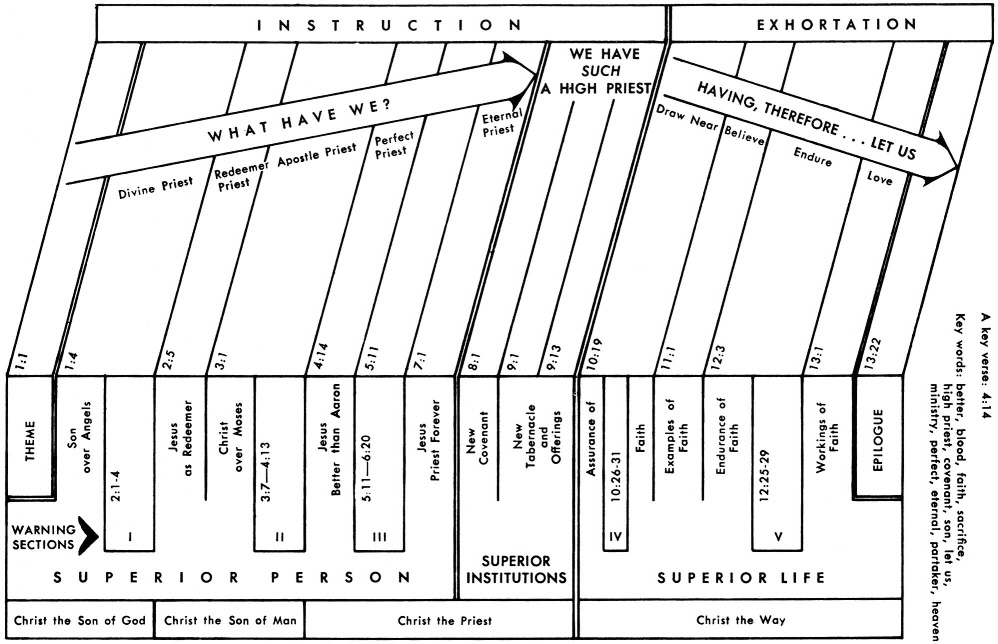
CONSIDER JESUS OUR GREAT HIGH PRIEST
Click chart to enlarge
Charts from Jensen's Survey of the NT - used by permission
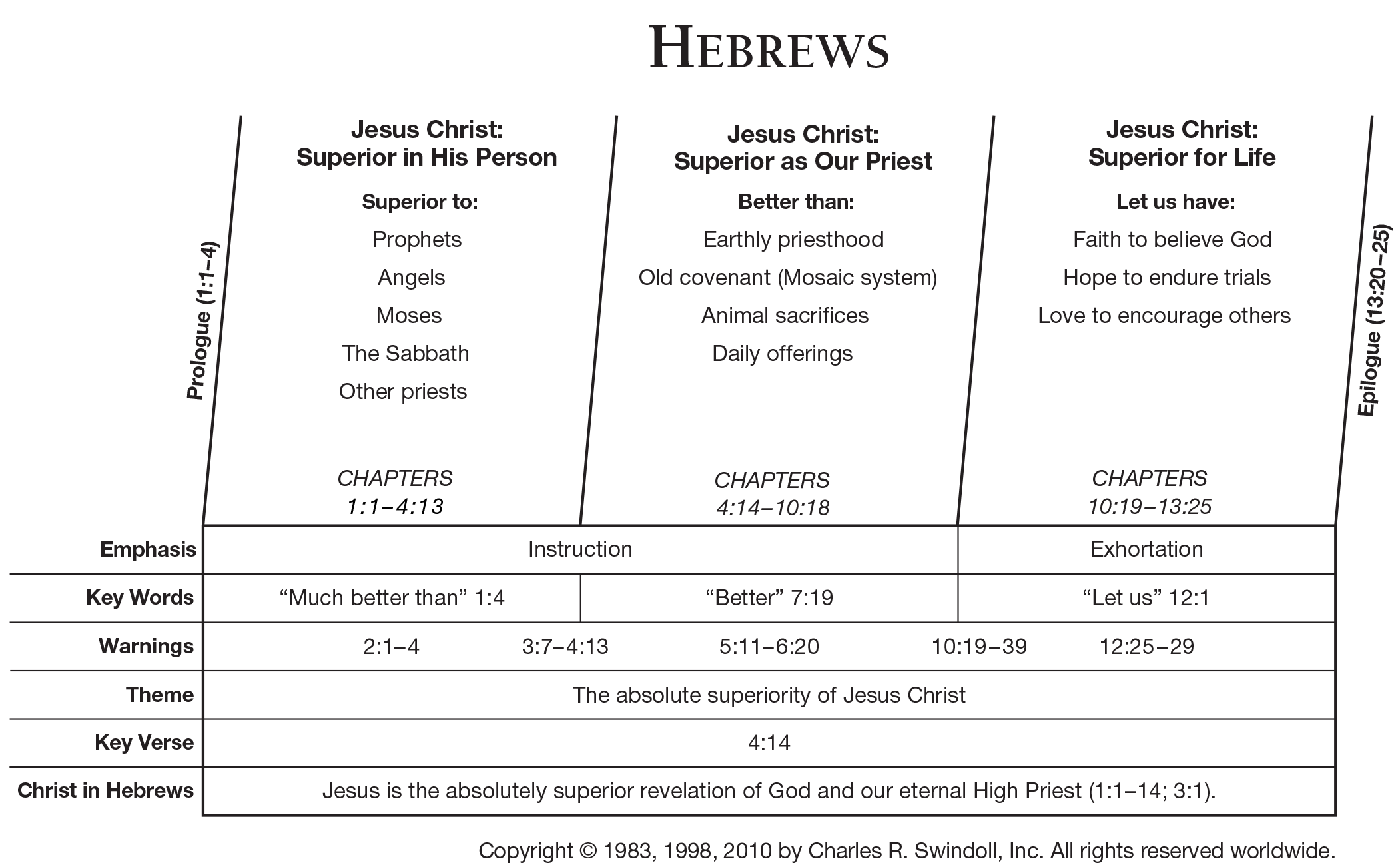
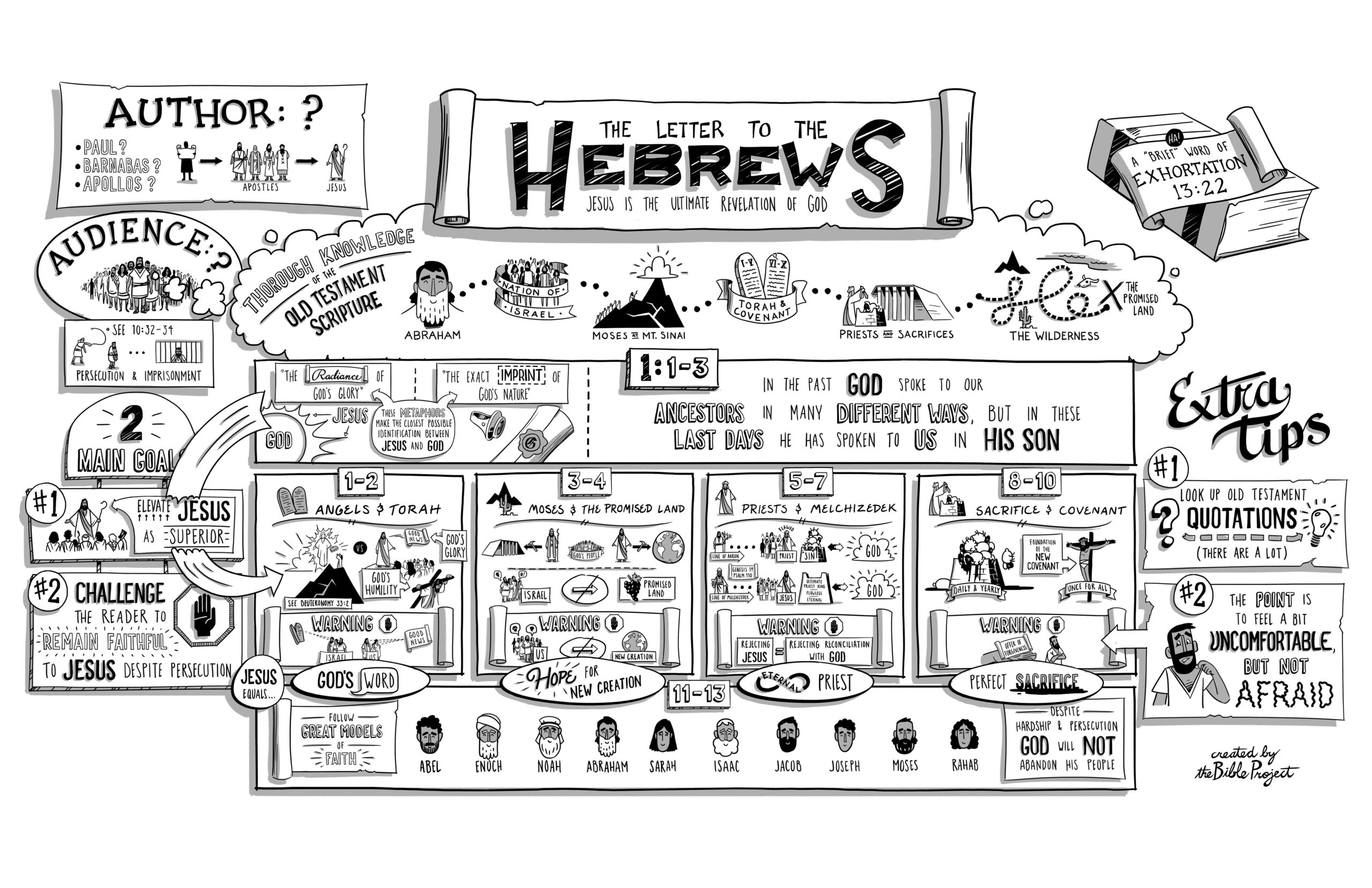
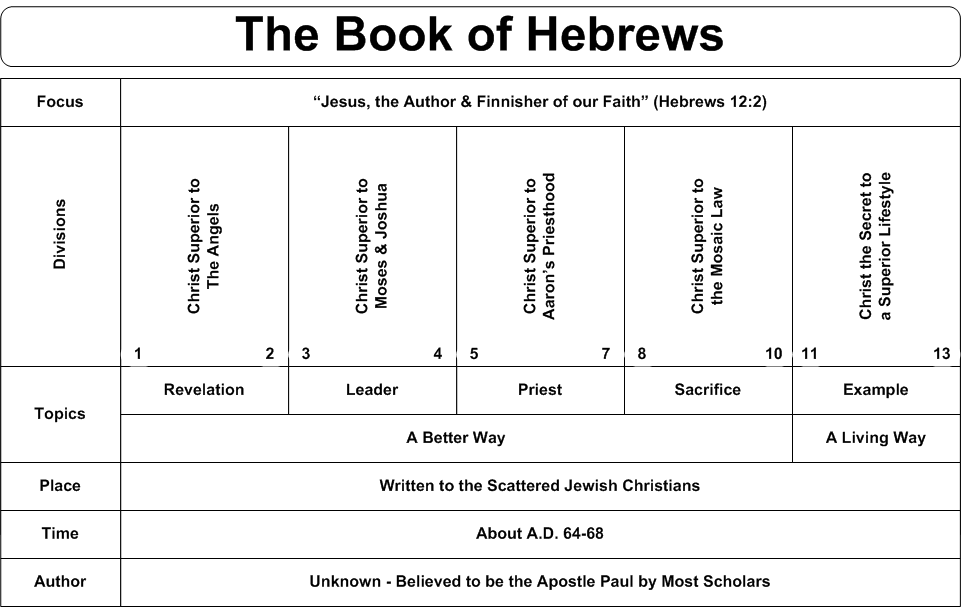
Swindoll's Chart, Interesting Pictorial Chart of Hebrews, Another Chart
|
The Epistle |
||||
| INSTRUCTION Hebrews 1-10:18 |
EXHORTATION Hebrews 10:19-13:25 |
|||
| REVELATION | RESPONSE | |||
| PRECEPTS | PRACTICE | |||
| DOCTRINE | DUTY | |||
| Superior Person of Christ Hebrews 1:1-4:13 |
Superior Priest in Christ Hebrews 4:14-10:18 |
Superior Life In Christ Hebrews 10:19-13:25 |
||
| BETTER THAN PROPHETS, ANGELS MOSES Hebrews 1:1-4:13 |
BETTER THAN AARON'S PRIESTHOOD Heb 4:14-7:28 |
BETTER THAN THE OLD COVENANT Heb 8:1-13 |
BETTER THAN ANIMAL SACRIFICES Heb 9:1-10:18 |
BETTER LIFE IN CHRIST THAN IN ADAM! |
| MAJESTY OF CHRIST |
MINISTRY OF CHRIST |
MINISTERS FOR CHRIST |
||
|
DATE WRITTEN: |
||||

See ESV Study Bible "Introduction to Hebrews"
(See also MacArthur's Introduction to Hebrews)
Borrow Ryrie Study Bible
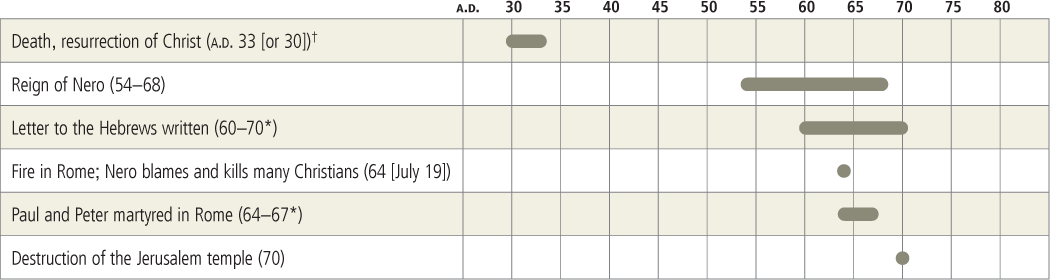
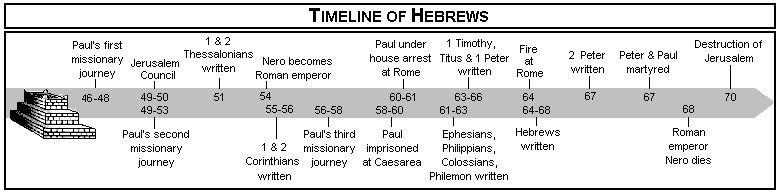
Timeline of Hebrews - ESV Study Bible
Hebrews 6:7 For ground that drinks the rain which often falls on it and brings forth vegetation useful to those for whose sake it is also tilled, receives a blessing from God; (NASB: Lockman)
Greek: ge gar e piousa (AAPFSN) ton ep' autes erchomenon (PMPMSA) pollakis hueton, kai tiktousa (PAPFSN) botanen eutheton ekeinois di' ous kai georgeitai, (3SPPI) metalambanei (3SPAI) eulogias apo tou theou;
Amplified: For the soil which has drunk the rain that repeatedly falls upon it and produces vegetation useful to those for whose benefit it is cultivated partakes of a blessing from God. (Amplified Bible - Lockman)
Barclay: For when the earth has drunk the rain that comes often times upon it and when it brings forth herbage useful to those who cultivate it, it receives a share of blessing from God; (Westminster Press)
ESV: For land that has drunk the rain that often falls on it, and produces a crop useful to those for whose sake it is cultivated, receives a blessing from God. (ESV)
KJV: For the earth which drinketh in the rain that cometh oft upon it, and bringeth forth herbs meet for them by whom it is dressed, receiveth blessing from God:
NET: For the ground that has soaked up the rain that frequently falls on it and yields useful vegetation for those who tend it receives a blessing from God. (NET Bible)
NIV: Land that drinks in the rain often falling on it and that produces a crop useful to those for whom it is farmed receives the blessing of God. (NIV - IBS)
NLT: When the ground soaks up the falling rain and bears a good crop for the farmer, it has God’s blessing. (NLT - Tyndale House)
Phillips: Ground which absorbs the rain that is constantly falling upon it and produces plants which are useful to those who cultivate it, is ground which has the blessing of God. (Phillips: Touchstone)
Wuest: For land which drank in the rain that comes often upon it and produces herbage suitable for those on whose account it is also tilled, partakes of a blessing from God.
Weymouth: For land which has drunk in the rain that often falls upon it, and brings forth vegetation useful to those for whose sakes, indeed, it is tilled, has a share in God’s blessing.
Young's Literal: For earth, that is drinking in the rain many times coming upon it, and is bringing forth herbs fit for those because of whom also it is dressed, doth partake of blessing from God,
FOR GROUND THAT DRINKS THE RAIN WHICH OFTEN FALLS ON IT: ge gar e piousa (AAPFSN) ton ep autes erchomenon (PMPMSA):
- Deut 28:11,12 Ps 65:9-13, Ps 104:11, 12, 13 Isaiah 55:10, 11, 12, 13 Joel 2:21, 22, 23, 24, 25, 26 James 5:7
- Hebrews 6 Resources - Multiple Sermons and Commentaries
For (gar) is a strategic term of explanation which should always prompt a pause to prayerfully ponder what the author is saying in a given section. This pause that refreshes will give your Teacher, the Spirit, an opportunity to speak to your heart (so that what you read is more than just head knowledge), not only illuminating the text (see The Bible and Illumination) but applying the text practically to your personal life (Application). Therefore, energized by the Spirit, let us discipline ourselves for godliness and frequently "P & P" (pause and ponder) the Word -- we are sure to be richly rewarded by our Father in Heaven, for "godliness is profitable for all things, since it holds promise for the present life and also for the life to come!" (1Ti 4:7-8-note, 1Ti 4:9-10-note)
To review remember that there are 4 Interpretative Views of Hebrews 6:4-8...
1). Saved, but lose salvation thru deliberate apostasy:
The Whole Counsel of God refutes the idea that one can lose his salvation. (Read passages like Jn 10:27-30+; Ro 8:35-37+;, Ep 1:13-14+, Ep 4:30+, Php 1:6+, He 10:14+, 1Pe 1:3-5+) (Can Salvation be Lost?; Once saved, always saved?; Does Hebrews 6:4-6 mean we can lose our salvation?; If our salvation is eternally secure, why does the Bible warn so strongly against apostasy?
2). Professors but not truly saved.
They clearly see the Truth ("enlightened"), experience the power to a degree ("tasted the good word of God and the powers of the age to come"), like Judas Iscariot (Mt 10:1-8) but they are like the rocky soil (see Lk 8:13), soil with thorns (Lk 8:14), who for a time conform to truth but in face of persecution (Lk 8:13), utterly and completely renounce the faith, falling away to perdition (Hebrews 3:12-note, Hebrews 10:39-note, Jn 17:12) (cf. Bruce, The Epistle to the Hebrews, pp. 118-125).
3). Saved persons who have fallen beyond repentance:
Falling into sin so that they are at the point of divine chastisement, having gone so far they cannot repent again of their sin. That they lose all their rewards.
4). Hypothetical case:
The proponents of this view feel that writer is presenting this hypothetical example to illustrate the folly of apostasy.
Ground that drinks the rain - The contrasting issue is either usefulness or worthlessness. The initial advantage described is the same and it is only the final result that is different.
Agricultural illustrations are frequent in Scripture (Isaiah 5:1-7- notes [Israel compared to a vineyard cultivated by God and yet did not yield fruit] ; Isaiah 28:23-29; Ezek 19:10-14 [Judah prospered like a luxuriant vine but God plucked the vine in judgment]]; Mt 3:10 [Divine judgment > fruitless persons would be destroyed like fruitless trees]; Matthew 7:16 see note).
John Piper writes concerning these verses that...
The two fields represent two kinds of persons: one a fruitful person. The other a fruitless person. Three words point to the final condemnation and lostness of the fruitless person. The fruitless field is worthless (Cf. Ro 1:28-note; 2Cor 13:5-7; 1Cor 9:24-25, 26-27; 2 Timothy 3:8-note; Titus 1:16-note - these verses all use adokimos - see notes Hebrews 6:8 ), and it is about to be cursed, and it's end (not means but end) is burning. Worthless, cursed, destined for burning. That is the language of final condemnation...The whole context tells us that more than a simple change of mind is involved (in their "falling away" in Hebrews 6:6). What's involved is a life that is persistently fruitless. That's the point of verse 7 -- the fruitless field. What brings the curse of God down on a person in this text is that they have drunk the rain of God's goodness year after year but have not brought forth any fruit.
The issue of apostasy is not primarily doctrinal, but practical. It's the problem of Hebrews 5:14 (note) where they are unwilling to put there faith into practice, and so their faculties are getting dull, right and wrong are becoming hazy, and the writer says, if you don't stop drifting (Hebrews 2:1-note) and neglecting your salvation (Hebrews 2:3 note) and forsaking the assembling of yourselves together (Hebrews 10:25-note) you are going to be hardened by the deceitfulness of sin and fall away from the living God (Hebrews 3:12-note; Heb 3:13-note).(See Related Discussion: The Deceitfulness of Sin)
What exposes a person to the danger of eternal loss in this text is the persistent failure to exercise the organ of faith in pumping the blood of obedience (see notes Hebrews 3:18; 4:11; 5:7; 5:8, 5:9; 10:36; 12:14). The issue at every point in Hebrews 5:11 to Hebrews 6:12 is the neglect of practical holiness not the abandonment doctrinal orthodoxy (as important as that is). And the falling away referred to in Hebrews 6:6 is the point at which the heart becomes so hardened and indifferent that it is beyond help any more.
If you allow yourself to drift down the river of sin with no zealous pursuit of holiness and growth in grace, there will come a point of no return." This is the great folly of those who profess to be Christians but live a carnal life thinking that they will clean things up in their old age.
I've told the story once before of the vulture who spotted the corpse of a fox on a big hunk of ice floating down the river toward Niagara Falls. He flies to the ice, lands and begins to eat the fox. He watches the falls approaching and hears the warnings of danger, but he tells himself that he has wings and is free and does not need to pay attention to such warnings. He is destined for the sky. At the last minute he finishes his feast and spreads his wings but he can't fly because his talons have frozen in the ice and he is dragged over the falls to his destruction.
And so it will be with people who have heard the warnings of scripture to abandon their worldly lusts and pursue holiness, but who say, "I have wings, I am a Christian. I can fly anytime I want to." The day will come when they may try and will not be able to repent because they are so hardened and addicted to the world they can't even feel one genuine spiritual affection (referring to Esau's regret without repentance - example of exposure to the Truth and yet their hardness - Hebrews 12:17 note). (See Piper's full pithy discussion The Doctrine of Perseverance)
F B Hole (Biographical Note) writes that - The contrast in verses 7 and 8 is not, you notice, between ground which this season is fruitful and the same ground which another season is unfruitful, but between ground which is essentially good and another piece which is essentially bad. The very form of this illustration supports the explanation just given of verses 4 to 6. Judas enjoyed "the rain that cometh oft," yet he only brought forth thorns and briars and was rejected. (Hebrews Commentary Notes)
Expositor's Bible Commentary - The process is illustrated from agriculture. There is land that frequently drinks in rain and as a result brings forth a crop. The rain comes first. The land does not produce the crop of itself. The spiritual parallel should not be overlooked. The word translated "a crop" (botane) is a general term for herbage; it does not mean any specific crop. "Useful to those for whom it is farmed" means that the beneficiaries are people in general and not only those who actually work on the farm. This land, then, receives God's blessing. (Gaebelein, F, Editor: Expositor's Bible Commentary 6-Volume New Testament. Zondervan Publishing)
AND BRINGS FORTH VEGETATION USEFUL TO THOSE FOR WHOSE SAKE IT IS ALSO TILLED, RECEIVES A BLESSING FROM GOD: pollakis hueton kai tiktousa (PAPFSN) botanen eutheton ekeinois di ous kai georgeitai (3SPPI) , metalambanei (3SPAI) eulogias apo tou theou:
- Ge 27:27 Lev 25:21 Ps 24:5 Ps 65:10 Ps 126:6 Isaiah 44:3 Ezek 34:26 Hosea 10:12 Mal 3:10
- Hebrews 6 Resources - Multiple Sermons and Commentaries
FRUITFUL FIELDS
BLESSED BY GOD
The rain comes first. The land does not produce the crop of itself. The spiritual parallel is that fruit-bearing is the evidence of a genuine faith and regeneration. Fruit-bearing (cf. John 15:5-6) is the evidence of a true relationship with Christ. The fruit of course is the evidence of and not the means of salvation.
It should be noted that some evangelical commentators like Dr Charles Ryrie feel that the writer is describing loss of rewards in Hebrews 6:6-7.
Brings forth (5088) (tikto) means to be born (of children in Mt 1:21 speaking of Mary declaring "she will bear a Son..."), here of course describing the earth producing or yielding vegetation. The present tense describes ground that continually (as a "lifestyle" so to speak) gives "birth" to useful vegetation.
Receives (3335) (metalambano from meta = with, denoting association + lambáno = receive) means to receive as one's share in or as one's part of. The idea is to share or participate in something.
Blessing (2129) (eulogia from eu = good, well + lógos = word) is literally a good word and by metonymy (figure of speech consisting of use of name of one thing for that of another of which it is an attribute or with which it is associated - e.g., "Washington" for the US government), blessing, favor conferred, gift, benefit, bounty.
Eulogia is the act of speaking in favorable terms (praise) or the benefit of blessing. Here it speaks primarily of the spiritual benefits bestowed by God upon His family members. He blesses because He is ready, willing and able to do so, not because we deserve His blessings or have earned them (it is all of grace). He is the source of all blessing, of every good thing. Goodness can only come from God because there is no source of goodness outside of God (the natural man bristles at truths such as this).
Jon Courson writes that "Just as rain falls on both briars and fruit-bearing plants, the glorious news of salvation would have been refreshing and renewing to those who understood that salvation is based solely and completely on the finished work of the Cross. But to those who insisted on returning to a works-based relationship with God, the same Word would be damning. (Courson, J: Jon Courson's Application Commentary: NT. Nelson. 2004)
Wycliffe Bible Commentary - In choosing to reject Christ, the apostates most resembled a field that yields only thorns and thistles, though the rains falling upon it and the farmers tilling were intended to produce beneficial herbs. There can be no mistaking the direct and strong warning to readers tempted to turn away from Christ. Indeed, what was true for these first century believers is still true for believers today. (Pfeiffer, C F: Wycliffe Bible Commentary. 1981. Moody)
KJV Bible Commentary - It should also be noticed that the illustration does not speak of a parcel of land that first produces and later becomes void of life; so it does not illustrate someone saved then lost. (Dobson, E G, Charles Feinberg, E Hindson, Woodrow Kroll, H L. Wilmington: KJV Bible Commentary: Nelson)
Wuest - In these verses the writer presents an analogy in nature. The abundant and frequently renewed rain, represents the free and reiterated bestowal of spiritual enlightenment and impulse to these Hebrews. One piece of ground reacts by producing herbage good for food. This is the Hebrew who accepts the New Testament by faith. On the other hand, the ground that receives the same rain, but produces thorns and briers, is likened to the Hebrew who being the recipient of the pre-salvation work of the Spirit, yet turns his back on Him and goes back to the First Testament sacrifices, the apostate who can look for nothing but certain judgment (Hebrews 10:26, 27, 28, 29, 30, 31). (Hebrews Commentary online)
Spurgeon - If, after having ploughed this ground, and sown it, and after it has been watered by the dew and rain of heaven, no good harvest ever comes of it, every wise man would leave off tilling it. He would say, “My labor is all thrown away on such a plot of ground as this. Nothing more can be done with it, for after having done my utmost nothing but weeds is produced, so now it must be left to itself.” You see, if it were possible for the work of grace in your souls to be of no avail, nothing more could be done for you. You have had God’s utmost effort expended upon your behalf, and there remains no other method of salvation for you. I believe that there have been some professors, such as Judas and Simon Magus, who have come very near to this condition, and others who are said, after a certain sort, to have believed, to have received the Holy Spirit in miraculous gifts, and to have been specially enlightened so as to have been able to teach others; but the work of grace did not affect their hearts, it did not renew their natures, it did not transform their spirits, and so it was impossible to renew them to repentance. When all that is possible is done for a piece of land, and yet it bears no harvest, it must be given up. If, after all, the Holy Spirit’s work in a man should prove fruitless, he must be given over to destruction; nothing else remains.
Hebrews 6:8 but if it yields thorns and thistles, it is worthless and close to being cursed, and it ends up being burned (NASB: Lockman)
Greek: ekpherousa (PAPFSN) de akanthas kai tribolous adokimos kai kataras eggus, es to telos eis kausin.
Amplified: But if [that same soil] persistently bears thorns and thistles, it is considered worthless and near to being cursed, whose end is to be burned. [Gen. 3:17, 18.] (Amplified Bible - Lockman)
Barclay: but if it produces thorns and thistles it is rejected and is in imminent danger of a curse, and its end is to be appointed for burning. (Westminster Press)
ESV: But if it bears thorns and thistles, it is worthless and near to being cursed, and its end is to be burned. (ESV)
KJV: But that which beareth thorns and briers is rejected, and is nigh unto cursing; whose end is to be burned.
NET: But if it produces thorns and thistles, it is useless and about to be cursed; its fate is to be burned. (NET Bible)
NIV: But land that produces thorns and thistles is worthless and is in danger of being cursed. In the end it will be burned. (NIV - IBS)
NLT: But if a field bears thorns and thistles, it is useless. The farmer will soon condemn that field and burn it. (NLT - Tyndale House)
Phillips: But ground which produces nothing but thorns and thistles is of no value and is bound sooner or later to be condemned - the only thing to do is to burn it clean. (Phillips: Touchstone)
Wuest: But if it brings forth thorns and thistles, it is rejected and almost cursed, and its end is burning.
Weymouth: But if it only yields a mass of thorns and briers, it is considered worthless, and is in danger of being cursed, and in the end will be destroyed by fire.
Young's Literal: and that which is bearing thorns and briers is disapproved of, and nigh to cursing, whose end is for burning;
BUT IF IT YIELDS THORNS AND THISTLES IT IS WORTHLESS: ekpherousa (PAPFSN) de akanthas kai tribolous adokimos :
- Heb 12:17 Ge 3:17,18 4:11 5:29 De 29:28 Job 31:40 Ps 107:34 Isaiah 5:1-7 Jer 17:6, 44:22 Mark 11:14,21 Lk 13:7-9
- Hebrews 6 Resources - Multiple Sermons and Commentaries
WORTHLESS
VEGETATION
Yields (1627) (ekphero from ek = out + phéro = bring, bear, carry) means to bear or carry out, bring forth, or yield. Note the present tense which means if it continually (as a "lifestyle") yields thorns and thistles.
Thorns (173) (akantha from ake = a point or prick) refers to a thorn plant, thistle or brier which abounds with pricks
Thistles (5146) (tribolos from treís = three + bélos = an arrow, dart, or bolís = dart) means three-pointed or three-pronged.
Vincent notes that the tribolos described "A ball with sharp iron spikes, on three of which it rested, while the fourth projected upward, was called tribulus or tribolos, or caltrop. These were scattered over the ground by Roman soldiers in order to impede the enemy’s cavalry. A kind of thorn or thistle, a land-caltrop, was called tribulus. (Vincent, M. R. Word Studies in the New Testament 4:447)
Worthless (96) (adokimos [word study] from a = without + dokimos = tested and thus reliable or acceptable) refers to that which is rejected after a trial or examination because it fails the test. It means to put to the test for the purpose of being approved, but failing to meet the requirements.
The basic meaning of adokimos is that of failing to meet the test or not standing the test. It describes that which does not prove itself to be such as it ought and which is therefore disapproved and useless. Worthless land does not produce fruit and does does not stand God's test. Adokimos a strong word and most of the NT's 8 usages (see below) refer to non-believers. In short adokimos describes that which is worthless, spurious, unqualified, disqualified, corrupted, not approved.
Adokimos was commonly used of metals that were rejected by refiners because of impurities. The impure metals were discarded, and adokimos therefore came to include the ideas of worthlessness and uselessness.
In relation to God, the rejecting mind becomes a rejected mind (Ro 1:28) and thereby becomes spiritually depraved, worthless and useless. Thus Paul records
Romans 1:28 And just as they did not see fit (dokimazo) to acknowledge God any longer, God gave them over to a depraved (adokimos) mind, to do those things which are not proper. (Comment: This is literally a disapproved mind or a mind which is no mind and cannot discharge the functions of one, a mind in which the divine distinctions of right and wrong are confused and lost, so that God’s condemnation cannot but fall on it at last). (see note Romans 1:28)
Study (and ponder) these other 6 NT uses of this picturesque adjective adokimos...
1Corinthians 9:27 but I buffet my body and make it my slave, lest possibly, after I have preached to others, I myself should be disqualified (adokimos).
Comment: Here adokimos presents a metaphor from the Isthmian games. A contestant who failed to meet the training requirements was disqualified from engaging in the athletic contest. Thus he could not even run, much less win. Note that Paul was not speaking of being disqualified from salvation, but of being disqualified as a usable instrument, a vessel of honor, of the Lord in ministry.
2 Corinthians 13:5+ Test (peirazo - present imperative) yourselves to see if you are in the faith; examine (dokimazo - present imperative) yourselves! Or do you not recognize this about yourselves, that Jesus Christ is in you-- unless indeed you fail the test (adokimos)?
2 Corinthians 13:6 But I trust that you will realize that we ourselves do not fail the test (adokimos).
2 Corinthians 13:7 Now we pray to God that you do no wrong; not that we ourselves may appear approved, but that you may do what is right, even though we should appear unapproved (adokimos).
2 Timothy 3:8 And just as Jannes and Jambres opposed Moses, so these men also oppose the truth, men of depraved mind, rejected (adokimos) as regards the faith. (see note)
Titus 1:16 They profess to know God, but by their deeds they deny Him, being detestable and disobedient, and worthless for any good deed. (see note)
Hebrews 6:8 but if it yields thorns and thistles, it is worthless (adokimos) and close to being cursed, and it ends up being burned.
There are 2 uses of adokimos in the Septuagint (LXX), Pr 25:4 and Isaiah 1:22.
Isaiah 1:22 Your (speaking of unfaithful, unsaved Israel) silver has become dross (Septuagint = adokimos = worthless), Your drink diluted with water.
Of unbelievers, Jeremiah wrote,
“They call them rejected (apodokimazo) silver, because the Lord has rejected them” (Jer 6:30).
The mind that finds God worthless becomes worthless itself. It is debauched, deceived, and deserving only of God’s divine wrath. The sinful, depraved mind says to God, “Depart from us! We do not even desire the knowledge of Thy ways."
John MacArthur asks "Do you see the illustration? All those who hear the gospel are like the earth. The rain falls, the gospel message is heard. The gospel seed is planted and there is nourishment and growth. Some of the growth is beautiful and good and productive. It is that which is planted, rooted, and nourished in God. But some of the growth is false, spurious, and unproductive. It has come from the same seed and has been nourished by the same ground and the same water, but has become thorny, destructive, and worthless. It has rejected the life offered it and become good only for burning. (MacArthur New Testament Commentary – Hebrews)
This group in Hebrews 6:4-6 (see Group 2) are professor whose deeds substantiate that their profession is false and their destiny is eternal burning in the Lake of fire.
Adam Clarke has a comment on adokimos appropriate to these who fall away - "Adulterate; like bad coin, deficient both in the weight and goodness of the metal, and without the proper sterling stamp; and consequently not current. If they did a good work, they did not do it in the spirit in which it should be performed. They had the name of God’s people; but they were counterfeit. The prophet said; Reprobate silver shall men call them." (Titus 1)
Adokimos was used to describe a counterfeit coin that fell below the standard weight, the worthless money being called adokimos. The word also was used of counterfeits of various sorts. Adokimos was used to describe a cowardly soldier who failed the test in the hour of battle. Adokimos described a candidate for office who the citizens regarded as useless. Finally a stone rejected by builders because of a flaw which made it unfit for construction, the rejected stone being clearly marked by a capital "A" (for adokimos) on it's surface. The ultimate test of life is usefulness, and the man whose influence is ever towards that which is unclean is of no use to God or to his fellow-men. Instead of helping God’s work in the world, he hinders it and uselessness always invites disaster.
It is as if these unsaved men profess Christ but in actuality deny Him and then have a giant "A" stamped on their head and heart. They stand forever rejected by the Master Architect and of no eternal value to Him in building His kingdom. This should break our hearts that these men and women are so deceived. Doubtless they will be among the
"Many (who) will say to Me on that day, 'Lord, Lord, did we not prophesy in Your name, and in Your name cast out demons, and in Your name perform many miracles?' (see note Matthew 7:22) to whom He declares "I never knew you; DEPART FROM ME, YOU WHO PRACTICE LAWLESSNESS." (see note Matthew 7:23)
The ultimate test in this life is usefulness to God and the man whose influence is ever towards that which is unclean is of no use to God or to his fellow men. Instead of helping God's work in the world, he hinders it and uselessness always invites disaster.
For many years John Wesley professed to be a Christian and yet when he truly examined himself realized he was not "in the faith" as illustrated by this brief excerpt from his sermon entitled "The Almost Christian":
I did go thus for many years, as many of this place can testify; using diligence to eschew all evil, and to have a conscience void of offence; redeeming the time; buying up every opportunity of doing all good to all men; constantly and carefully using all the public and all the private means of grace; endeavoring, after a steady seriousness of behavior, at all times, and in all places: and God is my record, before whom I stand, doing all this in sincerity; having a real design to serve God; a hearty desire to do his will in all things; to please him who had called me to “fight the good fight,” and to “lay hold on eternal life.” Yet my own conscience bears me witness, in the Holy Ghost, that all this time I was but almost a Christian.''
Fruitfulness is a test of genuine nature of a tree or plant and is a metaphor which Jesus Himself frequently used...
Therefore bring forth fruit in keeping with repentance (Mt 3:8)
Even so, every good tree bears good fruit; but the bad tree bears bad fruit. (see note Matthew 7:17)
And the one on whom seed was sown on the rocky places, this is the man who hears the word, and immediately receives it with joy; 21 yet he has no firm root in himself, but is only temporary, and when affliction or persecution arises because of the word, immediately he falls away. (Mt 13:20,21)
And those on the rocky soil are those who, when they hear, receive the word with joy; and these have no firm root; they believe for a while, and in time of temptation fall away. 14 "And the seed which fell among the thorns, these are the ones who have heard, and as they go on their way they are choked with worries and riches and pleasures of this life, and bring no fruit to maturity. (Luke 8:13-14)
And in a similar way these are the ones on whom seed was sown on the rocky places, who, when they hear the word, immediately receive it with joy; and they have no firm root in themselves, but are only temporary; then, when affliction or persecution arises because of the word, immediately they fall away. 18 "And others are the ones on whom seed was sown among the thorns; these are the ones who have heard the word, 19 and the worries of the world, and the deceitfulness of riches, and the desires for other things enter in and choke the word, and it becomes unfruitful. (Mk 4:16-19)
See related notes on assessing the genuineness of one's faith (Jas 2:14, 15, 16, 17, 18, 19, 20, 21, 22, 23, 24, 25, 26) - James 2:14 ; James 2:15; James 2:16; James 2:17; James 2:18; James 2:19; James 2:20; James 2:21; James 2:22; James 2:23; James 2:24; James 2:25; James 2:26
The rain that falls from heaven corresponds to the enlightening referred to in Hebrews 6:4-5 (see notes Hebrews 6:4; 6:5). If the seed of the word of God is truly present in the soil (the hearts of men and women), the rain causes fruitful crops to grow, fulfilling the blessing intended by God. On the other hand if the word of truth is heard but rejected, the rain can only bring to life that which is already in the soil (thorns and thistles).
Thomas Lea writes...
The author of Hebrews compared those believers who endure in their faith and produce fruit to fertile land which bears abundant crops. Those who never produce the evidence of righteousness are compared to land which never grew anything but weeds and thorns and is therefore worthless. The KJV translates the term worthless as "rejected." The word translated worthless (adokimos) also appears in 1Corinthians 9:27, where it describes someone disqualified from obtaining a prize or reward. In 2Corinthians 13:5, the same word identifies someone who failed a test. The word is used to picture those who claimed to be believers but presented no evidence. They could expect to confront the God who was a consuming fire (Heb. 12:29) in a future judgment. (Holman New Testament Commentary – Hebrews & James) (Bolding added)
Wayne Grudem adds that the writer in this section of Hebrews moves...
from (the) description of those who commit apostasy to a further analogy that shows that these people who fell away never had any genuine fruit in their lives.
As we explained above, Hebrews 6:7-8 speak of these people in terms of “thorns and thistles,” the kind of crop that is brought forth on land that has no worthwhile life in itself even though it receives repeated blessings from God (in terms of the analogy, even though rain frequently falls upon it).
We should notice here that people who commit apostasy are not compared to a field that once bore good fruit and now does not, but that they are like land that never bore good fruit but only thorns and thistles. The land may look good before the crops start to come up, but the fruit gives the genuine evidence, and it is bad (Ed note: For a parallel teaching see discussion of James 2:14-26).
Strong support for this interpretation of Hebrews 6:4-8 is found in the verse immediately following. Though the author has been speaking very harshly about the possibility of falling away, he then returns to speak to the situation of the great majority of the hearers, whom he thinks to be genuine Christians. He says,
“Though we speak thus, yet in your case beloved, we feel sure of better things that belong to salvation” (see note Hebrews 6:9).
But the question is “better things” than what? The plural “better things” forms an appropriate contrast to the “good things” that have been mentioned in Hebrews 6:4-6: the author is convinced that most of his readers have experienced better things than simply the partial and temporary influences of the Holy Spirit and the church talked about in Hebrews 6:4-6. (Grudem, W: Systematic Theology: An Introduction to Biblical Doctrine. IVP; Zondervan, 1994 = Highly Recommended resource!)
AND CLOSE TO BEING CURSED AND IT ENDS UP BEING BURNED: kai kataras eggus to telos eis kausin:
- Heb 10:27 Isaiah 27:10,11 Ezekiel 15:2-7, 20:47 Mal 4:1, Mt 3:10, 7:19, 25:41 John 15:6, Rev 20:15
- Hebrews 6 Resources - Multiple Sermons and Commentaries
Close (1451)(eggus) describes a position relatively close to another position or a point of time subsequent to another point of time, but relatively close. Near. Nigh.
Being cursed (2671) (katara from katá = against + ará = a curse) is an execration or imprecation. It can refer to a human utterance wishing evil on someone but this context implies it is God's righteous judgment on that which is unfruitful.
Ends up (5056) (telos from tello = to set out for a definite point or goal) is the culmination or the outcome of a growth or development representing an attained objective. Telos is never used in NT as a chronological end, as if something simply stops. Instead, telos speaks of a consummation, a goal achieved, a result attained, or a realization. Telos is the result of an event or process with special focus upon the final state or condition - outcome, result. Telos refers to the outcome of a growth or development representing an attained objective.
Telos used 5x in Hebrews...
Hebrews 3:6 (note) but Christ was faithful as a Son over His house whose house we are, if we hold fast our confidence and the boast of our hope firm until the end.
Hebrews 3:14 (note) For we have become partakers of Christ, if we hold fast the beginning of our assurance firm until the end;
Hebrews 6:8 (note) but if it yields thorns and thistles, it is worthless and close to being cursed, and it ends up being burned.
Hebrews 6:11 (note) And we desire that each one of you show the same diligence so as to realize the full assurance of hope until the end,
Hebrews 7:3 (note) Without father, without mother, without genealogy, having neither beginning of days nor end of life, but made like the Son of God, he abides a priest perpetually.
Being burned (2740) (kausis from kaio = to burn) Literally the Greek reads "the end into burning"
This person alluded to in Hebrews 6:7-8 reminds one of the spies at Kadesh-barnea (Dt 1:19-26 - see below) who saw the land and had the very fruit of it in their hands, and yet turned back! The Israelite spies had experienced to the full the goodness of God but unbelief manifested itself in disobedience and their unbelief blocked their entrance into God's Rest (ultimately His salvation Rest in Christ).
"Then (this was the first "step" on their journey to conquer the promised land) we set out from Horeb, and went through (about 100 miles) all that great and terrible (very arid) wilderness which you saw, on the way to the hill country of the Amorites, just as the LORD our God had commanded us; and we came to Kadesh-barnea.
20 "And I said to you, 'You have come to the hill country of the Amorites which the LORD our God is about to give us.
21 'See, the LORD your God has placed the land (promised land - "the land" of Genesis 12:1-2 promised in the Abrahamic Covenant) before you; go up, take possession, as the LORD, the God of your fathers, has spoken to you. Do not fear or be dismayed.'
22 "Then (notice who initiated this plan - not God!) all of you approached me and said, 'Let us send men before us, that they may search out the land for us, and bring back to us word of the way by which we should go up, and the cities which we shall enter.'
23 "And the thing pleased me (although He did not initiate this plan He agreed with it) and I took twelve of your men, one man for each tribe.
24 "And they turned and went up into the hill country, and came to the valley of Eshcol, and spied it out.
25 "Then they took some of the fruit of the land in their hands and brought it down to us; and they brought us back a report and said, 'It is a good land which the LORD our God is about to give us.'
26 "Yet you were not willing to go up, but rebelled against the command of the LORD your God;
27 and you grumbled (cp Ex 15:24, 16:2, 17:3) in your tents (really in your hearts) and said, 'Because the LORD hates us (sin corrupts one's vision of God's character!), He has brought us out of the land of Egypt to deliver us into the hand of the Amorites to destroy us (cf Ex 16:3, 17:3). (Dt 1:19-26)
Compare Hebrews 3:18-19...
And to whom did He swear that they should not enter His rest, but to those who were disobedient? 19 And so we see that they were not able to enter because of unbelief. (see notes Hebrews 3:18; 3:19)
John Piper writes that...
The danger is real lostness for ever -- the final curse of God and the fire of hell. He is not talking about a mere temporal disciplining of the child of God. He is talking about a final fiery curse. (See Piper's full discussion The Doctrine of Perseverance)
Paul and James also wrote of people who profess a connection with the Christian faith, but who subsequently fail to continue and thus show they are not genuine believers...
But actually, I wrote to you not to associate with any so-called brother (professed to be believers but habitually practice sin and thus was not a genuine believer) if he should be an immoral person, or covetous, or an idolater, or a reviler, or a drunkard, or a swindler-- not even to eat with such a one. (1Cor 5:11)
Or do you not know that the unrighteous shall not inherit the kingdom of God? Do not be deceived; neither fornicators, nor idolaters, nor adulterers, nor effeminate, nor homosexuals,10 nor thieves, nor the covetous, nor drunkards, nor revilers, nor swindlers, shall inherit the kingdom of God. 11 And such were some of you; but you were washed, but you were sanctified, but you were justified in the name of the Lord Jesus Christ, and in the Spirit of our God. (1 Corinthians 6:9-11)
Test (present imperative = command to continually do this) yourselves (Yourselves is emphatic - look at yourselves first! "Are you really a Christian?") to see if you are in the faith; examine (present imperative) yourselves! Or do you not recognize this about yourselves, that Jesus Christ is in you-- unless indeed you fail the test (adokimos)? (2Cor 13:5)
They profess to know God, but by their deeds they deny Him, being detestable and disobedient, and worthless for any good deed. (see note Titus 1:16)
Expositor's Bible Commentary - This land then, producing only what is worthless, awaits the curse. "Is in danger of being cursed" might give the impression that the land came close to being cursed but just escaped. The author seems rather to be saying that at the moment of which he speaks the curse has not yet fallen, certain though it is. Such a field in the end "will be burned." Some commentators think the writer knew little of agriculture, for the burning of the field was not a curse but rather a source of blessing as it got rid of the weeds and so prepared for a good crop. But whatever his knowledge of farming, he had a valid point. Land that produced nothing but weeds faced nothing but fire. The warning to professing Christians whose lives produce only the equivalent of weeds is plain. (Gaebelein, F, Editor: Expositor's Bible Commentary 6-Volume New Testament. Zondervan Publishing)
F B Meyer notes that...
The writer of this Epistle is eager to lead his readers from first principles to that strong meat which was befitting for those of mature growth; and, as he proceeds to do so, it was as though he were arrested by a sudden thought of some who had recently fallen away from the faith.
In the awful stress of trial which accompanied the fall of Jerusalem, the Hebrew Christians, who were still dwelling in Palestine, were strongly tempted to apostatize. Some, indeed, had done so. But can we really consider that they ever were true Christians? They went out, because they had never been truly of. They had been enlightened as to the doctrines of Christianity; but the enlightenment had been of their head rather than of their heart. They had tasted of the heavenly hopes, anticipations, and joys of the Gospel message, without really belonging to the Household of Faith. But, notwithstanding all, they had gone back.
It is impossible to renew such to repentance, whilst they go on living as they do, crucifying the Son of God by their vicious and cowardly course of action, and putting Him to an open shame. Notice that whilst, suggested by Bishop Westcott, of the margin of the r.v. It is the solution of the great difficulty which has perplexed many timid souls. The impossibility of renewal is only for those who persist in their evil ways. Abandon your sins, and God will restore you to your old place.
It cannot be too clearly emphasized that this text does not say that backsliders cannot be restored to the favor and forgiveness of God; but that they cannot be restored so long as they cling to the things which had been the sources of their declension. (Meyer, F. B. Our Daily Homily)
F B Meyer - Our Daily Homily - The writer of this Epistle is eager to lead his readers from first principles to. that strong ineat which was befitting for those of mature growth; and, as he proceeds to do so, it was as though he were arrested by a sudden thought of some who had recently fallen away from the faith.
In the awful stress of trial which accompanied the fall of Jerusalem, the Hebrew Christians, who were still dwelling in Palestine, were strongly tempted to apostatise. Some, indeed, had done so. But can we really consider that they ever were true Christians? They went out, because they had never been truly of. They had been enlightened as to the doctrines of Christianity; but the enlightenment had been of their head rather than of their heart. They had tasted of the heavenly hopes, anticipations, and joys of the Gospel message, without really belonging to the Household of Faith. But, notwithstanding all, they had gone back.
It is impossible to renew such to repentance, whilst they go on living as they do, crucifying the Son of God by their vicious and cowardly course of action, and putting Him to an open shame. Notice that whilst, suggested by Bishop Westcott, of the margin of the r.v. It is the solution of the great difficulty which has perplexed many timid souls. The impossibility of renewal is only for those who persist in their evil ways. Abandon your sins, and God will restore you to your old place.
It cannot be too clearly emphasized that this text does not say that backsliders cannot be restored to the favor and forgiveness of God; but that they cannot be restored so long as they cling to the things which had been the sources of their declension. (Meyer, F. B. Our Daily Homily)