Hebrews 7:1
Hebrews 7:2
Hebrews 7:3
Hebrews 7:4
Hebrews 7:5
Hebrews 7:6
Hebrews 7:7
Hebrews 7:8
Hebrews 7:9
Hebrews 7:10
Hebrews 7:11
Hebrews 7:12
Hebrews 7:13
Hebrews 7:14
Hebrews 7:15
Hebrews 7:16
Hebrews 7:17
Hebrews 7:18
Hebrews 7:19
Hebrews 7:20
Hebrews 7:21
Hebrews 7:22
Hebrews 7:23
Hebrews 7:24
Hebrews 7:25
Hebrews 7:26
Hebrews 7:27
Hebrews 7:28
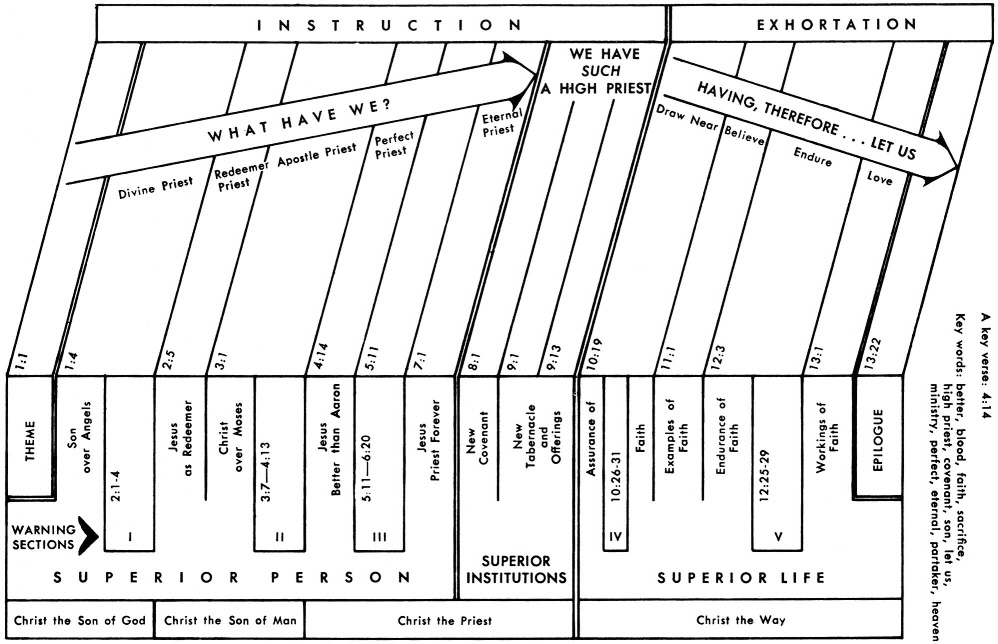
CONSIDER JESUS OUR GREAT HIGH PRIEST
Click chart to enlarge
Charts from Jensen's Survey of the NT - used by permission
Swindoll's Chart, Interesting Pictorial Chart of Hebrews, Another Chart
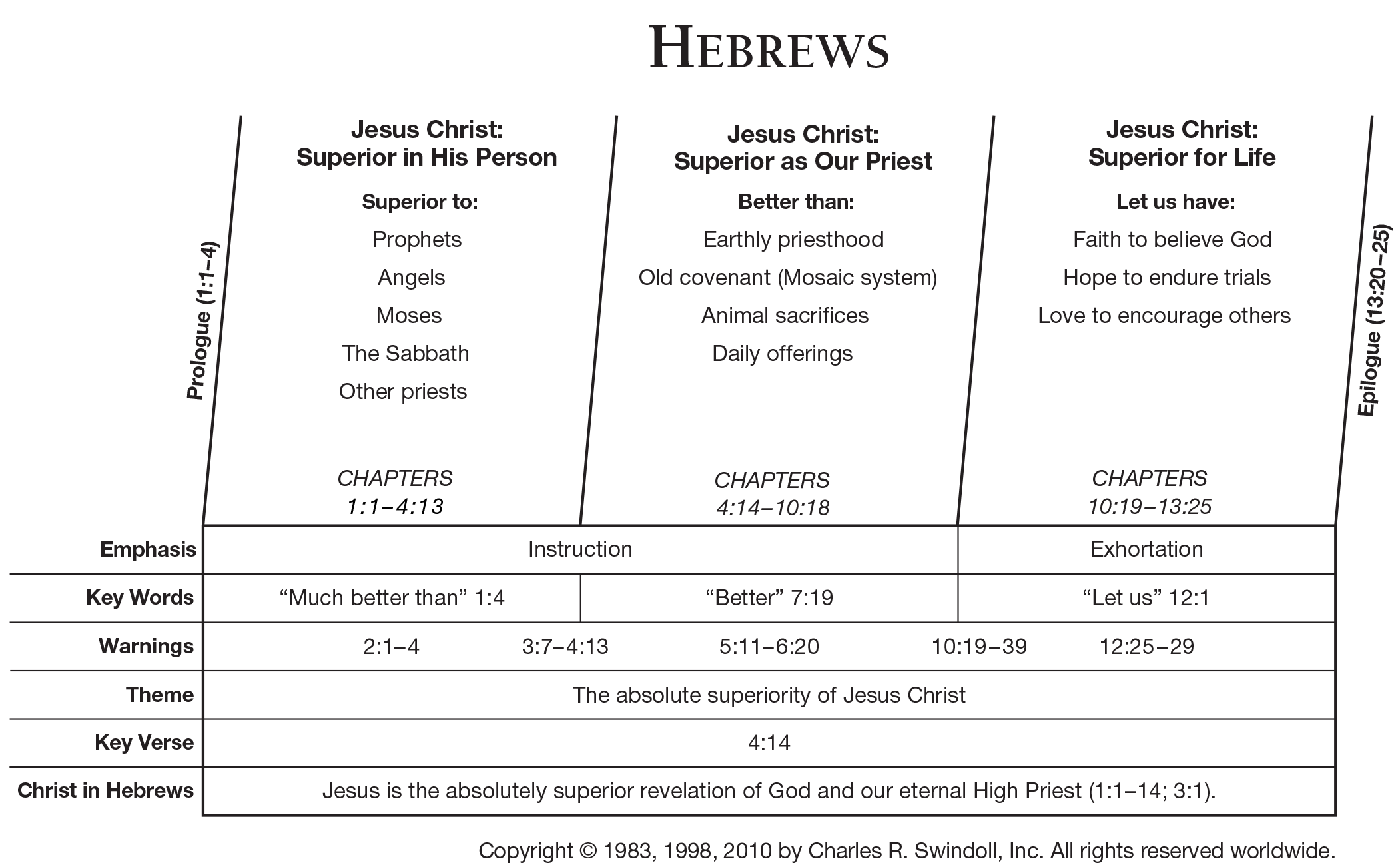
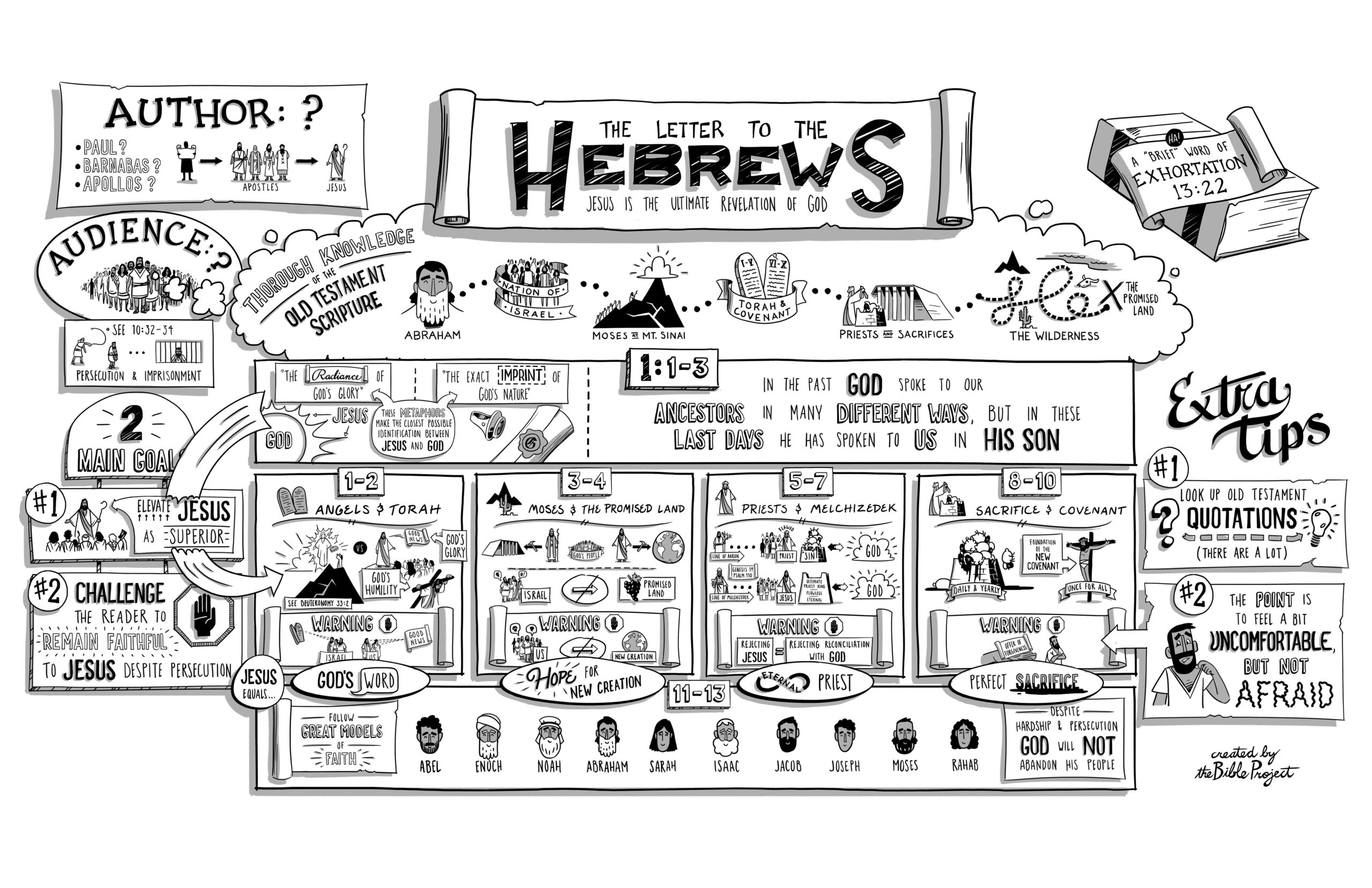
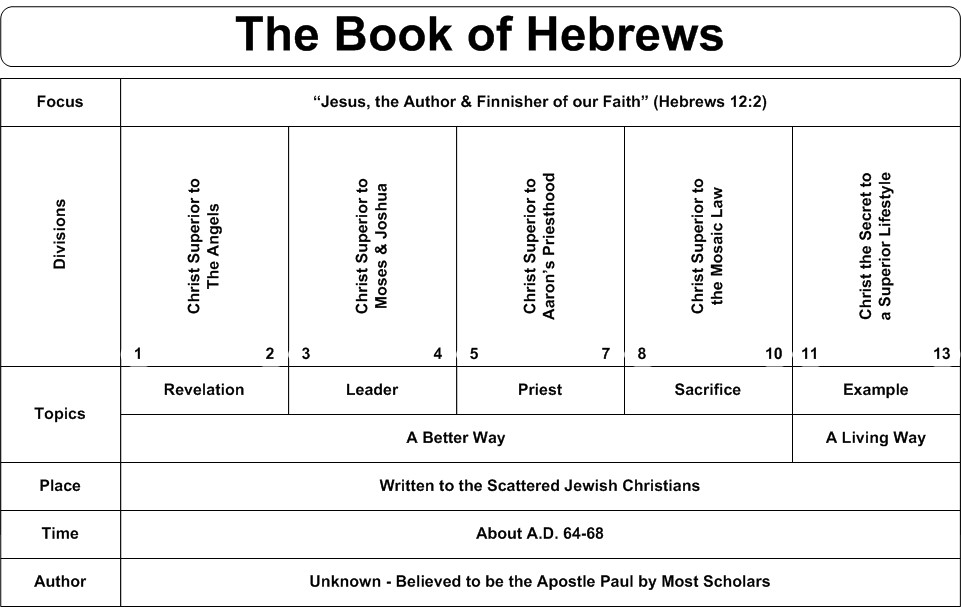
|
The Epistle |
||||
| INSTRUCTION Hebrews 1-10:18 |
EXHORTATION Hebrews 10:19-13:25 |
|||
| Superior Person of Christ Hebrews 1:1-4:13 |
Superior Priest in Christ Hebrews 4:14-10:18 |
Superior Life In Christ Hebrews 10:19-13:25 |
||
| BETTER THAN PERSON Hebrews 1:1-4:13 |
BETTER PRIESTHOOD Heb 4:14-7:28 |
BETTER COVENANT Heb 8:1-13 |
BETTER SACRIFICE Heb 9:1-10:18 |
BETTER LIFE |
| MAJESTY OF CHRIST |
MINISTRY OF CHRIST |
MINISTERS FOR CHRIST |
||
|
DOCTRINE |
DUTY |
|||
|
DATE WRITTEN: |
||||

See ESV Study Bible "Introduction to Hebrews"
(See also MacArthur's Introduction to Hebrews)
Borrow Ryrie Study Bible
Hebrews 7:1 For this Melchizedek, king of Salem, priest of the Most High God, who met Abraham as he was returning from the slaughter of the kings and blessed him, (NASB: Lockman)
Greek: Houtos gar o Melchisedek, basileus Salem, hiereus tou theou tou hupsistou, o sunantesas (AAPMSN) Abraam hupostrephonti (PAPMSD) apo tes kopes ton basileon kai eulogesas (AAPMSN) auton,
Amplified: FOR THIS Melchizedek, king of Salem [and] priest of the Most High God, met Abraham as he returned from the slaughter of the kings and blessed him (Amplified Bible - Lockman)
KJV: For this Melchisedec, king of Salem, priest of the most high God, who met Abraham returning from the slaughter of the kings, and blessed him;
NLT: This Melchizedek was king of the city of Salem and also a priest of God Most High. When Abraham was returning home after winning a great battle against many kings, Melchizedek met him and blessed him. (NLT - Tyndale House)
Young's Literal: For this Melchisedek, king of Salem, priest of God Most High, who did meet Abraham turning back from the smiting of the kings, and did bless him,
|
THE WORK OF |
||
| PAST | PRESENT | FUTURE |
| He has appeared at the Cross for Propitiation |
He now appears at the right hand of the throne for Intercession |
He shall appear a Second time for the elect's final Deliverance |
| He appeared for our Redemption |
He now appears for our Representation |
He shall appear for our Rewards |
| He has appeared in Humiliation | He does appear in Exaltation | He shall appear in Universal Manifestation |
| He has appeared for our Justification | He does appear for our Sanctification | He shall appear for our Glorification |
INTRODUCTION TO HEBREWS 7 - Chapter 7 is a critical section because it concerns the introduction of a better priesthood. No sacrifices were possible without a priest (therefore no "forgiveness") and therefore the priesthood was greatly revered by Jews.
Remember that in Hebrews 5:5-10 the writer began to speak of the Melchizedek but then began a lengthy parenthetical section from Hebrews 5:11 through Hebrews 6:20. This parenthesis was to prepare his "dull of hearing" readers so that they might better understand of this important chapter. There is a point of application we in the modern church need to consider and it is this -- the solid food and sound doctrine of Scripture is not revealed by the Spirit to those who are spiritually lazy or apathetic. In Hebrews 7:4 we encounter the only command in this entire chapter (Heb 7:4) and the command is to give careful consideration (as contrasted with a superficial reading) to the teaching on Melchizedek because he is a type of Jesus Christ.
The background of course is Jewish readers who had professed belief in Christ and were being tempted to abandon their faith in the Messiah and return to Judaism under threat of persecution as described in chapter 10...
But remember the former days, when, after being enlightened, you endured a great conflict of sufferings, 33 partly, by being made a public spectacle through reproaches and tribulations, and partly by becoming sharers with those who were so treated. 34 For you showed sympathy to the prisoners, and accepted joyfully the seizure of your property, knowing that you have for yourselves a better possession and an abiding one. (Heb 10:30)
And so the writer is trying to convince them to break with Judaism and the rituals that their forefathers had followed for centuries. He is trying to show them a better way. And so he focuses on the supremacy of Christ, the great High Priest, Who is the fulfillment of all that was written by Moses and the prophets. And he picks up his thoughts on Melchizedek from Hebrews 5 because he wants to explain that Jesus is not a priest like the familiar Levitical priests, but is of a different order of Melchizedek and because of that, He is a better priest than any of the priests in the old system. Ironically the old system was never intended to be the end but the means, to the coming Messiah.
Chapter 7 is the focal point of Hebrews...
the priesthood was exalted in Judaism
John MacArthur points out that "Chapter 7 is the focal point of Hebrews. It concerns the central, the most important, part of Judaism—the priesthood. No sacrifices could be made except by the priest and no forgiveness of sins could be had apart from the sacrifices. Obedience to the law was exceedingly important, but the offering of sacrifices was even more important. And the priesthood was essential for offering them. Consequently, the priesthood was exalted in Judaism." (See Hebrews Commentary)
Ray Stedman points out that "The unfolding of the meaning of the Melchizedek priesthood of Jesus is the goal toward which the author has been aiming ever since Hebrews 2:17, where he first uses the term high priest with reference to Jesus... These themes are little noted or understood in the average church today but desperately needed if the church (or the individual Christian) is to confront the world with power and grace. (Hebrews Commentary )
R C H Lenski introduces chapter 7 noting that "The readers, former Jews who were now thinking of returning to Judaism, are here confronted with their great forefather Abraham and are shown how he accepted the royal priest Melchizedek long before Levi and Aaron were born and the Aaronitic high priesthood came into existence. The readers want to be true sons of Abraham, yea, are thinking of returning to Judaism for that very reason. Well, let them look at Abraham and at the one priest to whom Abraham bowed. Let them consider what God said through David regarding this royal priest and regarding the Messiah-Christ who is typified by Melchizedek. (Borrow Hebrews Commentary)
Warren Wiersbe - Chapter 7 of Hebrews introduces the second main section, as we have outlined it: A superior Priesthood (Heb. 7-10). In Hebrews 7, the writer argued that Christ's priesthood, like Melchizedek's, is superior in its order. In Hebrews 8, the emphasis is on Christ's better covenant; in Hebrews 9, it is His better sanctuary; and Hebrews 10 concludes the section by arguing for Christ's better sacrifice....In spite of their many failures, the priests had served God for centuries; but now the writer has affirmed that their priesthood has ended! (Bible Exposition Commentary)
As Matthew Henry says "Nothing made the Jews so fond of the Levitical dispensation as the high esteem they had of their priesthood, and it was doubtless a sacred and most excellent institution; it was a very severe threatening denounced against the Jews (Hos. 3:4), that the children of Israel should abide many days without a prince or priest, and without a sacrifice, and with an ephod, and without teraphim. Now the apostle assures them that by receiving the Lord Jesus they would have a much better high priest, a priesthood of a higher order, and consequently a better dispensation or covenant, a better law and testament...(and now the writer) sets before them some of the strong meat he had spoken of before in Hebrews 5, hoping they would by greater diligence be better prepared to digest it."
John Piper helps us understand we are in desperate need of a High Priest for as Piper explains "the reason for all this talk about Christ’s relation to Melchizedek in verses 1–24 is because the eternal, superior priesthood of Jesus is our only hope of eternal salvation. God’s wrath never changes. There is only one hope for sinners like us. We must have a faithful High Priest, Who will intercede for us forever. We need a King of righteousness (He 7:2). We need a King of peace (He 7:2). We need Someone without beginning and ending (He 7:3). Someone Who has an indestructible life (verse 16) and will never die and need to be replaced (He 7:23,24). We need Someone greater than Abraham and greater than Levi—something like Melchizedek, who blessed Abraham, (He 7:6,7) and who received tithes from Abraham and, in a sense, from Levi in Abraham (He 7:5, He 7:6, He 7:8-10). We need a new and greater Priest—so much greater that Heb 7:11 says there was no perfection through the Levitical priesthood. All the Old Testament priesthood could do was point toward the One superior Priest (after the order of Melchizedek, Psalm 110:4), Whose sacrifice of Himself and Whose eternal intercession would guarantee eternal salvation for all God’s people. So the first implication of He 7:25 is that all this truth about priesthood is because what we need saving from is the wrath of God. God’s way of solving that problem is priesthood. This is not ours to figure out or solve. God has to do it for us. And He has done it. He ordains a Priest, His Son. And don’t make a mistake here. It’s not as though Jesus the Priest loves us and God the Father doesn’t. God the Father ordains the priesthood for our salvation. It is His idea. He sends the Priest. It is His own Son Whom He sends. And He loves Him infinitely. All this is the love of God rescuing us from the wrath of God, in such a way that the justice of God is vindicated and the glory of God is exalted. (Full sermon Hebrews 7:1-25 Jesus: from Melchizedek to eternal Saviour)
See excellent overview sermon on Hebrews 7:1-10 by Steven Cole.
FOR THIS MELCHIZEDEK: houtos gar ho Melchisedek:
- Heb 6:20; Genesis 14:18-20
- Hebrews 6 Resources - Multiple Sermons and Commentaries
Related Passages:
Genesis 14:17-20 (Moses writes) Then after his return from the defeat of Chedorlaomer and the kings who were with him, the king of Sodom went out to meet him at the valley of Shaveh (that is, the King's Valley). 18 And Melchizedek (means "king of righteousness") king of Salem (means "peace", thus Melchizedek was "king of peace". Salem in this context is another name for Jerusalem and the first mention of the "city of God" in the Bible) brought out bread and wine; now he was a priest (the first mention of a priest in Scripture) of God Most High (El Elyon). 19 And he blessed him and said, "Blessed be Abram of God Most High, Possessor of heaven and earth; 20 And blessed be God Most High, Who has delivered your enemies into your hand." And he (Abraham) gave him (Melchizedek) a tenth of all. (NOTE THAT the writer of Hebrews in Hebrews 7:1 substitutes Melchizedek in place of the King of Sodom as the one who met Abraham at the Valley of Shaveh, probably the modern day Kidron Valley [or here])
Psalm 110:4 (David writes that about 500 years after Genesis 14) The LORD has sworn and will not change His mind, "Thou art a priest forever according to the order of Melchizedek."
Hebrews 5:6 just as He says also in another passage, “YOU ARE A PRIEST FOREVER ACCORDING TO THE ORDER OF MELCHIZEDEK.”
Hebrews 5:10 being designated by God as a high priest according to the order of Melchizedek.
Hebrews 6:20 where Jesus has entered as a forerunner for us, having become a high priest forever according to the order of Melchizedek.
Psalms 76:2 His tabernacle is in Salem; His dwelling place also is in Zion.
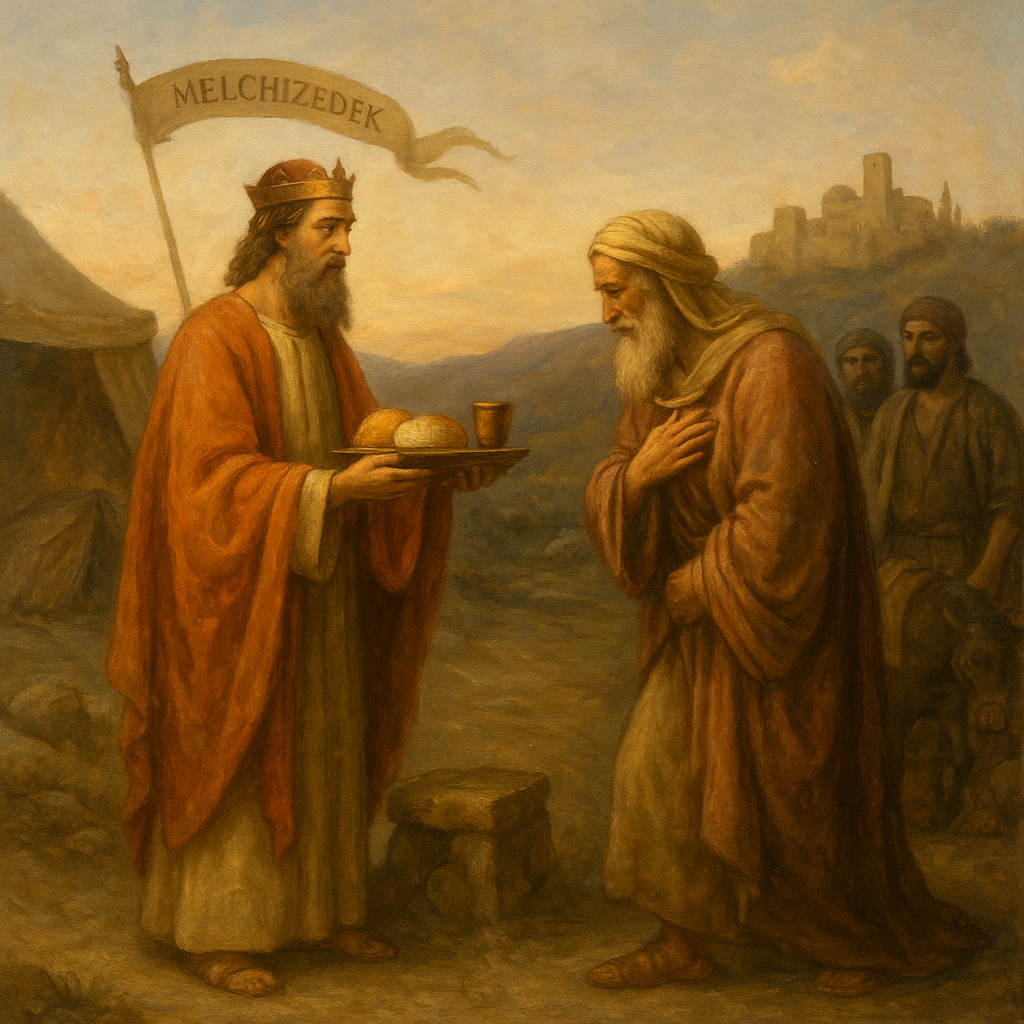
Melchizedek Blessing Abram Ge 14:19
A PROVIDENTIAL, PROPHETIC MEETING OF
MELCHIZEDEK AND ABRAHAM
For (gar) this Melchizedek - This is first in the Greek text for emphasis to draw our attention to this mysterious character in Scripture thus linking this verse with Hebrews 6:20. The writer is elaborating on the previous verse where we learned that "Jesus has entered heaven as a forerunner for us, having become a high priest forever according to the order of Melchizedek." (He 6:20) In another sense Hebrews 7 is an explanation of Hebrews 5:10-11 and now he begins to take "much to say."
Brian Bell - Wiersbe said, The Emphasis in Hebrews is not on what Christ did on the earth (the milk of the word), but what He is doing in heaven (the meat of the word). 2. He is saying that, the basics of the Christian life revolves around Jesus earthly ministry and work. While His priestly ministry constitutes the meat of God’s word. a) Jesus’ ministry on earth was only 3 years...but His ministry in heaven has so far been 2000 years, since His cross/res.
For (gar) is a strategic term of explanation which should always prompt a pause to prayerfully ponder what the author is saying in a given section. This pause that refreshes will give your Teacher, the Spirit, an opportunity to speak to your heart (so that what you read is more than just head knowledge), not only illuminating the text (see The Bible and Illumination) but applying the text practically to your personal life (Application). Therefore, energized by the Spirit, let us discipline ourselves for godliness and frequently "P & P" (pause and ponder) the Word -- we are sure to be richly rewarded by our Father in Heaven, for "godliness is profitable for all things, since it holds promise for the present life and also for the life to come!" (1Ti 4:7-8, 1Ti 4:9-10+)
The purpose of the exposition on Melchizedek is
to validate Jesus’ priesthood by grounding it in Scripture.
This Melchizedek - The author assumes the audience’s familiarity with Melchizedek but now unpacks his significance. This is the writer's fourth mention of Melchizedek (Heb 5:6,10, 6:20) and there will be five more in chapter 7 (Heb 7:1, 10, 11, 15, 17, 21). In Hebrews 7, in effect the writer devotes 28 verses to an exposition of the Old Testament texts on Melchizedek—though the entire subject reflects just three verses in Genesis 14:18-20 and a single reference by David about 400 years later in Psalm 110:4. The writer of Hebrews now expands on Melchizedek, showing how this historical Old Testament figure is a type of and an affirmation of the legitimacy of Jesus’ priesthood. Melchizedek’s priesthood is non-Levitical and universal, predating the Law and Levitical Priesthood (note) by centuries. This sets up the argument that if Abraham (father of Israel) acknowledged such a pre-Law priest, then Jesus’ priesthood outside the Levitical line is legitimate.
🙏 THOUGHT - "If a writer of the New Testament considered Old Testament episodes—even something so brief as this encounter with Melchizedek—so important, we would do well to become as familiar as possible with the wealth of information God has revealed in the Old Testament! (Dwight Pentecost) (What a contrast Pentecost's exhortation is to the advice of a well known pastor, Andy Stanley, who has made the shocking statement that we need to "unhitch" from the Old Testament. See article by Thomas Schreiner and a review by Michael Krueger of his book advocating "unhitching" from the Old Testament).
King (basileus) of Salem (see SALEM), priest (hiereus) of the Most High (hupsistos) God (cf El Elyon), who met Abraham (Ge 14:18-20) as he was returning (hupostrepho) from the slaughter (kope) of the kings (basileus) and blessed (eulogeo) him - Salem is probably another name for Jerusalem, as deduced from Psalm 76:1-2 "God is known in Judah; His name is great in Israel. And His tabernacle is in Salem; His dwelling place also is in Zion. (Ps 76:1,2) The Hebrew word for ‘Salem” is shalem which is derived from the same root as shalom or “peace”. Genesis 14:18 and Psalm 76:2 are the only occurrences of Salem in the OT. It is important to note that Melchizedek although not a Levitical priest was a legitimate priest of the Most High God. Contrary to the Levitical priests Melchizedek was both a priest and a king.
Spurgeon on Melchizedek - Consider how great Melchizedek was. There is something majestic about every movement of that dimly revealed figure. His one and only appearance is thus fitly described in the book of Genesis: “And Melchizedek, the king of Salem, brought out bread and wine (He was the priest of God Most High). And he blessed him and said, ‘Blessed be Abram by God Most High, Maker of heaven and earth. And blessed be God Most High who delivered your enemies into your hand.’ And he gave to him a tenth of everything” (Ge 14:18–20). We see but little of him, yet we see nothing little in him. He is here and gone, as far as the historic page is concerned, yet he is “a priest forever,” (Ps 110:4) and “it is testified that he lives” (Heb 7:8). Everything about him is on a scale majestic and sublime. Melchizedek seems to have been, first by name, and then by place of office, doubly designated a king. First, his name is Melchizedek , which signifies by interpretation, “king of righteousness.” His personal name is “king of righteousness.” As a matter of fact, he was also the monarch of some town called Salem. It is not at all likely to have been Jerusalem, although that may have been the case. The interpretation of his official name is “king of peace.” He was one who worshiped God after the primitive fashion, a believer in God such as Job was in the land of Uz, one of the world’s gray fathers who had kept faithful to the Most High God. He combined in his own person the kingship and the priesthood; a conjunction by no means unusual in the first ages. (See full sermon The Man Christ Jesus)
So when Abraham returned to his home after the slaughter of the kings he was a hero, at the pinnacle of martial success. Can you see him proudly astride his lumbering camel, smeared with the dirt and blood of battle, leading his 318 proud men plus Lot and all the captives and all the plunder through Jerusalem? If so, you have the “feel” necessary to begin to appreciate Abraham’s strange, mystic encounter with a shadowy figure of immense grandeur — Melchizedek, the priest-king of Salem. In this background and a sense of Abraham's incredible victory against all odds we read these words in Hebrews 7:1 "This Melchizedek, king of Salem, priest of the Most High God, who met Abraham as he was returning from the slaughter of the kings and blessed him." Imagine the joy and victory that was in the air. It would have been enough to go to any man's head, but not Abraham, for he recognized that the victory was not his, but ultimately that they victory was the Lord's. And so he chose to honor King Melchizedek who was also the priest of the Most High God Who had given him the victory. Our victories from day to day may not be as dramatic but they are no less always a reflection of the fact that the victory belongs to the Lord (El Elyon: Most High God - Sovereign Over All).
🙏 THOUGHT - Are we quick to acknowledge this eternal truth when accolades and adulation come our way? Let us seek to have an "Abraham attitude" as we bask in the victory, whether it be over the world, the flesh or the devil. As David said some 500 years later "Thine, O LORD, is the greatness and the power and the glory and the victory and the majesty, indeed everything that is in the heavens and the earth; Thine is the dominion, O LORD, and Thou dost exalt Thyself as head over all. (1 Chronicles 29:11, cf Ps 115:1)
Gerald Hawthorne rightly remarks that Melchizedek's "greatness is seen from the fact that he blessed Abraham the patriarch (i.e., the father of us all) at a time when Abraham was second to none in the land—victor over Chedorlaomer and the kings who were with him, and from the fact that Abraham gave him a tenth of everything. (New International Bible Commentary)
John MacArthur gives us some background on the Levitical priest to help understand Melchizedek's priesthood and how it pointed to Jesus' priesthood -- First, as mentioned above, the entire tribe of Levi was dedicated by God for religious service. Although all priests were Levites, not all Levites were priests. All priests, in fact, not only had to be descended from Levi but also from Aaron, Moses’ brother. The non-priestly Levites served as helpers to the priests, and probably as singers, instrumentalists, and the like. The priesthood was strictly national, strictly Jewish. Second, the Levites were subject to the king just as much as were the other tribes. Their priestly functions were not under the control of the king, but in all other matters they were ordinary subjects. They were in no way a ruling class. A Levite, in fact, could not be king. They were set aside as a first fruit to God for special priestly service (Num. 8:14–16). Third, the priestly sacrifices, including the one by the high priest on the Day of Atonement, were not permanent. They had to be repeated and repeated and repeated—continually. They had no permanence. They provided no permanent forgiveness, no permanent righteousness, no permanent peace. Fourth, the Levitical priesthood was hereditary. A man who served as a priest did so because he was born into the right family, not because he lived a right life. Fifth, just as the effects of the sacrifices were temporary, so was the time of priestly service. A priest served from the age of 25 until the age of 50, after which his ministry was over (Num. 8:24–25). (See Hebrews Commentary - Page 174)
King of Salem - In the next verse the writer tells us this equates with king of peace.
The Most High God - (See all NT uses of phrase "Most High") In Hebrew "Most High God" is El Elyon (note) one of the great names of God (they are all great of course!) which is expressive of God's sovereignty over all things.
R C H Lenski asks and answers an important question - But how could there be “a priest of God the Most High” in this idolatrous country of Canaan? The answer must be that the true religion of Noah had been fully conserved in Melchizedek. “The Most High” is not relative, not polytheistic: the highest of many gods as Zeus was called “the highest”; “Most High” is absolute, monotheistic: High beyond all other things. We now say “God Almighty” to express the same idea. “Most High” appears a number of times in the New Testament, being appropriated from the Old. (Borrow Hebrews Commentary)
Brian Bell Melchizedek was both King & Priest – This was forbidden by the Levitical priesthood. The throne & the altar were always separated. Those persons who attempted to invade the priests’ office were judged by God. a) But here is a man who had both offices. Aaron never had that privilege. b) And it is important to note that Melchizedek was not a counterfeit priest: he was the priest of the Most High God (Gen.14:18, 22). His ministry was legit. c) He was of God’s original priesthood since he preceded Levi by several hundred yrs. Jesus wasn’t from the tribe of Levi (7:14, Judah instead). He could fulfill what the prophet Zechariah said, He(Messiah) shall be a priest on His throne, and the counsel of peace shall be between them both(both offices). Zech 6:13. Jesus thus fulfills both titles of Melchizedek. He is the King of Righteousness. & the King of Peace. Ps.85:10 says Righteousness and peace have kissed. (yep, on the cross) “The trouble for many is they want the Peace without the Prince.” (you?)
THOUGHT (Brian Bell) - Application: Jesus as King can control circumstances around you; Jesus as Priest can change attitudes within you. Of course God could change the circumstances around you (i.e. yank you out of them, or deal with your foe/opposer)...but often God’s more concerned with changing your attitudes while in you’re in the circumstance.
In the Old Testament, the throne (KING) and the altar (PRIESTS) were separated and any person who was not of the Levitical priesthood who attempted to act as priest was judged by God.
But Uzziah (a king who was attempting to function as a priest), with a censer in his hand for burning incense, was enraged; and while he was enraged with the priests, the leprosy broke out on his forehead before the priests in the house of the LORD, beside the altar of incense. (2 Chronicles 26:19)
Melchizedek is thus a unique man with a unique designation as both king and priest! Melchizedek's specific identity does not detract from the powerful logic of the writer of Hebrews, who is appealing to his Hebrew Scriptures to substantiate his argument. He is saying in essence that even the Hebrew Scriptures recognize a priesthood that is distinct from that of Aaron, and that furthermore, this priesthood antedates Aaron's priesthood by literally hundreds of years.
WHAT does Melchizedek's blessing of Abraham (and the fact that Abraham received it) show about Melchizedek's relation to the great patriarch Abraham? Melchizedek not only blessed Abraham but also blessed the Most High God (Ge 14:19-20). Note that blessing conveys divine favor and is meditated through the one with authority to bestow the blessing. Ans so the SIGNIFICANCE OF BLESSING ABRAHAM is that Melchizedek was shown to be greater than Abraham (who submitted to the blessing), who was himself the great patriarch and recipient of God’s promises and father of the ten tribes of Israel (including Levi). Therefore, by extension, this act of blessing would serve to elevate Melchizedek above the Levitical priesthood that descended from Abraham. This simple act begins to show that Melchizedek’s priesthood is legitimate, divinely appointed, and superior to the later Levitical system and prepares the reader's for the revelation that Jesus' priesthood in the order of Melchizedek is superior to the Levitical priesthood.
John Calvin points out that it is remarkable that Melchizedek lived with Sodom on one side and the Canaanites on the other, and yet he was a righteous king and priest. This shows that God can raise up a godly witness for Himself when and where He pleases. Here are Calvin's comments...
It was doubtless no common thing that in a country abounding in the corruptions of so many superstitions, a man was found who preserved the pure worship of God; for on one side he was nigh to Sodom and Gomorrah, and on the other to the Canaanites, so that he was on every side encompassed by ungodly men. Besides, the whole world was so fallen into impiety, that it is very probable that God was nowhere faithfully worshipped except in the family of Abraham; for his father and his grandfather, who ought to have retained true religion, had long before degenerated into idolatry. It was therefore a memorable fact, that there was still a king who not only retained true religion, but also performed himself the office of a priest. And it was doubtless necessary that in him who was to be a type of the Son of God all things excellent should be found: and that Christ was shadowed forth by this type is evident from the Psalm referred to; for David did not say without reason, “Thou art a priest forever after the order Melchisedec;” no, but on the contrary, by these words a sublime mystery was recommended to the Church.
JEWISH FALSE TEACHING ON MELCHIZEDEK (See also the false teaching of Mormons) - The question is would the Jewish readers of Hebrews have known these teachings? We cannot state with certainty because the written form of the Targums (Targum Onkelos - Torah and Targum Jonathan - Prophets) were not available until the first and second centuries AD. Oral forms did pre-date Christ. So could the readers of Hebrews been biased by this false teaching? It is a moot (debatable) point. In the Targum, which reflects rabbinic interpretation (and in this case non-Biblical speculation), Melchizedek is identified as Shem, Noah's son (Targum Ps.-J. Gen 14:18; see esp Carmona, Est Bib 37 [1978] 79-102). The rabbis made the totally unsubstantiated remark that the priesthood was transferred to Abraham and his posterity at the meeting recorded in Genesis 14:18-20 because Melchizedek proved to be unworthy of his office! WOE! The implications of this specious rabbinic interpretation would negate the writer's argument in Hebrews 7 in view of the fact that Levi eventually came from the line of Abraham and thus according to the rabbi's false teaching the Levitical priesthood is the legitimate successor to the priesthood forfeited by Melchizedek. The rabbinic literature goes on to make the ridiculous application of the description of Psalm 110:4 to Abraham (cp, R. Ishmael as early as 135 AD). In so doing they totally ignore the context for Ps 110:1 states "The LORD says to my Lord: “Sit at My right hand Until I make Your enemies a footstool for Your feet.” This is clearly a Messianic psalm.
Rabbinic Interpretation of Ps 110 (After Christ) Early rabbis recognized that the psalm had messianic elements. Midrash Tehillim (on Ps 110) and other rabbinic sources apply it to the Messiah, sometimes called “the son of David.” However, as Christians strongly used Psalm 110:1 and 110:4 to prove Jesus’ Messiahship and priesthood, rabbinic Judaism shifted. To avoid Christian interpretations, some rabbis re-read it as referring not to the Messiah but to Abraham, David himself, or even Melchizedek. This shows a kind of reactionary hermeneutic to distance Jewish exegesis from Christian claims. This reminds me of disclaimers on some movies or articles "The names have been changed to protect the innocent!" Of course in this case the names have been changed to assure that the innocent are duped and damned if they never have their eyes opened to the truth!
Priest (2409) (hiereus from hieros = sacred, holy, consecrated to God, used as a noun to mean a sacred place or temple, cp Mark 11:11) is a sacred or consecrated person who serves God (or the false gods in the pagan religions). Hiereus describes the specific position and not necessarily a priest’s character. See discussion of Levitical Priesthood below
W. G. Moorehead defines a priest as "One who is duly qualified to minister in sacred things, particularly to offer sacrifices at the altar, and to act as mediator between men and God. (ISBE)
Priest in Latin is pontifex (from pont-, pons = bridge + facere = to make) which literally means a bridge maker, and is word used even today to describe the Pope as "Pontifex Maximus" (maximus = greatest, highest), which literally means the "greatest bridge builder" and in modern parlance "the Highest Priest".
Wuest - The Roman emperor was Pontifex Maximus, a high priest upon the throne of the Caesars. But our Lord Jesus is a high priest who, now seated upon a throne of grace, will some day as High Priest in the Messianic Kingdom occupy the throne of David in Jerusalem, as Zechariah says, “He shall be a priest upon his throne” (Zech. 6:13). (Hebrews Commentary online)
Most High (highest) (5310) hupsistos superlative of hupsos = height from hupsi = high, aloft) in a spatial sense means the highest (highest places). Figuratively of the highest possible status. In view of God's superior rank and power it is an appropriate descriptive Name of God. He is the Most High which also emphasizes His as dwelling in the highest heavens far exalted above all other things. Hupsistos is used in the plural in the phrase "in the highest" (in the "highest" regions, the abode of God) as in Hosanna in the highest (Mt 21:9, Mk 11:10) The adjective hupsistos is used in the Septuagint to translate the Hebrew Name of God El Elyon -- "And Melchizedek king of Salem brought out bread and wine; now he was a priest of God Most High (hupsistos)." (Ge 14:18, 19, 20, 22, cp Nu 24:16 in connection with Balaam) And it is not surprising, that where there is truth, there is usually a counterfeit - thus the Greeks called Zeus hupsistos, the "highest" to be distinguished from their lesser false gods!
Returning (Turn away from) (5290) hupostrepho from hupo = under + strepho = to turn, to change) means to turn back from or to return (go back to a location). Peter uses hupostrepho figuratively meaning these men made a definite turn back to (aorist tense = completed effective action in the past) a previous belief. The made a change to their former belief which describes the perversion and defection of the false teachers. They professed "the way of righteousness" and had access to the true teachings of Scripture ("the holy commandment") but by their lives they demonstrated that they had chosen to reject Christ so they turned back to the Christ-rejecting, godless belief..
Friberg - intransitively in the NT turn back, return; with eis and the accusative of place or state be again in, return to (Luke 1.56); with apo, and the genitive return from (Lk 4.1); with ek and the genitive turn away from (2P 2.21)
Slaughter (2871)(kope from kopto = to cut off, strike) describes carnage alluding to Ge 14:17.
Gilbrant - Kopē is related to the verb koptō (2847), “to cut or strike.” Kopē primarily denotes the act of cutting or cutting to pieces and by implication “carnage” or “slaughter.” In the Bible it is an intense term indicating the killing of enemies in war. It is used in the Septuagint for Abraham’s slaughter of the kings when he rescued Lot (Genesis 14:17) and in Hebrews 7:1 which refers to that event (the only New Testament occurrence). In his address to the fledgling nation of Israel about disobedience, Moses warned that among other things God would give Israel up to its enemies for slaughter (Deuteronomy 28:25). One other use of kopē is found in Joshua 10:20. This text recounts Joshua’s rout of the five-king alliance that attacked Gibeon. (Complete Biblical Library)
Kings (935) basileus occurs throughout Greek literature, including the Septuagint (e.g., Genesis 14:1; Exodus 1:8; Judges 3:8; et al.), with the same meaning, i.e., “a king.” It is used 118 times in the New Testament. It refers to secular rulers such as kings and emperors: Herod (Matthew 2:1), David (Matthew 1:6), Agrippa (Acts 25:13), Melchizedek (Hebrews 7:1), and kings in general (1 Timothy 2:2). Basileus refers to divine rulers: God (Matthew 5:35); Christ, as King in general (Luke 23:2), as King of kings (1 Timothy 6:15), as King of the Jews (Matthew 2:2), as King of Israel (Matthew 27:42), and as King of saints (Revelation 15:3). Among the church fathers, Christ was also referred to as King of all creation, and King of the Church; and the Holy Spirit was referred to as King. Among the secular writers basileus was used to refer to pagan deities such as Zeus. Basileus also is used in the New Testament to refer to the saints who will rule and reign with Christ (Revelation 5:10), and to evil powers such as Abaddon (Revelation 9:11; cf. Abaddōn [3]).
- See 7 Page Discussion of King, Kingship in Dictionary of Biblical Imagery page 1624
- See 19 Page Discussion of King in The New International Dictionary Of New Testament Theology page 372
BASILEUS IN HEBREWS - Heb. 7:1; Heb. 7:2; Heb. 11:23; Heb. 11:27
Blessed (2127) eulogeo from eu = good + lógos = word; see cognates eulogetos and eulogia) means speak good or well. When eulogeo is used by men toward men it means to speak well of with praise and thanksgiving (English "Eulogy" = an address in praise for one deceased ). To say good or positive things. Eulogeo can be from men to God, from men to men, and from God to men. When God blesses men He grants them favor and confers happiness upon them.
EULOGEO IN HEBREWS Heb. 6:14; Heb. 7:1; Heb. 7:6; Heb. 7:7; Heb. 11:20; Heb. 11:21 - 38V - Matt. 14:19; Matt. 21:9; Matt. 23:39; Matt. 25:34; Matt. 26:26; Mk. 6:41; Mk. 8:7; Mk. 11:9; Mk. 11:10; Mk. 14:22; Lk. 1:42; Lk. 1:64; Lk. 2:28; Lk. 2:34; Lk. 6:28; Lk. 9:16; Lk. 13:35; Lk. 19:38; Lk. 24:30; Lk. 24:50; Lk. 24:51; Lk. 24:53; Jn. 12:13; Acts 3:26; Rom. 12:14; 1 Co. 4:12; 1 Co. 10:16; 1 Co. 14:16; Gal. 3:9; Eph. 1:3; Heb. 6:14; Heb. 7:1; Heb. 7:6; Heb. 7:7; Heb. 11:20; Heb. 11:21; Jas. 3:9; 1 Pet. 3:9
Brian Bell Melchizedek - King of Righteousness.
1. Gen.14 He’s brought up in a Historical context.
2. Ps.110 He’s brought up in a Prophetical context. [only twice in OT]
3. Heb.7 He’s brought up in a Doctrinal context.
Hebrews 7 is an important chapter for in it the writer establishes the following points...
1). Melchizedek’s historic identity
2). Melchizedek’s precedence and superiority to Levitical priesthood
a). Abraham paid him tithes (so then did Levi)
b). Melchizedek blessed Abraham
3). The need for a replacement of the Law because it...
a). Could not make perfect
b). Jesus was from another tribe not specified in Mosaic Law
4). The advantages of the Melchizedekian order...
a). A better hope = access to God (draw near)
b) A guarantee of a better covenant
c). A permanent priesthood
d). Salvation forever... and a priest Who ever intercedes
5). A dramatic contrast between Jesus' priesthood and the Levitical priesthood
a) Jesus is holy, innocent, undefiled, separated, exalted
b). Jesus offered up one sacrifice of himself for all time.
Operation Entebbe is a fascinating modern day "equivalent" of the Genesis 14 account of Abraham's daring exploit. The following account of Operation Entebbe is taken from Wikipedia "On June 27, 1976, Air France Flight 139, an Airbus A300 originating from Tel Aviv, carrying 248 passengers and a crew of twelve, took off from Athens, heading for Paris. Soon after the 12:30 p.m. takeoff, the flight was hijacked by two Palestinians from the Popular Front for the Liberation of Palestine - External Operations (PFLP-EO) and two Germans from the German "Revolutionary Cells (RZ)" (Wilfried Böse and Brigitte Kuhlmann), who commandeered the flight, diverting it to Benghazi, Libya. There it was held on the ground for seven hours for refueling, during which time a female hostage who pretended she was pregnant was released. The plane left Benghazi, and at 3:15 it arrived at Entebbe Airport in Uganda." (Read the full account)
Uganda at that time was ruled by the dictator Idi Amin who welcomed the hijacked airliner which remained at Entebbe Airport the next 7 days as the PLO hijackers prepared for their next move. Like the raiders who had taken Lot captive in Genesis 14, the PLO hijackers certainly appeared to be in total control of their Israeli captives who were on this flight. But unbeknownst to the hijackers, three Israeli C-130 Hercules transports were on there way from Tel Aviv to Entebbe with a Israeli commandos, who within hours attacked the airport under the cover of darkness. In less than one hour the commandos rushed the old terminal, gunned down the hijackers, and rescued 110 of the 113 hostages. The next day Israel’s Premier Yitzhak Rabin declared "This operation will certainly be inscribed in the annals of military history, in legend and in national tradition” and indeed it has been so honored, even as was Abraham's daring raid some 4000 years earlier! Abraham with only “318 trained men” from his own household took off in hot pursuit of Lot and his kidnappers and under the cover of night deployed his relatively small force in a surprise attack which put the four kidnapper kings to flight.
Lawrence Richardson - Christ is no levitical priest; His priesthood is of a totally different order (Heb 7:1–11). Thus every element of the Mosaic system is also replaced: its ineffective Law (Heb 7:12–19), its mortal priesthood (Heb 7:21–28), its inadequate gifts and sacrifices (Heb 8:1–6). Christ has instituted the promised New Covenant, which brings forgiveness and renewal to all who believe (Heb 8:7–13).....
Even today a person’s family name has significance. That’s one reason why a Japanese firm recently bought a controlling interest in a Rockefeller holding company. With it, they purchased the right to use the name “Rockefeller” in their marketing!
The family line—the name of the person to whom one’s identity can be traced—was particularly significant in Judaism. And thus the writer took great pains to show that Jesus’ priesthood is not Aaronic, but can be traced back to a more ancient and honorable name.
For us the name to which we trace our identity is Jesus Christ. We hold up that name whenever we identify ourselves as Christians. Because Christ’s name is so honorable, it is vital that everything we do makes it shine even brighter. And that nothing we do tarnishes a single letter.
MADE NEW IN RIGHTEOUSNESS AND TRUE HOLINESS - NIV, Once-A-Day: Walk with Jesus: 365 Days in the New Testament
This Melchizedek was king of Salem and priest of God Most High. HEBREWS 7:1
Scripture records that Melchizedek was “without father or mother, without genealogy, without beginning of days or end of life, resembling the Son of God” (Hebrews 7:3).
And resembling Melchizedek, Christ is “king of righteousness” and “king of peace” (Hebrews 7:2).
But what does all this mean for the believer? Alexander Maclaren explains Jesus’ role as the righteous King.
WALK WITH ALEXANDER MACLAREN
“The very heart of the Christian doctrine is this: As soon as a person puts his trembling trust in Jesus Christ as his Savior, then he receives not merely pardon and the uninterrupted flow of the divine love in spite of his sin, but an imparting to him of that new life, which, after God, is created in righteousness and true holiness.
“Do not suppose that the great message of the gospel is merely forgiveness. Do not suppose that its blessed gift is only that one is acquitted because Christ died.
“All that is true. But there is something more. By faith in Jesus Christ, I am so knit to him that there passes into me, by his gift, a life which is created after his life, and is in fact kindred with it.
“He is first of all King of righteousness. Let that which is first in all his gifts be first in all your efforts too; and do not seek so much for comfort as for grace to know and to do your duty, and strength to ‘put aside the deeds of darkness and put on the armor of light’ (Romans 13:12).”
WALK CLOSER TO GOD
Because Jesus is righteous, you are forgiven and God sees you as righteous. Because Jesus is righteous, you can live a righteous life—through the power of his life in you.
Abraham gave to Melchizedek a “tenth of everything” (Genesis 14:20) as a sign of his subjection to one greater than he. Is it too much to ask that you, being made righteous by the King of righteousness, give him your life in return?
As an aside, the reader will undoubtedly encounter a wide variety of interpretations on the identity of Melchizedek, some of the more fanciful interpretations including the following...
(1). Angel = Origen, Didymus
(2). Enoch = Husius, Calmet
(3). Shem = the rabbis of the first century sought to identify him with Shem, the oldest son of Noah, to counter the Christian view of him as a type of Christ. The early Christian writers for the most part objected to this as invalidating the claim of Hebrews that Melchizedek was “without genealogy,” since the genealogy of Shem was well known.
(4) Some Gnostic cults (Gnosticism) taught that Melchizedek was a theophany (visible manifestation) of the Holy Spirit, while a later sect saw him as a preincarnate appearance of the Son of God.
(5) The Dead Sea Scrolls (Cave 11 at Qumran) spoke of Melchizedek as the coming great Deliverer of the Jewish remnant and equated him with the archangel Michael.
(6) Jerome (340-420 AD), author of the Latin Vulgate translation of the Bible , stated that early church authorities such as Irenaeus, Hippolytus, Eusebius of Caesarea and Apollinaris all viewed Melchizedek as a man and the majority of the Reformers followed this view.
A number of writers interpret Melchizedek as a preincarnate appearance of Christ and base this interpretation on facts from the OT and Hebrews...
(1). The names, the king of righteousness and king of peace are very similar to names attributed to Christ (He 7:2)
(2). His lack of a recorded genealogy - "without father, without mother, without genealogy, having neither beginning of days nor end of life" (He 7:3)
(3). "He abides a priest perpetually" (He 7:3)
(4). Contrasted with mortal men - "mortal men receive tithes, but in that case one (Melchizedek) receives them, of whom it is witnessed that he lives on" (Heb 7:8)
COMMENT - One of the strongest arguments against that interpretation is the writer's clear statement that he was "made like the Son of God" (He 7:3)
John Calvin - And it was doubtless necessary that in him who was to be a type of the Son of God (See Biblical Typology; Typology on site; Utley on Typology) all things excellent should be found: and that Christ was shadowed forth by this type is evident from the Ps 110
Steven Cole (his sermons are highly recommended) - Melchizedek is a type of Christ in the dignity of his person. Everything we know about Melchizedek comes from Genesis 14:18-20, Psalm 110:4, and Hebrews 7. The first text is historical, the second is prophetic, and the third is theological. (See sermon Why You Need to Know About Melchizedek)
Alfred Edersheim - That Melchizedek was not Christ Himself is evident from the statement that he was “made like unto the Son of God” (or “likened unto” Him, Heb. vii. 3); while it equally appears from these words, and from the whole tenor of Scripture, that he was a type of Christ.
Matthew Henry - The most general opinion is that he was a Canaanite king, who reigned in Salem, and kept up religion and the worship of the true God; that he was raised to be a type of Christ (See Biblical Typology; Typology on site; Utley on Typology; Utley on Typology), and was honoured by Abraham as such.
R Kent Hughes - In the writer’s opening statement he concisely states the significance of the historical Melchizedek as a type of the ultimate priesthood of Christ: Melchizedek was “without father or mother, without genealogy, without beginning of days or end of life, [and] like the Son of God he remains a priest forever” (v. 3). Some have inferred from these words that Melchizedek must have been an angel who took on human form for Abraham, or even a pre-incarnate appearance of Jesus Himself. But such interpretations are unnecessary, because the writer is simply using a rabbinical method of interpretation from silence. His point is that the Genesis account does not mention Melchizedek’s parents or genealogy or when he was born or died, thereby providing a fitting type of what would be fleshed out in the qualifications of Christ (See Biblical Typology; Typology on site; Utley on Typology) (See Hebrews: An Anchor for the Soul)
H A Ironside - There is no reason to think of Melchisedec as a mysterious person, possibly supernatural, or even as some have supposed a preincarnate appearance of our Lord Jesus Christ. If any ask, "Who is Melchisedec?" the only proper answer is "Melchisedec." He was not Shem the son of Noah, nor Job of the land of Uz, nor Cheops the builder of the great pyramid, as some have endeavored to prove. He was, as is distinctly stated, Melchisedec, King of Salem. (Hebrews 7 Commentary)
KJV Commentary - What is true of Melchizedek (the type) only because of silence is intrinsically true of Christ (the reality). Melchizedek is without parents only in that they are unknown. (See online page 2866 - JV Bible Commentary: Nelson)
John MacArthur - But Melchizedek is described as made like the Son of God (7:3), not as being the Son of God. I believe that Melchizedek was a historical human being, whose priestly ministry typifies that of Christ (See Biblical Typology; Typology on site; Utley on Typology), a man whom God designed to use as a picture of Jesus Christ. But we cannot be sure of the details of his identity. (see Hebrews MacArthur New Testament Commentary - Page 173)
William MacDonald - We should not conclude that Melchizedek had no parents, that he was never born, and that he never died. That is not the point. The thought is that as far as his priesthood was concerned, there is no record of these vital statistics because his ministry as priest was not dependent on them. (Borrow Believer's Bible Commentary)
J Vernon McGee - Melchizedek is a type of Christ. (McGee, J V: Thru the Bible Commentary: Thomas Nelson)
Henry Morris - The usual interpretation ... is that he (Melchizedek) was made into a type of Christ since as a "King of Righteousness" (meaning of Melchizedek) and "King of Peace" (meaning of Salem), he appears and leaves the record suddenly, with no mention of either ancestry or death. It seems better to take the words literally, in which case they could be applicable to Christ Himself, appearing here to Abram in a theophany. This would also solve the problem of how such a godly king and priest as Melchizedek could be ruling a city in such an ungodly land as Canaan and, why, if he did, Abram would have had no other contact with him. The fact that he was "like unto the Son of God" (Hebrews 7:3) accords with one of Christ's pre-incarnate appearances; at His human birth, he became the incarnate Son of God forever. Melchizedek was also said to be a man (Hebrews 7:4), but the same is true in the case of other theophanies, one of which was likewise manifested to Abram (Genesis 18:2,22; 19:1-24). (Morris, Henry: Defenders Study Bible. World Publishing)
Dwight Pentecost - The question is often raised about whether what is recorded in Genesis 14 is a theophany; that is, a preincarnate appearance of the eternal Son of God. While many say it is, the context of Genesis 14 seems to argue against it. Every verifiable theophany in the Old Testament fulfills the purpose of bringing a message from God to men. But that is not the case here. Further, the details of the account—giving names and places—argue against it. Melchizedek could hardly be called the “king of Salem” unless he exercised legal authority there over an extended period of time. When the writer says he was “made like the Son of God,” he seems to imply that only those things had been recorded that could be used later by the writer of the Hebrews to reveal truth concerning Christ’s priestly office. Thus, in the historical context, Melchizedek is an individual, universal, timeless, unique priest whose ministry resulted in spiritual and material benefits; and he is never known outside of that picture. In this, as the writer of the Hebrews will show, he represents a perpetual foreshadowing of the priestly order Christ will fill. (See Faith That Endures)
Charles Ryrie - Melchizedek is clearly a type of Christ (See Biblical Typology; Typology on site; Utley on Typology). Everything known about him from the OT is found in Ge14:17-20 and Ps. 110:4. He was a great king-priest, and it is to his order of priesthood that Christ belongs. (Borrow Ryrie Study Bible)
C I Scofield - Melchizedek, a type of Christ the King-Priest.
C H Spurgeon - WE will not enlarge upon the story of Melchisedec, nor discuss the question as to who he was. It is near enough for us to believe that he was one who worshipped God after the primitive fashion, a believer in God such as Job was in the land of Uz, one of the world’s grey fathers who had kept faithful to the Most High God. He combined in his own person the kingship and the priesthood; a conjunction by no means unusual in the first ages. Of this man we know very little; and it is partly because we know so little of him that he is all the better type of our Lord, of whom we may enquire, “Who shall declare his generation?” The very mystery which hangs about Melchisedec serves to set forth the mystery of the person of our divine Lord.
Ray Stedman - Though some commentators have viewed Melchizedek as a preincarnate appearance of Christ, the phrase like the Son of God seems to militate against that. “Melchizedek thus was the facsimile of which Christ is the reality” (Howley 1969:552). To a modern congregation, this passage should be presented as a vivid picture of the help which is available for believers today from our great high priest who can give us righteousness and peace from within if we “come to the throne of grace to receive mercy and find grace to help us in our time of need.” (Hebrews Commentary )
Will Varner - A more popular interpretation is that Melchizedek was Christ Himself in some preincarnate form. Thus, he would have been like the Old Testament “angel of the LORD” (e.g., Ge 16:-1; Ex. 3:2; Jdg 13:3-21). Proponents of this view point to the language of Hebrews 7:3: “Without father, without mother, without descent, having neither beginning of day nor end of life.” There are some serious problems, however, with this idea. Six times the writer of Hebrews cited Psalm 110:4 when stating that Jesus is a priest “after the order of Melchizedek” (He 5:6, 10; 6:20; 7:11, 17, 21). If Jesus actually was Melchizedek, He would not be said to be “after the order of Melchizedek.” Furthermore, language of similarity, not identity, is used to describe the relationship between the two. Hebrews 7:3 states that Melchizedek was “made like unto the Son of God,” not that he actually was the Son of God. Finally, Hebrews 7:15 states that Jesus is a priest “after the similitude [likeness] of Melchizedek,” not that he actually was Melchizedek. These verses indicate that Melchizedek was an individual who was a type of Christ, not that he actually was the preincarnate Christ. (see Jesus Is Better Than Melchizedek - see also The Messiah: Revealed, Rejected, Received - Page 215)
John Walvoord - Although some have thought that Melchizedek was actually a theophany, that is, an appearance of Christ in the form of Melchizedek to Abraham, the more probable view is that Hebrews means only that Melchizedek, unlike Aaronic priests, had no recorded genealogy. He was a priest independent of his father or his successor. In other words, he was not dependent on his genealogy, in sharp contrast to the Aaronic priesthood which depended upon it completely. The predecessors and successors of Melchizedek are not mentioned in the Bible, and the validity of the Melchizedek priesthood does not rest upon this background.
Warren Wiersbe - Melchizedek was a man (see Hebrews 7:4), so he had to have had a mother and a father. But there is no record of his genealogy (“descent”) in the Old Testament; and this is significant because most great persons in the Old Testament have their ancestry identified. (Bible Exposition Commentary)
Mormons (which I consider a non-Christian cult! [see critique of Mormonism] This note is only for completeness) - Claim that their male members are priests of the order of Melchizedek and that their prophet, Joseph Smith, held both the Aaronic and Melchizedek priesthoods. But this is a wholly gratuitous claim since it rests on no objective appointment by God but only on a subjective assertion in which they take this honor upon themselves.
David Reed - Borrow Mormons Answered Verse by Verse (Also see the search list on left side of page for Melchizedek - 16 hits retrieved)
Hebrews 5:6; 7:1 As he saith also in another place, Thou art a priest for ever after the order of Melchisedec.… this Melchisedec, king of Salem, priest of the most high God, who met Abraham returning from the slaughter of the kings, and blessed him.
Mormonism teaches that the Church of Jesus Christ of Latter-day Saints contains the restoration of the Melchizedek Priesthood, and that this is one of the proofs that it is the one true religion. But the discussion of Melchizedek and priesthoods in Hebrews chapters 5 through 8 actually points to Jesus Christ, rather than to any modern organization on earth. The writer of Hebrews sums it up by saying: “Now of the things which we have spoken this is the sum: We have such an high priest, who is set on the right hand of the throne of the Majesty in the heavens” (Heb. 8:1).
See also the discussions of Genesis 14:18; Psalm 110:4; Acts 3:20, 21; and Hebrews 5:1, 4. (Mormons Answered Verse by Verse)
|
MELCHIZEDEK AND MESSIAH |
|
|
IN THE NARRATIVE |
IN HIS NATURE |
|
A priest outside the Levitical priesthood, therefore not a minister of the Law of Moses, which came much later |
The ultimate Priest outside the Levitical priesthood, therefore not a minister of the Law of Moses, which He fulfilled |
|
A “king of righteousness” according to a translation of his name |
The true King of Righteousness, because He purchased righteousness for us on the cross |
|
A “king of peace,” as Salem means “peace” |
The real Prince of Peace, who will one day bring a kingdom of universal peace |
|
Without a record of parents, having neither his beginning nor end recorded in Scripture |
The eternal Son of God, having neither beginning nor end, eternally one with the Father and the Holy Spirit as God the Son |
- From Charles Swindoll's Insights on Hebrews - Page 108
In "The Way into the Holiest" F B Meyer writes that...
History gives its unanimous judgment against the temporal and the spiritual power being vested in the same man. In Israel the two offices were kept rigorously separate; and when, on one occasion, a king passed the sacred barrier, and, snatching up a censer, strode into the inner court, he was at once followed by the remonstrances of the priestly band, whilst the white brand of leprosy wrote his doom upon his brow; "and he himself hastened to go out, because the Lord had smitten him." But the simple monarch of whom we write, living before gathering abuses forbade the union, combined in his person the royal scepter and the sacerdotal censer. And herein he foreshadowed the Christ.
Jesus is King and Priest. He is King because He is a priest. He is highly exalted, demanding homage from every knee, and confession from every lip, because He became obedient to the death of the cross. He bases His royal claims, not on hereditary descent, though the blood of David flowed in His veins; not on conquest or superior force; not on the legislation that underpins the kingdom of heaven among men: but on this, that He redeemed us to God by His blood. He is the King of glory, because He is the Lamb of God which taketh away the sin of the world. The cross was the stepping-stone to His throne.
And He cannot fulfill his office as Priest unless he be first recognized as King. Many fail to derive all the blessing offered to men through the Priesthood of Christ, because they are not willing to admit His claims as King. They do not reverence and obey Him. They do not open the whole of the inner realm to His scepter. They endeavor to serve two masters; and to stand well with empires as different as light and darkness, heaven and hell, God and Satan.
There must be consecration before there can be perfect faith; coronation before deliverance; the King before the Priest.
The order is invariable first King of Righteousness, and after that also King of Peace (Heb. 7:2).
"Peace, give us peace!" is the importunate demand of men; peace at any price; by all means peace. But God, in the deep waters, lays the foundation of righteousness; "and the work of righteousness shall be peace, and the effect of righteousness quietness and assurance forever." It is of no use to heal the wound slightly, saying, "Peace, peace," when there is none. Infinitely better is it to probe to the bottom, and to build up from a sound and healthy foundation to the surface of the flesh.
And the King of Peace will never enter your soul until you have first acknowledged him as King of Righteousness, submitting yourself to his righteous claims, and renouncing the righteousness which is of the law for that which is by faith. It is lamentable to find how few Christians, comparatively, are realizing the full meaning or power of Christianity. Joyless, fruitless, powerless, they are a stumbling block to the world, and a mockery to devils. And is not the reason here? They are not right. They are harboring traitors and aliens in their souls. They constantly condemn themselves in things that they allow. No doubt they excuse themselves, and invent special reasons to palliate their faults, so that what would be inadmissible with others is pardonable in them. What special pleading! What ingenious arguments! What gymnastic feats are theirs! But all in vain. Let any such who read these lines learn that it is peremptory to make Christ King, and King of Righteousness, before ever they can appreciate the peace which accrues from his Priesthood on our behalf.
Walter Kaiser - Who Was Melchizedek? See page 641 Hard Sayings of the Bible
The historical Melchizedek and his deeds occupy three verses of the Old Testament, Genesis 14:18–20. The comparison of Jesus with this figure occupies a whole chapter of Hebrews, beginning with Hebrews 7:1. What is more, the author of Hebrews has some strange things to say about King Melchizedek: “First, his name means ‘king of righteousness’; then also, ‘king of Salem’ means ‘king of peace.’ Without father or mother, without genealogy, without beginning of days or end of life, like the Son of God he remains a priest forever” (Heb 7:2–3). Who was the historical character Melchizedek? How is Hebrews using the Old Testament? Is this use legitimate? Was it legitimate only for the author of Hebrews, or is it still legitimate today?
Palestine in the Middle Bronze Age (the period before 1500 B.C.) was divided into numerous city-states. Melchizedek is identified as the priest-king of Salem, which many scholars identify with Jerusalem. There they worshiped El Elyôn, or God Most High. While this term is frequently used in the Psalms for Yahweh, it is not recorded as a name by which the patriarchs knew God. Still, Abraham must have recognized an identity between this One and the God he worshiped, for he later takes an oath by God Most High (Gen 14:22). Perhaps he had previous contact with Melchizedek or he and his allies had paused to pray and worship in Salem on their way north. But Melchizedek remains one of the shadowy non-Israelite figures of the Old Testament, including Balaam, which show that God apparently was known to people other than to Israel.
Melchizedek fades from view after this incident, presumably returning to Salem and living out his days. Some scholars point to the sudden appearance of the Zadokite line of priests after David captures Jerusalem, suggesting that they descended from Melchizedek (the ZDK in Zadok and Melchizedek are forms of the same root) and merged with the Aaronic line. Whatever the case, later Judaism did speculate on Melchizedek. There is some evidence that the Hasmonean priest-kings of Judah (164 B.C.–63 B.C.), from which the Sadducees probably came, looked to Melchizedek for a precedent of a person who was both a priest and a king. In response, rabbinic Judaism (and presumably Pharisaic Judaism earlier) named Melchizedek as one who would “not inherit the age to come” because he blessed Abraham first before he blessed God! A third Jewish view is found in the Dead Sea Scroll 11Q Melchizedek, in which he appears as an archangel warrior. None of this speculation is taken up by the author of Hebrews, although his caution in speaking about Melchizedek may be related to the low view taken of him in Pharisaic circles.
What the author does is look at what the text does and does not say and draw historical correspondences to Christ. He first looks at his name. Melek is the standard Hebrew for “king,” and zedek comes from the same root as “righteous” or “righteousness.” Originally the name probably meant “my king [= god] is righteous” or “my king is Zedek,” but the author reads it as one might normally read what is called a Hebrew construct state, “king of righteousness.” He then looks at his being king of Salem and notes that Salem comes from the same root as šalōm, the Hebrew for “peace” or “well-being.” Thus he derives the meaning “king of peace.” It is clear that he wants the readers to draw a parallel between Melchizedek and Jesus, whom he has argued is without sin and therefore righteous (Heb 4:15), in contrast to the Aaronic priests. He also has called Jesus the bringer of God’s true rest (Heb 4:1–11), which might be comparable to peace. But the author never makes either of the comparisons explicit. Nor do we discover if calling Melchizedek “king of righteousness” has any implications for the low view we presume was taken by Pharisaic Judaism. Presumably the author knows the background of his readers and expects them to draw the proper conclusions.5
Then the author notes that Melchizedek is not called “son of” anyone. That several other individuals in the Abraham stories are also named without their parents (such as Abimelek) is immaterial, for he is only interested in the parallel with Melchizedek. He is not talking about history. He then points out that Melchizedek also has no descendants named in the text, nor is there any mention of his birth or death. Historically we expect none of this for a figure who makes only a cameo appearance in the narrative. But for the author they are a parallel with Jesus. He has already indicated that Jesus existed before his birth (Heb 1:2–3), but his real interest is that Jesus exercises his priesthood in heaven as a resurrected being. Thus it literally has no end, just as no end is reported of Melchizedek’s life. This contrasts with the repeated changes of ministry, even under ideal circumstances,6 in the Aaronic priesthood due to the deaths of the high priests.
The author of Hebrews, then, demonstrates a way of interpreting the text that is foreign to modern methods of exegesis. That is, he sees Melchizedek and each detail of the Genesis text as a “type” or historical precedent for Jesus, the “antitype.” This form of exegesis is frowned upon today, but such a typological interpretation was quite moderate according to the standards of the author’s age. We argue that neither etymology (explaining the meaning of the names) nor typology (noting the correspondences in history in what the text does and does not say) bring out the meaning that the original author (the author of Genesis) had in mind when he wrote the text, and therefore that they are not appropriate means of interpretation if we are interested in biblical authority being behind our interpretation.7 This was not the point of view of the New Testament writers, who believed that there were deeper meanings than the historical to be discovered in texts, a view that they shared with their contemporaries. Furthermore, they believed that they were under the inspiration of the Spirit and had in Jesus the key to the deeper meaning of the Old Testament. The surprising thing is not how they interpreted Scripture, but how conservative they were in doing it.8
How can the modern reader evaluate this? Orthodox Christians believe that the writers of Scripture did have the inspiration of the Spirit. Therefore it would be the prerogative of the Spirit to give whatever message he wanted through his Scripture, even if it might not be the historical message. But can the same be done today? Certainly the New Testament expects that the Spirit will remain in the church, but any speaking under the inspiration of the Spirit, according to Paul, cannot be a claim to absolute truth but must be “weighed carefully” (1 Cor 14:29). Scripture, of course, has already been weighed carefully by the church as a whole and found fully of the Spirit. No present speaker can claim such credentials. Thus, exegesis such as we find in Hebrews could be appropriate and helpful for the church so long as the speaker (1) did not claim the authority of the scriptural text for it and (2) did not expect his words to be accepted without careful sifting and weighing (and perhaps correcting and revising). The only exegesis that can claim a higher level of authority is that in which the speaker points his or her finger to the text and is aligned with its message clearly enough for all to see.
><>><>><>
Another entry on Genesis 14:18-19 Who Was Melchizedek? Hard Sayings of the Bible (see page 90)
Melchizedek was a Canaanite, but he is called a “priest of God Most High.” In addition to his office of priest, he also is described as the king of Salem, apparently a reference to the shortened name for Jerusalem, which at that time was occupied by the Canaanites.
This Gentile, about whom we have had no previous notice, either in the text or anywhere else for that matter, comes forward to pay homage to Abram. He brings with him bread and wine as he goes out to meet Abram on his return from the amazing victory by the 318 servants of the patriarch over four Mesopotamian kings. In so doing, the priest-king pays respect to Abram, yet he acknowledges that what has been accomplished could only be attributed to God Most High.
This is a most unexpected turn of events, for out of the grossly pagan world of the Canaanites emerges not only one who shares belief and worship in the same God as the Semitic Abram but one who pronounces the blessing on the patriarch whom God had already blessed. Abram also acknowledges the priestly dignity of this Canaanite priest-king by giving him a tithe.
This situation is very similar to that of Jethro in Exodus 18. He too was a priest who worshiped the same God Moses did, yet he too was a Gentile Midianite (Ex 2:16; 3:1; 18:12). Evidently God was also calling out a people for his own name from among the Gentiles even though the text rarely pauses in its pursuit of the promise-plan of God through the Hebrew people to reflect on this phenomenon.
Who then was Melchizedek? Was he an early preincarnate appearance of Christ or, as theologians label this type of happening, a christophany? Or was he a type of Christ, since Psalm 110:4 and Hebrews 6:20–7:21 link Christ’s priesthood not to Aaron and the famous Levitical priestly line in Israel, but to Melchizedek?
The sudden and almost mysterious appearance of Melchizedek is what gives him that quality of timelessness and uniqueness. There can be little doubt that the text treats him as if he were a real historical character who touched the life of the biblical patriarch at a very crucial time in his service for God.
But Melchizedek also has a typological aspect to his character, not in all aspects of his person and character, but most significantly in the fact that we know absolutely nothing about his parentage or his age. This fact sets him apart from all other priests we are told about in the biblical narrative. Thus the author of Hebrews likens Melchizedek to Jesus: “Without father or mother, without genealogy, without beginning of days or end of life, like the Son of God he remains a priest forever” (Heb 7:3).
What is intended, of course, is that the biblical record does not mention Melchizedek’s parents, his ancestry, his birth or his death. In that sense he was different from any other individual found in the biblical narrative. This fact uniquely fits him to be a type of Christ. As such, he functions as a symbol of eternity. His unique priesthood offers a picture of the eternal and universal priesthood of Jesus Christ.
This explains how the Messiah could come from the promise line of Abram and eventually from the tribe of Judah and could also be a priest as well as a prophet and a king. Messiah could not come from two tribes at once, both from Judah (as king) and from Levi (as priest). But he solved the dilemma by becoming a priest “not on the basis of a regulation as to his ancestry [that is, a legal requirement concerning bodily descent] but on the basis of the power of an indestructible life” (Heb 7:16).
One more point needs to be made: Abram gave a tenth to this priest-king, not the other way around. The “everything” of which Abram gave a tithe was the spoils Abram had taken in battle. This was Abram’s response to Melchizedek’s offer of bread and wine and the blessing which Melchizedek had offered—a blessing which normally comes from the greater person to the lesser. Strangely enough, as the author of Hebrews points out (Heb 7:10), in this sense Levi paid tithes and recognized a priesthood which would supersede his own line even before he was born, because “Levi was still in the body of his ancestor” when Abram offered the tithe to Melchizedek.
John Phillips - Borrow Exploring Hebrews
Christ Is a Royal Priest (Hebrews 7:1–8:5)
1. The Undoubted Lordship of Christ as Priest (Hebrews 7:1–10)
1. The Prerogative of Melchizedek (7:1)
2. The Power of Melchizedek (7:2)
3. The Person of Melchizedek (7:3)
4. The Preeminence of Melchizedek (7:4–7)
1. What He Expected of Abraham (7:4–5)
2. What He Extended to Abraham (7:6–7)
5. The Permanence of Melchizedek (7:8)
6. The Primacy of Melchizedek (7:9–10)
2. The Undeniable Legality of Christ as Priest (Hebrews 7:11–22)
1. The Change in the Priestly Ordinance (7:11–14)
1. The Tribal Descent Changed (7:11)
2. The Title Deed Changed (7:12–14)
1. Because of the Requirement of the Old Law (7:12–13)
2. Because of the Restriction of the Old Law (7:14)
2. The Change in the Priestly Order (7:15–19)
1. The Inherent Wonder of the New Order (7:15–17)
1. The Wonder of Its Design (7:15)
2. The Wonder of Its Dynamism (7:16)
3. The Wonder of Its Durability (7:17)
2. The Inherent Weakness of the Old Order (7:18–19)
1. There Was No Power in It (7:18a)
2. There Was No Profit in It (7:18b)
3. There Was No Perfection in It (7:19)
3. The Change in the Priestly Ordination (7:20–22)
1. A Singular Oath (7:20–21)
2. A Superior Operation (7:22)
3. The Undying Life of Christ as Priest (Hebrews 7:23–8:5)
1. Why He Is Able to Minister to Us (7:23–28)
1. He Is a Continuing Priest (7:23–24)
2. He Is a Capable Priest (7:25)
3. He Is a Consecrated Priest (7:26–28)
1. In Life (7:26)
2. In Death (7:27)
3. In Resurrection (7:28)
2. Where He Is Able to Minister for Us (8:1–5)
1. The Place of Majesty (8:1)
2. A Place of Ministry (8:2–5)
1. The True Place (8:2–3)
2. The Typical Place (8:4–5)
W E Vine - The Priesthood of Christ, Illustrated by Melchizedek
(1) Melchizedek’s position: (Hebrews 7:1)
(a) King of Salem
(b) Priest of God most High
(2) His acts: (Hebrews 7:1, 2)
(a) he met Abraham
(b) he blessed Abraham
(c) he received tithes from Abraham
(3) His titles: (Hebrews 7:2)
(a) King of righteousness
(b) King of peace
(4) The resemblance to the Son of God: (Hebrews 7:3)
(a) without parentage
(b) without genealogy
(c) unoriginal (in the history)
(d) unending (in the history)
(5) His superiority as a priest: (Hebrews 7:4–10)
(a) Abraham paid him tithes (Hebrews 7:4, 5).
(i) Levites take tithes
(ii) being Abraham’s children they are inferior to Melchizedek
(b) Melchizedek blessed Abraham: (Hebrews 7:6, 7)
(i) his genealogy was separate from Abraham’s
(ii) Melchizedek’s position was greater even than his who had the promise
(c) his death is not recorded (Hebrews 7:8).
(d) Levites virtually paid tithes in Abraham (Hebrews 7:9, 10).
QUESTION - What is the order of Melchizedek (Psalm 110:4; Hebrews 7:17)?
ANSWER The priest Melchizedek appears in three sections of Scripture. He is briefly introduced in Genesis 14:18–20. In a messianic psalm (Psalm 110:4), David addresses the “order of Melchizedek” specifically: after describing the victory and glory of the Messiah, David says,
“The Lord has sworn
and will not change his mind:
‘You are a priest forever,
in the order of Melchizedek’” (Psalm 110:4).
The author of Hebrews, in speaking of Christ, quotes this verse in Hebrews 7:17. So, Genesis provides background regarding the identity of Melchizedek, Psalm 110 connects Melchizedek to the Messiah, and Hebrews chapters 5, 6, and 7 describe the supremacy of Jesus as the Great High Priest, using Melchizedek’s role as an illustration of Jesus’ priesthood and kingship.
The Bible utilizes the phrase the order of to point to a lineage. An Aaronic priest would have been a priest according to “the order of” Aaron (Hebrews 7:11). These priests would have come from the lineage of Aaron, sharing a similar function and nature. So, another translation of Psalm 110:4 says that the Messiah will be a priest “after the pattern of Melchizedek” (NET) or “after the manner of Melchizedek” (ISV).
Genesis 14 describes Melchizedek as the king of Salem (which would later become Jerusalem) and a priest of God Most High. Abram recognized Melchizedek’s priesthood through his tithing of the possessions he had taken in battle (Genesis 14:16). Interestingly, this incident took place before the institution of the Aaronic line (part of the Levitical priesthood), which was to mediate between God and man under the Mosaic Law. Melchizedek was not a priest of Israel, as that nation did not exist—Abraham had no children yet. The Levites would not become a priestly tribe for another four centuries.
Psalm 110 describes the messianic nature of Jesus’ future rule, with an emphasis on Jesus’ eternality. It is in the context of Jesus’ kingship (cf. Psalm 110:2) that David writes about the Messiah’s being “a priest forever, in the order of Melchizedek” (Psalm 110:4). Priests according to the order of Aaron were not kings but priests alone. However, as the author of Hebrews says, Melchizedek was both a priest and a king (Hebrews 7:1). In the same way, Jesus holds the dual role of king and priest.
The eternal nature of the order of Melchizedek is presented in Hebrews 7:3: “Without father or mother, without genealogy, without beginning of days or end of life, resembling the Son of God, he remains a priest forever.” In other words, Melchizedek appears in history with no record of a genealogy or ancestral line, no record of his birth, and no record of his death. The point is, Melchizedek appears to transcend earthly existence; this makes him a type of Christ, who truly does transcend earthly existence as the eternal King-Priest who has no predecessor and no successor in His high office.
One implication of Jesus’ priesthood according to the order of Melchizedek is that the Mosaic Law was insufficient to save: “If perfection could have been attained through the Levitical priesthood—and indeed the law given to the people established that priesthood—why was there still need for another priest to come, one in the order of Melchizedek, not in the order of Aaron? For when the priesthood is changed, the law must be changed also” (Hebrews 7:11–12). We needed a better priesthood—an eternal priesthood—to save us from our sins for eternity. We needed Jesus, “one who has become a priest not on the basis of a regulation as to his ancestry but on the basis of the power of an indestructible life” (Hebrews 7:16).
A priest is a mediator between God and man. Within the Old Testament, the Aaronic or Levitical priests would make sacrifices on behalf of the nation of Israel (Leviticus 16:1–28). Those sacrifices had to be repeated over and over. Eventually the priest would die, and his work as mediator would cease. Jesus, our High Priest “in the order of Melchizedek,” is not only our mediator but also our sacrifice (see 1 John 2:1–2). Because of His resurrection, death does not interrupt His work; Jesus remains our eternal High Priest.
Not only is Jesus the sympathetic High Priest (Hebrews 4:14–16), but He is the King as well (Revelation 19:16). Jesus will physically reign as king in Jerusalem (Psalm 110:2), and His kingship will be everlasting (2 Samuel 7:13). Much like Melchizedek was both priest and king, Jesus is also both priest and king. He is the eternal mediator between God and man and the final authority as reigning king, soon to return and establish His physical kingdom in the same city where Melchizedek was from, Jerusalem. GotQuestions.org
QUESTION - Who was Melchizedek?]
ANSWER - Melchizedek, whose name means “king of righteousness,” was a king of Salem (Jerusalem) and priest of the Most High God (Genesis 14:18–20; Psalm 110:4; Hebrews 5:6–11; 6:20—7:28). Melchizedek’s sudden appearance and disappearance in the book of Genesis is somewhat mysterious. Melchizedek and Abraham first met after Abraham’s defeat of Chedorlaomer and his three allies. Melchizedek presented bread and wine to Abraham and his weary men, demonstrating friendship. He bestowed a blessing on Abraham in the name of El Elyon (“God Most High”) and praised God for giving Abraham a victory in battle (Genesis 14:18–20).
Abraham presented Melchizedek with a tithe (a tenth) of all the items he had gathered. By this act Abraham indicated that he recognized Melchizedek as a priest who ranked higher spiritually than he.
In Psalm 110, a messianic psalm written by David (Matthew 22:43), Melchizedek is presented as a type of Christ. This theme is repeated in the book of Hebrews, where both Melchizedek and Christ are considered kings of righteousness and peace. By citing Melchizedek and his unique priesthood as a type, the writer shows that Christ’s new priesthood is superior to the old levitical order and the priesthood of Aaron (Hebrews 7:1–10).
Some propose that Melchizedek was actually a pre-incarnate appearance of Jesus Christ, or a Christophany. This is a possible theory, especially given that Abraham received such a visit later, in Genesis 17—18, when Abraham saw and spoke with the Lord (Yahweh) in the form of a man.
Hebrews 6:20 says, “[Jesus] has become a high priest forever, in the order of Melchizedek.” This term order would ordinarily indicate a succession of priests holding the office. None are ever mentioned, however, in the long interval from Melchizedek to Christ, an anomaly that can be solved by assuming that Melchizedek and Christ are really the same person. Thus the “order” is eternally vested in Him and Him alone.
Hebrews 7:3 says that Melchizedek was “without father or mother, without genealogy, without beginning of days or end of life, resembling the Son of God, he remains a priest forever.” The question is whether the author of Hebrews means this actually or figuratively.
If the description in Hebrews is literal, then it is indeed difficult to see how it could be properly applied to anyone but the Lord Jesus Christ. No mere earthly king “remains a priest forever,” and no mere human is “without father or mother.” If Genesis 14 describes a theophany, then God the Son came to give Abraham His blessing (Genesis 14:17–19), appearing as the King of Righteousness (Revelation 19:11,16), the King of Peace (Isaiah 9:6), and the Mediator between God and Man (1 Timothy 2:5).
If the description of Melchizedek is figurative, then the details of having no genealogy, no beginning or ending, and a ceaseless ministry are simply statements accentuating the mysterious nature of the person who met Abraham. In this case, the silence in the Genesis account concerning these details is purposeful and better serves to link Melchizedek with Christ.
Are Melchizedek and Jesus the same person? A case can be made either way. At the very least, Melchizedek is a type of Christ, prefiguring the Lord’s ministry. But it is also possible that Abraham, after his weary battle, met and gave honor to the Lord Jesus Himself. GotQuestions.org
QUESTION - What is the Melchizedek priesthood?
ANSWER - In biblical Christianity, the Melchizedek priesthood is an office that applies only to Christ. Melchizedek is introduced in Genesis 14:18 and is described as the king of Salem and “priest of God.” Abram (later Abraham) offers Melchizedek a tithe and is blessed. The name Melchizedek is the combination of the Hebrew words for “king” and “righteous,” making Melchizedek a righteous, kingly priest.
In Matthew 22 Jesus debates the Pharisees. In verse 44 Jesus cites Psalm 110:1, stating that the Messiah is David’s “lord” in that verse. Melchizedek is mentioned in the same psalm: “The Lord has sworn and will not change his mind: ‘You are a priest forever, in the order of Melchizedek’” (Psalm 110:4). So the Messiah, David’s lord, was given Melchizedek’s priesthood. Melchizedek is therefore a type of Christ—some commentators say Melchizedek’s appearance to Abraham was actually a Christophany, an early revelation of Jesus Christ.
Much of chapters 6 and 7 of the book of Hebrews is given to explaining why Jesus’ Melchizedek priesthood is superior to that of Aaron. Hebrews 7:23–24 implies that Jesus holds His priestly office eternally, using a Greek word that suggests something that cannot be passed down or changed. Hebrews 7:26 calls this priest “exalted” and sinless. For all of these reasons, Christ alone can fulfill the office of the Melchizedek priesthood (Hebrews 6:20).
Mormonism holds a different, unbiblical view of the priesthood of Melchizedek. According to Mormon doctrine, the office the Melchizedek priesthood stopped until it was re-instituted through the ministry of Joseph Smith (Doctrine and Covenants 107:1–5). Mormonism teaches that men may be ordained into this priesthood, through offices such as Apostle, Patriarch, or Elder. The invoking of Melchizedek and, to a lesser extent, Aaron, is used by Mormonism to arrogate priestly authority for their offices. GotQuestions.org
Hebrews 7:2 to whom also Abraham apportioned a tenth part of all the spoils, was first of all, by the translation of his name, king of righteousness, and then also king of Salem, which is king of peace. (NASB: Lockman)
Greek: ho kai dekaten apo panton emerisen (3SAAI) Abraam, proton men ermeneuomenos (PPPMSN) basileus dikaiosunes epeita de kai basileus Salem, o estin (3SPAI) basileus eirenes,
BGT ᾧ καὶ δεκάτην ἀπὸ πάντων ἐμέρισεν Ἀβραάμ, πρῶτον μὲν ἑρμηνευόμενος βασιλεὺς δικαιοσύνης ἔπειτα δὲ καὶ βασιλεὺς Σαλήμ, ὅ ἐστιν βασιλεὺς εἰρήνης,
Amplified: And Abraham gave to him a tenth portion of all [the spoil]. He is primarily, as his name when translated indicates, king of righteousness, and then he is also king of Salem, which means king of peace. (Amplified Bible - Lockman)
KJV: To whom also Abraham gave a tenth part of all; first being by interpretation King of righteousness, and after that also King of Salem, which is, King of peace;
NLT: Then Abraham took a tenth of all he had won in the battle and gave it to Melchizedek. His name means "king of justice." He is also "king of peace" because Salem means "peace." (NLT - Tyndale House)
Young's Literal: to whom also a tenth of all did Abraham divide, (first, indeed, being interpreted, `King of righteousness,' and then also, King of Salem, which is, King of Peace,)
NKJ Hebrews 7:2 to whom also Abraham gave a tenth part of all, first being translated "king of righteousness," and then also king of Salem, meaning "king of peace,"
NET To him also Abraham apportioned a tithe of everything. His name first means king of righteousness, then king of Salem, that is, king of peace.
CSB and Abraham gave him a tenth of everything; first, his name means king of righteousness, then also, king of Salem, meaning king of peace;
ESV and to him Abraham apportioned a tenth part of everything. He is first, by translation of his name, king of righteousness, and then he is also king of Salem, that is, king of peace.
NIV and Abraham gave him a tenth of everything. First, his name means "king of righteousness"; then also, "king of Salem" means "king of peace."
- Tenth - Genesis 28:22; Leviticus 27:32; Nu 18:21; 1Sa 8:15,17
- King of righteousness: 2Sa 8:15 23:3 1Ki 4:24,25 1Ch 22:9 Ps 45:4-7 72:1-3,7 85:10,11 Isa 9:6,7 32:1,2 45:22-25 Jer 23:5,6 33:15,16 Mic 5:5 Lu 2:14 Ro 3:26 5:1,2 Eph 2:14-18
- Hebrews 6 Resources - Multiple Sermons and Commentaries
Related Passages:
Genesis 14:20 And blessed be God Most High, Who has delivered your enemies into your hand.” He gave him a tenth of all.
Numbers 18:21 “To the sons of Levi, behold, I have given all the tithe in Israel for an inheritance, in return for their service which they perform, the service of the tent of meeting.
Isaiah 32:17 (RIGHTEOUSNESS PRECEDES PEACE) And the work of righteousness will be peace, And the service of righteousness, quietness and confidence forever.
Psalms 72:7 In his days may the righteous flourish, And abundance of peace till the moon is no more.
Psalm 85:10 Lovingkindness and truth have met together; Righteousness and peace have kissed each other.
Romans 5:1 (RIGHTEOUSNESS PRECEDES PEACE) Therefore, having been justified by faith (DECLARED RIGHTEOUS), we have peace with God through our Lord Jesus Christ,
Jeremiah 23:5 “Behold, the days are coming,” declares the LORD, “When I will raise up for David a righteous Branch; And He will reign as king and act wisely And do justice and righteousness in the land. “In His days Judah will be saved, And Israel will dwell securely; And this is His name by which He will be called, ‘The LORD our righteousness. (KING OF RIGHTEOUSNESS)’
Jeremiah 33:16 (KING OF RIGHTEOUSNESS) ‘In those days Judah will be saved and Jerusalem will dwell in safety; and this is the name by which she will be called: the LORD is our righteousness.’
James 3:17-18 But the wisdom from above is first pure, then peaceable, gentle, reasonable, full of mercy and good fruits, unwavering, without hypocrisy. 18 And the seed whose fruit is righteousness is sown in peace by those who make peace.
Hebrews 12:11 All discipline for the moment seems not to be joyful, but sorrowful; yet to those who have been trained by it, afterwards it yields the peaceful fruit of righteousness.
GREAT ABRAHAM TITHES TO
THE GREATER MELCHIZEDEK
to whom (Melchizedek) also Abraham apportioned (merizo) a tenth part of all the spoils, was first (protos) of all, by the translation (hermeneuo) of his name, king (basileus) of righteousness (dikaiosune), and then also king (basileus) of Salem, which is king (basileus) of peace (eirene) - Abraham giving a tenth of all the spoils to Melchizedek prepares the readers for a startling conclusion beginning in Heb 7:4 through Heb 7:10. The act of tithing shows that Melchizedek’s priesthood was not a minor side-note in Genesis, but a divinely planted foreshadowing. The writer of Hebrews will use this tithe to argue that if Abraham, the father of Levi, gave tithes, then in a sense Levi (and the Levitical priesthood) also acknowledged Melchizedek’s superiority. The writer will explain more about a tenth in Heb 7:4-10. This sets the stage for showing why Christ’s priesthood — in the order of Melchizedek — is greater than the Levitical priesthood.
To say it another way the writer is beginning to shift his Jewish reader's perspective - The original audience was tempted to look back longingly to the Levitical system because that is all they had ever known for centuries. This first step forces them to rethink that “If our forefather Abraham submitted to Melchizedek, then surely we should not be clinging to Levi, but to the greater priesthood that Melchizedek represents.” And so this begins to dismantle their pride in their heritage by showing that even the very root of their heritage (Abraham) bowed before a higher priest.
Our author...invests Melchizedek not with allegorical
but with typological significance.
Phillip E Hughes - Our author, it is important to notice, invests Melchizedek not with allegorical but with typological significance. (See Biblical Typology; Typology on site) He is content here to draw attention to the messianic significance of the Hebrew names Melchizedek and Salem, the former of which means “king of righteousness” and the latter “peace.” Accordingly, as king of righteousness and king of peace Melchizedek is presented as the type of the messianic priest-king, the marks of whose kingdom are righteousness and peace. In Christ we see the appearance of the expected everlasting king promised to David’s line under whom righteousness flourishes and peace abounds (Ps. 72:7; cf. Ps. 97:2; 98:3, 9); he is “the Prince of Peace,” of the increase of whose government and peace there shall be no end (Isa. 9:6f.); he is the long-awaited king who will speak peace to the nations (Zech. 9:9f.), and “the righteous Branch,” whose name is “The Lord our Righteousness” and who administers justice in his glorious reign (Jer. 23:5f.; 33:15f.). As king he is just, and as priest he justifies all who trust in his atoning sacrifice (Rom. 3:26; 5:8f.). (See A Commentary on the Epistle to the Hebrews - Page 247; scroll up a few pages for a lengthy Excursus on Melchizedek - but it is missing pages 242-243)
John MacArthur on typology (See Biblical Typology; Typology on site) - In biblical study, a type refers to an Old Testament person, practice, or ceremony that has a counterpart, an antitype, in the New Testament. In that sense types are predictive. The type pictures, or prefigures, the antitype. The type, though it is historical, real, and of God, is nonetheless imperfect and temporary. The antitype, on the other hand, is perfect and eternal. The study of types and antitypes is called, as one might expect, typology. The bronze serpent that God commanded Moses to set on a standard (Num. 21:8), for example, was a type of Christ’s being lifted up on the cross (John 3:14). The sacrificial lamb was a type of the Lamb of God, Jesus Christ, who was sacrificed for the sins of the world (John 1:29; Rev. 5:6, 8; etc.). Melchizedek is also a type of Christ....Types are frail illustrations at best. They are analogies, and, like all analogies, they correspond to the person or thing to which they are compared only in certain ways—perhaps only in one way. The bronze serpent typified Christ in that it was lifted up for all the people to see and in that looking upon it brought them deliverance. The sacrificial lamb typifies Christ in that it is very meek (innocent) and that it was sacrificed on behalf of the sins of another. Similarly, though Melchizedek is in no way the equal of Christ, his unique priesthood, and even his name, typify Jesus Christ and His work in a number of significant ways. (See Hebrews MacArthur New Testament Commentary - Page 171)
Dwight Pentecost comments that when Melchizedek "came out to meet Abraham, he pronounced a twofold blessing. First, he pronounced a blessing upon Abraham (Ge 14:19), evidently because he recognized that Abraham’s victory was a victory by faith. He also pronounced a blessing upon God Most High (Ge 14:20). Even though the conflict was waged in faith, the victory did not belong to Abraham. The victory was God’s—through Abraham—so that the honor and the glory for the victory must be given to God Most High. Abraham’s response was to give Melchizedek a tithe of all the spoils of the conquest (Ge 14:20). In giving the tithes, Abraham was declaring that the victory was not his, but God’s. Therefore all of the spoils did not belong to Abraham, but they rightly belonged to God. In giving a tithe he recognized God’s right to all he had taken in battle. (SEE Faith That Endures: A Practical Commentary on the Book of Hebrews)
David Guzik comments on the subtle juxtaposition of Melchizedek, the king of righteousness followed by peace (the king of Salem or peace) - As always, righteousness comes before peace. Righteousness is the only true path to peace. People look for that peace in escape, in evasion, or in compromise; but they will only find it in righteousness. (Hebrews 7)
Why the OT Priesthood could never make a man perfect - One purpose of the Aaronic priesthood was to offer sacrifices which would restore the people to a right relationship to God. These sacrifices were of the blood of animals and could never perfectly succeed in any deep and lasting way, for they were but a pre-figurement or type of the one perfect sacrifice of the Lamb of God did remove sin and provide lasting forgiveness. The Aaronic sacrifices symbolized and pointed to the sacrifice of the Cross that alone makes men righteous and results in genuine peace with God (see Ro 5:1), but they themselves could not make men righteous or give men lasting peace. As a temporary ritual they accomplished their God-ordained purpose. But they could not bring men to God. They were never meant to.
King of righteousness - In the Bible names and their meanings are often very important and this name is no exception. Melchizedek's name attests that he was a king who established and promoted righteousness in his kingdom.As alluded to elsewhere in this discussion, this ultimately points to the King of kings Whose return ushers in a 1000 year reign of righteousness. Jesus is the King of righteousness and as Dwight Pentecost points out - When various religious groups propose their own views of what Jesus Christ would or would not do in today’s world, reigning as “King of Righteousness” usually is not something they include. Be wary of those cultists, religious liberals, or radicals who say they “believe in Jesus.” Always ask them to clarify which “Jesus” they believe in—the “Jesus” of their own philosophy or the Jesus of the Bible! (See Faith That Endures:)
Keep in mind that there was no Mosaic law at the time of Abraham's tithe. More than 430 years later the Mosaic law required one tenth to be paid to the Lord from both produce and flocks...
'Thus all the tithe of the land, of the seed of the land or of the fruit of the tree, is the LORD'S; it is holy to the LORD. 31 'If, therefore, a man wishes to redeem part of his tithe, he shall add to it one-fifth of it. 32 'And for every tenth part of herd or flock, whatever passes under the rod, the tenth one shall be holy to the LORD. (Lev 27:30-32).
Expositor's Greek Testament has an interesting note that "the offering of a tithe of the spoils to the gods was a custom of antiquity. See Wetstein for examples and especially Arnold's not on Thucydides iii.50. "Frequently the anathemata were of the nature of aparchai, or the divine share of what was won in peace or way,...The colossal statue of Athena Promachos on the Athenian Acropolis hill was a votive offering from a tithe of the booty taken at marathon." (Gardner and Jevon's Greek Ant., 181.) (Hebrews 7 Commentary - Marcus Dods)
🙏 THOUGHT - How can we apply this truth to our lives today? If Melchizedek is a type of Christ (which I believe he is) and Abraham paid a tithe of his choice spoils to this man, how much more should believers today acknowledge our Great High Priest Jesus as the One Who bought us with a price... Or do you not know that your body is a temple of the Holy Spirit who is in you, Whom you have from God, and that you are not your own? For you have been bought with a price: therefore glorify (aorist imperative = Command to do this without any hesitation! Give a proper opinion of your Lord by how you think, what you say and how you act before both lost and saved - in context especially referring to abstaining from fleshly lusts and immorality - He wants our obedience before He wants our money or even our songs of praise, cp 1 Sa 15:22,23, Psalm 51:16, 17) God in your body. (1 Corinthians 6:19-20)
Summary: Abraham’s tithe in Hebrews 7:2 is significant because it marks the first proof that Melchizedek’s priesthood is greater than Abraham and, therefore, greater than Levi’s. For the readers, it begins to show them that their confidence in the Levitical system was misplaced and that God always had in view a superior, eternal priesthood fulfilled in Christ.
Spurgeon - Note well the order of these two, and the dependence of the one upon the other; for there could be no true peace that was not grounded upon righteousness; and out of righteousness pence is sure to spring up. Righteousness is essential to peace; if it were not first, peace could not be second. If there could be a kind of peace apart from righteousness, it would be dank, dark, deadly, a horrible peace, ending in a worse misery than war itself could inflict. It is needful where an unrighteous peace exists that it should be broken up, that a better peace should be established upon a true foundation that will last forever. Herein (king) he is like our divine Lord, whose name and character can only come to us by interpretation. What he is and who he is and all his character, no angel’s tongue could tell. No human language can ever describe to the full what Jesus is. He is King, but that is a poor word for such royalty as His. He reigns, but that word “reigns” is but a slender description of that supreme empire that He continually exercises. He is said to be King of righteousness, but that is by interpretation, by the toning down of His character to our comprehension. This Melchizedek, whom we exhibit as a type, is such a king as God is. He is according to divine model. He is priest of the Most High God, and he is like the Most High God, for the Lord Himself is, first, King of righteousness, and after that also King of peace. The great Creator entered the garden of Eden in that sorrowful hour when our parents had rebelled, and were hiding among the trees to escape His call; and He bade them answer for their fault. When they stood trembling before Him in the nakedness of their conscious guilt, they knew Him as their King and their Judge. At that moment he was not first the King of peace to them, but first the King of righteousness. All over the world, and everywhere, this is God’s way of dealing with men. Do not imagine that God will ever lay aside His righteousness for the sake of saving a sinner—that He will ever deal with men unrighteously in order that they may escape the penalty due to their transgression. He has never done so, and He never will. Glorious in holiness is He forever and ever. That blazing throne must consume iniquity; transgression cannot stand before it; there can be no exception to this rule. The Judge of all the earth must do right. Whatever things may change, the law of God cannot alter, and the character of God cannot deteriorate. High as the great mountains, deep as the abyss, eternal as His being, is the righteousness of the Most High. Peace can never come to men from the Lord God Almighty except by righteousness. The two can never be separated without the most fearful consequences. Peace without righteousness is like the smooth surface of the stream before it takes its awful Niagara plunge. If there is to be peace between God and man, God must still be a righteous God, and by some means or other the transgression of man must be justly put away; for God cannot wink at it or permit it to go unpunished. Salvation must first of all provide for righteousness, or peace will never lodge within its chambers. The Lord of heaven is first King of righteousness, and then King of peace, so that Melchizedek was such a king as God is. Today our Lord and Master has gone His way up to the eternal hills where He reigns. But His kingdom, for which we daily pray, is coming; and, mark you, it will come by righteousness. I say no word against those who endeavor to bring peace to the nations by the extension of commerce, facilities for travel, and so forth; but it is not thus that the sword of war shall be broken. I never anticipate the reign of universal peace on earth till first the King of righteousness is acknowledged in every place. I do not think that we shall ever see the fruits without the tree, or the stream without the source, or peace without the enthronement of the principle of righteousness from which it springs. There shall come a day when the lion shall eat straw like the ox, and the wolf shall lie down with the lamb—when they shall hang the useless helmet in the hall, and study war no more. But that reign of the joyous King, that era of plenty, love, and joy, can only commence as a reign of righteousness. It cannot be anything else. Until sin is dethroned, till iniquity is banished, we shall not see the divine fruit of peace upon the face of the earth. Wherever Jesus is King He must be first King of righteousness, and after that King of peace. So, then, Melchizedek is such a king as God is, and such a king as Jesus is. (First, King of Righteousness and After That, King of Peace)
H A Ironside makes an interesting observation on the the order of the names of Melchizedek writing "how remarkably the Spirit of God sets His seal on the verbal inspiration of the Old Testament. Our attention is drawn to the fact that this royal hierarch is first "by interpretation King of righteousness, and after that also King of Salem, which is, King of peace" (Hebrews 7:2). If the order of the names had been reversed, God's beautiful type would have been spoiled. But standing just as they do, the names righteousness and Salem are in perfect agreement with truth revealed elsewhere. Righteousness must come before peace. We are told in Isaiah 32:17, "The work of righteousness shall be peace; and the effect of righteousness quietness and assurance forever." And in the great gospel Epistle to the Romans we first learn how the righteousness of God has been maintained in the cross before we are told of peace with God, which is ours by faith. So exact is Scripture that the changing of the order of the original words would throw all into confusion. (Hebrews 7 Commentary)
First (4413) (protos) refers to the former or first and here seems to refer to priority.
Friberg adds protos is "I. adjectivally first of several; (1) of time; (a) in comparison of past and present earlier, first, former (Rev 2:5); (b) in antithesis between the beginning and the end first, before anything else (Rev 1:17), opposite ἔσχατος (last, final); (2) of rank and value first (of all), foremost, chief, most important of all; (a) of things (Mt 22:38); (b) substantivally, of persons οἱ πρῶτοι the leading men, the most important persons (Mk 6:21); (3) of number or sequence first (Mt 21:28; HE 10:9); (4) spatially front; substantivally ἡ πρώτη the outer (tent) (Heb 9:2, 6, 8); II. substantivally, neuter singular πρῶτον as an adverb; (1) of time at first, to begin with, (for) the first time (Ro 1:16); before, earlier (Jn 15:18); (2) of priority or value first of all (Mt 5:24); of degree above all, especially, in the first place (Mt 6:33)
Protos - in Hebrews - Heb. 7:2; Heb. 8:7; Heb. 8:13; Heb. 9:1; Heb. 9:2; Heb. 9:6; Heb. 9:8; Heb. 9:15; Heb. 9:18; Heb. 10:9
Translation (2059) (the verb hermeneuo [noun = hermeneia] which some say is from Hermes the pagan god of language - our English Hermeneutics - study or science of interpretation of Scripture) (see ISBE Article) means to interpret, to explain in words (expound) or to translate what has been spoken or written in a foreign language. The idea in some contexts is to help someone understand a subject or matter by making it plain. In the present context the idea is the rendering of words in a different language (which also makes them understandable).
Here are the other cognates in this word group - hermeneía (2058 see the 2 uses) = interpretation (e.g., interpretation of tongues); diermeneúo (1329 see the 6 uses) = to interpret; diermeneutes (1328 see the one use) = an interpreter (1Cor 14:28 "there is no interpreter"); methermeneúo (3177 see the 8 uses) translate from one language to another.
In sum hermeneuo means "to interpret" in either the sense of explaining or in the sense of translating. Thus interpretation involves making something that is unclear or unknown into something that is clear and intelligible. In Classical Greek the verb also at times meant "to say" or "to express ones' thoughts in words," but this is close to the meaning "to explain."
In modern parlance especially as it relates to the church hermeneutics is "The discipline of interpreting texts, with special reference to the principles and procedures involved" (DeMoss, M. S. Pocket Dictionary for the Study of New Testament Greek. IVP)
Dr Stephen Lewis writes that hermeneutics is
The science (principles) and art (task) by which the meaning of the biblical text is determined [It is a science because it is guided by rules within a system; and it is an art because the application of the rules is by skill, and not by mechanical imitation].
A. Hermeneutics is a SUPPORTING discipline. By delineating how a student should reach his/her conclusion.
B. Hermeneutics is a REFLECTIVE discipline. By exposing how a student is reaching his/her conclusions.
C. Hermeneutics is a CLARIFYING discipline. By enabling a student to gain self-awareness.
But being aware of how you reach your interpretation you are in a better position to weigh the merits of your interpretation. (Hermeneutics)
As noted above some feel the etymology of hermeneuo is related to Hermes the pagan Greek god who functioned primarily as the attendant, herald, and interpreter of the gods to mortals. Hermes was responsible for communicating what was beyond human understanding into a form that human intelligence could grasp. He was also known as the god of science, inventions, speech, writing, literature and eloquence. He was the messenger or interpreter of the gods, and particularly of his father Zeus. It follows that the verb hermeneuo came to refer to Thus the verb came to refer to bringing someone to understanding of something in his language ( explanation, interpretation) or in another language (translation). In a similar way our English word interpret is used at times to mean explain and at other times translate. In its nineteen usages (both nouns and verbs) in the New Testament, it is more frequently used in the latter sense, as the following illustrates.
English dictionaries define hermeneutics (from hermēneuein = to interpret, from hermēneus = interpreter) as the study of the methodological principles of interpretation as of the Bible. They go on to state that it is the branch of theology that deals with the principles and methodology of exegesis (means critical exposition or explanation of the meaning of a scriptural passage in the context of the whole Bible. [from Greek exēgēsis, from exēgeisthai = to explain, interpret, from ex- + hēgeisthai = to lead]).
Nelson's New Illustrated Bible Dictionary - Bible scholars believe a biblical text must be interpreted according to the language in which it was written, its historical context, the identity and purpose of the author, its literary nature, and the situation to which it was originally addressed. (Youngblood, R. F., Bruce, F. F., Harrison, R. K., & Thomas Nelson Publishers. Nelson's New Illustrated Bible Dictionary)
In a number of languages the equivalent of translate or interpret is an idiomatic expression such as `it comes out in our language as', `in our words it means' or `in our mouths it says.'
Hermeneuo is used 3 times in the NT...
John 1:42 He brought him to Jesus. Jesus looked at him, and said, "You are Simon the son of John; you shall be called Cephas " (which is translated Peter).
John 9:7 and said to him, "Go, wash in the pool of Siloam " (which is translated, Sent). And so he went away and washed, and came back seeing.
Hebrews 7:2 to whom also Abraham apportioned a tenth part of all the spoils, was first of all, by the translation of his name, king of righteousness, and then also king of Salem, which is king of peace.
Hermeneuo is used 3 times in the Septuagint (Ezra 4:7, Esther 10:3, Job 42:17)
Ezra 4:7 And in the days of Artaxerxes, Bishlam, Mithredath, Tabeel, and the rest of his colleagues, wrote to Artaxerxes king of Persia; and the text of the letter was written in Aramaic and translated (Hebrew = tirgam = interpret; Lxx = hermeneuo) from Aramaic.
As an aside since exegesis and exposition is so closely related to hermeneutics, the following definition of terms is presented from Dr Lewis' paper Hermeneutics...
EXEGESIS AND EXPOSITION - The communication of the meaning of the text (the Bible) along with its relevance to present-day hearers. It starts with a given passage and investigates it using the process of historical/cultural, grammatical, rhetorical analysis.
What is the difference between Exegesis and Exposition? The word "exegesis" is a transliteration of the Greek word which, according to Arndt and Gingrich, means "narrative, description, or explanation, interpretation." In the Septuagint this noun is used in Judges 7:15 in referring to the "interpretation" of a dream. The verb "exegeomai" according to Arndt and Gingrich, means to "explain, interpret, tell, report, describe."
In Webster's Dictionary the terms exegesis and exposition are very similar in meaning. The former is "an explanation or critical interpretation of a text," and the latter is "a setting forth of the meaning or purpose" of a writing. However, at EAST and in other biblical circles a more technical distinction is often made between these two terms. The primary concern in exegesis is an understanding of the text, whereas the primary concern of exposition is the communication of the meaning of
the text.
An effective expositor is first an effective exegete. Exegesis precedes exposition just as baking a cake comes before serving it. The exegetical process takes place in the workshop, the warehouse. It is a process in private, a perspiring task in which the Bible student examines the backgrounds, meanings, and forms of words; the structure and parts of sentences; the ascertaining of the original textual reading (textual criticism); etc. But not all those details are shared when he preaches or teaches the Bible. An artist, in the process of creating his work, agonizes over the minutiae of his painting, but in the end he wants ethers to see not the fine details but the whole and how the parts are related.
Exegesis is thus a means to an end, a step toward the end result of exposition. Exegesis is more technical and is basic to exposition, which is more practical. In the privacy of his study, the exegete seeks to comprehend the exact meaning of the details of the Bible passage being studied. But in the pulpit or classroom the expositor, having built his material on an exegetical base, seeks to communicate the content. One is to the other as the foundation is to the building. (Hermeneutics)
AND THEN ALSO KING OF SALEM, WHICH IS KING OF PEACE: epeita (then) de kai basileus salem o estin (3SPAI) basileus eirenes:
- Zec 6:13
- Hebrews 6 Resources - Multiple Sermons and Commentaries
MELCHIZEDEK'S
TWO REGAL TITLES
and then also king (basileus) of Salem, which is king (basileus) of peace (eirene) - King of Salem (08004) (shalem - from Hebrew shalom) = King of peace. See also Hebrew word study - Peace (07965)(shalom) The designation King of Salem emphasizes not only the place (probably indicates Jerusalem) but also the character of this king as one who rules with peace or shalom. As an aside, it is notable that there is no single English word that can truly convey the richness of the meaning of the familiar Hebrew word shalom. The general meaning behind the root sh-l-m is of completion and fulfillment and thus of entering into a state of wholeness and unity (oneness) signified by a restored relationship, especially wholeness of the relationship between a person and God. Shalom signifies a sense of well-being and harmony both within and without, health, happiness, quietness of soul, preservation, prosperity, tranquility, security, safety and includes all that makes life worthwhile. Shalom also conveys the sense of being at peace with God and involves more than forgiveness of sin, in that fullness of life, prosperity, and peace with men is the expected result of shalom. In narrative books shalom typically is used to describe an absence of hostility or strife. In the psalms and the prophets it goes beyond this, so that in at least 2/3 of the biblical references shalom indicates a total fulfillment that comes when individuals experience God’s presence.
Shalom is used as a greeting and also as a way of inquiring after someone’s state of being & to want the very best for him in life. To be at peace is to be happy, to be whole, to be right with God, fellow humans, and creation. Peace is the opposite of the rivalry, instability, and division brought by envy and ambition. Shalom is still used today in Israel in greeting & thus wishing one another well, saying in essence "may all things be prosperous with you." Someone has well said that "Peace in the Jewish sense is the symphony of life made meaningful through a right relationship with God." (New Geneva study Bible: Thomas Nelson: Nashville) Shalom always means everything which makes for a man’s highest good. In the east when one man says shalom to another, he does not mean that he wishes for the other man only the absence of evil things; he wishes for him the presence of all good things. In the Bible peace means not only freedom from all trouble; it means enjoyment of all good.
Expositor's Greek Testament writes that - "first" by his very name, "then" by his actual position; probably the peace of his kingdom is considered as a consequence of its righteousness. Righteousness and peace are characteristic properties of the Messianic Kingdom. (Hebrews 7 Commentary - Marcus Dods)
The psalmist Solomon writes "In his (Solomon desire for his son finds ultimate fulfillment in the Messiah's reign) days may the righteous flourish, And abundance of peace till the moon is no more. (Psalm 72:7)
Spurgeon commenting on Psalm 72:7 writes "Where Jesus reigns He is known as the true Melchizedek, King both of righteousness and peace. Peace based upon right is sure to be lasting, but no other will be. Many a so called Holy Alliance has come to the ground ere many moons have filled their horns, because craft formed the league, perjury established it, and oppression was the design of it; but when Jesus shall proclaim the great Truce of God, He will ordain perpetual peace, and men shall learn war no more. The peace which Jesus brings is not superficial or short lived; it is abundant in its depth and duration. Let all hearts and voices welcome the King of nations; Jesus the Good, the Great, the Just, the Ever blessed.
In another place the psalmist writes that "Lovingkindness and truth have met together; Righteousness and peace have kissed each other. (Psalm 85:10)
Spurgeon comments that ultimately there is a sense in which this verse speaks of "Christ Jesus, the reconciling Word. In Him, the attributes of God unite in glad unanimity in the salvation of guilty men, they meet and embrace in such a manner as else were inconceivable either to our just fears or to our enlightened hopes. God is as true as if He had fulfilled every letter of His threatenings, as righteous as if He had never spoken peace to a sinner's conscience; His love in undiminished splendour shines forth, but no other of His ever blessed characteristics is eclipsed thereby. It is the custom of modern thinkers(?) to make sport of this representation of the result of our Lord's substitutionary atonement; but had they ever been themselves made to feel the weight of sin upon a spiritually awakened conscience, they would cease from their vain ridicule. Their doctrine of atonement has well been described by Dr. Duncan as the admission "that the Lord Jesus Christ did something or other, which somehow or other, was in some way or other connected with man's salvation." This is their substitute for substitution. Our facts are infinitely superior to their dreams, and yet they sneer. It is but natural that natural men should do so. We cannot expect animals to set much store by the discoveries of science, neither can we hope to see unspiritual men rightly estimate the solution of spiritual problems -- they are far above and out of their sight. Meanwhile it remains for those who rejoice in the great reconciliation to continue both to wonder and adore."
Adrian Rogers commenting on Psalm 85:10 mentions the practical implications of righteousness and peace - Now put down Psalm 85:10 in your margin and listen to this: “Mercy and truth are met together; righteousness and peace have kissed each other.” In the Bible, God makes righteousness and peace to cohabitate together. Righteousness loves peace. Peace loves righteousness. Our high priest is the King of Righteousness and He is the King of Peace. Now, friend, when sin comes, righteousness leaves, and when righteousness leaves, peace leaves. I mean, you cannot have peace without righteousness. Righteousness and peace cohabit together. And righteousness and peace have kissed one another. Sin came into the world, and when sin came, righteousness went that way and peace went that way. And people are wondering why can’t I have peace in my home? Because you don’t have righteousness there! Why can’t we have peace in our city? Because we don’t have righteousness! Why can we not have peace in our world? Because we don’t have righteousness! There, you know, all the world wants peace, but the world doesn’t want righteousness. Ha. We’re trying everything we can do to have peace. How can we have peace without righteousness? Righteousness and peace have kissed one another. Jesus is the King of Righteousness, and Jesus is the King of Peace, and so we’ll never have peace until sin is dealt with. (ED: AND UNTIL HE RETURNS TO REIGN FROM ZION!) And, thank God, at Calvary, let me tell you what happened at Calvary. One more time, righteousness and peace kissed one another at Calvary. You see, at Calvary righteousness and peace are reunited. (From his sermon Your Great High Priest - see page 124)
Spurgeon - Salem, which, brought down to our tongue, signifies “peace,” is in reference to a place rather than a person. You see, our Lord Jesus is essentially righteousness; that is interwoven with His name and person. But He gives, bestows, deposits, pours forth peace in a place that He has chosen, and upon a people whom He has ordained, and whom He has brought near unto Himself: so that His kingdom of peace links Him with His redeemed, to whom He has given the peace of God. In beginning to deal with an apostate race the Lord observed the fitting order of our text: He began with righteousness, and afterwards went on to peace. At the gate of the garden commenced the dispensation of mercy and peace, but first of all there was the pronouncing of the sentence that man should eat bread in the sweat of his face, and that unto dust he should return. Substantial righteousness was dealt out to the guilty, and then peace was provided for the troubled. At the fall God first set up a judgment seat, and right speedily a mercy seat. Righteousness must ever lead the van. (First, King of Righteousness and After That, King of Peace)
As emphasized righteousness always precedes peace, the prophet Isaiah recording that "the work of righteousness will be peace, And the service of righteousness, quietness and confidence forever." (Isaiah 32:17, cp Heb 12:11)
Peace (1515) (eirene from verb eiro = to join or bind together that which has been separated) literally pictures the binding or joining together again of that which had been separated or divided and thus setting at one again, a meaning conveyed by the common expression of one “having it all together”. It follows that peace is the opposite of division or dissension. Peace as a state of concord and harmony is the opposite of war. Peace was used as a greeting or farewell corresponding to the Hebrew word shalom - "peace to you". Eirene can convey the sense of an inner rest, well being and harmony. The ultimate peace is the state of reconciliation with God, effected by placing one's faith in the gospel. In eschatology, peace is prophesied to be an essential characteristic of the Messianic kingdom (Acts 10:36).
Peace is a condition of freedom from disturbance, whether outwardly, as of a nation from war or enemies or inwardly, as in the current context, within the soul. Peace implies health, well-being, and prosperity.
EIRENE IN HEBREWS - Heb. 7:2; Heb. 11:31; Heb. 12:14; Heb. 13:20
Like a River Glorious
Is God’s perfect peace,
Over all victorious
In its bright increase;
Perfect, yet it floweth
Fuller every day,
Perfect, yet it groweth
Deeper all the way.
Stayed upon Christ Jesus,
Hearts are fully blest;
Finding, as He promised,
Perfect peace and rest.
Peace Illustrated - Jim Walton was translating the NT for the Muinane people of La Sabana in the jungles of Colombia. But he was having trouble with the word peace. During this time, Fernando, the village chief, was promised a 20-minute plane ride to a location that would have taken him 3 days to travel by walking. The plane was delayed in arriving at La Sabana, so Fernando departed on foot. When the plane finally came, a runner took off to bring Fernando back. But by the time he had returned, the plane had left. Fernando was livid because of the mix-up. He went to Jim and launched into an angry tirade. Fortunately, Walton had taped the chief's diatribe. When he later translated it, he discovered that the chief kept repeating the phrase, "I don't have one heart." Jim asked other villagers what having "one heart" meant, and he found that it was like saying, "There is nothing between you and the other person." That, Walton realized, was just what he needed to translate the word peace. To have peace with God means that there is nothing--no sin, no guilt, no condemnation--that separates us. And that peace with God is possible only through Christ (see + Romans 5:1). Do you have "one heart" with God today?
King of Peace - Henry Morris
"And Melchizedek king of Salem brought forth bread and wine: and he was the priest of the most high God" (Gen. 14:18).
The mysterious king Melchizedek was at least a type—if not an actual pre-incarnate appearance—of Christ. As such, it is appropriate that he is called the "King of Salem," or "King of peace," and that this is the first mention of the word "peace" (Hebrew, Shalem, or Shalom) in the Bible. He is also called "King of righteousness" (Heb. 7:2), because his name is a combination of two Hebrew words carrying this meaning.
Thus, Melchizedek—that is, in principle, Jesus Christ—is king of both peace and righteousness, for neither can really exist without the other. True peace can be founded only in true righteousness, for "there is no peace, saith the Lord, unto the wicked" (Isa. 48:22). Similarly, God had promised, "O that thou hadst hearkened to my commandments! then had thy peace been as a river, and thy righteousness as the waves of the sea" (Isa. 48:18).
Peace and righteousness go together. No armistice or peace treaty will ever be permanent (always there is a new "Pearl Harbor Day" ahead) unless founded on righteousness, and this will never be until Christ returns, for He is both the "Prince of Peace" and "the righteousness of God" (Isa. 9:6; 2 Cor. 5:21). The nations of the world have been at war with God, and therefore with each other, ever since sin entered the world. When He does return, there will finally be permanent peace and eternal righteousness. "In his days Judah shall be saved, and Israel shall dwell safely: and this is his name whereby he shall be called, THE LORD OUR RIGHTEOUSNESS" (Jer. 23:6).
We may well honor those who have fought and died for peace, as did those who died for our country, but real and permanent peace can only be attained through the King of Peace.
Spurgeon - First King of righteousness, and after that King of peace - That is the kind of king that God would have every one of us to be. We ought all to be, first, kings of righteousness, and then kings of peace. The Lord has appointed each man his kingdom: let us see to it that we reign for good and not for evil. On all sides we hear voices inviting us to peace apart from righteousness. ‘Oh,’ they say to us, ‘a confederacy, a confederacy.’ What do you mean? You are to preach a lie, and we are to preach the truth, and yet we are to call each other brothers. We are no brothers, and we will not by our silence aid the fraud. ‘Oh, but,’ they say, ‘be charitable.’ Charitable with what? Charitable with God’s truth, flinging it down into the mire of error? Charitable by deceiving our fellowmen? That we cannot be. Brethren, we must so hold and love the truth as to hate every false way, for the way of error is ruinous to the souls of men, and it will go hard with us if even by our silence we lead men to run therein. If any man shall say to you, ‘Come and let us sin together,’ reply to him, ‘I cannot enter into association with you, for I must first be pure and then peaceable, since I serve a Lord who is first King of righteousness, and after that King of peace.’ ‘Hold your tongue,’ says the world. ‘Do not fight against error. Why need you speak so fondly against a wrong thing?’ We must speak, and speak sharply too, for souls are in danger. We must uplift the banner of truth, or we shall be meanest of all cowards. God has made us kings, and we must be first kings of righteousness, and after that kings of peace.
C H Spurgeon on Melchisedec (some repetition from his notes above)...
Melchisedec seems to have been, first by name, and then by place of office, doubly designated a king...I believe in the verbal inspiration of Scripture; hence, I can see how there can be instruction for us even in the proper names of persons and of places. Those who reject verbal inspiration must in effect condemn the great apostle of the Gentiles, whose teaching is so frequently based upon a word. He makes more of words and names than any of us should have thought of doing, and he was guided therein by the Spirit of the Lord, and therefore he was right. For my part, I am far mores afraid of making too little of the Word than of seeing too much in it.
This man is, first, named “Melchi-zedek“ — ”king of righteousness” by interpretation; and herein he is like our divine Lord, whose name and character can only come to us by interpretation. What he is and who he is and all his character, no angel’s tongue could tell. No human language can ever describe to the full what Jesus is. He is King, but that is a poor word for such royalty as his. He reigns, but that word “reigns” is but a slender description of that supreme empire which he continually exercises. He is said to be King of righteousness, but that is by interpretation, by the toning down of his character to our comprehension. Scripture might have called him King of holiness, for he is “glorious in holiness.” His character, better known to spirits before the throne than to us, is not to be comprehended in that one word “righteousness:” it is but an interpretation, and most things lose by translation, and so the perfect character of the Son of God, as it stands before the Eternal Hind, cannot be fully expressed in human language. In fact, when our faculties are enlarged, and our spirits raised to the highest platform, they can never reach the eternity of our Lord’s sonship, and the glory of his kingdom: the equity of his character, and the loveliness of his mind, both as God and man, must still be far beyond us. But this much is translated to us into our own tongue — that he is a King, and that he is a righteous King — yea, the very King of righteousness — the Sovereign of the realm of equity, the supreme Lord of everything that is good and holy. That, you see, is wrapped up in his name and nature. Jesus is righteousness, and every righteous thing gathers beneath the right scepter of his kingdom.
But the second word, Salem, which, brought down to our tongues signifies “peace,” is in reference to a place rather than a person. You see our Lord Jesus is essentially righteousness, that is interwoven with his name and person; but he gives, bestows, deposits, pours forth peace in a place which he has chosen, and upon a people whom he has ordained, and whom he has brought near unto himself: so that his kingdom of peace little him with his redeemed, to whom he has given the peace of God.
“First, King of righteousness.” How early that “first“ is I cannot tell you.” In the beginning was the Word,” but when that beginning was, who knows? — for is he not, indeed, without beginning? First and firstborn, from everlasting thou art God, O mighty Son of Jehovah! First King of righteousness, and then afterwards when men fell, when rebellion, and strife, and war had sprung up — then he came to heal the mischief and become “King of peace.” He comes himself as the divine Ambassador, our Peacemaker and Peace; he comes here into this place even into the midst of his Salem, into the midst of his people, and gives us now, as he has long given, the vision of peace; opening up before the eye of faith the completeness, the sureness, and the delight of perfect peace in himself.
The one matter which I am going to set forth at this time is just this — ”First King of righteousness, and after that also King of peace.” Note well the order of these two, and the dependence of the one upon the other; for there could be no true peace that was not grounded upon, righteousness; and out of righteousness peace is sure to spring up. Righteousness is essential to peace; if it were not first, peace could not be second. If there could be a lying peace apart from righteousness, it would be dank, dark, deadly, a horrible peace, ending in a worse misery than war itself could inflict. It is needful where an unrighteous peace exists that it should be beholden up, that a better peace should be established upon a true foundation which will last for ever.
I shall ask you — and may the Spirit of God help us to do it — first, to admire the King, and, secondly, to enjoy him — to enter with holy delight into the full meaning of his name and character as King of Righteousness and King of peace. (First, King of Righteousness and After That, King of Peace)
Hebrews 7:3 Without father, without mother, without genealogy, having neither beginning of days nor end of life, but made like the Son of God, he remains a priest perpetually * (NASB: Lockman)
Greek: apator, ametor, agenealogetos, mete archen hemeron mete zoes telos echon, (PAPMSN) aphomoiomenos (RPPMSN) de to uio tou theou, menei (3SPAI) hiereus eis to dienekes.
BGT ἀπάτωρ ἀμήτωρ ἀγενεαλόγητος, μήτε ἀρχὴν ἡμερῶν μήτε ζωῆς τέλος ἔχων, ἀφωμοιωμένος δὲ τῷ υἱῷ τοῦ θεοῦ, μένει ἱερεὺς εἰς τὸ διηνεκές.
Amplified: Without [record of] father or mother or ancestral line, neither with beginning of days nor ending of life, but, resembling the Son of God, he continues to be a priest without interruption and without successor. (Amplified Bible - Lockman)
KJV: Without father, without mother, without descent, having neither beginning of days, nor end of life; but made like unto the Son of God; abideth a priest continually.
NKJ without father, without mother, without genealogy, having neither beginning of days nor end of life, but made like the Son of God, remains a priest continually.
NLT: There is no record of his father or mother or any of his ancestors—no beginning or end to his life. He remains a priest forever, resembling the Son of God. (NLT - Tyndale House)
Young's Literal: without father, without mother, without genealogy, having neither beginning of days nor end of life, and being made like to the Son of God, doth remain a priest continually.
NET Without father, without mother, without genealogy, he has neither beginning of days nor end of life but is like the son of God, and he remains a priest for all time.
CSB without father, mother, or genealogy, having neither beginning of days nor end of life, but resembling the Son of God-- remains a priest forever.
ESV He is without father or mother or genealogy, having neither beginning of days nor end of life, but resembling the Son of God he continues a priest forever.
NIV Without father or mother, without genealogy, without beginning of days or end of life, like the Son of God he remains a priest forever.
- Ex 6:18,20-27; 1Ch 6:1, 2, 3
- Hebrews 6 Resources - Multiple Sermons and Commentaries
Related Passages:
Ezra 2:61-63 (IMPORTANCE OF ANCESTRY FOR LEVITICAL PRIESTS) Of the sons of the priests: the sons of Habaiah, the sons of Hakkoz, the sons of Barzillai, who took a wife from the daughters of Barzillai the Gileadite, and he was called by their name. 62 These searched among their ancestral registration, but they could not be located; therefore they were considered unclean and excluded from the priesthood. 63 The governor said to them that they should not eat from the most holy things until a priest stood up with Urim and Thummim.
MELCHIZEDEK: A TYPE OF
THE SON OF GOD
This verse has perplexed many especially in view of the fact that Genesis where Melchizedek is first mentioned is filled with genealogies. Melchizedek however has none -- at least none that is recorded. He disappears from Genesis 14 as quickly as he had appeared. The silence of Scripture on His genealogy is a perfect type of our great High Priest Christ Jesus Who is eternal (without beginning or end). (See Biblical Typology; Typology on site)
Without father (apator), without mother (ametor), without genealogy (agenealogetos = lit with ancestral record), having neither beginning (arche) of days nor end (telos) of life (zoe), but (term of contrast) made (aphomoioo - perfect) like (aphomoioo) the Son (huios) of God He abides (meno - present tense - continually) a priest (hiereus) perpetually (eis to dienekes) - Without father, without mother, without genealogy does not mean Melchizedek literally had no parents, but that Scripture records no lineage for him. "Here the writer of Hebrews uses an argument from silence, but it is a valid one." (Wiersbe) Levitical priests legitimacy depended on genealogy -- they had to prove their ancestry (see Ezra 2:61-63; Neh. 7:63-65). Melchizedek’s priesthood is not tied to ancestry. Levitical priests could only serve at age 25 and until he was 50 if he lived that long but no priest, no matter how faithful, could serve more than 25 years. The point is that the Levitical priesthood was in all respects a temporary arrangement by God and was established only as part of the Old Covenant and never meant to continue into the New Covenant. Melchizedek's priesthood had no such restrictions regarding time. The writer is not saying Melchizedek was immortal but by this description shows him to be the perfect type of Christ, the antetype. Melchizedek was the symbol of which Christ was the reality (Hebrews 7:24-25).
Brian Bell quips on this verse that it is "Frustrating trying to get a FBI, background check on this mystery man. He must have been part of God’s Witness Protection Plan!" Without = the father/mother were unknown (ED: It does NOT say he never had a father or mother!) Scripture is silent as to his ancestry & progeny, which seems to be the authors point. He was a real man, a real king, and a real priest in a real city. But as far as the record is concerned, he was not born, nor did he die. He obtained his position not by genealogy (like Levitical priests), but by Divine appointment, i.e. not by earthly credentials. Since Gen.14 says nothing about Melchizedek’s lineage, birth, and death, so his priesthood has neither qualifications nor limitations like those of the Levitical priesthood. In the OT the high priest was the man appointed to represent the people before God. (1) He was the man who dealt with sins and weaknesses by offering the necessary sacrifices for sins (Heb. 5:3). But as a link between God and man, the OT priest was never enough. He was a shadow representing the coming perfect intermediary. b) Melchizedek met Abraham, fed him, and blessed him. What a wonderful Savior (type).
Peter T O'Brien - The key to the interpretation of the words without father or mother is the third element, without genealogy, which indicates that the whole clause is about priestly qualification, not miraculous birth....‘He required neither priestly ancestry nor succession to authorize his unique and unending priesthood which shows the unrestricted quality of his life. Consequently, Melchizedek foreshadows the priesthood of Christ at that point where it is most fundamentally different from the Levitical priesthood’ (Pillar - The Letter to the Hebrews)
John MacArthur on without genealogy - Everyone has a genealogy, whether he can trace it or not. The point in Hebrews is that Melchizedek’s parentage and origin are irrelevant to his priesthood. Whereas to the Aaronic priesthood genealogy was everything, to the Melchizedek priesthood it was nothing. In this, Melchizedek was a type of Christ, not because Jesus had no genealogy but because Jesus’s genealogy was not significant in regard to His priesthood (See Hebrews Commentary - Page 177)
Bob Utley has an interesting comment on without genealogy - This is rabbinical hermeneutics (midrash) based on the fact that Melchizedek's lineage is not given in Gen. 14:18-20. Like all human beings Melchizedek had parents, but he serves as a type of the eternal Messiah (cf. Heb. 7:8). This is developed in Heb. 7:8,12,16,17,21,24,25,28.
As Lenski quips "he lacked everything that a Jewish priest had to have....Every Aaronitic priest had to be able to trace and to establish his genealogy or be excluded from the priesthood (Ezra 7:3, 4); he was restricted even as to the wife he might marry, thus even the female line of descent (Ezek. 44:22; Lev. 21:7) was safeguarded. All these regulations concerning parentage, genealogy, time of birth and time of death, and children born to continue the priestly line, all of which were so essential for the Aaronitic priests, were completely absent in the case of Melchizedek. The idea is not that he had no father and no mother, no ancestors and no descendants, no day of birth and no day of death. This is the extravagant supposition of those who made Melchizedek an angel, the Holy Spirit, etc., as noted above. The point is that, as far as the Scripture record is concerned, king-priest though this record makes him, it does so while omitting all these things because they are regarded as being wholly immaterial. “Without father,” etc., means that the Scriptures completely ignore his descent....The old genealogical records were kept very meticulously, but Melchizedek’s name and his line are found in none of them. He appears, he vanishes—that is all. Yet Abraham bows to his priesthood, Abraham, in whom all the nations were to be blessed (Heb 6:14). This fact must have been stunning to the first readers of our epistle who had in mind to leave Christianity for the old Jewish priesthood....The sudden way in which the Scriptures draw back and close the curtain on Melchizedek is the divine way of making him a type of Jesus, the King-Priest, who, like Melchizedek, stands alone and unique in his priesthood and is absolutely distinct from the long Aaronitic succession of priests. (Borrow Hebrews Commentary)
Charles Spurgeon - We find no father or mother mentioned in the case of Melchizedek, because he did not come to the priesthood by natural descent as did the sons of Aaron. In this he is the great type of Jesus, who is not one of a line, but the sole and only priest of His order. As a priest He is “without beginning of days or end of years,” neither taking the priesthood from a predecessor, nor passing it on to a successor, nor laying it down because of old age. So mysterious is Melchizedek that many deeply taught expositors think that he was veritably an appearance of our Lord Jesus Christ. They are inclined to believe that he was not a king of some city in Canaan, as most of us suppose, but that he was a manifestation of the Son of God, such as were the angels that appeared to Abraham on the plains of Mamre, and that divine being who appeared to Joshua by Jericho, and to the three holy ones in the furnace. At any rate, you may well “consider how great this man was” when you observe how veiled in cloud is everything about his coming and going—veiled because intended to impress us with the depth of the sacred meanings that were shadowed forth in him.
H A Ironside exhorts us writing "Again let us worship as we contemplate the perfection of Scripture—just as perfect in what it omits as in what it relates! (Hebrews 7 Commentary)
William Barclay comments on apator and ametor) noting that "These words are very interesting. They have certain uses in secular Greek. They are the regular description of waifs and strays and of people of low pedigree. They contemptuously dismiss a man as having no ancestry. More, apator has a technical legal use in the contemporary Greek of the papyri. It is the word which is used on legal documents, especially on birth certificates, for father unknown and, therefore, illegitimate. So, for instance, there is a papyrus which speaks of: “Chairēmōn, apator, father unknown, whose mother is Thasēs.” (Hebrews 7 Commentary)
Marvin Vincent -The meaning is that there is no record concerning his parentage. This is significant as indicating a different type of priesthood from the Levitical, in which genealogy was of prime importance. No man might exercise priestly functions who was not of the lineage of Aaron.
The absence of traceable lineage is significant because it indicates that this order refers to one that is distinctly different from than the Levitical priesthood, wherein it was of critical importance to know one's genealogy. If one was not of the lineage of Aaron, they could not exercise priestly functions. As someone has said, the result of this emphasis on lineage was that priests were often more concerned about pedigree than holiness.
R Kent Hughes - The point is, Jesus’ priesthood, like Melchizedek’s, was based solely on the call of God, not on heredity. Jesus and Melchizedek were both appointed as “priests of God Most High.” (See Hebrews: An Anchor for the Soul)
The silence of the Genesis narrative concerning Melchizedek’s parents or line of priestly descent was significant because of the contrast it posed with the Levitical priesthood, where recorded line of descent was required for accession to the priestly office
Expositors Greek Testament writes that the terms "Without father, without mother, without genealogy" indicate that "he stands in Scripture alone, no mention being made of an illustrious father or mother from whom he could have inherited power and dignity, (and) still less can his priestly office and service be ascribed to his belonging to a priestly family. It is by virtue of his own personality he is what he is; his office derives no sanction from priestly lineage or hereditary rights; and in this respect he is made like to the Son of God. Of course it is not meant that in point of fact he had neither father nor mother, but that as he appears in Scripture his is without (such lineage)."
Having neither beginning...nor end - This does not mean that he came from nowhere. It simply means that in the Old Testament record nothing is said of his parents or origin. In practical terms the point the writer is seeking to get across to his readers with this statement about Melchizedek's having no beginning or end is that he was shadow the substance of which was realized in Messiah's eternal priesthood.
As Vincent says "That is to say, history is silent concerning his birth and death."
As an aside notable that some who believe in reincarnation appeal to this section of Hebrews to support their premise that Jesus is a reincarnation of Melchizedek. Clearly this is not a valid interpretation because the writer says Melchizedek was only “made like” Jesus, not that Jesus was Melchizedek. The writer also states in Hebrews 7:11 that Christ was a priest “according to the order of” Melchizedek and not that He was Melchizedek.
Without father (540) (apator from a = without + pater = father) means fatherless and was a term used in secular Greek to describe children who were orphaned, abandoned, estranged, or born out of wedlock.
TDNT adds that apator had the following secular uses "Humans. When used of humans, apator can mean “orphan,” “foundling,” “bastard,” “of unequal parentage,” “disinherited,” or “of nonnoble or unknown origin.” In Judaism converted pagans are said to be “without father,” and Judaism also applies the sense of “unnamed” to Esther, who is an orphan in Esther 2:7. Deities. Such deities as Athena, Hephaestus, and Aphrodite are said to be without father or mother. God has no father in Orphic, Gnostic, and mystic works. The point is that he has no origin, or is uncreated. (Referring to the sole NT use in Hebrews 7:3) This says of Melchizedek that he has no father, mother, nor genealogy. The point is that he does not fall into the sequence of the Levitical priesthood. As the promise precedes the law in Paul, so this priesthood precedes the Levitical priesthood in Hebrews. Similarly, as the reference of the promise is to Christ, so the reference of Melchizedek's priesthood is to the high priesthood of Christ. (See Kittel's Theological Dictionary of the New Testament)
Without mother (282) ametor means strictly "strictly without mother; in the NT, as denoting one who holds an office independently of maternal descent without record of a mother" (Friberg)
Gilbrant - In classical writings amētōr (from alpha, “no, not” plus mētēr, “mother”) has a variety of definitions; all, however, generally involve the idea “without a mother.” The various shades of meaning range from being born without a mother at all to being “unmotherly” (i.e., not acting in a motherly manner; see Thayer’s Greek-English Lexicon). Amētōr is absent in both the canonical and apocryphal writings of the Septuagint. Amētōr is only used once in the New Testament: Hebrews 7:3. There, in keeping with classical usage, it refers to the “absence of a genealogy” or “no record of parentage” and is applied to Melchizedek. The Old Testament contains no records of Melchizedek’s ancestry (see Genesis 14:18). Melchizedek stands alone. Perhaps a comparison can be drawn from the Greek word for “fatherless,” apatōr, which means “one’s father is unnamed or unknown.” The use of both amētōr and apatōr in Hebrews 7:3 seems to imply not a miraculous being (Melchizedek) without birth or death, but a shadowy figure whose origin and destiny were unknown and unrecorded. (Complete Biblical Library)
Without genealogy (35)(agenealogetos from a = without + genealogeo = to trace a genealogy) is literally without a traceable genealogy and so without pedigree or descent. William Barclay comments that this "is a word that, so far as we know, no Greek writer ever used before." (Hebrews 7 Commentary)
Gilbrant - The term agenealogētos does not appear in either classical Greek or the Septuagint. Its only other occurrences are in passages which build on its use in the New Testament.
Found only at Hebrews 7:3, agenealogētos means “without a genealogy.” It parallels the expression mē genealogoumenos found in Hebrews 7:6. In its present context agenealogētos is applied to Melchizedek (whose name means “king of righteousness,” and he was “king of Salem” [Genesis 14:18]), “the priest of the most high God.” Since Melchizedek is introduced in the Genesis account without the usual “family tree,” this term is an apt description of him.
As long as the priesthood remained, it was expected that the priest would be a descendant of Aaron and that he would be able to verify that relationship with an accurate family tree. This explains why the priests who were unable to secure their family trees at the time of Nehemiah were excluded from the priesthood as “unclean” (Nehemiah 7:64, NIV) or “polluted.”
What makes this matter so vital for the author of Hebrews is that Scripture itself predicted the Messiah would be a priest after the order of Melchizedek (Psalm 110:4). The Messiah, then, did not belong to the Levitical priesthood because He was not of the family of Aaron.
The writer of Hebrews explained: “For it is evident that our Lord sprang out of Judah; of which tribe Moses spake nothing concerning priesthood” (Hebrews 7:14). But when “there is verily a disannulling of the commandment going before for the weakness and unprofitableness thereof” (Hebrews 7:18), “a better hope” was introduced (verse 19). The Old Testament predicted that this new priesthood would be after the order of Melchizedek (verse 17). Jesus alone is in this new priesthood. Jesus, like Melchizedek, does not need to appeal to any genealogical tree for the basis of His priesthood. In this respect the king of Salem resembled the Son of God. (Complete Biblical Library)
BUT MADE LIKE THE SON OF GOD HE ABIDES A PRIEST PERPETUALLY: aphomoiomenos (RPPMSN) de to huio tou theou menei (3SPAI) hiereus:
- Heb 7:17,23-28
- Hebrews 6 Resources - Multiple Sermons and Commentaries
THE ETERNAL PATTERN
OF CHRIST'S PRIESTHOOD
But (term of contrast) made (aphomoioo - perfect) like (aphomoioo) the Son (huios) of God He abides (meno - present tense - continually) a priest (hiereus) perpetually (eis to dienekes) - Melchizedek is patterned after Christ, not the other way around. The Son of God is not made like Melchizedek, but he is made like the Son of God, and thus Melchizedek is presented in Scripture in such a way that he points to the truth about the Son of God. Jewish readers might be tempted to think Melchizedek’s greatness diminishes Christ. But the author flips it: Melchizedek is significant only because he resembles Jesus — the true and eternal High Priest. The type gains meaning from the greater reality in Christ. The wording preserves the supremacy of Christ: the eternal Son of God is the archetype; Melchizedek is the shadow cast backward into the Old Testament record to prepare God’s people for Him.
Brian Bell – Here’s the other side of the argument...that this Mystery Man is more than a prototype....Esp with names like: king of rt; prince of peace Also, w/o genealogy is a reverse of the habitual practice throughout Genesis...it’s all about genealogy. Aaron/Levitical priesthood was all about certified pedigree. Character & ability had nothing to do with it. (Barclay)
Melchizedek thus was the facsimile
of which Christ is the reality
-- Howley
Made like (aphomoioo) is perfect passive participle (aphōmoiōmenos). Passive means Melchizedek is not inherently the Son, but is made to resemble Him. Perfect tense indicates the resemblance is a fixed description in the scriptural record. Melchizedek is not Christ, but he is portrayed in Scripture in a way that foreshadows Christ. This is typology (See Biblical Typology; Typology on site): Melchizedek = type (a shadow, foreshadowing). Christ = antitype (the reality, fulfillment). “Melchizedek was divinely portrayed in Scripture as a foreshadowing of Christ — not being Christ Himself, but resembling Him in certain God-ordained ways (no genealogy recorded, no death recorded, remaining priest forever).” Note that Melchizedek's likeness is not to Messiah as Son of Man but to Him as Son of God. As Son of Man He was born and died. As Son of God, neither could be said of Him.
Leon Morris on made like the son of God - The writer says that Melchizedek is “made like” (aphōmoiōmenos) the Son of God, not that the Son of God is like Melchizedek. Thus it is not that Melchizedek sets the pattern and Jesus follows it. Rather, the record about Melchizedek is so arranged that it brings out certain truths that apply far more fully to Jesus than they do to Melchizedek. With the latter, these truths are simply a matter of record; but with Jesus they are not only historically true, they also have significant spiritual dimensions. The writer is, of course, speaking of the Son’s eternal nature, not of his appearance in the Incarnation. (See The Expositor's Bible Commentary - Abridged Edition)
Charles Swindoll on made like the son of God - This doesn’t mean that Melchizedek was in his nature the Son of God or that he was in his nature eternal, divine, angelic, or heavenly. Rather, it means that in the text of Scripture (that is, in the narrative), the description of Melchizedek displays some striking similarities that serve as a “type,” “foreshadowing,” or illustration of the true eternal high priest, Jesus Christ. (See Insights on Hebrews - Page 107)
Donald Guthrie - Unlike the Aaronic priests for whom Levitical descent was essential for eligibility to hold office, the order of Melchizedek is of a wholly different kind. There is no account of his father or of his children. He stands mysteriously apart from all need to establish his genealogy. For this reason he is again admirably suited to be compared with Jesus Christ. (See The Letter to the Hebrews: An Introduction and Commentary - Page 156)
C H Spurgeon - Melchizedek just passed across the page; he has no predecessor, he has no successor. We see him in Scripture, and we know nothing of his descent; we know nothing of his death. We only know that he was a priest of the Most High God; and this very silence about him is highly significant and instructive, for in this he is like “the Son of God—he remains a priest for all time.” Now consider who this great man was, unto whom even “Abraham the patriarch gave a tenth from the spoils.” If Abraham, the father of the faithful, the friend of God, paid tribute to him, how great must he have been, how high his office!
Leon Morris - And it is the Son of God Who is the standard, not the ancient priest–king. The writer says that Melchizedek is “made like” (aphomoiomenos) the Son of God, not that the Son of God is like Melchizedek. Thus it is not that Melchizedek sets the pattern and Jesus follows it. Rather, the record about Melchizedek is so arranged that it brings out certain truths that apply far more fully to Jesus than they do to Melchizedek. With the latter, these truths are simply a matter of record; but with Jesus they are not only historically true, they also have significant spiritual dimensions. The writer is, of course, speaking of the Son’s eternal nature, not of his appearance in the Incarnation. (See The Expositor's Bible Commentary)
Donald Guthrie commenting on Melchizedek's priesthood wrote that "Any priesthood is evaluated according to the status of the deity who is served, which means that Melchizedek’s must have been of a highly exalted kind. (See The Letter to the Hebrews: An Introduction and Commentary - Page 155)
David Guzik commenting on "made like the Son of God" writing that "It really isn’t that Jesus has Melchizedek’s kind of priesthood. Instead, Melchizedek has Jesus’ kind of priesthood. (Ibid)
F B Meyer - It was as if the Father could not await the day of His Son’s priestly entrance within the veil; but must needs anticipate the marvels of His ministry, by embodying its leading features in miniature (The priesthood of Melchizedek).
In summary form what the writer has also done is to present several characteristics of an ideal priesthood -- righteous, peaceable, personal and eternal.
Compare Isaiah's description of the Messiah in which righteousness is emphasized...
But with righteousness He will judge the poor, And decide with fairness for the afflicted of the earth; And He will strike the earth with the rod of His mouth, And with the breath of His lips He will slay the wicked. (Isaiah 11:4)
Isaiah also emphasizes the Messiah's association with peace in the well known passage in chapter 9
"For a child will be born to us, a son will be given to us; And the government will rest on His shoulders; And His name will be called Wonderful Counselor, Mighty God, Eternal Father, Prince of Peace. There will be no end to the increase of His government or of peace, On the throne of David and over his kingdom, To establish it and to uphold it with justice and righteousness From then on and forevermore. The zeal of the LORD of hosts will accomplish this." (Isaiah 9:6,7)
Compare Hebrews 1:8
But of the Son He says, “YOUR THRONE, O GOD, IS FOREVER AND EVER, AND THE RIGHTEOUS SCEPTER IS THE SCEPTER OF HIS KINGDOM.
WHAT are the parallels of Christ between Hebrews and Isaiah?
- The Son is King in both - Hebrews 1:8 calls Jesus "Son" and then describes Him as a KING (throne...scepter...kingdom) <=>
Isaiah 9:7 also hails Him as a KING on the "throne of David and over his kingdom." and "government will rest on His shoulders."
Christ is the eternal King-Priest (echoing Melchizedek, both king and priest). - Divinity of King in both - Hebrews 1:8 = the Son is designated as God.
Isaiah 9:6 = promised child called Mighty God
Jesus is more than a human priest; He is divine, unlike all Levitical priests. - Eternal Reign of King in both - Both give the length of His regal rule - "forever and ever" and "forevermore"
Both affirm that the Son’s rule (and by extension His Priesthood) is unending, a key contrast with the temporary Levitical priesthood. - Righteous rule of King in both - Heb 1:8 with Isa 9:7 -
Both focus on the character of Christ’s rule: perfect justice and righteousness unlike Israel’s flawed kings and priests.
Son of God - Arthur Pink comments that "The various appellations under which our Lord is referred to in this Epistle call for due attention. They are not used at haphazard, but with precision and design. In Hebrews 2:9 it is “Jesus” that faith beholds—the humiliated but now glorified Saviour. In Hebrews 3:6 it is “Christ”, the Anointed One, who is over God’s house. But in Heb 7:3 it is “the Son of God”, as High Priest, unto whom Melchizedek was made a similitude. The Spirit here jealously guards the honour of Him whom it is His office and delight to glorify. He hereby intimates to the Hebrews that though Melchizedek were such an excellent person, yet he was infinitely beneath Him whom he represented. The typical person was but man; the antitype, Divine! Furthermore, one who was more than mortal was required in order to fulfil that which Melchizedek foreshadowed: he who should be capable of discharging an always-living, constant-abiding, uninterrupted priesthood, must be the Son of God! (Hebrews 7:4-10 Melchizedek Continued)
A PRIEST
PERPETUALLY
Perpetually is the Greek phrase eis to dienekes. Eis is a preposition of motion into any place or thing. Figuratively eis marks the point toward which anything ends. Dienekes means carried through or stretched the whole length and thus protracted, continual or perpetual. Taken together this phrase means for all time or without interruption. In reference to a dynasty dienekes was used to mean that the royal family would never fail to have a male heir to rule. Webster's defines "perpetual" as the holding of something (such as an office) for life or for an unlimited time. Perpetually dramatically contrasts with the length of service of the Levitical priests who were eligible to serve only from age 25 until age 50, regardless of how faithfully they served. Perpetually also contrasts with the Levitical priesthood which was only ordained under the Old Covenant, which the writer later explains has become "obsolete...growing old (and) ready to disappear".
The perpetuity of Melchizedek’s personal priesthood perfectly pictures the eternality of Christ's priesthood which the writer emphasizes later writing that Christ...
on the other hand, because He abides forever, holds His priesthood permanently. Hence, also, He is able to save forever those who draw near to God through Him, since He always lives to make intercession for them. (Heb 7:24, 25)
Dwight Pentecost - We know nothing of a time in his life before he became a priest, nor do we know anything of a retirement from the priesthood at the end of his life. In this respect—since he had neither beginning nor ending of days as far as is recorded—he stands as a timeless priest. (See Faith That Endures: A Practical Commentary on the Book of Hebrews)
R C H Lenski on perpetually - “remains a priest in perpetuity.” How? He remains so because the type is perpetuated in the antitype Jesus. Thus “this Melchizedek remains in perpetuity.” The difference between εἰς τὸν αἰῶνα, “for the eon,” i. e., “forever” (5:6; 6:20) and εἰς τὸ διηνεκές is the fact that the former expresses eternity, the latter continuance or perpetuity. Jesus is eternal in his royal priesthood; Melchizedek is perpetual, his priesthood is perpetuated in Jesus. Jesus is independent, absolute; Melchizedek is dependent on the antitype Jesus, and his priesthood is thus relative. (Borrow Hebrews Commentary)
William Lane - Melchizedek’s sudden appearance and equally sudden disappearance from recorded history awakens within a sensitive reader the notion of eternity. (Hebrews: A Call to Commitment. Hendrickson, 1988)
Gerald Hawthorne - Melchizedek thus was the facsimile of which Christ is the reality. Christ, therefore, is king of righteousness and peace in the fullest sense, and priest ‘like’, ‘in the order of’ Melchizedek, that is, priest forever! (New International Bible Commentary)
R Kent Hughes sums up this section emphasizing that "The big picture the writer wants us to see is that Jesus perfectly fulfills what was foreshadowed in the Genesis account of Melchizedek. Melchizedek’s character type regarding king, priest, righteousness and peace was fulfilled to perfection in Christ. Melchizedek’s qualifications, being without genealogy and without beginning or end, prefigured Jesus who had no priestly genealogy or priestly term of service but was appointed by God and ministers eternally. (See Hebrews: An Anchor for the Soul)
Made like (871) (aphomoioo from apo = intensifies meaning or also means away from + homoioo = to make like, resemble) means liken, cause a resemblance, make like or similar or to produce a facsimile. In the passive sense it means to be like, to resemble or to portray (“to be or become like” or “make oneself out to be like.”) It often denotes an intentional comparison or representation rather than an inherent equality.
Guthrie adds that aphomoioo "is a suggestive word, used in the active of ‘a facsimile copy or model’ and in the passive of ‘being made similar to.’
TDNT writes "that Melchizedek “is like” the Son of God. The point may be that the Son of God is the prototype, or that the OT text is taken to be a messianic prophecy, i.e., a sign that points forward to Christ."
Thayer writes that aphomoioo means "to cause a model to pass off (apo) into an image or shape like it -- to express itself in it."
Remains (3306) (meno) means to remain in the same place over a period of time and so to abide.
MENO IN HEBREWS - Heb. 7:3; Heb. 7:24; Heb. 10:34; Heb. 12:27; Heb. 13:1; Heb. 13:14
Priest (2409)(hiereus from hieros = sacred, consecrated to deity) is one who is consecrated to the service of deity. Melchizedek truly unique for no other OT individual served as both a king and a priest. The next individual who exercises these two offices in one person will be our Lord Jesus Christ, Who at His second coming will reign and serve as King and Priest when He takes His seat on David’s throne to rule over the Messianic age and kingdom.
HIEREUS - 30V - Matt. 8:4; Matt. 12:4; Matt. 12:5; Mk. 1:44; Mk. 2:26; Lk. 1:5; Lk. 5:14; Lk. 6:4; Lk. 10:31; Lk. 17:14; Jn. 1:19; Acts 4:1; Acts 5:24; Acts 6:7; Acts 14:13; Heb. 5:6; Heb. 7:1; Heb. 7:3; Heb. 7:11; Heb. 7:15; Heb. 7:17; Heb. 7:21; Heb. 7:23; Heb. 8:4; Heb. 9:6; Heb. 10:11; Heb. 10:21; Rev. 1:6; Rev. 5:10; Rev. 20:6
John Walvoord addressing the question of when Christ became a priest writing that...
One of the problems which are raised concerning the eternal priesthood of Christ is the question of the point in time when Christ assumed His priestly office.
Probably the most common tendency has been to assume that His priestly work began with the cross and the glorification that followed His resurrection. As William Milligan points out: “Such writers as Tholuck, Riehm, Hofmann, Delitzsch, Davidson, and Westcott admit with more or less distinctness that the High-priesthood of our Lord began with His Glorification; but they cannot allow that the death upon the cross was not ‘an essential part of His High priest’s work, performed in the outer court, that is, in this world,’ and they are thus driven to the expedient of saying that, High priestly as that act was, the Priesthood of Christ only attained its completeness after His resurrection. This distinction, however, between incompleteness and completeness cannot be maintained; and the true solution appears to be suggested by our Lord’s own words. It began upon the cross, and the cross was the beginning of His glory.”
It is clear from Scripture, however, that Christ long before His dying on the cross served as a priest in the sense of interceding for man and acting as mediator. On occasion He prayed all night, and specifically, according to Luke 22:32, Christ declared of Peter, “I made supplication for thee, that thy faith fail not.” Inasmuch as intercession is a priestly function, Christ was doing the work of a priest.
Another suggestion which has been offered is that the baptism of Christ by John the Baptist was His induction into the priestly office, fulfilling that which was represented in the induction to the Aaronic priesthood of the Old Testament where the priest was given a bath.
Still others point to the incarnation as the beginning of His priestly work in that the union of God and man was necessary for Christ to be the true mediator.
While each of these points of view has some factors to commend it, the solution seems to be that Christ’s priesthood is eternal as to its office, and temporal in its fulfillment as far as ministry is concerned.
It is true that the priesthood of Christ depended upon His incarnation, sacrifice, and glorification, all of which was prerequisite to His work as priest at the right hand of the Father.
The office of Christ as priest, however, can be considered eternal in the same sense that Christ is the Savior eternally. In support of this point of view, Psalm 110:4 is quoted in Hebrews 7:20–21:
“Jehovah hath sworn, and will not repent: Thou art a priest for ever after the order of Melchizedek.”
Here the argument is that Christ as a priest was so constituted, not by ordinary appointment in time, but was made a priest by the eternal oath of God. As Psalm 110 was written a thousand years before the birth of Christ, it would seem at that time that Christ was already regarded as a priest and hence, His priesthood did not begin at some later time, such as the time of His incarnation, baptism, or death on the cross. The priesthood of Christ, then, instead of resting on an earthly lineage, historic beginning, ordinances, or sacrifice, instead, originated in the eternal oath of God. (See The Present Work of Christ in Heaven - part 3, See also Present Work of Christ in Heaven in Part 1, Part 2).
Christ and Aaron
Isaac Watts
Jesus, in thee our eyes behold
A thousand glories more,
Than the rich gems and polished gold
The sons of Aaron wore.
They first their own burnt-offerings brought,
To purge themselves from sin;
Thy life was pure without a spot,
And all thy nature clean.
[Fresh blood as constant as the day
Was on their altar spilt;
But thy one offering takes away
For ever all our guilt.]
[Their priesthood ran through several hands,
For mortal was their race;
Thy never-changing office stands
Eternal as thy days.]
[Once in the circuit of a year,
With blood, but not his own,
Aaron within the veil appears
Before the golden throne:
But Christ, by his own powerful blood,
Ascends above the skies,
And in the presence of our God
Shows his own sacrifice.]
Jesus, the King of glory, reigns
On Zion’s heav’nly hill;
Looks like a lamb that has been slain,
And wears his priesthood still.
He ever lives to intercede
Before his Father’s face:
Give him, my soul, thy cause to plead,
Nor doubt the Father’s grace.
S Lewis Johnson (Hebrews 7:1-3 Melchizedek and Jesus Christ) writes that in Hebrews 7 we have come...
to the major theme of this great book, the high priesthood of our Lord Jesus Christ. Chapter 7 is of paramount importance because the relationship of Jesus Christ to Melchizedek is so significant to an understanding of this book. What our author has done is to take Psalm 110:4 and construct this epistle around this text...
The author of this epistle conceives of "spirituality" as access to God. This is very important because today in evangelicalism it is common to think of spirituality as "being saved". The author of Hebrews does not say that being saved is not important for that is where we begin. But the whole of the Bible especially the New Testament teaches that we are "saved" in order that we may embark on "the way to maturity." Maturity is the goal of Christian thought.
Salvation is a step along the way. Paul makes that very plain in Colossians when he says that his goal is to bring men and women to maturity. That is why Paul labors so diligently. Of course he wants them to be saved, but Paul wants to bring them to maturity. Now this author thinks of maturity as "access to God", not just getting saved. Access to God means having new life and then worshipping God.
This is possible by three things...
(1) By covenant, that is by the divine promises for the covenants contain the promises. Of extreme importance is "the New Covenant" and we will see much more about it in Hebrews 8 and 9.
(2) We also say that sacrifice or the divine redemption is important because there can be no fulfillment of the divine promises without a sacrifice by which sin is removed.
(3) Finally and very important, that which makes "access to God" possible is priesthood or divine mediation.
So we have...
Divine Promises – The Covenants
Divine Redemption – The Sacrifice
Divine Mediation – The Priesthood
THE PRIESTHOOD Exodus 28; Leviticus 8; Hebrews 7
There is a difference, of course, between a priest and an apostle. An apostle is one who comes out from God with a message to man. A priest is one who goes in to God on behalf of man. The Lord Jesus Christ is both Apostle and High Priest (Heb. 3:1). He came from God, and He went back to God. The great work of the priest was to minister unto the Lord (Exod. 28:3). “I delight to do Thy will, O my God,” is the language of the Great High Priest. This will also be the delight of our lives if we are walking in the white robes of our holy priesthood (Rev. 1:6).
I. The Priestly Calling.
1. AARON WAS CALLED OF GOD. “No man taketh this honour unto himself, but he that is called of God, as was Aaron” (Heb. 5:4). “Every high priest is ordained” (Heb. 8:3). Jesus Christ our High Priest was the chosen of God, He is the only divinely ordained high priest, the only “mediator between God and man” (1 Tim. 2:5).
2. HE WAS WASHED. They must be clean that bear the vessels of the Lord. Aaron is a sunlight type of Christ, but this washing just brings out how far short the best of men come in resembling the Holy One of God. He needed net this cleansing.
3. HE WAS CLOTHED. The coat, the robe, and the ephod were put upon him. Our great High Priest was robed in garments of glory and beauty. These holy robes were, as we shall see, typical of His character.
4. HE WAS CROWNED. The mitre, or holy crown, was put upon his head. The priestly dress was not complete without the crown (Zech. 3:1–5). The priest must be one fitted to wear a crown. The mediator between God and man must be one able to wear, and worthy of a glorious crown. The crown of holiness is His.
5. HE WAS ANOINTED. “Moses poured the anointing oil upon Aaron’s head” (Lev. 8:12). The anointing spirit was poured out upon the head of God’s beloved as He stood by the Jordan. The Spirit, like a dove, crowned Him with honour. He is the Lord’s anointed.
6. HE WAS CONSECRATED. Aaron was sprinkled with the blood and had his hands filled for the Lord (Levit. 8:24–27). Claimed and filled is the true consecrated state. The Lord Jesus Christ was both. The voice from Heaven said, “This is My beloved Son”—claimed. The Spirit was given unto Him without measure—filled. His holy hands were indeed filled for God and for man.
7. HE FED ON THE BREAD OF CONSECRATION (v. 31). Holy bread was his. What none other could touch was his by right of his character as priest. Jesus could say, “I have a meat to eat that ye know not of” (Lev. 21:22). He did eat the “Bread of His God.”
8. HE WAS BLAMELESS. No man that hath a blemish shall come nigh to offer the offering of the Lord (Lev. 21:23). Our High Priest was “holy, harmless, undefiled, and separate from sinners” (Heb. 7:26). Man could find no fault in Him, and God was infinitely pleased with Him. Aaron is a type of Christ.
II. Aaron’s Sons represent the position and privilege of all those who belong to Christ. Let the Holy Spirit now take the things which are Christ’s and show them unto us. From Leviticus 8 we learn some deep spiritual truths concerning the priesthood of believers.
1. THEIR NAMES WERE CLOSELY ASSOCIATED. Ten times do we read, “Aaron and his sons.” Aaron was called, and his sons were called in him. Oh, the depths! Chosen in Him from “before the foundation of the world.” Called to be holy, “Be ye holy, for I am holy” (1 Peter 1:16). Aaron’s sons were priests by birth. So are we. Priests because they were sons. Now are we the sons of God, blood relatives to the Great High Priest, bone of His bone, flesh of His flesh.
2. THEY HAD THE SAME CALLING. Called to be priests. “As the Father hath sent Me, so have I sent you” (John 20:21). He hath made us priests unto God. Are we abiding in our high and holy calling, or are we doing nothing at it just now?
3. THEY HAD THE SAME UNDERCLOTHING. Aaron had robes of glory and beauty which belonged to himself only as high priest. His sons, like himself, had the pure linen coat. There are glories which belong to the Lord Jesus Christ as the divine and eternal One which we cannot have, but, like Him, we may all have, and ought to have, the linen coat of inward purity.
4. THEY HAD THE SAME ANOINTING. They were accepted by the same blood and anointed with the same oil. Christ is entered by His own blood, and so are we as His. The same Spirit that come upon Him is to anoint us (1 John 2:27). How unerring the type. The oil was first poured upon Aaron’s head before it was given unto his sons. The Spirit was given unto Christ without measure that He might give the Spirit to them that ask Him. “The promise is unto you, and to your children” (Acts 2:39). This was true of Him also. The anointing oil was not to be put upon strangers. The world cannot receive the Holy Spirit. Only those born into the family of God can receive this sacred honour.
5. THEY HAD THEIR HANDS FILLED WITH THE SAME OFFERING. We have nothing else to offer God on our behalf than that which Christ, our Aaron, offered. But we must wave before the Lord that which He waves.
6. THEY EAT THE SAME FOOD. They fed on the same holy bread. Jesus lived by faith, so must we. His soul rested on and was strengthened by the promises of His Father. This also is our high privilege. Live as He lived. He “left us an example that we should follow His steps” (1 Peter 2:21).
7. THEY WERE UNDER THE SAME AUTHORITY. “They were to keep the charge of the Lord” (Josh. 22:3). Oh, how faithfully Jesus kept the charge given Him, “I must be about My Father’s business” (Luke 2:49). He went about continually doing good. “I have glorified Thee on the earth; I have finished the Work which Thou gavest Me to do” (John 17:4). “It is finished!” Are we so seeking to keep the charge of the Lord? Are we glorifying Him on earth? Are we finished, or shirking the work given us to do? “As Thou hast sent Me into the world, even so have I sent also them into the world” (John 20:21).
III. The Priestly Dress reveals the priestly character. Every part of it was appointed by God. He was to be a man after God’s own heart, both inwardly and outwardly. In the inward thoughts of His heart and in the outward acts of His life the Lord Jesus was all and everything that God desired. The attire of the high priest was in three different parts, just as there were three divisions in the Tabernacle. We get the same thoughts in the priest’s dress as we find in the coverings and the vessels. They all speak of Him who came in human form to glorify God and save men. There was—
1. THE COAT. This was made of “fine white linen,” and worn next to the body. “White linen is the righteousness of the saints” (Rev. 19:8). So the linen here reminds us of the pure and spotless human character of the Lord Jesus, who knew no sin as a personal experience, but was “holy, harmless, undefiled.” What a contrast between the “fine linen” of His righteousness and the “filthy rags” of man’s own righteousness! No man was ever so particular about his linen as God was about this. Before we can wear the white linen coat of His righteousness, like the sons of Aaron, we must be washed in the blood of the Lamb. The white linen was not to cover uncleanness, but to cover nakedness. Connected with this coat was “the girdle” of fine white linen.
The teaching here is plain, the girdle speaks of service, the white linen girdle tells of the Man Christ Jesus as the Servant of God. He girt Himself with a towel and washed His disciples’ feet. His girdle was never loose. He went about continually doing good. God the Father said of Him, “Behold My Servant” (Isa. 42:1). As a servant, He made Himself of no reputation, and was obedient unto death (Phil. 2:5–7). The service of the Lord “in fashion as a man” was in the sight of God as “fine white linen.” All the sons of Aaron wore this coat and girdle. Every believer in the Lord Jesus has the coat of righteousness and the girdle of service. But, alas! the girdles of many are hanging loose, if not altogether cast off. The girdle was attached to the coat. God means both to go together. We are saved to serve (Luke 1:74).
2. THE ROBE. This robe was worn over the white linen coat, and was “all of blue.” It was “curiously wrought,” and “without seam.” As the “white linen” speaks of the perfect man, so “all of blue” speaks of the Lord from Heaven. “Curiously wrought” in His incarnation, and with regard to His eternal existence, “without seam.” In the one we see Christ as the “Child born,” in the other as the “Son given.” This robe of blue was worn by the high priest alone. It represents something belonging to Christ which cannot be put upon His people—DIVINITY, GODHEAD. This robe was to be strongly bound. The Deity of Christ, our High Priest, can neither be torn nor tarnished, it is unchangeable.
Attached to the skirt of this robe were “GOLDEN BELLS” and “POMEGRANATES.” The bells speak of a harmonious, joyful sound. The juicy, pleasant-flavoured pomegranate speaks of refreshing, satisfaction, and fruitfulness. It is most significant to notice that these were not connected with the coat (the human nature), but with the robe (the divine). If Christ had only been a man there could have been no joyous sound of salvation, no soul satisfaction for us as sinners before God. The glad song of the herald angels was, “Fear not, I bring you good tidings of great joy, for unto you is born a Saviour which is CHRIST THE LORD” (Luke 2:11). The sweetness of this song lay, not in that a man was born, but in that this Man was the Holy One, the Son of God. The bells were hung on the robe of blue. These bells and pomegranates doubtless had a reference to God as well as to man. From the fact that they belonged only to that part of the dress which distinguished the high priest indicate this. There is in Christ Jesus, as our great High Priest, that which is infinitely sweet and melodious to the ear of God, and also that which is refreshing and satisfying to His heart. The Gospel bells and pomegranates of promise have brought gladness and satisfaction to many a weary, despairing soul. “Blessed is the people that know the joyful sound” (Psa. 89:15). These are the golden bells of the grace of God, and they have a charming sound.
3. THE EPHOD. This part of the priestly attire was worn above the “robe of blue.” It was made of the same materials as the vail, “blue, purple, and scarlet.” We have the same order here as in the curtains. The white coat, representing the human character of Christ, the “robe of blue” His divinity, the ephod and two natures in One Person. The first is the Man Jesus; the second is the Man Christ Jesus; the third is the Mediator between God and men, the Man Christ Jesus. There was also a girdle connected with the ephod, made of the same materials. The girdle means service. Thus we learn that even while the priest was clothed with these “robes for glory and beauty” he was still in the attitude of serving. Our great High Priest, although now robed with glory and beauty, still wears the golden girdle of service (Rev. 1:13).
4. THE BREASTPLATE. This breastplate was nine inches square, and was formed with “cunning work of gold, blue, purple, and scarlet” (see Exod. 28). It was “not to be loosed from the ephod.” It is therefore typical of something which belongs to Christ as our Mediator. Twelve stones were set in it, in four rows, one for each tribe in Israel, bearing their names. Thus the high priest carried the people of God on his bosom, written on his heart. This is a precious thought for every one redeemed by the blood of Christ. They are ever remembered by Him, they are ever before Him. Our place with Him is on His heart, held up before God, and ever accepted in Him. The priest could not lay off the breastplate without stripping himself of his garment of glory. If the Lord casts away His people He casts away His own glory as the redeeming Son of God. Christ’s glorious character and His people are bound together. He will not be in glory and leave me behind. These stones had all different colours. The people of God may possess very different gifts and spheres of usefulness, but they were all one in the breastplate, all alike near to the priest, all one in Christ.
But one thing more we must notice here, that is, the “SHOULDER PIECES.” They were connected with the breastplate and the ephod. In each of these pieces was a stone with the names of six of the tribes of Israel engraven on them. So all the people of the Lord were represented on the heart and on the shoulders of their mediator. On the heart, the place of affection; on the shoulders, the place of strength and security. Every time the high priest entered the holy place he carried with him all the ransomed of the Lord. Where he went they went. Remember the words of the Lord, how He said, “Where I am, there shall ye be also” (John 14:3). “We have an advocate with the Father, Jesus Christ the Righteous” (1 John 2:1).
5. THE MITRE. This was the head-piece, or “holy crown,” of the priest. It was made of fine white linen, and had a plate of pure gold in the forefront, with these solemn words clearly engraven upon it, “HOLINESS TO THE LORD” (Exod. 28:36). While the truth taught here is a deeply humbling one, it is also comforting. This holy crown was put upon Aaron that he might bear the “iniquity of the holy things.” Think of it. There is that in our most holy things which mar their purity and disfigure their character, but our representative is crowned with holiness, and we are in Him that is true. Praise the Lord! It is most significantly added that “IT shall be always upon his forehead, that THEY may be accepted before the Lord” (Exod. 28:38). “Who is He that condemneth? It is Christ that died, yea rather, that is risen again, who is even at the right hand of God, who also maketh intercession for us” (Rom. 8:34). Who shall separate us from Him who hath bound us to His shoulder and heart with the cords of love and power? I am nothing; He is everything. Of myself I can only say, “Unclean,” but He is “Holiness to the Lord.” “Abide in Him.” “Ye are complete in Him.” In Him ye are perfect, entire, wanting nothing.
6. THE URIM AND THUMMIM. These mysterious stones were connected with the breastplate, they mean “Lights and Perfections.” It would seem that they were used when making special inquiry of the Lord (Num. 27:21; 1 Sam. 28:6). Perhaps they either brightened or grew dim according to God’s “Yes” or “No.” It is evident that God’s mind was at times in some way or other revealed through them. They appear to us to typify the revealing and sanctifying ministry of the Holy Ghost. It would be strange indeed, if, where there is so much that speaks of Christ’s character and work, there was nothing to indicate the great gift that has come to His Church through His entering into the holiest. The Urim and Thummim, through the high priest, revealed the will of God. The Holy Spirit coming to us through our High Priest “leads us into all truth.”
These precious stones, like the Holy Spirit, testify only of HIM. That they were two in number may be intended to show us further that the Holy Spirit is the gift of both Father and Son. The greatest importance was always attached to the Urim and Thummim. A priest without them was only a man without power with God (Neh. 7:65). It was through the eternal Spirit that Christ offered Himself unto God. If we would, as priests, have power with God and with men, let us see that we have always with us the Urim of the Holy Spirit.
Such were the official garments of the great high priest. But these could not be put on till after the great day of atonement. Christ must first offer Himself a sacrifice unto God before He could put on His robes of glory and beauty as our representative before the throne of God.
IV. The Work of the Priest. The great work of Aaron the high priest, as well as the work of his sons, was summed up in these words, “To keep the charge of the Lord” (Lev. 8:35). Keeping His charge meant doing all His will. This the Lord Jesus Christ delighted to do. The priestly work was very varied. He had to—
1. PRESENT HIMSELF BEFORE GOD. He had, first of all, to make atonement for himself before he could do anything for others. He must be without sin himself who would offer a sacrifice unto God for others. Christ needed no sacrifice for Himself, being “holy, harmless, and undefiled” (Heb. 7:26). He was able at once to present Himself before God in the room of others.
2. MAKE ATONEMENT FOR THE PEOPLE. This priest had to offer himself twice; once for himself, and again for the people. Jesus Christ “offered Himself once” (Heb. 9:28). This atonement was made once a year, it was “the great day.” All the vessels of the Tabernacle were sprinkled with blood. They all received their authority and efficacy on the ground of the great atonement. The teaching is plain. All spiritual blessings come through the great atoning death of Jesus. The high priest only could make atonement. He was to be alone in the work. Who could help the Son of God to make atonement for sin? He “trod the winepress alone, there was none to help” (Isa. 63:3). On this day the priest had to put off his garments of glory and beauty, and do his greatest work in the attire of an ordinary priest. Christ did not die in the purple robe (Mark 15:20), nor with His garments white and glistening, but in “His own clothes” of humility and meekness, as the holy MAN.
3. SPRINKLE THE VESSELS. The sprinkling of the vessels meant the sanctifying, or opening up, of the way into the presence of God (Heb. 9:21–26). Jesus, by His own blood, hath consecrated for us a new and living way into the holiest (Heb. 10:20). He died for our sins that we might be justified before God, and for every justified one there is provision made by Him for every step of the way. “All the way long it is JESUS.”
4. OFFER GIFTS. Besides the sacrifices and meat-offerings, the priest also offered the gifts of incense on the golden altar. Jesus, too, had somewhat to offer. “A body hast Thou prepared Me” (Heb. 10:5). “He bare our sins on His own body” (1 Peter 2:24). Gifts of sweet incense He also offered in the days of His flesh, “prayers, supplications, strong crying, tears” (Heb. 5:7). And here is the sweet perfume, “He was heard in that He feared.”
5. TRIM TEE LAMPS. The priest supplied the oil daily for the lamps. The lamps would soon die out if the priests failed to keep the charge of the Lord. Our High Priest will not fail, He gladly supplies the Spirit of grace that we may be able to bear a bright testimony for Him. “My grace is sufficient for thee” (2 Cor. 12:9).
6. DISCERN BETWEEN THE CLEAN AND UNCLEAN. He who was “Holiness to the Lord” was well fitted to pronounce judgment between the clean and the unclean. “Who art thou, O man, that judgest?” (Rom. 2:1). If there is any perplexity as to whether a thing is clean or unclean, right or wrong, take it to Him who knows everything that is unclean in the sight of a holy God. There need be no doubt, unless we are afraid to submit it to the searching eye of the Holy One. If we walk according to His judgment we shall “walk worthy of the Lord in all pleasing” (Col. 1:10).
7. MAKE INTERCESSION. If the people would inquire of the Lord it must be by priest or prophet. The Lord Jesus is both priest and prophet. A prophet to declare the will of God to us, a priest to make intercession for us. He was able to intercede because He was qualified to atone. He who could reconcile could also plead their cause. By reason of death the priesthood had to be changed, “but this Man (Christ), because He continueth ever, hath an unchangeable priesthood, wherefore He is able to save to the uttermost them that come unto God by Him, seeing He ever liveth to make intercession for them” (Heb. 7:24, 25).
The high priest never sat down during the time of his ministry; he went in and out, but never sat, his work was never done. Jesus could say, “I have finished the work Thou gavest me to do” (John 17:4). So that “after He had offered one sacrifice for sins for ever, He sat down on the right hand of God” (Heb. 10:12). But the order of the priest’s work was not complete until he came out and presented himself to the waiting people and blessed them. Our high priest has gone in, now we wait for His Son from Heaven, who said, “If I go, I will come again, and receive you unto Myself; that where I am, ye may be also” (John 14:3).
Warren Wiersbe - WITHOUT GENEALOGY - Pause for Power: A 365-Day Journey through the Scriptures - Page 174
Melchizedek was a man, so he had to have had a mother and a father. But there is no record of his genealogy (descent) in the Old Testament; and this is significant because most great persons in the Old Testament have their ancestry identified. It was especially important that the priests be able to prove their ancestry. Here the writer of Hebrews uses an argument from silence, but it is a valid one.
Melchizedek was not an angel or some superhuman creature; nor was he an Old Testament appearance of Jesus Christ. He was a real man, a real king, and a real priest in a real city. But as far as the record is concerned, he was not born, nor did he die. In this way, he is a picture of the Lord Jesus Christ, the eternal Son of God. Though Jesus Christ did die, Calvary was not the end; for He arose from the dead and today he lives in "the power of an indestructible life" (v. 16). Since there is no account of Melchizedek's death, as far as the record is concerned, it seems that Melchizedek is still serving as a priest and king. This is another way in which he is like the eternal Son of God.
The application is clear: neither Aaron nor any of his descendants could claim to be "without genealogy." They could not claim to have an eternal ministry. Nor could they claim to be both kings and priests, like Jesus Christ.
Jay Adams - HEBREWS 7:3 “Without father or mother or ancestral lineage, without a beginning of days, or end of life”
Now this Melchizedek, king of Salem … without father or mother or ancestral lineage, without a beginning of days or end of life, but like God’s Son, he remains a priest perpetually
Could this be true of an individual, some have asked? How is it possible to say such things about anyone other than Adam or Eve? Doesn’t everyone since this first pair have all of these? The Gospels even set forth the lineage of Jesus, and as a man, He surely had a beginning of days. What sort of person was Melchizedek anyway?
Well, if you read the passage in Hebrews the way such a questioner does, you will certainly go on being perplexed. But that was not what the writer of the book of Hebrews intended anyone to think. What he is saying about Melchizedek is simply this—the Old Testament account in which he is introduced has him suddenly appearing on the scene without any record of his background. We do not know of his lineage, who his parents were, or any other background. The only thing we have to go on is that he was a priest of God (after a different order than the Levitical priesthood), and that he was also a king of a place called “Salem” (which means “peace” and possibly was the ancient name of Jerusalem). And we know that he was a great person, since Abraham offered tithes to him (Hebrews 7:4).
Moreover, after he appears virtually out of nowhere, in a similar manner he disappears. We know nothing of his demise. He appears, then leaves the record in an equally mysterious manner. Hebrews says that he could be called “King of Righteousness” (the meaning of the name Melchizedek), and that he was King of Salem. In these two senses, he was like our Lord Jesus, Whom Isaiah styled “The Prince of Peace” (Isaiah 9:6) and the “King Who will reign in righteousness” (Isaiah 32:1). And, so far as we can ascertain, since there was no replacement of the Melchizedek priesthood, like our Lord’s, his priesthood is “forever.” These comparisons show his greatness as a type of Jesus Christ.
So, while not puzzled an longer by his seeming supernatural birth (that was never intended, as we have seen), we ought to be impressed by what we may learn of our Savior through Melchizedek. We shall go on wondering about the things that Hebrews says we do not know about this man until we reach heaven. But we ought not lose sleep over the matter!
Norman Geisler - When Critics AskHEBREWS 7:3—Does this verse support reincarnation?
PROBLEM: Hebrews tells us that Melchizedek, “having neither beginning of days nor end of life, but made like the Son of God, remains a priest continually.” Since Jesus assumed this priesthood (7:21), some reincarnationalists use this verse to prove that Jesus is a reincarnation of Melchizedek. Are they correct?
SOLUTION: No, this is a misuse of this passage. This is clear for several reasons. First of all, it says Melchizedek was only “made like” Jesus, not that Jesus was Melchizedek (Heb. 7:3). Second, Christ was only a priest “according to the order of” (Heb. 7:21) Melchizedek. It does not affirm that He was Melchizedek. Finally, the fact that Melchizedek had a mysterious and unrecorded birth and death (Heb. 7:3) does not prove reincarnation—it was merely used as an analogy for the eternal Messiah, Jesus Christ.
Croft Pentz - The Unchanging Savior Hebrews 7:1–28
As the years go by we see many changes in our world. However, Christ does not change (Heb. 13:6). His love, compassion, and concern will always remain the same. Regardless of how we may accept or reject Him, His character will remain the same. Because of this we can trust in Him, knowing He cares and understands.
I. The Personality (Hebrews 7:1–10)
A. Priest (Hebrews 7:1). Melchisedec, king of Salem, blessed Abraham.
B. Peace (Hebrews 7:2). Salem means peace. Abraham paid tithes of all his possessions (see Mal. 3:8–10).
C. Personal (Hebrews 7:3). No record is given of this priest’s ancestors.
D. Practice (Hebrews 7:4–6). Abraham paid tithes before the Ten Commandments were given. People paid their tithes to a relative. Melchisedec was not a relative of Abraham, but he followed this practice.
E. Plan (Hebrews 7:7–10). Abraham was blessed by Melchisedec. Levi was not yet born.
II. The Priesthood (Hebrews 7:11–14)
A. Pure priest (Hebrews 7:11). The Old Testament priests were only types or symbols of the coming Christ, our priest.
B. Perfect priest (Hebrews 7:12–14). The Son of God is our priest.
III. The Perfection (Hebrews 7:15–19)
A. Plan (Hebrews 7:15, 16). Christ was not from the tribe of Levi. He was a priest that would never die (cf. John 1:1–3).
B. Picture (Hebrews 7:17). Christ, like Melchisedec, had no beginning or end (see John 14:10).
C. Problem (Hebrews 7:18). The priesthood followed tradition, but Christ broke this tradition. He followed God’s laws.
IV. The Promise (Hebrews 7:20–22)
A. Promise (Hebrews 7:20). God promised that Christ would always be a priest and intercede for mankind (cf. Heb. 13:8).
B. Perfection (Hebrews 7:21, 22). Christ was the perfect priest. The Old Testament priests were not perfect; they were just human beings.
V. The Purity (Hebrews 7:23–28)
A. Priest (Hebrews 7:23, 24). The Old Testament priests died, but Christ, our priest, will live forever (see John 11:25, 26).
B. Power (Hebrews 7:25). The power to save all people (see Rom. 10:13).
C. Personality (Hebrews 7:26). Note the character of Christ. What a Savior!
D. Purging (Hebrews 7:27). He died once. There need not be any more sacrifice; His blood cleanses all sin (1 John 1:7).
E. Perfection (Hebrews 7:28). The Old Testament priests were human, but Christ is divine and omnipotent, able to help and save.
Since Christ made one sacrifice we need not make any more sacrifices. Today Christ stands between God and man, interceding for man. His death on the cross cleanses man from all sin. If we confess our sins He will hear us, forgiving us all sin (1 John 1:9). Without His blood there is no forgiveness from our sin (Heb. 9:22).
Most of you would probably admit that you’re not highly motivated to learn about Melchizedek. You’ve got marriage problems, problems with your kids, financial problems, personal problems, and other practical needs. Why in the world would you be interested in learning about some obscure figure from many centuries ago named Melchizedek? “For crying out loud, Steve, it’s Mother’s Day! Give us a message that relates to mothers!” I believe that learning about Melchizedek will help you to be a better mother, father, child, or whatever role you are in. My aim is to convince you that you do need to know about this man.
To understand this, we need to put the chapter in its context. The Jewish Christians to whom this letter was addressed were tempted to abandon their Christian faith and return to Judaism under the threat of persecution. Some of them had lost their property and had suffered public reproach on account of their faith (10:32–34). They were thinking, “Hey, we didn’t have it so bad as Jews! The Jewish religion was a good system. It spelled out how we should live. The rituals were familiar and satisfying. It was the faith of our forefathers for many centuries. Maybe we should just go back to the way things were.”
To understand the pull of the past, we need to realize that religious traditions die hard! For over 20 years, Marla and I have read and prayed along with The Global Prayer Digest (published by the U.S. Center for World Mission) (ED: Now replaced by Joshua Project daily prayer for an unreached people group -- Why Should You Consider Interceding for a Hidden People Group). One thing that has repeatedly struck me as I’ve read it is how strongly entrenched religious traditions are. It will mention a people group where, many centuries ago, Islam took root and the culture is totally Islamic. For hundreds of years, generations have lived and died without questioning the religious traditions. These false religious views dominate their whole way of life. When missionaries try to penetrate these cultures with the gospel, they meet with strong resistance, because to accept the gospel would mean abandoning centuries of religious tradition.
Sacrifices, rituals, and rules that had been in place for over 1,400 years
had now been replaced by a better way
The author of Hebrews was trying to convince people that a religious system of sacrifices, rituals, and rules that had been in place for over 1,400 years had now been replaced by a better way. He focuses on the supremacy of Jesus Christ, who is the fulfillment of all that was written by Moses and the Jewish prophets. He introduces a theme that is only treated in the Book of Hebrews, that Jesus Christ is our high priest.
We will only appreciate our need for a high priest to the degree that we realize how holy and unapproachable God is and how sinful and defiled we are. When Isaiah saw the Lord, sitting on His throne, lofty and exalted, surrounded by the seraphim who called out, “Holy, holy, holy, is the Lord of hosts,” the prophet was undone (Isa. 6:1–5). It devastated him because immediately he became aware of how utterly sinful he was, in contrast to God in His awesome holiness.
Israel in the wilderness had seen Moses go up on the mountain into the cloud, with lightning and thunder and a loud trumpet sound, and they were terrified. If the people got too close to the mountain, God warned that He would break forth upon them with a deadly plague (Exod. 19:10–25). The Jews knew that they could not saunter into the Holy of Holies to chat with God! Only the high priest could enter there, and only once a year, with blood. The Jewish people knew how desperately they needed a high priest if they were to approach God.
The author of Hebrews is making the point that Jesus is our high priest. But He is not just the fulfillment of the Levitical priesthood. He is something more, a high priest forever according to the order of Melchizedek. To view Him on a par with the Levitical priests would be to make a spiritually fatal mistake. That entire old system was designed to point ahead to Jesus Christ, who superceded and fulfilled it. To go back to the old way would be to abandon God’s only way of entrance into His holy presence. It would be to turn from the only One who can save us from our sins and go back to an inferior system. So the author here is saying,
You need to know about Melchizedek because
he is a type of the Lord Jesus Christ,
and you desperately need to know about Christ.
The author is picking up where he left off in Heb 5:10 , before his exhortation from Hebrews 5:11–6:20. He wanted to discuss the significance of Melchizedek, but he could not do so because these people had become dull of hearing. (ED: BECAUSE THEY WERE DULL OF HEARING AND HEBREWS 7 TAKES SOME MENTAL ACUITY TO UNDERSTAND!) He wants them to understand Melchizedek so that they can gain a deeper understanding of Jesus Christ. But Christ does not reveal Himself to those who are spiritually lazy or apathetic.
THOUGHT - Have you ever considered why Jesus did not do the Transfiguration in front of the multitudes? In fact, He didn’t even do it in front of the Twelve. He only took with Him Peter, James, and John to witness this astounding scene!
But to the multitudes, Jesus concealed His glory and spoke in parables, because they were spiritually dull (see Matt. 13:12–15). He only reveals His glory to those with whom He is intimate, and He is only intimate with those whose hearts are humbled before Him (Mt 5:5, 8). And so as we approach these truths about Melchizedek as a type of Christ, we must make sure that our hearts are right before God.
Also, we must give some effort and attention to the matter of seeking to know Him. The only command in our text is, “observe how great this man [Melchizedek] was” (Hebrews 7:4). The Greek word (theoreo) means to gaze at or discern through careful observation. We get the word “theater” from it. We are to observe Melchizedek because he is a type of Jesus Christ, and we desire to see the beauty and glory of Jesus, in whom are hidden all the treasures of wisdom and knowledge (Col. 2:3). To see Him as He is, is a transforming experience (1 John 3:2). The solution to every problem that you face is to know Jesus Christ more accurately and intimately.
The flow of thought runs like this: In Hebrews 7:1–3, the author identifies Melchizedek as both king and priest, without genealogy or end of days. In these ways, he is “made like the Son of God,” and remains a priest perpetually. The Son of God is not made like him, but he is made like the Son of God, presented in Scripture in such a way that he points to the truth about the Son of God.
Then, in Hebrews 7:4–7, the author shows that Melchizedek is greater than Abraham, the father of the Jews and of all believers, in that Abraham paid tithes to Melchizedek and he blessed Abraham.
In Hebrews 7:8–10, the author shows that Melchizedek was also greater than the Levitical priests (and the system they represented), in two ways:
First, the Levitical priests were mortal, but Melchizedek “lives on” (Hebrews 7:8).
Second, Levi, who received tithes, actually paid tithes to Melchizedek through Abraham, his forefather, when he paid tithes to Melchizedek (Hebrews 7:9–10). We can sum up these points under four headings that show how Melchizedek was a type of Jesus Christ:
1. Melchizedek is a type of Christ in the dignity of his person.
Everything we know about Melchizedek comes from Genesis 14:18–20, Psalm 110:4, and Hebrews 7. The first text is historical, the second is prophetic, and the third is theological. Melchizedek was the king of Salem (probably Jerusalem [Ps. 76:2]) and priest of the Most High God. Abraham had gone after four kings that had taken his nephew Lot and his family captive when they raided Sodom, where Lot was living. Abraham defeated these kings, recovered all of the goods, and brought back Lot and his family. As Abraham returned from this battle, Melchizedek came out to meet him. He blessed Abraham and Abraham gave Melchizedek a tenth of his spoils.
Out of what that short account says and does not say, the author of Hebrews draws some amazing parallels between Melchizedek and Christ. It is interesting that he omits what seems to be an obvious parallel, that Melchizedek met Abraham with bread and wine! You would think, “That’s clearly a type of Christ giving bread and wine to the disciples!” In the original story, Melchizedek was bringing refreshment to Abraham and his weary men. But for some reason, the author of Hebrews passes over the easy parallel and focuses on some things that most of us would have missed.
The first thing to note is that Melchizedek was both a king and a priest in the same person (Hebrews 7:1), which was not allowed in Israel. You may be a king or you may be a priest, but you could not be both at once. John Calvin (Calvin’s Commentaries [Baker], Hebrews, p. 155) points out that it is remarkable that Melchizedek lived with Sodom on one side and the Canaanites on the other, and yet he was a righteous king and priest. This shows that God can raise up a godly witness for Himself when and where He pleases. Like Melchizedek, Jesus is both king and priest in one person.
The author makes the point (Hebrews 7:2) that Melchizedek “was first of all, by the translation of his name, king of righteousness, and then also king of Salem, which is king of peace.” In Hebrew, Melchi means “my king,” and zedek means “righteousness.” Salem is related to shalom, which means peace. The order is significant: righteousness comes before peace. A king cannot have true peace in his kingdom unless both he and his kingdom are righteous. Sin brings discord and strife. Righteousness is the foundation for peace.
Jesus is called “Jesus Christ the righteous” (1 John 2:1). He not only imputes and imparts righteousness to others; He is righteous in His very being. He never sinned, nor could any guilt be found in Him. He is the Lamb of God, unblemished and spotless (1 Pet. 1:19). He is “holy, innocent, undefiled, separated from sinners” (Heb. 7:26). He did “no violence, nor was there any deceit in His mouth” (Isa. 53:9).
When He comes again to reign, “in righteousness” He will wage war against the wicked (Rev. 19:11). “With righteousness He will judge the poor…. And He will strike the earth with the rod of His mouth, and with the breath of His lips He will slay the wicked. Also righteousness will be the belt about His loins, and faithfulness the belt about His waist” (Isa. 11:4–5). “There will be no end to the increase of His government or of peace, on the throne of David and over his kingdom, to establish it and to uphold it with justice and righteousness from then on and forevermore” (Isa. 9:7).
Jesus is also the king of peace (Eph. 2:14–18). He brings peace between sinners and God, and peace among all that live under His lordship. Paul wrote, “Therefore, having been justified [“declared righteous”] by faith, we have peace with God through our Lord Jesus Christ” (Rom. 5:1). God did not lay aside His righteousness to make peace with sinners. Rather, He laid our penalty on His righteous substitute, “so that He would be just and the justifier of the one who has faith in Jesus” (Rom. 3:26).
THOUGHT - If you know Jesus Christ as your King of righteousness and peace, you will be growing in righteous behavior and you will be pursuing peace with others (Rom. 14:17, 19). I am not talking about perfection, but rather, direction. You will be growing in conformity to your King.
2. Melchizedek is a type of Christ in the derivation and duration of his priesthood.
Being a priest in Israel was totally dependent on your family lineage. All priests came from the tribe of Levi. No one else need apply. If you could not establish your family heritage, you were excluded from the priesthood (Neh. 7:61–64). But Melchizedek was “without father, without mother, without genealogy” (Heb. 7:3). Yet he was “priest of the Most High God” (Hebrews 7:1).
A few have interpreted Melchizedek’s lack of genealogy and the next phrase, that he had “neither beginning of days nor end of life,” to mean that he was superhuman, either an angel or a preincarnate appearance of Jesus Christ. But the vast majority of commentators reject that interpretation and agree that Melchizedek was simply a great man who lived at the same time as Abraham.
The author of Hebrews is building an argument from the strange silence of Genesis. That book emphasizes genealogies and the number of years that the patriarchs lived. In the midst of this emphasis, seemingly out of nowhere, comes this man Melchizedek. His family lineage is never mentioned, nor does Genesis say anything about the length of his life or his death. The author is saying that the Holy Spirit deliberately omitted these facts from a book that emphasizes such, in order to make Melchizedek an appropriate type of Jesus Christ. That’s why he says that Melchizedek was “made like the Son of God” (Hebrews 7:3), rather than “Jesus was made like Melchizedek.” It is not that Melchizedek never died, but rather in what Genesis omits, that he “remains a priest perpetually.”
Jesus’ human lineage is given in Scripture, but He did not come from the priestly tribe of Levi, but from Judah (Hebrews 7:14). To be our high priest forever, Jesus had to be of a different priestly order, namely, that of Melchizedek. As the Son of God (that title is used deliberately in Hebrews 7:3 to focus on Jesus’ deity; see also, Hebrews 1:8), Jesus has no human lineage, and thus fulfills the type of Melchizedek as reported in Genesis. Also, the Levitical priests died and had to be replaced, but Jesus lives on in His high priesthood (Hebrews 7:23–24). So both in the derivation and in the duration of his priesthood, Melchizedek is a type of Jesus Christ.
3. Melchizedek is a type of Christ in the dimension of his priesthood.
Melchizedek was greater than both Abraham and Levi, since he received tithes from both of these great men. Abraham spontaneously recognized that this man represented God Most High, and so he gave him a tenth of his choicest spoils as an act of worship and gratitude toward God for granting him victory over the four kings. Levi, who was Abraham’s great-grandson, gave tithes to Melchizedek through Abraham’s tithes, in that he was still in Abraham’s loins when this took place. In Hebrew thought, an ancestor contained in him all of his descendants. Thus Paul argues that when Adam sinned, the entire human race sinned (Rom. 5:12) (SEE FEDERAL HEADSHIP). So here, the author says, “so to speak, through Abraham even Levi, who received tithes, paid tithes.”
Some (e.g., A. W. Pink) use this to argue that the principle of the tithe, giving God ten percent, transcends the Law of Moses. But Abraham only did this on one recorded occasion (as did Jacob, Gen. 28:22). The New Testament epistles never command believers to tithe, even when addressed to Gentile congregations that would have needed such instruction. Rather, the New Testament principle is that God owns everything that we are and have, and that we are to give as He has prospered us (1 Cor. 16:2; 2 Cor. 8 & 9). We are stewards of His resources, and we will give an account of how we have used them to further His kingdom (Matt. 6:19–33; 25:14–30; Luke 16:1–13; 1 Tim. 6:17–19).
But the point of the typology between Melchizedek and the Son of God is that since Melchizedek, in receiving tithes from Abraham and Levi, was greater than these great men, Jesus is greater still. As our High Priest, He is worthy not just of a tithe, but of all that we are and have, because He bought us with His blood. No gifts that we give can compare with His matchless worth!
Thus Melchizedek is a type of Christ in the dignity of his person; in the derivation and duration of his priesthood; and, in the dimension of his priesthood. Finally,
4. Melchizedek is a type of Christ in the dispensing of his priesthood.
Even though Abraham was God’s chosen man and God promised to bless the nations through him, Melchizedek “blessed the one who had the promises. But without any dispute the lesser is blessed by the greater” (7:6–7). Scripture uses the term “blessing” in different ways. In one sense, we bless God (Ps. 103:1), which does not imply that we are greater than He! We bless others by praying for them or rendering kind words or service (Luke 6:28; 1 Pet. 3:9), which is mutual. But here the sense is that of the priestly (Num. 6:22–27) or fatherly (Gen. 27:27; 48:15) blessing, which was not mutual. The one imparting the blessing is conveying God’s blessing through His authority onto the one being blessed. Since Melchizedek pronounced God’s blessing on Abraham, he is greater than this great man who had God’s promises!
But Melchizedek is only a type of the one who is greater still, the Lord Jesus Christ. Herveus (a 12th century writer, cited by Philip Hughes, A Commentary on the Epistle to the Hebrews [Eerdmans], p. 251) applies the truth here to Christ by saying,
If Melchizedek, who was a sign and shadow, is preferred to Abraham and to all the levitical priests, how much more Christ, who is the truth and the substance! … If a type of Christ is greater than he who has the promises, how much more so is Christ himself! (A Commentary on the Epistle to the Hebrews - Page 251)
If Melchizedek could bless Abraham, how much more is the Son of God ready and able to bless those who draw near to God through Him! If we want God’s blessings, we should seek them in Christ, because “as many as are the promises of God, in Him they are yes” (2 Cor. 1:20). What do you need from God? Eternal life? Yes! Forgiveness of sins? Yes! Inner peace? Yes! Hope? Yes! Joy in the midst of trials? Yes! Grace to endure? Yes! Victory over sin? Yes! Healing from past wounds? Yes! Jesus is the perfect high priest who dispenses God’s blessings to those who have His promises. Draw near to Him!
Conclusion
Two concluding applications:
First, what you believe about Jesus Christ makes a huge difference! The Hebrews were in danger of falling away from the faith because they did not grasp how great Melchizedek is and therefore they did not grasp how much greater the One whom Melchizedek prefigured is.
As I have pointed out many times, the most important question in the world is Jesus’ question to the Twelve, “Who do you say that I am?” (See my sermons, “The Most Important Question in the World,” from Mark 8:27–33; and, “The Crucial Question,” from Luke 9:18–22.) That question has an objectively true answer. Your eternal destiny hinges on your response to that question. If you correctly say from your heart by faith, “Jesus Christ is the Son of God who gave Himself on the cross as the only sacrifice for my sins,” you have eternal life! If you diminish Jesus to a lesser role, such as, “He is a great moral example or teacher,” then you do not have the high priest that you need when you stand before God for judgment. Any teaching that diminishes the supremacy of Jesus Christ is false teaching!
Second, seek God continually and fervently in His Word to give you a greater knowledge of the beauty and glory of Jesus Christ. Paul’s lifelong quest as a believer was to “count all things to be loss in view of the surpassing value of knowing Christ Jesus my Lord” (Phil. 3:8). Samuel Ridout wrote,
As we see the glories of Christ contrasted with the shadows of the law and everything that was connected with an earthly priesthood, well might we say that if faith had apprehended the reality of what Christ was, they would gladly take not only the spoiling of their goods, but also the spoiling of all their earthly hopes, things that they had clung to as so dear before. Once let Christ be apprehended, once let the beauty of His character as our Priest and the blessedness of the place into which He had introduced us be laid hold of by the soul, and the things of earth which would hold us fast, a carnal religion and all else, will lose their hold, even as the leaves drop off the trees in autumn.
So why do you need to know about Melchizedek? Because he is one gateway that God has provided to tell you about Christ. If you want to endure hardship and even persecution, if you want God’s blessing on your family and in your personal life, if you want to resist temptation and live a righteous life, seek God for a clearer vision of the glory of Christ. When we are enthralled with Him, “the things of earth will grow strangely dim, in the light of His glory and grace” (Helen Lemmel, “Turn Your Eyes Upon Jesus”).
Discussion Questions
1. “The solution to every problem that you face is to know Jesus Christ more accurately and intimately.” Is this overly simplistic? (Be honest!) Why/why not?
2. Why did Jesus conceal Himself from the multitudes and reveal Himself only to a limited group (see Matt. 13:10–17)?
3. Are there things that we can do to know Christ more deeply, or is this “predetermined”? If we can do something, what?
4. How can we know if something in the O.T. is a type? Can we take this too far? What principles of interpretation apply?