Hebrews 7:1
Hebrews 7:2
Hebrews 7:3
Hebrews 7:4
Hebrews 7:5
Hebrews 7:6
Hebrews 7:7
Hebrews 7:8
Hebrews 7:9
Hebrews 7:10
Hebrews 7:11
Hebrews 7:12
Hebrews 7:13
Hebrews 7:14
Hebrews 7:15
Hebrews 7:16
Hebrews 7:17
Hebrews 7:18
Hebrews 7:19
Hebrews 7:20
Hebrews 7:21
Hebrews 7:22
Hebrews 7:23
Hebrews 7:24
Hebrews 7:25
Hebrews 7:26
Hebrews 7:27
Hebrews 7:28
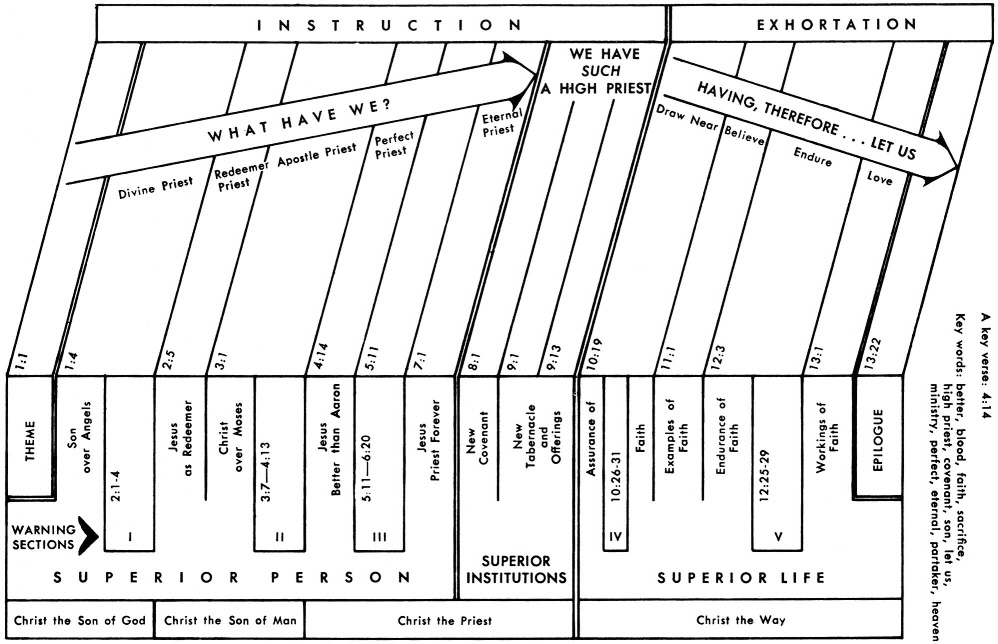
CONSIDER JESUS OUR GREAT HIGH PRIEST
Click chart to enlarge
Charts from Jensen's Survey of the NT - used by permission
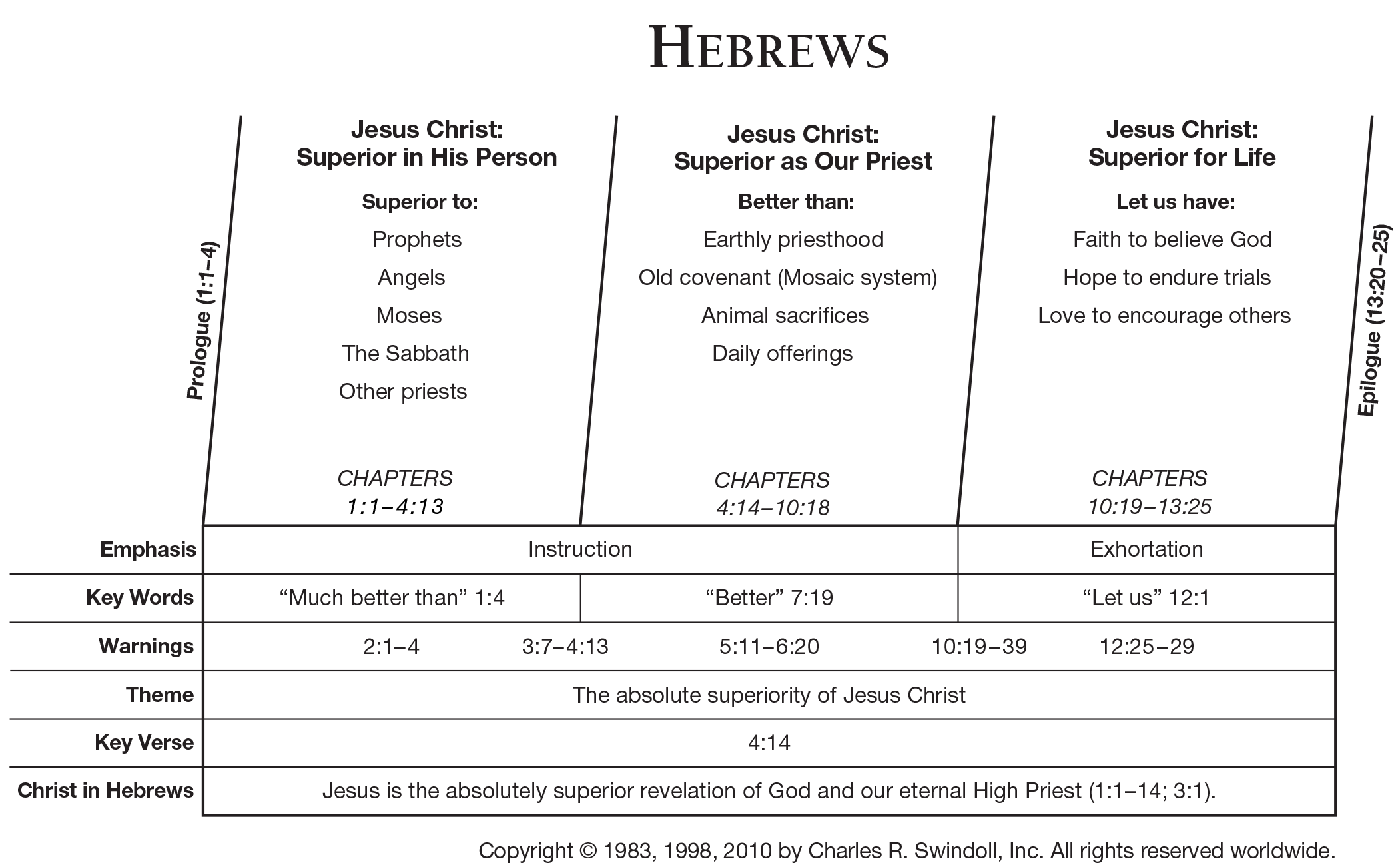
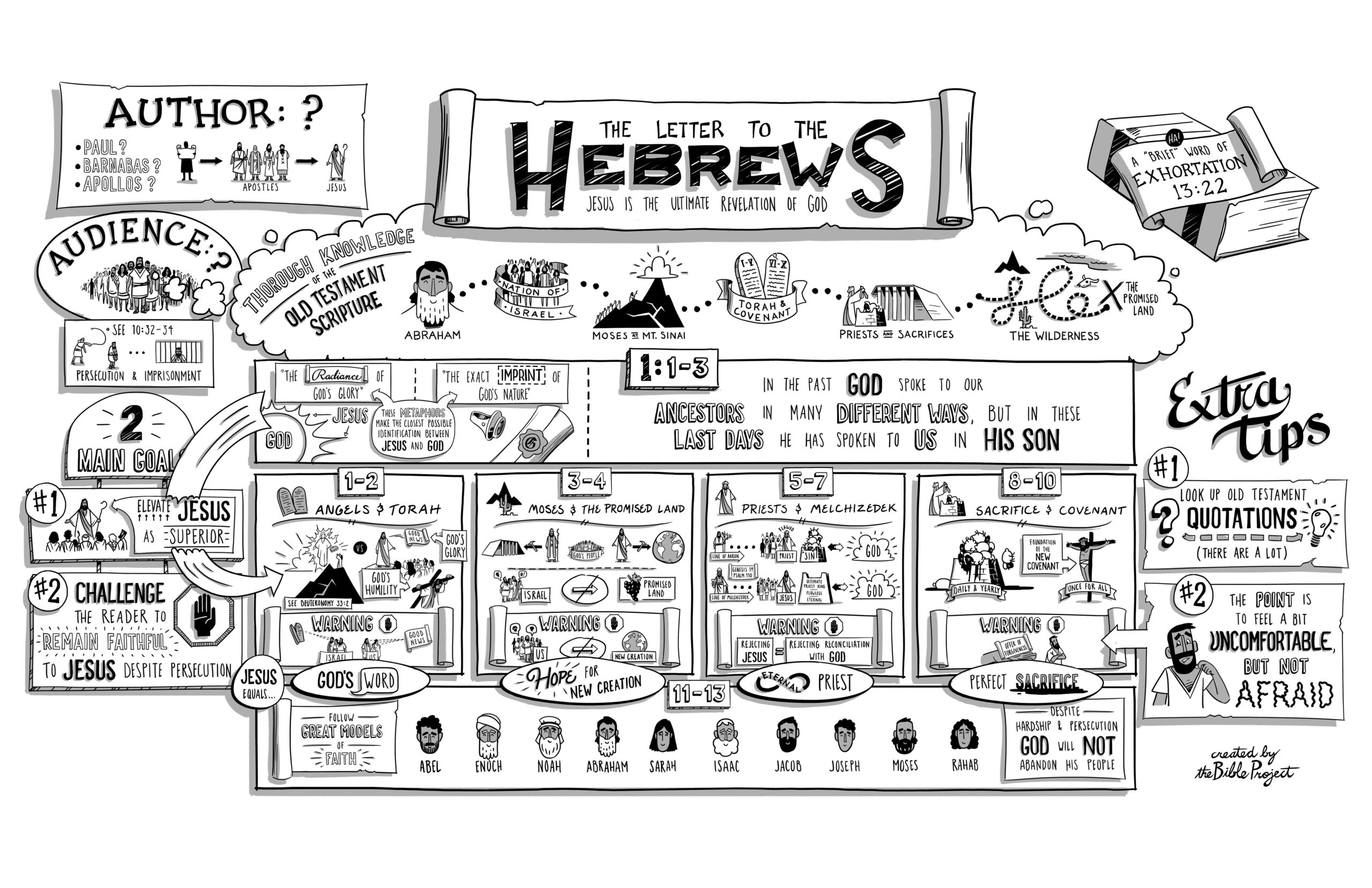
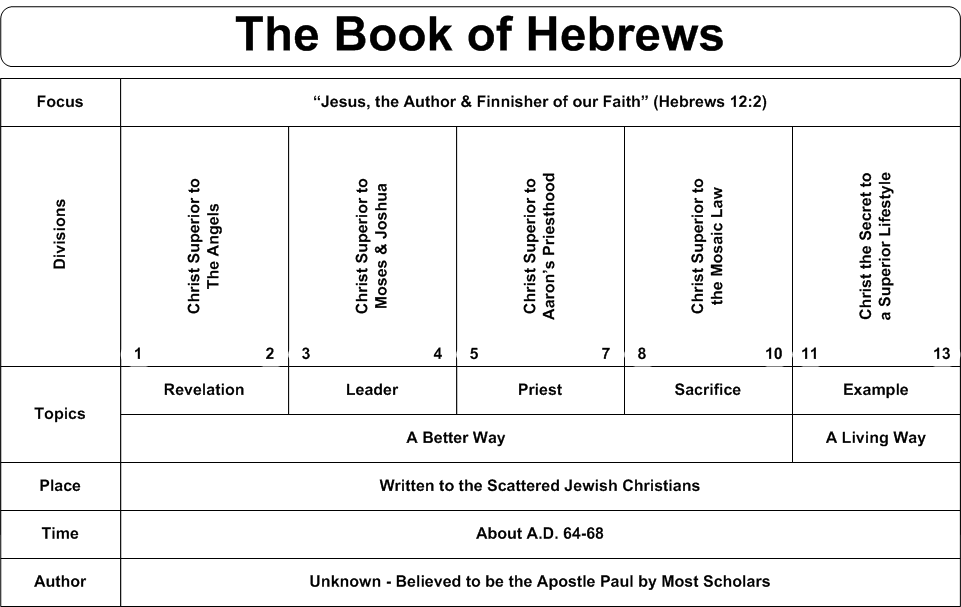
Swindoll's Chart, Interesting Pictorial Chart of Hebrews, Another Chart
|
The Epistle |
||||
| INSTRUCTION Hebrews 1-10:18 |
EXHORTATION Hebrews 10:19-13:25 |
|||
| Superior Person of Christ Hebrews 1:1-4:13 |
Superior Priest in Christ Hebrews 4:14-10:18 |
Superior Life In Christ Hebrews 10:19-13:25 |
||
| BETTER THAN PERSON Hebrews 1:1-4:13 |
BETTER PRIESTHOOD Heb 4:14-7:28 |
BETTER COVENANT Heb 8:1-13 |
BETTER SACRIFICE Heb 9:1-10:18 |
BETTER LIFE |
| MAJESTY OF CHRIST |
MINISTRY OF CHRIST |
MINISTERS FOR CHRIST |
||
|
DOCTRINE |
DUTY |
|||
|
DATE WRITTEN: |
||||

See ESV Study Bible "Introduction to Hebrews"
(See also MacArthur's Introduction to Hebrews)
Borrow Ryrie Study Bible
Hebrews 7:11 Now if perfection was through the Levitical priesthood (for on the basis of it the people received the Law ), what further need was there for another priest to arise according to the order of Melchizedek, and not be designated according to the order of Aaron? (NASB: Lockman)
Greek: Ei men oun teleiosis dia tes Leuitikes hierosunes en, (3SIAI) o laos gar ep' autes nenomothetetai, (3SRPI) tis eti chreia kata ten taxin Melchisedek heteron anistasthai (PMN) hierea kai ou kata ten taxin Aaron legesthai? (PPN)
BGT Εἰ μὲν οὖν τελείωσις διὰ τῆς Λευιτικῆς ἱερωσύνης ἦν, ὁ λαὸς γὰρ ἐπ᾽ αὐτῆς νενομοθέτηται, τίς ἔτι χρεία κατὰ τὴν τάξιν Μελχισέδεκ ἕτερον ἀνίστασθαι ἱερέα καὶ οὐ κατὰ τὴν τάξιν Ἀαρὼν λέγεσθαι;
Amplified: Now if perfection (a perfect fellowship between God and the worshiper) had been attainable by the Levitical priesthood—for under it the people were given the Law—why was it further necessary that there should arise another and different kind of Priest, one after the order of Melchizedek, rather than one appointed after the order and rank of Aaron? (Amplified Bible - Lockman)
KJV: If therefore perfection were by the Levitical priesthood, (for under it the people received the law,) what further need was there that another priest should rise after the order of Melchisedec, and not be called after the order of Aaron?
NKJ Therefore, if perfection were through the Levitical priesthood (for under it the people received the law), what further need was there that another priest should rise according to the order of Melchizedek, and not be called according to the order of Aaron?
NLT: And finally, if the priesthood of Levi could have achieved God's purposes—and it was that priesthood on which the law was based—why did God need to send a different priest from the line of Melchizedek, instead of from the line of Levi and Aaron? (NLT - Tyndale House)
Wuest: If indeed, therefore, completeness were through the Levitical priesthood, for the people upon its basis had the law laid down [to them], what need after that should there be of a priest of a different kind arising according to the order of Melchisedec and not being called after the order of Aaron? (Eerdmans)
Young's Literal: If indeed, then, perfection were through the Levitical priesthood--for the people under it had received law--what further need, according to the order of Melchisedek, for another priest to arise, and not to be called according to the order of Aaron?
NET So if perfection had in fact been possible through the Levitical priesthood– for on that basis the people received the law– what further need would there have been for another priest to arise, said to be in the order of Melchizedek and not in Aaron's order?
CSB If then, perfection came through the Levitical priesthood (for under it the people received the law), what further need was there for another priest to appear, said to be in the order of Melchizedek and not in the order of Aaron?
ESV Now if perfection had been attainable through the Levitical priesthood (for under it the people received the law), what further need would there have been for another priest to arise after the order of Melchizedek, rather than one named after the order of Aaron?
NIV If perfection could have been attained through the Levitical priesthood (for on the basis of it the law was given to the people), why was there still need for another priest to come--one in the order of Melchizedek, not in the order of Aaron?
MIT Therefore, were perfection realized through the Levitical priesthood the people received under the law, why would he say it was imperative for a different priest to arise according to the Melchizedekean order, a priest not from the Aaronic order?
NJB Now if perfection had been reached through the levitical priesthood -- and this was the basis of the Law given to the people -- why was it necessary for a different kind of priest to arise, spoken of as being of the order of Melchizedek rather than of the order of Aaron?
NRS Now if perfection had been attainable through the levitical priesthood-- for the people received the law under this priesthood-- what further need would there have been to speak of another priest arising according to the order of Melchizedek, rather than one according to the order of Aaron?
RSV Now if perfection had been attainable through the Levitical priesthood (for under it the people received the law), what further need would there have been for another priest to arise after the order of Melchizedek, rather than one named after the order of Aaron?
NAB If, then, perfection came through the levitical priesthood, on the basis of which the people received the law, what need would there still have been for another priest to arise according to the order of Melchizedek, and not reckoned according to the order of Aaron?
GWN The people established the Levitical priesthood based on instructions they received. If the work of the Levitical priests had been perfect, we wouldn't need to speak about another kind of priest. However, we speak about another kind of priest, a priest like Melchizedek, not a Levitical priest like Aaron.
BBE Now if it was possible for things to be made complete through the priests of the house of Levi (for the law was given to the people in connection with them), what need was there for another priest who was of the order of Melchizedek and not of the order of Aaron?
ASV Now if there was perfection through the Levitical priesthood (for under it hath the people received the law), what further need was there that another priest should arise after the order of Melchizedek, and not be reckoned after the order of Aaron?
Paraphrase If the Levitical priesthood could have brought people to spiritual completion and wholeness, there would have been no need for another priest to come after the pattern of Melchizedek rather than the line of Aaron.
Paraphrase Since the Law itself was tied to the Levitical priesthood, if that priesthood had been able to secure perfection, why would Scripture speak of another priest arising in the order of Melchizedek instead of Aaron?
Paraphrase If the Levitical priests had been able to provide the perfection God requires, there would have been no reason for God to raise up another priest from a different order—Melchizedek’s rather than Aaron’s.
Paraphrase Because the people received the Law through the Levitical system, if that system were truly able to make people perfect, then no further priesthood would have been necessary—especially one patterned after Melchizedek rather than Aaron.
Paraphrase If spiritual completeness could have been achieved by the Levitical priesthood, upon which the whole Law depended, then there would have been no need for another priestly order, different from Aaron’s and in line with Melchizedek.
- Perfection - Heb 7:18,19; 8:7,10-13; 10:1-4; Galatians 2:21; 4:3,9; Colossians 2:10-17
- what further need: He 7:26-28
- another priest: He 7:15,17,21 5:6,10 6:20
- Hebrews Study Questions - to aid your personal study or leading an inductive Bible study
- Hebrews 7 Resources - sermons and commentaries
Related Passages:
Hebrews 2:10 For it was fitting for Him, for whom are all things, and through whom are all things, in bringing many sons to glory, to perfect the author of their salvation through sufferings.
Hebrews 5:9-10 And having been made perfect, He became to all those who obey Him the source of eternal salvation, 10 being designated by God as a high priest according to the order of Melchizedek.
THE IMPERFECTION OF
THE LEVITICAL SYSTEM
One could paraphrase this passage this way (see other paraphrase above) - If the Levitical priesthood had actually been able to bring people to true spiritual completion (and remember, the whole Law was given on the basis of that priesthood), then there would have been no reason for God to speak of another priest coming in the order of Melchizedek instead of Aaron. The very fact that God announced another priest shows the Levitical system was not sufficient.
The writer now moves from description to logical conclusion. He has already shown that Melchizedek was greater than Abraham and therefore greater than Levi. Now he presses the point further: if the Levitical priesthood—the very system given under the Law—had been capable of bringing God’s people to the goal of perfection, there would have been no reason to expect another kind of priesthood. Yet Psalm 110:4 promised just that: a priest “according to the order of Melchizedek.” This means that the old system was inadequate and that God Himself had always planned something better. The verse serves as a turning hinge in the argument, leading from the superiority of Melchizedek to the necessity of a new priesthood and a new covenant. Hallelujah!
Perfection was demanded but not supplied
by the Levitical priesthood or the Law!
Now if perfection (teleiosis) was through the Levitical priesthood (hierosune) - An institution is perfect (teleiosis) or complete when it effects the purpose for which it was instituted, and produces a result that corresponds to the purpose for which it was designed. Perfection (teleiosis) in this context means to put someone in the position in which they can come before God, having been made acceptable to God. In other words, the purpose of the priesthood was to remove the obstacle of sin which kept man from God, and to reconcile men to God. Perfection was demanded but not supplied by the Levitical priesthood or the Law! (cf Heb 7:11, 19; 9:9; 10:1) The priesthood and the sacrifices were like a giant index finger pointing to the reconciliation that could only be achieved (cf "perfection") by our Great High Priest and His substitutionary sacrifice on the Cross.
The Levitical priesthood and the Mosaic Law
are inseparably linked together.
You can't have the priesthood without the old covenant. You can't have the old covenant with a priesthood to minister the Laws. The are like a hand and a glove. The Old Covenant (Law of Moses) was the glove — it defined the structure, sacrifices, and requirements. The Levitical Priesthood was the hand that filled it out and made it function. Without priests, the Law’s sacrificial system was only theory. Without the Law, the priests had nothing to administer.
You cannot separate the old covenant from the Levitical priesthood. The Law required priests to administer its commands, and the priesthood had no authority apart from the Law. They were like a hand and glove: distinct in role, yet inseparably joined in function.
What the old covenant could not accomplish, Christ did. The Levitical priesthood had its place in God’s plan, but it was limited and ineffective—it could only point to perfection, not provide it. Likewise, the Law had its place: it represented God’s truth and righteousness and demanded perfection. On that very basis the people received the Law. Yet neither the sacrifices that symbolized perfection nor the Law that required it could ever achieve it. True perfection is found only in Jesus Christ.”
(Perfection in this context) does not mean spiritual maturity
(being advanced in the faith) but salvation in Christ (coming to faith).
John MacArthur elaborates on perfection - "In Scripture, the word perfect is often used in the sense of maturity or completion, of being what something or someone is meant to be. Sometimes it means full-grown. Paul often uses it in this way. In Hebrews, however, it is used to refer to the goal and aim of Christianity. This goal, this maturity, is access to God. In this sense it does not mean spiritual maturity (being advanced in the faith) but salvation in Christ (coming to faith)."....But neither the sacrifice that pictured it (perfection) nor the law that demanded it could provide perfection. Perfection is provided only in Jesus Christ. (See Hebrews Commentary - Page 185)
Steven Cole - Since the author presents a tight argument here, we will follow the text closely. It falls into two sections: in Hebrews 7:11–14, he argues for the inferiority of the Law and Levitical priesthood, which could not make anyone perfect. In Hebrews 7:15–19, he argues for the superiority of the New Covenant and the priesthood of Jesus according to the order of Melchizedek, which enable us to draw near to God. (A Better Hope: Drawing Near to God)
Charles Spurgeon - The priesthood of Aaron and his successors was intended to be temporary. God did not confirm the priests of old in their offices, because He held in reserve the right to set them aside when He pleased. He from the first intended that their functions should be abolished when the fullness of time (Gal 4:4) should come for another and better priest to take their place. They were candles for the darkness, but the sun was to rise, and then they would not be needed. They were pictorial representations, but when the substance was come they would not be required. He allowed their priesthood to be one of imperfect men, because He intended by-and-by to supersede it by a perfect and enduring priesthood; hence no oath of God attended the ordination of the sons of Aaron. (Full sermon The Priest Ordained by the Oath of God)
To suggest that either of these venerable institutions
(the priesthood and the law)were inadequate and needed change was
to assault Judaism in its most sacred and revered precincts.
Ray Stedman explains that "The argument of Hebrews 7:11-19 constitutes a bold, and even radical, declaration by the writer. This section asserts unequivocally that the death and resurrection of Jesus has introduced a new and permanent priesthood that brings the Levitical priesthood to an end and, with it, the demise of the law of Moses. It is important to note in Hebrews 7:11-12 that the law was originally given to support the priesthood, not the other way around. The priesthood and the tabernacle with its sacrifices were the means God employed to render the sinful people acceptable to himself. They constituted the shadow of Jesus in the Old Testament. Then the law was given with its sharp demands to awaken the people to their true condition so that they might avail themselves of the sacrifices. This agrees fully with Paul’s statement in Romans 5:20 and Galatians 3:19-23 that the law was a teacher to lead to Christ (represented in Israel by the tabernacle and its priesthood) (ED: SEE PURPOSE OF THE LAW). To suggest that either of these venerable institutions (the priesthood and the law) were inadequate and needed change was to assault Judaism in its most sacred and revered precincts. But that this was the teaching of Christians from the beginning is seen in the savage charges hurled at Stephen, and later Paul, when they engaged certain Jewish leaders in religious dialog. See, for instance, Acts 6:14, where Stephen’s opponents testified, “We have heard him say that this Jesus of Nazareth will destroy this place [the temple] and change the customs Moses handed down to us.” (Hebrews 7:11-19 Aaronic Priesthood and Law Replaced)
John MacArthur - the fact that the Messiah was a priest after the order of Melchizedek opened the way. He could remove the veil because He atoned for sin. He actually bore our sin; the Levitical sacrifices only symbolically anticipated its cancellation. And now that sin had actually been dealt with, the Levitical priesthood was no longer necessary, and God set it aside. You do not need a symbol when you have the real thing. Now that the perfect had come, the imperfect passed away. The design of Hebrews 7:11–19 is to show this truth. The point is to encourage the wavering Jews to break with the old system and come to Jesus Christ. This was not an easy thing for Jews to understand or accept. Despite the many prophecies of the Messiah and of the new order He would bring, most Jews could not imagine that the Mosaic economy was temporary and inadequate and defective and unable to bring perfection. The very idea was incomprehensible to the pious Jew. All their lives they had assumed that the Levitical system was instituted by God, and that it was perfect, sufficient, and permanent. They were correct only in the first part. It was indeed instituted by God. But it was never intended or declared by Him to be perfect, eternally sufficient, or permanent. It is the imperfection of the Levitical system that the Holy Spirit points out in our present passage. He uses invincible logic to show that the Aaronic priesthood was imperfect and that, because it was imperfect, it had to be superseded. First He shows the imperfection of the old priesthood, then the perfection of the new. (See The MacArthur Commentary)
For on the basis of it the people received the Law (nomotheteo) - The Law was received (implemented, put into effect) through the priesthood. In other words, the Levitical priesthood was the channel through which the Law functioned for the people. Without priests to offer sacrifices, the Law could not operate as God intended. Thus the Law of Moses was given to Israel with the Levitical priesthood as its foundation. The Law and the priesthood were inseparably linked—laws about sacrifices, atonement, and priestly duties only made sense in a Levitical system. So, when the priesthood changes (to Melchizedek/Christ), the whole legal framework tied to that priesthood must also change (see Heb 7:12).
Ray Stedman adds "It is important to note in Hebrews 7:11-12 that the law was originally given to support the priesthood, not the other way around. The priesthood and the tabernacle with its sacrifices were the means God employed to render the sinful people acceptable to himself." (Hebrews 7:11-19 The Aaronic Priesthood and Law Replaced)
The Law had profound limitations. It could not atone for sin. The Levitical sacrifices covered over sin, but they did not remove it. The Law marvelously served to enhance one’s awareness of sin. Paul tells us in Ro 7:7, 8 that the Law’s command not to covet made him aware that all he did was covet. The Law was a teacher Gal 3:24
F. F. Bruce says, “The whole apparatus of worship associated with sacrifice and ritual and priesthood was calculated rather to keep men at a distance from God than to bring them near.” (Quoted by R Kent Hughes - see Hebrews: An Anchor for the Soul)
What further need (chreia) was there for another (heteros - of a different kind of) priest (2409) hiereus) to arise (anistemi) according to the order (taxis) of Melchizedek, and not ( ou) be designated according to the order of Aaron - Further (eti) indicates an extension of time beyond an expected point. It often carries the sense of continuing beyond what has already been stated, or something additional still needed. If the Levitical priesthood truly brought perfection (teleiosis), then no additional (further) priesthood would have been necessary. The use of Further (eti) underscores the unnecessariness of something “more” if the first system had been sufficient. If perfection (teleiosis) was attainable through the Levitical system, there would be no ongoing or additional need (chreia) (“further need”) for another priesthood. But since Psalm 110:4 does speak of another (heteros - of a different kind of) priesthood, it shows the Levitical system was insufficient. In short, “further” (eti) emphasizes that the appearance of another another (heteros - of a different kind of) priesthood proves the first one was incomplete or inadequate for man's sin problem, so it leaves no doubt that another priesthood was necessary.
To say it another way, if perfection had been attainable through the Levitical priesthood—if its sacrifices could truly bring a person into God’s presence—they would have ceased. They would have fulfilled their purpose. If the Levitical priesthood could have solved the sin problem and brought people into full fellowship with God, then why would God speak of another priest, a different kind of priest, coming in the order of Melchizedek instead of in Aaron’s line? The very fact that Scripture in Psalm 110:4 speaks of another priest shows that the old priesthood could not bring perfection.
If the old priesthood did its job,
God wouldn’t have announced a new one.
The Levitical priesthood failed to accomplish its purpose. Old Testament saints lacked freedom from the ongoing consciousness of sin, for the animal sacrifices of the Old Covenant could not remove guilt or bring them into full fellowship with a holy God. Because their sins were not completely cleansed, neither were their consciences. By contrast, the New Covenant provides full forgiveness, freedom from guilt, and the peace of a cleansed conscience.
This truth was crucial for his Jewish readers to understand. For believing Jews, it assured them that they were now completely secure in Jesus Christ and that their break with Judaism—with its rituals and repeated sacrifices—was justified. They had no reason to look back longingly at the ceremonies and symbols (SHADOWS), meaningful as those once were, because they now possessed the reality of the Savior (SUBSTANCE - Col 2:17+). But in the argument of Hebrews 7, this truth was even more vital for Jews who had not yet fully come to Christ. It demonstrated that the Levitical priesthood could never bring people to perfection or into God’s presence—for it was never intended to do so (See Purpose of the Law). As long as they clung to priestly rituals and animal sacrifices, they would remain in sin and have no access to God.
C H Spurgeon on another priest to arise according to the order of Melchizedek - Before the foundation of the world, when there was no word concerning a priest of the house of Levi, our Lord Jesus Christ was looked upon by God as priest and sacrifice for men. It is not said, “You will be a priest,” but “You, a priest forever.” The verb is left out, but the word “are,” in the present tense, is correctly enough supplied by the translators. “You are a priest forever according to the order of Melchizedek” (Psa 110:4). He was a priest before Aaron and his sons were born or thought of. Moreover, consider that the decree registered by the psalmist in Psalm 110 was published by revelation hundreds of years after the law had been given, so that it was not an old decree invalidated by the law of Moses, but a newly published decree abrogating in due time that which had gone before. Even while the law was in its palmy days, and the priest wore the Urim and the Thummim, there was a note struck in the Psalms of David that intimated the ending of it all, because there was another priest, not of the house of Aaron, who surpassed all of them, being made a priest by oath, even while they were priests without an oath. Whatever priesthood there may have been of God’s ordaining under the Old Testament, it was evidently all subordinate to the superior Melchizedek-priesthood of Jesus Christ our Savior, and was pre-destinated to give place to it. (From sermon The Priest Ordained by the Oath of God)
Steven Cole has an interesting quote from "Philip Hughes (See A Commentary on the Epistle to the Hebrews - Page 255) points out that the first century Jewish Dead Sea Sect “looked for the appearance of two messianic figures, one priestly, ‘the messiah of Aaron,’ and the other lay and kingly, ‘the messiah of Israel’….” The priestly messiah would be the head of the nation, with the kingly messiah, from the line of David, subordinate to him. Hughes suggests that if the original readers of Hebrews had been influenced by this or similar teaching, then the author’s point that Jesus fulfills both roles in the same person, according to the superior order of Melchizedek, is quite relevant. (A Better Hope: Drawing Near to God)
Perfection (5050) teleiosis from verb teleioo = to bring to completion, to perfect, to finish, to accomplish) with the suffix -sis (σις) indicates the result or state of an action. Therefore teleíōsis signifies “the state of being brought to completion” or “the result of perfection/consummation.” When speaking of an action refers to the "actualization of a promise" (fulfillment, accomplishment; achievement; completing of) as in Lk 1:45+ (speaks of Mary believing God for the fulfillment of the promise of a Child). In other words God’s word reaches its goal; His promise comes to completion. The only other NT uses of teleiosis refers to a completion of spiritual preparation ("perfection" in Heb 7:11+)
TELEIOSIS - 2V - Lk. 1:45; Heb. 7:11 Teleiosis is not found in the Septuagint.
Core Sense of teleosis is the act or state of completion, fulfillment, consummation. Indicates the result, that the goal has been reached, the purpose achieved. In Hebrews 7:11 the idea is the state that grants true access to God, something that the Levitical order could not achieve but could only be achieved by Jesus priesthood in the order of Melchizedek. The old covenant priesthood could not bring teleíōsis (full access and consummation). Christ’s Melchizedekian priesthood achieves the goal: real, lasting access to God. Only Christ secures the believer’s full access to God (Heb 7:11). Rituals, rules, or self-effort cannot supply the “completion” that Christ alone gives. This necessitates a change of priesthood and law (Heb 7:11–12).
Friberg on teleiosis - as designating an action; (1) as actualization of a promise = fulfillment, accomplishment (Lk 1.45+); (2) as a completion of spiritual preparation = perfection (Heb 7.11+) (Borrow Analytical Lexicon of the Greek New Testament)
Gilbrant - In classical Greek the word teleiōsis carries the idea of actualization or execution of a resolve or an oath. This is the way Aristotle and Philo used the term. Thayer notes other usages in classical Greek that have the connotation of conclusion or the processes of maturation (Greek-English Lexicon). In the Septuagint the word is used in other ways including execution of a plan or completion of a plan (e.g., Exodus 29:22; cf. Delling, “teleiōsis,” Kittel, 8:84). The usage of the word in Luke 1:45+ suggests that Mary was blessed because the things she hoped for would certainly come to pass; through an angel God said they would. The emphasis here is on the substance of her faith that was so crucial to the fulfillment (teleiosis) of the promise given to her (Nicholl, Expositor’s New Testament, 1:446). (Complete Biblical Library)
Another (2087) heteros has the basic meaning of the other of two or more but specifically different. So the idea is qualitatively another of a different kind, and so not identical with what was previously referred to (Ro 7:23 "different law," Gal 1:6 - "different Gospel"). A second sense of heteros is numerically speaking and thus denoting a new member distinct in kind from those that preceded another (e.g., someone else, something else) (1 Cor 12:8-10+ - "given...to another", Lk 8:6-8 of seed "other seed fell on rocky soil...and other seed fell among the thorns").
Allos is often the diametric opposite of heteros, one of the most striking uses being Jesus' description of the Holy Spirit as "another (allos not heteros) Helper" One just like Himself! (Jn 14:16).
HETEROS IN HEBREWS - Heb. 5:6; Heb. 7:11; Heb. 7:13; Heb. 7:15; Heb. 11:36
SUPERIORITY OF CHRIST'S PRIESTHOOD by W E Vine
(1) Its Perfection: (Hebrews 7:11–14)
(a) not by Levitical priests (Hebrews 7:11a).
(b) the need of Melchizedek order (Hebrews 7:11b).
(c) change of law re priesthood (Hebrews 7:12).
(d) new order from Judah tribe (Hebrews 7:13, 14).(2) Its Eternity: (Hebrews 7:15–19)
(a) Melchizedek order, and power of endless life (Hebrews 7:15, 16).
(b) the witness as to its perpetuity (Hebrews 7:17).
(c) law of priesthood done away—better hope given (Hebrews 7:18, 19).(3) Its Sacredness: (Hebrews 7:20–24)
(a) an oath taken (Hebrews 7:20).
(b) the words of the oath (Hebrews 7:21).
(c) Jesus the Surety of a better Covenant (Hebrews 7:22).
(d) His Priesthood deathless, unchangeable (Hebrews 7:23, 24).(4) Its Person: (Hebrews 7:25–28)
(a) His intercession and salvation (Hebrews 7:25).
(b) His character and position (Hebrews 7:26).
(c) His one Sacrifice (Hebrews 7:27).
(d) His appointment—a Son and the oath (Hebrews 7:28).
John Phillips - - Borrow Exploring Hebrews
The Undeniable Legality of Christ as Priest (Hebrews 7:11–22)
1. The Change in the Priestly Ordinance (Hebrews 7:11–14)
1. The Tribal Descent Changed (Hebrews 7:11)
2. The Title Deed Changed (Hebrews 7:12–14)1. Because of the Requirement of the Old Law (Hebrews 7:12–13)
2. Because of the Restriction of the Old Law (Hebrews 7:14)
2. The Change in the Priestly Order (Hebrews 7:15–19)
1. The Inherent Wonder of the New Order (Hebrews 7:15–17)
1. The Wonder of Its Design (Hebrews 7:15)
2. The Wonder of Its Dynamism (Hebrews 7:16)
3. The Wonder of Its Durability (Hebrews 7:17)2. The Inherent Weakness of the Old Order (Hebrews 7:18–19)
1. There Was No Power in It (Hebrews 7:18a)
2. There Was No Profit in It (Hebrews 7:18b)
3. There Was No Perfection in It (Hebrews 7:19)3. The Change in the Priestly Ordination (Hebrews 7:20–22)
1. A Singular Oath (Hebrews 7:20–21)
2. A Superior Operation (Hebrews 7:22)3. The Undying Life of Christ as Priest (Hebrews 7:23–8:5)
1. Why He Is Able to Minister to Us (Hebrews 7:23–28)
1. He Is a Continuing Priest (Hebrews 7:23–24)
2. He Is a Capable Priest (Hebrews 7:25)
3. He Is a Consecrated Priest (Hebrews 7:26–28)1. In Life (Hebrews 7:26)
2. In Death (Hebrews 7:27)
3. In Resurrection (Hebrews 7:28)
Hebrews 7:12 For when the priesthood is changed, of necessity there takes place a change of law also. (NASB: Lockman)
Greek: metatithemenes (PPPFSG) gar tes ierosunes ex anagkes kai nomou metathesis ginetai. (3SPMI)
BGT μετατιθεμένης γὰρ τῆς ἱερωσύνης ἐξ ἀνάγκης καὶ νόμου μετάθεσις γίνεται.
Amplified: For when there is a change in the priesthood, there is of necessity an alteration of the law [concerning the priesthood] as well. (Amplified Bible - Lockman)
KJV: For the priesthood being changed, there is made of necessity a change also of the law.
NLT: And when the priesthood is changed, the law must also be changed to permit it. (NLT - Tyndale House)
Young's Literal: for the priesthood being changed, of necessity also, of the law a change doth come,
Wuest: For there being a transfer of the priesthood [to another order], of necessity also of the law there is a transfer, (13 for He concerning whom these things are being spoken pertained to a different kind of a tribe from which no one gave attendance at the altar.) (Eerdmans)
NET For when the priesthood changes, a change in the law must come as well.
CSB For when there is a change of the priesthood, there must be a change of law as well.
ESV For when there is a change in the priesthood, there is necessarily a change in the law as well.
NIV For when there is a change of the priesthood, there must also be a change of the law.
NLT And if the priesthood is changed, the law must also be changed to permit it.
MIT Answer: When there is a replacement of the priesthood, a change in the law has necessarily occurred.
Paraphrase When the priesthood shifts to a new order, the law connected to it must also be changed.
Paraphrase A new kind of priesthood inevitably requires a new kind of law to govern it.
Paraphrase Since the priesthood has been altered, it is unavoidable that the law itself also undergoes alteration.
Paraphrase If God establishes a different priesthood, then by necessity the entire legal framework is transformed as well.
Paraphrase Because the priesthood has changed, the law tied to that priesthood must likewise be changed.
- A change - Isaiah 66:21; Jeremiah 31:31-34; Ezekiel 16:61; Acts 6:13-14
- Hebrews Study Questions - to aid your personal study or leading an inductive Bible study
- Hebrews 7 Resources - sermons and commentaries
Related Passages:
Jeremiah 31:31-34+ “Behold, days are coming,” declares the LORD, “when I will make a new covenant with the house of Israel and with the house of Judah, 32 not like the covenant which I made with their fathers in the day I took them by the hand to bring them out of the land of Egypt, My covenant which they broke (AKA - IT COULD NOT ACHIEVE PERFECTION), although I was a husband to them,” declares the LORD. 33 “But this is the covenant which I will make with the house of Israel after those days,” declares the LORD, “I will put My law within them and on their heart I will write it; and I will be their God, and they shall be My people. 34 “They will not teach again, each man his neighbor and each man his brother, saying, ‘Know the LORD,’ for they will all know Me, from the least of them to the greatest of them,” declares the LORD, “for I will forgive their iniquity, and their sin I will remember no more.”
Acts 6:13-14+ (THE EFFECT OF SUGGESTING A "CHANGE IN THE LAW") They put forward false witnesses who said, “This man incessantly speaks against this holy place and the Law; for we have heard him say that this Nazarene, Jesus, will destroy this place and alter the customs which Moses handed down to us.” (WHICH IS EXACTLY WHAT WOULD HAPPEN LITERALLY IN 70AD WITH DESTRUCTION OF THE TEMPLE!)
A NEW PRIESTHOOD
CALLS FOR A NEW COVENANT
Since God has introduced a different kind of priesthood, it is unavoidable that the entire system of Law tied to the old priesthood must also be replaced. The writer is building a careful case that Jesus’ priesthood, patterned after Melchizedek, is superior to the Levitical priesthood. Hebrews 7:11 raised the question: If the Levitical priesthood brought perfection, why would God promise another priest “after the order of Melchizedek”? And the answer is of course He wouldn't if the Levitical priesthood had accomplished perfection! Hebrews 7:12 answers in effect saying that if God introduces a new kind of priesthood, then the law that established the old priesthood must also be set aside and replaced. Simply put, you cannot insert Christ into the Levitical system and legally He would not even be allowed. The very fact that He comes from the tribe of Judah (Hebrews 7:13-14) proves that God had done something radically new.
For (gar) is a term of explanation which should stimulate the question "What is the writer explaining?" In Heb 7:11, raises the problem: the Levitical priesthood could not bring perfection. In Hebrews 7:12 the writer explains that if God brings in a new priesthood, He must also change the law (which would prove to be the new covenant) In other words, because the priesthood and the law are bound together, the introduction of a new priesthood (Melchizedek/Christ) means the entire legal structure of the old covenant has to be replaced (see Heb 8:13+). To say it another, you cannot just swap in Christ into the Levitical framework. The arrival of a new kind of priest brings with it a new covenantal order. It’s not just an upgrade to the old system, but requires an entirely new covenant, a better covenant (cf Jer. 31:31–34; see Heb 8:6–13+). To sum up, the “for” here in verse 12 explains the logical necessity, that is, that the inadequacy of the Levitical priesthood (discussed in Heb 7:11) demands not only a new priest but a new covenant to go with Him.
James Girdwood makes an interesting comment - Hebrews 7:12 seems to be stated backwards. One would expect it to say that the change of law would require a change of priesthood; instead, changing the priesthood required changing the law. To understand this, we must recall that Jesus was such a dominant person that when he appeared on the scene everything had to change to fit around who he was. (Book of Hebrews)
They were candles for the darkness,
but the sun was to rise, and then they would not be needed.
-- C H Spurgeon
When the priesthood is changed (metathesis) of necessity (anagke - compulsion) there takes place a change (metathesis) in the law also - This is not just a small change but a complete transfer of the priesthood—from the line of Levi under the Old Covenant to the priesthood of Christ in the order of Melchizedek under the New Covenant. God's choice of this new type of priesthood for His Son, left the Levitical line off to one side, forever setting aside "the order of Aaron" and replacing it with the new order of Melchizedek. A new covenantal order is required, with new terms of access to God (by grace through faith, on the basis of Christ’s once-for-all offering).
It was no accident or mistake that God set aside
the Israelite priesthood. He had planned it that way from the beginning.
John MacArthur on the priesthood is changed - It was no accident or mistake that God set aside the Israelite priesthood. He had planned it that way from the beginning. That is obvious because soon after He called Abraham, before He actually made the covenant with him, God introduced him to Melchizedek, a priest of a higher order than the one that would come from Abraham’s descendants. (See Hebrews Commentary - Page 185)
Steven Cole "In this verse, the author shows the radical implication of a change in the priesthood: it necessarily also demands a change in the Law. Again, to understand this we must keep in mind that for a conscientious Jew, this was unthinkable! The Law of Moses was the bedrock of the Jewish religion and culture. How could you even talk about changing the Law? But the author is arguing that the Law and the Levitical priesthood were so closely linked that you could not change the priesthood without changing the Law. (A Better Hope: Drawing Near to God)
To be sure, Christianity, in a sense, comes from Judaism. But Christianity is not merely enhanced or advanced Judaism. In truth, Christianity replaces Judaism. For a Jewish convert, his faith is changed from Judaism to Christianity. The new priesthood, after the order of Melchizedek, was not added to Aaron’s priesthood, but replaced it.
C H Spurgeon - The law of the priesthood alters since the person of the priest, the character of the priest, and the very office of the priest had altered too.
Kenneth Wuest explains the transfer to a new basis noting that "The priesthood after the order of Melchizedek was put in the place of the priesthood after the order of Aaron. The blood of animals could not pay for sin, but the blood of Messiah could. Thus, the New Covenant was substituted for the Old Covenant, Jesus’ blood, the reality, for animal blood, the type. But that could only be done by changing the law governing the priesthood. Thus, if a transfer to a new and different order of priesthood was to be effected, it must be by reason of a transfer to a new basis. The law governing the priesthood as found in the Mosaic economy must be abrogated in favor of another which would provide for an order of priesthood that would function successfully in the very thing in which the Aaronic priesthood failed. (Hebrews Commentary online)
Marvin Vincent - The inferiority of the Levitical priesthood is inferred from the fact that another priesthood was promised. If perfection was possible at all under the Mosaic economy, it must come thru the Levitical priesthood, since that priesthood was, in a sense, the basis of the law. The whole legal system centered in it. The fundamental idea of the law was that of a people united w God. Sin, the obstacle to this ideal union, was dealt with through the priesthood. If the law failed to effect complete fellowship with God, the priesthood was shown to be a failure, and must be abolished; and the change of the priesthood involved the abolition of the legal (ceremonial) system."
The inferiority of the Levitical priesthood is inferred from the fact that another priesthood was promised. If perfection was possible at all under the Mosaic economy, it must come through the Levitical priesthood, since that priesthood was, in a sense, the basis of the law. The whole legal system centered in it. The fundamental idea of the law was that of a people united with God. Sin, the obstacle to this ideal union, was dealt with through the priesthood. If the law failed to effect complete fellowship with God, the priesthood was shown to be a failure, and must be abolished; and the change of the priesthood involved the abolition of the entire legal system.
This setting...aside was extremely difficult for many Jews
and the reasons for doing so were difficult for them to fully grasp.
However note the abolition was not so much the 10 Commandments (in fact those standards remained unchanged in the New Covenant where the Law was now written on man's heart - see discussion of the difference between the ceremonial law, the moral law, and the judicial law in the Old Testament) but the abolition was of the ceremonial law, the Aaronic priesthood (now all believers are priests! 1Pe 2:9+) and system of sacrifices (the once for all sacrifice has been made - Jn 19:30+), the required rituals and ceremonies of the Old Covenant, has been set aside (Jn 19:30, cp Jesus' words "Prophets; I did not come to abolish, but to fulfill." Mt 5:17+). However setting this aside was extremely difficult for many Jews and the reasons for doing so were difficult for them to fully grasp. Thus the need for the epistle to the Hebrews and need to clear their ears (cf Heb 5:11+)!
Some believing Jews in the first century church were not only insisted on maintaining their own Jewish practices, but on making them mandatory for everyone who wanted to become a "Christian" (e.g., Paul attacked these teachings in Galatians - Gal 2:12+, Gal 6:12-13+, Gal 5:2, 6, 11-14+). These people were called Judaizers, and they were a plague to the early church for many years. They told prospective believers, and even non-Jewish Christians, that they needed to be circumcised and have sacrifices made in the Temple and follow all the prescribed Jewish laws and rituals.
At Sinai the people were fenced off at the foot of the mountain, so they could not approach God (Ex 19:12+). In the Tabernacle and in the Temple the veil stood between them and God’s presence in the Holy of Holies. The Old Covenant not only did not bring men into God’s presence, it actually forbade them from trying to get there. Without full cleansing, complete forgiveness of sins, they were not qualified. But Jesus, so to speak, came down the mountain to the people and tore down the veil.
So the whole Judaistic system was changed-better, not just changed, but exchanged-for a new order, a new Priest, a new sacrifice, an entirely New Covenant. This is why the writer had exhorted them not to drift back (Heb 2:1-3) but to leave behind the elementary teachings about the Christ and to press on to maturity in Heb 6:1-3.
Priesthood (2420) hierosune/hierosyne from hieros - sacred. Refers to priestly office, the office of priest. The office, dignity, or order of a priest; priesthood as an institution. It does not describe individual priests (hiereus) but the priesthood as a whole, the system or order. Institutional: hierosynē is not about who is priest (hiereus) but about the office/system of priesthood itself. In Heb 7:11 it refers to the Levitical order, emphasizing its inability to bring about “perfection” (teleiōsis, completion, full access to God). The point: priesthood defines the covenant’s effectiveness. In Hebrews 7:12 hierosynē denotes the entire priestly order/system. A change in priesthood is not minor—it requires a new covenantal framework. In Hebrews 7:24 it contrasts the temporary Levitical priesthood with Christ’s permanent, untransferable one. The stress is on the indestructibility and eternal character of Christ’s priesthood. In Greek literature, hierosynē referred broadly to priestly office or dignity (e.g., inscriptions about temple priesthoods in Greco-Roman cities). It conveyed not just function, but status, authority, and sacred duty. This background would resonate with Hellenistic readers.
Hebrews uses this rare word to emphasize that the entire priestly system has shifted in Christ—from shadow to substance, from temporary to eternal.
HIEROSUNE - 3V -Heb. 7:11; Heb. 7:12; Heb. 7:24
Changed (3346) metatithemi from meta = change of place or condition + tithemi = to put or place) literally means to put in another place, as used here in Heb 11:5, the passive since meaning to be taken or transferred. We find another literal use in Acts 7:16 where bodies are transferred to a burial place in Shechem. In the figurative sense metatithemi means to effect a change in state or condition and so to alter something as when the priesthood is changed (Heb 7:12). Another figurative use is found in Jude 1:4 who were continually "turning" the grace of God into licentiousness, saying in essence that God's marvelous grace provided a "license" for immoral behavior! In another figurative use Paul accuses Peter of "deserting" (turning away from) the gospel to follow a different gospel (Gal 1:6).
METATITHEMI - 5V - Acts 7:16; Gal. 1:6; Heb. 7:12; Heb. 11:5; Jude 1:4
Friberg - (1) literally, as causing a change from one place to another transfer, bring to, transplant (Heb 11.5b); passive = be taken, be transferred (Heb 11.5a); of a body transferred to another burial place be brought back (Acts 7.16); (2) figuratively; (a) change, alter (Heb 7.12); in a bad sense pervert (Jude 1:4); (b) middle, as changing one's loyalty as a follower turn from, desert, become apostate (Gal 1.6) (Borrow Analytical Lexicon of the Greek New Testament)
Change (3331) (metathesis from metatithemi = transfer from meta = implying change + tithemi = put) is literally, the act of transferring from one place to another and so the removal or taking up or away. Transliterated it gives us the English word metathesis which is defined as the transposition of a letter of a word. Literally metathesis can describe a transfer from one place to another, as for example the translation of a person to heaven "By faith Enoch was taken up so that he should not see death; and he was not found because God took him up; for he obtained the witness that before his being taken up he was pleasing to God." (see note Hebrews 11:5). Figuratively, metathesis means to transpose or put one thing in the place of another. It can mean a change of things instituted or established, such as a changeover from the Levitical priesthood as in Hebrews 7:12. Hebrews 12:27+ uses metathesis with the idea of removal. - "And this expression, "Yet once more," denotes the removing (metathesis) of those things which can be shaken, as of created things, in order that those things which cannot be shaken may remain."
METATHESIS - 3V - Heb. 7:12; Heb. 11:5; Heb. 12:27. Not in the Septuagint.
Steven Cole - In 1903, someone noticed a Russian sentry standing guard at a post with no apparent reason for his being there. When asked why he was standing guard there, he answered, “I’m just following orders.” The question was asked of the captain of the guard, but he didn’t know why that sentry was posted there. The inquiry eventually went up the chain of command to the czar, but he didn’t know either! He asked that someone track down the answer. Finally, it was discovered that in 1776, Catherine the Great had planted a rose bush there, and posted a sentry to guard it. The bush had been dead for over 80 years, but the sentry was still standing guard! Traditions are hard to change!
Religious traditions are especially hard to change, because people insist that God ordained them. The Jews rightly believed that God had ordained the traditions and practices of the Mosaic Law almost 15 centuries before the time of Christ. The Law was the very center of the Jewish culture. They ordered their lives around the Sabbath worship and the yearly feasts. The priests and Levites oversaw and regulated the worship at the temple. The sacrifices and rules for ceremonial cleansing were all spelled out in the Law. These laws and traditions were deeply entrenched!
To challenge the validity of these practices was to risk your life! The opponents of Stephen, the first Christian martyr, charged, “This man incessantly speaks against this holy place and the Law; for we have heard him say that this Nazarene, Jesus, will destroy this place and alter the customs which Moses handed down to us” (Acts 6:13–14). Paul’s opponents shouted, “This is the man who preaches to all men everywhere against our people and the Law and this place” (Acts 21:28). Even many Jews who had professed faith in Christ were still “zealous for the Law” (Acts 21:20).
He is drawing a distinct dividing line between Judaism and Christianity.
You cannot blend the two into a homogenous hybrid.
So the author of Hebrews had a formidable task in trying to convince his Jewish Christian readers that the Law and the Levitical priesthood that was inextricably linked to the Law were now obsolete and set aside because of the far better New Covenant and priesthood of Jesus. He makes some radical statements about the Law: it was weak and useless; it made nothing perfect (Hebrews 7:18, 19). Because of these problems, it has been changed and set aside (Hebrews 7:12, 18). He is drawing a distinct dividing line between Judaism and Christianity. You cannot blend the two into a homogenous hybrid. He doesn’t want his readers to go back to the old Jewish way, as if it were good enough. Even if they suffer persecution for their faith, they must persevere, because Jesus has provided “a better hope, through which we draw near to God” (Hebrews 7:19).
The New Covenant and priesthood of Jesus are superior
to the Law and Levitical priesthood because
they provide the way for us to draw near to God.
That statement was radical, too. As I said last week, every Jew knew that you couldn’t just stroll into the Holy of Holies to have a little chat with God! The Levitical system was designed to keep the worshipers at a distance from God, lest He destroy them. Only the high priest could enter the Holy of Holies, and that only once a year, on the Day of Atonement. So for the author to emphasize that we are to draw near to God through Jesus (4:14–16; 6:19–20; 7:19; 10:19–22) was a staggering concept for those from a Jewish background. (See A Better Hope: Drawing Near to God)
Before the Face of God - A Change of Covenants - R C Sproulo
For when there is a change of the priesthood, there must also be a change of the law. [Heb. 7:12]
Law given through Moses came on the basis of the Levitical priesthood. But Christ’s priesthood is superior in every respect. Exodus 24 shows us that the law was sealed to the people through the sacrifices offered under Aaron’s oversight. If, then, the Hebrew Christians turn back to the Mosaic covenant, they turn back to the Levitical priesthood.
But, he reminds them, each time there was a change of priesthood, there was also a change in the law. In 1 Samuel, Eli the high priest died at about the same time the tabernacle was destroyed. When the temple was built by Solomon a century later, there was a change of priesthood. Eli was a descendant of Aaron’s son Ithamar, while Zadok was a descendant of Eleazar. When the Mosaic covenant itself was inaugurated the priesthood changed. Formerly the head of each household was priest of that household; after Moses the descendants of Aaron were priests.
Likewise, now that Jesus is priest after the order of Melchizedek, there is a change in the law. The fundamental principles of justice embodied in the Sinaitic law have not changed, but the specific form of the law has changed. The temples, festivals, and other features of the law have been transformed into a new covenant form.
The form of that new covenant is far more durable. Such was the weakness of the Levitical priesthood that high priests always died and had to be replaced. In a sense, each time a high priest died the law changed, for each new high priest ruled the house of God in his own style. Scripture records no end to Melchizedek’s priesthood. Assuming Melchizedek was a human king and not a manifestation of Christ, his priesthood did end. But as a type or picture for Christ’s priesthood, it did not end. Jesus rules forever. In permanence his priesthood towers over Levi.
God did not swear by himself that Levi’s priesthood would be eternal, but he did swear that the priesthood of the Greater Melchizedek would last forever.
Coram Deo -- Sometimes our lives change drastically because a person with authority, who gives structure to our work or family is no longer in place. Things change when a person in charge dies or is replaced by a new person. The experience can be terribly unsettling. Think about such a time in your own life, then increase your faith with the knowledge that this will not happen with Jesus. His rule is fixed with unshakable permanence beneath our feet.