Hebrews 7:1
Hebrews 7:2
Hebrews 7:3
Hebrews 7:4
Hebrews 7:5
Hebrews 7:6
Hebrews 7:7
Hebrews 7:8
Hebrews 7:9
Hebrews 7:10
Hebrews 7:11
Hebrews 7:12
Hebrews 7:13
Hebrews 7:14
Hebrews 7:15
Hebrews 7:16
Hebrews 7:17
Hebrews 7:18
Hebrews 7:19
Hebrews 7:20
Hebrews 7:21
Hebrews 7:22
Hebrews 7:23
Hebrews 7:24
Hebrews 7:25
Hebrews 7:26
Hebrews 7:27
Hebrews 7:28
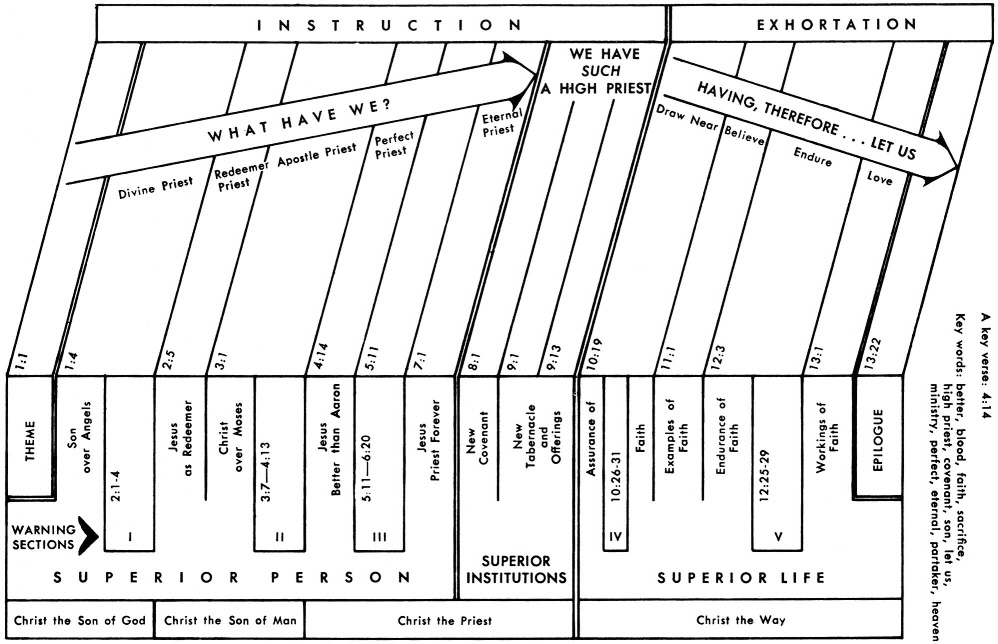
CONSIDER JESUS OUR GREAT HIGH PRIEST
Click chart to enlarge
Charts from Jensen's Survey of the NT - used by permission
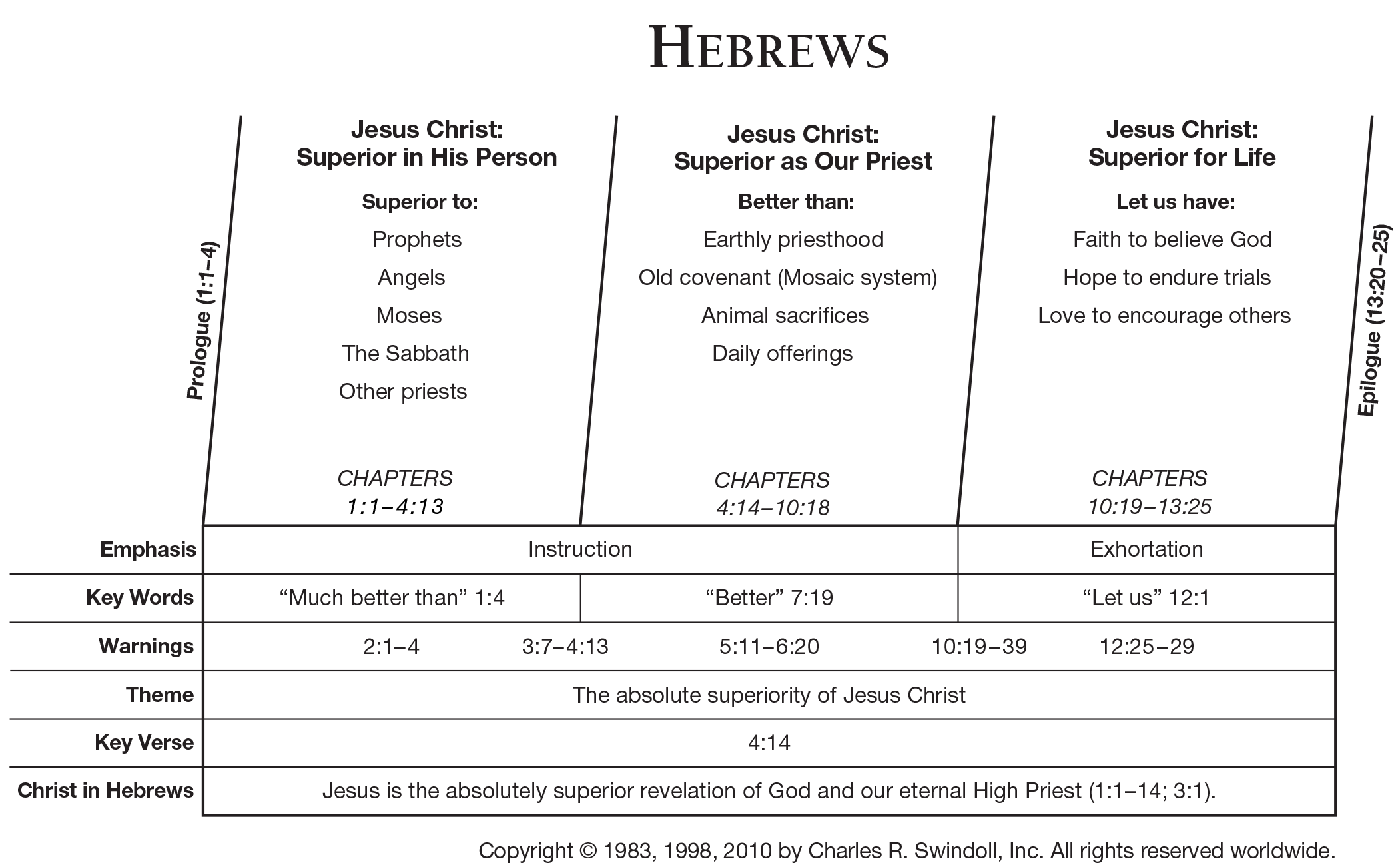
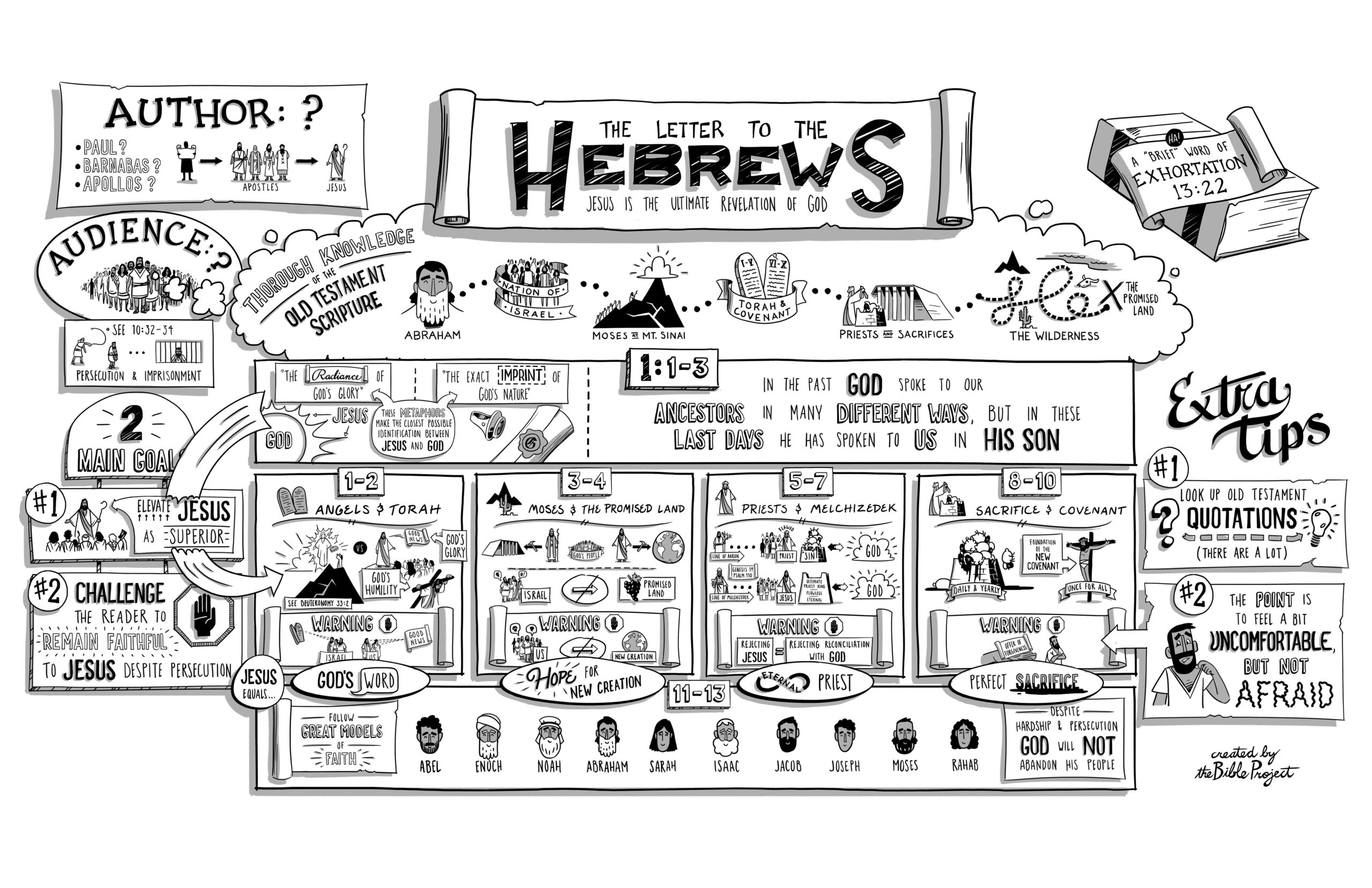
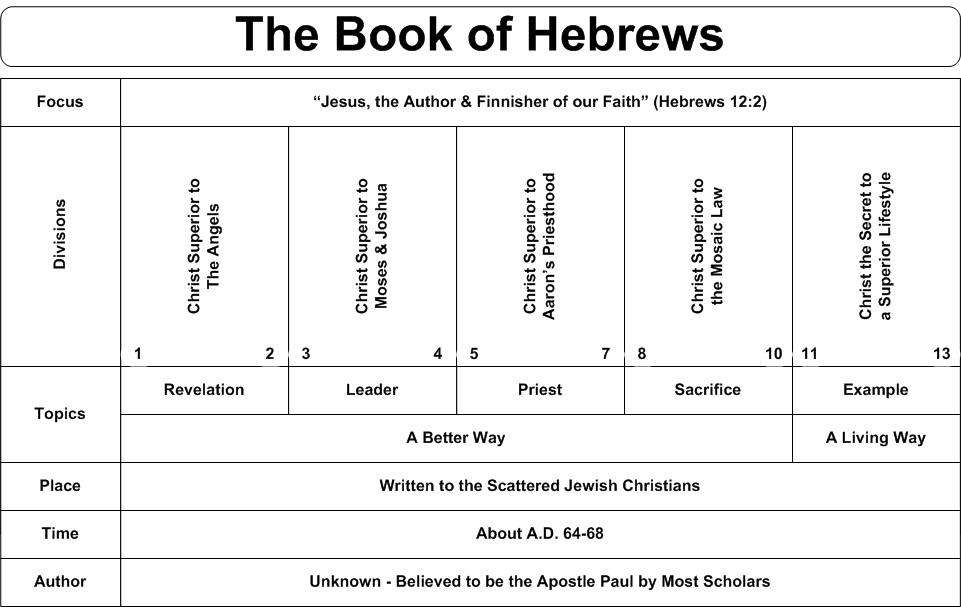
Swindoll's Chart, Interesting Pictorial Chart of Hebrews, Another Chart
|
The Epistle |
||||
| INSTRUCTION Hebrews 1-10:18 |
EXHORTATION Hebrews 10:19-13:25 |
|||
| Superior Person of Christ Hebrews 1:1-4:13 |
Superior Priest in Christ Hebrews 4:14-10:18 |
Superior Life In Christ Hebrews 10:19-13:25 |
||
| BETTER THAN PERSON Hebrews 1:1-4:13 |
BETTER PRIESTHOOD Heb 4:14-7:28 |
BETTER COVENANT Heb 8:1-13 |
BETTER SACRIFICE Heb 9:1-10:18 |
BETTER LIFE |
| MAJESTY OF CHRIST |
MINISTRY OF CHRIST |
MINISTERS FOR CHRIST |
||
|
DOCTRINE |
DUTY |
|||
|
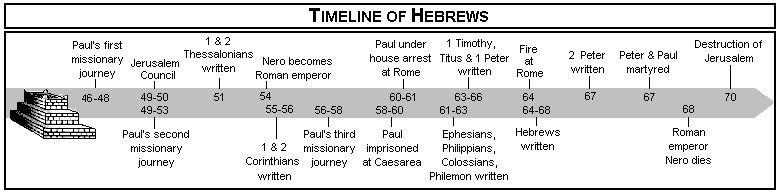
DATE WRITTEN: |
||||

See ESV Study Bible "Introduction to Hebrews"
(See also MacArthur's Introduction to Hebrews)
Borrow Ryrie Study Bible
Hebrews 7:18 For, on the one hand, there is a setting aside of a former commandment because of its weakness and uselessness (NASB: Lockman)
Greek: athetesis men gar ginetai (3SPMI) proagouses (PAPFSG) entoles dia to autes asthenes kai anopheles,
BGT ἀθέτησις μὲν γὰρ γίνεται προαγούσης ἐντολῆς διὰ τὸ αὐτῆς ἀσθενὲς καὶ ἀνωφελές-
Amplified: So a previous physical regulation and command is cancelled because of its weakness and ineffectiveness and uselessness— (Amplified Bible - Lockman)
KJV: For there is verily a disannulling of the commandment going before for the weakness and unprofitableness thereof.
NLT: Yes, the old requirement about the priesthood was set aside because it was weak and useless. (NLT - Tyndale House)
Wuest: For there is indeed a doing away with a foregoing commandment because of its weakness and unprofitableness,
Young's Literal: for a disannulling indeed doth come of the command going before because of its weakness, and unprofitableness,
NKJ For on the one hand there is an annulling of the former commandment because of its weakness and unprofitableness,
NET On the one hand a former command is set aside because it is weak and useless,
CSB So the previous command is annulled because it was weak and unprofitable
ESV For on the one hand, a former commandment is set aside because of its weakness and uselessness
NIV The former regulation is set aside because it was weak and useless
MIT Cancellation of the former legal structure transpired because of the mentioned weakness and futility associated with it.
NJB The earlier commandment is thus abolished, because of its weakness and ineffectiveness
NRS There is, on the one hand, the abrogation of an earlier commandment because it was weak and ineffectual
RSV On the one hand, a former commandment is set aside because of its weakness and uselessness
NAB On the one hand, a former commandment is annulled because of its weakness and uselessness,
GWN The former requirements are rejected because they are weak and useless.
BBE So the law which went before is put on one side, because it was feeble and without profit.
- Setting aside - Heb 7:11,12; Heb 8:7-13; Heb 10:1-9; Ro 3:31; Gal 3:15,17
- Weakness and uselessness - Heb 7:19; 8:7-10; Heb 10:1-4; 13:9; Acts 13:39; Ro 8:3; Gal4:9,21; 1Ti 4:8
- Hebrews Study Questions - to aid your personal study or leading an inductive Bible study
- Hebrews 7 Resources - sermons and commentaries
Related Passages:
Galatians 4:9+ (WEAKNESS OF FORMER COMMANDMENT) But now that you have come to know God, or rather to be known by God, how is it that you turn back again to the weak (asthenes) and worthless elemental things, to which you desire to be enslaved all over again?
Romans 4:13-14+ For the promise to Abraham or to his descendants that he would be heir of the world was not through the Law, but through the righteousness of faith. 14 For if those who are of the Law are heirs, faith is made void and the promise is nullified;
Hebrews 8:13 When He said, “A new covenant,” He has made the first obsolete. But whatever is becoming obsolete and growing old is ready to disappear.
ANNULMENT OF THE OLD
WEAK COMMANDMENT
For (gar - term of explanation) signals that the writer is grounding what he just said in Heb 7:17 (“it is attested of Him, ‘You are a priest forever…’”) with a further reason. Heb 7:16–17 stated Christ’s priesthood is valid not by legal regulation but by the power of His indestructible life, and God Himself testifies to this by Scripture (Ps 110:4). Then in Heb 7:18 the "for" explains why such a divine attestation was necessary—because the old commandment (the Levitical priesthood under the Law) was weak and useless to bring perfection. In other words, the old system had to be set aside, which justifies the need for God to declare a new priesthood.
On the one hand, there is (present tense) a setting aside (athetesis) of a former (proago) commandment (entole) because of its weakness (asthenes) and uselessness (anopheles) - Former (proago) commandment (entole) refers to the Mosaic system especially as it regulated the priesthood and the sacrificial system. We have already seen that this system could not produce perfection (Heb 7;11) and restricted the priesthood to the tribe of Levi. Because is a clear term of explanation, explaining the former commandment must be set aside because it was weak (could not bring about perfection as explained in Heb 7:19 or lasting access to God) and useless (it only pointed forward but could not accomplish what Christ's priesthood accomplishes). Note that setting aside was a legal term for invalidating a law, covenant, or regulation and did not signify just to neglect it, but to annul it. it was annulled—not because God’s plan failed, but because it had a temporary, preparatory role now fulfilled in Christ.
It is called former (proago) because it belonged to the Old Covenant, and it has now been annulled, set aside, replaced by the superior priesthood of Christ, which actually brings people near to God.
Its weakness (asthenes) - Law had no capacity to make men perfect, to bring them into the presence of God. The Law could not impart strength to fulfill its demands and thus could not bestow spiritual/eternal life. It could not justify a man and therefore could not bring men into fellowship with God (cf Ro 5:1+). Asthenes is used figuratively here in Hebrews 7 to describe the weakness and powerlessness of the Law to produce righteousness and a life pleasing to God. (see Purpose of the Law)
Brian Bell - the Law was Weak and unprofitable/useless – How? Since it cannot cleanse from sin or provide power to obey.
The law is the light that reveals how dirty the room is, not the broom that sweeps it clean.
The law is a dentist’s mirror that shows decay, not the instruments needed to fix the cavity.
The law is a flashlight that guides you in the dark to the electrical panel, but doesn’t help you trip the breaker.
The law is a plumb-line, a framer used to see if something was true to vertical, but he never uses it to square the wall.
So, The law points out the problem of sin; it doesn’t provide a solution.
Addendum: Though the law is not itself sinful ("the Law is holy, and the commandment is holy and righteous and good." Ro 7:12+), the Law does have the effect to arouse sin!
"For while we were in the flesh, the sinful passions, which were aroused by the Law, were at work in the members of our body to bear fruit for death." (Ro 7:5+)
PRINCIPLE - The law by itself arouses within us the desire to disobey. There is something about saying “Don’t” that makes us want to “Do.” There is something about saying “Do” that makes us want to “Not Do.” We all by nature instinctively rebel inwardly against rules and regulations. The sign says, “Wet Paint. Do not touch.” What do you do? You touch it!

The law had ritual value
but no redemptive power.
Why was the former commandment useless? - Do not misunderstand! It was not useless in the sense of being worthless in God’s plan, but ineffective in achieving perfection (See Purpose of the Law). The useless aspect is that it could never bring sinners into lasting fellowship with God. The law was useless in the sense that it could not save or bring about lasting inward change in a person. It provided temporary, symbolic cleansing but not the permanent removal of guilt (Heb 9:9–10, 13). The law had ritual value but no redemptive power.
Spurgeon - The old Levitical law is disannulled; it became weak and unprofitable. Now a higher and better dispensation is ushered in with a greater and undying priesthood.
The Levitical economy was perfect for the purpose for which it was instituted,
that of being an index-finger pointing to the High Priest, Messiah....
The Mosaic economy brought nothing to a conclusion...it could not save anyone.
Kenneth Wuest - (Hebrews 7:18, 19) These two verses take up the idea of Heb 7:16. They speak of the negative and positive result of the superseding of the fleshly ordinance by the power of an indestructible life. On the one hand there is a setting aside of the previous enactment. On the other, there is the bringing in of a better hope. The word “disannulling” is the translation of athetesis, the fundamental idea of which is the doing away of something established. The words, “the commandment going before” could better be phrased “a foregoing commandment.” The word “foregoing” does not emphasize mere precedence in time, but rather the preliminary character of the commandment as destined to be done away by a later ordinance. It was set aside because of its weakness and unprofitableness. The Levitical economy was perfect for the purpose for which it was instituted, that of being an index-finger pointing to the High Priest, Messiah. But when it came to the place where a sacrifice would be demanded of it that would pay for sin, it was found to be weak and unprofitable. This is explained in the words, “for the law made nothing perfect.” The words “made perfect” are the translation of teleioo which means “to carry through completely, to make complete, to finish, bring to an end.” The Mosaic economy brought nothing to a conclusion. It could not offer a sacrifice which would pay for sin. Therefore, it could not save anyone. Therefore, it was set aside. In place of it, there was brought in a better hope. The Greek text has it “a bringing in upon;” that is, the better hope was brought in upon the ground formerly occupied by the commandment. The reason why the new order is better is that through it, men are enabled to draw nigh to God. The old priesthood could not effect this. (Hebrews Commentary)
Setting aside (115) (athetesis from atheteo = to annul, declare invalid, not recognize, make ineffective, inoperative or nonexistent) describes the doing away of something established. To set aside. To disannul. It was used of annulling a treaty, a promise, a law, a regulation. It was also used of removing a man’s name from a document. To make as of no value = putting away & "annulling" the former commandment [Gal 3:15] It means to refuse to recognize the validity of something and so to reject it or regard it as invalid (an annulment). It can describe the process of causing something not to continue. It can mean to act towards anything as though it were annulled. Atheteo was used commonly in the Greek papyri in a legal sense of making void.
In Hebrews 9:26+ athetesis refers to the fact that at the Cross, the guilt and power of sin were disannulled - "Otherwise, He would have needed to suffer often since the foundation of the world; but now once at the consummation of the ages He has been manifested to put away sin by the sacrifice of Himself." At the Cross not only as sin "set aside" or disannulled, but the whole paraphernalia of the sacrificial system, the whole ceremonial system, was canceled, annulled, done away with entirely. God assured its end in 70AD, when He allowed the Temple to be destroyed.
ATHETESIS - 2V - Heb. 7:18; Heb. 9:26 Once Lxx = 1Sa 24:12
Commandment (1785) entole from en = in, upon + téllo = accomplish, charge, command) - Entole refers to some type of demand or requirement. A general injunction, charge, precept of moral and religious nature. Of the 67 uses, all but three (Lk 15:29; Col 4:10; Titus 1:14) refer specifically to divine commandments.
ENTOLE IN HEBREWS - Heb. 7:5; Heb. 7:16; Heb. 7:18; Heb. 9:19
Weakness (772) (asthenes from a = without + sthénos = strength, bodily vigor) (See astheneo) is literally without strength or bodily vigor. Asthenes describes one's state of limited capacity to do or be something and is used literally of physical weakness (most of the uses in the Gospels).
The related verb astheneo is used in Romans 8:3+ with a similar meaning, referring to the weakness of the Law to save a man, Paul recording "For what the Law could not do, weak as it was (astheneo) through the flesh, God did: sending His own Son in the likeness of sinful flesh and as an offering for sin, He condemned sin in the flesh."
ASTHENES - 22V - Matt. 25:43; Matt. 25:44; Matt. 26:41; Mk. 14:38; Lk. 10:9; Acts 4:9; Acts 5:15; Acts 5:16; Rom. 5:6; 1 Co. 1:25; 1 Co. 1:27; 1 Co. 4:10; 1 Co. 8:7; 1 Co. 8:9; 1 Co. 8:10; 1 Co. 9:22; 1 Co. 11:30; 1 Co. 12:22; 2 Co. 10:10; Gal. 4:9; 1 Thess. 5:14; Heb. 7:18
Summary (1) Pertaining to suffering from a debilitating illness - sick, ill (2) Pertaining to experiencing some incapacity or limitation - weak a) Of physical weakness - the flesh is weak = gives up too easily (Mt 26:41, Mark 14:38); weaker vessel = sex (1Peter 3:7); personal appearance is weak = unimpressive (1Cor 10:10) b) Of relative ineffectiveness, whether external or inward weak = feeble, ineffectual (1Cor 4:10); the weaker, less important members (1Cor 12:22); what is weak in (the eyes of) the world (1Cor 1:27) c) Of the inner life - Helpless in a moral sense (Romans 5:6) Of a weakness in faith, which through lack of advanced knowledge, considers externals of the greatest importance (1Cor 8:7, 9, 9:10, cp similar use of related verb astheneo in Ro 14:1, 2- note) To those who are weak in faith I became as they are (1Cor 9:22) (BORROW A Greek-English lexicon of the New Testament,)
Uselessness (512) anopheles from a = without + opheleo = to profit) serving no purpose. It describes that which does not offer any special benefit and thus is without advantage, is useless and is unprofitable. In Titus 3:9, anopheles describes the "disputes about the law" which serve no purpose, and hence are noxious and even injurious.
Hebrews 7:19 (for the Law made nothing perfect ), and on the other hand there is a bringing in of a better hope, through which we draw near to God. (NASB: Lockman)
Greek: ouden gar eteleiosen (3SAAI) o nomos, epeisagoge de kreittonos elpidos, di' es eggizomen (1PPAI) to theo.
BGT οὐδὲν γὰρ ἐτελείωσεν ὁ νόμος- ἐπεισαγωγὴ δὲ κρείττονος ἐλπίδος δι᾽ ἧς ἐγγίζομεν τῷ θεῷ.
Amplified: For the Law never made anything perfect—but instead a better hope is introduced through which we [now] come close to God. (Amplified Bible - Lockman)
KJV: For the law made nothing perfect, but the bringing in of a better hope did; by the which we draw nigh unto God.
NLT: For the law made nothing perfect, and now a better hope has taken its place. And that is how we draw near to God. (NLT - Tyndale House)
Wuest: for not even one thing did the law bring to completion; and a bringing in thereupon of a better hope, by means of which we are drawing near to God.
Young's Literal: (for nothing did the law perfect) and the bringing in of a better hope, through which we draw nigh to God.
NKJ for the law made nothing perfect; on the other hand, there is the bringing in of a better hope, through which we draw near to God.
NET for the law made nothing perfect. On the other hand a better hope is introduced, through which we draw near to God.
CSB (for the law perfected nothing), but a better hope is introduced, through which we draw near to God.
ESV (for the law made nothing perfect); but on the other hand, a better hope is introduced, through which we draw near to God.
NIV (for the law made nothing perfect), and a better hope is introduced, by which we draw near to God.
MIT The law, in fact, perfects nothing. But there is the introduction of a better hope through which we actually become close to God.
NJB since the Law could not make anything perfect; but now this commandment is replaced by something better-the hope that brings us close to God.
NRS (for the law made nothing perfect); there is, on the other hand, the introduction of a better hope, through which we approach God.
RSV (for the law made nothing perfect); on the other hand, a better hope is introduced, through which we draw near to God.
NAB for the law brought nothing to perfection; on the other hand, a better hope is introduced, through which we draw near to God.
GWN Moses' Teachings couldn't accomplish everything that God required. But we have something else that gives us greater confidence and allows us to approach God.
BBE (Because the law made nothing complete), and in its place there is a better hope, through which we come near to God.
Paraphrase The Law never brought anything to completion, but now a better hope has been introduced, and it is through this hope that we come near to God.
Paraphrase Since the Law could not make anyone perfect, God has provided a better hope—one that actually allows us to draw close to Him.
- The law - Hebrews 7:11; Heb 9:9; Acts 13:39; Ro 3:20-21; Ro 8:3; Gal 2:16
- Bringing in of a better hope - He 6:18 Heb 8:6 11:40 Joh 1:17 Ro 8:3 Col 1:27 1Ti 1:1
- Through which we draw near to God - He 4:16 Heb 10:19-22 Ps 73:28 Jn 14:6 Ro 5:2 Eph 2:13-18 3:12
- Hebrews Study Questions - to aid your personal study or leading an inductive Bible study
- Hebrews 7 Resources - sermons and commentaries
Related Passages:
Acts 13:38-39+ (LAW MADE NOTHING PERFECT) “Therefore let it be known to you, brethren, that through Him forgiveness of sins is proclaimed to you, 39 and through Him (CHRIST OUR GREAT HIGH PRIEST) everyone who believes is freed from all things, from which you could not be freed through the Law of Moses.
Romans 3:20-21+ because by the works of the Law no flesh will be justified in His sight; for through the Law comes the knowledge of sin. 21 But now apart from the Law the righteousness of God has been manifested, being witnessed by the Law and the Prophets,
Romans 8:3+ For what the Law could not do, weak as it was through the flesh, God did: sending His own Son in the likeness of sinful flesh and as an offering for sin, He condemned sin in the flesh,
Galatians 2:16+ nevertheless knowing that a man is not justified by the works of the Law but through faith in Christ Jesus, even we have believed in Christ Jesus, so that we may be justified by faith in Christ and not by the works of the Law; since by the works of the Law no flesh will be justified.
Hebrews 6:18-20+ so that by two unchangeable things in which it is impossible for God to lie, we who have taken refuge would have strong encouragement to take hold of the hope set before us. 19 This hope we have as an anchor of the soul, a hope both sure and steadfast and one which enters within the veil, 20 where Jesus has entered as a forerunner for us, having become a high priest forever according to the order of Melchizedek.
Hebrews 4:16+ Therefore let us draw near with confidence to the throne of grace, so that we may receive mercy and find grace to help in time of need.
Hebrews 10:19-22+ Therefore, brethren, since we have confidence to enter the holy place by the blood of Jesus, 20 by a new and living way which He inaugurated for us through the veil, that is, His flesh, 21 and since we have a great priest over the house of God, 22 let us draw near with a sincere heart in full assurance of faith, having our hearts sprinkled clean from an evil conscience and our bodies washed with pure water.
John 14:6+ (THROUGH CHRIST) Jesus *said to him, “I am the way, and the truth, and the life; no one comes to the Father but through Me.
Romans 5:2+ through Whom (THROUGH CHRIST) also we have obtained our introduction by faith into this grace in which we stand; and we exult in hope of the glory of God.
Ephesians 2:18+ (THROUGH CHRIST) for through Him we both have our access in one Spirit to the Father.
A BETTER HOPE THROUGH
WHICH WE DRAW NEAR
For the Law made nothing (oudeis) perfect (teleioo - see Heb 7:11+) - What's he explaining? He is explaining why the Law was weak and useless in Heb 7:18. Note the first word in the Greek sentence for emphasis - nothing! Which means means literally "but absolutely not one" which emphasizes not even one.The Law completed nothing. Specifically it was unable to facilitate a sinner's drawing near to God. The Law was the tutor, the introduction, but not the completion of righteousness which is only by grace through faith.(See Purpose of the Law) The old covenant could reveal sin but it could never remove sin, and so it had to be removed or set aside. It brought nothing to conclusion. It gave no security. It gave no peace. A man never had a clean conscience.
The Law’s inability contrasted
to Christ’s sufficiency.
And on the other hand - This introduces the glorious contrast. It signals a strong contrast—not just a continuation, but a deliberate turning point. On one hand (Heb 7:18), the Law is weak, unable to perfect, leaving things unfinished. On the other hand, God has introduced something new and better—a better hope—through which true access to Him is possible. In short on the other hand highlights the replacement of inadequacy with sufficiency, the movement from Old Covenant failure to New Covenant fulfillment in Christ.
There is a bringing in (epeisagoge) of a better (kreitton) hope (elpis), through (dia) which we draw near (eggizo) to God - A bringing in (epeisagoge) is found only here in the Bible and means a bringing in besides, an introduction, a new insertion. The Law was unable to bring perfection (teleiōsis), so in its place, God has brought in or introduced a better hope. Bringing in (epeisagoge) stresses deliberate divine initiative. In other words, this better hope didn’t grow out of the Law but was inserted, introduced from outside, by God’s sovereign plan. The writer is not describing reformation, but replacement. God's better hope is not a patch on the old legal system but the introduction of a new way to God through Christ. In short, the better hope in Christ is sovereignly inserted into history to replace what the Law could not accomplish. The better hope is Christ Himself (cf. Heb 7:22, “Jesus has become the guarantee of a better covenant”). The idea of hope is not "hope so," (worldly "hope"), but "hope sure," a confident expectation that God will do good to us rooted not in our wishful thinking but in God’s immutable word of promise!
In Hebrews, hope is linked
to access to God’s presence
A better hope - Better hope is placed in deliberate contrast with the old covenant law, which could not provide true access to God. Better hope speaks of a better certainty, one which gives absolute assurance of future good, an assurance that God will do good to me in the future because we are safe in Christ by grace through faith. In Hebrews, hope is linked to access to God’s presence (Heb 6:19–20, “hope … enters within the veil”). It is Christ-centered, not law-centered. The BETTER HOPE is “better” because it actually accomplishes what the law could never do, which is to bring sinners near to God.
This hope not only sustains us now but guarantees
ultimate perfection (glorification) and eternal fellowship with God.
What is the BETTER HOPE? It is Christ Himself as our High Priest, the anchor of the soul (Heb 6:19–20). It is the new covenant reality of access to God through His blood (Heb 10:19). It is confidence in God’s oath and promise (Heb 6:17–18). In sum, the BETTER HOPE is the believer’s confident expectation of access to God, secured by Jesus’ eternal priesthood.
In his first epistle to Timothy Paul explained the ultimate Source of the believer's better hope "Paul, an apostle of Christ Jesus according to the commandment of God our Savior, and of Christ Jesus our Hope" (1 Timothy 1:1+)
Jesus’ work permits
true fellowship with God.
-- ESV Study Bible
Through which - better is through Whom! (see Through Him) - Through (dia) is a preposition, usually meaning “through, by means of, because of.” Combined with the pronoun which (hes) it means by means of which also called the instrumental of means. In plain English the phrase indicates the instrument or channel by which something is accomplished. The better hope is not just an abstract idea but it is the means (instrumental of means) by which we actually draw near (eggizo) to God. The Law could not have functioned as that instrument, because it actually barred people, keeping them at a distance (only priests could approach, and only the high priest once a year). There is no other avenue to Him (God the Father) then through Him (God the Son) Who became sin for us, bearing the wrath we deserved and Who now intercedes for us sitting forevermore at the right hand of the Majesty on high. The better hope is shorthand for Christ’s priesthood and the New Covenant in His blood (Lk 22:20+, 1Co 11:25+), by which He mediates (1Ti 2:5, Heb 8:6, Heb 9:15, Heb 12:24), and through Whom we can boldly, confidently approach God.
C H Spurgeon - If God had ever meant that this covenant should be temporary He would never have given His Son to bleed and die as the substance of that covenant. It cannot be that so vast an expense should be laid out upon a transient business. Moreover, Jesus lives, and as long as He lives the covenant must be regarded as a reality. It cannot possibly be that a work should be regarded as a fiction when it has been wrought out by such an one as He is. The ever-living Son of God did not die to perform a mere representation: the abiding essence of the matter is in His work, and He lives to prove that it is so.
Abba, this is someone
who needs to talk to You.
Brian Bell - Despite the Jews longings...access was limited to God. The Old Covenant made man keep his distance…The New Covenant brings man near. A better hope is brought in to replace it which will do what the Law and the priesthood could not do…enable us to draw near to God. Access was seen as the highest good. Access presupposes a right relationship. Access would mean acceptance before God and the forgiveness of sin. Access would also involve an exposure to the glory of his holiness. ILLUSTRATION - During the Civil War, there was a young Union soldier who had lost his father and older brother in the war. He went to Washington, D.C., to see if he could get an exemption from military service so that he could go back home and help his mother and sister with the spring planting. When he approached the White House and asked to see the president, he was turned away. Totally disheartened, the soldier sat down on a park bench nearby. A little boy approached him and said, “You look unhappy, soldier. What’s wrong?” After the soldier shared his story, the little boy took him by the hand. He led him through the back door of the White House, past the guards, and into the president’s office itself. President Lincoln looked up and asked, “What can I do for you, Tad?” Tad said, “Daddy, this soldier needs to talk to you” - and the soldier was not turned away. Jesus simply says, “Abba, this is someone who needs to talk to You.”
Made...perfect (5048) (teleioo related to teleios from telos = an end, a purpose, an aim, a goal, consummate soundness, idea of being whole) means to accomplish or bring to an end or to the intended goal (telos). It means to be complete, mature, fully developed, full grown, brought to its end, finished, wanting nothing necessary to completeness or in good working order. It does not mean simply to terminate something but to carry it out to the full finish which is picked up in the translation "perfected". Teleioo signifies the attainment of consummate soundness and includes the idea of being made whole. Interestingly the Gnostics used teleios of one fully initiated into their mysteries and that may have been why Paul used teleios in this epistle.
TELEIOO - 9X in Hebrews out of 24 total NT uses - Hebrews 2:10+ Hebrews 5:9+ Hebrews 7:19+ Hebrews 7:28+ Hebrews 9:9+ Hebrews 10:1+ Hebrews 10:14+ Hebrews 11:40+ Hebrews 12:23+
In the Septuagint (LXX) teleioo is translated numerous times as consecrated or consecration, especially speaking of consecration of the priests (cf Jesus our "great High Priest") (Ex 29:9, 29, 33, 35 Lv 4:5; 8:33; 16:32; 21:10; Nu 3:3). The LXX translators gave the verb teleioo a special sense of consecration to priestly service and this official concept stands behind the writer's use in the passage in Hebrews 5:9+. It signifies that Jesus has been fully equipped to come before God in priestly action.
Teleioo means (1) to complete an activity, bringing it to an end or a point of accomplishment (Lk 13:32 "...I reach My goal", the Cross) (Lk 2:43 after Jesus' parents celebrated the feast of Passover "they were returning, after spending the full number of days" [literally having finished the days]).(2) To overcome an imperfect state of things by one that is free thus bringing to its goal or accomplishment and make perfect. (as in Hebrews 2:10, 5:9, 7:28). (3) Fulfilling or carrying out a promise or prophecy (John 19:28 After this, Jesus, knowing that all things had already been accomplished [teleo], in order that the Scripture might be fulfilled [telioo], said, "I am thirsty.") (4) To initiate - it was used with this meaning in the mystery religions.
Bringing in (1898) (epeisagoge from epí = upon + eisagoge = introduction) means literally leading in upon and thus the bringing in or introduction of something additional. It pictures something new being ushered in alongside what existed before. Josephus (Ant XI.6,2) uses it to describe the introduction of a new wife in place of the repudiated one! Only used in Heb 7:19 with no uses in the Septuagint.
Better (2909) (kreitton/kreisson) servers as the comparative degree of agathos = intrinsically good and thus means excellent, better, more useful, more profitable. It means stronger, more useful, more advantageous, superior in quality and effectiveness. It conveys superiority in quality, power, value, usefulness, or advantage. Kreitton is not merely “better in quality,” but decisively superior in power, efficacy, and permanence.
Kreitton reinforces the once-for-all superiority of Christ in the argument of Hebrews. It assures believers of the finality and sufficiency of Christ’s work. It exhorts Jewish-Christian readers not to drift back to an inferior system. The “better hope” (Heb 7:19) anchors the soul in God’s eternal promises. The “better covenant” (Heb 7:22; 8:6) guarantees eternal redemption and relationship with God. The “better resurrection” (Heb 11:35) directs believers to eternal hope beyond suffering. Kreitton always contrasts the temporary/incomplete (old covenant) with the eternal/complete (Christ). The BETTER is not just a comparison—it is a decisive, ultimate superiority grounded in Christ’s person and work.
In classical Greek, κρείττων often describes what is stronger, mightier, or more excellent in comparison. It is the comparative form, with the superlative being κράτιστος (kratistos, “best”). Root idea: might/power leading to superiority.
KREITTON ccurs 19 times in the NT. Most frequently in Hebrews (13X), making it a central theme-word in that epistle.
KREITTON - better(17), better things(1), greater(1) -19x in 18v - 1 Cor 7:9, 38; 11:17; Phil 1:23; Heb 1:4; 6:9; 7:7, 19, 22; 8:6; 9:23; 10:34; 11:16, 35, 40; 12:24; 1 Pet 3:17; 2 Pet 2:21.
Hebrews consistently uses kreitton to highlight Christ’s superiority:
- Superior person (Jesus > angels, Moses, Aaron)
- Superior hope (not law, but Christ’s priesthood)
- Superior covenant (new > old)
- Superior promises (spiritual > earthly)
- Superior sacrifices (Christ > animals)
- Superior possession (heavenly > earthly)
- Superior country (heavenly > earthly)
- Superior resurrection (eternal > temporal)
Hope (1680) (elpis) in Scripture is not the world's definition of "I hope so", with a few rare exceptions (e.g., Acts 27:20) but is is an absolute certainty of future good. Hope is defined as a desire for some future good with the expectation of obtaining it. Hope is confident expectancy. Hope is the looking forward to something with some reason for confidence respecting fulfillment. See related study on the Believer's Blessed Hope.
ELPIS IN HEBREWS - Heb. 3:6; Heb. 6:11; Heb. 6:18; Heb. 7:19; Heb. 10:23
Hope as the world typically defines it is a desire for some future occurrence of which one is not assured of attaining. The ancient world did not generally regard hope as a virtue, but merely as a temporary illusion. Historians tell us that a great cloud of hopelessness covered the ancient world. Philosophies were empty; traditions were disappearing; religions were powerless to help men face either life or death. People longed to pierce the veil and get some message of hope from the other side, but there is none outside of Christ.
Hope is a repeated theme in Hebrews. Study the 5 uses in context -- Hebrews 3:6+; Hebrews 6:11+; Hebrews 6:18+; Hebrews 7:19+; Hebrews 10:23+
Through (1223) (dia) the channel through which we draw near is ultimately the Person of our High Priest (see Hope as our Anchor - He 6:18-20+)
For there is one God, and one Mediator also between God and men, the Man Christ Jesus Who gave Himself as a ransom for (huper = in place of, for the sake of = speaks of substitution) all, the testimony borne at the proper time. (1Timothy 2:5, 6)
DIA IN HEBREWS - Heb. 1:2; Heb. 1:9; Heb. 1:14; Heb. 2:1; Heb. 2:2; Heb. 2:3; Heb. 2:9; Heb. 2:10; Heb. 2:11; Heb. 2:14; Heb. 2:15; Heb. 3:16; Heb. 3:19; Heb. 4:6; Heb. 5:3; Heb. 5:12; Heb. 5:14; Heb. 6:7; Heb. 6:12; Heb. 6:18; Heb. 7:9; Heb. 7:11; Heb. 7:18; Heb. 7:19; Heb. 7:21; Heb. 7:23; Heb. 7:24; Heb. 7:25; Heb. 9:6; Heb. 9:11; Heb. 9:12; Heb. 9:14; Heb. 9:15; Heb. 9:26; Heb. 10:2; Heb. 10:10; Heb. 10:20; Heb. 11:4; Heb. 11:7; Heb. 11:29; Heb. 11:33; Heb. 11:39; Heb. 12:1; Heb. 12:11; Heb. 12:15; Heb. 12:28; Heb. 13:2; Heb. 13:11; Heb. 13:12; Heb. 13:15; Heb. 13:21; Heb. 13:22
Draw near (1448) (eggizo from eggus = near) means to move nearer to a reference point, draw near, be nigh, come near, approach.
The priesthood of Jesus Christ made all of what Israel looked forward to a reality. It brought access into the presence of God the Father. This hope has entered within the veil! Once and for all. And our souls are "tethered" to this anchor. We can now DRAW NEAR through Jesus to God.
Christianity is the "religion" of good hope because by it men first enter into intimate fellowship with God. The old priesthood could not effect this.
God’s ultimate desire for men is for them to come to Him. His ultimate desire for believers is that they continue to draw nearer to Him. God’s goal in all that He does in behalf of men is that they might come into His presence. Drawing near to God is the essence of Christianity. Drawing near to God is the Christian’s highest experience, and should be his highest purpose. This is the design of God for Christianity-access to His presence, coming into His presence with nothing between. Sometimes we forget this.
Some Christians seem to look at Jesus Christ only as a means to salvation and personal happiness. If they believe they are saved and are fairly happy with their circumstances, they consider their lives fulfilled. They are looking for happiness and security. They find these in Christ and are satisfied. Others see their Christian lives as a continuing, growing relationship to God through study of and obedience to His Word. This view of the Christian life is much more mature than the first. But the key to the Christian life is drawing near to God. The fullest expression of faith is to enter into the presence of God in His heavenly Holy of Holies and to fellowship with Him. That is something Judaism was limited in enabling men to do. That is the basic goal of the gospel. Judaism brought a man into the presence of God, but not in the purest and fullest sense. The veil was always there. Only in the New Covenant is complete entrance possible.
Consider the following simple study - observe and record the wonderful truths that accrue through Him - this would make an edifying, easy to prepare Sunday School lesson - then take some time to give thanks for these great truths by offering up a sacrifice of praise...through Him.
John 1:3 [NIV reads "through Him"], John 1:7, John 1:10,Jn 3:17, Jn 14:6, Acts 3:16, Acts 7:25, Acts 10:43, Acts 13:38-39, Romans 5:9 +, Romans 8:37+, Ro 11:36+; 1Cor 8:6, Ep 2:18+, Php 4:13+, Col 1:20+, Col 2:15+, Col 3:17+, He 7:25+, He 13:15+,1Pe 1:21+, 1John 4:9
Would you like more study on the wonderful topic of through Him? Click the NT uses of the parallel phrase through Jesus or see (John 1:17, Acts 10:36, Ro 1:8-+, Ro 5:1,2+ Ro 5:21+, Ro 7:25+, Ro 16:27+, Gal 1:1, Ep 1:5+, Php 1:11+, Titus 3:6+, He 13:21+, 1Pe 2:5+, 1Pe 4:11+, Jude 1:25)
All things are from Him, through Him and to Him.
To Him be the glory forever. Amen.
Paul on his first missionary journey was invited to speak in the Jewish Synagogue and one of his topics was the Law...
Therefore let it be known to you, brethren, that through Him (see study below on "through Him" - the Messiah = the Christ) forgiveness (aphesis = action causing separation. legal term ~repay or cancel debt. Thru shedding of His blood Christ took the sins of world upon Himself and carried them an eternal, infinite distance away with no return possible!) of sins is proclaimed to you, and through Him everyone who believes (not a passive assent to truth but an active staking of one's life on the claims of God. Saving faith includes [1] a firm conviction which produces full acknowledgment of God's revelation of Truth [2] a personal surrender to the Truth and [3] a conduct inspired by and consistent with that surrender - in short truth faith is evidenced by genuine repentance or a changed life!) is freed (dikaioo - acquitted, vindicated) from all things, from which you could not be freed through the Law of Moses. (Acts 13:38, 39) (Through Christ by faith not through the Law by works!)
In a parallel passage in his great epistle to the Romans in the section in which Paul argues for every man's desperate need to receive the gospel, he says that...
by the works of the Law no flesh (here refers to the physical flesh, the body, flesh and blood, not the evil disposition opposed to God - flesh) will be justified (declared righteous before God, a forensic or legal term = acquitted of all sins past, present and future) in His sight (cp Heb 7:19 "the Law made nothing perfect"); for through the Law comes the knowledge of sin (What then is one function of the Law? see also note Romans 7:7) But now (one of the best "but now's" in all time and eternity!) apart from (choris = marker of dissociation indicating a distinct separation from) the Law the righteousness of God has been manifested (Paul teaches that the righteousness of God has been made known once for all in the incarnate Christ and His death on Calvary and the perfect tense = “has been manifested and continues to lie open to view”), being witnessed (Paul personifies the OT as it were a witness called to the stand to testify!) by the Law and the Prophets (synonymous with entire OT) (see Messianic Prophecy), (See notes Romans 3:20; 3:21)
Finally writing to the Galatians who had begun well but were being hindered and encouraged to walk by sight and works not faith, Paul reiterated what they already knew...
that a man is not justified by the works of the Law but through faith in Christ Jesus, even we have believed in Christ Jesus, that we may be justified (declared righteous in God's sight and vindicated of any charge of sin in connection with failure to keep God's law) by faith in Christ, and not by the works of the Law; since by the works of the Law shall no flesh be justified. (Galatians 2:16) (Comment: Some have fallaciously argued that James contradicts Paul, saying that Abraham was "justified by works" [James 2:21]. However, he was not justified by "works of the law." Abraham even lived before God gave the Law to Moses! How could he be justified by it! In James 2, he also states clearly that Abraham was justified by faith in the eyes of God [see James 2:23] and justified by works in the eyes of man. In other words, Abraham was shown by his external works to have experienced justification by faith, which was now manifest before men as a changed life. Justified is used with the same meaning [show to be righteous] in Paul's description of God Who clearly does not need to be declared righteous! [see note Romans 3:4]. In sum, there is no contradiction, for genuine saving faith is inevitably demonstrated before men by "works of righteousness" [see notes Titus 3:5; see notes Ephesians 2:8; 2:9; 2:10]. In any case, Paul makes it clear to the Galatians that no one can ever be justified by keeping the Law. In fact, James himself makes it plain that no one can keep the law fully [James 2:10]).
NORMAN GEISLER - When Critics Ask - HEBREWS 7:19—Was the Law of Moses perfect or imperfect?
PROBLEM: The psalmist declared that the “law of the Lord is perfect” (Ps. 19:7). It reflects the very character of God (cf. Lev. 11:45). Yet the writer of Hebrews insists that “the law made nothing perfect” (7:19), and thus God brought in a “better covenant” (v. 22). This, he contends, would not have been necessary “if that first covenant had been faultless” (Heb. 8:7). So, who is right? Is the law perfect or imperfect?
SOLUTION: The law was perfect in its nature, but imperfect in its results. It was a perfect expression of God’s righteousness, but an imperfect means of making man righteous. Of course, that is not the fault of the law itself or the purpose for which God gave it. For the law was never given to redeem sinners (Titus 3:5–6; Rom. 4:5), but to reveal sin. As a standard and means of revealing sin, the law was an impeccable norm and teacher. But it was only “our tutor to bring us to Christ, that we might be justified by faith” (Gal. 3:24). Like a mirror, the law was intended to reveal our imperfections as we look into it; but it, no more than the mirror, was intended to correct our imperfections. So the law is perfect in itself, as a rule and revealer of sin, but it is imperfect as a means of empowering us to overcome sin
Henry Halley - Better is also one of this letter’s favorite words.
• Better hope (7:19)
• Better covenant (8:6KJV; NIV, superior)
• Better promises (8:6)
• Better possessions in heaven (10:34)
• Better country: heaven, not Canaan (11:16)
• Better resurrection: never to die again (11:35)
• Blood that speaks a better word than that of Abel (12:24)
James Smith - BETTER - HEBREWS
This may be taken as the keynote of the Epistle. The Jewish Christians, to whom this Epistle was specifically addressed, owing to the taunts and jeers of their persecutors, were beginning to undervalue their Christian possessions. Therefore the writer rings the changes on the word “better,” conceding they had certain things under the Law, but under Grace far “better.”
1. Blessings (Hebrews 11:40).
2. Sacrifice (Hebrews 9:23).
3. Blood that Speaks of Better Things (Hebrews 12:24).
4. Hope (Hebrews 7:19).
5. Covenant (Hebrews 8:6; 7:22).
6. Promises (Hebrews 8:6).
7. Substance (Hebrews 10:34).
8. Country (Hebrews 11:16).
9. Resurrection (Hebrews 11:35).
Drawing Near to the Sun - C H Spurgeon
Psalm 73:28; Hebrews 7:19; 10:22; James 4:8; 1 Peter 2:4
The old preachers used to illustrate nearness to Christ by the planets. They said there were Jupiter and Saturn far away, with very little light and very little heat from the sun, and then they have their satellites, their rings, their moons, and their belts to make up for that.
Just so, they said, with some Christians. They get worldly comforts—their moons and their belts—but they do not have much of their Master. They have gotten enough to save them, but such little light.
But, they said, when you get to Mercury, there is a planet without moons. Why, the sun is its moon, and, therefore, what does it need with moons when it has the full blaze of the sun’s light and heat continually pouring on it? And what a nimble planet it is; how it spins along in its orbit because it is near the sun! Oh, to be like that—not to be far away from Jesus Christ, even with all the comforts of this life, but to be near him, filled with life and sacred activity through the abundance of fellowship and communion with him. It is still coming, but it is coming after a nearer sort. (Sermon Coming to Christ)
Franklin Noble - The Better Hope
The bringing in of a better hope.—Hebrews 7:19.
How better? It might be a hope of better things around me; the confidence of the optimist who sees the world advancing in wealth, intelligence, and happiness. But, without discrediting that, I am more interested in the brightening of the hope in my own heart; the bringing of a sweet hope into my own soul.
Count Leopardi, though fallen into the skepticism so common to educated men under the shadow of Rome, said that a man of high character has the happiest life, because his noble illusions comfort and uplift him, and they never come to unworthy men. And something of the same thought is in that saying of Cicero, an older Italian, “If this is a dream of immortality with which I am comforting myself, I trust I may not be awakened from it.”
So I think, irrespective of the strong evidences, we may well gather and strengthen our hearts in our hope.
I. It is yet a hope.
We may do this, though we confess that we are still like those “heroes of faith” of whom it was written that they “died in faith, not having received the promise.”
Though it is yet a hope, it is a “hope that maketh not ashamed.” A wayward son of a good and rich family wandered off to a frontier mining town, where he wasted his money and sank into unmanly dependence on remittances from home, saying to his creditors that he would pay when he received a check he was expecting; and he said this so often that he could not but see the incredulity with which it was heard, and found it answered by a misgiving of shame in his own mind. But at length he did receive an earnest letter from his father, urging him to come home, saying he knew he must be badly in debt, but saying, “Tell me all about it, and I will send you what is necessary to clear it up and come back to us.” Here was a new hope, of which he was not ashamed to speak. It was still only a hope; but it was a man of a new spirit who gathered up the account of his old obligations. I cannot yet discharge all the obligations I owe to the world, in which I have filled my place so poorly; but I have a hope which lifts me above shame.
II. It is within.
There is advance in the world around us; and an advance, not greater, but closer, and so “better” to me, is within me.
I am not sorry for this. A sick man wants healing in his own person. My Lord does not assure me of immediate renewal of the world in which I live—that will come in time—but of “a new heart.” That is just what I feel the need of: new heart in my work, new hopes for the outcome, and new courage and patience for to-day.
The early church was a company of disheartened mourners of an unpopular leader who had been put to death, but with a new hope they became an irresistible army that conquered the old world in a generation.
The old Hebrews believed that God was keeping them in His partial protection. Driven from this, they felt themselves the chosen people because “unto them were committed the oracles of God.” Later still they began to understand Jeremiah’s best assurance of the “new covenant,” in which God was writing His laws in their hearts. To us this is enlarged to the writing in our hearts of promises as well as laws, and the holy love in which the law was given and which must be its real fulfilling.
III. Drawing near to God.
Our better hope has one immediate result; it does not renew the world at once; it does not even take away all weakness and unworthiness from us. When we think what heroic things Christ and His servants have done to renew the world, the world as we see it seems to show inadequate results; and when we think what love and patience and toil of God and man, or woman, has been spent on us, we seem to show discouragingly small results. But one thing is accomplished by the bringing in to us of the better hope: we can, and I think do, draw near to God. That is to say: we come more to understand life as God understands it, and feel about it as He feels about it.
I am like a boy in school, utterly puzzled over the sum he has to do. But the teacher says, come up here by me, and as he stands beside the teacher, he sees not only that the sum can be worked out, but that he can do it: the insight of his teacher becomes his insight. And not only so: as he looks out from beside the teacher over the school, he understands now how the teacher manages the school, with the same kind wisdom and personal helpfulness with which he puts his arm around him. He has drawn near to his teacher. I have a vivid recollection of a wise and loving man whom for a year I had for my teacher. He was a very distinguished teacher and author, but found delight in guiding wisely and lovingly a school filled for the most part with little boys. The distinguishing quality of the school was the use of gentle measures in instruction, and these gentle measures were effective and controlling because that great and good man got so close to us all. He knew us and we knew him and loved him. God is more than a teacher, but He draws us near to Himself. He shows us His thoughts—His idea of pardon, always including a higher righteousness; the forgiveness that does not let us go, but holds us fast to Himself.
Horatius Bonar - THE INTRODUCTION OF THE BETTER HOPE
‘For there is verily a disannulling of the commandment going before, for the weakness and unprofitableness thereof. For the law made nothing perfect, but the bringing in of a better hope did; by the which we draw nigh unto God.’—HEB. 7:18, 19.
WHILE our translation brings out the substantial meaning of the passage, the following paraphrase will better show the point and force of the argument. ‘There is thus, on the one hand, the disannulling of the preceding commandment on account of its weakness and unprofitableness (for the law made nothing perfect); and, on the other, there is the introduction of a better hope, by means of which (introduction of the better hope) we draw nigh to God.’ Keeping this in view, we take up the apostle’s statements in the following order:—
I. The disannulling of the commandment.—The commandment here is not the moral law; but rites and ceremonies, and such outward ordinances. These have all passed away; not swept away by the spoiler, but cancelled and removed by God Himself. The taking down was effected by the same hands as built up. In both we see God. Both have a special significance. ‘He taketh away the first,’ is the announcement which turns our eye away from all types and shadows to the true blood and the living Christ. Outward things can do nothing for the conscience; no amount of blood could give us a good conscience. Blood must cease to flow; the lamb must no; more be offered; altar and temple must be swept away, that God and the sinner may come directly into contact with each other through the one medium, a dead and risen Christ. The same Architect who planned and built the temple, takes it down to erect something more glorious in its stead.
II. The reasons for the disannulling.—(1.) It was weak; or it had no spiritual power or life. (2.) It was unprofitable. It did not accomplish anything; it left all things in the same state in which it found them. (3.) It made nothing perfect. God’s object was perfection; perfection of the conscience, of the heart, of the whole man; perfect worship, perfect service; but the law could contribute nothing to this. This ritual law was in itself an imperfection, and it could not communicate what it did not possess. It spoke of perfection, but did not effect it. It was not possible that the blood of bulls and goats could take away sin. It could not remove it out of God’s sight, or from our consciences. It accomplished no pardon, no acceptance, no reconciliation. It did its best, but that best was imperfection. And if a divinely-instituted law could not secure peace or pardon, how can our own self-selected performances do this? All is weak, unprofitable, imperfect. We need something better and more satisfying.
III. The introduction of a better hope.—Hope means the things hoped for; the things promised through Messiah; the good things to come, whether connected with His first or second coming. This hope is in all respects better than anything going before; better in its nature, its foundation, its objects, its results. This better hope was pointed out by the temple ritual, but not realized. Ere it could come fully out into view, the ritual must be disannulled; ere the glorious building can be seen, the scaffolding must be taken down. On the ruins of the temple there rose up this better hope. Thus it was that Messiah introduced this hope. He took away the first that He might establish the second. His blood made perfect; it purged the conscience; and that which the Church from the beginning had been hoping for,—to which all sacrifices, from Abel’s downward, looked forward,—was now introduced and established. And this better hope still endureth. On it we stand.
IV. The object and result of this better hope.—To draw us nigh to God. In this better hope many things are contained. It contains the glory and the kingdom, which are still future; but it also contains such a revelation of grace and righteousness, as emboldens us to draw near to God. It shows us Messiah Himself, the new and living way; it shows us the rent veil, the sprinkled blood, the golden mercy-seat, the High Priest after the order of Melchisedec sitting on it,—all things provided to make the sinner’s approach safe to himself and honourable to God. Christ as the High Priest of good things to come, beckons us in, takes us by the hand, blesses us with all spiritual blessings. Without Him and His blood, there was no access to God; only distance, separation, dread. The sinner could not look on God without terror; nor God on him without abhorrence. But now he does not need to stand afar off or without. Blood has been shed, which removes terror, which gives a good conscience, which makes the inner shrine or presence of God not only safe, but the safest place of all; nay, the only safe place anywhere for the sinner. So that it is not now the question, ‘Dare I venture in?’ But it is, ‘Dare I stand without?’ There is now no safe place anywhere but in the very presence of God. For safety, as well as for favour and blessing, we must draw near. This hope does not say, You had better come, but, You must; you dare not stand without, amid wrath and peril and darkness. Nor does it say, Come and take your chance of being received; it says, Come and you shall be received,—at once, and without qualification, solely on the ground of the one great sacrifice. Come boldly; draw near with a true heart, and in full assurance of faith; for that which bids you come at all, bids you come at once with boldness. It is not what we see in ourselves, or our prayers, or our experiences, that emboldens us, but simply what we see in the blood and in the throne. We are believers in the blood, not believers in our own faith.
Are you waiting for more substantial faith before you are bold? What! is the excellence of your faith better than the blood? Can it do what the blood cannot? How can we do anything else than come boldly? How can we come doubtingly, uncertainly, despondingly? It is, moreover, a daily drawing near; or, rather, it is a constant dwelling there, as in our proper home.
Octavius Winslow's Devotional on Hebrews 7:19 - The Holy Spirit teaches the believer to plead the atoning blood of Christ. He puts this great and prevailing argument in his mouth; and when sin seems a mountain, when unbelief would suppress the aspiration, and a deep consciousness of unworthiness would cause the soul to "stand afar of ," He opens to his view this precious and encouraging truth, the prevalency of the blood of Jesus with God on behalf of His people. In a moment, the mountain is leveled, unbelief is checked, and the soul, unfettered and unrestrained, draws near to God, yes, to the bosom of its Father. What a view does this give us of the love of the Spirit, as the Author of prayer! Who has not experienced it who is not yet a stranger to the blessed exercise of communion with God? How often has guilt caused the head to hang down, and the sense of utter vileness and worthlessness has covered the soul with shame, and even the very destitution has kept back the believer, just as the penury, the wretched covering, the loathsomeness of the poor beggar have kept him from the door-then does the blessed Spirit, in the plenitude of His grace and tenderness, unfold Jesus to the soul, as being all that it needs to give it full, and free, and near access to God. He removes the eye from self, and fixes and fastens it upon the blood that pleads louder for mercy than all his sins can plead for condemnation; he brings, too, the righteousness near, which so clothes and covers the soul, as fits it to appear in the presence of the King of kings, not merely with acceptance, but with delight. Beholding him thus washed and clothed, God rests in his love, and rejoices over him with singing.
Nor must we overlook the understanding which subsists between God the Father and the Spirit. The Father, the searcher of hearts, knows the mind of the Spirit. He understands the desire and the meaning of the Spirit in the souls of His saints. He understands the "groanings which cannot be uttered." He can interpret their sighs, yes; He can read the meaning of their very desires. And, when feeling has been too deep for utterance, and thought too intent for expression, when the soul could but groan out its needs and requests, then has God understood the mind of the Spirit. Oh the inconceivable preciousness of a throne of grace! To have a God to go to, who knows the mind of the Spirit-a God who can interpret the groan, and read the language of desire-to have promise upon promise bidding the soul draw near; and when, from the fullness of the heart, the mouth has been dumb, and from the poverty of language, thought could not be expressed-that then, God, who searches the hearts, and knows what is the mind of the Spirit, should say, "Never did you, my child, pray to me as you did then-never was your voice so sweet, so powerful, so persuasive, never were you so eloquent as when my Spirit made intercession for you with groanings which you could not utter." It was, perhaps, your last resource; refuge failed you, no man cared for your soul; friends failed you, your heart failed you, all forsook you and fled; and, in your extremity, you did betake yourself to God, and He failed you not. You did find the throne of grace accessible; you did see a God of grace upon it, and the sweet incense of the Redeemer's precious merits going up; and you did draw near, and sigh, and groan, and breathe out your needs, and did say, "It is good for me to draw near to God." Yes! "He knows the mind of the Spirit." The secret desire for Jesus, the longing for Divine conformity, the hidden mourning over the existence and power of indwelling sin, the feeblest rising of the heart to God, the first sigh of the humble and contrite spirit, all are known to God. Oh, let this encourage you, dear reader, when you feel you cannot pray by reason of the weakness of the flesh or the depth of your feeling; if the Spirit is interceding in you, your heavenly Father knows the mind of the Spirit, and not a sigh or a groan can escape His notice.