Hebrews 7:1
Hebrews 7:2
Hebrews 7:3
Hebrews 7:4
Hebrews 7:5
Hebrews 7:6
Hebrews 7:7
Hebrews 7:8
Hebrews 7:9
Hebrews 7:10
Hebrews 7:11
Hebrews 7:12
Hebrews 7:13
Hebrews 7:14
Hebrews 7:15
Hebrews 7:16
Hebrews 7:17
Hebrews 7:18
Hebrews 7:19
Hebrews 7:20
Hebrews 7:21
Hebrews 7:22
Hebrews 7:23
Hebrews 7:24
Hebrews 7:25
Hebrews 7:26
Hebrews 7:27
Hebrews 7:28
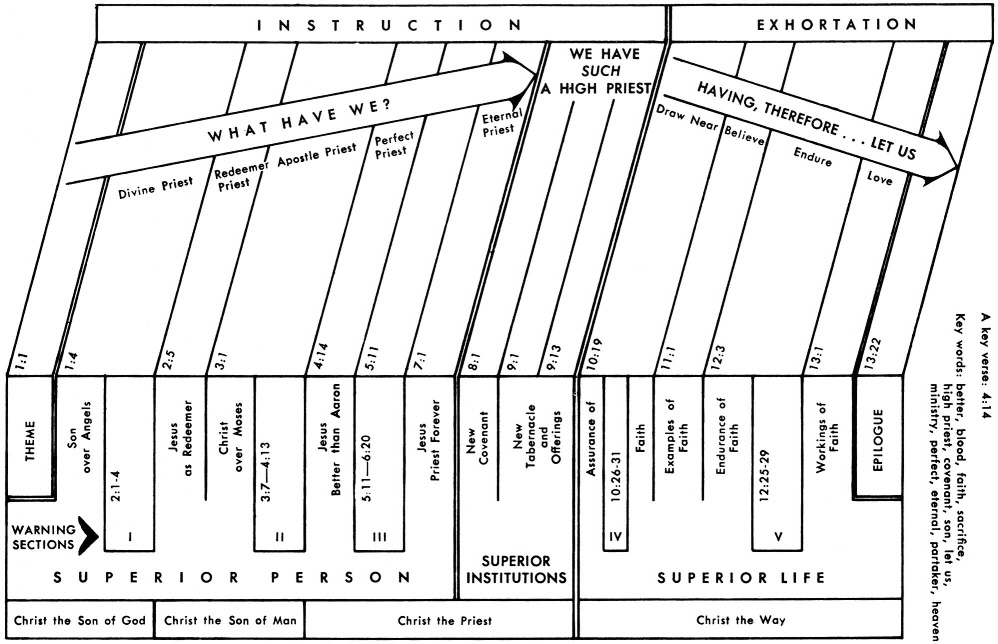
CONSIDER JESUS OUR GREAT HIGH PRIEST
Click chart to enlarge
Charts from Jensen's Survey of the NT - used by permission
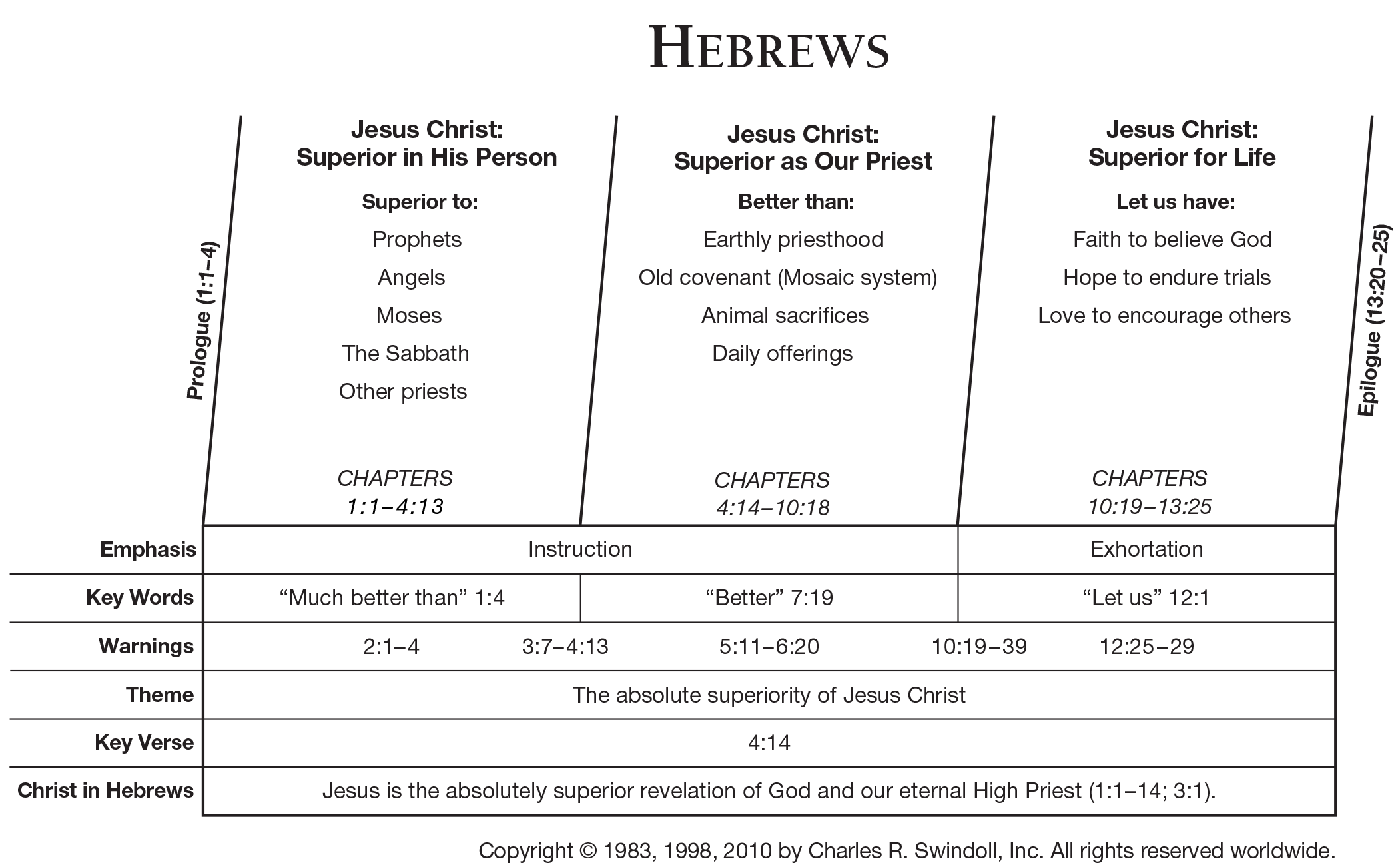
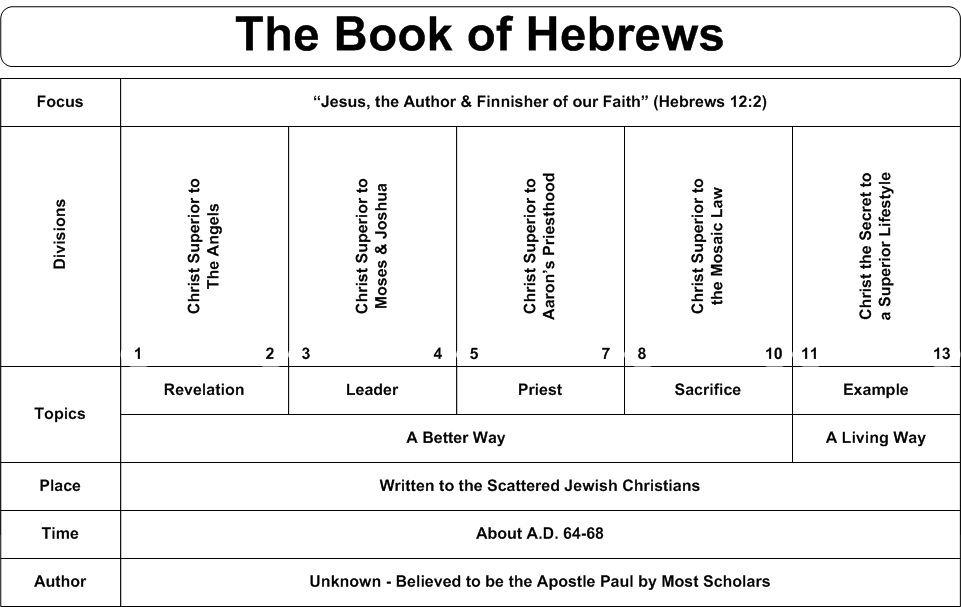
Swindoll's Chart, Interesting Pictorial Chart of Hebrews, Another Chart

|
The Epistle |
||||
| INSTRUCTION Hebrews 1-10:18 |
EXHORTATION Hebrews 10:19-13:25 |
|||
| Superior Person of Christ Hebrews 1:1-4:13 |
Superior Priest in Christ Hebrews 4:14-10:18 |
Superior Life In Christ Hebrews 10:19-13:25 |
||
| BETTER THAN PERSON Hebrews 1:1-4:13 |
BETTER PRIESTHOOD Heb 4:14-7:28 |
BETTER COVENANT Heb 8:1-13 |
BETTER SACRIFICE Heb 9:1-10:18 |
BETTER LIFE |
| MAJESTY OF CHRIST |
MINISTRY OF CHRIST |
MINISTERS FOR CHRIST |
||
|
DOCTRINE |
DUTY |
|||
|
DATE WRITTEN: |
||||

See ESV Study Bible "Introduction to Hebrews"
(See also MacArthur's Introduction to Hebrews)
Borrow Ryrie Study Bible
Hebrews 7:23 The former priests, on the one hand, existed * in greater numbers because they were prevented by death from continuing, (NASB: Lockman)
Greek: kai oi men pleiones eisin (3PPAI) gegonotes (RAPMPN) hiereis dia to thanato koluesthai (PPN) paramenein; (PAN)
Amplified: [Again, the former successive line of priests] was made up of many, because they were each prevented by death from continuing [perpetually in office]; (Amplified Bible - Lockman)
KJV: And they truly were many priests, because they were not suffered to continue by reason of death:
NLT: Another difference is that there were many priests under the old system. When one priest died, another had to take his place. (NLT - Tyndale House)
Wuest: And they indeed have been made many priests in number, because they were hindered from continuing by reason of death.
Young's Literal: and those indeed are many who have become priests, because by death they are hindered from remaining;
- Existed - Heb 7:8; 1Chr 6:3-14; Nehemiah 12:10,11
- Hebrews Study Questions - to aid your personal study or leading an inductive Bible study
- Hebrews 7 Resources - sermons and commentaries
PLETHORA OF PRIESTS
INTERRUPTED BY DEATH
This verse highlights the fragility and impermanence of the old priesthood, urging wavering Jewish readers to look to the one eternal Priest of the new covenant.
The former priests (hiereus), on the one hand, existed in greater numbers because they were prevented (koluo) by death (thanatos) from continuing (parameno) - The former priests refers to the Levitical priests. On the one hand sets up a contrast with Jesus in the next verse. One striking contrast is that there were many priests under the old covenant but only One under the better covenant. Because introduces the straightforward reason for the greater numbers, which is of course because they died and had to be replaced. Death terminated their tenure (unless they were past 50 which was the upper age limit). In short, under the Levitical system, priests could not continue permanently—every priest eventually died. So replacements were constantly needed. Across centuries, there were thousands of Levitical priests. Contrast with Christ Who is the one eternal High Priest and Who never needs a successor.
Old order: Many priests → mortality, fragility, constant change. New order: One Priest forever → permanence, stability, unbroken ministry. The multiplication of Levitical priests was actually a sign of weakness, not strength.
As if to picture that the Levitical priesthood would never be able to bring them to salvation, God gave Israel a dramatic and significant demonstration, recorded in Nu 20:23-29. When Aaron, the first high priest and progenitor of all succeeding priests, was about to die, God commanded Moses to bring Aaron and his son and successor, Eleazar, to Mount Hor, in view of all the people. Aaron’s high priestly garments were taken from him and placed on Eleazar. After Aaron died, the people mourned for him for 30 days. The people’s attention was specially focused on Aaron’s death, as if God were impressing upon them the fact that the priesthood he represented was a dying priesthood.
In this brief demonstration, along with Moses’ own death shortly afterward, two things about the Old Covenant were symbolized: it was not permanent, and it could not bring the people into the Promised Land. It was temporary and it could not save. Neither the law (represented by Moses) nor the sacrifices (represented by Aaron) could deliver from the wilderness of sin and bring into the land of salvation.
Wuest on prevented by death from continuing - Another proof of the superiority of the New Testament over the First Testament is found in the continued life of the priest, this priest therefore able to make intercession for the believer forever, and thus able to save him completely, whereas the Aaronic priests were compelled by death to transfer their ministry to the next priest in succession. The word “continue” is the translation of parameno which means “to remain alongside.” The idea is that because the Aaronic priests died, they were hindered from abiding by their ministration. (Hebrews Commentary online)
Spurgeon - A common priest served from thirty to fifty years of age, and then his work was done. Priests of the house of Aaron, who became high priests, held their office through life. Sometimes a high priest would continue in his office, therefore, for a considerable length of time, but in many cases he was cut off as other men are by premature death; hence there was priest after priest of the order of Aaron to go within the veil for the people. Our Lord Jesus is not as Aaron, who had to be stripped of his garments on the top of Mount Hor, and to die in the mount; neither is He like to any of the sons of Aaron who in due time suffered the infirmities of age, and at last bowed their heads to inevitable death. He died once, but death has no more dominion over Him; it is witnessed of Him that He lives.
UPSHOT - By stressing the mortality of the Levitical priesthood, the author contrasts its impermanence with the permanence of Christ’s priesthood, thereby urging his readers to embrace the superiority of the new covenant.
Priests (hiereus from hieros = sacred) is a sacred person serving at God’s altar. There were 24 classes for the service of the temple (see 1Ch 24). Compare to Webster's definition of pontifex [Pontifex, from pont-, pons = bridge + facere = to make) is literally one who makes a bridge! He spans the gap between God and man caused by man's sin.
HIEREUS - 30V - Matt. 8:4; Matt. 12:4; Matt. 12:5; Mk. 1:44; Mk. 2:26; Lk. 1:5; Lk. 5:14; Lk. 6:4; Lk. 10:31; Lk. 17:14; Jn. 1:19; Acts 4:1; Acts 6:7; Acts 14:13; Heb. 5:6; Heb. 7:1; Heb. 7:3; Heb. 7:11; Heb. 7:14; Heb. 7:15; Heb. 7:17; Heb. 7:21; Heb. 7:23; Heb. 8:4; Heb. 9:6; Heb. 10:11; Heb. 10:21; Rev. 1:6; Rev. 5:10; Rev. 20:6
ILLUSTRATION - The Endless Relay Race
Imagine a relay race with thousands of runners. Each runner can only go a short distance before he collapses with exhaustion, so the baton keeps getting passed, over and over again. The race never truly ends, because no runner has the strength to finish it on his own.
That is like the Levitical priesthood. Priest after priest served for a time, but death always stopped their service. The work was never complete, so another had to step in.
Now picture a champion runner who takes the baton, and unlike the rest, He never grows weary, never collapses, never stops. He runs the entire course to the finish and claims the victory once and for all. He would be "superhuman" and would be in fact a good picture of Jesus! That is Jesus’ priesthood. Unlike the many mortal priests, He lives forever and holds His priesthood permanently. He does not pass the baton—He carries it to the end.
Hebrews 7:24 but Jesus, on the other hand, because He continues forever, holds His priesthood permanently. (NASB: Lockman)
Greek: o de dia to menein (PAN) auton eis ton aiona aparabaton echei (3SPAI) ten hierosunen;
Amplified: But He holds His priesthood unchangeably, because He lives on forever. (Amplified Bible - Lockman)
KJV: But this man, because he continueth ever, hath an unchangeable priesthood.
NLT: But Jesus remains a priest forever; his priesthood will never end. (NLT - Tyndale House)
Wuest: But this (priest), because He abides forever, has the priesthood which is non-transferable,
Young's Literal: and he, because of his remaining--to the age, hath the priesthood not transient,
- He continues forever - Heb 7:8-25,28; 13:8; Isa 9:6,7; Jn 12:34; Ro 6:9; Rev 1:18
- Holds the priesthood permanently - 1 Samuel 2:35
- Hebrews Study Questions - to aid your personal study or leading an inductive Bible study
- Hebrews 7 Resources - sermons and commentaries
PERMANENCE AND PERPETUITY
OF THE PERFECT PRIEST
The author points to Christ’s indestructible life as the foundation of His untransferable priesthood, underscoring its permanence in contrast to the mortality of the Levitical priests.”
But (term of contrast) Jesus (Iesous), on the other hand, because He continues (meno - present tense) forever (eis ton aion = unto the age), holds (present tense) His priesthood (hierosune/hierosyne) permanently (aparabatos). - Jesus, unlike the priests of the old order, lives forever. Therefore His priesthood is unchanging and can never be transferred to another. Jesus’ priesthood does not just happen to be permanent. It cannot possibly be anything but permanent. It is not capable of anything but permanence. By its very divine nature it can never conclude or weaken or become ineffective. Jesus Christ has a priesthood that is absolutely incapable of ever being altered in any way! He is the last High Priest. No other will ever be needed.
He had no predecessor and
He will have no successor
Spurgeon on Jesus...continues forever - Here is our comfort: We have only one priest, and He ever lives. He had no predecessor and He will have no successor, because He ever lives personally to exercise the office of high priest on our behalf. My soul reposes in the faith of His one sacrifice, offered once and no more. There is but one presenter of that one sacrifice, and never can there be another, since the One is all-sufficient, and He never dies. Jesus reads my heart, and has always read it since it began to beat: He knows my griefs and has carried my sorrows from of old, and He will bear both them and me when old age shall shrivel up my strength. When I myself shall fall asleep in death He will not die, but will be ready to receive me into His own undying blessedness.
Spurgeon - I think they reckoned that there were eighty-three high priests in regular succession from Aaron to the death of Phineas, the last high priest at the siege of Jerusalem. One succeeded another, but this one goes on continually, forever has an untransferable priesthood. We know no priests on earth now, save that in a secondary sense the Lord Jesus has made all believers to be kings and priests unto God. We have now no special order of persons set apart to represent their fellows before God. Under the Mosaic dispensation there were many priests not suffered to continue by reason of death; but under the Christian dispensation we have only one priest, who continues ever in an untransferable priesthood.
Simon Kistemaker - What purpose does Jesus’ permanent priesthood serve? In fact, it serves many purposes. First, “he is able to save completely those who come to God through him.” Jesus is a Savior who does his work completely, fully, and to perfection.29 He sets man free from the curse of sin and accomplishes restoration between God and man; through Jesus man is united with his God (John 17:21).
Second, Jesus as eternal high priest lives not for himself, but for the people who look to him for help (2:17–18; 4:14–16). He is their Mediator, truly God and truly man. Without ceasing he pleads for us; standing between God and man, he constantly intercedes for those who come to God in prayer (Rom. 8:34; Heb. 9:24). God grants us everything we need for the furtherance of his name, his kingdom, and his will. He answers our prayers for daily sustenance, remission of sin, and protection from the evil one.
Third, Jesus taught: “No one comes to the Father except through me” (John 14:6). The writer of Hebrews repeats this very thought and reminds his readers that prayers to God must be offered in the name of Jesus.
Fourth, knowing that Jesus is always praying for us in heaven, we long to be with him. We have the assurance that as he lives eternally before God so shall we live forever with him. Presently we come to God in prayer, but at the end of our earthly stay he will take us home to be with him eternally.
Permanently (531) (aparabatos from a = w/o + parabaino = go beyond, transgress) is an adjective which literally that which does not go beyond and thus does not pass away. It means more than incidental permanence or something that simply will not be changed. It means unchangeable, unalterable, inviolable. It is something that cannot be changed. Carries idea of “valid and unalterable” and in secular Greek was used at the end of legal contracts. The only use is Hebrews 7:24 where the writer is teaching that in contrast to the Jewish high priesthood which was passed from father to son and successor and was liable to be violated and transgressed (Heb. 7:11), Christ's priesthood can never be transferred to another!
Wuest notes that aparabatos "describes that which cannot be violated, or that which does not pass over to another. The priestly ministry of Messiah is in view here, a ministry such that no other person can step into it, a ministry that cannot be transferred to another." (Hebrews Commentary)
Gilbrant - Aparabatos does not occur in writings during the classical period, instead it belongs to the Hellenistic period (ca. 330-30 B.C.). In Hellenistic Greek the term describes such things as the “changeless” nature of fate (among the Stoics) or the “unalterable” course of the stars and their movement (Schneider, “parabainō,” Kittel, 5:742). Josephus used it of the beauty of the “unchanging” piety of Jews (Against Apion 2.41, “inviolable”; cf. Antiquities 18.8.2). It is not used in the Septuagint.
|
CONTRASTS BETWEEN THE LEVITICAL HIGH PRIEST |
||
| LEVITICAL HIGH PRIEST | SCRIPTURE | JESUS HIGH PRIEST |
|
Many |
Heb 7:23-24 |
One |
|
Temporary |
Heb 7:23-24 |
Permanent |
|
Sinners - sacrifices for |
Heb 7:26-27 |
Holy, innocent - sacrifices only for sinners |
|
Daily sacrifices |
Heb 7:27 |
Sacrificed Once for All |
|
Animal Sacrifices |
Heb 7:27, 9:11-14 |
Offered up Himself |
|
Once/yr entered holy place made by men & by animal blood |
Heb 9:11-12 |
Entered true Holy Place in presence of God with His own blood |
Since Hebrews 7:23 and Hebrews 7:24 give us a contrast here are contrasting titles
Hebrews 7:23 – The Priests Who Could Not Continue
Hebrews 7:24 – The Priest Who Continues Forever
- Hebrews 7:23 – Many Priests, All Dying
- Hebrews 7:24 – One Priest, Ever Living
- Hebrews 7:23 – A Priesthood Broken by Death
- Hebrews 7:24 – A Priesthood Secured by Life
- Hebrews 7:23 – The Frailty of the Old Order
- Hebrews 7:24 – The Permanence of the New Order
- Hebrews 7:23 – Succession Without Security
- Hebrews 7:24 – Continuity With Certainty