Hebrews 7:1
Hebrews 7:2
Hebrews 7:3
Hebrews 7:4
Hebrews 7:5
Hebrews 7:6
Hebrews 7:7
Hebrews 7:8
Hebrews 7:9
Hebrews 7:10
Hebrews 7:11
Hebrews 7:12
Hebrews 7:13
Hebrews 7:14
Hebrews 7:15
Hebrews 7:16
Hebrews 7:17
Hebrews 7:18
Hebrews 7:19
Hebrews 7:20
Hebrews 7:21
Hebrews 7:22
Hebrews 7:23
Hebrews 7:24
Hebrews 7:25
Hebrews 7:26
Hebrews 7:27
Hebrews 7:28
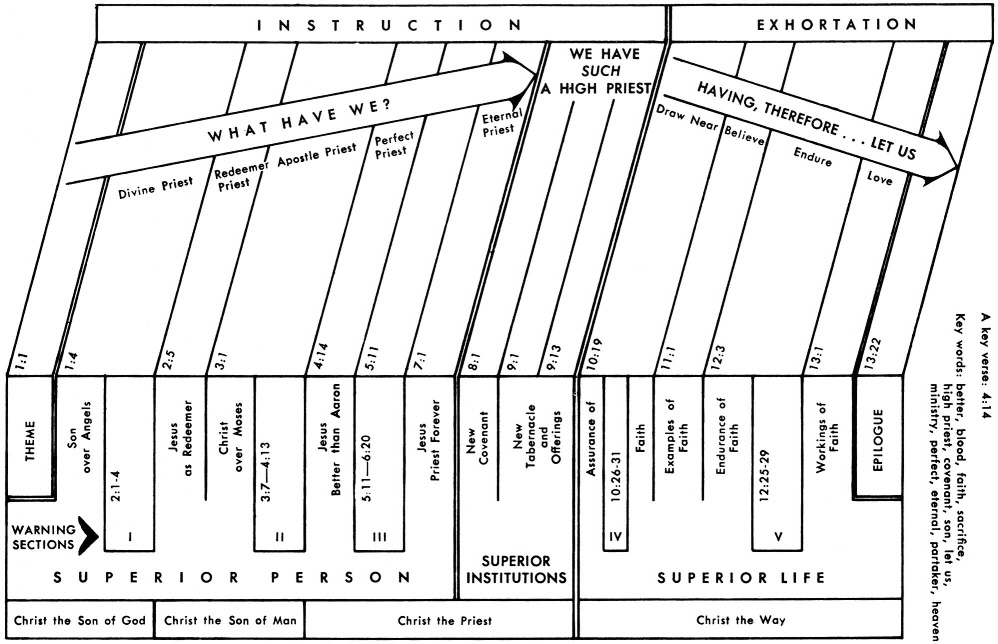
CONSIDER JESUS OUR GREAT HIGH PRIEST
Click chart to enlarge
Charts from Jensen's Survey of the NT - used by permission
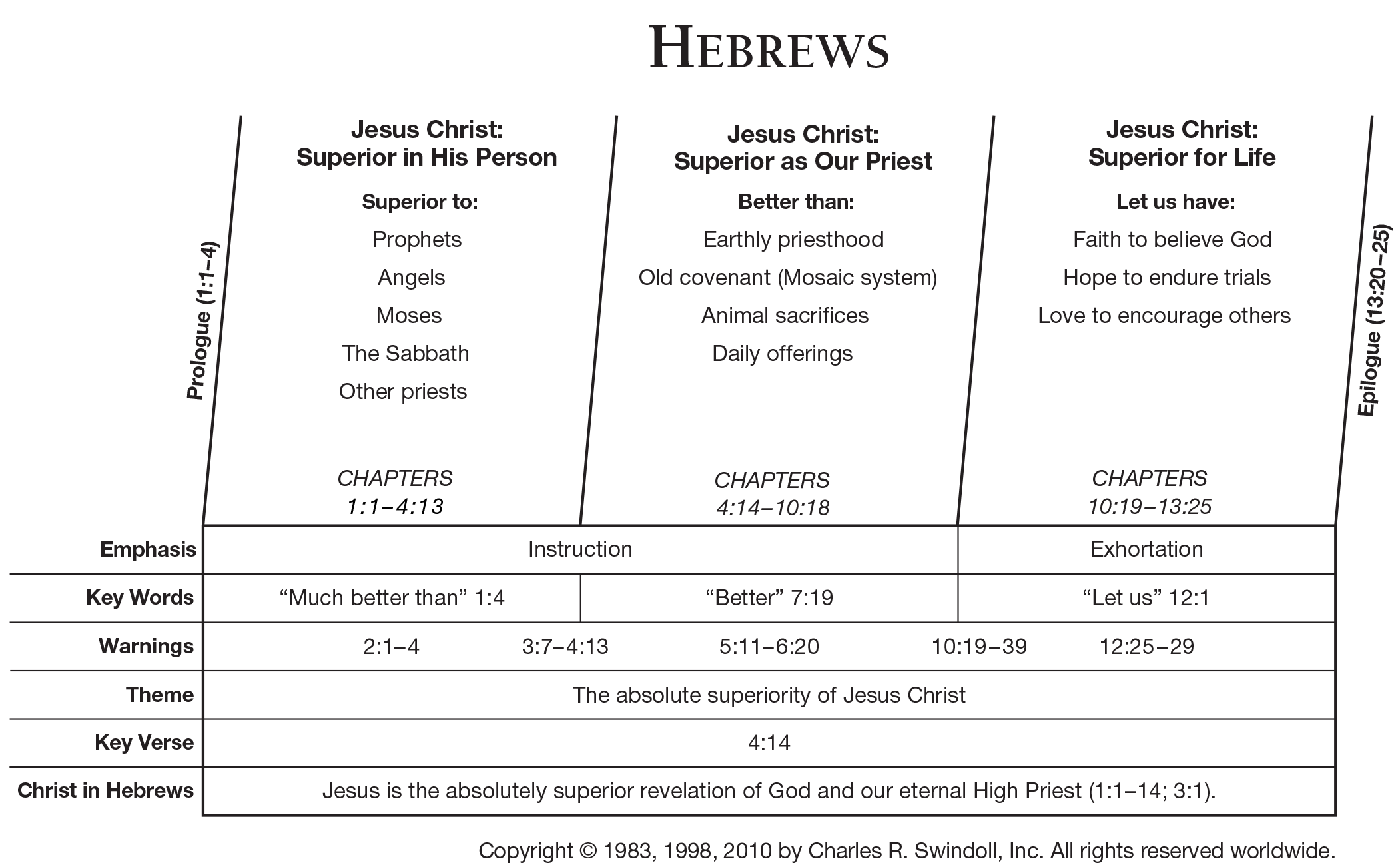
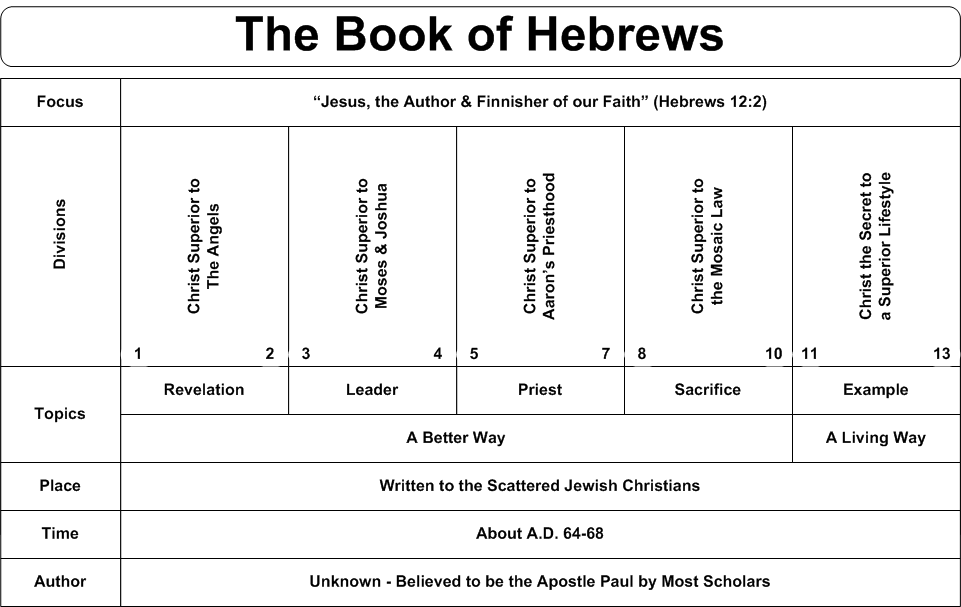
Swindoll's Chart, Interesting Pictorial Chart of Hebrews, Another Chart

|
The Epistle |
||||
| INSTRUCTION Hebrews 1-10:18 |
EXHORTATION Hebrews 10:19-13:25 |
|||
| Superior Person of Christ Hebrews 1:1-4:13 |
Superior Priest in Christ Hebrews 4:14-10:18 |
Superior Life In Christ Hebrews 10:19-13:25 |
||
| BETTER THAN PERSON Hebrews 1:1-4:13 |
BETTER PRIESTHOOD Heb 4:14-7:28 |
BETTER COVENANT Heb 8:1-13 |
BETTER SACRIFICE Heb 9:1-10:18 |
BETTER LIFE |
| MAJESTY OF CHRIST |
MINISTRY OF CHRIST |
MINISTERS FOR CHRIST |
||
|
DOCTRINE |
DUTY |
|||
|
DATE WRITTEN: |
||||

See ESV Study Bible "Introduction to Hebrews"
(See also MacArthur's Introduction to Hebrews)
Borrow Ryrie Study Bible
Hebrews 7:25 Therefore He is able also to save forever * those who draw near to God through Him, since He always lives to make intercession for them. (NASB: Lockman)
Greek: hothen kai sozein (PAN) eis to panteles dunatai (3SPPI) tous proserchomenous (PMPMPA) di autou to theo pantote zon (PAPMSN) eis to entugchanein (PAN) huper auton
BGT ὅθεν καὶ σῴζειν εἰς τὸ παντελὲς δύναται τοὺς προσερχομένους δι᾽ αὐτοῦ τῷ θεῷ, πάντοτε ζῶν εἰς τὸ ἐντυγχάνειν ὑπὲρ αὐτῶν.
Amplified: Therefore He is able also to save to the uttermost (completely, perfectly, finally, and for all time and eternity) those who come to God through Him, since He is always living to make petition to God and intercede with Him and intervene for them. (Amplified Bible - Lockman)
BBE: So that he is fully able to be the Saviour of all who come to God through him, because he is ever living to make prayer to God for them.
ESV: Consequently, he is able to save to the uttermost those who draw near to God through him, since he always lives to make intercession for them (ESV)
KJV: Wherefore he is able also to save them to the uttermost that come unto God by him, seeing he ever liveth to make intercession for them.
NKJ Therefore He is also able to save to the uttermost those who come to God through Him, since He always lives to make intercession for them.
NET So he is able to save completely those who come to God through him, because he always lives to intercede for them.
CSB Therefore, He is always able to save those who come to God through Him, since He always lives to intercede for them.
ESV Consequently, he is able to save to the uttermost those who draw near to God through him, since he always lives to make intercession for them.
NIV Therefore he is able to save completely those who come to God through him, because he always lives to intercede for them.
NLT: Therefore he is able, once and forever, to save everyone who comes to God through him. He lives forever to plead with God on their behalf. (NLT - Tyndale House)
Phillips: This means that he can save fully and completely those who approach God through him, for he is always living to intercede on their behalf. (Phillips: Touchstone)
Weymouth: Hence too He is able to save to the uttermost those who come to God through Him, seeing that He ever lives to plead for them.
Wuest: for which reason also He is able to be saving completely and forever those who come to God through Him, being always alive for the purpose of continually making intercession for them
Young's Literal: whence also he is able to save to the very end, those coming through him unto God--ever living to make intercession for them.
Paraphrase Because Jesus lives eternally, He has the power to save completely and without end everyone who approaches God through Him, continually speaking to God on their behalf.
Paraphrase Therefore, Jesus can forever rescue anyone who comes to God through Him, since He always stands before God interceding on their behalf.
Paraphrase Jesus is able to provide eternal salvation for those who come to God through Him, because He never stops praying and pleading for them.
|
THE WORK OF |
||
| PAST | PRESENT | FUTURE |
| He has appeared at the Cross for Propitiation |
He now appears at the right hand of the throne for Intercession |
He shall appear a Second time for the elect's final Deliverance |
| He appeared for our Redemption |
He now appears for our Representation |
He shall appear for our Rewards |
| He has appeared in Humiliation | He does appear in Exaltation | He shall appear in Universal Manifestation |
| He has appeared for our Justification | He does appear for our Sanctification | He shall appear for our Glorification |
- He is able to save forever - Heb 2:18; 5:7; Isa 45:22; 63:1; Da 3:15,17,29; 6:20; Jn 5:37-40; 10:29; 10:30; Eph 3:20; Php 3:21; 2Ti 1:12; Jude 1:24
- Draw near to God Heb 7:19; 11:6; Job 22:17; 23:3; Psalms 68:31,32; Isaiah 45:24; Jeremiah 3:22
- Through Him - Hebrews 13:15; John 14:6; Romans 5:2; Ephesians 2:18; 3:12; 1John 2:1,2
- Hebrews 7:20-28 Salvation Guaranteed! - Steven Cole
- Hebrews 7:20-28 Jesus: The Guarantee of a Better Covenant - John MacArthur
- Hebrews Study Questions - to aid your personal study or leading an inductive Bible study
- Hebrews 7 Resources - sermons and commentaries
Related Passages:
1 Timothy 2:5+ for there is one God, and one Mediator also between God and men, the Man Christ Jesus,
Romans 8:34+ who is the one who condemns? Christ Jesus is He who died, yes, rather who was raised, who is at the right hand of God, Who also intercedes for us.
Luke 22:32+ but I have prayed for you, that your faith may not fail; and you, when once you have turned again, strengthen your brothers.
Isaiah 53:12+ Therefore, I will allot Him a portion with the great, And He will divide the booty with the strong; Because He poured out Himself to death, And was numbered with the transgressors; Yet He Himself bore the sin of many, And interceded for the transgressors.
Hebrews 9:15+ For this reason He is the Mediator of a new covenant, so that, since a death has taken place for the redemption of the transgressions that were committed under the first covenant, those who have been called may receive the promise of the eternal inheritance.
1 John 2:1+ My little children, I am writing these things to you so that you may not sin. And if anyone sins, we have an Advocate (parakletos) with the Father, Jesus Christ the Righteous;
Jude 1:24+ Now to Him who is able to keep you from stumbling, and to make you stand in the presence of His glory blameless with great joy,
Romans 16:25+ Now to Him who is able to establish you according to my gospel and the preaching of Jesus Christ, according to the revelation of the mystery which has been kept secret for long ages past,
Ephesians 3:20+ Now to Him who is able to do far more abundantly beyond all that we ask or think, according to the power that works within us,
John 10:28+ and I give eternal life to them, and they will never perish; and no one will snatch them out of My hand.
John 14:6+ Jesus *said to him, “I am the way, and the truth, and the life; no one comes to the Father but THROUGH ME.
Romans 5:1-2+ Therefore, having been justified by faith, we have peace with God through our Lord Jesus Christ, 2 THROUGH WHOM also we have obtained our introduction (prosagoge) by faith into this grace in which we stand; and we exult in hope of the glory of God.
Ephesians 2:18+ for THROUGH HIM we both have our access in one Spirit to the Father.
1 Peter 3:18+ For Christ also died for sins once for all, the just for the unjust, so that He might bring us to God, having been put to death in the flesh, but made alive in the spirit;
THE PRIEST WHO IS ABLE TO
SAVE AND INTERCEDE FOREVER
John MacArthur writes that Hebrews 7:25 "is one of the most beautiful verses in Scripture. Like John 3:16, it contains the whole essence of the gospel. Salvation is the main theme of the entire Bible. Salvation is what the text is all about." (See Hebrews Commentary - Page 199)
The author has just contrasted the temporary and fragile priesthood of the sons of Levi—cut short by death—with the eternal priesthood of Jesus, who “continues forever” and thus holds His office permanently (Heb 7:24). This permanence is not theoretical; it has profound implications for believers. Since Christ’s priesthood never passes to another, His ministry of intercession is uninterrupted, unchanging, and all-sufficient. Hebrews 7:25 therefore presents the glorious outcome of His indestructible life and unending priesthood: the absolute ability to save, once and for all, those who draw near to God through Him. Hallelujah! Amen!
Therefore (term of conclusion) connects what has just been said (Heb 7:24: Jesus holds His priesthood aparabatos, unchangeable) with the resulting conclusion (Heb 7:25: He is therefore able to save completely). Heb 7:23–24 says the Levitical priests were many because death prevented permanence but Jesus continues forever, so His priesthood is unchangeable. Then in Heb 7:25 the conclusion based on the fact that His priesthood never ends is the wonderful truth that He is able to save completely and forever. So the therefore introduces the logical conclusion that the permanence of His priesthood guarantees the permanence of His saving work.
He is able (dunamai - present tense = continually) also to save (sozo - present tense = continually) forever (eis to panteles) those who draw near (proserchomai) to God through Him - He is able (dunamai - present tense = continually) means more than “He might do it” but means He has full power, sufficient ability, unfailing capacity to accomplish it. The Levitical priests were not able to save (Heb 7:18–19) because their sacrifices were animal blood and were temporary and incomplete. He is able means Jesus has the full, unbreakable power to accomplish salvation completely and eternally for all who come to God through Him. Nothing can hinder Him, nothing is beyond His capacity.
Salvation is threefold—
past, present, and future.
W H Griffith Thomas adds that "When it is said “able to save,” it means literally “able to keep on saving.” Salvation is threefold—past, present, and future. It includes deliverance from the penalty of sin (past); from the power of sin (present); and from the presence of sin (future). Each of these is clearly taught in Scripture, and “salvation” in its fullest meaning includes them all. In this Epistle the main thought is invariably of the salvation which is at once continuous, permanent, and perfect, and in this text, in particular “keep on saving,” the truth is that of the believer’s continual deliverance, just as the Apostle argues that those who have been reconciled to God by the death of His Son will inevitably be “kept safe in His life” (Moule) because of our Lord’s Resurrection (Rom. 5:6–10.). But it is not only a continuous, it is a complete salvation. He is able to save “to the uttermost.” The phrase means “completely,” and is only found in one other place in Scripture, where we have a very striking contrast (Luke 13:11+). The poor woman was unable to lift up herself “completely,” or “to the uttermost,”—that is, she was unable “to the uttermost,” but Christ is able “to the uttermost.” What does this mean? Surely, first of all, it means “to the uttermost” of our need through sin, whether this is ours through inherited disposition or through acquired characteristic. Then it means “to the uttermost” of our circumstances, whatever they may be, in all their difficulty, complexity, and pressure. Then it means “to the uttermost” of our time, covering past, present, and future. Looking back over the past, we have been saved from the condemnation and guilt of sin; looking round upon the present, we are being saved from the power, love, and defilement of sin; looking forward to the future, we shall be saved from the very presence of sin in the glorified state above. Not least of all, this phrase means “to the uttermost” of place. For just as our Lord sent His disciples to the “uttermost part of the earth” (Acts 1:8+), so, wherever His children go today, they experience His salvation regardless of locality, since He is the same everywhere, in His saving, sanctifying, and satisfying power. (BORROW Hebrews; a devotional commentary PAGE 92)
The Amplified renders He is able to save forever "He is able also to save to the uttermost (completely, perfectly, finally, and for all time and eternity). Many English translations render it differently, some emphasizing duration “forever” (NASB, NKJV, NRSV) but other emphasizing the extent “completely” / “to the uttermost” (ESV, NIV, KJV margin, CSB). Both are implied: Extent — He saves us in every aspect (past, present, future; body, soul, spirit). Duration — He saves us for all time because His priesthood never ends. Both of these senses clearly can be true. Kenneth Wuest in his rendering picks up both meanings -- "He is able to be saving completely and forever."
KJV Bible Commentary on save them to the uttermost "The possibilities for this Greek phrase are twofold, completely or forever. The context allows both ideas; and so the broader meaning, completely, seems the more appropriate usage. The one other occurrence of this Greek phrase also suggests completeness (Lk 13:11+—of a woman completely stooped over). Christ has saved us to the uttermost; our salvation is complete in every respect. It is complete in regard to time; so it is secure to the end of time. It is complete in that it can perfect regeneration in any life." (Online - KJV Bible Commentary)
Here sozo is equated with deliverance from sins (guilt and power of) with Jesus' Name being a transliteration of Joshua meaning "Jehovah is salvation". Stated another way, this verse speaks of all Three Tenses of Salvation, justification, sanctification and glorification. This salvation is unto the uttermost, and will be consummated when we experience our future tense salvation or glorification, at which time we will be "utterly saved", saved from not only the presence and power of sin, but also the pleasure of sin! Hallelujah! Lord haste that glorious day!
Save (sozo) in the present tense emphasizes that He continually saves. This includes then the idea that He is able to daily keep us safe and sound and to rescue us from dangerous situations and to restore us to health (especially spiritually). The nature of salvation is bringing men near to God. By delivering from sin, it qualifies believers to come to God.
Leon Morris - The verb “to save” (sozo) is used absolutely, which means that Christ will save in the most comprehensive sense; he saves from all that humanity needs saving from. The expression rendered “completely” (eis to panteles) is an unusual one, used again in the NT only in Luke 13:11 of the woman who could not straighten herself “completely” (“at all,” NIV). This may well be the sense of it here, too. Christ’s salvation is a complete deliverance no matter what the need of the sinner. Some take the word pantelēs in a temporal sense and see it as scarcely differing from “forever” or “always.” There is more to be said for the former meaning, though the latter is not impossible. The verb “is able” (dynatai) refers to power. Christ’s inviolable priesthood, a priesthood that can never be put away, means that he has the capacity (as others have not) of bringing a complete salvation to all who approach God through him. (See The Expositor's Bible Commentary - Abridged Edition)
John MacArthur on save (sozo) forever (eis to panteles) - Although the meaning in the context of Heb 7:25 can be that of eternal, the basic idea of the word is that of completeness or perfection. The King James translation (“to the uttermost”) is therefore accurate and significant. Jesus’ priesthood is no halfway measure, as were the old sacrifices that only symbolized removal of sin. The symbol was important for that covenant. It was God-given and God-required, but still was only a symbol. But Jesus Christ is able to save both eternally and completely. (See Hebrews Commentary - Page 199)
Forever (eis to panteles) and literally reads something like "into or unto the completion of all" Young's Literal has "to the very end" and the venerable King James has the great phrase to the uttermost. Note that He saves not from the uttermost but to the uttermost. The unchanging nature of Jesus’ priesthood means that the salvation He gives is also unchanging, permanent, and secure. He is able to save to the uttermost. Obviously He could save us from anything but the writer's point is that Jesus saves us to something to a complete, forever salvation. Because He is our High Priest forever, He can save forever. The evangelist Billy Sunday had a great sermon, where he talked about how God saved him from the gutter-most because he was a gutter-drunk when God saved him.
Spurgeon on save forever (KJV = to save them to the uttermost) - By which we understand that the uttermost extent of guilt is not beyond the power of the Savior. Can anyone tell what is the uttermost amount to which a man might sin? But there is a limit to His purpose to save. If I read the Bible rightly, there is one sin that can never be forgiven. It is the sin against the Holy Ghost. Tremble, unpardoned sinners, lest you should commit that. If I may tell you what I think the sin against the Holy Ghost is, I must say that I believe it to be different in different people; but in many persons, the sin against the Holy Ghost consists in stifling their convictions.
Matthew Henry writes that "this ever-living High Priest is able to save to the utmost—in all times, in all cases, in every juncture."
Those who draw near (proserchomai) to God through Him - Draw near (proserchomai) is in the present tense which emphasizes continual activity, but it also indicates that we have continual access to God through Jesus! The present tense signifies not a one-time act, but a lifestyle, a repeated approach to God through Christ. O how I fear I fall so short of "taking advantage" of this "opportunity of a lifetime!" We see a parallel passage in Ro 5:1-2+ where those justified by faith have access ("introduction" - see study of prosagoge ) to the Father through Jesus.
In the Old Covenant, drawing near was a technical term for approaching God in worship through the priests and sacrifices. Levitical priests drew near to minister (Ex 19:22; Lev 21:17, 21). Ordinary Israelites could not freely draw near but had to approach through mediators (priests, sacrifices, temple). The writer of Hebrews now applies this priestly language to believers, showing that in Christ, all who believe can come directly before God’s presence. Draw near describes believers actively seeking God, not through the old priesthood or sacrifices, but through Jesus, the eternal High Priest. Note that there is an qualifier, for it must be “through Him” for no other mediator grants access (cf Jn 14:6).
🙏 THOUGHT - Are you daily drawing near to God through Christ? The idea of drawing near to God is the heart of Christian faith because by Christ’s blood and priesthood, believers have free, confident, and continual access into God’s presence for worship, prayer, and fellowship. What was once restricted and fearful under the old covenant is now open, personal, and transforming in Christ.
Spurgeon addresses who those who draw near - "There is no limitation here of sect or denomination: it does not say, the Baptist, the Independent, or the Episcopalian that come unto God by Jesus Christ, but it simply says, "those," by which I understand men of all creeds, men of all ranks, men of all classes, who do but come to Jesus Christ. They shall be saved, whatever their apparent position before men, or whatever may be the denomination to which they have linked themselves. (Salvation to the Uttermost)
THOUGH HIM
Through (dia) Him - Through is the preposition dia which usually means “through,” “by means of,” or “on account of.” Here through expresses the channel or mediator by which access to God is possible. So the sense is “by means of Him [Jesus], and Him alone.”
Through Him conveys several thoughts - (1) Exclusive – There is no other way to God (John 14:6: “No one comes to the Father but through Me”). (2) Mediatorial – Christ stands as the bridge between a holy God and sinful humanity (1 Tim 2:5). (3) Ongoing – It’s not just past tense (at conversion) but continuous: every act of prayer, worship, or fellowship with God flows through Him.
What a startling contrast this truth of through Him would have been for his Jewish readers who had previously only known the Old Covenant. In the Levitical system, they could only approach God through the priests, sacrifices, and rituals, but that approach was still far, not near! Now, in Christ, those OT shadows are fulfilled, so that the readers did not have to come through temple or priestly rituals, but through the once-for-all work of Jesus who always lives to intercede.
The whole OT system highlighted man’s separation
rather than his intimacy.
For Jewish readers steeped in the Old Covenant, the phrase “through Him” (δι’ αὐτοῦ) would have landed with breathtaking force. Their entire religious history had taught them that God’s presence was both central and yet inaccessible. The tabernacle and later the temple were visible reminders of His nearness, but also of His distance. Every curtain, every ritual, every priestly duty whispered: “You cannot come too close.” In the Levitical system, access to God was indirect and limited. The people could not stroll into the holy place. Only priests could minister before the altar, and only the high priest could enter the Most Holy Place and that just once a year, with blood, and not without fear (Lev 16). Even then, the whole system highlighted man’s separation rather than his intimacy. Worshippers brought sacrifices, but the blood of bulls and goats could never truly cleanse the conscience (Heb 10:1–4). The law provided a way to approach, but it was always at a distance, mediated by fragile, sinful men. Now, in Christ, everything had changed. The shadows of the Old Covenant — priests, sacrifices, festivals, new moons or Sabbath days— all find their substance in Him (Col 2:16-17+). No longer did worshippers have to come through a temple curtain or through the blood of animals. Instead, they could now through Him, the once-for-all Sacrifice and eternal High Priest who lives forever to intercede. The distance has collapsed. What was “far off” has become “near” (Eph 2:13+). This was more than a doctrinal shift for these Jewish readers. It was a paradigm shock! To say that sinners could draw near to God directly and continually through Christ’s priesthood would have seemed almost scandalous to ears accustomed to distance, ritual, and hierarchy. No longer did a worshipper stand trembling at the edge of Sinai, warned not to touch the mountain (Ex 19:12). Instead, he was now invited with boldness to draw near to Zion, to the heavenly throne of grace (Heb 4:16; Heb 12:22). The result for them and for us that access to God's very presence is immediate, continual, and personal. Christ’s priesthood means believers do not approach as outsiders but as children welcomed home.
In sum: The truth of “through Him” is the climax of the contrast between Old Covenant distance and New Covenant nearness. The Jewish readers were being invited to trade a system of shadows for the substance, a system of repeated sacrifices for the once-for-all Sacrifice, and a system of mediated distance for the living presence of the eternal High Priest.
Able (1410) (dunamai is related to dunamis) means to have intrinsic or inherent ability to achieve. The present tense means that He is continually able to provide us with His unlimited strength. disposal. Through the enabling of the Holy Spirit, the believer can serve valiantly, endure patiently, suffer triumphantly, and, if need be, die gloriously. Note that words derived from the stem duna— all have the basic meaning of “being able,” of “capacity” in virtue of an ability. Duna- is the root for English words like dynamic, dynamo, dynamite, etc.
DUNAMAI IN HEBREWS - Heb. 2:18; Heb. 3:19; Heb. 4:15; Heb. 5:2; Heb. 5:7; Heb. 7:25; Heb. 9:9; Heb. 10:1; Heb. 10:11;
See Related Studies:
- GOD IS ABLE
- MIGHTY TO SAVE (Part 1)
- MIGHTY TO SAVE (Part 2)
- MIGHTY TO SAVE (Part 3).
- Pause a moment in the middle of your busy day and praise Jesus as you sing along with Laura Story Mighty to Save
Shine your light and let the whole world see
For the glory of the risen King.
Since faith comes by hearing and hearing by the word of Christ, "hear" the repetitive echo of "He is able..." (Suggestion: make a list of what God is able to do and then use it in a time of prayer)
and do not suppose that you can say to yourselves, 'We have Abraham for our father'; for I say to you, that God is able from these stones to raise up children to Abraham (Mt 3:9, cf Lu 3:8)
"And do not fear those who kill the body, but are unable to kill the soul; but rather fear Him who is able to destroy both soul and body in hell. (Mt 10:28)
"And now I commend you to God and to the word of His grace, which is able to build you up and to give you the inheritance among all those who are sanctified. (Acts 20:32)
And they also, if they do not continue in their unbelief, will be grafted in; for God is able to graft them in again. (see note Romans 11:23)
Who are you to judge the servant of another? To his own master he stands or falls; and stand he will, for the Lord is able to make him stand. (see note Romans 14:4)
Now to Him Who is able to establish you according to my gospel and the preaching of Jesus Christ, according to the revelation of the mystery which has been kept secret for long ages past (see note Romans 16:25)
And God is able to make all grace abound to you, that always having all sufficiency in everything, you may have an abundance for every good deed (2 Cor 9:8)
Now to Him Who is able to do exceeding abundantly beyond all that we ask or think, according to the power that works within us, 21 to Him be the glory in the church and in Christ Jesus to all generations forever and ever. Amen. (see note Ephesians 3:20)
For our citizenship is in heaven, from which also we eagerly wait for a Savior, the Lord Jesus Christ; 21 Who shall change our vile body, that it may be fashioned like unto his glorious body, according to the working whereby He is able even to subdue all things unto himself. (King James Version) (see notes Philippians 3:20; Philippians 3:21)
For this reason I also suffer these things, but I am not ashamed; for I know whom I have believed and I am convinced that He is able to guard what I have entrusted to Him until that day. (see note 2 Timothy 1:12)
For since He Himself was tempted in that which He has suffered, He is able to come to the aid of those who are tempted. (see note Hebrews 2:18)
Hence, also, He is able to save forever those who draw near to God through Him, since He always lives to make intercession for them. (Hebrews 7:25)
He considered that God is able to raise men even from the dead; from which he also received him back as a type. (see note Hebrews 11:19)
Therefore putting aside all filthiness and all that remains of wickedness, in humility receive the word implanted, which is able to save your souls. (James 1:21)
There is only one Lawgiver and Judge, the One who is able to save and to destroy; but who are you who judge your neighbor? (James 4:12)
Now to Him Who is able to keep you from stumbling, and to make you stand in the presence of His glory blameless with great joy (Jude 1:24)
Save (4982) (sozo) in general means to save, preserve from harm, rescue. Sozo is sometimes used of physical deliverance from danger of perishing (see Mt 8:25; Mt 14:30; Lu 23:35; Acts 27:20 27:31), physical healing from sickness (Mt 9:21, 22; Mk 5:23, Acts 4:9), and deliverance from demonic possession (Lk 8:36). More often sozo refers to salvation in a spiritual sense as illustrated in the following passages: Matthew recorded the angel's conversation with Joseph declaring "She (Mary) will bear a Son; and you shall call His name Jesus, for it is He who will save (sozo) His people from their sins." (Mt 1:21)
SOZO - only 2x in Hebrews Heb. 5:7; Heb. 7:25
Forever (eis ton panteles) (3838) panteles (pas = all + telos = an end) completely, entirely, to the uttermost perfectly. Panteles is used in the Greek phrase (eis to pantelēs), so it is not the usual word for “forever” (aiōnios). So Heb 7:25 literally says “He is able to save to the uttermost those who draw near to God through Him.”
PANTELES IN NT - Lk. 13:11; Heb. 7:25
Gilbrant - Outside of the Scriptures the word pantelēs has the meaning of “complete, perfect.” It is used to signify a monarch’s “full authority,” a “mistress” of a house, or anything “all-accomplishing” (Liddell-Scott). Furthermore, it is used to describe the “absolute” forbidding of divorce and the “complete” driving out of lepers from the city. There is also an adverbial use signifying time and translated “forever.” In the Septuagint pantelēs is found only in 3 Maccabees 7:16 where it functions as an adjective and is translated “eternal.” God is the “eternal” Saviour. In the New Testament pantelēs has the same meaning as the adverb pantelōs (“completely, fully,” or “wholly”). Hebrews 7:25 can be understood in this sense, “to save entirely.” The phrase eis to pantelēs can also be translated as an adverb concerned with time. This meaning fits Hebrews 7:25 and would read, “He is able to save forever (for all time).” The only other occurrence of the word is in Luke 13:11 which may carry the same meaning. “The woman could not straighten herself up at all” (Bauer), in the sense of an incomplete result regardless of the effort. (Complete Biblical Library)
Draw near (4334) (proserchomai from prós = facing + érchomai = come) means literally to come facing toward and so to approach or come near. To come to visit or associate with. It describes the approach to or entry into a deity’s presence. In the Septuagint (LXX) proserchomai was the verb used to describe the approach of the priests to Jehovah for worship and to perform of their priestly (Levitical) functions. But here in Hebrews, under the New covenant, all seven uses of proserchomai refer to believers possessing the privilege of access to God the Father through Christ the Great High Priest.
Drawing near is a common theme in the seven uses of proserchomai in Hebrews...
Hebrews 4:16 (note) Let us therefore draw near with confidence to the throne of grace, that we may receive mercy and may find grace to help in time of need. (Comment: "Let us..." emphasizes that this privilege is always available to those under the New Covenant. Do we really comprehend and avail ourselves of the profundity of this privilege?)
Hebrews 7:25 (note) Hence, also, He is able to save forever those who draw near to God through Him, since He always lives to make intercession for them.
Hebrews 10:1 (note) For the Law, since it has only a shadow of the good things to come and not the very form of things, can never by the same sacrifices year by year, which they offer continually, make perfect those who draw near.
Hebrews 10:22 (note) let us draw near with a sincere heart in full assurance of faith, having our hearts sprinkled clean from an evil conscience and our bodies washed with pure water.
Hebrews 11:6 (note) And without faith it is impossible to please Him, for he who comes (drawn near) to God must believe that He is, and that He is a rewarder of those who seek Him.
Hebrews 12:18 (note) For you have not come (drawn near) to a mountain that may be touched and to a blazing fire, and to darkness and gloom and whirlwind,
Hebrews 12:22 (note) But you have come (drawn near) to Mount Zion and to the city of the living God, the heavenly Jerusalem, and to myriads of angels,
Spurgeon comments on the uttermost asking...WHAT IS THE MEASURE OF THE SAVIOUR'S ABILITY? This is a question as important as if it were for life or death—a question as to the ability of Jesus Christ. How far can salvation go? What are its limits and its boundaries? Christ is a Saviour: how far is he able to save? He is a Physician: to what extent will his skill reach to heal diseases? What a noble answer the text gives! "He is able to save to the uttermost." Now, I will certainly affirm, and no one can deny it, that no one here knows how far the uttermost is. David said, if he took the wings of the morning, to fly to the uttermost parts of the sea, even there should God reach him. But who knoweth where the uttermost is? Borrow the angel's wing, and fly far, far beyond the most remote star: go where wing has never flapped before, and where the undisturbed ether is as serene and quiet as the breast of Deity itself; you still, beyond the bounds of creation, where space itself falls, and where chaos takes up its reign: you will not come to the uttermost. It is too far for mortal intellect to conceive of; it is beyond the range of reason or of thought. Now, our text tells us that Christ is "able to save to the uttermost."
1. Sinner, I shall address thee first; and saints of God, I shall address you afterwards. Sinner, Christ is "able to save to the uttermost;" by which we understand that the uttermost extent of guilt is not beyond the power of the Saviour. Can any one tell what is the uttermost amount to which a man might sin? Some of us conceive that Palmer has gone almost to the uttermost of human depravity; we fancy that no heart could be much more vile than that which conceived a murder so deliberate, and contemplated a crime so protracted; but I can conceive it possible that there might be even worse men than he, and that if his life were spared, and he were set at large, he might become even a worse man than he is now. Yea, supposing he were to commit another murder, and then another, and another, would he have gone to the uttermost? Could not a man be yet more guilty? As long as ever he lives, he may become more guilty than he was the day before. But yet my text says, Christ is "able to save to the uttermost." I may imagine a person has crept in here, who thinks himself to be the most loathsome of all beings, the most condemned of all creatures. "Surely," says he, "I have gone to the utmost extremity of sin; none could outstrip me in vice." My dear friend, suppose you had gone to the uttermost, remember that even then you would not have gone beyond the reach of divine mercy; for he is "able to save to the uttermost," and it is possible that you yourself might go a little further, and therefore you have not gone to the uttermost yet. However far you may have gone—if you have gone to the very artic regions of vice, where the sun of mercy seems to scatter but a few oblique rays, there can the light of salvation reach you. If I should see a sinner staggering on in his progress to hell, I would not give him up, even when he had advanced to the last stage of iniquity. Though his foot hung trembling over the very verge of perdition, I would not cease to pray for him; and though he should in his poor drunken wickedness go staggering on till one foot were over hell, and he were ready to perish, I would not despair of him. Till the pit had shut her mouth upon him I would believe it still possible that divine grace might save him. See here! he is just upon the edge of the pit, ready to fall; but ere he falls, free grace bids, "Arrest that man!" Down mercy comes, catches him on her broad wings, and he is saved, a trophy of redeeming love. If there be any such in this vast assembly—if there be any here of the outcast of society, the vilest of the vile, the scum, the draff of this poor world,—oh! ye chief of sinners! Christ is "able to save to the uttermost." Tell that everywhere, in every garret, in every cellar, in every haunt of vice, in every kennel of sin; tell it everywhere! "To the uttermost!" "He is able to save them to the uttermost."
2. Yet again: not only to the uttermost of crime, but to the uttermost of rejection. I must explain what I mean by this. There are many of you here who have heard the gospel from your youth up. I see some here, who like myself are children of pious parents. There are some of you upon whose infant forehead the pure heavenly drops of a mother's tears continually fell; there are many of you here who were trained up by one whose knee, whenever it was bent, was ever bent for you, her first-born son. Your mother has gone to heaven, it may be, and all the prayers she ever prayed for you are as yet unanswered. Sometimes you wept. You remember well how she grasped your hand, and said to you, "Ah! John, you will break my heart by this your sin, if you continue running on in those ways of iniquity: oh! if you did but melt, and you would fly to Christ." Do you not remember that time? The hot sweat stood upon your brow, and you said—for you could not break her heart—"Mother, I will think of it;" and you did think of it; but you met your companion outside, and it was all gone: your mother's expostulation was brushed away; like the thin cobwebs of the gossamer, blown by the swift north wind, not a trace of it was left. Since then you have often stepped in to hear the minister. Not long ago you heard a powerful sermon; the minister spoke as though he were a man just started from his grave, with as much earnestness as if he had been a sheeted ghost come back from the realms of despair, to tell you his own awful fate, and warn you of it. You remember how the tears rolled down your cheeks. while he told you of sin, of righteousness, and of judgment to come; you remember how he preached to you Jesus and salvation by the cross, and you rose up from your seat in that chapel, and you said, "Please God I am spared another day, I will turn to him with full purpose of heart." And there you are, still unchanged—perhaps worse than you were; and you have spent your Sunday afternoon the angel knows where: and your mother's spirit knows where you have spent it too, and could she weep, she would weep over you who have this day despised God's Sabbath, and trampled on his Holy Word. But doest thou feel in thine heart to-night the tender motions of the Holy Spirit? Dost thou feel something say, "Sinner! come to Christ now?" Dost thou hear conscience whispering to thee, telling thee of thy past transgression? And is there some sweet angel voice, saying, "Come to Jesus, come to Jesus; he will save you yet?" I tell you, sinner, you may have rejected Christ to the very uttermost; but he is still able to save you. There are a thousand prayers on which you have trampled, there are a hundred sermons all wasted on you, there are thousands of Sabbaths which you have thrown away; you have rejected Christ, you have despised his Spirit; but still he ceases not to cry, "Return, return!" He is "able to save thee to the uttermost," if thou comest unto God by him.
3. There is another case which demands my particular attention to-night. It is that of the man who has gone to the uttermost of despair. There are some poor creatures in the world, who from a course of crime have become hardened, and when at last aroused by remorse and the pricklings of conscience, there is an evil spirit which broods over them, telling them it is hopeless for such as they are to seek salvation. We have met with some who have gone so far that they have thought that even devils might be saved rather than they could. They have given themselves up for lost, and signed their own death-warrant, and in such a state of mind have positively taken the halter in their hand, to end their unhappy lives. Despair has brought many a man to a premature death; it hath sharpened many a knife, and mingled many a cup of poison. Have I a despairing person here? I know him by his sombre face and downcast looks. He wishes he were dead, for he thinks that hell itself could be scarce worse torment than to be here expecting it. Let me whisper to him words of consolation. Despairing soul! hope yet, for Christ is able to save to the uttermost;" and though thou art put in the lowest dungeon of the castle of despair, though key after key hath been turned upon thee, and the iron grating of thy window forbids all filing, and the height of thy prison-wall is so awful that thou couldst not expect to escape, yet let me tell thee, there is one at the gate who can break every bolt, and undo every lock; there is one who can lead thee out to God's free air and save thee yet, for though the worst may come to the worst, he "is able to save thee to the uttermost."
4. And now a word to the saint, to comfort him: for this text is his also. Beloved brother in the gospel! Christ is able to save thee to the uttermost. Art thou brought very low by distress? hast thou lost house and home, friend and property? Remember, thou hast not come "to the uttermost" yet, Badly off as thou art, thou mightest be worse. He is able to save thee; and suppose it should come to this, that thou hadst not a rag left, nor a crust, nor a drop of water, still he would be able to save thee, for "he is able to save to the uttermost." So with temptation. If thou shouldst have the sharpest temptation with which mortal was ever tried, he is able to save thee. If thou shouldst be brought into such a predicament that the foot of the devil should be upon thy neck, and the fiend should say, "Now I will make an end of thee," God would be able to save thee then. Ay, and in the uttermost infirmity shouldst thou live for many a year, till thou art leaning on thy staff, and tottering along thy weary life, if thou shouldst outlive Methusaleh, thou couldst not live beyond the uttermost, and he would save thee then. Yes, and when thy little bark is launched by death upon the unknown sea of eternity, he will be with thee; and though thick vapours of gloomy darkness gather round thee, and thou canst not see into the dim future, though thy thoughts tell thee that thou wilt be destroyed, yet God will be "able to save thee to the uttermost."
Then, my friends, if Christ is able to save a Christian to the uttermost, do you suppose he will ever let a Christian perish? Wherever I go, I hope always to bear my hearty protest against the most accursed doctrine of a saint's falling away and perishing. There are some ministers who preach that a man may be a child of God (now, angels! do not hear what I am about to say, listen to me, ye who are down below in hell, for it may suit you) that a man may be a child of God to-day, and a child of the devil to-morrow; that God may acquit a man, and yet condemn him—save him by grace, and then let him perish—suffer a man to be taken out of Christ's hands, though he has said such a thing shall never take place. How will you explain this? It certainly is no lack of power. You must accuse him of a want of love, and will you dare to do that? He is full of love; and since he has also the power, he will never suffer one of his people to perish. It is true, and ever shall be true, that he will save them to the very uttermost. (Salvation to the Uttermost)
Draw near unto God - Spurgeon writes...
They "come unto God." By coming to God we are not to understand the mere formality of devotion, since this may be but a solemn means of sinning.
What a splendid general confession is that in the Church of England Prayer Book: "We have erred and strayed from thy ways like lost sheep; we have done those things which we ought not to have done, and we have left undone those things which we ought to have done, and there is no health in us." There is not to be found a finer confession in the English language. And yet how often, my dear friends, have the best of us mocked God by repeating such expressions verbally, and thinking we have done our duty! How many of you go to chapel, and must confess your own absence of mind while you have bowed your knee in prayer, or uttered a song of praise! My friends, it is one thing to go to church or chapel; it is quite another thing to go to God.
There are many people who can pray right eloquently, and who do so; who have learned a form of prayer by heart, or, perhaps, use an extemporary form of words of their own composing: but who, instead of going to God, are all the while going from God.
Let me persuade you all not to be content with mere formality. There will be many damned who never broke the Sabbath, as they thought, but who, all their lives were Sabbath-breakers. It is as much possible to break the Sabbath in a church as it is to break the Sabbath in the park; it is as easy to break it here in this solemn assembly as in your own houses. Every one of you virtually break the Sabbath when you merely go through a round of duties, having done which, you retire to your chambers, fully content with yourselves, and fancy that all is over—that you have done your day's work—whereas, you have never come to God at all, but have merely come to the outward ordinance and to the visible means, which is quite another thing from coming to God himself.
And let me tell you, again, that coming to God is not what some of you suppose—now and then sincerely performing an act of devotion, but giving to the world the greater part of your life.
You think that if sometimes you are sincere, if now and then you put up an earnest cry to heaven, God will accept you; and though your life may be still worldly, and your desires still carnal, you suppose that for the sake of this occasional devotion God will be pleased, in his infinite mercy, to blot out your sins. I tell you, sinners, there is no such thing as bringing half of yourselves to God, and leaving the other half away. If a man has come here, I suppose he has brought his whole self with him; and so if a man comes to God, he cannot come, half of him, and half of him stay away.
Our whole being must be surrendered to the service of our Maker. We must come to him with an entire dedication of ourselves, giving up all we are, and all we ever shall be, to be thoroughly devoted to his service, otherwise we have never come to God aright.
I am astonished to see how people in these days try to love the world and love Christ too; according to the old proverb, they "hold with the hare and run with the hounds." They are real good Christians sometimes, when they think they ought to be religious; but they are right bad fellows at other seasons, when they think that religion would be a little loss to them.
Let me warn you all. It is of no earthly use for you to pretend to be on two sides of the question.
"If God be God, serve him; If Baal be God, serve him."
I like an out-and-out man of any sort. Give me a man that is a sinner: I have some hope for him when I see him sincere in his vices, and open to acknowledging his own character; but if you give me a man who is half-hearted, who is not quite bold enough to be all for the devil, nor quite sincere enough to be all for Christ, I tell you, I despair of such a man as that. The man who wants to link the two together is in an extremely hopeless case.
Do you think, sinners, you will be able to serve two masters, when Christ has said you cannot? Do you fancy you can walk with God and walk with mammon too? Will you take God on one arm, and the devil on the other? Do you suppose you can be allowed to drink the cup of the Lord, and the cup of Satan at the same time? I tell you, ye shall depart, as cursed and miserable hypocrites, if so you come to God.
God will have the whole of you come, or else you shall not come at all. The whole man must seek after the Lord; the whole soul must be poured out before him; otherwise it is no acceptable coming to God at all. Oh, halters between two opinions, remember this and tremble.
I think I hear one say, "Well, then, tell us what it is to come to God." I answer, coming to God implies, leaving something else. If a man comes to God, he must leave his sins; he must leave his righteousness; he must leave both his bad works and his good ones, and come to God, leaving them entirely.
Again, coming to God implies, there is no aversion towards him; for a man will not come to God while he hates God; he will be sure to keep away. Coming to God signifies having some love to God. Again: coming to God signifies desiring God, desiring to be near to him. And, above all, it signifies praying to God and putting faith in him. This is coming to God; and those that have come to God in that fashion are among the saved. The come to God: that is the place to which their eager spirits hasten. (Salvation to the Uttermost)
Spurgeon has the following thoughts on through Him "But notice, next, how they come. The "come unto God by Jesus Christ." We have known many persons who call themselves natural religionists. They worship the God of nature, and they think that they can approach God apart from Jesus Christ. There be some men we wot of who despise the mediation of the Saviour, and, who, if they were in an hour of peril, would put up their prayer at once to God, without faith in the Mediator. Do such of you fancy that you will be heard and saved by the great God your Creator, apart from the merits of his Son? Let me solemnly assure you, in God's most holy name, there never was a prayer answered for salvation, by God the Creator, since Adam fell, without Jesus Christ the Mediator. "No man can come unto God but by Jesus Christ;" and if any one of you deny the Divinity of Christ, and if any soul among you do not come to God through the merits of a Saviour, bold fidelity obliges me to pronounce you condemned persons; for however amiable you may be, you cannot be right in the rest, unless you think rightly of him. I tell you, ye may offer all the prayers that ever may be prayed, but ye shall be damned, unless ye put them up through Christ. It is all in vain for you to take your prayers and carry them yourself to the throne. "Get thee hence, sinner; get thee hence," says God; "I never knew thee. Why didst not thou put thy prayer into the hands of a Mediator? It would have been sure of an answer. But as thou presentest it thyself, see what I will do with it!" And he read your petition, and casts it to the four winds of heaven; and thou goest away unheard, unsaved. The Father will never save a man apart from Christ; there is not one soul now in heaven who was not saved by Jesus Christ; there is not one who ever came to God aright, who did not come through Jesus Christ. If you would be at peace with God, you must come to him through Christ, as the way, the truth, and the life, making mention of his righteousness, and of his only. (Salvation to the Uttermost)
Consider the following simple study - observe and record the wonderful truths that accrue through Him - this would make an edifying, easy to prepare Sunday School lesson - then take some time to give thanks for these great truths by offering up a sacrifice of praise...through Him.
John 1:3 [NIV reads "through Him"], John 1:7, John 1:10,Jn 3:17, Jn 14:6, Acts 3:16, Acts 7:25, Acts 10:43, Acts 13:38-39, Romans 5:9 +, Romans 8:37+, Ro 11:36+; 1Cor 8:6, Ep 2:18+, Php 4:13+, Col 1:20+, Col 2:15+, Col 3:17+, He 7:25+, He 13:15+,1Pe 1:21+, 1John 4:9
Would you like more study on the wonderful topic of through Him? Click the NT uses of the parallel phrase through Jesus or see (John 1:17, Acts 10:36, Ro 1:8-+, Ro 5:1,2+ Ro 5:21+, Ro 7:25+, Ro 16:27+, Gal 1:1, Ep 1:5+, Php 1:11+, Titus 3:6+, He 13:21+, 1Pe 2:5+, 1Pe 4:11+, Jude 1:25)
All things are from Him, through Him and to Him.
To Him be the glory forever. Amen.
SINCE HE ALWAYS LIVES TO MAKE INTERCESSION FOR THEM: di autou to theo pantote zon (PAPMSN) eis to entugchanein (PAN) huper auton:
- He always lives - Heb 7:8,16,24
- To make intercession - Heb 9:24; Isaiah 53:12; 59:16; Da 9:16; Jn 14:13,16; 16:23,24; 17:9-26; Ro 8:34; 1 Ti 2:5; 1 Jn 2:1,2; Rev 8:3,4
- Hebrews 7:20-28 Salvation Guaranteed! - Steven Cole
- Hebrews 7:20-28 Jesus: The Guarantee of a Better Covenant - John MacArthur
- Hebrews 7 Resources - Multiple Sermons and Commentaries
Related Passages:
Isaiah 53:12 Therefore, I will allot Him a portion with the great, And He will divide the booty with the strong; Because He poured out Himself to death, And was numbered with the transgressors; Yet He Himself bore the sin of many, And interceded for the transgressors.
Isaiah 59:16 And He saw that there was no man, and was astonished that there was no one to intercede; Then His own arm brought salvation to Him, and His righteousness upheld Him
Romans 8:34+ who is the one who condemns? Christ Jesus is He who died, yes, rather who was raised, who is at the right hand of God, who also intercedes (entugchano - present tense) for (huper) us.
Hebrews 9:24+ For Christ did not enter a holy place made with hands, a mere copy of the true one, but into heaven itself, now to appear in the presence of God for us (see note )
1 Timothy 2:5+ For there is one God, and one mediator also between God and men, the man Christ Jesus,
1 John 2:1-2+ My little children, I am writing these things to you so that you may not sin. And if anyone sins, we have an Advocate with the Father, Jesus Christ the righteous; and He Himself is the propitiation for our sins; and not for ours only, but also for those of the whole world.
THE POWER OF OUR PRIEST'S
ENDLESS INTERCESSION
Since He always (pantote) lives (zao - present tense = continually) to make intercession (entugchano - present tense = continually) for them - Since He always (pantote) lives (zao) means “because He lives without interruption.” Since He always lives, His saving power never expires. Our salvation is secure as long as Christ lives and He lives forever. The ground of His saving power is His indestructible life (Heb 7:16). Unlike Levitical priests, who were interrupted by death (Heb 7:23), Jesus’ life never ends. His eternal life guarantees His eternal intercession so that there is never a moment when He ceases to represent His people before God. Christ’s priesthood is not based on lineage but on resurrection. He “lives always” because death has no dominion over Him (Ro 6:9). His advocacy doesn’t expire with age or death. He is permanently active in mediating for His people (1 John 2:1+).
Jesus is not merely alive in heaven but actively engaged in a priestly work: continually representing His people before the Father. His intercession means: He presents His once-for-all sacrifice as the ongoing basis of our acceptance (cf. Heb 9:24). He pleads for us personally, bringing our needs before God (Rom 8:34). He protects us against accusation from the enemy (Rom 8:33–34; 1 John 2:1).
To make intercession (entugchano - present tense = continually) for (huper) them - Jesus’ role as High Priest is not limited to offering a once-for-all sacrifice; it continues in His ongoing advocacy at the Father’s right hand. His intercession is not begging a reluctant Father, but His very presence and representation on behalf of those He saves. The focus is continual, unbroken priestly ministry — “He always lives to intercede.” For (huper) them can have a substitutionary sense but in this context it speaks more of representation, on behalf of or for the benefit of. Jesus lives and acts on behalf of those who draw near to God through Him. It’s less substitutionary here (that was accomplished at the cross once-for-all, cf. Heb 9:28), and more ongoing advocacy. We see this same idea in Ro 8:34 where "He intercedes (entugchano - present tense) for (huper) us." In sum, to make intercession for them means Jesus, as our eternal High Priest, is continually and actively representing believers before the Father. His very life, His once-for-all sacrifice, and His ongoing advocacy guarantee that our access to God is permanent and our salvation secure.
Kenneth Wuest writes that Messiah's current intercession "includes every form of Messiah’s identifying Himself with humanity, and includes the idea of intercession. The writer speaks here of the present intercession of Messiah on behalf of believers, which is based upon and follows His once-for-all offering of Himself as the sacrifice for sin. (Hebrews Commentary online)
Spurgeon - That Man who once died on the cross is alive; that Jesus who was buried in the tomb is alive. Jesus resembles Melchizedek in being both king and priest, in having no predecessor or successor in office, and in being greater than the Levitical priesthood. He is a priest forever by the oath of God, and we who trust in Him have this sweet consolation that our Great High Priest ever lives, is always in power, is always accessible, and always ready to perform His office on our behalf. The Lord Jesus Christ in His perpetual priesthood lives on purpose to be the Advocate, Defender, Patron, Mediator, and Interposer for His people. You who come to God by Him will highly esteem this constant service rendered to you by your Lord. Whereas Christ by His death provided all that was necessary for your salvation, He, by His life, applies the provision that He made in His death. He lives on purpose to see brought home to you, and enjoyed by you, all those blessed boons and privileges that He purchased upon the tree, when He died in your room and stead.
Ray Stedman notes that in his commentary (The Epistle to the Hebrews. The New International Commentary on the New Testament) F F Bruce "suggests we have a sample of that intercession in our Lord’s prayer for Peter (Lk 22:32+) and in his high priestly prayer of John 17:9+. In answer to those prayers, all believers are being shaped and polished by the Spirit into the likeness of Christ (2 Cor 3:18+). That perfect likeness is gradually growing within us, along with the daily manifestations of imperfection and evil which come from the “Old Man” still resident in our fleshly bodies. But at the resurrection all that old life ends forever and only the perfection of Christ remains, formed in us by the Spirit. We are saved completely by the work and prayers of Jesus." (Hebrews 7:1-28 Our Melchizedek)
Jamieson on make intercession for us writes that "There was but the one offering on earth once for all. But the intercession for us in the heavens (Heb 7:26) is ever continuing, whence the result follows, that we can never be separated from the love of God in Christ. He intercedes only for those who come unto God through Him, not for the unbelieving world (Jn 17:9+). (Hebrews 7)
Spurgeon, “If Christ appears in heaven for us, be glad to appear on earth for Him. If Christ pleads w/God for men, let us plead w/men for God. If He by intercession saves us to the uttermost, let us hasten to serve Him to the uttermost. If He spends eternity in intercession for us, let us spend our time in intercession for His cause.”
Intercession (appeal, plead) (1793) entugchano from en = in + tugcháno = to reach a mark, to get, to obtain) according to Vine means "primarily “to fall in with, meet with in order to converse”; then, “to make petition,” especially “to make intercession, plead with a person,” either for or against others". Entugchano was sometimes used of bringing a petition before a king on behalf of another. Vincent writes that the verb entugchano "means to light upon or fall in with; to go to meet for consultation, conversation, or supplication. The idea of entugchano is first to meet up with or to encounter, then to meet with for the purposes of conversation or an interview, and then to approach someone with a petition. Entugchano thus means to make an earnest request through contact with the one approached. To entreat (in favor or against), to make intercession, to bring a petition to a king on behalf of someone, to ask for something with urgency and intensity, to plead, beg, appeal to or to petition.
ENTUGCHANO - 5V - Acts 25:24; Rom. 8:27; Rom. 8:34; Rom. 11:2; Heb. 7:25
Our Great High Priest speaks to His Father on our behalf and He is engaged in this gracious work continually (present tense) He is continuously interceding on behalf of His brethren. Warren Wiersbe writes that "It has well been said that Christ’s life in heaven is His prayer for us. It is what He is that determines what He does. In reviewing the reasoning found in this long section (Heb 7:11-25), we are impressed with the logic of the writer. Jesus Christ’s priesthood after the order of Melchizedek is superior to that of Aaron and has replaced it. Both the historical argument and the doctrinal argument are sound. (Bible Exposition Commentary)
Vincent feels that here in Hebrews 7:25 that the idea of entugchano "is not intercession, but intervention. It includes every form of Christ’s identifying Himself with human interests. The attempt has been made to trace this idea to Philo, who alludes to the suppliant Logos, and the the advocate-Logos. But the Logos is not treated by Philo as a divine-human personality intervening for men, but as a poetical personification allegorically considered (Ed note: Just another fact that should cause the judicious reader to be wary when reading men like Philo and instead to stick very close to the pure milk of the Word!). (Comment: Moffatt wrote that "His intercession has red blood in it, unlike Philo’s conception”)
Dr John Walvoord notes that the verb entugchano is used twice to refer to Christ's intercession and adds that there are...
two other instances where a noun form enteuxis is used, (1Ti 2:1, 1Ti 4:5), in which instances the word is translated intercession and prayer respectively, being used for the prayers of men to God. It is significant that the same word, which is used of Christ’s intercession in its verb form (entugchano), is used of the prayer of men in its noun form. This would imply a close resemblance and would justify the conclusion that the intercession of Christ in some sense is similar to that of human prayer and, therefore, more than mere presence in heaven.
This conclusion is confirmed by the reference in the Scriptures to the intercession of the Holy Spirit in Romans 8:26; 8:27 (note). The intercession of the Spirit is prompted by the fact that believers do not know how to pray as they should and the Holy Spirit therefore presents their petitions. If it may be concluded from this that the Holy Spirit is engaged in real intercession, it would imply that the intercession of Christ is equally real...
Accordingly, it may be concluded that while intercession may not necessarily take the form of words and may not carry out all the forms of human expression used on earth, the fact that similar words for intercession are used both for the intercession of Christ and the prayers of men implies that the reality of intercession is more than the presence of Christ in heaven.
Intercession, therefore, may be considered an act not merely an inevitability due to the nature of His person and circumstances, but an active presentation in some form of the needs of believers on earth. While the nature of communication between two glorified omniscient beings, such as the Father and the Son, is beyond human powers to understand, the fact that this is inscrutable and beyond our comprehension is not necessarily an argument against its reality.
The conclusion therefore is that the intercession of Christ is (1) real; (2) more than mere presence of the life of the glorified Man; (3) may be vocal, but not necessarily; (4) involves active communication between the Son and the Father.
The results of the intercession of Christ. For those prepared to enter into its wonderful truth, the fact that Christ intercedes for His own in heaven is another guarantee of the security of the believer. While the hope of the believer for eternal salvation rests essentially on his possession of eternal life and the finished character of the death of Christ, it is undoubtedly strengthened by the fact of the intercession of Christ. In His intercession in heaven Christ sustains the believer and keeps him from many of the spiritual dangers of life. Such intercession pleads the fact that the believer is in Christ and a partaker of His righteousness. The work of Christ in intercession also pledges the ultimate sanctification of the believer and all that is necessary to effect this end. The doctrine of intercession taken as a whole makes clear that salvation is progressive. While the ultimate purpose of God is sure from the beginning in all of its time factors, salvation is a work of God for man through Christ which once begun is carried on triumphantly to its conclusion in eternity.
The intercession of Christ is also most significant as providing the secret for keeping the believer from the sin of the world. The nature of Christ’s intercession is indicated in His prayer in John 17:11, 15 in which He prays that believers might be kept from evil. Undoubtedly many a spiritual triumph and many a godly life are explainable not by human factors, but by the faithfulness of the Son of God as He intercedes for His own.
The intercession of Christ is also vitally related to the matter of the believer’s fellowship with God. By preventing sin, a basis for continued fellowship is provided. When a believer does sin, Christ in His advocacy provides a way for restoration. On the divine side, adjustment is always made immediately when the believers sin. God is never out of adjustment in His part of His relationship to the believer. On the experiential side, however, that is, the human side, fellowship is conditioned on the believer’s response to the pleadings of God, his confession of his sin, and his resulting restoration through the sanctifying blood of Christ. Accordingly, the continued fellowship of the believer according to 1John 1:5 - 1John 2:2 is based on the blood of Christ and conditioned on confession of known sin.
The doctrine of intercession emphasizes the great truth that Christ never ceases to intercede for His own. While human prayers on earth are limited in both extent and power, the intercession of Christ knows no limits within the will of God. As an infinite person Christ is able to concentrate His intercession wholly on each individual believer without any diminution or detraction from the needs of any other. In effect, the believer is assured of the intercession of Christ in such a manner as would be true if Christ centered all His love and all His intercession on that one believer. Whatever may be the limitation of human prayers, the believer is assured that there is One who never ceases to pray to him and his needs and that this Intercessor has all power and favor with the Father and, accordingly, “is able to do exceeding abundantly above all that we ask or think” (Ep 3:20 -see note Ep 3:20). (Bibliotheca Sacra: Volume 122, page 105)
Spurgeon asks
WHY IS THAT JESUS CHRIST IS "ABLE TO SAVE TO THE UTTERMOST?" The answer is, that he "ever liveth to make intercession for them." This implies that he died, which is indeed the great source of his saving power. Oh! how sweet it is to reflect upon the great and wonderous works which Christ hath done, whereby he hath become "the high priest of our profession," able to save us! It is pleasant to look back to Calvary's hill, and to behold that bleeding form expiring on the tree; it is sweet, amazingly sweet, to pry with eyes of love between those thick olives, and hear the groanings of the Man who sweat great drops of blood. Sinner, if thou askest me how Christ can save thee, I tell thee this—he can save thee, because he did not save himself; he can save thee, because he took thy guilt and endured thy punishment. There is no way of salvation apart from the satisfaction of divine justice. Either the sinner must die, or else some one must die for him. Sinner, Christ can save thee, because, if thou comest to God by him, then he died for thee. God has a debt against us, and he never remits that debt; he will have it paid. Christ pays it, and then the poor sinner goes free.
And we are told another reason why he is able to save: not only because he died, but because he lives to make intercession for us. That Man who once died on the cross is alive; that Jesus who was buried in the tomb is alive. If you ask me what he is doing; I bid you listen. Listen, if you have ears! Did you not hear him, poor penitent sinner? Did you not hear his voice, sweeter than harpers playing on their harps? Did you not hear a charming voice? Listen! what did it say? "O my Father! forgive—!" Why, he mentioned your own name! "O my Father, forgive him; he knew not what he did. It is true he sinned against light, and knowledge, and warnings; sinned wilfully and woefully; but, Father, forgive him!" Penitent, if thou canst listen, thou wilt hear him praying for thee. And that is why he is able to save.
A warning and a question, and I have done. First, a warning. Remember, there is a limit to God's mercy. I have told you from the Scriptures, that "he is able to save to the uttermost;" but there is a limit to his purpose to save. If I read the Bible rightly, there is one sin which can never be forgiven. It is the sin against the Holy Ghost. Tremble, unpardoned sinners, lest ye should commit that. If I may tell you what I think the sin against the Holy Ghost is, I must say that I believe it to be different in different people; but in many persons, the sin against the Holy Ghost consists in stifling their convictions. Tremble, my hearers, lest to-night's sermon should be the last you hear. Go away and scorn the preacher, if you like; but do not neglect his warning. Perhaps the very next time thou laughest over a sermon, or mockest at a prayer, or despisest a text, the very next oath thou swearest, God may say, "He is given to idols, let him alone; my Spirit shall no more strive with that man; I will never speak to him again." That is the warning.
And now, lastly, the question. Christ has done so much for you: what have you ever done for him? Ah! poor sinner, if thou knewest that Christ died for thee—and I know that he did, if thou repentest—if thou knewest that one day thou wilt be his, wouldst thou spit upon him now? wouldst thou scoff at God's day, if thou knewest that one day it will be thy day? wouldst thou despise Christ, if thou knewest that he loves thee now, and will display that love by-and-bye? Oh! there are some of you that will loathe yourselves when you know Christ because you did not treat him better. He will come to you one of these bright mornings, and he will say, "Poor sinner, I forgive you;" and you will look up in his face, and say. "What! Lord, forgive me? I used to curse thee, I laughed at thy people, I despised everything that had to do with religion. Forgive me?" "Yes," says Christ, "give me thy hand; I loved thee when thou hatedst me: come here!" And sure there is nothing will break a heart half so much as thinking of the way in which you sinned against one who loved you so much.
Oh! beloved, hear again the text,—"He is able to save to the uttermost them that come unto God by him." I am no orator, I have no eloquence; but if I were the one, and had the other, I would preach to you with all my soul. As it is, I only talk right on, and tell you what I do know; I can only say again,
"He is able;
He is willing: doubt no more.
Come, ye thirsty, come and welcome,
God's free bounty glorify:
True belief and true repentance,
Every grace that brings us nigh—
Without money,
Come to Jesus Christ, and buy."
For he is able to save to the uttermost them that come unto God by him." O Lord! make sinners come! Spirit of God! make them come! Compel them to come to Christ by sweet constraint, and let not our words be in vain, or our labour lost; for Jesus Christ's sake! Amen. (Salvation to the Uttermost)
ILLUSTRATION - During the Revolutionary War, Pastor John Miller learned that his greatest enemy was to be hanged for his crimes. When he learned of this, he walked sixty miles to see General George Washington and intercede for this man. Washington said he could not pardon his friend. Pastor Miller said, "He is not my friend, he is my enemy!" Hearing this and seeing the pastor's forgiveness, Washington signed a pardon for this man. The pastor traveled fifteen more miles to the execution site, arriving just as the condemned man was trudging toward the scaffold. Our Lord intercedes for us, we who condemned Him and disobeyed Him (Hebrews 7:25).
James Smith - SAVED TO THE VERY END. Hebrews 7:25.
This verse has been called "The Gospel for Saints." But why saints? Sinners need the Gospel, that is universally admitted. But do saints need a Gospel message? Yes; and when the message of "uttermost" is understood, the force of this word is seen. The meaning of the word in the Greek rendered "uttermost" is really "to the very end." "The end"—not end in time but end in place. It is true His salvation is good for both. But we are endeavouring to penetrate into the meaning of this word before us.
Israel was saved from death in Egypt by the sprinkling of the blood, and saved from the power of their enemy when the waters of the Red Sea drowned the pursuing army. But they were not saved "to the uttermost," i.e., "to the very end" (as Rotherham renders it) until, after the forty years' wanderings expired, they crossed the Jordan and took possession of the Promised Land. This is a great word. If a redeemed soul has not yet fully entered into his possessions in Christ, and in consequence is not living the life of victory and communion of Beulah land, he has not yet been saved "to the uttermost?"
1. His Ability to Save. "He is able."
2. Whom He Saves. "Them that come."
3. Extent of His Salvation. "To the uttermost," right up to Canaan, i.e., the life of fellowship and victory.
4. Period of His Salvation. "To the very end" (r.).
5. Ground of this Salvation. "He ever liveth."
6. Character of His Salvation. "Completely" (J.N.D.).
James Smith - THE WORD "UTTERMOST" IN DOCTRINE AND PRACTICE.
The word "uttermost" is found in quite a number of places in the Holy Book. We shall consider some of them.
I. The Uttermost of Need (Matt. 5:26). No escape until all is paid—even to the uttermost farthing. What about God's righteous claims? The Law of God arrests us. Our condition is a perilous one.
II. The Uttermost of Salvation (Heb. 7:25). The Lord has come to our need. He has paid for us the uttermost farthing of all rightful claims by Divine Justice upon us. His salvation is an uttermost one, reaching down to the gutter, and lifting up to the Heavenly places in Christ Jesus.
III. The Uttermost of Witness (Acts 1:8). After the reception of His wonderful salvation, followed by the fulness of His Holy Spirit, comes witness even to the uttermost parts of the earth.
IV. The Uttermost of Prayers (Psa. 2:8). Here is God's challenge for our prayers to the uttermost.
V. The Uttermost of Success (Matt. 12:42). So successful can we be in prayer and service that sinners can come to the One greater than Solomon from even the uttermost parts of the earth.
Adrian Rogers - "To save to the uttermost"—do you know what that means? It means to save all the way, to save you to the end, because (as the verse goes on to say) "He always lives to make intercession" for you, His believing disciple.
The finished work of Jesus is Calvary. He died on the cross and said, "It is finished." But the unfinished work is His ministry of intercession. He continues to pray for us. The One who said, "Father, I thank You that You have heard Me" (John 11:41) is sure to have His prayer for you answered. Your place in heaven with Him is assured if you have placed your faith in Jesus.
1 John 1:10-2:2 TODAY IN THE WORD
He is able to save completely those who come to God through him, because he always lives to intercede for them. - Hebrews 7:25
One evening well-known preacher Harry Ironside’s young son did something wrong and was sent to his room until he confessed. When dinner came, the boy called out, “Dad, if you think that I have done something wrong, then I am sorry. Can I come down now?” But his father replied, “No.” This went on for some time, until the boy finally came with tears in his eyes, saying, “Dad, please forgive me. I know I have done wrong.”
This story illustrates the third of three false claims about the Christian life in 1 John. The first was the claim that one could have fellowship with God while still walking in sin and rebellion (v. 6). The second was the claim that one could somehow be without sin (v. 8). The third claim (v. 10) says that although sin may be possible in theory, this particular individual has done nothing wrong. These people would agree that Christ died for sin in general, but they would deny that they had any sins that needed to be forgiven. As with the other false claims, John exposes this claim for what it truly is: complete deception.
John wants believers to be honest about sin. There’s no place in the Christian walk for denying sin’s existence. To be sure, John wrote to warn believers about the reality of sin so that they might not sin. If possible, he would want believers never to sin. But since that’s not possible this side of heaven, believers need to know that sin is real and that there’s a provision for it, namely, our advocate, Jesus Christ.
The term advocate belongs to the realm of the courtroom. Accused individuals would call upon an advocate to argue their case before a judge. In our situation, Jesus argues our case before the Judge of the world.
APPLY THE WORD
Sometimes we take lightly the privilege of confessing our sins before Christ, our Advocate. Or we think that we should confess only “big” sins, not “small” ones like getting angry while driving. But sin is sin, and as writer Doris Greig puts it, we need “to keep short accounts with God.” We begin by acknowledging our sin, and then confessing it. It often helps to be specific (for example, anger, lying, cheating, lust, etc.), so as to thwart the accusing whispers of Satan. Finally, we receive the gift of forgiveness. Alleluia!
Warren Wiersbe - We must depend on the Holy Spirit’s intercession. Our Savior intercedes before the Father so we can speak to him (Rom. 8:34; Heb. 7:25) and the Holy Spirit intercedes within our hearts so the Father can speak to us (Rom. 8:26–27). The Spirit knows the will of the Father and the Son and can guide us as we pray. I recall times when I have prayed about certain matters for a week or two and then suddenly realized that the Spirit was not joining me in my request, so I removed it from my prayer notebook. A friend of mine compares the Spirit’s intercession to the “autopilot” in an airplane. If for some reason the plane gets off course, the autopilot goes to work and gets the plane back on course.
The Tabernacle - Robert Neighbour
Exodus 40:1-9, 34-38
• The Door — Christ Our Approach — the Place of Entrance (John 10:9).
• The Brazen Altar — Christ Our Sacrifice — the Place of Redemption (Heb. 9:14).
• The Laver — Christ Our Sanctification — the Place of Cleansing (II Tim. 2:21).
• The Shewbread — Christ Our Food — the Place of Strength (John 6:35).
• The Altar of Incense — Christ Our High Priest — the Place of Intercession (Heb. 7:25).
• The Candlesticks — Christ Our Light — the Place of Testimony (John 1:4).
• The Ark — Christ Our Guest — the Place of Fellowship (Heb. 9:4, 5).
Believe the glad tidings of great salvation, which God hath prepared for all people. Believe that He who is “the brightness of His Father’s glory, the express image of his person,” is “able to save unto the uttermost all that come unto God through Him.”
He is able to save you from all the sin that still remains in your heart.
He is able to save you from all the sin that cleaves to all your words and actions.
He is able to save you from sins of omission, and to supply whatever is wanting in you.
It is true, this is impossible with man; but with God-Man all things are possible.
—from “The Repentance of Believers”
Joni Eareckson Tada - He Is Able Pearls of Great Price: 366 Daily Devotional Readings - Page 27
Therefore he is able to save completely those who come to God through him, because he always lives to intercede for them. — HEBREWS 7:25
Able … able-bodied … disabled … disability. As a quadriplegic, I am very familiar with the word able. There is so much I am not able to do, whether it’s playing the piano, embroidering, vacuuming, holding a pen or pencil, or peeling an orange. My muscles simply aren’t capable (another one of those words with able in it).
This is why I love the many verses in Scripture that describe our God as able. Today’s verse reminds us God is able to save completely. Because Jesus lives and is no longer subject to death, he is able to utterly save and to extend his salvation to anyone who comes to God through him. Second Timothy 1:12 assures us God is able to keep saving us all the way until the day we go to glory. First Chronicles 17:10 tells us God is able to subdue all of our enemies, including the powers of darkness who try to erode our joy and peace of mind. Philippians 3:21 reminds us God is the authoritative ruler, able to subdue all things to himself. Finally in Matthew 9:28, Jesus asks a troubled blind man, “Do you believe that I am able to do this?”
I want to be like that blind man. I may have a disability, but my confidence rests in the Savior. I say with the blind man, “Yes, Lord, have your way in my life.”
If you have a disability, God can be your “ability.” Plan a study around the verses listed today and celebrate Ephesians 3:20 – 21, “Now to him who is able to do immeasurably more than all we ask or imagine … to him be glory in the church and in Christ Jesus throughout all generations, for ever and ever! Amen.”
Lord Jesus, there is nothing missing in your character or your ability to save, sustain, succor, and subdue. I praise you because you are ABLE!
Saved with Utmost Completeness
Wherefore he is able also to save them to the uttermost that come unto God by him, seeing he ever liveth to make intercession for them.—Heb. 7:25.
How rich are the terms Scripture applies to salvation through Jesus! “He is able to save them to the uttermost that come unto God by him.” What can go further than “uttermost”? Dr. Clarke says, “He is able to save from the power, guilt, nature, and punishment of sin, to the uttermost, to all intents, degrees, and purposes, and always, and in, and through all times, places, and circumstances; for all this is implied in the original word.” The Dutch Bible translates the word “perfectly;” the German has it “for ever;” Dr. Leander Van Ess translates “complete;” Berlenburg Bible, “most perfectly;” Catholic Bible (German), “eternally;” Dr. Stier renders it “most complete.” The original word seems to combine the two ideas of continuity and utmost completeness. Hence Jesus saves for ever to the uttermost. But you must come unto God by him, and keep coming all the time, which implies a complete separation from sin and an entire consecration to God. Here is full salvation for you, hungering soul. Christ offers to you the overflowing well of salvation, thirsty heart. You are not straitened in him; you may receive from his fullness grace for grace. Come and be saved for ever to the uttermost.—Evangelical Messenger.
John Butler -
To to save them to the uttermost that come unto God by him, seeking he ever liveth to make intercession for them.” (Hebrews 7:25)
HERE is a great verse about soul salvation. This verse tells us about the Christ of salvation, the character of salvation, and the coming for salvation.
Christ of salvation. “He is able … to save.” The emphasis in this verse is on Who can save. The answer is Christ. He is referred to three times in this verse—“he,” “him,” and “he.” If you leave out Christ, you have no salvation. Christ is able to save. No one else can save us. Our good works will not save us; money will not save us. Only Christ is able to save us. And He is able to save us because of the resurrection. “He ever liveth to make intercession for them.” Christ died on the cross and shed His blood for our sins; but if Christ had not risen from the grave, He could not be our Savior. A dead man cannot be a mediator and intercede for us. It takes a live person, and Christ “ever liveth” because He was resurrected from the grave.
Character of salvation. “Uttermost.” This word is often misused in its application. It is common to say that Christ can save anyone even to the “uttermost” or as some say, “guttermost” to emphasize His ability to save anyone regardless of their sin. Christ can indeed save to the “guttermost,” but this is not the proof text. The word “uttermost” here does not refer to the people who can be saved but rather to the character of salvation. The word “uttermost” is translated from the Greek word which means complete. Christ is able to save us completely. We need no other help. “Ye are complete in Him” (Col. 2:10). You do not need Mary or baptism or anything else to be saved. Christ does it all alone, for “He is able.”
Coming for salvation. “That come unto God by him.” Salvation is limited by our response to it. Salvation has a “whosoever” in the invitation, but you are not saved by proxy. You are saved when you personally come to Christ. Few people are coming to Christ today. Most are running from Him. But if you want soul salvation, you must come to Him for it.
W. GRAHAM SCROGGIE - Hebrews 7:25
The inviting voice of Christ is never silent. He calls us in the morning of life, when wondrous powers are stirring within us, when love, and hope, and ambition fill our hearts. At such a time He calls us to the realization of a life better than our brightest dreams.
And He calls us in the noontide of life, when, with developing powers and growing responsibilities, we bend to our tasks beneath the burning sun; when, also, we feel most keenly the impact of temptation on our souls. At such a time, if we will but listen, we may hear Him calling us to courage and endurance.
And also He calls us in the evening of life, when the shadows are gathering, and our powers are beginning to fail, when interests are declining, and when we have to make room for others. Christ does not leave us then but calls us to a new and rich experience of Himself as able “to save to the uttermost.”
As He calls us at all times, so also He calls us in many ways. His voice may reach us by force of circumstances, as in the case of Moses, who little thought when he killed the Egyptian that God was thereby calling him to a new discipline, and to preparation for a great mission.
And Christ may call us by sudden illumination, as in the case of Saul of Tarsus. In one brief moment all the past was seen in a new light, and all the future took on a new significance. What has not happened in a millennium may happen in a moment, and what through half a lifetime may have been dark may suddenly be flooded with light.
God’s call to us may come also by growing conviction, as it did to Timothy who, from his youth, was taught to listen to the divine voice. In these and other ways God calls us, men and women, young and old; and He does so because He desires to have us, delights to save us, and designs to use us.
Nothing is more certain than that he has a place and a use for each of us. It may be as minister, doctor, lawyer, artist, writer, teacher, tradesman, or something else; but what will give any and all of these their chiefest significance, and secure success in the pursuit of them, is that, in God’s plan, they are not merely employments, but vocations.
Martyn Lloyd-Jones - THE ADVOCATE, PART 2
He ever liveth to make intercession for us. HEBREWS 7:25
Christ is not our advocate before an unwilling God. But at the same time we must be very careful not to go to the other extreme and think that what John means by “advocate” is just that the work of Christ on the cross prevails and continues throughout eternity and is there always in the mind of God, and that therefore in that sense Christ and His work are advocates for us. We must not think that, because that makes it something quite passive, and that is an idea we must reject, not only because of 1 John 2:1, but also because of those magnificent words in Hebrews 7 where the whole argument is that “he ever liveth to make intercession for us.” Christ is unlike the Levitical priests who came and lived and died and then a new person had to be appointed. The whole point about Him, says the author of Hebrews, is that He lives. He is without beginning and without end—it is an eternal priesthood—and it is because “he ever liveth” that He is able to “save . . . to the uttermost”—and must forever and ever irrespective of what may happen—those “that come unto God by him.”
In other words, it does seem to me that once more we are confronted by a conception that baffles our understanding. But of this we can be quite certain: As the Lord Jesus Christ looked after His disciples and followers while here on earth, as He looked after their interests and did certain things for them, so He is now equally active for us there in heaven. He is representing His people; He is there looking after us and our interests. This is not a conflict between Father and Son; but it seems to me that in the economy of the blessed Trinity, the Father has handed this particular work to the Son.
As the Lord Jesus Christ looked after His disciples while here on earth, so He is now equally active for us there in heaven.
Adrian Rogers - Now, what is our Lord Jesus Christ doing right now in the glory? Well, I will tell you what He is doing. Hebrews 7, verse 25: “Wherefore he is able also to save them to the uttermost that come unto God by him, seeing he ever liveth to make intercession for them.” (Hebrews 7:25) When the Bible says, “He is able to save them to the uttermost,” that doesn’t mean He is able to save the worst of sinners. He is able to save the worst of sinners. And many verses teach that. But that isn’t what this one teaches. When the Bible says, “He is able to save them to the uttermost,” it means He is able to keep you to the end. He is able to save you all the way. He will never let you go. He will never lose you. He will never forsake you. He will keep you to uttermost. “Wherefore he is able to save them to the uttermost.” Why is He able to save to the uttermost? Well, He tells us: because He ever lives to make intercession for us. The same Jesus who prayed for Simon Peter is the Jesus who is now in the glory praying for you. If you are a failure, He is praying for you.
Does that encourage you? It ought to. Suppose you knew that right behind that door up there Jesus is on His knees in a physical body praying for you. Would that encourage you? It shouldn’t encourage you one whit more than to know He is in the glory praying for you and encouraging you. Now the finished work of Jesus is Calvary. The unfinished work is His intercession. Jesus is praying for you.
The soul that on Jesus has leaned for repose,
I will not, I will not desert to its foes;
That soul, though all hell should endeavor to shake,
I’ll never, no never, no never forsake.
—AUTHOR UNKNOWN
Daily Light on the Daily Path -
He is able to save to the uttermost those who draw near to God through him.
“I am the way, and the truth, and the life. No one comes to the Father except through me.”—“And there is salvation in no one else, for there is no other name under heaven given among men by which we must be saved.”
“My sheep hear my voice, and I know them, and they follow me. I give them eternal life, and they will never perish, and no one will snatch them out of my hand.”—He who began a good work in you will bring it to completion at the day of Jesus Christ.—“Is anything too hard for the Lord?”
Now to him who is able to keep you from stumbling and to present you blameless before the presence of his glory with great joy, to the only God, our Savior, through Jesus Christ our Lord, be glory, majesty, dominion, and authority, before all time and now and forever. Amen.
Heb. 7:25; John 14:6; Acts 4:12; John 10:27–28; Phil. 1:6; Gen. 18:14; Jude 24–25
Eternal comfort.
“I will remember my covenant with you in the days of your youth, and I will establish for you an everlasting covenant.”
By a single offering he has perfected for all time those who are being sanctified.— Consequently, he is able to save to the uttermost those who draw near to God through him, since he always lives to make intercession for them.—I know whom I have believed, and I am convinced that he is able to guard until that Day what has been entrusted to me.—The gifts and the calling of God are irrevocable.—Who shall separate us from the love of Christ?—“For the Lamb in the midst of the throne will be their shepherd, and he will guide them to springs of living water, and God will wipe away every tear from their eyes.”—So we will always be with the Lord. Therefore encourage one another with these words.—This is no place to rest.—For here we have no lasting city, but we seek the city that is to come.
2 Thess. 2:16; Ezek. 16:60; Heb. 10:14; Heb. 7:25; 2 Tim. 1:12; Rom. 11:29; Rom. 8:35; Rev. 7:17; 1 Thess. 4:17–18; Mic. 2:10; Heb. 13:14
He always lives to make intercession for them.
Who is to condemn? Christ Jesus is the one who died . . . , who indeed is interceding for us.—For Christ has entered, not into holy places made with hands, which are copies of the true things, but into heaven itself, now to appear in the presence of God on our behalf.—But if anyone does sin, we have an advocate with the Father, Jesus Christ the righteous.—There is one mediator between God and men, the man Christ Jesus.
Since then we have a great high priest who has passed through the heavens, Jesus, the Son of God, let us hold fast our confession. For we do not have a high priest who is unable to sympathize with our weaknesses, but one who in every respect has been tempted as we are, yet without sin. Let us then with confidence draw near to the throne of grace, that we may receive mercy and find grace to help in time of need.—For through him we both have access in one Spirit to the Father.
Heb. 7:25; Rom. 8:34; Heb. 9:24; 1 John 2:1; 1 Tim. 2:5; Heb. 4:14–16; Eph. 2:18
For there is one God, and there is one mediator between God and men, the man Christ Jesus.
Since therefore the children share in flesh and blood, he himself likewise partook of the same things.
“Turn to me and be saved, all the ends of the earth! For I am God, and there is no other.”
We have an advocate with the Father, Jesus Christ the righteous.—But now in Christ Jesus you who once were far off have been brought near by the blood of Christ. For he himself is our peace.—He entered once for all into the holy places, not by means of the blood of goats and calves but by means of his own blood, thus securing an eternal redemption. . . . Therefore he is the mediator of a new covenant, so that those who are called may receive the promised eternal inheritance, since a death has occurred that redeems them from the transgressions committed under the first covenant.—Consequently, he is able to save to the uttermost those who draw near to God through him, since he always lives to make intercession for them.
1 Tim. 2:5; Heb. 2:14; Isa. 45:22; 1 John 2:1; Eph. 2:13–14;
Heb. 9:12, 15; Heb. 7:25
“Their Redeemer is strong.”
For I know how many are your transgressions and how great are your sins.— “I have granted help to one who is mighty.”—“Lord your Savior, and your Redeemer, the Mighty One of Jacob.”—“Mighty to save.”—Able to keep you from stumbling.—Where sin increased, grace abounded all the more.
“Whoever believes in him is not condemned, but whoever does not believe is condemned already, because he has not believed in the name of the only Son of God.”—He is able to save to the uttermost those who draw near to God through him.
“Is my hand shortened, that it cannot redeem?”—Who shall separate us from the love of Christ? . . . For I am sure that neither death nor life, nor angels nor rulers, nor things present nor things to come, nor powers, nor height nor depth, nor anything else in all creation, will be able to separate us from the love of God in Christ Jesus our Lord.
Jer. 50:34; Amos 5:12; Ps. 89:19; Isa. 49:26; Isa. 63:1; Jude 24; Rom. 5:20; John 3:18; Heb. 7:25; Isa. 50:2; Rom. 8:35, 38–39
Let my prayer be counted as incense before you, and the lifting up of my hands as the evening sacrifice!
“You shall make an altar on which to burn incense. . . . And you shall put it in front of the veil that is above the ark of the testimony, in front of the mercy seat that is above the testimony, where I will meet with you. And Aaron shall burn fragrant incense on it . . . And when Aaron sets up the lamps at twilight, he shall burn it, a regular incense offering before the Lord throughout your generations.”
Consequently, [Jesus] is able to save to the uttermost those who draw near to God through him, since he always lives to make intercession for them.—And the smoke of the incense, with the prayers of the saints, rose before God from the hand of the angel.
You yourselves like living stones are being built up as a spiritual house, to be a holy priesthood, to offer spiritual sacrifices acceptable to God through Jesus Christ.
Pray without ceasing.
Ps. 141:2; Ex. 30:1, 6–8; Heb. 7:25; Rev. 8:4; 1 Pet. 2:5; 1 Thess. 5:17
To the uttermost. (Heb. 7:25) - Springs in the Valley
John B. Gough, the world’s greatest temperance lecturer, was given a text by his godly mother, which indeed became like buried treasure, for it lay hidden within his heart for seven long years of dissipation. It was
He is able to save them to the uttermost
that come unto God by him.
His sins rose mountain-high before him; they seemed indelible; the past could not be undone! But he met Jesus Christ and found that His Blood availed for even him. “I have suffered,” he cried, “and come out of the fire scorched and scathed with the marks upon my person, and with the memory of it burnt right into my soul.” He likened his life to a snowdrift that had been badly stained; no power on earth could restore its former whiteness and purity. “The scars remain! The scars remain!” he used to say with bitter self-reproaches.
Giant Yesterday pointed to the black, black past derisively; held it a threat over the poor penitent’s bowed and contrite head; told in tones that sounded like thunderclaps that there was no escape.
Wounds of the soul, though healed, will ache;
The reddening scars remain
And make confession.
Lost innocence returns no more,
We are not what we were
Before transgression!
Jesus is able to save to the uttermost. Says a writer, “God paints in many colors, but He never paints so gorgeously as when He paints in white.” The crimson of the sunset; the azure of the ocean; the green of the valleys; the scarlet of the poppies; the silver of the dewdrops; the gold of the gorse: these are exquisite—so perfectly beautiful, indeed, that we cannot imagine an attractive heaven without them. But in the soul of John B. Gough we feel that the Divine art is at its very best.
Forty-four years have passed away since he had that grim struggle with sin. Gough is again in America, addressing a vast audience of young men in Philadelphia.
“Young men,” he cries, perhaps with a bitter memory of those seven indelible years. “Young men, keep your record clean!” He pauses—a longer pause than usual, and the audience wonders. But he regains his voice.
“Young men,” he repeats, more feebly this time, “keep your record clean!” Another pause—longer than the previous one. But again he finds the power of speech.
“Young men,” he cries the third time, but in a thin, wavering voice. “Young men, keep your record clean!”
He falls heavily on the platform. Devout men carry him to his burial, and make lamentation over him. His race is finished; his voyage completed; his battle won. The promise has been literally and triumphantly fulfilled. The grace that saved him has kept him to the very last inch, of the very last yard, of the very last mile; to the very last minute, of the very last hour, of the very last day! For “He is able to save them to the uttermost that come unto God by him”! SELECTED
Charles Stanley - Your Eternal Security Seeking His Face: A Daily Devotional - Page 7
SCRIPTURE READING: 1 John 5:10–15
KEY VERSE: Hebrews 7:25 He is also able to save to the uttermost those who come to God through Him, since He ever lives to make intercession for them.
Perhaps the most miserable people on earth are those who have trusted in Christ as Savior but battle harassing doubts concerning the assurance of their eternal security.
If you find yourself swinging in and out of a sense of eternal security, you can walk on the level, unchanging ground of God’s truth. The ride of swaying doubt can end today. Here’s why: You were saved by Christ’s performance on the cross, where all your sins—past, present, and future—were forgiven. Your eternal security is grounded in the person and work of Christ, not your performance.
Feelings fluctuate, especially when we sin. But nothing can cancel the reservation that Christ has made in heaven for believers, since it was purchased once and for all by His sacrificial death.
Once you are saved, Christ takes up permanent residence in your life. He will never leave you, even if your track record as a saint is spotty. He may discipline you, and the consequences for your sin may not be pleasant. But your eternal security is not altered.
God’s love for you is unconditional, unfailing, and unchanging. He has made you His child forever, and absolutely nothing can change your identity as God’s son or daughter.
How I praise You, Lord, that nothing can change my identity as Your child. I am so grateful that Your love for me is unconditional, unfailing, and unchanging.
H A Ironside —Heb. 7:25.
The work of redemption was finished upon the cross. The ministry of intercession has been carried on ever since our Lord returned to the Father. He bears up before God all His own, even as the high priest of old bore the names of all Israel on his heart (Ex. 28:15–29) and on his shoulders (Ex. 28:9–12) when he went into the Holy Place to offer the pure incense, which speaks of prayer (Ps. 141:2). This intercessory work is for the purpose of maintaining and sustaining His people in their testimony for God, as they pass through this adverse scene, in which they are strangers and pilgrims (1 Pet. 2:11). It is precious to realize that He ever prays for even the feeblest of His saints, and enters into all their trials and sorrows as they journey on to the home above.
“Entered the holy place above,
Covered with meritorious scars,
The tokens of His dying love
Our great High-priest in glory bears;
He pleads His passion on the tree,
He shows Himself to God for me.
This instant now I may receive
The answer of His powerful prayer;
This instant now by Him I live,
His prevalence with God declare;
And soon my spirit, in His hands,
Shall stand where my Forerunner stands.
—Charles Wesley
Jesus, Our Mediator
As Mediator, Jesus was not merely a “middleman” between holy God and fallen human beings. He was God in human flesh, whom some theologians have termed the “God-man”; He was “complete in his deity and perfect in his humanity.”5 As the once-for-all sinless sacrifice, He guaranteed our salvation. His priesthood endures forever (Heb. 7:22–28).
As Mediator of the new covenant, Jesus stands in the fullness of His beauty and glory. The writer of Hebrews here (v. 22) called God’s Son by His redemptive name, “Jesus.” The angel Gabriel told Mary that His name, Jesus, would affirm His mission to “save His people from their sins” (Matt. 1:21). At Mount Sinai, under the old covenant, we saw that we were sinners, forever unable to obey fully God’s Law. Then Jesus came to be our Savior, our Redeemer, our one and only Mediator with the Father in heaven.
This infallible truth about Jesus as our Mediator should continue to inspire God’s people with the constant awareness of His availability not only as the One who stands between us and the true and eternal holy God, but also as the One who is at the right hand of the Father in heaven where “He always lives to intercede” for us (Heb. 7:25).
David L. Jenkins is a retired pastor living in Gilmer, Texas.
Springs in the Valley -
He is able to save to the uttermost. (Heb. 7:25)
What a magnificent prospect! Does it not take your breath away?
It may well do so; but nevertheless it is true, gloriously and eternally true, for it is written in the Word of God. Grip that fact; grip it with your whole heart; take risks on it; stake your all on it; whisper it to yourself with clenched teeth when you are in the heat of the fight; shout it to the heavens when you see the enemy about to flee; triumph in it; exult in it!
Faith in this one thing can transfigure your whole life, and lift you to the heights of victory and glory that once seemed to you as far off and remote as the distant snows of some shining mountain summit seem to the traveler when, through a haze of sunshine, he lifts up his eyes to gaze as at some holy thing up in the blue air.
Remember, that the life of sanctification and spiritual power can never be had cheaply. To bestow it upon us the Lord Jesus paid the price of Calvary. To receive it we must be at least willing to pay the price of obedience to His simple conditions. Remember, too, it is the only life worth living. READER HARRIS
It costs to have a vision, but it costs too much to remember only the price
Clinging—a Scripture Poem
He which testifieth these things saith, Surely I come quickly. Amen. Even so, come, Lord Jesus.—Rev. 22:20.
A curious and beautiful arrangement of different biblical texts is given in the following poem:—
Cling to the Mighty One, Ps. 89:19.
Cling in thy grief; Heb. 12:11.
Cling to the Holy One, Ps. 16:10.
He gives relief. Ps. 116:8.
Cling to the Gracious One, Ps. 116:5.
Cling in thy pain; Ps. 55:4.
Cling to the Faithful One, 1 Thess. 5:24.
He will sustain. Ps. 28:8.
Cling to the Living One, Heb. 7:25.
Cling in thy woe; Ps. 86:7.
Cling to the Loving One, 1 John 4:16.
Through all below. Rom. 8:38.
Cling to the Pardoning One, Isa. 4:6.
He speaketh peace; John 14:27.
Cling to the Healing One, Exod. 15:26.
Anguish shall cease. Ps. 147:3.
Cling to the Bleeding One, 1 John 1:7.
Cling to his side; John 20:27.
Cling to the Risen One, Rom. 6:9.
In him abide. John 15:4.
Cling to the Coming One, Rev. 22:20.
Hope shall arise; Titus 2:13.
Cling to the Reigning One, Ps. 96:1.
Joy lights thine eyes. Ps. 16:11.
Hebrews 7:20-28
He is able to save completely those who come to God through him, because he always lives to intercede for them. - Hebrews 7:25
TODAY IN THE WORD
Two words are central to the author's argument for the superiority of Christ: perfect and better.
These words hold the key to today's passage. Jesus is a perfect High Priest, totally separate from sin; therefore, He brought in a better covenant. This is the basic truth to grasp in the verses before us.
The author is building the case for his declaration that the Law of Moses, under which his Jewish Christian readers had been brought up, had been done away with in Christ. Chapter 7 is part of an extended section, stretching into chapter 10, in which the superior priesthood and covenant of Jesus Christ are revealed.
The oath of God is one reason that the new covenant Jesus established is better than the old. The Law of Moses did not require an oath from its priests. Even if those priests had been required to swear their faithfulness, their oath would have lasted only as long as they lived. Every new priest would have had to swear a new oath.
The priesthood of Jesus forever settled the issue of an oath; God Himself took an oath that Jesus would be ""a priest forever"" (v. 21). This verse and verse 17, quotations from Psalm 110:4, show that God made this promise long before Jesus came to earth to fulfill His ministry. Since the oath of God cannot be changed, Jesus is guaranteed an eternal priesthood.
It seems that every paragraph we encounter in Hebrews gives us another reason to thank God for the new covenant in Jesus' blood (Luke 22:20). It's obvious that human spiritual leaders are imperfect people who grow old and die, just like everyone else.
It's one thing to lose leaders. It's another thing to have to rely on those leaders and their endless sacrificial rituals for our acceptance before God. The whole Levitical system had a sense of impermanence about it that nothing could fix--except a totally different priesthood and a perfect High Priest!
Jesus meets this need (v. 26). Look at His qualifications, compare Him with every other priest, and you'll praise God that He appointed His perfect Son to be your High Priest.
TODAY ALONG THE WAY
No one but Jesus can ""save completely those who come to God through him"" (v. 25).
The book of Hebrews helps us understand about the ""present tense"" of salvation. This is the priestly work that Jesus Christ is carrying out in heaven today to help us in our struggles and to keep us cleansed from sin. Because He always lives to intercede for you, you can bring Him your deepest need or burden today--and we urge you to do so.
"I Know I'm Saved" - Selwyn Hughes Every Day with Jesus Daily Bible - Page 40
He [Jesus] is always able to save those who come to God through Him.—HEBREWS 7:25
Is it possible to know without any shadow of doubt that one is saved and ready to meet God? This question, says one writer, goes right to the roots of religious experience. Christianity says "yes." Other religions are not sure. Without exception they will tell you that it savors of presumption to say one is certain that one is saved.
I know some Christians have difficulty here also. They contend that we can hope to be saved, or claim we are being saved, but that no one can state with any degree of assurance that they are saved. It is gross self-centeredness, they maintain, and a sign of self-absorption to claim here and now on this earth, "I am saved." Yet John Wesley declared it. On May 24, 1738, he walked into a room in Aldersgate Street, London, where he heard someone read the Preface to Luther's commentary on Romans, and as he listened there was given him "an assurance" that God had taken away his sins and saved him from the law of sin and death.
Millions all over the world can say as Wesley did that they have an assurance they are saved and know that when they die they will go to heaven. It is not presumption to say you are saved providing, of course, you have entered into a personal relationship with Jesus Christ. Indeed, it is offensive for anyone who has given himself or herself to Christ not to say they are saved. As we see from our text today, Christ promises to save and save completely. I know I'm saved. How about you?
Prayer - O Father, thank You that not only do You save me from my sins and draw me to Yourself but You give me the assurance that I am Yours forever. How can I thank You enough for such wondrous grace? With my stammering tongue, however, I will try. Amen.
Further Study - 2Ti 1:1-12; 1Jn 3:14; Jb 19:25
What was Paul able to write to Timothy? What was Job able to say?
He Is the Greatest Master I Have Ever Known
David Livingstone once wisely remarked:
He is the greatest master I have ever known. If there is anyone greater, I do not know him. Jesus Christ is the only master supremely worth serving. He is the only ideal that never loses its inspiration. He is the only friend whose friendship meets every demand. He is the only Savior who can save the uttermost. We go forth in His name, in His power, and in His Spirit to serve Him.
Christ's Intercession
"A child," saith Ambrose, "That is willing to present his father with a bouquet, goes into the garden, and there gathers some flowers and some weeds together; but, coming to his mother, she picks out the weeds, and binds the flowers, and so it is presented to the father." Thus, when we have put up our prayers, Christ comes, and picks away the weeds, the sin of our prayers, and presents nothing but flowers to his Father, which are sweet-smelling savor.
A WORD FOR ALL.
1. To the Unconverted, John 3:7
2. To the Anxious Inquirer, John 1:12
3. To the Doubting, 1 John 5:12, 13
4. To the Despairing, Hebrews 7:25
5. To the Young Convert, 1 Peter 2:2
6. To the Aged Christian, Isaiah 46:4
7. To the Weary Worker, 2 Cor. 12:9
Hebrews 7:25 Praying for Us
Robert Murray McCheyne (1813-1843), pioneer missionary to America, testified, “If I could hear Christ praying for me in the next room, I would not fear a million enemies. Yet distance makes no difference. He is praying for me!”
What Is Meant by Intercession?
The question, "What is meant by intercession?" being asked in a Sunday school, one of the children replied, "Speaking a word to God for us, sir."
Hebrews 7:25 John 17:13-19
He is able to save completely those who come to God through him, because he always lives to intercede for them. - Hebrews 7:25
TODAY IN THE WORD
Bible scholars talk about imputed righteousness and imparted righteousness. Imputed righteousness has to do with the saving work of Jesus Christ on the Cross. When we put our faith in Jesus, we’re declared “not guilty” in the Father’s sight because of the price that Jesus paid for our sin. Imparted righteousness has to do with the work of the Holy Spirit. Through God’s Word and His indwelling presence, the Holy Spirit sanctifies us, or makes us more like the image of Jesus Christ.
Many reformations have expired with the reformer. But our Great Reformer “ever liveth” to carry on His reformation.
SALVATION TO THE UTTERMOST
“Wherefore he is able to save them to the uttermost that come unto God by him, seeing he ever liveth to make intercession for them.”—Heb. 7:25.
Revelation affords us a complete history of salvation. Nowhere else can we find any trace thereof.
I. THE PEOPLE WHO ARE TO BE SAVED.
1. Where these people come to.
2. How they come.
3. What do they come for?
4. In what style do these persons come?
II. WHAT IS THE MEASURE OF THE SAVIOUR’S ABILITY?
1. To the uttermost extent of the sinner’s guilt.
2. To the uttermost of the sinner’s rejection of Him.
3. To the uttermost of the sinner’s despair.
4. To the uttermost of the saint’s distress.
III. WHY IS JESUS CHRIST ABLE TO SAVE TO THE UTTERMOST?
1. Because He died to save.
2. Because He lives to make intercession.
(a) A warning. There is a limit to God’s mercy.
(b) A question. Christ has done so much for you; what have you ever done for Him?—C. H. S.
J C Philpot - If the gracious Lord did not live to make interecession for us, He could hardly be said to save us to the uttermost. But as He ever lives at God’s right hand and is ever intereceding, ever presenting the perfume of His acceptable mediation, this gives us a certain pledge of His love, His pity, and His power. Is not this very encouraging to all who come unto God by Him? and may we not say, “Such are we, o Lord; we do come, we daily come to thee by Jesus Christ?” And do we not need all the encouragement that God may give us out of it? for we often sink very low through temptation and trial and the manifold afflictions of the way. How blessed, then, it is if you can only trace this mark of grace in your soul when others seem almost lost out of sight. If you know anything of internal work, you know this—whether you have come, whether you are coming to God by Jesus Christ. It is very simple, yet very expressive. Have you come as an outcast? Have you come as ready to perish? for these are expressly spoken of as coming in that day when the great trumpet is blown, the great and glorious trumpet of the gospel, for its jubilee notes are sounded specially for them. Have you come in faith? have you come in hope? have you come in love? and have you found any measure of acceptance and approbation in your own bosom? “Yes,” say some, “with all my doubts, fears and questioning, I can answer your question with an honest heart and a firm front, that I have come to God by Jesus Christ, and have felt the blessedness of so doing.” Then you have known something or will know something about the uttermost; and the more you know about the uttermost, the more you will prize salvation by grace, the more you will cleave to the Son of God, the more you will hang upon His finished work, and the more you will look unto Him who has so kindly said, “Look unto me and be ye saved, all the ends of the earth; for I am God, and there is none else.
John Piper - Good Friday WHAT GOOD FRIDAY IS ALL ABOUT
Consequently, he [Jesus] is able to save to the uttermost those who draw near to God through him, since he always lives to make intercession for them. (Hebrews 7:25)
The great passion of the writer of Hebrews is that we “draw near” to God (Hebrews 4:16, 7:25, 10:22, 11:6). Draw near to his throne to find all the help we need. Draw near to him, confident that he will reward us with all that he is for us in Jesus. And this is clearly what he means in Hebrews 10:22, because verse 19 says that we have confidence “to enter the holy place,” that is, the new heavenly “holy of holies,” like that inner room in the old tabernacle of the Old Testament where the high priest met with God once a year, and where his glory descended on the ark of the covenant.
So the one command, the one exhortation, that we are given in Hebrews 10:19–22 is to draw near to God. The great aim of this writer is that we get near God, that we have fellowship with him, that we not settle for a Christian life at a distance from God, that God not be a distant thought, but a near and present reality, that we experience what the old Puritans called communion with God.
This drawing near is not a physical act. It’s not building a tower of Babel, by your achievements, to get to heaven. It’s not necessarily going into a church building, or walking to an altar at the front. It is an invisible act of the heart. You can do it while standing absolutely still, or while lying in a hospital bed, or while sitting in a pew listening to a sermon.
Drawing near is not moving from one place to another. It is a directing of the heart into the presence of God who is as distant as the holy of holies in heaven, and yet as near as the door of faith. He is commanding us to come, to approach him, to draw near to him.
The Center of the Gospel
In fact, this is the very heart of the entire New Testament gospel, isn’t it? That Christ came into the world to make a way for us to come to God without being consumed in our sin by his holiness.
›
“For Christ also suffered once for sins, the righteous for the unrighteous, that he might bring us to God” (1 Peter 3:18).
›
“For through him [Christ] we both have access in one Spirit to the Father” (Ephesians 2:18).
›
“We also rejoice in God through our Lord Jesus Christ, through whom we have now received reconciliation” (Romans 5:11).
This is the center of the gospel—this is what the Garden of Gethsemane and Good Friday are all about—that God has done astonishing and costly things to draw us near. He has sent his Son to suffer and to die so that through him we might draw near. It’s all so that we might draw near. And all of this is for our joy and for his glory.
He does not need us. If we stay away he is not impoverished. He does not need us in order to be happy in the fellowship of the Trinity. But he magnifies his mercy by giving us free access through his Son, in spite of our sin, to the one Reality that can satisfy us completely and forever, namely, himself. “You make known to me the path of life; in your presence there is fullness of joy; at your right hand are pleasures forevermore” (Psalm 16:11).
Oswald Chambers - Wherefore he is able also to save them to the uttermost that come unto God by him, seeing he ever liveth to make intercession for them. —Hebrews 7:25
GOD WANTS PRAYING PEOPLE WHO will vicariously take on the difficulties of the various churches and denominations and communities in which they live. He wants us to present these difficulties before God, being identified with them.
The New Testament teaches that we are raised up “together” to sit “in heavenly places in Christ Jesus”—not raised in isolation, but together. God grant that we may learn the tremendous meaning of intercessory prayer!
Intercession includes vicarious repentance—feeling all the distress and all the pain of the sins of the people to whom we belong, as if they were really our own. Are you willing to make this your ministry?
Mediatorship—Christ’s 1 Tim. 2:5; Heb. 7:25
A common characteristic in folk religion is the need for mediators to intercede on behalf of the people in order to protect them from evil. For example if a man is sick, he would seek the albularyo (shaman) who would intercede on his behalf to get the “gods/spirits” to heal him. The albularyo receives the answers and antidote from the gods and passes them on to the person seeking help. The sick person is only responsible to bring his case before the albulyaro. The onus of responsibility is upon the albulyaro because he is the mediator. Likewise Christ is our ever-present mediator before God who acts on our behalf, for our good. But unlike the albulyaro, who wants to make the people dependent on him alone, usually through fear and his claim to have exclusive access to the gods, Christ allows us the freedom to meet with God directly without the aid of a human intercessor. —EL
SECURITY HAS NO LIMITS - John MacArthur
He is also able to save to the uttermost those who come to God through Him. HEBREWS 7:25
The extent of your security as a believer is as limitless as its certainty is absolute. In fact, the expression “to the uttermost” in today’s verse literally means “completely,” or “forever.” The security of salvation is utterly comprehensive, without qualifications or limits. The Father’s infallible decree of security for Christians was graciously and completely carried out through the work of His Son at Calvary (see 1 John 2:1). And that security is strong enough to last throughout your entire life on earth, until you are in the presence of the Lord. The apostle Jude offers this encouraging benediction, which you can always count on: “Now to Him who is able to keep you from stumbling, and to present you faultless before the presence of His glory with exceeding joy” (Jude 24).
Jon Courson writes that "When most people think of intercession, here’s what they picture: I sinned again. And Jesus, my Intercessor pleads my case before the Father. “Okay, I hear Your presentation, Son,” the Father says. “So because You are the Intercessor, the charges against Jon are dropped.” But wait. That’s not what happens. In chapter 1, we saw that after He purged our sins, Jesus went to the right hand of the throne of God and sat down. Therefore, although Romans 8 declares He’s at the right hand of the Father making intercession, He’s doing so not with His words, but with His wounds. Both Johnnie Cochran and Marcia Clark stood when they made their cases in the O. J. Simpson trial because they were trying to persuade a jury. Neither side felt their case was secure enough to sit. On the other hand, if you walked into the home of another football legend, Jim Plunkett, and heard him say, “I was a great quarterback,” there would be no discussion, no debate, no argument. The Heismann trophy on his mantel would be absolute evidence of the fact that Jim Plunkett was a great football player. So, too, Jesus sits at the right hand of the Father, and the wounds in His hands and feet, the scars on His brow, the hole in His side settle the issue. Jesus isn’t talking the Father into being merciful to me. He’s not asking the Father to be lenient with me. His scars alone are sufficient. That’s why when Thomas finally saw Jesus, Jesus didn’t say to him, “Let’s talk doctrine. He said, “Touch My wounds” (see John 20:27). (See Jon Courson's Application Commentary)
THE UNFINISHED WORK OF CHRIST
Wherefore, he [Christ] is able also to save them to the uttermost that come unto God by him, seeing he ever liveth to make intercession for them. Hebrews 7:25
Although we hear much of Christ's redemptive work which was finished at Calvary, we hear little of His unfinished intercessory work which continues unabated! Yet it is a great and comforting truth to know that even as Jesus prayed for Peter in a time when he was experiencing severe temptation (Luke 22: 32), so our Lord now constantly intercedes on our behalf before the Father's Throne. This work of the Savior will never be completed as long as we creatures of the dust are in need of help, comfort, and blessing. R. M. McCheyne, much impressed with this truth, remarked, "If I could hear Christ praying for me in the next room, I would not fear a million enemies. Yet the distance makes no difference; He is praying for me!"
Recently when facing a personal crisis, I realized the truth of these words in Hebrews 7 in a new and wonderful way. I asked the dear Lord to pray and intercede in my behalf, for Satan seemed to be seeking to "sift me" in his sieve (Luke 22:31). I recognized the impotence of my own weak prayers and the need of special grace. The very next day the problem of several months was solved by the Lord's special intervention. Never before had I so fully appreciated the high-priestly work of our risen Savior.
If there is a great problem in your life, Christian, and your prayers seem of no avail, tell the Lord Jesus about it and ask Him to pray for you! He will take your request and present it to the Father — perfumed with the everlasting incense of His own merits. Because of His wonderful intercessory work on your be-half, you too may experience the remarkable results which only His all-powerful prayers can obtain.
In the hour of trial, Jesus, plead for me,
Lest, by base denial, I depart from Thee;
When Thou seest me waver, with a look recall;
Nor for fear or favor suffer me to fall.
—J. Montgomery
Our Daily Bread - OUR FULL-TIME INTERCESSOR - It was dawn, and I was painfully aware of being only a few weeks into widowhood. After another restless night, I felt too weary to pray for myself. "Lord," I sighed, "I need someone to pray for me right now."
Almost instantly God's Spirit comforted my distraught mind with the words of today's text, reminding me that Jesus was praying for me that very moment. With a wave of relief, I acknowledged Him as my lifelong intercessor. I will never forget how that bleak morning became gold-tinged with hope. Since then, I have drawn courage and strength countless times from my faithful High Priest.
Robert Murray McCheyne (1813-1843), pioneer missionary to America, testified, "If I could hear Christ praying for me in the next room, I would not fear a million enemies. Yet distance makes no difference. He is praying for me!"
We too can draw courage and strength from Jesus. He is our priestly representative before God the Father.
Are difficult circumstances creating fear in your heart? By all means, ask others to pray for you. But don't forget to count on the prayers of Jesus Himself. By faith, hear Him praying around the clock for you, as if He were in the next room. - Joanie E. Yoder (Our Daily Bread, Copyright RBC Ministries, Grand Rapids, MI. Reprinted by permission. All rights reserved)
I have an Advocate above,
And though I cannot see
His face, I know His heart is love
And that He pleads for me.
-- Tydeman
“If I could hear Christ praying for me in the next room, I would not fear a million enemies. Yet distance makes no difference. He is praying for me!”
J C Philpot - Hebrews 7:25
If the gracious Lord did not live to make intercession for us, he could hardly be said to save us to the uttermost. But as he ever lives at God's right hand and is ever interceding, ever presenting the perfume of his acceptable mediation, this gives us a certain pledge of his love, his pity, and his power. Is not this very encouraging to all who come unto God by him? and may we not say, "Such are we, O Lord; we do come, we daily come to you by Jesus Christ?" And do we not need all the encouragement that God may give us out of it? for we often sink very low through temptation and trial and the manifold afflictions of the way.
How blessed, then, it is if you can only trace this mark of grace in your soul when others seem almost lost out of sight. If you know anything of internal work, you know this--whether you have come--whether you are coming to God by Jesus Christ. It is very simple, yet very expressive. Have you come as an outcast? Have you come as ready to perish? for these are expressly spoken of as coming in that day when the great trumpet is blown, the great and glorious trumpet of the gospel, for its jubilee notes are sounded specially for them. Have you come in faith? have you come in hope? have you come in love? and have you found any measure of acceptance and approbation in your own bosom? "Yes," say some, "with all my doubts, fears, and questioning, I can answer your question with an honest heart and a firm front, that I have come to God by Jesus Christ, and have felt the blessedness of so doing."
Then you have known something or will know something about the uttermost; and the more you know about the uttermost, the more you will prize salvation by grace, the more you will cleave to the Son of God, the more you will hang upon his finished work, and the more you will look unto him who has so kindly said, "Look unto me and be saved, all the ends of the earth; for I am God, and there is none else."
Our Friend at Court (Hebrews 7:25)
Dr. J. Wilbur Chapman told this story of one of his friends who was a boyhood companion of Robert Lincoln. He entered the Civil War and went to the front. When Robert Lincoln found that he was a private soldier, he said to a friend, “Write, and tell him to write to me, and I will intercede with father, and get him something better.” The young soldier said: “I never took advantage of the offer, but you do not know what a comfort it was to me. Often after a weary march I would throw myself on the ground and say, ‘If it becomes beyond human endurance, I can write to Bob Lincoln and get relief; and I would rather have his intercession than that of the President’s cabinet members, because he is President Lincoln’s son.’ “ Every true Christian knows that he has the best friend possible at the court of heaven in the Son of God, who “ever liveth to make intercession for us” (see Heb. 7:25).
Billy Graham - Hope for the Future HEBREWS 7:25 NIV Hope for Each Day Morning and Evening Devotions - Page 372
Sometimes life brings us to the point where we don’t see much hope for the future. If you’re there right now—whatever the situation, whatever the reason—let me assure you that God cares and that, because of Him, your future can be different.
Committing our lives to Christ or renewing our commitment to Him doesn’t mean all our problems will suddenly vanish. We can’t undo the past, and when we have made unwise decisions, we often have to live with the consequences. But isn’t it better to face the future with God than without Him? God loves you, and even when life is dark and uncertain, that truth will bring you encouragement and strength.
Jesus knows what you are going through, and—as the verse above says—He is praying for you. So commit your problems and your future into His hands. Ask Him to help you make wise decisions about your future and to follow Him every day. Then “the God of hope [will] fill you with all joy and peace in believing” (Romans 15:13).
What Jesus Is Able to Do
And when he was come into the house, the blind men came to him: and Jesus saith unto them, Believe ye that I am able to do this? They said unto him, Yea, Lord.—Matthew 9:28.
“Able even to subdue all things unto himself.”—Phil. 3:21. “Able to make all grace abound toward you; that ye, always having all-sufficiency in all things, may abound to every good work.”—2 Cor. 9:8.
“Able to keep you from falling, and to present you faultless before the presence of his glory with exceeding joy.”—Jude 24.
“Able to succor them that are tempted.”—Heb. 2:18.
“Able also to save them to the uttermost that come unto God by him.”—Heb. 7:25.
“What he had promised, he was able also to perform.”—Rom. 4:21.
“Able to make him stand.”—Rom. 14:4.
“Able to keep that which I have committed unto him.”—2 Tim. 1:2.
“Able to build you up, and to give you an inheritance among all them which are sanctified.”—Acts 20:32.
“Able to do exceeding abundantly above all that we ask or think.”—Eph. 3:20.
“Believe ye that I am able to do this?”—Matt. 9:28.
Andrew Murray - THE SALVATION OF SOULS
Therefore he is able, once and forever, to save everyone who comes to God through him. He lives forever to plead with God on their behalf. HEBREWS 7:25
Christ’s power to save depends on unceasing intercession. “Then we can spend our time in prayer and preaching and teaching the word…. God’s message was preached in ever-widening circles. The number of believers greatly increased” (Acts 6:4, 7). After the apostles spent time away in continual prayer, the number of the disciples multiplied greatly.
As we spend time in intercession, we will see more conversions. Christ is exalted as sinners repent. The church exists with the divine purpose and promise of conversions. Don’t be ashamed to confess your sin and weakness and pray to God for more conversions both here and in other countries. Plead for the salvation of sinners.
Pray in deep humility. “Yes, Lord … but even dogs are permitted to eat crumbs…. Woman … your faith is great. Your request is granted” (Matthew 15:27–28).
True humility proves its integrity by not seeking anything but simply trusting His grace. And so it is the strength of a great faith. Don’t let your littleness hinder you for a moment.
Andrew Murray - CHRIST AS INTERCESSOR HEBREWS 7:25
In His life on earth, Christ began His work as Intercessor. Think of the high-priestly prayer on behalf of His disciples and of all who would believe in His name through them. Think of His words to Peter, “I have pleaded in prayer for you, Simon, that your faith should not fail” (Luke 22:32)—a proof of how intensely personal His intercession is. And on the cross, He spoke as intercessor: “Father, forgive these people” (Luke 23:34).
Now that He is seated at God’s right hand, He continues, as our great High Priest, the work of intercession without ceasing. Yet He gives His people power to take part in it. Seven times in His farewell discourse, He repeated the assurance that He would do what they asked.
The power of heaven was to be at the disciples’ disposal. God waited for the disciples to ask for His grace and power. Through the leading of the Holy Spirit, they would know what the will of God was. They would learn in faith to pray in His name. He would present their requests to the Father, and through united intercession, the Church would be clothed with the power of the Spirit.
Henrietta Mears - CHRIST, OUR ASCENDED LORD God's Plan: Discover What the Bible Says About Finding ... - Page 197
Therefore He is also able to save to the uttermost those who come to God through Him, since He always lives to make intercession for them.
HEBREWS 7:25
A story has been told imagining what may have taken place when Jesus went back to heaven after His resurrection. The Master was met by some of the angels. They were talking of the work Christ had done on Earth. One of the angels said, “Master, You died for the whole world down there, did You not?”
“Yes,” said Jesus.
“You must have suffered much,” the angel said. There was amazement on his face.
“Yes,” again came the answer in a wondrous voice, very quiet, but strangely full of deepest feeling.
“And do all the people on Earth know what You did?”
“Oh, no. Only a few in a little land know about it so far.”
“Well, Master, what is Your plan? What have You done about telling the world that You have died for them? May I go and tell of Your work?”
“No,” the Master answered. “I asked Peter, and James, and John, and Andrew, and some more of them down there, to make it the business of their lives to tell others, until the last man in the farthest circle of the earth has heard the story and has felt the thrilling, transforming power of it.”
The angel thought for a minute. He remembered all the things that had happened in the world. Then he answered with a sort of hesitating reluctance, as though he could see difficulties in the working of the plan. “Yes … but suppose Peter fails. Suppose after a while John simply does not tell others. Suppose their descendants, their successors way off in the centuries to come, get so busy about things—some of them proper enough, some maybe not quite so proper—that they do not tell others. What then?”
The angel’s eyes were big with the intenseness of his thought, for he was thinking of the suffering. And he was thinking, too, of the difference to the man who hasn’t been told. “What then?”
Back came that quiet, wondrous voice of Jesus. “I haven’t made any other plans. I’m counting on them!” The responsibility and privilege of letting the world know about the work of Jesus Christ rests upon you and me. Did you ever think of that before?
We have been studying about this gift of God, our Lord and Savior. Have we accepted this great gift for ourselves? Do we believe on the Lord Jesus Christ and that He is the Son of God? Have we confessed Him as our Savior?
If we have, is that enough? Is this the only duty Christ gives to a person? Remember His last command to His disciples: “You shall be witnesses to Me in Jerusalem, and in all Judea and Samaria, and to the end of the earth” (Acts 1:8). After Christ said these words, He was taken out of their sight. He ascended into heaven. Where is Christ now? Yes, in heaven, making intercession for us (see Heb. 7:25).
Adrian Rogers - Sermon Is Jesus God? page 1850
He Is Able to Save
First of all, He, because He is God, is able to save. Remember over there in Isaiah, Jehovah said, “Beside me there is no saviour” (Isaiah 43:11). But put down Hebrews chapter 7, verse 25, which says, “Wherefore he”—Jesus—“is able to save them to the uttermost that come unto God by him” (Hebrews 7:25). I want to tell you today He’s able to save you. There’s no one that He’s not able to save. Anybody who wants to be saved can be saved.
You say, “Well, have I committed the unpardonable sin?” Friend, if you want to be saved, you can be saved. Anybody who wants to be saved hasn’t committed the unpardonable sin. You say, “Am I one of the elect?” Do you want to be saved? Just come on. Oh, who are the elect? I can put that in fifteen seconds. The elect are the whosoever wills. Whosoever will may come. “He is able to save them to the uttermost that come unto God by him.” And, “Whosoever shall call upon the name of the Lord shall be saved” (Romans 10:13). Hallelujah! He’s able to save.
James Smith - SALVATION HEBREWS
1. Our Name: HEIRS. “Heirs of salvation” (Hebrews 1:14).
2. Our Salvation: GREAT. “So great salvation” (Hebrews 2:3).
3. Our Peril: How? “How shall we escape?” (Hebrews 2:3). The unanswerable question. What must I do to be lost? Just nothing. No need to reject salvation or treat it with contempt—just neglect it.
4. Our Benefactor: AUTHOR. “Captain of their salvation (Hebrews 2:10). Captain means author or originator.
5. Our Destiny: ETERNITY. “Eternal salvation” (Hebrews 5:9).
6. Our Blessings: THINGS. “Things that accompany salvation” (Hebrews 6:9).
7. Our Goal: UTTERMOST. “Saved to the uttermost” (Hebrews 7:25).
8. Our Hope: WITHOUT SIN. “Without sin unto salvation” (Hebrews 9:28).
Spurgeon - Christ had no transgressions of His own. He took ours upon His head. He never committed a wrong, but He took all my sin, and all yours, if you are a believer. Concerning all His people, it is true, He bore their griefs and carried their sorrows in His own body on the tree. (See Isaiah 53:4; 1 Peter 2:24.) Sin may drag you ever so low, but Christ’s great atonement is still under all. You may have descended into the deeps, but you cannot have fallen so low as the uttermost, and “to the uttermost” (Heb. 7:25) He saves.
Today the world’s one and only remedy is the Cross.
He ever liveth Heb. 7:25
It is our hope for ourselves, and for His truth, and for mankind. Men come and go. Leaders, teachers, thinkers, speak and work for a season, and then fall silent and impotent. He abides. They die, but He lives. They are lights kindled, and therefore, sooner or later quenched, but He is the true Light from which they draw all their brightness, and He shines for forevermore. -- Alexander Maclaren
Christ the Saviour (Hebrews 7:25) Charles Inglis
I. HIS ABILITY TO SAVE.
“Able also to save.” Heb. 7:25.
Because
1. He died. “Christ died for us.” Rom. 5:8.
2. He lives. “He ever liveth.” Heb. 7:25.
3. He loves. “Who loved me.” Gal. 2:20.
II. THE EXTENT TO WHICH HE SAVES.
“To the uttermost.” Heb. 7:25.
HE SAVES FROM
1. The sin which mastered us. Rom. 6:14.
2. The bondage which enthralled us. Heb. 2:14–15.
3. The wrath which awaited us. 1 Thess. 1:10.
III. THE PEOPLE WHOM HE SAVES.
“All that come.” Heb. 7:25.
1. Who are to come? Those at a distance. Isa. 57:19.
2. How am I to come? “Just as I am.”
3. When am I to come? “Now.” Isa. 1:18.
An illustration from Progress Magazine (December, 1992) emphasizes the incredible privilege believers have to the throne of God because of their "go between" the Great High Priest, Jesus Christ: "During the Civil War, there was a young Union soldier who had lost his father and older brother in the war. He went to Washington, D.C., to see if he could get an exemption from military service so that he could go back home and help his mother and sister with the spring planting. When he approached the White House and asked to see the president, he was turned away. Totally disheartened, the soldier sat down on a park bench nearby. A little boy approached him and said, “You look unhappy, soldier. What’s wrong?” After the soldier shared his story, the little boy took him by the hand. He led him through the back door of the White House, past the guards, and into the president’s office itself. President Lincoln looked up and asked, “What can I do for you, Tad?” Tad said, “Daddy, this soldier needs to talk to you”—and the soldier was not turned away. When Jesus completed the work of salvation, He opened up the way so that we could have access to God. Those who have placed their trust in Christ may come directly to the Heavenly Father with their petitions. And the Son sits on the Father’s right hand and says, “Daddy, this is someone who needs to talk to You.” He is the only intercessor we need. Hallelujah, what a Savior!"
THE ONE WHO IS BOTH PURCHASER AND PRICE Closer Walk New Testament: New International Version - Page 769
Therefore he is able to save completely those who come to God through him, because he always lives to intercede for them. HEBREWS 7:25
Umpires, referees, arbitrators, judges—without them, disputes could never be settled.
But a dispute of eternal dimensions between a sinful human race and the holy God required a Mediator who could go between heaven and earth. God acted to send the only one fully qualified to represent his need for justice and our need for mercy: the God-man Jesus Christ.
Jonathan Edwards discusses God’s unilateral action on behalf of humanity.
WALK WITH JONATHAN EDWARDS
“The redeemed are dependent on God for all.
“All that we have—wisdom, the pardon of sin, deliverance, acceptance in God’s favor, grace, holiness, true comfort and happiness, eternal life and glory—we have from God by a mediator; and this mediator is God.
“God not only gives us the Mediator, and accepts his mediation, and of his power and grace bestows the things purchased by the Mediator, but he is the mediator.
“Our blessings are what we have by purchase; and the purchase is made of God; the blessings are purchased of him; and not only so, but God is the purchaser.
“Yes, God is both the purchaser and the price; for Christ, who is God, purchased these blessings by offering himself as the price of our salvation.”
WALK CLOSER TO GOD
As God incarnate, Jesus was the perfect go-between. Paul described Jesus’ unique role this way: “For there is one God and one mediator between God and mankind, the man Christ Jesus, who gave himself as a ransom for all people” (1 Timothy 2:5–6).
The price for man’s rebellion was high, demanding nothing less than the death of the Mediator.
The response of the Mediator was love personified: “He offered himself” (Hebrews 7:27).
And you have God to thank that he did all that for you!
James Smith - THE WAY TO GOD
1. A Needed Way, Psa. 63:1.
2. A New Way, Heb. 10:19, 20
3. A Finished Way, 1 Peter 3:18.
4. A Personal Way, John 14:6.
5. A Safe Way, Heb. 7:25.
6. A Free Way, Heb. 10:20-22.
7. A Blessed Way, into all needed help, Heb. 4:14-16.
8. An Unfailing Way, James 4:8.
Our Daily Bread - Christ's Unfinished Work
We often hear of the salvation Christ provided at Calvary when He died for our sins. But little is said of His continuing ministry of prayer for our spiritual growth. Just as Jesus prayed for Peter in a time of severe temptation (Luke 22:31-32), so also He intercedes before the Father's throne on our behalf. This vital work of the Savior will go on as long as we are in need of His help, comfort, and blessing.
Robert Murray McCheyne, the beloved Scottish minister of the 19th century, wrote, "If I could hear Christ praying for me in the next room, I would not fear a million enemies. Yet the distance makes no difference. He is praying for me!"
During a deep personal crisis, I realized the truth of Hebrews 7 in a new and wonderful way. Satan seemed to be attacking me on every side. So I asked the Lord to plead for me. The next day the problem was solved, and I knew it was the Lord's special intervention. Never before had I been so conscious of the Savior's high-priestly ministry (Heb 8:1).
If you are having great difficulty, tell Jesus about it. He will present your needs to the Father. Through His intercessory work, you'll experience the remarkable results that only His prayers can accomplish.—Henry G. Bosch (Our Daily Bread, Copyright RBC Ministries, Grand Rapids, MI. Reprinted by permission. All rights reserved)
In the hour of trial, Jesus, plead for me,
Lest, by base denial, I depart from Thee;
When Thou seest me waver, with a look recall;
Nor for fear or favor suffer me to fall. —Montgomery
Satan is powerless against the power of Christ's prayer
F B Meyer in Our Daily Walk - UTTERMOST SALVATION
THE ATTRACTION of the Divine Nature. We draw near because we are drawn. As the sun is ever exerting a drawing power on each planet and each particle of stardust in the solar system, so God is ever attracting us to Himself. To all eternity we shall be ever drawing nearer to Him, though there will be ever an infinite distance to traverse. When Jesus was lifted up on the Cross He began to draw all men unto Himself, and that magnetic attraction has continued through the centuries.
There is no reason for us to be afraid of God. He is Love! He is a consuming fire to our sin, but His Nature is essentially lovely. Moses exceedingly feared when he ascended Sinai, amid the trembling of the mountain and the heavy clouds that enclosed the Divine Light. But, as we learn from the 12th chapter of this Epistle, when we approximate to God, we encounter three circles. The innumerable Hosts of Angels, including the Cherubim and Seraphim, with their burning love and purity! The Church of the First-born, the purest and noblest of elect spirits! The Spirits of the Just made perfect, inclusive of our own beloved ones that have passed over. Surely where these are, we may venture without fear. The God in whom they live and move and have their being cannot be other than infinitely beautiful to know and love. Lord, Thou hast been the dwelling-place of all generations, and Thy secret place shall be our home for ever. "Draw us, and we will run after Thee!"
Our fears are met by the Risen and Living Saviour. First, He will ever live to make intercession for us; but next He will go on sanctifying us lower down, even to the uttermost. To the depths of our nature, He will carry His gracious work. Salvation has three stages. It begins with deliverance from the penalty of the past. Our sins are blotted out. The penalty is remitted or turned to benediction. Then we are saved lower down. The process of purification goes deeper and deeper into our nature. Finally, our body is renewed through the resurrection-grace of Christ. And surely there is a sense in which the grace of Christ will ever sink deeper, giving us a profounder realisation and participation in the things that will open before us in the eternal progress. Here we see in a glass darkly, there face to face. Here we know in part, there we shall develop in the knowledge and love of God. Salvation to the uttermost!
PRAYER - I draw near to Thee, Almighty and Ever-living God, in the Name of Jesus Christ, my High Priest and Mediator, who hath passed into the heavens, where He ever liveth to make intercession for sinners. Forgive and accept me for His sake. AMEN. (F B Meyer. Our Daily Walk)
Alexander Maclaren has the following discussion of Hebrews 7:25...
THIS chapter needs to be read under a deep sense of sin, to be properly understood and appreciated. It is the conscious sinner who needs the Priest. We can do very well with Christ as Teacher, Philanthropist, Ideal Man, until we see ourselves as we are in the sight of God; but when that vision is given to us, our hearts cry out with an exceeding great and bitter cry for the Priest, who can stand for us with God, and for God with us.
There is urgent need for a fresh consciousness and conviction of our sinnership, both amongst unbelievers and professing Christians. Light views of sin give slight views of the sacrifice of Calvary, of the need for propitiation, and of the dread future penalty on willful wrong-doing. Did men really understand what sin is, they would not talk so glibly of their complete deliverance from it; confounding as they do the few sins of which they are cognizant with the mass of evil that lies still in their nature, like the mud at the bottom of a pellucid lake, only needing to be stirred to show itself. And if men really felt their sins, there would be a unanimous rush to the precious Blood and to the only priest for absolution and pardon.
It is hardly likely that these poor words can affect the set of the current; yet, if it were possible to reach the great mass of the preachers of the present day, one would urge them to lay aside their literary essays, their arguments with evolutionists, their poetry and rhetoric, and to bring the trenchant teaching of God's Word to bear on human consciences and lives. Let them attack sin as sin. Let them deal with the sins of their congregations specifically, as the Boer marks his man for his bullet. Let them show what God thinks of the sins which we treat so lightly. And as soon as we get back to the old fashioned style of preaching, we shall see a revival of old fashioned conversions. It is of no use complaining, when we are ourselves to blame. Human nature is unaltered. The law of God is unchanged. The cry of the conscience is stifled, not silenced. Again shall we hear of multitudes pierced to the heart, and crying for mercy. And then the Priesthood of Christ, as described here, will acquire a new preciousness.
HE IS A GREAT HIGH-PRIEST (He 7:4-see note He 7:4).
How great, appears from the episode here referred to. Flushed with victory, bringing with him all the captives and goods which Chedorlaomer had swept away from Sodom, the patriarch Abraham had nearly reached his own camp. But as he drew nigh to Salem, where peace and righteousness dwelt beneath the rule of Melchizedek, he was met by this saintly figure, bearing in his hands the sacred emblems of bread and wine: meet type of him who often accosts us on the road of life, when weary with conflict, or when entering into subtle temptation, and refreshes us with the bread of his flesh, and the wine of his blood. And Abraham knelt to receive a blessing at his hand, and gave him tithes of all (Gen. 14:19, 20).
Does not this prove the greatness of Melchizedek? The Levites and priests were indeed permitted to take tithes of their brethren; but this glorious priest feels no compunction to take tithes of one of another race. He rose above the narrow boundaries of race or blood, and was prepared to do his office with equal care for an alien as for his own. This unsectarian, cosmopolitan, large-hearted view of his obligations to man as man is a true mark of greatness. And in this he manifests a trait of the greatness of our dear Lord, whose Priesthood overleaps the limits which might be set by nationality or birth, and deals with man as man; with thee, reader, and me, if only we will come to him.
Besides this, since the greater must bless the less, it is obvious that Abraham, great and good though he was, the friend of God, and the recipient of the promises, must have felt that Melchizedek was his superior, or he would never have treated him with such marked respect (see notes Hebrews 7:6; Hebrews 7:7). Surely, then, this holy man was a fit representative of our blessed Lord, to whom all the noblest in heaven and earth bow the knee; confessing that he is Lord; and consecrating to him, not a tenth only, but the whole of what they have and are.
HE IS A GREATER HIGH-PRIEST THAN AARON OR HIS SONS.
When Abraham knelt beneath that royal and priestly hand, he did not do so for himself alone, but as a representative man. First and head of his race, his descendants were identified with him in his deed. Levi, therefore, who receiveth tithes paid tithes in the patriarch; and, in doing so, forevermore took up the second place as inferior, and second best.
"Stop," cries an objector; "if you affirm this inferiority of the Jewish priesthood to that of Melchizedek, you are making an assertion so far-reaching in its results as to need some further corroboration. Are you quite sure that this is as you say?"
"Certainly," is the reply; "else, why should there be so emphatic an announcement made in David's Psalms of the coming of another Priest long after the Jewish priesthood had been in operation? 'If perfection were by the Levitical priesthood, what further need was there that another Priest should arise after the order of Melchizedek and not be called after the order of Aaron?'"
"But stay," again interposes the objector; "if you are going to supersede the Levitical priesthood, you are of necessity making a change in all that ceremonial law which rested on the priesthood as an arch upon its keystone. Are you prepared to sweep away a system so venerable, so religiously maintained, the bulwark of religion, the institution of God?"
"I am prepared for this," is the reply; "the previous commandments that relate to sacrifices and rites and ceremonies will have to go. They were temporary and imperfect. Types, not realities; molds, not the real vessels; shadows, not the substance. They made nothing perfect. Their office was to bring in a better hope; but, now that this is come, they may be annulled and laid aside."
It seems a light thing to us; but it was of the gravest import to those who were here addressed. To them the Jewish priesthood and ceremonial were more than a state religion; they were religion itself. Tradition, custom, ancestral veneration, personal admiration, and adherence, all these ties had to be rudely snapped, as they were compelled to admit the cogency of this inspired and irresistible argument. If Jesus were indeed the Priest spoken of by David in Psalm 110.- and of this there seemed no doubt because it was so often applied to him (Matt. 22:44; Acts 2:34)- then there could be no doubt that his Priesthood was better than Aaron's; and that the whole system of which the Levitical priesthood was the essential characteristic must pass away before that system which gathers around the person and work of the Lord Jesus.
We must distinguish between the moral and the ceremonial law: the latter is transient, and was fulfilled in Jesus Christ; the former, of course, is of permanent and eternal force, written on the conscience of man and the government of the world.
We can only stay for a moment here to show how absurd it is for either the Roman or the Anglican priest to base his pretensions on the example of the Old Testament. To do so is to confess their inferiority to the only Priesthood which is recognized in the present age. They are in evil case. Press them for their warrant of existence. If they quote Rev 1:6 (see note Revelation 1:6), then we all have an equal right to wear their dress and fulfill their office. If they quote Leviticus, then are they hopelessly undone; for that priesthood has been superseded. The time is coming when all his people will have to disavow connection with those men whose pretensions are baseless, or worse, delusive; and an unwarrantable intrusion into the sacred offices of Christ. Alas I poor souls, deluded and fleeced by them!
HE IS THE GREATEST OF HIGH-PRIESTS.
Because he was made priest by the oath of God (He 7:20, 21-see notes Hebrews 7:20; 7:21). Ordinary priests had no such sanction to their appointment; but he by an oath. Jehovah sware, and will not change his mind. His appointment is final, absolute, immutable. It never can be superseded, as that of Aaron has been. Heaven and earth may pass away, but it will not pass away.
Because he continueth ever. His is the Priesthood in which throbs the power of an endless life (He 7:16-see note He 7:16). It is witnessed of him, that he liveth. "Behold," said he, "I am alive forevermore." What a contrast to all human priests, on whose graves this epitaph may ever be inscribed, "Not suffered to continue by reason of death." One by one they grow old and die: the eye, often filmed with tears, is closed; the heart stands still; the hands, often raised in absolution, crossed meekly on the breast, as if asking for pardon. But he ever liveth. And of this perpetual life there are two blessed results. On the one hand, he has an untransferable Priesthood (He 7:24-see note He 7:24); on the other hand, he is able to save them to the uttermost that come unto God by him (see note Hebrews 7:25). There is no limit to his salvation, no barrier beyond which he may not pass. Uttermost in time, and in character, and in desperation, you may be at one of the ends of the earth; yet you shall be lifted to the uttermost degree of glory. To the uttermost-from sins of thought as well as of word and deed; to the uttermost, in cleansing the thoughts and intents of the heart.
Because of his blameless character. Holy toward God; harmless toward man; undefiled in heart; separate from sinners in life. Not needing to offer up sacrifice for himself, as the priests did always before offering for the congregation; not requiring to make a daily or yearly repetition of that perfect sacrifice and oblation which was once made on the cross (He 7;26, 27-see notes He 7:26; 27).
Because of the dignity of his Person (He 7:28-see note He 7:28). The office of mediation is no longer intrusted to a man, or set of men, encompassed by infirmities. See! through the shining ranks of being there advances the Son, Light of Light, Fellow of Jehovah, Co-equal with God, One with Father and Spirit in the ever-blessed Trinity. He is solemnly consecrated to this task of reconciling and saving sinners. All heaven hears and ratifies the oath. And surely we may well ponder what must be our worth in the thought of God, and what our destiny, when our case is undertaken, amid such solemnities, by One so August, so glorious, so divine, as the High-Priest, who now awaits the appeal of the humblest penitent of the human race. "Such a High-Priest became us."
TO THE UTTERMOST
Eyes may light on these words, weary with weeping, of those who have been reduced well-nigh to despair through the greatness and virulence of their sins. Not only does the record of the past seem too black to be forgiven, but old habits are perpetually reasserting themselves; ridiculing the most steadfast resolutions, and smiting the inner life of the soul down to the ground. At such times we are disposed to envy the vegetable and animal creation, which are not capable of sin; or the myriads of sweet children who have been taken home to God before the time of conscious rebellion and war could rend their infant hearts. But the greatness of our sin is always less than the greatness of God's grace. Where the one abounds, the other much more abounds. If we go down to the bottoms of the mountains and touch the heart of the deep, deeper than all is the redeeming mercy of God. The love and grace and power of Jesus are more than our unutterable necessities. Only trust him, he is "able to save unto the uttermost"; and he is as willing as able.
There are many in these days filled with questionings about the clean heart, the extent to which we may be delivered from sin, and such like speculations. To these we say:
Cease to think of cleansing, and consider the Cleanser;
forbear to speculate on the deliverance, and deal with the Deliverer;
be not so eager as to the nature of the salvation, but let the Saviour into your heart;
and be sure that so long as he is in possession, he will exert so salutary an effect, that sin, however mighty, shall instantly lose its power over the tempest-driven soul that comes through him to God, the source of holiness.