Hebrews 7:1
Hebrews 7:2
Hebrews 7:3
Hebrews 7:4
Hebrews 7:5
Hebrews 7:6
Hebrews 7:7
Hebrews 7:8
Hebrews 7:9
Hebrews 7:10
Hebrews 7:11
Hebrews 7:12
Hebrews 7:13
Hebrews 7:14
Hebrews 7:15
Hebrews 7:16
Hebrews 7:17
Hebrews 7:18
Hebrews 7:19
Hebrews 7:20
Hebrews 7:21
Hebrews 7:22
Hebrews 7:23
Hebrews 7:24
Hebrews 7:25
Hebrews 7:26
Hebrews 7:27
Hebrews 7:28
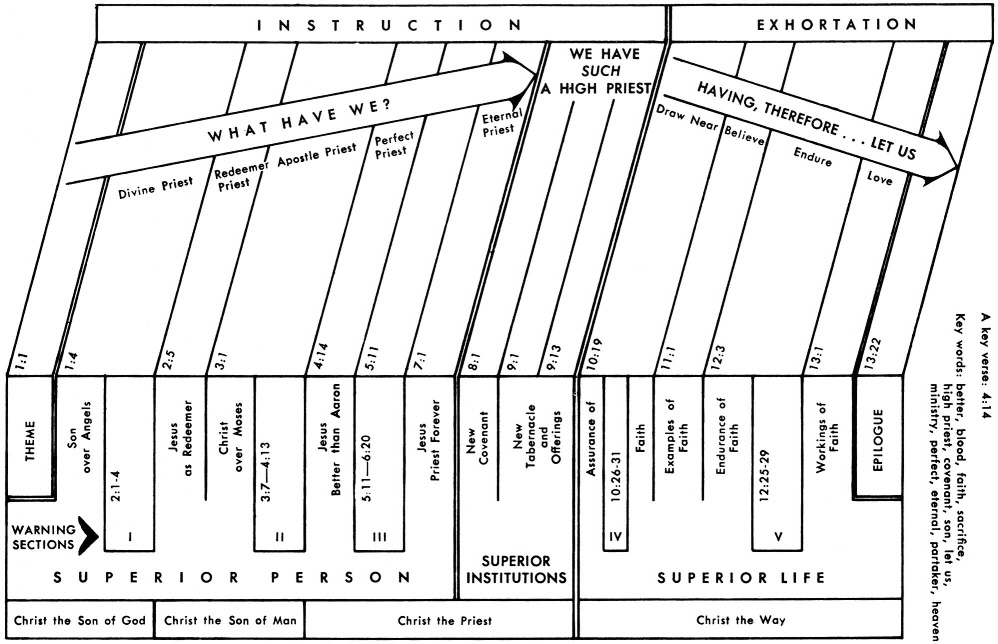
CONSIDER JESUS OUR GREAT HIGH PRIEST
Click chart to enlarge
Charts from Jensen's Survey of the NT - used by permission
Swindoll's Chart, Interesting Pictorial Chart of Hebrews, Another Chart
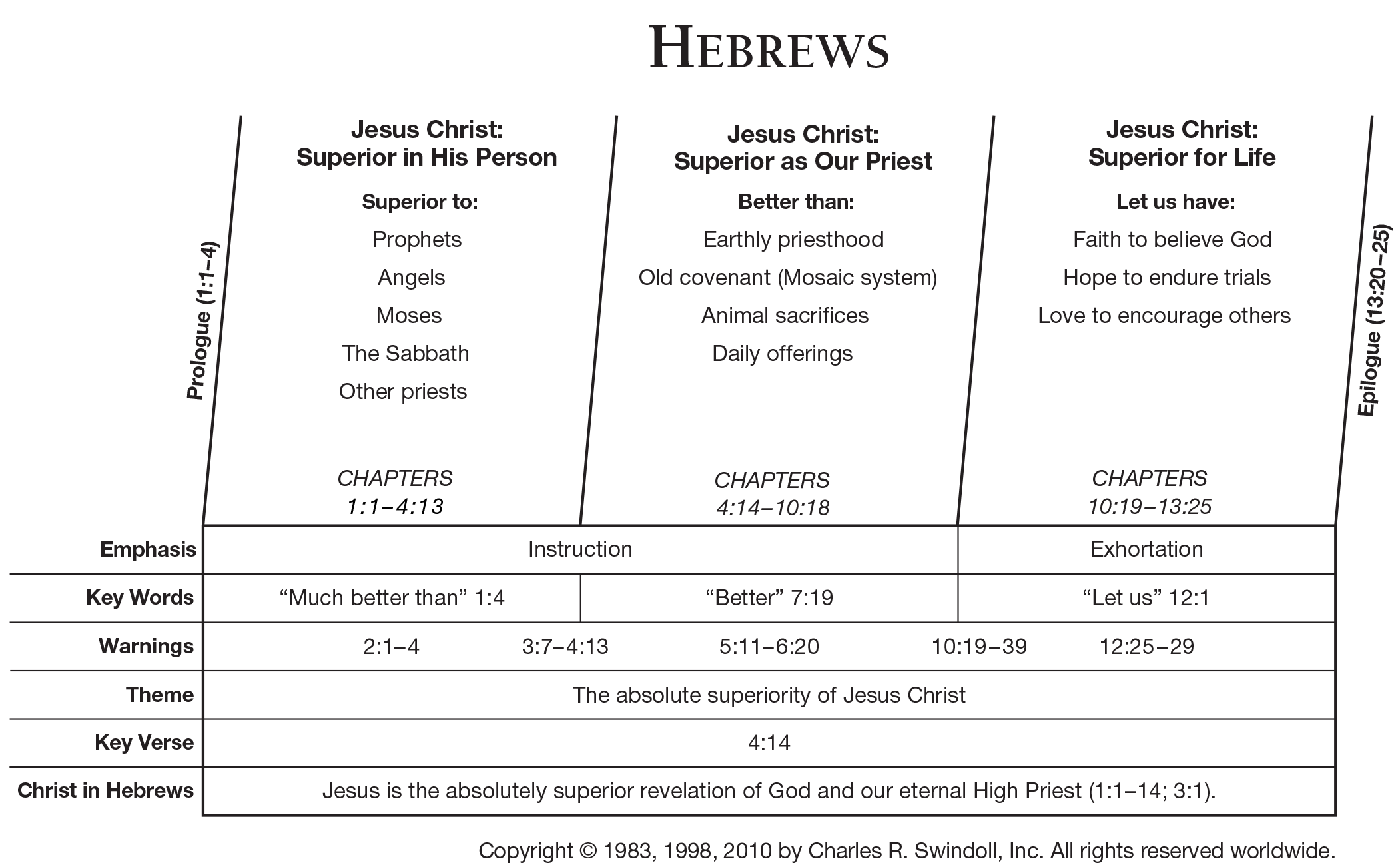
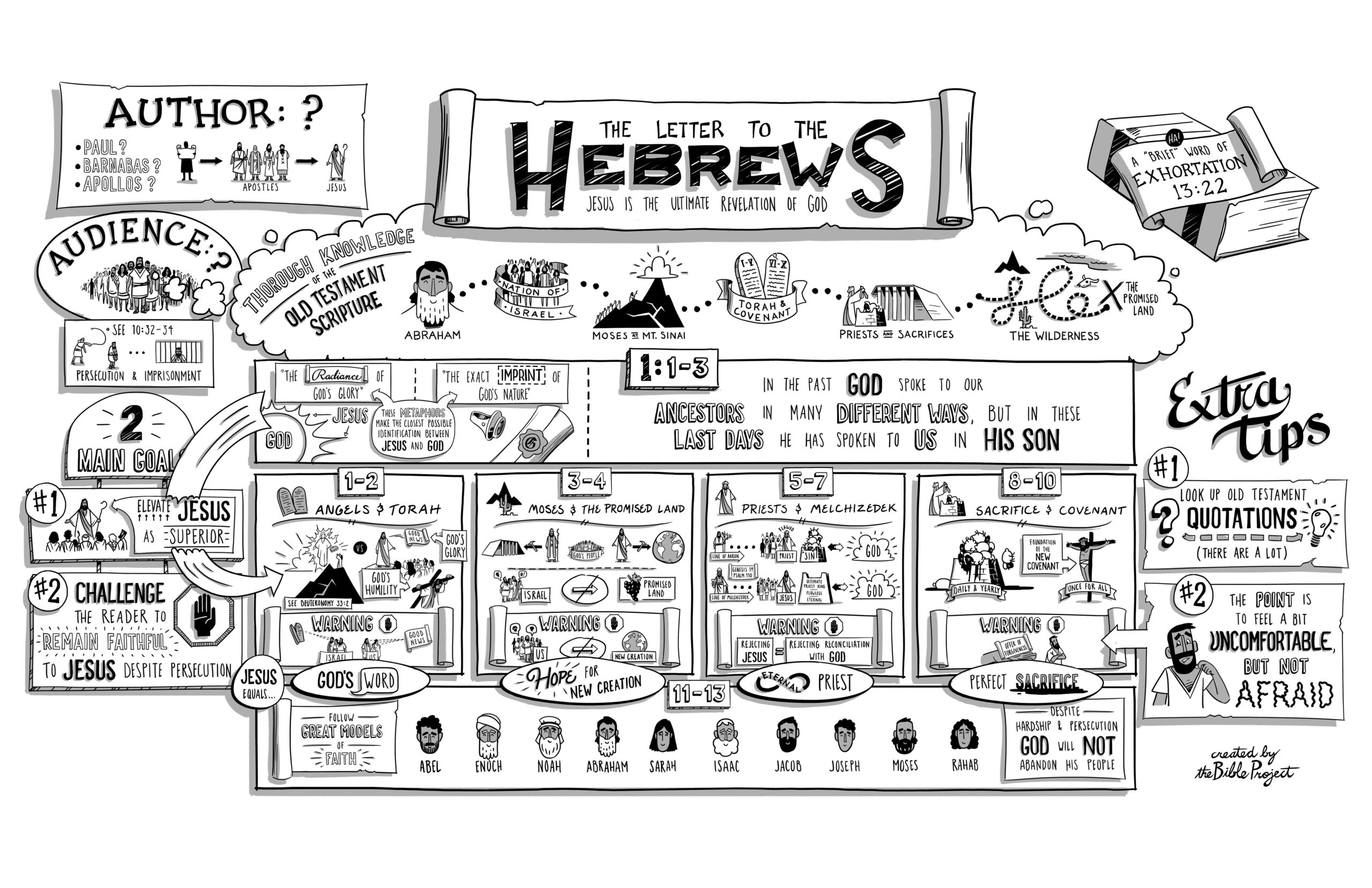
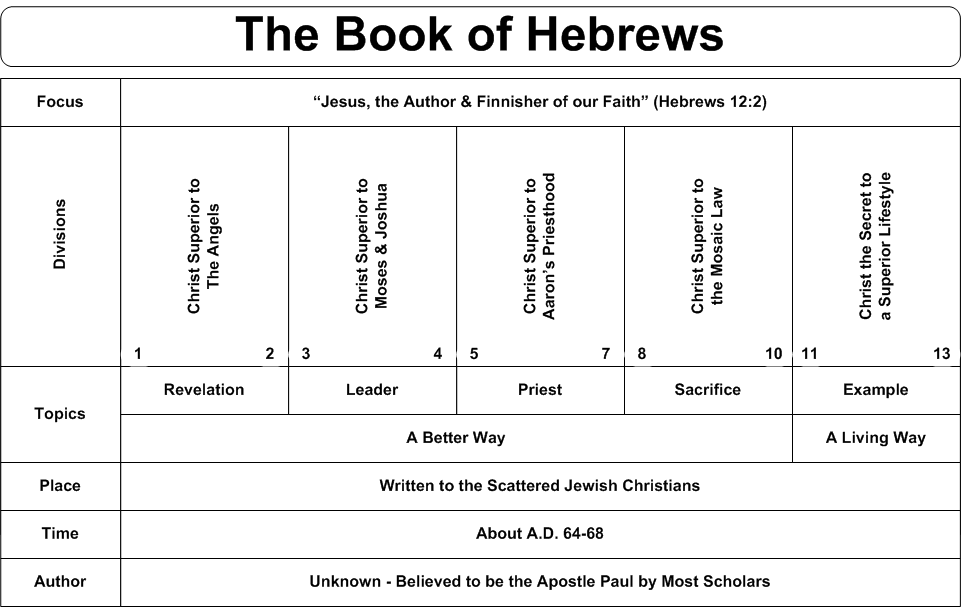
|
The Epistle |
||||
| INSTRUCTION Hebrews 1-10:18 |
EXHORTATION Hebrews 10:19-13:25 |
|||
| Superior Person of Christ Hebrews 1:1-4:13 |
Superior Priest in Christ Hebrews 4:14-10:18 |
Superior Life In Christ Hebrews 10:19-13:25 |
||
| BETTER THAN PERSON Hebrews 1:1-4:13 |
BETTER PRIESTHOOD Heb 4:14-7:28 |
BETTER COVENANT Heb 8:1-13 |
BETTER SACRIFICE Heb 9:1-10:18 |
BETTER LIFE |
| MAJESTY OF CHRIST |
MINISTRY OF CHRIST |
MINISTERS FOR CHRIST |
||
|
DOCTRINE |
DUTY |
|||
|
DATE WRITTEN: |
||||

See ESV Study Bible "Introduction to Hebrews"
(See also MacArthur's Introduction to Hebrews)
Borrow Ryrie Study Bible
Hebrews 7:26 For it was fitting for us to have such a high priest, holy, innocent, undefiled, separated from sinners and exalted above the heavens (NASB: Lockman)
Greek: Toioutos gar hemin kai eprepen (3SIAI) archiereus, osios, akakos, amiantos, kechorismenos (RPPMSN) apo ton hamartolon, kai hupseloteros ton ouranon genomenos; (AMPMSN)
BGT Hebrews 7:26 Τοιοῦτος γὰρ ἡμῖν καὶ ἔπρεπεν ἀρχιερεύς, ὅσιος ἄκακος ἀμίαντος, κεχωρισμένος ἀπὸ τῶν ἁμαρτωλῶν καὶ ὑψηλότερος τῶν οὐρανῶν γενόμενος,
Amplified: [Here is] the High Priest [perfectly adapted] to our needs, as was fitting—holy, blameless, unstained by sin, separated from sinners, and exalted higher than the heavens. (Amplified Bible - Lockman)
KJV: For such an high priest became us, who is holy, harmless, undefiled, separate from sinners, and made higher than the heavens;
NKJ For such a High Priest was fitting for us, who is holy, harmless, undefiled, separate from sinners, and has become higher than the heavens;
NLT: He is the kind of high priest we need because he is holy and blameless, unstained by sin. He has now been set apart from sinners, and he has been given the highest place of honor in heaven. (NLT - Tyndale House)
Young's Literal: For such a chief priest did become us--kind, harmless, undefiled, separate from the sinners, and become higher than the heavens,
Wuest: For such a high priest is fitting to us, holy, without guile, undefiled, having been separated from sinners, and made higher than the heavens.
NET For it is indeed fitting for us to have such a high priest: holy, innocent, undefiled, separate from sinners, and exalted above the heavens.
CSB For this is the kind of high priest we need: holy, innocent, undefiled, separated from sinners, and exalted above the heavens.
ESV For it was indeed fitting that we should have such a high priest, holy, innocent, unstained, separated from sinners, and exalted above the heavens.
NIV Such a high priest meets our need--one who is holy, blameless, pure, set apart from sinners, exalted above the heavens.
Paraphrase Such a High Priest was exactly what we needed—one who is holy in character, innocent of wrongdoing, completely unstained by sin, set apart from sinful humanity, and now exalted higher than the heavens.
|
THE WORK OF |
||
| PAST | PRESENT | FUTURE |
| He has appeared at the Cross for Propitiation |
He now appears at the right hand of the throne for Intercession |
He shall appear a Second time for the elect's final Deliverance |
| He appeared for our Redemption |
He now appears for our Representation |
He shall appear for our Rewards |
| He has appeared in Humiliation | He does appear in Exaltation | He shall appear in Universal Manifestation |
| He has appeared for our Justification | He does appear for our Sanctification | He shall appear for our Glorification |
- Such a high priest - Heb 7:11; Heb 8:1; Heb 9:23-26; Heb 10:11-22
- It is fitting Heb 2:10; Luke 24:26,46
- Holy - Heb 4:15; 9:14; Ex 28:36; Isa 53:9; Lk 1:35; 23:22,41,47; Jn 8:29; 14:30; Acts 3:14; 4:27; 2Co 5:21; 1Pe 1:19; 2:22; 1Jn 2:2; 3:5; Rev 3:7
- Exalted above the heavens - Heb 1:3; 4:14; 8:1; 12:2; Ps 68:18; Mt 27:18; M 16:19; Eph 1:20-22; Ep 4:8-10; Php 2:9-11; 1Pe 3:22; Rev 1:17,18
- Hebrews Study Questions - to aid your personal study or leading an inductive Bible study
- Hebrews 7 Resources - sermons and commentaries
Related Passages:
Hebrews 2:10 (see note below) For it was fitting (prepo) for Him (GOD), for Whom are all things, and through Whom are all things, in bringing many sons to glory, to perfect the Author (CHRIST) of their salvation through sufferings.
THE PERFECT HIGH PRIEST
WE NEEDED
Up to this point, the writer has been contrasting the weakness, transience, and sinfulness of the Levitical priests with the permanence and perfection of Christ’s priesthood. Now, in verse 26, he pauses to describe the kind of High Priest believers truly needed—a priest unlike any who had come before, one who perfectly matches our need. With a series of exalted descriptions, he paints Christ as holy in relation to God, innocent in relation to man, undefiled in relation to Himself, separated from sinners in His sinless nature, and exalted above the heavens in His present position. This verse gathers together the unique, flawless qualifications of Jesus, showing why only He could be the High Priest to bring complete and eternal salvation.
For (gar - term of explanation) typically introduces an explanation, reason, or proof of what has just been stated. Here For (gar) links Christ’s continual intercession and ability to save (v. 25) with His unique qualifications as High Priest (v. 26). In other words in Heb 7:25 Christ’s functions as our Savior and Intercessor. Now in Heb 7:26 the writer explains this is possible (He is holy, innocent, undefiled, separated from sinners, exalted above the heavens). In a sense the for prevents v.26 from being a disconnected list of Christ’s qualities. Instead, the for shows that Christ's attributes are the very reason His priesthood is effective and His intercession unfailing. This strengthens the argument of Hebrews that Christ is superior to the Levitical priests—He alone possesses the character necessary to secure eternal salvation and give us unfettered, confident access to the Throne Room of His Father!
For it was fitting (prepo) for us to have such a high priest - NLT = "He is the kind of high priest we need." As an aside, notice that there are two "for's" in this clause but only the first is a term of explanation and that can always be determined if you can substitute the word "because" and the sentence still makes sense. It was fitting (prepo) means that which is proper, becoming, appropriate or suitable. WHY would he point this out to his Jewish readers? The writer is saying: given humanity’s sin problem and the inadequacy of the Levitical priesthood, Jesus alone is the suitable priest who meets our deepest need. Because the Levitical priesthood was clearly not the kind of priest they needed to bring them into the presence of God. In short God’s design and provision of such a high priest as Christ is no accident. It is exactly what was necessary, uniquely appropriate, and perfectly in harmony with God’s perfect holiness and humanity’s desperate need.
Kenneth Wuest explains - The...translation of prepo means “to be becoming, to be seemly, to be fitting.” The Messiah as High Priest was as to His character, one who was fitting to us. There was an essential fitness in the provision God made in Him as High Priest of the believer. That essential fitness consisted of the qualities mentioned in Heb 7:26–28. That is, we sinners being sinful and dependant upon the mediation of a priest, needed a sinless one. What a contrast this is to the Aaronic priests who were themselves sinners and who needed in the last analysis, a High Priest to mediate salvation for them. (Hebrews Commentary)
Steven Cole adds "It was fitting points to Christ’s suitability for His saving work (Morris, p. 72). It means that He “answered exactly to the requirements of the predicament” that we were in as sinners (Hughes, p. 271). The author piles up five terms that emphasize the perfect purity of Jesus." (Salvation Guaranteed!)
Charles Haddon Spurgeon - There is no approach unto God except through the intercession of Christ. Does not this teach the grand principle of the evil of sin, and teach it in the plainest manner? The distance that sin puts between the sinner and God, and the necessity of mediation in order that a just God may commune with the imperfect—are not these fully taught by the institution of the perpetual intercession of the Son of God? This is as much a declaration of the righteousness of God as was the substitutionary death on Calvary. (Full sermon The Ever-Living Priest)
William Newell on "us" (KJV) - Humbly we would call attention to the emphatic place in this sentence of the word “us.” For here we have the “partakers of a heavenly calling” in plain view.
Fitting (proper) (4241) prepo has the basic meaning to be prominent or conspicuous. It came to be used of a distinguishing characteristic, that which conspicuously stands out, and then especially what is suitable. Thus a "distinguishing characteristic" of saints should be a lifestyle of love and absence of these vices so common and "beloved" to the Gentiles. This is the standard of that which is fitting to their position as those set apart from the profane things of the world and to the pure and holy things of God and His high and holy purpose for their lives. (Eph 2:10+) It also means appropriate, perfectly suited, exactly right. Used in secular Greek for something that “fits” the situation—like a garment that matches, or a solution that suits the need. In NT usage: what is morally right, befitting, or in harmony with God’s character and plan (cf. Matt 3:15, “it is fitting for us to fulfill all righteousness”).So in Hebrews 7:26, it doesn’t just mean “convenient” but “perfectly appropriate to God’s wisdom and plan.”
Note that the first use of prepo in Hebrews 2:10+ was used to show that it was wholly consistent with God’s character and purposes that Christ should be perfected (brought to the full goal of His mediatorial work) through suffering. In Hebrews 2:10 prepo underlines that the path of the cross was not arbitrary—it harmonized with God’s glory, holiness, and righteousness. Note the interesting parallel - Heb 2:10 = It was fitting for God → to accomplish salvation through the suffering of Christ. Heb 7:26 = It was fitting for us → to have a High Priest like Christ, whose character and position meet our deepest need for salvation.
PREPO - 7V - fitting(4), proper(3). Matt. 3:15; 1 Co. 11:13; Eph. 5:3; 1 Tim. 2:10; Tit. 2:1; Heb. 2:10; Heb. 7:26
Prepō refers to acting appropriately in a particular situation, i.e. as it is seemly to God – and therefore "conspicuous amongst others; hence eminent, distinguished. . . seemly fit". With believers, prépō ("be comely, fitting") means to do what the Lord persuades them of – hence it is directly connected with pístis ("faith," see Titus 2:1,2). In sum, prépō means exhibiting "comely behavior" as it "morally matches" faith-decisions – i.e. what is proper to God. This acts out outstanding behavior which is "conspicuously (undeniably) fitting" (LS). Prepō) shows forth unmistakable integrity because conformed to God (His power, standards) – and hence conspicuously glorifies Him (see 1 Cor 11:13; Eph 5:3; Titus 2:1). (from The Discovery Bible)
High priest (749)(archiereus from arche = first in a series, the leader or ruler, idea of rank or degree + hiereus = priest - hieros is that which is determined, filled or consecrated by divine power) refers to the priest that was chief over all the other priests in Israel. This office was established by God through Moses instructions in the Pentateuch. The high priest functioned as the mediator between Jehovah and Israel (cp new order under the New Covenant - 1Ti 2:5) performing sacrifices and rituals like other priests, but in addition acting to expiate the sins of the nation on the annual Day of Atonement (See commentary on Lev 16:1-34).
ARCHIEREUS KEYWORD IN HEBREWS - Heb. 2:17; Heb. 3:1; Heb. 4:14; Heb. 4:15; Heb. 5:1; Heb. 5:5; Heb. 5:10; Heb. 6:20; Heb. 7:26; Heb. 7:27; Heb. 7:28; Heb. 8:1; Heb. 8:3; Heb. 9:7; Heb. 9:11; Heb. 9:25; Heb. 13:11
CHRIST'S PERSONAL
CHARACTER: HOLY
Holy, innocent, undefiled, separated from sinners and exalted above the heavens Now he proceeds to give us five descriptions of traits that explain that Jesus is not like the flawed priests of Israel. His character is morally flawless and eternally exalted. Earlier in the chapter, the writer stressed that Levitical priests were weak, sinful, and temporary. Here he shows Jesus is the opposite: pure, blameless, exalted, and therefore the only truly effective High Priest.
Holy (hosios) highlights Christ’s intrinsic holiness—His inward, personal, moral purity. This contrasts with the OT priests who were outwardly consecrated (hagios), but inwardly weak and sinful (Heb 7:27–28). Jesus is not merely ceremonially “holy,” but inwardly and essentially “holy” in His nature. He alone fits the description of the ideal High Priest: not tainted by sin, perfectly aligned with the will of God.
Holy (3741)(hosios) pertains to being without fault relative to deity, devout, pious, pleasing to God, holy. It describes a person who lives right before God and so is described as devout, dedicated or holy. It is thus quite fitting that hosios describes Jesus our Messiah as the prophesied Holy One (Acts 2:27, 13:35), the Great High Priest (Hebrews 7:26), our soon coming King (Revelation 15:4-+) and the One Who reigns forever as the Holy One (Revelation 16:5+) Hosios emphasizes moral quality and inner righteousness rather than ritual consecration. Classical/Septuagint usage: often denotes what is “pious” or “devout” toward God, contrasted with profane/unrighteous living.
Hosios not hagios = "The former speaks of personal holiness, while the latter speaks of holiness as a state of separation to God. It speaks of holiness as that state of a person who is undefiled by sin, free from wickedness." (Wuest Commentary)
Hosios speaks of personal piety, an inner attitude of conforming to what is felt to be pleasing to God and consistent with religious practices. In Classical Greek hosios referred to the everlasting principles of right, not constituted by laws or customs of men, but antedating them; such as the paying of the proper rites of sepulture.
Steven Cole - Hosios refers to practical holiness, being separate from sin and evil behavior. It does not mean being separate from sinners, because the Lord Jesus was the friend of sinners. But the devout man does not carouse with sinners in their sin. Rather, he seeks to lead them to repentance. The devout man takes God and the Word of God seriously. He doesn’t take the things of God as a joke. He lives in obedience to God’s Word. (Salvation Guaranteed!)
Newell - “Holy” has reference to nature. Gabriel’s announcement of our Lord’s birth was, “That which is to be born shall be called holy, the Son of God.” Twice the word is used in Acts 2:27; 13:35: “Thy holy One”; Christ as we have seen, “through the eternal Spirit offered Himself without blemish unto God” (Heb. 9:14). When it came to Calvary, the end of His earthly life, He was still the Holy One; and in Revelation 15:4, “Thou only art holy.” (Hebrews Commentary)
Hosios is used only 8x in the NT - Acts 2:27; 13:34-35; 1Ti 2:8; Titus 1:8; Heb 7:26; Rev 15:4; 16:5.
Rev 15:4+ “Who will not fear, O Lord, and glorify Thy name? For Thou alone art holy (hosios); For ALL THE NATIONS WILL COME AND WORSHIP BEFORE THEE, FOR THY RIGHTEOUS ACTS HAVE BEEN REVEALED.”
Rev 16:5+ And I heard the angel of the waters saying, “Righteous art Thou, who art and who wast, O Holy (hosios) One, because Thou didst judge these things;
Hosios is used in the Septuagint (Lxx) to describe our Jehovah.
Deuteronomy 32:4 "The Rock! His work is perfect, For all His ways are just; A God of faithfulness and without injustice, Righteous and upright (Heb = yashar - straight, right; Lxx = hosios) is He.
Psalm 16:10 For You will not abandon my soul to Sheol; Nor will You allow Your Holy One (Heb = hasid = kind, benevolent, merciful, pious; Lxx = hosios) to undergo decay.
And in amazing set of uses of hosios in the Septuagint (Lxx), we see that it frequently is used to describe the character of men and women as "godly ones" (Heb = hasid; Lxx = hosios) (Ps 4:3, 12:1, 31:23, 32:6, 37:28, 50:5, 52:9, 79:2; 85:8; 86:2; 89:19; 97:10; 116:15; 132:9, 148:14; 149:1, 5, 9)! Sinners lost in Adam, redeemed in Christ, to live and look like Christ enabled by the Spirit of Christ! Amazing grace indeed!
CHRIST'S PERSONAL
CHARACTER: INNOCENT
Innocent (172) (akakos from a = negative prefix = without, not + kakos = constitutionally bad) is literally without evil or not (constitutionally) bad. It describes the absence of all that is bad and wrong. It means "guileless, free from malice and craft." It conveys the idea of being free from malice, deceit, or injurious intent. Jesus is free of everything that is evil or harmful. He is without malice, perfectly innocent in intent and action. He is unlike human priests who were weak and sinful, often prone to selfishness or corruption. What a great High Priest we have the privilege to approach!
Jesus was not only sinless in His relationship to God, but also blameless in His dealings with others. His innocence underscores His qualification to be a High Priest for sinners—He had no guile, no hidden agenda, no trace of evil. By using akakos, the writer assures wavering readers: their Priest is absolutely trustworthy and without corruption, unlike human religious leaders.
Webster says of guile (the antithesis of the character of Christ) - Craft; cunning; artifice; duplicity; deceit; usually in a bad sense. Who does that definition remind you of?
Steven Cole - It may point to Jesus’ moral purity, in contrast to the outward ritual purity of the Levitical priests. Though they may be pure outwardly, inwardly they were defiled as sinners. But Jesus was completely pure throughout (Salvation Guaranteed!)
William Newell - The next word is “guileless.” It means, without an evil thought—like an innocent little child. Such was Christ! This word is very difficult for us, because, since Adam sinned, this world is crowded with a race none other than guileful. Now in Christ there was no guile whatever. He said, “I came not to judge the world, but to save the world” (John 12:47). This was the reason publicans and sinners crowded around Him. Unconsciously, they found One Who was guileless as any child! He spoke words which, because He was The Light, discovered indeed their sins to them,—but, all the while, they knew He was the Friend of sinners! Gently and guilelessly He could say to the Samaritan woman who had had five husbands, and was then living with a man not her husband, “Thou saidst well, I have no husband.” Our Lord is still the “guileless” One, “the same yesterday and today, and forever.” He is not today a judge, a severe inspector. Think not of Him so! The day of His judging (Acts 17:31) is not come. Rely on Him as your Friend. It is impossible, except by God’s help, to conceive of this guilelessness in the One Who knew all things, Who “knew what was in man” (Jn. 2:25). But it is of inestimable comfort to our hearts, this fact of guilelessness in our Great High Priest! of utter absence of evil thoughts concerning us. (Hebrews Commentary - Verse by Verse)
CHRIST'S PERSONAL
CHARACTER: UNDEFILED
Undefiled (283)(amiantos from a = negative prefix = not or without + miaíno = pollute, defile especially by staining, as with color) describes the man who is absolutely free from any blemishes which might make it impossible for him to draw near to God. The blemished victim cannot be offered to God; the defiled man cannot approach him; but the one who is amiantos is fit to enter into God's presence. This term is not merely ritual or ceremonial purity (like OT priests - Lev 21:10-15+) but genuine ethical cleanliness. When Jesus was ministering on earth, our Lord was a friend of publicans and sinners (Mt 9:10; 11:19), and yet His contact with them did not defile His character or His conduct. There was contact without contamination. He was not isolated, but was separated! Amiantos in Hebrews 7:26 means undefiled, unstained, untouched by sin’s corruption. It stresses Christ’s absolute purity, in contrast to Levitical priests who were constantly defiled and needed cleansing. Jesus is the perfect High Priest whose sinless life made His once-for-all sacrifice acceptable before God.
Hebrews 7:26 — Christ Himself: “undefiled.”
Hebrews 13:4 — “the marriage bed is to be undefiled (amiantos).”
1 Peter 1:4 — “an inheritance imperishable and undefiled (amiantos).”
James 1:27 — “to keep oneself unstained (amiantos) by the world.”
Amiantos always emphasizes purity untouched by corruption.
Wuest on amiantos - “free from that by which the nature of a thing is deformed or debased, or its force or vigor is impaired.” (Hebrews Commentary)
William Newell - unsoiled. Literally it means unstained, undyed by foreign color; consequently, uncontaminated. (The word without the negative is used in Heb 12:15). Such was our Lord that though passing through the midst of and thronged by publicans and harlots, and ecclesiastics full of Satanic pride, of sin and stain of every sort and degree, He remained unsullied, undefiled. This affords our hearts measureless comfort and confidence. It is such a high priest, unstained by the sin and sinful scenes that confront us daily, Who is at the right hand of God, ever keeping His own. (Hebrews Commentary - Verse by Verse)
An undefiled Priest and
an undefiled inheritance.
How wonderful that because our Great High Priest is undefiled (amiantos), He is able to lead us into our "inheritance which is imperishable and undefiled (amiantos) and will not fade away, reserved in heaven for" us. (1Pe 1:4+) An undefiled Priest and an undefiled inheritance. Surely this suggest what our real "inheritance" is -- Christ Himself, our firm Cornerstone, our abundant Life today and forever and ever. Amen
Jesus, Holy, Undefiled
Jesus, holy, undefiled,
Listen to a little child;
Thou hast sent the glorious light,
Chasing far the silent night.
Thou hast sent the sun to shine,
O’er this glorious world of Thine;
Warmth to give and pleasant glow,
On each tender flow’r below.
Now the little birds arise,
Chirping gaily in the skies;
Thee their tiny voices praise,
In the early songs they raise.
Thou, by Whom the birds are fed,
Give to me my daily bread;
And Thy holy Spirit give,
Without Whom I cannot live.
CHRIST'S PERSON:
SEPARATED
Separated from sinners - Separated (5563) (chorizo) means to separate objects by introducing considerable space, so in this case pictures mortal men on earth and our High Priest Jesus in heaven, in the holy place (exalted above the heavens). The separation is due to His perfect qualities; he is separated in a class separate from sinners. The perfect tense defines this as His abiding, permanent state. Clearly this does not that He did not have contact with sinners, like a monk moving to a secluded monastery. His enemies were in a sense correct when they referred to Him as a "friend of tax-gatherers and sinners." (Mt 11:19+) He was "a friend of tax-gatherers and sinners" because He had come "to seek and to save that which is lost" (Lk 19:10+). Separated from sinners means Jesus, though He lived among sinful humanity, was morally distinct and unstained by sin, and now, by His exaltation, is positionally removed from the sphere of sinful humanity, ministering as our perfect High Priest in heaven.
The Levitical high priests were “among sinners” in every sense — morally weak, needing sacrifice for themselves (Heb 7:27). Jesus was in the world but not of it — He associated with sinners to redeem them (Matt 9:10–13; Luke 15:2), but remained unstained. Now, in His exaltation, He is permanently separated, ministering in God’s presence on our behalf. His separation shows that He is uniquely qualified: Sympathetic (Heb 4:15) because He lived among us. Sinless because He never joined us in sin. Exalted because He now ministers from heaven. This guards two truths: He is not too distant (He lived among us), Nor is He too compromised (He was set apart from sin).
Steven Cole adds that "He was the friend of sinners, He kept Himself separate and undefiled. Unlike the Levitical priests, who had to keep themselves away from anyone who would defile them ritually, Jesus could mix with sinful people and yet their defilement did not affect Him. He could touch lepers (Mark 1:41+), the ritually unclean, and even the dead (Luke 8:40-56+) without contracting their defilement. Instead, His purity and life-giving power were imparted to them!" (Salvation Guaranteed!)
Wuest on separated - the Messiah is separated from sinners in that in His service as High Priest, He is void of all contact and commerce with sinners, removed far away in His glorified state and body, into God’s Holy of Holies. (Ibid)
William Newell - No Pharisee would understand this. Look at Luke 15:1, 2 for example: “All the publicans and sinners were drawing near unto Him to hear Him. And both the Pharisees and the scribes murmured, saying, This man receiveth sinners, and eateth with them.” See also Matthew 9:10–13. But you say, Publicans and sinners drew near to Him in perfect liberty, for was He not everywhere known as a friend of publicans and sinners (Matt. 11:19; Lk. 7:34), “eating and drinking” with them? He was! praise God for it! And yet all the while this astonishing, to us impossible, but glorious fact remained: separated from sinners. This separation does not mean as Alford contends that He was “void of all contact and commerce with sinners, removed far away in His glorified state and body, into God’s holy place” (Alford, en loc.). This idea defeats any true understanding of this wondrous expression. For if Christ must be carried up to Heaven to be separated from sinners, all the four blessed things already affirmed of Him are defeated. Note that “separated” is the participle in the passive voice, aorist. I am thankful that the passive voice is used, for our blessed Lord did not say, Behold Me: I have separated Myself from sinners. (Although He did say, with the calmness of Deity, “Which of you accuseth Me of sin?” And there was no answer to that!) His was not such a physical withdrawal from the world as that which the monks and nuns and all the hermits (Prov. 18:1) follow—taking their sin with them into their self-deceiving seclusion! But it was as the Sinless One: “I came out from the Father, and am come into the world: again, I leave the world, and go unto the Father.” “I am not of the world.” What a strengthening of heart to us to know that this Jesus, the holy, guileless, undefiled One, separated from sinners, has passed through this earthly scene! By His whole history among us there unfolds before us the holy flower of Deity—of “God manifested in the flesh.” Separated from sinners indeed was He, yet did the publicans and sinners draw near to Him, for here was a Teacher such as they had never heard, Who spoke with the authority of Heaven, Whom yet in their hearts they knew for a friend! Thus was fulfilled in Him this blessed passive voice, separated from sinners. (Hebrews Commentary - Verse by Verse)
CHRIST'S PERSONAL
POSITION: EXALTED!
Exalted (5308) (hupselos from hupsos/hypsos = height, elevation) means high, elevated, lofty. Listen to Twila Paris' great worship song He is Exalted (live version shorter version) - if this song doesn't stimulate a desire to bow down and worship Him with heart felt praise, I don't know what will - surely a small foretaste of that coming glorious day when we are in the presence of the Exalted One, the King of kings and Lord of lords. Amen
The original Greek is hupsēloteros = “higher, loftier, exalted above.” Comparative of hupselos(“high, elevated”). Genomenos = “having become, being made/appointed.” Points to a change in state → exaltation after His earthly ministry.
Exalted above the heavens - Literally "Having become higher than the heavens." But He is not unavailable to His sheep...in fact He sits in the Throne Room, ever interceding (Ro 8:34b+), and always ready to come to our aid (Heb 2:18+, [see especially the sense of the great Greek word boetheo = run to the aid when hear a cry] cp Heb 13:6+) and ever ready to hear our pleadings for mercy grace to help in the nick of time (Heb 4:16+).
Exalted above the heavens emphasizes Christ’s exalted position after His resurrection and ascension. He is not just morally pure (hosios, akakos, amiantos), but also positionally supreme. This parallels Heb 4:14 “we have a great high priest who has passed through the heavens.” and also Hebrews 8:1 “we have such a high priest, who has taken His seat at the right hand of the throne of the Majesty in the heavens.” This truth accentuates the contrast between the Levitical priests who entered the earthly holy of holies (a copy/shadow) and Christ, as exalted High Priest, Who entered the true heavenly sanctuary (cf. Heb 9:11, 24). Above the heavens is the ultimate sphere of God’s presence, transcending created space. In short, this phrase emphasizes Christ's Supremacy for He is enthroned above all creation (Phil 2:9–11; Eph 1:20–21), His Accessibility for His exalted position guarantees direct access for believers (Heb 4:16; 10:19–22), His Permanence for unlike priests who ministered in earthly sanctuaries repeatedly, Christ ministers eternally in heaven’s sanctuary. In short, while the Levitical priests were bound to earth and temple ritual, Jesus is forever lifted to the ultimate realm of God’s throne. And all God's people shout "Hallelujah!"
Steven Cole - ´Exalted above the heavens “embraces the truth of Christ’s resurrection, ascension, and glorification, and it portrays the supreme perfection of our ever living High Priest in the sanctuary above” (Hughes, p. 275). It means, “The power of his all-sufficient atoning work is available without diminishment to us today as it was to the believers of the first century, and it is so because he who died for us is alive from the dead and enthroned on high” (Salvation Guaranteed!)
William Newell - Now in Ephesians 1:20 and 21 we read: “God wrought in Christ, when He raised Him from the dead, and made Him to sit at His right hand in the heavenlies, far above all rule, and authority and power, and dominion, and every name that is named, not only in this world, but also in that which is to come.”
In Ephesians 4:10 we see Him as “ascended far above all the heavens.” And in Hebrews 4:14: “Having been a Great High Priest Who hath passed through the heavens, Jesus the Son of God;” and in Chapter 8:1:
“Now in the things which we are saying the chief point is this: We have such a High Priest, Who sat down on the right hand of the throne of the Majesty in the heavens.”
Here then is the High Priest that became us, who in the infinite wisdom and grace of God are partakers of a heavenly calling. Are we born again (anothen, literally, down from above)? We have a High Priest above. Is our citizenship in Heaven? Our representative, our “Forerunner” and Great High Priest is already there, a Man in the glory. Has God,
“being rich in mercy, for His great love wherewith He loved us, even when we were dead through our trespasses, enlifed us together with Christ … and raised us up with Him, and made us to sit with Him in the heavenlies”?
Even so! And although we ourselves are yet traveling through the world in our unredeemed bodies, the earthly tabernacle in which we groan, being burdened, yet Christ, the Firstfruits of the resurrection, the First-born from the dead, has already ascended up on high, and been greeted by God as High Priest forever! And to Him has been given the place of honor at the right hand of God.*
There used to be a teaching that Heaven was at the center of the created universe, which revolved around it! Not so. The throne of God is far above all the heavens, far above His created universe. Our Great High Priest was made higher than the heavens. But His position “far above all” does not change His affections, His sympathy. How humbling it is to us who “look to the hole of the pit whence we have been digged” by sovereign Divine mercy and grace, we who have received a heavenly calling, with such a High Priest as this!
Indeed, this one blessed verse, Chapter 7:26, could afford an excuse to that great man of God, John Owen, the Puritan, to write his commentary of nine volumes on this wondrous epistle to the Hebrews! (Hebrews Commentary - Verse by Verse)
Psalm 22:6 is about Jesus, the Son of God, and He is calling Himself a worm! Hebrews 7:26 describes Him as “holy, blameless, pure, set apart from sinners, exalted above the heavens,” yet He calls Himself a worm.
Not Isolated but Insulated - “We are not to be isolated but insulated,” said Vance Havner, “moving in the midst of evil but untouched by it.” Separation is contact with contamination. Jesus was “holy, harmless, undefiled, separate from sinners” (Heb. 7:26), yet He was “a friend of tax collectors and sinners” (Luke 7:34).
Stephen Olford - “Looking at Jesus as He walked, he said,‘Behold the Lamb of God!’” – John 1:36
Here in verse 36, it is not “The Lamb of God who takes away the sin of the world” (v. 29), but just “The Lamb of God.” This verse portrays a slightly different aspect of Christ to the truth of verse 29. Again, here it is the “Lamb.” As He walked, the Lamb speaks of:
Absolute Submission. If ever there was a submissive creature, the lamb certainly stands out as the supreme example. Submission to the will of God.
Absolute Selflessness. The lamb is the picture of absolute humility and selflessness. Such was the character of the Lord Jesus (see Matt. 11:28; Phil. 2).
Absolute Separation. The parted hoof of the lamb pictures and speaks of separation. The path of the Lord Jesus was one of separation – “Separate from sinners” (Heb. 7:26).
Behold the Lamb of God!
Daily Light for the Daily Path -
“They are not of the world, just as I am not of the world.”
He was despised and rejected by men; a man of sorrows, and acquainted with grief.—“In the world you will have tribulation. But take heart; I have overcome the world.”
It was indeed fitting that we should have such a high priest, holy, innocent, unstained, separated from sinners.—That you may be blameless and innocent, children of God without blemish in the midst of a crooked and twisted generation.
“Jesus of Nazareth . . . went about doing good and healing all who were oppressed by the devil, for God was with him.”—So then, as we have opportunity, let us do good to everyone, and especially to those who are of the household of faith.
The true light, which gives light to everyone, was coming into the world.—“You are the light of the world. A city set on a hill cannot be hidden. Let your light shine before others, so that they may see your good works and give glory to your Father who is in heaven.”
John 17:16; Isa. 53:3; John 16:33; Heb. 7:26; Phil. 2:15; Acts 10:38; Gal. 6:10; John 1:9; Matt. 5:14, 16
><>><>><>
Can wicked rulers be allied with you?
Indeed our fellowship is with the Father and with his Son Jesus Christ.—Beloved, we are God’s children now, and what we will be has not yet appeared; but we know that when he appears we shall be like him, because we shall see him as he is. And everyone who thus hopes in him purifies himself as he is pure.
“The ruler of this world is coming. He has no claim on me.”—A high priest, holy, innocent, unstained.
We do not wrestle against flesh and blood, but against the rulers, against the authorities, against the cosmic powers over this present darkness, against the spiritual forces of evil in the heavenly places.—The prince of the power of the air, the spirit that is now at work in the sons of disobedience.
We know that everyone who has been born of God does not keep on sinning, but he who was born of God protects him, and the evil one does not touch him. We know that we are from God, and the whole world lies in the power of the evil one.
Ps. 94:20; 1 John 1:3; 1 John 3:2–3; John 14:30; Heb. 7:26; Eph. 6:12; Eph. 2:2; 1 John 5:18–19
><>><>><>
“No leaven shall be seen with you in all your territory.”
The fear of the Lord is hatred of evil.—Abhor what is evil.—Abstain from every form of evil.—See to it that no one fails to obtain the grace of God; that no “root of bitterness” springs up and causes trouble, and by it many become defiled.
If I had cherished iniquity in my heart, the Lord would not have listened.—Do you not know that a little leaven leavens the whole lump? Cleanse out the old leaven that you may be a new lump, as you really are unleavened. For Christ, our Passover lamb, has been sacrificed. Let us therefore celebrate the festival, not with the old leaven, the leaven of malice and evil, but with the unleavened bread of sincerity and truth.—Let a person examine himself, then, and so eat of the bread and drink of the cup.—“Let everyone who names the name of the Lord depart from iniquity.”—It was indeed fitting that we should have such a high priest, holy, innocent, unstained, separated from sinners.—In him there is no sin.
Ex. 13:7; Prov. 8:13; Rom. 12:9; 1 Thess. 5:22; Heb. 12:15; Ps. 66:18; 1 Cor. 5:6–8; 1 Cor. 11:28; 2 Tim. 2:19; Heb. 7:26; 1 John 3:5
Robert Hawker —Heb. 7:26.
WHAT a sweet thought! Surely, as a poor sinner, I need an High-priest to act for me. I cannot, I dare not, approach in myself, and with my poor polluted offerings, without one. But he that intercedes for me, must be himself holy, free from sin: his sacrifice holy, his obedience holy, and in all points suited to his office, and my necessities. Cherish, then, the thought, my soul. He that is thine High-priest, is all this, and infinitely more. So holy in himself, that not the shadow of sin was in him. So harmless, that in his mouth was found no guile. So undefiled, that though he took all the sins of his people upon him, yet in himself he was free from all sin. So separate from sinners, that though he took the nature of man, yet wholly underived from man; and so much higher than the heavens, that his own personal holiness infinitely transcended the holiness of angels. For while they are said to be charged with folly, Jesus is the Holy One in whom the Father declared himself well pleased. Meditate, my soul, on these precious features in thy Jesus, at all times, and upon all occasions: and more especially, when thou drawest nigh the throne of grace in and through this glorious Mediator. And moreover, for thy further comfort and encouragement to come boldly to the mercy-seat, forget not to recollect the still further blessed thought, that this holiness of Jesus is the righteousness of all his people; for he was made sin, when he knew no sin, that they might be made the righteousness of God in him. And, as if this was not enough, Christ glorified not himself to be made thy High-priest, but was called to it, as was Aaron. Go then, my soul, go to the precious, the holy, the harmless, the undefiled, High-priest, Christ Jesus, in whom, and in whose righteousness and atoning blood, thou mayest always have boldness to draw nigh, to find grace, and mercy to help, in all time of need.
Holy (ὅσιος) — Morally Pure Illustration: A crystal-clear mountain spring. No debris, no pollution, no foreign matter — just pure water. That is what Christ’s holiness is like: absolute purity at the source.
Contrast: The priests of Israel were like wells that needed constant cleansing; Christ is a fountain that never runs muddy.
Composite Illustration (All Five Qualities Together)
Illustration: Picture a flawless diamond.
- Its brilliance = holy.
- Its transparency = innocent.
- Its unstained clarity = undefiled.
- Lifted from the dirt and set in a royal crown = separated from sinners.
- Placed at the very top of the crown, sparkling in glory = exalted above the heavens.
Point: Each facet shows another angle of Christ’s perfection as our High Priest.
Separated from Sinners (κεχωρισμένος ἀπὸ τῶν ἁμαρτωλῶν)
Illustration: A skilled surgeon who steps into an operating room — he is surrounded by sickness, yet he himself is healthy, set apart to bring healing.
Point: Christ lived among sinners to save them, but He was never entangled in their sin.
Undefiled (ἀμίαντος) — Unstained
Illustration: Imagine a white garment carried through a coal mine yet emerging spotless. Christ walked among sinners, but sin never clung to Him.
Biblical Parallel: Like the Passover lamb that had to be “without blemish” (Exod 12:5), Jesus was untouched by any stain of sin.
Devotional Thought: The writer of Hebrews reminds us that God did not give us just any mediator—He gave us the exact High Priest we needed. His holiness means He is fully pleasing to God. His innocence shows He is blameless before men. His undefiled purity guarantees no corruption taints His sacrifice. Unlike the Levitical priests, Jesus is untouched by sin’s weakness. Exalted above the heavens, He ministers not in an earthly tabernacle but in the true sanctuary before the Father. Every aspect of His person is “fitting”—perfectly suited for our salvation.
Application: When you feel unworthy, remember: Christ is perfectly qualified to represent you before God. You do not need to look inward for adequacy; you look upward to Him.
Holiness and Nearness
Devotional Thought: Jesus is “holy” and “separated from sinners.” At first, that may sound like distance. But His holiness does not push us away—it ensures that His intercession is effective. Because He is not entangled in sin like us, He can stand in our place. His separation from sinners is not in compassion, but in condition. He is without sin, yet He draws near to save sinners.
Application: Rejoice that your Savior is both near in love and separate in purity. This perfect balance means He can both sympathize with you and save you from your sin.
The End of the Cycle
Devotional Thought: The priests of old were many, always replaced by death, always offering sacrifices that could never cleanse the conscience. But here is One—holy, innocent, undefiled—whose single self-offering was enough. His exaltation above the heavens shows the cycle is broken. His priesthood is not a shadow but the reality.
Application: Stop trying to atone for your sins through repeated efforts of self-penance. Trust in the finality of Christ’s once-for-all sacrifice. Your High Priest has sat down at the right hand of God because the work is done.
Fitting for Us—God’s Wise Provision
Devotional Thought: “It was fitting for us to have such a High Priest.” God’s plan in Christ is not random—it matches our need precisely. Nothing about Jesus’ character or work is accidental. Every detail is tailor-made for sinners who long for forgiveness and communion with God. He is the perfect match for our desperate condition.
Application: Praise God for His wisdom. He didn’t give us a half-way Savior or a temporary priest. He gave us exactly the Redeemer our souls required.
Exalted Yet Interceding
Devotional Thought: Though exalted above the heavens, Jesus has not abandoned us. His exaltation is the proof that His sacrifice was accepted. Now He intercedes continually, not as one striving to finish the work, but as one who has completed it. His presence in heaven is the guarantee of our access to God.
Application: When doubts arise, look to Christ at the Father’s right hand. His very position there is the assurance that your forgiveness is secure and your access is open.
Hebrews 7:27 Who does not need daily *, like those high priests, to offer up sacrifices, first for His own sins and then for the sins of the people, because this He did once for all when He offered up Himself (NASB: Lockman)
Greek: os ouk echei (3SPAI) kath' hemeran anagken, hosper oi archiereis, proteron huper ton idion hamartion thusias anapherein, (PAN) epeita (3SAAI) ton tou laou; touto gar epoiesen (3SAAI) ephapax heauton anenegkas. (AAPMSN)
BGT ὃς οὐκ ἔχει καθ᾽ ἡμέραν ἀνάγκην, ὥσπερ οἱ ἀρχιερεῖς, πρότερον ὑπὲρ τῶν ἰδίων ἁμαρτιῶν θυσίας ἀναφέρειν ἔπειτα τῶν τοῦ λαοῦ· τοῦτο γὰρ ἐποίησεν ἐφάπαξ ἑαυτὸν ἀνενέγκας.
Amplified: He has no day by day necessity, as [do each of these other] high priests, to offer sacrifice first of all for his own [personal] sins and then for those of the people, because He [met all the requirements] once for all when He brought Himself [as a sacrifice] which He offered up. (Amplified Bible - Lockman)
KJV: Who needeth not daily, as those high priests, to offer up sacrifice, first for his own sins, and then for the people's: for this he did once, when he offered up himself.
NKJ who does not need daily, as those high priests, to offer up sacrifices, first for His own sins and then for the people's, for this He did once for all when He offered up Himself.
NLT: He does not need to offer sacrifices every day like the other high priests. They did this for their own sins first and then for the sins of the people. But Jesus did this once for all when he sacrificed himself on the cross. (NLT - Tyndale House)
Wuest: Who does not have daily need, even as those high priests, first for their own sins to be offering up sacrifice, then for those of the people, for this He did once for all, having offered up Himself.
Young's Literal: who hath no necessity daily, as the chief priests, first for his own sins to offer up sacrifice, then for those of the people; for this he did once, having offered up himself;
NET He has no need to do every day what those priests do, to offer sacrifices first for their own sins and then for the sins of the people, since he did this in offering himself once for all.
CSB He doesn't need to offer sacrifices every day, as high priests do-- first for their own sins, then for those of the people. He did this once for all when He offered Himself.
ESV He has no need, like those high priests, to offer sacrifices daily, first for his own sins and then for those of the people, since he did this once for all when he offered up himself.
NIV Unlike the other high priests, he does not need to offer sacrifices day after day, first for his own sins, and then for the sins of the people. He sacrificed for their sins once for all when he offered himself.
Paraphrase Unlike the former priests who were required to offer up sacrifices every day—first for their own sins and then for the sins of the people—Jesus had no such need. Instead, He offered Himself once for all time, and by that one offering fully accomplished what endless sacrifices never could.
- Does not need daily Heb 7:10; Heb 10:11; Ex 29:36-42; Nu 28:2-10
- First for His own sins - Heb 5:3; 9:7; Lev 4:3-35; 9:7-24; Lev 16:6,11
- Then for the sins of the people - Leviticus 4:13-16; 9:15; 16:15
- Hebrews Study Questions - to aid your personal study or leading an inductive Bible study
- Hebrews 7 Resources - sermons and commentaries
Related Passages:
Hebrews 10:11+ And every priest stands daily ministering and offering time after time the same sacrifices, which can never take away sins.
Titus 2:14+ (CHRIST) gave Himself FOR (huper = IN OUR PLACE, OUR SUBSTITUTE) us, that He might redeem us from every lawless deed and purify for Himself a people for His own possession, zealous for good deeds.
CHRIST'S ONE SACRIFICE
COMPLETE AND FINAL
Having just described the flawless character of our High Priest (Heb 7:26), the writer now contrasts Christ's sacrificial ministry with that of the Levitical priests. The old covenant priests were "weakened" by sin, and thus had to offer sacrifices repeatedly, first for their own sins, then for the people’s. But Jesus, in His perfection, had no need to atone for Himself. Instead, He offered one sacrifice, Himself, which fully and finally satisfied God’s justice. This verse underscores the once-for-all sufficiency of Christ’s work on the cross, in sharp contrast to the daily, never-ending sacrifices of the former order. In short, the writer closes the chapter by weaving together Christ’s character (Hebrews 7:26), work (Hebrews 7:27), and appointment (Hebrews 7:28) — showing He is everything the old priesthood was not — the sinless, once-for-all in sacrifice, and forever established by God’s sworn oath.
Who does not ( ou, ouk - strong negation = absolutely not) need (anagke) daily, like those high priests (archiereus), to offer up (anaphero) sacrifices (thusia), first (proteron - first of all, an adverb used for comparison between two things) for His own sins (hamartia) and then for the sins of the people - With the does not ( ou, ouk - strong negation = absolutely not) the writer is emphatically stating that Jesus’ ministry stands in complete contrast with the Levitical priests. Need (anagke) in Hebrews, was used of what is required by law or circumstance. For the Levitical priests it was a necessary duty for they were compelled to offer daily sacrifices because of their weakness and sin. For Christ: that necessity does not exist, because He is holy, innocent, undefiled (Heb 7:26). Daily emphasizes the constant repetition in their ministry. The high priest does not offer the daily sacrifices personally, but he is responsible. Every day the priests offered sacrifices for sins of the people. On the Day of Atonement, even the high priest had to sacrifice first for himself (Read Lev 16:6-11+). Because the Levitical priests were weak and mortal, they remained trapped in an endless cycle of repeated offerings.
All the readers knew that the high priests were sinners just like they were and thus they had to offer sacrifices daily for their sins. The writer is emphasizing that in stark contrast, the Great High Priest Jesus Christ did not need to carry out daily sacrifices. This would have been a radical thought for these pious Jews.
The Old Covenant necessity is described in Leviticus 4...
First for his own sins - Moses received instructions for the priests when they sinned writing that "If the anointed priest sins so as to bring guilt on the people, then let him offer to the LORD a bull without defect as a sin offering for the sin he has committed. 4‘And he shall bring the bull to the doorway of the tent of meeting before the LORD, and he shall lay his hand on the head of the bull, and slay the bull before the LORD. 5‘Then the anointed priest is to take some of the blood of the bull and bring it to the tent of meeting, 6and the priest shall dip his finger in the blood, and sprinkle some of the blood seven times before the LORD, in front of the veil of the sanctuary. 7‘The priest shall also put some of the blood on the horns of the altar of fragrant incense which is before the LORD in the tent of meeting; and all the blood of the bull he shall pour out at the base of the altar of burnt offering which is at the doorway of the tent of meeting. 8‘And he shall remove from it all the fat of the bull of the sin offering: the fat that covers the entrails, and all the fat which is on the entrails, 9and the two kidneys with the fat that is on them, which is on the loins, and the lobe of the liver, which he shall remove with the kidneys 10(just as it is removed from the ox of the sacrifice of peace offerings), and the priest is to offer them up in smoke on the altar of burnt offering. 11‘But the hide of the bull and all its flesh with its head and its legs and its entrails and its refuse, 12that is, all [the rest of] the bull, he is to bring out to a clean place outside the camp where the ashes are poured out, and burn it on wood with fire; where the ashes are poured out it shall be burned. (Lev 4:3-12+)
Then for the sins of the people - Moses wrote ‘Now if the whole congregation of Israel commits error, and the matter escapes the notice of the assembly, and they commit any of the things which the LORD has commanded not to be done, and they become guilty;14 when the sin which they have committed becomes known, then the assembly shall offer a bull of the herd for a sin offering, and bring it before the tent of meeting.15 ‘Then the elders of the congregation shall lay their hands on the head of the bull before the LORD, and the bull shall be slain before the LORD.16 ‘Then the anointed priest is to bring some of the blood of the bull to the tent of meeting;17 and the priest shall dip his finger in the blood, and sprinkle [it] seven times before the LORD, in front of the veil.18 ‘And he shall put some of the blood on the horns of the altar which is before the LORD in the tent of meeting; and all the blood he shall pour out at the base of the altar of burnt offering which is at the doorway of the tent of meeting.19 ‘And he shall remove all its fat from it and offer it up in smoke on the altar. 20 ‘He shall also do with the bull just as he did with the bull of the sin offering; thus he shall do with it. So the priest shall make atonement for them, and they shall be forgiven. (Lev 4:13-20+)
Because (gar - term of explanation) this He did (poieo - aorist points to a one time completed action) once for all (ephapax) when He offered up (anaphero - aorist points to a one time completed action) Himself (His offering on the Cross!) - Because explains why Christ had no need to carry out daily sacrifices. Beloved, Christ does not need to be "re-sacrificed" as if such a thing could even happen. Once for all (ephapax) means once for all time and forever. When Christ shouted "It is finished" (Jn 19:30+), He served notice that once and for all time, the price for sin and sinners was "Paid in Full!" (tetelestai = perfect tense of teleo) Let us rejoice in the sure word "once for all (ephapax)!" Offered up (anaphero) Himself is something no Levitical priest was ever asked to do or could do! The Levitical priests were the shadow of which Christ is the substance (Col 2:17+). Jesus, as our Great High Priest, offered up the sacrifice of Himself by bringing His body up to the Cross.
John Piper adds that "This is a great word (ephapax))—“once for all.” The effect it has is to make Jesus the center of history. Every work of God’s grace in history before the sacrifice of Christ looked forward to the death of Christ for its foundation. And every work of God’s grace since the sacrifice of Christ looks back to the death of Christ for its foundation. Christ is the center of the history of grace. There is no grace without him. Grace was planned from all eternity, but not without Jesus Christ at the center and his death as the foundation. Paul says in 2 Timothy 1: 9 that God’s “grace … was granted us in Christ Jesus from all eternity.” (See Our High Priest is the Son of God Perfect Forever)
Spurgeon - Jesus Christ, the Son of God, came into the world, and “offered up Himself” as a sacrifice for sin. The great High Priest, who officiated on the occasion of that wondrous and unique sacrifice, was Jesus Christ Himself. he offered up himself When He bowed His head, it was because He would do it, and willingly yielded up His soul, committing His spirit to the Father—not under constraint, but “he offered up himself.” Oh, this makes the sacrifice of Christ so blessed and glorious! They dragged the bullocks and they drove the sheep to the altar; they bound the calves with cords, even with cords to the altar’s horn. But not so was it with the Christ of God. None did compel Him to die; He laid down his life voluntarily, for He had power to lay it down, and to take it again. So far as Christ was Himself alone concerned, there was no necessity that He should die. He was infinitely glorious and blessed. “He offered up himself,” but not for Himself; then, for whom did He die? For men. We are told that He took not up angels, but He took up the seed of Abraham—He took up sinful men. (See full sermon Priest and Victim)
Need (compulsion) (318)(anagke from ana = up, again, back, renewal, repetition, intensity, reversal + agkale = arm when bent) refers to any necessity or compulsion, outer or inner, brought on by a variety of circumstances. It can mean necessity imposed either by external conditions or by the law of duty.
Anagke can refer to an inner compulsion (something that must be done) or an external constraint (force, requirement, duty) and is commonly translated “need,” “must,” “compulsion.” In Hebrews 7:27 anagke refers to the obligation or necessity imposed on priests to continually offer sacrifices.
Levitical priests had the NEED to sacrifice again and again. Daily sacrifices for the people. Annual atonement sacrifices (and first for their own sins). Their own weakness and mortality required this ongoing duty. Christ has no such necessity. He is sinless—no need to sacrifice for Himself. His once-for-all offering completely satisfied sin—no need for repetition.
ANAGKE - 18V - compulsion(3), constraint(1), distress(3), distresses(1), hardships(1), inevitable(1), necessary(2), necessity(3), need(2), obliged*(1). Matt. 18:7; Lk. 14:18; Lk. 21:23; Lk. 23:17; Rom. 13:5; 1 Co. 7:26; 1 Co. 7:37; 1 Co. 9:16; 2 Co. 6:4; 2 Co. 9:7; 2 Co. 12:10; 1 Thess. 3:7; Phlm. 1:14; Heb. 7:12; Heb. 7:27; Heb. 9:16; Heb. 9:23; Jude 1:3
Offered (399)(anaphero from ana = up, again, back + phero = bear, carry) literally means to carry, bring or bear up and so to to cause to move from a lower position to a higher position. It serves as a technical term for offering sacrifices offer up (to an altar). Figuratively (as in 1Pe 2:24-+) anaphero means to take up and bear sins by imputation (act of laying the responsibility or blame for) as typified by the ancient sacrifices. Jesus our Great High Priests bore our sins as our substitutionary sacrifice, dying in our place, in order to bring about atonement for our sins. The priests in the Old Covenant could not bear our sins.
ANAPHERO - 8V - bear(1), bore(1), brought(1), led(1), offer(3), offered(2). Matt. 17:1; Mk. 9:2; Heb. 7:27; Heb. 9:28; Heb. 13:15; Jas. 2:21; 1 Pet. 2:5; 1 Pet. 2:24
Anaphero is as a compound verb means “to carry up, to bring up, to present.” It was a technical sacrificial term in the LXX and NT for offering sacrifices to God (Heb 9:28+; 1 Pet 2:5, 24+). It suggests both the act of presentation and the ascent of the offering (smoke rising to God). The priests had to “carry up” countless sacrifices—but Christ “offered up” Himself once (note the aorist—decisive, completed action).
It is interesting to note that the Jewish people did not crucify criminals. They stoned them to death. But if the victim was especially evil, his dead body was hung on a tree until evening, as a mark of shame (Dt 21:23). Jesus died on a tree—a cross—and bore the curse of the Law (Gal 3:13). The force of ana = up, appears in the fact of the altar was in fact elevated.
Anaphero is used in Heb 9:28+ of Jesus "bearing the sins of many", to offer up a sacrifice of praise in Heb 13:15+, of Abraham offering up Isaac James 2:21+, of believer priests offering up spiritual sacrifices acceptable to God through Jesus Christ in 1Pe 2:5+ , and lastly of Jesus Himself Who "bore our sins in His body on the cross, that we might die to sin and live to righteousness (1Pe 2:24+).
Anaphero is used frequently in the Septuagint (LXX) to translate the Hebrew verb qatar, which means to offer up (offer up in smoke). Thus a majority of the uses of anaphero are in passages that refer to the Levitical sacrifices (Lev 2:16+; Lev 3:5, 11, 16+; Lev 4:10, 19, 26, 31+, Lev 6:15+, Lev 7:5, 31+; Lev 8:16, 20-21, 28+; Lev 9:10, 20+; Lev 16:25+; Lev 17:6+)
Isaiah uses anaphero in a prophecy of the Suffering Servant, the Messiah - As a result of the anguish of His soul, He will see it and be satisfied; By His knowledge the Righteous One, My Servant, will justify the many, as He will bear (Heb = sabal = to bear a load; carry burdens as a slave, used in Isa 53:4; Lxx = anaphero) their iniquities. Therefore, I will allot Him a portion with the great, and He will divide the booty with the strong, because He poured out Himself to death, and was numbered with the transgressors. Yet He Himself bore (Hebrew = nasa - to lift, to take away; Lxx = anaphero) the sin of many, and interceded for the transgressors." (Isa 53:11-12, cp Isa 53:4-6)
When John the Baptist saw "Jesus coming to him" he declared the fulfillment in essence of all the OT animal offerings when he declared "Behold, the Lamb of God who takes away the sin of the world!" (Jn 1:29)
Sacrifices (2378)(thusia from thuo/thyo = to slay, sacrifice or kill a sacrificial victim; to bring a religious offering to a deity) refers literally to animal sacrifices that were slain and offered on the altar. The root meaning of thusia is “something slain” and was used of an offering presented to God. In Hebrews, thusia always tied to the sacrificial system of the Old Covenant (Heb 7:27; 8:3; 9:9, 23; 10:1, 3, 26). For the Levitical priests, it meant repeated blood sacrifices of animals. But for Christ it was the unique, once-for-all sacrifice of Himself (the thusia par excellence).
THUSIA - 28V - MOST IN HEBREWS - Matt. 9:13; Matt. 12:7; Mk. 12:33; Lk. 2:24; Lk. 13:1; Acts 7:41; Acts 7:42; Rom. 12:1; 1 Co. 10:18; Eph. 5:2; Phil. 2:17; Phil. 4:18; Heb. 5:1; Heb. 7:27; Heb. 8:3; Heb. 9:9; Heb. 9:23; Heb. 9:26; Heb. 10:1; Heb. 10:5; Heb. 10:8; Heb. 10:11; Heb. 10:12; Heb. 10:26; Heb. 11:4; Heb. 13:15; Heb. 13:16; 1 Pet. 2:5
Sins (266)(hamartia) literally conveys the idea of missing the mark as when hunting with a bow and arrow (in Homer some hundred times of a warrior hurling his spear but missing his foe). Later hamartia came to mean missing or falling short of any goal, standard, or purpose. Hamartia in the Bible signifies a departure from God's holy, perfect standard of what is right in word or deed (righteous). It pictures the idea of missing His appointed goal (His will) which results in a deviation from what is pleasing to Him. In short, sin is conceived as a missing the true end and scope of our lives, which is the Triune God Himself. As Martin Luther put it "Sin is essentially a departure from God." Hamaria can refer to (1) acts of sin (committed deeds), (2) Condition of sin (the state of human fallenness), or (3) Personified power of sin (esp. in Romans 6-7). In Hebrews 7:27, hamartia highlights the contrast between the Levitical priests who were sinners, needing sacrifices for their own sins first and Jesus Who was sinless, needing no sacrifice for Himself, but offering Himself once for the sins of the people.
HAMARTIA IS A KEYWORD IN HEBREWS - Heb. 1:3; Heb. 2:17; Heb. 3:13; Heb. 4:15; Heb. 5:1; Heb. 5:3; Heb. 7:27; Heb. 8:12; Heb. 9:26; Heb. 9:28; Heb. 10:2; Heb. 10:3; Heb. 10:4; Heb. 10:6; Heb. 10:8; Heb. 10:11; Heb. 10:12; Heb. 10:17; Heb. 10:18; Heb. 10:26; Heb. 11:25; Heb. 12:1; Heb. 12:4; Heb. 13:11
Some other Uses of hamartia in Hebrews
Hebrews 2:17 — Jesus made propitiation “for the sins (hamartia) of the people.”
Hebrews 9:26 — He appeared “to put away sin (hamartia) by the sacrifice of Himself.”
Hebrews 10:4, 11, 12, 18 — contrast between OT sacrifices that could never take away sins and Christ’s once-for-all offering.
Hebrews 12:1 — believers must lay aside “the sin (hamartia) which so easily entangles us.”
In every case, hamartia points to humanity’s deepest need — and Christ’s unique sufficiency to deal with it once for all.
Once for all (2178)(ephapax from epi = upon, at + hapax = once, a compound of "ha-" [="heis" in compounds] and "pax" [pegnumi = make firm, bring together] = giving hapax the fundamental meaning of numerical singularity and completeness which needs no additions) means once and for all or all at once, decisively, never needing repetition. Indicates a single, complete, unrepeatable event.
EPHAPAX contrasts Christ with Levitical Priests: Levitical priests: Daily repetition (for sins of the people). Annual repetition (Day of Atonement). Never final—atonement was provisional, pointing forward. Christ: One act of self-offering. Once for all time. No repetition needed. EPHAPAX shows the finality of Christ’s sacrifice. Demonstrates its sufficiency—it accomplished what repeated offerings could not. Emphasizes His sinlessness—He didn’t offer for His own sins, but Himself for ours. Anchors our assurance—no more sacrifices remain, nothing can be added. In short, unlike the Levitical priests who offered sacrifices again and again, Jesus offered Himself once for all—His single sacrifice was decisive, sufficient, and final, never needing to be repeated.
Friberg says that ephapax is used "as a religious technical term for the uniqueness and singularity of the Christ's death and the resultant redemption once and for all (Heb 10:10)
EPHAPAX - 5V - Rom. 6:10; 1 Co. 15:6; Heb. 7:27; Heb. 9:12; Heb. 10:10
Other Key Uses of ephapax which all point to the decisive, final, unrepeatable sacrifice of Christ.
Romans 6:10: “The death that He died, He died to sin once for all.”
Hebrews 9:12: “He entered once for all into the holy places… by means of His own blood.”
Hebrews 10:10: “We have been sanctified through the offering of the body of Jesus Christ once for all.”
Applications:
- Am I resting in the truth that my priest has no sin of His own — He is wholly devoted to my salvation?
- Do I sometimes project human weakness onto Christ, forgetting He is perfect and unstained?
- Do I grasp the depth of His love — that He offered Himself for me?
- How does this truth stir gratitude, worship, and trust in my daily walk?
- Do I live as though my forgiveness is settled, or do I act like it depends on repeated efforts (my rituals, penance, or performance)?
Hebrews 7:27 declares Jesus is the priest we need because He is sinless, sacrificial, and sufficient — His offering of Himself, once-for-all, meets every need our sinful hearts could never solve by endless sacrifices.
Dennis Rainey - WATER, WATER EVERYWHERE Moments With You: Daily Connections for Couples - Page 90
This He did once for all when He offered up Himself.HEBREWS 7:27
Every 12 years in the northern India town of Allahabad, the Hindu faithful participate in what claims to be the largest religious gathering in the world. Nearly 70 million pilgrims converge on the spot where the Ganges, Yamuna and Sarasvati Rivers come together. It’s timed to coincide with the alignment of Jupiter and the sun in the astrological houses of Aquarius and Aries.
The two-month event draws Hindus and tourists from all over the world. The vast grounds are transformed into a tent city, with thousands of police on hand to maintain public safety and order.
The origins of this pilgrimage—known as the Kumbha Mela (“Grand Pitcher Festival”)—come from a bit of Hindu mythology. According to myth, gods and demons fought a celestial war over the nectar of immortality, spilling some of it at this sacred site. But the festival’s purpose is much more distinct, if no less mystical: plunging into the chilly winter waters of the revered Ganges to be purified from sin and escape the relentless cycle of reincarnation.
I try to imagine feeling the need to journey hundreds or thousands of miles in search of a peace and forgiveness that never seem complete. I try to imagine what it’s like to hope that a dip in some murky waters will result in eternal life.
If we’re ever tempted to take Christ’s once-for-all sacrifice for granted, may we picture ourselves in the frantic throng at the Ganges, wondering if this water is really enough.
I am grateful for Jesus’ claim, promise and authoritative words in John 14:6: “I am the way, and the truth, and the life; no one comes to the Father but through Me.”
There is nothing murky about those words. Crystal clear. And if you believe, crystal clean!
DISCUSS
What are some of the forgotten benefits of God’s remarkable, faith-based, grace-giving salvation? Stop and celebrate a few.
PRAY
Thank God for His indescribable gift of forgiveness through His Son, who knew no sin, to be sin on our behalf so that in Him we might have the righteousness of God (see 2 Corinthians 5:21).
Illustrations
1. Daily vs. Once-for-All Sacrifice
Illustration: A person trying to mop a dirt floor — no matter how many times they mop, the dirt keeps coming back. That’s the Levitical system. Christ’s one sacrifice is like laying down a solid, clean floor once and for all — the dirt is gone for good.
2. Priests First for Themselves
Illustration: Imagine a doctor who is so sick that he must first take his own medicine before he can treat the patient. The Levitical priests had to deal with their own sin first. But Christ, the Great Physician, was perfectly healthy and needed no treatment — so He could give His healing fully to others.
3. Daily Repetition vs. Completed Act
Illustration: In the ancient world, candles or oil lamps had to be refilled daily to give light. But the sun rises once each day and fills the whole world with light. The priests’ sacrifices were like lamps that needed constant tending; Christ’s sacrifice is like the sun — one act, full and final.
4. Self-Offering of Christ
Illustration: A shepherd protecting his flock from wolves. Other shepherds might run, but the true shepherd lays down his life for the sheep (John 10:11). That’s what Jesus did — not offering an animal, but His very self.
5. Contrast with Human Weakness
Illustration: A contractor who keeps patching a crumbling wall — day after day the repairs fail. Then comes the master builder who replaces the entire foundation once for all. The Levitical priests could only patch sin; Christ destroyed sin’s foundation and laid down something new and permanent.
Devotionals by Day
Day 1 – The Sinless Priest
Scripture: “…who does not need daily, like those high priests, to offer up sacrifices, first for His own sins and then for the sins of the people…” (Hebrews 7:27a)
Reflection:
The priests of old had to first make atonement for their own failures before they could stand for the people. But Jesus, being holy and undefiled, needed no such offering. His purity made Him the perfect intercessor.
Application:
Rest in this truth: your High Priest never needs cleansing. He is always worthy to stand for you.
Prayer:
Lord Jesus, thank You that in Your sinlessness You stand before the Father on my behalf. Help me trust in Your perfect righteousness, not my own. In Jesus' Name. Amen.
Day 2 – No More Daily Sacrifices
Scripture: “…who does not need daily, like those high priests, to offer up sacrifices…” (Hebrews 7:27a)
Reflection:
Daily sacrifices testified to the incompleteness of the old covenant. But Christ’s once-for-all sacrifice ended the endless cycle. His cross declared, “Enough.”
Application:
Stop trying to “pay” for your sin with repeated guilt. Trust fully in the finished work of Christ.
Prayer:
Father, thank You that Jesus’ sacrifice has ended the daily burden of offerings. Let me live in the freedom of His finished work. In Jesus' Name. Amen.
Day 3 – Once for All
Scripture: “…because this He did once for all when He offered up Himself.” (Hebrews 7:27b)
Reflection:
The cross was not provisional or partial. Christ’s offering was decisive, final, sufficient—never needing to be repeated. “Once for all” means nothing more is required.
Application:
Live with confidence. No sin is left uncovered, no guilt remains unaddressed. Christ’s blood is enough.
Prayer:
Lord, thank You that Your sacrifice was once for all. Teach me to rest in the completeness of what You have done. In Jesus' Name. Amen.
Day 4 – The Priest Who Became the Sacrifice
Scripture: “…when He offered up Himself.” (Hebrews 7:27b)
Reflection:
The Levitical priests placed animals on the altar. Jesus placed Himself. The priest and the sacrifice were one. His love is displayed not only in His intercession but in His self-giving.
Application:
Worship Jesus as both Priest and Lamb. Let His self-giving love move you to surrender.
Prayer:
Jesus, thank You for not offering another, but Yourself. Teach me to love You in return with all my heart. In Jesus' Name. Amen.
Day 5 – Freedom from Guilt
Scripture: “…this He did once for all…” (Hebrews 7:27b)
Reflection:
Repeated sacrifices reminded Israel of sin year after year. Christ’s once-for-all offering cleanses the conscience. His blood doesn’t just cover sin—it removes its guilt.
Application:
When guilt rises, silence it with the truth: Christ has already paid in full.
Prayer:
Father, thank You that in Christ I am cleansed, forgiven, and free. Help me walk in the joy of a conscience washed clean by His blood. In Jesus' Name. Amen.
Henry Halley - Another major emphasis in Hebrews is “once for all” (vv. 26–28):
• Christ offered Himself once for all (7:27).
• Once for all He entered the Holy Place (9:12).
• He has appeared once for all at the end of the ages to put away sin (9:26).
• Men are appointed once [for all] to die (9:27).
• Christians are sanctified once for all by the offering of Christ (10:10).
• Christ, once [for all] offered, shall appear a second time for His waiting heirs (9:28).
James Smith - HE IS ABLE HEBREWS 7:27 (See also God is Able)
1. He is Able to Save.
2. He is Able to Save those that come.
3. He is Able to Save those that come unto God.
4. He is Able to Save those that come unto God by Jesus Christ.
5. He is Able to Save them to the uttermost.
6. He is Able to Save them to the uttermost because He ever liveth.
Brian Bill - He offered up Himself – how much more should we respond by offering up ourselves for Him?
2 hunters noticed on the horizon a cloud of smoke. Soon he could hear crackling as the wind shifted. He realized a brushfire was advancing, so fast they couldn’t outrun it. Rifling through his pockets, he soon found what he was looking for - a book of matches. He lit a small fire around the two of them. Soon they were standing in a circle of blackened earth, waiting for the fire to come. They didn’t have to wait long. They covered their mouths with handkerchiefs and braced themselves. The fire came near - and swept right past them. But they were completely unhurt, untouched. Fire would not pass where fire already had passed. 1. The law is like a brushfire. I cannot escape it. But if I stand in the burned-over place, not a hair of my head will be singed. Christ’s death has disarmed it.
Hebrews 7:28 For the Law appoints men as high priests who are weak, but the word of the oath, which came after the Law, appoints a Son, made perfect forever (NASB: Lockman)
Greek: o nomos gar anthropous kathistesin (3SPAI) archiereis echontas (PAPMPA) astheneian, o logos de tes horkomosias tes meta ton nomon huion eis ton aiona teteleiomenon. (RPPMSA)
Amplified: For the Law sets up men in their weakness [frail, sinful, dying human beings] as high priests, but the word of [God’s] oath, which [was spoken later] after the institution of the Law, [chooses and appoints as priest One Whose appointment is complete and permanent], a Son Who has been made perfect forever. (Amplified Bible - Lockman)
KJV: For the law maketh men high priests which have infirmity; but the word of the oath, which was since the law, maketh the Son, who is consecrated for evermore.
NLT: Those who were high priests under the law of Moses were limited by human weakness. But after the law was given, God appointed his Son with an oath, and his Son has been made perfect forever. (NLT - Tyndale House)
Wuest: For the law constitutes high priests men having infirmity, but the word of the oath which was since the law, constitutes One who is in character Son (a High Priest), who is perfected forevermore.
Young's Literal: for the law doth appoint men chief priests, having infirmity, but the word of the oath that is after the law appointeth the Son--to the age having been perfected.
- For the law - Heb 5:1,2; Exodus 32:21,22; Leviticus 4:3
- The word of the oath -He 7:21 Ps 110:4
- Appoints a Son - He 7:3 Heb 1:2 Heb 3:6 Heb 4:14 Heb 5:5,8
- Made perfect - He 7:21,24 He 2:10 Heb 5:9 Lu 13:32 Jn 19:30
- Hebrews Study Questions - to aid your personal study or leading an inductive Bible study
- Hebrews 7 Resources - sermons and commentaries
Related Passages:
Hebrews 5:9+ And having been made perfect, He became to all those who obey Him the source of eternal salvation,
Hebrews 7:21+ (THE OATH) (for they indeed became priests without an oath, but He with an oath through the One who said to Him, “THE LORD HAS SWORN AND WILL NOT CHANGE HIS MIND, ‘YOU ARE A PRIEST FOREVER’”);
THE LAW APPOINTED MEN
THE OATH APPOINTED THE SON
For (gar) - Always pause to ponder this term of explanation. Here For (gar) links back to Hebrews 7:27 (and the entire preceding argument of Christ’s superiority as priest). In v.27, the writer declares that Jesus, unlike the Levitical priests, does not need to offer sacrifices daily, for Himself and then for the people, since He offered Himself once for all. Now, in v.28, the “for” introduces the reason why this is so. The Law’s priests were men beset with weakness, needing repeated sacrifices. The Son (appointed by God’s oath, Ps 110:4) has been perfected forever, therefore His sacrifice is unique, final, and unrepeatable. The for ties the whole priesthood argument into one final contrast. It shows that Jesus’ “once-for-all” sacrifice in Hebrews 7:27 is not an isolated idea but is rooted in the very structure of God’s oath and promise, in contrast to the provisional nature of the Law. In short: the permanence and perfection of Christ’s priesthood explains the finality of His sacrifice.
For the Law (nomos) appoints (kathistemi) men as high priests (archiereus) who are weak (astheneia) - The Old Covenant (nomos) is personified as the "Appointer" of the high priests (e.g., see commentary on Leviticus 8:1-33). Their problem was that they were weak, referring not just to physical weakness (they died), but their moral weakness and sinfulness, so that they could not rise above their own human condition. The writer underscores that the very men who served as high priests embodied the weakness of the system they represented. Their office was God-ordained, but their frailty highlighted the need for a better priesthood. This stands in sharp contrast to the Son, appointed by God’s oath, whose priesthood is marked by perfection and permanence.
Note that appoints (kathistemi) is in the present tense which indicates that at the same time this epistle was being written the Levitical priesthood was still functioning, with the implication that the Jerusalem temple was still standing
Bob Utley - This is a contrast between the covenant of Moses and its procedures vs. the "oath" of Ps. 110:4, which related to the New covenant of Jer. 31:31-34.
Wuest on weak - The law constitutes men who are constitutionally weak, morally, spiritually, physically, high priests, whereas the sworn declaration of God constitutes the Son High Priest, who is perfected forevermore.
High priests who are weak - When he officiated, the OT high priest wore an ephod (see Hebrew word for ephod), an elaborate vestment on which were two onyx stones, each inscribed with the names of six of the tribes of Israel. (See consecration ceremony of the priests in Lev 8:6-33-see commentary) Attached to the ephod by gold chains was a breastplate, on which were twelve more precious stones representing the twelve tribes. Therefore whenever he went into the presence of God, he carried with him all the tribes of Israel. The high priest symbolically bore the children of Israel to God on his heart (his affections) and on his shoulders (his strength). This represented what the priesthood was to be: first, a heart for the people, and secondly, the strength to bring them to God. Many of these priests no doubt had a heart for the people. But none of them was able to bring the people to God. They could not even bring themselves to Him.
Steven Cole on priests who are weak - Those priests were weak (Heb 7:28) sinners, standing before God with their own sacrifices before they could represent other sinners. But Jesus didn’t need a sacrifice because He was without sin. Rather, He offered Himself as the sacrifice, and that, once for all! (Salvation Guaranteed!)
But (term of contrast) the word of the oath (horkomosia), which came after the Law (nomos), appoints a Son (huios), made perfect (teleioo) forever (eis ton aiona = unto the ages) - The word of the oath which he had just written "for they indeed became priests without an oath, but He with an oath through the One who said to Him, “THE LORD HAS SWORN AND WILL NOT CHANGE HIS MIND, ‘THOU ART A PRIEST FOREVER’” (Heb 7:21+) was his quote from Psalm 110:4+. Examining the context of Psalm 110 we see that Ps 110:1 was an oath spoken by the Father to the Son - "The LORD (The Father) says to my (David's) Lord (Christ): “Sit at My (the Father) right hand, Until I make Thine (Christ) enemies a footstool for Thy (Christ's) feet.” Then in Psalm 110:4+ we see David records the Father's oath to His Son - "The LORD (the Father) has sworn and will not change His mind, “Thou (the Son) art a priest forever according to the order of Melchizedek.” The word of the oath makes Christ’s priesthood inviolable, eternal, and superior. It grounds His priesthood not in law or lineage, but in God’s sworn promise. For the wavering Jewish readers, this underscored that Christ’s priesthood is not man’s invention—it is God’s own sworn decree.
As John Piper says "The oath comes after the law and, in fact, points already in the Old Testament to the end of the Law as a ritual system....So the final High Priest is the Messiah, the Son of God, in the order of Melchizedek, not Levi or Aaron (Ed: Which would have had to be the case if the Law were still being invoked), and is installed by an oath, not by the Law, which is passing away."
Bob Utley - "appoints a Son" Jesus is a superior priest because He is part of God's family (i.e., "a son,"cf. Heb. 1:2; 3:6; 5:8). This reference seems to combine Ps. 2 and Ps. 110 which were a Royal combined with a Priestly Psalm (ED: SEE DISCUSSION ABOVE). He combines both OT anointed offices (i.e., King and Priest) in Himself by the Father's oath.
Made perfect (teleioo) is in the perfect tense which conveys the sense that Jesus' priesthood is abiding, permanent and will continue (and then the writer adds "forever!") Made perfect does not imply that Jesus was not perfect. As explained below this verb expresses the truth that something has attained its goal or is fully accomplished. In other words it was not that Christ lacked moral perfection (He was always sinless), but that, through His incarnation, suffering, death, resurrection, and exaltation, He was perfectly qualified and fully equipped to be our eternal High Priest. Jesus Christ, our omnipotent Great High Priest has no weakness. He carries our names on His heart and on His shoulders. But He needs no ephod or breastplate as symbols, for He has true affection and true salvation. He perfectly loves us and He can perfectly save us. He is able.
C H Spurgeon - Our High Priest is of such dignity that none can be compared with Him. He is the Son of the Highest, the equal of the Father. I want you to think of this truth, because it may help you to see how great must have been the merit of the sacrifice when it was God Himself who “offered up himself.” He was no mere delegated or elected priest, but Christ Jesus Himself, in whom “dwells all the fullness of the Godhead bodily” (Col 2:9)—Christ, who is the brightness of His Father’s glory, and the express image of His person. He it was who stood at the altar presenting “himself” to God as the one and only sacrifice for sin.
Spurgeon - If you will not accept this Christ, there will never be another; and if you will not be saved by His redemption, you will never be redeemed at all. And there is this comfort about it—that He only died once because there is no need that He should ever die again. His one death has slain death for all who trust Him. His one bearing of sin has put their sin away forever. God now can justly forgive the believing sinner; and He may well blot out the debt when it has been paid by His Son. Well may He remit the sentence against us now that His Son has stood in our place, and borne the penalty due to our sin. God is therefore just when He justifies those for whom Christ died.
John Piper explains how Jesus is made perfect and then summarizes this section -
Jesus never dies. He never has to be replaced. He has an indestructible life. He will outlive all his foes. He will be there for us long after everyone we depend on is dead. Sometimes children fret that Mommy or Daddy won’t live to take care of them. And sometimes we parents fret that we won’t be alive to take care of our children (especially when at age 50 we adopt a baby girl). But that is why this truth is so precious. The priesthood of Jesus—the one who prays for us, as we saw last week, and the one who is sympathetic with us, as we saw in Hebrews 4:15—this has been perfected forever. Not for a decade or a century or a millennium. But forever. To that we look when we think about how uncertain our lives are. The great and overarching point of this text at the end of chapter 7 and the beginning of chapter 8 is that we have a great High Priest, Jesus Christ, Who came into the world as the Son of God, lived a sinless life, offered himself as a perfect sacrifice for the sins of his people, rose to everlasting life at the right hand of the majesty of God, and there loves us and prays for us and bids us draw near to God through him. He did not come to fit into the old system of priestly sacrifices. He came to fulfill them and end them. He is the reality; they were the shadow and the copy of the reality. When the Reality comes, the shadow passes away. Now let me draw out some implications of this for the life of worship. The High Priesthood of Jesus—the coming of the reality instead of the shadow—fulfills and brings to an end the physical center of Old Testament worship, the tabernacle and the temple. It fulfills and brings to an end the official priesthood. It fulfills and brings to an end the sacrificial offerings. It fulfills and brings to an end the dietary laws. It fulfills and brings to an end the priestly vestments. It fulfills and brings to an end the seasonal acts of atonement and reconciliation.
What this means, in essence, is that the entire worship life of the Old Testament has been radically refocused onto Jesus himself and has become a radically spiritual thing, as opposed to an external thing. The external is still important, but now the spiritual is so radically pervasive that virtually all of external life, not just church life, is the expression of worship. “Present your bodies as living sacrifices which is your reasonable service of worship” (Romans 12:1). That’s all the time and everywhere. “Whether, then, you eat or drink or whatever you do, do all to the glory of God” (1 Corinthians 10:31)—all the time, everywhere. The money that the Philippians sent to Paul he says in Php 4:18 was “a fragrant aroma, an acceptable sacrifice, well-pleasing to God.”
In the New Testament, all the focus is on the reality of the glory of Christ, not the shadow and copy of religious objects and forms. It is stunning how indifferent the New Testament is to such things: there is no authorization in the New Testament for worship buildings, or worship dress, or worship times, or worship music, or worship liturgy or worship size or thirty-five-minute sermons, or Advent poems or choirs or instruments or candles. In fact, the act of getting together as Christians in the New Testament to sing or pray or hear the word of God is never even called worship. I wonder if we do not distort the Biblical meaning of “worship” by using the word almost entirely for an event for which the New Testament never uses the word.
But all of this makes us very free and, perhaps, very frightened. Free to find place and time and dress and size and music and elements and objects that help us orient radically toward the supremacy of God in Christ. And frightened, perhaps, because almost every worship tradition we have is culturally shaped rather than Biblically commanded. The command is a radical connection of love and trust and obedience to Jesus Christ in all of life.
There’s a reason for this radical spirituality of worship in the New Testament. And the reason is this. The New Testament is a missionary document. The message of this book is meant to be carried to every people on earth and incarnated in every culture in the world. And that is why our High Priest came and ended tabernacle, and sacrifices and feasts and vestments and dietary laws and circumcision and priesthood. The Old Testament was mainly a come-and-see religion. The New Testament is mainly a go-and-tell religion. And to make that possible, the Son of God has not abolished worship, but made it the kind of radically spiritual engagement with God in Christ that can and must happen in every culture on the earth. Worship is not trivialized in the New Testament, but intensified, deepened, and made the radical fuel and goal of all missions.
The frightening freedom of worship in the New Testament is a missionary mandate. We must not lock this gospel treasure in any cultural straitjacket. Rather let us find the place, the time, the dress, the forms, the music that kindles and carries a passion for the supremacy of God in all things. And may our communion with the living God be so real and the Spirit of God so powerfully present that the heart of what we do becomes the joy of all the peoples we are called to reach. (Our High Priest is the Son of God Perfect Forever)
Appoints (put in charge, made) (2525)(kathistemi from katá = down + hístēmi = to set or stand) means literally “to stand or set down". Most of the NT uses of kathistemi are figurative and refer to "setting someone down in office" or appointing or assigning a person to a position of authority. To put in charge or to appoint one to administer an office.
KATHISTEMI - 21V - Matt. 24:45; Matt. 24:47; Matt. 25:21; Matt. 25:23; Lk. 12:14; Lk. 12:42; Lk. 12:44; Acts 6:3; Acts 7:10; Acts 7:27; Acts 7:35; Acts 17:15; Rom. 5:19; Tit. 1:5; Heb. 2:7; Heb. 5:1; Heb. 7:28; Heb. 8:3; Jas. 3:6; Jas. 4:4; 2 Pet. 1:8
High priests (749)(archiereus from arche = first in a series, the leader or ruler, idea of rank or degree + hiereus = priest - hieros is that which is determined, filled or consecrated by divine power) refers to the priest that was chief over all the other priests in Israel. This office was established by God through Moses instructions in the Pentateuch. The high priest functioned as the mediator between Jehovah and Israel (cp new order under the New Covenant - 1Ti 2:5) performing sacrifices and rituals like other priests, but in addition acting to expiate the sins of the nation on the annual Day of Atonement (See commentary on Lev 16:1-34)
ARCHIEREUS IN HEBREWS - Heb. 2:17; Heb. 3:1; Heb. 4:14; Heb. 4:15; Heb. 5:1; Heb. 5:5; Heb. 5:10; Heb. 6:20; Heb. 7:26; Heb. 7:27; Heb. 7:28; Heb. 8:1; Heb. 8:3; Heb. 9:7; Heb. 9:11; Heb. 9:25; Heb. 13:11
Weak (769)(astheneia from a = without + sthénos = strength, bodily vigor) means literally without strength or bodily vigor = want of strength = lacking strength. Literally astheneia refers to bodily diseases or ailments (Lk 5:15, 13:11, 12, Jn 5:5, 11:4, 28:9). Another meaning of astheneia is incapacity to do or experience something, an inability to produce results, a state of weakness or limitation (1Co 15:43; 2Co 11:30; 12:5, 9, 10, 13:4; Ro 8:27; Heb 4:15; 5:2; 7:28; 11:34) Richards adds that astheneia "expresses powerlessness. The weak are without strength, incapacitated in some serious way. (Expository Dictionary)
ASTHENEIA - 23V - Matt. 8:17; Lk. 5:15; Lk. 8:2; Lk. 13:11; Lk. 13:12; Jn. 5:5; Jn. 11:4; Acts 28:9; Rom. 6:19; Rom. 8:26; 1 Co. 2:3; 1 Co. 15:43; 2 Co. 11:30; 2 Co. 12:5; 2 Co. 12:9; 2 Co. 12:10; 2 Co. 13:4; Gal. 4:13; 1 Tim. 5:23; Heb. 4:15; Heb. 5:2; Heb. 7:28; Heb. 11:34
Oath (3728) horkomosia from horkos - take an oath + omnuo - to swear Another derivation = horkoo - to make one swear) means taking of an oath, swearing, confirmation by oath, oath. It is the process of taking an oath, a solemn declaration binding a promise. Horkōmosía emphasizes not just “an oath” but the act of oath-taking itself. LSJ (Classical Greek): Generally used for a solemn oath-taking ceremony, especially in legal or covenantal contexts. In Heb 7:20-21 the author contrasts the Levitical priests (who became priests without an oath) with Christ (whose priesthood was confirmed with an oath).
HORKOMOSIA - 4X/3V - oath (4) - Heb. 7:20; Heb. 7:21; Heb. 7:28. SEPTUAGINT - Ezek. 17:18; Ezek. 17:19
Made perfect (5048)(teleioo related to teleios from telos = an end, a purpose, an aim, a goal, consummate soundness, idea of being whole) means to accomplish or bring to an end or to the intended goal (telos). The verb teleioō doesn’t just mean “morally perfect.” Its range includes: To bring to completion, goal, fulfillment. To bring something (or someone) to its intended purpose.
TELEIOO - 23V - Lk. 2:43; Lk. 13:32; Jn. 4:34; Jn. 5:36; Jn. 17:4; Jn. 17:23; Jn. 19:28; Acts 20:24; Phil. 3:12; Heb. 2:10; Heb. 5:9; Heb. 7:19; Heb. 7:28; Heb. 9:9; Heb. 10:1; Heb. 10:14; Heb. 11:40; Heb. 12:23; Jas. 2:22; 1 Jn. 2:5; 1 Jn. 4:12; 1 Jn. 4:17; 1 Jn. 4:18
The Levitical Priesthood was like a giant sign in the Old Testament saying "This way to Jesus." The Old was but a shadow of which Jesus is the substance (Col 2:17+). Teleioo means that Jesus brought the shadow of the priesthood to its end.
Notice the recurrence of the favorite idea of perfect/perfection in Hebrews often used of Christ’s priestly work, meaning consecrated, fully qualified, brought to completion in His role (Cp. Heb 2:10; 5:9; 6:1; 7:11, 19, 28; 9:9; 10:1, 14; 11:40). The writer of Hebrews is trying to get across to those of his Jewish readers who were vacillating between the Old and the New Covenants and thus repeatedly uses the word perfect or perfection.
Noah Webster's 1828 dictionary has a definition of perfect = "Finished; complete; consummate; not defective; having all that is requisite to its nature and kind." That sentence would make an excellent summary of the Priesthood of Jesus Christ!
Joni Eareckson Tada The Perfect Response More Precious Than Silver: 366 Daily Devotional Readings - Page 17
The law appoints as high priests men who are weak; but the oath, which came after the law, appointed the Son, who has been made perfect forever.
—Hebrews 7:28
Jesus is the perfect priest who can completely empathize with our weaknesses. His response to our plight—especially our grief and pain—is utterly perfect. This is good news for the hurting widow, the rejected wife, the abandoned young person, and the stroke survivor dealing with loss of his ability to think clearly and walk steadily. It’s good news because sometimes we think that God is far removed from our heartache. Yet Jesus—God in the flesh—is never, ever far removed from our grief.
Consider the grief shown by Jesus in the Gospels. See him with Mary, the sister of Lazarus, at the tomb of her brother. John 11:35 poignantly observes that “Jesus wept.” Did only his human nature weep and not his divine? No, for Jesus explained, “The Son can do nothing by himself; he can do only what he sees his Father doing” (John 5:19). The grief Jesus showed on earth reflects not only the Father’s heart but also the Holy Spirit’s—for we learn in Isaiah 63:10 of the Spirit’s reaction to a straying Israel: “They rebelled and grieved his Holy Spirit.” The entire Trinity is able to grieve.
“As with his contentment, joy, and anger,” says Steve Estes, “God’s grief is a worthy emotion—without weakness, without impurity, without anything uncomely. It never paralyzes him, and it did not lead him sentimentally to ignore justice.”2 In other words, when God grieves, he does it perfectly. He does it without reservations or insecurities. He always knows the right thing to feel, do, and say. Others may stumble to offer the right response, but not God. When it is right to grieve, when grieving is the perfect response—this is what God does, because he is perfect.
If you know someone who is grieving, gently point that person to Christ. The Lord grieves better, more wisely, and more wonderfully than anyone can imagine.
Lord, thank you for always having the perfect response to whatever it is I am going through, whether grief, joy, pain, or contentment.
5 Day Devotional
Day 1 – Weak Men, Strong Son
Scripture: “For the Law appoints men as high priests who are weak…” (Hebrews 7:28a)
Reflection:
The Levitical priests were frail, mortal, prone to sin. Their weakness limited their ministry. But Jesus is the Son of God—strong, eternal, sinless. His priesthood is not bound by weakness but marked by power.
Application:
Depend not on human strength but on Christ’s perfect priesthood.
Prayer:
Lord, thank You that my salvation rests not on weak men, but on Your strong and perfect Son. In Jesus' Name. Amen
Day 2 – The Word of the Oath
Scripture: “…but the word of the oath, which came after the Law…” (Hebrews 7:28b)
Reflection:
The Law appointed priests without an oath. But God Himself swore an oath in Psalm 110:4—“You are a priest forever.” The priesthood of Jesus rests on God’s unchangeable promise.
Application:
Anchor your faith in God’s sworn word. His promises cannot fail.
Prayer:
Father, thank You that You swore by Yourself to secure Christ’s priesthood forever. Strengthen my trust in Your unshakable word. In Jesus' Name. Amen
Day 3 – A Son Appointed
Scripture: “…appoints a Son…” (Hebrews 7:28b)
Reflection:
The priests of old were sons of Aaron, but this oath appoints the Son of God. He is not one priest among many—He is unique, divine, eternal.
Application:
Fix your eyes on Jesus, the Son, whose priesthood cannot be replaced or surpassed.
Prayer:
Jesus, Son of God, I worship You as my everlasting High Priest. In Jesus' Name. Amen
Day 4 – Made Perfect
Scripture: “…made perfect…” (Hebrews 7:28c)
Reflection:
Christ was always sinless, yet He was “made perfect” in His role as Savior through His suffering, death, resurrection, and exaltation. He is now fully qualified as our eternal High Priest.
Application:
When you feel incomplete, remember: your salvation rests on One who has been made perfectly qualified to save you.
Prayer:
Lord, thank You that You are fully qualified to represent me before the Father. In Jesus' Name. Amen
Day 5 – Forever
Scripture: “…made perfect forever.” (Hebrews 7:28c)
Reflection:
The Law’s priests were temporary, always replaced by death. But Christ’s perfection endures forever. His priesthood never expires; His intercession never ends.
Application:
Rest in the eternal security of a High Priest who will never be replaced.
Prayer:
Father, thank You that Jesus is my Priest forever. Let this truth steady my heart in every season.In Jesus' Name. Amen
ILLUSTRATIONS OF HEBREWS 7:28
1. Daily Repetition vs. Finality
Illustration: Think of an old debt that accrues interest daily. The debtor must keep making small payments, but the balance never truly goes away. Then one day, a wealthy benefactor pays off the entire debt in full. That is Christ’s sacrifice compared to the priests’ endless offerings.
2. Priests First for Themselves
Illustration: Imagine a firefighter trapped in the flames of his own burning house. He cannot rescue others until he first saves himself. Levitical priests had to sacrifice for their own sins before they could intercede for the people. Christ, being sinless, needed no rescue, and could fully give Himself for others.
3. Weak Remedy vs. Complete Cure
Illustration: The priests’ sacrifices were like daily doses of pain reliever — temporarily easing symptoms but never addressing the root cause. Christ’s offering was like a surgeon removing the cancer once and for all — the problem dealt with at the core.
4. Animals vs. Himself
Illustration: A substitute teacher keeps sending worksheets to the class day after day, but the students never really learn. Then the teacher himself steps in, giving the full lesson directly. The priests kept offering animal sacrifices, but Christ offered Himself — the real lesson, the real solution.
5. One Door Opened
Illustration: The priests’ repeated sacrifices are like someone knocking every day at a locked door, never being let in. Christ’s one sacrifice is like the key that opens the door once and forever — now access to God is secured.
Repetition of Forever in Hebrews 7:17, 21, 24, 25, 28 - Perpetually in Heb 7:3
- Hebrews 7:17 “a priest forever…”
- Hebrews 7:21 “You are a priest forever…”
- Hebrews 7:24 “He continues forever…”
- Hebrews 7:25 “save forever…” (NASB; many others render “to the uttermost”)
- Hebrews 7:28 “made perfect forever.”
- Hebrews 7:3 uses “perpetually” (same idea of ongoingness; Gk eis to diēnekes).
The repetition of forever is intentional and strategic in the argument:
Contrast with Levitical Priests
- Levitical priests were temporary: they served for a time, but were interrupted by death (Heb 7:23).
- Jesus’ priesthood is eternal: He will never be replaced, interrupted, or succeeded.
Fulfillment of Scripture
- The Psalm 110:4 quotation (“a priest forever”) is central to the author’s case. The inspired oath proves that Jesus’ priesthood is not temporary or experimental but divinely ordained as everlasting.
Basis of Eternal Salvation
- Hebrews 7:25 ties Jesus’ eternal priesthood directly to His ability to “save forever those who draw near to God through Him.”
- If His priesthood were not forever, our salvation could not be secure.
Assurance for Wavering Readers
- Jewish believers tempted to return to temple rituals needed reassurance: Christ’s priesthood (and thus their salvation) isn’t just better—it’s permanent.
- “Forever” underlines the certainty and unchangeability of Christ’s work.
The author stacks “forever” to prove the permanence and superiority of Jesus’ priesthood and the security it gives believers:
- Prototype (7:3) – Melchizedek models a priesthood with no terminal date.
- Prophetic oath (7:17, 7:21) – God swears it: the Messiah’s priesthood is forever.
- Personal continuity (7:24) – Jesus continues forever (He doesn’t die and pass it on).
- Pastoral effect (7:25) – Because His priesthood doesn’t end, He can save forever / to the uttermost.
- Priestly fitness (7:28) – The Son is made perfect forever—fully qualified permanently.
In a word, an eternal priest secures an eternal salvation.