Hebrews 7:1
Hebrews 7:2
Hebrews 7:3
Hebrews 7:4
Hebrews 7:5
Hebrews 7:6
Hebrews 7:7
Hebrews 7:8
Hebrews 7:9
Hebrews 7:10
Hebrews 7:11
Hebrews 7:12
Hebrews 7:13
Hebrews 7:14
Hebrews 7:15
Hebrews 7:16
Hebrews 7:17
Hebrews 7:18
Hebrews 7:19
Hebrews 7:20
Hebrews 7:21
Hebrews 7:22
Hebrews 7:23
Hebrews 7:24
Hebrews 7:25
Hebrews 7:26
Hebrews 7:27
Hebrews 7:28
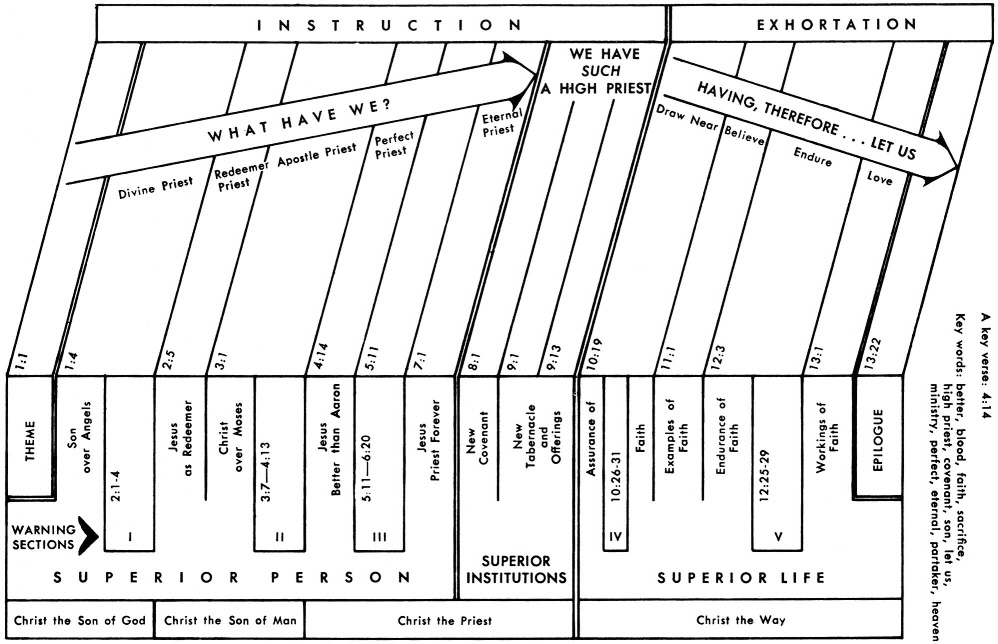
CONSIDER JESUS OUR GREAT HIGH PRIEST
Click chart to enlarge
Charts from Jensen's Survey of the NT - used by permission
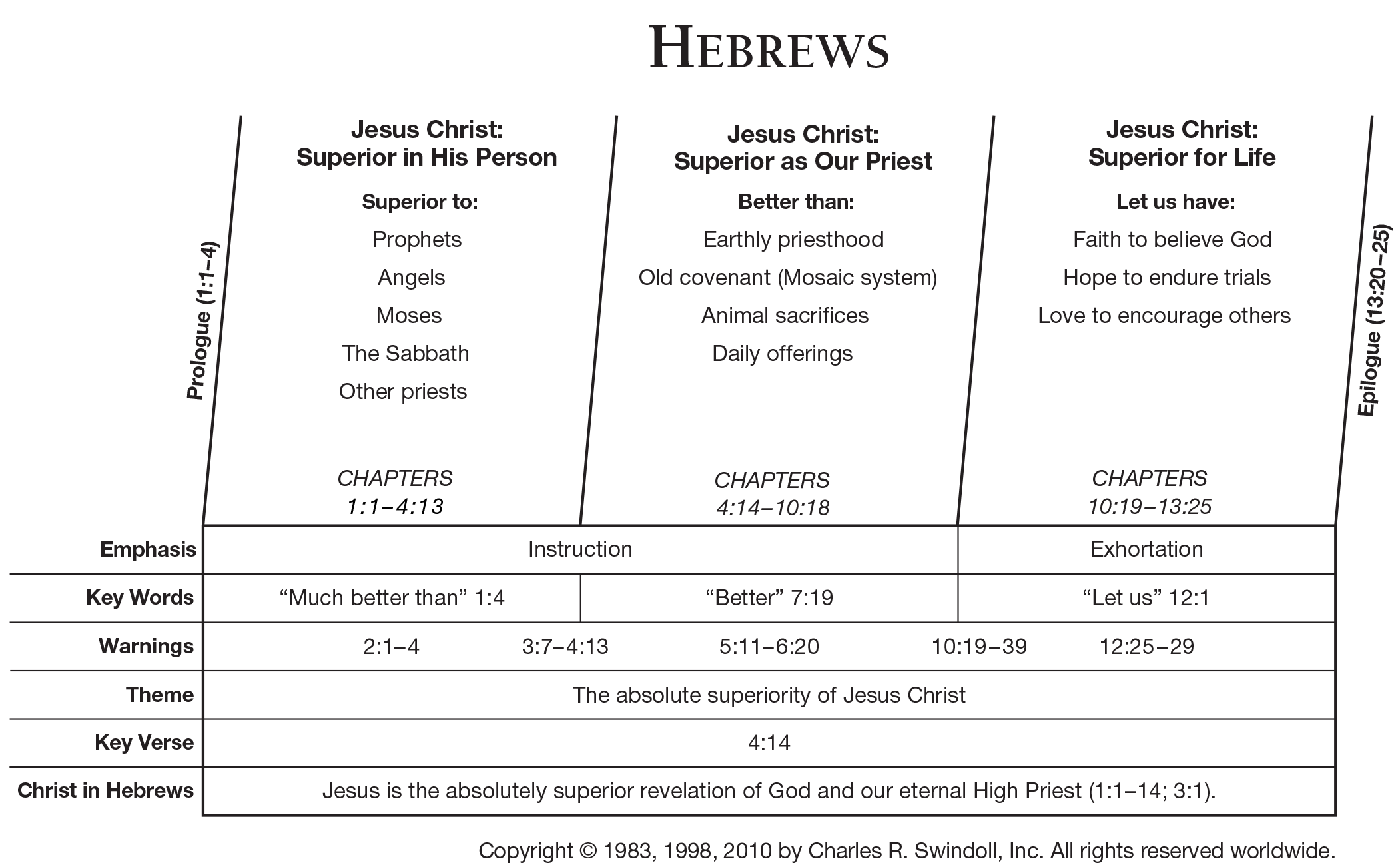
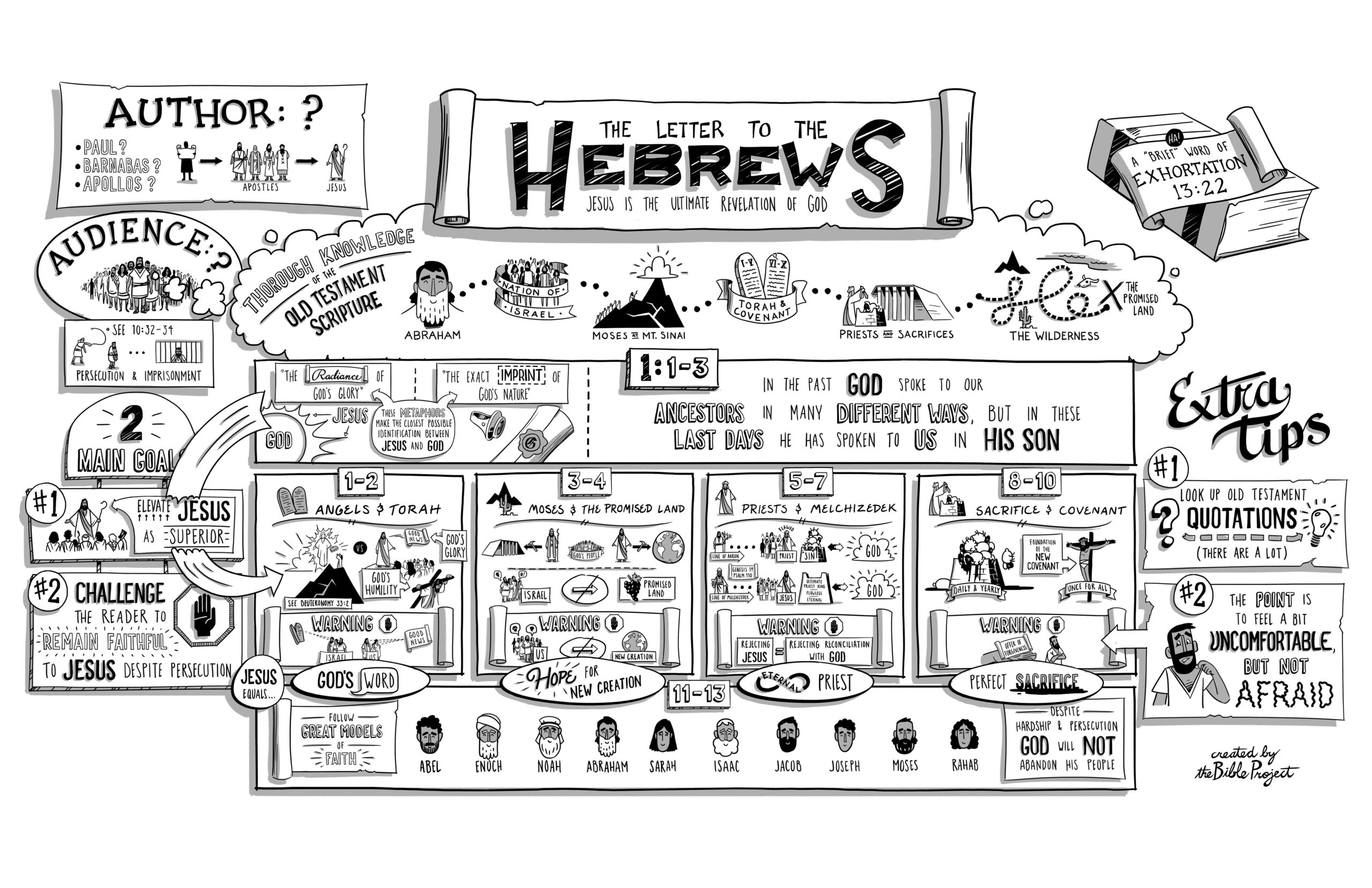
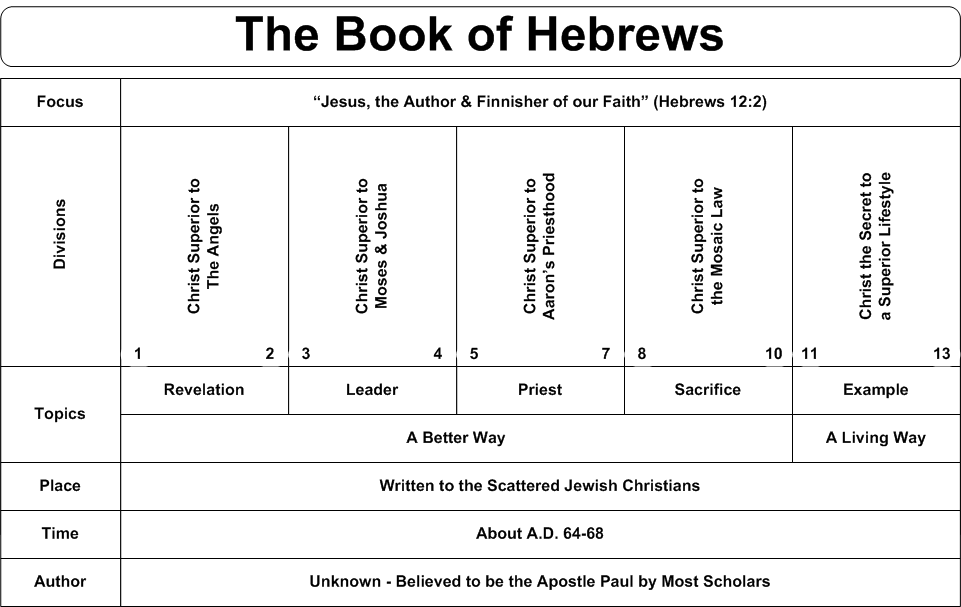
Swindoll's Chart, Interesting Pictorial Chart of Hebrews, Another Chart
|
The Epistle |
||||
| INSTRUCTION Hebrews 1-10:18 |
EXHORTATION Hebrews 10:19-13:25 |
|||
| Superior Person of Christ Hebrews 1:1-4:13 |
Superior Priest in Christ Hebrews 4:14-10:18 |
Superior Life In Christ Hebrews 10:19-13:25 |
||
| BETTER THAN PERSON Hebrews 1:1-4:13 |
BETTER PRIESTHOOD Heb 4:14-7:28 |
BETTER COVENANT Heb 8:1-13 |
BETTER SACRIFICE Heb 9:1-10:18 |
BETTER LIFE |
| MAJESTY OF CHRIST |
MINISTRY OF CHRIST |
MINISTERS FOR CHRIST |
||
|
DOCTRINE |
DUTY |
|||
|
DATE WRITTEN: |
||||

See ESV Study Bible "Introduction to Hebrews"
(See also MacArthur's Introduction to Hebrews)
Borrow Ryrie Study Bible
Hebrews 7:4 Now observe how great this man was to whom Abraham, the patriarch, gave a tenth of the choicest spoils (NASB: Lockman)
Greek: Theoreite (2PPAM) de pelikos outos o [kai] dekaten Abraam edoken (3SAAI) ek ton akrothinion o patriarches.
BGT Θεωρεῖτε δὲ πηλίκος οὗτος, ᾧ [καὶ] δεκάτην Ἀβραὰμ ἔδωκεν ἐκ τῶν ἀκροθινίων ὁ πατριάρχης.
Amplified: Now observe and consider how great [a personage] this was to whom even Abraham the patriarch gave a tenth [the topmost or the pick of the heap] of the spoils (Amplified Bible - Lockman)
KJV: Now consider how great this man was, unto whom even the patriarch Abraham gave the tenth of the spoils.
NKJ Now consider how great this man was, to whom even the patriarch Abraham gave a tenth of the spoils.
NLT: Consider then how great this Melchizedek was. Even Abraham, the great patriarch of Israel, recognized how great Melchizedek was by giving him a tenth of what he had taken in battle. (NLT - Tyndale House)
Phillips: Now notice the greatness of this man. Even Abraham the patriarch pays him a tribute of a tenth part of the spoils. (Phillips: Touchstone)
Young's Literal: And see how great this one is, to whom also a tenth Abraham the patriarch did give out of the best of the spoils,
NET But see how great he must be, if Abraham the patriarch gave him a tithe of his plunder.
CSB Now consider how great this man was-- even Abraham the patriarch gave a tenth of the plunder to him!
ESV See how great this man was to whom Abraham the patriarch gave a tenth of the spoils!
NIV Just think how great he was: Even the patriarch Abraham gave him a tenth of the plunder!
MIT Consider how distinguished was this man to whom Abraham, the patriarch, gave a tithe of the plunder.
NJB Now think how great this man must have been, if the patriarch Abraham gave him a tenth of the finest plunder.
NRS See how great he is! Even Abraham the patriarch gave him a tenth of the spoils.
RSV See how great he is! Abraham the patriarch gave him a tithe of the spoils.
GWN You can see how important Melchizedek was. Abraham gave him a tenth of what he had captured, even though Abraham was the father of the chosen people.
International Children's Bible You can see that Melchizedek was very great. Abraham, the great father, gave Melchizedek a tenth of everything that Abraham won in battle.
Paraphrase: Think carefully about how great this man was: even Abraham, the forefather of Israel, gave him a tenth of the best spoils of war.
- the patriarch Acts 2:29; Acts 7:8-9
- Abraham Genesis 12:2; 17:5,6; Ro 4:11-13,17,18; Gal 3:28,29; Jas 2:23
- Gave a tenth Ge 14:20
- Hebrews Study Questions - to aid your personal study or leading an inductive Bible study
- Hebrews 7 Resources - sermons and commentaries
THE PATRIARCH GIVES A TITHE
TO MELCHIZEDEK THE GREATER
In Hebrews 7:4-10 the writer is establishing the superiority of Melchizedek over Abraham and more importantly over Abraham's descendants, the Levitical priests.
Kenneth Wuest summarizes the writer's logical argument in this section of Hebrews observing that "The writer now proceeds to show that Melchisedec was better than Abraham, in order that he might show that he was better than Levi, and thus better than Aaron. It follows therefore that if Melchisedec is superior to Aaron, his priesthood must be better than that of Aaron. Since that is the case, Messiah’s priesthood, being in the order of the priesthood of Melchisedec, must be better. That makes Messiah better than Aaron and, therefore, the New Testament He instituted, better than the First Testament, which Aaron was instrumental in bringing in. And that is the argument of the Book of Hebrews, namely, that the New Testament in Jesus’ blood is superior to and takes the place of the First Testament in animal blood. (Hebrews Commentary online)
Robert Gundry has an interesting comment noting that "The symbolism that the author finds in the Old Testament portrayal of Melchizedek is getting “hard to explain” (Heb 5:11). So the author commands his audience to “be observing how great [was] this Melchizedek.”
Now observe (theoreo) how great (pelikos) this man (lit - one) was to whom Abraham, the patriarch (patriarches), gave a tenth of the choicest spoils (akrothinion) - Observe (theoreo) is a command in the present imperative calling for his readers to continue gaze at and discern with careful consideration what he is explaining about the greatness of Melchizedek and why this was critically important in his argument for the superiority of the priesthood of Christ. Calling Abraham “the patriarch” heightens his dignity so that Melchizedek’s superiority (receiving tithes/blessing signifies he is the greater) lands with maximum force on wavering Hebrew readers.
And so here he begins by flatly stating Melchizedek was great, which would have been a striking statement to his readers who also considered Abraham great. The writer goes on to allude to what should have been a familiar story in Genesis 14:18-20 to show that the great patriarch Abraham, even in the face of a resounding victory, was willing to voluntarily give Melchizedek a tenth of his plunder, even from "the top of the heap!" Abraham's giving was not obligatory, but voluntary and was not from his "least" but from his best! This clearly reflected Abraham's heart of devotion and gratitude to El Elyon for giving him the victory against all odds! It also follows that Abraham's offering to Melchizedek reflected his acknowledgment of Melchizedek's authority and superiority. This truth will be amplified in Hebrews 7:4-10. For now what we are beginning to see, given that Christ is of the order of Melchizedek (Ps 110:4), is that Christ's priesthood is superior to the priesthood that came from the loins of Abraham. This distinction will be more clearly shown as the writer weaves this truth through Hebrews 7:4-10.
🙏 THOUGHT - While Melchizedek was the literal recipient, the tithe ultimately was given to the Lord Whom Melchizedek served. By way of application this attitude should be the motivation behind our giving to the Most High God!
Phillip E Hughes comments that “If Melchizedek, who was a sign and shadow, is preferred to Abraham and to all the levitical priests, how much more Christ, who is the truth and the substance!… If a type of Christ is greater than he who has the promises, how much more so is Christ himself!” (Hughes - A Commentary on the Epistle to the Hebrews - Page 251)
William MacDonald adds that "Since Abraham was one of the greatest stars in the Hebrew firmament, it follows that Melchizedek must have been a star of even greater magnitude." (BORROW Believer's Bible Commentary)
C H Spurgeon on Melchizedek - He was duly appointed both priest and king: king of righteousness and peace, and at the same time priest of the Most High God. It may be said of him that he sat as a priest upon his throne. He exercised the double office to the great blessedness of those who were with him; for his one act towards Abraham would seem to be typical of his whole life; he blessed him in the name of the Most High God. “See how great this man was,” that he not only ruled his people with righteousness and brought them peace, but he was their representative toward God and God’s representative to them.If Melchizedek was so great, how much greater is that man whom Melchizedek represents! If the type is so wonderful, what must the Antitype be! I invite you to consider “how great” is He of whom it is written that the Lord “has sworn and he will not change his mind, ‘You are a priest forever according to the manner of Melchizedek” (Psa 110:4). I will not say “Consider how great this man was,” for there is no verb: the “was” is inserted by the translators. We are to consider “how great this man.” Say “was” if you will, but read also “is,” and “shall be.” Consider how great this man was and is, and is to be, even the Man Christ Jesus. (See full sermon The Man Christ Jesus)
How great (pelikos) this man (lit - one) was - Note that how great (pelikos) is an exclamation, not a question. The idea is "how important" or "how high is his status". This man is more literally "this one." The word man is added by the translators (Young's Literal = "how great this one"), and should read “now consider how great this one”. His exalted rank is clear from the fact that none other than Abraham, the father and head of Israel, had shown him deference. It is also notable that the writer is careful in his argument to identify Melchizedek as the man (literally "this one"), lest his Jewish readers think it might be some other man of the same name.
Abraham the patriarch (patriarches) - This designation is important to the writer's logic and he accentuates in the original Greek sentence by placing patriarches emphatically at the end of the sentence. Since Abraham is the forefather and head of the Jewish race and nation, it is legitimate to make a comparison between Abraham's descendants (the Levitical priesthood) and Melchizedek. The point is that Abraham as the ancestor of the Levitical priests, represents all of his descendants -- he stands at the fountainhead of all the subsequent offspring.
F F Bruce on how great this man (lit - one) was - if Melchizedek was greater than Abraham, his priesthood (our author argues) must be greater than a priesthood which traces its descent from Abraham. The superior greatness of Melchizedek appears in two important respects: he accepted tithes from Abraham and bestowed his blessing on Abraham. (See The Epistle to the Hebrews - Page 162)
Marcus Dods adds that "Abraham is in emphatic place, but the emphasis is multiplied by the position of ho patriarches ("the patriarch"). (ED: Morris says the idea is “none less than the patriarch.”) It is as if he heard some of his readers saying, "He must be mistaken or must refer to some other Abraham and not the fountain of all our families and of Levi and Aaron". He adds ho patriarches ("the patriarch") to indicate that it is precisely this greatest of men to whom the people owe even their being, of who he says that Melchizedek was greater." (Expositor's Greek Testament)
Melchizedek was superior because he was a specially consecrated king-priest (as emphasized in Hebrews 7:3), and was above the later patriarch-priests. The argument goes like this - Since Abraham was himself one of the founders of Israel, the implication is that he, although a patriarch of the Jews, nevertheless chose to recognize Melchizedek as more important than himself.
A W Pink adds the force of the writer's
reasoning here is easily perceived. To give tithes to another who is the servant of God is a token of official respect, it is the recognition and acknowledgement of his superior status. The value of such official tokens is measured by the dignity and rank of the person making them. Now Abraham was a person of very high dignity, both naturally and spiritually. Naturally he was the founder of the Jewish nation; spiritually he was the “father” of all believers (Romans 4). In his person was concentrated all the sacred dignity belonging to the people of God. How “great” then must be Melchizedek, seeing that Abraham himself owned his official superiority! And therefore how “great” must be that order of priesthood to which he belonged!
That upon which the Jews insisted as their chief and fundamental privilege, and which they were unwilling to forego, was the greatness of their ancestors, considered as the high favorites of God. They so gloried in Abraham and their being his children, that they opposed this to the person and doctrine of Christ Himself (John 8:33, 53).
With regard to official dignity, they looked upon Aaron and his successors as to be preferred above all the world. Whilst they clung to such fleshly honours, the Gospel of Christ, which addressed them as lost sinners, could not be but distasteful to them. To disabuse their minds, to demonstrate that those in whom they trusted came far short in dignity, honour, and greatness, of the true High Priest, the apostle presses upon them the eminence of him who was a type of Christ, and shows that the greatest of all their ancestors paid obeisance (deferential respect and respectful submission, such as when one bows in an attitude of homage) to him. (Hebrews 7:4-10 Melchizedek Continued)
Spurgeon amplifies the command to consider...
Consider how great Melchizedek was. There is something majestic about every movement of that dimly-revealed figure. His one and only appearance is thus fitly described in the Book of Genesis...We see but little of him, yet we see nothing little in him. He is here and gone, as far as the historic page is concerned, yet is he “a priest for ever,” and “it is witnessed that he liveth.” Everything about him is on a scale majestic and sublime.
“Consider how great this man was” in the combination of his offices. He was duly appointed both priest and king: king of righteousness and peace, and at the same time priest of the Most High God. It may be said of him that he sat as a priest upon his throne. He exercised the double office to the great blessedness of those who were with him; for his one act towards Abraham would seem to be typical of his whole life; he blessed him in the name of the Most High God.
“Consider how great this man was,” that he not only ruled his people with righteousness and brought them peace, but he was their representative towards God and God’s representative to them; and in each character distributed divine blessings.
“Consider how great this man was” in the power of his benedictions. Abraham had already been greatly blessed, so much so that he is described as “he that received the promises.” Yet a receiver of promises so great, a man with whom God had entered into solemn covenant, was yet blessed by Melchizedek, “and without all contradiction the less is blessed of the better.” This great man yet further blessed the blessed Abraham, and the father of the faithful was glad to receive benediction at his hands. No small man this: no priest of second rank; but one who overtops the sons of men by more than head and shoulders, and acts a superior’s part among the greatest of them.
“Consider how great this man was” in his supremacy over all around him. He met Abraham when he was returning as a conqueror from the overthrow of the robber kings; and the victorious patriarch bowed before him and gave him tithes of the best of the spoil. Without a moment’s hesitation the man of God recognized the priest of God, and paid to him the tribute of a subject to the officer of a great king. In Abraham’s bowing all the line of Aaronic priesthood did homage unto Melchizedek; for as the apostle saith, “Levi also, who receiveth tithes, paid tithes in Abraham, for he was yet in the loins of his father when Melchizedek met him.” So that all kings in Abraham, and all priests in Abraham, did homage unto this man, who, as king and priest, was owned to be supreme.
“Consider how great this man was.” When the writer of Hebrews had once proved that Melchizedek was greater than Abraham, he felt that he had clearly proved him to be greater than all others, at least to the Hebrews; for the seed of Abraham can recognize none greater than Abraham; and since Abraham by paying tithes acknowledges his subordination to Melchizedek, it is clear that the priest of the Most High God was the greatest of men.
“Consider how great this man was” as to the singularity of his person, “without father, without mother, without descent”: that is to say, we know nothing as to his birth, his origin, or his history. Even this explanation hardly answers to the words, especially when it is added, “Having neither beginning of days, nor end of life.” So mysterious is Melchizedek that many deeply-taught expositors think that he was veritably an appearance of our Lord Jesus Christ. They are inclined to believe that he was not a king of some city in Canaan, as the most of us suppose, but that he was a manifestation of the Son of God, such as were the angels that appeared to Abraham on the plains of Mamre, and that divine being who appeared to Joshua by Jericho, and to the three holy ones in the furnace.
At any rate, you may well “consider how great this man was” when you observe how veiled in cloud is everything about his coming and going — veiled because intended to impress us with the depth of the sacred meanings which were shadowed forth in him. How much more shall this be said of him of whom we ask —
“Thy generation who can tell,
Or count the number of thy years?”
“Consider how great this man was” in the specialty of his office. He had no predecessor in his priesthood, and he had no successor. He was not one who took a holy office and then laid it down; but as far as the historic page of Scripture is concerned we have no note of his quitting this mortal scene; he disappears, but we read nothing of his death any more than of his birth. His office was perpetual, and passed not from sire to son; for he was the type of One “who is made not after the law of a carnal commandment, but after the power of an endless life.”
“Consider how great this man was” in his being altogether unique. There is another “after the order of Melchizedek,” the glorious Antitype in Whom Melchizedek himself is absorbed; but apart from Him Melchizedek is unique. Who can equal this strange, mysterious priest, prophet, king, sent of the Most High God to bless the father of the faithful? He is altogether alone: he receives no commission from the hands of men, nor from God by men; and he does not transmit to a successor what he had not received from a predecessor. Melchizedek stands alone: one mighty crag, rising out of the plain; a lone Alp, whose brow is swathed in cloud sublime. “Consider how great this man was;” but think not to measure that greatness.
I shall leave you to that consideration; for my business this morning is not with Melchizedek, but with a greater than he. I shall take my text in its connection, but lift it up to a higher application.
if Melchizedek was so great, how much greater is
that Man whom Melchizedek represents!
Beloved friends, if Melchizedek was so great, how much greater is that man whom Melchizedek represents! If the type is so wonderful what must the Antitype be! I invite you to consider “how great” is He of Whom it is written, “The Lord swore and will not change His mind, Thou art a priest for ever after the order of Melchizedek.” I will not say “Consider how great this man was,” for there is no verb: the “was” is inserted in italics by the translators. We are to consider “how great this man.” Say “was” if you will, but read also “is,” and “shalt be.” Consider how great this man was and is, and is to be, even the Man Christ Jesus. (If you have time read Spurgeon's application of these truths to our Great High Priest Christ Jesus in his message entitled The Man Christ Jesus)
Observe (2334) (theoreo from theoros = a spectator <> theaomai = to look closely at; gives us our English word "theater" where people concentrate on the meaning of an action, the performance) means to continually give careful consideration to the writers logic in the following discourse, like a general would who is inspecting his army! Gaze on for the purpose of analyzing. Weigh with attentive contemplation. This word describes one who his a spectator although not one who is an apathetic spectator but one who looks with rapt attention and focused interest (-- Just like most men watch their favorite professional sporting event on the weekends!)
Vincent writes that theoreo "denotes calm, intent, continuous contemplation of an object which remains before the spectator. So John 1:14, we beheld, implying that Jesus’ stay upon earth, though brief, was such that his followers could calmly and leisurely contemplate his glory. Compare John 2:23: “they beheld his miracles,” thoughtfully and attentively. Here (Luke 10:18 [Jesus declared] "I was watching Satan fall from heaven like lightning") it denotes the rapt contemplation of a vision."
THEOREO - 51V - Matt. 27:55; Matt. 28:1; Mk. 3:11; Mk. 5:15; Mk. 12:41; Mk. 15:40; Mk. 15:47; Mk. 16:4; Lk. 10:18; Lk. 14:29; Lk. 21:6; Lk. 23:35; Lk. 23:48; Lk. 24:37; Lk. 24:39; Jn. 2:23; Jn. 4:19; Jn. 6:19; Jn. 6:40; Jn. 6:62; Jn. 7:3; Jn. 8:51; Jn. 9:8; Jn. 10:12; Jn. 12:19; Jn. 12:45; Jn. 14:17; Jn. 14:19; Jn. 16:10; Jn. 17:24; Jn. 20:6; Jn. 20:12; Jn. 20:14; Acts 3:16; Acts 4:13; Acts 7:56; Acts 8:13; Acts 9:7; Acts 10:11; Acts 17:16; Acts 17:22; Acts 19:26; Acts 20:38; Acts 21:20; Acts 25:24; Acts 27:10; Acts 28:6; Heb. 7:4; 1 Jn. 3:17; Rev. 11:11; Rev. 11:1
Great (4080) pelikos (from helikos = how great) is an interrogative correlative pronoun (a pronoun that not only asks a question -- interrogative -- but also sets up a relationship or correlation -- correlative -- with another part of the sentence) used in exclamatory statements: literally, of size how large, how great (Gal 6.11) and figuratively, of dignity = how great, how distinguished (Heb 7.4) This interrogative pronoun is indicative of the New Testament’s tendency to use interrogatives as exclamations (Turner, Grammar of New Testament Greek, 3:50). In both New Testament passages in which it appears (Galatians 6:11; Hebrews 7:4) it functions as a heightened expression of comparison. Paul said to the Galatians: “Ye see how large a letter I have written unto you” (Galatians 6:11). In classical Greek frequent in questions about size/magnitude (e.g., geometry, rhetoric).
Only uses - Zech. 2:6; Gal. 6:11; Heb. 7:4
In Hebrews 7:4 (masc. nom. sg.) carries a qualitative sense of greatness/distinction, not merely physical size, matching the writer’s argument about Melchizedek’s superiority. The author signals qualitative eminence—Melchizedek’s greatness is evidenced by Abraham’s tithe and by Melchizedek’s blessing (and “the lesser is blessed by the greater,” Heb 7:7). Reading πηλίκος this way tightens the argument for Christ’s superior Melchizedekian priesthood.
In Galatians 6:11 See with what large letters I am writing to you with my own hand.” πηλίκοις (neut. dat. pl.) modifies γράμμασιν. Debate: large characters (letter-size; likely a noticeable autograph/postscript) vs. long letter (overall length). Most take size of letters as primary (contrast with πόσος for length/amount). Likely an autographic emphasis—either Paul’s large handwriting for emphasis/visibility or a stylistic “I, Paul, am personally writing this.” This favors letter-size over letter-length because γράμματα in the plural typically denotes characters.
Core idea: “how great / how large,” sometimes “how important / distinguished” (extent, magnitude; not number). Closely parallels ἡλίκος (helikos); often contrasted with πόσος (posos)(“how many/how much,” i.e., quantity). LSJ notes its use for magnitude vs. quantity and shows classical pairings like πόσα καὶ πηλίκα (“what number and size”). It can correlate with τηλικοῦτος (telikoutos)(“so great”).
Plato, Meno 82d: πηλίκη τις ἔσται ἡ γραμμή; — “How long/large will the line be?” (size/magnitude in geometric context). atlas.perseus.tufts.edu
Polybius 1.2.8: πόσα καὶ πηλίκα — “how many and how great,” explicitly distinguishing number from size. atlas.perseus.tufts.edu
Takeaway: In classical prose it is a live interrogative/exclamatory adjective for extent/size, frequently in technical or rhetorical measurement contexts (geometry, magnitude), and can be used exclamatorily
Patriarch (3966) (patriarches from patria = lineage, family <> from pater = father + archo = to be chief, to lead, to rule or arche = beginning or head) is literally the chief father (or "first father"). “chief/father of a clan/tribe; patriarch.” Later also a formal ecclesiastical title (e.g., bishops of Rome, Constantinople, Jerusalem, Antioch, Alexandria). Patriarch is in Scripture was applied to important male ancestors who were the father of a tribe or nation. The patriarch represented the primary ancestor of a national entity, which in this case was Israel or the Hebrew nation. In short, Abraham is the "first father" of these Jewish readers. He is their great progenitor, and yet, as the writer explains, Melchizedek is even greater!
Smith's Bible Dictionary writes that patriarch was...(father of a tribe), the name given to the head of a family or tribe in Old Testament times. In common usage the title of patriarch is assigned especially to those whose lives are recorded in Scripture previous to the time of Moses, as Adam, Abraham, Isaac and Jacob. "In the early history of the Hebrews we find the ancestor or father of a family retaining authority over his children and his children's children so long as he lived, whatever new connections they might form when the father died the branch families did not break off and form new communities, but usually united under another common head. The eldest son was generally invested with this dignity. His authority was paternal. He was honored as central point of connection and as the representative of the whole kindred. Thus each great family had its patriarch or head, and each tribe its prince, selected from the several heads of the families which it embraced." --McClintock and Strong. "After the destruction of Jerusalem, patriarch was the title of the chief religious rulers of the Jews in Asia and in early Christian times it became the designation of the bishops of Rome, Constantinople, Alexandria, Antioch and Jerusalem." --American Cyclopedia (see Dictionary Definitions)
There are 4 NT uses of patriarches...
Acts 2:29 "Brethren, I may confidently say to you regarding the patriarch David that he both died and was buried, and his tomb is with us to this day.
Acts 7:8 "And He gave him the covenant of circumcision; and so Abraham became the father of Isaac, and circumcised him on the eighth day; and Isaac became the father of Jacob, and Jacob of the twelve patriarchs. 9 "And the patriarchs became jealous of Joseph and sold him into Egypt. And yet God was with him,
Hebrews 7:4 Now observe how great this man was to whom Abraham, the patriarch, gave a tenth of the choicest spoils.
Sense in LXX: a socio-administrative title for leading men—“heads of fathers’ houses,” “clan chiefs,” or “tribal leaders”—not merely “forefathers.” There are 5 uses of patriarches in the Lxx (1 Chr. 24:31; 27:22; 2 Chr. 19:8; 23:20; 26:12) as exemplified by the following use...
2 Chronicles 19:8 And in Jerusalem also Jehoshaphat appointed some of the Levites and priests, and some of the heads of the fathers' (2 Hebrews words, rosh = head + 'ab = father; Lxx = patriarches) households of Israel, for the judgment of the LORD and to judge disputes among the inhabitants of Jerusalem.
Choicest (205) akrothinion (from akro = the extreme, top, highest + this = heap, pile, esp of grain or sand) means literally "the topmost heap," or top of the heap and thus best of the spoils, the first fruits of the field. In Hebrews 7:4 it is genitive plural, “top of the heap,” “first fruits of spoils.” Function: emphasizes that Abraham did not give just anything but the best, select portion of the spoils to Melchizedek.
Literal/physical: top heap of grain or produce.
Cultic/dedicatory: the first, choicest part of spoils of war dedicated to a deity.
Transferred sense: by NT period, shorthand for “spoils of war” generally, esp. the best of them.
Friberg - (1) often plural, as the best of produce, at the top of the pile = firstfruits; (2) as the best part of goods captured in battle = most valuable plunder, booty, spoils (Heb 7.4) (Borrow Analytical Lexicon of the Greek New Testament)
Gilbrant - In classical Greek akrothinion refers to the spoils of war, taken captive by the victors after a battle. It could have included any or all of the following: produce, animals, merchandise, or persons. It is translated “firstfruits of their victory” (Thucydides 1.132.2) or just “firstfruits” (Herodotus 1.86), both of which refer to the gain received after a battle. There is no use of akrothinion in the Septuagint, but a comparable word skulon (4516), is used, which also means “firstfruits” or “spoils” (see Deuteronomy 2:35; Joshua 8:27; see also Luke 11:22). The word akrothinion is found in the New Testament only in Hebrews 7:4. It comes from two Greek words: akros (204) meaning “top” and this meaning “heap,” thereby giving the meaning of that which comes from the top of the heap, topmost, best part of the heap; implying in context, the best part of the booty or spoil. The Greeks, after having won a battle, would gather all the spoils into a giant heap (this), and the top (akros) of the heap would be given to the gods as a tithe (Dods, Expositors Greek Testament, 4:309). The actual use of the word in the context of Hebrews 7:4 is in reference to Abraham giving a tithe of the spoils (akrothinion) of war to Melchizedek, thereby acknowledging him as a priest. (Complete Biblical Library)
In Classic Greek - Properly: ἀκροθίνια = the topmost heaps of a pile of grain (Homeric usage). Figurative: the first-fruits of booty set apart as an offering, esp. to the gods. Examples
Homer, Iliad 2.237: ἐπ᾽ ἀκροθινίῳ πολέμοιο — “on the topmost heap of war.”
Herodotus 8.121: ἀκροθίνια ἀνατιθέναι τῷ θεῷ — “to dedicate the first-fruits [choicest spoils] to the god.”
Xenophon, Hellenica 1.6.34: generals dedicate ἀκροθίνια from the spoils to gods.
Takeaway in Classic Greek: Akrothinion denotes the select, representative portion of spoils or produce placed on top of a heap as a dedicatory offering. Always implies first/choicest part offered to deity.
Related Terms
ἀπαρχή — “first-fruits” (used frequently in LXX & NT).
δεκάτη — “tithe.” Often paired conceptually with ἀκροθίνια.
τηλικοῦτος / πηλίκος — terms for degree/extent, sometimes paired in rhetorical constructions with offerings.
GAVE A TENTH OF THE CHOICEST SPOILS: edoken (3SAAI) ek ton akrothinion o patriarches:
- Genesis 14:20
Related Passages:
Genesis 14:20+ And blessed be God Most High, Who has delivered your enemies into your hand.” He gave him a tenth of all.
GIVING GOD A TENTH
OF THE BEST
Gave a tenth of the of the choicest spoils (akrothinion) - More literally it reads "gave from or out of (ek)". The point is that the tithe was taken out of the best portion of the plunder, "the top of the heap." The giving of “tenths” or “tithes” is a custom in a number of cultures today (including many churches). The writer will use this fact of Abraham giving a tenth to Melchizedek in Heb 7:7-10 to make his case for the greatness of Melchizedek as it relates to the Levitical priesthood.
This implies a certain subjection on the part of those
paying to those to whom the tithe was paid.
Leon Morris makes the point that In the ancient world, it was generally recognized that there was an obligation to pay tithes to important religious functionaries. This implies a certain subjection on the part of those paying to those to whom the tithe was paid. (See The Expositor's Bible Commentary - Abridged Edition)
C H Spurgeon - He met Abraham when he was returning as a conqueror from the overthrow of the robber kings; and the victorious patriarch bowed before him and gave him tithes of the best of the spoil. Without a moment’s hesitation the man of God recognized the priest of God, and paid to him the tribute of a subject to the officer of a great king. (From sermon The Man Christ Jesus)
Abraham, to whom God gave the promises,
doubly acknowledged his inferiority to Melchizedek
Charles Ryrie explains the significance of the transaction this way "By taking the role of the one who tithed and the one who received the blessing (Heb 7:1), Abraham, to whom God gave the promises, doubly acknowledged his inferiority to Melchizedek. (Borrow Ryrie Study Bible)
Kenneth Wuest adds that "The Greeks after a victory, gathered up the spoils in a heap, and the top, or best part of the heap (akrothinion), was presented to the gods. The fact that Abraham gave a tenth of the pick of the spoils to Melchisedec, magnifies the latter’s greatness in the eyes of the readers of this letter. But it was not any ordinary man called Abraham who paid tithes to Melchisedec. It was Abraham, the patriarch (patriarches). The writer is careful to identify him, lest his Jewish readers think it might be some other man of the same name. (Hebrews Commentary)
🙏 THOUGHT - Abraham voluntarily gave his best to a "shadow" of Messiah without being asked! Do I give the Lord who is the "Substance" (Col 2:17+) my best (time, talents, treasures) or just throw Him my leftovers?
Spurgeon - See sermon The man Christ Jesus
‘Consider how great this man was’ as to the singularity of his person, ‘Without father, without mother, without descent,’ that is to say, we know nothing as to his birth, his origin, or his history. Even this explanation hardly answers to the words, especially when it is added, ‘having neither beginning of days, nor end of life’. So mysterious is Melchizedek that many deeply-taught expositors think that he was veritably an appearance of our Lord Jesus Christ. They are inclined to believe that he was not a king of some city in Canaan, as most of us suppose, but that he was a manifestation of the Son of God, such as were the angels that appeared to Abraham on the plains of Mamre, that divine being who appeared to Joshua by Jericho, and to the three holy ones in the furnace. At any rate, you may well ‘consider how great this man was’ when you observe how veiled in cloud is everything about his coming and going, veiled because intended to impress us with the depth of the sacred meanings which were shadowed forth in him. How much more shall this be said of him of whom we ask, ‘Thy generation who can tell, or count the number of thy years?’ ‘Consider how great this man was’ in the speciality of his office. He had no predecessor in his priesthood and he had no successor. He was not one who took a holy office and then laid it down, but as far as the historic page of Scripture is concerned we have no note of his quitting this mortal scene; he disappears, but we read nothing of his death any more than of his birth. His office was perpetual and passed not from sire to son, for he was the type of one ‘Who is made, not after the law of a carnal commandment, but after the power of an endless life.
Hebrews 7:5 And those indeed of the sons of Levi who receive the priest's office have commandment in the Law to collect a tenth from the people, that is, from their brethren, although these are descended * from Abraham (NASB: Lockman)
Greek: kai oi men ek ton huion Leui ten hierateian lambanontes (PAPMPN) entolen echousin (3PPAI) apodekatoun (PAN) ton laon kata ton nomon, tout' estin (3SPAI) tous adelphous auton, kaiper exeleluthotas (RAPMPA) ek tes osphuos Abraam;
BGT καὶ οἱ μὲν ἐκ τῶν υἱῶν Λευὶ τὴν ἱερατείαν λαμβάνοντες ἐντολὴν ἔχουσιν ἀποδεκατοῦν τὸν λαὸν κατὰ τὸν νόμον, τοῦτ᾽ ἔστιν τοὺς ἀδελφοὺς αὐτῶν, καίπερ ἐξεληλυθότας ἐκ τῆς ὀσφύος Ἀβραάμ·
Amplified: And it is true that those descendants of Levi who are charged with the priestly office are commanded in the Law to take tithes from the people—which means, from their brethren—though these have descended from Abraham (Amplified Bible - Lockman)
KJV: And verily they that are of the sons of Levi, who receive the office of the priesthood, have a commandment to take tithes of the people according to the law, that is, of their brethren, though they come out of the loins of Abraham:
NLT: Now the priests, who are descendants of Levi, are commanded in the law of Moses to collect a tithe from all the people, even though they are their own relatives. (NLT - Tyndale House)
Young's Literal: and those, indeed, out of the sons of Levi receiving the priesthood, a command have to take tithes from the people according to the law, that is, their brethren, even though they came forth out of the loins of Abraham;
NET And those of the sons of Levi who receive the priestly office have authorization according to the law to collect a tithe from the people, that is, from their fellow countrymen, although they too are descendants of Abraham.
CSB The sons of Levi who receive the priestly office have a command according to the law to collect a tenth from the people-- that is, from their brothers-- though they have also descended from Abraham.
Paraphrase Now the sons of Levi who serve as priests are commanded by the Law to take a tenth from the people—that is, from their own brothers—even though they too come from Abraham’s line.
Paraphrase Those from Levi’s tribe who became priests were instructed by the Law to collect tithes from the rest of the Israelites, their own relatives, even though all were Abraham’s descendants.
Paraphrase The Levites who became priests were ordered by the Law to take a tenth from the people, even though the people were their fellow children of Abraham.
- Who receive the priest's office - Heb 5:4; Ex 28:1; Nu 16:10,11; 17:3-10; 18:7,21-26
- To collect a tenth - Leviticus 27:30-33; Numbers 18:26-32; 2 Chronicles 31:4-6; Nehemiah 13:10
- Are descended from Abraham
- Hebrews Study Questions - to aid your personal study or leading an inductive Bible study
- Hebrews 7 Resources - sermons and commentaries
Related Passages:
Numbers 18:21; 24+ (LAW GOVERNING TITHES TO LEVITES) “To the sons of Levi, behold, I have given all the tithe in Israel for an inheritance, in return for their service which they perform, the service of the tent of meeting....24 “For the tithe of the sons of Israel, which they offer as an offering to the LORD, I have given to the Levites for an inheritance; therefore I have said concerning them, ‘They shall have no inheritance among the sons of Israel.’”
LEGAL TITHES TO LEVITES CONTRASTS
WITH VOLUNTARY TITHE TO MELCHIZEDEK
This title is based on the descriptions in Hebrews 7:5 and the contrasting clause in Hebrews 7:6.
The point the writer is building toward in this section (Hebrews 7:4-10) is that Melchizedek, who did not originate from the tribe of Levi in Israel and collected a tenth of the choicest spoils from Abraham and blessed Abraham, was greater than Abraham the patriarch and also greater than Abraham's descendants, the Levitical priests, who descended from Levi through Abraham. He is trying to show the wavering Jews that the OT priesthood has been surpassed by the new Priesthood of Christ because Christ is in the order of Melchizedek.
And those indeed of the sons of Levi who receive the priest's office have commandment in the Law to collect a tenth from the people, that is, from their brethren, although these are descended from Abraham (exerchomai - came out + osphus - loins > Literally - out of the loins of Abraham) - The writer reminds his readers that under the Mosaic Law, the Levitical priests had the legal authority to collect tithes from their fellow Israelites. And since the priests were brethren they were not superior to those who tithed. What is significant about this fact? The point is that the ability of the priests to collect tithes did not come from any inherent superiority but came from the commandment. In other words, the tithe they received was not optional because God legislated it (cf. Nu. 18:21–24). By stating that the priests took tithes from his own brothers based on the Law, the writer prepares to show the striking contrast in the next verse, Hebrews 7:6, that Melchizedek collected tithes voluntarily given by their father Abraham. In short, Melchizedek received his tithe not based on the Law but based on his inherent superiority to Abraham.
Bob Utley on "although these are descended from Abraham" This is rabbinic logic based on Levi being present in the loins of Abraham (cf. Heb. 7:10). This is Jewish exegesis, not scientific fact.
Let's look at the writer's logic: Step 1 (Heb 7:5): Levitical priests had God-given authority to receive tithes. Step 2 (Heb 7:6): But Melchizedek, who had no such legal authority, still collected tithes from Abraham who gave voluntarity. Step 3 (Heb 7:6–7): Since the greater (Melchizedek) received tithes and also blessed the lesser (Abraham), Melchizedek’s superiority is established over Abraham and by extension over the Levitical priests (who were in Abe's loins when he tithed so that in effect they also tithed to Melchizedek - see Heb 7:9-10).
Spurgeon sums it up this way "In Abraham’s bowing all the line of Aaronic priesthood did homage unto Melchizedek (ED: SPURGEON IS PICKING UP THE TRUTH IN Heb 7:9-10 OF LEVI IN LOINS OF ABRAHAM). So that all kings in Abraham, and all priests in Abraham, did homage unto this man, who as king and priest was owned to be supreme."