Hebrews 7:1
Hebrews 7:2
Hebrews 7:3
Hebrews 7:4
Hebrews 7:5
Hebrews 7:6
Hebrews 7:7
Hebrews 7:8
Hebrews 7:9
Hebrews 7:10
Hebrews 7:11
Hebrews 7:12
Hebrews 7:13
Hebrews 7:14
Hebrews 7:15
Hebrews 7:16
Hebrews 7:17
Hebrews 7:18
Hebrews 7:19
Hebrews 7:20
Hebrews 7:21
Hebrews 7:22
Hebrews 7:23
Hebrews 7:24
Hebrews 7:25
Hebrews 7:26
Hebrews 7:27
Hebrews 7:28
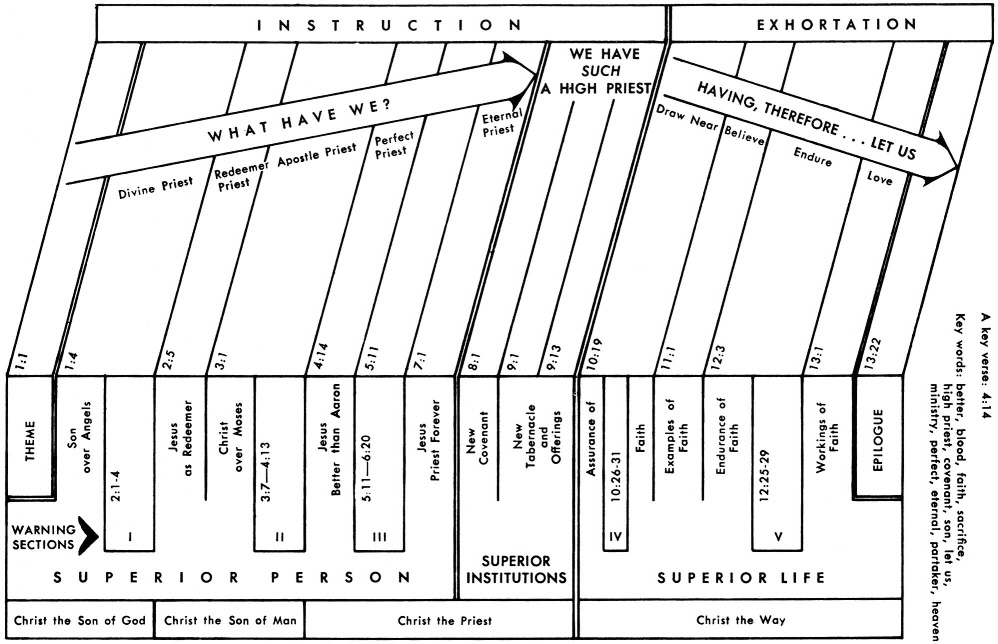
CONSIDER JESUS OUR GREAT HIGH PRIEST
Click chart to enlarge
Charts from Jensen's Survey of the NT - used by permission
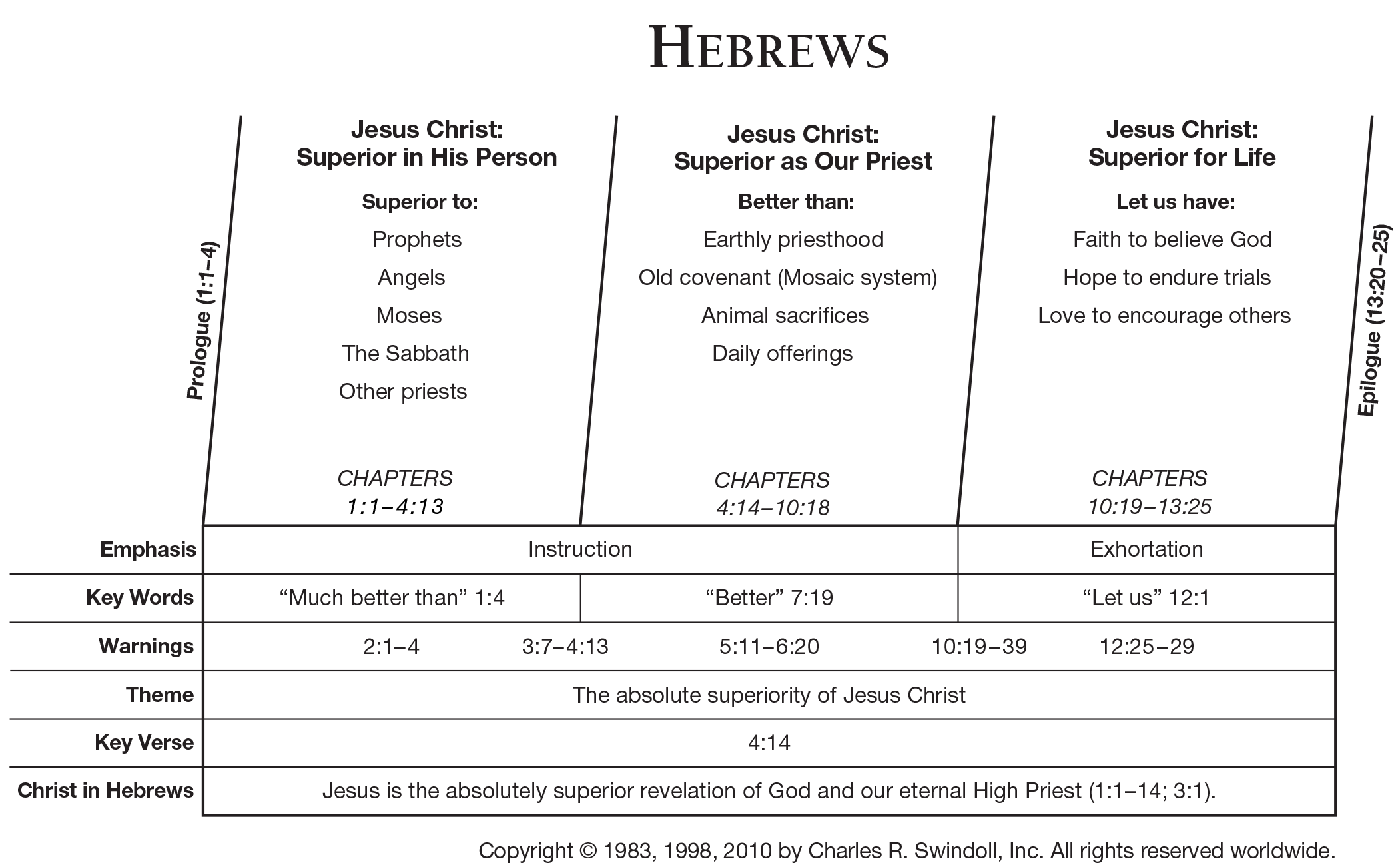
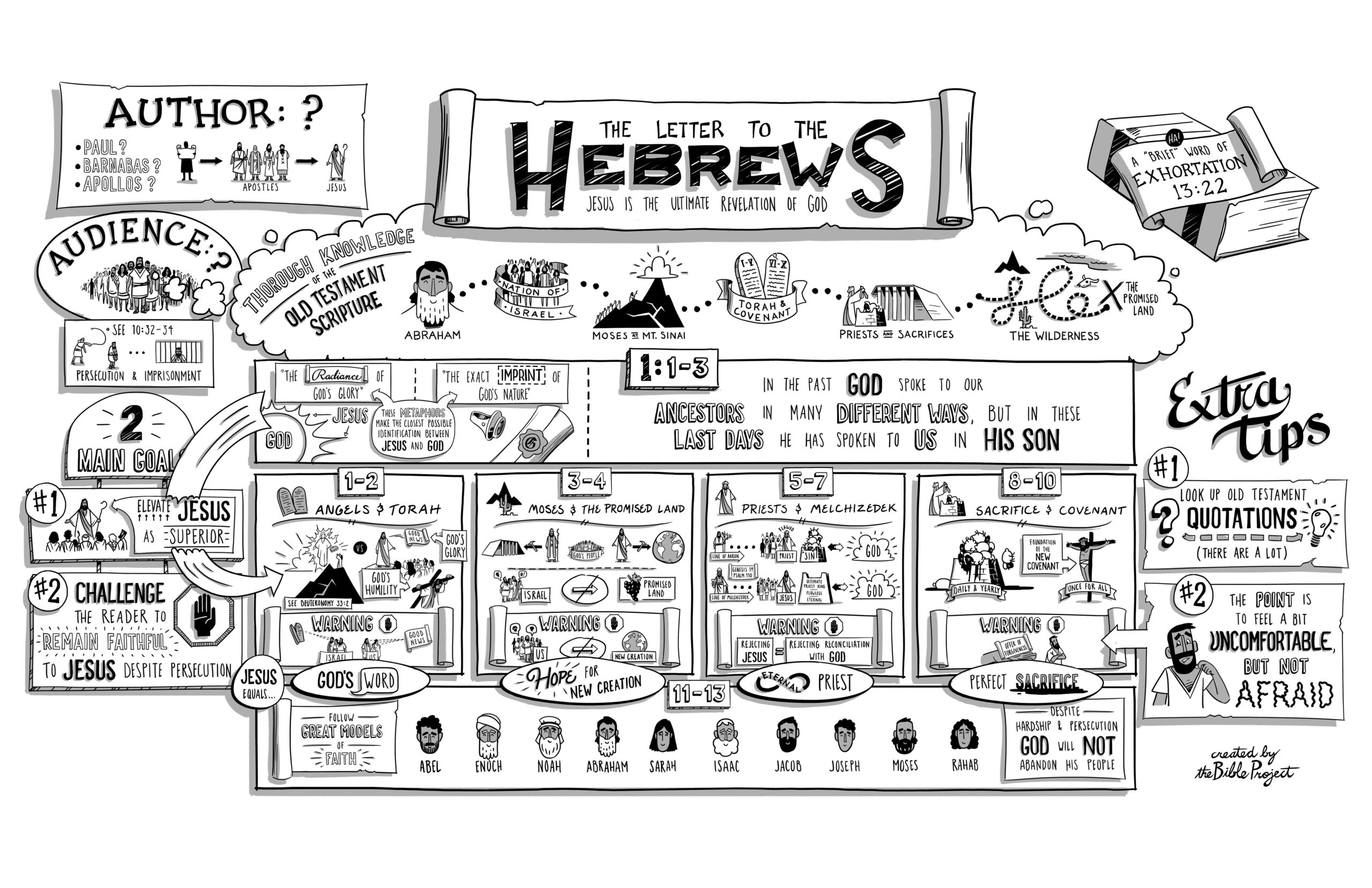
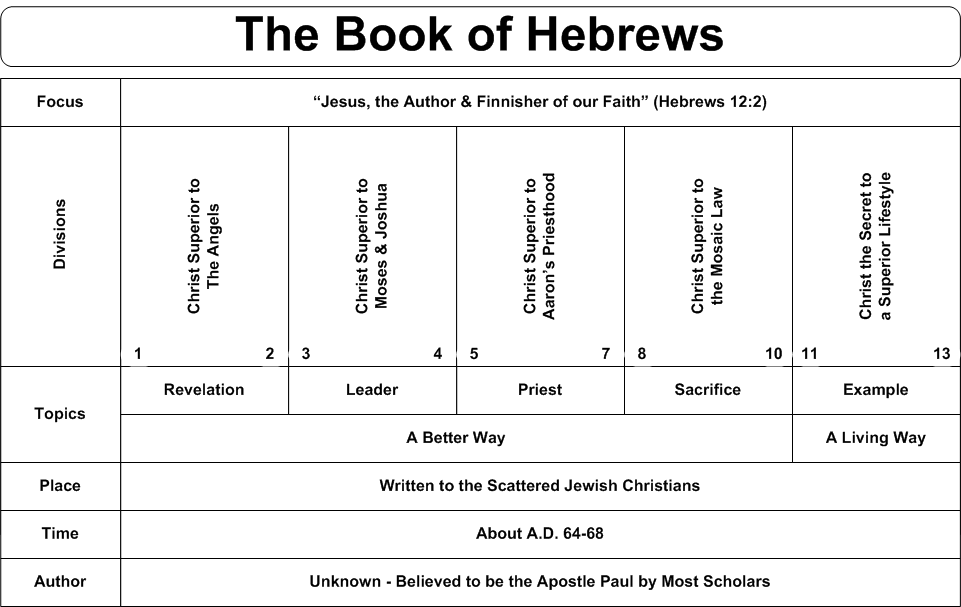
Swindoll's Chart, Interesting Pictorial Chart of Hebrews, Another Chart
|
The Epistle |
||||
| INSTRUCTION Hebrews 1-10:18 |
EXHORTATION Hebrews 10:19-13:25 |
|||
| Superior Person of Christ Hebrews 1:1-4:13 |
Superior Priest in Christ Hebrews 4:14-10:18 |
Superior Life In Christ Hebrews 10:19-13:25 |
||
| BETTER THAN PERSON Hebrews 1:1-4:13 |
BETTER PRIESTHOOD Heb 4:14-7:28 |
BETTER COVENANT Heb 8:1-13 |
BETTER SACRIFICE Heb 9:1-10:18 |
BETTER LIFE |
| MAJESTY OF CHRIST |
MINISTRY OF CHRIST |
MINISTERS FOR CHRIST |
||
|
DOCTRINE |
DUTY |
|||
|
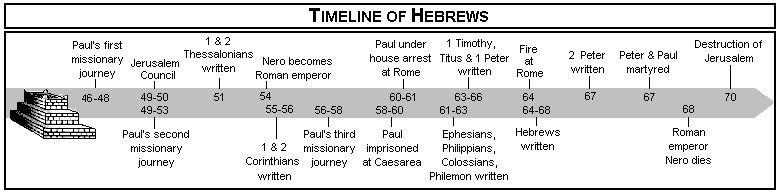
DATE WRITTEN: |
||||

See ESV Study Bible "Introduction to Hebrews"
(See also MacArthur's Introduction to Hebrews)
Borrow Ryrie Study Bible
Hebrews 7:8 In this case mortal men receive tithes, but in that case one receives them, of whom it is witnessed that he lives on. (NASB: Lockman)
Greek: kai hode men dekatas apothneskontes (PAPMPN) anthropoi lambanousin, (3PPAI) ekei de marturoumenos (PPPMSN) hoti ze. (PPPMSN)
BGT καὶ ὧδε μὲν δεκάτας ἀποθνῄσκοντες ἄνθρωποι λαμβάνουσιν, ἐκεῖ δὲ μαρτυρούμενος ὅτι ζῇ.
Amplified: Furthermore, here [in the Levitical priesthood] tithes are received by men who are subject to death; while there [in the case of Melchizedek], they are received by one of whom it is testified that he lives [perpetually]. (Amplified Bible - Lockman)
KJV: And here men that die receive tithes; but there he receiveth them, of whom it is witnessed that he liveth.
NLT: In the case of Jewish priests, tithes are paid to men who will die. But Melchizedek is greater than they are, because we are told that he lives on. (NLT - Tyndale House)
Young's Literal: and here, indeed, men who die do receive tithes, and there he, who is testified to that he was living,
NKJ Here mortal men receive tithes, but there he receives them, of whom it is witnessed that he lives.
NET and in one case tithes are received by mortal men, while in the other by him who is affirmed to be alive.
CSB n the one case, men who will die receive tenths, but in the other case, Scripture testifies that he lives.
ESV In the one case tithes are received by mortal men, but in the other case, by one of whom it is testified that he lives.
NIV In the one case, the tenth is collected by men who die; but in the other case, by him who is declared to be living.
Paraphrase On the one hand, the tithes are collected by men who are subject to death; but on the other hand, they are received by one (Melchizedek) who is affirmed in Scripture to continue living ("he abides a priest perpetually" Heb 7:3).
- Mortal men - Heb 7:23; 9:27
- He lives on - Heb 3:16; 5:6; 6:20; 9:24,25; Jn 11:25,26; 14:6,19; Rev 1:18
- Hebrews Study Questions - to aid your personal study or leading an inductive Bible study
- Hebrews 7 Resources - sermons and commentaries
Related Passages:
Hebrews 7:23 (MORTAL MEN) The former priests, on the one hand, existed in greater numbers because they were prevented by death from continuing,
THE PRIEST WHO
LIVES FOREVER
After showing that Melchizedek both received tithes from Abraham and blessed him (Heb 7:6–7), the writer now presses the contrast further. In the Levitical system, tithes were collected by men who were mortal—priests who lived, served, and then died. Their ministry was temporary, marked by human frailty. In contrast, Melchizedek, whose priesthood is sketched in Scripture without genealogy or death record, is portrayed as one who “lives on.” This contrast sets up the deeper point: the priesthood that depends on mortal men is inherently limited, but the priesthood associated with Melchizedek—and ultimately fulfilled in Christ—carries the witness of enduring life. Thus, the superiority of Melchizedek’s order is not only in status (Heb 7:6–7) but also in permanence (Heb 7:8). In sum, the writer is contrasting the Levitical priests (mortal, temporary) with Melchizedek (portrayed as abiding, a type of Christ’s eternal priesthood).
In this case mortal men (lit - "men who die" - apothnesko in present tense) receive (lambano in present tense) tithes, but in that case one receives them, of whom it is witnessed (martureo in present tense) that he lives on (zao in present tense) - And in this case literally reads "and here, indeed...". The word "here" conveys this sense "Here, i.e., in this Levitical system with which we who are Hebrews are familiar, (ekei) "there" in that system identified with that ancient priest." (Dods). Mortal men literally reads "men who are continually dying". The writer emphasizes that dying men receive tithes which in the present context refers to the Levitical priests who were "continually dying" and passing the baton to the next generation of priests. The point he is that the Levitical order was temporary, but in not so with the order of Melchizedek. In that case (more literally but there) introduces the contrast of Abraham giving a tenth of his choicest spoils to Melchizedek who "abides a priest perpetually" (Heb 7:3).
In that case one - That is, Melchizedek. In dramatic contrast to the Levitical priests "who are continually dying" stands the record regarding Melchizedek, "one...that...lives on", with not one word about his death. In this sense Melchizedek's office as priest was not passed on to another.
He lives on - No death is recorded for Melchizedek, and thus in a "typical" sense his priesthood is viewed as eternal and thus his priesthood was clearly superior to that of Aaron. In other words the Scripture specifies no limit to the authority of his priesthood, but on the contrary there is an intimation of perpetuity ("he remains a priest perpetually" Heb 7:3+).
F F Bruce - Nowhere is it related that Melchizedek lost his priestly office by death, whereas we have the record, generation after generation, of Levitical priests who died and had to hand on their dignity and duty to their heirs. The tithe prescribed by Israelite law is paid to mortal men; the tithe which Abraham gave Melchizedek was received by one who, as far as the record goes, has no “end of life"....what was true of Melchizedek in this limited and “literary” sense is true absolutely of him who serves his people as high priest in the presence of God. Melchizedek “is attested as being alive” in the sense that we never read of him otherwise than as a living man; Christ can be said to live in the sense that, having died once for all and risen from the dead, he is alive forevermore (cf. "power of an indestructible life" - Heb 7:16; Rom. 6:9; Rev. 1:18). The practical implications of this are drawn out more fully in vv. 23–25 of the present chapter. (See The Epistle to the Hebrews - Page 163)
Thomas Lea - This verse draws from the silence of Scripture to undergird Melchizedek's greatness. The Levitical priesthood is contrasted with the priesthood of Melchizedek. The Old Testament priests were mortal men. After a few years of service to God, they would die. Melchizedek, however, served in a priesthood which enjoyed a continual existence. Records show the death of generation after generation of Levitical priests, but not of Melchizedek. Levites transferred their position and duties to their heirs. Israelites paid tithes to these mortals. Abraham paid his tithes to one whom Scripture never showed to be anything except a living person. Scripture's silence could thus be seen as a type representing the eternal priesthood of Christ. (See Holman New Testament Commentary - Hebrews)
Leon Morris makes an interesting observation that "The present tenses of both dying and receiving coupled with the "here" at the beginning may be held to indicate that the temple system was still in operation at the time the words were written. Thus they support a date before A.D. 70 for the writing of the epistle. (ED: Date of writing of Hebrews debated but conservative commentators place it c. A.D. 64–68, just before the temple’s fall) (See The Expositor's Bible Commentary)
William MacDonald - In the Aaronic priesthood tithes were received by men who were subject to death. There was a constant succession of priests, each one serving his own generation, then passing on. In Melchizedek's case there is no mention of his having died. Therefore he can represent a priesthood which is unique in that it is perpetual. (Borrow Believer's Bible Commentary page 2178)
Leon Morris adds - "There" puts Melchizedek in strong contrast to the Aaronic priests (here). He is remote from this scene. The writer does not say that Melchizedek lives on but that the testimony (witness) about him is that he lives. Once more he is emphasizing the silences of Scripture to bring out his point. Scripture records nothing about the death of Melchizedek. This must be borne in mind when estimating the significance of the incident and the way the priest-king prefigures Christ. (See The Expositor's Bible Commentary - Abridged Edition)
C H Spurgeon - And thus Aaron was greater than the people, being set apart to a high and honorable office, into which none else might intrude. He was God’s representative, and so he spoke with the authority of his office. Today our Savior’s intercession in the heavenly places rises far higher in power and glory than that of any ordinary intercessor. He blesses in fact, while the greatest saints on earth and in heaven can only bless in desire.Calvin -He takes the silence respecting his death, as I have said, as an evidence of his life. (and then he adds) The type (Melchizedek) is described as having no end; the order of priesthood which it represents is therefore eternal. (From sermon The Blessing of the High Priest)
Marcus Dods explains "witnessed" as follows - Giving to the silence of Scripture the force of an assertion, the writer speaks of Melchizedek as "a person of whom it is witnessed" (marturoumenos hoti) (Expositor's Greek Testament )
A W Pink - Some have stumbled over the statement here made about Melchizedek: “it is witnessed that he lives on”. These words have been appealed to in proof that he was a superhuman being. But if this statement be interpreted in the light of its context, there is no difficulty. It was not absolutely and personally that Melchizedek still lived, but typically and as a representation of Christ. Scripture frequently attributes to the type (here, Melchizedek) what is found alone in the antitype (here, Christ). Thus, the paschal lamb was expressly called God’s Passover (Ex 12:11), when in reality it was only a pledge and token thereof. So the emblems on the Lord’s table are denominated (given the name of) the body and blood of Christ, because they represent such. The blessedness of this detail will come before us in the later verses. (Melchizedek, Continued)
Witnessed (3140) (martureo from mártus = witness, one who has information or knowledge of something & hence can bring to light or confirm something; English ~ martyr) ) means to be a witness, to testify, to give evidence, to give testimony, to affirm that one has seen or heard or experienced something. To be well reported. It means to provide information about a person or an event concerning which the speaker has direct knowledge. Martureo in some contexts is used in the sense of making an important and solemn declaration. It can be used in the sense of confirmation or approval and so to affirm n a supportive manner.
Martureo is a key word in Hebrews (7 of 81 NT uses, ~10% uses)
- Hebrews 7:8+ - In this case mortal men receive tithes, but in that case one receives them, of whom it is witnessed that he lives on.
- Hebrews 7:17+ - For it is attested of Him, "YOU AREA PRIEST FOREVER ACCORDING TO THE ORDER OF MELCHIZEDEK ."
- Hebrews 10:15+ - And the Holy Spirit also testifies to us; for after saying,
- Hebrews 11:2+ - For by it the men of old gained approval.
- Hebrews 11:4+ - By faith Abel offered to God a better sacrifice than Cain, through which he obtained the testimony that he was righteous, God testifying about his gifts, and through faith, though he is dead, he still speaks.
- Hebrews 11:5+ - By faith Enoch was taken up so that he would not see death; AND HE WAS NOT FOUND BECAUSE GOD TOOK HIM UP; for he obtained the witness that before his being taken up he was pleasing to God.
- Hebrews 11:39+ - And all these, having gained approval through their faith, did not receive what was promised
Hebrews 7:9 And, so * to speak, through Abraham even Levi, who received tithes, paid tithes, (NASB: Lockman)
Greek: kai os epos eipein, (AAN) di' Abraam kai Leui o dekatas lambanon (PAPMSN) dedekatotai, (3SRPI)
BGT καὶ ὡς ἔπος εἰπεῖν, δι᾽ Ἀβραὰμ καὶ Λευὶ ὁ δεκάτας λαμβάνων δεδεκάτωται·
Amplified: A person might even say that Levi [the father of the priestly tribe] himself, who received tithes (the tenth), paid tithes through Abraham, (Amplified Bible - Lockman)
KJV: And as I may so say, Levi also, who receiveth tithes, payed tithes in Abraham.
NLT: In addition, we might even say that Levi's descendants, the ones who collect the tithe, paid a tithe to Melchizedek through their ancestor Abraham. (NLT - Tyndale House)
Young's Literal: and so to speak, through Abraham even Levi who is receiving tithes, hath paid tithes,
NKJ Even Levi, who receives tithes, paid tithes through Abraham, so to speak,
NET And it could be said that Levi himself, who receives tithes, paid a tithe through Abraham.
CSB And in a sense Levi himself, who receives tenths, has paid tenths through Abraham,
ESV One might even say that Levi himself, who receives tithes, paid tithes through Abraham,
NIV One might even say that Levi, who collects the tenth, paid the tenth through Abraham,
Paraphrase In a manner of speaking, Levi himself—the one who normally collects the tithes—actually paid tithes through Abraham.
Paraphrase Symbolically, when Abraham gave Melchizedek a tithe, Levi (his descendant, the future tithe-collector) was also giving a tithe.
- Paid tithes - He 7:4 Ge 14:20 Ro 5:12
- Hebrews Study Questions - to aid your personal study or leading an inductive Bible study
- Hebrews 7 Resources - sermons and commentaries
Related Passages:
Hebrews 7:4+ Now observe how great this man was to whom Abraham, the patriarch, gave a tenth of the choicest spoils.
Genesis 14:20+ And blessed be God Most High, Who has delivered your enemies into your hand.” He gave him a tenth of all.
THE TITHE COLLECTOR
BECOMES THE TITHE PAYER
The writer of Hebrews continues his careful argument showing that Melchizedek’s priesthood is greater than the Levitical priesthood. In Hebrews 7:8, he contrasts mortal priests who receive tithes with the one who is testified to as living. Now, in Hebrews 7:9, he presses the point even further with a striking, almost rhetorical turn teaching that Levi himself—though not yet born—was, in a sense, involved in Abraham’s act of tithing to Melchizedek.
Keep in mind that the argument in this verse regarding solidarity (of the Jewish race) while readily understood by a first century Jew, is not that well understood by modern minds that emphasize "individuality." "The idea is that neither the father nor the children would be independent of one another. Levi here is more than an individual. He served as ancestor and representative of the Jewish priesthood." (Lea)
And, so to speak, through Abraham even Levi, who received (lambano) tithes, paid tithes (dekatoo) - So to speak is literally "so to speak a word" (epos = a word + eipein = say or speak). The idea of this introductory phrase is "I might almost say" this phrase conveying the thought that what follows is not to be taken literally. ("Do not press this too literally.")
Abraham really acted as a representative for all his posterity
when he gave a tenth to Melchizedek.
--William MacDonald
Vincent adds this was used to introduce "an unusual statement, or one which may appear paradoxical or startling to the reader, as this statement certainly is, to a modern reader at least." This mode of introduction is calculated to make sure that the statement about to be spoken (The a sense in which even Levi paid tithes to Melchizedek) is not to be understood in a literal sense.
Even Levi - In context this reference to Levi is not speaking so much of him personally as of Levi collectively or as the source of the tribe that sprung from him, especially the priests in the line of Aaron. Remember the author's overall intent in this section is to demonstrate beyond a doubt the superiority of the priesthood of Messiah over the Levitical (Aaronic) priesthood.
Through Abraham - The idea is "by means of Abraham" the payment was made by the Levitical priests to Melchizedek, a concept that the writer elaborates on in the next verse.
Paid tithes (dekatoo) - As we have already discussed, in the ancient orient, when one paid a tithe to someone, they payer was in essence acknowledging the superiority of the payee (or recipient of the tithe).
The fact that the Levitical priesthood would pay tithes would have been a rather startling statement to the Jewish readers of the letter because the characteristic of the Levitical priesthood was not that of paying but of receiving tithes!
Matthew Poole writes “And as I may so say:” the Spirit now sets this priesthood above the Levitical by instance, an instance which is not so proper or direct, and so his form of introducing it is considerable, as hos epos eipein, as to say the word, a Greek elegancy of speech, which is used as a preface when something is uttered which is remarkable, and hard to understand and it is not only conclusive to what was spoken before (I will speak a word more, and then end the discourse) but interpretative of what he was about to say concerning Levi, born a hundred and sixty-two years after this transaction; “As I may so say,” or, in some sense it may be said.
Paid tithes (1183) (dekatoo from dekatos = tenth) means to take tithes or a tenth from (active voice as in Hebrews 7:6) or to pay tithes (passive voice in Hebrews 7:9). There is one use in the Septuagint (LXX)...
Nehemiah 10:37 We will also bring the first of our dough, our contributions, the fruit of every tree, the new wine and the oil to the priests at the chambers of the house of our God, and the tithe of our ground to the Levites, for the Levites are they who receive the tithes (Hebrew = 'asar = to take or give a tenth; Lxx = dekatoo) in all the rural towns.
Norman Geisler - When Critics Ask - HEBREWS 7:9–10—Do these verses indicate that an embryo is merely a potential human being, not an actual human person?
PROBLEM: The writer of Hebrews declares that Levi paid tithes to Melchizedek through Abraham. However, Levi was not even born until hundreds of years after this time. So Levi could not possibly have actually paid tithes to Melchizedek—he could only have done it potentially.
SOLUTION: This text is not speaking of an embryo, to say nothing of calling it a potential human being. First, it does not say that Levi was potentially in Abraham. He was probably only there representatively or figuratively.
Second, even if Levi was potentially in Abraham, it certainly does not follow that he was an embryo in Abraham.
Third, if Levi, who was not even conceived when he was said to be “in Abraham,” was a potential human being, then we are potential humans before we are even conceived.
Fourth, if this is so, then even human sperm (before they fertilize an ovum) are potential human beings just like embryos. But this is genetically incorrect. Sperm have only 23 chromosomes while embryos have 46 (see comments on Ps. 139:13–16). (When Critics Ask)
Hebrews 7:10 for he was still in the loins of his father when Melchizedek met him (NASB: Lockman)
Greek: eti gar en te osphui tou patros en (3SIAI) ote sunentesen (3SAAI) auto Melchisedek.
Amplified: For he was still in the loins of his forefather [Abraham] when Melchizedek met him [Abraham]. (Amplified Bible - Lockman)
KJV: For he was yet in the loins of his father, when Melchisedec met him.
NLT: For although Levi wasn't born yet, the seed from which he came was in Abraham's loins when Melchizedek collected the tithe from him. (NLT - Tyndale House)
Young's Literal: for he was yet in the loins of the father when Melchisedek met him.
NKJ Hebrews 7:10 for he was still in the loins of his father when Melchizedek met him.
NET Hebrews 7:10 For he was still in his ancestor Abraham's loins when Melchizedek met him.
BGT ἔτι γὰρ ἐν τῇ ὀσφύϊ τοῦ πατρὸς ἦν ὅτε συνήντησεν αὐτῷ Μελχισέδεκ.
CSB for he was still within his ancestor when Melchizedek met him.
ESV for he was still in the loins of his ancestor when Melchizedek met him.
NIV because when Melchizedek met Abraham, Levi was still in the body of his ancestor.
GWN Even though Levi had not yet been born, he was in the body of Abraham when Melchizedek met him.
Paraphrase For Levi was still in Abraham’s body when Melchizedek met him.
Paraphrase Levi himself was not yet born but was represented in Abraham when Melchizedek met him.
- Hebrews 7:5; Genesis 35:11; 46:26; 1 Kings 8:19
- Hebrews Study Questions - to aid your personal study or leading an inductive Bible study
- Hebrews 7 Resources - sermons and commentaries
Related Passages:
Romans 5:12 (SEE EXPLANATIONS BELOW) Therefore, just as through one man (OUR FEDERAL HEAD) sin entered into the world, and death through sin, and so death spread to all men, because all sinned–
LEVI TITHES BY PROXY
THROUGH ABRAHAM
By proxy is a way of saying someone acts on behalf of another. Abraham was the representative of his whole line. Therefore, when Abraham gave tithes, Levi (his descendant, the head of the priestly tribe) is considered to have given tithes through him.
The writer has already argued that Abraham, Israel’s patriarch, paid tithes to Melchizedek and was blessed by him (Heb 7:6–7), and that this blessing demonstrates Melchizedek’s superiority. Now in Heb 7:10, he presses the logic even further. Levi himself, though not yet born, is considered to have paid tithes to Melchizedek “through Abraham.” This reflects the biblical idea of ancestral solidarity—that descendants are in some way represented in their forefather’s actions (see discussions below of how all men were in some way "in Adam"). By this reasoning, the entire Levitical priesthood is shown to be subordinate to Melchizedek’s order, since their ancestor Abraham acknowledged him with tithes.
For (gar) introduces an explanation (see importance of pausing to ponder this term of explanation) , in this case the explanation of how it was possible that through Abraham even Levi...paid tithes.
An ancestor is regarded in biblical thought
as containing within himself all his descendants
-- F F Bruce
He was still in the loins (osphus) of his father (cf Heb 7:5+ literally "come out of, from the loins of Abraham") - Levi was still in the loins (in modern somewhat scientific terms in the genetic/chromosomal makeup) of Abraham. In addition, the Jewish priesthood was considered as being in Abraham. So if Levi (and the Levitical priests) was in Abraham, when the great patriarch paid a tenth of the spoils to Melchizedek, then it is as if Levi (and his descendants) also paid a tithe to Melchizedek. In the same way, when "father Abraham" was blessed by Melchizedek, all of Abraham's progeny were blessed, including the tribe of Levi, whose reception of Melchizedek's blessing equated to submitting to Melchizedek's greater authority (the greater would bless the lesser figure). And of course in His infinite wisdom the Holy Spirit Who inspired this epistle knew full well that this line of reasoning would be very appealing to the Jews, who placed a strong emphasis on the solidarity (a feeling of unity as in interests, standards, and responsibilities that binds members of a group together) of their race.
Thomas Lea explains "Since Levi was Abraham's great-grandson and was unborn when Abraham met Melchizedek, he could be described as already in Abraham's loins. Biblical thought accepted the idea that an ancestor contained within himself all of his descendants. Although Levi had not yet been born when Abraham paid the tithes, we could view him as paying tithes to Melchizedek by this manner of reckoning. The payment of tithes by Abraham could be transferred to his offspring Levi and to all the priesthood.... If Levi paid the tithes to Melchizedek, this demonstrates even more clearly the superiority of Melchizedek." (See Holman New Testament Commentary - Hebrews)
Warren Wiersbe - The Jewish people believe strongly in “racial solidarity,” and this is one example of it. The paying of the tithes involved not just the patriarch Abraham, but also the unborn generations in his loins. (Bible Exposition Commentary)
Leon Morris on in the loins of his father explains that "This is a way of speaking we find here and there in the Bible when the ancestor includes the descendants. So it was said to Rebekah, not two children but "two nations are in your womb" (Ge 25:23). Again, Paul can say, "In Adam all die" (1Cor 15:22). Levi was thus included in the payment of the tithe (and, of course, all the priests who descended from him and whom the Hebrews esteemed so highly). The author wants his readers to be in no doubt about the superiority of Christ to any other priests and sees the mysterious figure of Melchizedek as powerfully illustrating this superiority. (See The Expositor's Bible Commentary - Abridged Edition)
As an aside, someone today might argue that in light of the fact that Christ was the "seed" of Abraham (see Galatians 3:16), and thus "in the loins of" Abraham and so He too paid tithe to Melchizedek. This argument breaks down because Abraham was not Messiah's father. God was His Father and His birth was unique and supernatural.
Fausset explains it this way - Christ did not, in this sense, pay tithes in Abraham, for He never was in the loins of an earthly father [Alford]. Though, in respect to His mother, He was “of the fruit of (David’s, and so of) Abraham’s loins,” yet, being supernaturally, without human father, conceived, as He is above the natural law of birth, so is he above the law of tithes. Only those born in the natural way, and so in sin, being under the curse, needed to pay tithe to the priest, that he might make propitiation for their sin. Not so Christ, who derived only His flesh, not also the taint of the flesh, from Abraham. (Hebrews 7)
Warren Wiersbe also addresses this question asking...Since Jesus Christ came “of the seed of Abraham” (Heb 2:16+), does this mean that He too was a part of this experience? No, because Jesus Christ is the eternal Son of God. His identification with Abraham was for “the days of His flesh” (Heb 5:7+). Since Christ existed before Abraham (John 8:58), He could not have been “in Abraham” as were Aaron and his family. (Bible Exposition Commentary)
Let's review the progression in the writer's logic -- Melchizedek was shown to be greater than Abraham in order to show that Melchizedek was greater that Levi and in turn greater than Aaron from whose lineage came the Levitical priests. From this line of logic, one can then deduce that if Melchizedek is greater than Aaron, then Melchizedek's priesthood must also be greater than Aaron's priesthood and in the final analysis, Messiah’s priesthood, since it was of the order of Melchizedek must be greater than the Aaronic Priesthood. This is why the dull of hearing were not ready for for the writer's line of logic!
Think of Adam the representative head of all mankind - In Romans 5:12ff Paul uses the same principle of the head representing all the subsequent offspring of all time. Paul explained that the entire human race was considered to be in Adam, so that when Adam sinned, I sinned and you sinned, not to mention that we also inherited Adam's "sin virus" which made us "little sinners" even from the womb. Recall Paul's teaching...
Therefore, just as through one man (Adam) sin (the 100% contagious "sin virus") entered into the world, and death through sin, and so death spread to all men, because all sinned (this is difficult to understand but Paul flatly states it as a fact, and it reflects the principle of imputation - or receiving credit - so that when Adam sinned, every human who was ever born "received credit" for that sin as if they had themselves committed it. Don't ask me to try to explain this further because I cannot. God says it and I believe it regardless of whether I can fully comprehend it or explain it! See Federal Headship) (Ro 5:12+) (A W Pink's note below goes into a more detailed explanation)
In an similar way, the Levitical priesthood was considered to have been present in the patriarch Abraham not when he sinned but when he tithed and was blessed. Specifically the Jewish race in general and the Levitical descendants were present when their great patriarch and father acknowledged the superiority of Melchizedek by his voluntary willingness to tithe to him and receive blessing from him.
Thomas Lea gives a good summary of the EVIDENCES OF THE GREATNESS OF THE PRIESTHOOD OF MELCHIZEDEK in Hebrews 7:4-10
- Abraham gave him tithes.
- Melchizedek blessed Abraham.
- Melchizedek had an eternal priesthood.
- Levi paid tithes to Melchizedek through Abraham. (See Holman New Testament Commentary - Hebrews)
Melchizedek was superior to Abraham.
The Levitical priests were “in Abraham.”
Therefore, Melchizedek is greater than the Levitical priests.
--Charles Swindoll
A W Pink has a lengthy explanation on Hebrews 7:9,10 noting that...
In these verses the (writer) meets the last objection which a carping Jew could make upon the subject. Against what the (writer) had been saying, it might be advanced:
Granting that Abraham himself paid tithes to Melchizedek, it does not follow that Melchizedek was superior to all Abraham’s descendants. Abraham was, in some sense, a priest (Gen. 12:7), yet he was not so by virtue of any office which God had instituted in His "Church: (Ed note: Church does not appear in the OT - perhaps a better word here would be "congregation"). But in the days of Moses, Jehovah did institute an order and office of priesthood in the family of Aaron, and were not they, by Divine appointment, superior, because superceding the earlier order of Melchizedek?
Many find it difficult to follow (the writer's) line of thought, and that, because they are so ill-acquainted with the most important truth of headship and representation. Let us quote here from F. S. Sampson...
Abraham was truly the covenant-head of his posterity in the line of Isaac and Jacob, in whose descendants the promises made to him were fulfilled. It was in virtue of this covenant with Abraham, that the Jews inherited their distinguished privileges as a nation. It was the transaction with Abraham which brought them into the relation of a ‘peculiar people’ to Jehovah; and hence, in his patriarchal character and acts, he stood forth as the representative or federal head of the nation, so far as all the promises, privileges, and institutions of the Judaical were concerned. He was both their natural progenitor and their covenant-head, by the appointment of God. We must remember that He was concerned, through His providence and promises, in all this business. Therefore, when Abraham paid tithes to Melchizedek as a priest of the most High God, and received a blessing from him, it was a historical fact intentionally introduced by God’s providence, with a view to its becoming a feature of the type (so to speak) which Melchizedek, in his history and functions, was foreordained to present, of the supreme and eternal High Priest. This providential incident prefigured and represented, by the Divine intention, the supremacy of the antitype; and in it Abraham acknowledged the official superiority of the type, not only over himself, but over his posterity then in his loins, represented by and acting in him.
The principle of federal representation (See also Federal Headship) lies at the very base of all God’s dealings with men, as a careful study of Ro 5:12-19+ and 1 Corinthians 15:45–47+ reveals. Adam stood for and transacted on the behalf of the whole human race, so that what he did, they legally did; hence his sin, guilt and death, are imputed (reckoned, credited to the account) to all his posterity, and God deals with them accordingly. So too Christ stood for and transacted on the behalf of all His seed, so that what He did, they legally did; hence, His meeting the demands of the law, His death and resurrection-life, are imputed to all who believe on Him.
In like manner, Abraham stood for and transacted on the behalf of all his posterity, so that God’s covenanting with him, is to be regarded as His covenanting with them also. Proof of this is found in the title here (and nowhere else) given to Abraham, viz., the patriarch (Heb 7:4+), which means
Thus the (writer) here brings to a head his argument by pointing out that, virtually (for all practical purposes, in effect though not in literal fact) and representatively (not personally and actually), Levi himself had paid tithes to Melchizedek. We repeat, that Abraham in Genesis is not to be considered only as a private individual, but also as the head and representative of all his children. When Abraham gave tithes he did so not only in his own name, but also in that of all his descendants. Abraham had been called of God and separated to His service as the head of His elect people. There was more than a natural relation between him and his descendants. Jehovah promised to be a God unto him and to his seed after him, and therefore Abraham covenanted with God in the name of and as the representative of his seed. What God gave unto Abraham He gave unto his children, but he received the grant of it as the representative of his children, who, four hundred years later, took possession of it. (Melchizedek, Continued)
Loins (3751) osphus (see additional note) or "hip" (as used in classic Greek according to the TDNT) refers literally to the general area of the body between the ribs and the thighs, the midsection between the upper and lower body that includes the hips, the small of the back, the waist, and the reproductive organs. Osphus refers to the lower region of the back, which is the region of the 5 lower vertebrae of lumbar region, the part of body where the girdle was worn. It is the region of the hips as opposed to shoulders and thighs. Jews considered osphus as the place of the reproductive organs and so we find the phrases ''to go forth from someone's loins'' equated with ''to be descendant''.
OSPHUS - 6V - Matt. 3:4; Mk. 1:6; Acts 2:30; Eph. 6:14; Heb. 7:5; Heb. 7:10
Now let us briefly summarize what the writer has been saying in Hebrews 7:4-10, as he seeks to convince these professing Jewish brethren that Melchizedek is greater than Abraham , the great grandfather of Levi, and so he is also greater than the Levitical priesthood. The writer gives 4 reasons...
(1) Hebrews 7:5-6: The Levitical priests also received tithes from their brethren, and yet the fact that they descended from their "father" Abraham indicated that the Levitical priesthood was inferior to Melchizedek's, to whom Abraham paid a tithe.
(2) Hebrews 7:7: Abraham the lesser was blessed by Melchizedek the greater.
(3) Hebrews 7:8: The Levitical priests eventually died but, Christ Who ministers according to the order of Melchizedek lives forever.
(4) Hebrews 7:9-10: Levi, who although the great-grandson of Abraham, was represented by Abraham and in this sense actually also paid tithes to Melchizedek.
A W Pink then draws an application of these great truths to the lives of believers all of whom are in Christ in a way similar (but more profound and eternal because of Who Christ is) to Levi's being in Abraham at the time of his transaction with Melchizedek in Genesis 14...
The all-important and inexpressibly blessed truth for us to lay hold of is that in Hebrews 7:9, 10 we have an illustration of the most soul-satisfying truth revealed in Holy Writ. Just as Levi was “in Abraham”, not only seminally but representatively, so every one of God’s children was “in Christ” when He wrought out that glorious work which has honored and pleased God high above everything else. When the death-sentence of the law fell upon Christ, it fell upon the believer, so that he can unhesitatingly say, “I was crucified with Christ” (Gal 2:20+). So too when Christ arose in triumph from the tomb, all His people shared His victory (Eph 2:5-6+). When He ascended on high, they ascended too. Let all Christian readers pray earnestly that God may be pleased to reveal to them the meaning, blessedness, and fullness of those words “In Christ” (see notes on in Christ and in Christ Jesus). (Melchizedek, Continued)