Hebrews 8:1
Hebrews 8:2
Hebrews 8:3
Hebrews 8:4
Hebrews 8:5
Hebrews 8:6
Hebrews 8:7
Hebrews 8:8
Hebrews 8:9
Hebrews 8:10
Hebrews 8:11
Hebrews 8:12
Hebrews 8:13
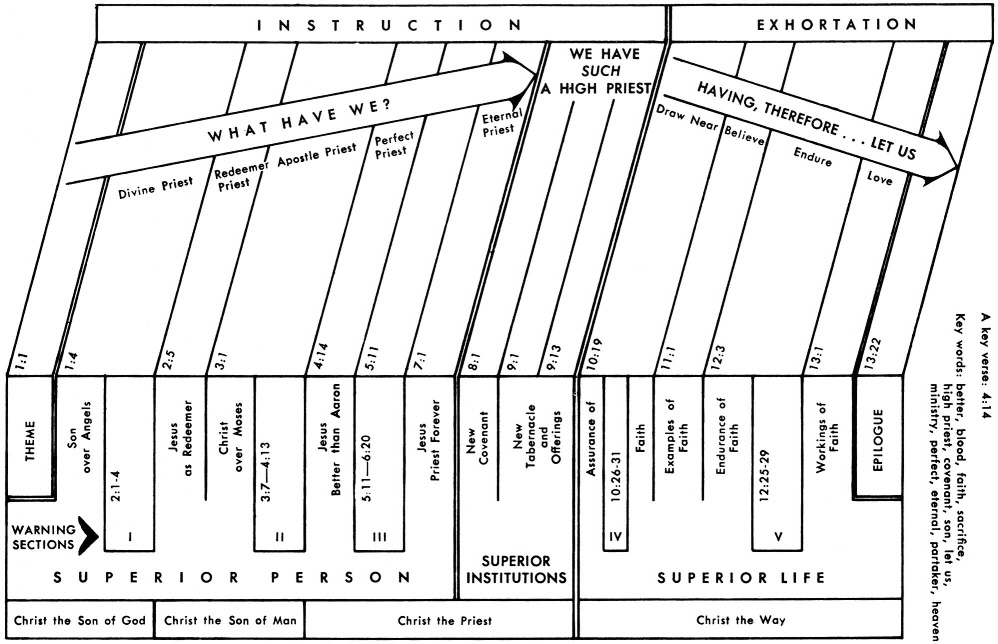
CONSIDER JESUS OUR GREAT HIGH PRIEST
Click chart to enlarge
Charts from Jensen's Survey of the NT - used by permission
Swindoll's Chart, Interesting Pictorial Chart of Hebrews, Another Chart
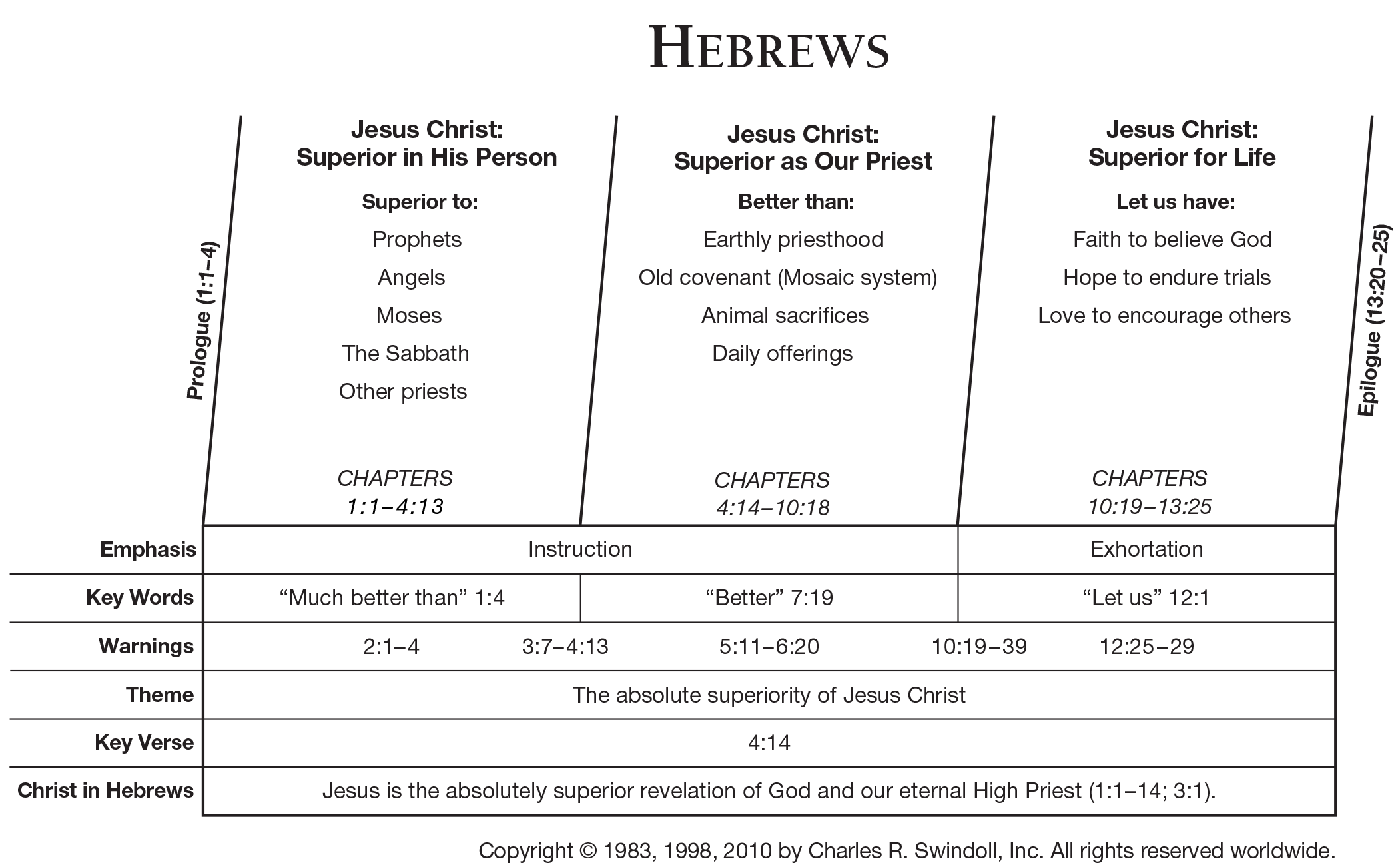

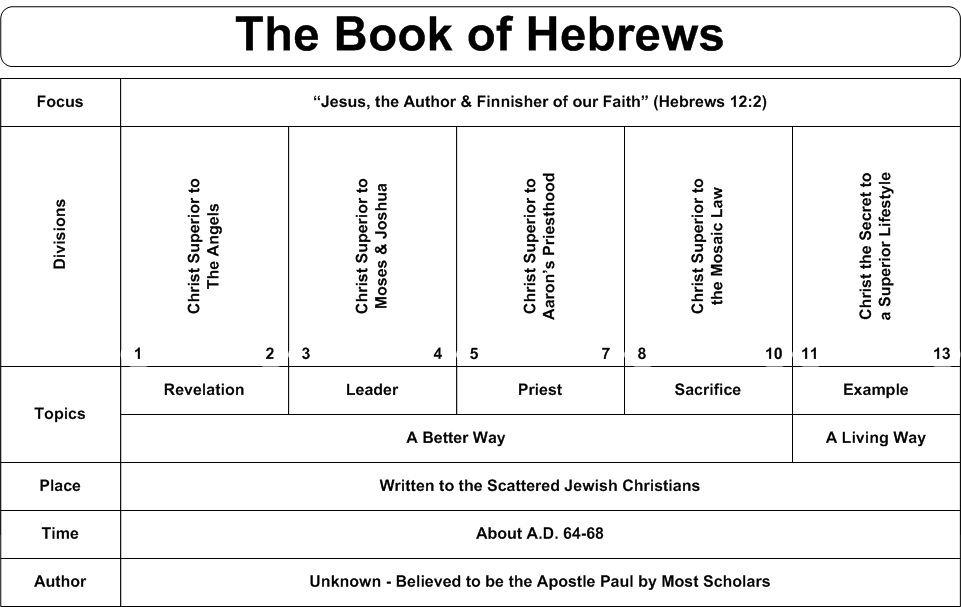
|
The Epistle |
||||
| INSTRUCTION Hebrews 1-10:18 |
EXHORTATION Hebrews 10:19-13:25 |
|||
| Superior Person of Christ Hebrews 1:1-4:13 |
Superior Priest in Christ Hebrews 4:14-10:18 |
Superior Life In Christ Hebrews 10:19-13:25 |
||
| BETTER THAN PERSON Hebrews 1:1-4:13 |
BETTER PRIESTHOOD Heb 4:14-7:28 |
BETTER COVENANT Heb 8:1-13 |
BETTER SACRIFICE Heb 9:1-10:18 |
BETTER LIFE |
| MAJESTY OF CHRIST |
MINISTRY OF CHRIST |
MINISTERS FOR CHRIST |
||
|
DOCTRINE |
DUTY |
|||
|
DATE WRITTEN: |
||||

See ESV Study Bible "Introduction to Hebrews"
(See also MacArthur's Introduction to Hebrews)
Borrow Ryrie Study Bible
Hebrews 8:12 "FOR I WILL BE MERCIFUL TO THEIR INIQUITIES, AND I WILL REMEMBER THEIR SINS NO * MORE." (NASB: Lockman)
Greek: hoti hileos esomai (1SFMI) tais adikiais auton, kai ton amartion auton ou me mnestho (1SAPS) eti.
BGT ὅτι ἵλεως ἔσομαι ταῖς ἀδικίαις αὐτῶν καὶ τῶν ἁμαρτιῶν αὐτῶν οὐ μὴ μνησθῶ ἔτι.
Amplified: For I will be merciful and gracious toward their sins and I will remember their deeds of unrighteousness no more. (Amplified Bible - Lockman)
HCSB: For I will be merciful to their wrongdoing, and I will never again remember their sins.
NLT: And I will forgive their wrongdoings, and I will never again remember their sins." (NLT - Tyndale House)
Wuest: because I will be merciful in the case of their unrighteousnesses, and their sins I will in no wise remember anymore.
Young's Literal: because I will be merciful to their unrighteousness, and their sins and their lawlessnesses I will remember no more;' --
KJV For I will be merciful to their unrighteousness, and their sins and their iniquities will I remember no more.
NKJ "For I will be merciful to their unrighteousness, and their sins and their lawless deeds I will remember no more."
NET "For I will be merciful toward their evil deeds, and their sins I will remember no longer."
CSB For I will be merciful to their wrongdoing, and I will never again remember their sins.
ESV For I will be merciful toward their iniquities, and I will remember their sins no more."
NIV For I will forgive their wickedness and will remember their sins no more."
Paraphrase “For I will be merciful to their wrongdoing, and I will never again remember their sins.”
Paraphrase “I will forgive their acts of unrighteousness, and I will erase their sins from My memory.”
Paraphrase “I will show grace toward their failures, and their sins I will remember no more.”
Paraphrase “I will pardon their lawless deeds, and their sins will never again be brought to mind.”
- Heb 10:16,17; Ps 25:7; 65:3; Isa 43:25; 44:22; Jer 33:8; 50:20; Micah 7:19; Acts 13:38,39; Ro 11:27; Eph 1:7; Col 1:14; 1John 1:7-9; 2:1,2; Rev 1:5
- Hebrews 8:1-13 Hebrews and the New Covenant - S Lewis Johnson's excellent review of Hebrews 8:1-13
- Hebrews 8 Resources - Multiple Sermons and Commentaries
Related Passages:
Isaiah 43:25 “I, even I, am the one who wipes out your transgressions for My own sake, And I will not remember your sins.
Isaiah 44:22 “I have wiped out your transgressions like a thick cloud And your sins like a heavy mist. Return to Me, for I have redeemed you.”
Micah 7:19 ) He will again have compassion on us; He will tread our iniquities under foot. Yes, You will cast all their sins Into the depths of the sea.
HEART OF THE NEW COVENANT
GRACE GREATER THAN OUR SIN!
This verse brings the prophecy of the new covenant to its glorious climax: full and final forgiveness. The heart of the new covenant is not merely law written on hearts or universal knowledge of God, but God’s promise to deal once and for all with the problem of sin. Unlike the old covenant, which could only cover sins temporarily through repeated sacrifices, the new covenant guarantees God’s mercy and the complete removal of sins—never to be remembered again. This divine pardon secures the relationship promised in the new covenant, for only forgiven people can truly belong to a holy God.
For (hoti) is a term of explanation- What is the writer explaining? The writer is explaining how a holy God can have communion with a sinful people. It is because He is great in mercy! Vine adds "the “For” shows that what is now being promised gives the reason for the preceding assurances."
I WILL BE MERCIFUL (hileos) TO THEIR INIQUITIES (adikia), AND I WILL REMEMBER THEIR SINS NO * MORE - Note that divine mercy is first in the Greek for emphasis, for that is Who God is and what He shows to those who otherwise deserve His wrath! (Play Rich Mullin's Let Mercy Lead and let it cause you to cry out in grateful praise for His Mercy Seat that saves us all! Ex 25:17-21,22+ "there I will meet with you and from above the mercy seat, from between the two cherubim which are upon the ark of the testimony, I will speak to you") I will is found seven times in 3 verses (Heb 8:8, 10, 12). Clearly I will is a key phrase. Every time God says "I will" it's like another degree of assurance regarding the trustworthy nature of the new covenant.These promises by God in essence are teaching that the New Covenant brings complete forgiveness of our sins, something the Old Covenant could never do as the writer explained in Hebrews 10…
For the Law, since it has only a shadow of the good things to come and not the very form of things, can never by the same sacrifices year by year, which they offer continually, make perfect those who draw near. 2 Otherwise, would they not have ceased to be offered, because the worshipers, having once been cleansed, would no longer have had consciousness of sins? 3 But in those sacrifices there is a reminder of sins year by year (CONTRAST THE LAW "REMEMBERING" BUT GOD NOT REMEMBERING!!!). 4 For it is impossible for the blood of bulls and goats (the only provision available in the Old Covenant) to take away sins (procure the forgiveness of sins). (Heb 10:1-4+)
Comment: The new and better covenant would not have been needed if the first covenant had been faultless!
Jamieson - I will be merciful—Greek, “propitious”; the Hebrew, “salach,” is always used of God only in relation to men."
William MacDonald reminds us that "the law (Old Covenant) could not deal effectively with sins. It provided for the atonement of sins but not for their removal. (The Hebrew word for atonement comes from the verb meaning cover.) The sacrifices prescribed in the law made a man ceremonially clean, that is, they qualified him to engage in the religious life of the nation. But this ritual cleansing was external; it did not touch a man’s inward life. It did not provide moral cleansing or give him a clear conscience. (See Believer's Bible Commentary - Page 2183)
John MacArthur - Here is the capstone of the New Covenant. Here is what men need more than anything else—and what the Old Covenant pictured but could not give. The promise of the Old Testament is finally fulfilled! Under the Old Covenant, sins could never really be forgotten, because they were never really forgiven. They were only covered, foreshadowing and anticipating true forgiveness in Jesus Christ. But for those who belong to His dear Son—whether they believed under the Old Covenant or under the New—God forgets every sin. (See Hebrews Commentary - Page 216)
Andrew Murray offers an interesting comment "OF the blessings of the new covenant, the one which is here ‘mentioned last is in reality the first. For I will be merciful—this is what precedes, and is the ground of the renewal of the heart and the fellowship with God. Pardon is the door; holiness of heart and life the pathway; the presence of God the blessedness of the Christian life. The first leads to the second, the first and second to the third. To live in God’s presence and fellowship two things must be clear: the thought of sin must be put away out of God’s heart, and the love of sin out of our heart. These two blessings are together secured in the new covenant. First, the forgiveness of sins so complete, that He remembers them no more for ever; they never more enter into God’s heart. And, second, the renewal of our heart and will so complete, that the law of God is written there by the Holy Spirit, so that the will of God is our will.The three blessings—the pardon of sin, purity of heart, and the presence of God—are so joined, that as our views and our acceptance of one is feeble, our hold on the others will suffer. In Jesus the Mediator of the new covenant they are offered and secured to us in their fulness, in the power of an endless life. But our experience of this depends upon our knowledge, our faith, our surrender. And it is because our understanding and acceptance and experience of the two first blessings is so defective that our fellowship with God, our entrance into the holy presence, and our abiding there, is still so much in Old Testament failure—But they continued not. Let us try and realise this. (Hebrews 8 Commentary -- Holiest of All)
C H Spurgeon - Suppose that you are under a sense of sin. Something has revived in you a recollection of past guilt, or it may be that you have sadly stumbled this very day, and Satan whispers, “You will surely be destroyed, for you have sinned.” Now go to the great Father, and open this page, putting your finger on that twelfth verse, and say, “Lord, you have in infinite, boundless, inconceivable mercy entered into covenant with me, a poor sinner, seeing I believe in the name of Jesus. And now, I ask you, have respect unto your covenant. You have said, I will be merciful toward their wrongdoings—O God be merciful to mine. I will not remember their sins any longer—Lord, remember no more my sins: forget forever my iniquity.” That is the way to use the covenant: when under a sense of sin, run to that clause which meets your case.
C H Spurgeon - The covenant is the sure foundation of mercy, and when the whole fabric of outward grace manifested in the saints lies in ruins this is the fundamental basis of love which is never moved, and upon it the Lord proceeds to build again a new structure of grace. Covenant mercy is sure as the throne of God.
Albert Barnes - I will remember no more. This is evidently spoken after the manner of men, and in accordance with human apprehension. It cannot mean literally that God forgets that men are sinners, but it means that he treats them as if this were forgotten. Their sins are not charged upon them, and they are no more punished than if they had passed entirely out of the recollection. God treats them with just as much kindness, and regards them with as sincere affection, as if their sins ceased wholly to be remembered, or which is the same thing, as if they had never sinned. (Hebrews 8 Commentary)
Note that "remember… no more" does not mean the omniscient God does not have a memory of our past sins. Omniscient means that God knows all things actual and possible and knows them in one simple and eternal act. God's attribute of eternal means that He has no beginning, end or succession of moments in His being and that He sees all time equally vividly, and yet also sees events in time and acts in time (Modified from Grudem's Systematic Theology). If you are believer, then you can be confident and at peace over the fact that God has forgiven (sent away, remitted the debt) all your sin, past, present and future (placing them on our Sin Bearer, the Lamb, Christ Jesus - Isa 53:6, 1Pe 2:24, 2Cor 5:21, Jn 1:29)
Warren Wiersbe adds that…
There is no forgiveness under the Law because the Law was not given for that purpose. “Therefore by the deeds of the Law there shall no flesh be justified in His sight; for by the Law is knowledge of sin” (Rom. 3:20). The Law could not promise forgiveness to Israel, let alone to all mankind. It is only through the sacrifice of Jesus Christ that forgiveness is possible to all who will call on Him. The Old Testament sacrifices brought a remembrance of sins, not a remission of sins (Heb. 10:1–3, 18)…
What does it mean that God remembers our sins and iniquities no more? (Heb. 8:12) This important statement is quoted again in Hebrews 10:16–17. Does it mean that our all-knowing God can actually forget what we have done? If God forgot anything, He would cease to be God! The phrase “remember no more” means “hold against us no more.” God recalls what we have done, but He does not hold it against us. He deals with us on the basis of grace and mercy, not law and merit. Once sin has been forgiven, it is never brought before us again. The matter is settled eternally.
As a pastor in counseling ministry I have often heard people say, “Well, I can forgive—but I cannot forget!” “Of course you can’t forget,” I usually reply. “The more you try to put this thing out of your mind, the more you will remember it. But that isn’t what it means to forget.” Then I go on to explain that “to forget” means “not to hold it against the person who has wronged us.” We may remember what others have done, but we treat them as though they never did it. How is this possible? It is possible because of the cross, for there God treated His Son as though He had done it! Our experience of forgiveness from God makes it possible for us to forgive others. (Bible Exposition Commentary )
Some individuals say that they cannot forgive themselves. The question is this - is this genre of forgiveness mentioned in Scripture? You can search the Bible from Genesis to Revelation and you will never find a Scripture that says we are to forgive ourselves. This is simply not a Biblical teaching. Yes, the Bible speaks of VERTICAL (DIVINE) FORGIVENESS and HORIZONTAL (HUMAN) FORGIVENESS but there is not one word about a person forgiving themselves. It is simply not taught in Scripture!Spurgeon - There is no “if” in the covenant of grace. It runs thus: “I will,” and “You shall.” That is the tenor of it. Its essence lies in the supreme word, “I will.” Therefore, because the conditions of the covenant of grace have been fulfilled it is in no danger of abrogation, and Christ Jesus has become the surety of a better covenant.
DIVINE AND
HUMAN FORGIVENESS
DIVINE FORGIVENESS is predicated or made possible by the execution of the penalty of death and the shedding of blood (Heb 9:22, Lev 17:11, cp Ro 6:23). In the OT the penalty was death of a sacrificial animal. All of the OT ceremonies and sacrifices pointed to Christ but could not actually take away the sin (Heb 10:4). The sins which believers committed in the OT were "passed over" (Ro 3:25, cp Heb 9:15) but ultimately were paid for in full by Christ's death on the Cross ("It is finished" = "Paid in full!" = Jn 19:30). Jesus' death and shed blood inaugurated the "New Covenant in His blood" which made divine forgiveness possible (Mt 26:28).
Human forgiveness means the remission of a penalty deserved. As believers we are called to confess our sins and receive God's forgiveness of our sins (1Jn 1:9). When someone sins against us (Let's say they gossip or speak falsely about us and we find out about it), we are called to forgive them (Col 3:13, Eph 4:32). But even then we recognize that their sin is primarily against God (Ps 51:4-note, cp Ge 39:9, 2Sa 12:13-note) and only He can forgive their sin against Himself. We are never expected to forgive the sins of others toward God because we have no power to do so (Read Mark 2:5-12, cp Lk 5:22-26, Mt 9:1-8), but we are expected to forgive others for the sins done to us. Jesus instructed us to pray for this forgiveness asking God to "Forgive us our debts, as we forgive our debtors" (Mt 6:12-note, Mt 6:14-15-note). When we forgive someone who has wronged us (by surrendering to the enabling power of the Spirit), we are giving up our right to any feeling of animosity we may have had against them and we re-establish a heart attitude of friendliness and affection (as far as that is possible on our part). We do not hold the wrong done to us against the person anymore. Why are we charged to forgive? We forgive others because we have been forgiven far greater offenses by God. Read- Eph 4:32 (note the phrase "just as God in Christ has forgiven you"- See note) and Col 3:13 (note the phrase "just as the Lord forgave you, so also should you."- See note)
So yes we are to forgive others but we are not ever told to forgive ourselves. When someone says “I just can’t forgive myself”, the problem is often that they do not have a true understanding of the completeness of God's forgiveness of their sin. What they are saying in essence is they cannot forgive themselves because they really doubt that God has truly forgiven them! If you struggle with guilt over a past sin and wonder if God still holds you guilty or condemns you, then ask the Holy Spirit to enlighten your heart and enable you to meditate on Ro 8:1-2-note. Then take some time to meditate on the pictures of the completeness of divine forgiveness in the following passages…
Ps 103:12+ As far as the east is from the west, So far has He removed our transgressions from us.
Comment: Ask yourself "How far is east from west?" Had the verse stated "as far as north is from the south" we would have been able to "measure" God's forgiveness by some "finite measurement." However, there is no east or west pole, so God is clearly teaching us that His forgiveness has no limits. It is "perfect" and complete forgiveness, whether we believe it or whether we feel like it. In both cases, it is absolutely, eternally true!
Isa 43:25-((Spurgeon's sermon - A Sense of Pardoned Guilt)) “I, even I, am the one who wipes out your transgressions for My own sake; And I will not remember your sins.
Isa 38:17-(Spurgeon's sermon - God's Non-Remembrance of Sin) “Lo, for my own welfare I had great bitterness; It is Thou who hast kept my soul from the pit of nothingness, For Thou hast cast all my sins behind Thy back.
Mic 7:18-19 (Spurgeon's sermon - Sin Subdued) Who is a God like Thee, who pardons iniquity And passes over the rebellious act of the remnant of His possession? He does not retain His anger forever, Because He delights in unchanging love. 19 He will again have compassion on us; He will tread our iniquities under foot. Yes, Thou wilt cast all their sins Into the depths of the sea. (And for believers has planted a "NO FISHING" sign!)
Nouthetic counselor Jay Adams says that the…
concepts (self esteem and self forgiveness), as Packer has seen, stand or fall together; they are of a piece. The problem supposedly is that men look down on themselves. But Jesus told us to love our neighbors as ourselves, implying that we already do pretty well in that regard and need instead to start working on loving our neighbor with some of the same devotion and concern that we already show ourselves (Lev 19:18, Mt 19:19, 22:39, Mk 12:31, Lk 10:27, Ro 13:9, Gal 5:14, James 2:8). There is never, in all of the Word of God, a statement to the effect that men have a low self-image, that they must learn to love themselves, or that they must learn to forgive themselves. On the contrary, it is assumed that we do this without the slightest difficulty. So the Bible aims all its commands at turning our concern from self to God and others.
It is not simply a matter of the Bible not using the jargon of the self-image teachers, as Packer thinks, but rather, a matter of the entire Bible knowing nothing of self-love, self-forgiveness concepts, and a doctrine of man that depicts him thinking so lowly of himself. It is not enough to assert that the Scriptures teach that man has a low self-image problem and, therefore, command him to think more highly of himself and learn to forgive himself. If we are told that not to do so is sin, biblical warrant for that fact must be clearly demonstrated. Otherwise, we have theologians, psychologists, and other writers placing new burdens on men’s backs that they need not bear.
“But what is the problem then? Surely there are people who will tell you that they are having a hard time forgiving themselves. Haven’t you ever had counselees who have said as much?”
Certainly, but their speech was filled with the lingo of the psychologists and others who propagate such things. I tell them, “You will never solve your problem by misunderstanding it as a problem of self-forgiveness.”
“What do you tell them to do, then?”
Well, something like this. Suppose someone, through carelessness, runs over a child in his automobile and comes in saying, “Ill never be able to forgive myself for what I did.” Or suppose a woman confesses the abortions she has had were murder and says much the same. I make it clear to them that the problem is not self-forgiveness. Their expressed agony stems from the very fact that, in the worst way, they want to forgive themselves. They want to put it behind them, they want to bury it once and for all. They want the burden of guilt lifted from their shoulders. If they had such low self-esteem as some think, they would instead be saying such things as, “Well, you’d expect someone like the to do that, wouldn’t you?” Or, “I guess this is just true to form for a lout like me.” But they don’t. They say, “I don’t know if I’ll ever be able to forgive myself for what I’ve done,” indicating they are certainly anxious to do so. Lack of ability to forgive self is not the problem.
The problem is that people who talk this way recognize something more needs to be done. Forgiveness is just the beginning; it clears away the guilt. They also recognize that they are still the same persons who did the wrong—that though they are forgiven, they have not changed. Without being able to articulate it, and using instead the jargon they have heard all around them, they are crying out for the change that will assure them they will never do anything like it again. When, as a counselor, I help them to deal with the problems in their lives that led to the wrong, in such a way that they have adopted a more biblical lifestyle, I then ask, “Are you still having trouble forgiving yourself?” Invariably, they say no. (BORROW From Forgiven to Forgiving Learning to Forgive One Another God's Way - PAGE 62)
D L Moody spoke of self forgiveness
I want to ask you this question: If sin needs forgiveness--and all sin is against God--how can you work out your own forgiveness? If I stole $100 from a friend, I could not forgive myself, could I? No act of mine would bring about forgiveness, unless my friend forgave me. And so, if I want forgiveness of sin, it must be the work of God.
WHAT A GREAT GREEK
DOUBLE NEGATIVE!
No more (ou me) is a double negative, which could be paraphrased "Absolutely no, never will I remember". Part of our difficulty with accepting the completeness of God's forgiveness and His promise to remember our sins no more" is because we don't really understand the meaning of remember. English dictionaries emphasize that remember means to bring to mind, to give attention to. When you remember something, you are retrieving that information from your stored knowledge (memory). To not remember is to not retrieve the stored data from your memory. Not remembering does not mean that the data has been lost or deleted. Nor does it mean that it is irretrievable… it is retrievable but not retrieved. That is the common use of remember. … and is so used in many Biblical references. When we believed in Jesus, our sins were 100% forgiven…and God 100% remembers them no more. He no longer gives attention to our sins…no longer considers them…no longer brings them to mind. After we became His children (1Jn 3:1), He disregarded our sins because they had already been paid for by Jesus on the cross (Jn 19:30). The knowledge of our forgiven sins has not been deleted from His memory. There is just no reason for Him to retrieve that information. It is wonderful that our sins have been removed from us as far as the east is from the west … and wonderful that God intentionally considers them no more. He knows absolutely everything about us. He has archived the data about our sins … but does not retrieve it. God is omniscient. The data about our sins is in His memory … but when He considers us, it is as if it had been deleted, because He sees us now and forever clothed with the righteousness of His Sinless Son (Isaiah 61:10)! This calls for a loud "Hallelujah!"
Warren Wiersbe - The blood of bulls and of goats could cover sins, but only the blood of the Lamb of God could “take away the sins of the world” (John 1:29). What a wonderful promise the New Covenant gives to the burdened sinner: his sins will be forgiven and forgotten forever!(Borrow Wiersbe's Expository Outlines on the New Testament)
WHAT ARE THE
BETTER PROMISES?
To summarize, the better promises (Heb 8:6) of this better covenant (Heb 8:6; 7:22)—the New Covenant—are centered on the forgiveness of sins and the divine enablement whereby God writes His laws within us. When we, by grace through faith, enter the New Covenant, God’s Spirit provides a new inner control center.
R Kent Hughes commenting on "superior forgiveness" of the New Covenant observes that "This is precisely what the Old Covenant could not do. Under the Old Covenant, sins were never completely forgiven because they were never truly forgotten. They were covered, awaiting and pointing to the true forgiveness through Christ’s death. (See Hebrews: An Anchor for the Soul)
Merciful (2436) (hileos - related in stem and meaning to hilaros = glad, merry, cheerful) means propitious (Webster 1828 = "Be Disposed to gracious or merciful; ready to forgive sins and bestow blessings; favorable"), benevolent, forgiving or favorably disposed to another. It pertains to the demonstration of mercy or compassion. "Appeased, merciful, as of gods; cheerful, propitious, favorable, merciful, as of men." (Zodhiates)
Vine - Hileōs means propitious; not that God is ever to be conciliated, but that in grace and on a basis of righteousness, consistent with His attitude toward sin and with His essential holiness, and through the expiatory sacrifice of His Son, He delivers the sinner from his deserved doom and, in free, sovereign grace, justifies him.
Hileos is the root of hilaskomai in Luke 18:13+
“But the tax-gatherer, standing some distance away, was even unwilling to lift up his eyes to heaven, but was beating his breast, saying, ‘God, be merciful (be favorable) to me, the sinner!’
MacArthur: He had no hope but the mercy of God. This is the point to which the law aims to bring every sinner (cf. Ro 3:19, 20; 7:13; Gal 3:22–24).
The only other NT use of hileos is…
Mt 16:22 And Peter took Him aside and began to rebuke Him, saying, “God forbid it (Young's Literal = "Be kind to"), Lord! This shall never happen to You.”
Comment: Its expanded sense in this statement would be, "God save you from those things"
NET Note: "Merciful to you." A highly elliptical expression: "May God be merciful to you in sparing you from having to undergo [some experience]". A contemporary English equivalent is "God forbid!"
BDAG: The idea is "may God be gracious to you, Lord, i.e. may God in mercy spare you this, God forbid!"
BDAG says hileos pertains to "being favorably disposed, with implication of overcoming obstacles that are unfavorable to a relationship, gracious, merciful, in the wider lit. mostly—in our lit. and in LXX always—of God.
TDNT - A predicate of persons, hileos means “happy,” “friendly,” “gracious.” It is used especially of rulers and deities. In the LXX it is a predicate of God alone, e.g., in phrases for “to forgive,” “to have pity.”
W E Vine - Hileōs means propitious; not that God is ever to be conciliated, but that in grace and on a basis of righteousness, consistent with His attitude toward sin and with His essential holiness, and through the expiatory sacrifice of His Son, He delivers the sinner from his deserved doom and, in free, sovereign grace, justifies him.
NIDNTT in classic Greek hileos "is chiefly used of rulers or gods; in connection with gods the phrase hileo poiein, to make gracious, is found (Plato, Laws 10, 910a).
Hileos - 25x in the Septuagint (often with the sense " ("far be it from you, Lord" as in 1Kings 21:3; 1Chr 11:19) -
Ge 43:23 (LXE = And he said to them, God deal mercifully with you); Ex 32:12 (LXE = be merciful to the sin of thy people); Num 14:19-20; Deut 21:8 (LXE = Be merciful to thy people Israel); 2Sa 20:20; 23:17 (LXE Lord, forbid that I should do this); 1Kgs 8:30 (LXE = "and be gracious"), 1Ki 8:34, 36, 39, 50 (LXE be merciful to their unrighteousness); 1Chr 11:19; 2Chr 6:21, 25, 27, 39; 7:14; Isa 54:10; Jer 5:1, 7; 31:34; 36:3; 50:20; Amos 7:2
Jeremiah 31:34 "They will not teach again, each man his neighbor and each man his brother, saying, 'Know the LORD,' for they will all know Me, from the least of them to the greatest of them," declares the LORD, "for I will forgive (Hebrew = salach = forgive, pardon; Lxx = Hileos = be propitious toward) their iniquity, and their sin I will remember no more."
Iniquities (93) (adikia from a = without + dike = right, expected behavior according to an external standard, in this case God's) is literally "unrightness" or the condition of not being right according to the standard of God's holy demands. Unrighteousness, injustice, wickedness, wrongdoing, a violation of divine law. Thayer: 1. injustice; 2. unrighteousness of heart and life; 3. a deed violating law and justice, act of unrighteousness. Hamartia is the broader term for sin in general. Dikaiosunē, righteousness, justice is the opposite of adikia.
Adikia covers both the Condition / State – a quality of being unjust or unrighteous (internal disposition) and the Action / Deed – acts of wrongdoing or injustice (external expression). Thus adikia can describe: A moral bent (Romans 1:18, suppressing truth “in unrighteousness”). Specific evil deeds (Luke 16:8, “dishonest steward” = steward of adikia). Systemic injustice or corruption (Acts 1:18, Judas’ “wages of unrighteousness”). 2 Thessalonians 2:10 – deception of wickedness (adikia) for those who perish. 1 John 1:9 – God forgives sins and cleanses from all adikia. Adikia is frequent in the Greek OT: Psalm 5:5 (LXX 5:6) – “You hate all workers of adikia.” Proverbs 10:29 – “Destruction to those who work adikia.”
Nature of man apart from God – humanity characterized by adikia (Rom 1:29). God’s judgment – His wrath revealed against adikia (Rom 1:18). Christ’s work – He bears our sins so that God may cleanse us from adikia (1 John 1:9). Kingdom ethics – Believers must not walk in adikia (2 Cor 6:14, “what fellowship has righteousness with adikia?”).
ADIKIA - 24V - doing wrong(1), evildoers(1), iniquities(1), iniquity(2), injustice(1), unrighteous(2), unrighteousness(12), wickedness(4), wrong(1). Lk. 13:27; Lk. 16:8; Lk. 16:9; Lk. 18:6; Jn. 7:18; Acts 1:18; Acts 8:23; Rom. 1:18; Rom. 1:29; Rom. 2:8; Rom. 3:5; Rom. 6:13; Rom. 9:14; 1 Co. 13:6; 2 Co. 12:13; 2 Thess. 2:10; 2 Thess. 2:12; 2 Tim. 2:19; Heb. 8:12; Jas. 3:6; 2 Pet. 2:13; 2 Pet. 2:15; 1 Jn. 1:9; 1 Jn. 5:17
Remember (3415) (mnaomai from mimnesko = to recall to mind, to remind) means to be mindful of. God will not recall their sins to mind!
MNAOMAI - 23V - recall(1), remember(13), remembered(8), remembrance(1). - Matt. 5:23; Matt. 26:75; Matt. 27:63; Lk. 1:54; Lk. 1:72; Lk. 16:25; Lk. 23:42; Lk. 24:6; Lk. 24:8; Jn. 2:17; Jn. 2:22; Jn. 12:16; Acts 10:31; Acts 11:16; 1 Co. 11:2; 2 Tim. 1:4; Heb. 2:6; Heb. 8:12; Heb. 10:17; Heb. 13:3; 2 Pet. 3:2; Jude 1:17; Rev. 16:19
Hebrews 2:6 WHAT IS MAN, THAT YOU REMEMBER HIM?
Hebrews 8:12 I WILL REMEMBER THEIR SINS NO MORE.”
Hebrews 10:17 THEIR SINS AND THEIR LAWLESS DEEDS I WILL REMEMBER NO MORE.
Hebrews 13:3 Remember the prisoners, as though in prison with them,
Sins (266) (hamartia) originally conveyed the idea of missing the mark as when hunting with a bow and arrow and then came to mean missing or falling short of any goal, standard, or purpose. In Scripture sin often describes our thoughts, words and deeds that miss the ultimate purpose God has for each individual, these thoughts, words and deeds falling short of God’s perfect standard of holiness.
HAMARTIA IS A KEYWORD IN HEBREWS 25x - Heb. 1:3; Heb. 2:17; Heb. 3:13; Heb. 4:15; Heb. 5:1; Heb. 5:3; Heb. 7:27; Heb. 8:12; Heb. 9:26; Heb. 9:28; Heb. 10:2; Heb. 10:3; Heb. 10:4; Heb. 10:6; Heb. 10:8; Heb. 10:11; Heb. 10:12; Heb. 10:17; Heb. 10:18; Heb. 10:26; Heb. 11:25; Heb. 12:1; Heb. 12:4; Heb. 13:11
Hebrews 1:3 When He had made purification of sins,
Hebrews 2:17 to make propitiation for the sins of the people.
Hebrews 3:13 so that none of you will be hardened by the deceitfulness of sin.
Hebrews 4:15 tempted in all things as we are, yet without sin.
Hebrews 5:1 offer both gifts and sacrifices for sins;
Hebrews 5:3 he is obligated to offer sacrifices for sins
Hebrews 7:27 to offer up sacrifices, first for His own sins and then for the sins of the people
Hebrews 8:12 I WILL REMEMBER THEIR SINS NO MORE
Hebrews 9:26 He has been manifested to put away sin by the sacrifice of Himself
Hebrews 9:28 so Christ also, having been offered once to bear the sins of many,
Hebrews 9:28 will appear a second time for salvation without reference to sin
Hebrews 10:2 would no longer have had consciousness of sins?
Hebrews 10:3 in those sacrifices there is a reminder of sins year by year.
Hebrews 10:4 For it is impossible for the blood of bulls and goats to take away sins.
Hebrews 10:6 AND sacrifices FOR SIN YOU HAVE TAKEN NO PLEASURE.
Hebrews 10:8 AND sacrifices FOR SIN YOU HAVE NOT DESIRED
Hebrews 10:11 same sacrifices, which can never take away sins;
Hebrews 10:12 He, having offered one sacrifice for sins for all time
Hebrews 10:17 AND THEIR SINS AND THEIR LAWLESS DEEDS I WILL REMEMBER NO MORE.”
Hebrews 10:18 there is no longer any offering for sin.
Hebrews 10:26 there no longer remains a sacrifice for sins,
Hebrews 11:25 than to enjoy the passing pleasures of sin,
Hebrews 12:1 and the sin which so easily entangles us
Hebrews 12:4 shedding blood in your striving against sin;
Hebrews 13:11 brought into the holy place by the high priest as an offering for sin
James Smith - THE ETERNAL COMPLETENESS AND EFFICACY OF CHRIST’S DEATH HEBREWS 8:12
This is brought out and emphasised many times in this Epistle (7:27; 9:25, 26; 10:1–3), but particularly in association with Heb. 8:12. The late James Neill, M.A., has so well pointed out that the New Covenant referred to in chapter 8:6–13, begins at a point to which the Old Covenant never for a moment reached. For there was no sacrifice to atone for wilful sin under the Old Covenant, with four exceptions only:
1. Wilful concealment of knowledge as a witness (Lev. 5:1).
2. A wilful lie (Lev. 6:2).
3. Perjury (Lev. 6:2).
4. A sin of uncleanness (Lev. 19:20, 22).
As to all else, it is said: “The soul that acts presumptuously … that soul shall be cut off” (Num. 15:30). That shows the force of David’s petition, “Thou desirest not sacrifice, else would I give it” (Psa. 51:16). He is referring to his wilful sin, for which no provision had been made. But of this New Covenant, well, it begins at a point where the Old Covenant never reached—the full, free, forgiveness of all sin. Praise the Lord! Hence the force of “The Blood of Jesus Christ, His Son, cleanseth us from all sin” (1 John 1:7)
TODAY IN THE WORD I will forgive their wickedness and will remember their sins no more. - Hebrews 8:12
Polycarp, the bishop of Smyrna in what is now modern Turkey, was a worthy defender of the Christian faith. Born in 65 AD, he counted the apostle John among his teachers. It was John, in fact, who named Polycarp to the office he held for more than fifty years. He died at the stake in 155 AD, after many years of defending Christian truth against paganism and mystical heresies such as gnosticism, the error that threatened to engulf the church in the decades immediately after the apostles.
Polycarp considered his life of little importance in comparison to the truth of God. We can't say whether or not the author of Hebrews became a martyr for Jesus Christ. But the fact that the book is anonymous tells us that the writer considered God's truth far more important than personal identity. Like Bishop Polycarp, whoever wrote Hebrews was a worthy defender of the faith.
Chapter 8 is another vital link in the writer's argument for ""the truth that is in Jesus"" (Eph. 4:21).
Some people tend to think of Hebrews as somewhat hard to understand. Clearly this was not the author's intention. He wanted the Hebrews, and the larger body of Christ, to understand exactly what he was saying.
And what could be clearer than the teaching of verses 1-6? Jesus Christ is a High Priest who serves at God's right hand in the true tabernacle in heaven, of which the tabernacle Moses built was just a copy and a shadow. Therefore, both Jesus' ministry and His covenant are superior to the old.
Even the promises of the new covenant are better. The writer proves this by quoting the great new covenant promise of Jeremiah 31:31-34. We recognize this as the salvation purchased for us by the blood of Christ, a salvation which included not only full forgiveness of sin (v. 12), but also the promised indwelling presence of the Holy Spirit.
What was deficient about the first covenant? As we saw earlier, the problem was not the commands of God but the people's inability to keep them. If God had not provided a way for us to be forgiven for our transgressions of His Law, none of us would be able to stand before Him.
TODAY ALONG THE WAY Israel's sacrificial system crumbled when Jerusalem was attacked by Roman invaders in 70 AD. Even before that event, Jesus Christ had already made the offering of animal sacrifices obsolete. But that does not mean we have no sacrifice to offer God. Instead of offering God a lamb to cover our sins, we are instructed to bring Him ""a sacrifice of praise--the fruit of lips that confess His name"" (Heb. 13:15). This week, let's bring the Lord this sacrifice by sharing about His faithfulness to someone who needs Christ.
Dealing With Your Past by Theodore Epp
Philippians 3:12-14; 1 Timothy 1:12-17
We can do nothing about the past except make necessary confession. And when confession is made, the Bible promises: "If we confess our sins, he is faithful and just to forgive us our sins, and to cleanse us from all unrighteousness" (1 John 1:9).
By confession, sin is placed under the cleansing blood of the Lord Jesus Christ, and when it is under the blood, it does not condemn any longer.
Unless the past is dealt with, one is not prepared to live in the present nor to go on into the future. Unless the past is dealt with, it becomes a haunting memory that saps the strength of the believer so he is unable to honor Christ in his daily life.
What God does with sin when it is confessed is explained in various passages. Isaiah 44:22 says, "I have wiped out your transgressions like a thick cloud, and your sins like a heavy mist. Return to Me, for I have redeemed you"
"FOR I WILL BE MERCIFUL TO THEIR INIQUITIES, AND
I WILL REMEMBER THEIR SINS NO MORE".
Hebrews 8:12
Someone has said, "The present must forget the past by correction, or else the past will become a moral and spiritual liability for the future."
Consider some items that need to be forgotten: failures--they keep our faith from advancing; successes--they create pride (see Prov. 16:18); losses--they drag us down so we cannot serve the Lord the way we should; grievances--they produce false attitudes (see 1 Cor. 13:6); sorrows--God can heal all heartaches; discouragements--we need to remember Christ, not disappointments, thwarted hopes and plans.
"And their sins and iniquities will I remember no more" (Heb. 10:17).
In Reader’s Digest, a contributor told of an Aunt Ruby and Uncle Arnie who had adopted a baby boy after five years of trying unsuccessfully to conceive. To their surprise, a short time after the adoption, Aunt Ruby discovered she was pregnant, and she later gave birth to a boy.
One day when the two boys were eight and nine years old, the teller of the story was visiting Aunt Ruby, and a woman in the neighborhood came to visit.
Observing the children at play, the woman asked, “Which boy is yours, Ruby?”
“Both of them,” Aunt Ruby replied.
The caller persisted. “But I mean, which one is adopted?”
Aunt Ruby did not hesitate. In her finest hour, she looked straight at her guest and replied, “I’ve forgotten.”
When we are adopted as God’s children, we quickly come
to cherish our heavenly Father’s forgetfulness
When we are adopted as God’s children, we quickly come to cherish our heavenly Father’s forgetfulness. For he chooses to forget our sins, to forget our wayward past, and to give us the full rights of sons or daughters. He treats us as if we had never sinned.
Peter Kennedy - God’s Mercy
Topics: GOD’S FORGIVENESS, GOD’S MERCY
Bible Verses: Jeremiah 31:34; Hebrews 8:12
Doctor Everett L. Worthington, Jr. is a professor of psychology at Virginia Commonwealth University and has won recognition on the subject of forgiveness. Dr. Worthington dedicated seven years of his life studying the physiological effects of forgiveness and its benefits. One day after mailing off his manuscript outlining a step-by-step process of forgiveness, his own ability was sorely tested when his mother was murdered.
Doctor Worthington recalls: “On New Year’s Eve, 1995, my mother was murdered. At first, I did not want to forgive the murderer. I wanted to beat his head in. Mercifully, though, I believe God gave me the grace to forgive the murder even though the murderer was never brought to justice. It was not easy to forgive such a brutal murder. A youth bludgeoned my mother to death with a crowbar during a botched burglary. If he had been caught and convicted, that would have made forgiving easier. Justice would have soaked up some of the bitter tears.
As I look back on that event, from the perspective of years past, I have seen what I never saw during my first couple of years. I have marveled at God’s mercy to me.”
God’s forgiveness and his mercy towards us are greater than any hurt in our lives.
Andrew Murray - THE NEW COVENANT IN HEBREWS
“And I will forgive their wrongdoings, and I will never again remember their sins.”HEBREWS 8:12
In this Epistle of Hebrews, Christ is called the Mediator of a better covenant, based upon better promises (8:6). In Him, the two parts of the covenant find their complete fulfillment. First of all, He came to atone for sin so that its power over man was destroyed. And with that came the fuller blessing—a new heart, with God’s Holy Spirit breathing into it delight in God’s law and the power to obey it.
These two parts of the covenant may never be separated. There are so many who put their trust in Christ for the forgiveness of sin and yet never think of claiming the fullness of His promised blessings.
Jesus Christ is the Mediator of the new covenant with the forgiveness of sin in the power of His Spirit. Just as surely as complete pardon of sin is assured, the complete fulfillment of God’s promises should be expected, too.
To appropriate the new covenant requires a strong desire for a life wholly given to Christ. As we pray, let us be willing to accept our place with Him—crucified to the world, to sin, and to self. It means a readiness to follow Him at any cost. It means a simple, wholehearted acceptance of Christ as Lord and Master and a surrender of our heart and life to Him. (See also Andrew Murray's The Two Covenants)
Warren Wiersbe - Short-Term Memory Pause for Power: A 365-Day Journey through the Scriptures - Page 245
Read Hebrews 8:7–12 I will forgive their wickedness and will remember their sins no more. Hebrews 8:12
What does it mean that God remembers our sins no more? Does it mean that our all-knowing God can actually forget what we have done? The phrase “remember [our] sins no more” means “hold our sins against us no more.” God recalls what we have done, but He does not hold it against us (2 Cor. 5:18–19). He deals with us on the basis of grace and mercy, not law and merit. Once sin has been forgiven, it is never brought before us again. The matter is settled eternally.
As a pastor in counseling ministry, I have often heard people say, “Well, I can forgive—but I cannot forget!”
“Of course you can’t forget,” I usually reply. “The more you try to put this thing out of your mind, the more you will remember it. But that isn’t what it means to forget.” Then I go on to explain that “to forget” means “not to hold it against the person who has wronged us.” We may remember what others have done, but we treat them as though they never did it.
This is only possible because of the cross, for there God treated His Son as though He had done it! Our experience of forgiveness from God makes it possible for us to forgive others.
Something to Ponder -- What steps do you take to keep from taking God’s forgiveness for granted?
Spurgeon - I will never again remember their sins.”
This is a wonder of wonders, that God should say he will do what in some sense he cannot do. God’s pardon of sin is so complete that he himself describes it as not remembering our iniquity. The Lord cannot in strict accuracy of speech forget anything. But he wishes us to know that his pardon is so true and deep that it amounts to an absolute oblivion, a total forgetting of all the wrongdoing of the pardoned ones.
Steve McVey - No Remembering Sins Grace Walk Moments: A Devotional
I will be merciful to their iniquities, and I will remember their sins no more. HEBREWS 8:12
The promise that God will not remember our sins anymore doesn’t mean that He forgets. The assurance is much greater than that. To refuse to remember our sins shows how merciful our Father is toward us.
Consider this example: Your finger is a member on your hand. If you were to accidentally cut off your finger, it is possible that somebody could pick it up, pack it in ice, and rush you to the hospital with your severed finger. You would most likely be rushed into surgery, where the surgeon would seek to “re-member” your finger by reattaching it to your hand.
That’s the meaning of the word as used in this verse. You can be confident that your sins have been severed from you through the finished work of Christ on the cross. They will never be “remembered” again. Your sins are gone, and you have the personal commitment from God that He will never remember them again.
Walk into this day in the joy of knowing your sins will never be remembered!
Charles Stanley - PERFECTION NOT REQUIRED God's Way: Day by Day - Page 365
I will be merciful to their unrighteousness, and their sins … I will remember no more. HEBREWS 8:12
Perfect performance isn’t possible in this life. God most certainly does not require it. When self-worth is based upon performance, anxiety and frustration are nearly always present.
Sooner or later, we all fall short of our own best. We all come in second, third, or even last place. We all have moments when we don’t achieve to the level we would like to achieve, when we fail to prepare as thoroughly as we could, or when we don’t perform as well as we have at other times. That’s part of being human. God does not require perfect performance from us at all times, and we are unwise to require it of ourselves or our children.
Max Lucado - I will be merciful to their unrighteousness, and their sins … I will remember no more.HEBREWS 8:12, NKJV
Wow! Now, that is a remarkable promise.
God doesn’t just forgive, He forgets. He erases the board. He destroys the evidence. He burns the microfilm. He clears the computer.
He doesn’t remember my mistakes. For all the things he does do, this is one thing he refuses to do. He refuses to keep a list of my wrongs.
---
“Therefore, there is now no condemnation for those who are in Christ Jesus” (Romans 8:1 NIV).
“[God] justifies those who have faith in Jesus” (Romans 3:26 NIV).
For those in Christ, these promises are not only a source of joy. They are also the foundations of true courage. You are guaranteed that your sins will be filtered through, hidden in, and screened out by the sacrifice of Jesus. When God looks at you, he doesn’t see you; he sees the One who surrounds you. That means that failure is not a concern for you. Your victory is secure. How could you not be courageous?
THE WOMAN WHO CAN’T FORGET
A.J. has the most astonishing memory scientists have ever tested. She can replay decades of her life like a movie. Give her any date, and she can recall the day of the week, usually what the weather was like, personal details of her life at that time, and major news events that occurred.
After testing A.J. over the last six years, Dr. James McGaugh of the University of California at Irvine has decided that A.J. is not using mnemonic devices to memorize data; nor is she a savant with exceptional memory in one area. This foremost authority on memory can’t explain A.J.’s recall.
"The woman who can’t forget" simply says that she intensely feels each day and remembers trivial details as clearly as major events. Asked what happened on August 16, 1977, she knew that Elvis Presley had died. But she also remembered that a California tax initiative passed on June 6 of the following year, and a plane crashed in Chicago on May 25 of the next year.
A great memory is not all it’s cracked up to be. A.J. had to study for exams in school, struggled to memorize dates for history class, and still has to make a weekly grocery list. When asked if she considered her memory a gift, A.J. said, "Well, if I’m able to cure a disease, it’s a gift.
But to remember, like, the end of every relationship—it’s hard."
Perhaps the ability to forget
should be considered a gift as well.
—Michelle Trudeau, "Unique Memory Lets Woman Replay Life Like a Movie," NPR’s
Max Lucado - HEBREWS 8:12 NIV
“Therefore, there is now no condemnation for those who are in Christ Jesus” (Romans 8:1 NIV).
“[God] justifies those who have faith in Jesus” (Romans 3:26 NIV).
For those in Christ, these promises are not only a source of joy. They are also the foundations of true courage. You are guaranteed that your sins will be filtered through, hidden in, and screened out by the sacrifice of Jesus. When God looks at you, he doesn’t see you; he sees the One who surrounds you. That means that failure is not a concern for you. Your victory is secure. How could you not be courageous?
Adrian Rogers - From sermon The Nature of a New Birth page 190
The Bible says that God—“their sins and their iniquities will I remember no more” (Hebrews 8:12). Isn’t that wonderful? Glory to God! Hallelujah!
I don’t care what you’ve done. Friend, if a prostitute was to come down this aisle today … And doubtless, as many people as are listening this morning, there’ll be some prostitute listening this morning. And, God loves them very much. If a prostitute were to come down this aisle this morning and give her heart to Jesus, at that moment, not only would she be saved; she would become an arch virgin in the sight of the Lord Jesus Christ. I don’t care what you’ve done; I don’t care how deep your sin is; I don’t care if you’re a murderer; I don’t care if you’re a sodomite—it makes no difference. “Though your sins be as scarlet, they shall be as white as snow; though they be red like crimson, they shall be as wool” (Isaiah 1:18). Every stain, every blot, every blur, every blemish that ever came across the soul—whiter than snow, the Lord Jesus makes it. It is gone, my friend. He’s like a brand new babe. He’s all tomorrows; he’s no yesterdays. Hallelujah! That’s wonderful.
Larry Richards - New! Borrow 365 Day Devotional Commentary page 1076
(Heb. 8:7–13)
Advertising Age pointed out long ago that the two most attractive things a seller can say about his product are “New!” and “Free!”
But that’s not always the case. I have a six-year-old van, with about 70,000 miles on it. I don’t want a new one. I plan to keep this one till it runs up at least 300,000 miles. Why get something new if what you have works perfectly well?
Yet that’s just the point the writer was making in Hebrews 8. The old system of Law didn’t work (Hebrews 8:7, 9, 13). The covenant made by Moses, called the Old Covenant here, was “obsolete and aging” almost before it was given.
What makes the New Covenant God has made with us in Christ superior? Two things. It provides complete and full forgiveness for all our wicked acts (Hebrews 8:12). Because Christ has paid for our sins, God is no longer obligated to “remember”—in the sense of punish—our sins.
And, the New Covenant operates to “put My laws in their minds, and write them on their hearts.” The Old Covenant engraved standards that human beings proved unable to meet on tablets of stone. The New Covenant engraves the desire to please God in our inmost being, and moves us to do the very things Law demanded, but could not produce.
When it comes to faith, “New!” truly is a sell word. Those who have tried everything else, and failed to become the kind of person they, and God, want them to be, can turn to Jesus and find themselves forgiven and renewed.
And, in case you didn’t notice, the other sell word applies too. The salvation offered us in Christ, costs us nothing.
Hebrews 8:1–6 reminds us that everything in the Old Testament system had significance, but that the significance was primarily symbolic. The gifts and offerings made by Old Testament priests were vivid illustrations of what Jesus would do in the heavenly sanctuary of which the earthly tabernacle and temple were merely “copies and shadows.” Christ is the reality, and His work has won us a full salvation.
Personal Application
The best advertisement for Christianity is the new and improved Christian.
Quotable
“We ought to be Christians in large type, so that it would not be necessary for others to be long in our society, or to regard us through spectacles, in order to detect our true discipleship. The message of our lives should resemble the big advertisements which can be read on the street by all who pass by.”—F.B. Meyer
Adrian Rogers "And I will remember their sins no more" - See sermon Forgiveness page 1394
Now, listen. Intellectually, God doesn’t forget. God can never forget anything. For that matter, He can’t learn anything. Has it ever occurred to you that nothing ever occurs to God? I mean, God is God intellectually, and He knows everything. If He forgot, He’d change. He can’t change. But what He says is, “I will remember them against you no more.” When you forgive somebody, it doesn’t mean you get amnesia. I mean, you know it happened. But, you see, that is removed from the account side of the ledger. It’s not like you keep saying, “You owe me; I’m holding this up before you.” No, no, you don’t do that anymore. You forgive it, and you let it go. And at the moment you free that other person, at that moment, my friend, you become free.
I heard of a businessman who liked to keep records in his office. He kept records of almost everything, especially his correspondence. His files were bulging. His secretary said, “Look, we’ve got to clean these files. How about letting me go through the files and pull out this stuff and put it in the shredder?” Reluctantly, he said, “Okay, okay, you can do it. But before you do that, make a copy of everything.”
Have you done that: said, “This goes in the shredder, but I’ve got the copy over here”? Oh, you forgive, my dear friend, freely, fully, and finally. Bury it in the grave of God’s forgetfulness. Cut it loose, and let it go. And if he does it again, she does it again, it’s the first time you’re forgiving that offense. So you don’t keep numbers. It’s just the first time. And if it happens seven times a day, and if he repents, she repents, you don’t judge and say, “You did it six times; you don’t mean it.” Listen, dear friend. That’s fatalism and cynicism. There must always be the time that you’re going to believe that individual is going to mean business with you and mean business with God.
Now, how are you going to forgive? I mean, you don’t have the strength to forgive. Dear friend, forgiveness is not an emotion. It is an act of the will. And it is an act of the will that is aided by the will of God. “For it is God which worketh in you both to will and to do of his good pleasure” (Philippians 2:13). The emotion follows. But you must decide that you want to forgive, and then call out to God and ask God to help you. It takes two to forgive: you and Jesus. Someone wrote a long time ago: “To err is human. To forgive is divine.”
Corrie Ten Boom is a woman whose testimony we’ve all heard. She hid the Jews in Holland from Hitler’s storm troopers. As a result, she found herself in a Nazi concentration camp in Ravensbrück. Corrie Ten Boom and her sisters suffered unmentionable brutality, indignity, horrors, humiliation, and saw friends and loved ones die. But, by the grace of God, she was kept. A spirit of forgiveness was working in her heart.
In 1947, Corrie Ten Boom, after the war, was in West Germany. She was speaking on the subject of forgiveness like I’m speaking on it this morning. But when she’d finished, there was a man in her audience who had been a prison guard in that concentration camp. The Spirit of God had convicted that man of his need for forgiveness. And he came up to Corrie Ten Boom; and when he approached, she looked at him. She remembered his face. It had been molded into her consciousness and riveted into her soul. That was the face of the one who had brutalized and humiliated her, and now he was coming with his hand extended asking for forgiveness. Corrie Ten Boom said, “I froze. I knew what I ought to do, but,” she said, “I knew I could not do it.” She said, “It was like my hand was paralyzed. I could not reach out and take that man by the hand.” She cried out to God, and she said, “Oh, God, I can’t forgive him. But, Lord, you can. Help me, God.” By an act of her will, she placed her hand in that man’s hand. She said, “When I did that, my body became warm, and my spirit was filled with light,” as Almighty God did in her, through her, and for her what humanly she could not do.
Greg Laurie - REMEMBER TO FORGET
Where is another God like you, who pardons the sins of the survivors among his people? You cannot stay angry with your people forever, because you delight in showing mercy. Once again you will have compassion on us. You will trample our sins under your feet and throw them into the depths of the ocean! (Micah 7:18-19, NLT)
Have you ever done anything that you’re ashamed of? Have you ever done things you wished you hadn’t? If you have repented of those sins and have turned your back on them, the Bible clearly teaches that you are forgiven.
There is something in us that wants to keep dredging up our sins. Maybe we feel that by doing so, we are somehow making amends for the wrong that we’ve done. Maybe by punishing ourselves, we think we are somehow appeasing God. But this is wrong—and thoroughly unscriptural.
The book of Acts tells us: “Brothers, listen! In this man Jesus there is forgiveness for your sins. Everyone who believes in him is freed from all guilt and declared right with God—something the Jewish law could never do” (Acts 13:38-39, NLT).
Speaking of our sins, God said, “And I will forgive their wickedness, and I will never again remember their sins” (Hebrews 8:12, NLT).
In the verse that opens today’s devotional, the prophet speaks of God throwing our sins into the depths of the ocean. Have you ever lost anything in a lake or in the ocean? It’s pretty much a lost cause. Once it goes down, it goes way down. And that is what God has done with our sins: He has thrown them into the deepest part of the ocean. Simply put, our sins are G-O-N-E…and you and I shouldn’t choose to remember what God has chosen to forget.
Adrian Rogers - The Bible says in Hebrews chapter 8 and verse 12, “I will remember their sins no more.” (Hebrews 8:12) - from sermon God’s Plan for Prosperity page 544
Sin Must Be Exposed in the Life
First of all, sin must be exposed in the life. And who is going to expose that sin? “Well,” you say, “I guess I have to expose my own sin.” You can’t do it. You’re not qualified to do it. You don’t have the tools to do it. You see, the Bible says that your “heart is deceitful above all things, and desperately wicked.” (Jeremiah 17:9) And I want to tell you that a wicked heart can never diagnose a wicked heart; a wicked heart is never going to condemn a wicked heart; and your “heart is deceitful above all things, and desperately wicked.”
There is One whose job it is to expose sin in your life—and that is the Holy Spirit. Jesus said, “When he is come, he will reprove the world of sin.” (John 16:8) It is His job to expose sin in your life. And rather than you trying to probe around in your innards, and analyze and psychoanalyze yourself, take yourself apart by little pieces, and put yourself back together, you need to let the Holy Spirit of God expose that sin in your life. And He is quite capable of doing it. You need to pray this prayer: “Search me, O God, and know my heart … and see if there be any wicked way in me.” (Psalm 139:23–24) Let the Holy Spirit of God convict you of that sin. He is the One who will expose sin in your life.
Now right now I want to say something very important. I want you to pay attention, and give me, please, your minds. The Holy Spirit of God will expose sin in the life. The devil will exploit sin in the life. Now, what is the difference between the exposing of sin and the exploiting of sin? Well, when the Holy Spirit exposes sin, the only sin that the Holy Spirit will expose is sin that you’ve tried to cover. But sin that you have uncovered the Holy Spirit covers. Now, pay attention. When we cover it, He uncovers it. When we uncover it, He covers it. You see? “He that covereth his sins shall not prosper.” The moment I say, “Look, God, I did it; I confess it; I put it under the blood,” then the Holy Spirit says, “All right now, I cover it.” And when He covers it, it is gone; it is forgotten forever, never, never to be brought up again. The Bible says in Hebrews chapter 8 and verse 12, “I will remember their sins no more.” (Hebrews 8:12)
But now the devil will exploit your sin. And that sin that has already been uncovered by you and covered by him, the devil will try to uncover it one more time. The devil will try to bring it up one more time. The devil will try to dredge up forgiven-and-should-be-forgotten sin and make you feel guilty. Now, dear friend, if you’ve put that sin under the blood, and if you’ve felt the Son of God saying, “Your sins be forgiven,” and it comes up again, it is the dirty devil trying to exploit your sin. And you need to recognize it for what it is. It is not Holy Spirit conviction; it is satanic accusation. The devil is accusing you, and you need to put him in his place. And you no longer need to be haunted by the ghost of guilt. What God has forgiven, don’t any man dig up again.
Martin Luther, who led in the Protestant Reformation, had a dream, or a vision, or a nightmare—he didn’t know what it was. But he awakened in the middle of the night, and standing at the foot of his bed was a figure that he believed to be the devil himself. And the devil had a scroll, and on that scroll were the sins that Martin Luther had committed. And the scroll was very accurate. And the devil was reading them one after another after another, and pointing a fiery, bony finger into the face of Martin Luther and condemning him and accusing him and saying, “What hope of heaven do you have?” And Martin Luther said he felt that his very soul was slipping down into hell. And then the Lord spoke to Luther and said, “Tell him to unroll the scroll.” Luther said, “Unroll the scroll entirely.” He said the devil refused. And Luther said, “In the name of Jesus, unroll the scroll.” And he unrolled it, and there printed in crimson ink were these words across the entire thing: “This entire sin account of Martin Luther: paid in full by the blood of Jesus Christ.”
Now the devil didn’t want you to see that; the devil didn’t want you to unroll the scroll. I want to tell you that the Holy Spirit will expose your sin, but the devil will exploit your sin. And when you cover it, the Holy Spirit uncovers it. But when you uncover it, the Holy Spirit covers it. And only the devil will try to uncover it again. “He that covereth his sins shall not prosper.”
I want to tell you, dear friend, another thing. When the Holy Spirit exposes your sin, he will expose your sin specifically. That is, he will tell you exactly, precisely, what you did. Now the devil, if he can’t dredge up some sin that’s already been covered and put under the blood of Jesus, what the devil will try to do is this: he’ll make you feel bad, mostly all over. He won’t name a particular sin; he’ll just make you feel unworthy. Have you ever just kind of felt unworthy? Just unacceptable? That’s not God the Holy Spirit. The Bible says, concerning the Holy Spirit, “He hath made us accepted in the beloved.” (Ephesians 1:6) He doesn’t make us feel unaccepted. He doesn’t make us feel unworthy. That’s the devil. That’s condemnation. You see, when the Holy Spirit is exposing sin in your life, the Holy Spirit will expose a specific sin that has not yet been dealt with. He’ll say, “You lied,” or, “You were proud,” or, “You were selfish,” or, “You were dishonest,” or, “You exaggerated,” or whatever. And the Holy Spirit will name that particular thing. He’ll put his finger on the sore spot and push. But the devil will just sort of accuse you vaguely and make you feel unworthy. But what I’m trying to say is this: that in order for sin to be confessed, that sin must be exposed in the life; and it is the Holy Spirit of God who puts the searchlight of His holiness there.
C H Spurgeon - God’s non-remembrance of sin Hebrews 8:12
We may not speak, except after the manner of men, of the Lord God as having memory; and yet how blessed it is that he should himself use the speech which is current among ourselves, and represent himself after the manner of a man, and then say, ‘their sins and their iniquities will I remember no more.’ He wishes us to know that his pardon is so true and deep that it amounts to an absolute oblivion, a total forgetting of all the wrong-doing of the pardoned ones. You know what we do when we exercise memory. To speak popularly, a man lays up a thing in his mind: but when sin is forgiven it is not laid up in God’s mind. A certain matter has happened, and we remember it, storing it away in our memory. We read that ‘Mary kept all these things, and pondered them in her heart.’ We make a kind of storeroom of our memory, and there things are preserved, like fruits in autumn, stored up to be used by and by. We reckon a man to be fortunate who has a good memory, so that he can lay by things in his brain where he can get at them in time of need. The Lord will not do this with our sins. He will not store them in his archives: he will not give them house-room. The record of our sin shall not be laid up in the divine treasury: we shall not cry with Job, ‘My transgression is sealed up in a bag, and thou sewest up mine iniquity.’ As for the ungodly, their sins are written with an iron pen, and the measure of their iniquity is daily filling, till it be poured out upon their own head: their sins have gone before them to the judgment seat, and are crying aloud for vengeance.
Breaking The Grip Of Guilt: Can you think of anything too hard for God to do? Put yourself in the shoes of a fellow Christian who has committed a sin so awful that the person simply cannot imagine that God would forgive it. Think about what he or she considers to be impossible for God.
In an article on forgiveness, Pastor Charles Stanley wrote about talking to a teenager who was having a hard time believing that God could forgive her sexual sins. She told him she was a Christian and had asked Jesus many times to forgive her. Even though she knew the Bible says God had forgiven her, she still felt dirty in her heart.
This teenager thought she had found something that was too hard for God to do—forgive her.
When we tell ourselves that our sin is so bad God won’t forgive us,
we are doubting His power. (Ed: and His promise)
We are robbing ourselves of the great gifts of a clear conscience and fellowship with God (1John 1:5-10).
Does guilt for sin have its icy hands around your heart? Is it strangling your joy and making you forget that God’s forgiveness is not based on what you do but on what Christ has done? Ask for His forgiveness. Then thank Him for it, and moment by moment remind yourself of the wonder of God’s grace. — by Dave Branon
Thinking It Over: If you're struggling with accepting God's forgiveness for something you've done, meditate on these verses: Psalm 32; Ps 51; Ephesians 1:3-8; Colossians 1:13-14.
When God forgives,
it's time for us to forget.
Comment: We can forget, but that does not mean we can never remember. In this context the idea is that we consciously make a choice (enabled by the Holy Spirit) to cease remembering the sin and the guilt we felt when we were not forgiven by God.
Does God Forget? God longs to forgive sinners! But in the minds of many people, this thought seems too good to be true. Countless sermons have been preached to convince guilt-ridden individuals that it is true. Many of these sermons emphasize the idea that God not only forgives the sinner, but He also forgets the sin. I've often said it myself, never doubting its soundness. Then one Sunday I heard a sermon that revolutionized my thinking. The speaker caught my attention when he said, "The idea that God forgets my sins isn't very reassuring to me. After all, what if He suddenly remembered? In any case, only imperfection can forget, and God is perfect."
As I was questioning the biblical basis for such statements, the pastor read Hebrews 8:12,
"Their sins and their lawless deeds I will remember no more."
Then he said, "God doesn't say He'll forget our sins--He says He'll remember them no more! His promise not to remember them ever again is stronger than saying He'll forget them. Now that reassures me!"
Do you feel that you are too bad to be forgiven? Remember, God promises to forgive and never bring up your sin against you. Confess it to Him now. --J E Yoder (Our Daily Bread, Copyright RBC Ministries, Grand Rapids, MI. Reprinted by permission. All rights reserved)
Forever gone the sins He bore,
His work is so complete
That He'll remember them no more;
I worship at His feet. --Anon.
To enjoy the future,
accept God's forgiveness for the past.
Spurgeon has the following notes on God’s non-remembrance of sin —
I. THERE IS FORGIVENESS.
1. This appears, first, in the treatment of sinners by God, inasmuch as He spares their forfeited lives.
2. Why did God institute the ceremonial law if there were no ways of pardoning transgression? Does not a type imply the existence of that which is typified?
3. If there were no forgiveness of sin why has the Lord given to sinful men exhortations to repent?
4. If you will think of it you will see that there must be pardons in the hand of God, or why the institution of religious worship among us to this day?
5. Furthermore, why did Christ institute the Christian ministry, and send forth His servants to proclaim His gospel? For what is the gospel but a declaration that Christ is exalted on high to give repentance unto Israel and remission of sins?
6. Now, you do not want any more arguments, but if you did I would venture to offer this. Why are we taught in that blessed model of prayer which our Saviour has left us, to say, “Forgive us our debts as we forgive our debtors,” or, “Forgive us our trespasses as we forgive them that trespass against us”? It is evident that God means us to give a real, true, and hearty absolution to all who have offended us. If, then, our forgiveness is real, so is His; if ours be sincere, so is His; if ours be complete, so is His; only much more so, inasmuch as the great God of all is so much more gracious than we poor, fallen creatures ever can be.
7. The best of all arguments is this: God has actually forgiven multitudes of sinners. We have read in Holy Scripture of men who walked with God and had this testimony, that they pleased God; but they could not have pleased God if their sins still provoked Him to wrath; therefore He must have put their sins away.
II. THIS FORGIVENESS IS TANTAMOUNT TO FORGETTING SIN.
This is a wonder to me, a wonder of wonders, that God should say that He will do what in some sense He cannot do; and yet that it should be strictly true as He intends it. God’s pardon of sin is so complete that He Himself describes it as not remembering our iniquity and transgression. He wishes us to know that His pardon is so true and deep that it amounts to an absolute oblivion, a total forgetting of all the wrong-doing of the pardoned ones.
1. You know what we do when we exercise memory. To speak popularly, a man lays up a thing in his mind: but when sin is forgiven it is not laid up in God’s mind.
2. In remembering, men also consider and meditate on things; but the Lord will not think over the sins of His people. The record of our iniquity is taken away, and the judge has no judicial memory of it.
3. Sometimes you have almost forgotten a thing, and it is quite gone out of your mind; but an event happens which recalls it so vividly that it seems as if it were perpetrated but yesterday. God will not recall the sin of the pardoned. “Their sins and their iniquities will I remember no more.” “No more!” Let those words go echoing through the chambers of despair: “No more!” Is there not music in the two syllables? God will never have His memory refreshed. The transgressions of His people are dead and buried with Christ, and they shall never have a resurrection.
4. Furthermore, this not remembering, means that God will never seek any further atonement. The apostle saith: “Now where remission of these is, there is no more offering for sin.” The one sacrifice of Jesus has made an end of sin.
5. Again, when it is said that God forgets our sins it signifies that He will never punish us for them. How can He when He has forgotten them?
6. He will never upbraid us with them — “He giveth liberally and upbraideth not.” How can He upbraid us with what He has forgotten? He will not even lay them to our charge.
7. Once more, when the Lord says, “I will not remember their sins,” what does it mean but this — that He will not treat us any the less generously on account of our having been great sinners.
III. FORGIVENESS IS TO BE HAD.
1. Through the atoning blood. Why does God forget our sin? It is not on this wise? — He looks upon His Son Jesus bearing that sin.
2. Next remember that this forgetfulness of God is caused by overflowing mercy. God is love: “His mercy endureth for ever”; and He desired vent for His love.
3. How does God forget sin? Well, it is through His everlasting love. He loved His people before they fell; and He loved His people when they fell. “I have loved thee,” saith He, “with an everlasting love”; and when that great love of His had led Him to give His Son Jesus for His people’s ransom, it made him also forget His people’s sins.
4. Again, God forgets His people’s sins because of the complacency He has in them as renewed and sanctified creatures. When He hears their cries of repentance, when He hears their declarations of faith, when He sees the love which His Spirit has wrought in them, when He beholds them growing more and more like His dear
Hebrews 8:13 When He said, "A new covenant," He has made the first obsolete. But whatever is becoming obsolete and growing old is ready to disappear (NASB: Lockman)
Greek: en to legein (PAN) Kainen pepalaioken (3SRAI) ten proten; to de palaioumenon (PPPNSN) kai geraskon (PAPNSN) eggus aphanismou.
BGT ἐν τῷ λέγειν καινὴν πεπαλαίωκεν τὴν πρώτην· τὸ δὲ παλαιούμενον καὶ γηράσκον ἐγγὺς ἀφανισμοῦ.
Amplified: When God speaks of a new [covenant or agreement], He makes the first one obsolete (out of use). And what is obsolete (out of use and annulled because of age) is ripe for disappearance and to be dispensed with altogether. (Amplified Bible - Lockman)
NLT: When God speaks of a new covenant, it means he has made the first one obsolete. It is now out of date and ready to be put aside. (NLT - Tyndale House)
Wuest: In the fact that He says, New in quality, He has permanently antiquated the first. Now, that which is being antiquated and is waning in strength, is near to the point of vanishing away.
Young's Literal: in the saying `new,' He hath made the first old, and what doth become obsolete and is old is nigh disappearing.
KJV In that he saith, A new covenant, he hath made the first old. Now that which decayeth and waxeth old is ready to vanish away.
NKJ In that He says, "A new covenant," He has made the first obsolete. Now what is becoming obsolete and growing old is ready to vanish away.
NET When he speaks of a new covenant, he makes the first obsolete. Now what is growing obsolete and aging is about to disappear.
CSB By saying, a new covenant, He has declared that the first is old. And what is old and aging is about to disappear.
ESV In speaking of a new covenant, he makes the first one obsolete. And what is becoming obsolete and growing old is ready to vanish away.
NIV By calling this covenant "new," he has made the first one obsolete; and what is obsolete and aging will soon disappear.
Paraphrase “For I will show mercy toward their failures, and I will no longer keep a record of their sins.”
Paraphrase “I will forgive their lawless deeds, and their sins will never again come to mind.”
Paraphrase “I will deal graciously with their wrongdoings, and their sins I will remember no more.”
Paraphrase “I will pardon their transgressions completely, and I will never recall their sins again.”
- A new: He 8:8
- he has made: He 7:11,12,18,19 9:9,10
- ready: Isa 51:6 Mt 24:35 1Co 13:8 2Co 5:17
- Hebrews 8 Resources - Multiple Sermons and Commentaries
THE PROMISE OF A NEW COVENANT
WHY THE OLD COULD NOT CONTINUE
The new covenant reaches its pinnacle in God’s promise of complete forgiveness. The central problem of the old covenant was sin—it exposed guilt but could never remove it. In contrast, God declares that under the new covenant He will deal decisively with sin, extending mercy for every act of unrighteousness and choosing never again to remember His people’s sins. This promise is the bedrock of the believer’s security and the ultimate assurance that the new covenant is indeed “better.” Forgiveness is not partial or temporary, but final and complete, making fellowship with a holy God possible.
When He said, "A new (kainos) covenant," He has made the first (protos) obsolete (palaioo) - The word covenant is supplied by the translators, but the context makes clear that this is the intended meaning. Even the word new (kainos) implies that the first is now obsolete. When God spoke of a “new” covenant in Jeremiah, He simultaneously rendered the Mosaic covenant old, highlighting its temporary nature. To illustrate, when we purchase a “new” car, the one we already owned immediately becomes the “old” car. This is the writer’s logic: the announcement of a new covenant automatically renders the former one obsolete.
First (protos) often conveys “foremost” or “most important,” but in this passage it simply points to that which came earlier in time—the Old Covenant. The phrase Made obsolete (palaioo) is in the active voice, meaning “to make old,” and also indicates that it was God that declared the covenant obsolete. In the perfect tense, obsolete (palaioo) indicates a past action (the Old Covenant’s obsolescence) with continuing results. This stresses the permanence of the New Covenant in contrast to the temporal nature of the Old.
The author’s point is not only that the New Covenant is better than the Old, but also that it fully replaces it.
Note the timing of the New Covenant in Jeremiah, "Behold, days are coming," declares the LORD, "when I will make a new (Lxx = kainos) covenant with the house of Israel and with the house of Judah (Jeremiah 31:31) Don't you love God's timing! Here Judah was experiencing God's hand of judgment through His "servant" Babylon/Nebuchadnezzar (Jer 25:9, 27:6, 43:10) and in the midst of their deserved divine wrath, God shines the light of the prophetic promise of the new covenant.
Yet, most amazingly, the Old Covenant prophesies
the new and, thus, foretells its own demise.
KJV Bible Commentary (online) In that God calls this one new, the author concludes that God is also calling the former one old. And if it is old, it decayeth and is ready to vanish away. Even in Jeremiah’s day (ca. 600 B.C.) the Law was already regarded as old. Yet, most amazingly, the Old Covenant prophesies the new and, thus, foretells its own demise.
Warren Wiersbe - Jer. 31:31ff states that God promised this New Covenant to the Jews. What right do we have to apply it to the church? The answer lies in the dispensational character of the Book of Acts. We recall that Acts 1–7 is God’s offer of the kingdom to the Jews. When the Holy Spirit came to the believers at Pentecost, the New Covenant was in force. Had the nation repented and received Christ as Messiah, all of the blessings and promises of the New Covenant would have followed. But Israel refused the message and resisted the Spirit, and thus the nation was set aside. It is at this point that God brought the Gentiles into the New Covenant and formed the church out of believing Jews and Gentiles. So, we today in the body of Christ share in the New Covenant; but the nation of Israel at some future date will enjoy these same blessings when it “looks upon Him whom they have pierced” and the kingdom is established (Zech. 12:10).(Borrow Wiersbe's Expository Outlines on the New Testament)
Frederick Diven (read full article in Israel My Glory : Volume 51 Issue 4. 1999) reminds us of the fact that "Whereas most of the other covenants are material and national in nature, the New Covenant is spiritual. It is an unconditional covenant, meaning that the fulfillment of its promises does not depend on the obedience of Israel, although, in time, the covenant will be the cause of their obedience (Ezek. 36:21-22+). The fulfillment of the promises of the New Covenant depends totally on God’s faithfulness to His Word. God enforced this fact by stating, “I, the Lord, have spoken it, and I will do it” (Ezek. 36:36+).....Following is a list of the major components of the New Covenant as recorded by various Old Testament prophets:
- The covenant was made with the nation of Israel (Jer. 50:4–5).
- The covenant is in contrast to the Mosaic Covenant, which depended on the obedience of Israel for its fulfillment (Jer. 31:32).
- The major portion of the covenant will be fulfilled after the Great Tribulation (Jer. 30:7).
- The New Covenant will take the place of the Mosaic Covenant and will be written “in their hearts” instead of on tablets of stone (Jer. 31:33).
- The New Covenant will feature great spiritual blessings for the people of Israel (Ezek. 36:26–30).
- The New Covenant will reveal the glory of God so that it will no longer be necessary to witness to others (Ps. 72:19; Jer. 31:34).
- The New Covenant will feature forgiveness, grace, and blessings (Jer. 31:34).
- In the covenant God promised the indwelling of the Holy Spirit (Ezek. 36:27; Joel 2:28–29).
- There will be universal knowledge of Jehovah among the people of Israel (Jer. 31:34).
- The covenant includes a promise that Israel will obey God and have a right attitude toward Him forever (Jer. 32:39–40).
Spurgeon - In calling it new, he has declared the former to be old - So the old covenant has vanished away, with all its types, and symbols, and sacrifices. As the morning mists dissolve upon the rising of the sun—as darkness flies away when the light shines—so has the covenant of works departed forever. In its place stands out the everlasting covenant of God’s unmerited mercy to the most guilty and vile of the sons and daughters of men. May He graciously grant to us the privilege of having an interest in that covenant, for His dear Son’s sake.
The New Covenant is…
a treasury of wealth,
a granary of food,
a fountain of life,
a store-house of salvation,
a charter of peace,
and a haven of joy.
| CONTRASTS BETWEEN THE TWO COVENANTS IN 2 Corinthians 3:3-18+ |
|
| THE OLD COVENANT |
THE NEW COVENANT |
| Written with ink on tablets of stone 2Cor 3:3+ |
Written with the Spirit on tablets of human hearts 2Cor 3:3 |
| Adequacy from Self 2Cor 3:5+ |
Adequacy from God 2Cor 3:5 |
| The Letter (law) Kills (3000 @ Sinai – Ex 32:28+) 2Cor 3:6+ |
The Spirit gives Life (3000 @ Pentecost – Acts 2:41) 2Cor 3:6 |
| Ministry of Death (glory…fading) 2Cor 3:8+ |
Ministry of the Spirit (more glory) 2Cor 3:8 |
| Ministry of Condemnation 2Cor 3:9+ |
Ministry of Righteousness 2Cor 3:9 |
| No glory (~glory of moon) 2Cor 3:10+ |
Glory that surpasses (~glory of sun) 2Cor 3:10 |
| Fading Glory: Temporary 2Cor 3:11+ |
Remains in Glory: Permanent 2Cor 3:11 |
| Reading of Old Covenant hearts veiled 2Cor 3:14,15+ |
Turn to the Lord Veil is removed in Christ 2Cor 3:16+ |
| (By implication Bondage) |
Where Spirit of the Lord is Liberty 2Cor 3:17+ |
| Glory fading on Moses’ face No Internal Transformation 2Co 3:13+ |
Glory going to glory on saints' faces Continual Internal transformation by the Spirit 2Cor 3:18+ |
Made obsolete (3822) (palaioo from palaios = in terms of age this means "old"; in terms of use, it means "old" or "worn out" like a garment) means to make old, to become old, to wear out, to become obsolete.
BDAG: to make old, declare old, obsolete (passive: “become old, be worn out, become obsolete”). In a figurative sense: to make or declare antiquated, no longer valid.
Thayer: To make ancient or old. To become old, worn out, obsolete, no longer in force.
Liddell–Scott (classical): To make old, age, wear out. Passive: grow old, become antiquated.
Gilbrant - The verb palaioō occurs in classical Greek from the Fourth Century B.C., frequently in the sense of “old” (active) or “make old” (passive). In the papyri it is always in the passive voice (cf. Bauer). It also occurs in the Septuagint frequently meaning “become old” (i.e., Leviticus 13:11; Jeremiah 38:11 [LXX 45:11]). In the New Testament palaioō occurs only four times, once (as a passive) in Luke, and three times in Hebrews. In Luke 12:33 it refers to “bags which wax not old.” In Hebrews 1:11 it occurs in a quotation from Psalm 102:26: “They all shall wax old as doth a garment.” For the writer of Hebrews the word has theological significance in Hebrews 8:13 where it occurs twice, first in an active voice and then in the passive. On the basis of Jeremiah 31:31-34 the writer argued that the establishment of the new covenant caused the Mosaic covenant to become old or decay. Although the old system would continue to function within Judaism for 40 years after the crucifixion of Christ, God was finished with it. This same antithesis between the old and the new can be found in the teaching of Jesus and the apostle Paul (see Matthew 5:17f., passim; 2 Corinthians 3:12-18; 5:17; Ephesians 4:20-24).
Decay and transience – creation itself “ages” and wears out (Heb 1:11; Ps 102:26).
Contrast with God’s permanence – while all else ages and fades, God remains unchanged.
Covenantal transition – palaioō in Heb 8:13 declares the Mosaic covenant obsolete once God introduces the New Covenant. It’s not just old in time but rendered invalid.
Practical lesson – the old ways of self-effort, law-keeping, and rituals “wear out”; true spiritual life is in the Spirit’s newness (Rom 7:6, though Paul there uses kainotēs = newness).
PALAIOO IN NT - 3 USES -- In the NT, the verb’s use moves from physical wearing out (Luke, Hebrews 1) to covenantal obsolescence (Hebrews 8).
Luke 12:33+ “Sell your possessions and give to charity; make yourselves money belts which do not wear out, an unfailing treasure in heaven, where no thief comes near nor moth destroys.
Hebrews 1:11+ THEY WILL PERISH, BUT YOU REMAIN; AND THEY ALL WILL BECOME OLD LIKE A GARMENT,
Hebrews 8:13 When He said, “A new covenant,” He has made the first obsolete. But whatever is becoming obsolete and growing old is ready to disappear.
PALAIOO - IN THE SEPTUAGINT - Lev. 13:11; Deut. 29:5; Jos. 9:5; Jos. 9:13; Neh. 9:21; Job 9:5; Job 13:28; Job 14:18; Job 21:7; Job 32:15; Ps. 6:7; Ps. 18:45; Ps. 32:3; Ps. 49:14; Ps. 102:26; Isa. 50:9; Isa. 51:6; Isa. 65:22; Lam. 3:4; Ezek. 47:12; Dan. 11:33;
New (2537) (kainos) probably from root ken [qen] = freshly come, or begun) is an adjective which refers to that which is new kind (unprecedented, novel, uncommon, unheard of). It relates to being not previously present. Compare the related noun kainotes translated newness (Freiberg defines it as "depicting something not only recent and different but extraordinary"!) in Ro 6:4+ and Ro 7:6+. Believers now have a brand new life with a brand new source of power (the Spirit) to live out that life to the full (cp Jesus' desire for all believers - Jn 10:10b)! Beloved in Christ, may this (His) "extraordinary" life be a genuine reality in our day to day experience in Christ. Amen! R. C. Trench distinguishes Neos and Kainos as follows "Contemplate the new under aspects of time, as that which has recently come into existence, and this is neos... . But contemplate the new, not now under aspects of time, but of quality, the new, as set over against that which has seen service, the outworn, the effete or marred through age, and this is kainos. (New - Trench's Synonyms of the New Testament.)
Vine adds that kainos "denotes “new,” of that which is unaccustomed or unused, not “new” in time, recent (Greek = "neos"), but “new” as to form or quality, of different nature from what is contrasted as old. As Vincent says in his discussion of kainos "All the elements of festivity in the heavenly kingdom will be of a new and higher quality.
The Open Bible notes that kainos "can be used with reference to something that has not been used before (Mt 9:17). Kainos is also used with the connotation of “remarkable” as a designation of something that is “new” and not known previously (Mk 1:27; Jn 13:34). The same word qualifies something as “new” in the sense of a replacement for something that is old and obsolete—as in the “new covenant” (Heb 8:8). Converts are “new persons” (2Co 5:17+; Ep 4:24). Kainos is used in an eschatological sense to describe the “new” heaven and earth (2Pe 3:13; Rev 21:1). (The Open Bible : New King James Version. Nashville: Thomas Nelson Publishers)
Kainos denotes the new and miraculous condition that is emphasized especially in the church age. Thus we see kainos as a key term in eschatological statements -- the new heaven and earth in Rev 21:1+; 2Pe 3:13+, new Jerusalem in Rev 3:12-+;Rev 21:2-note, new wine in Mk 14:25, the new name in Rev 2:17-note; Rev 3:12-note, the new song in Rev 5:9-note, the new creation in Rev 21:5-note. This new creation, which is the goal of hope, finds expression in Christian life (2Cor 5:17-note). The new aeon has come with Christ. In him Jews and Gentiles are one new man, referring to the body of Christ (Ep 2:15-note). Believers are to put on the new nature that they are given (Eph 4:24-note). God’s saving will is worked out in the promised new covenant that Jesus has established (Luke 22:20; 1Cor 11:25; Heb 8:8ff.; Heb 9:15). This is a better covenant (Heb 7:22-note), infallible (Heb 8:7-note), everlasting (Heb 13:20-note), grounded on higher promises (Heb 8:6-note). The fact that the old and the new cannot be mixed (Mk. 2:21-22) stresses the element of distinctiveness. The new commandment of love has its basis in Christ’s own love (Jn 13:34).
In Mark 1:27+ we read the reaction to Jesus' teaching "And they were all amazed, so that they debated among themselves, saying, "What is this? A new (kainos) teaching with authority! He commands even the unclean spirits, and they obey Him."
Wuest comments that "There are two words for “new,” neos, referring to that which is new as to the matter of time, namely, that which has just come into existence, and kainos, which contemplates the new, not under the aspect of time, but of quality, the new as set over against that which has seen service, the outworn, the effete or marred through age. Compared to the stilted, staid, dry as dust rabbinical droning, this teaching of Jesus was like the fragrance of a field of clover in the springtime. It was fresh with the dew of heaven upon it.- from Wuest's Word Studies from the Greek New Testament: Eerdmans)
KAINOS - 36V - fresh(3), new(37), new things(1), things new(1). Matt. 9:17; Matt. 13:52; Matt. 26:29; Matt. 27:60; Mk. 1:27; Mk. 2:21; Mk. 2:22; Mk. 14:25; Mk. 16:17; Lk. 5:36; Lk. 5:38; Lk. 22:20; Jn. 13:34; Jn. 19:41; Acts 17:19; Acts 17:21; 1 Co. 11:25; 2 Co. 3:6; 2 Co. 5:17; Gal. 6:15; Eph. 2:15; Eph. 4:24; Heb. 8:8; Heb. 8:13; Heb. 9:15; 2 Pet. 3:13; 1 Jn. 2:7; 1 Jn. 2:8; 2 Jn. 1:5; Rev. 2:17; Rev. 3:12; Rev. 5:9; Rev. 14:3; Rev. 21:1; Rev. 21:2; Rev. 21:5
Hebrews 8:8 I WILL EFFECT A NEW COVENANT
Hebrews 8:13 When He said, “A new covenant,”
Hebrews 9:15 He is the mediator of a new covenant
"NEW COVENANT" APPEARS 8X/8V - Jer. 31:31; Lk. 22:20; 1 Co. 11:25; 2 Co. 3:6; Heb. 8:8; Heb. 8:13; Heb. 9:15; Heb. 12:24
Jeremiah 31:31 “Behold, days are coming,” declares the LORD, “when I will make a new covenant with the house of Israel and with the house of Judah,
Luke 22:20 And in the same way He took the cup after they had eaten, saying, “This cup which is poured out for you is the new covenant in My blood.
1 Corinthians 11:25 In the same way He took the cup also after supper, saying, “This cup is the new covenant in My blood; do this, as often as you drink it, in remembrance of Me.”
2 Corinthians 3:6; who also made us adequate as servants of a new covenant, not of the letter but of the Spirit; for the letter kills, but the Spirit gives life.
Hebrews 12:24 and to Jesus, the mediator of a new covenant, and to the sprinkled blood, which speaks better than the blood of Abel.
BUT WHATEVER IS BECOMING OBSOLETE AND GROWING OLD IS READY TO DISAPPEAR: to de palaioumenon (PPPNSN) kai geraskon (PAPNSN) eggus aphanismou:
- Ready to disappear - Isaiah 51:6; Mt 24:35; 1Cor 13:8; 2Cor 5:17
THE OBSOLETE, AGING,
VANISHING COVENANT
After quoting Jeremiah’s prophecy, the writer draws a decisive conclusion. By announcing a “new covenant,” God Himself rendered the first covenant obsolete. The old covenant, with its rituals, sacrifices, and priesthood, was not evil but temporary—designed to point forward to Christ. Now that Christ has come, the old order is both outdated and passing away. The imagery of something “becoming obsolete and growing old” suggests that it is already in decline, near its end, and about to vanish completely. For the wavering Jewish believers, this was a sobering reminder: to cling to the old system was to hold on to what God had already declared obsolete and destined to disappear.
But - Introduces a contrast - whenever you encounter a contrast in your reading, pause to ponder what the author is contrasting. In so doing you are in effect practicing the blessed discipline of meditation on the Scripture (cp Josh 1:8+, Ps 1:2+, Ps 1:3+). Even as the Old law passed away, the old life passed away when one entered the new covenant…
2Cor 5:17+ Therefore if any man is in Christ, he is a new creature; the old things passed away; behold, new things have come.
Comment: This is an important verse in our day where "conversions" are often treated lightly in the sense that there is no expectation of a change in one's life. The idea is just believe and you will be saved. Clearly salvation is by "just believing" but if it genuine "believing" there will by "spiritual default" be genuine (new) behaving. In short, a person's general direction of their life after having repented and believed in the Gospel is good evidence of the new life of Christ in them. And remember, we're speaking of direction, not perfection! Struggles with the flesh will continue for the remainder of our life in the mortal flesh, but our life should give evidence of traveling on the highway of heaven not hell!
But whatever is becoming obsolete (palaioo - present tense) and growing old (gerasko) is ready (eggus) to disappear (aphanismos) - Is becoming obsolete is in the present tense indicating that it was in process. Jeremiah's prophecy which was written sometime around 600 BC marked the beginning of the Old Covenant becoming obsolete. The legal covenant is continually (present tense) growing old! The old covenant is like a very old person (I'm almost 80 so I understand this picture very well! I am near to disappearing!) The writer's point is "Hebrew readers. Don't put yourself back up under (subject to, enslaved to) the law, if you have come under grace through faith!" (cp Ro 6:14+, Gal 4:9, 21)
Growing old (gerasko) conveys inevitability: just as old age leads to death, so the Mosaic covenant—though once vital—was destined to pass away. It highlights transience: no matter how glorious its beginning, the Old Covenant was never permanent. Growing old (gerasko) is paired with (palaioo) creating a double description that emphasizes the inevitable decline and vanishing of the Old Covenant. It is not just declared obsolete (legal/religious), but also seen to be aging and decaying (natural, unstoppable process). In other words, Hebrews 8:13 shows that the Old Covenant was not only legally replaced (palaioō) but also organically decaying (gēraskō). This reinforces the superiority of Christ’s priesthood and covenant—one never subject to age or decline (cf. Heb 7:24–25). The contrast is stark: the Old Covenant, like an aging person, fades and dies; the New Covenant, like Christ’s indestructible life, remains forever.
Combining all three terms - Obsolete (palaioō) – legally outdated. Growing old (gēraskō) – naturally declining. Ready to disappear (aphanismos) – about to vanish completely. This threefold description (obsolete → aging → vanishing) stresses the finality of the Old Covenant’s removal.
Ready to disappear (aphanismos) - In this passage the writer is declaring that the Old Covenant was disappearing and would be like a shadow that his readers might try to grasp at but never lay hold of because it had vanished into thin air. It portrays the Old Covenant as on the verge of complete disappearance—destined to give way to the eternal New Covenant in Christ. Although there is not total agreement on the interpretation, this phrase appears to be an allusion to the soon coming destruction of the Temple in 70AD when the Old Covenant with its temple rituals and sacrifices could no longer be practiced. In essence the Old Covenant with its Levitical system became obsolete and disappeared in 70AD.
🙏 THOUGHT - If Hebrews 8:13 is true (and it is) why do so many believers seek to hang on to the OT law (or some rule or regulation or some "Do" or "Don't"), living as if they were still in bondage under the law rather than living in freedom (in Christ) under supernatural, life transforming, enabling, amazing grace? (cf Gal 5:1, Ro 8:3, Gal 3:3, 4:9, Col 2:20-23) For believers it is no longer us who live but Christ in us living out His overcoming life in us by the power of His Spirit and the grace He supplies. The law puts us into bondage because of our inevitable failure to be able to keep it. In fact instead of "making us better" the law has the opposite effect for it actually arouses the old sin nature! Christ’s life and Spirit now flows through us to elevate us and give us the power to do His will. The law promises death to all who break it but Christ promises life to all who trust Him. Truly the New Covenant is a better covenant and Jesus is its surety, the Guarantee of God’s immutable promises, for they are all "yea and amen" in Christ.
While Hebrews 8:13 is clearly alluding to the antiquated nature of the Old Covenant, he is not throwing the baby out with the bathwater. The fact is that the Law is still valuable in leading souls to the salvation found only in the New Covenant (See discussion of The Purpose of the Law).
John MacArthur adds "The Old Covenant symbol is not bad, and was never bad. It had a beautiful, God-given purpose. It pointed to the Son, represented the Son, foreshadowed the Son before He came to earth. But now that the Son has come, the symbol has no more purpose, and God means for it to be discarded." (See Hebrews Commentary - Page 217)
Leon Morris - The author picks out the word “new” (cf. v. 8) and sees it as making his essential point. It implies that something else is “old” and that the old is to be replaced. When God speaks of a “new” covenant, then, it means that the old one is obsolete. And that in turn means that it is close to disappearing. It is not something people should go back to with nostalgia. The words used of it emphasize that it is ineffective, unable to meet people’s needs, outworn. (See The Expositor's Bible Commentary - Abridged Edition)
F F Bruce points out that "And if the covenant of Moses’ day is antiquated, our author further implies, so must be the Aaronic priesthood, the earthly sanctuary, and the Levitical sacrifices, which were all established under that covenant. The age of the law and the prophets is past; the age of the Son is here, and here to stay. (See The Epistle to the Hebrews - Page 195)
Simon Kistemaker - Whereas the old covenant was an external manifestation of God’s grace, the new covenant involves the individual believer. God made the old covenant with the nation Israel and gave the people his laws written on tablets of stone. He establishes the new covenant with the believer in Christ and writes God’s law on the believer’s heart. With this law written on his inmost being, the believer has an intimate relationship with God through Christ. (Borrow Hebrews Commentary page 228)
Spurgeon - The ark was made of long-enduring gopher wood, but it has yielded to time. The veil was one of the most costly and durable fabrics, but it yielded to the strain, and was rent from top to bottom. The temple itself, if it had not been destroyed by the enemy, must have grown gray with age, for time strikes with impartial hand buildings both holy and profane. But see the doctrine of the cross of Christ! No time affects it. The message of salvation by grace is as fresh today as when Peter preached it at Pentecost. The great command, “Believe and live,” has as much life-giving power about it as when it was first applied by the Holy Ghost. No time affects the promise of the Father, the merit of the blood of Jesus, or the energy of the Divine Spirit; hence our faith remains.
Growing old (1095) (gerasko from geras = old, old age as in Lk 1:36; English "geriatrics") is used in John 21:18 (and often in the Lxx) of an individual growing old and figuratively here of the old covenant. Gerasko also can convey the sense of waning strength, growing weak with age. It speaks of being obsolescent or failing from age.
The only other NT use of gerasko is used of literally growing old (age):
John 21:18+ "Truly, truly, I say to you, when you were younger, you used to gird yourself and walk wherever you wished; but when you grow old, you will stretch out your hands and someone else will gird you, and bring you where you do not wish to go."
GERASKO - 14x in Lxx - Gen. 18:13; Gen. 24:36; Gen. 27:1; Gen. 27:2; Jos. 23:2; Ruth 1:12; 1 Sam. 8:1; 1 Sam. 8:5; 1 Sam. 12:2; 2 Chr. 24:15; Job 14:8; Job 29:18; Ps. 37:25; Prov. 23:22 - Almost all these uses refer to old in terms of age.
Ready (1451) (eggus) is an adverb which means near (or close) and can describe a physical position relatively close to another position (Lk 19:11 or also a temporal position of one point of time relatively close to another point of time (Mt 26:18 - referring to His Crucifixion). When it speaks of position of time, it describes a point in time subsequent to another point in time, albeit still relatively close. One might picture it as "Right at the door". Joel uses eggus 3x to describe the Day of the LORD as near (Joel 1:15, 2:1, 3:14, cp Ezek 30:3). Matthew and Mark describe Jesus' imminent return as “at the doors” (Mt. 24:33; Mk 13:29) which means it is near. The Passover is described as near (Jn 2:13, 6:4, 11:55) Ro 10:18 describes the Lord as near or close at hand, meaning ready to help (quoting Dt. 30:14). Thayer defines eggus as “near,” adding that it speaks of "things imminent and soon to come to pass.” The only other use in Hebrews is Hebrews 6:8 describing a field that "yields thorns and thistles, it is worthless and close to being cursed, and it ends up being burned."
BDAG: “disappearance, destruction, obliteration, ruin.”
Thayer: “disappearance, destruction, annihilation, extinction.”
Liddell–Scott (classical Greek): Physical: disappearance, invisibility. Figurative: destruction, ruin, effacement.
So, the word has a strong sense of something being wiped out, vanishing from sight, or being completely undone.
EGGUS - 31V - Matt. 24:32; Matt. 24:33; Matt. 26:18; Mk. 13:28; Mk. 13:29; Lk. 19:11; Lk. 21:30; Lk. 21:31; Jn. 2:13; Jn. 3:23; Jn. 6:4; Jn. 6:19; Jn. 6:23; Jn. 7:2; Jn. 11:18; Jn. 11:54; Jn. 11:55; Jn. 19:20; Jn. 19:42; Acts 1:12; Acts 9:38; Acts 27:8; Rom. 10:8; Rom. 13:11; Eph. 2:13; Eph. 2:17; Phil. 4:5; Heb. 6:8; Heb. 8:13; Rev. 1:3; Rev. 22:10
Disappear (854) (aphanismos from a = negates + phaino = to cause to appear; see related verb aphanizo = make invisible) means vanishing away, disappearance. It is suggestive of utter destruction and abolition. Aphanismos is used to describe laws which are abolished or which fall into disuse. The word is suggestive of utter destruction and abolition and was used in the Septuagint (LXX) of God destroying the enemies in the Promised Land, Moses recording "and when the LORD your God shall deliver them before you, and you shall defeat them, then you shall utterly destroy (Lxx = aphanismos) them. You shall make no covenant with them and show no favor to them." (Deut. 7:2+) Josephus used the word of cities that disappeared by destruction (Jos., Ant., 17:306) or of attempts to destroy (“cause to disappear”) the ancestry or heritage of the Jews (Jos., Ant., 19:174).
William Barclay - “Now aphanismos [about to disappear] is the word that is used for wiping out a city, obliterating an inscription, or completely abolishing a law. It indicates a complete obliteration or wiping out.”
Arnold Fruchtenbaum a born again Jewish writer applies this truth of the old covenant ready to disappear in his discussion of the believer's freedom in Christ "The New Testament is clear that in the age of the Church the dietary laws, special feast days, and other legal observances are subsumed under our freedom in Christ. Paul stressed in Romans 14 (see notes beginning in Romans 14:1-note) that under the new covenant Christians can have the freedom to observe every day alike, rather than feeling the compulsion to fix certain days as unique, above the others. Since Christ has come, that to which all the shadows of the Old Testament were pointing (see Colossians 2:17-note), Paul encouraged the Colossians to “let no one act as your judge in regard to food or drink or in respect to a festival or a new moon or a Sabbath day” (see Colossians 2:16-note). Individual Christians, both Jewish and Gentile, have the freedom in Christ to enjoy all foods and days. They have the freedom to celebrate any number of Jewish events, (e.g., a bar mitzvah or Hannakah) as simply a part of the Jewish calendar, but not with any “redeeming” religious significance. Where the proponents of Hebrew Christian congregations err is in the incorporation of the “types and shadows” for the “Substance” of their worship. They err when they restrict their religious activities to the Sabbath, eat only kosher foods, and observe Yom Kippur and Passover, two holidays that have clearly passed away with the termination of the Levitical priesthood and sacrificial system of the old covenant (Hebrews 7:12-note, Heb 8:13- note). (Fruchtenbaum, A. G. Israelology : The Missing link in Systematic Theology. Tustin, Calif.: Ariel Ministries)
Articles by Arnold Fruchtenbaum related to Israel
- Israelology: Part 1 of 6 Introduction: Definition of Terms
- Israelology: Part 2 of 6 Israel Present (Note: Article begins on Page 2)
- Israelology: Part 3 of 6 Israel Present (Continued)
- Israelology: Part 4 of 6 - Israel Future (Part One)
- Israelology: Part 5 of 6 - Israel Future (Part Two)
- Israelology: Part 6 of 6 Other Relevant Topics - Illustrations of Israel (including marriage)
F B Meyer explains that "When the Epistle of the Hebrews was written the institutions of the old covenant were becoming old, waxing aged, and were nigh unto vanishing away (Hebrews 8:13). But the destruction was only part of the natural process through which the ideal of the ancient Scriptures was being fulfilled. It was not a destruction which left no trace, as when the fire destroys the artist's studio, burning sketch and picture, the plaster cast and the finished statue, but the destruction of the less perfect form in face of the finished and completed design. Thus the rough sketch is superseded by the finished painting, the bud by the flower, the toys and the lesson-books of childhood by the interests of the mature man. The emblems of the kindergarten fulfil their work in the child's mind by giving it conceptions of shape and form, and its first rudimentary knowledge. They are then cast aside; but the conceptions that they helped to form are the permanent possession of the nature which thus made its first trials on the tiny lake before it launched out upon the mighty ocean with its boundless horizon. The Aaronic Priesthood was destroyed that it might be fulfilled in the one unchangeable priesthood of the Son of God. The altars on which ten thousand victims had been consumed were destroyed, and their ashes poured out upon the ground, because they were fulfilled in that one Altar on which the supreme Propitiation was made. The Temple was destroyed, because the Shekinah of God's Presence had gone forth to fulfil that temple which is composed of saved souls, and of which the Apostle says that "the building fitly framed together groweth into a holy temple in the Lord." The whole system of ceremonial observance, with which Leviticus is full, has been destroyed, because love has come to be the inner principle of the Christian heart, and "Love is the fulfilling of the Law." (F. B. Meyer. The Directory of the Devout Life)
Elwood McQuaid reminds us of the cultural climate at the time of the writing of the epistle of Hebrews…
During the early days of the Church era, Jewish believers were faced with transitional questions that worked themselves out in due course as the composition and nature of the Church were clarified (see Will Varner’s article). Extremities of the problem are identified in the Book of Hebrews where the writer deals with the issue of Jewish believers incorporating Judaism into their worship and lifestyle. The Temple was standing at the time Hebrews was written, and the forms and rituals of their former way of life had a strong magnetism for those who were not wholly committed to full salvation in Christ. Some were wavering between Christ and returning to the rituals and requirements of Judaism. The key word in Hebrews is better. The good things of biblical Judaism had been made better in Jesus Christ.
He is better than angels (Heb. 1:4).
He is better than Moses (Heb. 3:3).
He is better than Aaron (Heb. 7:11-22).
His New Covenant is better than the Old (Heb. 8:6-13).
Judaism, in the divine plan, had become only a “shadow of things to come” (Col. 2:17). Its temporary role gave way to Christ, who transformed the shadow into substance and reared a “greater and more perfect tabernacle, not made with hands” (Heb. 9:11). “For Christ is not entered into the holy places made with hands, which are the figures of the true, but into heaven itself, now to appear in the presence of God for us” (Heb. 9:24).
In totality, Hebrews emphatically sets forth the departure of the Old Covenant, with its institutions and rituals, in favor of Christ and the New Covenant. As the Law was a schoolmaster to bring us to Christ, Judaism, with its sanctuary, sacrifices, services, and ceremonies, served to identify Him. Once this was done, biblical Judaism had served its lofty purpose. It was consummated in Christ.
Thus, the destruction of the Temple in 70 A.D., while legitimately mourned as a lost architectural treasure, could not be wept for as an imparter of spiritual light and life. A greater light had arrived, entered the heavenly sanctuary with His own blood once for all (Heb. 9:12), and made all earthly altars obsolete. (See full article No Middle Wall in Israel My Glory: Volume 49 Issue 1. 1999)
The KJV Bible Commentary gives a succinct explanation of how Gentiles today relate to the New Covenant and how there is a yet future fulfillment to the New Covenant for all believers (when Israel is saved at the return of Christ)…
The relation of the New Covenant to the gentile, church-age believer is commonly viewed in several ways.
First, the amillennialists believe that the church replaces Israel; and so this covenant is fulfilled by the church.
A second view proposes that this covenant, like Jeremiah 31 suggests, is for the nation of Israel alone.
The third view suggests that two new covenants exist: one for Israel and one for the church.
In the understanding of this writer (ED NOTE: And I strongly agree), the best view is that there is one New Covenant, which God will one day fulfill with Israel and in which the church participates soteriologically today. In other words, though the covenant is not fulfilled, Christ’s death has initiated its benefits for today for those who will some day share in its ultimate blessings when it is fulfilled with Israel. This view allows the witness of both the Old and New Testament to stand. Further, nowhere does Scripture speak of two new covenants, any more than it speaks of two old covenants. Paul was a minister to the churches of this New Covenant (2Cor 3:6). The ordinance of the Lord’s Supper that has been given to the church is based upon the sacrifice of the New Covenant—Christ’s death. Many references to the New Covenant within the New Testament clearly relate it to the church (Hebrews 12:23, 24; 1Cor 11:25; 2Cor 3:6), and others also relate it to Israel (Hebrews 8:10; 12:23, 24; Ro 11:27). As heirs of Christ’s kingdom, we partake of the New Covenant’s spiritual blessings today and in the future will share in its fulfillment with Israel. (See online KJV Bible Commentary)
According to orthodox Jewish tradition, there is only one day between Passover and Pentecost on which anyone may get married or get a haircut. The grand law of Moses disintegrated into such foolishness that it had to be replaced with the new covenant, written on the hearts of men.
H A Ironside - Hebrews 8:13
The old covenant was the testing of man through Israel, the nation that God had selected from all others as the recipient of His special favor. Their failure proved the incorrigibility of all mankind (Romans 3:19), and has shown that all alike are under sin. Hence, there can be no salvation for any apart from the direct operation of God’s Spirit upon the heart of man, acting in sovereign grace. This is the blessing of the new covenant. God is now the Worker—not man. He is the only contracting party. He gives freely, to all who are willing to receive, the riches of His mercy in Christ Jesus. He imparts divine life to the believer, and with this life is linked a new and a divine nature which delights in that which pleases God.
Rest, my soul, the work is done,
Done by God’s almighty Son;
This to faith is now so clear,
There’s no place for torturing fear.
Not through works of weary toil,
Comes the sunshine of God’s smile;
Won by Christ, if found in Him,
Brightly falls the glorious beam.
With belief in Jesus blest,
We are ent’ring into rest;
He who full salvation brought,
In us all our works hath wrought.
—Mary Bowley
Steve McVey - A New Covenant - Grace Walk Moments: A Devotional
If that first covenant had been faultless, there would have been no occasion sought for a second…When He said, “A new covenant,” He has made the first obsolete. But whatever is becoming obsolete and growing old is ready to disappear. HEBREWS 8:7,13
God’s Law is perfect, but the Old Covenant of Law wasn’t perfect. The Bible says that if it had been faultless there would have been no need for the New Covenant. The Law was perfect for revealing man’s sin, but it had absolutely no power to remedy the problem. It was a diagnostician with no cure for a fatal disease.
The New Covenant of grace in Jesus Christ has replaced the old system of laws. The old has become obsolete. It is yesterday’s news; it has been worn out and set aside. (That’s what the word obsolete means.)
Religious voices of our day still direct people toward the Law as a means of honoring God, but their message contradicts what the Bible teaches. You have Jesus living inside you, showing you new ways of living and generating within you a desire to live His life in this world.
The “old school” way of doing things is done. That school has been eternally closed. It’s summer vacation in Christ, and this vacation will never end.
Title:
Topics: NEW COVENANT, OLD COVENANT
Bible Verses: 1 Corinthians 11:25; Hebrews 8:13
In September 2007, the last surviving 13th century copy of the Magna Carta in private hands was put up for auction by its owner, Texas billionaire and former U.S. presidential candidate Ross Perot.
There are only 17 known copies of one of Britain’s greatest historical documents dating back to the 13th century. The Magna Carta is the most significant early legal document. It influenced the process that gave way to today’s U.S. Constitution.
Issued in 1215 by the chancery of King John, the document required the king to renounce certain rights, respect certain legal procedures and accept that his will could be bound by the law. It explicitly protected certain rights of the king’s subjects, whether free or fettered—most notably the right of Habeas Corpus, meaning that they had rights against unlawful imprisonment.
The Perot copy dates from 1297. It contains 2500 words in Latin which are so faded in places that they are barely legible.
Though the “old” covenant provided for a restored relationship between God and man, it pales in comparison to the “new” covenant we have in Jesus Christ.
Warren Wiersbe - Hand in Hand - See Wiersbe Bible Commentary - Page 826
By calling this covenant “new,” he has made the first one obsolete; and what is obsolete and aging will soon disappear. Hebrews 8:13
It is one thing to say, “We will!” and quite another to do it. However, the new covenant does not depend on people’s faithfulness to God but on God’s faithful promise to people. The writer of Hebrews affirms God’s “I will” on behalf of those who trust Jesus Christ. In fact, God’s “I will” is stated three times in Hebrews 8:10 and six times in verses 8 through 12.
God led Israel out of Egypt the way a father would take his children by the hand and lead them. God gave Israel His holy law for their own good, to separate them from the other nations and to protect them from the sinful practices of the heathens around them. But the nation failed. God’s responses to Israel’s disobedience were to discipline them repeatedly and finally to send them into captivity.
God did not find fault with His covenant, but with His people. The problem is not with the law, but with our sinful natures, for by ourselves we cannot keep God’s law. The law “made nothing perfect” (7:19) because it could not change any human heart. Only God’s grace can do that.
Something to Ponder In what ways does God lead you as a father might lead a child?
F B Meyer in Our Daily Homily wrote…
THERE had been a manifest decay and vanishing away of the first Tabernacle or Temple with its rites and services. At the time when these words were written there were evident symptoms of the approaching collapse of the whole system of which pious Jews had been wont to boast. But the Holy Spirit reassures their failing hearts.
It is well, He seems to say, that these should vanish from the earth; that men may be certified that the old covenant, of which they were the sign and seal, has also gone--gone never to be recalled. Thereupon, the very natural enquiry was suggested: If the old covenant has decayed and vanished away, what is the agreement or arrangement under which we are living now? To this enquiry the present chapter is an answer.
Those who believe in Christ are still in covenant relationship with God. A new covenant has been set up, which indeed is as old as the everlasting hills. It is the covenant of love; the covenant which says very little of what man does, and much of the I WILLS of Jehovah; a covenant which was entered into between God and His Son, standing as Mediator; a covenant which has been sealed with priceless blood.
The provisions of that covenant are enumerated in the foregoing verses: that God will engrave His law on mind and heart, and take us to be His people and be our God, and remember our sins no more. As the decay of the symbols of the Old Testament indicated that it was vanishing, so the ever-fresh beauty of the supper of our Lord, as it was practiced in the first Church, witnessed to the permanence of the New Testament.