Hebrews 8:1
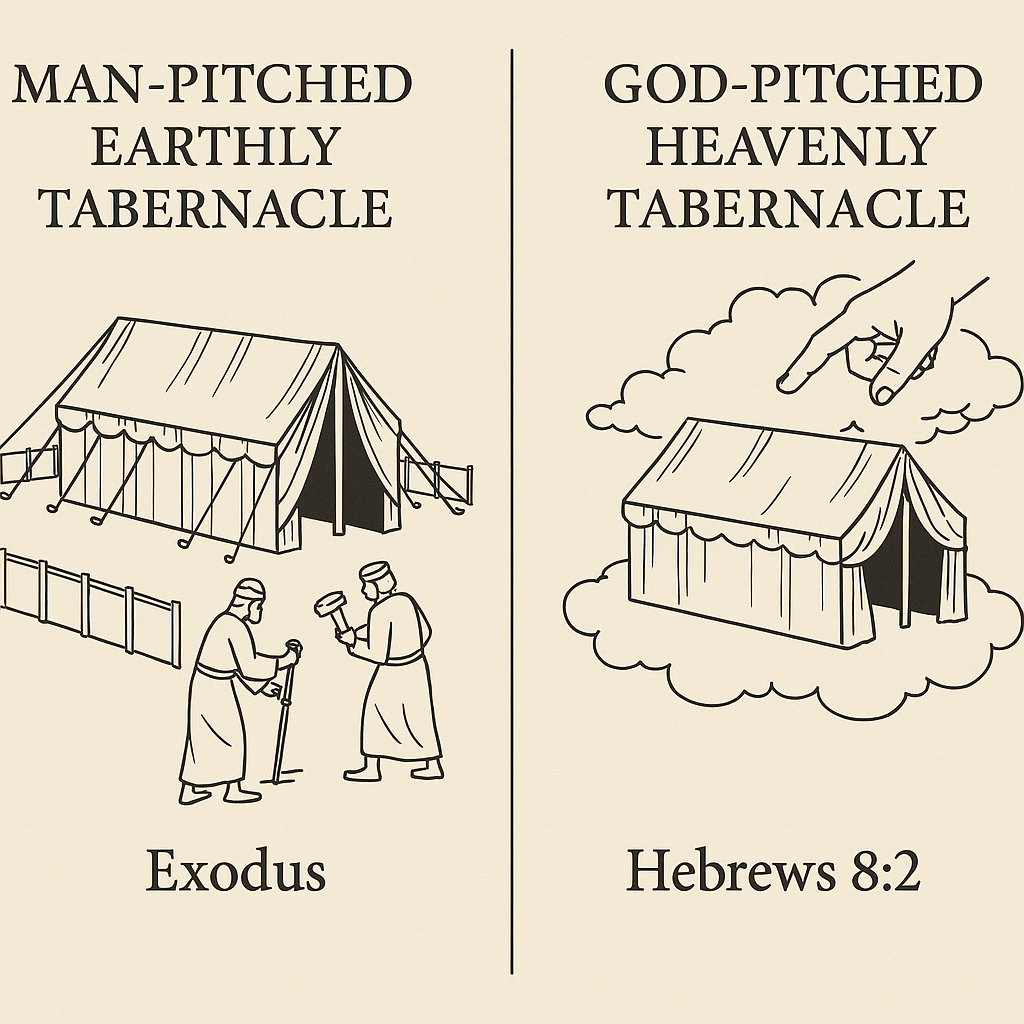
Hebrews 8:2
Hebrews 8:3
Hebrews 8:4
Hebrews 8:5
Hebrews 8:6
Hebrews 8:7
Hebrews 8:8
Hebrews 8:9
Hebrews 8:10
Hebrews 8:11
Hebrews 8:12
Hebrews 8:13
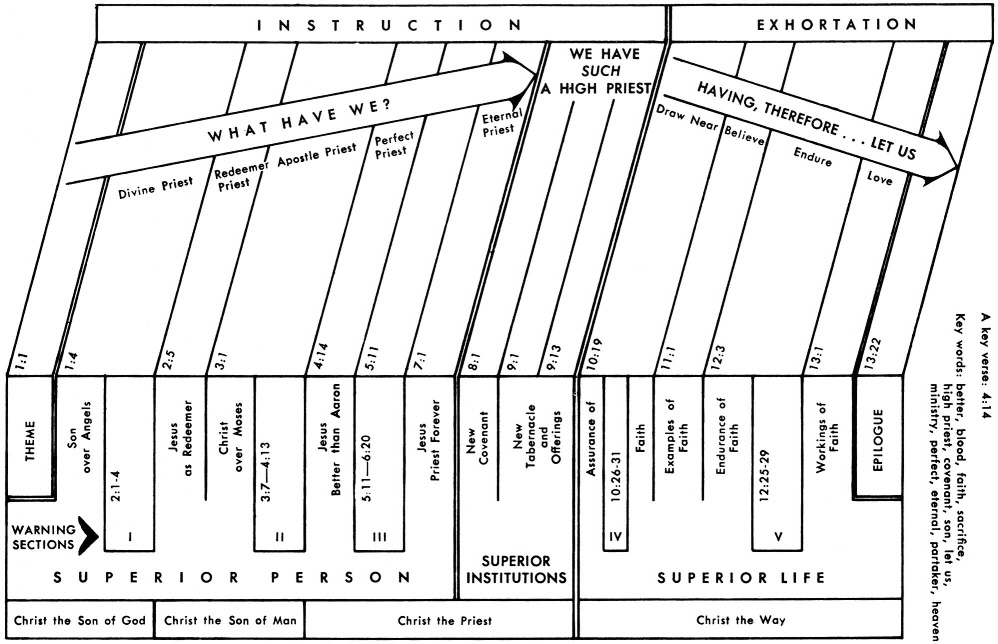
CONSIDER JESUS OUR GREAT HIGH PRIEST
Click chart to enlarge
Charts from Jensen's Survey of the NT - used by permission
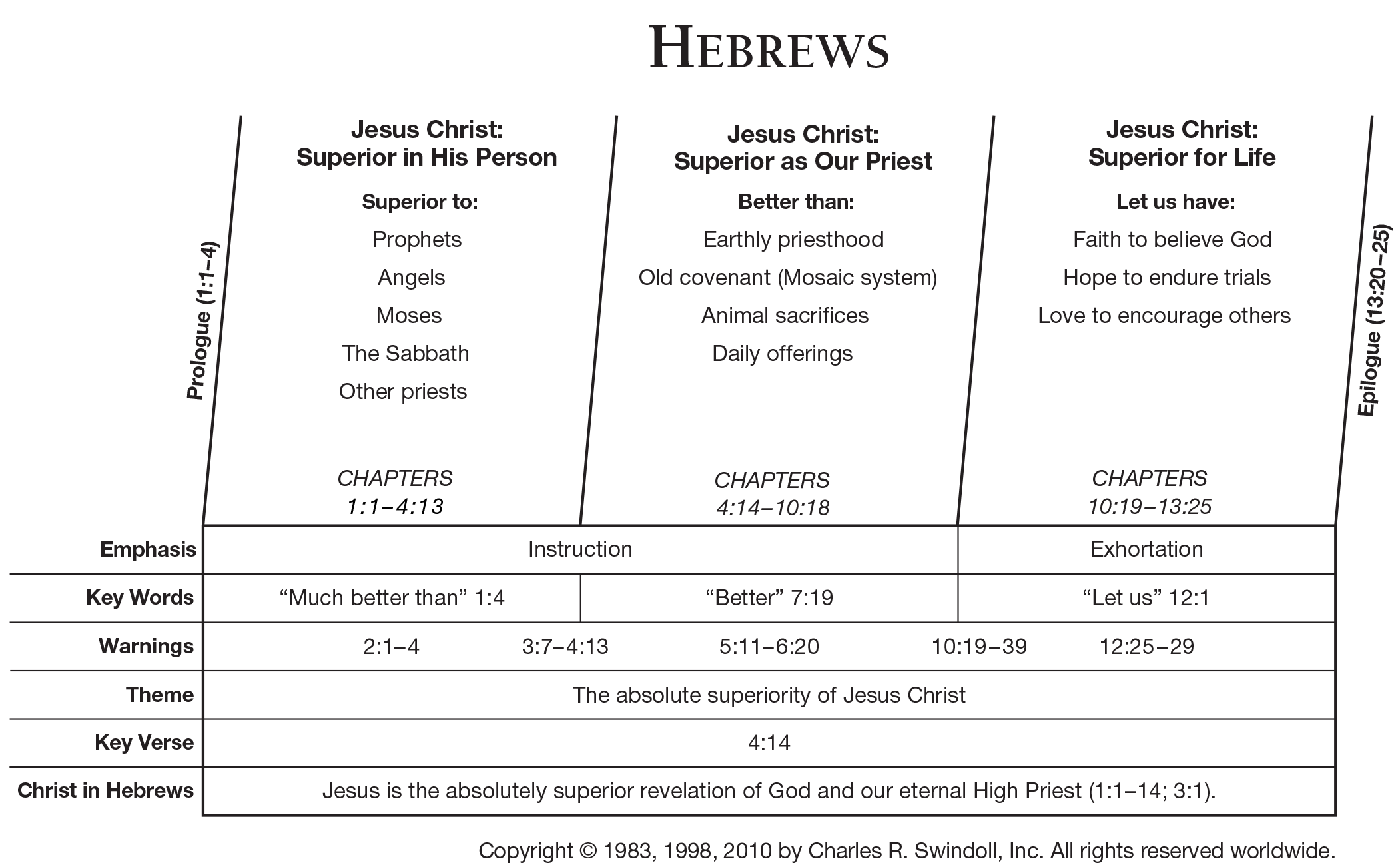
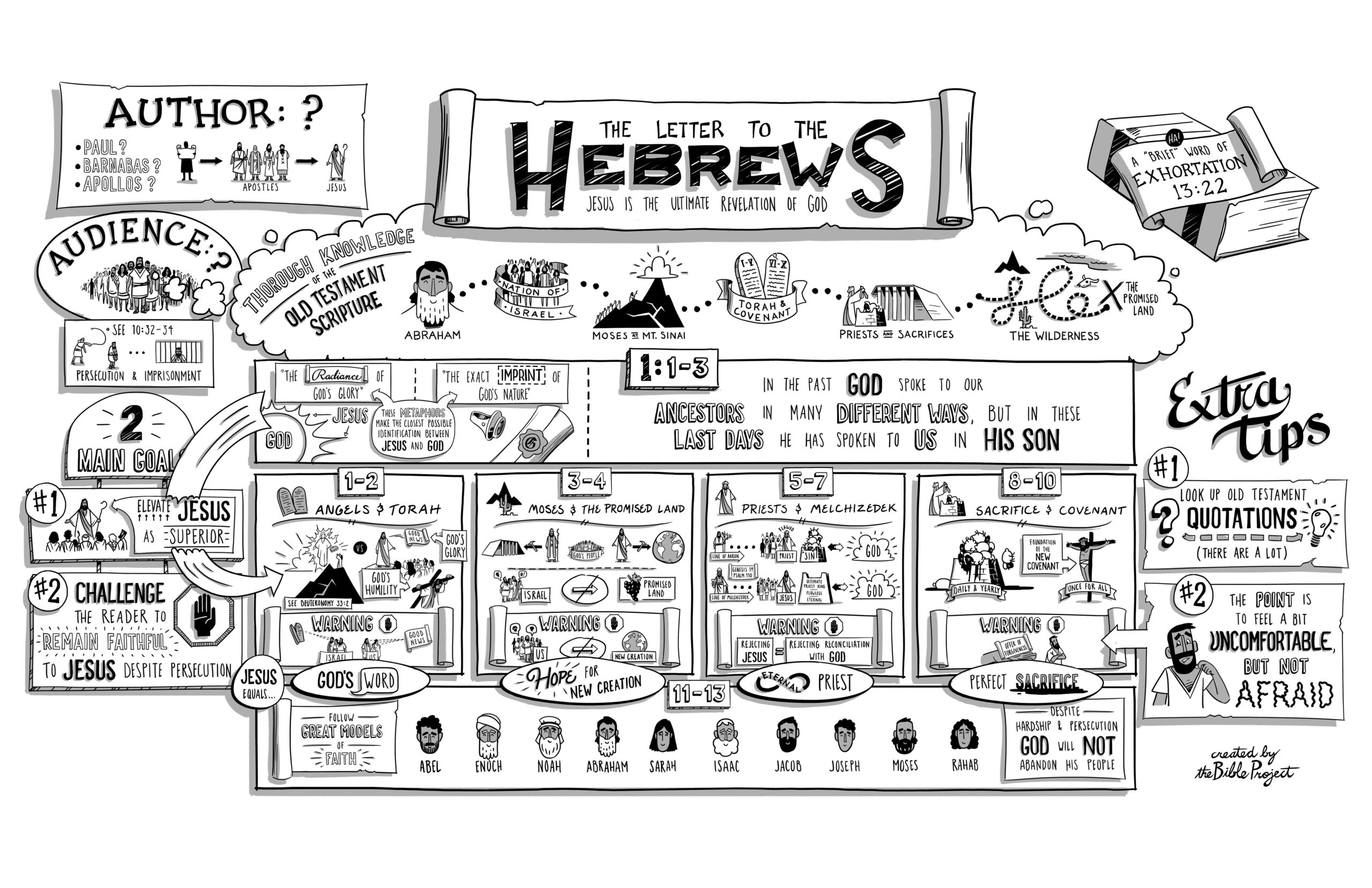
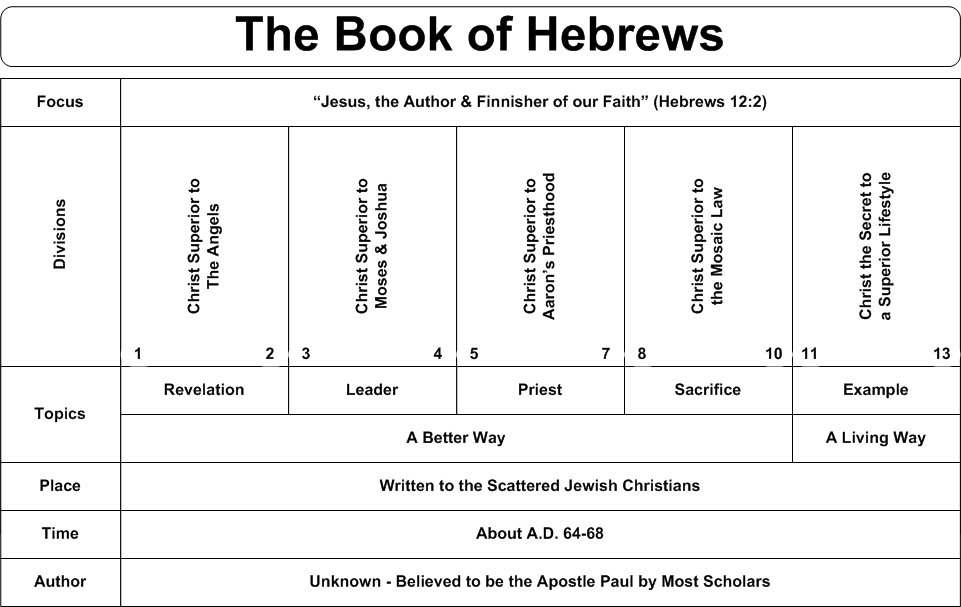
Swindoll's Chart, Interesting Pictorial Chart of Hebrews, Another Chart
|
The Epistle |
||||
| INSTRUCTION Hebrews 1-10:18 |
EXHORTATION Hebrews 10:19-13:25 |
|||
| Superior Person of Christ Hebrews 1:1-4:13 |
Superior Priest in Christ Hebrews 4:14-10:18 |
Superior Life In Christ Hebrews 10:19-13:25 |
||
| BETTER THAN PERSON Hebrews 1:1-4:13 |
BETTER PRIESTHOOD Heb 4:14-7:28 |
BETTER COVENANT Heb 8:1-13 |
BETTER SACRIFICE Heb 9:1-10:18 |
BETTER LIFE |
| MAJESTY OF CHRIST |
MINISTRY OF CHRIST |
MINISTERS FOR CHRIST |
||
|
DOCTRINE |
DUTY |
|||
|
DATE WRITTEN: |
||||

See ESV Study Bible "Introduction to Hebrews"
(See also MacArthur's Introduction to Hebrews)
Borrow Ryrie Study Bible
Hebrews 8:4 Now if He were on earth, He would not be a priest at all, since there are those who offer the gifts according to the Law (NASB: Lockman)
Greek: ei men oun en (3SIAI) epi ges, oud' an en (3SIAI) hiereus, onton (PAPMPG) ton prospheronton (PAPMPG) kata nomon ta dora
BGT εἰ μὲν οὖν ἦν ἐπὶ γῆς, οὐδ᾽ ἂν ἦν ἱερεύς, ὄντων τῶν προσφερόντων κατὰ νόμον τὰ δῶρα·
Amplified: If then He were still living on earth, He would not be a priest at all, for there are [already priests] who offer the gifts in accordance with the Law. (Amplified Bible - Lockman)
NLT: If he were here on earth, he would not even be a priest, since there already are priests who offer the gifts required by the law of Moses. (NLT - Tyndale House)
Wuest: If indeed therefore He were on earth, in that case He would not be a priest, there being those who offer the gifts according to law,
Young's Literal: for if, indeed, he were upon earth, he would not be a priest--(there being the priests who are offering according to the law, the gifts,
KJV For if he were on earth, he should not be a priest, seeing that there are priests that offer gifts according to the law:
NKJ For if He were on earth, He would not be a priest, since there are priests who offer the gifts according to the law;
NET Now if he were on earth, he would not be a priest, since there are already priests who offer the gifts prescribed by the law.
CSB Now if He were on earth, He wouldn't be a priest, since there are those offering the gifts prescribed by the law.
ESV Now if he were on earth, he would not be a priest at all, since there are priests who offer gifts according to the law.
NIV If he were on earth, he would not be a priest, for there are already men who offer the gifts prescribed by the law.
Paraphrase If Christ’s ministry were still confined to earth, He would not even be considered a priest, since the Law already has priests who offer the required gifts.
Paraphrase On earth, Jesus would not have a priestly role, because that service was already assigned to men appointed under the Law to present offerings.
- He would not be a priest at all - Hebrews 7:11-15; Nu 16:40; 17:12,13; 18:5
- Offer gifts - Heb 11:4
- Hebrews 8 Resources - Multiple Sermons and Commentaries
Related Passages:
Hebrews 7:11-14+ Now if perfection was through the Levitical priesthood (for on the basis of it the people received the Law), what further need was there for another priest to arise according to the order of Melchizedek, and not be designated according to the order of Aaron? 12For when the priesthood is changed, of necessity there takes place a change of law also. (JESUS EXCLUDED FROM EARTHLY PRIESTHOOD) For the one concerning whom these things are spoken belongs to another tribe, from which no one has officiated at the altar. 14 For it is evident that our Lord was descended from Judah, a tribe with reference to which Moses spoke nothing concerning priests.
NO EARTHLY PRIESTHOOD
FOR CHRIST
Having shown that Christ is the true High Priest Who ministers in the heavenly sanctuary, the writer now underscores the contrast by pointing out that if Christ were still on earth, He would not even qualify to serve as a priest. The Levitical system was already in place with men who offered gifts according to the Law. This highlights the sharp distinction between the earthly, temporary priesthood and Christ’s superior, heavenly priesthood, rooted not in Law but in God’s grace as John writes in Jn 1:17+ "For the Law was given through Moses; (NOW THE CONTRAST) grace and truth were realized through Jesus Christ."
Donald Guthrie - It occurs to the writer that some confusion might arise in his readers' minds over the co-existence of two orders of priesthood. He proceeds, therefore, to show that the priesthood of Jesus was not established on earth. The main point he is making is the impossibility of Jesus fulfilling the conditions either in the matter of genealogy, or in the precise nature of the gifts, which are stipulated in the Mosaic Law. This leads into his thesis that the superior priesthood is that which operates in heaven, not on earth. (BORROW Hebrews Commentary)
Now if He were on earth (ge), He would not be a priest (hiereus) at all, since there are those who offer (prosphero - present tense) the gifts according to the Law - The "IF" in this verse introduces a second class conditional statement which expresses a contrary to fact statement (He is not a priest on earth!) (cf. all the second class conditional statements in Hebrews = Heb. 4:8; 7:11; 8:4,7; 10:2; 11:15). Why could He not be a priest at all? And not just not a high priest, but not even a lesser priest! For one thing the office was already filled! The Old Covenant strictly regulated all of the concerns regarding the priesthood and by this very law Christ was excluded from the priestly office because of lineage. Christ was from the Tribe of Judah (Heb 7:14+), not Levi, and was not eligible under the Old Covenant (according to the Law) to be an earthly priest. On earth Jesus functioned as a "layman" and strictly speaking He performed no priestly functions in the earthly Temple. Those functions were carried out by the Aaronic priests (from the tribe of Levi) as ordered by God in the first covenant (cf Lev 1:5, 1:7–9, 2:2, 3:2, 4:5, etc.). As discussed (Heb 8:1–2 cf Heb 9:11–12, 24), Christ's priestly functions are exercised in the true Tabernacle in heaven at the right hand of the Majesty.
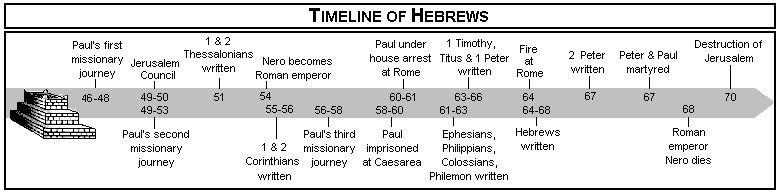
Notice that offer (prosphero) is present tense indicating that the offerings were still ongoing at the time of writing. This would add support to the thought that the Jewish temple in Jerusalem was still standing, and therefore would date the epistle before 70 AD, when the temple was destroyed.
John MacArthur adds that "The use of the present tense in Heb 5:1–4; 7:21, 23, 27, 28; 8:3–5,7, 13; 9:6–9, 13, 25; 10:1, 3, 4, 8, 11; and 13:10, 11 would suggest that the Levitical priesthood and sacrificial system were still in operation when the epistle was composed. Since the Temple was destroyed by General (later Emperor) Titus Vespasian in A.D. 70, the epistle must have been written prior to that date. In addition, it may be noted that Timothy had just been released from prison (Hebrews 13:23) and that persecution was becoming severe (Hebrews 10:32–39; 12:4; 13:3). These details suggest a date for the epistle around A.D. 67–69. (See discussion of Author and Date)
The Law (Old Covenant) stated the following regarding the priesthood "as a reminder to the sons of Israel that no layman who is not of the descendants of Aaron should come near to burn incense before the LORD; that he might not become like Korah and his company-- just as the LORD had spoken to him through Moses." (Numbers 16:40+)
King Uzziah tried to bypass God's laws and paid a dear price "And they opposed Uzziah the king and said to him, "It is not for you, Uzziah, to burn incense to the LORD, but for the priests, the sons of Aaron who are consecrated to burn incense. Get out of the sanctuary, for you have been unfaithful, and will have no honor from the LORD God." 19 But Uzziah, with a censer in his hand for burning incense, was enraged; and while he was enraged with the priests, the leprosy broke out on his forehead before the priests in the house of the LORD, beside the altar of incense. (2Chronicles 26:18,19+)
In describing the the new order (the priesthood of Melchizedek) the writer dealt with Jesus' inability to be an earthly priest in Hebrews 7 - Heb 7:11-15+
Now if perfection was through the Levitical priesthood (for on the basis of it the people received the Law), what further need was there for another priest (JESUS) to arise according to the order of Melchizedek, and not be designated according to the order of Aaron? 12 For when the priesthood is changed, of necessity there takes place a change of law also. 13 For the One (JESUS) concerning whom these things are spoken belongs to another tribe, from which no one has officiated at the altar (JUDAH). 14 For it is evident that our Lord was descended from Judah, a tribe with reference to which Moses spoke nothing concerning priests. 15 And this is clearer still, if another priest arises according to the likeness of Melchizedek,
Gotquestions adds that "The rebellion of Korah demonstrates the grim consequences of usurping the authority of God and of those whom He has chosen to be leaders of His people.
C H Spurgeon - In the tabernacle everything was done according to the pattern seen in the holy mount by Moses; in the temple no sacrifice was presented but according to divine command. The whole Aaronic ritual was very impressive. The priests in their holy robes, pure white linen garments, the golden altar, candlestick, and table, the fire, the smoke, the incense; the whole thing was calculated very much to impress the mind. The first covenant provided a very magnificent service, such as never will be excelled, but for all that, costly, divinely arranged, impressive, yet it could not put away sin; and the evidence of this is found in the fact that after one day of atonement they needed another atonement next year. God set aside that first covenant. He put it away as an outworn and useless thing; and He brought in a new covenant—the covenant of grace; and in our text we see what is the tenor of it: “I will put my laws into their mind, and write them in their hearts” (Jer 31:33). This is one of the most glorious promises that ever fell from the lips of infinite love. God said not, “I will come again, as I came on Sinai, and thunder at them.” No, but, “I will come in gentleness and mercy, and find a way into their hearts.” He said not, “I will take two great tables of stone, and with my finger write out my law before their eyes.” No, but, “I will put my finger upon their hearts, and there will I write my law.” He said not, “I will give promises and threatenings that shall be the safeguard of this new covenant”; but, “I will with my Spirit graciously operate upon their minds and their hearts, and so I will sweetly influence them to serve me—not for reward, nor from any servile motive, but because they know me, and they love me, and they feel it to be their delight to walk in the way of my commandments.”
Related Resource:
- Excellent review of Hebrews 8:1-13 Hebrews and the New Covenant - Dr S Lewis Johnson
Priest (2409) (hiereus from hieros = sacred, holy, consecrated to God, used as a noun to mean a sacred place or temple, cp Mark 11:11; cp English derivative "hierarchy" = leadership) is a sacred or consecrated person who serves deity. Priests in the NT refer primarily to the ceremonial officials of Jesus' day, that group of men who offered Temple sacrifices and carried out the other sacred rites associated with the Jewish Temple and Jewish people (cp Heb 8:4) . Most of the uses of hiereus refer to Jewish priests, but Acts 14:13 refers to a priest of the pagan cult of Zeus (patron little g god of the city of Lystra). Jesus is our Great High Priest, which describes His primary ministry in our behalf today (Heb 7:1, 3, 11, 14, 15, 17, 20, 21, 23), one aspect of that ministry being His continual intercession for us (Heb 7:25, Ro 8:34). Hiereus describes the specific position and not necessarily a priest’s character (e.g., see Lk 10:31 where a priest was a "bad Samaritan" so to speak). In Revelation hiereus describes believers who will rule and reign as priests with Christ the Great Priest (Jesus - Heb 10:21 = See Christ as Priest, Rev 1:6, Rev 5:10, Rev 20:6). Even though the hiereus described religious men, it did not signify necessarily that they were saved (cp Acts 6:7).
HIEREUS IS A KEYWORD IN HEBREWS - 14 OF 30 USES - Matt. 8:4; Matt. 12:4; Matt. 12:5; Mk. 1:44; Mk. 2:26; Lk. 1:5; Lk. 5:14; Lk. 6:4; Lk. 10:31; Lk. 17:14; Jn. 1:19; Acts 4:1; Acts 6:7; Acts 14:13; Heb. 5:6; Heb. 7:1; Heb. 7:3; Heb. 7:11; Heb. 7:14; Heb. 7:15; Heb. 7:17; Heb. 7:21; Heb. 7:23; Heb. 8:4; Heb. 9:6; Heb. 10:11; Heb. 10:21; Rev. 1:6; Rev. 5:10; Rev. 20:6
Hebrews 5:6 YOU ARE A PRIEST FOREVER
Hebrews 7:1 priest of the Most High God,
Hebrews 7:3 he remains a priest perpetually.
Hebrews 7:11 what further need was there for another priest
Hebrews 7:14 Moses spoke nothing concerning priests.
Hebrews 7:15 if another priest arises according to the likeness of Melchizedek
Hebrews 7:17 YOU ARE A PRIEST FOREVER
Hebrews 7:21 for they indeed became priests without an oath
Hebrews 7:21 YOU ARE A PRIEST FOREVER’
Hebrews 7:23 The former priests, on the one hand, existed in greater numbers
Hebrews 8:4 Now if He were on earth, He would not be a priest at all
Hebrews 9:6 the priests are continually entering the outer tabernacle
Hebrews 10:11 Every priest stands daily ministering
Hebrews 10:21 and since we have a great priest over the house of God,
Offer (4374) (prosphero from prós = to, toward + phéro = bring, bear carry) means literally to bring to and so to offer or present. In classical Greek, it could mean: Bringing something to someone (a gift, tribute, or message). Carrying or bearing something toward a person or place. Directionality: Always “toward” God (pros). Formality: Not casual bringing, but official presentation. Volition: Often intentional, an act of devotion, obedience, or sacrifice.
PROSPHERO IS A KEYWORD IN HEBREWS (18/46 NT uses) - Heb. 5:1; Heb. 5:3; Heb. 5:7; Heb. 8:3; Heb. 8:4; Heb. 9:7; Heb. 9:9; Heb. 9:14; Heb. 9:25; Heb. 9:28; Heb. 10:1; Heb. 10:2; Heb. 10:8; Heb. 10:11; Heb. 10:12; Heb. 11:4; Heb. 11:17; Heb. 12:7
Hebrews 5:1 in order to offer both gifts and sacrifices for sins
Hebrews 5:3 he is obligated to offer sacrifices for sins
Hebrews 5:7 He offered up both prayers and supplications
Hebrews 8:3 appointed to offer both gifts and sacrifices...high priest also have something to offer.
Hebrews 8:4 those who offer the gifts according to the Law
Hebrews 9:7 blood, which he offers for himself and for the sins of the people
Hebrews 9:9 gifts and sacrifices are offered
Hebrews 9:14 through the eternal Spirit offered Himself without blemish to God
Hebrews 9:25 nor was it that He would offer Himself often
Hebrews 9:28 Christ also, having been offered once to bear the sins of many
Hebrews 10:1 by the same sacrifices which they offer continually year by year
Hebrews 10:2 would they not have ceased to be offered
Hebrews 10:8 which are offered according to the Law
Hebrews 10:11 daily ministering and offering time after time
Hebrews 10:12 He, having offered one sacrifice for sins for all time
Hebrews 11:4 By faith Abel offered to God a better sacrifice than Cain
Hebrews 11:17 By faith Abraham, when he was tested, offered up Isaac,
Hebrews 12:7 God deals with you as with sons
R C Sproul - Before the Face of God - The Earthly Sanctuary
If he were on earth, he would not be a priest, for there are already men who offer the gifts prescribed by the law. [Heb. 8:4]
We are now to understand the relationship between the Aaronic priesthood of the earthly sanctuary and the Melchizedek priesthood of the heavenly sanctuary. We must consider what the Bible teaches about typology. A type is a copy or shadow that reveals the pattern of something greater—something more substantial and glorious. The earthly sanctuaries, both tabernacle and temple, were copies, or types, of a reality in heaven.
Hebrews 8:4 says that if Jesus were still on earth he would not be a priest. At the time of this Epistle’s writing, the readers could see go to Jerusalem and see the Levitical priests offering gifts in the earthly sanctuary. But that work will pass away, we read, for the earthly sanctuary was never intended to be permanent. The earthly sanctuary must give way to the heavenly one, for the temporary must unveil the permanent and then decline to dust.
The earthly sanctuary is secondary in that Moses made the tabernacle precisely according to the pattern revealed to him from heaven. The tabernacle, and later the temple, were made according to exacting instructions because they were symbolic copies of an existing standard. Genesis 1:1 says that God made heaven and earth, in that order. Knowing what the rest of the Old Testament makes clear, we see in this opening a hint that earth copies heaven. In the plan of salvation an earthly work precedes in time the heavenly work, but the earthly tabernacle worship has significance only because of what will happen in the heavenly one.
The work of the priests pictured the earthly work that Jesus would come to do. Priests of the old order never finished their work. They died, and new priests came along. But Jesus finished the work connected with the earthly sanctuary. There will be no more priests in this sense. The work in the sanctuary is over. Jesus entered the heavenly sanctuary to do a new kind of work. The work on earth was designed to open the gate to heaven. Jesus’ new work in heaven brings many sons and daughters to glory.
Coram Deo - If the earth is a copy of heaven, we can learn about heaven through observing the earth. The magnificence of creation inspires awe. How much more inspiring it is when we realize it is but a copy. As you consider the beauty of the forest, the splendor of a mountain, the delicacy of a flower, and the microscopic intricacy of a living cell, realize that their glory only reflects the glory of the original.
Hebrews 8:5 who serve a copy and shadow of the heavenly things, just as Moses was warned by God when he was about to erect the tabernacle; for, "SEE," He says, "THAT YOU MAKE all things ACCORDING TO THE PATTERN WHICH WAS SHOWN YOU ON THE MOUNTAIN." (NASB: Lockman)
Greek: Hoitines hupodeigmati kai skia latreuousin (3PPAI) ton epouranion, kathos kechrematistai (3SRPI) Mouses mellon (PAPMSN) epitelein (PAN) ten skenen, Hora (2SPAM) gar, phesin, (3SPAI) poieseis (2SFAI) panta kata ton tupon ton deixthenta (APPMSA) soi en to horei
BGT οἵτινες ὑποδείγματι καὶ σκιᾷ λατρεύουσιν τῶν ἐπουρανίων, καθὼς κεχρημάτισται Μωϋσῆς μέλλων ἐπιτελεῖν τὴν σκηνήν· ὅρα γάρ φησιν, ποιήσεις πάντα κατὰ τὸν τύπον τὸν δειχθέντα σοι ἐν τῷ ὄρει·
Amplified: [But these offer] service [merely] as a pattern and as a foreshadowing of [what has its true existence and reality in] the heavenly sanctuary. For when Moses was about to erect the tabernacle, he was warned by God, saying, See to it that you make it all [exactly] according to the copy (the model) which was shown to you on the mountain. (Amplified Bible - Lockman)
NLT: They serve in a place of worship that is only a copy, a shadow of the real one in heaven. For when Moses was getting ready to build the Tabernacle, God gave him this warning: "Be sure that you make everything according to the design I have shown you here on the mountain." . (NLT - Tyndale House)
Wuest: who are of such a character as serve the copy and representation of the heavenly things, even as Moses was divinely commanded when about to be completing the tent. For, See, He says, make all things according to the pattern which was shown to you on the mountain.
Young's Literal: who unto an example and shadow do serve of the heavenly things, as Moses hath been divinely warned, being about to construct the tabernacle, for `See (saith He) thou mayest make all things according to the pattern that was shewn to thee in the mount;') --
KJV Who serve unto the example and shadow of heavenly things, as Moses was admonished of God when he was about to make the tabernacle: for, See, saith he, that thou make all things according to the pattern shewed to thee in the mount.
NKJ who serve the copy and shadow of the heavenly things, as Moses was divinely instructed when he was about to make the tabernacle. For He said, "See that you make all things according to the pattern shown you on the mountain."
NET The place where they serve is a sketch and shadow of the heavenly sanctuary, just as Moses was warned by God as he was about to complete the tabernacle. For he says, "See that you make everything according to the design shown to you on the mountain."
CSB These serve as a copy and shadow of the heavenly things, as Moses was warned when he was about to complete the tabernacle. For God said, Be careful that you make everything according to the pattern that was shown to you on the mountain.
ESV They serve a copy and shadow of the heavenly things. For when Moses was about to erect the tent, he was instructed by God, saying, "See that you make everything according to the pattern that was shown you on the mountain."
NIV They serve at a sanctuary that is a copy and shadow of what is in heaven. This is why Moses was warned when he was about to build the tabernacle: "See to it that you make everything according to the pattern shown you on the mountain."
Paraphrase The earthly priests perform their service in what is only a copy and shadow of heavenly realities, just as God warned Moses when he was about to build the tabernacle: ‘Be careful to make everything exactly according to the pattern I showed you on the mountain.’”
Paraphrase “These priests minister in a sanctuary that is only a reflection and outline of what is real in heaven—just as God cautioned Moses at Sinai: ‘Pay attention, and construct everything precisely as the model you saw on the mountain.’”
Paraphrase “The Levitical priests serve in what is merely an earthly sketch, a shadow cast from the true heavenly sanctuary. This is why God warned Moses as he prepared to build the tabernacle: ‘Be sure to follow the blueprint you were shown on the mountain.’”
Paraphrase “The priests on earth serve only in a shadowy copy of heaven’s reality. God reminded Moses on Sinai, ‘Make sure to follow the pattern I showed you.’ Their ministry points to the greater, true sanctuary above.”
Paraphrase “The ministry of the earthly priests is not in the real sanctuary but in one that only mirrors it—a shadow of heavenly things. That is why God solemnly warned Moses when he was about to set up the tabernacle: ‘See to it that you make everything exactly according to the pattern I revealed to you on the mountain.’”
- Example - Hebrews 9:9,23,24; 10:1; Colossians 2:17
- See - Ex 25:40 26:30 27:8 Nu 8:4 1Ch 28:12,19 Ac 7:44
- Hebrews 8 Resources - Multiple Sermons and Commentaries
Related Passages:
Colossians 2:16-17+ Therefore no one is to act as your judge in regard to food or drink or in respect to a festival or a new moon or a Sabbath day– 17 things which are a mere shadow of what is to come; but the substance belongs to Christ.
Exodus 25:40+ “See that you make them after the pattern (Lxx = tupos) for them, which was shown to you on the mountain.
THE SHADOW
OF THE OLD
Having established that earthly priests serve in the tabernacle pitched by men, the writer now underscores the inferiority of that service by describing it as only a copy and shadow of heavenly realities. Their ministry, though ordained by God, was never the ultimate reality but a temporary sketch pointing forward to something (Someone) greater. To prove the point, he recalls God’s solemn warning to Moses at Sinai: when constructing the tabernacle, he had to follow the heavenly blueprint exactly, because the earthly structure was meant to reflect the true sanctuary above. This prepares the way for the argument that Christ’s ministry surpasses theirs precisely because He serves, not in the shadow, but in the substance itself.
Who (Levitical priests) serve (latreuo - present tense - see note above) a copy (hupodeigma) and shadow (skia) of the heavenly (epouranios) things - Amplified = "[But these offer] service [merely] as a pattern and as a foreshadowing of [what has its true existence and reality in] the heavenly sanctuary." NLT = "They serve in a system of worship that is only a copy, a shadow of the real one in heaven." The Levitical priests served in a God-given ministry, but what they handled were only copies (hupodeigma) and shadows (skia) — earthly sketches and outlines of heavenly realities (epouranios). These were like a giant finger pointing forward to Christ, who is the true High Priest in the heavenly sanctuary. Here hupodeigma refers to a representative copy or likeness of the true original. What Moses saw on the mountain was the original heavenly pattern, while the constructed tabernacle and its furnishings were the copy — reflecting that original and serving as a model that pointed back to it.
NET Note - Literally the Greek reads who serve in - referring to the Levitical priests, but focusing on the provisional and typological nature of the tabernacle in which they served." This explains why the NET Bible version renders it "The place where they serve is a sketch and shadow of the heavenly sanctuary." Other versions are more literal like ESV = "They serve a copy and shadow of the heavenly things." That rendering suggests it is the priests which were the copy and shadow, and in one sense they were but in context it seems the author's intent is that copy and shadow were meant to describe the place rather than the priests.
NET Note on copy - Or "prototype," "outline." The Greek word hupodeigma does not mean "copy," as it is often translated; it means "something to be copied," a basis for imitation. BDAG 1037 s.v. 2 lists both Heb 8:5 and Heb 9:23 under the second category of usage, "an indication of something that appears at a subsequent time," emphasizing the temporal progression between the earthly and heavenly sanctuaries.
John MacArthur explains that latreuo "might best be translated “to render respectful spiritual service.” True worship goes beyond praising God, singing hymns, or participating in a worship service. The essence of worship is living a life of obedient service to God. “Do not neglect doing good and sharing,” exhorts the writer of Hebrews, “for with such sacrifices God is pleased” (Hebrews 13:16). True worship involves every aspect of life. (See Philippians Commentary - Page 221)
Who serve a copy (hupodeigma) and shadow (skia) - What he is referring to here is the fact that the ministry of the Levitical was a "typical" ministry or a type (Typology = the study of types) of that which was to come. The doctrine of typology seems to be largely neglected in the modern church either because of ignorance or because of exposure to some proponents who have grossly distorted this interpretative method. Some may have heard such fanciful typological interpretations, that they automatically tend to shy away at any mention of the word type or typology (I was once in this group, primarily because of ignorance). And so here the writer of Hebrews is referring to the temporary tabernacle which prefigured an eternal, heavenly tabernacle. The tabernacle passed away, but the truth it was meant to teach endures and this subject will be explained in more detail in Hebrews 9.
These Old Testament pictures and types were like a child's picture book, but these pictures did serve a purpose for they pointed ultimately to the real, eternal heavenly things. In Colossians Paul gives us a good "application" in light of this truth concerning what is really "real"…
If then you have been raised up with Christ, keep seeking (present imperative - do this frequently, habitually, even as your lifestyle -- see our need to depend on the Holy Spirit to obey) the things above, where Christ is, seated at the right hand of God. Set your mind (present imperative - do this frequently, habitually, even as your lifestyle) on the things above, not on the things that are on earth. (Col 3:1, 2+; +)
Comment - Paul's point is that believers must continually, consciously cultivate this heavenly mindset rather than getting seduced into the trap of this world system. Looking by faith [founded on truths as in Colossians 1 and Colossians 2] to the eternal is a good preventative to keep us from getting caught in the mire of the transitory. The earthly is but a shadow and the things are heaven are the reality. As John said "the world is passing away, and also its lusts; but the one who does the will of God abides forever" (1 John 2:17+)
Wuest paraphrases Expositor's Greek Testament which explains that skia in this verse is ""an adumbration (imperfect portrayal or representation of a thing) of a reality which it does not embody." A shadow has no substance in itself. It has no independent existence. It merely is proof of the fact that there is a reality back of it. It is not itself solid or real. Just so, the earthly tabernacle gave proof of the fact that there was a real one, the heavenly one where God Himself dwelt, where Messiah officiates as High Priest. The Aaronic priests performed their priestly rites in the representation of the heavenly tabernacle. (Hebrews 8 Commentary)
Summary - The point is that the Mosaic covenant including the institutions of the priesthood and the tabernacle performed a real service but only in a copy and shadow—an earthly model that pointed to the greater, heavenly reality. Their ministry dealt with symbols; Christ’s ministry fulfills the substance in heaven itself. Stated another way, the author’s point in both Heb 8:2 and in Heb 8:5 is that this sanctuary and tabernacle in heaven is the real thing. The earthly tabernacle was only a copy and shadow of heavenly things.
To emphasize the more excellent ministry of Messiah, the concept of a copy and shadow is repeated throughout this section…
symbol for the present time (See note Hebrews 9:9)
copies of things in the heavens (See note Hebrews 9:23)
not a copy of the true one but into heaven itself (See note Hebrews 9:24)
Brian Bell - Copy & shadow – The Greeks had a basic thought about the universe. They thought in terms of 2 worlds, the real and the unreal. They believe that this world of space and time was only a pale copy of the real world. That was the basic doctrine of Plato, the greatest of all Greek thinkers. He believed in what he called forms. Somewhere there was a world where there was laid up the perfect forms of which everything in this world is an imperfect copy. Sometimes he called the forms ideas. (e.g. there is the idea of a chair of which all actual chairs are in perfect copies) The Greeks were fascinated by this conception of a real world of which this world is only a flickering, imperfect copy.
Copies/shadows: [earthly temple/real Temple; earthly worship/real worship; earthly priesthood/real priesthood]
1. Moses used the blood of an animal. Jesus, His own.
2. Moses spoke of the covenant of the Law. Jesus, the covenant of Grace.
3. Moses spoke of a partial covering. Jesus, the actual remission of sins.
When you trust Christ, you enter a life of reality, & you are forever finished w/substitutes. Don’t all substitutes kinda seem bad: egg substitute? bacon substitute?
Serve (3000) (latreuo from latris = hired servant or latron = reward, wages) means to work for reward, for hire or for pay, to be in servitude, render cultic service. Latreuo was used literally for bodily service (e.g., workers on the land, or slaves), and in the NT speaks of rendering service to God, to worship, to perform sacred services or to minister to God in a spirit of worship. This verb is one of the key words in Hebrews with 6 uses of a total of 22 NT uses (All the uses = Hebrews 8:5, 9:9, 9:14, 10:2, 12:28, 13:10) In secular Greek latreuo meant to work for wages, then to serve without wages. It originally referred predominantly to physical work then later was used more generally. Latreuo can convey either the idea of worship or service and frequently appears to mean both which suggests that service cannot be separated from worship.
Vine adds that latreuo, and its corresponding noun latreia, originally signified the work of a hired servant, as distinguished from the compulsory service of the slave, but in the course of time it largely lost that significance, and in its usage in Scripture the thought of adoration was added to that of free obedience.
Copy (5262) (hupodeigma from hupo = under + deiknúo/deíknumi = to show, to point to something, to make known the character or significance of something) means literally that which is shown below. It means an example, pattern, illustration. It refers to a sign suggestive of anything, an outline, a delineation, a suggestion. "A specimen, or, still better, a sketch-plan."
Vine writes that hupodeigma signifies "(a) a sign suggestive of anything, the delineation or representation of a thing, and so, a figure, “copy”; in Heb. 9:23; (b) an example for imitation, John 13:1; Jamess. 5:10; for warning, Heb 4:11; 2Pet. 2:6. (Vine's Expository Dictionary)
Richards notes that "In the NT the pattern is nearly always established by a person whose words and actions provide a living expression of that which Scripture calls for from all believers. At times the example found in the Bible is negative (Hebrews 4). But the concept of example is essentially positive. (BORROW Expository Dictionary of Bible Words)
Here are the other NT uses of hupodeigma…
Hebrews 4:11+ Let us therefore be diligent to enter that rest, lest anyone fall through following the same example of disobedience.
Hebrews 9:23+ Therefore it was necessary for the copies of the things in the heavens to be cleansed with these, but the heavenly things themselves with better sacrifices than these.
2 Peter 2:6+ and if He condemned the cities of Sodom and Gomorrah to destruction by reducing them to ashes, having made them an example to those who would live ungodly thereafter; (Comment: The meaning of hupodeigma is similar to Hebrews 4:11, where the example is a "negative" one, something that should be avoided.)
James 5:10+ As an example, brethren, of suffering and patience (literally a long holding out of one's mind before giving room to passion = reflects emotional calm in face of provocation or misfortune - see makrothumia), take the prophets who spoke in the name of the Lord.
COMMENT - What did the patience or endurance of the prophets demonstrate? They serve as an example of the perseverance of the saints demonstrating that it is possible to endure to the end (in His power not our power).
Shadow (4639) (skia) refers to a pale shadow, as contrasted with a sharp, distinct one. Skia is used of a literal shadow (the shape cast by an object as it blocks rays of light) in Acts 5:15 and of literal shade in Mark 4:32 (Here skia refers to the shelter from light and any heat associated with it), but the other 5 NT uses are figurative. Two uses describe the "shadow" of death, that sphere of existence which of men in which they are alienated from God (Mt 4:16, Lk 1:79) and into which Messiah comes as the Light of the world. Poetically the OT Septuagint (see below) speaks of the sheltering shadow of God's wings. Other OT uses speak of human transitoriness (see examples below from Job and the Psalms). The Jewish historian Josephus uses skia to in his description of a besieged city in Jewish War 6.194 where only the shadow of food seemed to be available.
Jewish Rabbis used skia literally but also compared human life to the shadow of a flying bird. The rabbis gave advice that it is better to eat simply and sit in the shade than to eat dainties and be exposed to creditors.
The figurative uses of skia in Colossians and Hebrews describe a mere representation of something that is real. In this figurative use Old Testament historical truths were like shadows cast by those objects (truths) and which represented the form or substance of that truth. Or stated another way, the OT truth was the type which foreshadowed the NT fulfillment, the antitype (see discussion of Typology - Study of Biblical types, rationale, cautions, guidelines, contrasts with allegory)
The Aaronic priesthood, and its associated ceremonies and rituals were only a pale shadow of the things Christ would bring. They were form without substance.
NIDNTT writes that in Classical Greek skia has…both a proper and a transferred meaning. On the one hand, it means a shadow, thrown by an object (e.g. a tree or a rock) or a person. On the other hand, it can assume the meaning of skotos and indicate the sphere of darkness. A particularly important example of this is in the expression skia thanatou, shadow of death. Skia here underlines the suggestion of threat already contained in the concept of death. But apart from this combination, skia can also be used to signify the vanity (Empty, art. mataios) of human actions (e.g. Lucian, Hermotimus 79, to pursue a shadow, a fiction) and of man in general (e.g. Pindar, Pyth. 8, 95f., man is the dream of a shadow). Occasionally skia may be translated image, reflection. In Plato it is used alongside eikon almost as a synonym for that term, which like skia describes a mere likeness of the true and eternal realities (cf. Rep. 6, 510e; 7, 517d)… In apocryphal literature also the term “shadow” is used chiefly to demonstrate the nothingness of human life (cf. Wis. 2:5; 5:9) and effort (cf. Sir. 34:2, “As one who catches at a shadow … is he who gives heed to dreams”). But the lit. meaning is also found (cf. Wis. 19:7, cloud; Bar. 5:8, plant); and the term can also refer to an (earthly) empire (cf. Bar. 1:12). (See online article for more detail Brown, Colin, Editor. New International Dictionary of NT Theology note pages go BACKWARDS!)
There are 7 uses of skia in the NT…
Matthew 4:16 "The people who were sitting in darkness saw a great light, And to those who were sitting in the land and shadow of death, Upon them a light dawned." (Comment: Here the land and shadow of death denote the Gentiles to whom the Messiah comes with the light of salvation. In this context skia in the sense of darkness, gloom, such as the foreboding “shadow of death,” meaning the thickest darkness)
Mark 4:32 yet when it is sown, grows up and becomes larger than all the garden plants and forms large branches; so that the birds of the air can nest under its shade." (Here skia refers to the shelter from light and any heat associated with it. The shadow of the mustard plant affording shelter to the birds indicates a place of security offered by nature.)
Luke 1:79 To shine upon those who sit in darkness and the shadow of death, To guide our feet into the way of peace."
Acts 5:15 to such an extent that they even carried the sick out into the streets, and laid them on cots and pallets, so that when Peter came by, at least his shadow might fall on any one of them.
Colossians 2:17 (note) things (things related to the Law - food or drink or… a festival or a new moon or a Sabbath day) which are a mere shadow of what is to come; but the substance belongs to Christ. (Comment: The law was a shadow of future things in contrast to Christ the reality and fulfillment of those OT shadows. Since there is no body without shadow, the shadow points to the body).
Hebrews 8:5 (note) who serve a copy and shadow of the heavenly things, just as Moses was warned by God when he was about to erect the tabernacle; for, "See," He says, "that you make all things according to the pattern which was shown you on the mountain."
Hebrews 10:1 (note) For the Law, since it has only a shadow of the good things to come and not the very form of things, can never by the same sacrifices year by year, which they offer continually, make perfect those who draw near.
There are 43 uses of skia in the Septuagint (LXX) (Judges 9:15, 36; 2 Ki. 20:9ff; 1Chr. 29:15; Job 3:5; 7:2; 8:9; 12:22; 14:2; 15:29; 16:16; 24:17; 28:3; Ps. 23:4; 44:19; 57:1; 80:10; 88:6; 102:11; 107:10, 14; 109:23; 144:4; Eccl. 6:12; 7:12; 8:13; Song 2:3, 17; 4:6; Is 4:6; 9:2; 38:8; 51:16; Jer. 6:4; 13:16; Lam. 4:20; Ezek. 17:23; 31:6; Amos 5:8; Jonah 4:5,6) Here are some representative uses of skia in the Septuagint. One of the more famous uses of "shadows" in history is recorded in 2 Kings…
And Isaiah said (in answer to King Hezekiah's query for a sign that Jehovah would heal him), "This shall be the sign to you from the LORD, that the LORD will do the thing that He has spoken: shall the shadow (Hebrew = tsel = shadow, shade, symbolic of transitoriness of life; Lxx = skia) go forward ten steps or go back ten steps?" (2 Kings 20:9, skia also in Lxx of 2 Ki 20:10, 11)
(King David praise to Jehovah upon the willing provision of His people for the building of His Temple. David declared… ) We are sojourners before Thee, and tenants, as all our fathers were; our days on the earth are like a shadow (Hebrew = tsel = shadow, shade, symbolic of transitoriness of life; Lxx = skia), and there is no hope. (1Chronicles 29:15) (Comment: This verse is immediately applicable for it serves as a good reminder of the brevity of our life, so that we might redeem the time before we step into eternity. - see note Ephesians 5:16)
(Bildad wasn't the best counselor but he was right when he declared) we are only of yesterday and know nothing, Because our days on earth are as a shadow (Hebrew = tsel = shadow, shade, symbolic of transitoriness of life; Lxx = skia). (Job 8:9)
Even though I walk through the valley of the shadow (Hebrew = tsalmaveth = deep shadow; Lxx = skia) of death , I fear no evil; for Thou art with me; Thy rod and Thy staff, they comfort me. (Psalm 23:4 - Spurgeon's note)
Be gracious to me, O God, be gracious to me, for my soul takes refuge in Thee; and in the shadow (Hebrew = tsel = shadow, shade, symbolic of transitoriness of life; Lxx = skia) of Thy wings I will take refuge, until destruction passes by. (Psalm 57:1 - Spurgeon's note)
Man is like a mere breath; His days are like a passing shadow (Hebrew = tsel = shadow, shade, symbolic of transitoriness of life; Lxx = skia). (Psalm 144:4 - Spurgeon's note)
JUST AS MOSES WAS WARNED WHEN HE WAS ABOUT TO ERECT THE TABERNACLE SEE HE SAYS THAT YOU MAKE ALL THINGS ACCORDING TO THE PATTERN WHICH WAS SHOWN YOU ON THE MOUNTAIN: kechrematistai (3SRPI) Mouses mellon (PAPMSN) epitelein (PAN) ten skenen hora (2SPAM) gar phesin (3SPAI) poieseis (2SFAI) panta kata ton tupon ton deichthenta (APPMSA) soi en to horei:
- Hebrews 8 Resources - Multiple Sermons and Commentaries
Related Passages:
John 1:14+ And the Word (John 1:1+) became flesh, and dwelt (skenoo - Marginal note = "tabernacled," YLT = "did tabernacle among us") among us, and we saw His glory, glory as of the only begotten ( monogenes - only one of His kind!) from the Father, full of grace and truth.
John 2:19-21+ Jesus answered them, “Destroy this temple (naos), and in three days I will raise it up.” 20 The Jews then said, “It took forty-six years to build this temple (naos), and will You raise it up in three days?” 21 But He was speaking of the temple (naos) of His body.
Exodus 25:9+ According to all that I am going to show you, as the pattern (Lxx - paradeigma - model) of the tabernacle and the pattern (Lxx - paradeigma - model) of all its furniture, just so you shall construct it.
Exodus 25:40+ “See that you make them after the pattern (Lxx = tupos) for them, which was shown to you on the mountain.
Acts 7:44+ “Our fathers had the tabernacle of testimony in the wilderness, just as He who spoke to Moses directed him to make it according to the pattern which he had seen.
THE PATTERN FOR
THE OLD
Just as Moses was warned (chrematizo) by God when he was about to erect (epiteleo - complete) the tabernacle (skene); for, "SEE (present imperative)" He says, "THAT YOU MAKE (poieo) all things ACCORDING TO THE PATTERN (tupos) WHICH WAS SHOWN (deiknuo/deiknumi) YOU ON THE MOUNTAIN (oros - Mt Sinai) - Moses was divinely warned (chrematizo) at the moment he was about to complete (epiteleo - complete) the the tabernacle (skene). Note the emphasis on all things. In Exodus 25–31 God gave Moses detailed instructions for the tabernacle, its furnishings, and the priestly garments. In Hebrew the word pattern (tabnith) means model, design, plan, or blueprint. God revealed a heavenly design for earthly worship. Moses had to follow it exactly—no deviations. That pattern was a shadow pointing to Christ, the true heavenly reality. Moses was not free to improvise; everything had to conform exactly to the divinely revealed heavenly pattern.
The earthly tabernacle was a copy and shadow (Heb 8:5) of the heavenly reality. The true “original” is the heavenly sanctuary where Christ ministers. This means the earthly system was temporary, preparatory, and anticipatory of something greater.
Earthly worship under the Old Covenant = shadow.
Heavenly reality in Christ = substance. (cf Col 2:16-17+)
The writer’s point: the old pattern was temporary, and was fulfilled and perfected in Christ. Jesus is the true High Priest, the true Sacrifice, and the true Sanctuary.
According to the pattern (tupos) - Specifically how this pattern was communicated or what exactly was shown to Moses on Mt Sinai is not stated in Scripture, so it is best not to speculate as did the Jewish rabbis who postulated ideas like the following "An ark of fire and a table of fire and a candlestick of fire came down from heaven; and these Moses saw and reproduced (Tal Menahoth 29a)." Other Rabbis added the groundless speculation that Gabriel in a workman's apron showed Moses how to reproduce the articles he was shown!
The Old Covenant tabernacle pointed beyond itself to Christ and His heavenly priesthood. Fulfillment in Christ: Jesus is the true Tabernacle (John 1:14+, “dwelt” = tabernacled), the true Priest, and the true Sacrifice.
How important is the divine instruction regarding the Tabernacle in the Lord's mind? God devotes some 50 chapters that discuss the TABERNACLE and only 2 to the CREATION STORY (although of course there are mentions of creation elsewhere in individual verses). The 50 chapters in the Bible devoted to the tabernacle include 13 in Exodus; 18 in Leviticus; 13 in Numbers; two in Deuteronomy; and four in Hebrews. The final 16 chapters in Exodus are primarily devoted to the instructions and fashioning of the tabernacle. (Borrow King James Study Bible page 138)
TECHNICAL NOTES:
NET Note - There are two main options for understanding the conceptual background of the heavenly sanctuary imagery. The first is to understand the imagery to be functioning on a vertical plane. This background is Hellenistic, philosophical, and spatial in orientation and sees the earthly sanctuary as a copy of the heavenly reality. The other option is to see the imagery functioning on a horizontal plane. This background is Jewish, eschatological, and temporal and sees the heavenly sanctuary as the fulfillment and true form of the earthly sanctuary which preceded it. The second option is preferred, both for lexical reasons (see tn above) and because it fits the Jewish context of the book (although many scholars prefer to emphasize the relationship the book has to Hellenistic thought).NET Note - The word (tupos) here has the meaning "an archetype serving as a model, type, pattern, model" (BDAG 1020 s.v. 6.a). This is in keeping with the horizontal imagery accepted for this verse (see sn on "sketch" earlier in the verse). Here Moses was shown the future heavenly sanctuary which, though it did not yet exist, became the outline for the earthly sanctuary
The writer quotes from the Old Testament "And see that you make them after the pattern for them, which was shown to you on the mountain. (Ex 25:40) (The writer quotes from the Septuagint - LXX, but changes the verb tense of "shown" from perfect in the Lxx to aorist in Hebrews.) In Exodus 25, the warning to follow the pattern was given in the midst of minute instructions about the ark, the table, the lampstand, and the size, shape and materials specified to build the Tabernacle.
Compare similar instructions to Moses...
According to all that I am going to show you, as the pattern of the tabernacle and the pattern of all its furniture, just so you shall construct it. (Ex 25:9)
Then you shall erect the tabernacle according to its plan which you have been shown in the mountain. (Ex 26:30)
Now this was the workmanship of the lampstand, hammered work of gold; from its base to its flowers, it was hammered work; according to the pattern which the LORD had showed Moses, so he made the lampstand. (Nu 8:4)
John Owen has an interesting thought on true tabernacle - I think that the true tabernacle refers to the human nature of the Lord Christ. He is the only way to approach God in holy worship, as the tabernacle was of old. Christ himself called his own body his temple when referring to the temple of Jerusalem, which was put to the same use as the tabernacle (John 2:19-22+). The old tabernacle was a type. It was a token, pledge, and means for God's presence to be with his people here on earth, and for him to be near them. So he said he dwelt among them. This can only really and substantially happen through Christ. He alone, therefore, is this true tabernacle.
Warned (5537) (chrematizo from chrema = an affair, business) originally meant to transact business, to advise or to give answer to those asking advice and so to give a response to those who consult an oracle. Then it meant to give a divine command or in the passive to be commanded. Stated another way, chrematizo means to impart a divine message or make known a divine warning by giving a message.
CHREMATIZO - 9V - Matt. 2:12; Matt. 2:22; Lk. 2:26; Acts 10:22; Acts 11:26; Rom. 7:3; Heb. 8:5; Heb. 11:7; Heb. 12:25
Hebrews 11:7 — Noah, “being warned (chrematizō) by God about things not yet seen.”
Hebrews 12:25 — warning against refusing Him who “warns (chrematizō) from heaven.”
Tabernacle (4633) (skene) is a tent, booth, hut, tabernacle, any covered or shaded place. The first use is of skene is in the transfiguration where Peter sought to build "three tabernacles here, one for (Jesus), and one for Moses, and one for Elijah.” (Mt 17:4).
SKENE KEYWORD IN HEBREWS - 10X IN 20 NT USES - dwellings(1), tabernacle(15), tabernacles(3), tents(1). Matt. 17:4; Mk. 9:5; Lk. 9:33; Lk. 16:9; Acts 7:43; Acts 7:44; Acts 15:16; Rev. 13:6; Rev. 15:5; Rev. 21:3 Heb. 8:2; Heb. 8:5; Heb. 9:2; Heb. 9:3; Heb. 9:6; Heb. 9:8; Heb. 9:11; Heb. 9:21; Heb. 11:9; Heb. 13:10;
Hebrews 8:2 in the true tabernacle
Hebrews 8:5 when he was about to erect the tabernacle;
Hebrews 9:2 For there was a tabernacle prepared
Hebrews 9:3 Behind the second veil there was a tabernacle
Hebrews 9:6 priests are continually entering the outer tabernacle
Hebrews 9:8 not yet been disclosed while the outer tabernacle is still standing
Hebrews 9:11 He entered through the greater and more perfect tabernacle
Hebrews 9:21 he sprinkled both the tabernacle
Hebrews 11:9 dwelling in tents with Isaac and Jacob
Hebrews 13:10 those who serve the tabernacle have no right to eat
Pattern (5179)(tupos from túpto = strike, smite with repeated strokes) literally refers to a visible mark or impression made by a stroke or blow from an instrument or object. What is left after the stroke or blow is called a print, a figure or an impression. For example, the most famous reference to a literal mark (tupos) is when Thomas doubted Jesus' resurrection from the dead declaring "Unless I shall see in His hands the imprint (tupos) of the nails (John 20:25/john-20-commentary#20:25)." (See also ISBE Article)
TUPOS - 14V - Jn. 20:25; Acts 7:43; Acts 7:44; Acts 23:25; Rom. 5:14; Rom. 6:17; 1 Co. 10:6; Phil. 3:17; 1 Thess. 1:7; 2 Thess. 3:9; 1 Tim. 4:12; Tit. 2:7; Heb. 8:5; 1 Pet. 5:3
Stated another way tupos properly means a model, pattern or mold into which clay or wax was pressed (or molds into which molten metal for castings was poured), that it might take the figure or exact shape of the mold. Our English word type is similar and originally referred to an impression made by a die as that which is struck.
Tupos also came to be used figuratively of a pattern, mold, model, or copy of the original of something, whether a physical object, such as a statute, or a principle or virtue. Thus in a technical sense tupos is the pattern in conformity to which a thing must be made. In an ethical sense, tupos is a dissuasive (tending to dissuade) example, a pattern of warning or an example to be imitated, this last meaning being seen in Paul's charge to Timothy to…
Let no one look down on your youthfulness, but rather in speech, conduct, love, faith and purity, show yourself an example (tupos - a pattern they believers are to emulate) of those who believe. (1 Ti 4:12).
Similarly Titus was "to be an example [tupos] of good deeds" [Titus was to live so that his life would be cast like a “spiritual die” that would impress itself on others - all believers should strive to be "spiritual dies" to those around them, but this applies especially to leaders] see note Titus 2:7; Paul's exhortation "Brethren join in following my example", see note Philippians 3:17, the Thessalonian saints became "an example to all the believers in Macedonia and Achaia" see note 1Thessalonians 1:7 cf 2Thes 3:9.
Type is used to denote a resemblance between something present and something future. For example, in Romans 5:14 (see note), tupos prefigures a future person in this case Adam being called a type of Jesus Christ, each of the two having exercised a preeminent influence upon the human race (the former destructive, the latter, saving) Adam’s act had universal impact and was a type of Christ’s act, which also has universal impact. The point of similarity between Adam and Christ is that what each did affected many others. Each communicated what belonged to him to those he represented.
Shown (1166) deiknuo/deiknumi means to show and has the sense of (1) to draw attention to, to point out, to show, to make known, to exhibit something (by visual, auditory, gestural, or linguistic means) so that it can be apprehended by the senses, to cause to see (Mt 4:8, Lk 4:5, Mt 8:4) or (2) to show so as to prove something is true or to make clear by evidence or reasoning. Show in the sense of demonstrate or prove as in Jas 3:13). To exhibit or present to the view of others. To explain the meaning or significance of something by demonstration.
Vance Havner - Not Copies but Children
The pattern shewed to thee in the mount. Hebrews 8:5.
There is always such a wide gulf between the ideal and the actual. The best we are and do looks so little like the Perfect Example, like a little child's scrawl below the model line. But we can be blameless, though not faultless (Phil. 2:15).
Sometimes we expect too much. We break ourselves with demands on ourselves that God never made. He knows our frame and remembers that we are dust. He remembers what we so often forget, and, as another has said, forgets what we remember—our sins!
But we can also expect too little and be content to plod when we ought to fly. We are to be perfect as He is, perfect with a perfection which He both demands and supplies.
It is not imitation, however, but identification—"Christ liveth in me." Christians are not mimics trying to copy Christ in their feeble strength. They are children of God in whom Christ lives again.
Bryan Chappell on Using Illustrations to Preach with Power - The Narrative Mirror
The interpreter is not without experiential guidance on the Spirit-led course to understanding Scripture. The historical events recorded in narrative passages reflect, disclose, and anchor meanings for the propositions of Christian truth that they accompany. Their lived-body features provide a consistent experiential context in which those propositions may be illustrated, understood, and shared. For example, according to the writer of the book of Hebrews, aspects of the Mosaic economy in the Old Testament are “a copy, and a shadow of what is in heaven” (Heb. 8:5). The details of these emblems, along with their administration, were carefully articulated because they were so important to the message God related through them. “This is why Moses was warned when he was about to build the tabernacle: ‘See to it that you make everything according to the pattern shown you on the mountain” ’ (Heb 8:5). The apostle Paul clarifies the reason for the careful monitoring of the Old Testament illustrations: “These are a shadow of the things that were to come; the reality, however, is found in Christ” (Col. 2:17).
In essence, the writers of Scripture are describing a double semiotic system that the Spirit has designed through their messages. The Old Testament symbols and narratives are signs that point to Christ. We understand statements about him (and from him) more fully because of the body of Old Testament illustrative material that prepared for a New Testament age understanding of him. At the same time, the New Testament narratives of Christ’s redemptive work reflect back on the features of the Old Testament, more fully illuminating their meaning and purpose. The signs of each testament mirror the images of the other, with the message of each mirror further illumined and clarified by the images in its counterpart. (BORROW Using Illustrations to Preach with Power page 74)
John Piper - Old Testament Shadows and the Coming of Christ (from Good News of Great Joy available for download)
One of the main points of the book of Hebrews is that the old-covenant system of worship is a shadow replaced by Christ. So Christmas is the replacement of shadows with reality. (You can see this in Hebrews 8:5, where it says that the priests “serve a copy and shadow of the heavenly things.”) Consider six such shadows that the coming of Christ replaces with reality.
1. The shadow of the old-covenant priesthood
The former priests were many in number, because they were prevented by death from continuing in office, but he holds his priesthood permanently, because he continues forever. (Hebrews 7:23–24)
2. The shadow of the Passover sacrifice
Clean out the old leaven so that you may be a new lump, just as you are in fact unleavened. For Christ our Passover also has been sacrificed. (1 Corinthians 5:7 NASB)
3. The shadow of the tabernacle and temple
Now the main point in what has been said is this: we have such a high priest, who has taken His seat at the right hand of the throne of the Majesty in the heavens, a minister in the sanctuary, and in the true tabernacle, which the Lord pitched, not man. (Hebrews 8:1–2 NASB)
Jesus answered them, “Destroy this temple, and in three days I will raise it up.” The Jews then said, “It has taken forty-six years to build this temple, and will you raise it up in three days?” But he was speaking about the temple of his body. (John 2:19–21)
4. The shadow of circumcision
Circumcision is nothing, and uncircumcision is nothing, but what matters is the keeping of the commandments of God. (1 Corinthians 7:19 NASB)
5. The shadow of dietary laws
He said to them, “Are you so lacking in understanding also? Do you not understand that whatever goes into the man from outside cannot defile him, because it does not go into his heart, but into his stomach, and is eliminated?” (Thus He declared all foods clean.) (Mark 7:18–19 NASB)
6. The shadow of feast days
Therefore no one is to act as your judge in regard to food or drink or in respect to a festival or a new moon or a Sabbath day—things which are a mere shadow of what is to come; but the substance belongs to Christ. (Colossians 2:16–17 NASB)
The meaning of Christmas is that the substance belongs to Christ. That is, religious ritual is like a shadow of a great and glorious person. Let us turn from the shadow and look the person in the face (2 Corinthians 4:6). My little children, keep yourselves from (religious) idols (1 John 5:21).
John Piper - The Final Reality Is Here (from Good News of Great Joy available for download)
Now the point in what we are saying is this: we have such a high priest, one who is seated at the right hand of the throne of the Majesty in heaven, a minister in the holy places, in the true tent, that the Lord set up, not man.… They serve a copy and shadow of the heavenly things. For when Moses was about to erect the tent, he was instructed by God, saying, “See that you make everything according to the pattern that was shown you on the mountain.” HEBREWS 8:1–2, 5
We’ve seen it before. But there’s more. Christmas is the replacement of shadows with the real thing.
Hebrews 8:1–2, 5 is a kind of summary statement. The point is that the one priest who goes between us and God and makes us right with God and prays for us to God is not an ordinary, weak, sinful, dying priest as in the Old Testament days. He is the Son of God—strong, sinless, with an indestructible life.
Not only that, but he is not ministering in an earthly tabernacle, with all its limitations of place and size, that gets worn out and moth-eaten and soaked and burned and torn and stolen. No, Hebrews 8:2 says that Christ is ministering for us in a “true tent that the Lord set up, not man.” This is not the shadow. It’s the real thing in heaven. This is the reality that cast a shadow on Mount Sinai for Moses to copy.
According to Hebrews 8:1, another great thing about the reality which is greater than the shadow is that our high priest is seated at the right hand of the Majesty in heaven. No Old Testament priest could ever say that.
Jesus deals directly with God the Father. He has a place of honor beside God. He is loved and respected infinitely by God. He is constantly with God. This is not shadow reality like curtains and bowls and tables and candles and robes and tassels and sheep and goats and pigeons. This is final, ultimate reality: God and his Son interacting in love and holiness for our eternal salvation.
Ultimate reality is the persons of the Godhead in relationship, dealing with each other concerning how their majesty and holiness and love and justice and goodness and truth shall be manifest in a redeemed people.
Stephen Olford - “Make all things according to the pattern.”– Hebrews 8:5
These words were spoken to Moses. He had been alone in the mountain with God. He had seen the pattern of the tabernacle. He was now to reproduce it in the wilderness. Its reproduction in the wilderness became a means of infinite blessing to those Canaan-bound pilgrims.
The true tabernacle is Christ. Real visions of Him as such are only seen away in the Mount of Holy Communion with God. But when the great pattern is seen, the message comes to the believer, “Make all things [the light in the wilderness journey] according to the pattern.”
O, that I might conform to the pattern of Christ!
Adrian Rogers - A House Designed (from a wonderful sermon My Heart: God’s Home - see page 493)
Now, what was that temple? Friend, that temple was nothing more, nothing less, than a gigantic pattern. As a matter of fact, the Book of Hebrews calls it a pattern—just a pattern. It’s an object lesson. It corresponds to the human body. The outer court was the place of sacrifice, where the brazen altar was. We’re to “present [our] bodies”—what?—“a living sacrifice” (Romans 12:1). The inner court was a place where the people met, and worshipped, and had fellowship together like we’re having in this church, and that represents the soul. We fellowship with one another on a soulish plane. But then, that innermost place represents the human spirit—that Holy of Holies. Well, this was God’s pattern house. God used the temple to teach a colossal lesson, and I don’t want us to miss the lesson. First of all, a house designed—God designed the temple of three rooms, and God said, “See that you do it according to the pattern that I gave you because it’s a lesson” (Hebrews 8:5)—house designed.
Related Resource:
- Adrian Rogers 10 part sermon series of over 100 pages of exposition on The Study of the Tabernacle beginning on page 631 through page 739 - HIGHLY RECOMMENDED
Phillips Brooks - See that thou make all things according to the pattern shewed to thee in the mount.—Heb. 8:5.
For man to accept the pattern of his living absolutely from any other being besides God in all the universe would be for him to sacrifice his self and to lose his originality. But for man to find and simply reproduce the picture of his life which is in God is for him not to sacrifice but to find his self. For the man is in God. The ideal, the possible perfection of everything that he can do or be, is there in God; and to be original for any man is not to start aside with headlong recklessness and do what neither brother-man nor God dreamed of our doing; but it is to do with filial loyalty the act which, because God is God, a being such as we are ought to do under the circumstances, in the conditions in which we stand. Because no other being ever was or ever will be just the same as you, and because precisely the same conditions never before have been and never will be grouped about any other mortal life as are grouped around yours, therefore for you to do and be what you, with your own nature in your own circumstances, ought in the judgment of the perfect mind to do and be, that is originality for you.
Smith agrees lamenting that "It is exceedingly unfortunate that modern scholarship has succeeded in almost eliminating the investigation and teaching of typology as a valid interpretive pursuit. So much has been lost of the richness and practical illustrative value which I believe God intends we should have through an understanding of types… Typology is a bad word in many theological circles, but it is not difficult to see that God has a use for it, even if we do not. It is easy to see why many have reacted adversely to this field of biblical interpretation, for one only needs to read some of the writings of the past centuries to see the tendency to overreach in this obviously fascinating use of figurative language. (Smith, Bob: Basics of Bible Interpretation - see chapter on Allegories and Types)
Dr S Lewis Johnson defines typology as "the study of spiritual correspondences between persons, events and things within the historical framework of revelation." (Lectures and transcripts on Typology in Leviticus- 12 part audio series on Leviticus is highly recommended if you are struggling to understand the relevance of Leviticus to you as a NT believer. You will be edified and blessed! If you are really serious I would also recommend downloading Lesson 1 [click to download Pdf including diagrams of Tabernacle and depictions of each offering - burnt, grain, peace, sin, guilt] from Precept Ministries, which will give you an excellent introduction to Leviticus as Lesson 1 covers chapters 1-7. If you want more, get the book and do the all 7 lessons.)
I like Bob Smith's definition of type…"I see a type as being a premeditated resemblance which God has built into the Bible and history to illustrate and teach truth---to make it easier to grasp than if it were only stated in prosaic and propositional terms. It is a kindness of God to stir our minds and imagination by the use of types --to make an unforgettable impress. I see it as God's way of "putting his brand on our brain" so that we cannot escape the impact of truth. (Smith, Bob: Basics of Bible Interpretation - see chapter on Allegories and Types on Page 81)
The essential components of typology include…
(1) Correspondence - There is a correspondence (agreement of things with one another) between the events of the OT and their fulfillment in the NT. Stated another way, the type and the antitype (see Gk antitupon) have a natural correspondence or resemblance.
Example: The type, the Passover Lamb in Exodus 12 provided redemption by his blood corresponds with the antitype, "Christ our Passover" (1Cor 5:7), by Whose blood we have been redeemed (cf 1 Peter 1:18-note; 1Pe 1:19-note).
(2) Historicity (historical actuality or authenticity) - The types are historical and are not allegorical (symbolic representations) and speak of events which actually occurred in time and space in the Old Testament. In short, typology deals with events that are historically true and actually happened. To reiterate, typology should not be confused with allegorical interpretation which assigns so-called "deeper meanings" to biblical persons, events, things or institutions. Donald Campbell emphasizes this distinction explaining that…
A type is based upon a recognition of the literal meaning of a given text of Scripture. Springing from that literal meaning, however, is a foreshadowing of someone or something yet to come. The allegory minimizes and often destroys the literal and historical, “the milk,” in favor of the secondary sense, “the meat.” This method of interpretation is to be avoided at all costs. (Ibid - emphasis in bold mine)
The actual history of the biblical story is unimportant in allegorical interpretation whereas in typology the history is essential. And thus the original historical event is viewed as the type and the later corresponding event is the antitype that parallels, fulfills and/or even transcends the type (as Christ the antitype did Adam the type - see note above). (See Tony Garland's helpful discussion on the Rise of Allegorical Interpretation)
The historical context and grammatical meaning of the Old Testament texts must to be sought out and adhered to diligently or otherwise the OT events would have had no validity if they had not actually happened. Typology seeks to interpret how these historical texts foreshadowed the historical Christ.
(3) Predictiveness - This feature arises out of the fact that God works according to the patterns that are revealed in the OT and they find their fulfillment in the NT. It follows that the types of the Old Testament point forward to their ultimate fulfillment in the NT. Type is similar to prophecy in that both point to the future, but the difference is seen in the form of prediction. In addition prophecy is the more specific and may be used to teach a doctrine, whereas a type should be employed to illustrate a doctrine elsewhere taught. (see more detailed discussion of Typology)
Related Resources:
- Main Article on Typology - preceptaustin.org - caveats regarding typological interpretation
- Bridgeway Bible Dictionary Type, typology
- Baker Evangelical Dictionary Type, Typology
- CARM Theological Dictionary Type, typology
- Holman Bible Dictionary Typology
- Webster Dictionary Typology
- Torrey Topical Textbook Types of Christ
- American Tract Society Type
- Charles Buck Dictionary Type
- Easton's Bible Dictionary Adam, a Type Type
- Hastings' Dictionary of the NT Type
- Morrish Bible Dictionary Type
- Hawker's Poor Man's Dictionary Types
- Whyte's Bible Characters Moses, the type of christ
- Watson's Theological Dictionary Type
- International Standard Bible Encyclopedia Type
- Kitto Biblical Cyclopedia Type
Hebrews 8:6 But now He has obtained a more excellent ministry, by as much as He is also the mediator of a better covenant, which has been enacted on better promises. (NASB: Lockman)
Greek: nun[i] de diaphoroteras tetuchen (3SRAI) leitourgias, hoso kai kreittonos estin (3SPAI) diathekes mesites, etis epi kreittosin epaggeliais nenomothetetai. (3SRPI)
BGT νυν[ὶ] δὲ διαφορωτέρας τέτυχεν λειτουργίας, ὅσῳ καὶ κρείττονός ἐστιν διαθήκης μεσίτης, ἥτις ἐπὶ κρείττοσιν ἐπαγγελίαις νενομοθέτηται.
Amplified: But as it now is, He [Christ] has acquired a [priestly] ministry which is as much superior and more excellent [than the old] as the covenant (the agreement) of which He is the Mediator (the Arbiter, Agent) is superior and more excellent, [because] it is enacted and rests upon more important (sublimer, higher, and nobler) promises. (Amplified Bible - Lockman)
NLT: But our High Priest has been given a ministry that is far superior to the ministry of those who serve under the old laws, for he is the one who guarantees for us a better covenant with God, based on better promises. (NLT - Tyndale House)
Wuest: But now a more excellent ministry He has obtained, by how much also He is a mediator of a better testament, which is of such a character as to have been enacted upon the basis of better promises.
Young's Literal: and now he hath obtained a more excellent service, how much also of a better covenant is he mediator, which on better promises hath been sanctioned,
KJV But now hath he obtained a more excellent ministry, by how much also he is the mediator of a better covenant, which was established upon better promises.
NKJ But now He has obtained a more excellent ministry, inasmuch as He is also Mediator of a better covenant, which was established on better promises.
NET But now Jesus has obtained a superior ministry, since the covenant that he mediates is also better and is enacted on better promises.
CSB But Jesus has now obtained a superior ministry, and to that degree He is the mediator of a better covenant, which has been legally enacted on better promises.
ESV But as it is, Christ has obtained a ministry that is as much more excellent than the old as the covenant he mediates is better, since it is enacted on better promises.
NIV But the ministry Jesus has received is as superior to theirs as the covenant of which he is mediator is superior to the old one, and it is founded on better promises.
Paraphrase But now Jesus has been given a ministry that far surpasses the old priests, because He mediates a covenant that is better than the former one, founded upon stronger and surer promises.
Paraphrase Yet as it stands, Christ’s priestly work is far superior to theirs, for He serves as the Mediator of a covenant that is infinitely better—established, not on the fragile demands of law, but on the unshakable promises of God’s grace.
- Obtained - Hebrews 8:7-13; 2 Cor 3:6-11
- Hebrews 8 Resources - Multiple Sermons and Commentaries
Related Passages:
2 Corinthians 3:5-11+ Not that we are adequate in ourselves to consider anything as coming from ourselves, but our adequacy is from God, who also made us adequate as servants of a new covenant, not of the letter but of the Spirit; for the letter kills, but the Spirit gives life. 7 But if the ministry of death, in letters engraved on stones, came with glory, so that the sons of Israel could not look intently at the face of Moses because of the glory of his face, fading as it was, 8 how will the ministry of the Spirit fail to be even more with glory? 9 For if the ministry of condemnation has glory, much more does the ministry of righteousness abound in glory. 10 For indeed what had glory, in this case has no glory because of the glory that surpasses it. 11 For if that which fades away was with glory, much more that which remains is in glory.
FROM SHADOW TO SUBSTANCE:
MEDIATOR OF A BETTER COVENANT
In Hebrews 8:6, the writer draws the contrast between the Levitical priesthood and Christ’s heavenly priesthood to a climax. Having established that Jesus serves in a greater sanctuary, the argument now moves to the covenant itself. The Old Covenant, mediated through Moses, was insufficient to perfect the worshiper; but now Christ, the superior Mediator, brings in a better covenant, enacted on better promises. This verse acts as the hinge between the priesthood argument and the introduction of the New Covenant quotations from Jeremiah. It highlights not only the superiority of Christ’s ministry but also the surpassing greatness of the covenant blessings believers enjoy in Him.
But now - Introduces a contrast - whenever you encounter a contrast in your reading, pause to ponder what the author is contrasting. In so doing you are in effect practicing the blessed discipline of meditation on the Scripture (cp Josh 1:8+, Ps 1:2+, Ps 1:3+). Most observers favor this contrast as a reference to the quality of priestly ministry -- the ministry of Jesus is "differing" or "more excellent" than the Levitical priestly ministry. Here but now marks a sharp contrast with the discussion of Levitical priests (Heb 8:4–5) and signals a decisive shift: not what “they” do on earth, but what He (Christ) has already accomplished in heaven. It emphasizes the present reality that Jesus’ priestly work is not future or hypothetical, but current. Hallelujah! As an aside one might also interpret but now in a temporal sense, that it, that it refers to the days when Jesus inaugurated the New Covenant.
Vincent for example writes that the particle now (nun) in this context "is logical: as the case now stands. The statement of Hebrew 8:4 is taken up. “If he were on earth he could not be a priest,” etc., but now, since Christ is a priest, and must have a sanctuary and an offering, He has a more excellent ministry. (Hebrews 8: Word Studies)
He has obtained (tugchano/tynchano - perfect tense = enduring, an abiding state of being) a more excellent (diaphoros) ministry (leitourgia) - Note that the perfect tense of has obtained speaks of a past completed action with present ongoing effect/benefit, emphasizing Jesus' continual/permanent possession of this ministry. The verb means this was not random but points to His rightful possession of this priestly ministry, given by the Father and secured by His perfect obedience, sacrificial death, resurrection, and exaltation. In other words, it is not as if Jesus chanced upon it. And He will forever be our great High Priest! This is indeed good news for sinners. More excellent (diaphoros) is not merely “better in degree” but better in quality and essence. Christ’s ministry is categorically superior to the Levitical ministry, different in nature, not just in size or effectiveness. Ministry (leitourgia)refers to His heavenly priestly service in the true sanctuary (Heb 8:2), continually interceding (Heb 7:25+, Ro 8:34+) and applying the benefits of His once-for-all sacrifice. Unlike the earthly priests who ministered in shadows, His is real, lasting, and effective.
Christ's ministry is better in every way — its location (heaven, not earth), its basis (His indestructible life, not dying men), its sacrifice (once-for-all, not repeated animals), and its results (perfect forgiveness, not temporary covering).
More excellent (diaphoros) ministry (leitourgia) - Referring to the ministry of the heavenly sanctuary. And what do priest do? They offer sacrifices, even as do believers as "believer priests" do today, the writer of Hebrews explaining that "Through Him (Jesus our Great High Priest and Mediator) then, let us continually offer up a sacrifice of praise to God, that is, the fruit of lips that give thanks to His name. And do not neglect doing good and sharing; for with such sacrifices God is pleased." (Hebrews 13:15-16+)
🙏 THOUGHT - Have you offered any "sacrifices" to our Most High God today? Consider pausing and draw near to His throne room (Heb 4:16+) to praise Him for being our better High Priest and giving us the better hope of eternal life. Our "sacrifices" of course have no atoning value, for Christ's sacrifice of Himself was sufficient for all time.
Phillip E Hughes comments that Christ's "ministry is much more excellent than the old, not only because the heavenly is exalted in comparison with the earthly and the eternal reality superior to the temporary copy, but also because the covenant mediated by Christ is better in that it is enacted on better promises. (See A Commentary on the Epistle to the Hebrews - Page 296)
C H Spurgeon - The old covenant, the old ceremonial law, the old spirit of bondage, and the whole of the old leaven Jesus has purged out of the house, and He has admitted to a new dispensation wherein grace reigns through righteousness unto eternal life.
Hebrews 8:6 "is a pivotal verse in the epistle.
"It closes the first major argument.
Kenneth Wuest observes that Hebrews 8:6 "is a pivotal verse in the epistle. It closes the first major argument. The book was written to prove the following proposition: The New Testament in Jesus’ blood is superior to and takes the place of the First Testament in animal blood. The writer has proved this to be true on the basis of pure logic and the Old Testament Scriptures. Using the logical argument that a superior workman turns out a superior product, he has shown that Messiah, the Founder of the New Testament is better than the founders of the First Testament, who were the prophets, angels, Moses, Joshua, and Aaron. Therefore, the testament He brought in is superior to and takes the place of theirs. In the light of this, we can better understand the words "but now he has obtained a more excellent ministry." (Hebrews 8 Commentary)
- Superior order (Heb 7:1-17)
- Superior calling (Heb 7:21)
- Superior tenure (Heb 7:23, 24)
- Superior character (Heb 7:26)
- Superior sanctuary and covenant (Heb 9:1ff)
- Superior sacrifice (Heb 10:1ff, 7:27)
Expositor's Greek Testament writes that "the ministry being a part of the work of mediating the better covenant, it must participate in the superior excellence of that covenant. And the superiority of the covenant consists in this that it has been legally based on better promises… what these better promises are he shows us in Hebrews 8:8-12."
Has obtained (5177) (tugchano/tynchano probably from tucho = the idea of effecting) properly "hit" as of hitting a mark and comes to be used in the sense hit upon, light upon, and thence obtain, as in this use. In classical Greek: used for hitting a target, encountering something, or achieving something by circumstance. It also conveys the sense of to experience something. It often carries the nuance of coming into possession of something, either by effort, appointment, or even providence. Shades of Meaning - To obtain / secure (by God’s will): Heb 6:15, Heb 8:6, Heb 11:35. To happen / occur: Acts 25:15 (“when I happened to be in Jerusalem”). To experience / enjoy: Luke 20:35 (“those who are considered worthy to attain that age”).
TUGCHANO - 12 V - attain(1), attained(1), extraordinary(2), obtain(2), obtained(2), perhaps(3), receive(1). Lk. 20:35; Acts 19:11; Acts 24:2; Acts 26:22; Acts 27:3; Acts 28:2; 1 Co. 14:10; 1 Co. 15:37; 1 Co. 16:6; 2 Tim. 2:10; Heb. 8:6; Heb. 11:35
Hebrews 11:35 - Women received back their dead by resurrection; and others were tortured, not accepting their release, so that they might obtain a better resurrection;
More excellent (1313) (diaphoros from diaphéro = be different, superior from dia = through + phero = bear/carry) is from the idea of carrying different ways and then means that which is different or unlike and as in Hebrews 8:6 means more excellent (the comparative of diaphoros), distinguished or remarkable. Literally the idea of diaphoros is carrying through, distinct, different and it came to mean that which differs, is distinct, surpasses, excels. So it’s not just “a little better,” but different in kind and quality. Classical Greek: could mean “different, distinct,” or “exceptional, outstanding.”
DIAPHOROS - Rom. 12:6; Heb. 1:4; Heb. 8:6; Heb. 9:10
In Hebrews 8:6 diaphoros is not saying Christ’s ministry is just “slightly improved” but that it is categorically distinct and superior to the Levitical ministry. It is different in its essence (heavenly vs. earthly), in its efficacy (once-for-all vs. repeated), and in its results (true access to God vs. symbolic shadow).
In Hebrews 1 diaphoros was used to compare Jesus to the angels, the writer explaining that Jesus has "become as much better (kreitton) than the angels, as He has inherited a more excellent (diaphoros) name than they. (Heb 1:4+)
Hebrews 9:10 since they relate only to food and drink and various washings, regulations for the body imposed until a time of reformation.
Ministry (3009) (leitourgia from leitourgos = public servant from laos = people + ergon = work thus "work for the people") was a public service or office, such as in Athens and elsewhere, administered by the citizens at their own expense as a part of the system of finance. In the NT, leitourgia referred to service or ministry as of the public ministrations of the Jewish priesthood.
In Hebrews 8:6 leitourgia refers specifically to Christ’s heavenly priestly service. Unlike Levitical leitourgia, which was performed in an earthly tabernacle and repeated continually, Christ’s leitourgia is: Superior in place (heavenly sanctuary, not earthly copy). Superior in nature (based on His once-for-all sacrifice, not endless animal blood). Superior in result (true access to God, eternal redemption, forgiveness).
LEITOURGIA - 6V - ministry(2), priestly service(1), service(3).Lk. 1:23; 2 Co. 9:12; Phil. 2:17; Phil. 2:30; Heb. 8:6; Heb. 9:21
Hebrews 9:21 And in the same way he sprinkled both the tabernacle and all the vessels of the ministry with the blood.
LEITOURGIA IN THE Septuagint (LXX) - Exod. 38:21; Num. 4:24; Num. 4:27; Num. 4:28; Num. 4:33; Num. 7:5; Num. 7:7; Num. 7:8; Num. 8:22; Num. 8:25; Num. 16:9; Num. 18:4; Num. 18:6; Num. 18:7; Num. 18:21; Num. 18:23; Num. 18:31; 2 Sam. 19:18; 1 Chr. 6:32; 1 Chr. 6:48; 1 Chr. 9:13; 1 Chr. 9:19; 1 Chr. 9:28; 1 Chr. 23:24; 1 Chr. 23:26; 1 Chr. 23:28; 1 Chr. 24:3; 1 Chr. 24:19; 1 Chr. 26:30; 1 Chr. 28:13; 1 Chr. 28:20; 1 Chr. 28:21; 2 Chr. 8:14; 2 Chr. 31:2; 2 Chr. 31:4; 2 Chr. 31:16; 2 Chr. 35:10; 2 Chr. 35:15; 2 Chr. 35:16; Ezr. 7:19; Ezek. 29:20
Leitourgia is regularly used in Septuagint (LXX) of the service of priests, particularly their service at the altar (Nu 16:9; 18:4, 6; 1Chr 9:13, 19, 28; 2Chr 31:4; 35:16) Thus writer's use of this word in a sense shows how Jesus' Priesthood was the reality the shadow had been pointing to for centuries.
BY AS MUCH AS HE IS ALSO THE MEDIATOR OF A BETTER COVENANT WHICH HAS BEEN ENACTED ON BETTER PROMISES: kai kreittonos estin (3SPAI) diathekes mesites etis epi kreittosin epaggeliais nenomothethtai (3SRPI):
- The Mediator - Hebrews 7:22; Heb 12:24; Galatians 3:19-20
- Covenant - Hebrews 7:22; Heb 9:15-20
- On better promises - Hebrews 8:10-12; Romans 9:4; Galatians 3:16-21; Titus 1:2; 2 Peter 1:4
- Hebrews 8 Resources - Multiple Sermons and Commentaries
Related Passages:
Hebrews 7:22+ so much the more also Jesus has become the guarantee of a better covenant.
Hebrews 9:15-20+ For this reason He is the mediator of a new covenant, so that, since a death has taken place for the redemption of the transgressions that were committed under the first covenant, those who have been called may receive the promise of the eternal inheritance. 16 For where a covenant is, there must of necessity be the death of the one who made it. 17 For a covenant is valid only when men are dead, for it is never in force while the one who made it lives. 18 Therefore even the first covenant was not inaugurated without blood. 19 For when every commandment had been spoken by Moses to all the people according to the Law, he took the blood of the calves and the goats, with water and scarlet wool and hyssop, and sprinkled both the book itself and all the people, 20 saying, “THIS IS THE BLOOD OF THE COVENANT WHICH GOD COMMANDED YOU.”
Hebrews 12:24+ and to Jesus, the mediator of a new covenant, and to the sprinkled blood, which speaks better than the blood of Abel.
1 Timothy 2:5+ (CHRIST IS THE ONLY MEDIATOR BETWEEN MAN AND GOD) For there is one God, and one mediator also between God and men, the man Christ Jesus,
Deuteronomy 5:5+ (MOSES MEDIATOR OF THE OLD COVENANT ~ THE OT "GO BETWEEN") while I was standing between the LORD and you at that time, to declare to you the word of the LORD; for you were afraid because of the fire and did not go up the mountain. He said,
Jeremiah 31:31-34+ (PROMISE OF THE NEW COVENANT) “Behold, days are coming,” declares the LORD, “when I will make a new covenant with the house of Israel and with the house of Judah, 32 not like the covenant which I made with their fathers in the day I took them by the hand to bring them out of the land of Egypt, My covenant which they broke, although I was a husband to them,” declares the LORD. 33 “But this is the covenant which I will make with the house of Israel after those days,” declares the LORD, “I will put My law within them and on their heart I will write it; and I will be their God, and they shall be My people. 34 “They will not teach again, each man his neighbor and each man his brother, saying, ‘Know the LORD,’ for they will all know Me, from the least of them to the greatest of them,” declares the LORD, “for I will forgive their iniquity, and their sin I will remember no more.”
Ezekiel 36:25-27+ (PROMISE OF THE NEW COVENANT) “Then I will sprinkle clean water on you, and you will be clean; I will cleanse you from all your filthiness and from all your idols. 26 “Moreover, I will give you a new heart and put a new spirit within you; and I will remove the heart of stone from your flesh and give you a heart of flesh. 27 “I will put My Spirit within you and cause you to walk in My statutes, and you will be careful to observe My ordinances.
BETTER MEDIATOR
OF A BETTER COVENANT
The writer of Hebrews now reaches the heart of his argument: Jesus, as the heavenly High Priest, serves not under the old Mosaic arrangement but as Mediator of a better covenant. This covenant surpasses the old because it rests on better promises—promises of inward transformation, complete forgiveness, and direct access to God. The superiority of Christ’s priesthood is thus inseparably tied to the superiority of the covenant He mediates, confirming the necessity and glory of the new arrangement God has established through His Son.
By as much as - It means “to the degree that,” “in proportion as,” or “insofar as”. "His ministry is more excellent precisely because He mediates a better covenant." This introduces a measure of comparison, showing how the superiority of Christ’s ministry matches the superiority of the covenant. The author is linking Christ’s role (Mediator) with the covenant’s quality (better promises).
He is (present tense - continually) also the Mediator (mesites) of a better (kreitton) covenant (diatheke), which has been enacted (nomotheteo - perfect tense = enduring effect, an abiding state) on better (kreitton) promises (eppagellia) - Moses was the mediator (go-between) of the Old Covenant in the giving of the Law (Ex 19:3+, Gal. 3:19–20+). Jesus is a "better" Mediator because His mediation is not temporary like Moses or Aaron, but eternal (Heb 7:24–25+) and He mediates a better covenant (Heb 9:15+, Heb 12:24+). Jesus is the go-between Who brings God and man together through the New Covenant (cf 1Pe 3:18+). He represents man before God and God before man — reconciling both through His once-for-all sacrifice (cf Ro 5:10,11+, 2Co 5:18-21+). All covenants are based on promises.
Warren Wiersbe notes that "Christ’s ministry as Mediator is more excellent than that of the Old Testament priests because it is based on a better covenant; and His covenant is founded on better promises." (Bible Exposition Commentary )
The writer is coming to the heart of his argument in explaining that Jesus is not only a superior High Priest with a superior ministry, but He also the Mediator of a better (superior) covenant. Unlike the old covenant, which depended on man’s obedience and brought continual reminders of sin, the new covenant rests on better promises—the forgiveness of sins, the gift of the indwelling Spirit, God’s law written on our heart, and an unbreakable relationship with Him. By highlighting Christ as Mediator, the author shows that all access to God and all covenant blessings come through Him Alone. This covenant is not an addition to the old but a replacement, grounded in promises that cannot fail because they rest on God’s grace in Christ's finished work on the Cross.
More excellent… better - Observe that there are three contrasts between the old and new orders, the new order possessing…(1) More excellent ministry (2) Better covenant (3) Better promises. The NEW is better than the OLD because the Old Covenant (Mosaic) was based on conditions: “Do this and live.” Blessings were tied to obedience, curses to disobedience (Deut 28). Israel failed. The promises are better because they guarantee what the old could never accomplish.
🙏 THOUGHT- While those of us who are now in the New Covenant, yes, we still have a responsibility to "do this and live," but now we are supernaturally enabled by the Spirit (Ezek 36:27+) to carry this out, motivated by love of our Father in heaven, not by a shaking fear.
Notice that these passages substitute new (kainos) covenant for better (kreitton) covenant as in the present passage. He will quote from Jeremiah 31 which ironically in the Old Testament describes the New Covenant, which is God's new arrangement for those who enter that covenant to live and which our better high priest mediates and guarantees (Heb 7:22+).
Kenneth Wuest explains that a mediator "refers to one who intervenes between two, either to make or restore peace and friendship, to form a compact, or to ratify a covenant. Here the Messiah acts as a go-between or Mediator between a holy God and sinful man. By His death on the Cross, He removes the obstacle, sin, which caused an estrangement between man and God. When the sinner accepts the merits of Messiah’s sacrifice, the guilt and penalty of his sin is his no more, the power of sin in his life is broken, he becomes the recipient of the divine nature, and the estrangement between himself and God, both legal and personal, disappears. Messiah became the Mediator not only in order that He might pay the penalty of sinners who live since the Cross, but also that He might do so for those who lived before the Cross (Ed note: As indicated by the phrase "the transgressions that were committed under the first covenant" in Hebrews 9:15 [see note]; Thus Job's cry for an "umpire" was answered!). Sinners who were saved under the First Testament were actually saved, not by it or by any sacrifice offered under its jurisdiction, but through the atoning work of Messiah under the New Testament. (Ed note: They were saved by faith in the gospel just as Abraham was - cf Gal 3:8, Genesis 12:3, 15:6). (Hebrews 8 Commentary)
Donald Guthrie on mediator - Since a covenant involves two contracting parties, the mediator is a go-between whose task is to keep the parties in fellowship with one another. In a case where God is one of the parties and man is the other, the covenant idea is inevitably one-sided. Defection is always on man’s side and hence the mediator’s task is mainly to act on man’s behalf before God, although he has also to act for God before men. (BORROW Hebrews Commentary)
Steven Cole adds "Since Jesus is the better priest who ministers in the true tabernacle (Heb 8:1–6a), He also is “the mediator of a better covenant, which has been enacted on better promises” (Heb 8:6b). The better promises of this better covenant are those of the new covenant that Jeremiah prophesied of (Heb 8:8–12 cites Jer. 31:31–34 from the LXX)." (A Better Priest for a Better Covenant)
Warren Wiersbe - The “better covenant” that is referred to in this paragraph was announced by the Prophet Jeremiah (Jer. 31:31–34). The promise was given in a prophecy that assured the Jews of future restoration. Jeremiah ministered during the closing years of the nation’s history, before Judah went into Babylonian Captivity. At a time when the nation’s future seemed completely destroyed, God gave the promise of restoration and blessing...Some Bible students solve the problem (IS THE PROMISE TO ISRAEL OR THE CHURCH) by concluding that the church is “spiritual Israel” (SEE ISRAEL OF GOD) and that the New Covenant promises therefore belong to “Abraham’s spiritual seed” today. That believers today are the “spiritual seed” of Abraham is clear from Galatians 3:13–29; but this is not the same as saying that the church is “spiritual Israel.” The promise quoted in Hebrews 8:8 specifically names “the house of Israel and … the house of Judah.” Once we are permitted to make such plain words as “Israel” and “Judah” mean something else, there is no end to how we might interpret the Bible! (SEE DISCUSSION OF REPLACEMENT THEOLOGY) (Bible Exposition Commentary)
Better covenant… better promises - Clearly the New Covenant is better than the Old Covenant, because the New Covenant has better promises than the Old Covenant. What are those better promises? Jeremiah 31-31-34 summarizes them as (1) An inner understanding of God's laws which are God will put in their minds and write on their hearts; (2) An intimate relationship with God for they shall be His people and all shall know Him from the least to the greatest; (3) Mercy for their iniquities so that their sins will absolutely not be remembered by Him (which equates with forgiveness of all sins).
In short: “better promises” = God’s guaranteed commitments of inward transformation, personal relationship, and complete forgiveness in Christ, surpassing the external and conditional blessings of the Mosaic covenant.
Marvin Vincent observes that "Both here and in the following chapter, the ideas of the sanctuary and the covenant are closely united. God’s covenant was embodied in the sanctuary. The ark was “the ark of the covenant”; the tables of the law were “the tables of the covenant.” The essence of a covenant is the establishment of a relationship. The sanctuary was the meeting-place of God and man. The ritual of sacrifice adjusted the sinner’s relation to a holy God. All the furniture and all the ordinances of the tabernacle assumed the covenant between God and His people. Thus the two ideas belong together. The minister of the Levitical sanctuary was the mediator of the old covenant. A new covenant implies a new ministry, a better covenant implies a better ministry. Christ’s priesthood implies a sanctuary. The new sanctuary implies a new covenant. This covenant is a better covenant because it was established upon better promises (Hebrews 8: Word Studies)
Mediator (3316) (mesites from mésos = middle, in midst) is one who stands in the middle between two people and brings them together. It is basically a neutral and trusted person in middle (mesos), a so called "middle Man" (arbitrator), a go-between in a dispute or conflict who must represent both parties. It is one who works to remove disagreement and thus serves as a mediator, go-between or reconciler. Mesites in secular Greek was a common business term used in the sense of arbitrator or go between. In Hebrews it always refers to Christ as the One who mediates a covenant. Christ "is the perfect Atonemaker, conserving the interests of both parties for whom He acts." (E K Simpson)
Three of the NT uses of mesites are in Hebrews…
And for this reason (since His blood cleanses the conscience from dead works to serve the living God) He is the mediator of a new covenant, in order that since a death has taken place for the redemption of the transgressions that were committed under the first covenant, those who have been called may receive the promise of the eternal inheritance. (Heb 9:15+)
(But you have come to Mount Zion…) and to Jesus, the mediator of a new covenant, and to the sprinkled blood, which speaks better than the blood of Abel. (Hebrews 12:22+)
Paul uses mesites in the three other NT occurrences (total of 6)…
1 Timothy 2:5+ there is one God, and one mediator also between God and men, the man Christ Jesus, 2:6 Who gave Himself as a ransom for all, the testimony borne at the proper time.
Vincent comments that "As the one God, so the one mediator implies the extension of the saving purpose to all. (Word Studies in the New Testament)
Galatians 3:19+ Why the Law then? It was added because of transgressions, having been ordained through angels by the agency of a mediator (a reference to Moses), until the Seed (Messiah - see Gal 3:18 "your seed," that is, Christ) should come to Whom the promise had been made.
Vincent has a long note on mesites in this passage "Mesites is a later Greek word, signifying also umpire, arbitrator, and appears in LXX only in Job. 9:33. The mediator here (Gal 3:16) is Moses, who is often so designated by rabbinical writers. (Word Studies in the New Testament)
Galatians 3:20+ Now a mediator is not for one party only; whereas God is only one.
There is one use of mesites in the Septuagint…
Job 9:32 For He is not a man as I am that I may answer Him, that we may go to court together. 33 There is no umpire (mesites) between us, who may lay his hand upon us both.
Job acknowledges that as a mere man he himself had no right to mediate his plight or complaint with God and so he expresses his longing for a mediator between God and himself, but he finds none in the Old Covenant. In the New Covenant we encounter the Mediator Who could meet our deepest need, the God-Man, Christ Jesus (1 Ti 2:5). Matthew Henry adds that…
Job would gladly refer the matter, but no creature was capable of being a referee, and therefore he must even refer it still to God Himself and resolve to acquiesce in His judgment. Our Lord Jesus is the blessed Days-Man (KJV word for umpire or arbiter), Who has mediated between heaven and earth, has laid His hand upon us both; to Him the Father has committed all judgment, and we must. But this matter was not then brought to so clear a light as it is now by the gospel (Ed note: And the New Covenant revealed in the Gospel), which leaves no room for such a complaint as this.
J Vernon McGee commenting on Job's predicament writes…
Job is saying in effect, “If He were a man, I could talk to Him.” This is the reason God became a Man, my friend—so man could talk to Him and walk with Him and realize that he cannot meet God’s standards. The only Man who ever met God’s standards was the Lord Jesus Christ.
This is what makes some of the contemporary plays and literature such a curse. They insinuate that Jesus was not only a man, but that He was a sinful man! Liberalism has been saying this for years. However, they cannot find in the Word of God that there was any sin in the Lord Jesus Christ. They find the sin in their own dirty hearts, because Jesus was without sin.
Because Jesus was a Man, I can go to Him. He died for me on the cross! And He shows me by His life that I cannot meet God’s standards, that I need a Savior. By His death He can save me. This is what poor old Job was longing for.
Job’s complaint was that there was no mediator between him and God. His cry is this: “Oh, if there were only Someone who could put His hand in the hand of God and who could put His other hand in my hand and bring us together. If He could do that, then I would have a mediator.” In the New Testament Paul wrote to a young preacher, “For there is one God, and one mediator between God and men, the man Christ Jesus” (1 Tim. 2:5).
The song that says, “Put your hand in the hand of the Man from Galilee” is only half true. The Man of Galilee has another hand, and that hand is in the hand of God. Jesus is God, my friend; He is the God-Man. What a glorious, wonderful truth that is. Oh, how Job longed for Him! (McGee, J V: Thru the Bible Commentary: Thomas Nelson) (Or listen to his Mp3) (Ed note: Beloved, how much more should we who abide on this side of Calvary long for Him, for as mere men God still has ample cause for complaint against us, and so we have abundant, continuing need for our heavenly Great High Priest to mediate for us with such a holy and awesome God! Let us long for and rely upon the mediating ministry of our Lord Jesus Christ, our "Advocate with the Father, Jesus Christ the righteous… the propitiation for our sins" Hallelujah! 1John 2:1,2)
Has been enacted (3549) (nomotheteo from nomos = a law + títhemi = to put, establish, set; cp nomothetes = "lawgiver" referring to God) is literally to put a law and means to enact laws, make laws, give laws or establish as law (legislate). The only other NT use is Hebrews 7:11+ "Now if perfection was through the Levitical priesthood (for on the basis of it the people received the Law), what further need was there for another priest to arise according to the order of Melchizedek, and not be designated according to the order of Aaron?" In the passive voice it means -- laws are enacted or prescribed for one, to be legislated for, furnished with laws.
The New Covenant isn’t an informal arrangement but has been formally legislated/enacted by God. Just as the Mosaic covenant was enacted at Sinai (Ex 24), the New Covenant is enacted through Christ’s priesthood and His sacrifice. The passive voice indicates God is the One who enacts it — it is His authoritative action. So, in Heb 8:6, nomotheteō emphasizes that the New Covenant is no human innovation — it is God’s own legislated, binding, superior covenant, enacted once for all in Christ.
TDNT writes that "This word means either a. “to give laws” or b. “to settle matters legally.” In the passive in Hebrews 7:11 the point is receiving the law - the whole law and not just cultic legislation. In Hebrews 8:6 the reference is to the general enactment of either the ministry (leitourgia) or the covenant (diatheke) most likely the former, although nothing essential is at stake.
The only other NT use of nomotheteo is in Hebrews - Now if perfection was through the Levitical priesthood (for on the basis of it the people received the Law), what further need was there for another priest to arise according to the order of Melchizedek, and not be designated according to the order of Aaron? (see note Hebrews 7:11) (the people received the Mosaic law established upon the foundation of the priesthood)
There are 9 uses of nomotheteo in the Lxx (Ex 24:12; Deut 17:10; Ps. 25:8, 12; 27:11; 84:6; 119:33, 102, 104) and in most of these uses this word carries the sense of to instruct or to teach
Psalm 25:8 Good and upright is the LORD; Therefore He instructs (Lxx translates with nomotheteo) sinners in the way.
Psalm 27:11 Teach (Lxx translates with nomotheteo) me Thy way, O LORD, And lead me in a level path, Because of my foes.
Psalm 119:33 Teach (Lxx translates with nomotheteo) me, O LORD, the way of Thy statutes, And I shall observe it to the end.
Better (2909) (kreitton/kreisson comparative of agathos = intrinsically good) means better (in sense of more useful or more profitable), superior, more excellent, more advantageous. The author of Hebrews consistently emphasizes that Christ and the new covenant bring what is better—superior in quality, permanence, and effectiveness—than what came before. This term functions as a key rhetorical device to encourage wavering Jewish believers to press on in faith and not retreat to the old covenant shadows.
KREITTON KEYWORD IN HEBREWS - 18V - 1 Co. 7:9; 1 Co. 7:38; 1 Co. 11:17; Phil. 1:23; Heb. 1:4; Heb. 6:9; Heb. 7:7; Heb. 7:19; Heb. 7:22; Heb. 8:6; Heb. 9:23; Heb. 10:34; Heb. 11:16; Heb. 11:35; Heb. 11:40; Heb. 12:24; 1 Pet. 3:17; 2 Pet. 2:21
Hebrews 1:4 having become as much better than the angels
Hebrews 6:9 But, beloved, we are convinced of better things concerning you
Hebrews 7:7 But without any dispute the lesser is blessed by the greater.
Hebrews 7:19 there is a bringing in of a better hope, through which we draw near to God.
Hebrews 7:22 Jesus has become the guarantee of a better covenant.
Hebrews 8:6 He is also the mediator of a better covenant,
Hebrews 8:6 which has been enacted on better promises.
Hebrews 9:23 but the heavenly things themselves with better sacrifices than these.
Hebrews 10:34 you have for yourselves a better possession and a lasting one.
Hebrews 11:16 But as it is, they desire a better country, that is, a heavenly one.
Hebrews 11:35 so that they might obtain a better resurrection;
Hebrews 11:40 because God had provided something better for us,
Hebrews 12:24 the sprinkled blood, which speaks better than the blood of Abel.
Enacted (3549) (nomotheteo from nómos = law + títhemi = to put, set) means to legislate, to make or give laws, establish as law. The perfect tense indicates these better promises were enacted at point in time and remain in effect.
Upon (epi) - Upon the basis of better promises. At every point Christianity is seen to be better than Judaism.
Promises (1860) (epaggelia/epangelia from epí = intensifies verbal meaning + aggéllo = to tell, declare, announce) originally referred to an announcement or declaration (especially of a favorable message) but in later Greek came to mean a declaration to do something with the implication of obligation to carry out what is stated (thus a promise or pledge). Epaggelia was primarily a legal term denoting summons, a promise to do or give something, but in the NT speaks primarily of the promises of God.
Epaggelia is used in Hebrews 14 times in 13 verses (27.4% of all 51 NT uses)
Hebrews 4:1 Therefore, let us fear if, while a promise remains of entering His rest,
Hebrews 6:12 through faith and patience inherit the promises.
Hebrews 6:15 having patiently waited, he obtained the promise.
Hebrews 6:17 to show to the heirs of the promise the unchangeableness of His purpose
Hebrews 7:6 blessed the one who had the promises.
Hebrews 8:6 a better covenant, which has been enacted on better promises.
Hebrews 9:15 those who have been called may receive the promise of the eternal inheritance.
Hebrews 10:36 you may receive what was promised. ("the promise")
Hebrews 11:9 Isaac and Jacob, fellow heirs of the same promise;
Hebrews 11:13 All these died in faith, without receiving the promises
Hebrews 11:17 he who had received the promises
Hebrews 11:33 who by faith...obtained promises
Hebrews 11:39 did not receive what was promised ("the promise")
(See commentary on Hebrews 4:1, Hebrews 6:12, 6:15, 6:17, Hebrews 7:6, Hebrews 8:6, Hebrews 9:15, Hebrews 10:36, Hebrews 11:9, 11:13, 11:17, 11:33, 11:39)
TDNT summarizes this word group writing that it has the following nuances - a. The first sense is “to indicate,” “declare,” “declaration,” “report.” b. When the state declares something, it becomes an “order.” c. In law we find the senses “accusation” and “delivery of a judgment.” d. We then find the senses “to declare an achievement,” “to show one's mastery,” “to profess a subject.” e. Another sense is “to offer,” “to promise,” “to vow.” As regards promises, tension between word and deed is felt, so that promises are often seen as worthless. f. A special type of promise is the “promise of money,” and in this sense the idea of a “subscription” or “donation” arises (state liturgies, gifts to rulers at their accession, priests promising gifts in support of their candidature). g. In the Hellenistic period we also find a sacral use for the “proclamation” of a festival. Among all the instances, only one example has been found for the promise of a deity. (BORROW Kittel's Theological Dictionary of the New Testament : abridged in one volume)
Note that covenant is such a vitally important word in the Old and New Testaments that the following word study will attempt to only mention the highlights. For a more thorough discussion of covenant, including rituals associated with covenant, practical implications of covenant (including the marriage covenant), etc see…
- Covenant: As It Relates to Marriage
- Covenant: Why Study It?
- Covenant: Introduction
- Part 1 Covenant: Summary Table
- Part 2 Covenant: The Exchange of Robes
- Part 3 Covenant: The Exchange of Armor and Belts
- Part 4 Covenant: Solemn and Binding
- Part 5 Covenant: A Walk Into Death
- Part 6 Covenant: The Oneness of Covenant
- Part 6a Covenant: Oneness Notes
- Part 7 Covenant: Withholding Nothing from God
- Part 8 Covenant: Abrahamic versus Mosaic
- Part 9 Covenant: New Covenant in the Old Testament
- Part 10 Covenant: Why the New is Better
- Part 11 Covenant: Abrahamic vs Old vs New
Covenant (1242) (diatheke from diatithemi = set out in order, dispose in a certain order <> from dia = two + tithemi = to place pictures that which is placed between two Thus, a covenant is something placed between two = thus an arrangement between two parties) literally conveys the idea of a testament, as in one's last will and testament.
Remember that there were 3 unconditional covenants in the Old Testament, the Abrahamic (which is the basis on which we are saved today), the Palestinian and the Davidic covenants. The question might arise as to how or on what grounds will God fulfill the Abrahamic and Davidic covenant?
Dr Johnson explains that these questions…
Raise the issue of redemption, for those who had any understanding of spiritual matters would know that it is not possible for God to give an unconditional covenant to sinners, if some provision were not made for their sins. Being a holy and righteous God, He must make provision for their sin, if He is to convey blessing to them. So it raises the question of upon what grounds are the promises to Abraham and David to be fulfilled? The New Covenant begins the explanation of the grounds on which those promises are to be made a reality, because the New Covenant has to do with redemption. He states at the end of this covenant that their sins and their iniquities God will remember no more. The New Covenant is of course the one that our Lord ratifies with His death on Calvary's cross, even as He had explained beforehand at the Lord's Supper when He took the cup and said "This cup is the New Covenant in my blood which is shed for many for the forgiveness of their sins." (Mt 26:28) The significance of the Lord's Supper is that it speaks of a sacrifice and a completed redemption which in effect makes it possible for the Abrahamic and the Davidic covenants also to have the certainty and assurance of their ultimate fulfillment as well.
A covenant is an agreement between two parties that binds them together and conveys the associated ideas of very close fellowship (even oneness and identity as for example in the marriage covenant where two mystically become one flesh).
Cleon Rogers describes covenant in the ancient world as…the uniting and community of the souls and wills of the two, which results in a common purpose, common friends, common enemies, mutual confidence, loyalty, and exclusion of strife. In all of this the will of the stronger was the dominating force. This resulting harmony is often described by the word Shalom which stresses the wholeness, harmony, and unity of the two. Along with this unity there was also the obligation to help or aid one another in time of trouble. Because of these tremendous implications it was always advisable to proceed with caution before making a covenant with anyone. (SEE THE FULL ARTICLE The Covenant with Abraham and Its Historical Setting. Bibliotheca Sacra. Volume 127. Issue 507. Page 240. 1970) (See another article by Cleon Rogers - Covenant with Moses)
The 3 major meanings of diatheke in the NT can be summarized as…
(1) A legal technical term used when one settles an inheritance and known by our familiar English term "last will and testament"
(2) A binding contract between two or more persons, as in Galatians 3:15 where the covenant is between men.
(3) The major NT (and Septuagint use) is a declaration of the will of God in "concerning His self-commitment, promises, and conditions by which he entered into relationship with man covenant, agreement" (BORROW Analytical Lexicon of the Greek New Testament)
Diatheke was commonly used in the Greco-Roman world to define a legal transaction in settling an inheritance (used in this sense in Hebrews 9:16; 9:17) which we often refer to as one's last will and testament. In this sense it referred to the disposition which a person made of his property in prospect of death.
Vine - Etymologically considered the (English) word covenant is formed from two others meaning “coming together,” and thus describes a mutual undertaking between two or more parties who severally make themselves responsible for the discharge of certain obligations. But the Greek word diatheke, from which it is translated, does not in itself contain the idea of joint obligation, it means rather an obligation undertaken by one alone. (Vine's Expository Dictionary of Old Testament and New Testament Words)
NIDNTT adds that in classical Greek usage diatheke "occurs from Democritus and Aristophanes (c. 450–385 B.C.) onwards in the sense of a will or testament. It is not thought to be derived from the active diatithemi, distribute, allocate, regulate, but only from the middle diatithemai, control persons and things (Xen.), and especially dispose of by will (so private legal documents among papyri). It denotes, therefore, an irrevocable decision, which cannot be cancelled by anyone. A prerequisite of its effectiveness before the law is the death of the disposer. Hence diatheke must be clearly distinguished from syntheke, an agreement. In the latter two partners engaged in common activity accept reciprocal obligations. Diatheke is found only once with this meaning (Aristophanes - Birds, 1, 440). Elsewhere it always means a one-sided action. (Click New International Dictionary of NT Theology to read the 6 page discussion on DIATHEKE)(Bolding added)
Covenant has profound implications and is the most solemn, binding, intimate contract known in the Bible. Covenant was considered a binding agreement among the ancients, and so was not entered into lightly. After pieces of the sacrificial animal were laid opposite one another, the individuals who were cutting covenant would walk between the flesh. This walk represented the so-called walk into death indicating their commitment to die to independent living and to ever after live for their covenant partner and to fulfill the stipulations of their covenant (See this practice in Jer 34:8ff, esp Jer 34:18-19). Furthermore, this walk into death was a testimony by each covenant partner that if either broke the covenant God would take their life, even as had been done to the sacrificial animal. In short, we see the gravity of entering into and then breaking covenant. Covenant was a pledge to death. A pledge cut in blood. In covenant the shedding of blood demonstrated as nothing else could the intensity of the commitment. By cutting covenant the two parties were bound for life. Thus the shedding of blood in the cutting of covenant established the gravity and binding nature of this transaction. Both the Old and the New Covenants were inaugurated with blood. The practice of cutting covenant is found throughout history with traces or remnants of covenant truth in every quarter of the globe. (See Introduction to Covenant and Summary of Major Biblical Covenants)
As noted, most of the NT uses of diatheke refer to God's declaration of His will concerning His self-commitment, promises, and conditions by which he entered into relationship with man.
Diatheke denotes an irrevocable decision, which cannot be cancelled by anyone. A prerequisite of its effectiveness before the law is the death of the disposer and thus diatheke was like a "final will and testament".
In reference to the divine covenants, such as the Abrahamic covenant, diatheke is not a covenant in the sense that God came to agreement or compromise with fallen man as if signing a contract. Rather, it involves declaration of God’s unconditional promise to make Abraham and his seed the recipients of certain blessings.
All covenants are based on promises. Sometimes the promises are by only one party, sometimes by both. Sometimes the promises are conditional, sometimes they are not. But promises are always involved. As far as God’s covenants are concerned, it is always His promises that are significant. Men break their promises, God does not. The benefits and the power are always from God’s side, and therefore the significant promises are always from His side. Consequently, it is God’s promises in the New Covenant that here are called “better.”
Here are some general aspects of covenant as recorded in Scripture
(1) Initiated by one of the parties - In covenants with God, He is the Initiator (with Noah, Ge 6;18, with Abraham, Ge 17:7, cf Ge 12:1, 2, 3, 4, with Moses and Israel Ex 34:27, Jesus inaugurates the New Covenant, Mt 26:28, Lk 22:20, cf Isaiah 42:8, Mal 3:1). Examples of men who initiated covenants with other men include Abimelech with Abraham, Ge 21:27, 32; Abimelech with Isaac, Ge 26:28, Laban with Jacob, Ge 31:44).
(2) Sacrifice is usually involved - clean animals Ge 8:20, animals in Ge 15:10, Jesus' body and blood in the New Covenant, Mt 26:28. The spillage of blood is usually a central part of the establishment of the covenant.
(3) Offspring are affected by the covenant - see Ge 6:18, 9:9, 9:12 (every living creature included here).
(4) Often accompanied by a promise or an oath - see God's promise in Ge 8:21 "I will never again destroy every living thing as I have done." In Genesis 17 (see initial promises in Genesis 12:1-3) God promises Abram (Abraham) "I will multiply you exceedingly… for I will make you the father of a multitude of nations… an everlasting covenant to be God to you and to your descendants after you. "And I will give to you and to your descendants after you, the land of your sojournings, all the land of Canaan, for an everlasting possession; and I will be their God."
(5) A sign or witness often accompanies the establishment of covenant - Genesis 9:13 "My (rain) bow in the cloud… shall be for a sign of a covenant between Me and the earth." Cf circumcision in Ge 17:14. The "well of seven" (or of the oath) in Genesis 21 between Abraham and Abimelech.
(6) There is often a covenant meal - Isaac and Abimelech Ge 26:30, Laban and Jacob, Ge 31:54, meal in Ex 24:11 with the Mosaic covenant, the "Passover meal" (= Lord's Supper = communion) in Luke 22:30.
In our modern society and even in the evangelical church, we have for the most part forgotten the profound significance of covenant in Scripture. Yes, we can recite the covenants but few understand the symbolism and seriousness of Biblical covenants which were the closest, most indissoluble union two parties could make. Today we make "covenants" with fine print that allows one to "get out" of the agreement with relative ease. Take for example the sacred marriage covenant, which has all but lost its holy character in society in general (some are even talking of doing away with this covenant, and many are living together without marrying which in effect is an abolition of this covenant. See Covenant: As It Relates to Marriage) and tragically even in the evangelical church where surveys show divorce rates as high as among non-believers!
Andrew Murray, the gifted nineteen century writer emphasizes the importance of more than a superficial understanding of covenant writing… :
Blessed is the man who truly knows God as his God; who knows what the Covenant promises him; what unwavering confidence of expectation it secures, that all its [covenant's] terms will be fulfilled to him; what a claim and hold it gives him on the Covenant-keeping God Himself. To many a man, who has never thought much of the Covenant, a true and living faith in it would mean the transformation of his whole life. The full knowledge of what God wants to do for him; the assurance that it will be done by an Almighty Power; the being drawn to God Himself in personal surrender, and dependence, and waiting to have it done; all this would make the Covenant the very gate of heaven. May the Holy Spirit give us some vision of its glory. (Murray, Andrew: Two Covenants) (See discussion of Covenant: Why Study It?)
The covenant between Jonathan and David in 1 Samuel 18 highlights the seriousness of covenant as it was understood by the ancients (see discussion of Covenant - Solemn and Binding and A Walk Into Death). When covenant was cut, there was a surrender of rights and a merger of individual natures, so that the two became one, signifying a oneness and identity with the other party. As a result of this oneness and identity each party became the other party's covenant defender. For more background on these profound concepts see Covenant -The Exchange of Robes and Exchange of Armor and Belts. The idea of two becoming one (cp the mystical union of marriage in Genesis 2:24) has several aspects including the co-mingling of blood, the sharing of a common life, the exchange of names, the sharing of a meal, the idea of friendship and the establishment of a memorial (eg, wedding rings, Lord's Supper "Do this in remembrance of Me"!). For a more thorough discussion the reader is encouraged to study the topics The Oneness of Covenant and Covenant: Oneness Notes. Finally, we would be remiss if we did not emphasize that covenant conveyed responsibilities (see Covenant: Withholding Nothing from God). Finally, Scripture says "let the redeemed of the Lord say so" and my personal testimony is that as I began to study covenant, God used these profound truths to literally (and supernaturally) save my marriage covenant of 25 years (and 15 years as a believer). I firmly believe that if the truths of covenant were understood in churches across America, divorce rates would be drastically, supernaturally reduced as these truths transformed husbands and wives. (see Covenant: As It Relates to Marriage).
Without question the best way to truly understand covenant in the way I have attempted to summarize it, is to study these Biblical truths for one's self. And the best course available is the 11 week course of Covenant (click to download 20 page Pdf of Lesson 1 - the overview) produced by Precept Ministries International. This study will transform your life, your marriage, and your ministry. As one of my old medical school professors used to say "you can't not know" these truth about covenant. They are too important. Consider the fact for example that the Greek titles of the Scriptures are the “Old Covenant” and the “New Covenant” and our English word “Testament” is taken from the titles prefixed to the Latin versions. Covenant is what the entire Bible is about beloved. You can't not know!
Diatheke is used over 330 times in Septuagint (LXX) most often (some 270 times) to translate the Hebrew word Beriyth (01285). See the excellent ISBE article Covenant In The Old Testament. As discussed elsewhere, the ordinary Greek word for a compact was syntheke but this term was avoided by the Septuagint translators because it suggested the equal rank of the two parties, whereas the OT Beriyth is used for "a relationship between God and man graciously created by God, and only accepted by man".
Here are the NT uses of diatheke, all translated as covenant… (See the ISBE article Covenant, The New)
Matthew 26:28+ for this is My blood of the covenant, which is poured out for many for forgiveness of sins.
Dictionary articles on Covenant -
Mark 14:24+ And He said to them, "This is My blood of the covenant, which is poured out for many. (see Why the New is Better)
Luke 1:72+ To show mercy toward our fathers, And to remember His holy covenant, (reference to Abrahamic)
Luke 22:20+ And in the same way He took the cup after they had eaten, saying, "This cup which is poured out for you is the new covenant in My blood. (see Abrahamic vs Old vs New )
Acts 3:25+ "It is you who are the sons of the prophets, and of the covenant which God made with your fathers, saying to Abraham, 'And in your seed all the families of the earth shall be blessed.' (reference to Abrahamic see Genesis 12:3, 18:18, 22:18, 26:4)
Acts 7:8+ "And He gave him the covenant of circumcision (Mosaic); and so Abraham became the father of Isaac, and circumcised him on the eighth day; and Isaac became the father of Jacob, and Jacob of the twelve patriarchs.
Romans 9:4+ who are Israelites, to whom belongs the adoption as sons and the glory and the covenants (see Abrahamic vs Old vs New ) and the giving of the Law and the temple service and the promises,
Romans 11:27+ "And this is My covenant with them (refers to New Covenant initially given to the Jews in Jer 31:31-34, inaugurated by Jesus with His Jewish disciples, Lk 22:20), When I take away their sins."
1 Corinthians 11:25+ In the same way He took the cup also, after supper, saying, "This cup is the new covenant in My blood; do this, as often as you drink it, in remembrance of Me."
2 Corinthians 3:6+ who also made us adequate as servants of a new covenant, not of the letter, but of the Spirit; for the letter kills, but the Spirit gives life.
2 Corinthians 3:14+ But their minds were hardened; for until this very day at the reading of the old covenant the same veil remains unlifted, because it is removed in Christ.
Galatians 3:15+ Brethren, I speak in terms of human relations: even though it is only a man's covenant, yet when it has been ratified, no one sets it aside or adds conditions to it.
Galatians 3:17+ What I am saying is this: the Law, which came four hundred and thirty years later, does not invalidate a covenant (reference to Abrahamic) previously ratified by God, so as to nullify the promise.
Galatians 4:24+ This is allegorically speaking: for these women are two covenants (Abrahamic versus Mosaic), one proceeding from Mount Sinai bearing children who are to be slaves; she is Hagar.
Ephesians 2:12+ remember that you were at that time separate from Christ, excluded from the commonwealth of Israel, and strangers to the covenants of promise, having no hope and without God in the world.
Hebrews 7:22+ so much the more also Jesus has become the guarantee of a better covenant (see Why the New is Better).
Hebrews 8:6+ But now He has obtained a more excellent ministry, by as much as He is also the mediator of a better covenant (see Why the New is Better), which has been enacted on better promises…
Heb 8:8 For finding fault with them, He says, "Behold, days are coming, says the Lord, When I will effect a new covenant With the house of Israel and with the house of Judah (see New Covenant in the Old Testament);
Heb 8:9 Not like the covenant (Mosaic) which I made with their fathers On the day when I took them by the hand To lead them out of the land of Egypt; For they did not continue in My covenant (Mosaic), And I did not care for them, says the Lord.
Heb 8:10 "For this is the covenant that I will make with the house of Israel After those days, says the Lord: I will put My laws into their minds, And I will write them upon their hearts. And I will be their God, And they shall be My people.
Hebrews 9:4 + having a golden altar of incense and the ark of the covenant covered on all sides with gold, in which was a golden jar holding the manna, and Aaron's rod which budded, and the tables of the covenant… 15 And for this reason He is the mediator of a new covenant (see Why the New is Better), in order that since a death has taken place for the redemption of the transgressions that were committed under the first covenant (Mosaic), those who have been called may receive the promise of the eternal inheritance. 16 For where a covenant is, there must of necessity be the death of the one who made it. 17 For a covenant is valid only when men are dead, for it is never in force while the one who made it lives… 20 saying, "This is the blood of the covenant which God commanded you."
Hebrews 10:16+ "This is the covenant that I will make with them After those days, says the Lord: I will put My laws upon their heart, And upon their mind I will write them," He then says, (see New Covenant in the Old Testament )
Hebrews 10:29+ How much severer punishment do you think he will deserve who has trampled under foot the Son of God, and has regarded as unclean the blood of the covenant by which he was sanctified, and has insulted the Spirit of grace?
Hebrews 12:24+ and to Jesus, the mediator of a new covenant, and to the sprinkled blood, which speaks better than the blood of Abel.
Hebrews 13:20+ Now the God of peace, who brought up from the dead the great Shepherd of the sheep through the blood of the eternal covenant, even Jesus our Lord,
Revelation 11:19+ And the temple of God which is in heaven was opened; and the ark of His covenant appeared in His temple, and there were flashes of lightning and sounds and peals of thunder and an earthquake and a great hailstorm.
The choice of diatheke, rather than suntheke, which is the common word for covenant, is no doubt deliberate. Suntheke was the common word in the OT for agreements and for covenants and usually implied that the parties to the covenant contracted on equal terms. Suntheke referred to covenants in which the two parties had obligations. Diatheke in ancient times generally referred to a man's will (or so-called last "will and testament"). A man's will is not something that depends on the obligations on the part of two people. In other words we don't think of the one who receives the benefits as an obligation. It is a benefit and something you receive by the will of the person who had died and convey something to the recipient. As already alluded to the more common word suntheke is passed over when we come to the New Covenant, which stresses that the New Covenant is one in which only one person has obligation and that is the Lord God. It is an unconditional covenant, a one way disposition of the benefits which the Lord Jesus Christ has won for us. When God enters into this covenant He disposes everything, as a man disposes of his property by making a will. Clearly, this points to the truth that it is a covenant of grace!
Barclay adds that…
the normal Greek word for a covenant between two people is suntheke/syntheke (not used in the NT), which is the word everywhere used for a marriage covenant or an agreement between persons or states. In all normal Greek in all ages diatheke means, not a 'covenant', but a 'will'. Kata diatheken is the regular term for 'according to the terms of the will'. In a papyrus a testator leaves houses and gardens in accordance with the dispositions (diathekas) which are deposited in the temple of Aphrodite, with Eunomides the governor, and with Ctesiphon the lawyer. Why should the NT never use suntheke and always diatheke?
The reason is this. Suntheke always describes 'an agreement made on equal terms', an agreement which either party can alter. But the word 'covenant' means something different. God and man do not meet on equal terms; it means that God, of his own choice and in his free grace, offered man this relationship, which man cannot alter or change or annul, but which he can only accept or refuse. Now the supreme example of such an agreement is 'a will'.
The conditions of a will are not made on equal terms. They are made by one person and accepted by the other, who cannot alter them and who could not have made them.
Our relationship with God is not something into which we entered in our own right and on our own terms; it is something given to us solely and completely on the initiative and in the grace of God. (BORROW Barclay, William: New Testament Words)
Christianity - BETTER
When we study English, we all learn about the comparative adjectives and the superlative adjectives. They can be illustrated in the three words good, better, and best. The book of Hebrews emphasizes the word better and shows how in numerous ways Christianity is better than Judaism. Judaism was good for its time and place. Christianity is better. A close reading of Hebrews, however, will convince you that the adjective better is not enough. We can move from the comparative to the superlative and say of Christianity, "It is the best of all possible religions."
SEE: HEBREWS 7:22, HEBREWS 8:6, HEBREWS 9:23
James Smith - BETTER HEBREWS
This may be taken as the keynote of the Epistle. The Jewish Christians, to whom this Epistle was specifically addressed, owing to the taunts and jeers of their persecutors, were beginning to undervalue their Christian possessions. Therefore the writer rings the changes on the word “better,” conceding they had certain things under the Law, but under Grace far “better.”
1. Blessings (Hebrews 11:40).
2. Sacrifice (Hebrews 9:23).
3. Blood that Speaks of Better Things (Hebrews 12:24).
4. Hope (Hebrews 7:19).
5. Covenant (Hebrews 8:6; 7:22).
6. Promises (Hebrews 8:6).
7. Substance (Hebrews 10:34).
8. Country (Hebrews 11:16).
9. Resurrection (Hebrews 11:35).
Halley's Bible Handbook - THE NEW COVENANT
Christ brought humanity a new covenant. The first covenant, which centered around the tabernacle services and the Ten Commandments, had served its purpose (Hebrews 9:1–5). Its laws had been written on tablets of stone (Hebrews 9:4). Christ’s laws would be written on our hearts (Hebrews 8:10). The first covenant was temporal. Christ’s covenant would be everlasting (Hebrews 13:20). The first covenant was sealed with the blood of animals. Christ’s covenant was sealed with His own blood (Hebrews 10:29). It was a better covenant, with better promises, based on the unchangeableness of God’s Word (Hebrews 6:18).
Better is also one of this letter’s favorite words.
• Better hope (Hebrews 7:19)
• Better covenant (Hebrews 8:6KJV; NIV, superior)
• Better promises (Hebrews 8:6)
• Better possessions in heaven (Hebrews 10:34)
• Better country: heaven, not Canaan (Hebrews 11:16)
• Better resurrection: never to die again (Hebrews 11:35)
• Blood that speaks a better word than that of Abel (Hebrews 12:24)
Stewart Custer - MEDIATOR
The apostle Paul argues, “Now a mediator is not a mediator of one, but God is one” (Gal. 3:20). “For there is one God, and one mediator between God and men, the man Christ Jesus; who gave himself a ransom for all” (I Tim. 2:5–6a). “But now hath he obtained a more excellent ministry, by how much also he is the mediator of a better covenant, which was established upon better promises” (Heb. 8:6). “And for this cause he is the mediator of the new testament, that by means of death, for the redemption of the transgressions that were under the first testament, they which are called might receive the promise of eternal inheritance” (Heb. 9:15). “But ye are come … to God the judge of all, … and to Jesus the mediator of the new covenant, and to the blood of sprinkling, that speaketh better things than that of Abel” (Heb. 12:22–24).
GOLDEN THOUGHT You are come to Jesus, the Mediator of a better covenant.
The Results of His Work: (The Billy Graham Christian Worker’s Handbook)
(1) He ascended to His Father (Luke 24:49–53; Acts 1:6–11).
(2) He is our eternal Mediator (1 Timothy 2:5; Hebrews 8:6; 1 John 2:1.
(3) He is our Savior: “Thou shalt call his name Jesus: for he shall save his people from their sins” (Matthew 1:21, KJV). “Him hath God exalted with his right hand to be a Prince and a Savior, for to give repentance to Israel, and forgiveness of sins” (Acts 5:31, KJV).
• He is the only Savior. “Salvation is found in no one else, for there is no other name under heaven given to men by which we must be saved” (Acts 4:12, NIV).
• He is a complete Savior. “Wherefore he is able also to save them to the uttermost that come unto God by him, seeing he ever liveth to make intercession for them” (Hebrews 7:25, KJV).
• He is a personal Savior. “That if thou shalt confess with thy mouth the Lord Jesus, and shalt believe in thine heart that God hath raised him from the dead, thou shalt be saved. For with the heart man believeth unto righteousness: and with the mouth confession is made unto salvation” (Romans 10:9, 10, KJV).
The Skilled Mediator - Peter Kennedy
Topics: MEDIATOR, RECONCILIATION, WISDOM
Bible Verses: 1 Timothy 2:5; Hebrews 8:6
Hendrik W. van der Merwe was born June 24, 1929 in rural South Africa. He grew up in a Quaker home and received his Bachelor’s degree in 1956 and his Master’s degree in sociology in 1957 from the University of Stellenbosch in South Africa. He was awarded the Ph.D. in Sociology in 1963, from the University of California, Los Angeles. In 1963, he returned to South Africa to teach sociology at Rhodes University in Grahamstown.
He began pioneering the development of conflict resolution and peace studies in South Africa. In 1981, he organized the first training courses in handling community conflicts. He soon became one of the leading white leaders in the anti-apartheid movement.
He developed strong ties with the Mandela family and visited Nelson Mandela in prison. He eventually mediated Nelson’s release. He mediated in local, regional and national conflicts, including between Inkatha and the United Democratic Front in Natal in 1985–86 and he arranged the first meetings between the ANC and the Afrikaner Freedom Foundation in 1992.
Hendrik’s life was characterized by straightforward honesty and passionate moral convictions. His courageous work against apartheid and his great skill as a mediator contributed significantly to South Africa’s peaceful transformation to democracy.
In Jesus Christ, we have a mediator who is superior to any mediator that has ever or will ever live. For Christ has mediated the difference between sinful man and Holy God by giving His life as a Holy Sacrifice.
Wayne Grudem - The parties to this covenant of grace are God and the people whom he will redeem. But in this case Christ fulfills a special role as “mediator” (Heb. 8:6; 9:15; 12:24) in which he fulfills the conditions of the covenant for us and thereby reconciles us to God.
Daily Light for the Daily Path -
One God, and . . . one mediator between God and men, the man Christ Jesus.
“Hear, O Israel: The Lord our God, the Lord is one.”—An intermediary implies more than one, but God is one.
We and our fathers have sinned; we have committed iniquity; we have done wickedness. Our fathers, when they were in Egypt, . . . they did not remember the abundance of your steadfast love. . . . Therefore he said he would destroy them—had not Moses, his chosen one, stood in the breach before him, to turn away his wrath from destroying them.
Therefore, holy brothers, you who share in a heavenly calling, consider Jesus, the apostle and high priest of our confession, who was faithful to him who appointed him, just as Moses also was faithful in all God’s house.
The covenant he mediates is better, since it is enacted on better promises. . . . “I will be merciful toward their iniquities, and I will remember their sins no more.”
1 Tim. 2:5; Deut. 6:4; Gal. 3:20; Ps. 106:6–7, 23; Heb. 3:1–2; Heb. 8:6, 12
Chris Tiegreen - The One Year Hearing His Voice Devotional: 365 Days of ... - Page 88
He is the one who mediates for us a far better covenant with God, based on better promises. HEBREWS 8:6
Twice we are reminded that Jesus offers us a “better covenant” —here and in Hebrews 7:22. But better than what? Better than the covenant instituted in a dramatic encounter with God at Sinai. Better than a legal system that allows a priest to enter the holiest place and encounter God directly. Better than the relationship God had with Abraham, Moses, David, and the prophets. In fact, better than what has been recorded in the pages of Scripture with ink on paper.
Many tell us that God no longer speaks because everything He has to say to us has been included in the Bible. Yet if God met Moses face to face and merely gave us a book, we do not have a better covenant. If He performed signs and wonders in nearly every book of the Old Testament yet remains silent in our day, we do not have a better covenant. If He spoke directly to prophets of old but never speaks to us personally, we do not have a better covenant. If the written word were better than face-to-face communication, couples would always converse by e-mail and never in person. No, God speaks because we live in the days of the new covenant and the indwelling Spirit. We are redeemed in order to relate to Him. Personally.
Never fall for the deception that God’s general revelation to everyone precludes His personal conversation with us as individuals. Yes, He speaks through His Word and anchors His conversations with us there. But He still speaks specifically into our particular circumstances and in response to our unique needs. He has not fallen silent. He has not sent us love letters from a distant land. He is here, with us and in us, always expressing His heart.
Lord, I embrace every word of Your revelation in Scripture, and I choose to take it personally. Yet I know You give specific direction, too, and I know You enjoy my company. Please keep our conversations lively and refreshing —and very unique to us.
><>><>><>
He is the one who mediates for us a far better covenant with God, based on better promises. Hebrews 8:6
Think of all the promises God gave to Moses and the Israelites: that He was leading them to a land of promise, that His Presence would go with them, that they would be blessed if they followed His will and obeyed His laws, that they would be victorious against their enemies and fruitful in their labor, and on and on. These promises were often conditional on their obedience, but they were extravagant nonetheless. And we have seen the mind-boggling ways Moses and those around him experienced God’s Presence. God was doing a truly remarkable thing among His people.
Yet the writer of Hebrews twice—in 7:22 and here in 8:6—refers to our covenant in Jesus as a “better covenant.” It’s based on better promises. The God who cannot lie and who does not change His mind somehow fulfilled His covenant with Moses in the work of Christ, and He has grafted us into all the blessings His Son will receive. We receive a standing of righteousness, an inheritance of glory, free access to the throne room of God, and all the qualities of life our Savior secured for us and experiences Himself. It is truly an exchanged life; He took our death upon Himself and gave us His life in all its fullness. That’s a better covenant.
It’s amazing to consider that Moses’ closeness to God and face-to-face encounters with His Presence have been surpassed by a better covenant with better promises. Yet that’s what Scripture declares. We look at Moses and marvel, but God has offered us more. Jesus did not come simply to turn us back to the law; He came to put God’s own Spirit and righteousness and desires and dreams within us. We dare not neglect what He has made available.
Lord, Moses experienced You in unimaginable ways, but You offer us an even deeper relationship with You. Let me experience more than Your written words; I want every benefit of the better covenant.
John Piper - Making It Real for His People (from Good News of Great Joy available for download)
Christ has obtained a ministry that is as much more excellent than the old as the covenant he mediates is better, since it is enacted on better promises.HEBREWS 8:6
Christ is the mediator of a new covenant, according to Hebrews 8:6. What does that mean? It means that his blood—the blood of the covenant (Luke 22:20; Hebrews 13:20)—finally and decisively purchased and secured the fulfillment of God’s promises for us.
It means that God, according to the new-covenant promises, brings about our inner transformation by the Spirit of Christ.
And it means that God works this transformation in us through faith—faith in all that God is for us in Christ.
The new covenant is purchased by the blood of Christ, effected by the Spirit of Christ, and appropriated by faith in Christ.
The best place to see Christ working as the mediator of the new covenant is in Hebrews 13:20–21:
Now may the God of peace who brought again from the dead our Lord Jesus, the great shepherd of the sheep, by the blood of the eternal covenant, equip you with everything good that you may do his will, working in us that which is pleasing in his sight, through Jesus Christ, to whom be glory forever and ever. Amen.
The words “working in us that which is pleasing in his sight” describe what happens when God writes the law on our hearts in accord with the new covenant. And the words “through Jesus Christ” describe Jesus as the mediator of this glorious work of sovereign grace.
So the meaning of Christmas is not only that God replaces shadows with reality, but also that he takes the reality and makes it real to his people. He writes it on our hearts. He does not lay his Christmas gift of salvation and transformation under the tree, so to speak, for you to pick up in your own strength. He picks it up and puts it in your heart and in your mind and gives you the seal of assurance that you are a child of God.
F B Meyer - JESUS, THE MEDIATOR OF A NEW COVENANT
"He is the mediator of a better covenant, which hath been enacted upon better promises. He is faithful that promised."-- Heb 8:6; Heb 10:23.
THIS IS called the Better Covenant. There are no ifs; no injunctions of "'observe to do"; no conditions of obedience to be fulfilled. From first to last it consists of the I Wills of the Most High.
I will put my laws into their minds, refers to the intellectual faculty, which thinks, remembers, and reasons.
I will write them upon their hearts, the seat of the emotional life and affections. What a man loves, he is pretty certain to follow and obey. "A little lower," said the dying veteran, as they probed for the bullet, "and you will find the Emperor." So with the Christian who has been taken into the Covenant with God, the law is inscribed on the deepest affections of his being. He obeys because he loves.
I will be to them a God, and they shall be to Me a people. This last clause is even better than the first, because it implies the keeping power of God. If we are to be a people for His peculiar possession, it can only result from the operation of His gracious Spirit, who keeps us, as the sun restrains the planets from becoming wandering stars.
All shall know Me. Oh, wonder of wonders. Can it be? To know God! To know Him as Abraham did, to whom He told His secrets; as Moses did, who conversed with Him face to face; or as the Apostle John did when he beheld Him in the visions of the Apocalypse. And that this privilege should be within the reach of the least!
I will be merciful to their iniquities, and their sins will I remember no more. As a score is forgotten when blotted from a slate, so shall sin be obliterated from the memory of God. It will be forgotten as a debt paid years ago.
Do you ask how God can call this a covenant, in which there is no second covenanting party? The answer is easy: Jesus Christ has stood in our stead, and has not only negotiated this covenant, but has fulfilled in our name, and on our behalf, all the conditions which were necessary and fight. He has become our Sponsor and Surety, so God is able to enter into these liberal terms with us, if we will identify ourselves with Him by a living faith. This is the new and better covenant.
PRAYER
Holy Father! I claim from Thee the fulfilment of Thy Covenant Promise, that Thou shouldst write Thy law upon my heart, and remember my sins and iniquities no more. May I hear Thee say: "Thy faith hath saved thee; Go, and sin no more!" AMEN.
F B Meyer: Our Daily Walk MAKING A COVENANT WITH GOD
"We make a sure covenant, and write it."-- Nehemiah 9:38.
"He is the Mediator of a better covenant."-- Hebrews 8:6.
IT IS good for a soul to make a covenant with God. On his twenty-third birthday Milton wrote these memorable words:
"Yet be it less or more, or soon or slow,
It shall be still in strictest measure even
To that same lot, however mean or high,
Toward which Time leads me and the will of Heaven.
All is, if I have grace to use it so,
As ever in my great Taskmaster's eye."
This was his covenant with God; and through all the years, now in his prime under Cromwell, and again in his lovely old age under Charles II, he never swerved from the path he had selected.
Who can forget those magnificent lines of Wordsworth, which tell how he was returning from a village merry-making, which had lasted through the night, and lo, the glory of a summer-dawn was breaking over the hills! He describes its beauty, and adds:
"Vows were made for me,
That I should be, else sinning greatly,
A dedicated spirit."
There are certain principles outlined in these chapters in Nehemiah, which may well be included in our covenant with God:
(1) Never to allow anything in private or business life which is not in keeping with the high ideals of the Bible.
(2) To set aside a certain proportion of our income and time for the maintenance of the Work and House of God.
(3) To observe the Rest-Day.
But a covenant is between two. No resolution of ours is strong enough to keep us true. The most fervent protestations and vows may fail us in the day of trial, and our covenants are permanent only so far as God is party to them. But if Jesus is our Co-Signatory, there will be a safe-guard and certainty which all the powers of evil will not be able to overthrow.
Livingstone's covenant with God was that he might heal the open plague-spot of the Arab slave-trade. A covenant like this, in some cases, has been signed with blood. This was D. L. Moody's prayer, as a young man: "Great God, let the world learn, through my life, what Thou canst do by a man wholly devoted to Thee!"
PRAYER - We present to Thee, O God, ourselves to be a living sacrifice, holy and acceptable, our reasonable service. Fulfill through us the good pleasure of Thy goodness, and the work of faith with power. Amen
A Better Way - We are always looking for better ways to do things. We have faster computers, more efficient cars, and better-sounding compact disc players--vast improvements over the abacus, the Model-T, and the Victrola. God is the originator of the better way. The author of Hebrews said that animal sacrifices were only a "shadow of the heavenly things" of which Christ and His death on the cross are the reality (Heb 8:5; 9:11-15).
Before Jesus came, people waited for the annual Day of Atonement, when the high priest entered the Most Holy Place. The Jews call this special day Yom Kippur. In that awe-inspiring place where the ark of the covenant was located, the High Priest offered the blood of animals on behalf of himself and the Israelites. When Jesus Christ came to earth, something better was revealed. He Himself became our High Priest by sacrificing His life and shedding His blood to atone for our sins. Now, when we accept His gift of forgiveness, we can rejoice that the penalty of our sins has been paid and our guilt removed. Salvation through Messiah Jesus is the only way we can be forgiven and have fellowship with God. Have you found this better way? --J D Branon (Our Daily Bread, Copyright RBC Ministries, Grand Rapids, MI. Reprinted by permission. All rights reserved)
Oh, precious is the flow
That makes me white as snow;
No other fount I know,
Nothing but the blood of Jesus.
--Lowry
Christ's sacrifice is exactly what God desired and our sin required