Hebrews 8:1
Hebrews 8:2
Hebrews 8:3
Hebrews 8:4
Hebrews 8:5
Hebrews 8:6
Hebrews 8:7
Hebrews 8:8
Hebrews 8:9
Hebrews 8:10
Hebrews 8:11
Hebrews 8:12
Hebrews 8:13
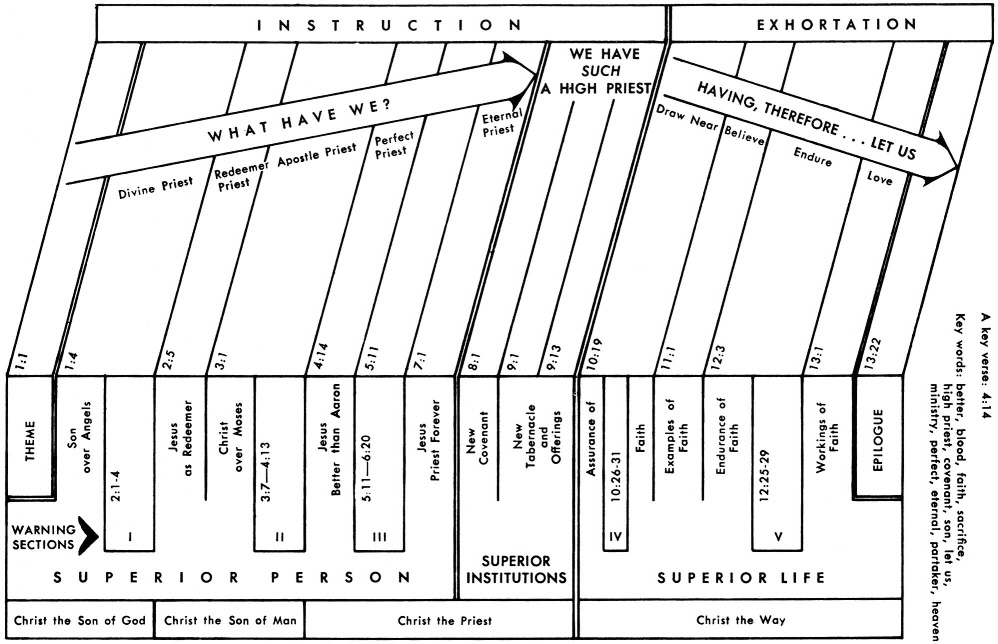
CONSIDER JESUS OUR GREAT HIGH PRIEST
Click chart to enlarge
Charts from Jensen's Survey of the NT - used by permission
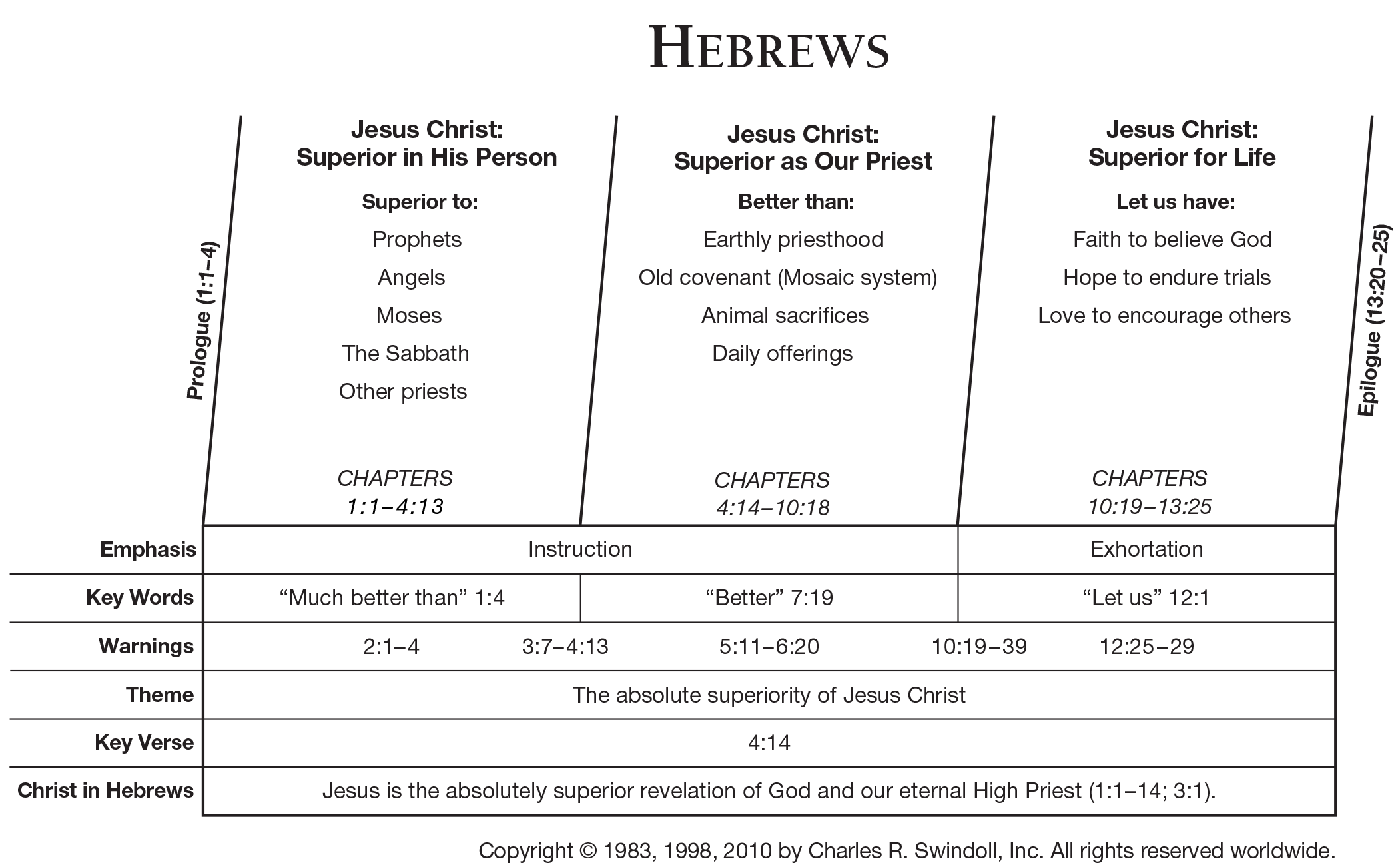
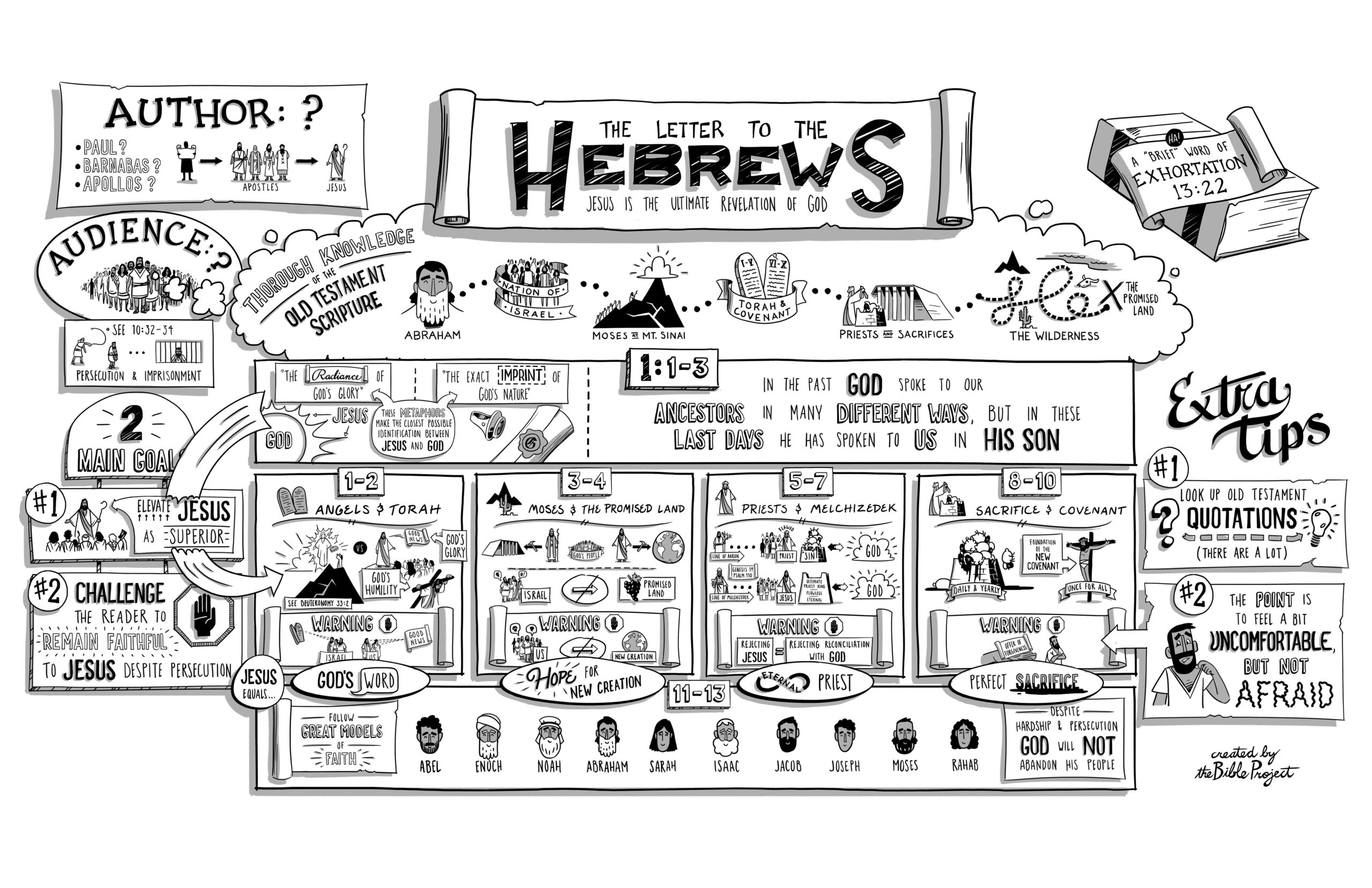
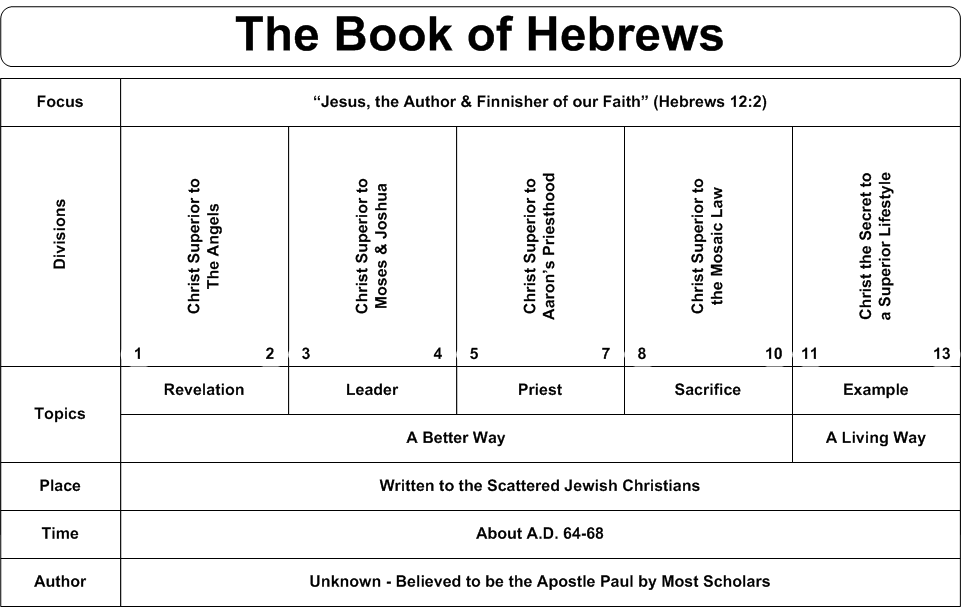
Swindoll's Chart, Interesting Pictorial Chart of Hebrews, Another Chart
|
The Epistle |
||||
| INSTRUCTION Hebrews 1-10:18 |
EXHORTATION Hebrews 10:19-13:25 |
|||
| Superior Person of Christ Hebrews 1:1-4:13 |
Superior Priest in Christ Hebrews 4:14-10:18 |
Superior Life In Christ Hebrews 10:19-13:25 |
||
| BETTER THAN PERSON Hebrews 1:1-4:13 |
BETTER PRIESTHOOD Heb 4:14-7:28 |
BETTER COVENANT Heb 8:1-13 |
BETTER SACRIFICE Heb 9:1-10:18 |
BETTER LIFE |
| MAJESTY OF CHRIST |
MINISTRY OF CHRIST |
MINISTERS FOR CHRIST |
||
|
DOCTRINE |
DUTY |
|||
|
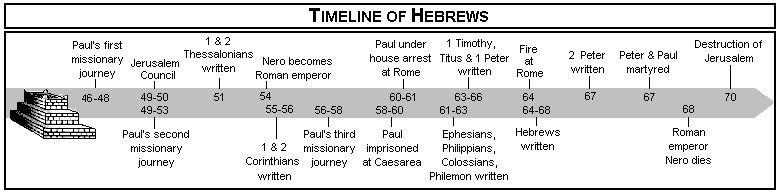
DATE WRITTEN: |
||||

See ESV Study Bible "Introduction to Hebrews"
(See also MacArthur's Introduction to Hebrews)
Borrow Ryrie Study Bible
Hebrews 8:7 For if that first covenant had been faultless, there would have been no occasion sought for a second. (NASB: Lockman)
Greek: Ei gar e prote ekeine en (3SIAI) amemptos, ouk an deuteras ezeteito (3SIPI) topos;
BGT Εἰ γὰρ ἡ πρώτη ἐκείνη ἦν ἄμεμπτος, οὐκ ἂν δευτέρας ἐζητεῖτο τόπος.
Amplified: For if that first covenant had been without defect, there would have been no room for another one or an attempt to institute another one. (Amplified Bible - Lockman)
NLT: If the first covenant had been faultless, there would have been no need for a second covenant to replace it. (NLT - Tyndale House)
Wuest: For if that first testament had been faultless, in that case there would not have been a constant searching out of a place for a second.
Young's Literal: for if that first were faultless, a place would not have been sought for a second.
NKJ For if that first covenant had been faultless, then no place would have been sought for a second.
NET For if that first covenant had been faultless, no one would have looked for a second one.
CSB For if that first covenant had been faultless, there would have been no occasion for a second one.
ESV For if that first covenant had been faultless, there would have been no occasion to look for a second.
NIV For if there had been nothing wrong with that first covenant, no place would have been sought for another.
Paraphrase If the first agreement had been perfect, God would not have needed to provide another.
Paraphrase Since the old covenant was incomplete, it required replacement by a new one.
Paraphrase If the Mosaic covenant had been sufficient, there would have been no reason for a new covenant to be introduced.
- Hebrews 8:6; 7:11,18; Galatians 3:21
- Hebrews 8 Resources - Multiple Sermons and Commentaries
WHY A NEW COVENANT
WAS NEEDED
Hebrews 8:7 provides the rationale for introducing the New Covenant. The writer argues that if the first covenant—the Mosaic Covenant—had been flawless and sufficient, there would have been no reason for God to establish another. The very fact that Scripture speaks of a “new” covenant implies the inadequacy of the old. This verse functions as a transition: it does not denigrate God’s law or covenant, but it highlights its limitations in producing inward transformation and lasting forgiveness. By pointing out the imperfection of the old, the author sets the stage for the necessity and glory of the covenant mediated by Christ.
For (gar) is a term of explanation- What is the writer explaining? He is explaining is explaining the necessity of the new covenant, showing that the promise of a second proves the insufficiency of the first.
For if that first (protos) covenant (diatheke) had been faultless (amemptos), there would have been no (ou, ouk - absolutely negates following) occasion (topos) sought (zeteo) for a second (the New Covenant) - That first (protos) refers to the first covenant, the Mosaic covenant, the Old Covenant, the covenant of Law. Faultless (amemptos) does not say the problem was with God’s law (which is holy and good, Ro 7:12), but with God's people who could not keep it (Heb 8:8)! In context, faultless (amemptos) doesn’t mean morally evil, but insufficient, unable to accomplish full salvation. Thus, it was not blameless in the sense of being fully adequate, for it had a "design flaw by intention" -- it could expose sin but not remove it. The Law could "diagnose" sin, but could not cure sin! The “fault” was its inability to accomplish salvation, perfect the conscience and bring people into permanent fellowship with God. The very promise of a “new covenant” (Jer 31, quoted in Heb 8:8–12) shows that the old one was provisional.
In other words, if the Old Covenant could have done its job there would have been no need for the New Covenant. But the Law could not change man. It was therefore useless (Heb 7:18) and therefore unfruitful or weak in our lives (Ro 8:3) because it could not change us. So, what does God do?
Gromacki - The first covenant, the Mosaic Law with its attendant Levitical priestly system, was not “faultless” (amemptos). Since God gave the legal covenant, it was good and perfect in itself (James 1:17). It was truth and achieved its divine purpose. It was never intended to produce justification within the Israelite (Gal. 3:21). The law possessed fault only in that it depended upon man for its fulfillment, and therein was the problem. Paul commented: “For what the law could not do, in that it was weak through the flesh …” (Rom. 8:3). If the first covenant could have imparted eternal life to that person who obeyed it, then why did God promise to give Israel a new covenant? The prediction of the second demonstrates the temporary nature of the first and the replacement of the first by the second. (Stand Bold in Grace: An Exposition of Hebrews)
If - This if is a condition of the second class which assumes that the old covenant was not faultless. This would be perceived as quite a serious accusation and so the writer hastens to explain his reasons for such a "blasphemous" (not in truth but possibly to ears of some of his Jewish hearers) statement.
An obviously false statement is used
to make a theological point.
As Bob Utley explains the IF "is another SECOND CLASS CONDITIONAL SENTENCE, which is called contrary to fact (cf. IF in Hebrews 8:4). This is a major point of the argument. An obviously false statement is used to make a theological point. The first covenant did not produce the desired result of restoration and righteousness.
The writer had made a similar statement regarding the "inadequacy" of the Levitical priesthood writing...
Now if perfection (ED: making man acceptable to God giving him complete communion with God - the sacrificial Levitical system never achieved this goal) was through the Levitical priesthood (for on the basis of it the people received the Law), what further need was there for another priest to arise according to the order of Melchizedek, and not be designated according to the order of Aaron? (Hebrews 7:11+) (cf. all the second class conditional statements in Hebrews = Heb. 4:8; 7:11; 8:4,7; 10:2; 11:15)
Steven Cole - As I mentioned in our study of Heb 7:11-19, the idea of the Law of Moses being defective in any way would have been unthinkable for the Jews! The Law was the foundation of their entire way of life. It was the basis of their religious worship, which was the very warp and woof of being a Jew. In chapter 7, the author argued that the change of the priesthood required a change of the law also, since the two were inextricably bound together. He used Psalm 110:4 to show that David had predicted the change of the priesthood. Here, he cites Jeremiah 31 to show that the Old Testament itself also predicted a new covenant that would replace the old, Mosaic covenant. The reason for replacing the old covenant was that it was defective. (A Better Priest for a Better Covenant)
C H Spurgeon - WHEN God gave to Israel His law—the law of the first covenant—it was such a holy law that it ought to have been kept by the people. It was a just and righteous law, concerning which God said, “You must carry out my regulations, and you must observe my statutes by following them; I am Yahweh your God. And you shall observe my statutes and my regulations by which the person doing them shall live; I am Yahweh” (Lev 18:4–5). The law of the ten commandments is strictly just; it is such a law as a man might make for himself if he studied his own best interests and had wisdom enough to frame it aright. It is a perfect law, in which the interests of God and man are both studied. It is not a partial law, but impartial, complete, and covering all the circumstances of life. You could not take away one command out of the ten without spoiling both tables of the law, and you could not add another command without being guilty of making a superfluity. The law is holy, and just, and good; it is like the God who made it, it is a perfect law. Then, surely, it ought to have been kept. In the economy of grace of which our Lord is the surety no fault can be found, and in it there is no fuel for decay to feed upon. There is nothing about it that is weak and unprofitable, for it is “ordered in all things and sure” (2 Sam 23:5). “He takes away the first” (Heb 10:9), not that He may set up another that shall be removed in its turn, but “in order to establish the second.” In this second we have covenant purposes from eternity unalterable, love infinite and changeless, promises sure and inviolable, and pledges given that can never be withdrawn, for the Lord has sworn and will not repent.
Although this is somewhat redundant, let's make sure we understand what was the fault of the first covenant -- Although the Law is holy, and the commandment is holy and righteous and good (Ro 7:2+), the law could never save a person, but could only lead him or her to see their need for salvation. (SEE PURPOSE OF THE LAW) To seek to obey the law in an attempt to merit salvation is to arouse the flesh (Ro 7:5+, Ro 7:7-8+, 1Co 15:56+ - AS A PRACTICAL ASIDE - THIS IS THE DANGER OF LEGALISM! IT STIRS UP THE FLESH!!! See Ray Stedman's excellent discussion of Legalism) and put one's self in a yoke of bondage to the Law. As sinners, we are unable to keep God’s holy Law in reliance on our own power. The Old Covenant did not supply the new heart (Ezek 36:26+) or the enabling ministry of the Spirit (Ezek 36:27+) without which we cannot obey the Law. The old covenant failed to bind Israel to their God, but as he explains in the next verse, the ultimate cause of this failure lay in the character of the people, not in character of the covenant.
Writing to the believers in Galatia who were being tempted by the Judaizers to come under the yoke of the law (the Old Covenant), Paul reasoned rhetorically...
Is the Law then contrary to the promises of God? May it never be! For if a law had been given which was able to impart life, then righteousness would indeed have been based on law. (Galatians 3:21+) (See related notes on the Purpose/Effect of the Law)
Faultless (273) (amemptos from a = negative + mémphomai = find fault, blame) means blameless, irreproachable, faultless, without defect or blemish, not being able to find fault in someone or some thing. The idea is that the Old Covenant was not flawless. Luke 1:6 – Zacharias and Elizabeth were “blameless in all the commandments.” Philippians 2:15 – Believers are to be “blameless and innocent.” Philippians 3:6 – Paul was “blameless” in legal righteousness. 1 Thessalonians 3:13 – God will establish hearts “blameless in holiness.” Hebrews 8:7 – “If that first covenant had been faultless …” So, amemptos usually describes a person who cannot be accused of wrongdoing but in Hebrews 8:7 it describes the covenant itself.
AMEMPTOS - 5V blameless(2), blamelessly(1), faultless(1), without blame(1). Lk. 1:6; Phil. 2:15; Phil. 3:6; 1 Thess. 3:13; Heb. 8:7
Related Resources:
- Covenant: New Covenant in the Old Testament
- Covenant: Why the New is Better
- Covenant: Abrahamic vs Old vs New
- Hebrews 8:1-13 Hebrews and the New Covenant - Excellent review of Hebrews 8:1-13 by Dr S Lewis Johnson former professor of Systematic Theology at Dallas Theological Seminary
KJV Bible Commentary (online) has an interesting discussion of if that first covenant had been faultless.
The author again takes up the point which he had mentioned in 7:11, that the Law and the corresponding levitical priesthood could not bring men to the necessary perfection. Its fault was that it could not save (Rom 3:20), nor could it sanctify (Rom 7:12–24; 8:2–3). Yet, we must not assume that the Law has failed to do its work; for its work was not to save, but to reveal sin (Rom 3:19–20), making men aware of their sin and condemnation (Rom 4:15; Deut 27:26). The Law manifests sin’s terrible nature (Rom 7:7–13) and extent (Rom 5:20). Furthermore, the Law was given to actively restrain sin (Gal 3:23; 1 Tim 1:9–10).
But the Law was never intended to be God’s final program, or even His first. It was not first, for Paul says “it was added”; nor was it final, for it was only given “… till the seed should come to whom the promise was made …” (Gal 3:19, cf. Gal 3:23–25). God first made the promise (the Old Covenant) with Abraham. During the interval, before the promise was fulfilled, the Law was added until Christ should come. He has now come, and the Mosaic law has passed away. Scriptural proof is abundant (Rom 6:14; 7:1–6; Gal 3:10, 13, 19–25; 1 Cor 9:20; 2 Cor 3:11–13). Its removal, however, did not involve its destruction (Mt 5:17–18), but its fulfillment. Christ has attained the righteous goal toward which the Law was directed (Rom 10:4). He has paid its penalty on behalf of others, and so He has fulfilled its demand (Gal 3:10–13). Thus, the believer is now free from the Law and united with Christ (Rom 7:1–6; Gal 2:19–20; 3:19–25). The unsaved man, however, still lives under its convicting and condemning work (1 Tim 1:8–11).
Larry Richards - DEVOTIONAL New! (Heb. 8:7–13) (Borrow The 365 day devotional commentary)
Advertising Age pointed out long ago that the two most attractive things a seller can say about his product are “New!” and “Free!”
But that’s not always the case. I have a six-year-old van, with about 70,000 miles on it. I don’t want a new one. I plan to keep this one till it runs up at least 300,000 miles. Why get something new if what you have works perfectly well?
Yet that’s just the point the writer was making in Hebrews 8. The old system of Law didn’t work (vv. 7, 9, 13). The covenant made by Moses, called the Old Covenant here, was “obsolete and aging” almost before it was given.
What makes the New Covenant God has made with us in Christ superior? Two things. It provides complete and full forgiveness for all our wicked acts (v. 12). Because Christ has paid for our sins, God is no longer obligated to “remember”—in the sense of punish—our sins.
And, the New Covenant operates to “put My laws in their minds, and write them on their hearts.” The Old Covenant engraved standards that human beings proved unable to meet on tablets of stone. The New Covenant engraves the desire to please God in our inmost being, and moves us to do the very things Law demanded, but could not produce.
When it comes to faith, “New!” truly is a sell word. Those who have tried everything else, and failed to become the kind of person they, and God, want them to be, can turn to Jesus and find themselves forgiven and renewed.
And, in case you didn’t notice, the other sell word applies too. The salvation offered us in Christ, costs us nothing.
Hebrews 8:1–6 reminds us that everything in the Old Testament system had significance, but that the significance was primarily symbolic. The gifts and offerings made by Old Testament priests were vivid illustrations of what Jesus would do in the heavenly sanctuary of which the earthly tabernacle and temple were merely “copies and shadows.” Christ is the reality, and His work has won us a full salvation.
Personal Application
The best advertisement for Christianity is the new and improved Christian.
Quotable
“We ought to be Christians in large type, so that it would not be necessary for others to be long in our society, or to regard us through spectacles, in order to detect our true discipleship. The message of our lives should resemble the big advertisements which can be read on the street by all who pass by.”—F.B. Meyer
Hebrews 8:8 For finding fault with them, He says, "BEHOLD, DAYS ARE COMING, SAYS THE LORD, WHEN I WILL EFFECT A NEW COVENANT WITH THE HOUSE OF ISRAEL AND WITH THE HOUSE OF JUDAH (NASB: Lockman)
Greek: memphomenos (PMPMSN) gar autous legei, (3SPAI) Idou (AAM) hemerai erchontai, (3PPMI) legei (3SPAI) kurios, kai sunteleso (1SFAI) epi ton oikon Israel kai epi ton oikon Iouda diatheken kainen,
BGT μεμφόμενος γὰρ αὐτοὺς λέγει· ἰδοὺ ἡμέραι ἔρχονται, λέγει κύριος, καὶ συντελέσω ἐπὶ τὸν οἶκον Ἰσραὴλ καὶ ἐπὶ τὸν οἶκον Ἰούδα διαθήκην καινήν,
Amplified: However, He finds fault with them [showing its inadequacy] when He says, Behold, the days will come, says the Lord, when I will make and ratify a new covenant or agreement with the house of Israel and with the house of Judah. (Amplified Bible - Lockman)
NLT: But God himself found fault with the old one when he said: "The day will come, says the Lord, when I will make a new covenant with the people of Israel and Judah. (NLT - Tyndale House)
Wuest: For, finding fault with them He says, Behold, days come, says the Lord, and I will consummate with the house of Israel and the house of Judah a testament new in quality
Young's Literal: For finding fault, He saith to them, `Lo, days come, saith the Lord, and I will complete with the house of Israel, and with the house of Judah, a new covenant,
KJV For finding fault with them, he saith, Behold, the days come, saith the Lord, when I will make a new covenant with the house of Israel and with the house of Judah:
NKJ Because finding fault with them, He says: "Behold, the days are coming, says the LORD, when I will make a new covenant with the house of Israel and with the house of Judah--
NET But showing its fault, God says to them, "Look, the days are coming, says the Lord, when I will complete a new covenant with the house of Israel and with the house of Judah.
CSB But finding fault with His people, He says: Look, the days are coming, says the Lord, when I will make a new covenant with the house of Israel and with the house of Judah--
ESV For he finds fault with them when he says: "Behold, the days are coming, declares the Lord, when I will establish a new covenant with the house of Israel and with the house of Judah,
NIV But God found fault with the people and said: "The time is coming, declares the Lord, when I will make a new covenant with the house of Israel and with the house of Judah.
Paraphrase God, finding fault with the people, declared He would establish a new covenant with Israel and Judah.
Paraphrase Because of their failure, God promised a fresh covenant for His people.
Paraphrase Seeing their unfaithfulness, God foretold through Jeremiah that He would make a new covenant with His chosen people.
- he says: Jer 31:31-34
- the days: He 10:16,17 Jer 23:5,7 30:3 31:27,31-34,38 Lu 17:22
- a new: He 9:15 12:24 Mt 26:28 Mk 14:24 Lu 22:20 1Co 11:25 2Co 3:6
- covenant : Isa 55:3 Jer 32:40 33:24-26 Eze 16:60,61 37:26
- Hebrews 8 Resources - Multiple Sermons and Commentaries
Related Passages:
Jeremiah 7:23-24 (GOD FINDS FAULT WITH HIS PEOPLE, NOT HIS LAW!) “But this is what I commanded them, saying, ‘Obey My voice, and I will be your God, and you will be My people; and you will walk in all the way which I command you, that it may be well with you.’ 24 “Yet they did not obey or incline their ear, but walked in their own counsels and in the stubbornness of their evil heart, and went backward and not forward. (THEIR DISOBEDIENCE BEGAN WITH A GOLDEN CALF IN 1440 AND CONTINUED FOR THE NEXT 14 CENTURIES! MOST OF ISRAEL WAS LOST -- WHICH YOU MAY FIND SHOCKING -- BUT NOTE THAT GOD ALWAYS PRESERVED A REMNANT OF JEWS WHO WERE TRUE BELIEVERS. STUDY THE REMNANT OF ISRAEL)
Isaiah 59:20-21 “A Redeemer will come to Zion, And to those who turn from transgression in Jacob,” declares the LORD. 21 “As for Me, this is My covenant with them,” says the LORD: “My Spirit which is upon you, and My words which I have put in your mouth shall not depart from your mouth, nor from the mouth of your offspring, nor from the mouth of your offspring’s offspring,” says the LORD, “from now and forever.”
Romans 11:25-27+ For I do not want you, brethren, to be uninformed of this mystery–so that you will not be wise in your own estimation–that a partial hardening has happened to Israel until the fullness of the Gentiles has come in; 26 and so all Israel will be saved; just as it is written, “THE DELIVERER WILL COME FROM ZION, HE WILL REMOVE UNGODLINESS FROM JACOB.” 27 “THIS IS MY COVENANT WITH THEM, WHEN I TAKE AWAY THEIR SINS.”
THE FAULT WAS WITH THEM
GOD DECLARES A NEW COVENANT
The writer now quotes directly from the prophet Jeremiah (quoting the Septuagint of Jer 31:31–34+), showing that God Himself had already foretold the inadequacy of the Old Covenant and given the promise of a new one. In other words, the very fact that God announced in the Old Testament a “new covenant” proves that the first was temporary and insufficient. Israel’s unfaithfulness (“finding fault with them”) brought about the need for something better. This verse introduces the divine promise of a covenant not based on external law but written on the heart, a covenant secured by Christ’s perfect mediation. In this way, the author grounds his argument, not in human reasoning, but in the authority of God’s Word through the prophets,with whom his Jewish readers would be very familiar.
For (gar) is a term of explanation - What is the writer explaining? He is explaining why the first covenant failed (why it was not faultless) and why a new covenant was necessary. In short, the fault was not with the old covenant but with the people! He is also explaining why God introduced the promise of a new covenant, as the “for” leads into Jeremiah’s prophecy as the divine proof that the old covenant was insufficient. To say it another way, the “for” signals that Jeremiah 31 is the explanatory evidence of verse 7’s claim. NET Note translates "for" as "but" and explains ""for," but providing an explanation of the God-intended limitation of the first covenant from v. 7."
Finding fault (memphomai) with them, He says, "BEHOLD (idou), DAYS ARE COMING (erchomai - present tense), SAYS (present tense) THE LORD (kurios), WHEN I WILL EFFECT (sunteleo - NET = "will complete") A NEW (kainos) COVENANT (diatheke) WITH THE HOUSE OF ISRAEL AND WITH THE HOUSE OF JUDAH - In Hebrews 8:8-12 we encounter the the longest Old Testament quotation in the New Testament. Note that the new covenant was NOT established in the time of Jeremiah, but was a prophetic promise (note) to be fulfilled in the the future.
Finding fault (memphomai) in the present tense indicates God was continually finding fault with His chosen people, who repeatedly broke His covenant. They in effect continually (century after century) rebelled against Him like an unfaithful wife (see verse 32 in the Jeremiah 31 passage below). The problem with the Old Covenant was not bad laws, but bad hearts! Paul had clearly written that "the Law is holy, and the commandment is holy and righteous and good." (Ro 7:12+)
NET Note The "fault" or limitation in the first covenant was not in its inherent righteousness, but in its design from God himself. It was never intended to be his final revelation or provision for mankind; it was provisional, always pointing toward the fulfillment to come in Christ.
With them emphasizes the writer's shift of language from the covenant to the people. After saying the Old Covenant was not faultless, he comes to the essence of the problem and finds fault with the people. The primary problem was not the Old Covenant per se, but the failure of the Jews to keep the Old Covenant "for they did not continue (persevere in, hold fast to, remain true to, or abide) in (God's old) covenant." (Heb 8:9+).
Warren Wiersbe on finding fault (memphomai) with them - Note that God does not find fault with the Old Covenant, but with the people themselves. The Law is spiritual, but men are carnal, “sold under sin,” says Rom. 7:14; and Rom. 8:3 makes it clear that the Law was “weak through the flesh.” In other words, the failure of Israel could not be blamed on any weakness in the Old Covenant, but on the weakness of human nature. It is here, then, that grace steps in; what the Law could not do because of man’s weakness, God accomplished through the Cross. (Borrow Wiersbe's Expository Outlines on the New Testament)
Technical note on DAYS ARE COMING (erchomai - present tense) - The present tense here is what grammarians often call the “futuristic present” or “prophetic present.” It portrays the future event as if it is already in motion. The certainty is so strong that the prophet speaks of it as already coming. This emphasizes inevitability—the fulfillment is not in doubt. Example parallels: Amos 8:11: “Behold, days are coming…” (future judgment certain). John 4:23: “But an hour is coming, and now is…” (Jesus speaks of the future worship reality as already unfolding). The idea is also that God is not passively waiting but His plan is already set in motion. It conveys God’s sovereign control of history—what He declares is so certain it can be described in present time. It highlights hope for the hearers—the “coming days” of restoration, new covenant, or judgment are already rolling toward them like a wave. This is not a possibility but a certainty—it is already on its way.
It is clearly stated that the new covenant is to be made
with the house of Israel and with the house of Judah....
Since the two divisions of the kingdom (Israel-Judah) are distinguished,
this is clearly a literal promise.
Ray Stedman makes a very important comment on the need to read God's prophetic promise literally (and not symbolically or allegorically - see discussion of the rise and danger of allegorical interpretation) - In Heb 8:10–12, the gracious provisions of the new covenant are detailed. It must not be ignored that in both the original passage from Jeremiah and here, it is clearly stated that the new covenant is to be made with the house of Israel and with the house of Judah. Both Hebrews 8:8 ("days are coming") and Hebrews 8:10 ("after those days") refer to a time when this occurs. Since the two divisions of the kingdom (Israel-Judah) are distinguished, this is clearly a literal promise. Such a time will indeed come when the ancient divisions will be forgotten and Israel shall be one nation living in the land promised them. Ezekiel confirms this in Ezekiel 37:15–23+. At that time, he states, God promises to cleanse them, and “they will be my people, and I will be their God,” the very words used by Jeremiah as the main provision of the new covenant (Heb 8:10). This, too, is the substance of Isaiah’s awed prophecy: "Who has ever heard of such a thing? Who has ever seen such things? Can a country be born in a day or a nation be brought forth in a moment? Yet no sooner is Zion in labor than she gives birth to her children." (Is 66:8) New Testament support for a time when Israel will be saved is found in Paul’s words, paraphrasing Isaiah 59:20–21: “The deliverer will come from Zion; he will turn godlessness away from Jacob. And this is my covenant with them when I take away their sins” (Rom 11:26–27+). (Hebrews 8:7-13 The Better Covenant)
As an aside, I find it most interesting that many commentators on Hebrews avoid rendering any definitive interpretation of the phrase the house of Israel and the house of Judah, (a combination that occurs as a literal description 4 times in the Old Testament - Jer 5:11, Jer 11:10, Jer 31:27, Jer 33:14 in addition to Jer 31:31). It would seem most reasonable that a writer speaking to Jewish readers would be using these terms literally and not allegorically of the church as is sadly often promulgated by replacement theologians.
The statement concerning those with whom
this covenant is made is very precise.
KJV Bible Commentary (online) on with the house of Israel and with the house of Judah - The statement concerning those with whom this covenant is made is very precise. It involves the Jewish people at a time when they will again be united. When Jeremiah revealed this prophecy, Israel was scattered throughout the Middle East and Judah had just recently begun its exile in Babylon. This New Covenant made with the Jewish people would come after they were regathered to Israel (Jer 30:1–3) and after a time of severe tribulation identified as “the time of Jacob’s trouble” (Jer 30:7+).
William Lane - The treatment of the two covenants in vv 7–8a exhibits the eschatological outlook of the writer. At the level of historical events, the covenant mediated by Moses had developed faults on the human side and has been replaced by a better arrangement. The super session of the old covenant was not due simply to the unfaithfulness of the people to the stipulations of the covenant. It occurred because a new unfolding of God’s redemptive purpose had taken place, which called for new covenant action on the part of God. That God took the initiative in announcing his intention to establish a new covenant with Israel (v 8a) indicates that he fully intended the first covenant to be provisional (cf. R. A. Harrisville, The Concept of Newness in the New Testament [Minneapolis: Augsburg, 1960] 48–53). Thus God finds fault (memphomenos) with the Mosaic covenant, and not simply with the people (see above, Notes) (See Hebrews 1-8, Volume 47A)
Bob Utley - "For finding fault with them" Not the Law (cf. Matt. 5:17-19), but human weakness was the problem (cf. Rom. 7:12,16; Galatians 3). This introduces the longest OT quote in the NT. Verses 8-12 are a sustained quote from Jer. 31:31-34. Notice "He" refers to YHWH; however, in Heb. 10:15 this same phrase is attributed to the Holy Spirit. The inspiration of the OT is sometimes ascribed to the Spirit and sometimes to the Father.
He says - God (present tense - continually - it was present tense in the Greek of Jer 31:31 and so He is still speaking this now) spoke prophetically through Jeremiah of a new covenant based on grace which would replace the first covenant based on law. To say it another way the writer is not simply citing a past prophet, but is presenting Jeremiah’s words as God’s current testimony to his readers.The writer quotes God's declaration in Jeremiah 31:31-34+ (note that the quotation is not from the Hebrew text but from the Greek Septuagint - LXX) which reads...
31 "Behold, days are coming," declares the LORD, "when I will make a new covenant with the house of Israel and with the house of Judah, 32 not like the covenant which I made with their fathers in the day I took them by the hand to bring them out of the land of Egypt (Old Covenant, Mosaic Covenant, "the law"), My covenant which they broke, although I was a husband to them (Israel is the wife of Jehovah - cp Isa 54:4 addressed to Israel - "your husband is your Maker")," declares the LORD. 33 "But this is the covenant which I will make with the house of Israel after those days," declares the LORD, "I will put My law within them, and on their heart I will write it; and I will be their God, and they shall be My people. 34 "And they shall not teach again, each man his neighbor and each man his brother, saying, 'Know the LORD,' for they shall all know Me, from the least of them to the greatest of them," (The following are not quoted here but are vitally important passages for evangelicals to understand) 35 Thus says the LORD, Who gives the sun for light by day, and the fixed order of the moon and the stars for light by night, Who stirs up the sea so that its waves roar; The LORD of hosts is His name: 36 "If this fixed order (sun, moon, stars) departs from before Me," declares the LORD, "Then the offspring of Israel also shall cease From being a nation before Me forever." (Classic "if...then" passage) 37 Thus says the LORD, "If the heavens above can be measured, And the foundations of the earth searched out below, Then I will also cast off all the offspring of Israel For all that they have done," declares the LORD. (God's point is that He has not cast Israel aside, even today when most of the Jews in Israel are not "religious". He is not finished with Israel as so many teach today, but these promises will be completely and literally fulfilled at the Second Coming of the Messiah. Notice that the following passages for example are part of God's covenant promise -- albeit not mentioned in the NT -- and they will be fulfilled.) 38 "Behold, days are coming (this time phrase is identical to verse 31 - this is the same covenant!)," declares the LORD, "when the city shall be rebuilt for the LORD from the Tower of Hananel to the Corner Gate. 39 "And the measuring line shall go out farther straight ahead to the hill Gareb; then it will turn to Goah. 40 "And the whole valley of the dead bodies and of the ashes, and all the fields as far as the brook Kidron, to the corner of the Horse Gate toward the east, shall be holy to the LORD; it shall not be plucked up, or overthrown anymore forever."
The writer considers this passage so important for his readers to grasp that he reiterates the covenant promises in part in Hebrews 10:16; 17...
THIS IS THE COVENANT THAT I WILL MAKE WITH THEM AFTER THOSE DAYS, SAYS THE LORD: I WILL PUT MY LAWS UPON THEIR HEART, AND UPON THEIR MIND I WILL WRITE THEM," He then says, 17 "AND THEIR SINS AND THEIR LAWLESS DEEDS I WILL REMEMBER NO MORE." (Heb 10:16-17+)
Notice the writer's logic (compare similar line of reasoning in Heb 4:8+, He 7:11+, Heb 8:4+) - The writer declares that if there had been nothing wrong with the first covenant, there would have been no need for another covenant. But in fact as already suggested the first covenant was not faultless because the Jews could not keep their promises to fulfill it as they vowed in Exodus 24 (even making a golden calf idol shortly after making their vows)...
Then Moses came and recounted to the people all the words of the LORD and all the ordinances (The Old Covenant, the First Covenant); and all the people answered with one voice, and said, "All the words which the LORD has spoken we will do!" (Exodus 24:3+)
The first covenant lacked the power to energize their obedience because it was on tablets of stone, not on the tablets of their heart and mind as in the New Covenant. Although not stated in this section, another critical promise of the New Covenant was a new "Person" Who would provide a new power to fulfill the requirements of the Law, God prophesying in Ezekiel...
Moreover, I will give you a new heart and put a new spirit within you; and I will remove the heart of stone from your flesh and give you a heart of flesh. And I will put My Spirit within you and cause you to walk in My statutes, and you will be careful to observe My ordinances. (Ezekiel 36:26,27+)
In short, the old covenant was faulty because it did not provide enabling power for the people to live up to the terms or conditions of the Law. In other words, the old covenant did not include a provision for their inherent faultiness.
Finding fault (3201) (memphomai from same root as mempo to blame, to censure) means to blame, find fault with, accuse, impute as blameworthy. Often implies pointing out deficiency or failure. Occurs only twice in the NT, Ro 9:19, Heb 8:8. Not in the Septuagint.
Romans 9:19+ You will say to me then, “Why does He still find fault? For who resists His will?”
BEHOLD DAYS ARE COMING SAYS THE LORD: Idou hemerai erchontai legei kurios:
- He says - Jeremiah 31:31-34 - see commentary on this covenant
- Days - Heb 10:16,17; Jeremiah 23:5,7; Jer 30:3; 31:27,31-34, 38; Luke 17:22
- Hebrews 8 Resources - Multiple Sermons and Commentaries
Related Passages:
Jeremiah 23:5; 7 “Behold, the days are coming,” declares the LORD, “When I will raise up for David a righteous Branch; And He will reign as king and act wisely And do justice and righteousness in the land. (23:7) “Therefore behold, the days are coming,” declares the LORD, “when they will no longer say, ‘As the LORD lives, who brought up the sons of Israel from the land of Egypt,’
Jeremiah 30:3+ ‘For behold, days are coming,’ declares the LORD, ‘when I will restore the fortunes of My people Israel and Judah.’ The LORD says, ‘I will also bring them back to the land that I gave to their forefathers and they shall possess it.’”
Romans 11:26+ and so all Israel will be saved; just as it is written, “THE DELIVERER WILL COME FROM ZION, HE WILL REMOVE UNGODLINESS FROM JACOB.”
Zechariah 12:10+ “I will pour out on the house of David and on the inhabitants of Jerusalem, the Spirit of grace and of supplication, so that they will look on Me whom they have pierced; and they will mourn for Him, as one mourns for an only son, and they will weep bitterly over Him like the bitter weeping over a firstborn.
Zechariah 13:7-9+ “Awake, O sword, against My Shepherd, And against the man, My Associate,” Declares the LORD of hosts. “Strike the Shepherd that the sheep may be scattered; And I will turn My hand against the little ones. 8“It will come about in all the land,” Declares the LORD, “That two parts in it will be cut off and perish; But the third will be left in it. (ED: THIS 1/3 EQUATES WITH THE "ALL" IN Ro 11:26 - THAT IS "ALL" WHO BELIEVE) 9 “And I will bring the third part through the fire, Refine them as silver is refined, And test them as gold is tested. They will call on My name, And I will answer them; I will say, ‘They are My people,’ And they will say, ‘The LORD is my God.’”
THE DAWN OF A
NEW COVENANT
Behold (idou) - An interjection in the form of a command (aorist imperative) which is an urgent call for the hearer or reader to pay attention to what follows. This is important! It is notable that "behold" occurs 1058 times in the Old Testament and 223 times in the New Testament. God desires that we pay close attention to His words!
DAYS ARE COMING, SAYS THE LORD, WHEN I WILL EFFECT (sunteleo) A NEW (kainos) COVENANT (diatheke) WITH THE HOUSE OF ISRAEL AND WITH THE HOUSE OF JUDAH - I will effect is future tense so that in effect this is a prophetic promise. It begs the question "when?" or "what days? As discussed more below, days would be the church age where all believers are beneficiaries of this promise to Israel but it also (in my opinion) speaks of the last days of this age in which "all Israel will be saved." (Ro 11:26+). And how will they be saved? By grace through faith in the New Covenant.
As New Testament believers it is vitally important that we remember to whom God was (initially) addressing the covenant with its promises in Jeremiah 31:31-34. The recipients of Jeremiah's New Covenant prophecy were clearly Jews. Specifically the covenant was addressed to both the house of Israel and the house of Judah, not just to Israel!. This fact is important to keep in mind because there is a widespread tendency in the modern evangelical world to do away with God's promises to Israel (aka "replacement theology" cf What is replacement theology - supersessionism), and to say that the NT church has replaced Israel, as the "Israel of God" (phrase used in Gal 6:16 - interestingly every other NT use of "Israel" refers to [you guessed it!] ISRAEL! See discussion of - Israel of God). This is not what Scripture teaches as Paul tries to explain in Romans 11, lest the wild olive branches (the Gentiles who are grafted into the rich root of the Abrahamic Covenant) become arrogant or conceited (see Ro 11:18+; Ro 11:20+). As as aside, one of the sad ways that otherwise excellent writers do away with the promises to the house of Israel and the house of Judah is by saying these are really "symbolic." They refuse to take these literally (as they certainly would have been understood in the day Jeremiah recorded these words). E.g., Philip E Hughes (who I highly respect) says "The promise of the reunion of Israel and Judah was symbolical of the healing of every human breach." Hughes sees Israel and Judah as figures of speech but that is absurd because in the original declaration these clearly refer to the divided kingdom of Israel. Hughes is forces to make this genre of "allegorical" interpretation because this allows one to interpret literal Israel in the NT as a reference to the church.
The writer's logic is "brilliant" (because it is inspired). He appeals to one of their own prophets which means the Jewish readers would have to reject the veracity and assurance of the Old Testament, if they refused to accept the New Testament teaching on the New Covenant which is found in the Old Covenant! To reject the New Covenant, would be tantamount to rejecting their own prophet Jeremiah. Thus the writer builds his argument upon the Old Testament Scriptures, the very Word of God his readers professed to believe. This is a good example for all who would preach or teach the Word of God - base your "arguments" on the firm foundation of God's Word, including the Old Testament. There is a distinct bias I fear in modern evangelicalism to "shy away from" preaching on the Old Testament. Those pastors who shy away from teaching the Old, would be wise to remember that this was the only "Bible" the apostles and early disciples (most common term for believers in Acts) had access to. Many who applaud the oratorical, expositional skills of the prince of preachers, Charles Haddon Spurgeon, would be wise (and blessed) to emulate his example of frequent forays into the Old Testament Scriptures (for example, witness his 57 messages on the seldom taught book of Ezekiel!)
Days are coming - What days? When? Some see this only as to the times of the gospel, the times of the Messiah. If God were finished with the nation of Israel that would be a reasonable interpretation. But what if God has additional plans for Israel in the future? And as a literalist (note I am not a dispensationalist!), I agree with the commentators who favor a "dual" fulfillment, theologically speaking a soteriological (the times of the Messiah) and an eschatological fulfillment(the future time for the nation of Israel). The first fulfillment is related to the application of the truth in Jeremiah 31:31 of a new covenant which through the Gospel was made available to both Jews and Gentiles (Romans 1:16+). Although the covenant was initially given to Israel, it is clearly applicable to Gentiles who enter it by grace through faith. In other words, in terms of applying the truth of the Jeremiah passage, whenever anyone is saved, Jew or Gentile, the day has come that the New Covenant has become a reality in that person's life. On the other hand, if one views this passage to Israel through "prophetic glasses", it will be completely fulfilled (compare meaning of (sunteleo) at the time of the Lord's return, when "all Israel will be saved".
Says the Lord - As noted elsewhere but worth reiterating, this passage teaches that it was God Himself Who initiated the covenant, not man (in fact throughout Scripture, all covenants between God and man are initiated by God and never by any man.) As far as we know, Israel never asked God how it was that He would be able to fulfill the promises of the Abrahamic Covenant (which is ultimately made possible by the payment of Christ's sacrificial blood in the New Covenant, which paid the price of redemption, the very truth we celebrate when we partake of communion) to themselves who were sinners and who needed a Redeemer. But God saw their need and He provided for their need by initiating ("says the Lord") the New Covenant, which Jesus referred to as the "New Covenant in My blood" (Luke 22:20) which alludes to the need for redemption by a satisfactory Goel or Kinsman Redeemer.
In Romans, Paul explains (like the writer of Hebrews, appealing to the the Old Testament Scriptures to validate his argument)...
thus all Israel will be saved; just as it is written, "The Deliverer (the Messiah) will come from Zion. He will turn godlessness away from Jacob. And this is My covenant with them when I take away their sins." (Romans 11:26,27+).
In Revelation 19 we see the Deliverer returning at the end of the Great Tribulation (see notes beginning with Revelation 19:11 and read through the subsequent verse notes) and the beginning of the 1000 year reign of Messiah, the Millennium or Messianic Age (see also notes beginning with Revelation 20:4). It is at this future time that Zechariah's prophecy will "dovetail" with Jeremiah's prophecy, God predicting that...
"And it will come about in all the land," Declares Jehovah, "That two parts in it will be cut off and perish; but the third will be left in it. And I will bring the third part through the fire, Refine them as silver is refined, and test them as gold is tested. They will call on My name (cp, the New Covenant promise "they shall all know Me"), and I will answer them; I will say, 'They are My people,' And they will say, 'The LORD is my God.'" (cp, God's promise in Jeremiah's prophecy in Jer 31:33 - "I will be their God, and they shall be My people.") (Zechariah 13:8,9+)
The third part that Jehovah brings through the fire will be those who by grace through faith receive the Messiah as their Deliverer and their Redeemer, and all of this one third will be saved. (If you are interested in this somewhat complex, sometimes controversial subject of "What Happens to the Jews?" read Romans 11:26; 11:27+)
Related Resources:
- 14+ hour series on Israel
- Romans 9:1-5 Paul's Sorrow Concerning Israel
- Romans 9:6-13 Children of the Promise
- Romans 9:14-24 The Potter and the Clay
- Romans 9:25-33 A Remnant Will be Saved
- Romans 10:1-13 The Righteousness of God
- Romans 10:14-21 Has Israel Not Heard?
- Romans 11:1-6 God Has Not Cast Away The Jews
- Romans 11:7-15 Life from the Dead
- Romans 11:16-24 Two Olive Trees
- Romans 11:25-36 The Salvation of Israel
- Romans 11 Does God Have a Future for Israel? by Gil Rugh
WHEN I WILL EFFECT A NEW COVENANT WITH THE HOUSE OF ISRAEL AND THE HOUSE OF JUDAH: kai sunteleso (1SFAI) epi ton oikon Israel kai epi ton oikon Iouda diatheken kainen:
- New - Hebrews 9:15; 12:24; Mt 26:28; Mark 14:24; Luke 22:20; 1Cor 11:25; 2Cor 3:6
- Covenant Is 55:3; Jer 31 2:40; 33:24, 25, 26; Ezekiel 16:60,61; 37:26
- Hebrews 8 Resources - Multiple Sermons and Commentaries
Related Passages:
Jeremiah 31:31 - “Behold, days are coming,” declares the LORD, “when I will make a NEW COVENANT (Hebrew = karath chadash beriyth literally "cut a new covenant") with the house of Israel and with the house of Judah, 32 not like the covenant which I made with their fathers in the day I took them by the hand to bring them out of the land of Egypt, My covenant which they broke, although I was a husband to them,” declares the LORD. 33 “But this is the covenant which I will make (Hebrew = karath literally "cut") with the house of Israel after those days,” declares the LORD, “I will put My law within them and on their heart I will write it; and I will be their God, and they shall be My people. 34“They will not teach again, each man his neighbor and each man his brother, saying, ‘Know the LORD,’ for they will all know Me, from the least of them to the greatest of them,” declares the LORD, “for I will forgive their iniquity, and their sin I will remember no more.”
WHEN I WILL EFFECT (sunteleo - NET = "I will complete") A NEW (kainos) COVENANT (diatheke) WITH THE HOUSE OF ISRAEL AND WITH THE HOUSE OF JUDAH - I will (Heb 8:8, 8:10, 8:12) indicates that God initiates the covenant. Israel did not seek it. God's grace is initiating grace. Yes, God had found the people at fault and they deserved nothing but condemnation and yet He promised them a new covenant. How great is the Father's love!
In the original Hebrew make...COVENANT reads karath chadash beriyth literally "cut a new covenant" alluding perhaps to the slaying of victims at the inauguration of a covenant where those who bound themselves to the covenant would walk between the pieces of a slain animal saying in effect "If I break this covenant, may it happen to me as has happened to this animal." The covenant’s seriousness and binding force were affirmed through the shedding of blood. Blood had to be spilled to slay the animal and to cut the covenant, which helps us understand Jesus' words "this is My blood of the covenant." (Mt 26:28+, Mk 14:24+, Lk 22:20+ = "new covenant in My blood." 1Co 11:25+) (Study the cutting of the unconditional Abrahamic Covenant in Ge 15:10-17+, noting only God passes through the slain animal! cf another covenant in Jer 34:18,19) The Septuagint quoted by the writer of Hebrews substitutes sunteleo for the Hebrew karath, probably because sunteleo conveys God's intent to accomplish or fulfill this covenant promise to the Chosen People. Thus the NET Bible renders it "When I will complete a new covenant with the house of Israel and the house of Judah." One gets the sense that God is saying something like "I have some covenant business to finish up with Israel and Judah!"
Albert Barnes an older commentator is one who does comment on both Israel and Judah and explains by saying "the words Israel and Judah are used to denote the people of God in general." Where in the Bible are Israel and Judah ever called the people of God in general? Answer? They are not! This is the type of commentary that must be invented in an attempt to counter a literal interpretation. If you interpret it literally, you have a difficult time saying Israel in the New Testament is the church, because what are you going to do with Judah. Judah is clearly not the church! My rule of thumb is that if the plain sense (literal reading) makes good sense in context, then seek to make no other sense out of it, lest you end up with nonsense.
As both shared the exile, so both shall share
the literal and spiritual restoration.Jamieson is one of the few older commentators that tends to be more literal and thus interprets this Jer 31:31 literally writing "Therefore, the ten tribes, as well as Judah, share in the new covenant. As both shared the exile, so both shall share the literal and spiritual restoration."
OTHER PROMISES IN JEREMIAH THAT CLEARLY PROPHESY A RESTORATION OF ISRAEL AND JUDAH...
Jeremiah 3:14-18 ‘Return, O faithless sons,’ declares the LORD; ‘For I am a master to you, And I will take you one from a city and two from a family, And I will bring you to Zion.’ 15 “Then I will give you shepherds after My own heart, who will feed you on knowledge and understanding.“It shall be in those days when you are multiplied and increased in the land,” declares the LORD, “they will no longer say, ‘The ark of the covenant of the LORD.’ And it will not come to mind, nor will they remember it, nor will they miss it, nor will it be made again. 17At that time they will call Jerusalem ‘The Throne of the LORD,’ and all the nations will be gathered to it, to Jerusalem, for the name of the LORD; nor will they walk anymore after the stubbornness of their evil heart. 18 “In those days the house of Judah will walk with the house of Israel, and they will come together from the land of the north to the land that I gave your fathers as an inheritance.
Jeremiah 23:5-6 Behold, the days are coming,” declares the LORD, “When I will raise up for David a righteous Branch; And He will reign as king and act wisely And do justice and righteousness in the land. 6 “In His days Judah will be saved, And Israel will dwell securely; And this is His name by which He will be called, ‘The LORD our righteousness.’
Jeremiah 31:27 “Behold, days are coming,” declares the LORD, “when I will sow the house of Israel and the house of Judah with the seed of man and with the seed of beast.
Jeremiah 50:4–5 In those days and at that time,” declares the LORD, “the sons of Israel will come, both they and the sons of Judah as well; they will go along weeping as they go, and it will be the LORD their God they will seek. 5 “They will ask for the way to Zion, turning their faces in its direction; they will come that they may join themselves to the LORD in an everlasting covenant that will not be forgotten (THIS IS THE NEW COVENANT PROMISED IN JEREMIAH 31).
I will effect (sunteleo from teleo) is a verb that speaks of bringing something to an end, to the finish so that it is fully accomplished or fulfilled. God is guaranteeing this covenant will be accomplished. Jamieson says sunteleo means to "perfect”; “consummate.” A suitable expression as to the new covenant, which perfected what the old could not." The verb is future active pointing to God’s certain future action. The emphasis is not simply “beginning” a covenant but bringing it to full realization. He Himself will do this, which reflects His sovereign initiative, not man's initiative. This verb sunteleo even gives a sense of finality and fullness—God isn’t patching up the old covenant but is bringing something qualitatively finished into existence. As an aside the verb sunteleō implies a finished, decisive act, one that will be consummated or fulfilled at the Cross of Jesus Christ, when He actually cries out using the root verb teleo “It is finished” tetelestai, which is the perfect tense of teleo.
The New Covenant does not depend on man’s faithfulness to God
but on God’s faithful promise to man
--Warren Wiersbe
When I will effect a new covenant - As discussed elsewhere in these notes, the New Covenant was made with Israel but clearly is applicable to Gentiles. But the benefits of the New Covenant are like a health insurance policy we own but in ignorance still end up paying for medications, etc, simply because we did not understand our benefits or were "too lazy" to check the policy. How many believers really understand the benefits that are granted to them in Christ Jesus by virtue of being in (new) covenant with Him? Are you plagued by guilt for past sins you have confessed? No problem because in the New Covenant God says your sins I will remember no more (See Heb 8:12 notes on this truth). If the Holy God chooses to not remember them, why are experiencing a sense of guilt (see notes if you are confused by the phrase "forgive yourself")? Perhaps, we don't completely comprehend the benefits of the New Covenant. Or take many believers who are running the race of grace well and then begin to be put under rules or laws or "do's and don'ts" instead of remembering that God has clearly stated that He would place the law on our heart and mind. So instead of living a life of freedom, they bring themselves under a yoke of bondage to legalism in its various forms (listen to Ray Stedman's very helpful summary of Legalism or read the transcript)
Spurgeon - The tenor of the covenant of grace is, “I will,” and “they shall”; there are no ifs or buts in it. It is made up of absolute promises upon God’s part, and cannot be put in jeopardy by the acts of man; hence it is sure. The old covenant had an “if” in it, and so it suffered shipwreck. It was, “If you will be obedient then you shall be blessed,” and hence there came a failure on man’s part, and the whole covenant ended in disaster. It was the covenant of works, and under it we were in bondage until we were delivered from it and introduced to the covenant of grace, which has no “if” in it, but runs upon the strain of promise. It is “I will” and “You shall” all the way through. No longer the law graven upon the tables of stone, but the law written on the heart; no more the Lord’s command without man’s power and will to obey it, but God will renew our nature, and change our disposition, so that we shall love to do what once we loathed, and shall loathe the sins that we once loved. What a wonderful mass of mercies is included in the covenant of grace! Under the first covenant we are ruined; there is no salvation for us but under this new covenant. For this reason, let us read to our joy and comfort what the promises and provisions of that new covenant are.
Warren Wiersbe - Six times in Hebrews 8:8–13 God says “I will.” This is grace! The Old Covenant was a yoke of bondage, demanding perfect obedience. But the New Covenant emphasizes what God will do for His people, not what they must do for Him. (Borrow Wiersbe's Expository Outlines on the New Testament)
William MacDonald - the new covenant has to do primarily with the nation of Israel and not with the church. It will find its complete fulfillment when Christ comes back to reign over the repentant and redeemed nation. In the meantime some of the blessings of the covenant are enjoyed by all believers. (Borrow Believer's Bible Commentary)
G D Henderson writes "And so we distinguish between the primary interpretation to Israel, and the secondary, spiritual application to the Church today. We now enjoy in the power of the Holy Spirit the blessings of the new covenant, and yet there will be still further and future manifestations for Israel according to God’s promise." (Studies in the Epistle to the Hebrews)
John MacArthur makes an interesting statement on the New Covenant - God has never made a covenant with Gentiles, and, as far as I can see from Scripture, He never will. The New Covenant is not made with the church, as some seem to think. It is made with the same people the Old Covenant was made with: Israel. Gentiles can be beneficiaries of the New Covenant, just like they could be beneficiaries of the Old (cf. Gen 12:3). But both covenants were made with Israel alone. Israel as a nation rejected God by rejecting His Son. But God has never rejected Israel, nor has He transferred His covenant with her to anyone else.....When Gentiles are saved they become descendants of Abraham—spiritual descendants...(Gal 3:7-8+) The Abrahamic covenant is fulfilled in each of us when we accept the single requirement of the New Covenant—faith in Jesus Christ. “And if you belong to Christ, then you are Abraham’s offspring, heirs according to promise” (Gal. 3:29). For the time being, in fact, Gentiles are sharing more in the New Covenant than are Jews. But one day this will change. After Gentiles have had sufficient time to respond to the gospel, all Israel will be saved (Rom. 11:26). Her day is coming. She will be grafted back into the trunk of covenant salvation (cf. Rom 11:17–24). (See Hebrews Commentary - Page 213)
God makes no covenants with the Gentiles. Israel is the chosen channel
through which He brings salvation to the human race.
Kenneth Wuest agrees with MacArthur writing "It is important to note that the New Testament is not Christianity. The Book of Hebrews is not an argument the purpose of which is to prove that Christianity is superior to Judaism as seen in its Founder, Christ. The First Testament was a covenant made with Israel. The New Testament is also a covenant made with Israel. God makes no covenants with the Gentiles. Israel is the chosen channel through which He brings salvation to the human race. The First Testament consisted of a system of sacrifices, symbolic in their import. The New Testament is a Sacrifice, the Lord Jesus at the Cross, actual in its character, and efficacious in its merits. The First Testament began at Genesis 3:21, and ended at the Cross. The New Testament began at the Cross and is an everlasting one (Hebrews 13:20). Christianity refers to the Mystical Body of Christ of which He is the Head. This Body is composed of all who are saved from Pentecost to the Rapture. The New Testament made Christianity possible. The saints of the Church Age are saved through the Blood of the Sacrifice which was offered under the New Testament. That is the relationship between the New Testament and Christianity. The two names, Israel and Judah, refer here to the two parts of the divided nation, Israel the northern kingdom, and Judah, the southern. (Hebrews 8 Commentary)
Spurgeon - Now, rolling up that old covenant as a useless thing out of which no salvation can ever develop, God comes to us in another way and says, “I will make a new covenant with you, not like the old one at all.” (Hebrews 8:8-13.) It is a covenant of grace, a covenant made, not with the worthy, but with the unworthy; a covenant not made upon conditions, but unconditionally, every supposed condition having been fulfilled by our great Representative and Surety, the Lord Jesus Christ; a covenant without an if or a but in it; “an everlasting covenant, ordered in all things, and sure” (2 Samuel 23:5); a covenant of shalls and wills, in which God says, “I will, and you shall”; a covenant suited to our broken-down, helpless condition; a covenant that will land everyone who has an interest in it in heaven. No other covenant will ever do this.
WHAT IS NEW ABOUT
THE NEW COVENANT?
A NEW (kainos) COVENANT (diatheke) - It is new in that it is fresh and it contains the "freshness of the redemptive promises". Even the other great unconditional covenants in the Old Testament, the Abrahamic and the Davidic, did not in themselves explicitly elaborate on the redemptive promises implicit in the New Covenant, promises which form the basis for the fulfillment of the other unconditional covenants. In other words, the Abrahamic covenant needed the completion of the redemptive sacrifice of Christ to make it possible for this Old Testament covenant to have the certainty and assurance of its ultimate fulfillment. It pointed to the Seed, Christ, but it did not explain the redemptive aspect of Christ as did the New Covenant (cf, the better promise of the New Covenant "I will remember their sins no more" which equates with forgiveness.) There had to be the death and spillage of blood of a suitable sacrifice to bring about redemption. This is what Jesus was referring to when He stated that this is the blood of the (New) Covenant which is poured out for many for forgiveness of sins. Without His payment of the price of His precious blood (i.e., redemption - payment of price to buy slaves out of bondage, etc), forgiveness would not have been possible and the Abrahamic Covenant would not have had a foundation for its fulfillment.
Jesus identifies the promised blessings of the new covenant in
Jeremiah 31 as being inaugurated by his death on the cross.
David Allen has an interesting comment on the New Covenant in Jeremiah writing that "Jeremiah 31:31–34 plays a crucial role in the New Testament. In addition to Heb 9:15; 10:13; and 12:24, it is referenced by all three Synoptic Gospel writers as well as Paul concerning the Lord’s Supper (Luke 22:20; Matt 26:28; Mark 14:24; 1 Cor 11:25). Paul makes two additional references to it (Rom 11:27; 2 Cor 3:6)....The Synoptic Gospels refer to this new covenant in the last supper narratives, but it is only in Luke’s account (Luke 22:20) that the adjective “new” is used. Jesus’ use of this terminology references Jer 31:31–34. Furthermore, Jesus identifies the promised blessings of the new covenant in Jeremiah 31 as being inaugurated by his death on the cross. (See Hebrews: An Exegetical and Theological Exposition)
In the NEW (kainos) COVENANT (diatheke) God explains its better promises which are centered in the forgiveness of sins and the divine enablement (God's laws are now within = when we by grace through faith enter the New Covenant, God's Spirit gives us a "new inner control center"). When one studies the promises of the Abrahamic covenant (and the Davidic), one concludes that what God says in Jeremiah 31 about the New Covenant is essentially a "repetition" (Dr S Lewis Johnson's term) or an "extension" of these other unconditional covenants. And so this new or fresh covenant repeats or extends the Abrahamic (and Davidic) but adds the redemptive grounds for the Abrahamic (and Davidic) covenant.
WITH WHOM IS
THE NEW COVENANT MADE?
WITH THE HOUSE OF ISRAEL AND WITH THE HOUSE OF JUDAH - Note carefully that because two divisions of the kingdom are distinguished, this is clearly a literal promise, and should silence the false teaching that the church has replaced Israel! In other words, it would be ridiculous to teach that the church was "the house of Israel and the house of Judah" and try to use Galatians 6:16+ to defend that presumption! To repeat, the New Covenant is made with the house of Israel and the house of Judah, not with the Church. Why would the writer of Hebrews emphasize the two houses? Remember that the letter is addressed to Hebrew professing believers and he is seeking to deliver them from the danger that they would depart from the faith that they had professed. What better way to jolt them back to reality, then to remind the Hebrew professing believers of the great covenant that was given through Jeremiah to the Jewish people.
This distinction is vitally important because most of us are of neither Jewish house. The question arises then "How did we Gentiles "get in" if this New Covenant was not given to us?" How do we qualify? As explained elsewhere in these notes, the New Covenant is essentially a repetition or extension of the Abrahamic promises, so we can understand how Gentile believers can be the recipients of those promises. Stated another way, one can understand the New Covenant as the grounds of fulfillment of the Abrahamic Covenant. And if you look at the Abrahamic covenant, you will note that even in this covenant, provision was made for Gentile believers...
And I will bless those who bless you, and the one who curses you I will curse. And in you all the families of the earth shall be blessed. (Genesis 12:3+)
All the families would include Jews and Gentiles and so provision was made for Gentiles even in the Abrahamic Covenant. The New Covenant provides for and explains the redemptive grounds for the Abrahamic Covenant (which is an "everlasting covenant", e.g., see Genesis 17:7,8, cp the unconditional Davidic covenant which is also "an everlasting covenant" - see 2Sa 23:5). And so we see that these unconditional covenants while distinct are not wholly separate covenants but are related as part of God's so-called "covenantal program" (the everlasting Davidic covenant is also part of this "program"). And in this covenantal program, the gracious God has made provision for both Jews and Gentiles to enter into the covenant promises. Without going into great detail at this time, it should be added that Paul further explains how Gentiles ("wild olive branches") are grafted in to the rich root of the natural olive tree, this rich root representing the Abrahamic covenant that promised blessing to both Jew and Gentile through the coming Redeemer, Jesus Christ. (See Romans 11:17+, cp Galatians 3:7+ "be sure that it is those who are of faith who are sons of Abraham" where Paul speaks of Abraham's spiritual descendants as those who believe in Christ for salvation.)
Ray Stedman warns that "Though the writer of Hebrews undoubtedly applies this new covenant to the church, those commentators who deny its future application to the nation of Israel ignore great areas of Old and New Testament prophecy. (Hebrews 8:1-13 The New Covenant)
At risk of becoming too detailed, the Gentile believer who carefully reads these notes and studies the Abrahamic covenant, will conclude that although Gentile believers are spiritual descendants of Abraham, we do not inherit the specific promises of the Land (Ge 15:18ff+) that God made to Abraham that were passed on to Abraham's son Isaac and then to Isaac's son Jacob (God later changed his name to Israel), and in turn passed through Jacob (Israel - eg, see read Ge 35:9, 10, 11, 12 esp the phrase "to your descendants after you" - Gentiles are not the descendants of Jacob) to the physical Israelites who would come to believe in their Jewish Messiah (see related topic - believing Jewish remnant).
The promises of the Land of Israel will be fulfilled to those believing physical/biological Jews at the return of Messiah to set up His 1000 year kingdom (see Millennium). Stated another way, believing Gentiles do not inherit the promises made to physical/biological Jews who become believers, as is often taught by those who hold to Amillennialism (What is Amillennialism?) and believe the phrase the Israel of God (Galatians 6:16+) refers to the church (see discussion of the phrase Israel of God). Believing Gentiles do not become Jews and the believing church does not become Israel. That doesn't even sound like it makes good sense and yet it is a widely promoted belief in American churches. When Messiah returns at the end of the Great Tribulation to defeat the antichrist and the world forces arrayed against Him (and against the nation of Israel), He will establish His kingdom and bring about the final fulfillment of the covenant promises of "the Land" (of Israel - first promised in Genesis 15:18ff+). Here are a few prophecies given to the Jews (NOT THE CHURCH) and they clearly mention the promise of LAND...
Ezekiel 36:24-28+ “For I WILL take you from the nations (JEWS ARE STILL SCATTERED THROUGHOUT THE NATIONS! THIS IS YET TO BE FULFILLED), gather you from all the lands and bring you into your own LAND (WHOSE LAND? THEIR LAND!!!). 25 (NOTE HOW RESTORATION TO THE LAND PROMISES NOW LINKS UP WITH A "NEW COVENANT" PROMISE) “Then I WILL sprinkle clean water on you, and you will be clean; I WILL cleanse you from all your filthiness and from all your idols. 26 “Moreover, I WILL give you a new heart and put a new spirit within you; and I WILL remove the heart of stone from your flesh and give you a heart of flesh. 27 “I WILL put My Spirit within you and cause you to walk in My statutes, and you will be careful to observe My ordinances. 28 “You will live in the LAND that I gave to your forefathers (WHEN DID HE GIVE THE LAND TO THEIR FOREFATHERS? SEE Ge 15:18+) ; so you will be My people, and I WILL be your God.
COMMENT - THE ESV STUDY BIBLE (which I highly respect in most of their comments) LEANS TOWARD CALLING ISRAEL THE CHURCH AND MAKE THE FOLLOWING COMMENTS ON THE LAND - "The restoration of the people to the land is symbolic of, and probably implies the reality of, the return of the people to live in the presence of God." NOTE THAT WHEN ONE JETTISONS LITERAL INTERPRETATION OF THE SCRIPTURES, THEY ARE USUALLY FORCED TO INVOKE THE PREMISE THAT THIS MUST BE "FIGURATIVE." NOTE THEIR WORDS "symbolic and probably implies," THE FORMER PHRASE INDICATING THEIR FIGURATIVE INTERPRETATION AND THE LATTER PHRASE ["probably implies"] INDICATES WE HAVE ENTERED THE SPHERE OF SPECULATION! IN FAIRNESS, THEY DO GO ON AND SPEAK MORE OF "THE LAND" BUT DO NOT DEFINITELY STATE THE LAND BELONGS TO ISRAEL.
Ezekiel 36:34-35+ “The desolate LAND will be cultivated instead of being a desolation in the sight of everyone who passes by. 35 “They will say, ‘This desolate LAND has become like the garden of Eden; and the waste, desolate and ruined cities are fortified and inhabited.’
Ezekiel 37:12-14+ “Therefore prophesy and say to them, ‘Thus says the Lord GOD, “Behold, I WILL open your graves and cause you to come up out of your graves, My people; and I WILL bring you into the LAND of Israel. 13 “Then (WHEN?) you will know that I am the LORD, when I have opened your graves and caused you to come up out of your graves, My people. 14 “I WILL put My Spirit within you and you will come to life (AKA "BORN AGAIN"), and I WILL place you on your own LAND. (HOW "FUZZY" IS THIS PROMISE? THAT'S RHETORICAL OF COURSE!) Then (WHEN?) you will know that I, the LORD, have spoken and done it,” declares the LORD.’”
Ezekiel 37:21-22+ Say to them, ‘Thus says the Lord GOD, “Behold (ATTENTION GRABBER!), I WILL take the sons of Israel from among the nations where they have gone, and I WILL gather them from every side and bring them into their own land; 22 and I WILL make them one nation in the land, on the mountains of Israel; and one king will be king for all of them; and they will no longer be two nations (ISRAEL AND JUDAH - Jer 31:31, cf "I WILL give them ONE HEART" Jer 32:39+, Ezek 11:39+) and no longer be divided into two kingdoms.
Ezekiel 37:25-27+ “They will live on the LAND that I gave to Jacob My servant (LAND GIVEN TO JACOB NOT THE CHURCH), in which your fathers lived; and they will live on it, they, and their sons and their sons’ sons, forever; and David My servant will be their prince forever. 26 “I WILL make a covenant of peace with them; it will be an everlasting covenant with them. And I WILL place them and multiply them, and WILL set My sanctuary in their midst forever. 27“ My dwelling place also WILL be with them; and I WILL be their God, and they will be My people (THIS IS THE LANGUAGE OF COVENANT).
Ezekiel 39:26 They will forget their disgrace and all their treachery which they perpetrated against Me, when they live securely on their own LAND (WHOSE LAND? "THEIR OWN" = ISRAEL, THE CHURCH IS NO WHERE EVEN INTIMATED IN THESE PROPHECIES TO ISRAEL) with no one to make them afraid.
We could list other passages, but I think you get the point that one will have to do a great deal of Scriptural gymnastics to erase the truth that God made an immutable promise of LAND to the forefathers, a promise He vows to keep in the future.
This "new covenant" is specifically affirmed...to be with Israel and Judah,
not with the Christian church.
Henry Morris a literalist writes that - Hebrews 8:8-12 constitute a quotation from Jeremiah 31:31-34. Note that this "new covenant" is specifically affirmed, both by Jeremiah and here in the book of Hebrews, to be with Israel and Judah, not with the Christian church. However, since the covenant includes the promise of eternal forgiveness (Hebrews 8:12), it is evident that it applies only to those in Israel and Judah who have been redeemed through faith in Christ, not only as their Messiah but also as their Savior. See notes on Jeremiah 31:31-37, notes on Romans 11:25-26, and notes on Ezekiel 36:24-28. The promise must be fulfilled in the coming millennium, after "the time of Jacob's trouble" (Jeremiah 30:7-9) during the "great tribulation" (Matthew 24:21). At the climax of that terrible time, the people of Israel still living will all believe on Him "whom they have pierced, and they shall mourn for Him" (Zechariah 12:10). "In that day there shall be a fountain opened to the house of David and to the inhabitants of Jerusalem for sin and for uncleanness" (Zechariah 13:1). At the same time, since believers from both Israel and the Gentiles have been made one in Christ (Ephesians 2:11-18), the "new covenant," or "new testament," becomes applicable also to Gentile believers (note Matthew 26:28; 1 Corinthians 11:25; Hebrews 9:15; 12:24). (Defender's Study Bible)
Will effect (4931) (sunteleo from sun = with + telos = goal) means to end together or at the same time. To end completely; to bring to an end, finish, complete. In speaking of an activity it means to bring to an end and so to complete or finish the activity. Sunteleo means to carry out or bring into being something that has been promised or expected and thus to carry it out, fulfill it or accomplish it. "In Hebrews 8:8, the writer seems to have chosen sunteleo rather than poieo “to make,” in order to emphasize more clearly the conclusive perfecting power of the New Testament." (Kenneth Wuest)
SUNTELEO - 6V - effect(1), ended(1), finished(1), fulfilled(1), over(1), thoroughly(1). Mk. 13:4; Lk. 4:2; Lk. 4:13; Acts 21:27; Rom. 9:28; Heb. 8:8
SUNTELEO IN SEPTUAGINT - Gen. 2:1; Gen. 2:2; Gen. 6:16; Gen. 17:22; Gen. 18:21; Gen. 24:15; Gen. 24:45; Gen. 29:27; Gen. 43:2; Gen. 44:5; Gen. 49:5; Exod. 5:13; Exod. 5:14; Exod. 36:2; Exod. 40:33; Lev. 16:20; Lev. 19:9; Lev. 23:22; Lev. 23:39; Num. 4:15; Num. 7:1; Deut. 26:12; Deut. 31:1; Deut. 31:24; Deut. 32:23; Deut. 32:45; Deut. 34:8; Jos. 3:17; Jos. 4:1; Jos. 4:10; Jos. 4:11; Jos. 21:42; Jdg. 3:18; Ruth 2:23; Ruth 3:3; 1 Sam. 10:13; 1 Sam. 13:10; 1 Sam. 15:18; 1 Sam. 20:7; 1 Sam. 20:9; 1 Sam. 20:33; 1 Sam. 20:34; 1 Sam. 24:16; 1 Sam. 25:17; 2 Sam. 6:18; 2 Sam. 11:19; 2 Sam. 13:36; 2 Sam. 21:5; 2 Sam. 22:38; 1 Ki. 1:41; 1 Ki. 2:35; 1 Ki. 3:1; 1 Ki. 5:17; 1 Ki. 6:3; 1 Ki. 6:9; 1 Ki. 7:1; 1 Ki. 7:40; 1 Ki. 8:1; 1 Ki. 8:12; 1 Ki. 8:54; 1 Ki. 9:1; 1 Ki. 22:11; 2 Ki. 10:25; 1 Chr. 16:2; 1 Chr. 27:24; 1 Chr. 28:20; 2 Chr. 4:11; 2 Chr. 5:1; 2 Chr. 7:1; 2 Chr. 7:11; 2 Chr. 18:10; 2 Chr. 20:23; 2 Chr. 24:14; 2 Chr. 29:17; 2 Chr. 29:28; 2 Chr. 29:29; 2 Chr. 29:34; 2 Chr. 30:22; 2 Chr. 31:1; 2 Chr. 31:7; Est. 3:13; Est. 4:1; Est. 8:12; Job 1:5; Job 14:14; Job 15:4; Job 19:26; Job 19:27; Job 21:13; Job 33:27; Job 35:14; Job 36:11; Ps. 7:9; Ps. 119:87; Prov. 1:19; Prov. 8:31; Prov. 22:8; Isa. 1:28; Isa. 8:8; Isa. 10:12; Isa. 10:22; Isa. 18:5; Isa. 28:22; Isa. 32:6; Isa. 44:24; Isa. 46:10; Isa. 55:11; Jer. 5:3; Jer. 6:11; Jer. 6:13; Jer. 13:19; Jer. 14:12; Jer. 14:15; Jer. 15:16; Jer. 16:4; Jer. 34:8; Jer. 34:15; Lam. 2:17; Lam. 4:11; Ezek. 4:6; Ezek. 4:8; Ezek. 5:12; Ezek. 5:13; Ezek. 6:12; Ezek. 7:8; Ezek. 7:15; Ezek. 11:15; Ezek. 13:14; Ezek. 13:15; Ezek. 16:14; Ezek. 20:8; Ezek. 20:21; Ezek. 22:12; Ezek. 22:13; Ezek. 22:31; Ezek. 23:32; Ezek. 42:15; Ezek. 43:23; Dan. 5:26; Dan. 9:24; Dan. 10:3; Dan. 11:36; Dan. 12:7; Hos. 13:2; Joel 2:8; Amos 7:2; Mic. 2:1; Nah. 1:15; Zech. 5:4; Mal. 3:9;
New (2537) kainos probably from root ken [qen] = freshly come, or begun) is an adjective which refers to that which is new kind (unprecedented, novel, uncommon, unheard of). It relates to being not previously present. Compare the related noun kainotes translated newness (Freiberg defines it as "depicting something not only recent and different but extraordinary"!) in Ro 6:4+ and Ro 7:6+. Believers now have a brand new life with a brand new source of power (the Spirit) to live out that life to the full (cp Jesus' desire for all believers - Jn 10:10b)! Beloved in Christ, may this (His) "extraordinary" life be a genuine reality in our day to day experience in Christ. Amen! R. C. Trench distinguishes Neos and Kainos as follows "Contemplate the new under aspects of time, as that which has recently come into existence, and this is neos... . But contemplate the new, not now under aspects of time, but of quality, the new, as set over against that which has seen service, the outworn, the effete or marred through age, and this is kainos. (New - Trench's Synonyms of the New Testament.)
Vine adds that kainos "denotes “new,” of that which is unaccustomed or unused, not “new” in time, recent (Greek = "neos"), but “new” as to form or quality, of different nature from what is contrasted as old. As Vincent says in his discussion of kainos "All the elements of festivity in the heavenly kingdom will be of a new and higher quality.
The Open Bible notes that kainos "can be used with reference to something that has not been used before (Mt 9:17). Kainos is also used with the connotation of “remarkable” as a designation of something that is “new” and not known previously (Mk 1:27; Jn 13:34). The same word qualifies something as “new” in the sense of a replacement for something that is old and obsolete—as in the “new covenant” (Heb 8:8). Converts are “new persons” (2Co 5:17+; Ep 4:24). Kainos is used in an eschatological sense to describe the “new” heaven and earth (2Pe 3:13; Rev 21:1). (The Open Bible : New King James Version. Nashville: Thomas Nelson Publishers)
KAINOS - 36V - fresh(3), new(37), new things(1), things new(1). Matt. 9:17; Matt. 13:52; Matt. 26:29; Matt. 27:60; Mk. 1:27; Mk. 2:21; Mk. 2:22; Mk. 14:25; Mk. 16:17; Lk. 5:36; Lk. 5:38; Lk. 22:20; Jn. 13:34; Jn. 19:41; Acts 17:19; Acts 17:21; 1 Co. 11:25; 2 Co. 3:6; 2 Co. 5:17; Gal. 6:15; Eph. 2:15; Eph. 4:24; Heb. 8:8; Heb. 8:13; Heb. 9:15; 2 Pet. 3:13; 1 Jn. 2:7; 1 Jn. 2:8; 2 Jn. 1:5; Rev. 2:17; Rev. 3:12; Rev. 5:9; Rev. 14:3; Rev. 21:1; Rev. 21:2; Rev. 21:5
Hebrews 8:8 I WILL EFFECT A NEW COVENANT
Hebrews 8:13 When He said, “A new covenant,”
Hebrews 9:15 He is the mediator of a new covenant
"NEW COVENANT" APPEARS 8X/8V - Jer. 31:31; Lk. 22:20; 1 Co. 11:25; 2 Co. 3:6; Heb. 8:8; Heb. 8:13; Heb. 9:15; Heb. 12:24
Jeremiah 31:31 “Behold, days are coming,” declares the LORD, “when I will make a new covenant with the house of Israel and with the house of Judah,
Luke 22:20 And in the same way He took the cup after they had eaten, saying, “This cup which is poured out for you is the new covenant in My blood.
1 Corinthians 11:25 In the same way He took the cup also after supper, saying, “This cup is the new covenant in My blood; do this, as often as you drink it, in remembrance of Me.”
2 Corinthians 3:6; who also made us adequate as servants of a new covenant, not of the letter but of the Spirit; for the letter kills, but the Spirit gives life.
Hebrews 12:24 and to Jesus, the mediator of a new covenant, and to the sprinkled blood, which speaks better than the blood of Abel.
Covenant (1242) (see more detailed discussion of diatheke from dia = two + tithemi = to place pictures that which is placed between two. Thus, a covenant is something placed between two, an arrangement between two parties.) was a commonly used in the Greco-Roman world to define a legal transaction in settling an inheritance. Diatheke denotes an irrevocable decision, which cannot be cancelled by anyone. A prerequisite of its effectiveness before the law is the death of the disposer and thus diatheke was like a "final will and testament". In reference to the divine covenants, such as the Abrahamic covenant, diatheke is not a covenant in the sense that God came to agreement or compromise with fallen man as if signing a contract. Rather, it involves declaration of God’s unconditional promise to make Abraham and his seed the recipients of certain blessings.
In OLD Testament Covenant (01285) is berit/berith/beriyth. Diatheke is used to translate Beriyth in the Septuagint in 270 of 286 occurrences in the Hebrew text.
DIATHEKE IS A KEY WORD IN HEBREWS = 14X OUT OF 30X IN NT - Matt. 26:28; Mk. 14:24; Lk. 1:72; Lk. 22:20; Acts 3:25; Acts 7:8; Rom. 9:4; Rom. 11:27; 1 Co. 11:25; 2 Co. 3:6; 2 Co. 3:14; Gal. 3:15; Gal. 3:17; Gal. 4:24; Eph. 2:12; Heb. 7:22; Heb. 8:6; Heb. 8:8; Heb. 8:9; Heb. 8:10; Heb. 9:4; Heb. 9:15; Heb. 9:16; Heb. 9:17; Heb. 9:20; Heb. 10:16; Heb. 10:29; Heb. 12:24; Heb. 13:20; Rev. 11:19
Hebrews 7:22 Jesus has become the guarantee of a better covenant.
Hebrews 8:6 He is also the mediator of a better covenant
Hebrews 8:8 WHEN I WILL EFFECT A NEW COVENANT
Hebrews 8:9 NOT LIKE THE COVENANT WHICH I MADE WITH THEIR FATHERS
Hebrews 8:10 “FOR THIS IS THE COVENANT THAT I WILL MAKE
Hebrews 9:4 the ark of the covenant covered on all sides with gold,
Hebrews 9:15 He is the mediator of a new covenant,
Hebrews 9:16 For where a covenant is,
Hebrews 9:17 For a covenant is valid only when men are dead
Hebrews 9:20 THIS IS THE BLOOD OF THE COVENANT
Hebrews 10:16 “THIS IS THE COVENANT THAT I WILL MAKE WITH THEM A
Hebrews 10:29 regarded as unclean the blood of the covenant by which he was sanctified
Hebrews 12:24 and to Jesus, the mediator of a new covenant,
Hebrews 13:20 through the blood of the eternal covenant, even Jesus our Lord,
Puritan Daily Readings - The New Covenant
For finding fault with them, he saith, Behold, the days come, saith the Lord, when I will make a new covenant with the house of Israel and with the house of Judah. Hebrews 8:8
There is a childlike dependence upon God’s general offer, though we have not an evidence of the sincerity of our particular claim. God offers to be a Father in Christ to all penitent believers. Now, when a broken-hearted creature comes to God, and looks for mercy upon the account of the covenant, though he cannot see his own interest; for then we come to God, though not as our Father, yet as “the God and Father of our Lord Jesus Christ;” and that is a relief in prayer, “Blessed be the God and Father of our Lord Jesus Christ” (Eph. 1:3), and, verse 17, “The God of our Lord Jesus Christ, the Father of glory;” and, “I bow my knees unto the Father of our Lord Jesus Christ” (Eph. 3:14). Mark, when we come to Him as the Father of Christ, we believe what God offers in the covenant of grace—namely, that He will deal kindly with us as a father with his children; that He will be good to those that come to Him by Christ. The term Father is not only to be considered with respect to the disposition or qualification of the persons, but the dispensation they are under. It is the new covenant. In the new covenant God undertakes to be fatherly—that is, to pity our miseries, to pardon our sins, to heal our natures, to save our persons. Now all that come for refuge to take hold of this hope set before them, may come to God as a father, if they believe the gospel in general though they are not assured of God’s love to themselves.
P G Matthew - Daily Delight - The time is coming, declares the Lord, when I will make a new covenant with the house of Israel. —Hebrews 8:8
In Hebrews 8 we learn that the old Sinaitic covenant was faulty, imperfect, and temporary, though God himself had instituted it. The fault, however, lay not in God, but in his people. The old covenant placed the emphasis on Israel’s obligation. God established his covenant with Israel on Mount Sinai, and they agreed to keep it, declaring, “We will do everything the Lord has said; we will obey” (Exod. 24:7). But notice what God says about his people: “They did not remain faithful to my covenant” (Heb. 8:9). During the forty years in the wilderness, most of the Israelites were killed by God because of their unbelief and disobedience. After the next generation entered Canaan, they too proved to be unfaithful to their covenant Lord. And to a large extent, this remained the story of Israel.
Yet thanks be to God, it has always been his plan to bring about a new covenant and a new priesthood after the order of Melchizedek, as we read in Psalm 110 and Jeremiah 31. By design, then, the Aaronic priesthood and the law were temporary. The purpose of this temporary Sinaitic covenant was to bring home to our consciences a heightened awareness of our sin and moral inability, so that we would see clearly our need for the promised Savior.
In the seventh century BC, God declared through Jeremiah his intent to bring about this new covenant that would be permanent, effectual, and final. In the verses quoted from Jeremiah by the Hebrews writer, three times we see the words, “declares the Lord,” and seven times God says, “I will,” indicating that he would surely bring it about. In the fullness of time, this covenant was ratified by our mediator, Jesus Christ. He solved our sin problem once for all and now enables us to enter the presence of God so that we may worship him in spirit and in truth, and fellowship with him forever.
What, then, shall we do? Let us consider Jesus, the apostle and high priest of the new covenant. Let us consider him who lives forever to intercede for us before the Father. Let us consider him, our guarantor and mediator. Then we will be filled with all hope, power, and peace to live for God’s glory in joy inexpressible, here and hereafter.
Homer Kent has an excellent summary of the 4 interpretative views of the New Covenant: Borrow Hebrews Commentary page 156.
Four views are current today regarding the relation of the church to the new covenant:
View 1. The church has replaced Israel as the participant in the new covenant. This is the viewpoint of amillennialists, who see the nation of Israel as permanently displaced and all the blessings promised to her now fulfilled by the church. Lenski is representative of this position as he writes concerning the mention of “the house of Israel” in Hebrews 8:8:
Right here we have the universality of the new testament. Lost among the Gentiles and turned Gentile, the gospel goes out to all nations to bring the new testament in Christ’s blood to all.80
Oswald T. Allis comments in the same vein regarding the new covenant:
The passage speaks of the new covenant. It declares that this new covenant has been already introduced and that by virtue of the fact that it is called “new” it has made the one which it is replacing “old,” and that the old is about to vanish away. It would be hard to find a clearer reference to the gospel age in the Old Testament than in these verses in Jeremiah.81
One accepts this view only to the extent that he is willing to interpret “the house of Israel and the house of Judah” as the Christian church in the present age.
View 2. The new covenant is with the nation of Israel only. This is one of several views suggested by various dispensational premillennialists. It interprets the words of Jeremiah literally and sees no warrant for inclusion of the New Testament church. J. N. Darby has written:
The first covenant was made with Israel; the second must be so likewise, according to the prophecy of Jeremiah.…
We enjoy indeed all the essential privileges of the new covenant, its foundation being laid on God’s part in the blood of Christ, but we do so in spirit, not according to the letter.
The new covenant will be established formally with Israel in the millennium. (J. N. Darby, Synopsis of the Books of the Bible, V, 329, 330.)
The two views above represent the extremes—one seeing the church exclusively in the new covenant, and the other seeing Israel only.
View 3. There are two new covenants, one with Israel and one with the New Testament Church. This explanation recognizes the demands of a strict grammatico-historico hermeneutic for the Jeremiah passage, and at the same time acknowledges that some of the New Testament passages cannot ignore the church’s relation to the new covenant. This view was expressed by Chafer as follows:
Reference at this point is to the new covenant yet to be made with Israel and not to the new covenant now in force in the Church.
There remains to be recognized a heavenly covenant for the heavenly people, which is also styled like the preceding one for Israel a “new covenant.” It is made in the blood of Christ (cf. Mark 14:24) and continues in effect throughout this age, whereas the new covenant made with Israel happens to be future in its application. To suppose that these two covenants—one for Israel and one for the Church—are the same is to assume that there is a latitude of common interest between God’s purpose for Israel and His purpose for the Church.83
Among others holding this view are C. C. Ryrie 84 and J. F. Walvoord. 85 J. D. Pentecost presents the position at some length, but does not indicate categorically his personal commitment.86 These three were all students of L. S. Chafer.
By this view one is required to differentiate among the New Testament references those referring to the new covenant promised to Israel from those describing the new covenant with the church.
View 4. There is one new covenant to be fulfilled eschatologically with Israel, but participated in soteriologically by the church today. This view recognizes that Christ’s death provided the basis for instituting the new covenant, and also accepts the unconditional character of Jeremiah’s prophecy which leaves no room for Israel’s forfeiture. At the same time it also notes that the New Testament passages definitely relate New Testament Christians to this covenant. Perhaps the best-known representative of this position is the Scofield Reference Bible. At Hebrews 8:8 the following notes appear:
The New Covenant secures the personal revelation of the Lord to every believer (v. 11); … and secures the perpetuity, future conversion, and blessing of Israel. (C I Scofield)
The New Covenant rests upon the sacrifice of Christ, and secures the eternal blessedness, under the Abrahamic Covenant (Gal. 3:13–29), of all who believe. (C I Scofield)
Among the reasons supporting this interpretation are the following:
(a) The normal way of interpreting the several uses of the expression “the new covenant” is to refer them to one covenant, rather than to posit two distinct covenants with the same name (and apparently with the same or at least very similar contents).89
(b) The author is writing to Christians when he mentions the new covenant. It is granted that they are Jewish Christians, but the fact remains that they are Christians.
(c) To assign arbitrarily the references to the new covenant to Israel exclusively in some cases and to the New Testament church exclusively in other cases so as to imply the existence of two new covenants encounters difficulty at Hebrews 12:23, 24, where both the church (“church of the firstborn”) and Old Testament saints (“spirits of just men made perfect”) are related to the new covenant (not two covenants).
(d) Christ spoke of the new covenant in the upper room discourse (Luke 22:20), and the apostles who heard Him must certainly have thought in terms of Jeremiah 31. Yet they were being made ready for the church. Christ’s mention of the new covenant was a part of His institution of the bread and the cup, and this was understood by the apostles as intended for the church to perpetuate.
(e) The apostle Paul shows a clear connection between the new covenant and the church in his two uses of the term. In 1 Corinthians 11:25, he uses it in quoting our Lord’s upper room instruction, where the sense conveyed to the apostles must surely have been the concept in Jeremiah 31. At the same time Paul is urging the observance of this ordinance by the Gentile Christian church at Corinth. In 2 Corinthians 3:6 he calls himself and his associates “ministers of the new covenant.”
(f) Hebrews 8 argues that the title “new covenant” implies a corresponding “old covenant.” The Mosaic covenant is obviously the old covenant insofar as Israel’s relation to the new covenant is concerned. If the church has a totally separate new covenant, what is its “old covenant”?
All things considered, view 4 offers the least hermeneutical problems. It allows the new covenant as announced for Israel by Jeremiah to find its fulfilment with the nation when Christ returns. At the same time it recognizes that after the analogy of the Abrahamic covenant, in which present believers through their union with Christ (the “Seed” of Abraham, Gal. 3:16) enjoy God’s blessing as “Abraham’s seed” (Gal. 3:29) even though the Abrahamic covenant will not find its complete fulfilment until the millennium, so Christian believers depend for their blessing upon the blood of Christ which instituted the new covenant. Romans 11:17 ff. depicts the same truth as Gentile believers are described as grafted into the good olive tree (and at present the natural branches—Israel—are broken off). Yet the Jewish branches will someday be grafted back in (Rom. 11:24), and God’s new covenant will find its fulfilment as Jeremiah predicted.
Hebrews 8:9 NOT LIKE THE COVENANT WHICH I MADE WITH THEIR FATHERS ON THE DAY WHEN I TOOK THEM BY THE HAND TO LEAD THEM OUT OF THE LAND OF EGYPT; FOR THEY DID NOT CONTINUE IN MY COVENANT, AND I DID NOT CARE FOR THEM, SAYS THE LORD. (NASB: Lockman)
Greek: ou kata ten diatheken en epoiesa (1SAAI) tois patrasin auton en emera epilabomenou (AMPMSG) mou tes cheiros auton exagagein (AAN) autous ek ges Aiguptou, oti autoi ouk enemeinan (3PAAI) en te diatheke mou, kago emelesa (1SAAI) auton, legei (3SPAI) kurios.
BGT οὐ κατὰ τὴν διαθήκην, ἣν ἐποίησα τοῖς πατράσιν αὐτῶν ἐν ἡμέρᾳ ἐπιλαβομένου μου τῆς χειρὸς αὐτῶν ἐξαγαγεῖν αὐτοὺς ἐκ γῆς Αἰγύπτου, ὅτι αὐτοὶ οὐκ ἐνέμειναν ἐν τῇ διαθήκῃ μου, κἀγὼ ἠμέλησα αὐτῶν, λέγει κύριος·
Amplified: It will not be like the covenant that I made with their forefathers on the day when I grasped them by the hand to help and relieve them and to lead them out from the land of Egypt, for they did not abide in My agreement with them, and so I withdrew My favor and disregarded them, says the Lord. (Amplified Bible - Lockman)
NLT: This covenant will not be like the one I made with their ancestors when I took them by the hand and led them out of the land of Egypt. They did not remain faithful to my covenant, so I turned my back on them, says the Lord. (NLT - Tyndale House)
Wuest: not according to the testament which I made with their fathers in the day when I took them by the hand to bring them out of the land of Egypt, because they themselves did not continue true to my testament, and I disregarded them, says the Lord.
Young's Literal: not according to the covenant that I made with their fathers, in the day of My taking them by their hand, to bring them out of the land of Egypt--because they did not remain in My covenant, and I did not regard them, saith the Lord, --
KJV Not according to the covenant that I made with their fathers in the day when I took them by the hand to lead them out of the land of Egypt; because they continued not in my covenant, and I regarded them not, saith the Lord.
NKJ "not according to the covenant that I made with their fathers in the day when I took them by the hand to lead them out of the land of Egypt; because they did not continue in My covenant, and I disregarded them, says the LORD.
NET "It will not be like the covenant that I made with their fathers, on the day when I took them by the hand to lead them out of Egypt, because they did not continue in my covenant and I had no regard for them, says the Lord.
CSB not like the covenant that I made with their ancestors on the day I took them by their hands to lead them out of the land of Egypt. I disregarded them, says the Lord, because they did not continue in My covenant.
ESV not like the covenant that I made with their fathers on the day when I took them by the hand to bring them out of the land of Egypt. For they did not continue in my covenant, and so I showed no concern for them, declares the Lord.
NIV It will not be like the covenant I made with their forefathers when I took them by the hand to lead them out of Egypt, because they did not remain faithful to my covenant, and I turned away from them, declares the Lord.
Paraphrase “This new covenant will not be like the one I made with their ancestors on the day I led them out of Egypt, for they did not remain faithful to it, and as a result I turned away from them, declares the Lord.”
Paraphrase “It will differ from the covenant I gave their fathers when I took them by the hand to bring them out of Egypt, because they broke that covenant and refused to continue in it; so I withdrew My favor from them, says the Lord.”
Paraphrase “This covenant will not be like the one I established with their forefathers when I guided them out of Egypt as a husband cares for his bride. They did not remain true to Me, so I let them go their own way, says the Lord.”
Paraphrase “The new covenant will be of a different kind, not like the covenant I made with Israel when I rescued them from Egypt. That covenant they were unable to keep, so I withdrew My presence from them, says the Lord.”
- the covenant (KJV): He 9:18-20 Ex 24:3-11 34:10,27,28 De 5:2,3 29:1,12 Ga 3:15-19 Ga 4:24
- I took: Ge 19:16 Job 8:20 *marg: Song 8:5 Isa 41:13 51:18 Mk 8:23 Ac 9:8 13:11
- to lead: Ex 19:4,5 Ps 77:20 78:52-54 105:43 136:11-14 Isa 40:11 63:9 Isa 63:11-13
- they did not continue: Ex 32:8 De 29:25 31:16-18 Jos 23:15,16 2Ki 17:15-18 Ps 78:10 Ps 78:11,57 Isa 24:5,6 Jer 11:7,8 22:8,9 31:32 Eze 16:8,59 Eze 20:37,38
- regard: Jdg 10:13,14 La 4:16 Am 5:22 Mal 2:13
- Hebrews 8 Resources - Multiple Sermons and Commentaries
Related Passages:
Hosea 11:1-4 When Israel was a youth I loved him, And out of Egypt I called My son. 2 The more they called them, The more they went from them; They kept sacrificing to the Baals And burning incense to idols. 3 Yet it is I who taught Ephraim to walk, I took them in My arms; But they did not know that I healed them. 4 I led them with cords of a man, with bonds of love, And I became to them as one who lifts the yoke from their jaws; And I bent down and fed them.
A COVENANT NOT LIKE THAT
AT MOUNT SINAI
The author continues quoting Jeremiah’s prophecy, stressing how the new covenant will be unlike the covenant made with Israel at Sinai. That earlier covenant was broken because of the people’s unfaithfulness, even though God had tenderly cared for them as a husband. By recalling Israel’s failure, the writer underscores both the insufficiency of the old covenant and the necessity of the new. The contrast sets the stage: the former covenant depended on man’s obedience to external laws, while the coming covenant would be founded on God’s unbreakable promises and inward transformation.
NOT LIKE THE COVENANT (diatheke) WHICH I MADE (poieo) WITH THEIR FATHERS (pater) ON THE DAY WHEN I TOOK (epilambano) THEM BY THE HAND TO LEAD THEM OUT (exago) OF THE LAND (ge) OF EGYPT - Not like the covenant is a clear reference to the Old Covenant, the Mosaic Covenant. This New Covenant is different and distinct. It is a "fresh" covenant with a new quality compared to the Old Covenant.
Spurgeon - God not only gave a law that ought to have been kept, because of its own intrinsic excellence, but He also gave it in a very wonderful way, which ought to have ensured its observance by the people. The Lord came down upon Mount Sinai in fire, and the mountain was all wrapped in smoke, and “its smoke went up like the smoke of a smelting furnace, and the whole mountain trembled greatly” (Exod 19:18). And the sight that was then seen on Sinai, and the sounds that were there heard, and all the pomp and awful grandeur were so terrible that even Moses—that boldest, calmest, quietest of men—said, “I am terrified and trembling” (Heb 12:21). The children of Israel, as they heard that law proclaimed, were so amazed and overwhelmed with God’s display of His majesty and might that they were ready enough to promise to keep His commandments. The law of God could not have been made known to mankind in grander or more sublime style than was displayed in the giving of that covenant on Mount Sinai.
Steven Cole writes that "The emphasis here is on discontinuity, not on continuity. God says, “Not like the covenant which I made with their fathers….” This is a major problem, in my estimation, for Covenant Theology, which views the old and new covenants as two different administrations of the same covenant of grace. The emphasis in that view is on the unity and continuity of the covenant throughout history (The Evangelical Dictionary of Theology, ed. by Walter Elwell [Baker], p. 280), whereas the emphasis here is clearly on discontinuity. (A Better Priest for a Better Covenant - Pdf) (In another sermon Cole argues that) since the Bible never uses the title, “covenant of grace,” and since there is obviously a great distinction between the old and new covenants (Heb 8:7, 8, 9), I am not inclined to that system. On the other hand, dispensational theologians point out that the new covenant is to be made “with the house of Israel and … Judah” (Heb 8:8), and so many of them insist that the new covenant that Jesus inaugurated at the Last Supper was different than this New Covenant. But, plainly, the church today partakes of the one new covenant that Jeremiah predicted (Ed: And I agree!). The author of Hebrews (and Paul in 2Cor 3:1ff) obviously views the New Covenant of Jeremiah as in effect now. (The Better Covenant)
The table below is based on Pastor Cole's sermon The Better Covenant in which he discusses 12 distinctions between the Old Covenant and the New Covenant, basing his discussion in turn on John Owen's original discussion of 17 distinctions.
FOR THEY DID NOT CONTINUE IN MY COVENANT AND I DID NOT CARE FOR THEM, SAYS THE LORD: hoti autoi ouk enemeinan (3PAAI) en te diatheke mou, kago emelesa (1SAAI) auton, legei (3SPAI) kurios:
- Did not continue - Ex 32:8; Dt 29:25; 31:16, 17, 18; Josh 23:15,16; 2Ki 17:15, 16, 17, 18; Ps 78:10; Ps 78:11, 57; Isa 24:5,6; Jer 11:7,8; 22:8,9; 31:32; Ezek 16:8,59; Eze 20:37,38
- Did not care for them - Jdg 10:13-14; Lam 4:16; Amos 5:22; Malachi 2:13 Masoretic Text has "although I was a husband to them."
- Hebrews 8 Resources - Multiple Sermons and Commentaries
Related Passages:
Judges 10:13-14+ “Yet you have forsaken Me and served other gods; therefore I will no longer deliver you. 14“Go and cry out to the gods which you have chosen; let them deliver you in the time of your distress.”
Lamentations 4:16 The presence of the LORD has scattered them, He will not continue to regard them; They did not honor the priests, They did not favor the elders.
Jeremiah 31:32 not like the covenant which I made with their fathers in the day I took them by the hand to bring them out of the land of Egypt, My covenant which they broke, although I was a husband to them,” declares the LORD.
THE WAGES OF ISRAEL'S SIN
THE LOSS OF GOD'S CARE
For (hoti) is a term of explanation. What is the writer explaining? Here the writer is explaining why the old covenant was broken. Not because God failed, but because the people failed and were unfaithful. Their disobedience broke covenant fellowship, and God, as a faithful husband (Jer 31:32), let them go to the consequences of their unfaithfulness, thus fulfilling His promises of "curses" in Dt 28:63-66+. Though God had graciously taken them by the hand, leading them out of Egypt like a loving faithful Husband (See Israel the Wife of Jehovah), they did not keep their "marriage vows" made in the Old Covenant.
THEY DID NOT (ou, ouk) CONTINUE (emmeno) IN MY COVENANT, AND I DID NOT CARE (ameleo) FOR THEM, SAYS THE LORD. They did not (ou, ouk) continue (emmeno) means they were disobedient. They had vowed twice ("we will do") in Ex 24:3, 7+ but quickly failed with the Golden Calf episode (Ex 32:1-6+). The Greek word for not (ou, ouk) indicates absolute negation -- they absolutely did not continue in obedience to the Mosaic Covenant as they had promised at Mt Sinai, but continually went astray. The book of Judges 1:1-36+ begins the description of 300 plus years of cycling through periods of sin, discipline, repentance and deliverance, almost 25% of Israel's Old Testament history!
Note I did not care for them in the original Hebrew, the Masoretic Text (MT), reads "although I was a husband to them." (See my note on Israel the Wife of Jehovah) The Septuagint (LXX) translation is different reading "And I did not care for them"
Jamieson says "The Hebrews regarded not God, so God, in righteous retribution, regarded them not."
Israel's disobedience and covenant-breaking brought consequences—God “did not care for them,” meaning He withdrew His protective favor and allowed them to experience the fruit of their rebellion (Israel exiled 722 BC, Judah taken in exile to Babylon 605, 597 and 586 BC) . This statement underscores the central weakness of the Mosaic covenant. It depended on human obedience. Because the people could not remain faithful, the covenant relationship was broken, making the promise of a new covenant both necessary and gracious.
C H Spurgeon - After the giving of the law, did not God affix to it those terrible penalties that should have prevented men from disobeying His commands? “Cursed be the one who does not keep the words of this law, to observe them” (Deut 27:26). “The person, the one sinning, will die” (Ezek 18:20). It was the capital sentence that was to be pronounced upon the disobedient; there could be no heavier punishment than that. God had, as it were, drawn His sword against sin; and if man had been a reasonable being, he ought at once to have started back from committing an act that he might be sure would make God his foe. Moreover, the blessings that were appended to the keeping of the law ought to have induced men to keep it; look again at those words I quoted just now: “And you shall observe my statutes and my regulations by which the person doing them shall live; I am Yahweh” (Lev 18:5). This did not mean that the man who kept God’s law should merely exist; there are some in these degenerate days who seek to make out life to be existence, and death to be annihilation, but there is little likeness between the words, or between what those words mean. “He shall live in them,” said the Lord concerning the man who kept His law; and there is a fullness of blessedness couched in that word “live.” If men had kept the covenant of the Lord—if Adam, for instance, had kept it in the garden of Eden, the rose would have been without a thorn to tear his flesh, and the enjoyment of life would never have been marred by the bitterness of toil or grief. Notwithstanding all these solemn sanctions of the ancient covenant, men did not keep it. The promise, “Do this and you will live” (Luke 10:28), never produced any doing that was worthy to be rewarded with life; and the threatening, “Do this, and you will die,” never kept any man back from daringly venturing into the wrong road that leads unto death. The fact is that the covenant of works, if it be looked upon as a way of safety, is a total failure.
Continue (1696) (emmeno) means literally to remain in. In Acts 14:22+ Paul visited the new disciples in Asia [Minor] - "encouraging them to continue in the faith". In striking contrast, the Israelites repeatedly broke covenant and when they did God annulled it making the covenant void.
EMMENO - 3V - abide(1), continue(2), stayed(1). Acts 14:22; Gal. 3:10; Heb. 8:9
Care for (272) (ameleo from a = without + melo = to care for, to show concern, forethought or interest) means literally without care and thus showing no concern. To be careless. To be unconcerned about or to care nothing for something or someone. Ameleo describes the opposite attitude or response to the parallel verb prosecho (used in Hebrews 2:1-note) which calls for one to be in a continuous state of readiness to learn of a danger, need, error, etc, and to respond appropriately.
Here the writer quotes form the Septuagint where ameleo is used to describe Jehovah's reaction to Israel's "neglect" of their promise to obey all of the laws of the Old Covenant. He explains that now the New Covenant is...
not according to the covenant (Mosaic) which I made with their fathers in the day when I took hold of their hand to bring them out of the land of Egypt; for they abode not in my covenant, and I disregarded (ameleo) them, saith the Lord." (Jeremiah 31:32+)
This is Brenton's English translation of the Septuagint and is the translated almost verbatim in Hebrews 8:9. The writer explains to his readers that Israel had been careless, neglectful and unconcerned about fulfilling their side of the covenant promises and as a result God in a sense repaid them by disregarding them.
Below are the 4 uses of ameleo in NT:
Matthew 22:5 "But they paid no attention and went their way, one to his own farm, another to his business,
1 Timothy 4:14 Do not neglect (present imperative - stop doing this) the spiritual gift within you, which was bestowed upon you through prophetic utterance with the laying on of hands by the presbytery.
Hebrews 2:3+ how shall we escape if we neglect so great a salvation? After it was at the first spoken through the Lord, it was confirmed to us by those who heard,
Hebrews 8:9+ Not like the covenant which I made with their fathers On the day when I took them by the hand to lead them out of the land of Egypt; for they did not continue in My covenant, and I did not care for them, says the Lord.
What is the problem if we neglect? Here are a few illustrative (and some very tragic) examples...
The devil and his cohorts were devising plans to get people to reject the Gospel. “Let’s go to them and say there is no God,” proposed one. Silence prevailed. Every devil knew that most people believe in a supreme being. “Let’s tell them there is no hell, no future punishment for the wicked.” offered another. That was turned down, because men obviously have consciences which tell them that sin must be punished. The concave was going to end in failure when there came a voice from the rear: “Tell them there is a God, there is a hell and that the Bible is the Word of God. But tell them there is plenty of time to decide the question. Let them ‘neglect’ the Gospel, until it is too late.” All hell erupted with ghoulish glee, for they knew that if a person procrastinated on Christ, they usually never accept Him. (10000 Sermon Illustrations. Dallas: Biblical Studies Press)
An incident from the American Revolution illustrates what tragedy can result from neglect. Colonel Rahl, commander of the British troops in Trenton, New Jersey, was playing cards when a courier brought an urgent message stating that General George Washington was crossing the Delaware River. Rahl put the letter in his pocket and didn't bother to read it until the game was finished. Then, realizing the seriousness of the situation, he hurriedly tried to rally his men to meet the coming attack, but his neglect was his undoing. He and many of his men were killed and the rest of the regiment were capture. Nolbert Quayle said, "Only a few minutes' delay cost him his life, his honor, and the liberty of his soldiers." Earth's history is strewn with the wrecks of half-finished plans and unexecuted resolutions. 'Tomorrow' is the excuse of the lazy and refuge of the incompetent. (from Our Daily Bread)
The Cost of Not Putting a Finger in the Dike - For most of the last decade, Chicagoans who worked in the Loop, the booming downtown business district, could easily ignore the city's budget crisis; Washington's cutback of aid to cities didn't seem to hurt business. Last week, they learned one price of neglecting the underpinnings of all that economic growth. A quarter billion gallons of murky Chicago River water gushed into a 60-mile network of turn-of-the-century freight tunnels under the Loop and brought nearly all businesses to a soggy halt. It turned out that a top city official had known about the leak, but, acting for a cash-strapped government, had delayed repairs costing only about $50,000. The final cost of the damage caused by this neglect was estimated to be more than $1 billion. (From U.S. News & World Report, April 27, 1992.)
We often fail to consider the gradual, cumulative effect of sin in our lives. In Saint Louis in 1984, an unemployed cleaning woman noticed a few bees buzzing around the attic of her home. Since there were only a few, she made no effort to deal with them. Over the summer the bees continued to fly in and out the attic vent while the woman remained unconcerned, unaware of the growing city of bees. The whole attic became a hive, and the ceiling of the second- floor bedroom finally caved in under the weight of hundreds of pounds of honey and thousands of angry bees. While the woman escaped serious injury, she was unable to repair the damage of her accumulated neglect. (Robert T Wenz)
A 64-year-old woman, whose decomposed body was found in her dilapidated Houston home recently, was discovered frozen to death for five months. She was forgotten (neglected) all winter and spring by neighbors and family members. Neighbors described her as someone who "didn't have anything to do with anybody, and nobody had anything to do with her." This occurred after her children had grown up and moved away, and then her husband's death. She had two children, one of whom lived about 10 miles from his mother's house.
Below are OT Passages that describe or foreshadow the New Covenant God promised to Israel in Jeremiah 31:31-34. Time phrases are highlighted. Note also that this list of allusions to the New Covenant in the Old Testament is not intended to be exhaustive.
NEW COVENANT
IN DEUTERONOMY 30:3-6+
Deuteronomy 30:1+ "So it shall be when all of these things have come upon you, the blessing and the curse which I have set before you (the final fulfillment of the "curse" will come about during the three and one-half year period that Jesus declared would be "The Great Tribulation" = "The time of Jacob's Distress" Jeremiah 30:7+, see also the chart on the seven year period that immediately precedes Messiah's return = Daniel's Seventieth Week -- see Great Tribulation, see Timeline of Jewish & Gentile History according to Daniel) and you call them to mind in all nations where the LORD your God has banished you (the Jews today are dispersed throughout the whole world),
Deut 30:2+ and you return to the LORD your God and obey Him with all your heart (because they have a new heart from the New Covenant!) and soul according to all that I command you today, you and your sons
Deut 30:3 then (when Messiah returns) the LORD your God will restore you from captivity, and have compassion on you, and will gather you again from all the peoples where the LORD your God has scattered you.
Deut 30:4 If your outcasts are at the ends of the earth, from there the LORD your God will gather you, and from there He will bring you back (including those in the so-called 10 lost tribes that went into captivity in Assyria in 722 BC).
Deut 30:5 And the LORD your God will bring you into the land ("The Land" which was promised forever {Ge 13:15} to Abraham, Isaac and Jacob) which your fathers possessed, and you shall possess it; and He will prosper you and multiply you more than your fathers (in May, 1948 the nation of Israel was miraculously reborn {witness this incredible story for yourself in the DVD Israel - A Nation Is Born} but this is only a partial fulfillment of the Deuteronomy 30:1-6 prophecy. The perfect fulfillment will occur in the 1000 year or Millennial Reign of the Messiah - see map of Israel in the Messianic age).
Deut 30:6 Moreover the LORD your God will circumcise your heart and the heart of your descendants (a reference to the New Covenant God revealed more clearly some 800 years later by Jeremiah in Jer 31:31ff. The fulfillment of this prophecy parallels Revelation 19:11ff+) when Messiah returns at the end of the 3.5 year "Great Tribulation" and brings His chosen people, those Jews who have received a "heart transplant" into their promised land, the land of Israel, to possess it in during the 1000 year Millennium thus bringing about the fulfillment of Jehovah's covenant promises to Abraham), to love the LORD your God with all your heart and with all your soul, in order that you may live. (chay = Hebrew for "To have life" = this has always been the Father's heart for Israel. See his desire and charge in Deuteronomy 30:19-20+)
Related Resource:
NEW COVENANT
IN ISAIAH
ISAIAH 32
Isaiah 32:15-20 Until the Spirit is poured out upon us from on high (the New Covenant, cf God giving them His Spirit in Ezekiel 36:26), and the wilderness becomes a fertile field and the fertile field is considered as a forest. 16 Then justice will dwell in the wilderness, and righteousness will abide in the fertile field. 17 And the work of righteousness will be peace, and the service of righteousness, quietness and confidence forever. 18 Then my people will live in a peaceful habitation, and in secure dwellings and in undisturbed resting places; 19 And it will hail when the forest comes down, and the city will be utterly laid low. 20 How blessed will you be, you who sow beside all waters, Who let out freely the ox and the donkey.
ISAIAH 43
Isaiah 43:25 "I, even I, am the one who wipes out (blots out so as to eliminate the record of) your transgressions for My own sake; and I will not remember your sins." (These promises are fulfilled in the New Covenant - see Jeremiah 31:34 below)
ISAIAH 54
Isaiah 54:9 "For this is like the days of Noah to Me; when I swore that the waters of Noah Should not flood the earth again. So I have sworn that I will not be angry with you, Nor will I rebuke you. (This oath is reflected in the terms of the New Covenant promised to Israel and Judah) 10 "For the mountains may be removed and the hills may shake (the unshakeable nature of God's oath in the New Covenant), but My lovingkindness (hesed is God's loyal, faithful love which is often used in the context of covenant) will not be removed from you, and My covenant of peace will not be shaken," Says the LORD Who has compassion on you. 11 "O afflicted one, storm-tossed, and not comforted, Behold, I will set your stones in antimony, and your foundations I will lay in sapphires. 12 "Moreover, I will make your battlements of rubies, and your gates of crystal, and your entire wall of precious stones. 13 "And all your sons will be taught of the LORD (this is one of the promises of the New Covenant in Jeremiah 31:34) ; and the well-being of your sons will be great. 14 "In righteousness you will be established. You will be far from oppression, for you will not fear; and from terror, for it will not come near you." (This idyllic description is fulfilled for the nation of Israel during the 1000 year reign of Messiah, the Messianic Age, the Millennium)
ISAIAH 55
Isaiah 55:3 "Incline your ear and come to Me. Listen (second time He told them to "listen" = this is important!), that you may live (in contrast to that described in Isaiah 55:2); and I will make (cut) an everlasting covenant with you, according to the faithful mercies shown to David. (NET Bible renders this verse "Then I will make an unconditional covenantal promise to you, just like the reliable covenantal promises I made to David" -- this "covenant" the New Covenant, although note that some feel it is a reference to the Davidic Covenant = 2Sa 7:16. The NET Bible rendering allows for this to be a reference to both of these covenants) 4 "Behold, I have made Him a Witness (in context this is the Messiah) to the peoples, a leader and commander for the peoples. 5 "Behold, you (redeemed Israel composed of Jews who have entered the New Covenant by grace through faith) will call a nation you do not know, and a nation which knows you not will run to you, because of the LORD your God, even the Holy One of Israel; for He has glorified you."
ISAIAH 59
Isaiah 59:20 "And a Redeemer will come to Zion (Paul described this in Romans 11:25, 26, 27 - see notes Romans 11:25; 26; 27), and to those who turn from transgression in Jacob," declares the LORD. 21 "And as for Me, this is My covenant with them," says the LORD: "My Spirit which is upon you, and My words which I have put in your mouth, shall not depart from your mouth, nor from the mouth of your offspring, nor from the mouth of your offspring's offspring," says the LORD, "from now and forever."
ISAIAH 61
Isaiah 61:1-commentary The Spirit of the Lord GOD is upon Me (MESSIAH), because the LORD has anointed Me to bring good news (THE GOSPEL) to the afflicted. He has sent Me to bind up the brokenhearted, to proclaim liberty to captives, and freedom to prisoners; 2 To proclaim the favorable year of the LORD (MESSIAH'S FIRST COMING), and the day of vengeance of our God (MESSIAH'S SECOND COMING); to comfort all who mourn, 3 To grant those who mourn in Zion, giving them a garland instead of ashes, The oil of gladness instead of mourning, The mantle of praise instead of a spirit of fainting. So they will be called oaks of righteousness, the planting of the LORD, that He may be glorified. 4 Then (after the return of the Messiah and during the Millennium, the 1000 year reign of Christ) they will rebuild the ancient ruins. They will raise up the former devastations, and they will repair the ruined cities, the desolations of many generations. 5 And strangers will stand and pasture your flocks, and foreigners will be your farmers and your vinedressers. 6 But you (BELIEVING ISRAEL) will be called the priests of the LORD. You will be spoken of as ministers of our God. You will eat the wealth of nations, and in their riches you will boast. 7 Instead of your shame you will have a double portion, and instead of humiliation they will shout for joy over their portion. Therefore they will possess a double portion in their land. Everlasting joy (BENEFIT OF THE EVERLASTING NEW COVENANT) will be theirs. 8 For I, the LORD, love justice, I hate robbery in the burnt offering; and I will faithfully give them their recompense, and I will make an everlasting covenant (New Covenant) with them. 9 Then their offspring will be known among the nations (GENTILES), and their descendants in the midst of the peoples. All who see them will recognize them because they are the offspring whom the LORD has blessed.
NEW COVENANT
IN EZEKIEL
EZEKIEL 16
Ezekiel 16:60-commentary "Nevertheless, I will remember My covenant with you in the days of your youth (most probably a reference to the Abrahamic Covenant since it was everlasting and God's favor was bestowed without merit on those who entered it - His remembrance in the present context is clearly an act of undeserved lovingkindness), and I will establish an everlasting covenant (this is the New Covenant) with you. 61 "Then (in the Millennial Kingdom) you will remember your ways and be ashamed when you receive your sisters, both your older and your younger; and I will give them to you as daughters, but not because of your covenant. 62 Thus I will establish My covenant with you, and you shall know that I am the LORD (the same promise of the New Covenant outlined by Jeremiah in Jeremiah 31:31ff) 63 in order that you may remember and be ashamed, and never open your mouth anymore because of your humiliation, when I have forgiven you for all that you have done (because of the New Covenant which as Jesus explained "is My blood of the covenant, which is poured out for many for forgiveness [Greek word aphesis means an action causing a separation = a secular legal term meaning to cancel a debt] of sins." Mt 26:28) " the Lord GOD declares.
EZEKIEL 18
Ezekiel 18:30 ""Therefore I will judge you, O house of Israel, each according to his conduct," declares the Lord GOD. "Repent and turn away from all your transgressions, so that iniquity may not become a stumbling block to you. 31 Cast away from you all your transgressions which you have committed, and make yourselves a new heart and a new spirit! (referring to the New Covenant) for why will you die, O house of Israel? (This is a clear invitation from Jehovah to sinful Judah to repent ["cast away"] and enter the New Covenant [by grace through faith] for it was the only means provided for sinful man to obtain a brand new spiritual heart. It was unnecessary for them to die in their sins [and then to die the second death in the Lake of fire] when they could turn from their transgressions and unto the New Covenant, as God had promised earlier in Ezekiel 11:19-20, and truly live, not just physically but spiritually). 32 "For I have no pleasure in the death of anyone who dies," declares the Lord GOD. "Therefore, repent and live."
EZEKIEL 20
Ezekiel 20:33-40 foretells the future judgment of the Jews, who are still alive at the termination of the Great Tribulation, recording
"As I live," declares the Lord GOD, "surely with a mighty hand and with an outstretched arm and with wrath poured out (refers to the Great Tribulation, a time of purifying when 2/3's of Israel will not come through the fire), I shall be king over you. And I shall bring you out from the peoples and gather you from the lands where you are scattered (predicts a worldwide regathering of Israel, a regathering we have been witnessing since the birth of the nation of Israel in May, 1948), with a mighty hand and with an outstretched arm and with wrath poured out; and I shall bring you into the wilderness of the peoples, and there I shall enter into judgment with you face to face. As I entered into judgment with your fathers in the wilderness of the land of Egypt (alluding to the judgment in which most of the Jews who came out of Egypt were not allowed to enter into the Promised Land of Canaan because of unbelief), so I will enter into judgment with you," declares the Lord GOD.
"And I shall make you pass under the rod (By means of the judgments during the Great Tribulation judgments, the rebellious Jews who refuse to believe in Messiah will be purged out, but 1/3 will be regenerated, the so-called faithful remnant), and I shall bring you (God Himself engineers this spiritual transaction, which speaks of His grace and mercy) into the bond of the covenant (an allusion to the New Covenant not the Old Covenant of Law - cf Jer 31:31-34) and I shall purge from you the rebels and those who transgress against Me; I shall bring them out of the land where they sojourn, but they will not enter the land of Israel (part of the 2/3's who are purged. Walvoord states "This is to be interpreted as a judgment of physical death, and they will be raised from the dead at the judgment of the great white throne after the millennium to participate in the destiny of all the wicked."). Thus you will know that I am the LORD. (The Jews who are regenerated will turn away from seeking to establish their own righteousness and will seek the righteousness of God through Jesus the Messiah and that will bring about their national regeneration. It is going to be a new nation, a regenerate nation that will enter the Millennial Israel under King Messiah. Notice that the description given does not mention any resurrection from the dead and it may be assumed in view of the fact that regathering is a prerequisite to the judgment that this applies only to the living Israelites in the world at the time of the second coming.)
"As for you, O house of Israel," thus says the Lord GOD, "Go, serve everyone his idols; but later, you will surely listen to Me, and My holy name you will profane no longer with your gifts and with your idols. For on My holy mountain, on the high mountain of Israel," declares the Lord GOD, "there the whole house of Israel, all of them, will serve Me in the land; there I shall accept them, and there I shall seek your contributions and the choicest of your gifts, with all your holy things. (Ezekiel 20:33-40) (See related study The Millennium 2)
EZEKIEL 11
(Context: Final Destruction of Jerusalem and the Temple after the Shekinah glory cloud has departed from the Temple - see Glory of God)
Ezekiel 11:16-commentary "Therefore say, 'Thus says the Lord GOD, "Though I had removed them far away among the nations, and though I had scattered them among the countries, yet I was a sanctuary for them a little while in the countries where they had gone."' 17 "Therefore say, 'Thus says the Lord GOD, "I shall gather you from the peoples and assemble you out of the countries among which you have been scattered, and I shall give you the land of Israel."' (A promise yet to be fully fulfilled) 18 "When they come there, they will remove all its detestable things and all its abominations from it.
THE NEW COVENANT
Ezekiel 11:19-commentary "And I shall give them one heart, and shall put a new spirit within them. And I shall take the heart of stone out of their flesh and give them a heart of flesh,20 that they may walk in My statutes and keep My ordinances, and do them (This they will be enabled to do because the Spirit indwells them - see Ezekiel 36:26,27). Then they will be My people, and I shall be their God (Speaks of communion with God) 21 "But as for those whose hearts go after their detestable things and abominations, I shall bring their conduct down on their heads," declares the Lord GOD. 22 Then the cherubim lifted up their wings with the wheels beside them, and the glory of the God of Israel hovered over them. 23 And the glory (Shekinah glory cloud) of the LORD went up from the midst of the city, and stood over the mountain which is east of the city (Mount of Olives, the very mount Jesus ascended from after resurrection and the one to which He will return). 24 And the Spirit lifted me up and brought me in a vision by the Spirit of God to the exiles in Chaldea. So the vision that I had seen left me. 25 Then I told the exiles all the things that the LORD had shown me.
EZEKIEL 36
Ezekiel 36:22-commentary "Therefore, say to the house of Israel, 'Thus says the Lord GOD, "It is not for your sake, O house of Israel, that I am about to act, but for My holy name, which you have profaned among the nations where you went. 23 "And I will vindicate the holiness of My great name which has been profaned among the nations, which you have profaned in their midst. Then the nations (the Gentiles) will know that I am the LORD," declares the Lord GOD, "when I prove Myself holy among you in their sight. 24 "For I will take you from the nations, gather you from all the lands, and bring you into your own land. (At the end of the Great Tribulation just prior to the Millennium) 25 "Then I will sprinkle clean water on you, and you will be clean; I will cleanse you from all your filthiness and from all your idols. 26 "Moreover, I will give you a new heart and put a new spirit within you; and I will remove the heart of stone from your flesh and give you a heart of flesh. (illustration) 27 "And I will put My Spirit within you and cause you to walk in My statutes, and you will be careful to observe My ordinances. (The New Covenant) 28 "And you will live in the land (promised to Abraham in Genesis 15) that I gave to your forefathers; so you will be My people, and I will be your God. 29 "Moreover, I will save you from all your uncleanness; and I will call for the grain and multiply it, and I will not bring a famine on you. 30 "And I will multiply the fruit of the tree and the produce of the field, that you may not receive again the disgrace of famine among the nations. 31 "Then you will remember your evil ways and your deeds that were not good, and you will loathe yourselves in your own sight for your iniquities and your abominations. 32 "I am not doing this for your sake," declares the Lord GOD, "let it be known to you. Be ashamed and confounded for your ways, O house of Israel!" 33 'Thus says the Lord GOD, "On the day that I cleanse you from all your iniquities, I will cause the cities to be inhabited, and the waste places will be rebuilt. 34 "And the desolate land will be cultivated instead of being a desolation in the sight of everyone who passed by. 35 "And they will say, 'This desolate land has become like the garden of Eden; and the waste, desolate, and ruined cities are fortified and inhabited.' 36 "Then the (Gentile) nations that are left round about you will know that I, the LORD, have rebuilt the ruined places and planted that which was desolate; I, the LORD, have spoken and will do it." 37 'Thus says the Lord GOD, "This also I will let the house of Israel ask Me to do for them: I will increase their men like a flock. 38 "Like the flock for sacrifices, like the flock at Jerusalem during her appointed feasts, so will the waste cities be filled with flocks of men. Then they will know that I am the LORD."'"
Illustration of a "New Heart" - On one occasion Dr, Christian Barnard, the 1st surgeon ever to do a heart transplant, impulsively asked one of his patients, Dr. Philip Blaiberg, “Would you like to see your old heart?” - At 8PM on a subsequent evening, the men stood in a room of the Groote Schuur Hospital, in Johannesburg, South Africa. – Dr. Barnard went up to a cupboard, took down a glass container and handed it to Dr. Blaiberg. Inside that container was Blaiberg’s old heart. For a moment he stood their in stunned silence – The first man in history ever to hold his own heart in his hands. Finally he spoke & for 10 minutes plied Dr. Barnard with technical questions. Then he turned to take a final look at the contents of the glass container, and said, “So this is my old heart that caused me so much trouble.” He handed it back, turned away and left it forever! Believers still have the same heart…but it is radically new!
EZEKIEL 37
Ezekiel 37:21-see commentary "And say to them, 'Thus says the Lord GOD, "Behold, I will take the sons of Israel from among the nations (THE GENTILES) where they have gone, and I will gather them from every side and bring them into their own land (FULFILLING THE PROMISE TO ABRAHAM, ISAAC AND JACOB); 22 and I will make them one nation in the land, on the mountains of Israel; and one king will be king for all of them; and they will no longer be two nations, and they will no longer be divided into two kingdoms. 23 And they will no longer defile themselves with their idols, or with their detestable things, or with any of their transgressions; but I will deliver them from all their dwelling places in which they have sinned, and will cleanse them. And they will be My people, and I will be their God (THE PROMISE OF THE NEW COVENANT). 24 And My servant David will be king over them (LITERALLY THIS READS "DAVID" AND THE MOST NATURAL INTERPRETATION IS DAVID IN HIS RESURRECTED BODY OF COURSE WILL RULE OVER ISRAEL IN THE MILLENNIUM AND MESSIAH WILL OF COURSE BE OVER HIM. SOME THINK THIS REFERS TO MESSIAH THE SON OF DAVID WHO WILL CLEARLY REIGN OVER ALL PEOPLES FROM JERUSALEM), and they will all have one shepherd; and they will walk in My ordinances, and keep My statutes, and observe them. 25 "And they shall live on the land that I gave to Jacob My servant, in which your fathers lived; and they will live on it, they, and their sons, and their sons' sons, forever; and David My servant shall be their prince forever. 26 "And I will make (cut) a covenant of peace (this is God's New Covenant with Israel) with them; it will be an everlasting covenant with them. And I will place them and multiply them, and will set My sanctuary in their midst forever. 27 "My dwelling place also will be with them (THIS IS THE PROMISE OF THE NEW TEMPLE IN JERUSALEM DURING THE MILLENNIUM WHICH IS DESCRIBED BEGINNING IN Ezekiel 40:5 through Ezekiel 48) and I will be their God, and they will be My people. 28 And the nations (GENTILES) will know that I am the LORD who sanctifies (SETS APART, MAKE HOLY) Israel, when My sanctuary is in their midst forever."
NEW COVENANT
IN JEREMIAH
Jeremiah 24:7 'And I will give them a heart to know Me (NEW HEART IN THE NEW COVENANT), for I am the LORD; and they will be My people, and I will be their God, for they will return to Me with their whole heart.
Jeremiah 31:31-commentary "Behold, days are coming," declares the LORD, "when I will make a new covenant with the house of Israel and with the house of Judah, 32 not like the covenant which I made with their fathers in the day I took them by the hand to bring them out of the land of Egypt, My covenant which they broke, although I was a husband to them," declares the LORD. 33 "But this is the covenant which I will make with the house of Israel after those days," declares the LORD, "I will put My law within them, and on their heart I will write it; and I will be their God, and they shall be My people. 34 "And they shall not teach again, each man his neighbor and each man his brother, saying, 'Know the LORD,' for they shall all know Me, from the least of them to the greatest of them," declares the LORD, "for I will forgive their iniquity, and their sin I will remember no more." 35 Thus says the LORD, Who gives the sun for light by day, And the fixed order of the moon and the stars for light by night, Who stirs up the sea so that its waves roar; The LORD of hosts is His name: 36 "If this fixed order departs From before Me," declares the LORD, "Then the offspring of Israel also shall cease From being a nation before Me forever." 37 Thus says the LORD, "If the heavens above can be measured, And the foundations of the earth searched out below, Then I will also cast off all the offspring of Israel For all that they have done," declares the LORD. 38 "Behold, days are coming," declares the LORD, "when the city shall be rebuilt for the LORD from the Tower of Hananel to the Corner Gate. 39 "And the measuring line shall go out farther straight ahead to the hill Gareb; then it will turn to Goah. 40 "And the whole valley of the dead bodies and of the ashes, and all the fields as far as the brook Kidron, to the corner of the Horse Gate toward the east, shall be holy to the LORD; it shall not be plucked up, or overthrown anymore forever."
Jeremiah 32:39-commentary and I will give them one heart and one way, that they may fear Me always, for their own good, and for the good of their children after them. 40 "And I will make (cut) an everlasting covenant (NEW COVENANT) with them that I will not turn away from them, to do them good; and I will put the fear of Me in their hearts so that they will not turn away from Me. 41 "And I will rejoice (translated "delight" in Dt 28:63 WHERE HE DELIGHTED TO DO THEM HARM BECAUSE OF THEIR DISOBEDIENCE) over them to do them good, and I will faithfully plant them in this land with all My heart and with all My soul. 42 "For thus says the LORD, 'Just as I brought all this great disaster on this people, so I am going to bring on them all the good that I am promising them. 43 'And fields shall be bought in this land of which you say, "It is a desolation, without man or beast; it is given into the hand of the Chaldeans." 44 'Men shall buy fields for money, sign and seal deeds, and call in witnesses in the land of Benjamin, in the environs of Jerusalem, in the cities of Judah, in the cities of the hill country, in the cities of the lowland, and in the cities of the Negev; for I will restore their fortunes,' declares the LORD."
Jeremiah 50:4 "In those days and at that time," (AT THE BEGINNING OF THE MILLENNIAL REIGN OF THE MESSIAH) declares the LORD, "the sons of Israel will come, both they and the sons of Judah as well; they will go along weeping as they go, and it will be the LORD their God they will seek. 5 "They will ask for the way to Zion, turning their faces in its direction; they will come that they may join themselves to the LORD in an everlasting covenant (NEW COVENANT) that will not be forgotten.
NEW COVENANT
IN HOSEA
Hosea 2:18 "In that day (what day? When Messiah returns in Revelation 19:11ff to fulfill all His promises to Israel) I will also make (cut) a covenant for them with the beasts of the field, the birds of the sky, and the creeping things of the ground. And I will abolish the bow, the sword, and war from the land, and will make them lie down in safety. 19 "And I will betroth (engage for matrimony and in the Ancient East was equivalent to and as binding as the actual marriage vow) you to Me forever; Yes, I will betroth you to Me in righteousness and in justice, in lovingkindness (His loyal love reflecting His unswerving commitment - a covenant word) and in compassion (tender affection), 20 And I will betroth (Don't miss the repetition of betroth which speaks of the intensity of the Father's love for and desire to restore His "wife" Israel - in Jer 31:32 JEHOVAH DECLARED "I WAS A HUSBAND TO THEM") you to Me in faithfulness. Then you will know (this word speaks of an intimate knowing even as a husband would be intimate with his wife) the LORD (this is the New Covenant God promised to Israel in Jeremiah 31). 21 "And it will come about in that day (TIME OF THE MILLENNIAL REIGN OF MESSIAH -see Millennium) that I will respond," declares the LORD. I will respond to the heavens, and they will respond to the earth, 22 And the earth will respond to the grain, to the new wine, and to the oil, and they will respond to Jezreel. 23 "And I will sow her for Myself in the land. I will also have compassion on her who had not obtained compassion, and I will say to those who were not My people, 'You are My people!' (here the New Covenant promises are prophetically spoken to the Jews for in their rebellion they were not God's holy people. In the New Testament Paul takes this same verse and applies it not to the unbelieving Jews but to the unsaved Gentiles in Romans 9:24-26 (See notes Ro 9:24; 25; 26) as does Peter in 1 Peter 2:10 (note), both quoting from Hosea 2:23) And they will say, 'Thou art my God!'" (Glory!!!)
NEW COVENANT
IN ZEPHANIAH
Zephaniah 3:9+ "For then (when Messiah returns to defeat the kings and nations gathered against Him in Revelation 19) I will give to the peoples purified lips, (for as Jesus explained the lips reflect the heart condition declaring in Matthew 12:34+ "You brood of vipers, how can you, being evil, speak what is good? For the mouth speaks out of that which fills the heart") That all of them may call on the name of the LORD, To serve Him shoulder to shoulder. (Read the verses that follow Zephaniah 3:9 describing the Millennial reign of Messiah. Fascinating!)
NEW COVENANT
IN ZECHARIAH
Zechariah 12:10-commentary "And I will pour out on the house of David and on the inhabitants of Jerusalem, the Spirit of grace and of supplication, (in the New Covenant, compare God cleansing them from all their filthiness in Ezekiel 36:25 and giving them His Spirit in Ezekiel 36:26) so that they will look on Me (their Messiah) Whom they have pierced and they will mourn for Him, as one mourns for an only son, and they will weep bitterly over Him, like the bitter weeping over a first-born.
Zechariah 13:1-commentary "In that day (what day? when Messiah returns at the end of the Great Tribulation) a fountain will be opened for the house of David and for the inhabitants of Jerusalem, for sin and for impurity.
Zechariah 13:8-9-commentary "And it will come about in all the land," Declares the LORD, "That two parts in it will be cut off and perish; but the third will be left in it (part of the spiritual "remnant" of national Israel). 9 And I will bring the third part through the fire , refine them as silver is refined, and test them as gold is tested. They will call on My name, and I will answer them; I will say, 'They are My people,' And they will say, 'The LORD is my God. (This is one of the aspects of the New Covenant in Jer 31:33+)"
An understanding of the internal ("heart ") work promised to the Jews in the OT, helps one understand Jesus' charge to the hypocritically, "externally" clean Pharisees...
Matthew 23:26+ "You blind Pharisee, first clean the inside of the cup and of the dish, so that the outside of it (without heart cleansing, the external is a lie, a spiritual "facade") may become clean also."
Jesus terminated the Old Covenant (Mark 7:19; Ro 10:4; 14:14; Heb. 8:6-9:22; et al.) and ratified the New Covenant (Luke 22:20; 1Cor 11:25). Therefore, the writer of Hebrews declares...
Hebrews 8:13+ When He said, “A new covenant,” He has made the first obsolete. But whatever is becoming obsolete and growing old is ready to disappear.