Hebrews 9:1
Hebrews 9:2
Hebrews 9:3
Hebrews 9:4
Hebrews 9:5
Hebrews 9:6
Hebrews 9:7
Hebrews 9:8
Hebrews 9:9
Hebrews 9:10
Hebrews 9:11
Hebrews 9:12
Hebrews 9:13
Hebrews 9:14
Hebrews 9:15
Hebrews 9:16
Hebrews 9:17
Hebrews 9:18
Hebrews 9:19
Hebrews 9:20
Hebrews 9:21
Hebrews 9:22
Hebrews 9:23
Hebrews 9:24
Hebrews 9:25
Hebrews 9:26
Hebrews 9:27
Hebrews 9:28
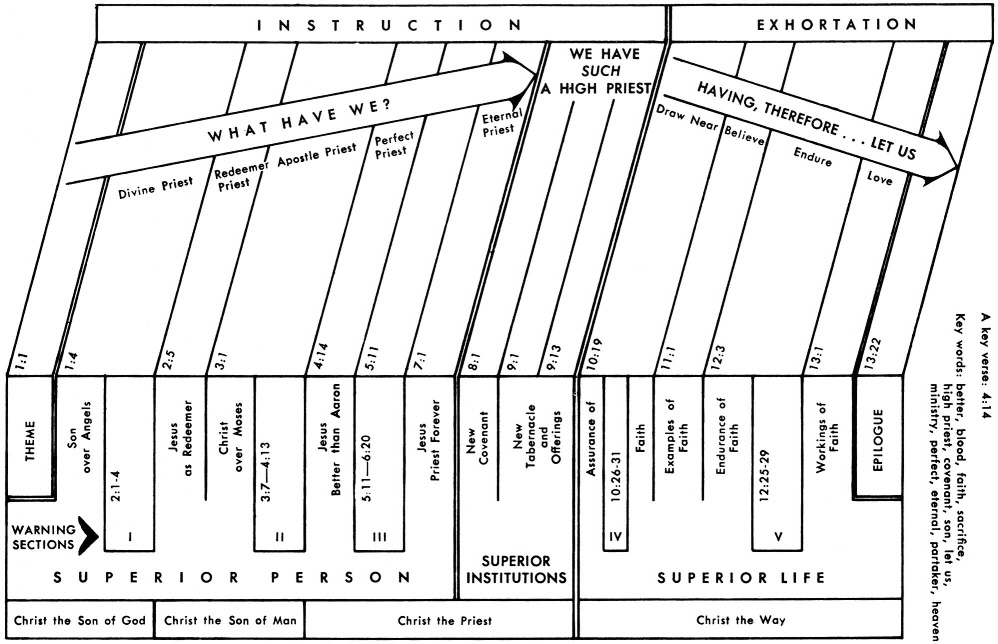
CONSIDER JESUS OUR GREAT HIGH PRIEST
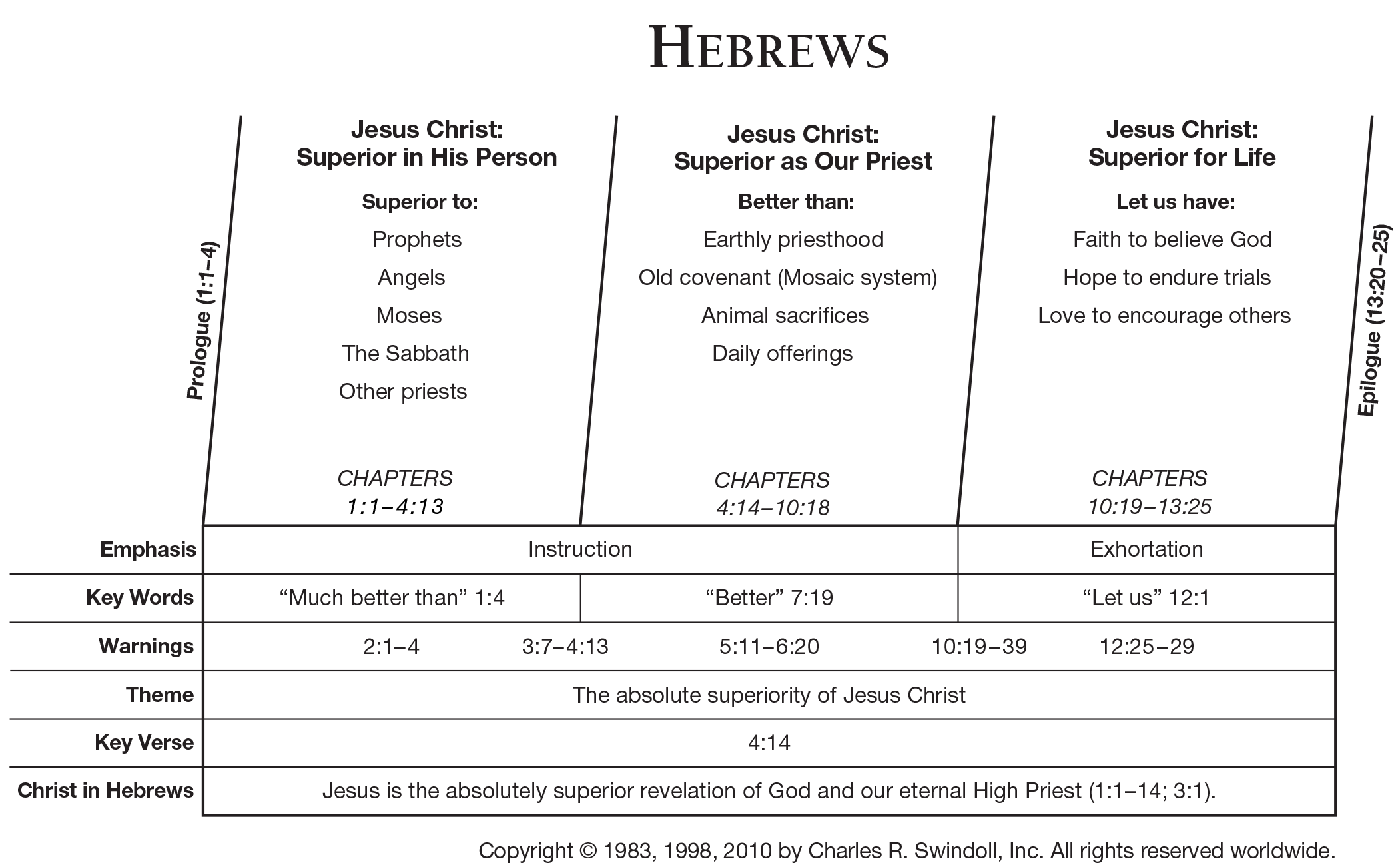
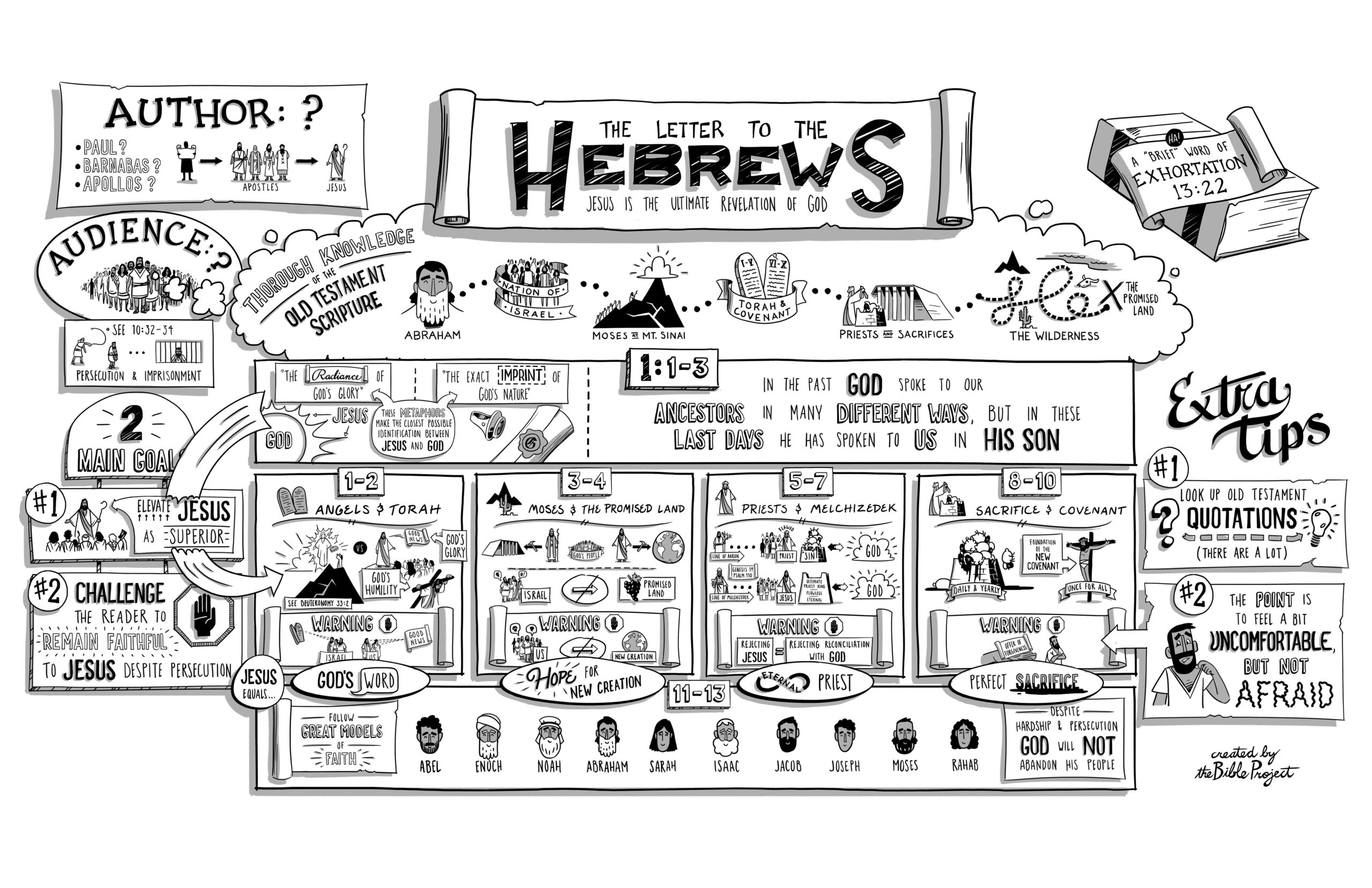
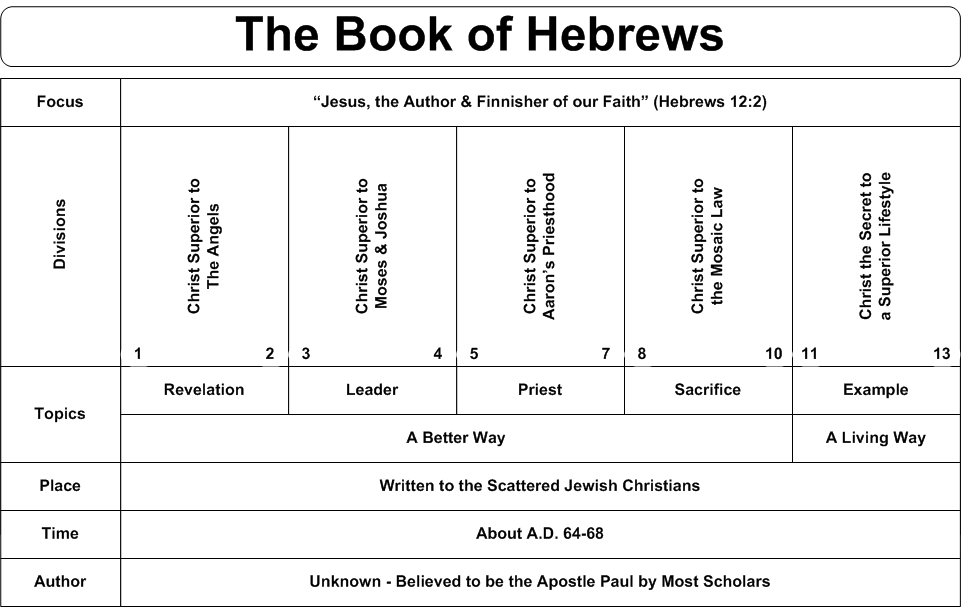
Click chart to enlarge
Charts from Jensen's Survey of the NT - used by permission
Swindoll's Chart, Interesting Pictorial Chart of Hebrews, Another Chart
|
The Epistle |
||||
| INSTRUCTION Hebrews 1-10:18 |
EXHORTATION Hebrews 10:19-13:25 |
|||
| Superior Person of Christ Hebrews 1:1-4:13 |
Superior Priest in Christ Hebrews 4:14-10:18 |
Superior Life In Christ Hebrews 10:19-13:25 |
||
| BETTER THAN PERSON Hebrews 1:1-4:13 |
BETTER PRIESTHOOD Heb 4:14-7:28 |
BETTER COVENANT Heb 8:1-13 |
BETTER SACRIFICE Heb 9:1-10:18 |
BETTER LIFE |
| MAJESTY OF CHRIST |
MINISTRY OF CHRIST |
MINISTERS FOR CHRIST |
||
|
DOCTRINE |
DUTY |
|||
|
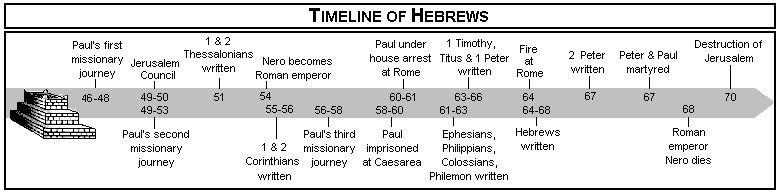
DATE WRITTEN: |
||||

See ESV Study Bible "Introduction to Hebrews"
(See also MacArthur's Introduction to Hebrews)
Borrow Ryrie Study Bible
Hebrews 9:11 But when Christ appeared as a high priest of the good things to come, He entered through the greater and more perfect tabernacle, not made with hands, that is to say, not of this creation (NASB: Lockman)
Greek: Christos de paragenomenos (AMPMSN) archiereus ton genomenon (AMPNPG) agathon dia tes meizonos kai teleioteras skenes ou cheiropoietou, tout' estin (3SPAI) ou tautes tes ktiseos,
Amplified: But [that appointed time came] when Christ (the Messiah) appeared as a High Priest of the better things that have come and are to come. [Then] through the greater and more perfect tabernacle not made with [human] hands, that is, not a part of this material creation, (Amplified Bible - Lockman)
Barclay: But when Christ arrived upon the scene, a high priest of the good things which are to come, by means of a tabernacle which was greater and better able to produce the results for which it was meant, a tabernacle not made by the hands of men—that is, a tabernacle which did not belong to this world order— (Westminster Press)
KJV: But Christ being come an high priest of good things to come, by a greater and more perfect tabernacle, not made with hands, that is to say, not of this building;
NLT: So Christ has now become the High Priest over all the good things that have come. He has entered that great, perfect sanctuary in heaven, not made by human hands and not part of this created world. (NLT - Tyndale House)
Phillips: For now Christ has come among us, the High Priest of the good things which were to come, and has passed through a greater and more perfect tent which no human hand has made (for it was no part of this world of ours). (Phillips: Touchstone)
Wuest: But Messiah having appeared upon the scene, a High Priest of good things realized, through the instrumentality of the greater and more complete tent not made by hands, that is to say, not of this creation, (Eerdmans Publishing - used by permission)
Young's Literal: And Christ being come, chief priest of the coming good things, through the greater and more perfect tabernacle not made with hands -- that is, not of this creation--
NKJ But Christ came as High Priest of the good things to come, with the greater and more perfect tabernacle not made with hands, that is, not of this creation.
NET But now Christ has come as the high priest of the good things to come. He passed through the greater and more perfect tent not made with hands, that is, not of this creation,
BGT Χριστὸς δὲ παραγενόμενος ἀρχιερεὺς τῶν γενομένων ἀγαθῶν διὰ τῆς μείζονος καὶ τελειοτέρας σκηνῆς οὐ χειροποιήτου, τοῦτ᾽ ἔστιν οὐ ταύτης τῆς κτίσεως,
CSB But the Messiah has appeared, high priest of the good things that have come. In the greater and more perfect tabernacle not made with hands (that is, not of this creation),
ESV But when Christ appeared as a high priest of the good things that have come, then through the greater and more perfect tent (not made with hands, that is, not of this creation)
NIV When Christ came as high priest of the good things that are already here, he went through the greater and more perfect tabernacle that is not man-made, that is to say, not a part of this creation.
Paraphrase Christ appeared as the High Priest of the better things God had promised. His ministry took place in the greater, perfect tabernacle of heaven, not in a structure belonging to this creation.”
Paraphrase Now Christ has come as our High Priest, bringing the good things that were anticipated. He did not serve in the earthly copy, but entered the greater and more perfect dwelling above, untouched by human construction.”
- But when Christ appeared - Ge 49:10; Ps 40:7; Isa 59:20; Mal 3:1; Mt 2:6; 11:3; Jn 4:25; 1Jn 4:2,3; 5:20; 2Jn 1:7
- As a High Priest - Heb 2:17; 3:1; 4:15; 5:5,6; 7:1,11:26,27; 8:1)
- Of the good things to come - He 10:1
- He entered through a greater: He 9:1-9 Heb 8:2 Jn 1:14
- not made with hands: He 9:23,24 Ac 7:48 17:24,25 2Co 5:1 Col 2:11
- Hebrews Part 2 - Study Questions - Hebrews 9, Lev 16 The Day of Atonement
- Hebrews 9 Resources - Multiple Sermons and Commentaries
Related Passage:
Hebrews 8:2 (THE GREATER, MORE PERFECT TABERNACLE) a minister in the sanctuary and in the true tabernacle, which the Lord pitched, not man.
FROM SHADOW TO SUBSTANCE:
GREATER TABERNACLE, GREATER PRIEST
Leon Morris - The argument moves a stage further as the author turns specifically to what Christ has done. The sacrifices of the old covenant were ineffectual. But in strong contrast Christ made an offering that secures a redemption valid for all eternity. In the sacrifices, a good deal pertained to the use of blood. So in accord with this, the author considers the significance of the blood of animals and that of Christ. (See The Expositor's Bible Commentary - Abridged Edition)
But (term of contrast) introduces a dramatic contrast a hinge between shadow and substance, between the new versus the old covenant described in Hebrews 9:1-10. The author is saying that everything up to verse 10 was temporary, imposed until Christ came. But now that He has come, everything changes. This is the time of reformation has arrived and this sets up a sharp contrast between what was temporary and what is now fulfilled in Christ (Heb 9:11 onward). One might say this is the "turning point" (the name of Charlie Kirk's ministry - assassinated 9/10/2025). The sacrifices of the first covenant could not make atonement for the lost sinner, whereas the sacrifice of the Lamb of God effected eternal redemption. And so the writer now shifts from describing the limitations of the Old Covenant tabernacle and its rituals to highlighting the superiority of Christ’s priesthood.
When Christ appeared (paraginomai) as a high priest (archiereus) of the good (agathos - beneficial, excellent, spiritually blessed) things to come, He entered through the greater and more perfect (teleios) tabernacle (skene), not made with hands (cheiropoietos), that is to say, not of this creation (ktisis) - Having shown that the earthly sanctuary was temporary, external, and imperfect, the focus turns to Christ as the High Priest of a better covenant who ministers in a greater, heavenly tabernacle. This marks the turning point from shadow to substance, from the earthly copy to the heavenly reality, from repeated sacrifices to the once-for-all work of Christ.
The good (agathos) things to come would be the good things associated with the New Covenant. In stating He entered through the greater and more perfect (teleios) tabernacle (skene), not made with hands (cheiropoietos) the writer now directs our gaze away from the earthly tabernacle—the copy made with human hands—to the greater and more perfect dwelling where Christ, our High Priest, carries out His ministry in the present age. This tabernacle is not of this creation but belongs to the eternal order of God’s heavenly reality. By entering there, Christ shows that His work transcends all limitations of the old covenant tabernacle, bringing us into contact with the true, perfect, and lasting presence of God.
It was the greater and more perfect perfect (teleios) tabernacle because it actually accomplished what the earthly could only foreshadow.
NET NOTE - But Christ, when he came," introducing a sentence that includes all of Heb 9:11–12. The main construction is "Christ, having come…, entered…, having secured…," and everything else describes his entrance.
Wuest - In Heb 9:1–10 the writer has spoken of the typical significance of the First Testament, and its transitory use. Now, in Heb 9:11–15, he speaks of the New Testament, and its ability to do that which the sacrifices of the First Testament could not do, namely, make atonement for the lost sinner. The little word “but” is the pivot upon which this argument swings. (Hebrews Commentary)
Spurgeon - No son of Aaron stands before us, but the Christ, the truly Anointed One, commissioned of the Lord to introduce man to his offended God. Anointed by the eternal Spirit without measure, the Lord Jesus Christ appears in the end of the world to put away sin by the sacrifice of Himself, and then to destroy the separating veil by going in unto the Father. Up till then religion dealt with externals, such as meats, and drinks, and washings, and carnal ordinances, and priests who could only offer the blood of bulls and of goats. But the coming of the Messiah changed all this. We pass from shadow to substance.
Vine - The first ten verses of this chapter have presented the picture of the earthly tabernacle and its offerings, and their incompleteness to effect what was necessary for the perfecting of the worshiper. Now comes a striking antithesis. The background in the first part of the chapter serves to set forth by way of contrast the glories and perfections of Christ, His offering, His heavenly sanctuary, His mediatorship of the new covenant. All serves to present the perfections of His priesthood, connecting it with His incarnation, His death and His appearing a second time. (Collected Writings)
Robertson rightly declares that "This is the great historic event that is the crux of history." Indeed even time records this "crux" from BC (Before Christ) to AD (Year of our Lord) (See Note).
When Christ appeared - The "real Christmas"! In this section, the writer speaks of the ultimate theological significance of the "Christmas story", which was so much more than just a Babe "in a manger".
The Messiah's appearance had been prophesied by Jacob who declared…
The scepter (symbol of royal comment and right to rule) shall not depart from Judah, nor the ruler's staff from between his feet, until Shiloh (meaning either "that which belongs to him" or "Bearer of rest and tranquility" [there not clearly complete agreement] a reference not to the town but to the Messiah Who ) comes, and to Him (the Messiah) shall be the obedience of the peoples (the nations - indicating this rule would be worldwide). (Genesis 49:10)
In the Messianic psalm Christ declared…
Then I said, "Behold, I come; In the scroll of the book it is written of me. (Psalm 40:7)
Comment - Psalm 40 is quoted by the writer beginning in Hebrews 10:5
Isaiah foretold of Messiah's glorious appearing…
Isaiah 59:20 "And a Redeemer will come to Zion, and to those who turn from transgression in Jacob," declares the LORD.
Malachi (means "My messenger") predicted the Messiah's appearance…
Behold, I am going to send My messenger (Fulfilled some 400 years later in the appearing of John the Baptist, cp Mt 3:3, 11:10, cp Isaiah's similar prophecy 40:3,4), and he will clear the way before Me. And the Lord, Whom you seek, will suddenly come to His temple (eg, see Jesus cleansing of the Temple in John 2:14-17); and the Messenger (mal'ak = one who is sent) of the covenant (the Messiah), in Whom you delight, behold, He is coming," says the LORD of hosts. (Malachi 3:1)
The Greater Priest
with Greater Gifts
The good things to come - better promises, better covenant, etc. The OT high priest procured only temporary blessings, but Christ, the Great High Priest procured eternal blessings (in eternity present and eternity future). In the immediate context two "good things" (1) Eternal Redemption (using the word that brought to the mind of that day the liberation of a slave by paying the ransom price, securing total freedom) and (2) Clean conscience from dead works to serve (worship) the living God. Freedom from the bondage to sin and freedom from guilt that our sins bring… those are indeed good things Jesus our High Priest made a reality by His public appearance (cp 2Ti 1:10)
Some of the good things to come (and this list could go on and on -- meditate on and thank God for all the good things that are now ours in Christ)
A Cleansed Conscience
Not just outward purity, but inner cleansing from guilt (Heb 9:14).
Shadow: animal sacrifices → Reality: Christ’s blood purges conscience.
Full Access to God
Old: access restricted to priests once per year (Lev 16).
New: Christ opens the way into the true Holy of Holies (Heb 10:19–20).
Eternal Redemption
Old: temporary covering (atonement, kaphar).
New: “He obtained eternal redemption” (Heb 9:12).
New Covenant Promises
Law written on hearts, sins remembered no more (Heb 8:10–12; Jer 31:31–34).
The Spirit transforms from within.
Heavenly Inheritance
Old: temporary blessings in the land.
New: “the promised eternal inheritance” (Heb 9:15; 1 Pet 1:4).
AND ON AND ON AND ON...THROUGHOUT ETERNITY!
Spurgeon - Things that were in the olden time “things to come” are things present at this hour. Jesus has brought to light the precious things of the covenant, which kings and prophets desired to see. Yet even now there are good things in the future: “Things that eye has not seen and ear has not heard, and have not entered into the heart of man, all that God has prepared for those who love him” (1 Cor 2:9). The Lord Jesus has brought all good things to those who believe in Him, that they may rejoice with joy unspeakable and full of glory. Good things to come find their way here by the Mediator. God Himself has come among men in the person of the Lord Jesus, who has taken our nature into union with His Godhead. Our Immanuel was born at Bethlehem, He dwelled at Nazareth, He died on Calvary, and He has now gone up on high because His work is finished and the reward of it is given. (ED: INDEED IS NOT CHRIST IN US THE HOPE OF GLORY [Col 1:27] THE SUMMUM BONUM, THE BEST OF THE GOOD THINGS!)
He entered through - The preposition is better rendered "by means of." Wuest explains it this way - The word “through” is the translation of dia, the preposition of intermediate agency. That is, the kind of tabernacle the priest officiates in, determines the quality of his work. If he ministers in a tabernacle that is a mere type, his work is not efficacious so far as actual salvation is concerned, but only typical. If he on the other hand, serves in the actual tabernacle of which the other tabernacle is only a type, his work of salvation is actual and meritorious." (Hebrews Commentary)
He entered through the greater and more perfect (teleios) tabernacle (skene) - Christ a greater heavenly High Priest did not enter a temporal, earthly, man made (even though God designed) tabernacle but a greater and more perfect tabernacle. It was Not made with hands but made by God Himself, which explains why it is greater and more perfect. This is the very Throne Room of the Almighty, and it is the place in which and from which our Great High Priest Christ Jesus now ministers, seated at the right hand of the Father. "That is, the tabernacle in which Messiah serves, does not belong to the natural creation, the material universe." (Wuest)
There is even something more incredible for us as believers regarding Christ's entrance into this heavenly tabernacle. You ask what is it? I think John MacArthur gives us the answer writing...
Our heavenly Priest takes His people with Him all the way into the sanctuary. (ED: ANOTHER CONTRAST WITH AARONIC PRIESTHOOD WHICH WAS A SOLO SHORT SOJOURN!) He takes us into the sanctuary of sanctuaries, into heaven itself—not into the symbolic presence of God, but into the real presence of God. Not only has He gone before us, but He takes us with Him. If we are believers, He already has taken us with Him. “But God, being rich in mercy, because of His great love with which He loved us, even when we were dead in our transgressions, made us alive together with Christ, … and raised us up with Him, and seated (ED: PAST TENSE!) us with Him in the heavenly places, in Christ Jesus” (Eph. 2:4–6). When we were saved, Christ at that time took us into the Father’s presence, where, spiritually speaking, we already live with Him and will forever live with Him. We live right now in heavenly places, in the presence of God—in His throne room and in His sanctuary. “Our citizenship is in heaven” (Phil. 3:20). (See Hebrews Commentary) (ED: TRY TO GET YOUR MIND AROUND THAT TRUTH, WHICH I FULLY AGREE WITH!)
Spurgeon has an interesting thought about the greater and more perfect tabernacle - That tabernacle was his body, which was not made with hands, nor yet formed by carnal generation as our human tabernacle is. This greater and more perfect tabernacle was made according to the power of an endless life.
In Acts Stephen explains to the Jews who were fixated on the earthly tabernacle, that the true dwelling place of God is not on this earth writing that "the Most High does not dwell in houses made by human hands; as the prophet says: ‘Heaven is My throne, and earth is the footstool of My feet. What kind of house will you build for Me?’ says the Lord; ‘Or what place is there for My repose? ‘Was it not My hand which made all these things?’ (Acts 7:48-50)
THE ATONING WORK IS DONE
—Thomas Kelly
Th’ atoning work is done,
The Victim’s blood is shed,
And Jesus now is gone
His people’s cause to plead:
He stands in heaven their great High Priest,
And bears their names upon His breast.
He sprinkled with His blood
The mercy-seat above;
For justice had withstood
The purposes of love;
But justice now withstands no more,
And mercy yields her boundless store.
No temple made with hands,
His place of service is;
In heaven itself He serves,
A heavenly priesthood His:
In Him the shadows of the law
Are all fulfilled, and now withdraw.
And though awhile He be
Hid from the eyes of men,
His people look to see
Their great High Priest again:
In brightest glory He will come,
And take His waiting people home
Appeared (3854) (paraginomai from para = beside + ginomai = to be, become, come into being) means to be beside or to become alongside and conveys the sense of Messiah's arriving upon the scene of human history at His first advent. Messiah came from "another world" as it were and "invaded" human history not as another human being born in the midst of humanity. His first appearing fulfilled the prophetic aspects of His Old Testament name Immanuel, "God with us". His first advent was just a picture of a Baby being born, but of God taking the form of humanity in a miraculous Virgin Birth. As one would say in Spanish, Messiah became "Deos con carne" or "God in the flesh"!
The same verb paraginomai was used to describe the appearing of John the Baptist, Matthew recording "Now in those days John the Baptist came (paraginomai - appeared on the scene of human history), preaching in the wilderness of Judea, saying, "Repent, for the kingdom of heaven is at hand." (Mt 3:1,2)
High priest (749) (archiereus from arche = first in a series, the leader or ruler + hiereus = priest) (Dictionary articles - Easton's; ISBE) refers to the priest that was chief over all the other priests in Israel. This office was established by God through Moses instructions in the Pentateuch. The high priest functioned as the mediator between Jehovah and Israel performing sacrifices and rituals like other priests, but in addition acting to expiate the sins of the nation on the annual Day of Atonement. The irony is that the high priest Caiaphas was residing over the Sanhedrin during trial of Jesus, the trial which would lead to His death and pave the way for His eternal High Priesthood!
Eerdman's Bible Dictionary explains that "The high priest descended from Eleazar, the son of Aaron. The office was normally hereditary and was conferred upon an individual for life (Nu 25:10-13). The candidate was consecrated in a seven-day ceremony which included investiture with the special clothing of his office as well as anointments and sacrifices (Ex 29:1-37; Lev 8:5-35). The high priest was bound to a higher degree of ritual purity than ordinary Levitical priests. He could have no contact with dead bodies, including those of his parents. Nor could he rend his clothing or allow his hair to grow out as signs of mourning. He could not marry a widow, divorced woman, or harlot, but only an Israelite virgin (Lev. 21:10-15). Any sin committed by the high priest brought guilt upon the entire nation and had to be countered by special sacrifice (Lev 4:1-12). Upon a high priest’s death manslayers were released from the cities of refuge (Nu 35:25, 28, 32). (Eerdman's Bible Dictionary)
ARCHIEREUS IS A KEY WORD IN HEBREWS - 17 verses
Hebrews 2:17 that He might become a merciful and faithful high priest
Hebrews 3:1 consider Jesus, the Apostle and High Priest of our confession.
Hebrews 4:14 Since then we have a great high priest who has passed through the heavens
Hebrews 4:15 we do not have a high priest who cannot sympathize with our weaknesses
Hebrews 5:1 For every high priest taken from among men is appointed on behalf of men
Hebrews 5:5 Christ did not glorify Himself so as to become a high priest,
Hebrews 5:10 being designated by God as a high priest according to the order of Melchizedek.
Hebrews 6:20 having become a high priest forever according to the order of Melchizedek.
Hebrews 7:26 For it was fitting that we should have such a high priest, holy
Hebrews 7:27 who does not need daily, like those high priests, to offer up sacrifices
Hebrews 7:28 For the Law appoints men as high priests who are weak
Hebrews 8:1 Now the main point in what has been said is this: we have such a high priest,
Hebrews 8:3 For every high priest is appointed to offer both gifts and sacrifices
Hebrews 9:7 into the second only the high priest enters, once a year, not without taking blood
Hebrews 9:11 But when Christ appeared as a high priest of the good things to come
Hebrews 9:25 as the high priest enters the holy place year by year with blood not his own.
Hebrews 13:11 brought into the holy place by the high priest as an offering for sin
Made with hands (5499)(cheiropoietos from cheir = hand + poieo = make) made or done by human hands, man-made. (In the Septuagint of idols; of other things, occasionally in Herodotus, Thucydides, Xenophon, Polybius, Diodorus.) In classical Greek and elsewhere it means “made with hands” or “artificial.” It stands in contrast to something “natural” (autophuēs), and it can suggest something done intentionally (Liddell-Scott). In the Septuagint cheiropoiētos consistently denotes the “man-made” idols erected by humans (Leviticus 26:1; Isaiah 2:18; 10:11). The Septuagint appears to be a major factor for the understanding of the term in the New Testament. This is clearly seen in Mark 14:58; Acts 7:48; 17:24; Hebrews 9:11; and 9:24. Each of these texts emphasizes that the one true God dwells not in man-made temples or tabernacles but in heaven (Acts 7:48,49; Hebrews 9:24; cf. 1 Kings 8:27). As creator of all things God does not need to have a sanctuary fashioned by man (Acts 17:24). He exists on a plane above the created order itself (Hebrews 9:11).
W E Vine - made by hand," of human handiwork (cheir, and poieō, "to make"), is said of the temple in Jerusalem, Mark 14:58; temples in general, Acts 7:48 (RV, "houses"); Acts 17:24; negatively, of the heavenly and spiritual tabernacle, Heb. 9:11; of the holy place in the earthly tabernacle, Heb. 9:24; of circumcision, Eph. 2:11. In the Sept., of idols, Lev. 26:1, 30; Isa. 2:18; Isa. 10:11; Isa. 16:12; Isa. 19:1; Isa. 21:9; Isa. 31:7; Isa. 46:6. (Vine's Expository Dictionary)
CHEIROPOIETOS - 6V - Mk. 14:58; Acts 7:48; Acts 17:24; Eph. 2:11; Heb. 9:11; Heb. 9:24
CHEIROPOIETOS IN SEPTUAGINT - Lev. 26:1; Lev. 26:30; Isa. 2:18; Isa. 10:11; Isa. 16:12; Isa. 19:1; Isa. 21:9; Isa. 31:7; Isa. 46:6; Dan. 5:4; Dan. 5:23; Dan. 6:27
TODAY IN THE WORD -In some places it is still customary to take care of the grave plots of deceased relatives, often called “graveyard workings.” Once a year family members will travel to the family plot and tidy the area. Headstones are cleaned. Weeds are pulled and new flowers are planted. American flags are set in place for veterans. Yet, no matter how neat and tidy the plot is, it doesn’t change the fact that the grave contains decay. The outside of the grave can be cleaned, but not the inside.
Similarly, Hebrews argues that the sacrifices of the Mosaic Law only cleansed the people externally, whereas the superior sacrifice of Jesus brings inner transformation.
Thus far in Hebrews we have seen that Jesus serves as high priest in a priestly order superior to that of Aaron. We have also seen that He mediates a better covenant than the one mediated by the Levitical priesthood. Yesterday we read that Jesus serves in a tabernacle far superior to the earthly one. Our text today tells us that Jesus also offered a sacrifice that was superior to those offered under the Old Covenant–His own life (He 9:12, 14). The blood of sacrificed animals was required to cleanse the instruments and the people under the Old Covenant. However, these rituals only cleansed them outwardly. The superior sacrifice of Christ, on the other hand, cleanses our consciences (Hebrews 9:13, 14).
Christ’s sacrifice for us is not, though, only about cleansing our consciences so that we feel better. It transforms us so that we can now serve the living God. Under the old covenant the priests had to be cleansed before they could perform their ministries (cf. Lev 8:6-30). Under the new covenant we are cleansed in the blood of Jesus so that we can go forth and perform our ministries before God.
TODAY ALONG THE WAY - Did you know that if you belong to Christ you are a priest of God Most High? Part of sharing in the blessings of Christ means living in the reality of this priestly call. (Copyright Moody Bible Institute. Used by permission. All rights reserved)
Robert Neighbour - The Offering of Christ, As Priest
"But Christ being come an High Priest of good things to come, by a greater and more perfect tabernacle, not made with hands, that is to say, not of this building. "Neither by the blood of goats and calves, but by His own Blood He entered in once into the holy place, having obtained eternal redemption for us. "For if the blood of bulls and of goats, and the ashes of an heifer sprinkling the unclean, sanctifieth to the purifying of the flesh: "How much more shall the Blood of Christ, Who through the eternal Spirit offered Himself without spot to God, purge your conscience from dead works to serve the Living God?" (Heb. 9:11-14).
The earthly Tabernacle and the blood of goats and calves were all typical. They looked forward to Christ. Christ fulfilled these types.
1. As an High Priest Christ must have somewhat to offer.
The priest of old offered up the blood of goats and calves. Christ offered up His own Blood.
2. As an High Priest Christ made no offering for Himself.
The priest of old offered up "first for his own sins, and then for the people's" (Heb. 7:27). But "such an High Priest became us, Who is holy, harmless, undefiled and separate from sinners, and made higher than the heavens" (Heb. 7:26).
3. Christ offered Himself without the camp.
"For the bodies of those beasts, whose blood is brought into the sanctuary by the high priest for sin, are burned without the camp. Wherefore Jesus also, that He might sanctify the people with His own Blood, suffered without the gate. Let us go forth therefore unto Him without the camp, bearing His reproach" (Heb. 13:11-13).
How wonderful is all of this! Jesus Christ was, in all things, the fulfillment of these Old Testament types. Surely we who know Him and who love Him, should gladly go with Him outside the camp, bearing His reproach.
4. Christ entered into the Holy Place.
The High Priest went alone, once a year, into the Holiest of all; but "not without blood" (Heb. 9:7).
But Christ entered not "into the holy places made with hands, which are the figures of the true; but into Heaven itself, now to appear in the presence of God for us" (Heb. 9:24).
In this act our Lord opened up a true and living way. The veil of the Temple rent when Christ died. The way to God is open to all who believe and receive the Lord Jesus Christ.
"Having therefore, brethren, boldness to enter into the holiest by the Blood of Jesus, "By a new and living way, which He hath consecrated for us, through the veil, that is to say, His flesh; "And having an High Priest over the house of God; "Let us draw near with a true heart in full assurance of faith, having our hearts sprinkled from an evil conscience, and our bodies washed with pure water" (Heb. 10:19-22).
The veil is rent—lo! Jesus stands
Before the throne of grace,
And clouds of incense from His bands,
Fill all that glorious place.
"Tis finished" here our soul can rest
His work can never fail;
By Him, our Sacrifice, and Priest
We enter through the veil.
R C Sproul - The Ultimate Tabernacle
When Christ came as high priest of the good things that are already here, he went through the greater and more perfect tabernacle that is not man-made, that is to say, not a part of this creation. [Heb. 9:11]
Jesus passed through the “greater and more perfect” outer tabernacle—one not made with hands and not of this creation—to enter the Holy of Holies by means of his own blood. What is this greater and more perfect outer tabernacle that is the entryway into the ultimate Holy of Holies?
To understand, we must refine our understanding of the Old Testament tabernacle and temple. The outer tent symbolized the anteroom of heaven. The courtyard around the tabernacle, with the holy mountain of the bronze altar in its midst, symbolized the earth. The area between the bronze altar and the tabernacle, including the laver of cleansing, represented the sky above the earth.
The priests ministered in the anteroom, the outer tabernacle of the Holy Place behind the blue veil of the firmament. This was the pre-Christ form of the kingdom, centered around the nation of Israel. The people owned the covenant promises, but they stood only in the anteroom of heaven, outside the fullness of the heavenly sanctuary. They lacked the righteousness to come into even the symbolic presence of God’s throne room.
Some have suggested that Hebrews 9:11 refers to Jesus’ ascension. In this view, Jesus ascended through the visible heavens on his way to the spiritual heaven. This cannot be the meaning of verse 11, however. The visible heavens are part of this creation. Jesus passed through another creation on his way to the throne of God. He passed through the spiritual heavens. Genesis 1:1 distinguishes the creation of these heavens from the creation of earth. When the priests passed through the anteroom they anticipated the reality of Christ’s passage through the true anteroom. A vision of this ultimate reality is shown to us through John in Revelation 4 and 5.
The work of the Aaronic priests in the earthly tabernacle was never more than a picture of the work of Christ. Their work never took away sins. It pictured Christ’s atonement, and dramatized the prayers of the saints, pleading with God to bring to pass redemption.
Coram Deo We have compared two “heavens,” the physical, natural heavens and the spiritual, original heavens of Genesis 1:1 pictured in the outer tabernacle. In 2 Corinthians 12:2 Paul speaks of a “third heaven.” If you know Christ, one day you personally will experience this ultimate heaven—the very throne room of God. Christ has prepared the way so that you can enter the Holy of Holies. What sacrifices of praise are you preparing to offer on that day.
For further study: Genesis 1:6–21; Isaiah 66:1–2; Revelation 4:1–8
Hebrews 9:11-12 With or By?
Equally sincere students of the Bible have disagreed on the interpretation of this passage. It reads,
But Christ being come an high priest of good things to come, but a greater and more perfect tabernacle, not made with hands, that is to say, not of this building. Neither by the blood of goats and calves, but by His own blood He entered in once into the holy place, having obtained eternal redemption for us (Hebrews 9:11, 12).
I personally do not believe that Christ went into Heaven with His blood. Note that Heb 9:12 does not say that He entered Heaven with His own blood, but by (or through) His own blood. The preposition dia may be translated “through” “by reason of,” or “by virtue of.” Christ is now seated in Heaven as the High Priest by virtue of His sacrificial death. The idea of carrying actual blood into Heaven is not justified by the passage. Remember, this “more perfect tabernacle” in Heaven was “made without hands.” The context does not allow for the admission of this literal material of earth. Besides Christ’s blood was efficacious the moment it was shed, as evidenced by the torn veil in the temple. - Source Unknown
Adrian Rogers - You don’t have to go around with unconfessed, unforgiven sin. You don’t have to drag yesterday into today. I’ve told you before, the way I start a day, on a normal day, is to lift my hands to God, and just say, “God, I thank You, Jesus, that You gave Yourself for me.” That, friend, is the saving blood. Then, I lift my hands, and I say, “Thank You, Jesus, that You gave Yourself to me.” That is the shared blood. Then, I lift my hands in surrender, and I say, “Now, Lord, live Your life through me. I am Yours today. Live Your life through me.” He didn’t just forgive me, and say, “Okay, Adrian, it’s up to you.”
He gave Himself for you, that He might give Himself to you, that He might live His life through you. And just as your body survives by that red river of life, the blood that is flowing in your body right now, the blood of Jesus Christ, the life of God wants to flow through His church, and there’s that constant provision, and there are those cleansing properties of the blood of Jesus Christ. It is the blood that cleanses. It doesn’t say cleansed. It says cleanses. It is continually cleansing, when we let that blood flow. (See full sermon The Power in the Blood page 455)
Horatius Bonar - THE HIGH PRIEST OF THE GOOD THINGS TO COME—HEB. 9:11, 12.
THE meaning and argument of these two verses may be brought out in the following propositions:—
I. All Israel’s varied service was but a figure or shadow; giving us the mere outline or idea of what was coming; no more.
II. This figure has passed away; the shadow has disappeared; the reality of the foreshadowed good things has come; the picture has vanished, the things painted have taken their place.
III. The Christ Himself has come. He in whom all the good things are wrapt up, is no longer ‘the coming one.’ ‘We know that the Son of God has come.’ This is our message, ‘The Christ has come.’
IV. He is the High Priest of the good things. These are now in His custody and at His disposal. They have been placed by the Father in His priestly hands. These good things are not all yet come; some are still ‘the good things to come,’ reserved for His appearing as Priest and King.
V. He has gone into the holy places, or ‘heavenlies.’ He is not here. He is risen. He has ascended on high. He is on the throne.
VI. He has done so by His own blood. ‘Not without blood’ was the divine commandment. As the High Priest He has been at the brazen altar, He has taken the blood, He has gone through the outer court and the holy place, into the holiest of all. He has ‘passed through the heavens’ (Heb. 4:14).
VII. He has thus gone in because He has obtained eternal redemption. He had gone out to seek it, He has returned having found it. With this redemption in His hands He goes back to the Father, and re-enters the heaven of heavens.
Such is the substance of the passage. But there are only three things in it that I mean to dwell upon. (1.) The redemption. (2.) The good things to come. (3.) The administration of these by Christ the High Priest.
I. The redemption.—There are three words used in the New Testament in connection with Christ’s redeeming work. There is simple ‘buying,’—ye are bought ‘with a price’ (1 Cor. 7:23). There is ‘a ransom’ (λύτρον),—‘to give His life a ransom for many’ (Matt. 20:28); where it is the price or purchase-money needed for buying back a captive or doomed one that is meant. Then there is the word in our text (λύτρωσις), which is more than ransom. The redemption (λύτρωσις) is the actual doing of the thing for which the ransom (λύτρον) was obtained or paid down. As in the case of the first-born. They were to be redeemed by the payment of five shekels. These five shekels were the ransom; but the actual deliverance of these first-born from the doom which otherwise would have fallen on them was the redemption. So Christ’s blood or life was the ransom; our deliverance by means of it from death is the redemption. It is of this latter that the apostle is here speaking. Not only has a ransom been found; but the result of it, viz. the deliverance from going down to the pit, has been secured and carried out. Hence the song of the Church is not merely ‘Thou hast found a ransom,’ but, ‘Thou hast redeemed us to God.’
There is redemption then! Not only a ransom, but redemption. Both have been ‘obtained;’ or, as the word more exactly means, ‘found;’ according to the words of Elihu (Job 33:24). Christ came, seeking the sinner, providing the ransom, securing the redemption. He has not come in vain. He has found them all. Redemption has been obtained! The cross has won it. Banishment, captivity, ruin, death are no longer necessary. The ransom has removed the necessity; and the redemption has made certain what the ransom made possible. The message descending from the heavenly throne, and sounding over earth to sinners, is ‘Deliver from going down to the pit, for I have found a ransom.’ Long hidden in the Father’s everlasting purpose, the Son has found it! Long hidden from the eyes of men, like an unsprung seed in the earth, He has sought for it and found it, and brought it up to the light of day!
Redemption has been obtained! It is no longer a purpose or a promise, but a fact, a certainty! The price has not merely been obtained for the ransom of the captive exile; but the vessel has been despatched to bring him. Nay, and that vessel goes furnished with a goodly company of the King’s own guard, to make sure that he is set free, and to convey him on board. Nay, and it is loaded with all provisions for the voyage home, and fair raiment for the delivered exile. Everything has been arranged for making his return a certainty, in spite of all hindrances from himself or from his enemies. This is the redemption that Christ has found!
And it is eternal! The deliverance is for evermore. No dread of a second captivity through failure of the redemption. The security is everlasting. The love is unquenchable. The pardon is for ever. The righteousness is for ever. The life is for ever. The salvation is irreversible. The inheritance fadeth not away. He has obtained eternal redemption for us!
II. The good things to come.—These good things flow out of the redemption; but they are not the same as either the redemption or the ransom. When a rich man redeems a slave or captive, he provides for him, feeds him, clothes him, brings him into his house, perhaps adopts him, making him his son and heir. These are the good things bestowed on the redeemed captive; but they are neither the ransom nor the redemption, though without that ransom and redemption not one of them could have been conferred. Were the wealthy Rothschilds to redeem Palestine for their nation from the Turk by the payment of some millions, they would straightway proceed to have its unlawful occupants dispossessed, its soil cultivated, its mountains terraced, its valleys ploughed, its cities rebuilt, Jerusalem restored in all its former splendour, and made the metropolis of the land. These would be the ‘good things’ following up the redemption of the land, but evidently not the same as the redemption.
So is it with Christ and our redemption. Having secured that redemption, He has gone up on high to administer it according to the Father’s everlasting purpose. In Him dwells the infinite and eternal fulness; and that fulness is the treasure-house of the ‘good things.’ It is of His unsearchable riches that the redeemed from among men are made partakers. These ‘good things’ are not now wholly future. Some of them have come; though some are yet to come. Christ’s first coming brought many, but His second coming is to bring many more. We get many at the cross; we wait for more in the kingdom. Forgiveness, reconciliation, peace, love, light, joy, life, consolation, holiness, with the earnest of the Spirit, we get now; but glory, honour, incorruption, the inheritance, the kingdom, the crown, we shall not obtain till He returns. These are still ‘good things to come;’ and for these we wait the arrival of the Son of God.
All that these ‘good things’ imply, it is impossible for us here to conceive. Even of those which we obtain just now, how little do we comprehend or enjoy! How much less of those which are still wholly future! Yet we know that they are surpassingly excellent; worthy of God, worthy of Christ; fit to satisfy the travail of His soul, and to bring the highest honour to Him, in whom and through whom we shall possess them all. They are far beyond our worthiness, but not beyond the worthiness of Him for whose sake they are conferred. The unworthiness of the bride shall but enhance the bounty and the glory of the Bridegroom. The greatness of the inheritance, and the kingdom, and the joy, shall be all to the praise of the glory of His grace, who hath not only delivered us from the wrath to come, but, as if that were a light thing, hath made us accepted in the Beloved, heirs of God, and joint heirs with Christ.
II. The administration of all these by Christ as the High Priest.—He is ‘the High Priest of the good things to come.’ To His priestly hands have all things been committed. The reins of universal government are the prerogative of His priesthood as well as of His kingship, for His is a royal priesthood; He is priest upon His throne; He is Melchizedek, king and priest in one. Our King is our priest, and our Priest is our king.
It is with a priest that a sinner has specially to do, for without priesthood, kingship and prophetship would be vain to one whom sin had separated from God. It is to a priest,—the High Priest of the good things to come,—that God invites us: ‘Let us come boldly to the throne of grace.’ It is of Him, and of our connection with Him, that the apostle speaks: ‘Having an High Priest over the house of God, let us draw near;’ and it is to His priestly intercession that he refers, when he says, ‘Wherefore He is able to save them to the uttermost who come unto God by Him, seeing He ever liveth to make intercession for them.’
It is our knowledge of this that removes our fear and uncertainty in drawing near for blessing. Less than this would not give us boldness. All that we need is in priestly hands! This thought meets every difficulty, and strikes down every rising doubt. The thought of kingly hands, kingly grace, and kingly bounty, would not do. It would leave each difficulty unremoved; and the sinner could but stand afar off, to weep and tremble. But the thought of priestly hands does well. This meets the sinner’s case. He is now safe in going to get all he needs; for the very end of priesthood is to provide for the sinner’s intercourse with God. The sinner is unworthy; but the priest is appointed to deal with such. The sinner is unfit; but the priest is just for the unfit. The sinner is guilty; the priest is here to pardon. The sinner is filthy; the priest is here to wash. Priestly grace is for the undeserving; priestly blessing is for the cursed; and priestly fulness is for the empty. The feeling that we are sinners, and, therefore, not entitled to expect good things, but evil, is completely removed by the knowledge that these good things are in priestly hands,—hands sprinkled with atoning blood, hands once nailed to the accursed tree. Our pardon is in priestly hands; let us go and get it. Peace is in priestly hands for us; let us go and get it. Health is in priestly hands; let us go and get it. The whole of salvation is in priestly hands; let us go and get it. Holiness is in priestly hands; let us go and get it. Life eternal is in priestly hands; let us go and get it. But let us go with boldness, for less than boldness implies a doubt of our High Priest’s sufficiency. Let us go with a true heart, and in full assurance of faith, not supposing it possible that a sinner can go and be sent empty away. An angel might go to the High Priest and return with nought, for he is holy;—and it is with the unholy that the High Priest has to do;—but not a sinner! No; not a sinner! That is impossible; and it is impossible, not because the sinner has done or felt something to ensure acceptance, but simply because our High Priest is what He is,—God’s appointed channel of blessing for the unworthy and the unholy.
As sinners, needing everything, we go to our High Priest, and we get at once the good things which have already come. The possession of these makes us children of God, saints, heirs of the kingdom. And as such we live on earth, enjoying the reconciliation, and the peace, and the love. But then, as men possessed of these things, we look forward to the possession of more. In the days of the Judges, when Eli was high priest in Shiloh, Hannah went to him with ‘the abundance of her complaint and grief’ (1 Sam. 1:16, 17). He received her at once, and sent her away with his priestly blessing, ‘Go in peace;’ adding, ‘The God of Israel grant thee thy petition that thou hast asked of Him.’ On this it is said, ‘The woman went her way, and did eat, and her countenance was no more sad.’ It is thus we go to our heavenly High Priest, to pour out before Him the abundance of our complaint and grief. And He at once receives us in the fulness of His love. ‘Go in peace,’ is His message to every soul that comes to Him. We believe Him, as Hannah did Eli; and we go upon our way, and our countenance is no more sad.
Having tasted the grace, we look for the glory. Receiving such of the ‘good things’ as are already come, we press forward to those which are still future. Standing beneath the shadow of the cross, we cast our eye upward to the promised glory, and realize the crown of righteousness, which the same priestly hands that ministered the pardon shall ere long place upon our heads. Christ’s first coming has brought us many good things; His second coming shall bring us more. The eternal redemption shall be consummated in the eternal inheritance. The deliverance from a present evil world shall end in our possession of the wondrous world to come, the inheritance of the saints in light, the new heavens and new earth, wherein dwelleth righteousness.
Just The Right Time
Read: Hebrews 9:11-22
Christ came as High Priest of the good things to come. — Hebrews 9:11
The conductor stood on the podium, his eyes scanning the choir and orchestra. The singers arranged the music in their folders, found a comfortable position for standing, and held the folder where they could see the conductor just over the top. Orchestra members positioned their music on the stand, found a comfortable position in their seats, and then sat still. The conductor waited and watched until everyone was ready. Then, with a downbeat of his baton, the sounds of Handel’s “Overture to Messiah” filled the cathedral.
With the sound swirling around me, I felt I was immersed in Christmas—when God, at just the right moment, signaled the downbeat and set in motion an overture that started with the birth of the Messiah, the “High Priest of the good things to come” (Heb. 9:11).
Every Christmas, as we celebrate Christ’s first coming with glorious music, I’m reminded that God’s people, like choir and orchestra members, are getting ready for the next downbeat of the conductor when Christ will come again. On that day, we will participate with Him in the final movement of God’s symphony of redemption—making all things new (Rev. 21:5). In anticipation, we need to keep our eyes on the Conductor and make sure we are ready. — Julie Ackerman Link
Sound the soul-inspiring anthem,
Angel hosts, your harps attune;
Earth’s long night is almost over,
Christ is coming—coming soon!
— Macomber
The advent of Christ celebrates His birth and anticipates His return
Hebrews 9:12 and not through the blood of goats and calves, but through His own blood, He entered the holy place once for all, having obtained eternal redemption. (NASB: Lockman)
Greek: oude di' aimatos tragon kai moschon dia de tou idiou aimatos, eiselthen (3SAAI) ephapax eis ta agia, aionian lutrosin euramenos. (AMPMSN)
Amplified: He went once for all into the [Holy of] Holies [of heaven], not by virtue of the blood of goats and calves [by which to make reconciliation between God and man], but His own blood, having found and secured a complete redemption (an everlasting release for us). (Amplified Bible - Lockman)
Barclay: and not by the blood of goats and bullocks but by his own blood, he entered once and for all into the Holy Place because he had secured for us an eternal redemption. (Westminster Press)
KJV: Neither by the blood of goats and calves, but by his own blood he entered in once into the holy place, having obtained eternal redemption for us.
NLT: Once for all time he took blood into that Most Holy Place, but not the blood of goats and calves. He took his own blood, and with it he secured our salvation forever. (NLT - Tyndale House)
Phillips: It was not with goats' or calves' blood but with his own blood that he entered once and for all into the holy of holies, having won for us men eternal reconciliation with God. (Phillips: Touchstone)
Wuest: nor even through the intermediate instrumentality of the blood of goats and calves, but through that blood of His own, He entered once for all into the Holy of Holies, having found and procured eternal redemption. (Eerdmans Publishing - used by permission)
Young's Literal: neither through blood of goats and calves, but through his own blood, did enter in once into the holy places, age-during redemption having obtained;
- Heb 9:13; Heb 10:4; Lev 8:2; 9:15; Lev 16:5-10 = "Yom Kippur" = Day of Atonement)
BETTER BLOOD OF
THE BETTER SACRIFICE
And not through the blood of goats and calves - Not is the Greek word signifying absolutely no way! Through (dia) speaks of instrumentality or means by which something is accomplished. The only One Who can split the curtain separating the holy place from the holy of holies is the Lamb of God, Whose blood Alone is the means by which this is accomplished. Blood of animals provided only a temporary covering, while the blood of Jesus provides eternal cleansing.
🙏 THOUGHT - Do you believe in the blood of the Lamb of God Who takes away (by His shed blood signifying His substitutionary death on the Cross) the sins of the world (Jn 1:29). Then enter into the Holy of holies, the very Throne Room of God and do it boldly in prayer (Heb 4:16), praise and worship (every day for the rest of your life on earth and then throughout eternity because He has provided eternal redemption!)
This section of Hebrews repeatedly alludes to the significance of blood and how the OT blood sacrifices all pointed a "bloody" finger at the Messiah, the Lamb Whose blood was to be shed on Calvary.
Hebrews 9:13 For if the blood of goats and bulls and the ashes of a heifer (see Red Heifer) sprinkling those who have been defiled, sanctify for the cleansing of the flesh,
Hebrews 10:4 (note) For it is impossible for the blood of bulls and goats to take away sins.
Leviticus 8:2 "Take Aaron and his sons with him, and the garments and the anointing oil and the bull of the sin offering, and the two rams and the basket of unleavened bread;
Leviticus 9:15 Then he presented the people's offering, and took the goat of the sin offering which was for the people, and slaughtered it and offered it for sin, like the first.
Leviticus 16:5-10 "And he shall take from the congregation of the sons of Israel two male goats for a sin offering and one ram for a burnt offering. 6 "Then Aaron shall offer the bull for the sin offering which is for himself, that he may make atonement for himself and for his household. 7 "And he shall take the two goats and present them before the LORD at the doorway of the tent of meeting. 8 "And Aaron shall cast lots for the two goats, one lot for the LORD and the other lot for the scapegoat. 9 "Then Aaron shall offer the goat on which the lot for the LORD fell, and make it a sin offering. 10 "But the goat on which the lot for the scapegoat fell, shall be presented alive before the LORD, to make atonement upon it, to send it into the wilderness as the scapegoat.
Phillips comments that "As a candle fades into total insignificance before the full blaze of the noonday sun, so the Old Testament priesthood fades into nothing before that of Christ. Who needs a candle when standing in the full blaze of day? As the majesty of the sun obliterates whatever majesty a candle might have had in the darkness of the night, so Christ's majesty obliterates that of the Levitical priesthood (Exploring Hebrews: An Expository Commentary)
Not (3761) (oude) indicates absolute negation - "absolutely not through the blood of goats and calves" like the Jewish High Priest Aaron on the Day of Atonement, yom kippur "Aaron shall enter the holy place with this: with a bull for a sin offering and a ram for a burnt offering. (Leviticus 16:3)
The Day of Atonement (Lev 16:1-34) pointed to the redeeming work of Christ more adequately than any other sacrifice or ceremony of the OT (cf. Heb. 9). But in itself, the Day of Atonement was still inadequate, "for it is not possible that the blood of bulls and goats could take away sins" (He 9:11, cf. Heb. 10:4). The Hebrew verb "to make atonement" is kaphar, which means "to cover, to make a covering." The teaching of Scripture is that the sins of the OT saints were covered over until Christ came and removed them (cf. Ro 3:24, Ro 3:25; Heb. 9:15). It was as if sins were forgiven "on credit" in the OT, with Christ later paying the debt in full through His death on the cross.
Jamieson notes that it was "not a bullock, such as the Levitical high priest offered for himself, and a goat for the people, on the day of atonement (Lev 16:6,15), year by year, whence the plural is used, goats… calves. Besides the goat offered for the people the blood of which was sprinkled before the mercy seat, the high priest led forth a second goat, namely, the scapegoat; over it he confessed the people's sins, putting them on the head of the goat, which was sent as the sin-bearer into the wilderness out of sight, implying that the atonement effected by the goat sin offering (of which the ceremony of the scapegoat is a part, and not distinct from the sin offering) consisted in the transfer of the people's sins on the goat, and their consequent removal out of sight… Christ's death is symbolized by the slain goat; His resurrection to life by the living goat sent away. Modern Jews substitute in some places a cock for the goat as an expiation, the sins of the offerers being transferred to the entrails, and exposed on the housetop for the birds to carry out of sight, as the scapegoat did; the Hebrew word for "man" and "cock" (gebher) being similar. (!)
QUESTION - What is the Day of Atonement (Yom Kippur)?
ANSWER - The Day of Atonement (Leviticus 23:27-28), also known as Yom Kippur, was the most solemn holy day of all the Israelite feasts and festivals, occurring once a year on the tenth day of Tishri, the seventh month of the Hebrew calendar. On that day, the high priest was to perform elaborate rituals to atone for the sins of the people. Described in Leviticus 16:1-34, the atonement ritual began with Aaron, or subsequent high priests of Israel, coming into the holy of holies. The solemnity of the day was underscored by God telling Moses to warn Aaron not to come into the Most Holy Place whenever he felt like it; he could only come on this special day once a year, lest he die (v.2). This was not a ceremony to be taken lightly, and the people were to understand that atonement for sin was to be done God’s way.
Before entering the tabernacle, Aaron was to bathe and put on special garments (v. 4), then sacrifice a bull for a sin offering for himself and his family (v. 6, 11). The blood of the bull was to be sprinkled on the ark of the covenant. Then Aaron was to bring two goats, one to be sacrificed “because of the uncleanness and rebellion of the Israelites, whatever their sins have been” (v. 16), and its blood was sprinkled on the ark of the covenant. The other goat was used as a scapegoat. Aaron placed his hands on its head, confessed over it the rebellion and wickedness of the Israelites, and sent the goat out with an appointed man who released it into the wilderness (v. 21). The goat carried on itself all the sins of the people, which were forgiven for another year (v. 30).
The symbolic significance of the ritual, particularly to Christians, is seen first in the washing and cleansing of the high priest, the man who released the goat, and the man who took the sacrificed animals outside the camp to burn the carcasses (v. 4, 24, 26, 28). Israelite washing ceremonies were required often throughout the Old Testament and symbolized the need for mankind to be cleansed of sin. But it wasn’t until Jesus came to make the “once for all” sacrifice that the need for cleansing ceremonies ceased (Hebrews 7:27). The blood of bulls and goats could only atone for sins if the ritual was continually done year after year, while Christ’s sacrifice was sufficient for all the sins of all who would ever believe in Him. When His sacrifice was made, He declared, “It is finished” (John 19:30). He then sat down at the right hand of God, and no further sacrifice was ever needed (Hebrews 10:1-12).
The sufficiency and completeness of the sacrifice of Christ is also seen in the two goats. The blood of the first goat was sprinkled on the ark, ritually appeasing the wrath of God for another year. The second goat removed the sins of the people into the wilderness where they were forgotten and no longer clung to the people. Sin is both propitiated and expiated God’s way—only by the sacrifice of Christ on the cross. Propitiation is the act of appeasing the wrath of God, while expiation is the act of atoning for sin and removing it from the sinner. Both together are achieved eternally by Christ. When He sacrificed Himself on the cross, He appeased God’s wrath against sin, taking that wrath upon Himself: “Since we have now been justified by his blood, how much more shall we be saved from God’s wrath through him!” (Romans 5:9). The removal of sin by the second goat was a living parable of the promise that God would remove our transgressions from us as far as the east is from the west (Psalm 103:12) and that He would remember them no more (Hebrews 8:12; 10:17). Jews today still celebrate the annual Day of Atonement, which falls on different days each year in September-October, traditionally observing this holy day with a 25-hour period of fasting and intensive prayer. Jews also often spend most of the day in synagogue services.GotQuestions.org
Tale Of Two Goats - Two goats without blemish stood before the high priest in the bright Middle Eastern sun. Lots were cast, and the priest slowly led one to the altar to be killed as a sin offering for the people. Its blood was sprinkled on the mercy seat. That goat was a sacrifice.
The other goat, known as the scapegoat, portrays another truth. The priest placed both his hands on its forehead and confessed the sins of Israel. Then the goat was led out into the desert and turned loose. As it wandered away, never to be seen again, it symbolically took Israel's sins along with it. They were gone. The people were reconciled to God. That goat was a substitute.
Both of these goats were pictures of what Christ would do for us. The cross became an upright altar, where the Lamb of God gave His life as a sacrifice for sin. And what the scapegoat symbolically portrayed for Israel—the removal of their sins—Jesus fulfilled in reality. He became our substitute. Because of our identification with Him as believers, our sins have been taken away completely.
Two goats representing two truths: sacrifice and substitution. Both were fulfilled in Christ when He died on the cross and made full atonement for our sins. Praise God! —David C. Egner (Our Daily Bread, Copyright RBC Ministries, Grand Rapids, MI. Reprinted by permission. All rights reserved)
Guilty, vile, and helpless we,
Spotless Lamb of God was He;
Full atonement! Can it be?
Hallelujah, what a Savior!
—P. Bliss
Jesus took our place to give us His peace.
BUT THROUGH HIS OWN BLOOD: dia de tou idiou haimatos:
- His own blood - Heb 1:3; He 10:9, 10, 11, 12, 13, 14; Acts 20:28; Ep 1:7; Col 1:14; Titus 2:14; 1Pe 1:18,19; Re 1:5; Re 5:9
Related Passages:
Hebrews 1:3 And He is the radiance of His glory and the exact representation of His nature, and upholds all things by the word of His power. When He had made purification of sins, He sat down at the right hand of the Majesty on high;
Hebrews 10:9-14 then He said, "BEHOLD, I HAVE COME TO DO THY WILL." He takes away the first in order to establish the second. 10 By this will we have been sanctified through the offering of the body of Jesus Christ once for all. 11 And every priest stands daily ministering and offering time after time the same sacrifices, which can never take away sins; 12 but He, having offered one sacrifice for sins for all time, SAT DOWN AT THE RIGHT HAND OF GOD, 13 waiting from that time onward UNTIL HIS ENEMIES BE MADE A FOOTSTOOL FOR HIS FEET. 14 For by one offering He has perfected for all time those who are sanctified.
Hebrews 10:19 Therefore, brethren, since we have confidence to enter the holy place by the blood of Jesus,
Acts 20:28 "Be on guard for yourselves and for all the flock, among which the Holy Spirit has made you overseers, to shepherd the church of God which He purchased with His own blood .
Ephesians 1:7 In Him we have redemption through His blood, the forgiveness of our trespasses, according to the riches of His grace,
1 Peter 1:18-19 knowing that you were not redeemed with perishable things like silver or gold from your futile way of life inherited from your forefathers, but with precious blood, as of a lamb unblemished and spotless, the blood of Christ.
Revelation 1:5 and from Jesus Christ, the faithful witness, the first-born of the dead, and the ruler of the kings of the earth. To Him who loves us, and released us from our sins by His blood,
Revelation 5:9 And they sang a new song, saying, "Worthy art Thou to take the book, and to break its seals; for Thou wast slain, and didst purchase for God with Thy blood men from every tribe and tongue and people and nation.
Romans 5:9 Much more then, having now been justified by His blood, we shall be saved from the wrath of God through Him (1Th 1:10).
Ephesians 2:13 But now in Christ Jesus you who formerly were far off have been brought near by the blood of Christ.
Colossians 1:20 and through Him to reconcile all things to Himself, having made peace through the blood of His cross; through Him, I say, whether things on earth or things in heaven. '
1 John 1:7 but if we walk in the Light as He Himself is in the Light, we have fellowship with one another, and the blood of Jesus His Son (present tense - continually) cleanses us from all sin.
THE PRECIOUS PRICE
OF REDEMPTION
The writer shifts attention from the ineffective rituals of the old covenant to the once-for-all sacrifice of Christ.
But (alla) is a strong term of contrast highlighting the contrast between animal blood and the blood of the Lamb (1Pe 1:18-19; Jn 1:29). The former blood came from another creature—powerless to cleanse the conscience and requiring constant repetition. By contrast the blood of the Lamb is unique, infinitely valuable, sufficient, and once-for-all effective. In short, the contrast is not just a difference in degree (animal vs. human blood), but in kind—temporary shadows versus eternal reality. The old covenant priest entered with another’s blood, but Christ entered with His own blood, highlighting the ideas of substitution and the costly nature of redemption.
Blood not Perishable,
but Precious
Through (dia) His own blood (haima) - This phrase captures the heart of redemption: He did not rely on the life of another, but poured out His own life as the ransom price. His blood speaks of substitution, sacrifice, and satisfaction of divine justice. It is both intensely personal (His own) and eternally powerful (blood as the life given for sin).
A T Robertson notes that "This is the great distinction between Christ as High Priest and all other high priests. They offer (animal) blood (He 9:7), but he offered his own blood. He is both victim and High Priest."
Through His own poured-out life,
He bought and brought everlasting salvation.
Spurgeon - The Lord Jesus did not bring before God the sufferings of others or the merits of others, but His own life and death. “He poured his life out to death” (Isa 53:12). Aaron could not do this; the blood he brought was not his own. And if he could, by any strange imagination, be supposed to bring his own blood, yet it could only have been for himself, since his death was due to God as the punishment for his own individual sin. Our Lord owed nothing to the justice of God on His own account; he was “holy, innocent, undefiled, separated from sinners” (Heb 7:26). Therefore, when He took our place, it was that He might voluntarily offer up His own sacrifice of personal suffering and personal death, yielding up His whole being as a sacrifice in our stead.
Jesus’ sacrifice was superior in that it was perfect,
voluntary, rational, and motivated by love.
-- David Guzik
Wuest - The blood offered was different. In the case of the Aaronic priests, it was the blood of goats and calves. In the case of Messiah, it was His own blood. The words "His own" are the translation of idios. Had the personal pronoun autos been used, the reference would be merely to the fact that it was by means of His blood that He entered the Holy of Holies. But the word idios speaks not merely of ownership, but of a personal, private, unique ownership. For instance, John in his Gospel (5:18) states the fact that the Jews tried to kill our Lord because He had said that God was His personal unique Father. Had John used autos, there would have been no justification for their accusation, for each one of these Jews claimed God as his Father. John used idios, reporting the Lord Jesus as saying that God was His private, unique Father. God was His Father in a different sense from that in which He might be the Father of others. Our Lord claimed unique Sonship, and, therefore, Deity. And these Jews recognized that fact. Now, the efficacy of our Lord's blood rested, not in the fact that it was human blood, but that it was human blood of a unique kind. It flowed in the veins of One who was as to His humanity, sinless, and as to His Person, Deity. And the combination of these two, sinless humanity, and Deity, made it unique, efficacious. It was the only sacrificial blood that could be sprinkled on the Mercy Seat in the heavenly Holy of Holies, the only blood which the High Court of Heaven would accept as atonement for human sin. It was this blood poured out on Calvary's Cross that gave Messiah access as High Priest into the Holy of Holies of heaven. (Hebrews Commentary) (Bolding added)
Through (dia) - Notice that the Greek word is not sun or meta which would be "with". Some teach that Christ entered the heavenly tabernacle with His blood, but if we take this text literally, it seems to declare that it was not with but through (by the instrumentality of) His precious blood. It is notable that some translations are rendered in a way that supports that premise that Jesus took His own blood to heaven. For example…
He has entered the sanctuary once and for all, taking with Him not the blood of goats and bull calves, but his own blood (New Jerusalem Bible)
with His own blood He entered the Most Holy Place once for all (NKJV)
Once for all time he took blood into that Most Holy Place (NLT - the first edition)
He took his own blood and obtained eternal salvation for us (TEV)
Steven Cole - Christ didn’t take the blood of goats and calves to sprinkle on the altar. Rather, He went there “through His own blood.” Some have erroneously taught that Jesus had to carry His blood into heaven to secure our redemption. But He didn’t go there with His blood, but through His blood. He secured our redemption on the cross. (Hebrews 9:1-14 God's Remedy for Guilt)
Wuest adds that "we are not to understand that our Lord took His blood into heaven. That precious blood was poured out on the Cross and dripped into the earth. But it was by virtue of that fact that He entered heaven, having accomplished salvation by the sacrifice of Himself. It was in that bloodless, glorified human body which is an eternal testimony that sin is paid for, that our blessed Lord entered heaven." (Hebrews Commentary) (Bolding added)
The point that it was Christ's own blood is emphasized by repetition later in this chapter…
nor was it that He (Messiah) should offer Himself often, as the high priest enters the holy place year by year with blood not his own. (Heb 9:25)
Here the redemption of man is attributed to the blood of Christ; and this blood is stated to be shed in a sacrificial way, precisely as the blood of bulls, goats and calves was shed under the law.
Steven Cole concludes "The author is showing the complete supremacy and finality of the blood of Christ over the old system. Through His death, our guilt is atoned for once and for all, for all eternity! The penalty has been paid. There is nothing that we can add to what Christ did. Through Him we have direct access to God! (Hebrews 9:1-14 God's Remedy for Guilt)
A T Robertson notes that "This is the great distinction between Christ as High Priest and all other high priests. They offer blood (Hebrews 9:7), but he offered his own blood. He is both victim and High Priest.
Through (dia) His own blood - There is some disagreement on the interpretation of this passage, as some commentators such as J Vernon McGee state that Christ went into Heaven with His blood. The Greek and (most) English renderings state that He entered Heaven not with His own blood, but through (or by) His own blood. The preposition dia may be translated through, by reason of, or by virtue of. This would lead one to understand that Christ is now seated in Heaven as the High Priest by virtue of His sacrificial death and precious blood. On the Cross Jesus stated "It is finished" ("paid in full") indicating that His blood was efficacious the moment it was shed, an interpretation that is also supported by the fact that veil in the temple was torn in two from top to bottom.
Sadly J Vernon McGee is dogmatic saying "I believe this verse proves that Christ took His literal blood to heaven. If that is not what the writer is talking about here, I do not know what he is saying."
R C H Lenski - We discard the idea that at the time of his death Jesus took his blood into the heavenly Sanctuary before God. One is disturbed to read what Bengel, Stier, Delitzsch, and others say about Christ’s blood; such things as that the blood Christ shed was received back into his body, that it was received into heaven, or that the blood which was left in Christ’s dead body was increased and renewed. (BORROW Hebrews Commentary page 292)
F F Bruce - It is unfortunate that the RSV (Heb 9:12RSV) says that he entered “taking not the blood of goats and calves but his own blood.” Aaron certainly carried the sacrificial blood into the holy of holies, but our author deliberately avoids saying that Christ carried his own blood into the heavenly sanctuary. Even as a symbolic expression this is open to objection. There have been expositors who, pressing the analogy of the Day of Atonement beyond the limits observed by our author, have argued that the expiatory work of Christ was not completed on the cross—not completed, indeed, until he ascended from earth and “made atonement ‘for us’ in the heavenly holy of holies by the presentation of his efficacious blood.” (See The Epistle to the Hebrews - Page 213)
Leon Morris adds "Some translations import the idea of Christ as taking his blood into heaven, e.g.,Heb 9:12RSV, “taking not the blood of goats and calves but his own blood” (similar are TEV, JB). This is quite unwarranted. The Greek does not say this. The translation is objectionable because it implies that Christ’s atoning work was not completed on the cross but that he still had to do some atoning act in heaven like the earthly high priest who took the blood into the Most Holy Place on the Day of Atonement. In this epistle, what Christ did on the cross was final. It needs no supplement. There may be another glance at the Day of Atonement ceremonies in the listing of “goats and calves,” for these were the animals used on that day. “Once for all” (ephapax) is an emphatic expression underlining the decisive character of Christ’s saving work. There can be no repetition. (The Expositor's Bible Commentary )
Related Resources:
- Philip E Hughes lengthy discussion on the blood of Jesus - A Commentary on the Epistle to the Hebrews - Page 329
- Wikipedia article Heavenly Presentation of Christ's Blood - even M R DeHaan founder of Our Daily Bread propounded the view that Christ took His actual blood to Heaven, a teaching with which I strongly disagree!
Remember that a "bloodless gospel is no gospel" for without the shedding of blood there is no remission of sins.
NOTHING BUT THE BLOOD
by Robert Lowry
Vocal by Carrie Underwood
What can wash away my sin?
Nothing but the blood of Jesus;
What can make me whole again?
Nothing but the blood of Jesus.
Refrain
Oh! precious is the flow
That makes me white as snow;
No other fount I know,
Nothing but the blood of Jesus.
Through (1223) dia. means through, on account of, because of. Strong's - 1) through 1a) of place 1a1) with 1a2) in 1b) of time 1b1) throughout 1b2) during 1c) of means 1c1) by 1c2) by the means of 2) through 2a) the ground or reason by which something is or is not done 2a1) by reason of 2a2) on account of 2a3) because of for this reason 2a4) therefore 2a5) on this account
Here is a summary of Zodhiates' detailed definition of dia - for full discussion borrow book Word Study New Testament
(I) With the gen. meaning of through:
(A) Of place implying motion, through a place, and used after verbs of motion, e.g., of going, coming (Matt. 2:12).
(B) Of time: (1) Continued time, time indefinite, meaning through, throughout... (2) Of time elapsed, meaning after
(C) Of the instrument or intermediate cause; that which intervenes between the act of the will and the effect, and through which the effect proceeds, meaning through, by, by means of
(D) Of the mode, manner, state, or circumstances through which anything, as it were, passes, i.e., takes place, is produced:
(II) With the acc. meaning through, by, by means of, or more generally on account of.
(A) Spoken of: (1) The instrument, the intermediate or efficient cause (see I, C above); through, by, by means of.
(B) Of the ground or motive, the moving or impelling cause of anything, "on account of" or "because of."
(C) Of the manner or state, meaning through or during which anything takes place
(III) In composition diá mostly retains its meaning and refers to space and time as through, throughout, implying transition, continuance,
(FOR IN DEPTH DISCUSSION OF EACH POINT IN THE ABOVE OUTLINE BORROW ZODHIATES' Complete Word Study Dictionary – New Testament)Gilbrant - Dia is a preposition which shows relationship between words or groups of words. It is used with two Greek noun cases. (1) With the genitive its primary meaning is “through,” and (2) with the accusative the basic meaning is “on account of.” Dia is also added as a prefix to other words to intensify or modify their meanings. For example, diakrinō (1246) means “to separate,” “to discern,” and “to discriminate.” Krinō (2892) alone means “to judge,” yet by the added dia the word is intensified (Acts 11:12). Another example is diablepō (1221) which means “to see through or across.” Blepō (984) means “to see,” but by adding the prefix dia the word is modified to mean “to see clearly” (Luke 6:42). In classical Greek usage dia occurs in the genitive case showing several nuances: of place or space in the sense of “through, in the midst of,” and “intervals”; of time in the sense of duration, “between” and “throughout”; of the causal sense, “through” or “by”; to express conditions, by “through” (see Liddell-Scott). Dia occurs with the accusative case in the sense of place meaning “through, among,” and “in”; of time with persons in the sense of “thanks to, on account of,” and “by reason of”; of things, to indicate the reason, occasion, or purpose in the sense of “for the sake of, because of,” and “on account of.” Without a case, dia is used as an adverb to mean “throughout.” Its meaning in compound words are: “through, in different directions, asunder, thoroughly, out and out, between, partly,” and “interval” (ibid.). According to the Greek papyri, the Koine use of dia is basically the same as the classical. The Biblical use of dia in the Septuagint and the Greek New Testament are also fundamentally alike. It appears little change occurred in meaning and usage of dia during the three centuries between the Septuagint’s translation and the New Testament’s origin.
In the New Testament dia occurs about 670 times as a preposition with the genitive and accusative cases. The usual translation of dia with the genitive is “through” or “by” when it is used of place or medium (Matthew 7:13; Luke 6:1; 2 Corinthians 11:33). When dia is used of time, the meaning is “during” or “in the course of” (Luke 5:5; Acts 5:19). Dia with the genitive often expresses secondary agency, causation, and instrumentality and is rendered “by means of” and “by” (John 1:3,10,17; Acts 3:18; 1 Corinthians 3:5; Ephesians 2:8). The usual translation of dia with the accusative case is “on account of” and “on this account,” thus “because of” or “for the sake of” (Matthew 10:22; 24:12; John 1:31; 6:57; Ephesians 2:4). Dia with the accusative gives the basis of an action and dia with the genitive states the instrument of an action. Compare dia with the accusative in Romans 15:15 and dia with the genitive in Romans 12:3. In the Romans 15:15 sense, grace is the basis for the apostle’s being made an instrument of grace in the Romans 12:3 reference. (Complete Biblical Library, part 2, part 3)
Gingrich - preposition with genitive and accusative = through—
A. WITH GENITIVE—I. of place through Mt 12:43; Lk 5:19; 6:1; Jn 10:1f; Ac 9:25; 20:3; Ro 15:28; 1 Cor 3:15; throughout 2 Cor 8:18; out of Mt 4:4.—
II. of time—1. to denote extent through, during, throughout Lk 5:5; Ac 23:31; Heb 2:15. dia. panto,j always, continually, constantly Mk 5:5; Ac 10:2; 2 Th 3:16; Hb 9:6. During Ac 5:19.—2. to denote an interval after Mk 2:1; Ac 24:17; Gal 2:1.—
III. of means, instrument, agency by means of, through, with—
1. of means, instrument, manner Ac 1:16; 15:27; 20:28; 1 Cor 16:3 ; 1 Pt 1:7; 2 J 12; in Lk 8:4.—
2. of attendant circumstance with Ro 2:27; 8:25; 14:20; 2 Cor 2:4; in a state of Ro 4:11.—
3. of cause through, because of, by means of Ro 3:20; 7:5; 1 Cor 1:21; 4:15; Gal 2:16; 5:6.—
4. of persons through (the agency of), by Mt 2:15; Ac 11:28; Ro 1:5; 1 Cor 1:9; Gal 1:1; 3:19; Hb 2:2; in the presence of 2 Ti 2:2; represented by Ro 2:16.—B. WITH ACCUSATIVE—
I. of place through Lk 17:11.—
II. to indicate the reason because of, for the sake of Mt 10:22; Mk 2:27; Lk 23:25; Ac 21:34. Out of Mt 27:18; J 7:13; Phil 1:15. dia. ti,* why? Mk 2:18; Lk 5:30; J 7:45; 1 Cor 6:7. [dia-, a combining form in numerous words] [pg 44] (BORROW Shorter Lexicon of the Greek New Testament )
Friberg - preposition; I. with the genitive; (1) spatial through, by way of ( JN 10.1); (2) temporal; (a) of a whole duration of time through, throughout (LU 5.5); (b) of time within which something takes place during, within (MT 26.61); (c) of an interval of time after ( AC 24.17); (3) modal; (a) denoting manner through, in, with ( LU 8.4); (b) of accompanying circumstance with, among, in spite of (AC 14.22); (4) causal; (a) of the efficient cause in consequence of, by, on the basis of, on account of (RO 12.1); (b) of the intermediate agent of an action by, through, by agency of (GA 1.1; 1C 1.9); II. with the accusative; (1) spatial through (LU 17.11); (2) causal, to indicate a reason on account of, because of, for the sake of (MT 13.21); (3) in direct questions d. ti, why? (MT 9.11); (4) in answers giving reason and inferences d. tou/to therefore, for this reason (MK 11.24) (Borrow Analytical Lexicon of the Greek New Testament)
DIA - 466V - account(4), after(2), afterward(1), always*(2), because(111), between*(1), briefly*(1), charge*(1), constantly(1), continually*(6), during(1), forever*(1), gives(1), means(3), over(1), presence(1), reason(40), sake(41), sakes(5), since(1), so then*(1), so*(1), therefore*(16), this reason*(1), this*(1), though(1), through(225), through the agency(1), through*(1), view(2), way(3), what(1), why(3), why*(27). Matt. 1:22; Matt. 2:15; Matt. 2:17; Matt. 2:23; Matt. 4:14; Matt. 6:25; Matt. 7:13; Matt. 8:17; Matt. 9:11; Matt. 9:14; Matt. 10:22; Matt. 12:1; Matt. 12:17; Matt. 12:27; Matt. 12:31; Matt. 12:43; Matt. 13:5; Matt. 13:6; Matt. 13:10; Matt. 13:13; Matt. 13:21; Matt. 13:35; Matt. 13:52; Matt. 13:58; Matt. 14:2; Matt. 14:3; Matt. 14:9; Matt. 15:2; Matt. 15:3; Matt. 15:6; Matt. 17:19; Matt. 17:20; Matt. 18:7; Matt. 18:10; Matt. 18:23; Matt. 19:12; Matt. 19:24; Matt. 21:4; Matt. 21:25; Matt. 21:43; Matt. 23:14; Matt. 23:34; Matt. 24:9; Matt. 24:12; Matt. 24:15; Matt. 24:22; Matt. 24:44; Matt. 27:9; Matt. 27:18; Matt. 27:19; Mk. 2:1; Mk. 2:4; Mk. 2:18; Mk. 2:23; Mk. 3:9; Mk. 4:5; Mk. 4:6; Mk. 4:17; Mk. 5:4; Mk. 5:5; Mk. 6:14; Mk. 6:17; Mk. 6:26; Mk. 7:5; Mk. 7:29; Mk. 7:31; Mk. 9:30; Mk. 10:25; Mk. 11:16; Mk. 11:24; Mk. 11:31; Mk. 12:24; Mk. 13:13; Mk. 13:20; Mk. 15:10; Lk. 1:78; Lk. 2:4; Lk. 4:30; Lk. 5:19; Lk. 5:30; Lk. 6:1; Lk. 6:48; Lk. 8:4; Lk. 8:6; Lk. 8:19; Lk. 8:47; Lk. 9:7; Lk. 11:8; Lk. 11:19; Lk. 11:24; Lk. 11:49; Lk. 12:22; Lk. 13:24; Lk. 14:20; Lk. 17:1; Lk. 17:11; Lk. 18:5; Lk. 18:25; Lk. 18:31; Lk. 19:11; Lk. 19:23; Lk. 19:31; Lk. 20:5; Lk. 21:17; Lk. 23:8; Lk. 24:38; Lk. 24:53; Jn. 1:3; Jn. 1:7; Jn. 1:10; Jn. 1:17; Jn. 3:17; Jn. 3:29; Jn. 4:4; Jn. 4:39; Jn. 4:41; Jn. 4:42; Jn. 5:16; Jn. 5:18; Jn. 6:57; Jn. 6:65; Jn. 7:22; Jn. 7:43; Jn. 7:45; Jn. 8:43; Jn. 8:46; Jn. 8:47; Jn. 9:23; Jn. 10:9; Jn. 10:17; Jn. 10:19; Jn. 11:15; Jn. 11:42; Jn. 12:5; Jn. 12:9; Jn. 12:11; Jn. 12:18; Jn. 12:30; Jn. 12:39; Jn. 12:42; Jn. 13:11; Jn. 13:37; Jn. 14:6; Jn. 14:11; Jn. 15:3; Jn. 15:19; Jn. 15:21; Jn. 16:15; Jn. 17:20; Jn. 19:11; Jn. 19:42; Acts 1:3; Acts 2:16; Acts 2:22; Acts 2:25; Acts 2:26; Acts 2:43; Acts 3:16; Acts 4:2; Acts 4:16; Acts 4:21; Acts 4:30; Acts 5:3; Acts 5:19; Acts 7:25; Acts 8:11; Acts 8:18; Acts 9:25; Acts 10:2; Acts 10:36; Acts 10:43; Acts 11:30; Acts 12:20; Acts 13:38; Acts 13:49; Acts 14:22; Acts 15:11; Acts 15:12; Acts 16:3; Acts 18:2; Acts 18:3; Acts 18:27; Acts 20:3; Acts 21:4; Acts 21:19; Acts 21:34; Acts 21:35; Acts 22:24; Acts 24:2; Acts 24:16; Acts 24:17; Acts 27:4; Acts 27:9; Acts 28:2; Acts 28:18; Acts 28:25; Rom. 1:2; Rom. 1:5; Rom. 1:8; Rom. 1:26; Rom. 2:16; Rom. 2:23; Rom. 2:24; Rom. 2:27; Rom. 3:20; Rom. 3:22; Rom. 3:24; Rom. 3:25; Rom. 3:30; Rom. 3:31; Rom. 4:13; Rom. 4:16; Rom. 4:23; Rom. 4:24; Rom. 4:25; Rom. 5:1; Rom. 5:2; Rom. 5:5; Rom. 5:9; Rom. 5:10; Rom. 5:11; Rom. 5:12; Rom. 5:16; Rom. 5:17; Rom. 5:18; Rom. 5:19; Rom. 5:21; Rom. 6:4; Rom. 6:19; Rom. 7:4; Rom. 7:7; Rom. 7:8; Rom. 7:11; Rom. 7:13; Rom. 7:25; Rom. 8:3; Rom. 8:10; Rom. 8:11; Rom. 8:20; Rom. 8:37; Rom. 9:32; Rom. 11:10; Rom. 11:28; Rom. 11:36; Rom. 12:3; Rom. 13:5; Rom. 13:6; Rom. 14:15; Rom. 14:20; Rom. 15:4; Rom. 15:9; Rom. 15:15; Rom. 15:18; Rom. 15:28; Rom. 16:27; 1 Co. 1:9; 1 Co. 1:21; 1 Co. 2:10; 1 Co. 3:5; 1 Co. 3:15; 1 Co. 4:6; 1 Co. 4:10; 1 Co. 4:15; 1 Co. 4:17; 1 Co. 6:7; 1 Co. 6:14; 1 Co. 7:2; 1 Co. 7:5; 1 Co. 7:26; 1 Co. 8:6; 1 Co. 8:11; 1 Co. 9:10; 1 Co. 9:23; 1 Co. 10:25; 1 Co. 10:27; 1 Co. 10:28; 1 Co. 11:9; 1 Co. 11:10; 1 Co. 11:12; 1 Co. 11:30; 1 Co. 12:8; 1 Co. 15:57; 2 Co. 1:5; 2 Co. 1:11; 2 Co. 1:16; 2 Co. 1:20; 2 Co. 2:10; 2 Co. 2:14; 2 Co. 3:4; 2 Co. 3:7; 2 Co. 4:1; 2 Co. 4:5; 2 Co. 4:11; 2 Co. 4:15; 2 Co. 5:18; 2 Co. 5:20; 2 Co. 7:13; 2 Co. 8:8; 2 Co. 8:9; 2 Co. 8:18; 2 Co. 9:11; 2 Co. 9:12; 2 Co. 9:13; 2 Co. 9:14; 2 Co. 11:11; 2 Co. 11:33; 2 Co. 12:17; 2 Co. 13:10; Gal. 1:1; Gal. 1:12; Gal. 1:15; Gal. 2:1; Gal. 2:4; Gal. 2:16; Gal. 2:19; Gal. 2:21; Gal. 3:14; Gal. 3:18; Gal. 3:19; Gal. 3:26; Gal. 4:7; Gal. 4:13; Gal. 4:23; Gal. 5:6; Gal. 5:13; Gal. 6:14; Eph. 1:5; Eph. 1:7; Eph. 1:15; Eph. 2:4; Eph. 2:8; Eph. 2:16; Eph. 2:18; Eph. 3:6; Eph. 3:10; Eph. 3:12; Eph. 3:16; Eph. 3:17; Eph. 4:6; Eph. 4:16; Eph. 4:18; Eph. 5:6; Eph. 5:17; Eph. 6:13; Phil. 1:7; Phil. 1:11; Phil. 1:19; Phil. 1:24; Phil. 1:26; Phil. 3:7; Phil. 3:8; Phil. 3:9; Col. 1:5; Col. 1:9; Col. 1:16; Col. 1:20; Col. 1:22; Col. 2:8; Col. 2:12; Col. 3:6; Col. 3:17; 1 Thess. 1:5; 1 Thess. 2:13; 1 Thess. 3:5; 1 Thess. 3:7; 1 Thess. 3:9; 1 Thess. 5:9; 1 Thess. 5:13; 2 Thess. 2:11; 2 Thess. 2:14; 2 Thess. 3:16; 1 Tim. 1:16; 1 Tim. 2:10; 1 Tim. 2:15; 1 Tim. 4:5; 1 Tim. 4:14; 1 Tim. 5:23; 2 Tim. 1:6; 2 Tim. 1:10; 2 Tim. 1:14; 2 Tim. 2:2; 2 Tim. 2:10; 2 Tim. 3:15; 2 Tim. 4:17; Tit. 3:6; Phlm. 1:7; Phlm. 1:9; Phlm. 1:15; Phlm. 1:22; Heb. 1:2; Heb. 1:9; Heb. 1:14; Heb. 2:1; Heb. 2:2; Heb. 2:3; Heb. 2:9; Heb. 2:10; Heb. 2:14; Heb. 3:19; Heb. 4:6; Heb. 5:3; Heb. 5:14; Heb. 6:7; Heb. 6:12; Heb. 7:9; Heb. 7:11; Heb. 7:18; Heb. 7:19; Heb. 7:21; Heb. 7:23; Heb. 7:24; Heb. 7:25; Heb. 9:6; Heb. 9:11; Heb. 9:12; Heb. 9:14; Heb. 9:15; Heb. 10:2; Heb. 10:10; Heb. 10:20; Heb. 11:4; Heb. 11:29; Heb. 11:39; Heb. 13:12; Heb. 13:15; Heb. 13:21; Heb. 13:22; Jas. 4:2; 1 Pet. 1:3; 1 Pet. 1:5; 1 Pet. 1:12; 1 Pet. 1:20; 1 Pet. 1:21; 1 Pet. 1:23; 1 Pet. 2:5; 1 Pet. 2:13; 1 Pet. 2:19; 1 Pet. 3:14; 1 Pet. 3:20; 1 Pet. 3:21; 1 Pet. 4:11; 1 Pet. 5:12; 2 Pet. 1:3; 2 Pet. 2:2; 2 Pet. 3:6; 2 Pet. 3:12; 1 Jn. 2:12; 1 Jn. 3:1; 1 Jn. 4:5; 1 Jn. 4:9; 2 Jn. 1:2; 3 Jn. 1:10; Jude 1:25; Rev. 1:9; Rev. 2:3; Rev. 4:11; Rev. 6:9; Rev. 7:15; Rev. 12:11; Rev. 12:12; Rev. 13:14; Rev. 17:7; Rev. 18:8; Rev. 18:10; Rev. 18:15; Rev. 20:4
Blood (129) haima is literally the red fluid that circulates in the heart, arteries, capillaries, and veins of a vertebrate animal carrying nourishment and oxygen to and bringing away waste products from all parts of the body and thus is essential for the preservation of life. Haima gives us English words like hemorrhage (Gk - haimorragia from haimo- + rragia from regnuo - to burst) English derivatives inclue hematology (study of blood) and "leukemia" which is from leuco (white) plus haima (blood), which is fitting as leukemia is a disease that affects the white blood cells. Derivatives of haima are : haimatekchusía (130), shedding of blood; haimorroéō (131), to hemorrhage. Haima was used to describe “descent” or “family” in ancient times. “To shed blood” is to destroy life.
In Matthew 27:24, 25 - When Pilate saw that he was accomplishing nothing, but rather that a riot was starting, he took water and washed his hands in front of the crowd, saying, "I am innocent of this Man's blood; see to that yourselves."25 And all the people said, "His blood shall be on us and on our children!" - Clearly Pilate and and the Jewish crowd use of blood as a metonymy to depict Jesus' death. In the Garden of Gethsemane Jesus' "sweat became like drops of blood." (Lk 22:44) See discussion of hematidrosis, a rare condition in which a human sweats blood.
Blood "has great significance in the Bible. Its meanings involve profound aspects of human life and God's desire to transform human existence. Blood is intimately associated with physical life. Blood and “life” or “living being” are closely associated." (Blood - Holman Bible Dictionary)
HAIMA IS A KEYWORD IN HEBREWS - 23x in 20v
Hebrews 2:14 since the children share in flesh and blood
Hebrews 9:7 only the high priest enters once a year, not without taking blood
Hebrews 9:12 and not through the blood of goats and calves
Hebrews 9:12 but through His own blood, He entered the holy place once for all,
Hebrews 9:13 For if the blood of goats and bulls and the ashes of a heifer sprinkling
Hebrews 9:14 how much more will the blood of Christ, who through the eternal Spirit offered Himself
Hebrews 9:18 Therefore even the first covenant was not inaugurated without blood.
Hebrews 9:19 he took the blood of the calves and the goats,
Hebrews 9:20 THIS IS THE BLOOD OF THE COVENANT WHICH GOD COMMANDED YOU.”
Hebrews 9:21 sprinkled both the tabernacle and all the vessels of the ministry with the blood.
Hebrews 9:22 And according to the Law, one may almost say, all things are cleansed with blood
Hebrews 9:22 and without shedding of blood there is no forgiveness.
Hebrews 9:25 high priest enters the holy place year by year with blood that is not his own.
Hebrews 10:4 For it is impossible for the blood of bulls and goats to take away sins.
Hebrews 10:19 we have confidence to enter the holy place by the blood of Jesus,
Hebrews 10:29 has regarded as unclean the blood of the covenant by which he was sanctified
Hebrews 11:28 By faith he kept the Passover and the sprinkling of the blood
Hebrews 12:4 You have not yet resisted to the point of shedding blood in your striving against sin;
Hebrews 12:24 and to Jesus, the mediator of a new covenant, and to the sprinkled blood
Hebrews 12:24 which speaks better than the blood of Abel.
Hebrews 13:11 For the bodies of those animals whose blood is brought into the holy place
Hebrews 13:12 Jesus also, that He might sanctify the people through His own blood
Hebrews 13:20 the great Shepherd of the sheep through the blood of the eternal covenant
Related Resources:
- Why is Christianity such a bloody religion? | GotQuestions.org
- What does the blood of Christ have to do with our salvation ...
- What does it mean that the blood is the life (Deuteronomy 12:23)
🎨 Illustrations
The Contrast of Ledgers
Imagine two books: one filled with the yearly entries of animal blood sacrifices, always marked “insufficient.” In Christ’s column, a single entry reads: “Paid in full (tetelestai) — His own blood.”
The Costly Check
A man in debt receives repeated temporary loans, but the balance never disappears. One day, the creditor himself writes a check from his own account that clears the debt forever. So Christ paid with His own blood.
The Surgeon’s Sacrifice
A doctor saves lives in time by transfusing others’ blood to patients. But Christ saves souls forever not with another’s blood, but by offering His own lifeblood — a personal gift that heals eternally.
The King’s Ransom
When a kingdom is threatened, a king may send soldiers to fight. But this King secured peace not by another’s blood but by laying down His own, winning redemption for His people.
William Newell comments on Hebrews 9:12 -
Nor yet through the blood of goats and calves—the means by which Israel’s high priest came before Jehovah, even into His presence, on the Great Day of Atonement. But such blood was a typical, temporary shadow, of what was to be done. Such offerings could not maintain man, nor even his representative, the high priest, in Jehovah’s presence; nor, indeed, give him liberty to open his mouth from behind the veil in Jehovah’s presence, the Holy of Holies, All he could do was to swing a censer of incense which spoke of that “sweet savor” which Christ’s sacrifice was one day to be before God; and then sprinkle the blood, the laid-down life of the sacrifice, upon the mercy seat, then seven times before the mercy seat, and then withdraw. (Addendum: Mark well, however (Lev. 16), that the high priest was also to cleanse, to “make atonement for the holy place” (Lev 16:16), “because of the uncleanesses of the children of Israel, and because of their transgressions, even all their sins,” AND “go out unto the altar … and make atonement for it … and cleanse it, and hallow it from all the uncleanessess of the Israel” (Lev 16:18, 19). The holiness of God’s being and the effect of the blood in Heaven, was the primary consideration in the Great Day of Atonement, as afterwards on the Cross.)
But through His own blood, entered in once for all into the Holies—Here we learn several astonishing things.
First, these words, through (dia) His own blood, reveal that Christ entered Heaven with a memorial of His own sacrifice. “Named of God [a High Priest] forever after the order of Melchizedek,” He comes back to Heaven in that character! Not merely as Son of God, Creator of all things; not as Heir, nor as the sinless Man, returning (as in Heb 7:26), “holy, guileless, undefiled, separated from sinners, and made higher than the heavens.” (He could indeed say to the Jews, “Which of you convicteth Me of sin?”) But it was not on that ground or in that capacity that He sat down on the right hand of the Majesty on high. He entered in by virtue of His blood. He might have entered Heaven at any moment during His perfect life here. But He would have gone alone as He came alone. But He has not entered Heaven in that way. Always pleasing unto the Father, through the eternal Spirit He offered Himself without blemish [at the Cross] unto God (Heb 9:14). We glory in Him as the sinless One, but as such our sins were laid upon Him, with the guilt thereof. So they became His, on the Cross. Indeed, He was “made to be sin on our behalf.” He was forsaken of God. He cried:
“For innumerable evils have compassed Me about;
Mine iniquities have overtaken Me, so that I am not able to look up;
They are more than the hairs of My head;
And My heart hath failed Me”
(Ps. 40:12).
We had committed those sins, of which He said again,
“Mine iniquities are gone over My head:
As a heavy burden they are too heavy for Me”
(Ps. 38:4).
He said, “That which I took not away” (man’s standing with God) “I have to restore” (Ps. 69:4). He recognized our iniquities now as His. Hear Psalm 22:
“Forsaken … groaning … My heart is like wax; it is melted within Me … My strength is dried up … My tongue cleaveth to My jaws … brought into the dust of death.”
Such words were His in the day that your load of guilt and mine lay upon Him! Then after He had said, “It is finished,” there came the piercing spear, and the outflowing blood and water.
He was buried. But according to His frequent words to His disciples concerning His death, that the third day He would be raised up, He was “raised from the dead by the glory of the Father.” Forty days He spent with His beloved disciples, “showing Himself alive after His passion by many proofs.” Then He ascended on high, saluted by God as a High Priest “after the order of Melchizedek,” as we have seen.
He was the Creator—“All things have been created through Him and unto Him.” But not as the Creator did He enter Heaven, “now to appear before the face of God for us.” He kept the Law perfectly, as Israel had not; but He did not go back to Heaven as one who had kept that Law. He was the Son of God, but He did not return to Heaven merely as the Son.
Nor is it as though He came to the earth and did something for us and then went back to Heaven, leaving us to get there if we could; but, contrariwise, having entered through His own blood, He has us there already potentially; and to simple faith, actually. (See Addendum at end of this note)
Behold, then, the Son of God, the Man also, without blemish, returning whence He came: and entering God’s presence through His own blood. He must enter thus or leave the redeemed behind forever. But His character now forever was that of a Redeemer. For did He not enter in … having obtained eternal redemption? He must be forever before God as One Who “bare our sins in His own body on the Tree.” Ours was the sin and guilt; His was the finished sacrifice of the Cross. That work was done. But He returns gladly in the character God gave Him: “Thou art a Priest forever.” (See Addendum #2 at end of this note) He would forever be connected with those whom He had redeemed.
Christ went into God’s presence for us with only one claim on our behalf: His shed blood! That blood was the witness that in the person of our Substitute, Divine wrath and judgment had been endured. That blood witnessed that we who believe dared not in ourselves approach God, that we abandoned all hopes in ourselves, and were “made nigh in the blood of Christ.” There is nothing that should bring men to despair of self-righteousness like the story of the Cross, for all we can do is to sit there in the darkness and let Another be judged in our place!
As Priest, that is, as representing us, not God: God’s claims against us having all been satisfied at the Cross, forever—as Priest He is committed to our interests. (For, we repeat, a prophet came out from God, representing God to the people; while a priest went in to God, representing the people to Him.†) Indeed, having borne our sin with the guilt thereof, Christ entered in above as our Substitute and Representative, not alone, but taking us with Him, in the right and power of His infinite sacrifice. Thus He is before God, and thus, as to fact and standing, are all those in Him. Is Christ there? Then we are there in Him, blessed be God.
When the redeemed are in the glory above, there will be this consciousness: Christ, the Son of God, became what I was. I committed the sin; He bore the sin. He even became sin on my behalf, and here I am, the righteousness of God in Him! I am not only righteous now before God, but I am the righteousness of God! (2 Cor. 5:21). Therefore, to bring me here, Christ exchanged places with me. My Lord, Himself, became so completely my sin, that when He returned to the glory there, He entered in through His own blood. Therefore, when I look at my righteousness, my heart turns with unspeakable love back to where He put away my sin, and when I look at the Cross and its finished work I look at this, that I am now forever more “the righteousness of God in Him.” Unspeakable Grace surrounds me, whichever way I turn. I am overwhelmed with the Grace of God that brought this salvation. (See Addendum below)
So if He, our Sin-Bearer, entered the Holies above through His own blood, we whose sins He bore find a glad welcome there also. A sense of eternal unchanging welcome at the throne of grace possesses our hearts. Oh, if we could always abide in this, that God is evermore delighting in Christ, that dear Son Who, after finishing the work of redemption the Father had given Him to do, entered the Holies above through His own blood, and now “appears before the face of God for us.” What a rest of heart would be ours!
Here then, let our conception of the priesthood of Christ find its eternal foundation. He entered into Heaven itself, through His own blood, as having borne our sins, having been once offered to bear the sins of many.† If Christ, Who did no sin, yet bore mine, entered into the Holies “before the face of God” through His own blood, shed at Calvary, how shall I, being invited through that blood also to enter with boldness—how can I shrink back?
It is not (far, far be the thought!) that we sinners learn that our sins have been borne, that the work is finished, and we can forget that, and pass on to something beyond and deeper. THERE IS NOTHING DEEPER, for all eternity! The gift of God was infinite: His only begotten Son. The devotion of Christ was infinite: “The cup My Father hath given Me, shall I not drink it?” The devotion of God to His Son (always unmeasured) is now communicated to creatures, yea, sinful creatures. It is beheld by the holy beings of Heaven with endless marvel!
But some say they are on a higher level than those newly pardoned through Christ’s blood, because they are now new creatures and are seated in heavenly places. But in Whom were they created? The only answer is, In the Risen Christ: the Christ of the wounds; the Christ Who entered Heaven through His own blood. It is a fearful undertaking to try, as some (like Bullinger)* do, to describe a condition beyond and above being redeemed by the shed blood of Christ, Who Himself sits at God’s right hand, through His own blood!
It will be found in eternity that the endless love of an infinite God was expressed at Calvary; also the quenchless affection of our Great High Priest, even Jesus. Get beyond that, you never will!
To have been redeemed will be the highest place in glory, because God is most revealed by the sacrifice of His Son, and the Son most revealed by His offering of Himself! And mark this, it is not as having left the shedding of that blood behind as a past event, merely, that He enters into the glory above, but it is strictly in the character of One Who has shed His blood, which character He will retain for all eternity.
Should He, my friend, He the Holy One, enter God’s presence through His own blood, and you dare dream of entering in apart from that blood? Would you as a sinner (and you know you are that) pass right by the blessed Son of God, Who entered God’s presence through His own blood, and present yourself to that Holy God as one who had “done his best”; who had “tried to keep the Law”; one who “had been a ‘church member’, and recognized on earth as ‘good’ ”? I say, would you dare, you who have never as a guilty sinner fled to Him for refuge, thus enter God’s holy presence?
There could be no more absolute and eternal insult to the God Who gave His Son, and Whose Son entered His presence through His own blood, than for you to undertake to come to God apart from the blood of Christ.
Hear the description of the saints in Hebrews:
Those “that draw near unto God through Him” (Christ).
Those that “enter into the holy place by the blood of Jesus, … by a freshly-slain and living way, through the veil, that is to say, His flesh.”
Those who, “having a Great Priest over the house of God, … draw near with a true heart in fullness of faith, having our hearts sprinkled from an evil conscience.”
Those who “have grace, whereby we may offer service well-pleasing to God with reverence and awe.”
Those who “offer up a sacrifice of praise to God continually, that is, the fruit of lips which make confession to His name.”
Those who “endured a great conflict of sufferings,” for their faith’s sake; being “in subjection” [as sons] under their Father’s chastening hand.
Those who “bear the reproach” of Jesus, Who “suffered without the gate”; “laying aside every weight” and besetting sin; “running with patience the race that is set before us.”
Those who refuse to “cast away their boldness” toward God, despite all obstacles and temptations; looking for THE PROMISE: “He that cometh shall come”—“shall appear a second time, apart from sin, to them that wait for Him, unto salvation.”
If you and I find ourselves among this company, blessed are we! But take heed: the Divine elevator is about to start for Heaven, but there is a great sign above its door, “FOR SINNERS ONLY.” Paul is in it, who of sinners is the chief. Peter is there, who swore he did not know Christ. Jerry McAuley, “the river rat,” is there; and John Newton, “once a libertine and infidel, a servant of slaves in Africa,” as reads his epitaph written by himself and a great multitude of others.
(Tertia, who is writing this dictation, says that readers will object, saying, “These men are already in Heaven.” It is not my thought when they go there, but how they go there. This I am illustrating by the elevator.)
“FOR SINNERS ONLY”: Here comes a Jew, saying, “I belong to the Chosen People.” Paul’s answer is ready, “He is not a Jew who is one outwardly.” Nobody gets on the elevator for Heaven because of racial descent.
But now comes a Presbyterian, and the keeper of the door (a faithful pastor or teacher of the word of God), says “Do you see the sign above the door, ‘For Sinners Only’? Will you step in as a sinner only?” The reply of this estimable person is, “I am a Presbyterian!”
“Keep back, then, with the Jew.”
Then comes the great roll of “church people”: Episcopalians, Methodists, Baptists, Congregationalists, Lutherans, Christians. The question of the faithful man who keeps the door always is, “Do you enter only as a sinner?” How evasive are the replies! Once in a while, one, like the publican, says, “Indeed, yes! Nothing but a sinner, thanking God for the news that Jesus died for me!”
“Step right in!”
Dear friends, pardon this crude illustration. It is for your soul’s sake, and we hope it is spoken in tender love. No one will get to Heaven as a Presbyterian, as a Baptist, as a Congregationalist, as a Lutheran, as a Plymouth Brother, for they all are sinners only! But we ask you solemnly to consider: Is your hope that of a sinner only? No righteousness of yours, whether personal, or attained (in your imagination) through “church work,” or denominational “membership,” has anything whatever to do with your entering the heavenlies above. Christ Himself entered there through His own blood. Have you given His shed blood that absolute place God has given it? We do not now pray, “God be merciful to me a sinner” for since Christ spoke those words, God has been merciful, and has transferred the sin of the world to the Substitute, even Christ, Who put away sin by the sacrifice of Himself. Is that your only hope?
O “professing Christians,” “church members,” down here on earth—whether “active” in “church work” or not, hearken! Whereon are your hopes of Heaven built? What right have you, who committed the sins Christ bore, what possible right have you to Heaven? None whatever! If He entered through His own blood, how do you expect to enter? God has shut out all “good works.” I beg you, trust not in “confirmation,” or “baptism,” or in any ordinance whatever; or in your “church duties,” or generous giving, or “regular attendance,” or zeal in “Christian activities”, whether at home or abroad, and however approved by men. Nay more, trust not in your fancied “spirituality,” your “prayer-life,” your separation from the world, your being persecuted, even.
For Christ Himself entered in through His own blood. And what do you mean, you poor sinner? Do you dream that God will look at your “works”? Why then did not Christ return to Heaven in view of His works? He was sinless, and His life, perfect. You are a poor sinner, nothing else: “All have sinned”! hear it; and, “There is no difference”: God, Who cannot lie, says that! You, a sinner, thinking to enter Heaven by works, while Christ the Holy One entered through His own blood—though he had never sinned, entered with blood—not works! Oh, the damning delusions under which many so-called “Christians” walk! Never having known their guilty, lost, state; never told by their preachers that guilty men can be made nigh to a holy God only by shed blood; that “apart from shedding of blood there is no remission”: that Christ has entered Heaven and God’s presence through His own blood; that He is there representing only sinners, who, as guilty sinners, have seen their guilt put away by the shedding of Christ’s blood—that alone!
Oh, the vast multitude of so-called “Christians” relying on their own profession, and not upon the blood of Christ!
And what about your “moralists,” your “evolutionists,” your “worldlings,” your careless crowds (for whom, all, the undertaker is patiently waiting: for, “It is appointed unto men once to die, and after this cometh judgment”)—what about these? “Modern education,” and “modern life,” leave the Bible out; these millions, God will leave without! For Christ entered Heaven through His own blood, and these know nothing, willingly know nothing, of the way to God, of pardon through Christ’s blood.
Nay, do not begin to say that you “believe in a God too merciful to shut out forever these creatures—who were ignorant of His salvation.” Ignorance! You say you believe in such and such a God—a god made in your own sin-darkened imagination; a God that does not exist! You will find this to be true at “the revelation of the Lord Jesus from Heaven.”
All sinners who enter God’s presence enter by the shed blood of Jesus.
Tell me, sinner, Do you desire to spend eternity in Heaven, like the elect angels whom God’s power kept from all transgression? Or do you desire, yea, long, to be eternally on exhibition as one toward whom the unaccountable love of God was extended in pardon, wholly on the ground of the shed blood of his Creator-Redeemer?
Christ in Heaven can only say to any human being, that He is forever in the character of One Who has borne sin. On earth He said, “NO man cometh unto the Father but by Me.” Now in Heaven, having entered through His own blood, He is infinitely ready to receive any sinners who rely on the blood He shed on the Cross as having put away their guilt. Read in the first two chapters of the Hebrews, of Who He is. Then read in the ninth of Hebrews of how He put away human sin by the sacrifice of Himself. And now and forever He is the Lamb that hath been slain. He can receive only sinners! If you can, as nothing but a sinner, rely on Him, He is your Great High Priest in Heaven. You need not fear: He bore your sin for you.
For us who have sinned, have been guilty, to be able to have rest of conscience, is a miracle, an operation of God within the soul. But Christ is seated in Heaven (and will be eternally so) as having put our guilt away. Meditate upon that. For no half-measures are possible: our sin has either been put away, or it has not. And God says it has!
Remember always to distinguish between that eternal redemption which Christ purchased upon the Cross, and His entering into the Holies through His own blood. People say, I thought Christ’s work was finished at the Cross. It was, as bearing wrath and judgment for our sin, as you read in Chapter 9:26: “Now once at the consummation of the ages hath He been manifested to put away sin by the sacrifice of Himself.” Therefore it is not in any sense an atoning work that Christ as Priest is carrying on in Heaven.
But notice once more, and finally, lay to heart with all your being, that Christ is eternally in the Holies on the basis of having been the Sin-offering. He entered Heaven not, as He came, as One that had no sin; but as One that had borne sin, and put sin away by the pouring out of His blood on the Cross. That was the character in which He entered, and continually abides, a High Priest forever! The Cross was primarily atoning; our Lord’s place in Heaven is primarily positional.
Thus are we in Christ brought to God. God extends to the believing sinner all the benefits of Christ’s death, resurrection, ascension to Heaven, and place at God’s right hand! The believer is in exactly the same infinite love and favor as His Redeemer!
Then the last words of this great twelfth verse, eternal redemption—how they rest the heart! An Israelite who had sinned brought a sin offering, and placed his hand upon its head, confessing his sins. The victim was then slain, its blood presented before God, its body burned without the camp. The priest could then say to him, Jehovah’s word is, You are forgiven.
Nevertheless, on the yearly Day of Atonement, the whole sin question is up again for all Israel. No Israelite could leave that great concourse rejoicing in heart, saying, My sins have been put away forever from Jehovah’s sight. I have eternal redemption. He knew the Great Day of Atonement would come again in another year. Nay, Moses, their leader, lamented,
“Thou hast set our iniquities before Thee,
Our secret sins in the light of Thy countenance” (Ps. 90:8).
That was the design and proper effect of the Law, which was a ministration of condemnation and death, a stern conductor of the soul to Christ and His salvation. “The Law is become our tutor to bring us unto Christ, that we might be justified by faith. But now that faith is come, we are no longer under a tutor” (Gal. 3:24–5).
To the Jews under Law, therefore, there was no consciousness of the putting away of sin, for sin was not put away until it was done once for all by Christ at the Cross.
Eternal redemption* in Hebrews 9:12 signifies everlasting freedom from the penalty of sin, Christ having borne it at the Cross; and includes also complete and eternal deliverance from the power of sin; not only from spiritual death. It also includes the redemption of the body, for which believers are waiting; and finally, praise God, complete deliverance from the power of the devil, who had the power of death over the race (2:14) from the time that Adam fell. Such glorious words as those of our verse should be kept in the heart and repeated over and over: Having obtained eternal redemption. The opening word, “For,” of verse 13, has in view this complete and eternal separation from the very presence of sin which is the hope of the instructed believer.
Addendum - Inasmuch as this wonderful phrase, through His own blood, is such a vital one, upon the proper understanding of which so much depends, we think it well to subjoin a brief extract from each of several comments thereupon, to set before the reader’s mind the judgment of these godly saints whose aim has been to make plain God’s truth as it has appeared to them:
Ridout well says: “Christ might have entered Heaven at any moment during His perfect life here, but He would have gone alone, as He came alone; there would not have been a single one to share His glory with Him. But He has not entered Heaven in that way. He has entered by, or in virtue of His blood—not by His perfect character, not by His keeping the Law of God, not by His personal worthiness, even; but He has entered by His own blood, after having accomplished redemption: and because of that work He is there before God.” Pp. 164–5.
And J. N. Darby: “Not, He got in by that means, even as to us, but He went in in that way.”—XIII, p. 193.
And in his Synopsis: “He has gone into the heavenly sanctuary by virtue of an eternal redemption, of blood, that has everlasting validity. The work is completely done, and can never change in value … The blood shed once for all is ever efficacious.”
“Here then are the three aspects of the results of the work of Christ: immediate access to God: a purged conscience; an eternal redemption.”—Pp. 288–9.
“The worshipper, under the former tabernacle, did not come into the presence of God; he stayed outside the unrent veil. He sinned—a sacrifice was offered: he sinned again—a sacrifice was offered. Now the veil is rent. We are always in the presence of God without a veil. Happen what may, He always sees us—sees us in His presence—according to the efficacy of Christ’s perfect sacrifice. We are there now, by virtue of a perfect sacrifice … He has opened an access for us, even now, to God in the light, having cleaned our consciences once for all—for He dwells on high continuously—that we may enter in, and that we may serve God here below.
“God has established and revealed the Mediator, Who has accomplished the work in an eternal way … The Mediator has paid the ransom. Sin has no more right over us.”—Pp. 293–5.
Addendum #2 - It behooves us to know in what attitude to God our Lord returned on high—in what old and new respects He came there: for we enter with Him! He re-entered indeed as Deity, that “glory He had with the Father before the world was.” Into that place He alone could enter. To speak reverently, He could give to no creature to be Deity! God is God; creatures, creatures—forever! But Christ re-entered Heaven as Man, also. And do not be led into that source of error—seeking to distinguish between “natures”: He was ONE PERSON. Let Jn 3:13 suffice: “The Son of Man Who is in Heaven.” Do not reason here, for reason fails; but believe. Our Lord spoke so to Nicodemus—“the Son of Man Who is in Heaven”—for He is ONE PERSON: and, “God was manifest in the flesh,” and thus speaks, to the great comfort of faith, the element in which the just live! (Hebrews 9 Commentary)
Having trusted Christ as our Savior, we should never cease to glory in His sacrifice for us on the cross. The reality of being identified with Christ in His death, burial, and resurrection should fill us with gratitude in the morning, give us refuge throughout the day, and be a pillow at night upon which to rest.
A small detachment of British troops, surprised by an overwhelming enemy force, fell back under heavy fire. Their wounded lay in a perilous position, facing certain death. They all realized they had to come immediately under the protection of a Red Cross flag if they wanted to survive. All they had was a piece of white cloth, but no red paint. So they used the blood from their wounds to make a large cross on that white cloth. Their attackers respected that grim flag as it was held aloft, and the British wounded were brought to safety (Sir Arthur Conan Doyle, The Great Boer War).
Our enemy not only must respect the blood of Christ shed on Calvary's cross, he also is helpless against it. Christ's blood represents the sacrifice of One whose death removed the guilt and condemnation of our sin and broke its hold over us. It is absolute protection against the accusation of Satan, the defeating remembrances of past sins, and the downpull of our Adamic nature. No wonder we glory in the cross.—D. J. De Haan (Our Daily Bread)
Calvary stands for Satan's fall.
HE ENTERED THE HOLY PLACE ONCE FOR ALL: eiselthen (3SAAI) ephapax eis ta hagia aionian lutrosin heuramenos (AMPMSN):
- He entered - He 9:7,24-26; 10:12,19
- Once for all - He 9:26,28; Heb 10:10; Zechariah 3:9
Related Passages:
Romans 6:10 For the death that He died, He died to sin once for all; but the life that He lives, He lives to God.
Hebrews 7:27 who does not need daily, like those high priests, to offer up sacrifices, first for His own sins and then for the sins of the people, because this He did once for all when He offered up Himself.
Hebrews 9:26; 28 Otherwise, He would have needed to suffer often since the foundation of the world; but now once at the consummation of the ages He has been manifested to put away sin by the sacrifice of Himself. (9:28) so Christ also, having been offered once to bear the sins of many, will appear a second time for salvation without reference to sin, to those who eagerly await Him.
Hebrews 10:10 By this will we have been sanctified through the offering of the body of Jesus Christ once for all.
1 Peter 3:18 For Christ also died for sins once for all, the just for the unjust, so that He might bring us to God, having been put to death in the flesh, but made alive in the spirit;
ONCE FOR ALL
ETERNAL ACCESS FOR ALL
He entered (eiserchomai) the Holy Place (hagios) once for all (ephapax) - Once for all time, He sat down at God’s right hand, having entered the "better" Holy Place. In the Old Covenant the Holy Place was on earth, while the believer's Holy Place is now in heaven where our Holy One awaits our homecoming! The Old Covenant Holy Place was made with human hands, but the believer's Holy Home is a "more perfect tabernacle, not made with hands, that is to say, not of this creation" (Heb 9:11b).
The work of atonement is done and
praise the Lord, it cannot be undone!
This time phrase once for all contrasts with Old Covenant Priests. Under the Law, the high priest entered the Most Holy Place year after year (Lev 16; Heb 9:7). Christ, by contrast, entered once for all, never to repeat His offering. It marks the finality of His Sacrifice ephapax, “once for all” stressing finality and sufficiency. It means His entrance was decisive, not provisional. It is into the Heavenly Sanctuary not enter the earthly tent made with hands, but the true heavenly Holy Place (Heb 9:11, 24). This emphasizes reality over shadow. It marks redemptive accomplishment because His single entrance secured “eternal redemption” (Heb 9:12), in contrast to temporary coverings of sin in the Old Covenant. And finally it opened access for believers. His once-for-all entrance means believers now have ongoing access into God’s presence (Heb 10:19–22).
Spurgeon - The Jewish high priests went once a year into the holy of holies. Each year as it came round demanded that they should go again. Their work was never done; but “he entered once,” and only once, “into the most holy place, obtaining eternal redemption.” I love that expression, “eternal redemption”—a redemption that really does redeem, and redeems forever and ever. If you are redeemed by it, you cannot be lost. If this redemption is yours, it is not for a time, or for a season, but it is “eternal redemption.” Oh, how you ought to rejoice in the one entrance within the veil by our great High Priest who has obtained eternal redemption for us! What if I say that the inner shrine has expanded itself and taken in the holy place, and now all places are holy where true hearts seek their God? Had our High Priest merely lifted the veil and passed in, we might have supposed that the veil fell back again. But since the veil of the temple was rent in two from the top to the bottom, there can be no need for a new entrance, for that which hinders is taken away. No veil now hangs between God and His chosen people; we may come boldly to the throne of grace. Blessed be the name of our Lord who has entered in “once”! Christ has entered into the true holy place—not into that which was curtained with a veil, which was but a type, and which was put away when the veil was rent from the top to the bottom as Jesus died. He has entered into the immediate presence of God, and He has entered there once for all, “obtaining eternal redemption.”
Albert Barnes notes that "as the Jewish high priest bore the blood of the animal into the Holy of Holies, and sprinkled it there as the means of expiation, so the offering which Christ has to make in heaven, or the consideration on which he pleads for the pardon of his people, is the blood which he shed on Calvary. Having made the atonement, he now pleads the merit of it as a “reason” why sinners should be saved. It is not of course meant that he literally bore his own blood into heaven - as the high priest did the blood of the bullock and the goat into the sanctuary; or that he literally “sprinkled” it on the mercy-seat there, but that that blood, having been shed for sin, is now the ground of his pleading and intercession for the pardon of sin - as the sprinkled blood of the Jewish sacrifice was the ground of the pleading of the Jewish high priest for the pardon of himself and the people.
SAVED BY THE BLOOD
by S J Henderson
Saved by the blood of the Crucified One!
Now ransomed from sin and a new work begun,
Sing praise to the Father and praise to the Son,
Saved by the blood of the Crucified One!Refrain
Glory, I’m saved! Glory, I’m saved!
My sins are all pardoned, my guilt is all gone!
Glory, I’m saved! Glory, I’m saved!
I am saved by the blood of the Crucified One!Saved by the blood of the Crucified One!
The angels rejoicing because it is done;
A child of the Father, joint heir with the Son,
Saved by the blood of the Crucified One!
RefrainSaved by the blood of the Crucified One!
The Father He spake, and His will it was done;
Great price of my pardon, His own precious Son;
Saved by the blood of the Crucified One!
RefrainSaved by the blood of the Crucified One!
All hail to the Father, all hail to the Son,
All hail to the Spirit, the great Three in One!
Saved by the blood of the Crucified One!
Refrain
Once for all (one time) (2178) ephapax from epi = upon, at + hapax = once, a compound of "ha-" [="heis" in compounds] and "pax" [pegnumi = make firm, bring together] = giving hapax the fundamental meaning of numerical singularity and completeness which needs no additions) means once and for all or all at once. At the same time (all together) as here in 1Co 15:6. Friberg says that ephapax is used "as a religious technical term for the uniqueness and singularity of the Christ's death and the resultant redemption once (and) for all (Heb 10:10) (Analytical Lexicon of the Greek New Testament. Baker Academic)
Ephapax, “once for all,” once and completely, to be distinguished from pote, “once upon a time.” It is a strengthened form of hapax, which has the same significance, “once for all,” and is used with reference to the death of Christ in He 9:26, He 9:28; 1Pe 3:18.
Ephapax - 5x in 5v = once for all(4), one time(1). - Ro 6:10; 1Cor 15:6; Heb 7:27; 9:12; 10:10. As you observe these passages below, notice that all except for 1Co 15:6 relate to the sacrificial death of Christ. There are no uses in the Septuagint.
HAVING OBTAINED ETERNAL REDEMPTION: lutrosin heuramenos (AMPMSN):
Having fully secured, once and for all, a ransom that brings everlasting deliverance.
By His own blood He has obtained a release that will never expire or be undone.
Christ accomplished redemption that is eternal in duration and sufficient in scope.
-
Having obtained - He 9:15; 5:9; Daniel 9:24; Mark 3:29; Galatians 3:13,14; 1Th 1:10
Related Passages:
Galatians 3:13-14 Christ redeemed (exagorazo) us from the curse of the Law, having become a curse for us–for it is written, “CURSED IS EVERYONE WHO HANGS ON A TREE”–14 in order that in Christ Jesus the blessing of Abraham might come to the Gentiles, so that we would receive the promise of the Spirit through faith.
Luke 1:68 “Blessed be the Lord God of Israel, For He has visited us and accomplished redemption for His people,
Romans 3:24 being justified as a gift by His grace through the redemption which is in Christ Jesus;
Ephesians 1:7 In Him we have redemption through His blood, the forgiveness of our trespasses, according to the riches of His grace
Colossians 1:14 in Whom we have redemption, the forgiveness of sins.
Titus 2:14 (CHRIST) Who gave Himself for us to redeem us from every lawless deed, and to purify for Himself a people for His own possession, zealous for good deeds.
SET FREE FOREVER
AND EVER! AMEN!
The writer of Hebrews now reaches the triumphant summit of his argument. Unlike the Levitical high priest, who entered the earthly sanctuary with animal blood year after year, Christ entered once for all into the greater and more perfect tabernacle in heaven. By His own blood He obtained—not merely sought, but fully secured—an eternal redemption. Yes, slaves of sin are set free, but are not set free to sin. Freedom in Christ is not the right to do as one pleases but the power to please God by doing what is right!
Having obtained (heurisko) eternal (aionios) redemption (lutrosis) - The verb obtained (heurisko) conveys the idea of something truly acquired, accomplished, and possessed. Redemption (lutrosis) speaks of liberation through the payment of a ransom, pointing to Christ’s substitutionary death that releases sinners from the bondage of sin and guilt. Jesus stepped out of eternity into time to make a way for all who are in Christ by grace through faith to eternity into eternity. He paid a price which never loses its value through all the ages to come. And He Himself is in a very real sense the assurance of the eternal nature of that covenant which He has cut with us, because He forever displays the scars in His body (see "slain" in Rev 5:9, Rev 5:12 where "was slain" = perfect tense - accomplished in the past and efficacious eternally!) which are evidence of that once for all time covenant He cut on the Cross.
Eternal (aionios) underscores that this redemption is not temporary or provisional, but everlasting in its scope and effect. This is no tentative covering, but a finished deliverance, grounded in the once-for-all sacrifice of the Son of God.
Spurgeon - When Aaron went in with the blood of bulls and goats, he had not obtained “eternal redemption”; he had only obtained a symbolic and temporary purification for the people, and that was all.
Redemption is deliverance through payment: in this case, ransom through one standing in another’s stead and discharging that other’s obligations. When the Lord Jesus Christ died, He paid our redemption price. And when He entered within the veil, He entered as one who not only desired to give us redemption, but as one who had “obtained eternal redemption.” He has won for us redemption both by price and by power. And now think of the nature of that redemption; for here is a grand point. He has obtained “eternal” redemption. If you carefully study the verses around the text, you will find the word “eternal” three times: there is “eternal redemption” (Heb 9:12), the “eternal Spirit” (Heb 9:14), and an “eternal inheritance” (Heb 9:15). Why is redemption said to be eternal? It is a long word, that word “eternal.” Notwithstanding all the squeezing and cutting that men give to it nowadays, they cannot make it into a limited period, do what they may. He has obtained eternal redemption—a redemption that entered into eternal consideration. I speak of the Lord God with great reverence when I say that redemption was from eternity in His thoughts. When our Lord entered in, he had by his sacrifice also dealt with eternal things, and not with matters of merely passing importance. He offered Himself by the Eternal Spirit, and by that offering He took off the mortgage from the eternal inheritance and bade us freely enter upon the predestinated possession. Sin, death, hell—these are not temporary things. The atonement deals with these, and hence it is an eternal redemption. Now, look forward into eternity. Behold the vista that has no end! Eternal redemption covers all the peril of this mortal life, and every danger beyond, if such there be.
Hebrews 5:9 And having been made perfect, He became to all those who obey Him the source of eternal salvation,
Hebrews 9:15 And for this reason He is the mediator of a new covenant, in order that since a death has taken place for the redemption of the transgressions that were committed under the first covenant, those who have been called may receive the promise of the eternal inheritance.
Adam Clarke writes that the redemption provided by the Messiah "is eternal in its merit and efficacy.
Albert Barnes adds that the effects of Messiah's redemption…will continue forever. It is not a temporary deliverance leaving the redeemed in danger of falling into sin and ruin, but it makes salvation secure, and in its effects extends through eternity. Who can estimate the extent of that love which purchased for us “such” a redemption? Who can be sufficiently grateful that he is thus redeemed? The doctrine in this verse is, that the blood of Christ is the means of redemption, or atones for sin… the following verses (show) that it not only makes atonement for sin, but that it is the means of sanctifying or purifying the soul.
Spurgeon agrees with Barnes exclaiming…I love that expression, eternal redemption-a redemption which really does redeem, and redeems forever and ever. If you are redeemed by it, you cannot be lost; if this redemption be yours, it is not for a time, or for a season, but it is “eternal redemption.” Oh, how you ought to rejoice in the one entrance within the veil by our great High Priest who has obtained eternal redemption for us!
The redemption provided by the Messiah provides not only internal purity but also outward, eternal deliverance. Remember that at least some of the Jewish readers were being tempted to apostatize (renounce their previous loyalty to Yeshua, the Messiah) so that this truth about a secure, everlasting redemption would encourage them to hold fast to the end.
🙏 THOUGHT - Dear reader, do you "wrestle" with your eternal security experiencing fiery missiles like… "Am I saved forever?"… "Can I lose my salvation?" If you are attacked by such thoughts, you would do well to meditate on the eternality of the Messiah's redemption -- May your mind be continually renewed by the Spirit "as you learn more and more about Christ, Who created this new nature within you." Amen (see Col 3:10NLT)
Having obtained (2147) (heurisko gives us our English eureka from the exclamation attributed to Archimedes on discovering a method for determining the purity of gold) means that they attained a state previously not known. Eureka expresses triumph on a discovery and what a "discovery" -- eternal redemption!!! Why would we ever want to live for the passing pleasures of sin and the lusts of this world which are passing away, when we have the sure promise an eternal possession - redemption forever?!
Vincent explains that this phrase can be paraphrased "Having found and won by his act of entrance into the heavenly sanctuary. This is better than to explain “entered the sanctuary after having obtained redemption by his life, death, and resurrection“; for the work of redemption is crowned and completed by Christ’s ascension to glory and his ministry in heaven (see Romans 6). Even in the old sanctuary the rite of the Day of Atonement was not complete until the blood had been offered in the sanctuary.
A T Robertson - The value of Christ’s offering consists in the fact that he is the Son of God as well as the Son of man, that he is sinless and so a perfect sacrifice with no need of an offering for himself, and that it is voluntary on his part (John 10:17).
NET Bible renders this verse "and He entered once for all into the most holy place not by the blood of goats and calves but by His own blood, and so He Himself secured eternal redemption.
NET Bible Note says that having obtained "occurs in the Greek middle voice, which here intensifies the role of the subject, Christ, in accomplishing the action: “He alone secured”; “He and no other secured.”
Vine comments that having obtained is in "the middle voice, indicating His personal interest in us, and His unutterable love for us. It was a love that overcame all difficulties, that overpowered all opposition, refusing to be turned aside, that underwent all the judgment, suffering and agony of the Cross in order to secure eternal redemption for us. This recalls the effects of His death as mentioned in Hebrews 2:13; Heb 2:14, namely, that He has delivered those who were in bondage. Redemption, as spoken of here, includes both the price paid down and the liberation of the captives. (Collected writings of W. E. Vine)
Eternal (166) (aionios from aion) means perpetual eternal, everlasting, without beginning or end (as of God), that which is always. Eternal is a key word Hebrews: blood of eternal covenant (He 13:20). He offered Himself through His eternal spirit (He 9:14) and has become the Author/Source of eternal salvation (He 5:9). He has obtained eternal redemption (Heb 9:12) and enables men to receive of the eternal inheritance (He 9:15; He 13:20).
Vincent comments that eternal here is…not mere duration is contemplated, but quality; a redemption answering in its quality to that age when all the conditions of time shall be no more: a redemption not ritual, but profoundly ethical and spiritual.
No fleeting gift, no passing grace,
But life secured in Christ’s embrace;
The ransom paid, the debt erased,
Eternal love our souls has traced.From sin’s dark prison we are freed,
By His blood that meets our deepest need;
Redemption sure, forever true—
All praise to Christ, Who makes us new.
Redemption (3085) (lutrosis from lutroo = to release on receipt of a ransom <> Lutroo is derived from the root verb luo = to loosen that which is bound, freeing those in prison, release from prison, opening of what is closed, destroying of foundations, putting off of fetters; Related - apolutrosis, exagorazo) describes a ransoming, a liberation, or a deliverance (in the NT, especially from the penalty and power of sin).
The related noun lutron is the ransom price paid for loosing captives from their bonds and setting them at liberty. The verb lutroo refers to the releasing of someone held captive (e.g., a prisoner or a slave) on receipt of the ransom payment.
It is estimated that the Roman Empire had as many 6 million slaves and thus the buying and selling of slaves was a major business. If a person wanted to free a loved one or friend who was enslaved, he would pay the redemption price, purchasing or redeeming that slave for himself and then granting him freedom, testifying to the deliverance by a written certificate.
Before redemption believers were held captive by Satan to do his will and were enslaved to our old sin nature inherited from Adam. In Christ we have been bought with a price (1Cor 6:20) of His Own blood (Re 1:5; Re 5:9), are no longer under the curse of the law (Gal 3:13; 4:5) and have been released from the bondage of sin into the freedom of grace (Ro 6:14).
BDAG writes that lutrosis describes the…experience of being liberated from an oppressive situation, (and in a) transferred sense of commercial usage ‘redemption of something for a price’.
Lutrosis is used only 3 times in the NT…
Luke 1:68 "Blessed be the Lord God of Israel, for He has visited us and accomplished redemption for His people (Zacharias spoke prophetically of the redemption Christ would accomplish by His death as if it were already an accomplished fact!)
Luke 2:38 And at that very moment she (Anna the prophetess, Luke 2:36-38) came up and began giving thanks to God, and continued to speak of Him (the newborn Messiah) to all those who were looking for (see word study prosdechomai) the redemption of Jerusalem.
Comment: "Those who were looking for the redemption of Israel" is a beautiful description of those Jews who had believed in the Messiah (even before He came) and were part of the Jewish remnant. Are you looking for your glorious redemption (see note Romans 8:23)? Are you loving His appearing (see note 2 Timothy 4:8)?
Hebrews 9:12 and not through the blood of goats and calves, but through His own blood, He entered the holy place once for all, having obtained eternal redemption.
Lutrosis is used 8 times in the Septuagint (LXX)… and here are some representative uses…
Leviticus 25:48 then he shall have redemption right (Hebrew = geullah = right of redemption; Lxx = lutrosis) after he has been sold. One of his brothers may redeem (Ga'al - click word study; Lxx = lutroo) him,
Comment: This passage illustrates the beautiful Old Testament principle of the Kinsman-Redeemer, in which a near relative could pay the redemption price to redeem an Israelite relative who was enslaved and then could set them free.
This pattern was beautifully fulfilled by Christ Who became our Kinsman-Redeemer Who paid the only possible ransom price (His "precious blood, as of a lamb unblemished and spotless" see note 1 Peter 1:19) to set sinners free from bondage to the right and might of sin and Satan. For more discussion on the kinsman redeemer click the following studies - Part 1 or Part 2). (See notes on the Kinsman-Redeemer Boaz - Ruth 2:20)
Psalm 49:8 (Context = Ps 48:7 No man can by any means redeem his brother, Or give to God a ransom for him--) For the redemption (Lxx = lutrosis; Hebrew = pidyon = ransom payment, pidyon is from padah used in Dt 7:8 "Jehovah brought you out by a mighty hand and redeemed you from the house of slavery") of his soul is costly, and he should cease trying forever--
Spurgeon writes regarding this redemption that…Too great is the price, the purchase is hopeless. For ever must the attempt to redeem a soul with money remain a failure. Death comes and wealth cannot bribe him. Hell follows and no golden key can unlock its dungeon. Vain, then, are your threatenings, ye possessors of the yellow clay (~gold); your childish toys are despised by men who estimate the value of possessions by the shekel of the sanctuary.
Psalm 111:9 He has sent redemption (Hebrew = peduth; Lxx = Lutrosis) to His people; He has ordained His covenant forever; Holy and awesome is His name.
Spurgeon comments…He sent redemption unto his people. When they were in Egypt he sent not only a deliverer, but an actual deliverance; not only a redeemer, but complete redemption. He has done the like spiritually for all his people, having first by blood purchased them out of the hand of the enemy, and then by power rescued them from the bondage of their sins. Redemption we can sing of as an accomplished act: it has been wrought for us, sent to us, and enjoyed by us, and we are in very deed the Lord's redeemed.
He hath commanded his covenant for ever. His divine decree has made the covenant of His grace a settled and eternal institution: redemption by blood proves that the covenant cannot be altered, for it ratifies and establishes it beyond all recall. This, too, is reason for the loudest praise. Redemption is a fit theme for the heartiest music, and when it is seen to be connected with gracious engagements from which the Lord's truth cannot swerve, it becomes a subject fitted to arouse the soul to an ecstasy of gratitude. Redemption and the covenant are enough to make the tongue of the dumb sing. (Ed note: The covenant referred to is the Abrahamic Covenant which was an everlasting covenant. This is not a specific reference to the New Covenant, but keep in mind that the Abrahamic and New Covenants although having distinct promises, are both conditional, both based on grace, both entered into by faith, and thus are clearly related. The New Covenant is in a sense an expansion of the Abrahamic Covenant.
Psalm 130:7 O Israel, hope in the LORD; for with the LORD there is lovingkindness, and with Him is abundant redemption. (Lxx = lutrosis) (See Spurgeon's Note)
Isaiah 63:4 For the day of vengeance was in My heart, and My year of redemption (Lxx = Lutrosis) has come.
Comment: In the OT the "day of redemption" was a picture of the year of Jubilee, (Lev 25:13) when all Jewish slaves were to be set free by their fellow Jews. This passage in context however carries a more far reaching meaning as it clearly refers to the return of Messiah [from the context "day of vengeance"] to defeat His enemies and set up His 1000 year kingdom. See Isaiah 61:2 which Christ read in the synagogue [see Luke 4:16-21] stopping in mid sentence of that verse [stopped before the "day of vengeance"] because that day was not fulfilled at His first coming but will be fulfilled at His Second Coming (cp Rev 19:11-16). The "redemption" of Israel which He is referring to in context is pictured by Jubilee but is a far greater day when "all Israel will be saved" when the "Deliverer" returns for then He "will remove ungodliness from Jacob" - see notes regarding this great day for believing Israel, a day in which we see also see the final fulfillment of the Abrahamic Covenant promises regarding the land of Israel - Ro 11:26,27)
🎨 Illustrations:
Courtroom / Debt Ledger
Picture a courtroom where a long list of debts is read against the accused. Christ enters, places His own life as payment, and the Judge stamps across the ledger: PAID IN FULL – FOREVER.
Slave Market
A slave stands shackled, awaiting his fate. Christ pays the ransom, the chains fall, and the slave walks out free. But unlike earthly freedom, this liberty is eternal — never to be lost, never to be reversed.
Rescue at Sea
A drowning sailor is pulled from the stormy waters and placed safely on solid ground. He doesn’t need to fear the waves again, for Christ has brought him not just temporary safety, but eternal deliverance.
Exodus Parable
Israel leaving Egypt after the blood of the lamb was shed (Ex 12). That redemption from slavery was temporal; Christ’s blood secures an exodus that leads to eternal freedom in His presence.
By His blood our Lord has ransomed,
Once for all the price was paid;
Chains are broken, sins forgiven,
Peace with God forever made.He obtained our full salvation,
Freed us from the guilt and shame;
Everlasting is redemption,
Glory to the Savior’s name!
James Smith - NEARNESS IN CHRIST. Ephesians 2:13
1. What we were, "Afar off."
2. Where we are, "In Christ Jesus."
3. What we enjoy, "Made nigh."
4. When this is enjoyed, "Now."
5. How this is attained, "By the blood of Christ" (Heb. 2:14; 9:12).
J Vernon McGee - The word worship comes from the same Anglo-Saxon root word as worth. To worship is to give someone something of which they are worthy. The Lord Jesus Christ is worthy to receive our praise and our adoration. That is worship, and from that follows service. Real worship will always lead to service. (See Thru the Bible The Epistles)
"TIRED BLOOD"
but by his own blood he entered in once into the holy place Hebrews 9:12
God requires a blood sacrifice. From the time sin entered the world this has been true. He Himself slew the innocent animal, shedding the blood to clothe the sinful pair in the gar-den of Eden. Abel was accepted because he brought the offering God required: the firstling of the flock, a blood sacrifice. All of these were but promissory notes anticipating the Lamb of God whose blood was to be shed, providing the "one sacrifice for sins forever." Only His blood could atone for sin.
A friend facetiously sent us a card reading, "The Blood Donors Association wishes to inform you that no donation will be necessary because you have tired blood." This is true of Adam's family; we have not only tired but tainted blood, for "by one man sin entered into the world, and death by sin, and so death passed upon all men, for all have sinned" (Ro 5:12).
An unblemished sacrifice was essential in paying the price of man's redemption. Only the spotless Lamb, God's well-beloved Son, could atone by shedding His blood. The poet expressed it so well: "Not all the blood of beasts on Jewish altars slain could give the guilty conscience peace or wash away the stain. But Christ the Heavenly Lamb takes all our sins away; a sacrifice of nobler name and richer blood than they." Not the "tired blood" of a sinful man or animal, but the precious blood of the Heaven-sent Sacrifice makes possible the removal of our sins.
Let us not forget it: "Without shedding of blood is no remission," and it is "the blood that maketh atonement for the soul." God is satisfied with His Son's offering. Nothing more is required.
Have you been to Jesus for the cleansing power?
Are you washed in the blood of the Lamb?
Are your garments spotless? Are they white as snow?
Are you washed in the blood of the Lamb?
— Hoffman
God spells salvation with five letters:
B-L-O-O-D
Once, only once, and once for all,
His precious life He gave;
Before the cross in faith we fall,
And own it strong to save.
—William Bright, 1865
Robert J Morgan - My All in All: Daily Assurance of God's Grace - Page 17
Reading: Hebrews 9:11-14
He entered the holy of holies once for all, not by the blood of goats and calves, but by His own blood, having obtained eternal redemption. Hebrews 9:12
Unlike the Old Testament priests who offered sacrifices continually, Jesus offered Himself one time for all time, on one cross for all people. As Hebrews 7:27 put it, "He doesn't need to offer sacrifices every day, as high priests do—first for their own sins, then for those of the people. He did this once for all when He offered Himself." An old Irish bookseller named William McComb put it this way in his hymn "Chief of Sinners":
Chief of sinners though I be,
Jesus shed His blood for me;
Died that I might live on high,
Died that I might never die;
As the branch is to the vine,
I am His, and He is mine.
O the height of Jesus' love!
Higher than the Heaven above;
Deeper than the deepest sea,
Lasting as eternity;
Love that found me—wondrous thought!
Found me when I sought Him not!
Chief of sinners though I be,
Christ is all in all to me;
All my wants to Him are known,
All my sorrows are His own;
Safe with Him from earthly strife,
He sustains the hidden life.
F B Meyer comments that…
THE BLOOD OF ANIMALS IS CONTRASTED WITH THE BLOOD OF CHRIST. Hecatombs of victims are not of equal value with one man; how much less with the Son of God! Rivers of the blood of beasts are not equivalent to one drop of his. They offer no standard by which to apprise his precious blood. This is too obvious to need further comment here, and we shall need to defer to another chapter our estimate, however inadequate, of the value of that blood.
But in the meanwhile, let us notice that it was through the Eternal Spirit that Christ offered himself without spot to God. It was not, as some falsely affirm, that the Father forced an innocent man to suffer for sins he had never done, or that our Saviour suffered to appease the Father's wrath; but that the eternal nature of God came out in the sacrifice of Calvary. "God was in Christ, reconciling the world unto himself." When God determined to save men, he did not delegate the work to angels, nor did he permit a sinless man to sink beneath the intolerable burden of a world's sin; but in the person of his Son, he took home to himself the agony and curse and cost of sin, and by bearing them, wiped them out forever. It is, therefore, eternal redemption (He 9:12).
The death of the cross was a voluntary act; "he offered himself; " Priest and victim both. And it was an act in which the Eternal Trinity participated; the manifestation in time of an eternal fact of the divine nature.
And how can we ever show our gratitude, except by serving the living God (He 9:14). We are redeemed to serve; bought to be owned absolutely.
Who can refuse a service so reasonable, fraught with blessedness so transcendent? Head! think for him whose brow was thorn-girt. Hands! toil for him whose hands were nailed to the cross. Feet! speed to do his behests whose feet were pierced. Body of mine! be his temple whose body was wrung with pains unspeakable. To serve him-this is the Only true attitude and behavior, as those who are not their own, but his.
TODAY IN THE WORD
Leviticus 23:23-32
[Christ] entered the Most Holy Place once for all by his own blood, having obtained eternal redemption. - Hebrews 9:12
Steven Ger of Sojourner Ministries (see the April 1 study) says one benefit of studying the Old Testament feasts is that they help us overcome what he calls the ""Leviticus Syndrome."" Ger says the problem comes ""when we decide to read through the Bible but get wiped out trying to plow through Leviticus."" It's safe to say that few believers spend much time studying the third book of Moses.
This is our loss, however, since the feasts of Leviticus are key to understanding much of the Old Testament. And as we are finding out this month, the feasts of Israel help us better understand our Christian faith. They helpexplain why Jesus said and did some of the things we read about in the Gospels. The apostle Paul also drew on the symbolism of the feasts in his writings.
Take the two feasts we read about today, for example. The Feast of Trumpets and the Day of Atonement were crucial to Israel's worship. And the Day of Atonement appears in the book of Hebrews, as the writer explains the importance of Jesus' sacrifice.
The command to blow the shofar, or ram's horn, signaled the beginning of the Jewish New Year, called Rosh Hashanah (literally, the ""head of the year"") in Hebrew. This ""sacred assembly"" (Leviticus 23:24) also begins what is known in Judaism as the ""ten days of awe"" between Trumpets and the Day of Atonement, which is Yom Kippur in Hebrew.
These were holy days of soul-searching and repentance before God, and our Jewish friends still observe them as such today. These holidays occur this year on September 11 and 20, and many calendars list them by their Hebrew names.
We'll study the Day of Atonement in more detail tomorrow and Thursday, given its importance for Israel and its fulfillment in Jesus Christ. Steven Ger points out that amid all the prayers of repentance and seeking of God's grace that occur during these solemn days, Jewish worshippers can only find forgiveness in the Lord Jesus Christ, Israel's Messiah and the Savior of all who believe.
TODAY ALONG THE WAY We hope these studies in the Jewish roots of our faith are helping you overcome any ""Leviticus Syndrome"" you may have about reading or studying the Old Testament.
We need to remind ourselves regularly that ""All Scripture is God-breathed and is useful for teaching, rebuking, correcting, and training in righteousness"" (2Ti 3:16). The goal of our study is that we might be ""equipped for every good work"" (2Ti 3:17). Ask God to apply His Word to your heart in a powerful way this week, and be alert for opportunities to do His ""good work.""
Bearing shame and scoffing rude,
In my place condemned he stood;
Sealed my pardon with his blood:
Hallelujah! what a Saviour!
--P. Bliss
Redemption Defined
The word means to buy back by paying a price, and set free
1. Man’s ruin Isaiah 52:3; John 8:34; Rom. 6:20
2. Man’s helplessness Psalm 49:7; Micah 6:7
3. A redeemer provided Job 33:24; Psalm 111:9
4. Redemption by blood Eph. 1:7; Acts 20:28; Heb. 9:12
5. Redemption by power Eph. 1:13–14; 4:30; Rom. 8:23
6. Redemption from iniquity Titus 2:14; 1 Peter 1:18
7. Redemption from the curse Gal. 3:3; Psalm 103:4
8. Redemption of the body Rom. 8:23; Phil. 3:20
From the Book of 750 Bible and Gospel Studies, 1909, George W Noble, Chicago
A W Tozer - “Born of God!” Mornings with Tozer: Daily Devotional Readings - Page 24
By his own blood he entered in once into the holy place. (Hebrews 9:12)
I think most of us remember with assurance the words of the Charles Wesley hymn which was his own personal testimony:
His Spirit answers to the blood,
And tells me I am born of God!
Wesley testified here and in many other hymns to an inner illumination!
When I became a Christian, no one had to come to me and tell me what Wesley meant. That is why Jesus taught that whosoever is willing to do His will shall have a revelation in his own heart. He shall have an inward revelation that tells him he is a child of God.
Too many persons try to make Jesus Christ a convenience. They reduce Him simply to a Big Friend who will help us when we are in trouble.
That is not biblical Christianity! Jesus Christ is Lord, and when an individual comes in repentance and faith, the truth flashes in. For the first time he finds himself saying, “I will do the will of the Lord, even if I die for it!”
C H Spurgeon - Hebrews 9:12 “Not by the blood of goats and calves, but by his own blood.”
The sacrifice presented by our Lord was unique. He offered his own blood—blood from the veins of a man. But what a man! He was without spot. In his birth he received no taint of original sin. He was pure and holy. Therefore he was able to bear the sin of others since he had none of his own. The sacrifice of our Lord was, in the highest sense, substitutionary. Sin necessitates death. Jesus died. The Lord Jesus Christ did not come to earth to make reconciliation by the holiness of his life, or by the earnestness of his teaching, but by his death.
“Eternal redemption.” When Aaron went in with the blood of bulls and goats, he had only obtained a symbolic and temporary purification for the people. But we do not fear death since our Lord has obtained eternal redemption. “Eternal punishment” is a word of unspeakable terror. But it is met and fully covered by “eternal redemption.” We need not be afraid if we put out trust in the Lord Jesus as our sacrifice and priest. Nothing in the mystery of eternity need frighten us. How shall we be lost for whom an eternal ransom has been paid?
John Phillips - Not only does the heavenly tabernacle have a far superior majesty to that which clung to the earthly Tabernacle, it also has an infinitely superior ministry. Why? Because it is secured by a better price. Everything in the Old Testament depended upon the shedding of the blood of bulls and goats. Christ has offered His own blood. It may well be argued, How could the blood of bulls and calves make any difference in the fitness of an individual to approach God? Sir Robert Anderson has the answer to that: “Just in the same way that a few pieces of paper may raise a pauper from poverty to wealth. The bank-note paper is intrinsically worthless, but it represents gold in the coffers of the Bank of England. Just as valueless was ‘that blood of slain beasts,’ but it represented ‘the precious blood of Christ’ ”[4] The “paper” atonement of the Old Testament has now been replaced by the genuine bullion of Christ’s atonement. That is the currency that must now be offered, because God is no longer honoring the old. During the Southern Confederacy many Southern banks carried on business with Confederate notes. Those are all worthless now, except as museum pieces or collector’s items. They certainly cannot be used for the payment of current debts. What folly to go back to bankrupt Judaism when we can come to God with the gold coin of Christ’s blood! (Borrow Exploring Hebrews page 96)
Dennis Rainey - BUT IS IT ENOUGH? -- HEBREWS 9:12 Moments With You: Daily Connections for Couples - Page 79
It began as a short, one-night romantic getaway for Martin and Gracia Burnham. It turned into a year-long nightmare when armed Philippine rebels burst into their cabin and took them hostage. These humble, hardworking missionaries, whose hearts had been wedded to their work in the Philippines, now found themselves with a handful of other captives, trudging at gunpoint through the tropical jungles of this island nation.
By the time it was all over, Martin was dead from a stray bullet fired during their rescue. Gracia escaped but was a widow.
There are many amazing accounts of faith recorded in Gracia’s autobiography, In the Presence of My Enemies, describing the events and emotions of those harrowing 12 months. But one of the most haunting was one she shared with us one day in a radio interview.
As their hostage odyssey neared Easter, Martin and Gracia were told by their captors that a sizable amount of ransom money had appeared in the camp. Gracia’s family had collected it, hoping against hope that it would be sufficient to satisfy the terrorists’ demands. But in the typical fashion of irrational diplomacy, the leaders of the group called the couple over and made this curt pronouncement: “There is a ransom that’s been paid for you, but we’ve decided it’s not enough.”
That really struck me, especially with “Easter” and “ransom” being mentioned in such close proximity. How tragic would it be to go through life, not knowing for sure whether Christ’s payment—His ransom for us—was enough. What if our lives, instead of being safe and secure in the arms of His forever provision, were still teetering in limbo, subject to the changing whims of an unpredictable, unjust God?
Thankfully, we won’t have to worry. His ransom has already been declared complete and acceptable on our behalf.
DISCUSS Recall for a moment what it was like to be lost, under the penalty of sin and in need of a ransom to be paid by the Savior.
PRAY Thank Him for the ransom that was paid and a full and totally guaranteed salvation.
Daily Light on the Daily Path - For there is one God, and there is one mediator between God and men, the man Christ Jesus.
Since therefore the children share in flesh and blood, he himself likewise partook of the same things.
“Turn to me and be saved, all the ends of the earth! For I am God, and there is no other.”
We have an advocate with the Father, Jesus Christ the righteous.—But now in Christ Jesus you who once were far off have been brought near by the blood of Christ. For he himself is our peace.—He entered once for all into the holy places, not by means of the blood of goats and calves but by means of his own blood, thus securing an eternal redemption. . . . Therefore he is the mediator of a new covenant, so that those who are called may receive the promised eternal inheritance, since a death has occurred that redeems them from the transgressions committed under the first covenant.—Consequently, he is able to save to the uttermost those who draw near to God through him, since he always lives to make intercession for them.
1 Tim. 2:5; Heb. 2:14; Isa. 45:22; 1 John 2:1; Eph. 2:13–14; Heb. 9:12, 15; Heb. 7:25
Daily Light on the Daily Path - “For the life of the flesh is in the blood, and I have given it for you on the altar to make atonement for your souls, for it is the blood that makes atonement by the life.”
“Behold, the Lamb of God, who takes away the sin of the world!”—The blood of the Lamb.—The precious blood of Christ, like that of a lamb without blemish or spot.—Without the shedding of blood there is no forgiveness of sins.—The blood of Jesus his Son cleanses us from all sin.
He entered once for all into the holy places, not by means of the blood of goats and calves but by means of his own blood, thus securing an eternal redemption.—Therefore, brothers, since we have confidence to enter the holy places by the blood of Jesus, by the new and living way that he opened for us through the curtain, that is, through his flesh . . . let us draw near with a true heart in full assurance of faith.
You were bought with a price. So glorify God in your body.
Lev. 17:11; John 1:29; Rev. 7:14; 1 Pet. 1:19; Heb. 9:22; 1 John 1:7; Heb. 9:12; Heb. 10:19–20, 22; 1 Cor. 6:20
R C Sproul - The Blood of Christ Heb. 9:12
If altars are doorways, the ritual of Leviticus 1
shows us how blood opens the doors.
If altars are doorways, the ritual of Leviticus 1 shows us how blood opens the doors. The animal is slain as a substitute for the worshiper. Then its blood is sprinkled on the altar. This display of blood before God satisfies God’s wrath, and he turns away his wrath (compare Exod. 12:7, 13).
Then the animal is cut apart and placed on the altar. God’s fire consumes the animal. This is not a picture of God’s wrath, which has been averted by the display of blood; rather, it depicts God’s acceptance of the animal into his presence, for God is a consuming fire (compare with Hebrews 12:29). God is pleased to accept the worshiper on the basis of the displayed blood.
The display of Jesus’ blood proves to God that his death has taken place. The display of blood averts God’s wrath and opens the doorway for Jesus to enter heaven, and us with him.
Did Jesus take his blood into heaven and show it to God?
No, Jesus’ blood was displayed on the cross.
Did this happen at the ascension? Did Jesus take his blood into heaven and show it to God? No, Jesus’ blood was displayed on the cross. On the basis of that display, God opened heaven to him, making his ascension possible.
Indeed, a more literal translation of the whole burnt offering of Leviticus 1 is “ascension offering.” The animal’s blood is displayed, and then it is allowed to ascend in the smoke over the altar into God’s presence. The worshiper can participate in the animal’s ascension, just as we participate in Jesus’ ascension when we put our trust in him.
But Jesus’ blood is far better than the blood of goats and bulls. Animal blood only covered sins of wandering temporarily. The high priest had to perform the same sacrifices year after year. It could never cleanse the conscience from Adam’s root sin (Heb. 9:9). Jesus’ blood cleanses our consciences fully, cleansing our souls once and for all, and ushering us into the throne room of heaven (Heb 9:13–14). By dealing with sin at its root, Jesus’ death also takes care of all our lesser sins of wandering (Heb 9:15).
Coram Deo Old covenant believers prayed in the anteroom of heaven, at the altar of incense. In essence they were shouting through the veil to the throne. With no veil between us and God, we have full access to the throne. As you pray, remember the blood displayed from the cross and the fire of our acceptability as Christians. Does this add to the boldness with which you approach God in prayer.
For further study: Leviticus 1; Ephesians 1:7–8; Philippians 4:6–7
Wayne Detzler - Dr. Geisler has written an entire book on the theme of contrast between the Old and the New Testaments. It is called, Christ: The Theme of the Bible. He compares, for instance, Aaron (The Pattern of Priesthood) with Christ (The Perfection of Priesthood). Aaron entered an earthly tabernacle, but Christ went into a heavenly temple (Heb. 6:19–20). Aaron went once a year into the most holy place, but Christ went in once for all (9:24–26). Aaron went beyond the veil, but Christ ripped the veil from top to bottom (10:20). Aaron offered for his own sin, but Christ offered for our sin (7:27). Aaron offered the blood of bulls, but Christ offered His own blood (9:12).
Christ is indeed the fulfillment of the Old Testament. He fulfilled the prophets (Luke 24:27). In Him the Law, Prophets, and Psalms were fulfilled (24:44). The entire “scroll of the book” is realized in His redemption (Heb. 10:7). Christ came not to abolish the Law but to complete it (Matt. 5:17). Indeed all of the Old Testament Scriptures bear witness to Christ (John 5:39).
William Smith - "Have I Done Enough to Be Saved?” Heb. 9:12
Have you ever wondered, “When I asked God to forgive me, was I truly sincere? Did I really repent? Did I confess all my sins? Was I specific enough? Comprehensive enough? Sorry enough?”
You may not realize it, but those questions are a sneaky version of works righteousness. That’s how theologians describe any attempt to say to God, “I’ve been good enough for you, and so you should save me.”
Are you surprised that repenting can become a “work”?
Most religious activities can.
Are you surprised that repenting can become a “work”? Most religious activities can. You fall into this trap any time you make gaining God’s mercy contingent on your own efforts—such as asking for forgiveness “the right way” or being remorseful “enough.” Thankfully, God addressed this version of works righteousness thousands of years ago.
In the Old Testament, God foreshadowed what Jesus would do on the cross by telling his people to offer an animal sacrifice as a substitute death on their behalf. The animal would symbolically take the penalty for the human’s sin on itself and would die, rather than the person who had sinned.
Even before God established the tabernacle or the temple, he told his people that they could make an earthen or stone altar on which to offer their sacrifices (see Ex. 20:24–26). But he gave them explicit instructions not to shape or cut the stones (see v. 25). They had to use them as they found them. This didn’t simply distinguish the appearance of their altars from those of their surrounding neighbors. It clarified the role that his people played in atoning for their sin: none at all. They didn’t create or give life to the creatures that they sacrificed, nor did they create the materials that were used to sacrifice them. They couldn’t even set their own stamp on those materials.
The altar pictured the mind-set that the people needed to approach God. It was a mind-set that said, “I have no part in fixing the problem I have created between God and me. All that I bring to this altar is my sin. The only reason I don’t die for my sin, as God’s presence comes near, is that he has offered to accept a substitute for me. If he’s satisfied with the sacrifice, then I live. If he isn’t, then there’s nothing I can do to satisfy him.”
It was never a matter of doing enough, because there was never anything you could do. By asking, “Did I do enough? Well enough?” you’re really asking, “Is God satisfied with what I’ve done?” The question that you need to ask instead is “Is God satisfied with what Christ has done?”
Since Jesus entered the Most Holy Place—and not an earthly copy of heaven’s throne room, but the real one in which God’s presence dwells (see Heb. 9:24–26)—then the answer throughout Scripture and heaven to “Is God satisfied?” is a resounding “Yes! It is enough.”
Let that answer resound in your heart just as loudly.
Reflect: Consider what is the underlying root of your question “Did I repent well enough?” Does that question come from (1) wanting to think well of yourself, (2) hating to be in another’s debt, (3) not wanting to feel vulnerable, (4) wanting to feel in control of your life, or (5) wanting to show God that you really do care? Or does it come from something else entirely?
Act: Here’s the good news: even for this, Jesus’s sacrifice was enough. Ask him to forgive you, and then rejoice in the greatness of his salvation.
Horatius Bonar - ENTRANCE INTO THE HOLIEST BY THE BLOOD’—HEB. 9:12.
IT is of no earthly high priest that these words are spoken; but of ‘Christ, the High Priest of the good things to come.’ It was into ‘the holy places’ (see Greek) that He entered; it was by His own blood that He did so. He entered once; for with such blood as He had to present, it was not needful that He should repeat the offering, seeing by that blood of His He obtained eternal redemption.
Thus He finished transgression and made an end of sin upon the cross. He offered the sacrifice; He completed the propitiation; He bore the sin; He rent the veil, and opened up the mercy-seat. With a finished expiation, an accepted atonement, He entered in to the presence of God.
The work, then, is done; ‘it is finished;’ nothing can be added to it or taken from it. Eighteen centuries have not changed it. They have altered all human things,—thrones, kingdoms, laws,—but they have left this untouched. It is to-day just what it was in the days of Pontius Pilate,—as full, as perfect, as efficacious, as suitable for sinners. No man nor angel can add to it; no devil can take from it. What it did for the men of the first century, it can do for us of the nineteenth.
As one loaded with sin, though not His own, Christ could not enter into the holy places; as one ‘made sin for us,’ ‘made a curse for us,’ He must have blood of expiation before He can cross the threshold. He has found that blood; it is infinitely precious; it avails not for a day or a year, but for ever: He has obtained eternal redemption. The blood has done the work, once and for ever.
I. The work that saves is done.—He came bringing salvation; righteous salvation. He carried out and consummated the saving work upon the cross. All that is needed for saving the guiltiest was finished then. Not a fragment is left for us to do. That work of the Substitute is meant to place the sinner in the same position as if he himself had done it. Our part is simply to recognise the completed work, and to enter on its fruits. Thus the great salvation comes to us. It is God’s free gift; priceless, yet without price; bestowed on us in such a way as to leave nothing for us to do, but to receive and wonder and rejoice.
II. The work that brings pardon is done.—Remission of sins is man’s first and great necessity. This has been secured; not made possible, or probable, or accessible, but secured; and secured through what was done upon the cross. That work was not meant to make forgiveness a thing which we could work out for ourselves, but a thing which is presented to us as a completed gift, to be received at once. Yes; the work that secures pardon is done. ‘Through this man is preached the forgiveness of sins’ (Acts 13:38).
III. The work that reconciles is done.—We are not pardoned and kept at a distance; made to stand outside, kept in estrangement, or in ignorance of favour, or in any uncertainty about it. The result of the work is to annihilate the distance, to sweep away the barrier, to bring the prodigal into his father’s house and arms. We who were afar off are made nigh by the blood of His cross. Reconciliation, complete and certain, as the result of our simple recognition of the completed work on the cross; this is God’s message to us. Not reconciliation by prayer, or effort, or merit, or money, or feeling, or repentance, but by that bloodshedding which was finished on Golgotha. He who realizes the completeness of the work, enters on the joy of friendship with God, without any addition of his own.
IV. The work that purges the conscience is done.—The evil conscience is the result of sin; we shrink from God. We must have that conscience made good, so that we shall feel safe and happy in His presence. There is but one thing for the purgation of the conscience,—the completed work of Calvary. He who understands that work sees in it that which delivers him from guilty dread, which makes his conscience feel as thoroughly at rest as if he had never sinned; keeps his conscience continually at peace, by reminding him that righteousness is satisfied, and that God is well pleased with every one who will recognise that work as finished. Thus peace at first, and peace all the days of our life, flows into us; and the most tender conscience is set at rest, being thoroughly pacified by the blood of the great Propitiation.
V. The work that recommends is done.—Vainly does man try to recommend himself,—to do or feel what will recommend him. All such certificates are vain, worse than vain. The one great and perfect certificate is the finished work. That is our recommendation. He who makes use of this is sure of a gracious reception from God. Nothing less than this will do; nothing more is needed. ‘Behold, O God, our shield.’ The value of the great sacrifice is infinite. Its excellency in the sight of God is beyond all conception; and this excellency is not merely intrinsic, but communicative. Its superfluity of merit and value overflows wide and far; lifting to the level of its own perfection the most imperfect of those who will credit that perfection. It spreads its divine mantle over the nakedest of all who will consent to be indebted to such a covering. It dispenses its outflowing and irrepressible influence to all who will accept it. It covers as with a canopy; it shelters as with a shield; it imparts its heavenly preciousness to all who will receive God’s testimony concerning it. Nay, and is it not to the smoke of this great burnt-offering, ever ascending and encompassing this accursed soil, that earth is indebted for her preservation in ages past, as well as for her present security from the devouring fire?
Christ, then, has gone into the holy places, and He bids us follow. He has rent the veil, sprinkled the way, made the access safe and sure. Follow me through that rent, along that way, is His message to the sinner now.
C H Spurgeon - Our Lord’s entrance within the veil Hebrews 9:12
When the Lord Jesus Christ died, he paid our redemption price and when he entered within the veil, he entered as one who not only desired to give us redemption, but as one who had ‘obtained eternal redemption’. He has won for us redemption both by price and by power. We do not fully know what the word ‘redemption’ means, for we were born free, but if we could go back a few years and mix with the negro slaves of America, they could have told us what redemption meant, if ever by any good fortune any one of them was able to buy his freedom. You that have groaned under the tyranny of sin, you know what redemption means in its spiritual sense and you prize the ransom by which you have been made free. Brethren, we are today redeemed from our far-off condition in reference to the Lord God: we do not now stand outside the veil. This is a great redemption. We are also delivered from guilt, for he has ‘washed us from our sins in his own blood’. This is a great redemption. We are rescued from the power of sin that we should not live any longer therein. We overcome sin through the blood of the Lamb. This also is a great redemption. We are now saved from the curse of sin, for he was ‘made a curse for us: for it is written, Cursed is every one that hangeth on a tree’. This is, indeed, a great redemption. We are redeemed from all the bondage that ensued from sin. We are no longer the serfs of Satan, nor the slaves of the world, neither are we ‘subject to bondage’ ‘through fear of death’. That last enemy shall be destroyed, and we know it. The Son has set us free, and we are ‘free indeed’. He entered into the heavenly places with this for his everlasting renown, that he has obtained redemption for his people.
Robert Hawker —Heb. 9:12.
PONDER, my soul, these solemn expressions concerning thy Jesus. Mark, in them, their vast contents. Jesus, as a Prophet, hath revealed his salvation: as a Priest, he alone hath procured it, and offered it up to God and the Father: and, as a King, he ever lives and reigns to see its efficacy fully accomplished in all his redeemed, being made partakers of it. Behold in this his priestly office, both as an High-Priest and as the Sacrifice, what he hath wrought, and what he hath accomplished; even eternal redemption. Mark, my soul, the several volumes of mercy comprised in it. First—Of man’s revolt from God. Secondly—The deadly breach by reason thereof. Thirdly—The proclamation from Heaven, of God’s determined purpose to take vengeance of sin. Fourthly—Man’s total inability to appease the divine wrath, either by doing or suffering. Fifthly—Divine grace, in the love of the Father, permitting a substitute, competent to do this great act of salvation, for men; and appointing and constituting no less a Person than his dear Son to the accomplishment of it. Sixthly—Jesus, the Son of God, voluntarily giving himself an offering and a sacrifice for sin, and by that one offering of himself, once offered, for ever perfecting them that are sanctified. Seventhly—Having thus accomplished the purpose of salvation upon earth, Jesus is now by his own blood entered into the holy place, to make the whole effectual by the exercise of his priestly office in heaven. And lastly, to add no more—God accepting and confirming his perfect approbation of the whole, and now proclaiming peace on earth, good-will towards men. Ponder over these grand, these glorious, these momentous subjects, my soul, this day! Take them about with thee wheresoever thou goest; fold them in thy bosom; write them on the tablets of thine heart; let them arise with thee, and lay down with thee. And, in all thine approaches to the mercy-seat, behold Him, and let him never be lost to the view of the eye of faith, by whom the whole is wrought, and of whom this sweet Scripture speaks; who “by his own blood entered in once into the holy place, having obtained eternal redemption for us.”
John Butler - Redemption -- Hebrews 9:12
THE theme of this verse is soul redemption. Redemption means to pay a ransom to free someone. We are all a captive of sin (Romans 6:17). This captivity will keep us from heaven unless we are redeemed. God has provided for our redemption. Our verse speaks about this wonderful redemption. It speaks of the payer of this redemption, the price of this redemption, and the permanency of this redemption.
Payer of this redemption. “By his own blood … having obtained eternal redemption for us.” Jesus Christ is the “his” of this verse. He is the One Who paid for our redemption. This was the purpose of His coming to earth some two thousand years ago. “The Son of man came not to be ministered unto, but to minister, and to give his life a ransom for many” (Matthew 20:28).
Price of this redemption. “By his own blood.” The price of redemption was extremely high. We did not have the means to pay the ransom for our sin. No one had the wealth to save himself or others (Psalm 49:6–8; 1 Peter 1:18, 19). Only the blood of Jesus Christ could pay the ransom. The fact that the price of redemption was the blood of Christ tells us how great our sin is. Never play down the enormity of your sin, for it took the precious blood of Jesus Christ to redeem you from your sin.
Permanency of this redemption. “Eternal redemption.” Our redemption is a permanent redemption. Once you are saved, you are always saved. Once the ransom for your soul is paid, you will never have to have another ransom paid. And if you pay a great price for something, you will go to great lengths to keep that object from being stolen or lost. No price was ever as great or equal to that paid for our salvation. Therefore, God will not let the saved be lost again (John 10:28). Thus this redemption makes you forever free from the condemnation of sin. Some do not believe in the security of the believer, but Scripture teaches it.
Don Fortner - Hebrews 9:12 ‘Eternal redemption’
Read Isaiah 54:1–17
‘By his own blood he entered in once into the holy place, having obtained eternal redemption.’ The death of Jesus Christ in the place of sinners was much more than a mere hopeful act on his part. Our Savior did not die to make redemption a possibility for all of Adam’s race. He died as the Substitute and Surety of his people and obtained eternal redemption for us. I want to share with you four blessed truths about our redemption by Christ.
1. Redemption by Christ was appointed by God in eternity. This was an act of loving sovereignty. God was not in any way obliged to redeem fallen sinners. And he had nothing to gain by doing so. Yet, by divine statute, our Lord was set up in eternity as ‘the Lamb slain from the foundation of the world’. And, in the fullness of time, he was ‘delivered by the determinate counsel and foreknowledge of God’. Before the world began, God gave his Son to die for the objects of his love. Christ agreed to bear our sins in his own body upon the tree.
2. Jesus Christ accomplished our redemption at Calvary. We have, by faith, been to Calvary and beheld the Son of God dying in our place. We hear the expiring Immanuel cry, ‘It is finished!’ And we know the great transaction is done. At that time our sins were put away; our souls were pardoned. Nothing could be added to it and nothing taken from it. It is the work of the God-man, and it is forever.
3. God Almighty accepted our redemption by the blood of Christ. The resurrection of Christ and his ascension into heaven are proof positive that God has accepted the finished work of his Son as our Redeemer and accepted us in him. The exalted God-man declares that justice is satisfied and God is reconciled to all who are represented in him.
4. This redemption by Christ is effectually applied by the Holy Spirit. He graciously sprinkles our hearts with the blood of Christ and reconciles us to God. By faith we receive justification and the forgiveness of sin.
Jack Hayford - The One Sacrifice April 1 Living the Spirit Filled Life
With His own blood He entered the Most Holy Place once for all, having obtained eternal redemption. Hebrews 9:12
This epistle contrasts God’s covenants through Moses and Christ. The Mosaic covenant provided animal sacrifices that brought only temporary relief to man’s guilt and demonstrated the lessons of God’s justice. But 1 Corinthians 10:6 tells us that the Old Testament sacrifices were given to us as examples, and these sacrifices were symbolic of the perfect sacrifice, the Lamb of God (John 1:29).
Under the old covenant, the High Priest, after purifying himself and offering a sacrifice for his own sin, entered the Holy of Holies to offer a sacrifice for the sins of the nation. These sacrifices had to be repeated annually at the tabernacle, but Jesus, our High Priest, made one sacrifice with His own blood to obtain for us eternal salvation.
Because of Christ’s one perfect sacrifice, all believers have access to the Mercy Seat, the very throne of God. We are now invited to “come boldly to the throne of grace, that we may obtain mercy and find grace to help in time of need” (Heb. 4:16). Let us go there today!
Oswald Chambers —Hebrews 9:12
THE NEW TESTAMENT USES INTERCHANGEABLY the phrases “sanctified by the Spirit,” “sanctified by the blood,” and “sanctified by the Word.” Also, “being baptized with the Holy Spirit (and fire),” “receiving the Holy Spirit,” and “being filled with the Spirit” are used as interchangeable terms. Why? Because they all mean one thing—i. e., entire sanctification.
Entire sanctification is not primarily for service, but for the “praise of his glory” (Ephesians 1:12). Our Lord told His disciples to rejoice, not over the fact that they had gifts to heal and to cast out demons or to do many wonderful things, but over the fact that “your names are written in heaven” (Luke 10:20).
Seek this marvelous work of grace, not for what the Spirit will enable you to do, but for the glory that your transformed nature can reflect to the Lord.
Our Redemption…
• Was obtained for us, at the cross Heb. 9:12
• Was sent to us, in the gospel Psalm 111:9
• Is known by us, in the present 1 Cor. 1:30
• Will be accomplished in us, in the future Rom. 8:23
From the Book of 750 Bible and Gospel Studies, 1909, George W Noble, Chicago
James Smith - ETERNITY ISAIAH 57:15
- The Soul (spirit) has been made for Eternity, Gen. 2:7
- Life is the seed-time of Eternity, Gal. 6:7, 8
- Time is given to prepare for Eternity, 2 Cor. 6:2
- Death is the gate of Eternity, Luke 16:22
- No Redemption in Eternity, Luke 16:26
- You may be Saved for Eternity, Heb. 9:12
- Where will you spend Eternity?
What We Possess in Hebrews - Charles Ingliss
1. A DELIVERANCE. “Obtained eternal redemption.” Hebrews 9:12.
2. A RELATIONSHIP. “To call them brethren.” Hebrews 2:11.
3. A HIGH PRIEST. “Such an high priest.” Hebrews 8:1.
4. ACCESS. “Liberty to enter in.” Hebrews 10:19.
5. A HOPE. “Which hope we have.” Hebrews 6:19
6. A CITY. “We seek one to come.” Hebrews 13:14
Christ is spoken of as THE SUN in the last chapter of the Old Testament.
Christ is spoken of as THE MORNING STAR in the last chapter of the New Testament.
TODAY IN THE WORD
He entered the Most Holy Place once for all by his own blood, having obtained eternal redemption. - Hebrews 9:12
The concept of redemption is fascinating and has its origin in the marketplace. Recall from Leviticus 25 (see Nov. 9) that extreme poverty could force the sale of one’s land or even oneself into slavery. It was the duty of a close relative to buy back, or “redeem,” this individual or property. By New Testament times, “redemption” often meant purchasing a slave’s freedom.
This background illustrates our own redemption from the slavery of sin. Titus 3:3 gives a sad “before” picture of life prior to salvation. Like a fettered slave, we were bound by “passions and pleasures.” Unseen chains ensnared our hearts so that we were disobedient to God and “hated and hating” toward each other.
Scripture teaches God’s righteous judgment on this sinful condition, but also shows that God’s answer to this depravity is restoration through repentance (see Nov. 15). Titus 3 describes this in terms of our Savior’s kindness and love (v. 4), salvation, and mercy (v. 5).
In fact, verses 4 through 7 provide a clear summary of the good news of salvation in Jesus Christ. Because of God’s mercy, He saved us by new birth through the renewal by the Holy Spirit, poured out through Jesus Christ (v. 6) so that we could have eternal life (v. 7). In essence, Christ paid the price of our redemption from sin through His own blood, shed on the cross.
But even more than that, God also made us heirs who have “the hope of eternal life.” We will look more closely at our status as heirs in our study tomorrow. By God’s grace, your “pre-Christian” life may not have resembled 1 Corin-thians 6:9-11. Still Scripture says we all were dead in sin before we were saved (Eph. 2:1).
"Glory to Him, whose love unknown,
Touched man's abyss from Heaven's high throne;
Like some new star its radiance beamed,
A new song rose: REDEEMED! REDEEMED!"
Alexander Maclaren's sermon on Hebrews 9:11-14, 24-28 entitled The Priest in the Holy Place writes that
SPACE forbids attempting full treatment of these pregnant verses. We can only sum up generally their teaching on the priesthood of Jesus.
I. Christ, as the high priest of the world, offers Himself. Obviously Hebrews 9:14 refers to Christ’s sacrificial death, and in Hebrews 9:26 His ‘sacrifice of Himself’ is equivalent to His ‘having suffered.’
The contention that the priestly office of Jesus begins with His entrance into the presence of God is set aside by the plain teaching of this passage, which regards His death as the beginning of His priestly work. What, then, are the characteristics of that offering, according to this Writer? The point dwelt on most emphatically is that He is both priest and sacrifice. That great thought opens a wide field of meditation, for adoring thankfulness and love. It implies the voluntariness of His death. No necessity bound Him to the Cross. Not the nails, but His, love; fastened Him there. Himself He would not save, because others He would save. The offering was ‘through the Eternal Spirit,’ the divine personality in Himself, which as it were, took the knife and slew the human life. That sacrifice was ‘without blemish,’ fulfilling in perfect moral purity the prescriptions of the ceremonial law, which but clothe in outward form the universal consciousness that nothing stained or faulty is worthy to be given to God. What are the blessings brought to us by that wondrous self-sacrifice? They are stated most generally in Hebrews 9:26 as the putting away of sin, and again in Hebrews 9:28 as being the bearing of the sins of many, and again in verse 14 as cleansing conscience from dead works to serve the living God. Now the first of these expressions includes the other two, and expresses the blessed truth that, by His death, Jesus has made an end of sin, in all its shapes and powers, whether it is regarded as guilt or burden, or taint and tendency paralysing and disabling. Sin is guilt, and Christ’s death deals with our past, taking away the burden of condemnation. Thus Hebrews 9:28 presents Him as bearing the sins of many, as the scapegoat bore the sins of the congregation into a land not inhabited, as ‘the Lord made to meet’ on the head of the Servant ‘the iniquities of us all.’ The best commentary on the words here is, ‘He bare our sins in His own body on the tree.’ But sin has an effect in the future as in the past, and the death of Christ deals with that, So Hebrews 9:14 parallels it not only with the sacrifice which made access to God possible, but with the ceremonial of the red heifer (see Red Heifer),’ by which pollution from touching a corpse was removed. A conscience which has been in contact with ‘dead works’ (and all works which are not done from ‘the life’ are so) is unfit to serve God, as well as lacking in wish to serve; and the only way to set it free from the nightmare which fetters it is to touch it with ‘the blood,’ and then it will spring up to a waking life of glad service. ‘The blood’ is shed to take away guilt; ‘the blood’ is the life, and, being shed in the death, it can be transfused into our veins, and so will. cleanse us from all sin. Thus, in regard both to past and future, sin is put away by the sacrifice of Himself. The completeness of His priestly work is further attested by the fact, triumphantly dwelt on in the lesson, that it is done once for all, and needs no repetition, and is incapable of repetition, while the world lasts.
II. Christ, as the high priest of the world, passes into heaven for us.
The priest’s office of old culminated in his entrance into the Holy of Holies, to present the blood of sacrifice. Christ’s priesthood is completed by His ascension and heavenly intercession. We necessarily attach local ideas to this, but the reality is deeper than all notions of place. The passage speaks of Jesus as ‘entering into the holy place,’ and again as entering ‘heaven itself for us.’ It also speaks of His having entered ‘through the greater and more perfect tabernacle,’ the meaning of which phrase depends on the force attached to ‘through.’ If it is taken locally, the meaning is as in Hebrews 4:14, that He has passed through the [lower] heavens to ‘heaven itself’; if it is taken instrumentally (as in following clause), the meaning is that Jesus used the ‘greater tabernacle’ in the discharge of His office of priest. The great truth underlying both the ascension and the representations of this context is, as Hebrews 9:24 puts it, that He appears ‘before the face of God,’ and there carries on His work, preparing a place for us. Further. we note that Jesus, as priest representing humanity, end being Himself man, can stand before the face of God, by virtue of His sacrifice, in which man is reconciled to God. His sinless manhood needed no such sacrifice, but, as our representative, He could not appear there without the blood of sacrifice. That blood, as shed on earth, avails to ‘put away sin’; as presented in heaven, it avails ‘for us,’ being ever present before the divine eye, and influencing the divine dealings. That entrance is the climax of the process by which He obtained ‘eternal redemption’ for us. Initial redemption is obtained through His death, but the full, perfect unending deliverance from all sin and evil is obtained, indeed, by His passing into the Holy Place above, but possessed in fact only when we follow Him thither. We need Him who ‘became dead’ for pardon and cleansing; we need Him who is ‘alive for evermore’ for present participation in His life and present sitting with Him in the heavenly places, and for the ultimate and eternal entrance there, whence we shall go no more out.
III. Christ, as the high priest of the world, will come forth from the holy place.
The ascension cannot end His connection with the world. It carries in itself the prophecy of a return. ‘If I go,… I will come again.’ The high priest came forth to the people waiting for him, so our High Priest will come. Men have to die, and ‘after death,’ not merely as following in time, but as necessarily following in idea and fact, a judgment in which each man’s work shall be infallibly estimated and manifested. Jesus has died ‘to bear the sins of many.’ There must follow for Him, too, an estimate and manifestation of His work. What for others is a judgment,’ for Him is manifestation of His sinlessness and saving power. He shall be seen, no longer stooping under the weight of a world’s sins, but ‘apart from sir,’ He shall be seen ‘unto salvation,’ for the vision will bring with it assimilation to His sinless likeness. He shall be thus seen by those that wait for Him, looking through the shows of time to the far-off shining of His coming, and meanwhile having their loins girt and their lamps burning.