Hebrews 9:1
Hebrews 9:2
Hebrews 9:3
Hebrews 9:4
Hebrews 9:5
Hebrews 9:6
Hebrews 9:7
Hebrews 9:8
Hebrews 9:9
Hebrews 9:10
Hebrews 9:11
Hebrews 9:12
Hebrews 9:13
Hebrews 9:14
Hebrews 9:15
Hebrews 9:16
Hebrews 9:17
Hebrews 9:18
Hebrews 9:19
Hebrews 9:20
Hebrews 9:21
Hebrews 9:22
Hebrews 9:23
Hebrews 9:24
Hebrews 9:25
Hebrews 9:26
Hebrews 9:27
Hebrews 9:28
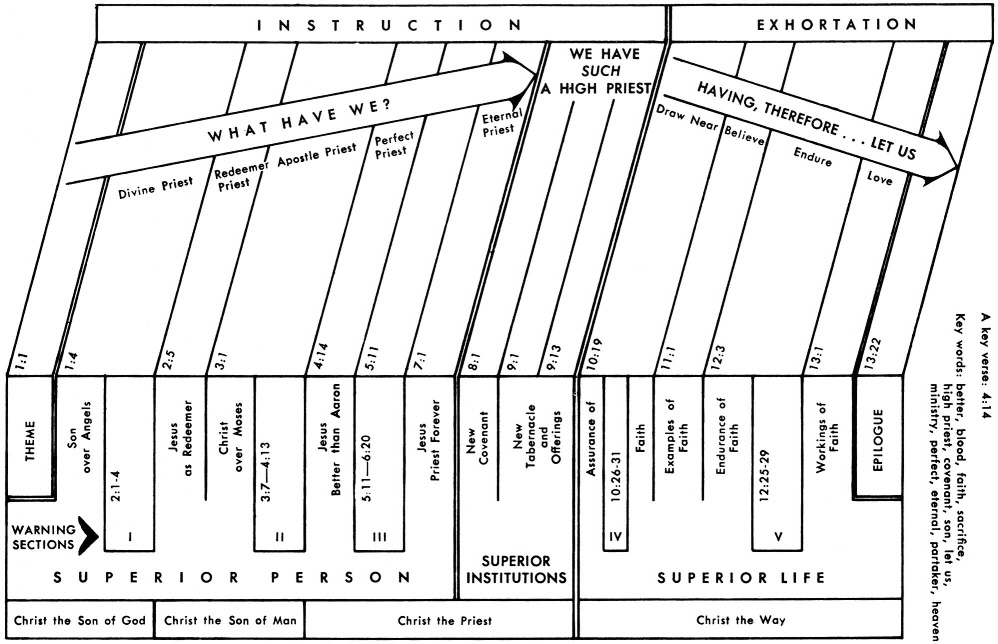
CONSIDER JESUS OUR GREAT HIGH PRIEST
Click chart to enlarge
Charts from Jensen's Survey of the NT - used by permission
Swindoll's Chart, Interesting Pictorial Chart of Hebrews, Another Chart
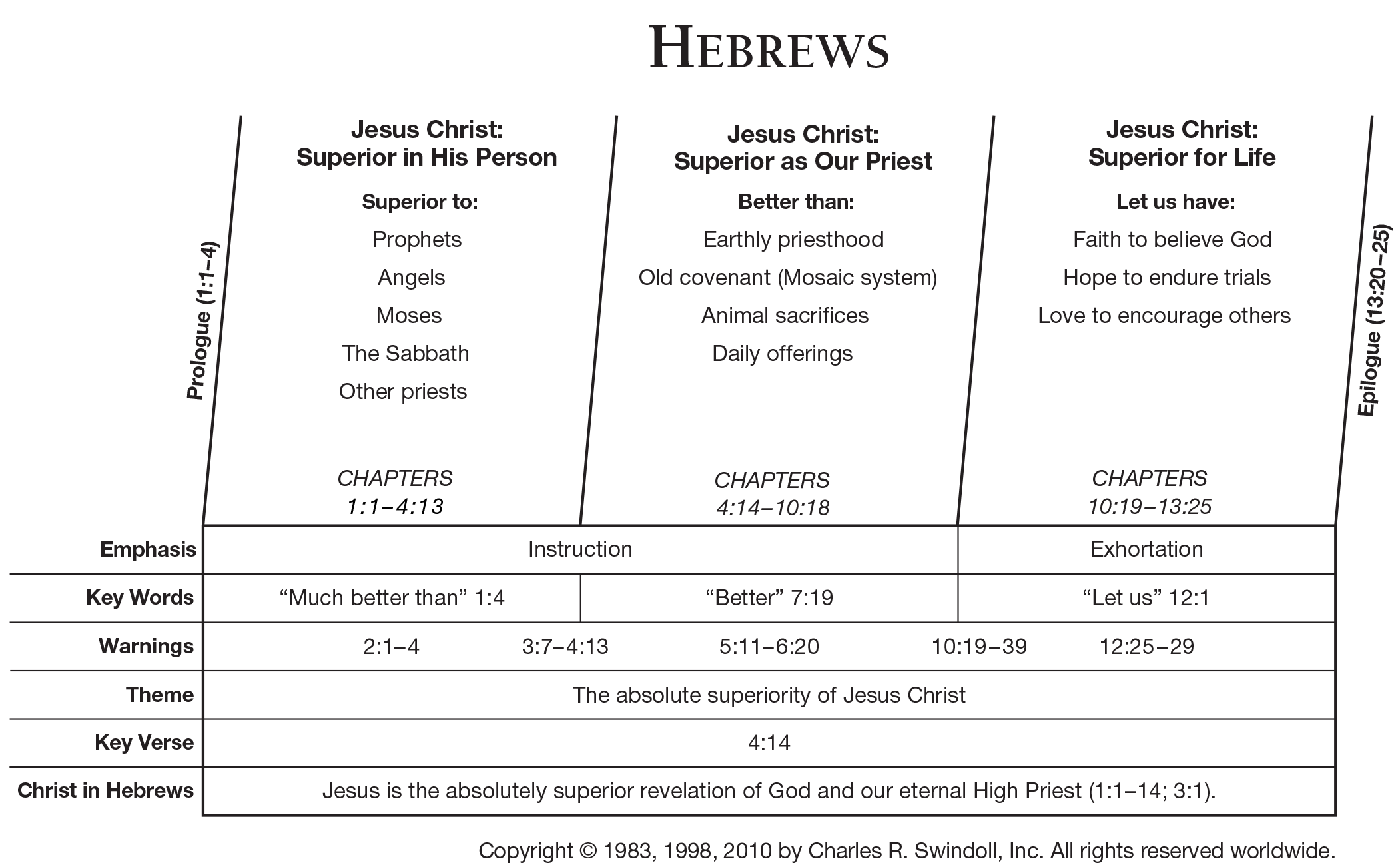

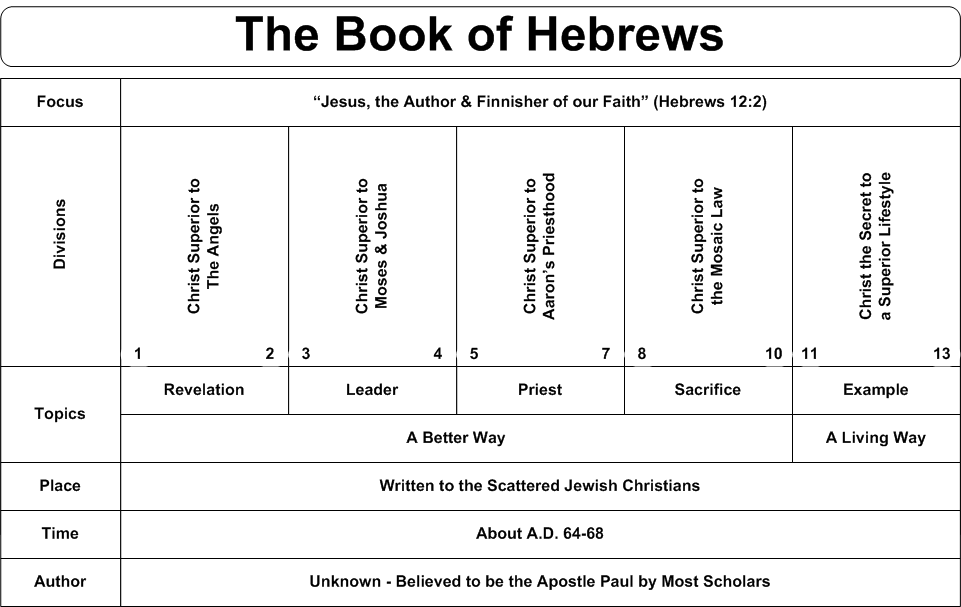
|
The Epistle |
||||
| INSTRUCTION Hebrews 1-10:18 |
EXHORTATION Hebrews 10:19-13:25 |
|||
| Superior Person of Christ Hebrews 1:1-4:13 |
Superior Priest in Christ Hebrews 4:14-10:18 |
Superior Life In Christ Hebrews 10:19-13:25 |
||
| BETTER THAN PERSON Hebrews 1:1-4:13 |
BETTER PRIESTHOOD Heb 4:14-7:28 |
BETTER COVENANT Heb 8:1-13 |
BETTER SACRIFICE Heb 9:1-10:18 |
BETTER LIFE |
| MAJESTY OF CHRIST |
MINISTRY OF CHRIST |
MINISTERS FOR CHRIST |
||
|
DOCTRINE |
DUTY |
|||
|
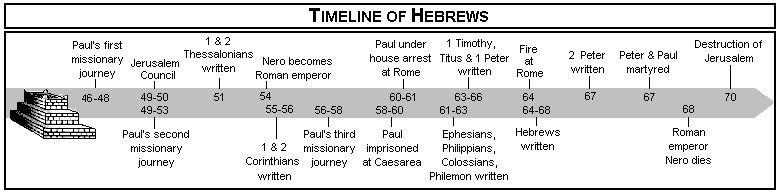
DATE WRITTEN: |
||||

See ESV Study Bible "Introduction to Hebrews"
(See also MacArthur's Introduction to Hebrews)
Borrow Ryrie Study Bible
Hebrews 9:13 For if the blood of goats and bulls and the ashes of a heifer sprinkling those who have been defiled sanctify for the cleansing of the flesh, (NASB: Lockman)
Greek: ei gar to haima tragon kai tauron kai spodos damaleos rantizousa (PAPFSN) tous kekoinomenous (RPPMPA) agiazei (3SPAI) pros ten tes sarkos katharoteta,
BGT εἰ γὰρ τὸ αἷμα τράγων καὶ ταύρων καὶ σποδὸς δαμάλεως ῥαντίζουσα τοὺς κεκοινωμένους ἁγιάζει πρὸς τὴν τῆς σαρκὸς καθαρότητα,
Amplified: For if [the mere] sprinkling of unholy and defiled persons with blood of goats and bulls and with the ashes of a burnt heifer is sufficient for the purification of the body (Amplified Bible - Lockman)
Barclay: For if the blood of goats and bulls and the ashes of a heifer could by sprinkling cleanse those that were unclean so that their bodies became pure (Westminster Press)
NLT: Under the old system, the blood of goats and bulls and the ashes of a young cow could cleanse people's bodies from ritual defilement. (NLT - Tyndale House)
NKJ Hebrews 9:13 For if the blood of bulls and goats and the ashes of a heifer, sprinkling the unclean, sanctifies for the purifying of the flesh,
NET For if the blood of goats and bulls and the ashes of a young cow sprinkled on those who are defiled consecrated them and provided ritual purity,
CSB For if the blood of goats and bulls and the ashes of a young cow, sprinkling those who are defiled, sanctify for the purification of the flesh,
ESV For if the blood of goats and bulls, and the sprinkling of defiled persons with the ashes of a heifer, sanctify for the purification of the flesh,
NIV The blood of goats and bulls and the ashes of a heifer sprinkled on those who are ceremonially unclean sanctify them so that they are outwardly clean.
Phillips: And if the blood of bulls and goats and the ashes of a burnt heifer were, when sprinkled on the unholy, sufficient to make the body pure, then how much more will the blood of Christ himself, who in his eternal spirit offered himself to God as the perfect sacrifice, purify your souls from the deeds of death, that you may serve the living God! (Phillips: Touchstone)
Wuest: For if, as is the case, the blood of bulls and of goats, and the ashes of a heifer, sprinkling those who are in a state of [ceremonial] uncleanness, set that person apart with reference to the purity of the flesh,
Young's Literal: for if the blood of bulls, and goats, and ashes of an heifer, sprinkling those defiled, doth sanctify to the purifying of the flesh
Paraphrase (Heb 9:13-14) If the blood of animals and the ashes of a heifer could make a person outwardly clean from ceremonial defilement, how much greater is the power of Christ’s blood! Through the eternal Spirit He offered Himself without defect to God, and His sacrifice cleanses our consciences from lifeless works so that we may truly serve the living God.
Paraphrase (Heb 9:13-14) Under the old covenant, even the blood of goats and bulls and the ashes of a red heifer, when sprinkled on the defiled, had the power to set them apart as clean in an outward, ceremonial sense. But now—how much more—the blood of Christ, who by the eternal Spirit offered Himself unblemished to God, reaches into the innermost part of us. His sacrifice purifies our conscience from dead and futile works, releasing us to worship and serve the God who lives forever.
Paraphrase (Heb 9:13-14) If external rituals with animal blood and ashes could restore outward purity, how much more will the blood of Christ restore inward purity! By the Spirit’s power, Jesus offered Himself as the spotless sacrifice to God, and His blood washes the conscience clean, freeing us from dead deeds so we may joyfully serve the living God.
- If the blood of bulls and goats - Leviticus 16:14,16 Numbers 19:2-21
- Hebrews 9 Resources - Multiple Sermons and Commentaries
Related Passages:
Leviticus 16:14+ "Moreover, he shall take some of the blood of the bull and sprinkle it with his finger on the mercy seat on the east side; also in front of the mercy seat he shall sprinkle some of the blood with his finger seven times… 16 And he shall make atonement for the holy place, because of the impurities of the sons of Israel, and because of their transgressions, in regard to all their sins; and thus he shall do for the tent of meeting which abides with them in the midst of their impurities.
Exodus 24:8+ So Moses took the blood and sprinkled it on the people, and said, “Behold the blood of the covenant, which the LORD has made with you in accordance with all these words.”
Numbers 19:13, 18-20+ Anyone who touches a corpse, the body of a man who has died, and does not purify himself, defiles the tabernacle of the LORD; and that person shall be cut off from Israel. Because the water for impurity was not sprinkled on him, he shall be unclean; his uncleanness is still on him....18 ‘A clean person shall take hyssop and dip it in the water, and sprinkle it on the tent and on all the furnishings and on the persons who were there, and on the one who touched the bone or the one slain or the one dying naturally or the grave. 19 ‘Then the clean person shall sprinkle on the unclean on the third day and on the seventh day; and on the seventh day he shall purify him from uncleanness, and he shall wash his clothes and bathe himself in water and shall be clean by evening. 20 ‘But the man who is unclean and does not purify himself from uncleanness, that person shall be cut off from the midst of the assembly, because he has defiled the sanctuary of the LORD; the water for impurity has not been sprinkled on him, he is unclean.
Psalm 51:7+ (DAVID ASKS GOD TO) Purify (Lxx = rhantizo) me with hyssop, and I shall be clean; Wash me, and I shall be whiter than snow. (NET VERSION = "Sprinkle me with water and I will be pure."
Isaiah 52:15 Thus He will sprinkle many nations, Kings will shut their mouths on account of Him; For what had not been told them they will see, And what they had not heard they will understand.
1 Peter 1:2+ according to the foreknowledge of God the Father, by the sanctifying work of the Spirit, to obey Jesus Christ and be sprinkled with His blood: May grace and peace be yours in the fullest measure.
IF THE LESSER HOW
MUCH MORE THE GREATER
In Hebrews 9:13-14 (which should be read together for the full impact of argument) the writer continues his “lesser-to-greater” argument. He points back to the animal sacrifices of the Old Covenant, specifically those on the Day of Atonement (goats and bulls) and the purification rites involving the red heifer (Nu 19:1-10+), to show that if these external rituals had some effect, then Christ’s sacrifice, being infinitely superior, must have a far greater effect on the inner person. This verse sets up the contrast with Heb 9:14: if the old blood could cleanse outwardly, how much more will Christ’s blood cleanse the conscience.
For (gar) Always pause to ponder this important term of explanation. Here the for (gar) introduces the reason for the statement just made in the previous passage. In Hebrews 9:12, the author had just declared that Christ entered the Most Holy Place once for all, obtaining eternal redemption through His own blood. Now he explains why this is so significant, doing so by drawing a comparison to the OT sacrifices. Stated another way for sets up a lesser-to-greater argument (a common rabbinic style called qal wahomer). The logic goes like this -- If the blood of animals in the Old Covenant could bring an outward cleansing, then how much more the blood of Christ can bring an inward, eternal cleansing (Heb 9:14, cf "eternal redemption" in Heb 9:12).
If the blood (haima) of goats and bulls and the ashes of a heifer sprinkling (rhantizo) those who have been defiled (koinoo) sanctify (hagiazo) for the cleansing (katharotes) of the flesh (sarx) - Note how the writer begins his argument with the lesser truth. Thus If is a first-class conditional statement indicating that what follows is assumed to be true. In other words, the divinely ordained OT ceremonial rituals did indeed serve "for the (external) cleansing of the flesh" but they were not sufficient for (internal) cleansing of one's conscience. Clearly, the cleansing of the flesh (sarx) in this context does not refer cleansing the fallen sinful flesh inherited from Adam but is symbolic of outward or ritual cleansing.
Sprinkling on the people was symbolic. In Lev 16:14-15+ on the Day of Atonement the high priest sprinkled blood of the bull and the goat on and before the mercy seat for atonement of himself, his household and the sons of Israel. In Nu 19 a red heifer was burned, ashes mixed with water and this mixture sprinkled on those defiled by touching a corpse, restoring them to ceremonial cleanness thus dealing with the most severe form of defilement which was the penalty to be cut off from the assembly (see Nu 19:13, 18-20+). As note the author is reasoning from “lesser-to-greater” so if sprinkling with animal blood and ashes could outwardly sanctify, how much more can Christ’s blood, applied by the Spirit, cleanse inwardly, to the conscience. Sprinkling in the OT was symbolic and external. Sprinkling in Christ is substantial and internal as shown in Hebrews 10:22 which says "let us draw near with a sincere heart in full assurance of faith, having our hearts sprinkled clean from an evil conscience and our bodies washed with pure water." See the commentary on the ashes of a heifer in Numbers 19:1-22 and also the note from Gotquestions.org below.
The ashes of the red heifer were regarded as a concentration of the essential properties of the sin-offering, and could be resorted to at all times with comparatively little trouble and no loss of time. One red heifer availed for centuries. Only six are said to have been required during the whole of Jewish history because only a small quantity of the ashes was necessary to impart cleansing to the water.
Steven Cole explains that ashes of a heifer sprinkling "was a ritual for purification, especially if someone had been defiled by touching a dead body. The author argues from the lesser to the greater. If these rituals could cleanse the flesh, “how much more will the blood of Christ, who through the eternal Spirit offered Himself without blemish to God, cleanse your conscience from dead works to serve the living God?” Jesus Christ is the only one who could atone for man’s sin, because He alone was a man without blemish in all that He did. Thus His blood can act as the substitute for the penalty that we deserve. (Hebrews 9:1-14 God's Remedy for Guilt)
Not all the blood of beasts on Jewish altars slain,
Could give the guilty conscience peace or wash away the stain.
Christ the heavenly Lamb takes all our sins away,
A sacrifice of nobler name and richer big than they.
-- Isaac Watts (Play entire hymn)
Charles Spurgeon reviews the sacrifices Aaron presented on the Day of Atonement which correspond to the writer's description of the blood (haima) of goats and bulls --"The atonement was made not only by the blood of sacrifice, but by the presentation of the blood within the veil. With the smoke of incense and a bowl filled with blood Aaron passed into the most holy place. Let us never forget that our Lord has gone into the heavenly places with better sacrifices than Aaron could present. His merits are the sweet incense that burns before the throne of the heavenly grace. His death supplies that blood of sprinkling that we find even in heaven. The presenting of the blood before God effects the atonement. (ED: NOT SURE IF SPURGEON THINKS THIS IS LITERAL BLOOD - SEE DISCUSSION OF THIS ABERRANT TEACHING BY SOME COMMENTATORS). The material of the atonement is in the blood and merits of Jesus, but a main part of the atoning act lies in the presentation of these in the heavenly places by Jesus Christ Himself.
David Guzik - The ashes of a heifer refer to the remains of a burnt offering that was preserved. The ashes were sprinkled in the laver of washing to provide water suitable for ceremonial cleansing (Numbers 19:1–10). This was a shadow, fulfilled and done away with when Jesus offered a perfect cleansing. Therefore there is no value in “holy water” used by the Roman Catholic Church. Reportedly, there is a search for a “red heifer” that can be sacrificed, and its ashes used as part of a restoration of priestly functions for a rebuilt temple in Jerusalem.
Kenneth Wuest comments on the sprinkling related to the red heifer - The writer in this verse speaks of the unclean Israelite, the person who was rendered ceremonially unclean by contact with a dead body, or by entering a house where a corpse was lying, or by touching a bone or a tomb. If he should enter the tabernacle while thus defiled, he was cut off from Israel. Ceremonial defilement was not in itself sin, but a type of sin. Hence the blood of animals could cleanse away this defilement. It was only the flesh of the person which was defiled by contact with the dead. It was likewise only the flesh that was cleansed (ED: IT WAS ONLY EXTERNAL!). Thus, defilement and cleansing were both symbolic. (Hebrews Commentary)
Blood of goats, the ashes red,
Could cleanse the flesh, but not the head;
Yet in these shadows Christ is shown,
Whose blood will cleanse the heart alone.
Spurgeon elaborates more on the red heifer - Under the old law men might be unclean who did not know it. A man might have touched a bone and not be aware of it, yet the law operated just as much: he might walk across a grave and not know it, but he was unclean. I fear that our proud sense of what we think to be our inward cleanness is simply the stupidity of our conscience. If our conscience were more sensitive and tender, it would perceive sin where now we congratulate ourselves that everything is pure. This teaching puts us into a very lowly place, but the lowlier our position the better and the safer for us, and the more shall we be able to prize the expiation by which we draw near to God.
The defilement was frequent, but the cleansing was always ready. At a certain time all the people of Israel brought a red heifer to be used in the expiation. It was not at the expense of one person, or tribe, but the whole congregation brought the red cow to be slain. It was to be their sacrifice, and it was brought for them all. It was not led, however, up to the holy place for sacrifice, but it was brought forth without the camp, and there it was slaughtered in the presence of the priest, and wholly burnt with fire, not as a sacrifice upon the altar, but as a polluted thing that was to be made an end of outside the camp. It was not a regular sacrifice, or we should have found it described in Leviticus. It was an ordinance entirely by itself, as setting forth quite another side of truth.
The red heifer was killed before the uncleanness was committed, just as our Lord Jesus Christ was made a curse for sin long, long ago. Before you and I had lived to commit the uncleanness, there was a sacrifice provided for us. For the easing of our conscience we shall be wise to view this sacrifice as that of a substitute for sin, and consider the results of that expiation. Sin on the conscience needs for its remedy the result of the Redeemer’s substitution.
But while this red cow was slaughtered for all, and the blood was sprinkled toward the holy place for all, no one derived any personal benefit from it in reference to his own uncleanness unless he made a personal use of it. When a man became unclean, he procured a clean person to go on his behalf to take a little of the ashes, and to put them in a cup with running water, and then to sprinkle this water of purification upon him, upon his tent, and all the vessels in it. By that sprinkling, at the end of seven days, the unclean person was purified. There was no other method of purification from his uncleanness but this.
It is so with us. Today the living water of the divine Spirit’s sacred influences must take up the result of our Lord’s substitution, and this must be applied to our consciences. That which remains of Christ after the fire has passed upon Him, even the eternal merits, the enduring virtue of our great sacrifice, must be sprinkled upon us through the Spirit of our God. Then are we clean in conscience, but not until then.
Wuest - The unclean Israelite was, therefore, "out of bounds," so to speak, so far as participation in the tabernacle service of Israel was concerned, and also his service to God. When he fulfilled the Levitical ritual that had to do with his position and his restoration to a participation in the worship of Israel, he was sanctified, that is, set apart for God again. (Hebrews Commentary)
In other words, he was cleaned up on the outside, but even that was only symbolic (not to mention imperfect and temporary). The writer's argument that is continued in verse 14 is that our Great High Priest in contrast to the ashes of a red heifer, effected internal cleansing (the conscience). Christ does much more than externally cleanse the old man for His blood paves the way for the birth of a brand new man. Paul wrote…
Therefore if any man is in Christ, he is a new creature; the old things passed away; behold, new things have come. (2Cor 5:17- note)
Peter speaks of the purification made possible by the blood of Christ…
Since you have in obedience to the truth purified your souls for a sincere love of the brethren, fervently love one another from the heart, 23 for you have been born again not of seed which is perishable but imperishable, that is, through the living and abiding word of God. (see note 1 Peter 1:22; 23)
ILLUSTRATION - There is a well known story of an evangelist named Alexander Wooten who related a story from the days when he held tent meetings. On one occasion after a series of meetings was over, he was pulling up his tent stakes when a young man approached him and asked what he had to do to be saved. The evangelist answered responded, “Sorry, it’s too late" which caused the young man to cry out "Oh no! Do you mean it’s too late because the services are over?” The evangelist explained that it was "too late" because it had already been done. In other words as he explained "Everything that could be done for your salvation has already been done.” After explaining Christ’s finished work to the young man, he led him to saving faith. Our salvation is based on the covenant whose redeeming work is finished-on a sacrifice that has been offered once and for all, that is complete and perfect and eternal. (Quoted by Warren Wiersbe in his comments on Dead John 19:28–30)
T Lewis on the practice of sprinkling in the OT
Sprinkling (blood, water, oil) formed an important--if not the essential--part of the act of sacrifice. A consideration of the chief passages in the Old Testament will reveal the prominence and the significance of sprinkling as a feature of the sacrificial act. The significance of the sprinkling of blood is seen in the account of the establishment of the covenant between Yahweh and Israel (Ex 24:6-8). Half the blood was sprinkled on the altar as representing the Deity, while the remainder was put into a basin and then sprinkled on the people. This ceremony is a survival in a modified form of the communal meal in which the tribal god and his worshippers sat together and participated in the same food, and in this way came to possess the same life. The two-fold sprinkling of blood resulted in the establishment of an inviolable bond (Nu 18:17; 2 Ki 16:15).
In the account of the consecration of Aaron and his sons (Ex 29:16,20,21) the blood of the ram of the burnt offering was sprinkled on the altar, while the blood of the ram of consecration was put on the altar and sprinkled on Aaron and his sons and on their garments. Water of purifying was sprinkled on the Levites at their ordination (Nu 8:7).
Leviticus gives detailed information in regard to sacrificial sprinkling. In the case of burnt offering the blood was sprinkled round about upon the altar (Lev 1:5,11). The same practice obtained in the case of peace offerings, whether ox, lamb or goat (Lev 3:2,8,13). When a sin offering for sins inadvertently committed was made, the priest dipped his fingers in the blood and sprinkled it seven times before Yahweh, before the veil of the Holy Place (Lev 4:6). Elsewhere (Lev 16:11,15) we read that Aaron took the blood of the sin offering and sprinkled it with his finger upon the mercy-seat, eastward, 7 times (see also Nu 19:4).
Sprinkling constituted part of the process of purification. But it is obvious that the sprinkling, even in this case, was a religious act, and not part of the actual physical cleaning. A simple kind of sprinkler was made by fastening a bunch of hyssop to a cedar rod by a piece of scarlet thread or wool and then the patient was besprinkled 7 times (Lev 14:7), while oil was sprinkled with the finger, also 7 times, before Yahweh (Lev 14:16; see also Ex 12:22; Nu 19:18; Ps 51:7). The house in which the leper lived was disinfected in the same thorough manner (Lev 16:51).
In the case of persons who had contracted uncleanness through contact with a corpse, sprinkling with the "water of separation" was part of the process of cleansing. The water of separation consisted of the ashes of a red heifer (slain for the purpose) mixed with running water (Nu 19). A sprinkler was used as in the case of the leper (Nu 19:18). The final sprinkling--on the 7th day--was followed by a bath (Nu 19:19). The "tent" in which the corpse lay, together with all the contents, were thoroughly disinfected.
According to Ex (9:8,10) the plague of "boils and blains" was caused through the sprinkling of ashes ("soot" the Revised Version margin) in the air toward heaven, which settled on man and beast and produced the eruption. The narrative gives no clue in reference to the connection between the ashes and the eruption, but the religious character of the act is obvious. By means of it, the assistance of the Deity was invoked. According to primitive thought, there was no necessary connection between the religious act and the consummation devoutly wished for. The purpose of the religious observance was to influence, or bring pressure to bear upon, the Deity so that He might exert Himself on behalf of the worshipper. It is evident that sprinkling as part of the act of worship was believed to be religiously effectual. It was not symbolical nor morally significant. It was a religious act. It is not denied that in some passages sprinkling is symbolical. According to Ezek (36:25) the restored community will experience moral and spiritual renewal. There will be a "new heart" and a "new spirit." The sprinkling with clean water is the outward symbol of the inward lustration. In Isa 63:3 the sacrificial allusion is obvious. The conqueror who strides triumphantly from Bozrah is "besprinkled" with the life-blood (or juice) of his victims. In Isa 52:15 "sprinkle" is a doubtful rendering. There is no apparent connection between bodily disfigurement and national purification. the Revised Version margin renders "startle" (literally, "cause to spring"). The exalted dignity of the "martyr" will excite the wonder of kings and peoples.
In 1 Pet 1:2, "sprinkling of the blood of Jesus Christ" is used figuratively of its cleansing efficacy (compare Heb 9:13,14; 10:22). (ISBE)
Blood (129) haima is literally the red fluid that circulates in the heart, arteries, capillaries, and veins of a vertebrate animal carrying nourishment and oxygen to and bringing away waste products from all parts of the body and thus is essential for the preservation of life. Haima gives us English words like hemorrhage (Gk - haimorragia from haimo- + rragia from regnuo - to burst) English derivatives include hematology (study of blood) and "leukemia" which is from leuco (white) plus haima (blood), which is fitting as leukemia is a disease that affects the white blood cells. Derivatives of haima are : haimatekchusía (130), shedding of blood; haimorroéō (131), to hemorrhage. Haima was used to describe “descent” or “family” in ancient times. “To shed blood” is to destroy life.
In Matthew 27:24, 25 - When Pilate saw that he was accomplishing nothing, but rather that a riot was starting, he took water and washed his hands in front of the crowd, saying, "I am innocent of this Man's blood; see to that yourselves."25 And all the people said, "His blood shall be on us and on our children!" - Clearly Pilate and and the Jewish crowd use of blood as a metonymy to depict Jesus' death. In the Garden of Gethsemane Jesus' "sweat became like drops of blood." (Lk 22:44) See discussion of hematidrosis, a rare condition in which a human sweats blood.
Blood "has great significance in the Bible. Its meanings involve profound aspects of human life and God's desire to transform human existence. Blood is intimately associated with physical life. Blood and “life” or “living being” are closely associated." (Blood - Holman Bible Dictionary)
HAIMA IS A KEYWORD IN HEBREWS - 23x in 20v
Hebrews 2:14 since the children share in flesh and blood
Hebrews 9:7 only the high priest enters once a year, not without taking blood
Hebrews 9:12 and not through the blood of goats and calves
Hebrews 9:12 but through His own blood, He entered the holy place once for all,
Hebrews 9:13 For if the blood of goats and bulls and the ashes of a heifer sprinkling
Hebrews 9:14 how much more will the blood of Christ, who through the eternal Spirit offered Himself
Hebrews 9:18 Therefore even the first covenant was not inaugurated without blood.
Hebrews 9:19 he took the blood of the calves and the goats,
Hebrews 9:20 THIS IS THE BLOOD OF THE COVENANT WHICH GOD COMMANDED YOU.”
Hebrews 9:21 sprinkled both the tabernacle and all the vessels of the ministry with the blood.
Hebrews 9:22 And according to the Law, one may almost say, all things are cleansed with blood
Hebrews 9:22 and without shedding of blood there is no forgiveness.
Hebrews 9:25 high priest enters the holy place year by year with blood that is not his own.
Hebrews 10:4 For it is impossible for the blood of bulls and goats to take away sins.
Hebrews 10:19 we have confidence to enter the holy place by the blood of Jesus,
Hebrews 10:29 has regarded as unclean the blood of the covenant by which he was sanctified
Hebrews 11:28 By faith he kept the Passover and the sprinkling of the blood
Hebrews 12:4 You have not yet resisted to the point of shedding blood in your striving against sin;
Hebrews 12:24 and to Jesus, the mediator of a new covenant, and to the sprinkled blood
Hebrews 12:24 which speaks better than the blood of Abel.
Hebrews 13:11 For the bodies of those animals whose blood is brought into the holy place
Hebrews 13:12 Jesus also, that He might sanctify the people through His own blood
Hebrews 13:20 the great Shepherd of the sheep through the blood of the eternal covenant
Related Resources:
- Why is Christianity such a bloody religion? | GotQuestions.org
- What does the blood of Christ have to do with our salvation ...
- What does it mean that the blood is the life (Deuteronomy 12:23)
Sprinkling (4472) (rhantizo from rhaino - to sprinkle; cp cognate = rhantismos) by implication meant to cleanse by sprinkling, purify, free from pollution. It was used in secular Greek to describe common sprinkling in a non-religious sense but there were uses in which sprinkling conveyed the idea of religious cleansing. Rhantizo speaks of internal (heart) cleansing in Heb 10:22. Sprinkling was the method of application for the blood of the sacrifice in order to secure its atoning efficacy and the method of purifying connected with expiation. Sprinkling persons with blood took place upon the ratifying of the covenant (Ex. 24:8; Heb. 9:19, 20); upon the consecration of the family of Aaron to the priesthood (Ex. 29:21); in cleansing from leprosy (Lev. 14:2-7). The symbolic use of rhantizō in the Septuagint is “purify” or “cleanse” in a moral sense (cf. Leviticus 6:27; Psalm 51:7], corresponding to Hebrews 9:13,19,21; 10:22). In the Old Testament religious sense it referred to oil that was mixed with the blood of the sacrifice and sprinkled on whatever was to be cleansed. TDNT - rhantizo is a rare and late form of rhaino, which is used for spraying or sprinkling something on something or something with something. Rhantizo - distinguish from nipto = to rinse part of the body, louo = wash the entire body, bapto/baptizo = immerse.
Robert B. Girdlestone in his Synonyms of The Old Testament has an interesting comment - "The sprinklings (shantismoi) specially referred to in the Epistle to the Hebrews are of two kinds—that which was performed with the ashes of a red heifer on persons who had contracted certain defilement (Heb. 9.13), and that which was performed with blood on the people and the Book in making the old covenant; also on the tabernacle and various vessels connected with the sacred service (Heb. 9.19,21). The substance of which these are the shadows is the sprinkling of the blood of Jesus, which speaketh better things than that of Abel (Heb. 12.24)
RHANTIZO - 5V Mk. 7:4; Heb. 9:13; Heb. 9:19; Heb. 9:21; Heb. 10:22 (In Lxx in Lev 6:20, 2Ki 9:33, Ps 51:7
Hebrews 9:13 For if the blood of goats and bulls and the ashes of a heifer sprinkling those who have been defiled sanctify for the cleansing of the flesh,
Hebrews 9:19 For when every commandment had been spoken by Moses to all the people according to the Law, he took the blood of the calves and the goats, with water and scarlet wool and hyssop, and sprinkled both the book itself and all the people,
Hebrews 9:21 And in the same way he sprinkled both the tabernacle and all the vessels of the ministry with the blood.
Hebrews 10:22 let us draw near with a sincere heart in full assurance of faith, having our hearts sprinkled clean from an evil conscience and our bodies washed with pure water.
Defiled (2840) (koinoo from koinos = common, defiled, unclean, unholy, profane, that which lies common or open to all) means to make koinos or common. In Scripture, koinoo means to make unclean, to profane (treat something with irreverence or contempt), to desecrate (to treat disrepectfully, irreverentially, outrageously), to render unhallowed, to pollute, to make or cause to become ritually unacceptable. The idea of koinoo is a violation of ritual holiness. Classic Greek - to make one a participant in something, to have a share in, to unite.
Koinoo - 14x in 11v - Usage: consider(2), defile(7), defiled(2), defiles(3). Found only in 4Macc 7:6.
Matthew 15:11 "It is not what enters into the mouth that defiles the man, but what proceeds out of the mouth, this defiles the man."
18 "But the things that proceed out of the mouth come from the heart, and those defile the man.
20 "These are the things which defile the man; but to eat with unwashed hands does not defile the man."
Mark 7:15 there is nothing outside the man which can defile him if it goes into him; but the things which proceed out of the man are what defile the man.
18 And He said to them, "Are you so lacking in understanding also? Do you not understand that whatever goes into the man from outside cannot defile him,
20 And He was saying, "That which proceeds out of the man, that is what defiles the man.
23 "All these evil things proceed from within and defile the man."
Acts 10:15 Again a voice came to him a second time, "What God has cleansed, no longer consider unholy."
Acts 11:9 "But a voice from heaven answered a second time, 'What God has cleansed, no longer consider unholy.'
Acts 21:28 crying out, "Men of Israel, come to our aid! This is the man who preaches to all men everywhere against our people and the Law and this place; and besides he has even brought Greeks into the temple and has defiled this holy place."
Hebrews 9:13 For if the blood of goats and bulls and the ashes of a heifer sprinkling those who have been defiled sanctify for the cleansing of the flesh,
Sanctify (37) (hagiazo from hagios = set apart from) means to set apart for God, to sanctify, to consecrate, to make a person or thing (in the OT altars, days, priests, etc were set apart) the opposite of koinos, which means profane or common.
Wuest writes that hagiazo does not mean "merely “to set apart,” but in the case of the pagan word, “to set apart for the gods,” and in the case of the Christian word “to set apart for God.” The worshipper of the pagan god acquired the character of that pagan god and the religious ceremonies connected with its worship. The Greek temple at Corinth housed a large number of harlots who were connected with the worship of the Greek god. Thus, the set-apartness of the Greek worshipper was in character licentious, totally depraved, and sinful.
Gilbrant - The Septuagint reflects four basic uses of hagiazō: (1) the consecration or making holy of objects; (2) the consecration of persons; (3) holy treatment or reverence of persons; and (4) purification. It signifies an act whereby people or things are consecrated or set aside for the exclusive use of God. They are not to be used for profane purposes but are a special possession of God. Old Testament examples of consecration of objects may be seen in Exodus where the breast of the wave offering was to be consecrated (29:27) as was the altar (29:37). The tabernacle was to be sanctified by God’s glory (Exodus 29:43), fasts were sanctified (Joel 1:14), and holy (i.e., “sanctified”) wars were declared (cf. Jeremiah 6:4). The consecration of persons is illustrated by the command to consecrate every firstborn child (Exodus 13:2). Aaron and his sons (Exodus 28:41), as well as the people (Joshua 7:13), were also set aside for the exclusive use of God. Reverence for persons, dates, or sacred objects is best seen in the command to keep the Sabbath Day holy, to set it aside as a day for God. Another emphasis of hagiazō seems to be on divine power. There was a presence of divine power with those who were consecrated or sanctified.
The Old Testament’s use of hagiazō-language is carried over into the New Testament. The holy places sanctified the material objects that were given for service. The temple sanctified the gold (Matthew 23:17); the altar sanctified the offering (Matthew 23:19). Paul reminded Timothy that everything created by God is sanctified by God’s Word and by prayer (1 Timothy 4:5). For believers it means to be separated from sin and unto God. Each time persons were sanctified in the New Testament it was by the act and power of God, Christ, and/or the Holy Spirit. On only one occasion did Paul indicate a sanctifying of a person by another (1 Corinthians 7:14). The Son was sanctified by the Father (John 10:36); however, this was not for moral purification, but for divine service. It was Jesus’ prayer that His disciples be sanctified (John 17:17,19). Individual believers are sanctified by the Holy Spirit; implicit here is the Old Testament concept of divine power. Paul told the men in the church in Ephesus that Christ left them an example of how to care for their wives by giving himself up on behalf of the Church in order to “make her holy . . . by the washing with water through the word” (Ephesians 5:25ff., NIV). Sanctification of persons is accomplished by faith (Acts 15:9), by the Holy Spirit (Romans 15:16), by God himself (1 Thessalonians 5:23), through the offering of the body and blood of Jesus Christ (Hebrews 10:10; 13:12). The concept of “reverence” is a New Testament use of hagiazō. The Lord’s pattern of prayer in Matthew 6:9ff. and Luke 11:2ff. asks that the name of God be held in reverence by men; Peter exhorted that Christ should be held in reverence “in your hearts” (1 Peter 3:15). The final use of hagiazō (Revelation 22:11) indicates that the holy person will continue in this state of sanctification throughout eternity. (Complete Biblical Library)
Cleansing (2514) (katharotes from katharos = pure or katharizo - to make clean) describes cleanness or purification. The state or condition of being ritually pure or ceremonially cleansed. This ritual was a symbolic (and external) way of showing one was cleansed from sin. Only use in Bible is Heb 9:13 where it signifies freedom from the guilt of filthiness. The particular emphasis of katharizo is either purity of speech or ceremonial purity. Ritualistic cleanliness is also indicated by the verb katharizo and the more typical noun form katharos. Katharotēs in Heb 9:13 addresses ceremonial purity and the blood of sacrificial animals. In the New Testament, “Religious and moral purity replaces ritual and cultic” (Hauck, “katharos,” Kittel, 3:424). Hebrews emphasizes the superiority of the new covenant to the old. In contrast with the older ritual purity, the new moral purity is a true and perfect purity.
QUESTION - What is the significance of a red heifer in the Bible? GOTQUESTIONS.ORG Watch Video
ANSWER - It seems that every few years, a red heifer (red cow) is born in Israel, and it results in some people thinking that the return of Jesus is near. Why is this? What does a red heifer have to do with the end times? Before we explore that question directly, it is important to understand the significance of a red heifer in the Bible.
To meet the requirements of the Old Testament law, a red heifer was needed to help accomplish the purification of the Israelites from uncleanness—specifically, the ashes of a red heifer were needed (see Numbers 19). Because red heifer ashes were necessary for the purification rites held at the temple, many have regarded the appearance of a red heifer today as heralding the construction of the third temple and the return of Christ.
According to rabbinical tradition, there have been nine red heifers sacrificed since Moses’ time. Since the destruction of the second temple, no red heifers have been slaughtered. The rabbi Maimonides (1135—1204) taught that the tenth red heifer would be sacrificed by the Messiah Himself (Parah Adumah, ch. 3, § 4). The Temple Institute, a group advocating the construction of a third temple, reports that five flawless red heifers from Texas arrived in Israel on September 15, 2022 (https://templeinstitute.org, accessed 9/22/22). Many people view this event as a fulfilment of prophecy, since the acquisition of a red heifer is a major step forward in plans for a new temple.
The Mosaic Law specified that the red heifer was to be “without defect or blemish” and to have never borne a yoke (Numbers 19:2). The sacrifice of the red heifer was unique in the law in that it used a female animal, it was sacrificed away from the entrance to the tabernacle, and it was the only sacrifice in which the color of the animal was specified.
The slaughtering of a red heifer is described in Numbers 19:1–10. Eleazar the priest was to oversee the ritual outside the camp of the Israelites. After the animal was killed, Eleazar was to sprinkle some of its blood toward the front of the tabernacle seven times (verse 4). Then he left camp again and oversaw the burning of the carcass of the red heifer (verse 5). As the red heifer burned, the priest was to add “some cedar wood, hyssop and scarlet wool” to the fire (verse 6).
The ashes of the red heifer were then collected and stored “in a ceremonially clean place outside the camp.” The ashes were used “in the water of cleansing; it is for purification from sin” (Numbers 19:9). The law goes on to detail when and how the ashes of the red heifer were used in purifying those who came in contact with a dead body: “Whoever touches a human corpse will be unclean for seven days. They must purify themselves with the water on the third day and on the seventh day; then they will be clean” (Nu 19:11–12). The purification process involved the ashes of the red heifer in this way: “Put some ashes from the burned purification offering into a jar and pour fresh water over them. Then a man who is ceremonially clean is to take some hyssop, dip it in the water and sprinkle . . . anyone who has touched a human bone or a grave or anyone who has been killed or anyone who has died a natural death” (Nu 19:17–18).
The commands concerning the red heifer were yet another foreshadowing of the sacrifice of Christ for believers’ sin. The Lord Jesus was “without blemish,” just as the red heifer was to be. As the heifer was sacrificed “outside the camp” (Numbers 19:3), Jesus was crucified outside of Jerusalem (Hebrews 13:11–12). And, just as the ashes of the red heifer cleansed people from the contamination of death, so the sacrifice of Christ saves us from the penalty and corruption of death.
The red heifer ritual as established in the Mosaic Law was fairly simple; in the interval since that time, Judaism has added many standards and extra criteria. Talmudic tradition speaks of the type of rope the red heifer was to be bound with, the direction it was to face when being slaughtered, the words spoken by the priest, the wearing of sandals during the ritual, etc. The rabbinical rules listed many things that would disqualify a red heifer from being sacrificed: if she had been ridden or leaned on, if she had a garment placed over her, if a bird had rested on her, and if she had two black or white hairs, among many other conditions not found in the biblical text.
According to the futurist timeline of eschatology, there will indeed be a third temple of God in Jerusalem. Jesus prophesied a desecration of the temple to occur during the tribulation (Matthew 24:15; cf. 2 Thessalonians 2:4); for that to happen, there obviously will need to be a temple. Assuming those who dedicate the end-times temple follow Jewish law, they will need the ashes of a red heifer, mixed with water, for the ceremonial cleansing. If a blemish-free red heifer has truly been found and is in Israel, that could be one more piece falling into place for the fulfillment of biblical prophecy.
Just a red heifer be found before the rapture occurs? No, Jesus could return to receive His own at any moment. The rapture is not contingent on the presence of any particular cow. Must a red heifer be found before the temple is rebuilt? Not necessarily, although temple advocates certainly want one for ceremonial purposes. Are animal sacrifices of any type required today? No, Jesus fulfilled all the requirements of the law, and His sacrifice provides true forgiveness and life eternal.
Scripture explicitly contrasts the red heifer ceremony with the greater sacrifice of Christ: “The ashes of a heifer sprinkled on those who are ceremonially unclean sanctify them so that they are outwardly clean. How much more, then, will the blood of Christ, who through the eternal Spirit offered himself unblemished to God, cleanse our consciences from acts that lead to death, so that we may serve the living God!” (Hebrews 9:13–14).
Hebrews 9:14 how much more will the blood of Christ, who through the eternal Spirit offered Himself without blemish to God, cleanse your conscience from dead works to serve the living God (NASB: Lockman)
Greek: poso mallon to aima tou Christou, os dia pneumatos aioniou eauton prosenegken (3SAAI) amomon to theo, kathariei (3SFAI) ten suneidesin emon apo nekron ergon eis to latreuein (PAN) theo zonti. (PAPMSD)
BGT πόσῳ μᾶλλον τὸ αἷμα τοῦ Χριστοῦ, ὃς διὰ πνεύματος αἰωνίου ἑαυτὸν προσήνεγκεν ἄμωμον τῷ θεῷ, καθαριεῖ τὴν συνείδησιν ἡμῶν ἀπὸ νεκρῶν ἔργων εἰς τὸ λατρεύειν θεῷ ζῶντι.
Amplified: How much more surely shall the blood of Christ, Who by virtue of [His] eternal Spirit [His own preexistent divine personality] has offered Himself as an unblemished sacrifice to God, purify our consciences from dead works and lifeless observances to serve the [ever] living God? (Amplified Bible - Lockman)
Barclay: how much more will the blood of Christ who, through the eternal Spirit offered himself spotless to God, cleanse your conscience so that you will be able to leave the deeds that make for death in order to become the servants of the living God? (Westminster Press)
NLT: Just think how much more the blood of Christ will purify our hearts from deeds that lead to death so that we can worship the living God. For by the power of the eternal Spirit, Christ offered himself to God as a perfect sacrifice for our sins. (NLT - Tyndale House)
Phillips: then how much more will the blood of Christ himself, who in his eternal spirit offered himself to God as the perfect sacrifice, purify your souls from the deeds of death, that you may serve the living God! (Phillips: Touchstone)
Wuest: how much more shall the blood of the Messiah, who by virtue of the intermediate instrumentality of [His] eternal spirit [His divine essence as deity, thus by His own volition as a member of the Godhead] offered himself spotless to God, purge our conscience from dead works to the serving of the living God.
Young's Literal: how much more shall the blood of the Christ (who through the age-during Spirit did offer himself unblemished to God) purify your conscience from dead works to serve the living God?
NKJ how much more shall the blood of Christ, who through the eternal Spirit offered Himself without spot to God, cleanse your conscience from dead works to serve the living God?
NET how much more will the blood of Christ, who through the eternal Spirit offered himself without blemish to God, purify our consciences from dead works to worship the living God.
CSB how much more will the blood of the Messiah, who through the eternal Spirit offered Himself without blemish to God, cleanse our consciences from dead works to serve the living God?
ESV how much more will the blood of Christ, who through the eternal Spirit offered himself without blemish to God, purify our conscience from dead works to serve the living God.
NIV How much more, then, will the blood of Christ, who through the eternal Spirit offered himself unblemished to God, cleanse our consciences from acts that lead to death, so that we may serve the living God!
MIT by how much more does the blood of Christ, who through the eternal spirit offered himself unblemished to God, purify our conscience from defunct deeds to serve the living God!
NJB How much more will the blood of Christ, who offered himself, blameless as he was, to God through the eternal Spirit, purify our conscience from dead actions so that we can worship the living God.
NRS how much more will the blood of Christ, who through the eternal Spirit offered himself without blemish to God, purify our conscience from dead works to worship the living God!
RSV how much more shall the blood of Christ, who through the eternal Spirit offered himself without blemish to God, purify your conscience from dead works to serve the living God.
NAB how much more will the blood of Christ, who through the eternal spirit offered himself unblemished to God, cleanse our consciences from dead works to worship the living God.
GWN The blood of Christ, who had no defect, does even more. Through the eternal Spirit he offered himself to God and cleansed our consciences from the useless things we had done. Now we can serve the living God.
BBE How much more will the blood of Christ, who, being without sin, made an offering of himself to God through the Holy Spirit, make your hearts clean from dead works to be servants of the living God?
ASV how much more shall the blood of Christ, who through the eternal Spirit offered himself without blemish unto God, cleanse your conscience from dead works to serve the living God?
DBY how much rather shall the blood of the Christ, who by the eternal Spirit offered himself spotless to God, purify your conscience from dead works to worship the living God?
NIRV But Christ offered himself to God without any flaw. He did this through the power of the eternal Holy Spirit. So how much more will his blood wash from our minds our feelings of guilt for committing sin! Sin always leads to death. But now we can serve the living God.
RWB How much more shall the blood of Christ, who through the eternal Spirit offered himself without spot to God, cleanse your conscience from dead works to serve the living God?
WEB How much more shall the blood of Christ, who through the eternal Spirit offered himself without spot to God, cleanse your conscience from dead works to serve the living God?
Paraphrase (Heb 9:13-14) If the blood of animals and the ashes of a heifer could make a person outwardly clean from ceremonial defilement, how much greater is the power of Christ’s blood! Through the eternal Spirit He offered Himself without defect to God, and His sacrifice cleanses our consciences from lifeless works so that we may truly serve the living God.
Paraphrase (Heb 9:13-14) Under the old covenant, even the blood of goats and bulls and the ashes of a red heifer, when sprinkled on the defiled, had the power to set them apart as clean in an outward, ceremonial sense. But now—how much more—the blood of Christ, who by the eternal Spirit offered Himself unblemished to God, reaches into the innermost part of us. His sacrifice purifies our conscience from dead and futile works, releasing us to worship and serve the God who lives forever.
- How much more - Dt 31:27; 2Sa4:11; Job 15:16; Mt 7:11; Lk 12:24,28; Ro 11:12,24
- The blood - He 9:12; 1Pe 1:19; 1Jn 1:7; Rev 1:5
- Who - Isa 42:1; 61:1; Mt 12:28; Lk 4:18; Jn 3:34; Acts 1:2; 10:38; Ro 1:4; 1Pe 3:18
- Through the eternal Spirit - Dt 33:27; Isa 57:15; Jer 10:10; Romans 1:20; 1Ti 1:17
- Offered Himself - Heb 9:7; 7:27; Mt 20:28; Eph 2:5; 5:2; Titus 2:14; 1Pe2:24; 3:18
- Without Blemish - Lev 22:20; Nu 19:2-21; 28:3,9,11; Dt 15:21; 17:1; Isa 53:9; Da 9:24, 25, 26; 2Co 5:21; 1Pe 1:19; 2:22; 1Jn 3:5
- Hebrews 9 Resources - Multiple Sermons and Commentaries
COMPARISON OF EFFICACY OF
ANIMAL BLOOD vs BLOOD OF CHRIST
How much more will the blood (haima) of Christ, Who through (dia) the eternal (genitive ainios) Spirit (pneuma) offered (prosphero) Himself without blemish (amomos) to God (theos) - How much more introduces the greater truth in a qal wāḥômer argument, building on the lesser fact that Old Testament purification rituals did provide external cleansing, underscores the surpassing greatness of Christ and the superiority of His work on our behalf. The blood of Christ, which speaks of His sacrifice for sin, accomplishes far more than the Old Testament rituals, for His blood brings true inward cleansing. If the blood of animals under the old covenant could provide outward cleansing, how much greater is the power of the blood of Christ! His was not a reluctant sacrifice, but a willing self-offering, carried out through the eternal Spirit. Unlike the blemished priests and their imperfect offerings, Jesus presented Himself as the spotless Lamb to God. Notice in this passage we see the Trinity at work for the the Son offers, the Spirit empowers, and the Father receives. This verse draws us into the heart of the gospel—Christ’s once-for-all sacrifice, perfect in its worth, eternal in its efficacy, and acceptable to God on behalf of sinners.
Spurgeon - Why does he say, “How much more?” First, because it is more truly purifying. There was not really and truly anything of purification about the blood of bulls and of goats. Speaking very literally, the blood of bulls and of goats might defile a person. Falling upon any man, it bespattered his garments. Who cared to have a smear of blood upon his brow or on his hands? It was not in itself a thing that could actually purify. All the prescribed purifications were types and shadows of the true propitiation for sin.
Moreover, our Lord Christ offered a much greater sacrifice. One reason why the precious blood has such power to put away sin is because it is the blood of Christ, that is, of God’s Anointed, God’s Messiah, the Sent One of the Most High. Our Lord did not come as an amateur, but He came with a commission. He came with an appointment and unction from the Holy One. If, therefore, the Lord Jesus Christ is offered a sacrifice for us, He is appointed to that end by God Himself, and therefore He must be accepted by God.
Kenneth Wuest - The writer now makes a comparison between the efficacy of the blood of animals and that of the blood of Messiah. The former could cleanse ceremonial defilement, but the latter can cleanse from actual sin. And the reason why the blood of Messiah is so much more efficacious is stated by the writer in the words "Who through the eternal Spirit offered Himself without spot to God." (Hebrews Commentary)
Spurgeon in his sermon (1 Peter 1:19 The Precious Blood of Christ) on the precious blood of Christ writes that "in Hebrews 9:14 Christ sanctified the people by His own blood. Certain it is, that the same blood which justifies by taking away sin, does in its after-action act upon the new nature and lead it onward to subdue sin and to follow out the commands of God. There is no motive for holiness so great as that which streams from the veins of Jesus. If you want to know why you should be obedient to God's will, my brethren, go and look upon Him who sweat, as it were, great drops of blood, and the love of Christ will constrain you, because you will thus judge, "That if one died for all, then were all dead: and that he died for all, that we which live might not henceforth live unto ourselves, but unto him that died for us and rose again."
Spurgeon (Hebrews 9:19-20 The Blood of the Testament) writes "I do not think anyone ever knows the preciousness of the blood of Christ, till he has had a full sight and sense of his sin, his uncleanness, and his ill-desert. Is there, any such thing as truly coming to the cross of Christ until you first of all have seen what your sin really deserves? A little light into that dark cellar, sir; a little light into that hole within the soul, a little light cast into that infernal den of your humanity, and you will soon discern what sin is, and, seeing it, you would discover that there was no hope of being washed from it except by a sacrifice far greater than you could ever render. Then the atonement of Christ would become fair and lustrous in your eyes, and you would rejoice with joy unspeakable in that boundless love which led the Savior to give himself a ransom for us, "the Just for the unjust, that he might bring us to God." May the Lord teach us, thundering at us, if need be, what sin means. May he teach it to us so that the lesson shall be burned into our souls, and we shall never forget it! I could fain wish that you were all burden-carriers till you grew weary. I could fain wish that you all laboured after eternal life until your strength failed, and that you might then rejoice in him who has finished the work, and who promises to be to you All-in-all when you believe in him, and trust in him with your whole heart.
Spurgeon - The whole stress is laid upon “the blood of Christ,” signifying thereby death, death with pain, death as a victim, death with reference to sin. “The life of all flesh is its blood” (Lev 17:14), and “apart from the shedding of blood there is no forgiveness” (Heb 9:22). It is by the blood of Christ that you and I have our consciences purged from dead works. Rejoice in Christ in glory, but put your trust in Christ crucified. Look with longing hope to His second coming; but for your purification rest upon His first coming. See in His agony and His death your joy and life. It is the blood of Christ that alone can make you fit to serve the living and true God.
Here is the NLT paraphrase of this verse - "Just think how much more the blood of Christ will purify our consciences from sinful deeds so that we can worship the living God. For by the power of the eternal Spirit, Christ offered himself to God as a perfect sacrifice for our sins." What truth do you see here about the relationship of the Man Christ Jesus and the Holy Spirit? I missed this is the NAS, but the NLT (which is a reputable paraphrase) highlights the fact that Jesus depended on the Holy Spirit even as He offered Himself as a sacrifice on the Cross!
Jesus did everything He did on earth
in obedience to the Father through the Spirit.
John MacArthur in fact makes the point that "Jesus did everything He did on earth in obedience to the Father through the Spirit. Even in His supreme sacrifice He through the eternal Spirit offered Himself without blemish to God. In doing so, He provided the cleansing of our consciences from dead works to serve the living God. He frees our consciences from guilt, a joy and a blessing that no Old Testament saint ever had or could have had. In Christ we can “draw near with a sincere heart in full assurance of faith, having our hearts sprinkled clean from an evil conscience and our bodies washed with pure water” (Heb 10:22). (See Hebrews Commentary - Page 230)
Warren Wiersbe adds that "Jesus depended on the Holy Spirit from his conception and birth (Luke 1:35+) to his death on the cross (Heb. 9:14) and throughout his entire ministry (Acts 10:38+). He admonished his disciples not to begin their own ministries until first they had been “clothed with power from on high” (Luke 24:49+). (Bible Exposition Commentary)
Steven Cole - Scholars debate whether “eternal Spirit” refers to the Holy Spirit or to Jesus’ eternal divine spirit (there were no capital letters in the original Greek). We cannot be dogmatic on this. (ED: WHILE I AGREE, NOTE THAT BY FAR MOST FAVOR THIS TO BE THE HOLY SPIRIT - E.G., SEE THE TRANSLATIONS ABOVE WHERE MOST CAPITALIZE "SPIRIT") If it refers to the Holy Spirit, then it means that Jesus relied on the Holy Spirit when He went to the cross, which is certainly true. If it refers to Jesus’ eternal divine nature, the emphasis would be on the fact that Jesus’ sacrifice was uniquely efficacious to redeem His people, be-cause He is not only a man, but also is eternal God (He 7:3, 16). The point is, “the difference between the Levitical offerings and Christ’s self-offering was infinite rather than relative” (P. Hughes, p. 360). This infinitely efficacious sacrifice satisfied God in a way that the blood of bulls and goats never could. Through Christ’s blood, we can have a clean conscience. (Hebrews 9:1-14 God's Remedy for Guilt)
Christ’s own spirit was indeed involved in his voluntary sacrifice,
but so is the divine Spirit.
-- Leon Morris
In my opinion, it seems reasonable that ‘Spirit’ could refer both to the Holy Spirit—Who clearly empowered Jesus’ ministry as true Man (Lk 4:1, 14+, Acts 10:37+, 38+, et al)—and also to Jesus’ own spirit, which was volitionally involved in the offering of His sacrifice to His Father (Jn 10:15, 17+, Lk 23:46+, ).”(See discussion on how Jesus walked as a Man The Holy Spirit-Walking Like Jesus Walked!)
Leon Morris on eternal Spirit - There is a problem in the way we should understand “the eternal Spirit.” Spelled with capital “S,” it appears to be another name for the Holy Spirit (cf. NIV, KJV, RSV, JB, et al.). But the Holy Spirit is not elsewhere referred to in this way. Thus many commentators, feeling that such a reference would be out of place here, prefer to see the “spirit” as Christ’s own spirit. For example, Snell sees the words as possibly “a rather odd way of saying that he put his whole human self into it,” but he prefers the meaning “by virtue of his own Personal nature as being Spirit” (in loc.).....Bruce (in loc.), however, points out that we ought to see the “Servant of the Lord” imagery behind this whole passage and he reminds us that the Servant is introduced in Isaiah with “I will put my Spirit on him” (Isa 42:1). Just as the prophet sees the Servant as accomplishing his entire ministry in the power of the divine Spirit, so we should see Christ as winning men’s salvation by a mighty act performed in the power of the Spirit of God. There is, in other words, an allusion to the Trinity here. Christ’s own spirit was indeed involved in his voluntary sacrifice, but so is the divine Spirit. (The Expositor's Bible Commentary)
F F Bruce on eternal Spirit - It was “through the eternal Spirit” that he offered Himself to God. The phrase “through eternal spirit” (as it is literally, whether the substantive be spelled with a capital “S” or not) is extremely difficult to interpret with satisfactory precision. As regards the variant rendering of the ARV (American Standard Version, 1901 margin), “through his eternal spirit,” it may be said that if our author had meant this, he could have said so quite simply. That our Lord’s self-sacrifice is described as being “a spiritual and eternal sacrifice” (NEB) is clear, but perhaps even more is intended.93 Behind our author’s thinking lies the portrayal of the Isaianic Servant of the Lord, Who yields up His life to God as a guilt offering for many, bearing their sin and procuring their justification. When this Servant is introduced for the first time, God says: “I have put My Spirit upon Him” (Isa. 42:1). It is in the power of the Divine Spirit, accordingly, that the Servant accomplishes every phase of his ministry, including the crowning phase in which He accepts death for the transgression of His people, filling the twofold rôle of priest and victim, as Christ does in this epistle.94 So, “in Christ’s sacrifice we see the final revelation of what God is, that behind which there is nothing in God, so that the religion which rests on that sacrifice rests on the ultimate truth of the divine nature, and can never be shaken.” (See page 208 in James Denney's The Death of Christ) (See The Epistle to the Hebrews - Page 217)
Paul Ellingworth - A further question is why the author should specify that Christ’s self offering was διὰ πνεύματος αἰωνίου. (through eternal spirit) Probably this phrase is to be taken together with ἑαυτὸν προσήνεγκεν: it was the power of the eternal Spirit which enabled Christ to be at the same time both high priest and offering. Other priests depended on animal sacrifices to cover their own sins; Christ was supernaturally empowered to be himself an unblemished offering; or conversely, it was the power of the eternal Spirit which made Christ’s unique sacrifice eternal in its effect. (NIGTC - Hebrews - compare his comment in another commentary he wrote)
Spurgeon - This does not refer to the Holy Ghost. The meaning is this: that His eternal Godhead gave to His offering of Himself an extreme value that otherwise could not have been attached to it. He by the power of His Godhead offered up Himself without spot. The Spirit of Christ was an eternal spirit, for it was the Godhead. There was conjoined with His deity the natural life of a perfect man, but the eternal spirit was His highest self. His Godhead willed that He should die, and concurred in the death of the manhood, so that by the eternal spirit He offered Himself. The blood that He shed was the blood of God, for thus we read: “Shepherd the church of God, which he obtained through his own blood” (Acts 20:28). Of course, “blood” as a physical, material thing cannot be the blood of God. But viewing it as what it means—His sufferings, His griefs, His woes—these were consented to by the divine spirit of Christ. And so by the eternal spirit He offered Himself to God. Once more, I must call to your notice the use of that word “eternal.” It gives to the offering of Christ an endless value. It can never cease to operate, for He offered up Himself by the “eternal spirit.” There is as much purging power in the death of our Lord today as in that hour when for the first time He appeared in the presence of God for us. The blood of the bull was a temporary thing; the “ashes of a young cow” could not last forever, but the merits of Christ are the merits of one who ever lives. His merits ever abide; they are the merits of an Eternal Person, who by His own spirit offered up Himself a sacrifice for sin.
Offered Himself - This emphasizes once again the voluntary character of Christ's death. He was not coerced but gave Himself willingly for us because He loved us and did not want us to suffer eternal separation from the Father.
Spurgeon - What a splendid word that is! Did He offer His blood? Yes, but He offered “himself.” Did He offer His life? Yes, but He specially offered “himself.” The entire Christ was offered by Christ. “He offered himself”! You cannot put it so strongly by the use of any other word. He “himself bore our sins in his body on the tree” (1 Pet 2:24); “Christ loved the church, and gave himself for her” (Eph 5:25)—not His life on earth, not His life in heaven, nor His abilities and His thoughts and His works; but Himself He gave. The sacrificial act by which He presented himself was a faultless one, without spot. There was nothing in what Christ was Himself, and nothing in the way in which He offered Himself, that could be objected to of God: it was “without blemish.” Now you see why it is that it has such purifying power for us. God sent the Christ; this Christ offered up Himself, and He offered Himself without spot. So we for whom this wondrous Christ was sent, for whom He made this matchless offering, for whom He made that offering without spot, we, I say, are accepted in the Beloved, made perfect in His perfection. Need I call your attention to the fact that He offered Himself “to God”? Yes, I must; for of late some have blasphemously said that the sacrifice was made to the devil. To mention such profanity is to condemn it.
Jeffrey Ebert has the following illustration "When I was 5 years old, before factory-installed seat belts and automobile air bags, my family was driving home at night on a two-lane country road. I was sitting on my mother's lap when another car, driven by a drunk driver, swerved into our lane and hit us head-on. I don't have any memory of the collision. I do recall the fear and confusion I felt as I saw myself literally covered with blood from head to toe. Then I learned that the blood wasn't mine at all, but my mother's. In that split second when the two headlights glared into her eyes, she instinctively pulled me closer to her chest and curled her body around mine. It was her body that slammed against the dashboard, her head that shattered the windshield. She took the impact of the collision so that I wouldn't have to. It took extensive surgery for my mother to recover from her injuries. In a similar, but infinitely more significant way, Jesus Christ took the impact for our sin, and his blood now permanently covers our lives. (Fresh Illustrations for Preaching & Teaching. Baker)
Eternal (166) (aionios from aion) means perpetual eternal, everlasting, without beginning or end (as of God), that which is always. Eternal is a key word Hebrews: blood of eternal covenant (He 13:20+). He offered Himself through His eternal spirit (He 9:14+) and has become the Author/Source of eternal salvation (He 5:9+). He has obtained eternal redemption (Heb 9:12+) and enables men to receive of the eternal inheritance (He 9:15-note; He 13:20+).
AIONIOS IN HEBREWS -
Hebrews 5:9 all those who obey Him the source of eternal salvation,
Hebrews 6:2 the resurrection of the dead and eternal judgment.
Hebrews 9:12 He entered the holy place once for all, having obtained eternal redemption.
Hebrews 9:14 blood of Christ, who through the eternal Spirit offered Himself
Hebrews 9:15 those who have been called may receive the promise of the eternal inheritance.
Hebrews 13:20 through the blood of the eternal covenant, even Jesus our Lord,
Offered (4374) prosphero from prós = to, toward + phéro = bring) means to carry or bring something into the presence of someone usually implying a transfer of something to that person carry to, bring (to). It means to bring near, to present, to offer and is a technical cultic term in LXX and NT for presenting a sacrificial offering to God. Thus prosphero describes an offering, whether of gifts, prayers, or sacrifices.
Friberg - (1) active bring to; passive be brought to; (a) with the accusative of person bring someone to someone (Mt 4.24); as a legal technical term hand over, bring before a magistrate ( Lk 23.14); (b) with the accusative of the thing bring, offer, hand something to someone (Mt 22.19); (2) of offerings, gifts, sacrifices, prayers to a deity present, bring, offer (Mt 2.11; Acts 7.42; Heb 5.7); (3) passive with the dative of person deal with, treat, act toward (Heb 12.7) (BORROW Analytical Lexicon of the Greek New Testament)
Gilbrant - As a compound of the preposition pros and the verb pherō, prospherō usually has the rather literal meaning of “to bring to.” This meaning is very common in classical literature. Prospherō can also mean “to present, offer,” especially of food or drink (Liddell-Scott). Further senses are “to address, to convey, to attack, to add,” and “to contribute” (ibid.). In the Septuagint prospherō is used quite extensively to refer to sacrifices being brought to God (Leviticus 2:8; Numbers 6:13), although cases exist of its being used simply to refer to anything or anybody brought to someone or something (Leviticus 8:6; Proverbs 19:24). In the New Testament we see many instances of the Old Testament usage in reference to sacrifices, particularly in the Book of Hebrews with its emphasis on the sacrifices. Here Weiss notes that prospherō is used to refer to the accomplishing of the sacrifice and not just to the bringing of it (“pherō,” Kittel, 9:67). Another common usage is that of the sick, lame, and demon possessed being brought to Jesus, although it is also used to indicate anyone’s being brought to another (Luke 23:14, Jesus is brought to Pilate). Of particular interest is John 16:2 where the King James Version reads, “He doeth God service.” A more literal translation would be “he offers God a service” or “he brings a service to God.” (Complete Biblical Library)
PROSPHERO IS A KEYWORD IN HEBREWS - 18X OUT OF 44 NT USES - Heb. 5:1; Heb. 5:3; Heb. 5:7; Heb. 8:3; Heb. 8:4; Heb. 9:7; Heb. 9:9; Heb. 9:14; Heb. 9:25; Heb. 9:28; Heb. 10:1; Heb. 10:2; Heb. 10:8; Heb. 10:11; Heb. 10:12; Heb. 11:4; Heb. 11:17; Heb. 12:7
Hebrews 5:1 in order to offer both gifts and sacrifices for sins;
Hebrews 5:3 because of it he is obligated to offer sacrifices for sins
Hebrews 5:7 In the days of His flesh, He offered up both prayers and supplications
Hebrews 8:3 For every high priest is appointed to offer both gifts and sacrifices;
Hebrews 8:4 since there are those who offer the gifts according to the Law
Hebrews 9:7 not without taking blood, which he offers for himself
Hebrews 9:9 both gifts and sacrifices are offered
Hebrews 9:14 blood of Christ, who through the eternal Spirit offered Himself without blemish to God
Hebrews 9:25 nor was it that He would offer Himself often, as the high priest
Hebrews 9:28 so Christ also, having been offered once to bear the sins of many
Hebrews 10:1 by the same sacrifices which they offer continually year by year,
Hebrews 10:2 Otherwise, would they not have ceased to be offered
Hebrews 10:8 which are offered according to the Law
Hebrews 10:11 Every priest stands daily ministering and offering time after time the same sacrifices
Hebrews 10:12 but He, having offered one sacrifice for sins for all time
Hebrews 11:4 By faith Abel offered to God a better sacrifice than Cain
Hebrews 11:17 By faith Abraham, when he was tested, offered up Isaac
Hebrews 12:7 It is for discipline that you endure; God deals with you as with sons
Without blemish (blameless, faultless, unblemished) (299) amomos from a = without, not + momos = spot, blemish in physical sense or moral sense, blot, flaw, shame or disgrace {as a moral disgrace}) is literally without spot or blemish (blot, blight). It was used literally of the absence of defects in sacrificial animals. Figuratively, it means morally (spiritually) blameless, unblemished by the marring of sin, a perfect description of the Lamb of God. How incredibly incomprehensible that sinners such as we can be described with the same adjective (amomos) used to describe our incomparable, sinless Lord! O the wonder of the "cleansing power" of the Lamb's precious blood, which washes us Whiter than the Snow (Isa 1:18+). Hallelujah. Thank You Jesus! 1 Peter 1:19+ says we were redeemed "with precious blood, as of a lamb unblemished and spotless, the blood of Christ."
AMOMOS - 8V - above reproach(1), blameless(5), unblemished(1), without blemish(1). Eph. 1:4; Eph. 5:27; Phil. 2:15; Col. 1:22; Heb. 9:14; 1 Pet. 1:19; Jude 1:24; Rev. 14:5
Qal Wāḥômer - This is a Hebrew phrase קל וחומר (qal wāḥômer) which literally means “Light and heavy” (or “easy and hard”) and describes a rabbinic method of argument in which a truth established in a lighter/lesser case (qal) is used to prove a truth in a heavier/greater case (ḥômer). This is the first rule in Hillel’s traditional “Seven Rules of Interpretation” used by Jewish rabbis. It argues from the lesser to the greater (or vice versa, though usually lesser → greater). In logic, it’s a form of a fortiori reasoning: “If this is true in a less significant case, how much more is it true in a greater one.”
📖 Biblical Uses of how much more (24x/24v) - Deut. 31:27; 1 Sam. 14:30; 1 Sam. 21:5; 1 Sam. 23:3; 2 Sam. 4:11; 2 Sam. 16:11; 2 Ki. 5:13; Job 4:19; Prov. 11:31; Prov. 15:11; Prov. 19:7; Prov. 21:27; Ezek. 14:21; Matt. 7:11; Matt. 10:25; Matt. 12:12; Lk. 11:13; Lk. 12:24; Lk. 12:28; Rom. 11:12; Rom. 11:24; 1 Co. 6:3; Phlm. 1:16; Heb. 9:14.
Some examples (note Romans 5:9-10 is a variation):
Deut 31:27 – “For I know your rebellion and your stubbornness; behold, while I am still alive with you today, you have been rebellious against the LORD; how much more, then, after my death?
Prov 11:31 – If the righteous will be rewarded in the earth, How much more the wicked and the sinner!
Matt 7:11 – If you then, being evil, know how to give good gifts to your children, how much more will your Father who is in heaven give what is good to those who ask Him!
Rom 5:9–10 – Much more then, having now been justified by His blood, we shall be saved from the wrath of God through Him. 10For if while we were enemies we were reconciled to God through the death of His Son, much more, having been reconciled, we shall be saved by His life.
Heb 9:13–14 – “For if the blood of goats and bulls and the ashes of a heifer sprinkling those who have been defiled sanctify for the cleansing of the flesh, 14 how much more will the blood of Christ, who through the eternal Spirit offered Himself without blemish to God, cleanse your conscience from dead works to serve the living God?
Significance of qal wāḥômer in Hebrews - The writer uses qal wāḥômer to show the absolute superiority of Christ’s priesthood and sacrifice over the Old Covenant system. Animal sacrifices had some effect (external, ceremonial); how much more effective is Christ’s once-for-all sacrifice (internal, eternal). The “lesser to greater” logic reassures believers that Christ’s work is not just sufficient but decisively better. Hallelujah!
“If the lesser is true, the greater is certain.”
--Qal wāḥômer
A Fortiori - Latin phrase meaning “from the stronger” describing an argument that draws a conclusion that is even more certain or stronger than a previously established point. The logic is if X is true in a lesser case, then Y is even more certainly true in a greater case. This is essentially the Latin equivalent of the rabbinic qal wāḥômer (“light and heavy”). A fortiori reasoning is a form of comparative logic: it moves from the weaker premise to the stronger conclusion. A Fortiori emphasizes certainty, superiority, or inevitability and is used frequently in Scripture to highlight the greater power, love, or work of God compared to human or lesser analogies.
Here are some Biblical examples - In 1 Sam 23:3 David’s men say, “Behold, we are afraid here in Judah. How much more then if we go to Keilah against the armies of the Philistines?” In Jer 12:5 God says to Jeremiah “If you have run with footmen and they have tired you out, then how can you compete with horses?” In the NT, in Matt 6:30 Jesus says “If God so clothes the grass of the field… will He not much more clothe you?” In Matt 12:12 Jesus says “How much more valuable then is a man than a sheep!”
The Biblical purpose of A Fortiori logic is usually to magnify the certainty of God’s promises and the superiority of Christ.
A FORTIORI ARGUMENTS IN HEBREWS
From Lesser (Shadow) to Greater (Substance in Christ)
| Lesser (Shadow) |
Greater (Substance in Christ) |
Reference in Hebrews |
|---|---|---|
| If the word spoken through angels proved unalterable, and every transgression received a just penalty… | How much more are we accountable if we neglect so great a salvation. | Heb 2:2–3 |
| If those who fell in the wilderness did not enter God’s rest because of unbelief… | How much more must we strive to enter the true rest through faith in Christ. | Heb 3:16–4:11 (esp. Heb 4:1, 11) |
| If perfection were attainable through the Levitical priesthood… | How much more certain is perfection through Christ’s Melchizedekian priesthood. | Heb 7:11–19 |
| If the blood of goats and bulls and the ashes of a heifer sanctify for the cleansing of the flesh… | How much more will the blood of Christ cleanse the conscience from dead works to serve the living God. | Heb 9:13–14 |
| If the earthly tabernacle and its sacrifices brought only external regulations… | How much more does Christ, through the greater and more perfect tabernacle, obtain eternal redemption. | Heb 9:10–12 |
| If humans die once and then face judgment… | How much more certain is it that Christ, offered once, will appear a second time for salvation. | Heb 9:27–28 |
| If those who refused Him who warned on earth did not escape… | How much more will we not escape if we turn away from Him who warns from heaven. | Heb 12:25 |
The writer of Hebrews consistently argues from shadow → substance, lesser → greater, to prove Christ’s absolute superiority:
- Revelation: Christ > Angels.
- Rest: Christ > Joshua.
- Priesthood: Christ > Levi.
- Sacrifice: Christ’s blood > animal blood.
- Covenant: Christ’s New > Old.
- Warning: Rejecting Christ > rejecting Moses.
“If the shadow had weight,
the substance has infinite weight.”
Blood of Christ - Andrew Murray in The Holiest of All comments on the blood of Christ writing that…
The one element that gives the blood its value is, the holy obedience of which its outpouring was the proof; the blood of Christ who offered Himself without spot unto God. He came to live the life of man, such as God had meant Him to be, in creating Him. He gave up His will to God, He pleased not Himself but sought only God's pleasure, He yielded His whole life that God might reveal Himself in it as He pleased: He offered Himself unto God. He took and filled the place the creature was meant to fill. And that without spot. His self-sacrifice was complete and perfect, and His blood, even as the blood of a man, was, in God's sight, inexpressibly precious. It was the embodiment of a perfect obedience.
… It was the Word that became flesh, the Eternal Son of God who was made man. It was the life of God that dwelt in Him. That life gave His blood, each drop of it, an infinite value. The blood of a man is of more worth than that of a sheep. The blood of a king or a great general is counted of more value than hundreds of common soldiers. The blood of the Son of God!, it is in vain the mind seeks for some expression of its value; all we can say is, it is His own blood, the precious blood of the Son of God!
It was… (the) infinite worth of the blood that gave it such mighty power, first, in opening the grave, and then in opening heaven. It was this gave it the victory over all the powers of death and hell beneath, and gave Him the victor's place on high on the throne of God. And now, when that blood, from out of the heavenly sanctuary, is sprinkled on the conscience by the heavenly High Priest--how much more--with what an infinitely effectual cleansing, must not our conscience be cleansed. (Hebrews 9 Commentary - Holiest of All) (Bolding added)
CLEANSE YOUR CONSCIENCE FROM DEAD WORKS: kathariei (3SFAI) ten suneidesin hemon apo nekron ergon:
- Cleanse - Hebrews 9:9, 9:14, 10:22, 13:18
- Dead works He 6:1
- Cleanse your conscience - He 9:9; 1:3; 10:2,22
- Hebrews 9 Resources - Multiple Sermons and Commentaries
Related Passages:
Hebrews 13:18+ Pray for us, for we are sure that we have a good conscience, desiring to conduct ourselves honorably in all things.
Hebrews 6:1+ Therefore leaving the elementary teaching about the Christ, let us press on to maturity, not laying again a foundation of repentance from dead works and of faith toward God,
FROM RITUAL CLEANSING
TO CONSCIENCE CLEANSING
Cleanse (katharizo) your conscience (suneidesis) from dead (nekros) works (ergon) - The old covenant sacrifices could only touch the surface, leaving the conscience burdened with guilt and futility. But through the blood of Christ, the inner life is purified in a way ritual could never achieve. To cleanse (katharizo) speaks of removal of defilement and restoration to purity. The conscience (suneidesis) is the inner faculty that knows, accuses, or excuses one’s actions before God. How is your conscience as you read this comment? Dead (nekros) works (ergon) are the outward deeds performed apart from God, Jn 15:5 vineless works, works that spring from the fallen flesh and lead only to dead works.
The conscience is the inner faculty by which a person stands before God, the place where God’s holiness is encountered (cf. Heb 9:9). Under the old system, a defiled conscience disqualified a person from serving God. But now, through the power of Christ’s blood, the conscience is cleansed from defilement so that believers may be renewed and enabled to truly worship and serve the Living God.
C H Spurgeon - In the camp in the wilderness the law was that if a man touched a dead body he was made unclean by that touch; not only so, but if he only trod upon a dead bone in his daily walks, he was polluted by his accidental contact with death. If any person died in the tent, all the family and the tent itself became at once defiled, and they must undergo purgation before the inhabitants could mingle with the rest of the congregation, much less could go up to the holy place of assembly. We are all under the ban by coming into contact with spiritual death. The apostle does not say, “Purge your conscience from evil works,” because he wanted to turn our minds to the type of defilement by death. Therefore he said, “dead works.” I think he had a further motive; he was not altogether indicating willful transgressions of the law, but those acts that are faulty because they are not performed as the result of spiritual life. Even of old there were no fishes presented on his altar, because they could not come there alive: the victim must be brought alive to the horns of the altar, or God could not receive it. We must not bring our dead faith or our dead works as an offering unto God; our prayers without emotion, our praises without gratitude, our testimonies without sincerity, our gifts without love—all these will be dead, and consequently unacceptable. We must present a living sacrifice to the living God, or we cannot hope to be accepted; and for this reason we greatly need the blood of Christ to purge our conscience from dead works.
Ray Stedman - As we have seen, it is the conscience within which acts as a barrier to God’s presence. Like Adam after the Fall, we tend to hide ourselves from God, fearing his judgment. Conscience cannot be rendered inactive by our will, though its voice can be muffled. It is only silenced when we see that God is not unhappy or angry with us. But since Jesus offered himself unblemished to God in our place, God’s justice no longer makes demands upon us. We may, therefore, set aside useless rituals and so feel ourselves free in his presence to serve the Living God. (Hebrews 9:11-14 The Application to Christians)
Warren Wiersbe - We learned from Hebrews 8 that the ministry of the New Covenant is internal. “I will put My laws into their mind, and write them in their hearts” (Heb. 8:10). This work is done by the Holy Spirit of God (2 Cor. 3:1–3). But the Spirit could not dwell within us if Jesus Christ had not paid for our sins. Cleansing our consciences cannot be done by some external ceremony; it demands an internal power. Because Jesus Christ is “without spot [blemish]” He was able to offer the perfect sacrifice. (Bible Exposition Commentary)
When sinners by grace through faith in Christ are regenerated by God's Spirit, a glorious aspect of that regeneration is that we are given a clean conscience, a "fresh slate" so to speak. Unfortunately, we still live in bodies of sin and walk in a sinful world and inevitably our consciences become "contaminated" by the sins we commit in thought, word and deed. And yet the same blood of Christ that provided for our entry into so great a salvation, is ever available (and necessary) for the maintenance of such a great salvation. John alludes to our continual need of cleansing from sin and a guilty conscience (and notice the links to the Day of Atonement!) writing…
If we say that we have fellowship with Him and yet walk in the darkness, we lie and do not practice the truth (truth is not just something taught but is something we should do!); 7 but if we walk in the light as He Himself is in the light, we have fellowship with one another, and the blood of Jesus His Son cleanses (katharizo - present tense) us from all sin. 8 If we say that we have no sin, we are deceiving ourselves, and the truth is not in us. 9 If we confess our sins (identify them specifically, agreeing with God as to their specific sinful character, and repenting or changing our mind about them and viewing as God does), He is faithful and righteous to FORGIVE (aphiemi - used in Lxx of Lev 16:10+ of sending the scapegoat into the wilderness!) us our sins and to CLEANSE (katharizo used twice in Lxx of Lev 16:30+ purpose of Day of Atonement!) us from all unrighteousness. (1 John 1:6-9+)
Dead works in the context of the Jewish religion which his readers had come out of has to do with works that one does thinking they will save us or will merit salvation. Before we are born again we are all dead in our trespasses and sins, (see note Ephesians 2:1) and all that a dead person can do is dead works. Dead people cannot do live work—it's impossible! In short, anything one does to try to earn salvation is a dead work.
Wuest has an excellent summation of dead works writing that "The superior nature of Messiah's sacrifice is seen in its deeper effect. While the Levitical ritual accomplished only formal ritual expiation, and left the inner man untouched, the sacrifice of Messiah reaches the very center of the moral and spiritual being of the individual. It cleanses the conscience of dead works, in that it changes the character of the works done by the individual. Before salvation, the sinner did so-called good works (see discussion of Good Deeds) in the strength of his own sinful nature. They were dead works. After salvation has wrought its mighty transformation within the individual, the good works are motivated, empowered, and produced by the Holy Spirit. They are, therefore, living works. Thus, the person serves the living God. (Hebrews Commentary)
Steven Cole writes that "Some Christians serve God in an attempt to pacify a guilty conscience. They erroneously think, “If I do enough for Him, maybe He will forgive me.” That is a wrong motive! Others mistakenly think that God forgives them so that they can feel good. Their focus is on themselves, not on God and others. Again, that is a wrong focus. The proper order is, “God has forgiven me by His grace through the precious blood of His Son. Now I am free to serve Him!” There are three senses in which the works of those who have not trusted in the blood of Christ are dead works (from P. Hughes, pp. 360-361):
First, they are dead works because the one doing them is dead in his sins, separated from the life of God. Second, they are dead works because they “are essentially sterile and unproductive.” They cannot communicate spiritual life to others because they stem from a person who is spiritually dead. Third, they are dead works because they end in spiritual death. A person does them thinking that they will earn him eternal life. But if eternal life could come through our good works, then Christ died needlessly! No amount of good works can qualify a person for heaven. But once we are born again by God’s grace, we offer ourselves as living sacrifices (Ro 12:1-2), so that whether we eat or drink or whatever we do, we do it to God’s glory (1 Cor 10:31). Our daily lives become an act of worship and praise to the living God out of gratitude (Heb 13:15-16). (Hebrews 9:1-14 God's Remedy for Guilt)
Spurgeon asks "Do you all feel the power of that blood now? Oh, what blessing it is to know that the conscience is quite at rest because of the purging wrought by Jesu’s blood! It is heaven begun below. We cannot serve God aright until we have been thus cleansed; nay, we dare not stand in that awful presence while the consciousness of sin is upon us; but when Jesus Christ saith to us, “Ye are clean,” then, “being justified by faith, we have peace with God through our Lord Jesus Christ.” Then have we “access with confidence” unto the Father through him."
William Newell - Has the blood of Christ so cleansed your conscience from dead works—all “religious” forms whatever, that you are consciously in the presence of God? Or, if walking in darkness, having no light, are you yet able to stay upon His Word, and occupy yourself with a “sacrifice of praise to God continually, that is, the fruit of lips which make confession to His name,” even though you are in the midst of trial? So did Christ: “Hold not Thy peace, O God of My praise:” so the 109th Psalm, in which He continues, “They have compassed Me about with words of hatred, and fought against Me without a cause.” So Jeremiah: “Heal me, O Jehovah, and I shall be healed; save me, and I shall be saved; for Thou art my praise.” (Hebrews 10 Commentary)
Cleanse (2511) (katharizo from katharos = pure, clean, without stain or spot; English words - catharsis = emotional or physical purging, cathartic = substance used to induce a purging, Cathar = member of a medieval sect which sought the purging of evil from its members) means to make clean by taking away an undesirable part. To cleanse from filth or impurity. Click here (and here) for more background on the important Biblical concept of clean and cleansing.
In secular Greek katharizo occurs in inscriptions for ceremonial cleansing. This word group conveys the idea of physical, religious, and moral cleanness or purity in such senses as clean, free from stains or shame, and free from adulteration.
Katharizo refers to cleansing from ritual contamination or impurity as in Acts 10:15 "And again a voice came to him a second time, "What God has cleansed, no longer consider unholy."
Katharizo was used of cleansing lepers from ceremonial uncleanness "And behold, a leper (see Leviticus 13) came to Him (Jesus), and bowed down to Him, saying, "Lord, if You are willing, You can make me clean (katharizo)." And He stretched out His hand and touched him, saying, "I am willing; be cleansed (katharizo - aorist imperative)" And immediately his leprosy was cleansed (katharizo). (Matthew 8:2, 3)
KATHARIZO - 31x in 30v - NAS = clean(3), cleanse(5), cleansed(16), cleanses(1), cleansing(1), declared… clean(1), make… clean(3), purify(1). Mt 8:2, 3; 10:8; 11:5; 23:25, 26; Mark 1:40, 41, 42, 7:19; Luke 4:27; 5:12, 13; 7:22; 11:39; 17:14, 17; Acts 10:15; 11:9; 15:9; 2Cor 7:1; Eph 5:26; Titus 2:14; Heb 9:14, 22, 23; 10:2; Jas 4:8; 1John 1:7, 9.
Hebrews 9:14 how much more will the blood of Christ, who through the eternal Spirit offered Himself without blemish to God, cleanse your conscience from dead works to serve the living God?
Hebrews 9:22 And according to the Law, one may almost say, all things are cleansed with blood, and without shedding of blood there is no forgiveness.
Hebrews 9:23 Therefore it was necessary for the copies of the things in the heavens to be cleansed with these, but the heavenly things themselves with better sacrifices than these.
Hebrews 10:2 Otherwise, would they not have ceased to be offered, because the worshipers, having once been cleansed, would no longer have had consciousness of sins?
Conscience (4893)(suneidesis from sun = with + eido = know) literally means a "knowing with", a co-knowledge with oneself or a being of one's own witness in the sense that one's own conscience "takes the stand" as the chief witness, testifying either to one's innocence or guilt. It describes the witness borne to one's conduct by that faculty by which we apprehend the will of God. (Click here for more notes on on this website on conscience) Webster defines "conscience" as the sense or consciousness of the moral goodness or blameworthiness of one’s own conduct, intentions, or character together with a feeling of obligation to do right or be good. The Greek noun suneidesis is the exact counterpart of the Latin con-science, “a knowing with,” a shared or joint knowledge. It is our awareness of ourselves in all the relationships of life, especially ethical relationships. We have ideas of right and wrong; and when we perceive their truth and claims on us, and will not obey, our souls are at war with themselves and with the law of God. Suneidesis is that process of thought which distinguishes what it considers morally good or bad, commending the good, condemning the bad, and so prompting to do the former and avoid the latter.
SUNEIDESIS is a KEY WORD in Hebrews
Hebrews 9:9+ which (the outer tabernacle) is a symbol for the present time. Accordingly both gifts and sacrifices are offered which cannot make the worshiper perfect in conscience,
Hebrews 9:14+ how much more will the blood of Christ, who through the eternal Spirit offered Himself without blemish to God, cleanse your conscience from dead works to serve the living God?
Hebrews 10:22+ let us draw near with a sincere heart in full assurance of faith, having our hearts sprinkled clean from an evil conscience and our bodies washed with pure water.
Hebrews 13:18+ Pray for us, for we are sure that we have a good conscience, desiring to conduct ourselves honorably in all things.
For the first time in their lives as Jews who worshiped Jehovah the guilt was completely gone, and their conscience could rest easy. This refers to the positional truth because of the cleansing provided by the blood of Christ. But there is also a practical (daily practice or sanctification) aspect to the conscience for Paul writes "I thank God, whom I serve (present tense = continually) with a clear conscience the way my forefathers did, as I constantly remember you in my prayers night and day, (2Ti 1:3+)
Kenneth Osbeck writes that "The conscience has been described as the “rudder of the soul” or the believer’s “principle within.” One of the prime responsibilities of Christian living is to keep the conscience clear as to the things of God so that we might live worthy lives before our fellowmen. But the conscience must be continually enlightened and developed by an exposure to God’s Word if it is to serve as a reliable guide for our lives. A conscience that is allowed to become hardened and insensitive to sin will ultimately lead to spiritual and moral disaster. We must allow God to develop our consciences and then our consciences are able to develop us. (Amazing Grace: 366 Inspiring Hymn Stories for Daily Devotions)
I Want a Principle Within
by Charles Wesley
I want a principle within of watchful, Godly fear,
A sensibility of sin, a pain to feel it near.
Help me the first approach to feel of pride or wrong desire,
To catch the wand’ring of my will and quench the Spirit’s fire.
From Thee that I no more may stray, no more Thy goodness grieve,
Grant me the filial awe, I pray, the tender conscience give.
Quick as the apple of an eye, O God, my conscience make!
Awake my soul when sin is nigh and keep it still awake.
Almighty God of truth and love, to me Thy pow’r impart;
The burden from my soul remove, the hardness from my heart.
O may the least omission pain my reawakened soul,
And drive me to that grace again which makes the wounded whole.
Conscience is the judgment which we pronounce on our own conduct by putting ourselves in the place of a bystander. (Adam Smith.)
Conscience is a dainty, delicate creature, a rare piece of workmanship of the Maker. Keep it whole without a crack, for if there be but one hole so that it break, it will with difficulty mend again. (S. Rutherford.)
The Christian can never find a “more faithful adviser, a more active accuser, a severer witness, a more impartial judge, a sweeter comforter, or a more inexorable enemy.” (Bp. Sanderson.)
Conscience in everything: — Trust that man in nothing who has not a conscience in everything. (Sterne.)
Conscience makes cowards of us; but conscience makes saints and heroes too. (J. Lightfoot.)
Conscience is a marvelous gift from God, the window that lets in the light of His truth. If we sin against Him deliberately, that window becomes dirty, and not as much truth can filter through. Eventually, the window becomes so dirty that it no longer lets in the light. The Bible calls this a defiled, seared conscience… Do you keep a clean conscience? It is a part of your inner being that responds to God's truth. When you sin, the window of your conscience becomes dirty and filters out truth. Avoid sin in your life and live with a clean conscience. Every day feed yourself truth from the Word of God. (Wiersbe, W: Prayer, Praise and Promises: Ps 51:3-6)
Hurt not your conscience with any known sin. (S. Rutherford.)
“Conscience is that faculty in me which attaches itself to the highest that I know, and tells me what the highest I know demands that I do."
“When there is any debate, quit. There is no debate possible when conscience speaks.”
Once we assuage our conscience by calling something a “necessary evil,” it begins to look more and more necessary and less and less evil. - Sidney J. Harris
As someone else has said, "She won't listen to her conscience. She doesn't want to take advice from a total stranger." Bob Goddard
The antagonism between life and conscience may be removed in two ways: By a change of life or by a change of conscience. Leo Tolstoy.
The trouble with the advice, "Follow your conscience" is that most people follow it like someone following a wheelbarrow--they direct it wherever they want it to go, and then follow behind.
Did you know that ever since 1811 (when someone who had defrauded the government anonymously sent $5 to Washington D.C.) the U.S. Treasury has operated a Conscience Fund? Since that time almost $3.5 million has been received from guilt-ridden citizens. (Chuck Swindoll, The Quest For Character)
Conscience is God’s spy and man’s overseer. (John Trapp)
A good conscience and a good confidence go together. (Thomas Brooks)
Franklin P. Jones wrote that
"Conscience is a small, still voice that makes minority reports."
Someone added
"Conscience is also what makes a boy tell his mother before his sister does."
H. C. Trumbull wrote that…
Conscience tells us that we ought to do right, but it does not tell us what right is--that we are taught by God's word.
Christopher Morley said about conscience
Pop used to say about the Presbyterians, 'It don't prevent them committing all the sins there are, but it keeps them from getting any fun but of it.'
The late General Omar Bradley was more serious in commenting on conscience "The world has achieved brilliance without conscience," he conceded. "Ours is a world of nuclear giants and ethical infants."
On the subject of conscience Martin Luther declared before the court of the Roman Empire at Worms in 1521 "My conscience is captive to the Word of God… I am more afraid of my own heart than of the pope and all his cardinals. I have within me the great pope, Self."
When a person comes to faith in Christ, his conscience becomes acutely sensitive to sin. No longer as a Christian can he sin with impunity. The story is told about an old Indian chief who was converted. Later a missionary asked him:
"Chief, how are you doing spiritually? Are you experiencing victory over the devil?"
"It's like this," the chief replied. "I have two dogs inside me: a good dog and a bad dog. They are constantly fighting with each other."
"Which dog wins?" asked the puzzled missionary.
"Whichever one I feed the most," retorted the wise old man. His conscience was being shaped by the Scriptures.
Billy Graham set out the importance of a clear conscience - "To have a guilty conscience is a feeling. Psychologists may define it as a guilt complex, and may seek to rationalize away the sense of guilt, but once it has been awakened through the application of the law of God, no explanation will quiet the insistent voice of conscience."
C H Spurgeon spoke frequently about conscience as seen in the following quite pithy quotations… beloved if you are contemplating sinning as you read this or are caught in the web of some sin, may the Holy Spirit of the Living God convict you of sin, righteousness and the judgment to come, not only for your sake of your Christian life but even more so for the sake of His name…
Conscience may tell me that something is wrong, but how wrong it is conscience itself does not know. Did any man's conscience, unenlightened by the Spirit, ever tell him that his sins deserved damnation? Did it ever lead any man to feel an abhorrence of sin as sin? Did conscience ever bring a man to such self-renunciation that he totally abhorred himself and all his works and came to Christ?
A man sees his enemy before him. By the light of his candle, he marks the insidious approach. His enemy is seeking his life. The man puts out the candle and then exclaims, "I am now quite at peace." That is what you do. Conscience is the candle of the Lord. It shows you your enemy. You try to put it out by saying, "Peace, peace! Put the enemy out!" God give you grace to thrust sin out!
Conscience is like a magnetic needle, which, if once turned aside from its pole, will never cease trembling. You can never make it still until it is permitted to return to its proper place.
I recollect the time when I thought that if I had to live on bread and water all my life and be chained in a dungeon, I would cheerfully submit to that if I might but get rid of my sins. When sin haunted and burdened my spirit, I am sure I would have counted the martyr's death preferable to a life under the lash of a guilty conscience
O believe me, guilt upon the conscience is worse than the body on the rack. Even the flames of the stake may be cheerfully endured, but the burnings of a conscience tormented by God are beyond all measure unendurable.
This side of hell, what can be worse than the tortures of an awakened conscience?
He was a fool who killed the watchdog because it alarmed him when thieves were breaking into his house. If conscience upbraids you, feel its upbraiding and heed its rebuke. It is your best friend.
Give me into the power of a roaring lion, but never let me come under the power of an awakened, guilty conscience. Shut me up in a dark dungeon, among all manner of loathsome creatures—snakes and reptiles of all kinds—but, oh, give me not over to my own thoughts when I am consciously guilty before God!
Fire such as martyrs felt at the stake were but a plaything compared with the flames of a burning conscience. Thunderbolts and tornadoes are nothing in force compared with the charges of a guilty conscience.
When a swarm of bees gets about a man, they are above, beneath, around, everywhere stinging, every one stinging, until he seems to be stung in every part of his body. So, when conscience wakes up the whole hive of our sins, we find ourselves compassed about with innumerable evils: sins at the board and sins on the bed, sins at the task and sins in the pew, sins in the street and sins in the shop, sins on the land and sins at sea, sins of body, soul, and spirit, sins of eye, of lip, of hand, of foot, sins everywhere. It is a horrible discovery when it seems to a man as if sin had become as omnipresent with him as God is.
The conscience of man, when he is really quickened and awakened by the Holy Spirit, speaks the truth. It rings the great alarm bell. And if he turns over in his bed, that great alarm bell rings out again and again, "The wrath to come! The wrath to come! The wrath to come! "
Nothing can be more horrible, out of hell, than to have an awakened conscience but not a reconciled God—to see sin, yet not see the Savior—to behold the deadly disease in all its loathsomeness, but not trust the good Physician, and so to have no hope of ever being healed of our malady.
I would bear any affliction rather than be burdened with a guilty conscience.
It is a blessed thing to have a conscience that will shiver when the very ghost of a sin goes by—a conscience that is not like our great steamships at sea that do not yield to every wave, but, like a cork on the water, goes up and down with every ripple, sensitive in a moment to the very approach of sin. May God the Holy Spirit make us so! This sensitiveness the Christian endeavors to have, for he knows that if he has it not, he will never be purified from his sin.
There are thousands of people in this country who would be greatly troubled in their minds if they did not go to church twice on Sundays. And they get comfort in this because their conscience is dead. If their conscience were really awakened, they would understand that there is no connection between conscience and outward forms.
When Sgt. Ray Baarz of the Midvale, Utah, police department opened his wallet, he noticed his driver's license had expired. Embarrassed at having caught himself red-handed, he had no alternative. He calmly and deliberately pulled out his ticket book and wrote himself a citation. Then Baarz took the ticket to the city judge who fined him five dollars. "How could I give a ticket to anyone else for an expired license in the future if I didn't cite myself?" Baarz asked.
In a number of languages it would be entirely misleading to speak of `a guilty conscience,' for this would seem to imply that there is something sinful about the conscience itself. In reality, it is the conscience that says that a person is guilty, and therefore it may be necessary to translate Heb10:22 as `with hearts that have been purified from a condition in which their conscience has said that they are guilty.
There is a treasure you can own
That's greater than a crown or throne;
This treasure is a conscience clear
That brings the sweetest peace and cheer. --Isenhour
See 1Pe 3:19 where Peter is encouraging the believers who are suffering (or will soon go thru a fiery trial) with the doctrinal truth that "baptism now saves you" and he equates this "baptism" not with water baptism of Christianity or ritual Jewish baptismal washing for "purification" but with the obtaining of a "good conscience". And in these verses in Hebrews we see the only way one can obtain a clean conscience is by having one's heart sprinkled (with the blood of Jesus) (1Pe1:2) representing the blood of the New Covenant in which the unregenerate person is born from above and receives a new heart (with a new conscience).
A Clear Conscience - In 1971 he killed a man. Even though he was the prime suspect in the murder, no one could prove it and the case was abandoned. So, he got away with it. Or did he? Nearly three decades later, in failing health and living in a nursing home, he confessed to the crime. A detective who headed the original investigation said, "He was looking over his shoulder for the last 26 years, not only for the law, but for his Maker. I think he wants to clear his conscience before he meets his Maker--or try to at least." How's your conscience today? Clear or clouded? What would it take to be ready to meet your Maker? How can you be made clean? It may seem strange to speak of blood as a cleansing agent, but that's how the Bible connects the death of Jesus on the cross to our standing before God (Heb. 10:19). Christ shed His blood so that we might be forgiven and made clean inside. Because of what He has done, we can have a clear conscience and "draw near with a true heart in full assurance of faith" (v.22). No matter who you are or what you've done, Jesus Christ can give you a clear conscience. Why not confess your sin and make things right with your Maker today. --D C McCasland (Our Daily Bread)
Now in His mercy He waits to impart
Peace to the conscience and joy to the heart,
Waits to be gracious, to pardon and heal
All who their guilt and their sinfulness feel. --Anon.
A clear conscience is a soft pillow.
The 50-Year Desire -- Years ago I was standing by the deathbed of an old minister down in Alabama. The old man had been a preacher for fifty years. I saw his son, who also was a minister, kneel by his father’s bed. “Father, you have preached for fifty years, and have done more good than any man I know.” The old man, with feeble but distinct voice, said: “Don’t tell me about that, son. Tell me about the blood of Jesus. Nothing but the blood of Jesus will do for a dying man.” If a man who had preached for fifty years and who had lived a pure, straight life, in his dying hour had to rely upon the blood of Jesus Christ, don’t you ever think there is any hope for you aside from this atoning blood?
Example of conscience that cannot be cleansed: Albert Speer was once interviewed about his last book on ABC’s “Good Morning, America.” Speer was the Hitler confidant whose technological genius was credited with keeping Nazi factories humming throughout World War II. In another era he might have been one of the world’s industrial giants. He was the only one of twenty-four war criminals tried in Nuremburg who admitted his guilt. Speer spent twenty years in Spandau prison. The interviewer referred to a passage in one of Speer’s earlier writings: “You have said the guilt can never be forgiven, or shouldn’t be. Do you still feel that way?” The look of pathos on Speer’s face was wrenching as he responded, “I served a sentence of twenty years, and I could say, ‘I’m a free man, my conscience has been cleared by serving the whole time as punishment.’ But I can’t do that. I still carry the burden of what happened to millions of people during Hitler’s lifetime, and I can’t get rid of it. This new book is part of my atoning, of clearing my conscience.” The interviewer pressed the point. “You really don’t think you’ll be able to clear it totally?” Speer shook his head. “I don’t think it will be possible.” For thirty-five years Speer had accepted complete responsibility for his crime. His writings were filled with contrition and warnings to others to avoid his moral sin. He desperately sought expiation. All to no avail.
Charles Simeon, one of the greatest preachers of the Church of England, explained his coming to Christ like this: As I was reading Bishop Wilson on the Lord’s supper, I met with an expression to this effect—“That the Jews knew what they did, when they transferred their sin to the head of their offering.” The thought came into my mind, “What, may I transfer all my guilt to another? Has God provided an Offering for me, that I may lay my sins on His head? Then, God willing, I will not bear them on my own soul one moment longer.” Accordingly I sought to lay my sins upon the sacred head of Jesus.
Andrew Murray in The Holiest of All writes that…
We know what conscience is. It tells us what we are. Conscience deals not only with past merit or guilt but specially with present integrity or falsehood. A conscience fully cleansed with the blood of Christ, fully conscious of its cleansing power, has the sense of guilt and demerit removed to an infinite distance. And no less is it delivered from that haunting sense of insincerity and double-heartedness, which renders boldness of access to God an impossibility. It can look up to God without the shadow of a cloud. The light of God's face, to which the blood gave our Surety access, shines clear on the conscience, and through it on the heart. The conscience is not a separate part of our heart or inner nature, and which can be in a different state from what the whole is. By no means. Just as a sensibility to bodily evil pervades the whole body, so the conscience is the sense which pervades our whole spiritual nature, and at once notices and reports what is wrong or right in our state. Hence it is when the conscience is cleansed or perfected, the heart is cleansed and perfected too. And so it is in the heart that the power the blood had in heaven is communicated here on earth. The blood that brought Christ into God's presence, brings us, and our whole inner being, there too.
Oh, let us realise it. The power of the blood in which Christ entered heaven, is the power in which He enters our hearts. The infinite sufficiency it has with God, to meet His holy requirements, is its sufficiency to meet the requirements of our heart and life. It is the blood of the covenant. Its three great promises---pardon and peace in God's forgetting sin; purity and power in having the law of life in our heart; the presence of God set open to us, axe not only secured to us by the blood, but the blood has its part too in communicating them. In the power of the Holy Spirit the blood effects a mighty, divine cleansing, full of heavenly life and energy. The Spirit that was in Christ, when He shed the blood, makes us partakers of its power. His victory over sin, His perfect obedience, His access to the Father,--the soul that fully knows the cleansing of the blood in its power will know these blessings too.
1. The blood that cleansed my conscience is the blood that give Christ access into the Holiest. If I truly desire, if I know and honour and trust the blood, It will give me access too.
2. How completely every vestige of an evil conscience can be taken away and kept away by the redeeming power of this precious blood! Let us believe that our High Priest, whose entrance into the sanctuary and whose ministry there, is all in the power of the blood, will make it true to us.
3. This cleansing is what is elsewhere spoken of as Christ's washing us in His blood. A piece of linen that is to be washed is steeped and saturated until every stain be taken out. As we in faith and patience allow the blood to possess our whole inner being, we shall know what it means that it washes whiter than snow. (Hebrews 9 Commentary from his book Holiest of All))
TO SERVE THE LIVING GOD: eis to latreuein (PAN) theo zonti.(PAPMSD):
- To serve - Lk 1:74; Ro 6:13,22; Gal 2:19; 1Th 1:9; 1Pe 4:2
- The Living God - He 11:21; Deut 5:26; 1Sa 17:26; 2Kis 19:16; Jer 10:10; Da 6:26; Acts 14:15; 2Co 6:16; 1Ti 3:15
- Hebrews 9 Resources - Multiple Sermons and Commentaries
CLEANSED CONSCIENCE LEADS
TO CONSECRATED SERVICE
To serve (latreuo) the living (zao - continuously living) God (theos) - To serve (latreuo) is in the present tense describing this as our lifestyle. Does this describe your lifestyle? Or are you more focused on serving self than Savior? The goal of Christ’s redeeming work was not simply to free us from guilt and deliver us from judgment, but to bring us into a new life of Spirit enabled service. Cleansed from dead works, believers are now consecrated to the living God. We are not our own but belong to Him for we have been bought with the price of the precious blood of the Lamb (1Co 6:19+). And so the writer's emphasis shifts from what we are delivered from to what we are delivered for, to worship and obey and commune with the God forever! True redemption issues in active devotion, not passive relief. The cross cancels our sin debt, but also commissions us for God glorifying service. It is not an insurance policy but an invitation into intimacy with the living God.
🙏 THOUGHT - It is fascinating that John uses the same verb latreuo to describe every saints' activity throughout eternity writing "There will no longer be any curse; and the throne of God and of the Lamb will be in it, and His bond-servants (doulos) will serve (latreuo) Him." (Rev 22:3+). Spirit enabled, God glorifying service in time is good preparation for similar service in eternity! Are you living today in light of eternity? Will your service on earth echo throughout the age? Will you be found faithful a faithful servant when the King calls (Mt 25:21, 24+,1Jn 2:28+)? Are you serving God with your best or just giving Him your "leftovers?" If eternity began tonight, would you be ready to serve Him forever?
The service of God is the element
in which alone we can fully live.
C H Spurgeon - You who are acquainted with the Greek will find that the kind of service here mentioned is not that which the slave or servant ( doulos) renders to his master, but a worshipful service (latreuo) such as priests render unto God. We who have been purged by Christ are to render to God the worship of a royal priesthood. It is ours to present prayers, thanksgivings, and sacrifice; it is ours to offer the incense of intercession; it is ours to light the lamp of testimony and furnish the table of shewbread. You who are the sons of God are all the sons of Levi this day. Yes, you are the true seed of Aaron, the priesthood is with you, even with you who worship God in the spirit and have no confidence in the flesh. You who believe in Christ, and are made pure by His blood, it is for you to live as if you wore the snow-white robes of the priests of the house of Aaron. Your garments should be vestments, and your conversation a perpetual priesthood unto God. The service of God is the element in which alone we can fully live. (ILLUSTRATION) If you had a fish here upon dry land, supposing it possible that it could exist, yet it would lead a very unhappy life. It would scarcely be a fish at all! You could not tell of what it was capable; it would be deprived of the opportunity of developing its true self. It is not until you put it into the stream that the fish becomes really a fish and enjoys its existence. It is just so with man. He does exist without God, but we may not venture to call that existence “life,” for he “will not see life—but the wrath of God remains on him” (John 3:36+). If he lives in pleasure, yet he is dead while he lives. He is so constituted that to develop his manhood perfectly, as God would have it to be, he must addict himself to fellowship with God and to the service of God.
Loving God must precede
laboring for God
🙏 THOUGHT - When our conscience is clear, we can worship with whole hearts and as we worship, the natural overflow of worship will be "work" (latreuo). Too often we coerce believers into this service or that service without first focusing on worship. Genuine worship will work itself out in serving the Living God. Many Christians are eager to ‘worship’ the Lord on Sunday yet too busy to ‘serve’ Him the rest of the week. But the New Testament speaks of no such divided allegiance. Scripture is clear: worship comes before service. Adoration of God must come before activity for God. Devotion to God must come before duty for God. True service draws its strength from a heart engaged with Him. Every genuine worshiper of God is also His servant—ready to do the Master’s will and faithfully carry out priestly duties.”
The superiority of Messiah’s sacrifice is seen in its profound effect. The Levitical rituals brought only outward, ritual cleansing and left the inner person unchanged. But Christ’s sacrifice penetrates to the very core of one’s moral and spiritual being, cleansing the conscience from dead works. Before salvation, so-called good works arose from a sinful nature and were therefore dead works, incapable of truly serving the Living God. After salvation, however, the Spirit transforms the believer so that good works are Spirit-motivated, Spirit-empowered, God glorifying works. This is real life, serving the living God.
The living (zao - continuously living) God (theos) stands in stark contrast to the dead so-called gods of paganism. Idols are false. God is true. Living God, is a phrase used 4 times in Hebrews, more than any other book in Scripture. Interesting! The living God is a giving God and a forgiving God!
LIVING GOD - 28X - Dt 5:26; Josh 3:10; 1Sa 17:26, 36; 2Kgs 19:4, 16; Ps 42:2; 84:2; Isa 37:4, 17; Jer 10:10; 23:36; Da 6:20, 26; Hos 1:10; Mt 16:16; 26:63; Acts 14:15; Ro 9:26; 2 Cor 3:3; 6:16; 1Ti 3:15; 4:10; Heb 3:12; 9:14; 10:31; 12:22; Rev 7:2
Warren Wiersbe on the great phrase "Living God" says "Christians are “children of the living God” (Ro 9:26). Their bodies are the “temples of the living God” (2 Cor 6:16), indwelt by the “Spirit of the living God” (2Cor 3:3). The church is “the church of the living God” (1 Ti 3:15); and for His church, God is preparing “the city of the living God” (Heb 12:22). The living God has given us a living hope by raising His Son Jesus Christ from the dead (1Pe 1:3). (Bible Exposition Commentary)
THE LIVING GOD is one of the great key themes of this epistle. Many speak of a ‘God of love’ or the ‘universal fatherhood of God,’ but such abstractions fall short—they have never encountered the living God! God is living before He is loving, and all His actions toward guilty sinners—whether pardon, justification, or, as here in Hebrews 9:14, enabling service—are grounded in the shed blood of Christ. Yet the false teaching of cults deny both the guilt of sinners and the transfer of that guilt to the Substitute. Avoid them, flee them, lest you share in their doom (Jer. 23:9–40; Ezek. 13:10). To serve the living God involves more than a cleansed conscience—it includes a heart that believes His love, acceptance of Christ’s easy yoke, and the assurance of union with Him: having died with Him to sin and the Law, having been made alive with Him, raised with Him, and seated with Him in the heavenlies (the ‘heavenly calling’ to which the Hebrew believers were partakers). Finally, it is a patient perseverance in doing the will of God, anchored by the promise: ‘Yet in a very little while, He who is coming will come, and will not delay’ (Heb. 10:36–37), with the certain hope of the ‘good things to come’ at His appearing.
Serve (3000) (latreuo from latris = one hired or latron = reward, wages) means to work for reward, for hire or for pay, to be in servitude, render cultic service. Latreuo was used literally for bodily service (e.g., workers on the land, or slaves), and figuratively for “to cherish.” The present tense speaks of a lifestyle of worship! In the NT the idea is to render service to God, to worship, to perform sacred services or to minister to God in a spirit of worship. In secular Greek latreuo meant to work for wages, then to serve without wages. It originally referred predominantly to physical work then later was used more generally. Vines adds that latreuo, and its corresponding noun latreia, originally signified the work of a hired servant, as distinguished from the compulsory service of the slave, but in the course of time it largely lost that significance, and in its usage in Scripture the thought of adoration was added to that of free obedience. John MacArthur explains that latreuo "might best be translated “to render respectful spiritual service.” True worship goes beyond praising God, singing hymns, or participating in a worship service. The essence of worship is living a life of obedient service to God. “Do not neglect doing good and sharing,” exhorts the writer of Hebrews, “for with such sacrifices God is pleased” (Hebrews 13:16). True worship involves every aspect of life." (See Philippians Commentary - Page 221)
LATREUO - Matt. 4:10; Lk. 1:74; Lk. 2:37; Lk. 4:8; Acts 7:7; Acts 7:42; Acts 24:14; Acts 26:7; Acts 27:23; Rom. 1:9; Rom. 1:25; Phil. 3:3; 2 Tim. 1:3; Heb. 8:5; Heb. 9:9; Heb. 9:14; Heb. 10:2; Heb. 12:28; Heb. 13:10; Rev. 7:15; Rev. 22:3
Hebrews 8:5 who serve a copy and shadow of the heavenly things,
Hebrews 9:9 cannot make the worshiper perfect in conscience,
Hebrews 9:14 cleanse your conscience from dead works to serve the living God?
Hebrews 10:2 because the worshipers, having once been cleansed,
Hebrews 12:28 we may offer to God an acceptable service with reverence and awe;
Hebrews 13:10 an altar from which those who serve the tabernacle have no right to eat.
Anna the prophetess exemplifies latreuo in action for even thought she was ""a widow … age of eighty-four… she never left the temple, serving (latreuo) night and day with fastings and prayers." (Luke 2:37+) How did she "serve"? "Fastings and prayers"! From Anna's example, one can see how the serving aspect of latreuo overlaps with the idea of worship.
Paul's introduction to the Romans conveys a similar nuance "For God, Whom I serve (latreuo) in my spirit ("with my whole spirit" Amplified) in the preaching of the gospel of His Son, is my witness as to how unceasingly I make mention of you." (Ro 1:9+) Notice that Paul's "service" is in my spirit which ultimately is best down "in His Spirit." Godly service calls for total, unreserved commitment. Paul served God (enabled by the Spirit) with everything he had, beginning with his spirit, that is, flowing out of a deep desire in his soul.
MacDonald comments on Paul's "latreuo" that "It was not that of a religious drudge (to do hard, menial, monotonous work), going through endless rituals and reciting prayers and liturgies by rote. It was service bathed in fervent, believing prayers. It was willing, devoted, tireless service, fired by a spirit (ED: AND GOD'S SPIRIT) that loved the Lord Jesus supremely. It was a flaming passion to make known the good news about God’s Son." (Believer's Bible Commentary)
IN this marvelous paragraph (vv. 6-14) there are five striking and well-defined contrasts between the picture symbols of Leviticus, and the realities revealed in the New Testament Scriptures. And to their consideration we will at once proceed, thanking God as we do so that we live in the very midst of the heavenly things themselves, rather than in the shadows, which, though they doubtless helped and nourished the devout souls of an earlier age, were confessedly inadequate to supply the deeper demands of man's spiritual life.
THE FIRST TABERNACLE IS CONTRASTED WITH THE TRUE (vv. 6, 8, 11). It must have been a fair and lovely sight to behold, when first, on the plains of Sinai, the Tabernacle was reared, with its golden furniture and sumptuous drapery. The very angels may have desired to look into it, and trace the outlines of thoughts, which perhaps were only beginning to unfold themselves to their intelligence. But fair though it was, it had in it all those traces of imperfection which necessarily attach to human workmanship, and make even a needle-point seem coarse beneath the microscope. It was "made with hands." Besides which it was destined to grow old, and perish beneath the gnawing tooth or fret of time. Already it must have shown signs of decay when it was carefully borne across the Jordan; and, in David's days, its venerable associations could not blind him to the necessity of replacing it as soon as possible.
How different to this is the true tabernacle, of which it was the type, which is so much "greater and more perfect." What is that tabernacle? and where? Sometimes it seems to pious musing as if the whole universe were one great temple; the mountains its altars; the seas and oceans, with their vast depths, its lavers; the heavens its blue curtains; the loftier spaces, with their stars and mystery of color, and fragrant incense-breath and angel worship, its holy place; whilst the very throne-room of God, where the Seer's eye beheld the rainbow-circled throne, corresponds to the most holy place in which the light of the Shekinah glistened over the blood-stained mercy seat.
But such poetic flights are forbidden by the sober prose which tells us that the true tabernacle is not "of this creation" (ver. 11). It is no part of this created world, whether earth or heaven; it would exist, though all the material universe should resolve itself into primeval chaos; it is a spiritual fabric, whose aisles are trodden by saintly spirits in their loftiest experiences, when, forgetting that they are creatures of time, they rise into communion with God, and enjoy rapturous moments, which seem ages in their wealth of blessed meaning. Such is the true tabernacle which the Lord pitched, and not man (viii. 2).
THE HIGH-PRIESTS ARE CONTRASTED WITH CHRIST (vv.7,11). The outer court of the sanctuary might be trodden, under certain conditions, by ordinary Israelites; but for the most part they were excluded, and service was rendered by Levites and priests, at the head of whom stood the high-priest, radiant in his garments of glory and beauty. The garment of fine white linen worn next his person; the linen girdle girt about his loins fitting him for ministry (John xiii. 4); the robe of the ephod, woven all of blue, and fringed with scarlet tassels in the form of pomegranates; the ephod itself, composed of the same materials as constituted the veil; and on his breast the twelve precious stones, engraven with the names of Israel. How grand a spectacle was there!
And yet there were two fatal flaws. He was not suffered to continue by reason of death (Heb 7:23); and he was a sinful man, who needed to offer sacrifice for himself (Heb 9:7). On the great day of atonement, it was expressly stated that he was not to go within the veil to plead for the people, until he had made an atonement for himself and his house by the blood of the young bullock, which he had previously killed (Lev. 16:11, 12, 13).
In these respects, how different is our High-Priest, after the order of Melchizedek! Death tried to master him; but he could not be holden of it; and by death he destroyed him that hath the power of death. "He continueth ever." "He ever liveth." His priesthood is unchangeable. "He is a priest forever." All this was clearly proved in the seventh chapter. But now it is asserted that he was "without spot" (ver. 14). He was well searched; but none could convince him of sin. Judas tried to find some warrant for his treachery, but was compelled to confess that it was innocent blood. Caiaphas and Annas called in false witnesses in vain; and at last condemned him on words uttered by his own lips, claiming divine authority and power. Pilate repeatedly asseverated, even washing his hands in proof, that he could find in him no fault at all.
Nay, the Lord himself bared his breast to the Father in conscious innocence; unlike the saintliest of men, who, in proportion to their goodness, confess their sinnership. "Such a High-Priest became us, who is holy, harmless, undefiled, and separate from sinners, who needeth not daily to offer up sacrifice for his own sins.
THE VEILED WAY INTO THE HOLIEST IS CONTRASTED WITH OUR FREEDOM TO ENTER THE PRESENCE OF GOD. We have the positive assurance of these words that the Holy Spirit meant to signify direct spiritual truth in the construction of the Jewish Tabernacle (ver. 8). He who revealed divine truth by inspired prophets, revealed it so in the structure of the material edifice. The methods of instruction might vary; the teacher was the same. Indeed, the whole ritual was a parable for the present time (ver. 9).
Every well-taught child is aware of the distinction between the holy place, with its candlesticks, incense-table, and shew-bread, and the holy of holies, with its ark, and cloud of glory. The first tabernacle was separated from the second by heavy curtains, which were never drawn aside except by the high-priest, and by him only once a year, and then in connection with an unusually solemn ritual. Surely the dullest Israelite must have understood the meaning of that expressive figure; and have felt that, even though his race might claim to be nearer to God than all mankind beside, yet there was a depth of intimacy from which his foot was checked by the prohibition of God himself. "The way into the holiest was not yet made manifest."
For us, however, the veil is rent. Jesus entered once into the holy place, and as he passed the heavy folds were rent in twain from the top to the bottom. Surely no priest that witnessed it could ever forget the moment, when, as the earth trembled beneath the temple floor, the thickly woven veil split and fell back, and disclosed the solemnities on which no eyes but those of the high-priest dared to gaze. Surely the most obtuse can read the meaning signified herein by the Holy Ghost. There is no veil between us and God but that which we weave by our own sin or ignorance. We may go into the very secrets of his love. We may stand unabashed where angels worship with veiled faces. We may behold mysteries hidden from before the foundation of the world. The love of God has no secrets for us whom he calls friends.
Oh, why are we so content with the superficial and the transient, with the ephemeral gossip and literature of our times, with the outer courts in which the formalists and worldly Christians around us are contented to remain? when there are such heights and depths, such lengths and breadths, to be explored in the very nature of God. Why do men in our time bring back that veil, though they call it "a screen"? Alas, they are blind leaders of the blind.
THE RITES OF JUDAISM ARE CONTRASTED WITH CONSCIENCE-CLEANSING ORDINANCES OF THE GOSPEL. They stood in meats and drinks and divers washings, which at the best were carnal ordinances imposed until a time of reformation; and though they rendered the worshiper ceremonially clean, they left his conscience unappeased.
A great many of the offenses which required to be put away in those olden days arose from the breach of ceremonial laws. A man who touched the dead or the unclean became ceremonially defiled. For any such thing he must undergo the appointed rites of cleansing, ere he could enter the courts of the Lord's house. The ceremonial laws were quite competent to deal with delinquencies like these; but they failed in providing atonement or in securing pardon for acts of sin. "They could not make him that did the service perfect, as pertaining to the conscience."
The unsatisfactory nature of sacrifices was even patent on the great day of atonement, which is here evidently referred to. Laying aside the gorgeous robes in which he was usually arrayed, the high-priest clothed himself in simple linen. The animals to be offered during the day were next presented at the door of the Tabernacle; and lots were cast as to which of the two bullocks was to be for himself, and which of the two goats was to be slain. Then for the first time he entered the most holy place amid the fumes of fragrant incense, and sprinkled the blood of the bullock to make an atonement for the sins of himself and his house. A second time he entered with the blood of the goat, to make an atonement for the sins of the people, who, meanwhile, stood without in penitential grief. And when all was over, the nation's sins were confessed over the head of the living goat, which was sent into the land of forgetfulness. Still, no one could suppose that the slaying of the one goat or the sending of the other into the wilderness actually expiated the offense of the whole people. There was a remembrance of sins made once a year; but not necessarily entire remission for all who stood in that vast silent crowd. And many must have turned away in doubt and misgiving. David expressed their feeling when he sang the Fifty-first Psalm beneath the impression of his own sinnership (see also Micah vi. 6).
But how different is all this now! Our consciences are purged (ver. 14). We have no more conscience of sins. We feel that the death of our Lord Jesus is an adequate expiation for them all, and that he has so fully taken them from us and put them away that they cannot be found; they are as though they had never been; they have ceased from the very memory of God. True, there are works which are constantly rendering our conscience unclean, as of old the flesh of the Israelite was rendered unclean by the touch of death. But the blood of Jesus does for our conscience what the ashes of the heifer did for the flesh of the ceremonially unclean. "The blood of Jesus Christ his Son cleanseth us from all sin." We have therefore no longer an evil conscience resulting from unexpiated sin.
THE BLOOD OF ANIMALS IS CONTRASTED WITH THE BLOOD OF CHRIST. Hecatombs of victims are not of equal value with one man; how much less with the Son of God! Rivers of the blood of beasts are not equivalent to one drop of his. They offer no standard by which to apprise his precious blood. This is too obvious to need further comment here, and we shall need to defer to another chapter our estimate, however inadequate, of the value of that blood.
But in the meanwhile, let us notice that it was through the Eternal Spirit that Christ offered himself without spot to God. It was not, as some falsely affirm, that the Father forced an innocent man to suffer for sins he had never done, or that our Saviour suffered to appease the Father's wrath; but that the eternal nature of God came out in the sacrifice of Calvary. "God was in Christ, reconciling the world unto himself." When God determined to save men, he did not delegate the work to angels, nor did he permit a sinless man to sink beneath the intolerable burden of a world's sin; but in the person of his Son, he took home to himself the agony and curse and cost of sin, and by bearing them, wiped them out forever. It is, therefore, eternal redemption (ver. I 2).
The death of the cross was a voluntary act; "he offered himself; " Priest and victim both. And it was an act in which the Eternal Trinity participated; the manifestation in time of an eternal fact of the divine nature.
And how can we ever show our gratitude, except by serving the living God (ver. 14). We are redeemed to serve; bought to be owned absolutely. Who can refuse a service so reasonable, fraught with blessedness so transcendent? Head! think for him whose brow was thorn-girt. Hands! toil for him whose hands were nailed to the cross. Feet! speed to do his behests whose feet were pierced. Body of mine! be his temple whose body was wrung with pains unspeakable. To serve him-this is the Only true attitude and behavior, as those who are not their own, but his.
BELOVED brethren in Christ, you dwell in great nearness to God. He calls you "a people near unto him." His grace has made you his sons and daughters, and he is a Father unto you. In you is his word fulfilled, "I will dwell in them and walk in them, and I will be their God, and they shall be my people." Remember that your favored position as children of God has placed you under a peculiar discipline, for now God dealeth with you as with sons, and sons are under household law. The Lord will be sanctified in them that come near unto him. Special favor involves special rule. There were no strict laws made as to the behavior of the Amalekites, Amorites, and Egyptians, because they were far off from God, and the times of their ignorance he winked at; but the Lord set Israel apart to be his people, and he came and dwelt in the midst of the congregation; the sacred Cent wherein he displayed his presence was pitched in the center of the camp, and there the great King uplifted his banner of fire and cloud; hence, as the Lord brought the people so near to himself, he put them under special laws, such as belong to his palace rather than to the outskirts of his dominion. They were bound to keep themselves very pure, for they bore the vessels of the Lord, and were a nation of priests before him. They ought to have been holy spiritually, but being in their childhood they were taught this by laws referring to external cleanliness. Read the laws laid down in Leviticus and see what care was required of the favored nation, and how jealously they were to keep themselves from defilement.
Just as the children of Israel in the wilderness were put under stringent regulations so do those who live near to God come under a holy discipline in the house of the Lord. "Even our God is a consuming fire." We are not now speaking of our salvation, or of our justification as sinners, but of the Lord's dealings towards us as saints. In that respect we must walk carefully with him, and watch our steps, that we offend not. Our earnest desire is so to behave ourselves in his house that he may always permit us to have access with boldness to his presence, and may never be compelled to reject our prayers because we have been falling into sin. Our heart's desire and inward longing is that we may never lose our Father's smile. If we have lost fellowship with him, even for an hour, our cry is, "Oh that I knew where I might find him, that I might come even to his seat"; for when we are in fellowship with God we are happy, we are strong, we are full of heavenly aspirations and emotions. Beneath the sky there is no joy like that of communion with God; it is incomparable and inexpressible, and therefore when we lose the presence of God, even for a little, we are like a dove bereaven of its mate, which ceases not to grieve. Our heart and our flesh cry out for God, for the living God. When shall we come and appear before God?
Now, beloved, in order that we may learn how to renew our fellowship with God whenever we lose it by a sense of sin, I have selected the subject of this morning. If the Holy Spirit will graciously enlighten us, we shall see how the conscience can be kept clean, that so the heart may be able to dwell with God. We shall see our danger of defilement and the way by which our uncleanness can be put away; may we have grace given to avoid the pollutions which would hinder fellowship, and grace to seek the purification by which uncleanness is removed and fellowship restored. I shall first endeavor to describe the type which is alluded to by the apostle in the words, "The ashes of an heifer sprinkling the unclean," and then, secondly, we shall magnify the Antitype, dwelling upon the words, "How much more shall the blood of Christ, who through the eternal Spirit offered himself without spot to God, purge your conscience from dead works to serve the living God?"
I. LET US DESCRIBE THE TYPE. In Numbers 19, you will find the type; be so good as to open your Bibles, and refresh your memories.
First, the type mentions ceremonial defilements, which were the symbols of the uncleanness caused by sin. The Israelites could very readily render themselves unclean, so as to be unfit to go up to the tabernacle of God. There were uncleannesses connected both with birth and with death, with meats and with drinks, with garments and with houses. The rules were very minute and all-pervading, so that a man could scarcely move abroad, or even remain within his own tent, without incurring uncleanness in one way or another, and becoming unfit to enter the courts of the Lord or to be an accepted member of the congregation. In the passage in Numbers which is now before us, the one source of defilement dealt with is death. "Whosoever toucheth one that is slain with a sword in the open fields, or a dead body, or a bone of a man, or a grave, shall be unclean seven days." Now, death is peculiarly the symbol of sin, as well as the fruit of sin. Sin, like death, defaces the image of God in man. As soon as death grasps the body of a man it destroys the bloom of beauty and the dignity of strength, and drives forth from the human form divine that mysterious something which is the token of life within. However comely a corpse may appear for a time, yet it is defaced; the excellence of life has departed, and alas, in a few hours, or at longest in a few days, the image of God begins utterly to pass away; corruption and the worm commence their desolating work, and horror follows in their train. Abraham, however much he may love his Sarah, soon becomes anxious to bury his beloved dead out of his sight. Now, what death does for the "human face divine," that sin does for the spiritual image of God upon us. It utterly defaces it. Human nature in perfection is a coin of the realm of God, minted by the great King; but by sin it is battered and defaced, to the great dishonor of the King whose image and superscription it bears. Hence sin is most obnoxious to God, and death is obnoxious as the type of sin.
The defilements which came to the Israelite by death must have been very frequent. As a whole generation died in the wilderness, most of the inhabitants must again and again have come under the law of uncleanness on account of the death of parents or friends. In the field a man might dig up human remains, or plough over a grave, or find a body slain by accident, and he was at once unclean. How frequent, therefore, were the occasions of defilement! But ah, my brethren, not so frequent as the occasions of pollution to our consciences in such a world as this, for in a thousand ways we err and transgress.
"Oh for a lodge in some vast wilderness,
Some boundless contiguity of shade,"
where never sin might reach my soul again! But it is in vain to sigh in this fashion, even if we could escape from the throng of men we should not thereby escape from sin. The Israelite might meet with defilement even in his tent. I have already reminded you that these statutes about the dead present to us only a part of the occasions of defilement which surrounded the people of Israel: they were much more numerous than this. A man might become unclean even in his sleep; so closely did the law track him into his most secret places, and surround his most unguarded hours. Even thus doth sin beset us. Like a dog at one's heels, it is always with us! Like our shadow, it follows us, go where we may. Yea, and when the sun shines not, and shadows are gone, sin is still there. Whither shall we flee from its presence, and where shall we hide from its power? When we would do good, evil is present with us. How humbled we ought to be at the recollection of this!
The Israelite became unclean even in the act of doing good; for assuredly it was a good deed to bury the dead. A man would be defiled if out of charity he helped to inter the poor, or the slain, or the poor relics of mortality which might He exposed upon the plain, and yet this was a praiseworthy action. Alas, there is sin even in our holy things. A morality so pure that no human eye can detect a flaw may yet be faulty to the eye of God. Brethren, sin stains our piety and pollutes our devotion. We do not even pray without needing to ask God to forgive the prayer. Our acts of faith have a measure of unbelief in them, for the faith is never so strong as it ought to be. Our penitential tears have some grit of impentience in them, and our heavenly aspirations have a measure of carnality to degrade them. The evil of our nature clingeth to all that we do. Who shall bring a clean thing out of an unclean? Not one. One way or another defilement will come upon us. We have been once washed in the blood of Jesus, and we are clean before the bar of God, and yet in the divine family we need that our feet be washed after walking awhile in this dusty world, and there is not one disciple who is above the need of this washing. To one and all our Lord saith, "If I wash thee not, thou hast no part in me."
The touching of the dead not only made the man unclean, but he became a fountain of defilement. "And whatsoever the unclean person toucheth shall be unclean; and the soul that toucheth it shall be unclean until even." While a man was unclean he might not go up to the worship of God, and he was in danger of being cut off from among the congregation, "because," saith the law, "he hath defiled the sanctuary of the Lord." Pollution went forth from the polluted. Do you and I sufficiently remember how much of evil we are spreading when we are out of communion with God? Every ungenerous temper creates the like in others. We never cast a proud look without exciting resentment and bad feelings in others. Somebody or other will follow our example if we be slothful; and thus we may be doing great mischief even when we are doing nothing. You cannot even bury your talent in a napkin without setting an example to others to do the like, and were that example followed by all how dreadful would be the consequences! Observe that I am not now speaking of outside sinners, but of the saints of God. As the ordinances in the chapter before us were for Israel, so these things are spoken to those in whom the Spirit of the Lord is. My soul's longing is, that we may walk worthy of the Lord unto all well pleasing, and may not become unfit for communion with him.
This uncleanness prevented the man from going up to the worship of God, and it separated him from that great, permanent congregation which was called to dwell in God's house by residing all around the holy place. He was, so to speak, excommunicated, suspended, at any rate, in his communion: he could bring no offering, he could not stand among the multitude and view the solemn worship, he was unclean, and must regard himself so. Do children of God ever get here? Ah, dear friends, so far as our consciences are concerned we too often come among the unclean. We are not polluted as the heathen, nor condemned with the world, but as children of God we feel that we have erred, and our conscience smites us. Sin is already put away from us, as we are criminals tried before a judge, but it comes upon the conscience even as a child's faults cause him to grieve. It is from the conscience that this uncleanness is to be purged, and our whole sermon is upon that matter. I speak not of the actual taking away of sin before God, but the removal of its defilement from the conscience, so that communion with God may be possible. Remember the word of the Lord, "Your iniquities have separated between you and your God, and your sins have hid his face from you that he will not hear." When sin is on your conscience it wants no law to prevent your communion with God; for you cannot approach him, you are afraid to do so, and you have a distaste for it. Until the pardoning blood speaks peace within your spirit, you cannot draw near unto God. The apostle saith, "Let us draw near with a true heart in full assurance of faith, having our hearts sprinkled from an evil conscience, and our bodies washed with pure water." It is the washing which enables us to draw near. We shrink, we tremble, we find communion impossible until we are made clean.
This much about the defilements described in the chapter; now concerning the cleansing which it mentions.
The defilement was frequent, but the cleansing was always ready. At a certain time all the people of Israel brought a red heifer to be used in the expiation. It was not at the expense of one person, or tribe, but the whole congregation brought the red cow to be slain. It was to be their sacrifice, and it was brought for them all. It was not led, however, up to the holy place for sacrifice, but it was brought forth without the camp, and there it was slaughtered in the presence of the priest, and wholly burnt with fire, not as a sacrifice upon the altar, but as a polluted thing which was to be made an end of outside the camp. It was not a regular sacrifice or we should have found it described in Leviticus 1 was an ordinance entirely by itself, as setting forth quite another side of truth.
To return to the chapter; the red heifer was killed, before the uncleanness was committed, just as our Lord Jesus Christ was made a curse for sin long, long ago. Before you and I had lived to commit the uncleanness there was a sacrifice provided for us. For the easing of our conscience we shall be wise to view this sacrifice as that of a substitute for sin, and consider the results of that expiation. Sin on the conscience needs for its remedy the result of the Redeemer's substitution.
The red heifer was slain: the victim fell beneath the butcher's axe. It was then all taken up - skin, flesh, blood, dung, everything - no trace of it must be left, and it was all burnt with fire, together with cedar wood, and hyssop, and scarlet wool, which I suppose had been used in the previous sprinkling of the heifer's blood, and so must be consumed with it. The whole was destroyed outside the camp! Even as our Lord, though in himself without spot, was made sin for us, and suffered without the camp, feeling the withdrawings of God, while he cried, "My God, my God, why hast thou forsaken me?" Ah, what it cost our Lord to come into our place and to bear the iniquities of men!
Then the ashes were collected and laid in a clean place accessible to the camp. Everybody knew where the ashes were, and whenever there was any uncleanness they went to this ash-heap and took away a small portion. Whenever the ashes were spent they brought another red heifer, and did the same as they had done before, that always there might be this purification for the unclean.
But while this red cow was slaughtered for all, and the blood was sprinkled towards the holy place for all, no one derived any personal benefit from it in reference to his own uncleanness unless he made a personal use of it. When a man became unclean he procured a clean person to go on his behalf to take a little of the ashes, and to put them in a cup with running water, and then to sprinkle this water of purification upon him, upon his tent, and all the vessels therein. By that sprinkling, at the end of seven days, the unclean person was purified. There was no other method of purification from his uncleanness but this. It is so with us. To-day the living water of the divine Spirit's sacred influences must take up the result of our Lord's substitution, and this must be applied to our consciences. That which remaineth of Christ after the fire hath passed upon him, even the eternal merits, the enduring virtue of our great sacrifice, must be sprinkled upon us through the Spirit of our God. Then are we clean in conscience, but not till then. We have two degrees of purification by this means, as in the type. Our Lord rose again on the third day, and blessed are they who receive the third day justification by the resurrection of the Lord. Thus is sin removed from the conscience; but yet as long as we are here in this body there will be some tremblings, some measure of unrest, because of sin within; but blessed be God there is a seventh day purification coming, which will complete the cleansing. When the eternal Sabbath breaks, then shall be the last sprinkling with the hyssop, and we shall be clean, and we shall enter into the rest which remaineth for the people of God, clean every what. We shall come before God at last without spot or wrinkle, or any such thing, and be as able to commune with him as if we had never transgressed, being presented faultless before his presence with exceeding great joy.
Thus much concerning the type, with which we have already mingled some degree of exposition.
II. LET US MAGNIFY THE GREAT ANTI-TYPE. "For if the blood of bulls and of goats, and the ashes of an heifer sprinkling the unclean, sanctifieth to the purification of the flesh: how much more shall the blood of Christ?" How much more? He doth not give us the measure, but leaves it with a note of interrogation. We shall never be able to tell how much more, for the difference between the blood of bulls and of goats and the blood of Christ, the difference between the ashes of a red cow and the eternal merits of the Lord Jesus, must be infinite. Let us help your judgments while we set forth the exceeding greatness of our mighty Expiator, by whom we are reconciled to God.
First, then, our defilement is much greater, for the defilement spoken of in the text is on the conscience. Now, I can believe that the Israelite when he was rendered unclean by touching a corpse by necessity, or a piece of a bone by accident, felt nothing on his conscience, for there was no sin in the matter; he was only ceremonially unclean, and that was all. His ceremonial disability troubled him, for he would be glad to go up to the tabernacle of the Lord and hold fellowship with the hosts of Israel. but there was nothing on his conscience. If there had been, the blood of bulls and goats could not have helped him. Beloved, you and I know what it is at times to have defilement upon the conscience, and to go mourning because we have erred from the Lord's commands. The ungodly do not thus sorrow: their conscience by fits and starts accuses them, but they never listen to its accusations so as to feel their inability to draw nigh to God. Nay, they will even go with a guilty conscience to their knees, and pretend to offer to God the sacrifice of prayer and of praise, while still they are unforgiven, alienated, and rebellious. You and I, if we are indeed the Lord's people, cannot do this. Guilt on our conscience is to us a horrible thing. There are no pains of body, there are no tortures inflicted by the Inquisition which are at all comparable to the whips of burning wire which lash the guilty conscience. You hear persons speak about the horrible figures of mediaeval ages with regard to hell, and the strong metaphors sometimes used by the orthodox to this day; let them remember that they are only figures, and then let any man who has felt the agonies of a guilty conscience judge whether the figures can possibly be overdrawn. It is an awful thing to feel yourself guilty, and the better man you are, the more will it grieve you to be consciously in a wrong state. I ask any truly regenerate man here, who at bottom has an assurance that his sin is already forgiven before God, whether he can do wrong without smarting? Whenever you have transgressed, and you are conscious of it, though you do not doubt the love of God to you, are you not like one who has all his bones broken? I know you are, and the better man you are the more intense will have been the terror of your spirit while guilt has been upon your conscience in any degree. Well, now, that which can take guilt off the conscience must be infinitely greater than that which can merely put away a ceremonial defilement.
Brethren, guilt on the conscience is a most effectual bar to drawing near to God. The Lord bids his people come near to him, and there is a way of access always open; but as long as you are conscious of sin you cannot use that way of access. We can come to God as sinners to seek pardon, but we cannot come before the Lord as dear children while there is any quarrel between us and our great Father. No, we must be clean, or we cannot approach our God. See how the priests washed their feet at the laver before they offered incense unto the Lord. We cannot have fellowship with God while there is a sense of unconfessed and unforgiven sin upon us. "Be ye reconciled to God" is a text for saints as well as for sinners: children may quarrel with a father as well as rebels with a king. There must be oneness of heart with God, or there is an end to communion, and therefore must the conscience be purged.
The man who was unclean could have come up to the tabernacle if there had been no law to prevent it, and it is possible that he could have worshipped God in spirit, notwithstanding his ceremonial disqualification. The defilement was no barrier in itself except so far as it was typical; but sin on the conscience is a natural wall between God and the soul. You cannot get into loving communion until the conscience is at ease; therefore, I charge you, fly at once to Jesus for peace.
Beloved, if our consciences were more fully developed than they are we should have as great a sense of the frequency of our uncleanness as ever the thoughtful Israelite had of his danger of ceremonial uncleanness. I tell you solemnly that the talk which we have heard lately about perfection in the flesh cometh of ignorance of the law and of self. When I have read expressions which seem to claim that the utterers were free from sin in thought, and word, and deed, I have been sorry for the deluded victims of self-conceit, and shuddered at their spirit. The sooner this boasting is purged out of the Church of God the better. God's true people have the spirit of truth within them, convincing them of sin, and not the proud and lying spirit which leads men to say they have no sin. True saints abide in the place of penitence and constant faith in the atoning blood, and dare not exalt themselves as the Pharisee who cried, "God, I thank thee that I am not as other men are." "There is not a just man upon earth, that doeth good, and sinneth not." (Eccles. 7:20.) Why, beloved, according to my own experience, we are constantly being defiled by being in this polluted world, and going up and down in it. As a man could not take a walk without stumbling over a grave, nor could he shut himself up in his house without the danger of death entering there, so are we everywhere liable to sin. It seems all but inevitable so long as we are in this body and in this sinful world that we should come into contact with sin in some form or other, and any contact with sin is defiling. Our Lord could live among sinners and remain undefiled, because there was no evil in his heart; but in our case sin without awakes the echoes from within, and so causes a measure of consent and defilement. The will more or less yields the temptation, and when the will does not yield, the imagination plays the traitor, and the affections parley, and so betray the soul. Although it may be accompanied with a resolve not to fall into evil, the very thought of evil is sin. Sin does not cross over the sensitive plate of our soul as it is exposed in its daily camera without leaving, even if we do not see it ourselves, some trace and stain which God sees. Our fellow-men are a terrible source of defilement to us. Did you not notice in the chapter which we read (Numbers 19.) that he who touched the dead body of a man was unclean seven days? Now, if you look in Leviticus 11:22 you will see that whosoever touched the carcase of an unclean beast was only unclean until the evening. Thus a dead man was seven times more defiling than a dead beast. Such is God's estimate of fallen, unregenerate man, and it is a just one, for wicked men do many things which brute beasts never do. All ungodly men defile us, and I am not sure that I may end there, the truth is wider still: I do not care how you pick your company, and you ought to pick it with great choiceness, but even if you associate with none but saints they will be an occasion of sin to you at some time or other: there will be something about them, ay, even about their holiness, which may raise you:' idolatry of them, or your envy of them, and in some way or other cause you to sin. You cannot, as you are a man of unclean lips, and dwell among a people of unclean lips, be altogether without uncleanness, and therefore you will always have need to use the way of cleansing which the Lord has prepared and revealed.
Remember that in the type the least touch defiled: if they only picked up a bone the Israelites were unclean; if they only walked over grave they were unclean. My brethren, the best of you can hardly read in the newspaper an account of a crime without some taint clinging to you. You cannot see sin in another without standing in fearful jeopardy of being in some degree infected thereby. Sin is of so subtle-and penetrating a nature that long before we are aware it tarnishes our brightness and eats into our spirit. The pure and holy God alone is undefiled; but as for the best of his saints they need to veil their faces in his presence and cry, "Unclean, unclean."
Under the old law men might be unclean who aid not know it. A man might have touched a bone and not be aware of it, yet the law operated just as much: he might walk across a grave and not know it, but he was unclean. I fear that our proud sense of what we think to be our inward cleanness is simply the stupidity of our conscience. If our conscience were more sensitive and tender, it would perceive sin where now we congratulate ourselves that everything is pure. My brethren, this teaching of mine puts us into a very lowly place, but the lowlier our position the better and the safer for us, and the more shall we be able to prize the expiation by which we draw near to God.
Since the stain is upon the conscience, its removal is a far greater work than is the removal of a mere ritual uncleanness.
Secondly upon this head, our sacrifice is greater in itself. I will not dwell upon each point of its greatness lest I weary you, but just notice that in the slaughter of the heifer blood was presented and sprinkled towards the holy place seven times, though it came not actually into it; so in the atonement through which we find peace of conscience there is blood, for "without shedding of blood there is no remission of sin." That is a settled decree of the Eternal Government, and the conscience will never get peace till it understands the mystery of the blood. We need not only the sufferings of Christ, but the death of Christ, which is set forth by his blood. The substitute must die. Death was our doom, and death for death did Christ render unto the eternal God. It is by a sense of our Lord's substitutionary death that the conscience becomes purged from dead works.
Furthermore, the heifer itself was offered. After the blood was sprinkled towards the tabernacle by the priestly hand, the victim itself was utterly consumed. Read now our text: "Christ, who through the eternal Spirit offered up himself without spot unto God." Our Lord Jesus Christ gave not merely his death, but his whole person, with all that appertained unto it, to be our substitutionary sacrifice. He offered himself, his person, his glory, his holiness, his life, his very self, in our stead. But, brethren, if a poor heifer when it was offered and consumed made the unclean man clean, how much more shall we be cleansed by Jesus, since he gave himself, his glorious self, in whom dwelt the fullness of the Godhead bodily? Oh what a sacrifice is this!
It is added that our Lord did this "by the Eternal Spirit." The heifer was not a spiritual but a carnal offering. The creature knew nothing of what was being done, it was the involuntary victim; but Christ was under the impulses of the Holy Ghost, which was poured upon him, and he was moved by him to render up himself a sacrifice for sin. Hence somewhat of the greater efficacy of his death, for the willinghood of the sacrifice greatly enhanced its value. To give you another, and probably a better, interpretation of the words, there was an eternal spirit linked with the manhood of Christ our Lord, and by it he gave himself unto God. He was God as well as man, and that eternal Godhead of his lent an infinite value to the sufferings of his human frame, so that he offered himself as a whole Christ, in the energy of his eternal power and Godhead. Oh, what a sacrifice is that on Calvary! It is by the blood of the man Christ that you are saved, and yet it is written, "The church of God which he" - that is God - "hath redeemed with his own blood." One who is both God and man has given himself as a sacrifice for us. Is not the sacrifice inconceivably greater in the fact than it is in the type? Ought it not most effectually to purge our conscience?
After they had burnt the heifer they swept up the ashes. All that could be burnt had been consumed. Our Lord was made a sacrifice for sin, what remains of him? Not a few ashes, but the whole Christ, which still remaineth, to die no more, but to abide for ever unchanged. He came uninjured through the fires, and now he ever liveth to make intercession for us. It is the application of his eternal merit which makes us clean, and is not that eternal merit inconceivably greater than the ashes of an heifer ever can be?
Now, my brethren, I want you for a moment to recollect that our Lord himself was spotless, pure and perfect, and yet - speak it with bated breath - God "hath made him to be sin for us," even him who knew no sin. Whisper it with greater awe still, "He was made a curse for us," - yes, a curse, as it is written, "Cursed is everyone that hangeth on a tree." That red heifer, though without spot and never having borne a yoke, was regarded as a polluted thing. Take it out of the camp. It must not live; kill it. It is a polluted thing; burn it right up; for God cannot endure it. Behold, and wonder that God's own ever blessed, adorable Son in inconceivable condescension of unutterable love, took the place of sin, the place of the sinner, and was numbered with the transgressors. He must die, hang him up on a cross; he must be forsaken of men, and even deserted of God. "It pleased the Father to bruise him; he hath put him to grief; he shall make his soul an offering for sin." "All we like sheep have gone astray; we have turned everyone to his own way, and the Lord hath laid on him the iniquity of us all," - not the punishment merely, but the iniquity, the very sin itself was laid upon the Ever Blessed. The wise men of our age say it is impossible that sin should be lawfully imputed to the innocent; that is what the philosophers say, but God declares that it was done: "He hath made him to be sin who knew no sin." Therefore, it was possible; yea, it is done; it is finished. The sacrifice then is much greater. "How much more," we may cry exultingly as we think of it, "shall the blood of Christ, who through the eternal Spirit offered himself without spot to God, purge our conscience from dead works to serve the living God?"
Now we will take a step further. As the defilement and the sacrifice were greater, so the purging is much greater. The purifying power of the blood of Christ must be much greater than the purging power of the water mixed with the ashes of the heifer. For, first, that could not purge conscience from sin, but the application of the atonement can do it, and does do it. I am not going to speak this morning about doctrine at all, but about fact. Did you ever feel the atonement of Christ applied by the Holy Ghost to your conscience? Then I am certain of it that the change upon your mind has been as sudden and glorious as if the darkness of midnight had glowed into the brightness of noonday. I remember well its effects upon my soul at the first, how it broke my bonds and made my heart to dance with delight. But I have found it equally powerful since then, for when I am examining myself before God it sometimes comes to pass that I fix my eye upon some one evil which! have done, and I turn it over until the memory of it eats into my very soul like caustic acid, or like a gnawing worm, or like coals of fire. I have tried to argue that the fault was excusable in me, or that there were certain circumstances which rendered it almost impossible that I could do otherwise, but I have never succeeded in quieting my conscience in that fashion; yet I am soon at rest when I come before the Lord, and cry, "Lord, though I am thine own dear child, I am unclean by reason of this sin: apply, again, the merit of my Lord's stoning sacrifice, for hast thou not said - If any man sin we have an advocate with the Father, Jesus Christ the righteous? Lord, hear his advocacy, and pardon my offenses." My brethren, the peace which thus comes is very sweet. You cannot pray acceptably before that peace, and you may thank God that you cannot pray, for it is a dreadful thing to be able to go on with your devotions as well under a sense of guilt as when the conscience is at rest. It is an ill child that can be happy while its father is displeased; a true child can do nothing till he is forgiven.
Now, the sprinkling of the ashes of the heifer upon the unclean was not comprehensible as to its effect by anybody who received it. I mean that there was no obvious connection between the cause and the effect. Supposing an Israelite had been unclean, and had been sprinkled with this water; he might now go up to the house of the Lord, but would he see any reason for the change? He would say, "I have received the water of separation and I am clean, but I do not know why the sprinkling of those ashes should make me clean except that God has so appointed." Brethren, you and I do know how it is that God has made us clean, for we know that Christ has suffered in our stead. Substitution explains the mystery, and hence it has much more effect upon the conscience than an outward, ritualistic form which could not be explained. Conscience is the understanding exercised upon moral subjects, and that which convinces the understanding that all is right soon gives peace to the conscience.
Time presses, and therefore I will only just say, that as the ashes of the heifer were for all the camp so are Christ's merits for all his people. As they were put where they were accessible, so may you always come and partake of the cleansing power of Christ's precious atonement. As a mere sprinkling made the unclean clean, even so may you come and be cleansed even though your faith be but little, and you seem get but little of Christ. O brethren, the Lord God of his infinite mercy give you to know the power of the great sacrifice to work peace in you, not after three or seven days, but at once; and peace not merely for a time, but for ever.
One riddle I must explain to you. Solomon, according to the Jewish tradition, declared that he did not understand why the ashes of the heifer made everybody unclean except those who were unclean already. You saw in the reading that the priest, the man who killed the red cow, the person who swept up the ashes, and he who mixed the ashes with water and sprinkled them, were all rendered unclean by those acts, and yet the ashes purified the unclean. Is not this analagous to the riddle of the brazen serpent? It was by a serpent that the people were bitten, and it was by a serpent of brass that they were healed. Christ's being regarded as unclean that we become clean, and the operation of his sacrifice is just like that of the ashes, for it both reveals uncleanness and removes it. If you are clean, and you think of Christ's death, what a sense of sin it brings upon you! You judge of the sin by the atonement. If you are unclean, drawing near to Christ takes that sin away.
"Thus while his death my sin displays
In all its blackest hue,
Such is the mystery of grace,
It seals my pardon too."
If we think we are unclean, a sight of the atoning blood makes us see how unclean we are; and if we judge ourselves unclean, then the application of the atoning sacrifice gives our conscience rest.
Now, what is all this business about? This slain heifer, - I understand that, for it admitted the unclean Israelites to the courts of the Lord;-but this Christ of God offering himself without spot by the eternal Spirit, - what is that for? The object of it is a service far higher: it is that we may be purged from dead works to serve the living God. The dead works are gone, God absolves you, you are clean, and you feel it. What then? Will you not abhor dead works for the future? Sin is death. Labour to keep from it. Inasmuch as you are delivered from the yoke of sin, go forth and serve God. Since he is the living God, and evidently hates death, and makes it to be an uncleanness to him, get you to living things. Offer to God living prayers, and living tears, love him with living love, trust him with living faith, serve him with living obedience.
Be all alive with his life; not only have life, but have it more abundantly. He has purged you from the defilement of death, now live in the beauty and glory and excellency of the divine life, and pray the Holy Ghost to quicken you that you may abide in full fellowship with God. If an unclean person had been made clean, and had then said, "I will not worship the Lord, neither will I serve him," we should account him a wretched being! And if any person here were to say, "My sin is forgiven and I know it, but I will do nothing for God," we might well cry, "Ah, wretched man!" What a hypocrite and a deceiver such a person must be. Where pardon is received at the hands of the Lord the soul is sure to feel a love to God rising within itself. He who has had much forgiven is certain to love much, and to do much for him by whom that forgiveness has been obtained.
The Lord bless you for Jesus' sake. Amen.
The ninth chapter of Hebrews may seem to many to be involved and even confusing, but it was perfectly clear to the Hebrew readers to whom this letter was first written. It describes, in rather close detail, the tabernacle in the wilderness with its sacrifices and regulations of food, drink, and clothing, and therefore seems difficult to us and even a little dull. But it will help greatly to see what the author is driving at. If we start there we shall have everything in perspective. That point is made clear in Verses 13 and 14:
For if the sprinkling of defiled persons with the blood of goats and bulls and with the ashes of a heifer sanctifies for the purification of the flesh [in the tabernacle of old], how much more shall the blood of Christ, who through the eternal Spirit offered himself without blemish to God, purify your conscience from dead works to serve the living God. {Heb 9:13-14 RSV}
The practical effect of Christ's ministry to us is given in these words, "to purify your conscience from dead works." The problem that is faced in this passage, therefore, is how to handle a nagging conscience.
We each have a conscience. We may not be able to analyze it, and we certainly cannot control it, but we know we all possess one. Conscience has been defined as "that still, small voice that makes you feel smaller still," or, as one little boy put it, "It is that which feels bad when everything else feels good." Conscience is that internal voice that sits in judgment over our will. There is a very common myth abroad that says that conscience is the means by which we tell what is right and what is wrong. But conscience is never that. It is training that tells us what is right or wrong. But when we know what is right or wrong, it is our conscience that insists that we do what we think is right and avoid what we think is wrong. That distinction is very important and needs to be made clear.
Conscience can be very mistaken; it is not a safe guide by itself. It accuses us when we violate whatever moral standard we may have, but that moral standard may be quite wrong when viewed in the light of God's revelation. But conscience also gives approval whenever we fulfill whatever standard we have, though that standard is right or wrong. And conscience, we have all discovered, acts both before and after the fact -- it can either prod or punish.
In the case of these Hebrews, the problem is not over wrongdoing, it is not a conscience troubled over evil deeds, but "dead works." We must remember that the readers of this letter are Christians who already know how to handle the problem of sins. When they become aware that they have deliberately disobeyed what they knew to be right, they know the only way they can quiet an avenging conscience is to confess the sin before God, and deal with the problem immediately. That aspect of a troubled conscience can easily be taken care of by Christians as they accept the forgiving grace of God. But the problem here is a conscience plagued with guilt over good left undone -- not sins of commission, but sins of omission.
These people try to put their conscience to rest by religious activity; they are goaded by an uneasy conscience into a high gear program in order to please God. Here are people who are intent on doing what is right, and thus pleasing God, and they have therefore launched upon an intensive program of religious activity which may range all the way from bead-counting and candle-burning to serving on committees, passing out tracts, and teaching Sunday school classes. What perceptible difference in motive is there between a poor, blinded pagan who, in his misconception of truth, crawls endlessly down a road to placate God, and an American Christian who busies himself in a continual round of activity to try to win a sense of acceptance before God? None whatsoever!
A woman said to me recently, "I don't know what is the matter with me. I do all I can to serve the Lord but I still feel guilty, and then I feel guilty about feeling guilty!"
Precisely! It is rather discouraging, is it not, to see that all this laudable effort on our part is dismissed here as "dead works." It is disconcerting to see that such effort is not acceptably serving God. God is not impressed by our feverish effort. What do you do when this is your problem? Certainly not try harder; that is the worst thing you could do.
Perhaps now we are ready to listen to what the writer says about the poverty of activity. Let us start at the first of the chapter. The problem, he points out, is not the nature of what we do, it is not activity itself for there was, in the Old Testament, a God-authorized place of activity:
Now even the first covenant had regulations for worship and an earthly sanctuary. For a tent was prepared, the outer one, in which were the lampstand and the table and the bread of the Presence; it is called the Holy Place. Behind the second curtain stood a tent called the Holy of Holies, having the golden altar of incense and the ark of the covenant covered on all sides with gold, which contained a golden urn holding the manna, and Aaron's rod that budded, and the tables of the covenant; above it were the cherubim of glory overshadowing the mercy seat. Of these things we cannot now speak in detail. {Heb 9:1-5 RSV}
And neither can we!
The point he makes is, there was nothing wrong with the activity of worship in the tabernacle; it was God-authorized, and perfectly proper. Also, there were God-authorized regulations:
These preparations having thus been made, the priests go continually into the outer tent, performing their ritual duties; but into the second only the high priest goes, and he but once a year, and not without taking blood which he offers for himself and for the errors of the people. By this the Holy Spirit indicates that the way into the sanctuary is not yet opened as long as the outer tent is still standing (which is symbolic for the present age). According to this arrangement, gifts and sacrifices are offered which cannot perfect the conscience of the worshipper, but deal only with food ant drink and various ablutions, regulations for the body imposed until the time of reformation. {Heb 9:6-10 RSV}
All of these activities had to do with the Old Testament, the worship in the tabernacle, and the regulations connected with it. But the writer is simply pointing out there were three drastic limitations to these:
First, if these Old Testament worshippers saw no deeper than the ordinance they were performing, the only benefit would be to the body. The writer says, "According to this arrangement, gifts and sacrifices are offered which cannot perfect the conscience… but deal only with food and drink and various ablutions, regulations for the body." Because these affected only the outer man, there was no change in the inner man. The performance of a service, a ritual, a sacrifice, or an ordinance, does not do anything to the performer, it only affects the part of the body involved in the performance.
In baptism the whole body is cleansed; if it is kneeling or bowing then only the part of the body involved is affected. This is his argument: no ritual or ordinance has value in itself. This needs to be declared again and again in the hearing of men. We are so convinced that God places value in ordinances. No, the writer says that even in this God-authorized system there was no value in what was done. He makes that very clear. The conscience was not touched and therefore gave the worshipper no rest, continually hounding him, making him feel guilty, dragging him back to perform the same thing over and over again in a restless search for peace.
It was like a man who goes down and buys a new suit every time he needs a bath. His solution never touches the real problem, but keeps covering it over. Eventually that kind of a person becomes very difficult to live with, as are also those who place value on ordinances.
The second point he makes is, these ordinances were intended to have a deeper message. They are symbolic, he says, for the present age. No ritual had meaning in itself, it had meaning in what it stood for, that is the point. It was intended to convey a deeper message. The tabernacle worship, with all these strange provisions -- the bread, the incense, the offerings, the ornate building itself with its altars -- all was a kind of religious play enacted to teach the people what was going on in their inner life. They were not to place importance upon the outward drama -- that was only a play -- it was what it stood for that was important. But they completely missed the point and thought God was interested in the ritual. In Chapter 10, the author of Hebrews will say very plainly, "in burnt offerings and sin offerings thou hast taken no pleasure," {Heb 10:6 RSV}. God was never interested in ritual. It meant nothing to him.
The third point he makes is that these things will never touch the conscience, reach the inner man, or do anything effective until men accept this fact that religious activity, i.e., ritual, is only a picture and has no value in itself at all. As he says, "The Holy Spirit indicates that the way into the sanctuary [the real inner man] was not yet opened as long as the outer tent [the tabernacle] is still standing." "Is still standing" is a mistranslation; it should be "still has any standing." That is the proper idea, "still has any value in their sight." In other words, they could never see what God was driving at as long as they had their attention focused on the ritual. They could never realize the value intended until they saw behind the ritual to what God was saying. Until they saw the total worthlessness of outward things to do anything for them, they could never begin to appropriate the real message.
There are some in the Old Testament who did see this. You cannot read David's experience recorded in the 51st Psalm without seeing that he understood this. That psalm was written after the terrible twin failure of adultery and murder into which he fell. And he was the king! In the Psalm he confesses that God brought conviction to his heart, yet he says,
For thou desirest not sacrifice; else would I give it: thou delightest not in burnt offering. The sacrifices of God are a broken spirit: a broken and a contrite heart, O God, thou wilt not despise. {Psa 51:16-17 KJV}
David understood the worthlessness of mere ritual. That is why he is called "a man after God's own heart," {cf, Acts 13:22}. But the rest of the people, by and large, missed the point. So they were goaded by their conscience into an endless routine of religious activity, until they came near despair.
In contrast to this, the writer sets before us the power of reality:
But when Christ appeared as a high priest of the good things that have come, then through the greater and more perfect tent (not made with hands, that is, not of this creation) he entered once for all into the Holy Place, taking not the blood of goats and calves but his own blood, thus securing an eternal redemption. For if the sprinkling of defiled persons with the blood of goats and bulls and with the ashes of a heifer sanctifies for the purification of the flesh, how much more shall the blood of Christ, who through the eternal Spirit offered himself without blemish to God, purify your conscience from dead works to serve the living God? {Heb 9:11-14 RSV}
Do you see the argument? He is saying the first arrangement, depending upon the activity of the worshipper (that is the point) affected only the body. If there is something you are trying to do for God, it is your activity on his behalf, all it ever affects is the outer man, the body. It never quiets the conscience. It cannot, for it does not get below the surface; it does not touch that area. But the second arrangement, the new constitution by which Christians are to live, depends not on the work of the worshipper but on the activity of Christ in our place! Therefore it moves through the man. When the conscience, in there, is confronted with the value of Christ's blood, it has nothing to say! Do you see the point?
He is declaring that our activity adds nothing to our acceptance before God. God does not like us better because we serve him. Oh, to get this point across! Our service, our faithful work on his behalf, our labors, our diligent efforts to do something for God, never make him think one bit better or worse of us. God does not love you because you serve him; God loves you because he is love! He accepts you because you believe in Christ. That is the only reason. Therefore, serving is no more a duty, but if we see it in that light it becomes delight.
Listen to these helpful words from a recent article in the Sunday School Times, entitled "The Great Saboteur", detailing the work of Satan as the great accuser of the brethren, the one who stimulates the conscience to nag, drive, goad and prod us, and to keep us feeling a vague sense of hazy, undefined guilt before God. That is the work of the accuser, the saboteur. Concerning that there come these revealing sentences:
Scripture recognizes, as the Accuser also does, that nothing so impedes your access to God as a guilty conscience. You can't draw near boldly unless your heart is "sprinkled from an evil conscience." Therefore, if you want to overcome Satan at this point, don't just talk to him about the blood of Christ.
Instead, accept the fact that the blood of Christ completely satisfies God about you. Remind yourself that God welcomes you into his presence not on the grounds of your Christian progress, the depth of your knowledge, or even the degree of victory you have found, but on the grounds of the blood of the Lamb.
The discovery of this glorious secret has enabled saints down the ages to overcome the Accuser, "they overcame him by the blood of the Lamb." They did not remind him of the blood of Christ, they reminded themselves. They refused to wilt before his accusations and were, therefore, able to enjoy free access to the throne of grace and full liberty in their service.
That is helpful, is it not? These overcomers did not keep looking always at their inner condition, they looked rather to the solution that God had given to the problem.
Right at this point any thoughtful person will raise a question which frequently nags Christians, and is often voiced by the enemies of Christian faith. Someone may well ask, "Why does this have to be by blood? Why is a death necessary?" The Christian gospel rests upon the blood sacrifice of Jesus Christ, and this fact has been a source of much criticism, and a stumbling block to many people. Christianity has been sneeringly referred to as "the religion of the slaughterhouse," and the gospel has been called "the gospel of gore" because of this continual emphasis upon the need for blood, for death. It is this mark of finality which the writer now examines.
Therefore he is the mediator of a new covenant, so that those who are called may receive the promised eternal inheritance, since a death has occurred which redeems them from the transgressions under the first covenant. For where a will is involved, the death of the one who made it must be established. For a will takes effect only at death, since it is not in force as long as the one who made it is alive. Hence even the first covenant was not ratified without blood. For when every commandment of the law had been declared by Moses to all the people, he took the blood of calves and goats, with water and scarlet wool and hyssop, and sprinkled both the book itself and all the people, saying, "This is the blood of the covenant which God commanded you." And in the same way he sprinkled with the blood both the tent and all the vessels used in worship. Indeed, under the law almost everything is purified with blood, and without the shedding of blood there is no forgiveness of sins.
Thus it was necessary for the copies of the heavenly things to be purified with these rites, but the heavenly things themselves with better sacrifices than these. {Heb 9:15-23 RSV}
Without a death, he argues, it is not possible to receive the benefits of the covenant God makes. For, he points out, no will that is written can bestow any benefits until after the death of the maker.
I recently met with a group of men and women to whom the Director of a Christian Conference Center was explaining certain of the procedures involved in securing additional property for the expansion of the ministry. He described one case where a deed had been executed by the owner of the property, a widow. He explained that she was to be paid an annuity until her death, and on her death the property would become the property of the Conference Association. Someone immediately raised his hand and facetiously asked, "How healthy is she?" The question was not in good taste, but it illustrates the point. Wills are of no value to the beneficiaries until the death of the testator, the will maker. This is what the writer here argues.
You cannot avail yourself of all that Jesus Christ provides for you in terms of release from a guilty conscience, unless there is a death. The will is useless without it. In fact, he says, death is so important that even the shadow, the picture in the Old Testament, required blood. Not, of course, the blood of Jesus Christ, but the blood of bulls and goats. Blood is inescapable.
Now that brings us to the point: Why? We shall never come to the answer till we squarely face the implications of the substitutionary character of the death of Jesus Christ. His death was not for his own sake, it was for ours. He was our representative. It was not so much his blood that was shed, but ours. This is what God is so desperately trying to convey to us.
The cross is God's way of saying there is nothing in us worth saving at all, apart from Christ -- no salvageable content whatsoever. He takes us as we are, men and women apart from Christ, and he says, "There is nothing you can do for me, not one thing." For when Christ became what we are, when he was "made sin for us" {cf, 2 Cor 5:21}, God passed sentence upon him, and put him to death. This is God's eloquent way of saying to us, "There is nothing to please me in yourslf; there is not a thing you can do by your own effort that is worth a thing." All that we can ever be, without Christ, is totally set aside. Death eliminates us, wipes us out.
That is why our activity does not improve our relationship with him in the least degree. It does not make us any more acceptable, even though it is activity for him. See what this does to our human pride. It cuts the ground right out from under us.
Who has not heard Christians talking in such a way as to give the impression that the greatest thing that ever happened to God was the day he found them. But we are not indispensable to him; he is indispensable to us. And the great truth to which this brings us is: If we become bankrupt to do anything for God, we are then able to receive everything from him. That is what he wants us to see.
That is why Verse 14 closes with this wonderful sentence, "the blood of Christ … purifies our conscience to serve the living God." The gospel is that he has made himself available to us, to do everything in us, as a living God. "Faithful is he who calls you, who also will do it," {cf, 1 Th 5:24}. The one who calls you to do something is the one who intends to do it, through you. Therefore, let us stop thinking we have to depend on our intellect, our ability, our gifts, our talents, or our anything, and start reckoning on his ability to supply what we lack to do what he asks. We can say with Paul, "I can do all things through Christ, who strengtheneth me," {cf, Phil 4:13}. Do you understand that? What a relief that is!
But the point of the whole passage is: If we refuse to reckon this way, to count this to be true, if we refuse this, then there are no benefits of the new covenant available to us.
A covenant is not in effect until there is the death of the testator, the death of the will maker. It is we, through Christ our representative, who died that death. But if we will not accept it, if we will not agree to this and accept God's sentence of death upon all that we are, then we cannot have the benefits.
That is what he is saying. If we fight this sentence of death, for the rest of our Christian lives we shall be troubled with a guilty conscience. We will never rest in any final acceptance before God. We shall always be wrestling with the problem of whether we have done enough and have been pleasing to God by our activity. But if we accept this, the effect is to render service pure delight.
A mission leader and I were recently discussing a young man whose very obvious, evident, earnest desire is to be used of God. This young man desperately hopes to be used, he wants to be in a place of leadership, he wants to exercise power in his ministry. But every time he is given the opportunity to try, somehow something about the way he does it, and the attitude he displays in it, immediately begins to create personality problems. Every effort he makes along this line comes to nothing. Eventually, he himself is overwhelmed with a sense of frustration and utter defeat. The reason he experiences this over and over is simply because he will not accept the fact that is proclaimed here -- that God has ruled him out, that there are no talents he has that he can employ in any service, any worthwhile, acceptable service to God. As long as he is still struggling to use his abilities to do something for God it will never be acceptable -- and neither will yours, nor mine!
By contrast, I sat yesterday and listened to another young man and his wife tell about how God had brought them through various struggles and trials until they had come to the place where, as he said, "Three months ago God broke through and I learned something that I have known all my life but I didn't understand up till this point. I have learned what is the meaning of that verse, 'If any man will come after me, let him deny himself.' I always thought that meant self-denial, that meant giving up certain things or places or position for Christ, but I never learned until now that it means I must deny my self, that I have no right to my self, that I have no abilities in my self, but that I can have everything in Christ. My life from that moment on has been a totally different thing." His wife, sitting by his side, kept nodding her head and smiling, which is the greatest testimony of all that this works.
Look on to the end of the book, in Chapter 13, that well-known doxology we quote so frequently:
Now may the God of peace who brought again from the dead our Lord Jesus, the great shepherd of the sheep, by the blood of the eternal covenant, equip you with everything good that you may do his will, working you [there is the secret] that which is pleasing in his sight. {Heb 13:20-22 RSV}
That is the secret of a clear conscience.
Prayer: Our Father, open our eyes to this new principle of human behavior. Teach us to grasp this, Lord, and to accept thy sentence of death upon everything in us that is not of Christ, and to recognize that in him, by him, through him we can do everything that needs to be done by us -- through him who loved us and who strengthens us. In his name, Amen. (A Clear Conscience - Hebrews 9-1-23)