Hebrews 9:1
Hebrews 9:2
Hebrews 9:3
Hebrews 9:4
Hebrews 9:5
Hebrews 9:6
Hebrews 9:7
Hebrews 9:8
Hebrews 9:9
Hebrews 9:10
Hebrews 9:11
Hebrews 9:12
Hebrews 9:13
Hebrews 9:14
Hebrews 9:15
Hebrews 9:16
Hebrews 9:17
Hebrews 9:18
Hebrews 9:19
Hebrews 9:20
Hebrews 9:21
Hebrews 9:22
Hebrews 9:23
Hebrews 9:24
Hebrews 9:25
Hebrews 9:26
Hebrews 9:27
Hebrews 9:28
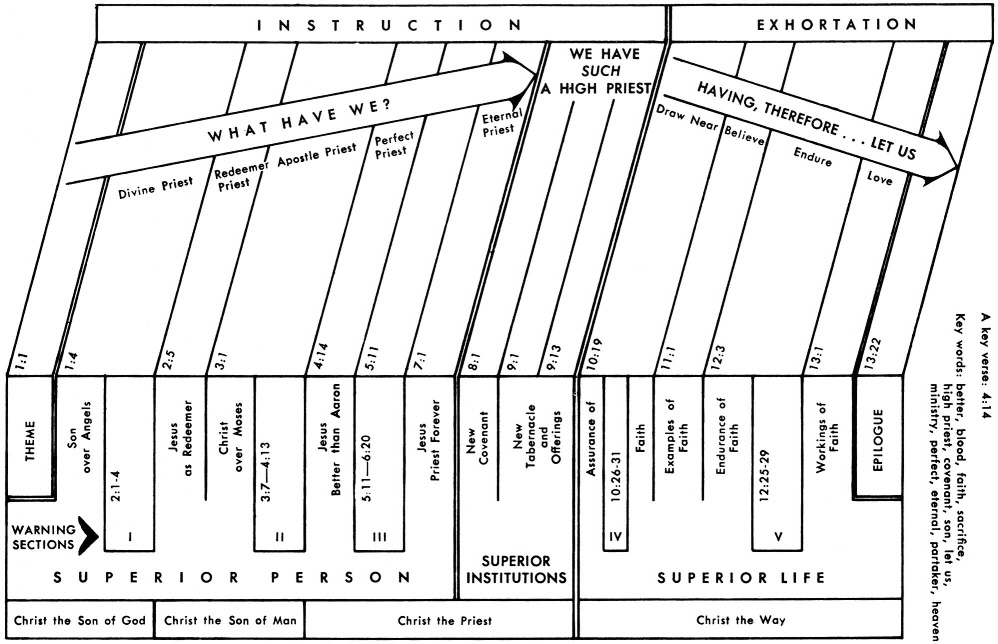
CONSIDER JESUS OUR GREAT HIGH PRIEST
Click chart to enlarge
Charts from Jensen's Survey of the NT - used by permission
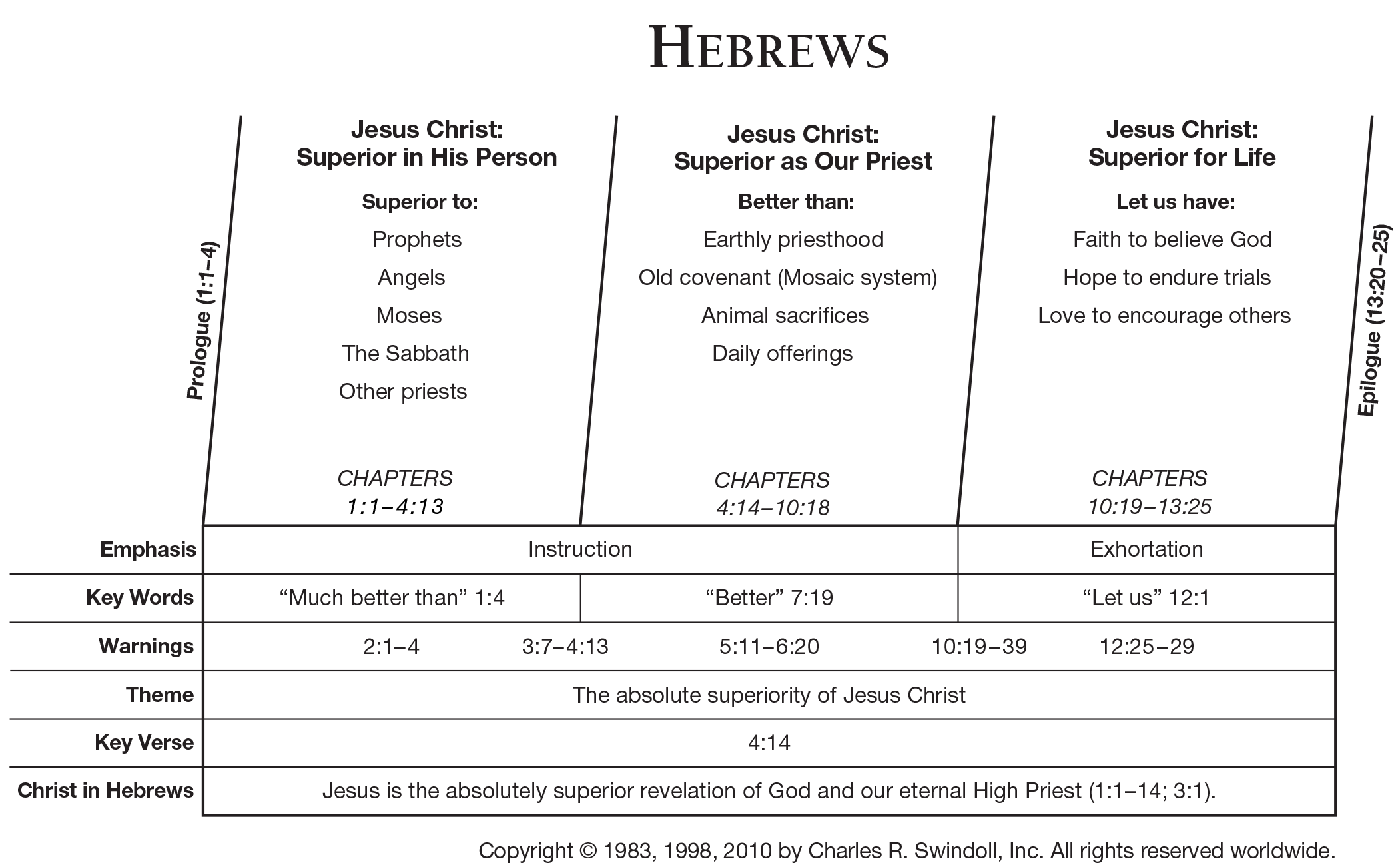
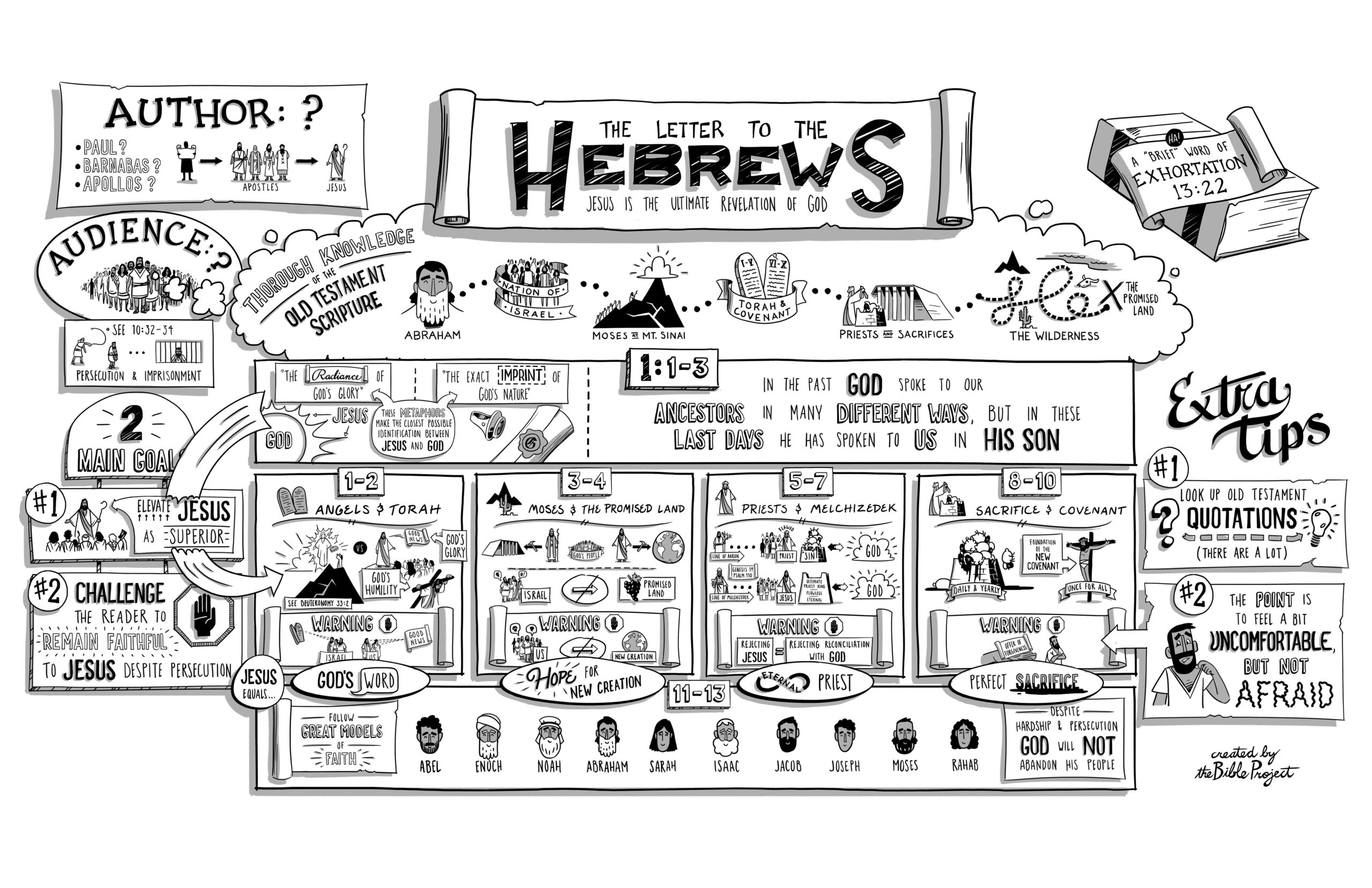
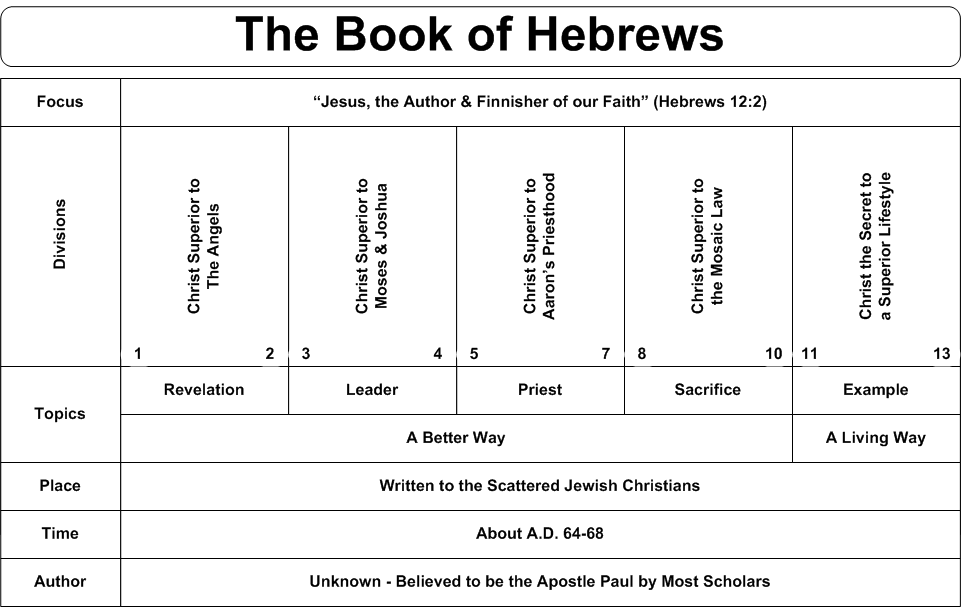
Swindoll's Chart, Interesting Pictorial Chart of Hebrews, Another Chart
|
The Epistle |
||||
| INSTRUCTION Hebrews 1-10:18 |
EXHORTATION Hebrews 10:19-13:25 |
|||
| Superior Person of Christ Hebrews 1:1-4:13 |
Superior Priest in Christ Hebrews 4:14-10:18 |
Superior Life In Christ Hebrews 10:19-13:25 |
||
| BETTER THAN PERSON Hebrews 1:1-4:13 |
BETTER PRIESTHOOD Heb 4:14-7:28 |
BETTER COVENANT Heb 8:1-13 |
BETTER SACRIFICE Heb 9:1-10:18 |
BETTER LIFE |
| MAJESTY OF CHRIST |
MINISTRY OF CHRIST |
MINISTERS FOR CHRIST |
||
|
DOCTRINE |
DUTY |
|||
|
DATE WRITTEN: |
||||

See ESV Study Bible "Introduction to Hebrews"
(See also MacArthur's Introduction to Hebrews)
Borrow Ryrie Study Bible
Hebrews 9:15 For this reason He is the mediator of a new covenant, so that, since a death has taken place for the redemption of the transgressions that were committed under the first covenant, those who have been called may receive the promise of the eternal inheritance. (NASB: Lockman)
Greek: Kai dia touto diathekes kaines mesites estin, (3PAI) opos thanatou genomenou (AMPMSG) eis apolutrosin ton epi te prote diatheke parabaseon ten epaggelian labosin (3PAAS) oi keklemenoi (RPPMPN) tes aioniou kleronomias.
BGT Καὶ διὰ τοῦτο διαθήκης καινῆς μεσίτης ἐστίν, ὅπως θανάτου γενομένου εἰς ἀπολύτρωσιν τῶν ἐπὶ τῇ πρώτῃ διαθήκῃ παραβάσεων τὴν ἐπαγγελίαν λάβωσιν οἱ κεκλημένοι τῆς αἰωνίου κληρονομίας.
Amplified: [Christ, the Messiah] is therefore the Negotiator and Mediator of an [entirely] new agreement (testament, covenant), so that those who are called and offered it may receive the fulfillment of the promised everlasting inheritance—since a death has taken place which rescues and delivers and redeems them from the transgressions committed under the [old] first agreement. (Amplified Bible - Lockman)
Barclay: It is through him that there emerges a new covenant between God and man; and the purpose behind this new covenant is that those who have been called might receive the eternal inheritance which has been promised to them (Westminster Press)
NET: And so he is the mediator of a new covenant, so that those who are called may receive the eternal inheritance he has promised, since he died to set them free from the violations committed under the first covenant. (NET Bible)
NLT: That is why he is the one who mediates the new covenant between God and people, so that all who are invited can receive the eternal inheritance God has promised them. For Christ died to set them free from the penalty of the sins they had committed under that first covenant. (NLT - Tyndale House)
NKJ And for this reason He is the Mediator of the new covenant, by means of death, for the redemption of the transgressions under the first covenant, that those who are called may receive the promise of the eternal inheritance.
NET And so he is the mediator of a new covenant, so that those who are called may receive the eternal inheritance he has promised, since he died to set them free from the violations committed under the first covenant.
CSB Therefore, He is the mediator of a new covenant, so that those who are called might receive the promise of the eternal inheritance, because a death has taken place for redemption from the transgressions committed under the first covenant.
ESV Therefore he is the mediator of a new covenant, so that those who are called may receive the promised eternal inheritance, since a death has occurred that redeems them from the transgressions committed under the first covenant.
NIV For this reason Christ is the mediator of a new covenant, that those who are called may receive the promised eternal inheritance--now that he has died as a ransom to set them free from the sins committed under the first covenant.
Phillips: Christ is consequently the administrator of an entirely new agreement, having the power, by virtue of his death, to redeem transgressions committed under the first agreement: to enable those who obey God's call to enjoy the promises of the eternal inheritance. (Phillips: Touchstone)
Wuest: And because of this, of a testament new in quality He is mediator, in order that a death having taken place for the redemption of the transgressions under the first testament, those who have been divinely summoned [into salvation] might receive the promise of the eternal inheritance. (Eerdmans Publishing - used by permission)
Young's Literal: And because of this, of a new covenant he is mediator, that, death having come, for redemption of the transgressions under the first covenant, those called may receive the promise of the age-during inheritance,
- Mediator - Heb 7:22; 8:6; 12:24; 1Ti 2:5
- New covenant - He 8:8; 2Co 3:6
- Romans 9 Resources - Multiple Sermons and Commentaries
Related Passages:
1 Timothy 2:5-6+ For there is one God, and one mediator also between God and men, the man Christ Jesus, 6 who gave Himself as a ransom for all, the testimony given at the proper time.
Hebrews 8:6+ But now He has obtained a more excellent ministry, by as much as He is also the Mediator of a better covenant, which has been enacted on better promises.
Hebrews 12:24+ and to Jesus, the mediator of a new covenant, and to the sprinkled blood, which speaks better than the blood of Abel.
Ephesians 1:3+ Blessed be the God and Father of our Lord Jesus Christ, Who has blessed us with every spiritual blessing in the heavenly places in Christ,
Hebrews 9:12+ and not through the blood of goats and calves, but through His own blood, He entered the holy place once for all, having obtained eternal redemption (WE ARE SECURE FOREVER!).
THE BRIDGE BETWEEN
GOD AND MAN
For this reason - When you see this term of explanation, pause and ponder it, eg, asking "What reason?" Why is Christ the Mediator of a New Covenant? The writer has just explained that Christ’s blood truly cleanses the conscience (Heb 9:15) and secured eternal redemption (Heb 9:12), He is therefore qualified to be the Mediator of the New Covenant (Heb 9:15).
W E Vine explains for this reason writing that "it is owing to the necessity of such a sacrifice as Christ offered, an offering which could put away sin and transgressions and cleanse the conscience, that He is the Mediator of the new covenant."
In other words the argument has been that the old system provided outward, temporary cleansing, but Christ’s once-for-all sacrifice provides inward, eternal cleansing to the level of the conscience. Because Christ’s sacrificial death has accomplished what the Law could never do, He alone stands as the Mediator of a New Covenant. What the old covenant foreshadowed, Christ has fulfilled.
Simon Kistemaker on for this reason - When the author writes “for this reason,” he wants us to look at verses 13 and 14 specifically and the preceding context generally. In these two verses, the writer contrasts the sacrifices of the first covenant with the sacrifice of Christ that introduces a new relationship. In verse 15, the author summarizes and says, “Christ is the mediator of a new covenant.”
Kenneth Wuest explains it this way - After comparing the relative merits of the blood of the First Testament and that offered under the New Testament, and showing that the blood of Messiah cleansed from actual sin, whereas the blood of animals could only cleanse from ceremonial defilement, the writer arrives at his conclusion, namely, that that was the reason why Messiah became the mediator of the New Testament. (Hebrews Commentary)
Ray Stedman feels the "For this reason, which introduces Heb 9:15, looks back to the close of Heb 9:14, that we may serve the living God." But of course that would connect to a clean conscience which is the foundation of Spirit enabled service of God. Sadly (I fear) many are seeking to serve God, but not doing so with a clean conscience, which likely quenches the Spirit and puts their service back in the box labeled "dead works."
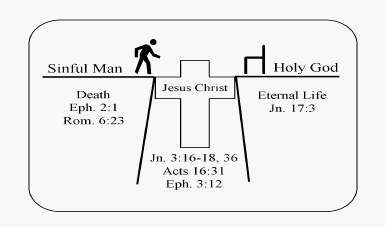
For this reason He is the Mediator (mesites from mesos = middle) of a new (kainos) covenant (diatheke), Amp = "the Negotiator and Mediator of an [entirely] new agreement" Christ is literally our "Go-between" or "Middleman," so to speak, standing (actually seated at present) between man and God in order to bring us to God. Peter alludes to Jesus' function as our Mediator writing that "Christ also died for sins once for all, the just for the unjust, so that He might bring us to God, having been put to death in the flesh, but made alive in the spirit." (1Pe 3:18+)
Wuest observes that a mediator "refers to one who intervenes between two, either to make or restore peace and friendship, to form a compact, or to ratify a covenant. Here the Messiah acts as a go-between or Mediator between a holy God and sinful man. By His death on the Cross, He removes the obstacle, sin, which caused an estrangement between man and God. When the sinner accepts the merits of Messiah’s sacrifice, the guilt and penalty of his sin is his no more, the power of sin in his life is broken, he becomes the recipient of the divine nature, and the estrangement between himself and God, both legal and personal, disappears. (Hebrews Commentary)
C H Spurgeon - It was absolutely needful that guilt should be atoned for, and, therefore, Jesus became a mediator. Nothing short of this could secure the eternal inheritance for those who are called. Take away the atonement and you have robbed our Lord of His greatest reason for being a mediator at all. We love and live upon the truth of His atoning death.
Whether it be a covenant or a testament, death is necessary to make it valid. God’s covenants have ever been sanctioned and ratified with blood, and the covenant or the testament of eternal grace is ratified with the blood of the Surety and Testator.
Mediator (3316) (mesites from mésos = middle, in midst) is one who stands in the middle between two people and brings them together. It is basically a neutral and trusted person in middle (mesos), a so called "middle Man". It is one who works to remove disagreement and thus a mediator, go-between or reconciler. In short, Jesus is the Mediator, the One Who stands between men and God to bring them together.
NET Note -The Greek word mesitēs, “mediator” in this context does not imply that Jesus was a mediator in the contemporary sense of the word, i.e., he worked for compromise between opposing parties. Here the term describes his function as the one who was used by God to enact a new covenant which established a new relationship between God and his people, but entirely on God's terms.
Mesites - 6x in 6v - Gal 3:19, 20; 1Ti 2:5; Heb 8:6; 9:15; 12:24 Three of the five NT uses of mesites are in Hebrews.
New (2537) kainos probably from root ken [qen] = freshly come, or begun) is an adjective which refers to that which is new kind (unprecedented, novel, uncommon, unheard of). It relates to being not previously present. Compare the related noun kainotes translated newness (Freiberg defines it as "depicting something not only recent and different but extraordinary"!) in Ro 6:4+ and Ro 7:6+. Believers now have a brand new life with a brand new source of power (the Spirit) to live out that life to the full (cp Jesus' desire for all believers - Jn 10:10b)! Beloved in Christ, may this (His) "extraordinary" life be a genuine reality in our day to day experience in Christ. Amen!
R. C. Trench distinguishes Neos and Kainos as follows "Contemplate the new under aspects of time, as that which has recently come into existence, and this is neos... . But contemplate the new, not now under aspects of time, but of quality, the new, as set over against that which has seen service, the outworn, the effete or marred through age, and this is kainos. (New - Trench's Synonyms of the New Testament.)
Vine adds that kainos "denotes “new,” of that which is unaccustomed or unused, not “new” in time, recent (Greek = "neos"), but “new” as to form or quality, of different nature from what is contrasted as old. As Vincent says in his discussion of kainos "All the elements of festivity in the heavenly kingdom will be of a new and higher quality.
The Open Bible notes that kainos "can be used with reference to something that has not been used before (Mt 9:17). Kainos is also used with the connotation of “remarkable” as a designation of something that is “new” and not known previously (Mk 1:27; Jn 13:34). The same word qualifies something as “new” in the sense of a replacement for something that is old and obsolete—as in the “new covenant” (Heb 8:8). Converts are “new persons” (2Co 5:17+; Ep 4:24). Kainos is used in an eschatological sense to describe the “new” heaven and earth (2Pe 3:13; Rev 21:1). (The Open Bible : New King James Version. Nashville: Thomas Nelson Publishers)
In summary Kainos signifies qualitatively new in contrast to neos which indicates temporally new or new with respect to age.
KAINOS - 36V - Matt. 9:17; Matt. 13:52; Matt. 26:29; Matt. 27:60; Mk. 1:27; Mk. 2:21; Mk. 2:22; Mk. 14:25; Mk. 16:17; Lk. 5:36; Lk. 5:38; Lk. 22:20; Jn. 13:34; Jn. 19:41; Acts 17:19; Acts 17:21; 1 Co. 11:25; 2 Co. 3:6; 2 Co. 5:17; Gal. 6:15; Eph. 2:15; Eph. 4:24; Heb. 8:8; Heb. 8:13; Heb. 9:15; 2 Pet. 3:13; 1 Jn. 2:7; 1 Jn. 2:8; 2 Jn. 1:5; Rev. 2:17; Rev. 3:12; Rev. 5:9; Rev. 14:3; Rev. 21:1; Rev. 21:2; Rev. 21:5
Hebrews 8:8 For finding fault with them, He says, “BEHOLD, DAYS ARE COMING, SAYS THE LORD, WHEN I WILL EFFECT A NEW COVENANT WITH THE HOUSE OF ISRAEL AND WITH THE HOUSE OF JUDAH;
Hebrews 8:13 When He said, “A new covenant,” He has made the first obsolete. But whatever is becoming obsolete and growing old is ready to disappear.
Hebrews 9:15 For this reason He is the mediator of a new covenant, so that, since a death has taken place for the redemption of the transgressions that were committed under the first covenant, those who have been called may receive the promise of the eternal inheritance.
SO THAT SINCE A DEATH HAS TAKEN PLACE FOR THE REDEMPTION OF THE TRANSGRESSIONS THAT WERE COMMITTED UNDER THE FIRST COVENANT: hopos thanatou genomenou (AMPMSG) eis apolutrosin ton epi te prote diatheke parabaseo:
- So that since a death has taken place - Heb 9:16,28; 2:14; 13:20; Isaiah 53:10, 11, 12; Daniel 9:26
- For the redemption of the transgressions - He 9:12; 11:40; Ro 3:24, 25, 26; 5:6,8,10; Ep 1:7; 1Pe 3:18; Rev 5:9; 14:3,4
- Under the first covenant - He 9:1; 8:7,13
- Romans 9 Resources - Multiple Sermons and Commentaries
Related Passages:
Hebrews 4:2+ (GOSPEL WAS PREACHED TO ISRAEL IN THE OT) For indeed we have had good news preached to us, just as they also; but the word they heard did not profit them, because it was not united by faith in those who heard.
Galatians 3:8+ The Scripture, foreseeing that God would justify the Gentiles by faith, preached the gospel beforehand to Abraham, saying, “ALL THE NATIONS WILL BE BLESSED IN YOU.”
Hebrews 2:9+ But we do see Him who was made for a little while lower than the angels, namely, Jesus, because of the suffering of death crowned with glory and honor, so that by the grace of God He might taste death for everyone.
SALVATION BY GRACE
"ON CREDIT"
So that (term of purpose/result), since a death (thanatos) has taken place (the Cross) for the redemption (apolutrosis) of the transgressions (parabasis) that were committed under the first (protos) covenant (diatheke) - So that (in order that, on this account) indicates purpose. Whenever you encounter it in your daily Scripture reading, pause and ponder the phrase asking at least "What is the purpose the Spirit intends to explain?" Barclay translates it "the purpose behind this new covenant." In this context the purpose of Christ's death which paid the price to set free captives of sin free (redemption - apolutrosis) who believed in Messiah under the first (protos) covenant (diatheke).
A death (thanatos) has taken place - Past tense. This speaks of a historical event, the Cross (30-33 AD), and introduces the subject of the death of the promised Messiah. Not just any death, but the death of the sinless Lamb, for no other sacrifice was of sufficient value or dignity "to suit the terms of the new covenant, and provide the eternal inheritance." (Vine) The new covenant required the death of the mediator a truth the writer explains in Hebrews 9:16-17.
The truth of a suffering Messiah has always been a "scandal" to the Jews, for as Paul declared "we preach Christ crucified (A DEATH), to Jews a stumbling block, and to Gentiles foolishness (1Cor 1:23+)." In light of this ever present theological impediment, the writer of Hebrews proceeds to give three reasons the Messiah had to die…(1) a testament demands death (2) forgiveness demands blood (3) judgment demands a substitute.
Spurgeon on covenant - Whether it be a covenant or a testament, death is necessary to make it valid. God’s covenants have ever been sanctioned and ratified with blood, and the covenant or the testament of eternal grace is ratified with the blood of the Surety and Testator.
In the economy of God, Jesus' death
was effective retroactively.
Perhaps you have wondered "How were individuals saved in the OT since Christ had not yet come and died as a substitute for sinners and payment for their sins?" From Genesis 15:6+ (cp Hab 2:4+) we know that Abraham believed God and God credited him with perfect righteousness. In a sense Abraham was "saved on credit", and when Christ died, His death paid off the debt finally and fully. In a very real sense in the economy of God, Jesus' death was effective retroactively. In a sense the Jewish Day of Atonement was a foreshadowing of this effect, because on that day the blood of an animal covered the sins that had been committed by the Jews during the previous year. In other words the Day of Atonement also had a retroactive effect, albeit only temporary and imperfect, in contrast to the eternal and perfect efficacy of the blood of Christ.
William Barclay writes "the sacrifice of Jesus Christ is retroactive. That is to say, the sacrifice of Christ is effective to wipe out the consequences of the sins of men committed under the old covenant, and to inaugurate the fellowship which is promised under the new covenant." (Daily Study Bible)
Wuest - Messiah became the Mediator not only in order that He might pay the penalty of sinners who live since the Cross, but also that He might do so for those who lived before the Cross. Sinners who were saved under the First Testament were actually saved, not by it or by any sacrifice offered under its jurisdiction, but through the atoning work of Messiah under the New Testament. (Ed note: They were saved by faith just as Abraham was). (Hebrews Commentary)
Paul taught a similar truth in Romans 3 explaining that sinners are "justified (declared righteous) as a gift (freely given) by His grace (unmerited favor) through the redemption (apolutrosis - price paid to set captives and slaves free) which is in Christ Jesus; 25 Whom God displayed publicly as a propitiation (satisfactory sacrifice = hilasterion = used in Day of Atonement for "mercy seat" = Lev 16:2, 13, 14, 15+) in His blood through faith. This was to demonstrate His righteousness, because in the forbearance (Explaining why God did what He did. He exhibited, as it were, "divine self-restraint," refraining from enforcing the death penalty that was due for even one sin! See word study on anoche) of God He passed over (paresis - deliberate disregard, passing over, letting go unpunished) the sins previously committed (This refers to the sins committed under the Old Covenant, the covenant under which Abraham lived and believed in Messiah); 26 for the demonstration, I say, of His righteousness at the present time, that He might be just and the justifier of the one who has faith in Jesus." (Ro 3:24-26+)
In other words, God passed over the sins of Old Covenant saints those who lived before the Cross. God was satisfied when a man in the OT put his faith the Messiah as did Abraham (Ge 15:6+, Gal 3:8+). Because Christ's blood was not shed until hundreds or thousands of years after many Old Testament believers died, their salvation was as stated, so to speak, "on credit." God was forbearing and patient, (Ro 2:4+) until the perfect sacrifice was made by Christ on the Cross. However, up until that time whenever God saw a heart of genuine faith in an OT man or woman, He passed over their sins. In a deeper sense, the sacrifice had already been made in God’s mind long before it was made in human history, because Christ’s works were finished from the foundation of the world (He 4:3+; cf. 1Pe 1:19, 20+; Rev 13:8+). From the human perspective, however, the Old Testament saints could only look forward to salvation as shown in the diagram below. And so you may be asking "Why the OT sacrifices? What effect did they have if they could not make a person righteous?" This is not the full answer, but clearly the Old Testament sacrifices were never prescribed as a means of salvation, but only as markers of faithful obedience and as symbols (signs) pointing to the one perfect sacrifice that would be the true means of salvation, so great a salvation!
A T Robertson somewhat addresses "why sacrifices" writing that "Here (ED: in his comment related to "under the first covenant") there is a definite statement that the real value in the typical sacrifices under the Old Testament system was in the realization in the death of Christ. It is Christ's death that gives worth to the types that pointed to Him. So then the atoning sacrifice of Christ is the basis of the salvation of all who are saved before the Cross and since."
MacArthur adds that "the Old Testament sacrifices were not means of salvation, but marks of faithful obedience and symbols of the one perfect sacrifice that would be the means of salvation." (Hebrews Commentary - Page 235)
Comment - This makes sense, because if Christ had not died, there would have been no value in the OT sacrifices, which were shadows. Their value was not intrinsic in the blood of animals. Their worth was derived from the reality they anticipated — the once-for-all sacrifice of Christ (Heb 9:26). If Christ had never come and died, those sacrifices would have been empty rituals, mere slaughter of animals without redemptive effect.
Old Testament atonement by animal blood depended
for its value upon the death of Christ to come.
Homer Kent adds that "Now this new covenant not only made possible the provisions prophesied by Jeremiah 31:31–34, but also had an effect upon the guilt of those who lived under the former Mosaic covenant. Transgressions committed at the time of the first covenant were “covered” (i.e., “atoned”) by animal sacrifices, but this provided no true expiation. Old Testament atonement by animal blood depended for its value upon the death of Christ to come. The death having occurred is clearly Christ’s death, and redemption of the transgressions means redemption of the sinner from the accumulated debts which were against him." (BORROW The Epistle to the Hebrews : a Commentary PAGE 174)
Here is a simple diagram that helps understand how one was saved by grace through faith looking forward to Christ in the Old Testament
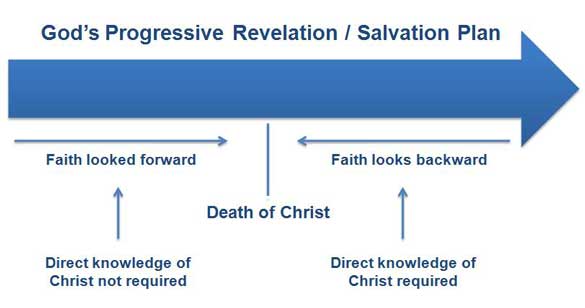
See the full article from Gotquestions - What is progressive revelation as it relates to salvation?
Marcus Dods points out that "Even under the old covenant this inheritance had been promised. A gospel had been preached to them (cp Gal 3:8+), and they had been invited, Hebrews 4:2+. God being during that period the covenant God of the people, this involved eternal good. But until their transgressions were atoned for they could not receive the inheritance. The sacrifices under the old covenant could not atone for sin, therefore a new covenant with a death which could atone was necessary; in order that such a death having taken place and their sins being removed they might receive fulfilment of the promise. (Expositor's Greek Testament Commentary )
John Phillips illustrates sin debt paid by Christ - A person is burdened by a crushing weight of debt. He tries every way within his power to extricate himself, but all his efforts are in vain. The mortgages and liens against him are too great and too many. He only sinks deeper and deeper into insolvency. Nothing but ruin stares him in the face. What can he do but declare bankruptcy and hope that somehow or other, at some future time, he might be able to recover his good name and face his creditors with honor? Then, one morning, he discovers that he is the sole beneficiary of the estate of a billionaire who has died, making him the heir and inheritor of enormous holdings! That is precisely what has happened to us. We are the spiritual heirs of the Lord Jesus Christ, Who has died, leaving us, in His last will and testament, (AKA THE "NEW COVENANT" IN HIS BLOOD) all the immense resources of goodness and grace that were His alone! Our insolvency, our vast debt of sin, and our spiritual bankruptcy are gone! (Phillips, John: Exploring Hebrews: An Expository Commentary)
The Death That Redeems
A death has occurred, the ransom was made,
The guilt of the ages on Jesus was laid.
Transgressions remembered, the Law could not clear,
But Christ bore the burden, our judgment drew near.
The blood of the covenant, holy and true,
Reached backward and forward, redeeming the few.
What bulls and what goats could never erase,
The Lamb’s crimson stream poured mercy and grace.
The first covenant showed us the weight of our sin,
Yet could not perfect or cleanse us within.
But Christ by His death has broken the chain,
Redeeming His people — forever to reign.
And they sang a new song, saying,
“Worthy are You to take the book and to break its seals;
for You were slain, and purchased for God with Your blood
men from every tribe and tongue and people and nation.
“You have made them to be a kingdom and priests to our God;
and they will reign upon the earth.”
-- Revelation 5:9-10+
Redemption (629) (apolutrosis from apo = marker of dissociation or separation + lutroo = to redeem <> from lutron = ransom <> from lúo = loosen what is bound, loose any person tied or fastened) is the payment of a price to ransom (lutron = money for a ransom = ransom or price paid for a slave who is then set free by the one who bought him), to release (of someone from the power of someone else) on payment of the ransom price, to buy back or to deliver one from a situation from in which one is powerless to liberate themselves from or for which the penalty was so costly that they could never hope to pay the ransom price. In other words, the idea of redemption is deliverance or release by payment of a ransom.
APOLUTROSIS - 10x/10v - Luke 21:28; Rom 3:24; 8:23; 1 Cor 1:30; Eph 1:7, 14; 4:30; Col 1:14; Heb 9:15; 11:35. NAS = redemption(9), release(1).
Hebrews 11:35 - Women received back their dead by resurrection; and others were tortured, not accepting their release, so that they might obtain a better resurrection;
From Ep 1:7+ and Col 1:14+ we have a wonderful "definition" (or association) of redemption as that which effects the forgiveness of sins - sin incurs a debt payable only by death = blood (Lev 17:11+, 1Pe 1:18, 19+)] & Jesus paid the price in full Jn 19:30+ ["It is finished" = verb tetelestai in perfect tense = "Paid in full" with perfect tense speaking of the enduring quality of the payment = the debt is cancelled completely and forever!]). As discussed more below this full payment would also take care of any sins committed under the Law.
Transgressions (3847) (parabasis from para = beyond, aside + baino = step) means to step on one side and thus is primarily a going aside, a stepping across a line, an overstepping or stepping over and always implies a breach of law and especially of the Law of Moses. It refers to the act of a person stepping beyond a fixed limit into forbidden territory. The point is that the law draws the line that should not be crossed or "stepped over". Where there is no law, people do not deliberately disobey God but they disobey in ignorance. And so parabasis is literally a going over, an overstepping and figuratively a transgression, a disregarding, a violating. It represents the act of deviating from a definite or established boundary or norm.
PARABASIS - 7x/7v - breaking(1), offense(1), transgression(2), transgressions(2), violation(1). Ro 2:23; 4:15; 5:14; Gal 3:19; 1Ti 2:14; Heb 2:2; 9:15.
First (4413) protos means 1) first in time or place 1a) in any succession of things or persons 2) first in rank 2a) influence, honour 2b) chief 2c) principal 3) first, at the first. Here in Heb 9:15 the nuance #1 is apropos.
PROTOS 10X IN HEBREWS - Heb. 7:2; Heb. 8:7; Heb. 8:13; Heb. 9:1; Heb. 9:2; Heb. 9:6; Heb. 9:8; Heb. 9:15; Heb. 9:18; Heb. 10:9
Hebrews 7:2 was first of all, by the translation of his name, king of righteousness,
Hebrews 8:7 For if that first covenant had been faultless
Hebrews 8:13 When He said, “A new covenant,” He has made the first obsolete.
Hebrews 9:1 Now even the first covenant had regulations of divine worship
Hebrews 9:2 For there was a tabernacle prepared, the outer one
Hebrews 9:6 priests are continually entering the outer tabernacle performing the divine worship,
Hebrews 9:8 not yet been disclosed while the outer tabernacle is still standing,
Hebrews 9:15 for the redemption of the transgressions that were committed under the first covenant
Hebrews 9:18 Therefore even the first covenant was not inaugurated without blood.
Hebrews 10:9 He takes away the first in order to establish the second.
Covenant (1242) diatheke from diatithemi = set out in order, dispose in a certain order <> from dia = two + tithemi = to place pictures that which is placed between two Thus, a covenant is something placed between two = thus an arrangement between two parties) literally conveys the idea of a testament, as in one's last will and testament.
Diatheke was commonly used in the Greco-Roman world to define a legal transaction in settling an inheritance (used in this sense in Hebrews 9:16; 9:17) which we often refer to as one's last will and testament. In this sense it referred to the disposition which a person made of his property in prospect of death. Furthermore, diatheke generally denoted a transaction that was irrevocable could not be cancelled by anyone. As discussed in Heb 9:17 a will does not come into effect until the one who made the will dies. It is not until the testator's death that the benefits and provisions of the will become reality. Prior to the testator's death, the stipulations in the will are only promises.
The 3 major meanings of diatheke in the NT can be summarized as…
(1) A legal technical term used when one settles an inheritance and known by our familiar English term "last will and testament"
(2) A binding contract between two or more persons, as in Galatians 3:15 where the covenant is between men.
(3) The major NT (and Septuagint use) is a declaration of the will of God in "concerning His self-commitment, promises, and conditions by which he entered into relationship with man covenant, agreement" (BORROW Analytical Lexicon of the Greek New Testament)
Vine adds that - A covenant was ordinarily ratified by the sacrifice of a victim, suggesting that the covenanting parties were dead to all possible change of mind. Hence arose the use of the phrase “to cut a covenant,” the reference being to the death of the victim. Thus, when the Lord made a covenant with Abraham concerning the inheritance promised to him and to his seed, he was commanded to sacrifice a heifer, a she goat, a ram, a turtledove, and a young pigeon. These, except the birds, were divided, and laid, the half of each victim over against the other half, a divine token, accompanied by the symbols of the smoking furnace and the flaming torch, that the covenant of promise would be carried out. The death of these victims, necessary to the old covenant, prefigured the death of Christ as the basis of the new covenant, by which “they that have been called,” the spiritual seed of Abraham, whether Jew or Gentile, may receive the promise of the eternal inheritance. The promise stands for the subject of the promise, the inheritance. Christ is both the sacrificial victim and the Mediator. He is the latter in virtue of His sacrifice. (Collected writings of W. E. Vine)
Cleon Rogers describes covenant in the ancient world as…the uniting and community of the souls and wills of the two, which results in a common purpose, common friends, common enemies, mutual confidence, loyalty, and exclusion of strife. In all of this the will of the stronger was the dominating force. This resulting harmony is often described by the word Shalom which stresses the wholeness, harmony, and unity of the two. Along with this unity there was also the obligation to help or aid one another in time of trouble. Because of these tremendous implications it was always advisable to proceed with caution before making a covenant with anyone. (SEE THE FULL ARTICLE The Covenant with Abraham and Its Historical Setting. Bibliotheca Sacra. Volume 127. Issue 507. Page 240. 1970) (See another article by Cleon Rogers - Covenant with Moses)
DIATHEKE IS A KEY WORD IN HEBREWS 15x/33 total uses. Heb. 7:22; Heb. 8:6; Heb. 8:8; Heb. 8:9; Heb. 8:10; Heb. 9:4; Heb. 9:15; Heb. 9:16; Heb. 9:17; Heb. 9:20; Heb. 10:16; Heb. 10:29; Heb. 12:24; Heb. 13:20
Hebrews 7:22 so much the more also Jesus has become the guarantee of a better covenant.
Hebrews 8:6 by as much as He is also the mediator of a better covenant
Hebrews 8:8 WHEN I WILL EFFECT A NEW COVENANT WITH THE HOUSE
Hebrews 8:9 NOT LIKE THE COVENANT WHICH I MADE WITH THEIR FATHERS ON THE DAY
Hebrews 8:9 FOR THEY DID NOT CONTINUE IN MY COVENANT,
Hebrews 8:10 “FOR THIS IS THE COVENANT THAT I WILL MAKE WITH
Hebrews 9:4 having a golden altar of incense and the ark of the covenant
Hebrews 9:15 For this reason He is the mediator of a new covenant
Hebrews 9:16 For where a covenant is, there must of necessity be the death of the one who made it.
Hebrews 9:17 For a covenant is valid only when men are dead
Hebrews 9:20 saying, “THIS IS THE BLOOD OF THE COVENANT WHICH GOD COMMANDED
Hebrews 10:16 “THIS IS THE COVENANT THAT I WILL MAKE WITH THEM AFTER THOSE DAYS
Hebrews 10:29 has regarded as unclean the blood of the covenant by which he was sanctified
Hebrews 12:24 and to Jesus, the mediator of a new covenant, and to the sprinkled blood
Hebrews 13:20 great Shepherd of the sheep through the blood of the eternal covenant
THOSE WHO HAVE BEEN CALLED MAY RECEIVE THE PROMISE OF THE ETERNAL INHERITANCE: hoi keklemenoi (RPPMPN) ten epaggelian labosin (3PAAS)… tes aioniou kleronomias:
- Those who have been called - Heb 3:1; Romans 8:28,30; 9:24; 2Th 2:14
- May receive the promise - He 6:13; 11:13,39,40; Jas 1:12; 1Jn 2:25
- Eternal inheritance - Ps 37:18; Mt 19:29; 25:34,36; Mk 10:17; Lk 18:18; Jn 10:28; Ro 6:23; 2Ti 2:10; Titus 1:2; 3:7; 1Pe 1:3,4; 5:10
- Romans 9 Resources - Multiple Sermons and Commentaries
Related Passages:
Hebrews 3:1+ Therefore, holy brethren, partakers of a heavenly calling, consider Jesus, the Apostle and High Priest of our confession;
1 Peter 1:3-4+ (THE ETERNAL INHERITANCE) Blessed be the God and Father of our Lord Jesus Christ, who according to His great mercy has caused us to be born again to a living hope through the resurrection of Jesus Christ from the dead, 4 to obtain an inheritance which is imperishable and undefiled and will not fade away, reserved in heaven for you,
Hebrews 6:11-12+ And we desire that each one of you show the same diligence so as to realize the full assurance of hope until the end, 12 so that you will not be sluggish, but imitators of those who through faith and patience inherit the promises.
FROM CALLING TO CLAIMING
THE COVENANT INHERITANCE
Those who have been called (kaleo) may receive (lambano) the promise (epaggelia/epangelia) of the eternal (aionios) inheritance (kleronomia) - This climactic phrase highlights the glorious purpose of Christ’s mediating work that those whom God has effectually called (kaleo) are not left in uncertainty, but are destined to receive (lambano) what God had long promised (epaggelia/epangelia)—an eternal (aionios) inheritance (kleronomia). This inheritance is imperishable, heavenly, and secured forever by the blood of Christ (cf. 1 Pet 1:4; Eph 1:11). It is both a present possession in Christ and a future consummation when faith becomes sight. Have been called in the perfect tense speaks of an action completed in past with present continuing effects/benefits. Literally this reads “the ones having been called” and looks back to those saints under the Old Covenant who were called to salvation by God on the basis of the sacrifice of Jesus Christ to come long after most of them had died.
Those who have been called - Note that it is God Who takes the initiative, not sinful men! Who are the called? These are the "heirs" of the new covenant. As the term the called is used by the writer of Hebrews and by Paul, Jude and John, it refers to those who have heard the Gospel and responded by exercising saving faith. This refers to the effectual calling related to salvation as seen in Heb 3:1+. In this understanding the called are virtually synonymous with "the elect". Theologians refer to this as the effectual call. Be aware that Matthew uses the term called (kletos) slightly differently than it is used in the epistles. In a parable Jesus said many were "called" to the "wedding feast" but few were "chosen" (Mt 22:1-13,14+). In that context in Matthew the term "call" is clearly not synonymous with an "effectual call" to salvation.
May receive (lambano) the promise (epaggelia/epangelia) of the eternal (aionios) inheritance (kleronomia) - The eternal inheritance speaks of salvation in its fullness and "foreverness!" (He 6:12+; 1Pe 1:3,4+; 1Pe 1:5+). Praise God that all of His promises are "yea and amen" in Jesus, the Covenant Messenger and Mediator of the New Covenant, a forever covenant.
Spurgeon on eternal inheritance - When you come to deal with Christ, you have to do with eternal things. There is nothing temporary about Him, or about His work. It is eternal redemption that He has obtained for us, it is an “eternal inheritance” that He has purchased for us.
Albert Barnes comments on the inheritance of the OT saints writing the the blood of Jesus "is effectual alike to save those under the ancient covenant and the new-so that they will be saved in the same manner, and unite in the same song of redeeming love."
John Phillips - Who can measure all the provisions of the eternal inheritance that is ours? The material wealth of a billionaire, left to us by human inheritance, cannot be remotely compared with the incalculable spiritual riches bequeathed to us by Christ. The greater part of the New Testament (as, by some happy inspiration, we call the second part of the Bible) has been written to set forth the wealth that has now come our way. Here, in this Hebrews letter, we have but a brief statement (eternal inheritance) of our benefits. (Borrow Exploring Hebrews page 116)
You may be asking what happened to these Old Testament saints when Jesus died and rose again? Even those saints in the OT who sinned under the Law but believed in the Promise of Messiah, were set free from Abraham's bosom in Sheol (see Lk 16:19-31) and were taken to Heaven to be present with their Messiah and receive their inheritance (Ephesians 4:8+).
Ray Stedman - The passage from Heb 9:15 through Heb 9:28 takes a slightly different slant. Though the same term covenant is used as in Hebrews 9:1-14, it is now treated more as a bequest being administered by a living executor after the death of the will-maker. However, Christ is seen both as the will-maker Who dies, and the Executor Who administers the estate, just as he was both the Offering for sin and the High Priest Who offered it. The phrase For this reason, which introduces Heb 9:15, looks back to the close of Heb 9:14, that we may serve the living God. The promised Messiah administers the New Covenant to those who are called in order that they may be equipped to serve the living and true God. That equipping capability of the New Covenant is called the promised eternal inheritance. We have already seen that it consists of an inner understanding of the nature of both good and evil; an intimate, Father-child relationship with God; and a total and continuing forgiveness of sins. This is the inheritance which our Mediator offers to us whenever we come to the throne of grace (Heb 4:16-note) to receive it by faith. Just as the heir of a fortune may draw from its resources at any time, so we are expected to draw from this great bequest, as it is now available to us after the death of the testator. (Hebrews 9:1-28 The True Tabernacle)
The Eternal Inheritance
Called by His mercy, chosen by grace,
Summoned to walk in the light of His face.
No earthly treasure, no fading delight,
But riches eternal, secure in His might.
The promise long spoken, the prophets foretold,
Now shines in the new, what was shadowed in old.
Through death of the Savior, the ransom was paid,
An everlasting inheritance forever displayed.
Not silver nor land, nor temple of stone,
But fellowship endless with Christ on the throne.
For those whom He called, His kingdom is near,
An heirship eternal, unfading, sincere.
Called (2564) (kaleo) speak to another in order to bring them nearer, either physically or in a personal relationship. Kaleo has several different nuances of meaning depending on the context and here in Hebrews 9:15 clearly refers to God's (effectual) invitation to salvation.
KALEO IN HEBREWS - Heb. 2:11; Heb. 3:13; Heb. 5:4; Heb. 9:15; Heb. 11:8; Heb. 11:18;
Hebrews 2:11 for which reason He is not ashamed to call them brethren,
Hebrews 3:13 encourage one another day after day, as long as it is still called “Today,”
Hebrews 5:4 but receives it when he is called by God, even as Aaron was.
Hebrews 9:15 those who have been called may receive the promise of the eternal inheritance.
Hebrews 11:8 By faith Abraham, when he was called, obeyed by going out to a place
Hebrews 11:18 it was he to whom it was said, “IN ISAAC YOUR DESCENDANTS SHALL BE CALLED.”
Promise (1860) (epaggelia/epangelia from epí = intensifies verbal meaning + aggéllo = to tell, declare) originally referred to an announcement or declaration (especially of a favorable message) but in later Greek came to mean a declaration to do something with the implication of obligation to carry out what is stated (thus a promise or pledge). Epaggelia was primarily a legal term denoting summons, a promise to do or give something, but in the NT speaks primarily of the promises of God, and Hebrews 9:15 refers to "the" (definite article in Greek conveys the sense of the specific) promise of salvation in the New Covenant which was made available by the blood of Christ, the Messiah.
EPAGGELIA IS A KEY WORD IN HEBREWS (14X/52 NT USES) - Heb. 4:1; Heb. 6:12; Heb. 6:15; Heb. 6:17; Heb. 7:6; Heb. 8:6; Heb. 9:15; Heb. 10:36; Heb. 11:9; Heb. 11:13; Heb. 11:17; Heb. 11:33; Heb. 11:39
Hebrews 4:1 Therefore, let us fear if, while a promise remains of entering His rest,
Hebrews 6:12 but imitators of those who through faith and patience inherit the promises.
Hebrews 6:15 And so, having patiently waited, he obtained the promise.
Hebrews 6:17 to show to the heirs of the promise the unchangeableness of His purpose, interposed with an oath,
Hebrews 7:6 blessed the one who had the promises.
Hebrews 8:6 mediator of a better covenant, which has been enacted on better promises.
Hebrews 9:15 may receive the promise of the eternal inheritance.
Hebrews 10:36 you may receive what was promised.
Hebrews 11:9 By faith he lived as an alien in the land of promise,
Hebrews 11:9 dwelling in tents with Isaac and Jacob, fellow heirs of the same promise;
Hebrews 11:13 All these died in faith, without receiving the promises,
Hebrews 11:17 he who had received the promises was offering up his only begotten son;
Hebrews 11:33 by faith conquered kingdoms, performed acts of righteousness, obtained promises
Hebrews 11:39 did not receive what was promised,
Eternal (166) (aionios from aion) means perpetual eternal, everlasting, without beginning or end (as of God), that which is always. Eternal is a key word Hebrews: blood of eternal covenant (He 13:20+). He offered Himself through His eternal spirit (He 9:14+) and has become the Author/Source of eternal salvation (He 5:9+). He has obtained eternal redemption (He 9:12-note) and enables men to receive of the eternal inheritance (He 9:15-note; He 13:20+).
ANINIOS IN HEBREWS - 6V -
Hebrews 5:9 all those who obey Him the source of eternal salvation,
Hebrews 6:2 and the resurrection of the dead and eternal judgment.
Hebrews 9:12 He entered the holy place once for all, having obtained eternal redemption.
Hebrews 9:14 the blood of Christ, who through the eternal Spirit offered Himself
Hebrews 9:15 have been called may receive the promise of the eternal inheritance.
Hebrews 13:20 through the blood of the eternal covenant, even Jesus our Lord,
Inheritance (2817)(kleronomia from kleros = lot + némo = give or distribute) is literally that which is distributed by lot and so refers to a portion which one receives by lot in a general distribution and then, in a more general sense means to possess oneself of, to receive as one's own, to obtain. In other words it can refer to property already received as well as that which is expected. Although kleronomia is an inheritance which one receives by lot, in the NT the idea of chance associated with the lot is not found. Here the inheritance is based on a promise from the "non-lying" God and thus it is trustworthy. To the Jews who were "waffling", the point was clear that they could "stake their life" on the promise of this inheritance! And so can we dear reader. All praise to God Who is not a man that He can lie.
KLERONOMIA - 14x/14v - Matt. 21:38; Mk. 12:7; Lk. 12:13; Lk. 20:14; Acts 7:5; Acts 20:32; Gal. 3:18; Eph. 1:14; Eph. 1:18; Eph. 5:5; Col. 3:24; Heb. 9:15; Heb. 11:8; 1 Pet. 1:4
| CONTRASTS BETWEEN THE TWO COVENANTS from 2 Corinthians 3:3-18+ |
|
| THE OLD COVENANT |
THE NEW COVENANT |
| Written with ink on tablets of stone 2Cor 3:3+ |
Written with the Spirit on tablets of human hearts 2Cor 3:3 |
| Adequacy from Self 2Cor 3:5+ |
Adequacy from God 2Cor 3:5 |
| The Letter (law) Kills (3000 @ Sinai – Ex 32:28+) 2Cor 3:6+ |
The Spirit gives Life (3000 @ Pentecost – Acts 2:41) 2Cor 3:6 |
| Ministry of Death (glory…fading) 2Cor 3:8+ |
Ministry of the Spirit (more glory) 2Cor 3:8 |
| Ministry of Condemnation 2Cor 3:9+ |
Ministry of Righteousness 2Cor 3:9 |
| No glory (~glory of moon) 2Cor 3:10+ |
Glory that surpasses (~glory of sun) 2Cor 3:10 |
| Fading Glory: Temporary 2Cor 3:11+ |
Remains in Glory: Permanent 2Cor 3:11 |
| Reading of Old Covenant hearts veiled 2Cor 3:14,15+ |
Turn to the Lord Veil is removed in Christ 2Cor 3:16+ |
| (By implication Bondage) |
Where Spirit of the Lord is Liberty 2Cor 3:17+ |
| Glory fading on Moses’ face No Internal Transformation 2Co 3:13+ |
Glory going to glory on saints' faces Continual Internal transformation by the Spirit 2Cor 3:18+ |
A Good Will - God … has begotten us again to a living hope through the resurrection of Jesus Christ. —1 Peter 1:3 - Perhaps you know someone who didn't receive the inheritance intended by a parent because of a faulty will. In an article titled "Money & The Law," attorney Jim Flynn says that if you want your estate to go to your chosen recipients instead of to members of the legal profession, you should avoid do-it-yourself wills. Such documents are usually legal but they are often unclear and fail to make provisions for unforeseen situations. Flynn advises having a formal will to be sure your wishes are carried out.
Man-made wills can fail, but there is no ambiguous language about the inheritance God has in store for us. The apostle Peter affirmed that God
Blessed be the God and Father of our Lord Jesus Christ, who according to His great mercy has caused us to be born again to a living hope through the resurrection of Jesus Christ from the dead, to obtain an inheritance which is imperishable and undefiled and will not fade away, reserved in heaven for you (1Pe 1:3, 4 - notes)
No fluctuation in the economy can reduce this inheritance. It is not subject to review by the courts nor to debate by squabbling families. No amount of suffering or trials can diminish or change what God has in store for us. Our inheritance is certain and eternal (Hebrews 9:15). And as we live for Him, we are assured that His will for our lives today is "good and acceptable and perfect" (Ro 12:2-note).—David C. McCasland (Our Daily Bread)
Why do we live like paupers,
When riches we possess?
We have become joint heirs with Christ
With blessings measureless. —Sper
The Christian's inheritance is guaranteed forever!
Today in the Word - D. L. Moody was determined that a lack of finances should not deter any student who wanted to come to his new Bible school in Chicago. So Mr. Moody instituted the policy of not charging student tuition--a tradition that continues to this day at Moody Bible Institute! Mr. Moody told the young man who would later become the school's first graduate:
"You come to my school in Chicago, and God will provide the funds."
The writer who gave us the book of Hebrews would have concurred with Dwight Moody's faith. In fact, this anonymous author argued something very similar in relation to Christ's finished work:
"You come to Christ, and He will provide the necessary payment for your sins."
This is the "will" or covenant that Jesus has mediated for us. Its wonderful provisions are in force because the One who drew up the will died to put it into effect. Although a covenant and a will are not exactly the same, the "outcome" is the same. Christ's death provided "the promised eternal inheritance" (Hebrews 9:15) to all of those who are called by His name and who are His heirs. This inheritance is salvation in all of its fullness--past, present, and future.
Once again, Moses and the ""first covenant"" he received from God are set in contrast to what we have in Christ. We have been told that the Law's endless sacrifices could never deal with sin once and for all. Here we are reminded of the reason for that inability. The blood offered under the old system was the "blood of calves" (Hebrews 9:19) and other animals that could never take away sin once and for all, but cover it only temporarily.
It was necessary that another blood sacrifice be made, since God requires that blood be the means of atoning for sin and providing the forgiveness that sinful people need so desperately (Hebrews 9:22).
Jesus' death fulfilled these requirements perfectly and permanently. His death put His ""will"" in force, so that those who are trusting in Him can receive everything promised both in this life and in the age to come when Jesus appears a second time.
TODAY ALONG THE WAY - It's hard to imagine a greater blessing than knowing that we can look forward to Christ's return, not with ""a fearful expectation of judgment"" (Heb. 10:27) but as heirs receiving an inheritance!
If you want a really solid reason to thank the Lord, you won't find a better one than this. Think of it: Jesus kept our appointment with judgment (Hebrews 9:27) when He died on the Cross for our sins. That's good news worth praising God for today--and it's worth sharing with someone else. (Copyright Moody Bible Institute. Used by permission. All rights reserved)
Hebrews 9:16 For where a covenant (will, testament) is, there must of necessity be the death of the one who made it. (NASB: Lockman)
Greek: opou gar diatheke, thanaton anagke pheresthai (PPN) tou diathemenou; (AMPMSG)
BGT Ὅπου γὰρ διαθήκη, θάνατον ἀνάγκη φέρεσθαι τοῦ διαθεμένου·
Amplified: For where there is a [last] will and testament involved, the death of the one who made it must be established (Amplified Bible - Lockman)
Barclay: but this could happen only after a death had taken place, the purpose of which was to rescue them from the consequences of the transgressions which had been committed under the conditions of the old covenant. (Westminster Press)
CEV: In fact, making an agreement of this kind is like writing a will. This is because the one who makes the will must die before it is of any use.
ESV: For where a will is involved, the death of the one who made it must be established.
GWT: In order for a will to take effect, it must be shown that the one who made it has died.
KJV: For where a testament is, there must also of necessity be the death of the testator.
NET: For where there is a will, the death of the one who made it must be proven. (NET Bible)
NIV: In the case of a will, it is necessary to prove the death of the one who made it
NKJ For where there is a testament, there must also of necessity be the death of the testator.
CSB Where a will exists, the death of the one who made it must be established.
ESV For where a will is involved, the death of the one who made it must be established.
NLT: Now when someone dies and leaves a will, no one gets anything until it is proved that the person who wrote the will is dead. (NLT - Tyndale House)
Phillips: For, as in the case of a will, the agreement is only valid after death. (Phillips: Touchstone)
Weymouth: For where there is a legal 'will,' there must also be a death brought forward in evidence—the death of him who made it.
Wuest: For where a testament is, a death must of necessity be brought in, the death of the testator, (Eerdmans Publishing - used by permission)
Young's Literal: for where a covenant is, the death of the covenant-victim to come in is necessary,
Paraphrase Every covenant requires the death of the covenant-maker before it can be put into force.
Paraphrase Just as a will does not distribute its benefits until the testator has died, so the covenant of God required the death of Christ before its promises could be realized.
Paraphrase The New Covenant, like a will, required the death of Christ before believers could receive their inheritance.
- Romans 9 Resources - Multiple Sermons and Commentaries
WILL ACTIVATED BY DEATH:
THE CROSS IS COVENANT SEAL
For (gar - term of explanation) - The writer of Hebrews now explains why Christ’s death was absolutely necessary for the New Covenant to take effect. Just as a human will (testament) cannot be executed until the testator dies, so too God’s covenant promises could not be realized apart from the death of Christ. The blessings of eternal inheritance (Heb 9:15) are secured only because the covenant-maker gave His life. This vivid legal analogy underscores the finality and necessity of the cross which was a stumbling block for many Jews who did not expect a suffering, crucified Messiah.
Where a covenant (diatheke - NIV, NET, ESV = "will") is, there must of necessity (anagke - it is required) be the death (thanatos) of the one who made it - The writer’s point is that death (thanatos) is the activating principle of a human will. Just as an earthly will requires the testator’s death to release the inheritance, so the New Covenant required Christ’s death to put its promises into effect.”
Simon Kistemaker - Now he introduces the concept of a last will. A lawyer draws up a will for a client who apportions his belongings to various people and agencies. But this last will becomes valid only upon the death of the person who made it. While the person is living, the will is nothing but a document, even though a lawyer testifies to its legality. Also this will may be changed and rewritten, but the moment the maker of the will dies, the words in the will are unalterable.....The implication is that the maker of the covenant is God, who has also made a will. Christ, the Son of God, is not the maker of a covenant or a will. Functioning as a mediator and as a guarantor, he sees that the conditions of the covenant are met and that its promises are honored. Christ died to fulfill these conditions. But at the same time, Christ’s death validates the last will and testament, so that believers indeed “may receive the promised eternal inheritance” (Heb 9:15). Christ is their guarantor. (Borrow Exposition of the Epistle to the Hebrews page 256)
As John MacArthur - the death of Christ was for many Jews a "theological blind spot, so the writer of Hebrews proceeds to give three reasons it was necessary for the Messiah to die: a testament demands death, forgiveness demands blood, and judgment demands a substitute. (See Hebrews MacArthur Commentary - Page 235)
C H Spurgeon - By His own death, Christ broke that evil power which brought death into the world with its long trail of woe. He did this, not by His example, not even by His life, but by His death. Therefore let those who speak slightingly of His atoning sacrifice see their folly, for it is through death that Christ destroys “him that had the power of death, that is, the devil“ (Heb 2:14+)
BLOOD AND COVENANTS - Christ’s sinless life qualified Him to be the perfect and all-sufficient sacrifice for sin, but it was His death that actually made the payment for sin. The first covenant made by God with man (at least first actually called covenant) was the unconditional covenant made with Noah after the flood (Ge 9:9-17+) following the sacrifice of clean animals (and spillage of blood) when they came out of the ark (Ge 8:20,21+,Ge 9:9+). Similarly, His unconditional covenant with Abraham was associated with a sacrifice of five animals (Ge 15:9,10,17,18+) and blood was spilled. When God gave the law to Israel on Mount Sinai, He made a conditional covenant (dependent on obedience) with them (Ex 19:5,6+) and this was accompanied by burnt offerings and peace offerings and the sprinkling of "the blood of the covenant" (Ex 24:5-8+). However, all of these offerings of the blood of animals were only shadows and temporal which were to point to the eternal offering of the blood of Christ and the new covenant. In each of the covenants God made with man, death was required to bring them into effect. In this sense, both the Mosaic covenant and the New Covenant functioned like ‘testaments’ or wills. For this reason, the translators appropriately used this word will or testament under these circumstances (NASB retains "covenant", but most use will or testament - see technical note by Vincent). The writer’s purpose in using the illustration of a will that takes effect only at the death of the testator is to show that Christ’s death was necessary for the New Covenant — the new ‘will’ — to be put into effect and made efficacious.”
The heart’s blood of Jesus is, as it were,
the establishment of His last will and testament.
Spurgeon - The covenant was not in force in the olden times until there had been a sacrifice to confirm it, and a will does not stand until the death of the testator has been proved to make it valid. The heart’s blood of Jesus is, as it were, the establishment of His last will and testament. Jesus, the great testator, has died, has made an end of sin, and His blood is the great seal of His testament, and makes it valid to us. Jesus has made His testament in the character of a sin-atoning sacrifice, and we can only share in it by regarding Him under that character. If I am not a sinner, I have no interest in the legacy of a bleeding Redeemer. The blood-mark proves that the testament was made for those who need atonement by blood, and that its legacies are bequeathed to sinners. This is one of the most humbling and yet most blessed of all truths. It casts down, and yet lifts up. If I have any grace or any covenant blessing, it did not come to me because I was heir to it by nature, or because I had purchased it, or because of any right intrinsic in myself, but because Jesus, when He died, had a right to make His will as He pleased, and He so made it that He would give Himself and all that He had to such a poor, needy, empty, lost, and guilty sinner as I am. Not because of any good in us do these blessings come to us, but all of our Lord’s good will who made the testament of love and sealed it with His heart’s blood.
Necessity (318) (anagke from ana = up, again, back, renewal, repetition, intensity, reversal + agkale = arm when bent or agcho = to compress, press tight) refers to any necessity or compulsion, outer or inner, brought on by a variety of circumstances. It can mean necessity imposed either by external conditions or by the law of duty.
ANAGKE - 17x in 17v - compulsion(3), constraint(1), distress(3), distresses(1), hardships(1), inevitable(1), necessary(2), necessity(3), need(2), obliged*(1). Matt. 18:7; Lk. 14:18; Lk. 21:23; Lk. 23:17; Rom. 13:5; 1 Co. 7:26; 1 Co. 7:37; 1 Co. 9:16; 2 Co. 6:4; 2 Co. 9:7; 2 Co. 12:10; 1 Thess. 3:7; Phlm. 1:14; Heb. 7:12; Heb. 7:27; Heb. 9:16; Heb. 9:23; Jude 1:3
Death (2288) (thanatos) is literally a physical separation of the soul from the body. Every form of death in the NT is treated not as a natural process but always as a destroying power related to sin and its consequences. This is even true in the case of the sinless God Man…
He (God the Father) made Him (Jesus the Son) Who knew no sin to be sin on our behalf, that we might become the righteousness of God in Him. (2 Cor 5:21)
THANATOS 9X IN HEBREWS - Heb. 2:9; Heb. 2:14; Heb. 2:15; Heb. 5:7; Heb. 7:23; Heb. 9:15; Heb. 9:16; Heb. 11:5
Hebrews 2:9 so that by the grace of God He might taste death for everyone.
Hebrews 2:14 , since the children share in flesh and blood, He Himself likewise also partook of the same, that through death
Hebrews 2:14 He might render powerless him who had the power of death, that is, the devil,
Hebrews 2:15 and might free those who through fear of death were subject to slavery
Hebrews 5:7 loud crying and tears to the One able to save Him from death
Hebrews 7:23 because they were prevented by death from continuing,
Hebrews 9:15 the mediator of a new covenant, so that, since a death has taken place
Hebrews 9:16 where a covenant is, there must of necessity be the death of the one who made it.
Hebrews 11:5 By faith Enoch was taken up so that he would not see death
Steven Cole has a helpful sermon on Hebrews 9:15-22 entitled…
Forgiveness
Through Christ’s Blood
Since the time of Christ, people have stumbled over the doctrine that Christ had to shed His blood to atone for our sins. When Jesus announced to the twelve that He had to go to Jerusalem where He would suffer and die, the apostle Peter rebuked Him, saying, “God forbid it, Lord! This should never happen to You!” (Matt. 16:21, 22). The apostle Paul wrote, “For the word of the cross is foolishness to those who are perishing….” He went on to say, “but we preach Christ crucified, to Jews a stumbling block and to Gentiles foolishness, but to those who are the called, both Jews and Greeks, Christ the power of God and the wisdom of God” (1Cor 1:18, 23, 24).
Liberal theologians hate the idea of Christ’s blood paying for our sins. They have called such views “slaughterhouse religion.” They ridicule Christians who believe in a God who would be petty enough to be angry over our sins, and pagan enough to be appeased by blood. The playwright, George Bernard Shaw, bitterly attacked the Anglican Book of Common Prayer, saying, “It is saturated with the ancient-and to me quite infernal-superstition of atonement by blood sacrifice, which I believe Christianity must completely get rid of, if it is to survive among thoughtful people” (cited in “Our Daily Bread,” 8/79).
But from the start of human history, God has made it plain that forgiveness of sins is only possible through the shed blood of an acceptable substitute. When Adam and Eve sinned, they became aware of their own nakedness and sewed fig leaves together to try to cover their guilt and shame. But God did not accept their approach. Instead, He clothed the guilty couple with the skin of a slaughtered animal (Ge 3:21). In so doing, God demonstrated in a graphic way the horrific penalty of sin, but also His great mercy in providing an acceptable substitute.
God no doubt explained to Adam and Eve and their children the type of sacrifices that He would accept. Abel obeyed God by bringing a sacrifice from his flock, but Cain presented to God an offering from the fruit of the ground. God had regard for Abel’s offering, but He had no regard for Cain’s offering (Gen. 4:3-5). In anger, Cain murdered his brother. And in his pride and rebellion, Cain became the father of those who hate God’s ordained way of forgiveness through the shedding of blood.
Pagan religions have always practiced appeasing the gods or spirits through blood sacrifices. Sometimes they have even gone so far as to offer human sacrifices, including their own children. But we would be mistaken to think that the Jews adopted their sacrificial system by copying the pagans. Rather, as John Calvin pointed out, “all the heathen sacrifices were corruptions, which had derived their origin from the institutions of God” (Calvin's Commentaries [Baker reprint], on He 9:16, p. 209).
Perhaps some in the Hebrew church had unbelieving Jewish friends who ridiculed them because they believed in a crucified Messiah. But the author is pointing out that the entire Jewish system of worship was based on blood sacrifices, and that God instituted that system to point ahead to the one all-sufficient sacrifice of Jesus Christ. To go back to the old system would be to return to a system that never could cleanse their consciences and to abandon the eternal redemption that God provided in Christ (He 9:12, 13, 14). In our text, he hammers home the point that…
Forgiveness of sins comes only through the blood of Christ.
In Hebrews 9:15 he shows that because Christ offered His own blood as the sacrifice for our sins, He is the mediator of a new covenant (He 8:6-note). He focuses on God’s promise of forgiveness of sins under the new covenant (He 8:12-note). He shows that Christ’s death covered all of the sins of those who were called under the old covenant, so that they “may receive the promise of the eternal inheritance.”
Moses inaugurated the old covenant with blood
in accordance with God’s command.
But Jesus inaugurated the new covenant with His own bloodThe mention of “inheritance” raises the idea of a will. There is some confusion in these verses because the same Greek word can be translated either “covenant” or “will” (or “testament”). In Heb 9:15, He 9:18+, and He 9:20+, it should be translated “covenant.” But in Heb 9:16,17, it has reference to a will or last testament, stemming from the mention of inheritance (the NIV translates it this way). A will is only in effect after the death of the one who made the will. In a similar manner, Moses inaugurated the old covenant with blood in accordance with God’s command. But Jesus inaugurated the new covenant with His own blood. Thus our salvation (our inheritance) rests securely on the new covenant in Christ’s blood, which is far better than the blood of animals. Consider three things:
1. Everyone needs forgiveness of sins because our sins have alienated us from God.
As I said last week (see Hebrews 9:1-14 God's Remedy for Guilt), you can deny guilt and become hardened to the point that your conscience no longer bothers you, but if God is holy and if you have violated His holy standards, you stand legally guilty in His courtroom. So the main issue with guilt is not just guilty feelings, but actual forensic liability. If God condemns you in the day of judgment, your guilt becomes eternal. God’s decreed final penalty for sin is eternal separation from Him in the lake of fire (called “the second death,” Re 20:14+; see also Births, Deaths, and Resurrections).
Sinners usually deny their need for God’s forgiveness by diminishing the holiness and justice of God and by magnifying their own goodness or merits. They wrongly think, “Surely God is love, and a loving God wouldn’t send a good person like me to hell.” But the Bible is clear that God is absolutely holy and just. He will punish all sin. His love does not mean that He sets aside His holiness or His justice. The Bible is also clear that we are far more sinful in God’s presence than we ever imagined. We are born alienated from God because Adam’s guilt was imputed to us. We quickly added our own sins to Adam’s guilt! We incurred guilt by violating God’s holy standards, both by our deeds and thoughts.
Being alienated from God, we need a mediator to reconcile us to Him. Jesus Christ is the only Mediator between God and man (1Ti 2:5). “He is the mediator of a new covenant” (Heb. 9:15). If you have ever been involved in a legal dispute, a mediator may help the two sides come to a satisfactory agreement. He listens to the terms of both sides and tries to work out a solution. Christ knew God’s absolute holiness. He also knew man’s enormous debt of sin. He took on human flesh, lived in complete conformity to God’s holy standards, and then offered Himself as the price of redemption that God’s justice demands. In so doing, He brought both sides together (see 2Co 5:18, 19, 20, 21).
Sometimes people wonder how those who lived before Christ were saved. The answer is, they were saved in the same way that we are saved, through faith in the shed blood of Christ. The sacrifices that they offered symbolized or pictured the sacrifice of Christ who would offer Himself as their substitute. Isaiah 53:5, 6, 11+ wrote,
But He was pierced through for our transgressions, He was crushed for our iniquities; the chastening for our well-being fell upon Him, and by His scourging we are healed. All of us like sheep have gone astray, each of us has turned to his own way; but the Lord has caused the iniquity of us all to fall on Him…. As a result of the anguish of His soul, He will see it and be satisfied; by His knowledge the Righteous One, My Servant, will justify the many, as He will bear their iniquities.
Thus the Old Testament sacrifices postponed the penalty for sins until Christ paid for them at the cross. The salvation of the saints before Christ was, so to speak, on credit, until Christ paid the bill. Paul says the same thing in Romans 3:23-26+
For all have sinned and fall short of the glory of God, being justified as a gift by His grace through the redemption which is in Christ Jesus; whom God displayed publicly as a propitiation in His blood through faith. This was to demonstrate His righteousness, because in the forbearance of God He passed over the sins previously committed; for the demonstration, I say, of His righteousness at the present time, so that He would be just and the justifier of the one who has faith in Jesus.
The fact that everyone is a sinner in need of God’s forgiveness means that you can offer the gospel to every person knowing that it is the power of God to salvation to everyone who believes. You may feel intimidated because the person you’re talking to is highly educated and intelligent. He may launch off into philosophy or science to try to prove that there is no God. Don’t be threatened. Just keep in mind that this guy is a sinner who is going to die and stand before a holy God. He needs a mediator to reconcile him to God before that day. Jesus Christ is the only such mediator. His shed blood is the price of redemption for sinners who trust in Him.
2. God’s uniform method for the forgiveness of sins has been the shedding of blood.
God decreed that “the wages of sin is death” (Ro 6:23+). In Leviticus 17:11+, God explains why blood must be shed: “For the life of the flesh is in the blood, and I have given it to you on the altar to make atonement for your souls; for it is the blood by reason of the life that makes atonement.” God’s justice demands the payment of the penalty, which is death. In His mercy, He will accept the death of an acceptable substitute in place of the death of the sinner. The system of animal sacrifices under the old covenant pictured and pointed ahead to Christ, the Lamb of God who would take away the sins of the world (John 1:29+). Note three things:
A. Sin leads to physical and spiritual death.
God told Adam and Eve that in the day that they ate of the tree of the knowledge of good and evil, they would surely die (Ge 2:17+). But they ate of the fruit and did not drop dead that day. Why not? At the moment that they ate of the fruit, they died spiritually. Previously, they had enjoyed intimate fellowship with God, with no barriers between them. But instantly they were alienated from Him and tried to hide themselves from His holy presence.
On that same day, the process of physical death set in. Al-though in God’s providence and purpose, those early humans lived for hundreds of years, they all died. Their bodies became subject to aging and disease. Sin resulted in death through murder and war. All of the ugly horrors of the world, whether the ravages of disease, the atrocities of crime, terrorism, and war, or the environmental devastation of the world’s resources, are the result of sin.
When I have read stories about missionaries going into savage tribes with the gospel, I have marveled that these tribes had not annihilated themselves centuries before. Their histories are one long account of one tribe wronging the other tribe, and then that tribe taking revenge in brutal ways. Then the other tribe retaliates and the cycle goes on and on. The same thing is true, however, in more “civilized” parts of the world. The entire history of the world is a history of battles over territory or resources. Proud men lord it over other proud men, until they are overthrown. Sin is at the root of all of the physical death in the world. And sin results in every person being spiritually dead, alienated from the life of God.
B. Blood graphically pictures the costliness of sin.
The word blood occurs six times in Hebrews 9:18, 19, 20, 21, 22, plus death or dead three times in Hebrews 9:15-17. Have you ever thought about how gory and messy the Jewish religion was? Everything was sprinkled with blood. The priests slaughtered dozens and sometimes hundreds or thousands of animals at the altar. They took bowls full of blood and sprinkled it on the altar. The carcasses were burned on the altar, so that the smell would have been constant and overwhelming. I’ve never seen the slaughter of a bull or sheep or goat. I buy my meat pre-cut and shrink-wrapped in cellophane at the grocery store. To be transported back in time and witness the sacrifices at the tabernacle would be a shocking experience for most of us. The blood graphically pictured the cost of sin.
C. The old covenant was inaugurated with blood, because death is God’s decreed penalty for sin.
The author mentions details in He 9:19+ that are not included in the account in Exodus 24+. There is no mention there of goats, water, scarlet wool, hyssop, or the sprinkling of the book. Other texts mention some of these things in other rituals (Lev 1:10+; Lev 14:4, 5, 6+; Nu 19:6, 18+). Either the author is collectively gathering up all of these rituals into one, since he is dealing with the general subject of all things in the Old Testament being cleansed by blood (so Calvin and John Owen). Or, he may be relying on oral tradition, with which all of the Jews were familiar. But, his point is, “according to the Law, one may almost say, all things are cleansed with blood” (He 9:22+). The exception was that a poor man could offer a grain offering instead of an animal sacrifice (Lev 5:11, 12, 13+). But the exception did not negate the rule, that “without the shedding of blood there is no forgiveness.” God was making the point that death is His decreed penalty for our sins.
Thus every person needs forgiveness of sins. God’s uniform method for the forgiveness of sins has been the shedding of blood.
3. The death of Jesus inaugurated the new covenant with blood.
Jesus’ blood, of course, is a figure of speech referring to His death. While Jesus’ physical sufferings were bloody and awful, it was what He went through spiritually that redeemed us from the curse of the Law. As Paul put it, “He made Him who knew no sin to be sin on our behalf, so that we might become the righteousness of God in Him” (2Cor. 5:21). Christ’s worst agony on the cross was to be separated from the Father as He bore our punishment.
LAST WILL AND TESTAMENT
In Hebrews 9:16, 17, the author uses the analogy of a last will and testament to show that forgiveness comes to us as heirs of Christ and that forgiveness comes to us through His blood.
A. Forgiveness comes to us as heirs of Christ.
To receive an inheritance, you have to be included in the will, and the person making the will must die. Those whom God calls (Heb 9:15) are the heirs. The emphasis here is not on men calling upon God, but on God’s calling of men. In other words, He is the owner of the estate, and He makes up the will, choosing the heirs. He has a specific list, not a sign-up sheet. But once the will has been drawn up, it is not put into effect until the death of the testator.
ILLUSTRATION - We all know this principle. Ray Stedman (Borrow What More Can God Say? [G/L Regal], p. 139) tells how he was at a meeting with a group of people where the director of a Christian conference center was explaining the procedures for securing additional properties to expand the ministry. He described an arrangement that the center had with a widow, where they paid her an annuity until her death, and on her death her property would be deeded over to the conference center. One man immediately raised his hand and facetiously asked, “How healthy is she?” The question was in bad taste, but it illustrates the truth that wills are of no value to the beneficiaries until the death of the testator.
So the question you need to answer is, “Have you heard God’s call in the gospel and responded with faith in Jesus’ death?” He died to inaugurate the benefits of the will for the heirs. If you are an heir of Christ through faith in His blood, you have the benefit of forgiveness that His death secured.
B. Forgiveness comes only through the blood of Christ.
If there is no forgiveness without the shedding of blood, then the opposite is also true: with the shedding of blood, there is forgiveness! As we saw from He 9:9+, these Old Testament sacrifices could not make the worshiper perfect in conscience. They sanctified for the cleansing of the flesh, but
“how much more will the blood of Christ, who through the eternal Spirit offered Himself without blemish to God, cleanse your conscience from dead works to serve the living God” (Heb 9:13, 14)!
We would not associate sprinkling blood on things as cleansing them (He 9:13+, He 9:22+), but rather, as staining them. If you’ve ever gotten blood on a nice shirt, you know that you need to rinse it out quickly or it will permanently stain your shirt. To think of taking blood and sprinkling the book, the people, the tabernacle, and all the sacred vessels seems like it would dirty them, not cleanse them.
But modern medicine (of which the ancient Hebrews had no clue) has revealed how accurate it is to speak of the cleansing property of blood. Dr. Paul Brand, who specialized in the treatment of leprosy, wrote (with Philip Yancey, Christianity Today [2/18/83], p. 13) about how the blood is designed to cleanse the body of toxins and wastes that are built up in the tissues:
No cell lies more than a hair’s breadth from a blood capillary, lest poisonous by-products pile up…. Through a basic chemical process of gas diffusion and transfer, individual red blood cells, traveling slowly inside narrow capillaries, simultaneously release their cargoes of fresh oxygen and absorb waste products (carbon dioxide, urea, and uric acid). The red cells deliver these potentially hazardous chemicals to organs that can dump them outside the body.
He goes on to tell how the lungs and kidneys, plus the liver and spleen, work to cleanse the blood of these poisons to keep our system cleansed and healthy. Each red blood cell can only sustain the sequence of loading and unloading these chemicals for about a quarter million circuits. Then they are broken down and recycled by the liver, while the bone marrow releases new red cells to continue the process (about four million cells per second!).
God designed this as a beautiful picture to show that just as blood cleanses our bodies from poisons, so the blood of Christ, applied to our hearts by faith, cleanses our souls from the poison of sin. Regarding the spiritual cleansing that we need, someone wrote,
“The blood of animals cannot cleanse from sin because it is non-moral. The blood of sinning man cannot cleanse because it is immoral. The blood of Christ itself alone can cleanse because it is moral” (cited by W. H. Griffith Thomas, BORROW Hebrews: A Devotional Commentary [Eerdmans] pp. 117-118).
The blood of Christ was shed to provide the cleansing from sin and forgiveness that we all need. Have you applied it to your soul? It is God’s only way for forgiveness of sins.
CONCLUSION
A legend says that during a serious illness, the devil came into Martin Luther’s sick room, looked at him with a triumphant smile, and unrolled a big scroll, which unwound by itself. Luther read from the scroll the long, fearful record of his own sins, one by one. At first, he reeled in despair.
But then, suddenly, Luther cried out, “One thing you have forgotten. The rest is all true, but one thing you left out: ‘The blood of Jesus Christ His Son cleanses us from all sin’” As Luther said this, the accuser of the brethren and his long scroll disappeared (Paul Tan, Encyclopedia of 7,700 Illustrations [Assurance Publishers], # 480).
Luther also said (cited by R. C. H. Lenski, The Interpretation of St. John's Gospel [Augsburg Publishing House], p. 130),
Sin has but two places where it may be; either it may be with you, so that it lies upon your neck, or upon Christ, the Lamb of God. If now it lies upon your neck, you are lost; if, how-ever, it lies upon Christ, you are free and will be saved. Take now whichever you prefer.
Forgiveness of your sins comes only through the blood of Jesus Christ. Make sure that you have applied His blood to your heart by faith! (Hebrews 9:15-22 Forgiveness Through Christ's Blood)
His Will Is Valid - A street evangelist in Edinburgh by the name of Robby Flockheart often spoke about Jesus as the Savior who died but who also lives. He would illustrate from personal experience the necessity of stressing both of these truths. He said that when he was called to serve in the army, he became friends with a man who was later condemned to die. The prisoner called for Robby and in his presence made out his will, leaving him what little money ye had. But on the day of his scheduled execution, the man was pardoned. Recounting the circumstances, Robby said, “He lived, but I lost my legacy. A testament is not in force while the testator lives. Well, another time a person left me a small legacy, and I did not get it either, because some rogue of a lawyer came along and I never saw a penny of it. I used to say, “If the man who left the will had been alive, he would have made sure his old friend Robby got his money.’ But being dead, he had no power to see his will carried out.”
Jesus, the great testator of the new covenant, did die; there is no question about that. Therefore, the will, certified by His precious blood, is valid. He has secured eternal redemption for us through His atoning death. But the Savior did not remain in the grave. After 3 days He arose, and today He lives to make sure that His will is fully carried out. His life ensures that every blessing promised by the New Testament will be given to everyone who trusts the Savior.
Thank God, the will is valid and our priceless inheritance is guaranteed! - P R V (Our Daily Bread)
Only a living Savior could rescue a dying world.
Illustration – The Will That Waited
Imagine a wealthy father who carefully prepares a last will and testament. In it, he provides an inheritance for his children—land, possessions, and lifelong provision. But no matter how carefully it is written or how great the blessings it promises, the will cannot take effect until the father dies. So long as he lives, the children may know what is promised, but they cannot take possession. It is only when the father dies that the will is legally activated and the inheritance distributed. In the same way, God’s New Covenant—promising forgiveness of sins, a cleansed conscience, and eternal inheritance—remained a promise until Christ, the divine Testator, laid down His life. At the cross, His death activated the covenant, and the riches of grace became available to all who believe.
A covenant (like a will) is powerless without death. Christ’s death did not just illustrate but actually inaugurated the New Covenant. Believers are not just “heirs on paper” — they receive the inheritance because the Testator died and rose again to ensure its delivery.
Hebrews 9:17 For a covenant is valid only when men are dead, for it is never in force while the one who made it lives. (NASB: Lockman)
Greek: diatheke gar epi nekrois bebaia, epei mepote ischuei (3SPAI) ote ze (3SPAI) o diathemenos. (AMPMSN)
BGT διαθήκη γὰρ ἐπὶ νεκροῖς βεβαία, ἐπεὶ μήποτε ἰσχύει ὅτε ζῇ ὁ διαθέμενος.
Amplified: For a will and testament is valid and takes effect only at death, since it has no force or legal power as long as the one who made it is alive. (Amplified Bible - Lockman)
Barclay: For where there is a will, it is necessary that there should be evidence of the death of the testator before the will is valid. It is in the case of dead people that a will is confirmed, since surely it cannot be operative when the testator is still alive. (Westminster Press)
NET: For a will takes effect only at death, since it carries no force while the one who made it is alive. (NET Bible)
NKJ For a testament is in force after men are dead, since it has no power at all while the testator lives.
CSB For a will is valid only when people die, since it is never in force while the one who made it is living.
ESV For a will takes effect only at death, since it is not in force as long as the one who made it is alive.
NIV because a will is in force only when somebody has died; it never takes effect while the one who made it is living.
NLT: The will goes into effect only after the death of the person who wrote it. While the person is still alive, no one can use the will to get any of the things promised to them. (NLT - Tyndale House)
Phillips: While the testator lives, a will has no legal power. (Phillips: Touchstone)
Wuest: for a testament is of force after men are dead, since it has no strength when the testator is living. (Eerdmans Publishing - used by permission)
Young's Literal: for a covenant over dead victims is stedfast, since it is no force at all when the covenant-victim liveth,
Paraphrase A will only takes effect after death, since it has no power while the person who made it is still alive.
Paraphrase A covenant like a will is not legally binding until the death of the one who established it; as long as he lives, it remains inactive.
Paraphrase Just as an earthly will is not effective until the death of its maker, so too the new covenant required the death of Christ before its blessings could be dispensed.
Paraphrase A testament remains a promise on paper until the testator dies; only then does it become operative and enforceable.
- Genesis 48:21; John 14:27; Galatians 3:15
- Romans 9 Resources - Multiple Sermons and Commentaries
Related Passages:
Galatians 3:15+ Brethren, I speak in terms of human relations: even though it is only a man’s covenant, yet when it has been ratified, no one sets it aside or adds conditions to it. (COMMENT - In the Greco-Roman world, once a contract, treaty, or will was legally ratified --confirmed, sealed, witnessed-- it was considered binding. Paul’s point in Gal 3:15–18 is that the law, which came 430 years later, could not annul or change the covenant God had already ratified with Abraham.)
THE WILL WAITS FOR DEATH:
NO DEATH, NO INHERITANCE
For (gar - term of explanation) The writer continues his illustration of a human will to press home the necessity of Christ’s death explaining that a will remains a mere document while the testator is alive and it has no power to convey its promised inheritance. Only at death does it become valid and operative. In the same way, the New Covenant could not dispense its blessings until Christ died. His death activated the covenant, securing forgiveness and opening the way for believers to receive the eternal inheritance.
A covenant (diatheke - "will" - NET, NIV, ESV - a testament, a last will) is valid (bebaios - firm, secure, legally binding, unalterable) only when men are dead, for it is never in force (ischuo - no legal effect, cannot be enforced) while the one who made (diatithemi - the one who set the terms) it lives (zao - present tense - continuing in earthly life) - The readers understood the truth that for the will among men to be enacted, the one who wrote the will had to first die. A will is not just an intention or promise, but a binding legal arrangement that determines inheritance. The testator (diatithemi) is the one who makes and seals the will. While the testator lives, the document has no strength (ischuo), no authority to release what it promises. As long as the testator lives (zao), the stipulations of the will remain unexecuted promises. The writer is building the clear case that Christ’s death was essential for without His death, the covenant could not be enacted, and the promised inheritance could not be released.
F F Bruce points out that "all analogies from ordinary life must be defective when they are applied to Him Who rose from the dead and is thus able personally to secure for His people the benefits which He died to procure for them. He is Testator and Executor in one, Surety and Mediator alike." (The Epistle to the Hebrews)
John MacArthur - The point being made in Heb 9:16–17 is simple and obvious. Its relevance to the Old Covenant, however, was anything but obvious to the Jews being addressed here, so the writer briefly explains how it applies. Building on verse 15, he is saying that God gave a legacy, an eternal inheritance, to Israel in the form of a covenant, a will. As with any will, it was only a type of promissory note until the provider of the will died. At this point, no mention is made of who the testator is or of how Christ fills that role in life and death. (See Hebrews Commentary - Page 236)
Philip E Hughes - While God himself, the source of all life, is not subject to death and would therefore inappropriately be cast in the role of testator, yet in Christ, who is God Incarnate and whose purpose in becoming man was that “he might taste death for every one” (Heb. 2:9), God capacitates himself, so to speak, for the fulfilment of this role. Christ is God in action on our behalf (2 Cor. 5:19). The inheritance God has promised his people takes effect and comes into force, in the manner of a will, on the death of the incarnate Son. The wonder and the mystery of divine grace is this, that the deathless Son of God should become the mortal Son of man, so that, though still eternally sovereign as God, as man he might die for mankind18 and, rising from the grave, unite mankind with himself in the enjoyment of his everlasting inheritance. (See A Commentary on the Epistle to the Hebrews - Page 370)
🙏 THOUGHT - Who are the heirs of God’s last will and testament? More personally, are you one of them? Is your name written in His will? Has He bequeathed to you the eternal inheritance? God has written His last will and testament in the blood of His Son. The question is not whether the inheritance is real — it is. The question is whether you are named among His heirs. Have you come to Christ in faith so that the eternal inheritance is yours? Do not rest until you know that His will WILL include you (see Ro 10:9-10+).
Until the blood of Jesus had been shed,
the covenant was not signed, and sealed, and ratified.
Spurgeon on it is never in force while the one who made it lives - Until the blood of Jesus had been shed, the covenant was not signed, and sealed, and ratified. It was like a will that could only become valid by the death of the testator. It is true that there was such perfect unity of heart between the Father and the Son, and such mutual foreknowledge that the covenant would be ratified in due time, that multitudes of the chosen ones were welcomed to heaven in anticipation of the redemption that would actually be accomplished by Christ upon the cross (Ro 3:25, Heb 9:15). But when Jesus took upon Himself the likeness of men, and in our human nature suffered and died upon the accursed tree, He did, as it were, write His name in crimson characters upon the eternal covenant, and thus sealed it with His blood. It is because the blood of Jesus is the seal of this covenant that it has such power to bless us, and is the means of lifting us up out of the prison pit where there is no water. (See full sermon The Blood of Christ's Covenant)
Valid (949) (bebaios from baino = to go, walk, step) describes that which is fixed, stable, sure, firm, guaranteed, attested to or certified. It is something which is unwavering and persistent and thus can be relied on or depended on. It pertains to that which is known with certainty. It refers to something that has validity over a period of time (e.g., the promise made to Abraham remained valid to NT believers, Ro 4:16+). Figuratively bebaios refers to that upon which one may build, rely or trust. Bebaios is used here in the legal sense of valid.
Friberg - steadfast, firm, sure; (1) literally, of an anchor secure, firm (Heb 6.19); figuratively, of what can be depended on reliable, certain, trustworthy (Ro 4.16); (2) as a legal technical term; (a) of law legally enforced, valid (Heb 2.2); (b) of a contracted agreement or testament valid, in force (Heb 9.17); (3) comparative - on more sure, altogether reliable (2Pe 1.19) (Borrow Analytical Lexicon of the Greek New Testament)
Bebaios - 8x in 8v - certain(1), firm(2), firmly grounded(1), guaranteed(1), more sure(1), steadfast(1), unalterable(1), valid(1). Rom. 4:16; 2 Co. 1:7; Heb. 2:2; Heb. 3:6; Heb. 3:14; Heb. 6:19; Heb. 9:17; 2 Pet. 1:10; 2 Pet. 1:19
Hebrews 2:2 For if the word spoken through angels proved unalterable
Hebrews 3:6 the boast of our hope firm until the end.
Hebrews 3:14 hold fast the beginning of our assurance firm until the end,
Hebrews 6:19 This hope we have as an anchor of the soul, a hope both sure and steadfast
Hebrews 9:17 For a covenant is valid only when men are dead
In force (2480) (ischuo from ischus = might) means to be strong in body or in resources. Ischuo can speak of physical power (Mk 2:17, 5:4, 9:12). It can speak of having the required personal resources to accomplish some objective as here in Php 4:13 or conversely with the negative speaks of that which is good for nothing (Mt 5:13+). Ischuo is the equivalent of to have efficacy, to avail or to have force. It means to be strong in body or in resources and so to be worth something, to have efficacy, to avail, have force and value.
Friberg - (1) of physical power be strong, be powerful, be able (Mk 5.4); as being in possession of one's powers be in good health, be healthy (Mk 2.17); (2) of intellectual power be competent, have power, be able (Phil 4.13); (3) of spiritual or supernatural power avail, prevail, be mighty (Acts 19.20; JA 5.16); (4) as a legal technical term, of law and institutions have meaning, be valid, be in force (Heb 9.17) (Borrow Analytical Lexicon of the Greek New Testament)
Ischuo - 28x in 28v - NAS = able(5), am… strong enough(1), been able(1), can(1), can do(1), could(8), force(1), good(1), healthy(2), means(1), overpowered(1), prevailing(1), strong enough(3), unable*(2). Matt 5:13; 8:28; 9:12; 26:40; Mark 2:17; 5:4; 9:18; 14:37; Luke 6:48; 8:43; 13:24; 14:6, 29f; 16:3; 20:26; John 21:6; Acts 6:10; 15:10; 19:16, 20; 25:7; 27:16; Gal 5:6; Phil 4:13; Heb 9:17; Jas 5:16; Rev 12:8.
Made (1303) (diatithemi from dia = through or as an intensive, root meaning = "two" + tithemi = to place or put) properly means, to place apart, to set in order, to arrange. If one considers the root meaning of dia ("two"), then the definition could be rendered "to place between two" as a covenant which is something that is placed between two, an arrangement between two parties. This verb is used in the NT only in the middle voice.
In secular Greek usage, diatithemi meant to arrange each in their several places, to distribute, to dispose of, arrange as one likes, to dispose of one’s property, devise it by will, to make a will, to arrange or settle mutually. The idea of placing, laying, disposing, arranging, etc, enters into the word diatithemi--as to place wares or merchandize for sale, to arrange a contract, etc.
Kenneth Wuest has a lengthy comment on diatithemi writing that "the meaning of the word is that of a testament in the sense of a last will or testament, the legal instrument by which something is bequeathed to someone. Thus, the words “covenant” or “testament” refer in this epistle (Hebrews) to one thing, the act of God providing for the salvation of the believing sinner through the blood atonement offered on Calvary’s Cross by the Lord Jesus. It is a covenant in the sense that it is an agreement on God’s part that He will give salvation to the sinner who will receive it by faith in the High Priest He has appointed. It is a last will or testament in the sense that God bequeaths salvation to the sinner who will receive it on the terms of the will, faith in the blood of Jesus. God, the divine Testator, dies to make the will effective. The words “covenant” and “testament” are used of one thing in this book, viewed from two angles. (Hebrews Commentary)
TDNT writes that diatithemi…This word has such varied meanings as “to distribute,” “to establish,” “to dispose,” “to handle,” “to put up for sale,” “to expound,” “to lecture.” The only senses that are important in relation to the NT are a. “to control by free choice,” b. “to make a testamentary disposition,” and c. “to make an arrangement.” The LXX mainly has sense c. but with a clear suggestion of disposing (cf. Ge 9:17). (Borrow Kittel's Theological Dictionary of the New Testament : abridged in one volume)
Here are the 7 NT uses of diatithemi…
Luke 22:29+ and just as My Father has granted (appointed) Me a kingdom, I grant you (Behm says of this passage: "As the eschatological basileia (kingdom) is ordained for Jesus by the sovereign declaration of the will of God, so it is decided by the sovereign resolve of Jesus that the disciples should reign with Him" -TDNT, 2:105-6)
Acts 3:25+ "It is you who are the sons of the prophets, and of the covenant which God made with your fathers, saying to Abraham, 'And in your seed all the families of the earth shall be blessed.'
Hebrews 8:10+ "For this is the covenant that I will make with the house of Israel After those days, says the Lord: I will put My laws into their minds, And I will write them upon their hearts. And I will be their God, And they shall be My people.
Hebrews 9:16+ For where a covenant is, there must of necessity be the death of the one who made it.
Hebrews 9:17+ For a covenant is valid only when men are dead, for it is never in force while the one who made it lives.
Hebrews 10:16+ "This is the covenant that I will make with them After those days, says the Lord: I will put My laws upon their heart, And upon their mind I will write them," He then says,
There are 78 uses in the Septuagint (LXX) Ge 9:17; 15:18; 21:27, 32; 26:28; 31:44; Exod. 24:8; Deut. 4:23; 5:2f; 7:2; 9:9; 29:1, 12, 14, 25; 31:16; Jos. 7:11; 9:6f, 11, 15f; 24:25; Jdg. 2:2; 1 Sam. 11:1f; 22:8; 23:18; 2 Sam. 3:12f, 21; 5:3; 1 Ki. 5:12; 8:9, 21; 15:19; 20:34; 2 Ki. 11:4, 17; 17:35, 38; 23:3; 1 Chr. 11:3; 16:16; 19:19; 2 Chr. 5:10; 6:11; 7:18; 16:3; 21:7; 23:3, 16; 29:10; 34:31; Ezr. 10:3; Neh. 9:8, 38; Ps. 50:5; 83:5; 84:5; 89:3; 105:9; Isa. 55:3; 61:8; Jer. 11:10; 31:31ff; 32:40; Ezek. 16:30; 17:13; 34:25; 37:26; Hos. 2:18; 10:4; 11:8; 12:1; Zech. 11:10
Marvin Vincent has a lengthy note arguing for why diatheke should not be translated will or testament (as do most of the NT versions). The inclusion of this note is for completeness and does not necessarily indicate I agree with his conclusions. Be a Berean…
Against the rendering testament for diatheke, and in favour of retaining covenant, are the following considerations:
(a) The abruptness of the change, and its interruption of the line of reasoning. It is introduced into the middle of a continuous argument, in which the new covenant is compared and contrasted with the Mosaic covenant (He 8:6-10:18).
(b) The turning-point, both of the analogy and of the contrast, is that both covenants were inaugurated and ratified by death: not ordinary, natural death, but sacrificial, violent death, accompanied with blood shedding as an essential feature. Such a death is plainly indicated in ver. 15. If diatheke signifies testament, thanatos death in ver. 16 must mean natural death without bloodshed.
(c) The figure of a testament would not appeal to Hebrews in connection with an inheritance. On the contrary, the idea of the kleronomia was always associated in the Hebrew mind with the inheritance of Canaan, and that inheritance with the idea of a covenant. See Deut. 4:20, 21, 22, 23; 1Chr. 16:15, 16, 17, 18; Ps. 105:8, 9, 10, 11.
(d) In LXX, from which our writer habitually quotes, diatheke has universally the meaning of covenant. It occurs about 350 times, mostly representing covenant (beriyth). In the Apocryphal books it has the same sense, except in Sir. 38:33, where it signifies disposition or arrangement. Diathesthai to dispose or arrange represents karath, to cut off, hew, divide. The phrase karath beriyth (to make) a covenant, is very common. The verb marks a disposing by the divine will, to which man becomes a party by assent; while suntithesthai indicates an arrangement between two equal parties. There is not a trace of the meaning testament in the Greek O. T. In the classics diatheke is usually testament. Philo uses the word in the sense of covenant, but also shows how it acquired that of testament (De Mutatione Nominum, § 6 ff.). The Vulgate has testamentum, even where the sense of covenant is indisputable. See Ex. 30:26; Num. 14:44; 2Ki6:15; Jer. 3:16; Mal. 3:1; Lk 1:72; Acts 3:25; 7:8. Also in NT quotations from the OT, where, in its translation of the OT, it uses foedus. See Jer. 31:31, cit. Heb. 8:8. For diatithesthai of making a covenant, see Heb. 8:10; Acts 3:25; Heb. 10:16.
(e) The ratification of a covenant by the sacrifice of a victim is attested by Gen. 15:10; Ps. 50:5; Jer. 34:18. This is suggested also by the phrase karath beriyth to cut a covenant, which finds abundant analogy in both Greek and “Latin. Thus we have horkia tamnein to cut oaths, that is, to sacrifice a victim in attestation (Hom. Il. ii. 124; Od. xxiv. 483: Hdt. vii. 132). Similarly, spondas temomen let us cut (make) a league (Eurip. Hel. 1235): philia temnesthai to cement friendship by sacrificing a victim; lit. to cut friendship (Eurip. Suppl. 375). In Latin, foedus ferire to strike a league: foedus ictum a ratified league, ratified by a blow (ictus).
(f) If testament is the correct translation in vv. 16, 17, the writer is fairly chargeable with a rhetorical blunder; for ver. 18 ff. is plainly intended as a historical illustration of the propositions in vv. 16, 17, and the illustration turns on a point entirely different from the matter illustrated. The writer is made to say, “A will is of no force until after the testator’s death; therefore the first covenant was ratified with the blood of victims. (Vincent, M. R. Word Studies in the New Testament 4:494-495).