Hebrews 9:1
Hebrews 9:2
Hebrews 9:3
Hebrews 9:4
Hebrews 9:5
Hebrews 9:6
Hebrews 9:7
Hebrews 9:8
Hebrews 9:9
Hebrews 9:10
Hebrews 9:11
Hebrews 9:12
Hebrews 9:13
Hebrews 9:14
Hebrews 9:15
Hebrews 9:16
Hebrews 9:17
Hebrews 9:18
Hebrews 9:19
Hebrews 9:20
Hebrews 9:21
Hebrews 9:22
Hebrews 9:23
Hebrews 9:24
Hebrews 9:25
Hebrews 9:26
Hebrews 9:27
Hebrews 9:28
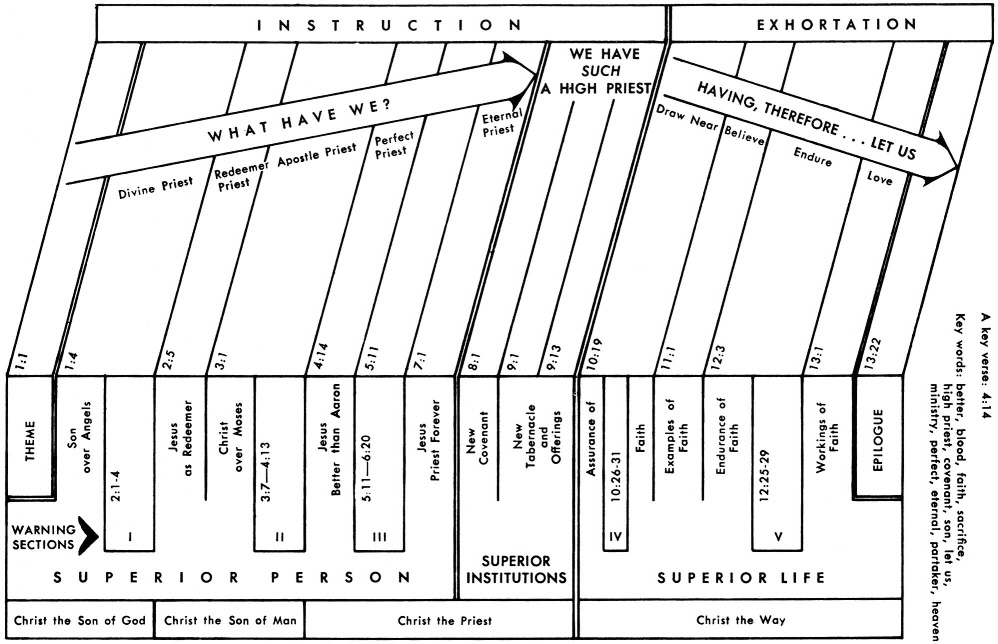
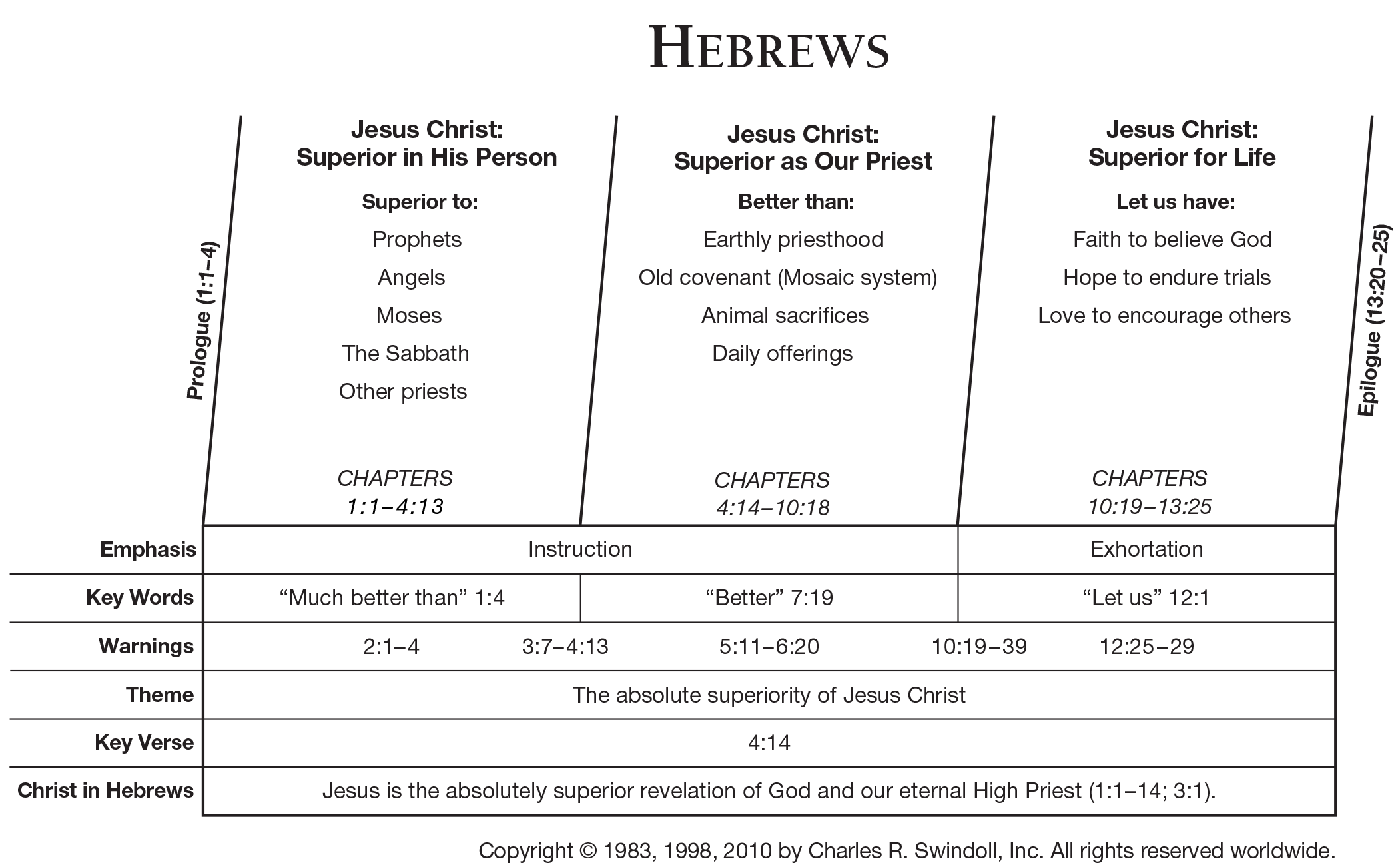
CONSIDER JESUS OUR GREAT HIGH PRIEST
Click chart to enlarge
Charts from Jensen's Survey of the NT - used by permission
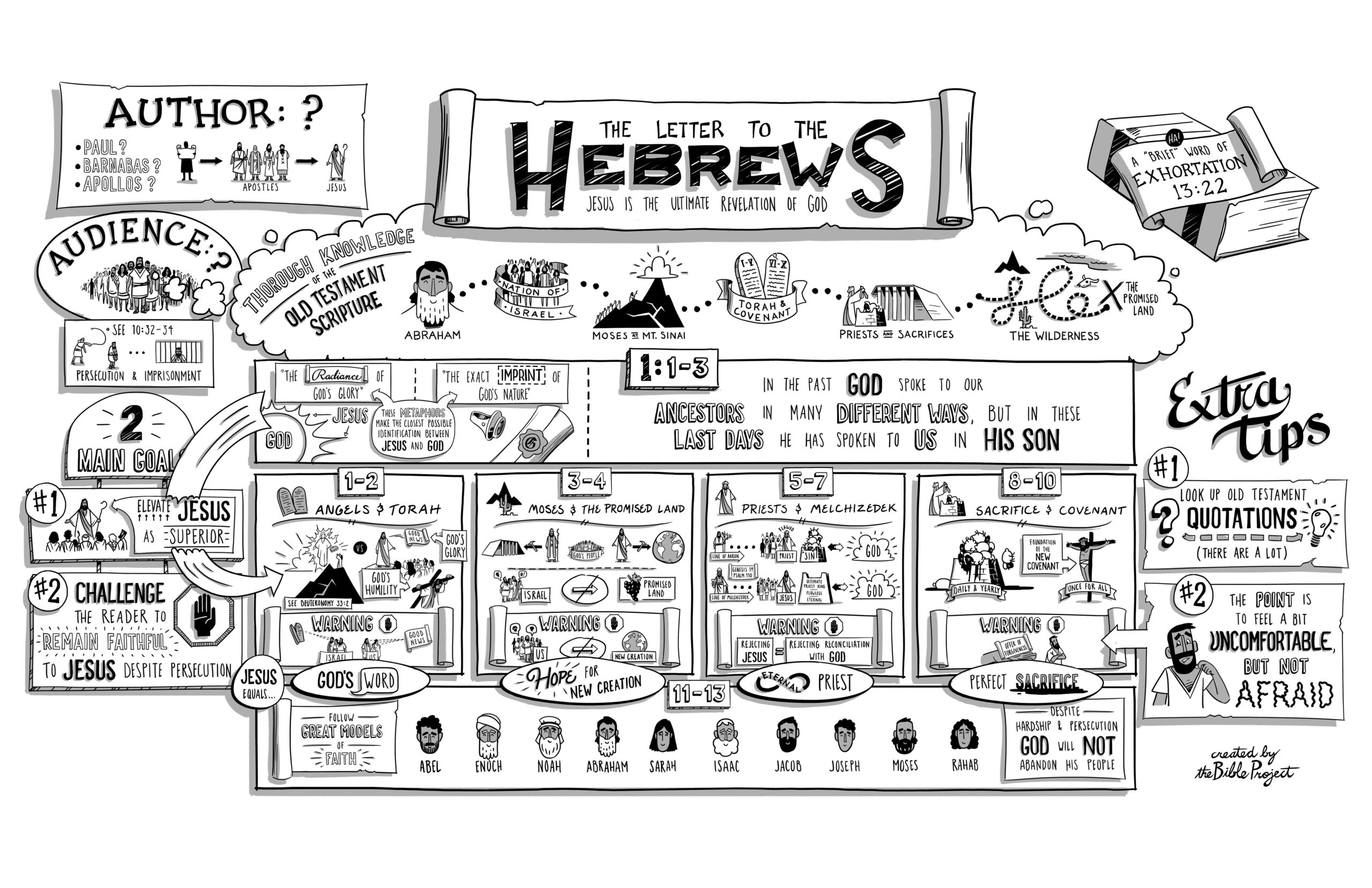
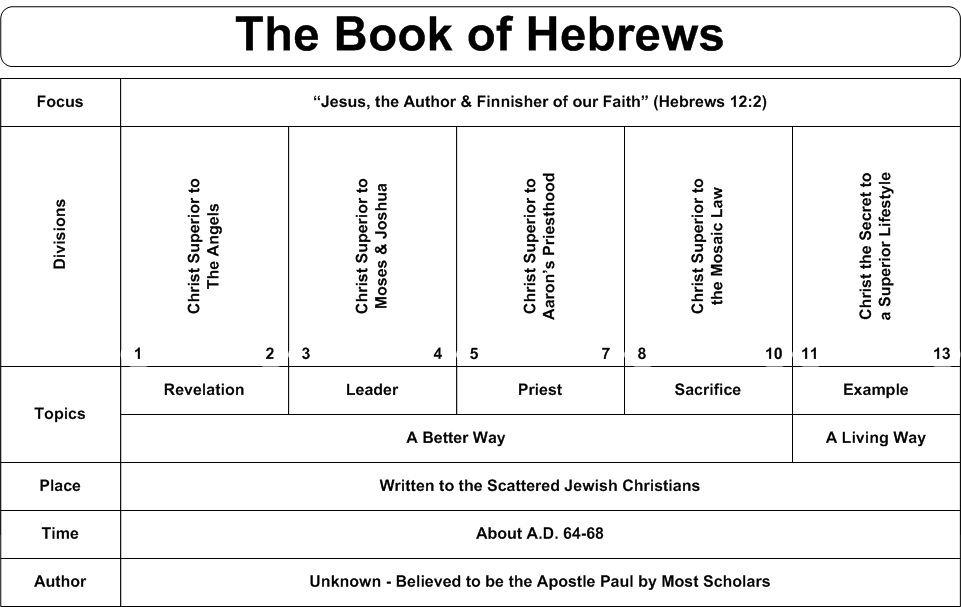
Swindoll's Chart, Interesting Pictorial Chart of Hebrews, Another Chart
|
The Epistle |
||||
| INSTRUCTION Hebrews 1-10:18 |
EXHORTATION Hebrews 10:19-13:25 |
|||
| Superior Person of Christ Hebrews 1:1-4:13 |
Superior Priest in Christ Hebrews 4:14-10:18 |
Superior Life In Christ Hebrews 10:19-13:25 |
||
| BETTER THAN PERSON Hebrews 1:1-4:13 |
BETTER PRIESTHOOD Heb 4:14-7:28 |
BETTER COVENANT Heb 8:1-13 |
BETTER SACRIFICE Heb 9:1-10:18 |
BETTER LIFE |
| MAJESTY OF CHRIST |
MINISTRY OF CHRIST |
MINISTERS FOR CHRIST |
||
|
DOCTRINE |
DUTY |
|||
|
DATE WRITTEN: |
||||

See ESV Study Bible "Introduction to Hebrews"
(See also MacArthur's Introduction to Hebrews)
Borrow Ryrie Study Bible
Hebrews 9:18 Therefore even the first [covenant] was not inaugurated without blood. (NASB: Lockman)
Greek: hothen oude e prote choris haimatos egkekainistai; (3SRPI)
BGT ὅθεν οὐδὲ ἡ πρώτη χωρὶς αἵματος ἐγκεκαίνισται·
BGT ὅθεν οὐδὲ ἡ πρώτη χωρὶς αἵματος ἐγκεκαίνισται·
Amplified: So even the [old] first covenant (God’s will) was not inaugurated and ratified and put in force without the shedding of blood. (Amplified Bible - Lockman)
KJV Whereupon neither the first testament was dedicated without blood.
NKJ Therefore not even the first covenant was dedicated without blood.
NET So even the first covenant was inaugurated with blood.
CSB that is why even the first covenant was inaugurated with blood.
ESV Therefore not even the first covenant was inaugurated without blood.
NIV This is why even the first covenant was not put into effect without blood.
Barclay: That is why even the first covenant was not inaugurated without blood. (Westminster Press)
NLT: That is why blood was required under the first covenant as a proof of death. (NLT - Tyndale House)
Phillips: And indeed we find that even the first agreement of God's will was not put into force without the shedding of blood. (Phillips: Touchstone)
Wuest: From whence it follows that neither was the first testament inaugurated without blood. (Eerdmans Publishing - used by permission)
Vincent: (Thus: a testament is of force after men are dead. It has no force so long as the testator is alive) Wherefore, the first covenant was ratified by slaying victims and sprinkling their blood.
Young's Literal: whence not even the first apart from blood hath been initiated,
Paraphrase This is why even the first covenant could not be established without the shedding of blood.
Paraphrase In fact, the very first covenant that God made with Israel was set in motion only through blood, never without it.
- The first - Heb 8:7, 8, 9; Ex 12:22; Ex 24:3-8
- Inaugurated He 9:14,22
Related Passages:
Exodus 12:22+ (THE PASSOVER MADE EFFECTIVE WITH BLOOD) “You shall take a bunch of hyssop and dip it in the blood which is in the basin, and apply some of the blood that is in the basin to the lintel and the two doorposts; and none of you shall go outside the door of his house until morning.
Exodus 24:3-8+ (INAUGURATION OF THE FIRST COVENANT WITH BLOOD) Then Moses came and recounted to the people all the words of the LORD and all the ordinances; and all the people answered with one voice and said, “All the words which the LORD has spoken we will do!” 4 Moses wrote down all the words of the LORD. Then he arose early in the morning, and built an altar at the foot of the mountain with twelve pillars for the twelve tribes of Israel. 5 He sent young men of the sons of Israel, and they offered burnt offerings and sacrificed young bulls as peace offerings to the LORD. 6 Moses took half of the blood and put it in basins, and the other half of the blood he sprinkled on the altar. 7 Then he took the book of the covenant and read it in the hearing of the people; and they said, “All that the LORD has spoken we will do, and we will be obedient!” 8 So Moses took the blood and sprinkled it on the people, and said, “Behold the blood of the covenant, which the LORD has made with you in accordance with all these words.”
Leviticus 17:11+ ‘For the life of the flesh is in the blood (TO SHED BLOOD IS TO POUR OUT LIFE OF THE VICTIM), and I have given it to you on the altar (GOD'S PLAN NOT MAN'S WAS BLOOD ATONEMENT) to make atonement (kapar) for your souls; for it is the blood by reason of the life (NOT THE RED FLUID BUT IN THE LIFE IT SIGNIFIES AND SURRENDERS. FORFEITED LIFE OF INNOCENT VICTIM MAKES ATONEMENT FOR GUILTY) that makes atonement (kapar). (BLOOD COVERS SIN, SATISFIES DIVINE JUSTICE, AVERTS WRATH AND RESTORES FELLOWSHIP. THE BLOOD STANDS AS VISIBLE PROOF THAT A LIFE HAS BEEN SUBSTITUTED FOR THE SINNER FORESHADOWING CHRIST'S ONCE FOR ALL SACRIFICE - Heb 9:12. HAVE YOU ACCEPTED CHRIST'S BLOOD SACRIFICE FOR YOUR SINS ONCE FOR ALL?)
Job 1:5 (EVEN JOB KNEW ABOUT BLOOD SACRIFICES) When the days of feasting had completed their cycle, Job would send and consecrate them, rising up early in the morning and offering burnt offerings according to the number of them all; for Job said, “Perhaps my sons have sinned and cursed God in their hearts.” Thus Job did continually. (THOUGHT - DO YOU PRAY FOR YOUR CHILDREN CONTINUALLY BRINGING THEM BEFORE GOD'S THRONE OF GRACE?)
NO DIVINE COVENANT
WITHOUT BLOOD RATIFICATION
The writer now turns from the analogy of a will to the reality of how God inaugurated covenants in history. He digresses to discuss the need for Christ death by referring to the Old Testament event in which Moses consecrated the Old Covenant, under which his Hebrew readers had been reared, with the blood of sacrifice (Ex. 24:4-8). Today we ratify agreements with a signature but God ratified His agreements with blood, the OT blood of animals being a "shadow" of the "substance" of the precious blood of Christ in the NT. In short, the principle of death and shed blood has always marked covenant ratification. The first covenant — the Mosaic covenant at Sinai — was not set into effect by words alone but by the sprinkling of blood (see above). This graphic act emphasized that sin brings death, that fellowship with God requires taking a life shedding blood to provide atonement, and that no covenant relationship can be entered apart from the shedding of blood. In this way, the old covenant pointed forward to the greater blood of Christ that inaugurated the new covenant.
Therefore (3606)(hothen) - (Pause and ponder every occurrence of this useful term of conclusion, "therefore") Or for which reason. What reason? Reflecting the principle that a covenant must be ratified by death (blood speaks of death - see note on Lev 17:11 which associates blood with atonement). The flow of thought is like this - In Hebrews 9:16–17 the writer explains that a will (covenant) requires the death of the one who made it and did not go into effect until death occurs. Now in Hebrews 9:18 he begins with a term of conclusion— since death/blood is necessary to inaugurate a will, it follows logically that even the first covenant (Mosaic) was not inaugurated without blood.
Remember that in Heb 9:16-18 what he is proving to his readers is why Christ's death in Heb 9:15 is necessary. It was important for the Jewish readers to understand and accept the absolute necessity of Messiah's death because they had been taught to look for a Messiah Who would defeat their enemies (Rome) and set them free, not a Messiah Who would die! They did not read or understand Isaiah 53+ which is true of most Jews today!
Even the first (protos) covenant was not (oude - strong negation) inaugurated (egkainizo - dedicated, put into effect) without blood (haima) - The first (protos) covenant refers to the Mosaic Covenant at Mt Sinai, the binding arrangement God made with Israel at Mount Sinai (Ex 24:3–8). The writer is describing the formal initiation of this covenant. The perfect tense of inaugurated (egkainizo) indicates that the Old Covenant was once-for-all set into motion, formally established through the prescribed blood ceremony (see above) in the past with results that continue into the present. Without blood (haima) refers to the lifeblood of the sacrificial victim which points to the principle that death (represented by the shed blood - see Lev 17:11 above) was necessary for ratification of the first covenant.
NET NOTE - The Greek text reinforces this by negating the opposite ("not even the first covenant was inaugurated without blood"), but this double negation is not used in contemporary English.
Blood was sprinkled on the book, the people, and the tabernacle/furnishings (Heb 9:19–21; Exod 24:6–8). This symbolized: Death as the basis of covenant relationship. The people’s consecration and obligation to obey. God’s acceptance of the covenant through substitutionary sacrifice.
Spurgeon on blood - Aversion and shrinking crosses most minds at the thought of blood. One feels sickened and saddened. The sight of murdered Abel must have been terrible indeed to Adam and Eve, unused as they were to gaze on blood. If it would be so to them after the fall, what would the sight have been to them had they remained pure and perfect beings? In proportion to purity will be the shock to the mind in the presence of death and blood. Cruel men might gloat over a battlefield, but to most of us the sight of a single violent death would be horrible to the last degree. Manhood, until it is brutalized, has the greatest possible aversion to the sight of blood; it is as though God had selected as the token of atonement that which would show to us His antipathy to sin. He would move us to aversion toward evil from a sight of its painful and deadly consequences. He as good as tells us that while a thing is stained with evil He will sooner destroy it than have it in His sight. Man, the masterpiece of the divine creation, shall sooner be slain and his life flow out on the ground than be allowed to wallow in iniquity. It was intended that even while we are being pardoned we should feel horror at having been defiled with sin. But this aversion must not be used sinfully, as some have used it. I have heard of persons saying, when I preach of the blood of Christ, “I could not bear to hear so much about blood! It quite disgusted me.” I want you to feel shocked because your sin requires such an awful cleansing, but you must not be shocked at the great sacrifice itself. (See full sermon The Blood of the Testament)
Without blood - Apart from the shedding of blood. Why blood? Andrew Murray writes "We know the answer (Lev 17:11 see note) -- "The life (soul) of the flesh is in the blood; and I have given it to you upon the altar to make atonement for your souls: for it is the blood that maketh atonement by reason of the life." The life is in the blood. The blood shed is the token of death, life taken away. Death is always and everywhere God's judgment on sin: The sting of death is sin (1Co 15:56+). The shed blood sprinkled upon the altar, or the person (Heb 9:19, 21), is the proof that death has been endured, that the penalty of the transgressions, for which atonement is being made, has been borne. In some cases the hands were laid upon the head of the sacrifice, confessing over it, and laying upon it, the sin to be atoned for (Lev 16:21+). The shed blood upon the altar was the pledge that God accepted the death of the substitute (ED: HE WAS PROPITIATED): the sins were covered (kapar) by the blood, and the guilty one restored to God's favour. Apart from blood-shedding there is no remission (aphesis - forgiveness - Heb 9:22+); in the blood-shedding there is remission, full and everlasting. (Hebrews 9 Commentary from his book Holiest of All)
The blood of Jesus is the very life of the gospel;
a ministry without the blood of Jesus in it is dead and worthless.
Spurgeon - Blood was seen on all sides under the law, it was vital to its teachings. The blood of Jesus is the very life of the gospel; a ministry without the blood of Jesus in it is dead and worthless. (Exposition) It is not possible that any sin should ever be forgiven to any man without shedding of blood. This has been known from the very first. As soon as man had sinned, God taught him that he needed a sacrifice. Adam and Eve, after they had sinned, tried to clothe themselves with fig leaves, but that was not a sufficient covering. God must kill some animals, shedding their blood, and in their skins our first parents must be clothed (Ge 3:21+). When Cain and Abel had grown up, the only sacrifice that God could accept was the slain lamb (Heb 11:4+). To Cain and his sacrifice of the fruits of the earth, God had no respect. Job is, perhaps, the earliest of the patriarchs, but he offered sacrifice for his children lest they should have offended God while they were feasting (Job 1:5). He did not think, nor did any of those ancient men who feared God think, of finding acceptance with Him, and remission of sin, without shedding blood. This belief has been almost universally held; there is scarcely to be found a tribe of men who have not believed in this. Wherever explorers go, they find that, wherever there is any conception of God, there is a sacrifice in some form or other. (See full sermon With or Without Blood-Shedding)
This section of Hebrews 9 recalls Moses' sprinkling blood on the altar and on the people at the inauguration of the Old Covenant at Mt Sinai…
Then Moses came and recounted to the people all the words of the LORD and all the ordinances; and all the people answered with one voice, and said, "All the words which the LORD has spoken we will do!" 4 And Moses wrote down all the words of the LORD. Then he arose early in the morning, and built an altar at the foot of the mountain with twelve pillars for the twelve tribes of Israel. 5 And he sent young men of the sons of Israel, and they offered burnt offerings and sacrificed young bulls as peace offerings to the LORD. 6 And Moses took half of the blood and put it in basins, and the other half of the blood he sprinkled on the altar. 7 Then he took the book of the covenant and read it in the hearing of the people; and they said, "All that the LORD has spoken we will do, and we will be obedient!" 8 So Moses took the blood and sprinkled it on the people, and said, "Behold the blood of the covenant, which the LORD has made with you in accordance with all these words." (Exodus 24:3-8+)
God had made earlier allusion to blood writing in the Passover where the blood from a slain spotless lamb provided life for those marked by this blood …
And you shall take a bunch of hyssop and dip it in the blood which is in the basin, and apply some of the blood that is in the basin to the lintel and the two doorposts; and none of you shall go outside the door of his house until morning. (Exodus 12:22+)
Spurgeon commenting on Hebrews 9:18-22 says that "There is no truth more plain than this in the whole of the Old Testament; and it must have within it a very weighty lesson to our souls. There are some who cannot endure the doctrine of a substitutionary atonement. Let them beware lest they be casting away the very soul and essence of the gospel. It is evident that the sacrifice of Christ was intended to give ease to the conscience, for we read that the blood of bulls and of goats could not do that. I fail to see how any doctrine of atonement except the doctrine of the vicarious sacrifice of Christ can give ease to the guilty conscience. Christ in my stead suffering the penalty of my sin—that pacifies my conscience, but nothing else does: "Without shedding of blood is no remission." (Exposition)
Andrew Murray explains the efficacy blood of the Lamb of God…
Not without blood! This is the wondrous note that rings through all Scripture, from Abel's sacrifice at the gate of paradise to the song of the ransomed in Revelation. God is willing to receive fallen man back again to His fellowship, to admit him to His heart and His love, to make a covenant with him, to give full assurance of all this; but—not without blood. Even His own Son, the Almighty and All-perfect One, the gift of His eternal love, even He could only redeem us, and enter the Father's presence, in submission to the word, not without blood. But, blessed be God, the blood of the Son of God, in which there was the life of the Eternal Spirit, has been given, and has now wrought an eternal redemption! He did, indeed, bear our sins, and take them away. He put away sin by the sacrifice of Himself. The life He poured out in His blood-shedding was a life that had conquered sin, and rendered a perfect obedience. The blood-shedding as the completion of that life, in its surrender to God and man, has made a complete atonement, a covering up, a putting away of sin. And so the blood of the new covenant, in which God remembers our sins no more, cleanses our heart to receive His laws into it, that the spirit of His law is the spirit of our life, and takes us into full and direct fellowship with Himself. It was in this blood of the eternal covenant that God brought again from the dead our Lord Jesus: the blood had so atoned for sin and made an end of it that, in its power, Christ was raised again. It became the power of a new life to Him and to us. With it He opened the way into the Holiest for us; the way into our hearts for Himself.
Not without blood! In earth and heaven, in each moment of our life, in each thought and act of worship, this word reigns supreme. There can be no fellowship with God, but in the blood, in the death, of His blessed Son.
But, praised be His name, in that blood there is an access and a fellowship, a life and a blessedness, a nearness and a love, that passeth understanding! Let us seek to cultivate large thoughts of what the blood has effected and can effect. Men have sometimes rejected the word: its associations are so coarse and at variance with a finer culture. Others do not reject it, and yet have not been able to sympathise with or approve the large place it sometimes takes in theology and devotion. The strange fascination, the irresistible attraction the word has, is not without reason. There is not a word in Scripture in which all theology is so easily summed up. All that Scripture teaches of sin and death, of the incarnation and the love of Christ, of redemption and salvation, of sin and death conquered, of heaven opened and the Spirit poured out, of the new covenant blessings, of a perfect conscience and a clean heart, and access to God and power to serve Him, personal attachment to Jesus, and of the joy of eternity, has its root and its fruit in this alone: the precious blood of Christ; the blood of the eternal covenant.
Hear what Steinhofer says:
One drop of that blood, sprinkled out of the sanctuary on the heart, changes the whole heart, perfects the conscience, sanctifies the soul, makes the garments clean and white, so that we are meet for fellowship with God, ready and able to live in His love. Such a heart, sprinkled and cleansed with the blood of Jesus, is now fitted for all the grace of the new covenant, all the heavenly gifts, all the holy operations of divine love, all the spiritual blessings of the heavenly places. The blood of the Lamb does indeed make the sinner pure and holy, worthy and fit to partake of all that the Inner sanctuary contains, and to live in God. Therefore the (writer) says: Let us, as those whose hearts are sprinkled from an evil conscience, boldly draw near before the face of God. To be sprinkled with the blood, to have the living, cleansing, all-pervading power of the blood of Jesus in the heart,—this fits us for serving God, not in the oldness of the letter but in the newness of the Spirit. (Hebrews 9 Commentary from his book Holiest of All))
First (4413) (protos) 1) first in time or place 1a) in any succession of things or persons 2) first in rank 2a) influence, honour 2b) chief 2c) principal 3) first, at the first
PROTOS IN HEBREWS - Heb. 7:2; Heb. 8:7; Heb. 8:13; Heb. 9:1; Heb. 9:2; Heb. 9:6; Heb. 9:8; Heb. 9:15; Heb. 9:18; Heb. 10:9
Hebrews 7:2 was first of all, by the translation of his name, king of righteousness
Hebrews 8:7 For if that first covenant had been faultless
Hebrews 8:13 When He said, “A new covenant,” He has made the first obsolete.
Hebrews 9:1 Now even the first covenant had regulations of divine worship
Hebrews 9:2 For there was a tabernacle prepared, the outer one
Hebrews 9:6 priests are continually entering the outer tabernacle performing the divine worship,
Hebrews 9:8 not yet been disclosed while the outer tabernacle is still standing,
Hebrews 9:15 transgressions that were committed under the first covenant
Hebrews 9:18 Therefore even the first covenant was not inaugurated without blood.
Hebrews 10:9 He takes away the first in order to establish the second.
Covenant (1242) diatheke from diatithemi = set out in order, dispose in a certain order <> from dia = two + tithemi = to place pictures that which is placed between two Thus, a covenant is something placed between two = thus an arrangement between two parties) literally conveys the idea of a testament, as in one's last will and testament.
Diatheke was commonly used in the Greco-Roman world to define a legal transaction in settling an inheritance (used in this sense in Hebrews 9:16; 9:17) which we often refer to as one's last will and testament. In this sense it referred to the disposition which a person made of his property in prospect of death. Furthermore, diatheke generally denoted a transaction that was irrevocable could not be cancelled by anyone. As discussed in Heb 9:17 a will does not come into effect until the one who made the will dies. It is not until the testator's death that the benefits and provisions of the will become reality. Prior to the testator's death, the stipulations in the will are only promises.
The 3 major meanings of diatheke in the NT can be summarized as…
(1) A legal technical term used when one settles an inheritance and known by our familiar English term "last will and testament"
(2) A binding contract between two or more persons, as in Galatians 3:15 where the covenant is between men.
(3) The major NT (and Septuagint use) is a declaration of the will of God in "concerning His self-commitment, promises, and conditions by which he entered into relationship with man covenant, agreement" (BORROW Analytical Lexicon of the Greek New Testament)
Vine adds that - A covenant was ordinarily ratified by the sacrifice of a victim, suggesting that the covenanting parties were dead to all possible change of mind. Hence arose the use of the phrase “to cut a covenant,” the reference being to the death of the victim. Thus, when the Lord made a covenant with Abraham concerning the inheritance promised to him and to his seed, he was commanded to sacrifice a heifer, a she goat, a ram, a turtledove, and a young pigeon. These, except the birds, were divided, and laid, the half of each victim over against the other half, a divine token, accompanied by the symbols of the smoking furnace and the flaming torch, that the covenant of promise would be carried out. The death of these victims, necessary to the old covenant, prefigured the death of Christ as the basis of the new covenant, by which “they that have been called,” the spiritual seed of Abraham, whether Jew or Gentile, may receive the promise of the eternal inheritance. The promise stands for the subject of the promise, the inheritance. Christ is both the sacrificial victim and the Mediator. He is the latter in virtue of His sacrifice. (Collected writings of W. E. Vine)
Cleon Rogers describes covenant in the ancient world as…the uniting and community of the souls and wills of the two, which results in a common purpose, common friends, common enemies, mutual confidence, loyalty, and exclusion of strife. In all of this the will of the stronger was the dominating force. This resulting harmony is often described by the word Shalom which stresses the wholeness, harmony, and unity of the two. Along with this unity there was also the obligation to help or aid one another in time of trouble. Because of these tremendous implications it was always advisable to proceed with caution before making a covenant with anyone. (SEE THE FULL ARTICLE The Covenant with Abraham and Its Historical Setting. Bibliotheca Sacra. Volume 127. Issue 507. Page 240. 1970) (See another article by Cleon Rogers - Covenant with Moses)
DIATHEKE IS A KEY WORD IN HEBREWS 15x/33 total uses. Heb. 7:22; Heb. 8:6; Heb. 8:8; Heb. 8:9; Heb. 8:10; Heb. 9:4; Heb. 9:15; Heb. 9:16; Heb. 9:17; Heb. 9:20; Heb. 10:16; Heb. 10:29; Heb. 12:24; Heb. 13:20
Hebrews 7:22 so much the more also Jesus has become the guarantee of a better covenant.
Hebrews 8:6 by as much as He is also the mediator of a better covenant
Hebrews 8:8 WHEN I WILL EFFECT A NEW COVENANT WITH THE HOUSE
Hebrews 8:9 NOT LIKE THE COVENANT WHICH I MADE WITH THEIR FATHERS ON THE DAY
Hebrews 8:9 FOR THEY DID NOT CONTINUE IN MY COVENANT,
Hebrews 8:10 “FOR THIS IS THE COVENANT THAT I WILL MAKE WITH
Hebrews 9:4 having a golden altar of incense and the ark of the covenant
Hebrews 9:15 For this reason He is the mediator of a new covenant
Hebrews 9:16 For where a covenant is, there must of necessity be the death of the one who made it.
Hebrews 9:17 For a covenant is valid only when men are dead
Hebrews 9:20 saying, “THIS IS THE BLOOD OF THE COVENANT WHICH GOD COMMANDED
Hebrews 10:16 “THIS IS THE COVENANT THAT I WILL MAKE WITH THEM AFTER THOSE DAYS
Hebrews 10:29 has regarded as unclean the blood of the covenant by which he was sanctified
Hebrews 12:24 and to Jesus, the mediator of a new covenant, and to the sprinkled blood
Hebrews 13:20 great Shepherd of the sheep through the blood of the eternal covenant
Inaugurated (1457) (egkainizo from en = en or at + kainizo = to make new from kainos = that which is new kind unprecedented, novel, uncommon, unheard of, not previously present) means to renew, to make new, to cause to go into effect, with the root word kainos giving the implication of something being newly established or not previously present. Egkainizo is used in the Septuagint to mean renew (the kingdom - 1Sa 11:14) and dedicate (the house of the Lord - 1Ki 8:63) To consecrate, to innovate, to initiate, to dedicate. To bring in as new. The idea of egkainizo is to introduce something new with the concepts of inauguration and dedication closely related. To renew qualitatively or make qualitatively new or initiate its qualitatively different effect or to innovate or begin its operation. In other words now "under the new (kainos) covenant the blood of Christ dedicates, or consecrates, all things for the believer, and renders them acceptable to God." (Vine)
The only other NT use of this word is in Hebrews 10:20…
Heb 10:20 (context He 10:19) by a new and living way which He inaugurated for us through the veil, that is, His flesh (context Heb 10:20, 21)
Comment: Egkainizo here describes the new way into the sanctuary which Jesus has opened by treading it Himself for the first time.
To inaugurate in Webster's means to bring about the beginning of. It is from a word borrowed from the ceremonies used by the Romans when they were received into the college of augurs. Kings and emperors are inaugurated by coronation; a prelate, by consecration; and the president of a college by such ceremonies and forms as give weight and authority to the transaction. The old covenant was officially commenced or formally initiated by the blood of animals, which necessitates the death of the animal.
So in essence what the writer is saying is that the Old Covenant was inaugurated by a death, albeit non-human. In the Old Covenant ritual this death of an animal was but a foreshadowing of the future death of the perfect sacrifice of the Lamb of God that would alone take away (the idea inherent in "forgive" is to take away) the sins of the world and inaugurate the New Covenant in His blood…
This is My blood of the covenant, which is poured out for many for forgiveness (KJV = "remission" = aphesis = the canceling of the debt) of sins (Mt 26:28, cp Luke 22:20)
Now the God of peace, Who brought up from the dead the great Shepherd of the sheep through the blood of the eternal covenant, even Jesus our Lord (He 13:20-note)
Egkainizo - 9 verse in the non-apocryphal Septuagint - Dt 20:5; 1Sa 11:14; 1Kgs 8:63; 2Chr 7:5; 15:8; Ps 51:10; Isa 16:11; 41:1; 45:16
Ps 51:10 Create (aorist imperative) in me a clean heart, O God, And renew (aorist imperative) a steadfast spirit within me.
Blood (129) haima is literally the red fluid that circulates in the heart, arteries, capillaries, and veins of a vertebrate animal carrying nourishment and oxygen to and bringing away waste products from all parts of the body and thus is essential for the preservation of life. Haima gives us English words like hemorrhage (Gk - haimorragia from haimo- + rragia from regnuo - to burst) English derivatives inclue hematology (study of blood) and "leukemia" which is from leuco (white) plus haima (blood), which is fitting as leukemia is a disease that affects the white blood cells. Derivatives of haima are : haimatekchusía (130), shedding of blood; haimorroéō (131), to hemorrhage. Haima was used to describe “descent” or “family” in ancient times. “To shed blood” is to destroy life.
Zodhiates adds that "haima is used to denote life given up or offered as an atonement since, in the ritual of sacrifice, special emphasis is laid upon it as the material basis of the individual life. The life of the animal offered for propitiation appears in the blood separated from the flesh which the Jews were forbidden to eat (Ge. 9:4; Lev. 3:17; 17:10-14; Deut. 12:23; Heb. 9:7-13, 18-25; 11:28; 13:11). This life is, on the one hand, in the blood, presented to God; on the other hand by sprinkling, appropriated to man (Heb. 9:7, 19, 20). This blood thus becomes the blood of the covenant or testament (see diathekē) which God commanded to us (Heb. 9:20). (Complete Word Study Dictionary- New Testament)
HAIMA IS A KEYWORD IN HEBREWS - 22X OUT OF 97X IN NT - Heb. 2:14; Heb. 9:7; Heb. 9:12; Heb. 9:13; Heb. 9:14; Heb. 9:18; Heb. 9:19; Heb. 9:20; Heb. 9:21; Heb. 9:22; Heb. 9:25; Heb. 10:4; Heb. 10:19; Heb. 10:29; Heb. 11:28; Heb. 12:4; Heb. 12:24; Heb. 13:11; Heb. 13:12; Heb. 13:20
Hebrews 2:14 Therefore, since the children share in flesh and blood,
Hebrews 9:7 only the high priest enters once a year, not without taking blood,
Hebrews 9:12 and not through the blood of goats and calves, but through His own blood
Hebrews 9:13 For if the blood of goats and bulls
Hebrews 9:14 how much more will the blood of Christ, who through the eternal Spirit offered Himself
Hebrews 9:18 even the first covenant was not inaugurated without blood.
Hebrews 9:19 he took the blood of the calves and the goats
Hebrews 9:20 saying, “THIS IS THE BLOOD OF THE COVENANT WHICH GOD COMMANDED YOU
Hebrews 9:21 he sprinkled both the tabernacle and all the vessels of the ministry with the blood
Hebrews 9:22 almost say, all things are cleansed with blood,
Hebrews 9:22 and without shedding of blood there is no forgiveness.
Hebrews 9:25 high priest enters the holy place year by year with blood that is not his own.
Hebrews 10:4 For it is impossible for the blood of bulls and goats to take away sins.
Hebrews 10:19 confidence to enter the holy place by the blood of Jesus,
Hebrews 10:29 has regarded as unclean the blood of the covenant by which he was sanctified
Hebrews 11:28 By faith he kept the Passover and the sprinkling of the blood
Hebrews 12:4 have not yet resisted to the point of shedding blood
Hebrews 12:24 Jesus, the mediator of a new covenant, and to the sprinkled blood
Hebrews 12:24 which speaks better than the blood of Abel.
Hebrews 13:11 For the bodies of those animals whose blood is brought into the holy place
Hebrews 13:12 He might sanctify the people through His own blood
Hebrews 13:20 the great Shepherd of the sheep through the blood of the eternal covenant
Spurgeon has the following sermons related to blood…
- Exodus 12:13 The Blood
- Hebrews 12:24-25 The Blood Of Sprinkling
- Hebrews 12:24-25 The Blood Of Sprinkling
- Hebrews 13:20 The Blood Of The Everlasting Covenant
- Hebrews 9:19-20 The Blood Of The Testament
- Hebrews 9:22 Blood-Shedding
Hebrews 9:19 For when every commandment had been spoken by Moses to all the people according to the Law, he took the blood of the calves and the goats, with water and scarlet wool and hyssop, and sprinkled both the book itself and all the people, (NASB: Lockman)
Greek: laletheises (APPFSG) gar pases entoles kata ton nomon upo Mouseos panti to lao, labon (AAPMSN) to aima ton moschon [kai ton tragon] meta udatos kai eriou kokkinou kai ussopou auto te to biblion kai panta ton laon errantisen 3SAAI
Amplified: For when every command of the Law had been read out by Moses to all the people, he took the blood of slain calves and goats, together with water and scarlet wool and with a bunch of hyssop, and sprinkled both the Book (the roll of the Law and covenant) itself and all the people, (Amplified Bible - Lockman)
Barclay: For, after every commandment which the law lays down had been announced by Moses to all the people, he took the blood of calves and goats, together with water and scarlet and hyssop, and sprinkled the book itself and all the people. (Westminster Press)
NLT: For after Moses had given the people all of God's laws, he took the blood of calves and goats, along with water, and sprinkled both the book of God's laws and all the people, using branches of hyssop bushes and scarlet wool. (NLT - Tyndale House)
Phillips: For when Moses had told the people every command of the Law he took calves' and goats' blood with water and scarlet wool, and sprinkled both the book and all the people with a sprig of hyssop, (Phillips: Touchstone)
Wuest: For after every commandment was spoken by Moses to all the people, he took the blood of calves and of goats, with water and scarlet wool, and hyssop, and sprinkled both the book itself and all the people, (Eerdmans Publishing - used by permission)
Young's Literal: for every command having been spoken, according to law, by Moses, to all the people, having taken the blood of the calves and goats, with water, and scarlet wool, and hyssop, he both the book itself and all the people did sprinkle,
- The blood - He 9:12; 10:4; Exodus 24:5,6,8, 9, 10, 11; Leviticus 1:2,3,10; 3:6; 16:14, 15, 16, 17, 18
- Scarlet wool - Lev 14:4, 5, 6,49, 50, 51, 52; Nu 19:6; Matthew 27:28; Mark 15:17,20; John 19:2,5
- Hyssop - Exodus 12:22; Numbers 19:18; Psalms 51:7
- Sprinkled - He 12:24; Ex 24:8; Isaiah 52:15; Ezekiel 36:25; 1Pe 1:2
Related Passages:
Leviticus 14:4 then the priest shall give orders to take two live clean birds and cedar wood and a scarlet string and hyssop for the one who is to be cleansed.
Numbers 19:6+ The priest shall take cedar wood and hyssop and scarlet material and cast it into the midst of the burning heifer.
Exodus 24:6-8+ (BLOOD ON BOOK AND PEOPLE) 6 Moses took half of the blood and put it in basins, and the other half of the blood he sprinkled on the altar. 7 Then he took the book of the covenant and read it in the hearing of the people; and they said, “All that the LORD has spoken we will do, and we will be obedient!” 8 So Moses took the blood and sprinkled it on the people, and said, “Behold the blood of the covenant, which the LORD has made with you in accordance with all these words.”
Isaiah 52:15 (FIGURATIVELY PORTRAYING MESSIAH SPRINKLING AND CLEANSING FROM SIN - ALLUDES TO THE NEW COVENANT) Thus He will sprinkle many nations (NOT JUST JEWS BUT ALSO GENTILES), Kings will shut their mouths on account of Him; For what had not been told them they will see, And what they had not heard they will understand.
Ezekiel 36:25+ (PROPHECY OF FUTURE FIGURATIVE "SPRINKLING" OF ISRAEL SPEAKING OF THE NEW COVENANT) “Then (IN THE END TIMES - SEE Ro 11:26-27 commentary) I will sprinkle clean water on you, and you will be clean; I will cleanse you from all your filthiness and from all your idols.

Moses Sprinkles Book
and People with Blood
For - Here this term of explanation explains (provides "proof" if you will) that the statement regarding the first covenant (Heb 9:18) is correct, that is, that if was actually inaugurated with blood.
When every commandment (entole) had been spoken (read aloud publicly, proclaimed with authority) by Moses to all the people (the entire assembly of Israel, so that none were excluded) according to the Law (just as the LORD had prescribed through His revealed covenant instruction)- See Exodus 24:5-11+. Moses, functioning as the mediator between God and Israel, spoke the commandment at Mt Sinai, speaking all of God's words, underscoring the seriousness of His Word.
Old Testament allusions such as this one substantiate once again that the writer is specifically addressing Jewish readers who would be familiar with the OT rituals.
He took the blood (haima) of the calves and the goats, with water (symbol of cleansing and purification), and scarlet wool (see note) and hyssop (see note) - Goats were not mentioned in Exodus 24, but were mentioned in discussion of burnt offerings (Lev 1:10; 4:23). Water and scarlet (see note) wool and hyssop is not found in Exodus 24, but those items are used in the ceremony of the red heifer (Numbers 19:6,7+ where the word "scarlet" appears without the word "wool") (Heb 9:13+)
Hyssop is a small bushy plant, often employed as a natural brush; used at the first Passover (Ex. 12:22), in cleansing lepers (Lev. 14:4–6), and by David in his cry for spiritual cleansing (Ps. 51:7). Here it functioned as God’s chosen instrument for applying the blood to both book and people.
Steven Cole points out that "The author mentions details in He 9:19+ that are not included in the account in Exodus 24+. There is no mention there of goats, water, scarlet wool, hyssop, or the sprinkling of the book. Other texts mention some of these things in other rituals (Lev 1:10+; Lev 14:4, 5, 6+; Nu 19:6, 18+). Either the author is collectively gathering up all of these rituals into one, since he is dealing with the general subject of all things in the Old Testament being cleansed by blood (so Calvin and John Owen). Or, he may be relying on oral tradition, with which all of the Jews were familiar. But, his point is, “according to the Law, one may almost say, all things are cleansed with blood” (He 9:22+). The exception was that a poor man could offer a grain offering instead of an animal sacrifice (Lev 5:11, 12, 13+). But the exception did not negate the rule, that “without the shedding of blood there is no forgiveness.” God was making the point that death is His decreed penalty for our sins." (Hebrews 9:15-22 Forgiveness Through Christ's Blood)
Albert Barnes adds that "This passage has given great perplexity to commentators from the fact that Moses, in his account of the transactions connected with the ratification of the covenant with the people, Exodus 24:3 mentions only a part of the circumstances here referred to. He says nothing of the blood of calves and of goats; nothing of water, and scarlet wool, and hyssop; nothing of sprinkling the book, the tabernacle, or the vessels of the ministry. It has been made a question, therefore, whence Paul obtained a knowledge of these circumstances? Since the account is not contained in the Old Testament, it must have been either by tradition or by direct inspiration."
And sprinkled (rhantizo - ceremonially scattered) both the book itself (biblion - the written covenant) and all the people (bringing them into the covenant) - Moses does not record the sprinkling of the book itself in Exodus, but it is implied (Ex 24:6-7+). The fact that the very scroll of the covenant law was sprinkled with blood indicated that even God’s written revelation was set apart and sealed by blood, binding its blessings and its curses with divine authority. Obviously blood did not touch every Israelite, but symbolically every Israelite was placed under the blood, which both consecrated them to God and bound them to keep the covenant terms. In other words, the sprinkled blood set them apart to God and made them accountable, calling for their obedience.
The consecration of Aaron and his sons to the priesthood is the only other occasion in the OT when persons were sprinkled with blood (Ex 29:21; Lev 8:30; cf. 1Pe 1:2+).
Stedman points out that "By sprinkling the blood of an animal on the people, Moses is saying that God would accept that substitution as a temporary reprieve until the true Substitute should come."
Without such a death, even the limited forgiveness provided for in the first covenant
could not take effect, for without the shedding of blood there is no forgiveness.
Ray Stedman points out that Heb 9:16-17 "argue that the covenant (viewed as a will) cannot take effect apart from the death of the will-maker. This principle is seen even in the first covenant (Heb 9:18–22) since Moses, having read the law to the people, took the blood of animals and sprinkled the scroll of the law, the people and everything connected with the service of the tabernacle (Lev 8:10, 19, 30). He thus indicated that the old covenant was based upon death—the death of animals. Without such a death, even the limited forgiveness provided for in the first covenant could not take effect, for without the shedding of blood there is no forgiveness. A striking scene is described in Exodus 24:8 when Moses sprinkled the blood upon the people. It was meant to impress on them that sin cannot be set aside, even by a loving God, without a death occurring. His judicial sentence, “the soul who sins is the one who will die” (Ezek 18:4), must be carried out.....The people must realize that sin is serious, since only death can relieve it. When the new covenant replaces the old, it not only removes sin through the death of Jesus but provides a new understanding and a new intimacy that make the service of God a delight and an enriching experience. (Hebrews 9:15-28 Jesus' Last Will and Testament)
Spurgeon - Oh, how delightful this Bible looks to me when I see the blood of Christ sprinkled upon it! Every leaf would have flashed with Sinai’s lightnings, and every verse would have rolled with the thunders of Horeb, if it had not been for Calvary’s cross. But now, as you look, you see on every page your Savior’s precious blood. He loved you, and gave Himself for you, and now you who are sprinkled with that blood, and have by faith rested in Him, can take that precious Book and find it to be green pastures and still waters to your souls.
Spurgeon comments on all the people "The drops (OF BLOOD) fell upon them all. As Moses took the basin and scattered the blood over the whole crowd, it fell upon all who were assembled at the door of the tabernacle. Have you had a sprinkling with the precious blood? If you have, you shall live forever. But if you have not, the wrath of God abides on you. Do you ask how you can have the blood of Christ sprinkled on you? It cannot be done literally, but faith does it. Faith is the bunch of hyssop that we dip into the basin, and it sprinkles man’s conscience from bad works. It is by the sprinkling of the blood, then, that we are saved. We must have the blood of Christ upon us in one way or the other. If we do not have it upon us to save us, we shall have it upon us to destroy us. “His blood be on us and on our children” (Matt 27:25) said the Jews to Pilate in their madness, and the siege of Jerusalem was the answer to the cry. Worse than the siege of Jerusalem was to the Jews shall be the death of those who have contempt for the Spirit of grace and despise the blood of Jesus. But happy shall they be who, giving up every other confidence, come to the blood of the covenant and put their trust there, for it shall not deceive them.
Blood was also sprinkled on the Day of Atonement which foreshadowed the atoning sacrifice of Christ our High Priest...
Lev 16:14-18+ "Moreover, he shall take some of the blood of the bull and sprinkle it with his finger on the mercy seat on the east side; also in front of the mercy seat he shall sprinkle some of the blood with his finger seven times. 15 "Then he shall slaughter the goat of the sin offering which is for the people, and bring its blood inside the veil, and do with its blood as he did with the blood of the bull, and sprinkle it on the mercy seat and in front of the mercy seat. 16 "And he shall make atonement for the holy place, because of the impurities of the sons of Israel, and because of their transgressions, in regard to all their sins; and thus he shall do for the tent of meeting which abides with them in the midst of their impurities. 17 "When he goes in to make atonement in the holy place, no one shall be in the tent of meeting until he comes out, that he may make atonement for himself and for his household and for all the assembly of Israel. 18 "Then he shall go out to the altar that is before the LORD and make atonement for it, and shall take some of the blood of the bull and of the blood of the goat, and put it on the horns of the altar on all sides.
Sprinkled (4472) (rhantizo from rhaino - to sprinkle; cp cognate = rhantismos) by implication meant to cleanse by sprinkling, purify, free from pollution. It was used in secular Greek to describe common sprinkling in a non-religious sense but there were uses in which sprinkling conveyed the idea of religious cleansing. Rhantizo speaks of internal (heart) cleansing in Heb 10:22. Sprinkling was the method of application for the blood of the sacrifice in order to secure its atoning efficacy and the method of purifying connected with expiation. Sprinkling persons with blood took place upon the ratifying of the covenant (Ex. 24:8; Heb. 9:19, 20); upon the consecration of the family of Aaron to the priesthood (Ex. 29:21); in cleansing from leprosy (Lev. 14:2-7). The symbolic use of rhantizō in the Septuagint is “purify” or “cleanse” in a moral sense (cf. Leviticus 6:27; Psalm 51:7], corresponding to Hebrews 9:13,19,21; 10:22). In the Old Testament religious sense it referred to oil that was mixed with the blood of the sacrifice and sprinkled on whatever was to be cleansed. TDNT - rhantizo is a rare and late form of rhaino, which is used for spraying or sprinkling something on something or something with something. Rhantizo - distinguish from nipto = to rinse part of the body, louo = wash the entire body, bapto/baptizo = immerse.
Robert B. Girdlestone in his Synonyms of The Old Testament has an interesting comment - "The sprinklings (shantismoi) specially referred to in the Epistle to the Hebrews are of two kinds—that which was performed with the ashes of a red heifer on persons who had contracted certain defilement (Heb. 9.13), and that which was performed with blood on the people and the Book in making the old covenant; also on the tabernacle and various vessels connected with the sacred service (Heb. 9.19,21). The substance of which these are the shadows is the sprinkling of the blood of Jesus, which speaketh better things than that of Abel (Heb. 12.24)
RHANTIZO - 5V Mk. 7:4; Heb. 9:13; Heb. 9:19; Heb. 9:21; Heb. 10:22 (In Lxx in Lev 6:20, 2Ki 9:33, Ps 51:7
Hebrews 9:13 For if the blood of goats and bulls and the ashes of a heifer sprinkling those who have been defiled sanctify for the cleansing of the flesh,
Hebrews 9:19 For when every commandment had been spoken by Moses to all the people according to the Law, he took the blood of the calves and the goats, with water and scarlet wool and hyssop, and sprinkled both the book itself and all the people,
Hebrews 9:21 And in the same way he sprinkled both the tabernacle and all the vessels of the ministry with the blood.
Hebrews 10:22 let us draw near with a sincere heart in full assurance of faith, having our hearts sprinkled clean from an evil conscience and our bodies washed with pure water.
Scarlet - This dye was obtained by the Egyptians from the shell-fish Carthamus tinctorius; and by the Hebrews from the Coccus ilicis, an insect which infests oak trees, called kermes by the Arabians. This colour was early known (Gen. 38:28). It was one of the colours of the ephod (Ex. 28:6), the girdle (8), and the breastplate (15) of the high priest. It is also mentioned in various other connections (Josh. 2:18; 2 Sam. 1:24; Lam. 4:5; Nahum 2:3). A scarlet robe was in mockery placed on our Lord (Matt. 27:28; Luke 23:11). "Sins as scarlet" (Isa. 1:18), i.e., as scarlet robes "glaring and habitual." Scarlet and crimson were the firmest of dyes, and thus not easily washed out.
Albert Barnes commenting on scarlet wool writes "The word here used denotes crimson, or deep scarlet. The colour was obtained from a small insect which was found adhering to the shoots of a species of oak in Spain and in Western Asia, of about the size of a pea. It was regarded as the most valuable of the colours for dyeing, and was very expensive. Why the wool used by Moses was of this colour is not known unless it be because it was the most expensive of colours, and thus accorded with everything employed in the construction of the tabernacle and its utensils. Wool appears to have been used in order to absorb and retain the blood.
- See discussion of Psalm 22:6 I am a Worm (Hebrew for worm =tola) for possible associations of scarlet with Christ. Remember that in Isaiah 1:18+ we read God's promise where He mentions both scarlet and wool - "“Come now, and let us reason together,” Says the LORD, “Though your sins are as scarlet, They will be as white as snow; Though they are red like crimson, They will be like wool."
- See also What is the significance of a scarlet thread? | GotQuestions.org
- Scarlet - 50x/50v - Gen. 38:28; Gen. 38:30; Exod. 25:4; Exod. 26:1; Exod. 26:31; Exod. 26:36; Exod. 27:16; Exod. 28:5; Exod. 28:6; Exod. 28:8; Exod. 28:15; Exod. 28:33; Exod. 35:6; Exod. 35:23; Exod. 35:25; Exod. 35:35; Exod. 36:8; Exod. 36:35; Exod. 36:37; Exod. 38:18; Exod. 38:23; Exod. 39:1; Exod. 39:2; Exod. 39:3; Exod. 39:5; Exod. 39:8; Exod. 39:24; Exod. 39:29; Lev. 14:4; Lev. 14:6; Lev. 14:49; Lev. 14:51; Lev. 14:52; Num. 4:8; Num. 19:6; Jos. 2:18; Jos. 2:21; 2 Sam. 1:24; Prov. 31:21; Song 4:3; Isa. 1:18; Jer. 4:30; Nah. 2:3; Matt. 27:28; Matt. 27:31; Heb. 9:19; Rev. 17:3; Rev. 17:4; Rev. 18:12; Rev. 18:16
QUESTION - What is hyssop? What was hyssop used for in the Bible? GOTQUESTIONS.ORG
ANSWER - Since people in the biblical era did not have access to the products we do today, they often relied on naturally occurring resources such as plants, animal byproducts, and minerals for cleaning, cooking, food, medicine, and more. Hyssop, an herb in the mint family with cleansing, medicinal, and flavoring properties, was prolific in the Middle East and was used in a variety of ways.
The Bible mentions hyssop several times, mostly in the Old Testament. In Leviticus, God commanded His people to use hyssop in the ceremonial cleansing of people and houses. In one example, God tells the priests to use hyssop together with cedar wood, scarlet yarn, and the blood of a clean bird to sprinkle a person recently healed from a skin disease (likely leprosy). This act would ceremonially cleanse the formerly diseased person and allow him to reenter the camp (Leviticus 14:1–7). The same method was used to purify a house that had previously contained mold (Leviticus 14:33–53).
Hyssop is also used symbolically in the Bible. When the Israelites marked their doorposts with lamb’s blood in order for the angel of death to pass over them, God instructed them to use a bunch of hyssop as a “paintbrush” (Exodus 12:22). This was probably because hyssop was sturdy and could withstand the brushing, but it also likely signified that God was marking His people as “pure” and not targets of the judgment God was about to deal out to the Egyptians.
David also mentions hyssop in Psalm 51:7: “Cleanse me with hyssop, and I will be clean; wash me, and I will be whiter than snow.” David does not refer to physical cleansing—rather, he is asking God to cleanse him spiritually as he confesses his sin.
Hyssop also appears at Jesus’ crucifixion, when the Roman soldiers offered Jesus a drink of wine vinegar on a sponge at the end of a stalk of hyssop (John 19:28–30). This was, in fact, Jesus’ last act before He declared His work on earth finished and gave up His spirit. While the hyssop stalk may have been used for purely practical purposes (i.e., it was long enough to reach to Jesus’ mouth as He hung on the cross), it is interesting that that particular plant was chosen. It is possible that God meant this as a picture of purification, as Jesus bought our forgiveness with His sacrifice. Just as in the Old Testament blood and hyssop purified a defiled person, so Jesus’ shed blood purifies us from the defilement of our sin.
Related Resources:
- What is the Day of Atonement (Yom Kippur)? | GotQuestions.org (See in depth verse by verse notes on Leviticus 16:1-34)
- What is the significance of a red heifer in the Bible? Is a red heifer a sign of the end times? | GotQuestions.org
Hebrews 9:20 saying, "THIS IS THE BLOOD OF THE COVENANT WHICH GOD COMMANDED YOU." (NASB: Lockman)
Greek: legon, (PAPMSN) Touto to aima tes diathekes es eneteilato (3SAMI) pros umas o theos;
BGT λέγων· τοῦτο τὸ αἷμα τῆς διαθήκης ἧς ἐνετείλατο πρὸς ὑμᾶς ὁ θεός.
Amplified: Saying these words: This is the blood that seals and ratifies the agreement (the testament, the covenant) which God commanded [me to deliver to] you. (Amplified Bible - Lockman)
Barclay: And as he did so, he said: “This is the blood of the covenant whose conditions God commanded you to observe.” (Westminster Press)
NLT: Then he said, "This blood confirms the covenant God has made with you." (Phillips: Touchstone)
NET and said, "This is the blood of the covenant that God has commanded you to keep."
CSB saying, This is the blood of the covenant that God has commanded for you.
ESV saying, "This is the blood of the covenant that God commanded for you."
Wuest: saying, This is the blood of the testament which God enjoined to you. (Eerdmans Publishing - used by permission)
Young's Literal: saying, 'This is the blood of the covenant that God enjoined unto you,'
Paraphrase This is the life-blood by which God Himself has ratified His covenant with you, sealing His binding agreement and laying His command upon you.
Paraphrase This is the sacrificial blood of the covenant — the solemn arrangement God decreed for you, binding you to His will.
Paraphrase Here is the blood which confirms the covenant that God has commanded and required of you, establishing your relationship with Him.
- This is the blood - Heb 13:20; Zechariah 9:11; Matthew 26:28
- The Covenant - Deuteronomy 29:12; Joshua 9:6
Related Passage:
Matthew 26:28+ (THE NEW COVENANT, A BETTER COVENANT, BY A BETTER MEDIATOR) for this is My blood (haima) of the covenant (diatheke), which is poured out for many for forgiveness (aphesis - COMPARE THE FORESHADOWING IN Lev 16:10+ WHERE SEND IN SEPTUAGINT = aphiemi) of sins.
Luke 22:20+ And in the same way He took the cup after they had eaten, saying, “This cup which is poured out for you is the new covenant in My blood. (WHAT MOSES ENACTED WITH ANIMAL BLOOD ON SINAI, JESUS FULFILLED WITH HIS OWN BLOOD ON CALVARY!)
Hebrews 13:20+ Now the God of peace, who brought up from the dead the great Shepherd of the sheep through the blood (haima) of the eternal covenant (diatheke), even Jesus our Lord,
Exodus 24:7-8+ Then he took the book of the covenant and read it in the hearing of the people; and they said, “All that the LORD has spoken we will do, and we will be obedient!” 8 So Moses took the blood and sprinkled it on the people, and said, “Behold the blood of the covenant, which the LORD has made with you in accordance with all these words.”
REMINDER OF MOSES' RATIFYING
THE OLD COVENANT WITH BLOOD
Saying, "THIS IS THE BLOOD (haima - the poured out life) OF THE COVENANT (diatheke - the solemn, binding agreement) WHICH GOD COMMANDED (entellomai - decreed, laid upon as a binding obligation) YOU - The writer is quoting Moses in Exodus 24:8+ which says "So Moses took the blood and sprinkled it on the people, and said, “Behold the blood of the covenant, which the LORD has made with you in accordance with all these words.” These are the words that Moses spoke to the Hebrews as he sprinkled the book and the people with blood. The law as read aloud, affirmed by the people, and then ratified by the sprinkling of the blood. The people swore to do their part (Ex 24:7), while God swore to do His part and thus the Old Covenant was inaugurated. The point to note is that the blood was an essential component of the Old Covenant. By sprinkling the blood, Moses was dramatizing two things: (1) Atonement — sin requires death, and blood is the substitute. (2) Binding — God and His people were now joined in covenant fellowship under blood.
THIS IS THE BLOOD (haima) OF THE COVENANT (diatheke) - This obviously refers to the Old Covenant but is a clear foreshadowing of the blood of the New Covenant. Virtually the same words were utilized in the inaugural ceremonies for both the Old Covenant and the New Covenant (cf Mt 26:28+). BLOOD (haima) is not just red liquid, but represents a life surrendered (or taken) in death (Lev 17:11-see note above). Blood represents the cost of sin (death) and the means of atonement. COMMANDED (entellomai) signifies that God Himself imposed this covenant; it was not optional or negotiable. The people were obligated to it under His authority. This covenant was not a mutual contract negotiated by equals. It was God’s sovereign initiative, graciously binding Israel to Himself under His word and His terms.
Commanded (1781) (entellomai from en = in, upon + téllo = accomplish, charge, command) means to give charge or commandments, to order.
ENTELLOMAI - 15V - Matt. 4:6; Matt. 17:9; Matt. 19:7; Matt. 28:20; Mk. 10:3; Mk. 13:34; Lk. 4:10; Jn. 8:5; Jn. 14:31; Jn. 15:14; Jn. 15:17; Acts 1:2; Acts 13:47; Heb. 9:20; Heb. 11:22 = "gave orders concerning his bones."
Saved by the blood of the Crucified One!
Now ransomed from sin and a new work begun;
Sing praise to the Father and praise to the Son--
Saved by the blood of the Crucified One!
--Henderson
Spurgeon's Morning and Evening - There is a strange power about the very name of blood, and the sight of it is always affecting. A kind heart cannot bear to see a sparrow bleed, and unless familiarized by use, turns away with horror at the slaughter of a beast. As to the blood of men, it is a consecrated thing: it is murder to shed it in wrath, it is a dreadful crime to squander it in war. Is this solemnity occasioned by the fact that the blood is the life, and the pouring of it forth the token of death? We think so. When we rise to contemplate the blood of the Son of God, our awe is yet more increased, and we shudder as we think of the guilt of sin, and the terrible penalty which the Sin-bearer endured. Blood, always precious, is priceless when it streams from Immanuel's side. The blood of Jesus seals the covenant of grace, and makes it for ever sure. Covenants of old were made by sacrifice, and the everlasting covenant was ratified in the same manner. Oh, the delight of being saved upon the sure foundation of divine engagements which cannot be dishonoured! Salvation by the works of the law is a frail and broken vessel whose shipwreck is sure; but the covenant vessel fears no storms, for the blood ensures the whole. The blood of Jesus made his testament valid. Wills are of no power unless the testators die. In this light the soldier's spear is a blessed aid to faith, since it proved our Lord to be really dead. Doubts upon that matter there can be none, and we may boldly appropriate the legacies which he has left for his people. Happy they who see their title to heavenly blessings assured to them by a dying Saviour. But has this blood no voice to us? Does it not bid us sanctify ourselves unto him by whom we have been redeemed? Does it not call us to newness of life, and incite us to entire consecration to the Lord? O that the power of the blood might be known, and felt in us this night!
Charles Haddon Spurgeon's Sermon on Hebrews 9:19-20..
The Blood Of The Testament
Metropolitan Tabernacle, Newington
3/14/1912 - 3293
"For when Moses had spoken every precept to all the people according to the law, he took the blood of calves and of goats, with water, and scarlet wool, and hyssop, and sprinkled both the book, and all his people, saying, This is the blood of the testament which God hath enjoined unto you."—Hebrews 9:19, 20.
Blood is always a terrible thing. It makes a sensitive mind shudder even to pronounce the word; but, to look upon the thing itself causes a thrill of horror. Although by familiarity men shake this off, for the seeing of the eye and the hearing of the ear can harden the heart, the instinct of a little child may teach you what is natural to us in referrer to blood. How it will worry if its finger bleeds ever so little, shocked as the sight, actually there be no smart. I envy not the man whose pity would not stir to see a sparrow bleed or a lamb wantonly put to pain; and as for the cruel man, I shudder at the thought of his depravity. What exquisite pain it must be caused our first parent - how deeply it must have touched the fine sensibilities of their nature to have had to offer sacrifice! Probably they had never seen death until they brought their first victim to the altar of God. Blood! Ah ! how they must have shuddered as they saw the warm life-fluid flowing forth from the innocent victim. It must have seemed to them to be a very horrible thing, and very properly so, for God intended them to feel their feelings outraged. He meant them to take to heart the anguish of the victim, and learn, with many a shudder, what a destructive and killing thing sin was. He meant them to see before their eyes a commentary upon his threatening, "In the day that thou eatest thereof thou shalt surely die." He meant Adam and Eve to witness the harrowing appearance, as the sentence upon sin was executed, stabbing at the very heart of life, convulsing all the frame, sealing up the senses, and leaving behind but a wreck of the beautiful creature, and not a relic of happiness for it in the world. How dreadful must have been the spectacle, when the first pair gathered around the corpse of their second son, slain by his find this brother! There were the clots of blood on the murderous club, or the sharp stone, or whatever other instrument Cain may have used in smiting his brother to the grave. How they must have mourned and sighed as they saw the precious crimson of human life wantonly poured out upon the ground, and crying to God against the murderer!
Yes, blood is always a ghastly and a terrible thing. It is so, I suppose, because we recognize in it the destruction of life. Is it not so, also,—though we may not be able to define the emotion,—because we are compelled, in our consciences, to admit the effect of sin, and we are staggered as we see what our sin has done? All through the great school of the Jewish law, blood was constantly used to instruct the Israelite in the guilt of sin, and in the greatness of the atonement necessary for putting it away. I suppose that the outer court of the Jewish temple was something worse than ordinary shambles. If you will read the lists of the multitudes of beasts that were sometimes slain there in a single day, you will see that the priests must have stood in gore, and have presented a crimson appearance,—their snow-white garments all splashed over with blood as they stood there offering sacrifice from morning till night. Every man who went up to the tabernacle or to the temple must have stood aside for a moment, and have said, "What a place this is for the worship of God! Everywhere I see signs of slaughter." God intended this to be so. It was the great lesson which he meant to be taught to the Jewish people, that sin was a loathsome and a detestable thing, and that it could only be put away by the sacrifice of a great life, such a life as had not then been lived,—the life of the Coming One, the life of the eternal Son of God, who must himself become man, that he might offer his own, immaculate life upon the altar of God to expiate the guilt, and put away the filth and the loathsomeness of human transgression.
Some of you will feel sickened at these reflections, and object to what I have already said, as unworthy of my lips and offensive to your ears. I know who these will be,—the creatures of taste, who have never felt the loathsomeness of sin. Oh, I would that your sins would sicken you ! I would to God that you had some sense of what a horrible thing it is to rebel against the Most High, to pervert the laws of right, to overthrow the rules of virtue, and to run into the ways of transgression and iniquity, for if blood be sickening to you, sin is infinitely more detestable to God; and if you find that being washed in blood seems awful to you, the great bath which was filled from Christ's veins, in which men are washed and made clean, is a thing of greater and deeper solemnity to God than any tongue shall be ever able to express.
I do not think anyone ever knows the preciousness of the blood of Christ, till he has had a full sight and sense of his sin, his uncleanness, and his ill-desert. Is there, any such thing as truly coming to the cross of Christ until you first of all have seen what your sin really deserves? A little light into that dark cellar, sir; a little light into that hole within the soul, a little light cast into that infernal den of your humanity, and you will soon discern what sin is, and, seeing it, you would discover that there was no hope of being washed from it except by a sacrifice far greater than you could ever render. Then the atonement of Christ would become fair and lustrous in your eyes, and you would rejoice with joy unspeakable in that boundless love which led the Savior to give himself a ransom for us, "the Just for the unjust, that he might bring us to God." May the Lord teach us, thundering at us, if need be, what sin means. May he teach it to us so that the lesson shall be burned into our souls, and we shall never forget it! I could fain wish that you were all burden-carriers till you grew weary. I could fain wish that you all laboured after eternal life until your strength failed, and that you might then rejoice in him who has finished the work, and who promises to be to you All-in-all when you believe in him, and trust in him with your whole heart.
Looking carefully at the text, I would have you notice the name given to the blood of Christ, the ministry in which it was used, and the effect that it produced.
I. First, observe THE NAME GIVEN IN THE TEXT TO THE BLOOD OF CHRIST. It is said to be, "THE BLOOD OF THE TESTAMENT."
You are aware, perhaps, you who read your Bibles thoroughly, that the word here rendered "testament" is more commonly rendered "covenant", and although it would be wrong to say that it does not mean "testament", yet it would be right to say that it signifies both "covenant" and "testament", and that its first and general meaning is "covenant."
Let us take it so. The blood of Jesus is the blood of the covenant. Long before this round world was made, or stars began to shine, God forsaw that he would make man. He also foresaw that man would fall into sin. Out of that fall of man his distinguishing grace and infinite sovereignty selected a multitude that no man can number to be his. But, seeing that they had offended against him, it was necessary, in order that they might be saved, that a great scheme or plan should be devised, by which the justice of God should be fully satisfied, and yet the mercy of God should have full play. A covenant was therefore arranged between the persons of the blessed Trinity. It was agreed and solemnly pledged by the oath of the eternal Father that he would give unto the Son a multitude whom no man could number who should be his, his spouse, the members of his mystical body, his sheep, his precious jewels. These the Savior accepted as his own, and then on his part, he undertook for them that he would keep the divine law that he would suffer all the penalties due on their behalf for offenses against the law, and that he would keep and preserve every one of them until the day of his appearing. Thus stood the covenant, and on that covenant the salvation of every saved man and woman hangs. Do not think it rests with thee, soul, for what saith the Scripture? "It is not of him that willeth, nor of him that runneth but of God that showeth mercy." He said to Moses, "I will have mercy on whom I will have mercy, and I will have compassion on whom I will have compassion." To show you that salvation is not by human merit, God was pleased to cast it entirely upon covenant arrangements. In that covenant, made between himself and his Son, there was not a word said about our actions having any merit in them. We were regarded as though we were not, except that we stood in Christ, and we were only so far parties to the covenant as we were in the loins of Christ on that august day. We were considered to be the seed of the Lord Jesus Christ, the children of his care, the members of his own body. "According as he hath chosen us in Christ before the foundation of the world." Oh, what grace it was that put your name and mine in the eternal roll, and provided for our salvation, provided for it by a covenant, by a sacred compact between the Father and his eternal Son, that we should belong to him in the day when he should make up his jewels!
Now, beloved, in a covenant there are pledges given, and on those pledges we delight to meditate. You know what they were. The Father pledged his honor and his word. He did more; he pledged his oath; and "becaue he could swear by no greater, he sware by himself." He pledged his own word and sacred honor of Godhead that he would be true, to his Son, that he should see his seed; and that by the knowledge of him Christ should "justify many." But there was needed a seal to the covenant, and what was that? Jesus Christ in the fullness of time set the seal to the covenant, to make it valid and secure, by pouring out his life's blood to make the covenant effectual once for all. Beloved, if there be an agreement made between two men, the one to sell such-an-such an estate, and the other to pay for it, the covenant does not hold good until the payment is made. Now, Jesus Christ's blood was the payment of his part of the covenant; and when he shed it, the covenant stood firm as the everlasting hills, and the throne of God himself is not more sure than is the covenant of grace; and, mark you, that covenant is not sure merely in its great outlines, but sure also in all its details. Every soul whose name was in that covenant must be saved. Unless God can undeify himself, every soul that Christ died for he will have. Every soul for which he stood Substitute and Surety he demands to have, and each of the souls he must have, for the covenant stands fast. Moreover, every blessing which in that, covenant was guaranteed to the chosen seed was by the precious blood made eternally secure to that seed. Oh, how I delight to speak about the sureness of that covenant! How the dying David rolled that under his tongue as a sweet morsel! "Although my house," said he, "be not so with God,"-there was the bitter in his mouth; "yet," said he,—and there came in the honey, "yet he hath made with me an everlasting covenant, ordered in all things, and sure." And this sureness, mark you, lies in the blood; it is the blood of Christ that makes all things secure, for all the promises of God are yea and amen in Christ Jesus, to the glory of God by us.
You will ask, it may be, "What is the purpose of this doctrine?" Its purpose is this,-To you who have believed in Jesus covenant mercies are sure, not because of your frames and feelings, but because of the precious blood of Jesus. Yesterday you were happy, mayhap, and to-day you are downcast. Well, but the covenant has not changed. To-morrow you may be in the very depths of despair, while to-day you are singing upon the top of the mountain; but the covenant will not alter. That august transaction was not made by you, and cannot be unmade by you. It tarrieth not for man, and waiteth not for the sons of men. There it stands fast and settled, signed by the eternal signet, and your security is not in yourselves, but in Christ. If Christ bought you, if the Father gave you to him, if Christ became a Surety for you, then—
"Nor death, nor hell, shall e'er remove
His favourites from his breast;
In the dear bosom of his love
They must for ever rest."
The name of the blood, as we find it in our own translation, is "the blood of the testament." This teaches a similar truth, though it puts it under another figure. Salvation comes to us as a matter of will. Jesus Christ has left eternal life to his people as a legacy. Here are the words:—"Father, I will that they also, whom thou hast given me, be with me where I am; that they may behold my glory." Now, a will, as the apostle rightly tells us, has no power whatever unless the man who made it is dead. Hence the blood of Jesus Christ, the token of his death, gives validity to all the promises which he has made. That spear-thrust by the Roman soldier was a precious proof to us that our Lord was really dead. And now, beloved, whenever you read a precious promise in the Bible, you may say, "This is a clause in the Redeemer's will." When you come to a choice word, you may say, "This is another codicil to the will." Recollect that these things are yours, not because you are this or that, but because the blood makes them yours. The next time Satan says to you, "You do not believe as you ought, and therefore the promise is not sure," tell him that the sureness of the promise lies in the blood, and not in what you are or in what you are not. There is a will proved in heaven's Court of Probate, whose validity depends upon its signatures, and upon its witnesses, and upon its being drawn up in proper style. The person to whom the property is left may be very poor, but that does not overthrow the will; he may be very ragged, but that does not upset the will; he may have disgraced himself in some way or other, but that does not make the will void; he who made the will, and put his name to the will, makes the will valid, and not the legatee to whom the legacy was left. And so with you this covenant stands secure, this will of Christ stands firm. In all your ups and downs, in all your successes and your failures, you, poor needy sinner, have nothing to do but to come and take Christ to be your All-in-all, and put your trust in him, and the blood of the covenant shall make the promises sure to you.
This is a sweet topic. I have not time, however, to enlarge upon it; but I heartily commend it to your private meditations, and trust you may find consolation in it.
II. The blood which Moses called "the blood of the covenant" or "of the testament "was of the utmost importance in the ministry of the tabernacle, for IT WAS SPRINKLED BY HIM EVERYWHERE.
First, we are told that he sprinkled it upon the book. Oh, how delightful this Bible looks to me when I see the blood of Christ sprinkled upon it! Every leaf would have flashed with Sinai's lightnings, and every verse would have rolled with the thunders of Horeb, if it had not been for Calvary's cross; but now, as you look, you see on every page your Savior's precious blood. He loved you, and gave himself for you, and now you who are sprinkled with that blood, and have by faith rested in him, can take that precious Book, and find it to be green pastures and still waters to your souls.
The blood was then sprinkled upon the mercy-seat itself. Whenever you cannot pray as you would, remember that Jesus Christ's blood has gone before you, and is pleading for you before the eternal throne; like the good Methodist, who, when a brother could not pray, cried cub, "Plead the blood, brother!" Ay, and when you feel so unworthy that you dare not look up, when the big tear stand in your eye because you have been such a backslider, and have been so cold in heart, plead the blood, my sister, you may always come where the blood is. There you see that this sin of yours has been already atoned for. Before you committed it, Jesus carried it. Long before it fell from your heart the weight of is had pressed upon the Redeemer's heart, and he put it away in that tremendous day when he took all the load of his people's guilt, and hurled it into the sepulchre, to be buried there for ever.
Then the blood was sprinkled upon every vessel of the sanctuary. I like that thought. I like to come up to God's house, and say, "Well, I shall worship God today in the power and through the merit of the precious blood; my praises will be poor, feeble things, but then the sweet perfume will go up out of the golden censer, and my praises will be accepted through Jesus Christ, my preaching, oh! how full of faults; how covered over with sins! but then the blood is on it, and because of that, God will not see sin in my ministry, but will accept it because of the sweetness of his Son's blood."
You will come to the communion table to-night, most of you; but, oh! do not come without the precious blood, for the best place of all upon which it was sprinkled was upon all the people. The drops fell upon them all. As Moses took the basin, and scattered the blood over the whole crowd, it fell upon all who were assembled at the door of the Tabernacle. Have you had sprinkling with the precious blood, my hearer? If you have, you shall live for ever; but if you have not, the wrath of God abideth on you. Do you ask how you can have the blood of Christ sprinkled upon you? It cannot be done literally, but faith does it. Faith is the bunch of hyssop which we dip into the basin, and it sprinkles man's conscience from bad works. You say you have been christened, confirmed, baptized; but, all these things together would not have one soul, much less all the multitudes who trust in them. They are not sufficient for the taking away of a single sin. But you always say your prayers, and you have family prayers, and you are we honest, and so on. I know all this; but all these things you ought to have done, and they will not make amends for what you have not done. All the debt that you have paid will not discharge those that are still due. Know you not that saying of the Scriptures, "by the deeds of the law there shall no flesh be justified in his sight: for by the law is the knowledge of sin"? You may work your fingers to the bone, but you can never weave a righteousness that shall cover your nakedness before God. The only hope of the sinner is to come and cast himself upon what Jesus Christ has done for him, depending upon the groans, and agonies, and death of the martyred Savior, who stood for us and suffered in our stead, that we might escape the wrath of God.
I hope that there is never a Sunday but what I teach this one doctrine; and, until this tongue is silent in the grave, I shall know no other gospel than just this,-
Trust Christ, and you shall live.
The bloody sacrifice of Calvary is the only hope of sinners. Look there, and you shall find the Star of peace guiding you to everlasting day; but turn your backs upon Christ, and you have turned your back upon heaven, you have courted destruction, you have sealed your doom. It is by the sprinkling of the blood, then, that we are saved. We must have the blood of Christ upon us in one way or the other. If we do not have it upon us to save us, we shall have it upon us to destroy us.
"His blood be on us and on our children," said the Jews to Pilate in their madness, and the siege of Jerusalem was the answer to the cry. Worse than was the siege of Jerusalem to the Jews shall be the death of those who do despite to the Spirit of grace, and despise the blood of Jesus; but happy shall they be who, giving up every other confidence, come to the blood of the covenant, and put their trust there, for it shall not deceive them.
III. THE EFFECT OF THE BLOOD OF CHRIST claims our earnest heed; yet the minutes are few in which I can enlarge upon it.
Whenever Jesus Christ's blood comes upon a man, the instantaneous effect is something more than miraculous. Before the application of Christ's blood, the man was distracted. His guilt, and its consequent punishment, weighed heavily upon him.
"Alas!" said he, "I shall soon die, and then hell will be my lot!" Oh ! some of us will never forget when we were in that miserable, burdened state I protest before you all that, when I felt the weight of my sin, I wished that I had never been born; and I envied frogs, and toads, and the most Ioathsome creatures, and thought that they were so much better off than I, because they had never broken the law of God, which I had so wickedly and so wilfully done. If I went to my bed, I started with the fear that I should wake up in hell; and by day the same dread thought distracted me, that I was cast off by God, and must perish. But the moment that I looked to Christ,—do not mistake me,—the very self-same moment that I put my trust in Christ, I rose from the depths of despair to the utmost heights of joy. It was not a process of reasoning; it was not a matter which took hours and days; it was all done in an instant. I understood that God had punished Christ instead of me, and I saw that, therefore, I could not be punished any more; that I never could be, if Christ died for me,-and I was assured that he did if I did but trust him. So I did trust him; with my whole weight I threw myself into his arms, and thought at the time that he had never had such a load to carry before. But I found that he was able to save, even to the uttermost, them that came unto him; and what joy and peace I had in that moment it is impossible for me to describe, and I thank God that I have never Iost it. There have been time of depression; there have been seasons when the light of God's countenance has been withdrawn; but one thing I know,—Christ Jesus came into the world to save sinners. I am a sinner, and my soul rests alone on him; and how can he cast me away, since his own promise is, "He that believeth and is baptized shall be saved"? I have believed; I have been baptized as an avowal of my faith; and he is not true if he does not save me. But he must be true, he cannot break his word. O dear friends, these are hundreds here who have passed through the same blessed experience, and they can tell you that the blood of Jesus in an instant speaks peace to the soul.
And this precious blood has this property about it, that, if the peace which it first causes should become a little dim, you have only to go to the precious blood to have that pace once more restored to you.
I would recommend any of my doubting brethren to come to Christ over again as they came to him at first. Never mind about your experience; never care about your marks and evidences. Never get piling up your experiences. If you go to the top of some mountains such as Snowdon or the Righi, you will find it all solid and firm enough; but there are some people who want to get a little higher than the mountain, so the people there build a rickety old stage, and charge you fourpence: or sixpence to go to the top of it; and when you get up there, you find it is all shaky, and ready to tumble down, and you are alarmed. Well, but what need is there to go up there at all? If you would stand on the mountain, that would not shake. So, sometimes, we are not content with resting upon Christ as poor sinners, and depending on him. We get building a rickety stage of our own experience, or sanctification, or emotions, and I know not what besides, and then it begins to shake under our feet. Better far if we were like the negro, who said he "fell flat down on de promise, and when he had done that, he couldn't fall no lower." Oh, to keep close to a promise! Job says that the naked embrace the rock for want of a shelter, and there is no shelter like the Rock of ages.
"None but Jesus
Can do helpless sinners good."
But I have not told you all the power of this blood, nor could I tell you to-night. That blood gives the pardoned sinner access with boldness to God himself. That blood, having taken away the guilt of sin, operates in a sanctifying manner, and takes away the power of sin, and the pardoned man does not live as he lived before he was pardoned. He loves God, who has forgiven him so much, and that love makes him inquire, "What shall I do for God, who has done so much for me?" Then he begins to purge himself of his old habits. He finds that the pleasures that once were sweet to him are sweet no more. "Away ye go," he says to his old companions; "but I cannot go with you to hell." Having a new heart, a new love, a new desire, he begins to mix with God's people. He searches God's Word. He makes haste to keep God's commandments. His desires are holy and heavenly, and he pants for the time when he shall get rid of all sin, shall be quite like Christ, and shall be taken away to dwell for ever where Jesus is. Oh ! the blood of Christ is a blessed sin-killer. They say that St. Patrick drove all the snakes out of Ireland. Ah! but Christ drives all the serpents out of the human heart when he once gets in. If he does but sprinkle his blood upon our hearts, we become new men,—such new men as all the rules of morality could not have made us, such new men as they are who, robed in white, day without night sing Jehovah's praise before his throne.
Sinner, would you be saved to-night? Trust Jesus, and you shall be. Sinner, would you be saved upon a dying bed? Trust Jesus now, and you shall be. Sinner, would you be saved when the heavens are in a blaze, and the stars fall like withered fig leaves from the firmament ? Look to Jesus now, and you shall be saved then. Oh! I would to God that some of you would look to him not for the eyes of your body to do it, but for the eyes of your mind to do it. Think of what Christ is; God, and yet man. Think of such a Being suffering instead of you. What must be the merit of such suffering, and what an honor to God's justice that such an One should suffer instead of you! Then, depend upon Christ; and if you do so, your sins are forgiven you. Believe that they are. Then will you feel springing up within your heart great love to him who has forgiven you, and that will become the mainspring of your new life. You will start afresh like one that is born tonight. You will, indeed, be born again, for this is regeneration. Not sprinkling your face with drops of water, but making a new man of you,—generating you over again, not by natural generation, but by the eternal Father begetting you again unto a lively hope, by the resurrection of Jesus Christ from the dead,—the true and only spiritual generation; and then, as new creatures in Christ Jesus, you shall go your way through this life up to the life eternal, God's blessing shielding you and crowning you for ever.
The Lord grant you his blessing, for Christ's sake! Amen.