Hebrews 9:1
Hebrews 9:2
Hebrews 9:3
Hebrews 9:4
Hebrews 9:5
Hebrews 9:6
Hebrews 9:7
Hebrews 9:8
Hebrews 9:9
Hebrews 9:10
Hebrews 9:11
Hebrews 9:12
Hebrews 9:13
Hebrews 9:14
Hebrews 9:15
Hebrews 9:16
Hebrews 9:17
Hebrews 9:18
Hebrews 9:19
Hebrews 9:20
Hebrews 9:21
Hebrews 9:22
Hebrews 9:23
Hebrews 9:24
Hebrews 9:25
Hebrews 9:26
Hebrews 9:27
Hebrews 9:28
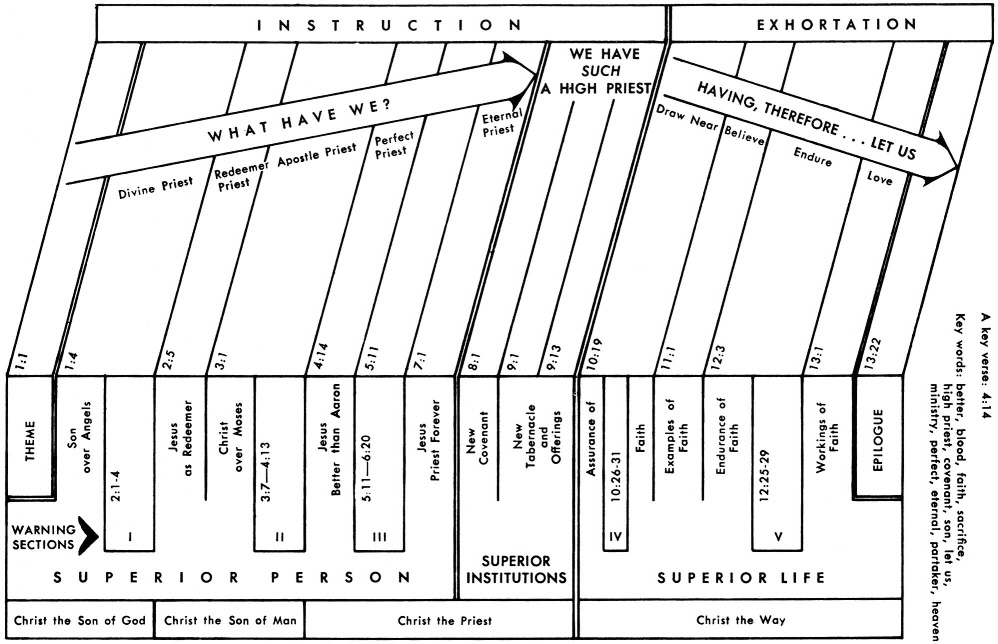
CONSIDER JESUS OUR GREAT HIGH PRIEST
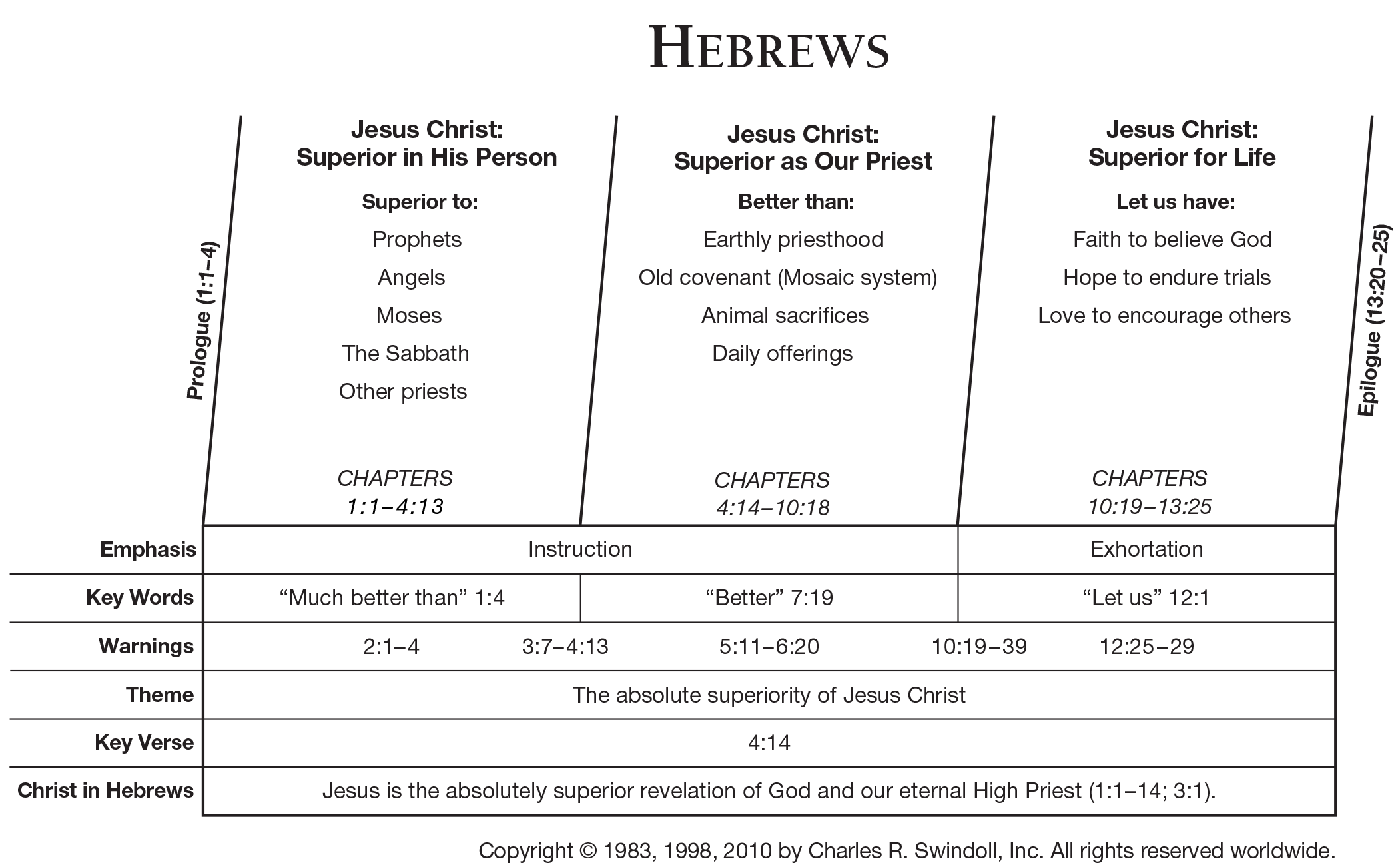
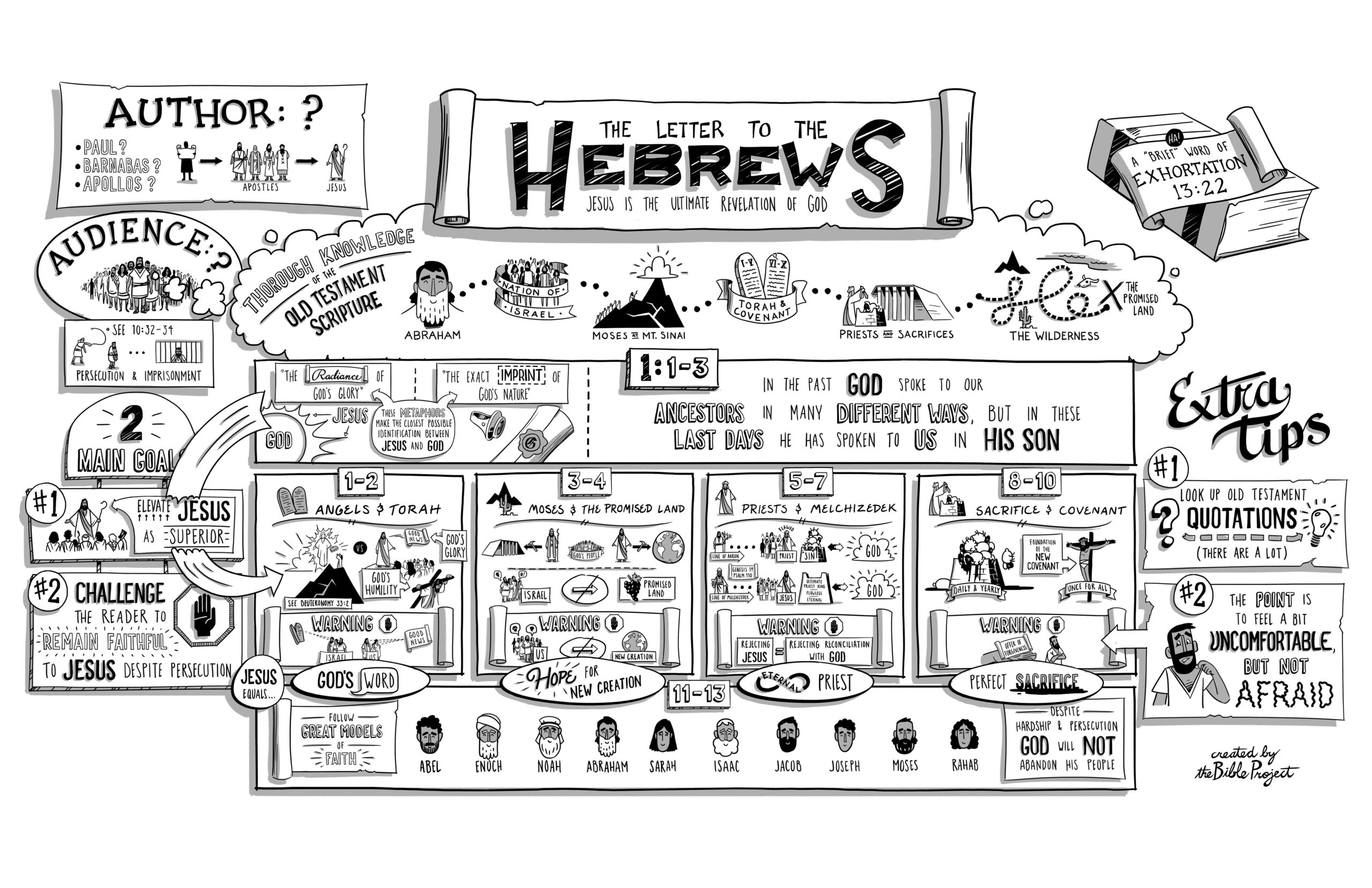
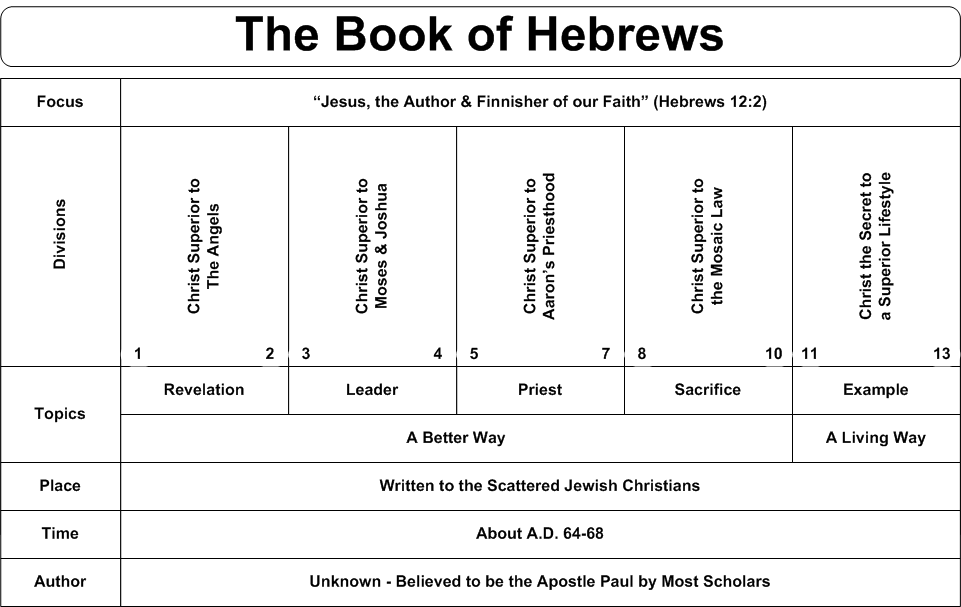
Click chart to enlarge
Charts from Jensen's Survey of the NT - used by permission
Swindoll's Chart, Interesting Pictorial Chart of Hebrews, Another Chart
|
The Epistle |
||||
| INSTRUCTION Hebrews 1-10:18 |
EXHORTATION Hebrews 10:19-13:25 |
|||
| Superior Person of Christ Hebrews 1:1-4:13 |
Superior Priest in Christ Hebrews 4:14-10:18 |
Superior Life In Christ Hebrews 10:19-13:25 |
||
| BETTER THAN PERSON Hebrews 1:1-4:13 |
BETTER PRIESTHOOD Heb 4:14-7:28 |
BETTER COVENANT Heb 8:1-13 |
BETTER SACRIFICE Heb 9:1-10:18 |
BETTER LIFE |
| MAJESTY OF CHRIST |
MINISTRY OF CHRIST |
MINISTERS FOR CHRIST |
||
|
DOCTRINE |
DUTY |
|||
|
DATE WRITTEN: |
||||

See ESV Study Bible "Introduction to Hebrews"
(See also MacArthur's Introduction to Hebrews)
Borrow Ryrie Study Bible
Hebrews 9:21 And in the same way he sprinkled both the tabernacle and all the vessels of the ministry with the blood. (NASB: Lockman)
Greek: kai ten skenen de kai panta ta skeue tes leitourgias to aimati omoios errantisen. (3SAAI)
BGT καὶ τὴν σκηνὴν δὲ καὶ πάντα τὰ σκεύη τῆς λειτουργίας τῷ αἵματι ὁμοίως ἐρράντισεν.
Amplified: And in the same way he sprinkled with the blood both the tabernacle and all the [sacred] vessels and appliances used in [divine] worship. (Amplified Bible - Lockman)
Barclay: In like manner he sprinkled with blood the tabernacle also and all the instruments used in its worship. (Westminster Press)
NLT: And in the same way, he sprinkled blood on the sacred tent and on everything used for worship. (NLT - Tyndale House)
KJV Moreover he sprinkled with blood both the tabernacle, and all the vessels of the ministry.
NKJ Then likewise he sprinkled with blood both the tabernacle and all the vessels of the ministry.
NET And both the tabernacle and all the utensils of worship he likewise sprinkled with blood.
CSB In the same way, he sprinkled the tabernacle and all the articles of worship with blood.
ESV And in the same way he sprinkled with the blood both the tent and all the vessels used in worship.
NIV In the same way, he sprinkled with the blood both the tabernacle and everything used in its ceremonies.
NLT And in the same way, he sprinkled blood on the Tabernacle and on everything used for worship.
Phillips: Moses also sprinkled with blood the tent itself and all the sacred vessels. And you will find that in the Law almost all cleansing is made by means of blood (Phillips: Touchstone)
Wuest: Moreover, the tent and all the instruments of the service with blood he likewise sprinkled. (Eerdmans Publishing - used by permission)
Young's Literal: and both the tabernacle and all the vessels of the service with blood in like manner he did sprinkle,
- Ex 29:12,20,36; Lev 8:15,19; 9:8,9,18; 16:14-19; 2Chr 29:19-22; Ezek 43:18, 19, 29, 21-26
Related Passages:
Exodus 29:12 "And you shall take some of the blood of the bull and put it on the horns of the altar with your finger; and you shall pour out all the blood at the base of the altar.
Exodus 29:20 "And you shall slaughter the ram, and take some of its blood and put it on the lobe of Aaron's right ear and on the lobes of his sons' right ears and on the thumbs of their right hands and on the big toes of their right feet, and sprinkle the rest of the blood around on the altar.
Exodus 29:36 "And each day you shall offer a bull as a sin offering for atonement, and you shall purify the altar when you make atonement for it; and you shall anoint it to consecrate it.
Leviticus 8:10 Moses then took the anointing oil and anointed the tabernacle and all that was in it, and consecrated them.
Leviticus 8:15 Next Moses slaughtered it and took the blood and with his finger put some of it around on the horns of the altar, and purified the altar. Then he poured out the rest of the blood at the base of the altar and consecrated it, to make atonement for it.
Leviticus 8:19 And Moses slaughtered it and sprinkled the blood around on the altar.
Leviticus 9:8-9 So Aaron came near to the altar and slaughtered the calf of the sin offering which was for himself. 9:9 — And Aaron's sons presented the blood to him; and he dipped his finger in the blood, and put some on the horns of the altar, and poured out the rest of the blood at the base of the altar.
Leviticus 9:18 Then he slaughtered the ox and the ram, the sacrifice of peace offerings which was for the people; and Aaron's sons handed the blood to him and he sprinkled it around on the altar.
SANCTUARY AND
SERVICE SPRINKLED
Now the writer of Hebrews draws the attention of the Hebrew readers to what Moses demonstrated in the OT rituals (shadows fulfilled in the NT) After recounting the inauguration of the covenant at Sinai with blood (Heb 9:20), the writer of Hebrews continues the picture: not only the people but also the sanctuary itself and altar were sprinkled with blood (Lev 16:20+, cf Lev 16:33+). This imagery highlights the need for purification from sin's pervasive effect — every object, place, and person connected to God’s service had to be consecrated through blood. The writer uses this to emphasize that sin’s defilement touches everything, and therefore only blood can sanctify both the worshiper and the place of worship.
And in the same way - This refers back to He 9:19+ "For when every commandment had been spoken by Moses to all the people according to the Law, he took the blood of the calves and the goats, with water and scarlet wool and hyssop, and sprinkled both the book itself and all the people."
He sprinkled (rhantizo) both the tabernacle (skene) and all the vessels (skeuos) of the ministry (leitourgia) with the blood (haima) - There is no mention made of blood in the consecration of the tabernacle in Exodus 40. Regardless of this absence of the mention of this detail the writer's point should not be missed that everything that has contacted sin is defiled and needs to be cleansed. Note that even true worship (leitourgia) required cleansing.
Blood (haima) refers to blood as the basis of life or what constitutes the life of an individual. Jehovah explained that "the life of the flesh is in the blood, and I have given it to you on the altar to make atonement for your souls; for it is the blood by reason of the life that makes atonement.' (Lev 17:11)
Blood is the basic component of a living organism. The shedding of Christ's blood (death) was the penalty price for sin. What was foreshadowed (shadow) in the Levitical system was realized (substance) at the Cross when the Son of God laid down His life in death and ransomed men from sin. His precious blood paid the ransom price for our redemption (Cf 1Pe 1:18+; Rev 5:9+, Ro 3:24+; Ro 3:25+) Blood was also used in the cleansing rites on the annual day of atonement.
Spurgeon - If God is to dwell in the midst of sinful men, it can only be through the blood of the atonement. Twice seven times were the holy place and the tabernacle to be sprinkled with blood, as though to indicate a double perfectness of efficacy of the preparation for God’s dwelling among sinful men. I like that thought. I like to come up to God’s house and say, “Well, I shall worship God today in the power and through the merit of the precious blood. My praises will be poor, feeble things, but then the sweet perfume will go up out of the golden censer, and my praises will be accepted through Jesus Christ. My preaching—oh! How full of faults; how covered over with sins! But then the blood is on it, and because of that, God will not see sin in my ministry, but will accept it because of the sweetness of His Son’s blood.” (Exposition)
As Steven Cole explains…God’s uniform method for the forgiveness of sins has been the shedding of blood. God decreed that “the wages of sin is death” (Ro 5:23+). In Leviticus 17:11+, God explains why blood must be shed: “For the life of the flesh is in the blood, and I have given it to you on the altar to make atonement for your souls; for it is the blood by reason of the life that makes atonement.” God’s justice demands the payment of the penalty, which is death. In His mercy, He will accept the death of an acceptable substitute in place of the death of the sinner. The system of animal sacrifices under the old covenant pictured and pointed ahead to Christ, the lamb of God who would take away the sins of the world (John 1:29+). Note three things:
A. Sin leads to physical and spiritual death.
God told Adam and Eve that in the day that they ate of the tree of the knowledge of good and evil, they would surely die (Gen. 2:17). But they ate of the fruit and did not drop dead that day. Why not? At the moment that they ate of the fruit, they died spiritually. Previously, they had enjoyed intimate fellowship with God, with no barriers between them. But instantly they were alienated from Him and tried to hide themselves from His holy presence.
On that same day, the process of physical death set in. Although in God’s providence and purpose, those early humans lived for hundreds of years, they all died. Their bodies became subject to aging and disease. Sin resulted in death through murder and war. All of the ugly horrors of the world, whether the ravages of disease, the atrocities of crime, terrorism, and war, or the environmental devastation of the world’s resources, are the result of sin.
When I have read stories about missionaries going into savage tribes with the gospel, I have marveled that these tribes had not annihilated themselves centuries before. Their histories are one long account of one tribe wronging the other tribe, and then that tribe taking revenge in brutal ways. Then the other tribe retaliates and the cycle goes on and on. The same thing is true, however, in more “civilized” parts of the world. The entire history of the world is a history of battles over territory or resources. Proud men lord it over other proud men, until they are overthrown. Sin is at the root of all of the physical death in the world. And sin results in every person being spiritually dead, alienated from the life of God.
B. Blood graphically pictures the costliness of sin.
The word blood occurs six times in Hebrews 9:18-22, plus death or dead three times in Hebrews 9:15-17. Have you ever thought about how gory and messy the Jewish religion was? Everything was sprinkled with blood. The priests slaughtered dozens and sometimes hundreds or thousands of animals at the altar. They took bowls full of blood and sprinkled it on the altar. The carcasses were burned on the altar, so that the smell would have been constant and overwhelming. I’ve never seen the slaughter of a bull or sheep or goat. I buy my meat pre-cut and shrink-wrapped in cellophane at the grocery store. To be transported back in time and witness the sacrifices at the tabernacle would be a shocking experience for most of us. The blood graphically pictured the cost of sin.
C. The old covenant was inaugurated with blood, because death is God’s decreed penalty for sin.
The author mentions details in Heb 9:19+ that are not included in the account in Exodus 24. There is no mention there of goats, water, scarlet wool, hyssop, or the sprinkling of the book. Other texts mention some of these things in other rituals (Lev 1:10; 14:4, 5, 6; Nu 19:6, 18). Either the author is collectively gathering up all of these rituals into one, since he is dealing with the general subject of all things in the Old Testament being cleansed by blood (so Calvin and John Owen). Or, he may be relying on oral tradition, with which all of the Jews were familiar.
But, his point is, “according to the Law, one may almost say, all things are cleansed with blood” (He 9:22-note). The exception was that a poor man could offer a grain offering instead of an animal sacrifice (Lev. 5:11, 12, 13). But the exception did not negate the rule, that “without the shedding of blood there is no forgiveness.” God was making the point that death is His decreed penalty for our sins.
Thus every person needs forgiveness of sins. God’s uniform method for the forgiveness of sins has been the shedding of blood. (Forgiveness Through Christ’s Blood )
Sprinkled (4472) (rhantizo from rhaino - to sprinkle; cp cognate = rhantismos) by implication meant to cleanse by sprinkling, purify, free from pollution. It was used in secular Greek to describe common sprinkling in a non-religious sense but there were uses in which sprinkling conveyed the idea of religious cleansing. Rhantizo speaks of internal (heart) cleansing in Heb 10:22). The cognate verb rhaino is used only in the Septuagint - Ex 29:21; Lev 4:17; 5:9; 8:11; 14:16, 27; 16:14-15, 19; Nu 19:4; Isa 45:8; Ezek 36:25 Rhantizo - distinguish from nipto = to rinse part of the body, louo = wash the entire body, bapto/baptizo = immerse. TDNT - rhantizo is a rare and late form of rhaino, which is used for spraying or sprinkling something on something or something with something.
Rhantizo - 5x -
Mark 7:4 and when they come from the market place, they do not eat unless they cleanse themselves; and there are many other things which they have received in order to observe, such as the washing of cups and pitchers and copper pots.)
Hebrews 9:13 For if the blood of goats and bulls and the ashes of a heifer sprinkling those who have been defiled sanctify for the cleansing of the flesh,
Hebrews 9:19 For when every commandment had been spoken by Moses to all the people according to the Law, he took the blood of the calves and the goats, with water and scarlet wool and hyssop, and sprinkled both the book itself and all the people,
Hebrews 9:21 And in the same way he sprinkled both the tabernacle and all the vessels of the ministry with the blood.
Hebrews 10:22 let us draw near with a sincere heart in full assurance of faith, having our hearts sprinkled clean from an evil conscience and our bodies washed with pure water.
Rhantizo - used 3 times in the Septuagint -
Leviticus 6:27 'Anyone who touches its flesh will become consecrated; and when any of its blood splashes on a garment, in a holy place you shall wash what was splashed on (Lxx = whosoever shall have it sprinkled).
2 Kings 9:33 He said, "Throw her down." So they threw her down, and some of her blood was sprinkled on the wall and on the horses, and he trampled her under foot.
Psalm 51:7 Purify (Hebrew = chata = to sin, to purify; Lxx = rhantizo) me with hyssop, and I shall be clean; Wash me, and I shall be whiter than snow.
Sprinkling (ISBE Article) (blood, water, oil) formed an important--if not the essential--part of the act of sacrifice. A consideration of the chief passages in the Old Testament will reveal the prominence and the significance of sprinkling as a feature of the sacrificial act. The significance of the sprinkling of blood is seen in the account of the establishment of the covenant between Yahweh and Israel (Ex 24:6-8). Half the blood was sprinkled on the altar as representing the Deity, while the remainder was put into a basin and then sprinkled on the people. This ceremony is a survival in a modified form of the communal meal in which the tribal god and his worshippers sat together and participated in the same food, and in this way came to possess the same life. The two-fold sprinkling of blood resulted in the establishment of an inviolable bond (Nu 18:17; 2Ki 16:15). In the account of the consecration of Aaron and his sons (Ex 29:16,20,21) the blood of the ram of the burnt offering was sprinkled on the altar, while the blood of the ram of consecration was put on the altar and sprinkled on Aaron and his sons and on their garments. Water of purifying was sprinkled on the Levites at their ordination (Nu 8:7). Leviticus gives detailed information in regard to sacrificial sprinkling. In the case of burnt offering the blood was sprinkled round about upon the altar (Lev 1:5,11). The same practice obtained in the case of peace offerings, whether ox, lamb or goat (Lev 3:2,8,13). When a sin offering for sins inadvertently committed was made, the priest dipped his fingers in the blood and sprinkled it seven times before Yahweh, before the veil of the Holy Place (Lev 4:6). Elsewhere (Lev 16:11,15) we read that Aaron took the blood of the sin offering and sprinkled it with his finger upon the mercy-seat, eastward, 7 times (see also Nu 19:4). Sprinkling constituted part of the process of purification. But it is obvious that the sprinkling, even in this case, was a religious act, and not part of the actual physical cleaning. A simple kind of sprinkler was made by fastening a bunch of hyssop to a cedar rod by a piece of scarlet thread or wool and then the patient was besprinkled 7 times (Lev 14:7), while oil was sprinkled with the finger, also 7 times, before Yahweh (Lev 14:16; see also Ex 12:22; Nu 19:18; Ps 51:7). The house in which the leper lived was disinfected in the same thorough manner (Lev 16:51). In the case of persons who had contracted uncleanness through contact with a corpse, sprinkling with the "water of separation" was part of the process of cleansing. The water of separation consisted of the ashes of a red heifer (slain for the purpose) mixed with running water (Nu 19). A sprinkler was used as in the case of the leper (Nu 19:18). The final sprinkling--on the 7th day--was followed by a bath (Nu 19:19). The "tent" in which the corpse lay, together with all the contents, were thoroughly disinfected.
Tabernacle (Article) (4633) (skene) is a tent, booth, hut and here specifically the tabernacle made according to the Old Covenant made largely of skins and was designed to be portable, emphasizing the essence of its impermanence (See Tabernacle in the Wilderness). The tabernacle of the Old Covenant gave every impression of being a temporary structure, which it was. As an aside, it is fascinating to note that God inspired only two chapters to describe the creation, but took some fifty chapters to describe various aspects of the earthly Tabernacle (esp. Ex 25-40). Clearly, God was saying that the Tabernacle was and important picture and demanded the attention of the Jews. But as so many expositors over the years have noted (see discussion of Typology), the Tabernacle of the Old Covenant was essentially a "giant portrait of Jesus Christ" (See related study on Covenant: Abrahamic versus Mosaic). Everywhere you look in the Tabernacle you can see the Messiah. But the old Tabernacle on earth was but a dim picture of the true Tabernacle in heaven
Vessels (4632) (skeuos) (Article) refers to a hollow vessel or container of any material used for a specific purpose, with the meaning varying according to the context - utensil, jar, dish, gear (e.g., translated an anchor in Acts 27:17 in NAS).
Ministry (3009) (leitourgia from leitourgeo = to be a public servant, to perform religious or charitable function, to minister; English = liturgy - body of rites prescribed for public worship) generally used of a servant of a superior and suggests a function to be discharged or a necessary service to be rendered. The word was used in secular Greek to refer to a public service or office, such as in Athens and elsewhere, administered by the citizens at their own expense as a part of the system of finance. In the NT, leitourgia referred to service or ministry as of the public ministrations of the Jewish priesthood. Leitourgia is regularly used in Septuagint (LXX) of the service of priests, particularly their service at the altar (Nu 16:9; 18:4, 6; 1Chr 9:13, 19, 28; 2Chr 31:4; 35:16) Thus writer's use of this word in a sense shows how Jesus' Priesthood was the reality the shadow had been pointing to for centuries.
Leitourgias - 6x in 6v - Usage: ministry(2), priestly service(1), service(3).
Luke 1:23 When the days of his priestly service were ended, he went back home.
2 Corinthians 9:12 For the ministry (diakonia) of this service is not only fully supplying the needs of the saints, but is also overflowing through many thanksgivings to God.
Philippians 2:17-note But even if I am being poured out as a drink offering upon the sacrifice and service of your faith (NLT = just like your faithful service is an offering to God), I rejoice and share my joy with you all.
Philippians 2:30-note because he came close to death for the work of Christ, risking his life to complete what was deficient in your service to me.
Hebrews 8:6-note But now He has obtained a more excellent ministry, by as much as He is also the mediator of a better covenant, which has been enacted on better promises.
Hebrews 9:21 And in the same way he sprinkled both the tabernacle and all the vessels of the ministry with the blood.
Leitourgias - 41 verses in the non-apocryphal Septuagint - Ex 38:21; Nu 4:24, 27f, 33; 7:5, 7f; 8:22, 25; 16:9; 18:4, 6f, 21, 23, 31; 2Sa 19:18; 1Chr 6:32, 48; 9:13, 19, 28; 23:24, 26, 28; 24:3, 19; 26:30; 28:13, 20f; 2Chr 8:14; 31:2, 4, 16; 35:10, 15f; Ezra 7:19; Ezek 29:20
Barclay on Christian Service as described by the word group - leitourgia, leitourgos ,leitourgeo, leitourgikos…
Leitourgia, from which comes our English word 'liturgy', and its kindred words form a group of words of unsurpassed interest. In classical and Hellenistic Greek these words go through four stages of meaning.
(i) In the very early days leitourgein, the verb, meant to undertake some service of the state voluntarily and of one's own free will, voluntarily to shoulder some public task in order patriotically to serve the state.
(ii) Later leitourgein came to mean to perform the services which the State laid upon citizens specially qualified to perform them. The services were the same, but now instead of being voluntary they have become compulsory. Certain duties were liable to be laid on any citizen who possessed more than three talents, that is about £700.
Four typical such duties were : (a) Choregia, which meant the supplying of all the expenses to maintain and train a chorus for the great dramatic performances. (b) Gymnasarchia, which meant the paying of the expenses involved in the training of outstanding athletes for the games. (c) Architheoria, which was the defraying of the expenses of embassies sent out by the state on solemn or sacred occasions. (d) Trierarchia, which meant the shouldering of all the expenses of a trireme or warship in time of national crisis. Still later, especially in Egypt, nearly all municipal duties were leitourgiai. The state picked out a suitable man and laid on him the duty of serving in some capacity his town or village or county. (iii) Still later leitourgein came to describe any kind of service. It is used, for instance, of dancing girls, flute-players, musicians who are hired for some entertainment; of a workman working for any master; and even, strangely enough, of a prostitute giving her services. (iv) In NT times leitourgein was the regular word for the service that a priest or servant rendered in a temple of the gods. So we read of `Thanes and Taous, the twins, who serve in the great temple of Serapis at Memphis'.
In the NT the words have three main uses. (i) They are used of the service rendered by man to man. So Paul, when he is set on taking the collection for the poor saints of Jerusalem, uses leitourgein and leitourgia (Ro 15.27; 2Cor. 9.12). He uses them of the service of the Philippians and of Epaphroditus to himself (Phil. 2.17, 30). To serve others is a 'liturgy' laid on the citizen of the Kingdom by God.
(ii) They are used of specifically religious service (Luke 1.23; Acts 13.2). They are actually used of the high-priestly work of Jesus himself (Heb. 8.6; 8.2). Our Church work is a 'liturgy' again laid on us by God.
(iii) There are two specially interesting uses in Paul.
(a) The magistrate, the person in power, is called by Paul a leitourgos (Ro 13.6). A man's public service must be done for God.
(b) Paul uses it of himself when he calls himself Jesus Christ's leitourgos to the Gentiles (Rom. 15.16). Just as Athens in the old days sent out its leitourgoi to represent the state, so Paul is sent by God to the Gentiles. Perhaps the most interesting fact of all about the word leitourgos is that in later Greek it came simply to mean a 'workman', for that simple fact has in it the great truth that all work is a 'liturgy' laid on men by God, and that the commonest task is glorious because it is done for him.
The great fact about leitourgia is that it has a double background.
(i) It describes voluntary service, spontaneously shouldered.
(ii) It describes that service which the state lays compulsorily upon its citizens. The Christian is a man who works for God and men, first, because he desires to, with his whole heart, and second, because he is compelled to, because the love of Christ constrains him. (New Testament Words)
Blood (129) haima is literally the red fluid that circulates in the heart, arteries, capillaries, and veins of a vertebrate animal carrying nourishment and oxygen to and bringing away waste products from all parts of the body and thus is essential for the preservation of life. Haima gives us English words like hemorrhage (Gk - haimorragia from haimo- + rragia from regnuo - to burst) English derivatives inclue hematology (study of blood) and "leukemia" which is from leuco (white) plus haima (blood), which is fitting as leukemia is a disease that affects the white blood cells. Derivatives of haima are : haimatekchusía (130), shedding of blood; haimorroéō (131), to hemorrhage. Haima was used to describe “descent” or “family” in ancient times. “To shed blood” is to destroy life.
Zodhiates adds that "haima is used to denote life given up or offered as an atonement since, in the ritual of sacrifice, special emphasis is laid upon it as the material basis of the individual life. The life of the animal offered for propitiation appears in the blood separated from the flesh which the Jews were forbidden to eat (Ge. 9:4; Lev. 3:17; 17:10-14; Deut. 12:23; Heb. 9:7-13, 18-25; 11:28; 13:11). This life is, on the one hand, in the blood, presented to God; on the other hand by sprinkling, appropriated to man (Heb. 9:7, 19, 20). This blood thus becomes the blood of the covenant or testament (see diathekē) which God commanded to us (Heb. 9:20). (Complete Word Study Dictionary- New Testament)
HAIMA IS A KEYWORD IN HEBREWS - 22X OUT OF 97X IN NT - Heb. 2:14; Heb. 9:7; Heb. 9:12; Heb. 9:13; Heb. 9:14; Heb. 9:18; Heb. 9:19; Heb. 9:20; Heb. 9:21; Heb. 9:22; Heb. 9:25; Heb. 10:4; Heb. 10:19; Heb. 10:29; Heb. 11:28; Heb. 12:4; Heb. 12:24; Heb. 13:11; Heb. 13:12; Heb. 13:20
Hebrews 2:14 Therefore, since the children share in flesh and blood,
Hebrews 9:7 only the high priest enters once a year, not without taking blood,
Hebrews 9:12 and not through the blood of goats and calves, but through His own blood
Hebrews 9:13 For if the blood of goats and bulls
Hebrews 9:14 how much more will the blood of Christ, who through the eternal Spirit offered Himself
Hebrews 9:18 even the first covenant was not inaugurated without blood.
Hebrews 9:19 he took the blood of the calves and the goats
Hebrews 9:20 saying, “THIS IS THE BLOOD OF THE COVENANT WHICH GOD COMMANDED YOU
Hebrews 9:21 he sprinkled both the tabernacle and all the vessels of the ministry with the blood
Hebrews 9:22 almost say, all things are cleansed with blood,
Hebrews 9:22 and without shedding of blood there is no forgiveness.
Hebrews 9:25 high priest enters the holy place year by year with blood that is not his own.
Hebrews 10:4 For it is impossible for the blood of bulls and goats to take away sins.
Hebrews 10:19 confidence to enter the holy place by the blood of Jesus,
Hebrews 10:29 has regarded as unclean the blood of the covenant by which he was sanctified
Hebrews 11:28 By faith he kept the Passover and the sprinkling of the blood
Hebrews 12:4 have not yet resisted to the point of shedding blood
Hebrews 12:24 Jesus, the mediator of a new covenant, and to the sprinkled blood
Hebrews 12:24 which speaks better than the blood of Abel.
Hebrews 13:11 For the bodies of those animals whose blood is brought into the holy place
Hebrews 13:12 He might sanctify the people through His own blood
Hebrews 13:20 the great Shepherd of the sheep through the blood of the eternal covenant
Spurgeon has the following sermons related to blood…
- Exodus 12:13 The Blood
- Hebrews 12:24-25 The Blood Of Sprinkling
- Hebrews 12:24-25 The Blood Of Sprinkling
- Hebrews 13:20 The Blood Of The Everlasting Covenant
- Hebrews 9:19-20 The Blood Of The Testament
- Hebrews 9:22 Blood-Shedding
Hebrews 9:22 And according to the Law, one may almost say, all things are cleansed with blood, and without shedding of blood there is no forgiveness (NASB: Lockman)
Greek: kai schedon en haimati panta katharizetai (3SPPI) kata ton nomon, kai choris haimatekchusias ou ginetai (3SPMI) aphesis.
BGT καὶ σχεδὸν ἐν αἵματι πάντα καθαρίζεται κατὰ τὸν νόμον καὶ χωρὶς αἱματεκχυσίας οὐ γίνεται ἄφεσις.
Amplified: In fact under the Law almost everything is purified by means of blood, and without the shedding of blood there is neither release from sin and its guilt nor the remission of the due and merited punishment for sins. (Amplified Bible - Lockman)
Barclay: Under the conditions which the law lays down it is true to say that almost everything is cleansed by blood. Without the shedding of blood there is no forgiveness. (Westminster Press)
NLT: In fact, we can say that according to the law of Moses, nearly everything was purified by sprinkling with blood. Without the shedding of blood, there is no forgiveness of sins. (NLT - Tyndale House)
KJV And almost all things are by the law purged with blood; and without shedding of blood is no remission.
NKJ And according to the law almost all things are purified with blood, and without shedding of blood there is no remission.
NET Indeed according to the law almost everything was purified with blood, and without the shedding of blood there is no forgiveness.
CSB According to the law almost everything is purified with blood, and without the shedding of blood there is no forgiveness.
ESV Indeed, under the law almost everything is purified with blood, and without the shedding of blood there is no forgiveness of sins.
NIV In fact, the law requires that nearly everything be cleansed with blood, and without the shedding of blood there is no forgiveness.
Wuest: And one may almost say that with blood all things are cleansed according to the law. And without blood shedding there is no remission. (Eerdmans Publishing - used by permission)
Young's Literal: and with blood almost all things are purified according to the law, and apart from blood-shedding forgiveness doth not come.
- Leviticus 14:6,14,25,51,52
NO BLOOD
NO FORGIVENESS
The writer of Hebrews now drives home the central principle that runs through the entire sacrificial system of the Old Covenant. God had established from the beginning that blood must be shed if sin is to be forgiven. The tabernacle, the vessels, the priests, and the people—all had to be sprinkled with blood, for without the outpoured life (Lev 17:11) of an innocent substitute, there could be no release from guilt. This is not an incidental detail but a divine necessity: “without the shedding of blood (haimatekchusia), there is no forgiveness.” What was symbolized repeatedly through animal sacrifices finds its perfect and final fulfillment in the once-for-all blood of Christ.
According to the Law - As prescribed in the Pentateuch or under the guidelines of the Mosaic or Old Covenant. Remember that what the writer is doing in this section is explaining to his readers why Christ had to die. He first stated that a will or testament demands a death for the will to become effective. In Hebrews 9:18, he explains the necessity of the shedding of blood in order to bring about forgiveness.
One may almost (schedon) say, all things are cleansed (katharizo) with blood (haima) - Almost but not absolutely. The writer is acknowledging that not absolutely everything under the Law was cleansed with blood. The phrase “almost” acknowledges that there were a few exceptions. For the poor, flour could substitute for an animal sacrifice (Lev 5:11), the emphasis is still on the necessity for blood. Purification could sometimes be done with water or fire (Num 31:22–24). But these exceptions did not touch the heart of the matter: blood was the primary means of cleansing under the covenant.
P E Hughes adds that even in Lev 5:11 there "was not a setting aside of the principle that “without shedding of blood there is no forgiveness of sins,” but a gracious concession to the condition of an individual in extreme poverty: the principle was there in intention and his humble offering of flour was accepted in place of the animal victim whose blood would ordinarily have been shed for his sins." (A Commentary on the Epistle to the Hebrews - Page 378)
Homer Kent - Purification, particularly of things in contrast to persons, was sometimes accomplished by water (Ex 19:10; Lev. 15:5; 16:26, 28; 22:6) and by fire (Num. 31:22, 23). Blood, however, was the characteristic means of purifying in the Mosaic law, especially of persons. (Borrow Hebrews Commentary page 176)
C H Spurgeon - Some things under the Jewish law might be cleansed by water or by fire, but in no case where absolute sin was concerned was there ever purification without blood, teaching this doctrine: that blood, and blood alone, must be applied for the remission of sin. Indeed, the very heathen seem to have an inkling of this fact. Do not I see their knives gory with the blood of victims? Have I not heard horrid tales of human immolations, of holocausts, of sacrifices? And what do these mean but that there lies deep in the human breast, deep as the very existence of man, this truth: that “apart from the shedding of blood there is no forgiveness”? God intended this to be so. It was the great lesson that He meant to be taught to the Jewish people, that sin was a loathsome and a detestable thing, and that it could only be put away by the sacrifice of a great life such a life as had not then been lived—the life of the Coming One. The life of the eternal Son of God, who must Himself become man, that He might offer His own immaculate life upon the altar of God to expiate the guilt, and put away the filth and the loathsomeness of human transgression.
Below are some of the OT exceptions to the necessity of blood for cleansing. And note that they are the rare exceptions to the general principle that blood was required from cleansing from sin.
Lev 5:11-13+ 'But if his means are insufficient for two turtledoves or two young pigeons (thus providing an exception for the extremely poor individual, suggesting that even the poorest would always at least have flour to offer), then for his offering for that which he has sinned, he shall bring the tenth of an ephah of fine flour for a sin offering; he shall not put oil on it or place incense on it, for it is a sin offering. 12 'And he shall bring it to the priest, and the priest shall take his handful of it as its memorial portion and offer it up in smoke on the altar, with the offerings of the LORD by fire: it is a sin offering. 13 'So the priest shall make atonement (Hebrew = kapar = cover over) for him concerning his sin which he has committed from one of these, and it shall be forgiven (Lxx = aphiemi) him; then the rest shall become the priest's, like the grain offering.'
Comment: In a sense, the flour "symbolized" the offering of an animal's blood. The fact that there is a non-blood offering for sin supports the fact that the OT sacrifices were symbolic. R C H Lenski feels that " Leviticus 5 presents no exception; it corroborates the fact that blood is needed for remission, for this passage permits only the very poor person, who is unable to provide the blood of even two cheap doves, to substitute a bit of flour and oil. Leviticus 5 allows the substitute only as a substitute for blood and thereby maintains the necessity of blood." (Borrow Hebrews Commentary page 310)
Nu 16:46+ (Context = God's judgment after the rebellion of Korah) And Moses said to Aaron, "Take your censer and put in it fire from the altar, and lay incense on it; then bring it quickly to the congregation and make atonement for them, for wrath has gone forth from the LORD, the plague has begun!"
Nu 31:50+ (Context = When the soldiers were counted and not one had been killed their gratitude stimulated them to make a freewill offering to the LORD) So we have brought as an offering to the LORD what each man found, (not blood but) articles of gold, armlets and bracelets, signet rings, earrings and necklaces, to make atonement for ourselves before the LORD.
William MacDonald mentions another exception noting that "For instance, when a man was to be numbered in a census among the children of Israel, he could bring a half-shekel of silver as “atonement money” instead of a blood offering (Ex. 30:11–16). The coin was a token symbolizing atonement for the man’s soul in order for him to be reckoned as one of God’s people. (Believer's Bible Commentary)
Spurgeon feels that "In one case only was there an apparent exception, and even that goes to prove the universality of the rule, because the reason for the exception is so fully given. The trespass offering, referred to as an alternative in Lev 5:11, might, in extreme cases of excessive poverty, be a bloodless offering. If a man was too poor to bring an offering from the flock, he was to bring two turtledoves or young pigeons. But if he was too poor even for that, he might offer the tenth part of an ephah of fine flour for a sin offering, without oil or frankincense, and it was cast upon the fire. That is the one solitary exception through all the types. In every place, at every time, in every instance where sin had to be removed, blood must flow. Life must be given. I suppose that the outer court of the Jewish temple was something worse than an ordinary slaughterhouse. If you will read the lists of the multitudes of beasts that were sometimes slain there in a single day, you will see that the priests must have stood in gore, and have presented a crimson appearance—their snow-white garments all splashed over with blood as they stood there offering sacrifice from morning till night. Every man who went up to the tabernacle or to the temple must have stood aside for a moment, and have said, “What a place this is for the worship of God! Everywhere I see signs of slaughter.” (See full sermon An Unalterable Law)
John Phillips commenting on "almost" writes "The word almost is a prefix to the entire clause. Some things were not cleansed with blood; some were cleansed with water, as the writer of the epistle has but recently shown. Some sins were not cleansed at all by the Levitical ritual, for example, presumptuous sins (Nu 15:30). Study David's prayer in the light of his presumptuous sins of adultery and murder (Ps 51:17+). Some time after the public ratification of the covenant, the Tabernacle was built, and Moses sprinkled this, too, with blood. The temporary structure of the Tabernacle and the temporary agreement of the law alike had to be sprinkled with blood. Such is human sin. (Exploring Hebrews: An Expository Commentary)
Spurgeon "This solemn truth needs to be well learned and remembered. Nothing can cleanse us but the blood of Jesus. Sacraments, prayers, repentances are all useless as a substitute for faith in the blood."
Almost (4975) (schedon) means nearly, almost or nigh. It is an adverb derived from the verb echo (I have, hold), that is, “to be held near,” and thus “nearly, almost." Schedon is used either (a) of locality, Acts 19:26, or (b) of degree, Acts 13:44; Heb. 9:22.
SCHEDON - 3V - Acts 13:44; Acts 19:26; Heb. 9:22
Gilbrant - This common adverb was used from the time of Homer (Eighth Century B.C.) as an adverb of place (“near”), as an adverb of time (the time [is “near”]), or as an adverb of degree (“nearly” or “almost”). We find it twice in Acts. In 13:44 it describes “almost (schedon) all the city” assembling to hear Paul and Barnabas preach the Word of God. In 19:26 the silversmith Demetrius attempted to arouse those in his same trade against Paul by charging that Paul was leading astray nearly (schedon) the whole province of Asia.Hebrews 9:22 utilizes schedon to remind us that the Law required “nearly everything” (NIV) to be purged or cleansed with blood because there is no forgiveness for sin without it.
Cleansed (2511) (katharizo from katharos = pure, clean, without stain or spot; English words - catharsis = emotional or physical purging, cathartic = substance used to induce a purging, Cathar = member of a medieval sect which sought the purging of evil from its members) means to make clean by taking away an undesirable part. To cleanse from filth or impurity. Click here (and here) for more background on the important Biblical concept of clean and cleansing. Figuratively katharizo referred to cleansing from ritual contamination or impurity as in (Acts 10:15). In a similar sense katharizo is used of cleansing lepers from ceremonial uncleanness (Mt 8:2, 3, et al) Another figurative use in 1John 1:9 (cf James 4:8, Hebrews 10:2) describes the purifying or cleansing from sin and a guilty conscience thus making one acceptable to God and reestablishing fellowship.
Katharizo - 31x in 30v - Mt 8:2, 3; 10:8; 11:5; 23:25, 26; Mark 1:40, 41, 42, 7:19; Luke 4:27; 5:12, 13; 7:22; 11:39; 17:14, 17; Acts 10:15; 11:9; 15:9; 2Cor 7:1; Eph 5:26; Titus 2:14; Heb 9:14, 22, 23; 10:2; Jas 4:8; 1John 1:7, 9. NAS = clean(3), cleanse(5), cleansed(16), cleanses(1), cleansing(1), declared… clean(1), make… clean(3), purify(1).
AND WITHOUT SHEDDING OF BLOOD THERE IS NO FORGIVENESS: kai choris haimatekchusias ou ginetai (3SPMI) aphesis:
- Leviticus 4:20,26,35; 5:10,12,18; 6:7; 17:11
Related Passages:
Leviticus 17:11+ ‘For the life of the flesh is in the blood (TO SHED BLOOD IS TO POUR OUT LIFE OF THE VICTIM), and I have given it to you on the altar (GOD'S PLAN NOT MAN'S WAS BLOOD ATONEMENT) to make atonement (kapar) for your souls; for it is the blood by reason of the life (NOT THE RED FLUID BUT IN THE LIFE IT SIGNIFIES AND SURRENDERS. FORFEITED LIFE OF INNOCENT VICTIM MAKES ATONEMENT FOR GUILTY) that makes atonement (kapar). (BLOOD COVERS SIN, SATISFIES DIVINE JUSTICE, AVERTS WRATH AND RESTORES FELLOWSHIP. THE BLOOD STANDS AS VISIBLE PROOF THAT A LIFE HAS BEEN SUBSTITUTED FOR THE SINNER FORESHADOWING CHRIST'S ONCE FOR ALL SACRIFICE - Heb 9:12. HAVE YOU ACCEPTED CHRIST'S BLOOD SACRIFICE FOR YOUR SINS ONCE FOR ALL?)
THE HIGH COST
OF FORGIVENESS
And without (choris - entirely separated from) shedding of blood (haimatekchusia) there is no forgiveness (aphesis - sending away of sins) - Without (choris) says there is no other way. Shedding of blood (haimatekchusia) literally the pouring out of life unto death. It is not a symbolic act, but a violent death in which blood is spilled.The writer now states the central principle that undergirds the entire sacrificial system and finds its ultimate fulfillment in Christ: forgiveness cannot be granted without the shedding of blood. Sin brings death (Gen 2:17; Rom 6:23), and God’s justice requires that penalty to be paid. The animal sacrifices of the old covenant illustrated this truth but could never fully remove guilt and give a clean conscience. They pointed forward to Christ, Whose own blood was shed once for all to secure eternal redemption. Here, the author crystallizes the heart of atonement stating that without the offering of life through blood, there can be no remission of sins.
🙏 THOUGHT - This principle of no blood, no forgiveness, should radically impact our understanding of the Lord’s Supper. Christ’s blood was required to atone for our sins, so sin must be seen as deadly serious. The cup represents the blood of the new covenant. Remembering that without His blood there is absolutely no forgiveness should fill our time in Communion with deep sense of gratitude and reverence. (1Co 11:25+)
Is (ginomai) means to cause to be ("gen"-erate), to become, to come into existence, to be formed or to come to exist. Forgiveness does not "come into existence" without an appropriate sacrifice of blood. The writer is emphasizing the general principle the even under the Old Covenant God required the shedding of blood for forgiveness under the Mosaic Law. This principle is absolutely true of the New Covenant.
R C H Lenski on forgiveness (remission - KJV) - The ἄφεσις (aphesis) is even more; it is not intended for things but for persons. Although it is used here in an unmodified form it, nevertheless, means the remission of sins, literally, “the sending away.” The thought is that expressed in Heb 8:12. To send away the sins from a sinner as far as the east is from the west (Ps. 103:12), to the bottom of the sea (Micah 7:19), thus blotting out the sins even from memory (Isa. 43:25) as a cloud is blotted out (Isa. 44:22) and vanishes, this absolutely requires “blood-shedding,” a word that is found nowhere else and is apparently the writer’s own coinage. This “remission” is the greatest cleansing of all. Nothing clings and sticks so frightfully close to the sinner as his sin, guilt, and just punishment. Blood, shed in substitution for him, this alone is able to free him. 1 John 1:7. In fact, only the blood of Christ so shed effects remission, all the blood of the Mosaic testament is only typical of Christ’s blood and thus by divine arrangement draws its power to cleanse away sin from his holy, precious, all-sufficient blood. (Borrow Hebrews Commentary page 310)
Simon Kistemaker writes "These two—the pouring out of blood and the forgiveness of sin—go hand in hand. The one does not exist without the other. The first part of the verse implies that exceptions were permitted, for the author says that “nearly everything” needs to be cleansed with blood. But in the second half of the verse, the writer does not allow exceptions. He posits negatives: without the shedding of blood there is no forgiveness. The absolute demand for blood to secure remission of sin responds to the terms of the covenant. Transgression of the laws of the covenant that were agreed upon and ratified by the Israelites constitutes a serious offense. This sin can be removed only by death, that is, the substitutionary death of an animal whose blood is shed for the sinner. The new covenant, instituted by Christ on the eve of his death, is sealed in his blood that has been shed on Calvary’s cross for remission of sin. Jesus’ words, “This is my blood of the covenant, which is poured out for many for the forgiveness of sins” (Matt. 26:28), are clearly echoed in the second part of Hebrews 9:22. (Borrow Exposition of Hebrews)
Charles Spurgeon - There is no truth more plain than this in the whole of the Old Testament, and it must have within it a very weighty lesson to our souls. There are some who cannot endure the doctrine of a substitutionary atonement. Let them beware lest they be casting away the very soul and essence of the gospel. It is evident that the sacrifice of Christ was intended to give ease to the conscience, for we read that the blood of bulls and of goats could not do that. I fail to see how any doctrine of atonement except the doctrine of the vicarious sacrifice of Christ can give ease to the guilty conscience. Christ in my stead suffering the penalty of my sin—that pacifies my conscience, but nothing else does.
All the repentance in the world cannot blot out the smallest sin. If you had only one sinful thought cross your mind, and you should grieve over that all the days of your life, yet the stain of that sin could not be removed even by the anguish it cost you. Where repentance is the work of the Spirit of God, it is a very precious gift, and is a sign of grace; but there is no atoning power in repentance. In a sea full of penitential tears, there is not the power or the virtue to wash out one spot of this hideous uncleanness. Without the blood-shedding, there is no remission.
Jesus Christ Himself cannot save us apart from His blood. It is a supposition that only folly has ever made, but I must refute even the hypothesis of folly when it affirms that the example of Christ can put away human sin, that the holy life of Jesus Christ has put the race on such a good footing with God that now He can forgive its faults and its transgression. Not so—not the holiness of Jesus, not the life of Jesus, not the death of Jesus, but the blood of Jesus only, for “apart from the shedding of blood there is no forgiveness.” (Exposition)
John Phillips - Today many look with revulsion on the shedding of blood that formed such an essential feature of the Old Testament religion. They consider with equal horror the New Testament teaching concerning Christ's blood. They shudder with abhorrence at many of the gospel hymns that emphasize the efficacy of the blood of Christ. Those who thus scorn the shed blood have their eyes blinded both to God's blazing holiness and to the dreadful, radical nature of sin. Sin is a radical and terrible reality that calls for a radical and terrible cure. (Phillips, John: Exploring the Bible Series: An Expository Commentary)
David Guzik - Modern (unbelieving, Biblically ignorant) people think that sin is remitted (forgiven) by time, by our good works, by our decent lives, or by simply death. But there is no forgiveness without the shedding of blood, and there is no perfect forgiveness without a perfect sacrifice.
Albert Barnes explains that "It is on this principle that the plan of salvation by the atonement is based, and on this that God in fact bestows pardon on men. There is not the slightest evidence that any man has ever been pardoned except through the blood shed for the remission of sins. The infidel who rejects the atonement has no evidence that his sins are pardoned; the man who lives in the neglect of the gospel, though he has abundant evidence that he is a sinner, furnishes none that his sins are forgiven; and the Mohammedan and the heathen can point to no proof that their sins are blotted out. It remains to be demonstrated that one single member of the human family has ever had the slightest evidence of pardoned sin, except through the blood of expiation. In the Divine arrangement there is no principle better established than this, that all sin which is forgiven is remitted through the blood of the atonement; a principle which has never been departed from hitherto, and which never will be. It follows, therefore, (1.) that no sinner can hope for forgiveness except through the blood of Christ; (2.) that if men are ever saved they must be willing to rely on the merits of that blood; (3.) that all men are on a level in regard to salvation, since all are to be saved in the same way; and (4.) that there will be one and the same song in heaven--the song of redeeming love. (Barnes NT Commentary)
Without (5565) (choris) as a preposition (its more frequent use) means apart from, without, separate from. It is used both as an adverb signifying separately or by itself (John 20:7). More often however choris is used as a preposition meaning apart from (eg, apart from Him nothing came into being John 1:3), without (eg, without sin He 4:15-note) or separate from (eg, separate from Christ, Ep 2:12-note). Webster says that without (as a preposition) is used as a function word to indicate the absence or lack of something or someone.
Choris - 41x in 38v - Matt 13:34; 14:21; 15:38; Mark 4:34; Luke 6:49; John 1:3; 15:5; 20:7; Rom 3:21, 28; 4:6; 7:8f; 10:14; 1 Cor 4:8; 11:11; 2Cor 11:28; 12:3; Eph 2:12; Phil 2:14; 1 Tim 2:8; 5:21; Philemon 1:14; Heb 4:15; 7:7, 20; 9:7, 18, 22, 28; 10:28; 11:6, 40; 12:8, 14; Jas 2:18, 20, 26 NAS = apart(10), besides(2), independent(2), itself(1), separate(1), without(25).
Shedding of blood (130) (haimatekchusia from haima = blood + ekcheo = to pour out) is literally the pouring out of blood. This reminds one of our Lord's words at the Last Supper where He says "this is My blood of the covenant, which is poured out for many for forgiveness of sins." (Mt 26:28+) LSJ (Liddell–Scott–Jones): Defines it as “shedding of blood, slaughter.” BDAG: “shedding of blood, bloodshed, esp. as a technical term for sacrifice.” NIDNTT: Stresses that the compound adds vividness: not just “blood” but the actual outpouring of life in sacrificial death. The writer is not speaking of accidental blood loss or mere violence but of sacrificial death.
Simon Kistemaker feels "the author coins a noun from the noun αἷμα (blood) and the verb ἐκχύνω (I pour out). These two words also occur in Jesus’ declaration, “This is my blood of the covenant, which is poured out for many for the forgiveness of sins” (Matt. 26:28, italics added; see also Mark 14:24 and Luke 22:20). (Borrow Exposition of Hebrews)
Forgiveness (859) (aphesis from aphiemi = action which causes separation and is in turn derived from apo = from + hiemi = put in motion, send. Aphiemi literally means to send away or to put apart. And thus the root meaning of forgiveness is to put away an offense. In secular Greek literature, the related word aphiemi was used to indicate the sending away of an object or a person and came to include the release of someone from the obligation of marriage, or debt, or even a religious vow. In its final form this word group came to embrace the principle of release from punishment for some wrongdoing.
The KJV uses the word remission instead of forgiveness, which conveys the idea of remitting (laying aside or releasing from penalty of) a debt (as in the "Lord's Prayer" - see Mt 6:12-note) which is an accurate picture because our sins are "debts" to a holy God (cf Lk 11:4 where "sins" compared to "debts" - where indebted = opheilo = basic meaning of owing a debt or having a strong obligation - moral obligation and personal duty, see Ro 6:23-note).
Aphesis - 17x in 17v - Matt 26:28 (New Covenant); Mark 1:4; 3:29; Luke 1:77; 3:3; 4:18; 24:47; Acts 2:38; 5:31; 10:43; 13:38; 26:18; Eph 1:7; Col 1:14; Heb 9:22; 10:18. NAS = forgiveness(15), free*(1), release(1).
Aphiemi - 143x in 131v - Matt 3:15; 4:11, 20, 22; 5:24, 40; 6:12, 14f; 7:4; 8:15, 22; 9:2, 5f; 12:31f; 13:30, 36; 15:14; 18:12, 21, 27, 32, 35; 19:14, 27, 29; 22:22, 25; 23:13, 23, 38; 24:2, 40f; 26:44, 56; 27:49f; Mark 1:18, 20, 31, 34; 2:5, 7, 9f; 3:28; 4:12, 36; 5:19, 37; 7:8, 12, 27; 8:13; 10:14, 28f; 11:6, 16, 25; 12:12, 19f, 22; 13:2, 34; 14:6, 50; 15:36f; Luke 4:39; 5:11, 20f, 23f; 6:42; 7:47ff; 8:51; 9:60; 10:30; 11:4; 12:10, 39; 13:8, 35; 17:3f, 34f; 18:16, 28f; 19:44; 21:6; 23:34; John 4:3, 28, 52; 8:29; 10:12; 11:44, 48; 12:7; 14:18, 27; 16:28, 32; 18:8; 20:23; Acts 5:38; 8:22; 14:17; Rom 1:27; 4:7; 1 Cor 7:11ff; Heb 2:8; 6:1; Jas 5:15; 1 John 1:9; 2:12; Rev 2:4, 20; 11:9. NAS = abandoned(1), allow(5), allowed(2), divorce(2), forgave(2), forgive(23), forgiven(23), forgives(1), gave… permission(1), leave(7), leaves(2), leaving(8), left(38), let(9), let… alone(6), let him have(1), neglected(1), neglecting(2), permit(6), permitted(1), permitting(1), send… away(1), tolerate(1), uttered(1), yielded(1).
Related Resources:
- Word study on charizomai = To forgive, to freely give, to cancel a debt
- Word study on aphesis = forgiveness
- Word study on aphiemi = to forgive
- Multiple illustrations and quotes related to forgiveness/unforgiveness
- Exposition of "Forgiveness" in Ephesians 4:32
- Exposition of "Forgiveness" in Colossians 3:13
- Exposition of "Forgiveness" in Matthew 6:12 and Matthew 6:14-15
- Exposition of Romans 4:7
- Exposition of Ephesians 1:7
QUESTION - Why did the sacrificial system require a blood sacrifice?
ANSWER - The whole of the Old Testament, every book, points toward the Great Sacrifice that was to come—that of Jesus’ sacrificial giving of His own life on our behalf. Leviticus 17:11 is the Old Testament’s central statement about the significance of blood in the sacrificial system. God, speaking to Moses, declares: “For the life of a creature is in the blood, and I have given it to you to make atonement for yourselves on the altar; it is the blood that makes atonement for one’s life.”
A “sacrifice” is defined as the offering up of something precious for a cause or a reason. Making atonement is satisfying someone or something for an offense committed. The Leviticus verse can be read more clearly now: God said, “I have given it to you (the creature’s life, which is in its blood) to make atonement for yourselves (covering the offense you have committed against Me).” In other words, those who are covered by the blood sacrifice are set free from the consequences of sin.
Of course, the Israelites did not know of Jesus per se, or how He would die on their behalf and then rise again, but they did believe God would be sending them a Savior. All of the many, many blood sacrifices seen throughout the Old Testament were foreshadowing the true, once-for-all-time sacrifice to come so that the Israelites would never forget that, without the blood, there is no forgiveness. This shedding of blood is a substitutionary act. Therefore, the last clause of Leviticus 17:11 could be read either “the blood ‘makes atonement’ at the cost of the life” (i.e., the animal’s life) or “makes atonement in the place of the life” (i.e., the sinner’s life, with Jesus Christ being the One giving life through His shed blood).
Hebrews 9:11-18 confirms the symbolism of blood as life and applies Leviticus 17:11 to the sacrifice of the Lord Jesus Christ. Verse 12 states clearly that the Old Testament blood sacrifices were temporary and only atoned for sin partially and for a short time, hence the need to repeat the sacrifices yearly. But when Christ entered the Most Holy Place, He did so to offer His own blood once for all time, making future sacrifices unnecessary. This is what Jesus meant by His dying words on the cross: “It is finished” (John 19:30). Never again would the blood of bulls and goats cleanse men from their sin. Only by accepting Jesus’ blood, shed on the cross for the remission of sins, can we stand before God covered in the righteousness of Christ (2 Corinthians 5:21).
Life in the Blood
"Son of Adam," said Aslan, "Go into that thicket and pluck the thorn that you will find there, and bring it to me." Eustace obeyed. The thorn was a foot long and sharp as a rapier.
"Drive it into my paw, Son of Adam," said Aslan, holding up his right fore-paw and spreading out the great pads towards Eustace.
"Must I?" said Eustace.
"Yes," said Aslan.
Then Eustace set his teeth and drove the thorn into the Lion's pad. And there came out a great drop of blood, redder than all redness that you have ever seen or imagined. And it splashed into the stream over the dead body of the King. At the same moment the doleful music stopped. And the dead King began to be changed. ... His eyes opened, and his lips both laughed, and suddenly he leaped up and stood before them.
See: Leviticus 17:11; Matthew 26:28; Hebrews 9:22
The Shedding of His Blood
Topics: BLOOD, CHRIST’S SACRIFICE, CROSS
Bible Verses: Leviticus 17:11; Hebrews 9:22
When Mel Gibson’s movie “The Passion of the Christ” was released in Italy, the review board gave it a “G” rating. Some parents objected, saying the movie was too violent for children to watch. But the reaction of Italian author Riccardo Zucconi, quoted in “USA Today”, said more about theology than parenting. He refused to allow his children to see the film, in his words, “because I want them to have this idea of the spirituality of Christ, not this idea of debauchery. The soul of Jesus is important, not his body.”
The writer preferred to have his son watch a 30-year-old film, “The Gospel According to Matthew”. “That film is very deep,” he said, “and you don’t see a drop of blood.”
Zucconi planned to see the movie himself, however, “I think sometimes I will shut my eyes to preserve myself from all this blood,” he said.
The film received a cold reaction even in the heart of “old Europe,” and in particular in France, where the cardinal of Paris, Jean-Marie Lustiger, stated that love of God cannot be measured by the liters of blood shed.
Without the body, the pain, and the blood, the Crucifixion is meaningless.
Adrian Rogers - It Cleanses - excerpt from his sermon Nothing But the Blood on page 185
Then not only that, but the blood of Jesus Christ, God’s Son, cleanses. First John 1, verse 7: “… the blood of Jesus Christ his Son cleanseth us from all sin.” As I preached to you this morning, you can get clean through the blood of Jesus, and there’s not a sin that the blood of Jesus cannot, will not wash whiter than snow. Hallelujah for the blood that cleanses. It cleanses.
And if there’s some sin your heart and in your life tonight, if you’re an unsaved person, the blood of Jesus will forgive you, cleanse you, and save you. If you’re saved and have slipped back into sin, bring that sin to Jesus. You don’t have to get saved all over again, but you need to be cleansed by the precious blood of the Lord Jesus. That blood redeems. It brings us nigh. That blood makes peace. That blood cleanses. And, hallelujah, it gives power over Satan. Revelation chapter 12 and verse 11, speaking of the devil, the Bible says, “And they—the saints—overcame him by the blood of the Lamb …” That’s the way to overcome to devil—by the blood of the Lamb!
I mentioned Spurgeon earlier. Spurgeon said that, “One time I used to argue with the accuser.” That is, the devil. He’s the accuser of the brethren. He’ll find some sin in your heart and in your life and he will accuse you to your face and he’ll accuse you before God. Spurgeon said, “I used to argue with the devil, but then I discovered he’s not worth it. You can’t convert him and you can’t convince him, so just turn him over to Jesus. Satan comes and he tells me, ‘You’re not a saint.’ I say, ‘Well, what am I then?’ ” Spurgeon says. “And he says, ‘Well, you’re a sinner.’ And I say, ‘Well, so are you.’ And he says, ‘But you’ll be lost.’ And Spurgeon said, “No, I shall not be lost. That’s why I’ll be saved because Christ Jesus came into the world to save sinners, and I trust Him to save me.’ ” That’s what Martin Luther calls cutting the devil’s head off with his own sword. My dear friend, thank God for the saving power of the precious blood of the Lord Jesus Christ.
What can wash away my sin? You answer, Nothing but the blood of Jesus. What can make me whole again? That’s right. You’ve got it. Oh, my dear friend, what is your relationship to the blood? All of us tonight are related some way to the blood of Jesus. Some people hate the blood. Go back, if you will, now to Hebrews where we began, and I want to show you one of the most fearful passages in all of the Bible—Hebrews, now, chapter 10, and look, if you will, in verse 28—the Bible says, “He that despised Moses’ law died without mercy under two or three witnesses:”—now listen to the rationale; listen to the reasoning—“of how much sorer punishment, suppose ye, shall he be thought worthy, who hath trodden under foot the Son of God, and hath counted the blood of the covenant, wherewith he was sanctified, an unholy thing, and hath done despite unto the Spirit of grace? For we know him that said, Vengeance belongeth unto me, I will recompense, saith the Lord. And again, The Lord shall judge his people. It is a fearful thing to fall into the hands of the living God.”
Some people hate the blood. They despise the blood. The devil despises the blood. There are Christ-rejecting scoffers and mockers who hate the blood of the Lord Jesus Christ. Verse 28: “He that despised Moses’ law died without mercy … of how much sorer punishment, suppose ye, shall he be thought worthy, who hath trodden under foot the Son of God …”
Now, my dear friend, when the Passover lamb was killed, the blood was put upon the lintels and the blood was put upon the door posts, the lintel and the door posts, but there was no blood for the threshold. You’re to walk under the blood; you’re not to walk over the blood, not to walk over the blood. I tell you, my dear friend, everybody here tonight, though, will walk out of this building either under the blood or trampling the blood beneath your feet. Either you will accept Christ or you will reject Him. Either you will crown Him or you will crucify Him. Either you will receive Him or you will refuse Him. Either you, my dear friend, will be under the blood or you will trample the blood. Neutral you cannot be. Jesus said, “He that is not with Me is against Me, and he that gathereth not with Me, scattereth abroad.” Some do despite unto the Spirit of grace. Trample beneath their feet the Son of God who died for them. I’d rather fall dead on this platform right now than to do such a thing. To some people, their relationship to the blood is one of hatred. To the other, their relationship to the blood is one of folly and foolishness. First Corinthians chapter 1 and verse 18: “For the preaching of the cross is to them that perish foolishness …”
You just simply say, “I don’t despise the blood; I just don’t agree with you—I just don’t agree with you. I think all that you’re saying is foolish. I think that I’m fine just like I am, and I think that God is going to accept me, if there be a God, like I am, and I do not need that blood religion.”
Billy Graham, when he first started preaching, had a professor from Cornell University who listened to Billy Graham preach. And that professor came to Graham and said, “Son, you’re a good speaker. You have a good personality. You have a fine mind. And I believe that you could be greatly used, but I want to make a suggestion. You’d better leave that blood stuff out.” Billy Graham said, “I determined there to preach more on the blood of Jesus Christ than ever.” Thank God he did. “The preaching of the cross is to them which perish foolishness …”
Now you can laugh at what I’m going to say, but, my dear friend, you can laugh your way into hell, but you can’t laugh your way out once you get there. Hell is a real place.
Now some, some hate the blood. Some mock the blood. Others simply ignore the blood. They just simple let it pass by. I mean, it just goes past. Some who are sitting in the congregation tonight are not listening to what I have to say. Some teenagers, perhaps, are passing notes back and forth. Others are letting their mind gather wool, and you just simply ignore the fact that Jesus Christ died for you, that Jesus Christ called a preacher of the gospel, that Jesus Christ put him in front of you, that that preacher tore his heart out preaching the blood of Jesus Christ, but you simply ignored it. You just simply said, “Oh well, when will this be over?” Oh, may God have mercy upon you. To ignore the blood is a dangerous thing.
Go back to the Passover. Remember that Passover night when God said, “I’m going to pass over the land of Egypt, and I’m going to look for the blood upon the door posts of every house. And if I see the blood, I’ll pass over. But if I don’t see the blood, the death angel is going to visit that house, and the firstborn in that house will be slain.”
Can you imagine Pharaoh’s son coming to Pharaoh and saying, “Dad, there’s a rumor going around. There’s a rumor that God, the God of the Hebrews, is going to come to the land of Egypt, and He’s going to smite every house that doesn’t have the blood of the lamb upon a door. Dad, the first born in that house is going to die that night. And, dad, I’m your firstborn. Dad, don’t you think we’d better get us a lamb? Don’t you think we’d better kill the lamb? Don’t you think, just in order to be safe, that we ought to put the blood of the lamb on our doorposts? And I can hear Pharaoh, as he laughs, curls his lip in scorn, and says, “Son, don’t worry. Son, we live in the palace. We have our palace guards. They have swords. We have soldiers to protect us. Besides that, we have our own priests. We have our own religion.” “But, dad, I’m worried. When Moses says something is going to happen, it happens!” But I can hear Pharaoh as he says to his son, “Son, son, don’t worry about it. Trust your daddy. Your daddy knows what’s best. Don’t worry about that blood of the lamb stuff.” The son says, “Well, thank you, dad.” And he goes to bed that night. But at midnight there’s a flash, a gasp of death, and a scream goes up all over the land of Egypt, because the death angel has visited; for God has brought vengeance upon the sins of those Egyptians who did not have an atonement for their blood.
Conclusion
Some—it is hated; others—it is ridiculed; with some—it is ignored. But oh, my dear friend, you’re looking at a man to whom the blood is precious. It is precious. You’re not redeemed with corruptible things, such as silver and gold, but with the precious blood of Jesus, as a lamb without spot or without blemish. And, Jesus, I love You tonight for dying for me. Thank God for the precious blood.
SAINT OR DEMON?
A cruel man brings trouble on himself. PROVERBS 11:17
1859: A troubled and troublesome man who had failed at everything found success at the end of his life. He was John Brown, a radical abolitionist who was certain God had called him to free the American slaves. In the 1850s when the Kansas Territory was called “Bleeding Kansas” because of the violence perpetrated by both pro-slavery and anti-slavery factions, Brown was a key player, brutally killing and mutilating pro-slavery settlers. He was hailed as a hero in the parlors of New England aristocrats who gave him support and believed him when he said he was acting on God’s direct commands. Owning slaves created a state of war, Brown said, and so violence was necessary. His favorite Bible verse was Hebrews 9:22: “Without the shedding of blood there is no remission of sins.”
On October 16, 1859, Brown and twenty-one armed men stole into Harper’s Ferry, Virginia, late at night, intending to seize the federal arsenal, arm the slaves, and launch the great slave rebellion. In his fantasy Brown had drawn up a new U.S. Constitution and saw himself as the president of an America without slaves. But his wild plan had no chance of success. Some in his band were killed, the rest taken prisoner. Brown himself was convicted of treason and hanged. He refused to be visited by any clergymen at the end. Most abolitionists praised him as a martyr while others (including Abraham Lincoln) were horrified by his violence.
After a distance of many years we can now ask: Was Brown right in what he did? He considered himself a Christian doing the will of God, yet there was no place in his religion for mercy or love of enemies. Slavery in a nation that considered itself Christian and that valued equality was a sin, as Brown said—but was bloodshed necessary to change things? We have to leave the matter to the ultimate Judge.
NO ATONEMENT APART FROM THE BLOOD NIV, Once-A-Day: Walk with Jesus: 365 Days in the New Testament
Without the shedding of blood there is no forgiveness.
HEBREWS 9:22
Many a person with oxygen to breathe and food to consume has died nonetheless. The problem: insufficient blood to transport oxygen and nutrients to the rest of the body. In short: no blood, no life.
Do you see a spiritual analogy in that? Take away the blood of Christ, and there can be no spiritual life. For sins to be covered, blood must be spilled—and that requirement was met by Jesus on the cross.
Charles Spurgeon paints a word picture of that life-giving sacrifice.
WALK WITH CHARLES SPURGEON
“By no means can sin be pardoned without atonement. Clearly, there is no hope for me outside of Christ; for there is no other blood-shedding which is worth a thought as an atonement for sin.
“All people are on a level as to their need of him. Even if we are moral, generous, amiable, or patriotic, the rule will not be altered to make an exception for us. It will yield to nothing less potent than the blood of him whom God has set forth as a satisfaction for sin.
“Persons of merely formal religion cannot understand how we can rejoice that all our sins are forgiven for Christ’s sake. Their works, prayers, and ceremonies give them very poor comfort.
“And well may they be uneasy, for they are neglecting the one great salvation, and are endeavoring to get forgiveness without blood.”
WALK CLOSER TO GOD
Make these words of hymnist William Cowper the basis for your prayer of praise today:
There is a fountain filled with blood,
Drawn from Immanuel’s veins;
And sinners, plunged beneath that flood,
Lose all their guilty stains.
Dear dying Lamb, Thy precious blood
Shall never lose its power,
Till all the ransomed church of God
Be saved, to sin no more.
Spurgeon - If the doctrine of the atonement be kicked at, the answer of Christ’s minister should be to preach the atonement again and again and again in the plainest terms, and declare with even greater vigor and frequency the glorious substitutionary sacrifice of our Lord Jesus Christ in the place of his people. This is the very heart of the gospel, and it should be preached in your hearing every Sabbath day at the least. Leave that out? You have left out the life of the gospel.
Spurgeon - Now and then we meet with some squeamish person who says, “I cannot bear the mention of the word blood.” Such individuals will be horrified this morning, and it is intended that they should be. Sin is such a horrible thing that God has appointed blood to wash it away, that the very horror which the thought of it causes may give you some notion of the terrible nature of sin as God judges it. It is not without a dreadful bloodshedding that your dreadful guilt could by any possibility be cleansed. Sin-bearing and suffering for sin can never be pleasant things; neither should the type which sets it forth be pleasing to the observer. On great days of sacrifice the courts of the tabernacle must have seemed like a shambles, and fitly so, that all might be struck with the deadly nature of sin.
Blood Purifying
And almost all things are by the law purged with blood; and without shedding of blood is no remission.—Heb. 9:22.
There was a custom in ancient Phrygia, practiced for the purpose of purifying, which evidently came by tradition from the scriptural account of blood sacrifices. When a person desired to be purified, he was placed by the priests in a pit prepared for the purpose, which was covered by a platform. This platform was perforated with many small holes; then a beast for sacrifice was brought and slain on this platform, so that its blood might flow through these perforations upon the person beneath. As the blood came down upon the head, the hands, the feet, the limbs, and the whole person, he was considered purified. The Bible declares, “Without shedding of blood is no remission” of sins; and also, “The blood of Jesus Christ, his Son, cleanseth us from all sin.”
Withouts
Without
• Without shedding of blood, no remission Heb. 9:22
• Without faith no pleasing God Heb. 11:6
• Without holiness, no heaven Heb. 12:14
• Without chastisement, no sonship Heb. 12:8
From the Book of 750 Bible and Gospel Studies, 1909, George W. Noble,
Seven Indispensable Things
1. Without shedding of blood is no remission (Hebrews 9:22).
2. Without faith it is impossible to please God (Hebrews 11:6).
3. Without works faith is dead (James 2:26).
4. Without holiness no man shall see the Lord (Hebrews 12:14).
5. Without love 1 am nothing (1 Corinthians 13:2).
6. Without chastisement ye are not sons (Hebrews 12:8).
7. Without me ye can do nothing (John 15:5).
ROBERT G. LEE
Allen Ross - Hebrews 9:22 “The Shedding of Blood”
After explaining how the death of Christ fulfills the sacrificial offerings of atonement in Israel, the writer ofHebrews says, “In fact, the Law requires that nearly everything be cleansed with blood, and without the shedding of blood there is no forgiveness.”
A number of years ago I read an article on what Americans consider to be obscene. What do they avoid, dislike, find offensive, shrink away from, avoid talking about, think taboo? The survey was rather extensive, and the answer by a mile was death. People do not like hospitals, funerals, or cemeteries; they shrink from blood, or panic when they bleed. Bloodshed and death are obscene to most of us.
This was interesting to me because this is essentially the point that the Bible is making. We may find bloodshed offensive, or talk of sprinkling blood on an altar unpleasant. That is the very point--it is. A life has been taken, its blood poured out, and its carcase burned. Why? Basically, because God finds sin offensive to Him.
Leviticus makes it clear that “the life of the flesh is in the blood.” Because the sinner has violated the laws of God, there is a death penalty. “The soul that sins shall die” is the decree of God. And death involves the relinquishing of life. There are many ways death can be exacted; the clearest and most certain way is the shedding of blood. As the blood drained out of the animal, the life ended for sure. But more than that, splattering the blood at the side of the altar was a proclamation for all to see that the life had been relinquished for the atonement.
In the garden of Eden Adam and Eve sinned and immediately felt the weight of their guilt. They covered themselves with some leaves from a fig tree. But that was not good enough. They thought snatching some leaves from a tree would cover them, and would never be missed. The leaves would grow again. But God saw that as unsatisfactory, and He deprived an animal of its life to clothe them with animal skins. We do not know what He told them; but their two sons knew how to make sacrifices right away. And since in the Law the skins of the animals went to the priests for clothing or income, the connections would have been clear to the Israelite reader. A life was taken, because the penalty for sin was death.
Jesus’ death on the cross was a bloody, unpleasant death, a horrible death that the Romans inflicted the world with. For them the bloodshed was the evidence of the death, and having it flow from the victim on a cross was a way of displaying the death for all to see. In a way, their gruesome method served God’s purpose well. Christ Jesus was lifted up on a cross to shed His blood for the sins of the world, and on the cross He would be seen by all, like a banner from God saying “I have paid for the sins of the world with this blood.”
While some folks may be turned off by the blood of the Christian religion, it is the only way that sin and guilt can be removed. Other religions may try to merit heaven by good deeds, meditation, or birthright. It will not work. The soul that sins must die--unless One dies in his or her place. The sin is that offensive to God! But God’s love for His creation is so strong that He Himself would enter the world to shed His precious, sinless blood for us, so that we might live forever with Him.
Only the Blood of Christ
Theologian Emery Bancroft wrote, "Some years ago a Parliament of Religion was held in Chicago, in connection with the World's Fair. At that Parliament the great ethnic faiths of the world were represented. One by one the leading men arose and spoke for Buddhism, Confucianism, Hinduism, and Mohammedanism. Then Dr. Joseph Cook of Boston, who had been chosen to represent Christianity, arose to speak. "Here is Lady Macbeth's hand," he said, "stained with the foul murder of Duncan. See her as she perambulates through the halls and corridors of her palatial home, stopping to cry, 'Out (cursed) spot! Out I say! Will these hands ne'er be clean?'" Then turning to those seated on the platform, he said, 'Can any of you who are so anxious to propagate your religious systems offer any cleansing efficacy for the sin and guilt of Lady Macbeth's crime?' An oppressive silence was maintained by them all ... Only the blood of Christ can purge the conscience from dead works to serve the living God."
See: Hebrews 9:22; 1 John 1:7
Illustrations
1. The I.O.U. Paid in Blood
Imagine writing an I.O.U. every time you sinned. The Old Testament sacrifices were like temporary payments on interest, but the debt itself remained. Only when Christ shed His blood was the full debt marked “PAID IN FULL.” Without that blood, forgiveness could never be finalized.
2. Soap and Water Without the Scrub
Trying to be forgiven without blood is like washing greasy hands with water alone — the dirt smears, but it won’t come off. Blood is God’s appointed “cleansing agent” for sin. Christ’s blood penetrates where human effort cannot, cleansing the conscience (Heb 9:14).
3. The Sealed Will
A person’s will does not go into effect until death occurs. In the same way, God’s covenant of forgiveness could not be put into force without Christ’s death. The “shedding of blood” is like the seal that activates the inheritance.
4. Bridge Over a Chasm
Sin dug an uncrossable canyon between man and God. Good works, rituals, or intentions could never bridge it. Only the blood of Christ laid the solid “bridge” across, giving us safe passage to the Father. Without blood, the gap remains uncrossable.
5. Passover Doorway
On the night of Passover, Israel was safe only where blood marked the doorposts. Without blood, there was no protection from judgment. This illustrates vividly that forgiveness and safety from God’s wrath require blood.
6. Ink Without a Signature
A legal contract is worthless until signed. In the same way, religious rituals without blood are like unsigned documents — they cannot stand in court. Christ’s blood is the divine “signature” that validates forgiveness.
Each illustration highlights the same truth — forgiveness cannot be granted apart from the death of a substitute, culminating in Christ’s once-for-all sacrifice.
No Forgiveness Without Blood
Without the crimson flow of life,
No guilt is cleansed, no end of strife.
The law demands, the altar cries,
A spotless victim must suffice.
Through shadowed rites the truth was shown,
Not bulls nor goats could for sin atone.
Yet all the streams of sacrifice
Pointed to Christ, the Lamb, the Price.
Upon the cross His blood was shed,
The ransom paid, the curse was dead.
Now mercy speaks, and grace proclaims,
Forgiveness sealed in Jesus’ name.
So let my heart forever sing,
Salvation flows from Christ my King.
For without blood, no hope is given—
But through His blood, we enter heaven.
The Blood of the Sacrifice
Death and the curse were in that cup,
O Christ, 'twas full for Thee;
But Thou hast drained the last dark dregs,
'Tis empty now for me.
John writes, "... he (Jesus) went forth with His disciples over the ravine of the Kidron" (John 18:1). A drain ran from the temple altar down to the Kidron ravine to take away the blood of sacrifice. Since it was the Passover, more than 200,000 lambs would be slain in the next day. When Jesus and His band crossed the Kidron, it was red with the blood of the lambs prepared for sacrifice.
See: Hebrews 9:22
The Power of Blood
I used to think it strange that the Bible keeps talking about the cleansing power of the blood (1 Peter 1:2). It seemed to me that blood was messy stuff. I needed to wash my white lab coats if they became stained with blood.
Today, I love the analogy; it is so true of the body. The blood is constantly cleansing every cell, and washing away all the debris that accumulates all the time. I like Paul's phrase in Hebrews 9:14 KJV, "How much more shall the blood of Christ purge your conscience from dead works?"
See: Romans 3:25; Hebrews 13:12; Revelation 1
Blood
There is a saying among Italian sculptors, who often miss the chisel and hit their own hands with the hammer: "When the blood flows out, the mastery enters." It was so with Jesus Christ. It was his death on Calvary that made him the master of our souls. "There is power in the blood."
SEE: ROMANS 5:9; EPHESIANS 1:7; HEBREWS 9:22
R Kent Hughes has a pithy illustration of the forgiveness wrought by the blood of Christ…
In a rural village lived a doctor who was noted both for his professional skill and his devotion to Christ. After his death, his books were examined. Several entries had written across them in red ink: “Forgiven—too poor to pay.” Unfortunately, his wife was of a different disposition. Insisting that these debts be settled, she filed a suit before the proper court. When the case was being heard, the judge asked her, “Is this your husband’s handwriting in red?” She replied that it was. “Then,” said the judge, “not a court in the land can touch those whom he has forgiven.”
Jesus writes in bold crimson letters across our lives, “Forgiven!” “Who will bring any charge against those whom God has chosen? It is God who justifies. Who is he that condemns? Christ Jesus, who died—more than that, who was raised to life—is at the right hand of God and is also interceding for us” (Romans 8:33, 34). The sufficiency of Christ’s atoning death is the centerpiece of our salvation. (Hebrews An Anchor for the Soul)
Spurgeon comments "If the doctrine of the atonement be kicked at, the answer of Christ's minister should be to preach the atonement again and again and again in the plainest terms, and declare with even greater vigor and frequency the glorious substitutionary sacrifice of our Lord Jesus Christ in the place of his people. This is the very heart of the gospel, and it should be preached in your hearing every Sabbath day at the least. Leave that out? You have left out the life of the gospel. Now and then we meet with some squeamish person who says, "I cannot bear the mention of the word blood." Such individuals will be horrified this morning, and it is intended that they should be. Sin is such a horrible thing that God has appointed blood to wash it away, that the very horror which the thought of it causes may give you some notion of the terrible nature of sin as God judges it. It is not without a dreadful blood shedding that your dreadful guilt could by any possibility be cleansed. Sin-bearing and suffering for sin can never be pleasant things; neither should the type which sets it forth be pleasing to the observer. On great days of sacrifice the courts of the tabernacle must have seemed like a shambles, and fitly so, that all might be struck with the deadly nature of sin.
The blood-shedding - C H Spurgeon - full sermon
“Without shedding of blood is no remission” Hebrews 9:22
Here is a garden dark and gloomy; the ground is crisp with the cold frost of midnight; between those gloomy olive trees I see a man, I hear him groan out his life in prayer; hearken, angels, hearken, men, and wonder; it is the Saviour groaning out his soul! Come and see him. Behold his brow! O heavens! Drops of blood are streaming down his face, and from his body; every pore is open, and it sweats! but not the sweat of men that toil for bread; it is the sweat of one that toils for heaven—he sweats “great drops of blood!” That is the blood-shedding, without which there is no remission. Follow that man further; they have dragged him with sacrilegious hands from the place of his prayer and his agony, and they have taken him to the hall of Pilate; they mock him; a robe of purple is put on his shoulders in mockery; and mark his brow—they have put about it a crown of thorns, and the crimson drops of gore are rushing down his cheeks! Ye angels! the drops of blood are running down his cheeks! But turn aside that purple robe for a moment. His back is bleeding. Tell me, demons, who did this. They lift up the thongs, still dripping clots of gore; they scourge and tear his flesh, and make a river of blood to run down his shoulders! That is the shedding of blood without which there is no remission. Not yet have I done: they hurry him through the streets; they fling him on the ground; they nail his hands and feet to the transverse wood, they hoist it in the air, they dash it into its socket, it is fixed, and there he hangs the Christ of God. Blood from his head, blood from his hands, blood from his feet! In agony unknown he bleeds away his life; in terrible throes he exhausts his soul. “Eloi, Eloi, lama sabachthani.” And then see! they pierce his side, and forthwith runneth out blood and water. This is the shedding of blood, sinners and saints; this is the awful shedding of blood, the terrible pouring out of blood, without which for you, and for the whole human race, there is no remission.
NOTHING BUT THE BLOOD - play this hymn
Words and Music by Robert Lowry, 1826–1899
“… without the shedding of blood there is no forgiveness.” (Hebrews 9:22)
The teaching of the Bible, in both the Old and New Testaments, is very clear regarding God’s forgiveness of man’s sin. Only a perfect blood sacrifice would satisfy the Father’s requirement of holiness. Throughout the Old Testament much is told about the blood atonements that the priests had to make on behalf of their people (Exodus 30:10; Leviticus 17:11). But the blood of bulls and goats could never satisfy God’s justice for man’s past, present and future sin. Only the shedding of divine blood would do. The Father’s gift of salvation to man required His Son’s life blood. Now when God looks at us, He sees Christ’s shed blood and declares us righteous for Jesus’ sake. Our acceptance with God the Father rests completely upon the merits of the blood of Jesus Christ.
Not all the blood of beasts on Jewish altars slain
Could give the guilty conscience peace, or wash away the stain.
But Christ, the heav’nly Lamb, takes all our sins away;
A sacrifice of nobler name and richer blood than they.
—Isaac Watts
Robert Lowry was a popular Baptist pastor in various churches throughout the East. In later life he became interested in writing and publishing gospel songs. Today he is best remembered for his many contributions to our hymnal with songs such as “Nothing But the Blood,” published in 1876. Though simply stated both textually and musically (a five note melodic range and just two chords), this gospel song has had an important place in the church’s ministry in teaching both young and old the absolute necessity of trusting implicitly in the precious blood of Christ for this life and for eternity.
What can wash away my sin? Nothing but the blood of Jesus; what can make me whole again? Nothing but the blood of Jesus.
For my pardon this I see—nothing but the blood of Jesus; for my cleansing, this my plea—nothing but the blood of Jesus.
Nothing can for sin atone—nothing but the blood of Jesus; naught of good that I have done—nothing but the blood of Jesus.
This is all my hope and peace—nothing but the blood of Jesus; this is all my righteousness—nothing but the blood of Jesus.
Refrain: Oh! precious is the flow that makes me white as snow; no other fount I know, nothing but the blood of Jesus.
For Today: Isaiah 1:18; Zechariah 13:1; Romans 3:24, 25; Revelation 12:11
Recognize anew your total dependence on Christ’s shed blood. Thank Him with these musical lines—
- Borrow Kenneth Osbeck's Amazing Grace page 94
Stephen Olford - “Without shedding of blood there is no remission.”– Hebrews 9:22
God is holy. He is of “purer eyes than to behold evil” (Hab. 1:13). If He is then to vindicate His holiness, He must punish sin, and punish it with death, “for the wages of sin is death” (Rom. 6:23) and “the soul who sins shall die” (Eze. 18:4).
God is also love. And while He hates sin, He loves the sinner. He made men for His pleasure, and His delights were always with the sons of men.
The question arises: How are these aspects of God's nature going to be reconciled? The answer that reverberates through the courts of heaven is that before the foundation of the world, God's well-beloved Son replied: “Here I am, send Me.” And so He came, and bore in His own body our sin upon the tree. His shed blood satisfied God and provided remission for sins.
“Hallelujah! What a Savior!”
Blood Purifying
And almost all things are by the law purged with blood; and without shedding of blood is no remission.—Heb. 9:22.
There was a custom in ancient Phrygia, practiced for the purpose of purifying, which evidently came by tradition from the scriptural account of blood sacrifices. When a person desired to be purified, he was placed by the priests in a pit prepared for the purpose, which was covered by a platform. This platform was perforated with many small holes; then a beast for sacrifice was brought and slain on this platform, so that its blood might flow through these perforations upon the person beneath. As the blood came down upon the head, the hands, the feet, the limbs, and the whole person, he was considered purified. The Bible declares, “Without shedding of blood is no remission” of sins; and also, “The blood of Jesus Christ, his Son, cleanseth us from all sin.”
Daily Light on the Daily Path - For the life of the flesh is in the blood, and I have given it for you on the altar to make atonement for your souls, for it is the blood that makes atonement by the life.”
“Behold, the Lamb of God, who takes away the sin of the world!”—The blood of the Lamb.—The precious blood of Christ, like that of a lamb without blemish or spot.—Without the shedding of blood there is no forgiveness of sins.—The blood of Jesus his Son cleanses us from all sin.
He entered once for all into the holy places, not by means of the blood of goats and calves but by means of his own blood, thus securing an eternal redemption.—Therefore, brothers, since we have confidence to enter the holy places by the blood of Jesus, by the new and living way that he opened for us through the curtain, that is, through his flesh . . . let us draw near with a true heart in full assurance of faith.
You were bought with a price. So glorify God in your body.
Lev. 17:11; John 1:29; Rev. 7:14; 1 Pet. 1:19; Heb. 9:22; 1 John 1:7; Heb. 9:12; Heb. 10:19–20, 22; 1 Cor. 6:20
HARRY IRONSIDE -- THE ONLY SAFE GROUND
Without the shedding of blood is no remission. HEBREWS 9:22
THERE IS AN APPARENTLY AUTHENTIC story told of the great Queen Victoria, so long ruler of Britain's vast empire. When she occupied her castle at Balmoral, Scotland, she was in the habit of calling, in a friendly way, upon certain cottagers living in the neighborhood. One aged Highland woman, who felt greatly honored by these visits and who knew the Lord, was anxious about the soul of the Queen. As the season came to a close one year, Her Majesty was making her last visit to the humble home of this dear child of God. After the goodbyes were said, the old cottager timidly inquired, "May I ask Your Gracious Majesty a question?"
"Yes," replied the Queen, "as many as you like."
"Will Your Majesty meet me in heaven?"
Instantly the royal visitor replied, "I will, through the all-availing blood of Jesus."
That is the only safe ground for assurance. The blood shed on Calvary avails for all classes alike.
When Israel of old was about to leave Egypt, and the last awful plague was to fall on that land and its people, God Himself provided a way of escape for His own. They were to slay a lamb, sprinkle its blood on the doorposts and lintel of their houses, go inside, and shut the door. When the destroying angel passed through that night, he would not be permitted to enter any blood-sprinkled door, for Jehovah had said, "When I see the blood, I will pass over you." Inside the house, some might have been trembling and some rejoicing, but all were safe. Their security depended, not on their frames of mind or feelings, but on the fact that the eye of God beheld the blood of the lamb and they were sheltered behind it. As they recalled the word that He had given concerning it and truly believed it, they would have much assurance.
So it is today! We cannot see the blood shed so long ago for our redemption on Calvary, but there is a sense in which it is ever before the eyes of God. The moment a repentant sinner puts his trust in Christ, he is viewed by God as sheltered behind the blood-sprinkled lintel.
Frank Ray - Designer Dust
Hebrews 9:22 And almost all things are by the law purged with blood; and without shedding of blood is no remission.
Our Creator has always fascinated me, especially in the way He designed, shaped, and configured our human body. He went to great lengths to design us in such a unique fashion, to the extent that no two people are the same; each one of us is distinctively different. Even though, when God made man, He used some stuff we don’t appreciate. He formed man from the dust of the ground—the stuff that we wipe off of our glasses and shine out of our shoes. We work hard to get it out of our clothes and keep it off our furniture. Regardless of how beautiful the person sitting next to you is, they are merely dust. Regardless of what they drove up here in, just dust. Regardless of what part of town you live in, you are nothing but dust. Job said we came from dust and we are going back to dust. It’s always strange to me how one hunk of dust seems to be more important than another hunk of dust. You see dust rolling his eyes at other dust. You see one hunk of dust pointing at another hunk of dust. Just because one hunk smells better than the other, it’s still nothing but dust.
God took that dust, formed it, shaped it, and stood it up with 263 bones, 600 muscles, 970 miles of blood vessels, 32 feet of intestines, a heart that beats 70 times a minute, and eyes that can take pictures like cameras. No wonder the Psalmist asked a question, “What is man that thou are mindful of him?” Nobody did it but God. It is he that has made us and not we ourselves. We ought to remind ourselves that I did not make me. Instead, sometimes we act as if we are self-made. We think we achieved all these things on our own. But there had to have been a creator. There can be no preacher without a creator. There can be no watch without a watchmaker. There can be no design without a designer. God is that master designer.
C H Spurgeon Morning and Evening…
This is the voice of unalterable truth. In none of the Jewish ceremonies were sins, even typically, removed without blood- shedding. In no case, by no means can sin be pardoned without atonement. It is clear, then, that there is no hope for me out of Christ; for there is no other blood-shedding which is worth a thought as an atonement for sin. Am I, then, believing in him? Is the blood of his atonement truly applied to my soul? All men are on a level as to their need of him. If we be never so moral, generous, amiable, or patriotic, the rule will not be altered to make an exception for us. Sin will yield to nothing less potent than the blood of him whom God hath set forth as a propitiation. What a blessing that there is the one way of pardon! Why should we seek another?
Persons of merely formal religion cannot understand how we can rejoice that all our sins are forgiven us for Christ's sake. Their works, and prayers, and ceremonies, give them very poor comfort; and well may they be uneasy, for they are neglecting the one great salvation, and endeavouring to get remission without blood. My soul, sit down, and behold the justice of God as bound to punish sin; see that punishment all executed upon thy Lord Jesus, and fall down in humble joy, and kiss the dear feet of him whose blood has made atonement for thee. It is in vain when conscience is aroused to fly to feelings and evidences for comfort: this is a habit which we learned in the Egypt of our legal bondage. The only restorative for a guilty conscience is a sight of Jesus suffering on the cross. "The blood is the life thereof," says the Levitical law, and let us rest assured that it is the life of faith and joy and every other holy grace.
"Oh! how sweet to view the flowing
Of my Saviour's precious blood;
With divine assurance knowing
He has made my peace with God."
- The life of animals -Genesis 9:4; Leviticus 17:11,14
- Fluid -Deuteronomy 12:16
- Red -2Kings 3:22; Joel 2:31
- Of all men the same -Acts 17:26
EATING OF, FORBIDDEN TO
- Man after the flood -Genesis 9:4
- The Israelites under the law -Leviticus 3:17; 17:10,12
- The early Christians -Acts 15:20,29
- The Jews often guilty of eating -1Sa 14:32,33; Ezekiel 33:25
- Of animals slain for good to be poured on the earth and Covered -Lv 17:13; Dt 12:16,24
- Birds of prey delight in -Job 39:30
- Beasts of prey delight in -Numbers 23:24; Psalms 68:23
SHEDDING OF HUMAN
- Forbidden -Genesis 9:5
- Hateful to God -Proverbs 6:16,17
- Defiling to the land -Psalms 106:38
- Defiling to the person -Isaiah 59:3
- Jews often guilty of -Jeremiah 22:17; Ezekiel 22:4
- Always punished -Genesis 9:6
- Mode of clearing those accused of -Deuteronomy 21:1, 2, 3, 4, 5, 6, 7, 8, 9
- The price of, not to be consecrated -Matthew 27:6
OF LEGAL SACRIFICES
- For atonement -Exodus 30:10; Leviticus 17:11
- For purification -Hebrews 9:13,19, 20, 21, 22
- How disposed of -Exodus 29:12; Leviticus 4:7
- Not offered with leaven -Exodus 23:18; 34:25
- Ineffectual to remove sin -Hebrews 10:4
- Idolaters made drink-offerings of -Psalms 16:4
- Water turned into, as a sign -Exodus 4:30
- Waters of Egypt turned into, as a judgment -Exodus 7:17, 18, 19, 20, 21
ILLUSTRATIVE
- (Washing the feet in,) of victories -Psalms 58:10; 68:23
- (Building with,) of oppression and cruelty -Habakkuk 2:12
- (Preparing to,) of ripening for destruction -Ezekiel 35:6
- (On one’s own head,) of guilt -Leviticus 20:9; 2 Samuel 1:16; Ezekiel 18:13
- (Given to drink,) of severe judgments -Ezekiel 16:38; Revelation 16:6
C H Spurgeon has a sermon on Hebrews 9:22 entitled
An Unalterable Law
"Without shedding of blood there is no remission."—Hebrews 9:22.
EVERYWHERE under the old figurative dispensation, blood was sure to greet your eyes. It was the one most prominent thing under the Jewish economy, scarcely a ceremony was observed without it. You could not enter into any part of the tabernacle, but you saw traces of the blood-sprinkling. Sometimes there were bowls of blood cast at the foot of the altar. The place looked so like a shambles, that to visit it must have been far from attractive to the natural taste, and to delight in it, a man had need of a spiritual understanding and a lively faith. The slaughter of animals was the manner of worship; the effusion of blood was the appointed rite, and the diffusion of that blood on the floor, on the curtains, and on the vestments of the priests, was the constant memorial.
When Paul (Ed: Obviously Spurgeon thinks Paul wrote Hebrews but I would beg to differ) says that almost all things were, under the law, purged with blood, he alludes to a few things that were exempted. Thus you will find in several passages the people were exhorted to wash their clothes, and certain persons who had been unclean from physical causes were bidden to wash their clothes with water. Garments worn by men were usually cleansed with water. After the defeat of the Midianites, of which you read in the book of Numbers, the spoil, which had been polluted, had to be purified before it was claimed by the victorious Israelites. According to the ordinance of the law, which the Lord commanded Moses, some of the goods, such as raiment and articles made of skins or goat's hair, were purified with water, while other things that were of metal that could abide the fire, were purified by fire. Still, the apostle refers to a literal fact, when he says that almost all things, garments being the only exception, were purged, under the law, with blood. Then he refers to it as a general truth, under the old legal dispensation, that there was never any pardoning of sin, except by blood. In one case only was there an apparent exception, and even that goes to prove the universality of the rule, because the reason for the exception is so fully given. The trespass offering, referred to as an alternative, in Leviticus 5:11, might, in extreme cases of excessive poverty, be a bloodless offering. If a man was too poor to bring an offering from the flock, he was to bring two turtle-doves or young pigeons; but if he was too poor even for that, he might offer the tenth part of an ephah of fine flour for a sin offering, without oil or frankincense, and it was cast upon the fire. That is the one solitary exception through all the types. In every place, at every time, in every instance where sin had to be removed, blood must flow, life must be given.
Under the Gospel there is No Exception
The one exception we have noticed gives emphasis to the statute that, "without shedding of blood, there is no remission." Under the gospel there is no exception, not such an isolated one as there was under the law; no, not even for the extremely poor. Such we all are spiritually. Since we have not any of us to bring an offering, any more than an offering to bring; but we have all of us to take the offering which has already been presented, and to accept the sacrifice which Christ has, of himself, made in our stead; there is now no cause or ground for exemption to any man or woman born, nor ever shall there be, either in this world or in that which is to come,—"Without shedding of blood, there is no remission." With great simplicity, then, as it concerns our salvation, may I ask the attention of each one here present, to this great matter which intimately concerns our everlasting interests? I gather from the text, first of all, the encouraging fact that:—
I. THERE IS SUCH A THING AS REMISSION—that is to say, the remission of sins.
"Without shedding of blood there is no remission."
Blood has been shed, and there is, therefore, hope concerning such a thing. Remission, notwithstanding the stern requirements of the law, is not to be abandoned in sheer despair. The word remission means the putting away of debts. Just as sin may be regarded as a debt incurred to God, so that debt may be blotted out, cancelled, and obliterated. The sinner, God's debtor, may cease to be in debt by compensation, by full acquittance, and may be set free by virtue of such remission. Such a thing is possible. Glory be to God, the remission of all sin, of which it is possible to repent, is possible to be obtained. Whatever the transgression of any man may be, pardon is possible to him if repentance be possible to him.
Unrepented sin is unforgivable sin. (cf Pr 28:13)
If he confess his sin and forsake it, then shall he find mercy (1Jn 1:9). God hath so declared it, and he will not be unfaithful to his word. "But is there not," saith one, "a sin which is unto death?" (1Jn 5:16) Yea, verily, though I know not what it is; nor do we think that any who have enquired into the subject have been able to discover what that sin is; this much seems clear, that practically the sin is unforgivable because it is never repented of. The man who commits it becomes, to all intents and purposes, dead in sin in a more deep and lasting sense even than the human race is as a whole, and he is given up case-hardened—his conscience seared, as it were, with a hot iron, and henceforth he will seek no mercy. But all manner of sin and blasphemy shall be forgiven unto men. For lust, for robbery, for adultery—yea, for murder, there is forgiveness with God, that he may be feared. He is the Lord God, merciful and gracious, passing by transgression, iniquity, and sin.
And this forgiveness which is possible is, according to the Scriptures, complete; that is to say, when God forgives a man his sin, he does it outright. He blots out the debt without any back reckoning. He does not put away a part of the man's sin, and have him accountable for the rest; but in the moment in which a sin is forgiven, his iniquity is as though it had never been committed; he is received in the Father's house and embraced with the Father's love as if he had never erred; he is made to stand before God as accepted, and in the same condition as though he had never transgressed. Blessed be God, believer, there is no sin in God's Book against thee. If thou hast believed, thou art forgiven— forgiven not partially, but altogether. The handwriting that was against thee is blotted out, nailed to the cross of Christ, and can never be pleaded against thee any more for ever. The pardon is complete.
Moreover, this is a present pardon. It is an imagination of some (very derogatory to the gospel) that you cannot get pardon till you come to die, and, perhaps, then in some mysterious way, in the last few minutes, you may be absolved; but we preach to you, in the name of Jesus, immediate and present pardon for all transgressions—a pardon given in an instant—the moment that a sinner believes in Jesus; not as though a disease were healed gradually and required months and long years of progress. True, the corruption of our nature is such a disease, and the sin that dwelleth in us must be daily and hourly mortified; but as for the guilt of our transgressions before God, and the debt incurred to his justice, the remission thereof is not a thing of progress and degree. The pardon of a sinner is granted at once; it will be given to any of you tonight who accept it—yea, and given you in such a way that you shall never lose it. Once forgiven, you shall be forgiven for ever, and none of the consequences of sin shall be visited upon you. You shall be absolved unreservedly and eternally, so that when the heavens are on a blaze, and the great white throne is set up, and the last great assize is held, you may stand boldly before the judgment-seat and fear no accusation, for the forgiveness which God himself vouchsafes he will never revoke.
I will add to this one other remark. The man who gets this pardon may know he has it. Did he merely hope he had it, that hope might often struggle with fear. Did he merely trust he had it, many a qualm might startle him; but to know that he has it is a sure ground of peace to the heart. Glory be to God, the privileges of the covenant of grace are not only matters of hope and surmise, but they are matters of faith, conviction, and assurance. Count it not presumption for a man to believe God's Word. God's own Word it is that says, "Whosoever believeth in Jesus Christ is not condemned." If I believe in Jesus Christ, then I am not condemned. What right have I to think I am? If God says I am not, it would be presumption on my part to think I am condemned. It cannot be presumption to take God's Word just as he gives it to me. "Oh!" saith one, "how happy should I be if this might be my case." Thou hast well spoken, for blessed is he whose transgression is forgiven, and whose sin is covered. Blessed is the man to whom the Lord doth not impute iniquity. "But," saith another, "I should hardly think such a great thing could be possible to such an one as I am." Thou reasonest after the manner of the sons of men. Know then that as high as the heavens are above the earth, so high are God's ways above your ways, and his thoughts above your thoughts. It is yours to err; it is God's to forgive. You err like a man, but God does not pardon like a man; he pardons like a God, so that we burst forth with wonder, and sing, "Who is a God like unto thee, that passeth by transgression, iniquity, and sin?" When you make anything, it is some little work suitable to your abilities, but our God made the heavens. When you forgive, it is some forgiveness suitable to your nature and circumstances; but when he forgives, he displays the riches of his grace on a grander scale than your finite mind can comprehend. Ten thousand sins of blackest dye, sins of a hellish hue he doth in a moment put away, for he delighteth in mercy; and judgment is his strange work. "As I live, saith the Lord, I have no pleasure in the death of him that dieth, but had rather that he turn unto me and live." This is a joyful note with which my text furnishes me. There is no remission, except with blood; but there is remission, for the blood has been shed.
Coming more closely to the text, we have now to insist on its great lesson, that:—
II. THOUGH THERE BE PARDON OF SIN, IT IS NEVER WITHOUT BLOOD.
That is a sweeping sentence, for there are some in this world that are trusting for the pardon of sin to their repentance. It, beyond question, is your duty to repent of your sin. If you have disobeyed God, you should be sorry for it. To cease from sin is but the duty of the creature, else sin is not the violation of God's holy law. But be it known unto you, that all the repentance in the world cannot blot out the smallest sin. If you had only one sinful thought cross your mind, and you should grieve over that all the days of your life, yet the stain of that sin could not be removed even by the anguish it cost you. Where repentance is the work of the Spirit of God, it is a very precious gift, and is a sign of grace; but there is no atoning power in repentance. In a sea full of penitential tears, there is not the power or the virtue to wash out one spot of this hideous uncleanness. Without the blood-shedding, there is no remission. But others suppose that, at any rate, active reformation growing out of repentance may achieve the task. What if drunkenness be given up, and temperance become the rule? What if licentiousness be abandoned, and chastity adorn the character? What if dishonest dealing be relinquished, and integrity be scrupulously maintained in every action? I say, 'tis well; I would to God such reformations took place everywhere—yet for all that, debts already incurred are not paid by our not getting into debt further, and past delinquencies are not condoned by future good behaviour. So sin is not remitted by reformation. Though you should suddenly become immaculate as angels (not that such a thing is possible to you, for the Ethiopian cannot change his skin, nor the leopard his spots), your reformations could make no atonement to God for the sins that are past in the days that you have transgressed against him. "What then," saith the man, "shall I do?" There are those who think that now their prayers and their humblings of soul may, perhaps, effect something for them. Your prayers, if they be sincere, I would not stay; rather do I hope they may be such prayers as betoken spiritual life. But oh! dear hearer, there is no efficacy in prayer to blot out sin. I will put it strongly. All the prayers of all the saints on earth, and, if the saints in heaven could all join, all their prayers could not blot out through their own natural efficacy the sin of a single evil word. No, there is no deterrent power in prayer. God has never set it to be a cleanser. It has its uses, and its valuable uses. It is one of the privileges of the man who prays, that he prays acceptably, but prayer itself can never blot out the sin without the blood. "Without the shedding of blood there is no remission," pray as you may.
There are persons who have thought that self-denial and mortifications of an extraordinary kind might rid them of their guilt. We do not often come across such people in our circle, yet there be those who, in order to purge themselves of sin, flagellate their bodies, observe protracted fasts, wear sackcloth and hair shirts next to their skin, and even some have gone so far as to imagine that to refrain from ablutions, and to allow their body to be filthy, was the readiest mode of purifying their soul. A strange infatuation certainly! Yet today, in Hindostan, you shall find the fakir passing his body through marvellous sufferings and distortions, in the hope of getting rid of sin. To what purpose is it all? Methinks I hear the Lord say, "What is this to me that thou didst bow thy head like a bulrush, and wrapped thyself in sackcloth, and eat ashes with thy bread, and mingle wormwood with thy drink? Thou hast broken my law; these things cannot repair it; thou hast done injury to my honour by thy sin; but where is the righteousness that reflects honour upon my name?" The old cry in the olden days was, "Wherewithal shall we come before God?" and they said, "Shall we give our firstborn for our transgression, the fruit of our body for the sin of our soul?" Alas! it was all in vain. Here stands the sentence. Here for ever must it stand, "Without shedding of blood there is no remission." It is the life God demands as the penalty due for sin, and nothing but the life indicated in the blood-shedding will ever satisfy him.
Observe, again, how this sweeping text puts away all confidence in ceremony, even the ceremonies of God's own ordinance. There are some who suppose that sin can be washed away in baptism. Ah! futile fancy! The expression where it is once used in Scripture implies nothing of the kind—it has no such meaning as some attach to it, for that very apostle, of whom it was said, gloried that he had not baptized many persons lest they should suppose there was some efficacy in his administration of the rite. Baptism is an admirable ordinance, in which the believer holds fellowship with Christ in his death. It is a symbol; it is nothing more. Tens of thousands and millions have been baptized and have died in their sins. Or what profit is there in the unbloody sacrifice of the Mass, as Antichrist puts it? Do any say it is "an unbloody sacrifice," yet at the same time offer it for a propitiation for sin—we fling this text in their faces, "Without shedding of blood there is no remission." Do they reply that the blood is there in the body of Christ? We answer that even were it so, that would not meet the case, for it is without the shedding of blood—without the blood-shedding; the blood as distinct from the flesh; without the shedding of blood there is no remission of sin.
And here I must pass on to make a distinction that will go deeper still. Jesus Christ himself cannot save us, apart from his blood. It is a supposition which only folly has ever made, but we must refute even the hypothesis of folly, when it affirms that the example of Christ can put away human sin, that the holy life of Jesus Christ has put the race on such a good footing with God that now he can forgive its faults and its transgression. Not so; not the holiness of Jesus, not the life of Jesus, not the death of Jesus, but the blood of Jesus only; for "Without shedding of blood there is no remission."
And I have met with some who think so much of the second coming of Christ, that they seem to have fixed their entire faith upon Christ in his glory. I believe this to be the fault of Irvingism—that, too much it holds before the sinner's eye Christ on the throne, whereas, though Christ on the throne is ever the loved and adorable, yet we must see Christ upon the cross, or we never can be saved. Thy faith must not be placed merely in Christ glorified, but in Christ crucified. "God forbid that I should glory, save in the cross of our Lord Jesus Christ." "We preach Christ crucified, to the Jews a stumbling block, and to the Greeks foolishness." I remember one person who was united with this church (the dear sister may be present now), that had been for some years a professor, and had never enjoyed peace with God, nor produced any of the fruits of the Spirit. She said, "I have been in a church where I was taught to rest upon Christ glorified, and I did so fix my confidence, such as it was, upon him, that I neither had a sense of sin, nor a sense of pardon, from Christ crucified! I did not know, and until I had seen him as shedding his blood and making a propitiation, I never entered into rest." Yes, we will say it again, for the text is vitally important: "Without the shedding of blood, there is no remission," not even with Christ himself. It is the sacrifice that he has offered for us, that is the means of putting away our sin—this, and nothing else. Let us pass on a little further with the same truth:—
III. THIS REMISSION OF SIN IS TO BE FOUND AT THE FOOT OF THE CROSS.
There is remission to be had through Jesus Christ, whose blood was shed. The hymn we sang at the commencement of the service gave you the marrow of the doctrine. We owe to God a debt of punishment for sin. Was that debt due or not? If the law was right, the penalty ought to be exacted. If the penalty was too severe, and the law inaccurate, then God made a mistake. But it is blasphemy to suppose that. The law, then, being a righteous law, and the penalty just, shall God do an unjust thing? It will be an unjust thing for him not to carry out the penalty. Would you have him to be unjust? He had declared that the soul that sinned should die; would you have God to be a liar? Shall he eat his words to save his creatures? "Let God be true, and every man a liar." The law's sentence must be carried out. It was inevitable that if God maintained the prerogative of his holiness, he must punish the sins that men have committed. How, then, should he save us? Behold the plan! His dear Son, the Lord of glory, takes upon himself human nature, comes into the place of as many as the Father gave him, stands in their standing, and when the sentence of justice has been proclaimed, and the sword of vengeance has leaped out of its scabbard, behold the glorious Substitute bares his arm, and he says, "Strike, O sword, but strike me, and let my people go." Into the very soul of Jesus the sword of the law pierced, and his blood was shed, the blood, not of one who was man only, but of One who, by his being an eternal Spirit was able to offer up himself without spot unto God, in a way which gave infinite efficacy to his sufferings. He, through the eternal Spirit, we are told, offered himself without spot to God. Being in his own nature infinitely beyond the nature of man, comprehending all the natures of man, as it were, within himself, by reason of the majesty of his person, he was able to offer an atonement to God of infinite, boundless, inconceivable sufficiency.
What our Lord suffered none of us can tell. I am sure of this: I would not disparage or under-estimate his physical sufferings—the tortures he endured in his body—but I am equally sure that we can none of us exaggerate or over-value the sufferings of such a soul as his; they are beyond all conception. So pure and so perfect, so exquisitely sensitive, and so immaculately holy was he, that to be numbered with transgressors, to be smitten by his Father, to die (shall I say it?) the death of the uncircumcised by the hand of strangers, was the very essence of bitterness, the consummation of anguish. "Yet it pleased the Father to bruise him; he hath put him to grief." His sorrows in themselves were what the Greek liturgy well calls them, "unknown sufferings, great griefs." Hence, too, their efficacy is boundless, without limit. Now, therefore, God is able to forgive sin. He has punished the sin on Christ; it becomes justice, as well as mercy, that God should blot out those debts which have been paid. It were unjust—I speak with reverence, but yet with holy boldness—it were unjust on the part of the infinite Majesty, to lay to my charge a single sin which was laid to the charge of my Substitute. If my Surety took my sin, he released me, and I am clear. Who shall resuscitate judgment against me when I have been condemned in the person of my Saviour? Who shall commit me to the flames of Gehenna, when Christ, my Substitute, has suffered the tantamount of hell for me? Who shall lay anything to my charge when Christ has had all my crimes laid to his charge, answered for them, expiated them, and received the token of quittance from them, in that he was raised from the dead that he might openly vindicate that justification in which by grace I am called and privileged to share? This is all very simple, it lies in a nutshell, but do we all receive it—have we all accepted it? Oh! my dear hearers, the text is full of warning to some of you. You may have an amiable disposition, an excellent character, a serious turn of mind, but you scruple at accepting Christ; you stumble at this stumbling-stone; you split on this rock. How can I meet your hapless case? I shall not reason with you. I forbear to enter into any argument. I ask you one question. Do you believe this Bible to be inspired of God? Look, then, at that passage, "Without the shedding of blood there is no remission." What say you? Is it not plain, absolute, conclusive? Allow me to draw the inference. If you have not an interest in the blood-shedding, which I have briefly endeavoured to describe, is there any remission for you? Can there be? Your own sins are on your head now. Of your hand shall they be demanded at the coming of the great Judge. You may labour, you may toil, you may be sincere in your convictions, and quiet in your conscience, or you may be tossed about with your scruples; but as the Lord liveth, there is no pardon for you, except through this shedding of blood. Do you reject it? On your own head will lie the peril! God has spoken. It cannot be said that your ruin is designed by him when your own remedy is revealed by him.
He bids you take the way which he appoints, and if you reject it, you must die. Your death is suicide, be it deliberate, accidental, or through error of judgment. Your blood be on your own head. You are warned.
On the other hand, what a far-reaching consolation the text gives us! "Without shedding of blood there is no remission," but where there is the blood-shedding, there is remission. If thou hast come to Christ, thou art saved. If thou canst say from thy very heart:—
"My faith doth lay her hand
On that dear head of thine,
While like a penitent I stand,
And here confess my sin."
Then, your sin is gone. Where is that young man? where is that young woman? where are those anxious hearts that have been saying, "We would be pardoned now"? Oh! look, look, look, look to the crucified Saviour, and you are pardoned. Ye may go your way, inasmuch as you have accepted God's atonement. Daughter, be of good cheer, thy sins, which are many, are forgiven thee. Son, rejoice, for thy transgressions are blotted out.
My last word shall be this. You that are teachers of others and trying to do good, cleave fast to this doctrine. Let this be the front, the centre, the pith, and the marrow of all you have to testify. I often preach it, but there is never a Sabbath in which I go to my bed with such inward content as when I have preached the substitutionary sacrifice of Christ. Then I feel, "If sinners are lost, I have none of their blood upon me." This is the soul-saving doctrine; grip it, and you shall have laid hold of eternal life; reject it, and you reject it to your confusion. Oh! keep to this. Martin Luther used to say that every sermon ought to have the doctrine of justification by faith in it. True; but let it have the doctrine of atonement in it. He says he could not get the doctrine of justification by faith in to the Wurtembergers' heads, and he felt half inclined to take the book into the pulpit and fling it at their heads, in order to get it in. I am afraid he would not have succeeded if he had. But oh! how would I try to hammer again, and again, and again upon this one nail, "The blood is the life thereof." "When I see the blood, I will pass over you."
Christ giving up his life in pouring out his blood—it is this that gives pardon and peace to every one of you, if you will but look to him— pardon now, complete pardon; pardon for ever. Look away from all other confidences, and rely upon the sufferings and the death of the Incarnate God, who has gone into the heavens, and who lives today to plead before his Father's throne, the merit of the blood which, on Calvary, he poured forth for sinners. As I shall meet you all in that great day, when the crucified One shall come as the King and Lord of all, which day is hastening on apace, as I shall meet you then, I pray you bear me witness that I have striven to tell you in all simplicity what is the way of salvation; and if you reject it, do me this favour, to say that at least I have proffered to you in Jehovah's name this, his gospel, and have earnestly urged you to accept it, that you may be saved. But the rather I would God that I might meet you there, all covered in the one atonement, clothed in the one righteousness, and accepted in the one Saviour, and then together will we sing, "Worthy is the Lamb that was slain, and hath redeemed us to God by his blood to receive honour, and power, and dominion for ever and ever." Amen.