Hebrews 9:1
Hebrews 9:2
Hebrews 9:3
Hebrews 9:4
Hebrews 9:5
Hebrews 9:6
Hebrews 9:7
Hebrews 9:8
Hebrews 9:9
Hebrews 9:10
Hebrews 9:11
Hebrews 9:12
Hebrews 9:13
Hebrews 9:14
Hebrews 9:15
Hebrews 9:16
Hebrews 9:17
Hebrews 9:18
Hebrews 9:19
Hebrews 9:20
Hebrews 9:21
Hebrews 9:22
Hebrews 9:23
Hebrews 9:24
Hebrews 9:25
Hebrews 9:26
Hebrews 9:27
Hebrews 9:28
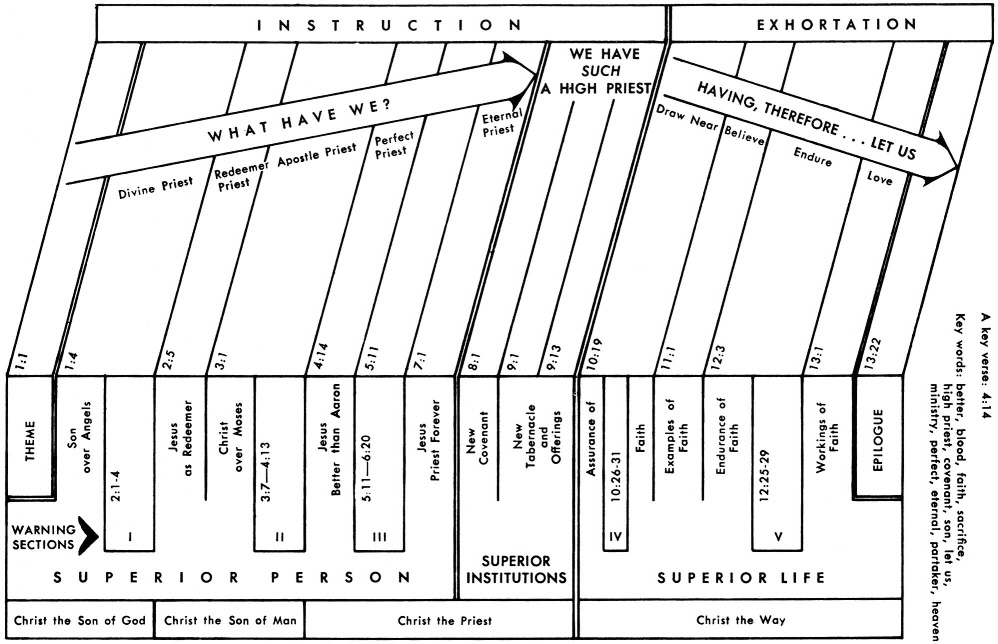
CONSIDER JESUS OUR GREAT HIGH PRIEST
Click chart to enlarge
Charts from Jensen's Survey of the NT - used by permission
Swindoll's Chart, Interesting Pictorial Chart of Hebrews, Another Chart
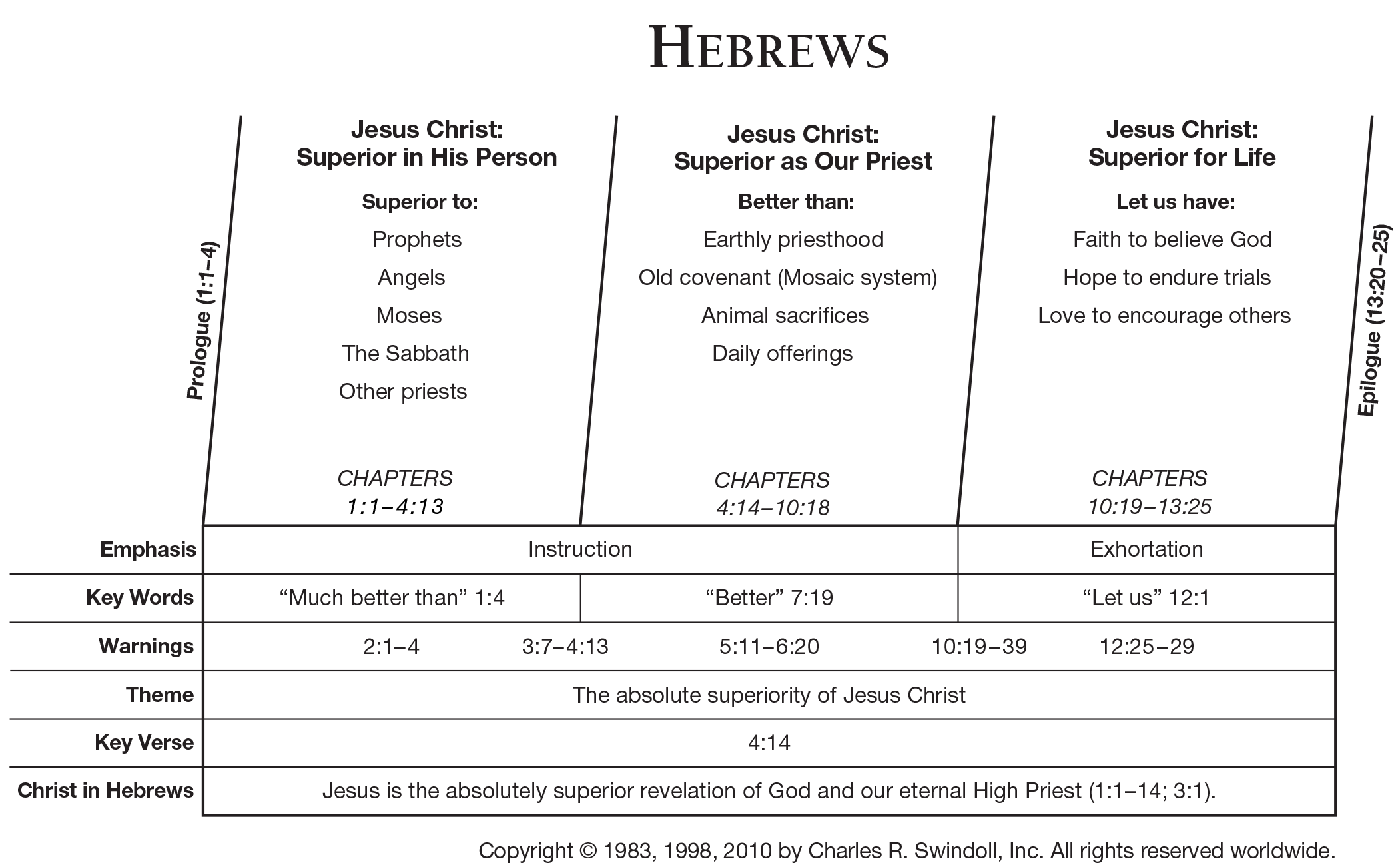
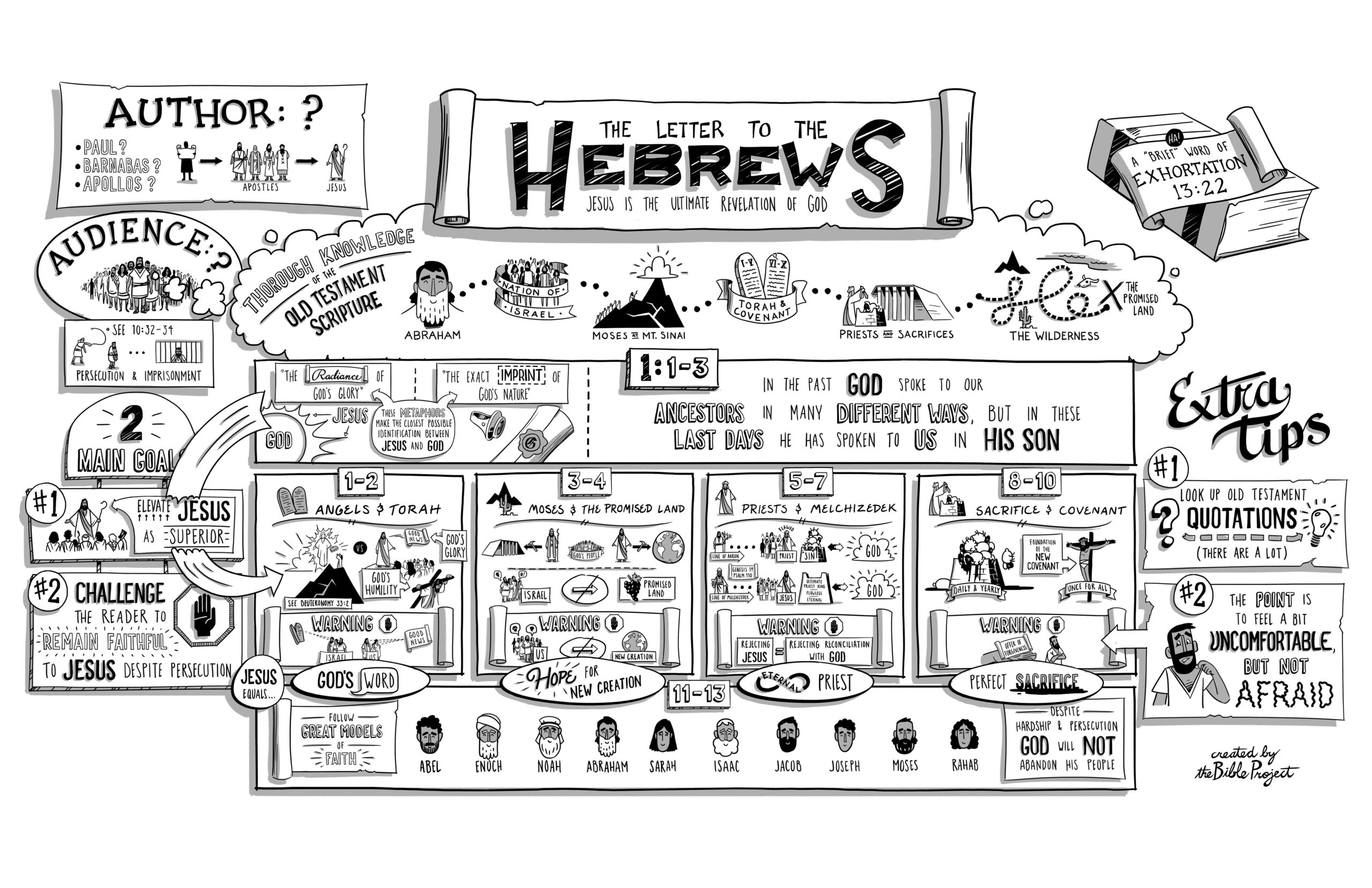
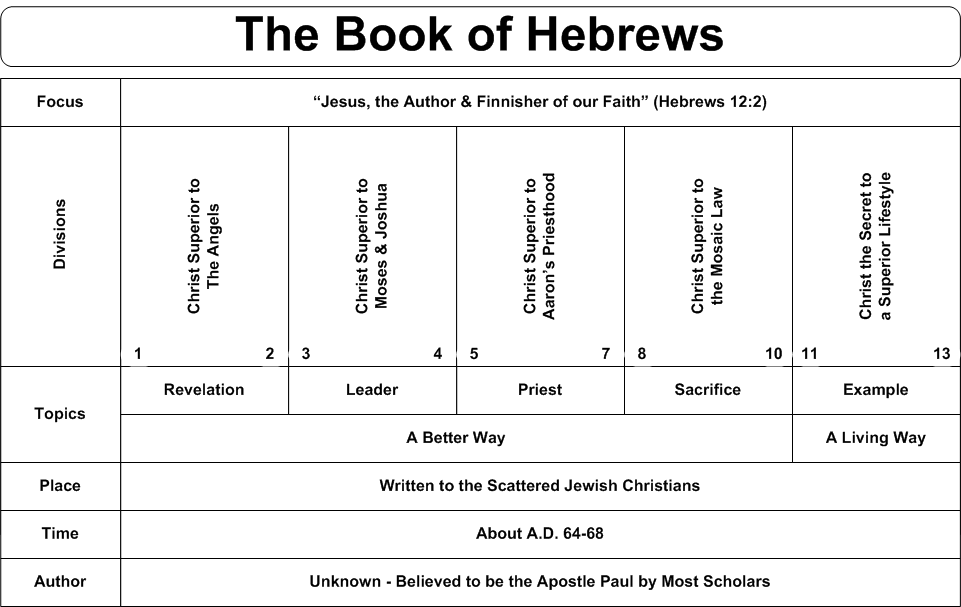
|
The Epistle |
||||
| INSTRUCTION Hebrews 1-10:18 |
EXHORTATION Hebrews 10:19-13:25 |
|||
| Superior Person of Christ Hebrews 1:1-4:13 |
Superior Priest in Christ Hebrews 4:14-10:18 |
Superior Life In Christ Hebrews 10:19-13:25 |
||
| BETTER THAN PERSON Hebrews 1:1-4:13 |
BETTER PRIESTHOOD Heb 4:14-7:28 |
BETTER COVENANT Heb 8:1-13 |
BETTER SACRIFICE Heb 9:1-10:18 |
BETTER LIFE |
| MAJESTY OF CHRIST |
MINISTRY OF CHRIST |
MINISTERS FOR CHRIST |
||
|
DOCTRINE |
DUTY |
|||
|
DATE WRITTEN: |
||||

See ESV Study Bible "Introduction to Hebrews"
(See also MacArthur's Introduction to Hebrews)
Borrow Ryrie Study Bible
Hebrews 9:23 Therefore it was necessary for the copies of the things in the heavens to be cleansed with these, but the heavenly things themselves with better sacrifices than these. (NASB: Lockman)
Greek: Anagke oun ta men hupodeigmata ton en tois ouranois toutois katharizesthai, (PPN) auta de ta epourania kreittosin thusiais para tautas.
BGT Ἀνάγκη οὖν τὰ μὲν ὑποδείγματα τῶν ἐν τοῖς οὐρανοῖς τούτοις καθαρίζεσθαι, αὐτὰ δὲ τὰ ἐπουράνια κρείττοσιν θυσίαις παρὰ ταύτας.
Amplified: By such means, therefore, it was necessary for the [earthly] copies of the heavenly things to be purified, but the actual heavenly things themselves [required far] better and nobler sacrifices than these. (Amplified Bible - Lockman)
Barclay: So, then, if it was necessary that the things which are copies of the heavenly realities should be cleansed by processes like these, it is necessary that the heavenly realities themselves should be cleansed by finer sacrifices than those of which we have been thinking. (Westminster Press)
NLT: That is why the earthly tent and everything in it—which were copies of things in heaven—had to be purified by the blood of animals. But the real things in heaven had to be purified with far better sacrifices than the blood of animals. (NLT - Tyndale House)
KJV It was therefore necessary that the patterns of things in the heavens should be purified with these; but the heavenly things themselves with better sacrifices than these.
NKJ Therefore it was necessary that the copies of the things in the heavens should be purified with these, but the heavenly things themselves with better sacrifices than these.
NET So it was necessary for the sketches of the things in heaven to be purified with these sacrifices, but the heavenly things themselves required better sacrifices than these.
CSB Therefore it was necessary for the copies of the things in the heavens to be purified with these sacrifices, but the heavenly things themselves to be purified with better sacrifices than these.
ESV Thus it was necessary for the copies of the heavenly things to be purified with these rites, but the heavenly things themselves with better sacrifices than these.
NIV It was necessary, then, for the copies of the heavenly things to be purified with these sacrifices, but the heavenly things themselves with better sacrifices than these.
Phillips: It was necessary for the earthly reproductions of heavenly realities to be purified by such methods, but the actual heavenly things could only be made pure in God's sight by higher sacrifices than these. (Phillips: Touchstone)
Wuest: It was therefore necessary on the one hand that the representations of the things in the heavens [the earthly tent] should be cleansed constantly with these [animal sacrifices], but on the other hand, the heavenly things themselves with better sacrifices than these [the blood of the Lord Jesus].
Young's Literal: It is necessary, therefore, the pattern indeed of the things in the heavens to be purified with these, and the heavenly things themselves with better sacrifices than these
Paraphrase So then, since the earthly tabernacle and its furnishings were only shadows of heavenly realities, they had to be purified with animal blood. But the true heavenly realities themselves required a far superior sacrifice — the blood of Christ.
Paraphrase This shows why it was necessary for the earthly sanctuary, which was only a copy of the heavenly one, to be cleansed with animal sacrifices, while the heavenly realities had to be purified with something infinitely better.
Paraphrase The earthly copies — tents, altars, and vessels — were set apart with animal blood. But the heavenly things they pointed to could only be consecrated by a better sacrifice, Christ’s own offering of Himself.
- The copies - Heb 9:9,10,24; 8:5; 10:1; Col 2:17
- Hebrews 9 Resources - Multiple Sermons and Commentaries
Related Passages:
Hebrews 8:5+ who serve a copy (hupodeigma) and shadow of the heavenly things, just as Moses was warned by God when he was about to erect the tabernacle; for, “SEE,” He says, “THAT YOU MAKE all things ACCORDING TO THE PATTERN WHICH WAS SHOWN YOU ON THE MOUNTAIN.”
Colossians 2:16, 17+ "Therefore no one is to act as your judge in regard to food or drink or in respect to a festival or a new moon or a Sabbath day-- things which are a mere shadow of what is to come; but the substance belongs to Christ.
BLOOD FOR THE COPY
BETTER BLOOD FOR THE REALITY
Therefore (term of conclusion) (oun) in context serves to introduce the idea of necessity. The writer has made it abundantly clear in He 9:22 that blood must be shed in purification according to the law. The writer has just shown that the first covenant was inaugurated with blood (Heb 9:18-22), this same principle applies to the heavenly realities of the New Covenant.
Steven Cole on therefore - Therefore goes back to the previous section, which made the point that forgiveness of sins is possible only through the shed blood of Jesus Christ. The blood sacrifices of the Old Testament all foreshadowed the supreme sacrifice of the Son of God. (Hebrews 9:23-28 Judgment or Salvation?)
The writer now draws the logical conclusion from all that has been said: if the earthly tabernacle and its furnishings — mere copies and shadows of the heavenly realities — required cleansing by animal sacrifices, then this necessity points to something greater. The temporary sanctuary was purified with the blood of goats and calves, but this only underscored the far greater need for a perfect sacrifice to purify the true, heavenly sanctuary. In other words, the cleansing of earthly copies was a divinely appointed preview of the cleansing that Christ’s own blood would accomplish in heaven itself.
Therefore (oun) it was necessary (anagke) for the copies (hupodeigma) of the things in the heavens (ouranos) to be cleansed (katharizo) with these -"It was" is not in the Greek. Necessary (anagke) is first in the Greek for emphasis and signifies this was divinely required and not optional. Necessary in this context speaks of a "divine compulsion" because God Himself required it. In other words, there was no other way. There is no other "escape hatch". No secret/mystical passage. No asterisk or fine print providing an exception to the need for Christ's blood. He is the Way, the only Way (Jn 14:6). The Way into the Holy of Holies is by no other Name under heaven (Acts 4:12).
The copies (hupodeigma) refer to earthly representations, symbols, shadows (tabernacle, etc) pointing to heavenly realities (cf Heb 8:5+). Cleansed (katharizo) does not refer to moral (conscience) cleansing but ritual purification that set apart the tabernacle and the people for holy use. With these refers to the blood of calves and goats, together with water, scarlet wool, and hyssop, all of the cleansing rituals in the Old Covenant (Heb 9:19–21; Ex 24:6–8). All of these OT pictures pointed to the better sacrifice of Christ.
Steven Cole says the copies "refers to the tabernacle and its furnishings. These things had to be cleansed by the blood of sacrificial animals. But these things were only earthly types of heavenly realities. The heavenly things themselves had to be cleansed with better sacrifices than these, namely, the blood of Christ. He uses the plural to refer to the one sacrifice of Christ, which gathered up into one all of the Old Testament sacrifices. Christ’s sacrifice “is so many-sided that it required a whole range of sacrifices to serve as adequate copies” (BORROW Donald Guthrie, Hebrews: Tyndale New Testament Commentaries [IVP/Eerdmans], p. 196). (Hebrews 9:23-28 Judgment or Salvation?)
Spurgeon - These things down below are only the patterns, the models, the symbols of the heavenly things; they could therefore be ceremonially purified with the blood which is the symbol of the atoning sacrifice of Christ.
Necessary (318) (anagke from ana = up, again, back, renewal, repetition, intensity, reversal + agkale = arm when bent or agcho = to compress, press tight) refers to any necessity or compulsion, outer or inner, brought on by a variety of circumstances. It can mean necessity imposed either by external conditions or by the law of duty.
ANAGKE - 17x in 17v - compulsion(3), constraint(1), distress(3), distresses(1), hardships(1), inevitable(1), necessary(2), necessity(3), need(2), obliged*(1). Matt. 18:7; Lk. 14:18; Lk. 21:23; Lk. 23:17; Rom. 13:5; 1 Co. 7:26; 1 Co. 7:37; 1 Co. 9:16; 2 Co. 6:4; 2 Co. 9:7; 2 Co. 12:10; 1 Thess. 3:7; Phlm. 1:14; Heb. 7:12; Heb. 7:27; Heb. 9:16; Heb. 9:23; Jude 1:3
Hebrews 7:12 of necessity there takes place a change of law also.
Hebrews 7:27 who does not need daily, like those high priests
Hebrews 9:16 there must of necessity be the death of the one who made it.
Hebrews 9:23 Therefore it was necessary for the copies of the things in the heavens
Copies (5262) (hupodeigma from hupo = under + deiknúo/deíknumi = to show, to point to something, to make known the character or significance of something) means literally that which is shown below. It means an example, pattern, illustration. It refers to a sign suggestive of anything, an outline, a delineation, a suggestion. Barclay writes that hupodeigma means "a specimen, or, still better, a sketch-plan."
HUPODEIGMA - 6x/6v - copies(1), copy(1), example(4). Jn 13:15 Heb 4:11, 8:5, 9:23 Jas 5:10 2Pe 2:6.
Hebrews 4:11 through following the same example of disobedience.
Hebrews 8:5 who serve a copy and shadow of the heavenly things
Hebrews 9:23 it was necessary for the copies of the things in the heavens
Heavens (3772) (ouranos) describes literally the expanse of space that seems to be over the earth like a dome. In the NT heaven and earth comprise all of creation, though the two are distinctive (Mt 6:9+). God spoke both into existence and heaven is His realm. In Hebrew thought heaven was Jehovah's dwelling place and is the believer's true and eternal home. (see more detailed discussion) In the present context this word is a reference to the place where God dwells.
It is interesting that one English word derived from ouranos is "uranium." In light of the fact that Revelation has 50 uses of "heaven" if you wanted to have a better sense of the meaning of ouranos, observing each of these uses for associations would be a profitable study. Strong's summary - (1) the vaulted expanse of the sky with all things visible in it 1a) the universe, the world 1b) the aerial heavens or sky, the region where the clouds and the tempests gather, and where thunder and lightning are produced 1c) the sidereal or starry heavens (2) the region above the sidereal heavens, the seat of order of things eternal and consummately perfect where God dwells and other heavenly beings.
Friberg has a good summary of a very big topic - heaven, as a part of the universe (Mt 5:18), opposite ge (earth); (1) as the atmosphere directly above the earth sky, air, firmament (Mt 6:26; Lk 17:24); (2) as the starry heaven firmament, sky (Mt 24:29a); (3) as the dwelling place of God (Mt 5:16), the angels (Mt 22:30), and the righteous dead (2Co 5:1, 2) heaven; (4) by metonymy, as synonymous with God or the inhabitants of heaven (Lk 15:18; Rev 12:12 [possibly personification]); (5) plural οἱ οὐρανοί heaven, the heavens, a Jewish concept, originally found in the Septuagint, that heaven is comprised of several spheres, with God dwelling in the highest heaven (2Co 12:2; Eph 1:10) (BORROW Analytical Lexicon of the Greek New Testament, PAGE 288)
OURANOS - 256V - 10X IN HEBREWS - Heb. 1:10; Heb. 4:14; Heb. 7:26; Heb. 8:1; Heb. 9:23; Heb. 9:24; Heb. 11:12; Heb. 12:23; Heb. 12:25; Heb. 12:26;
Hebrews 1:10 THE HEAVENS ARE THE WORKS OF YOUR HANDS;
Hebrews 4:14 since we have a great high priest who has passed through the heavens
Hebrews 7:26 separated from sinners and exalted above the heavens;
Hebrews 8:1 has taken His seat at the right hand of the throne of the Majesty in the heavens,
Hebrews 9:23 it was necessary for the copies of the things in the heavens
Hebrews 9:24 but into heaven itself, now to appear in the presence of God for us;
Hebrews 11:12 AS THE STARS OF HEAVEN IN NUMBER
Hebrews 12:23 church of the firstborn who are enrolled in heaven
Hebrews 12:25 much less will we escape who turn away from Him who warns from heaven.
Hebrews 12:26 I WILL SHAKE NOT ONLY THE EARTH, BUT ALSO THE HEAVEN.”
To be cleansed (2511) (katharizo from katharos = pure, clean, without stain or spot; English words - catharsis = emotional or physical purging, cathartic = substance used to induce a purging, Cathar = member of a medieval sect which sought the purging of evil from its members) means to make clean by taking away an undesirable part. To cleanse from filth or impurity. Click here (and here) for more background on the important Biblical concept of clean and cleansing.
Figuratively katharizo referred to cleansing from ritual contamination or impurity as in (Acts 10:15). In a similar sense katharizo is used of cleansing lepers from ceremonial uncleanness (Mt 8:2-3, et al) Another figurative use in 1John 1:9 (cf James 4:8, Hebrews 10:2) describes the purifying or cleansing from sin and a guilty conscience thus making one acceptable to God and reestablishing fellowship.
KATHARIZO - 31x in 30v - Matt. 8:2; Matt. 8:3; Matt. 10:8; Matt. 11:5; Matt. 23:25; Matt. 23:26; Mk. 1:40; Mk. 1:41; Mk. 1:42; Mk. 7:19; Lk. 4:27; Lk. 5:12; Lk. 5:13; Lk. 7:22; Lk. 11:39; Lk. 17:14; Lk. 17:17; Acts 10:15; Acts 11:9; Acts 15:9; 2 Co. 7:1; Eph. 5:26; Tit. 2:14; Heb. 9:14; Heb. 9:22; Heb. 9:23; Heb. 10:2; Jas. 4:8; 1 Jn. 1:7; 1 Jn. 1:9
Hebrews 9:14 cleanse your conscience from dead works to serve the living God?
Hebrews 9:22 one may almost say, all things are cleansed with blood
Hebrews 9:23 the copies of the things in the heavens to be cleansed with these
Hebrews 10:2 because the worshipers, having once been cleansed
BUT THE HEAVENLY THINGS THEMSELVES WITH BETTER SACRIFICES THAN THESE: auta de ta epourania kreittosin thusiais para tautas:
- The heavenly things - Heb 9:11,12,14,24; Heb 10:4,10-17; Lk 24:26,46; Jn 14:3; 1Pe 1:19, 20, 21; Rev 5:9
- Hebrews 9 Resources - Multiple Sermons and Commentaries
Related Passage:
Revelation 5:9+ And they *sang a new song, saying, “Worthy are You to take the book and to break its seals; for You were slain, and purchased for God with Your blood men from every tribe and tongue and people and nation.
A GREATER SACRIFICE FOR
A GREATER SANCTUARY
But (term of contrast) the heavenly (epouranios) things themselves (including saints in God's presence) with better (kreitton) sacrifices (thusia) than these - But marks a decisive shift from shadow to substance, copy to reality. With better (kreitton) sacrifices (thusia) while using the plural can only refer to one sacrifice (sacrifices is referred to by many as a "generic plural - see note") for the one sacrifice of Christ was sufficient and superior in effect to the many sacrifices under the Old Covenant. Than these refers to the animal sacrifices of the old covenant, which were repeated yet insufficient (Heb 10:1-4). If copies required purification with animal blood, then the true heavenly things required something immeasurably better — the blood of Christ Himself.
The difficult question this verse raises is why do heavenly things need cleansing? See comments below for more detail. While I certainly cannot be dogmatic, it seems that the only things in heaven that need cleansing are sinful people who are there. Let me explain what I mean. In Eph 2:6+ Paul says believers have been seated (past tense) in Heaven in Christ Jesus. For us to have attained such a lofty position in the heavenly place, we would need be purified which is only possible be the blood of Christ, which continually cleanses in 1Jn 1:7+. Grant Osborne seems to agree writing that "the best option is the cleansing of the saints. The emphasis is on the spiritual cleansing and the clear conscience (Heb 9:14) produced by the sacrifice of Christ. The sacrificial blood of the old covenant could not produce this; only the blood of Christ was adequate." (See Hebrews Verse by Verse - Page lxxx)
C H Spurgeon also seems to agree with this explanation of cleansing of heavenly things. Was the heavenly place itself defiled? No, that cannot be. But if you and I had gone there without atonement by blood, heaven would have been defiled. Look at the crowds of once sinful men and women who are daily entering there to dwell with God. How could they come there if the heavenly places had not been prepared for them? Look at the multitude of our prayers and praises that are daily going up there! Are they not all in a measure impure, and would it not have defiled heaven to accept them? But the Lord has gone there, and has sprinkled His blood upon the mercy seat, that so our prayers and praises—indeed, and ourselves also—may enter without let or hindrance.
Spurgeon on better sacrifices - The blood of bulls would suffice to purge the types, but the realities must have a richer sacrifice to cleanse them. In the tabernacle everything was done according to the pattern seen in the holy mount by Moses. In the temple no sacrifice was presented but according to divine command. The whole Aaronic ritual was very impressive. The priests in their holy robes, pure white linen garments, the golden altar, candlestick and table, the fire, the smoke, the incense—the whole thing was calculated very much to impress the mind. The first covenant provided a very magnificent service, such as never will be excelled. But for all that, costly, divinely arranged, impressive, yet it could not put away sin. The evidence of this is found in the fact that after one day of atonement they needed another atonement next year.
Philip Hughes writes on better sacrifices that "there is general agreement among commentators that the plural better sacrifices is not a precise but a generic plural, corresponding or accommodated to the plural "these rites" in the first clause of the verse: the inferior sacrifices of the Levitical system called, speaking generally, for better sacrifices. To be specific, however, they were superseded not by many sacrifices but by one, namely, the unique and fully adequate self-offering of the incarnate Son on the cross of Calvary (as our author repeatedly insists—see He 7:27; 9:12, 14; 10:10, 12, 14, so that he is not open to the charge of imprecision). His is the "one sacrifice for sins for ever" (He 10:12 KJV). Hence it is described here as better: it accomplishes once and for all that complete and eternal redemption which the imperfect sacrifices of the former system never could accomplish. (A Commentary on the Epistle to the Hebrews)
Generic Plural - A generic plural is when a plural noun is used not to describe many individual items, but to describe a class or category in general. It’s about kind rather than count. A generic plural uses the plural form to describe a whole category or class, not multiple items being counted. In Hebrews, it often highlights the kind or quality of something (like “better sacrifices”) rather than suggesting numerical plurality.
Heavenly (2032) (epouranios - used 5 times in Ephesians - Eph 1:3, 20, 2:6, 3:10, 6:12 see notes Eph 1:3, 20; 2:6; 3:10; 6:12) encompass the entire supernatural realm of God, His complete domain, and the full extent of His divine operation.
Friberg - (1) as an adjective, with reference to heaven as the dwelling of God and what belongs there heavenly (Heb 12.22), opposite evpi,geioj (earthly); (2) substantivally; (a) hoi` epouranioi - dwellers in heaven, heavenly beings (Phil 2.10); (b) ta epourania - what is derived from God = heavenly things, divine or spiritual things (Jn 3.12); (c) ta epourania = as the dwelling place of God heaven, the heavenly world, the heavenly places ( Eph 3.10); (3) as an adjective, with reference to the sky as the realm of the sun, moon, and stars in the sky, celestial ( 1Co 15.40) (Borrow Analytical Lexicon of the Greek New Testament)
NIDNTT (in depth online resource) - CL ouranos, heaven, possibly related to an Indo-European root meaning water,rain, means that which moistens or fructifies. The related adj. ouranios means what is in heaven, comes from heaven, or appears in the heavens, i.e. heavenly. But it can also mean what is appropriate to a god, i.e. divine, and can even stand for god or the deity. On the other hand, it can mean simply that which belongs to the firmament or sky. epouranios means in heaven, belonging to the divine heaven.
EPOURANIOS - 19x in 17v - NAS = heaven(1), heavenly(14), heavenly one(1), heavenly things(3).Jn. 3:12; 1 Co. 15:40; 1 Co. 15:48; 1 Co. 15:49; Eph. 1:3; Eph. 1:20; Eph. 2:6; Eph. 3:10; Eph. 6:12; Phil. 2:10; 2 Tim. 4:18; Heb. 3:1; Heb. 6:4; Heb. 8:5; Heb. 9:23; Heb. 11:16; Heb. 12:22
Hebrews 3:1 Therefore, holy brethren, partakers of a heavenly calling,
Hebrews 6:4 and have tasted of the heavenly gift
Hebrews 8:5 who serve a copy and shadow of the heavenly things,
Hebrews 9:23 the heavenly things themselves with better sacrifices than these.
Hebrews 11:16 they desire a better country, that is, a heavenly one.
Hebrews 12:22 to Mount Zion and to the city of the living God, the heavenly Jerusalem
Better (2909) (kreitton/kreisson) is a comparative of kratus (strong) and the comparative degree of agathos which means “good”. This reminds one of our English comparative "good, better, best." That which is of high status, is more prominent or higher in rank (Of a person -Heb 7:7; of things Heb 7:19). Kreitton relates to that which has "a relative advantage in value" (BDAG) (Heb 6:9). Better in English - in a more excellent manner, to greater advantage, to a higher or greater degree. More advantageous. More acceptable. Superior excellence.
Friberg summarizes kreitton/kreisson - (1) of persons superior, better, higher in rank (Heb 1.4); substantivally more important person (Heb 7.7); (2) of what is more advantageous, better, more useful (1Cor 7.9); neuter as a substantive to. kreitton the advantage, the more profitable thing (1Cor 11.17; perhaps Heb 12.24), opposite to the worse; ta. kreissona more useful things (Heb 6.9); (3) neuter as an adverb (in a) better (way) (probably Heb 12.24). (Borrow Analytical Lexicon of the Greek New Testament)
KREITTON KEY WORD IN HEBREWS - 19x/18v - NAS = better(17), better things(1), greater(1). 1 Co. 7:9; 1 Co. 7:38; 1 Co. 11:17; Phil. 1:23; Heb. 1:4; Heb. 6:9; Heb. 7:7; Heb. 7:19; Heb. 7:22; Heb. 8:6; Heb. 9:23; Heb. 10:34; Heb. 11:16; Heb. 11:35; Heb. 11:40; Heb. 12:24; 1 Pet. 3:17; 2 Pet. 2:21 Kreitton is used only twice in the Septuagint = Pr 3:14, Pr 25:24.
Better is a KEYWORD in Hebrews. This repetition of "better" demonstrates beyond all doubt to the Jewish reader that the New is better than the Old system. Study the uses below. What is better? You will need to read the surrounding context to answer this question.
Hebrews 1:4+ having become as much better than the angels, as He has inherited a more excellent name than they.
Hebrews 6:9+ But, beloved, we are convinced of better things concerning you, and things that accompany salvation, though we are speaking in this way.
Hebrews 7:19+ (for the Law made nothing perfect), and on the other hand there is a bringing in of a better hope, through which we draw near to God.
Hebrews 7:22+ so much the more also Jesus has become the guarantee of a better covenant.
Hebrews 8:6+ But now He has obtained a more excellent ministry, by as much as He is also the mediator of a better covenant, which has been enacted on better promises.
Hebrews 9:23+ Therefore it was necessary for the copies of the things in the heavens to be cleansed with these, but the heavenly things themselves with better sacrifices than these.
Hebrews 10:34+ For you showed sympathy to the prisoners, and accepted joyfully the seizure of your property, knowing that you have for yourselves a better possession and an abiding one.
Hebrews 11:4+ By faith Abel offered to God a better sacrifice than Cain, through which he obtained the testimony that he was righteous, God testifying about his gifts, and through faith, though he is dead, he still speaks.
Hebrews 11:16+ But as it is, they desire a better country, that is a heavenly one. Therefore God is not ashamed to be called their God; for He has prepared a city for them.
Hebrews 11:35+ Women received back their dead by resurrection; and others were tortured, not accepting their release, in order that they might obtain a better resurrection;
Hebrews 11:40+ because God had provided something better for us, so that apart from us they should not be made perfect.
Hebrews 12:24+ and to Jesus, the mediator of a new covenant, and to the sprinkled blood, which speaks better than the blood of Abel.
Sacrifices (2378) (thusia from thuo = to sacrifice or kill a sacrificial victim) means that which is offered as a sacrifice. An offering. A sacrifice. A victim. That which is sacrificially offered to deity. Most of the NT uses of thusia refer to that which is sacrificed (i.e., a sacrificial offering, Lk 2:24). Thusia speaks of Christ's sacrificial death as better (cf Heb 9:23, Heb 10:12). Figuratively, thusia speaks of the the death of Christ, His offering to His Father (Eph 5:2). In Romans 12:1 thusia speaks of the offering by a believer of his life to God. In Hebrews 13:1516 thusia refers to our praise, our doing good (not to gain merit or favor with God, but motivated by love and energized by the Spirit) and our sharing as acceptable offerings to God. In Php 4:18 thusia refers to the financial offering from the Philippian church. Webster's defines sacrifice as act of offering to a deity something precious!
In the Old Testament there were two types of sacrifices, the first offered to deal with sin and the broken fellowship that resulted from the sin. The sacrificial blood was a picture of the bridging of the gap between the giver and God (although OT sacrifices for sin only covered over for a time, whereas Christ's sacrifice effectively and permanently removed all guilt of sin for those who believe in Him). The second type of OT sacrifice was presented to God as an act of worship, the presenter having had his sins covered over by the blood of the sin offering, which resulted in his hearts being full of thanksgiving and praise to God which was reflected in the offering.
One of the most instructive uses of thusia in Scripture is in the Septuagint of Psalm 51:17 "The sacrifices (Hebrew = zebach; Lxx = thusia) of God are a broken spirit; a broken and a contrite heart, O God, You will not despise. (See exposition)
THUSIA - KEY WORD IN HEBREWS (15X) - Total 28x/28v - Usage: sacrifice(14), sacrifices(14). Matt. 9:13; Matt. 12:7; Mk. 12:33; Lk. 2:24; Lk. 13:1; Acts 7:41; Acts 7:42; Rom. 12:1; 1 Co. 10:18; Eph. 5:2; Phil. 2:17; Phil. 4:18; Heb. 5:1; Heb. 7:27; Heb. 8:3; Heb. 9:9; Heb. 9:23; Heb. 9:26; Heb. 10:1; Heb. 10:5; Heb. 10:8; Heb. 10:11; Heb. 10:12; Heb. 10:26; Heb. 11:4; Heb. 13:15; Heb. 13:16; 1 Pet. 2:5
Hebrews 5:1 in order to offer both gifts and sacrifices for sins;
Hebrews 7:27 who does not need daily, like those high priests, to offer up sacrifices,
Hebrews 8:3 For every high priest is appointed to offer both gifts and sacrifices
Hebrews 9:9 Accordingly both gifts and sacrifices are offered which cannot
Hebrews 9:23 but the heavenly things themselves with better sacrifices than these.
Hebrews 9:26 He has been manifested to put away sin by the sacrifice of Himself.
Hebrews 10:1 by the same sacrifices which they offer continually year by year"
Hebrews 10:5 He comes into the world, He says, "SACRIFICE AND OFFERING YOU HAVE NOT DESIRED
Hebrews 10:8 After saying above, "SACRIFICES AND OFFERINGS AND WHOLE BURNT OFFERINGS
Hebrews 10:11 offering time after time the same sacrifices, which can never take away sins;
Hebrews 10:12He, having offered one sacrifice for sins for all time
Hebrews 10:26 there no longer remains a sacrifice for sins,
Hebrews 11:4 By faith Abel offered to God a better sacrifice than Cain
Hebrews 13:15 Through Him then, let us continually offer up a sacrifice of praise to God,
Hebrews 13::16 And do not neglect doing good and sharing, for with such sacrifices God is pleased.
C H Spurgeon - the heavenly things themselves Was the heavenly place itself defiled? No, that cannot be. But if you and I had gone there without atonement by blood, heaven would have been defiled. Look at the crowds of once sinful men and women who are daily entering there to dwell with God. How could they come there if the heavenly places had not been prepared for them? Look at the multitude of our prayers and praises that are daily going up there! Are they not all in a measure impure, and would it not have defiled heaven to accept them? But the Lord has gone there, and has sprinkled His blood upon the mercy seat, that so our prayers and praises—indeed, and ourselves also—may enter without let or hindrance.
Grant Osborne - There is some difference in opinion about why the “heavenly” reality needed to be purified, with some thinking it implicitly points to the purifying of heaven, the inauguration of the heavenly sanctuary (building on Exodus 24), or the spiritual cleansing of the people of God. The problem with the first two options is why heaven itself would need either cleansing or covenant inauguration since it is already perfect. So the best option is the cleansing of the saints. The emphasis is on the spiritual cleansing and the clear conscience (Heb 9:14) produced by the sacrifice of Christ. The sacrificial blood of the old covenant could not produce this; only the blood of Christ was adequate. (See Hebrews Verse by Verse - Page lxxx)
David J. MacLeod writes "As sinful pilgrims on their way to the heavenly city, God’s people defile all they touch, even their ‘meeting place’ with God, and they need the constant efficacy of the sacrifice of Christ their High Priest to remove that defilement.” (for full discussion see The Cleansing of the True Tabernacle)
Steven Cole writes that "verse 23 raises a question: What are the heavenly things and why do they need cleansing? A number of views have been put forth (Leon Morris summarizes these in The Expositor's Bible Commentary, ed. by Frank Gaebelein [Zondervan], 12:9 1). We need to understand that the author is speaking spiritually. There is no literal altar or golden lampstand or table of sacred bread in heaven. But why would the spiritual counterparts in heaven (whatever they are) require cleansing? Some say that it is a dedicatory consecration, similar to the dedication of the tabernacle. Some relate it to the fact that Satan and the fallen angels have defiled heaven and that in His atonement, Christ disarmed them and triumphed over them, thus cleansing heaven. But in light of Hebrews 9:24, which states that Christ entered the true holy place in heaven to appear in the presence of God for us, the author is likely referring to the fact that we, God’s people, are now His spiritual dwelling place (Hebrews 3:6+). How can we be pure and free from defilement, so that God may dwell in us, not just individually, but corporately as His holy temple (see notes Ephesians 2:21, 22+; 1Pe 2:5+)? The answer is that Christ’s blood alone can cleanse our conscience from dead works to serve the living God (Hebrews 9:14+). (Hebrews 9:23-28 Judgment or Salvation?)
Warren Wiersbe - Through Jesus Christ, we who are sinners can enter into the holy of holies in the heavenly sanctuary (Heb. 10:19–22). Physically, of course, we are on earth; but spiritually, we are communing with God in the heavenly holy of holies. In order for God to receive us into this heavenly fellowship, the blood of Jesus Christ had to be applied. We enter into God’s presence “by the blood of Jesus” (Heb. 10:19). (Bible Exposition Commentary - page 831)
John MacArthur - God is not satisfied with us, however. That is the very reason we have to come to Him through Jesus. Jesus is the only one who satisfies the Father, and therefore no one comes to Him except through Jesus. The idea that God accepts us as we are is utterly unbiblical. We come to Jesus just as we are, since there is nothing worthwhile we can bring. But He does not present us to the Father just as we are. We are totally unpresentable as we are. Otherwise we could present ourselves. When Jesus presents us to His Father, He presents us in Himself, as He is. When we enter into God’s presence, God sees Jesus instead of us. He sees Jesus’ righteousness instead of our unrighteousness. He sees Jesus’ sacrifice instead of our sin, His payment for our sin instead of the penalty we deserve for our sin. Jesus recognized the indebtedness of sinners. He recognized that God had to be satisfied, and He offered His own blood—His own self—on our behalf. (Hebrews MacArthur New Testament Commentary)
Leon Morris - There is a problem in seeing in what sense things in heaven—where God is (He 9:24)—need purification. Some deny outright that they need it, regarding the expression as a way of referring to God's people. Thus Bruce (in loc.) reminds us that the author tells us repeatedly that it is people's consciences that need to be cleansed; and so the author can speak of God's people as His dwelling, His house (cf. He 3:6). Others make essentially the same point and hold that it is not something material but spiritual that is seen as needing cleansing—a fact meaning that Christ's work is effective in the spiritual life of men, not in some material sanctuary. The difficulty with such interpretations is that, while what they say is true, "the heavenly things themselves" is a strange way of referring to men and women here on earth. Other commentators see in He 9:23 a reference to Satan's rebellion and think of that as somehow defiling heaven so that heaven itself needs cleansing. Still others think of purification in the sense in which it is used here as meaning not so much the removal of impurity as a consecratory or inaugural process. This, they feel, is not out of place with "the heavenly things" any more than with an earthly sanctuary. Akin to that is the view that the earthly sanctuary needed cleansing, not so much because it was unclean, as because it was the place where sinners were restored. So with heaven.
On the whole, it seems best to recall that in the NT there are references to "the spiritual forces of evil in the heavenly realms" (Eph 6:12); the "rulers of this age" (1Cor 2:8); the "powers" like "height" and "depth" (Ro 8:38, 39), as well as "angels" and "demons." Such references seem to indicate wickedness beyond this earth. And when Christ performed his atoning work, he "disarmed the powers and authorities, … triumphing over them by the cross" (Col 2:15). It was God's will "through him to reconcile to himself all things, whether things on earth or things in heaven, by making peace through his blood, shed on the cross" (Col 1:20). This strand of teaching is not prominent in Hebrews. Nevertheless, the language used here seems to accord with it better than with other views. (Expositor's Bible Commentary Zondervan Publishing)
Marvin Vincent - How can it be said that the heavenly things needed cleansing? It is not easy to answer. Various explanations have been proposed, which the student will find collected in Alford’s note on this passage. The expression is rhetorical and figurative, and appears to be founded on that feature of the Levitical ritual according to which the high priest was required, on the Great Day of Atonement, to make an atonement for the sanctuary, “because of the uncleanness of the children of Israel.” He was to do this also for the tabernacle of the congregation, and for the great altar. See Lev. 16:16 ff. The rite implied that even the holy of holies had contracted defilement from the people’s sin. Similarly, the atoning blood of Christ is conceived as purifying the things of the heavenly sanctuary which had been defiled by the sins of men. “If the heavenly city of God, with its Holy Place, is, conformably with the promise, destined for the covenant-people, that they may there attain to perfect fellowship with God, then their guilt has defiled these holy things as well as the earthly, and they must be purified in the same way as the typical law appointed for the latter, only not by the blood of an imperfect, but of a perfect sacrifice” (Delitzsch).
Believer's Study Bible suggests that "Perhaps a clue is found in Job 15:15, “the heavens are not pure in His sight.” Doubtless this is because Satan committed the first act of sin in heaven (Isa. 14:12-14), and because he still has access to the presence of God as the accuser of the brethren (Rev 12:10+)."
W E Vine - As to the question why the heavenly things should require to be cleansed, the subject before us is not only the remission of our sins, but our access into the presence of God as His worshipers, through the eternal redemption obtained for us. The sanctuary of the presence of God required the savor of redemptive sacrifice. Just as the high priests of old entered into the Holy of Holies with the blood of sacrifice, on behalf of the people as worshipers of God, so only by the cleansing blood of Christ on the cross could the very presence of God become the meeting place between Him and the believer. (Collected writings of W. E. Vine)
Philip Hughes offers a lengthy discussion on this thorny passage…
In what sense are we to understand the affirmation that "the heavenly things themselves" needed to be "purified"? It is clear from the verse which follows and from He 8:5 above that the expression "the heavenly things" designates the sanctuary above which is "heaven itself," the reality of which the earthly sanctuary was but a shadow. The interpreter is faced with the problem of explaining how the heavenly reality, where the pure presence of God dwells, can be conceived as requiring any kind of purification. The explanation offered by Delitzsch and others, that heaven needed cleansing in the sense, first, that it had been darkened as the light of God's love had been replaced by the cloud of his wrath against sin and, second, that it had been rendered unapproachable to man because of man's sin, is unacceptable; for it is a serious misconception to imagine that the wrath of God is opposed to the love of God, or that these are two mutually exclusive motions or emotions in the Deity. God's wrath, no less than his love, is the expression of his holiness and purity, nor does he set aside wrath in order to display love; indeed, the cross is the supreme manifestation of the love and the wrath of God meeting together, for there the love of God absorbed the wrath of God as the incarnate Son enacted the love of God by taking both the sinner's place and his punishment. Moreover, the unapproachability of heaven to sinful man argues the need for the purification, not of heaven, but of the sinner: to redeemed mankind, cleansed from sin and sanctified by the Holy Spirit, heaven, previously closed, now lies open (He 10:19ff.).
Also unsatisfactory is the opinion of Héring and others that the purification in question was effected by the dismissal of Satan from heaven (cf. Lk. 10:18; Jn. 12:31; Rev. 12:7ff.) and with him the removal of all defilement. Appeal is made to Ephesians 6:12, which speaks of the powers of wickedness in heavenly places, and to He 2:14f. above, where Christ is spoken of as overcoming the devil who has the power of death and delivering those he has held captive; but, while the victory of Christ is indeed the death-blow for Satan and the vindication of his own supreme lordship, the judgment and perdition of the devil were sure even apart from what took place at Calvary. It is inconceivable, further, that the glorious presence of God should be in any danger of defilement because of the rebellion of Satan.
Another view, propounded by, among others, Spicq, Lünemann, and Owen, is that the "purification" of "the heavenly things themselves" means the "inauguration" or "consecration" of the heavenly sanctuary by reason of the "better" sacrifice of Christ. Support for this view is sought from our author's assertion above that the Mosaic covenant was inaugurated with blood (v. 18) and that under the law almost everything was purified with blood (v. 22), the conclusion being drawn that in the present context "to purify" and "to inaugurate" are equivalent terms. There is much to attract in this proposal, which has both simplicity and strength. In contrast to verses 19 to 22, however, which certainly refer to the inauguration of the former covenant, verse 23 is quite general in its scope, and this would seem to present a difficulty; but it could well be treated as a parenthetical comment.
Another interpretation, which can claim a long history and includes among its advocates Chrysostom, Peter Lombard, Herveus, Luther, Cornelius a Lapide, Estius, Teodorico, F. F. Bruce, and Montefiore, understands "the heavenly things" mentioned here, or "the heavenly sanctuary" (as the same expression is translated in He 8:5 above), to be the people of God who together constitute the church or temple of God, "a spiritual house, a holy priesthood, to offer spiritual sacrifices acceptable to God through Jesus Christ" (1Pet. 2:5). Bruce explains that "in order to be a spiritual house of this kind they must have experienced regeneration and cleansing by 'sprinkling of the blood of Jesus Christ' (1Pet. 1:2, 19, 22f.)." This concept, it can be argued, corresponds as antitype to the action of Moses, recounted in verse 19 above, when he sprinkled all the people with the blood of the covenant. True though this is, it is difficult to see how, except in a subsidiary manner, an interpretation along these lines is suited to the exegesis of the verse before us, for it requires an identification between "the heavenly sanctuary," or, as the next verse defines it, "heaven itself" into which the risen Christ has entered, and the community of the redeemed. The new temple is indeed being built with the living stones of Christian believers within whom Christ dwells, but this concept is not the same as that of the transcendental sanctuary into which the risen Lord entered at his ascension. Nor is the situation clarified by the supposition that our author means that "by the removal of the defilement of sin from the hearts and consciences of the worshippers the heavenly sphere in which they approach God to worship him is itself cleansed from this defilement" (F. F. Bruce, and similarly B. Weiss); for to speak thus is to speak really of the cleansing of sinners, not of heaven. The heavenly sphere is in fact inaccessible to uncleansed sinners (cf. Rev. 21:27); therefore to postulate its cleansing from the defilement it would otherwise have contracted if access had been possible to uncleansed sinners is to postulate a situation which is not factual but rests upon an unfulfilled and unfulfillable condition.
There is no need to seek precise and detailed parallels and correspondences between the cleansing ritual with its multiplicity of applications under the old system and the purification which is made available under the new. The former is complex and repetitious, the latter simple and comprehensive in its uniqueness. Our author's main intention is to emphasize the absolute superiority of the blood of the new covenant over that of the old. The purpose of Christ's coming was "to put away sin by the sacrifice of himself" (He 7:26 below); and now, "holy, blameless, unstained, separated from sinners, exalted above the heavens" (He 7:26), he has entered the pure sanctuary above. The blood-shedding and exaltation of him who is our fellow man and our forerunner (He 2:14; 6:20) have opened the way for mankind into the shrine of God's presence (He 4:14, 15, 16; 9:8; 10:19ff.); and the ultimate effect of the shedding of his blood of the new covenant will be the renewal of the universe, freed at last from sin, and filled with righteousness (He 12:28; Isa. 65:17; 66:22; 2Pet. 3:13; Rev. 21:1ff.; Acts 3:21; Ro 8:21). Such is the measure by which the former sacrifices are judged to have been surpassed by that better sacrifice which was offered once and forever by our great and eternal High Priest. (See A Commentary on the Epistle to the Hebrews - Page 382)
Here is a summary from J Harold Greenlee's "An Exegetical Summary of Hebrews" addressing the question "To what does τὰ ἐπουράνια ‘the heavenly things’ refer?" (Abbreviations are the different comments by various commentators - as you can see there is not a great deal of agreement on the interpretation!)
(1) It is not to be taken literally, but simply means the ultimate reality, the spiritual sphere where atonement is completed [GNC-Habner, Hwt-Hewitt].
(2) It refers to the heavenly worship system by which mankind’s conscience is cleansed [HNTC-Montefiore]. It refers to the consciences of the people, who are the temple of God, which need cleansing [NCBC-Wilson, NIC-Bruce].
(3) It refers to the heavenly sanctuary [Lg-Lange, Lns-Lenski, Mil-Miller, My-Lunemann, WBC-Lane].
(3a) It needs to be cleansed from the influence of human sin upon it [Lg, Mil, WBC-Lane, Westcott].
(3b) It needs to be cleansed because, like the earthly sanctuary, it serves sinners; the cleansing does not remove defilement from the sanctuary, but enables it to serve sinners without becoming defiled itself [Lns].(4) It refers to heaven itself [ICC-Moffatt] and the things in it [Alf-Alford, EGT-Dods], which need cleansing because they are entered by sinful mankind [EGT].
(5) It refers to the approach to heaven [Blm-Bloomfield]; Christ’s sacrifice opened heaven as a sanctuary for mankind [NTC-Kistemaker].
It refers to spiritual forces of evil beyond the earth [EBC-Morris].
Hebrews 9:24 For Christ did not enter a holy place made with hands, a mere copy of the true one, but into heaven itself, now to appear in the presence of God for us
Greek: ou gar eis cheiropoieta eiselthen (3SAAI) agia Christos, antitupa ton alethinon, all' eis auton ton ouranon, nun emphanisthenai (APN) to prosopo tou theou uper emon;
BGT οὐ γὰρ εἰς χειροποίητα εἰσῆλθεν ἅγια Χριστός, ἀντίτυπα τῶν ἀληθινῶν, ἀλλ᾽ εἰς αὐτὸν τὸν οὐρανόν, νῦν ἐμφανισθῆναι τῷ προσώπῳ τοῦ θεοῦ ὑπὲρ ἡμῶν·
Amplified: For Christ (the Messiah) has not entered into a sanctuary made with [human] hands, only a copy and pattern and type of the true one, but [He has entered] into heaven itself, now to appear in the [very] presence of God on our behalf. (Amplified Bible - Lockman)
Barclay: It is not into a man-made sanctuary that Christ has entered—that would be a mere symbol of the things which are real. It is into heaven itself that he entered, now to appear on our behalf before the presence of God. (Westminster Press)
NLT: For Christ has entered into heaven itself to appear now before God as our Advocate. He did not go into the earthly place of worship, for that was merely a copy of the real Temple in heaven. (NLT - Tyndale House)
KJV For Christ is not entered into the holy places made with hands, which are the figures of the true; but into heaven itself, now to appear in the presence of God for us:
NKJ For Christ has not entered the holy places made with hands, which are copies of the true, but into heaven itself, now to appear in the presence of God for us;
NET For Christ did not enter a sanctuary made with hands– the representation of the true sanctuary– but into heaven itself, and he appears now in God's presence for us.
CSB For the Messiah did not enter a sanctuary made with hands (only a model of the true one) but into heaven itself, so that He might now appear in the presence of God for us.
ESV For Christ has entered, not into holy places made with hands, which are copies of the true things, but into heaven itself, now to appear in the presence of God on our behalf.
NIV For Christ did not enter a man-made sanctuary that was only a copy of the true one; he entered heaven itself, now to appear for us in God's presence.
Phillips: Christ did not therefore enter into any holy places made by human hands (however truly these may represent heavenly realities), but he entered Heaven itself to make his appearance before God as High Priest on our behalf. (Phillips: Touchstone)
Wuest: For not into holy places constructed by human hands did Messiah enter, which are the types of the genuine [holy places], but into heaven itself, now to be manifested before the face of God on behalf of us.
Young's Literal: for not into holy places made with hands did the Christ enter -- figures of the true -- but into the heaven itself, now to be manifested in the presence of God for us
Paraphrase Christ did not enter a sanctuary that was only a counterpart (antitupon), a sketch and shadow of heavenly things, not the actual dwelling of God’s presence, but entered into the genuine (alēthinos) sanctuary—the very presence of God Himself in heaven.
- Holy place - Heb 9:11; Mark 14:58; John 2:19- 21
- Copy of the true - Heb 9:9,23; 8:2
- But into heaven itself - Heb 1:3; Heb 6:19-20; 7:26; 8:2,5; 12:2; Ps 68:18; Mk 16:19; Luke 24:51; Jn 6:62; Jn 16:28; Acts 1:9, 10, 11; 3:21; Eph 1:20, 21, 22; 4:8, 9, 10, 11; Col 3:2; 1Pe 3:22
- Hebrews 9 Resources - Multiple Sermons and Commentaries
Related Passages:
Hebrews 9:11 But when Christ appeared as a high priest of the good things to come, He entered through the greater and more perfect tabernacle, not made with hands, that is to say, not of this creation;
Hebrews 9:25 nor was it that He would offer Himself often, as the high priest enters the holy place year by year with blood that is not his own.
Hebrews 6:19-20 This hope we have as an anchor of the soul, a hope both sure and steadfast and one which enters within the veil, 20 where Jesus has entered as a forerunner for us, having become a high priest forever according to the order of Melchizedek.
OUR PRIEST APPEARS FOR
US IN THE TRUE HOLY PLACE
Having shown that Christ’s sacrifice surpasses the old covenant rituals, the writer now explains where Christ’s priestly ministry takes place. Unlike the Levitical high priest who entered a man-made sanctuary — a copy and shadow of the true — Christ entered heaven itself, the true Holy of Holies. There, in the very presence of God, He appears on behalf of His people as their living High Priest. This verse underscores both the superiority of Christ’s sacrifice ("better sacrifices" Heb 9:23) and the location of His ministry: not in an earthly tabernacle of symbols, but in the heavenly reality where God dwells.
🙏 THOUGHT - In this last section of Hebrews 9 (He 9:23-28), all 3 aspects of Christ’s ministry of salvation/redemption are pictured - (1) His First Coming to save us from the penalty of sin ("better sacrifices" He 9:23+). (2) His present intercessory ministry in heaven to save us from the power of sin ("now appear… for us" He 9:24+) (3) His Second Coming (He 9:28+) to deliver us from the presence of sin.
For (gar) is explaining why the better sacrifices described in Heb 9:23 were necessary. Wuest agrees saying that "This verse is in explanation of the statement in the previous verse (Heb 9:23) to the effect that the heavenly things had to be purified by blood superior to animal blood, and that Messiah did not enter the Holy of Holies on earth as High Priest, but the Holy of Holies of heaven itself." (Hebrews Commentary)
Leon Morris says that "For" introduces an explanation of what precedes. We have already had the idea that Christ's ministry was not in a sanctuary that is "man-made" (He 9:11), and here we come back to it. Not in such sanctuaries can the Atonement be made that really deals with sin. (Expositor's Bible Commentary)
Christ (Christos) did (ou - absolutely not = this negative is first in Greek sentence for emphasis) not enter (eiserchomai) a holy place (hagios - holy of holies) made with hands (cheiropoietos), a mere copy (antitupon) of the true (alethinos) one - Christ (Christos) the Anointed One, God’s Messiah, set apart by God as Prophet, Priest, and King, fulfills all that the Old Covenant foreshadowed, but in this context especially fulfills the role of High Priest. The writer's negative emphasis ("did not enter" ) sharpens the contrast of Christ's work versus the work of the Levitical priests. The writer doesn’t want the readers to think Christ’s priestly ministry happened in the earthly temple (the “holy place made with hands”). By stressing “not,” he eliminates that possibility. The verb enter (eiserchomai) describes the Levitical high priest entering the Holy of Holies once a year, but applied to Christ in a greater, final way.
A holy place (hagios) refers not to heaven itself of course, but to the man-made sanctuary (the tabernacle/temple) where God’s presence was symbolized. The author highlights the inadequacy of the earthly sanctuary for it was only a sketch (antitupon), not the ultimate reality (alethinos). The Levitical priests entered the earthly holy place repeatedly (Heb 9:6–7), whereas Christ entered once-for-all into the heavenly holy place (Heb 9:12, 24; 10:19). The old covenant shouted ‘Keep Out!’ while the new covenant in Christ proclaims ‘Come In!’” A mere copy (antitupon) describes the earthly holy place as a counterpart, a shadow-like reflection of the heavenly reality. It was like a model or sketch pointing to the real thing but lacking full substance. The true (alethinos) one does not mean “true” in contrast to “false,” but “true” as in “ultimate vs. provisional” emphasizing that the heavenly sanctuary is the ultimate, genuine dwelling of God, not a symbolic replica. The author’s point is that Christ did not waste His priestly work in a model temple but He went directly into heaven itself, the true Holy Place.
The Old Covenant worship was never ultimate—it was preparatory. The earthly holy place was a visual aid, a giant "picture book," seeking to help Israel understand what real access to Him would one day look like. The earthly tabernacle was only a temporary replica pointing forward; the heavenly sanctuary is the eternal reality. Christ’s priesthood operates not in copies but in the true, heavenly presence of God. In Christ, the shadow gives way to substance. Believers’ confidence is not in ritual copies but in the Savior Who entered the reality.
Warren Wiersbe makes an application from made with hands warning us all to "Beware of trusting anything for your spiritual life that is “made with hands” (Heb. 9:24). It will not last. The tabernacle was replaced by Solomon’s temple, and that temple was destroyed by the Babylonians. When the Jews returned to their land after the Captivity, they rebuilt their temple; and King Herod, in later years, expanded and embellished it. But the Romans destroyed that temple, and it has never been rebuilt. Furthermore, since the genealogical records have been lost or destroyed, the Jews are not certain who can minister as priests. These things that are “made with hands” are perishable, but the things “not made with hands” are eternal. (Bible Exposition Commentary)
Spurgeon - Christ never went within the veil in the Jewish temple; that was but the symbol of the true holy of holies. He has gone “into heaven itself, now to appear in the presence of God on our behalf.”
Matthew Poole comments that this section "shows this to be a rational proof of the transcendence of Christ’s death and sacrifice; and this he demonstrates from the place of his ministry, far exceeding that of his type. The gospel High Priest did not, like Aaron, enter with his blood into the holy of holiest of an earthly tabernacle, frail and movable, and appear before the mercy-seat on the ark there, Heb 9:9.
But into heaven (ouranos) itself - But introduces a striking contrast between the heavenly substance and the earthly shadow. Other passages in Hebrews emphasize Christ's entrance and presence in the true holy place. The holy place is true in the sense that in its character it is all that is expected of it. In short, the thing described as true (the holy place) measures up to the specifications which a holy God would demand. The heavenly Holy of Holies is everything that could be expected of such a place. What delights await those God now calls "My beloved in Christ"!
Hebrews 1:3+ And He is the radiance of His glory and the exact representation of His nature, and upholds all things by the word of His power. When He had made purification of sins, He sat down at the right hand of the Majesty on high;
Hebrews 6:20+ where Jesus has entered as a forerunner for us, having become a high priest forever according to the order of Melchizedek.
Hebrews 7:26+ For it was fitting that we should have such a high priest, holy, innocent, undefiled, separated from sinners and exalted above the heavens;
Hebrews 8:2+ a Minister in the sanctuary, and in the true tabernacle, which the Lord pitched, not man.
Hebrews 8:5+ who serve a copy and shadow of the heavenly things, just as Moses was warned by God when he was about to erect the tabernacle; for, "SEE," He says, "THAT YOU MAKE all things ACCORDING TO THE PATTERN WHICH WAS SHOWN YOU ON THE MOUNTAIN."
Hebrews 12:2+ fixing our eyes on Jesus, the author and perfecter of faith, who for the joy set before Him endured the cross, despising the shame, and has sat down at the right hand of the throne of God.
Jesus, being of the tribe of Judah, and not of Levi,
never entered the temple proper.
Albert Barnes - The Jewish high priest alone entered into the most holy place; and the other priests into the holy place. Jesus, being of the tribe of Judah, and not of Levi, never entered the temple proper. He had access only to the courts of the temple, in the same way as any other Jew had. See [Mt 21:12]. He has entered into the true temple--heaven of which the earthly tabernacle was the type. (Barnes NT Commentary)
Christ (5547) (Christos from chrio = to anoint, rub with oil, consecrate to an office) is the Anointed One, the Messiah, Christos being the Greek equivalent of the transliterated Hebrew word Messiah. Christos describes one who has been anointed with oil, one who has been consecrated. The majority of the NT uses refer to Jesus (exceptions = "false Christs" - Mt 24:24, Mk 13:22).
Christos describes one who has been anointed, symbolizing appointment to a task. It is used here as the title "Anointed One" and is the Greek synonym for "Messiah." Christos is used in the Septuagint describing everyone anointed with the holy oil, especially the priesthood (Lev. 4:5+, Lev 4:16+) and it is also a name applied to those who were acting as redeemers like Cyrus.
Gilbrant writes that "Hamilton suggests a fourfold significance to such anointing (“māshach,” Theological Wordbook of the Old Testament, 1:530): (1) separation unto God, (2) authorization by God, (3) divine enablement, and (4) the coming Deliverer. In regards to this final use he says, “Though this association with the term māshach is not as prevalent in the OT as often supposed, the prospect of a righteous, Spirit-filled ruler is increasingly discernible in the OT (cf. Isaiah 9:1-7+; Isa1 1:1-5+; Isa 61:1)” (ibid.). It was probably because of his role as a deliverer of God’s people, selected by the Lord for His purpose, that Cyrus, a Gentile emperor, was given the title of “messiah, anointed” (Isaiah 45:1). However, long after Cyrus, God’s people were still promised Messiah the prince, the one to fulfill all of the Biblical promises (Daniel 9:25,26+)." (Complete Biblical Library Greek-English Dictionary)
CHRISTOS - 500V - USED 12X IN HEBREWS - Heb. 3:6; Heb. 3:14; Heb. 5:5; Heb. 6:1; Heb. 9:11; Heb. 9:14; Heb. 9:24; Heb. 9:28; Heb. 10:10; Heb. 11:26; Heb. 13:8; Heb. 13:21;
Hebrews 3:6 but Christ was faithful as a Son over His house–whose house we are
Hebrews 3:14 For we have become partakers of Christ
Hebrews 5:5 So also Christ did not glorify Himself so as to become a high priest,
Hebrews 6:1 Therefore leaving the elementary teaching about the Christ,
Hebrews 9:11 But when Christ appeared as a high priest of the good things to come
Hebrews 9:14 how much more will the blood of Christ, who through the eternal Spirit
Hebrews 9:24 For Christ did not enter a holy place made with hands, a mere copy
Hebrews 9:28 so Christ also, having been offered once to bear the sins of many
Hebrews 10:10 through the offering of the body of Jesus Christ once for all.
Hebrews 11:26 considering the reproach of Christ greater riches than the treasures of Egypt
Hebrews 13:8 Jesus Christ is the same yesterday and today and forever.
Hebrews 13:21 through Jesus Christ, to whom be the glory forever and ever. Amen.
Enter (1525)(eiserchomai from eis = into + erchomai = come) means literally to come into and thus to enter into. Notice that enter into refers to a single event, a past completed historical event (after His ascension), but consequences of this event are now (see "but now" in Hebrews 8:6) and on our behalf (He 6:20+; He 7:25+).
Eiserchomai can speak of a thought “coming into” mind (Herodotus), wisdom entering someone (Wisdom of Solomon 1:4), the “entering” of the prophetic spirit (Josephus Antiquities 4.6.5), demonic spirits that “enter” into men (Mk 9:25; Lk 8:30), and Satan “entering” Judas (Lk 22:3). Figuratively eiserchomai can denote the acquiring of something, i.e., “to attain something” (wealth, property, and so on). It is used of the kingdom of God/heaven (Mt 5:20; Mt 7:21; Mt 19:24; Mk 9:47; Mk 10:15; et al); eiserchomai describes attaining eternal life (Mt 18:8f.; Mt 19:17; Mk 9:43,45); or eiserchomai can speak of entering rest (Heb 3:11,18; Heb 4:11).
Friberg - (1) literally, in a local sense go or come into, enter (Mt 2.21); (2) figuratively; (a) of the birth of Jesus come into (the world) ( Heb 10.5); (b) of demons enter in, take possession of (Mk 9.25 ); (c) of persons; (i) in a good sense come into, enter into, begin to enjoy (Mt 5.20); (ii) in a bad sense begin to experience, meet, encounter (Mt 26.41); (d) as the first stage of an activity -- begin, come up (Lk 9.46) (Borrow Analytical Lexicon of the Greek New Testament)
EISERCHOMAI IN HEBREWS - 17X IN HEBREWS - Heb. 3:11; Heb. 3:18; Heb. 3:19; Heb. 4:1; Heb. 4:3; Heb. 4:5; Heb. 4:6; Heb. 4:10; Heb. 4:11; Heb. 6:19; Heb. 6:20; Heb. 9:12; Heb. 9:24; Heb. 9:25; Heb. 10:5
Hebrews 3:11 AS I SWORE IN MY WRATH, ‘THEY SHALL NOT ENTER MY REST
Hebrews 3:18 And to whom did He swear that they would not enter His rest,
Hebrews 3:19 we see that they were not able to enter because of unbelief.
Hebrews 4:1 Therefore, let us fear if, while a promise remains of entering His rest,
Hebrews 4:3 For we who have believed enter that rest,
Hebrews 4:3 AS I SWORE IN MY WRATH, THEY SHALL NOT ENTER MY REST,
Hebrews 4:5 and again in this passage, “THEY SHALL NOT ENTER MY REST.”
Hebrews 4:6 Therefore, since it remains for some to enter it,
Hebrews 4:6 formerly had good news preached to them failed to enter because of disobedience,
Hebrews 4:10 For the one who has entered His rest has himself also rested from his works
Hebrews 4:11 Therefore let us be diligent to enter that rest,
Hebrews 6:19 a hope both sure and steadfast and one which enters within the veil,
Hebrews 6:20 where Jesus has entered as a forerunner for us
Hebrews 9:12 He entered the holy place once for all, having obtained eternal redemption.
Hebrews 9:24 For Christ did not enter a holy place made with hands,
Hebrews 9:25 as the high priest enters the holy place year by year with blood that is not his own.
Hebrews 10:5 Therefore, when He comes into the world, He says, “
Holy place (40) (hagios) means a place set apart from the profane or common and unto God and for the worship of and approach to the Holy God. In the New Testament, saints are holy ones in character having been set apart by God to be exclusively His possession, to be dedicated to Him and to manifest holiness of heart and conduct in contrast to the impurity of the unbelievers (Jew or Gentile). Saints are set aside for sacred use. Here a specific local is set apart for sacred use.
Holy place - This phrase occurs 60x in Scripture in NAS - Ex 26:33; 28:29, 35, 43; 29:30f; 31:11; 35:19; 39:1, 41; Lev 6:16, 26f, 30; 7:6; 10:13, 17; 16:2f, 16f, 20, 23f, 27; 24:9; Num 28:7; 1 Kgs 6:16; 7:50; 8:6, 8, 10; 1 Chr 6:49; 23:32; 2 Chr 5:11; 29:5, 7; 35:5; Ezra 9:8; Ps 24:3; Eccl 8:10; Isa 57:15; Ezek 41:4; 45:2ff; 48:12; Dan 8:13f; 9:24; Matt 24:15; Acts 6:13; 21:28; Heb 9:2, 8, 12, 24f; 10:19; 13:11
HAGIOS KEYWORD IN HEBREWS: Heb. 2:4; Heb. 3:1; Heb. 3:7; Heb. 6:4; Heb. 6:10; Heb. 8:2; Heb. 9:1; Heb. 9:2; Heb. 9:3; Heb. 9:8; Heb. 9:12; Heb. 9:24; Heb. 9:25; Heb. 10:15; Heb. 10:19; Heb. 13:11; Heb. 13:24
Hebrews 2:4 Holy Spirit
Hebrews 3:1 holy (brethren)
Hebrews 3:7 Holy Spirit
Hebrews 6:4 Holy Spirit
Hebrews 6:10 saints
Hebrews 8:2 sanctuary (heavens)
Hebrews 9:1 sanctuary (earthly)
Hebrews 9:2 holy place
Hebrews 9:3 Holy of holies
Hebrews 9:8 Holy Spirit...holy place
Hebrews 9:12 holy place
Hebrews 9:24 holy place
Hebrews 9:25 holy place
Hebrews 10:15 Holy Spirit
Hebrews 10:19 holy place
Hebrews 13:11 holy place
Hebrews 13:24 saints
Made with hands (5499)(cheiropoietos from cheir = hand + poieo= make) made or done by human hands, man-made. (In the Septuagint of idols; of other things, occasionally in Herodotus, Thucydides, Xenophon, Polybius, Diodorus.) In classical Greek and elsewhere it means “made with hands” or “artificial.” It stands in contrast to something “natural” (autophuēs), and it can suggest something done intentionally (Liddell-Scott). In the Septuagint cheiropoiētos consistently denotes the “man-made” idols erected by humans (Leviticus 26:1; Isaiah 2:18; 10:11). The Septuagint appears to be a major factor for the understanding of the term in the New Testament. This is clearly seen in Mark 14:58; Acts 7:48; 17:24; Hebrews 9:11; and 9:24. Each of these texts emphasizes that the one true God dwells not in man-made temples or tabernacles but in heaven (Acts 7:48,49; Hebrews 9:24; cf. 1 Kings 8:27). As creator of all things God does not need to have a sanctuary fashioned by man (Acts 17:24). He exists on a plane above the created order itself (Hebrews 9:11).
W E Vine - made by hand," of human handiwork (cheir, and poieō, "to make"), is said of the temple in Jerusalem, Mark 14:58; temples in general, Acts 7:48 (RV, "houses"); Acts 17:24; negatively, of the heavenly and spiritual tabernacle, Heb. 9:11; of the holy place in the earthly tabernacle, Heb. 9:24; of circumcision, Eph. 2:11. In the Sept., of idols, Lev. 26:1, 30; Isa. 2:18; Isa. 10:11; Isa. 16:12; Isa. 19:1; Isa. 21:9; Isa. 31:7; Isa. 46:6. (Vine's Expository Dictionary)
CHEIROPOIETOS - 6V - Mk. 14:58; Acts 7:48; Acts 17:24; Eph. 2:11; Heb. 9:11; Heb. 9:24
CHEIROPOIETOS IN SEPTUAGINT - Lev. 26:1; Lev. 26:30; Isa. 2:18; Isa. 10:11; Isa. 16:12; Isa. 19:1; Isa. 21:9; Isa. 31:7; Isa. 46:6; Dan. 5:4; Dan. 5:23; Dan. 6:27
Copy (499) (antitupon from anti = against, instead of, corresponding to + tupos = a type, model, figure, form, impression, print) is an earthly expression of a spiritual reality. Thus it represents something which symbolizes some spiritual truth. In modern Greek antitupon means a copy of a book. In the present case the earthly tabernacle prefigured the reality of the tabernacle of God in heaven.
Barnes explains that antitupon "properly means that which is formed after a model, pattern, or type; and then that which corresponds to something, or answers to, it. The idea here is, that the type or fashion--the true figure or form--was shown to Moses in the Mount, and then the tabernacle was made after that model, or corresponded to it. The true original figure is heaven itself; the tabernacle was an antitype of that--or was so formed as in some sense to correspond to it. That is, it corresponded in regard to the matters under consideration--the most Holy Place denoted heaven; the mercy-seat and the Shekinah (see notes) were symbols of the presence of God, and of the fact that he shows mercy in heaven; the entrance of the high priest was emblematical of the entrance of the Redeemer into heaven; the sprinkling of the blood there was a type of what the Redeemer would do in heaven. (Barnes NT Commentary)
True one (228) (alethinos from alethes = true, one who cannot lie) describes that which has not only the name and resemblance, but the real nature corresponding to the name, in every respect corresponding to the idea signified by the name and thus real, true and genuine not spurious, fictitious, counterfeit, imaginary, simulated or pretended. Alethinos is used of Christ as the “true light” (Jn 1:9), the “true bread” (Jn 6:32), the “true vine” (Jn 15:1).
Alethinos - 28x in 26v - NAS = sincere(1), true(26), true one(1). Luke 16:11; John 1:9; 4:23, 37; 6:32; 7:28; 8:16; 15:1; 17:3; 19:35; 1Th 1:9; Heb 8:2; 9:24; 10:22; 1 John 2:8; 5:20; Rev 3:7, 14; 6:10; 15:3; 16:7; 19:2, 9, 11; 21:5; 22:6.
NOW TO APPEAR IN THE PRESENCE OF GOD FOR US: nun emphanisthenai (APN) to prosopo tou theou huper hemon:
- Heb 7:25; Ex 28:12,29; Zech 3:1; Ro 8:33; 1Jn 2:1,2; Rev 8:3
- Hebrews 9 Resources - Multiple Sermons and Commentaries
Related Passages:
1 John 2:1+ My little children, I am writing these things to you that you may not sin. And if anyone sins, we have an Advocate with the Father, Jesus Christ the righteous; 2:2 and He Himself is the propitiation (hilasmos) for our sins; and not for ours only, but also for those of the whole world
Hebrews 7:25+ Therefore He is able also to save forever those who draw near to God through Him, since He always lives to make intercession for (huper) them.
Romans 8:34+ Who is the one who condemns? Christ Jesus is He who died, yes, rather who was raised, who is at the right hand of God, who also intercedes for (huper) us.
CHRIST'S CONTINUAL FACE TO FACE
INTERCESSION AND ADVOCACY FOR US
But into heaven (ouranos) itself, now to appear (emphanizo) in the presence (prosopon) of God for (huper) us - Now (nun) means in the present moment. Even as you read these words, Jesus is in the presence of His Father and is there on our behalf. Amazing love. In the presence (prosopon) of God means in the face of God, emphasizing immediate access (not through a veil like the OT priest). Of God is literally "of the God", the definite article (the) emphasizing the exclusivity of God. He is not one among a pantheon of gods but is alone the true and living God.
To appear (emphanizo) is more literally "to be made to appear" openly, clearly. Christ is visibly and officially present before God as our personal representative and Advocate (parakletos) (1Jn 2:1+). Jamieson adds that "Mere man may have a vision through a medium, or veil, as Moses had (Ex 33:18, 20–23+). Christ Alone beholds the Father without a veil, and is His perfect image. Through seeing Him only can we see the Father."
For (huper) us signifies that Christ appears as our High Priest, standing before God in our place (read that again)! Just as the Levitical high priest entered on behalf of Israel only once per year on the Day of Atonement, Christ now stands in heaven for us all forever, as our personal representative before God’s face! Everything our Great High Priest does in the heavenly sanctuary is for our good, interceding, securing forgiveness, access, and eternal inheritance.
His presence before God guarantees our acceptance.
🙏 THOUGHT - For us (huper) are only 2 words in the Greek and English, but what precious words they are to our sinful ears, for the Greek word "huper" means "on behalf of," "as our representative," "for our benefit," or "in our place" (cp Hebrews 6:20+ where Jesus has entered as a forerunner for us, having become a high priest forever according to the order of Melchizedek.) Just as the high priest appeared for a few moments before God in the incense filled Holy of Holies for (in the place of, on behalf of - as the representative of) the entire congregation of Israel on the Day of Atonement (Lev 16:32, 33+), our High Priest is now continually before the Father (at His right hand) on our behalf, and in that exalted position "He always lives to make intercession for (huper) us" (He 7:25+). As David Guzik says "It’s not hard to believe that Jesus does appear in the presence of God. But to believe that He appears there FOR US is glorious!"
Marcus Dods - the darkness and clouds of incense in the old sanctuary were meant as much to veil the unworthiness of the priest from God as the glory of God from the priest. Now Christ appears before God face to face with no intervening cloud. Perfect fellowship is attained by His perfect and stainless offering of Himself. All is clear between God and man. For it is ‘for (huper) us’ He enters this presence and fellowship; not that He alone may enjoy it, but that we may enter into the rest and blessedness that He won for us. (Expositors Greek Testament)
WHAT is the crucial time phrase/word in Hebrews 9:24?
- Now - at the present time, in this very moment, highlighting that with Christ a reformation has taken place
- Now - Jesus is presently, actively, actually appearing before God FOR (on our behalf) us (What is He doing in Heb 7:25?)
Steven Cole writes "We, who are not used to the physical rituals and sacrifices of the Jewish temple, may not struggle with the spirituality of Christian worship. But the first readers of this epistle were having a hard time letting go of the physicality of the temple and the sacrifices. So the author emphasizes again (Hebrews 8:1-5; 9:11) that “Christ did not enter a holy place made with hands, a mere copy of the true one, but into heaven itself, now to appear in the presence of God for us” (Hebrews 9:24+). Under the Jewish system, the high priest would go into the Holy of Holies once a year to represent the people before God, but Jesus is in the true holy place permanently (huper) on our behalf! Furthermore, the high priest had to keep returning year after year with the blood of the sacrificial animals. But Jesus once for all offered His own blood. He didn’t have to suffer and die over and over again from the foundation of the world. His one sacrifice at the consummation of the ages put away our sin (see Hebrews 9:26+). “The consummation of the ages” is similar to Paul’s phrase in Galatians 4:4+, “But when the fullness of the time came, God sent forth His Son….” It implies the preexistence of Christ before His birth. It also means that the cross represents the apex or consummation of God’s purpose of the ages, to glorify Himself. (Hebrews 9:23-28 Judgment or Salvation?)
Matthew Poole adds that the Risen Messiah…now appears as our advocating Mediator, pleading His merit for the remission of our sins, and rendering of God’s face smiling on and favoring His clients, which was terrifying and affrighting to guilty Adam before: He 7:25+, He 10:19+ Ro 8:34+ Re 5:6+. 1 John 2:1, 2. Here He represents our persons to God’s face, fitting in the mean while us beneath for our seeing Him face to face, and being blessed in the enjoyment of that prospect forever.
Jamieson - The saints shall hereafter see God’s face in Christ (Rev 22:4+): the earnest of which is now given (2Co 3:18+). Aaron, the Levitical high priest for the people, stood before the ark and only saw the cloud, the symbol of God’s glory (Ex 28:30+).
Alberts Barnes - As the Jewish high priest appeared before the Shekinah, the symbol of the Divine Presence in the tabernacle, so Christ appears before God himself in our behalf in heaven. He has gone to plead for our salvation; to present the merits of his blood as a permanent reason why we should be saved (Barnes NT Commentary)
I agree with MacDonald who remarks that "It is difficult to understand why anyone would want to leave the reality and go back to the copy, why anyone would leave the great High Priest serving in the heavenly sanctuary to return to the priests of Israel serving in a symbolic tent. (Believer's Bible Commentary: Thomas Nelson)
Spurgeon - Jesus, as our Representative, is a hiding place to us from all the winds that would come to us by the way of the sepulcher. We are not afraid to die, for Jesus lives; and He said to His disciples, “Because I live, you also will live” (John 14:19). He has also gone up into heaven; in His glorified body, He ascended up on high, there to appear in the presence of God for us. So, whenever you have any dread about the future, recollect that you will be where He is. If you are a believer in Him, you must ascend to heaven even as He has done; and as He sits upon His throne, even so shall you; and as He is perfected in glory, even so must you be.
Matthew Poole - “Now to appear in the presence of God for us;” where He now appears as our advocating Mediator, pleading His merit for the remission of our sins, and rendering of God’s face smiling on and favoring His clients, which was terrifying and affrighting to guilty Adam before: see Heb 7:25, 10:19 Ro 8:34 1John 2:1, 2 Rev 5:6. Here He represents our persons to God’s face, fitting in the mean while us beneath for our seeing Him face to face, and being blessed in the enjoyment of that prospect for ever.
David J. MacLeod writes that - At His ascension Christ was formally installed as High Priest and began His present high priestly work. In the heavenly tabernacle today He represents His people (i.e., He secures their acceptance with God) (1Ti 2:5, Ep 1:6KJV); obtains free access for them into God’s presence (Ro 5:2); intercedes in prayer for them (Ro 8:34, He 7:25) and grants them help (He 2:18); mediates their prayers to God and God’s strength to them (2Ti 2:1); anticipates His return to earth to reign; and, at the end of the present session, will bless His people by bringing them deliverance into the kingdom. (David J. MacLeod, “The Present Work of Christ in Hebrews,” Bibliotheca Sacra 148:590 April-June 1991)
Delitzsch writes that "It is enough that Jesus should show Himself for us to the Father: the sight of Jesus satisfied God in our behalf. He brings before the face of God no offering which has exhausted itself, and, as only sufficing for a time, needs renewal; but He himself is in person, by virtue of the eternal Spirit, that is, the imperishable life of His person, now and for ever freed from death, our eternally present offering before God (Ed: And one which is indelibly irrevocably validated by His scars, the covenant marks in His hands and feet and side, the marks of His everlasting covenant - He 13:20-note)
THREE "APPEARANCES" OF CHRIST - The three appearings mentioned in Hebrews 9:24-28 are connected with the three aspects of the great Salvation of our Lord, the past, the present, and the future.
- PAST - "He has been manifested to put away sin by the sacrifice of Himself." (Heb 9:26)— Redemption/Justification/Past Deliverance
- PRESENT - "Now to appear in the presence of God for (HUPER) us" (Heb 9:24)—Intercession/Sanctification/Present Deliverance
- FUTURE - "He shall appear the second time without sin unto salvation" (Heb 9:27) —Transformation/Glorification/Future Deliverance
This same threefold deliverance is mentioned in 2 Cor 1:10, and corresponds with the threefold character of Christ, as prophet, priest, and king.
The second coming of Christ has not much prominence in the preaching of today, although it has a very large place in the Word of God. There are 260 chapters in the New Testament, and over 300 references to this great coming event. (7957 verses in NT divided by 300 means there is an allusion to the Second Coming in about 1 of every 26.5 verses).Wuest - This appearance of Messiah at the Cross, corresponds to the appearance of the high priest at the Brazen Altar on the Day of Atonement where the animal for sacrifice was slain. This is Messiah’s first appearance. He puts away sin. His second appearance, recorded in Heb 9:24, is in the Holy of Holies of heaven, His present appearance. There He appears in the presence of God for us who are saved. His presence there, brings believers into the presence of God. (Hebrews Commentary)
G Campbell Morgan - This is the fact which made possible the covenant. This was the supreme act of His priesthood, and it is continuous. In a former note we considered the statement that our great High Priest has "passed through the heavens" (Heb 4.14). Here it is said that He has entered into heaven. This is not a contradiction, but an interpretation. The heavens through which He passed are the created heavens. The Heaven which He entered is the uncreated abode of God Himself, the very Holiest of all. Thither He went "to appear before the face of God." The statement is apprehended in all its fulness of meaning when we put it into contrast with the greatest hour in the life and ministry of Moses. In an hour of supreme need and highest communion Moses asked to see the glory of God; that is, to behold His face. The answer was, "Thou canst not see My face"; but in grace he was given to see the back of God. The Son of God, in His glorified manhood entered into Heaven to be manifested before the face of God! There, as man, God beheld Him, and He beheld God. And this was for us. In His humanity ours was represented, our sin covered by His completed atonement, our imperfections can-celled in His perfection, our weakness ended in His strength. Henceforth we are accepted in the Beloved, and all the wisdom and might and love of God are given to us through Him in the covenant which God makes with us. (Morgan, G. C. Life Applications from Every Chapter of the Bible)
ILLUSTRATIONS -
1. The Copy vs. the Original
Think of a child who treasures a photograph of their parent during a long absence. The picture is precious—but when the parent walks in the room, the photo is set aside with joy.
The earthly tabernacle was the picture.
Heaven itself is the reality.
Point: Christ entered not the picture, but the presence.
2. Blueprint vs. Building
A family may admire the architect’s detailed blueprint, but they cannot live in it. Only the completed house fulfills the purpose.
The tabernacle was the blueprint.
Heaven itself is the house.
Point: Christ ministers in the finished reality, not the sketch.
3. The Courtroom Advocate
Picture a defense attorney standing before the judge on behalf of his client.
The client remains silent, but the advocate speaks with authority, presenting the completed case.
In heaven’s courtroom, Christ Himself now appears for us.
Point: Jesus represents us before the Father with His finished sacrifice.
4. The Shadow and the Substance
Imagine a traveler standing before a cave entrance at sunset. On the cave wall he sees the shadows of trees—but turning around, he beholds the real forest in sunlight.
The old covenant sanctuary was the shadow.
Heaven is the substance.
Point: Why cling to shadows when the true reality has come?
5. The Open Door
In an earthly palace, only servants could enter certain rooms; the king’s throne room was shut. But suddenly the king’s own Son opens the door and brings you in.
Christ did not stop at outer courts but went straight into the throne room of heaven.
Point: Access is ours because Christ is there for us.
6. Ambassador in the Capital
Think of an ambassador who does not remain in a replica embassy but enters the capital itself to plead for his people.
Christ did not stay in symbolic places, but appears in heaven, representing us before God.
Point: Our Mediator is where it matters most.
The True Sanctuary
Not temples built by human hands,
Not veils or walls that man commands;
But heaven’s court, the throne of grace,
Where Christ now stands to take our place.
No shadowed forms, no copy dim,
The perfect realm belongs to Him.
He enters there, our Priest, our Guide,
With wounds of love still glorified.
Before God’s face He pleads our cause,
Eternal Advocate of laws.
Once sacrificed, forever true,
He lives in heaven—for me, for you.
Appear (1718) (emphanizo from en = in, into + phaino = give light, illuminate, shine, shine forth) means to make apparent, to be manifested, to be shown. The aorist infinitive (infinitive expresses purpose) indicates that Christ has been "made to appear", the purpose of His presence there being to appear openly before God. Christ is made openly manifest before the face of God. The Levitical priest had to conceal the Ark of the Covenant and over arching Shekinah glory cloud (representing the presence of God) with the smoke of incense. Why? So that he might not look upon God face to face (see prosopon = towards the eye or face).
Emphanizo - 10x in 10v - appear(1), appeared(1), brought charges(3), disclose(2), make… clear(1), notified(1), notify(1). Matt 27:53; John 14:21f; Acts 23:15, 22; 24:1; 25:2, 15; Heb 9:24; 11:14 = " For those who say such things make it clear that they are seeking a country of their own."
Vine says that emphanizo is here used in the middle voice (Ed: Note that some interpret it as passive voice), signifying, to present Himself; and indicating His interest in doing so.
This same verb emphanizo is used in the Greek translation of Exodus 33:13+ where Moses says to God…
Now therefore, I pray Thee, if I have found favor in Thy sight, let me know (Lxx = emphanizo meaning to reveal) Thy ways, that I may know Thee, so that I may find favor in Thy sight. Consider too, that this nation is Thy people.
For (on behalf of, for sake of) (5228) huper can mean "on behalf of" and thus pictures the substitutionary aspect of Christ's sacrifice (Ro 5:6 2Co 5:15, 21 Ga 3:13 Phlm 13 Gal 1:4, 1Co 15:3; Ga 2:20). He did not become a sinner on the Cross, but our sin bearer (Jn 1:29, 1Cor 5:7, 1Pe 2:24, Isa 53:4-6) (What is the doctrine of substitution?)
For us - other uses of this glorious phrase with a similar sense of Christ "as our substitute" - Ro 5:8; 8:26, 34; Gal 3:13; Eph 5:2; 1Th 5:10; Titus 2:14; Heb 6:20;9:24; 10:20; 1Jn 3:16
HUPER - USED ABOUT 144X IN NT AND 11X IN HEBREWS - Heb. 2:9; Heb. 4:12; Heb. 5:1; Heb. 6:20; Heb. 7:25; Heb. 7:27; Heb. 9:7; Heb. 9:24; Heb. 10:12; Heb. 13:17;
Hebrews 2:9 so that by the grace of God He might taste death for (huper) everyone.
Hebrews 4:12 For the word of God is living and active and sharper than (huper) any two-edged sword,
Hebrews 5:1 For every high priest taken from among men is appointed on behalf of (huper) men in things pertaining to God
Hebrews 5:1 in order to offer both gifts and sacrifices for (huper) sins;
Hebrews 6:20 where Jesus has entered as a forerunner for (huper) us, having become a high priest forever
Hebrews 7:25 since He always lives to make intercession for (huper) them.
Hebrews 7:27 first for (huper) His own sins and then for the sins of the people,
Hebrews 9:7 not without taking blood, which he offers for (huper) himself
Hebrews 9:24 now to appear in the presence of God for (huper) us;
Hebrews 10:12 but He, having offered one sacrifice for (huper) sins for all time
Hebrews 13:17 Obey your leaders and submit to them, for they keep watch over (huper) your souls
Huper, a common preposition, appears approximately 160 times in the New Testament, about 135 times with the genitive case meaning “for,” etc.; 20 times with the accusative case meaning “above, beyond,” etc.; and once as a separate adverb meaning “more” (2 Corinthians 11:23). In compounds with verbs, nouns, or adverbs it adds the ideas of: (1) “over” or “beyond,” spatially; (2) “for” someone or something; or (3) “beyond (normal) limits.” (Compare the English hyper- and super- forms which are derived from this Greek word and its cognate Latin form, respectively.)
In the New Testament huper, used with the genitive or accusative cases, is not used literally of position. The most common usage is with the sense of “for” someone or something (genitive). Some of these involve the more specific idea of “in their behalf” or “for their sake.” Specific usage of this type involves the following constructions:
(1) after verbs of speaking, praying, etc. (e.g., Acts 26:1, “thou art permitted to speak for [i.e., in behalf of] thyself”);
(2) with verbs of being (e.g., Mark 9:40, Luke 9:50, “he that is not against us is for us”);
(3) following verbs of personal concern, effort, sacrifice, dying, etc. (Luke 22:20, “my blood . . . shed for you”; Romans 8:32, “delivered him up for us all”). Related to this last construction is a usage with the genitive case of the thing affected, e.g., “the life of the world” (= to bring life to), John 6:51; “the glory of God,” John 11:4; “sins” (= to atone for), Galatians 1:4. Huper is also used to refer to actions as done for Christ (2 Corinthians 5:20; 12:10) or “his name” (Acts 5:41, etc.).
Huper is also used in instances where someone goes beyond just acting in behalf of someone to actually being God’s representative or substitute, i.e., being “in place of” or “instead of” the other (e.g., Romans 9:3; 1 Corinthians 15:29; 2 Corinthians 5:14,15; Galatians 3:13; Philemon 13). This meaning is more precisely expressed by anti (470) which is more commonly used for this idea.
Presence (4383) (prosopon from pros = towards + ops = eye, the part around the eye and so the face) means literally toward the eye or face. Of the face of Jesus transfigured (Mt 17:2), of His face spat in (Mt 26:67) and slapped (Mk 14:65). Most of the uses of prosopon refer to one's face ("toward the eye"). In Mt 11:10 (Lk 7:27, 9:52, 10:1) the idiom "before you face" is rendered "ahead of." Mt 16:3 Jesus acknowledges that they can "discern the appearance (face) of the sky?" To fall on one's face is to worship, to acknowledge the worth of the one before whom one falls (Mt 17:6, Lk 17:16, 24:5, Mt 26:39 = Jesus falling on His face to pray to His Father). Jesus said that the angels in heaven continually see the face of My Father Who is in heaven." (Mt 18:10). Prosopon expresses the idea of presence (Lk 2:31, Acts 2:28, 3:13, 19, Acts 5:41, 2Cor 2:10, 2Th 1:9, Rev 6:16, 12:14, 20:11 - Webster says presence = a being in company near or before the face of another, approach face to face) In Luke 9:51 Jesus "was determined to go to Jerusalem" which is more literally set or fixed His face, a Semitic (Hebrew) idiom which speaks of an unshakable resolve to do something (cp use of prosopon in Ge 31:21, Isa 50:7). To send ahead is the idiom to send "before one's face." (Mt 11:10, Mk 1:2, Lk 9:52). In Lk 9:51 to "fix one's face" speaks of determination. In Lk 9:53 "traveling toward" is more literally "his face was going." Prosopon is used figuratively to describe the face of the earth (Lk 21:35, cp "appearance" in Lk 12:56, Lxx - Ge 6:7, 7:4 = the face of the land).
Prosopon means to be partial in Mt 22:16 (Mk 12:14, Lk 20:21, Gal 2:6) (literally = "does not look to the face of men). Our Lord's cruel captors spat in His face (Mt 26:67) and slapped His face (Mk 14:65). The derivative verb prosopolepteo (prosopon = face + lambáno = receive) means literally to receive face and thus to show partiality.
Here in Heb 9:24 prosopon is the picture of Christ our Representative now being face to face with the invisible God our Father. Remember that the writer is speaking primarily to Jewish believers (and those who are being drawn to believe in Messiah) and thus the truth that Messiah appears in the presence of God would be a strong expression of Christ's nearness to God, something no Jewish high priest could ever hope to achieve. And again another reason for the struggling, tested Jewish readers not to doubt but to "Consider Jesus the Apostle and High Priest of our confession." (He 3:1-note)
TDNT on prosopon in secular use - 1. Face. The basic sense of prosopon is “face,” “countenance.” The plural occurs in Homer and the tragedians, but later the singular takes over. Human faces, or at times those of the gods, are at issue, with only occasional exceptions. A wider sense is “personal appearance,” “form,” “figure.” With kata “personal presence” is denoted. A figurative use is for a military front or the front of a building. 2. Mask. The mask worn by actors resembles a face and is thus called a prosopon. The role or part is then denoted by the term. Another use is for the anonymous opponent in a dialogue. 3. Person. A further meaning is the person either socially or grammatically or, at a later time, legally.
TDNT on prosopon in Septuagint - 1. Face. Occurring some 850 times or more in the LXX, prosopon first means “face.” Falling on the face is an expression of veneration (Gen. 17:3). Seeing a king’s face means having an audience. The face of an animal is meant in Ezek. 1:10. “Appearance” is the sense in Gen. 40:7 (of a matter in 2Sa 14:20). The prosopon denotes the whole person in 2 Sam. 17:11 (Absalom). 2. Front Side. Like the Hebrew original, prosopon may denote “surface” (Ge 2:6), or “edge” (Eccl. 10:10), or “front” in prepositional phrases signifying movement to or from, e.g., with apó (from), eis (to or before), ek (from), en (before), epí (on), katá (before or over against), metá (with), and pró (before). 3. God’s Countenance. a. Frequently prosopon denotes God’s countenance in anthropomorphic expressions. God’s lifting his countenance means grace and peace. Prayer is made that his face may shine on Israel (Num. 6:25). Hiding his face denotes withdrawal of grace (Dt. 32:20). In penal wrath God turns his face against sinners (Ps. 34:16). Seeing God’s face is a special privilege (Gen. 32:3). Because of God’s holiness it involves peril; hence even Moses sees God’s glory only from behind (Ex. 32:23). God reveals himself through his word, not through seeing his face. b. Various cultic expressions use the term. Thus “to see God’s face” is to visit the sanctuary; believers seek God’s face (Ps. 42:3; Zech. 8:21–22). The accent here is not on seeing God but on assurance of his presence and favor. In Ps. 105:4 seeking God’s face is a daily procedure; it is a matter of supreme concern in Ps. 27:8. The holy bread is the bread of the prosopon in 1Sa 21:6, i.e., the bread of the presence.
Friberg's summary - (1) face, countenance; literally, as a part of the body face (MT 6.16); figuratively; (a) as denoting personal presence in person (1Th 2.17); idiomatically, with the sense varied by controlling prepositions: face to face (1Co 13.12); directly from (Acts 3.20); before, in front of (2Co 8.24); in the presence of (2Co 2.10); face to face, in person (Acts 3.13), openly, personally, to one’s face (Gal 2.11); with the presence of, by being with someone (Acts 2.28); in front of, ahead of (Mt 11.10); (b) as denoting the front side of something face; of the earth surface (Lk 21.35); (c) as denoting the external form of something appearance (2Co 5.12; JA 1.11); (2) by synecdoche person, individual (2Co 1.11)
NAS = ahead*(2), appearance(5), before*(2), coming*(1), face(37), faces(5), openly(1), outwardly*(1), partial*(3), partiality(1), people(1), person(1), persons(1), presence(11), sight(1). Prosopon - 76x in 71v -
Matthew 6:16 "Whenever you fast, do not put on a gloomy face as the hypocrites do, for they neglect their appearance so that they will be noticed by men when they are fasting. Truly I say to you, they have their reward in full.
17 "But you, when you fast, anoint your head and wash your face
Matthew 11:10 "This is the one about whom it is written, 'BEHOLD, I SEND MY MESSENGER AHEAD (before your face) OF YOU, WHO WILL PREPARE YOUR WAY BEFORE YOU.'
Matthew 16:3 "And in the morning, 'There will be a storm today, for the sky is red and threatening.' Do you know how to discern the appearance of the sky, but cannot discern the signs of the times?
Matthew 17:2 And He was transfigured before them; and His face shone like the sun, and His garments became as white as light.
6 When the disciples heard this, they fell face down to the ground and were terrified.
Matthew 18:10 "See that you do not despise one of these little ones, for I say to you that their angels in heaven continually see the face of My Father who is in heaven.
Matthew 22:16 And they sent their disciples to Him, along with the Herodians, saying, "Teacher, we know that You are truthful and teach the way of God in truth, and defer to no one; for You are not partial to any.
Matthew 26:39 And He went a little beyond them, and fell on His face and prayed, saying, "My Father, if it is possible, let this cup pass from Me; yet not as I will, but as You will."
67 Then they spat in His face and beat Him with their fists; and others slapped Him,
Mark 1:2 As it is written in Isaiah the prophet: "BEHOLD, I SEND MY MESSENGER AHEAD OF YOU, WHO WILL PREPARE YOUR WAY;
Mark 12:14 They came and said to Him, "Teacher, we know that You are truthful and defer to no one; for You are not partial to any, but teach the way of God in truth. Is it lawful to pay a poll-tax to Caesar, or not?
Mark 14:65 Some began to spit at Him, and to blindfold Him, and to beat Him with their fists, and to say to Him, "Prophesy!" And the officers received Him with slaps in the face.
Luke 2:31 Which You have prepared in the presence of all peoples,
Luke 5:12 While He was in one of the cities, behold, there was a man covered with leprosy; and when he saw Jesus, he fell on his face and implored Him, saying, "Lord, if You are willing, You can make me clean."
Luke 7:27 "This is the one about whom it is written, 'BEHOLD, I SEND MY MESSENGER AHEAD (literally = before your face) OF YOU, WHO WILL PREPARE YOUR WAY BEFORE YOU.'
Luke 9:29 And while He was praying, the appearance of His face became different, and His clothing became white and gleaming.
51 When the days were approaching for His ascension, He was determined (fixed his face) to go to Jerusalem;
52 and He sent messengers on ahead of Him, and they went and entered a village of the Samaritans to make arrangements for Him.
53 But they did not receive Him, because He was traveling toward (his face was going) Jerusalem.
Luke 10:1 Now after this the Lord appointed seventy others, and sent them in pairs ahead of Him to every city and place where He Himself was going to come.
Luke 12:56 "You hypocrites! You know how to analyze the appearance (face) of the earth and the sky, but why do you not analyze this present time?
Luke 17:16 and he fell on his face at His feet, giving thanks to Him. And he was a Samaritan.
Luke 20:21 They questioned Him, saying, "Teacher, we know that You speak and teach correctly, and You are not partial to any, but teach the way of God in truth.
Luke 21:35 for it will come upon all those who dwell on the face of all the earth.
Luke 24:5 and as the women were terrified and bowed their faces to the ground, the men said to them, "Why do you seek the living One among the dead?
Acts 2:28 'YOU HAVE MADE KNOWN TO ME THE WAYS OF LIFE; YOU WILL MAKE ME FULL OF GLADNESS WITH YOUR PRESENCE.'
Acts 3:13 "The God of Abraham, Isaac and Jacob, the God of our fathers, has glorified His servant Jesus, the one whom you delivered and disowned in the presence of Pilate, when he had decided to release Him.
19 "Therefore repent and return, so that your sins may be wiped away, in order that times of refreshing may come from the presence of the Lord;
Acts 5:41 So they went on their way from the presence of the Council, rejoicing that they had been considered worthy to suffer shame for His name.
Acts 6:15 And fixing their gaze on him, all who were sitting in the Council saw his face like the face of an angel.
Acts 7:45 "And having received it in their turn, our fathers brought it in with Joshua upon dispossessing the nations whom God drove out before (from the presence of ) our fathers, until the time of David.
Acts 13:24 after John had proclaimed before His coming (Before the face of His entrance) a baptism of repentance to all the people of Israel.
Acts 17:26 and He made from one man every nation of mankind to live on all the face of the earth, having determined their appointed times and the boundaries of their habitation,
Acts 20:25 "And now, behold, I know that all of you, among whom I went about preaching the kingdom, will no longer see my face.
38 grieving especially over the word which he had spoken, that they would not see his face again. And they were accompanying him to the ship.
Acts 25:16 "I answered them that it is not the custom of the Romans to hand over any man before the accused meets his accusers face to face and has an opportunity to make his defense against the charges.
1 Corinthians 13:12 For now we see in a mirror dimly, but then face to face; now I know in part, but then I will know fully just as I also have been fully known.
1 Corinthians 14:25 the secrets of his heart are disclosed; and so he will fall on his face and worship God, declaring that God is certainly among you.
2 Corinthians 1:11 you also joining in helping us through your prayers, so that thanks may be given by many persons on our behalf for the favor bestowed on us through the prayers of many.
2 Corinthians 2:10 But one whom you forgive anything, I forgive also; for indeed what I have forgiven, if I have forgiven anything, I did it for your sakes in the presence of Christ,
2 Corinthians 3:7 But if the ministry of death, in letters engraved on stones, came with glory, so that the sons of Israel could not look intently at the face of Moses because of the glory of his face, fading as it was,
13 and are not like Moses, who used to put a veil over his face so that the sons of Israel would not look intently at the end of what was fading away.
18 But we all, with unveiled face, beholding as in a mirror the glory of the Lord, are being transformed into the same image from glory to glory, just as from the Lord, the Spirit.
2 Corinthians 4:6 For God, who said, "Light shall shine out of darkness," is the One who has shone in our hearts to give the Light of the knowledge of the glory of God in the face of Christ.
2 Corinthians 5:12 We are not again commending ourselves to you but are giving you an occasion to be proud of us, so that you will have an answer for those who take pride in appearance and not in heart.
2 Corinthians 8:24 Therefore openly (in the face of) before the churches, show them the proof of your love and of our reason for boasting about you.
2 Corinthians 10:1 Now I, Paul, myself urge you by the meekness and gentleness of Christ-- I who am meek when face to face with you, but bold toward you when absent!
7 You are looking at things as they are outwardly. If anyone is confident in himself that he is Christ's, let him consider this again within himself, that just as he is Christ's, so also are we. (NET Note: The phrase is close to a recognized idiom for judging based on outward appearances (L&N 30.120). Some translators see a distinction, however, and translate 2Cor 10:7a as "Look at what is in front of your eyes," that is, the obvious facts of the case (so NRSV). )
2 Corinthians 11:20 For you tolerate it if anyone enslaves you, anyone devours you, anyone takes advantage of you, anyone exalts himself, anyone hits you in the face.
Galatians 1:22 I was still unknown by sight to the churches of Judea which were in Christ;
Galatians 2:6 But from those who were of high reputation (what they were makes no difference to me; God shows no partiality)-- well, those who were of reputation contributed nothing to me.
11 But when Cephas came to Antioch, I opposed him to his face, because he stood condemned.
Colossians 2:1 For I want you to know how great a struggle I have on your behalf and for those who are at Laodicea, and for all those who have not personally seen my face,
1 Thessalonians 2:17 But we, brethren, having been taken away from you for a short while-- in person, not in spirit-- were all the more eager with great desire to see your face.
1 Thessalonians 3:10 as we night and day keep praying most earnestly that we may see your face, and may complete what is lacking in your faith?
2 Thessalonians 1:9 These will pay the penalty of eternal destruction, away from the presence of the Lord and from the glory of His power,
Hebrews 9:24 For Christ did not enter a holy place made with hands, a mere copy of the true one, but into heaven itself, now to appear in the presence of God for us;
James 1:11 For the sun rises with a scorching wind and withers the grass; and its flower falls off and the beauty of its appearance is destroyed; so too the rich man in the midst of his pursuits will fade away.
23 For if anyone is a hearer of the word and not a doer, he is like a man who looks at his natural face (Lit at the face of his birth) in a mirror;
1 Peter 3:12 "FOR THE EYES OF THE LORD ARE TOWARD THE RIGHTEOUS, AND HIS EARS ATTEND TO THEIR PRAYER, BUT THE FACE OF THE LORD IS AGAINST THOSE WHO DO EVIL."
Jude 1:16 These are grumblers, finding fault, following after their own lusts; they speak arrogantly, flattering people for the sake of gaining an advantage. (NET Note - Enchanting folks [Grk "awing faces"] refers to the fact that the speeches of these false teachers are powerful and seductive.)
Revelation 4:7 The first creature was like a lion, and the second creature like a calf, and the third creature had a face like that of a man, and the fourth creature was like a flying eagle.
Revelation 6:16 and they said to the mountains and to the rocks, "Fall on us and hide us from the presence of Him who sits on the throne, and from the wrath of the Lamb;
Revelation 7:11 And all the angels were standing around the throne and around the elders and the four living creatures; and they fell on their faces before the throne and worshiped God,
Revelation 9:7 The appearance of the locusts was like horses prepared for battle; and on their heads appeared to be crowns like gold, and their faces were like the faces of men.
Revelation 10:1 I saw another strong angel coming down out of heaven, clothed with a cloud; and the rainbow was upon his head, and his face was like the sun, and his feet like pillars of fire;
Revelation 11:16 And the twenty-four elders, who sit on their thrones before God, fell on their faces and worshiped God,
Revelation 12:14 But the two wings of the great eagle were given to the woman, so that she could fly into the wilderness to her place, where she was nourished for a time and times and half a time, from the presence of the serpent.
Revelation 20:11 Then I saw a great white throne and Him who sat upon it, from whose presence earth and heaven fled away, and no place was found for them.
Revelation 22:4 they will see His face, and His name will be on their foreheads.
In the Septuagint - After they sinned they "hid themselves from the presence (Lxx = prosopon) of the LORD God." (Ge 3:8) In Ge 4:5-6 we see prosopon again used in context of sin - "but for Cain and for his offering He had no regard. So Cain became very angry and his countenance (Lxx = prosopon) fell. 6 Then the LORD said to Cain, “Why are you angry? And why has your countenance (Lxx = prosopon) fallen?" In Ge 4:14 Cain protests “Behold, Thou hast driven me this day from the face of the ground; and from Thy face I shall be hidden, and I shall be a vagrant and a wanderer on the earth, and it will come about that whoever finds me will kill me.” In Ge 4:16 "Cain went out from the presence of the LORD, and settled in the land of Nod, east of Eden."
Prosopon - over 1200v in the Septuagint - Ge 2:6-7; 3:8, 19; Ge 4:5-6, 14, 16; 6:7; 7:4, 23; 8:8f, 13; 9:23; 11:4, 8f; 16:6, 8, 12; 17:3, 17; 18:16; 19:1, 21, 28; 20:16; 23:8, 17; 25:18; 27:30; 31:2, 5; 32:20f, 30; 33:10, 18; 35:1, 7; 36:6; 38:15; 40:7; 41:46, 56; 42:6; 43:3, 5, 26, 31; 44:23, 26, 29; 46:30; 48:11f; 50:1; Exod 2:15; 3:6; 10:11, 28f; 14:19, 25; 16:14; 23:18, 20; 25:20, 37; 26:9; 28:23, 37; 32:34; 33:2, 20, 23; 34:6, 11, 24, 29f, 33, 35; 39:18, 20; Lev 8:9; 9:24; 10:4, 18; 13:41; 16:2, 14f; 17:10; 18:24; 19:15, 32; 20:3, 5f; 26:10, 17; Num 3:38; 6:25f; 8:2f; 12:14; 14:5, 42; 16:4, 22, 43, 45f; 17:9; 19:4, 16; 20:6; 21:11, 20; 22:3, 31; 24:1; 27:17; 32:21; 33:52, 55; Deut 1:17, 21, 30; 2:12, 21f, 25, 31, 33; 3:18, 28; 4:38; 5:4f, 7; 6:15, 19; 7:1, 6, 10, 19, 21f, 24; 8:20; 9:2ff; 10:17; 11:4, 23, 25; 12:29f; 14:2; 16:19; 20:3, 19; 22:6; 23:14; 25:9; 28:7, 25, 50, 60; 30:1, 15, 19; 31:3, 6f, 17f, 21; 32:20, 49; 33:27; 34:1, 10; Josh 2:10f; 3:10; 4:5, 7; 5:1, 14; 6:5; 7:4, 6, 10, 12; 8:5f, 10, 15; 9:24; 10:10ff; 11:6; 13:3, 6, 16, 25; 15:8; 17:7; 18:14, 16; 19:11; 23:3, 5, 9, 13; 24:8, 12, 18; Jdg 2:3, 14, 18, 21; 5:5; 6:2, 6f, 9, 11, 22; 9:21, 40; 11:3, 23f, 33; 13:20; 16:3; 18:23; 20:2; Ruth 2:10; 1 Sam 1:14, 18, 22; 2:11; 4:17; 5:3f; 7:7; 8:18; 9:12; 13:12; 14:13, 25; 15:7, 27; 16:7f; 17:49; 18:12, 15f; 19:8, 10; 20:15, 41; 21:6, 10, 12f; 22:4; 23:5, 26; 24:2, 8; 25:10, 23, 35, 41; 26:1, 3, 20; 28:14; 30:16; 31:1; 2 Sam 2:22, 24; 3:13; 7:9, 15, 23; 9:6; 10:9, 13f, 18; 11:11; 14:4, 7, 20, 22, 24, 28, 32f; 15:14, 18, 23; 17:11, 19; 18:8, 28; 19:4f, 8, 18; 21:1; 23:11; 24:20; 1 Kgs 1:23, 31, 50; 2:7, 15ff, 20, 29; 3:15, 28; 5:3; 6:3, 17, 21, 36; 7:6, 36, 49; 8:8, 11, 14, 22, 25, 31, 54, 64; 9:7; 10:24; 11:43; 12:8, 10, 30; 13:6, 11, 34; 14:24; 17:3, 5; 18:1, 7, 39, 42; 19:13; 21:4, 26f, 29; 2 Kgs 1:15; 3:14, 24; 4:29, 31; 5:1, 27; 6:32; 8:11, 15; 9:7, 14, 32, 37; 10:4; 11:2, 18; 12:17; 13:4, 14, 23; 14:8, 11f; 16:3, 14, 18; 17:8, 11, 18, 20, 23; 18:24; 20:2; 21:2, 9, 13; 22:19; 23:13, 27; 24:3, 20; 25:19, 26; 1 Chr 5:25; 10:1; 11:13; 12:1, 8; 16:4, 11, 27, 29f, 33; 17:8, 21, 25; 19:10, 15, 18f; 21:12, 16, 21, 30; 28:8; 29:11; 2Chr 1:13; 3:4, 8, 13, 17; 4:20; 5:9, 14; 6:3, 16, 31, 36, 42; 7:3, 14, 20; 9:23; 10:2; 12:5; 13:7f, 16; 19:7, 11; 20:3, 5, 7, 15, 18; 22:11; 25:17, 22; 28:3; 29:6; 30:9; 32:2, 7, 21; 33:2, 9, 12; 34:4, 27; 35:19, 22; 36:5, 12; Ezra 7:14; 9:6f; 10:6; Neh 2:2f; 4:9, 14; 5:15; 8:6; 10:33; Esth 5:1f; 7:8; 8:12; Job 1:11; 2:5; 4:15; 6:28; 9:24, 27; 11:15; 13:10, 20; 14:20; 15:27; 16:8; 17:12; 18:17; 19:8; 21:31; 22:8; 23:15, 17; 24:15, 18; 26:9f; 29:24; 30:10f; 32:22; 33:26; 34:19, 29; 38:30; 40:13; 41:13f; 42:8; Ps 1:4; 3:1; 4:6; 9:3; 10:5, 11; 11:7; 13:1; 16:11; 17:2, 9, 15; 18:8, 42; 21:6, 9, 12; 22:24; 24:6; 27:8f; 30:7; 31:16, 20, 22; 34:1, 5, 16; 35:5; 38:3, 5; 42:2, 5, 11; 43:5; 44:3, 15f, 24; 45:11; 50:21; 51:9, 11; 55:21; 57:1, 6; 60:4; 61:2; 67:1; 68:1f, 4, 8; 69:7, 17, 29; 78:55; 80:3, 7, 16, 19; 82:2; 83:13, 16; 84:9; 88:14; 89:14f, 23; 90:8; 95:2; 96:9, 13; 97:5; 102:2, 10; 104:15, 29f; 105:4; 114:7; 119:58, 135; 132:10; 139:7; 140:13; 143:7; 147:17; Prov 2:6; 4:3; 7:13, 15; 8:30; 15:13; 17:24; 18:5; 19:6; 21:29; 22:26; 24:23; 25:5, 7, 23; 27:17, 19; 28:21; 29:5, 26; Eccl 2:26; 3:14; 5:2, 6; 7:3, 26; 8:1, 3, 12f; 9:1; 10:5, 10; 11:1; Song 7:4; Isa 2:10, 19, 21; 3:9, 15, 19; 6:2; 7:16; 8:17; 9:15; 13:8; 16:4; 17:9; 19:1, 16; 24:1; 25:8; 28:25; 29:22; 30:28; 31:8; 34:15; 36:9; 38:2; 49:23; 50:6f; 51:13; 53:3; 54:8; 57:1, 14, 17; 59:2; 62:11; 63:12; 64:2, 7; Jer 1:8, 13f, 17; 2:27; 3:12; 4:1, 4, 26; 5:3, 22; 6:7; 7:12, 15, 19; 8:2; 9:7, 13, 22, 26; 10:2; 13:17, 26; 14:16; 15:1, 17, 19; 16:4; 17:16; 18:17, 20, 23; 21:8, 10; 22:25; 23:9f; 24:1; 25:16, 23, 26f, 33, 37f; 26:4, 19; 28:16; 30:6, 20; 31:36; 32:24, 31, 33; 33:5; 34:15, 18; 35:5, 11, 19; 36:7, 9, 22; 37:11, 20; 38:9; 39:17; 40:9f; 41:9, 18; 42:2, 11, 15ff; 44:3, 10f, 22f; 46:16; 48:44; 49:5, 19, 32; 50:5, 8, 16, 44; 51:51, 64; 52:12, 25, 33; Lam 1:5f, 22; 2:3, 19; 3:35; 4:16, 20; 5:9f; Ezek 1:6, 8ff, 12, 28; 2:6; 3:8f, 20, 23; 4:1, 3, 7; 6:2, 9; 7:18, 22; 8:11, 16; 9:8; 10:21f; 11:13; 12:6, 12; 13:17; 14:1, 3f, 6ff, 15; 15:7; 16:5, 18f, 63; 20:1, 35, 43, 46f; 21:2, 16; 22:30; 23:24, 41; 25:2; 27:35; 28:21; 29:2, 5; 32:10; 33:27; 34:6; 35:2; 36:17, 31; 37:2; 38:2, 20; 39:5, 14, 23f, 29; 40:12; 41:4, 12, 14f, 18f, 21f, 25; 42:10f, 13, 17, 19; 43:3; 44:4, 12, 15; 45:7; 47:1; Dan 1:10; 2:15, 31, 46; 3:19; 4:22, 33; 5:19, 24; 6:10, 12f, 26; 7:8, 10; 8:5, 17f, 23; 9:3, 7f, 10, 13, 17; 10:6, 9, 12, 15; 11:16ff, 22; Hos 2:2; 5:5, 15; 7:2, 10; 10:7, 15; 11:2; Joel 2:3, 6, 10f, 20; Amos 2:9; 5:8, 19; 9:4, 6, 8; Jonah 1:3, 10; Mic 1:4; 2:13; 3:4; 6:4; Nah 1:5f; 2:1, 10; 3:5; Hab 1:9; 2:20; 3:5; Zeph 1:2f, 7; 2:7; Hag 1:12; 2:14; Zech 2:13; 3:1, 3f, 8f; 4:7; 5:3; 8:21f; 14:20; Mal 1:8f; 2:3, 5, 9; 3:1, 14;
Hallelujah! What A Savior
(Play hymn as you praise Him)
(Modern Rendition)
Bearing shame and scoffing rude,
In my place condemned He stood;
Sealed my pardon with His blood;
Hallelujah! What a Saviour!
—Philip P. Bliss