Hebrews 9:1
Hebrews 9:2
Hebrews 9:3
Hebrews 9:4
Hebrews 9:5
Hebrews 9:6
Hebrews 9:7
Hebrews 9:8
Hebrews 9:9
Hebrews 9:10
Hebrews 9:11
Hebrews 9:12
Hebrews 9:13
Hebrews 9:14
Hebrews 9:15
Hebrews 9:16
Hebrews 9:17
Hebrews 9:18
Hebrews 9:19
Hebrews 9:20
Hebrews 9:21
Hebrews 9:22
Hebrews 9:23
Hebrews 9:24
Hebrews 9:25
Hebrews 9:26
Hebrews 9:27
Hebrews 9:28
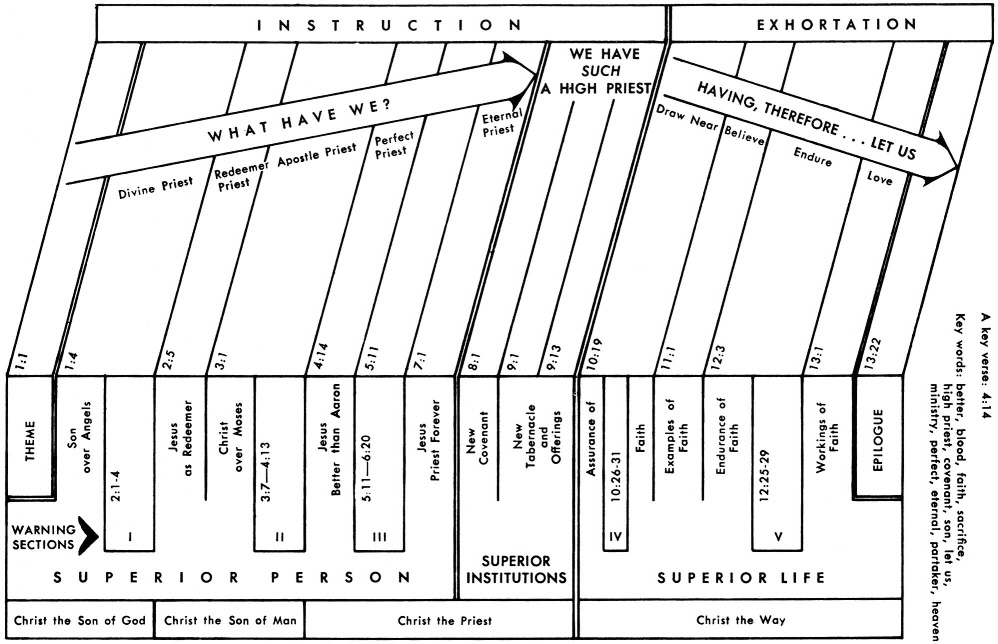
CONSIDER JESUS OUR GREAT HIGH PRIEST
Click chart to enlarge
Charts from Jensen's Survey of the NT - used by permission
Swindoll's Chart, Interesting Pictorial Chart of Hebrews, Another Chart
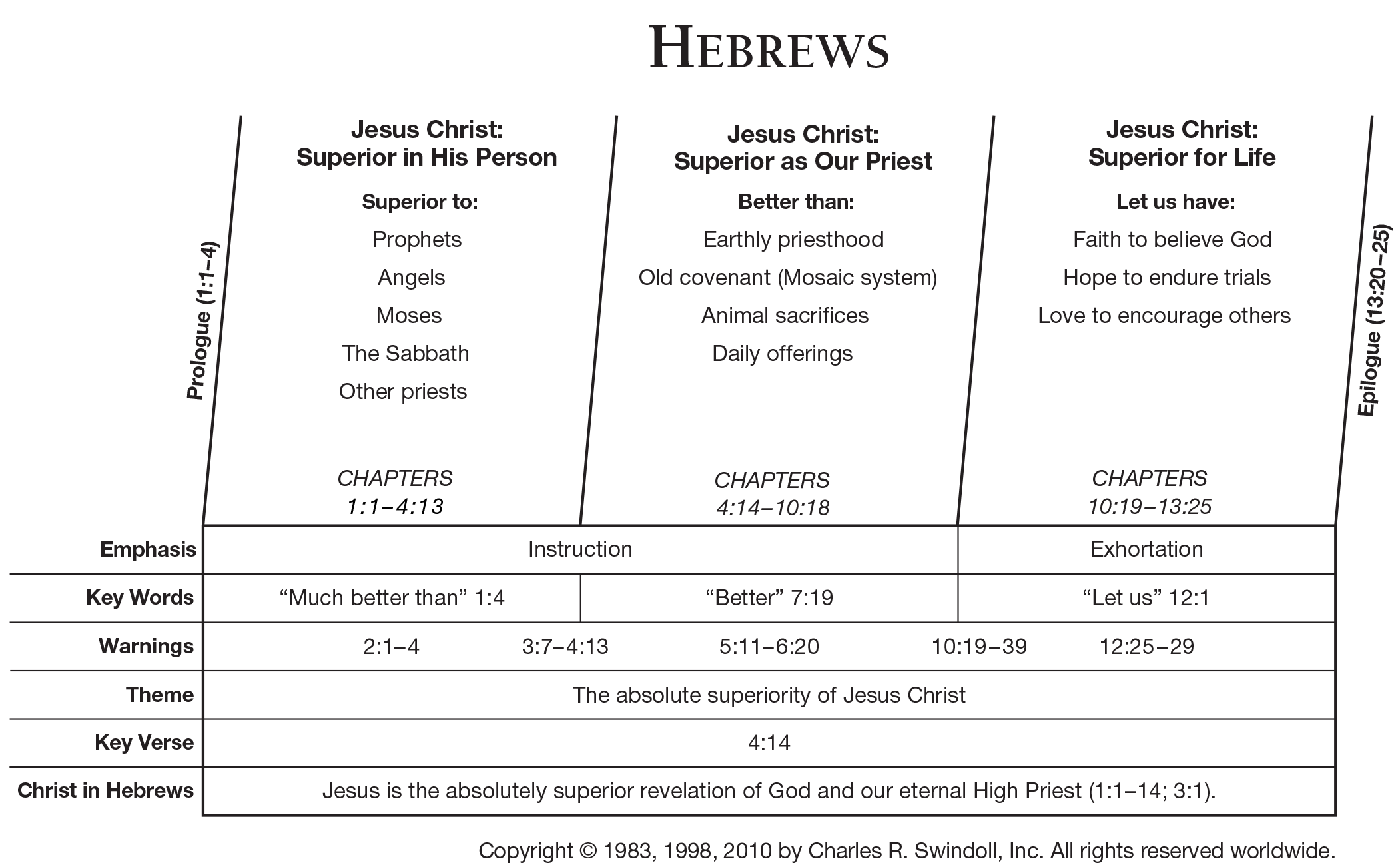
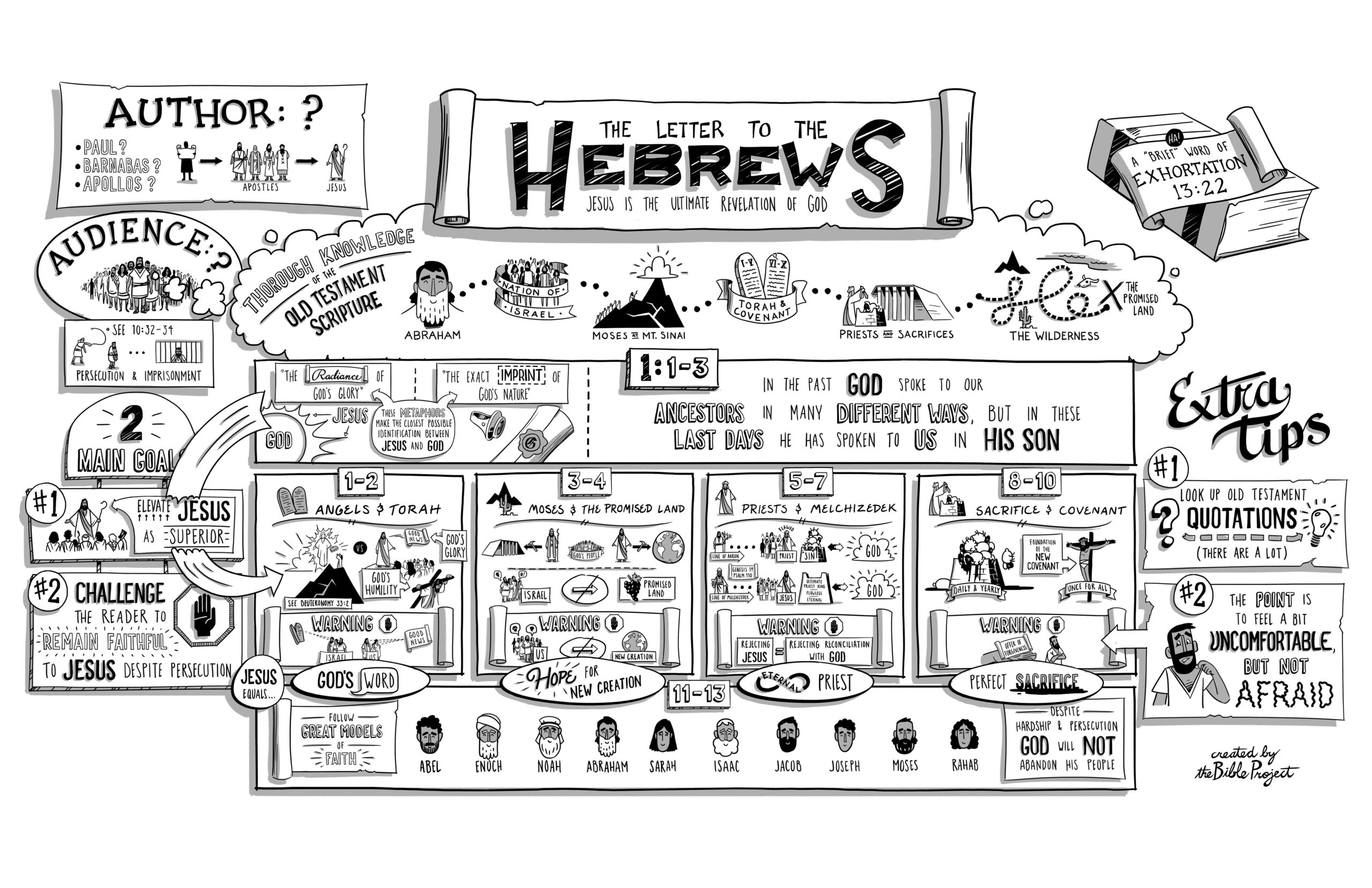
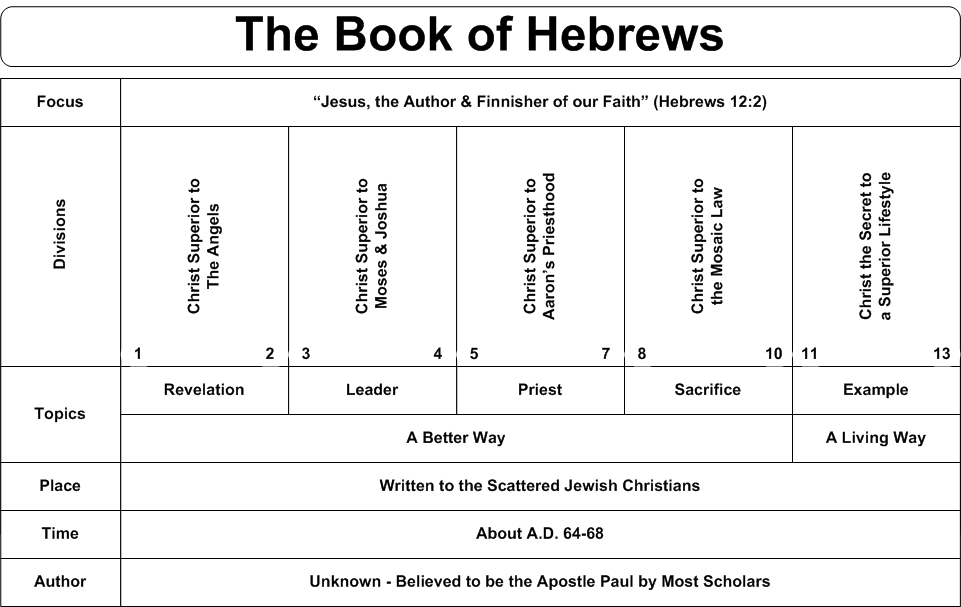
|
The Epistle |
||||
| INSTRUCTION Hebrews 1-10:18 |
EXHORTATION Hebrews 10:19-13:25 |
|||
| Superior Person of Christ Hebrews 1:1-4:13 |
Superior Priest in Christ Hebrews 4:14-10:18 |
Superior Life In Christ Hebrews 10:19-13:25 |
||
| BETTER THAN PERSON Hebrews 1:1-4:13 |
BETTER PRIESTHOOD Heb 4:14-7:28 |
BETTER COVENANT Heb 8:1-13 |
BETTER SACRIFICE Heb 9:1-10:18 |
BETTER LIFE |
| MAJESTY OF CHRIST |
MINISTRY OF CHRIST |
MINISTERS FOR CHRIST |
||
|
DOCTRINE |
DUTY |
|||
|
DATE WRITTEN: |
||||

See ESV Study Bible "Introduction to Hebrews"
(See also MacArthur's Introduction to Hebrews)
Borrow Ryrie Study Bible
Hebrews 9:25 nor was it that He would offer Himself often, as the high priest enters the holy place year by year with blood that is not his own. (NASB: Lockman)
Greek: oud' hina pollakis prosphere (3SPAS) heauton, hosper o archiereus eiserchetai (3SPMI) eis ta hagia kat' eniauton en haimati allotrio,
BGT οὐδ᾽ ἵνα πολλάκις προσφέρῃ ἑαυτόν, ὥσπερ ὁ ἀρχιερεὺς εἰσέρχεται εἰς τὰ ἅγια κατ᾽ ἐνιαυτὸν ἐν αἵματι ἀλλοτρίῳ,
Amplified: Nor did He [enter into the heavenly sanctuary to] offer Himself regularly again and again, as the high priest enters the [Holy of] Holies every year with blood not his own. (Amplified Bible - Lockman)
Barclay: It is not that he has to offer himself repeatedly, as the High Priest year by year enters into the Holy Place with a blood that is not his own. (Westminster Press)
NLT: Nor did he enter heaven to offer himself again and again, like the earthly high priest who enters the Most Holy Place year after year to offer the blood of an animal. (NLT - Tyndale House)
KJV Nor yet that he should offer himself often, as the high priest entereth into the holy place every year with blood of others;
NKJ not that He should offer Himself often, as the high priest enters the Most Holy Place every year with blood of another--
NET And he did not enter to offer himself again and again, the way the high priest enters the sanctuary year after year with blood that is not his own,
CSB He did not do this to offer Himself many times, as the high priest enters the sanctuary yearly with the blood of another.
ESV Nor was it to offer himself repeatedly, as the high priest enters the holy places every year with blood not his own,
NIV Nor did he enter heaven to offer himself again and again, the way the high priest enters the Most Holy Place every year with blood that is not his own.
Phillips: There is no intention that he should offer himself regularly, like the High Priest entering the holy of holies every year with the blood of another creature. (Phillips: Touchstone)
Wuest: Nor yet [did He enter] in order that He might be offering himself often, even as the high priest enters the holy places every year with blood belonging to another,
Young's Literal: nor that he may many times offer himself, even as the chief priest doth enter into the holy places every year with blood of others;
Paraphrase Christ did not have to repeatedly offer Himself, unlike the earthly high priest who entered the sanctuary every year with the blood of another.
Paraphrase His sacrifice was not a ritual of repetition; He did not go again and again with borrowed blood, as the high priest did annually.
Paraphrase Jesus’ offering was not cyclical—He did not return each year to present another life’s blood, as the high priest was required to.
Paraphrase He did not enter heaven again and again; unlike the high priest who must approach each year carrying blood that belonged to an animal.
Paraphrase He offered Himself once, not many times, contrasting the high priest who returned every year with substitute blood.
- Offer - Heb 9:7,14,26; 10:10
- As the high priest - Heb 9:12; Ex 30:10; Lev 16:2-34
- Hebrews 9 Resources - Multiple Sermons and Commentaries
NO REPETITION REQUIRED
A BETTER OFFERING
Having declared that Christ entered heaven itself to appear before God for us, the writer now clarifies how His priestly ministry differs from that of the Levitical high priest. The earthly high priest entered the Most Holy Place year after year, always with the blood of another creature, and always repeating the ritual because it could never fully take away sin. In contrast, Christ’s appearance in God’s presence was not to offer Himself repeatedly. His sacrifice is of such infinite worth and sufficiency that it never needs repetition. This verse underscores the once-for-all nature of His offering, showing that the old covenant’s continual cycle of sacrifices has been decisively broken in Christ.
Nor (oude) excludes two false ideas (1) Christ ministering in an earthly copy (v. 24) and Christ needing to repeat His offering (v. 25). By using oude, he ties these negations tightly together: Christ’s work is heavenly and final, not earthly and repetitive. Nor (oude) strengthens the argument: Christ did not enter an earthly sanctuary, nor did He need to offer Himself repeatedly. His sacrifice was once-for-all, in heaven, and sufficient.
Was it that He would offer (prosphero) Himself often (pollakis), as the high priest (archiereus) enters (eiserchomai) the holy place (hagios) year by year with blood (haima) that is not his own - Offer (prosphero) Himself often (pollakis),conveys the idea of "again and again", "over and over". The author is addressing the idea that Christ might have made an offering over and over like the Levitical high priests. The holy place (hagios) in context refers to the holy of holies set apart (sanctified) for God's special purpose (His presence and His means for men to meet with Him). But the earthly holy of holies was only a shadow of the heavenly holy place, the true holy of holies. Year by year (cf Heb 10:1,3) speaks of the Day of Atonement commanded by God for the high priest to carry out once each year (See Leviticus 16:1-34+). Over and over emphasizes the inadequacy of the ritual observances under the Old Covenant, and contrasts with the sufficiency of Christ's blood. Blood (haima) not his own is another striking contrast with our Great High Priest Who entered with His own blood, not that of bulls and goats! His better blood makes for a better priesthood and a better sacrifice.
Kenneth Wuest feels that "The word “offer” does not refer here to Messiah offering Himself on the Cross (ED: NOT SURE I AGREE WITH THIS BECAUSE IN CONTEXT HE IS ALLUDING TO THE DAY OF ATONEMENT), but to His entrance into the Holy of Holies. Vincent says: “The point is that, being once in the heavenly sanctuary, Christ was not compelled to renew often His presentation of Himself there, since, in that case, it would be necessary for Him to suffer often. Each separate offering would necessitate a corresponding suffering.” His was a once-for-all entrance, based upon and given efficacy and merit by virtue of His precious blood, as against the annual entrance of the high priest in Israel who came into the earthly tabernacle by virtue of the blood of sacrificial animals. (Hebrews Commentary)
No, there is not a repeated offering of Christ to God,
nor a repeated taking possession of heaven on our behalf.
Spurgeon - No, there is not a repeated offering of Christ to God, nor a repeated taking possession of heaven on our behalf. “Once for all” (Heb 10:10) the work is done. Jude 3 tells us that “once and for all” the faith was delivered to the saints: it is a final act, which is so complete that it needs no repeating. The entrance of our Lord once for all into the holy place has secured the entrance of His people. It was once, and it cannot be twice, because it was so effectual. This is set forth by the Evangelists, for when our Lord entered the holy place, the veil was rent. The holy of holies was laid open: its enclosure was thrown down. If any of His work were left undone, He would return to the earth that He might finish it, for He never did leave a work incomplete, and He never will. Christ effected the redemption of His people by one stroke: coming here, and living, and dying. He put away sin; He did not merely try to do it, but He actually accomplished the stupendous work for which He left His glory-throne above.
Albert Barnes - The Jewish high priest entered the most holy place with blood once every year. In this respect the offering made by Christ, and the work which He performed, differed from that of the Jewish high priest. It was not needful that He should enter the holy place but once. Having entered there, He permanently remains there. (Barnes NT Commentary)
Matthew Poole - The excellency of Christ’s sacrifice beyond the Aaronical is argued here from its singularity; it needs no repetition, as their multiplied sacrifices did. (Commentary)
Adam Clarke - The sacrifice of Christ is not like that of the Jewish high priest; his must be offered every year, Christ has offered himself once for all: and this sacrificial act has ever the same efficacy, his crucified body being still a powerful and infinitely meritorious sacrifice before the throne.
Leon Morris - Two things call for comment. The first is the clear implication that only Christ's offering can put away sin. The sins of those who lived in old times were dealt with by Christ's one offering. The reasoning is that if that offering had not been sufficient, Christ would have had to offer himself "again and again." That is to say, no other offering is in view when it is a matter of really putting sin away. The other point is that when the high priest entered the Most Holy Place he did so "with blood that is not his own." The superiority of Christ's offering is seen in that he does not press into service some external means, like the blood of some non-cooperating, non-comprehending animal. He uses his own blood and with it makes the one sufficient offering. (SEE The Expositor's Bible Commentary - Abridged Edition)
There is no more need of a sacrifice for sin, and
they are grossly guilty who pretend to offer Christ over again.
Spurgeon - What Aaron could not do by entering into the holy place year after year, Christ has done by entering into heaven once. There is no more need of a sacrifice for sin, and they are grossly guilty who pretend to offer Christ over again. The great work of redemption is finished; sin is put away, and there is no more remembrance of it. In the sight of God, Christ’s one sacrifice has completed the expiation of sin; glory be to His holy name!
Note - In Roman Catholic theology, the Eucharist (Mass) is described as a re-presentation of Christ’s sacrifice, not merely a memorial. The Council of Trent (16th c.) declared that the Mass is a “true and proper sacrifice” in which Christ is offered in an unbloody manner. (I wonder if most Catholics truly even understand this teaching of their church?) Protestants have historically objected to this language, seeing it as conflicting with Hebrews’ insistence that Christ’s offering was once for all, never repeated. The writer to the Hebrews would say this diminishes the sufficiency and finality of the cross! (See more discussion below)
Offer (4374) (prosphero from prós = to, toward + phéro = bring) means to carry or bring something into the presence of someone usually implying a transfer of something to that person carry to, bring (to). It means to bring near, to present, to offer and is a technical cultic term in LXX and NT for presenting a sacrificial offering to God. Thus prosphero describes an offering, whether of gifts, prayers, or sacrifices. The Septuagint (LXX) uses this word 124 times and often in the context of a sacrificial offering (more than 50 times in Leviticus alone!).
Friberg - (1) active bring to; passive be brought to; (a) with the accusative of person bring someone to someone (Mt 4.24); as a legal technical term hand over, bring before a magistrate ( Lk 23.14); (b) with the accusative of the thing bring, offer, hand something to someone (Mt 22.19); (2) of offerings, gifts, sacrifices, prayers to a deity present, bring, offer (Mt 2.11; Acts 7.42; Heb 5.7); (3) passive with the dative of person deal with, treat, act toward (Heb 12.7) (BORROW Analytical Lexicon of the Greek New Testament)
Gilbrant - As a compound of the preposition pros and the verb pherō, prospherō usually has the rather literal meaning of “to bring to.” This meaning is very common in classical literature. Prospherō can also mean “to present, offer,” especially of food or drink (Liddell-Scott). Further senses are “to address, to convey, to attack, to add,” and “to contribute” (ibid.). In the Septuagint prospherō is used quite extensively to refer to sacrifices being brought to God (Leviticus 2:8; Numbers 6:13), although cases exist of its being used simply to refer to anything or anybody brought to someone or something (Leviticus 8:6; Proverbs 19:24). In the New Testament we see many instances of the Old Testament usage in reference to sacrifices, particularly in the Book of Hebrews with its emphasis on the sacrifices. Here Weiss notes that prospherō is used to refer to the accomplishing of the sacrifice and not just to the bringing of it (“pherō,” Kittel, 9:67). Another common usage is that of the sick, lame, and demon possessed being brought to Jesus, although it is also used to indicate anyone’s being brought to another (Luke 23:14, Jesus is brought to Pilate). Of particular interest is John 16:2 where the King James Version reads, “He doeth God service.” A more literal translation would be “he offers God a service” or “he brings a service to God.” (Complete Biblical Library)
PROSPHERO IS A KEYWORD IN HEBREWS - 18X OUT OF 44 NT USES - Heb. 5:1; Heb. 5:3; Heb. 5:7; Heb. 8:3; Heb. 8:4; Heb. 9:7; Heb. 9:9; Heb. 9:14; Heb. 9:25; Heb. 9:28; Heb. 10:1; Heb. 10:2; Heb. 10:8; Heb. 10:11; Heb. 10:12; Heb. 11:4; Heb. 11:17; Heb. 12:7
Hebrews 5:1 in order to offer both gifts and sacrifices for sins;
Hebrews 5:3 because of it he is obligated to offer sacrifices for sins
Hebrews 5:7 In the days of His flesh, He offered up both prayers and supplications
Hebrews 8:3 For every high priest is appointed to offer both gifts and sacrifices;
Hebrews 8:4 since there are those who offer the gifts according to the Law
Hebrews 9:7 not without taking blood, which he offers for himself
Hebrews 9:9 both gifts and sacrifices are offered
Hebrews 9:14 blood of Christ, who through the eternal Spirit offered Himself without blemish to God
Hebrews 9:25 nor was it that He would offer Himself often, as the high priest
Hebrews 9:28 so Christ also, having been offered once to bear the sins of many
Hebrews 10:1 by the same sacrifices which they offer continually year by year,
Hebrews 10:2 Otherwise, would they not have ceased to be offered
Hebrews 10:8 which are offered according to the Law
Hebrews 10:11 Every priest stands daily ministering and offering time after time the same sacrifices
Hebrews 10:12 but He, having offered one sacrifice for sins for all time
Hebrews 11:4 By faith Abel offered to God a better sacrifice than Cain
Hebrews 11:17 By faith Abraham, when he was tested, offered up Isaac
Hebrews 12:7 It is for discipline that you endure; God deals with you as with sons
Often (4178) (pollakis from from polus = many + suffix -kis = numerical term denoting frequency) means many times or frequently. The Levitical priests in contrast to the Great High Priest's once for all time offering were in and out of the holy place (outer) daily and the Holy of holies every year.
Pollakis - 18x/16v - frequent(1), many(1), often(15), time after time(1).Matt. 17:15; Mk. 5:4; Mk. 9:22; Jn. 18:2; Acts 26:11; Rom. 1:13; 2 Co. 8:22; 2 Co. 11:23; 2 Co. 11:26; 2 Co. 11:27; Phil. 3:18; 2 Tim. 1:16; Heb. 6:7; Heb. 9:25; Heb. 9:26; Heb. 10:11
Hebrews 6:7 For ground that drinks the rain which often falls on it and brings forth vegetation
Hebrews 9:25 nor was it that He would offer Himself often,
Hebrews 9:26 Otherwise, He would have needed to suffer often since the foundation of the world
Hebrews 10:11 Every priest stands daily ministering and offering time after time the same sacrifices
Nor (3761) oude from ou = strong negation + de = and thus rendering it "and not," "nor" or "neither." (1) And not, nor (connecting negative clauses or words). (2) Not even (emphatic, heightening the denial). Oude may also be repeated many times in one sentence to connect negative sentences or clauses of the same kind (Bauer). Oudé is continuative, meaning and not, also not, and hence, not, neither, not even, usually as connecting whole clauses or propositions.
Used as (a) Simple Negative Connection (joining two denials) Matthew 6:20 — “…where neither (οὐδέ) moth nor rust destroys.” Romans 8:39 — “…nor (οὐδέ) height, nor depth…” (b) Emphatic “Not Even” (heightening the impossibility) Acts 4:14 — “…and seeing the man who had been healed standing with them, they had nothing (οὐδέ) to say in reply.” (not even a word). Galatians 2:3 — “…But not even (οὐδέ) Titus…was compelled to be circumcised.” (c) Logical Contrast - Often functions to tighten the logic of an argument, excluding possibilities. Hebrews 9:25 — “Nor (οὐδέ) was it that He would offer Himself often” → excludes the idea of Christ’s sacrifice being repetitive.
Zodhiates - (I.) (A) And not, nor, neither, generally preceded by ou (Matt. 5:15; 6:20, 26, 28; Mark 4:22; Luke 12:33; John 1:13; 6:24; Acts 8:21; Gal. 1:1; Rev. 21:23).....(B) Oudé also means not, neither, in a stronger transition or antithesis, e.g., preceded by ou (Matt. 21:27; Mark 12:10, 21; Luke 16:31)......(II) Not even, not so much as. (A) In the middle of a clause (Matt. 6:29; Mark 6:31; Luke 7:9; John 21:25; 1 Cor. 5:1). As strengthening ou, i.e., ouk oudé (Luke 18:13). Preceded by allá <G235>, but, allʾ oudé, yea not even (Acts 19:2; 1 Cor. 4:3). (B) In interrogatives (Mark 12:10; Luke 6:3; 23:40). (See page 1070 for lengthy discussion Word Study New Testament )
Gingrich - negative conjunction—1. and not, nor Mt 6:20, 26, 28; Mk 8:17; Lk 6:43f; Jn 8:42; Ac 4:12, 34; Rev 5:3.—2. also not, not either, neither Mt 6:15; Mk 16:13; Lk 16:31; 23:15; Jn 15:4 ; Ro 4:15; 1Co 15:13, 16.—3. not even Mt 6:29; 24:36; Lk 12:26; 18:13; Jn 1:3; 21:25; Ac 19:2; 1 Cor 5:1; 14:21; Heb 8:4. (Borrow Shorter Lexicon of the Greek New Testament)
Friberg - negative conjunction; (1) used as a correlative to join negative sentences or clauses and not, nor (Mt 6.20); (2) used to reinforce a negative alternative also not, not either, neither ( Mt 6.15); (3) used as an ascensive adverb not even (Mt 6.29) (Borrow Analytical Lexicon of the Greek New Testament)
OUDE - 124V - all(2), cannot*(3), either(4), even(37), neither(4), no(4), no*(1), nor(64), nothing*(1), or(20), then(1). Matt. 5:15; Matt. 6:15; Matt. 6:20; Matt. 6:26; Matt. 6:28; Matt. 6:29; Matt. 7:18; Matt. 9:17; Matt. 10:24; Matt. 11:27; Matt. 12:4; Matt. 12:19; Matt. 13:13; Matt. 16:9; Matt. 16:10; Matt. 21:27; Matt. 21:32; Matt. 22:46; Matt. 23:13; Matt. 24:21; Matt. 24:36; Matt. 25:13; Matt. 27:14; Mk. 4:22; Mk. 5:3; Mk. 6:31; Mk. 8:17; Mk. 11:26; Mk. 11:33; Mk. 12:10; Mk. 13:32; Mk. 14:59; Mk. 16:13; Lk. 6:3; Lk. 6:43; Lk. 6:44; Lk. 7:7; Lk. 7:9; Lk. 8:17; Lk. 11:33; Lk. 12:24; Lk. 12:26; Lk. 12:27; Lk. 12:33; Lk. 16:31; Lk. 17:21; Lk. 18:4; Lk. 18:13; Lk. 20:8; Lk. 20:36; Lk. 23:15; Lk. 23:40; Jn. 1:3; Jn. 1:13; Jn. 1:25; Jn. 5:22; Jn. 6:24; Jn. 7:5; Jn. 8:11; Jn. 8:42; Jn. 11:50; Jn. 13:16; Jn. 14:17; Jn. 15:4; Jn. 16:3; Jn. 21:25; Acts 2:27; Acts 4:12; Acts 7:5; Acts 8:21; Acts 9:9; Acts 16:21; Acts 17:25; Acts 19:2; Acts 24:13; Acts 24:18; Rom. 2:28; Rom. 3:10; Rom. 8:7; Rom. 9:7; Rom. 9:16; Rom. 11:21; 1 Co. 2:6; 1 Co. 3:2; 1 Co. 4:3; 1 Co. 5:1; 1 Co. 11:14; 1 Co. 11:16; 1 Co. 14:21; 1 Co. 15:13; 1 Co. 15:16; 1 Co. 15:50; 2 Co. 7:12; Gal. 1:1; Gal. 1:12; Gal. 1:17; Gal. 2:3; Gal. 2:5; Gal. 3:28; Gal. 4:1; Gal. 4:14; Gal. 6:13; Phil. 2:16; 1 Thess. 2:3; 1 Thess. 5:5; 2 Thess. 3:8; 1 Tim. 2:12; 1 Tim. 6:7; 1 Tim. 6:16; Heb. 8:4; Heb. 9:18; Heb. 9:25; Heb. 10:8; Heb. 13:5; 1 Pet. 2:22; 2 Pet. 1:8; 1 Jn. 3:6; Rev. 5:3; Rev. 7:16; Rev. 9:4; Rev. 12:8; Rev. 13:17; Rev. 20:4; Rev. 21:23
OUDE IN SEPTUAGINT - Gen. 3:3; Gen. 21:26; Gen. 39:9; Gen. 45:6; Exod. 4:10; Exod. 7:23; Exod. 10:6; Exod. 12:9; Exod. 12:39; Exod. 13:7; Exod. 14:28; Exod. 16:24; Exod. 20:4; Exod. 20:5; Exod. 22:21; Exod. 23:13; Exod. 23:18; Exod. 23:24; Exod. 23:26; Exod. 24:11; Exod. 32:18; Lev. 5:11; Lev. 11:10; Lev. 19:10; Lev. 19:15; Lev. 19:26; Lev. 19:27; Lev. 21:11; Lev. 25:11; Lev. 25:36; Lev. 26:1; Lev. 26:44; Lev. 27:10; Lev. 27:28; Num. 5:15; Num. 11:19; Num. 14:23; Num. 16:15; Num. 20:5; Num. 20:17; Num. 21:5; Num. 22:12; Num. 22:26; Num. 23:19; Num. 23:21; Num. 23:23; Num. 26:65; Num. 31:49; Num. 35:23; Deut. 1:37; Deut. 1:42; Deut. 1:45; Deut. 2:5; Deut. 2:27; Deut. 4:28; Deut. 4:31; Deut. 5:8; Deut. 5:9; Deut. 5:32; Deut. 7:2; Deut. 7:3; Deut. 7:14; Deut. 7:25; Deut. 9:5; Deut. 10:17; Deut. 11:2; Deut. 12:12; Deut. 12:32; Deut. 13:8; Deut. 14:27; Deut. 14:29; Deut. 15:7; Deut. 16:19; Deut. 17:11; Deut. 17:16; Deut. 17:17; Deut. 18:1; Deut. 18:16; Deut. 21:4; Deut. 22:5; Deut. 23:18; Deut. 24:6; Deut. 28:14; Deut. 28:39; Deut. 28:65; Deut. 29:23; Deut. 29:26; Deut. 30:11; Deut. 30:13; Deut. 31:8; Deut. 34:7; Jos. 1:5; Jos. 1:7; Jos. 6:1; Jos. 9:23; Jos. 10:14; Jos. 10:30; Jos. 11:14; Jos. 22:26; Jos. 22:28; Jos. 23:7; Jos. 24:12; Jdg. 1:18; Jdg. 1:27; Jdg. 1:30; Jdg. 2:2; Jdg. 6:4; 1 Sam. 3:13; 1 Sam. 6:12; 1 Sam. 15:29; 1 Sam. 16:8; 1 Sam. 24:11; 1 Sam. 25:15; 2 Sam. 2:19; 2 Sam. 13:30; 2 Sam. 19:6; 2 Sam. 19:24; 2 Sam. 20:1; 1 Ki. 3:11; 1 Ki. 10:12; 1 Ki. 12:24; 1 Ki. 13:8; 1 Ki. 13:16; 2 Ki. 1:18; 2 Ki. 4:23; 2 Ki. 6:10; 2 Chr. 1:11; 2 Chr. 19:7; Ezr. 4:13; Est. 2:10; Est. 4:17; Est. 9:27; Est. 10:3; Job 5:6; Job 6:26; Job 7:10; Job 7:11; Job 7:19; Job 9:11; Job 10:22; Job 15:5; Job 15:30; Job 18:19; Job 22:7; Job 24:13; Job 27:4; Job 28:13; Job 32:9; Job 32:21; Job 33:7; Job 34:8; Job 34:19; Job 34:22; Job 36:28; Job 41:9; Ps. 1:5; Ps. 5:4; Ps. 15:3; Ps. 16:4; Ps. 16:10; Ps. 19:3; Ps. 22:24; Ps. 32:2; Ps. 37:25; Ps. 37:33; Ps. 49:17; Ps. 50:9; Ps. 78:22; Ps. 78:37; Ps. 81:9; Ps. 82:5; Ps. 89:33; Ps. 89:34; Ps. 94:7; Ps. 103:9; Ps. 103:10; Ps. 104:9; Ps. 115:17; Ps. 121:4; Ps. 121:6; Ps. 131:1; Ps. 135:17; Ps. 144:14; Ps. 147:10; Prov. 1:30; Prov. 2:19; Prov. 3:25; Prov. 5:13; Prov. 6:29; Prov. 6:35; Prov. 8:8; Prov. 15:23; Prov. 17:6; Prov. 17:7; Prov. 17:26; Prov. 18:5; Prov. 19:24; Prov. 27:19; Prov. 27:24; Prov. 30:30; Isa. 1:12; Isa. 3:7; Isa. 5:6; Isa. 5:27; Isa. 7:7; Isa. 7:9; Isa. 7:12; Isa. 8:12; Isa. 8:14; Isa. 11:3; Isa. 11:9; Isa. 13:17; Isa. 13:18; Isa. 13:20; Isa. 14:20; Isa. 17:8; Isa. 22:2; Isa. 23:4; Isa. 23:12; Isa. 23:13; Isa. 26:14; Isa. 27:11; Isa. 28:27; Isa. 28:28; Isa. 29:9; Isa. 29:22; Isa. 31:8; Isa. 33:19; Isa. 33:20; Isa. 33:21; Isa. 35:8; Isa. 35:9; Isa. 37:33; Isa. 38:18; Isa. 40:24; Isa. 40:28; Isa. 41:26; Isa. 42:2; Isa. 42:8; Isa. 42:24; Isa. 42:25; Isa. 43:22; Isa. 43:23; Isa. 43:24; Isa. 44:19; Isa. 45:9; Isa. 45:13; Isa. 45:17; Isa. 45:19; Isa. 47:7; Isa. 47:8; Isa. 48:1; Isa. 48:16; Isa. 48:19; Isa. 49:10; Isa. 50:5; Isa. 51:14; Isa. 51:18; Isa. 52:12; Isa. 53:2; Isa. 53:9; Isa. 54:6; Isa. 54:10; Isa. 55:8; Isa. 57:11; Isa. 57:16; Isa. 58:5; Isa. 58:13; Isa. 59:4; Isa. 59:6; Isa. 60:18; Isa. 60:19; Isa. 63:9; Isa. 63:19; Isa. 64:4; Isa. 65:17; Isa. 65:19; Isa. 65:23; Isa. 65:25; Isa. 66:19; Jer. 3:16; Jer. 4:11; Jer. 6:15; Jer. 7:27; Jer. 10:23; Jer. 14:13; Jer. 16:2; Jer. 16:6; Jer. 19:5; Jer. 22:16; Jer. 22:17; Jer. 22:18; Jer. 23:4; Jer. 48:33; Jer. 51:43; Ezek. 1:18; Ezek. 3:6; Ezek. 3:18; Ezek. 4:14; Ezek. 5:7; Ezek. 7:4; Ezek. 7:7; Ezek. 7:9; Ezek. 7:11; Ezek. 8:18; Ezek. 9:10; Ezek. 13:9; Ezek. 13:15; Ezek. 14:18; Ezek. 15:5; Ezek. 16:4; Ezek. 16:5; Ezek. 16:16; Ezek. 16:28; Ezek. 16:29; Ezek. 16:47; Ezek. 17:9; Ezek. 17:17; Ezek. 18:17; Ezek. 18:20; Ezek. 21:27; Ezek. 22:24; Ezek. 24:14; Ezek. 24:16; Ezek. 34:6; Ezek. 37:22; Ezek. 38:11; Ezek. 39:10; Ezek. 44:13; Ezek. 47:12; Ezek. 48:14; Dan. 2:43; Dan. 3:27; Dan. 4:32; Dan. 5:23; Dan. 6:4; Dan. 11:4; Dan. 11:20; Dan. 11:24; Hos. 1:7; Hos. 1:10; Hos. 3:3; Hos. 3:4; Hos. 4:1; Amos 2:15; Amos 4:9; Amos 4:10; Amos 4:11; Amos 7:14; Amos 8:11; Amos 9:10; Zeph. 1:12; Zech. 4:6; Zech. 10:10;
High Priest (dictionary article) (749) archiereus rom arche = first in a series, the leader or ruler, idea of rank or degree + hiereus = priest - hieros is that which is determined, filled or consecrated by divine power) refers to the priest that was chief over all the other priests in Israel. This office was established by God through Moses instructions in the Pentateuch. The high priest was the principal member among the chief priests. The irony is that the high priest Caiaphas was residing over the Sanhedrin during trial of Jesus, the trial which would lead to His death and pave the way for His eternal High Priesthood!The high priest functioned as the mediator between Jehovah and Israel (cp new order under the New Covenant - 1Ti 2:5) performing sacrifices and rituals like other priests, but in addition acting to expiate the sins of the nation on the annual Day of Atonement (Read Lev 16:1-34+) (dictionary article)
ARCHIEREUS - KEYWORD IN HEBREWS - 17X - Heb. 2:17; Heb. 3:1; Heb. 4:14; Heb. 4:15; Heb. 5:1; Heb. 5:5; Heb. 5:10; Heb. 6:20; Heb. 7:26; Heb. 7:27; Heb. 7:28; Heb. 8:1; Heb. 8:3; Heb. 9:7; Heb. 9:11; Heb. 9:25; Heb. 13:11
Hebrews 2:17 so that He might become a merciful and faithful high priest
Hebrews 3:1 consider Jesus, the Apostle and High Priest of our confession;
Hebrews 4:14 Therefore, since we have a great high priest who has passed through the heavens
Hebrews 4:15 we do not have a high priest who cannot sympathize with our weaknesses
Hebrews 5:1 For every high priest taken from among men is appointed on behalf of men
Hebrews 5:5 Christ did not glorify Himself so as to become a high priest
Hebrews 5:10 being designated by God as a high priest according to the order of Melchizedek.
Hebrews 6:20 having become a high priest forever according to the order of Melchizedek.
Hebrews 7:26 For it was fitting for us to have such a high priest
Hebrews 7:27 who does not need daily, like those high priests,
Hebrews 7:28 For the Law appoints men as high priests who are weak
Hebrews 8:1 Now the main point in what has been said is this: we have such a high priest
Hebrews 8:3 For every high priest is appointed to offer both gifts and sacrifices
Hebrews 9:7 but into the second, only the high priest enters once a year
Hebrews 9:11 But when Christ appeared as a high priest of the good things to come
Hebrews 9:25 as the high priest enters the holy place year by year with blood that is not his own.
Hebrews 13:11 blood is brought into the holy place by the high priest
Enters (come, came)(1525) eiserchomai (from eis = into + erchomai = to come, go) means to go in (to), enter. Eiserchomai can speak of a thought “coming into” mind (Herodotus), wisdom entering someone (Wisdom of Solomon 1:4), the “entering” of the prophetic spirit (Josephus Antiquities 4.6.5), demonic spirits that “enter” into men (Mk 9:25; Lk 8:30), and Satan “entering” Judas (Lk 22:3). Figuratively eiserchomai can denote the acquiring of something, i.e., “to attain something” (wealth, property, and so on). It is used of the kingdom of God/heaven (Mt 5:20; Mt 7:21; Mt 19:24; Mk 9:47; Mk 10:15; et al); eiserchomai describes attaining eternal life (Mt 18:8f.; Mt 19:17; Mk 9:43,45); or eiserchomai can speak of entering rest (Heb 3:11,18; Heb 4:11).
Friberg - (1) literally, in a local sense go or come into, enter (Mt 2.21); (2) figuratively; (a) of the birth of Jesus come into (the world) ( Heb 10.5); (b) of demons enter in, take possession of (Mk 9.25 ); (c) of persons; (i) in a good sense come into, enter into, begin to enjoy (Mt 5.20); (ii) in a bad sense begin to experience, meet, encounter (Mt 26.41); (d) as the first stage of an activity -- begin, come up (Lk 9.46) (Borrow Analytical Lexicon of the Greek New Testament)
EISERCHOMAI IN HEBREWS - KEY WORD IN HEBREWS 3-4 - Heb. 3:11; Heb. 3:18; Heb. 3:19; Heb. 4:1; Heb. 4:3; Heb. 4:5; Heb. 4:6; Heb. 4:10; Heb. 4:11; Heb. 6:19; Heb. 6:20; Heb. 9:12; Heb. 9:24; Heb. 9:25; Heb. 10:5
Hebrews 3:11 AS I SWORE IN MY WRATH, ‘THEY SHALL NOT ENTER MY REST
Hebrews 3:18 And to whom did He swear that they would not enter His rest,
Hebrews 3:19 we see that they were not able to enter because of unbelief.
Hebrews 4:1 Therefore, let us fear if, while a promise remains of entering His rest,
Hebrews 4:3 For we who have believed enter that rest,
Hebrews 4:3 AS I SWORE IN MY WRATH, THEY SHALL NOT ENTER MY REST,
Hebrews 4:5 and again in this passage, “THEY SHALL NOT ENTER MY REST.”
Hebrews 4:6 Therefore, since it remains for some to enter it,
Hebrews 4:6 formerly had good news preached to them failed to enter because of disobedience,
Hebrews 4:10 For the one who has entered His rest has himself also rested from his works
Hebrews 4:11 Therefore let us be diligent to enter that rest,
Hebrews 6:19 a hope both sure and steadfast and one which enters within the veil,
Hebrews 6:20 where Jesus has entered as a forerunner for us
Hebrews 9:12 He entered the holy place once for all, having obtained eternal redemption.
Hebrews 9:24 For Christ did not enter a holy place made with hands,
Hebrews 9:25 as the high priest enters the holy place year by year with blood that is not his own.
Hebrews 10:5 Therefore, when He comes into the world, He says, “
Holy place (40) (hagios) means a place set apart from the profane or common and unto God and for the worship of and approach to the Holy God. In the New Testament, saints are holy ones in character having been set apart by God to be exclusively His possession, to be dedicated to Him and to manifest holiness of heart and conduct in contrast to the impurity of the unbelievers (Jew or Gentile). Saints are set aside for sacred use. Here a specific local is set apart for sacred use.
Holy place - This phrase occurs 60x in Scripture in NAS - Ex 26:33; 28:29, 35, 43; 29:30f; 31:11; 35:19; 39:1, 41; Lev 6:16, 26f, 30; 7:6; 10:13, 17; 16:2f, 16f, 20, 23f, 27; 24:9; Num 28:7; 1 Kgs 6:16; 7:50; 8:6, 8, 10; 1 Chr 6:49; 23:32; 2 Chr 5:11; 29:5, 7; 35:5; Ezra 9:8; Ps 24:3; Eccl 8:10; Isa 57:15; Ezek 41:4; 45:2ff; 48:12; Dan 8:13f; 9:24; Matt 24:15; Acts 6:13; 21:28; Heb 9:2, 8, 12, 24f; 10:19; 13:11
HAGIOS KEYWORD IN HEBREWS: Heb. 2:4; Heb. 3:1; Heb. 3:7; Heb. 6:4; Heb. 6:10; Heb. 8:2; Heb. 9:1; Heb. 9:2; Heb. 9:3; Heb. 9:8; Heb. 9:12; Heb. 9:24; Heb. 9:25; Heb. 10:15; Heb. 10:19; Heb. 13:11; Heb. 13:24
Hebrews 2:4 Holy Spirit
Hebrews 3:1 holy (brethren)
Hebrews 3:7 Holy Spirit
Hebrews 6:4 Holy Spirit
Hebrews 6:10 saints
Hebrews 8:2 sanctuary (heavens)
Hebrews 9:1 sanctuary (earthly)
Hebrews 9:2 holy place
Hebrews 9:3 Holy of holies
Hebrews 9:8 Holy Spirit...holy place
Hebrews 9:12 holy place
Hebrews 9:24 holy place
Hebrews 9:25 holy place
Hebrews 10:15 Holy Spirit
Hebrews 10:19 holy place
Hebrews 13:11 holy place
Hebrews 13:24 saints
Blood (129) haima is literally the red fluid that circulates in the heart, arteries, capillaries, and veins of a vertebrate animal carrying nourishment and oxygen to and bringing away waste products from all parts of the body and thus is essential for the preservation of life. Haima gives us English words like hemorrhage (Gk - haimorragia from haimo- + rragia from regnuo - to burst) English derivatives inclue hematology (study of blood) and "leukemia" which is from leuco (white) plus haima (blood), which is fitting as leukemia is a disease that affects the white blood cells. Derivatives of haima are : haimatekchusía (130), shedding of blood; haimorroéō (131), to hemorrhage. Haima was used to describe “descent” or “family” in ancient times. “To shed blood” is to destroy life.
Zodhiates adds that "haima is used to denote life given up or offered as an atonement since, in the ritual of sacrifice, special emphasis is laid upon it as the material basis of the individual life. The life of the animal offered for propitiation appears in the blood separated from the flesh which the Jews were forbidden to eat (Ge. 9:4; Lev. 3:17; 17:10-14; Deut. 12:23; Heb. 9:7-13, 18-25; 11:28; 13:11). This life is, on the one hand, in the blood, presented to God; on the other hand by sprinkling, appropriated to man (Heb. 9:7, 19, 20). This blood thus becomes the blood of the covenant or testament (see diathekē) which God commanded to us (Heb. 9:20). (Complete Word Study Dictionary- New Testament)
HAIMA IS A KEYWORD IN HEBREWS - 22X OUT OF 97X IN NT - Heb. 2:14; Heb. 9:7; Heb. 9:12; Heb. 9:13; Heb. 9:14; Heb. 9:18; Heb. 9:19; Heb. 9:20; Heb. 9:21; Heb. 9:22; Heb. 9:25; Heb. 10:4; Heb. 10:19; Heb. 10:29; Heb. 11:28; Heb. 12:4; Heb. 12:24; Heb. 13:11; Heb. 13:12; Heb. 13:20
Hebrews 2:14 Therefore, since the children share in flesh and blood,
Hebrews 9:7 only the high priest enters once a year, not without taking blood,
Hebrews 9:12 and not through the blood of goats and calves, but through His own blood
Hebrews 9:13 For if the blood of goats and bulls
Hebrews 9:14 how much more will the blood of Christ, who through the eternal Spirit offered Himself
Hebrews 9:18 even the first covenant was not inaugurated without blood.
Hebrews 9:19 he took the blood of the calves and the goats
Hebrews 9:20 saying, “THIS IS THE BLOOD OF THE COVENANT WHICH GOD COMMANDED YOU
Hebrews 9:21 he sprinkled both the tabernacle and all the vessels of the ministry with the blood
Hebrews 9:22 almost say, all things are cleansed with blood,
Hebrews 9:22 and without shedding of blood there is no forgiveness.
Hebrews 9:25 high priest enters the holy place year by year with blood that is not his own.
Hebrews 10:4 For it is impossible for the blood of bulls and goats to take away sins.
Hebrews 10:19 confidence to enter the holy place by the blood of Jesus,
Hebrews 10:29 has regarded as unclean the blood of the covenant by which he was sanctified
Hebrews 11:28 By faith he kept the Passover and the sprinkling of the blood
Hebrews 12:4 have not yet resisted to the point of shedding blood
Hebrews 12:24 Jesus, the mediator of a new covenant, and to the sprinkled blood
Hebrews 12:24 which speaks better than the blood of Abel.
Hebrews 13:11 For the bodies of those animals whose blood is brought into the holy place
Hebrews 13:12 He might sanctify the people through His own blood
Hebrews 13:20 the great Shepherd of the sheep through the blood of the eternal covenant
Spurgeon has the following sermons related to blood…
- Exodus 12:13 The Blood
- Hebrews 12:24-25 The Blood Of Sprinkling
- Hebrews 12:24-25 The Blood Of Sprinkling
- Hebrews 13:20 The Blood Of The Everlasting Covenant
- Hebrews 9:19-20 The Blood Of The Testament
- Hebrews 9:22 Blood-Shedding
Not Year by Year
Not year by year with borrowed blood,
Not endless streams, a crimson flood;
No priestly tread through veils once more,
Christ entered heaven’s final door.
No victim slain again, again,
No cycle of the goats and men;
One sacrifice, His life He gave,
Sufficient love, enough to save.
The high priest’s path was dark, unsure,
But Christ has made redemption sure.
Once offered up, His work complete,
Our endless need at last did meet.
ILLUSTRATIONS
1. The Annual Bill vs. The Paid-in-Full Receipt
Imagine a man who must pay rent every single year without fail. The debt never ends; the payment is only temporary.
Then one day, someone steps in and pays the entire cost once for all, canceling the obligation forever.
Point: The high priest’s sacrifices were recurring bills. Christ’s sacrifice is the one receipt stamped “Paid in Full.”
2. Borrowed Tools vs. Master’s Own Hands
A worker borrows tools each year to do a job, never using his own. The work is repetitive and never lasting.
Christ, however, brings His own life-blood, not another’s, and finishes the task once and for all.
Point: Priests offered “blood not their own.” Jesus offered Himself.
3. A Leaky Bucket vs. A Living Spring
A thirsty man keeps filling a leaky bucket with water; each time, it drains away and must be refilled.
Finally, a fountain is uncovered—pure, abundant, and permanent.
Point: The yearly offerings were like leaky buckets. Christ’s sacrifice is the eternal fountain.
4. The Rehearsal vs. The Performance
Musicians may practice the same piece over and over in rehearsal, but it’s never the final event.
Then the full concert comes—once, complete, decisive.
Point: Priests rehearsed yearly; Christ’s sacrifice was the final performance.
5. The Annual Cover vs. The Final Cure
Think of medicine that only manages symptoms—you must keep taking it every year.
Then a cure arrives, applied once, and the disease is gone.
Point: The old offerings only covered sin temporarily. Christ cured it eternally.
6. The Substitute Player vs. The Champion Himself
A sports team keeps sending in substitutes who can’t win the game, year after year.
Finally, the champion enters the field himself and secures the victory once for all.
Point: Priests brought substitute blood; Christ brought His own and won.
Our Daily Bread Devotionals Related to Hebrews 9 - These make excellent sermon illustrations…
- Hebrews 9:11-22 There When You Need It
- Hebrews 9:11-28 "Blood Red"
- Hebrews 9:12 "Tired Blood"
- Hebrews 9:16 His Will Is Valid
- Hebrews 9:16 A Good Will
- Hebrews 9:16 No Lost Legacy
- Hebrews 9:22: There When You Need It
- Hebrews 9:22: House Of Symbols
- Hebrews 9:24-28 Dead Is Dead
- Hebrews 9:23-28 Love Gives Value
- Hebrews 9:27 Taking Risks
- Hebrews 9:27 Never Wait for the Storm
- Hebrews 9:27: Consider The Landing
- Hebrews 9:27: An Inevitable Appointment
- Hebrews 9:27: On The Edge Of Eternity
- Hebrews 9:27: Final Appointment
- Hebrews 9:27: A Sure Thing
- Hebrews 9:27: An Eternal Future
- Hebrews 9:27: Are You Ready?
- Hebrews 9:27: 'Looking For Loopholes'
- Hebrews 9:27: 'Life's Final Deadline
- Hebrews 9:27-10:18 The Ultimate Tragedy
- Hebrews 9:28: The Perfect Sacrifice
- Hebrews 9:28: Finished!
Hebrews 9:26 Otherwise, He would have needed to suffer often since the foundation of the world; but now once at the consummation of the ages He has been manifested to put away sin by the sacrifice of Himself. (NASB: Lockman)
Greek: epei edei (3SIAI) auton pollakis pathein (AAN) apo kataboles kosmou; nuni de hapax epi sunteleia ton aionon eis athetesin [tes] hamartias dia tes thusias autou pephanerotai. (3SRPI)
BGT ἐπεὶ ἔδει αὐτὸν πολλάκις παθεῖν ἀπὸ καταβολῆς κόσμου· νυνὶ δὲ ἅπαξ ἐπὶ συντελείᾳ τῶν αἰώνων εἰς ἀθέτησιν [τῆς] ἁμαρτίας διὰ τῆς θυσίας αὐτοῦ πεφανέρωται.
Amplified: For then would He often have had to suffer [over and over again] since the foundation of the world. But as it now is, He has once for all at the consummation and close of the ages appeared to put away and abolish sin by His sacrifice [of Himself]. (Amplified Bible - Lockman)
Barclay: Were that so he would have had to suffer again and again since the world was founded. But now, as things are, once and for all, at the end of the ages, he has appeared with his sacrifice of himself so that our sins should be cancelled. (Westminster Press)
NLT: If that had been necessary, he would have had to die again and again, ever since the world began. But no! He came once for all time, at the end of the age, to remove the power of sin forever by his sacrificial death for us. (NLT - Tyndale House)
Phillips: For that would mean that he would have to suffer death every time he entered Heaven from the beginning of the world! No, the fact is that now, at this point in time, the end of the present age, he has appeared once and for all to abolish sin by the sacrifice of himself. (Phillips: Touchstone)
Wuest: since then it would have been a necessity in the nature of the case for Him to suffer often since the foundation of the universe. But now at this very time, once in the consummation of the ages, for the putting away of sin through His sacrifice has He been manifested.
Young's Literal: since it had behoved him many times to suffer from the foundation of the world, but now once, at the full end of the ages, for putting away of sin through his sacrifice, he hath been manifested;
KJV For then must he often have suffered since the foundation of the world: but now once in the end of the world hath he appeared to put away sin by the sacrifice of himself.
NKJ He then would have had to suffer often since the foundation of the world; but now, once at the end of the ages, He has appeared to put away sin by the sacrifice of Himself.
NET for then he would have had to suffer again and again since the foundation of the world. But now he has appeared once for all at the consummation of the ages to put away sin by his sacrifice.
CSB Otherwise, He would have had to suffer many times since the foundation of the world. But now He has appeared one time, at the end of the ages, for the removal of sin by the sacrifice of Himself.
ESV for then he would have had to suffer repeatedly since the foundation of the world. But as it is, he has appeared once for all at the end of the ages to put away sin by the sacrifice of himself.
NIV Then Christ would have had to suffer many times since the creation of the world. But now he has appeared once for all at the end of the ages to do away with sin by the sacrifice of himself.
Paraphrase If Christ’s work were like the old sacrifices, He would have had to die again and again since the world began. But instead, He came once, at the climax of history, to remove sin by offering Himself.
Paraphrase Had His sacrifice been incomplete, He would have needed to suffer repeatedly through the ages; but now, in these last days, He has appeared once to abolish sin through His self-offering.
Paraphrase Unlike the endless cycle of animal sacrifices, Christ did not need to repeat His suffering from the beginning of time. Rather, once for all, at the turning point of the ages, He appeared to do away with sin by giving His own life.
Paraphrase If forgiveness required repetition, Christ would have suffered countless times across history. But His once-for-all coming at the fulfillment of the ages was enough to cancel sin through His own sacrifice.
Paraphrase Since the world’s foundation, repeated offerings would have been necessary—if His work were like theirs. But now, at the decisive moment, He appeared once to put sin away forever.
- the foundation - Mt 25:34; Jn 17:24; 1Pe 1:20; Rev 13:8; 17:8
- At the consummation - Heb 1:2; Isa 2:2; Da 10:14; Micah 4:1; 1Co 10:11; Gal 4:1; Eph 1:10; 1Pe 1:20
- Hebrews 9 Resources - Multiple Sermons and Commentaries
NO REPEAT SACRIFICES FROM
THE WORLD'S BEGINNING
Having shown that Christ did not need to offer Himself repeatedly like the Levitical priests, the writer now drives the point home: if Christ’s sacrifice were not once-for-all, He would have had to suffer again and again since the foundation of the world. But in reality, at the consummation of the ages, He appeared once, offering Himself as the perfect sacrifice to put away sin forever. This verse emphasizes both the timing (the climactic moment in redemptive history) and the purpose (to abolish sin through His own sacrifice) of Christ’s once-for-all appearing.
Otherwise (epei) in this context means in that case or if that were the case (referring to year by year sacrifice of Levitical high priests in Heb 9:25) and introduces a hypothetical consequence that would follow if the opposite were true. Otherwise highlights the contrast between repeated old covenant sacrifices and Christ’s once-for-all sacrifice.
He would have needed (dei - it would have been absolutely necessary, unavoidable, a binding requirement) to suffer (pascho - to undergo pain, hardship, affliction, and specifically death) often (pollakis - again and again, repeatedly, continually) since the foundation (katabole - the laying down the foundation, establishment) of the world (kosmos); but now (as the present reality in contrast to the hypothetical past) once (hapax once-for-all, never to be repeated, a decisive and final act) at the consummation (sunteleia the bringing together, completion, fulfillment, climax) of the ages (aion the long eras of history, the unfolding periods of God’s redemptive plan) He has been manifested (phaneroo made visible, revealed openly, disclosed in full reality, disclose what was hidden, made public and historical, observable Jn 9:37,39+) to put away (athetesis to annul, set aside, cancel, abolish with finality) sin (hamartia the penalty, power and guilt of sin) by the sacrifice (thusia the offering up of His life, His substitutionary death presented to God) of Himself (His very own person, not another, His self-giving in love) - If Christ’s sacrifice had not been once-for-all, He would have had to suffer repeatedly since since the foundation (katabole) of the world (kosmos) meaning the the starting point of history, specifically the referring to the time when sin entered the world which would necessitate a Redeemer (Ro 5:12+). The writer argues that if Christ’s sacrifice were like the old covenant rituals, He would have been suffering repeatedly since the beginning.
Now is a dramatic contrast with the hypothetical otherwise. Once (hapax) means once-for-all, once only, never to be repeated, thus emphasizing the uniqueness and finality of Christ’s sacrifice (contrast with annual sacrifice in Heb 9:25). At the consummation (sunteleia) of the ages (aion) describes Christ's coming which marked the fulfillment of all previous ages, the turning point of history, so to speak (cf BC→AD).
Charles Spurgeon - For Christ once to die a shameful death upon the cross on Calvary has made an indelible mark upon our heart, as though it had been burned with a hot iron. I have sometimes half said to myself, “God forbid that His dear Son should ever have died!” The price seemed too great even for our redemption. Should He die, the Holy One and the Just, the glorious, and blessed Son of God? The answer to that question is that he has died. Thank God, He can never die again! It would be horrible to us to think that it should be possible that He should ever be called upon to bear our sins a second time. Every man’s death day is his doomsday; all is settled then. So Jesus, when He died, finished His atoning work, and nothing remains for Him but to come a second time, no more to die, to take His great reward.
Marcus Dods writes that "If Christ’s one offering of Himself were not eternally efficacious, if it required periodical renewal, then this demanded periodical sacrifice. It was ‘not without blood’ that the entrance was made, and if the entrance required repetition, so must the sacrifice be repeated. If His offering of Himself were not independent of time and valid as a single act, if it were valid only for the generation for whom it was immediately made, then in order to benefit men in the past, He must have suffered often, indeed in each generation of the past." (The Expositor's Greek Testament )
Vincent - For, from the foundation of the world, sin required atonement by sacrifice; and, therefore, if Christ had been a victim like others, which must be offered repeatedly, he would have had to suffer repeatedly from the foundation of the world. If his sacrifice, like the animal atonements, had availed for a time only, he would have been obliged to repeat his offering whenever that time expired; and, since his atonement was designed to be universal, it would have been necessary for him to appear repeatedly upon earth, and to die repeatedly from the foundation of the world. Comp. 1 Peter 1:20+; Revelation 13:8KJV+. (Ibid)
Leon Morris on the consummation of the ages - If we take it in the sense of “the close of the age,” it would mean that the first coming of Christ—and more particularly his offering of himself on the cross—ushered in the final state of affairs. (The Expositor's Bible Commentary - Abridged)
Spurgeon - Our Lord has once for all made an atonement, and all attempts to tamper with His finished work is treason such as shall be answered for in the court of heaven. Terrible shall be the doom of those who have dishonored Christ in the point where He is most jealous of his honor. Christ’s being in heaven today is a proof that there is nothing to divide a sinner from God on God’s part.
Spurgeon - Who is this that has appeared to put away sin? I will not delay for a moment, but tell you at once that He that appeared was very God of very God. He against whom sin had been committed, He who will judge the quick and the dead—He it was who appeared to put away sin. Who is it that appeared? It is He, the commissioned of the Father. Christ did not come as an amateur Saviour, trying an experiment on His own account. He came as the chosen Mediator, ordained of God for this tremendous task. “He appeared,” He who was pledged in covenant to do it—for, of old, before the world was, He became the Surety of the covenant on behalf of His people. He undertook to redeem them. His Father gave Him a people to be His own, and He declared that He would do the Father’s will and perfect those whom the Father had given Him.
Steven Cole writes that Christ's…
one sacrifice at the consummation of the ages put away our sin (He 9:26+). “The consummation of the ages” is similar to Paul’s phrase in Gal 4:4, “But when the fullness of the time came, God sent forth His Son….” It implies the preexistence of Christ before His birth. It also means that the cross represents the apex or consummation of God’s purpose of the ages, to glorify Himself.
At the cross, God’s perfect justice was displayed. If He had simply forgiven our sins without the payment of the penalty, He would not have been just. The death of the infinite, holy Son of God satisfied God’s wrath by paying the penalty we deserved. The cross also magnified God’s amazing love and grace. Any system of salvation that magnifies human merit or minimizes the cross is not from God.
At the cross, Christ “put away sin by the sacrifice of Himself” (He 9:26). The Greek word for “put away” is used only in He 7:18, where it refers to the “setting aside” of the Law that established the Levitical priesthood in deference to the greater Melchizedek priest-hood of Jesus. “Put away” “is used in a technical, juristic sense,” “meaning ‘to annul’ or ‘cancel’” (Morris, p. 93). Philip Hughes (A Commentary on the Epistle to the Hebrews [Eerdmans], p. 385) states, “This nullification, moreover, is comprehensive: it covers sin in its totality, without qualification, in every form and degree and also in every age of human history, retrospectively as well as prospectively.” This means that when Christ died, He paid the penalty for the sins of all of His elect both before and after the cross.
Consummation of the ages - Vincent explains that "The true sense is the consummation of the ages: that is to say, Christ appeared when the former ages had reached their moral consummation under the old Levitical economy."
The consummation of the ages was manifest by Christ's fully satisfactory sacrifice at Calvary and thus it is little wonder that the the apostles and first century church expected Jesus to return at any moment and set up His kingdom to establish the messianic age (see Millennium), “the age to come” (Mt 12:32). Until that age, His promise is "Lo I am with you always even to the end of the age". (Mt 28:20). The crucifixion of Christ marked the consummation of the ages because of His once and for all sacrifice. The Lamb of God Who takes away the sin of the world, did not simply "cover" sin like the OT sacrifices but He actually put away or removed sin.
Steven Cole on Consummation of the ages - “The consummation of the ages” is similar to Paul’s phrase in Galatians 4:4+, “But when the fullness of the time came, God sent forth His Son….” It implies the preexistence of Christ before His birth. It also means that the cross represents the apex or consummation of God’s purpose of the ages, to glorify Himself. (Hebrews 9:23-28 Judgment or Salvation?)
In other words All the ages and eras found their fulfillment in the coming of the Messiah. With His arrival, the eschatological age was inaugurated — which is why Paul could write Galatians 4:4+.
W E Vine - Taking the order of the words in the original, the clause “at the end of the ages” is to be connected with “to put away sin by the sacrifice of Himself.” Christ was manifested in incarnation for the purpose of putting away sin. It was at the consummation of the ages that He offered Himself in sacrifice at Calvary. All ages prior to that event looked on to it; all succeeding ages will look back to it. The Cross was ever in view in the eternal counsels of God in the past, it ever is before Him, and always will be, in the ages to come. The dispensational and providential dealings of God with men in the past ages were preparatory to this great act of redeeming grace and mercy. And from it has come, and will come, every blessing that God has for any of His creatures. The work of the Cross thus forms the pivot of all God’s counsels and acts in regard to man and to creation at large. (Collected writings of W. E. Vine)
HE HAS BEEN MANIFESTED TO PUT AWAY SIN BY THE SACRIFICE OF HIMSELF: eis athetesin (tes) hamartias dia tes thusias autou pephanerotai (3SRPI):
- He has been manifested to put away sin - Heb 9:12; 7:27; 10:4,10; Lev 16:21,22; 2Sa 12:13; 24:10; Job 7:21; Da 9:24; Jn 1:29; 1Pe 2:24; 3:18; 1Jn 3:5
- By the sacrifice of Himself - He 9:14; 10:12,26; Ep 5:2; Titus 2:14
- Hebrews 9 Resources - Multiple Sermons and Commentaries
Related Passages:
2 Timothy 1:10+ "but now has been revealed (phaneroo in the aorist tense = past completed action - a historical event) by the appearing (epiphaneia - English "epiphany") of our Savior Christ Jesus, who abolished death and brought life and immortality to light through the gospel
Ephesians 5:1-2+ Therefore be (present imperative see our need to depend on the Holy Spirit to obey) imitators of God, as beloved children; and walk (present imperative see our need to depend on the Holy Spirit to obey) in (locative of sphere) love, just as (term of comparison// simile) Christ also loved you and gave Himself up FOR (huper = substitutionary sacrifice) us, an offering and a sacrifice to God as a fragrant aroma.
Titus 2:14+ Who gave Himself FOR (huper = substitutionary sacrifice) us to redeem us from every lawless deed, and to purify for Himself a people for His own possession, zealous for good deeds.
REVELATION OF THE REDEEMER
REMOVES SIN, SECURES SALVATION
He has been manifested (phaneroo made visible, revealed openly, disclosed in full reality, disclose what was hidden, made public and historical, observable Jn 9:37,39+) to put away (athetesis to annul, set aside, cancel, abolish with finality) sin (hamartia the penalty, power and guilt of sin) by the sacrifice (thusia the offering up of His life, His substitutionary death presented to God) of Himself (His very own person, not another, His self-giving in love) He has been manifested (phaneroo) is perfect tense, indicates past completed action (incarnation Jn 1:14+, 1Ti 3:16+, Gal 4:4+) with enduring effect (our forever High Priest now interceding for us). Manifested is in the passive voice which indicates Christ’s appearing was something done to Him by God the Father (Jn 3:16+) and the Spirit (Lk 1:35+) and was not self-appointed. Christ's manifestation was directly tied to His mission, to put away (athetesis) sin (hamartia). The Son, eternal and unseen, was made visible in flesh at the climax of time to abolish sin by His own sacrifice (thusia). His appearing was not hidden or symbolic but public, real, and final with results that will remain throughout the ages to come.
Spurgeon - He could not sit in heaven and do this great work. With all reverence to the blessed Son of God, we can truly say that He could not have saved us if He had kept His throne, and not left the courts of glory; but he appeared.
This is a great word of encouragement for saints surrounded by and frequently defiled by sin because it states clearly that sin has been "annulled", deprived of its force and power. This annulment is valid only as believers "walk in the light" allowing the blood of Jesus to continually cleanse us from all the defiling effects of sin. (1Jn 1:7-note) This is cause for great rejoicing. Don't go back under the old system of dead works in trying to please God or cleanse yourself by praying more prayers, giving more money, serving on more committees, etc. Instead, put yourself continually under the cleansing blood of Christ.
Brown writes that "In other words, by Christ’s death it is not only that the devil is deposed and the power of death overcome, but also that sin is vanquished. Jesus came to rob sin of its tyranny and its suffocating stranglehold on man. Obviously, sin is still at large in the world, just as death and the devil are still active, but all three have been robbed of their former hold on man. In Christ we are free from their enslaving power (Ed: Compare Ro 6:16, 17-note, Ro 6:18-note). (Christ Above All. The Bible Speaks Today. Leicester, England; Downers Grove, Ill., U.S.A.: Inter-Varsity Press)
He would have needed (1163)(dei from deo = to bind or tie objects together, put in prison and also root of doulos, bond-servant) refers to what is not optional but needful (binding) out of intrinsic necessity or inevitability. Dei refers to inward constraint which is why it is often translated "must". Dei describes that which is under the necessity of happening or which must necessarily take place, often with the implication of inevitability. Dei is used 3x in Hebrews:
Hebrews 2:1 For this reason we must pay much closer attention to what we have heard, so that we do not drift away from it.
Hebrews 9:26 Otherwise, He would have needed to suffer often since the foundation of the world; but now once at the consummation of the ages He has been manifested to put away sin by the sacrifice of Himself.
Hebrews 11:6 And without faith it is impossible to please Him, for he who comes to God must believe that He is and that He is a rewarder of those who seek Him.
Suffer (3958) (pascho) means to experience a sensation or feeling which comes from outside of one's self and which has to be suffered. It means to undergo an experience, usually difficult, normally with implication of physical or psychological suffering.
PASCHO - 39V - Matt. 16:21; Matt. 17:12; Matt. 27:19; Mk. 5:26; Mk. 8:31; Mk. 9:12; Lk. 9:22; Lk. 13:2; Lk. 17:25; Lk. 22:15; Lk. 24:26; Lk. 24:46; Acts 1:3; Acts 3:18; Acts 9:16; Acts 17:3; Acts 28:5; 1 Co. 12:26; 2 Co. 1:6; Gal. 3:4; Phil. 1:29; 1 Thess. 2:14; 2 Thess. 1:5; 2 Tim. 1:12; Heb. 2:18; Heb. 5:8; Heb. 9:26; Heb. 13:12; 1 Pet. 2:19; 1 Pet. 2:20; 1 Pet. 2:21; 1 Pet. 2:23; 1 Pet. 3:14; 1 Pet. 3:17; 1 Pet. 4:1; 1 Pet. 4:15; 1 Pet. 4:19; 1 Pet. 5:10; Rev. 2:10
Hebrews 2:18 For since He Himself was tempted in that which He has suffered,
Hebrews 5:8 He learned obedience from the things which He suffered.
Hebrews 9:26 Otherwise, He would have needed to suffer often
Hebrews 13:12 through His own blood, suffered outside the gate.
Foundation (2602) (katabole from kataballo = to throw down from kata = down + ballo = throw, cast) is literally a casting down or laying down. The original idea was the laying down of the foundation of a house. Katabole was a technical term for putting seed into the ground, it is also used of the role of the male in impregnating the female and there is one such use in He 11:11+, referring to the casting in or sowing of seed, conveying the idea of begetting.
TDNT adds that katabole meant "“laying down,” is used for, e.g., the casting of seed, human begetting, the sowing of war, and the establishment of government.
Ten of the 11 NT uses of katabole (there are no uses in the LXX) are in the phrase "foundation of the world". Here are the uses in Hebrews…
Hebrews 4:3+ For we who have believed enter that rest, just as He has said, "As I swore in My wrath, They shall not enter My rest," although His works were finished from the foundation of the world.
Hebrews 9:26+ Otherwise, He would have needed to suffer often since the foundation of the world; but now once at the consummation of the ages He has been manifested to put away sin by the sacrifice of Himself.
Hebrews 11:11+ By faith even Sarah herself received ability to conceive, even beyond the proper time of life, since she considered Him faithful who had promised;
World (2889) (kosmos related to the verb kosmeo = to order or adorn, to put in order [Mt 25:7 = "trimmed"], to adorn literally [1Ti 2:9], to adorn figuratively [Titus 2:9+]) means essentially something that is well-arranged, that which has order or something arranged harmoniously. Kosmos refers to an ordered system or a system where order prevails. As explained below however, kosmos as used here in James 4:4 and many places in the NT, takes on a considerably more negative shade of meaning. In this sense kosmos is much like the Greek word for flesh (sarx), which can be a neutral word, but which many times in the NT takes on an evil connotation.
KOSMOS - Used in 5 of 151 NT verses -Heb. 4:3; Heb. 9:26; Heb. 10:5; Heb. 11:7; Heb. 11:38
See also
- An Out-of-this-World Experience A Look at Kosmos in the Johannine Literature
- See 6 page article on Kosmos in New International Dictionary of NT Theology
Now (3570)(nun) at this time, the present, now. Nun is an word which is used as a direct antithesis to something done in past. In Hebrews 9:26 NOW marks a decisive turning point in salvation history.
Gingrich - adv., emphatic form of nun now—1. lit., of time Ac 22:1; 24:13; Ro 3:21; 15:23, 25; 2 Cor 8:22; Eph 2:13; Col 3:8; Philemon 1:9 .—2. with the idea of time weakened or entirely absent nuni de, but now, but, as a matter of fact Ro 7:17; 1 Cor 5:11 v.l.; 1Co 12:18; 13:13; 15:20; Heb 9:26. (Borrow Shorter Lexicon of the Greek New Testament)
Frieberg - adverb of time; an emphatic form of nu/n but not differing from it in meaning; (1) as a point of time not past or future now, at the present time (Acts 24.13), opposite (earlier); (2) as an adjective used with the article and joined to a noun the present (Acts 22.1); (3) non-temporally, as a particle of logical antithesis used to shift from an unreal to a real state of affairs but now; but, as a matter of fact (1Co 5.11); (4) nun de, used to introduce a summary of a situation but now, and so (Ro 7.17; 1Co 13.13) (Borrow Analytical Lexicon of the Greek New Testament)
Gilbrant - Classical Greek and Septuagint Usage - The adverb nun, “now,” is a commonly used word with reference to time. It is found throughout classical writers such as Homer, Sophocles, Herodotus, and Euripides, as well as in inscriptions, papyri, the Septuagint, Philo, and Josephus (see Bauer for specific examples).
In the classical writings a number of nuances are expressed with the use of nun. Not only does it express time in the sense of “this present moment” but also with the sense of “the present time generally” (Liddell-Scott). Additionally, nun is used: (a) to express time in the past; (b) to indicate the immediate sequence of one thing upon another, “then, therefore, thereafter”; (c) to show the sequence of one thing from another, “then, therefore”; (d) to strengthen or precipitate a command or call; (e) to strengthen a question, “what then?” The use of nun in the Septuagint is extensive, and it is used to translate a number of Hebrew words which relate to time.
In the New Testament a variety of nuances are present, carrying forward the Hebrew concepts of time. Approximately 140 instances of nun can be found, the majority located in the writings of Luke, John, and Paul. Although strictly an adverb, nun is also used as a noun and adjective. Perhaps the greatest use of nun is its literal representation of time in a variety of modes.
Translated “now,” nun is used of the immediate present and to denote both a particular point in time as well as the extent of the time (Bauer). In this sense it occurs with a variety of verb tenses in order to give the constructions different nuances of meaning. In this way the writer could express himself according to his desire, e.g., using nun with the aorist tense to make a contrast with the past, denoting the action or condition as beginning in the present (ibid.; e.g., Romans 5:11, “we have now received the atonement,” “reconciliation,” NIV).
Nun is also used in conjunction with other particles such as de (1156), “but now”; alla (233), “but now”; gar (1056), “for now”; oude eti, “not even now,” and kai (2504), “even now,” as well as others. In addition to the emphasis being placed upon the immediate present, nun is used to direct attention to the situation at a given time, e.g., “For now we really live, if you stand firm in the Lord” (1 Thessalonians 3:8, NASB: also Acts 15:10).
Finally, when nun is found with the article it functions as an adjective or a substantive. Paul used nun adjectivally when he wrote to Timothy and Titus concerning “this present (nun) world” (1 Timothy 6:17, NIV; 2 Timothy 4:10; Titus 2:12). Peter also used nun in this way when he wrote about the “present (nun) heavens and earth” (2 Peter 3:7, NIV). It is seen as a substantive in 2 Corinthians 5:16: “So from now on we regard no one from a wordly point of view” (NIV). The substantival use is also seen in Romans 8:22 where the whole creation is said to be groaning until nun, “now; this present time” (see also Philippians 1:5 where Paul spoke of the believers’ participation in the gospel “from the first day until now [nun]”). (Complete Biblical Library)
NUN - 18X/18V - Matt. 24:21; Matt. 26:65; Matt. 27:42; Matt. 27:43; Mk. 10:30; Mk. 13:19; Mk. 15:32; Lk. 1:48; Lk. 2:29; Lk. 5:10; Lk. 6:21; Lk. 6:25; Lk. 11:39; Lk. 12:52; Lk. 16:25; Lk. 19:42; Lk. 22:36; Lk. 22:69; Jn. 2:8; Jn. 4:18; Jn. 4:23; Jn. 5:25; Jn. 8:40; Jn. 8:52; Jn. 9:21; Jn. 9:41; Jn. 11:8; Jn. 11:22; Jn. 12:27; Jn. 12:31; Jn. 13:31; Jn. 13:36; Jn. 14:29; Jn. 15:22; Jn. 15:24; Jn. 16:5; Jn. 16:22; Jn. 16:29; Jn. 16:30; Jn. 16:32; Jn. 17:5; Jn. 17:7; Jn. 17:13; Jn. 18:36; Jn. 21:10; Acts 2:33; Acts 3:17; Acts 7:4; Acts 7:34; Acts 7:52; Acts 10:5; Acts 10:33; Acts 12:11; Acts 13:11; Acts 15:10; Acts 16:36; Acts 16:37; Acts 18:6; Acts 20:22; Acts 20:25; Acts 22:1; Acts 22:16; Acts 23:15; Acts 23:21; Acts 24:13; Acts 24:25; Acts 26:6; Acts 26:17; Rom. 3:26; Rom. 5:9; Rom. 5:11; Rom. 6:19; Rom. 6:21; Rom. 8:1; Rom. 8:18; Rom. 8:22; Rom. 11:5; Rom. 11:30; Rom. 11:31; Rom. 13:11; Rom. 16:26; 1 Co. 3:2; 1 Co. 7:14; 1 Co. 12:20; 1 Co. 16:12; 2 Co. 5:16; 2 Co. 6:2; 2 Co. 7:9; 2 Co. 8:14; 2 Co. 13:2; Gal. 1:23; Gal. 2:20; Gal. 3:3; Gal. 4:9; Gal. 4:25; Gal. 4:29; Eph. 2:2; Eph. 3:5; Eph. 3:10; Eph. 5:8; Phil. 1:5; Phil. 1:20; Phil. 1:30; Phil. 2:12; Phil. 3:18; Col. 1:24; 1 Thess. 3:8; 2 Thess. 2:6; 1 Tim. 4:8; 1 Tim. 6:17; 2 Tim. 1:10; 2 Tim. 4:10; Tit. 2:12; Heb. 2:8; Heb. 9:5; Heb. 9:24; Heb. 9:26; Heb. 12:26; Jas. 4:13; Jas. 4:16; Jas. 5:1; 1 Pet. 1:12; 1 Pet. 2:10; 1 Pet. 2:25; 1 Pet. 3:21; 2 Pet. 3:7; 2 Pet. 3:18; 1 Jn. 2:18; 1 Jn. 2:28; 1 Jn. 3:2; 1 Jn. 4:3; 2 Jn. 1:5; Jude 1:25
NUN IN THE SEPTUAGINT - Exod. 32:34; Num. 11:6; Deut. 10:22; Jos. 5:14; Jos. 14:12; 2 Ki. 3:15; Job 6:28; Job 7:21; Job 30:1; Job 30:9; Job 42:5; Ps. 17:11; Ps. 44:9
USES ON NUN IN HEBREWS:
Hebrews 2:8 YOU HAVE PUT ALL THINGS IN SUBJECTION UNDER HIS FEET.” For in subjecting all things to him, He left nothing that is not subject to him. But now we do not yet see all things subjected to him.
Hebrews 9:5 and above it were the cherubim of glory overshadowing the mercy seat; but of these things we cannot now speak in detail.
Hebrews 9:24 For Christ did not enter a holy place made with hands, a mere copy of the true one, but into heaven itself, now to appear in the presence of God for us;
Hebrews 9:26 Otherwise, He would have needed to suffer often since the foundation of the world; but now once at the consummation of the ages He has been manifested to put away sin by the sacrifice of Himself.
Hebrews 12:26 And His voice shook the earth then, but now He has promised, saying, “YET ONCE MORE I WILL SHAKE NOT ONLY THE EARTH, BUT ALSO THE HEAVEN.”
Once (530) (hapax) means literally once or one time. It is used to describe a simple numerical occurrence of once (2Cor 11:25). It can also be used to convey the sense of something done uniquely and thus means once for all. It is that which is so done as to be of perpetual validity, and never needs repetition (see note Hebrews 9:28).
Friberg - adverb; once; (1) as a strictly numerical concept in the sense of one time once (2Co 11.25); once a year (Heb 9.7); (2) of something done uniquely only once, once for all (Heb 9.28); (3) idiomatically a[. kai. di,j literally once and twice, i.e. more than once, several times (Php 4.16) (BORROW Analytical Lexicon of the Greek New Testament)
Gilbrant - From the time of Homer, classical Greek writings contain this term as an actual numeral. However, this word, like the Latin semel, also could refer to the quality of perpetual validity, that which did not need repetition. Sometimes it was employed in connection with the enactment of a law that was given once and for all. This once-for-all sense came to be far more important than the simple numerical significance.
HAPAX - 15V KEYWORD (>50% IN HEBREWS) - Neh. 7:70; 2 Co. 11:25; Phil. 4:16; 1 Thess. 2:18; Heb. 6:4; Heb. 9:7; Heb. 9:26; Heb. 9:27; Heb. 9:28; Heb. 10:2; Heb. 12:26; Heb. 12:27; 1 Pet. 3:18; Jude 1:3; Jude 1:5
Hebrews 6:4 For in the case of those who have once been enlightened
Hebrews 9:7 but into the second, only the high priest enters once a year
Hebrews 9:26 but now once at the consummation of the ages
Hebrews 9:27 it is appointed for men to die once and after this comes judgment,
Hebrews 9:28 so Christ also, having been offered once to bear the sins of many
Hebrews 10:2 because the worshipers, having once been cleansed
Hebrews 12:26 YET ONCE MORE I WILL SHAKE NOT ONLY THE EARTH, BUT ALSO THE HEAVEN
Hebrews 12:27 This expression, “Yet once more,” denotes the removing of those things
Consummation (4930) (sunteleia from sun = together or an intensifier + teleo = to finish) describes the bringing of something to a successful finish. In a word the noun sunteleia means completion, conclusion, close, end, consummation. It is used 5 times by Jesus Himself in the phrase the "end of the age."
Sunteleia is used much more frequently in the Lxx than in NT. Study especially the uses (see Lxx uses below) in the apocalyptic or prophetic portions of Daniel (Da 8:19+, Da 9:25+, Da 9:26+, Da 9:27+, Da 12:4, 6, 7, 13+). Sunteleia is clearly an "eschatologically rich" term both the Old and the New Testaments apply to the end of the age.
SUNTELEIA - 6x/6v - consummation(1), end(5).
Matthew 13:39+ and the enemy who sowed them is the devil, and the harvest is the end of the age; and the reapers are angels. 40 "So just as the tares are gathered up and burned with fire, so shall it be at the end of the age. 49 "So it will be at the end of the age; the angels will come forth and take out the wicked from among the righteous,
Matthew 24:3+ As He was sitting on the Mount of Olives, the disciples came to Him privately, saying, "Tell us, when will these things happen, and what will be the sign of Your coming, and of the end of the age?"
Matthew 28:20+ teaching them to observe all that I commanded you; and lo, I am with you always, even to the end of the age."
Comment: His presence, the indwelling Spirit of Christ, is also His power to perform.
Hebrews 9:26+ Otherwise, He would have needed to suffer often since the foundation of the world; but now once at the consummation of the ages He has been manifested to put away sin by the sacrifice of Himself.
Sunteleia - 56 verses in the non-apocryphal Septuagint - Ex 23:16; Deut 11:12; Josh 4:8; Jdg 20:40; 1 Sam 8:3; 20:41; 1 Kgs 6:22, 25; 2 Kgs 13:17, 19; 2 Chr 24:23; Ezra 9:14; Neh 9:31; Esth 4:17; Job 26:10; 30:2; Ps 59:12f; 119:96; Jer 4:27; 5:10, 18; 46:28; Ezek 11:13; 13:13; 20:17; 21:28; 22:12; Dan 4:28, 31, 34; 8:19; Da 9:25-27; 11:6, 13, 27, 35f, 40, 45; 12:4, 6f, 13; Amos 1:14; 8:8; 9:5; Nah 1:3, 8f; Hab 1:9, 15; 3:19; Zeph 1:18
Dan 9:27+ “And he will make a firm covenant with the many for one week, but in the middle of the week he will put a stop to sacrifice and grain offering; and on the wing of abominations will come one who makes desolate, even until a complete destruction (Lxx = at the end of time an end shall be put to the desolation), one that is decreed, is poured out on the one who makes desolate.”
Ages (165) (aion) is here plural to imply that the course of history is regarded as a succession of various periods, of which the appearance of Christ forms the conclusion. The phrase the end of the ages designates the present age as the last of a series. It marks the end of human history as we now know it and will terminate in the events which Jesus foretold would occur at the end of the age (Mt 24,25).
His one sacrifice of Himself was made at the consummation of the ages. The epistles confirm this. “Children, it is the last hour” (1Jn 2:18) “For the coming of the Lord is at hand” (Jas 5:8) “The end of all things is at hand” (1Pe 4:7+).
AION USED 15X IN HEBREWS - 13 OF 91 NT VERSES - Heb. 1:2; Heb. 1:8; Heb. 5:6; Heb. 6:5; Heb. 6:20; Heb. 7:17; Heb. 7:21; Heb. 7:24; Heb. 7:28; Heb. 9:26; Heb. 11:3; Heb. 13:8; Heb. 13:21
Hebrews 1:2 through Whom also He made the world.
Hebrews 1:8 “YOUR THRONE, O GOD, IS FOREVER AND EVER,
Hebrews 5:6 “YOU ARE A PRIEST FOREVER ACCORDING TO THE ORDER OF MELCHIZEDEK.”
Hebrews 6:5 and the powers of the age to come,
Hebrews 6:20 having become a high priest forever according to the order of Melchizedek.
Hebrews 7:17 “YOU ARE A PRIEST FOREVER ACCORDING TO THE ORDER OF MELCHIZEDEK.”
Hebrews 7:21 WILL NOT CHANGE HIS MIND, ‘YOU ARE A PRIEST FOREVER’
Hebrews 7:24 but Jesus, on the other hand, because He continues forever
Hebrews 7:28 which came after the Law, appoints a Son, made perfect forever.
Hebrews 9:26 but now once at the consummation of the ages He has been manifested
Hebrews 11:3 By faith we understand that the worlds were prepared by the word of God
Hebrews 13:8 Jesus Christ is the same yesterday and today and forever.
Hebrews 13:21 through Jesus Christ, to whom be the glory forever and ever. Amen.
He has been manifested (5319) (phaneroo from phanerós = manifest, visible, conspicuous in turn from phaino = give light; become visible in turn from phos = light) is literally "to bring to light" and primarily means "to make visible" or to cause to become visible. It indicates an external manifestation to the senses which is thus open to all. It means to make visible that which has been hidden. The primary reference is to what is visible to sensory perception and thus which is made to appear, caused to be seen or uncovered, laid bare or revealed.
To be manifested, in the Scriptural sense is more than just to appear. For example, a person may appear in a false guise or without a disclosure of what he truly is. Thus in this context, phaneroo conveys the sense of to be manifested or to be revealed in one's true character (this is meaning in Jn 3:21, 1Cor 4:5, 2Cor 5:10,11, Eph 5:13-note)
Phaneroo - 49x in 44v - NAS = appear(1), appeared(6), appears(3), become visible(1), becomes visible(1), disclose(1), disclosed(1), displayed(1), made… evident(2), made known(1), made manifest(2), make… clear(1), manifested(18), manifests(1), revealed(7), show(1), shown(1). Mk 4:22; 16:12, 14; John 1:31; 2:11; 3:21; 7:4; 9:3; 17:6; 21:1, 14; Rom 1:19; 3:21; 16:26; 1 Cor 4:5; 2 Cor 2:14; 3:3; 4:10f; 5:10f; 7:12; 11:6; Eph 5:13f; Col 1:26; 3:4; 4:4; 1 Tim 3:16; 2 Tim 1:10; Titus 1:3; Heb 9:8, 26; 1 Pet 1:20; 5:4; 1 John 1:2; 2:19, 28; 3:2, 5, 8; 4:9; Rev 3:18; 15:4.
To put away (115) (athetesis from atheteo = to annul, declare invalid, not recognize, make ineffective, inoperative or nonexistent) describes the doing away of something established (in context, the removal of sin! Christ paid the penalty and thus in a sense "annuls" the effect of sin its ability to bring eternal death to the one who commits sin. See below for His "annulling" of sin's power over believers.). To set aside. To disannul. It was used of annulling a treaty, a promise, a law, a regulation. It was also used of removing a man’s name from a document. To make as of no value = putting away and "annulling" the former commandment [Gal 3:15] It means to refuse to recognize the validity of something and so to reject it or regard it as invalid (an annulment). It can describe the process of causing something not to continue. It can mean to act towards anything as though it were annulled. Atheteo was used commonly in the Greek papyri in a legal sense of making void.
“Put away” “is used in a technical, juristic sense,” “meaning ‘to annul’ or ‘cancel’” (Morris, p. 93). Philip Hughes (A Commentary on the Epistle to the Hebrews [Eerdmans], p. 385) states, “This nullification, moreover, is comprehensive: it covers sin in its totality, without qualification, in every form and degree and also in every age of human history, retrospectively as well as prospectively.”
In He 7:18+ (the only other NT use, once in Lxx = 1Sa 24:12) athetesis refers to the fact that at the Cross, the whole paraphernalia of the sacrificial system, the whole ceremonial system, was canceled, annulled, done away with entirely. God assured its end in 70AD, when He allowed the Temple to be destroyed.
For, on the one hand, there is a setting aside of a former commandment because of its weakness and uselessness (Hebrews 7:18+)
Sin (266) (hamartia) originally conveyed the idea of missing the mark as when hunting with a bow and arrow and then came to mean missing or falling short of any goal, standard, or purpose. In Scripture sin often describes our thoughts, words and deeds that miss the ultimate purpose God has for each individual, these thoughts, words and deeds falling short of God’s perfect standard of holiness. In this verse Sin speaks of the principle or propensity inherited from Adam which causes us to commit sins (plural).
W. H. Auden, a well- known twentieth century poet, has said "All sin tends to be addictive and the terminal point of addiction is what is called damnation (Ed: cp He 9:27).
Vincent calls us to "Note the singular number, sin. The sacrifice of Christ dealt with Sin as a principle: the Levitical sacrifices with individual transgressions (Ed: But still did not remove them completely!). (Ibid)
Spurgeon - Sin.” It is a very little word, but it contains an awful abyss of meaning. “Sin” is transgression against God, rebellion against the King of kings, violation of the law of right, commission of all manner of wrong. Sin is in every one of us. We have all committed it; we have all been defiled with it. Christ came to put away sin. You see, the evil is put in one word, as if wrongdoing was made into one lump, all heaped together, and called, not “sins,” but “sin.” Can you catch the idea? All the sinfulness, all the omissions, all the commissions, and all the tendencies to rebel that ever were in the world are all piled together, hill upon hill, mountain upon mountain, and then called by this one name, “sin.” Christ was revealed to put away sin. He did not come into the world to palliate it merely, or to cover it up, but He came to put it away. Observe, He not only came to put away some of the attributes of sin, such as the filth of it, the guilt of it, the penalty of it, the degradation of it; He came to put away sin itself. For sin, you see, is the fountain of all the mischief. He did not come to empty out the streams, but to clear away the fatal source of the pollution. He appeared to put away sin itself, sin in its essence and being.
HAMARTIA IS A KEY WORD IN HEBREWS - 25X OUT OF 150V IN NT - Heb. 1:3; Heb. 2:17; Heb. 3:13; Heb. 4:15; Heb. 5:1; Heb. 5:3; Heb. 7:27; Heb. 8:12; Heb. 9:26; Heb. 9:28; Heb. 10:2; Heb. 10:3; Heb. 10:4; Heb. 10:6; Heb. 10:8; Heb. 10:11; Heb. 10:12; Heb. 10:17; Heb. 10:18; Heb. 10:26; Heb. 11:25; Heb. 12:1; Heb. 12:4; Heb. 13:11
Hebrews 1:3 When He had made purification of sins, He sat down at the right hand of the Majesty on high,
Hebrews 2:17 to make propitiation for the sins of the people.
Hebrews 3:13 so that none of you will be hardened by the deceitfulness of sin.
Hebrews 4:15 One who has been tempted in all things as we are, yet without sin.
Hebrews 5:1 in order to offer both gifts and sacrifices for sins;
Hebrews 5:3 and because of it he is obligated to offer sacrifices for sins
Hebrews 7:27 who does not need daily, like those high priests, to offer up sacrifices, first for His own sins
Hebrews 7:27 then for the sins of the people, because this He did once for all when He offered up Himself.
Hebrews 8:12 AND I WILL REMEMBER THEIR SINS NO MORE.”
Hebrews 9:26 He has been manifested to put away sin by the sacrifice of Himself.
Hebrews 9:28 so Christ also, having been offered once to bear the sins of many
Hebrews 10:2 having once been cleansed, would no longer have had consciousness of sins?
Hebrews 10:3 But in those sacrifices there is a reminder of sins year by year.
Hebrews 10:4 For it is impossible for the blood of bulls and goats to take away sins.
Hebrews 10:6 IN WHOLE BURNT OFFERINGS AND sacrifices FOR SIN YOU HAVE TAKEN NO PLEASURE.
Hebrews 10:8 WHOLE BURNT OFFERINGS AND sacrifices FOR SIN YOU HAVE NOT DESIRED
Hebrews 10:11 the same sacrifices, which can never take away sins;
Hebrews 10:12 but He, having offered one sacrifice for sins for all time
Hebrews 10:17 AND THEIR SINS AND THEIR LAWLESS DEEDS I WILL REMEMBER NO MORE
Hebrews 10:18 there is no longer any offering for sin
Hebrews 10:26 there no longer remains a sacrifice for sins,
Hebrews 11:25 than to enjoy the passing pleasures of sin,
Hebrews 12:1 let us also lay aside every encumbrance and the sin which so easily entangles us
Hebrews 12:4 You have not yet resisted to the point of shedding blood in your striving against sin;
Hebrews 13:11 whose blood is brought into the holy place by the high priest as an offering for sin
Sacrifice (2378) (thusia from thuo/thyo = to slay, sacrifice or kill a sacrificial victim; to bring a religious offering to a deity) refers literally to animal sacrifices that were slain and offered on the altar. Homer (about nine centuries before Christ) used thusia to describe the "smoke or burnt offering." Later the sense of thusia was broadened to mean the actual slaying of a sacrifice. According to Pindar, thusia was the very ritual of sacrifice, the religious service in which a sacrifice was brought.
Thusia is used figuratively in the NT. Thusia refers to the death of Christ as an offering of Himself to God (Ep 5:2+). Thusia is used to refer to the volitional choice of a believer to make a consecration or surrender of one's whole life unto God (Ro 12:1+). thusia refers to the believer's offering of praise and good deeds (He 13:16+) to God, an offering that is acceptable to God only through Jesus, only on the basis of His shed blood (He 13:15+). Peter concurs saying we are "to offer up spiritual sacrifices acceptable to God through Jesus Christ." (1Pe 2:5+)
THUSIA IN HEBREWS - Heb. 5:1; Heb. 7:27; Heb. 8:3; Heb. 9:9; Heb. 9:23; Heb. 9:26; Heb. 10:1; Heb. 10:5; Heb. 10:8; Heb. 10:11; Heb. 10:12; Heb. 10:26; Heb. 11:4; Heb. 13:15; Heb. 13:16
Hebrews 5:1 in order to offer both gifts and sacrifices for sins;
Hebrews 7:27 who does not need daily, like those high priests, to offer up sacrifices,
Hebrews 8:3 every high priest is appointed to offer both gifts and sacrifices;
Hebrews 9:9 both gifts and sacrifices are offered which cannot
Hebrews 9:23 the heavenly things themselves with better sacrifices than these.
Hebrews 9:26 He has been manifested to put away sin by the sacrifice of Himself.
Hebrews 10:1 by the same sacrifices which they offer continually year by year
Hebrews 10:5 He says, “SACRIFICE AND OFFERING YOU HAVE NOT DESIRED
Hebrews 10:8 After saying above, “SACRIFICES AND OFFERINGS AND WHOLE BURNT OFFERINGS AND
Hebrews 10:8 sacrifices FOR SIN YOU HAVE NOT DESIRED
Hebrews 10:11 offering time after time the same sacrifices
Hebrews 10:12 He, having offered one sacrifice for sins for all time
Hebrews 10:26 there no longer remains a sacrifice for sins,
Hebrews 11:4 By faith Abel offered to God a better sacrifice than Cain
Hebrews 13:15 let us continually offer up a sacrifice of praise to God
Hebrews 13:16 for with such sacrifices God is pleased.
It has been pointed out that we have three appearances of Christ in He 9:24, 28 summarized as follows:
He 9:26: He has appeared. His First Advent when He came to earth to save us from the penalty of sin (past tense salvation = justification - see Three Tenses of Salvation).
He 9:24: He now appears. His present ministry in the presence of God to save us from the power of sin (present tense salvation = sanctification).
He 9:28: He will appear. His imminent Return when He will save us from the presence of sin (future tense of salvation = glorification).
William MacDonald eloquently summarizes the truth in this passage explaining that…
Under the New Covenant, there is:
1. Positive finality—He has appeared once for all. The work never needs to be repeated.
2. A propitious time—He appeared at the end of the ages, that is, after the Old Covenant had conclusively demonstrated man’s failure and powerlessness.
3. A perfect work—He appeared, to put away sin. The emphasis is on the words put away. It was no longer a matter of annual atonement. Now it was eternal forgiveness.
4. A personal sacrifice—He put away sin by the sacrifice of Himself. In His own body He bore the punishment which our sins deserved. (Believer's Bible Commentary)
Bearing shame and scoffing rude,
In my place condemned He stood;
Sealed my pardon with His blood;
Hallelujah! What a Saviour!
—Philip P. Bliss
QUESTION - What is the Catholic sacrament of Holy Eucharist? | GotQuestions.org
ANSWER - For Catholics, the Holy Eucharist / Catholic Mass is considered the most important and highest form of prayer. In fact, attending Mass is an obligation, under penalty of mortal sin, each Sunday and on certain other Holy Days of Obligation. The Mass is divided into two sections, the Liturgy of the Word and the Liturgy of the Eucharist. The Liturgy of the Word consists of two readings (one from the Old Testament and one from the New Testament), the Responsorial Psalm, the Gospel reading, the homily (or sermon), and general intercessions (also called petitions).
The center of the Mass is its second part, the Liturgy of the Holy Eucharist. During this time, Catholics share in the body and blood of Jesus in the form of the bread and wine passed out to the congregation. According to the Bible, this is done in remembrance of Christ (1 Corinthians 11:23-25; cf. Luke 22:18-20 and Matthew 26:26-28). However, according to the Catechism of the Catholic Church, paragraph 1366,
"The Eucharist is thus a sacrifice because it re-presents (makes present) the sacrifice of the cross, because it is its memorial and because it applies its fruit."
The catechism continues in paragraph 1367:
The sacrifice of Christ and the sacrifice of the Holy Eucharist are one single sacrifice: "The victim is one and the same: the same now offers through the ministry of priests, who then offered himself on the cross; only the manner of offering is different." "And since in this divine sacrifice which is celebrated in the Mass, the same Christ who offered himself once in a bloody manner on the altar of the cross is contained and is offered in an unbloody manner . . . this sacrifice is truly propitiatory."
In the book of Malachi, the prophet predicts elimination of the old sacrificial system and the institution of a new sacrifice: "I have no pleasure in you, says the Lord of hosts, and I will not accept an offering from your hand. For from the rising of the sun to its setting my name will be great among the nations, and in every place incense will be offered to my name, and a pure offering. For my name will be great among the nations, says the Lord of hosts" (Malachi 1:10-11). This means that God will one day be glorified among the Gentiles, who will make pure offerings to Him in all places. The Catholics see this as the Eucharist. However, the apostle Paul seems to have a different slant on it: "I appeal to you therefore, brothers, by the mercies of God, to present your bodies as a living sacrifice, holy and acceptable to God, which is your spiritual worship" (Romans 12:1). The Eucharist can only be offered in select places: churches consecrated and blessed according to Catholic canon law. The idea of offering our bodies as living sacrifices fits better with the language of the prediction, which says that the sacrifices will be offered "in every place."
The Roman Catholic Church believes that the bread and wine of the Holy Eucharist become the actual body and blood of Jesus. They attempt to support their system of thought with passages such as John 6:32-58; Matthew 26:26; Luke 22:17-23; and 1 Corinthians 11:24-25. In A.D. 1551, the Counsel of Trent officially stated,
"By the consecration of the bread and wine there takes place a change of the whole substance of the bread into the substance of the body of Christ our Lord and of the whole substance of the wine into the substance of his blood. This change the holy Catholic Church has fittingly and properly called transubstantiation" (Session XIII, chapter IV; cf. canon II).
By sharing in the Eucharistic meal, the Church teaches that Catholics are fulfilling John 6:53:
"Truly, truly, I say to you, unless you eat the flesh of the Son of Man and drink his blood, you have no life in you."
What does that really mean? Jesus goes on to say that "it is the Spirit who gives life; the flesh is of no avail. The words that I have spoken to you are spirit and life" (John 6:63-64). So, if "the flesh is of no avail," why would we have to eat Jesus’ flesh in order to have eternal life? It does not make sense, until Jesus tells us that the words He speaks are "spirit." Jesus is saying that this is not a literal teaching, but a spiritual one. The language ties in perfectly with the aforementioned statement of the apostle Paul: "Present your bodies as a living sacrifice, holy and acceptable to God, which is your spiritual worship" (Romans 12:1).
In Jewish thought, bread was equated with the Torah, and "eating of it" was reading and understanding the covenant of God (cf. Deuteronomy 8:3). For example, the apocryphal book of Sirach states, "'He who eats of me will hunger still, he who drinks of me will thirst for more; he who obeys me will not be put to shame, he who serves me will never fail.' All this is true of the book of Most High’s covenant, the law which Moses commanded us as an inheritance for the community of Jacob" (Sirach 24:20-22). Quoting from Sirach here is not endorsing it as Scripture; it only serves to illustrate how the Jewish people thought of Mosaic Law. It is important to understand the equating of bread with the Torah to appreciate Jesus’ real point.
In John 6, Jesus is actually telling the crowd that He is superior to the Torah (cf. John 6:49-51) and the entire Mosaic system of Law. The passage from Sirach states that those who eat of the Law will "hunger still" and "thirst for more"; this language is mirrored by Jesus when He says, "He who comes to Me will never be hungry, he who believes in Me will never be thirsty" (John 6:35). Jesus is not commanding people to literally eat His flesh and drink His blood. He is telling them the core of all Christian doctrine: belief in Jesus Himself ("The work of God is this: to believe in the One He has sent," John 6:29, emphasis added). Therefore, the Catholic interpretation of John 6 is unbiblical.
Second, there is a very clear analogy in John 6 to the days of Moses and the eating of manna. In the days of Moses, manna was God’s provision for food for the Israelites as they wandered in the wilderness. In John 6, however, Jesus claimed to be the true manna, the bread of heaven. With this statement Jesus claimed to be God’s full provision for salvation. Manna was God’s provision of deliverance from starvation. Jesus is God’s provision of deliverance from damnation. Just as the manna had to be consumed to preserve the lives of the Israelites, so Jesus has to be consumed (fully received by faith) for salvation to be received.
It is very clear that Jesus referred to Himself as the Bread of Life and encouraged His followers to eat of His flesh in John 6. But we do not need to conclude that Jesus was teaching what the Catholics have referred to as transubstantiation. The Lord’s Supper / Christian communion / Holy Eucharist had not been instituted yet. Jesus did not institute the Holy Eucharist / Mass / Lord’s Supper until John chapter 13. Therefore, to read the Lord’s Supper into John 6 is unwarranted. As suggested above, it is best to understand this passage in light of coming to Jesus, in faith, for salvation. When we receive Him as Savior, placing our full trust in Him, we are “consuming His flesh” and “drinking His blood.” His body was broken (at His death) and His blood was shed to provide for our salvation. 1 Corinthians 11:26, “For whenever you eat this bread and drink this cup, you proclaim the Lord’s death until He comes.”
Christ does not need
to be re-sacrificed.
Whether the Catholic definition of Holy Eucharist is a "re-sacrifice" of Christ, or a "re-offering" of Christ’s sacrifice, or a “re-presentation” of Christ’s sacrifice, the concept is unbiblical. Christ does not need to be re-sacrificed. Christ’s sacrifice does not need to be re-offered or re-presented. Hebrews 7:27 declares, "Unlike the other high priests, He (Jesus) does not need to offer sacrifices day after day, first for his own sins, and then for the sins of the people. He sacrificed for their sins ONCE for all when He offered Himself." Similarly, 1 Peter 3:18 exclaims, "For Christ died for sins ONCE for all, the righteous for the unrighteous, to bring you to God..." Christ’s once-for-all death on the cross was sufficient to atone for all of our sins (1 John 2:2). Therefore, Christ’s sacrifice does not need to be re-offered. Instead, Christ’s sacrifice is to be received by faith (John 1:12; 3:16). Eating Christ’s flesh and drinking His blood are symbols of fully receiving His sacrifice on our behalf, by grace through faith.
Spurgeon writes that…
THE TWO GREAT links between earth and heaven are the two advents of our Lord: or, rather, he is the great bond of union, by these two appearings. When the world had revolted, and God had been defied by his own creatures, a great gulf was opened between God and man. The first coming of Christ was like a bridge which crossed the chasm and made a way of access from God to man, and then from man to God. Our Lord's second advent will make that bridge far broader, until heaven shall come down to earth, and ultimately earth shall go up to heaven. At these two points a sinful world is drawn into closest contact with a gracious God. Jesus herein is seen as opening the door which none can shut, by means of which the Lord is beheld as truly Emmanuel, God with us.
Here, too, is the place for us to build a grand suspension bridge, by which, through faith, we ourselves may cross from this side to the other of the stormy river of time. The cross, at whose feet we stand, is the massive column which supports the structure on this side; and as we look forward to the glory, the second advent of our Lord is the solid support on the other side of the deep gulf of time. By faith we first look to Jesus, and then for Jesus; and herein is the life of our spirits. Christ on the cross of shame, and Christ on the throne of glory, we dwell between these two boundaries: these are our Dan and Beersheba, and all between is holy ground. As for our Lord's first coming, there lies our rest: the once-offered Sacrifice hath put away our sin, and made our peace with God. As for his second coming, there lies our hope, our joy; for we know that when he shall appear, we shall be like him, for we shall see him as he is. The glories of his sacred royalty shall be repeated in all the saints; for he hath made us unto our God kings and priests: and we shall reign with him for ever and ever. At his first advent we adore him with gratitude rejoicing in "God with us", as making himself to be our near kinsman. We gather with grateful boldness around the infant in the manger, and behold our God. But in the second advent we are struck with a solemn reverence, a trembling awe. We are not less grateful, but we are more prostrate as we bow before the majesty of the triumphant Christ. Jesus in his glory is an overpowering vision. John, the beloved disciple, writes, "When I saw him, I fell at his feet as dead." We could have kissed his feet till he quitted us on Olivet; but at the sight of the returning Lord, when heaven and earth shall flee away, we bow in lowliest adoration. His first appearing has given us that life and holy confidence with which we press forward to his glorious appearing, which is the crown of all.
I want, at this time, to bring before you those two appearings of our Lord. The text says, "He hath appeared"; and again, "He shall appear." The twenty-sixth verse speaks of his unique manifestation already accomplished, and the twenty-eighth verse promises the glorious second outshining, as it promises, "He shall appear." Between these two lights-"he hath appeared" and "he shall appear"-we shall sail safely, if the Holy Spirit will direct our way.
My first head is this, once, and no second; and my other division of discourse will make a kind of paradox, but not a contradiction-yet a second.
I. Our first theme is, ONCE, AND NO SECOND.
Now once in the end of the world hath he appeared to put away sin by the sacrifice of himself."
This he has done once, and he will never repeat it. Let us dwell on the subject in detail.
Our Lord Jesus Christ has once appeared, and though he will appear again, it will not be for the same purpose. On his first appearing fix your thoughts; for the like of it will never be seen again. In the bosom of the Father he lay concealed as God; as the second person of the divine Trinity in Unity he could not be seen, for "no man hath seen God at any time." It is true that "without him was not anything made that was made"; and thus his hand was seen in his works; but as to himself, he was still hidden; revealed in type and prophecy, but yet in fact concealed. Jesus was not manifest to the sons of men, until one midnight an angel hastened from the skies, and bade the shepherds know that unto them was born in Bethlehem a Saviour, that is Christ the Lord. Then the rest of the angelic host, discovering that one of their number had gone before them on so wonderful an errand, were swift to overtake him; and in one mass of glittering glory they filled the midnight skies with heavenly harmony as they sang, "Glory to God in the highest, and on earth peace, good will toward men." Well might they sing; for the Son of God now appeared. In the manger he might be seen with the eyes, and looked upon, and handled; for there the Word was made flesh, and God was incarnate. He whom the ages could not contain, the glorious One who dwelt with the Father for ever unseen, now appeared within the bounds of time and space, and humble shepherds saw him, and adored. By Gentiles he was seen; for wise men from the East beheld and worshipped him whose star had led them. As he grew up, the children of Nazareth beheld him as a child obedient to his parents; and by-and-by he was made manifest to men by the witness of John and the descent of the Holy Ghost upon him at his baptism. God bore him witness as he went up and down the hills of Palestine preaching the kingdom and proclaiming salvation to the sons of men. Men saw him; for he spake among them openly, and walked in their midst. His was not the seclusion of dignity, but the manifestation of sympathy. "He went about doing good." He was seen of angels, for they came and ministered unto him; and he was seen of devils, for they trembled at his word. He dwelt among us, and we beheld his glory: he was the revelation of God to men, so that he could say, "He that hath seen me hath seen the Father." He was made still more manifest by his death; for in his crucifixion he was lifted up from the earth, that all might behold him. He was exalted upon the cross, even as Moses lifted up the serpent in the wilderness, on purpose that whosoever looked to him might live. There and then he opened those four conspicuous founts of cleansing blood which were made to flow by the nails. See how it flows from hands and feet! There, too, he laid bare his side, and set his heart abroach for dying men, and forthwith there flowed forth blood and water. Thus we may look into his inmost heart. High on the cross the Saviour hung, without veil or curtain to conceal him. "Once in the end of the world hath he appeared." I know of no appearance that could have been more complete, more unreserved. He moved in the midst of crowds, he spake to men and women one by one. He was on the mountain, and by the sea; he was in the desert, and by the river; he was both in house and in temple; he was everywhere accessible; in the fullest sense "once in the end of the world hath he appeared." Oh, the glory of this gracious epiphany! This is the greatest event in history: the invisible God has appeared in human form.
TO PUT AWAY SIN
The text tells us very precisely that in this first coming of our Lord he appeared to put away sin. Notice that fact. By his coming and sacrifice he accomplished many things; but his first end and object was "to put away sin." You know what the modern babblers say: they declare that he appeared to reveal to us the goodness and love of God. This is true; but it is only the fringe of the whole truth. The fact is, that he revealed God's love in the provision of a sacrifice to put away sin. Then, they say that he appeared to exhibit perfect manhood, and to let us see what our nature ought to be. Here also is a truth; but it is only part of the sacred design. He appeared, say they, to manifest self-sacrifice, and to set us an example of love to others. By his self-denial he trampled on the selfish passions of man. We deny none of these things; and yet we are indignant at the way in which the less is made to hide the greater. To put the secondary ends into the place of the grand object is to turn the truth of God into a lie. It is easy to distort truth, by exaggerating one portion of it and diminishing another; just as the drawing of the most beautiful face may soon be made a caricature rather than a portrait by neglect of proportion. You must observe proportion if you would take a truthful view of things; and in reference to the appearing of our Lord, his first and chiefest purpose is "to put away sin by the sacrifice of himself." The great object of our Lord's coming here was not to live, but to die. He hath appeared, not so much to subdue sin by his teaching, as to put it away by the sacrifice of himself. The master purpose which dominated all that our Lord did, was not to manifest goodness, nor to perfect an example, but to put away sin by sacrifice. That which the moderns would thrust into the background, our Lord placed in the forefront. He came to take away our sins, even as the scapegoat typically carried away the sin of Israel into the wilderness that the people might be clean before the living God. The Lord Jesus has come hither as a priest to remove sin from his people: "Ye know that he was manifested to take away our sins." Do not let us think of Jesus without remembering the design of his coming. I pray you, brethren, know not Christ without his cross, as some pretend to know him. We preach Christ; so do a great many more: but, "we preach Christ crucified"; so do not so many more. We preach concerning our Lord, his cross, his blood, his death; and upon the blood of his cross we lay great stress, extolling much "the precious blood of Christ as of a lamb without blemish and without spot." We know no past appearing of God in human flesh except that appearing which ended with a sacrifice to put away sin. For this our Saviour came, even to save sinners by putting away their sin. We will not deny, nor conceal, nor depreciate his master purpose, lest we be found guilty of trampling upon his blood, and treating it as an unholy thing. The putting away of sin was a Godlike purpose; and it is a wellspring of hope to us, that for this reason Jesus appeared among men.
Let us go a step further with our text: once only does the Lord appear for purpose of putting away sin. He came once to do it, and he has done it so well that there is no need for him to offer any further sacrifice.
"This man, after that he had offered one sacrifice for sins for ever, sat down."
He will never appear a second time for the putting away of sin. It was his purpose once; but he has so fulfilled it that it will never be his purpose again. The high priest, as you know, came every year with blood for the putting away of sin. He has slain the victim this year, but next year he must come in the same manner, and the next, and the next, and the next; because the sacrifice had not really removed the guilt; but our Lord has come once for this divine purpose; and he has so achieved that purpose that he could truly cry, "It is finished"; for the work is done once for all. He has so perfectly put away sin by the sacrifice of himself that he will never need to offer a second sacrifice. That our Lord should ever come a second time as he came the first time is inconceivable by those who love him. He will come a second time, but in a very different style, and for a very different purpose; not as a sacrifice for sins, but as King and Judge.
And here learn yet further, that once only is sin put away. Jesus died to finish transgression and make an end of sin. Our Lord made atonement for sin when he died the just for the unjust: he made peace for us when the chastisement of our peace was upon him. When the Lord had laid upon him the iniquity of us all, divine wrath fell upon him on account of our sins, until he cried, "My God, my God, why hast thou forsaken me." Then sin was put away. There, but never anywhere else, was full atonement presented, and iniquity was blotted out. There is no other place of expiation for sin but the place of our Lord's sacrifice of himself. Believing in him that died on the cross, our sins are put away; but without faith in him there is no remission of sin. Beyond our Lord's, other sacrifice there is none; other sacrifice there will never be. If any of you here are entertaining some "larger hope", I would say to you-Hope what you please; but remember, that hope without truth at the bottom of it, is an anchor without a holdfast. A groundless hope is a mere delusion. Wish what you will; but wishes without promises from God to back them, are vain imaginings. Why should you imagine or wish for another method of salvation? Rest you assured that the Lord God thinks so highly of the one sacrifice for sin, that for you to desire another is evil in his sight. If you reject the one sacrifice of the Son of God, there remains no hope for you; nor ought there to be. Our Lord's way of putting away sin is so just to God, so honoring to the law, and so safe for you, that if you reject it your blood must be on your own head. By once offering up himself to God, our Lord has done what myriads of years of repentance and suffering could never have done. Blessed be the name of the Lord, the sin of the world, which kept God from dealing with men at all, was put away by our Lord's death! John the Baptist said, "Behold the Lamb of God, which taketh away the sin of the world." God has been able to deal with the world of sinners in a way of grace, because Jesus died. I thank our Lord even more, because the actual sins of his own chosen-even of all those who believe on him in every age-have been put away. These sins were laid on him; and in him God visited man for them. "He his own self bare our sins in his own body on the tree"; and so put them away for ever, and they are cast into the depths of the sea. The putting away of my guilt as a believer was really, effectually, and eternally accomplished by the death of thy great Substitute upon the bloody tree. This is the ground of our everlasting consolation and good hope through grace. Jesus did it alone; he did not only seem to do it, but he actually achieved the putting away of sin. He blotted out the handwriting that was against us. He finished transgression and made an end of sin; and brought in everlasting righteousness when once for all he died upon the cross.
Beloved, there is a further note here: observe that once only hath he made a sacrifice of himself. "Now once in the end of the world hath he appeared to put away sin by the sacrifice of himself." The very best way to describe the death of our Lord is to call it "the sacrifice of himself." It may be well rightly to divide the sacrifice, as the priest cut up the bullock or the ram. You may speak of our Lord's bodily sufferings, his mental griefs, and his spiritual anguish; but for the most part we are not able to go far in this detailed appreciation of the wondrous sacrifice. We are such poor folk in spiritual things, that instead of bringing a bullock which could be anatomized and its vital organs all laid bare, we are content to bring a pair of turtle doves, or two young pigeons; and these were not carefully divided asunder, but burned upon the altar. The most of us have to take our Lord Jesus Christ as a whole; since, from want of understanding, we cannot go into detail. What did he offer to God? He made a sacrifice of himself. Truly he sacrificed his crown, his rest, his honor, his reputation, and his life; but the essence of the sacrifice was himself: Himself took our iniquity, and bare our sorrows. "He his own self bare our sins in his own body on the tree." Thy sacrifice, O Christ, is not to be measured unless we could compute the infinity of thy Godhead. It was not only thy labor, thy pain, thy shame, thy death; thy sacrifice was thyself; what more couldest even thou offer? There, on the altar, the Son of God did place himself, and there he bled and died that he might be the victim of punitive justice, the substitute for guilty men. There was he unto God a sweet-smelling savor, because he vindicated the law, and made it possible for the Lawgiver to be justly merciful. This, according to our text, was done once, and only once, and it never will be repeated; so that the whole business of our Lord's appearing to put away sin by the sacrifice of himself, is confined to one appearing and one offering. I want that word "ONE" to ring in your ears. "By one offering he hath perfected for ever them that are sanctified." I would have the adverb "once" go through every ear, and abide in every heart. "By his own blood he entered in once into the holy place, having obtained eternal redemption for us." Peter says, "Christ also hath once suffered for sins." (Hebrews 9:26-28 Between the Two Appearings)
Finished! - Outside Madrid stands an ancient monastery where the kings of Spain have been buried. The architect designed an elongated arch so flat that the reigning monarch insisted it could not hold the structure above it.
Against the architect's protest, the king ordered that a column be placed underneath the arch as a safety precaution. After the king died, the architect revealed that he had deliberately made the column a quarter of an inch too short--and the arch had never sagged!
Nothing need be, or can be, added to the finished work of Christ on Calvary to sustain the weight of the world's salvation. Our Savior's cry from the cross, "It is finished!" (Jn. 19:30), is a translation of a single Greek word (Ed: tetelestai) which more literally could be rendered as "Ended!" "Completed!" or "Accomplished!" (Ed: Or "Paid in Full"! "The debt is cancelled completely"))
That one word tells of the greatest miracle our Lord performed, the work of redeeming a lost world. Because our redemption was perfectly finished, it is impossible for us to add even one submicroscopic work of our own to what was already done on the cross.
With utter assurance, then, we can rest our eternal hope on that one all-important word, "Finished!" —Vernon C Grounds (Our Daily Bread)
Once for all, O sinner, receive it!
Once for all, O brother, believe it!
Cling to the cross, the burden will fall.
Christ has redeemed us once for all. --Bliss
(Play Free From the Law)
We are saved not by what we do but by what Christ has done
Spurgeon - He appeared to put away sin.” - He could not come to put away sin from those who had none or from those who by their own efforts could put that sin away by themselves. It must be, then, for such as you are, who are hopelessly sinful.
Spurgeon - Jesus putting away sin - Full Sermon
‘But now once in the end of the world hath he appeared to put away sin by the sacrifice of himself.’ Hebrews 9:26
Christ not only came to put away some of the attributes of sin such as the filth of it, the guilt of it, the penalty of it and the degradation of it, but he came to put away sin itself, for sin, you see, is the fountain of all the mischief. He did not come to empty out the streams, but to clear away the fatal source of the pollution. He appeared to put away sin itself, sin in its essence and being. Do not forget that he did take away the filth of sin, the guilt of sin, the punishment of sin, the power of sin and the dominion of sin, and that one day he will kill in us the very being and existence of sin, but do recollect that he aimed his stroke at sin itself. My Master seemed to say, as the king of Syria did of old, ‘Fight neither with small nor great, save only with the king’. He aimed his arrows at the monster’s head, smote his vital parts and laid him low. He put hell itself to flight and captivity was led captive. What a glorious word—our Lord ‘put away sin’! We read in the Word of God that he cast it ‘into the depths of the sea’; that is glorious; nobody can ever find it again—in the shoreless depths of the sea Jesus drowned our sins. Again, we find he removed it ‘as far as the east is from the west’. Who can measure that distance? Infinite leagues divide the utmost bounds of space; so far has he removed our transgressions from us. We read again that he has made ‘an end of sins’. You know what we mean by making an end of a thing; it is done with, annihilated, utterly destroyed and abolished. Jesus, we here read, has ‘put away sin’; he has divorced it from us. Sin and my soul are no more married. Christ has put sin away.
PUT AWAY
“For all his judgments were before me, and I did not put away his statutes from me” (Ps. 18:22). “Put away from thee a froward mouth” (Prov. 4:24a). “When I was a child, I spake as a child, I understood as a child, I thought as a child: but when I became a man, I put away childish things” (I Cor. 13:11). “Wherefore putting away lying, speak every man truth with his neighbour: for we are members one of another” (Eph. 4:25). “Let all bitterness, and wrath, and anger, and clamour, and evil speaking, be put away from you, with all malice: and be ye kind one to another” (Eph. 4:31–32a). “For then must he often have suffered since the foundation of the world: but now once in the end of the world hath he appeared to put away sin by the sacrifice of himself” (Heb. 9:26).
CHRIST—one died for all
Leviticus 4:3–4; Hebrews 9:26
One Life Lost—Millions Gained
In February, 1943, the transport Dorchester sank in the North Atlantic after being torpedoed by a German submarine. In an unforgettable stand of unity and courage, four chaplains sacrificed themselves by giving their life jackets to enlisted men. The chaplains sank with the ship, their arms on each other’s shoulders as they sank beneath the waves. Four men died gallantly and selflessly that day, and four others lived in their place. They did all they could do, yet their sacrifice had limited effectiveness.
Outside Jerusalem, on the Place of the Skull, One died—and, as a result, untold millions live again. Just One died that day for sins, yet in every century since, multitudes live forever. The Savior’s sacrifice did not replace one life with another; it replenished itself on a prodigious scale of multiplication, reconciling all creation to its Creator. This one sacrifice continues to give a second chance to all who believe.
Sin Is Destroyed - Steve McVey
…He has been manifested to put away sin by the sacrifice of Himself. HEBREWS 9:26
Before the first atom was created, our Triune God already had the provision for sin settled. There was no way He was going to leave humanity in the grip of Adam’s sin, being destroyed by its power. His love was the catalyst that caused Him to become a man and defeat sin as a human.
This verse says that Christ was manifested to “put away sin.” The phrase denotes the idea of disannulling it completely. The root word suggests the idea of “making void, to nullify, to thwart its efficacy.” In other words, Jesus didn’t just put a Band-Aid on sin. He removed it and completely disarmed its power over mankind.
You don’t have to struggle with sin anymore. You don’t have to feel guilty about sins ever again. Jesus has dealt with sin quite effectively. He dealt with every sin of your lifetime before you were even born. He took your sin into Himself and by His own sacrifice destroyed its power, leaving you completely free from its eternal penalty. Trust in what He has done and don’t even allow sin to find a place in your mind.
Once for All, At the End of the Ages
The ages converged in appointed design,
When Heaven declared, “This moment is Mine.”
The shadows gave way, the substance appeared,
The Lamb of God offered, salvation made clear.
No endless repeating of altar and flame,
For sin’s weight was lifted by Jesus’ dear name.
Once for all time, His sacrifice stands,
The Savior has written redemption’s commands.
The curtain was torn, the barrier removed,
The love of the Father forever proved.
The end of the ages brought new life begun,
Sin put away by the death of the Son.
So worship with wonder, bow low in His grace,
Christ once revealed—God’s glory we face.
Wayne Grudem - Jesus Offered a Perfect Sacrifice for Sin (page 546)
The sacrifice that Jesus offered for sins was not the blood of animals such as bulls or goats: “For it is impossible for the blood of bulls and goats to take away sins” (Heb. 10:4). Instead, Jesus offered himself as a perfect sacrifice: “But as it is, he has appeared once for all at the end of the ages to put away sin by the sacrifice of himself” (Heb. 9:26). This was a completed and final sacrifice, never to be repeated, a theme frequently emphasized in the book of Hebrews (see 7:27; 9:12, 24–28; 10:1–2, 10, 12, 14; 13:12). Therefore, Jesus fulfilled all the expectations that were prefigured not only in the Old Testament sacrifices but also in the lives and actions of the priests who offered them: he was both the sacrifice and the priest who offered the sacrifice. Jesus is now the “great high priest who has passed through the heavens” (Heb. 4:14) and who has appeared “in the presence of God on our behalf” (Heb. 9:24), since he has offered a sacrifice that ended for all time the need for any further sacrifices.
Spurgeon - A personal application (full sermon)
‘But now once in the end of the world hath he appeared to put away sin by the sacrifice of himself.’ Hebrews 9:26
What are you resting in at the present moment? Have you been saying in your soul, ‘I am the child of Christian parents; I have never gone into profanity, or open sin; it must be all right with me’? Or have you said in your heart, ‘I was christened in my infancy; I have been confirmed; I have paid due attention to the ceremonials of my church, and therefore I am saved’? Or have you said, ‘I have kept the commandments from my youth up; I have neither wronged man nor blasphemed God’? I tell you solemnly that these grounds of confidence are utterly worthless. If you could have been saved by your baptism, do you think Christ would have died? If your good works could have opened the gates of heaven for you, do you think that the Christ of God himself would have bled for sinners? If it had been possible for your godly ancestry to have lifted you to the skies, do you suppose that Jesus Christ would have been ‘obedient unto death, even the death of the cross’? All other confidence which begins, proceeds and ends with anything else save the person and the work of Jesus, will deceive you in the hour of death and at the day of judgment, and therefore I say to you, do not for a moment entertain it; away with it, confide in it no longer! If I saw you trusting yourself upon a bridge which I knew would snap in the centre when your weight came fairly upon it, I should not be unkind, but only following the instincts of humanity in warning you not to trust in it. And I do so warn you now that other refuge there is none save in Christ Jesus; if you seek another refuge you insult God, you do despite to Jesus Christ and you cast yourself into a tenfold jeopardy, for he that does not believe in Jesus Christ must be lost.
Daily Light on the Daily Path - “You shall call his name Jesus, for he will save his people from their sins.”
You know that he appeared in order to take away sins.—That we might die to sin and live to righteousness.—Consequently, he is able to save to the uttermost those who draw near to God through him.
But he was pierced for our transgressions; he was crushed for our iniquities; upon him was the chastisement that brought us peace, and with his wounds we are healed. . . . The Lord has laid on him the iniquity of us all.—“Thus it is written, that the Christ should suffer . . . and that repentance and forgiveness of sins should be proclaimed in his name to all nations.”—He has appeared . . . to put away sin by the sacrifice of himself.
“God exalted him at his right hand as Leader and Savior, to give repentance.”—“Through this man forgiveness of sins is proclaimed to you, and by him everyone who believes is freed from everything from which you could not be freed by the law of Moses.”—Your sins are forgiven for his name’s sake.
Matt. 1:21; 1 John 3:5; 1 Pet. 2:24; Heb. 7:25; Isa. 53:5–6;
Luke 24:46–47; Heb. 9:26; Acts 5:31; Acts 13:38–39; 1 John 2:12
ILLUSTRATIONS -
1. The Great Timeline Convergence
Imagine a massive timeline stretching from creation to eternity.
All the “ages” and events of history converge like rivers flowing into one ocean.
At the center stands the cross of Christ—the hinge of history—where the eternal plan of God reaches its climactic fulfillment.
Point: Christ’s sacrifice was not random, but the appointed turning point of history.
2. Shadows vs. Substance
Picture a child clutching a shadow of their parent on the ground, only to finally look up and see the parent themselves.
The Old Covenant sacrifices were the shadows.
Christ’s appearing is the reality.
Point: The shadow fades when the true figure arrives.
3. The Single Cure
Use the imagery of a doctor who discovers the one medicine that completely eradicates a deadly disease.
Generations tried treatments (the OT sacrifices), but none could cure.
Finally, Christ’s one “dose” (His sacrifice) eradicated sin’s power.
Point: Once-for-all efficacy of Christ’s offering.
4. The Legal Verdict
Think of a courtroom where countless cases are postponed, year after year, with no final verdict.
Then one day, the Judge’s own Son steps forward, bearing the guilt Himself.
The gavel falls: “Paid in full.”
Point: Christ appeared at the climax of God’s redemptive plan to settle sin’s case once for all.
5. The Final Bridge
Imagine two cliffs separated by an uncrossable chasm (God’s holiness vs. man’s sin).
For ages, people laid planks of sacrifice, but none reached the other side.
Then Christ builds the full and final bridge by the sacrifice of Himself.
Point: Access to God is forever secured.
6. The Consummation Wedding
The phrase “consummation of the ages” can be likened to the wedding climax.
History is like a long engagement, filled with anticipation and preparation.
Christ’s appearing is the wedding day—the culmination of all waiting, when the bridegroom secures His bride.
Point: All redemptive history points toward Christ’s appearing.
Making an End of Sins
Hebrews 9:26
Preaching Themes: Atonement, Forgiveness
When Pompey was killed, Julius Caesar obtained possession of a large box that contained a vast amount of correspondence that had been carried on with Pompey. There is no doubt that in that box there were many letters from certain of Caesar’s followers making overtures to Pompey, and if Caesar had read those letters it is probable that he would have been so angry with many of his friends that he would have put them to death for playing him false. Fearing this, he magnanimously took the box and destroyed it without reading a single line. What a splendid way of putting away and annihilating all their offenses against him! Why, he did not even know them; he could not be angry, for he did not know that they had offended. He consumed all their offenses and destroyed their iniquities so that he could treat them all as if they were innocent and faithful.
The Lord Jesus Christ has made just such an end of your sins and mine.
Spurgeon - The putting away of sin (full sermon)
‘Now once in the end of the world hath he appeared to put away sin by the sacrifice of himself.’ Hebrews 9:26
When Pompey was killed, Julius Caesar obtained possession of a large casket containing correspondence carried on with Pompey. In it there were probably letters from Caesar’s followers making overtures to Pompey, and had Caesar read them he could have been so angry with many of his friends that he would have put them to death. Fearing this, he took the casket and destroyed it without reading a single line. What a splendid way of putting away and annihilating all their offences against him! He could not be angry, for he did not know that they had offended. He consumed all their offences and destroyed their iniquities to treat them all as if they were innocent and faithful. The Lord Jesus Christ has made just such an end of our sins. Does not the Lord know our sins then? Yes, in a certain sense, and yet he declares, ‘their sins and iniquities will I remember no more.’ In one sense God cannot forget, but in another he declares that he remembers not the sins of his people, but has cast them behind his back; ‘in that time, saith the Lord, the iniquity of Israel shall be sought for, and there shall be none; and the sins of Judah, and they shall not be found’. An accusing spirit might have said to Caesar, ‘Do you not know that Caius and Florus were deeply involved with your enemy, Pompey?’ ‘No,’ he could reply, ‘I know nothing against them.’ ‘But in that casket there is evidence.’ ‘There remains no casket,’ rejoins the hero, ‘I have destroyed it.’ The metaphor fails because it does not set forth the perfectly legal way in which Jesus has made an end of sin by suffering its penalty. Justice has been satisfied, punishment has been meted out for every sin of ours if we are believers; and all has been accomplished, not by an evasion of law, but by a fulfilment of it, meeting justice face to face, satisfying vengeance and putting away sin.
Don Fortner - The putting away of sin’
Read Psalm 103:1–14
‘Now once in the end of the world hath he [the Lord Jesus Christ] appeared to put away sin by the sacrifice of himself’ (Heb. 9:26). It was for sinful men like us that the great Redeemer appeared. Once, in the end of the world, when the fullness of time was come, the Son of God appeared at the appointed place to put sin out of existence. Jesus Christ came into the world for this express purpose, to redeem hopelessly sinful men. He came into the world to give a real deliverance from sin by putting it away. He came to establish peace between man and God; for when sin is gone peace is lawful. Jesus Christ did not come into the world to make sin a harmless mistake. He did not come to give you a covering for your sin. He did not come to help you forget your sin. The Son of God came into this world to put away sin by the sacrifice of himself.
Sin is an infinitely evil thing. Sin is an attack upon the very throne of God. It is an offense against God’s holiness, the transgression of God’s law and the rebellion of the heart against God’s sovereignty. Sin is the monstrous attempt of depraved man to rape God and rob him of his dignity and glory as God! Sin is man’s denial of God’s right to be God!
It is a very hard thing to put away sin. All the Jewish sacrifices of the Old Testament, costly and numerous as they were, could not put away sin. All the religious zeal and devotion of the scribes and Pharisees could not put away sin. Not even repentance, faith and a holy life can put away sin. Even if you and I were to suffer the wrath of God in hell forever, we could not put away one sin. But the Lord Jesus Christ has put away sin! By his one all-sufficient, infinitely meritorious sacrifice at Calvary, the Son of God has put away all the sins of all his people forever! He did not put our sins away into hiding, or in reserve, to bring them out at another time. The blood of Christ has put sin out of existence for his people! In the sight of God’s law, so far as his holiness and justice are concerned, the man or woman who trusts Christ has no sin!
Robert Morgan - “Mr. Whitefield Is Dead!” - From this Verse
Benjamin Randall, great New England preacher and denominational leader, was born in 1749 to a sea captain and his wife on a rocky island off the coast of New Hampshire. In time, he became a tailor and sail-maker.
In September 1770, evangelist George Whitefield arrived in Portsmouth, New Hampshire. Randall attended the meetings unimpressed. Whitefield moved on. But a few days later, a horseman flew through town with dramatic news: “Mr. Whitefield is dead! Died this morning at Newburyport, about six o’clock!”
As I heard this an arrow pierced my heart. Mr. Whitefield was a man of God, and I had spoken reproachfully of him. That voice is not silent in death. On reaching home, I took to my room to mourn in solitude over my condition. My former religion seemed altogether worthless.
On October fifteenth, while musing on my condition, I fell into the following train of thought: “Once I was company for almost everyone, but now for none. I took pleasure in the world, but now there remains nothing of that. All things appear insipid.” While thus musing, Hebrews 9:26 came to my mind: “But now, once in the end of the world hath He appeared to put away sin by the sacrifice of Himself.” I was in such deep meditation that the words passed without particular notice. They came up the second time, however; then I began to think, “What can the passage mean?” While meditating upon the text my burden rolled off, leaving me calm and peaceful.
As my faith grasped the meaning of the text, I gave glory to God. And what a joy filled my soul! I could now see in Jesus Christ a blessed sacrifice for sin. How the character of Jesus shone in my soul! For a time I could do nothing but repeat the name of Jesus. Jesus! Jesus!! It seemed to me that if I had a thousand souls, I could trust them all in His hands.
Vance Havner - Christ’s Three Appearings
The ninth chapter of Hebrews speaks of three separate and distinct appearings of the Lord Jesus, each with special mission in which you and I may share.
The first is given in Heb 9:26: “Now once in the end of the world He has appeared to put away sin by the sacrifice of Himself.” That is His first advent, His coming as the Word made flesh, culminating on Calvary. That bloody sacrifice of Himself is lightly regarded in many circles, even church circles, today. A great denomination recently considered dropping such songs as “There Is a Fountain Filled with Blood” from its hymnal. But the vicarious death of the Lord Jesus is the heart of His first coming. He regarded it so Himself. When you take “the sacrifice of Himself” out of His first appearing, you still have a sublime life and message, but you do not have a gospel of redemption. He came “to put away sin,” “to give His life a ransom for many,” and it was necessary, as He told the disciples of Emmaus, that He should suffer these things and enter into His glory.
Now that He has entered into His glory, He has other work to do. He appears for us there. Verse 24 says, “For Christ has not entered into the holy places made with hands, which are the figures of the true; but into heaven itself, now to appear in the presence of God for us.” It is stated beautifully in Hebrews 7:25: “Wherefore He is able also to save them to the uttermost that come unto God by him, seeing He ever lives to make intercession for them.” Is it not a blessed thought that Christ is pleading your case and mine with the Father?
A woman was advised to secure the services of a well-known lawyer in an approaching litigation. She delayed, but finally called at his office and asked him to take the case. “I am sorry,” he replied, “but I have recently been appointed a judge. I cannot now plead for you, I can only judge you.” Jesus is now our Advocate before the Father (1 John 2:1); give Him your case, lest you delay until the age of grace is over and He must then be your Judge!
The third appearing of the Lord Jesus is given in verse 28 of our chapter: “Unto them that look for Him shall He appear the second time without sin unto salvation.” This is His second coming when He consummates His work of salvation. He does not come as Savior then, but to receive his own. That glorious event has been ignored and neglected nowadays, identified with world conversion or else misinterpreted by fantastic eschatologists. But it is an integral element of Bible truth, and we believe “this same Jesus, which is taken up from you into heaven, shall so come in like manner” as He went away.
This three-fold order of His appearings must be observed in Christian experience. First, we trust Him for our salvation through the sacrifice of Himself. Then, we trust Him for daily keeping and security because He continually appears for us before the Father, and we have the promise that He is able to save completely (to the uttermost) those who come to God by Him. Finally, we wait for His return when our salvation shall be completed in our deliverance from even the very presence of sin. The first appearing deals with sin’s penalty; the second with its power; the third with its presence.
As believers we “love His appearing” (2 Timothy 4:8). But we love all His appearings, for each is necessary for our complete salvation.
The Final Victory
Some will tell you that triumph will come by the development of human beings—the gradual evolution of their potentialities. We should just give it time, wait and see. Everything's coming up roses. World War I dealt that theory the cutting blow. World War II broke its spirit. Vietnam laid it in its grave. The takeovers of Czechoslovakia and Afghanistan shoveled the dirt of interment on it. Will human progress stop people and nations from sinning? Will human progress and achievement ever wipe away all tears from our eyes or heal our broken hearts? To ask these questions is to answer them.
No, the final victory will not come through some natural progress of human development, nor through the religious forces that are operative in the world right now. The victory will come not by an improvement of the present order but through its complete overthrow and supercession. The high point of human history will be the sudden appearance on the field of battle of the captain of our salvation. And he will come in glory, and it will be comparable to what John beheld: Look, I see a great white horse. And there is a rider on that horse whose name is Faithful and True, and there are many crowns upon his head. —R. Geoffrey Brown, "Look! A Great White Horse!," Preaching Today, Tape No. 111.
See: Matthew 26:64; Hebrews 9:26; Revelation 19:1-16.
TODAY IN THE WORD
But now [Jesus] has appeared once for all...to do away with sin by the sacrifice of himself. - Hebrews 9:26
D.L. Moody was determined that a lack of finances should not deter any student who wanted to come to his new Bible school in Chicago. So Mr. Moody instituted the policy of not charging student tuition--a tradition that continues to this day at Moody Bible Institute! Mr. Moody told the young man who would later become the school's first graduate: ""You come to my school in Chicago, and God will provide the funds.""
The writer who gave us the book of Hebrews would have concurred with Dwight Moody's faith. In fact, this anonymous author argued something very similar in relation to Christ's finished work: ""You come to Christ, and He will provide the necessary payment for your sins.""
This is the ""will"" or covenant that Jesus has mediated for us. Its wonderful provisions are in force because the One who drew up the will died to put it into effect. Although a covenant and a will are not exactly the same, the ""outcome"" is the same. Christ's death provided ""the promised eternal inheritance"" (v. 15) to all of those who are called by His name and who are His heirs. This inheritance is salvation in all of its fullness--past, present, and future.
Once again, Moses and the ""first covenant"" he received from God are set in contrast to what we have in Christ. We have been told that the Law's endless sacrifices could never deal with sin once and for all. Here we are reminded of the reason for that inability. The blood offered under the old system was the ""blood of calves"" (v. 19) and other animals that could never take away sin once and for all, but cover it only temporarily.
It was necessary that another blood sacrifice be made, since God requires that blood be the means of atoning for sin and providing the forgiveness that sinful people need so desperately (v. 22).
Jesus' death fulfilled these requirements perfectly and permanently. His death put His ""will"" in force, so that those who are trusting in Him can receive everything promised both in this life and in the age to come when Jesus appears a second time.
TODAY ALONG THE WAY
It's hard to imagine a greater blessing than knowing that we can look forward to Christ's return, not with ""a fearful expectation of judgment"" (Heb. 10:27) but as heirs receiving an inheritance!
If you want a really solid reason to thank the Lord, you won't find a better one than this. Think of it: Jesus kept our appointment with judgment (v. 27) when He died on the Cross for our sins. That's good news worth praising God for today--and it's worth sharing with someone else.
Vance Havner - CHRIST, ATONEMENT OF
"BUT NOW once in the end of the world hath he appeared to put away sin by the sacrifice of himself" (Heb. 9:26). The sacrifice on Calvary was "once for all." It did not need to be made again and again like the offerings of the high priest. And therefore we can sing:
Once for all, O sinner, receive it; Once for all, O sinner, believe it
Cling to the cross, the burden will fall; Christ hath redeemed us, once for all.
F B Meyer in Way into the Holiest writes…
THERE is a word here which recurs, like a note on an organ beneath the tumult of majestic sound. Five times, at least, it rolls forth its thunder, pealing through all ages, echoing through all worlds, announcing the finality of an accomplished redemption to the whole universe of God "ONCE!"
And there is another phrase which we must couple with it, spoken by the parched lips of the dying Saviour, yet with a loud voice, as though it were the cry of a conqueror:
"When Jesus, therefore, had received the vinegar, he said, 'It is finished'; and he bowed his head and gave up the ghost."
It is very seldom that man can look back on a finished life-work. The chisel drops from the paralyzed hand ere the statue is complete; the chilling fingers refuse to guide the pen along another line, though the book is so nearly done; the statesman must leave his plans and far-reaching schemes to be completed by another, perhaps his rival. But as from his cross Jesus Christ our Lord looked upon the work of redemption which he had undertaken, and in connection with which he had suffered even to the hiding of his Father's face, he could not discover one stitch, or stone, or particle deficient. For untold myriads for thee and me and all there was done that which never needed to be done again, but stood as an accomplished fact forevermore.
THE "ONCE" OF A COMPLETED WORK
(Hebrews 9:26)
In these words there is a sigh of relief. A thought had for a moment flashed across the sunlit page of Scripture, which had suggested an infinite horror. In pursuing the parallels between the incidents of the great day of atonement and the great day when Jesus died, we had been suddenly reminded of the fact that the solemn spectacle was witnessed once a year " The high-priest entereth into the holy place every year with blood of others" (Hebrews 9:25). Every year the same rites performed, the same blood shed, the same propitiation made. Suppose that, after the same analogy, Jesus had suffered every year! Every year the agony of the shadowed garden! Every year the bitter anguish of the cross! Every year the burial in the garden tomb! Then earth would have been overcast with midnight, and life would have been agony! Who could bear to see him suffer often!
But there was no necessity for him to suffer more than once; because repetition means imperfection, of which, in his work, there is no sign or trace. There petition of the sacrifices of the Jewish law meant that they could not take away sin, or make the comers thereunto perfect. Again and again the crowd of pious Jews gathered, driven to seek deliverance from the conscience of sins, which brooded deeply and darkly over their souls. Perhaps they would receive momentary respite as they saw the elaborate ceremonial, and felt that they were included in the high-priest's confession and benediction. And so they wended their way homeward; but ere long a weary sense of dissatisfaction would again betake them: they would reflect on the inadequacy of the atonement which stood only in the offering of the life of slain beasts. Sins were remembered, but not put away; it was impossible that the blood of bulls and goats could do that (x. 4). And so, doubtless, in the more thoughtful, hearts must have failed, and consciences moaned out their weary plaint unsatisfied. Therefore the sacrifices had to be presented continually.
On the other hand, Christ's work needs no repetition. It is final because it is perfect. Its perfection is attested, because it has never been repeated. "In that he died, he died unto sin once." Our Saviour set his hand to save us: he did not mean to faith he came into our world with this distinct purpose; he died to do it; and, having done it, he went home to God. But if from the vantage-ground of the throne, reviewing his work, he had discerned any deficiency or flaw, he would have come back to make it good; and, inasmuch as he has not done so, we may be sure that the death of the cross is perfectly satisfactory. "Now once, in the end of the ages, hath he appeared to put away sin by the sacrifice of himself." Oh, ponder these wondrous words! Once. He liveth forevermore; and shall never again pass for a moment under the dark shadow of death.
He hath appeared (or been manifested).
What then? He must have existed previously. The incarnation was but the embodiment in visible form of One who existed before all worlds; and the death of the cross was the unfolding in a single act of eternal facts in the nature of God. As the great sun-disk may be mirrored in a tiny mountain tarn, so in the one day of crucifixion, there were set forth to men, angels, and devils, love, sacrifice, and redeeming mercy, which are part of the very essence of God. Marvelous, indeed, the rending of the veil, by which such marvels are revealed.
In the end of the world (or of the ages).
God is called the King of Ages. Time is probably as much a creation as space or distance or matter. It is an accommodation to finite thought; a parenthesis in eternity; a rainbow flung across the mighty age of deity. We break time into hours; God breaks it into ages. There are ages behind us, and ages before. We stand on a narrow neck of land between two seas. The first age of which we know anything is that of creation. The second, of Paradise. The third, of the world before the flood. The fourth, of the Patriarchs. The fifth, of Moses, ending with the fall of Jerusalem, and the death of the Messiah. The sixth, of the Gentiles, in which we live. And before us, we can dimly descry the forms of the Age of Millennium; the Age of Regeneration and Restitution; the Age of Judgment; and the Age in which the kingdom shall be delivered to the Father. There is thus a complete analogy between the creation of the material world, and the creation of the new heavens and earth.
Geologists love to enumerate the strata of the earth's formation through which the processes of world -building were carried; and we shall probably discover some day that God has been building up the new creation through successive ages of history and development. Christ's death is here said to have happened at the end of the ages; and we should at once see the force of this, even though there may remain several great ages to be fulfilled, ere time run out its course, if only we knew how many ages have preceded. Compared to the number that have been, this is the end, the climax, the ridge of the weary climb; what lies beyond are the miles of level surface, to the sudden dip down of the cliffs in face of the ocean of eternity.
He hath put away sin.
Oh, marvelous word! It might be rendered to annihilate, to make as if it had never been. The wreath of cloud may disappear, but the separated drops still float through space. The bubble may break on the foam-tipped wave, but the film of water has gone to add its attenuated addition to the ocean depth. But Jesus has put sin away as when a debt is paid, an obligation is canceled, or a sin-laden victim was slain, burned, and buried in the old days of Moses. All sin, the sin of the world, the accumulated sin of mankind was made to meet in Jesus. He was made sin. He stood before the universe as though he had drawn upon himself all the human sin which has ever rent the air or befouled the earth, or put the stars of night to the blush; and, bearing the shame, the horror, the penalty during those dread hours which rung from him the cry of desolate forsakenness, he put it away, and wiped it out forever; and, in doing this, he has put away the penal results of Adam's fall.
The inherited tendencies to evil remain in all the race; but the spiritual penalty which Adam incurred for himself and all of us, as our representative and head, has been canceled by the sufferings and death of our glorious representative and head, the Second Adam, the Lord from heaven. Men will still have to suffer the penalty of sins which they voluntarily commit, and for which they do not seek forgiveness and cleansing through the blood; but men will not have to suffer the penalty which otherwise must have accrued to them, as members of a fallen race-fallen with their first parents and father, because Jesus put away that when he died. And thus it is that the multitudes of sweet babes, idiots, and others who belong to Adam's race, but have had no opportunity of personal transgression, are able to enter without let or hindrance into the land where there entereth nothing which defileth.
By the sacrifice of Himself.
Not by His example, fair and lovely though it was. Not by His teaching, though the food of the world. Not by His works, the source and fountain-head of modern philanthropy. But by His death, and by His death as a sacrifice.
If you want to understand a writer, you must know the sense in which he uses his characteristic words, and you must carefully study the definitions which he gives of them. And if you would understand the meaning of Christ's death, you must go back to the definitions, given in minute detail in Leviticus, of the meaning of sacrifice, atonement, and propitiation, by which that death is afterward described; and only so much you dare to interpret. Whatever sacrifice meant in Leviticus, it means when applied to the death of the cross. And surely there can be no controversy that of old it stood for the substitution of the innocent for the guilty; the canceling of deserved penalty because it had been borne by another; the wiping out of sin by the shedding of blood. All this it must mean when applied to the death of Christ, with this difference, that of old the suffering was borne and death endured involuntarily; but in the case of our blessed Redeemer, God in Him took home to Himself, voluntarily and freely, the accumulated results of a world's sin, and suffered them, and made them as if they had never been. "He put away sin by the sacrifice of Himself."
A SACRIFICE!
What was the death of Christ?
"A martyrdom," cries modern thought. "A mischance in an unenlightened age," replies the reviewer.
"An outcome of all such efforts to battle with evil," says the broad-church teacher.
"A SACRIFICE!" thunders this Book. A voluntary sacrifice! A voluntary sacrifice by which sin has been borne and put away. Here we rest, content to abide, in a world of mystery, at the foot of one mystery more, which, despite all its mystery, answers the cry of a convicted conscience, and sheds the peace of heaven through our hearts. (Praise the Lord. Amen!)
THE "ONCE" OF MORTALITY
(Hebrews 9:27)
With a few exceptions mentioned on the page of Scripture, where miracles of raising are recounted, men die but once. For those there was one cradle, two coffins; one birth, two burials. But for most it is mercifully arranged that the agony and pain of dissolution should be experienced only once. And this, which is the ordinary lot of humanity, also befell Jesus Christ. He could not die often, because he was literally man, and it would have been inconsistent to violate in his case the universal law. He must become man, because only through the portal of birth could he reach the bourne of death; but, having been born, and assumed our nature, he must obey the laws of that nature, and die but once.
THE "ONCE" OF DEITY
(Hebrews 9:28).
There must have been something more than mortal in him, who in his one death could bear away the sins of many. Good and great men have died, who would have done anything to cancel or atone for the sins of their nation, their family, and their beloved; but in vain. How marvelous then must be his worth, whose sufferings and death will counterveil for a world's sin!
And we can see the imperious necessity that our Saviour should be God manifest in the flesh; and that he who became obedient to the death of the cross should be also he who was in the form of God, and thought it not robbery to be God's equal. If it be true that his death "once" has put away sin, then, bring hither your songs of worship, your wreaths of empire, your ascriptions of lowliest adoration; for he must be God. No being of inferior make could do for man what, in that brief but dreadful darkness, he has done once for all, and forever.
THE "ONCE" OF A PURGED CONSCIENCE
(Hebrews 10:2)
We are not in the position of the Jews, needing to repeat their sacrifices year by year, in sad monotony; our sacrifice has been offered once for all. Therefore, we have not, like them, the perpetual conscience of sins. Our hearts are, once and forever, sprinkled from an evil conscience (Hebrews 10:22).
There is no necessity to ask repeatedly for forgiveness for the sins that have been once confessed and forgiven. God does not accuse us of them; we need not accuse ourselves. God does not remember them; we may well forget them, save as incentives to gratitude and humility. There is daily need for fresh confession of recent sin; but when once the soul realizes the completeness of Christ's work on its behalf, it cries with great joy: "As far as the east is from the west, so far hath he removed our transgressions from us."
THE "ONCE" OF A FULFILLED PURPOSE
(Hebrews 10:10)
Space forbids our lingering longer. In our next chapter we may show how completely the purpose of God has been realized in Jesus, and, therefore, that there is no necessity for a repetition of his sacrificial work. The will or purpose of God for man's redemption asks for nothing more than that which is given it in the life and death of our Saviour. Nothing more is required for the glory of God, for the accomplishment of the divine counsels, or for the perfect deliverance and sanctification of those who believe.
"Once for all, sinner, receive it!
Once for all, hrother, believe it!
Cling to the cross, the burden will fall;
Christ has redeemed us, once for all""