Hebrews 9:1
Hebrews 9:2
Hebrews 9:3
Hebrews 9:4
Hebrews 9:5
Hebrews 9:6
Hebrews 9:7
Hebrews 9:8
Hebrews 9:9
Hebrews 9:10
Hebrews 9:11
Hebrews 9:12
Hebrews 9:13
Hebrews 9:14
Hebrews 9:15
Hebrews 9:16
Hebrews 9:17
Hebrews 9:18
Hebrews 9:19
Hebrews 9:20
Hebrews 9:21
Hebrews 9:22
Hebrews 9:23
Hebrews 9:24
Hebrews 9:25
Hebrews 9:26
Hebrews 9:27
Hebrews 9:28
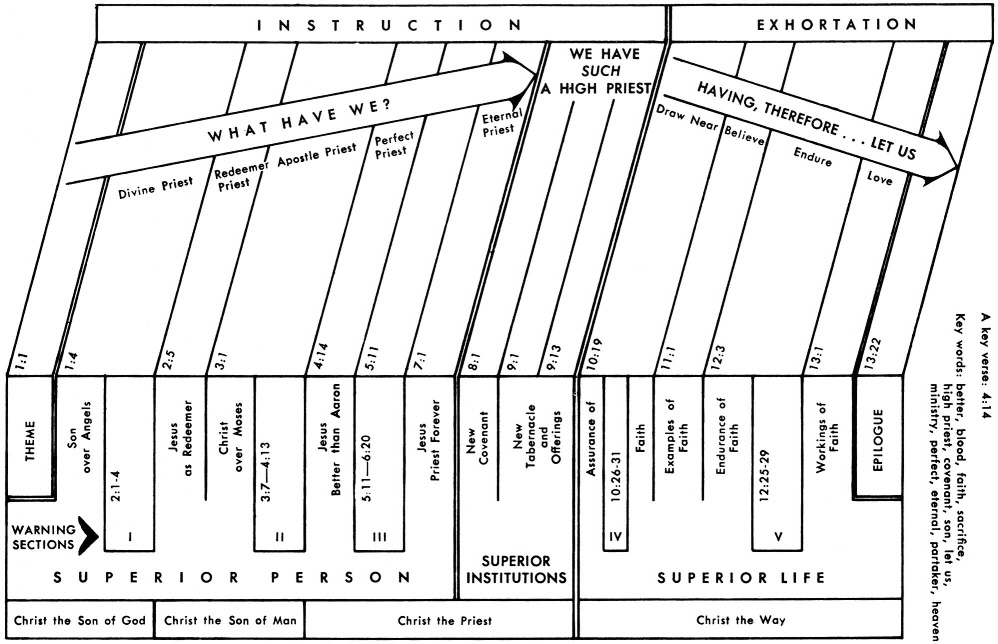
CONSIDER JESUS OUR GREAT HIGH PRIEST
Click chart to enlarge
Charts from Jensen's Survey of the NT - used by permission
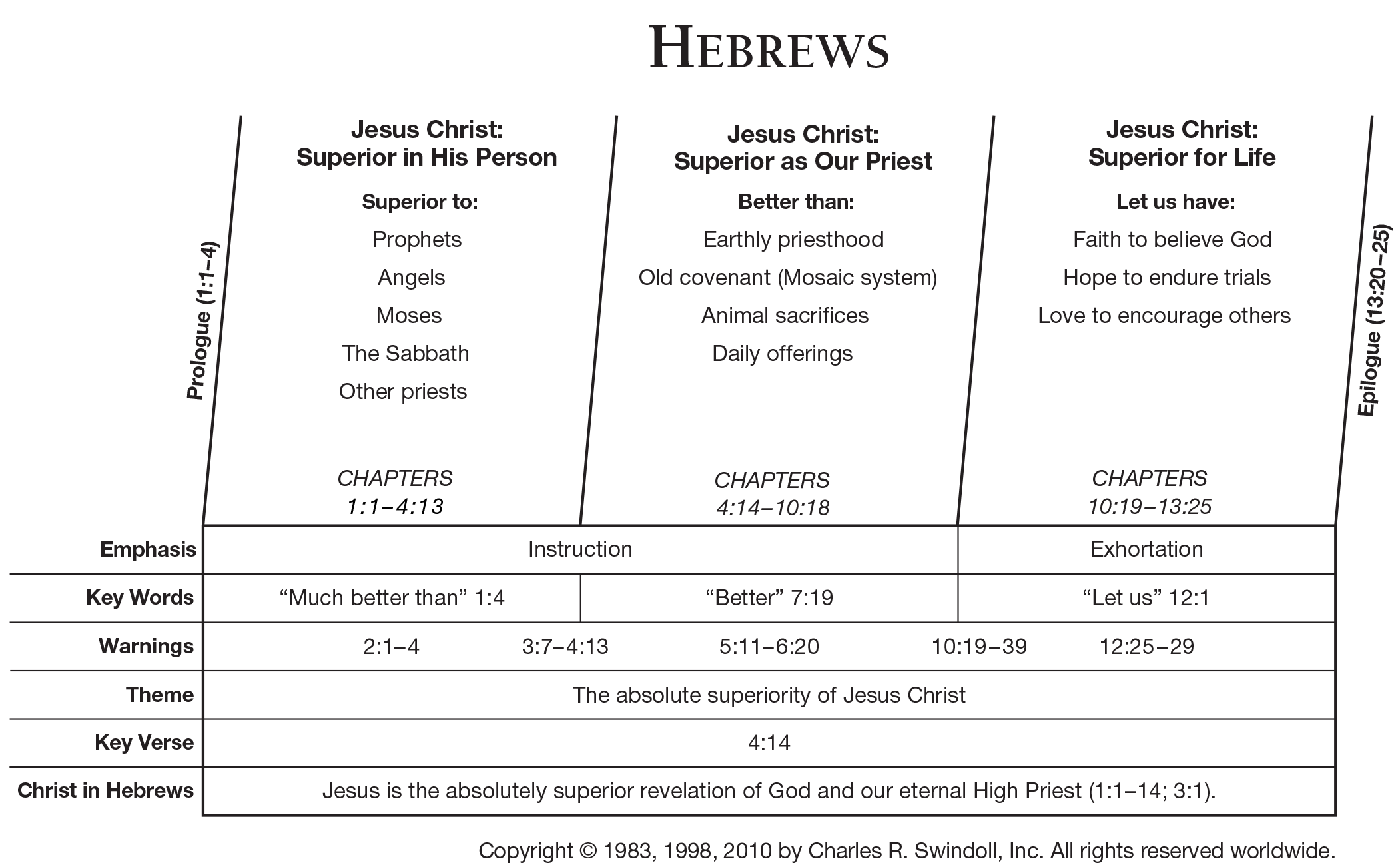
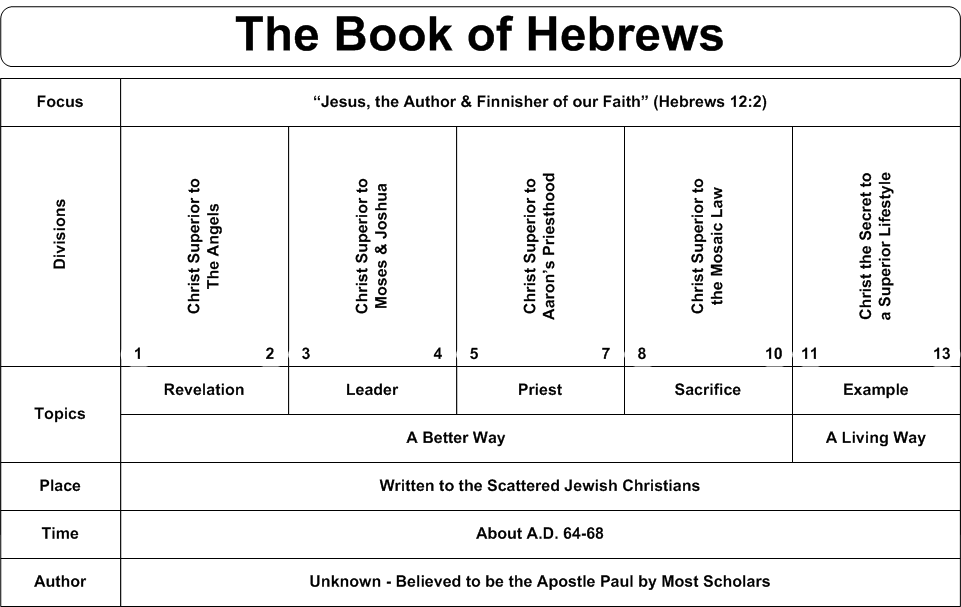
Swindoll's Chart, Interesting Pictorial Chart of Hebrews, Another Chart

|
The Epistle |
||||
| INSTRUCTION Hebrews 1-10:18 |
EXHORTATION Hebrews 10:19-13:25 |
|||
| Superior Person of Christ Hebrews 1:1-4:13 |
Superior Priest in Christ Hebrews 4:14-10:18 |
Superior Life In Christ Hebrews 10:19-13:25 |
||
| BETTER THAN PERSON Hebrews 1:1-4:13 |
BETTER PRIESTHOOD Heb 4:14-7:28 |
BETTER COVENANT Heb 8:1-13 |
BETTER SACRIFICE Heb 9:1-10:18 |
BETTER LIFE |
| MAJESTY OF CHRIST |
MINISTRY OF CHRIST |
MINISTERS FOR CHRIST |
||
|
DOCTRINE |
DUTY |
|||
|
DATE WRITTEN: |
||||

See ESV Study Bible "Introduction to Hebrews"
(See also MacArthur's Introduction to Hebrews)
Borrow Ryrie Study Bible
Hebrews 9:27 And inasmuch * as it is appointed for men to die once and after this comes judgment, (NASB: Lockman)
Greek: kai kath' oson apokeitai (3SPMI) tois anthropois hapax apothanein, (AAN) meta de touto krisis,
Amplified: And just as it is appointed for [all] men once to die, and after that the [certain] judgment. (Amplified Bible - Lockman)
Barclay: And just as it is laid down for men to die once and for all and then to face the judgment. (Westminster Press)
NLT: And just as it is destined that each person dies only once and after that comes judgment, (NLT - Tyndale House)
Phillips: And just as surely as it is appointed for all men to die and after that pass to their judgment (Phillips: Touchstone)
Wuest: And inasmuch as it is appointed to men once to die, but after this judgment
Young's Literal: and as it is laid up to men once to die, and after this -- judgment
KJV And as it is appointed unto men once to die, but after this the judgment:
NKJ And as it is appointed for men to die once, but after this the judgment,
NET And just as people are appointed to die once, and then to face judgment,
BGT καὶ καθ᾽ ὅσον ἀπόκειται τοῖς ἀνθρώποις ἅπαξ ἀποθανεῖν, μετὰ δὲ τοῦτο κρίσις,
CSB And just as it is appointed for people to die once-- and after this, judgment--
ESV And just as it is appointed for man to die once, and after that comes judgment,
NIV Just as man is destined to die once, and after that to face judgment,
Paraphrase Every human being has a divine appointment with death, and after death comes the certainty of judgment.
Paraphrase It is an unchangeable decree: all must die once, and then stand before God in judgment.
Paraphrase People are allotted only one death, and after that comes their evaluation before God.
Paraphrase Every person’s destiny is to die once, and after that to give account before God.”
- And inasmuch as it is appointed: Ge 3:19; 2Sa 14:14; Job 14:5; 30:23; Ps 89:48; Eccl 3:20; 9:5,10; 12:7; Ro 5:12
- but after this comes judgment: He 6:2 Job 19:25 Ec 11:9 12:14 Mt 25:31-46 Joh 5:26-29 Ac 17:31 Ro 2:5 14:9-12 1Co 4:5 2Co 5:10 2Ti 4:1 Jude 1:15 Rev 20:11
- Hebrews 9 Resources
THE UNAVOIDABLE APPOINTMENT:
EVERYONE'S DIVINELY FIXED DESTINY
This verse draws a solemn comparison between human destiny and Christ’s saving work. Just as death is an unavoidable appointment for every person, so too Christ’s once-for-all death was a divine appointment. Human beings cannot escape death and judgment; it is fixed by God’s decree. In the same way, Christ’s sacrifice was not random but divinely ordained, perfectly timed, and once-for-all. The writer uses this truth to underscore both the certainty of human accountability before God and the sufficiency of Christ’s single offering in the face of that judgment. The results of Christ's life are settled. In Christ's case the result is that He appears a second time without sin unto salvation, the sin having been destroyed by His death.
Here is the flow of the writer's argument in Hebrews 9:25–28. In Heb 9:25–26 Christ does not offer Himself repeatedly, unlike the high priest. In Heb 9:27 likewise, men die only once, not again and again. Heb 9:28 Therefore ("so"), Christ’s single offering suffices completely and will be followed by His return, not another sacrifice. The upshot is that the writer uses the certainty and finality of human death as an analogy to reinforce the certainty and finality of Christ’s sacrifice. Just as death is decisive and unrepeatable, so Christ’s offering is decisive and unrepeatable.
Death is once (no reincarnation, no cycles, no repeats).
Judgment follows (accountability before God).
And inasmuch (just as = introduces a comparison or analogy that is completed in Heb 9:28) as it is appointed (apokeimai - laid up, reserved, fixed by God's decree, set aside as certain and inevitable) for men to die (apothnesko - to expire, be separated from earthly existence) once (hapax once for all, never to be repeated) and after this (with nothing intervening, no purgatory) comes judgment (krisis) - Inasmuch is probably better translated just as, and this links nicely with the following passage which begins with so - Just as man dies once, so Christ as the God Man died only once as sacrifice. It introduces the comparison between human death/judgment and Christ’s death/salvation. What is true for other men was also the case for Christ—like other men, Christ was “destined to die once.” It is appointed (apokeimai) means men's death is not random but a divinely set appointment, certain and unavoidable. Once (hapax - key word in Heb 9:26-28!) means not multiple times, but one time, which is unrepeatable, unalterable, inescapable, and absolutely final! Judgment (krisis) refers to the decisive, divine verdict, a "crisis" (krisis), God’s evaluation and final verdict leading to either acquittal (believers were "acquitted" when we were justified) and reward or condemnation and punishment. The Bema Seat for saints (saved sinners) (2Co 5:10) or the Great White Throne judgment for unsaved sinners (Rev 20:11-15+). This verse excludes reincarnation, annihilation and second chances! Today is the day of salvation dear skeptical reader (2Co 6:2)!
🙏 THOUGHT - While many (including myself) yank this passage out of context and fail to see the writer's comparison with Christ's death, it fits perfectly with his analogy in Hebrews 9:28. In other words just as it is "appointed for men to die once," "so Christ also...was offered once!" Just as human death is a once-for-all event never to be repeated, so Christ’s offering of Himself in death was a once-for-all event, never to be repeated. Notice also how this parallel underscores substitution: Christ entered into what is common to all (death for us), but transformed its outcome (judgment → salvation for His people).
So let us not miss the writer's comparison/analogy in v27-28
Just as all humans die once and then face judgment
So also Christ died once (to bear sins) and will appear again (for salvation).
🙏 THOUGHT- Note how Christ's death bearing our sins changes our appointed judgment ("our court date") from wrath (Jn 8:24, Jn 5:24) to reward (2Co 5:10, 1Co 3:12-15, no condemnation - Ro 8:1)! The certainty of judgment highlights the necessity of Christ’s sacrifice, for by bearing our sins He secured our salvation instead of our condemnation. And while our death is followed by judgment, Christ's death will be followed by His return in glory! Hallelujah what a Savior! How great a salvation!
Marvin Vincent - That there is no place for a repeated offering of Christ is further shown by reference to the lot of men in general. The very idea is absurd; for men die once, and judgment follows. Christ was man, and Christ died. He will not come to earth to live and die again. Christ died, but judgment did not follow in His case. On the contrary, He became judge of all.
Death is not an accident
but an appointment!
William MacDonald observes that "Verses 27 and 28 seem to present another contrast between the Old Covenant and the New. The law condemned sinners to die once, but after this the judgment. The law was given to a people who were already sinners and who could not keep it perfectly. Therefore it became a means of condemnation to all who were under it. (Borrow Believer's Bible Commentary)
To die once - Once for all time to die. Reincarnation is excluded by this verse! For man this appointment is mandatory, but for our Lord it was voluntary. This is a generally true statement for we know that Enoch and Elijah apparently did not die (Ge 5:24; 2Ki 2:11) and we also know that the generation that is raptured will not die physically (see Rapture) In addition, Lazarus and those who came to life at Christ’s resurrection eventually died twice (cp Jn 11:43,44; Mt 27:51, 52, 53).
Death closes the door to earth,
but opens the court of heaven.
Vine writes that "man’s body becomes subject to death once, retributively on account of sin, and judgment follows. Had there been no provision made by God, death and judgment must have been the lot of all. Christ by His offering has, for those who accept Him, broken in upon this sequence of events. (W. E. Vine)
Man’s final breath
brings God’s final verdict.
Homer Kent - Death ends man’s opportunity to alter his circumstances. He does not get a second chance, nor die over and over. (ED: When death arrives, decisions are sealed.) Death closes the earthly scene for him, and then he must face the eternal issue of his life. This was an important point to remember as these early readers compared Christ’s sacrifice to the Levitical ones. The reason why Christ’s sacrifice does not need frequent repetition as was true of animals in Old Testament times is because Christ’s sacrifice consisted of Himself (Heb 9:25). It was a human sacrifice, and men die but once and then must face the results of their lives. Inasmuch as this particular human was the God-Man, the analogy is all the more forceful. (BORROW The Epistle to the Hebrews : a commentary PAGE 180)
Our last appointment on earth
is our first appointment with God.
As the KJV Bible Commentary rightly observes "It is axiomatic that man dies once. Exceptions do exist: Enoch and Elijah of the Old Testament, the New Testament saints who will be alive at Christ’s return who will never die, or Lazarus and others who have been raised from the dead and died twice. But no exceptions concerning God’s judgment can be cited. There is no reincarnation; every person gets one chance to prepare for God’s judgment.
One life, one death—then everything is weighed,
and the result declared: “after this, judgment.”
Spurgeon - A man dies once, and after that everything is fixed and settled, and he answers for his doings at the judgment. One life, one death—then everything is weighed, and the result declared: “after this, judgment.” So Christ comes, and dies once; after this, for Him also the result of what He has done, namely, the salvation of those who look for Him. He dies once, and then reaps the fixed result, according to the analogy of the human race, of which He became a member and representative. Men do not come back here to die twice. Men die once, and then the matter is decided, and there comes the judgment. So Christ dies; He does not come back here to die again, but He receives the result of His death—that is, the salvation of His own people. (Sermon Between Two Appearings)
Every life ends
at the bar of God’s justice.
Epicurus foolishly (see Ro 1:21,22) said "Thus, that which is the most awful of evils - death is nothing to us, since when we exist, there is no death. And when there is death, we do not exist!" Ah, foolish man! That is deceptively comforting until one reads Hebrews 9:27! Epicurus did not understand Biblical truth in life, but he does now in death! What he denied in life he discovered in eternity that Christ is Lord, whether embraced in faith or faced in judgment (Phil 2:10-11)! The truth Epicurus rejected in life became the terror he realized in death. His last breath led him to understand the truth that...
Every grave
leads to God’s gavel.
Morris writes "There is a finality about it [death] that is not to be disputed. But if it is the complete and final end to life on earth, it is not, as so many in the ancient world thought, the complete and final end. Death is more serious than that because it is followed by judgment. Men are accountable, and after death they will render account to God.
Human destiny ends
in accountability before God.
The fact that there will be a judgment implies that men (in order to be judged - Rev 20:11-15) will rise from the dead (see The Two Resurrections - "First" and "Second" - on a timeline). This was a shock to the Greeks many of whom believed that when an individual died, he ceased to experience conscious existence in any form. Thus some of the Greek writers philosophized that…
When earth once drinks the blood of a man, there is death once and for all and there is no resurrection. - Aeschylus
COMMENT: "The foolishness of God is wiser than men" like Aeschylus (1Co 1:25). Indeed, the earth drank Christ's blood at Calvary, but death could not hold Him (Acts 2:24). Christ's empty tomb proves that spilled blood does not mean finality—it means victory. "Christ has been raised from the dead, the first fruits of those who are asleep." (1Co 15:20) Unlike Aeschylus’ grim view, the Bible proclaims that death is swallowed up in victory, Paul writing "But when this perishable will have put on the imperishable, and this mortal will have put on immortality, then will come about the saying that is written, “DEATH IS SWALLOWED UP in victory. “O DEATH, WHERE IS YOUR VICTORY? O DEATH, WHERE IS YOUR STING?”" (1 Cor 15:54–55). The world says: “Death is the end.” Christ says in effect "I am the beginning of life"....“I am the resurrection and the life.” (Mt 11:25) Blood spilled at Calvary did not end hope—it birthed it. What Aeschylus called final, Christ called FINISHED (tetelestai)! GLORY! HALLELUJAH!
For the one loss is this that never mortal maketh good again the life of man-though wealth may be re-won. - Euripides (Greek Tragedy)
COMMENT: For Euripides and much of classical Greek thought, death was final. Wealth, power, or status could be rebuilt; but when life ended, all was over. The tragic worldview saw the grave as the ultimate one-way street. While Euripides saw Death as irretrievable, hopeless, final, Scripture teaches Death is real and serious, but not ultimate. What mortals cannot “make good again,” God restores by resurrection.
Wealth may be re-won, but in Christ even life is re-given.
Only in Christ is the irrecoverable recovered.
Euripides is saying that all losses can be recovered—except death. Once life is gone, no human can bring it back. It is the one irrecoverable loss from a human standpoint. His words reflect the despair of a worldview without a living hope of resurrection (1Pe 1:3). The Bible counters that in Christ, even death is not final—life lost is life restored in Christ, earthly wealth may perish but resurrection life is eternal with heavenly treasures that neither moth nor rust destroys, and where thieves do not break in or steal. (Mt 6:20)
Homer makes Achilles say when he reaches the shades "Rather would I live upon the soil as the hireling of another, with a landless man whose livelihood was small, than bear sway among all the dead who are no more."
Life’s certainty is death,
and death’s certainty is judgment.
Appointed (606) (apokeimai from apó = from, away + keímai = to lie, to be laid up, to set away) means literally to put something away for safekeeping, to reserve, to store away in a place for preservation (secular usage referred to money laid up or hidden). Apokeimai pictures something set aside in safekeeping—whether as a deposit, an inheritance, or a destiny (positive or negative). It can describe something physically stored (like money) or spiritually reserved (like hope or a crown). Used literally of a mina "kept put away in a handkerchief." (Lk 19:20). In Col 1:5 it refers to the spiritual blessing of "hope laid up for you in heaven." In 2Ti 4:8 Paul refers to the spiritual blessing that "in the future there is laid up for me (WHICH IS) the crown of righteousness." Our hope and reward are not fragile or earthly but preserved in heaven, safe from loss or corruption. Believers can live with certainty, knowing that their reward is stored away by God Himself. Figuratively it means to be appointed or destined (awaiting someone) as in Heb 9:27. With the story of the mina Jesus teaches that misusing or hiding what God entrusts leads to loss rather than reward.
Marvin Vincent - apokeimai is laid away, as the pound in the napkin, Luke 19:20. With the derivative sense of reserved or awaiting, as the crown, 2 Tim. 4:8. In Heb. 9:27, it is rendered appointed (unto men to die), where, however, the sense is the same: death awaits men as something laid up.
APOKEIMAI - 4V - appointed(1), laid(2), put away(1). Lk. 19:20; Col. 1:5; 2Ti 4:8; Heb. 9:27
Apokeimai is used twice in the Septuagint (LXX) - Genesis 49:10 and Job 38:23 (Which I have reserved [Hebrew = chasak = keep back, deep fro oneself; Lxx = apokeimai] for the time of distress, for the day of war and battle?)
Once (530) (hapax) means once for all time so that it never needs repeating. means literally once or one time. It is used to describe a simple numerical occurrence of once (2Cor 11:25). It can also be used to convey the sense of something done uniquely and thus means once for all. It is that which is so done as to be of perpetual validity, and never needs repetition (see note Hebrews 9:28).
Once (hapax) means once for all time so that it never needs repeating. This is a generally true statement for we know that Enoch and Elijah apparently did not die (Ge 5:24; 2Ki 2:11) and we also know that the generation that is raptured will not die physically (see Rapture) (See Why did God take Enoch and Elijah to heaven without them dying?) In addition, Lazarus and those who came to life at Christ’s resurrection eventually died twice (cp Jn 11:43,44; Mt 27:51, 52, 53).
Friberg - adverb; once; (1) as a strictly numerical concept in the sense of one time once (2Co 11.25); once a year (Heb 9.7); (2) of something done uniquely only once, once for all (Heb 9.28); (3) idiomatically a[. kai. di,j literally once and twice, i.e. more than once, several times (Php 4.16) (BORROW Analytical Lexicon of the Greek New Testament)
Gilbrant - From the time of Homer, classical Greek writings contain this term as an actual numeral. However, this word, like the Latin semel, also could refer to the quality of perpetual validity, that which did not need repetition. Sometimes it was employed in connection with the enactment of a law that was given once and for all. This once-for-all sense came to be far more important than the simple numerical significance.
HAPAX - 15V KEYWORD (>50% IN HEBREWS) - Neh. 7:70; 2 Co. 11:25; Phil. 4:16; 1 Thess. 2:18; Heb. 6:4; Heb. 9:7; Heb. 9:26; Heb. 9:27; Heb. 9:28; Heb. 10:2; Heb. 12:26; Heb. 12:27; 1 Pet. 3:18; Jude 1:3; Jude 1:5
Hebrews 6:4 For in the case of those who have once been enlightened
Hebrews 9:7 but into the second, only the high priest enters once a year
Hebrews 9:26 but now once at the consummation of the ages
Hebrews 9:27 it is appointed for men to die once and after this comes judgment,
Hebrews 9:28 so Christ also, having been offered once to bear the sins of many
Hebrews 10:2 because the worshipers, having once been cleansed
Hebrews 12:26 YET ONCE MORE I WILL SHAKE NOT ONLY THE EARTH, BUT ALSO THE HEAVEN
Hebrews 12:27 This expression, “Yet once more,” denotes the removing of those things
Judgment (2920) (krisis from krino = to judge, primarily signifies to distinguish, separate or discriminate) speaks of a separating, a division or a decision. Krisis is a general term encompassing the judgment of all people, believers (2Cor 5:10) and unbelievers (Re 20:11-15 ).
KRISIS - Matt. 5:21; Matt. 5:22; Matt. 10:15; Matt. 11:22; Matt. 11:24; Matt. 12:18; Matt. 12:20; Matt. 12:36; Matt. 12:41; Matt. 12:42; Matt. 23:23; Matt. 23:33; Lk. 10:14; Lk. 11:31; Lk. 11:32; Lk. 11:42; Jn. 3:19; Jn. 5:22; Jn. 5:24; Jn. 5:27; Jn. 5:29; Jn. 5:30; Jn. 7:24; Jn. 8:16; Jn. 12:31; Jn. 16:8; Jn. 16:11; Acts 8:33; 2 Thess. 1:5; 1 Tim. 5:24; Heb. 9:27; Heb. 10:27; Jas. 2:13; Jas. 5:12; 2 Pet. 2:4; 2 Pet. 2:9; 2 Pet. 2:11; 2 Pet. 3:7; 1 Jn. 4:17; Jude 1:6; Jude 1:9; Jude 1:15; Rev. 14:7; Rev. 16:7; Rev. 18:10; Rev. 19:2
Albert Barnes writes that…
And as it is appointed unto men once to die. Or, "since it is appointed unto men to die once only." The object of this is to illustrate the fact that Christ died but once for sin, and that is done by showing that the most important events pertaining to man occur but once. Thus it is with death. That does not, and cannot occur many times. It is the great law of our being, that men die but once, and hence the same thing was to be expected to occur in regard to him who made the atonement. It could not be supposed that this great law pertaining to man would be departed from in the case of him who died to make the atonement, and that he would repeatedly undergo the pains of death. The same thing was true in regard to the judgment. Man is to be judged once, and but once. The decision is to be final, and is not to be repeated. In like manner, there was a fitness that the great redeemer should die but once, and that his death should, without being repeated, determine the destiny of man. There was a remarkable oneness in the great events which most affected men; and neither death, the judgment, nor the atonement could be repeated. In regard to the declaration here, that "it is appointed unto men once to die," we may observe,
(1,) that death is the result of appointment, Genesis 3:19, It is not the effect of chance, or hap-hazard. It is not a "debt of nature." It is not the condition to which man was subject by the laws of his creation. It is not to be accounted for by the mere principles of physiology. God could as well have made the heart to play for ever as for fifty years. Death is no more the regular result of physical laws than the guillotine and the gallows are. It is, in all cases, the result of intelligent appointment, and for an adequate cause.
(2.) That cause, or the reason of that appointment, is sin. Romans 6:23. This is the adequate cause; this explains the whole of it. Holy beings do not die. There is not the slightest proof that an angel in heaven has died, or that any perfectly holy being has ever died, except the Lord Jesus. In every death, then, we have a demonstration that the race is guilty; in each case of mortality we have an affecting memento that we are individually transgressors.
(3.) Death occurs but once in this world. It cannot be repeated, if we should desire to have it repeated. Whatever truths or facts, then, pertain to death; whatever lessons it is calculated to convey, pertain to it as an event which is not to occur again. That which is to occur but once in an eternity of existence acquires, from that very fact, if there were no other circumstances, an immense importance. What is to be done but once, we should wish to be done well. We should make all proper preparation for it; we should regard it with singular interest. If preparation is to be made for it, we should make all which we expect ever to make. A man who is to cross the ocean but once-to go away from his home never to return-should make the right kind of preparation. He cannot come back to take that which he has forgotten; to arrange that which he has neglected; to give counsel which he has failed to do; to ask forgiveness for offences for which he has neglected to seek pardon. And so of death. A man who dies, dies but once. He cannot come back again to make preparation, if he has neglected it; to repair the evils which he has caused by a wicked life; or to implore pardon for sins for which he had failed to ask forgiveness. Whatever is to be done with reference to death, is to be done once for all before he dies.
(4.) Death occurs to all. "It is appointed unto men"-to the race. It is not an appointment for one, but for all. No one is appointed by name to die; and not an individual is designated as one who shall escape. No exception is made in favour of youth, beauty, or blood; no rank or station is exempt; no merit, no virtue, no patriotism, no talent, can purchase freedom from it. In every other sentence which goes out against men, there may be some hope of reprieve. Here there is none. We cannot meet an individual who is not under sentence of death. It is not only the poor wretch in the dungeon, doomed to the gallows, who is to die—it is the rich man in his palace; the gay trifler in the assembly room; the friend that we embrace and love; and she whom we meet in the crowded saloon of fashion, with all the graces of accomplishment and adorning. Each one of these is just as much under sentence of death as the poor wretch in the cell, and the execution on any one of them may occur before his. It is, too, for substantially the same cause, and is as really deserved. It is for sin that all are doomed to death; and the fact that we must die should be a constant remembrance of our guilt.
(5.) As death is to occur to us but once, there is a cheering interest in the reflection that when it is passed it is passed for ever. The dying pang, the chill, the cold sweat, are not to be repeated. Death is not to approach us often-he is to be allowed to come to us but once. When we have once passed through the dark valley, we shall have the assurance that we shall never tread its gloomy way again. Once, then, let us be willing to die-since we can die but once; and let us rejoice in the assurance which the gospel furnishes, that they who die in the Lord leave the world to go where death in any form is unknown.
But after this the judgment. The apostle does not say how long after death this will be, nor is it possible for us to know, Acts 1:7; Matthew 24:36. We may suppose, however, that there will be two periods in which there will be an act of judgment passed on those who die.
(1.) Immediately after death, when they pass into the eternal world, when their destiny will be made known to them. This seems to be necessarily implied in the supposition that they will continue to live, and to be happy or miserable after death. This act of judgment may not be formal and public, but will be such as to show them what must be the issues of the final day; and as the result of that interview with God, they will be made happy or miserable until the final doom shall be pronounced.
(2.) The more public and formal act of judgment, when the whole world will be assembled at the bar of Christ, Matthew 25. The decision of that day will not change or reverse the former; but the trial will be of such a nature as to bring out all the deeds done on earth, and the sentence which will be pronounced will be in view of the universe, and will fix the everlasting doom. Then the body will have been raised; the affairs of the world will be wound up; the elect will all be gathered in, and the state of retribution will commence, to continue for ever. The main thought of the apostle here may be, that after death will commence a state of retribution which can never change. Hence there was a propriety that Christ should die but once. In that future world he would not die to make atonement, for there all will be fixed and final. If men, therefore, neglect to avail themselves of the benefits of the atonement here, the opportunity will be lost for ever. In that changeless state, which constitutes the eternal judgment, no sacrifice will be again offered for sin; there will be no opportunity to embrace that Saviour who was rejected here on earth. — Barnes' Notes on the New Testament
QUESTION - What does the Bible say about reincarnation? | GotQuestions.org WATCH VIDEO
ANSWER - To reincarnate is, literally, to “incarnate again”; that is, reincarnation is a “rebirth” into a new body of flesh and blood. In most contexts, reincarnation refers to the process, after death, of a soul returning in a new body. Claims of remembering a “past life” imply reincarnation.
According to some religious and philosophical systems, reincarnation involves more than human souls and bodies: a dog’s spirit can reincarnate as another dog, for example, or a human soul can reincarnate as a cow. Reincarnation, also referred to as the transmigration of the soul, rests on concepts such as the eternal, uncreated nature of the soul and the need for the soul to “mature,” grow, transform, and evolve.
Of course, there is no “proof” for reincarnation. Any evidence put forward is entirely subjective: feelings of déjà vu, recurring dreams, feeling one has an “old soul,” irrational phobias, and an affinity for other cultures and eras are all interpreted, by some, as confirmation that they are living another life in a different body.
The concept of reincarnation, in any of its forms, is completely without foundation in the Bible. The truth is that we die once and then face judgment (Hebrews 9:27). The Bible never even remotely suggests that people have a second chance at life or that they can come back as different people or animals. Reincarnation has been a popular belief for thousands of years, but it has never been accepted by Christians or followers of Judaism because it is contradictory to Scripture.
Several passages in Scripture refute the idea of reincarnation. Jesus told the criminal on the cross, “Today you will be with me in paradise” (Luke 23:43)—not “You will have another chance to live a life on earth.” Matthew 25:46 tells us that, upon death, believers go on to eternal life while unbelievers go on to eternal punishment. We are created as individuals, and our identity does not change after death (see Luke 9:30).
Some who believe in reincarnation point to Matthew 17:10–13 as biblical support for reincarnation. The disciples ask Jesus about the commonly taught prophecy that Elijah must come before the Messiah (verse 10; cf. Malachi 4:5), and Jesus responds by identifying the “Elijah” of the prophecy as John the Baptist (Matthew 17:11–13). However, Jesus was not teaching that John the Baptist was Elijah reincarnated. For one thing, Elijah did not die; he was taken to heaven in a chariot of fire (2 Kings 2:11), so the literal “coming” of Elijah would have been a descent from heaven, not a reincarnation. Jesus calls John the Baptist “Elijah” because he came “in the spirit and power of Elijah” (Luke 1:17), not because he was Elijah in a literal sense. Also, Elijah himself had just appeared, talking with Jesus (Matthew 17:3), which shows that Elijah had not changed his identity—he had not become John. Finally, the people had earlier asked John the Baptist if he was Elijah, and he said, “I am not” (John 1:21).
Belief in reincarnation is a central tenet in most Indian religious traditions such as Hinduism, Sikhism, and Jainism. Many modern pagans also believe in reincarnation, as do some in the New Age movement, along with followers of Spiritualism. For the Christian, however, there can be no doubt: reincarnation is unbiblical and must be rejected as false.
Related Resource:
QUESTION - Is annihilationism biblical? | GotQuestions.org
ANSWER - Annihilationism is the belief that unbelievers will not experience an eternity of suffering in hell but will instead be “extinguished” or annihilated after death. Annihilationism is an attractive belief to many because of the awfulness of the idea of people spending eternity in hell. While there are some passages that seem to support annihilationism, a comprehensive look at what the Bible says about the destiny of the wicked reveals that punishment in hell is eternal. A belief in annihilationism results from a misunderstanding of the consequences of sin, the justice of God, and/or the nature of hell.
The end of life is not nothingness,
but accountability.
In relation to the nature of hell, annihilationists misunderstand the meaning of the lake of fire. Obviously, if a human being were cast into a lake of burning lava, he or she would be almost instantly consumed; however, the lake of fire is both a physical and spiritual realm. The punishment is not simply of a human body; it is of a human’s body, soul, and spirit. A spiritual nature cannot be consumed by physical fire. It seems that the unsaved are resurrected with a body fit for eternity just as the saved are (Revelation 20:13; Acts 24:15). These bodies are prepared for an eternal fate.
Life’s last heartbeat
summons all to God’s judgment seat.
Eternity is another point of contention. Annihilationists are correct that the Greek word aionion, which is usually translated “eternal,” does not by definition mean “eternal.” It refers to an “age” or “eon,” a specific period of time. In some passages, however, aionion is without question used to refer to an eternity. Revelation 20:10 speaks of Satan, the beast, and the false prophet being cast into the lake of fire and being “tormented day and night forever and ever.” These three are not “extinguished” by being cast into the lake of fire, but their torment goes on forever. Why would the fate of the unsaved, who are also thrown into the lake of fire, be any different (Revelation 20:14–15)?
One evidence for the eternality of hell is Matthew 25:46: “Then they [the unsaved] will go away to eternal punishment, but the righteous to eternal life.” In this verse, the same Greek word is used to refer to the destiny of the wicked and the righteous. If the wicked are only tormented for an “age,” then the righteous will only experience life in heaven for an “age.” If believers will be in heaven forever, unbelievers will be in hell forever.
Another frequent objection raised by annihilationists to the eternality of hell is that it would be unjust for God to punish people eternally for a finite amount of sin. How could it be fair for God to take a person who lived 70 years in sin, and punish him or her for all eternity? The answer is that our sin bears an infinite consequence because it is committed against an infinitely holy God. When King David committed the sins of adultery and murder, he prayed, “Against you, you only, have I sinned and done what is evil in your sight” (Psalm 51:4). God is an eternal and infinitely glorious being. Our sin, an affront to infinite worth and eternal glory, warrants an infinite and eternal punishment. The consequence is proportional to the value of the thing targeted. What matters is not the length of time we sinned, but the value of the character of the God we sinned against.
More personally, annihilationism puts forward the idea that we could not possibly be happy in heaven if we knew that some of our loved ones were suffering an eternity of torment in hell. Scripture says, however, that we will not have anything to complain about or be saddened by in the eternal state. God will “‘will wipe every tear from their eyes. There will be no more death’ or mourning or crying or pain, for the old order of things has passed away” (Revelation 21:4). If some of our loved ones are not in heaven, we will be in complete agreement that they do not belong there and that they are condemned by their own refusal to accept Jesus Christ as their Savior (see John 3:18; 14:6). It is hard to understand this, but we will not be saddened by the lack of their presence. Our focus now should not be on how we can enjoy heaven without our loved ones but on how we can point our loved ones to faith in Christ so they will be with us.
Hell is perhaps a primary reason why God sent Jesus Christ to pay the penalty for our sins. Being “extinguished” after death is no fate to dread, but an eternity in hell is. Jesus’ death paid our infinite sin debt so we would not have to pay it in hell for eternity (2 Corinthians 5:21). When we place our faith in Him, we are saved, forgiven, cleansed, and promised an eternal home in heaven. But if we reject God’s gift of eternal life, we will face the eternal consequences of that decision.
Appointed Once
Each life is given but one brief breath,
Appointed once to taste of death;
No second chance, no endless span,
The grave awaits each mortal man.
Beyond the veil, the Judge is near,
Whose eyes see all, whose gaze is clear;
No hidden thought, no secret deed,
Escapes the One who weighs each need.
So live, O soul, with wisdom true,
For fleeting days will soon be through;
Prepare to stand before His throne,
Through Christ who died to make you His own.
We Will All Face Death - Is the story of Sarah Winchester and the Winchester Mystery House® in San Jose, California true or is it surrounded by legend?
Sarah Winchester’s husband William Wirt Winchester had acquired a fortune by manufacturing and selling rifles invented by Benjamin Tyler Henry in 1860, the first successful lever-action repeating rifle using a self-contained metallic cartridge. This design was revolutionary because it allowed multiple sfhots without reloading after each one. William's father, Oliver Winchester, owned the company named Winchester Repeating Arms Company that manufactured and improved Henry’s design of the company. In 1873 the Winchester® rifle Model 73, known as “The Gun that Won the West,” was released. After Oliver Winchester died in 1880, he passed the company to his son William Wirt Winchester who died 3 months later of tuberculosis ("consumption") at the age of 43. Sarah Winchester inherited William Winchester’s vast fortune, reportedly $20 million dollars plus nearly 50% of the Winchester® Repeating Arms stock. In 1885 Sarah Winchester moved to California. In 1886 Sarah Winchester purchased a two-story farmhouse near San Jose, California, and began her remodeling the home which soon grew into her beloved Llanada Villa, later known as the Winchester Mystery House®. 1890-1900 marked the heyday of the mansion’s construction, when it rose from a small farmhouse to a 7-story Victorian giant. On February 24, 1895 The San Francisco Chronicle published the first known written story suggesting that Sarah Winchester was building her home to avoid death. She herself never responded publicly as to why she was building the house, so the story continued to be shared and repeated in newspapers until her death. In 1906 the Great San Francisco earthquake damaged the mansion. The 7-story tower and most of the fourth floor are later demolished. On June 10, 1911 – The San Francisco Examiner published an article calling the mansion a “House of Mystery”. This was during Sarah Winchester’s time living in the home and long before it was ever known as the Winchester Mystery House. On September 5, 1922 Sarah Winchester passed away at Llanada Villa in San Jose. Thirty-six years of construction ceased at the news of Mrs. Winchester’s death.
Here is where truth becomes legend. The legend says that Sarah sought out a medium to contact her dead husband. The medium told her, “As long as you keep building your home, you will never face death.”There is no solid historical evidence that Sarah consulted a medium who told her she must keep building to avoid death. That story appears decades later as part of the house’s marketing and local folklore. While Spiritualism was popular in the 1800s, and Sarah may have had some interest in it, the dramatic prophecy is unproven.
Continuous construction on the house - This part is true: construction went on for nearly 38 years (1884–1922). However, it was not literally nonstop day-and-night building as often claimed. Work crews were regularly employed, but the “unceasing” aspect is somewhat exaggerated. The house did become enormous, though figures vary: about 160 rooms, not exactly 150. The cost is often cited around $5 million at the time (which would be far higher today). Details like “2,000 doors” and “10,000 windows” are approximate and promotional, not precise counts. The “materials left for 80 more years” is not historically documented. Finally there is no clear evidence that she built out of fear of death or guilt over the rifle deaths.
While the story is intriguing and makes for an interesting illustration of Hebrews 9:27, it is probably a story that should be avoided because it cannot be historically verified. Stories that she held nightly seances to consult spirits on house construction are sensationalized myths. Popular lore claims a medium told her that she was haunted by victims of the Winchester rifle, requiring her to move west and continuously build her mansion. There is no evidence she was advised by a medium, and she actually adhered to the Episcopal Church. While a "Blue Room" in the house is known as a seance room, there is no documentation from her time confirming its use for communicating with the dead. Stories of her bizarre spiritual practices were largely promoted by sensationalist journalists after her death and during the early days of the house being a tourist attraction.
Here is an excerpt from the Winchester House website...
But as far as Sarah Winchester is concerned, unless some secret cache of papers is one day discovered that answers the question of her beliefs once and for all, the truth will remain hers alone. Either way, the stories of this enigmatic woman’s belief in the occult will no doubt continue to be passed down for at least another hundred years.
Wikipedia adds...
Testimonies and records from those who knew her describe her as intelligent, kind, a savvy financial manager, and not superstitious, remaining sharp-witted even into old age. However, in the years since her death, she has been depicted in popular culture as guilt-ridden, mad with grief, and delirious in her later life.
So we will leave this story as a legend and although she did die once as stated in Hebrews 9:27, this is probably not the best illustration of that verse. We do not know whether she was a believer in Jesus Christ and if she was not, then like all unbelievers, she had surely had a "fear of death (and was) subject to slavery all (her life)." (Hebrews 2:14, 15) "Thanks be to God, Who gives us the victory (over death) through our Lord Jesus Christ." (1Co 15:55,56, 57)
From Sunset To Sunrise - Kariel was riding home from a children's program at church with her neighbor friends. Admiring the sunset, she said to Gini, the driver, "That sunset is so beautiful it looks like heaven!" So Gini asked her, "Do you know how to get to heaven?" Kariel, who was only 5, answered confidently, "You have to have Jesus as your Savior—and I do!" Then she began to ask her friends in the van if they knew Jesus too.
That same evening, Kariel's 13-year-old sister Chantel was at another church, where someone asked her if she knew Jesus as her Savior. She told the person she did.
Early the next morning, fire swept through Kariel and Chantel's home, and tragically, they both died. They were in heaven with Jesus at sunrise.
No one has the promise of tomorrow. The crucial question is: Have we admitted our need for God's forgiveness of our sin and trusted Jesus as our Savior? (Romans 3:23; John 1:12). Our sin separates us from God and requires judgment, but Jesus gave His life in our place (Hebrews 9:27-28).
Make sure you have the same confidence that Chantel and Kariel had. Then, when your time comes to die, you'll be in heaven with Jesus at the next sunrise. —Anne Cetas (Our Daily Bread)
When I shall come to the end of my way,
When I shall rest at the close of life's day,
When "Welcome home" I shall hear Jesus say,
O that will be sunrise for me!
—Poole © Renewal 1952, The Rodeheaver Co.
Sunset in one land is sunrise in another.
The believer’s sunset is heaven’s sunrise.
When life sets on earth, it rises in eternity.
Our last dusk is Christ’s eternal dawn.
The grave’s sunset opens glory’s sunrise.
Earth’s goodbye is heaven’s good morning.
To close your eyes here is to open them there.
HALLELUJAH!
Dead Is Dead - Do you ever think about your inevitable death? Or are you like the influential theater tycoon Bernard Jacobs, who said, “Of all the things in the world I think least about, it’s what happens after you die. Dead is dead.”
Is that what happens when we exhale our last breath and our brain cells stop functioning? When our life has come to an end, are we totally extinguished like a flame of a candle plunged into water? That’s a common belief. But it isn’t what the Bible teaches. Hebrews 9:27 declares that it is appointed for us “to die once, but after this the judgment.”
If we have received Jesus as Savior from our sins, we need not fear facing Him. We will enter into blessed fellowship with God for all eternity, for we will be “absent from the body and … present with the Lord” (2Co 5:8).
Jesus taught His disciples, “I am the resurrection and the life. He who believes in Me, though he may die, he shall live. And whoever lives and believes in Me shall never die” (John 11:25, 26).
Jesus’ message in the Word of God gives hope when we face our own death or the death of someone we love. He promises that we will enter our heavenly home and be with Him forever. We can count on His word. —Vernon C Grounds
“I go to prepare a place for you …
That where I am there you may be,”
Our death is not the end of life—
Beyond, with Christ, eternity!
—Hess
Jesus’ resurrection spelled the death of Death.
Christ’s rising wrote death’s obituary.
The empty tomb emptied death of power.
Jesus’ resurrection was death’s destruction.
The tomb is empty, death undone,
Our life secured by God’s own Son;
Through Him the door to heaven’s shore,
Is open wide forevermore.
One death we face, yet fear is gone,
For Christ has triumphed, risen, strong;
And when we breathe our final breath,
He brings us life that conquers death.
Not end but entrance, death shall be,
To Christ, our Lord, eternally;
The grave a gate, the veil undone,
Our dwelling with the Risen One.
Looking For Loopholes - Comedian W. C. Fields (1880-1946) could make audiences roar with laughter, yet he himself was chronically unhappy. Religion apparently played no part in his life. But it's been said that as he faced the possibility of dying, he started to devote time to reading the Bible. When he was asked about his new interest in Scripture, Fields, always the comedian, replied, "I'm looking for loopholes, my friend. Looking for loopholes."
Fields may not have known Hebrews 9:27, "It is appointed for men to die once, but after this the judgment," yet he realized that he might soon be standing before God. And he may have been wondering what he would say if asked by the Lord why he should not be judged for his sins.
We will all stand before God someday, so it's imperative that we prepare to meet Him. But how? The only preparation we need to make is to accept the Lord Jesus Christ as our Savior from sin. He died to take the punishment we deserve (2Cor 5:21; 1Peter 3:18). When we admit that we are sinners (Ro:23) and ask Him to forgive and save us (Acts 16:31; Romans 10:13), we are brought into a right relationship with God (2Corinthians 5:18, 19).
Are you prepared? There are no loopholes. —Vernon Grounds (Reprinted by permission from Our Daily Bread Ministries. Please do not repost the full devotional without their permission.)
How can you go another day?
Respond to Christ, do not delay;
Just trust in Him, His Word believe—
Eternal life you will receive.
—Branon
Don't plan to repent at the 11th hour—you may die at 10:30.
Delay is dangerous; death may arrive before repentance.
Waiting for the last hour may leave you no hour at all.
Procrastinated repentance often perishes unspoken.
Banking on a final chance may cost you your only chance.
The thief on the cross repented at the last hour — don’t presume you’ll have one.
Putting off repentance may put you out of time.
The clock of mercy may strike sooner than you think.
Those who wait for the 11th hour may be buried at 10:30.
Life's Final Deadline - Prepare to meet your God. —Amos 4:12 - We're all confronted with deadlines. Bills must be paid, licenses renewed, tax returns filed— the list goes on and on.
One deadline, though, is of supreme importance. It's one we all will face. The Bible says, "It is appointed for men to die once, but after this the judgment" (Hebrews 9:27).
Except for believers who are living when Jesus returns (1Th 4:16, 17), everyone will die. And all people from the beginning of history will stand before God in judgment. How foolish to neglect the preparation necessary for this inevitable accounting!
Time expires,
but responsibility remains.
In Luke 12, Jesus told a parable of a rich man who planned to build bigger barns to store all his earthly goods so he could live out his days in pleasure and ease. But God unexpectedly announced, "Fool! This night your soul will be required of you" (Luke 12:20). His ultimate deadline had arrived.
Are you ready to meet God? If you've never received Christ as your personal Savior, do so without delay. Believe that He shed His blood on the cross to forgive your sins, and that He conquered death by rising from the grave. Ask Him to save you. Then you can face life's final deadline with confidence. —Richard De Haan (Our Daily Bread, Copyright RBC Ministries, Grand Rapids, MI. Reprinted by permission. All rights reserved)
If you believe that Jesus lives, you don't need to fear death.
When you know Jesus lives, death loses its terror.
Those who trust the Living Lord need not dread the dying hour.
Because He lives, death cannot enslave.
EXPECTED -- SOONER OR LATER - "The living know that they will die." - Ecclesiastes 9:5
I heard a popular senator who was swept out of office after only one term. His defeat came as a complete surprise to opponents and supporters alike. In his concession speech, the losing candidate wryly commented that recent events reminded him of an epitaph he once saw on an old tombstone. It said:
I EXPECTED THIS -- BUT NOT SO SOON.
Death is certain for all! The Bible says, "It is appointed for me to die once" (Heb. 9:27). For some of us that day is closer than we think. The sensible person faces up to the fact of death and makes provision for this final episode of his earthly life.
There's only one way to prepare for eternity -- trusting Christ as Savior. Those who come to God through Him will enter heaven when they have drawn their last breath. But for unbelievers, that fateful moment will seal their never-ending doom.
Are you ready for the inevitable? Jesus said, "He who hears My word and believes in Him who sent Me has everlasting life, and shall not come into judgment, but has passed from death into life" (Jn. 5:24). If you've never done so, place your faith in Christ, acknowledging that He died for your sins and rose victorious from the grave. Then, whether the expected comes sooner or later, you'll be ready! -- Richard W. De Haan
Sooner or later, yes, sooner for some,
Darkness will all then be past;
Sooner or later our savior will come --
With Him will your lot be cast?
-- Koch
Live each day as if it were your last - it could be!
ach sunrise could be your final sunrise.
One day will be your last — live ready for it.
Your last day is coming — it could be this one.
Redeem the time
--Eph 5:16
Hebrews 9:28 so Christ also, having been offered once to bear the sins of many, will appear a second time for salvation without reference to sin, to those who eagerly await Him. (NASB: Lockman)
Greek: outos kai o Christos, hapax prosenechtheis (APPMSN) eis to pollon anenegkein (AAN) amartias, ek deuterou choris hamartias ophthesetai (3SFPI) tois auton apekdechomenois (PMPMPD) eis soterian.
BGT οὕτως καὶ ὁ Χριστὸς ἅπαξ προσενεχθεὶς εἰς τὸ πολλῶν ἀνενεγκεῖν ἁμαρτίας ἐκ δευτέρου χωρὶς ἁμαρτίας ὀφθήσεται τοῖς αὐτὸν ἀπεκδεχομένοις εἰς σωτηρίαν.
Amplified: Even so it is that Christ, having been offered to take upon Himself and bear as a burden the sins of many once and once for all, will appear a second time, not to carry any burden of sin nor to deal with sin, but to bring to full salvation those who are [eagerly, constantly, and patiently] waiting for and expecting Him. (Amplified Bible - Lockman)
Barclay: so Christ, after being once and for all sacrificed to bear the burden of the sins of many, will appear a second time, not this time to deal with sin, but for the salvation of those who are waiting for him. (Westminster Press)
NLT: so also Christ died only once as a sacrifice to take away the sins of many people. He will come again but not to deal with our sins again. This time he will bring salvation to all those who are eagerly waiting for him. (NLT - Tyndale House)
KJV So Christ was once offered to bear the sins of many; and unto them that look for him shall he appear the second time without sin unto salvation.
NKJ so Christ was offered once to bear the sins of many. To those who eagerly wait for Him He will appear a second time, apart from sin, for salvation.
NET so also, after Christ was offered once to bear the sins of many, to those who eagerly await him he will appear a second time, not to bear sin but to bring salvation.
CSB so also the Messiah, having been offered once to bear the sins of many, will appear a second time, not to bear sin, but to bring salvation to those who are waiting for Him.
ESV so Christ, having been offered once to bear the sins of many, will appear a second time, not to deal with sin but to save those who are eagerly waiting for him.
NIV so Christ was sacrificed once to take away the sins of many people; and he will appear a second time, not to bear sin, but to bring salvation to those who are waiting for him.
Phillips: so it is certain that Christ was offered once to bear the sins of many and after that, to those who look for him, he will appear a second time, not this time to deal with sin, but to bring them to full salvation. (Phillips: Touchstone)
Wuest: thus also the Messiah once was offered for the purpose of bearing the sins of many; a second time apart from sin shall He be manifested to those who eagerly wait for Him [Israel], resulting in salvation. (Eerdmans)
Young's Literal: so also the Christ, once having been offered to bear the sins of many, a second time, apart from a sin-offering, shall appear, to those waiting for him -- to salvation!
Paraphrase Just as humans die once, so Christ was once offered to carry the burden of many sins; and He will come again, not to deal with sin, but to bring full salvation to those who long for Him.
Paraphrase As all humanity faces death once, so Christ once bore the sins of the many. His return will not be to offer another sacrifice, but to grant salvation to His expectant people.
- Christ also having been offered once - Hebrews 9:25; Ro 6:10; 1Pe 3:18; 1Jn 3:5
- To bear Lev 10:17; Nu 18:1,23; Isa 53:4-6,11-12; Mt 26:28; Ro 5:15; 1Pe 2:24
- To those who eagerly await Him Php 3:20; 1Th 1:10; 2Ti 4:8; Titus 2:13; 2Pe 3:12
- Hebrews 9 Resources
Related Passages:
Isaiah 53:4-6 Surely our griefs He Himself bore, And our sorrows He carried; Yet we ourselves esteemed Him stricken, Smitten of God, and afflicted. 5 But He was pierced through for our transgressions, He was crushed for our iniquities; The chastening for our well-being fell upon Him, And by His scourging we are healed. 6 All of us like sheep have gone astray, Each of us has turned to his own way; But the LORD has caused the iniquity of us all To fall on Him.
Isaiah 53:11-12 As a result of the anguish of His soul, He will see it and be satisfied; By His knowledge the Righteous One, My Servant, will justify the many, As He will bear their iniquities. 12 Therefore, I will allot Him a portion with the great, And He will divide the booty with the strong; Because He poured out Himself to death, And was numbered with the transgressors; Yet He Himself bore the sin of many, And interceded for the transgressors.
1 Peter 2:24 and He Himself bore our sins in His body on the cross, so that we might die to sin and live to righteousness; for by His wounds you were healed.
ONCE FOR SIN
AGAIN FOR SALVATION
Hebrews 9:28 brings the sweeping argument of the chapter to its climax by drawing a parallel between human destiny (death) and Christ’s redemptive mission (deliverance). Just as every person is appointed to die once and then face judgment (Heb 9:27), so also Christ entered into death once—but not for His own sin. Instead, He was offered up as the sin-bearer for many, fulfilling the role of the suffering Servant foretold in Isaiah 53. Unlike the Levitical priests whose offerings had to be repeated, Christ's sacrifice was final and complete. The verse also shifts our gaze forward from His first coming which was to deal with sin, to His second that will be apart from sin, and will bring the full salvation and deliverance longed for by those who eagerly await Him. This verse captures both appearings of Christ—His past accomplishment of atonement and His future return in consummation—anchoring the believer’s hope (not hope so, but hope sure - confidence) in Christ’s once-for-all work and promised return to take us home!
Christ tasted death
to give us eternal life.
So (houtos kai) means in the same way also and serves as a connective particle (hinge phrase) that links verse 28 with verse 27. In this context, just as it is universally true that all people die once and then face judgment, so also Christ was offered once to bear the sins of many. The author deliberately draws a parallel between human beings who experience death only once, and Christ Who likewise experienced death only once—yet with a crucial difference. Human death leads to judgment for one’s own sin, but Christ’s death was to bear the judgment of sins of others. Hallelujah! What a Savior!
Christ entered death’s domain
to free us from its dominion.
Christ (Christos) also, having been offered (prosphero) once (hapax) to bear (anaphero) the sins (hamartia) of many - Having been offered (prosphero) is in the passive voice underscoring that Christ's offering was divinely ordained. In other words Christ did not offer Himself in isolation, but surrendered His will to the will of His Father (Lk 22:42) Who gave His only begotten Son as an offering for our sin (Jn 3:16). Isa 53:10 says that "the LORD (GOD THE FATHER) was pleased to crush Him (MESSIAH), putting Him to grief." Peter told his Jewish audience that Jesus was "delivered over (handed over) by the predetermined plan and foreknowledge of God, you nailed to a cross by the hands of godless men and put Him to death." (Acts 2:23). Once (hapax) underscores the finality and completeness of Christ’s sacrifice accomplished at Calvary (Jn 19:30 = tetelestai). It does not allow for repetition or supplementation, for in that single offering sin was dealt with entirely and redemption was secured forever.
Once means of perpetual validity, not requiring repetition.
The sacrifice for sins is finished, the penalty paid in full forever and ever.
To bear (anaphero) means literally “to carry up” or “to take upon oneself” and pictures Christ lifting and carrying the weight of sin, as the Substitute Who willingly bore the judgment that was due to us under God’s justice. (cf. Isa 53:12; 1 Pet 2:24). The sins (hamartia) embraces far more than the outward effects of sin but includes the guilt, the defilement, and the judgment it deserves. On the Cross, Christ bore sin in its every dimension. Of many echoes Isaiah 53:12 (“He Himself bore the sin of many”). In Hebrew idiom, many does not stand in contrast to all as if only a restricted group were in view. Rather, it is a Semitic way of speaking about a vast number, a great multitude beyond counting for whom Christ died. Thus many emphasizes both the abundance of those saved and the certainty that His sacrifice was not for a few only, but for a great host redeemed through faith.
Jesus, as our Great High Priest , offered up
the sacrifice of Himself by bringing His body up to the Cross.
Vine - Man’s life and work on earth end with death. The results only remain, as determined by divine judgment. So also the death of Christ is final. There was nothing further to be done by sacrifice for sin. The finality of His one offering for sin is corroborated by the analogy of human life. He will return, but to salvation and quite apart from sin. Christ having taken upon Himself human nature, without sin, was offered voluntarily in sacrifice, once, and once only, and now all who believe are delivered from judgment. He will instead bring salvation to them at His appearing. Accordingly, the appearing of Christ for the salvation of His people is set in contrast to the judgment of the unregenerate. That He will appear a second time is the main statement of the last verse. (Collected writings of W. E. Vine)
Ray Stedman - Throughout this section the emphasis of the writer has been on the uniqueness of Christ’s death. Again and again he has called it “once-for all” (hapax or ephapax). That thought comes to the fore again in verses 27–28. Just as any fallen human being is destined to die once for all time, with judgment awaiting beyond death, so Christ also died once for all time to deal with sin. (The Unfolding Pattern)
Christ shared our death
to spare us from eternal death.
Spurgeon - He came the first time with, “I delight to do your will, O my God” (Psa 40:8). He comes a second time to claim the reward and to divide the spoil with the strong. He came the first time with a sin-offering; that offering having been once made, there is no more sacrifice for sin. He comes the second time to administer righteousness. He was righteous at his first coming, but it was the righteousness of allegiance. He shall be righteous at his second coming with the righteousness of supremacy. He came to endure the penalty, he comes to procure the reward. He came to serve, he comes to rule. He came to open wide the door of grace, he comes to shut to the door. He comes not to redeem but to judge; not to save but to pronounce the sentence; not to weep while he invites, but to smile while he rewards; not to tremble in heart while he proclaims grace, but to make others tremble while he proclaims their doom. (Sermon Between Two Appearings)
Christ embraced death
so we could escape its sting
-- 1Co 15:55
Peter teaches the same truth about Christ our Sin Bearer writing that "He Himself bore our sins in His body on the cross, that (purpose clause - introduces why He died) we might die to Sin (power of Sin to tempt us to commit sins - Ro 6:11-13 ) and live to righteousness (right conduct before God and men) for (explains how this is possible) by His wounds you were healed (used figuratively here to refer to Christ's effecting our deliverance from spiritual sickness - from Sin as our master). For (amplifies that the "healing" was not from a physical illness but a spiritual sickness that made us prone to wander) you were continually straying like sheep, but now you have returned to the Shepherd and Guardian of your souls. (1Pe 2:24-25)
Christ bore the curse of death
to bless us with eternal life.
Leon Morris - Sin-bearing is a concept found in the NT only here and in 1Pe 2:24, but it is quite frequent in the OT, where it plainly means "bear the penalty of sin." For example, the Israelites were condemned to wander in the wilderness for forty years as the penalty for their failure to go up into the land of Canaan: "For forty years—one year for each of the forty days you explored the land—you will suffer for your sins" (Nu 14:34; cf. Ezek 18:20, et al.). Many see here an echo of the fourth Servant Song: "He will bear their iniquities" (Isa 53:11); "he bore the sin of many" (Isa 53:12). So the author is saying that Christ took upon himself the consequences of the sins of the many (cf. Mark 10:45). (See The Expositor's Bible Commentary - Abridged Edition)
Christ endured the destiny of death
to deliver the gift of life.
Jesus our Great High Priest bore our sins as our substitutionary sacrifice, dying in our place, in order to bring about atonement for our sins. The priests in the Old Covenant could not bear our sins.
Once for all our Savior died,
The sacrifice was made;
He bore our sins, was crucified,
The debt of guilt was paid.
Appointed all to die but once,
Then judgment must appear;
Yet Christ has borne our curse and shame,
Our pardon stands secure.
No veil of sin can hide His face,
The work is fully done;
From death to life, from wrath to grace,
The victory is won.
He comes again, our hope made sure,
Not bearing sin again;
But bringing life that shall endure,
Eternal, free from pain.
Christ went down into death
so we might rise into life.
Steven Cole writes that…
Christ did not come to die and then leave salvation up to the fallen sinner’s choice. Rather He came to “save His people from their sins” (Mt 1:21). He came to lay down His life for His sheep (John 10:11, 14, 15). “Christ … loved the church and gave Himself up for her” (Eph 5:25). He was “offered once to bear the sins of many” (Heb. 9:28, reflecting Is. 53:12). He will not fail in His purpose to save al that the Father gave Him (John 6:37, 38, 39, 40). His sacrifice on the cross put away all of our sin once and for all.
You may wonder, “How can I know that Christ offered Him-self for my sins?” That is a vitally important question! First, are you aware of your need for cleansing from your sin? Christ didn’t come to put away sin from those who think that they are righteous in them-selves (Luke 5:31, 32). Second, are you aware that you can do nothing to pay for your sin? You cannot put away your own sin through penance, personal determination, or self-denial. Years of good deeds cannot pay your debt of sin. Even the Old Testament sacrificial system could not put away sin (10:4)! Only Christ, by His death on the cross, could put away sin. If your trust is in Him and in Him alone, then you can be assured that He has put away your sins.
In a sermon on this verse, Spurgeon puts it like this (Spurgeon's Expository Encyclopedia [Baker], 14:211-212):
He says that if any are conscious of the burden of their guilt and the impending judgment of God on their sins, the news of one who can put away sin should be of great joy. If your house were on fire, you would rejoice to hear that the fire engines were coming down the street. You would be absolutely certain that they were coming for you, because your house was in a blaze if no one else’s might be. Thus the news of Christ’s coming into the world to put away sin will sound like a trumpet blast of joy “to those who know themselves to be full of sin, who desire to have it put away, who are conscious that they cannot remove it themselves, and are alarmed at the fate which awaits them if the sin be not by some means blotted out.” (Judgment or Salvation? Hebrews 9:23-28)
Christ (5547) (Christos from chrio = to anoint, rub with oil, consecrate to an office) is the Anointed One, the Messiah, Christos being the Greek equivalent of the transliterated Hebrew word Messiah. Christos describes one who has been anointed with oil, one who has been consecrated. The majority of the NT uses refer to Jesus (exceptions = "false Christs" - Mt 24:24, Mk 13:22).
Christos describes one who has been anointed, symbolizing appointment to a task. It is used here as the title "Anointed One" and is the Greek synonym for "Messiah." Christos is used in the Septuagint describing everyone anointed with the holy oil, especially the priesthood (Lev. 4:5, Lev 4:16) and it is also a name applied to those who were acting as redeemers like Cyrus.
Gilbrant writes that "Hamilton suggests a fourfold significance to such anointing (“māshach,” Theological Wordbook of the Old Testament, 1:530): (1) separation unto God, (2) authorization by God, (3) divine enablement, and (4) the coming Deliverer. In regards to this final use he says, “Though this association with the term māshach is not as prevalent in the OT as often supposed, the prospect of a righteous, Spirit-filled ruler is increasingly discernible in the OT (cf. Isaiah 9:1-7; Isa 11:1-5; Isa 61:1)” (ibid.). It was probably because of his role as a deliverer of God’s people, selected by the Lord for His purpose, that Cyrus, a Gentile emperor, was given the title of “messiah, anointed” (Isaiah 45:1). However, long after Cyrus, God’s people were still promised Messiah the prince, the one to fulfill all of the Biblical promises (Daniel 9:25,26)." (Complete Biblical Library Greek-English Dictionary)
CHRISTOS - 500V - USED 12X IN HEBREWS - Heb. 3:6; Heb. 3:14; Heb. 5:5; Heb. 6:1; Heb. 9:11; Heb. 9:14; Heb. 9:24; Heb. 9:28; Heb. 10:10; Heb. 11:26; Heb. 13:8; Heb. 13:21;
Hebrews 3:6 but Christ was faithful as a Son over His house–whose house we are
Hebrews 3:14 For we have become partakers of Christ
Hebrews 5:5 So also Christ did not glorify Himself so as to become a high priest,
Hebrews 6:1 Therefore leaving the elementary teaching about the Christ,
Hebrews 9:11 But when Christ appeared as a high priest of the good things to come
Hebrews 9:14 how much more will the blood of Christ, who through the eternal Spirit
Hebrews 9:24 For Christ did not enter a holy place made with hands, a mere copy
Hebrews 9:28 so Christ also, having been offered once to bear the sins of many
Hebrews 10:10 through the offering of the body of Jesus Christ once for all.
Hebrews 11:26 considering the reproach of Christ greater riches than the treasures of Egypt
Hebrews 13:8 Jesus Christ is the same yesterday and today and forever.
Hebrews 13:21 through Jesus Christ, to whom be the glory forever and ever. Amen.
Having been offered (4374) (prosphero from prós = to, toward + phéro = bring) means to carry or bring something into the presence of someone usually implying a transfer of something to that person carry to, bring (to). It means to bring near, to present, to offer and is a technical cultic term in LXX and NT for presenting a sacrificial offering to God. Thus prosphero describes an offering, whether of gifts, prayers, or sacrifices. The Septuagint (LXX) uses this word 124 times and often in the context of a sacrificial offering (more than 50 times in Leviticus alone!).
Friberg - (1) active bring to; passive be brought to; (a) with the accusative of person bring someone to someone (Mt 4.24); as a legal technical term hand over, bring before a magistrate ( Lk 23.14); (b) with the accusative of the thing bring, offer, hand something to someone (Mt 22.19); (2) of offerings, gifts, sacrifices, prayers to a deity present, bring, offer (Mt 2.11; Acts 7.42; Heb 5.7); (3) passive with the dative of person deal with, treat, act toward (Heb 12.7) (BORROW Analytical Lexicon of the Greek New Testament)
Gilbrant - As a compound of the preposition pros and the verb pherō, prospherō usually has the rather literal meaning of “to bring to.” This meaning is very common in classical literature. Prospherō can also mean “to present, offer,” especially of food or drink (Liddell-Scott). Further senses are “to address, to convey, to attack, to add,” and “to contribute” (ibid.). In the Septuagint prospherō is used quite extensively to refer to sacrifices being brought to God (Leviticus 2:8; Numbers 6:13), although cases exist of its being used simply to refer to anything or anybody brought to someone or something (Leviticus 8:6; Proverbs 19:24). In the New Testament we see many instances of the Old Testament usage in reference to sacrifices, particularly in the Book of Hebrews with its emphasis on the sacrifices. Here Weiss notes that prospherō is used to refer to the accomplishing of the sacrifice and not just to the bringing of it (“pherō,” Kittel, 9:67). Another common usage is that of the sick, lame, and demon possessed being brought to Jesus, although it is also used to indicate anyone’s being brought to another (Luke 23:14, Jesus is brought to Pilate). Of particular interest is John 16:2 where the King James Version reads, “He doeth God service.” A more literal translation would be “he offers God a service” or “he brings a service to God.” (Complete Biblical Library)
PROSPHERO IS A KEYWORD IN HEBREWS - 18X OUT OF 44 NT USES - Heb. 5:1; Heb. 5:3; Heb. 5:7; Heb. 8:3; Heb. 8:4; Heb. 9:7; Heb. 9:9; Heb. 9:14; Heb. 9:25; Heb. 9:28; Heb. 10:1; Heb. 10:2; Heb. 10:8; Heb. 10:11; Heb. 10:12; Heb. 11:4; Heb. 11:17; Heb. 12:7
Hebrews 5:1 in order to offer both gifts and sacrifices for sins;
Hebrews 5:3 because of it he is obligated to offer sacrifices for sins
Hebrews 5:7 In the days of His flesh, He offered up both prayers and supplications
Hebrews 8:3 For every high priest is appointed to offer both gifts and sacrifices;
Hebrews 8:4 since there are those who offer the gifts according to the Law
Hebrews 9:7 not without taking blood, which he offers for himself
Hebrews 9:9 both gifts and sacrifices are offered
Hebrews 9:14 blood of Christ, who through the eternal Spirit offered Himself without blemish to God
Hebrews 9:25 nor was it that He would offer Himself often, as the high priest
Hebrews 9:28 so Christ also, having been offered once to bear the sins of many
Hebrews 10:1 by the same sacrifices which they offer continually year by year,
Hebrews 10:2 Otherwise, would they not have ceased to be offered
Hebrews 10:8 which are offered according to the Law
Hebrews 10:11 Every priest stands daily ministering and offering time after time the same sacrifices
Hebrews 10:12 but He, having offered one sacrifice for sins for all time
Hebrews 11:4 By faith Abel offered to God a better sacrifice than Cain
Hebrews 11:17 By faith Abraham, when he was tested, offered up Isaac
Hebrews 12:7 It is for discipline that you endure; God deals with you as with sons
Offered (399)(anaphero from ana = up, again, back + phero = bear, carry) literally means to carry, bring or bear up and so to to cause to move from a lower position to a higher position. It serves as a technical term for offering sacrifices offer up (to an altar). Figuratively (as in 1Pe 2:24) anaphero means to take up and bear sins by imputation (act of laying the responsibility or blame for) as typified by the ancient sacrifices. Jesus our Great High Priests bore our sins as our substitutionary sacrifice, dying in our place, in order to bring about atonement for our sins. The priests in the Old Covenant could not bear our sins.
Figuratively (as used in Hebrews 9:28) anaphero means to take up and bear sins by imputation (act of laying the responsibility or blame for) as typified (foreshadowed) by the Old Testament sacrifices which God had prescribed for Israel.
Anaphero is as a compound verb means “to carry up, to bring up, to present.” It was a technical sacrificial term in the LXX and NT for offering sacrifices to God (Heb 9:28; 1 Pet 2:5, 24). It suggests both the act of presentation and the ascent of the offering (smoke rising to God). The priests had to “carry up” countless sacrifices—but Christ “offered up” Himself once (note the aorist—decisive, completed action). It is interesting to note that the Jewish people did not crucify criminals. They stoned them to death. But if the victim was especially evil, his dead body was hung on a tree until evening, as a mark of shame (Dt 21:23). Jesus died on a tree—a cross—and bore the curse of the Law (Gal 3:13). The force of ana = up, appears in the fact of the altar was in fact elevated.
ANAPHERO - 8V - bear(1), bore(1), brought(1), led(1), offer(3), offered(2). Matt. 17:1; Mk. 9:2; Heb. 7:27; Heb. 9:28; Heb. 13:15; Jas. 2:21; 1 Pet. 2:5; 1 Pet. 2:24
Hebrews 7:27 who does not need daily, like those high priests, to offer up sacrifices,
Hebrews 7:27 because this He did once for all when He offered up Himself.
Hebrews 9:28 so Christ also, having been offered once to bear the sins of many,
Hebrews 13:15 Through Him then, let us continually offer up a sacrifice of praise to GodAnaphero is used in Heb 9:28 of Jesus "bearing the sins of many", to offer up a sacrifice of praise in Heb 13:15, of Abraham offering up Isaac James 2:21, of believer priests offering up spiritual sacrifices acceptable to God through Jesus Christ in 1Pe 2:5 , and lastly of Jesus Himself Who "bore our sins in His body on the cross, that we might die to sin and live to righteousness (1Pe 2:24).
Anaphero is used frequently in the Septuagint (LXX) to translate the Hebrew verb qatar, which means to offer up (offer up in smoke). Thus a majority of the uses of anaphero are in passages that refer to the Levitical sacrifices (Lev 2:16; Lev 3:5, 11, 16; Lev 4:10, 19, 26, 31, Lev 6:15, Lev 7:5, 31; Lev 8:16, 20-21, 28; Lev 9:10, 20; Lev 16:25; Lev 17:6)
Isaiah uses anaphero in a prophecy of the Suffering Servant, the Messiah - As a result of the anguish of His soul, He will see it and be satisfied; By His knowledge the Righteous One, My Servant, will justify the many, as He will bear (Heb = sabal = to bear a load; carry burdens as a slave, used in Isa 53:4; Lxx = anaphero) their iniquities. Therefore, I will allot Him a portion with the great, and He will divide the booty with the strong, because He poured out Himself to death, and was numbered with the transgressors. Yet He Himself bore (Hebrew = nasa - to lift, to take away; Lxx = anaphero) the sin of many, and interceded for the transgressors." (Isa 53:11-12, cp Isa 53:4-6)
When John the Baptist saw "Jesus coming to him" he declared the fulfillment in essence of all the OT animal offerings when he declared "Behold, the Lamb of God who takes away the sin of the world!" (Jn 1:29)
It is notable that anaphero is used 25 times in the Septuagint translation of Leviticus regarding offerings! For example, Moses records that
Aaron's sons shall offer it up (anaphero = bear, carry) in smoke on the altar on the burnt offering, which is on the wood that is on the fire; it is an offering by fire of a soothing aroma to the LORD. (Lev 3:5)
Anaphero is used in Hebrews 7 where the writer records that Jesus
does not need daily, like those (Jewish) high priests, to offer up (anaphero) (present tense = continually) sacrifices, first for His own sins, and then for the sins of the people, because this He did once for all when He offered up (anaphero) (aorist tense = past tense completed historical event) Himself. (Heb 7:27)
Exodus discusses the parallel role of the OT high priests (but Lxx does not use anaphero here) recording that
Aaron shall take away (Lxx = exairo - to lift, to carry) the iniquity of the holy things which the sons of Israel consecrate, with regard to all their holy gifts; and (the turban) shall always be on his forehead, that they may be accepted before the Lord. (Ex 28:38)
Isaiah in his famous prophecy of the suffering Servant (the Messiah) records that
Surely our griefs He Himself bore, and our sorrows He carried. Yet we ourselves esteemed Him stricken, smitten of God, and afflicted. But He was pierced through for our transgressions, He was crushed for our iniquities. The chastening for our well-being fell upon Him, and by His scourging we are healed. All of us like sheep have gone astray, each of us has turned to his own way, but the Lord has caused the iniquity of us all to fall on Him. (Is 53:4-6)
Isaiah adds that
As a result of the anguish of His soul, He will see it and be satisfied; By His knowledge the Righteous One, My Servant, will justify the many, as He will bear (LXX = anaphero) their iniquities. Therefore, I will allot Him a portion with the great, and He will divide the booty with the strong, because He poured out Himself to death, and was numbered with the transgressors. Yet He Himself bore (LXX = anaphero) the sin of many, and interceded for the transgressors. (Is 53:11-12)
Hebrews describes the role of NT believer priests:
Through Him (Jesus our Great High Priest) then, let us continually offer up (anaphero) a sacrifice of praise to God, that is, the fruit of lips that give thanks to His name. (Hebrews 13:15)
Jews did not crucify criminals, but instead stoned them. However if the victim was especially evil, his dead body was hung on a tree until evening which was a mark of shame (Dt 21:23). Jesus died on a tree (the cross) and bore the curse of the Law (Gal 3:13).
Anaphero is the same word used to describe the first altar offering in Genesis 8:20!
Then Noah built an altar to the LORD, and took of every clean animal and of every clean bird and offered (anaphero) burnt offerings on the altar.
The OT repeatedly pointed to the Messiah and His sacrifice as in Leviticus 14:19 where Moses records that…
The priest shall next offer the sin offering and make atonement (kaphar) for the one to be cleansed from his uncleanness. Then afterward, he shall slaughter the burnt offering." (see Lev 16:25 for anaphero on Day of Atonement)
Sins (266) (hamartia) (hamartia) originally conveyed the idea of missing the mark as when hunting with a bow and arrow and then came to mean missing or falling short of any goal, standard, or purpose. In Scripture sin often describes our thoughts, words and deeds that miss the ultimate purpose God has for each individual, these thoughts, words and deeds falling short of God’s perfect standard of holiness. In this verse Sin speaks of the principle or propensity inherited from Adam which causes us to commit sins (plural).
W. H. Auden, a well- known twentieth century poet, has said "All sin tends to be addictive and the terminal point of addiction is what is called damnation (Ed: cp He 9:27).
Vincent calls us to "Note the singular number, sin. The sacrifice of Christ dealt with Sin as a principle: the Levitical sacrifices with individual transgressions (Ed: But still did not remove them completely!). (Ibid)
Spurgeon - Sin.” It is a very little word, but it contains an awful abyss of meaning. “Sin” is transgression against God, rebellion against the King of kings, violation of the law of right, commission of all manner of wrong. Sin is in every one of us. We have all committed it; we have all been defiled with it. Christ came to put away sin. You see, the evil is put in one word, as if wrongdoing was made into one lump, all heaped together, and called, not “sins,” but “sin.” Can you catch the idea? All the sinfulness, all the omissions, all the commissions, and all the tendencies to rebel that ever were in the world are all piled together, hill upon hill, mountain upon mountain, and then called by this one name, “sin.” Christ was revealed to put away sin. He did not come into the world to palliate it merely, or to cover it up, but He came to put it away. Observe, He not only came to put away some of the attributes of sin, such as the filth of it, the guilt of it, the penalty of it, the degradation of it; He came to put away sin itself. For sin, you see, is the fountain of all the mischief. He did not come to empty out the streams, but to clear away the fatal source of the pollution. He appeared to put away sin itself, sin in its essence and being.
HAMARTIA IS A KEY WORD IN HEBREWS - 25X OUT OF 150V IN NT - Heb. 1:3; Heb. 2:17; Heb. 3:13; Heb. 4:15; Heb. 5:1; Heb. 5:3; Heb. 7:27; Heb. 8:12; Heb. 9:26; Heb. 9:28; Heb. 10:2; Heb. 10:3; Heb. 10:4; Heb. 10:6; Heb. 10:8; Heb. 10:11; Heb. 10:12; Heb. 10:17; Heb. 10:18; Heb. 10:26; Heb. 11:25; Heb. 12:1; Heb. 12:4; Heb. 13:11
Hebrews 1:3 When He had made purification of sins, He sat down at the right hand of the Majesty on high,
Hebrews 2:17 to make propitiation for the sins of the people.
Hebrews 3:13 so that none of you will be hardened by the deceitfulness of sin.
Hebrews 4:15 One who has been tempted in all things as we are, yet without sin.
Hebrews 5:1 in order to offer both gifts and sacrifices for sins;
Hebrews 5:3 and because of it he is obligated to offer sacrifices for sins
Hebrews 7:27 who does not need daily, like those high priests, to offer up sacrifices, first for His own sins
Hebrews 7:27 then for the sins of the people, because this He did once for all when He offered up Himself.
Hebrews 8:12 AND I WILL REMEMBER THEIR SINS NO MORE.”
Hebrews 9:26 He has been manifested to put away sin by the sacrifice of Himself.
Hebrews 9:28 so Christ also, having been offered once to bear the sins of many
Hebrews 10:2 having once been cleansed, would no longer have had consciousness of sins?
Hebrews 10:3 But in those sacrifices there is a reminder of sins year by year.
Hebrews 10:4 For it is impossible for the blood of bulls and goats to take away sins.
Hebrews 10:6 IN WHOLE BURNT OFFERINGS AND sacrifices FOR SIN YOU HAVE TAKEN NO PLEASURE.
Hebrews 10:8 WHOLE BURNT OFFERINGS AND sacrifices FOR SIN YOU HAVE NOT DESIRED
Hebrews 10:11 the same sacrifices, which can never take away sins;
Hebrews 10:12 but He, having offered one sacrifice for sins for all time
Hebrews 10:17 AND THEIR SINS AND THEIR LAWLESS DEEDS I WILL REMEMBER NO MORE
Hebrews 10:18 there is no longer any offering for sin
Hebrews 10:26 there no longer remains a sacrifice for sins,
Hebrews 11:25 than to enjoy the passing pleasures of sin,
Hebrews 12:1 let us also lay aside every encumbrance and the sin which so easily entangles us
Hebrews 12:4 You have not yet resisted to the point of shedding blood in your striving against sin;
Hebrews 13:11 whose blood is brought into the holy place by the high priest as an offering for sin
Once again the writer is showing to his Jewish readers the superiority of the priesthood of Christ and the New Covenant. Below is a chart (adapted from Wiersbe) comparing the Old and New Covenant contrasts the writer has been explaining.
| OLD COVENANT |
NEW COVENANT |
| Repeated sacrifices | One sacrifice |
| The blood of others |
His own blood |
| Covering sin |
Putting away sin |
| For Israel only |
For all sinners |
| Left the Holy of holies |
Entered heaven and remains there |
| Came out to bless the people |
Will come to take His own to heaven |
SHALL APPEAR A SECOND TIME FOR SALVATION WITHOUT REFERENCE TO SIN: ek deuterou choris hamartias ophthesetai (3SFPI) eis soterian:
- He shall appear a second time - Zech 14:5; Jn 14:3; Acts 1:11; 1Th 4:14-16; 2Th 1:5, 6, 7, 8, 9; 2:1; 1Jn 3:2; Re 1:7
- Without reference to sin - Ro 6:10; 8:3
- Hebrews 9 Resources
FROM SUFFERING SIN BEARER
TO CONQUERING SAVIOR
Will appear (horao) a second time for salvation (soteria) without (choris) reference to sin (hamartia), to those who eagerly await (apekdechomai) Him - The writer now shifts from Christ’s past, once-for-all sacrifice to His promised future return. Having borne sin fully at His first coming, He will appear (horaō) a second time, not to repeat His atoning work, but to bring the consummation of salvation (sōtēria). This coming is entirely without reference to sin (hamartia), for sin has already been judged at the cross. Instead, His appearing will be for the joy and final deliverance of those who eagerly await (apekdechomai) Him — the faithful who live in longing expectation of their Savior.
Related Resource:
Shall appear (3708) (horao) is one of several Greek words for seeing and generally means to be seen. Here horao refers not only the act of seeing but also the actual perception of what one sees. This at the time of this great event on the prophetic calendar Messiah returns as the victorious Warrior, the Lion of the tribe of Judah, the King of kings in all of His splendor, majesty and glory (Rev 19:11; 19:16 see notes Re 19:11; 16)
Spurgeon - The appearing will be of the most open character. He will not be visible in some quiet place where two or three are met, but He will appear as the lightning is seen in the heavens. At His first appearing He was truly seen: wherever He went He could be looked at and gazed upon, and touched and handled. He will appear quite as plainly by-and-by among the sons of men. The observation of Him will be far more general than at His first advent, for “every eye will see him” (Rev 1:7). Every eye did not see Him here when He came the first time, for He did not travel out of Palestine, save only when, as an infant all unknown, He was carried down into Egypt. But when He comes a second time all the nations of the world shall behold Him. They that are dead shall rise to see Him (1 Thess 4:16), both saints and sinners, and they that are alive and remain when He shall come shall be absorbed in this greatest of spectacles. (Sermon Between Two Appearings)
Wiersbe asks "Did you notice that the word “appear” is used three times in Hebrews 9:24, 24, 25, 26, 27, 28? These three uses give us a summary of our Lord’s work. He has appeared to put away sin by dying on the cross (Heb. 9:26). He is appearing now in heaven for us (Heb. 9:24). One day, He shall appear to take Christians home (Heb 9:28). These “three tenses of salvation” are all based on His finished work. (Bible Exposition Commentary)
Wuest has an intriguing analysis (BE A BEREAN) "The Rapture is not in view here, neither the Church. This is Jewish. The expression refers to the second Advent of Messiah to Israel for the Millennium. The first appearance of the high priest on the Day of Atonement was at the Brazen Altar where the sacrifice was slain. This corresponds to Messiah’s first appearance on earth to die on the Cross. The second appearance of the high priest was in the Holy of Holies. This corresponds to Messiah’s present appearance before God in heaven now. The third appearance of the high priest was out the gate of the court surrounding the tabernacle, to Israel, having in a symbolic way accomplished salvation. This corresponds to Messiah’s appearance upon earth in the second Advent to Israel, having actually accomplished salvation. His return will be apart from sin in that He settled the sin question the first time He came. Now He comes with salvation for the one who puts his faith in Him. (Hebrews Commentary)
For salvation (soteria) - This might at first seem confusing for you might be reasoning "once saved always saved." And to be sure if a person is genuinely saved, he or she is secure in Christ, safe and saved for all times. However, believers still live in these frail mortal, physical bodies, and we still carry about the old fallen Sin nature (defeated at Calvary but still present to harass and tempt us). So in that sense the believer's salvation is waiting completion, that glorious day when we exchange the mortal body for an immortal body in a moment, in the twinkling of an eye (cf 1 Cor 15:51, 52, 53, 54, 55). That moment is referred to as the future aspect of our salvation ("future tense salvation" - see notes below and also see Three Tenses of Salvation) or glorification, when believers receive their glorified body
in conformity with the body of His (Christ's) glory by the exertion of the power that He has even to subject all things to Himself." (Phil 3:20-21)
In Romans Paul describes the final redemption of our bodies (which have been redeemed already by the blood of Christ [Ephesians 1:7], but which need to be glorified to complete the redemption process.)
For I consider that the sufferings of this present time are not worthy to be compared with the glory that is to be revealed to us. 19 For the anxious longing of the creation waits eagerly for the revealing of the sons of God (In our glorified bodies). 20 For the creation was subjected to futility, not of its own will, but because of Him who subjected it, in hope (absolute assurance of future good) 21 that the creation itself also will be set free from its slavery to corruption into the freedom of the glory of the children of God (another reference to believer's possessing their glorified bodies). 22 For we know that the whole creation groans and suffers the pains of childbirth together until now. 23 And not only this, but also we ourselves, having the first fruits of the Spirit, even we ourselves groan within ourselves, waiting eagerly for our adoption as sons, the redemption of our body (another description of our final glorified body). 24 For in hope we have been saved, but hope that is seen is not hope; for why does one also hope for what he sees? 25 But if we hope for what we do not see, with perseverance we wait eagerly for it (so we are eagerly anticipating the time when "hope" becomes reality, which it will for Biblical hope is not "I hope so" but reflects an absolute confidence that God will do good to me in the future - in this case the good being to transform our bodies of corruption into bodies that are incorruptible) (Ro 8:18-25).
Second time (ek deuteron) - Vincent observes that this is "A phrase quite common in N. T., but not in Paul. The idea is, beginning from the second: the second in a series taken as the point of departure. As among men judgment follows as the second thing after death, so, when Christ shall appear for the second time, he will appear as the sinless Saviour. Second (deuteros) refers here to second in order, specifically not Messiah's first advent but His second advent (See Table comparing Rapture vs Second Coming). It is interesting that although the Second Coming (first and second phases) are referred to in about one of every 25-30 verses in the NT, this is the only passage in the New Testament where the return of Christ is actually called a second coming. Furthermore, when Messiah returns the second time, it is to Judge those who have rejected His free gift of salvation. There is no suggestion in this passage that when He comes, His purpose is to give His rejecters a second chance!
Hebrews alludes to the Second Coming in two other passages…
And when He again brings the first-born into the world, He says, "AND LET ALL THE ANGELS OF GOD WORSHIP HIM." (Heb 1:5)
FOR YET IN A VERY LITTLE WHILE, HE WHO IS COMING WILL COME, AND WILL NOT DELAY. (Heb 10:37)
Without reference (choris) means separate, apart from and in this context means without any relation to sacrifice for sin. John sees the Messiah in heaven in Revelation 5 (Rev 5:6) as a Lamb slain (the marks from Calvary that eternally document and validate His everlasting new covenant), in His Second Coming at the end of Daniel's Seventieth Week - CHART, He does not return as a Lamb to be sacrificed again. There is no need for a second sacrifice, because His one time sacrifice was for all time.
Spurgeon on without reference to sin - That is to say, He will bring no sin offering with Him, and will not Himself be a sacrifice for sin. What need that it should be so? We have seen that He once offered Himself without spot to God, and therefore, when He comes a second time, His relation to human guilt will finally cease. He will then have nothing further to do with that sin that was laid upon Him. Our sin, which He took to Himself by imputation, He has borne and discharged. Not only is the sinner free, but the sinner’s Surety is free also, for He has paid our debt to the utmost farthing. Jesus is no longer under obligation on our account. When He comes a second time, He will have no connection of any sort with the sin that once He bore. He will come, moreover, without those sicknesses and infirmities that arise out of sin. At His first advent, He came in suffering flesh, and then He came to hunger and to thirst, to be without a place to lay His head (Matt 8:20). He came to have His heart broken with reproach, and His soul grieved with the hardness of men’s hearts. He was compassed with infirmity; He came unto His God with strong crying and tears; He agonized even unto bloody sweat, and so He journeyed on with all the insignia of sin hanging about Him. But when He comes a second time it will be without the weakness, pain, poverty, and shame that accompany sin. There will then be no marred visage nor bleeding brow. He will have reassumed His ancient glory. It will be His glorious appearing. (Sermon Between Two Appearings)
Salvation (4991) (soteria from soter = Savior in turn from sozo = save, rescue, deliver) (Click word study on soteria) (Click here or here for in depth discussion of the related terms soter and sozo) describes the rescue or deliverance from danger, destruction and peril. "Salvation" is a broader term in Greek than we often think of in English. Other concepts that are inherent in soteria include restoration to a state of safety, soundness, health and well being as well as preservation from danger of destruction.)
SOTERIA - 44V - Lk. 1:69; Lk. 1:71; Lk. 1:77; Lk. 19:9; Jn. 4:22; Acts 4:12; Acts 7:25; Acts 13:26; Acts 13:47; Acts 16:17; Acts 27:34; Rom. 1:16; Rom. 10:1; Rom. 10:10; Rom. 11:11; Rom. 13:11; 2 Co. 1:6; 2 Co. 6:2; 2 Co. 7:10; Eph. 1:13; Phil. 1:19; Phil. 1:28; Phil. 2:12; 1 Thess. 5:8; 1 Thess. 5:9; 2 Thess. 2:13; 2 Tim. 2:10; 2 Tim. 3:15; Heb. 1:14; Heb. 2:3; Heb. 2:10; Heb. 5:9; Heb. 6:9; Heb. 9:28; Heb. 11:7; 1 Pet. 1:5; 1 Pet. 1:9; 1 Pet. 1:10; 1 Pet. 2:2; 2 Pet. 3:15; Jude 1:3; Rev. 7:10; Rev. 12:10; Rev. 19:1
Hebrews 1:14 Are they not all ministering spirits, sent out to render service for the sake of those who will inherit salvation?
Hebrews 2:3 how will we escape if we neglect so great a salvation? After it was at the first spoken through the Lord, it was confirmed to us by those who heard,
Hebrews 2:10 For it was fitting for Him, for whom are all things, and through whom are all things, in bringing many sons to glory, to perfect the author of their salvation through sufferings.
Hebrews 5:9 And having been made perfect, He became to all those who obey Him the source of eternal salvation,
Hebrews 6:9 But, beloved, we are convinced of better things concerning you, and things that accompany salvation, though we are speaking in this way.
Hebrews 9:28 so Christ also, having been offered once to bear the sins of many, will appear a second time for salvation without reference to sin, to those who eagerly await Him.
Hebrews 11:7 By faith Noah, being warned by God about things not yet seen, in reverence prepared an ark for the salvation of his household, by which he condemned the world, and became an heir of the righteousness which is according to faith.
Steven Cole writes that…
If our trust is in Christ alone to pay for our sins, then when Christ comes again, we can look forward to salvation, not to judgment (Hebrews 9:27, 28).
In the first half of Hebrews 9:27, 28, the author draws a comparison between the deaths of all people and the death of Christ. “It is appointed to men to die once….” Even so, it was God’s purpose for Christ to be offered once to bear the sins of many. But the second half of both verses contains an unexpected contrast. Men die once and then comes judgment. You would expect verse 28 to be parallel: “Christ died once and He’s coming back for judgment” (which is true). But instead, he says that Christ died once, but He “will appear a second time,” not for judgment, but “for salvation with-out reference to sin, to those who eagerly wait for Him.”
There are four important, practical truths here…
A. God has appointed death for all people. - Enoch, Elijah, and those living when Christ returns are the exceptions. But apart from them, all must die by God’s appointment. In other words, death is not a “natural” process. Death is a reality because man sinned and God ordained that the penalty for sin is death. I once attended a funeral at a liberal church where the minister tried to soothe everyone by saying that death is just part of the natural cycle of all things. It is not! Death is God’s curse on our sin. For the believer, the sting of death is removed by the cross (1Co 15:54, 55, 56, 57), but even so, death is a reminder of our sin and of God’s holy justice.
Also, the Bible teaches that God sovereignly appoints both our birthday and our death day. David proclaimed (Ps 139:1 6), “in Your book were all written the days that were ordained for me, when as yet there was not one of them.” Death may seem accidental to us, but it is never accidental to God. No one lives a day less or a day longer than God ordains. That should give us great comfort when we lose a loved one, especially if it is a younger per-son. God has reasons and purposes that we do not know, but we can trust Him. As Job said when his ten children were killed in a sudden windstorm, “The Lord gave and the Lord has taken away. Blessed be the name of the Lord” (Job 1:21).
This truth that God has ordained the day of death should also give us peace as we think about our own death. While we should not take reckless chances with our lives by doing foolish things, and while we should be sensible with regard to diet, exercise, and proper medical care, the fact is, our lives are in God’s hands. We will die at His appointed time.
At age 54, Jonathan Edwards, the godly revivalist preacher, received a vaccination for smallpox when that treatment was in its earliest practice. No doubt he thought that it was a wise precaution that could extend his life. Instead, the doctor gave him too much vaccine, and he contracted the deadly disease. On his deathbed, he spoke to his younger daughter, who was there with him. He did not question the sovereign will of God. He said (Iain Murray, Jonathan Edwards, a New Biography [Banner of Truth], p. 441),
Dear Lucy, it seems to me to be the will of God, that I must shortly leave you; therefore, give my kindest love to my dear wife, and tell her, that the uncommon union, which has so long subsisted between us, has been of such a nature, as I trust is spiritual, and therefore will continue for ever. And I hope she will be supported under so great a trial and submit cheerfully to the will of God.
He went on to commend his children
“to seek a Father who will never fail you.” “Then, when those at his bedside believed he was unconscious and expressed grief at what his absence would mean… they were surprised when he suddenly uttered a final sentence, ‘Trust in God, and you need not fear.’”
For her part, when the news reached Edwards’ wife Sarah, she was suffering so much from rheumatism in her neck that she could scarcely hold a pen. But she wrote to her daughter Esther, who had lost her husband, Aaron Burr, just months before:
What shall I say? A holy and good God has covered us with a dark cloud. O that we may kiss the rod, and lay our hands on our mouths! The Lord has done it. He has made me adore his goodness, that we had him [Jonathan] so long. But my God lives; and he has my heart. O what a legacy my husband, and your father, has left us! We are all given to God; and there I am, and love to be (ibid., p. 442).
B. Apart from Christ, people die and face judgment. - Men “die once and after this comes judgment” (9:27). This verse clearly refutes reincarnation. People do not die and come back in another life as someone or something else. I once heard a radio interview with a woman in Southeast Asia who was dying of AIDS, which she contracted from her husband, who got it from prostitutes. The interviewer asked her if she was angry at her husband. She answered that she was not angry, because she knew that she would come back in the next life in a better situation because of her unjust suffering in this life. I thought, “What a lie of Satan!” Reincarnation is totally at odds with the truth of the Bible. We die once, and then comes judgment.
This verse also refutes the idea that people get a second chance to receive Christ after they die. Death is final. Philip Hughes writes (p. 388), “To refuse the cross as the instrument of salvation is to choose it as the instrument of judgment (cf. John 12:48).” This is why the Bible urgently warns us, “now is ‘the day of salvation’” (2Cor. 6:2). Delay in trusting Christ could be eternally fatal!
Believers in Christ, however, do not come into judgment, but have passed out of death into life (John 5:24; see also Ro 8:1). Believers will appear before the judgment seat of Christ to be recompensed for the deeds done in the body, whether good or bad (2Cor 5:10). Our faithless, evil deeds will be burned up as wood, hay, and stubble, whereas the gold, silver, and precious stones will be the basis for reward. But, “If any man’s work is burned up, he will suffer loss; but he himself will be saved, yet so as through fire” (1Cor. 3:10, 11, 12, 13,14, 15).
C. Christ died once to bear our sins, but is coming again to finalize our salvation. - Christ was offered once to bear our sins (Heb 9:28). This clearly refutes the Roman Catholic practice of the mass, where Christ is offered as a sacrifice repeatedly in the communion elements, which they believe become the actual body and blood of Christ. Catholic theologians claim that the priests are making present the eternal and timeless sacrifice of Christ (P. H. Davids, Evangelical Dictionary of Theology, ed. by Walter Elwell [Baker], p. 697). But the average Catholic worshiper scarcely understands such fine distinctions! They do not understand that the instant they trust in Christ’s all-sufficient sacrifice, God forgives all their sins and imputes the righteousness of Christ to them.
Christ’s Second Coming will not be with reference to sin, since that issue was completely resolved at His first coming. Rather, He will appear for salvation for those who eagerly await Him. There are three tenses to our salvation. We were saved in the past at the moment we trusted in Christ. Presently, we are being saved as God works His holiness into our daily lives. And, in the future when Christ comes, we shall be saved completely and finally. “When He appears, we will be like Him, because we will see Him just as He is” (1 John 3:2). Because of this great promise,
D. Those whom Christ has saved eagerly await His coming. The picture behind the last phrase of 9:28 is of Jewish believers on the Day of Atonement. Their high priest took the blood and went out of their sight, behind the veil, to make atonement for their sins. The minutes that he was there seemed like hours, as they anxiously awaited his reappearance. Finally, he came out again, and the people rejoiced because they knew that God had accepted their offering and their sins were covered (see F. F. Bruce, Commentary on the Epistle to the Hebrews [Eerdmans], pp. 223-224). Even so, our High Priest has gone into the true Holy of Holies in heaven, out of our sight. He took His own blood with Him. We eagerly wait to see Him come again, because then all of God’s promises of salvation will be fully realized!
Do you eagerly await the coming of our Lord? As Paul faced martyrdom, he wrote, “In the future there is laid up for me the crown of righteousness, which the Lord, the righteous Judge, will award to me on that day.” Then he added, “and not only to me, but also to all who have loved His appearing” (2Ti 4:8). If, because Jesus Christ is your Savior you love His appearing, then He will not mete out judgment, but as the righteous Judge, He will award you the crown of righteousness.
Conclusion - Years ago, in a frontier town, a horse bolted and ran away with a wagon that had a little child in it. A young man risked his life to catch the horse, stop it, and rescue the child. Sadly, the rescued child grew up to become a lawless man. One day he stood before a judge to be sentenced for a serious crime. The prisoner recognized the judge as the same man who, years before, had saved his life. He pled for mercy on the basis of that experience. But the words from the bench silenced all his pleas: “Young man, then I was your savior; today I am your judge, and I must sentence you to be hanged” (“Our Daily Bread,” 8/84).
Today, Jesus Christ offers salvation to all who will trust in Him. But if we refuse to turn to Him in faith, one day we will stand before Him as our righteous Judge. Will you die and face judgment? Or, will you trust in Christ’s supreme sacrifice of Himself for your sins and receive His salvation? (Hebrews 9:23-28 Judgment or Salvation?)
| Past | Present | Future |
| He has appeared at Calvary's Cross for propitiation of our sins | He does appear at the right hand of the throne of God to carry out intercession for us | He shall appear at the Second Advent for the final deliverance of His elect. |
| He has appeared for our redemption. | He does appear for our representation. | He shall appear for our rewards at His Second Coming. |
| He has appeared in humiliation. | He does appear in exaltation. |
He shall appear in world wide manifestation. |
| He has appeared for atonement. | He does appear at the right hand of the Father in priesthood. | He shall appear for salvation. |
| He has appeared for justification. | He does appear for sanctification (which He carries out now on our behalf) | He shall appear for our glorification. |
Hebrews 9:24, 26, 27, 28 in a sense pictures all three "tenses" of salvation (see study of Three Tenses of Salvation)…
Hebrews 9:24 (note) For Christ did not enter a holy place made with hands, a mere copy of the true one, but into heaven itself, now to appear in the presence of God for us (Ed: This speaks of Christ's present tense work for us as we are in the process of being progressively sanctified);
Hebrews 9:26 (note) Otherwise, He would have needed to suffer often since the foundation of the world; but now once at the consummation of the ages He has been manifested (phaneroo = to make an an external manifestation to the senses which is visible for all to see) to put away sin by the sacrifice of Himself. (Which makes possible "past tense" salvation or justification by faith)
Hebrews 9:27 (note) And inasmuch as it is appointed for men to die once and after this comes judgment,
Hebrews 9:28 (note) so Christ also, having been offered once to bear the sins of many, shall appear a second time for salvation without reference to sin, to those who eagerly await Him (Ed: This is His future tense work at which time we receive our glorified bodies).
TO THOSE WHO EAGERLY AWAIT: tois auton apekdechomenois (PMPMPD) eis soterian:
- To those who eagerly await - Isa 25:9; Ro 8:23; 1Co 15:54; Php 3:21; 1Th 4:17; 2Th 1:10
- Hebrews 9 Resources
Related Passages:
Romans 8:19; 23; 25 For the anxious longing of the creation waits eagerly for the revealing of the sons of God. (8:23) And not only this, but also we ourselves, having the first fruits of the Spirit, even we ourselves groan within ourselves, waiting eagerly for our adoption as sons, the redemption of our body. (8:25) But if we hope for what we do not see, with perseverance we wait eagerly for it.
1 Corinthians 1:7 so that you are not lacking in any gift, awaiting eagerly the revelation of our Lord Jesus Christ,
Philippians 3:20 For our citizenship is in heaven, from which also we eagerly wait for a Savior, the Lord Jesus Christ;
Titus 2:13 looking for the blessed hope and the appearing of the glory of our great God and Savior, Christ Jesus,
Galatians 5:5 For we through the Spirit, by faith, are waiting for the hope of righteousness.
Jude 1:21 keep yourselves in the love of God, waiting anxiously for the mercy of our Lord Jesus Christ to eternal life.
2 Timothy 4:8 in the future there is laid up for me the crown of righteousness, which the Lord, the righteous Judge, will award to me on that day; and not only to me, but also to all who have loved His appearing.
HOPE FILLED WATCHERS
LONGING FOR HIS APPEARING
To those who eagerly await (apekdechomai) - This phrase identifies the beneficiaries of Christ’s second appearing. His return will not be for all humanity in general, but specifically for those who live in expectant hope, longing for His salvation to be fully revealed. The verb carries the sense of earnest anticipation, like someone on tiptoe waiting for a longed-for arrival. It speaks of faith that looks forward, hope that perseveres, and love that yearns for the presence of Christ. This eager waiting is not passive, but active—shaping how believers live, endure trials, and pursue holiness in light of the coming King.
🙏 THOUGHT - The Jewish readers would have been familiar with the OT ceremony surrounding the Day of Atonement. On that Day the people eagerly waited for the High Priest to come back out of the Holy of Holies. When he appeared, they knew that the sacrifice on their behalf had been accepted by God. In the same way, when Christ appears at His Second Coming, it will be confirmation that the Father has been fully satisfied with the Son’s sacrifice on behalf of believers. At that point salvation will be consummated (cf.1Pe 1:3, 4, 5). This begs the question - Are you looking for His soon appearing? If not why not? What are you looking at? Are you looking at temporal trinkets which will pass away or are you looking to the glorious appearing of our great God and Savior Christ Jesus? You cannot look both ways at the same time. Jesus alludes to this in Mt 6:24 clearly teaching that "(ABSOLUTELY) No one can serve two masters; for either he will hate the one and love the other, or he will be devoted to one and despise the other. You cannot serve God and wealth." John gives a sobering reminder that "The world is passing away, and also its lusts; but the one who does (present tense = direction, not perfection) the will of God lives forever. ." (1Jn 2:17).
Eagerly await (apekdechomai) is in the present tense indicating this is a heavenly citizen's continual mindset and the middle voice which indicates the subject is the beneficiary of the waiting. Wuest picks up on this nuance of the middle voice with the translation "eagerly waiting to welcome the Savior, the Lord Jesus Christ, and to receive Him to ourselves" where "to ourselves" is the reflexive aspect of the middle voice. What a beautiful picture of the Bride, His Church, waiting to receive Him to herself! A waiting, welcoming mindset will motivate the bride to keep herself pure and holy. Stated another way, present tense waiting speaks of one's lifestyle as marked by an "upward outlook". Such a saint lives focused on the things above (Col 3:1, Col 3:2) and not on the temporal things of this world nor the passing pleasures of sin (Hebrews 11:25). Those things which are seen are temporal and those which are unseen are eternal (2Cor 4:18) because we know we have a better possession, an abiding one (Hebrews 10:34). Now we are to live as those who see Him Who is unseen. (Matthew 5:8, Hebrews 11:27). They are constantly assiduously and patiently waiting for and fully expect His appearance at any moment!
Waiting is not passive but the most active life you would have ever believed possible because you are redeeming the time (see Ephesians 5:16). When the Church losing the sense of imminency, she becomes listless, lethargic and tends to compromise with this present world. Do you frequently contemplate His return beloved?
Spurgeon - At His coming He will set His foot upon the dragon’s head and bruise Satan under our feet. He will come to have all His enemies put under His feet. (Ps 110:1) Today we fight, and He fights in us. We groan and He groans in us, for the dread conflict is raging. When He comes again the battle will be ended. He shall divide the spoil of vanquished evil and celebrate the victory of righteousness. I will tell you what it is to look for that second appearing. It is to love the Lord Jesus, to love Him so that you long for Him as a bride longs for her husband. Why are His chariots so long in coming? Come quickly, Lord Jesus! Strong love hates separation, it pines for union. It cries, “Come, Lord! Come, Lord!” Longing follows on the heels of loving. To look for His coming is to prepare for Him. If I were asked to visit you tomorrow evening, I am sure you would make some preparations for my call—even for one so commonplace as myself. You would prepare, because you would welcome me. If you expected the Queen to call, how excited you would be! What preparation good housewives would make for a royal visitor! When we expect our Lord to come, we shall be concerned to have everything ready for Him. I sometimes see the great gates open in front of the larger houses in the suburbs, and it means that they are expecting company. Keep the great gates of your soul always open, expecting your Lord to come. (See sermon Between Two Appearings)
W E Vine has an interesting comment noting that "As the high priest of old, having gone into the Holy of Holies to do his service on behalf of the nation of Israel, reappeared to the people, so will Christ appear again on behalf of His saints. Those who wait for Him are not spoken of as a select number who will be waiting, in contrast to those who are not in that attitude. The phrase, which in the original consists of the definite article with the present participle of the verb (apekdechomai), is equivalent to the name of a whole company, and is descriptive of believers as a class of people whose characteristic attitude is that of waiting for Christ. (Ibid)=
Barnes writes that…It is one of the characteristics of Christians that they look for the return of their Lord, 2 Timothy 2:13, 2 Peter 3:12; comp. 1Th 1:10. They fully believe that he will come. They earnestly desire that he will come, 2Ti 4:8, Revelation 22:20. They are waiting for his appearing, 1Th 1:10. He left the world and ascended to heaven, but he will again return to the earth, and his people are looking for that time as the period when they shall be raised up from their graves; when they shall be publicly acknowledged to be his, and when they shall be admitted to heaven. John 14:3.
WHO are "those who eagerly await Me"? We know that the writer is addressing this book primarily to Jewish believers (some of whom are only professors and not possessors of eternal life), so that this verse could have very special meaning to those Jews who are alive at the end of the last 3.5 yrs which Jesus referred to as the Great Tribulation when the Messiah returns and brings salvation to those Jews who eagerly await Him not shrinking back in face of the most fierce "anti-Semitism" the world has ever known ~ the time of Jacob's trouble (Jeremiah 30:7 - see notes), Daniel's time of distress (Daniel 12:1), Jesus' Great Tribulation (see notes) (Mt 24:13). At the appointed time of the end "all Israel" will be saved (Ro 11:25; Ro 11:26, Zech 12:10,11, Zech 13:8,9, and Da 12:10). Obviously the verse is applicable to those Gentiles who come out of the tribulation ("great multitude" - see Revelation 7:9) refusing the Mark of the beast 666 (Revelation 13:16-18).
Who eagerly await (553) (apekdechomai from apó = intensifier + ekdéchomai = expect, look for <> from ek = out + déchomai = receive kindly, accept deliberately and readily) (Click word study on apekdechomai) means waiting in great anticipation but with patience (compare our English expression "wait it out"). To expect fully. To look (wait) for assiduously (marked by careful unremitting attention) and patiently. )
APEKDECHOMAI - 8x/8v - awaiting eagerly(1), eagerly await(1), eagerly wait(1), wait eagerly(1), waiting(2), waiting eagerly(1), waits eagerly(1). Rom 8:19, 23, 25; 1 Cor 1:7; Gal 5:5; Phil 3:20; Heb 9:28; 1 Pet 3:20. No uses LXX)
Kenneth Wuest explains that apekdechomai is "a Greek word made up of three words put together, the word, “to receive,” (dechomai) which speaks of a welcoming or appropriating reception such as is tendered to a friend who comes to visit one; the word “off,” (apo) speaking here of the withdrawal of one’s attention from other objects, and the word “out,” (ek) used here in a perfective sense which intensifies the already existing meaning of the word. The composite word speaks of an attitude of intense yearning and eager waiting for the coming of the Lord Jesus into the air to take His Bride to heaven with Him, the attention being withdrawn from all else and concentrated upon the Lord Jesus." (Wuest Word Studies in the Greek New Testament, Volume 5, Page 102 - Comments on use in Php 3:20 "For our citizenship is in heaven, from which also we eagerly wait for a Savior, the Lord Jesus Christ;")
Marvin Vincent writes that "the compounded preposition apo denotes the withdrawal of attention from inferior objects. The word is habitually used in the New Testament with reference to a future manifestation of the glory of Christ or of His people. (
A T Robertson adds that apekdechomai is a "Rare and late double compound (perfective use of prepositions like wait out) which vividly pictures Paul’s eagerness for the Second Coming of Christ as the normal attitude of the Christian colonist whose home is heaven.
Apekdechomai pictures waiting in great anticipation but with patience. Awaiting eagerly and expectantly for some future event and so to look forward eagerly. Note that seven of the eight NT uses of apekdechomai are related in some way to our blessed hope, the return of our Lord Jesus Christ. (See also Rapture vs Second Coming.)
As alluded in the Jewish context of the Day of Atonement the picture of EAGERLY WAITING brings to mind the anxious, almost fearful waiting of the people of Israel as they anticipated the emergence of the High Priest from the Holy Place on the Day of Atonement… one could almost sense an audible gasp of relief as his appearance alive signaled that the sacrifice had been acceptable to Yahweh (Yahweh was "satisfied" = propitiated cp Ro 3:25, Heb 2:17) and their sins were covered for the past year!
Once for Sin, Again for Salvation
He bore our sins upon the tree,
A sacrifice for you, for me;
Once for all, the work was done,
Finished through God’s Holy Son.
Now we wait with hearts aflame,
Longing for His promised name;
Not for sin He comes again,
But bringing life that knows no end.
The first appearing—cross and pain,
The second—glory, endless gain;
Hope fulfilled, our eyes shall see,
The Christ who died now comes for me.
Spurgeon (Faith's Checkbook)…
This is our hope. He to whom we have already looked as coming once to bear the sins of many will have another manifestation to the sons of men; this is a happy prospect in itself. But that second appearing has certain peculiar marks which glorify it exceedingly.
Our Lord will have ended the business of sin. He has so taken it away from His people and so effectually borne its penalty that He will have nothing to do with it at His Second Coming. He will present no sin offering, for He will have utterly put sin away.
Our Lord will then complete the salvation of His people. They will be finally and perfectly saved and will in every respect enjoy the fullness of that salvation. He comes not to bear the result of our transgressions but to bring the result of His obedience; not to remove our condemnation but to perfect our salvation.
Our Lord thus appears only to those who look for Him. He will not be seen in this character by men whose eyes are blinded with self and sin. To them He will be a terrible Judge and nothing more. We must first look to Him and then look for Him; and in both cases our look shall be life.
Fanny Crosby caught the idea of expectant living in this line from "Blessed Assurance" (click to play):
Perfect submission, all is at rest;
I in my Savior am happy and blest,
watching and waiting, looking above,
filled with his goodness, lost in his love.
ILLUSTRATIONS
1. The Return of a Loved One from War
Picture a family waiting at the airport for a soldier returning from deployment. Their eyes scan the crowd with eager expectation, hearts pounding with anticipation. Just as their loved one appears, joy floods the scene. So also believers wait eagerly for Christ’s appearing—not in dread of judgment, but in joy of reunion and salvation.
2. The Completed Payment
Imagine someone paying off a crushing debt with a single final payment. The banker stamps “PAID IN FULL” across the record. That debt never needs to be paid again. So Christ’s one offering forever bore the burden of sin—there is no installment plan, no repeats. His sacrifice is sufficient.
3. The Bride Waiting for the Groom
In Jewish wedding customs, the bride lived in readiness, waiting for the groom to come at an unexpected hour. She eagerly anticipated his arrival, for it meant the beginning of a new life together. In the same way, Christ will appear for those who are waiting in love and longing for Him.
4. The Rescue Ship
A group of shipwrecked sailors watches the horizon, straining their eyes for the rescue vessel. They know it is coming, but not when. Their survival depends on its arrival. So the church watches for Christ’s return—He has already secured salvation at the cross, and at His second appearing He brings it to completion.
5. Courtroom Parallel
When a criminal trial is over and the judge pronounces “not guilty,” the case is forever settled. The accused does not return to trial for the same offense. Similarly, Christ’s offering was once-for-all; He will not return to deal with sin again, but to bring salvation to His people.
6. The Traveler’s Return
A child waits by the window, watching the driveway for a father returning from a long journey. The waiting is filled with expectation, love, and longing. So believers look for Christ—not with fear, but with eager hearts, for He comes as Savior, not Judge, to His own.
We were out on the lake and the fish were biting. Suddenly we heard a rumble in the distance. Looking up, we saw a mass of dark clouds in the west. The sound of thunder warned of a coming storm. It was a long way off, I thought, so I didn't heed the suggestion of my fishing partner that we start back to the cottage. I hoped the bad weather would move to the north or south of us. But then it happened! A fresh breeze sprang up, and the clouds mounted quickly overhead. We tried starting the motor—but no response. I cranked while my partner rowed frantically. The waves became whitecaps; the rain came in sheets; and the gale tossed our aluminum boat like an autumn leaf. That experience taught me a valuable lesson. Never wait when a storm is brewing!
It also preached a powerful sermon. Judgment is coming! It may seem far off to those who are in good health, but our motor can "conk out" at any time. To heed the foreboding signals of death is true wisdom. Look in the mirror before you go to work and observe some of its warnings. Notice those gray hairs and wrinkles. Remember your stiffening joints, shortness of breath, that dizzy spell—it's all "thunder in the distance." Why not hasten to find shelter in Christ before it is too late? Don't depend on your motor or the oars of self-effort. You will have no excuse, for you have been warned! —M. R. De Haan, M.D. (Our Daily Bread, Copyright RBC Ministries, Grand Rapids, MI. Reprinted by permission. All rights reserved)
We are not truly ready to live until we are prepared to die.
THE PERFECT SACRIFICE - High atop the main pyramid of the temple of Tenochtitlan in Mexico, the ancient Aztecs performed their vile ritual of human sacrifice. According to their beliefs, the sun god needed the nourishment of human blood to drive back the darkness each dawn.
Human sacrifice is abhorrent to us -- and even more so to God. That makes the sacrifice of Jesus Christ so amazing. yet as we examine it, we see how different it was from those tragically misguided pagan rituals.
God's Word tells us that because of Adam's fall sin entered the human family. Because God is holy, something would have to be done to take away sin if man was to be restored to fellowship with Him. Jesus, who was God in the flesh, alone lived a perfect life and could open the way to God by paying the penalty for man's sin. And His sacrifice did that for us.
The Aztecs sacrificed human beings, hoping to appease the whims of the gods. The living and true God, however, sent His own Son to die in our place, thus satisfying both the demands of His holiness and the desires of His love. In God's righteous Son Jesus we have a perfect sacrifice. But just to know that truth is not enough. We must accept Him.
Have you put your trust in God's perfect sacrifice?-- J. David Branon (Our Daily Bread, Copyright RBC Ministries, Grand Rapids, MI. Reprinted by permission. All rights reserved)
Here we rest in wonder, viewing
All our sins on Jesus laid,
And a full redemption flowing
From the sacrifice He made.-
- Shirley
Our salvation is free because Christ paid the price.
Free for us, costly for Him.
Grace is without charge, because the Cross paid in full.
Our freedom was purchased with His blood.
The gift is free, but it was not cheap.
We owe nothing, because He gave everything.
Christ paid it all, so salvation costs us nothing at all.
WHEN THE END IS A BEGINNING - "Jesus Christ… has abolished death and brought life and immortality to light through the gospel." - 2Ti 1:10
Our faith in Jesus Christ ought to make a difference in the way we live -- and in the way we die.
God wants us to live with zest and happiness. Indeed, Jesus said He came to offer us abundant life (Jn 10:10). Paul too affirmed that God "gives us richly all things to enjoy" (1Ti 6:17).
Yet we can't escape the fact that our days on earth are numbered. So it is wise to think about our inevitable appointment with death (Heb 9:27).
Is our attitude toward our departure from this world like that of famous scientist Marie Curie, who with her husband Pierre discovered radium? When he was accidentally killed, she lamented, "It is the end of everything, everything, everything!"
Our attitude should be radically different. Because of our trust in the death-conquering Savior, we can say as a young German theologian did the night before the Nazis hanged him in 1945, "For me, this is the beginning."
For the believer, death is the end of all pain, loneliness, and sorrow, the end of whatever has made this life less than abundant, and the beginning of unimaginable blessing (Rev 21:1, 2, 3, 4, 5, 6). That prospect enables us to exclaim, "O Death, where is your sting?" (1Co 15:55).- Vernon C. Grounds (Our Daily Bread, Copyright RBC Ministries, Grand Rapids, MI. Reprinted by permission. All rights reserved)
To Him I trust my soul, my dust,
When flesh and spirit sever;
The Christ we sing has plucked the sting
Away from death forever.
-- Anon.
Christ is the difference between hope and hopelessness.
With Christ: living hope; without Christ: lost hope.
No Christ, no hope; know Christ, know hope.
Christ bridges the chasm from despair to hope.
Christ is the lifeline between ruin and redemption.
TODAY IN THE WORD - In our secular culture we can easily forget about the connection between the events we celebrate at Christmas and Easter. Hebrews reminds us that all of Jesus’ life on earth–His birth, growth, death, and resurrection–belongs together. Jesus’ life is unified by one goal: the eradication of sin (Hebrews 9:26). We must not forget that the accomplishment of this goal was not an end in itself; rather, the superior sacrifice of Jesus was made so that God’s people can “receive the promised eternal inheritance,” namely salvation (Hebrews 9:15, 9:28 - see notes He 9:15, 28).
Why, we may ask, did Jesus have to die to accomplish our salvation? Our text today addresses this very question. God’s covenants are much like a will–they cannot go into effect apart from death (Heb 9:16; 17; 18 -see notes He9:16; 17; 18). So, the promises of God regarding the forgiveness of sins are ratified by sacrifice. The old covenant teaches us that there is no forgiveness of sin without the shedding of blood (Hebrews 9:22).
The problem, as we have seen, is that the old covenant sacrifices only made things clean on the outside. The blood of bulls and goats didn’t open the way into the real, heavenly sanctuary–God’s very presence (Hebrews 9:8-9, 13). This is why a superior sacrifice was required. This is why Jesus had to die, and also why He has become the mediator of a new and better covenant (see Hebrews 9:15). The cleansing accomplished by Jesus opens the way into the very presence of God (Hebrews 9:24) and sets us free from sin and judgment so that, when He comes again, we will receive the promised eternal salvation in full (see Hebrews 9:5, 26-28).
TODAY ALONG THE WAY - With good reason some hymnals list Charles Wesley’s great hymn “Hark! The Herald Angels Sing” as both a Christmas and an Easter hymn. As you finish your devotions today, meditate on the words of this classic song. (Copyright Moody Bible Institute. Used by permission. All rights reserved)
F B Meyer in Way Into the Holiest writes the following comments on Hebrews 9:15-28 that…
ROUND and round this ancient window into the past (Hebrews 9:15-28) is bound the red cord of blood. Twelve times at the very least does this solemn, this awful, word occur. The devil himself seems to admit that it is invested with some mystic potency; else why should he compel so many of his miserable followers to interlard each phrase they utter by some reference to it? Man cannot look on or speak of blood without an involuntary solemnity; unless, indeed, he has done despite to some of the deepest instincts of his being, or through familiarity has learned con-tempt. And we feel whilst reading this chapter, as if we have come into the very heart of the deepest of all mysteries, the most solemn of all solemnities, the most awful of all tragedies or martyrdoms or sacrificial rites. Take off the shoes from your feet; for the place on which we stand together now is holy ground.
Blood is becoming increasingly recognized as one of the most important constituents of the human body. Scientific and other research is more and more inclined to verify the ancient sayings, which may have been broken in the colleges of Egypt, where Moses learned the most advanced science of his time, before ever they were stamped with the imprimatur of inspiration, "the blood is the life"; "the life of the flesh is in the blood" (Deut 12:23; Lev. 17:2). We know that the red corpuscles of the blood play an important function in carrying the oxygen of the air to consume the decaying tissues, and to light fires in every part of the human frame. But who can tell all the mysterious functions of the numberless colorless disks which float along the currents of the blood, and which may be intimately connected with the very essence of our vitality? Certain it is that impoverished blood means decrepit life; tainted blood means corruption and disease; ebbing blood means waning life. The first effort of the physician is to feel the pulse of the blood; whilst the most fatal disease is the poisoning of the blood. The blood is the life. And shed blood is life poured forth from its source and fountain-head.
There is nothing, therefore, in man more precious than blood. If he gives that, he gives the best he has to give. His blood is his life-his all; and it is a noble act when a man is ready to make this supreme gift for others. It is this which lights up the devilry of war, and sheds a transient gleam of nobility on the coarsest, roughest soldiery, that they are prepared to sacrifice their lives in torrents of blood, to beat the foeman back from hearth and home and fatherland. This is why women have treasured up handkerchiefs dipped in the blood that has flowed on the heads-man's block from the veins of martyrs for liberty or religion. This is why men point without a shudder to the stains of blood on blades that have been drawn in freedom's holy cause; or on tattered banners which led the fight against the battalions of Paganism or Popery. This is why the historian of the Church does not feel too dainty to make frequent reference to the blood which flowed in rivers on the eve of the Sicilian Vespers, and on the day of black St. Bartholomew. No, we glory in the blood which noble men have poured out as water on the ground. None of us is too sensitive to dwell with exultation on the phrase.
Why, then, should we hesitate to speak of the blood of Christ? It was royal blood. "His own" (Hebrews 9:12); and he was a King indeed. It was voluntarily shed: " He offered himself" (see Hebrews 9:14). It was pure "innocent blood," "without spot" (see Hebrews 9:14). It was sacrificial. He died not as a martyr, but as a Saviour (see Hebrews 9:26). It flowed from his head, thorn-girt, that it might atone for sins of thought; from his hands and feet, fast nailed, that it might expiate sins of deed and walk; from his side, that it might wipe out the sins of our affections, as well as tell us of his deep and fervent love, which could not be confined within the four chambers of his heart, but must find vent in falling on the earth. Why should we be ashamed of the blood of Christ? No other phrase will so readily or sufficiently gather up all the complex thoughts which mingle in the death of Christ. Life; life shed; life shed violently; life shed violently, and as a sacrifice; life passing forth by violence, and sacrificially, to become a tide of which we must also all stoop down and drink, if we desire to have life in ourselves (Jn 6:53, 54, 55, 56).
"This is he that came by water and blood; not by water only, but by water and blood" (1John 5:6).
Oh, precious words, recalling that never-to-be-forgotten incident when, following the rugged point of the soldier's spear, there came out blood and water from the Saviour's broken heart (John 19:34). Had it been water only, we had been undone. Water might do for respectable sinners-fifty-pence debtors, Pharisees, who are not sinners as other men. But some of us feel water would be of no avail at all. Our sins are so deep-dyed, so inveterate, so fast, that nothing but blood could set us free. Blood must atone for us. Blood must cleanse us. In other words, life must be shed to redeem us, such life as is poured from the very being of the Son of God.
But there is a deep sense in which that blood is flowing, washing, cleansing, and feeding soul, all down the age. Like the stream of desert, it follows us. "It speaketh" pleading with God for man, and with man for God (see Heb 12:24 note). "It cleanseth," not as a single past act, but as a perpetual experience in the believer's soul, removing recent sin, and checking the uprisings of our evil nature (1Jn 1:7). It is the drink of all devout souls; and its perennial presence and efficacy is well symbolized by the appearance still on the communion table of the church of the wine, which tells the worshiper that the blood of Calvary, once shed, and never shed again, is a s fresh and efficacious as ever, or as the wine poured freshly into the cup. Let men say what they will, the shedding of the blood of Christ is an embodiment of an eternal fact in the Being of God, and is an essential condition of the healthy life of man.
It purges the defiled conscience more completely than the ashes of a heifer purged of flesh of the ceremonially unclean (see Hebrews 9:14 note). Why, then, do you carry about the perpetual consciousness of sin? Confess sin instantly (see discussion of Confessing Sins and J C Ryle's Do You Confess?), of ever you are aware of it. Claim the blood of sprinkling, and go at once top serve the living God.
My Advocate
by Martha Snell Nicholson
I sinned, and straightway, post-haste, Satan flew
Before the presence of the Most-High God,
And made a railing accusation there.
He said, “This soul, this thing of clay and sod,
Has sinned. “Tis true that he has named thy Name,
But I demand his death, for Thou has said,
“The soul that sinneth, it shall die. ”Shall not
Thy sentence be fulfilled? Is justice dead?
Send now this wretched sinner to his doom.
What other thing can righteous ruler do?”
And thus he did accuse me day and night.
And every word he spoke, Oh God, was true!
Then quickly One rose up from God's right hand,
Before whose glory angels veiled their eyes.
He spoke. “Each jot and tittle of the law
Must be fulfilled” The guilty sinner dies!
But wait. Suppose his guilt was all transferred
To Me and that I paid his penalty!
Behold my hands, my side, my feet! One day
I was made sin for him, and died that he,
Might be presented faultless, at Thy throne!”
And Satan fled away, full well he knew
That he could not prevail against such love.
For every word my dear Lord spoke was true!
(Meyer continues) It put away the sin of previous dispensation. It was in virtue of the death to be suffered on Calvary that the holy God was able to forgive the offences and accept the imperfect services of Old Testament saints. The shadow of the cross fell backward, as well as forward. And it is because of what Jesus did that all have been saved, who have passed within the pearly gate, or shall pass it (Hebrews 9:15 note, and compare Romans 4:24 [note]).
It ratifies the covenant. No covenant was ratified in the old time, except in blood. When God entered into covenant with Abraham, five victims were divided in the midst, making a lane, down which the fire-symbol of the divine presence passed. "There is of necessity the death of the covenant maker." And in pursuance of this ancient custom, the first covenant was solemnly sealed by blood (see Hebrews 9:18 note; Hebrews 9:19 note). How sure and steadfast must that covenant be into which God has entered with our Surety on our behalf! The blood of Jesus is an asseveration which cannot be gain-said or transgressed. All God's will is opened to us since Jesus died. We may claim what we will. We are his heirs, the heirs of the wealth of our Elder Brother, Jesus.
It opens the way into the holies. What the high-priest did every year in miniature, Christ has done once (Hebrews 9:24, 25, 26). "He died unto sin once." By virtue of his own shed blood, he went once for all into the real holiest place, appearing in the presence of God for us as our High-Priest, and leaving the way forever open to those who dare to follow. "The heavenly things themselves" need cleansing; not because of any intrinsic evil in themselves, but because they are constantly being used and trodden by sinful men. Now, however, though that is so, there is an efficacy in the work of Jesus which is always counterveiling our impurity, and making it possible for us to draw near to God with boldness and acceptance.
It put away sin. "Once for all." " Once in the end of the world." Not for each dispensation, but for all dispensations. Not for one age, but for all ages Not for a few, but for the "many," comprehending the vastness of the number which no man can compute of the great family of man. As the year's sin of a nation was borne away into the desert by the scapegoat, and put away, so was the whole sin of the race centered on the head of Jesus. He was made sin. As a physician might be imagined drawing on himself all the maladies of his patients, so did Jesus draw to himself and assume all the sins of mankind. He was the propitiation for the whole world. And when he died, he dropped sin as a stone into the depths of oblivion. And he put away sin. The Greek word is very strong; annihilated, made nothing of made as though it had never been. Sin, in the mind and purpose of God, is as entirely done away as a debt when it is paid. Hallelujah! in heaven and on earth (see Revelation 5:9; Re1:5). But whilst this is an eternal truth with him who knows not our distinctions of time, yet it will avail only as a fact when each individual sinner lays claim to this wonderful provision, confesses his sin, and realizes that there is now no longer condemnation, because the Lamb of God has borne away his sin and the world's. Will you now dare to reckon this to be true for you, not because you feel it, but because God says it? Dare to repeat 1 Peter 2:24 (note), and Isaiah 53:5, substituting "my" for "our.
"What marvelous appearances are these three! He appeared once in the end of the world as a sacrifice. He appears now in heaven as a Priest. He will appear the second time without sin unto salvation; as of old the high priest, at the close of the day of atonement, came out with outstretched hands to bless the people. Oh, to be looking for him, that we may not miss the radiant vision or the tender blessing of peace!