Hebrews 9:1
Hebrews 9:2
Hebrews 9:3
Hebrews 9:4
Hebrews 9:5
Hebrews 9:6
Hebrews 9:7
Hebrews 9:8
Hebrews 9:9
Hebrews 9:10
Hebrews 9:11
Hebrews 9:12
Hebrews 9:13
Hebrews 9:14
Hebrews 9:15
Hebrews 9:16
Hebrews 9:17
Hebrews 9:18
Hebrews 9:19
Hebrews 9:20
Hebrews 9:21
Hebrews 9:22
Hebrews 9:23
Hebrews 9:24
Hebrews 9:25
Hebrews 9:26
Hebrews 9:27
Hebrews 9:28
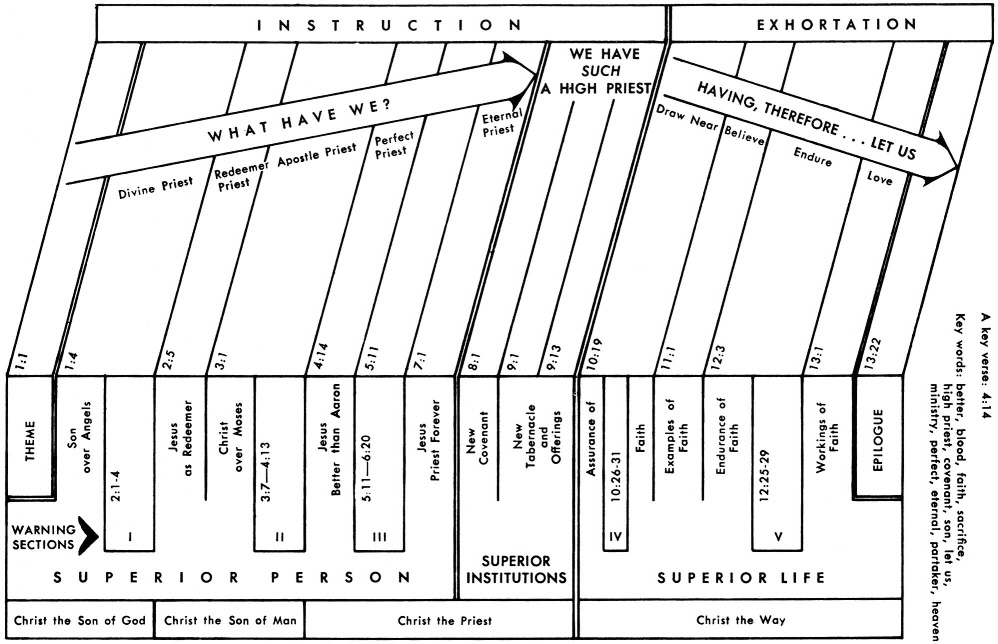
CONSIDER JESUS OUR GREAT HIGH PRIEST
Click chart to enlarge
Charts from Jensen's Survey of the NT - used by permission
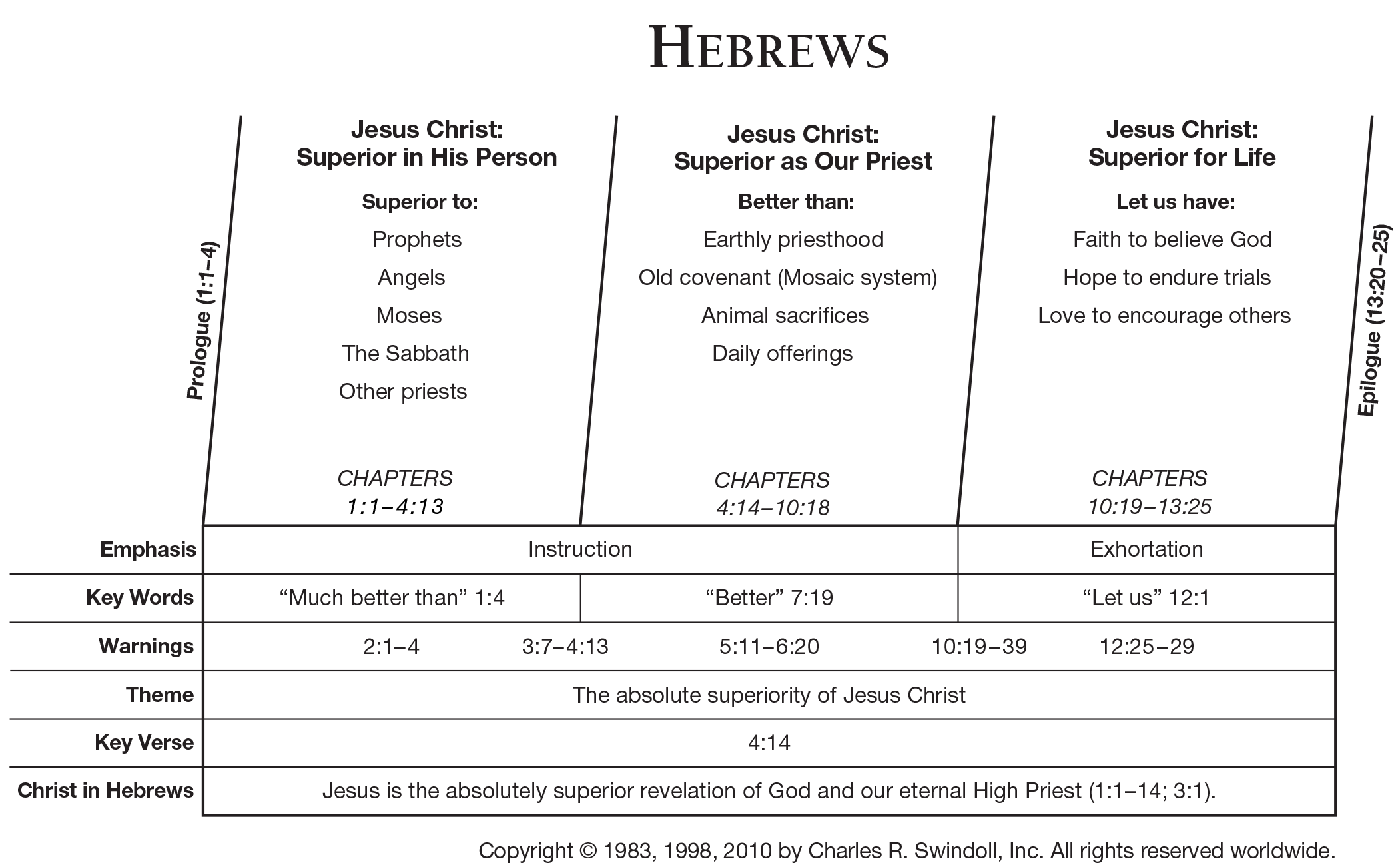
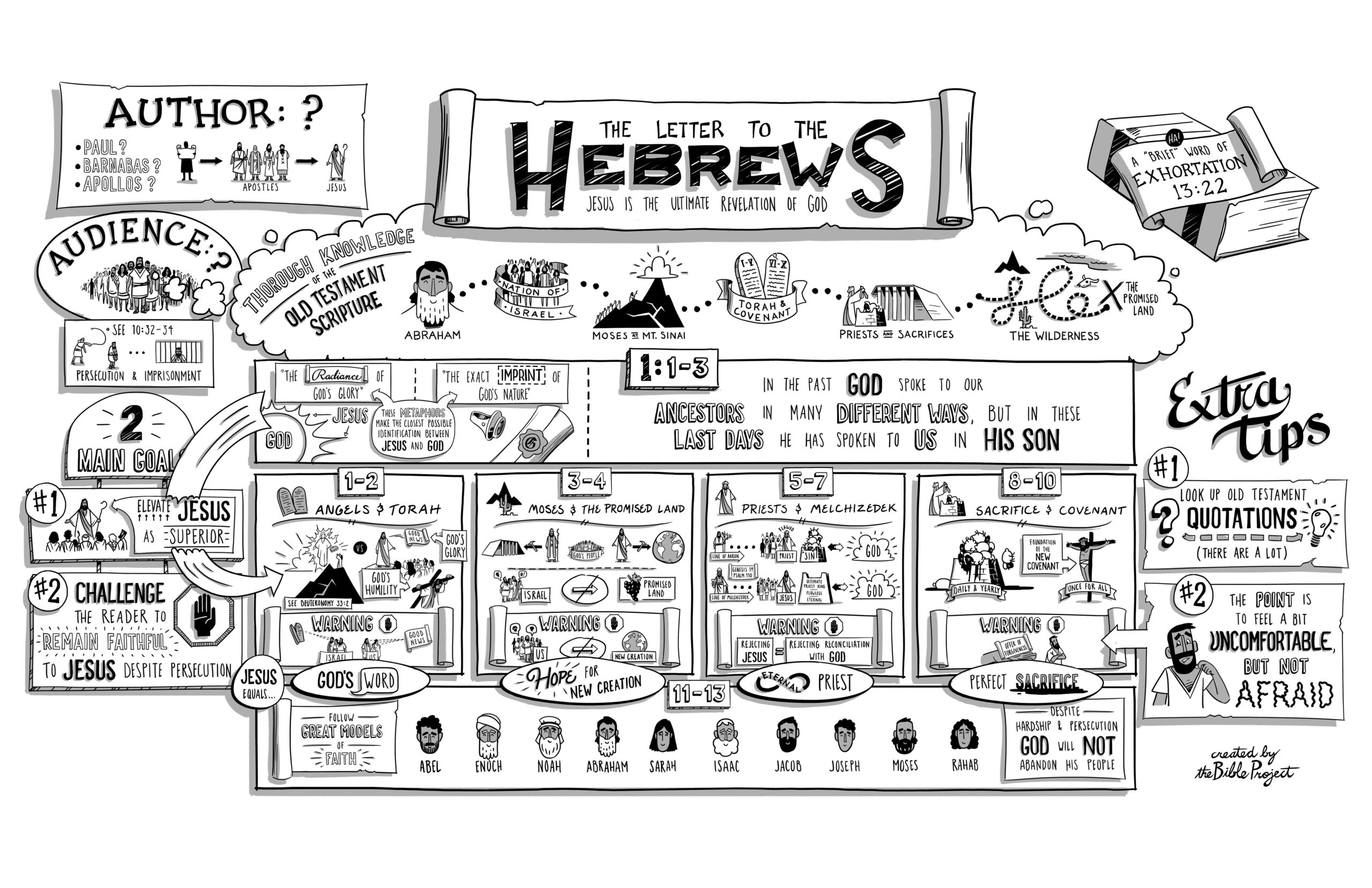
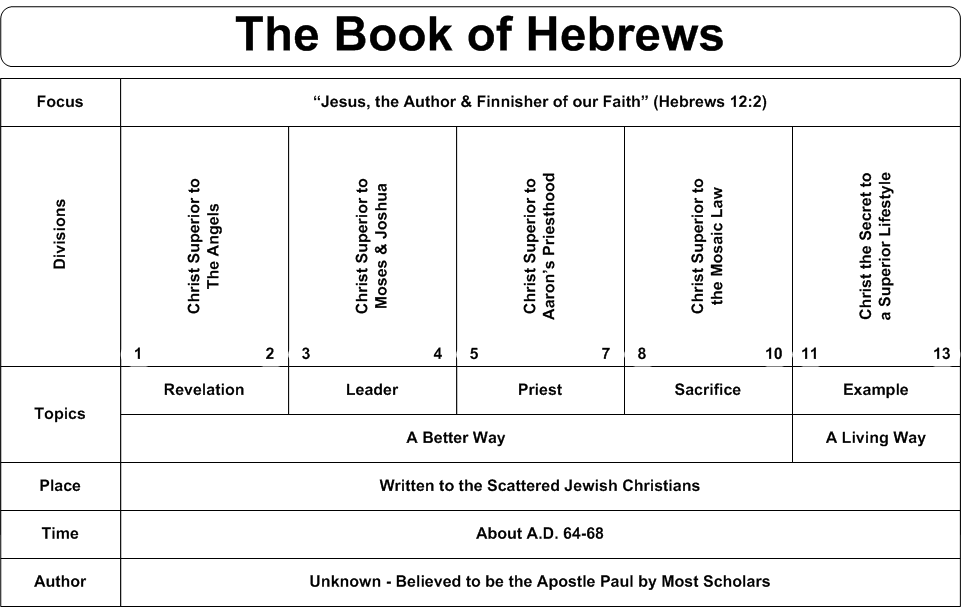
Swindoll's Chart, Interesting Pictorial Chart of Hebrews, Another Chart
|
The Epistle |
||||
| INSTRUCTION Hebrews 1-10:18 |
EXHORTATION Hebrews 10:19-13:25 |
|||
| Superior Person of Christ Hebrews 1:1-4:13 |
Superior Priest in Christ Hebrews 4:14-10:18 |
Superior Life In Christ Hebrews 10:19-13:25 |
||
| BETTER THAN PERSON Hebrews 1:1-4:13 |
BETTER PRIESTHOOD Heb 4:14-7:28 |
BETTER COVENANT Heb 8:1-13 |
BETTER SACRIFICE Heb 9:1-10:18 |
BETTER LIFE |
| MAJESTY OF CHRIST |
MINISTRY OF CHRIST |
MINISTERS FOR CHRIST |
||
|
DOCTRINE |
DUTY |
|||
|
DATE WRITTEN: |
||||

See ESV Study Bible "Introduction to Hebrews"
(See also MacArthur's Introduction to Hebrews)
Borrow Ryrie Study Bible
Hebrews 9:3 Behind the second veil there was a tabernacle which is called the Holy of Holies (NASB: Lockman)
Greek: meta de to deuteron katapetasma skene he legomene (PPPFSN) Hagia Hagion,
Amplified: But [inside] beyond the second curtain or veil, [there stood another] tabernacle [division] known as the Holy of Holies. (Amplified Bible - Lockman)
Barclay: Behind the second curtain there was that part of the tabernacle which was called the Holy of Holies. (Westminster Press)
KJV: And after the second veil, the tabernacle which is called the Holiest of all;
NLT: Then there was a curtain, and behind the curtain was the second room called the Most Holy Place. (NLT - Tyndale House)
Phillips: Inside, beyond the curtain, was the inner tent called the holy of holies (Phillips: Touchstone)
Wuest: And after the second veil, a tent which is called the Holy of Holies
Young's Literal: and after the second veil a tabernacle that is called 'Holy of holies,'
Paraphrase Behind the second curtain was a room called the Most Holy Place.
- The second veil - Heb 6:19; 10:20; Ex 26:31-33; 36:35-38; 40:3,21; 2Ch 3:14; Isa 25:7; Mt 27:51
- Holy of Holies - Hebrews 9:8; 10:19; 1Ki 8:6
- Hebrews 9 Resources - Multiple Sermons and Commentaries
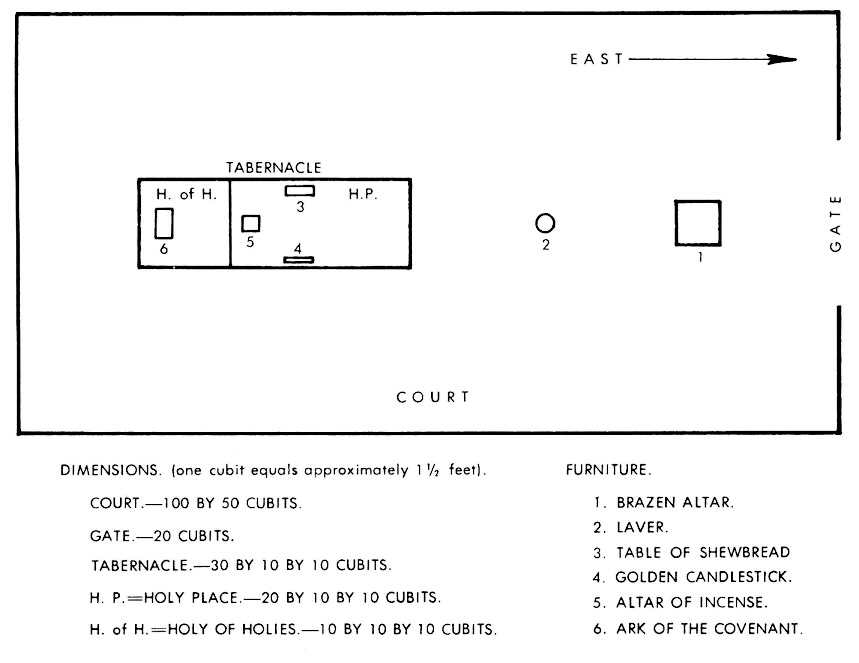
Pattern of the Tabernacle-Click to Enlarge
BEHIND THE SECOND VEIL:
THE MOST HOLY PLACE
Hebrews 9:3 marks the transition from the first room of the tabernacle, the Holy Place, into the innermost sanctuary known as the Holy of Holies (Most Holy Place).
Behind the second veil (katapetasma) there was a tabernacle (skene) which is called the Holy (hagios) of Holies (hagios) - From the diagram above, note that there was only one door entering into the outer courtyard and the first piece of furniture a Jew would encounter was the brazen (bronze) altar. Between the brazen altar and the tabernacle was the bronze laver which was in front of the first veil or screen, the second veil screening off the holy of holies from the holy place. This sacred chamber, separated by the veil, symbolized the impenetrable holiness of God and the restricted access man had under the old covenant. Only the high priest could enter, and that only once a year, underscoring both God’s nearness in covenant and His unapproachable holiness apart from atonement. This verse prepares the reader for the fuller contrast the writer will soon make between the limited, shadowed access of the old covenant and the full, permanent access opened through Christ.
Spurgeon- The child of God is a priest, and as a priest he is sanctified to enter within the veil. He is now permitted to go into the place that was once within the veil, but which is not so now, because the veil is rent in two.
Spurgeon- The holy of holies was not open to all men, but only to Jews; and not to all Jews, but only to priests; and not to all priests, but to the high priest alone; and not even to him at all times, or indeed at any time, except on one solitary day in the year.
RELATED PASSAGES
IN EXODUS
In Exodus 26:31-37+, God prescribes two partitions -
And you shall make a veil of blue and purple and scarlet material and fine twisted linen; it shall be made with cherubim, the work of a skillful workman. 32 "And you shall hang it on four pillars of acacia overlaid with gold, their hooks also being of gold, on four sockets of silver. 33 "And you shall hang up the veil under the clasps, and shall bring in the ark of the testimony there within the veil; and the veil shall serve for you as a partition between the holy place and the holy of holies. 34 "And you shall put the mercy seat on the ark of the testimony in the holy of holies. 35 "And you shall set the table outside the veil, and the lampstand opposite the table on the side of the tabernacle toward the south; and you shall put the table on the north side. 36 "And you shall make a screen (Hebrew = macak = basic meaning of root is to block. This is the outer veil hanging at the East end of the Holy Place) for the doorway of the tent of blue and purple and scarlet material and fine twisted linen, the work of a weaver. 37 "And you shall make five pillars of acacia for the screen, and overlay them with gold, their hooks also being of gold; and you shall cast five sockets of bronze for them.
In Exodus 36:35-37+ God gave the pattern and Moses unconditionally obeyed (a good pattern for all believers) -
Moreover, he (Moses) made the veil of blue and purple and scarlet material, and fine twisted linen; he made it with cherubim, the work of a skillful workman. 36 And he made four pillars of acacia for it, and overlaid them with gold, with their hooks of gold; and he cast four sockets of silver for them. 37 And he made a screen for the doorway of the tent, of blue and purple and scarlet material, and fine twisted linen, the work of a weaver;
In Exodus 40:21+ Moses refers to the veil between the holy of holies and the holy place as a screen -
And he (Moses) brought the ark into the tabernacle, and set up a veil for the screen, and screened off the ark of the testimony (in the holy of holies), (note this next phrase) just as the LORD had commanded Moses. (Exodus 40:21)
Veil (2665) (katapetasma from petannumi = before + kata) literally means that which is spread out or that which spreads out downwards and thus was a word used as a technical term for temple curtains.
Katapetasma - 6x in 6v - veil
Matthew 27:51+ And behold, the veil of the temple was torn in two from top to bottom; and the earth shook and the rocks were split.
Mark 15:38+ And the veil of the temple was torn in two from top to bottom.
Luke 23:45+ because the sun was obscured; and the veil of the temple was torn in two.
Hebrews 6:19+ This hope we have as an anchor of the soul, a hope both sure and steadfast and one which enters within the veil,
Hebrews 9:3+ Behind the second veil there was a tabernacle which is called the Holy of Holies,
Hebrews 10:20+ by a new and living way which He inaugurated for us through the veil, that is, His flesh,
ISBE on the veil - In Exodus, Leviticus, Numbers, the veil that hung between the two holy chambers of the tabernacle is mentioned 23 times (Ex 26:31, etc.). In several places it is termed "the veil of the screen" and it is distinguished from "the screen for the door of the tabernacle" (Ex 35:12,15; 39:34,38). By the latter is meant the curtain that hung outside the holy place, i.e. at the tabernacle entrance. Ex 26:31 informs us that the veil was made of fine-twined linen, and that its colors were blue and purple and scarlet. It was embroidered with cherubim. At each removal of the tabernacle the veil was used to enwrap the ark of the testimony (Nu 4:5). From its proximity to this central object of the Hebrew ceremonial system, the veil is termed "the veil of the testimony" (Lev 24:3), "the veil which is before the testimony" (Ex 27:21), etc. In Solomon's Temple the veil is mentioned but once (2Ch 3:14). It was protected by doors of olive wood (1 Ki 6:31). In the later temple it is alluded to in 1 Macc 1:22. Its presence in Herod's temple is attested by the statement in each of the Synoptists that at the time of Christ's death the veil of the temple was rent from top to bottom, or in the midst (Mt 27:51; Mk 15:38; Lk 23:45; compare in Mishna, Mid. ii. 1; iv.7). This fact is the basis of the profound truth expressed by the writer to the Hebrews that Jesus, by His sacrificial death, opened for all believers a way into the holiest "through the veil, that is to say, his flesh" (Heb 10:20-note). (Dictionary Article)
Tabernacle (ISBE Article) (4633) (skene) means tent, booth, cloth hut and here specifically the tabernacle which was made largely of skins and was designed to be portable, which emphasizes the essence of impermanence. The tabernacle gave every impression of being a temporary structure. It is fascinating that while there are only two chapters devoted to the creation, there are some fifty chapters that deal with the Tabernacle (esp Ex 25-40). As so many expositors over the years have noted, the Tabernacle was essentially a "giant portrait of Jesus Christ" (See related study on Covenant: Abrahamic versus Mosaic). Everywhere you look in the Tabernacle you can see the Messiah.
Friberg summarizes skene - tent, booth; (1) generally, of transitory, movable lodging places for nomads, pilgrims, herdsmen, soldiers, constructed of various materials tent, lodging, dwelling (Heb 11.9); (2) as the portable divine sanctuary Tabernacle, Tent (Heb 8.5); (3) as referring to the temple in Jerusalem (Heb 13.10); (4) as referring to the outer and inner rooms of the Tabernacle, comprising the Holy Place and the Holy of Holies (Heb 9.2-8); (5) as a portable case for an idol shrine (Acts 7.43); (6) figuratively, of the heavenly dwelling place of God, sanctuary (Rev 13.6); (7) plural, as the eternal habitations of the righteous dwellings, homes (Lk 16.9); (8) figuratively, as a ruling dynasty or lineage ruling family, kingdom (Acts 15.16). (BORROW Analytical Lexicon of the Greek New Testament)
SKENE - KEYWORD IN HEBREWS - Matt. 17:4; Mk. 9:5; Lk. 9:33; Lk. 16:9; Acts 7:43; Acts 7:44; Acts 15:16; Heb. 8:2; Heb. 8:5; Heb. 9:2; Heb. 9:3; Heb. 9:6; Heb. 9:8; Heb. 9:11; Heb. 9:21; Heb. 11:9; Heb. 13:10; Rev. 13:6; Rev. 15:5; Rev. 21:3
Hebrews 8:2 in the true tabernacle
Hebrews 8:5 when he was about to erect the tabernacle;
Hebrews 9:2 For there was a tabernacle prepared
Hebrews 9:3 Behind the second veil there was a tabernacle
Hebrews 9:6 priests are continually entering the outer tabernacle
Hebrews 9:8 not yet been disclosed while the outer tabernacle is still standing
Hebrews 9:11 He entered through the greater and more perfect tabernacle
Hebrews 9:21 he sprinkled both the tabernacle
Hebrews 11:9 dwelling in tents with Isaac and Jacob
Hebrews 13:10 those who serve the tabernacle have no right to eat
Holy...holies (40) (hagios) is literally the word holy and strictly speaking refers to whoever or whatever is set apart (sanctified) for a special purpose. In the New Testament, saints are holy ones in character having been set apart by God to be exclusively His possession, to be dedicated to Him and to manifest holiness of heart and conduct in contrast to the impurity of the unbelievers (Jew or Gentile). Saints are set aside for sacred use. Here a specific local is set apart for sacred use.
ISBE on the Holy of Holies was the innermost shrine of the sanctuary of Jehovah "The most holy place of the tabernacle in the wilderness (Ex 26:31, 32,33) was a small cube of 10 cubits (15 ft.) every way. It was divided from the holy Ceiled by curtains which bore cherubic figures embroidered in blue and purple and scarlet (Ex 26:1), it contained no furniture but the Ark of the Covenant, covered by a slab of gold called the MERCY-SEAT (which see), and having within it only the two stone tables of the Law (see TABERNACLE; ARK OF THE COVENANT). Only the high priest, and he but once a year, on the great Day of Atonement, was permitted to enter within the veil, clothed in penitential garments, amid a cloud of incense, and with blood of sacrifice (Lev 16:1-31; compare Heb 9:7). (Holy of Holies)
HAGIOS KEYWORD IN HEBREWS: Heb. 2:4; Heb. 3:1; Heb. 3:7; Heb. 6:4; Heb. 6:10; Heb. 8:2; Heb. 9:1; Heb. 9:2; Heb. 9:3; Heb. 9:8; Heb. 9:12; Heb. 9:24; Heb. 9:25; Heb. 10:15; Heb. 10:19; Heb. 13:11; Heb. 13:24
Hebrews 2:4 Holy Spirit
Hebrews 3:1 holy (brethren)
Hebrews 3:7 Holy Spirit
Hebrews 6:4 Holy Spirit
Hebrews 6:10 saints
Hebrews 8:2 sanctuary (heavens)
Hebrews 9:1 sanctuary (earthly)
Hebrews 9:2 holy place
Hebrews 9:3 Holy of holies
Hebrews 9:8 Holy Spirit...holy place
Hebrews 9:12 holy place
Hebrews 9:24 holy place
Hebrews 9:25 holy place
Hebrews 10:15 Holy Spirit
Hebrews 10:19 holy place
Hebrews 13:11 holy place
Hebrews 13:24 saints
Robert Hawker - And after the second veil, the tabernacle, which is called the holiest of all.—Heb. 9:3.
The veil of separation between the two tabernacles, no doubt, typified Christ’s body, which, in the moment of his death, by an invisible hand, was torn in twain from the top to the bottom, thereby intimating that now all separation was removed, and true believers were permitted to enter, by the blood of Jesus, into the presence of God, he having obtained eternal redemption for them. The second, or inner sanctuary, had several very interesting particulars, by way of distinction, belonging to it. The veil of separation, under the Jewish dispensation, intimated, that it was impossible for any to draw nigh to God, but by a mediator. When Jesus threw down the separation, and opened a new and living way by his blood, access was obtained to God in Christ; and Jesus, first for himself, and then for his people, led the way into the holy of holies. The veil of separation set forth how man was separated by sin; by the injury done to God’s holiness, and by the natural emnity of his own heart. But when Jesus came, and put away sin, by the sacrifice of himself, restored that which he took not away, gave to God his glory, restored to man God’s image, and took away the carnal mind, by making the heart of stone a heart of flesh, then it was that the veil of separation was for ever taken away, and the kingdom of heaven opened to all believers. My soul! what saith thine experience to these things? If the veil be removed, and thou art entered in, through Jesus, thy forerunner, then hast thou seen, and known, and felt, and enjoyed, the glory of Him, whom those things shadowed; and art rejoicing in Him, as the Lord thy righteousness. And art thou entered within the veil? Art thou resting upon Jesus, having cast anchor within the veil? Surely, then, Jesus is precious, his love is precious, his grace is precious; yea, every thing in him is precious. And then, by and by, all remaining clouds will be removed, and him whom thou seest now by faith, thou shalt see face to face, and know, even as thou art known. Precious Lord Jesus! take away all remaining darkness, ignorance, unbelief, and whatever comes in the way of clear views of thee, and the enjoyment of thee; and let the covering which is cast over all people, and the blackness over all faces, be done away in the full enjoyment of thee, in grace here, and in glory to all eternity! Amen.
Wayne Grudem (Systematic Theology page 327) - As recipients of the new covenant, we do not need to stay “outside the temple,” as all believers except the priests were required to do under the old covenant. Nor do we need to stay outside of the “Holy of Holies” (Heb. 9:3), the inner room of the temple where God himself was enthroned above the ark of the covenant and where only the high priest could go, and he but once a year. But now, since Christ has died as our mediational High Priest (Heb. 7:26–27), he has gained for us boldness and access to the very presence of God. Therefore “we have confidence to enter the holy places by the blood of Jesus” (Heb. 10:19), that is, into the holy place and into the holy of holies, the very presence of God himself! We enter “by the new and living way” (Heb. 10:20) that Christ opened for us. The author of Hebrews concludes that since these things are true, “and since we have a great priest over the house of God, let us draw near with a true heart in full assurance of faith” (Heb. 10:21–22). In this way, Christ’s mediational work gives us confidence to approach God in prayer.
We do not just come into God’s presence as strangers, visitors, or laypersons but as priests—as people who belong in the temple and have a right and even a duty to be in the most sacred places in the temple. Using imagery from the ceremony for ordination of priests (see Ex. 29:4, 21), the author of Hebrews pictures all believers as having been ordained as priests to God and thus able to enter into his presence, for he says that we draw near “with our hearts sprinkled clean from an evil conscience and our bodies washed with pure water” (Heb. 10:22; cf. 1 Peter 2:9). Does all this make sense to a modern Christian? No one today goes to Jerusalem to enter the temple and there “draw near” to God. Even if we did go to Jerusalem, we would find no temple standing, since it was destroyed in AD 70. What then does the author of Hebrews mean when he says we enter into the “holy places”? He is talking about a reality in the unseen spiritual realm. With Christ as our Mediator we enter not into the earthly temple in Jerusalem but into the true sanctuary, into “heaven itself,” where Christ has gone “to appear in the presence of God on our behalf” (Heb. 9:24).
Hbrews 9:4 having a golden altar of incense and the ark of the covenant covered on all sides with gold, in which was a golden jar holding the manna, and Aaron's rod which budded, and the tables of the covenant; (NASB: Lockman)
Greek: chrusoun echousa (PAPFSN) thumiaterion kai ten kiboton tes diathekes perikekalummenen (RPPFSA) pantothen chrusio, en e stamnos chruse echousa (PAPFSN) to manna kai e rabdos Aaron e blastesasa (AAPFSN) kai ai plakes tes diathekes,
BGT χρυσοῦν ἔχουσα θυμιατήριον καὶ τὴν κιβωτὸν τῆς διαθήκης περικεκαλυμμένην πάντοθεν χρυσίῳ, ἐν ᾗ στάμνος χρυσῆ ἔχουσα τὸ μάννα καὶ ἡ ῥάβδος Ἀαρὼν ἡ βλαστήσασα καὶ αἱ πλάκες τῆς διαθήκης,
Amplified: It had the golden altar of incense and the ark (chest) of the covenant, covered over with wrought gold. This [ark] contained a golden jar which held the manna and the rod of Aaron that sprouted and the [two stone] slabs of the covenant [bearing the Ten Commandments]. (Amplified Bible - Lockman)
Barclay: It was approached by means of the golden altar of incense, and it had in it the ark of the covenant, which was covered all over with gold. In the ark there was the golden pot with the manna and Aaron’s rod which budded and the tables of the covenant. (Westminster Press)
KJV: Which had the golden censer, and the ark of the covenant overlaid round about with gold, wherein was the golden pot that had manna, and Aaron's rod that budded, and the tables of the covenant;
NKJ which had the golden censer and the ark of the covenant overlaid on all sides with gold, in which were the golden pot that had the manna, Aaron's rod that budded, and the tablets of the covenant;
NLT: In that room were a gold incense altar and a wooden chest called the Ark of the Covenant, which was covered with gold on all sides. Inside the Ark were a gold jar containing manna, Aaron’s staff that sprouted leaves, and the stone tablets of the covenant. (NLT - Tyndale House)
Phillips: containing the golden jar of manna, Aaron's budding staff and the stone tablets inscribed with the words of the actual agreement. Above these things were fixed representations of the cherubim of glory, casting their shadow over the ark's covering, known as the mercy seat. (Phillips: Touchstone)
Wuest: having a golden censer and the ark of the testament overlaid round about with gold, in which was a golden pot having the manna, and the rod of Aaron, the one that budded, and the tablets of the testament
Young's Literal: having a golden censer, and the ark of the covenant overlaid all round about with gold, in which is the golden pot having the manna, and the rod of Aaron that budded, and the tables of the covenant,
NET It contained the golden altar of incense and the ark of the covenant covered entirely with gold. In this ark were the golden urn containing the manna, Aaron's rod that budded, and the stone tablets of the covenant.
CSB It contained the gold altar of incense and the ark of the covenant, covered with gold on all sides, in which there was a gold jar containing the manna, Aaron's staff that budded, and the tablets of the covenant.
ESV having the golden altar of incense and the ark of the covenant covered on all sides with gold, in which was a golden urn holding the manna, and Aaron's staff that budded, and the tablets of the covenant.
NIV which had the golden altar of incense and the gold-covered ark of the covenant. This ark contained the gold jar of manna, Aaron's staff that had budded, and the stone tablets of the covenant.
GWN It contained the gold incense burner and the ark of the Lord's promise. The ark was completely covered with gold. In the ark were the gold jar filled with manna, Aaron's staff that had blossomed, and the tablets on which the promise was written.
BBE Having a vessel of gold in it for burning perfumes, and the ark of the agreement, which was covered with gold and which had in it a pot made of gold for the manna, and Aaron's rod which put out buds, and the stones with the writing of the agreement;
DBY having a golden censer, and the ark of the covenant, covered round in every part with gold, in which were the golden pot that had the manna, and the rod of Aaron that had sprouted, and the tables of the covenant;
RWB Which had the golden censer, and the ark of the covenant overlaid on all sides with gold, in which was the golden pot that had manna, and Aaron's rod that budded, and the tables of the covenant;
WEB Which had the golden censer, and the ark of the covenant overlaid around with gold, in which {was} the golden pot that had manna, and Aaron's rod that budded, and the tables of the covenant;
- The golden altar - Lev 16:12; 1Ki 7:50; Rev 8:3
- The Ark of the Covenant - Exodus 25:10-16; Ex 26:33; Ex 37:1-5; 39:35; 40:3,21
- In which was Exodus 16:33,34
- Aaron's rod - Nu 17:5,8,10; Ps 110:2,3
- And the tables of the covenant - Ex 25:16,21; 26:33; 34:29; 40:3,20,21; Dt 10:2, 3, 4, 5; 1Ki 8:9,21; 2Ch 5:10
- Hebrews 9 Resources - Multiple Sermons and Commentaries
Related Passages:
Exodus 16:33-34+ Moses said to Aaron, “Take a jar and put an omerful of manna in it, and place it before the LORD to be kept throughout your generations.” 34 As the LORD commanded Moses, so Aaron placed it before the Testimony, to be kept.
Numbers 17:10+ (AARON'S ROD THAT BUDDED - FOR CONTEXT READ Nu 17:1-9) But the LORD said to Moses, “Put back the rod of Aaron before the testimony to be kept as a sign against the rebels, that you may put an end to their grumblings against Me, so that they will not die.”
Deuteronomy 10:2-5+ (TABLES OF THE COVENANT) ‘I will write on the tablets the words that were on the former tablets which you shattered, and you shall put them in the ark.’ 3 “So I made an ark of acacia wood and cut out two tablets of stone like the former ones, and went up on the mountain with the two tablets in my hand. 4 “He wrote on the tablets, like the former writing, the Ten Commandments which the LORD had spoken to you on the mountain from the midst of the fire on the day of the assembly; and the LORD gave them to me. 5 “Then I turned and came down from the mountain and put the tablets in the ark which I had made; and there they are, as the LORD commanded me.”
Aaron's Budding Rod, Jar of Manna, Two Tables of Law
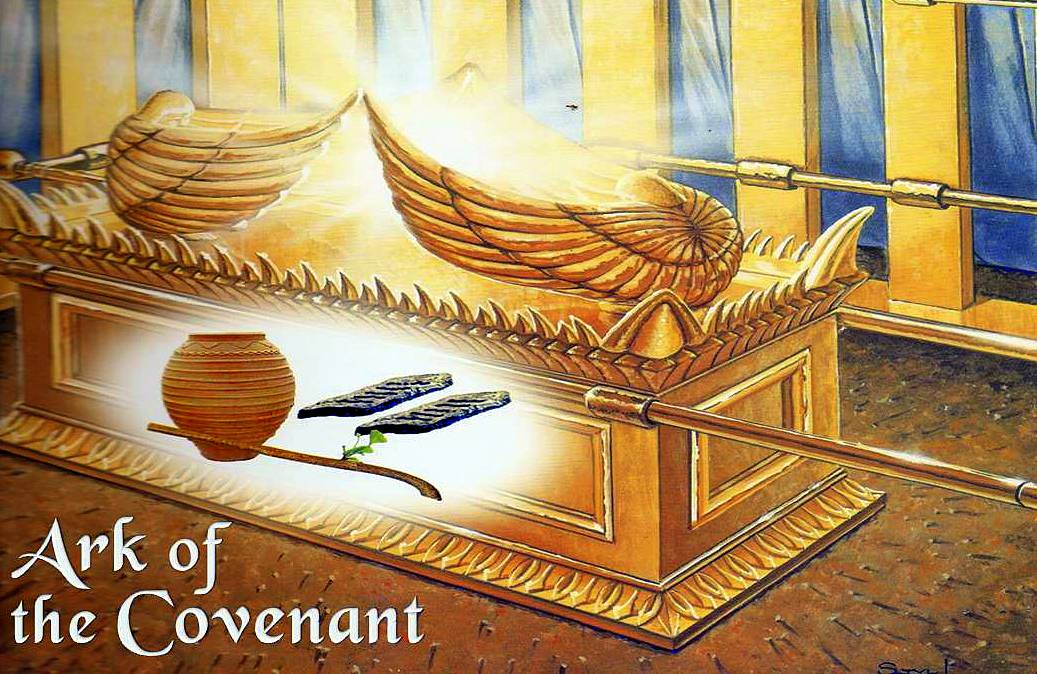
THE SACRED CONTENTS OF
THE HOLY OF HOLIES
The writer continues the description of the earthly tabernacle, now focusing on the inner sanctuary, the Holy of Holies. Each item he describes carried profound significance as reminders of God’s provision, His chosen priesthood, and His covenant law. This verse highlights how the old covenant worship revolved around symbols and shadows, preparing the way for the true and eternal realities fulfilled in Christ.
Having a golden (chrusous) altar of incense (thumiasterion) and the ark (kibotos) of the covenant (diatheke) covered (perikalupto) on all sides with gold (chrusion) - Note that several Bible versions (Darby, KJV, NKJV, Wuest, Webster's, Weymouth, Young's Literal) translate this Greek word thumiasterion as a censer not an altar of incense. The Ark of the Covenant was where God manifested Himself in a bright shining cloud, the Shekinah glory cloud (See Glory of the LORD). It was the only site where God could be approached with the blood of atonement or covering on the Day of Atonement. The Ark of the Covenant was not in the Herod's temple, but in its stead was a stone basement (called “the stone of foundation”) some three fingers high.
Steven Cole on golden (chrusous) altar of incense (thumiasterion) writing that "Scholars debate why the author of Hebrews seems to place the altar of incense inside the Holy of Holies, rather than just outside in the holy place. Some say that he was mistaken, but this is absurd. Every Jew knew the arrangement of these basic pieces of furniture. Some say that the reference is not to the altar itself, but to the censers that the priests used to carry incense into the Holy of Holies on the Day of Atonement (see Lev 16:12,13+), which the author obviously has in mind. The Greek word (thumiasterion) is used in this sense in the LXX. But then the author would have omitted mentioning a major piece of furniture in the holy place. Probably the best solution is that the author is connecting the liturgical function of the altar of incense with its close association with the Holy of Holies on the Day of Atonement (see Ex 30:6; 40:5; 1Ki 6:22). The same close connection is portrayed in Rev 8:3, where the golden altar of incense, representing the prayers of the saints, is “before the throne.”
Donald Guthrie suggests that “The altar was so placed that the smoke from the burning incense was supposed to penetrate the curtain and rise to God before the ark of the covenant.” (Borrow Hebrews Commentary page 182)
Believer's Study Bible has a slightly different interpretation on the location of the altar of incense or as the KJV renders it "the golden censer" - "The golden censer" (the altar of incense) was not actually inside the Holiest of All (Heb 9:3), or Most Holy Place, but was located near the veil. In function the altar belonged to the Most Holy Place because the incense was wafted into it. This justifies the statement that the Most Holy Place "had" the golden censer. That is, a portion of the function of the golden altar of incense was to prepare the way for the high priest to make his approach to the mercy seat on the Day of Atonement (cf. 1Ki 6:22, in which this altar is plainly associated with the oracle of God or the Most Holy Place) (Bolding added)
C H Spurgeon - I will take you for a moment into that which was called the holy place under the old Jewish law, the holy of holies. What was there? Only two things that could be seen. The one was the golden censer (NOTE: SPURGEON INTERPRETS IT AS A CENSER, NOT AN ALTAR), and the other was the mercy seat, and both of these things were instructive. Now, when you go to the Lord to worship, the first thing you want is somebody to render your worship acceptable. See there, in the person of your Lord Jesus Christ, a golden censer, representing the sweet merit of His prevalent intercession by which you also are accepted (Heb 7:25+). When the high priest went into the holy place, he filled this golden censer and waved it to and fro till the sweet perfumed smoke went up before the mercy seat (see Lev 16:12,13+). That is just what Jesus does in heaven for us. We burn the incense here below, and the sweet perfume of His merit continually ascends before the throne of the Most High and Holy God, and beneath the cloud of the smoke we worship. Jesus becomes a sanctuary for us, and you can never worship God aright till you feel that Jesus’ merits go with your worship. If your prayers are perfumed with the incense of your own merits, and you think they will be acceptable, you do not know what you are doing. But if you see that golden censer, and look to God through the smoke of Jesus’ merits, then do you really worship, and Christ thus becomes to you a sanctuary. (See sermon Christ a Sanctuary)
Spurgeon- The presence of God, as you know, in the temple and the tabernacle was known by the shining of the bright light called the Shekinah between the wings of the cherubim over the ark of the covenant. We often forget that the presence of God in the most holy place was a matter of faith to all but the high priest. Once in the year the high priest went within the awful veil, but we do not know that even he ever dared to look upon the blaze of splendor. God dwells in light that no man may approach. The smoke of the incense from the priest’s censer was needed partly to veil the exceeding glory of the divine presence, lest even those chosen eyes should suffer blindness. No one else went into the hallowed shrine, and only he once in the year. (See sermon One Greater than the Temple)
Smith's Bible Dictionary writes that the Ark of the Covenant was "The first piece of the tabernacle furniture, for which precise directions were delivered. Exodus 25.
I. Description. -- It appears to have been an oblong chest of shittim (acacia) wood, 2 1/2 cubits long by 1 1/2 broad and deep. Within and without gold was overlaid on the wood, and on the upper side or lid, which was edged round about with gold, the mercy-seat was placed. The ark was fitted with rings, one at each of the four corners, and through these were passed staves of the same wood similarly overlaid, by which it was carried by the Kohathites. (Nu 7:9; 10:21) The ends of the staves were visible without the veil in the holy place of the temple of Solomon. (1Ki 8:8) The ark, when transported, was enveloped in the "veil" of the dismantled tabernacle, in the curtain of badgers? skins and in a blue cloth over all, and was therefore not seen. (Nu 4:5,20)
II. Its purpose was to contain inviolate the divine autograph of the two tables, that "covenant" from which it derived its title. It was also probably a reliquary for the pot of manna and the rod of Aaron.
III. History .--Before David's time its abode was frequently shifted. It sojourned among several, probably Levitical, families, (1Sa 7:1; 2Sa 6:3,11; 1Ch 13:13; 15:24,25) in the border villages of eastern Judah; and did not take its place in the tabernacle, but dwelt in curtains, i.e. in a separate tent pitched for it in Jerusalem by David. Subsequently the temple, when completed, received, in the installation of the ark in its shrine, the signal of its inauguration by the effulgence of divine glory instantly manifested. It was probably taken captive or destroyed by Nebuchadnezzar, 2 Esdr. 10:22, so that there was no ark in the second temple. (See another article in ISBE)
MORE CONTENTS OF
THE GOLDEN JAR
In which was a golden (chrusous) jar holding the manna (manna), and Aaron's rod (rhabdos) which budded, and the tables (plax) of the covenant (diatheke) - "Within the ark were Israel's most treasured possessions: the jar of manna which never spoiled (Ex 16:32); Aaron's staff which had sprouted and borne fruit when Aaron's priesthood had been challenged by the heads of the other tribes (Num 17:8-10); and the actual tables of the law which Moses had brought down from the mountain, written on by the finger of God (Ex 32:15). (27)
This manna (manna) was supernaturally preserved by God, because otherwise it would rotted within one day. The manna (manna) would serve to remind Israel of God's provision for them in the wilderness wanderings. Aaron's rod (rhabdos) was given in the Old Testament as a "sign against the rebels" who were grumbling against Moses, so that they might cease their grumbling and not die! The rod (rhabdos) which budded (supernaturally) was to serve as a gracious reminder and warning not to grumble and to emphasize that God had selected Aaron and the Levites for the priesthood.
The Rabbis believed that in the future Elijah would restore to Israel the container of manna, the flask of sprinkling water and the jar of anointing oil.
Ray Stedman - The manna (manna) would remind Israel of God's miraculous and loving care of them in the wilderness; the rod of Aaron would mark the Levitical priesthood as divinely instituted and far more important than any human provision; and the stone tablets of the covenant would speak of the holy character which God's people must continually measure themselves against. Together they spoke of God's love, God's redemption and God's holiness. These find their counterpart in Christian experience: God's love for us initiates his redemptive activity (John 3:16); God's provision for us goes far beyond what any amount of human counseling or control can achieve (2 Corinthians 5:17); and God's sanctifying work within us produces at last a Christlike character that is fully acceptable to a holy God (2 Corinthians 3:18).
Numbers 17:5-10+ "And it will come about that the rod of the man whom I choose will sprout (Hebrew = parach = bud, sprout, send out shoots; Lxx = ekblastano - sprout out, be caused to grow out). Thus I shall lessen from upon Myself the grumblings of the sons of Israel, who are grumbling against you." 6 Moses therefore spoke to the sons of Israel, and all their leaders gave him a rod apiece, for each leader according to their fathers' households, twelve rods, with the rod of Aaron among their rods. 7 So Moses deposited the rods before the LORD in the tent of the testimony. 8 Now it came about on the next day that Moses went into the tent of the testimony; and behold, the rod of Aaron for the house of Levi had sprouted and put forth buds and produced blossoms, and it bore ripe almonds. 9 Moses then brought out all the rods from the presence of the LORD to all the sons of Israel; and they looked, and each man took his rod. 10 But the LORD said to Moses, "Put back the rod of Aaron before the testimony to be kept as a sign against the rebels, that you may put an end to their grumblings against Me, so that they should not die."
COMMENT - It is interesting to note that the Hebrew word in Numbers 17:8+ for ripe almonds is shaqed which means awakening or the awakening one, which is an allusion to an almond blossom, for these blossoms were the first to bloom in the spring, their pinkish-white blossoms always appearing before the leaves. Read the Numbers 17 passage above and notice that twelve dead or inanimate rods were placed before Jehovah in the Tent of the Testimony (the Tabernacle), and life came forth from only one. Some see this as a foreshadowing of a future Spring "Awakening One" (speaking obviously of Christ's resurrection indicative of His return to life from the dead), which in one sense is true but which might be pushing the original intended meaning somewhat.
ISBE on AARON'S ROD - (Nu 17:1-13 and Heb 9:4): Immediately after the incidents connected with the rebellion of Korah, Dathan and Abiram against the leadership of Moses and the priestly primacy of Aaron (Nu 16:1-50), it became necessary to indicate and emphasize the Divine appointment of Aaron. Therefore, at the command of Yahweh, Moses directs that twelve almond rods, one for each tribe with the prince's name engraved thereon, be placed within the Tent of the Testimony. When Moses entered the tent the following day, he found that Aaron's rod had budded, blossomed and borne fruit, "the three stages of vegetable life being thus simultaneously visible." When the miraculous sign was seen by the people, they accepted it as final; nor was there ever again any question of Aaron's priestly right. The rod was kept "before the testimony" in the sanctuary ever after as a token of the Divine will (Nu 17:10). The writer of Hebrews, probably following a later Jewish tradition, mentions the rod as kept in the Holy of Holies within the ark (Heb 9:4; compare 1Ki 8:9).
The the tables (plax) of the covenant (diatheke) (see Ex 25:16f; Ex 31:18; Deut 9:9; 10:5) refers to what we classically think of as the "Ten Commandments" (if you are as old as me, this phrase congers up the image of Charlton Heston portraying Moses holding the tablets in his hands in the classic movie The Ten Commandments.) We see the origin of the tables in Exodus 24:12+ "Now the LORD said to Moses, "Come up to Me on the mountain and remain there, and I will give you the stone tablets with the law and the commandment which I have written for their instruction." They were also called the tablets of the Testimony, tablets of stone in (Ex 31:18) and the tablets of stone, the tablets of the covenant (Dt 9:9).
Note that 1 Kings 8:9 states that the Ark contained the tables of the covenant but makes no mention of the other items "There was nothing in the ark except the two tablets of stone which Moses put there at Horeb, where the LORD made a covenant with the sons of Israel, when they came out of the land of Egypt.
Ryrie says "Aaron's rod, and manna apparently…had been lost by this time. Some think they were never placed in the ark but alongside it; (cf, Ex 16:33, 34; Nu 17:10.)" (See Ryrie Study Bible)
Golden (5551)(chrusous from chrusos = gold) means golden or made of (adorned with) gold. Made with inlaid gold (2Ti 2:20) or overlaid with gold (Heb 9:4).
CHRUSOUS is "used to describe things as either being made from or adorned with gold, or as having a golden color. It also developed a number of metaphoric uses, such as “the Golden Age” (cf. Liddell-Scott), since gold was the most valued metal among the ancients. By the time of the Septuagint, the common pronunciation and spelling had shifted to chrusous in favor of following the Attic rules of contraction. This contracted form is the only one found in the New Testament (for occurrences of the uncontracted form in some variant readings to the text of Revelation, see Bauer). All 18 uses in the New Testament describe things which are either made or adorned with gold, although the metaphoric nuances certainly contribute to the descriptions, particularly in Revelation. (Complete Biblical Library)
CHRUSOUS - 18X/13V gold(4), golden(14). - Acts 3:6; Acts 20:33; 1 Co. 3:12; 1 Tim. 2:9; Heb. 9:4; 1 Pet. 1:7; 1 Pet. 1:18; 1 Pet. 3:3; Rev. 3:18; Rev. 17:4; Rev. 18:16; Rev. 21:18; Rev. 21:21
CHRUSOUS IN SEPTUAGINT - (golden; a gold coin Ge 37:28; piece of gold, golden coin -- used as a measure of weight -- Nu 7:14) Gen. 24:22; Gen. 37:28; Gen. 45:22; Exod. 3:22; Exod. 11:2; Exod. 12:35; Exod. 16:33; Exod. 20:23; Exod. 25:11; Exod. 25:12; Exod. 25:18; Exod. 25:24; Exod. 25:26; Exod. 26:6; Exod. 26:29; Exod. 26:32; Exod. 26:37; Exod. 28:33; Exod. 28:34; Exod. 28:36; Exod. 30:3; Exod. 30:4; Exod. 32:2; Exod. 32:3; Exod. 32:31; Exod. 35:22; Exod. 36:34; Exod. 36:36; Exod. 37:3; Exod. 37:7; Exod. 37:16; Exod. 37:17; Exod. 37:20; Exod. 37:23; Exod. 39:16; Exod. 39:19; Exod. 39:20; Exod. 39:25; Exod. 39:26; Exod. 39:30; Exod. 40:5; Exod. 40:26; Lev. 8:9; Num. 4:11; Num. 7:14; Num. 7:20; Num. 7:26; Num. 7:32; Num. 7:38; Num. 7:44; Num. 7:50; Num. 7:56; Num. 7:62; Num. 7:68; Num. 7:74; Num. 7:80; Num. 7:84; Num. 7:86; Num. 8:4; Num. 31:50; Jos. 7:21; Jdg. 8:24; Jdg. 8:26; 1 Sam. 6:4; 1 Sam. 6:5; 1 Sam. 6:8; 1 Sam. 6:11; 1 Sam. 6:15; 1 Sam. 6:17; 1 Sam. 6:18; 2 Sam. 1:24; 2 Sam. 8:7; 2 Sam. 8:10; 1 Ki. 7:48; 1 Ki. 7:49; 1 Ki. 7:50; 1 Ki. 10:16; 1 Ki. 10:17; 1 Ki. 10:21; 1 Ki. 10:25; 1 Ki. 12:28; 1 Ki. 14:26; 1 Ki. 15:15; 2 Ki. 5:5; 2 Ki. 10:29; 2 Ki. 12:13; 2 Ki. 24:13; 2 Ki. 25:15; 1 Chr. 18:7; 1 Chr. 18:10; 1 Chr. 28:14; 1 Chr. 28:16; 1 Chr. 28:17; 1 Chr. 29:7; 2 Chr. 4:7; 2 Chr. 4:8; 2 Chr. 4:13; 2 Chr. 4:19; 2 Chr. 4:22; 2 Chr. 9:15; 2 Chr. 9:16; 2 Chr. 9:24; 2 Chr. 12:9; 2 Chr. 13:8; 2 Chr. 13:11; 2 Chr. 24:14; Ezr. 1:9; Ezr. 1:10; Ezr. 5:14; Ezr. 6:5; Ezr. 8:27; Neh. 7:70; Est. 1:6; Est. 1:7; Est. 4:11; Est. 5:2; Est. 8:4; Est. 8:15; Job 28:17; Job 42:11; Ps. 45:13; Prov. 25:11; Prov. 25:12; Cant. 5:14; Cant. 5:15; Isa. 2:20; Isa. 31:7; Jer. 4:30; Jer. 51:7; Jer. 52:19; Dan. 2:38; Dan. 3:1; Dan. 3:2; Dan. 3:5; Dan. 3:7; Dan. 3:10; Dan. 3:12; Dan. 3:14; Dan. 3:15; Dan. 3:18; Dan. 5:2; Dan. 5:7; Dan. 5:16; Dan. 5:29; Hos. 2:8; Zech. 4:2; Zech. 4:12;
Altar of incense (censer) (2369) (thumiasterion) strictly speaking in secular usage described a utensil or container for burning incense. However the Jewish historian Josephus uses thumiasterion to describe the altar of incense in the Jewish Temple, which would be a metonymy. Metonymy refers to a figure of speech where one uses the name of one thing (the utensil for burning incense) for the name of another thing (the altar of incense) of which it is an attribute or with which it is associated.
In the Septuagint (LXX) thumiasterion is used only twice (2Chr 26:19, Ezekiel 8:11) and both times describes a censer or utensil of incense and not the altar of incense. It appears therefore that what the author is describing with the term thumiasterion is the taking of coals of fire from the altar of incense in the Holy Place into the Holy of holies once each year on the Day of Atonement (see Lev 16:12,13). Such an explanation would present no contradiction with the location of the altar of incense in front of the second veil. (Ex 40:26, Ex 40:1, 2, 3, 4, 5). It is amazing that some commentaries go so far as to suggest that the writer must not have been familiar with the Old Testament Tabernacle and simply "slipped up"! This is a highly unlikely and very speculative explanation.
This altar of incense was gold-overlaid acacia wood, 11/2' square and about 3' high. On this altar were placed the burning coals from the bronze altar in the courtyard, where sacrifice was made.
ISBE has this note on the altar of incense explaining that "Ex 30:1-10 contains the commands for the construction and use of an altar of incense. The material was shittim wood, the dimensions one cubit by one by two, and it also had horns. Its top and sides were overlaid with gold and it was surrounded by a crown or rim of gold. For facility of transport it had golden rings and staves. It stood before the veil in front of the ark. Solomon also constructed an altar of incense (1Ki 6:20; 7:48; 1Ch 28:18), cedar replacing shittim wood. The altar of incense reappears in 1 Macc 1:21; 4:49.
Incense is from "the Latin "to burn," "a mixture of gums or spices and the like, used for the purpose of producing a perfume when burned;" or the perfume itself of the spices, etc., burned in worship. The incense employed in the service of the tabernacle walls compounded of the perfumes stacte, onycha, galbanum and pure frankincense. All incense which was not made of these ingredients was forbidden to be offered. (Exodus 30:9) Aaron, as high priest, was originally appointed to offer incense each morning and evening. The times of offering incense were specified in the instructions first given to Moses. (Exodus 30:7,8) When the priest entered the holy place with the incense, all the people were removed from the temple, and from between the porch and the altar. Cf. (Luke 1:10) Profound silence was observed among the congregation who were praying without, cf. (Revelation 8:1 [note]) and at a signal from the perfect the priest cast the incense on the fire and, bowing reverently toward the holy of holies, retired slowly backward. The offering of incense has formed part of the religious ceremonies of most ancient nations. It was an element in the idolatrous worship of the Israelites. (2Chronicles 34:25; Jeremiah 11:12,17; 48:35) It would seem to be symbolical, not of itself, but of that which makes acceptable, the intercession of Christ. In (Revelation 8:3 [note]; Re 8:4 [note]) the incense is of as something distinct from offered with the prayers of, all the saints cf. (Luke 1:10) and in Re 6:8 (note) It is the golden vials, and not the odors or incense, which are said to be the prayers of saints. (Incense)
Ark (2787) kibotos means box, a wooden box, a coffer, a chest, a sea-faring vessel or boat like the ark (Latin - arca) of Noah (Moffatt says something like a barge) (Mt 24:38; Lk 17:27; Heb 11:7; 1 Pt 3:20, 4Macc 15:31). The ark of the covenant in the Holy of Holies (Heb 9:4; Rev 11:19).
KIBOTOS - 6v - ark (6) - Matt. 24:38; Lk. 17:27; Heb. 9:4; Heb. 11:7; 1 Pet. 3:20; Rev. 11:19
KIBOTOS IN SEPTUAGINT (>200x - only Genesis listed here) Kibotos in the Septuagint - Gen. 6:14; Gen. 6:15; Gen. 6:16; Gen. 6:18; Gen. 6:19; Gen. 7:1; Gen. 7:7; Gen. 7:9; Gen. 7:13; Gen. 7:15; Gen. 7:16; Gen. 7:17; Gen. 7:18; Gen. 7:23; Gen. 8:1; Gen. 8:4; Gen. 8:6; Gen. 8:9; Gen. 8:10; Gen. 8:13; Gen. 8:16; Gen. 8:19; Gen. 9:10; Gen. 9:18
Covenant (1242) (diatheke from dia = two + tithemi = to place) pictures that which is placed between two and thus a covenant is something placed between two, an arrangement between two parties. It was a commonly used in the Greco-Roman world to define a legal transaction in settling an inheritance and would correspond with our modern term of "a will" which defines how that which belongs to the testator (the one who made the will) will be divided among the heirs.
Gold (5553) chrusion - a piece of gold, gold the most highly prized metal in most of the ancient world. 1 Pet. 3:3 refers to chains of gold about the neck, golden earrings, or bracelets of gold on the arms. Money made of gold (Acts 3:6; 20:33). Spiritually chrusion also denotes the true riches of Christ - "buy from Me gold refined by fire so that you may become rich" (Rev. 3:18).
Gilbrant - The noun chrusion is the diminutive of chrusos, “gold,” and thus denotes “a piece of gold.” However, the two terms had long since become interchangeable by New Testament times. As a result, one word often replaces the other in different parts of the textual tradition (cf. 1 Timothy 2:9). The more general meaning of chrusion as “gold” was narrowed by the use of metonymy (naming a thing by one of its attributes) to refer to “gold coinage” (cf. Acts 3:6) and “gold jewelry” (cf. 1 Peter 3:3). “Gold” was also often used as a symbol for “purity” (cf. Revelation 21:18,21).
J.G. Baldwin (SEE 2 PAGE ARTICLE IN THE “Gold,” Colin Brown, 2:96 - NIDNTT) has suggested that “the danger of covetousness and the association of idolatry” is responsible for the negative valuation of gold (chrusion) in Acts 20:33 and 1 Peter 1:18,19. This is clearly the case in the Acts reference; it is more probable, however, that the verses in 1 Peter utilize hyperbole. The usually permanent metals gold and silver are said to be “perishable” in comparison to the exceeding value of the “precious blood of Christ” that has redeemed the Christian.
Friberg - 1) as a very valuable metal gold (1Pet 1.7); (2) by metonymy, of things made of gold; (a) gold ornaments, jewelry (1Pe 3.3); (b) gold coins, gold, money (Acts 3.6) (BORROW Analytical Lexicon of the Greek New Testament)
CHRUSION - Acts 3:6; Acts 20:33; 1 Co. 3:12; 1 Tim. 2:9; Heb. 9:4; 1 Pet. 1:7; 1 Pet. 1:18; 1 Pet. 3:3; Rev. 3:18; Rev. 17:4; Rev. 18:16; Rev. 21:18; Rev. 21:21
CHRUSION IN SEPTUAGINT - Gen. 2:11; Gen. 2:12; Gen. 13:2; Gen. 24:35; Gen. 44:8; Exod. 25:3; Exod. 25:11; Exod. 25:13; Exod. 25:17; Exod. 25:23; Exod. 25:28; Exod. 25:29; Exod. 25:31; Exod. 25:36; Exod. 25:38; Exod. 25:39; Exod. 26:29; Exod. 26:32; Exod. 26:37; Exod. 28:5; Exod. 28:8; Exod. 28:13; Exod. 28:14; Exod. 28:15; Exod. 28:20; Exod. 28:22; Exod. 30:3; Exod. 30:5; Exod. 31:4; Exod. 32:24; Exod. 35:5; Exod. 35:22; Exod. 35:32; Exod. 36:34; Exod. 36:36; Exod. 36:38; Exod. 37:2; Exod. 37:6; Exod. 37:10; Exod. 37:15; Exod. 38:24; Exod. 39:2; Exod. 39:3; Exod. 39:5; Exod. 39:6; Exod. 39:8; Exod. 39:13; Exod. 39:15; Exod. 39:17; Exod. 39:30; Exod. 39:32; Num. 7:86; Num. 22:18; Num. 24:13; Num. 31:22; Num. 31:51; Num. 31:52; Num. 31:54; Deut. 7:25; Deut. 8:13; Deut. 17:17; Deut. 29:17; Jos. 6:19; Jos. 6:24; Jos. 22:8; 2 Sam. 8:11; 2 Sam. 12:30; 2 Sam. 21:4; 1 Ki. 6:20; 1 Ki. 6:21; 1 Ki. 6:22; 1 Ki. 6:28; 1 Ki. 6:30; 1 Ki. 6:32; 1 Ki. 6:35; 1 Ki. 7:51; 1 Ki. 9:11; 1 Ki. 9:14; 1 Ki. 9:15; 1 Ki. 9:28; 1 Ki. 10:10; 1 Ki. 10:11; 1 Ki. 10:14; 1 Ki. 10:17; 1 Ki. 10:18; 1 Ki. 10:21; 1 Ki. 10:27; 1 Ki. 15:18; 1 Ki. 15:19; 1 Ki. 16:28; 1 Ki. 20:3; 1 Ki. 20:5; 1 Ki. 20:7; 2 Ki. 7:8; 2 Ki. 12:18; 2 Ki. 14:14; 2 Ki. 16:8; 2 Ki. 18:14; 2 Ki. 20:13; 2 Ki. 23:33; 2 Ki. 23:35; 1 Chr. 18:11; 1 Chr. 20:2; 1 Chr. 21:25; 1 Chr. 22:14; 1 Chr. 22:16; 1 Chr. 28:18; 1 Chr. 29:2; 1 Chr. 29:3; 1 Chr. 29:4; 1 Chr. 29:7; 2 Chr. 1:15; 2 Chr. 2:7; 2 Chr. 2:14; 2 Chr. 3:4; 2 Chr. 3:5; 2 Chr. 3:6; 2 Chr. 3:7; 2 Chr. 3:8; 2 Chr. 3:9; 2 Chr. 3:10; 2 Chr. 4:20; 2 Chr. 4:21; 2 Chr. 5:1; 2 Chr. 8:18; 2 Chr. 9:1; 2 Chr. 9:9; 2 Chr. 9:10; 2 Chr. 9:13; 2 Chr. 9:14; 2 Chr. 9:17; 2 Chr. 9:18; 2 Chr. 9:20; 2 Chr. 9:21; 2 Chr. 9:27; 2 Chr. 15:18; 2 Chr. 16:2; 2 Chr. 16:3; 2 Chr. 21:3; 2 Chr. 25:24; 2 Chr. 32:27; 2 Chr. 36:3; 2 Chr. 36:4; Ezr. 1:4; Ezr. 2:69; Ezr. 7:15; Ezr. 7:16; Ezr. 7:18; Ezr. 8:25; Ezr. 8:26; Ezr. 8:27; Ezr. 8:28; Ezr. 8:30; Ezr. 8:33; Neh. 7:71; Neh. 7:72; Job 23:10; Job 27:16; Job 28:1; Job 28:6; Job 28:16; Job 28:17; Job 28:19; Job 31:24; Ps. 19:10; Ps. 68:13; Ps. 72:15; Ps. 105:37; Ps. 115:4; Ps. 119:72; Ps. 119:127; Ps. 135:15; Prov. 3:14; Prov. 8:10; Prov. 8:19; Prov. 16:16; Prov. 22:1; Eccl. 2:8; Eccl. 12:6; Cant. 1:11; Cant. 5:11; Isa. 2:7; Isa. 3:23; Isa. 3:24; Isa. 13:12; Isa. 13:17; Isa. 39:2; Isa. 40:19; Isa. 46:6; Isa. 60:6; Isa. 60:17; Jer. 10:4; Jer. 10:9; Lam. 4:1; Lam. 4:2; Ezek. 7:19; Ezek. 16:13; Ezek. 16:17; Ezek. 27:12; Ezek. 27:22; Ezek. 28:4; Ezek. 28:13; Ezek. 38:13; Dan. 2:32; Dan. 2:35; Dan. 11:8; Dan. 11:38; Dan. 11:43; Hos. 8:4; Joel 3:5; Nah. 2:9; Hab. 2:19; Zeph. 1:18; Hag. 2:8; Zech. 6:11; Zech. 9:3; Zech. 13:9; Zech. 14:14; Mal. 3:3;
Manna (3131) manna from Hebrew manna meaning "What is it?". This refers to the food with which God miraculously fed the Israelites in the desert after the exodus from Egypt
F. Merkel - OT Hebrew - man is a pre-Israelite name for the sap which is sucked from the manna-tamarisk in the Sinai desert in the rainy season by a kind of scale insect which drops in the form of small, very sweet, little balls to the ground. It is there collected by ants, but melts and disperses in the heat of the midday sun. That it was this phenomenon that the Israelites met in the desert as a helping miracle from God has been considered certain since Josephus (Ant., 3, 1, 6) and Origen. It is also supported by the Gk. manna, crumb, and modern scientific investigations (cf. F. S. Bodenheimer, ““The Manna of Sinai’, BA 10, 1947, 1.) (See 2 page article in NIDNTT)
Gilbrant - Classical Greek Perhaps manna (neuter, indeclinable) is related to the same Greek feminine form manna, meaning “little grain, granule.” But the form more likely is dependent upon the Hebrew word mān, the miraculous food God supplied to the Israelites during their wilderness wanderings. Papyri and current study also indicate that manna comes in a natural way from a tamarisk tree. This substance has no food value and was used in medical preparations to stop nose bleeding (Moulton-Milligan).
The Septuagint consistently translates mān as manna except for Exodus (16:31-33,35) where the direct transliteration occurs. Its name may have originally developed out of the question asked by the Israelites when they first encountered manna, “What (mān) is it?” The Hebrew word minchāh, “gift, tribute” (used of the offerings of Leviticus 2), also stands behind manna in some versions of the Septuagint (Jeremiah 17:26; 41:5; Ezekiel 46 passim). The correct form here is manna (e.g., Ezekiel 45:25; 46:5,7,11).
To fully appreciate the New Testament understanding of manna (five times) it is crucial to examine the Jewish traditions about manna’s significance. God, through His Holy Spirit, accommodated himself to speak in a language and in concepts fully intelligible to first-century peoples; at the same time He challenged their thinking. Thus the idea of Jesus as the “Bread of Heaven” (i.e., the manna) is an allusion to popular Jewish thinking (cf. Merkel, “Bread,” Colin Brown, 1:252f.) as well as a development of Old Testament concepts. Manna as “bread from heaven” is based upon Psalm 78:24: “He rained down manna for the people to eat, he gave them the grain of heaven” (NIV). Psalm 105:40 also contributed to this understanding: “They asked, and he brought them quail and satisfied them with the bread of heaven” (NIV). Later Judaism speculated that in the Messianic Age manna would again “descend” (e.g., 2 Baruch 29:8; cf. Revelation 2:17, of hidden manna for those who overcome). C.H. Dodd notes that the “renewal of the gift of manna becomes a fixed feature of Jewish eschatological expectation” (Interpretation of the Fourth Gospel, p.335, see note 2). Manna was divine food. Now, however, Jesus, the True Bread (= manna), had come down (katabainō) from heaven (John 6:33,41,50,51,58) as God’s divine food (John 6:32). But He is “food” of a different spiritual kind (John 6:48-59; cf. 6:31; 1 Corinthians 10:3). Jesus picked up on this in a way that radically challenged customary Jewish speculation. Although manna was indeed miraculous food, it possessed no power to bring eternal life; it merely sustained present existence (cf. John 6:26: Jesus downplayed their response to the physical satisfaction of His previous miracle of feeding 5,000). Jesus brings eternal life as the “living Bread from heaven” (John 6:35,48; cf. Deuteronomy 8:3). The world cannot understand this (6:52) apart from the enabling of the Spirit (6:65). Hebrews 9:4 refers to the container of manna that was placed in the ark of the covenant along with Aaron’s budding rod and the tablets of the Law (Exodus 16:32f.; Deuteronomy 10:3-5; 1 Kings 8:9). Believers partake of the Bread of Life only by faith in Christ (John 6:28f.). Those who have eaten and drank of the Son of Man are not to go around looking for signs to sustain them (i.e., so they might believe, cf. John 6:30). Even seeing signs is not enough to promote belief (John 6:36); instead there must be faith that Christ has come in the flesh (John 6:41,42). Those who believe soon discover that to partake of this flesh/bread is to share in the life which Jesus gives on behalf of the world (John 6:51). The difficulty of receiving this is evident in that many disciples found the saying “hard” (6:60) and no longer followed Jesus (John 6:66); i.e., they quit being disciples. They did not believe in Him. We must continually partake of this bread to live forever (John 6:58). (Complete Biblical Library)
MANNA - 4V - Jn. 6:31; Jn. 6:49; Heb. 9:4; Rev. 2:17
MANNA IN SEPTUAGINT - Nu. 11:6; Nu. 11:7; Nu. 11:9; Dt. 8:3; Dt. 8:16; Jos. 5:12; Neh. 9:20; Ps. 78:24
Tables (4109) plax refers to “anything flat or broad,” such as gold plates, land, even tombstones (Liddell-Scott). Any flat, broad surface, as a plain, the sea, a mesa, a tableland. In the NT flat stone to inscribe on, tablet; plural, of stones engraved with the law tables, tablets. In the NT, generally, a flat stone on which inscriptions could be made, a table, tablet of wood or stone for inscriptions as the two tables of the decalogue given to Moses. Liddell-Scott - "a flat surface, flat land, a plain, Aesch.; the ocean-plain, Pind.; Eur.: the flat top of a hill, table-land, Soph. 2. a flat stone, tablet" In Hebrews 9:4 it has the literal sense of stone tablets (cf. Ex 32:19; Dt 9:17), the tablets on which the finger of God wrote the Ten Commandments (Ex 31:18+). The only other use is 2Co 3:3 (used twice) figuratively describing the fleshly tables of the heart upon which the Holy Spirit writes "written not with ink but with the Spirit of the living God, not on tablets of stone but on tablets of human hearts." (cf. Jer 31:31-34; Ezek 36:26). Thus by the new covenant the Law is not external but internalized by the Holy Spirit in the individual.
PLAX - 3x - tables(1), tablets(2). 2 Co. 3:3; Heb. 9:4
SEPTUAGINT - Ex. 31:18; Ex 32:15; Ex 32:16; Ex 32:19; Ex 34:1; Ex 34:4; Ex 34:28; Ex 34:29; Dt. 4:13; Dt. 5:22; Dt. 9:9; Dt. 9:10; Dt. 9:11; Dt. 9:15; Dt. 9:17; Dt. 10:1; Dt. 10:2; Dt. 10:3; Dt. 10:4; Dt. 10:5; 1 Ki. 8:9; 2 Chr. 5:10;
James Smith - POTS v. HEARTS. Psalm 68:13.
1. A Dangerous Pot, 2 Kings 4:40
2. A Boiling Pot, Jer. 1:13
3. A Polluted Pot, Ezek. 24:6
4. A Refining Pot, Prov. 17:3
5. An Unfailing Pot, 2 Kings 4:2
6. A Golden Pot, Heb. 9:4
7. A Consecrated Pot, Zech. 14:20, 21
Robert Hawker - Aaron’s rod that budded.—Hebrews 9:4.
One view more of the inner tabernacle, and the articles of furniture therein contained, may be rendered profitable under the Spirit’s teaching; and therefore, my soul, look at that standing miracle, which was preserved there, of the rod of Aaron. The history of it is related in the book of Numbers, chap. 17. It was the method which the Lord was graciously pleased to appoint, for the determining on whom his choice rested for the priesthood. To this end a rod was taken from every tribe, and laid up before the Lord in the tabernacle; the Lord having declared, that whichsoever of the tribes had the rod to blossom, should be the man. The rod of Aaron, on the morrow, had buds, and blossoms, and fruits. But in all these, Christ, in his everlasting priesthood, was typified. To behold a dry stick bring forth buds, and become green and flourishing, was miraculous, and only to be referred into the sovereign power and will of God. But, my soul, when we see Jesus as the branch out of the root of Jesse, we behold him, as the prophet, ages before his incarnation, described him, growing up before Jehovah in his tabernacle, as the rod laid up before him, “a tender plant, and as a root out of a dry ground.” (Isaiah 53:2.) And as the rod of Aaron had in one and the same moment the whole product of the season in buds, and blossoms, and fruits, so in the everlasting priesthood of Christ are suited graces for the several ages of his Church, and the several wants of all his people. Precious Jesus! may my soul unceasingly look unto thee, as my faithful, everlasting and unchangeable High-Priest! And do thou, Lord, “send the rod of thy strength out of Zion: rule thou in the midst of thine enemies!” Full sure I am, O Lord, that every thing in me, and from me, like the rods of the different tribes of Israel, will remain dry, and neither give forth bud nor blossom. To thee, and the rod of thy strength, therefore, will I look, that thou mayest give life and grace to my poor soul, to bring forth fruit unto God, by grace here, and glory for ever.
Robert Hawker - The golden censer.—Hebrews 9:4.
It is blessed, my soul! to behold the numberless types and shadows “of good things to come,” which the Church of old contained; and it is blessed to see them all fulfilled in Christ, the substance. Jesus, thy Jesus, in his glorious high-priestly office, is at once the censer, the incense, the high-priest, and offering, and is now unceasingly engaged in carrying on the glorious purposes of his redemption, “by appearing in the presence of God for us.” He is the “mighty Angel” spoken of, (Rev. 8:3.) For upon the “golden censer” of his own merit and righteousness, and by the efficacy of his own glorious person, are all presentations made. “No man cometh to the Father, but by him.” But coming by him, and in him, and through him, all thy poor offerings come up “for a memorial before God.” And what is the much incense here spoken of, but the merits of that finished salvation of the Lord Jesus Christ, which hath indeed a fulness, yea, a redundancy of fulness, infinitely more precious and costly than ever can be compensated in blessings bestowed thereby upon his people, in time, and to all eternity. This was beautifully represented in the Jewish Church. The incense was composed of sweet spices, which made a fragrant smell through the whole temple. And what was the offering of Christ, but “an offering and sacrifice to God, for a sweet-smelling savour?” And if the incense in the Jewish temple was always burning, what was this but a representation of the everlasting priesthood of Christ, “who ever liveth to make intercession for his people?” And as the incense was burning within in the temple, while all the people were at prayers without, what a lively representation was this of our High-Priest in heaven, in this great office of a priest upon his throne, to offer upon the golden altar of his divine nature the prayers of his redeemed upon earth, to give acceptance to their persons and their offerings, by the much incense of his own merits and blood! My soul! look up this evening, look up both night and morning, and with the eye of faith behold this almighty Angel of the new covenant thus appearing in the presence of God for thee: into his almighty hands do thou commit and commend thine all; neither thy person nor thy poor offerings can find acceptance but in him, the beloved. He is thine Altar, thy Priest, thy Sacrifice, thine Incense, thine all; by virtue of whom, God the Father hath respect to his everlasting covenant, and dispenseth grace in this life, and glory in that which is to come. Hail! thou glorious, gracious, great High-Priest of a better covenant, founded upon better promises than that by Aaron! Oh! for faith to apprehend thee, to exercise faith upon thy person, work, and righteousness, and every day, and all the day, both night and morning, to come to God by thee, perfectly assured “that all that do come, thou wilt in nowise cast out.”
Robert Neighbour - Exodus 40:1-9, 34-38
• The Door — Christ Our Approach — the Place of Entrance (John 10:9).
• The Brazen Altar — Christ Our Sacrifice — the Place of Redemption (Heb. 9:14).
• The Laver — Christ Our Sanctification — the Place of Cleansing (II Tim. 2:21).
• The Shewbread — Christ Our Food — the Place of Strength (John 6:35).
• The Altar of Incense — Christ Our High Priest — the Place of Intercession (Heb. 7:25).
• The Candlesticks — Christ Our Light — the Place of Testimony (John 1:4).
• The Ark — Christ Our Guest — the Place of Fellowship (Heb. 9:4, 5).
The study of the Tabernacle sets forth in beautiful shadows and types the Lord Jesus Christ in many distinct and important particulars. There are some who seem averse to the study of types, and we agree that types should never be overdrawn. The meaning's of types are never certain, unless there is a clear and pointed "Thus saith the Lord" which unfolds them.
While this is true, the Tabernacle is a type in practically every particular. Let us notice a few verses on this line:
Heb. 8:5: "Who serve unto the example and shadow of Heavenly things, as Moses was admonished of God when he was about to make the Tabernacle: for, See, saith He, that thou make all things according to the pattern shewed to thee in the mount."
Heb. 9:8, 9: "While as the first Tabernacle was yet standing: which was a figure of the time then present, in which were offered both gifts and sacrifices."
Heb. 10:1: "For the Law having a shadow of good things to come, and not the very image of the things."
Everything about the Tabernacle spoke of Christ. It would take many, many studies to begin to set forth all of these figures. The purpose of this lesson will be no more than to get a bird's-eye view of the gate and the various furniture placed by Divine instruction, in the Court, the Holy Place, and the Holy of Holies.
It would be well to draw a picture on the blackboard outlining first the Tabernacle enclosure; and then in order, the place of the Brazen Altar and the Laver in the outer court, the positions of the Shewbread, Altar of Incense and Candlesticks in the Holy Place, and finally the Holy of Holies, with the position of the Ark.
It will be noticed that these, placed in order, formed a perfect cross.
We also suggest the significance of the twelve tribes pitching their camps about the Tabernacle where God was manifest between the cherubim in the Holy of Holies.
Saints should always meet with Christ "in the midst." He Himself says, "Where two or three are gathered together in My name, there am I in the midst of them" (Matt. 18:20).
We should run the Christian race looking unto Him. He should be our all in all.
Exodus 25:10-22 THE INTRIGUE OF THE ARK
"(God) has sealed us and given us the Spirit in our hearts.-- 2 Corinthians 1:22
There has always been an element of mystery and intrigue surrounding the ark of the covenant. This carefully crafted box was built by the Israelites to be placed in the tabernacle during their wandering years in the wilderness. Inside it were the stone tablets of the Ten Commandments, Aaron's staff that had budded, and a golden jar of manna (Heb. 9:4). Atop the ark, on what was called the mercy seat, were two golden cherubim. The ark was situated inside the Most Holy Place, where once a year the high priest would stand in the very presence of God.
We don't know what eventually happened to the ark and its contents, but it is intriguing to hear various reports claiming that it could still be in existence.
As interesting as those unproven reports are, the real intrigue of the ark is its symbolism of God's presence. The people of Israel could experience God's presence vicariously through the high priest. That must have been a heart- pounding encounter! Yet we have it better. When we accept Jesus Christ as Savior, we have the very presence of God in our heart -- through the Holy Spirit (2 Cor. 1:21-22).
Yes, the ark is surrounded by intrigue, but it doesn't compare with God's presence in our lives.- J. David Branon
Almighty, matchless, glorious God,
Inhabiting eternity,
I bow to you and give You praise,
In awe that You can live in me.
- Sper
To know God's presence is to know God's power.
Hebrews 9:5 and above it were the cherubim of glory overshadowing the mercy seat; but of these things we cannot now speak in detail. (NASB: Lockman)
Greek: huperano de autes Cheroubin doxes kataskiazonta (PAPNPN) to hilasterion; peri on ouk estin (3SPAI) nun legein (PAN) kata meros.
Amplified: Above [the ark] and overshadowing the mercy seat were the representations of the cherubim [winged creatures which were the symbols] of glory. We cannot now go into detail about these things. (Amplified Bible - Lockman)
Barclay: Above it there were the cherubim of glory, overshadowing the mercy seat; but this is not the place to speak about all these things in detail. (Westminster Press)
KJV: And over it the cherubims of glory shadowing the mercyseat; of which we cannot now speak particularly.
NLT: The glorious cherubim were above the Ark. Their wings were stretched out over the Ark's cover, the place of atonement. But we cannot explain all of these things now. (NLT - Tyndale House)
Phillips: Above these things were fixed representations of the cherubim of glory, casting their shadow over the ark's covering, known as the mercy seat. (All this is full of meaning but we cannot enter now into a detailed explanation.) (Phillips: Touchstone)
Wuest: and over it the cherubim of glory overshadowing the mercy seat, concerning which things we cannot now speak in detail.
Young's Literal: and over it cherubim of the glory, overshadowing the mercy-seat, concerning which we are not now to speak particularly.
- And above it - Ex 25:17-22; 37:6-9; Leviticus 16:2; Nu 7:89; 1Sa 4:4; 1Ki 8:6,7; 2Ki 19:15; Ps 80:1; 99:1; Ep 3:10; 1Pe 1:12
- The mercy seat - He 4:16; Lev 16:2,13; 1Ch 28:11
- Hebrews 9 Resources - Multiple Sermons and Commentaries
Related Passages:
Genesis 3:24+ So He drove the man out; and at the east of the garden of Eden He stationed the cherubim and the flaming sword which turned every direction to guard the way to the tree of life.
Exodus 25:17-22+ (GOD TO MOSES) 17“You shall make a mercy seat of pure gold, two and a half cubits long and one and a half cubits wide. 18 “You shall make two cherubim of gold, make them of hammered work at the two ends of the mercy seat. 19“Make one cherub at one end and one cherub at the other end; you shall make the cherubim of one piece with the mercy seat at its two ends. 20 “The cherubim shall have their wings spread upward, covering the mercy seat with their wings and facing one another; the faces of the cherubim are to be turned toward the mercy seat. 21 “You shall put the mercy seat on top of the ark, and in the ark you shall put the testimony which I will give to you. 22 “There I will meet with you; and from above the mercy seat (Hebrew = kapporet ; Lxx = hilasterion), from between the two cherubim which are upon the ark of the testimony, I will speak to you about all that I will give you in commandment for the sons of Israel.
Exodus 37:7-9+ He made two cherubim of gold; he made them of hammered work at the two ends of the mercy seat; 8one cherub at the one end and one cherub at the other end; he made the cherubim of one piece with the mercy seat at the two ends. 9The cherubim had their wings spread upward, covering the mercy seat with their wings, with their faces toward each other; the faces of the cherubim were toward the mercy seat.
Psalm 80:1+ For the choir director; set to El Shoshannim; Eduth. A Psalm of Asaph. Oh, give ear, Shepherd of Israel, You who lead Joseph like a flock; You who are enthroned above the cherubim, shine forth!
Psalm 99:1+ The LORD reigns, let the peoples tremble; He is enthroned above the cherubim, let the earth shake!
1 Samuel 4:4+ So the people sent to Shiloh, and from there they carried the ark of the covenant of the LORD of hosts who sits above the cherubim; and the two sons of Eli, Hophni and Phinehas, were there with the ark of the covenant of God.
Romans 9:4 who are Israelites, to whom belongs the adoption as sons, and the glory (PRESUMABLY THE GLORY OVER THE MERCY SEAT) and the covenants and the giving of the Law and the temple service and the promises,
Exodus 16:32-34+ (MANNA) Then Moses said, “This is what the LORD has commanded, ‘Let an omerful of it be kept throughout your generations, that they may see the bread that I fed you in the wilderness, when I brought you out of the land of Egypt.’” 33 Moses said to Aaron, “Take a jar and put an omerful of manna in it, and place it before the LORD to be kept throughout your generations.” 34 As the LORD commanded Moses, so Aaron placed it before the Testimony, to be kept.
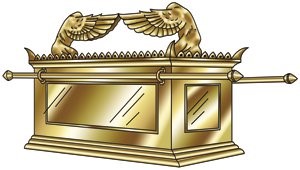
THE CHERUBIM OF GLORY AND
THE MERCY SEAT
And above (huperano) it were the cherubim (cheroubin) of glory (doxa) overshadowing (kataskiazo - present tense - continually) the mercy seat (hilasterion) - Here we see the earthly counterpart of the throne of grace in Heaven (Heb 4:16+). Having described the furnishings of the tabernacle, the author now mentions the most sacred element—the mercy seat atop the ark of the covenant. Above it were the cherubim of glory, angelic figures representing God’s holy presence, stretching their wings over the place where atoning blood was sprinkled. This was the symbolic meeting point between God and His people, the throne of grace under the old covenant.
Pause a moment and picture in your mind the tablets of Law in the Ark and then above the Ark there was an exactly fitting slab of gold called the mercy seat and above that was the Shekinah Glory, the manifestation of God's holy presence. Men broke the Law (symbolized in the Ark). Blood was placed annually on the mercy seat to propitiate or satisfy the wrath of God against the broken laws. The presence of the blood allowed for reconciliation with God by those who had broken the law. However, it was temporary and had to be repeated annually, so it was only a vague shadow of the infinite efficacy of the blood of our Great High Priest Jesus Christ, Who entered not an earthly tabernacle, but the perfect tabernacle in Heaven, and not through blood of animals but through His own blood by which He obtained eternal redemption (and eternal forgiveness and reconciliation) (Heb 9:11-12+).
As an aside remember that there was only one light in the first tabernacle but there was no light in the second, the holy of holies. So how could the high priest even see when he entered on the Day of Atonement? The glory of God was better than light from a menorah! Indeed in Rev 21:23+ we read "and the city has no need of the sun or of the moon to shine on it, for the glory of God has illumined it, and its lamp is the Lamb." Man has been brought fully into the holy of holies which is lit only by God’s glory! Again, we see the emphasis on the communion of man with a holy God. There is no longer any separation of any sort because sin has been completely done away with. And recall that God created light on the first day (Ge 1:3), but the sun and moon were not created until the fourth day (Ge 1:14).
Now, rather than elaborating on these details about the cherubim and mercy seat, the writer signals restraint saying “of these things we cannot now speak in detail.” His purpose is to move forward with the greater argument of showing how Christ, our High Priest, has entered not the copy but the true heavenly sanctuary, offering His own blood and thereby securing eternal redemption.
Note that the phrase cherubim of glory is genitive ("of glory") which can mean Cherubim associated with glory (they belong to the realm of God’s glory), or Cherubim that manifest glory (they reveal His glory). Most commentators favor the glory as that which emanates from God Himself, tantamount to the Shekinah Glory.
F F Bruce - The lid of the ark was a golden slab called the “mercy seat” or place of atonement, viewed by our author as the earthly counterpart of the “throne of grace” to which he has already exhorted his readers to draw near for help in the hour of need (Heb 4:16).... The “cherubim of glory” were two gold figures of composite creatures which overshadowed the mercy seat (Ex. 25:18–22; 37:7–9) and served to support the invisible presence of Israel’s God, who accordingly is repeatedly described as the one “who is enthroned on the cherubim” (1 Sam. 4:4, etc.). It was because of this function that they were called “cherubim of glory”; the glory is the shekhînah, the radiant presence of God dwelling in the midst of his people.
Phillip E Hughes agrees writing "They are described as “cherubim of glory,” not because they were gloriously or beautifully fashioned, as, for example, Aquinas supposed, but because it was between them that the glory of God’s presence appeared above the mercy seat, as promised in Exodus 25:22: “There I will meet with you, and from above the mercy seat, from between the two cherubim that are upon the ark of the testimony, I will speak with you.” The glory in the holy of holies is thus the shekinah glory of God’s presence in the midst of his people (cf. Ex. 40:34ff.; Lev. 16:2; 2 Sam. 6:2; 1 Ki. 8:10f.; 2 Chr. 5:13f.; Ps. 80:1; Isa. 37:16). (See A Commentary on the Epistle to the Hebrews - Page 316)
The Mercy Seat (hilasterion equivalent to the Hebrew kapporet as in Ex 25:17+) was a panel or slab of pure gold, 2.5 cubits long by 1.5 cubits wide (Ex 25:17+), which fit exactly over the top of the Ark of the covenant and to which was integrally attached the Cherubim. The Mercy Seat shows how atonement covers the broken law, in that blood comes between a Holy God and sinful people. In Christ, God’s righteousness and mercy meet perfectly (Ro 3:25 = Christ is our propitiation = hilasterion).
But (term of contrast) of these things we cannot now speak in detail - The author implies that the furnishings of the tabernacle are rich with meaning and symbolism, but he chooses not to explain them at this point. Note he is not saying he cannot explain them but that it is not the right time. On the other hand by making this statement,the author in a sense actually hints that there is a profound depth of symbolism in the tabernacle that could be unfolded—but it is beyond the scope of his argument. His purpose is not to give a full exposition of tabernacle furniture, but to press forward to his central argument: the superiority of Christ’s priestly ministry and sacrifice. He wants to show that Christ is the fulfillment of all the OT shadows.
Ray Pritchard says that "To propitiate means to "turn away wrath by offering a gift." Pagan religions are built on the concept of propitiation, whereby a devotee brings a chicken, a goat, a lamb, or a plate of food and offers it to his god. I saw that very thing happen in Haiti and also in India. By bringing the blood of a chicken, the followers of voodoo hope to appease the evil spirits and turn away their wrath. On a completely different level, a husband does this after having a fight with his wife when he stops at the freeway off ramp and buys flowers on the way home. He hopes the offering of flowers will turn away wrath and restore a right relationship. In the Old Testament the High Priest would enter the Holy of Holies once a year—on the Day of Atonement—bringing with him the blood of a bull. When he sprinkled the blood on the Mercy Seat—the lid of the Ark of the Covenant—that blood was accept by God as an "atonement" or a "covering" for the sin of the people.
The New Testament picks up this idea of propitiation in 1 John 2:2+, "He is the atoning sacrifice for our sins, and not only for ours but also for the sins of the whole world." The phrase "atoning sacrifice" translates the normal Greek word of propitiation. By the offering of himself, Jesus turned away God’s wrath forever. Let me give you three truths to summarize the effects of propitiation: (1) Because Jesus Christ died, God’s justice is now satisfied. (2) Because Jesus Christ died, God’s wrath has now been turned away. The price for sin has been paid. (3) Because Jesus Christ died, God’s mercy is now freely available to anyone who wants it. Justice satisfied … the price paid … mercy available. What an awesome thought. God’s wrath is real, but so is his mercy. He satisfied His Own wrath by offering his own Son on the cross. "Amazing love, how can it be, that thou, my God, shouldst die for me?" (A Forgotten Doctrine: The Wrath of God)
But - Cannot speak in detail - Not because he was ignorant, but because he did not wish to detract from his main point, the better sacrifice, better than that which the Levitical priests offered in the Sanctuary.
In detail is the phrase kata meros an idiom which literally means "in accordance with a part" or pertaining to an activity which proceeds part by part and thus conveys the idea of describing in detail or speaking of one item after another. Many spiritual truths lay hidden like treasure in the Tabernacle and the Tabernacle furnishings, and all are suitable for our edification or building up. But now the writer is trying to draw the Hebrew professing believers not back to the treasures of the Old Covenant but to explain that they were always intended to be a symbol of the better things to come.
Spurgeon comments that "Because it was not his main purpose at that time, and he was writing an important Epistle upon the most vital truths, it would not do to encumber it with too many explanations, so he waived the explanation of those things for another time."
Everything about the tabernacle and its furnishings was meant to be a teaching tool and I like many conservative commentators, believe that ultimately every aspect of the Tabernacles pointed to and was fulfilled in Christ!
- Tabernacle (And the Word became flesh and dwelt among us);
- Lampstand (light of the world);
- Showbread (I am the bread of life);
- Veil (which He consecrated for us, through the veil, that is, His flesh);
- Mercy seat (redemption that is in Christ Jesus, whom God set forth as a propitiation);
- Manna (I am the bread of life);
- Aaron’s rod (Jesus the High Priest);
- Tablets/stone (perfectly fulfilled)
Hugh Stowell caught a vision of the sublime privilege we have to come before the mercy seat and find comfort in time of need. In 1828, he penned the words to a hymn that he originally entitled Peace at the Mercy Seat, but the title was later changed to…
From every stormy wind that blows,
From every swelling tide of woes,
There is a calm, a sure retreat:
’Tis found beneath the mercy seat.
There is a place where Jesus sheds
The oil of gladness on our heads;
A place than all besides more sweet:
It is the blood-bought mercy seat.
There is a scene where spirits blend,
Where friend holds fellowship with friend;
Though sundered far, by faith they meet
Around one common mercy seat.
There, there, on eagles’ wings we soar,
And time and sense seem all no more;
And heaven comes down, our souls to greet,
And glory crowns the mercy seat.
Oh, let my hand forget her skill,
My tongue be silent, cold, and still,
This bounding heart forget to beat,
If I forget the mercy seat!
Cherubim (5502) (cheroubin) is the transliterated Hebrew word describing the two golden figures of living creatures with two wings which were fastened to the lid of the ark of the covenant in the holy of holies (tabernacle and Solomon's temple) in such a manner that their faces were turned towards each other and down towards the lid, which they overshadowed with their expanded wings. Between these figures God was regarded as having fixed His dwelling place. For Moses records…
And you shall put this altar in front of the veil that is near the ark of the testimony, in front of the mercy seat (Hebrew = kapporet = the lid that covered the ark of the testimony) that is over the ark of the testimony, where I will meet with you. (Exodus 30:6)
The following description is Smith's Bible Dictionary summary "The symbolical figure so called was a composite creature-form which finds a parallel in the religious insignia of Assyria, Egypt and Persia, e.g. the sphinx, the winged bulls and lions of Nineveh, etc. A cherub guarded paradise. (Genesis 3:24) Figures of Cherubim were placed on the mercy-seat of the ark. (Exodus 25:18) A pair of colossal size overshadowed it in Solomon's temple with the canopy of their contiguously extended wings. (1Kings 6:27) Those on the ark were to be placed with wings stretched forth, one at each end of the mercy-seat." Their wings were to be stretched upwards, and their faces "towards each other and towards the mercy-seat." It is remarkable that with such precise directions as to their position, attitude and material, nothing, save that they were winged, is said concerning their shape. (see Smith's Dictionary)
J G Baldwin (See NIDNTT) - The word does not occur in secular Greek, but is a transliteration of the Heb. or Aram., hence the variety of plur. endings. OT - The Heb. word is a winged heavenly messenger sometimes associated with the seraph or burning one (Isa. 6:2-6). Cherubim guard the way to the tree of life (Gen. 3:24) and either support or flank the throne of God (Ps. 80:1; Ps 99:1; Isa. 37:16). Their swiftness in flight is likened to the wind (2Sa 22:11; Ps. 18:10). Two wooden replicas of cherubim, gold covered and with wings outspread, were placed over the cover or “mercy seat” of the ark of the covenant, protecting the holy things and forming a pedestal for the throne of Yahweh (Ex 23:17—21; 37:7-9; cf. Nu 7:89). Cherubim also adorned the inmost curtains of the tabernacle and the “‘veil’’ which separated off the most holy place (Ex 26:1, 31), and symbolized the heavenly hosts of the Lord God of hosts (1Sa 4:4; 2Sa 6:2; 2Ki. 19:15; 1Ch 13:6). In Solomon’s temple emphasis is laid on the size of the cherubim, whose wings span the width of the sanctuary (1 Ki. 6:23-28; 2Ch 3:10—13). Among the prophets only Ezekiel mentions the word. The golden cherubim on which had rested the glory of the God of Israel were deserted (Ezek. 9:3), and he was to be found among living cherubim who carried out his every wish (Ezek. 10, cf. Ezek. 1:5 ff.), having moved the place of his throne away from the Temple. In Ezekiel cherubim also guard the presence of God (Ezek. 28:14-16 RSV).
Naves Topic Cherubim
- Eastward of the garden of Eden, Ge 3:24.
- In the tabernacle, Ex. 25:18, 19, 20; 37:7, 8, 9.
- Ark rested beneath the wings of, 1Ki 8:6, 7; 2Chr 5:7, 8; Heb 9:5
- Figures of,
- embroidered on walls of tabernacle, Ex. 26:1; 36:8;
- on the veil, Ex. 26:31; 36:35.
- In the temple, 1Ki 6:23, 24, 25, 26, 27, 28, 29; 2Chr. 3:10, 11, 12, 13.
- Figures of,
- on the veil, 2Chr. 3:14;
- walls, 1Ki 6:29-35; 2Chr 3:7;
- bowls, 1Ki 7:29, 36.
- In Ezekiel's vision of the temple, Ezek. 41:18, 19, 20, 25
- Figurative Ezek. 28:14, 16
- Symbolical Ezek 1; Ezek 10:1-20
The psalms make reference to God enthroned above the cherubim of glory…
Oh, give ear, Shepherd of Israel, Thou who dost lead Joseph like a flock; Thou Who art enthroned above the cherubim, shine forth! (Psalm 80:1)
C H Spurgeon commenting on the cherubim of glory writes "The Lord's especial presence was revealed upon the mercyseat between the cherubim, and in all our pleadings we should come to the Lord by this way: only upon the mercyseat will God reveal His grace, and only there can we hope to commune with Him. Let us ever plead the Name of Jesus, Who is our true mercyseat, to Whom we may come boldly, and through Whom we may look for a display of the glory of the Lord on our behalf. Our greatest dread is the withdrawal of the Lord's presence, and our brightest hope is the prospect of His return. In the darkest times of Israel, the light of her Shepherd's countenance is all she needs.
The LORD (Jehovah) reigns, let the peoples tremble. He is enthroned above the cherubim, let the earth shake! (Psalm 99:1)
C H Spurgeon commenting on the cherubim of glory writes "In grandeur of sublime glory, yet in nearness of mediatorial condescension, Jehovah revealed Himself above the mercyseat, whereon stood the likeness of those flaming ones who gaze upon His glory, and for ever cry, "Holy, Holy, Holy, Lord God of hosts." (Ed note: Seraphim in Isaiah 6:2,3)The Lord reigning on that throne of grace which is sprinkled with atoning blood, and veiled with the covering wings of mediatorial love, is above all other revelations wonderful, and fitted to excite emotion among all mankind, hence it is added, Let the earth be moved. Not merely "the people," but the whole earth should feel a movement of adoring awe when it is known that on the mercyseat God sits as universal Monarch. The pomp of heaven surrounds Him, and is symbolized by the outstretched wings of waiting cherubs; let not the earth be less moved to adoration, rather let all her tribes bow before His infinite majesty, yea, let the solid earth itself with reverent tremor acknowledge His presence. (Amen)
Glory (1391) doxa from dokeo = to think) in simple terms means to give a proper opinion or estimate of something. Glory is something that is a source of honor, fame, or admiration. It describes renown, a thing that is beautiful, impressive, or worthy of praise. It follows that the glory of God expresses all that He is in His Being and in His nature, character, power and acts. He is glorified when He is allowed to be seen as He really is. To be where God is will be glory. To be what God intended will be glory. To do what God purposed will be glory.
DOXA IN HEBREWS - Heb. 1:3; Heb. 2:7; Heb. 2:9; Heb. 2:10; Heb. 3:3; Heb. 9:5; Heb. 13:21
Hebrews 1:3 And He is the radiance of His glory
Hebrews 2:7 YOU HAVE CROWNED HIM WITH GLORY AND HONOR
Hebrews 2:9 because of the suffering of death crowned with glory and honor
Hebrews 3:3 He has been counted worthy of more glory than Moses
Hebrews 9:5 above it were the cherubim of glory overshadowing the mercy seat
Hebrews 13:21 Jesus Christ, to Whom be the glory forever and ever. Amen.
Overshadowing (2683) (kataskiazo from kata = down, over + skia = shade, shadow) means literally to cast a shadow upon. This is the only use in the NT (none in Lxx). The present tense pictures the cherubim continually overshadowing the mercy seat.
Mercy seat (2435) (hilasterion from hilaskomai = propitiate, expiate <> from hileos = appeased, merciful, propitious) means to appease and render favorable. In addition (and as used here in Hebrews) hilasterion identifies the place of propitiation. Two uses in NT - Ro 3:25 and Heb 9:5. Hilastērion translated mercy seat is the term ordinarily used in the Septuagint to render the Hebrew kapporet which means simply “covering.” This Hebrew word was descriptive in a literal sense, because the mercy seat exactly covered the ark of the covenant. Hughes adds that the mercy seat "may well also have had a symbolical significance from the earliest times in that, as Westcott and others have pointed out, it was interposed between the tables of the law contained in the ark, by which the sinner stood condemned, and the glory of God’s holy presence. This is certainly the implication of the Greek hilastērion, which means a place of propitiation." (See Commentary on Hebrews)
Friberg -with focus on the means by which sins are forgiven having atoning power, bringing about reconciliation; substantivally to hilasterion means of forgiveness (Ro 3.25); by metonymy, with a focus on the place where sins are forgiven by means of the blood from an atoning sacrifice placed there place of forgiveness, place where God forgives sins, often translated mercy seat (Heb 9.5) (Borrow Analytical Lexicon of the Greek New Testament)
Thayer writes that the hilasterion referred to "the well-known cover of the ark of the covenant in the Holy of holies, which was sprinkled with the blood of the expiatory victim on the annual day of atonement (this rite signifying that the life of the people, the loss of which they had merited by their sins, was offered to God in the blood as the life of the victim, and that God by this ceremony was appeased The only other NT use of hilasterion is found in Romans in Paul's discussion of justification by faith where he describes Jesus "Whom God displayed publicly as a propitiation (hilasterion) in His blood through faith. This was to demonstrate His righteousness, because in the forbearance of God He passed over (deliberated disregarded, let go unpunished) the sins previously committed." (Ro 3:25+)
Hilasterion means a sacrifice that bears God's wrath and in so doing in a sense changes His wrath toward us into favor. God has set the sinner free through Christ, but He has not done so by setting aside the rules. He has set the sinner free in Christ by satisfying His demands for justice in the penalty poured out on His Christ. And so God remains just and is able to be the Justifier (Ro 3:26+)! Due to sin, a penalty was to be meted out and a price was to be paid. Christ paid that price and suffered that penalty (“redemption” is the price paid to set free slaves, captives, etc). God’s wrath had to be appeased, due to man’s sin and Christ has appeased that wrath, this appeasement being pictured in the term propitiation.
Satisfaction is a synonym for propitiation and indicates that God's moral requirement ("the wages of sin is death" - see Ro 6:23+) has been completely met by the death of His Son on behalf of each Old and New Testament believer (for each of them "the free gift of God is eternal life in Christ Jesus our Lord." - see Ro 6:23+). Christ's once for all sacrifice has fully, perfectly satisfied (propitiated) God. The apostle John uses the related word hilasmos which pictures that which propitiates or appeases and here states that Jesus "Himself is the propitiation (hilasmos - appeasement, satisfaction) for our sins… (1Jn 2:2+)
MacDonald explains the significance of Christ our Propitiation, noting that "by dying for us, He freed us from the guilt of our sins and restored us to God by providing the needed satisfaction and by removing every barrier to fellowship. God can show mercy to us because Christ has satisfied the claims of justice. It is not often that an advocate (or lawyer) pays for his client’s sins; yet that is what our Lord has done, and most remarkable of all, He paid for them by the sacrifice of Himself. (Believer's Bible Commentary)
It needs to be clearly understood that propitiation is not placating a vengeful God but, rather, it is satisfying the righteousness and justice of a holy God, thereby making it possible for Him to show mercy righteously. As alluded to earlier, God can now be just (His law says sin demands death) and can deal with men graciously and benevolently (Justifier).
Hilasterion is used only twice in the NT but is related to 3 other words (1) hilaskomai = propitiate, conciliate, make gracious, be gracious in Lu 18:13+ and Hebrews 2:17+ (2) hileos = gracious, merciful Mt 16:22+ and Hebrews 8:12+ (3) hilasmos = propitiation, propitiatory sacrifice (1Jn 2:2+, 1Jn 4:10+); (4) hilasterion = that which propitiates, means of propitiation, mercy-seat in Ro 3:25+, He 9:5+.
HILASTERION - 28X in the Septuagint (LXX) - Exod. 25:17; Exod. 25:18; Exod. 25:19; Exod. 25:20; Exod. 25:21; Exod. 25:22; Exod. 31:7; Exod. 35:12; Exod. 37:6; Exod. 37:8; Exod. 37:9; Lev. 16:2; Lev. 16:13; Lev. 16:14; Lev. 16:15; Num. 7:89; Ezek. 43:14; Ezek. 43:17; Ezek. 43:20; Amos 9:1; Notice that all of the uses of hilasterion in Exodus, Leviticus and Numbers translate the important Hebrew word kapporet from kaphar = to cover, make atonement. (also to cover over with pitch as in Ge 6:14+) which is translated mercy seat which was the lid that covered the Ark of the Covenant (Ark of Testimony) in the Holy of Holies. The kapporet was the place of atonement or golden plate of propitiation on which the High Priest sprinkled the blood of a sacrificial animal seat seven times on the Day of Atonement this sprinkling symbolizing the reconciliation of Jehovah and His chosen people (Lev 16:14-15, 16,17+). This slab of gold on top of the Ark of the Covenant measured 2.5 by 1.5 cubits and was integrally associated with two golden cherubim facing each other with outstretched wings that came together above the mercy seat.
Hilasterion describes the mercy seat or cover of the ark of the covenant in the Holy of Holies. It was upon this "mercy seat" that the High Priest would sprinkle the blood of the sacrifice once each year on the Day of Atonement (described in Lev 16:1-34+), which corresponds to the modern day Jewish holiday of Yom Kippur that is held on the tenth day of the seventh month, Tishri (7th month of the Jewish year corresponding to September/October). On that day only would the high priest enter within the inner veil bearing the blood of the sin offering (cf. Heb 9:7+). A second goat was released as an escape goat to symbolize the total removal of sin (aza'zel = scapegoat). This solemn day was the only day of fasting prescribed for Israel. It was celebrated by a special sin offering for the whole nation. All the sins of the people were brought symbolically to the Holy of Holies, where blood was sprinkled on the mercy seat as a sacrifice to atone (supply satisfaction for - atonement = making of God and sinners “at one” by the offering of sacrifice and providing a way for humankind to come back into harmonious relation with Him) for them.
Atonement is the act by which God restores a relationship of harmony and unity between Himself and human beings. The word can be broken into three parts that express this great truth in simple but profound terms: “at-one-ment.” Although Old Testament believers were truly forgiven and received genuine atonement through animal sacrifice, the New Testament clearly states that during the Old Testament period God’s justice was not served "For it is not possible that the blood of bulls and goats could take away sins" (Heb 10:4+) Atonement was possible in the Old testament "because in the forbearance of God He passed over the sins previously committed (Ro 3:25+).
However, God’s justice was served in the death of Jesus Christ as a substitute, Hebrews recording that "not through the blood of goats and calves, but through His own blood, He (both as our Substitute Sacrifice and as our Great High Priest) entered the holy place once for all, having obtained eternal redemption (lutrosis - ransoming and release from penalty, power and ultimately some day from the presence and pleasure of sin) (Heb 9:12+). "And for this reason He (Jesus Christ our Great High Priest) is the Mediator of a new covenant, in order that since a death has taken place for the redemption (apolutrosis - payment of a price to ransom and emancipate slaves of sin) of the transgressions that were committed under the first covenant, those who have been called may receive the promise of the eternal inheritance." (Heb 9:15+).
We see a parallel teaching by Jesus Who describes "Two men went up into the temple to pray, one a Pharisee, and the other a tax-gatherer. The Pharisee stood and was praying thus to himself, ‘God, I thank Thee that I am not like other people: swindlers, unjust, adulterers, or even like this tax-gatherer. ‘I fast twice a week; I pay tithes of all that I get.’ “But the tax-gatherer, standing some distance away, was even unwilling to lift up his eyes to heaven, but was beating his breast, saying, ‘God, be merciful to me, the sinner!’ “I tell you, this man went down to his house justified rather than the other; for everyone who exalts himself shall be humbled, but he who humbles himself shall be exalted." (Lu 18:10-14+)
Related Resources:
- What is the Shekinah glory?
- What is the mercy seat?
- The Tabernacle: A Picture of Jesus (Exodus 25-30)
- The Tabernacle of Moses – God’s Heavenly Pattern for our Spiritual Transformation - Part I: The Outer Court - excellent graphics
- The Tabernacle of Moses – God’s Heavenly Pattern for our Spiritual Transformation - Part II: The Holy Place
- The Tabernacle of Moses – God’s Heavenly Pattern for our Spiritual Transformation - Part III: The Holy Place
- The Tabernacle of Moses – God’s Heavenly Pattern for our Spiritual Transformation - Part IV: The Holy Place
- The Tabernacle of Moses – God’s Heavenly Pattern for our Spiritual Transformation - Part V: The Most Holy Place
- The Tabernacle, the Dwelling Place of God
- What was the tabernacle of Moses?
- What was the tent of meeting?
- What was the significance of the bronze laver?
In Exodus 25 Moses records God's instruction to cover the Ark of the Covenant with…
a mercy seat (Hebrew = kapporet ; Lxx = hilasterion) of pure gold, two and a half cubits long and one and a half cubits wide. And you shall make two cherubim of gold, make them of hammered work at the two ends of the mercy seat. And make one cherub at one end and one cherub at the other end; you shall make the cherubim of one piece with the mercy seat at its two ends. And the cherubim shall have their wings spread upward, covering the mercy seat with their wings and facing one another; the faces of the cherubim are to be turned toward the mercy seat. And you shall put the mercy seat on top of the ark, and in the ark you shall put the testimony (the tablets of stone with the 10 Commandments written by the finger of God) which I shall give to you. And there I will meet with you; ("I will keep an appointment with you there” - the Hebrew word has idea of prearranged meeting) and from above the mercy seat, from between the two cherubim which are upon the ark of the testimony, I will speak to you about all that I will give you in commandment for the sons of Israel. (Ex 25:17-22+; cp Nu 7:89)
The godly Plymouth Brethren writer C H Mackintosh (Biography) has the following beautiful devotional thoughts on Exodus 25…
This chapter forms the commencement of one of the richest veins in Inspiration's exhaustless mine — a vein in which every stroke of the mattock brings to light untold wealth. We know the mattock with which alone we can work in such a mine, namely, the distinct ministry of the Holy Ghost. Nature can do nothing here. Reason is blind — imagination utterly vain — the most gigantic intellect, instead of being able to interpret the sacred symbols, appears like a bat in the sunshine, blindly dashing itself against the objects which it is utterly unable to discern. We must compel reason and imagination to stand without, while, with a chastened heart, a single eye, and a spiritual mind, we enter the hallowed precincts and gaze upon the deeply significant furniture.
God the Holy Ghost is the only One who can conduct us through the courts of the Lord's house, and expound to our souls the true meaning of all that there meets our view. To attempt the exposition, by the aid of intellect's unsanctified powers, would be infinitely more absurd than to set about the repairs of a watch with a blacksmith's tongs and hammer.
"The patterns of things in the heavens" cannot be interpreted by the natural mind, in its most cultivated form. They must all be read in the light of heaven. Earth has no light which could at all develop their beauties. The One who furnished the patterns can alone explain what the patterns mean. The One Who furnished the beauteous symbols can alone interpret them.
To the human eye there would seem to be a desultoriness (a sense that there is lack of a definite plan) in the mode in which the Holy Ghost has presented the furniture of the tabernacle; but, in reality, as might be expected, there is the most perfect order, the most remarkable precision, the most studious accuracy. From Ex. 25 to Ex. 30, inclusive, we have a distinct section of the Book of Exodus. This section is divided into two parts, the first terminating at Ex. 27:19, and the second as the close of Ex. 30. The former begins with the ark of the covenant, inside the veil, and ends with the brazen altar and the court in which that altar stood. That is, it gives us, in the first place, Jehovah's throne of judgement, whereon He sat as Lord of all the earth; and it conducts us to that place where He met the sinner, in the credit and virtue of accomplished atonement. Then, in the latter, we have the mode of man's approach to God — the privileges, dignities, and responsibilities of those who, as priests, were permitted to draw nigh to the Divine Presence and enjoy worship and communion there. Thus the arrangement is perfect and beautiful. How could it be otherwise, seeing that it is divine? The ark and the brazen altar present, as it were, two extremes. The former was the throne of God established in "justice and judgement." (Ps. 89:19) The latter was the place of approach for the sinner where "mercy and truth" went before Jehovah's face. Man, in himself, dared not to approach the ark to meet God, for "the way into the holiest of all was not yet made manifest." (Heb 9:8) But God could approach the altar of brass, to meet man as a sinner.
"Justice and judgement" could not admit the sinner in; but "mercy and truth" could bring God out; not, indeed, in that overwhelming brightness and majesty in which He was wont to shine forth from between those mystic supporters of His throne — "the cherubim of glory" — but in that gracious ministry which is symbolically presented to us in the furniture and ordinances of the tabernacle.
All this may well remind us of the path trodden by that blessed One, who is the antitype of all these types — the substance of all these shadows (see topic Typology). He travelled from the eternal throne of God in heaven, down to the depths of Calvary's cross. He came from all the glory of the former down into all the shame of the latter, in order that He might conduct His redeemed, forgiven, and accepted people back with Himself, and present them faultless before that very throne which He had left on their account. The Lord Jesus fills up, in His own person and work, every point between the throne of God and the dust of death, and every point between the dust of death and the throne of God. In Him God has come down, in perfect grace, to the sinner; in Him the sinner is brought up, in perfect righteousness, to God. All the way, from the ark to the brazen altar, was marked with the footprints of love; and all the way from the brazen altar to the ark of God was sprinkled with the blood of atonement; end as the ransomed worshipper passes along that wondrous path, he beholds the name of Jesus stamped on all that meets his view. May that name be dearer to our hearts! Let us now proceed to examine the chapters consecutively.
It is most interesting to note here, that the first thing which the Lord communicated to Moses is His gracious purpose to have a sanctuary or holy dwelling place in the midst of His people — a sanctuary composed of materials, which directly point to Christ, His Person, His work, and the precious fruit of that work, as seen in the light, the power, and the varied graces of the Holy Ghost. Moreover, these materials were the fragrant fruit of the grace of God — the voluntary offerings of devoted hearts.
Jehovah, whose majesty, " the heaven of heavens could not contain," was graciously pleased to dwell in a boarded and curtained tent, erected for Him by those who cherished the fond desire to hail His presence amongst them. This tabernacle may be viewed in two ways: first, as furnishing "a pattern of things in the heavens;" and, secondly, as presenting a deeply significant type of the body of Christ. The various materials of which the tabernacle was composed will come before us, as we pass along; we shall, therefore, consider the three comprehensive subjects put before us in this chapter, namely, the ark; the table; and the candlestick.
The ark of the covenant occupies the leading place in the divine communications to Moses. Its position, too, in the tabernacle was most marked. Shut in within the veil, in the holiest of all, it formed the base of Jehovah's throne. Its very name conveys to the mind its import. An ark, so far as the word instructs us, is designed to preserve intact whatever is put therein. An ark carried Noah and his family, together with all the orders of creation, in safety over the billows of judgement which covered the earth. An ark, at the opening of this book, was faith's vessel for preserving "a proper child" from the waters of death.
When, therefore, we read of "the ark of the covenant," we are led to believe that it was designed of God to preserve His covenant unbroken, in the midst of an erring people. In it, as we know, the second set of tables were deposited. As to the first set, they were broken in pieces, beneath the mount, showing that man's covenant was wholly abolished — that his work could never, by any possibility, form the basis of Jehovah's throne of government.
"Justice and judgement are the habitation of that throne," whether in its earthly or heavenly aspect. The ark could not contain within its hallowed enclosure, broken tables. Man might fail to fulfil his self-chosen vow; but God's law must be preserved in its divine integrity and perfectness. If God was to set up His throne in the midst of His people, He could only do so in a way worthy of Himself. His standard of judgement and government must be perfect.
"And thou shalt make staves of shittim wood, and overlay them with gold. and thou shalt put the staves into the rings by the sides of the ark, that the ark may be borne with them." The ark of the covenant was to accompany the people in all their wanderings. It never rested while they were a travelling or a conflicting host. It moved from place to place in the wilderness. It went before them into the midst of Jordan; it was their grand rallying Point in all the wars of Canaan; it was the sure and certain earnest of power wherever it went. No power of the enemy could stand before that which was the well-known expression of the divine presence and power. The ark was to be Israel's companion in travel, in the desert; and "the staves" and "the rings" were the apt expression of its travelling character.
However, it was not always to be a traveller. "The afflictions of David," as well as the wars of Israel, were to have an end. The prayer was yet to be breathed and answered, "Arise, O Lord, into thy rest: thou and the Ark of thy strength." (Ps. 132:8) This most sublime petition had its partial accomplishment in the palmy days of Solomon, when "the priests brought in the ark of the covenant of the Lord unto his place, into the oracle of the house, to the most holy place, even under the wings of the cherubims. For the cherubims spread forth their two wings over the place of the ark, and the cherubims covered the ark, and the staves thereof above. And they drew out the staves, that the ends of the staves were seen out in the holy place before the oracle, and they were not seen without: and there they are unto this day." (1 Kings 8:6-8) The sand of the desert was to be exchanged for the golden floor of the temple. (1 Kings 6: 30) The wanderings of the ark were to have an end; there was "neither enemy nor evil occurrent," and therefore, "the staves were drawn out."
Nor was this the only difference between the ark in the tabernacle and in the temple. The apostle, speaking of the ark in its wilderness habitation, describes it as "the ark of the covenant, overlaid round about with gold, wherein was the golden pot that had manna, and Aaron's rod that budded, and the tables of the covenant." (Heb. 9:4) Such were the contents of the ark in its wilderness journeyings — the pot of manna, the record of Jehovah's faithfulness, in providing for His redeemed in the desert, and Aaron's rod, "a token against the rebels," to "take away their murmurings.'' (Compare Ex. 16:32-39; and Num. 17:10) But when the moment arrived in which "the staves" were to be "drawn out," when the wanderings and wars of Israel were over, the "exceeding magnifical" house was completed, when the sun of Israel's glory had reached, in type, its meridian, as marked by the wealth and splendour of Solomon's reign, then the records of wilderness need and wilderness failure were unnoticed, and nothing remained save that which constituted the eternal foundation of the throne of the God of Israel, and of all the earth. "There was nothing in the ark, save the two tables of stone, which Moses put there at Horeb." (1 Kings 8: 9)
But all this brightness was soon to be overcast by the heavy clouds of human failure and divine displeasure. The rude foot of the uncircumcised was yet to walk across the ruins of that beautiful house, and as faded light and departed glory were yet to elicit the contemptuous "hiss" of the stranger. This would not be the place to follow out these things in detail; I shall only refer my reader to the last notice which the Word of God affords us of "the ark of the covenant," — a notice which carries us forward to a time when human folly and sin shall no more disturb the resting-place of that ark, and when neither a curtained tent, nor yet a temple made with hands, shall contain it. (see Revelation 11:15; 16; 17; 18; 19)
The mercy-seat comes next in order… Here Jehovah gives utterance to His gracious intention of coming down from the fiery mount to take His place upon the mercy seat. This He could do, inasmuch as the tables of testimony were preserved unbroken beneath, and the symbols of His power, whether in creation or providence, rose on the right hand and on the left — the inseparable adjuncts of that throne on which Jehovah had seated himself — a throne of grace founded upon divine righteousness and supported by justice and judgement. Here the glory of the God of Israel shone forth. From hence He issued His commands, softened and sweetened by the gracious source from whence they emanated, and the medium through which they came — like the beams of the mid-day sun, passing through a cloud, we can enjoy their genial and enlivening influence without being dazzled by their brightness. "His commandments are not grievous," when received from off the mercy-seat, because they come in connection with grace, which gives the ears to hear and the power to obey.
Looking at the ark and mercy-seat together, we may see in them a striking figure of Christ, in His Person and work. He having, in His life, magnified the law and made it honourable, became, through death, a propitiation or mercy-seat for every one that believeth. God's mercy could only repose on a pedestal of perfect righteousness. "Grace reigns through righteousness unto eternal life by Jesus Christ our Lord." (Ro 5:21) The only proper meeting place between God and man is the point where grace and righteousness meet and perfectly harmonize. Nothing but perfect righteousness could suit God; and nothing but perfect grace could suit the sinner. But where could these attributes meet in one point? Only in the cross. There it is that "mercy and truth are met together; righteousness and peace have kissed each other." (Ps. 85:10 - Spurgeon's note)
Thus it is that the soul of the believing sinner finds peace. He sees that God's righteousness and his justification rest upon precisely the same basis, namely, Christ's accomplished work. When man, under the powerful action of the truth of God, takes his place as a sinner, God can, in the exercise of Grace, take His place as a Saviour, and then every question is settled, for the cross having answered all the claims of divine justice, mercy's copious streams can flow unhindered. When a righteous God and a ruined sinner meet, on a blood-sprinkled platform, all is settled for ever — settled in such a way as perfectly glorifies God, and eternally saves the sinner. God must be true, though every man be proved a liar; and when man is so thoroughly brought down to the lowest point of his own moral condition before God as to be willing to take the place which God's truth assigns him, he then learns that God has revealed Himself as the righteous Justifier of such a one. This must give settled peace to the conscience; and not only so, but impart a capacity to commune with God, and hearken to His holy precepts in the intelligence of that relationship into which divine grace has introduced us.
Hence, therefore, "the holiest of all" unfolds a truly wondrous scene. The ark, the mercy seat, the cherubim, the glory! What a sight for the high-priest of Israel to behold as, once a year, he went in within the veil! May the Spirit of God open the eyes of our understandings, that we may understand more fully the deep meaning of those precious types…
Christian reader, your high calling places you in the very midst of all these precious realities. Your place is not merely amid "the patterns of things in the heavens," but amid "the heavenly things themselves." You have "boldness to enter into the holiest by the blood of Jesus." You are a Priest unto God. "The showbread" is yours. Your place is at "the pure table," to feed on the priestly food, in the light of the Holy Ghost. Nothing can ever deprive you of those divine privileges. They are yours for ever. Let it be your care to watch against everything that might rob you of the enjoyment of them. Beware of all unhallowed tempers, lusts, feelings, and imaginations. Keep nature down — keep the world out --- keep Satan off. May the Holy Ghost fill your whole soul with Christ. Then you will be practically holy and abidingly happy. You will bear fruit, and the Father will be glorified, and your joy shall be full. (And all God's people said "Amen", so be it!)
MacIntosh on Genesis 3:24 writes the following
The closing verses of this chapter are full of instruction. Fallen man, in his fallen state, must not be allowed to eat of the fruit of the tree of life, for that would entail upon him endless wretchedness in this world. To take of the tree of life, and eat, and live forever, in our present condition, would be unmingled misery. The tree of life can only be tasted in resurrection. To live forever, in a frail tabernacle, in a body of sin and death, would be intolerable. Wherefore, the Lord God drove out the man. He drove him out into a world which, everywhere, exhibited the lamentable results of his fall. The Cherubim and the flaming sword, too, forbid fallen man to pluck the fruit of the tree of life; while God's revelation pointed him to the death and resurrection of the seed of the woman (Genesis 3:15), as that wherein life was to be found beyond the power of death.
Thus Adam was a happier and a safer man, outside the bounds of Paradise, than he had been within, for this reason — that, within, his life depended upon himself whereas, outside, it depended upon another, even a promised Christ. And as he looked up, and beheld the Cherubim and the flaming sword, he could bless the hand that had set them there, to keep the way of the tree of life, inasmuch as the same hand had opened a better, a safer, and a happier way to that tree (Ed note: Compare to the 12 verses mentioning "better" in Hebrews… better than angels, better things, better hope, better covenant, better sacrifices, better possession, better country, better resurrection, something better, better than the blood of Abel). If the Cherubim and flaming sword stopped up the way to Paradise, the Lord Jesus Christ has opened "a new and living way" (He 10:20-note) into the holiest of all. I am the way, the truth, and the life; no man cometh unto the Father, but by me. (John 14:6) In the knowledge of this, the believer now moves onward through a world which is under the curse — where the traces of sin are visible on all hands. He has found his way, by faith, to the bosom of the Father; and while he can secretly repose there, he is cheered by the blessed assurance that the One who has conducted him thither, is gone to prepare a place in the many mansions of the Father's house, and that he will soon come again and receive him unto Himself, amid the glory of the Father's kingdom. Thus, in the bosom, the house, and the kingdom of the Father, the believer finds his present portion, his future home and reward. (Genesis 1-15)
Robert Neighbour - The Mercy Seat -
"And thou shalt put the Mercy Seat above the Ark; * * and there I will meet with thee, and I will commune with thee from above the Mercy Seat" (Exod. 25:21, 22).
The Mercy Seat is a picture exclusively of Christ and of His redemptive work.
1. The Mercy Seat was made from pure gold, the type of Jesus Christ, God's Son.
The man who denies the virgin birth, and sets to one side the Deity of our Lord has no place of meeting with God.
The Lord said, "For if ye believe not that I am He, ye shall die in your sins" (John 8:24). A human Christ cannot save the sinner.
A so-called minister of the Gospel told us recently that he could not see any difference — it mattered not to him whether Jesus Christ was the son of Joseph, or whether He was the Son of God.
Another minister told us that we gained nothing in claiming the virgin birth; that, if Jesus Christ was born of Joseph and Mary, He was a whole sinner, and if He was born of God and Mary, He was half a sinner.
What blasphemy these words suggest!
The gold of the Mercy Seat proclaimed that Jesus Christ was God. The wood of the Ark covered with gold, proclaimed that He was the God-man.
The God-man, however, was God manifest in the flesh. He did not receive from Mary His nature; He received His nature from God.
2. The Mercy Seat was made from beaten gold.
The beaten gold symbolizes the sufferings of Christ upon the Cross. Jesus Christ, the Son of God suffered the Just for the unjust, "He hath poured out His soul unto death" (Isa. 53:12).
We remember, as a college student, we debated upon the theme, "Did Divinity Suffer?" How foolish to discuss such a theme. Was not Jesus Christ Divine? Divine, not in the sense that all men are Divine, but Divine in the sense that He was Deity? If He was Divine, then Divinity suffered.
The gold symbolized the Deity, and the gold was beaten gold.
3. Upon the Mercy Seat, the blood was sprinkled.
The Mercy Seat was the place of propitiation. The Mercy Seat fitted on top, in the rim of the Ark, and covered it. Beneath the Mercy Seat and within the Ark were the Law, the manna, and Aaron's rod.
Above the Mercy Seat were the cherubims and there, God dwelt. God looked down at the Law, which man had broken, through the blood-sprinkled Mercy Seat.
All this suggests that Jesus Christ is our Daysman. He is our Go-between. God approaches us, in our sins, through Jesus Christ, and the Blood of His Cross; we approach God by the same method.
"God was in Christ, reconciling the world unto Himself" (2 Cor. 5:19).
God gave Christ to be "the propitiation for our sins;" that is, the Mercy Seat for our sins.
4. The blood was sprinkled once a year.
This was because the blood of bulls and of goats had no power to cleanse. Their blood was merely typical, therefore it was often shed.
The Lord Jesus Christ, however, shed His Blood once for all, and entered into the Holiest of all where He ever lives our Mercy Seat.
Robert Neighbour - The Cherubim
"And the Cherubims shall stretch forth their wings on high, covering the Mercy Seat with their wings, and their faces shall look one to another; toward the Mercy Seat shall the faces of the Cherubims be" (Exod. 25:20).
We have come to our final consideration, that of the Cherubim. Four things are before us.
1. The Cherubims were ministers of judgment.
The first story of the Cherubim is given us in Genesis 3:24, God had driven man forth from the Garden, then, "He placed at the east of the Garden of Eden Cherubims, and a flaming sword which turned every way, to keep the way of the Tree of Life" (Gen. 3:24).
Our God is a holy God, and whenever there is sin, there is judgment.
The Cherubims are angels of righteousness, and therefore they perform the function of judgment.
"All have sinned, and come short of the glory of God," therefore all are under the wrath of God.
If a man thinks that he, in his sins and rebellion against God, can somehow or other break through and get into the glory, let him not forget the cherubims — they guard the Way of Life.
2. The Cherubims are ministers of approval.
To us there is no scene in the Word of God more striking than that of the Cherubims with their wings overlapping, and with their faces turned toward each other, looking toward the Mercy Seat.
The Cherubims over the Mercy Seat, were symbols of the true Cherubim, just as the gold of the Mercy Seat was a symbol of the true Christ.
The ministers of God's judgment, the protectors of His righteousness, seemed to be saying as they looked toward the blood-sprinkled Mercy Seat, "God is satisfied with Christ and His sacrifice."
Christ, in His death, held up the honor and the glory of the Father, sustained the majesty of the Law. Christ was made sin for us that we might be made the righteousness of God in Him.
It was here, between the approving Cherubims, that God said, "There will I meet My people" (Exod. 25:22).
3. The Cherubims are ministers of inquiry.
In II Chronicles 3, we have the story of the Cherubims in their relation to the Temple of Solomon. Here they are much larger in size. "And the wings of the Cherubims were twenty cubits long: one wing of the one Cherub was five cubits, reaching to the wall of the house: and the other wing was likewise five cubits, reaching to the wing of the other Cherub. * * The wings of these Cherubims spread themselves forth twenty cubits: and they stood on their feet, and their faces were inward."
It seems to us that the Cherubims were saying, "Is all within, right with God?"
We know the story that Ezekiel tells and how the Cherubims finally left the Temple by the east gate, and went away.
4. The Cherubims are ministers of praise.
In the Book of Revelation we see the Cherubims again. They are called here the four living ones, and they rest not day and night, saying, "Holy, holy, holy, is the Lord God, the Almighty, who was and who is and who is to come" (Rev. 4:8, A. S. V.).
The Cherubims of Ezekiel, and of Revelation 4 and 5 represent our Lord Jesus Christ in His fourfold characteristics.
Some day, we shall know more of these marvelous beings of light. To-day, we praise God that they stood over the Mercy Seat in approval of the Christ of God, and of the Blood of His Cross.
May God pity the men who denounce the Deity of our Lord and decry His Blood. We would rather take our place with the Cherubims, and cry, "Holy, holy, holy, Lord God Almighty."
Matthew Henry - Hebrews 9:5
Those whom God leads he leads to his holy hill, and to his tabernacles; those therefore who pretend to be led by the Spirit, and yet turn their backs upon instituted ordinances, certainly deceive themselves. That God by his grace would bring him into communion with himself, and prepare him for the vision and fruition of himself in the other world; we are to pray for God’s light and truth, the Spirit of light and truth, who supplies the want of Christ’s bodily presence, to lead us into the mystery of godliness and to guide us in the way to heaven. When God sends his light and truth into our hearts, these will guide us to the upper world in all our devotions as well as in all our aims and expectations; and, if we conscientiously follow that light and that truth, they will certainly bring us to the holy hill above. Those that come to the tabernacles should come to the altar; those that come to ordinances should qualify themselves to come, and then come to special ordinances, to those that are most affecting and most binding. The nearer we come, the closer we cleave to God, the better. Those that come to the altar of God must see to it that therein they come unto God, and draw near to him with the heart, with a true heart: we come in vain to holy ordinances if we do not in them come to the holy God. Those that come unto God must come to him as their exceeding joy, not only as their future bliss, but as their present joy, and that not a common, but an exceeding joy, far exceeding all the joys of sense and tim
Our society has thrown out guilt as a bad carryover from our Puritan past. Movie stars and celebrities not only cast off their guilt, but also go on TV to boast about their shameful deeds. Even Christians who have fallen into sin explain how they have come to feel good about themselves in spite of their failures. They complain about self-righteous, judgmental Christians who won’t accept their “shortcomings.”
And yet, in spite of our widespread efforts to suppress or deny guilt, we can’t quite shake it. Years ago, psychologist Eric Fromm observed, “It is indeed amazing that in as fundamentally irreligious a culture as ours, the sense of guilt should be so widespread and deep-rooted as it is” (The Sane Society, [publisher unknown], p. 181). A cartoon hit the nail on the head. It showed a psychologist saying to his patient, “Mr. Figby, I think I can explain your feelings of guilt. You’re guilty!”
The Bible declares that all of us are guilty before the bench of God’s holy justice. “All have sinned and fall short of the glory of God” (Rom. 3:23). The Bible teaches that guilt is more than just a bad feeling. It is true moral culpability that alienates us from God and brings us under His decreed penalty, eternal punishment in the lake of fire (Rev. 20:11-15). But, thankfully, the Bible also declares that God has provided a remedy for our guilt. It is vital that we understand and apply this remedy personally.
The Hebrew Christians were tempted to leave the Christian faith and return to Judaism. The author is showing them why that would be spiritually fatal. The old covenant under Moses was inferior to the new covenant that Jesus initiated. The Levitical priests under the old covenant were sinful, mortal men, as contrasted with Jesus, our sinless priest forever according to the order of Melchizedek. In our text, he shows that the old covenant sacrificial system was temporary and imperfect. It could not provide a clean conscience for the worshipers. God designed that old system to point ahead to the superior, final sacrifice of our high priest, Christ, who offered His own blood to obtain for us eternal redemption and a clean conscience. Thus his point is that…
God’s remedy for guilt
is the blood of Christ.
We will examine the text under three points: the imperfection of the old sacrificial system (Hebrews 9:1-10); what Christ’s sacrifice of Himself accomplished (Hebrews 9:11-14); and, the practical result, that we now can serve the living God (Hebrews 9:14).
1. God designed the old sacrificial system as a temporary, imperfect way of pointing ahead to Christ (Hebrews 9:1-10).
These verses fall into two sections:
A. GOD DESIGNED THE EARTHLY TABERNACLE AS A PICTURE OF CHRIST (Hebrews 9:1-5).
The whole thing was an Old Testament
portrait of Jesus Christ.
John MacArthur (The MacArthur New Testament Commentary, Hebrews [Moody Press], p. 221) points out that the Bible only devotes two chapters to the story of creation, but it gives about 50 chapters to the tabernacle. It was the center of Jewish worship under the old covenant. The author mentions the tabernacle rather than the temple because the tabernacle was introduced immediately after the old covenant was instituted (Ex 24-25). Also, the tabernacle was obviously more temporary than the temple, which fits the author’s point here. As we saw in Hebrews 8:5, the design of the tabernacle and its worship was not left up to human ideas, but God revealed everything in great detail to Moses on the mountain. The whole thing was an Old Testament portrait of Jesus Christ.
The author omits any reference to the courtyard, which contained the bronze altar for sacrifices and the bronze laver or basin. His purpose centers on the tabernacle itself, because he wants to compare and contrast it with the true tabernacle in heaven, where Jesus entered into the very presence of God.
The tabernacle was divided into two sections. The outer section, called the holy place, was about 30 long, 15 feet wide, and 15 feet high. The inner section, the Holy of Holies, was a 15-foot cube. On the left in the holy place, as the priest entered, was a solid gold lampstand with seven branches filled with pure olive oil. Since there were no windows, this provided the only source of light. On the right was the table that held the 12 loaves of sacred bread. Farther in, and to the center just outside the veil that divided the holy place from the Holy of Holies, was the altar of incense.
Scholars debate why the author of Hebrews seems to place the altar of incense inside the Holy of Holies, rather than just outside in the holy place. Some say that he was mistaken, but this is absurd. Every Jew knew the arrangement of these basic pieces of furniture. Some say that the reference is not to the altar itself, but to the censers that the priests used to carry incense into the Holy of Holies on the Day of Atonement, which the author obviously has in mind. The Greek word is used in this sense in the LXX. But then the author would have omitted mentioning a major piece of furniture in the holy place.
Probably the best solution is that the author is connecting the liturgical function of the altar of incense with its close association with the Holy of Holies on the Day of Atonement (see Exod. 30:6; 40:5; 1 Kings 6:22). The same close connection is portrayed in Revelation 8:3, where the golden altar of incense, representing the prayers of the saints, is “before the throne.”
Inside the Holy of Holies was the ark of the covenant, measuring about 45 inches long, 27 inches wide and 27 inches high, which contained (in earliest times) a golden jar of manna, Aaron’s rod that budded, and the stone tablets of the Ten Commandments. The covering of the ark was called the mercy seat, or (in Greek - hilasterion), the place of propitiation. It was overshadowed by two cherubim of glory, so called because it was there that the glory of God’s presence was manifested (Ex 25:22+ = mercy seat > Hebrew = kapporet; Lxx = hilasterion). The high priest sprinkled the blood from the sacrifices on this mercy seat.
The author does not explain the symbolic meaning of any of these things, but hurries on to his point, that these things were temporary and looked ahead to Christ. But let me comment briefly. The lampstand pictures Christ, not here as the light of the world (because the world was not allowed into the holy place), but as the one who illumines the things of God through the Holy Spirit (the oil) to those who draw near. The table of sacred bread pictures Christ as the sustenance of His chosen people and their communion with Him. The altar of incense shows Christ interceding for His people in God’s presence. The ark pictured the very presence of God. The golden jar of manna shows Christ as the daily bread of His people. Aaron’s rod that budded shows Christ, the branch, chosen above others because He alone is life-giving. The tables of the covenant reveal God’s holy standards. Neither the pot of manna nor Aaron’s rod existed in Solomon’s time, but the two stone tables were still there (1 Kings 8:9). The ark itself apparently disappeared when Nebuchadnezzar destroyed the temple in 586 B.C. The later temple only contained a stone slab in the Holy of Holies.
The author moves on to describe the familiar tabernacle ritual:
B. GOD DESIGNED THE MINISTRY OF THE PRIESTS IN THE TABERNACLE AS A PICTURE OF THE WORK OF CHRIST (Hebrews 9:6-10).
He summarizes the common activities of the priests in Heb 9:6. They went into the outer tabernacle to trim the lamps and to put fresh incense on the altar. Once a week they would replace the sacred loaves of bread. But Heb 9:7 focuses on the Holy of Holies. Only the high priest could go in there, once a year, on the Day of Atonement (Leviticus 16:1-34). He would first offer a bull for his own sins. He would enter the Holy of Holies and sprinkle the blood of the bull on the mercy seat and in front of it. Then he would go back out and slaughter one of two goats as a sin offering for the people and take this blood into the mercy seat. He would go back out and lay his hands on the living goat, confessing over it the sins of the people. They would lead this goat out into the wilderness and let it go.
The author calls attention to the fact that old system provided a way for forgiveness for “the sins of the people committed in ignorance” (Heb 9:7). The Law stipulated that there was no sacrifice for sins of defiance (Nu 15:30-31). There is a sense, of course, in which virtually all of our sins stem from defiance toward God, but the reference in Numbers seems to refer to outrageous, blasphemous behavior that represented revolt or treason against God (Ronald Allen, Expositor’s Bible Commentary [Zondervan], ed. by Frank Gaebelein, 2:830). In this sense, there is a parallel in Hebrews 10:26-31, where the author strongly warns his readers against apostasy, for which there is no sacrifice.
The annual Day of Atonement ritual would have underscored to Israel a number of vital spiritual truths. It portrayed the absolute holiness of God and how our sin separates us from entering His presence. It showed the sin and defilement of all of the people, including the high priest. It showed that no one dared to enter God’s holy presence without the blood of an acceptable sacrifice (cf Lev 17:11). It showed that the people must approach God through the proper mediator, the high priest. It showed that if the proper sacrifice was offered, God would be propitiated or satisfied, so that He would not judge their sins. But, as glorious as all of this ritual was, it was inadequate, for two main reasons:
1). THE OLD SYSTEM PROVIDED LIMITED ACCESS TO GOD.
None of the people and not even all of the priests could enter the Holy of Holies. Only the high priest could go there, and that only once a year, with blood. It was not a cozy place where he put his feet up on the hearth and had a warm conversation with God! He had to make sure that he had the ritual down perfectly, or it would be his last trip into that sacred sanctuary! (cf bells in Ex 28:33-35+)
The author attributes the Old Testament account to the Holy Spirit (Heb 9:8), who was signifying “that the way into the holy place has not yet been disclosed, while the first tabernacle is still standing.” Some understand “first tabernacle” to refer to the entire tabernacle, but since the same phrase is used in Heb 9:2 and Heb 9:6 to refer to the holy place, others take it to refer to the outer or first room of the tabernacle. The meaning then would be that the holy place “was blocking the way into the sanctuary of God’s presence for the mass of the people, for whom entry even into the holy place was prohibited….So long, then, as the holy place continued standing they had no hope of immediate access to God” (Philip Hughes, A Commentary on the Epistle to the Hebrews [Eerdmans], p. 322, 323).
2). THE OLD SYSTEM PROVIDED LIMITED EFFICACY OF THE SACRIFICES.
The author’s bottom line is that these gifts and sacrifices could not “make the worshiper perfect in conscience” (Heb 9:9). He does not explain exactly what that means, except that it was “a symbol” (parable) “for the present time.” The “present time” (Heb 9:9) may mean “the time then present,” that is, “in the Old Testament days the way to God was not yet revealed.” Or, it may mean “the time now present,” indicating that “the real meaning of the tabernacle can only now be understood, in the light of the work of Christ” (Leon Morris, The Expositor’s Bible Commentary [Zondervan], ed. by Frank Gaebelein, 12:84).
The inability of the sacrifices to make the worshiper perfect in conscience “did not mean … that no Old Testament saint ever had a clear conscience, but he did not obtain it by the sacrifices as such” (ibid.). The author offers two reasons for this statement (Heb 9:10). First, they were external regulations for the body, but (the implication is) they could not deal adequately with the conscience. Second, they were temporary, “imposed until a time of reformation,” which refers to the time of Christ. The fact that the sacrifices had to be repeated annually showed the incomplete nature of the forgiveness. It put off guilt for each year, but it had to be done again and again.
Up to this point, the author is arguing that the Old Testament sacrificial system was not God’s complete and final provision for the guilt of our sins. It all pointed ahead to Christ.
2. The blood of Christ obtained eternal redemption and a clean conscience for us (Hebrews 9:11-14).
Whereas the old system provided only limited access and limited efficacy, Christ provides complete access and efficacy:
A. CHRIST’S BLOOD PROVIDES COMPLETE ACCESS INTO THE HEAVENLY HOLY OF HOLIES (Hebrews 9:11-12).
There is a textual variant in 9:11. Probably the best reading is, “the good things that have come.” The “greater and more perfect tabernacle, not made with hands,” refers to the “true tabernacle” in heaven (8:2), which is God’s very presence. The point is, Christ didn’t just go into an earthly Holy of Holies. He went into heaven itself, of which the earthly tabernacle was only a picture.
Furthermore, Christ didn’t take the blood of goats and calves to sprinkle on the altar. Rather, He went there “through His own blood.” Some have erroneously taught that Jesus had to carry His blood into heaven to secure our redemption. But He didn’t go there with His blood, but through His blood. He secured our redemption on the cross. In contrast to going back every year, Christ “entered the holy place once for all, having obtained eternal redemption.” The author is showing the complete supremacy and finality of the blood of Christ over the old system. Through His death, our guilt is atoned for once and for all, for all eternity! The penalty has been paid. There is nothing that we can add to what Christ did. Through Him we have direct access to God!
B. CHRIST’S BLOOD PROVIDES COMPLETE EFFICACY THAT CLEANSES OUR CONSCIENCES (Hebrews 9:13-14).
The blood of bulls and goats and the ashes of a heifer “sanctify for the cleansing of the flesh.” In addition to the Day of Atonement ritual, the author adds the red heifer ritual (Nu 19:1-13). This was a ritual for purification, especially if someone had been defiled by touching a dead body. The author argues from the lesser to the greater. If these rituals could cleanse the flesh, “how much more will the blood of Christ, who through the eternal Spirit offered Himself without blemish to God, cleanse your conscience from dead works to serve the living God?” Jesus Christ is the only one who could atone for man’s sin, because He alone was a man without blemish in all that He did. Thus His blood can act as the substitute for the penalty that we deserve.
Scholars debate whether “eternal Spirit” refers to the Holy Spirit or to Jesus’ eternal divine spirit (there were no capital letters in the original Greek). We cannot be dogmatic on this. If it refers to the Holy Spirit, then it means that Jesus relied on the Holy Spirit when He went to the cross, which is certainly true. If it refers to Jesus’ eternal divine nature, the emphasis would be on the fact that Jesus’ sacrifice was uniquely efficacious to redeem His people, because He is not only a man, but also is eternal God (7:3, 16). The point is, “the difference between the levitical offerings and Christ’s self-offering was infinite rather than relative” (P. Hughes, p. 360). This infinitely efficacious sacrifice satisfied God in a way that the blood of bulls and goats never could. Through Christ’s blood, we can have a clean conscience.
The Bible teaches that the conscience alone is not an infallible guide. Through repeated sin, the conscience can be defiled (Titus 1:15) and seared (1 Tim. 4:2). For example, I read that Cambodian dictator Pol Pot murdered between two and seven million of his fellow people. He ordered the murder of everyone who wore eyeglasses, among many other senseless killings. Historians say that his evil deeds were even greater than those of Hitler and Stalin, if possible. Yet just before he died in 1998, he told a reporter that he had a clear conscience! It wasn’t clear; it was seared!
So our consciences need to be informed and trained through Scripture. As we learn who God is and what His holy standards are, our consciences accuse us of how sinful we are. God’s commandments, applied as Jesus did to the heart level, convict and condemn us all! None of us come close to loving God with our entire being, or to loving our fellow human beings as we love ourselves. Part of God’s work in regeneration is to bring His holy Law to bear on our hearts, so that we despair of any way of trying to justify ourselves. We stand truly guilty
So how can our guilt be removed and our consciences be cleansed? Only through the sacrifice of an acceptable substitute. As 1 Peter 3: 18 puts it, “For Christ also died for sins once for all, the just for the unjust, so that He might bring us to God….” Or, as Paul put it (Rom. 3:24-25), “being justified as a gift by His grace through the redemption which is in Christ Jesus; whom God displayed publicly as a propitiation in His blood through faith.” Our guilt is not removed by doing penance or good works. Our guilt is totally removed by God’s free gift through the blood of Christ. We receive this gift through faith.
“But,” you may wonder, “if it is totally by God’s grace apart from anything that we do, won’t people take advantage of His grace by living in sin?” Paul deals extensively with this objection in Romans 6. But here our author counters it with a single phrase at the end of verse 14:
3. Christ redeems and cleanses us from dead works to serve the living God (9:14).
Some Christians serve God in an attempt to pacify a guilty conscience. They erroneously think, “If I do enough for Him, maybe He will forgive me.” That is a wrong motive! Others mistakenly think that God forgives them so that they can feel good. Their focus is on themselves, not on God and others. Again, that is a wrong focus. The proper order is, “God has forgiven me by His grace through the precious blood of His Son. Now I am free to serve Him!”
There are three senses in which the works of those who have not trusted in the blood of Christ are dead works (from P. Hughes, pp. 360-361): First, they are dead works because the one doing them is dead in his sins, separated from the life of God. Second, they are dead works because they “are essentially sterile and unproductive.” They cannot communicate spiritual life to others because they stem from a person who is spiritually dead. Third, they are dead works because they end in spiritual death. A person does them thinking that they will earn him eternal life. But if eternal life could come through our good works, then Christ died needlessly! No amount of good works can qualify a person for heaven.
But once we are born again by God’s grace, we offer ourselves as living sacrifices (Rom. 12:1-2), so that whether we eat or drink or whatever we do, we do it to God’s glory (1 Cor. 10:31). Our daily lives become an act of worship and praise to the living God out of gratitude (Heb. 13:15-16).
Conclusion
Charles Simeon was a godly Anglican pastor at Holy Trinity Church in Cambridge. He described his own conversion in 1813 (F. F. Bruce, Commentary on the Epistle to the Hebrews [Eerdmans], p. 194, citing H. C. G. Moule, Charles Simeon):
As I was reading Bishop Wilson on the Lord’s Supper, I met with an expression to this effect—“That the Jews knew what they did, when they transferred their sin to the head of their offering.” The thought came into my mind, “What, may I transfer all my guilt to another? Has God provided an Offering for me, that I may lay my sins on His head? Then, God willing, I will not bear them on my own soul one moment longer.” Accordingly I sought to lay my sins upon the sacred head of Jesus.
Have you done that? If you have not, you are truly guilty before God and stand in jeopardy of His judgment. If you have, you have applied God’s remedy for your guilt, the blood of Christ. With a clean conscience, you now can serve the living God.
Discussion Questions
- Are guilt feelings valid for a Christian who has sinned? How would you counsel such a person?
- How can a believer distinguish between true and false guilt? How should each be dealt with?
- How should we witness to a person who has no sense of guilt before God?
- If we are totally forgiven through faith in Christ, why do we need to ask forgiveness when we sin?
- Copyright, Steven J. Cole, 2004, All Rights Reserved.
- Unless otherwise noted, all Scripture Quotations are from the New American Standard Bible, Updated Edition © The Lockman Foundation