Hebrews 9:1
Hebrews 9:2
Hebrews 9:3
Hebrews 9:4
Hebrews 9:5
Hebrews 9:6
Hebrews 9:7
Hebrews 9:8
Hebrews 9:9
Hebrews 9:10
Hebrews 9:11
Hebrews 9:12
Hebrews 9:13
Hebrews 9:14
Hebrews 9:15
Hebrews 9:16
Hebrews 9:17
Hebrews 9:18
Hebrews 9:19
Hebrews 9:20
Hebrews 9:21
Hebrews 9:22
Hebrews 9:23
Hebrews 9:24
Hebrews 9:25
Hebrews 9:26
Hebrews 9:27
Hebrews 9:28
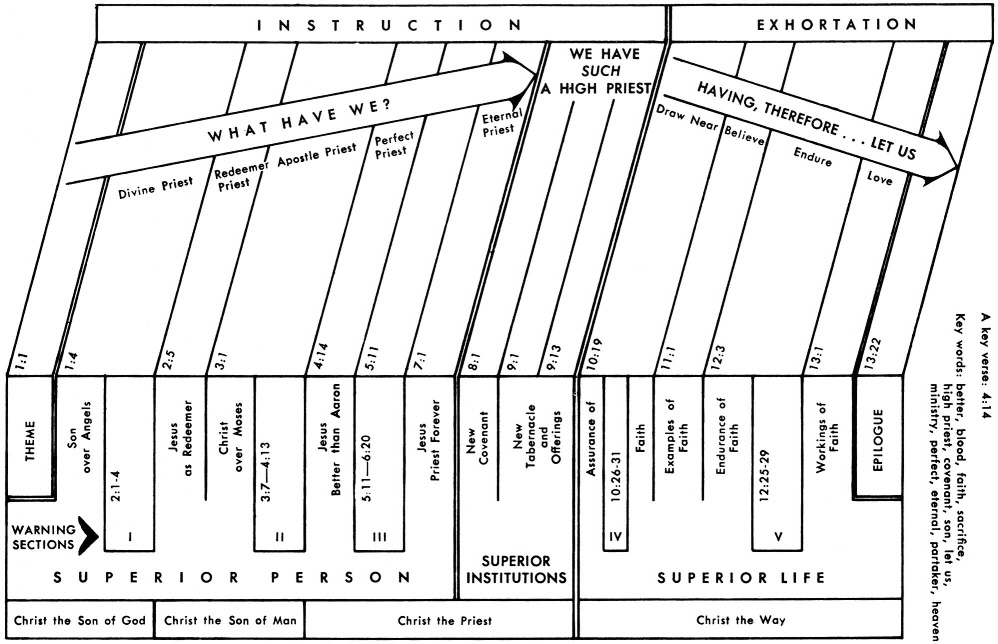
CONSIDER JESUS OUR GREAT HIGH PRIEST
Click chart to enlarge
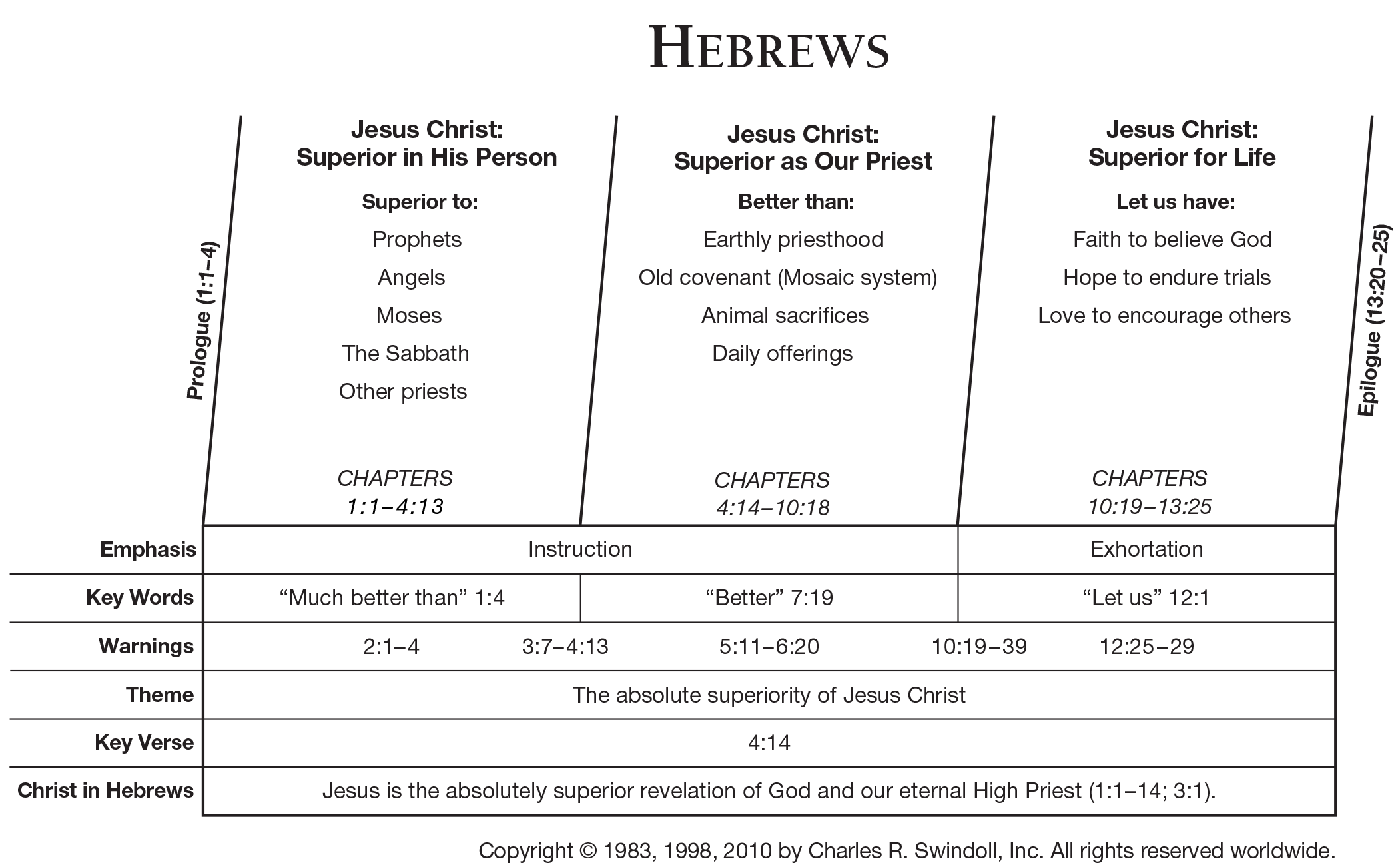
Charts from Jensen's Survey of the NT - used by permission
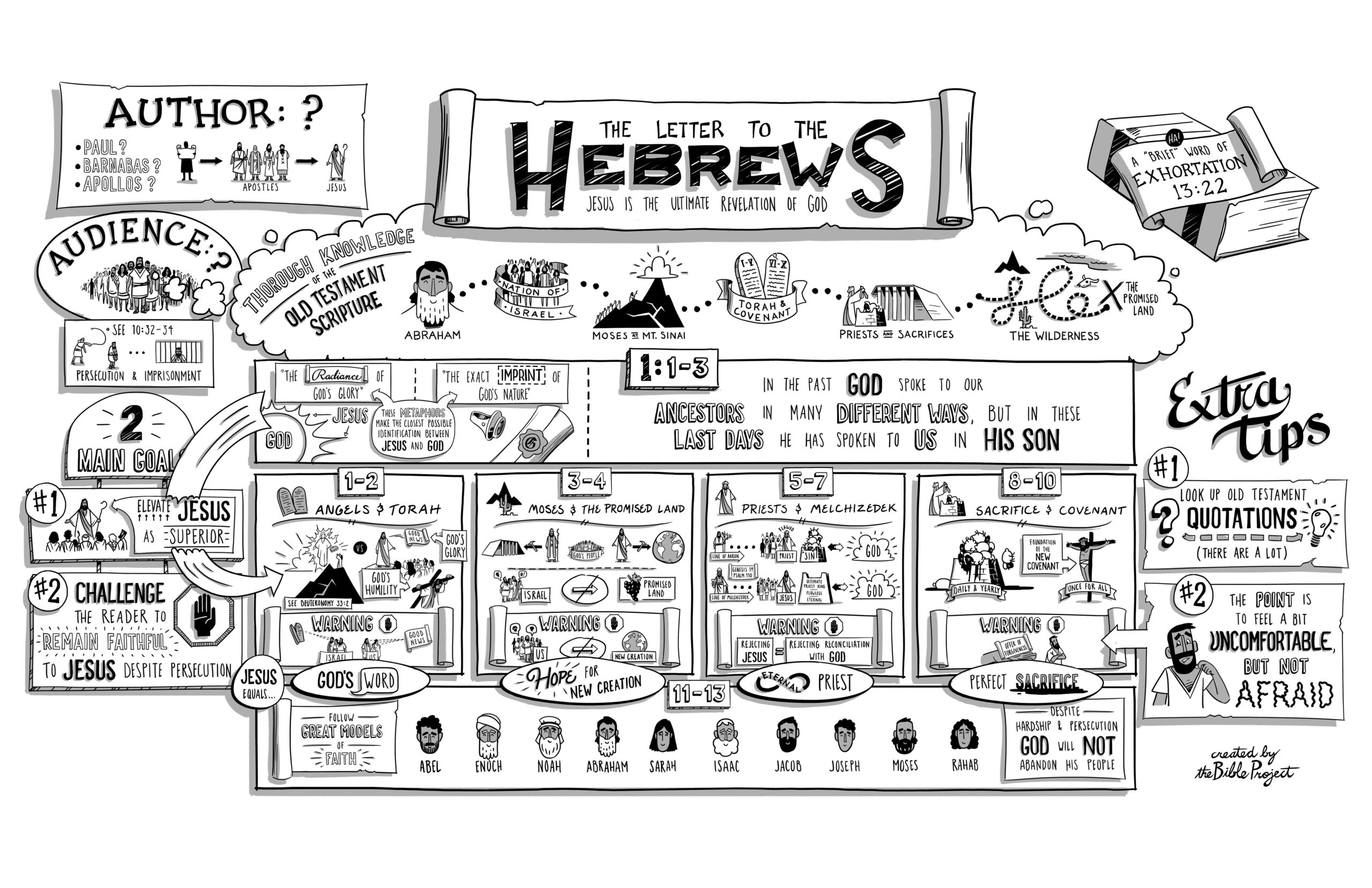
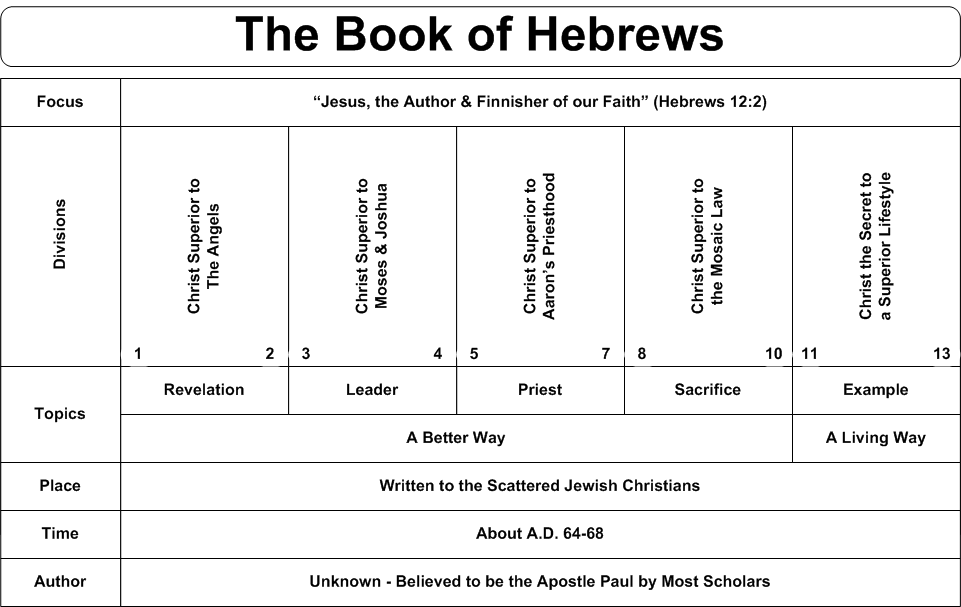
Swindoll's Chart, Interesting Pictorial Chart of Hebrews, Another Chart
|
The Epistle |
||||
| INSTRUCTION Hebrews 1-10:18 |
EXHORTATION Hebrews 10:19-13:25 |
|||
| Superior Person of Christ Hebrews 1:1-4:13 |
Superior Priest in Christ Hebrews 4:14-10:18 |
Superior Life In Christ Hebrews 10:19-13:25 |
||
| BETTER THAN PERSON Hebrews 1:1-4:13 |
BETTER PRIESTHOOD Heb 4:14-7:28 |
BETTER COVENANT Heb 8:1-13 |
BETTER SACRIFICE Heb 9:1-10:18 |
BETTER LIFE |
| MAJESTY OF CHRIST |
MINISTRY OF CHRIST |
MINISTERS FOR CHRIST |
||
|
DOCTRINE |
DUTY |
|||
|
DATE WRITTEN: |
||||

See ESV Study Bible "Introduction to Hebrews"
(See also MacArthur's Introduction to Hebrews)
Borrow Ryrie Study Bible
|
THE FIVE WARNING PASSAGES |
| Heb 2:1-4+ |
| Heb 3:7-4:13+ |
| Heb 5:11-6:12+ |
| Heb 10:19-39+ |
| Heb 12:14-29+ |
Hebrews 9:6 Now when these things have been so prepared, the priests are continually * entering the outer tabernacle performing the divine worship (NASB: Lockman)
Greek: Touton de houtos kateskeuasmenon, (RPPNPG) eis men ten proten skenen dia pantos eisiasin (3PPAI) oi hiereis tas latreias epitelountes, (PAPMPN)
Amplified: These arrangements having thus been made, the priests enter [habitually] into the outer division of the tabernacle in performance of their ritual acts of worship. (Amplified Bible - Lockman)
Barclay: Since these preparations have been made, the priests continually enter into the first tabernacle as they perform the various acts of worship. (Westminster Press)
KJV: Now when these things were thus ordained, the priests went always into the first tabernacle, accomplishing the service of God.
NLT: When these things were all in place, the priests went in and out of the first room regularly as they performed their religious duties. (NLT - Tyndale House)
Phillips: Under this arrangement the outer tent was habitually used by the priests in the regular discharge of their religious duties. (Phillips: Touchstone)
Wuest: But these things having been thus arranged, into the first tent the priests enter continually, fulfilling the sacred service.
Young's Literal: And these things having been thus prepared, into the first tabernacle, indeed, at all times the priests do go in, performing the services
Paraphrase After the furnishings of the Holy Place were set in order, the priests went in day after day, performing the regular rituals and acts of service required under the law.
Paraphrase Thus, once the outer sanctuary was prepared, the priests went in repeatedly to perform their daily tasks — a reminder that their ministry was constant but never complete.
- Exodus 27:21; 30:7,8; Numbers 28:3; 2 Chronicles 26:16-19; Daniel 8:11; Luke 1:8-11
- Hebrews 9 Resources - Multiple Sermons and Commentaries
DAILY SERVICE OF PRIESTS
MINISTRY IN THE SHADOWS
Hebrews 9:6 moves us from discussion of the sanctuary to description of the daily ritual of the priests. Rituals in the outer tabernacle were continually active with lamp-lighting, continuous incense burning, and weekly changing of the bread of the Presence, it was not the place of full access to God. These regulations highlighted the limitations of the first covenant: service was real, but it just a faint shadow and symbol, carried out by men who themselves needed atonement. The busy routine of the priests in the Holy Place stood in sharp contrast to the restricted access of the Most Holy Place, where God’s presence was manifest but veiled. This verse prepares the reader to see the insufficiency of Old Covenant worship and the necessity of Christ’s superior priestly work.
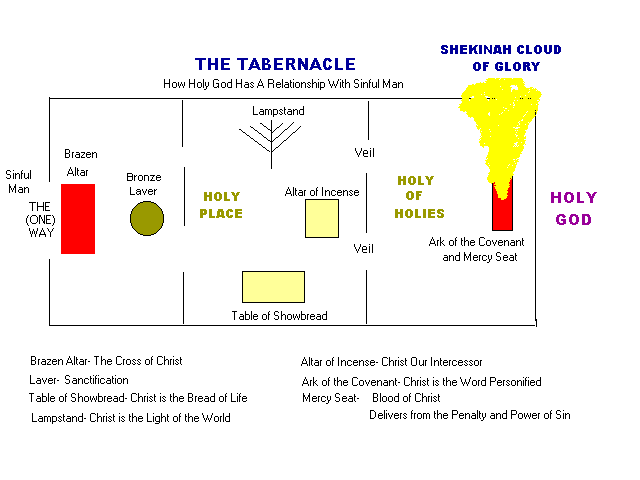
Now when these things have been so prepared (kataskeuazo - perfect tense), the priests (hiereus) are continually entering the outer tabernacle (skene) performing (epiteleo - continually) the divine worship (latreia) - These things (Ask WHAT things?) refers to the furnishings and arrangements of the tabernacle described in the preceding verses (Heb 9:1–5). The priests (hiereus) refers not to the high priests but lower level priests, who were daily busy with activity in the outer tabernacle (trimming the lamp, replacing the bread, burning incense) but never attaining access to the inner tabernacle where God dwelt. One might say they were busy but barred from God's immediate presence. This clearly shows the weakness of the Levitical priesthood and the the incompleteness of the Old Covenant because their work never done, sins were never fully dealt with and access to God's presence was never truly open.
Continually entering - Their continual ministry in the outer room actually underlined the barrier of the veil. In effect long as the old system stood, it was teaching separation rather than true access. As with the Old Covenant in general, the system pointed forward but could not accomplish salvation.
F F Bruce on continually entering - In the tabernacle and in the temples which replaced it, the outer compartment, the holy place, was in continual use. Day by day, morning and evening, the appointed priests entered it to trim the lamps on the lampstand (Ex. 27:20f.) and at the same time to burn incense on the incense-altar (Ex. 30:7f.)....week by week the appointed priests entered the holy place to put fresh loaves on the table of showbread (Lev. 24:8f.). These were the principal services which were discharged in “the first tent,” and any member of the priesthood could discharge them.
Performing (epiteleo - continually) the divine worship (latreia) - In the sanctuary the Old Covenant had divine services. Although these were outside the Holy Place, the first responsibility of priests each morning was to remove the old ashes from the brazen altar, get the fire burning, and then offer a lamb to the Lord, a symbol of total devotion to God (Ex 29:38-42+, Nu 28:2-3+) The priests entered the Holy Place daily to perform their tasks. Morning and evening the lamps were trimmed to ensure they kept burning without interruption (Ex 27:20+), and burning of incense morning and evening (Ex 30:7-8+). The Showbread was replaced weekly. Every Sabbath they had to change 12 loaves of bread (Lev 24:5-9+). David suggests that the incense is a picture of prayer ascending to God (Ps 141:2) and it reminds us that Jesus Christ intercedes for us (Ro 8:33-34+).
Prepared (2680)(kataskeuazo from kata = intensifies the meaning of + skeuazo = prepare, make ready <> from skeuos = implement, vessel) means to means to cause to be thoroughly prepared, to make ready, to put in a state of readiness (Mk 1:2+). It is used of persons who are mentally and spiritually prepared - "make ready a people prepared for the Lord." (Lk 1:17+). To build, construct, erect, create (Heb 3:3-4+, Heb 11:7+, 1 Pe 3:20+). To furnish or equip (Heb 9:2, 6+). Kataskeuazo means to make, construct or erect with idea of adorning and equipping with all things necessary. Kataskeuazo was the word used to describe the preparing of a way before oriental monarch (see use in Mk 1:2+; from Malachi 3:1+).
KATASKEUAZO - 10V - Matt. 11:10; Mk. 1:2; Lk. 1:17; Lk. 7:27; Heb. 3:3; Heb. 3:4; Heb. 9:2; Heb. 9:6; Heb. 11:7; 1 Pet. 3:20
Hebrews 3:3 by just so much as the builder of the house has more honor than the house.
Hebrews 3:4 For every house is built by someone
Hebrews 3:4 but the builder of all things is God.
Hebrews 9:2 For there was a tabernacle prepared, the outer one
Hebrews 9:6 Now when these things have been so prepared
Hebrews 11:7 in reverence prepared an ark for the salvation of his household,
Priests (2409) (hiereus from hieros = sacred, holy, consecrated to God, used as a noun to mean a sacred place or temple, cp Mark 11:11; cp English derivative "hierarchy" = leadership) is a sacred or consecrated person who serves deity. Priests in the NT refer primarily to the ceremonial officials of Jesus' day, that group of men who offered Temple sacrifices and carried out the other sacred rites associated with the Jewish Temple and Jewish people (cp Heb 8:4) . Most of the uses of hiereus refer to Jewish priests, but Acts 14:13 refers to a priest of the pagan cult of Zeus (patron little g god of the city of Lystra). Jesus is our Great High Priest, which describes His primary ministry in our behalf today (Heb 7:1, 3, 11, 14, 15, 17, 20, 21, 23), one aspect of that ministry being His continual intercession for us (Heb 7:25, Ro 8:34). Hiereus describes the specific position and not necessarily a priest’s character (e.g., see Lk 10:31 where a priest was a "bad Samaritan" so to speak). In Revelation hiereus describes believers who will rule and reign as priests with Christ the Great Priest (Jesus - Heb 10:21 = See Christ as Priest, Rev 1:6, Rev 5:10, Rev 20:6). Even though the hiereus described religious men, it did not signify necessarily that they were saved (cp Acts 6:7).
Priest in Latin is pontifex (from pont-, pons = bridge + facere/facio = to make) which literally means a bridge maker, and is word used even today to describe the Pope as "Pontifex Maximus" (maximus = greatest, highest), which literally means the "greatest bridge builder" and in modern parlance "the Highest Priest".
HIEREUS IS A KEYWORD IN HEBREWS - 14 OF 30 USES - Matt. 8:4; Matt. 12:4; Matt. 12:5; Mk. 1:44; Mk. 2:26; Lk. 1:5; Lk. 5:14; Lk. 6:4; Lk. 10:31; Lk. 17:14; Jn. 1:19; Acts 4:1; Acts 6:7; Acts 14:13; Heb. 5:6; Heb. 7:1; Heb. 7:3; Heb. 7:11; Heb. 7:14; Heb. 7:15; Heb. 7:17; Heb. 7:21; Heb. 7:23; Heb. 8:4; Heb. 9:6; Heb. 10:11; Heb. 10:21; Rev. 1:6; Rev. 5:10; Rev. 20:6
Hebrews 5:6 YOU ARE A PRIEST FOREVER
Hebrews 7:1 priest of the Most High God,
Hebrews 7:3 he remains a priest perpetually.
Hebrews 7:11 what further need was there for another priest
Hebrews 7:14 Moses spoke nothing concerning priests.
Hebrews 7:15 if another priest arises according to the likeness of Melchizedek
Hebrews 7:17 YOU ARE A PRIEST FOREVER
Hebrews 7:21 for they indeed became priests without an oath
Hebrews 7:21 YOU ARE A PRIEST FOREVER’
Hebrews 7:23 The former priests, on the one hand, existed in greater numbers
Hebrews 8:4 Now if He were on earth, He would not be a priest at all
Hebrews 9:6 the priests are continually entering the outer tabernacle
Hebrews 10:11 Every priest stands daily ministering
Hebrews 10:21 and since we have a great priest over the house of God,HIEREUS - Almost 800x in the Septuagint - ONLY Genesis & Exodus here - Gen. 14:18; Gen. 41:45; Gen. 41:50; Gen. 46:20; Gen. 47:22; Gen. 47:26; Exod. 2:16; Exod. 3:1; Exod. 18:1; Exod. 19:22; Exod. 19:24; Exod. 29:30; Exod. 35:19; Exod. 36:8; Exod. 37:19
Wayne A Detzler on Priest -
MEANING The Greek word for priest is hiereus. This root is seen in many English words, such as "hierarchy" (ruling body of clergymen), "hieroglyphics" (priestly engravings), and "hierolatry" (the worship of saints). The basic meaning of the word hieros is "one consecrated or filled with divine power."
Early Greek writers used this word to describe things pertaining to their pagan gods. The head of Zeus was described as being hieros, consecrated, or holy. The same term was used to describe an expert in the sacrificial system of religion. Men who were especially wise were set apart as priests and entitled hiereus.
In the Septuagint Greek Old Testament the priests were occupied with three duties. First, they served regularly in the sanctuary, whether the tent tabernacle or the temple at Jerusalem. Second, they brought sacrifices on a regular basis. Third, they discerned divine guidance through waiting on the Lord.
BIBLE USAGE The Greek word for priest occurs 31 times in the New Testament. Almost half of these appearances are in the Book of Hebrews, where it usually refers to the Lord Jesus Christ. (A related word is archiereus, which means "chief priest.")
Though the priests uniformly opposed Jesus, He still showed respect to them. For instance, when He healed lepers, Jesus sent the restored men to the priests for sacramental confirmation of their healing (Matt. 8:4). This was a fulfillment of the Levitical Law (Lev. 14:1-12).
Jesus also referred to priests in His parabolic teaching. In the story of the Good Samaritan, it was a priest who walked past the ambushed traveler without lifting a finger to help (Luke 10:31). No one seemed to be surprised at this callous action by the priest. Perhaps this reveals the low opinion which most people held concerning the priesthood. But despite this low opinion, many priests did come to believe in the Lord (Acts 6:7).
In speaking of the Sabbath, Jesus said that priests "break the Sabbath" by working on that day (Matt. 12:5). Jesus used this to justify His own ministry on the Sabbath. Since the Jews accepted the priests' activity on the Sabbath, they should also accept Christ's healing work on the holy day. Incidentally, Christ here seems to emphasize His role as a priest.
The Book of Hebrews makes the point that the Levitical priesthood had failed to make people right with God. Those priests were only "a copy" of the perfect priesthood of Christ (Heb. 8:4-5). Despite their faithfulness in keeping the forms of Judaism, they were only a pale picture of Christ, the true Priest (Heb 9:1-9). The point is this: Human priests cannot provide a perfect sacrifice for sin (Heb 10:11).
The New Testament portrays Christ as the perfect Priest. He entered into intercession for us during the last hours before His crucifixion (John 17). Since His ascension into heaven, Christ has ceaselessly interceded for us, His people (Heb. 7:24-25). He is a Priest according to the ancient order of Melchizedek (Heb 5:6; 7:1-3, 11-15). No human frailty mars the priesthood of Christ.
In the Scriptures, however, there is another class of priests. The Bible teaches that every believer is a priest (1 Peter 2:9; Ex. 19:5-6). This means that every believer is capable of interpreting the Scriptures. It also implies that every believer is capable of an intercessory ministry. Further, it teaches that every believer can bring the offering of worship to the Lord (Rom. 15:16). This priesthood will be fulfilled ultimately in heaven (Rev. 1:6; 5:10).
In other words, there are only two classes of true priests in the world today. The first is the Lord Jesus Christ who is the perfect Priest and the Intercessor for His people. The second class of priests are Christians who engage in all the functions of priesthood here on earth.
ILLUSTRATIONS An elderly retired missionary once joined a church which I pastored. He laid down one requirement when he joined: "Pastor," he said, "don't let me become a dumb priest." He was keenly aware that God had given him a priestly ministry of intercession and mediation, and he was eager to not let that ministry lapse into disuse. Despite severe illness, he continued to function as a priest in our midst.
There are four reasons why Christians should be encouraged to exercise a priestly ministry in the church. First, they are all equal before the Lord, and no one is excluded from this ministry (Gal. 3:28). Second, the unity of the body of Christ makes us all dependent on each other (1 Cor. 12:7). Third, no church can function well without the use of the gifts present in its priests (1Cor 12:24-26). Fourth, the priesthood of believers emphasizes the glorious diversity implicit in the plan of God (1Cor 12:11).
In his helpful book on the church, Professor Robert Saucy of Talbot Theological Seminary emphasizes the importance of this doctrine. According to the priest-hood of believers, "All members of the church have the same direct access to God and His grace." In another place, Professor Saucy says: "The humblest believer has direct access into the throne room of God along with the minister." Referring to the work of Martin Luther, Professor Saucy claims: "One of the foundations of Reformation truth was the concept of the priesthood of all believers" (BORROW The Church in God's Program [Chicago: Moody Press, 1972], pp. 111, 117, 127).
Even though he was a Bishop of the Church of England, Professor J.B. Lightfoot (1828-89) insisted: "As individuals, all Christians are priests alike… There is an entire silence about priestly functions [in the New Testament]: for the most exalted office in the church, the highest gift of the Spirit, conveyed no sacerdotal [sacramental] right which was not enjoyed by the humblest member of the Christian community."
Though few people know about it, there was in the 17th century a revival in Germany. One of the leading lights of that awakening was Jacob Spener (1635-1705), who wrote the book Pia Desideria or Pious Desires (1675). Part of that great revival movement, called Pietism, was a return to the Reformation doctrine of the priesthood of all believers, about which Spener wrote: "Not only ministers but all Christians are made priests by their Saviour, [they] are anointed by the Holy Spirit, and are dedicated to perform spiritual-priestly acts… Indeed, it was by a special trick of the cursed devil … that all these functions were assigned solely to the clergy" (BORROW Pia Desideria [Philadelphia: Fortress Press, 1964], pp. 92-93). (BORROW New Testament Words in Today's Language page 318)
Related Resources:
- Did the high priest have a rope tied to him when he entered the Holy of Holies?
- What does it mean that Jesus is our High Priest?
- Torrey Topical Textbook Priests
- Easton's Bible Dictionary Priest
- Fausset Bible Dictionary Priest
- Hastings' Dictionary of the Bible Priest
- Hastings' Dictionary of the NT Priest
- The Jewish Encyclopedia Priest
The outer (4413) (protos) refers to the former or first in a series or set, in this case the first of two inner "rooms".
Tabernacle (ISBE Article) (4633) (skene) means tent, booth, cloth hut and here specifically the tabernacle which was made largely of skins and was designed to be portable, which emphasizes the essence of impermanence. The tabernacle gave every impression of being a temporary structure. It is fascinating that while there are only two chapters devoted to the creation, there are some fifty chapters that deal with the Tabernacle (esp Ex 25-40). As so many expositors over the years have noted, the Tabernacle was essentially a "giant portrait of Jesus Christ" (See related study on Covenant: Abrahamic versus Mosaic). Everywhere you look in the Tabernacle you can see the Messiah.
SKENE - KEYWORD IN HEBREWS - 20V - Matt. 17:4; Mk. 9:5; Lk. 9:33; Lk. 16:9; Acts 7:43; Acts 7:44; Acts 15:16; Heb. 8:2; Heb. 8:5; Heb. 9:2; Heb. 9:3; Heb. 9:6; Heb. 9:8; Heb. 9:11; Heb. 9:21; Heb. 11:9; Heb. 13:10; Rev. 13:6; Rev. 15:5; Rev. 21:3
Hebrews 8:2 in the true tabernacle
Hebrews 8:5 when he was about to erect the tabernacle;
Hebrews 9:2 For there was a tabernacle prepared
Hebrews 9:3 Behind the second veil there was a tabernacle
Hebrews 9:6 priests are continually entering the outer tabernacle
Hebrews 9:8 not yet been disclosed while the outer tabernacle is still standing
Hebrews 9:11 He entered through the greater and more perfect tabernacle
Hebrews 9:21 he sprinkled both the tabernacle
Hebrews 11:9 dwelling in tents with Isaac and Jacob
Hebrews 13:10 those who serve the tabernacle have no right to eat
Performing (2005)(epiteleo from epi = “up,” intensive + teleo = goal, end) is a strengthened form of teleo meaning to accomplish perfectly. The idea is to complete something, not by merely bringing to an end but by bringing it to perfection or its intended goal.
EPITELEO - Rom. 15:28; 2 Co. 7:1; 2 Co. 8:6; 2 Co. 8:11; Gal. 3:3; Phil. 1:6; Heb. 8:5; Heb. 9:6; 1 Pet. 5:9
Hebrews 8:5 who serve a copy and shadow of the heavenly things, just as Moses was warned by God when he was about to ERECT (epiteleo) the tabernacle; for, “SEE,” He says, “THAT YOU MAKE all things ACCORDING TO THE PATTERN WHICH WAS SHOWN YOU ON THE MOUNTAIN.”
Divine worship (2999) (latreia from latris = one hired or latron = reward, wages - see an in depth study of the related word latreuo) in secular Greek referred to service rendered for hire and then to any service, by extension including service to God. In classical Greek it was used for the service of the gods. In modern Greek it means "adoration, worship." In the NT it is used only for service to God. In the Septuagint, latreia was used to describe the service of God according to the requirements of the Levitical law (think of "liturgical") and included the regulations of divine worship such as the rituals and ceremonies which composed part of the priestly duties. As an aside, recall that these OT rituals and ceremonies were instituted by God not as an end in themselves, but as sort of a "picture book" that pointed toward the Messiah. These OT services were divine services, but they were also temporary services, performed in a temporary sanctuary. In sum, latreia is normal word for the service that a priest rendered at the altar in the Temple of God and is the standard word for religious service.
LATREIA - 5V - Jn. 16:2; Rom. 9:4; Rom. 12:1; Heb. 9:1; Heb. 9:6
W E Vine adds the noun latreia, "originally signified the work of a hired servant, as distinguished from the compulsory service of the slave, but in the course of time it largely lost that significance, and in its usage in Scripture the thought of adoration was added to that of free obedience. Used of the service of God, the word gained the idea of a service characterized by worship. (Collected writings of W. E. Vine)
William Barclay - Originally (the verb latreuo) meant to work for hire or pay. It was the word used of the labouring man who gave his strength to an employer in return for the pay the employer would give him. It denotes, not slavery, but the voluntary undertaking of work. It then came to mean quite generally to serve; but it also came to mean that to which a man gives his whole life. For instance, a man could be said latreuein kallei, which means to give his life to the service of beauty. In that sense, it came very near meaning to dedicate one’s life to. Finally, it came to be the word distinctively used of the service of the gods. In the Bible it never means human service; it is always used of service to and worship of God. Here we have a most significant thing. True worship is the offering to God of one’s body, and all that one does every day with it. Real worship is not the offering to God of a liturgy, however noble, and a ritual, however magnificent. Real worship is the offering of everyday life to him, not something transacted in a church, but something which sees the whole world as the temple of the living God. (Barclay, W: The Daily Study Bible Series. The Westminster Press)
Related Resources:
- The Tabernacle: A Picture of Jesus (Exodus 25-30)
- TThe Tabernacle of Moses – God’s Heavenly Pattern for our Spiritual Transformation - Part I: The Outer Court - excellent graphics
- The Tabernacle of Moses – God’s Heavenly Pattern for our Spiritual Transformation - Part II: The Holy Place
- The Tabernacle of Moses – God’s Heavenly Pattern for our Spiritual Transformation - Part III: The Holy Place
- The Tabernacle of Moses – God’s Heavenly Pattern for our Spiritual Transformation - Part IV: The Holy Place
- The Tabernacle of Moses – God’s Heavenly Pattern for our Spiritual Transformation - Part V: The Most Holy Place
- The Tabernacle, the Dwelling Place of God
- What was the tabernacle of Moses?
- What was the tent of meeting?
- What was the significance of the bronze laver?
- What is the mercy seat?
- What is the Shekinah glory?
Today in the Word - Dr. G. Campbell Morgan said this about believers who are reluctant to commit themselves wholeheartedly to Christ:
"When our convictions are yielded to Him completely, He is able to give Himself to us in all His fullness. Until that is so, He cannot trust us. How true it is that we often miss the joy and strength of our Christianity because, by withholding ourselves from Christ, we make it impossible for Him to give Himself to us in all the fullness of His grace and truth."
What an accurate description of the spiritual loss the recipients of Hebrews were in danger of bringing upon themselves! By pulling back from their commitment to Christ--perhaps under persecution from certain Jewish elements or the threat of it--they were risking the loss of unspeakable blessings.
The first half of Hebrews 9 spells out clearly the two choices facing these believers in terms of their commitment. They could go back to the familiar--the old covenant with its repeated sacrifices offered by imperfect priests. Or they could go on with Christ to enjoy the blessings of the new covenant.
We have hinted at this several times, but it becomes very obvious in today's text: if you ever have reason to doubt the advantages we enjoy in Christ, turn to these verses immediately. The contrast could not be greater.
Notice, for example, the difference between the ""earthly sanctuary"" of the old covenant and heaven's ""greater and more perfect tabernacle,"" in which Christ offered His sacrifice (Hebrews 9:1, 11). And this is just the beginning.
The priests under the first covenant had to offer sacrifices ""regularly,"" while the high priest had to go into the ""inner room,"" the Holy Place, every year (Hebrews 9:6-7). But Jesus entered the Most Holy Place in the heavenly tabernacle ""once for all"" (Hebrews 9:12), one of the key phrases in Hebrews. Also, the Old Testament priests brought the blood of animals (Hebrews 9:7, 12-13), while Jesus came into the Holy of Holies on the merit of His own sacrifice (Hebrews 9:12, 14).
And here's the best part. Although the blood of sacrificial animals could not make a final cleansing for sin, the blood of Christ has washed away sin's stain forever (Hebrews 9:10, 14)!
Notice that everything about the old system required human effort.
The tabernacle was built by human beings, someone had to raise the animals for sacrifice, and the blood was offered by human priests. But Christ's sacrifice and present priestly ministry are divine; the writer even says the heavenly tabernacle was ""not man-made.""
The point? The work of redemption has been done for us. We are free to ""serve the living God"" (Hebrews 9:14). Where has He called you to serve Him today, or this week? Serve Him with all your heart! (Copyright Moody Bible Institute. Used by permission. All rights reserved)
F B Meyer comments that…
IN this marvelous paragraph (Hebrews 9:6-14) there are five striking and well-defined contrasts between the picture symbols of Leviticus, and the realities revealed in the New Testament Scriptures. And to their consideration we will at once proceed, thanking God as we do so that we live in the very midst of the heavenly things themselves, rather than in the shadows, which, though they doubtless helped and nourished the devout souls of an earlier age, were confessedly inadequate to supply the deeper demands of man's spiritual life.
THE FIRST TABERNACLE IS CONTRASTED WITH THE TRUE (Hebrews 9:6, 8, 11). It must have been a fair and lovely sight to behold, when first, on the plains of Sinai, the Tabernacle was reared, with its golden furniture and sumptuous drapery. The very angels may have desired to look into it, and trace the outlines of thoughts, which perhaps were only beginning to unfold themselves to their intelligence. But fair though it was, it had in it all those traces of imperfection which necessarily attach to human workmanship, and make even a needle-point seem coarse beneath the microscope. It was "made with hands." Besides which it was destined to grow old, and perish beneath the gnawing tooth or fret of time. Already it must have shown signs of decay when it was carefully borne across the Jordan; and, in David's days, its venerable associations could not blind him to the necessity of replacing it as soon as possible.
How different to this is the true tabernacle, of which it was the type, which is so much "greater and more perfect." What is that tabernacle? and where? Sometimes it seems to pious musing as if the whole universe were one great temple; the mountains its altars; the seas and oceans, with their vast depths, its lavers; the heavens its blue curtains; the loftier spaces, with their stars and mystery of color, and fragrant incense-breath and angel worship, its holy place; whilst the very throne-room of God, where the Seer's eye beheld the rainbow-circled throne, corresponds to the most holy place in which the light of the Shekinah glistened over the blood-stained mercy seat.
But such poetic flights are forbidden by the sober prose which tells us that the true tabernacle is not "of this creation" (Hebrews 9:11). It is no part of this created world, whether earth or heaven; it would exist, though all the material universe should resolve itself into primeval chaos; it is a spiritual fabric, whose aisles are trodden by saintly spirits in their loftiest experiences, when, forgetting that they are creatures of time, they rise into communion with God, and enjoy rapturous moments, which seem ages in their wealth of blessed meaning. Such is the true tabernacle which the Lord pitched, and not man (Hebrews 8:2).
Hebrews 9:7 but into the second, only the high priest enters once a year, not without taking blood, which he offers for himself and for the sins of the people committed in ignorance (NASB: Lockman)
Greek: eis de ten deuteran hapax tou eniautou monos o archiereus, ou choris aimatos, o prospherei (3SPAI) huper heautou kai ton tou laou agnoematon,
Amplified: But into the second [division of the tabernacle] none but the high priest goes, and he only once a year, and never without taking a sacrifice of blood with him, which he offers for himself and for the errors and sins of ignorance and thoughtlessness which the people have committed. (Amplified Bible - Lockman)
Barclay: But into the second tabernacle the High Priest alone enters, and that once a year and not without blood, which he offers for himself and for the errors of the people. (Westminster Press)
KJV: But into the second went the high priest alone once every year, not without blood, which he offered for himself, and for the errors of the people:
NLT: But only the high priest goes into the Most Holy Place, and only once a year, and always with blood, which he offers to God to cover his own sins and the sins the people have committed in ignorance. (Phillips: Touchstone)
Wuest: But into the second, once a year, alone, the high priest entered, not without blood which he offers in behalf of himself and in behalf of the sins of ignorance of the people,
Young's Literal: and into the second, once in the year, only the chief priest, not apart from blood, which he doth offer for himself and the errors of the people,
Paraphrase Into the Holy of Holies no priest could go except the high priest, and even he could enter only once each year on the Day of Atonement. He had to bring blood with him, offered first for his own sins and then for the sins of the people, especially those committed without full awareness.
Paraphrase Yet into the Most Holy Place went the high priest alone, one day in the year, bearing the blood of sacrifice. He offered it for his own guilt and for the people’s hidden sins — a solemn reminder that man’s approach to God required cleansing blood.
- Into the second - Heb 9:24,25; Ex 30:10; Lev 16:2-20,34
- Not without blood - He 5:3 7:27 10:19,20
- Sins of the people committed in ignorance - Lev 5:18 2Sa 6:7 2Ch 33:9 Ps 19:12 95:10 Isa 3:12 9:16 28:7 Isa 29:14 Ho 4:12 Am 2:14
- Hebrews 9 Resources - Multiple Sermons and Commentaries
Related Passages:
Leviticus 5:18 “He is then to bring to the priest a ram without defect from the flock, according to your valuation, for a guilt offering. So the priest shall make atonement for him concerning his error in which he sinned unintentionally and did not know it, and it will be forgiven him.
2 Samuel 6:7 And the anger of the LORD burned against Uzzah, and God struck him down there for his irreverence; and he died there by the ark of God.
Psalm 19:12 Who can discern his errors? Acquit me of hidden faults.
Spurgeon - Cleanse thou me from secret faults. Thou canst mark in me faults entirely hidden from myself. It were hopeless to expect to see all my spots; therefore, O Lord, wash away in the atoning blood even those sins which my conscience has been unable to detect. Secret sins, like private conspirators, must be hunted out, or they may do deadly mischief; it is well to be much in prayer concerning them… if we could receive pardon for all our sins by telling every sin we have committed in one hour, there is not one of us who would be able to enter heaven, since, besides the sins that are known to us and that we may be able to confess, there are a vast mass of sins, which are as truly sins as those which we lament, but which are secret, and come not beneath our eye. If we had eyes like those of God, we should think very differently of ourselves. The transgressions which we see and confess are but like the farmer's small samples which he brings to market, when he has left his granary full at home. We have but a very few sins which we can observe and detect, compared with those which are hidden from ourselves and unseen by our fellow creatures.
Hebrews 5:3+ and because of it he (the high priest) is obligated to offer sacrifices for sins, as for the people, so also for himself.
Hebrews 7:27+ (Jesus is a different kind of High Priest) Who does not need daily, like those high priests, to offer up sacrifices, first for His own sins, and then for the sins of the people, because this He did once for all when He offered up Himself.
Hebrews 10:19+ Since therefore, brethren, we have confidence to enter the holy place by the blood of Jesus, 20 by a new and living way which He inaugurated for us through the veil, that is, His flesh 21 and since we have a great priest over the house of God, 22 let us draw near with a sincere heart in full assurance of faith, having our hearts sprinkled clean from an evil conscience and our bodies washed with pure water.
Leviticus 16:6+ “Then Aaron shall offer the bull for the sin offering which is for himself, that he may make atonement for himself and for his household.
Leviticus 16:11+ “Then Aaron shall offer the bull of the sin offering which is for himself and make atonement for himself and for his household, and he shall slaughter the bull of the sin offering which is for himself.
ACCESS RESTRICTED:
ONCE A YEAR, ONE MAN
Hebrews 9:7 shifts from the daily ministry of the priests in the Holy Place to the most solemn and restricted ritual of the Old Covenant — the Day of Atonement. Unlike the continual entering of the priests into the outer tabernacle, only the high priest could enter the inner tabernacle, the Holy of Holies, and only once each year.
But (term of contrast) contrasts the priests with the high priest and the infrequent access of the Holy of Holies as compared to the constant activity in the outer tabernacle. The contrast prepares the way for the argument that Christ, our great High Priest, has entered the true Holy of Holies in heaven once for all, with His own blood, securing eternal redemption.
Into the second, only the high priest enters once a year - Into the second is the second tabernacle, the holy of holies, representing the very presence of the Holy One of Israel. Only the high priest has no "exception clause", no fine print, no asterisk, for regardless of who one was or how powerful they were, divine access was only granted to the high priest. Once a year refers to the Day of Atonement. Moses was to tell Aaron he could "not enter at any time into the" Holy of holies, but only "once every year." (Lev 16:2, 34+). Note that the high priest actually made 2 entrances (Lev 16:12, 15+) but both on one day thus "once per year" is appropriate. Some think Lev 16:14 describes a third entrance. Not without blood which he offers for himself indicates he too was a sinner and in need of blood atonement. The point is that access to God always required substitutionary death.
This is "only" one word, but oh, how filled with meaning it is, for it emphasizes the limited access to the holiness of God under the Old Covenant. Not anyone, not everyone, but only the high priest! Dear saint, let us meditate on our present access through our Great High Priest to the holy of holies, the throne of grace. Do we really understand our high and holy privilege? Do we really believe we now have continual access? If so why do we so seldom draw nigh to the heavenly holy of holies, dearly beloved of the Father? Perhaps we are not broken and grieved over our sins against the Holy One, etc. For those of you reading these notes who are now continually drawing nigh, first, praise God for drawing you, and second, I beg of you to lift up a fragrant aroma to the throne pleading with our Father that all of His saints (present writer included) would be so seated at the foot of His throne as you are. Thank you.
The Day of Atonement (Lev 16) intended to make sacrifice for all those sins that had not yet been covered (see Lev 16:30,33) and was a great day for liberation of the conscience, but as the writer explains even this great day could not make the worshiper perfect in conscience! How much better is the New Covenant in our High Priest's BLOOD that allows all blood bought believers have bold continual access into the presence of the Shekinah, access that even the most pious and God-fearing Jew could only view from a distance (except the Aaronic high priests).
🙏 THOUGHT - Open our hearts O Great Jehovah to appreciate the magnitude of this incredible work of grace and how great is our privilege in the church age. Forgive us as your people for "squandering" opportunity after opportunity to commune with You, O Most High God. Amen.
We as NT believers are a kingdom of priests and can ''burn incense'' at all times in between (pray without ceasing). Lord, please show us what prayer means to you, how important it is for us, and how it is part of fulfilling our role as Your priests on earth, Your ''go between'' so to speak, interceding for sinful men and women. Amen.
Note that on this most solemn of days to a Jew (then and even today), the only one who works is the high priest. Thus from beginning of this holy day to the end he carries out the divine worship and sacrifices with no help from the other priests (except that there is a person who takes the scapegoat into the wilderness). This serves as a picture of our Great High Priest because He alone was qualified to bring an acceptable sacrifice to a Holy Righteous God.
Not without taking blood (haima), which he offers (prosphero) for (huper) himself and for the sins of the people committed in ignorance (agnoema) - On the Day of Atonement, the high priest had to first atone for his own sins (Lev 16:6,11) before he could atone for the people's sins. Why blood? Blood (haima) in Levitical thought it speaks of a life given in substitution (Lev 17:11), but most significantly it is God's means of atonement.
For (huper) himself - The high priest placed his hands on the head of a bull selected as a sacrifice for his own sins and those of his family and according to one source Jewish prayed "O God, I have committed iniquity, transgressed and sinned before thee, I and my house, as it is written in the Law of thy servant Moses, "For on this day shall atonement be made for you to cleanse you; from all your sins shall ye be clean before the Lord." And they answered after him, 227 "Blessed be the name of the glory of his kingdom for ever and ever!" (Yoma, 3.8) For (huper) is a preposition which in this context speaks of substitution. It could be translated “for the sake of" or "in behalf of”. Clearly this single preposition pictures the substitutionary character of the atonement by the blood of the sacrificial animal that is carried in by the Levitical high priest. Clearly this ritual foreshadowed the once for all substitutionary and fully atoning sacrifice of the Lamb of God, Who takes away the sin of the world (see Jn 11:50, see note Titus 2:14). The writer will go on to teach that under the Old Covenant the offering of the blood of animals pointed to and was perfectly and finally fulfilled in the offering of the precious blood of the Lamb, the suffering, crucified Messiah of Isaiah 53 and Psalm 22.
As Westcott says of the high priest on the Day of Atonement “even he entered only in the power of another life.”
Spurgeon on not without blood - The greatest of the Jewish high priests had to admit that they were sinners themselves, for they had to present sin-offerings on their own account, but our Lord Jesus has no sin of his own; hence in part his ability to bear our sin.....But the high priest could not go within the veil, because he was not perfect. He had to be sprinkled with the blood, and that made him officially perfect. It would not make him perfect merely to put on the breastplate, or to wear the ephod; he was not perfect till the blood had been sprinkled upon him, and then he went within the veil. But when next year came around he was not fit to go within the veil till blood was sprinkled on him again. And the next year, though he was always a sanctified man, he was not always, officially, a perfect man. He had to be sprinkled with blood again. And so, year after year, the high priest who went within the veil needed afresh to be made perfect in order that he might obtain access to God. We who are the priests of God have a right as priests to go to God’s mercy seat that is within the veil, but it would be to our death to go there unless we were perfect. But we are perfect, for the blood of Christ has been sprinkled on us, and, therefore, our standing before God is the standing of perfection. Our standing, in our own conscience, is imperfection, just as the character of the priest might be imperfect. But that has nothing to do with it. Our standing in the sight of God is a standing of perfection. When He sees the blood, as of old the destroying angel passed over Israel, so this day, when He sees the blood, God passes over our sins and accepts us at the throne of His mercy as if we were perfect.
Matthew Poole writes "Not without blood: when he first entered into the holiest of all, it was with the blood of a young bull, of a ram, Lev 16:3, 14, with the blood of the he-goat, Heb 9:15, 27. After he had offered the incense on his golden censer, Heb 9:4, he must sprinkle the blood upon the mercy-seat and before it, by which expiatory blood there was made an atonement, Heb 9:12-14.
Spurgeon - No one entered the sacred precincts save one man, and he but once a year. The great teaching was, God is hidden from men; sin has made a division between man and God; the way of approach is not yet made manifest. Yet even then there was a hint given that an entrance would be made manifest, for the division was not a piece of brickwork, nor even an arrangement of cedar overlaid with gold. It was a veil that, once in the year, was solemnly lifted, that the high priest might pass beneath. This hinted that sinful men were yet to be permitted to draw nigh unto the Most Holy God through the Christ of God. Notice especially those words, “Not without blood.” There could be no approach to God under the old dispensation without the shedding of blood, and there is no access to the Lord now without the precious blood of Christ. Inasmuch as the new covenant was not the type, but the substance, a more precious sacrifice was needed, and nobler blood than any which is found in the veins of bulls or of goats. Jesus the Son of God must die, or the covenant would be unsealed, the testament without force. No covenant blessing comes to us apart from the death of our great sacrifice, for “apart from the shedding of blood there is no forgiveness,” (Heb 9:22) and forgiveness is one of the earliest of the gifts of grace. If we cannot even begin the heavenly life by receiving forgiveness of sins without coming into connection with the blood, we may be sure that no further blessing can come to us apart from it. It seems to be absolutely necessary that when God comes into communication with guilty man it must be through an atonement, and that atonement must be made by blood, or by the sacrifice of a life. The greatest of the Jewish high priests had to admit that they were sinners themselves, for they had to present sin offerings on their own account. But our Lord Jesus has no sin of His own; hence in part His ability to bear our sin.
Guzik - Sins of ignorance (agnoema) were the specific aim of the Day of Atonement. It was assumed that known sin would be taken care of through the regular sin offerings and the daily sacrifices. In this respect, Jesus’ work is far greater than the work done on the Day of Atonement. Jesus’ work on the cross is sufficient to atone for both the sins we do in ignorance and sins that we know.
Steven Cole on sins… in ignorance (agnoema) writes that "The author calls attention to the fact that old system provided a way for forgiveness for “the sins of the people committed in ignorance”). The Law stipulated that there was no sacrifice for sins of defiance (Nu 15:30-31). There is a sense, of course, in which virtually all of our sins stem from defiance toward God, but the reference in Numbers seems to refer to outrageous, blasphemous behavior that represented revolt or treason against God (Ronald Allen, Expositor's Bible Commentary, 2:830). In this sense, there is a parallel in Hebrews 10:26-31, where the author strongly warns his readers against apostasy for which there is no sacrifice. The annual Day of Atonement ritual would have underscored to Israel a number of vital spiritual truths. It portrayed the absolute holiness of God and how our sin separates us from entering His presence. It showed the sin and defilement of all of the people, including the high priest. It showed that no one dared to enter God’s holy presence without the blood of an acceptable sacrifice. It showed that the people must approach God through the proper mediator, the high priest. It showed that if the proper sacrifice was offered, God would be propitiated or satisfied, so that He would not judge their sins. But, as glorious as all of this ritual was, it was inadequate, for two main reasons: (1) The old system provided limited access to God… (2) The old system provided limited efficacy of the sacrifices. (Hebrews 9:1-14 God's Remedy for Guilt)
Adam Clarke explains sins… in ignorance (agnoema) - For transgressions of which they were not conscious: there were so many niceties in the ritual worship of the Jews, and so many ways in which they might offend against the law and incur guilt, that it was found necessary to institute sacrifices to atone for these sins of ignorance. And as the high priest was also clothed with infirmity, he required to have an interest in the same sacrifice, on the same account. This was a national sacrifice; and by it the people understood that they were absolved from all the errors of the past year, and that they now had a renewed right of access to the mercy-seat.
Albert Barnes on sins… in ignorance (agnoema) - The blood of the goat was offered for them, Leviticus 16:15. The word rendered errors—agnoema—denotes, properly, ignorance, involuntary error; and then error or fault in general—the same as the Hebrew מִשְׁנֶּה from שָׁנָה—to err. The object was to make expiation for all the error and sins of the people, and this occurred once in the year. The repetition of these sacrifices was a constant remembrance of sin; and the design was, that neither the priests nor the people should lose sight of the fact that they were violators of the law of God.
Phillip E Hughes sums up Hebrews 9:7 - All this served to make dramatically plain to the Israelites that the way into the presence of God was closed to them because of their sinfulness which separated them from their Creator, and that it was only through the blood of a sacrifice offered in their stead that they could hope to find mercy and forgiveness. (See A Commentary on the Epistle to the Hebrews - Page 320)
Witness what happened to King Uzziah when he committed a willful sin, not one in ignorance...
"he became strong, his heart was so proud that he acted corruptly (what was the heart of the problem?), and he was unfaithful to the LORD his God (what was the rotten result?), for he entered the temple of the LORD to burn incense on the altar of incense (What should Uzziah have known? What did the king of Israel have to do when he sat on the throne according to Deut 17:18-20?) . 17 Then Azariah the priest entered after him and with him eighty priests of the LORD, valiant men. 18 And they opposed Uzziah the king and said to him, "It is not for you, Uzziah, to burn incense to the LORD, but for the priests, the sons of Aaron who are consecrated to burn incense. Get out of the sanctuary, for you have been unfaithful, and will have no honor from the LORD God." 19 But Uzziah, with a censer in his hand for burning incense, was enraged; and while he was enraged with the priests, the leprosy broke out on his forehead before the priests in the house of the LORD, beside the altar of incense. 20 And Azariah the chief priest and all the priests looked at him, and behold, he was leprous on his forehead; and they hurried him out of there, and he himself also hastened to get out because the LORD had smitten him. (2 Chronicles 16:16-20)
This is a good point to stop for a moment and "offer up a sacrifice of praise to God, that is, the fruit of lips that give thanks to His name" (Hebrews 13:15+) and to the Lamb Who has opened the gates of so great a salvation (click hymn to play and sing along)…
NOTHING BUT THE BLOOD
by Robert Lowery
What can wash away my sin?
Nothing but the blood of Jesus;
What can make me whole again?
Nothing but the blood of Jesus.
Refrain
Oh! precious is the flow
That makes me white as snow;
No other fount I know,
Nothing but the blood of Jesus.
For my pardon, this I see,
Nothing but the blood of Jesus;
For my cleansing this my plea,
Nothing but the blood of Jesus.
Refrain
Nothing can for sin atone,
Nothing but the blood of Jesus;
Naught of good that I have done,
Nothing but the blood of Jesus.
Refrain
This is all my hope and peace,
Nothing but the blood of Jesus;
This is all my righteousness,
Nothing but the blood of Jesus.
Refrain
Now by this I’ll overcome—
Nothing but the blood of Jesus,
Now by this I’ll reach my home—
Nothing but the blood of Jesus.
Refrain
Glory! Glory! This I sing—
Nothing but the blood of Jesus,
All my praise for this I bring—
Nothing but the blood of Jesus.
Refrain
High priest (749) archiereus rom arche = first in a series, the leader or ruler, idea of rank or degree + hiereus = priest - hieros is that which is determined, filled or consecrated by divine power) refers to the priest that was chief over all the other priests in Israel. This office was established by God through Moses instructions in the Pentateuch. The high priest functioned as the mediator between Jehovah and Israel (cp new order under the New Covenant - 1Ti 2:5) performing sacrifices and rituals like other priests, but in addition acting to expiate the sins of the nation on the annual Day of Atonement (another source) (Read Lev 16:1-34)
ARCHIEREUS - KEYWORD IN HEBREWS - 17X - Heb. 2:17; Heb. 3:1; Heb. 4:14; Heb. 4:15; Heb. 5:1; Heb. 5:5; Heb. 5:10; Heb. 6:20; Heb. 7:26; Heb. 7:27; Heb. 7:28; Heb. 8:1; Heb. 8:3; Heb. 9:7; Heb. 9:11; Heb. 9:25; Heb. 13:11
Hebrews 2:17 so that He might become a merciful and faithful high priest
Hebrews 3:1 consider Jesus, the Apostle and High Priest of our confession;
Hebrews 4:14 Therefore, since we have a great high priest who has passed through the heavens
Hebrews 4:15 we do not have a high priest who cannot sympathize with our weaknesses
Hebrews 5:1 For every high priest taken from among men is appointed on behalf of men
Hebrews 5:5 Christ did not glorify Himself so as to become a high priest
Hebrews 5:10 being designated by God as a high priest according to the order of Melchizedek.
Hebrews 6:20 having become a high priest forever according to the order of Melchizedek.
Hebrews 7:26 For it was fitting for us to have such a high priest
Hebrews 7:27 who does not need daily, like those high priests,
Hebrews 7:28 For the Law appoints men as high priests who are weak
Hebrews 8:1 Now the main point in what has been said is this: we have such a high priest
Hebrews 8:3 For every high priest is appointed to offer both gifts and sacrifices
Hebrews 9:7 but into the second, only the high priest enters once a year
Hebrews 9:11 But when Christ appeared as a high priest of the good things to come
Hebrews 9:25 as the high priest enters the holy place year by year with blood that is not his own.
Hebrews 13:11 blood is brought into the holy place by the high priest
Once (530) hapax means literally once or one time. It is used to describe a simple numerical occurrence of once (2Cor 11:25). It can also be used to convey the sense of something done uniquely and thus means once for all. It is that which is so done as to be of perpetual validity, and never needs repetition (see note Hebrews 9:28).
Friberg - adverb; once; (1) as a strictly numerical concept in the sense of one time once (2Co 11.25); once a year (Heb 9.7); (2) of something done uniquely only once, once for all (Heb 9.28); (3) idiomatically a[. kai. di,j literally once and twice, i.e. more than once, several times (Php 4.16) (BORROW Analytical Lexicon of the Greek New Testament)
Gilbrant - From the time of Homer, classical Greek writings contain this term as an actual numeral. However, this word, like the Latin semel, also could refer to the quality of perpetual validity, that which did not need repetition. Sometimes it was employed in connection with the enactment of a law that was given once and for all. This once-for-all sense came to be far more important than the simple numerical significance.
HAPAX - 15V KEYWORD (>50% IN HEBREWS) - Neh. 7:70; 2 Co. 11:25; Phil. 4:16; 1 Thess. 2:18; Heb. 6:4; Heb. 9:7; Heb. 9:26; Heb. 9:27; Heb. 9:28; Heb. 10:2; Heb. 12:26; Heb. 12:27; 1 Pet. 3:18; Jude 1:3; Jude 1:5
Hebrews 6:4 For in the case of those who have once been enlightened
Hebrews 9:7 but into the second, only the high priest enters once a year
Hebrews 9:26 but now once at the consummation of the ages
Hebrews 9:27 it is appointed for men to die once and after this comes judgment,
Hebrews 9:28 so Christ also, having been offered once to bear the sins of many
Hebrews 10:2 because the worshipers, having once been cleansed
Hebrews 12:26 YET ONCE MORE I WILL SHAKE NOT ONLY THE EARTH, BUT ALSO THE HEAVEN
Hebrews 12:27 This expression, “Yet once more,” denotes the removing of those things
Blood (129) haima is literally the red fluid that circulates in the heart, arteries, capillaries, and veins of a vertebrate animal carrying nourishment and oxygen to and bringing away waste products from all parts of the body and thus is essential for the preservation of life. Haima gives us English words like hemorrhage (Gk - haimorragia from haimo- + rragia from regnuo - to burst) English derivatives inclue hematology (study of blood) and "leukemia" which is from leuco (white) plus haima (blood), which is fitting as leukemia is a disease that affects the white blood cells. Derivatives of haima are : haimatekchusía (130), shedding of blood; haimorroéō (131), to hemorrhage. Haima was used to describe “descent” or “family” in ancient times. “To shed blood” is to destroy life.
Zodhiates adds that "haima is used to denote life given up or offered as an atonement since, in the ritual of sacrifice, special emphasis is laid upon it as the material basis of the individual life. The life of the animal offered for propitiation appears in the blood separated from the flesh which the Jews were forbidden to eat (Ge. 9:4; Lev. 3:17; 17:10-14; Deut. 12:23; Heb. 9:7-13, 18-25; 11:28; 13:11). This life is, on the one hand, in the blood, presented to God; on the other hand by sprinkling, appropriated to man (Heb. 9:7, 19, 20). This blood thus becomes the blood of the covenant or testament (see diathekē) which God commanded to us (Heb. 9:20). (Complete Word Study Dictionary- New Testament)
HAIMA IS A KEYWORD IN HEBREWS - 22X OUT OF 97X IN NT - Heb. 2:14; Heb. 9:7; Heb. 9:12; Heb. 9:13; Heb. 9:14; Heb. 9:18; Heb. 9:19; Heb. 9:20; Heb. 9:21; Heb. 9:22; Heb. 9:25; Heb. 10:4; Heb. 10:19; Heb. 10:29; Heb. 11:28; Heb. 12:4; Heb. 12:24; Heb. 13:11; Heb. 13:12; Heb. 13:20
Hebrews 2:14 Therefore, since the children share in flesh and blood,
Hebrews 9:7 only the high priest enters once a year, not without taking blood,
Hebrews 9:12 and not through the blood of goats and calves, but through His own blood
Hebrews 9:13 For if the blood of goats and bulls
Hebrews 9:14 how much more will the blood of Christ, who through the eternal Spirit offered Himself
Hebrews 9:18 even the first covenant was not inaugurated without blood.
Hebrews 9:19 he took the blood of the calves and the goats
Hebrews 9:20 saying, “THIS IS THE BLOOD OF THE COVENANT WHICH GOD COMMANDED YOU
Hebrews 9:21 he sprinkled both the tabernacle and all the vessels of the ministry with the blood
Hebrews 9:22 almost say, all things are cleansed with blood,
Hebrews 9:22 and without shedding of blood there is no forgiveness.
Hebrews 9:25 high priest enters the holy place year by year with blood that is not his own.
Hebrews 10:4 For it is impossible for the blood of bulls and goats to take away sins.
Hebrews 10:19 confidence to enter the holy place by the blood of Jesus,
Hebrews 10:29 has regarded as unclean the blood of the covenant by which he was sanctified
Hebrews 11:28 By faith he kept the Passover and the sprinkling of the blood
Hebrews 12:4 have not yet resisted to the point of shedding blood
Hebrews 12:24 Jesus, the mediator of a new covenant, and to the sprinkled blood
Hebrews 12:24 which speaks better than the blood of Abel.
Hebrews 13:11 For the bodies of those animals whose blood is brought into the holy place
Hebrews 13:12 He might sanctify the people through His own blood
Hebrews 13:20 the great Shepherd of the sheep through the blood of the eternal covenant
Spurgeon has the following sermons related to blood…
- Exodus 12:13 The Blood
- Hebrews 12:24-25 The Blood Of Sprinkling
- Hebrews 12:24-25 The Blood Of Sprinkling
- Hebrews 13:20 The Blood Of The Everlasting Covenant
- Hebrews 9:19-20 The Blood Of The Testament
- Hebrews 9:22 Blood-Shedding
Offers (4374) prosphero from prós = to, toward + phéro = bring) means to carry or bring something into the presence of someone usually implying a transfer of something to that person carry to, bring (to). It means to bring near, to present, to offer and is a technical cultic term in LXX and NT for presenting a sacrificial offering to God. Thus prosphero describes an offering, whether of gifts, prayers, or sacrifices.
Friberg - (1) active bring to; passive be brought to; (a) with the accusative of person bring someone to someone (Mt 4.24); as a legal technical term hand over, bring before a magistrate ( Lk 23.14); (b) with the accusative of the thing bring, offer, hand something to someone (Mt 22.19); (2) of offerings, gifts, sacrifices, prayers to a deity present, bring, offer (Mt 2.11; Acts 7.42; Heb 5.7); (3) passive with the dative of person deal with, treat, act toward (Heb 12.7) (BORROW Analytical Lexicon of the Greek New Testament)
Gilbrant - As a compound of the preposition pros and the verb pherō, prospherō usually has the rather literal meaning of “to bring to.” This meaning is very common in classical literature. Prospherō can also mean “to present, offer,” especially of food or drink (Liddell-Scott). Further senses are “to address, to convey, to attack, to add,” and “to contribute” (ibid.). In the Septuagint prospherō is used quite extensively to refer to sacrifices being brought to God (Leviticus 2:8; Numbers 6:13), although cases exist of its being used simply to refer to anything or anybody brought to someone or something (Leviticus 8:6; Proverbs 19:24). In the New Testament we see many instances of the Old Testament usage in reference to sacrifices, particularly in the Book of Hebrews with its emphasis on the sacrifices. Here Weiss notes that prospherō is used to refer to the accomplishing of the sacrifice and not just to the bringing of it (“pherō,” Kittel, 9:67). Another common usage is that of the sick, lame, and demon possessed being brought to Jesus, although it is also used to indicate anyone’s being brought to another (Luke 23:14, Jesus is brought to Pilate). Of particular interest is John 16:2 where the King James Version reads, “He doeth God service.” A more literal translation would be “he offers God a service” or “he brings a service to God.” (Complete Biblical Library)
PROSPHERO IS A KEYWORD IN HEBREWS - 18X OUT OF 44 NT USES - Heb. 5:1; Heb. 5:3; Heb. 5:7; Heb. 8:3; Heb. 8:4; Heb. 9:7; Heb. 9:9; Heb. 9:14; Heb. 9:25; Heb. 9:28; Heb. 10:1; Heb. 10:2; Heb. 10:8; Heb. 10:11; Heb. 10:12; Heb. 11:4; Heb. 11:17; Heb. 12:7
Hebrews 5:1 in order to offer both gifts and sacrifices for sins;
Hebrews 5:3 because of it he is obligated to offer sacrifices for sins
Hebrews 5:7 In the days of His flesh, He offered up both prayers and supplications
Hebrews 8:3 For every high priest is appointed to offer both gifts and sacrifices;
Hebrews 8:4 since there are those who offer the gifts according to the Law
Hebrews 9:7 not without taking blood, which he offers for himself
Hebrews 9:9 both gifts and sacrifices are offered
Hebrews 9:14 blood of Christ, who through the eternal Spirit offered Himself without blemish to God
Hebrews 9:25 nor was it that He would offer Himself often, as the high priest
Hebrews 9:28 so Christ also, having been offered once to bear the sins of many
Hebrews 10:1 by the same sacrifices which they offer continually year by year,
Hebrews 10:2 Otherwise, would they not have ceased to be offered
Hebrews 10:8 which are offered according to the Law
Hebrews 10:11 Every priest stands daily ministering and offering time after time the same sacrifices
Hebrews 10:12 but He, having offered one sacrifice for sins for all time
Hebrews 11:4 By faith Abel offered to God a better sacrifice than Cain
Hebrews 11:17 By faith Abraham, when he was tested, offered up Isaac
Hebrews 12:7 It is for discipline that you endure; God deals with you as with sons
For (on behalf of) (5228)(huper - see also uses below) can mean "on behalf of" and thus pictures the substitutionary aspect of Christ's sacrifice (Ro 5:6 2Co 5:15, 21 Ga 3:13 Phlm 13 Gal 1:4, 1Co 15:3; Ga 2:20). He did not become a sinner on the Cross, but our sin bearer (Jn 1:29, 1Cor 5:7, 1Pe 2:24, Isa 53:4-6) (What is the doctrine of substitution?)
HUPER IN HEBREWS - Heb. 2:9; Heb. 4:12; Heb. 5:1; Heb. 5:3; Heb. 6:20; Heb. 7:25; Heb. 7:27; Heb. 9:7; Heb. 9:24; Heb. 10:12; Heb. 13:17
Hebrews 2:9 so that by the grace of God He might taste death for everyone.
Hebrews 4:12 For the word of God is living and active and sharper than any two-edged sword,
Hebrews 5:1 For every high priest taken from among men is appointed on behalf of men
Hebrews 5:1 in order to offer both gifts and sacrifices for sins;
Hebrews 5:3 as for the people, so also for himself.
Hebrews 6:20 Jesus has entered as a forerunner for us
Hebrews 7:25 He always lives to make intercession for them.
Hebrews 7:27 first for His own sins and then for the sins of the people
Hebrews 9:7 which he offers for himself
Hebrews 9:24 now to appear in the presence of God for us;
Hebrews 10:12 He, having offered one sacrifice for sins for all time
Hebrews 13:17 Obey your leaders and submit to them, for they keep watch over your soulsHe Died for You: When Lincoln’s body was brought from Washington to Illinois, it passed through Albany and it was carried through the street. They say a black woman stood upon the curb and lifted her little son as far as she could reach above the heads of the crowd and was heard to say to him, “Take a long look, honey. He died for you.” So, if I could, I would lift up your spirit to see Calvary. Take a long look, He died for you.
Huper, a common preposition, appears approximately 160 times in the New Testament, about 135 times with the genitive case meaning “for,” etc.; 20 times with the accusative case meaning “above, beyond,” etc.; and once as a separate adverb meaning “more” (2 Corinthians 11:23). In compounds with verbs, nouns, or adverbs it adds the ideas of: (1) “over” or “beyond,” spatially; (2) “for” someone or something; or (3) “beyond (normal) limits.” (Compare the English hyper- and super- forms which are derived from this Greek word and its cognate Latin form, respectively.)
Sins… Ignorance (51) (agnoema from agnoeo = not to know, ignore) in context defines sin committed through ignorance or thoughtlessness. In other words it meant to sin without knowing that one has sinned. Basic sense: “ignorance,” “an error made out of ignorance,” “a mistake due to not knowing.” It emphasizes sins or offenses committed without full awareness or deliberate intent—not willful rebellion, but wrongs done through lack of knowledge or understanding. There is one use in the Septuagint in Ge 43:12 "perhaps it was a mistake."
E Shutz says it relates it closely to the OT concept of unintentional sins (e.g., Numbers 15:22–29; Lev 4), which still required atonement even though they were not high-handed defiance. (See full article on agnoeo and cognates in the New International Dictionary of New Testament Theology page 406)
Agnoema highlights human fallibility because we all commit sins without even realizing they are sins! It shows the absolute necessity of Christ’s atonement for all sins! Under the Old Covenant, sacrifices addressed these “sins of ignorance,” but under the New Covenant, Christ’s once-for-all sacrifice covers both willful and unwitting sin. See Nu 15:22-31, 30 for contrast of "unintentional" vs "defiant" sins (see Nu 15:32-36 for specific example of "defiant" sin) and compare to writer's warning in Heb 10:26ff.
Gilbrant - Classical Greek and Septuagint Usage Agnoēma, an “oversight,” a “fault of ignorance,” or “ignorance about something” (Liddell-Scott) according to classical usage, occurs only once in the canonical Hebrew Scriptures (Genesis 43:12). There it follows the classical understanding of “mistake” (see NIV) or “oversight.” Jacob reasoned that it was a “mistake” that their silver had been returned to them (unknown to them, by Joseph) (cf. Genesis 42:25ff.). Agnoēma occurs five times in the apocryphal writings. There its usage more closely approximates the single New Testament use. Agnoēma specifically functions to denote “unintentional sins” or “sins committed ignorantly” (cf. Tobit 3:3, tais hamartais kai tois agnoēmasin; Judith 5:20; Sirach 23:2; and 1 Maccabees 13:39, agnoēmata).
Only Hebrews 9:7 reads agnoēma in the New Testament. Here the term continues the nuances seen in the noncanonical uses of the Septuagint. In speaking of the former cultic system of Israel, the author recalled that the high priest, on the Day of Atonement, entered the Holy of Holies to offer sacrifice for himself and for the “sins the people had committed in ignorance” (NIV; cf. Hebrews 5:2,3). Note how firmly this concept is rooted in the Old Testament, although the Septuagint often used the verb agnoeō (49) to convey this concept (e.g., Leviticus 4:2; 5:18; Ezekiel 45:20; cf. Psalm 19:13) instead of the noun. That God would make such a provision for sins committed unwittingly or unintentionally is a marvelous illustration that the old covenant, too, was based on God’s grace rather than on keeping the Law. The provision implicitly admits humanity’s inability to keep the Law in its entirety, and it offers the one willing to confess his or her sin and to repent for inadvertent sin an opportunity to reestablish fellowship with God. For the willful, blatantly rebellious sinner— even though this may be done in “ignorance”— there is no such provision (cf. 2 Peter 2:12), since this behavior essentially denies God. Only through genuine repentance is forgiveness received. (Complete Biblical Library)
Related Resource:
QUESTION - What is the significance that life is in the blood (Leviticus 17:14)?
ANSWER - Thousands of years before scientists understood the complex and extraordinary life-sustaining properties of blood, the Bible informed that “the life of every creature is in its blood” (Leviticus 17:14, NLT). In ancient Israel, blood was not only a metaphor or symbol for life; it was equivalent to life itself. In most occurrences where blood was shed in Scripture, it meant that life had ended. To remove the blood is to terminate life.
In Leviticus chapter 17, God gives instructions regarding sacrifices and offerings, particularly on the proper slaughtering of animals. The people of Israel were to bring each animal to the tabernacle entrance for the priest to offer. The blood of the animal was never to be treated as common food; it belonged to God, who is the giver of life (Genesis 2:7; Job 33:4; Psalm 139:13). Thus, the blood of animals had to be drained and offered to God on the altar.
Blood was God’s ordained means of effecting atonement: “For the life of a creature is in the blood, and I have given it to you to make atonement for yourselves on the altar; it is the blood that makes atonement for one’s life” (Leviticus 17:11). Atonement for sin was achieved by sacrificing an animal’s life in substitution for one’s own life. The shedding of blood was the most critical element—it was the blood of the guiltless substitute offered on the altar that served as payment for the people’s sins (Leviticus 16:15).
Through God’s ordained system of sacrifice in the Old Testament, the Lord laid the groundwork for a message that would not be fully grasped until later: “The old system under the law of Moses was only a shadow, a dim preview of the good things to come, not the good things themselves. The sacrifices under that system were repeated again and again, year after year, but they were never able to provide perfect cleansing for those who came to worship” (Hebrews 10:1, NLT).
The full meaning of “the life is in the blood” would only be revealed in Jesus Christ: “That is why, when Christ came into the world, he said to God, ‘You did not want animal sacrifices or sin offerings. But you have given me a body to offer’” (Hebrews 10:5, NLT). It has always been God’s will for humans to be made right with God by the sacrifice of the body of Jesus Christ, once for all time (Hebrews 10:10). In the Old Testament, the priests offered animals’ blood over and over again, but this repeated shedding of blood never permanently removed the curse of sin (Hebrews 10:11).
When Jesus came and offered up His life—pouring out His blood on the cross—the perfect sacrifice had finally been made: “Just think how much more the blood of Christ will purify our consciences from sinful deeds so that we can worship the living God. For by the power of the eternal Spirit, Christ offered himself to God as a perfect sacrifice for our sins” (Hebrews 9:14, NLT).
All those from times past, present, and future who put their faith in the Messiah, Jesus Christ, are made right with God: “For God presented Jesus as the sacrifice for sin. People are made right with God when they believe that Jesus sacrificed his life, shedding his blood. This sacrifice shows that God was being fair when he held back and did not punish those who sinned in times past, for he was looking ahead and including them in what he would do in this present time. God did this to demonstrate his righteousness, for he himself is fair and just, and he makes sinners right in his sight when they believe in Jesus” (Romans 3:25–26, NLT). The apostle John saw a future multitude of believers in heaven who “have washed their robes in the blood of the Lamb.” They have been purified from sin and “clothed in white” (Revelation 7:13–14).
Because of the Old Testament system, Christ’s followers could comprehend what He was doing when He shed His blood on the cross. And today we can better see what His sacrifice means. Just as physical life is in the blood of animals, eternal life is in the blood of Jesus Christ. Physically, our existence depends on blood to sustain life, and, spiritually, our lives depend on the shed blood of Jesus Christ (Romans 5:10; 1 John 1:7; Ephesians 1:7; Colossians 1:14; Hebrews 9:22). Through those ancient sacrifices repeatedly offered in the Old Testament, we are led to appreciate that death—the shedding of blood—has always been the cost of securing eternal life for sinful humans.
Believers are cleansed, forgiven, and made right with God by the blood of the Lamb, God’s guiltless substitute. The life that Christ emptied of its blood now pumps everlasting life into our veins. Oh, how astounding it is that God would shed His own blood to pay the penalty for our sins!
D L Moody - Not without flood.—Hebrews 9:7. Anecdotes and Illustrations of D.L. Moody - Page 46
LOOK at the Roman soldier as he pushed his spear into the very heart of the God-man. What a hellish deed! But what was the next thing that took place? Blood covered the spear! Oh! thank God, the blood covers sin. The very crowning act of sin brought out the crowning act of love; the crowning act of wickedness was the crowning act of grace.
David Rudolph - Voice of the Lord
Only the cohen hagadol enters the inner one; and he goes in only once a year (Heb. 9:7).
Yom Kippur (the Day of Atonement) is the day when men stand before God, and the sins of God’s people are forgiven. Unlike the other festivals of the Lord, the most important practice of Yom Kippur was performed in secret. No one saw the atonement that was made on the altar! The central event took place in secret behind the veil of the Holy of Holies, a place where only the Cohen HaGadol (High Priest) entered.
The Hebrew word for “holy” is kadosh. It literally means “set apart.” As children of God, we need to have a secret place—a place set apart from our jobs, our day-to-day lives, and even from our congregation or ministry. Each of these has a place. But the problem is that we easily get lost in them. It’s easy, even doing the things of God, to lose God himself! But the secret place is only big enough for us and God.
We need to put aside all those other things and make time to be alone with our beloved. If we dwell in the secret place, then everything else will be in its proper priority. The most holy secret of the most holy day is to come back to our first love and be filled to overflowing in the radiance of his presence, hidden away in our secret place.
Today I Will
… think of the fact that Yeshua gave his life for me—a priceless gift to make my life a priceless treasure. I won’t waste it.
James Smith - THE WAY TO THE FATHER
1. The Way Blocked by Sin (Gen. 3:24). Like rebellious Absalom we need reconciliation (2 Sam. 14:14).
2. The Way Blocked by the Law (Exod. 19:12, 13; Rom. 3:20).
3. The New Way in Prospect (Heb. 9:7, 8).
4. The Opening of the Way (Heb. 10:19, 20). The dividing veil was rent from top to bottom (Mark 15:38).
5. The End of this Way (Eph. 2:18; John 14:6; Heb. 4:14–16).
6. The Conditions of Entrance (Eph. 3:12). Faith. “He that cometh to God must believe” (Heb. 11:6).
7. The Privileges of those who Enter. 1. Accepted in the Beloved (Eph. 1:6). 2. Fellowship (1 John 1:3).
8. The Partakers (Heb. 12:9, 10).
James Smith - THE WORK OF CHRIST. Leviticus 16:1-34
The Day of Atonement was Israel's great day. All the vessels and services derived their value from it. It was the most solemn day in all the year to the high priest. The day of Christ's humiliation was the most solemn day in all the history of His eternal existence. In verse 30 we have the key to the whole chapter. There is—
1. The work: "an atonement for you."
2. The worker: "the priest."
3. The time: "on that day."
4. The purpose: "make you clean before the Lord."
This great day was the—
1. Day of needful humiliation. The garments of glory and beauty had to be laid aside for the plain "holy linen coat" (Leviticus 16:4). He could not represent the people before God until atonement was made. Christ made Himself of no reputation (see Phil. 2:7, 8). Though in the form of a servant, his character was as "holy linen" (Heb. 7:26).
2. Day of special sacrifice (Leviticus 16:5-11). The priest had first to offer a sacrifice for himself. His own standing had to be secured before God. Christ being the Son, needed not this (Heb. 7:27). The two goats constituted one offering, representing the two aspects of Christ's death. The one went up (margin 9), the other went away (Leviticus 16:12; John 1:29)—atonement and substitution.
3. Day of solemn imputation. "Aaron shall confess all their sins, putting them upon the head of the goat" (Leviticus 16:21, 22). The goat became a curse for them (Gal. 3:13), was led into a land not inhabited (Mark 15:34), bearing their iniquities in its body (1 Peter 2:24; Isa. 53).
4. Day of nearness to God (Leviticus 16:12-15). On that day the vail was opened. Christ's death removed the last barrier (Luke 23:45). The way into the holiest is now manifest (Heb. 9:8). The blood was sprinkled upon and before the mercy-seat, signifying—(1) a complete acceptance; (2) a secure standing (Eph. 1:6, 7).
5. Day of real affliction. "This shall be a statute for ever, ye shall afflict your souls" (Leviticus 16:29). Sin is no trifle, neither is atonement. Frivolous hearts will always treat it lightly. The awful atonement must be accepted with convicted and broken hearts (John 16:8; Acts 2:37).
6. Day of perfect rest. "Ye shall do no work at all" (Leviticus 16:29; see Leviticus 23:30). On the day of atonement the priest did all the work. Jesus did it all (John 19:30). Proud man would fain do something to help himself to God, but that something can only bring death (Eph. 2:8).
7. Day of blessed experience. "Clean from all your sins before the Lord" (Leviticus 16:30). It is ours to accept by faith what He has done, this brings salvation (Acts. 13:39). And to believe what He hath said, this brings assurance (1 John 5:13). If the death of Christ has not made us clean before the Lord it has availed us nothing (John 13:8).
The following suggested sequence is adapted from MacArthur Study Bible page 176 and the The Reformation Study Bible.
1) The High Priest washed at the basin in the courtyard and dressed in the tabernacle in a holy linen tunic (Lev 16:4), which in the Septuagint is the word chiton, the same word used of Jesus' garment while He made atonement on the Cross (cf John 19:23+)
Comment: Even as the Jewish High Priest changed garments, so too did Jesus. Jesus Who "existed in the form of God" (Php 2:6+) laid aside His majesty and glory before He "clothed Himself" with flesh and blood (cp Heb 2:14+), which was necessary because it was only by the payment of His blood that eternal life would be made possible for all who would believe in Him.
Where did he change his glorious garments for the more humble attire? Most likely (in order to be discreet) he change his clothing in the tabernacle (behind the curtains leading into the outer tent). In Lev 16:23 he changes in the Tent of Meeting which supports this first change as occurring in the same location. In any event, he was certainly outside of the view of the people.
2) The High Priest offered the bull as a sin offering for himself and his family (Lev 16:3, 6, 11).
Comment: This act clearly separates the human priesthood from the priesthood of Jesus who was without sin. The writer of Hebrews says "For every high priest taken from among men is appointed on behalf of men in things pertaining to God, in order to offer both gifts and sacrifices for sins; 2 he can deal gently with the ignorant and misguided, since he himself also is beset with weakness; 3 and because of it he is obligated to offer sacrifices for sins, as for the people, so also for himself. (Heb 5:1-3+)
3) FIRST TIME IN HOLY OF HOLIES - The High Priest entered inside the veil, into the Holy of Holies, with the bull's blood, incense, and a fire pan full of coals of fire with incense from the brazen altar of burnt offering (Lev 16:12, 13).
Comment: The incense was to protect the High Priest, because Lev 16:13 says "He shall put the incense on the fire before the LORD, that the cloud of incense may cover the mercy seat that is on the ark of the testimony, otherwise he will die."
Lindsey "The high priest was to enter the most holy place three times, the first time with a censer full of burning coals from the altar of burnt offering on which coals he was to burn incense prepared especially for use in the tabernacle (cf. Ex. 30:34–36)." (See Bible Knowledge Commentary - Page 197)
4) The High Priest sprinkled the bull's blood on the mercy seat (does not say but possibly 7x) and then sprinkled blood 7 times in front of the mercy seat (Lev 16:14) carrying this out for himself and for his family
5) The High Priest went back to the courtyard and cast lots for the two goats, one lot for the LORD and the other lot for the scapegoat. (Lev 16:7, 8).
6) The High Priest sacrificed one goat as a sin offering for the people (Lev 16:5, 9, 15).
7) SECOND TIME IN HOLY OF HOLIES - The High Priest took the blood from the sacrificed goat inside the veil, reentered the Holy of holies and sprinkled blood on the mercy seat and in front of the mercy seat just as he had done with the blood of the bull for himself and his family (Steps #3-4). (Lev 16:15)
Lev 16:15 "Then he shall slaughter the goat of the sin offering which is for the people, and bring its blood inside the veil and do with its blood as he did with the blood of the bull, and sprinkle it on the mercy seat and in front of the mercy seat."
Comment: Sprinkling of the blood of the goat 7 times is not mentioned but the statement "do with its blood as he did with the blood of the bull," suggests this was also repeated. The High Priest enters inside the veil a second time with the blood of the goat to be sprinkled on the mercy seat and in front. This act accomplishes atonement for the holy place and for the people.
8) THIS STEP IS LESS CERTAIN - While in the most holy portion of The Tabernacle, Aaron was to use the blood of the sin-offering of the congregation to cover and cleanse the Holy Place itself. Then Aaron was to cleanse the whole of the Tent of Meeting. It is not clear whether he splattered blood all about The Tabernacle to cover it from the sins of the people or whether the blood ceremony he had already performed was sufficient for covering the Holy Place and the whole Tabernacle at the same time.
THIS STEP IS BASED ON Lev 16:16-17 He shall make atonement for the holy place, because of the impurities of the sons of Israel and because of their transgressions in regard to all their sins; and thus he shall do for the tent of meeting which abides with them in the midst of their impurities. 17 “When he goes in to make atonement in the holy place, no one shall be in the tent of meeting until he comes out, that he may make atonement for himself and for his household and for all the assembly of Israel.
The Reformation Study Bible presumably commenting on the tent of meeting says "he went out to the outer part of the tabernacle of meeting and sprinkled the blood (Lev 16:16)."
8) The High Priest returned to the brazen altar of burnt offering and cleansed it with the blood of the bull and goat (from the previous sacrifices) and with his finger he sprinkled some of the blood on the brazen altar seven times to cleanse it from the impurities of the sons of Israel and also to consecrate it. (Lev 16:18, 19).
9) The High Priest confessed the sins of Israel while laying his hands on the head of the live goat, the scapegoat which was then dispatched to the wilderness (Lev 16:20-22).
“When he finishes atoning for the holy place and the tent of meeting and the altar (DESCRIBED IN STEPS 7-8), he shall offer the live goat. 21 “Then Aaron shall lay both of his hands on the head of the live goat, and confess over it all the iniquities of the sons of Israel and all their transgressions in regard to all their sins; and he shall lay them on the head of the goat and send it away into the wilderness by the hand of a man who stands in readiness. 22 “The goat shall bear on itself all their iniquities to a solitary land; and he shall release the goat in the wilderness.
10) Afterward, the goat keeper cleansed himself (Lev 16:26).
11) The scapegoat gone, the High Priest removed his special Day of Atonement clothing (described in Lev 16:4), rewashed, and put on the regular priestly garments (Lev 16:23, 24).
12) The High Priest offered two rams as burnt offerings for himself and the people (Lev 16:3, 5, 24).
Comment: NIV has "comes out" suggesting he is in an enclosure hidden from view while he is bathing.
13) The fat of the sin offering was burned (Lev 16:25).
14) The bull-and-goat sin offerings were carried outside the camp to be burned (Lev 16:27).
Comment: A picture of Jesus crucified outside the city gate. MacArthur agrees that "This represents the historical reality of Christ’s death outside of Jerusalem (Heb 13:10–14)."
15) The one who burned the sin offering cleansed himself (Lev 16:28).
William Barrick summarizes - The Day of Atonement was the central observance of the levitical system. It emphasized, more than any other observance, the holiness of God and the sinfulness of His people. It emphasized the lack of direct access to God by anyone at any time under the Mosaic legislation. Therefore, the Day of Atonement is the point of comparison with regard to the sacrificial work of Jesus Christ in Hebrews 8–10. The chief point of the Epistle to the Hebrews (see Hebrews 8:1) is in direct contrast to the chief point of the Mosaic Law (see Hebrews 9:8).
The ritual for the Day of Atonement thus appropriately
stands before the laws on holy living.
John Hartley - The instruction regarding the Day of Atonement “prepares for the coming material on holy living. It may be said that the moral and spiritual energy for the people to fulfill the laws in Leviticus 17–26 comes out of their finding complete expiation on the Day of Atonement. The ritual for the Day of Atonement thus appropriately stands before the laws on holy living.” – see Leviticus, Volume 4 - Page 217),
- See also commentary on Leviticus 16
Leviticus 16:1, 2. And the Lord spake unto Moses after the death of the two sons of Aaron, when they offered before the Lord, and died, and the Lord said unto Moses, Speak unto Aaron thy brother, that he come not at all times into the holy place within the vail before the mercy seat, which is upon the ark; that he die not: for I will appear in the cloud upon the mercy seat.
The way into the heavenly places was not yet made manifest; the inner shrine, called the holy of holies, was specially guarded from human access. No one could have said in those days, "Let us come boldly unto the throne of grace," for only the high priest could approach the mercy seat at all, and he must go within the veil strictly in accordance with the instructions given to Moses by the Lord. Nadab and Abihu appear to have entered into the presence of God wrongfully, they had probably been drinking, for there was a command afterwards given that no priest should drink wine or strong drink when he went into the house of the Lord. God in his righteous anger slew these young men at once, and now, lest any others should intrude into the secret place of communion, a law was given to tell when and how man might approach his God.
Leviticus 16:3. Thus shall Aaron come into the holy place: with a young bullock for a sin offering, and a ram for a burnt offering.
There is no access to God except by sacrifice; there never was, and there never can be, any way to God for sinful man except by sacrifice.
Leviticus 16:4. He shall put on the holy linen coat, and he shall have the linen breeches upon his flesh, and shall be girded with a linen girdle, and with the linen mitre shall he be attired: these are holy garments; therefore shall he wash his flesh in water, and so put them on.
Our great High Priest offered himself without spot to God, and he is himself without sin; but the Jewish high priest must make himself typically pure by putting on the snow-white garments of holy service, and before doing so he must wash himself with water, that he might come before God acceptably. None might approach the Holy God with impurities upon them.
Leviticus 16:5, 6. And he shall take of the congregation of the children of Israel two kids of the goats for a sin offering, and one ram for a burnt offering. And Aaron shall offer his bullock of the sin offering, which is for himself, and make an atonement for himself, and for his house.
These priests were sinful, and therefore they must first themselves be purged from guilt before they could come nigh to God; but the true High Priest of God, our Lord Jesus, needed to offer no sacrifice for himself, for he was pure and without blemish or stain of sin.
Leviticus 16:7. And he shall take the two goats, and present them before the Lord at the door of the tabernacle of the congregation.
These two goats were not for himself, but for the people. You must regard them as if they were but one offering, for it needed both of them to set forth the divine plan by which sin is put away; one was to die, and the other was typically to bear away the sin of the people.
Leviticus 16:8. And Aaron shall cast lots upon the two goats; one lot for the Lord, and the other lot for the scapegoat.
One goat was to show how sin is put away in reference to God by sacrifice, and the other goat was to show how it is put away in reference to us, God's people, by being carried into oblivion.
Leviticus 16:9-14. And Aaron shall bring the goat upon which the Lord's lot fell, and offer him for a sin offering. But the goat, on which the lot fell to be the scapegoat, shall be presented alive before the Lord, to make an atonement with him, and to let him go for a scapegoat into the wilderness. And Aaron shall bring the bullock of the sin offering, which is for himself, and shall make an atonement for himself, and for his house, and shall kill the bullock of the sin offering which is for himself: and he shall take a censer full of burning coals of fire from off the altar before the Lord, and his hands full of sweet incense beaten small, and bring it within the vail: and he shall put the incense upon the fire before the Lord, that the cloud of the incense may cover the mercy seat that is upon the testimony, that he die not: and he shall take of the blood of the bullock, and sprinkle it with his finger upon the mercy seat eastward; and before the mercy seat shall he sprinkle of the blood with his finger seven times.
This was his first entrance within the veil, with holy incense to denote the acceptance which Christ has with God, though he is always well-beloved, and dear, and precious to his Father. This incense sent up a cloud that veiled the glory of the Shekinah which shone between the two wings of the cherubim, and so the high priest was better able to bear the wondrous brilliance by which God revealed his presence. When Aaron had thus filled the place with the sweetly-perfumed smoke, he took the blood of the bullock of the sin-offering, and carefully sprinkled it seven times on the mercy seat, and on the ground around the mercy seat. What a mercy it is for you and me that the spot where we meet with God is a place where the blood of the great sacrifice has been sprinkled, ay, and that the ground of our meeting with God, the place on which the mercy seat rests, has also the blood mark upon it!
Leviticus 16:15. Then shall he kill the goat of the sin offering, that is for the people, and bring his blood within the vail, and do with that blood as he did with the blood of the bullock, and sprinkle it upon the mercy seat, and before the mercy seat:
Twice, you see, is the holy place thus besprinkled, first with the blood of the bullock, and then with that of the goat.
Leviticus 16:16. And he shall make an atonement for the holy place, because of the uncleanness of the children of Israel, and because of their transgressions in all their sins: and so shall he do for the tabernacle of the congregation, that remaineth among them in the midst of their uncleanness.
If God is to dwell in the midst of sinful men, it can only be through the blood of the atonement. Twice seven times were the holy place and the tabernacle to be sprinkled with blood, as though to indicate a double perfectness of efficacy of the preparation for God's dwelling among sinful men.
Leviticus 16:17-19 And there shall be no man in the tabernacle of the congregation when he goeth in to make an atonement in the holy place, until he come out, and have made an atonement for himself, and for his household, and for all the congregation of Israel. And he shall go out unto the altar that is before the Lord, and make an atonement for it; and shall take of the blood of the bullock, and of the blood of the goat, and put it upon the horns of the altar round about. And he shall sprinkle of the blood upon it with his finger seven times, and cleanse it, and hallow it from the uncleanness of the children of Israel.
Even this altar, to which we bring our prayers and our thankofferings, has sin upon it. There is some defilement even in the saltwater of our penitent tears; there is some unbelief even in our most acceptable faith; there is some want of holiness about our holiest things. We are unclean by nature, and by practice, too, what could we do without the sprinkling of the blood? See how the Lord insisted upon it in the case of his ancient people, yet there are some in these modern times who deride it. God forgive their blasphemy!
Leviticus 16:20, 21. And when he hath made an end of reconciling the holy place, and the tabernacle of the congregation, and the altar, he shall bring the live goat: and Aaron shall lay both his hands upon the head of the live goat, and confess over him all the iniquities of the children of Israel, and all their transgressions in all their sins, putting them upon the head of the goat, and shall send him away by the hand of a fit man into the wilderness:
Notice the "all" in verse 21, "Aaron shall lay both his hands upon the head of the live goat, and confess over him all the iniquities of the children of Israel, and all their transgressions in all their sins, putting them upon the head of the goat, and shall send him away by the hand of a fit man into the wilderness." This was the second part of the atonement showing, not sacrifice, but the effect of sacrifice, and explaining what becomes of sin after the sacrifice has been accepted, and the blood has been presented within the veil.
Leviticus 16:22-25. And the goat shall bear upon him all their iniquities unto a land not inhabited: and he shall let go the goat in the wilderness. And Aaron shall come into the tabernacle of the congregation, and shall put off the linen garments, which he put on when he went into the holy place, and shall leave them there: and he shall wash his flesh with water in the holy place, and put on his garments, and come forth, and offer his burnt offering, and the burnt offering of the people, and make an atonement for himself, and for the people. And the fat of the sin offering shall he burn upon the altar.
Only the fat of it, the best of it, was burnt upon the altar, for sin offerings were not acceptable to God. They were regarded as being filled with impurity by reason of the sin which they brought to mind; for this reason the bullock and the goat of the sin offering had to be burnt without the camp: "Wherefore Jesus also, that he might sanctify the people with his own blood, suffered without the gate," as our sin offering. Yet, inasmuch as the fat was accepted upon the altar, so is Christ, even as our sin offering, acceptable before God.
Leviticus 16:26, 27. And he that let go the goat for the scapegoat shall wash his clothes, and bathe his flesh in water, and afterward come into the camp. And the bullock for the sin offering and the goat for the sin offering, whose blood was brought in to make atonement in the holy place, shall one carry forth without the camp; and they shall burn in the fire their skins, and their flesh, and their dung.
All must be burnt; and the last is mentioned because it more strikingly sets forth the impurity of the sin connected with the sin offering. All must be burnt right up; there must not be a particle of the sin offering left unconsumed.
Leviticus 16:28. And he that burneth them shall wash his clothes, and bathe his flesh in water, and afterward he shall come into the camp.
Everything that has to do with God's service must be clean and pure purified by fire, and purified by water. An atonement cannot be made by that which is itself defiled; it must be without spot, or wrinkle, or any such thing before it can put sin away; this is the virtue of Christ's atonement, for he was altogether without sin of any kind.
Leviticus 16:29-31 And this shall be a statute for ever unto you: that in the seventh month, on the tenth day of the month, ye shall afflict your souls, and do no work at all, whether it be one of your own country, or a stranger that sojourneth among you: for on that day shall the priest make an atonement for you, to cleanse you, that ye may be clean from all your sins before the Lord. It shall be a sabbath of rest unto you, and ye shall afflict your souls, by a statute for ever.
This shows what sacredness the Lord attached to the great day of atonement, and gives us more than a hint of the preciousness of our Lord's atoning work for us. Now let us turn to the Epistle to the Hebrews, and see how the apostle spiritualizes the services of the Mosaic dispensation.
Andrew Murray (Holiest of All) writes…
Let us see and grasp this. Aaron's work was the shadow of Christ's work upon earth, of sacrifice and blood-shedding, of atonement and reconciliation with God. Aaron entered indeed within the veil with the blood, in token of God's acceptance of the atonement and the people. But he might not tarry there; he had to come out again at once. His entering only once a year, and that only for a few moments, served mostly, as we see in chap. 9:7, 8, to teach the people that the way into the Holiest was not yet opened; that for this they would have to wait till another dispensation came. Of a life in the Holiest of All, of a dwelling in God's presence, and fellowship with Him there, of a communication to the people of the power of a life within the veil,—of all this there was no thought. The glory of Christ's priesthood consists in His rending the veil and entering in for us: of His sitting at the right hand of God to receive and impart the Spirit of God and the powers of the heavenly life; of His being able to bring us in, that we too may draw nigh to God; of His maintenance in us of the life of heaven by His unceasing intercession and ministry in the power of an endless life; of all this the ministry of Aaron could afford no promise. (Hebrews 9 Commentary from his book Holiest of All))
F B Meyer comments that…
THE HIGH-PRIESTS ARE CONTRASTED WITH CHRIST (vv.7,11). The outer court of the sanctuary might be trodden, under certain conditions, by ordinary Israelites; but for the most part they were excluded, and service was rendered by Levites and priests, at the head of whom stood the high-priest, radiant in his garments of glory and beauty. The garment of fine white linen worn next his person; the linen girdle girt about his loins fitting him for ministry (John xiii. 4); the robe of the ephod, woven all of blue, and fringed with scarlet tassels in the form of pomegranates; the ephod itself, composed of the same materials as constituted the veil; and on his breast the twelve precious stones, engraven with the names of Israel. How grand a spectacle was there!
And yet there were two fatal flaws. He was not suffered to continue by reason of death (Heb 7:23); and he was a sinful man, who needed to offer sacrifice for himself (Heb 9:7). On the great day of atonement, it was expressly stated that he was not to go within the veil to plead for the people, until he had made an atonement for himself and his house by the blood of the young bullock, which he had previously killed (Lev. 16:11, 12, 13).
In these respects, how different is our High-Priest, after the order of Melchizedek! Death tried to master him; but he could not be holden of it; and by death he destroyed him that hath the power of death. "He continueth ever." "He ever liveth." His priesthood is unchangeable. "He is a priest forever." All this was clearly proved in the seventh chapter. But now it is asserted that he was "without spot" (ver. 14). He was well searched; but none could convince him of sin. Judas tried to find some warrant for his treachery, but was compelled to confess that it was innocent blood. Caiaphas and Annas called in false witnesses in vain; and at last condemned him on words uttered by his own lips, claiming divine authority and power. Pilate repeatedly asseverated, even washing his hands in proof, that he could find in him no fault at all.
Nay, the Lord himself bared his breast to the Father in conscious innocence; unlike the saintliest of men, who, in proportion to their goodness, confess their sinnership. "Such a High-Priest became us, who is holy, harmless, undefiled, and separate from sinners, who needeth not daily to offer up sacrifice for his own sins.
Lev 16:1–2 – Aaron could only enter the Most Holy Place once a year, under strict conditions.
Heb 9:7–8 – The Holy Spirit showed that access to God was still restricted.
Connection: In the Old Covenant, only the high priest could approach God, and only once a year.
Fulfillment in Christ: Through Jesus’ torn flesh (the veil), believers now have full and permanent access to God (Heb 10:19–20).Lev 16:3–4 – Aaron had to bring a bull for a sin offering and put on special garments.
Heb 9:6–7 – Priests served regularly in the outer tent, but the high priest alone entered the inner tent with blood.
Connection: The priest needed sacrifice for himself, but Christ, the perfect High Priest, did not.
Fulfillment in Christ: Jesus, clothed in His own perfect righteousness, needed no sacrifice for Himself. He entered God’s presence in His own merit.Lev 16:5–6 – Aaron made atonement for himself and his household with the bull.
Heb 9:7 – The high priest offered for his own sins and the people’s sins done in ignorance.
Connection: Christ never needed to offer for His own sins—He was sinless.
Fulfillment in Christ: Jesus is sinless and did not need to atone for Himself—He offered Himself for us alone (Heb 7:27).Lev 16:7–10 – Two goats were chosen: one for the LORD, the other as the scapegoat.
Heb 9:12, 26 – Christ entered once for all with His own blood, not the blood of animals.
Connection: The two goats symbolized substitution and removal of sin—fulfilled completely in Christ.
Fulfillment in Christ: Jesus is both the offering (bearing God’s wrath) and the scapegoat (removing our sin “as far as the east is from the west”).Lev 16:11–14 – Blood of the bull was sprinkled on the mercy seat.
Heb 9:21–22 – Without the shedding of blood, there is no forgiveness.
Connection: Blood was required to cover sin before God; Christ’s blood actually cleanses the conscience.
Fulfillment in Christ: Jesus sprinkled His own blood in the heavenly sanctuary, securing eternal redemption (Heb 9:12).Lev 16:15–19 – Blood of the goat cleansed the people, the holy place, and the altar.
Heb 9:23–24 – Earthly things were cleansed with animal blood, but heavenly things with a better sacrifice.
Connection: Old rituals cleansed symbols on earth; Christ’s blood purified the true heavenly reality.Lev 16:20–22 – The scapegoat carried Israel’s sins into the wilderness.
Heb 9:26, 28 – Christ bore sins once for all and took them away by His sacrifice.
Connection: The scapegoat pictured removal of guilt; Christ truly takes away sin.
Fulfillment in Christ: Our sins were laid on Him; He removed them forever, never to return (Isa 53:6; John 1:29).Lev 16:23–25 – Aaron washed, changed clothes, and offered burnt offerings.
Heb 9:11–12 – Christ, as High Priest of the good things to come, entered the greater tabernacle once for all.
Connection: Aaron’s rituals of purity pointed to Christ’s perfect holiness.
Fulfillment in Christ: Jesus, perfectly pure, rose in glory and offered Himself without spot, accepted eternally.Lev 16:26–28 – Those who handled the carcasses had to wash; the bodies were burned.
Heb 9:13–14 – Animal blood sanctified outwardly, but Christ’s blood cleanses the conscience.
Connection: The Old Covenant dealt with outward defilement; Christ deals with inward cleansing.
Fulfillment in Christ: Jesus suffered “outside the gate” (Heb 13:11–12), bearing reproach, to cleanse us inwardly.Lev 16:29–31 – The Day of Atonement was a lasting statute, a day of rest and self-denial.
Heb 9:9–10 – These were regulations about food, drink, and washings, imposed until the time of reformation.
Connection: The rituals were temporary, pointing ahead to Christ’s once-for-all rest and renewal.
Fulfillment in Christ: Jesus provides the true Sabbath rest (Heb 4:9–10), and His once-for-all work brings eternal renewal.Lev 16:32–34 – The high priest made atonement every year for all Israel.
Heb 9:25–28 – Christ did not offer Himself yearly but once for all, at the end of the ages, to put away sin.
Connection: The Old Covenant required repetition; Christ’s sacrifice was final and complete.
Fulfillment in Christ: Jesus’ one sacrifice is final, complete, and never needs repeating—eternal salvation secured.