Hebrews 9:1
Hebrews 9:2
Hebrews 9:3
Hebrews 9:4
Hebrews 9:5
Hebrews 9:6
Hebrews 9:7
Hebrews 9:8
Hebrews 9:9
Hebrews 9:10
Hebrews 9:11
Hebrews 9:12
Hebrews 9:13
Hebrews 9:14
Hebrews 9:15
Hebrews 9:16
Hebrews 9:17
Hebrews 9:18
Hebrews 9:19
Hebrews 9:20
Hebrews 9:21
Hebrews 9:22
Hebrews 9:23
Hebrews 9:24
Hebrews 9:25
Hebrews 9:26
Hebrews 9:27
Hebrews 9:28
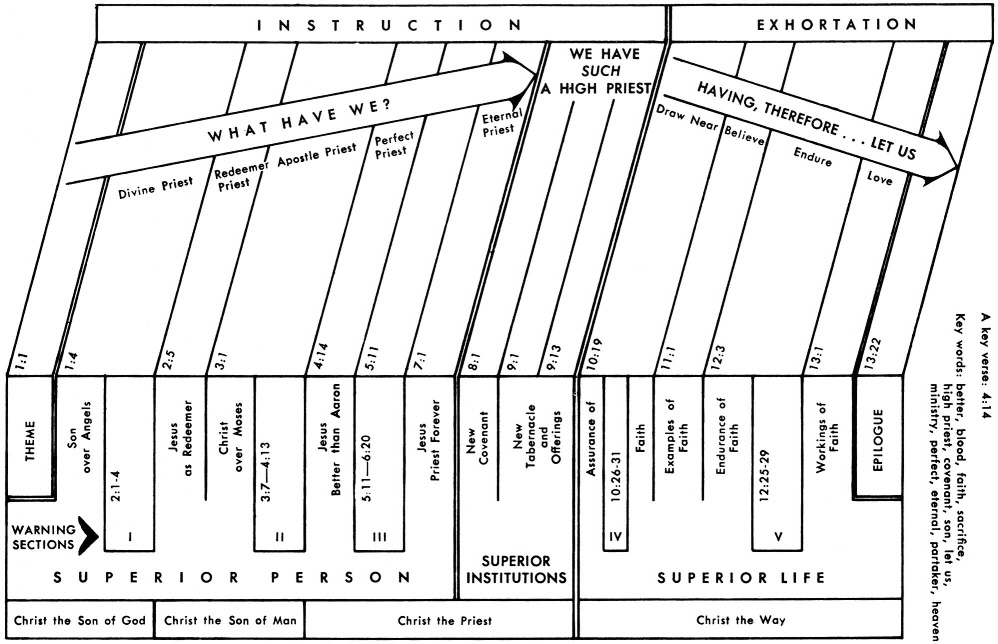
CONSIDER JESUS OUR GREAT HIGH PRIEST
Click chart to enlarge
Charts from Jensen's Survey of the NT - used by permission
Swindoll's Chart, Interesting Pictorial Chart of Hebrews, Another Chart
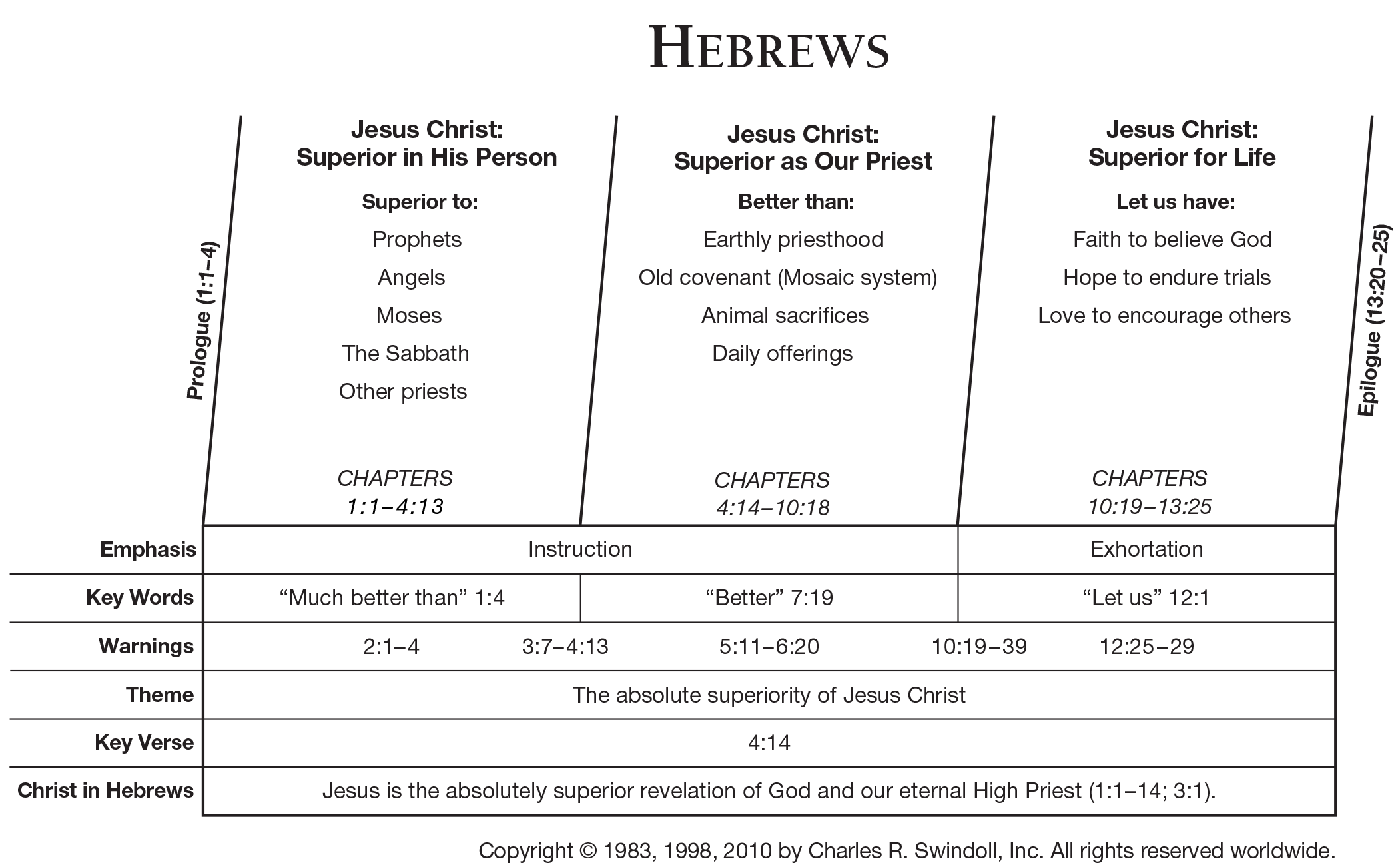
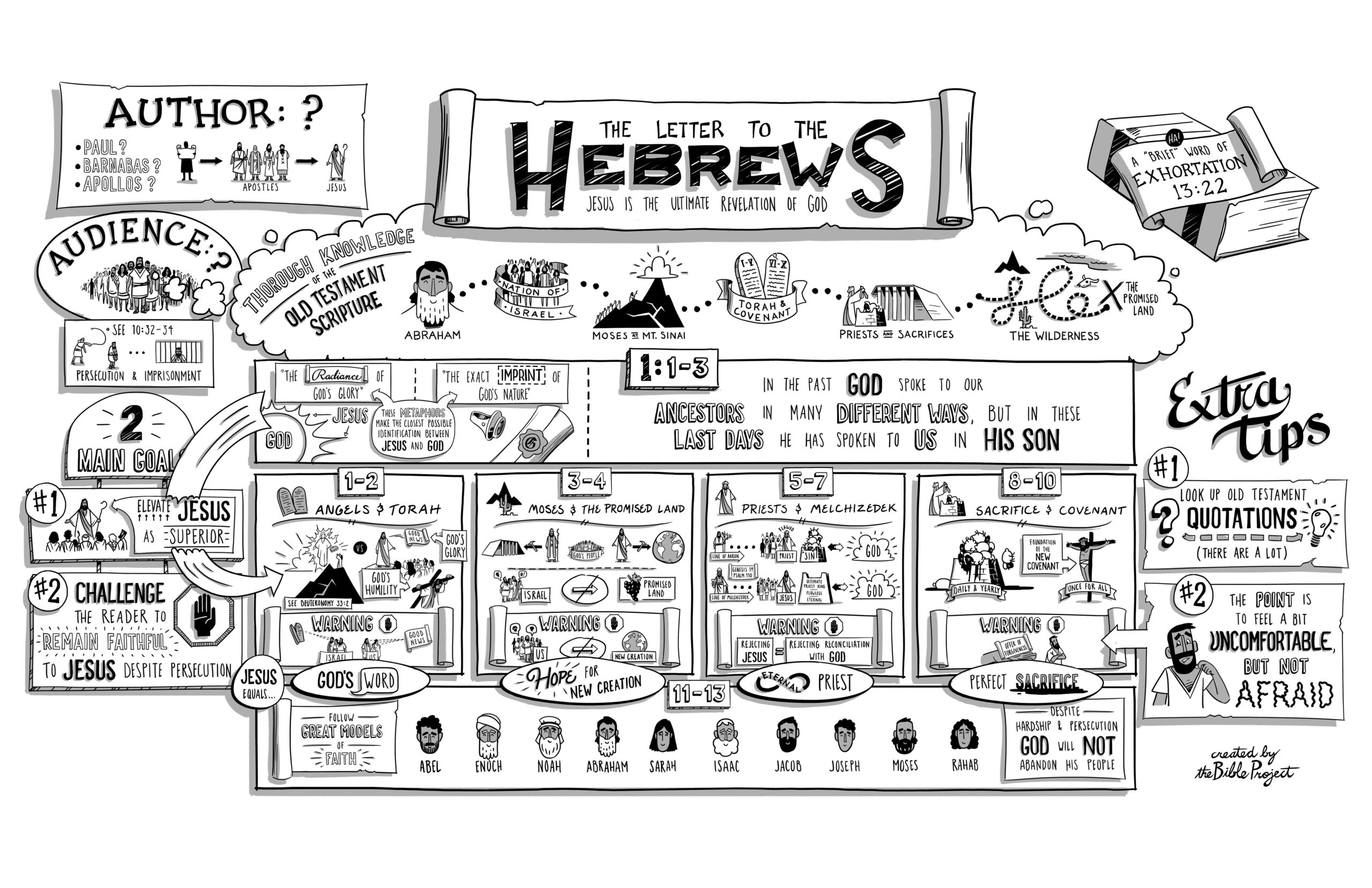
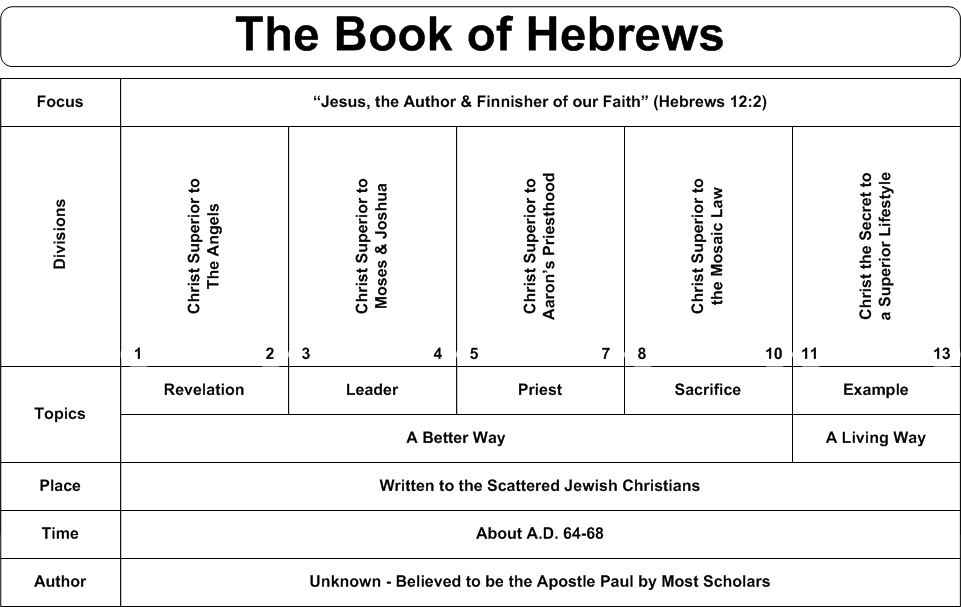
|
The Epistle |
||||
| INSTRUCTION Hebrews 1-10:18 |
EXHORTATION Hebrews 10:19-13:25 |
|||
| Superior Person of Christ Hebrews 1:1-4:13 |
Superior Priest in Christ Hebrews 4:14-10:18 |
Superior Life In Christ Hebrews 10:19-13:25 |
||
| BETTER THAN PERSON Hebrews 1:1-4:13 |
BETTER PRIESTHOOD Heb 4:14-7:28 |
BETTER COVENANT Heb 8:1-13 |
BETTER SACRIFICE Heb 9:1-10:18 |
BETTER LIFE |
| MAJESTY OF CHRIST |
MINISTRY OF CHRIST |
MINISTERS FOR CHRIST |
||
|
DOCTRINE |
DUTY |
|||
|
DATE WRITTEN: |
||||

See ESV Study Bible "Introduction to Hebrews"
(See also MacArthur's Introduction to Hebrews)
Borrow Ryrie Study Bible
Hebrews 9:8 The Holy Spirit is signifying this, that the way into the holy place has not yet been disclosed while the outer tabernacle is still standing, (NASB: Lockman)
Greek: touto delountos (PAPNSG) tou pneumatos tou agiou, mepo pephanerosthai (RPN) ten ton agion odon eti tes protes skenes echouses (PAPFSG) stasin,
BGT Hebrews 9:8 τοῦτο δηλοῦντος τοῦ πνεύματος τοῦ ἁγίου, μήπω πεφανερῶσθαι τὴν τῶν ἁγίων ὁδὸν ἔτι τῆς πρώτης σκηνῆς ἐχούσης στάσιν,
Amplified: By this the Holy Spirit points out that the way into the [true Holy of] Holies is not yet thrown open as long as the former [the outer portion of the] tabernacle remains a recognized institution and is still standing, (Amplified Bible - Lockman)
Barclay: By this the Holy Spirit is showing that the way into the Holy Place was not yet opened up so long as the first tabernacle stood. (Westminster Press)
KJV: The Holy Ghost this signifying, that the way into the holiest of all was not yet made manifest, while as the first tabernacle was yet standing:
NKJ the Holy Spirit indicating this, that the way into the Holiest of All was not yet made manifest while the first tabernacle was still standing.
NET The Holy Spirit is making clear that the way into the holy place had not yet appeared as long as the old tabernacle was standing.
CSB The Holy Spirit was making it clear that the way into the most holy place had not yet been disclosed while the first tabernacle was still standing.
ESV By this the Holy Spirit indicates that the way into the holy places is not yet opened as long as the first section is still standing
NIV The Holy Spirit was showing by this that the way into the Most Holy Place had not yet been disclosed as long as the first tabernacle was still standing.
NLT: By these regulations the Holy Spirit revealed that the Most Holy Place was not open to the people as long as the first room and the entire system it represents were still in use. (NLT - Tyndale House)
Phillips: By these things the Holy Spirit means us to understand that the way to the holy of holies was not yet open, that is, so long as the first tent and all that it stands for still exist. (Phillips: Touchstone)
Wuest: the Holy Spirit all the while making this plain, that not yet was made actual the road into the Holiest while still the first tent had standing [i.e., remained a recognized institution],
Young's Literal: the Holy Spirit this evidencing that not yet hath been manifested the way of the holy places, the first tabernacle having yet a standing;
Paraphrase The Holy Spirit was teaching through this arrangement that the way into God’s true presence was not yet revealed as long as the old tabernacle system remained in effect.
- Holy Spirit - Heb 3:7; 10:15; Isaiah 63:11; Acts 7:51,52; 28:25; Galatians 3:8; 2 Peter 1:21
- The way into the holy place - He 9:3 Heb 4:15,16 Heb 10:19-22 Joh 10:7,9 14:6 Eph 2:18
- Hebrews 9:1-14 God's Remedy for Guilt - Steven Cole
- Hebrews 9:1-14 The New Covenant, Part 2 - John MacArthur
- Hebrews 9 Resources - Multiple Sermons and Commentaries
Related Passages:
2 Peter 1:20-21+ (Holy Spirit inspired the Old Testament) But know this first of all, that no prophecy of Scripture is a matter of one's own interpretation, for no prophecy was ever made by an act of human will, but men moved by the Holy Spirit spoke from God.
Hebrews 3:7+ (Holy Spirit spoke in the Old Testament) Therefore, just as the Holy Spirit says, "TODAY IF YOU HEAR HIS VOICE,
Hebrews 10:15-16+ (Holy Spirit testified in the Old Testament) And the Holy Spirit also bears witness to us; for after saying 10:16 "THIS IS THE COVENANT THAT I WILL MAKE WITH THEM AFTER THOSE DAYS, SAYS THE LORD: I WILL PUT MY LAWS UPON THEIR HEART, AND UPON THEIR MIND I WILL WRITE THEM," He then says,
Hebrews 10:19-22+ Therefore, brethren, since we have confidence to enter the holy place by the blood of Jesus, 20 by a new and living way which He inaugurated for us through the veil, that is, His flesh, 21 and since we have a great priest over the house of God, 22 let us draw near with a sincere heart in full assurance of faith, having our hearts sprinkled clean from an evil conscience and our bodies washed with pure water.
Matthew 27:51+ (SEE SIGNIFICANCE OF TORN VEIL) (Mark 15:38, Luke 23:45) And behold, the veil of the temple was torn in two from top to bottom; and the earth shook and the rocks were split.
John 10:7,9+ (THE WAY INTO GOD'S PRESENCE) Jesus therefore said to them again, "Truly, truly, I say to you, I am the door of the sheep… 10:9 I am the door; if anyone enters through Me, he shall be saved, and shall go in and out, and find pasture.
John 14:6+ (THE WAY INTO GOD'S PRESENCE) Jesus said to him, "I am the (specific, only) way, and the (specific, only) truth, and the (specific, only) life; no one comes to the Father, but through Me.
Comment - Cults twist this passage and translate it to say "a way" the implication of course being that Jesus is fine, but He is just one of many ways to God. Wrong!
Ephesians 2:18+ (THE WAY INTO GOD'S PRESENCE) for through Him we both have our access in one Spirit to the Father.
Romans 5:2+ (THE WAY INTO GOD'S PRESENCE) through Whom (Jesus) also we have obtained our introduction by faith into this grace in which we stand; and we exult in hope of the glory of God.
THE SPIRIT POINTS TO THE
TRUTH ABOUT ACCESS TO GOD
Hebrews 9:8 provides inspired commentary on the meaning of the tabernacle’s design. The writer explains that the Holy Spirit Himself was teaching through the very structure of the sanctuary. The veil that divided the Holy Place from the Holy of Holies was not an arbitrary feature—it was a divine lesson meant to teach the sons of Israel. As long as the tabernacle and its rituals remained, they served as tutors declaring that the way into God’s immediate presence was still closed. The priestly ministry under the first covenant could never provide believers with full access to Him. That privilege awaited the finished work of Christ, our Great High Priest, Who through His death removed the barrier and opened the way into the true heavenly sanctuary. This verse therefore highlights the tension of the Old Covenant—access to God was foreshadowed, but not yet fulfilled.
The Holy Spirit is signifying (deloo in present tense continually making plain) this that the way (unfettered access) into the holy place (hagios - holy of holies) has not yet (this time phrase points to something future - see "not yet/now already") been disclosed (phaneroo - revealed, made conspicuous) while the outer tabernacle (NET = "old tabernacle") is still standing (stasis ~ continuance of the old covenant order) - It could be read "by this (by these things) the Holy Spirit is continually pointing out". Observe the writer testifies the Author of the Old Testament Scriptures is the Holy Spirit! By the design of the tabernacle, especially the two rooms separated by a heavy veil was intentional and was a living lesson, a visual picture to help Israel understand that free access into the very presence of God was not yet open to the people. In other words, the way (hodos) into the holy place (hagios) was not open. Under this arrangement, even the priests themselves could not enter God’s presence as long as the outer sanctuary and its daily rituals remained in operation. As long as the tabernacle stood and functioned, the veil remained intact, symbolizing that full access to God had not yet been opened. Its continued presence also suggests that the Temple in Jerusalem was still in existence at the time of this writing.
The Holy Spirit was teaching that true access to God is impossible without a perfect priest, a perfect sacrifice, and a perfect covenant which were in fact disclosed by Messiah's sacrifice on the Cross, an conclusion he is building toward in the following passages. By restricting the people to the outer court, the Spirit was illustrating that under Judaism there was no access to God.
NET Note on outer tabernacle - Grk "the first tent." The literal phrase "the first tent" refers to either (1) the outer chamber of the tabernacle in the wilderness (as in Heb 9:2, 6) or (2) the entire tabernacle as a symbol of the OT system of approaching God. The second is more likely given the contrast that follows in vv. 11–12. (ED: Thus the NET BIBLE translates it "as long as the first tabernacle was standing.")
Steven Cole adds that "Some understand “first tabernacle” (ED: As in Heb 9:8KJV, Heb 9:8NIV) to refer to the entire tabernacle, but since the same phrase is used in Heb 9:2 and Heb 9:6 to refer to the holy place, others take it to refer to the outer or first room of the tabernacle. The meaning then would be that the holy place “was blocking the way into the sanctuary of God’s presence for the mass of the people, for whom entry even into the holy place was prohibited…. So long, then, as the holy place continued standing they had no hope of immediate access to God” (Philip Hughes, A Commentary on the Epistle to the Hebrews [Eerdmans], p. 322, 323). (God's Remedy for Guilt Hebrews 9:1-14)
Comment - Whether the writer is referring to the entire tabernacle or only to its first division, the point remains the same: under the Old Covenant system, the sons of Israel were not given direct access to God.
W E Vine has an interesting comment regarding the division of the earthly tabernacle compared to the heavenly one noting that "the heavenly sanctuary itself is not spoken of as the Holiest of all or the Holy of Holies as if suggesting an inner shrine in contrast with an outer. There could not be two parts in the heavenly tabernacle, for the veil has been rent. Accordingly the writer, in referring to the heavenly sanctuary, speaks simply of “the holy place”). (Collected writings of W. E. Vine)
C H Spurgeon points out that "It is from this sentence (Heb 9:8) that I am sure that the Holy Ghost had a signification, a meaning, a teaching, for every item of the ancient tabernacle and temple; and we are not spinning fancies out of idle brains when we interpret these types, and learn from them important gospel lessons."
QUESTION - Since this letter was written after Jesus’ crucifixion—when the veil separating the Holy Place from the Holy of Holies was torn from top to bottom, granting open access to God—why would the writer still emphasize that such access was not yet available?”
Kenneth Wuest has an interesting, albeit somewhat speculative comment addressing the preceding question writing that "As long as that part of the Levitical institution was still in effect, Israel was to understand that the way into the presence of God had not yet been opened. The division of the tabernacle into the Holy Place and the Holy of Holies showed the limitations of the Levitical system, and kept the people from coming directly to God. The Holy Place barred both priests and people from the Holy of Holies. When the new order of things was brought into being by the death of Messiah on the Cross, thus fulfilling the typical sacrifices, God rent the inner veil of the temple which separated the Holy Place from the Holy of Holies, making of the two rooms, one. There was, therefore, no more “within the veil.” This was God’s object lesson to the Aaronic priesthood that its ministry was now over, that the temple was to be closed, that a new Priest had arisen after the order of Melchisedek. But, Israel in its apostasy, repaired the veil, kept on offering sacrifices, until God in His wrath, sent Rome to destroy the city of Jerusalem and scatter His chosen people to the ends of the Roman empire. (ED: WUEST'S EXPLANATION IS NOT FOUND IN SCRIPTURE, NOR CAN I VERIFY FROM HISTORICAL RECORDS THAT THE VEIL WAS EVER REPAIRED. WHAT IS CLEAR, HOWEVER, IS THAT TEMPLE SACRIFICES DID CONTINUE FOR ALMOST 40 YEARS!!! - E.G., Acts 21:26, FURTHERMORE, GOD MOVED OUT OF THE TEMPLE AFTER THE PERFECT SACRIFICE WAS MADE - cf Acts 17:24)
Sadly Israel as nation for the most part resisted the Holy Spirit's teaching, Stephen declaring ""You men (first century Jews) who are stiff-necked and uncircumcised in heart (Lev 26:41 Dt 10:16, 30:6 Jer 4:4 9:26) and ears (Jer 6:10; Ro 2:28-29+, Col 2:11+) are always resisting (antipipto = rush against or upon in a hostile manner, assault, resist by force and violence - present tense = their general practice!) the Holy Spirit; you (first century Jews) are doing just as your fathers did. Which one of the prophets did your fathers not persecute? And they killed those who had previously announced the coming of the Righteous One, whose betrayers and murderers you have now become." (Acts 7:51,52+)
Since God always preserved a believing Jewish remnant, a few of the sons of Israel became believers, under the illuminating ministry of the Holy Spirit, as they saw in these symbolic shadows something of the Way of access to God, of communion with Him, and of admission into heaven thru the promised Redeemer. Sadly most of the sons of Israel looked no further than the outward forms & shadows, failing to unite the spiritual truths being pictured with saving faith ("good news… but the word they heard did not profit them, because it was not united by faith in those who heard" Hebrews 4:2)
You must break the shell
to get at the kernel.
Spurgeon - It was necessary that you should take away the sacred tent, the tabernacle—and take away the temple, too—before you could learn the spiritual meaning of them. You must break the shell to get at the kernel. So God had ordained. Hence, there is now no tabernacle, no temple, no holy court, no inner shrine, the holy of holies. The material worship is done away with in order that we may render the spiritual worship of which the material was but the type.
Signifying (1213) (deloo from delos = manifest, evident) means to make plain by words and thus to declare. To make manifest to the mind. Deloo is used of indications which lead the mind to conclusions about the origin or character of things. It means to make some matter known that was unknown or not communicated previously. It means to show clearly, to signify, to make manifest, visible, clear, or plain and to make known. When spoken of things past it means to tell, relate or impart information (as in 1Cor 1:11; Col 1:18). Although deloo is used most often in reference to declarations through articulate language, it is also used often (as in the present verse) of any kind of indirect communication.
When spoken of things future or hidden, deloo means to reveal, show or bring to light.
Deloo is used 28 times in the Septuagint (LXX) (Exod. 6:3; 33:12; Deut. 33:10; Jos. 4:7; 1 Sam. 3:21; 1 Ki. 8:36; 2 Chr. 6:27; Est. 2:22; Ps. 25:14; 51:6; 147:20; Isa. 42:9; Jer. 16:21; Dan. 2:5f, 9, 11, 16, 23ff, 28ff, 47; 4:18; 7:16). Here are some uses in the Septuagint (LXX)
Exodus 6:3 and I appeared to Abraham, Isaac, and Jacob, as God Almighty, but by My name, LORD, I did not make Myself known (deloo) to them.
Exodus 33:12 Then Moses said to the LORD, "See, Thou dost say to me, 'Bring up this people!' But Thou Thyself hast not let me know (deloo) whom Thou wilt send with me. Moreover, Thou hast said, 'I have known you by name, and you have also found favor in My sight.'
Esther 2:22 But the plot became known (deloo) to Mordecai, and he told Queen Esther, and Esther informed the king in Mordecai's name.
Psalm 25:14 The secret of the LORD is for those who fear Him, And He will make them know (deloo) His covenant.
Psalm 51:6 Behold, Thou dost desire truth in the innermost being, And in the hidden part Thou wilt make me know (deloo) wisdom.
Psalm 147:20 He has not dealt thus with any nation and as for His ordinances, they have not known (deloo) them. Praise the LORD!
Isaiah 42:9 "Behold, the former things have come to pass, Now I declare new things; Before they spring forth I proclaim (Lxx = deloo = make them known) them to you."
Daniel 2:25 Then Arioch hurriedly brought Daniel into the king's presence and spoke to him as follows: "I have found a man among the exiles from Judah who can make the interpretation known (deloo) to the king!"
Deloo is used 7 times in the NT…
1 Corinthians 1:11+ For I have been informed concerning you, my brethren, by Chloe's people, that there are quarrels among you.
1 Corinthians 3:13+ each man's work will become evident; for the day will show it, because it is to be revealed with fire; and the fire itself will test the quality of each man's work.
Colossians 1:8+ and he also informed us of your love in the Spirit.
Hebrews 9:8+ The Holy Spirit is signifying this, that the way into the holy place has not yet been disclosed, while the outer tabernacle is still standing,
Hebrews 12:27+ And this expression, "Yet once more," denotes the removing of those things which can be shaken, as of created things, in order that those things which cannot be shaken may remain.
1 Peter 1:11+ seeking to know what person or time the Spirit of Christ within them was indicating as He predicted the sufferings of Christ and the glories to follow.
2 Peter 1:14+ knowing that the laying aside of my earthly dwelling is imminent, as also our Lord Jesus Christ has made clear (of something divinely communicated) to me.
Disclosed (5319) (phaneroo from phanerós = manifest, visible, conspicuous from phaino = give light; become visible from phos = light) indicates an external manifestation to the senses which is thus open to all. It means to make visible that which has been hidden. The primary reference is to what is visible to sensory perception and thus which is made to appear, caused to be seen or uncovered, laid bare or revealed. To be manifested, in the Scriptural sense is more than just to appear. For example, a person may appear in a false guise or without a disclosure of what he truly is. Thus in this context, phaneroo conveys the sense of to be manifested or to be revealed in one's true character (this is meaning in Jn 3:21, 1Cor 4:5, 2Cor 5:10,11, Eph 5:13+).
The only other use in Hebrews is Heb 9:26 "Otherwise, He would have needed to suffer often since the foundation of the world; but now once at the consummation of the ages He has been manifested to put away sin by the sacrifice of Himself."
1. Access to God
- Not yet: “The way into the holy place has not yet been disclosed while the outer tabernacle is still standing” (Hebrews 9:8).
- Now/already: “We have confidence to enter the holy place by the blood of Jesus, by a new and living way…” (Hebrews 10:19–20).
2. Forgiveness of Sins
- Not yet: “It is impossible for the blood of bulls and goats to take away sins” (Hebrews 10:4).
- Now/already: “By this will we have been sanctified through the offering of the body of Jesus Christ once for all” (Hebrews 10:10).
3. The Priesthood
- Not yet: The Levitical priests “stand daily ministering and offering time after time the same sacrifices, which can never take away sins” (Hebrews 10:11).
- Now/already: “But He, having offered one sacrifice for sins for all time, sat down at the right hand of God” (Hebrews 10:12).
4. Covenant Relationship
- Not yet: “For if that first covenant had been faultless, there would have been no occasion sought for a second” (Hebrews 8:7).
- Now/already: “But now He has obtained a more excellent ministry… the mediator of a better covenant, enacted on better promises” (Hebrews 8:6).
5. Conscience Cleansing
- Not yet: “Gifts and sacrifices are offered which cannot make the worshiper perfect in conscience” (Hebrews 9:9).
- Now/already: “How much more will the blood of Christ… cleanse your conscience from dead works to serve the living God?” (Hebrews 9:14).
6. Inheritance and Fulfillment
- Not yet: “And all these [OT saints], having gained approval through their faith, did not receive what was promised” (Hebrews 11:39).
- Now/already: “God had provided something better for us, so that apart from us they would not be made perfect” (Hebrews 11:40).
F B Meyer comments that…
THE VEILED WAY INTO THE HOLIEST IS CONTRASTED WITH OUR FREEDOM TO ENTER THE PRESENCE OF GOD. We have the positive assurance of these words that the Holy Spirit meant to signify direct spiritual truth in the construction of the Jewish Tabernacle (ver. 8). He who revealed divine truth by inspired prophets, revealed it so in the structure of the material edifice. The methods of instruction might vary; the teacher was the same. Indeed, the whole ritual was a parable for the present time (ver. 9).
Every well-taught child is aware of the distinction between the holy place, with its candlesticks, incense-table, and shew-bread, and the holy of holies, with its ark, and cloud of glory. The first tabernacle was separated from the second by heavy curtains, which were never drawn aside except by the high-priest, and by him only once a year, and then in connection with an unusually solemn ritual. Surely the dullest Israelite must have understood the meaning of that expressive figure; and have felt that, even though his race might claim to be nearer to God than all mankind beside, yet there was a depth of intimacy from which his foot was checked by the prohibition of God himself. "The way into the holiest was not yet made manifest."
For us, however, the veil is rent. Jesus entered once into the holy place, and as he passed the heavy folds were rent in twain from the top to the bottom. Surely no priest that witnessed it could ever forget the moment, when, as the earth trembled beneath the temple floor, the thickly woven veil split and fell back, and disclosed the solemnities on which no eyes but those of the high-priest dared to gaze. Surely the most obtuse can read the meaning signified herein by the Holy Ghost. There is no veil between us and God but that which we weave by our own sin or ignorance. We may go into the very secrets of his love. We may stand unabashed where angels worship with veiled faces. We may behold mysteries hidden from before the foundation of the world. The love of God has no secrets for us whom he calls friends.
Oh, why are we so content with the superficial and the transient, with the ephemeral gossip and literature of our times, with the outer courts in which the formalists and worldly Christians around us are contented to remain? when there are such heights and depths, such lengths and breadths, to be explored in the very nature of God. Why do men in our time bring back that veil, though they call it "a screen"? Alas, they are blind leaders of the blind.
He Is a Person Hebrews 9:8
Spell this out in capital letters: THE HOLY SPIRIT IS A PERSON. He is not enthusiasm. He is not courage. He is not energy. He is not the personification of all good qualities, like Jack Frost is the personification of cold weather. Actually, the Holy Spirit is not the personification of anything. He is a Person, the same as you are a person, but not material substance. He has individuality. He is one being and not another. He has will and intelligence. He has hearing. He has knowledge and sympathy and ability to love and see and think. He can hear, speak, desire, grieve and rejoice. He is a Person. See: Romans 5:5; Ephesians 4:30
Daily Light on the Daily Path - “And you shall put the mercy seat on the top of the ark. . . . There I will meet with you.”
The way into the holy places is not yet opened.—And Jesus cried out again with a loud voice and yielded up his spirit. And behold, the curtain of the temple was torn in two, from top to bottom.
Therefore, brothers, since we have confidence to enter the holy places by the blood of Jesus, by the new and living way that he opened for us through the curtain, that is, through his flesh, . . . let us draw near with a true heart in full assurance of faith, with our hearts sprinkled clean from an evil conscience and our bodies washed with pure water.—Let us then with confidence draw near to the throne of grace, that we may receive mercy and find grace to help in time of need.
. . . Christ Jesus, whom God put forward as a propitiation by his blood, to be received by faith. This was to show God’s righteousness, because in his divine forbearance he had passed over former sins.—Through him we . . . have access in one Spirit to the Father.
Ex. 25:21–22; Heb. 9:8; Matt. 27:50–51; Heb. 10:19–20, 22; Heb. 4:16; Rom. 3:24–25; Eph. 2:18
Daily Light on the Daily Path - The new and living way.
Then Cain went away from the presence of the Lord.—But your iniquities have made a separation between you and your God, and your sins have hidden his face from you.—The holiness without which no one will see the Lord.—“I am the way, and the truth, and the life. No one comes to the Father except through me.”—Our Savior Christ Jesus . . . abolished death and brought life and immortality to light through the gospel.—The way into the holy places is not yet opened as long as the first section is still standing.—For he himself is our peace, who has made us both one and has broken down in his flesh the dividing wall of hostility.—And behold, the curtain of the temple was torn in two, from top to bottom.
“For the gate is narrow and the way is hard that leads to life, and those who find it are few.”—You make known to me the path of life; in your presence there is fullness of joy; at your right hand are pleasures forevermore.
Heb. 10:20; Gen. 4:16; Isa. 59:2; Heb. 12:14; John 14:6; 2 Tim. 1:10; Heb. 9:8; Eph. 2:14; Matt. 27:51; Matt. 7:14; Ps. 16:11
Daily Light on the Daily Path - “Truly, truly, I say to you, I am the door of the sheep.”
And behold, the curtain of the temple was torn in two, from top to bottom. And the earth shook, and the rocks were split.—For Christ also suffered once for sins, the righteous for the unrighteous, that he might bring us to God.—By this the Holy Spirit indicates that the way into the holy places is not yet opened as long as the first section is still standing.
“I am the door. If anyone enters by me, he will be saved and will go in and out and find pasture.”
“No one comes to the Father except through me.”—For through him we . . . have access in one Spirit to the Father. So then you are no longer strangers and aliens, but you are fellow citizens with the saints and members of the household of God.—Therefore, brothers, since we have confidence to enter the holy places by the blood of Jesus, by the new and living way that he opened for us through the curtain, that is, through his flesh . . . —We have peace with God through our Lord Jesus Christ. Through him we have also obtained access by faith into this grace in which we stand, and we rejoice in hope of the glory of God.
John 10:7; Matt. 27:51; 1 Pet. 3:18; Heb. 9:8; John 10:9; John 14:6; Eph. 2:18–19; Heb. 10:19–20; Rom. 5:1–2
R C Sproul - The Outer, Older Tabernacle
The Holy Spirit was showing by this that the way into the Most Holy Place had not yet been disclosed as long as the first tabernacle was still standing. [Heb. 9:8]
During the administration of God’s kingdom on earth before Christ, sacrifices for sin took away only sins “committed in ignorance.” The Greek word in Hebrews 9:7 corresponds to a Hebrew term in Leviticus 4, which deals with the sin offerings. That word may be translated “sin of inadvertency” or “unintentional sin,” but most precisely it refers to a “sin of wandering astray.” God graciously considered the sins of humanity as sins of wandering. The race had been led astray by its first shepherd, Adam. There was nothing unintentional about Adam’s sin. It was high-handed rebellion that was not dealt with by the old covenant sacrifices.
The outer or first tabernacle, the Holy Place, symbolized the period of the old covenant, not our own “present time” as some translations render it. It has been superseded by the heavenly ministry of Jesus. Work done in the Holy Place symbolized the preliminary nature of the kingdom of God before Christ.
Priests regularly ministered in the Holy Place. The Holy Place was the ante-room to the Holy of Holies, but only the high priest went into the Holy of Holies. He could enter only once a year, and then only for brief moments. The entire ministry of the Holy Place pointed to the need for someone to get into the Holy of Holies permanently. Whether in the tabernacle or in Solomon’s or Herod’s temples, as long as the outer tabernacle continued, the way into the Holy of Holies remained sealed. The high priest knocked at that door year after year, but the blood of bulls, goats, lambs, rams, and birds could never open it.
The sacrifices of the preliminary kingdom were incomplete. They dealt with secondary sins, the sins of wandering, but they never dealt with the root sin, the sin of Adam. They never cleansed the conscience at the core of human life.
Likewise, the dietary laws and laws of baptisms in Leviticus 11–15 dealt with the outer life, but not the heart. We needed a clean heart as well.
Coram Deo We lose sight of the completeness of the reign of our Priest-King. After our earthly life is done, we will experience a new level of awareness of God’s presence and glory. When Christ returns the kingdom will be more visible. These are “not-yet” parts of the kingdom of God. But the kingdom will not be more real or victorious than it is at this moment. Make lists of the “already” and “not-yet” benefits of the kingdom. The “already” list should be much longer. For further study: Numbers 28:1–8; Psalm 20:1–3; Hebrews 10:11–14
The Structure of the Tabernacle
The tabernacle was the structure ordered built by God so that He might dwell among His people (Ex. 25:8). It was to be mobile and constructed to exacting specifications. It is referred to in Ex. 25–27, 30–31, 35–40; Num. 3:25ff; 4:4 ff.; 7:1ff. In all of scripture more space is devoted to the tabernacle than any other topic.
Many books have been written on the spiritual significance of the tabernacle, how it represented Christ, and how it foretold the gospel. The tabernacle consisted of the outer court and the tabernacle. The outer court was entered from the East in which were the altar of burnt offering (Ex. 27:1–8) and the bronze laver (Ex. 30:17–21). The tabernacle stood within the court (Ex. 26:1 ff). It was divided into two main divisions: the holy place and the holy of holies which were separated by a veil (Ex. 26:31 ff), the same veil that was torn from top to bottom at the crucifixion of Jesus (Matt. 27:51). Where the veil had represented the barrier separating sinful man from a holy God (Heb. 9:8), its destruction represented the free access sinners have to God through the blood of Christ (Heb. 10:19 ff). The tabernacle was a place of sacrifice.
The holy place contained three things: first, a table on which was placed the shewbread, the bread of the presence (Ex. 25:23–30), second, a golden lampstand (Ex. 25:31–40) and third, an altar of incense (Ex. 30:1–7). In the holy of holies was the ark of the covenant which contained the Ten Commandments (Ex. 25:16). The holy of holies was entered only once a year by the high priest who offered sacrifice for the nation of Israel. -- Source unknown
Ark and altar. Sinful man cannot approach God at the ark (Heb. 9:8), but God approaches man as a sinner through Christ (altar). Blood prints all the way from ark to altar. Only safe in God's courts when redeemed on that path.
F B Meyer on Hebrews 9:8 - Its Import. All this was a parable for that time and for all time, "the Holy Spirit thus signifying" (Hebrews 9:8). That quotation is very pertinent to the understanding of these symbols, because of the distinct statement that there was a divine intention in their construction. Are we not told that God spake of old time by divers portions and in divers manners (Hebrews 1:1)? This is one of those manners. He spake to man in the Holy Scriptures, on the history of the chosen people, and in the very apparatus which is so minutely furnished in these pages.
Robert Neighbour - The Tabernacle Exodus 40:1-9, 34-38
• The Door — Christ Our Approach — the Place of Entrance (John 10:9).
• The Brazen Altar — Christ Our Sacrifice — the Place of Redemption (Heb. 9:14).
• The Laver — Christ Our Sanctification — the Place of Cleansing (II Tim. 2:21).
• The Shewbread — Christ Our Food — the Place of Strength (John 6:35).
• The Altar of Incense — Christ Our High Priest — the Place of Intercession (Heb. 7:25).
• The Candlesticks — Christ Our Light — the Place of Testimony (John 1:4).
• The Ark — Christ Our Guest — the Place of Fellowship (Heb. 9:4, 5).
The study of the Tabernacle sets forth in beautiful shadows and types the Lord Jesus Christ in many distinct and important particulars. There are some who seem averse to the study of types, and we agree that types should never be overdrawn. The meaning's of types are never certain, unless there is a clear and pointed "Thus saith the Lord" which unfolds them.
While this is true, the Tabernacle is a type in practically every particular. Let us notice a few verses on this line:
Heb. 8:5: "Who serve unto the example and shadow of Heavenly things, as Moses was admonished of God when he was about to make the Tabernacle: for, See, saith He, that thou make all things according to the pattern shewed to thee in the mount."
Heb. 9:8, 9: "While as the first Tabernacle was yet standing: which was a figure of the time then present, in which were offered both gifts and sacrifices."
Heb. 10:1: "For the Law having a shadow of good things to come, and not the very image of the things."
Everything about the Tabernacle spoke of Christ. It would take many, many studies to begin to set forth all of these figures. The purpose of this lesson will be no more than to get a bird's-eye view of the gate and the various furniture placed by Divine instruction, in the Court, the Holy Place, and the Holy of Holies.
It would be well to draw a picture on the blackboard outlining first the Tabernacle enclosure; and then in order, the place of the Brazen Altar and the Laver in the outer court, the positions of the Shewbread, Altar of Incense and Candlesticks in the Holy Place, and finally the Holy of Holies, with the position of the Ark.
It will be noticed that these, placed in order, formed a perfect cross.
We also suggest the significance of the twelve tribes pitching their camps about the Tabernacle where God was manifest between the cherubim in the Holy of Holies.
Saints should always meet with Christ "in the midst." He Himself says, "Where two or three are gathered together in My name, there am I in the midst of them" (Matt. 18:20).
We should run the Christian race looking unto Him.
He should be our all in all.
James Smith - "I AM THE WAY." John 14:6.
Christ has not come to show us the way, nor has He come only to make the way, but to be the Way. He is the Way.
1. He is the New and living Way, Heb. 10:19.
2. He is the Way through suffering, Heb. 10:19, 20.
3. He is the Way to the Father, Eph. 2:18.
4. He is the Way into Salvation, John 10:9.
5. He is the Way into the Holiest, Heb. 9:8.
6. He is the Way consecrated for us, Heb. 10:20.
7. He is the only Way, John 14:6.
"THIS IS THE WAY; WALK YE IN IT" (Isa. 30:21).
Hebrews 9:9 which is a symbol for the present time. Accordingly both gifts and sacrifices are offered which cannot * make the worshiper perfect in conscience, (NASB: Lockman)
Greek: etis parabole eis ton kairon ton enestekota, (RAPMSA) kath' en dora te kai thusiai prospherontai (3PPPI) me dunamenai (PPPFPN) kata suneidesin teleiosai (AAN) ton latreuonta
Amplified: Seeing that that first [outer portion of the] tabernacle was a parable (a visible symbol or type or picture of the present age). In it gifts and sacrifices are offered, and yet are incapable of perfecting the conscience or of cleansing and renewing the inner man of the worshiper. (Amplified Bible - Lockman)
Barclay: Now the first tabernacle stands for this present age, and according to its services sacrifices are offered which cannot perfect the conscience of the worshipper. (Westminster Press)
KJV: Which was a figure for the time then present, in which were offered both gifts and sacrifices, that could not make him that did the service perfect, as pertaining to the conscience;
NLT: This is an illustration pointing to the present time. For the gifts and sacrifices that the priests offer are not able to cleanse the consciences of the people who bring them. (NLT - Tyndale House)
Phillips: For in this outer tent we see a picture of the present time, in which both gifts and sacrifices are offered and yet are incapable of cleansing the soul of the worshipper. (Phillips: Touchstone)
Wuest: which [tent] was of such a nature as to be an explanation for the ensuing time, according to which both gifts and sacrifices are being offered which are not able to make complete the one who offers them so far as the conscience is concerned;
Young's Literal: which is a simile in regard to the present time, in which both gifts and sacrifices are offered, which are not able, in regard to conscience, to make perfect him who is serving
Paraphrase “The entire tabernacle system served as a parable for this age, showing outward rituals that could not cleanse the heart. Although gifts and sacrifices were continually offered, they could never bring true cleansing of the conscience. They pointed beyond themselves to the perfect work of Christ.”
Paraphrase “This tabernacle and its rituals were a symbolic picture for the present age, where offerings are still being made that cannot truly cleanse the heart or perfect the worshiper’s conscience.”
Paraphrase “The old system was a kind of parable, teaching us about the limitations of ritual. Even though sacrifices were offered, they could never bring inward purity or a clear conscience.”
Paraphrase “All those offerings and rituals were meant as illustrations, pointing forward to something greater. They could not make anyone feel truly forgiven deep down in their conscience.”
Paraphrase “The old worship system was only a picture. Its sacrifices could not wash the inside of a person or bring them peace with God.”
- which is a symbol Heb 9:24; 11:19; Ro 5:14; 1Pe 3:21
- Present time - Heb 7:11; 11:39,40; 1Pe 1:11,12
- Accordingly both gifts and sacrifices - Heb 5:1
- make the worshiper perfect in conscience - Heb 9:13,14 7:18,19 10:1-4,11 Ps 40:6,7 Ga 3:21
- Hebrews 9 Resources - Multiple Sermons and Commentaries
- Hebrews 9:1-14 God's Remedy for Guilt - Steven Cole
- Hebrews 9:1-14 The New Covenant, Part 2 - John MacArthur
Related Passages:
Hebrews 9:14+ (CHRIST A BETTER SACRIFICE) how much more will the blood of Christ, who through the eternal Spirit offered Himself without blemish to God, cleanse your conscience from dead works to serve the living God?
Hebrews 10:22+ (CHRIST A BETTER SACRIFICE) let us draw near with a sincere heart in full assurance of faith, having our hearts sprinkled clean from an evil conscience and our bodies washed with pure water.
Hebrews 13:18+ (CHRIST A BETTER SACRIFICE) Pray for us, for we are sure that we have a good conscience, desiring to conduct ourselves honorably in all things.
Hebrews 5:1 For every high priest taken from among men is appointed on behalf of men in things pertaining to God, in order to offer both gifts and sacrifices for sins;
Hebrews 8:3-4 For every high priest is appointed to offer both gifts and sacrifices; so it is necessary that this high priest also have something to offer. 4 Now if He were on earth, He would not be a priest at all, since there are those who offer the gifts according to the Law;
SHADOWS WITHOUT SUBSTANCE
BUT POINTING TO THE SAVIOR
The writer of Hebrews continues his comparison of the earthly tabernacle with the heavenly reality in Christ.
Which is a symbol (parabole) for the present time (kairos). - A symbol (parabole) is a setting forth of the character of the Old Testament beside the "new" for purposes of comparison. The writer explains that the entire Levitical system (priests, offerings, and rituals) functioned as a parable or illustration pointing forward to Christ. For the present time refers to the time of temple-worship which was still ongoing even as this letter was written.
Tabernacle rituals remind us that the old sacrifices could never bring peace to the heart, for they could not cleanse the worshiper’s troubled conscience. The lesson is clear: no ritual can quiet a guilty heart. Only the blood of Jesus gives lasting peace and makes the conscience clean.
As stated earlier, he uses the old covenant tabernacle and sacrifices (plural) as an object lesson to illustrate the better sacrifice (singular) of Christ. Think of the Old Covenant as analogous to a children's book which especially with young children is filled with pictures to help teach the child truths. In the same way, the structure and rigid rituals of the Old Covenant were God's inspired "picture book" by which He sought to tutor Israel and thereby to lead them to comet to know and receive their Messiah.
C H Spurgeon on a symbol (parabole) for the present time (kairos) - Only a figure, and only meant for “the present time.” It was the childhood of the Lord’s people. It was a time when, as yet, the light had not fully broken in upon spiritual eyes, so they must be taught by picture books. They must have a kind of kindergarten for the little children that they might learn the elements of the faith by the symbols, types, and representations of a material worship. When we come into the true gospel light, all that is done away with; it was only “a symbol for the present time.” All these rites could only give a fleshly (EXTERNAL) purity, but they could not touch the conscience. If men saw what was meant by the outward type, then the conscience was appeased; but by the outward sign itself the conscience was never comforted, if it was a living and lowly conscience. (Comments)
Steven Cole on the present time (kairos) - The “present time” may mean “the time then present,” that is, “in the Old Testament days the way to God was not yet revealed.” Or, it may mean “the time now present,” indicating that “the real meaning of the tabernacle can only now be understood, in the light of the work of Christ”
Kenneth Wuest notes "the tabernacle was an object lesson used to explain spiritual truth. As long as it remained an object lesson, thus a recognized institution, it was clear that the actual tabernacle to which it pointed was not yet in use. The tabernacle in Israel, and later, the temple, remained that object lesson during the history of Israel, until the veil of the temple was rent." (Hebrews Commentary)
As John MacArthur says "the old was only a "parable," an object lesson, for Israel. The old sacrifices were never meant to cleanse from sin, but only to symbolize such cleansing (ED:: Therefore in a sense pointing toward the blood of Jesus shed on the Cross for the remission of sins). The conscience of the person sacrificing was never freed from the feeling of guilt because the guilt itself was never removed (Heb 9:9, Heb 9:13, Heb 10:22). The cleansing was entirely external. Consequently, he could never have a clear conscience, a deep, abiding sense of forgiveness." (sEE Hebrews Commentary - Page 227).
Their bodies could be rendered temporarily clean before God
by the various ceremonial washings, but their consciences remained defiled.
--Ray Stedman
Accordingly both gifts (doron) and sacrifices (thusia - cf Lev 16:3-6, 11-15+) are offered (prosphero) which cannot make the worshiper (latreuo) perfect (teleioo) in conscience (suneidesis) - The Old Covenant gifts and sacrifices lacked the inherent ability to give a perfectly clean conscience. Offered in the present tense depicts the Levitical priests offered continually, day in, day out, morning and evening, year after year. And yet those sacrifices could never truly cleanse the conscience or bring final peace with God. Only in Christ is the conscience cleansed, access opened, and the heart made perfect before God. It should be understood that inability to provide a clean conscience was not the only way the Old Covenant was ineffective, but singling out this subject served the writer's purpose to emphasize his point. Cannot (me = not + dunamai = able) in the present tense literally reads "continually not able." Make...perfect (teleioo) in conscience (suneidesis) means that even an OT saint (a genuine believer, one declared righteous by faith) could never have a clear conscience but just that such a conscience could never be obtained by the OT sacrifices, no matter how many sacrifices one made.
It is always possible for persons to satisfy themselves that they have fulfilled
their obligations to God merely by observing traditional ceremonies.
Homer Kent has an interesting comment on gifts (doron) and sacrifices (thusia) are offered - Old Testament ritual for purification involved physical things, such as foods and drinks and ceremonial ablutions. Only certain specified kinds of animals were allowable as sacrifices. Some foods could not be eaten. Strong drink was not allowed to those taking a Nazarite vow (Num. 6:3). Priests had to bathe themselves ritualistically before the Day of Atonement celebration (Lev. 16:4). Yet these matters were all regulations regarding the flesh, and actually had no connection with the heart (except as expressions of heartfelt obedience to God’s instructions). Thus it is always possible for persons to satisfy themselves that they have fulfilled their obligations to God merely by observing traditional ceremonies. (ED: TODAY EVEN BELIEVERS CAN GET CAUGHT UP IN LEGALISM, TRYING TO EARN OR MERIT GOD'S FAVOR!) Many in Israel did just that, and although their faithful conformity to Mosaic law maintained them in their civil and religious privileges, their hearts were far from God and they knew little or nothing of God’s forgiveness. Was this part of the problem of the original readers? As Hebrew Christians whose spiritual growth was abnormally slow (Heb 5:12), they could well have placed undue confidence in the ritual of Judaism, and found its attractions almost irresistible. This would explain the author’s repeated emphasis upon the inadequacy of Levitical sacrifices (7:11, 18, 19; 9:9, 10, 13, 14, 23; 10:1–4, 11).(Borrow The Epistle to the Hebrews : a commentary page 168)
Warren Wiersbe - All of the ceremonies associated with the tabernacle had to do with ceremonial purity, not moral purity. They were “carnal ordinances” that pertained to the outer man but that could not change the inner man. (Bible Exposition Commentary)
The sacrifices (thusia) repeated year after year on the Day of Atonement (Lev 16:3–6, 11–15+) could at best provide a temporary covering for sin, but they could never reach into the inner life to cleanse the conscience. Their continual repetition was itself evidence of their inadequacy; for if those sacrifices had truly perfected the worshipers within, bringing lasting peace of conscience, there would have been no need for them to be offered again and again. Outward rituals of washing (cf Lev 16:26, 28+) produced only ceremonial purity; they could never reach into the heart to cleanse the conscience. Leviticus 16 paints the picture of repeated sacrifices, limited access, outward cleansings. Hebrews 9:9 gives the inspired commentary that those sacrifices were only symbols, never able to cleanse the conscience.
The OT ceremonies were like road signs on the journey,
pointing ahead to Christ.
They were not the destination themselves,
nor could they bring the inner rest of a clear conscience.
Make the worshiper (latreuo) perfect (teleioo) in conscience (suneidesis) - He is not saying make the worshipper "sinless," which is not possible in this lifetime. The idea is finished or complete, needing nothing to make it what it should be. Wuest goes on to explain "The Levitical ritual as such did not touch the conscience. No ritual in itself ever does. There was nothing in it that could deal with conscience. Only the working of the Holy Spirit through the Word of God and the efficacy of the blood of the Messiah could do that. The Holy Spirit did in Old Testament times deal as He does today with the consciences of men, but the salvation which He applied under the Levitical system found its source in the New Testament Sacrifice, the Lord Jesus. Therefore, while operating under the jurisdiction of the First Testament, God was giving salvation to the First Testament believer by virtue of that which was accomplished through the New Testament. Since the First Testament could not do that which the New Testament did, it was set aside in favor of the New Testament. And this is the argument of the Book of Hebrews." (Hebrews Commentary)
Man’s conscience is the barometer
of his moral sensitivity to deeds performed.
Simon Kistemaker says conscience "is a significant word, for man’s conscience is the barometer of his moral sensitivity to deeds performed. Before the death of Christ, believers driven by a guilty conscience brought gifts and sacrifices to God. But these offerings, given to the priest who served as intermediary, did not quiet the awakened conscience of the worshiper. Gifts and sacrifices failed to remove guilt that continued to bother the believer’s conscience. They could not clear the conscience of the sinner who came to God with offerings. They were unable to make the worshiper whole, perfect, and complete with respect to his conscience." (BORROW Exposition of the Epistle to the Hebrews page 244)
Homer Kent on cannot make the worshiper perfect in conscience - Now these Jewish sacrifices had distinct limitations. They were unable to bring to completion in conscience the adherents of this system. The Levitical offerings never enabled the worshiper to have the inner consciousness that he was completely and permanently cleansed (otherwise they would not have needed repetition, Heb 10:2). This does not imply that no Old Testament believer ever achieved a cleansed conscience, but that animal sacrifices per se could not grant this inner consciousness of God’s favor. Such was the result of the Spirit of God acting in response to the faith of the believing Israelite (e.g., Ps. 51). In fact, it was only when sacrifices were offered in obedience out of a heartfelt contrition and faith that they were acceptable to God (Ps. 51:16–19). (Borrow The Epistle to the Hebrews : a commentary page 168)
The really effective barrier to...free access to God is an inward
and not a material one; it exists in the conscience
-- F F Bruce
Phillip E Hughes - The conscience is properly man’s inner knowledge of himself, especially in the sense of his answerability for his motives and actions in view of the fact that he, as a creature made in the image of God, stands before and must give an account of himself to his Creator. As a sinner, who has failed to keep the loving standard of God’s law, he has an inner consciousness of his guilt and of his need for cleansing and restoration. The levitical ceremonial was incompetent to provide that perfection of reconciliation, that completeness of justification before God, which the sinner so radically needed. The prescriptions of the Mosaic system were external rather than internal in character....Not that these ceremonies of old were empty ceremonies—far from it, for, as our author has said, they constitute a parable, pointing through and beyond themselves to the promised reality of perfection that was yet to come. (See A Commentary on the Epistle to the Hebrews - Page 324)
John MacArthur - The Israelites never really knew that they were forgiven. The scapegoat was sent out to be lost in the wilderness, but there was always the chance of his finding his way back to the camp. There was no freedom of conscience, no assurance of cleansing. (See Hebrews Commentary - Page 226)
Shadows Could Not Cleanse
The priest walked in with gifts of flame,
Yet conscience still bore sin’s dark name.
The altar smoked, the blood was shed,
But guilt remained, not peace instead.
These rituals spoke, a parable told,
Of greater things the ages hold.
A shadow cast, a sign, a guide,
Of Christ the Lamb, once crucified.
No sacrifice of beast or dove,
Could cleanse the heart or birth true love.
But Jesus came, the veil was torn,
The conscience freed, the soul reborn.
Matthew Poole - the tabernacle in all its parts, and the whole economy of it, was parabole, which signifies the translation of a word or thing from its own natural signification to signify another, which thing so signified by it is commonly more excellent than itself, as the substance exceeds the shadow; equivalent it is to those terms of types, examples, figures of things to come: such are the tabernacle and its services, representations of things spiritual and Divine, and very imperfect shadows of them, serving only for that infant state of the church: and when its nonage was to expire by the coming of the truths themselves, then were they to expire too. The only time when the tabernacle administration was present, and no longer.
Ray Stedman - This has been the argument of Hebrews all along. To cling to the shadows of the past and not to move on to the clear light of the great reality in Christ is to put our whole eternal destiny at stake and, in fact, to be in danger of drifting into a total apostasy. Let the tabernacle and its ritual lose its standing in our eyes. Go on to the reality to which the Holy Spirit is pointing—the full forgiveness of sins of the new covenant and the resulting intimacy with God. Those who today try to earn a sense of being pleasing to God by good behavior need to hear this lesson. Never knowing when they have done enough, they feel troubled and restive without any heart-peace and thus are often driven to extreme measures of self-punishment and despair. They need to cease from their efforts and trust in Christ’s completed work. (Hebrews 9:6-10 The Meaning of the Ritual)
C H Spurgeon -All these sacrifices and ceremonies, although full of instruction, were not in themselves able to give peace to the conscience of men. The new and better covenant does give rest to the heart by the real and actual taking away of guilt, but this the first covenant could not do. It is astonishing that there should be any who want to go back to the “beggarly elements” of the old Jewish law, and again to have priests, and an elaborate ritual, and I know not what besides. These things were faulty and fell short of what was needed even when God instituted them, for they were never intended to produce perfection, or to give rest to the troubled conscience; so of what use can those ceremonies be which are of man’s own invention, and which are not according to the new covenant at all?
For the first time in their lives as Jews who worshiped Jehovah the guilt was completely gone, and their conscience could rest easy. This refers to the positional truth because of the cleansing provided by the blood of Christ. But there is also a practical (daily practice or sanctification) aspect to the conscience for Paul writes "I thank God, whom I serve (present tense = continually) with a clear conscience the way my forefathers did, as I constantly remember you in my prayers night and day." (2Ti 1:3+)
Not All the Blood of Beasts
Not all the blood of beasts
On Jewish altars slain
Could give the guilty conscience peace
Or wash away the stain.
But Christ, the heav’nly Lamb,
Takes all our sins away;
A sacrifice of nobler name
And richer blood than they.
My faith would lay her hand
On that dear head of Thine,
While, like a penitent, I stand,
And there confess my sin.
My soul looks back to see
The burdens Thou didst bear
When hanging on the cursèd tree,
And hopes her guilt was there.
Believing, we rejoice
To see the curse remove;
We bless the Lamb with cheerful voice,
And sing His bleeding love.
Symbol (3850) (parabole from para = beside, near + ballo = throw, cast; English "parable") is literally a throwing beside or placing of one thing by the side of another (juxtaposition as of ships in battle in classic Greek). The metaphorical meaning is to place or lay something besides something else for the purpose of comparison. (Mt 24:32, Mk 13:28, Mk 3:23, Lk 14:7). An illustration (Mt 13:3). Most of the uses of parable in the NT refer to the stories of Jesus which had a symbolic content and a profound spiritual application. In Hebrews 9:9 the idea is of something (OT Tabernacle) that serves as a model or example pointing beyond itself for later realization and thus a type or a figure. There is only one other use of parabole in Hebrews "He considered that God is able to raise people even from the dead, from which he also received him back as a type.'
In simple terms, the Old Testament tabernacle was an object lesson used to explain spiritual truth. The tabernacle itself and all that the Old Covenant represented were suggestive of deeper truths, parables as it were of the New Covenant.
Swindoll on parabole - “parable,” “figure,” “illustrative comparison” This word has the basic sense of “set beside” or “stand beside,” with the idea that two things should be compared and then understood as similar. In practice, a parable is a narrative or a saying designed to illustrate a truth. Unlike an allegory, in which the figurative people or things have direct, literal counterparts, a parable is intentionally less precise. In parables, the big picture is what is important, not the details. (SEE Insights on Luke - Page 111)
Commenting on the use of parabole in Heb 11:19, W E Vine says "Parabole means a laying alongside, and signifies, not a figure, but something that resembles or corresponds to another. Thus the giving back of the offering to the offerer without the slaying, was in parabolic act a resurrection."
A T Robertson says parabole in Hebrews 9:9 is "applied to the old dispensation as a symbol pointing to Christ and Christianity." In Luke 4:23 Jesus uses it in the sense of a proverb. Abraham's believed that God was able to raise men from the dead and so figuratively speaking (NIV) he did receive Isaac back from the dead. In the Lxx in Nu 23:7+ parabole refers to a poem or figurative discourse. In Micah 2:4 it refers to a taunt or mocking speech.
John MacArthur says parabole is "A spiritual or moral truth would often be expressed by laying it alongside, so to speak, a physical example that could be more easily understood. A common, observable object or practice was used to illustrate a subjective truth or principle. That which was well known was laid alongside that which was not known or understood in order to explain it. The known elucidated the unknown. The parable was a common form of Jewish teaching… Teaching through parables and other figurative means is effective because it helps make abstract truth more concrete, more interesting, easier to remember, and easier to apply to life. When a truth is externalized in the figures of a parable, the internalizing of moral and spiritual meaning is much easier. In the series of parables in chapter 13, Jesus uses such familiar figures as soil, seed, birds, thorns, rocks, sun, wheat, tares, mustard seed, leaven, hidden treasure, and a pearl. But in these particular parables themselves the truth is not made clear, because the basic story tells nothing but the literal account, without presenting the moral or spiritual truth. It was only to His disciples that Jesus explained what the soil, the seed, the thorns, and the other figures represent. And an unexplained parable was nothing but an impossible riddle, whose meaning could only be guessed at." (See Matthew Commentary).
Easton's Bible Dictionary - (Gr. parabole), a placing beside; a comparison; equivalent to the Heb. mashal, a similitude. In the Old Testament this is used to denote (1) a proverb (1 Sam. 10:12; 24:13; 2Chr. 7:20), (2) a prophetic utterance (Num. 23:7; Ezek. 20:49), (3) an enigmatic saying (Ps. 78:2; Prov. 1:6). In the New Testament, (1) a proverb (Mark 7:17; Luke 4:23), (2) a typical emblem (Heb. 9:9; 11:19), (3) a similitude or allegory (Matt. 15:15; 24:32; Mark 3:23; Luke 5:36; 14:7); (4) ordinarily, in a more restricted sense, a comparison of earthly with heavenly things, "an earthly story with a heavenly meaning," as in the parables of our Lord. Instruction by parables has been in use from the earliest times. A large portion of our Lord's public teaching consisted of parables. He himself explains his reasons for this in his answer to the inquiry of the disciples, "Why speakest thou to them in parables?" (Matt. 13:13-15; Mark 4:11, 12; Luke 8:9, 10). He followed in so doing the rule of the divine procedures, as recorded in Matt. 13:13. The parables uttered by our Lord are all recorded in the synoptical (i.e., the first three) Gospels. The fourth Gospel contains no parable properly so called, although the illustration of the good shepherd (John 10:1-16) has all the essential features of a parable.
TDNT on the classic or Secular Greek meaning - 1. This word has the following senses: “setting beside,” “standing beside,” “aberration,” and “division.” In rhetoric it means “similitude,” “parable.” 2. Rhetoric distinguishes between the comparison, the metaphor, the metaphor which has passed into common use, the simile, the allegory, and the parable. The latter compares two things from different fields in order to elucidate the unfamiliar by means of the familiar. 3. Epic poetry makes great use of similitudes because of their illustrative power and evocative content. Gnomic poetry likes them, and so does Plato, who draws on human life or myth for illustrations. The Stoic-Cynic diatribe also uses illustrations, often in answer to objections. Aristotle thinks examples from history are more valuable than parables, but points out that the latter, as distinct from fables, take their material from real life. The effectiveness of comparisons, he says, rests on the ability to see analogy, and it is better that discerning minds should grasp the point of comparison independently. Parable and allegory often merge into one another.
TDNT adds that - In the LXX parabole is mostly a rendering of mashal, which indicates likeness. At first the mashal is a proverb (1 Sam. 10:12); we find it in the phrase "to become a proverb or byword" (Is. 14:4). In Wisdom writings it is the wise saying and comprises examples from life, rules of prudence and courtesy, vocational advice, moral admonitions, and religious directions. Many proverbs use the comparative "as" (Pr 25:11ff.; 26:18-19). Comparison is also made by juxtaposition (Pr 15:16; 16:8). But parallelism is predominant. Since sages love veiled expressions, parabole and ainigma ("riddle") are often synonymous. In Ps. 78:2 the mashal is a didactic poem that seeks to solve the riddle of the people's history. Another form of mashal is the developed comparison or similitude (cf. 2Sa 12:1ff.; Jdg 9:8ff.). The prophets find parables helpful, either constructing them (Is. 28:23ff.) or receiving them in visions (Amos 7:8). The best known is the parable of the vineyard in Isa 5. The OT parable in this sense is a complete story whose meaning is hidden and may be either discerned independently or disclosed by the prophet. In Ezekiel the mashal is a word of divine revelation (Ezek. 17:2; 24:3); another word is needed to interpret it (Ezek 17:11ff.; 24:6ff.). In Ps. 49:4 the psalmist speaks as a prophet who has received from God a word that explains the strange prosperity of the wicked. Parabolic actions are also performed by the prophets. As a rendering of mashal, parabole takes on a richer content that carries over into the NT. (Borrow Kittel's Theological Dictionary of the New Testament : abridged in one volume)
BDAG says parabole is "a narrative or saying of varying length, designed to illustrate a truth especially through comparison or simile… in the synoptics the word refers to a variety of illustrative formulations in the teaching of Jesus"
Liddell-Scott - Parable - 1. juxtaposition, comparison, Plat. 2. a comparison, illustration, analogy, Aristotle 3. a parable, i.e. a fictitious narrative by which some religious or moral lesson is conveyed, NT. 4. a by-word, proverb.
Parabole - 50x in 48v - Usage: parable(31), parables(16), proverb(1), symbol(1), type(1). Most referring to parables in the Gospels. -Matt 13:3, 10, 13, 18, 24, 31, 33ff, 53; 15:15; 21:33, 45; 22:1; 24:32; Mark 3:23; 4:2, 10f, 13, 30, 33f; 7:17; 12:1, 12; 13:28; Luke 4:23; 5:36; 6:39; 8:4, 9ff; 12:16, 41; 13:6; 14:7; 15:3; 18:1, 9; 19:11; 20:9, 19; 21:29; Heb 9:9; 11:19
Parabole - 33v in non-apocryphal Septuagint -Num 23:7, 18; 24:3, 15, 20f, 23; Dt 28:37; 1Sa 10:12; 24:13; 2 Sam 23:3; 1Kgs 4:32; 2Chr 7:20; Ps 44:14; 49:4; 69:11; 78:2; Pr 1:6; Eccl 1:17; 12:9; Jer 24:9; Ezek 12:22f; 16:44; 17:2; 18:2f; 19:14; 20:49; 24:3; Dan 12:8; Mic 2:4; Hab 2:6
Related Resource:
Sacrifices (2378) thusia from thuo/thyo = to slay, sacrifice or kill a sacrificial victim; to bring a religious offering to a deity) refers literally to animal sacrifices that were slain and offered on the altar. Homer (about nine centuries before Christ) used thusia to describe the "smoke or burnt offering." Later the sense of thusia was broadened to mean the actual slaying of a sacrifice. According to Pindar, thusia was the very ritual of sacrifice, the religious service in which a sacrifice was brought.
Thusia is used figuratively in the NT. Thusia refers to the death of Christ as an offering of Himself to God (Ep 5:2+). Thusia is used to refer to the volitional choice of a believer to make a consecration or surrender of one's whole life unto God (Ro 12:1+). thusia refers to the believer's offering of praise and good deeds (He 13:16+) to God, an offering that is acceptable to God only through Jesus, only on the basis of His shed blood (He 13:15+). Peter concurs saying we are "to offer up spiritual sacrifices acceptable to God through Jesus Christ." (1Pe 2:5+)
THUSIA IN HEBREWS - Heb. 5:1; Heb. 7:27; Heb. 8:3; Heb. 9:9; Heb. 9:23; Heb. 9:26; Heb. 10:1; Heb. 10:5; Heb. 10:8; Heb. 10:11; Heb. 10:12; Heb. 10:26; Heb. 11:4; Heb. 13:15; Heb. 13:16
Hebrews 5:1 in order to offer both gifts and sacrifices for sins;
Hebrews 7:27 who does not need daily, like those high priests, to offer up sacrifices,
Hebrews 8:3 every high priest is appointed to offer both gifts and sacrifices;
Hebrews 9:9 both gifts and sacrifices are offered which cannot
Hebrews 9:23 the heavenly things themselves with better sacrifices than these.
Hebrews 9:26 He has been manifested to put away sin by the sacrifice of Himself.
Hebrews 10:1 by the same sacrifices which they offer continually year by year
Hebrews 10:5 He says, “SACRIFICE AND OFFERING YOU HAVE NOT DESIRED
Hebrews 10:8 After saying above, “SACRIFICES AND OFFERINGS AND WHOLE BURNT OFFERINGS AND
Hebrews 10:8 sacrifices FOR SIN YOU HAVE NOT DESIRED
Hebrews 10:11 offering time after time the same sacrifices
Hebrews 10:12 He, having offered one sacrifice for sins for all time
Hebrews 10:26 there no longer remains a sacrifice for sins,
Hebrews 11:4 By faith Abel offered to God a better sacrifice than Cain
Hebrews 13:15 let us continually offer up a sacrifice of praise to God
Hebrews 13:16 for with such sacrifices God is pleased.
Make… perfect (5048) (teleioo related to teleios from telos = an end, a purpose, an aim, a goal, consummate soundness, idea of being whole) means to accomplish or bring to an end or to the intended goal (telos). It means to be complete, mature, fully developed, full grown, brought to its end, finished, wanting nothing necessary to completeness or in good working order. It does not mean simply to terminate something but to carry it out to the full finish which is picked up in the translation "perfected". Teleioo signifies the attainment of consummate soundness and includes the idea of being made whole. Interestingly the Gnostics used teleios of one fully initiated into their mysteries and that may have been why Paul used teleios in this epistle. It is interesting and doubtless no mere coincidence that in the Septuagint (LXX) teleioo is translated numerous times as consecrated or consecration, especially speaking of consecration of the priests (cf Jesus our "great High Priest")
TELEIOO - KEYWORD IN HEBREWS - 9X/23V IN HEBREWS - Lk. 2:43; Lk. 13:32; Jn. 4:34; Jn. 5:36; Jn. 17:4; Jn. 17:23; Jn. 19:28; Acts 20:24; Phil. 3:12; Heb. 2:10; Heb. 5:9; Heb. 7:19; Heb. 7:28; Heb. 9:9; Heb. 10:1; Heb. 10:14; Heb. 11:40; Heb. 12:23; Jas. 2:22; 1 Jn. 2:5; 1 Jn. 4:12; 1 Jn. 4:17; 1 Jn. 4:18
Hebrews 2:10 to perfect the author of their salvation through sufferings.
Hebrews 5:9 And having been made perfect, He became to all
Hebrews 7:19 (or the Law made nothing perfect),
Hebrews 7:28 appoints a Son, made perfect forever.
Hebrews 9:9 cannot make the worshiper perfect in conscience,
Hebrews 10:1 make perfect those who draw near…
Hebrews 10:14 For by one offering He has perfected for all time those who are sanctified.
Hebrews 11:40 apart from us they should not be made perfect.
Hebrews 12:23 and to the spirits of righteous men made perfect,
Worshiper (3000) (latreuo from latris = one hired or latron = reward, wages) means to work for reward, for hire or for pay, to be in servitude, render cultic service. Latreuo was used literally for bodily service (e.g., workers on the land, or slaves), and figuratively for “to cherish.” In the NT the idea is to render service to God, to worship, to perform sacred services or to minister to God in a spirit of worship (in fact in the NT uses below, note several passages clearly associate worship with serving.)
LATREUO - Matt. 4:10; Lk. 1:74; Lk. 2:37; Lk. 4:8; Acts 7:7; Acts 7:42; Acts 24:14; Acts 26:7; Acts 27:23; Rom. 1:9; Rom. 1:25; Phil. 3:3; 2 Tim. 1:3; Heb. 8:5; Heb. 9:9; Heb. 9:14; Heb. 10:2; Heb. 12:28; Heb. 13:10; Rev. 7:15; Rev. 22:3
Hebrews 8:5 who serve a copy and shadow of the heavenly things,
Hebrews 9:9 cannot make the worshiper perfect in conscience,
Hebrews 9:14 cleanse your conscience from dead works to serve the living God?
Hebrews 10:2 because the worshipers, having once been cleansed,
Hebrews 12:28 we may offer to God an acceptable service with reverence and awe;
Hebrews 13:10 an altar from which those who serve the tabernacle have no right to eat.
Conscience (4893)(suneidesis from sun = with + eido = know) literally means a "knowing with", a co-knowledge with oneself or a being of one's own witness in the sense that one's own conscience "takes the stand" as the chief witness, testifying either to one's innocence or guilt. It describes the witness borne to one's conduct by that faculty by which we apprehend the will of God. (Click here for more notes on on this website on conscience) Suneidesis is that process of thought which distinguishes what it considers morally good or bad, commending the good, condemning the bad, and so prompting to do the former and avoid the latter. The Greek noun suneidesis is the exact counterpart of the Latin con-science, “a knowing with,” a shared or joint knowledge. It is our awareness of ourselves in all the relationships of life, especially ethical relationships. We have ideas of right and wrong; and when we perceive their truth and claims on us, and will not obey, our souls are at war with themselves and with the law of God. Webster defines "conscience" as the sense or consciousness of the moral goodness or blameworthiness of one’s own conduct, intentions, or character together with a feeling of obligation to do right or be good.
To have a "clear conscience" does not mean that we have never sinned or do not commit acts of sin. Rather, it means that the underlying direction and motive of life is to obey and please God, so that acts of sin are habitually recognized as such and faced before God (1Jn 1:9)
Someone has said that many people have only their bad memory to thank for their clear conscience!
A "clear conscience" consists in being able to say that there is no one (God or man) whom I have knowingly offended and not tried to make it right (either by asking forgiveness or restoration or both). Paul wanted Timothy to have no doubt that he endured his present physical afflictions, as he had countless others, because of his unswerving faithfulness to the Lord, not as a consequence of unfaithful, ungodly living. So as Paul neared his death, he could testify that his conscience did not accuse or condemn him. His guilt was forgiven, and his devotion was undivided. To continually reject God’s truth causes the conscience to become progressively less sensitive to sin, as if covered with layers of unspiritual scar tissue. Paul’s conscience was clear, sensitive, & responsive to its convicting voice. Click on the books below to study the NT picture of conscience.
SUNEIDESIS - KEY WORD IN HEBREWS - 29V - Acts 23:1; Acts 24:16; Rom. 2:15; Rom. 9:1; Rom. 13:5; 1 Co. 8:7; 1 Co. 8:10; 1 Co. 8:12; 1 Co. 10:25; 1 Co. 10:27; 1 Co. 10:28; 1 Co. 10:29; 2 Co. 1:12; 2 Co. 4:2; 2 Co. 5:11; 1 Tim. 1:5; 1 Tim. 1:19; 1 Tim. 3:9; 1 Tim. 4:2; 2 Tim. 1:3; Tit. 1:15; Heb. 9:9; Heb. 9:14; Heb. 10:2; Heb. 10:22; Heb. 13:18; 1 Pet. 2:19; 1 Pet. 3:16; 1 Pet. 3:21
Hebrews 9:9+ cannot make the worshiper perfect in conscience,
Hebrews 9:14+ cleanse your conscience from dead works to serve the living God?
Hebrews 10:22+ hearts sprinkled clean from an evil conscience
Hebrews 13:18+ Pray for us, for we are sure that we have a good conscience,
Adrian Rogers - This is a symbol for the present time - Hebrews 9:9
Sometimes people ask, "Is the Bible supposed to be interpreted literally or figuratively?" The answer is, "Yes." The Bible is to be interpreted literally and figuratively all at the same time. In the book of Revelation, for example, the devil is described as a huge dragon with a tail so long that he sweeps a third of the stars from heaven. Today, we know about stars that are billions of light-years into outer space. Could there be a dragon whose tail is big enough to wipe out that many stars? This passage is talking about the devil and the fallen angels. See, it's symbolism, but it has a literal application.
ILLUSTRATIONS -
The Mirror Smudge: Imagine trying to clean a mirror with dirty water. You wipe and wipe, but the smudges remain. So it was with the old sacrifices: outward effort, but the inner stain of sin remained.
Band-Aid on Cancer: Ritual sacrifices were like a band-aid on a life-threatening disease—temporarily covering but never curing. Christ alone provides the true healing.
Shadow vs. Reality: A child may play with the shadow of their father on the wall, but they cannot be embraced until the father himself appears. The old covenant was the shadow; Christ is the substance.
Debt Minimum Payment: Making only the “minimum payment” on a massive debt never clears it. The sacrifices were minimum payments, but only Christ canceled the debt in full.
Charles Colson in his book Who Speaks for God (pp 76,77) tells the following story…
Albert Speer was once interviewed about his book on ABC’s “Good Morning America”. Speer was the Hitler confidant whose technological genius was credited with keeping Nazi factories humming throughout World War II. In another era he might have been one of the world’s industrial giants. He was only one of 24 war criminals tried in Nuremburg who admitted his guilt. Speer spent 20 years in Spandau prison.
The interviewer referred to a passage in one of Speer’s earlier writings:
You have said the guilt can never be forgiven, or shouldn’t be. Do you still feel that way?
The look of pathos on Speer’s face was wrenching as he responded,
I served a sentence of 20 yrs, and I could say, ‘I’m a free man, my conscience has been cleared by serving the whole time as punishment.’ But I can’t do that. I still carry the burden of what happened to millions of people during Hitler’s lifetime, and I can’t get rid of it. This new book is part of my atoning, of clearing my conscience.
The interviewer pressed the point.
You really don’t think you’ll be able to clear it totally?
Speer shook his head.
I don’t think it will be possible.
For 35 yrs Speer had accepted complete responsibility for his crime. His writings were filled with contrition and warnings to others to avoid his moral sin. He desperately sought expiation. All to no avail.
Mark Twain once said "Man is the only animal that blushes, and the only animal that needs to."
Kenneth Osbeck writes that…The conscience has been described as the “rudder of the soul” or the believer’s “principle within.” One of the prime responsibilities of Christian living is to keep the conscience clear as to the things of God so that we might live worthy lives before our fellowmen. But the conscience must be continually enlightened and developed by an exposure to God’s Word if it is to serve as a reliable guide for our lives. A conscience that is allowed to become hardened and insensitive to sin will ultimately lead to spiritual and moral disaster. We must allow God to develop our consciences and then our consciences are able to develop us. (Osbeck, K. W. Amazing Grace: 366 Inspiring Hymn Stories for Daily Devotions. Kregel Publications)
I Want a Principle Within
by Charles Wesley
I want a principle within of watchful, Godly fear,
A sensibility of sin, a pain to feel it near.
Help me the first approach to feel of pride or wrong desire,
To catch the wand’ring of my will and quench the Spirit’s fire.
From Thee that I no more may stray, no more Thy goodness grieve,
Grant me the filial awe, I pray, the tender conscience give.
Quick as the apple of an eye, O God, my conscience make!
Awake my soul when sin is nigh and keep it still awake.
Almighty God of truth and love, to me Thy pow’r impart;
The burden from my soul remove, the hardness from my heart.
O may the least omission pain my reawakened soul,
And drive me to that grace again which makes the wounded whole.
Conscience is the judgment which we pronounce on our own conduct by putting ourselves in the place of a bystander. (Adam Smith.)
Conscience is a dainty, delicate creature, a rare piece of workmanship of the Maker. Keep it whole without a crack, for if there be but one hole so that it break, it will with difficulty mend again. (S. Rutherford.)
The Christian can never find a “more faithful adviser, a more active accuser, a severer witness, a more impartial judge, a sweeter comforter, or a more inexorable enemy.” (Bp. Sanderson.)
Conscience in everything: — Trust that man in nothing who has not a conscience in everything. (Sterne.)
Conscience makes cowards of us; but conscience makes saints and heroes too. (J. Lightfoot.)
Conscience is a marvelous gift from God, the window that lets in the light of His truth. If we sin against Him deliberately, that window becomes dirty, and not as much truth can filter through. Eventually, the window becomes so dirty that it no longer lets in the light. The Bible calls this a defiled, seared conscience… Do you keep a clean conscience? It is a part of your inner being that responds to God's truth. When you sin, the window of your conscience becomes dirty and filters out truth. Avoid sin in your life and live with a clean conscience. Every day feed yourself truth from the Word of God. (Wiersbe, W: Prayer, Praise and Promises: Ps 51:3-6)
Hurt not your conscience with any known sin. (S. Rutherford.)
“Conscience is that faculty in me which attaches itself to the highest that I know, and tells me what the highest I know demands that I do."
“When there is any debate, quit. There is no debate possible when conscience speaks.”
Once we assuage our conscience by calling something a “necessary evil,” it begins to look more and more necessary and less and less evil. - Sidney J. Harris
As someone else has said, "She won't listen to her conscience. She doesn't want to take advice from a total stranger." Bob Goddard
The antagonism between life and conscience may be removed in two ways: By a change of life or by a change of conscience. Leo Tolstoy.
The trouble with the advice, "Follow your conscience" is that most people follow it like someone following a wheelbarrow--they direct it wherever they want it to go, and then follow behind.
Did you know that ever since 1811 (when someone who had defrauded the government anonymously sent $5 to Washington D.C.) the U.S. Treasury has operated a Conscience Fund? Since that time almost $3.5 million has been received from guilt-ridden citizens. (Chuck Swindoll, The Quest For Character)
Conscience is God’s spy and man’s overseer. (John Trapp)
A good conscience and a good confidence go together. (Thomas Brooks)
Franklin P. Jones wrote that "Conscience is a small, still voice that makes minority reports."
Someone added "Conscience is also what makes a boy tell his mother before his sister does."
H. C. Trumbull wrote that "Conscience tells us that we ought to do right, but it does not tell us what right is--that we are taught by God's word.
Christopher Morley said about conscience - Pop used to say about the Presbyterians, 'It don't prevent them committing all the sins there are, but it keeps them from getting any fun but of it.'
The late General Omar Bradley was more serious in commenting on conscience "The world has achieved brilliance without conscience," he conceded. "Ours is a world of nuclear giants and ethical infants."
On the subject of conscience Martin Luther declared before the court of the Roman Empire at Worms in 1521 "My conscience is captive to the Word of God… I am more afraid of my own heart than of the pope and all his cardinals. I have within me the great pope, Self."
When a person comes to faith in Christ, his conscience becomes acutely sensitive to sin. No longer as a Christian can he sin with impunity. The story is told about an old Indian chief who was converted. Later a missionary asked him:
"Chief, how are you doing spiritually? Are you experiencing victory over the devil?"
"It's like this," the chief replied. "I have two dogs inside me: a good dog and a bad dog. They are constantly fighting with each other."
"Which dog wins?" asked the puzzled missionary.
"Whichever one I feed the most," retorted the wise old man. His conscience was being shaped by the Scriptures.
Billy Graham set out the importance of a clear conscience "To have a guilty conscience is a feeling. Psychologists may define it as a guilt complex, and may seek to rationalize away the sense of guilt, but once it has been awakened through the application of the law of God, no explanation will quiet the insistent voice of conscience."
C H Spurgeon spoke frequently about conscience as seen in the following quite pithy quotations… beloved if you are contemplating sinning as you read this or are caught in the web of some sin, may the Holy Spirit of the Living God convict you of sin, righteousness and the judgment to come, not only for your sake of your Christian life but even more so for the sake of His name…
Conscience may tell me that something is wrong, but how wrong it is conscience itself does not know. Did any man's conscience, unenlightened by the Spirit, ever tell him that his sins deserved damnation? Did it ever lead any man to feel an abhorrence of sin as sin? Did conscience ever bring a man to such self-renunciation that he totally abhorred himself and all his works and came to Christ?
A man sees his enemy before him. By the light of his candle, he marks the insidious approach. His enemy is seeking his life. The man puts out the candle and then exclaims, "I am now quite at peace." That is what you do. Conscience is the candle of the Lord. It shows you your enemy. You try to put it out by saying, "Peace, peace! Put the enemy out!" God give you grace to thrust sin out!
Conscience is like a magnetic needle, which, if once turned aside from its pole, will never cease trembling. You can never make it still until it is permitted to return to its proper place.
I recollect the time when I thought that if I had to live on bread and water all my life and be chained in a dungeon, I would cheerfully submit to that if I might but get rid of my sins. When sin haunted and burdened my spirit, I am sure I would have counted the martyr's death preferable to a life under the lash of a guilty conscience
O believe me, guilt upon the conscience is worse than the body on the rack. Even the flames of the stake may be cheerfully endured, but the burnings of a conscience tormented by God are beyond all measure unendurable.
This side of hell, what can be worse than the tortures of an awakened conscience?
He was a fool who killed the watchdog because it alarmed him when thieves were breaking into his house. If conscience upbraids you, feel its upbraiding and heed its rebuke. It is your best friend.
Give me into the power of a roaring lion, but never let me come under the power of an awakened, guilty conscience. Shut me up in a dark dungeon, among all manner of loathsome creatures—snakes and reptiles of all kinds—but, oh, give me not over to my own thoughts when I am consciously guilty before God!
Fire such as martyrs felt at the stake were but a plaything compared with the flames of a burning conscience. Thunderbolts and tornadoes are nothing in force compared with the charges of a guilty conscience.
When a swarm of bees gets about a man, they are above, beneath, around, everywhere stinging, every one stinging, until he seems to be stung in every part of his body. So, when conscience wakes up the whole hive of our sins, we find ourselves compassed about with innumerable evils: sins at the board and sins on the bed, sins at the task and sins in the pew, sins in the street and sins in the shop, sins on the land and sins at sea, sins of body, soul, and spirit, sins of eye, of lip, of hand, of foot, sins everywhere. It is a horrible discovery when it seems to a man as if sin had become as omnipresent with him as God is.
The conscience of man, when he is really quickened and awakened by the Holy Spirit, speaks the truth. It rings the great alarm bell. And if he turns over in his bed, that great alarm bell rings out again and again, "The wrath to come! The wrath to come! The wrath to come! "
Nothing can be more horrible, out of hell, than to have an awakened conscience but not a reconciled God—to see sin, yet not see the Savior—to behold the deadly disease in all its loathsomeness, but not trust the good Physician, and so to have no hope of ever being healed of our malady.
I would bear any affliction rather than be burdened with a guilty conscience.
It is a blessed thing to have a conscience that will shiver when the very ghost of a sin goes by—a conscience that is not like our great steamships at sea that do not yield to every wave, but, like a cork on the water, goes up and down with every ripple, sensitive in a moment to the very approach of sin. May God the Holy Spirit make us so! This sensitiveness the Christian endeavors to have, for he knows that if he has it not, he will never be purified from his sin.
There are thousands of people in this country who would be greatly troubled in their minds if they did not go to church twice on Sundays. And they get comfort in this because their conscience is dead. If their conscience were really awakened, they would understand that there is no connection between conscience and outward forms.
When Sgt. Ray Baarz of the Midvale, Utah, police department opened his wallet, he noticed his driver's license had expired. Embarrassed at having caught himself red-handed, he had no alternative. He calmly and deliberately pulled out his ticket book and wrote himself a citation. Then Baarz took the ticket to the city judge who fined him five dollars. "How could I give a ticket to anyone else for an expired license in the future if I didn't cite myself?" Baarz asked.
See full sermon by Adrian Rogers - A Clean Conscience page 173
Introduction
I. The Causes of an Unclean Conscience
A. The Deliberate Acts of Sin
B. The Defiling Associations of Sin
C. The Deceiving Accidents of Sin
II. The Consequences of an Unclean Conscience
A. The Loss of Fellowship with Man
B. The Loss of Freedom with God
C. The Loss of Fruitfulness in Service
III. The Cleansing of an Unclean Conscience
A. The Cleansing Agent Must Be Acceptable to God
B. The Cleansing Agent Must Be Accessible to Man
C. The Cleansing Agent Must Be Applicable by Faith
Conclusion
You see, you can’t serve God if you don’t have a clean conscience, but it’s the blood of Jesus that makes your conscience clean. And, I thank God out yonder in the glory there is that perpetual sacrifice. I don’t have to go around with sin on my soul. I sin every day. I’m … I just have to confess it to you. Man, I have to ask God over and over to forgive me. And sometimes—and oh, how my heart makes me ashamed—I have to ask God to forgive me for the same things over and over again. But, I thank God there’s a pot full of ashes. I thank God there’s a perpetual sacrifice. I thank God there’s the running water, and I thank God there is the hyssop, the faith—so common, so available. “God hath dealt to every man the measure of faith.” (Romans 12:3) I don’t have to go around with a load of guilt on me. I don’t have to go around saying, “Unclean, unclean, unclean, unclean.” I know every day I deliberately stumble into sin, and perhaps, sometimes … I mean, I deliberately sin, and sometimes I get defiled by sin that I’m not aware of. I know sometimes I walk on some graves that I don’t even know are there. Sometimes I touch some bones I have no business touching. But, I’m glad the Bible says, “If we confess our sins, [he’s] faithful and just to forgive us our sins, and to cleanse us from all unrighteousness.” (1 John 1:9) Now, I’m just glad for a book like this that has such truth in it to bless our hearts.
In a number of languages it would be entirely misleading to speak of `a guilty conscience,' for this would seem to imply that there is something sinful about the conscience itself. In reality, it is the conscience that says that a person is guilty, and therefore it may be necessary to translate Heb10:22 as `with hearts that have been purified from a condition in which their conscience has said that they are guilty.
There is a treasure you can own
That's greater than a crown or throne;
This treasure is a conscience clear
That brings the sweetest peace and cheer. --Isenhour
See 1Pe 3:19 where Peter is encouraging the believers who are suffering (or will soon go thru a fiery trial) with the doctrinal truth that "baptism now saves you" and he equates this "baptism" not with water baptism of Christianity or ritual Jewish baptismal washing for "purification" but with the obtaining of a "good conscience". And in these verses in Hebrews we see the only way one can obtain a clean conscience is by having one's heart sprinkled (with the blood of Jesus) (1Pe1:2) representing the blood of the New Covenant in which the unregenerate person is born from above and receives a new heart (with a new conscience).
A Clear Conscience - In 1971 he killed a man. Even though he was the prime suspect in the murder, no one could prove it and the case was abandoned. So, he got away with it. Or did he? Nearly three decades later, in failing health and living in a nursing home, he confessed to the crime. A detective who headed the original investigation said, "He was looking over his shoulder for the last 26 years, not only for the law, but for his Maker. I think he wants to clear his conscience before he meets his Maker--or try to at least."
How's your conscience today? Clear or clouded? What would it take to be ready to meet your Maker? How can you be made clean? It may seem strange to speak of blood as a cleansing agent, but that's how the Bible connects the death of Jesus on the cross to our standing before God (Hebrews 10:19-note). Christ shed His blood so that we might be forgiven and made clean inside. Because of what He has done, we can have a clear conscience and "draw near with a true heart in full assurance of faith" (Hebrews 10:22-note). No matter who you are or what you've done, Jesus Christ can give you a clear conscience. Why not confess your sin and make things right with your Maker today. --D C McCasland (Our Daily Bread, Copyright RBC Ministries, Grand Rapids, MI. Reprinted by permission. All rights reserved)
Now in His mercy He waits to impart
Peace to the conscience and joy to the heart,
Waits to be gracious, to pardon and heal
All who their guilt and their sinfulness feel.
--Anon.
A clear conscience is a soft pillow.
The 50-Year Desire -- Years ago I was standing by the deathbed of an old minister down in Alabama. The old man had been a preacher for fifty years. I saw his son, who also was a minister, kneel by his father’s bed. “Father, you have preached for fifty years, and have done more good than any man I know.” The old man, with feeble but distinct voice, said: “Don’t tell me about that, son. Tell me about the blood of Jesus. Nothing but the blood of Jesus will do for a dying man.” If a man who had preached for fifty years and who had lived a pure, straight life, in his dying hour had to rely upon the blood of Jesus Christ, don’t you ever think there is any hope for you aside from this atoning blood?
Example of conscience that cannot be cleansed: Albert Speer was once interviewed about his last book on ABC’s “Good Morning, America.” Speer was the Hitler confidant whose technological genius was credited with keeping Nazi factories humming throughout World War II. In another era he might have been one of the world’s industrial giants. He was the only one of twenty-four war criminals tried in Nuremburg who admitted his guilt. Speer spent twenty years in Spandau prison. The interviewer referred to a passage in one of Speer’s earlier writings: “You have said the guilt can never be forgiven, or shouldn’t be. Do you still feel that way?” The look of pathos on Speer’s face was wrenching as he responded, “I served a sentence of twenty years, and I could say, ‘I’m a free man, my conscience has been cleared by serving the whole time as punishment.’ But I can’t do that. I still carry the burden of what happened to millions of people during Hitler’s lifetime, and I can’t get rid of it. This new book is part of my atoning, of clearing my conscience.” The interviewer pressed the point. “You really don’t think you’ll be able to clear it totally?” Speer shook his head. “I don’t think it will be possible.” For thirty-five years Speer had accepted complete responsibility for his crime. His writings were filled with contrition and warnings to others to avoid his moral sin. He desperately sought expiation. All to no avail.
Charles Simeon, one of the greatest preachers of the Church of England, explained his coming to Christ like this: As I was reading Bishop Wilson on the Lord’s supper, I met with an expression to this effect—“That the Jews knew what they did, when they transferred their sin to the head of their offering.” The thought came into my mind, “What, may I transfer all my guilt to another? Has God provided an Offering for me, that I may lay my sins on His head? Then, God willing, I will not bear them on my own soul one moment longer.” Accordingly I sought to lay my sins upon the sacred head of Jesus.
F B Meyer comments that…
THE RITES OF JUDAISM ARE CONTRASTED WITH CONSCIENCE-CLEANSING ORDINANCES OF THE GOSPEL. They stood in meats and drinks and divers washings, which at the best were carnal ordinances imposed until a time of reformation; and though they rendered the worshiper ceremonially clean, they left his conscience unappeased.
A great many of the offenses which required to be put away in those olden days arose from the breach of ceremonial laws. A man who touched the dead or the unclean became ceremonially defiled. For any such thing he must undergo the appointed rites of cleansing, ere he could enter the courts of the Lord's house. The ceremonial laws were quite competent to deal with delinquencies like these; but they failed in providing atonement or in securing pardon for acts of sin. "They could not make him that did the service perfect, as pertaining to the conscience."
The unsatisfactory nature of sacrifices was even patent on the great day of atonement, which is here evidently referred to. Laying aside the gorgeous robes in which he was usually arrayed, the high-priest clothed himself in simple linen. The animals to be offered during the day were next presented at the door of the Tabernacle; and lots were cast as to which of the two bullocks was to be for himself, and which of the two goats was to be slain. Then for the first time he entered the most holy place amid the fumes of fragrant incense, and sprinkled the blood of the bullock to make an atonement for the sins of himself and his house. A second time he entered with the blood of the goat, to make an atonement for the sins of the people, who, meanwhile, stood without in penitential grief. And when all was over, the nation's sins were confessed over the head of the living goat, which was sent into the land of forgetfulness. Still, no one could suppose that the slaying of the one goat or the sending of the other into the wilderness actually expiated the offense of the whole people. There was a remembrance of sins made once a year; but not necessarily entire remission for all who stood in that vast silent crowd. And many must have turned away in doubt and misgiving. David expressed their feeling when he sang the Fifty-first Psalm beneath the impression of his own sinnership (see also Micah vi. 6).
But how different is all this now! Our consciences are purged (ver. 14). We have no more conscience of sins. We feel that the death of our Lord Jesus is an adequate expiation for them all, and that he has so fully taken them from us and put them away that they cannot be found; they are as though they had never been; they have ceased from the very memory of God. True, there are works which are constantly rendering our conscience unclean, as of old the flesh of the Israelite was rendered unclean by the touch of death. But the blood of Jesus does for our conscience what the ashes of the heifer did for the flesh of the ceremonially unclean. "The blood of Jesus Christ his Son cleanseth us from all sin." We have therefore no longer an evil conscience resulting from unexpiated sin.
Hebrews 9:10 since they relate only to food and drink and various washings, regulations for the body imposed until a time of reformation (NASB: Lockman)
Greek: monon epi bromasin kai pomasin kai diaphorois baptismois, dikaiomata sarkos mechri kairou diorthoseos epikeimena. (PMPNPN)
BGT μόνον ἐπὶ βρώμασιν καὶ πόμασιν καὶ διαφόροις βαπτισμοῖς, δικαιώματα σαρκὸς μέχρι καιροῦ διορθώσεως ἐπικείμενα.
Amplified: For [the ceremonies] deal only with clean and unclean meats and drinks and different washings, [mere] external rules and regulations for the body imposed to tide the worshipers over until the time of setting things straight [of reformation, of the complete new order when Christ, the Messiah, shall establish the reality of what these things foreshadow—a better covenant]. (Amplified Bible - Lockman)
Barclay: but which, since they are based on food and drink and various kinds of washings, are human regulations, laid down until the time of the new order should come. (Westminster Press)
KJV: Which stood only in meats and drinks, and divers washings, and carnal ordinances, imposed on them until the time of reformation.
NKJ concerned only with foods and drinks, various washings, and fleshly ordinances imposed until the time of reformation.
NET They served only for matters of food and drink and various washings; they are external regulations imposed until the new order came.
CSB They are physical regulations and only deal with food, drink, and various washings imposed until the time of restoration.
ESV but deal only with food and drink and various washings, regulations for the body imposed until the time of reformation.
NIV They are only a matter of food and drink and various ceremonial washings--external regulations applying until the time of the new order.
NLT: For that old system deals only with food and drink and ritual washing—external regulations that are in effect only until their limitations can be corrected. (NLT - Tyndale House)
Phillips: The ceremonies are concerned with food and drink, various washings and rules for bodily conduct, and were only intended to be valid until the time when Christ should establish the truth. (Phillips: Touchstone)
Wuest: which [the Levitical system] had its basis only in food and drink and various ceremonial ablutions, ordinances befitting human beings, enjoined until the season of bringing matters to a satisfactory state.
Young's Literal: only in victuals, and drinks, and different baptisms, and fleshly ordinances -- till the time of reformation imposed upon them.
Paraphrase These rituals dealt only with outward matters like food, drink, and washings, imposed as temporary rules until Christ came to bring true change.”
Paraphrase The old ordinances were external regulations, touching only the body, not the heart—lasting only until the new order arrived in Christ.
Paraphrase All these rules about diet and ritual washings were symbolic and temporary, waiting for the time when Christ would establish real cleansing.
- Food - Heb 13:9; Lev 11:2-47; Deut 14:3-21; Ezek 4:14; Acts 10:13-15; Col 2:16
- Various washings (see note below) - Heb 6:2; 10:22; Ex 29:4; 30:19-21; 40:12; Lev 14:8,9; 16:4,24; 17:15,16; 22:6; Nu 19:7-21; Dt 21:6; 23:11
- For the body - Heb 9:1; 7:16; Gal 4:3,9; Eph 2:15; Col 2:20-22
- Until (always pay attention to this important time phrase!) - Heb 2:5; 6:5; Gal 4:4; Eph 1:10
- Hebrews 9 Resources - Multiple Sermons and Commentaries
- Hebrews 9:1-14 God's Remedy for Guilt - Steven Cole
- Hebrews 9:1-14 The New Covenant, Part 2 - John MacArthur
Related Passages:
Hebrews 13:9+ (FOOD...REGULATIONS) Do not be carried away (present imperative with a negative - meaning either don't begin or stop being carried away implying this was happening to some) by varied and strange teachings; for it is good for the heart to be strengthened by grace, not by foods, through which those who were thus occupied were not benefited.
REGULATION WITHOUT RENEWAL
OUTWARD RULES, INWARD NEED
Since they relate only to food (broma) and drink and various washings regulations for the body (sarx) imposed until a time of reformation (diorthosis) ("until the time of setting things right" Net = "new order," ") - The writer is explaining how the OT sacrifices could not produce a clear conscience. First, he says that they were external regulations with the implication being that they could not deal adequately with the internal conscience. Washings could not wash the conscience clean (pun intended)! Second, he says they were temporary imposed until the time of Christ. The very fact that the sacrifices had to be repeated over and over points to their lack of efficacy to bring about complete, perfect forgiveness of sin. They could only "cover" the sins and put off guilt until for example the next Day of Atonement. The point is that the OT sacrificial system was never meant to be God's complete and final provision for sins but that it always pointed to the coming of the Messiah Who would inaugurate the New Covenant. The regulations were temporary, designed to teach Israel about holiness and separation, but always pointing forward to something greater. The authority of the regulations lasted only “until the time of reformation,” when Christ, through His once-for-all sacrifice, would inaugurate the New Covenant and bring true, inward cleansing. In short, the system of washings and food laws was a shadow, external commands imposed until the substance came and Jesus made all things new.
🙏 THOUGHT - Keep alert for important time words like until - Until marks a set boundary in time -- It establishes a line where something stops or changes. Until speaks of limitation in duration – It makes clear that the condition is not permanent, but provisional. Until can function as a transition marker – It can signal that once the boundary is reached, something different begins (a new reality, covenant, stage, or circumstance). For example, here in Hebrews 9:10, the Old Covenant rituals were “imposed UNTIL a time of reformation.” Therefore, UNTIL shows that those regulations were valid within a God-ordained time frame, but they had an endpoint when Christ inaugurated the New Covenant ("time of reformation"). In short, the outward rituals, washings, and regulations were never intended to be permanent and while they were divinely instituted, they had an expiration date. It's like the expiration date on your milk saying "Good until such and such a date." I have tried it in my coffee after the expiration date and ruined the entire cup of coffee because it was curdled and sour! Now apply this truth spiritually to these Jewish readers! It would not just sour their coffee but sour their souls and ruin their lives!
Rules can regulate,
but only redemption can regenerate.
Amplified Bible gives a good sense of the meaning of this passage - For [the ceremonies] deal only with clean and unclean meats and drinks and different washings, [mere] external rules and regulations for the body imposed to tide the worshipers over until the time of setting things straight [of reformation, of the complete new order when Christ, the Messiah, shall establish the reality of what these things foreshadow—a better covenant].
Rituals may refine,
but only renewal can redeem.
Steven Cole - The inability of the sacrifices to make the worshiper perfect in conscience “did not mean … that no Old Testament saint ever had a clear conscience, but he did not obtain it by the sacrifices as such” (ibid.). The author offers two reasons for this statement (Hebrews 9:10). First, they were external regulations for the body, but (the implication is) they could not deal adequately with the conscience. Second, they were temporary, “imposed until a time of reformation,” which refers to the time of Christ. The fact that the sacrifices had to be repeated annually showed the incomplete nature of the forgiveness. It put off guilt for each year, but it had to be done again and again.
Law regulates the outside;
grace regenerates the inside.
Spurgeon makes the point that "These ordinances were only laid upon the Jews-not upon any other people-and only laid upon them until the better and brighter days of reformation and fuller illumination. The appearance of the substance and the putting away of the shadows, was a reformation, or emendation. Is it not wonderful (in the sense of amazing!) that any should wish to undo this reformation, and go back to the beggarly elements of the law?
Outward regulations
fall short of inward regeneration
Kenneth Wuest - The word translated “reformation” is interesting and important. It is diorthosis, from the verb diorthoo. The word means in its physical sense the making straight, the restoring to its natural and normal condition, something which in some way protrudes or has gotten out of line, as for instance broken or misshapen limbs. It means “to set things to rights.” In the LXX it is used of mending one’s ways (Jer 7:3, 5), and of setting up or establishing (Isa 16:5). The word in its context here means “to bring matters to a satisfactory state.” It refers to the introduction of the New Testament which latter displaces the First Testament. The First Testament never was satisfactory, so far as offering a sacrifice that could pay for sin was concerned. It could not actually in itself save the believer. (Hebrews Commentary)
Ceremony covers,
but only Christ cleanses.
W E Vine - The word translated “reformation” (diorthosis) literally denotes “a making straight.” The time of reformation was the time when what was inadequate and imperfect would give place to that which was effectual and perfect, when the substance and the reality would supersede the shadow and the copy, when the unsuccessful endeavors to fulfill the requirements of God’s law would be followed by the enjoyment of His grace, under the unconditional terms of the new covenant. The time of reformation would be brought in upon the ground of the sacrifice of Christ and under His High-Priestly ministry in the sanctuary. (Collected writings of W. E. Vine)
Rites can regulate,
but only rebirth can renew.
The point of the word reformation (diorthosis) is that in the new order of the New Covenant, Christ "corrects" or "makes straight" what the Old Covenant could never "correct" or "straighten" (our crooked hearts!) Christ is the substance of which the Old Covenant of rituals, symbols and forms were but a pale shadow. It was beyond the capability of the Old Covenant to bring about reformation and make things right between holy God and sinful man. The Old Covenant law alway meant to be like a signpost, pointing to the satisfactory sacrifice of Christ. (See Purpose of the Law)
Patterns can point,
but only a Person can purify.
The writer is not deprecating the Old Covenant, as if it had no meaning or purpose. His point is simply that the Old was temporary and incomplete, and that it all the while served as a picture of Christ's better, perfect work on Calvary.
Patterns were shadows,
but only Christ brings substance
Peter got caught up in the "food" issue in Acts, Luke recording "And a voice came to him, "Arise, Peter, kill and eat!" 14 But Peter said, "By no means, Lord, for I have never eaten anything unholy and unclean." 15 And again a voice came to him a second time, "What God has cleansed, no longer consider unholy." (Acts 10:13-15)
The OT had numerous instances of "washings" for various purposes all relating to ritual cleansing from some type of contamination. The writer had previously alluded to washing in his exhortation in Hebrews 6:1-2+…
Therefore leaving the elementary teaching about the Christ, let us press on to maturity, not laying again a foundation of repentance from dead works and of faith toward God, of instruction about washings, and laying on of hands, and the resurrection of the dead, and eternal judgment.
Later, the writer points to the true ‘washing’ made possible through the coming of the time of reformation, available to all who enter the New Covenant.”
let us draw near with a sincere heart in full assurance of faith, having our hearts sprinkled clean from an evil conscience and our bodies washed with pure water. (Heb 10:22+)
Comment - Unlike the outward rituals of the Old Covenant, which could only provide temporary, ceremonial cleansing, this washing reaches into the very heart and conscience. It is the inward purification promised to all who enter the New Covenant, made effective through the once-for-all sacrifice of Christ and the regenerating work of the Holy Spirit.”
Shadows pointed the way;
the Savior opened the way.
Paul countered a similar attraction that had apparently been introduced by teachers into the body of believers at Colossae, commanding them…
Therefore let no one act as your judge (present imperative with a negative see our need to depend on the Holy Spirit to obey - A command meaning in essence "Stop letting others judge your Christianity… " implying this was happening to some of Paul's readers) in regard to food or drink or in respect to a festival or a new moon or a Sabbath day (Colossians 2:16+)
Paul went on to address this tendency of our fleshly tendency to gravitate toward legalism (even believers! You know exactly what I mean, don't you!) instead of resting by grace through faith in the law of liberty…
Let no one keep defrauding you of your prize (present imperative with a negative see our need to depend on the Holy Spirit to obey - A command meaning in essence "Stop letting others steal your prize" implying this was happening to some of Paul's readers - How was this happening?) by delighting in self-abasement and the worship of the angels, taking his stand on visions he has seen, inflated without cause by his fleshly mind, 19 and not holding fast to the Head (the "antidote" to legalistic, mystical false teachings), from Whom the entire body, being supplied and held together by the joints and ligaments, grows with a growth which is from God.
If (Since - assumes you have been born again) you have died with Christ to the elementary principles of the world, why, as if you were living in the world, do you submit yourself to decrees, such as, 21 "Do not handle, do not taste, do not touch!" 22 (which all refer to things destined to perish with the using)—in accordance with the commandments and teachings of men? 23 These are matters which have, to be sure, the appearance of wisdom in self-made religion and self-abasement and severe treatment of the body, but are of (absolutely) no value against fleshly indulgence (in fact they actually "stimulate" or arouse the old fallen nature! - see Ro 7:5+). (Col 2:18-23+)
Regulations (1345) (dikaioma from díkaios = just, righteous) conveys 3 distinct meanings and seems best described comprehensively as “a concrete expression of righteousness” or a declaration that a person or thing is righteous. In this context it represents an ordinance or what God declared to be right. It refers specifically to the OT ordinances for the flesh. The cleansing, like the covenant as a whole, not only was limited and imperfect but temporary. It related only to food and drink and various washings, regulations for the body imposed until a time of reformation. This system was never intended to last forever. It was not intended even to last through human history. It was instituted thousands of years after human history began and ended thousands of years before human history will end. As of now, it has been nearly two thousand years since the last sacrifice was made in the Temple.
Imposed (1945) (epikeimai from epí = upon + keímai = to lie on) means to lie upon, to be placed on, to lie on (literally of the stone against Jesus' tomb - Jn 21:9, of fish on the fire of coals - Jn 21:9). Metaphorically as used here in Hebrews 9, epikeimai means imposed upon and has the force of obligation, thus speaking speaks of necessity.
Another metaphorical meaning is to be insistent (pictures one keeping putting pressure on so to speak) in Lk 23:23. The idea is to act upon through force or pressure. The people were in a sense piling evidence on top of Pilate (so to speak), nearly burying him with reasons he need to sentence Jesus to crucifixion (cf Pilate's efforts in Jn 19:12) A T Robertson adds that epikeimai was "an old verb for the rush and swirl of a tempest… Pilate was overwhelmed by this tornado."
In Acts 27:20 epikeimai conveys the metaphorical sense of assailing, picturing the storm "pressing upon" their boat.
Epikeimai - 7x in 7v - Usage: am under(1), assailing(1), imposed(1), insistent(1), lying(1), placed(1), pressing around(1). Lxx Uses = Ex 39:31 (fasten); Job 19:3 (wrong me ~ "lie upon me" so to speak), Job 21:27.
Luke 5:1 Now it happened that while the crowd was pressing around Him and listening to the word of God, He was standing by the lake of Gennesaret;
Luke 23:23 But they were insistent, with loud voices asking that He be crucified. And their voices began to prevail.
John 11:38 So Jesus, again being deeply moved within, came to the tomb. Now it was a cave, and a stone was lying against it.
John 21:9 So when they got out on the land, they saw a charcoal fire already laid and fish placed on it, and bread.
Acts 27:20 Since neither sun nor stars appeared for many days, and no small storm was assailing us, from then on all hope of our being saved was gradually abandoned.
1 Corinthians 9:16 For if I preach the gospel, I have nothing to boast of, for I am under compulsion (literally the idea is "necessity is laid upon me"); for woe is me if I do not preach the gospel.
Hebrews 9:10 since they relate only to food and drink and various washings, regulations for the body imposed until a time of reformation.
Comment: The legal ordinances are pictured as being placed upon the people of Israel during the dispensation of the old covenant (the Law).
Reformation (1357) (diorthosis from diorthoo = correct, amend from dia = through, marker of instrument by which something is accomplished + orthos = straight, erect, upright) means to make straight, to straighten thoroughly, to correct, to reform. Diorthosis in its physical sense means the making straight, the restoring of something to its natural and normal condition, especially something which in some way protrudes or has gotten out of line, as for instance broken or misshapen limbs. In short, diorthosis means to set things right.
Diorthosis in the present context (the only NT use) means “to bring matters to a satisfactory state” referring to the introduction of the New Covenant which displaces the Old Covenant. The Old never was satisfactory, so far as offering a sacrifice that could pay for sin was concerned and thus could not give salvation.
In the Septuagint (LXX) the related verb diorthoo, was used of mending one’s ways (Jeremiah 7:3,5 - Jeremiah 7:5 For if you truly amend your ways and your deeds, if you truly practice justice between a man and his neighbor), and of setting up or establishing (Isaiah 16:5 - A throne will even be established in lovingkindness).
Jewish Washings
Edersheim in The Life and Times of Jesus the Messiah outlines the most elaborate of Jewish washings.
Water jars were kept ready to be used before a meal. The minimum amount of water to be used was a quarter of a log, which is defined as enough to fill one and a half eggshells. The water was first poured on both hands, held with the fingers pointed upwards, and must run up the arm as far as the wrist. It must drop off from the wrist, for the water was now itself unclean, having touched the unclean hands, and, if it ran down the fingers again, it would again render them unclean. The process was repeated with the hands held in the opposite direction, with the fingers pointing down; and then finally each hand was cleansed by being rubbed with the fist of the other. A really strict Jew would do all this, not only before a meal, but also between each of the courses.
See: Mark 7:1-8; Hebrews 9:10
There are a number of washings (See Dictionary Articles) mentioned in the Old Testament…
Ex 29:4 — "Then you shall bring Aaron and his sons to the doorway of the tent of meeting, and wash them with water.
Ex 30:19-21 — "And Aaron and his sons shall wash their hands and their feet from it; 20 when they enter the tent of meeting, they shall wash with water, that they may not die; or when they approach the altar to minister, by offering up in smoke a fire sacrifice to the LORD. 21 "So they shall wash their hands and their feet, that they may not die; and it shall be a perpetual statute for them, for Aaron and his descendants throughout their generations."
Ex 40:12 — "Then you shall bring Aaron and his sons to the doorway of the tent of meeting and wash them with water.
Lev 14:8 — "The one to be cleansed shall then wash his clothes and shave off all his hair, and bathe in water and be clean. Now afterward, he may enter the camp, but he shall stay outside his tent for seven days.
Lev 14:9 — "And it will be on the seventh day that he shall shave off all his hair: he shall shave his head and his beard and his eyebrows, even all his hair. He shall then wash his clothes and bathe his body in water and be clean.
Lev 16:4 — "He shall put on the holy linen tunic, and the linen undergarments shall be next to his body, and he shall be girded with the linen sash, and attired with the linen turban (these are holy garments). Then he shall bathe his body in water and put them on.
Lev 16:24 — "And he shall bathe his body with water in a holy place and put on his clothes, and come forth and offer his burnt offering and the burnt offering of the people, and make atonement for himself and for the people.
Lev 17:15 — "And when any person eats an animal which dies, or is torn by beasts, whether he is a native or an alien, he shall wash his clothes and bathe in water, and remain unclean until evening; then he will become clean.
Lev 17:16 — "But if he does not wash them or bathe his body, then he shall bear his guilt."
Lev 22:6 — a person who touches any such shall be unclean until evening, and shall not eat of the holy gifts, unless he has bathed his body in water.
Nu 19:7-12 — 'The priest shall then wash his clothes and bathe his body in water, and afterward come into the camp, but the priest shall be unclean until evening. 8 'The one who burns it shall also wash his clothes in water and bathe his body in water, and shall be unclean until evening. 9 'Now a man who is clean shall gather up the ashes of the heifer (see Red Heifer) and deposit them outside the camp in a clean place, and the congregation of the sons of Israel shall keep it as water to remove impurity; it is purification from sin. 10 'And the one who gathers the ashes of the heifer shall wash his clothes and be unclean until evening; and it shall be a perpetual statute to the sons of Israel and to the alien who sojourns among them. 11 'The one who touches the corpse of any person shall be unclean for seven days. 12 'That one shall purify himself from uncleanness with the water on the third day and on the seventh day, and then he shall be clean; but if he does not purify himself on the third day and on the seventh day, he shall not be clean.
Dt 21:6 — "And all the elders of that city which is nearest to the slain man shall wash their hands over the heifer whose neck was broken in the valley;
Dt 23:11 — "But it shall be when evening approaches, he shall bathe himself with water, and at sundown he may reenter the camp.
| Parallels Between Leviticus 16, Hebrews 9, and Christ |
||
|---|---|---|
| Leviticus 16 (Type) | Hebrews 9 (Explanation) | Fulfillment in Christ (Reality) |
| Lev 16:1–2 — Only Aaron could enter the Most Holy Place once a year under strict conditions. | Heb 9:7–8 — The Spirit signified that access to God was still restricted; only the high priest once a year, not without blood. | Heb 10:19–20 — Through Jesus’ torn flesh (the veil), believers have full and permanent access to God. |
| Lev 16:3–4 — Aaron brings a bull for his own sin; wears holy linen garments. | Heb 9:6–7 — Priests serve continually; the high priest alone enters the inner tent with blood for himself and the people. | Heb 7:26–27 — Jesus, perfectly holy, needed no sacrifice for Himself; He offered Himself for us. |
| Lev 16:5–6 — Atonement for Aaron and his household with the bull. | Heb 9:7 — The high priest offers for his own sins and for the people’s sins of ignorance. | Heb 4:15; 7:27 — Christ is sinless; His offering was solely for sinners, not Himself. |
| Lev 16:7–10 — Two goats chosen: one for the LORD (sacrifice), one as the scapegoat (removal). | Heb 9:12, 26 — Christ entered once for all with His own blood, not that of animals. | Isa 53:6; Jn 1:29; Heb 9:12 — Jesus bears wrath as the offering and removes sin as the true “scapegoat.” |
| Lev 16:11–14 — Blood of the bull sprinkled on/before the mercy seat. | Heb 9:21–22 — Without shedding of blood there is no forgiveness. | Heb 9:12 — Jesus presents His own blood in the heavenly sanctuary, securing eternal redemption. |
| Lev 16:15–19 — Goat’s blood makes atonement for the people, holy place, tent, and altar. | Heb 9:23–24 — Earthly copies cleansed with animal blood; heavenly realities require a better sacrifice. | Heb 9:24 — Jesus purifies the true heavenly dwelling and fully reconciles us to God. |
| Lev 16:20–22 — Scapegoat bears sins and is sent away into the wilderness. | Heb 9:26, 28 — Christ bore sins once for all to put away sin by His sacrifice. | Ps 103:12; Heb 10:17–18 — Our sins are removed forever; God remembers them no more. |
| Lev 16:23–25 — Aaron washes, changes garments, and offers burnt offerings. | Heb 9:11–12 — Christ, High Priest of the good things, entered the greater tabernacle once for all. | 1 Pet 1:19; Heb 9:14 — Jesus, spotless and pure, offers Himself once, accepted eternally. |
| Lev 16:26–28 — Carcasses burned outside the camp; handlers must wash. | Heb 9:13–14 — Animal blood sanctifies outwardly; Christ’s blood cleanses the conscience. | Heb 13:11–12 — Jesus suffers “outside the gate,” bearing reproach to cleanse us inwardly. |
| Lev 16:29–31 — A lasting statute: afflict your souls; a Sabbath of solemn rest. | Heb 9:9–10 — Regulations about food, drink, washings, imposed until the time of reformation. | Heb 4:9–10; 10:14 — Christ brings true Sabbath rest and once-for-all perfection for His people. |
| Lev 16:32–34 — The high priest makes atonement yearly for all Israel. | Heb 9:25–28 — Not yearly, but once for all at the end of the ages; He appeared to put away sin. | Heb 10:12–14 — Jesus’ single sacrifice is final and complete; eternal salvation secured. |