Isaiah 1:2
Isaiah 1:3
Isaiah 1:4
Isaiah 1:5
Isaiah 1:6
Isaiah 1:7
Isaiah 1:8
Isaiah 1:9
Isaiah 1:10
Isaiah 1:11
Isaiah 1:12
Isaiah 1:13
Isaiah 1:14
Isaiah 1:15
Isaiah 1:16
Isaiah 1:17
Isaiah 1:18
Isaiah 1:19
Isaiah 1:20
Isaiah 1:21
Isaiah 1:22
Isaiah 1:23
Isaiah 1:24
Isaiah 1:25
Isaiah 1:26
Isaiah 1:27
Isaiah 1:28
Isaiah 1:29
Isaiah 1:30
Isaiah 1:31
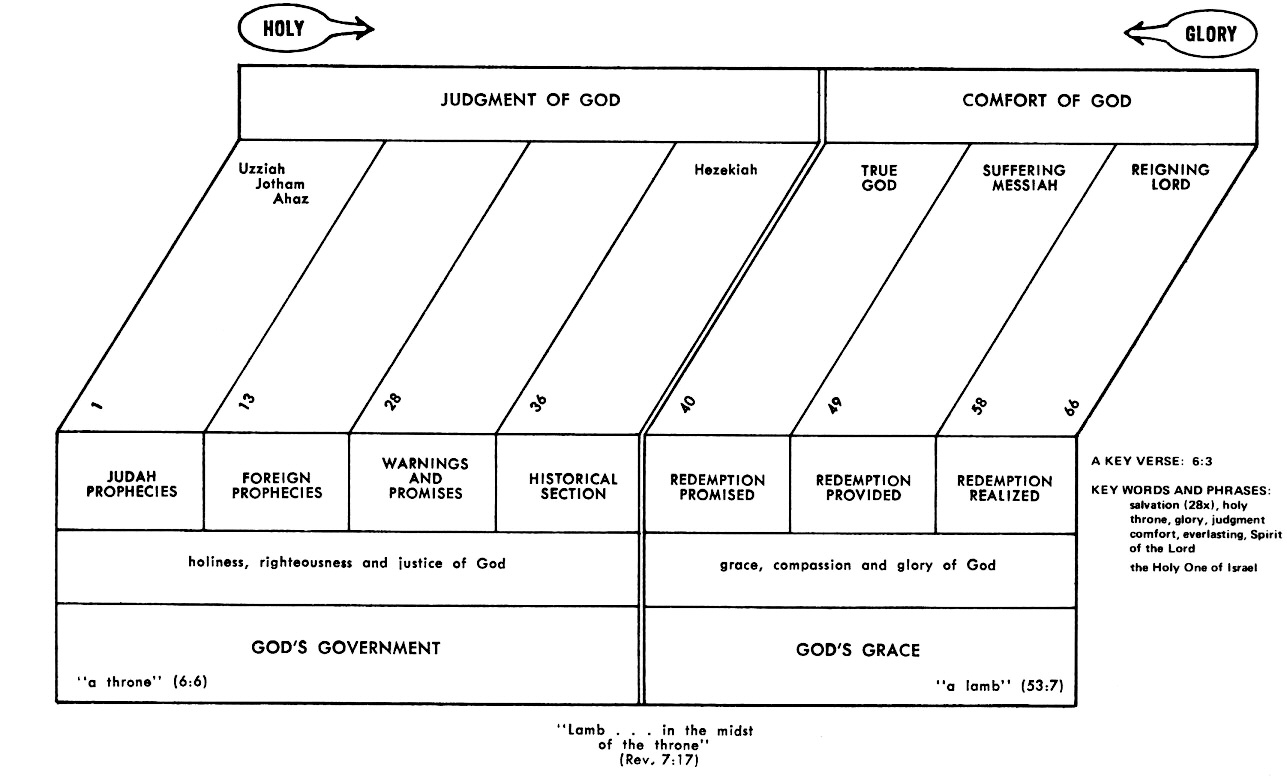
Click chart to enlarge
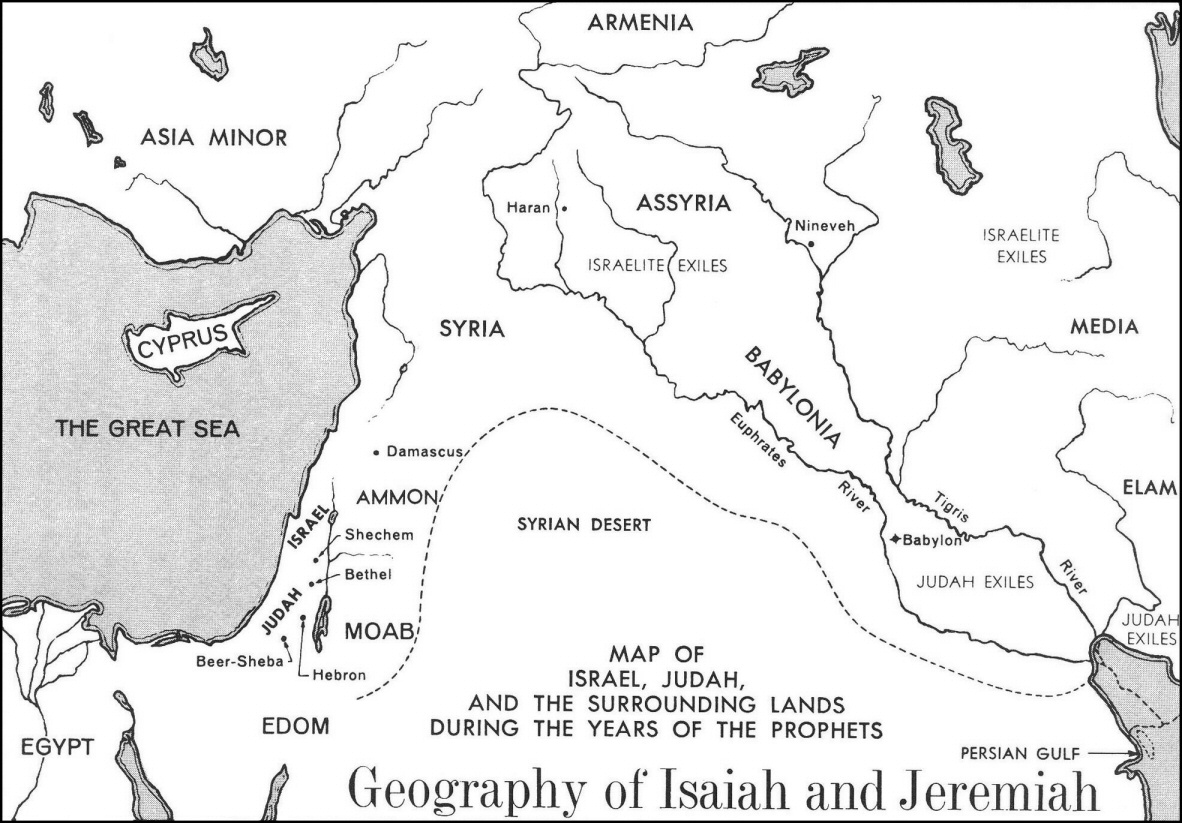
Click chart to enlarge
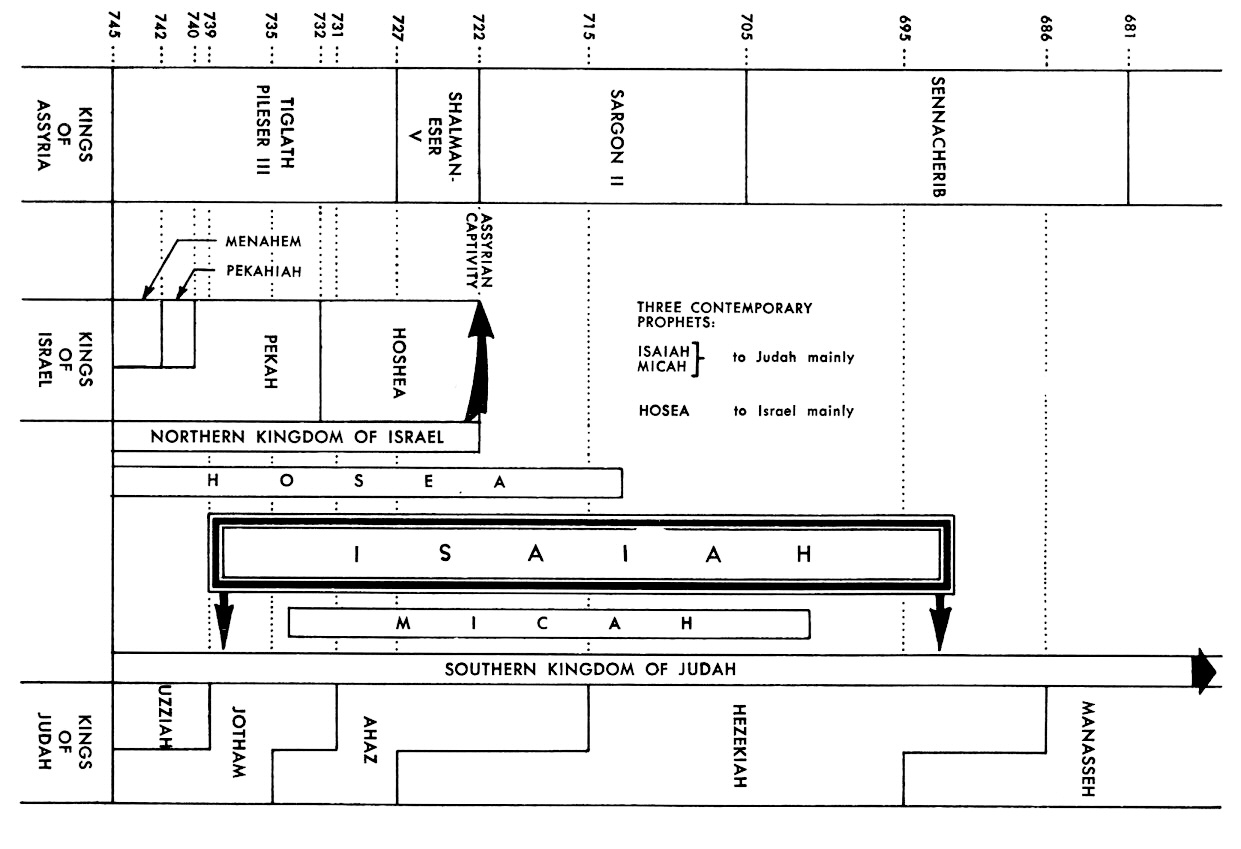
Chart from recommended resource Jensen's Survey of the OT - used by permission
Another Isaiah Chart see on right side
HERE IS AN EXCELLENT TIMELINE OF ISAIAH
Isaiah 1:1 The vision of Isaiah the son of Amoz concerning Judah and Jerusalem, which he saw during the reigns of Uzziah, Jotham, Ahaz and Hezekiah, kings of Judah. (NASB: Lockman)
English Translation of the Greek (Septuagint): The vision which Esaias the son of Amos saw, which he saw against Juda, and against Jerusalem, in the reign of Ozias, and Joatham, and Achaz, and Ezekias, who reigned over Judea.
Amplified: THE VISION [seen by spiritual perception] of Isaiah son of Amoz, which he saw concerning Judah [the kingdom] and Jerusalem [its capital] in the days of Uzziah, Jotham, Ahaz, and Hezekiah, kings of Judah. (Amplified Bible - Lockman)
KJV: The vision of Isaiah the son of Amoz, which he saw concerning Judah and Jerusalem in the days of Uzziah, Jotham, Ahaz, and Hezekiah, kings of Judah.
NET: Here is the message about Judah and Jerusalem that was revealed to Isaiah son of Amoz during the time when Uzziah, Jotham, Ahaz, and Hezekiah reigned over Judah. (NET Bible)
NJB: The vision of Isaiah son of Amoz concerning Judah and Jerusalem, which he received in the reigns of Uzziah, Jotham, Ahaz and Hezekiah kings of Judah. (NJB)
NLT: These visions concerning Judah and Jerusalem came to Isaiah son of Amoz during the reigns of Uzziah, Jotham, Ahaz, and Hezekiah--all kings of Judah.
Young's Literal: The Visions of Isaiah son of Amoz, that he hath seen concerning Judah and Jerusalem, in the days of Uzziah, Jotham, Ahaz, Hezekiah, kings of Judah.
| ISAIAH ("Jehovah is Salvation") See Excellent Timeline for Isaiah - page 39 |
||||||
| JEHOVAH'S Judgment & Character (Isaiah 1-39) |
JEHOVAH'S Comfort & Redemption (Isaiah 40-66) |
|||||
| Uzziah Jotham Ahaz 1-12 |
13-27 |
28-35 |
Hezekiah's Salvation & Blessing 36-39 |
True God 40-48 |
Suffering Messiah 49-57 |
Reigning Lord 58-66 |
| Prophecies Regarding Judah & Jerusalem Is 1:1-12:6 |
Prophecies Against the Nations |
Warnings & Promises |
Historical Section |
Redemption Promised: Israel's Deliverance |
Redemption Provided: Israel's Deliverer |
Redemption Realized: Israel's Glorious Future |
| Prophetic | Historic | Messianic | ||||
| Holiness, Righteousness & Justice of Jehovah | Grace, Compassion & Glory of Jehovah | |||||
| God's Government "A throne" Is 6:1 |
God's Grace "A Lamb" Is 53:7 |
|||||
| Time 740-680BC HERE IS AN EXCELLENT TIMELINE OF ISAIAH |
||||||
INTRODUCTORY COMMENTS
THE BOOK OF ISAIAH
This page represents the first page of a lifelong dream to write a simple commentary on the great book of Isaiah, a goal which I hope to achieve within the next 12 months (2008/2009....well, it is now August, 2016 and it is not completed so it may never be finished as I have had to completely revamp my website to keep up with technological advances on the internet and it has been extremely time-consuming). Please pray with me and for me that God's Word of Truth would be rightly divided for His glory, through the illuminating/teaching ministry of His Spirit and for the glory of His Son, our promised Messiah and soon coming King of kings. Amen.
DISCLAIMER: I should state at the outset that my approach to the interpretation of Isaiah will be conservative, evangelical and literal, with a firm conviction that the unfulfilled Old Testament prophetic promises to Israel (specifically the remnant) will one day be fulfilled to the letter (including those that describe the Millennium) and that the New Testament church has not replaced Israel (see discussion of the Israel of God). I will frequently quote from commentaries both old and new which espouse a "replacement" view (the church replacing Israel; see also replacement theology) in order that the reader might be aware of the widespread prevalence of such an interpretative view especially in pre-1900 commentaries, but sadly also in many modern commentaries. As discussed below, the NT writings make it very clear that the church was a mystery not revealed in the OT (cf Eph 3:4-6), and one would think that such Scriptural evidence would be sufficient to exclude serious consideration of the replacement view, but sadly it is not! On the other hand, while Judah and Jerusalem are the main "target" audience (as literally stated in Isa 1:1, Isa 2:1, Isa 3:1, etc), Isaiah is replete with both pithy and comforting applications for all NT saints.
E. M. Blaiklock wrote that in this book…
We see Isaiah move with fearless dignity through the chaos of his day, firm in his quiet faith, sure in his God (Handbook of Bible People, Scripture Union).
Warren Wiersbe in his preface to his commentary on Isaiah writes…
Isaiah is the prophet we need to hear today as he cries out God’s message above the din of world upheaval, “Comfort, yes, comfort My people!” (Isa 40:1, NKJV) The English word “comfort” comes from two Latin words that together mean “with strength.” When Isaiah says to us, “Be comforted!” it is not a word of pity but of power. God’s comfort does not weaken us; it strengthens us. God is not indulging us but empowering us. “In quietness and confidence shall be your strength.” (Borrow Bible Exposition Commentary - Old Testament)
G Campbell Morgan wrote that..
The whole story of the prophet Isaiah, as it is revealed to us in this one book, is that of a man who spoke to an inattentive age or to an age which, if attentive, mocked him and refused to obey his message, until, as the prophetic period drew to a close, he inquired in anguish, ‘Who has believed our report? And to whom has the arm of the Lord been revealed?’ (Isa 53:1) ” (Westminster Pulpit, vol. 10, p. 10)
Ray Stedman a gifted expositor presents an eloquent introduction to the book of Isaiah…
Isaiah was the greatest of the prophets and a superb master of language. If you enjoy beautiful, rolling cadences and marvelous literary passages, you will enjoy this book for that reason alone.
Isaiah is the fullest revelation of Christ in the Old Testament -- so much so, that it is often called "the gospel according to Isaiah." To acquaint yourself with these magnificent, prophetic passages looking forward to Christ is to experience much of the richness and depth of Scripture.
Also, the prophetic nature of the book of Isaiah is one of the great proofs that the Bible is the word of God, for Isaiah lived some 724 years before Christ. The many passages looking forward to the Messiah point so clearly to Christ and are fulfilled in him, and thereby constitute an unanswerable argument for the divine inspiration of the book.
Any time we approach a new book, we always want to look for a key. I am afraid, however, that this is sometimes a rather weak approach. Sometimes these Bible books seem like locked houses, barred and shuttered, so that you can't get anything out of them unless you find the key. And some people feel that the only duly-licensed real estate agents are the Bible teachers, who alone have the keys to the Scripture's "real estate."
But scriptural books are not like that. They are more like national parks. They are open to everyone to roam in, and are a delight to explore all by yourself. But each park has a characteristic peculiar to itself that distinguishes it from the others; and you appreciate a park better if you know what that characteristic is. I have learned to appreciate some of the distinct characteristics of the great national parks in the West. For instance, if you want to see nature's various moods, go to Yellowstone Park. There she pulls all the tricks out of her bag and throws everything together. If you want to see mountain grandeur and cool lakes, Glacier Park in Montana is the place to go. If you want to be awed and humbled and stirred, then go to the Grand Canyon. If you are looking for a quiet valley in which to rest and reflect, Yosemite fills the bill -- that is, any time other than midsummer, when some twenty thousand people are in the valley with you.
Sometimes I think of these books of the Bible like this. The book of Revelation is to me very much like Yellowstone National Park. It is full of spouting geysers and all kinds of weird symbolism and a variety of formations. The Gospel of John is more like Yosemite; quiet and deep and reverent. But there is no question that the book of Isaiah is the Grand Canyon of scripture. Geologists tell us that the Grand Canyon is a miniature history of the earth -- a condensed history, a pocket volume of the past -- just so, the book of Isaiah has long been recognized as a miniature Bible…
Visitors to the Grand Canyon are always astonished by one thing when they go there. They stand at the rim and look out over the vast. jumbled, silent canyon -- down to the Colorado River, which seems but a silver thread more than a mile below them -- and sooner or later some tourist cries in amazement, "I don't understand how a tiny thing like that river could have carved a canyon like this!" They are amazed by that concept.
Now if you read the book of Isaiah thoughtfully and carefully, you sense immediately the grandeur and the power of God. You hear the powerful, rolling cadences of this book's language. You sense the insignificance of man when compared with the might and the wisdom and majesty of God. And if you ask yourself, "How could Isaiah, just a human being like myself, write a book like this?" to answer seems impossible…
Now if any key is needed to this book, this is it. Isaiah was a man who was searching for something. Peter says he was searching after the salvation that was to come from God. And the interesting thing is that the name "Isaiah" means "The salvation of Jehovah."
Now what sets this man searching? Why does he pore over his writings, puzzling over this matter? Well, when you read this book you can see his problem. Isaiah lived in a time of national stress, when man's true nature was visible and was exposing itself for what it was just as in our day. (Isaiah: The Salvation of the Lord)
To understand Isaiah or any of the OT prophets one must have a grasp of the history of the nation of Israel as summarized below. The reader is encouraged to read the Scripture references that substantiate the historical events (words in blue are also active links). After pondering and digesting the history of Israel, the diligent student of God's Word would be well advised to study the table (table) that depicts the OT prophets, their times and their target audience (Israel or Judah). Finally, as an aid to understanding prophetic passages, the astute reader would be prudent to study the major prophetic points of history (chart).
COMMENTARIES ON THE BOOK OF ISAIAH
Some quotes on Modern Commentaries on Isaiah especially regarding their tendency to jettison a literal interpretation and replace the nation of Israel with the Church…
Preaching Isaiah: Dispensational Issues - Neal Cushman - This is a very interesting article even if you are not a dispensationalist (which I am not - I am a literalist!)
John Oswalt, the Book of Isaiah - Cushman's review - "Oswalt’s two-volume set on Isaiah in the New International Commentary on the Old Testament series is unsurpassed among other commentaries on this prophecy for its focus on Hebrew grammar and syntax, its approach to textual critical issues, and its extensive interaction with secondary literature. Unfortunately, it is amillennial in its eschatology which tends to frequently skew Isaiah’s message. (Preaching Isaiah: Dispensational Issues - Neal Cushman). NOTE: Volume 1 - can be borrowed online - The Book of Isaiah. Chapters 1-39
J. Alec Motyer, Isaiah : an introduction and commentary (borrow) - Cushman's review - "Be aware that Motyer, a pre-millenialist, states that the theme of the first 37 chapters of Isaiah is “the king who reigns in Zion.”… However, when one examines Motyer’s analysis of Isaiah’s prophecy more closely it appears that when he speaks of Israel, Judah, or Jerusalem he speaks of the church. Motyer’s outline of Isaiah fashions eschatology related to the Jewish nation to the church… Motyer speaks of a “church within the church” when describing the remnant in Isa 8. (Preaching Isaiah: Dispensational Issues - Neal Cushman - see page 17) .
Young's 3 Volume Commentary on Isaiah - Voluminous but very much not literal! Be a Berean!
On the other hand some modern commentators thankfully have held fast to a literal interpretation of Isaiah's prophecies
Be Comforted (Isaiah)- Feeling Secure in the Arms of God- Warren W. Wiersbe (see Isaiah in Bible Exposition Commentary - Old Testament) - Commenting on Isaiah 2:1-5 Dr Wiersbe warns "These promises must not be “spiritualized” and applied to the church (HALLELUJAH! PRAISE THE LORD FOR LITERAL INTERPRETATION!), for they describe a literal kingdom of righteousness and peace. The Jewish temple will be rebuilt, and the Word of God will go forth from Jerusalem to govern the nations of the world." (Page 22)
W E Vine - Isaiah Prophecies Promises Warning (borrow) 232 page book that generally takes a literal interpretative view of the prophecies of Isaiah.
The Expositor's Bible Commentary- Isaiah, Jeremiah, Lamentations, Ezekiel Volume 6 - Geoffrey Grogan - Grogan seems to justify various aspects of both a literal and a spiritualizing approach to Isaiah, although he does not replace Israel with the Church - "The Book of Isaiah, like other OT prophetic Scriptures, has been understood in more than one way as far as its eschatology is concerned. Clearly, a high doctrine of Scripture requires us to take the teaching of its every part with great seriousness, and it also requires that we consider the way the NT writers understood it. Some writers hold to the principle that every prophecy that can be taken literally should be so taken. This does not mean that there is no recognition of figurative language or the wide range of physical analogies used by the writers. It does mean though that Jerusalem is taken to be a geographical location, not a symbol for the church, that the wolf and the lamb lie down together in the Messiah’s kingdom as literal animals, and so on. Others interpret the bulk of the material spiritually maintaining that the promises made to Israel are to be fulfilled in the church, so that we are not to think in terms of the physical realities themselves so much as the spiritual concepts they were designed to point to. This does not mean, of course, that none of the prophecies are to be taken literally. For instance, Christ did offer his back to those who would beat him (50:6). The key to spiritualization really lies in the formula: For “Israel” or “Jerusalem” read “the church.” In the judgment of the present writer, both these positions have difficulties in the light of the NT. A good case can be made out for the fulfillment of many of the “Israel” prophecies in the church, which is the thesis of OT Allis’s Prophecy and the Church. But there is an important group of NT passages that can hardly be understood in any other way than in relation to literal Israel and geographical Jerusalem, passages like Matthew 19:28 and Luke 21:24. The most natural interpretation of Romans 11:26–27 takes “all Israel” to be a reference to the earthly nation, and a study of Revelation 20 leads to the conclusion that it is speaking about a thousand-year reign of Christ on earth after his second advent. Of course, those who argue for consistent spiritualization have their own interpretations of these passages, but this writer does not find them convincing. Romans 11:26–27 is particularly important and interesting because it quotes Isaiah 59:20–21 and 27:9. It is also difficult to take the consistently literal position, especially if this means the setting up of a temple and a sacrificial system again after Christ has made the final sacrifice." (Page 14-15).
ESV Study Bible - Neal Cushman (Preaching Isaiah: Dispensational Issues) review - "Raymond Ortlund, Jr. writes the introduction and notes for Isaiah in the highly popular ESV Study Bible. 38 Ortlund states, “[Isaiah] reveals, through symbols and reasoned thought, a God-centered way of seeing and living. It offers everyone the true alternative to the false appearances of this world.”39 He further explains, “The purpose of Isaiah, then, is to declare the good news that God will glorify himself through the renewed and increased glory of his people, which will attract the nations. The book of Isaiah is a vision of hope for sinners through the coming of Messiah, promising for the ‘ransomed’ people of God a new world where sin and sorrow will be forever forgotten” (Isaiah 35:10; 51:11). As is customary in the ESV Study Bible, possible interpretations are listed so that the reader may choose. Ortlund takes this approach in the many passages that teach a future earthly kingdom in Isaiah, but he consistently presents the amillennial interpretation as the favored view."
My Addendum - Ortlund also the Isaiah commentary in the series Preaching the Word - however he does not approach the text literally but sadly replaces Scriptures given directly to the Jews (cp Isaiah 2:1-2 The word which Isaiah the son of Amoz saw concerning Judah and Jerusalem. Now it will come about that In the last days, The mountain of the house of the LORD Will be established as the chief of the mountains, And will be raised above the hills; And all the nations will stream to it. ) and applies them to the church. And so in his comments on Isaiah 2:1-2 he writes "in the latter days the nations will abandon their worldviews and ideologies and gladly give to the church their esteem as the world’s leader in worship." In fact a search of his entire commentary retrieves only 92 mentions of Judah (to whom the prophecy is directed in Isaiah 1:1, 2:1) and 288 mentions of the church which is not addressed directly once in Isaiah 1-66! Ortlund is a good writer and has some wonderful applications but one must be aware of the lack of literal interpretation.
KJV Bible Commentary (online no restrictions) - Hindson, Edward E; Kroll, Woodrow Michael. Over 3000 pages of the entire OT/NT. Well done conservative commentary that interprets Scripture from a literal perspective. Pre-millennial.
The King James Study Bible Second Edition (online no restrictions) 2240 pages (2013) General Editor - Edward Hindson with multiple contributing editors. Pre-millennial. See introduction on How to Use this Study Bible.
NKJV Study Bible: New King James Version Study Bible (online no restrictions) by Earl D Radmacher; Ronald Barclay Allen; Wayne H House. 2345 pages. (1997, 2007). Very helpful notes. Conservative. Pre-millennial.
The MacArthur Study Bible (borrow) - Brief but well done notes from a literal perspective.
Bible Knowledge Commentary - Old Testament (borrow) - Dispensational perspective.
Ryrie Study Bible - Neal Cushman's review - This study Bible does not include a section in the introduction to describe Isaiah’s overall argument. However, the outline for the book contains considerable detail and Ryrie’s notes, though brief, are generally helpful. For instance, regarding the day when the Lord will recover the remnant of his people a second time (Isa 11:11), Ryrie argues that this second regathering may be identified as the future eschatological gathering of Israel; the first time occurred under Zerubbabel in 537 BC. 42 Recent Isaianic scholars view this prophecy as a “New Exodus” as compared to the “First Exodus.” However, Ryrie does not adequately distinguish the prophecies of the eschatological regathering of Israel (43:1-13) from the return from Babylon (43:14- 21). (Preaching Isaiah: Dispensational Issues).
Neil Cushman makes some interesting observations - In the past year, 468 sermons in which Isaiah was the principal text were uploaded onto Sermon Audio’s website. Since approximately 6000 sermons were uploaded during that same period of time, sermons on Isaiah would account for nearly 8 percent of those preached. As previously noted, preachers frequently focus on familiar texts in Isaiah’s prophecy. Thus, homeleticians expounded Isaiah 6 thirty-one times, 7:14 eighteen times, 9:6 thirty times, and chapter 53 ninety- three times. In the majority of these sermons the overall message of Isaiah was not mentioned, although the historical context was sometimes addressed, especially in respect to chapters 6 and 7. (Preaching Isaiah: Dispensational Issues - Neal Cushman).
A FEW SIMPLE GUIDELINES FOR
STUDY OF PROPHETIC BOOKS
In regard to Prophetic books like Isaiah (the same caveat applies to Jeremiah, Daniel, and the 12 "Minor" Prophets), remember that the most accurate interpretation is derived by applying the following principles:
(1) Read the Scripture literally unless the passage is clearly figurative language, but even then keep in mind that the figurative always points to a literal reality and does not give the interpreter liberty to let the imagination "run wild" with specious speculations!
(2) Take time to observe the context (it does take time - reading and re-reading the surrounding passages/paragraphs/chapters to accurately establish the context) for context is "king" and rules over accurate Interpretation. For example, don't take verses from Isaiah out of their Old Testament context in which God is speaking to the saved and unsaved Jews in Judah and Jerusalem.
Remember that Jehovah's promises to the nation of Israel regarding the promised land remain valid, and it is vital (for accurate interpretation) to not replace Israel with the NT church (See Paul's declaration that the Gentiles were to be fellow members of the body, the church, had heretofore been a mystery, not revealed in the OT! Ep 3:3-note, Ep 3:4, 5-note, Ep 3:6-note - It is a serious interpretative error to substitute the church for Israel when reading the OT! See study Israel of God). A large percentage of commentaries on Isaiah (old and recent) have abrogated this vital, irrefutable covenant principle (cp Ge 12:1, 2, 3). The church is not mentioned in the Old Testament but was a mystery revealed only in the New Testament. This is not to say that Isaiah is not applicable to NT believers, because to the contrary, Isaiah's message to Israel is imminently applicable and is urgently needed that it might be heeded by the New Testament church.
(3) Remember that Scripture is always the best commentary on Scripture. As you read through the comments on Isaiah, you will from time to time encounter examples of spurious (in my opinion) interpretative comments. These comments will be quoted not to denigrate the author of the comments (some of whom are quite famous) but to convince you of the importance of doing your own observations of the text before you are read and are potentially biased by someone else's interpretation (including the one you are currently reading!) It is always important to be a Berean (Acts 17:11-notes) when studying the Scriptures, but this caution is especially necessary when studying the Old Testament prophetic books.
Before you consult commentaries, sermons or other resources, first consult the Word of God, studying the Scriptures diligently and inductively (See inductive Bible study) in dependence on your Teacher, the Holy Spirit, Who Jesus promised would guide us into all truth (John 16:13).
A BRIEF SUMMARY OF ISRAEL'S HISTORY
The history of Israel begins with Jehovah's call to and covenant with Abraham (Acts 7:2, 3, 4, Ge 12:1, 2, 3, 17:1, 2, 3, 4, 5, 6, 7, 8), with these covenant promises passing down through Isaac to Jacob (Ge 32:28, 35:10, 11, 12) from whom came the 12 tribes of Israel. The 12 tribes under the leadership of Moses were delivered by Jehovah (Acts 7:30, 31, 32, 33, 34, 35, 36) from the death angel by the blood of the Passover lamb (Ex 12:11, 21, 27, 50, 51) and from Egyptian bondage and Pharaoh's pursuit - Ex 14:21, 22, 23, 24, 25, 26, 27, 28, 29, 30, 31). Jehovah then entered into a conditional covenant with Israel at Mt Sinai (Ex 19:5, 24:3, 7, 8). After 40 years of wilderness wandering (Acts 7:36), the first generation of Israelites (those who had been freed from Egypt) died off (Nu 14:32, 33, 34, 35) with the exception of Joshua and Caleb (Nu 14:36, 37, 38).
The second generation of Israelites crossed the Jordan into the promised land to capture and occupy their specific tribal territory under the leadership of Joshua (Josh 21:43, 44, 45, Ne 9:23, 24). After Joshua's death, the dark days of the period of the judges followed, lasting some 300 plus years, during which every man did what was right in his own eyes because there was no king in Israel (Jdg 21:25-notes, Neh 9:26, 27, 28, 29). During this dark time Ruth the Moabitess married Boaz, the kinsmen-redeemer (Ru 3:9, 12, 13, 4:4, 5, 6 - see verse by verse commentary on Ruth), and gave birth to Obed the father of Jesse, the father of David (Ruth 4:21, 22).
Toward the end of the period of Judges (see commentary on Judges - Verse by Verse) the prophet Samuel was raised up (1Sa 1:20, 21, 22, 28; 3:8, 9, 10, 19, 20, 21) to call Israel back to her King (cp 1Sa 7:3, 4, 5, 6, 7, 8, 9, 10, 11, 12, 13). However, when the prophet (EBD article) Samuel had grown old, his sons did not walk in his ways (1Sa 8:2, 3) with the result that Israel began to cry out for a king like the other nations (1Sa 8:4, 5, 6, 19, 20). And so God gave them a king and allowed the 12 tribes (the United Kingdom) to be ruled for 40 years by King Saul, 40 years by King David and 40 years by King Solomon.
In 931BC, God declared to King Solomon that He would tear the kingdom from him because of his idolatry, but would leave the tribe of Judah and the tribe of Benjamin under his son Rehoboam's rule (1Ki 11:10, 11, 12, 13). And just as Jehovah had prophesied, the 12 tribes were divided at the end of Solomon's reign, Jeroboam I (followed by 18 evil kings) being the first king of the north ruling over 10 tribes in the capital city of Samaria (1Ki 11:26, 27, 28, 29, 30, 31, 32, 33, 34, 35, 36, 37, 38, 39, 40). Rehoboam (followed by 11 evil and 8 godly kings) (1Ki 11:42, 43) became the first king of the south and he ruled in the capital city of Jerusalem over two tribes, Judah and Benjamin.
The Northern Kingdom stood for 209 years until it was captured by Assyria and taken into exile in 722 BC (2Ki 17:1, 2, 3, 4, 5, 6. Why? 2Ki 17:7,8, 9, 10, 11, 12, 13, 14, 15, 16, 17, 18, 19).
The Southern Kingdom failed to learn from Israel's punishment by Jehovah after 345 years was taken into captivity by Nebuchadnezzar in 586 BC (Zedekiah the last king - 2Chr 36:11, 12, 13, 14, 15, 16, 17, 18, 19, 20, Why 70 years of exile in Babylon? 2Chr 36:21, Lv 25:4, 26:33, 34, 35). Note that there were 3 sieges of Jerusalem by Babylon - 605 BC (Daniel and his friends taken, Jehoiakim king of Judah), 597 BC (Ezekiel and 10,000 taken captive, Jehoiachin king of Judah) and 586 BC (Jerusalem and the Holy Temple destroyed, Zedekiah king of Judah).
THE OLD TESTAMENT PROPHETS
The chart below summarizes the the periods of ministry of all 17 Old Testament prophets, often divided (primarily on the basis of their length) into major prophets (Isaiah, Jeremiah, Ezekiel, Daniel) and minor prophets (see names in chart below). The chart depicts the time of the prophet's ministry - Exilic, Pre- or Post-exilic - and the primary recipient of their prophetic message (eg, Amos and Hosea to the 10 Northern tribes referred to as Israel - whenever you observe the term "Israel" in Scripture check the context because in other uses it can refer to the 12 tribes representing undivided Israel). As described above, the Northern 10 Tribes were taken into exile by Assyria in 722 BC. Isaiah began his prophetic ministry which was directed primarily to the Southern Kingdom of Judah about 739BC or approximately 17 years prior to the fall of the Northern Kingdom of Israel. Isaiah's ministry to Judah ceased about 681BC, almost 100 years prior to the Babylonian exile in 586BC. Note also that Amos, Hosea and Micah were contemporary prophets of Isaiah.
|
ASSYRIAN |
BABYLONIAN |
|||||
|
1 |
2 EXILIC |
3 POST-EXILIC |
||||
|
ISRAEL |
||||||
| JONAH | AMOS | HOSEA | ||||
|
JUDAH |
RESTORED |
|||||
| OBADIAH | ISAIAH | NAHUM | ZECHARIAH | MALACHI | ||
| JOEL | MICAH | ZEPHANIAH | HAGGAI | |||
Related Resource: Excellent Timeline for Isaiah in Pdf
As you study Isaiah (and any prophecy for that matter) keep in mind that the prophets words speak to one or more of the major prophetic points in history: The prophet's own day, Judah's 70 years captivity (exile) in Babylon, Judah's post-exilic return to Jerusalem (and "the land" - see following note), Messiah's first coming, Messiah's second coming to reign one thousand years (The Millennium), and the inception of the New Heaven and New Earth.
Keep in mind that many times in the OT, the seemingly general phrase "the land" is a specific designation of the promised land (determined by the context), the land of "milk and honey" which Jehovah unconditionally promised to Abraham and his offspring forever (eg, observe the phrase "the land" in Ge 12:1, 7, 13:15, 15:18, 17:7, 8, 24:7, 28:4, 13, 14, 15, 35:9, 10, 11, 12, 48:4, Ex 20:12, 33:1, Dt 34:4, 2Chr 20:7, Neh 9:7, 8)
|
The |
Judah's 70 Yrs in Babylonian Captivity (Exile) |
Judah's Return to Jerusalem & Restoration of Temple |
400 Years |
Messiah's First Coming as a Man to be Crucified for our sins |
Messiah's Second Coming to reign as King over His Millennial Kingdom |
New Heaven and New Earth |
Related Resources:
Prophetic Points in Book of Daniel
Isaiah has been referred to as the Bible in miniature, having 66 chapters even as the Bible has 66 books. And just as the Bible is divided into two parts of 39 Old Testament books and 27 New Testament books, Isaiah is divided into two parts, the first 39 chapters (Isa 1-39) having to do largely with Israel's past and the promise of Messiah's coming, and the last 27 chapters (Isa 40-66) dealing especially with Israel's future and her deliverance. Obviously, the "division" of Isaiah into 39 and 27 chapters is coincidental because the original manuscript of Isaiah had no chapter divisions but the chapters were established by human editors, not the Holy Spirit. J Vernon McGee illustrates the comparison of Isaiah and the Bible in the following table…
| Isaiah | Bible |
| 66 Chapters | 66 Books |
| 39 Chapters on LAW, the Government of God |
39 Books in Old Testament |
| 27 Chapters on GRACE, Salvation of God |
27 Books in New Testament |
Isaiah has been called the "fifth evangelist" because of his portrayal f the nature of God and His purpose in salvation. Others have referred to the book of Isaiah as "the fifth Gospel," because the prophet so clearly predicts the Lord Jesus Christ's Christ’s virgin birth, character, life, death, resurrection, and second coming.
The importance of Isaiah to the argument of the NT cannot be underestimated for the NT writers have some 66 direct quotations. In addition if one also includes NT passages that have "allusions" to Isaiah the number of references is approximately 85. Twenty of the twenty-seven New Testament books refer in some way to Isaiah with 12 of those books utilizing direct quotations.
Unger in his Bible handbook writes that
Isaiah… is the great messianic prophet and prince of OT seers. For splendor of diction, brilliance of imagery, versatility and beauty of style, profundity and breadth of prophetic vision, he is without peer.
Henry Morris writes that Isaiah…
is considered the greatest of Old Testament prophets. His book contains the most significant and greatest number of Messianic prophecies. It falls naturally into two divisions, chapters 1-39 and chapters 40-66. Liberals have long argued that the two divisions were written by two different authors (Ed note: This refers to the rise of so called "higher criticism" [see note on the approach one takes to interpretation] in the late 1800's spurred the debate about who wrote Isaiah.). The only real evidence for this idea is the fact that certain explicit prophecies in the second division (Isaiah 45:1, 2, 3, 4), were fulfilled long after the "first" Isaiah died. Liberals do not believe in predictive prophecy. The New Testament, however, including Christ Himself, quotes from both divisions, attributing all such quotes to "Isaiah the prophet" (Mt 3:3; 12:17,18; Luke 3:4; Jn 12:38, 39, 40, 41; Acts 8:28, 29, 30, 31, 32, 33, 34; Ro 10:16,20). Jesus says that Isaiah wrote the prophecy in both Isaiah 6:9,10 (quoted in Mt 13:14,15) and Isaiah 53:4 (quoted in Mt 8:17), as well as other quotes from both divisions…
The real reason… for the "two Isaiahs" ("Deutero-Isaiah") notion is that the second division contains many remarkable prophecies that were later fulfilled--for example, the naming of the Persian emperor Cyrus a century and a half in advance (Isaiah 45:1, 2, 3, 4). Skeptical theologians are unwilling to believe that God can supernaturally reveal the future to His divinely called and prepared prophets, and so most assume that the last part of Isaiah was written by an unknown writer living among the exiles in Babylon after Cyrus had conquered the city. (Borrow The Defender's Study Bible)
Deuteronomy 18:18 gives us an excellent Biblical definition of a prophet…
'I will raise up a prophet from among their countrymen like you, and I will put My words in his mouth, and he shall speak to them all that I command him.
Easton's writes that the word prophet is the Hebrew word nabi which is
from a root meaning "to bubble forth, as from a fountain," hence "to utter", (cp. Ps 45:1). This Hebrew word is the first and the most generally used for a prophet. In the time of Samuel another word, ro'eh, "seer", began to be used (1Sa 9:9). It occurs seven times in reference to Samuel. Afterwards another word, hozeh, "seer" (2Sa 24:11), was employed. In 1Chr 29:29 all these three words are used: "Samuel the seer (ro'eh), Nathan the prophet (nabi'), Gad the seer" (hozeh). In Josh 13:22 Balaam is called (Heb.) a kosem "diviner," a word used only of a false prophet.
So important is prophecy in God's Word that it occupies about one third of the whole Bible. Prophecy is God's revelation of His Plans to His children.
Sir Winston Churchill was asked to give the qualifications a person needed to succeed in politics to which he replied
It is the ability to foretell what is going to happen tomorrow, next week, next month, and next year. And to have the ability afterwards to explain why it didn’t happen.
God’s genuine prophets unlike politicians were always correct and did not have to explain away their mistakes.
Moses records that…
When a prophet speaks in the name of the Lord, if the thing does not come about or come true, that is the thing which the Lord has not spoken. The prophet has spoken it presumptuously; you shall not be afraid of him. (Dt 18:22)
Isaiah alludes to the test of authenticity writing…
To the law and to the testimony! If they do not speak according to this word, it is because they have no dawn. (Is 8:20)
Wil Pounds in his summary The Prophets: Holy Men of God writes that…
A prophet is a man who speaks to men on behalf of God the message he has received from God. Prophecy is the declaration and illustration of the principles of the divine government, whether in the past, present, or the future. Prophets were God’s specially called and inspired messengers. They were "holy men of God who spoke as they were moved by the Holy Spirit" (2Peter 1:21-note). The prophets are called by various names including: "Man of God," "Servant of Jehovah (LORD)," "Messenger of Jehovah," "Interpreter," "Sentinel," "The Man of the Spirit." The Holy Spirit breathing into the mind of the prophet so illumined his spirit and pervaded his thoughts, that while nothing as a person was taken away, yet everything that was necessary to enable him to declare divine truth in all its fullness was bestowed on him. Their inspiration consisted in the fullness of the influence of the Holy Spirit enabling them to accomplish their work.
His job was to call the people back to God and to the truth of God. It involved warning them of the consequences of their actions and a call to repentance (aka a "forth teller"). At times it was a message of God's plan for the future of His Kingdom (aka a "fore teller"). They were men through whom God spoke His message of love for sinners, and warned them of the consequences of their sins. The heart of their message was God's promise of eternal redemption through the coming of Jesus Christ the Messiah.
The test of the prophet was practical and simple. "When the word of the prophet shall come to pass, then shall the prophet be known, that the Lord has truly sent him" (Jeremiah 28:9). The term ("FALSE PROPHET") does not occur in the Old Testament. It is found on the lips of Jesus (Mt 7:15-23; Mk.13:21, 22, 23; Jer 14:13, 14, 15, 16, 17, 18; 28; 1Ki 22:5-28) (ED CORRECTION - WHILE THE TERM "FALSE PROPHET" IS NOT FOUND IN THE ENGLISH TRANSLATIONS OF THE OT, THE GREEK WORD "PSEUDOPROPHETES" IS FOUND IN THE SEPTUAGINT IN Zech. 13:2; Jer. 6:13; Jer. 33:7; Jer. 33:8; Jer. 33:11; Jer. 33:16; Jer. 34:9; Jer. 35:1; Jer. 36:1; Jer. 36:8) Things that are most highly valued are most subject to counterfeiting. True prophecy has in it no contradictions. It must always agree in genuine way with what is already known about Yahweh. Satan is the counterfeiter.
1. They were sent from God. These men claimed to be speaking from God and for God. "Thus says the Lord" was a clear emphasis of their preaching. The content of their message is proof that they were inspired of the Lord.
2. Their message was related to history. It grew out of some historic situation in which they lived. The prophets were messengers of their times. The message can only be understood by seeing it in its original setting. You have to become a student of history to understand Old Testament prophecy.
3. God's revelation is progressive. Each message builds upon other revealed truth from God.
4. Prophecy is not always predictive. It is a mistake to think that Old Testament prophecy was always predictive or foretelling of the future. There were times when the prophet spoke only to his own generation without any special reference to the future. He called his generation to repentance or to a social change within the nation or political changes. They warned the nation and its leaders of wrongs that needed to be corrected. They were primarily messengers of God, whether they spoke of the past, the present, or the future.
5. There were absolute predictions of the future. These predictions reveal God's purposes of grace to men. They are dependent upon the sovereign purpose of God, and they are certain of fulfillment. A good example is Genesis 3:15, which is not dependent upon, man, but solely upon God. Galatians 4:4, 5 shows its fulfillment.
6. There were conditional predictions, which directly bear upon men’s responsibility for a proper human response to secure fulfillment. A good example is Jonah's prediction that Nineveh would be destroyed in forty days.
7. Correct interpretation of prophecy includes the recognition of both literal and figurative language freely intermingled. Genesis 3:15 is a figurative way of picturing the conflict between Christ and Satan.
8. All prophecy is centered in Christ. It is a testimony of Jesus Christ. He is at the center of prophecy because He is the central theme of all the Scriptures. No one, or anything can share that center stage with Him. Bring every prophecy to Christ in order to see it in its true light.
9. Interpret Old Testament prophecy in the light of the New Testament. We find the key to the interpretation of Old Testament prophecy by examining how New Testament writers interpreted the prophets. The explanation of the Old Testament in the New Testament is the very point from which alone all explanation that listens to the voice of the divine wisdom must set out. This way we understand the sense of the Holy Scriptures as understood by inspired men themselves, and are furnished with the true key to knowledge. We discover from the New Testament writers the correct principles of interpreting the Old Testament prophecies. Probably we should see much more in the prophetic messages than we at first observed.
10. The interpretation of prophecy should generally be in the literal and natural meaning of the words. Seek the plain teaching of the passage. The fulfillment of predictions made by the prophets is to be thought of as literal and not allegorical. Many predictions may be given to us in figurative language, and we may or may not understand them, but when the day comes for fulfillment it is to be thought of as literal. (Source)
Harry Ironside has some interesting introductory thoughts on the book of Isaiah…
ISAIAH'S "wild measure" has ever been a portion of GOD's Holy Word in which spiritually minded believers have found much to exercise their hearts and lead out their souls in glad anticipation of the coming day when Immanuel (God with us), of whom this prophet speaks, will take His great power and reign.
Longer than any other prophetic book, it contains the fullest Messianic predictions to be found in the Old Testament, testifying in no uncertain way to "the sufferings of Christ, and the glory that should follow." Of late, like all other books of the Bible, it has suffered much at the hands of unbelieving and haughty critics, who have done their best to undermine the faith of the simple in the integrity and unity of the Bible, but all that is settled for those who have faith by the Lord Jesus. When here on earth He placed the seal or His divine approval upon it in its entirety. And from this book the apostles drew again and again in their ministry after the ascension of the Saviour, all by the direct guidance of the Holy Spirit, giving it a place of unquestionable authority as the very word of the Lord.
Isaiah himself was a man of wealth, rank, and learning, if we may give any credence to Jewish tradition respecting him. He is supposed to be the one referred to in Hebrews 11:37, who was "sawn asunder" by the enraged rejecters of his prophetic ministry. If this be so, it occurred at the close of a long and honored life, for his public service extended over at least half a century. As he tells us in the opening verse, he prophesied "in the days of Uzziah, Jotham, Ahaz, and Hezekiah."
In all likelihood he did not appear in the prophetic office until the last year of Uzziah's long reign (Isaiah 6:1). Chapter six records his divine commission, and it is questionable if he had uttered the burdens of the previous chapters ere the vision there portrayed, which took place "in the year that King Uzziah died": that is, not necessarily after he died but in the same year as that solemn event. We know he continued to give forth the word of the Lord later than the fourteenth year of Hezekiah's reign, for it was then that he was commissioned to make known to the stricken monarch that fifteen years were to be added to his life. He was, therefore, contemporary with Hosea throughout, and possibly with Amos for a very brief season, though it is more likely the herdsman-prophet had passed off the scene before Isaiah began to make known the mind of GOD. Micah also held the prophetic office during the reigns of the last three kings mentioned. So Isaiah would be the chief among a goodly little company, who had the secret of the Lord (Ps 25:14-note) in a day when formalism and hypocrisy largely prevailed.
That there was but one Isaiah, not two, is evident from the testimony given by the inspired writer of the Gospel of Luke. He tells us that on the occasion of the Lord's first public visit to the synagogue at Nazareth, "there was delivered unto Him the book of the prophet Esaias," (not of "the great unknown"), and from it He preached His gospel of deliverance to the captives and the acceptable year of the Lord. The glorious predictions of Isaiah 61:1,2 the Lord cited as inspired Scripture and written by Isaiah, not as the writing of an unknown poet of the Maccabean or a later period.
The book as it stands bears every evidence of being preserved in its divinely arranged order. It is only unbelieving ignorance coupled with amazing egotism, that could lead any to think to rearrange and dissect it in the manner of modern critics, of which George Adam Smith's "Isaiah" in the Expositor's Bible series is the most commonly known specimen. It is a virtual denial of inspiration and a biased attempt to destroy the true prophetic character of the Messianic portions of this magnificent "golden prophecy."
Unbelief finds difficulties
where faith bows with adoring reverence.
As I write not for skeptics, but for those who truly know Christ Whose sufferings and glories Isaiah foretold, I shall pay but slight attention to the objections of those unbelieving, natural men, albeit distinguished in the world of letters and in the Christless religious circles of the day.
Many professing Christians pay little or no attention to the prophetic word, but in neglecting that which formed so large a part of the Holy Scriptures, they wrong their own souls and dishonor Him who gave His Word for our edification and comfort.
The real value of prophecy
is that it occupies us with a Person,
not merely with events.
That Person is our Lord Jesus Christ Who came once to suffer and is coming again to reign. Of both these advents Isaiah treats, and that In a way more plain and full than do any of the other Old Testament seers.
Prophecy…
Foretelling of future events
Forth-telling of the mind of God for the moment
It should be borne in mind, however, that prophecy is not simply the foretelling of future events, but is rather the forth-telling of the mind of GOD for the moment.
When both the priesthood and the monarchy had failed completely in Israel and Judah, God continued to minister to His people through the prophets. These were men to whom special insight was given into holy things, and who were sent of GOD to call an erring people to repentance. It was their responsibility to put before the people not only the coming glories into which they were to enter in Messiah's day, but also to impress upon them the necessity of preparing the way of the Lord by turning from sin to righteousness, and from their idolatrous vanities to the living GOD who had so wonderfully manifested His power on their behalf throughout Israel's history. (Ironside, Harry A: Expository Notes on the Prophet Isaiah)
A SIMPLE OUTLINE
OF ISAIAH
(I) Isaiah 1-35 Prophetic: Israel and Gentile nations, especially Assyria
(II) Isaiah 36-39 Historic: Reign of Hezekiah
(III) Isaiah 40-66 Messianic: Especially re deliverance of a remnant in Israel
Warren Wiersbe (Borrow Bible Exposition Commentary - Old Testament) offers the following simple outline…
I. Condemnation—(Isaiah 1-39)
1. Sermons against Judah and Israel—(Isaiah 1-12)
2. Burdens of Judgment against the Gentiles—(Isaiah 13-23)
3. Songs about Future Glory—(Isaiah 24-27)
4. Woes of Coming Judgment from Assyria—(Isaiah 28-35)
5. Historical Interlude—(Isaiah 36-39)
a. Hezekiah delivered from Assyria—(Isaiah 36-37)
b. Hezekiah deceived by Babylon—(Isaiah 37-38)
II. Consolation—(Isaiah 40-66)
1. God’s Greatness—(Isaiah 40-48) (The Father vs. idols)
2. God’s Grace—(Isaiah 49-57) (The Son, God’s Servant)
3. God’s Glory—(Isaiah 58-66) (The Spirit and the kingdom)
Charles H Spurgeon comments that…
This is a chapter which teaches an important lesson to those of us who desire the salvation of men, for it shows us how God sets about that work. He begins by exhibiting the sinner’s sin to him before he proclaims mercy to him; and if we want to be the means of doing good to men, it will not be by merely crying to them, “Believe, believe, believe;” but there must be a laying of the axe at the root of the tree of self-righteousness, and a cutting away of all trust in self. A man must realize his danger before he will desire to escape from it, and it is a mistaken kindness which refuses to set before him the peril in which he is. God, who is infinitely tender and inconceivably merciful, shows us, in this chapter, how to go to work with sinners. (Exposition of Isaiah 1:1-31)
The vision of Isaiah the son of Amoz:
- Isa 21:2; Nu 12:6; 24:4,16; 2Chr 32:32; Ps 89:19; Jer 23:16; Nah 1:1; Hab 2:2; Mt 17:9; Acts 10:17; 26:19; 2Co 12:1
- Isa 2:1; 13:1; 2Pe 1:21
Spurgeon notes that "Prophets were called seers, they saw what they were called to say; and every true preacher of Christ must first be a seer of Christ. He must see that is, realize for himself; and then he must tell to others what he has seen. This Book is about “the vision of Isaiah the son of Amoz, which he saw”. During the time in which Isaiah prophesied, the worship of God was, upon the whole, maintained in Judah; yet, prosperous as the times appeared to be, there was visible to the eye of the Lord much iniquity. He who seeth not as man seeth, but who looks beneath the surface, and into the hearts of men (1Sa 16:7), saw that the condition of the people was exceedingly unsatisfactory. Do not forget that these upbraiding words were spoken during the reigns of comparatively good kings, and try to imagine how the Lord must have felt towards the people who lived in the reigns of bad kings. (Exposition of Isaiah 1)
Vision (02377) (chazown/chazon from chazah = to see or behold) is a masculine noun meaning a revelation by means of a vision, an oracle, a divine communication. The emphasis is not so much on what is seen but on the message that is conveyed by what is seen. Thus chazon describes a divine revelation conveyed by something seen ("seer"). In this sense vision is somewhat similar to a dream, but as used in Scripture however, a vision is not a typical "dream" but represents an actual experience in which the individual is given superhuman insight or awareness. Dreams (not "day dreams"!) occur only when one is asleep whereas visions can occur while one is awake (cp Da 10:7). Some visions were conveyed by angels to men (Da 10:14). Visions usually conveyed prophetic truths that related to Israel (Da 9:21, 10:14).
One of my favorite uses of chazon is Pr 29:18+ "When there is no vision (chazon "prophetic vision" Lxx = exegetes = literally one who leads on or out [great description of pastors, teachers!], expounder, interpreter - only 2 other uses in Bible - Ge 41:8, 24; related verb exegeomai of Jesus - Jn 1:18-note), the people are unrestrained, ("run wild!" which is what is transpiring in America circa 2016!), but happy (better "blessed") is he who keeps (observes) the law."
The NET Note on Pr 29:18 says "The Hebrew word “vision” (from the verb חָזָה [khazah, “to see”]) refers to divine communication to prophets (as in 1 Sa 3:1) and not to individual goals or plans. C. H. Toy sees a problem here: The most calamitous period of Israel’s history was when prophetic vision was at its height, whereas people were often more obedient when God was silent. He also notes that in the book of Proverbs there is no mention of prophetic teaching with wisdom as a guide. So he emends the word to “guidance” following the LXX (see Proverbs [ICC], 512). The TEV has “guidance”; the NIV retains “revelation.” It must be stated that the prophetic ministry was usually in response to the calamitous periods, calling the people back to God. Without them the downward rush to anarchy and destruction would have been faster than with these prophetic calls from God. (THOUGHT - WOULD THIS BE APROPOS FOR AMERICA CIRCA 2023? JUST WONDERING!)
Jeremiah 23:16 is instructive "Thus says the LORD of hosts, "Do not listen to the words of the prophets who are prophesying to you. They are leading you into futility; They speak a vision of their own imagination, Not from the mouth of the LORD." False prophets give a message from human origin (cp Ezek 13:16), not the Lord and the result is not surprising - futility!
Baker adds that chazon "signifies the direct, specific communication between God and people through the prophetic office (1Sa 3:1; 1Chr. 17:15; Ps. 89:19) or the collection of such messages (2Chr. 32:32; Isa. 1:1; Obad. 1:1; Nah. 1:1; Hab. 2:2, 3). Also, the word is used of the messages of false prophets (Jer. 14:14; 23:16); a guiding communication from the Lord, often restricted when a people are under judgment (Lam. 2:9; Ezek. 7:26; Mic. 3:6); and the revelation of future events on a grand scale (Da 9:24; 10:14). (Complete Word Study Dictionary: Old Testament).
The Lxx translates chazon with horasis which describes the action (seeing) or what is seen, including supernatural vision (Acts 2:17).
Vine says that "Chazon almost always signifies a means of divine revelation. First, it refers to the means itself, to a prophetic “vision” by which divine messages are communicated: “The days are prolonged, and every vision faileth” (Ezek 12:22). Second, this word represents the message received by prophetic “vision”: “Where there is no vision, the people perish: but he that keepeth the law, happy is he” (Pr 29:18). Finally, chazon can represent the entirety of a prophetic or prophet’s message as it is written down: “The vision of Isaiah the son of Amoz …” (Isa 1:1). Thus the word inseparably related to the content of a divine communication focuses on the means by which that message is received: “And the word of the Lord was precious in those days; there was no open vision” (1Sa 3:1 the first occurrence of the word). In Isa 29:7 chazon signifies a non-prophetic dream. (Vine's Complete Expository Dictionary of Old and New Testament Words)
Note what happens when there is no chazon, no vision in Pr 29:18 (note) where same word is used for vision. (cp similar spiritual "dynamic" in 1Sa 3:1, Amos 8:11,12 Hosea 4:6)- "Where there is no vision, the people are unrestrained ("run wild"), but happy (blessed) is he who keeps the law." Note that in Pr 29:18, the Septuagint chooses the interesting Greek word exegetes to translate the Hebrew word for vision (chazon). Exegetes in Greek literally means one who leads out, and so unfolds, declares or tells. Exegetes of course gives us our English “exegesis” which describes the unfolding interpretation brought about by teaching the Scripture. An exegetes in secular Greek described an expounder, interpreter, as of oracles dreams, omens, or sacred customs. Exegetes is not used in the NT but the verbal root exegeomai is used 6 times (Lk 24:35, Jn 1:18, Acts 10:8, 15:12, 14, 21:19) and means to provide detailed information in a systematic manner. God's people are best fed (and spiritually healthiest) when they are fed with the pure milk of the Word (1Pe 2:2-note), expounded by the Spirit endued and empowered exegete! For practical purposes when any people, individually or corporately, fails to have a Word from God, by default the only only source from which one can receive a "word" is from the godless world, the depraved flesh or the deceptive devil! And the result is chaos not kosmos (order)!
Moses records "He said, "Hear now My words: If there is a prophet among you, I, the LORD, shall make Myself known to him in a vision. I shall speak with him in a dream." (Nu 12:6) Ryrie Comments: God spoke to prophets through visions and dreams; but He spoke to Moses directly, openly (Nu 11:17, 25, Ex 34:5, cp Ps 103:7), and not in dark sayings (riddles).
Webster's 1828 dictionary says that a vision - In Scripture is a revelation from God; an appearance or exhibition of something supernaturally presented to the minds of the prophets, by which they were informed of future events. Such were the visions of Isaiah, of Amos, of Ezekiel, etc.
Morris - In the Old Testament, vision is often synonymous with "divine revelation," amounting to a claim by the prophet that the account that follows is supernaturally inspired. (Defenders Study Bible)
Nelson's Bible Dictionary - In the Bible, people who had visions were filled with a special consciousness of God. The most noteworthy examples in the Old Testament of recipients of visions are Ezekiel (cp Ezek 1:1-25; 26, 27, 28) and Daniel (Da 7:15, 28, 8:15, 17, 19). Visions in the New Testament are most prominent in the Gospel of Luke (Lk 1:22, 24, 22, 23), the Book of Acts (Acts 7:31, Paul - Acts 26:19 compare with Acts 9:3, 4, 5, 6, 10, 11, 12, 13, 14, 15; Cornelius - Acts 10:1, 2, 3, 4, 5, 6, 7, Peter - Acts 10:10, 11, 12, 13, 17, 19, 20, 11:5, 6, 7, 8, 9, 10; Paul - Acts 16:9, 10, 11, 12 18:8, 9, 10, 11), and the Book of Revelation. The purpose of visions was to give guidance and direction to God’s servants and to foretell the future. Daniel’s vision, for example, told of the coming of the Messiah (Da 8:1, 17). (Youngblood, R. F., Bruce, F. F., Harrison, R. K., & Thomas Nelson Publishers. Nelson's New Illustrated Bible Dictionary)
Chazon - 34 uses in the OT - Notice that there are no uses of chazon prior to first Samuel and not surprisingly most of the uses are in the prophetic books.
1 Samuel 3:1 Now the boy Samuel was ministering to the LORD before Eli. And word from the LORD was rare in those days, visions were infrequent.
1 Chronicles 17:15 According to all these words and according to all this vision, so Nathan spoke to David.
2 Chronicles 32:32 Now the rest of the acts of Hezekiah and his deeds of devotion, behold, they are written in the vision of Isaiah the prophet, the son of Amoz, in the Book of the Kings of Judah and Israel.
Psalm 89:19 Once You spoke in vision to Your godly ones, And said, "I have given help to one who is mighty; I have exalted one chosen from the people.
Proverbs 29:18 Where there is no vision, the people are unrestrained, But happy is he who keeps the law.
Isaiah 1:1 The vision of Isaiah the son of Amoz concerning Judah and Jerusalem, which he saw during the reigns of Uzziah, Jotham, Ahaz and Hezekiah, kings of Judah.
Isaiah 29:7 And the multitude of all the nations who wage war against Ariel, Even all who wage war against her and her stronghold, and who distress her, Will be like a dream, a vision of the night.
Jeremiah 14:14 Then the LORD said to me, "The prophets are prophesying falsehood in My name. I have neither sent them nor commanded them nor spoken to them; they are prophesying to you a false vision, divination, futility and the deception of their own minds.
Jeremiah 23:16 Thus says the LORD of hosts, "Do not listen to the words of the prophets who are prophesying to you. They are leading you into futility; They speak a vision of their own imagination, Not from the mouth of the LORD.
Lamentations 2:9 Her gates have sunk into the ground, He has destroyed and broken her bars. Her king and her princes are among the nations; The law is no more. Also, her prophets find No vision from the LORD.
Ezekiel 7:13 'Indeed, the seller will not regain what he sold as long as they both live; for the vision regarding all their multitude will not be averted, nor will any of them maintain his life by his iniquity.
26 'Disaster will come upon disaster and rumor will be added to rumor; then they will seek a vision from a prophet, but the law will be lost from the priest and counsel from the elders.
Ezekiel 12:22 "Son of man, what is this proverb you people have concerning the land of Israel, saying, 'The days are long and every vision fails '?
23 "Therefore say to them, 'Thus says the Lord GOD, "I will make this proverb cease so that they will no longer use it as a proverb in Israel." But tell them, "The days draw near as well as the fulfillment of every vision.
24 "For there will no longer be any false vision or flattering divination within the house of Israel.
27 "Son of man, behold, the house of Israel is saying, 'The vision that he sees is for many years from now, and he prophesies of times far off.'
Ezekiel 13:16 along with the prophets of Israel who prophesy to Jerusalem, and who see visions of peace for her when there is no peace,' declares the Lord GOD.
Daniel 1:17 As for these four youths, God gave them knowledge and intelligence in every branch of literature and wisdom; Daniel even understood all kinds of visions and dreams.
Daniel 8:1 In the third year of the reign of Belshazzar the king a vision appeared to me, Daniel, subsequent to the one which appeared to me previously.
2 I looked in the vision, and while I was looking I was in the citadel of Susa, which is in the province of Elam; and I looked in the vision and I myself was beside the Ulai Canal.
13 Then I heard a holy one speaking, and another holy one said to that particular one who was speaking, "How long will the vision about the regular sacrifice apply, while the transgression causes horror, so as to allow both the holy place and the host to be trampled?"
15 When I, Daniel, had seen the vision, I sought to understand it; and behold, standing before me was one who looked like a man.
17 So he came near to where I was standing, and when he came I was frightened and fell on my face; but he said to me, "Son of man, understand that the vision pertains to the time of the end."
26 "The vision of the evenings and mornings Which has been told is true; But keep the vision secret, For it pertains to many days in the future."
Daniel 9:21 while I was still speaking in prayer, then the man Gabriel, whom I had seen in the vision previously, came to me in my extreme weariness about the time of the evening offering.
24 "Seventy weeks have been decreed for your people and your holy city, to finish the transgression, to make an end of sin, to make atonement for iniquity, to bring in everlasting righteousness, to seal up vision and prophecy and to anoint the most holy place.
Daniel 10:14 "Now I have come to give you an understanding of what will happen to your people in the latter days, for the vision pertains to the days yet future."
Daniel 11:14 "Now in those times many will rise up against the king of the South; the violent ones among your people will also lift themselves up in order to fulfill the vision, but they will fall down.
Hosea 12:10 I have also spoken to the prophets, And I gave numerous visions, And through the prophets I gave parables.
Obadiah 1:1 The vision of Obadiah. Thus says the Lord GOD concerning Edom-- We have heard a report from the LORD, And an envoy has been sent among the nations saying, "Arise and let us go against her for battle "--
Micah 3:6-note Therefore (because of their sin) it will be night for you-- without vision, And darkness for you-- without divination. The sun will go down on the prophets, And the day will become dark over them.
Nahum 1:1 The oracle of Nineveh. The book of the vision of Nahum the Elkoshite.
Habakkuk 2:2-note Then the LORD answered me and said, "Record the vision And inscribe it on tablets, That the one who reads it may run.
3 "For the vision is yet for the appointed time; It hastens toward the goal and it will not fail. Though it tarries, wait for it; For it will certainly come, it will not delay.
The word prophet in its various forms, appears over 600 times in the Scriptures, with two-thirds of the uses being in the OT. This prevalence gives some sense of the importance of study of the prophetic books like Isaiah . There are 17 books of prophecy in the OT written by 16 different prophets (assuming that Jeremiah wrote Lamentations). As alluded to earlier, contrary to the common assumption by many saints, the primary task of the OT prophet was not to foretell events but to forthtell the will of God as He revealed it to them (cp 2Ki 17:13, 14, 2Chr 24:18, 19, 20, 21, 36:15, 16). In Exodus Jehovah specifies that Aaron would serve as Moses' prophet and thus would be his mouthpiece or authorized spokesman…
Then the LORD said to Moses, "See, I make you as God to Pharaoh, and your brother Aaron shall be your prophet (nabiy see all OT uses by book). (Ex 7:1+)
The writer of Hebrews although not using the actual word vision nevertheless does allude to this divine means of communication in his introductory remarks…
God, after He spoke long ago to the fathers in the prophets in many portions and in many ways (Ed Note: Including visions), in these last days has spoken to us in His Son, whom He appointed heir of all things, through whom also He made the world. (He 1:1, 2-note)
MacArthur explains that "A prophet is one who speaks to men for God; a priest is one who speaks to God for men. The priest takes man’s problems to God; the prophet takes God’s message to men. Both, if they are true, are commissioned by God, but their ministries are quite different. The book of Hebrews has a great deal to say about priests, but its opening verse speaks of prophets. The Holy Spirit establishes the divine authorship of the Old Testament, its accuracy and its authority, through the fact that it was given to and delivered by God’s prophets." For example the "LORD said to Moses, "See, I make you as God to Pharaoh, and your brother Aaron shall be your prophet." (Ex 7:1) (MacArthur, John: Hebrews. Moody Press)
The OT prophets like Isaiah were the mouthpieces of God and their words were not the production of their own spirit, but came from the Holy Spirit as emphasized by Peter who wrote that
no prophecy was ever made by an act of human will, but men moved by the Holy Spirit spoke from God. (2Pe 1:21-note)
The prophet John the Baptist quoting the prophet Isaiah explained that he was but
a voice of One who is crying out in the wilderness (Jn 1:23)
The One giving the message was God, John being His voice,
a vessel for honor, sanctified, useful to the Master, prepared for every good work. (2Ti 2:21-note)
OT SYNONYMS
FOR PROPHET
The OT prophets were known by a several synonyms including
Man of God (70 times) Deut. 33:1; Jos. 14:6; Jdg. 13:6; Jdg. 13:8; 1 Sam. 2:27; 1 Sam. 9:6; 1 Sam. 9:7; 1 Sam. 9:8; 1 Sam. 9:10; 1 Ki. 12:22; 1 Ki. 13:1; 1 Ki. 13:4; 1 Ki. 13:5; 1 Ki. 13:6; 1 Ki. 13:7; 1 Ki. 13:8; 1 Ki. 13:11; 1 Ki. 13:12; 1 Ki. 13:14; 1 Ki. 13:21; 1 Ki. 13:26; 1 Ki. 13:29; 1 Ki. 13:31; 1 Ki. 17:18; 1 Ki. 17:24; 1 Ki. 20:28; 2 Ki. 1:9; 2 Ki. 1:10; 2 Ki. 1:11; 2 Ki. 1:12; 2 Ki. 1:13; 2 Ki. 4:7; 2 Ki. 4:9; 2 Ki. 4:16; 2 Ki. 4:21; 2 Ki. 4:22; 2 Ki. 4:25; 2 Ki. 4:27; 2 Ki. 4:40; 2 Ki. 4:42; 2 Ki. 5:8; 2 Ki. 5:14; 2 Ki. 5:15; 2 Ki. 5:20; 2 Ki. 6:6; 2 Ki. 6:9; 2 Ki. 6:10; 2 Ki. 6:15; 2 Ki. 7:2; 2 Ki. 7:17; 2 Ki. 7:18; 2 Ki. 7:19; 2 Ki. 8:2; 2 Ki. 8:4; 2 Ki. 8:7; 2 Ki. 8:8; 2 Ki. 8:11; 2 Ki. 13:19; 2 Ki. 23:16; 2 Ki. 23:17; 1 Chr. 23:14; 2 Chr. 8:14; 2 Chr. 11:2; 2 Chr. 25:7; 2 Chr. 25:9; 2 Chr. 30:16; Ezr. 3:2; Neh. 12:24; Neh. 12:36; Ps. 90:1; Jer. 35:4; 1 Tim. 6:11; 2 Tim. 3:17
Seer (roeh) (20 times) 1 Sam. 9:9; 1 Sam. 9:11; 1 Sam. 9:18; 1 Sam. 9:19; 2 Sam. 15:27; 2 Sam. 24:11; 2 Ki. 17:13; 1 Chr. 9:22; 1 Chr. 21:9; 1 Chr. 25:5; 1 Chr. 26:28; 1 Chr. 29:29; 2 Chr. 9:29; 2 Chr. 12:15; 2 Chr. 16:7; 2 Chr. 16:10; 2 Chr. 19:2; 2 Chr. 29:25; 2 Chr. 29:30; 2 Chr. 33:18; 2 Chr. 35:15; Isa. 29:10; Isa. 30:10; Amos 7:12; Mic. 3:7
Servant of Jehovah (esp used of Moses and David Dt 34:5, Josh 1:1, 13, 15, 8:31, 33, 11:12, 12:6, 13:8, 14:7, 18:7, 22:2, 4, 5, 24:29, Jdg 2:8, 2Ki 18:12, 2Chr 1:3, 24:6, Ps 18:1, 36:1, Isa 42:19)
Messenger of Jehovah (Hag 1:13)
The prophets received their call or appointment directly from God, and some like Jeremiah (Jer 1:5) or John the Baptist (Jn 1:13, 14, 15), were called before birth. Although not all that God had spoken through the prophets was predictive prophecy, this aspect of God's revelation is one of the strongest evidences that the Bible is divinely inspired. The prophets were generally divided into those with an oral ministry only () and others who had both an oral and written ministry.
J Vernon McGee adds that…
Although the predictive element bulks large in this section, the prophets were more than fortune-tellers. Actually, they were men raised up of God in a decadent day when both priest and king were no longer worthy channels through whom the expressions of God might flow.
These men not only spoke of events in the far-off future but also spoke of local events in the immediate future. They had to speak in this manner in order to qualify for this office under God, according to the Mosaic code:
'But the prophet who shall speak a word presumptuously in My name which I have not commanded him to speak, or which he shall speak in the name of other gods, that prophet shall die.' "And you may say in your heart, 'How shall we know the word which the LORD has not spoken?' "When a prophet speaks in the name of the LORD, if the thing does not come about or come true, that is the thing which the LORD has not spoken. The prophet has spoken it presumptuously; you shall not be afraid of him. (Deuteronomy 18:20, 21, 22)
If the local event did not transpire just as the prophet predicted, he was labeled a false prophet and was so treated. You may be sure that the message of the false prophet is not in the library of inspired Scripture. The prophetic books are filled with events that are local and fulfilled. A sharp distinction needs to be drawn between this portion and that which is yet to be fulfilled. One of the greatest evidences of the fact that these men were speaking the words of God is revealed in the hundreds of prophecies that have been fulfilled literally. Man cannot guess the future. Even the meteorologists have difficulty in prognosticating the weather twenty-four hours in advance, although they have the advantage of all sorts of scientific and mechanical devices to assist them. No modern weather forecaster could have been an accepted prophet in Israel! The law of compound probability forbids man from consistently foretelling the future. Each uncertain element added decreases the chance of accuracy by fifty percent. The example of hundreds of prophecies literally fulfilled has a genuine appeal to the honest mind and sincere seeker after the truth. Fulfilled prophecy is one of the infallible proofs of plenary, verbal inspiration of Scripture.
The predictive element is the peculiar and particular contribution of these men of God. This does not mean there was not this element before them or after them. The last book of the Bible closes the message of God for the future.
The prophets were extremely nationalistic. They rebuked sin in high as well as low places. They warned the nation. They pleaded with a proud people to humble themselves and return to God. Fire and tears were mingled in their message, which was not one of doom and gloom alone, for they saw the Day of the Lord and the glory to follow. All of them looked through the darkness to the dawn of a new day. In the night of sin they saw the light of a coming Savior and Sovereign; they saw the millennial kingdom coming in all its fullness. Their message must be interpreted before an appreciation of the kingdom in the New Testament can be attained. The correct perspective of the kingdom must be gained through the eye of the Old Testament prophets. (McGee, J Vernon: Isaiah Introduction - Pdf)
ISAIAH
Prophetic Ministry:
739-681BC
Isaiah - His name means "the LORD saves" or "Yahweh has saved" certainly an apropos name for a prophet through whom God gives knowledge of His salvation through the Messiah of whom he prophesies extensively.
Bultema wrote that Isaiah…
has the courage of a Daniel, the sensitivity of a Jeremiah, the pathos of a Hosea, and the raging anger of an Amos; and moreover he leaves all of them far behind the in the unique art of holy mockery. His courage is of such a nature that he never, not even for a moment, shows himself to be weak or timid.
Isaiah is often referred to as the "prince of prophets" prince of prophets," because of the length of his prophecy (although the prophecy of Jeremiah is slightly longer in the number of words/verses) and because of the majesty and beauty of his themes and the many prophetic pictures of the two comings of the Messiah and His glorious Millennial Kingdom. Isaiah 53 contains one of most complete expositions of the substitutionary sacrifice of Christ in Scripture. Isaiah as you will observe begins with a sad depiction of the sinful, condition of the majority of the people, but ends with a glorious description of the new heavens and new earth, proving that God's ultimate desire for His people is good, not judgment.
Not much is known about Isaiah's personal life, but we do know that Isaiah was married and was the father of at least two sons (Isaiah 7:3,8:3) and lived in Jerusalem (Isa 7:3, 22:1, 37:2, 38:5, 39:3). Some resources state that Isaiah belonged to the royal family of David but this cannot be affirmed from Scripture. (2Ki 19:1, 2, 3, 4, 5, 6, 7-37, and 2Ki 20:1-3, 4, 5, 6, 7, 8, 9, 10, 11-13, 14, 15, 16, 17, 18, 19, 20, 21) 2Kings describes Isaiah's interactions with King Hezekiah.
Isaiah is mentioned by name in the ESV 54 times (22 of which are in the NT) - 2Ki. 19:2, 5, 6, 20; 20:1, 4, 7, 8, 9, 11, 14, 16, 19; 2Chr 26:22; 32:20, 32; Isa 1:1; 2:1; 7:3; 13:1; 20:2, 3; 37:2, 5, 6, 21; 38:1, 4, 21; 39:3, 5, 8; Mt 3:3; 4:14; 8:17; 12:17; 13:14; 15:7; Mk. 1:2; 7:6; Lk. 3:4; 4:17; Jn 1:23; 12:38, 39, 41; Acts 8:28, 30; 28:25; Ro 9:27, 29; 10:16, 20; 15:12.
C I Scofield writes "According to an ancient Jewish tradition the Prophet Isaiah was sawn asunder by the servants of King Manasseh."
Other writers agree with Scofield that Isaiah was the man sawn in half in Hebrews 11 "They were stoned, they were sawn in two, they were tempted, they were put to death with the sword; they went about in sheepskins, in goatskins, being destitute, afflicted, ill-treated,." (Heb 11:37)
This passage in Hebrews could possibly refer to Isaiah but we will have to wait until we meet him face to face to confirm this supposition (either way he will be back in one piece in glory! Hallelujah!). J Vernon McGee adds a pithy comment that…
This (Isaiah's being sawn in two) may or may not be true. The liberal critic has sawn him asunder in forging the fake fabric of the Deutero-Isaiah hypothesis. Some have gone so far as to fabricate a Trito-Isaiah. There is not a scrap of documentary evidence beyond the skepticism of the destructive critic. They have cut Isaiah up like a railroad restaurant pie. History presents only one Isaiah, not two or three. This method of the destructive critic could be applied one thousand years hence to prove just as easily that there were three Dwight Eisenhowers:
1st — General Eisenhower, the military leader of the victorious forces of World War II — European theatre.
2nd —President Eisenhower of the United States, elected in 1952 and 1956.
3rd — Dwight D. Eisenhower, the invalid man and victim of a heart attack and a serious operation for ileitis.
We know that only one man by the name of Eisenhower fulfilled all those requirements. Likewise, only one man by the name of Isaiah can easily fulfill all the requirements as the sole author of the Book of Isaiah. (McGee, J Vernon: Isaiah Introduction - Pdf)
As noted above, the prophet's words sometimes spoke to his own time and in fact the fulfillment of some of Isaiah's prophesies served to authenticate him as a true prophet of God. For example, Sennacherib failed to take Jerusalem as Isaiah had prophesied (Isa 37:6,7, see Isa 36-38). In another fulfillment, Jehovah healed Hezekiah just as Isaiah had predicted (Isa 38:5; 2Ki 20:7).
Isaiah also prophesied of events that occurred after his lifetime, one of the most famous being his prophecy that a man named Cyrus would become king of Persia and deliver Judah from the Babylonian captivity (Isa 44:28; 45:1). Isaiah prophesied of another King who would come and be rejected, the fulfillment of his prophecies of Messiah's first coming serving to validate his prophecies of Messiah's yet to come future return to rule and reign in Jerusalem, a prophecy many commentators still refuse to acknowledge as yet to be literally fulfilled. Isaiah presented more prophetic details on the the Day of the Lord and Messiah’s future Millennial Kingdom on earth than any other OT prophet.
John MacArthur adds that…
Through a literary device called “prophetic foreshortening,” Isaiah predicted future events without delineating exact sequences of the events or time intervals separating them. For example, nothing in Isaiah reveals the extended period separating the two comings of the Messiah. Also, he does not provide as clear a distinction between the future temporal kingdom and the eternal kingdom as John does in Revelation 20:1-10+; Rev 21:1-22:5+. In God’s program of progressive revelation, details of these relationships awaited a prophetic spokesman of a later time.
Interpretive challenges in a long and significant book such as Isaiah are numerous. The most critical of them focuses on whether Isaiah’s prophecies will receive literal fulfillment or not. (Borrow The MacArthur Study Bible)
MacArthur also argues against the frequently espoused interpretation that God has abandoned national Israel and permanently replaced them with the church, defending his position by noting that there are
numerous portions of Isaiah support the position that God has not replaced ethnic Israel with an alleged “new Israel.” (see Israel of God) Isaiah has too much to say about God’s faithfulness to Israel, that He would not reject the people whom He has created and chosen (Isa 43:1). The nation is on the palms of His hands, and Jerusalem’s walls are ever before His eyes (Isa 49:16). He is bound by His own Word to fulfill the promises He has made to bring them back to Himself and bless them in that future day (Isa 55:10, 11, 12)… The kingdom promised to David belongs to Israel, not the church. The future exaltation of Jerusalem will be on earth, not in heaven. Christ will reign personally on this earth as we know it, as well as in the new heavens and new earth (Re 22:1,3). (Borrow The MacArthur Study Bible) (Bolding added)
SON OF AMOZ
The son of Amoz - Amoz means "strong". See the 13 occurrences of Amoz in the OT - 2Ki. 19:2, 20; 20:1; 2Chr. 26:22; 32:20, 32; "son of Amoz" recurs in Isa. 1:1; 2:1; 13:1; 20:2; 37:2, 21; 38:1
Guzik notes that "There are at least seven men by the name of Isaiah in the Bible, but only one is Isaiah, the son of Amoz."
Easton's Bible Dictionary says that in regard to Isaiah's
personal history little is positively known. He is supposed by some to have been the "man of God" spoken of in 2Chr 25:7, 8.
Rich Cathers in his introductory comments notes that…
The book of Isaiah is the first book in the section of the Old Testament that we call the "prophets". It is the Old Testament book that has the clearest picture of the coming Messiah. John, the forerunner of Christ, began his ministry with a quote from Isaiah (Mat. 3:3). Jesus preached His first sermon in Nazareth from Isaiah (Luke 4:17, 18, 19, 20, 21). The New Testament quotes from Isaiah more than from any other prophet.
This is not a book that was written all at once, in a single sitting. There are various sections of the book, and it is the compiling of the writings of a man over sixty years. There will be times that the prophetic message is aimed at Isaiah’s time. There will be times when the prophetic message is aimed far in the future. There will be times when the message has a double effect with both a near and far prophecy. (Isaiah 1:1-20)
Concerning Judah and Jerusalem :
This verse clearly states to whom this prophecy is directly addressed - the southern kingdom of Judah and its capital city, the Holy City of Jerusalem. Keep in mind that for the first portion of Isaiah's ministry (739-722BC), the Northern Kingdom was still in existence. As an aside note that the prophecy is not directed to the church, contrary to what some of the commentaries state.
McGee as usual offers a pithy comment…I am sure that we will not make the mistake of locating either one anywhere in the Western Hemisphere. There is, however, a marvelous application for America today—one that we need to hear and heed. (Thru the Bible Commentary)
Judah and Jerusalem - This combination occurs throughout both the first (1-39) and second (40-66) sections of Isaiah - See the 11 occurrences - Isa 1:1, 2:1,3:1, 3:8, 5:3, 7:1, 22:21, 36:7, 37:10, 40:9, 44:26.
Vine adds that…The subject is Judah and Jerusalem and it is to be noticed that this twofold theme is prominent in chapters 40-66 as much as in 1-39, and that it involves a constant reference throughout the book to the whole nation of Israel.
Jamieson - Other nations also are the subjects of his prophecies; but only in their relation to the Jews (Isa 13:1-23:18 - In the time of Isaiah, Israel was a little nation often caught in the middle of the wars between three superpowers: Egypt, Assyria, and Babylon); so also the ten tribes of Israel are introduced only in the same relation (Isa 7:1-9:21). Jerusalem is particularly specified, being the site of the temple, and the center of the theocracy, and the future throne of Messiah (Ps 48:2, 3, 9; Jer 3:17). Jesus Christ is the "Lion of the tribe of Judah" (Re 5:5).
Which he saw during the reigns of Uzziah, Jotham, Ahaz and Hezekiah, kings of Judah:
- Isa 6:1; 7:1, 3; 14:27; 20:1; 36:1; 38:1; 39:1; 2Chr 26:1-32; Ho 1:1; Amos 1:1; Mic 1:1)
Uzziah, Jotham, Ahaz and Hezekiah, kings of Judah - Three good, godly kings and one evil king (Ahaz)
HISTORICAL CONTEXT:
A Timeline of Isaiah**
790 - Uzziah (790-739BC) becomes king of Judah, reigns 52 years
759 - Jotham becomes king of Judah assuming reign when Uzziah becomes leprous
742 - Micah begins his prophetic ministry (cp ministry to Hezekiah Jer 26:18, 19, Mic 3:12)
739 - Isaiah begins prophetic ministry in year King Uzziah died (Isa 6:1f)
731 - Ahaz becomes king of Judah (2Ki 15:38, 16:1, 2Chr 28:1)
726 - Hezekiah becomes 12th king of Judah (2Ki 16:20, 18:1,2) and one of 3 best (2Ki 18:5)
722 - Shalmaneser (2Ki 17:3, 18:9) dies while besieging Samaria, Sargon seizes crown
722 - Sargon of Assyria (Sargon) (Is 20:1) conquers Samaria (2Ki 17:6, 18:9, 10, 11, 12)
701 - Sennacherib (son of Sargon) of Assyria lays siege to Jerusalem
695 - Manasseh becomes king of Judah (2Ki 21:1, 2, 3, 4, 5, 6, 7, 8, 9, 10, 11, 12)
627 - Jeremiah begins prophetic ministry
586 - Nebuchadnezzar of Babylon conquers Judah
(Source: The Ryrie Study Bible: New American Standard Translation: 1995. Moody Publishers)
HISTORICAL CONTEXT:
SUMMARY OF JUDAH'S KINGS
(See discussion of kings below) - In some ways, the time of Isaiah was not the darkest in Judah because three of the four kings, Uzziah, Jotham and Hezekiah were good and godly rulers who sought to serve and glorify God. But these days were extremely dark and ominous because of the menace of the formidable kingdom of Assyria in the north. In fact, it was early in the ministry of Isaiah (739-681BC) that the 10 tribes of the northern kingdom of Israel were carried away into captivity in Assyria (722BC). And as you will discover in especially the first 6 chapters of Isaiah, these days were spiritually dark days, days in dire need of a prophetic voice of warning and reason (cp Isa 1:18).
Ryrie describes the times of Isaiah…
(Isaiah) warned vigorously against foreign alliances and urged Judah to trust the Lord (Isa 7:4; 30:1-17). He also attacked the social ills of the day, not because he was a social reformer, but because he saw those abuses as symptoms of spiritual declension (Isa 1:3, 4, 5, 6, 7, 8, 9; 58:6, 7, 8, 9, 10).
During the latter half of the eighth century Judah seemingly was about to follow the example of apostasy of the 10 northern tribes of Israel (who were captured by Assyria in 722 B.C.). King Ahaz foolishly looked to Assyria for protection, even though Isaiah told him the Northern Kingdom would shortly fall at the hands of the Assyrians (Isa 8:3, 4). Hezekiah, Ahaz's God-fearing son, instituted spiritual reforms but sought the help of Egypt in foreign affairs. Egypt fell before Sennacherib of Assyria, and only through divine intervention was Judah saved from the same fate (Isa 37:36, 37). During the reign of Manasseh, idolatrous practices were reinstated, and Isaiah warned of the inevitability of the Babylonian captivity. He also gave assurance of the preservation of the people and restoration of the nation. (Borrow Ryrie Study Bible)
Take a moment to at least briefly survey the lives of these four kings, to get a good sense of the political and cultural climate in Judah during the days Isaiah. Remember that as the rulers of the nation go, so go the people, and you will see Isaiah's prophecy frequently addressing the conduct of the rulers and laity in Judah. A sense of the "spiritual climate" will help understand Isaiah's various prophecies.
To help understand the spiritual compromise and decline that occurred in Judah it is helpful to understand the nature of the high places (Hebrew word = bamah - 01116 - click to study a few of the 100+ uses of Bamah and note especially the stark contrast between the true and the counterfeit high places in the 2 uses in Psalms) which describe…
an eminence, natural or artificial, where worship by sacrifice or offerings was made (1Ki 13:32; 2Ki 17:29). The first altar after the Flood was built on a mountain (Ge 8:20). Abraham also built an altar on a mountain (Ge 12:7, 8). It was on a mountain in Gilead that Laban and Jacob offered sacrifices (Ge 31:54). After the Israelites entered the Promised Land they were strictly enjoined to overthrow the high places of the Canaanites (Ex 34:13; Dt 7:5; 12:2, 3), and they were forbidden to worship the Lord on high places (Dt 12:11, 12, 13, 14), and were enjoined to use but one altar for sacrifices (Lv 17:3, 4; Dt. 12; 16:21). The injunction against high places was, however, very imperfectly obeyed, and we find again and again mention made of them (2Ki 14:4; 15:4, 35:2Chr 15:17, etc.). (Click bamah for more description of High Places)
ISAIAH'S MINISTRY
739-681BC
Isaiah began his prophetic ministry in the final year of King Uzziah’s reign (740BC, Isa 6:1) and extended into the later years of Hezekiah’s reign, which ended in 686BC.
Jamieson comments that "The Old Testament prophecies spiritually interpret the histories, as the New Testament Epistles interpret the Gospels and Acts. Study them together, to see their spiritual relations. Isaiah prophesied for only a few years before Uzziah's death; but his prophecies of that period (Isa 1:1-6:13) apply to Jotham's reign also, in which he probably wrote none; for Isa 7:1-25 enters immediately on Ahaz' reign, after Uzziah in Isa 6:1-13; the prophecies under Hezekiah follow next.
UZZIAH
(AZARIAH)
790-739BC
(1) Uzziah (strength of Jehovah - Dictionary Articles) was Judah's 11th king and for the greater part of his 52 year reign he lived in the fear of God, conducting himself as a wise and godly king.
He was sixteen years old when he became king, and he reigned fifty-two years in Jerusalem; and his mother's name was Jecoliah of Jerusalem. 3 And he did right in the sight of the LORD, according to all that his father Amaziah had done. 4 Only the high places were not taken away; the people still sacrificed and burned incense on the high places. (bamah)(2Ki 15:2, 3, 4)
Unlike his contemporaries, the kings of the Northern Kingdom of Israel, Uzziah never deserted the worship of the one true and living God, and was influenced by the prophet Zechariah (2Chr 26:5). God blessed the southern kingdom of Judah with a degree of material prosperity not known since seen the reign of King Solomon. Sadly, Uzziah's end was less noble than his beginning, for…
when he became strong, his heart was so proud that he acted corruptly (Pr 11:2, 16:18, 18:12, 29:23, Isa 2:11, 12), and he was unfaithful to the LORD his God, for he entered the temple of the LORD to burn incense on the altar of incense. 17 Then Azariah the priest entered after him and with him eighty priests of the LORD, valiant men. 18 And they opposed Uzziah the king and said to him, "It is not for you, Uzziah, to burn incense to the LORD, but for the priests, the sons of Aaron who are consecrated to burn incense. Get out of the sanctuary, for you have been unfaithful, and will have no honor from the LORD God." 19 But Uzziah, with a censer in his hand for burning incense, was enraged; and while he was enraged with the priests, the leprosy broke out on his forehead before the priests in the house of the LORD, beside the altar of incense. 20 And Azariah the chief priest and all the priests looked at him, and behold, he was leprous on his forehead; and they hurried him out of there, and he himself also hastened to get out because the LORD had smitten him. 21 And King Uzziah was a leper to the day of his death; and he lived in a separate house, being a leper, for he was cut off from the house of the LORD. And Jotham his son was over the king's house judging the people of the land. (2Chr 26:16-21)
Uzziah Nave's Topical summary of Uzziah's life (the best description is 2Chr 26:1-23)…
Called Azariah. King of Judah, 2Ki 14:21; 15:1, 2; 2Chr 26:1, 2, 3.
Rebuilds Elath, 2Ki 14:22; 2Chr 26:2.
Reigns righteously, 2Ki 15:3; 2Chr 26:4, 5
Defeats the Philistines, 2Chr 26:6, 7.
Takes tribute from the Ammonites; strengthens the kingdom, 2Chr. 26:8.
Strengthens the fortifications of Jerusalem, 2Chr 26:9.
Promotes cattle raising and agriculture, 2Chr 26:10.
Military establishment of, 2Chr 26:11, 12, 13, 14, 15.
Burns incense; stricken with leprosy 2Chr 26:16, 17, 18, 19, 20, 21; 2Ki 15:5
Jotham ruled 7 years as regent during Uzziah's quarantine of, 2Ki 15:5; 2Chr 26:21.
Death of, 2Ki 15:7; 2Chr 26:23.
History of Uzziah was written by Isaiah, 2Chr 26:22; Isa 1:1.
Great earthquake occurred during his reign, Amos 1:1; Zec 14:5.
John MacArthur writes that…
During Uzziah’s prosperous 52 year reign (ca. 790-739BC), Judah developed into a strong commercial and military state with a port for commerce on the Red Sea and the construction of walls, towers, and fortifications (2Chr 26:3, 4, 5,8, 9, 10,13, 14, 15). Yet the period witnessed a decline in Judah’s spiritual status. (Borrow The MacArthur Study Bible)
Skinner writes that…
Under Uzziah, Judah appears to have been… prosperous. The conquest of Edom and the restoration of the Red Sea port of Elath (2Ki 14:22) secured the control of the caravan trade with Southern Arabia; and the revenue obtained from this source seems to have been wisely applied to develop the resources of the country and perfect its military efficiency (see 2Chr 26:1-15). The result was that when Isaiah began his public work Judah had attained a degree of wealth, power and civilisation which must have placed it, along with Israel (Ed: Despite having 18 evil kings and no godly kings, God did allow the Northern Kingdom to prosper, but it was a deceptive prosperity as shown by their fall to Assyria in 722BC), in the front rank of the petty principalities that now separated Egypt from Assyria. "The land was full of silver and gold and there was no end of its treasures ; the land was full of horses and there was no end of their chariots" (Isa 2:7).
JOTHAM
759-743BC
(750-731)**
(752-736)**
(2) Jotham (Jehovah is perfect or upright - Dictionary Articles) was the son of Uzziah (2Ki 15:32-38; 2Ch 27:1-9) and when he was 25 his father King Uzziah was struck with leprosy, at which time Jotham assumed active rule (2Ki 15:5; 2Ch 26:21, 22, 23, 27:1). Jotham administered over Judah for seven years in his father's stead. After his father's death he became sole monarch, and reigned for sixteen years (759-743BC) (2Ki 15:33; 2Ch 27:1). Jotham ruled in the fear of God, and not surprisingly his reign was prosperous. He was contemporary with the prophets Isaiah, Hosea, and Micah, by whose ministrations he profited. He was buried in the sepulchre of the kings and greatly lamented by the people (2Ki 15:38; 2Chr. 27:7, 8, 9). Jotham's name appears in the royal list of 1Chr 3:12, and in the genealogy of Jesus (Mt 1:9). It is notable that Assyria began to emerge as a new international power under Tiglath-Pileser (745-727BC) while Jotham was king (2Ki 15:19).
MacArthur observes that…
Judah also began to incur opposition from Israel and Syria to her north during his reign (2Ki 15:37). Jotham was a builder and a fighter like his father, but spiritual corruption still existed in the Land (2Ki 15:34,35; 2Chr 27:1,2). (Borrow The MacArthur Study Bible)
AHAZ
741-726BC
(735-715)**
(736-720)**
(3) Ahaz (possessor - Dictionary Articles) the son of Jotham became king at age 25 and reigned 16 years (2Chr 28:1, 8), but did not do what was right in the sight of Jehovah (2Ki 16:2) instead sadly walking (conducting)
in the way (conduct) of the kings of Israel, and even made his son pass through the fire, according to the abominations of the nations whom the LORD had driven out from before the sons of Israel.4 And he sacrificed and burned incense on the high places and on the hills and under every green tree. (2Ki 16:3,4)
MacArthur summarizes Ahaz's rule noting that "Israel and Syria formed an alliance to combat the rising Assyrian threat from the East, but Ahaz refused to bring Judah into the alliance (2Ki 16:5; Isa 7:6). For this, the northern neighbors threatened to dethrone him, and war resulted (734 BC). In panic, Ahaz sent to the Assyrian king for help (2Ki 16:7) and the Assyrian king gladly responded, sacking Gaza, carrying all of Galilee and Gilead into captivity, and finally capturing Damascus (732 BC). Ahaz’s alliance with Assyria led to his introduction of a heathen altar, which he set up in Solomon’s temple (2Ki 16:10, 11, 12, 13, 14, 15, 16; 2Chr 28:3). During his reign (722 bc), Assyria captured Samaria, capital of the northern kingdom, and carried many of Israel’s most capable people into captivity (2 Kin. 17:6,24). (Borrow The MacArthur Study Bible)
Nave's Topical summary of Ahaz's life…
King of Judah, son and successor of Jotham, 2Ki 15:38; 16:1; 2Chr 27:9; 28:1.
Idolatrous abominations of, 2Ki 16:3, 4; 2Chr 28:2, 3, 4, 22, 23, 24, 25.
Kingdom of, invaded by the kings of Syria and Samaria, 2Ki 16:5, 6; 2Chr 28:5, 6, 7, 8.
Robs the temple to purchase aid from the king of Assyria, 2Ki 16:7, 8, 9, 17, 18; 2Chr 28:21.
Visits Damascus, obtains a novel pattern of an altar, substitutes for altar in God's temple in Jerusalem and perverts the form of worship, 2Ki 16:10, 11, 12, 13, 14, 15, 16.
Sundial of Ahaz, 2Ki 20:11; Isa 38:8.
Prophets in the reign of, Isa 1:1; Ho 1:1; Mic 1:1
Prophecies concerning, Isa 7:13, 14, 15, 16, 17, 18, 19, 20, 21, 22, 23, 24, 25
Succeeded by Hezekiah, 2Ki 16:20.
HEZEKIAH
730-686BC
(729-699)**
(715-686)**
(4) Hezekiah (the might of Jehovah or whom Jehovah has strengthened - Dictionary Articles) the son of the evil king Ahaz (who sacrificed Hezekiah's brothers to the idol Molech!) was one of the finest kings of the southern kingdom of Judah (see 2Chr 29:1) who made spiritual reformation a priority (cp see Passover - 2Chr 30:1, 2, 3, 4, 5, 6, 7, 8, 9, 10, 11, 12, 13, 14, 15,16, 17, 18, 19, 20, 21, 22, 23, 24, 25, 26, 27, esp 2Chr 30:20). When Hezekiah…
was twenty-five years old when he became king, and he reigned 29 years in Jerusalem; and his mother's name was Abi the daughter of Zechariah. 3 And he did right in the sight of the LORD, according to all that his father David had done (2Chr 29:27). 4 He removed the high places and broke down the sacred pillars and cut down the Asherah (cp 2Ki 8:22, 2Chr 29:3, 4, 5, 6, 7, 8, 9, 10, 11, 15, 16, 17, 18, 19). He also broke in pieces the bronze serpent that Moses had made, for until those days the sons of Israel burned incense to it; and it was called Nehushtan (see Nehushtan a thing of brass) (cp with Nu 21:4, 5, 6, 7, 8, 9 = "serpent of brass" [nachash = serpent; nechosheth = brass] which became an idol). 5 He trusted in the LORD, the God of Israel; so that after him there was none like him among all the kings of Judah, nor among those who were before him. 6 For he clung to the LORD; he did not depart from following Him, but kept His commandments, which the LORD had commanded Moses. 7 And the LORD was with him; wherever he went he prospered. And he rebelled against the king of Assyria and did not serve him. 8 He defeated the Philistines as far as Gaza and its territory, from watchtower to fortified city. (2Ki 18:2-8)
Isaiah's most influential ministry was under King Hezekiah, who led the nation in its greatest spiritual revival since the days of David and Solomon.
MacArthur adds that "In 701BC Hezekiah became very ill with a life-threatening disease, but he prayed and God graciously extended his life for 15 years (2Ki 20:1, 2, 3, 4, 5, 6, 7, 8, 9, 10, 11 ; Isa 38:1f) until 686 BC. The ruler of Babylon used the opportunity of his illness and recovery to send congratulations to him, probably seeking to form an alliance with Judah against Assyria at the same time (2Ki 20:12, 13, 14, 15, 16, 17, 18, 19, 20, 21; Isa 39:1f). When Assyria became weak through internal strife, Hezekiah refused to pay any further tribute to that power (2Ki 18:7). So in 701 BC Sennacherib, the Assyrian king, invaded the coastal areas of Israel, marching toward Egypt on Israel’s southern flank. In the process he overran many Judean towns, looting and carrying many people back to Assyria. While besieging Lachish, he sent a contingent of forces to besiege Jerusalem (2Ki 18:17-19:8; Isa 36:2-37:8). The side-expedition failed, however, so in a second attempt he sent messengers to Jerusalem demanding an immediate surrender of the city (2Ki 19:9f.; Isa 37:9f.). With Isaiah’s encouragement, Hezekiah refused to surrender, and when Sennacherib’s army fell prey to a sudden disaster, he returned to Nineveh and never threatened Judah again. (Borrow The MacArthur Study Bible)
Nave's Topical summary of Hezekiah…
King of Judah, 2Ki 16:20; 18:1, 2; 1Chr. 3:13; 2Chr. 29:1; Mt 1:9.
Religious zeal of, 2 Chr. 29; 30; 31.
Purges the nation of idolatry, 2Ki 18:4; 2Chr 31:1; 33:3.
Restores the true forms of worship, 2 Chr. 31:2-21.
His piety, 2Ki 18:3, 5, 6; 2 Chr 29:2; 31:20, 21; 32:32; Je 26:19.
Military operations of, 2Ki 18:19; 1Chr. 4:39-43; 2Chr. 32; Isa. 36:37.
Sickness and restoration of, 2Ki 20:1-11; 2Chr 32:24; Isa 38:1-8.
His psalm of thanksgiving, Isa 38:9-22.
His lack of wisdom in showing his resources to commissioners of Babylon, 2 Kin. 20:12-19; 2 Chr. 32:25, 26, 31; Isa. 39.
Prospered of God, 2Ki 18:7; 2Chr 32:27, 28, 29, 30.
Conducts the brook Gihon into Jerusalem, 2Ki 18:17; 20:20; 2Chr. 32:4, 30; 33:14; Neh. 2:13-15; 3:13, 16; Isa 7:3; 22:9, 1011; 36:2.
Scribes of, Pr 25:1.
Death and burial of, 2Ki 20:21; 2Chr 32:33.
Prophecies concerning, 2Ki 19:20-34; 20:5, 6, 16, 17, 18; Isa. 38:5, 6, 7, 8; 39:5, 6, 7; Jer. 26:18, 19.
Message From God - Isaiah 1:1-18
REBELLION THAT WEAKENS THE NATION - Isa 1:1-8
REMNANT THAT PREVENTS DESTRUCTION - Isa 1:9
RELIGION THAT SICKENS GOD - Isa 1:10-15
REPENTANCE THAT PLEASES GOD - Isa 1:16-18
** Note that most of these dates are approximations and not indisputable facts. They are listed to help give the reader have a general idea of the relationship of historical events in Isaiah's time. The alternate dates for the reigns of the kings of Judah reflect the opinions of various conservative resources. Clearly there is not a consensus on the dates of their reigns, so it is wise to avoid dogmatism and to treat these dates as approximations.