James 1:2 Commentary
James 1:3 Commentary
James 1:4 Commentary
James 1:5 Commentary
James 1:6 Commentary
James 1:7 Commentary
James 1:8 Commentary
James 1:9 Commentary
James 1:10 Commentary
James 1:11 Commentary
James 1:12 Commentary
James 1:13 Commentary
James 1:14 Commentary
James 1:15 Commentary
James 1:16 Commentary
James 1:17 Commentary
James 1:18 Commentary
James 1:19 Commentary
James 1:20 Commentary
James 1:21 Commentary
James 1:22 Commentary
James 1:23 Commentary
James 1:24 Commentary
James 1:25 Commentary
James 1:26 Commentary
James 1:27 Commentary
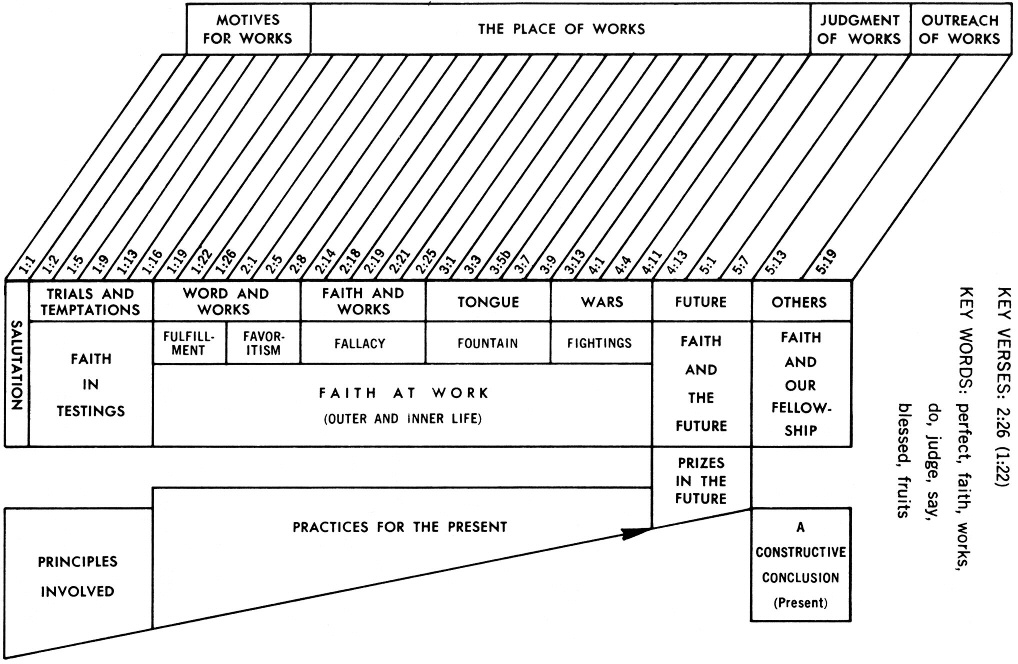
Click chart to enlarge
Chart from recommended resource Jensen's Survey of the NT - used by permission
See also Overview Chart by Charles Swindoll
|
JAMES |
|||||||
| Motives for Works |
The Place of Works: Outward Demonstration of Inner Faith |
Outreach of Works |
|||||
| Jas 1:1-18 | Jas 1:19-2:13 | Jas 2:14-25 | Jas 3:1-12 | Jas 3:13-4:12 | Jas 4:13-5:12 | Jas 5:13-19 | |
| Trials & Temptations |
Word & Works |
Faith & Works |
Tongue | Wars | Future | Others | |
|
Faith |
Fulfill |
Favor |
Fallacy |
Fountain |
Factions |
Faith |
Faith |
|
FAITH AT WORK |
|||||||
The Theme: The Testings of Personal Faith
The trials of the believer (James 1:2–12)
A. The proper attitude toward trials (James 1:2–4)
1. The attitude commanded (James 1:2)
2. The reason indicated (James 1:3)
3. The outcome to be realized (James 1:4)
B. The use of prayer amid trials (James 1:5–8)
1. The need for wisdom (James 1:5a)
2. The request for wisdom (James 1:5b)
3. The bestowal of wisdom (James 1:5c–8)
a. The divine response (James 1:5c)
b. The human obligation (James 1:6–8)
(1) The necessary attitude (James 1:6a)
(2) The rejected character (James 1:6b–8)
C. The correct attitude toward life by the tried (James 1:9–11)
1. The attitude of the lowly brother (James 1:9)
2. The attitude of the rich (James 1:10–11)
a. The reason for the attitude (James 1:10a)
b. The illustration from the flower (James 1:11a)
c. The application to the rich (James 1:11b)
D. The result of enduring trials (James 1:12)
1. The blessedness of endurance (v 12a)
2. The reward of endurance (James 1:12b)
The nature of human temptation (James 1:13–16)
A. The source of human temptation (James 1:13–14)
1. The repudiation of a divine source (James 1:13)
a. The rejection stated (James 1:13a)
b. The rejection vindicated (James 1:13b)
2. The reality of the human source (James 1:14)
B. The consequences of yielding to temptation (James 1:15)
C. The warning against being deceived (James 1:16)
The activity of God in human affairs (James 1:17–18)
A. The Giver of all good gifts (James 1:17)
B. The Author of the believer’s regeneration (James 1:18)
The Test Marks of a Living Faith
Faith tested by its response to the Word of God (James 1:19–27)
A. The reactions to the Word (James 1:19–20)
1. The knowledge possessed (James 1:19a)
2. The reaction demanded (James 1:19b)
3. The reason stated (James 1:20)
B. The reception of the Word (James 1:21)
1. The stripping off of sins (James 1:21a)
2. The appropriation of the Word (James 1:21b)
C. The obedience to the Word (James 1:22–27)
1. The demand for active obedience (James 1:22–25)
a. The statement of the requirement (James 1:22)
b. The illustration of the requirement (James 1:23–25)
(1) The negative portrayal (James 1:23–24)
(2) The positive portrayal (James 1:25)
2. The nature of acceptable obedience (James 1:26–27)
a. The futility of activity without inner control (James 1:26)
b. Acceptable service with inner control (James 1:27) (from Hiebert - James Commentary)
James 1:16 Do not be deceived, my beloved brethren. (NASB: Lockman)
Greek: Me planasthe, (2PPPM) adelphoi mou agapetoi.
BGT Μὴ πλανᾶσθε, ἀδελφοί μου ἀγαπητοί.
Amplified: Do not be misled, my beloved brethren. (Amplified Bible - Lockman)
KJV: Do not err, my beloved brethren.
NET Do not be led astray, my dear brothers and sisters.
CSB Don't be deceived, my dearly loved brothers.
ESV Do not be deceived, my beloved brothers.
NIV Don't be deceived, my dear brothers.
NLT: So don't be misled, my dear brothers and sisters. (NLT - Tyndale House)
Phillips: make no mistake about that, brothers of mine! (Phillips: Touchstone)
Wuest: Stop being deceived, my brethren, beloved ones.
Young's Literal: Be not led astray, my brethren beloved;
- Do not be deceived - Mt 22:29; Mk 12:24, 27; Gal 6:7; Col 2:4,8; 2Ti 2:18
- My beloved brethren - James 1:19; 2:5; Philippians 2:12; 4:1; Hebrews 13:1
- James 1 Resources - Multiple Sermons and Commentaries
- IN DEPTH DISCUSSION ON THE DECEITFULNESS OF SIN
Related Passages:
Deuteronomy 11:16+ "Beware (imperative; Lxx = present imperative), lest your hearts be deceived and you turn away and serve other gods and worship them.
1 Corinthians 6:9+ Or do you not know that the unrighteous shall not inherit the kingdom of God? Do not be deceived; neither fornicators, nor idolaters, nor adulterers, nor effeminate, nor homosexuals,
1 Corinthians 15:33+ Do not be deceived: "Bad company corrupts good morals."
Galatians 6:7+ Do not be deceived, God is not mocked; for whatever a man sows, this he will also reap.
Hebrews 3:13+ But encourage one another day after day, as long as it is still called “Today,” so that none of you will be hardened by the deceitfulness of sin. (SEE IN DEPTH DISCUSSION ON THE DECEITFULNESS OF SIN.)
DO NOT BE DECEIVED!
A REPEATED WARNING
A NEEDED WARNING!
James has just given a sobering warning that death from sin could be the result if one yields to temptation by lust. In light of the grave danger James introduces a life giving command but softens it with the affectionate phrase my beloved brethren which clearly indicates his sincere concern for their souls. James knows that what he is warning about is deadly serious and wants to be sure they are open to hear him.
Do not be deceived (planao) my beloved (agapeto) brethren (adelphos) - This is not a suggestion but a critical command in the present imperative with a negative. Either stop it or don't start it! Don't allow yourself to be led astray. Don't allow yourself to be caused to wander. Don't be misled. Stop being deceived thinking that God has caused your temptation (or your trials)! Keep in mind that the keeping of this command calls for supernatural enablement! See discussion of the Need for the Holy Spirit to obey NT commands)
At this point the command could perform two functions - It closes the warning section of Jas 1:13–15 (sin's deadly lifecycle) and opens the door to the reassurance of Jas 1:17–18 (God's unfailing goodness).
In the present context, it is interesting that this command has virtually a "dual" application, looking back to the immediate context of deception regarding the source and potential consequences of temptation. Or looking to the following verses where James explains what God offers in place of temptation. In contrast to the "gifts" temptation offers, God's gifts are good and perfect (lacking nothing).
D Edomond Hiebert interprets the warning against deception as follows "The warning may be connected with what immediately precedes (James 1:13-15) or with what follows (James 1:17-18). If the former, the warning is to not be deceived about the source and consequences of sin. If the latter, it is a call to beware of casting suspicion on God and His beneficent activities. The verse has a transitional function and, like a bridge, provides connections in both directions, but what has gone before seems primarily in view (ED: I AGREE). The same formula occurs elsewhere to establish the rejection of a false opinion, as in 1 Corinthians 6:9+; 1Co 15:33+, and Galatians 4:7+. "It introduces an appeal to Christian consciousness and experience to confirm the writer's statement."To harbor the false concept that God tempts people is to cast grave suspicion on His character. It is a grievous doctrinal error that must have dangerous consequences for daily conduct. (James)
C H Spurgeon - Do not err (be deceived) about anything; but, especially, do not err about this matter of temptation (ED: SO SPURGEON FAVORS IT POINTING TO THE PRECEDING DISCUSSION OF THE DECEPTIVE CYCLE OF SIN AS EMPHASIZED BY THE VERBS "drawn away" and "enticed"), where you may so easily make a blunder: “Do not err, my beloved brethren.”
Craig Blomberg sees this verse as pointing more to what follows - Here we have another hinge verse that could fit with the preceding section as a final warning.34 However, most commentators take it as the introduction to vv. 17–18. Vv. 16–18 are thus best seen as a further discussion of what does and does not come from God. If God does not send temptations, then the question naturally arises as to what he does give his people.35 (See James - Page 72)
All good from God, all evil from ourselves.
-- C H Spurgeon
🙏 THOUGHT - Stop letting the world, the flesh (the sinful desires of the flesh in light of James 1:14) and the devil try to "sell you" that they have something better than what God offers! And the only way to accomplish this is if "by the Spirit you are putting to death the deeds of the body." (Ro 8:13+) So may God grant that you (and I) are enabled to "walk (present imperative) by the Spirit, and you (I) will not carry out the desire of the flesh. (Gal 5:16+) See also the "Paradoxical Principle of 100% Dependent and 100% Responsible" (100/100)
John Trapp on do not be deceived - Wander not, as wandering stars, to whom is reserved the blackness of darkness for ever, Jude 1:13, by seeking to father your faults upon God, as Adam did, Genesis 3:12.
John MacArthur feels James is saying - Stop blaming other people, circumstances, or Satan for your temptations and sins, he is saying. Above all, do not blame God. Take full blame on yourselves, where it belongs. Realize that your enemy—your fallenness, your lusts, your weaknesses, your rationalizations, and your sins—are within and have to be dealt with from within. (See The MacArthur Commentary)
Matthew Henry - Man in this his degenerate state is of a straying nature, thence compared to a lost sheep; this must be sought and brought back, and guided in the right way, Ps 119:176. (See Spurgeon's Note) He is weak, and ready to be imposed upon by the wiles and subtleties of Satan, and of men lying in wait to seduce and mislead.
Michael Andrus - Anytime you see the phrase, “don’t be deceived, my dear brothers,” you can be certain that many Christians are deceived about the very issue being discussed. “Come to your senses, friends,” he cries. Far from being responsible for tempting you to take a lure with a hook in it, God is the source of every good and perfect gift. If we will just open our eyes we will see that if we reject the forbidden thing, God has substitutes that are just as attractive and delightful, and they won’t lead to destruction and death!
Albert Barnes on do not be deceived - This is said as if there were great danger of error in the point under consideration. The point on which he would guard them seems to have been in respect to the opinion that God was the author of sin, and that the evils in the world are to be traced to him. There was great danger that they would embrace that opinion, for experience has shown that it is a danger into which men are strongly prone to fall.
Adam Clarke writes that deceived is "erring - wandering from the right way in consequence of our ignorance, not knowing the right way; and, in consequence of our unbelief and obstinacy, not choosing to know it.
William MacDonald introduces this section with a the thought that "It is not unusual for people who fall into sin to blame God instead of themselves. They say, in effect, to their Creator, “Why have you made me this way?” But this is a form of self-deception. Only good gifts come from God. In fact, He is the source of every good and every perfect gift. (borrow Believer's Bible Commentary)
This command is "sandwiched" between two sections and can actually be read as going with one and/or the other. In the previous section (James 1:13-15+) James would be warning them not to keep being deceived about the source and consequences of sin. In the other direction (James 1:17-18+) the warning is for his readers to beware of ascribing to God any evil motives in His activities for He is the essence of goodness and all He does is good (see God's great attribute Goodness)
Bruce Barton - Not only does God not tempt us, he is also actively providing everything good that we find in life. We are not to attribute evil intent to God—God is the source of good gifts, especially the new birth (1:18). He is the author of salvation, not temptation. Paragraph 1:16-18 is the positive side of the picture painted in 1:13-15. (See James - Page 27)
John Phillips gives an interesting explanation in this context for James' command to not be deceived - Because the whole issue of sin is surrounded by deception, James concludes this statement regarding temptation thus: "Do not err, my beloved brethren" (1:16). We might wonder how James came to have such a thoroughgoing acquaintance with the dynamics of sin. He derived it from a study of his own heart. He was held in the bondage of unbelief, a particularly malevolent form of sin (Rev. 21:8) all through the years that he spent in the same home, synagogue, and workshop as Jesus. Throughout those years, he was held in error concerning the nature, person, personality, and ministry of the Lord. He was completely deceived. When the serpent is first introduced into the Bible story, the Holy Spirit gives us fair warning. "The serpent," He says, "was more subtle than any beast of the field..." (Gen. 3:1). The Hebrew word can be rendered "wise" or "crafty" (Job 5:12; 15:5). The serpent allowed itself to become the agent of fallen Lucifer, the most brilliant of all created intelligences. Lucifer was a high-ranking member of the order of the cherubim. However, his wisdom has turned into craftiness, subtlety, and guile. He has a thousand devices for making sin attractive to us and for deceiving us. We must be on our guard. (See Exploring the Epistle of James: An Expository Commentary - Page 46)
Steven Cole sees this command as related to the issue of trials that God allows in our life asking…
How do you avoid Satan’s deception and endure such a trial with God’s joy through your tears? James shows us: To avoid being deceived when you go through trials, affirm by faith God’s sovereign goodness. In Jas 1:12, James states,“Blessed is a man who perseveres under trial; for once he has been approved, he will receive the crown of life which the Lord has promised to those who love Him.”He goes on to show (Jas 1:13-15) that God does not tempt us with evil. When we sin, it comes from our own lusts. But now he shows that when we’re under trials, we’re susceptible to deception.
At such times, we must affirm by faith that God is good and only gives us good gifts (Jas 1:17). This is supremely illustrated in our salvation, which demonstrates His sovereign goodness (Jas 1:18). We are constantly tempted to reverse the truths that James sets forth in verses 13-18. Rather than blaming evil on ourselves, we’re tempted to blame it on God or on others: “I was just the victim!” Rather than attributing everything good in our lives to our loving heavenly Father, we’re prone to take the credit ourselves: “The reason I’m so blessed is because I’m such a good person.” James wants us to avoid these common pitfalls so that we will persevere under trials and receive the crown of life.
1. When you go through trials, you are especially vulnerable to deception (Jas 1:16). (ED: WHILE I AGREE, THE SAME APPLIES FOR WHEN WE EXPERIENCE TEMPTATION, SO IN PRACTICE BOTH TRIALS AND TEMPTATIONS ARE PRONE TO MAKE US WANDER IN OUR MIND AND BEGIN TO BLAME GOD! WE THINK "IF YOU ARE SOVEREIGN, YOU COULD HAVE KEPT THIS TRIAL OR TEMPTATION FROM COMING ON ME.")
James was not a cold-hearted theologian, dispensing a dose of doctrine and saying, “Call me if you’re not better in a week!” He addresses his readers as “beloved brethren.” James had a pastor’s heart for these believers who were going through terrible trials. As a pastor, he knew that sound doctrine about God and His salvation is the most compassionate way to help people who are struggling through trials. God’s truth gives us the rock we need to stand on in the flood.
“Do not be deceived” is literally, “Stop being deceived.” (ED: ALSO CAN MEAN "DO NOT BEGIN TO BE DECEIVED.") Apparently, some of James’ readers were already nibbling on Satan’s bait: “If your God is good and loving, why is He letting you suffer? If He is omnipotent, He could stop it.” James reminds them that God is both good and sovereign. He never sends anything evil into our lives. He only gives good gifts.
But, we need to define those “good gifts” from God’s eternal, all-wise perspective and plan, not from our own shortsighted, temporal point of view. God sends trials for His own sovereign, loving purposes. Amos (Amos 3:6b) the prophet, asks, “If a calamity occurs in a city has not the Lord done it?” Although it was Satan that directly attacked the godly Job, clearly he did it with God’s full permission. When Job’s wife told him to curse God and die, Job wisely answered (Job 2:10), “Shall we indeed accept good from God and not accept adversity?” The apostle Paul came to see that his thorn in the flesh was a cause for rejoicing, because it kept him in humble dependence on God (2Co 12:7, 8, 9, 10). So the “good gifts” that God sends may include extremely difficult trials.
Whenever the Bible says, “Do not be deceived,” we need to perk up and pay attention. This is an area where the enemy easily could fake you out. When we’ve traveled overseas, we’ve been warned about pickpockets, so we’re especially on guard. I never put my wallet or passport in a pocket where it could be easily stolen. Being alert is the key to not getting ripped off. So when you face a difficult trial, be alert! The enemy will try to deceive you. (James 1:16-18 Avoiding Deception in Trials)
Hiebert - My dear brothers is the first of three occurrences of this full address in James (James 1:19 ; James 2:5, cp James 1:1). The warning is prompted by his strong affectionate relationship to his readers. The verbal agapetoi, here rendered "dear," is more literally "beloved" and marks the close relationship between writer and readers. They are the recipients of his heartfelt love. As members of the family of God, they must not allow a false view of God to quench their filial relations to the Head of the Christian family. (James)
Bruce Barton - People will listen to hard things more readily when they are reminded that the one saying them is doing so out of genuine love. (See James - Page 27)
Deceived (4105)(planao from plane which describes "a wandering" and gives us our English word "planet") means literally made to wander and so to go (active sense) or be led (passive sense as of sheep in Mt 18:12, 13) astray. Literal wandering is described in Hebrews 11:38+. Spiritual wandering is described in (1Pe 2:25+) In spiritual terms, planao means to be made to err from the right way, the highway of truth and holiness. Straying in the spiritual sense occurs when one does not adhere to the truth (James 5:19+) and/or forsakes the right way (see 2 Pe 2:15+)
The present imperative with a negative signifies that the readers (plural) are to stop an action already progress (or don't let it begin). James is not suggesting but demanding that his readers must not succumb to the danger of being led astray!
Note that in this passage planao is in the passive voice which indicates an outside force or influence (e.g., in context presumably speaking to believers and so referring to the power of Sin [the Sin principle or propensity inherited from Adam] rendered ineffective [Ro 6:6+] but unfortunately still latent in believers - cf command in Ro 6:12-13+) is causing the deception that leads one down the wrong path regarding truth.
Planao - 39x in the NT - NAS renders planao as deceive(4), deceived(9), deceives(2), deceiving(2), go astray(1), gone astray(3), leads astray(2), led astray(1), misguided(1), mislead(4), misleads(2), misled(1), mistaken(3), straying(2), strays(1),wandering(1). Matt. 18:12f; 22:29; 24:4f, 11, 24; Mk. 12:24, 27; 13:5f; Lk. 21:8; Jn. 7:12, 47; 1 Co. 6:9; 15:33; Gal. 6:7; 2 Tim. 3:13; Tit. 3:3; Heb. 3:10; 5:2; 11:38; Jas. 1:16; 5:19; 1 Pet. 2:25; 2 Pet. 2:15; 1 Jn. 1:8; 2:26; 3:7; Rev. 2:20; 12:9; 13:14; 18:23; 19:20; 20:3, 8, 10
Beloved (27) (agapetos from agapao = love) means beloved, dear, very much loved. Agapetos is love called out of one’s heart by preciousness of the object loved. Agapetos is used only of Christians as united with God or with each other in love.
God the Father uses this same word describing Jesus the Son declaring that "This is My beloved Son, in whom I am well-pleased." (Mt 3:17+)
In fact the first 9 uses in the NT are of God the Father speaking of Christ, His beloved Son. This gives you some idea of the preciousness of the word "beloved"! This truth makes it even more incredible that Paul described the saints at Thessalonica (and by application all believers of all ages) as "brethren beloved (agapao) by God, His choice" (1 Th 1:4+).
Brethren (80) (adelphos from collative a = denoting unity + delphús = womb) is literally one born from same womb and thus a male having the same father and mother as reference person. Figuratively, adelphos as in this verse refers to a close associate of a group of persons having well-defined membership, specifically here referring to those who have been brought forth by the word of truth and are, as it were, God's first fruits.
Gene Getz - In what ways can a person—even a Christian—be deceived? A look at the scriptural context of each warning against deception helps us to answer this question rather specifically, beginning with James's statement itself.
"Don't Be Deceived" (James 1:16)
Know the Source of Evil Desire
James's main concern in the context of his warning against deception is that a Christian understand the source of sin—it originates deep within our own hearts. He warns against blaming God for our evil desires and, more so, our sinful actions. To misunderstand this reality will surely lead to self-deception and persistent rationalization. Furthermore, it will open the door to all kinds of departure from the will of God.
Genesis 3:5 DON'T BE DECEIVED
"ye shall be as God, knowing good and evil. - Genesis 3:5
One of Satan’s most effective tactics down through the ages has been deception. He is a master at making things appear what they are not. A mixture of truth and error seems to serve his purposes much better than total error.
Donald Grey Barnhouse illustrated this forcefully with the following story: “Duveen, the famous English art connoisseur, took his little daughter to the beach one day, but could not get her to go into the chilly water. After persuasion failed, he borrowed a teakettle, built a fire, and heated a little water until it steamed beautifully. With much flourish, he poured it into the ocean. Greatly impressed, his daughter went in without a murmur.” Barnhouse then made this application: Satan “dilutes an ocean of unbelief with a steaming teakettle of Christian ethics, and people go wading in, self-satisfied, but unaware that they are bathing in unbelief.”
The adversary is delighted when a person turns over a new leaf or engages in good works, just as long as he continues to reject the provision of God’s grace in salvation. Somehow the sinner completely ignores the fatal error or not trusting Christ because his life as been tempered with a teakettle of wholesome resolves.
Our Lord’s words are very clear: “...he that believeth not is condemned already, because he hath not believed in the name of the only begotten Son of God” (John 3:18). Don’t be deceived by Satan’s clever ploy. You cannot dilute an ocean of cold unbelief with a little warm water of religiosity or good human endeavor. P. R. Van Gorder. (Reprinted by permission from Our Daily Bread Ministries. Please do not repost the full devotional without their permission.)
The devil in his subtle way
Will chloroform your soul,
If you don’t quickly turn to Christ,
Whose blood can make you whole.
- Lyle
Satan will flood you with truth to float one lie.
Poisoned Well
One of the most beautiful concessions of love in all of literature is the one Ruth made to Naomi. In vowing to return to Israel with her, Ruth pledged, "Wherever you go, I will go; and wherever you lodge, I will lodge; your people shall be my people, and your God, my God. Where you die, I will die, and there will I be buried" (Ruth 1:16, 17-note). But suppose Naomi had said to herself, "Ruth's just a gold digger. What she really wants is to get into Israel to marry a wealthy Hebrew. I'm just her passport in."
If Naomi had doubted Ruth's good intentions, and rejected her kindness, she would have lost out on blessings she never could have imagined.
But that's exactly what we do when we fail to trust God's goodness. We stop believing He will do what is best for us. And as the saying goes, once the well is poisoned, all the water is contaminated.
James 1:16, 17 (notes ) states, "Do not be deceived .... Every perfect gift is from above, and comes down from the Father." Once we doubt God's goodness, some of His best gifts-- like trials that help us to mature-- will seem like bad ones.
Don't doubt God's goodness and poison the wellspring of blessing He has for you. - Haddon W. Robinson
Drink deep of God's goodness, His faithfulness too,
Leave no room for doubting and fear;
His Word is the Water of Life pure and true,
Refreshing and cooling and clear.
- Hess
We poison the well when we don't think well of God's goodness.
James Smith - ON BEING DECEIVED JAMES 1:16, 22, 26
Three times over in this chapter does James warn God’s people upon the possibility and danger of being deceived. Wise are we if we take heed to the warning.
I. About God (1:16). “Be not deceived” is the R.V. At first sight we are not sure whether this is a warning against (13) blaming God for our temptations to evil, or imagining changefulness in Him (17). On a second sight we decide that it has to do with verses 17 to 21.
1. GOD’S GIFTS ARE:
a. “Good.”
b. “Perfect.”
c. “From above” (17)
2. GOD HIMSELF.
a. Source of all Light—like the sun, the centre and chief of all the glories of the visible universe.
b. Free from variableness—is to be relied upon.
c. “Free from shadow cast by turning” (R.).
II. About Ourselves (1:22).
1. If only a hearer and not a doer of the Word, we shall deceive ourselves (1:22).
2. Such are like most of us who have a habit of looking into the mirror in an absent-minded sort of way (1:23, 24).
III. About Religion (1:26).
1. The religion that does not influence the tongue is not a true or vital one.
2. True vital godliness leads to, and includes:
а. Control of tongue.
b. Purity of life—“Unspotted from the world.”
c. Usefulness in life—“Visit the fatherless and widows.”
James 1:17 Every good thing given and every perfect gift is from above, coming down from the Father of lights, with whom there is no variation or shifting shadow. (NASB: Lockman)
Greek: pasa dosis agathe kai pan dorema teleion anothen estin, (3SPAI) katabainon (PAPNSN) apo tou patros ton photon, par' o ouk eni (3SPAI) parallage e tropes aposkiasma.
Amplified: Every good gift and every perfect (free, large, full) gift is from above; it comes down from the Father of all [that gives] light, in [the shining of] Whom there can be no variation [rising or setting] or shadow cast by His turning [as in an eclipse]. (Amplified Bible - Lockman)
R Kent Hughes - “Every good and perfect gift is from above [all good comes from above], coming down [in unending succession] from the Father of the heavenly lights [the good framer of the universe], who does not change like shifting shadows [his goodness stays at unchanging, eternal high noon].”
KJV: Every good gift and every perfect gift is from above, and cometh down from the Father of lights, with whom is no variableness, neither shadow of turning.
NET: All generous giving and every perfect gift is from above, coming down from the Father of lights, with whom there is no variation or the slightest hint of change.
NIV: Every good and perfect gift is from above, coming down from the Father of the heavenly lights, who does not change like shifting shadows.
NLT: Whatever is good and perfect comes to us from God above, who created all heaven's lights. Unlike them, he never changes or casts shifting shadows. (NLT - Tyndale House)
Phillips: But every good endowment that we possess and every complete gift that we have received must come from above, from the Father of all lights, with whom there is never the slightest variation or shadow of inconsistency. (Phillips: Touchstone)
Wuest: Every good gift and every perfect gift is from above, coming down from the Father of the lights, with whom there can be no variableness nor shadow which is cast by the motion of turning.
Young's Literal: every good giving, and every perfect gift is from above, coming down from the Father of the lights, with whom is no variation, or shadow of turning;
- Good - Jas 1:5; 3:15,17; Ge 41:16,38,39; Ex 4:11,12; 31:3-6; 36:1,2; Nu 11:17,25; 1Chr 22:12; 29:19; 2Chr 1:11,12; Pr 2:6; Is 28:26; Da 2:21,22,27-30; Mt 7:11; 11:25,26; 13:11,12; Lk 11:13; Jn 3:27; Acts 5:31; 11:18; Ro 6:23; 11:30; 12:6, 7, 8; 1Co 4:7; 12:4-12; Ep 2:3-4, 5,8; 4:8-11; Phil 1:29; Titus 3:3-5; 1Jn 4:10; 5:11-12
- Father - Ge 1:2-5,14,15; Dt 4:19; Ps 19:1-8; Ps 84:11; Is 45:7; 60:19; Jn 1:9; Jn 8:12; 2Co 4:6; Eph 1:18; 1Jn 1:5; Rev 21:23; 22:5
- James 1 Resources - Multiple Sermons and Commentaries
- See Attribute of God - Good
Related Passages:
Psalm 136:7 "To Him who made the great lights, for His lovingkindness is everlasting.
GOD THE PERFECT
GIVER
Every good (agathos) thing given (dosis) and every perfect (teleios) gift (dorema) is from above (anothen), coming down (katabaino) from the Father (pater) of lights (phos), with Whom there is no variation (parallage) or shifting (trope) shadow (aposkiasma) - Literally this reads "every gift good and every give perfect from above is continually coming down". Having declared what God is not. not the source of temptation, not the author of evil, not the initiator of our moral ruin, James now declares what God is, that He is the exclusive Source of every good thing in existence! In short all goodness comes from God! That's a radical truth! And in context having just warned against deception (believing was is false), here James presents the antidote to that deception by emphasizing a glorious truth about God's character. Spurgeon captures this contrast perfectly writing "Ascribe all evil to yourself, to the world, or to Satan; but ascribe all good unto God. “Every good gift and every perfect gift” — every grain of goodness, every trace of excellence that there is in the world, comes from him; but no evil ever comes from him."
Note the repetition of the word "every" (pas = all) for emphasis. What is that emphasis? It is simply the fact that there are no exceptions whatsoever. The universal quantifier every leaves no room for a good thing to exist outside God's giving. Note also 2 aspects of giving...
Given (δόσις - dosis) refers to the the act of giving; the process of bestowal (from didōmi). It emphasizes God's active, ongoing generosity. Good is agathos which describes intrinsic goodness; that which is good in its nature and character (as distinct from kalos, outward beauty or excellence). This is moral, essential goodness.
Gift (δώρημα - dōrēma) refers to the concrete gift itself, the object bestowed (a stronger, more emphatic word than dosis). Robertson notes this emphasizes the gift as a completed, tangible thing. This gift is perfect (τέλειον - teleion; lemma - teleios) which means perfect, complete, lacking nothing. Teleios is from telos which mean the end or the goal. This this gift is one that fully accomplishes its purpose, that which reaches its intended end or goal.
Lehman Strauss on given (dosis) and every perfect (teleios) gift (dorema) - There is an interesting thought in the use of the word "gift" in this verse. In the Greek these words are not the same. The first word for gift is "dosis" and is translated "act of giving." The second usage of the word is "dorema" and is translated as the noun "gift." The thought here is rich and beautiful. Both the act of giving and the gift are good. The act of giving would seem to include both the motive and the measure. When God gives, He has no ulterior motive such as giving to receive again. I am not too sure that the motive for our giving gifts at Christmas time is always good. How often have we scurried about at the last minute for a gift for someone only because we received an unexpected gift from that person! How many names have we added to our Christmas card mailing list of those persons who have sent us cards! When God gives, it is "liberally" (James 1:5), and that with no thought of receiving anything in return. He gave first out of love for man (John 3:16). His daily benefits, like food, clothing, shelter, strength of body, soundness of mind, and mercies too numerous to mention here come from His bountiful heart and hand.
Confidence in the goodness of God is one
of the believer’s greatest defenses against temptation.
WHY EMPHASIZE THE GOODNESS OF GOD IN THE CONTEXT OF TRIALS AND TEMPTATIONS? Because temptation often begins with a subtle assault on the character of God, the goodness of God. Satan understands that if he can cause us to doubt God’s goodness, wisdom, or love, our resistance to temptation is weakened. This was his strategy with Eve in Genesis 3. He enticed her to question God’s motives, saying, “God knows that in the day you eat from it your eyes will be opened, and you will be like God, knowing good and evil” (Ge 3:5+). In essence, Satan was suggesting that God was withholding something good from her, that God had a selfish even sinister agenda. Once Eve began to distrust the goodness of God, the temptation gained its power. The same battle continues in every trial and temptation. The enemy seeks to persuade us that God is not truly good, not fully trustworthy, or not acting for our best. James therefore emphasizes that “Every good thing given and every perfect gift is from above” (James 1:17), reminding believers that God is always good, always generous, and never the source of evil. Confidence in the goodness of God is one of the believer’s greatest defenses against temptation.
🙏 THOUGHT - Evil, sin, and death are not gifts from above. They are the fruit of human rebellion (Genesis 3), the work of the enemy (John 8:44), and the corruption of what was originally good. Evil has no independent existence but is a corruption of the good. A rotting tree is not a new substance but is the deterioration of what was once good. (What is the biblical solution to the problem of evil? | GotQuestions.org)
Scripture is unambiguous that there is no genuinely good thing that does not ultimately originate from God. Goodness is not something external to God that He possesses but is who He is. God does not have goodness; God is goodness. All creaturely goodness is derivative — a participation in and reflection of His being. This means anything truly good must flow from its Source.
Coming down (katabaino) is in the present tense, picturing God's good and perfect gifts continually coming down from Heaven, a veritable "unending succession of good gifts" (Hughes) I fear that too oftern my spiritual sight is so blurred that I fail to perceive what is clearly bounty from His goodness in my life.
R Kent Hughes writes that "God’s giving is intrinsically and comprehensively good—totally good! The logical, implied sense is that nothing evil can possibly come from above." (See James: Faith That Works - Page 54 - and read Hughes' intro to this chapter if it is available on the link. It is a "good" story about the goodness of God.)
In James 1:5 the author characterizes God as a giving God and here reiterates that attribute as he refutes the claim that God (a good gift giving God) could tempt men to sin. (James 1:13-15)
John MacArthur - James declares that God is not responsible for our temptations to sin because, as he has already made clear (v. 13), His own nature is incompatible with the nature of sin. Because God is wholly righteous and just, by definition He can have no part in sin, in any way or to any degree. What comes from God is not sin, but only every good thing given and every perfect gift. The perfect, flawless, holy goodness of God results in His doing and giving only what reflects His perfect holiness and truth. His works reflect His character. Negatively, James is saying that, from temptation to execution, God has absolutely no responsibility for sin. Positively, he is saying that God has complete responsibility for every good thing, and that every perfect gift that exists has come down from above. (See The MacArthur Commentary)
In the Sermon on the Mount Jesus alluded to good gifts - Or what man is there among you who, when his son asks for a loaf, will give him a stone? 10“Or if he asks for a fish, he will not give him a snake, will he? 11 “If you then, being evil, know how to give good gifts to your children, how much more will your Father Who is in heaven give what is good to those who ask Him! (Mt 7:9-11+)
As John Phillips says "God gives only good gifts. All that is good in our lives comes from God. God is good, and He alone is absolutely good. Far from being the source of temptation to do evil, God is the Source of all that is good." (See Exploring the Epistle of James: An Expository Commentary - Page 50)
Warren Wiersbe has a good word on the value of the goodness of God - The goodness of God is a great barrier against yielding to temptation. Since God is good, we do not need any other person (including Satan) to meet our needs. It is better to be hungry in the will of God than full outside the will of God. Once we start to doubt God’s goodness, we will be attracted to Satan’s offers; and the natural desires within will reach out for his bait. Moses warned Israel not to forget God’s goodness when they began to enjoy the blessings of the Promised Land (Deut. 6:10–15). We need this warning today. (Bible Exposition Commentary)
Marvin Vincent adds that James' declaration in this passage writing that "The statement that these gifts are from God is in pursuance of the idea that God does not tempt men to evil. The gifts of God are contrasted with the evil springing from man’s lust.
Every (3956) (pas) means all without exception. Every good thing from the all good God (see His attribute Good)
Good (agathos) gift - This identifies the giving as useful, profitable and beneficial in effect.
Marvin Vincent notes that James uses perfect to enlarge "upon good, bringing out more distinctly the moral quality of the gift."
William MacDonald applies every good gift... writing that God's "gifts are as perfect as Himself. Therefore it is unthinkable that He would ever entice man to sin. Temptation comes from man’s own evil nature. Let us test our faith on the subject of unholy temptations. Do we encourage evil thoughts to linger in our minds, or do we expel them quickly? When we sin, do we say that we couldn’t help it? Do we blame God when we are tempted to sin? (borrow Believer's Bible Commentary)
Every perfect gift - Perfect identifies the gift as lacking nothing for completeness and thus lacking nothing to meet the needs of the recipients.Hiebert explains that "Although all good gifts that men enjoy come from God, the context suggests that James is thinking specifically of His gifts "with special reference to their action on the soul of man; for he is exhibiting the truth which stands opposed to the error that God is the author of sin." (James -- D. Edmond Hiebert)
James Philip said that "The best defence against the temptation to stray from God is the possession by experience of His rich gifts that meet all desires.Is (estin) in the present tense emphasizes that it is continually from above which is reiterated by the use of "coming down" also in the present tense.
The present tense indicates that these good things are continually coming down. God is the ultimate Giver. We as saved sinners are the benefactors of amazing grace, for He gives and gives and gives, independent of any merit on our part. This is a humbling truth, that should generate within us a deep sense of gratitude as recipients who are not worthy of such good and perfect gifts. O, the deep, deep love of God! Let His unconditional, boundless love, motivate us as His children to quickly, willingly obey His Spirit's voice.
FATHER OF LIGHTS
Father (pater) of lights (phos) - Greek definite article is present so literally it reads "THE Father of lights." Father of lights was a distinctly Jewish way of referring to God as the Creator and Sustainer of all light. He is the Source of every form of illumination and blessing, the One Who created the sun, moon, and stars (Ge 1:14–18+), and also the One Who gives spiritual light and truth to the hearts of men (Ps 27:1; 1 Jn 1:5+). James uses this title to emphasize the absolute purity, goodness, and holiness of God. Temptations seek to draw us into moral and spiritual darkness, but such darkness stands in complete contrast to the very nature of God, for “God is Light, and in Him there is no darkness at all” (1 Jn 1:5+). The Father of lights never entices His children toward sin, evil, or deception. Instead, He continually gives what is good, pure, and life-giving. As His children, believers are called to walk in His light (cf Jn 8:12+) and reflect His character in a dark world (Eph 5:8,9+; Mt 5:14,15,16+, Php 2:14,15+).
D Edmond Hiebert - Lights in the original has the definite article, "the lights," and the primary reference is to the well-known celestial lights, the heavenly luminaries that are the sources of light for our earth. As "the Father" of these lights, God is their source of being, and they reflect the glory of their Creator (Ps 19:1; 136:7). As their Creator and Sustainer, He is not to be identified with them. These luminous celestial bodies must not be worshiped as God, but they testify to the Creator's luminous nature. Their glory and dignity declare the nature and essence of God, that "God is light" (1 John 1:5). He is also the Father of all our spiritual illumination (2Co 4:6). (James -- D. Edmond Hiebert) (Hiebert's Excellent Commentaries)
Marvin Vincent feels that lights in this phrase refers to "the heavenly bodies. Compare Ps. 135:7 (Sept.) and Jer 4:23 (Sept.). God is called “the Father of the lights,” as being their creator and maintainer. Compare Job 38:28 = "Has the rain a father? Or who has begotten the drops of dew?"; Ps. 8:3; Amos 5:8.
Alfred Edersheim in Sketches of Jewish Social Life in the Days of Christ noted the daily saying of the Jews regarding God's goodness and Father of lights - The following are the “benedictions” before the Shema, in their original form: I. “Blessed be Thou, O Lord, King of the world, Who formest the light and createst the darkness, Who makest peace and createst everything; Who in mercy, givest light to the earth and to those who dwell upon it, and in Thy goodness day by day and every day renewest the works of creation. Blessed be the Lord our God for the glory of His handiwork and for the light-giving lights which He has made for His praise, Selah! Blessed be the Lord our God, Who hath formed the lights.5
WITH WHOM THERE IS NO VARIATION OR SHIFTING SHADOW: par' o ouk eni (3SPAI) parallage e tropes aposkiasma:
- There is no variation - Nu 23:19; 1Sa 15:29; Ps 122:6; Is 46:10; Mal 3:6; Ro 11:29; Heb 1:11,12; 13:8
- James 1 Resources - Multiple Sermons and Commentaries
Related Passages:
Malachi 3:6 “For I, the LORD, do not change; therefore you, O sons of Jacob, are not consumed.
Hebrews 13:8 Jesus Christ is the same yesterday and today and forever.
Numbers 23:19 “God is not a man, that He should lie, Nor a son of man, that He should repent; Has He said, and will He not do it? Or has He spoken, and will He not make it good?
Psalm 74:16 Yours is the day, Yours also is the night; You have prepared the light and the sun.
Psalm 102:25-27 “Of old You founded the earth, And the heavens are the work of Your hands. 26 “Even they will perish, but You endure; And all of them will wear out like a garment; Like clothing You will change them and they will be changed. 27 “But You are the same, And Your years will not come to an end.
1 Timothy 6:16 who alone possesses immortality and dwells in unapproachable light, whom no man has seen or can see. To Him be honor and eternal dominion! Amen.
THE IMMUTABLE
GOD
With Whom there is no variation (parallage) or shifting (trope) shadow (aposkiasma) - Wuest = there can be no variableness nor shadow which is cast by the motion of turning. No (ou) indicates absolute negation! He changeth not. He is the unchanging One (Mal 3:6, Heb 13:8). In a world that is spiritually speaking "upside down" and morally "topsy turvy" it is good to have a God Who is neither, instead being the epitome of immutability, an immutability which is in fact infinite. Glory!
God's generosity is not seasonal, moody, or subject to change. Unlike the heavenly bodies He created (which cast shifting shadows as they move), God Himself never shifts. The sun has its spots, the moon wanes, the stars fall, but God, the Father of lights, knows no eclipse, no waning, no setting.
D Edmond Hiebert ties no variation (parallage) or shifting (trope) shadow (aposkiasma) with the previous section of James writing that "There is never any dimming of the light of God's holiness that would make it possible for Him to become the tempter of men. (James)
Lord Sabaoth, His Name,
From age to age the same
John MacArthur - From man’s perspective, the celestial bodies have different phases of movement and rotation, change from day to night, and vary in intensity and shadow. But God does not follow that pattern—He is changeless (cf. Mal 3:6; 1Jn 1:5). (See MacArthur Study Bible - Page 1896)
In his commentary MacArthur adds "The implication of this passage is this: When we, as God’s children, are so abundantly and continually showered with the most gracious, valuable, and satisfying blessings our heavenly Father can bestow, why should anything evil have the slightest attraction to us?" (See The MacArthur Commentary)
The good news today and for all eternity is this:
God is infinitely good.
-- R Kent Hughes
R Kent Hughes on no variation (parallage) or shifting (trope) shadow (aposkiasma) - We earthlings, with our feet planted here on earth, are subjected to constantly changing light. The sun rises, and our shadows fall long to the west; it stands high at noon, brightening all; and as it sets, our shadows are to the east, until they fade to nothingness. Day and night light perpetually changes. The moon waxes full and wanes to a crescent. Light is reflected and refracted differently moment by moment. But it is not so with the goodness of God. God “does not change like shifting shadows!” God’s goodness is always at high noon. (See James: Faith That Works - Page 54)
C H Spurgeon - There is variableness and there is the shadow of turning in the sun, but in that greater Father of lights there is neither parallax nor tropic; he is evermore the same, and we may go to him with unwavering confidence because he is the same. Oh! what a blessing to such changing creatures as we are to have an unchanging God! “Of his own will.” If you want to know the power of God’s will, it never goes towards evil.
David Guzik - Among modern theologians, there are some that are taken with something called process theology, which says that God is “maturing” and “growing” and “in process” Himself. Yet the Bible says that there is no variation or shadow of turning with God.
Bob Utley - These terms reflect the waxing and waning of the heavenly bodies of light or even the movement of constellations who the ancients thought affected their lives. God is not like them. He is unchanging (cf. Ps. 102:27; Mal. 3:6) , as is His Christ, (cf. Heb. 1:11-12; 13:8). This is not meant to imply that He is rigid or unsympathetic to human need (i.e., Exod. 32:12,14; Ps. 106:44-45; Jer. 18:6-10), but that His nature, His character of love and compassion towards humankind does not change. Believers can depend on His promises because His character is unchanging, immutable.
Thomas Manton - This is an astronomical term, taken from the heavenly bodies, which have many revolutions. The heavenly lights have their vicissitudes, eclipses, and decreases; but our sun always shines with the same brightness and glory. Like shifting shadows. The allusion continues. Stars, according to their different light and position, have various shadowings. The nearer the sun is to us, the less shadow it casts; the farther off, the greater the shadow. So we know the sun’s movements by its different shadows. But with the Father of spiritual lights there is no shadow of turning; that is, he does not change but always remains the same. This is a sun that does not set or rise and cannot be overcast or eclipsed. (A Practical Exposition of James - James 1:16, James 1:17; James 1:18)
There is nothing to be found in God but what is pure and excellent. There is no darkness, no shadow of turning. He is the Father of lights and the knowledge of this should make us at once grateful for every blessing, patient under every trial, and ashamed of every complaint.
Jon Courson is very practical - Not only is God good in the gifts He gives, but in who He is. In Him there is no variableness or shadow of turning. That is, He’s not moody. He doesn’t have bad days. He’s not generous with me one day, but grouchy the next—as I can so often be. We’re variable. We go up and down. God doesn’t. He can be nothing but good. He doesn’t react to me according to how I’m doing with Him. He is faithful when I am faithless (2Timothy 2:13). He is good when I am grumpy. He doesn’t change. He’s locked into His nature. That’s why I love the Lord so much. He’s solid as a Rock. And I can just enjoy Him without worrying about Him being ticked with me or tired of me. He gives nothing but good gifts, for He is a good God. (See Jon Courson's Application Commentary: Volume 3 - Page 1518).
Simon Kistemaker on no variation (parallage) or shifting (trope) shadow (aposkiasma) - As the earth, sun, moon, and stars move in their ordained courses, we observe the interplay of light and darkness, day and night, the longest and the shortest day of the year, the waning and the waxing of the moon, eclipses, and the movement of the planets. Nature is subject to variation and change. Not so with God! (New Testament Commentary Exposition of the Epistle of James and the Epistles of John)
Marvin Vincent on no variation (parallage) or shifting (trope) shadow (aposkiasma) - This is popularly understood to mean that there is in God not the faintest hint or shade of change, like the phrase, a shadow of suspicion. But the Greek has no such idiom, and that is not James’ meaning. Rev., rightly, renders, shadow tact is cast by turning; referring still to the heavenly orbs, which cast shadows in their revolution, as when the moon turns her dark side to us, or the sun is eclipsed by the body of the moon.
Gene Getz - Why does James turn his attention to God's gifts after warning Christians to guard against being deceived and led astray? First, he wanted us to know that God can give only gifts that are "good" and "perfect." Because of who He is He cannot be associated with anything that is evil and imperfect. But unfortunately, we can take what is "good" and "perfect" and use it in evil and imperfect ways. But when we do, that does not rob God's gifts of their goodness. Let me illustrate. What would we do without a knife at home? It's very useful. But if misused it can become deadly. If, for instance, rather than using it to peel potatoes, it is used to take the life of an innocent child, it becomes an evil weapon. In a case like this, of course, we would not arrest the maker of the knife or imprison the knife itself, but we would punish the user of the knife who used it in an evil, sinful way. Thus any of God's good gifts may prove to be evil when we handle those gifts in inappropriate ways.
Good (18) (agathos) means intrinsically good, inherently good in quality but with the idea of good which is also profitable, useful, benefiting others, benevolent (marked by or disposed to doing good). Good and doing good is the idea. Agathos describes that which is beneficial in addition to being good. Agathos is that which is good in its character, beneficial in its effects and/or useful in its action. Agathos is used in the New Testament primarily of spiritual and moral excellence. Paul uses agathos to describe the gospel as the “glad tidings of good things” (Ro 10:15+). The writer of Hebrews uses it in the same way, of “the good things to come” of which “Christ appeared as a high priest” (He 9:11+) and of which the law was “only a shadow” (He 10:1+). The precise meaning of agathos can be difficult to appreciate and distinguish from kalos (2570) an adjective that is also translated good. An attempt is made in the following discussion to bring out the difference, but in some verses where both are used, this distinction can be difficult to appreciate.
Given (1394) (dosis from didomi = to give) is a word which means giving and stresses the act of giving, either a human or a divine gift. Dosis is very common in financial transactions. Dosis adds the suffix of action to the verb root, means the act of giving, while dorema adds the suffix -ma, denoting the result of giving and hence the thing given or the gift itself.
Here is the only other NT uses of dosis - "And you yourselves also know, Philippians, that at the first preaching of the gospel, after I departed from Macedonia, no church shared with me in the matter of giving and receiving but you alone (see note Philippians 4:15). There are four uses of dosis in the LXX - Ge 47:22; Pr 21:14; 25:14
Perfect (5046) (teleios from telos = an end, a purpose, an aim, a goal) means complete, mature, fully developed, full grown, brought to its end, finished, wanting nothing necessary to completeness, in good working order. Teleios signifies consummate soundness, and includes the idea of being whole. Teleios has at least three shades of meaning: (1) Teleios speaks of totality, as opposed to partial or limited and when used of things means in full measure, undivided, complete or entire (as in Ro 12:2+ referring to "the will of God" which is "good and acceptable and perfect"). (2) Teleios also speaks of that which is fully development as opposed to that which is immature. (3) Teleios can refer to that which is in a state of full preparation or readiness.
Teleios - 19x in the NT - Matt. 5:48; 19:21; Rom. 12:2; 1 Co. 2:6; 13:10; 14:20; Eph. 4:13; Phil. 3:15; Col. 1:28; 4:12; Heb. 5:14; 9:11; Jas. 1:4, 17, 25; 3:2; 1 Jn. 4:18. The NAS renders teleios as complete(2), mature(4), more perfect(1), perfect(12).
Gift (1434) (dorema from dorea = free gift with emphasis on gratuitous nature + -ma = the result of giving [dosis]) is the thing given or that which is granted. Dorema is used in only one other NT passage (Ro 5:16-+).
Vincent notes that "Dorema enlarges slightly upon the other word in emphasizing tile gift as free, large, full; an idea which is further developed in verse 18, of his own will.
Coming down (2597) (katabaino from katá = down + baíno = go) means to come or go down or to descend from a higher to a lower place. Katabaino describes God descending to afford aid to the oppressed in Acts "I have certainly seen the oppression of My people in Egypt, and have heard their groans, and I have come down to deliver them; come now, and I will send you to Egypt." (Acts 7:34 from Ex. 3:8)
Katabaino - 81x - brought down(1), came down(10), come down(16), comes down(4), coming(1), coming down(9),descend(3), descended(9), descending(5), descends(1), falling down(1), go down(4), go downstairs(1), going down(3), got out of(1), steps(1), steps down(1), went down(12). Matt. 3:16; 7:25, 27; 8:1; 11:23; 14:29; 17:9; 24:17; 27:40, 42; 28:2; Mk. 1:10; 3:22; 9:9; 13:15; 15:30, 32; Lk. 2:51; 3:22; 6:17; 8:23; 9:54; 10:15, 30f; 17:31; 18:14; 19:5f; 22:44; Jn. 1:32f, 51; 2:12; 3:13; 4:47, 49, 51; 5:7; 6:16, 33, 38, 41f, 50f, 58; Acts 7:15, 34; 8:15, 26, 38; 10:11, 20f; 11:5; 14:11, 25; 16:8; 18:22; 20:10; 23:10; 24:1, 22; 25:6f; Rom. 10:7; Eph. 4:9f; 1 Thess. 4:16; Jas. 1:17; Rev. 3:12; 10:1; 12:12; 13:13; 16:21; 18:1; 20:1, 9; 21:2, 10
From above (509) (anothen) means from a higher place or a from a source that is above.
Anothen - 13x - translated again(2), all over(1), beginning(1), from above(5), from the long time(1), top(2).- Matt. 27:51; Mk. 15:38; Lk. 1:3; Jn. 3:3, 7, 31; 19:11, 23; Acts 26:5; Gal. 4:9; Jas. 1:17; 3:15, 17.
Variation (3883)(parallage from para = beside, near + allasso = to change) (Only NT use) (English = “parallax,” the difference between the directions of a body as seen from two different points) refers to a transmission from one condition to another. Parallage denotes a change or variation from an established course or pattern.
Marvin Vincent writes that parallage "is not used, as some suppose, in a technical, astronomical sense, which James’ readers would not have understood, but in the simple sense of change in the degree or intensity of light, such as is manifested by the heavenly bodies."
William Barclay - What he is stressing is the unchangeableness of God. To do so he uses two astronomical terms. The word he uses for changeableness is parallage, and the word for the turn of the shadow is trope. Both these words have to do with the variation which the heavenly bodies show, the variation in the length of the day and of the night, the apparent variation in the course of the sun, the phases of waxing and waning, the different brilliance at different times of the stars and the planets. Variability is characteristic of all created things. God is the Creator of the lights of heaven--the sun, the moon, the stars. The Jewish morning prayer says, "Blessed be the Lord God who hath formed the lights." The lights change but He who created them never changes. (Daily Study Bible)
Shifting (5157) (trope from the verb trepo = to turn) (Only NT use) describes literally a turning as of the planets in their orbits, but here used figuratively to depict the immutability or unchangeableness of our God.
Shadow (644) (aposkiasma from apó = from + skiázo = to shade) (Only NT use) is a shadow that is cast. It is literally the shade cast by an object blocking rays of light from the sun or other source. Unlike the heavenly bodies, which undergo continual changes, variableness is absolutely not part of the character of God. TDNT feels that aposkiasma refers " to the darkness caused on earth by the movement of heavenly bodies."
🙏 THOUGHT - Is your personal world "shaky" or "shaking"? Then take a moment dearly beloved of the Almighty One and sing loud Hosannas (Save us now, We pray, -- Ps 118:25, Mt 21:9) to His Name, Who from age to age is the same…
OUR GOD, OUR HELP IN AGES PAST
by Isaac Watts
(Piano/choir version)
Our God, our help in ages past,
Our hope for years to come,
Our shelter from the stormy blast,
And our eternal home.Under the shadow of Thy throne
Thy saints have dwelt secure;
Sufficient is Thine arm alone,
And our defense is sure.Before the hills in order stood,
Or earth received her frame,
From everlasting Thou art God,
To endless years the same.Thy Word commands our flesh to dust,
“Return, ye sons of men:”
All nations rose from earth at first,
And turn to earth again.A thousand ages in Thy sight
Are like an evening gone;
Short as the watch that ends the night
Before the rising sun.The busy tribes of flesh and blood,
With all their lives and cares,
Are carried downwards by the flood,
And lost in following years.Time, like an ever rolling stream,
Bears all its sons away;
They fly, forgotten, as a dream
Dies at the opening day.Like flowery fields the nations stand
Pleased with the morning light;
The flowers beneath the mower’s hand
Lie withering ere ‘tis night.Our God, our help in ages past,
Our hope for years to come,
Be Thou our guard while troubles last,
And our eternal home.
1. God as Creator and Sovereign Over the Heavenly Luminaries
The Greek phrase Father of lights points to God as the Creator of the sun, moon, and stars (Gen 1:14–18). These lights, placed in the heavens to mark times and seasons, reflect His ordering of creation.
"Then God said, 'Let there be lights in the expanse of the heavens to separate the day from the night, and let them be for signs and for seasons and for days and years.'" (Genesis 1:14)
The word Father (patēr) here carries the sense of originator, source, sustainer — the One from whom the lights derive their existence and function. He does not merely observe the lights; He fathers them. Every photon of starlight traces its origin back to Him.
2. God as the Source of All Light — Physical, Moral, and Spiritual
The descriptor "of lights" can refer to the heavenly luminaries over which God presides as Creator, but more deeply it signifies God as the source of all illumination — spiritual light, truth, knowledge, wisdom, and life itself.
In the Bible, darkness often symbolically refers to evil, sin, and corruption (John 1:5; 1 Thessalonians 5:4). Therefore, light represents goodness, honesty, purity, wisdom, glory, and love — everything that God is. First Timothy 6:16 also says that God "dwells in unapproachable light." Revelation 22:5 promises that those who dwell with the Lord forever will not need other sources of light, because God Himself will be our light.
"God is Light, and in Him there is no darkness at all." (1 John 1:5)
"The LORD is my light and my salvation; whom shall I fear?" (Psalm 27:1)
"Your word is a lamp to my feet and a light to my path." (Psalm 119:105)
3. God's Immutability — The Great Contrast with His Creation
This is the primary theological point James makes with the title. The Greek portrays God not only as Creator but also as the unchanging source behind the celestial order. Unlike the shifting heavenly bodies, God is constant, unwavering, and faithful. The lights themselves are mutable, rising, setting, waxing, waning, while the Father remains unchanged.
While lights shift , morning shadows lengthen, stars move across the sky, God remains the same. Malachi echoes this truth: "For I the LORD do not change; therefore you, O children of Jacob, are not consumed" (Mal 3:6).
The two Greek words that follow drive this home for variation is a term from astronomy describing the apparent shift in position of a star when viewed from different angles (parallax). Unlike the celestial bodies that have apparent shifts or movements (parallax), God does not change position or character. Shadow of turning refers to the shadow cast when a heavenly body rotates or orbits, producing eclipses, phases, and solstices. God casts no such shadow. There is no "dark side" to God, no phase of diminishment, no eclipse of His goodness.
"Jesus Christ is the same yesterday and today and forever." (Hebrews 13:8)
4. God as the Father of Believers — "Children of Light"
God is not the only light, although He is obviously the dominant and unchanging light. But it was always God's desire to have a family, and His family has His nature. Thus, even humans who are believers are "lights."
Believers become "children of light" (Eph 5:8; 1 Thess 5:5) because the Father of the lights has begotten them by His word of truth (Jas 1:18). Salvation is not only forgiveness but new creation, those who belong to Christ reflect His light as heirs of the Father's kingdom (Col 1:12, 13, Php 2:14,15).
"For you are all sons of light and sons of day. We are not of night nor of darkness." (1 Thessalonians 5:5)
"giving thanks to the Father, who has qualified us to share in the inheritance of the saints in Light." (Colossians 1:12)
5. A Polemic Against Pagan Astral Religion
James was writing to Jewish Christians scattered throughout the Greco-Roman world, where sun, moon, and star worship was pervasive. The title "Father of lights" might also implicitly challenge pagan deities associated with celestial bodies that were perceived to have variable natures. Jcgm
In early Judaism, stars were often associated with angels (Job 38:7; Judg 5:20). The heavenly host served as both symbols of divine glory and as spiritual beings in God's court. The phrase "Father of the lights" resonates with this worldview, where God is both source of the cosmos and sovereign over the angelic host.
The pagan gods of the heavenly bodies were fickle, changeable, even malevolent. James declares: the true God made all those lights and He is nothing like them.
6. Eschatological Significance — He Will Outshine What He Made
The present heavens and their lights are passing away (Isa 34:4; Matt 24:29). Revelation describes a future where "the city has no need of sun or moon to shine on it, for the glory of God gives it light, and its lamp is the Lamb" (Rev 21:23). Thus, the Father of the lights will ultimately outshine the very lights He created. The title, then, is not merely historical (He made the lights) but eschatological. He transcends the lights He created, and in the end, He alone will illumine His people.
The sun has its spots, the moon wanes, the stars fall
but God, the Father of all lights, knows no eclipse, no waning, no setting.
Steven Cole feels that in this section James is still speaking in the context of trials and states that…
To avoid deception in trials, affirm God’s goodness (Jas 1:17). When Satan originally tempted and deceived Eve, he did it by getting her to doubt God’s goodness. He said (Ge 3:1), “Indeed, has God said, ‘You shall not eat from any tree of the garden’?” Of course, God had not said that, and Eve corrected Satan. But he persisted with his lie (Ge 3:4, 5), “You shall not die! For God knows that in the day you eat from it your eyes will be opened, and you will be like God, knowing good and evil.” The implication was, “God is holding back something good from you. Therefore, God Himself is not good.” She fell for this line of deception, and you know the terrible consequences.
So James affirms here (Jas 1:17), for people going through trials, “Every good thing given and every perfect gift is from above, coming down from the Father of lights, with whom there is no variation or shifting shadow.” James probably repeats himself as a matter of literary style, combining Hebrew parallelism with a Greek poetic form, the hexameter. There is no significant difference between the “good thing given” and the “perfect gift.” Perfect is one of James’ favorite words. It has the nuance of mature. He used it twice in Jas 1:4, “And let endurance have its perfect result, so that you may be perfect and complete, lacking in nothing.” So Jas 1:17 ties back to verses Jas 1:2, 3, 4, with the idea that trials are one of God’s perfect gifts, because when we persevere in them, He uses them to produce spiritual maturity in us.
James’ point is that these good and perfect gifts, along with all of the many good things that God gives us to enjoy—the taste of good food, the love of our families, the beauty of His creation, and every wonderful experience in life—all of these good things come to us from a God whose very nature is good. As the Psalmist proclaims (Ps. 119:67, 68), “Before I was afflicted I went astray, but now I keep Your word. You are good and do good; teach me Your statutes.”
James states that all of the good things we experience come “down from the Father of lights, with whom there is no variation or shifting shadow.” This is the only time that God is called, “the Father of lights.” It refers to the fact that He created light and the heavenly bodies that give off light. Light stands for that which is good, in contrast to Satan’s evil domain of darkness (Acts 26:18; Col. 1:12, 13).
“Father” points not only to God’s creative power, but also to His tender care for His creatures. When James says that with the Father of lights, “there is no variation or shifting shadow,” he is drawing a comparison with the sun. Like the sun, God does not vary in His essential nature, which is light. He always steadily is light. He is always good. But, on earth we do not always experience the steady light of the sun. It varies on cloudy days, at night, and with the changing seasons. James means that when we experience what seem to be cloudy days or dark nights or wintry seasons, do not make the mistake of thinking that God has changed in His essential goodness towards us. His nature and His purpose towards His children are steady and unchanging. Therefore, we can trust Him at all times and in every difficult circumstance.
This has two practical applications:
(Ed: See Summary Chart - The Attributes of God and Spurgeon on the Attributes of God)
(1) Understanding Gods attributes as revealed in His Word is essential for your spiritual well being.
You must know God, not as you may conceive Him to be or wish Him to be, but as He has revealed Himself in the Bible. I’ve heard professing Christians say, “My God is not a God of judgment; He’s a God of love.” That’s nice, but your God is not the God of the Bible! He is a figment of your own imagination! The God of the Bible is both a God of judgment and of love. Or, there are Christians who dodge a difficult chapter like Romans 9, where Paul says of God (Ro 9:18), “So then He has mercy on whom He desires, and He hardens whom He desires.” They don’t want to conceive of God as having the sovereign right to save whom He chooses and to harden others in their sin. But to dodge what the Bible says about God is to make God in your own image, which is idolatry.
Two things will help you understand God’s attributes. First, read the Bible over and over, asking as you read, “What does this teach me about You, God?” Second, read some good books on the attributes of God. J. I. Packer’s classic, Knowing God [IVP] is a good place to start. A. W. Pink’s The Attributes of God [Baker] is brief, but good. A. W. Tozer’s The Knowledge of the Holy [Harper & Row] is a bit mystical, but worth reading. Stephen Charnock’s The Existence and Attributes of God [Baker] is wordy, but a gold mine. He spends 146 pages on the goodness of God (2:209-355). Any good systematic theology (Charles Hodge, Louis Berkhof, Wayne Grudem, Robert Reymond, etc.) will have a section on God’s attributes. There are also some excellent easy-to-read books on various attributes of God, such as R. C. Sproul’s The Holiness of God [Tyndale], A. W. Pink’s The Sovereignty of God [Banner of Truth], or John MacArthur’s The Love of God [Word]. Understanding God’s attributes will give you a firm footing
when you encounter trials.
(2) Interpreting your circumstances in light of God's attributes is essential for your spiritual well being.
You must know God, but then when trials hit, you have to process what you know in light of your difficult situation. By faith, you have to rehearse for yourself what you know to be true, maybe a hundred times a day.
The psalms are full of this type of thing. The psalmist is in a huge crisis. He rehearses for himself what he knows about God’s character and His covenant promises. By the end of the psalm his circumstances haven’t changed, but his attitude and emotions have changed dramatically, because he has interpreted his circumstances in light of who God is. For example, in Psalms 42 and Ps 43, there is a refrain, where the psalmist talks to himself. Three times he asks (Ps 43:5; see also, Ps 42:5, 11), “Why are you in despair, O my soul? And why are you disturbed within me?” He answers himself (Ps 43:5), “Hope in God, for I shall again praise Him, the help of my countenance and my God.” When you’re in the emotional throes of a major trial, you have to do this by faith in God’s Word, not by your feelings. Your feelings will be all over the chart, but your faith must rest on the facts about God as declared in His Word of truth: He is good! (James 1:16-18 Avoiding Deception in Trials)
QUESTION - What does it mean that there is no shadow of turning with God (James 1:17)? GotQuestions.org
ANSWER - The Bible clearly expresses the immutability of God—His unchanging, consistent nature—in numerous passages. James communicates it like this: “Every good gift and every perfect gift is from above, and comes down from the Father of lights, with whom there is no variation or shadow of turning” (James 1:17, NKJV).
With unique expressions such as “Father of lights” and “no shadow of turning,” James focuses on God’s creative power over the heavens and the earth (see Genesis 1:14–18; Job 38:4–15, 19–21, 31–33; Psalm 136:4–9; Jeremiah 31:35). These phrases are astronomical references to the variations of light intensity and shadows cast by the sun, moon, planets, and stars. The celestial bodies constantly move, revolving in space, casting “shadows of turning” as the light they produce shifts, fluctuates, and is eclipsed.
Each day as the sun rises in the east, it casts long, westerly shadows. At the sun’s full midday peak, the shadows disappear and then begin to turn toward the east as the direction of light pivots. At night the shadows are deepest but still turning and shifting with the moon’s phases. The shadow of turning may also refer to the variations of light and shadow caused by the changing seasons, as the earth turns on its axis and the sun’s distance and direction alter.
The variable lights and shadows cast by the heavenly bodies
contrast sharply with God’s unaltering character.
The variable lights and shadows cast by the heavenly bodies contrast sharply with God’s unaltering character. We perceive the sun’s light in varying degrees, but the sun is always shining. The same principle is true of God. In a spiritual sense, “God is light” and “in him there is no darkness at all” (1 John 1:5). Because He is the Father of lights, there is no dimming, darkening, or shadow of turning with God. James asserts that God’s goodness is demonstrated by the fact that He does not change. God created the universe with its continually varying conditions, yet He remains eternally the same (Psalm 102:27; Hebrews 1:12; Malachi 3:6). The same can be said of Jesus Christ (Hebrews 13:8).
There is no shadow of turning with God’s character. His love and faithfulness are constant (Psalm 89:2; 136:1–26; 2 Timothy 2:13). He is forever perfect (Deuteronomy 32:4; Matthew 5:48; 2 Samuel 22:31; Job 37:16) and holy (Isaiah 6:1–5; 1 Samuel 2:2; Revelation 4:1–8). His love for His children never fails (Romans 8:38–39; Jeremiah 31:3; Hebrews 13:5; 1 John 4:8).
There is no shadow of turning with God’s purposes and promises. The author of Hebrews explains that God “bound himself with an oath, so that those who received the promise could be perfectly sure that he would never change his mind” (Hebrews 6:17, NLT). God does not lie or change His mind (Numbers 23:19; 1 Samuel 15:29). The proverb writer declares, “You can make many plans, but the Lord’s purpose will prevail” (Proverbs 19:21, NLT). The Lord always accomplishes His will and keeps His promises (Psalm 145:13).
There is no shadow of turning with God’s Word: “The grass withers and the flowers fade, but the word of our God stands forever” (Isaiah 40:8, NLT). His eternal Word “stands firm in the heavens” (Psalm 119:89). The Lord’s Word never returns “empty, but will accomplish what I desire and achieve the purpose for which I sent it” (Isaiah 55:10–11).
Because there is no shadow of turning with God, we can put our whole trust and faith in Him. He is a good Father whose plans, actions, and dealings in our lives are always morally consistent with His nature and His Word. James taught that tests and trials ultimately serve a good purpose in our lives (see James 1:2–18). Even Paul’s thorn in the flesh was a good gift from God (see 2 Corinthians 12:1–10). When difficulties and temptations arise, we must not let the shifting shadows obscure our confidence in the Father of lights.
QUESTION - What does it mean that God is the Father of lights (James 1:17)? GotQuestions.org
ANSWER - James 1:17 says, “Every good thing given and every perfect gift is from above, coming down from the Father of lights, with whom there is no variation or shifting shadow” (NASB). The exact meaning of the term Father of lights in this passage is not clear from the text. However, we can assume some things based on other passages where God is referred to as “light.” 1 John 1:5 says, “God is light; in him there is no darkness at all.”
In both passages, God’s essence and personality are equated with all that is “light.” In the Bible, darkness often symbolically refers to evil, sin, and corruption (e.g., John 1:5; 1 Thessalonians 5:4). Therefore, light represents goodness, honesty, purity, wisdom, glory, and love—everything that God is. 1 Timothy 6:16 also says that God “dwells in unapproachable light.” Revelation 22:5 promises that those who dwell with the Lord forever will not need other sources of light, because God Himself will be our light.
The term Father of lights could also contain a reference to the great lights of the heavens, such as the sun, moon, and stars. Some Bible versions, such as the NIV, have added the word heavenly as an adjective to lights, but this is not found in the original texts. The original manuscripts leave the word lights open to interpretation.
It would be reasonable to conclude that the title “Father of lights” in James 1:17 communicates the idea that God is the author of all that is not darkness. There is no sin or transgression in Him. Everything represented by light is exemplified by God. Integrity, loyalty, honor, glory, wisdom, the fruit of the Spirit (Galatians 5:22), compassion, and love are all qualities of God and examples of spiritual “light.” Physical lights, too, owe their existence to God: the starry heavens and the planetary kingdoms are all created by the Father of lights for His glory and purpose. As the Father of lights, God embodies all that is good and right. Just as God is love (1 John 4:16), so God is light (1 John 1:5). God does not merely possess love and light, as though they are qualities that can be taken away. God is love and light, which makes Him the Father and originator of all lesser lights.
John MacArthur - DEALING A DEATHBLOW TO SINFUL DESIRES
Do not be deceived, my beloved brethren.JAMES 1:16
At what point do you deal with sin? Not at the point of behavior—because then it’s too late—but at the point of desire. The person who is able to control his emotional responses is able to deal effectively with sin. When being bombarded by negative emotional responses, a person with a mind that is sanctified can deactivate desires before they are activated by the will. But once they capture the will, their birth is inevitable. You must deal with lustful emotions if you want to effectively deal with sin in your life. If you expose your emotions to the baited hook, you may find yourself getting hooked unless you take immediate action
Don't Blame God
Woodrow Kroll
"Therefore listen to me, you men of understanding: Far be it from God to do wickedness, and from the Almighty to commit iniquity."
Scripture: James 1:17 Job 34:10
A man was handing out business cards that read, "Federman and Coe, Merchants." When asked about his partner the man admitted there was no such person. "Then why do you have the name on your card?" someone wanted to know. "Well, you see," the man replied, "if something goes wrong I just blame it on Coe. That way I get out of trouble easily."
Three of Job’s friends were suggesting the same. As they saw it, God was responsible for all the evil that had befallen Job. Even though they suspected some hidden sin in Job’s life, his troubles still came down to a smear on God’s character. But Elihu, Job’s fourth friend, objected to such a charge. God does not commit wickedness, even if some might consider it justified. Admittedly, we have the benefit of seeing behind the scenes and knowing that it was Satan who committed these acts of iniquity. But Eliphaz, Bildad and Zophar could have realized the same if they had truly understood God’s nature.
Christians are good at blaming God when things go wrong. If a child dies, it’s God’s fault. If the house burns down, it’s God’s fault. Such accusations cannot be true. God permits bad things to happen, but He doesn’t cause them. Sometimes things happen because of our own carelessness or sinfulness. Other times they happen because of the forces of evil in the world. But God is not to blame. James says, "Every good gift and every perfect gift is from above, and comes down from the Father of lights, with whom there is no variation or shadow of turning" (James 1:17). We may not understand much about God, but there is one thing we can know for certain: There is no "dark side" to God.
Don’t blame the Lord for your troubles. They come as a result of sin in this world. Confess to God any anger or bitterness you might feel for what you’ve experienced in life. Then ask Jesus to heal your wounds and make you whole.
God permits, but He never commits.
TODAY IN THE WORD
Ecclesiastes 8:14-17
Every good and perfect gift is from above, coming down from the Father of the heavenly lights. - James 1:17
Sometimes, when two completely different sets of standards collide, the result can be very costly. That’s what happened last year when a NASA space probe to Mars was lost. The Lockheed Martin company and NASA’s Jet Propulsion Laboratory used different measurements. Lockheed did its calculations in pounds and feet, while the Laboratory used the metric system of kilograms and meters. The two standards were never coordinated on the project, and the $125 million spacecraft got too close to Mars and either broke apart or burned up.
That can also happen in the spiritual realm when we use our limited, human standards trying to figure out an infinite God and reduce Him to our terms. We’ll crash and burn on that project in a hurry, because God hasn’t chosen to share all of His ways with us.
Let’s trust Solomon’s wise counsel. He became concerned with life’s unfairness, observing that people did not always get what it seemed they deserved. So he had to understand what God did and why He did it.
Solomon stayed awake night and day to observe the world around him and to arrive at a satisfying answer to his questions. But he concluded that the more he tried to unravel God’s ways, the more impossible that became.
Therefore, Solomon turned to a familiar piece of advice: accept the good things God gives us and leave the unsolved mysteries to Him. Again, this is not passive fatalism, but an active decision to leave our questions with God and get on with the things He has given us to do.
Solomon was not saying that finding contentment in our work will solve all the riddles of life. In fact, it’s because life is often so hard to explain that we need to get past the futile exercise of trying to make sense out of everything.
We often hear people say that it’s OK to doubt, that God is big enough to handle our doubts, and so on.
TODAY IN THE WORD
Every good and perfect gift is from above, coming down from the Father of the heavenly lights. - James 1:17
D. L. Moody told how his mother shared the family's dinner with people in need even though the Moody family lived in desperate poverty. Moody's father had died, leaving his widow with nine children to raise. Despite this, no hungry person was turned away from the Moody farmhouse. ""Mother just sliced the bread a little thinner"" is the way Moody described mealtimes.
God faithfully provided for Betsey Moody and her children even when the bill collectors came to the front door. The Moody family is among generations of God's people who can testify that their heavenly Father has cared for them. These familiar verses are prefaced by Jesus' command not to worry about life's necessities--a wasted effort anyway, and especially foolish in light of God's promise.
But the larger context of Jesus' teaching is also important if we are to appreciate these promises fully. The first word of Mt 6:25, ""therefore,"" makes it obvious that Jesus linked these verses with what He had just taught.
Go back about six verses and you'll read more words that will probably sound familiar. Speaking of our attitude toward finances, Jesus taught us to use our money for spiritual gain rather than to fall in love with it and the things it can buy. He knew that our devotion to money would lead to becoming enslaved to it, just as our devotion to God leads us to serve Him as our Master.
That's the message the Lord was communicating. Mt 6:25-33 are evidence verifying that when we make God our master instead of our checkbook, He assumes responsibility for our daily needs. And since He is the God of all creation, nothing we really need escapes His notice. God is infinitely able, and faithful, to meet any need we could ever have.
So all of us have two choices. We can either try to do everything ourselves, spending our time amassing as much as we can and then trying to hold on to it. Or, we can abandon the chase for the gold and commit our lives to our faithful Lord, trusting Him for our needs.
Since we only have one life to invest, and eternity after that, it makes sense to invest in eternity.
TODAY ALONG THE WAY
Today's reading follows a pattern we have seen often this month. God shows Himself faithful to those who obey and serve Him.
Adrian Rogers - Alexander the Great, the conquering general, once gave a beautiful and priceless golden cup to a lowly servant. When the servant saw the gift, he said, "Oh, no, that's too much for me to receive." Alexander drew himself up and said, "It's not too much for me to give."
If I placed a special gift for Joyce on the table, and she didn't even bother to unwrap it—just left it sitting there—two things would happen. I would be really disappointed, and she would not have the joy of receiving what I had given her. You, too, have been given a gift from God. Are you going to unwrap it? Or not?
Jesus Never Changes
Abraham Lincoln once told of a farmer trying to teach his son how to plow a straight furrow. In the time-honored tradition, he told the boy to keep his eyes on some object at the other end of the field and plow straight for it. The boy started plowing and the farmer went about his chores. When he returned after several hours to check on the boy's progress, he was shocked to find instead of straight rows something that looked like a question mark. The boy had obeyed his father's instructions. He had fixed his eyes on something at the other side of the field—a cow. Unfortunately, the cow had moved!
Evidently, that father forgot to tell his son to look for a stable object, one that wouldn't shift or move around. That's one mistake we don't have to make. We can fix our eyes on Jesus who never changes.
God knows best - James Scudder
Every good gift and every perfect gift is from above, and cometh down from the Father of lights, with whom is no variableness, neither shadow of turning. James 1:17
Dr. W.A. Criswell, pastor of the First Baptist Church in Dallas, tells a story about a particular family in his church. He paid a visit to them during the beginning of the oil boom in Texas. The land that they currently owned was in a prime area for the oil industry. Engineers came through the area and ensured every household that they would soon be very wealthy. Soon crews came in and dug all around this family's property. It was only a matter of time, they assumed, before the crews would start on their property. But, to their disappointment, oil was never discovered on their land. As the months passed, they saw their friends and neighbors cash in on the oil and move to the big city. The prosperity that they had expected had left them all alone.
Years went by and Dr. Criswell visited this family again. But, he was surprised to find them happy and contented. He asked them why they were so joyful. The husband said, "We're so glad that God didn't put oil on our land. We have seen what the money and the prosperity did to the lives of our friends. It caused broken marriages, rebellious children, and a lack of interest in God. Very few of them even attend church anymore."
Sometimes God blesses us best when He doesn't give us what we want. Usually He is withholding it because it will be the very thing that will destroy our lives.
Everything is needful that He sends, nothing is needful that He withholds. John Newton
Happy Thanksgiving! - James Scudder
Every good gift and every perfect gift is from above, and cometh down from the Father of lights, with whom is no variableness, neither shadow of turning. James 1:17
Some of our kindergarteners told their teachers the best way to cook the Thanksgiving turkey. I think Martha Stewart better watch out-there are some rival cooks coming up in the ranks!
Andrew said, "You get a turkey because my dad is a hunter. You get all the skin off. You get a big pan and put it in with some oil. Then you put oyster stuffing on it. (I learned that part from my dad!)"
Jessica explained, "First, buy a big turkey at the store. Then you put it in the oven, make it really hot, like 12 degrees, and cook it for ten minutes."
Steven said, "Cook the turkey at medium for 30, 60, 40 minutes. Write a note on the bag to let people know it is your turkey. Take the turkey out of the oven and eat it with a little cranberry on it and the brown stuff you call caramel."
Jonathan gives us the recipe for a truly "cooked" turkey. "You go to the woods and catch a turkey. You bring it home and cook it in the oven for 2,000 hours at 2,000 degrees. Then, after it cools off, you eat it!
Jonathan, I think it would take awhile for that turkey to cool off! Thanksgiving is a precious time for family traditions and thankfulness toward God for his bounty of blessings. Take some time today to share with family and friends and especially with God how thankful you really are.
The worst moment for the atheist is when he is really thankful and has nobody to thank. -- Dante Gabriel Rossetti
"FROM ABOVE." - James Smith
MESSAGE OF SPIRE. When we approach an English town or village the most conspicuous object is the tower or spire of the church or minster, rising above other buildings, and casting its shadow over all. And each spire is preaching a sermon every second, pointing men upward, Heavenward, where they "might see gleaming on high diviner things." Thus every spire is a finger pointing upwards.
NEEDED TO-DAY. It is a message much needed to-day. There is a danger of us becoming so engrossed by the affairs of this life that we forget there is a Heaven, i.e., another life. Many, alas, are grovelling like worms in the dust, when they ought to be living in the Heavenly Place. Bunyan's word picture of the man with the muckrake is true of many to-day.
DULL. How dull and gloomy is that life lived without God. A picture without a sky is a dull, lifeless thing. It is the sky that glorifies. So with life. A life without a sky is dull, empty, flat, lifeless.
ENIGMA. Not only is life dull without a sky. It is a mystery, an unintelligible thing. Many things puzzle, and cannot be explained if you leave Heaven out. History is simply an enigma if you leave God out of your reckoning.
"FROM ABOVE." The two words grip one. It is the translation of the Greek Anothen. Let us trace them.
I. "Revelation from Above." The only satisfactory explanation of the depth, purity, wisdom, and existence of the Bible, and is given in Luke 1:3. "From the very first," or "From another."
ABOVE. The Greek word (Anothen) is rendered in other places "from above." Luke had derived much knowledge from eye-witnesses. And that knowledge had been confirmed by revelation. Yet Luke here claims a Heavenly origin for his Gospel. Luke's Gospel was not traditional, but by revelation as well as inspiration.
NOT UNREASONABLE.
1. This is not unreasonable.
2. Is it likely that God should take all the trouble He did put Himself about for man and leave him ignorant of His will?
ONLY EXPLANATION. This is the only explanation that satisfies us. Only explanation which satisfactorily explains the Bible. Though written by human hands, it was indited by the Holy Spirit.
II. A Saviour from Above. The only satisfactory explanation of the mystery of the person of Christ (John 3:31, 8:23).
THE BEAUTY OF CHRIST. We reach Advent season when we celebrate the birth of our Lord. All, even His enemies of the past days and of our own, admire His love, gentleness, etc.
THE MYSTERY OF THE LORD. But the Lord is a mystery. He Himself said He was. "No man knoweth the Son" (Matt. 11:27). John the Baptist's last testimony, and our Lord's own statement, is the only explanation of that mystery.
III. A Salvation from Above. The only satisfactory explanation of the ascent of many a lost soul (Psa. 18:16).
A picture of a drowning man is given us in this Psalm. Can that man save himself by clasping his own hand? No; salvation—
1. Is outside of a man.
2. Is from above.
Every one must be a Moses, for that name means "drawn out." Moses was called so because he was drawn out of a watery grave.
IV. A New Birth from Above. The only satisfactory explanation of the transformation and revolution to be observed in the lives of God's people (John 3:3, margin). "Born from above." What is it that marks out some from others? The infusion of a new life.
V. Gifts from Above. The only satisfactory explanation of the enriched lives of the Lord's people (James 1:17). His gifts are many, and can hardly be enumerated. But note five—
1. His Son.
2. Forgiveness.
3. Life.
4. Grace.
5. Glory.
The point is, only the best and perfect gifts come from above.
VI. Wisdom from Above. The only satisfactory explanation of the wisdom exhibited by God's people (James 3:15, 17).
LAWRENCE. The natives of India had a saying about Sir Henry Lawrence: "When Sir Henry looked up twice to Heaven and once down to earth, and then stroked his beard, he knew what to do." They acknowledged his wisdom was from above.
PURITY. See. James speaks of purity and other moral virtues as proceeding from this wisdom.
VII. Power from Above. The only satisfactory explanation of the sweet resignation of the Lord (John 19:11). This was our Lord's reply to Pilate's proud boast. Here you have one explanation of our Lord's serenity and sweet resignation. Pilate's power was by God's permission.
"Every joy or trial
Faileth from above;
Traced upon our dial
By the Sun of Love."
J R Miller - Every good and perfect gift is from above, coming down from the Father of the heavenly lights." James 1:17
There are many good things that come to us through our friends. The father toils and saves, and leaves an inheritance for his children. Many rich blessings come to us through human affections. Hands are ever being reached out to us, hands of love and kindliness, offering us good things. We owe far more than we ever can estimate, to those who love us. The kindly ministry of friends, brings countless benefits to our lives.
But everyone of these is a blessing sent to us from God. The human hands which bring them—are but the hands of messengers. This is only one of God's ways of sending his good things to us.
James tells us also, that all that God gives us is good, and that every blessing of his is perfect. Sometimes we think that what we receive from God, cannot be good. We think he must have changed toward us. It is a loss or a disappointment, and it seems unkind. But in whatever form it comes, there is a blessing—some good is wrapped up in everything God sends to any of his children.
Doubting God — by Haddon W. Robinson
Every good gift and every perfect gift is from above. —James 1:17
When Satan tempted Eve, he did so by enticing her to doubt God’s character. He told Eve, “God knows that in the day you eat of [the forbidden fruit] your eyes will be opened, and you will be like God, knowing good and evil” (Ge 3:5+).
Satan was implying, “God has a hidden agenda, and it is an evil one.” The devil knew that once Eve doubted the goodness of God, the temptation would work.
We may not think we doubt God. But when events happen in our lives that make us question Him, that’s exactly what we do. We seldom stop believing in Him, but we do stop believing in His goodness. And that is a faith-poisoning idea!
John Greenleaf Whittier knew that at the center of trust is a confidence in God’s goodness. He wrote:
I see the wrong that round me lies,
I feel the guilt within,
I hear, with groan and travail cries,
The world confess its sin.
Yet, in the maddening maze of things,
And tossed by storm and flood,
To one fixed trust my spirit clings:
I know that God is good!
Never doubt God’s goodness. Even when our trials seem beyond our understanding, we can trust God to give us perfect gifts (Jas. 1:17).
Don't put a question mark where God has put a period.
Henry Blackaby - Every Perfect Gift
Don’t be deceived, my dear brothers. Every good and perfect gift is from above, coming down from the Father of the heavenly lights, who does not change like shifting shadows. James 1:16–17
One of Satan’s tricks is to try to convince us that we don’t need God. That we can get along fine without him. That the good things in our life are the result of our own hard work or good luck. James warns us not to be deceived. We are in dangerous territory if we start to believe that we are responsible for what we have. God, who gave us life itself, is the one behind everything in our lives that is worthwhile.
Often, we neglect to notice gifts from God. For example, we are short of money; then, unexpectedly, we receive a check that exactly matches our need. We exclaim, “What luck! I can’t believe how fortunate I am to receive this money right when I needed it most!” Or perhaps we are feeling discouraged, when suddenly a friend happens by to encourage us. We say, “What a coincidence that my friend would come along at that very moment!” Too often we don’t make the connection between the good things that happen in our lives and God’s provision for us.
Take some time to consider all the good things that have crossed your life recently. Review some of the things you have asked God to provide for you, both material and spiritual. Then begin writing down your prayer requests so you can take notice when God answers them! Make the connection between the many blessings in your life and the one to whom you owe thanks.
NO VARIATION. - C H Spurgeon James 1:17
Would you know yourself from twenty years ago if you were to meet that person in the street? I don’t think you would, for you have undergone a marked change. Aches and pains of body have altered you. Your juvenile elasticity of spirit has vanished, and your outward appearance is the worst for wear.
You have changed, but your God has not. What a mercy, that, though eternal ages roll over His immutability, with Him “there is no variation or shadow of turning” (James 1:17). God stands firm like the great mountains, and we like clouds melt on the mountains’ peaks. We come and go; we are, and we are not. We are the mists of an hour, but He is the same.
There is no end to His years. This is our consolation as we sing with Moses, “LORD, You have been our dwelling place in all generations. Before the mountains were brought forth, or even You had formed the earth and the world, even from everlasting to everlasting, You are God” (Ps. 90:1–2).
A W Tozer - NO CHANGE POSSIBLE—OR NECESSARY
Every good gift and every perfect gift is from above, and cometh down from the Father of lights, with whom is no variableness, neither shadow of turning. —James 1:17
Now for God to alter or change at all, to be different from Himself, one of three things has to take place:
1) God must go from better to worse, or
2) He must go from worse to better, or
3) He must change from one kind of being to another.
Now that’s so plain that anybody can follow it; there’s nothing profound about that. (Occasionally somebody will say I preach over their head. All I can say is, they must have their head awfully low!) Isn’t it reasonable to assume that if anything changes it has to change from better to worse, from worse to better or from one kind of thing to another? …
Therefore, if God is to change, then God either has to get better or worse or different. But God can’t go from better to worse, because God is a holy God. Because God is eternal holiness, He can never be any less holy than He is now. And of course, He never can be any more holy than He is now, because He is perfect just as He is. There will never be a change in God—no change is necessary! AOGII092-093
A W Tozer - Every good gift and every perfect gift is from above, and cometh down from the Father of lights, with whom is no variableness, neither shadow of turning. —James 1:17
Why does God answer prayer? Let’s not imagine that it’s because somebody was good. We Protestants think we don’t believe in saints, but we do. We canonize them: we have Saint George Mueller, Saint C.H. Spurgeon, Saint D.L. Moody and Saint A.B. Simpson. We get the idea that God answered prayer for them because they were really good. They would deny that fervently if they were here.
Nobody ever got anything from God on the grounds that he deserved it. Having fallen, man deserves only punishment and death. So if God answers prayer it’s because God is good. From His goodness, His loving-kindness, His good-natured benevolence, God does it! That’s the source of everything.
C H Spurgeon - The Father of lights
“Every good gift and every perfect gift is from above, and cometh down from the Father of lights, with whom is no variableness, neither shadow of turning.” James 1:17
The apostle, having thus introduced the sun as a figure to represent the Father of lights, finding that it did not bear the full resemblance of the invisible God, seems constrained to amend it by a remark that, unlike the sun, our Father has no turning or variableness. The sun has its daily variation; it rises at a different time each day, and it sets at various hours in the course of the year. It moves into other parts of the heavens. It is clouded at times, and eclipsed at times. It also has tropic; or, turning. It turns its chariot to the South, until, at the solstice, God bids it reverse its rein, and then it visits us once more. But God is superior to all figures or emblems. He is immutable. The sun changes, mountains crumble, the ocean shall be dried up, the stars shall wither from the vault of night; but God, and God alone, remains ever the same. Were I to enter into a full discourse on the subject of immutability, my time, if multiplied by a high number, would fail me. But reminding you that there is no change in His power, justice, knowledge, oath, threatening, or decree, I will confine myself to the fact that His love to us knows no variation. How often it is called unchangeable, everlasting love! He loves me now as much as he did when first he inscribed my name in his eternal book of election. He has not repented of his choice. He has not blotted out one of his chosen; there are no erasures in that book; all whose names are written in it are safe for ever.
Daily Light on the Daily Path - “What do you want me to do for you?” He said, “Lord, let me recover my sight.”
Open my eyes, that I may behold wondrous things out of your law.
Then he opened their minds to understand the Scriptures.—“But the Helper, the Holy Spirit, whom the Father will send in my name, he will teach you all things.”—Every good gift and every perfect gift is from above, coming down from the Father of lights.
The God of our Lord Jesus Christ, the Father of glory, may give you the Spirit of wisdom and of revelation in the knowledge of him, having the eyes of your hearts enlightened, that you may know what is the hope to which he has called you, what are the riches of his glorious inheritance in the saints, and what is the immeasurable greatness of his power toward us who believe, according to the working of his great might.
Luke 18:41; Ps. 119:18; Luke 24:45; John 14:26; James 1:17; Eph. 1:17–19
There be many Christians most like unto young sailors who think the shore and the whole land doth move when the ship and they themselves are moved. Just so, not a few imagine that God moveth, and saileth, and changeth places because their giddy souls are under sail and subject to alteration, to ebbing and flowing. But the foundation of the Lord abideth sure. RUTHERFORD.
A W Tozer - JAMES 1:17
The word “immutable” is a negative of “mutable,” from the Latin word meaning subject to change. “Mutation” is a word we often use, meaning a change in a former nature or substance. Mutability, then, is subject to change; immutability means that it is not subject to change.
Many school children remember Percy Bysshe Shelley’s little poem that starts out with the cloud talking.
I am the daughter of Earth and Water,
And the nursling of the Sky;
I pass through the pores of the ocean and shores;
I change, but I cannot die.
It’s a cloud now, but the next day it may vaporize; and then the next day become a cloud again. It is constantly changing and passing through the pores of the ocean and shores, and it changes because it is mutable.
There is in God no mutation possible. James makes it very clear that there is no variableness when it comes to God. In the Old Testament, God says, “I am Jehovah, I change not.” He is the only One who can say that, in all of the universe. God never changes, and He never differs from Himself.
Great Father of glory, pure Father of light;
Thine angels adore Thee all veiling their sight.
All praise we would render, O help us to see
’Tis only the splendor of light hideth Thee. Amen.
WALTER CHALMERS SMITH (1824–1908)
A W Tozer - JAMES 1:17
The word “immutable” is a negative of “mutable,” from the Latin word meaning subject to change. “Mutation” is a word we often use, meaning a change in a former nature or substance. Mutability, then, is subject to change; immutability means that it is not subject to change.
Many school children remember Percy Bysshe Shelley’s little poem that starts out with the cloud talking.
I am the daughter of Earth and Water,
And the nursling of the Sky;
I pass through the pores of the ocean and shores;
I change, but I cannot die.
It’s a cloud now, but the next day it may vaporize; and then the next day become a cloud again. It is constantly changing and passing through the pores of the ocean and shores, and it changes because it is mutable.
There is in God no mutation possible. James makes it very clear that there is no variableness when it comes to God. In the Old Testament, God says, “I am Jehovah, I change not.” He is the only One who can say that, in all of the universe. God never changes, and He never differs from Himself.
Great Father of glory, pure Father of light;
Thine angels adore Thee all veiling their sight.
All praise we would render, O help us to see
’Tis only the splendor of light hideth Thee. Amen.
WALTER CHALMERS SMITH (1824–1908)
Billy Graham - TRIUMPH OUT OF TRAGEDY
Every good gift and every perfect gift is from above, and cometh down from the Father of lights, with whom is no variableness, neither shadow of turning. JAMES 1:17
The playwright William Shakespeare wrote numerous classics, some of which are called “tragedies.” Hamlet, Macbeth, King Lear, Julius Caesar, and Romeo and Juliet are only some of Shakespeare’s more classic tragedies.
Have you ever thought why these plays depict tragedy, indeed, why the stories are, themselves, tragic? It is because in each instance, the characters are victims of their own circumstances and are powerless to free themselves from them.
Not so for the Christian. We have the power to triumph over tragedy, even in situations which might seem hopeless and unredeemable in the world. The key to understanding tragedy is to understand its source.
Death and pain and tragedy came into the world because of sin. Many people blame God for tragedy, but James tells us that “every good and perfect gift comes down from the Father of lights.” Tragedy is a result of sin having entered the world.
But Christ has triumphed over tragedy, and He wants us to do the same because in such triumph God is glorified. Indeed, triumphing over tragedy is a form of witness for Christ. When something tragic happens to us—the loss of a loved one, the loss of a job—unbelievers watch us closely to see whether we react differently than they would. If there is no difference, if we despair as unbelievers might, how is God honored? How do we testify of Christ and His power?
Remember, “Now thanks be unto God, which always causeth us to triumph in Christ” (2 Corinthians 2:14).
Our Father and our God, thank You for bringing hope and forgiveness to dispel the sin in my life. Help me to triumph over the inevitable tragedies of life through trust and faith in You. Let my joy in the midst of despair honor and glorify You through Jesus. Amen.
H A Ironside - Every good gift and every perfect gift is from above, and comes down from the Father of lights, with whom there is no variation or shadow of turning.James 1:17
God is the source of all good. Every blessing we enjoy comes down from Him. He is the Father of lights, who is unchanging in His love and grace, and in whose dealings with us there is “no shadow cast by turning,” as the last part of this verse has been translated. His face is ever toward us. In all circumstances we may go to Him in perfect confidence, assured of a welcome and a sympathetic ear as we tell Him all that troubles and perplexes us. It is His joy to undertake for us. He delights to lavish His good and perfect gifts upon His obedient children. If He seems to withhold it is because He has something better for us, or because we need to judge something His holy eye has detected in our ways which makes it necessary to treat us with reserve. When all is right He gives without limit in answer to our prayer.
God answers prayer! the prayer of His dear children!
He’s sure to answer, if they keep His will.
He answers prayer! Yes—prayer concerning all things!
There’s nothing over-much for His great skill.
God answers prayer! Not always when we ask Him;
It may seem good to Him that we should wait.
How long? Ah well, ’tis only He that knoweth;
But sure, His answer will not be too late.
God answers prayer! Not always as we want Him;
He does not always answer prayer with “Yes;”
He sometimes answers “No!” because He loves us,
And sees the thing we ask could never bless.
And God would have us learn to sweetly trust Him—
To chiefly want His will—not our request;
To know whate’er may be His settled answer,
His will is highest, holiest, and best.
—J. Danson Smith
Charles Stanley - Greed
SCRIPTURE READING: Proverbs 11:24–26
KEY VERSE: James 1:17
Every good gift and every perfect gift is from above, and comes down from the Father of lights, with whom there is no variation or shadow of turning.
What drove the two biggest business deals of the late eighties—the $25 billion takeover fight for RJR Nabisco and the $14 billion merger of Time Inc. and Warner Communications? Was it the conviction that bigger is better? Was it the search for corporate “synergies”? On paper, maybe. But three telling new accounts make it clear that the real moving forces were raw ego, greed, and ambition.
Such is the way Time magazine described the driving force of greed in our culture.
From corporate takeovers to individual ambitions, greed is a prime motivation for millions. We want more than we have; we want it now.
Clearly the Christian must move countercurrent to the prevailing tide of greed when it comes to a generous spirit. Generosity does not flow from educational, governmental, or financial systems. The polluted power of sin within each of us prevents generosity from naturally coming forth from us.
Generosity is a godly quality because God is the Author of cheerful giving (2 Cor. 9:7). Do you feel stingy? Are you slow to help others? Only a deliberate step of submission to the Lord Jesus Christ with a humble request for a giving heart can begin the blessings of a generous spirit.
Dear heavenly Father, deliver me from greed. Make me a cheerful giver. Bless me with a generous spirit.
John MacArthur - GOD’S STABILITY
The Father of lights, with whom there is no variation or shadow of turning. JAMES 1:17
James called God “the Father of lights,” which was an ancient Jewish reference to God as the Creator. James chose that title because it fit his illustration of God.
The lights are the sun, moon, and stars—celestial bodies created by God. From our perspective, the sun, moon, and stars move, disappear, change in shape, or vary in intensity—their benefit to us comes and goes. But with God there is no variation or shifting. God doesn’t change from one condition to another or shift like shadows as the sun moves. His brilliant light of glory and gracious goodness does not fade. His grace never goes dark. First John 1:5 says, “God is light and in Him is no darkness at all.” Malachi 3:6 says, “I am the Lord, I do not change.”
God’s mercy never ceases. Nothing can eclipse His goodness or stop His benevolence. Knowing that, don’t take the devil’s bait and give birth to deadly sin. Rather, receive the good that God wants to give you.
Warren Wiersbe - Bright Forecast
Read James 1:12–18
Every good and perfect gift is from above, coming down from the Father of the heavenly lights, who does not change like shifting shadows. James 1:17
It is impossible for God to change. He cannot change for the worse because He is holy; He cannot change for the better because He is perfect. If shadows come between the Father and us, He did not cause them. We should never question His love or doubt His goodness when difficulties come or temptations appear.
The first barrier against temptation is a negative one: the judgment of God. The second barrier is positive: the goodness of God. A fear of God is a healthy attitude, but the love of God must balance it. We can obey Him because He may chasten us; or we can obey Him because He has already been so generous to us and because we love Him for it.
The next time you are tempted, meditate on the goodness of God in your life. If you think you need something, wait for the Lord to provide it. Never toy with the Devil’s bait. One reason God allows us to be tempted is to teach us patience. David was tempted twice to kill King Saul and hasten his own coronation (1 Sam. 24; 26), but he resisted the temptation and waited for God’s timing.
Something to Ponder -- What are some things that occasionally get between you and God and tend to form “shadows”?
David Jeremiah - A CHANGELESS GOD IN A SENSELESS WORLD
Every good gift and every perfect gift is from above, and comes down from the Father of lights, with whom there is no variation or shadow of turning. JAMES 1:17
No matter how dear your friends are, they can fail you. No matter how much money you have, you can go broke. No matter how diligently you exercise, you can get sick. Your most trusted walking stick can break. Your dearest dream can die. Life is as uncertain as the clouds that gather and scatter. It’s as fickle as the waves of the ocean.
How sad to be in a senseless world without a changeless God. We have a God with whom there is no variation nor shadow of turning. He doesn’t have shifting moods, bad days, “oops” moments, momentary breakdowns, or changes of heart. He’s as consistent as a plumb line, as steady as a rock, and as unchanging as eternity. He is as He has always been and will always be. Forever He is enthroned in the highest, and forever His Word is fixed in the heavens.
Our forefathers walked with God, and so can we. So can our children and grandchildren. He’s the same in every generation. His promises cannot fail, His presence cannot dim, His power cannot wane. We can trust Him completely.
John MacArthur - GOD’S GOODNESS
Every good gift and every perfect gift is from above. JAMES 1:17
Things that come from God are good and perfect. God could never produce evil because His nature is good. Rather, He produces unending good. Whereas we possess a nature that gives rise to sin, God does not.
Why would we try to satisfy ourselves with evil desires that result in death when God is pouring out everything we could ever want for our satisfaction? Only a fool would be lured away by such a trap when all the goodness of God is available by His grace. Likewise, our flesh can be compared to a well of stagnant water. It is ludicrous to believe we could be satisfied by drinking from it when we can come to the fountain of Living Water Himself who gives us every good and perfect gift.
David Jeremiah - CHANGE YOUR THINKING
Every good gift and every perfect gift is from above, and comes down from the Father of lights, with whom there is no variation or shadow of turning. JAMES 1:17
In contrast to the evil enticements that come from within us, every good gift comes from God, who is over us. The text literally says that such benefits come down to us in a steady stream from the Father of lights.
God’s nature is unchanging. He will forever be both good and trustworthy. Jesus (Matthew 6:30; 7:11) and Paul (Romans 13:14) shared the same perspective. James might add to Paul’s words that the believer should not only refrain from thinking about gratifying his desires but also avoid thinking about not gratifying his desires.
We are not to grit our teeth and make up our mind that we will not do a certain thing. The key to dealing with temptation is to fill our minds with other things. Since temptation begins with our thoughts, changing what we think about is the key to victory.
EVERY PERFECT GIFT. James 1:17 - C H Spurgeon
Take a great effort to know what God has promised and when He has promised it. Continually study God’s Word to see if the promises have your name written on them. Many times God has brought a promise to my heart with such freshness that I felt it was given only to me. This promise contained private marks that exactly matched the counterpart of my soul’s secrets. This proves that God meant me when He spoke.
When you pray, learn to take the promise and say, “My God, You have promised this blessing. You said that You will do it, and I know that you cannot lie! I am sure that You will give me this blessing because You are a God of truth. Your promises are a gracious bond. Your truthfulness cannot be questioned.”
“Every good gift and every perfect gift … comes down from the Father of lights, with whom there is no variation or shadow of turning” (James 1:17). When the Lord made His promises, He foresaw every possible contingency, and He made His promises with a determination to keep them. Time makes no difference. His promises are as fresh and unfading as when they first delighted His chosen.
Fall on your knees and pray, “Lord, this is Your promise. Be gracious and grant it. You do not change. Your Word is not withdrawn. You have never run from your Word, and You never will. Therefore fulfill it, because this gives me reason to hope.”
An unchanging God is the foundation of happiness for the believer.
Billy Graham - God’s Blessings
Every good gift and every perfect gift is from above. JAMES 1:17
In the midst of the Lord’s Prayer are these familiar words: “Give us this day our daily bread” (Matthew 6:11). They remind us that we are dependent on God for everything, and He is the giver of every blessing. “Every good gift and every perfect gift is from above, and comes down from the Father of lights” (James 1:17).
Some people say, “Why should I pray for my daily bread? I can take care of my own needs!” But listen: if it weren’t for God’s love and grace, you wouldn’t have anything. We need to pray this prayer every day, because we need to be reminded to trust God in everything.
This prayer reminds us also of Jesus’ words: “I am the bread of life. He who comes to Me shall never hunger” (John 6:35). Thank God for all His gifts—especially Christ, the greatest gift of all.
Imperfect Gifts
Every good gift and every perfect gift is from above, and comes down from the Father of lights. —James 1:17
Today's Scripture : James 1:2-18
When I was a child, I wondered why I had to thank God for food I didn’t want to eat. In my immature mind, gratitude was a response to receiving something I wanted—like a hamburger and French fries, not asparagus. So why did I have to be thankful for something I didn’t want?
In the human realm, my thinking was logical. Not everything people give us is for our good. And of course not everything we want is good.
But the situation with God is different. As Christ reminded us, loving parents do not give their children a stone rather than bread, a snake instead of a fish. And God is far more loving than our earthly parents (Matt. 7:9-11).
This doesn’t mean that God’s children can expect a pain-free, stress-free life. James tells us not only that every good gift comes from our heavenly Father (1:17), but also that we are to “count it all joy” when we “fall into various trials.” The testing of our “faith produces patience,” and the work of patience makes us “perfect and complete, lacking nothing” (vv.2-4).
Even when we receive something that doesn’t seem good, we can be grateful because we know there is more to it than we can see. What seems like an imperfect gift may be the means by which God perfects us. By: Julie Ackerman Link(Reprinted by permission from Our Daily Bread Ministries. Please do not repost the full devotional without their permission.)
Reflect & Pray
For Further Study
How can terrible things ever be good? Does our loving God "give" us pain? Read Why Would A Good God Allow Suffering? Finding goodness in trouble (or here)
A trial may be God's good gift in disguise.
The Sensuous Christian
Every good gift and every perfect gift is from above. —James 1:17
The gratification of our senses has gotten a bad reputation, perhaps because we live in a world obsessed with pleasure. But God approves of the proper experience of pleasure through our five senses.
First, God created our senses—sight, hearing, smell, taste, touch—and all that He created is good.
Second, God made sensuousness a part of worship. Consider God’s first formal worship setting: the tabernacle. It housed an ornate, gold-covered ark to hold the stone tablets God gave to Moses on Mt. Sinai. God approves of beauty. It had an altar of incense where priests burned a blend of fragrant spices made by a perfumer. God approves of pleasant aromas. It had an elaborate table with plates and pitchers. God approves of a tasteful dining experience. Around the tabernacle were curtains made from colorful yarn and finely twisted linen. God approves of beautiful colors and textures. Music was also a component of worship, as we learn from reading 2 Chronicles 29:28. God approves of pleasing sounds.
Yes, God values things that look, sound, smell, taste, and feel good. But He doesn’t want us to worship them; He wants our enjoyment and gratitude to prompt us to worship Him, the Creator and giver of all good things. Julie Ackerman Link (Reprinted by permission from Our Daily Bread Ministries. Please do not repost the full devotional without their permission.)
God gave us five senses
His world to enjoy;
But when we indulge them,
Their good we destroy.
—D. De Haan
It makes sense to use our senses to glorify God.
Consider The Source
Every good gift and every perfect gift is from above, and comes down from the Father of lights. —James 1:17
Today's Scripture : James 1:12-18
I love cinnamon. I love cinnamon rolls, cinnamon graham crackers, cinnamon candies, cinnamon toast, cinnamon apples, and cinnamon pretzels. Cinnamon is one of those spices that makes other things taste better. However, it never crossed my mind to think about where cinnamon comes from. Then, on a recent trip to Sri Lanka, I learned that 90 percent of all the cinnamon in the world comes from that island nation located in the Indian Ocean. For all of the cinnamon I’ve enjoyed over the years, I never stopped to consider its source.
Sadly, my walk with Christ is sometimes like that. God has blessed me with a wonderful wife, five children, and grandchildren who are more fun than a barrel of monkeys. In the midst of my enjoyment of them, however, I sometimes fail to consider the source of those blessings—what the hymnwriter called the “fount of every blessing.” James put it like this: “Every good gift and every perfect gift is from above, and comes down from the Father of lights, with whom there is no variation or shadow of turning” (1:17).
How ungrateful we would be to enjoy the rich blessings of life without thanking the Father who is the source of all of creation. By: Bill Crowder (Reprinted by permission from Our Daily Bread Ministries. Please do not repost the full devotional without their permission.)
Reflect & Pray
Dear Lord, from whom all blessings flow,
Most precious gifts dost Thou bestow;
So truly faithful may I be
As Thou art gracious unto me.
—Roworth
Gratitude is a God-honoring attitude.
James 1:18 In the exercise of His will He brought us forth by the word of truth, so that we would be a kind of first fruits among His creatures. (NASB: Lockman)
Greek: bouletheis (APPMSN) apekuesen (3SAAI) hemas logo aletheias, eis to einai (PAN) hemas aparchen tina ton autou ktismaton.
Amplified: And it was of His own [free] will that He gave us birth [as sons] by [His] Word of Truth, so that we should be a kind of firstfruits of His creatures [a sample of what He created to be consecrated to Himself]. (Amplified Bible - Lockman)
KJV: Of his own will begat he us with the word of truth, that we should be a kind of firstfruits of his creatures.
NET: By his sovereign plan he gave us birth through the message of truth, that we would be a kind of firstfruits of all he created.
NLT: In his goodness he chose to make us his own children by giving us his true word. And we, out of all creation, became his choice possession. (NLT - Tyndale House)
Phillips: By his own wish he made us his own sons through the Word of truth that we might be, so to speak, the first specimens of his new creation (Phillips: Touchstone)
Wuest: In accordance with His deliberate purpose He brought us into being by means of the word of truth, resulting in our being a kind of first fruits of His creatures.
Young's Literal: having counselled, He did beget us with a word of truth, for our being a certain first-fruit of His creatures.
- Excercise of His will - Jn 1:13; 3:3-5; Ro 4:17; 8:2-31; 9:15-18; Ep 2:4,5; Col 1:20,21; 2Th 2:13,14; 1Peter 1:3,23
- by the Word - 1Co 4:15 Eph 1:12 1Pe 1:23 1Jn 3:9
- See comments on the New Birth in John 3:3
- James 1 Resources - Multiple Sermons and Commentaries
Jas 1:21+ Therefore putting aside all filthiness and all that remains of wickedness, in humility receive the word implanted, which is able to save your souls.
BROUGHT FORTH BY
THE WORD OF TRUTH
James continues his discussion of the generous goodness of God as he now associates it with the best gift of all, the new birth or our regeneration by the Spirit. This gift indeed far "outshines" the lights of heaven he has just alluded to in verse 17.
In the exercise of His will (boulomai) He brought us forth by the word of truth, so that we would be a kind of first fruits among His creatures. - The verb boulomai is in the aorist tense (timeless but in context speaks of a completed action) and is a participle (a verbal adjective often ending in "-ing") so that it can be translated "having made His decision" which emphasizes that God acted freely, purposely and graciously. The fact that this verb is emphatically placed first in the Greek sentence makes His will the prominent operator and cause of our regeneration.
Robertson says boulomai indicates "God as Father acted deliberately of set purpose."
Jamieson writes that this speaks "Of his own good pleasure (which shows that it is God’s essential nature to do good, not evil), not induced by any external cause." James had just described God as the Father of lights and now proceeds to explain how God is the Father of believers.
Once again in this passage we see the vital importance of the Word of God, the Word of truth in bringing about the new birth. How God's people need to return to His Word of truth which saves us not just the first time (justification) but also saves us daily (sanctification as applied by the Holy Spirit).
Jamieson agrees that James links this verse with every good thing bestowed and every perfect gift noting that "The believer’s regeneration is the highest example of nothing but good proceeding from God."
In context, James explains what prompted a Holy God to save sinners who are unholy into saints who are holy! It was His choice (Related Ref: ekletos; Chosen in Christ). It was by His free will. It had nothing to do with our merit. He was not forced by anyone to save anyone. It is a reflection of His marvelous, magnanimous grace upon grace. Let us stop and offer up a sacrifice of praise (Heb 13:15+) for so great a salvation (Heb 2:3+).
Hiebert - Sin brought death (James 1:25+), but God resolutely willed not to let us perish in sin. His deliberate will to save us was not forced by any outside necessity. Having willed it, God acted freely to save us—a fact wholly inconsistent with the claim that God tempts an individual to sin. (James -- D. Edmond Hiebert)
As William MacDonald aptly explains "His love to us was unmerited, unbought and unsought. It was entirely voluntary on His part. This should cause us to worship! (borrow Believer's Bible Commentary)
Matthew Poole writes that exercise of His will means "out of his mere good pleasure, as the original cause, and not moved to it by any dignity or merit in us (Matthew Poole. Matthew Poole's Commentary on the New Testament)
We see similar description of God's exercise of His will in our salvation in Paul's letter to Timothy where he spoke of God "Who has saved us, and called us with a holy calling, not according to our works, but according to His own purpose and grace which was granted us in Christ Jesus from all eternity (before time began!) (2 Ti 1:9+)
Brought forth in the aorist tense in context speaks of a once for all action in the past, an accomplished act, a completed new birth (indicative mood = it was a real event) at the time of our conversion when spiritual new life became a historical reality. This truth is a direct assault on the aberrant teaching that one can lose their "new birth"! How could we be "unbegat" or "unbirthed"?
As Hiebert rightly states "In this epistle, James emphatically calls for Christian conduct as proof of the reality of our new birth, but he clearly insists that this new life must first be wrought in us by God." (James)
There is an striking contrast in the two births James describes in this section, the first beginning with lust and ending in death (Jas 1:14-15), and the second beginning with light (Father of lights) and ending in life!
The UBS Handbook notes that "The verb “to give birth” is normally used of a mother giving birth to a child. It is interesting to observe that here God takes on a feminine role by giving new birth to Christians (Ed: He is however not implying that God is feminine.). The verb here is the same as the one used in verse 15 and is meant to contrast with that use: there sin gives birth to death, and here God gives birth to spiritual life for Christians. (The United Bible Societies' New Testament Handbook Series)
In his Gospel, John teaches about the close association of light and life writing that…
In Him (Jesus) was life, and the life was the light of men. And the light shines in the darkness, and the darkness did not comprehend it… There was the true light which, coming into the world, enlightens every man… (Jesus declared) "I am the light of the world; he who follows Me shall not walk in the darkness, but shall have the light of life… While you have the light, believe in the light, in order that you may become sons of light… I have come as light into the world, that everyone who believes in Me may not remain in darkness. (John 1:4, 5, 9+; Jn 8:12, 12:36, 46)
THOUGHT - Dear reader, have you come to the Light of the World that you might experience the light of life?
Robertson comments that in context apekueo speaks of "Regeneration, not birth of all men, though God is the Father in the sense of creation of all men." (Acts 17:28, 29ff+.).
The 2 NT uses are both figurative, James 1:15 below personifying Sin as producing or bringing forth its vile offspring, death writing "Then when lust has conceived, it gives birth to sin; and when sin is accomplished, it brings forth death." (James 1:15+)
Apekueo in James 1:18 is in dramatic contrast to the only other NT use by James, for here we see God begets new life in sinners who are dead in their trespasses and sins.
John wrote that "as many as received Him (Jesus the Messiah), to them He gave the right to become children of God, even to those who believe in His name, who were born not of blood, nor of the will of the flesh, nor of the will of man, but of God. (John 1:12-13+)
Paul wrote to the Ephesian believers explaining that "In Him, you also, after listening to the message (rhema) of truth, the gospel of your salvation-- having also believed, you were sealed in Him with the Holy Spirit of promise. (Eph 1:13+)
Peter presents a similar begetting of believers initiated by the Word explaining to his readers that "Blessed be the God and Father of our Lord Jesus Christ, who according to His great mercy has caused us to be born again to a living hope through the resurrection of Jesus Christ from the dead (1Pe 1:3+)
Peter went on to explain later in this same chapter "you have been born again (anagennao) not of seed which is perishable but imperishable, that is, through the living and abiding word of God. (1Pe 1:23+)
John in a very important NT passage, also speaks of this new birth and it's radical effect on new creatures in Christ (2Cor 5:17) writing that…
No (ou = absolute negation) one who is born (gennao) of God practices (present tense = as their lifestyle; sure, believers still sin but if that is their lifestyle and there has never been any significant change after they said the "accepted Jesus" or "believed in Jesus", then one needs to be very concerned that this person is deceiving themselves as the rest of this verse amply explains! As an aside there are some in evangelical circles who have propounded the absurd teaching that one can express belief in Jesus and live the rest of their life just as they did before Jesus. This is a lie according to the apostle John, et al NT writers. Don't believe it no matter how many degrees those possess who spue out this deadly doctrine of demons) sin, because His seed abides (present tense = continually) in him; and he cannot (literally = "is not able" where not = ou signifying absolutely not and "able" also in the present tense, speaks of inherent ability - this born again one absolutely and continually has no inherent ability to commit sin as his or her way of life!) sin (present tense = habitually, as if nothing had changed in his heart. A new creature in Christ won't be perfect and may have seasons of sin but the indwelling Spirit is holy and He will cause one to tend toward holiness rather than toward unholiness. Do not be deceived!), because he is born of God. (1 John 3:9+' See also comments on the New Birth in John 3:3)
The phrase word of truth speaks of the gospel for as Paul taught this word has the intrinsic power to bring about a new birth. Thus Paul wrote…
I am not ashamed of the gospel (euaggelion), for it is the power (dunamis = speaks of inherent power of the Gospel message - this is good news dear believer - it is not how clever you present the message that gives it power - it has its own intrinsic power - so simply present it as the Spirit leads and provides wonderful opportunities to do so. And be blessed knowing that you have spoken forth the most hope filled words that person will ever hear. I pray that the seed you sow brings them forth as first fruit.) of God for salvation (soteria) to everyone who believes (pisteuo), to the Jew first and also to the Greek. (Ro 1:16+) (For more discussion of the encouraging truth regarding the inherent fruit bearing power of the Gospel word of truth - Col 1:5, 6 - see notes on Col 1:5; 6)
Word of truth (five times in NAS)
Ps 119:43+ And do not take the word of truth utterly out of my mouth, For I wait for Thine ordinances.
Spurgeon: The word of truth cannot be a joy to our mouths unless we have an experience of it in our lives, and it may be wise for us to be silent if We cannot support our testimonies by the verdict of our consciousness. This prayer may also refer to other modes by which we may be disabled from speaking in the name of the Lord: as, for instance, by our falling into open sin, by our becoming depressed and despairing, by our labouring under sickness or mental aberration, by our finding no door of utterance, or meeting with no willing audience. He who has once preached the gospel from his heart is filled with horror at the idea of being put out of the ministry; he will crave to be allowed a little share in the holy testimony, and will reckon his dumb Sabbaths to be days of banishment and punishment.
2Cor 6:7 in the word of truth, in the power of God; by the weapons of righteousness for the right hand and the left,
Col 1:5+ because of the hope laid up for you in heaven, of which you previously heard in the word of truth, the gospel,
2Ti 2:15+ Be diligent to present yourself approved to God as a workman who does not need to be ashamed, handling accurately the word of truth.
James 1:18 In the exercise of His will He brought us forth by the word of truth, so that we would be a kind of first fruits among His creatures.
The Word or the Message marked by or characterized by truth (genitive as appositional) or a message which proclaims truth (genitive as objective). This is the divine means used in our regeneration. The word of truth is a direct reference to the Gospel (cf Col 1:5+), a message that embodies the divine truth of God in the Person and work of Jesus Christ. As we proclaim the Gospel in the power of the Spirit, God's message effects regeneration in the hearts of those who hear and receive the truth. We see this pattern in the following cross references…
So faith comes from hearing, and hearing by the word of Christ. (see note Romans 10:17)
For if you were to have countless tutors in Christ, yet you would not have many fathers; for in Christ Jesus I became your father through the gospel. (1 Cor. 4:15)
And for this reason we also constantly thank God that when you received from us the word of God's message, you accepted it not as the word of men, but for what it really is, the word of God, which also performs its work in you who believe. (see note 1Thes 2:13)
for you have been born again not of seed which is perishable but imperishable, that is, through the living and abiding word of God. For, "ALL FLESH IS LIKE GRASS, AND ALL ITS GLORY LIKE THE FLOWER OF GRASS. THE GRASS WITHERS, AND THE FLOWER FALLS OFF, BUT THE WORD OF THE LORD ABIDES FOREVER." And this is the word which was preached to you. (see notes 1 Peter 1:23; 24; 25).
There is no substitute
for the proclamation of the Gospel.
Jamieson agrees that word of truth is a synonym for "the Gospel (which is) the objective means, as faith is the appropriating means of regeneration by the Holy Spirit, as the efficient Agent."
Matthew Poole writes that…The word of truth the gospel, so called, either: 1. By a usual Hebraism, from the true word; or: 2. By way of eminency, as containing the most excellent and necessary of all truths, the doctrine of righteousness and life by Jesus Christ; or: 3. With respect to the law and its shadows, the truth and substance of which is held forth in the gospel. (Matthew Poole. Matthew Poole's Commentary on the New Testament)
Paul uses the same phrase word of truth in his defense of his ministry so that it might not be discredited but that…in everything commending (the idea is Paul and his associates introduced themselves as in the description that follows - the connotation is with the objective of proving their authenticity) ourselves as servants of God, in much endurance, in afflictions, in hardships, in distresses… 7 in the word of truth (the Gospel), in the power of God; by the weapons of righteousness for the right hand and the left (2Cor 6:4,7)
Exercise of His will (1014) (boulomai) describes a settled desire emanating from one's reason not from one's emotion. This verb connotes more than just wanting a desire or wish to be fulfilled, and can include the idea of choosing one thing over another. Boulomai expresses also the inward predisposition and bent from which active volition proceeds and it is never used of evil people.
Boulomai - 37x in the NT - NAS renders boulomai as am unwilling*(1), desire(2), desired(1), desires(1), desiring(1), desirous(1), intend(1),intended(2), intending(2), like(1), want(7), wanted(2), wanting(2), will(1), willing(3), wills(3), wish(1), wished(1),wishes(1), wishing(3). Matt. 1:19; 11:27; Mk. 15:15; Lk. 10:22; 22:42; Jn. 18:39; Acts 5:28, 33; 12:4; 15:37; 17:20; 18:15, 27; 19:30; 22:30; 23:28; 25:20, 22; 27:43; 28:18; 1 Co. 12:11; 2 Co. 1:15, 17; Phil. 1:12; 1 Tim. 2:8; 5:14; 6:9; Tit. 3:8; Philemon 1:13; Heb. 6:17; Jas. 1:18; 3:4; 4:4; 2 Pet. 3:9; 2 Jn. 1:12; 3 Jn. 1:10; Jude 1:5
TDNT writes that boulomai means "To prefer,” suggesting volition, seems to be the original sense, then “to wish,” “to purpose,” or, more weakly, “to think.”…It can still denote the will of God, the Son, or the Spirit (seven times). Thus it expresses God’s eternal purpose in Heb 6:17 (note), his will to save in 2Pet 3:9 (note), his will to give new life in James 1:18, his sovereign counsel in Lk 22:42. Christ’s own will (in execution of God’s counsel) is the issue in Mt 11:27 (Lk. 10:22). The Spirit controls the distribution of gifts, according to 1Co 12:11. (borrow Kittel's Theological Dictionary of the New Testament : abridged in one volume)
Brought us forth (616) (apekueo from apo = from, used with the sense of "to cease from" + kuéo = swell, be pregnant) means to "cease from" pregnancy and thus literally describes the birthing process. To bring forth from the womb. To begat, to bear, to give birth (See New Birth). It is notable that apekueo is never used for creation, so that James is not explaining the creation of a living human race in general, but the re-creation (redemption) of a spiritually dead human race.
Friberg - literally, of motherhood give birth to, bear; figuratively in the NT; (1) of sin personified produce, cause to bring forth (Jas 1.15); (2) of God's spiritual fathering bring into being (spiritually), bring forth into new life (Jas 1.18)
Word (3056) (logos from lego = to speak with words; English = logic, logical) means something said and describes a communication whereby the mind finds expression in words. Although Lógos is most often translated word which Webster defines as "something that is said, a statement, an utterance", the Greek understanding of lógos is somewhat more complex. In Scripture Jesus is the Divine Logos (John 1:1). In this context James is referring to the living power of the living word (Heb 4:12+; 1Pe 1:23) of Scripture to bring forth spiritual life in one who is spiritually dead (Eph 2:1+).
Of truth (225) (aletheia from a = without + lêthô = that which is hidden or concealed, the combination meaning out in open) is the the unconcealed reality lying at the basis of and agreeing with an appearance; the manifested, the veritable essence of matter. It literally describes that which is contains nothing hidden. The basic understanding of aletheia is that it is the manifestation of a hidden reality. For example, when you are a witness in a trial, the attendant says "Raise your right hand. Do you swear that you will tell the truth and nothing but the truth so help you God?" And you say, "I do" and you sit down. The question is asking "Are you willing to come into this courtroom and manifest something that is hidden to us that only you know so that you will bear evidence to that?" And when you do speak the truth, you are manifesting a hidden reality.
Truth then is the correspondence between a reality and a declaration which professes to set it forth. To say it another way, words are true when they correspond with objective reality. Persons and things are true when they correspond with their profession. Hence a truth is a declaration which has corresponding reality, or a reality which is correctly set forth. Since God is Himself the great reality, that which correctly sets forth His nature is pre-eminently the Truth. Thus truth is the property of being in accord with fact or reality as defined by God. Whatever God says is true and therefore is worthy of one's trust.
TDNT explains the origin of this word this way…Etymologically aletheia means “nonconcealment.” It thus denotes what is seen, indicated, expressed, or disclosed, i.e., a thing as it really is, not as it is concealed or falsified. aletheia is “the real state of affairs,” e.g., the truth in law, or real events in history, or true being in philosophy… aletheia is “that which has certainty and force”… aletheia is “that on which one can rely”… aletheia is “the state of affairs as disclosed”… aletheia is “truth of statement” used with speaking (Lk. 4:25) or teaching (Mk. 12:14)… aletheia is “true teaching or faith” (2Co 13:8; 4:2; Gal. 5:7; 1Pe 1:22) (borrow Kittel's Theological Dictionary of the New Testament : abridged in one volume)
Aletheia - 109x in the NT - NAS renders aletheia as certainly(1), most certainly(1), rightly(1), truly(2), truth(104). Matt. 22:16; Mk. 5:33; 12:14, 32; Lk. 4:25; 20:21; 22:59; Jn. 1:14, 17; 3:21; 4:23f; 5:33; 8:32, 40, 44ff; 14:6, 17; 15:26; 16:7, 13; 17:17, 19; 18:37f; Acts 4:27; 10:34; 26:25; Rom. 1:18, 25; 2:2, 8, 20; 3:7; 9:1; 15:8; 1 Co. 5:8; 13:6; 2 Co. 4:2; 6:7; 7:14; 11:10; 12:6; 13:8; Gal. 2:5, 14; 5:7; Eph. 1:13; 4:21, 24f; 5:9; 6:14; Phil. 1:18; Col. 1:5f; 2Th 2:10, 12f; 1 Tim. 2:4, 7; 3:15; 4:3; 6:5; 2 Tim. 2:15, 18, 25; 3:7f; 4:4; Tit. 1:1, 14; Heb. 10:26; Jas. 1:18; 3:14; 5:19; 1 Pet. 1:22; 2 Pet. 1:12; 2:2; 1 Jn. 1:6, 8; 2:4, 21; 3:18f; 4:6; 5:6; 2 Jn. 1:1ff; 3 Jn. 1:1, 3f, 8, 12.
SO THAT WE WOULD BE A KIND OF FIRST FRUITS AMONG HIS CREATURES: eis to einai (PAN) hemas aparchen tina ton autou ktismaton:
- Lev 23:10 Jer 2:3 Am 6:1 Heb 12:23 Rev 14:4
- See comments on the New Birth in John 3:3
- James 1 Resources - Multiple Sermons and Commentaries
BELIEVERS ARE GOD'S
FIRST FRUITS
So that (1519)(eis) is a preposition that primarily conveys the idea of motion into something (most often translated "into" or "unto") but is used here to introduce the purpose of God's begetting us by His Word of truth.
THOUGHT - Always be alert for phrases such as "so that" (975 occurrences in NAS) and use these as opportunities for a divine encounter with your Teacher, the Spirit, as you ask questions like "what purpose?", "why?", etc, (5W/H questions) in effect carrying out a "miniMeditation" on the Scripture. (See terms of purpose or result)
Spurgeon - It is a very delightful idea that we are presented to God as “a kind of firstfruits of his creatures.” There is a whole harvest behind us, as Paul also reminds us in Romans 8:19-21 : “For the earnest expectation of the creature waiteth for the manifestation of the sons of God. For the creature was made subject to vanity, not willingly, but by reason of him who hath subjected the same in hope, because the creature itself also shall be delivered from the bondage of corruption into the glorious liberty of the children of God.”
We would be (einai) is the present tense of eimi (to be, to exist) speaks of their continual existence.
Kind (5100)(tis) generally is translated some one or a certain one.
Vincent writes that in the present context tis is translated kind and serves to indicate "the figurative nature of the term (first fruits). The figure is taken from the requirement of the Jewish law that the first-born of men and cattle, and the first growth of fruits and grain should be consecrated to the Lord. The point of the illustration is that Christians, like first-fruits, should be consecrated to God."
Hiebert - God's regenerating work in believers looked forward to a glorious goal: "that we might be a kind of first fruits of all he created." "That we might be" indicates purpose, but that does not imply that the purpose is as yet unrealized. The divine purpose that we should be His first fruits was fulfilled. The new birth that the readers, along with James, have experienced has given them the position and character as "first fruits." (James -- D. Edmond Hiebert) (Hiebert's Excellent Commentaries)
First fruits (536) (aparche from apó = away from + árchomai = to begin) (see also the discussion First Fruits, Christ - As OT Prophecy of His Resurrection) is first of all an OT technical term used to describe the first portion of a grain harvest or fruit harvest or the first portion of an animal offering, as from one's herd. The first fruits as will be discussed more below represented the first portion of an offering (grain or animal) or the firstborn male (Ex 13:12, 13, 14, 15, Nu 18:15, 16), all of which were to be set aside (considered holy) and considered as belonging specifically to the Lord. The first portion of the harvest was regarded both as a first installment and as a pledge of the final delivery of the whole and were offered to God in thanksgiving for His goodness in providing them.
In the present passage James uses aparche or first fruits much like Paul does in Ro 16:5 (note) to describe new converts, those who have been born again, regenerated by the Spirit, born from above by the Father of lights.
G M Burge explains that "The Greek term aparche had a wide currency stretching from the fifth century b.c. through the patristic period. It referred to the first produce or profits that might be given as a gift of thanksgiving. The recipient might be a person or, as in most cases, the Temple. Its use evolved so that any offering—even Temple taxes on the people—could be called aparche. (See Dictionary of Paul and his letters - Page lxiv or borrow Dictionary of Paul and his letters)
First fruits (see dictionary discussions) is related to the Jewish term that refers to that which is set apart to God before remainder could be used. Under the Mosaic Law Israel was to bring the first fruits of the grain to the LORD and in this act they were acknowledging that all produce was God's. The first fruits of a harvest of grain was an indication of a greater harvest to come.
FIRST-FRUITS IN THE OLD TESTAMENT
Below is a summarization of the OT teaching regarding first fruits…
The first-fruits of the ground were offered unto God just as the first-born of man and animals.
The law required,
(1.) That on the morrow after the Passover Sabbath a sheaf of new corn should be waved by the priest before the altar (Lev 23:5, 6, 10, 12; 2:12)
Then the LORD spoke to Moses, saying, 10 "Speak to the sons of Israel, and say to them, 'When you enter the land which I am going to give to you and reap its harvest, then you shall bring in the sheaf of the first fruits of your harvest to the priest. 11 'And he shall wave the sheaf before the LORD for you to be accepted; on the day after the sabbath the priest shall wave it. (Lev 23:9-11)
(2.) That at the feast of Pentecost two loaves of leavened bread, made from the new flour, were to be waved in like manner (Lev 23:15, 17; Nu 28:26).
(3.) The feast of Tabernacles was an acknowledgement that the fruits of the harvest were from the Lord (Ex 23:16; 34:22).
(4.) Every individual, besides, was required to consecrate to God a portion of the first-fruits of the land (Ex 22:29; 23:19; 34:26; Nu 15:20, 21).
You shall bring the choice first fruits of your soil into the house of the LORD your God. You are not to boil a kid in the milk of its mother. (Ex 23:19)
(5.) The law enjoined that no fruit was to be gathered from newly-planted fruit-trees for the first three years, and that the first-fruits of the fourth year were to be consecrated to the Lord (Lev 19:23, 24, 25). Jeremiah (Jer 2:3) alludes to the ordinance of "first-fruits," and hence he must have been acquainted with the books of Exodus, Leviticus, and Numbers, where the laws regarding it are recorded. (Easton's Bible Dictionary).
Most of the NT uses of aparche are by Paul who utilizes the metaphor of first fruits in three ways in the NT:
(1) Of those who participate in the First Resurrection. (See notes on The Two Resurrections - "First" and "Second" - on a timeline) The use of aparche in this context speaks of the relationship between the resurrection of Christ and the subsequent resurrection of those who are in Christ by grace through faith (1Cor 15:20, 23+). Christ’s resurrection is the “first fruit of those who have fallen asleep” (1Cor 15:20+), and like the first fruits of the harvest, it is a taste and a guarantee of the full harvest of resurrection yet to come. (see also the discussion First Fruits, Christ - As OT Prophecy of His Resurrection)
(2) Of the Holy Spirit. The Holy Spirit is called first fruit in (Ro 8:23+) (cf. Holy Spirit as a “downpayment” in 2Co 1:22; 5:5; see Eph 1:14-+), a foretaste of our supernatural life in the age to come.
(3) Of Converts. When Paul speaks of his first converts in a region, he calls them the “first fruits” (cf "first fruits of Achaia" in 1Co 16:15+). Epaenetus ("praised") was the first convert (and predictive of a greater harvest to follow) from Asia who became part of Paul’s “offering of the Gentiles” to the Lord (see Ro 15:16+).
FIRST-FRUITS IN
THE NEW TESTAMENT
There are 8 uses of aparche in NAS…
Romans 8:23+ And not only this, but also we ourselves, having the first fruits of the Spirit, even we ourselves groan within ourselves, waiting eagerly for our adoption as sons, the redemption of our body.
Comment: While indeed Christ has redeemed us by His precious blood, our redemption is not yet fully consummated. The first fruits of the Spirit are analogous to the pledge of the Spirit and signify that there is more to come. Just as the first handful of ripened grain is a pledge of the entire harvest to follow, so the Holy Spirit is our guarantee that the full inheritance will be ours. The "redemption of our body" represents the final divine "installment" in our redemption at which time believers will be changed in a moment and receive their glorified bodies.
The Nelson study Bible: The firstfruits of a harvest was a foretaste of the harvest to come. So the Spirit, or His work, is God’s assurance of the greater blessings to come.
Spirit Filled Life Study Bible - Just as the firstfruits of a harvest are a pledge of the full crop to come, the Holy Spirit is the pledge of our full adoption as God’s children, when our bodies are redeemed. The metaphor also suggests that the Holy Spirit is the foretaste of the life to come (see Eph. 1:14). We groan because although our souls are saved, our bodies are still subject to pain and sin. However, we look forward with hope (Ro 8:24) to our resurrection bodies, which will be free from physical frailty and indwelling sin (see 1Co 15:50-54) (Ed: Free from presence of sin and even the pleasure of sin. Hallelujah! Maranatha!).
W E Vine - The Holy Spirit, indwelling the believer, is the firstfruits of the full harvest of the Cross. In His whole person He is given to each believer at the new birth. The phrase “the firstfruits of the Spirit” does not mean that believers possess a part of the Holy Spirit now and will possess Him entirely hereafter. He Himself is the earnest of the liberty of the glory hereafter to be enjoyed both by the children of God and by creation. So Christ is spoken of in His resurrection in relation to all who have fallen asleep in Him (1Co 15:20, 23). So, again, believers now are spoken of in relationship to the whole of the redeemed in Jas 1:18+…
ALREADY…
NOT YET
Net Bible Notes - In the “already - not yet” scheme of the NT the possession of the Spirit now by believers (“already”) can be viewed as a guarantee that God will give them the balance of the promised blessings in the future (“not yet”).
G C Berkouwer - The unfulfilled condition—the “not yet”—can also be approached on the basis of what is written about the gift of the Spirit. The believers received the Spirit as “firstfruits” (Ro 8:23). This gift is at once a possession, a rich, blessed, and unquestionable reality, and an initial endowment. As an initial gift, it stands in direct line with the expectation. Furthermore, the Spirit is called the “guarantee” (2Co 1:22; 5:5—arrabon), a word that clearly conveys the eschatological nature of both “already” and “not yet.” There is no cause for skepticism about the reality of this gift. The very awareness of its reality is “the guarantee of … full future possession of salvation.” The Holy Spirit is the guarantee of our inheritance (Ep 1:14+). God has prepared us for the transition from the mortal to the immortal through His gift of the Spirit as pledge. Thus, “already” and “not yet” are not contrasted in an irreconcilable antithesis. Through what has been given, the believer obtains a perspective on a new fulness, namely, the reality of the inheritance. The designation “first fruits” indicates the beginning-character of the gift of the Spirit; the designation “pledge” indicates the veracity of the promise and validity of the expectation. Both designations firmly establish the correlation between present and future. (Studies in Dogmatics: The Return of Christ)
Romans 11:16+ And if the first piece (first fruit = Abraham who was holy or set apart by God) of dough be holy, the lump is also; and if the root be holy, the branches (Gentile converts, the see of Abraham) are too. (Comment: Paul used the metaphor of first fruits to explain how Gentile salvation had Jewish roots in Abraham.)
Romans 16:5+ also greet the church that is in their house. Greet Epaenetus, my beloved, who is the first convert to Christ from Asia.
1 Corinthians 15:20+ But now Christ has been raised from the dead, the first fruits of those who are asleep.
1 Corinthians 15:23+ But each in his own order: Christ the first fruits, after that those who are Christ's at His coming (Comment: Christ's resurrection guarantees the resurrection of all believers. Christ is the firstfruits, the One Who starts it off, the One making a beginning, and thus the One giving promise that those who belong to Christ will also be raised at His future return.)
1 Corinthians 16:15+ Now I urge you, brethren (you know the household of Stephanas, that they were the first fruits of Achaia, and that they have devoted themselves for ministry to the saints),
2 Thessalonians 2:13+ But we should always give thanks to God for you, brethren beloved by the Lord, because God has chosen you from the beginning for salvation through sanctification by the Spirit and faith in the truth.
James 1:18 In the exercise of His will He brought us forth by the word of truth, so that we might be, as it were, the first fruits among His creatures.
Revelation 14:4+ These are the ones who have not been defiled with women, for they have kept themselves chaste. These are the ones who follow the Lamb wherever He goes. These have been purchased from among men as first fruits to God and to the Lamb.
Here are the 57 uses of aparche in the Septuagint (LXX) Ex 22:29; 23:19; 25:2, 3; 35:5; 36:6; 38:24; Lev 2:12; 22:12; 23:10; Nu 5:9; 15:20, 21; 18:8, 11, 12, 29, 30, 32; 31:29; Deut. 12:6, 11, 17; 18:4; 26:2, 10; 33:21; 1Sa 2:29; 10:4; 2Sa 1:21; 2Chr. 31:5, 10, 12, 14; Ezra 8:25; Neh. 10:37, 39; 12:44; 13:5; Ps 78:51; 105:36; Ezek. 20:31, 40; 44:30; 45:1, 6f, 13, 16; 48:8, 9, 10, 12, 18, 20, 21; Mal. 3:8
First fruits of His creatures - This is a most precious description of believers as God's creatures, who are being singled out and separated from the rest of humanity. O, how I fear I take this truth too often, too much for granted. Forgive me Father.
Hiebert writes that "When James speaks of "we" as the first fruits, it seems natural that he is applying the term specifically to his Jewish Christian readers. They were the first sheaves of the gospel harvest and the earnest of what would yet be reaped. As the first ripe samples of that harvest, they proclaimed the new order of spiritual things that God was bringing upon the world scene. (Hiebert's Excellent Commentaries) (James)
Jamieson has an interesting thought commenting that "Of all God’s visible creatures, believers are the noblest part, and like the legal first-fruits, sanctify the rest; for this reason they are much tried now."
Creatures (2938) (ktisma from ktízo = to create, form or found) describes that which is created. A created thing. A creature. BDAG - product of creative action, that which is created (by God), creature (created by God)."
Gilbrant - This is the common word used to denote that which is created, “the creature.” It is an abstract word referring to anything God has created. One example of its use in the New Testament is found at 1 Timothy 4:4: “For every creature of God is good.” The word is often qualified to limit the grouping of creatures referred to. For example, “every creature which is in heaven” (Revelation 5:13) and “the creatures which were in the sea” (Revelation 8:9). It is the will of God that man be foremost in the creation (James 1:18).
Ktisma - 4x in the NT - The NAS renders ktisma as created(2), created thing(1), creatures(2).
Jas. 1:18 In the exercise of His will He brought us forth by the word of truth, so that we would be a kind of first fruits among His creatures.
1 Tim. 4:4 For everything created by God is good, and nothing is to be rejected if it is received with gratitude;
Rev 5:13+ And every created thing which is in heaven and on the earth and under the earth and on the sea, and all things in them, I heard saying, “To Him who sits on the throne, and to the Lamb, be blessing and honor and glory and dominion forever and ever.”
Rev 8:9+ and a third of the creatures which were in the sea and had life, died; and a third of the ships were destroyed. .
It is slightly different than ktisis, creation. Ktisis stresses the work of the original formation of an object and represents something which has undergone a process of creation. Ktisma stresses the result of this work and represents something which is the product of creation.
TDNT has an interesting comment regarding this word group [ktizo, ktisis, ktisma, ktistes): The question of the “whence” of the world and of man within it leads remorselessly to the limit of our thinking where it comes up against what is “above” it and what it necessarily finds to be the frontier imposed upon it from without—or where it threatens to lose itself as it plunges further and further into the void. The question is, then, whether it is in fact led to that limit which it can and must honour as the frontier imposed upon it. The answer to the decisive questions of life is enclosed in the answer to this question of the origin of the world. The “whither” is indissolubly bound up with the “whence.” So, too, is the “what,” i.e., the meaning of the world and of man. It is not for nothing that creation plays a leading part in the modern philosophical debate.
Steven Cole applies this section of James to how we handle trials and relates our handling of them to our knowledge of God's attributes writing that…
To avoid deception (Jas 1:16) in trials, affirm God’s sovereign goodness, especially as seen in your salvation (Jas 1:18).
When you go through trials, Satan hits you on these two attributes of God: Either He is not good, or He must not be sovereign.
To stand firm, by faith you must cling to both His goodness and His absolute sovereignty. James affirms God’s sovereignty in salvation as the bedrock truth to get you through your trials. If God is the source of your salvation, then He isn’t going to abandon you later when you face trials. As Paul put it (Phil. 1:6), “For I am confident of this very thing, that He who began a good work in you will perfect it until the day of Christ Jesus.” (Paul argues the same in Ro 8:28, 29, 30, 31, 32, 33, 34, 35, 36+) James makes two points in Jas 1:18:
A. Since salvation is totally from God’s will and power, He will care for you through every trial.
“In the exercise of His will, He brought us forth by the word of truth…” (Jas 1:18a).
Many believers would rewrite that verse to read, “In the exercise of our free will, He brought us forth….” They make our will the decisive factor in salvation. They say, “God has done everything that He can do for your salvation. The deciding vote is up to you. When you pull the lever of faith, all the goodies of salvation pour out the chute!” But the emphasis throughout the Bible is not on human will in salvation, but rather on God's will in our salvation. When God went to Adam and Eve after they sinned, He didn’t present them with the package and ask, “What do you think? Would you like for Me to clothe you with animal skins and to send a Savior by the seed of the woman, or not? You decide!” When God called Abram, He didn’t present His plan and then ask Abram for his decision. God called Abram and told him what He (God) would do and what Abram should do in response.
When the Lord knocked Saul (Paul) to the ground and blinded him, He didn’t say, “Would you like to decide for Jesus now?” He said, “Get up and enter the city, and it will be told you what you must do” (Acts 9:6). God told Ananias, who was to go to Paul, “Go, for he is a chosen instrument of Mine, to bear My name before the Gentiles and kings and the sons of Israel; for I will show him how much he must suffer for My name’s sake” (Acts 9:15, 16).
The Lord Jesus emphasized the same truth, that God's will is the decisive factor in our salvation. He said (Mt 11:27), “All things have been handed over to Me by My Father; and no one knows the Son except the Father; nor does anyone know the Father except the Son, and anyone to whom the Son wills to reveal Him.” Sinners are spiritually blinded by Satan, “so that they might not see the light of the gospel of the glory of Christ” (2Co 4:4+). It requires the sovereign will of God, who commanded light to shine out of darkness, “to give the Light of the knowledge of the glory of God in the face of Christ” (2Co 4:6+).
Those who argue against God’s sovereignty in salvation say that God’s command that we believe the gospel implies our ability to keep the command. Otherwise, He would be mocking us to tell us to believe when we can’t believe. But immediately after Jesus said that no one could know the Father, except those to whom the Son wills to reveal Him, He said, “Come unto Me, all who are weary and heavy-laden, and I will give you rest” (Mt. 11:28). Would anyone dare to say that Jesus was mocking them? With the command to believe, God imparts His life-giving, eye-opening power to all whom He has chosen. Jesus commanded a dead man named Lazarus to come forth from his tomb. Was He mocking him? No, because with the command, Jesus sent His life giving power, so that Lazarus could hear the command and obey it. He didn’t sit in the tomb debating, “Should I decide for Jesus or not?” Jesus commanded the man with the withered hand in the synagogue to stretch forth his hand (Lk 6:10). Was He mocking this man, to ask him in front of everyone to do what he was not able to do? No, because with the command, Jesus imparted His healing power to enable the man to obey. So, yes, God calls on sinners to repent and believe the gospel.
You cannot be saved unless you repent and believe. But when you repent and believe, it is not at all due to your free will or ability. You were dead in your sins and loving it (Eph 2:1, 2, 3+; Jn 3:19, 20). The only reason you responded in faith is that in the exercise of God’s will, He brought you from death to life (Jas 1:15, 18) by the power of His word of truth, the gospel. You weren’t the deciding factor in your salvation. God was! You were saved because “in the exercise of His will, [God] brought [you] forth by the word of truth.” Because of that, you can trust Him to take care of you in times of severe trials.
B. Since God saves you for His purpose, He will care for you through every trial.
James 1:18b continues, “so that we would be a kind of first fruits among His creatures.” This goes back to the Old Testament requirement that Israel bring the first portion of their crop as a thank-offering to God. God also claimed the ownership of all firstborn males, who had to be redeemed (Ex 22:29; 23:16, 19). This has two practical implications for us, who are God’s first fruits:
(1) As God's first fruits, He owns you and He is free to use you as He chooses. Since He saved you by bringing you from death to life in the exercise of His will, you are not your own. You have been bought with the blood of Christ. Therefore, you must present yourself and everything that you have to God as a thank-offering, to use as He chooses. Have you done that? Do you live that way?
(2) As God's first fruits, you are to bear fruit for Him. Offering the first fruits to God meant that there would be more to follow. Verse 18 reminds me of Jesus’ words to His disciples (John 15:16), “You did not choose Me but I chose you, and appointed you that you would go and bear fruit, and that your fruit would remain, so that whatever you ask of the Father in My name He may give to you.” God saved you so that you would bear fruit by bringing others to know Him. If you’re living for yourself, spending all of your time, money, and efforts to make life more comfortable for yourself, then you’re serving yourself, not the Lord. James wants you to realize that if God has imparted new life to you, then you are His first fruits. Especially in trials, your aim should be to bear fruit for Him and to bring glory to His name.
Conclusion - Joseph is one of the best illustrations of someone in severe trials affirming both God’s goodness and His sovereignty. His brothers were planning to murder him, but decided to sell him into slavery instead, so that they could make a profit by getting rid of him. As a slave in Egypt, he obeyed God by resisting the tempting advances of Potiphar’s wife. It would have been easy to rationalize yielding to her seduction. He was lonely, single, and in a foreign country. What prospects did he ever have for marriage? So how did God “reward” him for his obedience? He got thrown into an Egyptian dungeon, where he stayed for several years. He could have become a very bitter man. Instead, years later when he was second to Pharaoh and could have taken revenge on his brothers, he said to them (Ge 50:20), “As for you, you meant evil against me, but God meant it for good, in order to bring about this present result, to preserve many people alive.” In his many trials, Joseph avoided spiritual deception by affirming God’s sovereignty and His goodness. In whatever trials you go through, you can resist that spiritual con artist, Satan, by holding firmly to God’s goodness and His sovereignty, especially as seen in your salvation. (James 1:16-18 Avoiding Deception in Trials)