James 1:2 Commentary
James 1:3 Commentary
James 1:4 Commentary
James 1:5 Commentary
James 1:6 Commentary
James 1:7 Commentary
James 1:8 Commentary
James 1:9 Commentary
James 1:10 Commentary
James 1:11 Commentary
James 1:12 Commentary
James 1:13 Commentary
James 1:14 Commentary
James 1:15 Commentary
James 1:16 Commentary
James 1:17 Commentary
James 1:18 Commentary
James 1:19 Commentary
James 1:20 Commentary
James 1:21 Commentary
James 1:22 Commentary
James 1:23 Commentary
James 1:24 Commentary
James 1:25 Commentary
James 1:26 Commentary
James 1:27 Commentary
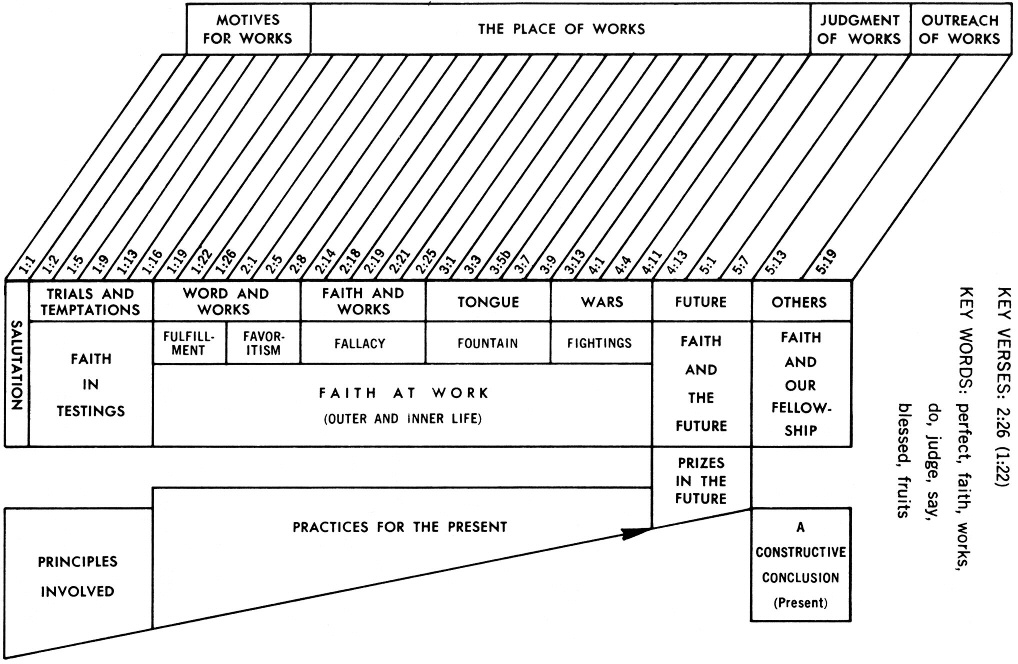
Click chart to enlarge
Chart from recommended resource Jensen's Survey of the NT - used by permission
See also Overview Chart by Charles Swindoll
|
JAMES |
|||||||
| Motives for Works |
The Place of Works: Outward Demonstration of Inner Faith |
Outreach of Works |
|||||
| Jas 1:1-18 | Jas 1:19-2:13 | Jas 2:14-25 | Jas 3:1-12 | Jas 3:13-4:12 | Jas 4:13-5:12 | Jas 5:13-19 | |
| Trials & Temptations |
Word & Works |
Faith & Works |
Tongue | Wars | Future | Others | |
|
Faith |
Fulfill |
Favor |
Fallacy |
Fountain |
Factions |
Faith |
Faith |
|
FAITH AT WORK |
|||||||
Hannah's Bible Outlines.
- Faith and the word (James 1:19-27)
- The reception of the word (James 1:19-21)
- The principle (James 1:19)
- The reason (James 1:20)
- The method (James 1:21)
- The doing of the word (James 1:22-27)
- The command (James 1:22)
- The hearer described (James 1:23-24)
- The doer described (James 1:25)
- The practice desired (James 1:26-27)
- The reception of the word (James 1:19-21)
James 1:21 Therefore, putting aside all filthiness and all that remains of wickedness, in humility receive the word implanted, which is able to save your souls. (NASB: Lockman)
Greek: dio apothemenoi (AMPMPN) pasan rhuparian kai perisseian kakias en prauteti dexasthe (2PAMM) ton emphuton logon ton dunamenon (PPPMSA) sosai (AAN) tas psuchas humon.
Amplified: So get rid of all uncleanness and the rampant outgrowth of wickedness, and in a humble (gentle, modest) spirit receive and welcome the Word which implanted and rooted [in your hearts] contains the power to save your souls. (Amplified Bible - Lockman)
ASV: Wherefore putting away all filthiness and overflowing of wickedness, receive with meekness the implanted word, which is able to save your souls.
Barclay: So then strip yourself of all filthiness and of the excrescence of vice, and in gentleness receive the inborn word which is able to save your souls.
Hiebert: Therefore, get rid of all moral filth and the evil that is so prevalent, and humbly accept the word planted in you, which can save you.
KJV: Wherefore lay apart all filthiness and superfluity of naughtiness, and receive with meekness the engrafted word, which is able to save your souls.
NLT: So get rid of all the filth and evil in your lives, and humbly accept the message God has planted in your hearts, for it is strong enough to save your souls. NLT - Tyndale House)
Phillips: Have done, then, with impurity and every other evil which touches the lives of others, and humbly accept the message that God has sown in your hearts, and which can save your souls. (Phillips: Touchstone)
Wuest: Wherefore, having put away every moral uncleanness and vulgarity and wickedness which is abounding, in meekness receive the implanted Word which is able to save your souls.
Young's Literal: wherefore having put aside all filthiness and superabundance of evil, in meekness be receiving the engrafted word, that is able to save your souls;
THEREFORE, PUTTING ASIDE ALL FILTHINESS: dio apothemenoi (AMPMPN) pasan rhuparian:
- Isa 2:20; 30:22; Ezek 18:31; Ro 13:12,13; Ep 4:22; Colossians 3:5, 6, 7, 8; Hebrews 12:1; 1Peter 2:1,11
- Filthiness - Jas 4:8; Ezekiel 36:25; 2Corinthians 7:1; Ephesians 5:4
- James 1 Resources - multiples sermons and commentaries
PUTTING OFF FILTH PRECEDES
PUTTING ON THE WORD
Therefore (dio) is an inferential conjunction that is also translated "for this reason" (see importance of observing for terms of conclusion). What has James just stated from which he is now drawing to conclusion? In the immediate context, James spoke of accomplishing the righteousness of God. This would be the equivalent of present tense salvation or progressive sanctification. James says in essence they have been saved in James 1:18 (see note - past tense salvation = justification = once for all time completed action in the past - see discussion of the Three Tenses of Salvation). But one who is justified by faith, immediately enters into present tense salvation, which is an ongoing, day by day process, often described in the NT as the Christian "walk". Note well however that both "tenses" of salvation are effected by faith, for we begin the new life in Christ by faith and it is by faith in His sufficiency and supply that we continue this new life of daily dependence and growth in Christ-likeness. And yet we have a responsibility in this "faith life" and here James says it is to put off, so to speak, the dirty filthy garments of the former life. Some writers feel James is speaking more of future tense salvation (glorification) which is possible, but given the practical instructions that follow in James 1:22-27 this would seem to favor ongoing sanctification which of course terminates in glorification.
John MacArthur agrees with this interpretation writing that "It is the divine power behind the truth of Scripture that is able to initiate salvation, keep it alive and growing, and finally bring it to final glory, complete and perfect. We have been saved (justified) through the power of the Word of God; we are kept saved (sanctified) through the power of the Word; and we will be ultimately, completely, and eternally saved (glorified) through the power of the Word. (SEE James MacArthur New Testament Commentary - Page 76)
D Edmond Hiebert sums up this section of James as…Faith Tested by Its Response to the Word of God (Jas 1:19-27) Since God’s Word is the means of regeneration (Jas 1:18), a right response to the Word is appropriately presented as the initial test of a vital faith. For the believer to accept regeneration through the Word is one thing; to permit the Word to work spiritual maturity in him is another. The necessary response is threefold: eagerness to hear it, restraint on any premature reaction, bridling of any angry rejection (Jas 1:19, 20). Before the Word can have full sway in the believer’s life, he must remove all that hinders its operation (Jas 1:21). Acceptance of the Word must be followed by persistent obedience to the Word (Jas 1:22–27). Hearing must be followed by active obedience; otherwise the hearing is useless (Jas 1:22, 23, 24, 25). But obedience to the Word is more than mere observance of outward forms of “religion” (church attendance, rote prayers, participation in the rites of religion) without the development of inner power to control the tongue (Jas 1:26). True obedience to the Word must reveal itself in beneficent social activity and stimulate personal self-control and purity in separation from worldly contamination (Jas 1:27). (The Unifying Theme of James - Excellent overview)
Putting aside (apotithemi) all filthiness (rhuparia) and all that remains (perisseia) of wickedness (kakia), in (locative of sphere) humility (prautes) receive (dechomai) the word (logos) implanted (emphutos) , which is able to (dunamai) save (sozo) your souls (psuche) - This passage teaches an important Biblical principle that you will not have an appetite for the Word of truth if you are actively, willfully living in darkness! How's your appetite been for the Word of God? If you find you have little appetite for the Word of truth, the diagnosis may be unconfessed sin!
Compare the same pattern in First Peter for putting off prior to partaking in the Word of God writing "Therefore, putting aside all malice and all deceit and hypocrisy and envy and all slander, like newborn babies, long for the pure milk of the word, so that by it you may grow in respect to salvation" (1Pe 2:1+, 1Pet 2:2+)
Mike Andrus on Putting aside (apotithemi) all filthiness (rhuparia) and all that remains (perisseia) of wickedness (kakia) - A clean heart: Get rid of all moral filth and evil. I fear that the principal reason many Christians do not welcome the Word of God, do not read it, and do not study it is that their lives are too compromised by moral filth and evil–from TV, movies, the internet, unhealthy relationships, etc. One simply cannot find joy and satisfaction in the Word of God if it is always speaking conviction to one’s lifestyle. It can’t happen! As a matter of fact, I have long thought that most people who claim to have intellectual problems with the Bible don’t have any such thing. They have moral problems with it. If you knew what was going on in their lives you would realize quickly that their beliefs and their behavior just couldn’t co-exist, so they jettisoned their beliefs and continued their behavior. James, of course, challenges us to do the opposite–get rid of moral filth and evil and continue to believe the Word of Truth. But it has to be one or the other. (When Religion Is Worthless) (Bolding added)
For the believer to accept regeneration through the Word is one thing;
to permit the Word to work spiritual maturity in him is another.
Simon Kistemaker writes that James 1:21 "is the conclusion to this section: an uncontrolled tongue and temper drive a man deep into sin and far from God. Therefore, a spiritual housecleaning is needed so that God’s Word, whether in written or spoken form, can enter man’s life…Note that they already had been given the message of salvation that as a plant had taken root in their souls (Jas 1:18+). Once again, the writer resorts to an illustration from nature. A plant needs constant care. If a plant is deprived of water and nurture, it will die. Thus if the readers who have heard the Word fail to pay attention, they will die a spiritual death. The Word needs diligent care and application, so that the readers may grow and increase spiritually. (New Testament commentary : Exposition of James and the Epistles of John.)
Putting aside (apotithemi) all filthiness (rhuparia) - This is a vivid word picture. James is saying take off your filthy attitudes and actions (moral defilement) just as you would soiled, smelly garments! The picture is like a snake that sloughs off its dead skin! Poole adds "not only restrain it, and keep it in; but put off, and throw it away as a filthy rag, Isa 30:22."
Putting aside is an aorist participle (in English usually identified by a word that ends in "-ing") which calls for this putting aside to be accomplished as an effective action, by a definite break with the things mentioned. It is the condition that must be fulfilled in order to facilitate the ready reception of the Word as discussed below. James use of the aorist tense here stresses the importance of a once for all putting off of sin prior to receiving God’s Word. James says our filthy, wicked vices are likened to soiled garments which are to be set aside once for all. Using another analogy, it is as if James saw the human heart as a garden. If left to itself, the soil of our wicked hearts inherited from Adam would produce only weeds. James as a good spiritual horticulturist urges us to “pull out the weeds” and prepare the soil for the “implanted Word of God.”
Beloved, how doth thy "garden" grow?
Figuratively the idea of apotithemi is to cease doing something as pictured by throwing it of and being done with it. The metaphor for this "negative" duty is putting off like dirty clothes, which James follows with the "positive" duty pictured by the agricultural figure of seed and soil. James emphasizes that the appropriation of the Word of Truth provides the secret of victory in the Christian life.
How is this possible? How can one cast aside these vile influences on our soul? William Kelly explains that…
It would be indeed a hopeless call if we had not a new Life in Christ; but this every believer possesses, and the Holy Spirit's indwelling to work suitably to Him Who is its source, fulness, and standard. The flesh is still there; but in the cross of Christ it has already received its condemnation in Him Who was the one and efficacious offering for sin (Ro 8: 3). Thus there is no excuse for the believer allowing its evil working in himself or others: God condemned it fully when Christ thus suffered, that we might have even now this immense comfort for faith as a settled thing. (Commentary)
MacArthur explains putting aside this way "The idea is that of confessing, repenting of, and eliminating every vestige and semblance of evil that corrupts our lives, reduces our hunger for the Word, and clouds our understanding of it. When that is done, we can indeed receive “the word of God, … not as the word of men, but for what it really is, the word of God, which also performs its work in [us] who believe” (1Th 2:13+). (SEE James MacArthur New Testament Commentary - Page 74)
Steven Cole - We all bring baggage from our old way of life over into the Christian life. Usually, we’re blind to much of it. We don’t realize that we’re displeasing God by our thoughts, words, or actions. As we begin to read God’s word, it convicts us of areas that we didn’t even know were sin. When this happens, the receptive heart cleans out the crud of sin and puts on the clean clothes of new life in Christ. If you don’t do this, the crud will prevent you from growing as a Christian. (James 1:19-21 A Receptive Heart)
Putting aside (659) (apotithemi from apo = away from, marker of dissociation, implying a rupture from a former association, separation, departure, cessation, any separation of one thing from another by which the union or fellowship of the two is destroyed + tithemi = put, place) means literally to put or take something away from its normal location and thus to put it out of the way (way out of the way!). It was used literally of runners who participated in the Olympic games who stripped off and cast aside their clothes and then ran almost completely naked in the stadium.
The word apo means away, and the word tithimi means to place or to lay something down. When these two words are compounded the picture is of someone who is laying something down at the same time he is pushing it far away from himself and beyond reach. Think of dirty, smelly clothes which you take off and throw away so you do smell the stench!
Here are the 9 interesting uses of apotithemi in the NT - Mt. 14:3; Acts 7:58; Ro 13:12+; Ep 4:22+, Ep 4:25+; Col 3:8+; Heb 12:1+ ; Jas 1:21; 1Pe 2:1+ which are translated in the NAS as laid aside(1), lay aside(3), laying aside(1), put(1), put aside(1), putting aside(2). Note that in most of these NT uses, apotithemi is used in an ethical exhortation calling for the reader to divest himself or herself of some undesirable attitude or action.
All (3956)(pas) is comprehensive and means all without exception, this adjective modifying both filthiness and wickedness. Pas denotes "every instance of" filthiness and wickedness. God is not satisfied with partial purity. However, do not misunderstand. James is not teaching spiritual perfection or "entire sanctification". He is speaking to believers who now have can confess their sins to their Father and be cleansed "from all unrighteousness" (1 John 1:9)
Filthiness (4507) (rhuparia from rhuparós = dirty, filthy) literally means dirt or filth (used to describe dirty garments), but is clearly used metaphorically by James to denote moral uncleanness or impurity. Sordid avarice. State of moral corruption (vulgarity). Barclay notes that rhuparia - can be used for the filth which soils clothes or soils the body. But it has one very interesting connection. It is a derivative of rhupos and, when rhupos is used in a medical sense, it means wax in the ear. It is just possible that it still retains that meaning here; and that James is telling his readers to get rid of everything which would stop their ears to the true word of God. When wax gathers in the ear, it can make a man deaf; and a man’s sins can make him deaf to God. (The Daily Study Bible Series. The Westminster Press) Plutarch used rhuparia (like our word "shabbiness") to describe "avarice", which conveys the sense of that which has debased moral value. Moulton and Milligan cite a use in the description of rich men not using their wealth.
The root adjective is used of the "filthy garments" in Zechariah 3:3, 4 which illustrates the action called for by James...
Now Joshua was clothed with filthy (Lxx - rhuparos) garments and standing before the angel.He spoke and said to those who were standing before him, saying, “Remove the filthy garments from him.” Again he said to him, “See, I have taken your iniquity away from you and will clothe you with festal robes.”
John uses the related verb form rhupoo in Revelation 22 in his description of heaven writing…Let the one who does wrong, still do wrong; and let the one who is filthy (rhupoo = to defile or pollute), still be filthy (rhupoo = to defile or pollute) and let the one who is righteous, still practice righteousness; and let the one who is holy, still keep himself holy." (Re 22:11+).
MacArthur comments: Some may think its connection with the command that preceded it is not immediately apparent. But the truth it dramatically conveys is that people’s response to the proclamation of the truth will fix their eternal destinies. Those who hear the truth but continue to do wrong and be filthy will by that hardened response fix their eternal destiny in hell. (SEE Revelation 12-22 MacArthur New Testament Commentary - Page 297)
Given the derivation discussed above, one person has rendered putting aside all filthiness as "Get rid of all your ear wax"
AND ALL THAT REMAINS OF (abundance of) WICKEDNESS: kai perisseian kakias:
All - The adjective is not present in the Greek but is assumed from the previous use of pas.
Remains (perisseia) of wickedness (kakia) - The word "remains" sounds like a verb but it is not. The KJV is more literal rendering it "Superfluity of naughtiness". Young's Literal is even more graphic - "superabundance of evil". The idea is that of wickedness present in abundance and thus abounding wickedness - what a horrible picture James paints, especially since he is speaking to new creations in Christ ("the first fruits among His creatures")!
That remains (4050)(perisseia from perissós = over and above) is a noun which means abundance/superabundance, overabundance, excess, superfluity, overflow, surplus. Perisseia is that which is over and above, something that is beyond the ordinary or that which is an exceeding measure or greater than expected amount. In Ecclesiastes (see examples below), perisseia conveys the sense of gain or profit. Perisseia gives a vivid picture of wickedness which is abounding or abundant. In context James speaks of the vast quantity or abundance of evil that must be removed. Perisseia is used in striking contrast in the NT with two of the uses describing an abundance of grace and an abundance of joy and here in James an abundance of wickedness.
Here are the 4 uses of perisseia in the NT -
Romans 5:17 (+) For if by the transgression of the one, death reigned through the one, much more those who receive the abundance of grace and of the gift of righteousness will reign in life through the One, Jesus Christ.
2 Corinthians 8:2 that in a great ordeal of affliction their abundance of joy and their deep poverty overflowed in the wealth of their liberality (or generosity = haplotes - an openness and sincerity in sharing with others).
2 Corinthians 10:15 not boasting beyond our measure, that is, in other men's labors, but with the hope that as your faith grows, we shall be, within our sphere, enlarged even more by you,
James 1:21 Therefore putting aside all filthiness and all that remains of wickedness, in humility receive the word implanted, which is able to save your souls.
There are 11 uses of perisseia in the Septuagint (LXX), all in Ecclesiastes - Eccl. 1:3; 2:11, 13; 3:9; 5:9, 16; 6:8; 7:11, 12; 10:10, 11
Ecclesiastes 1:3 What advantage (Heb = yithron = advantage, profit; Lxx = perisseia) does man have in all his work Which he does under the sun?
Ecclesiastes 2:13 And I saw that wisdom excels (Heb = yithron = advantage, profit; Lxx = perisseia) folly as light excels darkness.
POSB - The picture is that of taking off a dirty garment and putting it aside. A person must put off every dirty thing and lay it off to the side away from himself. If he enjoys the dirt and filth, then his mind is going to be on it. His mind will not be clear, not enough to hear the Word of God. William Barclay makes the point that the Greek word for "filthiness" is taken from the Greek word rupos. The word is sometimes used to refer to wax in the ear (The Letters of James and Peter, p.66). The picture is descriptive: a person with wax in the ear cannot hear the Word of God, not clearly. Therefore, he must take the wax out of his ear and put it away or else he will be deaf to the Word of God. He must put aside all that remains of naughtiness, wickedness, and evil. The idea is this: even after putting aside all filthiness, there will still be some naughtiness or wickedness that will show up within us. Therefore, we must be alert to these uprisings and put them off and lay them aside as well. We must be completely clean and pure from all dirt and naughtiness in order to hear the Word of God. (BORROW The Preacher's outline & sermon Bible)
John Phillips of wickedness (KJV - filthiness) - The word for “filthiness” suggests dirt, filth, and impurity. The word for “superfluity” suggests “an exceeding measure,” or something above and beyond the ordinary. The picture is of something overflowing, referring here to wickedness. The word for “naughtiness” (a much diluted word in our modern English vocabulary) refers to wickedness, depravity, and one’s vicious disposition and desires. We are to be done with these things. But that is easier said than done, given our fallen, Adamic nature. Evil wells up from within. James did not have the theological mind of Paul, nor did any of the Lord’s disciples. It would remain for Paul to write his epistle to the Romans, especially Romans chapters 6–8, before the great truths of positional and practical sanctification would be developed. But James had the right idea. The things that belong to the old nature cannot be allowed to hold sway in a believer’s life (ED: NOTE PHILLIPS UNDERSTANDS THIS INSTRUCTION AS TO A BELIEVER NOT A NON-BELEIVER, AN INTERPRETATION I FAVOR). James tells us to “lay apart” these things. Paul tells us to “put off” the old man and his deeds and to “put on” the new man (Col. 3:9–10). The act is volitional. James links the action to the Word of God; Paul links it to the Spirit of God (Rom. 8:1–4).
Poole has an interesting perspective writing that the wickedness…
is said to be superfluous or redundant, which is more than should be in a thing; in which respect all sin is superfluous in the soul, as being that which should not be in it: and so this intimates that we are not only to lay apart more gross pollutions, but all the lusts of the flesh, and relics of old Adam, as being all superfluities which may well be spared, or excrements, (as some render the word, agreeably to the former metaphor), which should be cast away.
Wickedness (2549)(kakia) refers to the quality of wickedness and thus in a moral sense means depravity, vice or baseness (1Pe 2:16+, Acts 8:22). It is the opposite of arete (+) and all virtue and therefore lacks social value. It denotes a vicious disposition, evilness, ill-will, spitefulness. Surprisingly, there are only 11 uses of kakia in the NT - Mt. 6:34; Acts 8:22; Ro 1:29; 1Co. 5:8; 14:20; Ep 4:31; Col 3:8; Titus 3:3; James 1:21; 1Pe 2:1, 16 which are translated in the NAS as evil(3), malice(5), trouble(1), wickedness(2). Note especially malice which is the feeling of a need to see others suffer! Malice is the desire to do mischief or to cause pain, injury, or distress to another individual created in the image of God. It speaks of evil intent. John Eadie writes that kakia is a generic term that seems to signify "badhardiness" and is the root of all the previous vices. In reference to behavior kakia conveys the idea of a mean-spirited or vicious attitude or disposition as indicated by words such as malice, ill-will, hatefulness, and dislike. It is an attitude of wickedness as an evil habit of one's mind. Kakia is used in NT to describe the wickedness which comes from within a person. Malice describes a vicious intention and expresses the desire to hurt another and rejoices in it!
C L Rogers writes that superfluity of wickedness (kakia)…is in reality an excrescence (a blot or a disfiguring, extraneous, or unwanted mark or part) on character, not a normal part of it. (BORROW The New Linguistic and Exegetical Key to the Greek New Testament)
Peter uses the same word kakia in a parallel passage preparatory for reception of the pure milk of God's Word…
Therefore (see 1Pe 1:22, 24, 25+), putting aside (same verb as James uses - apotithemi = aorist tense do this effectively - conveys the sense of a command) all malice (kakia) and all deceit and hypocrisy and envy and all slander, like newborn babies, long for (aorist imperative = Command calling for immediate attention. Do this!) the pure milk of the word, (Why long for and imbibe pure milk?) so that by it you may grow in respect to salvation (See notes 1 Peter 2:1; 2:2)
Comment: The picture is difficult to miss - A "baby" who fails to take in pure milk will not grow! Could this explain the dirth of
Note that Peter presents the same spiritual principle of the need to cast off sin and then you will long for the pure milk of the Word.
Separate yourself from the World
THEN…
Saturate yourself with the Word
In short, James is saying in essence - Let personal sin be cleansed so you can hear.
Before the Word can be effectively welcomed into their lives, hindering sins must be dealt with definitely (1 John 1:9+, Pr 28:13+).
Adrian Rogers (page 637) (CONTEXT - LAZARUS IS BOUND - HE IS LIFE BUT NOT LIBERTY SO JESUS SAYS UNBIND HIM AND LET HIM GO - Jn 11:44+) - James talks about “the superfluity of naughtiness.” (James 1:21KJV)....What is the superfluity of naughtiness? Well, the word superfluity means “that which remains,” “that which is left over”—what we would call “hangover sins” when you get saved. You can be saved; you can have life, but you still have the grave clothes—the grave clothes of that old language. You know, some people, when they get saved, they lose about half their vocabulary, don’t they? They’ve got another half they still need to lose. Old language, old lust, old laziness, old learning, old loves—they have to be taken away; they have to be stripped away. And friend, a lot of us are saved, but we have the grave clothes of the old life that keep us from having abundant life.
Many...have come to Calvary for pardon,
but they’ve never been to Pentecost for power.
IN HUMILITY RECEIVE THE WORD IMPLANTED, WHICH IS ABLE TO SAVE YOUR SOULS: en prauteti dexasthe (2PAMM) to emphuton logon:
- Receive - Ps 25:9; Is 29:19; 61:1; Zeph 2:3; Mt 5:5; Acts 10:33; 1Th 1:5; 2:13
- Implanted - Jn 6:63,68; Ro 6:17; 11:17; He 4:2
- James 1 Resources - multiples sermons and commentaries
PUTTING THE WELCOME MAT
OUT FOR THE WORD OF TRUTH
In (locative of sphere) humility (prautes) - In (1722) (en) in the sphere of or influence of an attitude not of weakness but of meekness. Notice that James places "in humility" (or meekness) become the verb "receive", emphasizing the inner attitude that must prepare the "soil" for fruitful reception of the seed of the Word of Truth.
Warren Wiersbe rightly notes that "The soil of the heart must be prepared to receive the Word. If we have unconfessed sin in our hearts, and bitterness against God because of our trials (cp Jas 1:2+), then we cannot receive the Word and be blessed by it. (BORROW Wiersbe's Expository Outlines on the New Testament )
Humility (meekness) (4240) (prautes) describes the quality of not being overly impressed by a sense of one’s self-importance. Prautes is a quality of gentle friendliness - gentleness, meekness (as strength that accommodates to another's weakness), consideration, restrained patience, patient trust in the midst of difficult circumstances. The essence of prautes is the opposite of anger (orge) discussed in Jas 1:19, 20. And so prautes in James 1:21 is the humble and gentle attitude which expresses itself in a patient submissiveness to offense, free from malice and desire for revenge. “Meekness is not weakness, but strength under control." Meekness is the very opposite of the common attitudes of self-interest, self-assertiveness, and self-direction. The ultimate example of meekness is the Lord Jesus in His humanity. As the well-known song proclaims:
He could have called ten thousand angels,
To destroy the world, and set Him free;
He could have called ten thousand angels,
But He died alone for you and me.
Hiebert explains that "Humility or meekness is an inner attitude, not of spineless weakness or haughtiness. Instead of brashly asserting themselves in anger, they need to be humble and teachable in order to rightly receive the divine message. (Commentary on James)
There are 11 uses of prautes in the NT - 1Co. 4:21; 2Co 10:1; Ga 5:23; 6:1; Ep 4:2; Col. 3:12; 2Ti 2:25; Titus 3:2; Jas. 1:21; 3:13; 1 Pet. 3:16 which are translated in the NAS as onsideration(1), gentleness(8), humility (1), meekness(1).
Barclay comments on James' use of prautes here writing that "No one can ever find one English word to translate (prautes) a one word summary of the truly teachable spirit. The teachable spirit is docile and tractable, and therefore humble enough to learn. The teachable spirit is without resentment and without anger and is, therefore, able to face the truth, even when it hurts and condemns. The teachable spirit is not blinded by its own overmastering prejudices but is clear-eyed to the truth. The teachable spirit is not seduced by laziness but is so self-controlled that it can willingly and faithfully accept the discipline of learning. Prautes describes the perfect conquest and control of everything in a man’s nature which would be a hindrance to his seeing, learning and obeying the truth. (The Daily Study Bible Series) (Bolding added)
Constable adds that prautes "occurs in non-biblical literature to describe a horse that someone had broken and had trained to submit to a bridle. It pictures strength under control, specifically the Holy Spirit’s control. The evidence of this attitude is a deliberate placing of oneself under divine authority. (Expository Notes)
R C Trench adds that prautes "is closely linked with humility, and follows directly upon it (Eph 4:2+; Col 3:12+) because it is only the humble heart which is also the meek; and which, as such, does not fight against God, and more or less struggle and contend with Him. (Ibid)
Warren Wiersbe makes a good point noting that "When you receive the Word with meekness, you accept it, do not argue with it, and honor it as the Word of God. You do not try to twist it to conform it to your thinking. (Bible Exposition Commentary)
POSB - We must receive the Word of God with meekness. We must be as a child before God our Father, that is, sit before Him meekly just as a child does his father. The idea is that we must be humble, gentle, quite, and attentive in listening to the Word of God. We must sit and listen with an open heart ready to hear exactly what our Father says. The person who sits before God like this discovers a most wonderful thing. Note the word "engrafted". It means to implant; to be born within. When a person listens and hears the Word of God, it is planted within his heart and life. What God says is actually born within his heart, and the man hears exactly what God says. The Word of God is born within his heart and life and the person's soul is saved. He conquers and triumphs over all temptation, including the terrible temptation of rejecting God and doing his own thing and living like he wants. He is saved to live eternally with God. This is the first preparation that a person must make to withstand temptation: he must be quick to hear the Word of God. (BORROW The Preacher's outline & sermon Bible)
Cornerstone Biblical Commentary - The positive answer to the dilemma of human rage is the command to "humbly accept the word God has planted in your hearts." Humility or gentleness is the antithesis of anger and is the primary manner in which we are both to open ourselves to God and to relate to others. But for the Greeks, "meekness was weakness," since the Greco-Roman world stressed self-reliance and the ability to control others (essential in a patron-client society). Here "in humility" is placed between the two sections and may be a hinge idea referring to one's attitude "both while divesting oneself of sinfulness and while receiving our new selves from God" (Blomberg and Kamell 2008:87). To be in complete submission and reliance on God makes one ready to "receive" God's word. Note the movement from "taking off" sin and "receiving" (a type of "putting on") the word. God's truth is both the means whereby sin is defeated and the power that replaces sin in our lives. (SEE James, 1-2 Peter, Jude, Revelation - Page 40)
A WELCOME
RECEPTION
Receive (dechomai) the word (logos) implanted (emphutos) - The Word of truth is living and active and like a seed. So once you have pulled up all the weeds (filthiness and wickedness), welcome the seed of the Word into good soil, into "an honest and good heart, and hold it fast, and bear fruit with perseverance." (Lk 8:15+).
Hiebert rightly remarks that James' "readers needed to go beyond a passive acquiescence to the statements of the Word and, by a definite volitional response, welcome it as an active, working force in their lives. They had to offer their hearts as the good soil in which the "implanted word" could readily grow." (Ibid)
Poole writes they are to receive the Word "not only into your heads by knowledge, but into your hearts by faith (cp Lk 8:15, Col 2:6)."
Spurgeon - Receive it as a graft. As the tree is prepared by the knife to receive the new shoot that is to be put into it, and does so receive it as to make it its own, and to use it for its own fruit-bearing purposes, even in that way “receive with meekness the engrafted word, which is able to save your souls.” A Warning to Waverers Spurgeon's Verse Expositions
Receive (accept, "welcome") (1209) (dechomai = middle voice of a primary verb) means to to receive something offered or transmitted by another (Lk 2:28), to take something into one's hand and so to grasp (Lk 2:28, 22:17), to be receptive to someone (Mt 10:14, 40) or to take a favorable attitude toward something (Mt 11:14).
Dechomai means to accept with a deliberate and ready reception of what is offered, to receive kindly and so to take to oneself what is presented or brought by another. It means to welcome a teacher, a friend, or a guest into one's house. Dechomai describes accepting the Word with open arms, minds, and hearts.
Dechomai pictures the disciple "putting out the welcome mat" for God's word of truth as one would a good friend or guest, inviting them to come into your house (Luke 10:8,10; Rahab welcomed the spies - Heb 11:31+). Dechomai thus pictures one assenting to God's Word of Truth and indicates that the reception is to be a voluntary and willing act on the part of the reader (hearer).
The saints at Berea are a great illustration of the meaning of dechomai, Luke recording…
Now these were more noble-minded than those in Thessalonica, for they received (dechomai) the word with great eagerness (prothumia = idea of ready and willing. Willingness. Inclination. Enthusiasm. Goodwill), examining (anakrino = sifting up and down = re-examine and so examine carefully) the Scriptures daily, to see whether these things were so. (Acts 17:11see notes)
There are 56 uses of dechomai in the NT -translated as accept(2), accepted(3), receive(18), received(11), receives(15), take(3), taken(1),took(1), welcome(1), welcomed(1). Matt. 10:14, 40, 41; 11:14; 18:5; Mk. 6:11; 9:37; 10:15; Lk. 2:28; 8:13; 9:5, 48, 53; 10:8, 10; 16:4, 6, 7, 9; 18:17; 22:17; Jn. 4:45; Acts 3:21; 7:38, 59; 8:14; 11:1; 17:11; 22:5; 28:21; 1Co. 2:14; 2Co. 6:1; 7:15; 8:17; 11:4, 16; Gal. 4:14; Ep 6:17; Phil. 4:18; Col. 4:10; 1Thess. 1:6; 2:13; 2Thess. 2:10; Heb. 11:31; James 1:21
Warren Wiersbe makes a profound comment we dare not read too quickly "The way a Christian treats his Bible shows how he regards Jesus Christ. He is the living Word (Jn 1:1, 14), and the Bible is the written Word; but in essence they are the same. Both are bread (Mt 4:4; Jn 6:48), light (Ps 119:105; Jn 8:12), and truth (Jn 14:6; 17:17). (Bible Exposition Commentary) Amen and Amen!
Word (3056) (logos from légō = to speak with words; English = logic, logical) means something said and describes a communication whereby the mind finds expression in words. Although Lógos is most often translated word which Webster defines as "something that is said, a statement, an utterance", the Greek understanding of lógos is somewhat more complex. In the present context word is used to stand for Scripture in general.
William Kelly explains that "The word of truth which first reached us when under the dominion of the falsehood of sin and Satan (Jas 1:18), and delivered us through faith in Christ and His mighty work, is spoken of also as the implanted word which we are told to receive as an accomplished act. It is in contrast with a merely external rule that could only condemn what was opposed to itself. It works inwardly in that life which the believer has, being perfectly akin to it and congenial with it, as both are of God (i.e, the Word and the New Creation in Christ). Hence there is nothing strange in the call; and the call is to receive it "with meekness," as becomes those who have already tasted that the Lord is good (cp Ps 34:8), and desire to profit more and more. For indeed only that word is "able to save our souls" (compare 1Pe 1:22, 23, 24, 25+, and 1Pe 2:1,2+). The God Who began so gracious a work does not forget or relinquish His care (cp Php 1:6+). He exercises and disciplines our souls, He spares no fault; but He has proved fully in Christ that those whom He loved that were in the world He loved unto the end (Jn 13:1). Still He works not by rites or forms, but by our faith in His word. We are kept by the power of God through faith unto salvation ready to be revealed in the last time (compare 1Pe 1: 5+). (Commentary)
Implanted (1721) (emphutos from emphuto = to implant; in turn from en = in + phuo = to generate, produce, bring forth, let grow) means inborn, native or engrafted. In secular literature emphutos was used most often in the sense of implanted by natural process. BDAG comments "as something implanted the word is permanently established in the individual and like inborn assets functions in an exceptional manner."
The literal picture was that of planting a seed in the ground and figuratively as used by James of the "seed" of the Word of Truth planted in the "good soil" of the heart where it took root. In His parable of the seed and the soils, Jesus explained that
the seed in the good soil, these are the ones who have heard the word in an honest and good heart, and hold it fast, and bear fruit with perseverance. (Lk 8:15+, cp "good soil" Mt 13:8, 23+)
Comment: As an aside mushrooms spring up overnight, but they are usually poisonous. The best fruits require time, cultivation, patience. A rare plant called ''godliness'' grows wonderfully when ''fertilized'' with the fruit of perseverance (2Pe 1:6+) in turn fertilized "in your faith" in "His precious and magnificent promises" (2Pe 1:4+, 2Pe 1:5+).
William Barclay - The word for inborn is emphutos (Greek #1721), and is capable of two general meanings.
(i) It can mean inborn in the sense of innate as opposed to acquired. If James uses it in that way he is thinking of much the same thing as Paul was thinking of when he spoke of the Gentiles doing the works of the law by nature because they have a kind of law in their hearts (Romans 2:14-15); it is the same picture as the Old Testament picture of the law "very near you; it is in your mouth, and in your heart" (Deuteronomy 30:14). It is practically equal to our word conscience. If this is its meaning here, James is saying that there is an instinctive knowledge of good and evil in a man's heart whose guidance we should at all times obey.
(ii) It can mean inborn in the sense of implanted, as a seed is planted in the ground. In 4Ezra 9:31 we read of God saying: "Behold, I sow my law in you, and you shall be glorified in it for ever." If James is using the word in this sense, the idea may well go back to the Parable of the Sower (Matthew 13:1-8), which tells how the seed of the word is sown into the hearts of men. Through his prophets and his preachers, and above all through Jesus Christ, God sows his truth into the hearts of men and the man who is wise will receive it and welcome it. (James 1- William Barclay's Daily Study Bible)
Hiebert makes the point that emphutos…"may denote that which is inborn, or native. The Word of God is not native to the human heart. The word can also denote a subsequent implantation, which is clearly the meaning here. Although the Word is not native to the human heart, it is well suited to be planted therein. As a living seed, its nature is to root itself deeply into the soil of the believing heart. Implanted at regeneration, the living Word actively roots itself in the heart as a vital part of the new nature. In Ro 6:5+, this adjective is used of the believer's being "united with" the indwelling Christ. The rendering "engrafted" (KJV) is not quite adequate, since the Word is not a bud grafted into us.' Rather, the figure is that of seed sown in the heart. The power of this seed to root itself deeply is not an automatic process. The imperative verb denotes that a welcoming human response is involved.
John MacArthur - With the Holy Spirit to interpret and empower, it (the Word of Truth) becomes a vital element in the new spiritual life of the child of God, for “the word of God is living and active and sharper than any two-edged sword, and piercing as far as the division of soul and spirit, of both joints and marrow, and able to judge the thoughts and intentions of the heart” (Heb. 4:12+). The Word of God is the gospel in its fullness and “is the power of God for salvation to everyone who believes” (Ro 1:16+). (Macarthur J. James. Moody)
Spurgeon writes "That evil branch is cut away, now be ready to have a branch of a better kind inserted into you, even “the engrafted word, which is able to have your souls,” that you may bring forth better fruit than the old crabbed stock of nature can possibly yield. Spurgeon's Sermons Volume 56: 1910
Perhaps you have seen a man grafting a tree. What a gash he makes in the tree before he puts in the graft! How he wounds it to make the sap flow into the new wood! If the Lord has made any of your hearts bleed to-night by the sharp cutting of his Spirit, we are not sorry, if it shall the better prepare you for receiving the grafts of his own nature, and his own Word. Charity and Purity
WHICH IS ABLE TO SAVE YOUR SOULS: ton dunamenon (PPPMSA) sosai (AAN) tas psuchas humon:
- Ac 13:26; Ro 1:16; 1Co 15:2; Eph 1:13; 2Ti 3:15, 16, 17; Titus 2:11; He 2:3; 1Pe 1:9
- James 1 Resources - multiples sermons and commentaries
Related Passages:
Romans 1:16+ For I am not ashamed of the gospel, for it is the power (dunamis) of God for salvation to everyone who believes, to the Jew first and also to the Greek.
THE INHERENT POWER OF
GOD'S WORD OF TRUTH
Which is able to (dunamai) save (sozo) your souls (psuche) - God's Word of Truth has the inherent ability, capability or power to accomplish the goal of saving our souls (the first time when we are born again and every day thereafter!). Able to (dunamai) is in the present tense signifying the Word of truth always has the power to deliver! This is good news if you feel presenting the Gospel depends on your power, your cleverness, etc. It depends on God's power! Therefore simply give out the Word of truth and do not be worried that you did not present it like a polished pastor! It will not return void (Isa 55:11).
While the context favors that James is speaking of salvation in the sense of progressive sanctification, this verse might be applied to one who was not yet born again. The only caveat is that I think it is not possible for that unsaved person using their natural (fleshly) power to carry out the two prerequisites of putting aside filthiness and wickedness.
Peter alludes to the inherent ability of God's Word using the metaphor of a "seed" writing to the believers that "you have been born again not of seed which is perishable but imperishable, that is, through the living and enduring word of God. (1Pe 1:23+)
So even as a biological seed has the inherent ability when planted to germinate and bring about new life, so too, the living and active Word of God has the inherent ability to bring about new spiritual life and to then sustain that spiritual life (which course calls for continual intake - 1Pe 2:2+)
As someone has well said the power of the Gospel is not seen in great preaching, large churches, or glorious music but is best seen in transformed lives.
Mike Andrus - The benefit of accepting the Word: it can save you. “Humbly accept the word planted in you, which can save you.” It’s a life or death issue. The Word of God is His instrument of salvation–ultimately the Living Word, Jesus Christ, but He can’t be separated from the Written Word, because that’s how we know Him. 1 Peter 1:23 says, “You have been born again, not of perishable seed, but of imperishable, through the living and enduring word of God.” James is simply saying that a true acceptance and welcoming of God’s Word must be accompanied by a listening ear, a controlled mouth, a calm spirit, and a clean heart, and if these things are not observable in our lives, that is evidence that we have not humbly accepted the Word of God and may not even be saved. (When Religion Is Worthless)
Able (1410) (dunamai) conveys the basic meaning of that which has the inherent ability to do something or accomplish some end. Thus dunamai means to be able to, to be capable of, to be strong enough to do or to have power to do something. It is usually translated able (50x), can (61x and cannot 58x) or could. BDAG says that dunamai means "to possess capability (whether because of personal or external factors) for experiencing or doing something."
Larry Richards says that dunamis and dunamai "look to the inherent physical, spiritual, or natural strength or power of individuals. The verb raises the issue of one's being "strong enough" and thus able. (BORROW Expository Dictionary of Bible Words )
TDNT - Words of this stem all have the basic sense of ability or capability. Dunamai means a. “to be able” in a general sense, b. “to be able” with reference to the attitude that makes one able, hence sometimes “to will,” and c. (of things) “to be equivalent to,” “to count as,” “to signify.” (BORROW Kittel's Theological Dictionary of the New Testament : abridged in one volume)
Thayer's summary of dunamai…1 to be able, have power whether by virtue of one’s own ability and resources, or of a state of mind, or through favorable circumstances, or by permission of law or custom. 2 to be able to do something. 3 to be capable, strong and powerful.
Vine summarizes dunamai writing that it means "“to be able, to have power,” whether by virtue of one’s own ability and resources, e.g., Ro 15:14 (note); or through a state of mind, or through favorable circumstances, e.g., 1Thes 2:6 (note); or by permission of law or custom, e.g., Acts 24:8, 11; or simply “to be able, powerful,” Matt. 3:9;2Ti 3:15 (note), etc. See can, may, possible, power. (Vine's Expository Dictionary of Old Testament and New Testament Words)
Dunamai is in the present tense which signifies the Word of Truth is continuously able or continually has inherent power to save. Luke has a similar statement writing that…
For no (ou = absolutely no) word (rhema) from God shall be void of power (adunateo - essentially the converse of dunamai). (Luke 1:37ASV+)
Comment: This verse says not one single Word of God is powerless or unable. Modern translations do not really convey the sense of the power of the Word quite as clearly as the ASV - e.g., the NAS = "For nothing will be impossible with God."
The Amplified Version is somewhat better "For with God nothing is ever impossible and no word from God shall be without power or impossible of fulfillment."
The derivative word dunamis (from dunamai) refers to intrinsic power or inherent ability, the power or ability to carry out some function, the potential for functioning in some way, the power residing in a thing by virtue of its nature. The word group (dunamai, dunamis, dunatos, etc) gives us our English word dynamic, (synonyms = energetic, functioning, live, operative, working) which describes that which is marked by usually continuous and productive activity or change. That which is dynamic is characterized by energy or forces that produce motion, as opposed to that which is static.
Click here to study all 210 uses of dunamai in the NT (in the window that opens, scroll down to the "Verse Count" which will show the distribution by NT book. Click on the book to see all the uses of dunamai in that book. Where are the majority of uses found?) Here are just a few representative uses…
Matthew 3:9 and do not suppose that you can say to yourselves, 'We have Abraham for our father'; for I say to you, that God is able from these stones to raise up children to Abraham. (God has the inherent ability or power. This same God is our Father. We need to remember "He is able"!)
Matthew 5:14 You are the light of the world. A city set on a hill cannot (does not have the ability even to) be hidden. (In other words the city must shine!)
Matthew 6:24 No one can (is able to, has the inherent ability or power to) serve two masters; for either he will hate the one and love the other, or he will hold to one and despise the other. You cannot serve God and mammon.
Matthew 6:27 "And which of you by being anxious can (is able to or has the power to) add a single cubit to his life's span?
Matthew 7:18 "A good tree cannot (does not have the inherent ability or power to) produce bad fruit, nor can a bad tree produce good fruit.
Matthew 8:2 And behold, a leper came to Him, and bowed down to Him, saying, "Lord, if You are willing, You can (have the inherent ability or power to) make me clean."
Matthew 9:28 And after He had come into the house, the blind men came up to Him, and Jesus said to them, "Do you believe that I am able (have the inherent ability or power) to do this?" They said to Him, "Yes, Lord." (What say you to this question? Do you believe Jesus still has the inherent ability to open our eyes to the "blind spots" in our life?)
Matthew 19:25 And when the disciples heard this, they were very astonished and said, "Then who can be saved?"
Mark 1:40 And a leper came to Him, beseeching Him and falling on his knees before Him, and saying to Him, "If You are willing, You can make me clean."
Mark 2:7 "Why does this man speak that way? He is blaspheming; who can forgive sins but God alone?"
Mark 4:33 And with many such parables He was speaking the word to them as they were able to hear it;
Mark 7:15 there is nothing outside the man which going into him can (has the inherent ability to) defile him; but the things which proceed out of the man are what defile the man… 18 And He said to them, "Are you so lacking in understanding also? Do you not understand that whatever goes into the man from outside cannot defile him;
Mark 8:23 And Jesus said to him, "'If You can!' All things are possible to him who believes."
Luke 3:8 "Therefore bring forth fruits in keeping with repentance, and do not begin to say to yourselves, 'We have Abraham for our father,' for I say to you that God is able from these stones to raise up children to Abraham.
Luke 21:15 for I will give you utterance and wisdom which none of your opponents will be able to resist or refute.
John 3:3 Jesus answered and said to him, "Truly, truly, I say to you, unless one is born again, he cannot (is not able, has no inherent ability or capability to) see the kingdom of God."
John 6:44 "No one can (has the inherent ability to) come to Me, unless the Father who sent Me draws him; and I will raise him up on the last day.
John 10:29 "My Father, who has given them to Me, is greater than all; and no one is able (has the inherent power) to snatch them out of the Father's hand.
John 10:35 "If he called them gods, to whom the word of God came (and the Scripture cannot be broken)
John 12:39 For this cause they could not believe, for Isaiah said again,
John 15:5 "I am the vine, you are the branches; he who abides in Me, and I in him, he bears much fruit; for apart from Me you can do nothing.
Acts 4:20 for we cannot (lack the inherent ability to) stop speaking what we have seen and heard."
Acts 20:32+ "And now I commend you to God and to the word of His grace, which is able to build you up and to give you the inheritance among all those who are sanctified.
Romans 8:7+ because the mind set on the flesh is hostile toward God; for it does not subject itself to the law of God, for it is not even able to do so; 8:8 and those who are in the flesh cannot please God.
Romans 8:39+ nor height, nor depth, nor any other created thing, shall be able to separate us from the love of God, which is in Christ Jesus our Lord.
Romans 16:25+ Now to Him (God the Father) Who is able (present tense = He is continuously able! Do you believe this about your great God and Father? Does your life of faith demonstrate you truly believe "He is dunamai"?) to establish you according to my gospel and the preaching of Jesus Christ, according to the revelation of the mystery which has been kept secret for long ages past,
1 Corinthians 2:14 But a natural (not born again by the Spirit, not a new creation in Christ) man does not accept the things of the Spirit of God; for they are foolishness to him, and he cannot (he does not have the inherent ability to) understand them, because they are spiritually appraised.
1 Corinthians 10:13 No temptation has overtaken you but such as is common to man; and God is faithful, Who will not allow you to be tempted beyond what you are able (beyond what you have the inherent ability to endure), but with the temptation will provide the way of escape also, that you may be able (have the capacity, the inherent ability) to endure it.
2 Corinthians 1:4 (The Father of mercies and God of all comfort) Who comforts us in all our affliction so that we may be able (have the capacity, inherent ability) to comfort those who are in any affliction with the comfort with which we ourselves are comforted by God.
Galatians 3:21 Is the Law then contrary to the promises of God? May it never be! For if a law had been given which was able (had the ability) to impart life, then righteousness would indeed have been based on law.
Ephesians 3:20+ Now to Him Who is able (present tense = He is continuously able) to do exceeding abundantly beyond all that we ask or think, according to the power that works within us,
Ephesians 6:11+ Put on the full armor of God, that you may be able (have the ability, power or capacity) to stand firm against the schemes of the devil… 6:13 Therefore, take up the full armor of God, that you may be able to resist in the evil day, and having done everything, to stand firm… 6:16 in addition to all, taking up the shield of faith with which you will be able to extinguish all the flaming missiles of the evil one.
Philippians 3:21+ Who (Php 3:20) will transform the body of our humble state into conformity with the body of His glory, by the exertion of the power (verb used as a noun - His inherent ability) that He has even to subject all things to Himself.
1 Timothy 6:7 For we have brought nothing into the world, so we cannot take anything out of it either.
1 Timothy 6:16 (He who is the blessed and only Sovereign, the King of kings and Lord of lords) Who alone possesses immortality and dwells in unapproachable light; Whom no man has seen or can see. To Him be honor and eternal dominion! Amen.
2 Timothy 3:15 and that from childhood you have known the sacred writings which are able to give you the wisdom that leads to salvation through faith which is in Christ Jesus.
Hebrews 2:18+ For since He Himself was tempted in that which He has suffered, He is able (present tense = He is continuously able) to come to the aid (see this great word - boetheo) of those who are tempted.
Hebrews 3:19+ And so we see that they were not able to enter because of unbelief.
Hebrews 4:15+ For we do not have a high priest who cannot sympathize with our weaknesses, but One who has been tempted in all things as we are, yet without sin.
Hebrews 5:2+ he can deal gently with the ignorant and misguided, since he himself also is beset with weakness;
Hebrews 7:25+ Hence, also, He is able to save forever those who draw near to God through Him, since He always lives to make intercession for them.
Hebrews 10:1+ For the Law, since it has only a shadow of the good things to come and not the very form of things, can never by the same sacrifices year by year, which they offer continually, make perfect those who draw near.
Hebrews 10:11+ And every priest stands daily ministering and offering time after time the same sacrifices, which can never take away sins;
James 2:14 What use is it, my brethren, if a man says he has faith, but he has no works? Can (does it have the inherent ability or power) that faith save him?
James 3:8 But no one can (has the inherent ability to) tame the tongue; it is a restless evil and full of deadly poison.
James 4:12 There is only one Lawgiver and Judge, the One who is able to save and to destroy; but who are you who judge your neighbor?
1 John 3:9 No (Greek = absolute negation) one who is born (perfect tense = speaks of the permanence of this "transaction") of God practices (present tense = habitually) sin, (why not?) because His seed abides in him; and he cannot (negative = ou = absolutely "not" able to continually commit sin - why? because the Holy Spirit in him and he has a new heart with new desires) sin (sin = present tense = speaks of the habitual practice of one's life, the "general direction" of their walk), because he is born of God. (Comment: This is a vitally important verse for modern day evangelicalism in America, for some teach the deadly lie that one can be genuinely born again and yet never have any change in the direction of their life. One cannot twist the apostle John's words so that they support such a deceptive and eternally damning lie.)
1 John 4:20 If someone says, "I love God," and hates his brother, he is a liar; for the one who does not love his brother whom he has seen, cannot (does not have the inherent ability - natural man is a "God hater" no matter how religious he is - only circumcision of one's heart brings about the inherent ability to love God) love God Whom he has not seen.
Jude 1:24 Now to Him Who is able (what's the tense? Right - you guessed it - present tense = continually) to keep you from stumbling, and to make you stand in the presence of His glory blameless with great joy,
Revelation 3:8+ 'I know your deeds. Behold, I have put before you an open door which no one can shut, because you have a little power, and have kept My word, and have not denied My name.
Revelation 5:3+ And no one in heaven, or on the earth, or under the earth, was able to open the book, or to look into it.
Revelation 7:9+ After these things I looked, and behold, a great multitude, which no one could count, from every nation and all tribes and peoples and tongues, standing before the throne and before the Lamb, clothed in white robes, and palm branches were in their hands;
Revelation 13:4 + and they worshiped the dragon, because he gave his authority to the beast; and they worshiped the beast, saying, "Who is like the beast, and who is able to wage war with him?"
Revelation 13:17+ and he provides that no one should be able to buy or to sell, except the one who has the mark, either the name of the beast or the number of his name.
To save (rescue) (4982) (sozo) has the basic meaning of rescuing one from great peril. Additional nuances include to protect, keep alive, preserve life, deliver, heal, be made whole. In short, to save, means to make a person whole and complete in every respect. And this is what the Word of Truth is able to do, delivering believers from the destructive consequences of sin.
🙏 THOUGHT - Why do we so often forsake the well of the Word and its living water and make for ourselves broken cisterns that can hold no water? (cp Je 2:13)
From the context we know that James is speaking to those who have been born again for he had just written that…
In the exercise of His will He brought us forth by the word of truth, so that we would be a kind of first fruits among His creatures. (James 1:18)
Hiebert comments that "James has already mentioned their new birth in Jas 1:18, but the full import of this saving activity is eschatological—the believer's full and final salvation at the return of Christ (ED: "FUTURE TENSE SALVATION" = GLORIFICATION). Implied is the present process of salvation from sin as the believer grows and matures spiritually (1Co 1:18; 2Co 3:18). (Ibid)
🙏 THOUGHT - Too often Christians have a truncated understanding of the scope of salvation. While none would dispute that all men need the Word of Truth to be saved (regenerated, born again), many lose site of the vitally important truth that believers (not yet glorified) are still in "harm's way" (cp the power of the fallen flesh within us to tempt us as discussed in Jas 1:14, 15+ and therefore in continual need of the "saving power" of the Word of Truth and the Spirit of Truth Who uses the Word to enable us to grow in grace. There will be no growth in grace unless there is intake of the Word which allows the Spirit to do His transforming word (see 2Co 3:18+). This fact serves to emphasize why it is so critical that saints in these last days, must exercise discernment and abstain from the many winds of doctrine that are "buffeting" sound doctrine which is the firm foundation of the church. Many of these winds gain credibility and acceptance because they emphasize feelings, emotions and experiences, all of which supposedly (but falsely) validate these seductive, specious teachings. If there was ever a time to give utmost priority to the pure milk of the Word of Truth it is in these last days (2Ti 3:1+). Our spiritual health depends on it!
Steven Cole feels that "When James says that the word implanted “is able to save your souls,” he is viewing salvation as the entire process of the Christian life, culminating in our “ultimate deliverance from sin and death that takes place at the time of Christ’s return in glory (see, e.g., Ro 5:9, 10; 13:11; 1Th 5:9; Phil. 2:12; 1Ti 4:16; 2Ti. 4:18; He 9:28; 1Pe 1:5, 9; 2:2; 4:18). James’ other uses of the [word] share this future orientation (Jas 2:14; 4:12; 5:20; in Jas 5:15 ‘save’ applies to physical, not spiritual, deliverance)” (Douglas Moo, The Letter of James [Eerdmans/Apollos], p. 88). Proverbs 4:23 says, “Watch over your heart with all diligence, for from it flow the springs of life.” (see in depth exposition of Pr 4:23) Have you done a heart check lately? If your heart is apathetic to God’s word, James says, “Be quick to hear.” If you’re prone to spout off arrogantly with how much you know, James says, “Be slow to speak.” If you’re fighting some aspect of the word that you don’t like, James says, “Be slow to anger.” If you’re tolerating the crud of sin, James says, “Put aside all filthiness.” If you’re resisting God’s commands that are designed to rescue you from sin, James says, “In humility receive the word implanted, which is able to save your souls.” (James 1:19-21 A Receptive Heart)
Your souls - James uses a Hebraism which was used to denote the whole person (cf. Nu 23:10, Ac 2:41; 27:37; He 10:38; 1Pe 3:20).
Souls (5590)(psuche or psyche from psucho = to breathe, blow, English = psychology, "study of the soul") is the breath, then that which breathes, and then the individual, animated creature. However the discerning reader must understand that psuche is one of those Greek words that can have several meanings, the exact nuance being determined by the context. It follows that one cannot simply select of the three main meanings of psuche and insert it in a given passage for it may not be appropriate to the given context. The meaning of psuche is also contingent upon whether one is a dichotomist or trichotomist. Consult Greek lexicons for more lengthy definitions of psuche as this definition is only a brief overview. (Click an excellent article on Soul in the Evangelical Dictionary of Biblical Theology; see also ISBE article on Soul)
Wuest says psuche (this definition would be compatible with the present context in James 1:21) is "that part of man which wills, and thinks, and feels, or in other words, to the will power, the reason, and the emotions, to the personality with all his activities, hopes, and aspirations. (Eerdmans Publishing - used by permission)
Vincent offers the follows thoughts on psuche - The soul (psuche) is the principle of individuality, the seat of personal impressions. It has a side in contact with both the material and the spiritual element of humanity, and is thus the mediating organ between body and spirit. Its meaning, therefore, constantly rises above life or the living individual, and takes color from its relation to either the emotional or the spiritual side of life, from the fact of its being the seat of the feelings, desires, affections, aversions, and the bearer and manifester of the divine life-principle (pneuma). Consequently psuche is often used in our sense of heart (Lu 1:46; Lu 2:35; Jn 10:24; Acts 14:2); and the meanings of psuche, soul, and pneuma, spirit, occasionally approach each other very closely. Compare Jn 12:27 and Jn 9:33; Mt 11:29 and 1Co 16:18. Also both words in Lu 1:47. In this passage psuche, soul, expresses the soul regarded as a moral being designed for everlasting life. See He 6:19+; He 10:39+; He 13:17+; 1Pe 2:11+;1Pe 4:19+. John commonly uses the word to denote the principle of the natural life. See Jn 10:11, 15; Jn 13:37; Jn 15:13; 1Jn 3:16" (Vincent, M. R. Word studies in the New Testament. Vol. 2, Page 1-400).
Every believer is involved in an intense spiritual battle for their soul (believers cannot lose salvation but can lose effectiveness for God's kingdom work! cp 2Ti 2:21+), a battle Peter highlights exhorting his believing readers who were being tested…
Beloved, I urge (present tense = continuous activity) you as aliens (paroikos from para = beside + oikos = dwelling, home = idea is that of a sojourn which describes one's stay in a foreign place as a temporary resident) and strangers (parepidemois = one who makes a brief stay in a strange or foreign place) to abstain (apechomai = hold oneself away from - present tense calls for continual abstaining and underlines the fact that the need/danger is continually present) from fleshly (depraved nature inherited from Adam - see flesh) lusts (epithumia) which wage war (strateuomai = carry on a military campaign used here of spiritual warfare; present tense = continual waging of war = which is why we need to continually abstain!) against the soul. (1Pe 2:11+)
Comment: Peter is not calling for "natural" abstinence which will only place one under law and will ultimately fail (cf Gal 3:2-3+). We abstain as we yield to and energized by the Spirit. When we walk by the Spirit, we will not fulfill the evil, sinful desires of our fallen flesh. (cp Gal 5:16+) Wuest's paraphrase of Peter's exhortational admonition reads like a virtual "mini-commentary" =
Divinely loved ones [loved by God], I beg of you, please, as aliens and those who have settled down alongside of pagan [unsaved] people should, be constantly holding yourselves back from the passionate cravings which are fleshly by nature [fleshly in that they come from the totally depraved nature], cravings of such a nature that, like an army carrying on a military campaign, they are waging war, hurling themselves down upon your soul
Fleshly lusts are still present in believers and seek to destroy our soul, which is why every believer needs the inherent power of the Word of Truth to save his or her soul. Jesus said that…
It is the Spirit Who gives life; the flesh profits nothing; the words that I have spoken to you are spirit and are life. (John 6:63+)
So as believers hear the Word of Truth and practice the Word ("doers" of the Word), the Holy Spirit uses the "seed" of the Word of God to give our souls spiritual life and rescue us from spiritual disaster.
Another great passage that underscores the powerful effect of the implanted Word of truth to save our souls is found in Paul's first epistle to the Thessalonians where he says…
For this reason (he has just called them to walk worthy of God [1Th 2:12+] - and this verse explains how their walk began [past tense salvation] and how it can continue [present tense salvation] - see Three Tenses of Salvation) we also constantly thank God that when you received (paralambano) the word of God which you heard from us (their regeneration, the time they were born again), you accepted ("welcomed" - dechomai) it not as the word of men, but for what it really is, the word of God, which also performs its work (Greek = energeo ~ "energizes" present tense = continually) in you who believe (pisteuo in the present tense = as your general practice). (1Th 2:13+)
🙏 THOUGHT: As an aside this verse in first Thessalonians would strongly support the call for the spiritually healthy believer to fast from natural words written by men (e.g., Christian fiction, Christian "self help" books, devotionals, etc) and concentrate on the only supernatural Word that can perform supernatural work in believers!
Recovering Sinners - People who are trying to become free from an addiction to drugs or alcohol understand an important concept. They know they will always be “recovering.”
The lure of those substances is so insidious that former abusers who are wise know how susceptible they are to being sucked in again. They must always be on guard. Time and again we’ve seen people in the public spotlight who seem to be cured, but who then have a relapse.
That principle is true not only of drug abusers but of all sinners. Those of us who have been redeemed by Jesus Christ’s sacrifice on the cross are not recovered sinners, but recovering ones. We are just one sin away from falling back into a self-destructive pattern of behavior. That’s why we must be so careful to avoid any activity or relationship that will reintroduce us to the sin we hate.
We are tempted when we are drawn toward a sin. It doesn’t become a sin until “desire has conceived” (Jas. 1:15). And the more we deliberately expose ourselves to temptation, the less our resistance will be.
Because we are all recovering sinners, we need to leave plenty of room between us and sin. If we do, we will be less likely to stumble again. By Dave Branon (Reprinted by permission from Our Daily Bread Ministries. Please do not repost the full devotional without their permission.)
When we are lured to turn away
From what we know is right,
Lord, help us to resist sin's pull
And recognize the fight.
—Sper
Being proud of overcoming a sin is the first step to repeating it.
Warren Wiersbe - James saw the human heart as a garden; if left to itself, the soil would produce only weeds. He urged us to "pull out the weeds" and prepare the soil tor the "implanted Word of God." He gives the picture of a garden overgrown with weeds that cannot be controlled. It is foolish to try to receive God's Word into an unprepared heart. How do we prepare the soil of our hearts for God's Word? First, by confessing our sins and asking the Father to forgive us. Then, by meditating on God's love and grace and asking Him to "plow up" any hardness in our hearts. Finally, we must have an attitude of meekness. When you receive the Word with humility, you accept it, do not argue with it, and honor it as the Word of God. You do not try to twist it to conform it to your thinking. If we do not receive the implanted Word, then we are deceiving ourselves. Christians who like to argue various "points of view" may be only fooling themselves. They think that their "discussions" are promoting spiritual growth, when in reality they may only be cultivating the weeds.
Get Rid of the Dirt - Peter Kennedy
"Therefore, get rid of all moral filth and the evil that is so prevalent and humbly accept the word planted in you, which can save you."—James 1:21
William Farel was an early French-Swiss Reformer who studied in Paris and later was forced to move to Switzerland. He was a fiery orator who imposed strict discipline. He mentored John Calvin who defined much of Reformation theology. For twenty-seven years Farel preached in the cathedral in Neuchatel, Switzerland. There he was often in conflict with those who placed tradition before the Word of God. Once, preaching an evangelistic message in the cemetery of a Roman Catholic parish, the monks began to ring the church bells to drown out his message.
Farel died peacefully when he was seventy-six years old. Those close to him were impressed that even up to his death, he remained zealous in placing the authority of Scripture above all.
Three hundred years after his death a statue of Farel was erected to commemorate his mark on the Reformation. It is a statue of the man holding the Bible aloft. It is a tribute that Sola Scriptura, the Bible and the Bible alone, is the authority for humanity. This is what made all the difference to the Reformers. Icons, statues, rituals, and traditions were stripped away so that the Word of God would grow.
Why are there so many sins in this world? Because God's Word has been neglected. Is Sola Scriptura your motto for life? Today in prayer ask God to examine your heart; confess your sins and let the Word of God live in you.
"I beg you, my dearest brother, to live among these sacred books, to meditate on them, to know nothing else, to seek nothing else. Does not this seem to you to be a little bit of heaven on earth?"—Jerome
Garbage Mary - She dressed in rags, lived in a tenement house amid mounds of garbage, and spent much of her time rummaging through trash cans. The local newspaper picked up her story after the woman who was known in her neighborhood as “Garbage Mary” had been admitted to a psychiatric hospital. Astonishingly, in her filthy apartment police found stock certificates and bankbooks indicating she was worth at least a million dollars.
This woman’s condition was heartbreaking. But from God’s point of view there are even more tragic examples of “wealthy” people who subsist on “garbage.” If Christians are controlled by lust, hate, envy, pride, impatience, or bitterness, they’re actually choosing to live off the refuse of the world.
This might be understandable if they had no resources to draw from. You’d expect that kind of behavior from people without faith in Christ. But that’s not the case for believers. We have the Word of truth and the help of the Holy Spirit. We have no excuse for groveling in the dirt of sin when the power of God is at our disposal.
Father, forgive us for eating “garbage” when You’ve prepared a banquet for us. Help us to “lay aside all filthiness” (James 1:21) and to feast on Your goodness. By Mart De Haan (Reprinted by permission from Our Daily Bread Ministries. Please do not repost the full devotional without their permission.)
Choose not the lowly paths of sin
When lofty heights before you rise;
God freely gives the power to win
The victor’s crown, the heavenly prize.
—D. De Haan
One taste of God’s grace can make us lose our hunger for the world.
Humbly accept the word planted in you, which can save you. James 1:21
Today's Scripture & Insight : James 1:2–5, 12–21
Fifteenth-century monk Thomas à Kempis, in the beloved classic The Imitation of Christ, offers a perspective on temptation that might be a bit surprising. Instead of focusing on the pain and difficulties temptation can lead to, he writes, “[temptations] are useful because they can make us humble, they can cleanse us, and they can teach us.” Kempis explains, “The key to victory is true humility and patience; in them we overcome the enemy.”
Humility and patience. How different my walk with Christ would be if that were how I naturally responded to temptation! More often, I react with shame, frustration, and impatient attempts to get rid of the struggle.
But, as we learn from James 1, the temptations and trials we face don’t have to be without purpose or merely a threat we endure. Although giving in to temptation can bring heartbreak and devastation (vv. 13–15), when we turn to God with humble hearts seeking His wisdom and grace, we find He “gives generously to all without finding fault” (v. 5). Through His power in us, our trials and struggles to resist sin build perseverance, “so that [we] may be mature and complete, not lacking anything” (v. 4).
As we trust in Jesus, there’s no reason to live in fear. As God’s dearly loved children, we can find peace as we rest in His loving arms even as we face temptation. By: Monica La Rose (Reprinted by permission from Our Daily Bread Ministries. Please do not repost the full devotional without their permission.)
Reflect & Pray
How might an attitude of humility and patience change how you respond to a current temptation or struggle? How is it freeing?
Jesus, I’m saddened when I realize how often I try to face life’s temptations and struggles on my own—as if I’m self-sufficient, as if I don’t need You. Thank You for Your unending love and patience with me.
John MacArthur - RECEIVING THE WORD IN PURITY Drawing Near: Daily Readings for a Deeper Faith - Page 39
“Putting aside all filthiness and all that remains of wickedness … receive the word” (James 1:21).
You cannot receive God’s Word
and harbor sin at the same time.
When the psalmist said, “I have restrained my feet from every evil way, that I may keep Thy word” (Ps. 119:101), he was acknowledging a key principle of spiritual growth: you must set aside sin if you expect to benefit from God’s Word. Peter expressed the same thought when he said, “Putting aside all malice and all guile and hypocrisy and envy and all slander, like newborn babes, long for the pure milk of the word, that by it you may grow in respect to salvation” (1 Peter 2:1–2). Likewise, James admonished us to put off sin and receive the Word (1:21).
Neither James nor Peter were addressing unbelievers, because without Christ people have no capacity to set sin aside or receive God’s Word. But we as Christians are characterized by our ability to do both, and we must continually purify our lives through confession of sin, repentance, and right choices. That’s why Paul said, “Just as you presented your members as slaves to impurity and to lawlessness, resulting in further lawlessness, so now present your members as slaves to righteousness, resulting in sanctification” (Rom. 6:19).
The Greek word translated “putting aside” in James 1:21 originally meant taking off dirty, soiled clothes. “Filthiness” translates a Greek word that was used of moral vice as well as dirty clothes. Its root word was sometimes used of ear wax, which impedes a person’s hearing. Similarly, sin impedes reception of the Word. “Wickedness” speaks of any evil intent or desire. Together these words stress the importance of setting aside all evil actions and intentions.
Simply stated, you should never presume on God’s grace by approaching His Word with unconfessed sin. David prayed, “Keep back Thy servant from presumptuous [deliberate] sins; let them not rule over me; then I shall be blameless” (Ps. 19:13). He wanted to be pure before the Lord. I pray that you share his desire and will always receive the Word in purity.
Suggestions for Prayer: Memorize Psalm 19:14. Make it your prayer as you study God’s Word.
For Further Study: Read Colossians 3:5–17. ✧ What does Paul admonish you to put off? Put on? ✧ Why is it important to heed his admonitions?
John MacArthur - RECEIVING THE WORD IN HUMILITY Drawing Near: Daily Readings for a Deeper Faith
“In humility receive the word implanted, which is able to save your souls” (James 1:21).
A humble heart is a teachable heart.
Scripture speaks of a past, present, and future aspect of salvation. You have been saved from the penalty of sin (salvation), are being saved from the power of sin (sanctification), and will ultimately be saved from the presence of sin (glorification). At first glance James 1:21 may sound like it’s written to unbelievers, urging them to receive the Word, which is able to redeem them. But the phrase “save your souls” carries the idea that the implanted Word has the ongoing power to continually save one’s soul. It’s a reference to the present and ongoing process of sanctification, which is nurtured by the Spirit-energized Word of God.
The Word was implanted within you by the Holy Spirit at the time of your salvation. It is the source of power and growth for your new life in Christ. Your responsibility is to receive it in purity and humility so it can do its sanctifying work.
“Humility” in James 1:21 could be translated “meekness,” “gentleness,” or “having a willing spirit”, but I prefer “teachability.” If your heart is pure and humble, you will be teachable and will set aside all resentment, anger, and pride so you can learn God’s truth and apply it to your life.
When Jesus said, “If you love Me, you will keep My commandments” (John 14:15), He was addressing this very issue. If you love Him, you will desire to obey Him and will receive His Word so you can know His will for your life. As you receive the Word, the Holy Spirit empowers you to live according to its principles.
Paul said, “Let the word of Christ richly dwell within you, with all wisdom teaching and admonishing one another … and whatever you do in word or deed, do all in the name of the Lord Jesus” (Col. 3:16–17). That’s the essence of a Biblical lifestyle and the fruit of receiving the Word in humility. May God bless you with a teachable spirit and an ever-increasing love for His truth.
✧✧✧
Suggestions for Prayer: Ask God to keep your heart tender towards Christ and His Word.
For Further Study: Read Nehemiah 8. ✧ Who read God’s Word to the people? ✧ How did the people respond? ✧ Would you characterize them as receivers of the Word? Explain.
Humbly accept the word planted in you, which can save you.
Peter Kennedy - Get Rid of the Dirt
“Therefore, get rid of all moral filth and the evil that is so prevalent and humbly accept the word planted in you, which can save you.”—James 1:21
William Farel was an early French-Swiss Reformer who studied in Paris and later was forced to move to Switzerland. He was a fiery orator who imposed strict discipline. He mentored John Calvin who defined much of Reformation theology. For twenty-seven years Farel preached in the cathedral in Neuchatel, Switzerland. There he was often in conflict with those who placed tradition before the Word of God. Once, preaching an evangelistic message in the cemetery of a Roman Catholic parish, the monks began to ring the church bells to drown out his message.
Farel died peacefully when he was seventy-six years old. Those close to him were impressed that even up to his death, he remained zealous in placing the authority of Scripture above all.
Three hundred years after his death a statue of Farel was erected to commemorate his mark on the Reformation. It is a statue of the man holding the Bible aloft. It is a tribute that Sola Scriptura, the Bible and the Bible alone, is the authority for humanity. This is what made all the difference to the Reformers. Icons, statues, rituals, and traditions were stripped away so that the Word of God would grow.
Why are there so many sins in this world? Because God’s Word has been neglected. Is Sola Scriptura your motto for life? Today in prayer ask God to examine your heart; confess your sins and let the Word of God live in you.
“I beg you, my dearest brother, to live among these sacred books, to meditate on them, to know nothing else, to seek nothing else. Does not this seem to you to be a little bit of heaven on earth?”—Jerome
J C Philpot - The Scripture employs two beautiful figures to illustrate the reception of the divine testimony. One is the committing of the seed to the ground, as in the parable of the sower. The husbandman scatters the seed in the bosom of the earth, and the ground having been previously ploughed and reduced to a beautiful tilth, opens its bosom to receive the grain. After a little time the seed begins to germinate, to strike a root downward, and shoot a germ upward; as the Lord speaks, “First the blade, then the ear, then the full corn in the ear” (Mark 4:28). This emblem beautifully represents how the testimony of Jesus Christ finds an entrance to the soul, takes root downward and carries a shoot upward. The root downward is into the depths of a tender conscience, and the shoot upward is the aspiration, breathing, and longing of the soul for the living God. The other figure is that of grafting. “Receive,” says James, “with meekness the engrafted word, which is able to save your souls” (James 1:21). Now when a scion is first put into the stock, after a little time sap begins to flow out of the stock into the scion, and this sap unites the two together. So it is spiritually when the soul receives the testimony of Christ. The testimony of Christ is received into a broken heart, as the scion is inserted into and received by the stock. As, then, life flows out of the stock into the scion, it creates and cements a sweet and blessed union with God’s Word and Him of whom the Word testifies. Thus it grows up into a living bough, which brings forth blossoms of hope, leaves of a consistent profession, and fruit of a godly life.
H A Ironside - “Wherefore lay apart all filthiness and superfluity of naughtiness, and receive with meekness the engrafted Word, which is able to save your souls. But be ye doers of the Word, and not hearers only, deceiving your own selves—James 1:21, 22.
The Epistle of James occupies a unique place in the New Testament. It is addressed specifically to the twelve tribes of Israel. Thus it is God’s last message in this age to Israel as such. But this does not mean that it is not for all the children of God. It abounds in practical truth which rises above all dispensational distinctions. Closely allied in substance to the teaching of our Lord in the Sermon on the Mount, which was primarily addressed to the disciples as waiting for the setting up of the kingdom, it stresses the behavior that should ever characterize those who own Jesus Christ as the anointed Saviour, while waiting for His return.
“Not what we have, but what we use;
Not what we see, but what we choose—
These are the things that mar or bless
The sum of human happiness.
The things near by, not things afar;
Not what we seem, but what we are—
These are the things that make or break,
That give the heart its joy or ache.
Not what seems fair, but what is true;
Not what we dream, but good we do—
These are the things that shine like gems,
Like stars, in fortune’s diadems.
Not as we take, but as we give;
Not as we pray, but as we live—
These are the things that make for peace
Both now and after time shall cease.
David Jeremiah- THE HOLINESS HABIT
Get rid of every filthy habit and all wicked conduct. Submit to God and accept the word that He plants in your hearts. JAMES 1:21, GNT
Holiness is a habit. It’s much more than that, of course. It’s a characteristic of God Himself, displayed perfectly in Christ and imputed to our accounts by grace through faith. But in practical terms, holy living means daily discipline. We form habits, then they form us.
That’s why we must weed out bad habits regularly, just as we weed our yards. An untended garden soon deteriorates into a weed patch, and an untended life does the same. It requires the discipline of the hoe to produce hollyhocks in our fields and holiness in our lives.
In his book How to Say No to a Stubborn Habit, Erwin W. Lutzer writes, “We are responsible for our own sin —including those sins ‘which so easily beset us.’ The fact that we do something wrong habitually does not relieve us of responsibility. On the contrary, it may make the sin all the worse. So we must take personal responsibility for our own habits and not shrink from calling them sin.”
Ask the Lord to help you identify “weeds” in your life, and replace them with holy habits that produce a crop of righteousness.
The Christian must see that bad habits are ultimately spiritual issues. ERWIN W. LUTZER
JAMES 1:21 - J I Packer
God plants the Word in our hearts just as we plant bulbs and seeds in our flower pots. The Word takes root in our hearts and changes us in ways of which we are not at first conscious; in due course, however, we become aware that we are different from the way we were. Once I didn’t see Jesus in His glory, and now I do. Once I didn’t love my heavenly Father, and now I do. Once I didn’t find worship a joy, and now I do. Once I didn’t desire to please God more than I desire anything else in the world; once I didn’t desire God’s fellowship at all—but that has changed. What has happened? The Word has been planted and taken root, and through the Holy Spirit it has become the means of life to my—and your—heart. Bible truth imparts spiritual life, and we need to soak ourselves in Scripture if we are ever to learn how to know and love and serve and honor and obey our Lord.
When the Word is planted in my heart, I change. (ED: I SUBMIT BETTER IS PASSIVE "I AM CHANGED" BY THE SPIRIT WHO USES THE WORD TO TRANSFORM ME INTO THE IMAGE OF CHRIST - 2Co 3:18+)
Jack Hayford - New Year’s Countdown December 30
Receive with meekness the implanted word. James 1:21
God’s Word is the source of wisdom for living, the standard of holiness for character, and the strength of the human spirit as truth. This Book, breathed by the Holy Spirit, is the foundation for our building, the fortress for our defense, and the food for our sustenance. Too much cannot be said about God’s Word.
But too little can be done.
Only as I feed daily, and only as I receive in humility what the Word says about me, does this divine masterpiece take effect. The Pharisees of Jesus’ time were experts in knowing the Word but failures in receiving it. So, on the brink of a New Year, lay plans for reading through the Word. But also plan to let it read through you too. Its saving power, which saves us from confusion, error, and failure just as surely as its truth saves our eternal souls, depends on such reception.
James Smith - THE BOOK JAMES
It is both interesting and instructive to trace what James has to say about the Holy Book of God. Putting all together we get a helpful study.
I. Its Names.
1. “WORD.” Origin of it (1:18). Word proves authorship. A word is the result of the mental and vocal exercise of a personal being. Therefore in that simple word of four letters, W-O-R-D, we have taught the origin of the Book—God Himself.
2. “LAW.” Authority of it (1:25). What a paradox we have here. Law imposes restraint. Yet we find here the phrase, “Law of Liberty.” Observe a few points:a. Restraint of the Book—“Law.”
b. Liberty of the Book—“Law of Liberty.”
c. Perfection of the Book—“Perfect Law.”
d. Authority of the Book—Law implies the Law-giving God.3. “TRUTH”—finality of it (1:18). It is the Word of Truth—that suggests its finality. Both Christ, the Living Word, and the Bible, the Written Word, are Truth.
4. JUDGE. Exercise of it (2:12). This verse declares no new thought, but only enforces what our Lord Jesus declared (John 12:48). The Word of God will be our Judge at that Great Day.
II. Its Operations.
1. CONVINCES (2:9). The Law convinces of transgression.
2. BEGETS (1:18). We are born of God’s Holy Spirit, through the Word. The Word is the great regenerating medium.
3. IMPLANTS (1:21). “Lay aside all filthiness and abounding of wickedness” is J.N.D. translation. The word “engrafted” is suggestive, teaching that upon the stem of our natural life God engrafts His Word, and so infuses His own life. For “engrafted” J.N.D. gives “implanted,” teaching the inwardness of the operation of the Word.
4. ENERGISES (1:25). The phrase “Law of Liberty” is suggestive of power, of energy. Law stands for force, power, energy.
III. Our Attitude.
1. EXAMINE (1:25). “Looketh into.” In this, and also verse 23, the Word is likened to a Mirror, into which we peer, and the contents of which we are to examine.
2. HEAR (1:23). “Hearer of the Word.” What a privilege it is to hear His Word.
3. RECEIVE (1:21). But hearing the Word is not sufficient, we are to “receive” it “with meekness.”
4. DO (1:23). How practical is James. We must not be satisfied with only “hearing,” we must go on doing.
The Uses of the Word
• Born again by the Word 1 Peter 1:23; James 1:18
• Cleansed by the Word Eph. 5:26; Psalm 119:9
• Saved by the Word 1 Tim. 4:16; James 1:21
• Growing by the Word 1 Peter 2:2; Jer. 16:17
• Sanctified by the Word John 17:17; 1 Tim. 4:6
• Enlightened by the Word Psalm 19:8; 119:105
• Kept by the Word Psalm 17:4; Rev. 3:10
From the Book of 750 Bible and Gospel Studies, 1909, George W. Noble, Chicago
Adrian Rogers - From sermon on James 1 - see page 210
First of all, there has to be a repentant spirit. Now look in verse 21—James chapter 1 and verse 21—it says this: “Wherefore lay apart all filthiness and superfluity of naughtiness” (James 1:21). Now what does that mean? Well, the word filthiness here is the word rhupos, and it literally means, “wax in the ear.” Get the wax out of your ear. Get the spiritual wax out of your ear. And what is that spiritual wax that’s in your ear? It’s what he calls the “superfluity of naughtiness” (James 1:21). Well, superfluity means, just simply, “that which is in excess, or remains, or is left over.” You see, many of us have been saved, but we’ve got sort of that remainder sin, that residual sin, that’s still in our lives, that stubbornness that is there, that the King James calls the “superfluity of naughtiness” (James 1:21). It’s that remainder, the unsanctified part of our lives. And what he is saying is this: You get the spiritual wax out of your ear, and you have to lay it apart.
Now my dear friend, a horse may be broken; but God does not break you the way a man breaks a horse. You have to come to a place where you yourself say, “I lay apart this wickedness. I turn from it.” My friend, if you want God to speak to you, if you want to understand this book, if you want the Bible to burst a flame in your heart and mind, you’ve got to get the spiritual wax out of your ear. And the only way to do that is by repentance. Repent of that sin.
B. A Receptive Spirit
Now there must be a repentant spirit. I’ll tell you what else there must be. There must be a receptive spirit. Now look again in verse 21—and, he says there: “And receive”—are you watching?—“with meekness the engrafted word” (James 1:21).
Do you see the word receive? Now in the Greek language, there are two words that are translated, “receive.” One word is lambano. That’s not the word that is used here. What is lambano? Well, that’s also translated, “receive,” but it has the idea of self-prompted taking. That is a sort of reaching out, and grasping something, or getting something, for yourself. That’s the word lambano. And that’s not the word he uses here. And what he is saying is this: that you’re not going to understand, you’re not going to receive the Word, with that kind of a spirit. You may know Greek; you may know Hebrew; you may know logic; and, you may have a high IQ; but, you’re not going to go into the Word of God, and pull the truth out with those things. Did you know that? Oh, you’ll learn the facts, but you will never know the truth. You will never really be able to understand the real message of the Word of God, if that’s the way you try to get truth.
God uses another word here, in James chapter 1 and verse 21, and that word is not the word lambano. It is the word dechomai, and it means, “to receive like you were to receive a gift, as somebody gives you a gift, and you say, ‘Oh thank you, thank you.’; or, to receive as you would welcome a guest. You would say, ‘Come into our house. We are delighted to have you.’ ”
Dear friend, do you welcome the Word of God? Have you opened the door of your heart? Do you say, “O God, I receive Your truth, I receive Your truth”? There are people who come and sit in a service like this, with their arms folded like this, and they try to make the Word of God pass by the judgment bar of their mind, to make up their mind whether or not the Word is welcome. Dear friend, you’ll never learn truth that way. Lay your intellectual pride in the dust. Humble your heart. Get your heart right with God. And welcome the Word of God. You have to do it with meekness. There has to be a repentant spirit. You lay aside that—set apart that—filthiness and superfluity of naughtiness. A repentant spirit. And then, there has to be a receptive spirit. Receive, receive, and receive. Welcome the Word with meekness.
Vance Havner - THE RESPONSIBILITY OF LISTENING
Take heed therefore how ye hear.... Luke 8:18.
What we hear is important (Mark 4:24), but it is equally important how we hear. Receiving with meekness the engrafted Word (James 1:21) is a solemn duty. One reason why we do not have many great preachers, is because we do not have many great listeners! It is just as important that Christians prepare to hear the sermon as it is that the preacher prepare to preach it. How few churchgoers ever think of readying ears and heart to hear the Word of God! We must be doers of the Word, of course, as well as hearers, but good hearing prepares for good doing.
God's Word Will Keep Us Humble
Philip II, father of Alexander the Great and king of Macedon, was always accompanied by two men who had a very interesting duty. One man was to say to him each morning, "Philip, remember that you are but a man," while the second asked the king each evening, "Philip, have you remembered that you are but a man?"
Since we're not kings, most of us can't afford two people on our payroll just to keep us humble! But we can turn to God's Word—anytime we need to be reminded that God delights in His people's humility, and indeed delights in lifting up the humble.
Nancy De Moss - Weed Killers
Put away all filthiness and rampant wickedness and receive with meekness the implanted word, which is able to save your souls.—James 1:21
SCRIPTURE DESCRIBES A twofold sanctification process that involves “putting off” our old, corrupt, sinful way of life, and “putting on” the holy life that is ours through Christ. Another word for “putting off” is mortification, from a Latin word meaning “to kill” or “to put to death.” This involves more than getting rid of things that are inherently sinful but also cutting off influences that fuel unholy thoughts and behaviors.
There was a season, many years ago, when the television became one of those influences in my life. Even though my viewing habits would have been considered temperate by most, I began to realize that the TV was a “weed” that was choking out holiness, dulling my spiritual senses, and diminishing my love and longing for God. The Spirit tugged at my heart about this issue for (I’m ashamed to admit it) months, but I resisted doing anything differently.
One day, I finally said, “Yes, Lord,” and agreed to “mortify” my flesh in this area. For me, this meant making a commitment not to watch TV anytime I was alone. The result was amazing. Within a short period of time, my love for God was rekindled, my desire for holiness renewed, and my spirit began to flourish once again.
I understand this may sound extreme and legalistic to some. And I don’t want to make an absolute out of a personal standard. But whenever I have made exceptions to this commitment—such as watching news coverage of a major disaster or crisis—I’ve discovered how easy it can be to make greater allowances and slip back into old patterns that prove to be harmful to my soul. This is one activity, for me, that needs to stay “mortified” if I am going to pursue holiness. What’s yours?
Why are we so prone to defend choices that take us right to the edge of sin, yet so reluctant to make radical choices to protect our hearts and minds?
HEBREWS 4:12
READ: James 1:21-27
IN BELIEF, indifference, busyness, and laziness are some of die excuses people give for not reading the Bible.
Gamaliel Bradford, a renowned American biographer who explored the lives and motives of famous individuals, candidly admitted, "I do not read the New Testament for fear of its awakening a storm of anxiety and self-reproach and doubt and dread of having taken the wrong path, of having been traitor to the plain and simple God."
Using the fear of facing failure, guilt, and sin as a reason for not reading the Bible is as irrational as refusing to see a doctor because you think you might have cancer.
Yes, the Bible does compel us to face ourselves. It is like an x-ray machine that penetrates the facade of goodness and reveals spiritual malignancy. It enables us to see how God views all the worst diseases of the soul. But the Bible does more than expose a fatal condition. It introduces us to the Great Physician, who can cure our sin and bring spiritual healing.
When we read the Bible with a willingness to obey its truth, we find the cure to every earthly trouble. —VCG
Lord, sometimes Your medicine for my spiritual ailments is harsh and unpleasant, but I know it is I00-percent effective. When I am discouraged by my weakness and failure, may I not try to cure myself with homemade remedies that only ease my symptoms. May I allow You to administer the cure. (Reprinted by permission from Our Daily Bread Ministries. Please do not repost the full devotional without their permission.)
Humbly Receive
READ: James 1:13-22
Lay aside all filthiness and overflow of wickedness, and receive with meekness the implanted Word, which is able to save your souls. —JAMES 1:21
While reading the first chapter of James, I was struck by the phrase "humbly accept the Word planted in you, which can save you" (v. 21 NIV). A decision with which I'd been struggling came to mind, and I thought: I don't need to read another book, attend another seminar, or ask another friend about this. I need to obey what the Bible tells me to do. My efforts to be better informed had become a means of resisting God's instruction rather than receiving it.
James was writing to followers of Christ when he said: "Lay aside all filthiness and overflow of wickedness, and receive with meekness the implanted Word, which is able to save your souls. But be doers of the Word, and not hearers only, deceiving yourselves" (James 1:21-22).
Bible scholar W. E. Vine said that the Greek word used here for receive means "deliberate and ready reception of what is offered." Meek¬ness is an attitude toward God "in which we accept His dealings with us as good, and therefore without disputing or resisting." A humble heart doesn't fight against God or contend with Him.
God's powerful Word, implanted in our hearts, is a trustworthy source of spiritual wisdom and strength. It's available to all who will
humbly receive it.—D M (Reprinted by permission from Our Daily Bread Ministries. Please do not repost the full devotional without their permission.)
God who formed worlds by the power of His Word
Speaks through the Scriptures His truth to be heard;
And if we read with the will to obey,
He by His Spirit will show us His way.
—D. DeHaan
Open your Bible prayerfully, read it carefully, and obey it joyfully.
James Smith - THE WORD.
1. As the Engrafted Word it is to he received (Jas. 1:21).
2. As the Faithful Word it is to be held fast (Titus 1:9).
3. As the Word of Life it is to be held forth (Phil. 2:16).
4. As the Word of Truth it is to be rightly divided (2 Tim. 2:1).
Receive with meekness the implanted word. James 1:21
God’s Word is the source of wisdom for living, the standard of holiness for character, and the strength of the human spirit as truth. This Book, breathed by the Holy Spirit, is the foundation for our building, the fortress for our defense, and the food for our sustenance. Too much cannot be said about God’s Word.
But too little can be done.
Only as I feed daily, and only as I receive in humility what the Word says about me, does this divine masterpiece take effect. The Pharisees of Jesus’ time were experts in knowing the Word but failures in receiving it. So, on the brink of a New Year, lay plans for reading through the Word. But also plan to let it read through you too. Its saving power, which saves us from confusion, error, and failure just as surely as its truth saves our eternal souls, depends on such reception.
Greg Laurie - HEARING WITH OUR HEARTS
Therefore lay aside all filthiness and overflow of wickedness, and receive with meekness the implanted word, which is able to save your souls. (James 1:21)
The Word of God cannot work in our lives unless we receive it in the right way. It is possible to hear God’s Word with our ears, but not with our hearts. The picture that is used in James 1:21 is one of soil. The human heart is like receptive soil to the seed of the Word of God. We determine what kind of soil our hearts will have by our response to God’s Word. That is why James says, “Lay aside all filthiness and overflow of wickedness.” For the seed of God’s Word to take root properly, we must first clear the ground of all that would hinder its growth. We need to uproot weeds of bitterness, wickedness, or anything that would hinder the seed from taking root. Jeremiah 4:3 says, “ ‘Break up your fallow ground, and do not sow among thorns.’ ”
Once the ground is broken up and cleared out, what are we to do? “Receive with meekness the implanted word.” This would be the opposite of pride. It means coming humbly, with an open ear to apply God’s precious Word, and not with some hypercritical, already-heard-that attitude. It is an openness to the Word of God.
It was after years of walking with the Lord that the apostle Paul said, “Not that I have already attained, or am already perfected; but I press on, that I may lay hold of that for which Christ Jesus has also laid hold of me” (Philippians 3:12). There is so much to learn, so much to know. We need to come to God’s Word with a willingness to accept and apply what it says.
ILLUSTRATION: I recently toured the Royal Observatory at Greenwich, England, famous as the location of the prime meridian. It is a remarkable location. I was able to take a picture of my children straddling the meridian, each standing with one foot in the Eastern Hemisphere and the other foot in the Western Hemisphere.
As delightful as that might be, I would have to add that the prime meridian itself is not physically impressive. In fact, you would not realize it was there at all if it were not for a bold line cut across the pavement. The demarcation is, in fact, of human invention. Prior to the International Meridian Conference of 1884, each local region kept its own time, a system that, if continued, would have rendered impossible our current arrangements for trade and commerce. While the meridian is humanly derived, its relation to the stars is not, and that heavenly correspondence allows us to find our place on the map and in the world.
The prime meridian came about through the work of John Flamsteed, the first Astronomer Royal, who made it his life mission to produce a proper navigational chart of the heavens, mapping the location of thousands of stars. Eventually, based on Flamsteed’s work, scientists were able to help people find their position on the planet, allowing them to answer that fundamental question of philosophy and physics: Where am I?
The power of the prime meridian is that it is a fixed position through which our knowledge of time and place can be understood. This is a metaphor for the effect of the Bible in human life. The Scripture is our meridian. It is the fixed position, given by God himself, through which we can understand who we are, where we are, and where we must go from here.
Daily Light on the Daily Path - “Your will be done, on earth as it is in heaven.”
Understand what the will of the Lord is.
“It is not the will of my Father who is in heaven that one of these little ones should perish.”
This is the will of God, your sanctification.—So as to live for the rest of the time in the flesh no longer for human passions but for the will of God.—Of his own will he brought us forth by the word of truth. . . . Therefore put away all filthiness.
“You shall be holy, for I am holy.”—[Jesus] said, . . . “For whoever does the will of God, he is my brother and sister and mother.”—“Everyone then who hears these words of mine and does them will be like a wise man who built his house on the rock. And the rain fell, and the floods came, and the winds blew and beat on that house, but it did not fall, because it had been founded on the rock.”—The world is passing away along with its desires, but whoever does the will of God abides forever.
Matt. 6:10; Eph. 5:17; Matt. 18:14; 1 Thess. 4:3; 1 Pet. 4:2; James 1:18, 21; 1 Pet. 1:16; Mark 3:34–35; Matt. 7:24–25; 1 John 2:17
THE WORD IS A "WORD..."
...of all t good words" Jos 23:14
...of Thy lips" Ps 17:4
...of this salvation" Acts 13:26
...of God" Acts 13:44, et al
...of the Lord" Acts 13:48, et al
...of His Grace Acts 14:3, 20:32
...of the Gospel" Acts 15:7
...of promise" Ro 9:9
...of faith" Ro 10:8
...of Christ" Ro 10:17
...of the Cross" 1Co 1:18
...of reconciliation" 2Co 5:19
...of truth" 2Co 6:7, Col 1:5, 2Ti 2:15, Jas 1:18
...of life" Php 2:16
...of God's message" 1Th 2:13
...of His power" Heb 1:3
...of righteousness" Heb 5:13
...of the oath" Heb 7:28
...of exhortation" Heb 13:22
...(living & abiding) 1Pe 1:23
...of Life" 1Jn 1:1
...of My perseverance" Rev 3:10
Metaphors for the Bible and the Words of God
a) Scripture Is like a Counselor Ps. 119:24
b) Scripture Is like Fire Je 5:14; Je 23:29
c) Scripture Is like Gold Ps. 19:9–10
d) Scripture Is like a Hammer Jer. 23:29
e) Scripture Is like a Heritage Ps. 119:111
f) Scripture Is like Honey Ps. 19:9–10; Ps. 119:103
g) Scripture Is like a Lamp Ps. 119:105
h) Scripture Is like a Light Ps 119:105; Ps 119:130; 2 Pe 1:19
i) Scripture Is like Milk 1 Co 3:1–3; Heb. 5:11–13; 1 Pe 2:2
j) Scripture Is like a Mirror Jas 1:23–25
k) Scripture Is like Rain Isa 55:10–11
l) Scripture Is like a Seed 1 Pe 1:23
m) Scripture Is like Snow Isa 55:10–11
n) Scripture Is like Solid Food Heb 5:11–12, 14
o) Scripture Is like a Sword Eph 6:17; Heb. 4:12
p) Scripture Is like Water Eph. 5:25–26
Warren Wiersbe - Maturity
Scripture: "Get rid of all moral filth and the evil that is so prevalent, and humbly accept the word planted in you, which can save you" (James 1:21).
CROP FAILURE?
James saw the human heart as a garden; if left to itself, the soil would produce only weeds. He urged us to "pull out the weeds" and prepare the soil tor the "implanted Word of God." He gives the picture of a garden overgrown with weeds that cannot be controlled. It is foolish to try to receive God's Word into an unprepared heart.
How do we prepare the soil of our hearts for God's Word? First, by confessing our sins and asking the Father to forgive us. Then, by meditating on God's love and grace and asking Him to "plow up" any hardness in our hearts. Finally, we must have an attitude of meekness. When you receive the Word with humility, you accept it, do not argue with it, and honor it as the Word of God. You do not try to twist it to conform it to your thinking.
If we do not receive the implanted Word, then we are deceiving ourselves. Christians who like to argue various "points of view" may be only fooling themselves. They think that their "discussions" are promoting spiritual growth, when in reality they may only be cultivating the weeds.
For Now And Forever - Cold terror gripped the heart of a soldier as mortar rounds whistled overhead, rifles cracked, and the enemy closed in. Suddenly he felt ripping pains as a bullet tore into his chest and arm. Yet it wasn’t the end for this soldier. According to an article in The New York Times, the bullet was slowed by a New Testament he was carrying in his shirt pocket. Years later, the young man still treasured the blood-stained book with the ragged hole through the middle. He believes it saved his life.
This is a nice story, but it says nothing about the life-saving spiritual help the Bible was designed to give. In Ezekiel 33, we read that the ancient Israelites used the words of the prophets to make them feel good but not to change their lives. They misused God’s promises to Abraham to support their own claim to the land (v.24). They found pleasure in listening to the words of the prophet (v.30), yet the Lord said to Ezekiel, “They hear your words, but they do not do them” (v.31). The result? They came under divine judgment.
Then as now, God’s Word is not to be cherished as a good-luck charm or to soothe the mind by bringing temporary relief from anxiety. It was given to be obeyed so that its help would not be only for this life—but forever. By Mart De Haan (Reprinted by permission from Our Daily Bread Ministries. Please do not repost the full devotional without their permission.)
We don't really know the Bible until we obey the Bible.