James 1:2 Commentary
James 1:3 Commentary
James 1:4 Commentary
James 1:5 Commentary
James 1:6 Commentary
James 1:7 Commentary
James 1:8 Commentary
James 1:9 Commentary
James 1:10 Commentary
James 1:11 Commentary
James 1:12 Commentary
James 1:13 Commentary
James 1:14 Commentary
James 1:15 Commentary
James 1:16 Commentary
James 1:17 Commentary
James 1:18 Commentary
James 1:19 Commentary
James 1:20 Commentary
James 1:21 Commentary
James 1:22 Commentary
James 1:23 Commentary
James 1:24 Commentary
James 1:25 Commentary
James 1:26 Commentary
James 1:27 Commentary
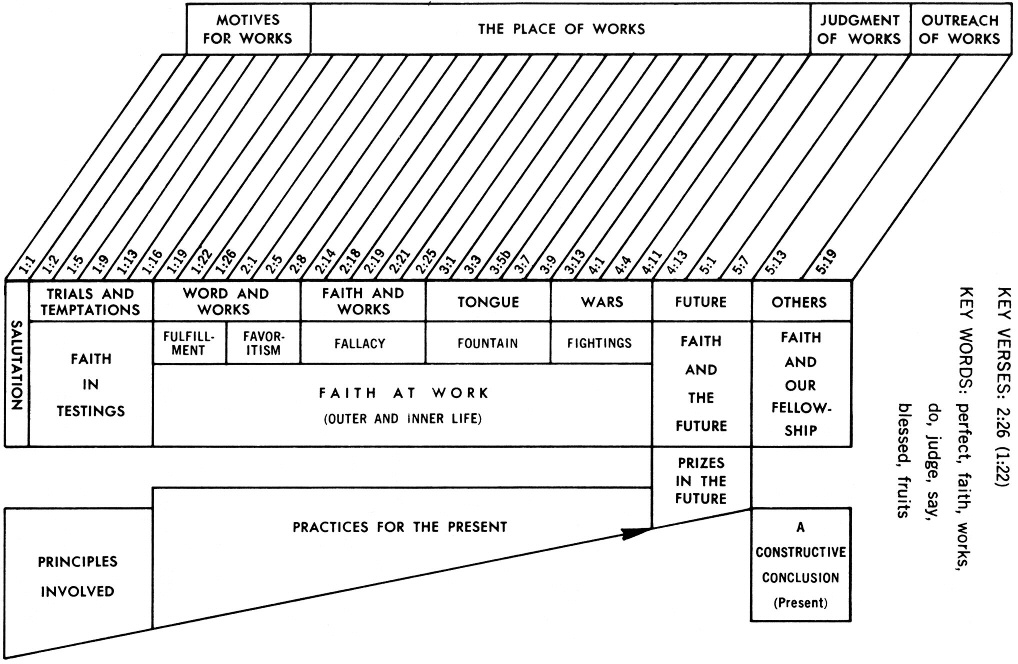
Click chart to enlarge
Chart from recommended resource Jensen's Survey of the NT - used by permission
See also Overview Chart by Charles Swindoll
|
JAMES |
|||||||
| Motives for Works |
The Place of Works: Outward Demonstration of Inner Faith |
Outreach of Works |
|||||
| Jas 1:1-18 | Jas 1:19-2:13 | Jas 2:14-25 | Jas 3:1-12 | Jas 3:13-4:12 | Jas 4:13-5:12 | Jas 5:13-19 | |
| Trials & Temptations |
Word & Works |
Faith & Works |
Tongue | Wars | Future | Others | |
|
Faith |
Fulfill |
Favor |
Fallacy |
Fountain |
Factions |
Faith |
Faith |
|
FAITH AT WORK |
|||||||
The Theme: The Testings of Personal Faith
The trials of the believer (James 1:2–12)
A. The proper attitude toward trials (James 1:2–4)
1. The attitude commanded (James 1:2)
2. The reason indicated (James 1:3)
3. The outcome to be realized (James 1:4)
B. The use of prayer amid trials (James 1:5–8)
1. The need for wisdom (James 1:5a)
2. The request for wisdom (James 1:5b)
3. The bestowal of wisdom (James 1:5c–8)
a. The divine response (James 1:5c)
b. The human obligation (James 1:6–8)
(1) The necessary attitude (James 1:6a)
(2) The rejected character (James 1:6b–8)
C. The correct attitude toward life by the tried (James 1:9–11)
1. The attitude of the lowly brother (James 1:9)
2. The attitude of the rich (James 1:10–11)
a. The reason for the attitude (James 1:10a)
b. The illustration from the flower (James 1:11a)
c. The application to the rich (James 1:11b)
D. The result of enduring trials (James 1:12)
1. The blessedness of endurance (v 12a)
2. The reward of endurance (James 1:12b)
The nature of human temptation (James 1:13–16)
A. The source of human temptation (James 1:13–14)
1. The repudiation of a divine source (James 1:13)
a. The rejection stated (James 1:13a)
b. The rejection vindicated (James 1:13b)
2. The reality of the human source (James 1:14)
B. The consequences of yielding to temptation (James 1:15)
C. The warning against being deceived (James 1:16)
The activity of God in human affairs (James 1:17–18)
A. The Giver of all good gifts (James 1:17)
B. The Author of the believer’s regeneration (James 1:18)
The Test Marks of a Living Faith
Faith tested by its response to the Word of God (James 1:19–27)
A. The reactions to the Word (James 1:19–20)
1. The knowledge possessed (James 1:19a)
2. The reaction demanded (James 1:19b)
3. The reason stated (James 1:20)
B. The reception of the Word (James 1:21)
1. The stripping off of sins (James 1:21a)
2. The appropriation of the Word (James 1:21b)
C. The obedience to the Word (James 1:22–27)
1. The demand for active obedience (James 1:22–25)
a. The statement of the requirement (James 1:22)
b. The illustration of the requirement (James 1:23–25)
(1) The negative portrayal (James 1:23–24)
(2) The positive portrayal (James 1:25)
2. The nature of acceptable obedience (James 1:26–27)
a. The futility of activity without inner control (James 1:26)
b. Acceptable service with inner control (James 1:27) (from Hiebert - James Commentary)
James 1:3 knowing that the testing of your faith produces endurance. (NASB: Lockman)
Greek: ginoskontes (PAPMPN) hoti to dokimion humon tes pisteos katergazetai (3SPMI) hupomonen;
BGT γινώσκοντες ὅτι τὸ δοκίμιον ὑμῶν τῆς πίστεως κατεργάζεται ὑπομονήν.
Amplified: Be assured and understand that the trial and proving of your faith bring out endurance and steadfastness and patience. (Amplified Bible - Lockman)
Amplified Be assured that the testing of your faith [through experience] produces endurance [leading to spiritual maturity, and inner peace]. (Revised)
Barclay: for you are well aware that the testing of your faith produces unswerving constancy. (Daily Study Bible)
KJV: Knowing this, that the trying of your faith worketh patience.
ERV You know that when your faith is tested, you learn to be patient in suffering.
EASY God wants to see (ED: TO SHOW YOU) if you really trust him. Your faith in God will become stronger as a result of these troubles.
GNT for you know that when your faith succeeds in facing such trials, the result is the ability to endure.
MSG You know that under pressure, your faith-life is forced into the open and shows its true colors.
NET because (hoti) you know that the testing of your faith produces endurance.
NLT For (hoti) you know that when your faith is tested, your endurance has a chance to grow. (Revised edition)
NLT: For (hoti when your faith is tested, your endurance has a chance to grow. (First edition - NLT - Tyndale House)
NLV You know these prove your faith. It helps you not to give up.
ESV for you know that the testing of your faith produces steadfastness.
NIV because you know that the testing of your faith develops perseverance.
BBE Because you have the knowledge that the testing of your faith gives you the power of going on in hope;
NIRV Your faith will be put to the test. You know that when that happens it will produce in you the strength to continue.
Phillips: Realise that they come to test your faith and to produce in you the quality of endurance. (Phillips: Touchstone)
Wuest: knowing experientially that the approving of your faith, that faith having been put to the test for the purpose of being approved, and having met the test, has been approved, produces a patience which bears up and does not lose heart or courage under trials.
Young's Literal: knowing that the proof of your faith doth work endurance,
KNOWING THAT THE TESTING OF YOUR FAITH PRODUCES ENDURANCE: ginoskontes (PAPMPN) hoti to dokimion humon tes pisteos katergazetai (3SPMI) hupomonen:
- Romans 5:3,4; 8:28; 2Co 4:17
- Ro 2:7; 8:25; 15:4; Col 1:11; 2Th 1:4; 3:5; Heb 10:36; 12:1; 2Pe 1:6
- James 1 Resources - Multiple Sermons and Commentaries
KNOWING MOTIVATES
OBEYING
Knowing (ginosko - present tense) that the testing (dokimion) of your faith (pistis) produces (katergazomai -- present tense - continually produces) endurance (hupomone) - The Greek text is better rendered "because you know". Why is that a better translation? The Greek has the coordinating conjunction "hoti" which can mean because or for this reason which is a nuance not clearly seen in the NASB translation. James is therefore giving believers the reason they can (should) obey the difficult command to “consider it all joy” when trials come (James 1:2). Ultimately the fruit of obedience is that rejoicing in trials yields the blessed fruit of endurance. This endurance is not "grin and bear it," but is a supernatural work of the Spirit Who gives the believer a greater capacity to "bear up under the load" (so to speak). Such growth in endurance is important because of the word "when," (not "if") in James 1:2 which indicates that trials are destined to come into our life! So the question is how will we respond when they come?
THOUGHT - Knowing means coming to know by personal observation and experience. How are you going to know by experience unless you remain in the furnace of affliction? This is the ONLY way of getting this view of the value of TRIALS.
We are here to be perfected,
Only God our needs can see;
Rarest gems bear hardest grinding,
God's own workmanship are we.
—Anon.
Paul records a similar truth in Romans 5...
And not only this, but we also exult (kauchaomai - present tense) in our tribulations (thlipsis), knowing that tribulation brings about (katergazomai - present tense) perseverance (hupomone); 4 and perseverance, proven character (dokime); and proven character, hope (elpis); 5 and hope does not disappoint, because the love of God has been poured out (ekcheo) within our hearts through the Holy Spirit Who was given to us. (Ro 5:3-5+)
Thomas Manton explained that "Trial is not only to approve, but to improve."
The genuine element in the faith of James' readers would be proven by a process similar to that of metal refining and ultimately would be found to be something more precious than even these precious metals. The trials would lead to a purging and purifying of this faith.
Johnstone explains that...
Affliction lets down a blazing torch for him into the depths of his own nature—and he sees many things which he little expected to see. He finds his faith weak where he thought it strong, his views dim where he thought them clear. (R Johnstone. Lectures Exegetical and Practical on the Epistle of James)
As Matthew Henry says "the faith of good people is tried, that they themselves may have the comfort of it, God the glory of it, and others the benefit of it.
J. Vernon McGee adds
When God tests us today, He puts us into the furnace. He doesn’t do that to destroy us or to hurt or harm us. But He wants pure gold, and that is the way He will get it. Friend, that is what develops Christian character. At the time of testing, the dross is drawn off and the precious gold appears. That is God’s method. That is God’s school. We don’t hear that teaching very much in our day. Rather, we are being taught to become sufficient within ourselves. Oh, my friend, you and I are not adequate; we are not sufficient, and we never will be. We simply come to God as sinners, and He saves us by His grace through the blood of Christ. Then He wants to live His life through us. He tries to teach us this through our trials. He is drawing us closer to Him. (McGee, J V: Thru the Bible Commentary: Thomas Nelson)
Roger M. Raymer writes on the topic of trials in 1 Peter says that "Knowledge alone cannot produce the great joy of experiential security and freedom from fear in the face of persecution. God’s omnipotent sovereignty needs to be coupled with human responsibility. Christians are responsible to respond in faith. Faith turns sound doctrine into sound practice. Faith acts on the content of theology and produces conduct that corresponds to that content. Faith makes theological security experiential. The Apostle John wrote, “This is the victory that has overcome the world, even our faith” (1Jn 5:4). This kind of faith or living hope can enable believers to rejoice even when they are called on to suffer grief. (See The Bible Knowledge Commentary - Page 28)
Genuine faith is indestructible. Job suffered more intense "multi colored trials" in one day than probably any other individual in history and yet he was able to say
Though He slay me, I will hope (wait for) in Him. (Job 13:15)
Warren Wiersbe comments that "This is one of the greatest declarations of faith found anywhere in Scripture, but it must be understood in its context. Job is saying, “I will take my case directly to God and prove my integrity. I know I am taking my life in my hands in approaching God, because He is able to slay me. But if He doesn’t slay me, it is proof that I am not the hypocrite you say I am." (Bible Exposition Commentary)
Later Job declared "He (God) knows the way I take. When He has tried me, I shall come forth as gold." (Job 23:10)
God knew that Job was in the furnace of affliction, but it was a furnace of God’s appointment and was not because of Job’s sin. Furthermore, God would use Job’s affliction to purify him and make him a better man. This is not the only answer to the frequently asked question, “Why do the righteous suffer?” but it is one of the best, and it can bring the sufferer great encouragement.
When God puts His own people into the furnace,
He keeps His eye on the clock and His hand on the thermostat.
Warren Wiersbe aptly describes the process of divine testing writing that - When God puts His own people into the furnace, He keeps His eye on the clock and His hand on the thermostat. He knows how long and how much. (If we rebel, He may have to reset the clock; but if we submit, He will not permit us to suffer one minute too long. The important thing is that we learn the lesson He wants to teach us and that we bring glory to Him alone.) We may question why He does it to begin with, or why He doesn’t turn down the heat or even turn it off; but our questions are only evidences of unbelief. (Job 23:10) is the answer: “But He knows the way that I take; when He has tested me, I shall come come forth as gold” (NKJV). Gold does not fear the fire. The furnace can only make the gold purer and brighter." (Bible Exposition Commentary)
Shadrach, Meshach and Abed-nego were literally tested by an "extremely hot...furnace of blazing fire". The Babylonian furnace proved their faith to be real and burned away the ropes that held them, setting them free. King Nebuchadnezzar in utter astonishment observed four men loosed and walking about in the midst of the fire without harm and the appearance of the fourth is like a son of the gods. (Da 3:22+) In their "multi colored fiery trial", they also came to experience the companionship of a fourth Person in the fire Who many consider to be “the Son of God” Who provided just the right "color" of grace to meet their need. (Da 3:12-30+)
A dark hour makes Jesus bright.
--Robert Murray M'Cheyne
Gold is tested by fire
Man is tested by adversity
Ray Pritchard (see full sermon) on the reason we can/should consider our trials "all joy":
“Because you know that the testing (dokimon) of your faith develops perseverance” (James 1:3). Every word of this verse is crucial. The phrase “you know” refers not to head knowledge (what we sometimes call “book learning”) but to heart knowledge, the kind gained by years of experience. Some things we learn from books, others we learn in the School of Hard Knocks. This lesson comes from daily life. God wants to put our faith to the test. The word “testing” (dokimon) refers to the process by which gold ore was purified. In order to separate the gold from the dross, the ore was placed in a furnace and heated until it melted. The dross rose to the surface and was skimmed off, leaving only pure gold. That’s a picture of what God is up to in our “fiery trials.” We all have to undergo some “furnace time” sooner or later. And some of us will spend an extended time in the furnace of affliction. But the result is the pure gold of Christlike character. Job spoke of this experience when he declared of the Lord, “He knows the way that I take; when he has tested me, I will come forth as gold” (Job 23:10).
What is God trying to do when he allows his children to go through hard trials and deep suffering? There are several answers to that question.
First, God wants to purge us of sin and to purify us of iniquity.
Second, God uses suffering to test our faith. Will you still obey God in the darkness? Will you serve God when things aren’t going your way? Will you hold on to the truth when you feel like giving up?
Third, God uses times of difficulty to humble us. When things are going well, we tend to get puffed up about our accomplishments. But let the darkness fall and we are on our knees crying out to God.
Fourth, God definitely uses hard times to prepare us to minister to others. He comforts us so that we may comfort others. I know many Christians whose greatest ministry has come from sharing with others how God helped them through a time of crisis.
Fifth, I believe God uses hard times to prepare us for a new understanding of his character. In the furnace we discover God’s goodness in a way we had never experienced it before.
You can talk about heaven all you want, but you’ll discover
whether or not you believe in it when you stand by the casket of someone you love.
Until your faith is put to the test, it remains theoretical. You never know what you believe until hard times come. Then you find out, for better or for worse. When the phone rings with bad news, when your son winds up in prison, when your best friend betrays you, when you lose your job, when your parents suddenly die, when life comes apart at the seams, then you discover what you truly and actually believe in the depth of your soul. Until then, your faith is speculative because it is untested. You can talk about heaven all you want, but you’ll discover whether or not you believe in it when you stand by the casket of someone you love.
it describes a certain kind of “battle-tested” faith that stands up
under withering fire from the enemy and does not cut and run.
God’s great design is to produce “perseverance.” The Greek word is hupomone, sometimes translated as “endurance” or “steadfastness” or “patience.” In the book of Revelation, this word describes the faith of those brave saints who would not take the Mark of the Beast. Thus it describes a certain kind of “battle-tested” faith that stands up under withering fire from the enemy and does not cut and run. William Barclay notes that in the early church the martyrs gained the respect of unbelievers because in the moment of death, they had this quality. To the very end, they died with their faith intact. Of them it was said, “They died singing.”
Pastor Steven Cole on knowing that the testing of your faith produces endurance....
"We should understand a reassuring truth in trials: “Knowing that the testing of your faith produces endurance” (Jas 1:3). There are two aspects to this reassuring truth:
(1). God is Sovereign over every trial.
The verse implies that God is using the trials for His purpose. He is not sitting in heaven saying, “I didn’t want that to happen, but now that it has happened, let’s see how we can make the best of a bad situation!” Scripture is clear that God is sovereign over everything, from the rain and snow that fall (Job 37:6-13), to seemingly random events (the lot, Pr 16:33), to the events of nations (Ps. 22:28; Acts 14:16; 17:26). On the personal level, He ordained all of the days of our lives before we were ever born (Ps 139:16). He fashions our hearts (Ps 33:14, 15) and orders our steps (Ps 37:23; Pr 16:9; 20:24). There are some radical Arminians (“Open Theism”) who try to get God off the hook when it comes to trials, saying, “This was not in His plan.” They argue that God does not control (or even know in advance!) the choices we make. But the Bible affirms that God is sovereign over birth defects (Ex 4:11), natural disasters (Ge 6:17; Jon 1:4), and even over the evil things that people do, although He is not responsible for their sin (Ge 50:20; Ex 4:21; 1Ki 22:23; Is 10:5; Acts 4:27, 28). It robs people of comfort and creates a very scary world, where evil is out of control, to deny God’s sovereignty over trials, because it denies that He is purposefully working those trials for our ultimate good (Ro 8:28+, Ge 50:20). The hymn writer had it right:
Every joy or trial falleth from above
Traced upon our dial by the Sun of Love
We may trust Him fully all for us to do.
They who trust Him wholly find Him wholly true.
Refrain
Stayed upon Jehovah, hearts are fully blest
Finding, as He promised, perfect peace and rest.
(Frances Havergal, Play Like a River Glorious).
(2). God is using the trials to test our faith to produce endurance.
When we endure trials by faith,
our faith is stronger for the next trial.
Testing is like the refining of a metal: it produces a better product through the process. Endurance is the better translation here. It means to stand fast or persevere. R. C. Trench, says that the Greek word translated “patience” (makrothumia) is used with respect to persons, whereas “endurance” (hupomeno) refers to things (ED: OR CIRCUMSTANCES). Thus the man is patient who is not easily provoked or angered by difficult people, whereas the man endures who does not lose heart under great trials. We might call it “spiritual toughness” (Hughes, p. 19). Picture an athlete who pushes himself to build up strength and endurance for an upcoming race. If it’s a 10k run, he may start with 5k and gradually extend his distance and speed. If he’s serious about winning, he will be running farther than 10k before the race, so that the race will seem easier than what he is conditioned for. In the same way, when we endure trials by faith, our faith is stronger for the next trial. We know that we can endure, because we’ve already been through previous trials. And when we endure trials by faith, with joy, it brings glory to our Lord and Savior. Thus when we encounter trials, we should adopt the radical attitude of counting it all joy. We should understand the reassuring truth, that our sovereign God is using it to develop enduring faith. (James 1:1-4 A Radical Approach to Trials) (Bolding added)
Knowing (1097) (ginosko [ginōskō]; English derivatives - prognosis, gnostic, Gnosticism) means to acquire information through some modality, as through sense perception (hearing). However ginosko involves experiential knowledge, not merely the accumulation of known facts. Ginosko is one of the major verbs of the Bible and because of its numerous uses, it is not surprising that Greek lexicographers ascribe a number of nuances of meaning including to get to know, come to understand, to ascertain, to have intimate relations with another, etc. The various meanings are outlined, discussed and illustrated in the notes that follow. Keep in mind that the basic meaning of ginosko is to know by experience.
Knowledge possessed through the intellectual process of learning is one thing. Knowledge gained by experience, by an active relationship between the one who knows and the person or thing known, is far superior to the former. Ginosko describes the latter quality of knowledge and is what every Christ follower should desire as their personal, permanent possession regarding the Person of Christ (e.g., see ginosko in Jn 8:32, Jn 17:3, Php 3:10).
In many of the NT uses ginosko refers not just to knowledge in a secular sense but to spiritual knowledge. As Puritan Stephen Charnock said "A man man be theologically knowing (Ed: "Pharisee-like") and spiritually ignorant. (See discussion of Jn 7:17 below which clearly links spiritual gnosis or knowledge with obedience.) In a related aphorism Charnock quipped that "Knowledge in the head is as money in the purse; knowledge in the heart is as money for our use."
A common definition in many references is "to know by experience or observation." This definition of ginosko is seen in James 1:4 MacArthur commenting that "As Christians, we know from our own experience, as well as from God’s Word, that the testing of [our] faith produces endurance. We have learned that His promise is indeed true, for, after we have endured suffering, affliction, or testings, we have discovered that our trust in the Lord is not only intact but is all the stronger for the testing. (Macarthur J. James. Moody)
Ginosko is when you experientially learn something, either in a classroom or more often in the "classroom of life". Ginosko is that knowledge that comes by obeying the Lord. You may intellectually know some truth but you don’t really "know" it experientially until you surrender and obey the truth. In other words ginosko speaks of knowledge that goes beyond the merely factual and into the realm of the experiential (Christianity is to be "felt"!).
By extension, ginosko was used of the intimate relationship between husband and wife (see Mt 1:25 below) and between God and His people (Jn 17:3). Stated another way ginosko frequently implies an active relation between the one who knows and the person known.
Charles Swindoll adds that ginosko "refers to intelligent comprehension with an emphasis on the process or act of knowing. Throughout John’s literature, “knowing” and “obeying” are inseparable (as they are in Old Testament literature). In the Upper Room, Jesus placed great emphasis on His followers knowing the mind of God so they might become integral to His redemptive plan. The disciples struggled with lack of understanding until they received the Holy Spirit. (Insights on John)
Robertson McQuilkin in his subsection "Prerequisites for Interpreting Scripture" has this comment on John 7:17
Regeneration is essential (Ed: To enable one to interpret Scripture - 1Co 2:11,12, 14, 15, 16), but it alone will not qualify the believer to understand the truth of God. The believer must have confidence in Scripture, for faith is not mere intellectual assent. Rather, faith means commitment, yielding to the Book; to its message, its meaning, and its divine Author. Faith predisposes one to discover the meaning the biblical writer intended, not to read into the text his own desired meaning. Only the one with full confidence in the Scripture will make the commitment necessary to fully understand its meaning.
If any man is willing to do His will, he shall know of the teaching, whether it is of God, or whether I speak from Myself. (John 7:17)
A person must be determined to obey the Word if he expects to understand it. (Ed: In other words knowing [ginosko] God's Word is integrally related to obeying God's Word. To jettison the latter and expect the former to be successful is a delusion!) Commitment to obedience has another characteristic: hard work. The person truly committed to obey God will study to show himself approved to God, a hard worker who has no need to be ashamed of his workmanship. "Faith" does not mean the Bible student lays aside his intellect and relies on feelings or subjective impulses to understand Scripture. No, the kind of faith that believes the Bible is God's own Word will drive the student to use all the resources God has given him to understand Scripture so that he may obey it....
Some people do not understand the Bible because they do not believe it is true, or at least, they do not believe that all parts of it are true. Others do not understand (Ed: They have "No ginosko" knowledge) it because they are unwilling to obey it. (Understanding and Applying the Bible - recommended) .
Vine writes that...
In the NT ginosko frequently indicates a relation between the person “knowing” and the object known; in this respect, what is “known” is of value or importance to the one who knows, and hence the establishment of the relationship, e.g., especially of God’s “knowledge,” 1Cor 8:3, “if any man love God, the same is known of Him”; Gal 4:9, “to be known of God”; here the “knowing” suggests approval and bears the meaning “to be approved”; so in 2Ti 2:19; cf. Jn 10:14, 27; Ge 18:19; Nah 1:7; the relationship implied may involve remedial chastisement, Amos 3:2. The same idea of appreciation as well as “knowledge” underlies several statements concerning the “knowledge” of God and His truth on the part of believers, e.g., Jn 8:32; 14:20, 31; 17:3; Gal. 4:9 (1st part); 1Jn 2:3-13, 14; 4:6, 8, 16; 5:20; such “knowledge” is obtained, not by mere intellectual activity, but by operation of the Holy Spirit consequent upon acceptance of Christ.
Carpenter differentiates two similar words for know in Greek -- Eido, related to the Greek word for “seeing,” denotes “perception” and “absolute knowledge.” Once something is known, it is known for good—nothing can be added to it. Ginosko denotes “inceptive and ongoing knowledge.” It designates ongoing, personal knowledge, which implies a relationship between the person who knows and the person who is known. This knowledge can grow and mature. By way of illustration, we can “know” (eido) someone’s name immediately, but it will take a lifetime to really “know” (ginosko) that person. (Ed: In fairness not all resources do not make clear cut distinctions between these two verbs. See more discussion below)
Donald Grey Barnhouse has the following summary of the nuances of ginosko -- The Greek verb ginosko occurs many times in the New Testament, with a dozen shades of meaning. To know is to feel (Mark 5:29; Luke 8:46); to observe (Mark 8:17; 12:12); to perceive, discern, recognize (Luke 7:39; Gal. 3:7; John 4:1; 5:6); to learn, discover (Mark 5:43; Phil 1:12; 4:5); to make certain (Mark 6:38; John 4:53); to be aware of (Matt. 24:50; Heb. 10:24); to be acquainted with (Matt. 25:24; Ro 2:18); to comprehend (Luke 18:34; John 3:10); to be expert in (Matt. 16:3); to be familiar with (Ro 7:7); and to decide (Luke 16:4). (God's Glory : Romans 14:13-16:27).
Louw Nida summarizes the different nuances of meaning of ginosko in the NT as follows...
1) To know, recognize, be aware (Ro 1:21) - to possess information about, to have knowledge of, to be acquainted with
2) To learn, acquire information, implying personal involvement or experience (Mk 6:38)
Mounce adds that Ginosko "can mean “to learn” or “to possess factual knowledge.” For example, Paul tells the Ephesian Christians that he is sending Tychicus to tell them how he is doing, that they may “know” how he is (Eph 6:22; see also Mt 6:3; Mk 15:10; Jn 19:14; Rom 6:6; Phil 4:5; Col 4:8; Jas 5:20; 2Pet. 1:20).
It can also refer to learning something by observation or noticing something. For example, when Jesus was twelve years old and his parents took him to Jerusalem, they did not “know” he was not with them on the return trip to Galilee (Lk 2:43). When Paul spoke before the Sanhedrin, he came to “know” (i.e., notice, realize) that some of them were Pharisees and some were Sadducees, and this observation provided him an avenue to introduce confusion into the meeting of his accusers (Acts 23:6; see also Lk 1:22; Jn 4:53; Acts 19:34; 21:24). (Mounce's Complete Expository Dictionary of Old and New Testament Words)
3) To be familiar with, learn to know, through personal experience (Jn 17:3; 1Jn 2:3) - to learn to know a person through direct personal experience, implying a continuity of relationship
4) To understand, come to know, perceive (Ro 7:7) - to come to an understanding as the result of ability to experience and learn
5) To acknowledge or to indicate that one does know (1Co 8:3)
6) To have sexual intercourse (Mt 1:25; Lk 1:34);
7) To do secretly (Mt 6:3) - to do something without letting the public know. (Louw, J. P., & Nida, E. A. Greek-English Lexicon of the New Testament: Based on Semantic Domains. United Bible societies)
BDAG summarizes ginosko as follows...
1) To arrive at a knowledge of someone or something - to know, know about, make acquaintance of (Mt 13:11, Mk 4:11, Lk 8:10, Lk 12:47, Jn 8:32 -see note below, Ro 7:7-see note below, 2Co 2:4)
2) To acquire information through some means, learn (of), ascertain, find out (Acts 22:30, Col 4:8, 1Th 3:5, Acts 9:24, Mt 9:30)
3) To grasp the significance or meaning of something, understand, comprehend (Mt 24:39, 21:45, 24:32 Mk 4:13, 12:12; Lk 18:34;Ac 8:30. Jn 3:10; 10:6, 12:16; Jn 8:27, 28, 43; 1Cor 2:8;11; 14)
4) To be aware of something, perceive, notice, realize (Mt 22:18, Lk 8:46, Mt 16:8; 26:10; Mk 8:17.
5) To have sexual intercourse with (Mt 1:25-see note below, Lk 1:34 - see note below; Lxx of Ge 4:1)
6) To have come to the knowledge of, have come to know, know
7) To indicate that one does know - acknowledge, recognize. (Mt 7:23, Jn 1:10) (Arndt, W., Danker, F. W., & Bauer, W. A Greek-English Lexicon of the New Testament and Other Early Christian Literature)
Nelson Study Bible says ginosko "can designate ongoing, personal knowledge, which implies a relationship between the knower and the person who is known." (The Nelson Study Bible: NKJV)
Ginosko - 222x in 205v -Mt 1:25; 6:3; 7:23; 9:30; 10:26; 12:7, 15, 33; 13:11; 16:3, 8; 21:45; 22:18; 24:32f, 39, 43, 50; 25:24; 26:10; Mark 4:13; 5:29, 43; 6:38; 7:24; 8:17; 9:30; 12:12; 13:28f; 15:10, 45; Luke 1:18, 34; 2:43; 6:44; 7:39; 8:10, 17, 46; 9:11; 10:11, 22; 12:2, 39, 46ff; 16:4, 15; 18:34; 19:15, 42, 44; 20:19; 21:20, 30f; 24:18, 35; John 1:10, 48; 2:24f; 3:10; 4:1, 53; 5:6, 42; 6:15, 69; 7:17, 26f, 49, 51; 8:27, 28, 32, 43, 52, 55; 10:6, 14f, 27, 38; 11:57; 12:9, 16; 13:7, 12, 28, 35; 14:7, 9, 17, 20, 31; 15:18; 16:3, 19; 17:3, 7f, 23, 25; 19:4; 21:17; Acts 1:7; 2:36; 8:30; 9:24; 17:13, 19f; 19:15, 35; 20:34; 21:24, 34, 37; 22:14, 30; 23:6; Rom 1:21; 2:18; 3:17; 6:6; 7:1, 7, 15; 10:19; 11:34; 1 Cor 1:21; 2:8, 11, 14, 16; 3:20; 4:19; 8:2f; 13:9, 12; 14:7, 9; 2 Cor 2:4, 9; 3:2; 5:16, 21; 8:9; 13:6; Gal 2:9; 3:7; 4:9; Eph 3:19; 5:5; 6:22; Phil 1:12; 2:19, 22; 3:10; 4:5; Col 4:8; 1Th 3:5; 2Ti 1:18; 2:19; 3:1; Heb 3:10; 8:11; 10:34; 13:23; Jas 1:3; 2:20; 5:20; 2 Pet 1:20; 3:3; 1 John 2:3ff, 13f, 18, 29; 3:1, 6, 16, 19f, 24; 4:2, 6ff, 13, 16; 5:2, 20; 2 John 1:1; Rev 2:23f; 3:3, 9
Ginosko in the NAS - ascertaining(1), aware(7), certainty(1), come to know(1), comprehend(1), felt(1), find(3), found(2), kept...a virgin*(1), knew(13), know(104), know how(1), knowing(3), known(25), knows(14), learn(1), learned(1), perceived(1), perceiving(2), put(1), realize(3), recognize(7), recognized(1), recognizing(1), sure(4), take notice(1), unaware*(2), understand(11), understood(6), virgin*(1).
Ginosko is used over 500x in the non-apocryphal Septuagint (Lxx). Gen 2:17; 3:5, 7, 22; 4:1, 9, 17, 25; 8:11; 9:24; 12:11; 15:8, 13; 18:21; 19:8; 20:6f; 21:26; 22:12; 24:14, 16, 21, 44; 27:2; 29:5; 30:26, 29; 33:13; 38:9, 16, 26; 39:8, 23; 42:33f; 44:27; Exod 2:25; 6:7; 7:5, 17; 9:29; 10:2; 14:4, 18; 16:6, 12; 18:11; 22:10; 25:22; 29:42, 46; 30:6, 36; 31:13; 33:13; Lev 4:14, 23, 28; 5:3f, 17; Num 11:23; 12:6; 14:34; 16:5, 28, 30; 17:4; 22:19; 31:17, 35; 32:23; Deut 4:39; 7:9, 15; 8:5; 9:3, 6, 24; 11:2; 18:21; 29:6; 34:10; Josh 3:7, 10; 4:24; 22:22, 31; 23:13f; Jdg 2:7, 10; 3:1f, 4; 4:9; 6:29, 37; 11:39; 13:16, 21; 14:4, 18; 16:9, 20; 17:13; 18:5, 14; 19:22, 25; 20:34; 21:12; Ruth 3:4, 14; 4:4; 1 Sam 1:19; 2:10; 3:7, 20; 4:6; 6:9; 10:24; 12:17; 14:29, 38; 17:46f; 20:3, 7, 9, 33, 39; 21:2; 22:3, 6, 17; 23:9, 22f; 24:11, 20; 25:17; 26:4, 12; 28:1f, 14; 2 Sam 3:25, 36f; 5:12; 14:1, 20, 22; 15:11; 17:19; 18:29; 19:6, 20, 35; 22:44; 24:2, 13; 1 Kgs 1:4, 11, 18; 2:5, 9, 32, 35, 37, 42, 44; 8:38f, 43, 60; 17:24; 18:36f; 20:7, 13, 22, 28; 2 Kgs 2:3, 5; 4:1, 9, 39; 5:7f, 15; 7:12; 17:26; 19:19, 27; 1 Chr 12:32; 14:2; 21:2; 28:9; 29:17; 2 Chr 6:29f, 33; 12:8; 13:5; 25:16; 32:13; 33:13; Ezra 4:15; 5:17; Neh 2:16; 4:11, 15; 6:16; 9:10; 13:10; Esth 4:11, 17; Job 5:24f, 27; 9:11; 11:6; 12:9, 20; 19:3, 6, 13, 29; 20:4; 21:19; 22:13; 23:3, 5; 24:14; 28:7; 34:4, 33; 35:15; 36:5, 26; 37:7; 39:1; Ps 1:6; 4:3; 9:10, 16, 20; 14:3f; 18:43; 20:6; 35:8, 11, 15; 36:10; 37:18; 39:4, 6; 40:9; 41:11; 44:21; 46:10; 48:3; 50:11; 51:3; 53:4; 56:9; 59:13; 67:2; 69:5, 19; 71:15; 73:11, 16, 22; 74:4, 9; 77:19; 78:3, 6; 79:6, 10; 81:5; 82:5; 83:18; 87:4; 88:12; 89:15; 90:11; 91:14; 92:6; 94:11; 95:10; 100:3; 101:3; 103:14; 104:19; 109:27; 119:75, 79, 125, 152; 135:5; 138:6; 139:1f, 4, 14, 23; 140:12; 142:3; 144:3; Pr 1:2; 4:1; 9:10; 10:9; 13:15, 20; 15:14; 22:17; 24:12, 22; 27:1; 29:20; 30:3f; Eccl 1:17; 2:14; 3:12, 14; 4:13; 6:5, 10; 7:25; 8:5, 7, 12, 16f; 9:5, 11f; 10:14f; 11:2, 5f, 9; Song 1:8; 6:12; Isa 1:3; 5:19; 7:15f; 8:4, 9; 9:9; 11:9; 15:4; 19:21; 26:11; 29:15, 24; 30:15; 33:13; 37:20; 40:13, 21, 28; 41:20, 22f, 26; 42:16, 25; 43:10, 19; 44:18ff; 45:3f, 6, 20f; 47:8, 10f; 48:4, 6ff; 49:23; 50:4, 7; 51:12; 52:6; 56:10; 58:2f; 59:12; 60:16; 61:9; 63:16; 66:14; Jer 2:16, 19, 23; 3:13; 5:1, 4; 6:15, 27; 8:7; 9:3, 16, 24; 11:18f; 12:3; 13:12; 14:20; 15:12, 15; 16:21; 17:9; 18:23; 22:16; 26:15; 28:9; 30:24; 31:19, 34; 32:8; 33:3; 36:19; 38:24; 40:14f; 41:4; 42:19; 44:3, 15, 28; 48:30; 50:24; Ezek 2:5; 6:13; 7:27; 10:20; 12:15f; 13:9, 23; 17:24; 20:5, 9, 12, 20; 22:16; 23:49; 26:6; 28:22ff, 26; 29:6, 9, 16, 21; 30:8, 19, 25f; 32:9, 15; 33:29, 33; 34:15, 27, 30; 35:4, 9, 11f, 15; 36:11, 23, 36, 38; 37:6, 13f, 28; 38:16, 23; 39:6ff, 22f, 28; Dan 1:4; 2:3, 9, 22, 30; 3:15; 4:9, 17, 25f, 32; 5:21ff; 6:10, 15; 9:25; 10:20; 11:32, 38; 12:7; Hos 2:8; 5:3; 6:3; 7:9; 8:2; 9:2; 11:3, 12; 13:4; Amos 3:2, 10; 5:12; Jonah 1:10, 12; 4:2, 11; Mic 3:1; 4:9, 12; 6:5; Nah 1:7; 3:17; Hab 2:14; 3:2; Zeph 3:5; Zech 2:9; 4:5; 6:15; 7:14; 11:11;
If anyone is willing to do His will, he will know (ginosko) of the teaching, whether it is of God or whether I speak from Myself. (Jn 7:17)
Comment: This verse teaches that there is a process in getting spiritual knowledge and it primarily involves my obedience to the Word of God. As I obey the truth I have heard, I began to "assimilate" that truth. Thus Jesus clearly associates the obtaining of experiential knowledge (ginosko) with a willingness to obey God's will. This virtue involves a diligent study and pursuit of truth in the Word of God. This kind of knowledge does not come automatically but calls for obedience.
Thomas Adams related knowing with obedience when he said that "Practice is the soul of knowledge."
So Jesus was saying to those Jews who had believed Him, “If you continue (remain, abide, remaining in the sphere of and under the influence of the Word of God) in My word, then you are truly disciples of Mine; 32 and you will know (ginosko) the truth, and the truth will make you free (eleutheroo).” (Jn 8:31-32).
Swindoll: The Greek word is ginosko, one of at least four terms John could have chosen to mean “know.” Unlike the others, ginosko stresses understanding rather than mere sensory observation. It is closely related to the Hebrew verb yada, which Jesus likely used, and describes the most intimate kind of knowledge (Ed: Lxx uses ginosko in Ge 3:5; In Ge 4:1 ginosko = intimate relation between man and wife). Moreover, as one “knows” the truth, he or she is “made free.” The Greek term (eleutheroo) suggests release from indentured servanthood. When someone in the ancient world became indebted beyond his or her means of paying, one solution was to exchange a term of slavery for relief from the debt. Sometimes the length of service could be the rest of one’s natural life. The indebtedness Jesus spoke of here, of course, is the penalty for sin; the freedom is spiritual release from judgment and the free gift of eternal life. Jesus’ statement that “the truth will make you free” has become something of a truism, and rightly so. While His primary point was spiritual and eternal, it is a fact that truth leads to freedom in the physical, temporal realm. Any recovering alcoholic will affirm this by experience. Any drug addict who has been “clean and sober” for a number of years will say the same. As they came to terms with the truth of their cravings, the truth of their origins and influences, and the truth of their personal responsibilities, they found freedom. In fact, any repentant sinner will affirm the power of truth to liberate—including the one writing these words! (Swindoll, C. R. Insights on John. Grand Rapids, MI: Zondervan)
I am the good shepherd, and I know (ginosko) My own and My own know (ginosko) Me, even as the Father knows (ginosko) Me and I know (ginosko) the Father; and I lay down My life for the sheep. (Jn 10:14, 15+)
Comment: Ginosko is used 4 times in these 2 verses. To “know” in this context means to have an intimate relationship built on experience and those who refuse to know Jesus in this way are “of the world” and are not "saved" (regenerate, born again. See Jn 1:10).
Mounce writes that "John especially has a rich view of what it means to “know.” When Jesus says he knows his sheep and he knows the Father, he is speaking of an intimate relationship that involves deep feelings of love (Jn 10:14, 15). Such a relationship leads to obedience on our part (Jn 10:27). “Those who say, ‘I know him,’ but do not do what he commands are liars” (1Jn. 2:4; cf. 3:6). In fact, Jesus defines eternal life as “knowing God and Jesus Christ,” which involves both faith in him and love for him (Jn 17:3). By contrast, John makes it plain that the world “does not know” God (Jn 17:25; 1Jn. 3:1+)."
If you had known (ginosko) Me (Jesus), you would have known (ginosko) My Father also; from now on you know (ginosko) Him, and have seen Him. (Jn 14:7+).
Comment: If the disciples had fully grasped who Jesus was, they would have known the Father as well. To know Jesus is to know God. Note the parallel between knowing in Jn 14:7 and believing in Jn 14:10 (see also Jn 17:8)
Wiersbe: What does it mean to “know the Father”? The word know is used 141 times in John’s Gospel (ginosko and eido), but it does not always carry the same meaning. In fact, there are four different “levels” of knowing according to John. The lowest level is simply knowing a fact. The next level is to understand the truth behind that fact. However, you can know the fact and know the truth behind it and still be lost in your sins. The third level introduces relationship; “to know” means “to believe in a person and become related to him or her.” This is the way “know” is used in John 17:3. In fact, in Scripture, “to know” is used of the most intimate relationship between man and wife (Ge 4:1). The fourth use of “know” means “to have a deeper relationship with a person, a deeper communion.” It was this level Paul was referring to when he wrote, “That I may know Him” (Phil. 3:10). Jesus will describe this deeper relationship in John 14:19-23+. (Bible Exposition Commentary)
This is eternal life, that they may know You, the only true God, and Jesus Christ whom You have sent. (Jn 17:3).
Comment: Ginosko in this context in not knowledge that is intellectual, but relational. Ginosko involves being in relationship. Compare "come to know (ginosko) Him" in 1Jn 2:3 (see discussion below). The only way to experience eternal life, the intimate knowledge with the Father, is through the Son (cp Jn 14:6).
For even though they knew God, they did not honor Him as God or give thanks, but they became futile in their speculations, and their foolish heart was darkened. (Romans 1:21+)
Comment: Knew in this context refers to a personal knowledge of the existence of God and of His attributes just mentioned. They saw the Sun and Moon and Stars which give clear testimony to their Creator. In a sense they experienced the Creator in His creation but made a choice even in the face of this experiential knowledge, not to honor Him as God. The point is that man began with knowledge of God’s being and character, not with ignorance of Him. Their experiential knowledge (ginosko) of God in this context clearly does not equate with believing in His for salvation! Compare ginosko in Ro 1:32+ where the heathen's knowledge of God made no difference in their activity.
E G Bulwer-Lytton: Knowledge of nature and atheism are incompatible. To know nature is to know that there must be a God.
What shall we say then? Is the Law sin? May it never be! On the contrary, I would not have come to know (ginosko) sin except through the Law...” (Ro 7:7a+).
Comment: This statement by Paul highlights the experiential aspect of ginosko. In other words, Paul gained an "experiential knowledge" of sin because of the law which brought out his desire to commit sin.
For what I am doing, I do not understand (ginosko - KJV = "I allow not"); for I am not practicing what I would like to do, but I am doing the very thing I hate. (Ro 7:15+)
MacArthur: (Ginosko) refers to knowledge that goes beyond the factual and includes the idea of an intimate relationship (cf. Gal 4:9). By extension, this word was sometimes used to express approving or accepting (cf. 1Co 8:3). That is its sense here, i.e., Paul found himself doing things he did not approve of.
Vine: The verb rendered “know” (understand) is ginosko, to recognize as a result of experience. This is the result of being like a slave, who is the instrument of another man’s will. He does not discern the true character and effects of what has been wrought.
But a natural (unregenerate, not born from above, still in Adam) man does not accept the things of the Spirit of God, for they are foolishness to him; and he cannot understand (ginosko) them, because they are spiritually appraised. (1Cor 2:14)
Comment: The unregenerate man can hear the same words of Scripture as a believer, but he does not have the ability to really know them experientially because these supernatural Words can only be illuminated by the Spirit Who indwells believers (1Co 2:11, 12, 13, 15, 16) and who graciously gives us the capacity (as well as the desire) to discern divine truth (cp Ps 119:18). It follows that unbelievers who think they can understand (know experientially and "intimately") the Word of God are deceiving themselves! As an aside, one of the vital marks of a believer who is maturing in the faith is an increasing ability to discern spiritual truth (with the Spirit's help of course) and to understand more and more of the will and mind of the Living God through His Living Word.
Vance Havner commenting on trying to explain spiritual truths to a natural man who cannot understand these things of the Spirit of God: "He might as well try to describe a sunset to a blind man or discuss nuclear physics with a monument in the city park. The natural man cannot receive such things. One might as well try to catch sunbeams with a fishhook as to lay hold of God’s revelation unassisted by the Holy Spirit. Unless one is born of the Spirit and taught by Him, all this is utterly foreign to him. Being a Ph. D. does not help, for in this realm it could mean ‘Phenomenal Dud!’"
But I will come to you soon, if the Lord wills, and I shall find out (ginosko), not the words of those who are arrogant but their power. (1Co 4:19).
Comment: Ginōskō in this context conveys more than simply to know a fact but means to ascertain or to find out the inner working of the arrogant Corinthians who were the cause of the division problem. The perfect tense indicates that those who had become arrogant are still in their state of an exaggerated sense of their own importance (in an overbearing manner)! We never wrestle with this sin do we?
But now that you have come to know (ginosko) God, or rather to be known (ginosko) by God, how is it that you turn back again to the weak and worthless elemental things, to which you desire to be enslaved all over again? (Gal 4:9).
Comment: The Galatians did not know God by nature but they came to know Him by personal experience and to enjoy a new relationship as sons in a new family. But Paul reminded them that they had come to be known by God, so that they would not be tempted to take credit for their salvation!
(Eph 3:16, 17, 18) and to know the love of Christ which surpasses knowledge, that you may be filled up to all the fullness of God. (Ephesians 3:19+)
Comment: The word translated “know” (ginosko) usually carries the idea of experiential knowledge as opposed to intuitive knowledge. In this verse, ginosko is used to convey the idea of experiencing Christ’s love. Paul is praying that even though the Ephesians will never fully comprehend the love of Christ, that they would be continually deepening in their knowledge and experience of it. (Rasnake)
But you know (ginosko) of his proven worth, that he served with me in the furtherance of the gospel like a child serving his father. (Philippians 2:22+)
Comment: the Philippians knew Timothy's character from personal encounter (personal experience), as a man who had stood the test.
(Php 3:8+, Php 3:9+) that I may know Him and the power of His resurrection and the fellowship of His sufferings, being conformed to His death (Php 3:10+).
MacArthur comments: That initial saving knowledge of Christ (see Php 3:8+ where "knowing" = gnosis) became the basis of Paul’s lifelong pursuit of an ever deeper knowledge of His Savior (Ed: Experiential, spiritual knowledge). Specifically, Paul longed to experience the power of His resurrection. He knew there was no power in the Law. He also knew there was no power in his flesh to overcome sin (Ed: Sin personified as a "King", a "Slavemaster", a force to be reckoned with, but reckoned with only by resurrection power, not our power, cp Ro 8:13+; Gal 5:16+) or serve God (cf. Ro 7:18+). But because he knew Christ and had His righteousness imputed to him, Paul had been given the Holy Spirit and the same spiritual power that raised Jesus from the dead. (Ed: And beloved this is true of your new life in Christ. Are you living it to maximum potential...resurrection power potential? Or are you as convicted as I am?!)
Let your gentle spirit be known (aorist imperative) to all men. The Lord is near. (Philippians 4:5+)
Comment: In other words Christians are to be sure that others come to know by experience, by seeing us in action, that we are a people who do not cling to our rights as do non-Christians (which is a description of a "gentle spirit").
Therefore I was angry with this generation, And said, ‘They always go astray in their heart, and they did not know My ways. (Heb 3:10+).
Comment: Why did the majority of Israel in the OT not know experientially and intimately the ways of God? Because for the most part they failed to obey His Word (see Jn 7:17 above). In this context "not know My ways" is another way of saying they did not believe in Him (cp Heb 3:12+).
By this we know (ginosko - present tense = continually) that we have come to know (ginosko - perfect tense) Him, if we keep His commandments. (1Jn 2:3).
Comment: Notice that the first ginosko refers to believers having an experiential knowledge that they are genuinely saved (i.e., an assurance of salvation). How? Because they keep (present tense = as their general lifestyle - it speaks of direction not perfection) His commandments. When we fail to keep His commandments why should we be surprised that we begin to doubt our salvation? (cp knowing and obeying in John 7:17 above). The phrase "come to know Him" is another way of saying we have come to trust in Christ (past completed action at a point in time - the moment we believed) and have experienced genuine regeneration. This second use of ginosko is in the perfect tense which describes this experience as our permanent condition.
The Dictionary of New Testament Theology points out that ginosko, means basically “grasping the full reality and nature of an object under consideration. It is thus distinguished from mere opinion, which may grasp the object half-correctly, inadequately, or even falsely.” This is what it means to know Jesus! It's not a claim to just understand His teachings, to have information about Him, etc. See the discussion on Mt 7:23 above which describes those who make some claim to know Him, but don't really "ginosko' Him and thus are unregenerate and destined for eternal separation from Him.
Smith adds this helpful note that relates to "knowing" and "doing" (or obeying): The principle is that it is not enough to understand the theory; we must put it into practice. E.g., what makes an artist? Not merely learning the rules of perspective and mixture of colors, but actually putting one’s hand to brush and canvas. First attempts may be unsuccessful, but skill comes by patient practice. Compare Rembrandt’s advice to his pupil Hoogstraten, ‘Try to put well in practice what you already know; and in doing so you will, in good time, discover the hidden things which you inquire about.’ To know about Christ, to understand the doctrine of His person and work is mere theory; we get to know Him (Ed: intimately, personally) and to know that we know Him by practice of His precepts.
As an aside John has 25 uses of ginosko in his first epistle undoubtedly in part to combat Gnosticism (from gnosis) a false teaching in the early church which claimed a true understanding of God, the self and salvation that come through special revelation and knowledge. The Gnostics generally stressed that privately revealed knowledge above that which was available to everyone through the Scriptures.
We know (ginosko) love by this, that He laid down His life for us; and we ought to lay down our lives for the brethren. (1Jn 3:16)
Wuest: The word (ginosko) speaks of knowledge gained by experience. The saints have experienced the love of God in that He laid down His life for them, and in that they have become the recipients of salvation. This knowledge is a permanent possession.
By this we know (ginosko) that we abide in Him and He in us, because He has given us of His Spirit. (1Jn 4:13).
Wuest comments: That is, the saint experiences the work of the Holy Spirit in him, and from that experience, he deduces the fact that the Holy Spirit is in him, a gift of God. This experiential knowledge confirms the fact that the saint dwells in God and God in him.
1John 4:16 We have come to know and have believed the love which God has for us. God is love, and the one who abides in love abides in God, and God abides in him.
Vine has an interesting comment on knowing and knowledge: The “we,” which bears stress, refers to all believers, as being those mentioned in the preceding verse (1Jn 4:15), who are characterized by the confession that Jesus is the Son of God. Alternatively it refers to the apostles, but the context suggests the former application. More closely to the original we may render by “We have come to know and have believed,” that is to say, “we have entered upon a path of progressive knowledge” (ginōskō). In one aspect of the case faith precedes knowledge, and knowledge perfects faith; for faith is necessary to apprehend the things of God. On the other hand, the knowledge (gnosis - ginosko) which implies personal acquaintance with Christ and experience of His will and way, is necessary for the perfecting of faith. That is perhaps why knowledge is put first here. While, then, there is an elementary faith which precedes knowledge, there is a practical faith which puts knowledge into effect. For the opposite order see the remarks of the disciples, as recorded in John 6:69, “We have believed and know.” There it had to do with a fact of divine truth; this has to do with the experience of divine love, not merely the knowledge of the fact that God loves us, but the experience of God’s love in us, by which we so know God’s nature that we love one another. This is the work of the Holy Spirit in us (cp. 1Jn 4:13).
Wayne Barber reminds us that ginosko speaks of a process of getting spiritual knowledge a process which is intimately related to obedience to the Word of God (see Jn 7:17 above). As I obey, (chose to deny my fleshly way of thinking and chose God's thinking regardless of what He says) I began to learn truth and as this truth sinks down into my life, the final product is gnosis. The process of getting the finished product, gnosis, is called ginosko.
Examination of some of the uses of ginosko in the Greek translation of the Hebrew OT gives us a sense of the depth of meaning of ginosko. For example, in Genesis 4:1 Moses records that "Adam knew (Hebrew - yada`) Eve his wife; and she conceived and bore Cain". The Hebrew word yada` (to know) is translated by ginosko in this verse and clearly alludes to the knowing vis a vis sexual intercourse. We can see from this example that ginosko indicates the most intimate knowledge of another person. Paul’s aim is not to know about Christ, but to know Him personally, intimately, experientially. This should be the heartbeat of ever true believer. May the Father grant it be so in the body of Christ in these last days for His glory through His Son Christ Jesus. Amen.
Gerald Cowen summaries ginosko...
Originally, ginosko denoted the grasping and understanding of things by the mind which came to it primarily by way of the senses. In other words, it meant knowledge gained by experience. This also included the interpretation of the data received from the senses.
Schmitz says that it meant "to notice, perceive, or recognize a thing, person, or situation through the senses, particularly the sight. (Seeing and ginosko are linked in Homer Od. 15, 532 and 24, 217)."
Other applications of ginosko include:
(1) "to distinguish" between persons, things, or experiences;
(2) "to know" or be acquainted with something in a personal way;
(3) to denote a relationship between persons, "to know" someone;
(4) to discern situations as a result of analyzing the information received, to judge as in a court situation;
(5) even philosophical speculation was often regarded as seeing something, to know by reflection, to perceive. This last use of ginosko is parallel to the primary use of oida.
In the New Testament ginosko is used in very similar ways.
(1) It means to know or come to know. This may include things: to know a tree by its fruits (Matt. 12:33), to know something by something. In particular, it is used of becoming acquainted with God and Christ and the things pertaining to Them. John 17:3, for example, says, "And this is life eternal, that they might know thee the only true God, and Jesus Christ, whom thou hast sent." (See Phil. 3:10 also)
(2) "Know" may also be used with the sense of "learn of or "find out" about a given situation. Cleopas asks, "Are you only a stranger in Jerusalem, and have not known the things which are to come to pass there in these days?" (Luke 24:18; see 1Th 3:5 also).
(3) To know sometimes means to understand or comprehend something such as a parable. Jesus said to the disciples, "Know ye not this parable? and how then will you know all parables?" (Mark 4:13).
(4) Ginosko is sometimes used with its original sense, "notice, feel, or realize." When the woman with an issue of blood touched Jesus, He perceived that virtue went out of Him (Luke 8:46).
(5) Finally, following the Old Testament usage, know can be a reference to having sexual relations with someone (Ge 4:1,17; Mt. 1:25).
Thayer makes this distinction between ginosko and eido. Ginosko denotes "a discriminating apprehension of external impressions, a knowledge grounded in personal experience." Eido, on the other hand, means "to have seen with the mind's eye." It represents a purely mental perception. Knowledge of a work of literature gained by reading such would be signified by ginosko. Jesus' insight into divine things is described by eido in John 5:32.
Further examination of the use of these terms gives us a better insight into the exact meaning of certain passages. For example, when confronted by one of the maids of the high priest, Peter began to curse and to swear, "I know not this man of whom you speak" (Mark 14:71). He uses eido, which is more emphatic in this instance than ginosko because it implies he not only had no relationship with Jesus, but that he knew nothing about Him at all. On the other hand, when Jesus says that He will say to some, "I never knew (ginosko) you; depart from me" (ginosko, Matt. 7:23). He is not saying that He is unaware that they exist or that He never met them, but that He never had a personal relationship with them. The same is true of Paul's statement in 2Corinthians 5:21, that Jesus "knew no sin" (ginosko). This does not mean that He had no intellectual knowledge of sin, but that He had not experienced it personally.
Regarding the Jews, the Scripture is clear that they as a group not only knew the law and God's will intellectually, but they had personal experience with it (Acts 22:14; Ro 2:18; 7:1 - all use ginosko). The arrogance of the Pharisees on this point is demonstrated in Jn 7:49, where the common people are described as those who have no personal experience with the law. Schmitz comments concerning this statement, "It contains the implication that the common people would not have gone after Jesus if they had really known and obeyed the law."9
In First John the use of the concept "know" is primarily used in reference to "knowing" that we know Christ personally or "knowing" that we have eternal life. Ginosko is used with the emphasis on the kind of knowledge that results from one's personal experience. We know that "we have known Him, if we keep His commandments" (1 John 2:3). Loving in deed rather than word only is one way that we can "know that we are of the truth" and gain assurance in our hearts (1John 3:19). Similarly, loving one another is more evidence from our own experience on which we can reflect and come to the conclusion that we know Him (1John 4:7). The inward testimony of the Spirit of God in one's life is further evidence that one can experience to help confirm the fact we are "in Him" (1 John 4:13).
Eido, in contrast, is generally used when the acceptance or understanding of doctrinal truths is concerned. For in stance, it is the believer who really understands what truth is (1 John 2:20-21). "We know that, when he shall appear, we shall be like him" (1 John 3:2), not by experience, of course, but we know it because we trust in His promise. Other facts we know, not by experience, but because we have been taught, include these. "He was manifested to take away our sins; and in Him is no sin" (1John 3: 5). "No murderer has eternal life abiding in Him" (1John 3:15). "Whosoever is born of God [does not continue in sin]" (1John 5:18). "We are of God, and the whole world lies in wickedness" (1 John 5:19). All of these beliefs are expressed with the use of eido.
Finally, in the last chapter, 1John 5:20, both eido and ginosko occur in the same verse.
"We know [eido, as a historical fact] that the Son of God is come, and has given us an understanding, that we may know [ginosko - by personal experience] him that is true, and we are in him that is true, even in his Son Jesus Christ."
We can know that we have eternal life because of what we have learned of Christ from the Scriptures and from our own personal relationship with Him. This is why John wrote," that ye may know (eido) that ye have eternal life" (1Jn 5:13). (Salvation Word Studies from the Greek New Testament)
Testing (1383) (dokimion from dokimazo from dokimos = proved, tried as metals by fire and thus purified, in turn from dechomai = to accept deliberately and readily, receive) describes both the process of determining the genuineness of something (in this case of our faith) or the result, this latter specifically referring to the genuineness of something (our faith) as the result of testing. Barclay says "Dokimion is an interesting word. It is the word for sterling coinage, for money which is genuine and unalloyed. The aim of testing is to purge us of all impurity."
The verb dokimazo describes putting someone or something to the test with a view of determining whether it is worthy of being approved or not, the test being made with the intention of approving if possible. Dokimazo was used of the act of examining candidates for the degree of Doctor of Medicine.
Peter has the only other NT use of dokimion reminding tried saints that "that the proof (dokimion) of your faith, being more precious than gold which is perishable, even though tested (dokimazo) by fire, may be found to result in praise and glory and honor at the revelation of Jesus Christ (1 Peter 1:7+)
F. B. Meyer (Our Daily Walk, Feb 21) on The Refiner's Fire...
NOTHING IS harder to bear than the apparent aimlessness of suffering.
They say that what breaks a convict's heart in gaol (Ed note: a prison) is to set him to say carry stones from one side of the prison to the other, and then back again!
But we must never look upon the trials of life as punishments, because all penalty was borne by our Lord Himself.
They are intended to destroy the weeds and rubbish of our natures, as the bonfires do in the gardens. Christ regards us in the light of our eternal interests, of which He alone can judge. If you and I knew what sphere we were to fulfill in the other world, we should understand the significance of His dealings with us, as now we cannot do.
The Refiner has a purpose in view, of which those who stand beside Him are ignorant, and, therefore, they are unable to judge the process which He is employing.
Dare to believe that Christ is working to a plan in your life. He loves you. Be patient! He would not take so much trouble unless He knew that it was worth while.
"We do not prune brambles,
or cast common stones into the crucible
or plough sea-sands!"
You must be capable of some special service, which can only be done by a carefully-prepared instrument, and so Christ sits beside you as the Refiner, year after year, that you may miss nothing. Whilst the Fire is hot keep conversing with the Refiner. Ponder these words: "He shall sit as a Refiner and Purifier of silver." (Malachi 3:3) The thought is specially suitable for those who cannot make long prayers, but they can talk to Christ as He sits beside them. Nicholas Hermann tells us that, as he could not concentrate his mind on prolonged prayer, he gave up set times of prayer and sought constant conversations with Christ. So speak with Him, then, in the midst of your daily toil. He hears the unspoken prayer, and catches your whispers. Talk to Christ about your trials, sorrows, and anxieties! Make Him your Confidant in your joy and happiness! Nothing makes Him so real as to talk to Him aloud about everything! PRAYER: Let the Fire of Thy Love consume in me all sinful desires of the flesh and of the mind, that I may henceforth continually abide in Jesus Christ my Lord, and seek the things where He sits at Thy right hand. AMEN."
ILLUSTRATION - Raku pottery. “Each pot is hand-formed a process that allows the spirit of the artist to speak through the finished work with particular directness and intimacy.” Once the clay has been shaped by the potter it is fired in a kiln. Then, glowing red hot, it is thrust into a smoldering sawdust pile where it remains until finished. The result is a unique product—”one of a kind." And so it is with every child of God - you beloved of God (1 Th 1:4+) are one of a kind and our Father "is able to keep you from stumbling, and to make you stand in the presence of His glory blameless with great joy." (Jude 24+)! But we all have one thing in common - we bear the imprint of our Potter’s hand. Don't resist the Potter's refining process, for He Who began a good work in you will bring it to His intended goal of likeness to His Son (cf Php 1:6+). (See related post on "The Refiner's Fire."
From Moody's Today in the Word - Trials have an uncanny way of revealing what's inside a person. Consider the behavior of some passengers aboard the doomed luxury liner Titanic. As the great ship was sinking and the few lifeboats were being filled, the command on deck was ""women and children first."" According to one survivor, most of the men and older boys obeyed the order. But some men ran back to the ship's staterooms and changed into women's clothing in an effort to gain a seat on a lifeboat. The crisis brought out the worst in these men. What about us? When God sends trials our way, do we respond in fear or in faith?" (Excerpt from Today in the Word)
Good timber does not grow in ease;
The stronger wind, the tougher trees;
By sun and cold, by rain and snows,
In tree or man, good timber grows.
--Malloch
God wants to use our difficulties
to make us better--not bitter.
ILLUSTRATION OF THE VALUE OF TRIALS - Last winter while visiting a natural history museum in Colorado, I learned some remarkable facts about the aspen tree. An entire grove of slender, white-trunked aspens can grow from a single seed and share the same root system. These root systems can exist for thousands of years whether or not they produce trees. They sleep underground, waiting for fire, flood, or avalanche to clear a space for them in the shady forest. After a natural disaster has cleared the land, aspen roots can sense the sun at last. The roots send up saplings, which become trees. For aspens, new growth is made possible by the devastation of a natural disaster. James writes that our growth in faith is also made possible by difficulties. “Consider it pure joy,” he writes, “whenever you face trials of many kinds, because you know that the testing of your faith produces perseverance. Let perseverance finish its work so that you may be mature and complete, not lacking anything” (James 1:2–4).
The testing of your faith produces patience (James 1:3).
One of the delights of my carefree days of childhood was flying a kite. What happy, peaceful hours I enjoyed with that soaring paper bird tugging on the string anchored to my finger! But if that kite could have talked, it might have said, "Look how high I'm flying and how gracefully I'm floating through the sky. And I'm doing all this in spite of that aggravating boy down there hanging onto the end of the string. I don't need that. Look, I have a tail and broad wings, but that pesky kid is hanging onto that cord as if he expects me to lift him into the wind. Why, if I didn't have the handicap of this string he is holding, I could fly up and reach the moon. If only I were not tied down in this irritating way."
Sometimes when flying my kite I would be distracted and I'd let go of the string. The kite would go wobbling down and become tangled in the branches of a tree. What might that proud paper bird have said then? If it had been an honest kite, it would have admitted, "The very thing I thought was tying me down was holding me up."
Likewise, much of our Christian growth and spiritual progress can be credited to our trials and testings, which so often make us fret. If God were to remove the restrictions that go with these difficult experiences, our lives would be wobbly and weak like that wandering kite. "The testing of your faith produces patience," James said. These testings are the rewarding restraints of One who desires to see His children soar to spiritual heights. —P. R. Van Gorder (Our Daily Bread, Copyright RBC Ministries, Grand Rapids, MI. Reprinted by permission. All rights reserved)
Adversity is only sand on your track
to prevent you from skidding.
Rugged And Ready
Read: James 1:1-12
The testing of your faith produces patience. —James 1:3
Every computer printer shipped by a Colorado company is first frozen, then heated to 130 degrees Fahrenheit, and finally shaken violently for a quarter of an hour. This testing is the final step in a process called “ruggedization,” which prepares an ordinary printer for use by the military. With its circuit boards secured and all components enclosed in a metal case, the printer is thoroughly tested to make sure it will work on the battlefield.
If that reminds you of the spiritual ruggedization you’re undergoing today, take heart. It is God Himself, our loving Father, who allows the times of testing to prepare us to serve Him. When we find ourselves in difficult circumstances, the Bible offers the surprising instruction to “count it all joy . . . , knowing that the testing of your faith produces patience” (James 1:2-3).
Through it all, God invites us to ask Him for wisdom. Why? That we might know how to respond properly to our trials. He gives this wisdom “liberally” to all who ask (v.5).
If life was like a clean, air-conditioned office, then off-the-shelf Christians would be adequate to meet the need. But we inhabit a world engulfed in a life-or-death spiritual battle. As we trust God through the difficult times, we’ll become rugged and ready, tested and prepared for greater usefulness. By David C. McCasland (Our Daily Bread, Copyright RBC Ministries, Grand Rapids, MI. Reprinted by permission. All rights reserved)
God has a purpose in our heartaches,
The Savior always knows what's best;
We learn so many precious lessons
In each sorrow, trial, and test.
—Jarvis
God allows adversity into our lives
not to break us but to better us.
Great Preachers
Read: 1 Peter 1:1-9
The testing of your faith produces patience. —James 1:3
The greatest sermons I have ever heard were not preached from pulpits but from sickbeds. The deepest truths of God’s Word have often been taught by those humble souls who have gone through the seminary of affliction.
The most cheerful people I have met, with few exceptions, have been those who’ve had the least sunshine and the most pain and suffering in their lives. The most grateful people I have ever known were not those who had traveled a pathway of roses all their lives, but those who were confined to their homes, some to their beds, and had learned to depend on God.
The gripers, on the other hand, are usually those who have the least to complain about. The men and women who are the most cheerful and the most grateful for the blessings of Almighty God are often those who have gone through the greatest trials.
The Bible tells us that if we respond properly to the trials of life, we will develop patience and godly maturity (Romans 5:3-5; James 1:3-4). We must keep in mind that our present sufferings are “but for a moment” and that they are being used by God for our eternal good (2 Corinthians 4:17-18).
So take heart, suffering one. Someday you too will realize that it was worth it all (1 Peter 1:7). By M.R. DeHaan (Our Daily Bread, Copyright RBC Ministries, Grand Rapids, MI. Reprinted by permission. All rights reserved)
Some of life's greatest lessons
are learned in the school of affliction.
Soil Preparation
Read: James 1:1-12
The testing of your faith produces patience. —James 1:3
Look at today’s newspaper. Watch the evening news. Chances are you’ll see some of the millions of refugees in our world who have fled persecution or violence. The global problems seem so great and the solutions so inadequate that those who are helping on the front lines and those of us who are watching from a distance may suffer from what’s called topsoil emerged. After planting seeds and watering the ground for several weeks, they had a green lawn.
If we want to plant a lawn or a garden, the soil must first be broken up. Even the most productive land must be turned over and tilled. Otherwise, growth is difficult, if not impossible.
God sometimes prepares the soil of human hearts to receive His Word by a breaking-up process. It may be through a disaster like a hurricane, flood, or fire. Other times it comes through sickness, disappointment, or deep sorrow.
If you have been experiencing trouble or heartache, God may be softening the soil of your life so that the seed of His Word can grow in you. Don’t fight it. Let Him have His way. Allow Him to produce patience and maturity in your heart (Jas. 1:3-4). One day you’ll thank Him for His soil preparation. By David C. Egner (Our Daily Bread, Copyright RBC Ministries, Grand Rapids, MI. Reprinted by permission. All rights reserved)
Thinking It Over
What kinds of "rocks" do trials often expose?
How does my attitude toward God and my trials
affect how much I learn through adversity?
Spiritual growth occurs when faith is cultivated.
Short & Full Of Trouble
Jacob’s life was full of trials. And as it was for the old patriarch, so it is for us. Life buffets and restricts us, makes demands on us that we do not want to bear. Yet even the most unjust, undeserved, and pointless suffering is an opportunity for us to respond in a way that our Lord can turn us into His own likeness. We can take joy in our trials, because we know that adversity is working to make us “perfect and complete, lacking nothing” (James 1:3-4). But this takes time.
We want the quick fix, but there are no shortcuts that can accomplish God’s ultimate purpose for us. The only way to grow into Christ’s likeness is to submit each day to the conditions God brings into our lives. As we accept His will and submit to His ways, His holiness becomes ours. Gradually but inexorably, God’s Spirit begins to turn us into kinder, gentler men and women—sturdier, stronger, more secure and sensible. The process is mysterious and inexplicable, but it is God’s way of endowing us with grace and beauty. Progress is inevitable.
As Ruth Bell Graham puts it, may God give us grace “to bear the heat of cleansing flame, not bitter at our lot, but mete to bear our share of suffering and keep sweet, in Jesus’ name.” By David H. Roper (Our Daily Bread, Copyright RBC Ministries, Grand Rapids, MI. Reprinted by permission. All rights reserved)
Give me, Father, a purpose deep,
In joy or sorrow Thy trust to keep;
And so through trouble, care, and strife,
Glorify Thee in my daily life.
—Bell
God often empties our hands to fill our heart.
The testing of your faith produces patience (James 1:3).
While visiting an inlet of the sea that reached deep into land, leaving a sheltered bay, I noticed that the pebbles on that protected beach were rough and jagged—not smooth and polished. But out on the open shore where fierce waves break over the rocks, the pebbles were sleek and round.
The same is true of Christian character. Just as the harsh treatment of the ocean waves makes the rough stones smooth, our trials, difficulties, and testings can produce in us the luster of Christian maturity. When circumstances become difficult, we can rest assured that God has only one design in view—the perfection of our character. That's why the psalmist could testify, "It is good for me that I have been afflicted, that I may learn Your statutes" (Ps. 119:71Spurgeon's note). Echoing that statement, Scottish pastor Samuel Rutherford declared that he "got a new Bible" through the furnace of adversity. The Scriptures took on fresh meaning for him when his faith had been tested and his character enriched.
The popular idea that bad things happen because we are being punished is contrary to what God says. The Word of God indicates that troubles can be a badge of honor for the Christian. Through them we can see that God is at work in us to produce the patience that James said would help us become mature, lacking nothing (James 1:4). Through the rough seas of trouble, God "rounds" the stone of our character and conforms us to the likeness of His Son. —P. R. Van Gorder (Our Daily Bread, Copyright RBC Ministries, Grand Rapids, MI. Reprinted by permission. All rights reserved)
God sends trials not to impair us
but to improve us.
- In promoting the glory of God -John 9:1, 2, 3; 11:3,4; 21:18,19
- In exhibiting the power and faithfulness of God -Ps 34:19,20; 2Co 4:8, 9, 10, 11
- In teaching us the will of God -Ps 119:71; Isaiah 26:9; Micah 6:9
- In turning us to God -Deut 4:30,31; Neh 1:8,9; Ps 78:34; Is 10:20,21; Ho 2:6,7
- In keeping us from again departing from God -Job 34:31,32; Is 10:20; Ezek 14:10,11
- In leading us to seek God in prayer -Jdg 4:3; Je 31:18; Lam 2:17-19; Ho 5:14,15; Jonah 2:1
- In convincing us of sin -Job 36:8,9; Ps 119:67; Lk 15:16-18
- In leading us to confession of sin -Nu 21:7; Ps 32:5; 51:3,5
- In testing and exhibiting our sincerity -Job 23:10; Psalms 66:10; Pr 17:3
- In trying our faith and obedience -Ge 22:1,2; He 11:17; Ex 15:23-25; Deut 8:2,16; 1Pe 1:7; Re 2:10
- In humbling us -Deut 8:3,16; 2Chr 7:13,14; Lam 3:19,20; 2Co 12:7
- In purifying us -Eccl 7:2,3; Is 1:25,26; 48:10; Je 9:6,7; Zech 13:9; Mal 3:2,3
- In exercising our patience Ps 40:1; Ro 5:3; James 1:3; 1Pe 2:20
- In rendering us fruitful in good works -John 15:2; Heb 12:10,11
- In furthering the gospel -Acts 8:3,4; 11:19-21; Php 1:12; 2Ti 2:9,10; 4:16,17
Exemplified
- Joseph’s brethren -Genesis 42:21
- Joseph -Genesis 45:5,7,8
- Israel -Deuteronomy 8:3,5
- Josiah -2 Kings 22:19
- Hezekiah -2 Chronicles 32:25,26
- Manasseh -2 Chronicles 33:12
- Jonah -Jonah 2:7
- Prodigal’s son -Luke 15:21
Hiebert observes that James' "mention of faith in his opening sentence (Jas 1:2,3) makes it clear that, for James, faith is central to the Christian life and is its true energizing principle. It has been said that Paul was the apostle of faith, John the apostle of love, and James the apostle of works, but this simplistic analysis fails to do justice to all three of them. It is a misinterpretation of the thrust of the epistle of James to say that his chief concern is works. For James, there can be no vital Christianity apart from a living faith. James is concerned with the fact that Christian faith is more than mere profession. Throughout the epistle, his concern is "to impress on his readers the fact that Christianity is not a faith merely, but through the power of faith, a life."' A saving faith is a living and active faith; it proves that it is alive by what it does. The reality of a living faith is demonstrated by its reaction under adversity "Faith is such a vital matter to the children of God that it must be put to the test, first in order to prove that it is genuine, and second, to purge and strengthen it."' The central thrust of the epistle of James is his treatment of various tests of a living faith. "The testing of your faith" (v. 3) may well be taken as the indication of its theme." (James Commentary)
Your faith - This phrase again supports the premise that the readers are genuine believers (cf "my brethren" is used repeatedly and “beloved brethren” (James 1:16, 19; 2:5).
Faith (4102) (pistis) is synonymous with trust or belief and is the conviction of the truth of anything, but in Scripture usually speaks of belief respecting man's relationship to God and divine things, generally with the included idea of trust and holy fervor born of faith and joined with it. Note that this discussion of pistis is only an overview and not a detailed treatise of this vitally important subject. Those interested are directed to respected, conservative books on systematic theology for more in depth discussion (eg, Dr Wayne Grudem's book Systematic Theology: An Introduction to Biblical Doctrine (online pdf or here) is an excellent, uncompromising, imminently readable resource for the lay person. See especially Chapter 35 which addresses the question "What is saving faith?" in an easy to understand manner.) Much of this "definition" deals with the general word group for faith (pistis = noun, pistos = adjective, pisteuo = verb)
As pistis relates to God, it is the conviction that God exists and is the Creator and Ruler of all things well as the Provider and Bestower of eternal salvation through Christ. As faith relates to Christ it represents a strong and welcome conviction or belief that Jesus is the Messiah, through Whom we obtain eternal salvation and entrance into the Kingdom of Heaven. Stated another way, eternal salvation comes only through belief in Jesus Christ and no other way.
Maclaren writes that
Faith is the hand that grasps. It is the means of communication, it is the channel through which the grace which is the life, or, rather, I should say, the life which is the grace, comes to us. It is the open door by which the angel of God comes in with his gifts. It is like the petals of the flowers, opening when the sunshine kisses them, and, by opening, laying bare the depths of their calyxes to be illuminated and coloured, and made to grow by the sunshine which itself has opened them, and without the presence of which, within the cup, there would have been neither life nor beauty. So faith is the basis of everything; the first shoot from which all the others ascend...Faith works. It is the foundation of all true work; even in the lowest sense of the word we might almost say that. But in the Christian scheme it is eminently the underlying requisite for all work which God does not consider as busy idleness...
Your work of faith. There is the whole of the thorny subject of the relation of faith and works packed into a nutshell. It is exactly what James said and it is exactly what a better than James said. When the Jews came to Him with their externalism, and thought that God was to be pleased by a whole rabble of separate good actions, and so said, ‘What shall we do that we might work the works of God?' Jesus said, ‘Never mind about Works. This is the work of God, that ye believe on Him whom He hath sent,' and out of that will come all the rest. That is the mother tincture; everything will flow from that. So Paul says, ‘Your work of faith.'
Does your faith work? Perhaps I should ask other people rather than you. Do men see that your faith works; that its output is different from the output of men who are not possessors of a ‘like precious faith'? Ask yourselves the question, and God help you to answer it. (Read full sermon on 1 Thessalonians 1:3)
Wayne Grudem defines faith that saves one's soul...
Saving faith is trust in Jesus Christ as a living person for forgiveness of sins and for eternal life with God. This definition emphasizes that saving faith is not just a belief in facts but personal trust in Jesus to save me... The definition emphasizes personal trust in Christ, not just belief in facts about Christ. Because saving faith in Scripture involves this personal trust, the word "trust" is a better word to use in contemporary culture than the word "faith" or "belief." The reason is that we can "believe" something to be true with no personal commitment or dependence involved in it. (Grudem, W. A. Systematic Theology: An Introduction to Biblical Doctrine Zondervan) (online pdf or here) (Bolding added)
- Miscellanies on Faith-- Jonathan Edwards
- The Spirit Working Faith -- A. W. Pink
- True Faith -- A. W. Pink
- Fact! Faith! Feeling! - F B Meyer
- The Nature of Faith -- Thomas Watson (Interesting)
- A Godly Man's Faith -- Thomas Watson
- Three Men in Fetters - Jim Ehrhard from Pilgrim's Progress
- Faith’s Way of Approach -- Charles Spurgeon
- Genesis 17:1,2 - Life, Walk, and Triumph of Faith - C H Spurgeon
- Job 13:15 Faith Tried and Triumphing - C H Spurgeon
- Job 23:6 The Question of Fear and the Answer of Faith - C H Spurgeon
- Psalm 57:1, 55:22, Isa 50:10 Three Texts but One Subject - Faith - C H Spurgeon
- Isaiah 44:5 Converts and their Confession of Faith - C H Spurgeon
- Habakkuk 2:4 Faith: Life
- Matthew 15:21-28 Faith Victorious - C H Spurgeon
- Matthew 15:28 Perseverance of Faith - C H Spurgeon
- Mark 1:15 Faith and Repentance Inseparable - C H Spurgeon
- Mark 4:40 Why Is Faith So Feeble? - C H Spurgeon
- Mark 9:23 Faith Omnipotent - C H Spurgeon
- Mark 9:24 Faith’s Dawn and Its Clouds - C H Spurgeon
- Mark 9:24 Feeble Faith Appealing to a Strong Saviour - C H Spurgeon
- Mark 14:31 The History of Little Faith - C H Spurgeon
- Luke 7:50 Saving Faith - C H Spurgeon
- John 1:11-13 Faith and its Attendant Privileges - C H Spurgeon
- John 4:48 Characteristics of Faith - C H Spurgeon
- Acts 15:9 Faith Purifying the Heart - C H Spurgeon
- Romans 10:17 How Can I Obtain Faith? - C H Spurgeon
- Romans 10:17 Faith’s Way of Approach - C H Spurgeon
- 2 Corinthians 5:7 Faith Versus Sight - C H Spurgeon
- Galatians 3:2 The Hearing of Faith - C H Spurgeon
- Galatians 3:11 Life by Faith - C H Spurgeon
- Ephesians 2:8 Faith: What Is It? How Can It Be Obtained?- C H Spurgeon
- Ephesians 6:16 The Shield of Faith - C H Spurgeon
- Colossians 2:6 Life and Walk of Faith - C H Spurgeon
- 2 Timothy 1:12 Faith Illustrated - C H Spurgeon
- 2 Thessalonians 1:3 A Lecture for Little Faith - C H Spurgeon
- 2 Thessalonians 1:3 The Necessity of Growing Faith - C H Spurgeon
- Hebrews 11:6 Faith - C H Spurgeon
- Hebrews 11:6 Faith Essential to Pleasing God - C H Spurgeon
- Hebrews 11:8 The Obedience of Faith - C H Spurgeon
- James 2:17 Fruitless Faith - C H Spurgeon
- 1 Peter 2:6 Faith’s Sure Foundation - C H Spurgeon
- 2 Peter 1:1-4 Faith and Life - C H Spurgeon
- 1 John 5:1 Faith and Life - C H Spurgeon
- 1 John 5:4,5 Victorious Faith - C H Spurgeon
- 1 John 5:4The Victory of Faith - C H Spurgeon
- 1 John 5:9,10 Faith and the Witness Upon Which it is Founded - C H Spurgeon
In Depth Studies on Related Topics
- The faith - How does his phrase differ from "faith" without the definitive article?
- Obedience of faith - Does obedience "trump" faith? Is one saved by obedience or works?
- Word study on Pistos
Produces (2716) (katergazomai from katá = intensifies meaning of verb + ergazomai = labor, work or engage in an activity involving considerable expenditure of effort. Ergazomai is the verb used in Jas 1:20, 2:9) means to work out fully and thoroughly, to accomplish or achieve an end (implying thoroughness), to finish or carry something to its conclusion. To work so as to bring something to fulfillment or successful completion and implies doing something with thoroughness. It means to do that from which something results. This verb always means to complete the effort and the work begun. The present tense indicates that the continual effect of a test is to bring about perseverance or endurance.
The preposition kata means "down" and gives this compound verb a perfective force, meaning that the work is continued until the task has been "worked down (kata)" to a successful conclusion, in the present case bringing about or producing endurance.
Katergazomai describes not the spirit in which some specific work is done, but the aim and issue—"carry through" and so it represents the full and final bringing of an enterprise to a successful conclusion.
Katergazomai is used 22 times in the NT - Ro 1:27; 2:9; 4:15; 5:3; 7:8, 13, 15, 17, 18, 20; 15:18; 1Co. 5:3; 2 Co. 4:17; 5:5; 7:10, 11; 9:11; 12:12; Ep 6:13; Phil. 2:12; Jas 1:3; 1Pe 4:3 (Jas 1:20 - ergazomai in the more modern manuscripts, katergazomai in the Greek Textus Receptus)
Katergazomai was used by the Romans to describe "working a mine" or "working a field" and in each case there were benefits that followed such diligence. The mine would yield precious metals...and the field would yield fruit and crops.
William Barclay says that katergazomai "always has the idea of bringing to completion. It is as if Paul says: “Don’t stop halfway; go on until the work of salvation is fully wrought out in you.” No Christian should be satisfied with anything less than the total benefits of the gospel." And so he translates this as "carry to its perfect conclusion". (The Daily Study Bible Series)
TDNT writes that katergazomai is "found from the time of Sophocles, means a. “to bear down to the ground,” “to overcome,” maintaining the older local sense of kata; b. “to work at,” “make.” Refined by constant use, it gradually takes on the sense of the simple, so that the verb signifies working at, and finally accomplishing a task." (Kittel, G., Friedrich, G., & Bromiley, G. W. TDNT - abridged online)
Endurance (5281)(hupomone from hupo = under + meno = stay, remain, abide) is literally abiding under. The root idea of hupomone is that of remaining under some discipline, subjecting one’s self to something which demands the acquiescence of the will to something against which one naturally would rebel. It portrays a picture of steadfastly and unflinchingly bearing up under a heavy load and describes that quality of character which does not allow one to surrender to circumstances or succumb under trial. It presents the picture of being under a heavy load and resolutely staying there instead of trying to escape
Hupomone describes that spirit which remains under (hupo = under + meno = remain) trials in a God-honoring way so as to learn the lesson they are sent to teach, rather than attempt to get out from under them in an effort to be relieved of their pressure.
Hupomone has in it a forward look, the ability to focus on what is beyond the current pressures. And thus as Hiebert says "triumphant faith finds power to persevere by "looking steadfastly (aphorao) on Jesus, the Leader and Completer of faith, who, in view of the joy lying before Him, endured (verb hupomeno) [the] cross" (Heb 12:2+).
And so hupomone does not describe a grim resignation or a passive "grin and bear" attitude but a triumphant facing of difficult circumstances knowing that even out of evil God guarantees good. It is courageous gallantry which accepts suffering and hardship and turns them into grace and glory.
Barclay - Hupomone is not simply the ability to bear things; it is the ability to turn them to greatness and to glory. The thing which amazed the heathen in the centuries of persecution was that the martyrs did not die grimly, they died singing. One smiled in the flames; they asked him what he found to smile at there. "I saw the glory of God," he said, "and was glad." Hupomone is the quality which makes a man able, not simply to suffer things, but to vanquish them. The effect of testing rightly borne is strength to bear still more and to conquer in still harder battles. (James 1)
James uses hupomone in Jas 1:4 and also in his description of Job writing...
Behold, we count those blessed who endured (hupomeno). You have heard of the endurance of Job and have seen the outcome of the Lord's dealings, that the Lord is full of compassion and is merciful. (Jas 5:11+)
Perseverance is something we should pray for as Paul did for the saints at Thessalonica...
And may the Lord direct your hearts into the love (agape) of God and into the steadfastness (hupomone) of Christ. (2Th 3:5+)
Perseverance is not something that develops automatically; we must work at it (in the sense of accepting and submitting to the trials God allows to strengthen our faith), realizing that it is God in us giving us the desire and the power to persevere (Php 2:13NLT+). James provides the template we need to follow in this practical section of Scripture.
Hupomone is the ability to endure when circumstances are difficult - not a passive sitting down and bearing things but a triumphant facing of them so that even out of evil there can come good, a bearing up in a way that honors and glorifies our heavenly Father.
The difficulties in our lives,
The obstacles we face,
Give God the opportunity
To show His power and grace.
Perseverance is that spiritual staying power that will die before it gives in. It is the virtue which can endure, not simply with resignation, but with a vibrant hope.
Perseverance involves doing what is right and never giving in to the temptation or trial. It is a conquering patience or conquering endurance. Hupomone is the ability to deal triumphantly with anything that life can do to us. It accepts the blows of life but in accepting them transforms them into stepping stones to new achievement.
Oswald Chambers - “Perseverance is more than endurance. It is endurance combined with absolute assurance and certainly that what we are looking for is going to happen. Perseverance means more than just hanging on, which may be only exposing our fear of letting go and falling. Perseverance is our supreme effort of refusing to believe that our hero is going to be conquered. . . . there is a call to spiritual perseverance. A call not to hang on and do nothing, but to work deliberately, knowing with certainty that God will never be defeated.” [My Utmost for His Highest Feb. 22]
Persistence: Consider your effort as a blow of an ax-blade against a mighty oak tree. The first blow may not cause a tremor or hardly make a mark–or the second blow–or the third. Each blow in itself may seem inconsequential. Yet the accumulation of the blows will eventually cause the big oak to fall.
A.J. Gordon in his book, The Holy Spirit in Missions, said “It was 7 years before Carey baptized his first convert in India. It was 7 years before Judson won his first disciple in Burma. Morrison toiled 7 years before the first Chinaman was brought to Christ. Moffat declared that he had waited 7 years to see the first evident moving of the Holy Spirit upon the Bekiwanas of Africa. Henry Richards wrought 7 years in the Congo before the first convert was gained [there].” [Cited by John Piper, “Holy, Holy, Holy is the Lord of Hosts,”]
Patience is the ability to idle your motor
when you feel like stripping the gears.
Self-control has to do with handling the pleasures of life, while perseverance relates to the pressures and problems of life.
Hiebert adds that perseverance "fosters the ability to withstand the two Satanic agencies of opposition from the world without and enticement from the flesh within. This quality was especially important in view of those who doubted Christ's return because of its seeming delay. (2Pe 3:3, 4+). (James Commentary)
Morris says hupomone "is the attitude of the soldier who in the thick of battle is not dismayed but fights on stoutly whatever the difficulties.
Thayer says that hupomone is "the characteristic of a man who is unswerved from his deliberate purpose and his loyalty to faith and piety by even the greatest trials and sufferings.
Trench says that hupomone "does not mark merely endurance, or even patience, but the perseverance, the brave patience with which the Christian contends against the various hindrances, persecutions, and temptations that befall him in his conflict with the inward and outward world.” He adds that hupomone is "that temper of spirit in which we accept God’s dealings with us as good, and therefore without disputing or resisting. (Synonyms of the New Testament)
William Barclay writes that hupomone does not mean...
the patience which sits down and accepts things but the patience which masters them. It is not some romantic thing which lends us wings to fly over the difficulties and the hard places. It is a determination, unhurrying and yet undelaying, which goes steadily on and refuses to be deflected. Obstacles do not daunt it and discouragements do not take its hope away. It is the steadfast endurance which carries on until in the end it gets there.
(Hupomone) means the spirit which can overcome the world; it means the spirit which does not passively endure but which actively overcomes the trials and tribulations of life. When Beethoven was threatened with deafness, that most terrible of troubles for a musician, he said: “I will take life by the throat.” That is hupomone. When Scott was involved in ruin because of the bankruptcy of his publishers, he said: “No man will say ‘Poor fellow!’ to me; my own right hand will pay the debt.” That is hupomone. Someone once said to a gallant soul who was undergoing a great sorrow: “Sorrow fairly colours life, doesn’t it?” Back came the reply: “Yes! And I propose to choose the colour!” That is hupomone...when we meet life with the hupomone which Christ can give, the colour of life is never grey or black; it is always tinged with glory. Hupomone is not the spirit which lies down and lets the floods go over it; it is the spirit which meets things breast forward and overcomes them.
(Hupomone) is the triumphant adequacy which can cope with life; it is the strength which does not only accept things, but which, in accepting them, transmutes them into glory.
Hupomone is not simply the ability to bear things; it is the ability to turn them to greatness and to glory. The thing which amazed the heathen in the centuries of persecution was that the martyrs did not die grimly, they died singing. One smiled in the flames; they asked him what he found to smile at there. “I saw the glory of God,” he said, “and was glad.” Hupomone is the quality which makes a man able, not simply to suffer things, but to vanquish them. The effect of testing rightly borne is strength to bear still more and to conquer in still harder battles.
The word used of (Job in James 5:11 "Behold, we count those blessed who endured. You have heard of the endurance (hupomone) of Job and have seen the outcome of the Lord's dealings, that the Lord is full of compassion and is merciful.") is that great New Testament word hupomone, which describes, not a passive patience, but that gallant spirit which can breast the tides of doubt and sorrow and disaster and come out with faith still stronger on the other side. There may be a faith which never complained or questioned; but still greater is the faith which was tortured by questions and still believed. It was the faith which held grimly on that came out on the other side, for “the Lord blessed the latter days of Job more than his beginning” (Job 42:12). There will be moments in life when we think that God has forgotten, but if we cling to the remnants of faith, at the end we, too, shall see that God is very kind and very merciful.
Chrysostom called hupomone “The Queen of the Virtues.” In the Authorized Version it is usually translated patience; but patience is too passive a word. Hupomone has always a background of courage. Cicero defines patientia, its Latin equivalent, as: “The voluntary and daily suffering of hard and difficult things, for the sake of honour and usefulness.” Didymus of Alexandria writes on the temper of Job: “It is not that the righteous man must be without feeling, although he must patiently bear the things which afflict him; but it is true virtue when a man deeply feels the things he toils against, but nevertheless despises sorrows for the sake of God.”...That is hupomone, Christian steadfastness. It is the courageous acceptance of everything that life can do to us and the transmuting of even the worst event into another step on the upward way.
The keynote of hupomone is not grim, bleak acceptance of trouble but triumph. It describes the spirit which can not only accept suffering but triumph over it....As the silver comes purer from the fire, so the Christian can emerge finer and stronger from hard days. The Christian is the athlete of God whose spiritual muscles become stronger from the discipline of difficulties.
(Hupomone) does not describe the frame of mind which can sit down with folded hands and bowed head and let a torrent of troubles sweep over it in passive resignation. It describes the ability to bear things in such a triumphant way that it transfigures them. Chrysostom has a great panegyric on this hupomone. He calls it “the root of all goods, the mother of piety, the fruit that never withers, a fortress that is never taken, a harbour that knows no storms” and “the queen of virtues, the foundation of right actions, peace in war, calm in tempest, security in plots.” It is the courageous and triumphant ability to pass the breaking-point and not to break and always to greet the unseen with a cheer. It is the alchemy which transmutes tribulation into strength and glory.
Hupomone never means simply the ability to sit down and bear things but the ability to rise up and conquer them. God is He who gives us the power to use any experience to lend greatness and glory to life. God is He in whom we learn to use joy and sorrow, success and failure, achievement and disappointment alike, to enrich and to ennoble life, to make us more useful to others and to bring us nearer to himself.
(Hupomone) is victorious endurance. “It is unswerving constancy to faith and piety in spite of adversity and suffering.” It is the virtue which does not so much accept the experiences of life as conquers them. (Barclay, W: The Daily Study Bible Series)
Amy Carmichael in Candles in the Dark (borrow) writes that
The best training is to learn to accept everything as it comes, as from Him whom our soul loves. The tests are always unexpected things, not great things that can be written up, but the common little rubs of life, silly little nothings, things you are ashamed of minding (at all). Yet they can knock a strong man over and lay him very low.
R. V. Lawrence - Tough trees grow in exposed situations, where the mightiest winds of heaven sweep and whirl from year to year. An experienced shipbuilder would not think of using for the mainmast of a ship a tree that had grown in a hot-house, where the whirlwind had never come. (Advantage of Adversity)
Incentives to Patience - W. Jowett, M. A.
I. The sufferer should look at THE HAND which sends the affliction. Patience springs out of faith.
II. The sufferer should look at THE PRESENT BENEFIT of affliction, which to a believer is unspeakably great.
III. The sufferer should look to THE END of his afflictions. God may perhaps see good not to bless us in this life, as He did His servant Job; but, oh, what glory will it be to hear it said of us at the last day, "These are they which came out of great tribulation," &c.
When Richard Williams, of the Patagonian Mission, with his few companions, was stranded on the beach by a high tide, and at the beginning of the terrible privations which terminated his life, he wrote in his diary: "I bless and praise God that this day has been, I think, the happiest of my life. The fire of Divine love has been burning on the mean altar of my breast, and the torch light of faith has been in full trim, so that I have only had to wave it to the right hand or left, in order to discern spiritual things in heavenly places." Later, when severe illness was added to circumstantial distress, he could say, "Not a moment sits wearily upon me. Sweet is the presence of Jesus; and oh, I am happy in His love." Again, though held fast by fatal disease, he wrote: "Ah, I am happy day and night, hour by hour. Asleep or awake, I am happy beyond the poor compass of language to tell. My joys are with Him whose delights have always been with the sons of men; and my heart and spirit are in heaven with the blessed."
Mr. John Philpot was shut up with some Protestant companions in the Bishop of London's coal-cellar, but they were so merry that they were fetched out to be reprimanded for their unseasonable mirth. "The world wonders," wrote the good man to a friend, "we can be merry under such extreme miseries, but our God is omnipotent, who turns our misery into joy. I have so much joy that, though I be in a place of darkness and mourning, yet I cannot lament, but both day and night am full of joy. I never was so merry before; the Lord's name be praised for ever. Oh, pray instantly that this joy may never be taken from us, for it passeth all the delights in this world." Benefit of Temptations E. B. Pusey, D. D.
James 1:4 And let endurance have its perfect result, so that you may be perfect and complete, lacking in nothing. (NASB: Lockman)
Greek: e de hupomone ergon teleion echeto, (3SPAM) hina ete (2PPAS) teleioi kai holokleroi, en medeni leipomenoi. (PPPMPN)
BGT ἡ δὲ ὑπομονὴ ἔργον τέλειον ἐχέτω, ἵνα ἦτε τέλειοι καὶ ὁλόκληροι ἐν μηδενὶ λειπόμενοι.
Amplified: But let endurance and steadfastness and patience have full play and do a thorough work, so that you may be [people] perfectly and fully developed [with no defects], lacking in nothing. (Amplified Bible - Lockman)
Barclay: And let constancy go on to work out its perfect work that you may be perfect and complete, deficient in nothing. (Daily Study Bible)
KJV: But let patience have her perfect work, that ye may be perfect and entire, wanting nothing.
NLT: So let it grow, for when your endurance is fully developed, you will be strong in character and ready for anything. (NLT - Tyndale House)
NLT So let it grow, for when your endurance is fully developed, you will be perfect and complete, needing nothing. (Revised)
NET And let endurance have its perfect effect, so that you will be perfect and complete, not deficient in anything.
CSB But endurance must do its complete work, so that you may be mature and complete, lacking nothing.
ESV And let steadfastness have its full effect, that you may be perfect and complete, lacking in nothing.
NIV Perseverance must finish its work so that you may be mature and complete, not lacking anything.
NKJ But let patience have its perfect work, that you may be perfect and complete, lacking nothing.
MIT Let perseverance have its full effect that you might be mature in every respect, coming up short in nothing.
Phillips: But let the process go on until that endurance is fully developed, and you will find you have become men of mature character with the right sort of independence. (Phillips: Touchstone)
WBC: Let endurance yield its complete work so that you may be complete and blameless with no deficiency at all.
Wuest: But be allowing the aforementioned patience to be having its complete work in order that you may be spiritually mature and complete in every detail, lacking in nothing.
Young's Literal: and let the endurance have a perfect work, that ye may be perfect and entire--in nothing lacking;
- Let endurance have - James 5:7-11; Job 17:9; Ps 37:7; 40:1; Hab 2:3; Mt 10:22; Lk 8:15; 21:19; Gal 6:9
- James 1 Resources - Multiple Sermons and Commentaries
Related Passages:
James 5:7-11+ Be patient, (aorist imperative - not a suggestion but a command - do this now! Don't delay!) therefore, brethren, until the coming of the Lord. Behold, the farmer waits for the precious produce of the soil, being patient (makrothumeo) about it, until it gets the early and late rains. 8 You too be patient (makrothumeo - aorist imperative); strengthen (sterizo - aorist imperative) your hearts, for the coming (parousia) of the Lord is at hand (See Table comparing Rapture vs Second Coming). 9 Do not complain (present imperative with a negative = Stop an action in progress!), brethren, against one another, that you yourselves may not be judged; behold, the Judge is standing right at the door. 10 As an example, brethren, of suffering and patience (makrothumia), take (aorist imperative - not a suggestion but a command) the prophets who spoke in the name of the Lord. 11 Behold (aorist imperative), we count those blessed who endured. You have heard of the endurance (hupomone) of Job and have seen the outcome of the Lord's dealings, that the Lord is full of compassion and is merciful.
Galatians 6:9+ "And let us not lose heart in doing good, for in due time we shall reap if we do not grow weary."
Hebrews 6:1+ Therefore leaving the elementary teaching about the Christ, let us press on to maturity, not laying again a foundation of repentance from dead works and of faith toward God,
2 Thessalonians 3:5+ (PRAY THIS PRAYER WHEN TRIALS COME UPON YOU) May the Lord direct your hearts into the love of God and into the steadfastness (hupomone) of Christ.
Hebrews 10:36-37+ For you have need of endurance (hupomone)., so that when you have done the will of God, you may receive what was promised. 37 For yet in a very little while, He who is coming will come, and will not delay.
Luke 8:15+ “But the seed in the good soil, these are the ones who have heard the word in an honest and good heart, and hold it fast, and bear fruit with perseverance (hupomone).
THE PERFECT WORK
OF ENDURANCE
And (de) can also be translated with the contrast word "but". Hiebert explains "The conjunction de, omitted in the NIV, has been given two different renderings. The rendering "and" views its force as transitional, serving to add a further aspect to the picture. Others give it an adversative force and render it "but": "But let endurance have its perfect work" (Montgomery). Then it points to a conceived danger to be avoided. Sore trials are hard to bear uncomplainingly, and it is easy to give way to an attitude that hinders endurance from exercising its proper effect and thereby incur serious loss. The latter seems more in harmony with the author's use of the imperative." (James Commentary)
Let endurance (hupomone) have its perfect (teleios) result (ergon - work), so that (hina - term of purpose/result) you may be perfect (teleios) and complete (holokleros), lacking (leipo) in nothing - NLT - "So let it grow" Let...have (echo) is present imperative a command calling for us to continually submit to endurance, ultimately submitting themselves to God. The picture is much like an athlete yielding to the discipline of a trainer whose goal is not harm, but strength, maturity, and greater usefulness. This “letting” is not motivated by legalism or mere duty, but by love for God and a confident understanding of His love for us. We yield because we know He is not seeking to destroy us, but to shape and mold us into Christlikeness. Thus, like a bond-servant whose will is willingly surrendered to his master, believers are commanded to allow this divine process to run its full course. At the same time, our obedience is never merely self-generated effort, for it is continually enabled by God’s indwelling Spirit and His all-sufficient grace (1Co 15:10+; 2Co 12:8-10+; Php 2:12+; Php 2:13+).
D Edmond Hiebert writes that let...have "is a command, intent on putting his readers on guard against the danger mentioned—allowing the chain of results to be interrupted." (James Commentary)
John MacArthur explains the need to obey the command - The only way out of a trial is through it. The Lord promises no bypasses, only that He always will see His people through the trials without their suffering spiritual harm. But God cannot do His perfect and complete work in and through us without our willing submissiveness. When we learn to rejoice in our trials and come to understand that our gracious heavenly Father uses them not to harm us but to strengthen and perfect us, we are motivated to embrace them as beneficial. (See James Commentary)
Steven Cole writes that "Let implies submission to God in the trial. Submitting to God does not necessarily mean passively enduring it without praying for relief. Paul prayed that God would remove his “thorn in the flesh.” He stopped praying when God told him, “My grace is sufficient for you” (2Co 12:8, 9). Being submissive to God does not necessarily mean that we do not take steps to remedy the problem. If the trial is the loss of a job, it is right, in dependence on the Lord, to seek another job. If the trial is an illness, it is right not only to pray, but to seek medical help. If it is a difficult circumstance, it is not necessarily wrong to try to change the circumstance. Submission is an attitude toward God, where we do not defiantly shake our fist in His face and tell Him that He has no right to do this to us. We are not submitting to Him if we ignore Him and take matters into our own hands, apart from prayer and faith. One of the best examples of submission was Job. After God afflicted him, he said, “The Lord gave and the Lord has taken away. Blessed be the name of the Lord” (Job 1:21).
Cole goes on to make two points about the work of endurance (1) Recognize that maturity is a process, not instant perfection. “Let endurance have its perfect result….” This isn’t a quick fix. The word “perfect” does not imply that you reach a point in this life where you’ve arrived and need no further progress. I find myself failing in lessons that I thought that I had already learned. So, I have to take the course over again and again! We don’t graduate until we go to heaven. (2) Submitting to the process will result in spiritual maturity. God’s goal in the trials is “that you may be perfect and complete, lacking in nothing.” Again, this does not mean that you can arrive at a state of sinless perfection or perfect maturity in this life. Rather, the idea is that you will be spiritually mature, well-equipped for the purpose that God created you. The fruit of the Spirit (Gal 5:22, 23) will be evident in your daily life. Peter Davids says that the word complete “stresses the incremental character of the process. That is, perfection is not just a maturing of character, but a rounding out as more and more ‘parts’ of the righteous character are added” (The Epistle of James - Page xcii). William Barclay observes, “By the way in which we meet every experience in life we are either fitting or unfitting ourselves for the task which God meant us to do.” (James 1:1-4 A Radical Approach to Trials)
D. Edmond Hiebert - James does not identify what that "perfect work" is. The reference may be to the development of perfect endurance: "Let endurance show itself perfectly in practice." More probably the reference is to the development of perfect character as perseverance or endurance is allowed to work out its intended effect in our lives. Maturity of character is not the result of the number of trials encountered but the way in which those trials are met, allowing them to achieve their divinely intended impact on us. "Mature Christians are the end-product of testing." (James Commentary)
Warren Wiersbe - God cannot build our character without our cooperation. If we resist Him, then He chastens us into submission. But if we submit to Him, then He can accomplish His work. He is not satisfied with a halfway job. God wants a perfect work; He wants a finished product that is mature and complete. God’s goal for our lives is maturity. It would be a tragedy if our children remained little babies. (Bible Exposition Commentary)
Let endurance (hupomone) have its perfect (teleios) result (ergon - work) - The Amplified version "But let endurance and steadfastness and patience have full play and do a thorough work" emphasizes that believers are not to hinder or short-circuit God’s refining process. ESV = "And let steadfastness have its full effect." NIV = "Perseverance must finish its work." James teaches that trials are not pointless interruptions in the Christian life, but God-appointed means of spiritual growth. Endurance is the pathway to maturity. As believers continue trusting God through hardship, the Spirit uses those pressures to deepen faith, strengthen character, expose weaknesses, cultivate dependence upon God, and conform them increasingly to the image of Christ (Ro 5:3-4; Heb 12:10-11; 1Pe 1:6-7).
Adam Clarke on endurance have its perfect result - These expressions in their present application are by some thought to be borrowed from the Grecian games: the man was perfect, who in any of the athletic exercises had got the victory; he was entire, having everything complete, who had the victory in the pentathlon, in each of the five exercises.
We are taught to pray, ‘Lead us not into temptation;
because trial has in itself a measure of temptation’
Spurgeon cautions that "The natural tendency of trouble is not to sanctify, but to induce sin. A man is very apt to become unbelieving under affliction: that is a sin. He is apt to murmur against God under it: that is a sin. He is apt to put forth his hand to some ill way of escaping from his difficulty: and that would be sin. Hence we are taught to pray, ‘Lead us not into temptation; because trial has in itself a measure of temptation’; and if it were not neutralized by abundant grace it would bear us towards sin.”...“I have looked back to times of trial with a kind of longing, not to have them return, but to feel the strength of God as I have felt it then, to feel the power of faith, as I have felt it then, to hang upon God’s powerful arm as I hung upon it then, and to see God at work as I saw him then.”
Trial > faith >
obedience > perseverance >
crown of life (Jas 1:12)
Endurance (5281)(hupomone from hupo = under + meno = stay, remain, abide) means literally abiding under and thus remaining under some discipline or some person or some thing which calls for the acquiescence of one's will to when our natural tendency would be to rebel. Hupomone portrays the picture of steadfastly and unflinchingly bearing up under a heavy load. It describes the quality of one's character which does not cause them to give in to circumstances or succumb under trial. Inherent in the concept of hupomone is a forward look or the ability to focus on what is beyond the current pressure, trial or affliction. Clearly this is a supernatural work in the believer's heart by the Spirit of God, as we interact with the trials God allows or sends into our life.
John Phillips has an interesting analysis of the word patience....
Patience is a farmer's word. The farmer plows and plants his field, but then he has to wait patiently for the harvest.
Patience is a photographer's word. We see him as he goes into the wilds to get videos of a cuckoo putting its eggs in another bird's nest or of a crocodile tenderly picking up its newly hatched young in her mouth. He has to find the right spot, build his blind, set up his cameras—and then settle down to wait.
Patience is an astronomer's word. His calculations tell him of the impending visit of a comet or the coming of an eclipse. In no way can he hurry the process. If he wants to see the comet or the eclipse, he must wait.
Patience is natures word. A time exists in the ripening process of a peach or an orange when it has all of its various parts. It is as much a peach or an orange as it is ever going to be, but it is not yet ripe. If the fruit is picked at that stage, it will be hard and bitter. Much fruit that is sold today is like that. The tomatoes are red and round and ripe—or so they seem. The peaches are beautiful in color, shape, and texture, but they have been forced in the growing process, and they have been picked too soon. The result is disappointing. The tomatoes are hard and dry, the oranges are sour, and the peaches are tasteless. They have been picked before they are ripe. Impatience has spoiled the process.
Patience is God's word. God is never in a hurry. God's word to us is "Wait!" It takes time for the earth to complete its journey around the sun. It takes time for the tide to come in. It takes time for a child to grow into a man or a woman. And it takes time to bring a person to full maturity in Christ.
We live in the day of fast-food restaurants, instant news, and instant entertainment. We try to carry all of this hurry over into spiritual life. A celebrity professes to be saved. He is lionized, promoted, hurried from place to place to give his testimony, and applauded on every hand. A young man shows promise as a preacher. He is invited here, there, and everywhere to preach his half a dozen borrowed sermons. He gets on the conference circuit and ascends the pulpits of the megachurches. Then, crash! Down he goes. God's word on all of this hurry is "Wait!" He says, "Not a novice, lest being lifted up with pride he fall into the condemnation of the devil" (1 Tim. 3:6). Patience! (See Exploring the Epistle of James: An Expository Commentary)
Perfect result (5046) (teleios from telos = an end, a purpose, an aim, a goal) means complete, mature, fully developed, full grown, brought to its end, finished, wanting nothing necessary to completeness, in good working order. Teleios signifies consummate soundness and includes the idea of being whole. Gnostics used teleios of the one fully initiated into their mysteries.
William Barclay - The Greek word is teleios which nearly always describes perfection towards some given end. Now, if a man obeys the law of Christ, he will fulfil the purpose for which God sent him into the world; he will be the person he ought to be and will make the contribution to the world he ought to make. He will be perfect in the sense that he will, by obeying the law of God, realize his God-given destiny. A sacrificial animal is teleios if it is fit to offer to God. A scholar is teleios if he is mature. A person is teleios if he is full grown. This constancy born of testing well met makes a man teleios in the sense of being fit for the task he was sent into the world to do. Here is a great thought. By the way in which we meet every experience in life we are either fitting or unfitting ourselves for the task which God meant us to do. (Daily Study Bible)
John Phillips - The word for "perfect" is teleiōs. It indicates something that has reached its end, something that is finished. It carries the idea of being fully developed, of being complete, or of being initiated. The word was applied to people who were fully instructed in something in contrast to those who were mere novices. Paul used the word when writing to carnal and immature Corinthians to describe a believer who had advanced beyond the need of elementary teaching (1 Cor. 2:6-7) (See Exploring the Epistle of James: An Expository Commentar)
John MacArthur commenting on perfect (teleios) in Mt 5:48 writes that "Teleios (perfect) basically means to reach an intended end or a completion and is often translated “mature” (1Co 2:6; 1Co 14:20; Ep 4:13+; etc.). But the meaning here is obviously that of perfection, because the heavenly Father is the standard. The “sons of [the] Father” (Mt 5:48+) are to be perfect, as [their] heavenly Father is perfect. That perfection is absolute perfection." That perfection is also utterly impossible in man’s own power. To those who wonder how Jesus can demand the impossible, He later says, “With men this is impossible, but with God all things are possible” (Mt 19:26). That which God demands, He provides the power to accomplish. Man’s own righteousness is possible, but is so imperfect that it is worthless; God’s righteousness is impossible for the very reason that it is perfect. But the impossible righteousness becomes possible for those who trust in Jesus Christ (ED: AND LEAN ON THE SPIRIT'S ENABLEMENT TO GIVE THEM THE DESIRE AND THE POWER - Php 2:13NLT+), because He gives them His righteousness. That is precisely our Lord’s point in all these illustrations and in the whole sermon --- to lead His audience to an overpowering sense of spiritual bankruptcy, to a “beatitude attitude” that shows them their need of a Savior, an Enabler who Alone can empower them to meet God’s standard of perfection." (SEE Matthew Commentary)
Vincent commenting on perfect and complete writes that "The two words express different shades of thought. Teleioi, perfect, from telos, fulfilment or completion (perfect, from perfectus, per factus, made throughout), denotes that which has reached its maturity or fulfilled the end contemplated. Holokleroi from holos, entire, and kleros, a lot or allotment; that which has all which properly belongs to it; its entire allotment, and is, therefore, intact in all its parts. Thus Peter (Acts 3:16) says of the restored cripple, “faith has given him this perfect soundness (holoklerian). Compare the familiar phrase, an accomplished man. Note, also, James’ repetition of the key-words of his discourse, rejoice, joy, patience, perfect.
Teleios has at least three shades of meaning:
(1) Teleios speaks of totality, as opposed to partial or limited and when used of things means in full measure, undivided, complete or entire (as in Ro 12:2+ referring to "the will of God" which is "good and acceptable and perfect"). When referring to persons the idea is that of complete or perfect ("Therefore you are to be perfect (teleios), as your heavenly Father is perfect (teleios)." Mt 5:48+) Teleios describes a victim which is fit for a sacrifice to God as without blemish.
(2) Teleios also speaks of that which is fully development as opposed to that which is immature. And so it describes persons who are full grown or mature (especially referring to spiritual maturity). In Greek teleios was applied to physical growth and so a man who has reached his full-grown stature is teleios in contradistinction to a half-grown lad. A student who has reached a mature knowledge of his subject is teleios as opposed to a learner who is just beginning, and who as yet has no grasp of things. For example Pythagoras divided his students into the learners, and the mature. (teleios). Philo divided his students into three classes—those just beginning (archomenoi), those making progress (prokoptontes), and those beginning to reach maturity (teleios).
Teleios does not imply complete knowledge but a certain spiritual maturity in the faith. That is Epaphras' desire for the saints at Colossae.
(3) Teleios can refer to that which is in a state of full preparation or readiness
In all the above variations of meaning the underlying idea is that a purpose has been achieved or that a thing or person has reached its intended goal or end. The basic meaning of teleios in the New Testament is always that the thing or person so described fully carries out the purpose for which designed. And so when Greek speaks of "perfect" (teleios) it is in fact such if it perfectly carries out the purpose for which it was designed.
Larry Richards explains teleios (and related words in this group such as teleioo, teleiotes) writing that the emphasis is on "wholeness and completeness. In the biological sense they mean "mature," or "full grown": the person, animal, or plant achieved the potential inherent in its nature. The perfect is the thing or person that is complete, in which nothing that belongs to its essence has been left out. It is perfect because every potential it possesses has been realized. ....The Greek words translated maturity are teleios (19 times in the NT) or teleiotes (twice in the NT). The root expresses an important Greek concept: that of end or goal. The thought is that a mature individual has reached the goal of the process of growth as a person. The NT gives us insight into the process by which a Christian becomes mature. Maturity should come as a natural process of our being among a group of believers who are functioning properly ("until we come to such unity in our faith and knowledge of God's Son that we will be mature and full grown [teleios] in the Lord, measuring up to the full stature of Christ." NLT, see Eph 4:13+), as we face trials and persevere ("And let endurance have its perfect [teleios] result, that you may be perfect [teleios] and complete, lacking in nothing." James 1:4. (Ed: James is referring to spiritual maturity fulfilled in Christlikeness, which is the goal of endurance and perseverance in trials!), and through the constant exercise of our faculties by applying God's Word to guide our daily choices ("But solid food is for the mature [teleios] , who because of practice have their senses trained to discern good and evil." He 5:14+). Why is maturity important? Because those who are mature Christians are able to grasp and apply spiritual truths ("Yet we do speak wisdom among those who are mature [teleios]; a wisdom, however, not of this age, nor of the rulers of this age, who are passing away" 1Co 2:6), establish right priorities in life ("Let us therefore, as many as are perfect [teleios], have this attitude; and if in anything you have a different attitude, God will reveal that also to you" Php 3:15 - +), and stand confident and firm in the will of God (Col 4:12+)." (Richards, L O: Expository Dictionary of Bible Words: Regency)
Wayne Detzler writes that the root meaning of teleios is...
"fulfilled purpose," which is seen in the English word "teleology" (the belief that any process is shaped by purpose). The "teleological" argument of the existence of God says that the purposeful arrangement of the universe demonstrates the existence of God. Later on this word assumed another meaning, that of perfection. When something fulfills its purpose, it is supposedly perfect. Aristotle emphasized the aspect of ethical perfection, doing that which is right. For him self-actualization was most important. A person should realize that which is right for himself, and this is perfection. In other words, perfection is not conforming to an external standard, be it God's or man's. In this sense Aristotle stood out in bold contrast with biblical ethics, which stress conformity to God's standard. Later, under the influence of Plato, perfection meant conformity to accepted virtues in Greek culture. When one exemplified these virtues in every way, he was perfect.
In its various forms teleios occurs about 100 times in the Greek New Testament. In each case it means "perfection," "completion," or "wholeness." For instance, in some cases it speaks of ethical perfection, behavior which is complete or whole. An example of this ethical perfection is found in James, when he asserted that endurance in the Christian life helps make one perfect (Jas 1:4). Let it be added that this does not teach sinless perfection. The Bible repeatedly emphasizes that no one is sinless, but every Christian should sin less every day. James illustrated this teaching by reference to obeying God's Law (Jas 1:25+;). Specifically, he saw the tongue as the main battleground in achieving spiritual perfection or wholeness (James 3:2, 6, 7, 8, 9, 10, 11, 12). James knew that true perfection is found in God alone (James 1:17+).
In John's epistles there is likewise an emphasis on perfection. Here the sole source of perfection is God. Only God can give perfect love, which takes away fear (1John 4:18). No perfection exists apart from Him.
In Paul's writings there is also reference to this ethical perfection. To Timothy Paul wrote that the young man should perfect or fulfill his ministry as an evangelist (2Ti 4:5+). No one is a perfect minister, but every Christian should fulfill his ministry. Paul wrote to the Colossians, urging them to teach young Christians and thus bring them to completion or maturity in the faith (Co 1:28+). This perfection was seen in their conformity to the will of God (Col 4:12+).
Christians gain insight into the way of God as they grow in grace. This produces spiritual wisdom and maturity (1Co 2:6). In fact, Paul pressured the Corinthian Christians to grow into spiritual maturity (1Co 14:20).
To the Ephesians Paul wrote that they should mature in the knowledge of God, and that this would bring them into the image of Christ (see Eph 4:13+). This goal of maturity motivated all Paul's missionary work. (Ed note: and also the prayers of Epaphras for the Colossian saints)
Besides the perfection of ethics and the perfection of character, the Scriptures also speak of perfection of doctrine. When a person professes faith in Christ, he has a basic, elementary understanding of Christian truth. He knows how to be saved, and that is about all. In time that Christian should grow on to maturity and develop a hunger for progressively deeper truth. This is what the writer of the Book of Hebrews calls perfection or maturity (He 5:13, 14+; He 6:1+).
Perfection in the New Testament is not a flawless imitation of God. Rather it its a growth into maturity which is discernible as one makes progress in the faith. Absolute perfection and completeness is found in God alone, and we shall experience it only when we are with Him." (Borrow New Testament Words in Today's Language)
David emphasizes the need for saints to submit to whatever God is allowing in their lives, writing...
Rest in the LORD and wait patiently for Him. Do not fret because of him who prospers in his way, because of the man who carries out wicked schemes. (Psalm 37:7)
Spurgeon comments: This fifth is a most divine precept, and requires much grace to carry it out. To hush the spirit, to be silent before the Lord, to wait in holy patience the time for clearing up the difficulties of Providence -- that is what every gracious heart should aim at. "Aaron held his peace:" "I opened not my mouth, because thou didst it." A silent tongue in many cases not only shows a wise head, but a holy heart.
And wait patiently for Him. Time is nothing to Him; let it be nothing to thee. God is worth waiting for. "He never is before His time, He never is too late." In a story we wait for the end to clear up the plot; we ought not to prejudge the great drama of life, but stay till the closing scene, and see to what a finis the whole arrives.
Fret not thyself because of him who prospers in his way, because of the man who bringeth wicked devices to pass. There is no good, but much evil, in worrying your heart about the present success of graceless plotters: be not enticed into premature judgments -- they dishonour God, they weary yourself. Determine, let the wicked succeed as they may, that you will treat the matter with indifference, and never allow a question to be raised as to the righteousness and goodness of the Lord. What if wicked devices succeed and your own plans are defeated! there is more of the love of God in your defeats than in the successes of the wicked.
Rest in the Lord, and wait patiently for him. There are two words in the original, which express the privilege and the duty of resting on Christ: one implies such a state of acquiescence, as silences the clamors of conscience, and composes the perturbation of the spirit; the other signifies the refreshment and repose of a weary pilgrim, when he arrives at the end of his journey, and is settled for life in a secure, commodious, plentiful habitation. James Hervey.
Rest in the Lord.
Rest in the will of God, for whatever he wills is for your good, your highest good.
Rest in the love of God, and often meditate on the words of Jesus on this point, "Thou hast loved them as thou hast loved me."
Rest in the mercy of God.
Rest in the word of God.
Rest in the relation thy God fills to thee; he is the Father.
Rest in the Lord as he is manifested in Jesus, thy God in covenant.
James Smith.
SO THAT YOU MAY BE PERFECT AND COMPLETE, LACKING IN NOTHING: hina ete (2PPAS) teleioi kai holokleroi, en medeni leipomenoi. (PPPMPN):
- Jas 3:2; Pr 4:8; Mt 5:48; Jn 17:23; 1Co 2:6; Php 3:12, 13, 14, 15; Col 4:12; 2Ti 3:17; Heb 13:21; 1Pe 5:10; 1Jn 4:17,18
- Jas 1:5; Mt 19:20; Mk 10:21; Lk 18:22; 2Pe 1:9
- James 1 Resources - Multiple Sermons and Commentaries
A FINISHED
PRODUCT!
So that (hina - term of purpose/result) introduces the result (perfected at the end of the task and complete in all parts) of submitting to your trials and your "strength" coach named "endurance", all made possible by grace and the Spirit.
Hiebert - So that you may be indicates that the intended outcome is in the realm of character development. The intended outcome is stated both positively and negatively. (James Commentary)
May be (ete from eimi) is in the present tense signifying James' desire that believers would continually be perfect and complete. It pictures a progressive growth toward this desired goal.
Douglas Moo - When faith is tested, then, the immediate result is, or should be, perseverance (ED: ENDURANCE). But valuable as it is, perseverance is not itself the final goal of testing. Rather, James says, believers should “let endurance have its perfect [or complete] work.” The translation reveals, first, that the benefits of testing come only to believers who respond to them in the right way: Christians must allow endurance to do its intended work....James, we must remember, is presenting this as the ultimate goal of faith’s testing; he is not claiming that believers will attain the goal. But we should not “lower the bar” on the expectation James sets for us. Nothing less than complete moral integrity will ultimately satisfy the God who is himself holy and righteous, completely set apart from sin. The last words in the verse underscore this point: when endurance is allowed to run its course and attain its goal, believers will be mature and complete, not lacking anything. (SEE The Letter of James)
You may be perfect (teleios) and complete (holokleros), lacking (leipo) in nothing - Teleios used of a believer in the present context describes one who has attained moral/ethical maturity, wanting in nothing, having reached the goal, purpose or end for which he or she was created and which man possessed before the fall.
Hiebert adds that teleios here in James "indicates adult growth and maturity—the opposite of babyhood. Thus James is thinking of a personality that has reached full development. "The word describes a 'maturity,' a ripeness and richness of knowledge and character, such as might be supposed to mark the full-grown man, as contrasted with the babe in Christ."' Unfortunately, many believers succumb to spiritual infantile paralysis and remain in a state of childish backwardness in their spiritual life. (James Commentary)
In chapter 3 James gives one of the "indicators" that a saint is growing in Christlike maturity writing that...
we all stumble in many ways. If anyone does not stumble in what he says, he is a perfect (mature - teleios) man, (here is the key) able to bridle the whole body as well (How? Supernaturally! cp walking by the Spirit Gal 5:16 [+] and the fruit of the Spirit controlled walk = self control Gal 5:23 [+], cp Paul's testimony to the grace of God - 1Cor 15:10). (Jas 3:2)
John Phillips on complete (holokleros) - The idea is that every grace present in Christ should be manifested in the believer. Or, as James puts it, "wanting [lacking] nothing." (See Exploring the Epistle of James: An Expository Commentary - Page 29)
Bruce Barton - What faithful perseverance generates is a whole person, recognized by three significant characteristics: (1) Mature (NRSV)—seasoned, experienced, well-developed, fit for the tasks God sent us into the world to do. Maturity in this sense is not related to age. It is a quality developed by how much we have learned from the trials we have experienced. Someone has defined experience as the ability to recognize a mistake when we make it again. Maturity is the ability to recognize a mistake before we make it again. It is a trained ability to learn from each previous experience. But maturity takes time. (2) Complete—fully trained. The weaknesses and imperfections are being removed from our character; we are gaining victory over old sins; we are demonstrating a sense of competence about life. This completeness relates to the breadth of our experience. We have passed through trials of many kinds. To be complete means that we have become mature in many areas of life. God does not want cheap substitutes, but thoroughly developed Christians. (3) Not lacking anything (NIV)—the basic life skills are there, ready to be used; the obvious weaknesses or blind spots of the past have been corrected; more and more clearly we mirror Christ himself! We will not be lacking anything when we are mature and complete in all the essential areas of life. Although this last quality is stated in the negative, it describes a security or contentment that comes from knowing that God has what we need, when we need it. Believing in God's faithfulness, we have everything we need....Where there is testing, there are failures along the way. It is possible to experience trials and not learn from them or develop perseverance. Growth is not guaranteed. But James fully expects believers to respond to trials with joy because they understand that the process is producing a deeper, more certain faith. He would expect no less from us. (See James - Page 9)
Complete (3648) (holokleros from holos = all, complete, the whole [holos gives us holograph, a 360-degree, three-dimensional depiction of an object] + kleros = a part, share, lot, allotment or all that has fallen by lot) literally is the "whole lot" and thus means having the entire allotment, complete in all its parts and in no part wanting or unsound. James is saying this man is the one who fulfills his lot, the one who fully attains to his high calling. The idea is that this man retains all that was initially allotted to him and is wanting nothing for its wholeness. He is without lack or deficiency, complete and whole in all his parts which conveys the idea of "with integrity" (English word integrity is from Latin "integer" meaning entire, intact, whole - cp English word "integer" meaning a whole number, a complete entity, a thing complete in itself!)
Hiebert writes that holokleros "denotes "that which retains all that was allotted to it." It was used for things that were complete and intact, such as animals that were sound and possessing all their parts, and thus acceptable for sacrifice on the altar. Here it is used in an ethical sense to include all those virtues that should characterize the mature believer. "Christ is not satisfied with less than our full-rounded personality."'" In this second adjective (which occurs only twice in the New Testament: 1Th 5:23; Jas 1:4) there is the suggestion that "perfection is not just a maturing of character, but a rounding out as more and more 'parts' of the righteous character are added." (James Commentary)
Knowling explains James use of these two adjectives (teleios and holokleros) this way -- In the "perfect" character no grace is merely in its weak imperfect beginnings, but all have reached a certain ripeness and maturity, while in the "entire" character no grace which ought to be in a Christian man is wanting."
Observe that in the next phrase James tells us in essence the "definition" of holokleros -- "lacking in nothing." The idea is complete in all respects. Consummate.
Holokleros was used of unhewn stones, as having lost nothing in the process of shaping and polishing.' Josephus (Ant. iii. 12, 2) uses holokleros of an unblemished victim for sacrifice.
Barclay writes that holokleros means "entire, perfect in every part. It is used of the animal which is fit to be offered to God and of the priest who is fit to serve him. It means that the animal or the person has no disfiguring and disqualifying blemishes. Gradually this unswerving constancy removes the weaknesses and the imperfections from a man’s character. Daily it enables him to conquer old sins, to shed old blemishes and to gain new virtues, until in the end he becomes entirely fit for the service of God and of his fellow-men. (Daily Study Bible Series)
Moulton and Milligan write that holokleros "is common of material or physical soundness and completeness."
Vine comments on the distinction between perfect and complete noting that complete "signifies that every grace should be manifest in the believer that is present in Christ, John 1:16 ("For of His fulness we have all received grace upon grace") (whereas) perfect (teleios) signifies that every grace should be developed and matured.:
Lacking (3007)(leipo) means falling short, being destitute or being in need. It pictures one not possessing something which is necessary. James does not want his readers to be deficient in anything that reflects Christian maturity.
Barclay on the meaning of leipo - it is used of the defeat of an army, of the giving up of a struggle, of the failure to reach a standard that should have been reached. If a man meets his testing in the right way, if day by day he develops this unswerving constancy, day by day he will live more victoriously and reach nearer to the standard of Jesus Christ himself. (Daily Study Bible)
Lacking in nothing (literally "in nothing being left behind") is the antithesis of holokleros. As Hiebert says this negative phrase "may thus picture James's concern that in no area of their development should they fail to reach the goal and that no part of their personality should fail to develop, leaving them in an unbalanced state. There is to be the absence of deficiency. Viewed in light of the total result, James's demand that his readers should reckon it a cause for joy whenever they fall into affliction is not seen o be fantasy but sober teaching in light of Christian experience (cf. Ro 5:3, 4, 5; 1Pe 1:5, 6). The attitude James calls for is vastly superior to the natural human reaction of complaining and brooding in self-pity or the adoption of an attitude of stoic resignation and grim fortitude. This "hard saying" by James "is really a merciful one, for it teaches us to endure the trials in the spirit that will make us feel them least." (James Commentary)
Vincent - Note James’ characteristic corroboration of a positive statement by a negative clause: entire, lacking in nothing; God that giveth and upbraideth not; in faith, nothing doubting.
C H Spurgeon writes "If his dark nights are as bright as the world’s days, what will his days be? If even his starlight is more splendid than the sun, what must his sunlight be? If he can praise the Lord in the fires, how will he extol Him before the eternal throne! If evil is good to him now, what will the overflowing goodness of God be to him then? Oh, blessed “afterward”! Who would not be a Christian? Who would not bear the present cross for the crown which comes afterwards? But herein is work for patience, for the rest is not for today, nor the triumph for the present, but “afterward.” Wait, soul, and “let patience have her perfect work” (James 1:4). (Daily Help)
Thomas D Lea - Joseph's brothers sold him into slavery in Egypt. Potiphar's wife betrayed him (Ge 39:1-20), and Pharaoh's cupbearer forgot him (Gen. 40:23). Still, in God's plan he became the second most powerful leader in Egypt. After their father Jacob died in Egypt, Joseph's brothers asked for mercy and forgiveness for their past wrongs to him. Joseph's inspiring response was, "Don't be afraid. Am I in the place of God? You intended to harm me, but God intended it for good to accomplish what is now being done, the saving of many lives" (Gen. 50:19-20). Enduring affliction had produced in Joseph an ability to see God's greater hand in the malicious intentions of his brothers. God had used trials to make Joseph mature and complete. (See Holman New Testament Commentary - Hebrews & James)
Spiros Zodhiates - There is an analogy between our lives and the different kinds of boats we have nowadays. There is the rowboat, the sailboat, and the steamboat. All three of them are able to carry loads.
The rowboat can carry the least because its motion depends on the strength of those who row. The sailboat can carry a little more, for its motion depends on the wind. But there is a chance that the wind will toss the boat around quite a bit, and it will be difficult to reach the goal. The steamboat, however, depends neither on human strength, nor on the winds, but on the power within, which will move it to its destination in spite of the weakness of human strength and the fury of outside circumstances. This is what Christ desires of us, James says (ED: ULTIMATELY THE "STEAM POWER" IS FROM THE INDWELLING SPIRIT, AS WE LEARN TO JETTISON SELF-RELIANCE AND RELY WHOLLY ON THE HOLY SPIRIT). He desires His followers to develop the capacity to carry a great load in life, without permitting that load to depress them, but rather to help them to move smoothly. I do not know whether you have ever traveled on a boat which is empty, which has no cargo. The motion is terribly rough and the seamen dread it. But when the boat is loaded, it goes along smoothly. That is the goal of trials in the Christian journey. They help us to get settled on the sea, furious though it may be, and move smoothly on to our destination. (Borrow James Commentary)
Steven Cole concludes his message on this section of James with the following story...
John Piper (Future Grace [Multnomah Press], pp. 171-172) relates the amazing story of Marie Durant (from Karl Olsson in Passion [Harper & Row]). In the late 17th century, in southern France, Marie was brought before the authorities and charged with the Huguenot heresy (being a Reformed Protestant). “She was fourteen years old, bright, attractive, marriageable.” She was asked to recant her Huguenot faith. “She was not asked to commit an immoral act, to become a criminal, or even to change the day-to-day quality of her behavior.” She was only asked to say, “I recant.” She refused.
Together with thirty other Huguenot women, she was put into a tower by the sea and left there for 38 years. She and her fellow martyrs scratched on the wall of their prison tower the single word, “Resist!” Tourists still see and gape at that word on that stone. Olssonreflects (ibid., p. 172),
We can understand a religion which enhances time… But we cannot understand a faith which is not nourished by the temporal hope that tomorrow things will be better. To sit in a prison room with thirty others and to see the day change into night and summer into autumn, to feel the slow systemic changes within one’s flesh: the drying and wrinkling of the skin, the loss of muscle tone, the stiffening of the joints, the slow stupefaction of the senses—to feel all this and still to persevere seems almost idiotic to a generation which has no capacity to wait and to endure.
Piper points out that a key adjective in that story points to the power of Marie Durant’s endurance. Olsson said, “We cannot understand a faith which is not nourished by the temporal hope that tomorrow things will be better.” Piper adds (ibid.), “Surely we cannot,
if ‘temporal’ hope is the only kind we have. But if there is a hope beyond this temporal life—if future grace extends into eternity—then there may be a profound understanding of such patience in this life.”
James 5:7 later encourages us, “Therefore be patient, brethren, until the coming of the Lord.” His radical approach to dealing with trials is: Adopt a radical attitude: “Consider it all joy.” Understand a reassuring truth: “Knowing that the testing of your faith produces endurance.” And, submit to the refining process: “let endurance have its perfect result, so that you may be perfect and complete, lacking in nothing.” That is one way that true faith responds with practical godliness under testing. (James 1:1-4 A Radical Approach to Trials recommended)
Warren Wiersbe - Paul outlined three works that are involved in a complete Christian life (Eph. 2:8–10+).
First, there is the work God does for us, which is salvation. Jesus Christ completed this work on the cross. If we trust Him, He will save us.
Second, there is the work God does in us: “For we are His workmanship.” This work is known as sanctification: God builds our character and we become more like Jesus Christ, “conformed to the image of His Son” (Ro 8:29).
The third work is what God does through us—service. We are “created in Christ Jesus unto good works.” (Eph 2:10+)
God builds character
before He calls to service.
He must work in us before He can work through us. God spent twenty-five years working in Abraham before He could give him his promised son. God worked thirteen years in Joseph’s life, putting him into “various testings” before He could put him on the throne of Egypt. He spent eighty years preparing Moses for forty years of service. Our Lord took three years training His disciples, building their character.
God cannot work in us without our consent.
There must be a surrendered will
But God cannot work in us without our consent. There must be a surrendered will. The mature person does not argue with God’s will; instead, he accepts it willingly and obeys it joyfully. “Doing the will of God from the heart” (Eph. 6:6). If we try to go through trials without surrendered wills, we will end up more like immature children than mature adults. (Bible Exposition Commentary)
Ray Pritchard (see full sermon) on the promise -
There is a process involved in our trials that leads to a product. Perseverance requires work and faith and hope and dogged determination to hold on to our faith even when the world seems to be disintegrating around us. Perseverance says, “I will not give up no matter what happens or how bad life may be. I will hold on because I promised and because I believe the Lord has something in store for me.” The reward of such gritty stubbornness is genuine spiritual maturity. When trials have finished their work in us, we will not lack anything the Lord wants us to have. If we need faith, we will have it. If we need hope, we will have it. If we need love, we will have it. If we need any of the nine-fold fruit of the Spirit (Galatians 5:22-23), it will be produced in us. Nothing will be left out; nothing will be left behind.
The great danger is that we will try to short-circuit the process by running away from our problems. Eugene Peterson (The Message) translates part of this verse this way: “Don’t try to get out of anything prematurely!” That’s good advice; it’s not always easy to follow. It occurs to me that you can see the full flowering of this passage in the life of an older saint of God. As I thought about this truth, my mind went to Mabel Scheck who died within the last year after a long battle with cancer. Mabel was in her 80s and had been a member of Calvary Memorial Church for almost 60 years. She and her husband joined our congregation near the end of World War II. He died many years ago and by the time I met Mabel, she was in her mid-70s. Over the years we became close friends. Mabel was full of vinegar and spice and pep and she always was ready with a quip or a comment. Almost every Sunday I would tease her and she would tease me right back. About ten years ago she developed cancer. The doctors did all they could but finally could do no more. She surprised them all by surviving three or four bouts with cancer. I used to kid her that she was living on “Bonus Time” from the Lord. When the cancer came back for the last time, she was truly ready to go to heaven. No fear, no doubts, and no regrets. Shortly before she died, my wife Marlene and I went to visit her. By this time she could barely breathe and her words were hard to understand. But her faith was undiminished. Cancer could take her earthly life but it could not destroy her walk with God. As she labored to get her breath, in a very faint voice she greeted us and said how glad she was that we had come to see her. She wanted to talk about things at the church and to hear the latest news. “I’m ready to go whenever the Lord wants to take me home,” she said. Then she added, “The Lord has been so good to me.” A few days later I spoke at her funeral service.
When I think of Mabel Scheck at the end of her life, two words come to mind: Pure Gold. Through long years of difficulty, God had fashioned truly Christlike character in her. She was mature and complete, nothing was lacking. I think that’s what James means when he says in verse 3, “You know.” We know these things are true because we have learned them by experience and because we have seen them come true in the lives of others.
Things Known and Unknown
Let me wrap up our study with a few concluding words. When trials come (and they will come to all of us eventually), there is something we can’t know and something we can know:
1) We can’t always know why things happen the way they do.
No matter how hard we try to figure things out, there will always be many mysteries in life. The greater the tragedy, the greater will be the mystery. God does not explain himself to us. As we go through life, we can look back and see many blanks that we wish God would fill in for us. Most of the time we will carry those unfilled blanks with us all the way to heaven.
2) When hard times come, we can know that God is at work in our trials for our benefit and for his glory.
To say that is to say nothing more than the words of Romans 8:28. For the children of God, “all things” do indeed work together for good. Sometimes we will see it; often we will simply have to take it by faith. But it is true whether we believe it or not.
And so we are left with the simple words of the Sixth Law of the Spiritual Life: There is no growth without struggle. As long as we live in a fallen world, we cannot fight against this law and win. Your arms are too short to box with God.
Be of Good Cheer!
When Charles Simeon finished his exposition of this passage, he addressed himself to two groups of people. First, there are the timid, those who fear the trials of life. Our message is, Be of good cheer. Fear not. Nothing can touch you that does not first pass through the hands of your Heavenly Father. Though the arrow be shot by the evil one, it cannot touch you unless God should will it so. And your Father who loves you will never give you more than you can bear. Though you may feel that you are far past the limit, you aren’t. God measures his trials along with his blessings. If he afflicts you, it is not to destroy you but to develop in you the gold of Christlike character.
And what shall we say to those who are suffering right now? Should we pity you? No! We should rather congratulate you that God has counted you worthy of such great trials. Nothing is wasted—not your pain, your tears, your confusion or even your doubts. All of it is grist for the mill of God’s loving purpose. “Behind a frowning providence, he hides a smiling face.” Receive with joy what God has given you, and bless his name.
Two Simple Words
In order to make this as simple as possible, I’d like to boil my sermon down to just two words. When hard times come, when trials fall upon us, or we seem to fall upon them, when the slings and arrows of outrageous fortune knock us to the ground, what should we do? Remember these two words.
Pray and stay. Repeat that out loud. PRAY and STAY.
Don’t run. Don’t hide. Don’t shake your fist at God. Don’t start arguing with the Almighty. And don’t waste time trying to make excuses or empty promises. And don’t try to bargain your way out of trouble. It doesn’t work, and you don’t have anything to bargain with anyway.
Pray and stay. Pray and stay. Pray and stay.
Pray: Seek God’s face. Spend time with the Lord. Listen for his voice. Ask God, “What are you trying to teach me? Speak, Lord, and I will listen to your voice.”
Stay: Wait. Be patient. Don’t rush God. (You can’t rush him!) Refuse to run away. Affirm by faith that God is at work even though he seems invisible and your life seems chaotic.
And don’t do anything foolish or hasty. While having lunch with an old friend, he reminded me that years ago he came to talk to me because his marriage was falling apart. In fact, he had made up his mind that he was going to divorce his wife because the situation seemed hopeless. I asked him one question: “Is there any decision you need to make today?” The answer was no. So I told him not to do anything until he had to. Soon after that there was a breakthrough that led to a turnaround that transformed his wife, himself, and their marriage. I had forgotten my advice until he reminded me. If you are tempted to take a quick and easy road out of your troubles, stop a moment and think about it. Do you have to do anything today? Then don’t. Give God time to work. There will be time to “do something” later if you have to.
The Choice is Ours
The Christian way is not an easy way and any representations to the contrary are false. There is an abundant life to be had, and there is spiritual victory, and there is joy in the Lord and the filling of the Spirit, but those things don’t come in spite of our trials. Most often they come through and with and alongside our trials. In various ways we will all struggle every day as we make our earthly pilgrimage. In a fallen world, there can be no other way. And for the most part, we can’t choose our trials nor can we avoid most of them. But we can choose how we respond. That part is up to us.
- Joy or bitterness.
- Forgiveness or anger.
- Trust or unbelief.
- Faith or fear.
- Love or hatred.
- Kindness or malice.
- Temperance or self-indulgence.
- Gentleness or stubbornness.
- Mercy or revenge.
- Peace or worry.
- Hope or despair.
Our perspective makes all the difference. Our trials are not sent to make us fall. They are sent to cause us to soar by grace. They are not meant to defeat us but to be the means to a greater spiritual victory. They are not intended to make us weaker but to make us stronger. They are not sent to hurt us but to help us. Therefore, we should not complain when hard times come. We should rejoice. And we will rejoice if we believe what God has said. Every hard trial is another step on the stairway that leads from earth to heaven. Amen.
Faith Tested - Alexander Maclaren, in a sermon entitled “Faith Tested and Crowned,” (Ge 22:1) distinguished between being tempted and being tested or tried. He said that “the former word conveys the idea of appealing to the worst part of man, with the wish that he may yield and do the wrong. The latter means an appeal to the better part of man, with the desire that he should stand. Temptation says, ‘Do this pleasant thing; do not be hindered by the fact that it is wrong.’ Trial or proving says, ‘Do this right and noble thing; do not be hindered by the fact that it is painful.’ The one is a sweet, beguiling melody, breathing soft indulgence and relaxation over the soul; the other is a pealing trumpet-call to high achievements.”
Every hardship of life holds the possibility of being a temptation and a trial. By resisting all suggestions we know are wrong and accepting all circumstances as opportunities for growth, we cooperate with the Holy Spirit in His sanctifying work in us. We move toward that desired goal of being “perfect and entire, lacking nothing” (James 1:4). - D. J. De Haan (Our Daily Bread, Copyright RBC Ministries, Grand Rapids, MI. Reprinted by permission. All rights reserved)
Octavius Winslow - Are you a child of affliction, dear reader? Ah! How many whose eye falls on this question shall say, "I am the man that has seen affliction!" Dearly beloved, so too was your Lord and Master and so too have been the most holy and eminent of His disciples. Then "think it not strange concerning the fiery trial which is to try you, as though some strange thing happened unto you: but rejoice, inasmuch as you are partakers of Christ's sufferings; that when His glory shall be revealed, you may be glad also with exceeding joy." This is the path along which all the Lord's covenant people are led; and in this path, thorny though it be, they pluck some of their choicest flowers, and find some of their sweetest fruits.
I am not addressing myself to those who are strangers to sanctified sorrow-whose voyage thus far has been over a smooth and summer sea-whose heart's affections have never been sundered, whose budding hopes have never been blighted-whose spring blossoms have never fallen, even while the fruit was beginning to appear-or whose sturdy oaks around which they fondly and closely clung, have never been stricken at their side: to such, I speak a mystery when I speak of the peculiar and costly blessings of sanctified affliction. Not so the experienced child of God, the "man that has seen affliction by the rod of His wrath." He is a witness to the truth of what I say. From this mine, he will tell you, he has dug his richest ore-in this field he has found his sweetest fruit. The knowledge of God to which he has here attained-His tender, loving, and wise dealings with His people-of His glorious character and perfections, His unchangeable love and faithfulness-his knowledge of Christ-His all-sufficiency and fullness, His sympathy and love-the knowledge of himself-his poverty, vileness, unworthiness-oh where, and in what other school, could these high attainments have been made, but in the low valley of humiliation, and beneath the discipline of the covenant of grace? thus does the Spirit sanctify the soul through the medium of God's afflictive dispensations; thus they deepen the work of grace in the heart-awaken the soul from its spiritual drowsiness-empty, humble, and lay it low-thus they lead to prayer, to self-examination, and afresh to the atoning blood; and in this way, and by these means, the believer advances in holiness, "through sanctification of the Spirit."
Blessed school of heavenly training! By this afflictive process, of what profounder teaching, what deeper purification, have we become the favored subjects! It is good for us to have been afflicted. Now have we, like our Lord, learned obedience by the things which we have suffered; and like Him, too, are being made perfect through suffering. The heart has been emptied of its self-confidence-the shrine has been despoiled of its idol-the affections that had been seduced from God, have returned to their rest-the ties that bound us to the vanities of a world, perishing in its very using, have become loosened-the engagements that absorbed our sympathies, and secularized our minds, have lost their fascination and their power-the beguiling and treacherous enjoyments that wove their spell around us, have grown tasteless and insipid-and thus by all these blessed and hallowed results of our trial, the image of the earthy has become more entirely effaced, and the image of the heavenly more deeply engraved, and more distinctly legible
J C Philpot writes...
But let patience have her perfect work." James 1:4
Patience then has its work; and what is that?
1. To ENDURE all trials, live through all temptations, bear all crosses, carry all loads, fight all battles, toil through all difficulties, and overcome all enemies.
2. To SUBMIT to the will of God, to own that he is Lord and King, to have no will or way of its own, no scheme or plan to please the flesh, avoid the cross, or escape the rod; but to submit simply to God's righteous dealings, both in providence and grace, believing that he does all things well, that he is a Sovereign, "and works all things according to the counsel of his own will."
Now until the soul is brought to this point, the work of patience is not perfect; it may be going on, but it is not consummated. You may be in the furnace of temptation now, passing through the fiery trial. Are you rebellious or submissive? If still rebellious, you must abide in the furnace until you are brought to submission; and not only so, but it must be thorough submission, or else patience has not its perfect work. The dross and slag of rebellion must be scummed off, and the pure metal flow down. It is all of God's grace to feel this for a single moment.
But are there not, and have there not been, times and seasons, in your soul, when you could be still and know that he is God? when you could submit to his will, believing that he is too wise to err, too good to be unkind? When this submission is felt, patience has its perfect work. Look at Jesus, our great example--see him in the gloomy garden, with the cross in prospect before him on the coming morn. How he could say, "Not my will, but your be done!" There was the perfect work of patience in the perfect soul of the Redeemer. Now you and I must have a work in our soul corresponding to this, or else we are not conformed to the suffering image of our crucified Lord.
Patience in us must have its perfect work; and God will take care that it shall be so. As in a beautiful piece of machinery, if the engineer sees a cog loose or a wheel out of gear, he must adjust the defective part, that it may work easily and properly, and in harmony with the whole machine; so if the God of all our salvation sees a particular grace not in operation or not properly performing its appointed work, he by his Spirit so influences the heart that it is again brought to work as he designed it should do.
Measure your faith and patience by this standard; but do not take in conjunction, or confound with them the workings of your carnal mind. Here we often mistake--we may be submissive as regards our spirit, meek and patient, quiet and resigned, in the inward man, yet feel many uprisings and rebellings of the flesh; and thus patience may not seem to have her perfect work. But to look for perfect submission in the flesh is to look for perfection in the flesh, which was never promised and is never given. Look to what the Spirit is working in you--not to the carnal mind, which is not subject to the law of God, neither indeed can be, and therefore knows neither subjection nor submission. Look at that inward principality of which the Prince of peace is Lord and Ruler, and see whether in the still depths of your soul, and where he lives and reigns, there is submission to the will of God. (J. C. Philpot. Daily Words for Zion's Wayfarers)
December 22 - The word "perfect" in the Scripture does not mean, as applied to a saint of God, anything approaching to the usual idea of perfection, as implying spotless, sinless holiness, but one who is 'matured' and ripened in the life of God, no longer a child but a grown man. As a tree grown to its full stature is said to have attained perfection; so when the Lord the Spirit has brought forth the work of patience in your soul, as far as regards that work you are perfect, for it is God's work in you; and so far you are "entire," that is, possessing all which that grace gives, and "lacking nothing" which that grace can communicate.
To submit wholly to the will of God, and be lost and swallowed up in conformity to it, is the height of Christian perfection here below; and he that has that, lacks nothing, for he has all things in Christ. What, then, is the greatest height of grace to which the soul can arrive? Where did grace shine forth so conspicuously as in the Lord Jesus Christ? and where did grace manifest itself more than in the gloomy garden and on the suffering cross? Was not the human nature of Jesus more manifestly filled with the Spirit, and did not every grace shine forth in him more conspicuously in Gethsemane and on Calvary than when enraptured upon the Mount of Transfiguration?
So there is more manifested grace in the heart of a saint of God who, under trial and temptation, can say, "Your will be done," and submit himself to the chastening rod of his heavenly Father, than when he is basking in the full beams of the Sun of righteousness. How often we are mistaken in this matter; longing for enjoyment, instead of seeing that true grace makes us submit to the will of God, whether in the valley or upon the mount! (J. C. Philpot. Daily Words for Zion's Wayfarers)