James 1:2 Commentary
James 1:3 Commentary
James 1:4 Commentary
James 1:5 Commentary
James 1:6 Commentary
James 1:7 Commentary
James 1:8 Commentary
James 1:9 Commentary
James 1:10 Commentary
James 1:11 Commentary
James 1:12 Commentary
James 1:13 Commentary
James 1:14 Commentary
James 1:15 Commentary
James 1:16 Commentary
James 1:17 Commentary
James 1:18 Commentary
James 1:19 Commentary
James 1:20 Commentary
James 1:21 Commentary
James 1:22 Commentary
James 1:23 Commentary
James 1:24 Commentary
James 1:25 Commentary
James 1:26 Commentary
James 1:27 Commentary
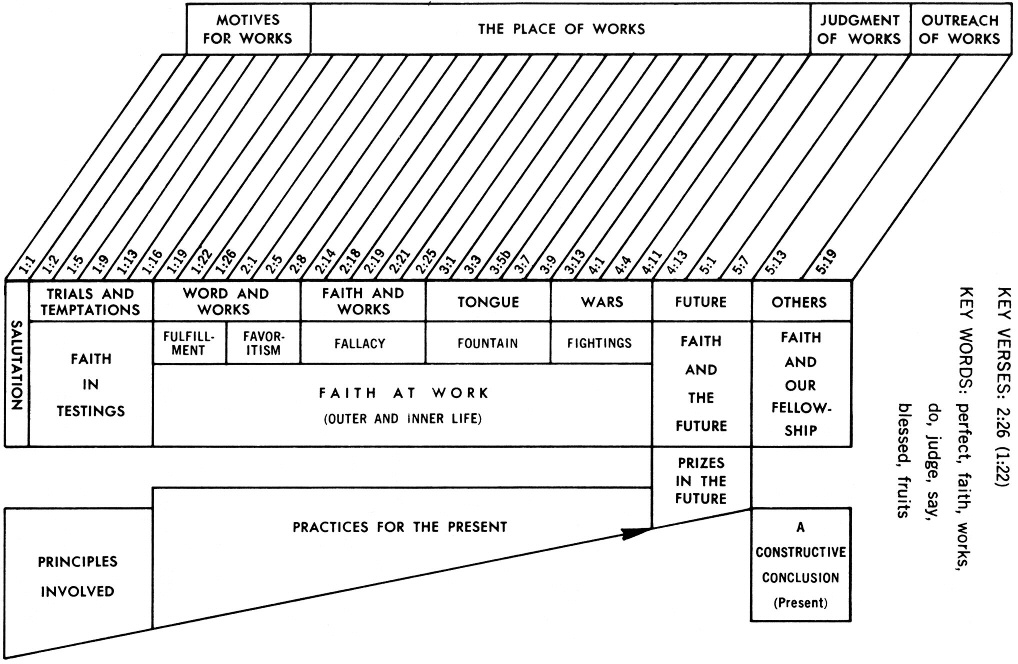
Click chart to enlarge
Chart from recommended resource Jensen's Survey of the NT - used by permission
See also Overview Chart by Charles Swindoll
|
JAMES |
|||||||
| Motives for Works |
The Place of Works: Outward Demonstration of Inner Faith |
Outreach of Works |
|||||
| Jas 1:1-18 | Jas 1:19-2:13 | Jas 2:14-25 | Jas 3:1-12 | Jas 3:13-4:12 | Jas 4:13-5:12 | Jas 5:13-19 | |
| Trials & Temptations |
Word & Works |
Faith & Works |
Tongue | Wars | Future | Others | |
|
Faith |
Fulfill |
Favor |
Fallacy |
Fountain |
Factions |
Faith |
Faith |
|
FAITH AT WORK |
|||||||
I. The opening salutation (James 1:1)
A. The author
B. The readers
C. The greeting
PART 1:The Theme: The Testings of Personal Faith
I. The trials of the believer (James 1:2-12)
A. The proper attitude toward trials (James 1:2-4)
1. The attitude commanded (James 1:2)
2. The reason indicated (James 1:3)
3. The outcome to be realized (James 1:4)
B. The use of prayer amid trials (James 1:5-8)
1. The need for wisdom (James 1:5a)
2. The request for wisdom (James 1:5b)
3. The bestowal of wisdom (James 1:5c-8)
a. The divine response (James 1:5c)
b. The human obligation (James 1:6-8)
1. The necessary attitude (James 1:6a)
2. The rejected character (James 1:6b-8)
C. The correct attitude toward life by the tried (James 1:9-11)
1. The attitude of the lowly brother (James 1:9)
2. The attitude of the rich (James 1:10-11)
a. The reason for the attitude (James 1:10a)
b. The illustration from the flower (James 1:11a)
c. The application to the rich (James 1:11b)
D. The result of enduring trials (James 1:12)
1. The blessedness of endurance (James 1:12a)
2. The reward of endurance (James 1:12b)
II. The nature of human temptation (James 1:13-16)
A. The source of human temptation (James 1:13-14)
1. The repudiation of a divine source (James 1:13)
a. The rejection stated (James 1:15a)
b. The rejection vindicated (James 1:13b)
2. The reality of the human source (James 1:14)
B. The consequences of yielding to temptation (James 1:15)
C. The warning against being deceived (James 1:16)
III. The activity of God in human affairs (James 1:17-18)
A. The Giver of all good gifts (James 1:17)
B. The Author of the believer's regeneration (James 1:18)
PART 2: The Test Marks of a living Faith
I. Faith tested by its response to the Word of God (James 1:19-27)
A. The reactions to the Word (James 1:19-20)
1. The knowledge possessed (James 1:19a)
2. The reaction demanded (James 1:19b)
3. The reason stated (James 1:20)
B. The reception of the Word (James 1:21)
1. The stripping off of sins (James 1:21a)
2. The appropriation of the Word (James 1:21b)
C. The obedience to the Word (James 1:22-27)
1. The demand for active obedience (James 1:22-25)
a. The statement of the requirement (James 1:22)
b. The illustration of the requirement (James 1:23-25)
1. The negative portrayal (James 1:23-24)
2. The positive portrayal (James 1:25)
2. The nature of acceptable obedience (James 1:26-27)
a. The futility of activity without inner control (James 1:26)
b. Acceptable service with inner control (James 1:27) (Hiebert - James Commentary)
James 1:7 For that man ought not to expect that he will receive anything from the Lord, (NASB: Lockman)
Greek: me gar oiestho (3SPMM) o anthropos ekeinos hoti lempsetai (3SFMI) ti para tou kuriou,
BGT μὴ γὰρ οἰέσθω ὁ ἄνθρωπος ἐκεῖνος ὅτι λήμψεταί τι παρὰ τοῦ κυρίου,
Amplified: For truly, let not such a person imagine that he will receive anything [he asks for] from the Lord, (Amplified Bible - Lockman)
KJV: For let not that man think that he shall receive any thing of the Lord.
NLT: People like that should not expect to receive anything from the Lord. (NLT - Tyndale House)
NET For that person must not suppose that he will receive anything from the Lord,
NLT Such people should not expect to receive anything from the Lord. (Revised)
ESV For that person must not suppose that he will receive anything from the Lord;
NRS for the doubter, being double-minded and unstable in every way, must not expect to receive anything from the Lord.
Phillips: That sort of man cannot hope to receive anything from God, (Phillips: Touchstone)
Wuest: for let not that individual be supposing that he shall receive anything from the presence of the Lord,
Young's Literal: for let not that man suppose that he shall receive anything from the Lord--
- Jas 4:3; Pr 15:8; Pr 21:27; Isa 1:15; Isa 58:3-4
- James 1 Resources - Multiple Sermons and Commentaries
Related Passages:
James 4:3+ You ask and do not receive, because you ask with wrong motives, so that you may spend it on your pleasures.
Proverbs 15:8 The sacrifice of the wicked is an abomination to the LORD, But the prayer of the upright is His delight.
THE FUTILITY OF
WAVERING PRAYER
For (term of explanation) (gar) means on account of this or that or for this reason and introduces the reason or explanation for that warning that the doubter should not expect to receive anything from God. In other words, because the doubter is unstable and divided in loyalty, therefore he should not expect to receive wisdom or any other spiritual blessing from God. In short, God does not reward divided faith.
That man (the one who is doubting, a man double minded, unstable in all his ways) ought not to expect (oiomai) - The Amplified Bible paraphrases it well “Let not such a person imagine.” This is a present imperative with a negative a construction that often carries the force of stopping an action already in progress. The idea is that the doubting person must stop entertaining the expectation that he will receive an answer to his prayer while persisting in a state of spiritual wavering and divided trust. James is not discouraging believers who struggle honestly with weakness, but warning those who continually vacillate between trust in God and reliance upon themselves or the world.
The problem is not merely intellectual uncertainty, but a divided heart that lacks settled confidence in God’s character, wisdom, and faithfulness. Such a person prays outwardly, yet inwardly remains unstable and unconvinced that God can truly be trusted. Therefore James says that this kind of wavering prayer should not expect to receive “anything from the Lord,” especially the wisdom needed to endure trials rightly. God desires believing dependence rather than hesitating distrust. Persistent doubting disrupts the believer’s spiritual stability and hinders confident access to God’s gracious provision.
That he will receive (lambano) anything from the Lord (kurios) - In the context of James 1, the “anything” refers specifically to the wisdom God promises to give those who ask Him in faith while enduring trials. James is not discussing every possible prayer request in a general sense, but the believer’s request for divine wisdom to navigate suffering, testing, and adversity in a God honoring manner.
The verb receive (lambano) means to take, receive, obtain, or grasp hold of something given. James’ point is that the doubting person should not expect to obtain the wisdom he seeks from the Lord because his divided heart lacks settled trust in God’s character and promise. God has already promised to give wisdom generously and without reproach (James 1:5+), but the doubting person approaches God wavering between trust and unbelief.
Bruce Barton - God's promises are not lottery tickets to be claimed in faint hopes that they will deliver what they describe. God's answers are not subject to the laws of probability and chance. God will do what he says he will do. He requires our trust. God's dependability is part of his character. The person who asks trustingly does not determine how God will answer, but he or she can be confident in knowing that God will answer. The person who asks doubtfully has no right to expect anything. His or her request was not genuine. When it seems as if God hasn't answered our prayers, we need to begin the search for a solution by asking ourselves whether we were trusting when we prayed. If our loyalties are straightened out, God's answers to prayer are restored to us. (See James - Page 13)
Lord (kurios) emphasizes God’s sovereign authority. The believer comes before the Lord of heaven and earth, the One Who possesses all wisdom and Who alone can grant the spiritual insight necessary to endure trials faithfully. Since wisdom resides fully with Him, the believer must approach Him with humble confidence and wholehearted dependence.
James is not teaching that believers must possess perfect faith before God will answer prayer. Rather, he warns against a fundamentally divided heart that vacillates between trust in God and reliance upon self or worldly thinking. The issue is not occasional weakness, but persistent double mindedness that refuses to rest confidently in God’s goodness and faithfulness.
Kurt Richardson writes "James comments about the expectations of a believer whose faith is adulterated by doubt. Persistent doubt nullifies faith. Faith receives because it trusts. Doubt, which also is directed toward God, is totally rejected by him. Prayer accompanied by doubt is much like the problem of claiming to have faith but showing no works (cf. Jas 2:17). There may be expectations, but they are unfounded in relation to God and his will. Such doubters will receive nothing from God. (See James: An Exegetical and Theological Exposition - Page 67)
Sinclair Ferguson on doubt during a time of testing...
To doubt is to be uncertain about God and to feel isolated from Him; to suffer (Ed: as one often does when trials come into our life) is to experience pain and to feel isolated from others. Giant Despair thus appears and imprisons us in what Bunyan aptly called “Doubting Castle.” (Read about the destruction of "Doubting Castle" in The Seventh Stage of Pilgrim's Progress) There, alone in the darkness, we begin to hear and believe the voices that say “there is no help for him in God” (Ps. 3:2). But it is not true that there is no help for us in God! Hear the testimony of others: “Because the Sovereign Lord helps me, I will not be disgraced” (Isa. 50:7); “God is our refuge and strength, an ever-present help in trouble… God will help … at break of day” (Ps. 46:1, 5).
The problem for the doubting sufferer, however, is that “break of day” has not yet come. It is still dark. When doubt is at its height and attacks most fiercely we ask, “Is there no light to help me through the night?” Indeed there is; but the prescribed antidote tends to work slowly. It is important for us, therefore, to complete the course.
Scripture’s account of genuine spiritual experience speaks to your situation. It describes your symptoms and illustrates the way of recovery. You are not unique. There is no test of faith that seizes us “except what is common to man. And God is faithful; he will not let you be tempted beyond what you can bear” (1Co 10:13+). Great saints of God have been where you are now.
Think of Elijah, suffering from total exhaustion; he doubted God’s future purpose for his life and lay down to die. “I have had enough, Lord,” he said (1 Kings 19:4+). Here is Jeremiah, bravely facing being beaten and put in the stocks; he is a different man in private when the suffering catches up with him and he cries out, “O Lord, you deceived me, and I was deceived” (Jer. 20:7+). There is John the Baptist, fearless in denouncing Herod’s immoral behavior yet he receives an unwelcome visit from doubt as he languishes in prison and anxiously sends to know whether Jesus really is the Messiah after all (Luke 7:19+). (If you would like more information on this important topic of doubt from the perspective of some of the finest Christian minds of modern times I would strongly recommend procuring the book edited by R C Sproul borrow Doubt & assurance page 33)
Do experience God answering your prayers? Or does He seem all too often silent? Either way, Torrey's topic below provides an excellent Scriptural overview of "Answers to Prayer." This topic would make an excellent small group Bible study - print out a selection of Scriptures under each subtopic (without Torrey's analysis) and simply observe what the text says, recording your observations which will lead to interpretation which should lead to personal application. This simple study might just significantly impact the prayer life of your group. Paul says the impact is not just in this present passing life but in eternity future! Redeem the time! "Discipline yourself (in your prayer life) for the purpose of godliness for bodily discipline is only of little profit, but godliness is profitable for all things, since it holds promise for the present life and also for the life to come." (1Ti 4:7-8+)
Spiros Zodhiates - There are two possible results when a person discovers his prayers are not answered. One is to blame God for it, and the other is to ask himself whether his request is in the will of God.
One day a lady was giving her little nephew some lessons. He was generally a good, attentive child, but on this occasion he could not fix his mind on his work. Suddenly he said, “Auntie, may I kneel down and ask God to help me find my marble?” His aunt gave her consent, and the little boy knelt by his chair, closed his eyes, and prayed silently. The next day, almost afraid to ask the question lest the child had not found his toy and so might lose his simple faith, the lady said to him, “Well, dear, have you found your marble?” “No, Auntie,” was the reply, “but God made me not want to.” That is the way God many times answers our prayers and thus rids us of the division within ourselves. The struggle between His will and ours ceases, for our will gets lost in His. We cannot always expect what we ask for, but we can expect a change in our own desire, and when that happens we shall see that everything we ask for will be in faith, and since it will be in full accordance with His will, it will be given to us. What a glorious truth is hidden in this wonderful verse. (Borrow James Commentary)
Expect (3633) (oiomai) means to consider something to be true but with a component of tentativeness. It means to regard something as presumably true, but without particular certainty—to suppose, to expect, to presume, to assume, to imagine, to believe, to think, to mean, to intend. Hiebert explains that oiomai implies "a subjective judgment which has feeling rather than thought for its ground."' It carries the collateral notion of an unwarranted judgment: "let not that man suppose."
There are 3 uses of oiomai in the NT, once in James, and in
John 21:25 And there are also many other things which Jesus did, which if they were written in detail, I suppose (present tense = continually) that even the world itself would not contain the books which were written
Philippians 1:17 the former proclaim Christ out of selfish ambition, rather than from pure motives, thinking (present tense = continually) to cause me distress in my imprisonment.
Oiomai in Septuagint (LXX) - 14x -Ge 37:7; 40:16; 41:1, 17; Esther 8:12; 9:12; Job 11:2; 34:12; 37:23; 38:2; 40:8; 42:3; Isa 57:8; Da 2:11
Will receive (2983) (lambano) means to take hold of, to grasp, to seize. Lambano can indicate either benevolent and hostile actions, and have as object either people or things; e.g. take a wife, collect taxes, accept a verdict, take a road, and figuratively take courage. It is used with a material subject, as when, for example, fear or terror seizes men.
- God gives -Psalm 99:6; 118:5; 138:3
- Christ gives -John 4:10,14; 14:14
- Christ received -John 11:42; Hebrews 5:7
GRANTED
- Through grace of God -Is 30:19 (esp refers to the Millennium, but principle applicable to all believers)
- Sometimes immediately -Is 65:24; Da 9:21,23; 10:12
- Sometimes after delay -Lk 18:7
- Sometimes differently from our desire -2Co 12:8,9
- Beyond expectation -Jeremiah 33:3; Ep 3:20
- Promised -Isa 58:9; Je 29:12; Mt 7:7
- Promised especially in times of trouble -Ps 50:15; 91:15
RECEIVED BY THOSE WHO
- Seek God -Psalms 34:4
- Seek God with all the heart -Je 29:12,13
- Wait upon God -Psalms 40:1
- Return to God -2 Chronicles 7:14; Job 22:23,27
- Ask in faith -Matthew 21:21; Jas 5:15
- Ask in the name of Christ -Jn 14:13
- Ask according to God’s will -1Jn 5:14
- Abide in Christ -John 15:7
- Call upon God in truth -Ps 145:18
- Fear God -Psalms 145:19
- Set their love upon God -Ps 91:14,15
- Keep God’s commandments -1Jn 3:22
- Call upon God under oppression -Is 19:20
- Call upon God under affliction -Ps 18:6; 106:44; Is 30:19,20
- Humble themselves -2Chr 7:14; Ps 9:12
- Are righteous -Psalms 34:15; Jas 5:16
- Are poor and needy -Is 41:17
SAINTS
- Are assured of -1Jn 5:15
- Love God for -Ps 116:1
- Bless God for -Ps 66:20
- Praise God for -Ps 116:17; 118:21
- A motive for continued prayer -Ps 116:2
DENIED TO THOSE WHO
- Ask amiss -Jas 4:3
- Regard iniquity in the heart -Ps 66:18
- Live in sin -Isaiah 59:2; -Jn 9:31
- Offer unworthy service to God -Mal 1:7, 8, 9
- Forsake God -Jeremiah 14:10,12
- Reject the call of God -Pr 1:24,25,28
- Hear not the law -Proverbs 28:9; Zech 7:11, 12, 13
- Are deaf to the cry of the poor -Pr 21:13
- Are blood shedders -Isaiah 1:15; 59:3
- Are idolaters -Jeremiah 11:11-14; Ezek 8:15-18
- Are wavering -James 1:6,7
- Are hypocrites -Job 27:8,9
- Are proud -Job 35:12,13
- Are self-righteous -Luke 18:11,12,14
- Are the enemies of saints Ps 18:40,41
- Cruelly oppress saints -Mic 3:2, 3, 4
Exemplified
- Abraham -Ge 17:20
- Lot -Ge 19:19-21
- Abraham’s servant -Ge 24:15-27
- Jacob -Ge 32:24-30
- Israelites -Ex 2:23,24
- Moses -Ex 17:4-6,11-13; 32:11, 12, 13, 14
- Samson -Jdg 15:18,19
- Hannah -1 Samuel 1:27
- Samuel -1 Samuel 7:9
- Solomon -1 Kings 3:9,12
- Man of God -1 Kings 13:6
- Elijah -1Ki 18:36-38; Jas 5:17,18
- Elisha -2Ki 4:33-35
- Jehoahaz -2 Kings 13:4
- Hezekiah -2 Kings 19:20
- Jabez -1 Chronicles 4:10
- Asa -2 Chronicles 14:11,12
- Jehoshaphat -2 Chronicles 20:6-17
- Manasseh -2 Chronicles 33:13,19
- Ezra -Ezra 8:21-23
- Nehemiah -Nehemiah 4:9,15
- Job -Job 42:10
- David -Psalms 18:6
- Jeremiah -Lamentations 3:55,56
- Daniel -Daniel 9:20-23
- Jonah -Jonah 2:2,10
- Zacharias -Luke 1:13
- Blind man -Luke 18:38,41, 42, 43
- Thief on the cross -Luke 23:42,43
- Apostles -Acts 4:29-31
- Cornelius -Acts 10:4,31
- The Christians -Acts 12:5,7
- Paul and Silas -Acts 16:25,26
- Paul -Acts 28:8
Refusal of, exemplified
- Saul -1 Samuel 28:15
- Elders of Israel -Ezekiel 20:3
- Pharisees -Matthew 23:14
James 1:8 being a double-minded man, unstable in all his ways. (NASB: Lockman)
Greek: aner dipsuchos, akatastatos en pasais tais hodois autou.
BGT ἀνὴρ δίψυχος, ἀκατάστατος ἐν πάσαις ταῖς ὁδοῖς αὐτοῦ.
Amplified: [For being as he is] a man of two minds (hesitating, dubious, irresolute), [he is] unstable and unreliable and uncertain about everything [he thinks, feels, decides]. (Amplified Bible - Lockman)
KJV: A double minded man is unstable in all his ways.
NLT: They can't make up their minds. They waver back and forth in everything they do. (NLT - Tyndale House)
NET since he is a double-minded individual, unstable in all his ways.
NLT Their loyalty is divided between God and the world, and they are unstable in everything they do. (Revised)
CSB An indecisive man is unstable in all his ways.
ESV he is a double-minded man, bunstable in all his ways.
NIV he is a double-minded man, unstable in all he does.
MIT One who is irresolute is unstable in all his ways.
NJB That sort of person, in two minds, inconsistent in every activity, must not expect to receive anything from the Lord.
NRS for the doubter, being double-minded and unstable in every way, must not expect to receive anything from the Lord.
Phillips: and the life of a man of divided loyalty will reveal instability at every turn. (Phillips: Touchstone)
Wuest: a dubious, undecided man, vacillating in all his ways.
Young's Literal: a two-souled man is unstable in all his ways.
- Double minded - Jas 4:8; 1Ki 18:21; 2Ki 17:33,41; Is 29:13; Ho 7:8-11; 10:2; Mt 6:22,24; 2Pe 2:14; 3:16
Related Passages:
James 4:8+ Draw near to God and He will draw near to you. Cleanse your hands, you sinners; and purify your hearts, you double-minded. (dipsuchos) (All verbs in red = aorist imperative)
Comment - The remedy for dipsuchos is not intellectual resolution but purification of the heart, a wholehearted consecration to God.
1 Kings 18:21+ Elijah came near to all the people and said, “How long will you hesitate between two opinions? If the LORD is God, follow Him; but if Baal, follow him.” But the people did not answer him a word.
Psalm 119:113 I hate those who are double-minded, but I love Thy law.
2 Kings 17:41+ So while these nations feared the LORD, they also served their idols; their children likewise and their grandchildren, as their fathers did, so they do to this day.
Isaiah 29:13 Then the Lord said, “Because this people draw near with their words And honor Me with their lip service, But they remove their hearts far from Me, And their reverence for Me consists of tradition learned by rote,
Matthew 6:24+ (A PICTURE OF A DOUBLE SOULED MAN) “No one can serve two masters; for either he will hate the one and love the other, or he will be devoted to one and despise the other. You cannot serve God and wealth.
2 Chronicles 25:1-2+ Amaziah was twenty-five years old when he became king, and he reigned twenty-nine years in Jerusalem. And his mother’s name was Jehoaddan of Jerusalem. 2 He did right in the sight of the LORD, (BUT HE HAD A FATAL FLAW - "SPIRITUAL SCHIZOPHRENIA"!) yet not with a whole heart.
A DOUBLE MINDED
MAN
Being - This verb is not present in the Greek text, but has been added by the NASB translators to smooth out the English reading and further describe “that man,” namely the doubter mentioned in James 1:7. In the original Greek, the description flows directly from the previous statement and functions almost like an explanatory apposition, further defining the character of the doubting person. James is not introducing a new individual, but continuing his portrayal of the same unstable man whose wavering faith hinders his expectation of receiving from the Lord. The supplied word “being” helps English readers see that verse 8 explains why the doubter should not expect answered prayer: he is “a double-minded man, unstable in all his ways.” Thus the focus is not merely on isolated acts of doubt, but on an ongoing condition of inner division and spiritual instability that characterizes the person James is describing.
A double-minded (dipsuchos) man, unstable (akatastatos) in all his ways - Wuest - "a dubious, undecided man, vacillating in all his ways." Amplified - "a man of two minds (hesitating, dubious, irresolute)." Double minded is "Two souled" as if two distinct souls were effecting this man's attitudes and actions! One of the souls is oriented as it were toward God and trusts in God, while the other is oriented toward the natural world and disbelieves God. As one writer has put it James is describing a man who is "a walking civil war in which trust and distrust of God wage a continual battle against each other." A double souled man cannot decide what he believes and therefore how he is going to live. He gets caught up in every wind of change that blows through society. A person without priorities will constantly find his heart captured by and worrying about every thing that might be. Notice all his ways means not only will their prayer not be answered but they are unstable in all they do! As Barton says "When indecisiveness marks our relationship with God, that instability will affect all of life." (Ibid)
Life Application Study Note - A person with divided loyalty is not completely convinced that God's way is best. He treats God's Word like any human advice and retains the option to disobey. He vacillates between allegiance to subjective feelings, the world's ideas, and God's commands. If your faith is new, weak, or struggling, remember that you can trust God. Then be loyal by committing yourself wholeheartedly to God. If you have ever seen the constant rolling of huge waves at sea, you know how restless they are—subject to the forces of wind, gravity, and tide. Divided loyalty leaves a person as unsettled as the restless waves. If you want to stop being tossed about, rely on God to show you what is best for you. Ask him for wisdom, and trust that he will give it to you. Then your decisions will be sure and solid. (See Life Application Study Bible, Third Edition - Page 2161)
John Bunyan in Pilgrim's Progress gives a similar picture in his description of "Mr. Facing-both-ways"!
There is a close connection between the way
a man prays and the way he lives.
Hiebert adds that in all his ways is a Hebraism depicting his personal conduct (Ps 91:11; 145:17; Pr 3:6; Je 16:17). The plural all his ways encompasses all the varied aspects of his life. His fickle and vacillating attitude in the realm of faith projects itself into all the areas of his life making him unreliable in all of his dealings. "The man who does not trust God cannot be trusted by men."' There is a close connection between the way a man prays and the way he lives. "Since the resting place of our will is the will of God found in prayer, a division at the centre destroys unity and force of character, and this produces instability in the whole range of conduct." (Ibid)
Donald Burdick - The Greek dipsuchos in strictest literalness means “double souled.” It is as though one soul declares, “I believe,” and the other in turn shouts, “I don’t!” This sort of instability is not only apparent when the man prays, it marks “all he does.” In his personal life, his business life, his social life, as well as in his spiritual life, indecisiveness negates his effectiveness. A person like this will not “receive anything from the Lord.” But one may wonder how this man is different from the anguished father who cried, “I do believe; help me overcome my unbelief!” (Mark 9:24). Such an exclamation seems to suggest that the father was “a double-minded man.” But there is a difference. The father was not oscillating between belief and unbelief. He desired to believe—and even asserted his belief—but because he felt keenly the inadequacy of his faith, he asked for help in believing. He was not facing in both directions at the same time like the “double-minded man” of James 1:8. In spite of his conscious weakness, the father had set his heart to believe. And Christ responded to his faith and healed his son (Mark 9:25–27). In response to this kind of faith, God will give wisdom to those who ask for it, and will enable them to persevere in times of trial. (See The Expositor's Bible Commentary - Abridged Edition)
Robert Johnstone says of the double-minded "one mind is disposed to lean on himself and to seek wisdom and strength and satisfaction in the world; the other is disposed to look to God and seek help and happiness from Him. Hesitation, inconsistency, varying purpose, and effort exhibit themselve, therefore, everywhere in his life." (Lectures exegetical and practical on the Epistle of James)
The result of a double minded man is that he is unsteady, changeable, erratic, mercurial, volatile, unsettled, etc.
Manton writes that "An unstable man has no constancy of soul. He is sometimes ready to depart from God and sometimes to be close to him; he is not settled in his religious profession." (Ibid)
Don Anderson - I don’t know how a man can serve two masters. You can’t go one way and the other. The other thing that happens to you is when you go through a trial the first thing we think of is withdrawal and the bottom line. Now, the next thing you have a tendency to do is when things get hard and difficult, what are you supposed to do? “Deem it pure joy,” knowing that God’s in control of it. If you need wisdom to relate to it, what are you supposed to do? You ask for wisdom. You’ve got to ask for wisdom with faith, believing that God is going to work out and use all this for His glory. There are a lot of people in the New Testament that will tell you that it’s because James was on his knees that God did some marvelous, marvelous things.
Bruce Barton gives a practical takeaway from James 1:2-8 - The choice James presents us in verses 2-8 is clear: We can live a single-minded life of trust in God where every experience, including the trials we fall into, is another step in the process of becoming mature and complete persons. The single-minded person will still be capable of doubt. In fact, doubts may be some of the trials that person faces. These doubts fall into the category of the man who wisely confessed when he stood before Jesus, "I believe; help my unbelief!" (Mark 9:24 nkjv). Single-minded persons do not dwell on whether they can find a shred of doubt in themselves; rather, they concentrate on wholehearted commitment to God.
We can live a double-minded life where every experience will be approached with doubt and lack of trust in God. The double-minded person doubts and refuses to stop doubting.
We must ask God for wisdom to keep making the right choice. (See James - Page 14)
O HAPPY DAY THAT FIXED MY CHOICE
by Philip Doddridge
Play this hymn
Now rest, my long divided heart,
Fixed on this blissful center, rest.
Here have I found a nobler part;
Here heavenly pleasures fill my breast.
Happy day, happy day, when Jesus washed my sins away!
He taught me how to watch and pray, and live rejoicing every day
Happy day, happy day, when Jesus washed my sins away.
If you wrestle with a double-mindedness, a great prayer to utter is Psalm 86:11…
Teach me Thy way, O LORD; I will walk in Thy truth;
Unite my heart to fear Thy name.
Spurgeon comments on this prayer - Having taught me one way, give me one heart to walk therein, for too often I feel a heart and a heart, two natures contending, two principles struggling for sovereignty. Our minds are apt to be divided between a variety of objects, like trickling streamlets which waste their force in a hundred runnels; our great desire should be to have all our life floods poured into one channel and to have that channel directed towards the Lord alone. A man of divided heart is weak, the man of one object is the man. God who created the bands of our nature can draw them together, tighten, strengthen, and fasten them, and so braced and inwardly knit by his uniting grace, we shall be powerful for good, but not otherwise. To fear God is both the beginning, the growth, and the maturity of wisdom, therefore should we be undividedly given up to it, heart, and soul.
Double-minded (1374) (dipsuchos from dís = twice + psuche = soul, mind) is an adjective which literally describes one who has two minds or one who is two-spirited and has been called one of the most picturesque words in the entire epistle. One personality, but two souls—this describes the person who behaves in two diametrically opposite ways, according to what is expedient. A man trying to walk two opposite roads simultaneously. Dipsuchos is the one who hesitates or vacillates between two or more opinions, This person in a sense has a divided loyalty and is manifest by indecision and doubting. Some might see such a person as "fickle" (marked by lack of steadfastness, constancy, or stability -- given to erratic changeableness). This is the man or woman who is uncertain about the truth of something, in this case the truth of the sovereign, omnipotent power of God. Synonyms for double minded - vacillating, halting, hesitant, hesitating, indecisive, irresolute, tentative, uncertain, indecisive, wavering. Idioms of two minds.
James 4:8+ Draw near to God and He will draw near to you. Cleanse your hands, you sinners; and purify your hearts, you double-minded. (All verbs in red = aorist imperative)
Charles Swindoll comments on dipsuchos - It appears here in the book of James for the first time in Greek literature, and James may have even invented the word himself.[4] By the way, if you invent a word, you get to define it, so let’s let James define it for us. James uses the term again in 4:8—“Purify your hearts, you double-minded.” It indicates an impurity of our inner person. Where there should be one thought, goal, attitude, or devotion, we find two competing thoughts. So, a double-minded person is one who wants his or her will and at the same time God’s will. That kind of person is unstable in everything he or she does. Pause and just imagine what happens when the double-minded person faces a double-barrel trial in life! (See Insights on James, 1 & 2 Peter - Page 23)
A similar thought is described in the OT passages which describe a person with a divided (versus a whole) heart (1Ki 8:61, 11:4, 15:3,14, 2Ki20:3, 1Ch12:38, 28:9, 29:19, 2Ch15:17, 16:9, 19:9, 25:2). Same idea in Ps 12:2 = double heart. Opposite of "undivided heart" = 1Chr 12:33. Cp "hesitate between two opinions" (1Ki 18:21). Dipsuchos is the opposite of Dt 4:29 = "with all your heart and all your soul".
Unstable.(182) (akatastatos from a = not + kathistemi = to settle from kata = down + histemi = to stand) an adjective that describes one who is unsettled, unsteady, unstable, staggering, restless, reeling like a drunken man. It means one who is never able to settle down. "Have you ever met a person like that? He never makes up his mind." (Zodhiates) Vacillating in all one's activity and conduct, because he or she lacks a solid foundation which predisposes to unsteadiness and wobbling. It describes a person who is often changing his mind about something. There are only 2 uses in NT - Jas 1:8, 3:8.
James 3:8+ But no one can tame the tongue; it is a restless (akatastatos cp "the restless sea" = continuously moving! Uncontrollable! Not subject to control) evil and full of deadly poison.
Septuagint - one use - Isaiah 54:11 "O afflicted one, storm-tossed, and not comforted, Behold, I will set your stones in antimony, And your foundations I will lay in sapphires.
Compare derivative noun akatastasia (181) = unsettlement, restlessness, disturbance, instability, disorder, commotion, confusion, tumult. Sometimes had political associations and had the meaning "anarchy" (Lk 21:9) - Jas 3:16 = disorder caused by those who with their "false wisdom" trouble the group of believers by demanding their own rights abd exercising a party spirit., Lk 21:9, 2Co 6:5 = personal unrest, 2Co 12:20, 1Co 14:33 = confusion as opposed to eirene = peace.
Ways (3598) (hodos) literally refers to a way along which one travels, such a road, street, highway or path and then speaks of a trip or journey (Mt 10:10, Mk 6:8, Lk 9:3). Figuratively, as used in the present passage, hodos speaks of one's course of behavior or way of life. In other words, life itself is compared to a way or a road one travels.
The Puritan writer Thomas Manton says that double minded "signifies a person who has two souls, and so it may imply:
(1) A hypocrite, since the same word is used with that meaning in Jas 4:8 : “Purify your hearts, you double-minded.” As he speaks to open sinners to cleanse their hands, so he speaks to secret hypocrites (whom he calls double-minded since they pretend one thing but mean another) to purify their hearts—that is, to grow more inwardly sincere. This word is similar to the Hebrew word for “deceive.” “Their flattering lips speak with deception” (Psalm 12:2); in the Hebrew this is “with a heart and a heart,” which is their way of expressing something that is double or deceitful (deceitful weights are “a weight and a weight” in the Hebrew of Pr 20:23). As Theophrastus says of the partridges of Paphlagonia that they had two hearts, so every hypocrite has two hearts or two souls.
(2) It implies a person who is distracted and divided in his thoughts, floating between two different opinions, as if he had two minds or two souls. In the apostle’s time there were some Judaizing brethren who sometimes sided with the Jews, sometimes with the Christians. They were not settled in the truth. See also 2Kings 17:33 , “They worshiped the Lord , but they also served their own gods”; they were divided between God and idols. The prophet says this shows a double or divided heart: “Their heart is deceitful, and now they must bear their guilt” (Hosea 10:2). Thus Athanasius applied this description to the Eusebians, who sometimes held one thing and then another.
(3) In the context of James this may refer to those whose minds were tossed to and fro with various ideas: now lifted up with a wave of presumption, then cast down in a gulf of despair, being torn between hopes and fears concerning their acceptance with God. I prefer this latter sense, as it conveys the apostle’s purpose best. (Manton, T. Exposition of James)
The Shepherd of Hermas (Apostolic Fathers) expounds on double mindedness in Mandate #9…
He said to me, “Rid yourself of double-mindedness (dipsuchos - used in Greek text in all the occurrences of double-mindedness in this mandate), and do not be at all double-minded about asking God for something, saying to yourself, for example, ‘How can I ask for something from God and receive it, when I have sinned so often against him?’
(2) Do not reason in this way, but turn to the Lord with all your heart and ask of him unhesitatingly, and you will know his extraordinary compassion, because he will never abandon you, but will fulfill your soul’s request.
(3) For God is not like men, who bear grudges; no, he is without malice and has compassion on his creation.
(4) Do, therefore, cleanse your heart of all the vanities of this life, and of all the things mentioned to you above, and ask of the Lord, and you will receive everything, and will not fail to receive all of your requests, if you ask unhesitatingly.
(5) But if you hesitate in your heart, you will certainly not receive any of your requests. For those who hesitate in their relation to God are the double-minded, and they never obtain any of their requests.
(6) But those who are perfect in faith make all their requests trusting in the Lord, and they receive them, because they ask unhesitatingly, without any double-mindedness. For every double-minded man, unless he repents, will scarcely be saved.
(7) So cleanse your heart of double-mindedness and put on faith, because it is strong, and trust God that you will receive all the requests you make. And whenever you ask for something from the Lord and you receive your request rather slowly, do not become double-minded just because you did not receive your soul’s request quickly, for assuredly it is because of some temptation or some transgression, of which you are ignorant, that you are receiving your request rather slowly.
(8) Do not, therefore, stop making your soul’s request, and you will receive it. But if you become weary and double-minded as you ask, blame yourself and not the One who gives to you.
(9) Beware of this double-mindedness, for it is evil and senseless, and has uprooted many from the faith, even those who are very faithful and strong. For this double-mindedness is indeed a daughter of the devil, and does much evil to God’s servants.
(10) So despise double-mindedness and gain mastery over it in everything by clothing yourself with faith that is strong and powerful. For faith promises all things, perfects all things; but double-mindedness, not having any confidence in itself, fails in all the works it tries to do.
(11) So you see,” he said, “that faith is from above, from the Lord, and has great power, but double-mindedness is an earthly spirit from the devil that has no power.
(12) So serve faith, which has power, and have nothing to do with double-mindedness, which has no power, and you will live to God; indeed, all who are so minded will live to God.” (The Apostolic Fathers : Greek texts and English translations. Grand Rapids, Mich.: Baker Books)
ILLUSTRATON - The field mouse who illustrated James "Double-minded man" - Driving in country at night when headlights showed up a field mouse dead ahead. He first started toward the left, then right, then left, and finally stood still as the car passed over him.
ILLUSTRATION - This is a divided heart—like the heart of the girl to which a young man once proposed. He said, “Darling, I want you to know that I love you more than anything else in the world. I want you to marry me. I’m not rich. I don’t have a yacht or a Rolls Royce like Johnny Brown, but I do love you with all my heart.” She thought for a minute and then replied, “I love you with all my heart, too, but tell me more about Johnny Brown.”
ILLUSTRATION - A woman, enlarging on her husband’s peculiar changefulness, said, “At a theologically Liberal meeting he’s a Liberal, and at a Conservative meeting he’s a Conservative.” Someone asked, “But what is he at home?” She replied with emphasis, “He’s a perfect demon!” ....This man James endeavors to describe is commonly known as a hypocrite, a man with two souls using either one at will, but let him be careful lest he be found not to have a soul at all.....Resolve to stand on solid ground. Determine what you are going to do, and do it without fear. Remember that “underneath are the everlasting arms.” (Zodhiates)
ILLUSTRATION OF DIPSUCHOS - I’ve never done this—and I probably should preface this by warning you not to try this without professional supervision—but I’ve heard it said that one of the cheapest and easiest ways to catch a monkey is to cut off the end of a hollow long-necked gourd, fill it with rice, and tie it to a tree. The hungry monkey will push his scrawny little hand into the thin neck of the gourd to grab the rice. He’ll clutch it with his hand and try to pull it out—but the monkey’s fist is bigger than the gourd’s neck. He’s trapped, because that hungry, shortsighted monkey won’t release the rice to remove his fist. He simply lacks the wisdom to decide that freedom without the rice is better than captivity with it. That’s the double-minded Christian. Inside the gourd is my will. Yes, part of me wants to live in God’s will, but the other part wants it on my terms. And when a trial comes, I refuse to release my grip and trust that the purpose and plan of God will bring true freedom. (See Swindoll's Insights on James, 1 & 2 Peter - Page 23)
ILLUSTRATION - Aesop, probably the most renowned writer of myths, speaks in one of his fables about a time when the beasts and the fowls were engaged in war. The bat tried to belong to both parties. When the birds were victorious, he would wing around telling everyone that he was a bird; when the beasts won a fight, he would walk around assuring everyone that he was a beast. But soon his hypocrisy was discovered, and he was rejected by both the beasts and the birds. He had to hide himself, and now he can appear openly only by night. You cannot hold onto the world with one hand and on to the Lord with the other. If you do, you will enjoy neither the world nor the Lord. A house divided against itself cannot stand, was the verdict of the Master, and that is exactly what James reaffirms here. (Zodhiates)
W E Vine's Outline of "The Heart" in James…
I. The divided heart (Jas 1:8; 4:8, lit.).
II. The deceived heart (Jas 1:26).
III. The contentious heart (Jas 3:14).
IV. The selfish heart (Jas 5:5).
V. The purified heart (Jas 4:8).
VI. The established heart (Jas 5:8).
ILLUSTRATION - Double Minded Man Pictured by Story of How to Catch a Fly - From the often austere letters column of the scientific journal Nature comes advice on the best way to swat a fly: “A piece of tissue paper is taken in each hand and the fly approached from the left and right, keeping the hands equidistant from the fly and moving to and fro slightly. Then both hands simultaneously pounce.” The advice is soundly grounded in “fly-neuroscience.” Dr. Edward Gray of England’s University College, London, wrote: “The fly cannot cope with this situation, since its central-nervous-system circuitry is geared to avoid approaching movement in only one part of its visual field at a time. Two simultaneously approaching threats render the fly immobile, for its central nervous system now cannot compute at which angle to take off.” Boston Globe
Bruce Barton - A double-minded person is trying to be allied to both sides in a war. That person is a walking contradiction. Augustine confessed to this kind of thinking when he remembered one of his earliest prayers, "O Lord, grant me purity, but not yet!" (Ibid)
Play Craig Smith's song - Single Heart, Single Mind
What God wants from us is singleness of heart in devotion and purpose. Only when Jesus is Lord of the heart is there control! How we need to pray those words of Paul Gerhardt:
O, knit my thankful heart to Thee,
And reign without a rival there …
Spurgeon's sermon - A Divided Heart- a sermon on Hosea 10:2KJV -
Observe, then, that our text describes a Fearful Disease. Their heart is divided. I have called it a fearful disease, and this will very readily appear if you observe, first of all, the seat of it. It affects a vital part, it is not merely a disease of the hand, that reformation might cure; it is not merely a disease of the foot, that restraint might sometimes mollify; it is not merely a disease of the eye which hath but to be couched to let the light stream in upon it. It is a disease of a vital region — of the heart; a disease in a part so vital that it affects the whole man. The utmost extremity of the frame suffers when once the heart becomes affected, and especially so affected as to be divided. There is no power, no passion, there is no motive, no principle, which does not become vitiated, when once the heart is diseased. Hence it is that Satan, who is always crafty, endeavors to strike at the heart. He will give you the hand if you please; you may be honest. He will give you the eye if you please; you shall be outwardly chaste. He will give you the foot, if you please; you shall appear to run in the way of righteousness Only let him keep the heart, only let him rule in the citadel, and he will be well content to give up all the rest. John Bunyan describes this as being one of the terms which old Diabolus was said to make with King Shaddai, — “Oh!” said he, “I will give up all the city of Mansoul, if thou wilt but permit me to live in the citadel of the heart.” Surely there was but little in his terms and conditions. Ay but give up everything else; if thou retainest the heart, thou retainest all, O, fiend! for out of the heart are the issues of life.
Thus the disease of our text is one that toucheth a vital part, a part which if once affected, tends to vitiate the whole frame. But you will observe, the disease here described, not only deals with a vital part, but toucheth it after a most serious fashion. It does not simply say the heart palpitates; it doth not declare that the life-floods that issue from it have become more shallow and less rapid, but it declares something worse than all these, namely, that the heart was cleft in twain and utterly divided. A stony heart may be turned to flesh but turn a divided heart into whatsoever you please, so long as it is divided, all is ill. Nothing can go right when that which should be one organ becomes two; when the one motive power begins to send forth its life-floods into two diverse channels, and so creates intestine strife and war. A united heart is life to a man, but if the heart be cut in twain, in the highest, deepest, and most spiritual sense, he dies. It is a disease which is not only affecting a vital part, but affecting it after the most deadly fashion.
But we must observe again of this divided heart, that it is a division in itself peculiarly loathsome. Men who are possessed of it do not feel themselves to be unclean; in fact they will visit all society, they will venture into the church, they will propose to receive her communion, and to be numbered with her members, and they will afterwards go and mingle with the world; and they do not feel that they have become dishonest. They think themselves fit to mingle with honest worldlings, and with sincere Christians too. If a man had spots upon his countenance or some disease that stared everyone else in the face as often as he was beheld surely he would retire from society and endeavor to keep himself a recluse. But not so the man with a divided heart. He goes everywhere, utterly unconscious that his disease is of the most loathsome character. Shall I show you how it is so? Take the glass and look at the man’s heart, and you will discern that it is loathsome, because Satan and sin reigns there. Although the man goes about and has sufficient of what is right and what is wrong, to be uneasy in his sin, yet has he such an intense love of all manner of iniquity, that he allows the loathsome demons to come and dwell in his heart. But his loathsomeness is worse than this, because all the while that he is really living in sin, he is a loathsome hypocrite, pretending that he is a child of God. Of all the things in the world that stink in the nostrils of a honest man, hypocrisy is the worst. If thou be a worldling, be a worldling. If thou serve Satan, serve him. If Baal be god, serve him, but mask not thy service of self and sin by a pretended service of God. Appear to be what thou art, tear off thy masks. The church was never meant to be a masquerade. Stand out in thy true colors. If thou preferest Satan’s shrine say so, and let men know it, but if thou wilt serve God, serve him, and do it heartily, as knowing him who is a jealous God and searcheth the hearts and trieth the reins of the children of men. It is a terribly loathsome disease this of a divided heart. If the man were but known, his disease is so loathsome, that the most wicked men in the world would have nothing to do with him. I have known sometimes instances of this. A man who pretended to be religious and regularly attended his place of worship is seen on one occasion entering into a ball-room of the very lowest class. He begins at once to plunge into its gaieties, with the most evil intentions. He is at once observed. The right senses even of the wicked themselves are awakened. “Kick that man down stairs,” is the unanimous verdict, and he receives it and he deserved it right well. When a man has a divided heart — tries to do right and to do wrong, to serve God and to serve Satan at the same time; I say his disease is of so loathsome and degraded a character, that the very worldling, whose leprosy is on his brow, despises, hates him, and avoids him.
And yet again, not merely is the disease loathsome, but I must observe it is one always difficult to cure, because it is chronic. It is not an acute disease, which brings pain, and suffering, and sorrow with it, but it is chronic, it has got into the very nature of the man. A divided heart, how are you to get at that? If it were a disease in any other part, the lancet might find it out, or some medicine might heal it. But what physician can join together a divided heart? What skillful surgeon can set together the disrupted members of a soul that has been divided between God and mammon? This is a disease which enters into the very nature, and will lie in the blood, though the most powerful medicines search it out. This is a disease, in fact, which nothing but Omnipotent grace can ever overcome. But he has no grace whose heart is divided between God and mammon. He is an enemy to God, he is an injury to the church, he is a despiser of God’s Word, he is a sheaf ripening for the harvest of eternal fire. His disease is deeply rooted within him, and if left alone it will come to a most dreadful end — its end is sure destruction.
I must observe once more, and then I will leave this point of the disease, that, according to the Hebrew of my text, this disease is a very difficult one to deal with, from the fact that it is a flattering disease. The text might be rendered — “Their heart flatters them; now are they found faulty.” There are many cunning flatterers in the world, but the most cunning is man’s own heart. A man’s own heart will flatter him even about his sins. A man is a grasping miser — his heart flatters him that he is only exercising proper business habits. A man on the other hand is extravagant and spends the good gifts of God upon his own evil passions; then his heart tells him that he is a liberal soul. The heart turns “sweet into bitter and bitter into sweet.” It is so “deceitful above all things,” and so “desperately wicked,” that it has the impudence to “put darkness for light and light for darkness.” Now when a man has a divided heart, he generally flatters himself. “Well,” says he, “it is true I drink too much, but then there is never a time that I refuse a guinea towards a charity. It is true,” says he “I am not certainly what I should be in my moral character, but still, see how regularly I keep to my church or chapel. It is true,” says he, “I don’t now and then mind a trick or two in my trade, but I am always ready to help the poor.” And so he imagines that he blots out an evil trait in his character with a good one and thus flatters his heart. And see how self-contented and satisfied he is. The poor child of God is trying his own heart with the deepest possible anxiety; this man knows of no such thing. He is always fully assured that he is right. The true believer is sitting down and turning over his accounts day by day to see whether he be really on the road to heaven or whether he has mistaken his evidence and has been deceived. But this man, self-satisfied, bandages his own eyes and walks deliberately on, singing at every step, straight to his own destruction. I know of some such now. It will not suffice for me simply to state what their character is unless God the Holy Spirit open their eyes. They will be sure not to know their own likeness, even though I should paint it to the very life, and put in every touch and stroke, yet they will say, “Ah he could not refer to me. I am so good and so godly, there could have been no reference to me in anything that he said.” Do you know a class of people that pull the most tremendously long faces, that always look so serious, that talk the English language with a kind of unctuous twang, that give a savoury pronunciation to every word they utter? Beware of them. When a man wears all his religion in his face, he has generally but a very small stock in his heart. Those tradesmen that put such a great display in their windows, frequently have very little behind. So with these professors; no one would know they were religious, so they label themselves that you may not make a mistake. You would think they were worldlings, if it were not for their sanctimonious appearance. But by putting that on, they think to glide through the world with credit. I hope they are not imagining that they shall stand accepted before the bar of God and deceive the Omniscient. Alas for them! Their heart is divided. This is no uncommon disease, despite its loathsomeness and its terrible fatality. Rife is it in this day; tens of thousands of Englishmen who are reckoned good and honorable are afflicted with it. Their whole head is sick, and their whole heart faint from the fact that their heart is divided. They lack the courage to be thorough-going sinners, and they have not sincerity enough to be truly-devoted people of God…
This brings us to the third point, the sad effect, of a divided heart. When a man’s heart is divided, he is at once everything that is bad. With regard to himself he is an unhappy man. Who can be happy while he has rival powers within his own breast. The soul must find a nest for itself, or else it cannot find rest. The bird that would seek to rest upon two twigs would never have peace, and the soul that endeavors to find two resting places, first, the world, and then the Savior, will never have any joy or comfort. A united heart is a happy heart; hence David says, “Unite my heart to fear thy name.” They that give themselves wholly to God are a blessed people, for they find that the ways of religion are “ways of pleasantness, and all her paths are peace.” Men who are neither this nor that, neither one thing nor another, are always uneasy and miserable. The fear of discovery, and the consciousness of being wrong, conspire together to agitate the soul and make it full of unease, disease, and restlessness of spirit. Such a man is unhappy in himself. (See the entire sermon A Divided Heart)
F B Meyer (Our Daily Walk) - THE DIVIDED HEART
"Where your treasure is, there will your heart be also. If thine eye be single, thy whole body shall be full of light."-- Mt 6:21, 22+
"A double minded man is unstable in all his ways."-- Jas. 1:8.
THE CLOSING paragraphs of Matthew 6 are full of instances of a divided heart. The Greek word for care means that which divides.
Some are divided by anxiety. The anxious soul cannot take a strong straight course, any more than a man can sleep who is wondering whether he has bolted the front door or wound up his watch. Some are divided by contrariness--a most difficult and complicated disposition of soul. We would like to be pleasant, helpful, agreeable, and amiable, but are conscious of cross-currents that restrain and make us awkward and disagreeable, and we find ourselves rent between two strong influences, the one to be Christlike and gracious, the other to be distant and angular. Others are divided by fitful and passionate impulses. Happy are they who can hold them well in check. Even St. Paul tells us that he was conscious of these two wills--the better serf which longed to do the will of God, and the lower, selfish, passionate self, which brought him into subjection. St. Augustine tells us that, though the prayers of Monica, his mother, greatly affected him, he was constantly swept back from his ideal by an outbreak of passion.
Bunyan also illustrates the same condition, saying that two selves were at war within him. The Devil came and said, "Sell Him!" But he resisted, even to blood, saying, "I won't!" But, as the Tempter continued urging, "Sell Him!" Bunyan finally yielded, and suffered an agony of remorse, as, on the one hand, he accepted Christ as his only Hope, and on the other, was prepared to barter Him away.
A divided heart lacks the first element of strength--it is unstable. The men who leave their mark on the world are those who can say: "This one thing I do." But we need more than concentration, we need consecration. We must not only be united in ourselves, we must be united in God. Let us make the prayer of Psalm 86:11, our own: "O knit my heart unto Thee, that I may fear Thy name." Yield yourself to God that He may disunite you from the world, and weave you into His own life.
PRAYER - O Faithful Lord, grant to us, we pray Thee, faithful hearts devoted to Thee, and to the service of all men for Thy sake. AMEN.