James 2:2
James 2:3
James 2:4
James 2:5
James 2:6
James 2:7
James 2:8
James 2:9
James 2:10
James 2:11
James 2:12
James 2:13
James 2:14
James 2:15
James 2:16
James 2:17
James 2:18
James 2:19
James 2:20
James 2:21
James 2:22
James 2:23
James 2:24
James 2:25
James 2:26
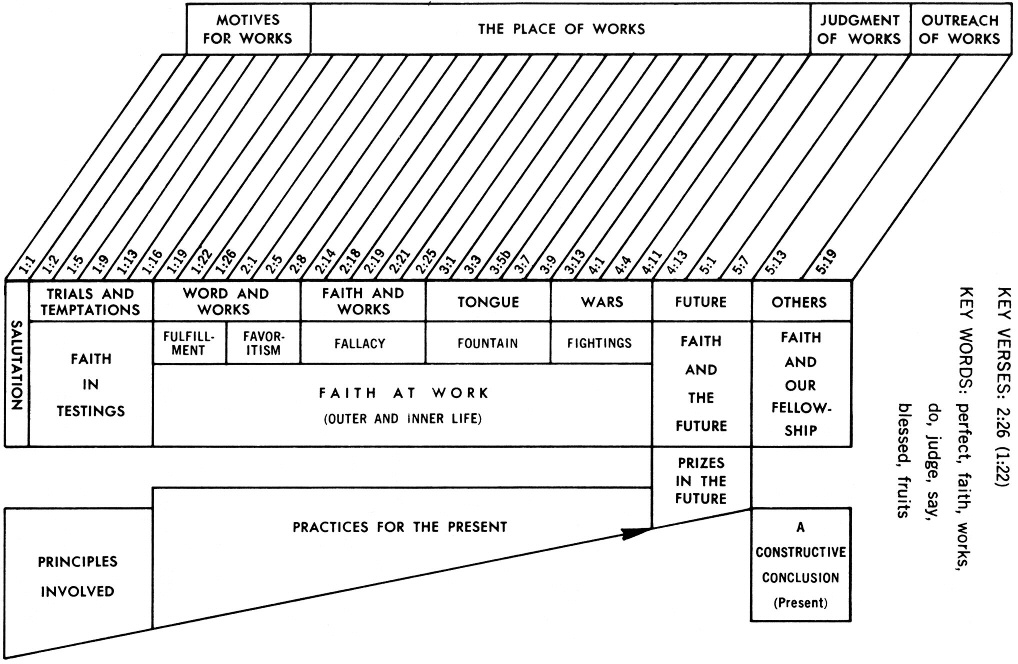
Click chart to enlarge
Chart from recommended resource Jensen's Survey of the NT - used by permission
See also Overview Chart by Charles Swindoll
|
JAMES |
|||||||
| Motives for Works |
The Place of Works: Outward Demonstration of Inner Faith |
Outreach of Works |
|||||
| Jas 1:1-18 | Jas 1:19-2:13 | Jas 2:14-25 | Jas 3:1-12 | Jas 3:13-4:12 | Jas 4:13-5:12 | Jas 5:13-19 | |
| Trials & Temptations |
Word & Works |
Faith & Works |
Tongue | Wars | Future | Others | |
|
Faith |
Fulfill |
Favor |
Fallacy |
Fountain |
Factions |
Faith |
Faith |
|
FAITH AT WORK |
|||||||
James 2:21 Was not Abraham our father justified by works when he offered up Isaac his son on the altar? (NASB: Lockman)
Greek: Abraam o pater emon ouk ex ergon edikaiothe, (3SAPI) anenegkas (AAPMSN) Isaak ton uion autou epi to thusiasterion?
Amplified: Was not our forefather Abraham [shown to be] justified (made acceptable to God) by [his] works when he brought to the altar as an offering his [own] son Isaac? (Amplified Bible - Lockman)
Hiebert: Was not our ancestor Abraham considered righteous for what he did when he offered his son Isaac on the altar?
KJV: Was not Abraham our father justified by works, when he had offered Isaac his son upon the altar?
NLT: Don't you remember that our ancestor Abraham was declared right with God because of what he did when he offered his son Isaac on the altar? (NLT - Tyndale House)
Phillips: Think of Abraham, our ancestor. Wasn't it his action which really justified him in God's sight when his faith led him to offer his son Isaac on the altar? (Phillips: Touchstone)
Wuest: Was not our father Abraham vindicated by works in that he offered his son Isaac on the altar of sacrifice? (Eerdmans Publishing - used by permission)
Young's Literal: Abraham our father--was not he declared righteous out of works, having brought up Isaac his son upon the altar?
WAS NOT ABRAHAM OUR FATHER JUSTIFIED BY WORKS: Abraam o pater emon ouk ex ergon edikaiothe, (3SAPI):
- Joshua 24:3; Isaiah 51:2; Matthew 3:9; Luke 1:73; 16:24,30; John 8:39,53; Acts 7:2; Romans 4:1,12,16
- Jas 2:18,24; Ps 143:2; Matthew 12:37; 25:31, 32, 33, 34, 35, 36, 37, 38, 39, 40; Romans 3:20
- James 2 Resources - Multiple Sermons and Commentaries (includes multiple journal articles on faith)
- James 2:20-26 Are We Justified by Works? - Steven Cole
- James 2:21-26: Living Faith - John MacArthur
- James 2:21-24 And the Justification of Abraham - R Bruce Compton (Detroit Baptist Seminary Journal 2: pages 19-45, 1997)
- Saved by Faith [Alone] in Paul Vs Not Saved by Faith Alone in James - Robert Stein
Stephen Nichols explains that Martin Luther "moved from viewing righteousness as active, as something he had to achieve, to viewing it as passive, something Christ achieved on his behalf, apprehended not by our merits but by faith alone. The Reformation plank of sola fide, faith alone, was born, and Luther was born again." (Martin Luther: A Guided Tour of His Life and Thought)
Now we encounter what to many observers including Martin Luther is the major difficulty in interpretation of this section, for it has more serious ramifications than the difficulties encountered in the interpretation of James 2:18.
Steven Cole writes that "coming out of his struggles with trying to work his way to right standing with God, Luther stumbled over the Epistle of James. In his preface to the New Testament of 1522, he called James “an epistle of straw.” Although he did not reject James from the canon of Scripture, he once remarked “that he would give his doctor’s beret to anyone who could reconcile James and Paul” (Roland Bainton, Here I Stand: A Life of Martin Luther [Abingdon Press], p. 259). That is my task today, but I am privileged to stand on the shoulders of many wise men who have gone before me! As I said last week, this is not simply an academic debate, because it deals with the most crucial question, “How can I be right before a holy God?” Nothing is more important than understanding the biblical answer to that question! We need to be clear: Are we justified by faith alone, or are we justified by faith plus our works? That issue divided the Reformers from the Roman Catholic Church and it is still the major issue between Roman Catholicism and the evangelical Protestant church today. (James 2:20-26 Are We Justified by Works?)
James 2:14-20 described a dead faith but now James 2:21-26 shifts to a saving faith providing examples that it manifests itself in the production of works.
James takes these two examples of a dynamic faith that present a contrast between Abraham, the father of the Jews and Rahab, a Gentile, woman who was a harlot. Their common denominator was a faith that proved itself as genuine by their works. What they believed determined how they behaved. Both behaviors were far from easy for in Abraham's case God asked him to sacrifice his only son and the other a woman was ask to put her own life on the line to save two Hebrew spies. Abraham would be an example of the best of men to these Jewish readers with Rahab an example of the worst. And yet they are both justified by works. The reference to each example is introduced with a rhetorical question which invites an affirmative response.
Although Abraham would have been the supreme example of faith to any believing Jews (cp James' target audience in James 1:1), Paul clearly presents Abraham as "the father of all who believe" (Ro 4:11-note), and in Galatians declares that "it is those who are of faith who are sons of Abraham" (Gal 3:7) and "if you belong to Christ, then you are Abraham's offspring, heirs according to promise." (Gal 3:29). It follows that "father Abraham" is the prototype of genuine faith for both Jews and Gentiles who would follow his example of saving faith.
By works (ex ergon) - Literally out of works.
Justified (see discussion of dikaioo in Jas 2:24-note)
Was not Abraham our father justified by works - Now compare Paul's statement in Romans 4…
But to the one who does not work, but believes in Him who justifies the ungodly, his faith is reckoned as righteousness (see note Romans 4:5)
Or Romans 3…
For we maintain that a man is justified by faith apart from works of the Law. (see note Romans 3:28)
JAMES TEACHES
JUSTIFICATION BY FAITH
APART FROM WORKS
A simple reading would lead one to conclude that these James and Paul are in direct contradiction regarding the manner in which one is justified. But now let's reason through this thorny passage. First, remember that in inductive Bible study, context is king in interpretation. So the question arises,
"Are there any truths in the immediate context of James' epistle that help us unravel this apparent and otherwise confusing contradiction?"
Specifically, does James teach anything about salvation in other passages?
(1) JAMES BELIEVED ABRAHAM
WAS JUSTIFIED BY FAITH
First, note that closest teaching on salvation (justification) follows in James 2:23, where James quotes the Old Testament passage from Genesis 15 that tells us how Abraham was saved. Paul uses this identical passage in Romans 4:3 explaining that salvation is by faith alone and not by works. So clearly James appears to agree with Paul by quoting the identical passage in James 2:23. Furthermore in James 2:21, note that James alludes to an event that took place in Genesis 22, some 30 plus years after Abraham exercised faith that resulted in God's crediting righteousness to his spiritual bank account! Was Abraham saved in Genesis 15:6 or wasn't he? The answer is clearly that he was declared righteous by faith (salvation). So even from this immediate context and a comparison of the chronology of the events in Abraham's life, it is clear James affirms justification by faith.
(2) JAMES TAUGHT GOD BROUGHT US FORTH BY THE WORD OF TRUTH
Second, note that earlier in James' epistle, he spoke of salvation writing that…
Every good thing bestowed and every perfect gift is from above, coming down from the Father of lights, with whom there is no variation, or shifting shadow. In the exercise of His will He brought us forth by the word of truth, so that we might be, as it were, the first fruits among His creatures. (James 1:17-18)
In the context of the Father of lights giving perfect gifts, James 1:18 describes the most perfect gift a sinner could ever receive from above - salvation. Is James teaching that this salvation is the result of man's works or merit? Clearly not, for James says that God beget or birthed us as it were by the Word of Truth (which is similar to Peter's explanation of our salvation…
you have been born again not of seed which is perishable but imperishable, that is, through the living and abiding word of God. (See note 1Peter 1:23)
Although, James does not use the specific word justified, the clear implication in the context of good gifts from above (Gk = anothen also in John 3:3,7 "born again" or "from above") is that this bringing forth was the result of God's amazing grace, His unmerited favor, independent of man's works.
(3) JAMES OPPOSED THE JUDAIZERS AT THE JERUSALEM COUNCIL
Third, James stood with Paul and Barnabas against the Jews who were saying one needed to add "works" (circumcision) to faith in order to assure salvation.
In Acts 15 (commentary), Dr Luke records…
And some men came down from Judea and began teaching the brethren, "Unless you are circumcised according to the custom of Moses, you cannot be saved."
2 And when Paul and Barnabas had great dissension and debate with them, the brethren determined that Paul and Barnabas and certain others of them should go up to Jerusalem to the apostles and elders concerning this issue. 3 Therefore, being sent on their way by the church, they were passing through both Phoenicia and Samaria, describing in detail the conversion of the Gentiles, and were bringing great joy to all the brethren. 4 And when they arrived at Jerusalem, they were received by the church and the apostles and the elders, and they reported all that God had done with them.
5 But certain ones of the sect of the Pharisees who had believed, stood up, saying, "It is necessary to circumcise them, and to direct them to observe the Law of Moses."
6 And the apostles and the elders came together to look into this matter. 7 And after there had been much debate, Peter stood up and said to them, "Brethren, you know that in the early days God made a choice among you, that by my mouth the Gentiles should hear the word of the gospel and believe. 8 "And God, who knows the heart, bore witness to them, giving them the Holy Spirit, just as He also did to us; 9 and He made no distinction between us and them, cleansing their hearts by faith. 10 "Now therefore why do you put God to the test by placing upon the neck of the disciples a yoke which neither our fathers nor we have been able to bear? 11 "But we believe that we are saved through the grace of the Lord Jesus, in the same way as they also are." 12 And all the multitude kept silent, and they were listening to Barnabas and Paul as they were relating what signs and wonders God had done through them among the Gentiles.
13 And after they had stopped speaking, James (this is the same James who authored the epistle of James) answered, saying, "Brethren, listen to me. 14 "Simeon has related how God first concerned Himself about taking from among the Gentiles a people for His name. 15 "And with this the words of the Prophets agree, just as it is written, 16 'AFTER THESE THINGS I will return, AND I WILL REBUILD THE TABERNACLE OF DAVID WHICH HAS FALLEN, AND I WILL REBUILD ITS RUINS, AND I WILL RESTORE IT, 17 IN ORDER THAT THE REST OF MANKIND MAY SEEK THE LORD, AND ALL THE GENTILES WHO ARE CALLED BY MY NAME,' 18 SAYS THE LORD, WHO MAKES THESE THINGS KNOWN FROM OF OLD. 19 "Therefore it is my judgment that we do not trouble those who are turning to God from among the Gentiles, 20 but that we write to them that they abstain from things contaminated by idols and from fornication and from what is strangled and from blood. 21 "For Moses from ancient generations has in every city those who preach him, since he is read in the synagogues every Sabbath." (Acts 15:1-21)
Comment: James was not saying that these restrictions were required for salvation, but rather for fellowship with the Jerusalem church and with Jewish Christians in general. These practices were prevalent in the Gentile world and were offensive to Jews, whether Christian or not, and therefore presented a stumbling block. They would also be a temptation through peer pressure to new Gentile believers and could easily lead them to backslide into paganism if not carefully avoided. In summary, James agreed with Peter's clear statement that the Gentiles were saved through the grace of the Lord Jesus" and "by faith".
PAUL TEACHES
JUSTIFICATION BY FAITH
IS ASSOCIATED WITH WORKS
And so even though James appears on first observation to contradict Paul's teaching of salvation by grace though faith and not works, James clearly is compatible with Paul's doctrine of salvation in other passages such as Ephesians 2…
For by grace you have been saved through faith; and that not of yourselves, it is the gift of God; not as a result of works, so that no one may boast. For we are His workmanship, created in Christ Jesus for good works, which God prepared beforehand so that we would walk in them. (see notes Ephesians 2:8; 2:9; 10)
(Jesus) gave Himself for us, that He might redeem us from every lawless deed and purify for Himself a people for His own possession (this would equate with salvation by grace through faith), zealous for good deeds (see study of Good Deeds). (see note Titus 2:14)
This is a trustworthy statement; and concerning these things I want you to speak confidently, so that those who have believed (This would equate with salvation by grace through faith) God may be careful to engage in good deeds (their belief results in a concordant behavior). These things are good and profitable for men. (see note Titus 3:8)
In short, simple observation of the preceding passages indicates that both James and Paul teach salvation is by grace alone through faith alone in Christ alone and both teach that genuine faith is associated with good works.
For more on justified by works see discussion notes on Jas 2:24-note.
WHEN HE OFFERED UP ISAAC HIS SON ON THE ALTAR: anenegkas (AAPMSN) Isaak ton huion autou epi to thusiasterion?:
- Genesis 22:9, 10, 11, 12,16, 17, 18
- James 2 Resources - Multiple Sermons and Commentaries (includes multiple journal articles on faith)
- James 2:20-26 Are We Justified by Works? - Steven Cole
- James 2:21-26: Living Faith - John MacArthur
When he offered his son Isaac on the altar - This recounts the specific faith-prompted deed that called forth God's commendation. (Ray Pritchard asks What Is Your Isaac?)
Offered (399) (anaphero from ana = up, again, back + phero = bear, carry) literally means to carry, bring or bear up and so to to cause to move from a lower position to a higher position. It serves as a technical term for offering sacrifices offer up (to an altar).
For background the writer of Hebrews in the famous "hall of faith" of Hebrews 11 explains that…
8 By faith Abraham, when he was called, obeyed by going out to a place which he was to receive for an inheritance; and he went out, not knowing where he was going.
17 By faith Abraham, when he was tested, offered up Isaac; and he who had received the promises was offering up his only begotten son 18 it was he to whom it was said, "IN ISAAC YOUR DESCENDANTS SHALL BE CALLED." 19 He considered that God is able to raise men even from the dead; from which he also received him back as a type. (See notes Hebrews 11:8; 17; 18; 19)
Steven Cole explains that…
Abraham was not saved by his obedience in sacrificing Isaac. Rather, that obedience proved the reality of his previous saving faith. Hebrews 11:8 states, “By faith Abraham, when he was called, obeyed….” That verse refers to his obedience in leaving his homeland and going to the promised land. But Hebrews 11:17 adds, “By faith Abraham, when he was tested, offered up Isaac….” In fact, all through Hebrews 11, we read of what the heroes of faith did. By faith, Abel offered a better sacrifice. By faith, Noah built the ark. By faith, Moses chose to endure ill-treatment with God’s people and leave Egypt. All through the chapter we see how faith acted.
It is the same point that James is making, that faith is not mere words without action. Genuine faith works. The proof that Abraham believed God is seen in his actions: He obediently offered up Isaac. Genuine faith and works are inseparable, because genuine faith always results in good works. (James 2:20-26 Are We Justified by Works?)
Jesus although speaking of one's words made a similar point as James and the writer of Hebrew when He declared…
For there is no good tree which produces bad fruit; nor, on the other hand, a bad tree which produces good fruit. 44 For each tree is known by its own fruit. For men do not gather figs from thorns, nor do they pick grapes from a briar bush. 45 The good man out of the good treasure of his heart brings forth what is good; and the evil man out of the evil treasure brings forth what is evil; for his mouth speaks from that which fills his heart. (Luke 6:43-45)
Warren Wiersbe comments on Luke 6:43-45: The illustration of the tree reminds us that fruit is always true to character. An apple tree produces apples, not oranges; and a good person produces good fruit, not evil. Believers do sin, but the witness of their words and works is consistently good to the glory of God.
A T Robertson (Luke 6:43-45): The fruit of each tree reveals its actual character. It is the final test.
Matthew Poole (Luke 6:43-45): Men and women here (as in other texts of Scripture) are compared to trees, with respect to their root and fruit, and the dependence the fruit hath upon the root and the nature of the tree. The heart of man is made the root, that being the principle of human actions, as the root is the principle to the fruit; for all the overt actions of a man’s life are but the imperate acts of the heart and of the will. Hence it is that a will renewed and sanctified in a man, and made conformable to the will of God, doth not only will and choose the will of God, love it, desire it, and delight in it; but commandeth the tongue to direct its discourses conformable to it, and also commandeth all the members of the body, in their motions and order, to act conformably: and on the contrary, the unrenewed and unsanctified will of man doth not only reject and refuse the will of God, but directeth the tongue to words contrary to the Divine will, and all the members of the body, in their motions and order, to act without any respect to or awe of the will of God.
Warren Wiersbe speaks of Abraham's obedience to God's request to offer his only son, reminding us that "Faith is not believing in spite of evidence. Faith is obeying in spite of consequence."
Note God's response to Abraham's act of obedience that came out of his great faith "Do not stretch out your hand against the lad, and do nothing to him; for now I know that you fear God, since you have not withheld your son, your only son, from Me. (Genesis 22:12)
Hiebert has an interesting note that "Scripture records no further testings of Abraham after this supreme testing of Abraham's obedience to God, demonstrating that God was first in his life. His faith-prompted action was the supreme example of the kind of works that James insists must result from a living faith.
Wayne Grudem writes that when Paul speaks of Abraham being justified by faith (Romans 4), he "is talking about the time God justified Abraham once for all, reckoning righteousness to him as a result of his faith in God. But James is talking about something far later, after Abraham had waited many years for the birth of Isaac, and then after Isaac had grown old enough to carry wood up the mountain for a sacrifice. At that point Abraham was “shown to be righteous” by his works… (Systematic Theology pdf - scroll down to p 635)
Related Resource -
James 2:22 You see that faith was working with his works, and as a result of the works, faith was perfected (NASB: Lockman)
Greek: blepeis (2SPAI) hoti e pistis sunergei (3SIAI) tois ergois autou kai ek ton ergon e pistis eteleiothe, (3SAPI)
Amplified: You see that [his] faith was cooperating with his works, and [his] faith was completed and reached its supreme expression [when he implemented it] by [good] works. (Amplified Bible - Lockman)
Hiebert: You see that his faith and his actions were working together, and his faith was made complete by what he did.
KJV: Seest thou how faith wrought with his works, and by works was faith made perfect?
NLT: You see, he was trusting God so much that he was willing to do whatever God told him to do. His faith was made complete by what he did—by his actions. (NLT - Tyndale House)
Phillips: Can't you see that his faith and his actions were, so to speak, partners - that his faith was implemented by his deed? (Phillips: Touchstone)
Wuest: You see that the aforementioned faith was co-operating and working with his works, and by his works was this faith brought to completion in a well-rounded whole. (Eerdmans Publishing - used by permission)
Young's Literal: dost thou see that the faith was working with his works, and out of the works the faith was perfected?
YOU SEE THAT FAITH WAS WORKING WITH HIS WORKS: blepeis (2SPAI) hoti e pistis sunergei (3SIAI) tois ergois autou:
- James 2:18; Galatians 5:6; Hebrews 11:17, 18, 19
- James 2 Resources - Multiple Sermons and Commentaries (includes multiple journal articles on faith)
- James 2:20-26 Are We Justified by Works? - Steven Cole
- James 2:21-26: Living Faith - John MacArthur
A WORKING
FAITH
You see - In this passage "you" is singular (in contrast to "you see" in Jas 2:24-note), and therefore seems to be directly addressing the objector in Jas 2:18 (note).
Notice that some of the translations render this verse as a question (KJV, Phillips, Young's Literal) while others render it as a declarative statement which follows from the preceding example of Abraham's faith being worked out.
Hiebert comments that "The present tense verb, "you see," implies that the double fact James advances from the example was so obvious that the objector could not fail to see these realities. This appeal to the individual suggests that each individual must see these spiritual realities for himself.
Faith is literally "the faith" (it has the definite article "the" in Greek) and obviously refers to Abraham's faith which although not present in the previous verse was assumed present because without "the faith", the deed would not have transpired. And this makes the point that James has been trying to drive home, that Abraham's faith was living as seen by the obedient action that resulted therefrom.
Spurgeon explains that "Faith and obedience are bound up in the same bundle. He that obeys God, trusts God; and he that trusts God, obeys God.
A W Tozer agrees writing that "The Bible recognizes no faith that does not lead to obedience, nor does it recognize any obedience that does not spring from faith. The two are opposite sides of the same coin.
As Wiersbe asks "How can you tell if a person is justified by faith if this transaction takes place between the sinner and God privately? Abraham's example answers that important question: the justified person has a changed life and obeys God's will. His faith is demonstrated by his works. ( Bible Exposition Commentary. 1989. Victor)
Working with (4903) (sunergeo from sun = together with, speaks of an intimate relationship + érgon = work; English - synergy) means literally to work together, to be a partner in work, to co-labor, to engage in cooperative endeavor, to assist. Here James uses it to show that faith works together with works and so it achieves visibility and hence fulfilment in the works.
As John Boys put it "The saints of God are sealed inwardly with faith, but outwardly with good works."
There are 5 uses of sunergeo in the NT…
Mark 16:20+ And they went out and preached everywhere, while the Lord worked with them, and confirmed the word by the signs that followed. And they promptly reported all these instructions to Peter and his companions. And after that, Jesus Himself sent out through them from east to west the sacred and imperishable proclamation of eternal salvation.
Romans 8:28+ And we know that God causes all things to work together for good to those who love God, to those who are called according to His purpose.
1 Corinthians 16:16+ that you also be in subjection to such men and to everyone who helps in the work and labors.
2 Corinthians 6:1+ And working together with Him, we also urge you not to receive the grace of God in vain--
James 2:22+ You see that faith was working with his works, and as a result of the works, faith was perfected;
Hiebert explains that "Working together (sunergei) asserts the close connection between Abraham's faith and his works. The compound verb may mean "to cooperate with," to work together as two quite independent forces. But James cannot mean that faith and works are two equal partners cooperating in the achievement of the stated result. Surely James did not teach such synergism. The preposition sun in the verb need not be so pressed. It seems better to accept that it has the force of working with in the sense of aiding and supporting; his works supported and sustained the fact that his faith was a living faith. The imperfect tense suggests that this working union of faith and works was not limited to this occasion but was characteristic of Abraham's life of faith. Faith is the motivating power of works and there can be no works of faith without faith, as there can be no fruit without the tree. We cannot say that the fruit of the tree cooperates with the tree, but we can say that the fruit helps us to know the nature of the tree. This verse underlines the inseparability of a living faith and Christian deeds. (James. Moody. 1992)
It is noteworthy that although Martin Luther considered James a "right strawy epistle" because of this section of the book, Luther himself agreed with James as his preface to Romans demonstrates…
O it is a living, quick, mighty thing this faith; so that it is impossible but that it should do all good things without intermission. It does not ask whether good works are to be done, but before the question could be asked it does them, and is always doing them. He who does not these good works is a man without faith… Yea, it is impossible to separate works from faith, as impossible to separate burning and shining from fire."
AND AS A RESULT OF THE WORKS, FAITH WAS PERFECTED: kai ek ton ergon e pistis eteleiothe, (3SAPI):
- 1John 2:5; 4:17,18
- James 2 Resources - Multiple Sermons and Commentaries (includes multiple journal articles on faith)
- James 2:20-26 Are We Justified by Works? - Steven Cole
- James 2:21-26: Living Faith - John MacArthur
- Related Resource - Jehovah Jireh - God our Provider (Abraham's Faith Demonstrated)
Faith was perfected - Notice carefully that this statement implies that faith was already present and thus preceded the works mentioned. Obviously James is not saying Abraham's faith was perfect, for that is not possible for fallen men, even those who are saved by grace through faith. What he was saying is that Abraham's faith attained a reached its goal (see definition of verb below). James is not saying that it was a defective faith, for Genesis 15:6 clearly teaches that it resulted in complete (forensic) justification.
Perfected (5048) (telioo related to teleios from telos = an end, a purpose, an aim, a goal, consummate soundness, idea of being whole) means to accomplish or bring to an end or to the intended goal (telos). It means to be complete, mature, fully developed, full grown, brought to its end, finished, wanting nothing necessary to completeness or in good working order. It does not mean simply to terminate something but to carry it out to the full finish which is picked up in the translation "perfected". Teleioo signifies the attainment of consummate soundness and includes the idea of being made whole.
Notice the use of the passive voice which indicates the perfecting was produced by an outside source, in this case God. When God saved Abraham in Genesis 15:6, He had a goal (a telos = an end, a purpose, an aim, a goal) in view.
Hiebert explains that goal this way "That goal was that through faith Abraham should be brought into such intimate relations with God that he would voluntarily act to place God first in every area of his life. That goal was effectively attained through the events recorded in Genesis 22. And thus "by what he did," by his "works," "his faith was made complete," brought to its intended goal. The works demonstrated the vital nature of the faith that produced them. A fruit tree is made perfect, brought to its intended goal, by the fruit that it produces. So "wherever there is genuine faith it must blossom into works."'
D. L. Moody said that "Every Bible should be bound in shoe leather.
Yes Moody had been a shoe salesman but that's not what he was referring to with this statement. He was basically agreeing with James who taught that a living faith obeys God and proves itself in daily life and works.
Wuest has this note on the NT word group (telos, teleioo, teleios, teleiosis, teleiotes) "Teleios the adjective, and teleioo the verb. The adjective is used in the papyri, of heirs being of age, of women who have attained maturity, of full-grown cocks, of acacia trees in good condition, of a complete lampstand, of something in good working order or condition. To summarize; the meaning of the adjective includes the ideas of full-growth, maturity, workability, soundness, and completeness. The verb refers to the act of bringing the person or thing to any one of the aforementioned conditions. When applied to a Christian, the word refers to one that is spiritually mature, complete, well-rounded in his Christian character. (Wuest Word Studies - Eerdman Publishing Company Volume 1, Volume 2, Volume 3 - used by permission)
Walking Our Faith - Often we Christians are urged not just to "talk the talk" but to "walk the talk." The same advice may be expressed in these words: Don't let your behavior contradict your professed belief. At other times we are admonished to be sure that life and lip agree. If our conduct doesn't harmonize with our confession of faith, however, that discrepancy nullifies the testimony of the gospel which we proclaim.
As far as we can know, Mahatma Gandhi never became a Christian, but he made a statement that we who follow Jesus would do well to ponder. When asked to put his message into one short sentence, he replied, "My life is my message."
Certainly we should explain the gospel message as clearly as possible. Yet the clearest explanation isn't going to win hearts for our Lord unless His love is embodied in our lives. To quote the apostle Paul in 1Corinthians 11:1, "Imitate me, just as I also imitate Christ." And holding himself up as a pattern, he wrote in Philippians 4:9, "The things which you learned and received and heard and saw in me, these do, and the God of peace will be with you."
Pray, then, that like Paul we may live out our saving faith before the watching world.— Vernon C. Grounds (Our Daily Bread, Copyright RBC Ministries, Grand Rapids, MI. Reprinted by permission. All rights reserved)
Let the beauty of Jesus be seen in me—
All His wonderful passion and purity!
O Thou Spirit divine, all my nature refine,
Till the beauty of Jesus be seen in me. —Orsborn
The world is watching us—do they see Jesus?
James 2:23 and the Scripture was fulfilled which says, "AND ABRAHAM BELIEVED GOD, AND IT WAS RECKONED TO HIM AS RIGHTEOUSNESS," and he was called the friend of God. (NASB: Lockman)
Greek: kai eplerothe (3SAPI) e graphe e legousa, (PAPFSN) Episteusen (3SAAI) de Abraam to theo, kai elogisthe (3SAPI) auto eis dikaiosunen, kai philos theou eklethe. (3SAPI)
Amplified: And [so] the Scripture was fulfilled that says, Abraham believed in (adhered to, trusted in, and relied on) God, and this was accounted to him as righteousness (as conformity to God’s will in thought and deed), and he was called God’s friend. (Amplified Bible - Lockman)
KJV: And the scripture was fulfilled which saith, Abraham believed God, and it was imputed unto him for righteousness: and he was called the Friend of God.
NLT: And so it happened just as the Scriptures say: "Abraham believed God, so God declared him to be righteous." He was even called "the friend of God." (NLT - Tyndale House)
Phillips: That is what the scripture means when it says: 'Abraham believed God, and it was accounted to him for righteousness. And he was called the friend of God.' (Phillips: Touchstone)
Wuest: And the scripture was actually and fully realized which said, And Abraham believed God, and it was put to his account for righteousness. And a friend of God he was called. (Eerdmans Publishing - used by permission)
Young's Literal: and fulfilled was the Writing that is saying, `And Abraham did believe God, and it was reckoned to him--to righteousness;' and, `Friend of God' he was called.
AND THE SCRIPTURE WAS FULFILLED WHICH SAYS: kai eplerothe (3SAPI) e graphe e legousa, (PAPFSN):
- Mark 12:10; 15:28; Luke 4:21; Acts 1:16; Romans 9:17; 11:2; Galatians 3:8, 9, 10,22; 2Ti 3:16; 1Pe 2:6
- James 2 Resources - Multiple Sermons and Commentaries (includes multiple journal articles on faith)
- James 2:20-26 Are We Justified by Works? - Steven Cole
- James 2:21-26: Living Faith - John MacArthur
And - This introduces a further result of Abraham's willingness to sacrifice Isaac.
The Scripture was fulfilled - This statement is somewhat nebulous and so it is not surprising that there is some disagreement among the commentators as to James' intended meaning. Some see it as a "fulfilled" prophecy, interpreting that Genesis 15:6 had a prophetic element, but that seems a bit far fetched to me. I agree with Moo who says there is no need to view Genesis 15:6 as "a prophecy that was 'fulfilled' later in Abraham's career. What he suggests, rather, is that this verse found its ultimate significance and meaning in Abraham's life of obedience."
Fulfilled (4137) (pleroo) means to be filled (passive voice = acted on by outside force) to the brim (a net, Mt 13:48, a building, Jn 12:3, Acts 2:2, a city, Acts 5:28, needs Phil 4:19-note) but in other contexts such as here in James pleroo means to make complete in every particular.
Grudem explains the phrase "the Scripture was fulfilled" writing that "James… says that Scripture “was fulfilled” when Abraham offered his son, apparently meaning that the earlier declaration of righteousness was then worked out and its results were seen to be true in Abraham’s life when he offered Isaac on the altar. (Systematic Theology pdf - scroll down to p 635)
AND ABRAHAM BELIEVED GOD AND IT WAS RECKONED TO HIM AS RIGHTEOUSNESS: Episteusen (3SAAI) de Abraam to theo, kai elogisthe (3SAPI) auto eis dikaiosunen:
- Genesis 15:6; Romans 4:3, 4, 5, 6,10,11,22, 23, 24; Galatians 3:6
- James 2 Resources - Multiple Sermons and Commentaries (includes multiple journal articles on faith)
- James 2:20-26 Are We Justified by Works? - Steven Cole
- James 2:21-26: Living Faith - John MacArthur
- Related Resource - Jehovah Jireh - God our Provider (Abraham's Faith Demonstrated
Genesis 15:6 forms the basis for Paul's defense of justification by faith apart from works, especially in Romans 4…
Romans 4:3 (note) For what does the Scripture say? "AND ABRAHAM BELIEVED GOD, AND IT WAS RECKONED TO HIM AS RIGHTEOUSNESS." 4:4 Now to the one who works, his wage is not reckoned as a favor, but as what is due. 4:5 But to the one who does not work, but believes in Him who justifies the ungodly, his faith is reckoned as righteousness, 4:6 just as David also speaks of the blessing upon the man to whom God reckons righteousness apart from works:
Romans 4:22 (note) Therefore also IT WAS RECKONED TO HIM AS RIGHTEOUSNESS. 23 Now not for his sake only was it written, that it was reckoned to him, 24 but for our sake also, to whom it will be reckoned, as those who believe in Him who raised Jesus our Lord from the dead,
Gal 3:6-note Even so Abraham BELIEVED GOD, AND IT WAS RECKONED TO HIM AS RIGHTEOUSNESS.
This famous passage, one of the most important in all Scripture, marks Abraham's day of salvation. This is the day he was justified by faith apart from works of righteousness. This is how every sinner in the Old Testament became a saved saint. It was not be works, by keeping the law, by sacrificing animals, etc. Salvation has always been by grace through faith. Notice also that the events of Genesis 15:6 antedate the giving of the Law on Mt Sinai by more than 400 years. There is no way the Law could have saved Abraham. The Law was never given to save, but among other purposes was meant to drive men to understand their need for a Savior because of their inability to keep the Law. If you have not memorized Genesis 15:6 then you should do so immediately. Do not be surprised if God gives you many opportunities to recount the great truth of this verse to others including Jews who call Abraham their father but do not do what Abraham did (cp Jn 8:39b "If you are Abraham's children, do the deeds of Abraham.").
Reckoned (3049) (logizomai from lógos = reason, word, account) means to reckon, compute, calculate, to take into account, to deliberate, and to weigh. Logizomai refers to a of careful study or reasoning which results in the arriving at a conclusion. Logizomai conveys the idea of calculating or estimating. Logizomai was a term frequently used in the business community of the NT era and meant to impute (put to one's account) or credit to one's account.
Reckoned then is a legal or financial term that means to place on one's account. The spiritual transfer that occurred was Abraham's spiritual bank account before God (who demands perfect righteousness) book was bankrupt as is every person born for we are all born into Adam's line and as such inherit his sin virus and as a result are spiritually dead. When Abraham trusted God, God placed perfect righteousness on Abraham's account as a gift not as something Abraham earned. Abraham was declared righteous by faith or justified by faith. As discussed more fully in James 2:24 (see notes), Abraham experienced justification which is the once-for-all time, immutable act of God whereby He declares the believing sinner righteous on the basis of Christ's finished work on the cross. Please do not be confused. God did not make Abraham righteous, for that implies a process and justification is not a process but is an act. Justification is not something the sinner does but is a declaration which God makes regarding the sinner's standing before Him when he places his or her trust in Christ.
R C Sproul asks "does God need to see your works to know if you have faith or not? Of course not. James is speaking of man’s sight. Paul says that in God’s sight, Abraham was justified by faith (Genesis 15). However, James says that in man’s sight the most telling proof that Abraham was a justified man is that he was willing to obey God even to the point of offering up his only son on the altar. (Tabletalk, May, 1989)
AND HE WAS CALLED THE FRIEND OF GOD: kai philos theou eklethe. (3SAPI):
- Ex 33:11; 2Chr 20:7; Job 16:21; Isa 41:8; Jn 15:13, 14, 15
- James 2 Resources - Multiple Sermons and Commentaries (includes multiple journal articles on faith)
- James 2:20-26 Are We Justified by Works? - Steven Cole
- James 2:21-26: Living Faith - John MacArthur
The friend of God - Did you realize that Abraham is the only person in the Bible who is called a friend of God? It is also notable that friend of God is the distinctive title for Abraham among the Arabs today.
Friend (5384) (philos) speaks of one who is on intimate terms or close association with another.
Webster's 1828 dictionary defines friend as…
One who is attached to another by affection; one who entertains for another sentiments of esteem, respect and affection, which lead him to desire his company, and to seek to promote his happiness and prosperity; opposed to foe or enemy.
Here are some other passages that relate to Abraham's friendship with God…
2 Chronicles 20:7 (King Jehoshaphat in addressing God) "Didst Thou not, O our God, drive out the inhabitants of this land before Thy people Israel, and give it to the descendants of Abraham Thy friend forever?
Isaiah 41:8 "But you, Israel, My servant, Jacob whom I have chosen, Descendant of Abraham My friend,
Jesus explains how Abraham was a friend of God declaring to His disciples that…
John 15:13-15 "Greater love has no one than this, that one lay down his life for his friends. 14 "You are My friends, if you do what I command you. 15 "No longer do I call you slaves, for the slave does not know what his master is doing; but I have called you friends, for all things that I have heard from My Father I have made known to you.
In addition a friend loves for as Jesus declared to His disciples…
If you love Me, you will keep My commandments. (John 14:15)
Bengel writes that Abraham "was the friend (in an active sense), the lover of God, in reference to his works; and (in a passive sense) loved by God in reference to his justification by works. Both senses are united in Jn 15:14, 15.
Steven Cole explains that "the obedient faith that James is describing is not just outward obedience to a list of commandments. It is certainly not a grudging obedience to a cruel taskmaster. Rather, it is an obedience that involves personal friendship with the holy God of the universe! So when you believe in Christ as the one who died for your sins, God not only declares you righteous. He also calls you “into fellowship with His Son, Jesus Christ our Lord” (1Cor. 1:9)! (James 2:20-26 Are We Justified by Works?)
Our Unfailing Friend - As a young man, Joseph Scriven had been engaged to a woman he deeply love. But tragedy struck the night before their wedding when the boat she was in capsized and she drowned. In the hope of forgetting the shock, which he never did, Joseph left his home in Ireland and went to Canada.
There he taught school and served as a tutor. He chose to live very simply, spending his money and strength in generously providing for destitute people. At times he even gave away his own clothing. He was considered an eccentric by some, yet all he tried to do was obey God's Word as best he could understand it.
In his loneliness, Joseph Scriven needed a steadfast friend. Having found that friend in Jesus Christ, he wrote these simple words, which movingly express his experience:
What a friend we have in Jesus,
All our sins and griefs to bear!
What a privilege to carry
Everything to God in prayer!
Even if we have been blessed with deeply enriching friendships, we all need Joseph Scriven's Friend. But before we can know Jesus as our Friend, we must know Him as our Savior. Then, through all of our changing circumstances, He will be the One we can depend on -- our unfailing Friend. Vernon C. Grounds (Our Daily Bread, Copyright RBC Ministries, Grand Rapids, MI. Reprinted by permission. All rights reserved)
Christ's friendship prevails even when human friendship fails.
The Best Friend - It’s an honor I cherish, and one I seek to live up to—but I don’t always do it. It’s the privilege of hearing my wife say, “You’re my best friend,” which she does often. As much as I love her, though, I occasionally do something that is not so “best friend-ish.”
In reality, no matter how hard we try, we cannot live up to the high standard of being a friend who never lets others down. We all fail from time to time—forgetting to do what we should or simply allowing selfishness to build a barrier between us.
As believers, we take comfort in knowing that we are called a friend of God, and He is a true friend who will never falter. Michael Gungor’s joyous song “Friend of God” captures the wonder of this relationship when it asks, “Who am I that You are mindful of me?”
Abraham was called “the friend of God,” and that friendship was related to his faith (2Chr 20:7; Jas 2:23). Jesus explained how we can receive that designation as well. He said to His disciples, “You are My friends if you do whatever I command you” (Jn 15:14). There is no better friend, for we know that He will never leave us nor forsake us (He 13:5).
Looking for the best friend ever? You can’t do better than the Lord Himself. — Dave Branon (Our Daily Bread, Copyright RBC Ministries, Grand Rapids, MI. Reprinted by permission. All rights reserved)
I’ve found a Friend, O such a Friend!
He loved me ere I knew Him;
He drew me with the cords of love,
And thus He bound me to Him. —SmallJesus is the only faultless Friend you’ll ever find.
Lightning and Thunder - When we see lightning flash across the sky, we expect the roar of thunder to follow. If there were no lightning, there would be no thunder because one causes the other.
It's like that with faith. Just as thunder always follows lightning, good works always follow true faith.
The relationship between faith and works is explained in the New Testament writings of Paul to the Ephesians, and in a brief letter from James. At first glance, these authors seem to contradict each other. Paul insisted, "By grace you have been saved through faith, … not of works" (Eph. 2:8, 9). But James declared, "A man is justified [declared righteous] by works, and not by faith only" (Jas. 2:24).
In context though, James wasn't denying that we are saved by faith. He referred to Abraham, saying that he "believed God, and it was accounted to him for righteousness" (Jas 2:23). This belief occurred years before Abraham gave evidence of his faith by preparing to offer his son as a sacrifice (Jas 2:21). Nor was the apostle Paul denying the value of works, for right after stating that we are saved by faith alone he said that we are saved "for good works" (Eph. 2:10).
What about you? Has the "lightning" of personal faith in Christ been followed by the "thunder" of good works? — Haddon W. Robinson (Our Daily Bread)
DIGGING DEEPER
Read Genesis 15:1, 2, 3, 4, 5, 6 and Genesis 22:1-14.
Why did God give righteousness to Abraham?
How did Abraham prove his faith?
We are saved by faith alone,
but faith that saves is never alone.