James 4:2
James 4:3
James 4:4
James 4:5
James 4:6
James 4:7
James 4:8
James 4:9
James 4:10
James 4:11
James 4:12
James 4:13
James 4:14
James 4:15
James 4:16
James 4:17
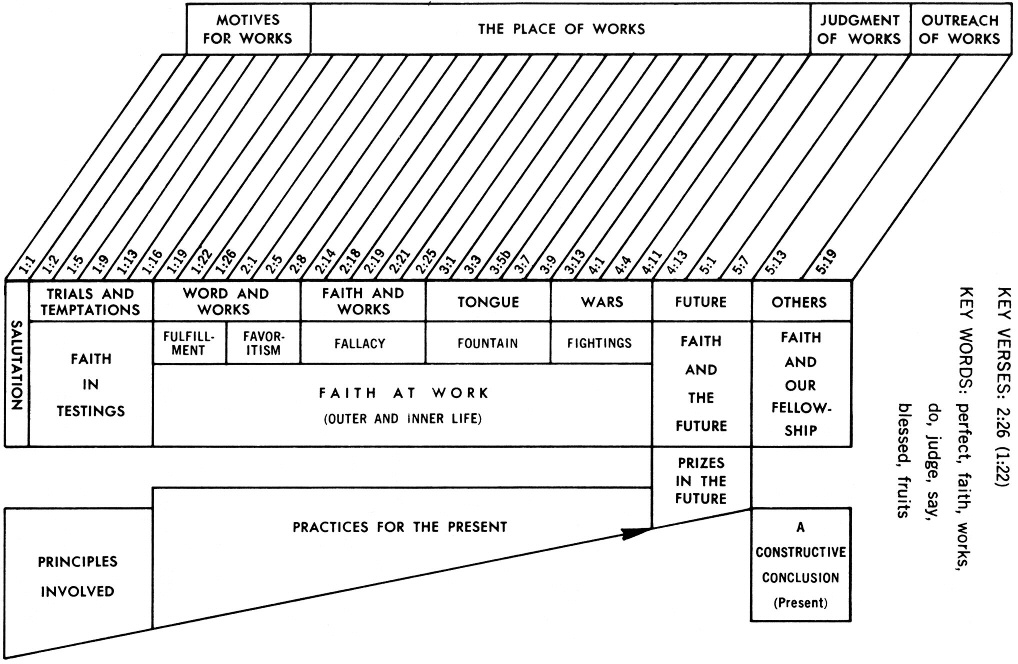
Click chart to enlarge
Chart from recommended resource Jensen's Survey of the NT - used by permission
See also Overview Chart by Charles Swindoll

|
JAMES |
|||||||
| Motives for Works |
The Place of Works: Outward Demonstration of Inner Faith |
Outreach of Works |
|||||
| Jas 1:1-18 | Jas 1:19-2:13 | Jas 2:14-25 | Jas 3:1-12 | Jas 3:13-4:12 | Jas 4:13-5:12 | Jas 5:13-19 | |
| Trials & Temptations |
Word & Works |
Faith & Works |
Tongue | Wars | Future | Others | |
|
Faith |
Fulfill |
Favor |
Fallacy |
Fountain |
Factions |
Faith |
Faith |
|
FAITH AT WORK |
|||||||
The Reactions of Living Faith to Worldliness
The reaction of living faith to selfish strife (James 4:1–5:12)
A. The condition manifesting worldliness (James 4:1–6)
1. The description of the condition (James 4:1–3)
a. The questions exposing the source (James 4:1)
b. The outcome of the condition (James 4:2a)
c. The reasons for the condition (James 4:2b–3)
2. The rebuke for the condition (James 4:4–6)
a. The adulterous character of worldliness (James 4:4)
(1) The question of rebuke (James 4:4a)
(2) The significance of their attitude (James 4:4b)
b. The authoritative message of Scripture (James 4:5a)
c. The divine response to the worldly (James 4:5b–6)
(1) The yearning of the Spirit (James 4:5b–6a)
(2) The verification from Scripture (James 4:6b)
B. The exhortation to the worldly (James 4:7–12)
1. The call to return to God (James 4:7–10)
a. The statement of the basic demand (James 4:7)
(1) Nearness to God (James 4:8a)
(2) Personal cleansing (James 4:8b)
(3) Open repentance (James 4:9)
(4) Godly humility (James 4:10)
2. The injunction against censoriousness (James 4:11–12)
a. The statement of the prohibition (James 4:11a)
b. The justification for the prohibition (James 4:11b–12)
The reaction of living faith to presumptuous planning (4:13–17)
A. The rebuke of their self-sufficient attitude (James 4:13–14)
1. The delineation of the attitude (James 4:13)
2. The presumption in the attitude (James 4:14)
B. The indication of the proper attitude (James 4:15)
C. The evil of their present attitude (James 4:16–17)
1. The evil of their boasting (James 4:16)
2. The sin of their inconsistency (James 4:17) (Hiebert - James Commentary)
James 4:6 But He gives a greater grace. Therefore it says, "GOD IS OPPOSED TO THE PROUD, BUT GIVES GRACE TO THE HUMBLE." (NASB: Lockman)
Greek: meizona de didosin (3SPAI) charin; dio legei, (3SPAI) O theos huperephanois antitassetai, (3SPMI) tapeinois de didosin (3SPAI) charin
Amplified: But He gives us more and more grace (power of the Holy Spirit, to meet this evil tendency and all others fully). That is why He says, God sets Himself against the proud and haughty, but gives grace [continually] to the lowly (those who are humble enough to receive it). [Pr. 3:34.] (Amplified Bible - Lockman)
ASV: But he giveth more grace. Wherefore the scripture saith, God resisteth the proud, but giveth grace to the humble.
BBE: But he gives more grace. So that the Writings say, God is against the men of pride, but he gives grace to those who make themselves low before him.
KJV: But he giveth more grace. Wherefore he saith, God resisteth the proud, but giveth grace unto the humble.
NLT: But he gives us even more grace to stand against such evil desires. As the Scriptures say, “God opposes the proud but favors the humble.” (NLT - Tyndale House)
Phillips: No, he gives us grace potent enough to meet this and every other evil spirit, if we are humble enough to receive it. That is why he says: 'God resists the proud, but gives grace to the humble.' (Phillips: Touchstone)
Wuest: Moreover, He [the Holy Spirit] gives greater grace. For this reason [in conformity with this] He [the Holy Spirit] says, God sets himself in battle array against the arrogant and haughty but gives grace to the humble and lowly.
Weymouth: But He gives more abundant grace, as is implied in His saying, “God sets Himself against the haughty, but to the lowly He gives grace.”
Young's Literal: and greater grace he doth give, wherefore he saith, 'God against proud ones doth set Himself up, and to lowly ones He doth give grace?'
But He gives a greater grace: de didosin (3SPAI) charin:
- Is 54:7, 8; Mt 13:12
- James 4 Resources - Multiple Sermons and Commentaries
- James 4:4-6 Spiritual Adultery & Resolving Conflicts - Steven Cole
- James 4:6-7 Drawing Near to God, Pt. 1 - John MacArthur
First consider the context in James 4…
What is the source of quarrels and conflicts among you? Is not the source your pleasures that wage war in your members? 2 You lust and do not have; so you commit murder. And you are envious and cannot obtain; so you fight and quarrel. You do not have because you do not ask. 3 You ask and do not receive, because you ask with wrong motives, so that you may spend it on your pleasures. 4 You adulteresses, do you not know that friendship with the world is hostility toward God? Therefore whoever wishes to be a friend of the world makes himself an enemy of God. 5 Or do you think that the Scripture (referring to the OT) speaks (the specific OT Scripture is not clear) to no purpose: "He jealously desires the Spirit (Ed: or "spirit" with little s - see below) which He has made to dwell in us"?
Here is James 4:4-6 in the Phillips Paraphrase …
You are like unfaithful wives, flirting with the glamour of this world, and never realizing that to be the world's lover means becoming the enemy of God! Anyone who deliberately chooses to love the world is thereby making himself God's enemy. Do you think what the scriptures have to say about this is a mere formality? Or do you imagine that this spirit of passionate jealousy is the Spirit he has caused to live in us? No, he gives us grace potent enough to meet this and every other evil spirit, if we are humble enough to receive it. That is why he says: 'God resists the proud, but gives grace to the humble.'
Steven Cole comments that as we study James 4:6-10, we need to…
Keep in mind that the overall context is about resolving conflicts in the church (or home). Here James zeroes in on God’s way of conflict resolution, which deals with our hearts before Him. Conflict with God is often behind conflicts with others. First and foremost in any conflict, we must get right with God (Sermon)
Roy Gingrich summarizes the context of James 4 as follows…
If we are living for lust gratification (Jas 4:1NLT, Jas 4:2NLT, Jas 4:3NLT), then we cultivate friendship with the world for the world furnishes us with the pleasures which (temporarily) gratify our lusts (“the world” is the present kosmos, which is under the headship of Satan, 2Co 4:4) If we cultivate the friendship of the world (Jas 4:4-note), we do four things: (1) We make ourselves to be spiritual adulterers. The church is the Bride of Christ, 2Co 11:2. Just as all unfaithfulness to Jehovah by Israel was called adultery, Jer 3:8, even so all unfaithfulness to Christ by the church is called adultery; (2) we make ourselves to be the enemies of God. The world is God’s enemy, Jn 15:18, 19, 20, 21, 22, 23, 24. If we love the world and court the friendship of the world (cp 1Jn 2:15, 16, 17), we have joined the ranks of God’s enemies and have made ourselves the enemies of God; (3) we make ourselves to be the objects of God’s jealousy. The Scripture does not speak in vain when it says “The Spirit which He made to dwell within us yearns over us jealousy.” God is jealous when He sees the affections of His people set on anything other than Himself; and (4) we make ourselves to be the objects of God’s resistance (Jas 4:6 "opposes the proud"). God asks us to do the difficult thing of being faithful to Himself in the midst of this world’s allurements and attractions. If we remain humble and obedient before Him. He gives us grace ("greater grace") to be faithful to Himself but if we become proud and rebellious before Him, He resists (opposes) us that He might turn us back to humility, obedience, and faithfulness to Himself (see Jas 4:7, 8, 9, 10). (Gingrich, R. E. The Book of James. Memphis, TN.: Riverside Printing) (from Roy Gingrich’s Commentaries in Outline Form 100 Volumes)
Henry Morris explains the contextual passages (Jas 4:4, 5-note) as follows…
(James 4:4) Compromising with the present world-system--whether in philosophy, dress or behavior --is surely one of the most prevalent characteristics of modern Christianity, even evangelicalism. This indictment of such compromise urgently needs emphasis today (1Jn 2:15-17; Gal 1:4; Jn 15:19; 17:14; Ro 8:6, 7, 8; 2Co 6:14, 15, 16, 17, 18, 2Co 7:1).
James 4:5 is a difficult passage, and interpretations have varied widely. There is no single Old Testament Scripture from which James is quoting, and he could not be referring to any New Testament Scripture, because the other New Testament books had not yet been written. He must, therefore, be referring to the general prophetic sense of those passages in the Old Testament that speak of God's Spirit as desiring the faithful love of His people and as opposed to any spirit of covetousness or adultery (whether spiritual or physical) in their hearts. Exemplifying this are such Scriptures as Ge 6:3; 2Sa 23:2; Ps 51:11; Isa 63:10,11; Ezek 36:26,27; Mic 2:7; Zech 7:12; 12:10; and others of the same general import. The verse can probably be best paraphrased as follows: "Do ye think that the Scriptures are speaking in vain when they testify that God's Holy Spirit [who is now actually dwelling in us] is longing for us to envy [that is, to covet after] God's love and friendship, rather than that of the world?" This rather free paraphrase seems to fit the entire context best, but, in view of the wide variety of translations and interpretations of this verse, it is not feasible to be dogmatic. (Morris, Henry: Defenders Study Bible. World Publishing - Highly Recommended Resource)
W A Criswell adds that…
"Adulterers and adulteresses" (Jas 4:4-note) is a strong metaphor for those who have been spiritually unfaithful to God and who have engaged in an affair with the "world" (that evil organized system under the rule of the devil which opposes God and His will). This unfaithfulness results in: (1) experiencing hostility from God and (2) becoming God's enemy.
(Jas 4:5) The precise OT text James has in mind is unclear, as is the correct translation. NKJV translators understand "the Spirit" to be the Holy Spirit and not the human spirit (contra KJV). This judgment is probably correct, and it should be noted that if this is the proper translation/interpretation, it is the only reference to the Holy Spirit in this epistle. The verse then is best understood as saying that the Holy Spirit, Who indwells believers, intensely desires their loyalty, love, and faithfulness. (The Ryrie Study Bible: New American Standard Translation: 1995. Moody Publishers)
Dr Ryrie has these comments on Jas 4:4, 5-note…
(Jas 4:4-note - You adulteresses) Symbolic language for unfaithful people, as often in the OT. friendship with the world. The Greek word is philia, indicating a reciprocal relationship. Unfaithful people love the world, and the world loves them.
(Jas 4:5) The thought may also be expressed thus: Do you imagine there is no meaning to the Scripture that says, "The Spirit that dwells in us longs jealously over us"? The Spirit does not want us to have divided allegiance. (Criswell, W A. Believer's Study Bible: New King James Version. 1991. Thomas Nelson)
But (1161) (de) introduces a "change of direction". The interpretation of this portion of Jas 4:6 is somewhat controversial. What is James contrasting? What is God's grace greater than? Context is always king in interpretation. Read the previous 5 verses again. What is the "thrust" of those passages? What is James describing? Is he not focusing on the wicked old nature, the flesh? Compare - quarrels, conflicts, wage war, lust, commit murder, envious, fight quarrel, ask with wrong motives, your pleasures, adulteresses, friendship with the world, hostility toward God, enemy of God. Clearly the focus is on the evil propensity of the "anti-god" energy of the flesh. Unfortunately this interpretation is not as straight forward as one would like, because there is some disagreement over whether Jas 4:5 refers to the Holy Spirit or the spirit within men.
And so the UBS Handbook comments that…
(1) If the subject of Jas 4:5 is taken to be divine jealousy (God’s or the Spirit’s), then the point may be that God’s grace is more than adequate to meet the requirements of His jealousy. (Ed: A holy jealousy which calls us to be in the world but not of the world [Jn 15:19], not seeking the passing pleasures of this world which is fading away, but instead seeking the will of God, 1Jn 2:17)
(2) If the reference in Jas 4:5 is seen to be to the evil desires of the human spirit (Ed: E.g., Jas 4:5ESV, Jas 4:5KJV), then the contrast is that God’s grace is greater and stronger than this human tendency to sin. (The United Bible Societies' New Testament Handbook Series)
Gives (1325) (didomi) means to give, to bestow, to confer, to make a present of something, to put something into another's possession. The 1828 Noah Webster's Dictionary has an excellent definition of give as "to pass or transfer the title or property of a thing to another person without an equivalent or compensation" (Ed: What a great description of grace - unmerited favor).
Note that in Jas 4:6, the verb didomi is in the present tense which signifies this giving is not just a one time gift but pictures God's desire to continually bestow grace upon the humble person! The present tense in this context can also convey the idea of a fact which is always true ("He always gives greater grace"). Whichever meaning one prefers, the point is that our benevolent God ever seeks to bless us with His grace, despite the widespread opinion held by many unbelievers that He is out to get us! No, in fact "He is out to give to us"! He continually gives amazing grace.
As Augustine once said "God gives what He demands." And in context He demands our love and loyalty to Himself instead of to the evil, "anti-god" world system, which exerts a powerful pull on all men, specifically on the fallen flesh of both the unsaved and the saved (who still possess the flesh, but now in Christ and "under grace" [Ro 6:14-note] have the power to say "no" to the pleasures of the world - Gal 6:14, cp Ro 6:11-note, Ro 6:12, 13-note) (Note that this strong "magnetic" pull of worldly pleasures is the emphasis in Jas 4:1, 2, 3,4). It is only by grace that the believer can "resist" the attraction of the pleasures (albeit passing! cp He 11:25-note), the power of His grace always being greater than the attraction of the world's pleasures. But the only way to be a benefactor of His greater grace is by maintaining a humble attitude (Jas 4:6), which is manifest by submission to Him and His will (His Word), resistance to the allures of Satan (Jas 4:7), a drawing near to God with clean hands and pure heart (Jas 4:8), and a heart attitude which laments over sin (Jas 4:9).
The Wycliffe Bible Commentary writes that…
The difficulties of living wholly for God in a wicked world are many, but he giveth more grace, which here seems to mean “gracious help.” And this gracious aid God makes available, as Pr 3:34 declares, not to proud, self-sufficient persons, but to humble, dependent men.
GREATER
GRACE
Greater (3173) (meizon) is the comparative of megas which means great, strong or large. The adjective meizon thus speaks of a kind characterized by relative largeness or more remarkable in magnitude, degree or effectiveness. Meizon expresses a larger, more extensive or more unusual degree of any thing.
Greater grace - As noted above there is some variation on how this phrase is interpreted.
Robert Morgan…
What did James mean by Jas 4:5b ("He jealously desires the Spirit which He has made to dwell in us")—The spirit He caused to live in us envies intensely? Commentators agree that this might be the most difficult sentence in the whole book to translate and interpret correctly. There are two basic possibilities:
(1) The Holy Spirit that God has placed within us is jealous for our godliness and intensely yearns for us to live godly lives; and as we humble ourselves we can draw from the grace of God and overcome these sinful desires.
(2) The human spirits that God placed within us have fallen into sin and are full of envy and jealously; and we need to humble ourselves and draw on the grace of God to overcome them.
The NIV comes down on the side of the second option (Jas 4:5NIV, cp Jas 4:5ASV, Jas 4:5KJV, Jas 4:5ESV, Jas 4:5NLT). Notice that the word spirit begins with a small s. God made us body and soul. We have a spirit within us. It was created by God who placed it with us. In the book of Genesis, we read that God created Adam from the dust of the ground and breathed into his nostrils the breath of life, and Adam became a living soul. But this spirit within us—our human spirit and our human nature—is full of envy and jealousy and evil desires. But God gives more grace! How do we access it? How do we win the victory? How do we mature and grow in Christ? James gives us a wonderful process here, which we’ll look at in greater next Sunday. But let me just outline it for you. 1. Humble yourself 2. Submit to the Lord (Jas 4:7) 3. Resist the devil (Jas 4:7) 4. Draw near to God (Jas 4:8) (Fights and Quarrels)
Steven Cole explains that…
Some (KJV, NIV) translate the verse, “The spirit which He has made to dwell in us lusts with envy.” In this sense, the verse is warning against the propensity of the fallen human spirit towards the sin of envy. In favor of this view is that the word translated “envy” is never used elsewhere of God.
Others (NASB) translate, “He [God] jealously desires the Spirit which He has made to dwell in us.” A variation of this translation takes “spirit” to refer to the human spirit, not to the Holy Spirit (James has no other references to the Holy Spirit). In this translation, James is referring to God’s holy jealousy for His people. The Greek grammar and the context argue in favor of this view (Douglas Moo) In Jas 4:4-note, James has warned against spiritual adultery. Jas 4:5 would naturally, then, refer to God’s holy jealousy as our Husband, which yearns for our faithfulness in our spirits to Him…
So as I understand Jas 4:5, James is saying that we must give total allegiance to God. He is a righteously jealous Husband who tolerates no rivals (2Co 11:2). We cannot dally with sin and follow Christ, too. We cannot live for self and yet make claim of being Christians. We cannot claim to be the bride of Christ and then run to the worldly “man next door” for comfort in our trials and counsel with our problems. James is saying that if we are having conflicts in our relationships, the place to begin is to turn from all spiritual adultery and be exclusively devoted to God. Living for self and seeking pleasure apart from God is to commit spiritual adultery.
The flow of thought between Jas 4:5 and Jas 4:6 is, “If God’s demand of absolute fidelity seems impossible, know that with the demand He gives the grace to obey it.” In fact, He gives “greater grace” than we need (cp Ro 5:20-note). But, we need to understand (here James cites Pr 3:34) that God does not give grace to the proud, self-reliant, self-righteous person. He opposes the proud. Rather, He gives grace to the humble, who admit that they are empty and ask God to fill them. As Psalm 107:9 (note) puts it, “For He has satisfied the thirsty soul, and the hungry soul He has filled with what is good.”
If you have drifted from God into any form of spiritual adultery, don’t miss James’ words, “He gives a greater grace.” You may be thinking, “But you don’t know what I’ve done!” True, but God
does, and His Word plainly states, “He gives a greater grace.” As we often sing, it is “grace greater than all our sins.” And, it is grace greater than all of our trials and burdens. It draws us to the Lord Jesus Himself as our all in all. (Full Sermon Text)
Annie Johnson Flint wrote,
He giveth more grace when the burdens grow greater;
He sendeth more strength when the labors increase.
To added affliction He addeth His mercy;
To multiplied trials, His multiplied peace.
When we have exhausted our store of endurance,
When our strength has failed ere the day is half done,
When we reach the end of our hoarded resources,
Our Father’s full giving is only begun.
His love has no limit; His grace has no measure;
His power has no boundary known unto men.
For out of His infinite riches in Jesus,
He giveth, and giveth, and giveth again!
(He Giveth More Grace)
If you’re in conflict in any relationship, consider the shocking possibility that you’re living for self, which is the essence of worldliness. Turn from such spiritual adultery, humble yourself and entreat God’s grace. As Paul said when addressing the conflicts between Jews and Gentiles, “For He Himself is our peace” (Eph 2:14-note). Let Christ be your peace in conflict!
The God who says, 'Here is My grace to receive' says in the same breath, 'here are My commands to obey'" (Motyer, J. A. The Message of James: The Tests of Faith. The Bible Speaks Today) (Ed: Referring to the 10 commands in Jas 4:7-10)
John MacArthur…
Despite the natural, unbelieving, worldly hearts of men, God nevertheless gives greater grace; but He does not give it to His proud and ungodly enemies… “God is opposed to the proud, but gives grace to the humble.” In other words, if a person is consumed with worldly lusts, desires, ambitions, pride, and love, he has no claim on this greater grace. (Macarthur J. James. Moody)
Kistemaker…
Sixteenth-century German theologian Zacharias Ursinus considered whether he was able to comply with what God required of him. He concluded, “No. I have a natural tendency to hate God and my neighbor.” The spirit of man longs for the pleasures of this world and perversely seeks its friendship. Is there no hope, then? Certainly! Note the contrast with the adversative but in the next sentence (Jas 4:6). “But [God] gives us more grace.” God comes to us in the redeeming love of his Son, who is full of grace. “From the fullness of his grace we have all received one blessing after another,” writes John in the prologue of his Gospel (Ro 1:16-note). (Kistemaker, S. J., & Hendriksen, W. Vol. 14: New Testament commentary : Exposition of James and the Epistles of John. Grand Rapids: Baker Book House)
Jamieson…
ever increasing grace; the farther ye depart from "envy" [BENGEL].
Phillips paraphrases it…
No, he gives us grace potent enough to meet this and every other evil spirit,
A T Robertson quoting Ropes says
"Greater grace in view of the greater requirement" (Ropes), like Ro 5:20-note. God does this.
Dave Roper commenting on greater grace says…
That is the kind of heavenly husband we have. When we have gone the world's way and have become adulterous he pours his grace out to us. And the rest of this passage, from verse 6 through verse 10, is an account of how we can receive that grace.
He gives a grace—a gift greater than you can receive by pursuing your passions on you own—a grace greater than the world can give, a grace greater than any other resource. He wants to give, and give, and give. That is the kind of Lord we have. He does not want to withhold one good thing from you or from me. He wants us to have everything good, worthwhile, valuable, proper, and constructive. And he will give it. So why do we seek it apart from God?—because we want it according to our time schedule. We want it now. So we trample over people, and engage in arguments and conflict with people because we want it now. God says, ‘‘Wait. I will give it to you. Ask me, and I will give you the desires of you heart.” (HOW TO HANDLE STRIFE)
Phil Newton explains that…
Here is the promise of grace for our need. The world may pull but God gives grace to resist: in our daily need he gives daily grace, in our sudden need he gives sudden grace, in our overwhelming need he gives overwhelming grace. Grace stands "greater" that all that opposes us.
An art gallery was sent a painting of Niagara Falls shortly before it was to open. With no title to the work the gallery gave it a name, "More to follow." That aptly describes the abundance of God's grace given to us: there is always more to follow (Kent Hughes, Faith that Works, 179). (Walking By Grace - James 4:6-10)
John Gill…
"greater grace"; than the world can give, whose friendship is courted by men; the least measure of grace, of faith, and hope, and love, and of a spiritual knowledge of Christ, and interest in him, and of peace, joy, and comfort, is more worth than all the world, and everything in it:
or greater grace, more favors than the saints are able to ask or think; so Solomon had more favours given him than he could think of asking for:
or greater grace, and larger measures of it, even of spiritual light and knowledge, under the Gospel dispensation, than under the former dispensation; or where God bestows gifts qualifying for service and usefulness, and these are made use of and employed for such purposes, he gives more:
or this may refer to internal grace wrought by the Spirit of God, in the hearts of his people; more of which he may be said to give, when he causes it to abound, as to its acts and exercises; when faith grows exceedingly, hope revives, and is lively, and abounds through his power and influence, and love to God and Christ, and one another, abounds yet more and more; when there is a growth in every grace, and in the knowledge of Christ Jesus, so that this grace becomes a well of living waters, springing up into eternal life, which at last will have its perfection in glory:
Regarding greater grace, Hiebert asks…
Greater than what? Johnstone thinks the comparative indicates that God's grace is "greater than the strength of depravity, greater than the power of the spirit of darkness, from whom temptations to envy and all forms of worldliness come. "Mitton suggests that the comparative may be loosely used to mean "more and more grace" or "abundant grace." But the expression seems to point to a comparison with some other measure of grace.
Perhaps the thought is that because of their worldliness, God graciously works in their lives so that they actually experience a greater measure of His grace than they would otherwise have been conscious of. "Where sin abounded, grace did abound more exceedingly" (Ro 5:20b). "God's desire to forgive is a precept upon which his [James's] whole book is based (Jas 5:19,20)."
Grace here seems to suggest the thought of God's "gracious gift" of help (cf. Heb 4:16-note). It may be understood in a very concrete sense as the practical equivalent of His power. His grace works in them the desire and ability to surrender completely to God's love and to serve Him with their whole heart. This brief statement has been called "one of the mostly comforting verses in Scripture. (D Edmond Hiebert - James - Highly Recommended Commentary - Any commentary written by Hiebert is excellent!)
Constable…
God has set a high standard of wholehearted love and devotion for His people, but He gives grace that is greater than His rigorous demand.
Tony Evans has some practical thoughts on "greater grace" which he explains as…
This is the grace we need to live victorious lives as believers. James is talking about grace that is greater than the mess you may be in right now. It doesn’t matter how big the mess is or what you’ve been through, the grace that is available to you in Christ is bigger than your mess. (Evans, A. T. (1998). The Battle is the Lord's: Chicago, Ill.: Moody Press)
Guzik…
He gives more grace: The same Holy Spirit convicting us of our compromise will also grant us the grace to serve God as we should. But this grace only comes to the humble.
Therefore it says, "GOD IS OPPOSED TO THE PROUD: dio legei, (3SPAI) O theos huperephanois antitassetai, (3SPMI):
- God opposes pride - Exodus 10:3,4; 15:9,10; 18:11; 1Samuel 2:3; Job 22:29; 40:10, 11, 12; Psalms 138:6; Proverbs 3:34; 6:16,17; 29:23; Isaiah 2:11,12,17; 10:8, 9, 10, 11, 12, 13, 14; 16:6,7; Daniel 4:37; Daniel 5:20, 21, 22, 23; Matthew 23:12; Luke 1:52; 14:11; 18:14; 1Peter 5:5
- James 4 Resources - Multiple Sermons and Commentaries
- James 4:4-6 Spiritual Adultery & Resolving Conflicts - Steven Cole
- James 4:6-7 Drawing Near to God, Pt. 1 - John MacArthur
Here are some of the parallel cross references…
Pr 6:16 — There are six things which the LORD hates, Yes, seven which are an abomination to Him: 17 — Haughty eyes, a lying tongue, and hands that shed innocent blood,
Pr 29:23 — A man's pride will bring him low, but a humble spirit will obtain honor.
Ps 138:6 For though the LORD is exalted, yet He regards the lowly (tapeinos = same word in Jas 4:6); but the haughty (Lxx = hupselos = literally = lofty, fig = arrogant, proud) He knows from afar.
Spurgeon comments…
Though the Lord be high. In greatness, dignity, and power, Jehovah is higher than the highest. His nature is high above the comprehension of his creatures, and his glory even exceeds the loftiest soarings of imagination.
Yet He has respect unto the lowly. He views them with pleasure, thinks of them with care, listens to their prayers, and protects them from evil. Because they think little of themselves He thinks much of them. They reverence Him, and He respects them. They are low in their own esteem, and He makes them high in His esteem.
But the proud He knows afar off. He does not need to come near them in order to discover their utter vanity: a glance from afar reveals to Him their emptiness and offensiveness. He has no fellowship with them, but views them from a distance; He is not deceived, but knows the truth about them, despite their blustering; He has no respect unto them, but utterly abhors them. To a Cain's sacrifice, a Pharaoh's promise, a Rabshakeh's threat, and a Pharisee's prayer, the Lord has no respect. Nebuchadnezzar, when far off from God, cried, "Behold this great Babylon which I have built"; but the Lord knew him, and sent him grazing with cattle. Proud men boast loudly of their culture and "the freedom of thought", and even dare to criticize their Maker: but He knows them from afar, and will keep them at arm's length in this life, and shut them up in hell in the next.
Da 4:37 — "Now I Nebuchadnezzar praise, exalt, and honor the King of heaven, for all His works are true and His ways just, and He is able to humble those who walk in pride."
Therefore it says - (because of this, for this reason) This phrase is a customary formula for introduction of a quotation. James now quotes from the Septuagint (Lxx) translation of Proverbs 3:34 with one change of the word Lord (in the Septuagint) to God. In other words, James now introduces a scriptural verification of the truth he has just presented.
Hiebert goes on to comment that…
God's attitude toward an individual is determined by the person's inner attitude. This involves both a threat and a promise. The quotation aptly continues the previous warning but also clearly states the good news of God's grace to those with a humble attitude. In now quoting this double scriptural assertion immediately after the blessed assurance "but he gives us more grace," James reminds his readers, "Here is grace abundant, but in order that you make it yours you need a certain kind of receptacle." The experience of God's grace is conditioned by the attitude of the human heart. (Ibid) (Bolding added)
First note the English translation of the Hebrew…
Proverbs 3:34 Though He scoffs at the scoffers (Hebrew = those who deride or to boast so as to express utter contempt), yet He gives grace to the afflicted (Hebrew = anaw = poor, oppressed, afflicted, humble. They put themselves after others in importance. They are not proud, haughty, supercilious or self-assertive)
Here is the English translation of the Septuagint (Lxx)…
Proverbs 3:34 The Lord resists (Lxx = antitasso) the proud (Lxx = huperephanos); but he gives grace (Lxx = charis) to the humble (to those who are "low down", Lxx = tapeinos); Here we see the principle of the "gravity of grace" = it flows down! As we bow or are brought low at the foot of the Cross of Christ, His amazing grace flows into our lives, cp 2Cor 8:9).
The UBS Handbook comments that…
The quotation is from Pr 3.34, based on the text of the Septuagint, the Greek translation of the Old Testament. The Hebrew has “he” as the subject, the Septuagint has “the Lord,” and James has “God.” The function of the quotation seems to be to serve as a transition from negative to positive, that is, to a call to humility and repentance. It consists of a threat and a promise: God opposes the proud, but gives grace to the humble. (The United Bible Societies' New Testament Handbook Series)
God is opposed to the proud - As explained below, God stands in continual opposition to the proud. In other words, pride is the death of grace. The proud person does not believe he or she needs grace. To draw upon the grace of God we must cultivate the attitude of humility which continually recognizes its need. In the context of James 4, the proud are those who have made themselves friends with the godless (even "anti-God") world system.
Robertson says these are "like our vernacular "stuck-up folks" (Ro 1:30), "haughty persons."
The proud man or woman has a little altar in their heart where they bow down before themselves and this causes their eyes to look at all others with a silent contempt. Look out! This sin is subtly deceptive but ever lurking to pounce (cp Ge 4:5, 6, 7. Cain failed to heed God's clear warning - Ge 4:8)!
Thomas Manton wrote that…
The proud man hath his tactics, and God his anti-tactics
Lenski comments that…
The haughty are the friends of the world, for the world promises to satisfy their pride, which God does not do. The lowly or humble realize that they have nothing, and they are happy to receive God’s rich grace which satisfies their souls. They are like empty vessels which God can fill; the haughty are full—how can God fill them? Least of all do they desire “grace” which is intended only for the unworthy and the humble. (Lenski, R. C. H. The Interpretation of the Epistle to the Hebrews and of the Epistle of James. Page 630. Columbus, O. 1938)
ILLUSTRATION - The story is told of a young Scottish minister who walked proudly into the pulpit to preach his first sermon. He had a brilliant mind and a good education and was confident of himself as he faced his first congregation. But the longer he preached, the more conscious everyone was that “the Lord was not in the wind.” He finished his message quickly and came down from the pulpit with his head bowed, his pride now gone. Afterward, one of the members said to him, “If you had gone into the pulpit the way you came down, you might have come down from the pulpit the way you went up.”
ILLUSTRATION - A small cathedral outside Bethlehem marks the supposed birthplace of Jesus. Behind a high altar in the church is a cave, a little cavern lit by silver lamps. You can enter the main edifice and admire the ancient church. You can also enter the quiet cave where a star embedded in the floor recognizes the birth of the King. There is one stipulation, however. You have to stoop. The door is so low you can’t go in standing up. The same is true of the Christ. You can see the world standing tall, but to witness the Savior, you have to get [down] on your knees. (Lucado, Max: The Applause of Heaven)
HOW SMALL ARE YOU? - A man who had just been elected to the British Parliament brought his family to London and was giving them a tour of the city. When they entered Westminster Abbey, his eight-year-old daughter seemed awe-struck by the size and beauty of that magnificent structure. Her proud father, curious about what was going on in her mind, asked, "And what, my child, are you thinking about?" She replied, "Daddy, I was just thinking about how big you are in our house, but how small you look here!"
Pride can creep into our lives without our awareness. From time to time it's good for us to be "cut down to size." We need to be reminded not to think of ourselves more highly than we ought to think. It's easy to become proud when we stay in our own circles of life. But when we are thrust into larger situations, with increased demands, pressures, and competition, we come to the shocking realization that "big fish in small ponds" shrink quickly in a large ocean.
One thing that stands out in the Word of God is that the Lord despises the haughty. Under inspiration the psalmist said, "One who has a haughty look and a proud heart, him I will not endure" (Psalm 101:5) . And James said, "God resists the proud, but gives grace to the humble" (James 4:6).
If we ask the Holy Spirit to help us see ourselves as we really are, He will enable us to control our foolish pride. —R W De Haan (Our Daily Bread, Copyright RBC Ministries, Grand Rapids, MI. Reprinted by permission. All rights reserved)
DIVINE
OPPOSITION!
Opposed (498) (antitasso from anti = against + tasso = order, set) means to set an army in array against, to arrange in battle order (to line oneself up against). Antitasso was a military term found in the papyri meaning "to range in battle against" and pictured an army arrayed against the enemy forces. It means to oppose someone, involving a psychological attitude and also corresponding behavior. It means to "to be an enemy of" or "to resist with assembled forces." Antitasso in this context conveys the idea of preventing the plans of the proud from succeeding.
Antitasso is in the present tense which signifies that this is God's continual attitude of Himself against the proud and self-sufficient! The middle voice speaks of a "reflexive" action, wherein the subject initiates the action and participates in the carrying out of the action. The idea is that God continually continually sets Himself against the proud. God is continually in full battle array against the proud for pride is the basic sin from which all others issue. This fact alone should be enough to cause us to run for cover from the sin of pride! The upshot is that if our life if filled with pride, we will find that God is actually fighting against us (and guess who will win that struggle)!
Ray Stedman rightly remarked "It scares me to think that whenever I am trying to live for myself, for my own advancement, that God is lined up against me, he resists that kind of thinking.
Vincent writes that antitasso is "A strong and graphic word. Lit., setteth himself in array against, as one draws out a host for battle. Pride calls out God’s armies. No wonder, therefore, that it “goeth before destruction.
Jamieson writes that opposed literally means "sets Himself in array against"; even as those like Pharaoh, set themselves against Him. God repays sinners in their own coin. "Pride" is the mother of "envy" (Jas 4:5); it is peculiarly satanic, for by it Satan fell.
John Gill - God resisteth the proud: or scorns the scorners; he rejects them that trust in themselves that they are righteous, and despise others; that say, Stand by thyself, I am holier than thou; that are proud of themselves, their enjoyments, their gifts, their external righteousness, and holiness, and are full, and rich, and increased with goods, and stand in need of nothing; these he opposes, he sets himself against, he thrusts them away from him, he sends them away empty, and scatters them in the imagination of their own hearts; and in the things in which they deal proudly, he is above them; he sits in the heavens and laughs at them, and frustrates all their schemes:
Matthew Poole - “God resisteth;” it is a military term: God sets himself, as in battle, against the proud, defying, beating down, exposing to contempt, and destroying them; he is so far from giving them more gifts, that he rather spoils them, as sworn enemies, of what they have. (Matthew Poole's Commentary on the New Testament)
Thomas Manton writes that God…
stands in battle-array or in direct defiance and opposition against them. The proud man has his tactics, and God has His anti-tactics.
The Word shows that there is a mutual opposition between God and the proud. And I note this particularly because in Proverbs it says, “He mocks proud mockers.” They mock God, and God mocks them. God still counteracts the proud, as he did Pharaoh. Mocking is a great sign of pride; disdain of others comes from overvaluing ourselves. God has made everyone an object of respect or pity; it is pride that makes them objects of contempt, and in them their Maker (Pr 17:5). Wicked men “sit in the seat of mockers” (Psalm 1:1). This is a sin so hateful to God that he takes notice of disdainful gestures—“the pointing finger and malicious talk” (Isa 58:9).
Why should God so expressly set himself against pride? Because of all sins, He hates this sin (Pr 16:5). Other sins are more hateful to men, because they bring disgrace and have more baseness in them, whereas pride seems to have a kind of bravery in it. But the Lord hates it because it is a sin that sets itself most against Him. Other sins are against God’s laws; this is against His being and sovereignty. Pride not only withdraws the heart from God but lifts it up against God. It is a direct contention as to who shall be acknowledged as the author of blessing and excellence: “Because you think you are wise, as wise as a god…” (Ezek 28:6). Babylon speaks in the name and style of God, and so does Nineveh: “I am, and there is none besides me” (Zeph 2:15). And as pride rises against his being, so it rises against his providence. (A Practical Exposition of James)
Andrew Murray explains why God is so opposed to the proud writing "All the sin of heathendom, all the sin of Christendom, is but the outgrowth of the one root—God dethroned, self enthroned in the heart of man.
A W Tozer put it this way - When we take to ourselves the place that is God's, the whole course of our lives is out of joint.
Kistemaker put it bluntly when he said "Pride shuts out grace."
Martin Luther - Until a man is nothing, God can make nothing of him.
PRIDE:
THE PRIMAL EVIL
John Piper writes that "Pride is the primal evil in the universe. The Lord leaves no doubt about how He feels about it: “Pride and arrogance… I hate” (Pr 8:13). (From The Dangerous Duty of Delight.: Multnomah Publishers)
The proud - Note that the absence of the definitive article ("the" in Greek) which stresses the character trait of pride rather than the identity of the proud people per se.
Proud (5244) (huperephanos from huper = over, above, + phaíno = shine) is one who shines above or shows himself above his fellows. The haughty person pictured with his head held high above others. Feeling himself conspicuously above others, the huperephanos person assumes an attitude of haughty superiority and pride. He shows himself above, not just above other men but on a level equal to or higher than God Himself! This man who because of his feeling of personal superiority, regards others with haughtiness. He is puffed up with a high opinion of himself, and thus regards others with contempt, as if they were unworthy of any social interactions. The proud disregard God’s claims and show contempt for him on the one hand and despise others on the other. The noun huperephania is usually translated pride which is one of those sins which Jesus says proceeds out of a man's heart (Mark 7.22 = only NT use of huperephania).
Wolfe writes that huperephanos…
reflects a false self-estimate which manifests itself in arrogance. The emphasis of the Greek word falls on thought, not speech, as an attitude cherished in the secrecy of the heart. (Richard Wolfe: General Epistles of James &Jude, Contemporary Commentaries)
Hiebert writes that "Gripped with a false sense of self-sufficiency, he regards himself as the standard of excellence and disdains those who fall short of the standard. It is an attitude of self-glorification, an attempt to disown his dependence on God. "The proud man cuts himself off from all the salutary effects of rebuke, criticism, and counsel." (Ibid)
Rich Cathers feels "that with some people they feel that their “pride” is a necessity. They are afraid of appearing “weak” or “stupid”. They work hard at showing everyone how much better they are. They are constantly at work trying to “sell” you on how much you need them. (James 4:1-10)
There are 5 uses of huperephanos in the NT…
Luke 1:51+ "He has done mighty deeds with His arm; He has scattered those who were proud in the thoughts of their heart.
Romans 1:30+ slanderers, haters of God, insolent, arrogant, boastful, inventors of evil, disobedient to parents,
2 Timothy 3:2+ For men will be lovers of self, lovers of money, boastful, arrogant, revilers, disobedient to parents, ungrateful, unholy,
James 4:6+ But He gives a greater grace. Therefore it says, "God is opposed to the proud, but gives grace to the humble."
1Peter 5:5+ You younger men, likewise, be subject to your elders; and all of you, clothe yourselves with humility toward one another, for God is opposed to the proud, but gives grace to the humble.
John Mason once said that "As the first step heaven-ward is humility, the first step hellward is pride.
C. H. Spurgeon - Let us be humble that we may not need to be humbled, but may be exalted by the grace of God.
Barclay adds that huperephanos "literally means one who shows himself above other people. Even the Greeks hated this pride. Theophrastus described it as “a certain contempt for all other people.” Theophylact, the Christian writer, called it “the citadel and summit of all evils.” The real terror of this pride is that it is a thing of the heart. It certainly means haughtiness, but the man who suffers from it might well appear to be walking in downcast humility, while all the time there was in his heart a vast contempt for all his fellow-men. This pride shuts itself off from God for three reasons. (i) It does not know its own need… It walks in proud self-sufficiency. (ii) It cherishes its own independence. It will be beholden to no man; it will not even be beholden to God… (iii) It does not recognize its own sin… A pride like that cannot receive help, because it does not know that it needs help, and, therefore, it cannot ask. It loves, not God, but itself. (Barclay, W: The Daily Study Bible Series, Rev. ed. Philadelphia: The Westminster Press)
In his book New Testament Words, Barclay adds that…
THE words huperephania and huperephanos are not very common in the NT, but they describe one of the gravest and most basic sins in human nature… It does not so much mean the man who is conspicuous and to whom others look up, as the man who stands on his own little self-created pedestal and looks down. The characteristic of the man who is huperephanos is that he looks down on everyone else, secure in his own arrogant self-conceit… We can see already that huperephania is an ugly sin; we must go on to look at it in two of its most characteristic manifestations.
(i) Huperephania and wealth were apt to go hand in hand. Riches and possessions have a way of begetting arrogance and pride. Stobaeus preserves a fragment of a writer called Callicratides: 'It is inevitable that those who have great possessions should become inflated with pride; then that being inflated with pride they should become boastful (alazon); then that being boastful they should be-come arrogant (huperephanos), and think that there is no one like themselves' (Stobaeus, 85.15)…
(ii) But huperephania can go even further than that. Huperephania can become the pride and arrogance which in the end despise God… Huperephania is the spirit which despises men and lifts itself arrogantly against God. No wonder Theophylact called huperephania the acropolis kakon, the peak of evils. This pride can come from pride in birth, from pride in wealth, from pride in knowledge, from aristocratic pride, from intellectual pride, from spiritual pride. It is described by Trench as 'human nature in battle array against God'.
Alazon [word study] describes the boaster, the man who shouts his claims and pretensions so that all can hear. But huperephania is worse that that, for the seat of huperephanoa is in the heart. The blustering, boasting alazon is plain for all to see; but the huperephanos is the man who might well go about the world with downcast eyes and folded hands and with out-ward quietness, but with a silent contempt within his heart for his fellow-men; the huperephanos is the man who might walk in outward humility, but in inward pride. His basic sin is that he has forgotten that he is a creature and that God is the Creator; for the huperephanos has erected an altar to himself within his own heart, and worships there. (William Barclay. New Testament Words)
NIDNTT adds that "The adjective hyperephanos (Hesiod onwards) usually means arrogant, proud; occasionally, prodigal. It also has a positive use (e.g. in Plato): magnificent. The writers of the classical period also used the noun hyperephania in the sense of pride, arrogance, contempt. (Brown, Colin, Editor. New International Dictionary of NT Theology. 1986. Zondervan)
Huperephanos is used much more frequently in the Septuagint (Lxx)… where we encounter 20 occurrences - Esther 4:17; Job 38:15; 40:12; Ps 18:27; 89:10; 94:2; 101:5; 119:21, 51, 69, 78, 122; 123:4; 140:5; Pr 3:34; Isa 1:25; 2:12; 13:11; 29:20; Zeph 3:6. Here are most of the uses, a study of which helps one discern the characteristics of huperephanos…
Job 40:12 "Look on everyone who is proud, and humble him; And tread down the wicked where they stand.
Psalm 18:27-note For Thou dost save an afflicted people; but haughty eyes Thou dost abase.
Spurgeon: Those who look down on others with scorn shall be looked down upon with contempt ere long. The Lord abhors a proud look. What a reason for repentance and humiliation! How much better to be humble than to provoke God to humble us in his wrath! A considerable number of clauses occur in this passage in the future tense; how forcibly are we thus brought to remember that our present joy or sorrow is not to have so much weight with us as the great and eternal future!
High looks: namely, the proud; the raising up of the eyebrows being a natural sign of that vice. Psalms 101:5 Proverbs 6:17. John Diodati.
Psalm 94:2-note Rise up, O Judge of the earth; Render recompense to the proud. (Lxx = huperephanos)
Render a reward to the proud, give them measure for measure, a fair retaliation, blow for blow. The proud look down upon the gracious poor and strike them from above, as a giant might hurl down blows upon his adversary; after the same manner, O Lord, lift up thyself, and "return a recompense upon the proud," and let them know that thou art far more above them than they can be above the meanest of their fellow men. The psalmist thus invokes the retribution of justice in plain speech, and his request is precisely that which patient innocence puts up in silence, when her looks of anguish appeal to heaven.
Psalm 101:5-note Whoever secretly slanders his neighbor, him I will destroy; No one who has a haughty (Lxx = huperephanos) look and an arrogant heart will I endure.
Spurgeon: Proud, domineering, supercilious gentlemen, who look down upon the poor as though they were so many worms crawling in the earth beneath their feet, the psalmist could not bear. The sight of them made him suffer, and therefore he would not suffer them. Great men often affect aristocratic airs and haughty manners, David therefore resolved that none should be great in his palace but those who had more grace and more sense than to indulge in such abominable vanity, Proud men are generally hard, and therefore very unfit for office; persons of high looks provoke enmity and discontent, and the fewer of such people about a court the better for the stability of a throne. If all slanderers were now cut off, and all the proud banished, it is to be feared that the next census would declare a very sensible diminution of the population.
Pride will sit and show itself in the eyes as soon as anywhere. A man is seen what he is in oculis, in poculis, in loculis (in his eyes, his cups, and his resorts) say the Rabbins. See Pr 6:17. --John Trapp.
Psalm 119:21-note Thou dost rebuke the arrogant (Lxx = huperephanos), the cursed, who wander from Thy commandments.
Spurgeon: Thou hast rebuked the proud that are cursed. This is one of God's judgments: he is sure to deal out a terrible portion to men of lofty looks. God rebuked Pharaoh with sore plagues, and at the Red Sea "In the foundations of the world were discovered at thy rebuke, O Lord." In the person of the naughty Egyptian he taught all the proud that he will certainly abase them. Proud men are cursed men: nobody blesses them, and they soon become a burden to themselves. In itself, pride is a plague and torment. Even if no curse came from the law of God, there seems to be a law of nature that proud men should be unhappy men. This led David to abhor pride; he dreaded the rebuke of God and the curse of the law. The proud sinners of his day were his enemies, and he felt happy that God was in the quarrel as well as he.
Psalm 119:51-note The arrogant (Lxx = huperephanos) utterly deride me, yet I do not turn aside from Thy law.
Spurgeon: The proud have had me greatly in derision. Proud men never love gracious men, and as they fear them they veil their fear under a pretended contempt. In this case their hatred revealed itself in ridicule, and that ridicule was loud and long. When they wanted sport they made sport of David because he was God's servant. Men must have strange eyes to be able to see a farce in faith, and a comedy in holiness; yet it is sadly the case that men who are short of wit can generally provoke a broad grin by jesting at a saint. Conceited sinners make footballs of godly men. They call it roaring fun to caricature a faithful member of "The Holy Club"; his methods of careful living are the material for their jokes about "the Methodist"; and his hatred of sin sets their tongues wagging at long faced Puritanism, and straitlaced hypocrisy. If David was greatly derided, we may not expect to escape the scorn of the ungodly. There are hosts of proud men still upon the lace of the earth, and if they find a believer in affliction they will be mean enough and cruel enough to make jests at his expense. It is the nature of the son of the bondwoman to mock the child of the promise.
Psalm 119:69-note The arrogant (Lxx = huperephanos) have forged a lie against me; With all my heart I will observe Thy precepts.
Spurgeon: The proud have forged a lie against me. They first derided him (Psalms 119:51), then defrauded him (Psalms 119:61), and now they have defamed him. To injure his character they resorted to falsehood, for they could find nothing against him if they spoke the truth. They forged a lie as a blacksmith beats out a weapon of iron, or they counterfeited the truth as men forge false coin. The original may suggest a common expression -- "They have patched up a lie against me." They were not too proud to lie. Pride is a lie, and when a proud man utters lies "he speaketh of his own." Proud men are usually the bitterest opponents of the righteous: they are envious of their good fame and are eager to ruin it. Slander is a cheap and handy weapon if the object is the destruction of a gracious reputation; and when many proud ones conspire to concoct, exaggerate, and spread abroad a malicious falsehood, they generally succeed in wounding their victim, and it is no fault of theirs if they do not kill him outright. O the venom which lies under the tongue of a liar! Many a happy life has been embittered by it, and many a good repute has been poisoned as with the deadliest drug. It is painful to the last degree to hear unscrupulous men hammering away at the devil's anvil forging a new calumny; the only help against it is the sweet promise, "No weapon that is formed against thee shall prosper, and every tongue that riseth against thee in judgment thou shalt condemn."
The proud. Faith humbleth, and infidelity maketh proud. Faith humbleth, because it letteth us see our sins, and the punishments thereof, and that we have no dealing with God but through the mediation of Christ; and that we can do no good, nor avoid evil, but by grace. But when men know not this, then they think much of themselves, and therefore are proud. Therefore all ignorant men, all heretics, and worldlings are proud. They that are humbled under God's hands, are humble to men; but they that despise God do also persecute his servants. --Richard Greenham.
Psalm 119:78-note May the arrogant (Lxx = huperephanos) be ashamed, for they subvert me with a lie; But I shall meditate on Thy precepts.
Spurgeon: Shame is for the proud, for it is a shameful thing to be proud. Shame is not for the holy, for there is nothing in holiness to be ashamed of.
Psalm 119:122-note Be surety for Thy servant for good; Do not let the arrogant (Lxx = huperephanos) oppress me.
Psalm 123:4-note Our soul is greatly filled With the scoffing of those who are at ease, And with the contempt of the proud (Lxx = huperephanos).
Spurgeon: And with the contempt of the proud". The proud think so much of themselves that they must needs think all the less of those who are better than themselves. Pride is both contemptible and contemptuous. The contempt of the great ones of the earth is often peculiarly acrid: some of them, like a well known statesman, are "masters of gibes and flouts and sneers", and never do they seem so much at home in their acrimony as when a servant of the Lord is the victim of their venom. It is easy enough to write upon this subject, but to be selected as the target of contempt is quite another matter. Great hearts have been broken and brave spirits have been withered beneath the accursed power of falsehood, and the horrible blight of contempt. For our comfort we may remember that our divine Lord was despised and rejected of men, yet he ceased not from his perfect service till he was exalted to dwell in the heavens. Let us bear our share of this evil which still rages under the sun, and let us firmly believe that the contempt of the ungodly shall turn to our honour in the world to come: even now it serves as a certificate that we are not of the world, for if we were of the world the world would love us as its own.
Psalm 140:5-note The proud (Lxx = huperephanos) have hidden a trap for me, and cords; They have spread a net by the wayside; They have set snares for me. Selah.
Isaiah 2:12-note For the LORD of hosts will have a day of reckoning against everyone who is proud (Lxx = huperephanos) and lofty, And against everyone who is lifted up, That he may be abased.
Isaiah 13:11+ Thus I will punish the world for its evil, And the wicked for their iniquity; I will also put an end to the arrogance of the proud (Lxx = huperephanos), And abase the haughtiness of the ruthless.
Tony Evans gives an interesting illustration of the deception of pride -
A little boy came to his father one day and said, “Dad, I measured myself, and I’m eight feet, four inches tall.”
His father said, “Son, you know you’re not eight feet tall.”
“Yes, I am,” the boy replied. “I measured myself, and I’m more than eight rulers tall.” The father went to see what the boy was measuring himself with and discovered it was a six-inch ruler. You can always get taller if you’re using the wrong gauge.
A lot of us think more of ourselves than we ought to think because we’re measuring ourselves against the wrong people. We’re comparing ourselves with each other instead of with God. We need to measure ourselves against the right standard. (Evans, A. T. The Battle is the Lord's : Chicago, Ill.: Moody Press)
In its most base for pride represents a denial of dependence upon the Almighty God.
As William Seeker said "Pride is a sinner's torment, but humility is a saint's ornament."
But (1161)(de) is an adversative (expressing antithesis or opposition) which introduces a striking change of direction from the path of pride to the walk of humility.
Kistemaker remarks that "Pride shuts out grace. If a patient refuses to take the medicine prescribed by the physician, he will never recover. If a son rejects the wise counsel of his parents, he can expect trouble. Pride enters the human heart because man measures himself by human standards, not God’s standards. The believer who lives in constant fellowship with God, who desires to do God’s will in all things, and who demonstrates the love of the Lord Jesus is the recipient of God’s abundant grace. (Kistemaker, S. J., & Hendriksen, W. Vol. 14: New Testament commentary : Exposition of James and the Epistles of John. Grand Rapids: Baker Book House)
Guzik - God resists the proud: Grace and pride are eternal enemies. Pride demands that God bless me in light of my merits, whether real or imagined. But grace will not deal with me on the basis of anything in me, good or bad, but only on the basis of who God is.
Vance Havner once said that "If we learned humility it might spare us humiliation."
In a famous OT verse the prophet Habakkuk records God's assessment of pride and humility writing…
Behold, as for the proud one, His soul is not right within him, but the righteous will live by his faith. (Hab 2:4+)
Comment: The proud individual's soul is not right while the righteous person lives by his faith. When we as believers become angry or embittered over what God has allowed into our life, we are choosing to walk by pride, not by faith (2Co 5:7, 4:16, 17, 18, He 11:1-note). On the other hand when we make the choice to walk by faith, we are choosing to trust God's sovereignty and His "definition" of what is good and beneficial to our growth in Christ-likeness. If we walk in pride and arrogance, we will look only at a limited and even distorted "definition" of what is best.
William Law - Pride and humility are the two master-powers, the two kingdoms in strife for the eternal possession of man.
Spurgeon - The testimony of Scripture concerning man's nature is manifestly true. We are by nature selfish and envious; but grace will enable us to conquer our inbred sins, if we humbly own them, and ask for help to overcome them.
Barton rightly remarks that "Pride makes us self-centered and leads us to conclude that we deserve all we can see, touch, or imagine. It creates greedy appetites for far more than we need. Pride can subtly cause us to no longer see our sins or our need for forgiveness. But humility opens the way for God’s grace to flow into our lives. (Barton, B. B., et al. Life Application Bible Commentary. Romans: Tyndale House Publishers)
BUT GIVES GRACE TO THE HUMBLE: de didosin (3SPAI) charin:
- 2Chr 32:26; 33:12,19,23; 34:27; Job 22:29; Ps 9:12; Pr 15:33; 18:12; Pr 22:4; Isa 57:15
- James 4 Resources - Multiple Sermons and Commentaries
- James 4:4-6 Spiritual Adultery & Resolving Conflicts - Steven Cole
- James 4:6-7 Drawing Near to God, Pt. 1 - John MacArthur
GRACE IS AVAILABLE
ARE YOU HUMBLE?
Grace is what we need to escape the ever present, subtle snares of this evil world system (aion), our fallen flesh and the wily schemes (methodeia) of the devil (diabolos) (cp Jas 4:1, 2, 3, 4, 5, 7). Paul explains how grace personified serves as our teacher, our schoolmaster and our disciplinarian, empowering us to be victorious in the battle within our minds and hearts…
For (explains Titus 2:10-note how bondslaves were able to adorn the doctrine of God) the grace of God has appeared (In the form of a Person, the Messiah - Jn 1:14, 16, 2Ti 2:1-note), bringing salvation to all men,12 (the grace of God) instructing (present tense = continually, so if we don't partake of this "instruction" and "empowerment" it is not for lack of supply - cp 2Co 12:9-note, 2Co 12:10-note) (paideuo = refers primarily to the training or discipline of children) us to deny (Ed: Beloved, do not try to "deny" these things in your own strength or by trying to keep a set of "do's and don't's" which is simply a subtle form of legalism and observe the effect of the Law on our old flesh nature - Ro 7:5-note]. We will always fail miserably. Grace and law are like oil and water - they do not mix. Never! Admit you cannot deny the world, the flesh and the devil in your own strength and cast yourself upon the abundant, sufficient grace of God! E.g., In Jas 4:7 we see the pattern of how one partakes of the grace of God and is enabled to defeat the fiery missiles of the evil one) ungodliness (asebeia) and worldly desires and to live (to live a graceful life we must continually be grace filled) sensibly (sophronos), righteously (dikaios) and godly (eusebos) in the present age,13 looking for (prosdechomai = looking expectantly as our lifestyle [present tense], getting up each morning and asking "Could this be the day?" and then living like it!) (What we are looking for will or should radically impact what and Who we are living for! No longer our own possession - see v14) the blessed hope and the appearing of the glory of our great God and Savior, Christ Jesus;14 Who gave Himself for (huper = in our place = Our Substitute) us, that He might redeem (lutroo) us from every lawless deed and purify (katharizo = same verb James uses to command us to cleans our hands! Jas 4:7-note) for Himself a people for His own possession (periousios, cp 1Co 6:20, 7:23, 1Pe 2:9-note, Lv 20:26, Dt 26:18, 19, Ex 19:6), zealous (Christians should be radical) for good deeds . (Titus 2:11-note, Titus 2:12-note, Titus 2:13-note, Titus 2:14-note)
Gives (1325) (didomi) as above is in the present tense which signifies God's giving is not just a one time gift but is a continual bestowal from an infinite source, Christ Jesus (Jn 1:14 grace and truth, Jn 1:16 grace "piled upon" grace).
John Blanchard writes that…
The essence of grace is that God is for us. (Truth for Life)
Grace Greater than Our Sin
Marvelous grace of our loving Lord,
Grace that exceeds our sin and our guilt,
Yonder on Calvary’s mount outpoured,
There where the blood of the Lamb was spilt.Grace, grace, God’s grace,
Grace that will pardon and cleanse within,
Grace, grace, God’s grace,
Grace that is greater than all our sin.
—Julia H. Johnston
Grace (5485) (charis [word study]) is God’s generous favor to undeserving sinners and needy saints. When we depend on God’s grace, we can endure suffering and turn trials into triumphs. Grace enables us to serve God in spite of difficulties (1Cor 15:9,10). Whatever begins with God’s grace will always lead to glory (Ps 84:11 [note]; 1Pe 5:10-note). First Peter shows how the three themes of suffering, grace, and glory unite to form an encouraging message for believers experiencing times of trial and persecution. These themes are summarized in 1Pe 5:10 (note) a verse we would do well to memorize.
Grace is not license to do as we please, but the power to do as we should. God’s grace insures that those who have been truly regenerated will persevere until the end of life. This aspect of the work of grace (cp, "the gospel of grace of God", Acts 20:24) is called sanctification, a work of God “whereby we are renewed in the whole man and are enabled more and more to die daily unto sin and to live unto righteousness” as stated by the Westminster Shorter Catechism (Ro 12:2 note; Ep 4:23-note; Col 3:10-note; 2Cor 4:16). (Torrey's Topic Sanctification)
Thomas Manton writes that God's giving of grace speaks…
spiritually of the help and grace by which they may overcome their worldly desires; worldly desires cannot be overcome without the assistance of grace. (A Practical Exposition of James)
The pastor and well known Christian writer Erwin Lutzer wais that…
Only those who see themselves as utterly destitute can fully appreciate the grace of God.
We can never be submissive to each other until we are first submissive to our Lord and Master Christ Jesus, a truth of which we need to be constantly mindful for we are no longer our own but belong to Him (1Co 6:18, 19, 20, Titus 2:14-note). It takes grace to submit to another believer, but God can and will give that needed grace if we humble ourselves before Him.
GRACE IS COSTLY
JESUS PAID THE PRICE
The martyred believer Dietrich Bonhoeffer rightly reminds us that…
grace is costly because it calls us to follow, and it is grace because it calls us to follow Jesus Christ. It is costly because it costs a man his life, and it is grace because it gives a man the only true life. It is costly because it condemns sin, and grace because it justifies the sinner. Above all, it is costly because it cost God the life of his Son: “ye were bought at a price,” and what has cost God much cannot be cheap for us. Above all, it is grace because God did not reckon his Son too dear a price to pay for our life, but delivered him up for us.
Phil Newton explains that…
Theologians speak of three types of grace:
(1) Common grace, that which is given to everyone, e.g., air to breathe, warmth of the sun, etc.;
(2) Saving grace, that which is the sovereign work of God in regenerating and calling sinners to himself that they might believe the gospel and be saved;
(3) Sanctifying or sustaining or "walking" grace, that which is given by God to assist the believer in his spiritual maturity…
We do not dispense grace nor manipulate it. It is not ours to demand of God but by its very nature, a gift of God. Multitudes of examples are found in the Old Testament of Israelites attempting to presume upon God's grace: e.g., manna given by grace but this grace presumed upon by those who failed to heed God's command to gather on Fridays enough for that day and the Sabbath.
Why do we need grace? We are limited by our own weakness, sinfulness, and imperfections. We struggle with the pride that asserts our own strength, our own ability, and our own wisdom to the neglect of trusting the Lord. This does not mean that we are to fail to utilize all that God has entrusted to us by way of mind, personality, resources, and abilities. But it does mean that there is a difference between leaning upon ourselves and learning to lean upon the resources of our Lord. (Walking By Grace - James 4:6-10)
Wuest explains that grace (charis) as used by the pagan Greeks…
referred to a favor done by one Greek to another out of the pure generosity of his heart, and with no hope of reward. When it is used in the New Testament, it refers to that favor which God did at Calvary when He stepped down from His judgment throne to take upon Himself the guilt and penalty of human sin. In the case of the Greek, the favor was done to a friend, never an enemy. In the case of God it was an enemy, the sinner, bitter in his hatred of God, for whom the favor was done. God has no strings tied to the salvation He procured for man at the Cross. Salvation is given the believing sinner out of the pure generosity of God’s heart.
The Greek word charis referred to an action that was beyond the ordinary course of what might be expected, and was therefore commendable. What a description of that which took place at the Cross! The grace spoken of here is sanctifying grace that part of salvation given the saint in which God causes him to grow in Christ-likeness through the ministry of the Holy Spirit… (Sanctifying grace is) the enabling grace for daily Christian living which is given to the saint yielded to and dependent upon the Holy Spirit. [Ed note: Grace equates in essence with the Spirit of Christ indwelling me and enabling me to overcome sin. I cannot overcome it… it will overcome me if I try. All attempts to defeat the flesh in my own power will fail]. ( Wuest's Word Studies from the Greek New Testament: Eerdmans)
To the humble - To lowly persons, the very ones who realize their need for God's grace. As with the proud, the Greek does not have the definite article ("the") which places emphasis on the trait of humility rather than their actual identity per se.
A. W. Pink wrote that…
Just as the sinner's despair of any help from himself is the first prerequisite of a sound conversion, so the loss of all confidence in himself is the first essential in the believer's growth in grace.
Spurgeon put it this way…
The more we are humbled in grace, the more we shall be exalted in glory… Humble hearts lie in the valleys where streams of grace are flowing, and hence they drink of them.
Francis Quarles adds that…
The best way to see divine light is to put out thine own candle.
Hughes writes that…
The “gravity of grace” works like the earth’s water system, which always flows from the highest to the lowest. Just as the waters of Niagara roll over the fall and plunge down to make a river below, and just as that river flows ever down to the even lower ranges of its course, then glides to still more low-lying areas where it brings life and growth, so it is with God’s grace. Grace’s gravity carries it to the lowly in heart, where it brings life and blessing. Grace goes to the humble.
This is the spiritual law behind Proverbs 3:34, which James has quoted in Jas 4:6: “‘God opposes the proud but gives grace to the humble.’” The unbowed soul standing proudly before God receives no benefit from God’s falling grace. It may descend upon him, but it does not penetrate, and drips away like rain from a statue. But the soul lying humbly before God is immersed—and even swims—in a sea of grace. So while there is always “more grace,” it is reserved for the lowly—the humble. (Hughes, R. K. James : Faith that works. Preaching the Word. Crossway Books)
Phil Newton…
God requires humility: "God is opposed to the proud but gives grace to the humble."
--Humility recognizes our own spiritual poverty (cf. Mt. 5:3-note).
--Humility acknowledges consequently our desperate need of God's help.
--Humility submits to His commanding will for all our lives (Doug Moo, TDNT, 150). (Walking by Grace)
John Gill defines the humble as those…
who are sensible of their own vileness and meanness, and acknowledge it; who think the meanest of themselves, and the best of others; and do not envy the gifts and graces of God bestowed upon others, but rejoice at them; and ascribe all they have, and are, to the free grace of God; and ingenuously confess the deficiency of their duties, and the insufficiency of their righteousness to justify them before God; and that when they have done all they can, or are assisted to do, they are but unprofitable servants
Andrew Murray asked a probing question that demands a right response…
"Do you want to enter what people call 'the higher life'?" Then go a step lower down.
Just as water ever seeks and fills the lowest place, so the moment God finds you abased and empty, His glory and power flow in.
John Flavel had it right declaring
They that know God, will be humble, and they that know themselves cannot be proud. (Woe, that hurts!)
An unknown saint wrote
Become nothing if you would become something. In His rules of success, you must stoop to rise, go down to get up, and shrink to grow. (cp John the Baptist's wise pattern for grace filled ["graceful"] living = Jn 3:30)
John the Baptist said:
A man can receive nothing (Greek = word meaning ABSOLUTELY nothing!), unless it have been given him from heaven. (Jn 3:27)
The humble person realizes that all that he or she has comes from God and must be given back to God (cp Ro 11:36-note)
Guzik notes that…
It isn't as if our humility earns the grace of God. Humility merely puts us in a position to receive the gift He freely gives.
F B Meyer expands that thought writing…
I used to think that God's gifts were on shelves one above the other, and that the taller we grew in Christian character the easier we could reach them. I now find that God's gifts are on shelves one beneath the other. It is not a question of growing taller, but of stooping down, to get His best gifts.
Adam Clarke…
The sure way to please God is to submit to the dispensation of his grace and providence; and when a man acknowledges him in all his ways, he will direct all his steps. The covetous man grasps at the shadow, and loses the substance.
Spurgeon exhorts believers to gladly accept a prone position (the root meaning of humility - see below) in order that grace might flow down most efficaciously…
Humble hearts seek grace, and therefore they receive grace. Humble hearts yield to the sweet influences of grace, and so grace is bestowed on them more and more largely. Humble hearts lie in the valleys where streams of grace are flowing, and hence they drink of them. Humble hearts are grateful for grace and give the LORD (Jehovah) the glory of it, and hence it is consistent with His honor to give it to them.
Come, dear reader, take a lowly place. Be little in thine own esteem, that the LORD may make much of thee. Perhaps the sigh breaks out, "I fear I am not humble." It may be that this is the language of true humility. Some are proud of being humble, and this is one of the very worst sorts of pride.
We are needy, helpless, undeserving, hell-deserving creatures,
and if we are not humble we ought to be.
Let us humble ourselves because of our sins against humility, and then the LORD will give us to taste of His favor. It is grace which makes us humble, and grace which finds in this humility an opportunity for pouring in more grace. (Ed: Read that again!)
Let us go down that we may rise.
Let us be poor in spirit that God may make us rich.
Let us be humble that we may not need to be humbled but may be exalted by the grace of God (Jas 4:10, 1Pe 5:6-note). (Faith's Checkbook)
William Romaine (1770) in his paper entitled Humility
Observe O my soul what an honor God has put upon this grace, "Before honor—is humility" (Proverbs 15:33)! Whom God honors—He first humbles. He gives grace to the humble, because the humble give Him all the glory. The highest throne which He has upon earth—is in the humblest heart. To it He vouchsafes His constant presence and makes the greatest communications of His love, "For thus says the high and lofty One who inhabits eternity, whose name is Holy—I dwell in the high and holy place, with him also who is of a contrite and humble spirit, to revive the spirit of the humble, and to revive the heart of the contrite ones" (Isaiah 57:15).
O what an honor is here promised to the humble! The greatest they can have on this side of Heaven. God will dwell with them—what a blessing! And His temple shall be in the humble heart. The high and holy One passes by what is in the highest esteem among men. He stains the pride of human greatness and goodness. He does not vouchsafe to set up His throne with the princes, nor to give His honor to the learned of the world. But He puts honor upon the contrite and humble. He condescends to visit them; yes, He delights to dwell with them, and in them—the Highest above all heavens—in the lowest and humblest hearts. There He communicates His choicest love and richest favors.
O my God! bestow upon me this grace, which in Your sight is so precious. Humble me, that I may be revived with Your presence, and refreshed daily with Your love. Give me more humility, and fit me for nearer fellowship with You. Bring down every proud thought, and let me find it true, that You resist the proud—but give more grace unto the humble.
True poverty of spirit is needful, not only to bring the sinner to Christ—but also to preserve the believer in communion with Him; for so long as he walks by faith, everything will tend to promote this communion. In the daily sense of his needs, he will go to his bountiful Savior for a supply. In the feeling of his misery, He will depend on his loving Savior for relief; whereby he will be led to more fellowship with Him. What he finds wrong in himself—will bring him to live more by faith, and as faith increases, so will his delight in God. He will grow more sensible of his weakness—and that will make him stronger in the Lord. He will know more of his own heart—which will humble him, and keep him dependent on the grace of Jesus. He will see reason not to lean to his own understanding—but ever to pray, Lord guide me by Your Spirit.
Viewing spots and blemishes in his best doings, his triumph will be, "I will make mention of Your righteousness, Lord Jesus, even of Yours alone" (Psalm 71:16). Thus everything will humble him, and lead him to live more by faith—by which means he will get faster hold of Christ, live in nearer fellowship, and be receiving out of his fullness "grace for grace". He will have two graces at once—the blessings needed and thankfulness for them. Hereby a sweet fellowship will be kept open.
To the humble, God delights to give grace—and they delight to return Him His glory. The more grace He gives—the more glory they gladly return. And He does give more grace, and He receives it back again in thanks and praise. Blessed grace! by which this holy fellowship is maintained. Happy humility! by which the heart, being emptied of self, is made capable of receiving the fullness which is of God.
Then is the promise fulfilled, "Blessed are the poor in spirit—for theirs is the kingdom of heaven" (Matt. 5:3). It is theirs now—not only in title—but also in possession, for the kingdom of God is within them and they are partakers at present of its blessings and glories as truly, though not so perfectly, as they will be in Heaven.
Meditate, O my soul, upon this Divine grace. You see the necessity of it—O pray earnestly for it, and for more of it. The great idol SELF must be dethroned where God reigns. You can not walk with Him—unless you are humble in heart. And if you have been walking with Him, you will be taught to stop, whenever you begin to look at SELF with admiration. O beg of the Lord, then, to give you the true Gospel poverty of spirit. It is to be in constant practice, and used for everything; for you see how it keeps up fellowship with God, who makes the greatest communications of Himself to His humblest child. And the reason is plain; because they return Him all His glory. If therefore you would have much grace in exercise—pray for much humility.
O my God! whatever You give, give humility with it, that I may not seek SELF in it—but Your honor, nor lay it out upon myself—but to Your glory. Meek and lowly Jesus, make me like Yourself; keep me learning of You—until I am perfectly like You. I would come always poor to You—to receive of Your riches, and to receive with them a humble heart to praise You for them. O let Your glory be my end and aim. May I be humbled—and You exalted. Let Your graces and gifts bring You in a constant revenue of praise. And may Your increasing goodness—be joined with a constant increase of my humility, that my heart may bless and praise Your holy name, today and forever. Amen.
And let this appear in my whole behavior to others. This is another blessed fruit of humility—it has an influence over the believer's fellowship with mankind, and renders his tempers and manners loving and amiable. Pride was not made for man, and yet it is in all men, and is the chief parent of human woe. It sets people above their place, and makes them think they could support the greatest fortunes, and are able to manage the most difficult affairs. Others, as proud as they, deny them their fancied superiority. Hence come wars and fightings, public and private.
The sweet grace of humility is sent from Heaven to relieve those distresses; for into whatever bosom it enters, it renders men kind to one another, tender-hearted, ready to perform every good word and work. Thus runs the Divine exhortation, "Be devoted to one another in brotherly love. Honor one another above yourselves" (Romans 12:10). This is heart-humility, which the Holy Spirit requires, and which He bestows. He brings His disciples into humble subjection to God, then to one another; this has the most happy effects upon public, social, and private happiness. These would greatly flourish, if all men were of a meek and quiet spirit! But there is none of this among the unconverted; and, alas, how little is there among believers! How often are they found in the proud spirit of the world! acting contrary to the humble spirit of Jesus.
And yet it is not for lack of precepts, nor for lack of promised help; but it is because they are not walking by faith, as befits the Gospel; nor out of love to God's glory, studying to recommend humility by their practice.
Observe, O my soul, the remedy provided of God for the subduing of all selfish tempers, and pray that it may be effectual in your heart and life. Do you think that the Scripture, says in vain, "The spirit that dwells in us lusts to envy. But He gives more grace. That is why Scripture says, God resists the proud—but gives grace unto the humble" (James 4:5, 6). This Scripture cannot speak in vain; for fallen man is certainly such as he is here described. The spirit that dwells in him, in his own nature, lusts to envy—a passion made up of pride and discontent, offended with God, and displeased with the blessings which He bestows upon men. Envy is an enemy to the love both of God and man, and transgresses the Law of both tables. Pride brought it into Heaven, and the fallen angels brought it into this world. Ever since it entered by sin, natural corruption breaks out very much in envy. But God gives more grace to conquer this passion, than sinful nature has to put it forth. He not only gives grace to pardon it—but also more grace to subdue it; so that envy loses its dominion in the reign of grace. We cannot subdue it, any more than we can pardon envy, pride, and such passions; but grace is almighty. He gives more grace, when the creature is humbled enough to take it out of the hands of His mercy. Thus he overcomes envy; "for He resists the proud" —He is at open war with them, and they with Him.
Pride lifts up the creature against the Creator, and puts it upon seeking happiness outside of God; this is resisting His sovereignty, attacking His providence, and opposing His Law. God is concerned to pull such rebels down, and He says their pride goes before destruction.
But "He gives grace unto the humble"—He gives them grace to humble them, and being emptied, He delights to fill them; for then they are disposed to receive His grace and to value it. Whatever God gives, the humble gives it back again to Him. They have the blessing—He has the praise—which is the just tribute due to Him for His gifts.
And He gives more grace—where He can get more glory. Thus He subdues self-conceit, with its various proud workings. And as grace reigns over them, humility prevails; which has a friendly aspect towards mankind. It keeps brotherly love in the heart, and tends mightily to the practice of every social virtue. Humility is patient and kind. Humility is not jealous or boastful or proud or rude. Humility does not demand its own way. Humility is not irritable, and it keeps no record of when it has been wronged.
(From his paper on Humility)
In Isaiah 66 Jehovah links humility with a contrite spirit (grieving and penitent for sin) and a reverential trembling regarding His Word…
For My hand made all these things, Thus all these things came into being," declares the LORD. "But (this contrast apparently indicating that what God values even more than His glorious inanimate creation is one with the following character traits) to this one I will look, To him who is humble (Lxx = tapeinos) and contrite of spirit, and who trembles at My word (cp Jn 14:23). (Isaiah 66:2, cp Isa 57:15)
As Andrew Murray put it…
Humility is that grace that, when you know you have it, you have lost it.
Thomas Brooks wrote that…
Humility is both a grace, and a vessel to receive grace. There are none that see so much need of grace as humble souls; there are none that prize grace like humble souls; there are none that improve grace like humble souls; therefore God singles out the humble soul to fill him to the brim with grace, while the proud are sent empty away.
Humble (5011) (tapeinos) means low, not high, not rising far from the ground and speaks of one's attitude or condition as lowly or of low degree. In Scripture, the humble are those who know their insufficiency and depend wholly on God.
In Greek culture tapeinos described that which was considered base, common, unfit, or having little value (see NIDNTT summary below). Scripture took the word tapeinos which was generally used in a despised sense by the Greeks and gave it a highly valued meaning, which is best illustrated by the attitude of Jesus Christ, Who although He was the Lord of lords, declared…
Take (aorist imperative - command to do this now, do it effectively. This is necessary to fulfill the promise of true rest) My yoke upon you, and learn (aorist imperative - command. Related to Greek mathetes = disciple - speaks of intentional learning by inquiry and observation) from Me, for I am gentle and humble (tapeinos) in heart (kardia = the "control center" of a person = this is Who Jesus was in His essence); and YOU SHALL FIND REST FOR YOUR SOULS. (Mt 11:29)
We get an interesting picture of the meaning of tapeinos from a secular Greek document which described the Nile River at its low stage stating that “It runs low (tapeinos).” Thus literally tapeinos is that which does not rise far from the ground. Considering that Jesus Christ was the epitome of humility (cp Mk 10:45), tapeinos describes believer (because an unbeliever would never trod this path) who follows in the humble and lowly steps of the Lord of lords. This helps us begin to understand how such an attitude is a prerequisite for the reception of God's unmerited favor.
Hiebert writes that…
The humble, deeply conscious of their sinfulness and need, gladly acknowledge their dependence on God and rest in His all-sufficiency. Like empty vessels, they are ready to receive His grace, and His help goes far beyond anything they deserve or can rightly expect. God's free grace is never intended to make men think lightly of sin. The promise of grace is the basis for the injunctions that follow (Jas 4:7-12). (Ibid)
Puritan writer Thomas Manton writes that the humility advocated by James…
does not mean a vile and abject condition, but a holy brokenness and contrition, just as by “proud,” in a spiritual sense, is meant stiff-necked and unhumbled sinners…
God’s grace is given to the humble. We lay up the richest wine in the lowest cellars; in the same way God’s choicest mercies are laid in humble and lowly hearts. Christ did most for those who were most humble. There is enough excellence in God; He only requires a sense of emptiness in us. God loves to make all His works creations; and grace works most freely when it works upon nothing. It is not to God’s honor that the creatures should receive nothing from mercy until they are brought to their knees; the condition that He lays down is, “Only acknowledge your guilt” (Jer 3:13). The humble are vessels of a larger size, fit to receive what grace gives. From this you may learn why humble people are most gracious, and gracious people most humble. God delights to fill up such people. (A Practical Exposition of James)
John MacArthur notes that…
Just as pride is the root of all sin, so humility is the root of all righteousness. It is only when the things of the world are no longer admired and sought, when self-concern is replaced with concern for God’s glory, that God’s Spirit can work His sovereign and gracious will in a heart, changing it from being an enemy to being a friend. (Macarthur J. James. Moody)
Illustrations and Meditations: Flowers from a Puritan's Garden.
The Spire - "The best of God's people have abhorred themselves. Like the spire of a steeple, minimus in summo, we are least at the highest. David, a king, was yet like a weaned child." Manton is not very clear about the steeple, but he means that the higher a spire rises toward heaven the smaller it becomes, and thus the more elevated are our spirits the less shall we be in our own esteem. Great thoughts of self and great grace never go together. Self-consciousness is a sure sign that there is not much depth of grace. He who overvalues himself undervalues his Saviour. He who abounds in piety is sure to be filled with humility. Light things, such as straws and feathers, are borne aloft; valuable goods keep their places, and remain below, not because they are chained or riveted there, but by virtue of their own weight. When we begin to talk of our perfection, our imperfection is getting the upper hand. The more full we become of the presence of the Lord the more shall we sink in our own esteem, even as laden vessels sink down to their water-mark, while empty ships float aloft. Lord, make and keep me humble. Lift me nearer and nearer to heaven, and then I shall grow less and less in my own esteem.
Jamieson writes that the humble in context are are…
the unenvious, uncovetous, and unambitious as to the world. Contrast Jas 4:4-note.
Humility is the quality of unpretentious behavior which recognizes one's own weakness while at the same time recognizing God's all sufficient (always enough) grace and power (supernatural enablement) (cp 2Co 12:9-note, 2Co 12:10-note)
Jesus presented the contrast between a prideful and humble heart in the following parable…
9 And He also told this parable to certain ones who trusted (had a settled persuasion or conviction about what constituted righteousness acceptable to God) in themselves that they were righteous, and viewed others with contempt (present tense = continually demonstrated by their attitude/manner of treatment that others who did not believe as they did were of no account = they disdained and despised them):
10 "Two men went up into the temple to pray, one a Pharisee, and the other a tax-gatherer (One of the most despised groups among the Jews of Jesus' day).
11 "The Pharisee stood and was praying thus to himself, 'God, I thank Thee that I am not like other people: swindlers, unjust, adulterers, or even like this tax-gatherer (Note with whom the tax gatherer is grouped!)
12 'I fast twice a week; I pay tithes of all that I get.'
13 "But (change of direction in the narrative) the tax-gatherer, standing some distance away, was even unwilling to lift up his eyes to heaven, but was beating his breast (cp "contrite spirit" in Isa 66:2), saying, 'God, be merciful (hilaskomai = propitiate, show kindness and compassion toward one who does not deserve it!) to me, the sinner (Same word hamartolos used in James 4:8)!'
14 "I tell you, this man went down to his house justified (declared righteous) rather than the other; for everyone who exalts himself shall be humbled, but he who humbles himself shall be exalted." (Luke 18:9, 10, 11, 12, 13, 14)
Spurgeon wisely said that…
Humility is to make a right assessment of oneself. Do not be proud of race, face, or grace." (Ed: Spurgeon's point is that everything and anything we have is from God Alone so how can we boast?) The higher a man is in grace, the lower he will be in his own esteem.
Puritan William Gurnall was correct when he remarked that
Humility is the necessary veil to all other graces.
Someone has well said that…
The ears of barley that bear the richest grain always hang the lowest!
Isaiah 57:15 For thus says the high and exalted One Who lives forever, whose name is Holy, "I dwell on a high and holy place, and also with the contrite and lowly of spirit in order to revive the spirit of the lowly and to revive the heart of the contrite.
Spurgeon's Comment: That is a wonderful verse. You notice that the prelude to it explains the greatness and the holiness of God; and then, like an eagle swooping out of the shy even down to the earth, we find God coming from his high and lofty place to dwell with humble and contrite hearts. Not with the proud,— not with you who think yourselves good and excellent,— does God dwell; but with men who feel their sin, and own it; with men who feel their unworthiness, and confess it. I will read this verse again to impress it upon your memory: “Thus saith the high and lofty One that inhabiteth eternity, whose name is Holy; I dwell in the high and holy place, with him also that is of a contrite and humble spirit, to revive the spirit of the humble, and to revive the heart of the contrite ones.”
C H Spurgeon…
Humble hearts seek grace, and therefore they get it. Humble hearts yield to the sweet influences of grace, and so it is bestowed on them more and more largely. Humble hearts lie in the valleys where streams of grace are flowing, and hence they drink of them, Humble hearts are grateful for grace and give the Lord the glory of it, and hence it is consistent with His honor to give it to them.
Come, dear reader, take a lowly place. Be little in thine own esteem, that the Lord may make much of thee. Perhaps the sigh breaks out, "I fear I am not humble." It may be that this is the language of true humility. Some are proud of being humble, and this is one of the very worst sorts of pride. We are needy, helpless, undeserving, hell-deserving creatures, and if we are not humble we ought to be. Let us humble ourselves because of our sins against humility, and then the Lord will give us to taste of His favor. It is grace which makes us humble, and grace which finds in this humility an opportunity for pouring in more grace. Let us go down that we may rise. Let us be poor in spirit that God may make us rich. Let us be humble that we may not need to be humbled but may be exalted by the grace of God
Richard DeHaan, wrote an excellent little book on 1Peter, in which he listed three tests that reveal whether your "humility" is genuine…
First, the test of precedence
Do you feel badly when others are honored, because they outshine you?
Second, comes the test of sincerity
All too often, people say things about themselves to sound humble, when they really are not.
Third, the test of criticism
Do you react unfavorably when someone points out your shortcomings?
If you gave yourself a perfect score on this test, you failed the test of humility! (Richard DeHaan, Good News for Bad Times).
Humility then does not so much consist in thinking badly of ourselves as in not thinking of ourselves at all. The humble person forgets self and looks at the Lord Jesus Christ, the only One who is truly worthy of all my thoughts.
For thus says the high and exalted One Who lives forever, Whose name is Holy, "I dwell on a high and holy place, And also with the contrite and lowly of spirit In order to revive the spirit of the lowly And to revive the heart of the contrite. (Is 57:15)
Humility is the opposite of pride, the sin that has always separated fallen men from God, making them, in effect, their own gods. Genuine humility involves believers’ not thinking too highly of themselves and requires that they regard one another as more important than themselves (see Philippians 2:3-note)
James used tapeinos in chapter 1 writing in the NAS…
But let the brother of humble circumstances glory in his high position (see paraphrase in Jas 1:9NLT)
Comment: There were many poor in Jerusalem at that time and a large section of the population lived chiefly or even entirely on charity or relief. Many even begged in order to survive. In contrast to their present humble, poor state (in the world's eyes), they had an exalted present position because of their union with Christ. (cp where they [and we] are seated! = Ep 2:6,7-note)
The original sense of low lying soon gave rise to metaphorical uses, NIDNTT listing several…
(a) low socially, poor, of little social position and influence (Hdt., 5th cent. B.C. onwards), powerless, unimportant;
(b) as a result of one’s social standing, with slavish outlook, a synonym of not free;
(c) despondent, downcast (Thuc., 5th cent. B.C. onwards; cf. Eng. “I’m feeling down”);
(d) in Socratic and post-Socratic ethical teaching the word was separated from its social links, but retained a depreciatory connotation. Men should avoid the two extremes of arrogance, provocation and pride (hybris), and of grovelling, servile behaviour and base flattery.
(e) Occasionally the word is used with a good connotation in individual, social, ethical and religious contexts. Where this is so, it does not mean humble, but unassuming (in Xen.), obedient, conforming one’s behaviour to the righteous laws of the gods (Aesch., Plato). In all these uses there remains the memory of the original physical meaning of below, low, in comparison with that which is above or higher. (Brown, Colin, Editor. New International Dictionary of NT Theology. 1986. Zondervan)
Tapeinos is used only 8 times in the NAS and KJV (Mt. 11:29; Lk 1:52; Ro 12:16; 2Co 7:6; 10:1; Jas. 1:9; 4:6; 1Pe 5:5) and is translated: depressed, 1; humble, 5; lowly, 1; meek, 1. In the KJV tapeinos is translated: base, 1; cast down, 1; humble, 2; lowly, 1; of low degree, 2; of low estate, 1.
There are 44 uses in the Septuagint -
Lev. 13:3, 4,, 20, 21, 25, 26; 14:37; 27:8; Jos. 11:16; Jdg. 1:15; 1 Sam. 18:23; Esther 1:1; Job 5:11; 12:21; Ps. 10:18; 18:27; 34:18; 82:3; 102:17; 113:6; 138:6; Pr 3:34; 11:2; 16:2; 30:14; Eccl. 10:6; Is 2:11; 11:4; 14:32; 25:4; 26:6; 32:7; 49:13; 54:11; 58:4; 66:2; Jer. 22:16; Ezek. 17:24; 21:26; 29:14; Amos 2:7; 8:6; Zeph. 2:3; 3:12
In his exposition of Ephesians 4 (Click here), Wayne Barber has a practical discussion of the practical significance of tapeinos/humility…
In Ephesians 4:1, 2, 3 (notes) What does this word "humility" mean?… The word (in Eph 4:2-note) is the Greek word tapeinophrosune (from tapeinos + phren = to think) which means to think less of yourself. The root word tapeinos… means to get down as flat as you can possibly get so nobody can see you at all… to be level with the earth. The Greek verb phren … speaks of a framed attitude of the mind… an attitude. So what is the attitude we must have towards ourselves? The attitude is that we are not to think more highly of ourselves than we ought to think (cp Ro 12:16-note). We need to get down where we belong. Listen, the only way up is to bow down before God. Do you want a proper estimate of self? Here it is… Die. Get down, flatten out, so that the Lord through His divine enablement can continue to keep you united with the body of Christ.
There are 3 things that I want you to see about humility. Paul uses it three times in three different books and each teaches us something about humility.
(1) Acts 20:19.
This is an important Scripture because Paul is speaking… with the elders of Ephesus (Ed: He is on his way back to Jerusalem and then on to Rome to be imprisoned and he will never see these men again). He has brought them down to Miletus. In this passage, we see that an attitude of humility is essential to serving the Lord Jesus Christ… Some people think, "God is so glad to have me on His team." That is about as unbiblical as anything you could say. God doesn’t want to use anything about who we are (Ed: That is our flesh nature in which there is no good thing! cp Ro 7:18-note). He wants us to be an empty vessel so He can infuse His power in our life (Ed: cp 2Co 4:7, 2Ti 2:21-note, Jesus referring to Paul in Acts 9:15KJV). Humility is an essential attitude which is necessary for us to carry out effective service for Christ. Let’s back up to Acts 20:18 to catch the context…
And when they came to him [the elders coming down to Miletus from Ephesus], he said to them, ‘You yourselves know, from the first day that I set foot in Asia, how I was with you the whole time, 19 serving (douleuo from doulos = conveys idea of one serving another as a slave serves his master and = present tense signifies this was Paul's continual attitude and action toward) the Lord with all (pas = all without exception, speaks of completeness) humility (tapeinophrosune [word study]) and with tears and with trials (peirasmos [word study]) which came upon me through the plots of the Jews
The first point about the essential attitude of humility in serving Christ is that when it is there, everybody else knows it. Paul says "you know… you saw… you experienced." Paul said, "You know that I was serving out of humility." How did they know? Paul didn’t tell them. I like what Ian Thomas said, "I can’t. He never said I could. He can. He always said He would." That is the essence of humility… When you have that attitude, everybody knows it… You are not aware that they are aware, but they are aware. Paul said, "You know."
Secondly, if humility is real it will provoke those who are "religious" (Ed: Christianity if more about relationship than about "religion".). Look at Acts 20:19: "serving the Lord with all humility and with tears and with trials which came upon me through the plots of the Jews." Is he talking about all Jews? No. He is talking about the "religious" group… Religion is what man does, and therefore, man has to stand up to do it. Christianity is what God does, and man has to get down in order to allow God to do it. The two cannot peacefully coexist… When you start being humble of mind, it means you are aware totally of what you are not, what He (Christ) is and Who He (Christ) is. You wait until He initiates it (Ed: e.g., a "good work") so that He might anoint it (Ed: And empower it.).
The third thing is in Acts 20:22. If this humility is real, then God’s will will always be preeminent above your will. Acts 20:22 says…
And now, behold, bound in spirit, I am on my way to Jerusalem, not knowing what will happen to me there.
We know what happened to him… We know he has been in prison for five years because he went to Jerusalem. At this point in Acts 20:22 he doesn’t know. He said, "I don’t have my will." Everyone tried to stop him from going to Jerusalem, but he said, "I have to go. I am chained to His chariot. I am bound to His Spirit. I am a prisoner of Jesus. I am a bond-servant of Christ." (cp Acts 21:12, 13, 14) When humility is a reality in your life, it is not what you wear or don’t wear. It is your attitude towards God which works in your life. You don’t have an agenda which you place before God. You just want His agenda in your life. So we see that humility is the essential attitude in serving Christ (Ed: His will not our will - see same idea inherent in the term doulos [word study] = a bondslave or bond servant).
2 Secondly
In Colossians 3:1,2, (note) humility is the attitude of those seeking a higher calling. The context is Col 3:1…
If then you have been raised up with Christ, keep seeking (present imperative = make this your lifestyle, the desire of your heart above all else to continually, intentionally, diligently seek) the things above, where Christ is, seated at the right hand of God. Set your mind on present imperative = command to continually have this mindset) the things above, not on the things that are on earth. (Col 3:1-see note, Col 3:2-see note)
With this context now look at Col 3:12
And so, as those who have been chosen of God, holy and beloved (Ponder your privilege and your position in Christ that it might motivate you to… ), put on (aorist imperative - command to do this now, do it effectively. Don't delay!) a heart of compassion, kindness, humility (tapeinophrosune [word study]), gentleness and patience.
Humility is part of the garment of the lifestyle of those who are seeking a higher calling. Who are these humble people? They are not seeking their own calling. They are seeking His calling. They are not looking for the praise of men. They are looking for the glory of God in their life (cp Mt 5:16-note). It is an attitude that originates from their new life in Christ.
3 Then finally
in Philippians 2 we see this attitude of humility once more. This attitude is not only essential to serving Christ, it is not only the attitude of those seeking Christ, but it is also the very attitude of our Savior Himself.
Do nothing from selfishness or empty conceit, but with humility of mind (tapeinophrosune [word study]) regard one another as more important than yourselves… 5 Have this attitude (present imperative = make this your lifestyle) in yourselves which was also in Christ Jesus, 6 who, although He existed in the form of God, did not regard equality with God a thing to be grasped, 7 but emptied Himself, taking the form of a bond-servant, and being made in the likeness of men. 8 Being found in appearance as a man, He humbled (tapeinoo) Himself by becoming obedient to the point of death, even death on a cross. 9 For this reason also, God highly exalted Him, and bestowed on Him the name which is above every name (Php 2:3-note, Php 2:5, 6, 7-note, Php 2:8, 9-note)
Have you ever heard someone preach on this passage but not put it in context? We know what Christ did. We know He emptied Himself of His glory, but Paul says is that you are to have the same attitude in you that He had before He came to this earth to die on a cross. So therefore be strengthened in the inner man with an ability that you don’t normally have (cp Eph 3:16-note). It is an ability He has place within you. Who is in you? It is Christ Himself (Col 1:27b-note; Ro 8:11-note). Let that attitude be released in your life. That is His attitude. What is it? Philippians 2:3 says,
Do nothing from selfishness or empty conceit, but with humility of mind (tapeinophrosune [word study]) let each of you regard one another as more important than himself. (Php 2:3-note)
I hope you are beginning to see something… If I truly have a high view of salvation, I will have a proper estimate of myself. Therefore, I am going to be humble in the way I approach the body of Christ. My attitude is, I know that I can’t, but I also know that He can. I want to be strengthened with might in the inner man with His power (cp Eph 3:16-note).
Larry Richards has some excellent comments on tapeinos writing that…
In Greek culture, tapeinos and its derivatives were words of contempt. The Greeks saw man as the measure of all things. Thus, to be low on the social scale, to know poverty, or to be socially powerless was seen as shameful. Only seldom in classical Greek do these words have a positive tone, commending an unassuming or obedient attitude. Scripture, however, sees the universe as measurable only against God. Compared to Him, human beings are rightly viewed as humble. Thus in Scripture tapeinos and its derivatives are nearly always used in a positive sense (exceptions are in 2Co 10:1 which uses tapeinos; [tapeinophrosune] in the following two passages - Col 2:18 -note, Col 2:23-note).
Tapeinos represents a person's proper estimate of himself in relation to God and to others. In this sense, Jesus himself lived a humble life, depending completely on God and relating appropriately to all around him (Mt 11:29). It is the humble, Jesus says, whom God will exalt in his good time (Lk 14:11; 18:14). While the thought of the OT about humility infuses the NT, we learn more about humility in the Gospels and the Epistles.
Mt 18:1, 2, 3, 4 helps us see humility expressed in relationship with God. The disciples asked Jesus who was greatest in the kingdom of heaven. The text tells us that Jesus "called a little child and had him stand among them." Jesus then told them that unless they were to "change and become like little children" they would be unable to enter heaven's kingdom (Mt 18:5, 6). He explained,
"Whoever humbles (tapeinoo - from tapeinos) himself like this child is the greatest in the kingdom of heaven." (Lk 18:4)
Just before this, Jesus had presented himself to Israel as God's Son and their promised Messiah. Israel refused to respond. But what of the child? When he was called, he came immediately, responding to Jesus' word. Humility in our relationship with God is seen when we refuse to stand in judgment on his Word but instead respond immediately, recognizing God as the ultimate authority in our life. The dependence and responsiveness of the child is to mark our attitude in our personal relationship with the Lord.
The NT often exhorts humility in relationships with other believers (e.g., Eph 4:2-note). Paul gives the example of Jesus' humility (Php 2:5, 6, 7, 8-note) to encourage compliance with his exhortation: "In humility consider others better than yourselves. Each of you should look not only to your own interests, but also to the interests of others" (Php 2:3, 4-note).
This attitude is explored further in Ro 12:3, 4, 5, 6-note, Ro 12:7, 8, 9-note, Ro 12:10, 11, 12, 13-note, Ro 12:14, 15, 16-note. The introductory instruction goes like this:
Do not think of yourself more highly than you ought, but rather think of yourself with sober judgment, in accordance with the measure of faith God has given you" (Ro 12:3-note).
That faith is to find expression within the body of Christ, as each member of the body uses his gifts to serve his fellows. Moved by a sincere love, each is told,
"Honor one another above yourselves" (Ro 12:10-note), and
"Do not be proud, but be willing to associate with people of low position. Do not be conceited" (Ro 12:16-note).
It is in seeing others as persons of great worth because they are loved by God and in seeing ourselves as their servants that we find the fulfilling lifestyle of humility. (Richards, L O: Expository Dictionary of Bible Words: Regency) (Bolding and color added)
John Ruskin (1819-1900) wrote that
The first test of a truly great man is humility.
Dwight L. Moody declared that…
Unless you humble yourself before (God) in the dust (Note: tapeinos = not rising far from the ground), and confess before Him your iniquities and sins, the gate of heaven, which is open only for sinners saved by grace, must be shut against you forever.
Puritan William Secker wrote that
Pride is a sinner's torment, but humility is a saint's ornament.
Warren Wiersbe wrote that…
To be poor in spirit means knowing yourself, accepting yourself, and being yourself to the glory of God.
ILLUSTRATION: After the memorial service for George Whitefield a staunch supporter of Whitefield accosted John Wesley, who had disagreed on some theological points with Whitefield, asking
"Mr. Wesley, do you think you shall see Mr. Whitefield in heaven?"
"No," retorted Wesley.
"I was afraid you would say that," lamented the lady.
Wesley however went on to say "George Whitefield will be so near to the throne of God, that men like me will never catch a glimpse of him."
Wesley's humility clothed him all his life and at one point he wrote to Francis Asbury, the founder of Methodism in America, "Oh, beware do not seek to be something! Let me be nothing, and Christ be all in all."
TORREY'S TOPIC
HUMILITY
- Necessary to the service of God -Micah 6:8
- Christ an example of -Matthew 11:29; John 13:14,15; Philippians 2:5-8
- A characteristic of saints -Psalms 34:2
THEY WHO HAVE HUMILITY
- Regarded by God -Psalms 138:6; Isaiah 66:2
- Heard by God -Psalms 9:12KJV
- Enjoy the presence of God -Isaiah 57:15
- Delivered by God -Job 22:29
- Lifted up by God -James 4:10
- Exalted by God -Luke 14:11; 18:14
- Are greatest in Christ’s kingdom -Matthew 18:4; 20:26-28
- Receive more grace -Proverbs 3:34; James 4:6
- Upheld by honour -Proverbs 18:12; 29:23
- Is before honour -Proverbs 15:33
- Leads to riches, honour, and life -Proverbs 22:4
SAINTS SHOULD
- Put on -Colossians 3:12
- Be clothed with -1 Peter 5:5
- Walk with -Ephesians 4:1,2
- Beware of false -Colossians 2:18,23
- Afflictions intended to produce -Leviticus 26:41; Deuteronomy 8:3; Lamentations 3:20
- Want of, condemned -2 Chronicles 33:23; 36:12; Jeremiah 44:10; Daniel 5:22
- Temporal judgments averted by -2 Chronicles 7:14; 12:6,7
- Excellency of -Proverbs 16:19
- Blessedness of -Matthew 5:3
EXEMPLIFIED
- Abraham -Genesis 18:27
- Jacob -Genesis 32:10
- Moses -Exodus 3:11; 4:10
- Joshua -Joshua 7:6
- Gideon -Judges 6:15
- David -1 Chronicles 29:14
- Hezekiah -2 Chronicles 32:26
- Manasseh -2 Chronicles 33:12
- Josiah -2 Chronicles 34:27
- Job -Job 40:4; 42:6
- Isaiah -Isaiah 6:5
- Jeremiah -Jeremiah 1:6
- John the Baptist -Matthew 3:14
- Centurion -Matthew 8:8
- Woman of Canaan -Matthew 15:27
- Elizabeth -Luke 1:43
- Peter -Luke 5:8
- Paul -Acts 20:19
PRIDE
- Is sin -Proverbs 21:4
- Hateful to God -Proverbs 6:16,17; 16:5
- Hateful to Christ -Proverbs 8:12,13
OFTEN ORIGINATES IN
- Self-righteousness -Luke 18:11,12
- Religious privileges -Zephaniah 3:11
- Unsanctified knowledge -1 Corinthians 8:1
- Inexperience -1 Timothy 3:6
- Possession of power -Leviticus 26:19; Ezekiel 30:6
- Possession of wealth -2 Kings 20:13
- Forbidden -1 Samuel 2:3; Romans 12:3,16
- Defiles a man -Mark 7:20,22
- Hardens the mind -Daniel 5:20
SAINTS
- give not away -Psalms 131:1
- Respect not, in others -Psalms 40:4
- Mourn over, in others -Jeremiah 13:17
- Hate, in others -Psalms 101:5
- A hindrance to seeking God -Psalms 10:4; Hosea 7:10
- A hindrance to improvement -Proverbs 26:12
A CHARACTERISTIC
- The devil -1 Timothy 3:6
- The world -1 John 2:16
- False teachers -1 Timothy 6:3,4
- The wicked -Habakkuk 2:4,5; Romans 1:30
- Comes from the heart -Mark 7:21-23
- The wicked encompassed with -Psalms 73:6
LEADS MEN TO
- Contempt and rejection of God’s word and ministers -Jeremiah 43:2
- A persecuting spirit -Psalms 10:2
- Wrath -Proverbs 21:24
- Contention -Proverbs 13:10; 28:25
- Self-deception -Jeremiah 49:16; Obadiah 1:3
- Exhortation against -Jeremiah 13:15
IS FOLLOWED BY
- Shame -Proverbs 11:2
- Debasement -Proverbs 29:23; Isaiah 28:3
- Destruction -Proverbs 16:18; 18:12
- Shall abound in the last days -2 Timothy 3:2
- Woe to -Isaiah 28:1,3
THEY WHO ARE GUILTY OF, SHALL BE
- Resisted -James 4:6
- Brought into contempt -Isaiah 23:9
- Recompensed -Psalms 31:23
- Marred -Jeremiah 13:9
- Subdued -Exodus 18:11; Isaiah 13:11
- Brought low -Psalms 18:27; Isaiah 2:12
- Abased -Daniel 4:37; Matthew 23:12
- Scattered -Luke 1:51
- Punished -Zephaniah 2:10,11; Malachi 4:1
EXEMPLIFIED
- Ahithophel -2 Samuel 17:23
- Hezekiah -2 Chronicles 32:25
- Pharaoh -Nehemiah 9:10
- Haman -Esther 3:5
- Moab -Isaiah 16:6
- Tyre -Isaiah 23:9
- Israel -Isaiah 28:1; Hosea 5:5,9
- Judah -Jeremiah 13:9
- Babylon -Jeremiah 50:29,32
- Assyria -Ezekiel 31:3,10
- Nebuchadnezzar Daniel 4:30; 5:20
- Belshazzar -Daniel 5:22,23
- Edom -Obadiah 1:3
- Scribes -Mark 12:38,39
- Herod -Acts 12:21-23
- Laodiceans -Revelation 3:17