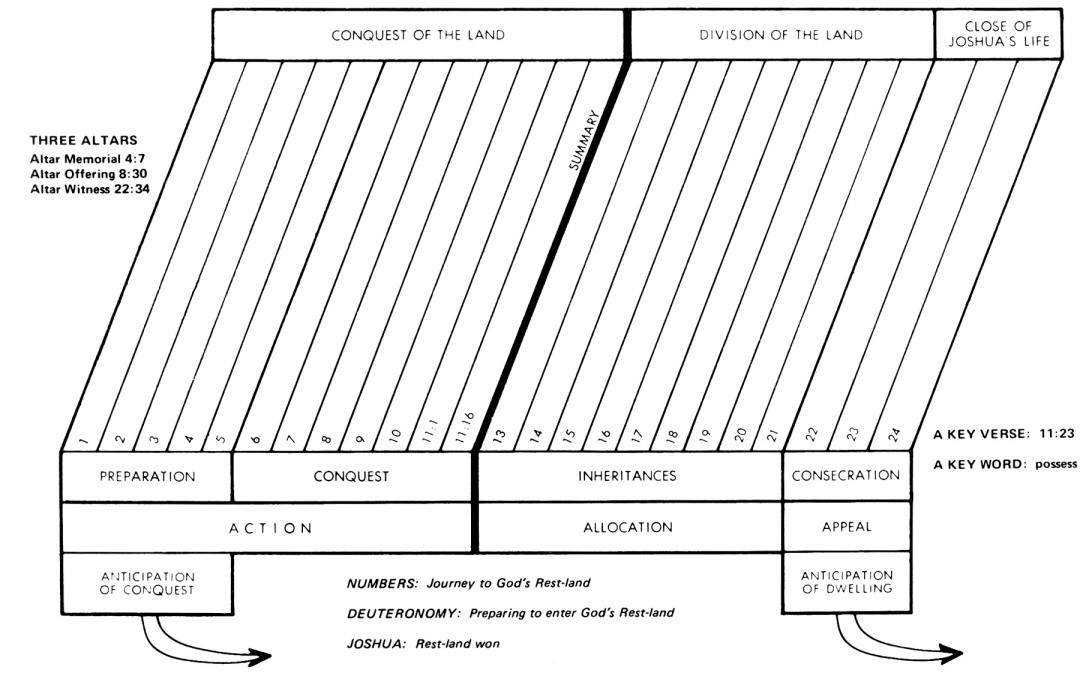
Jensen's Survey of the NT - used by permission
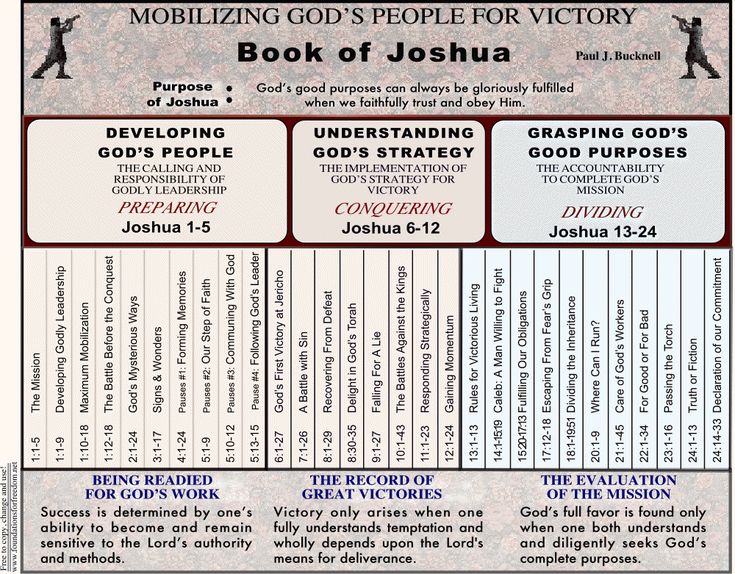
Paul J Bucknell - Biblical Foundations for Freedom
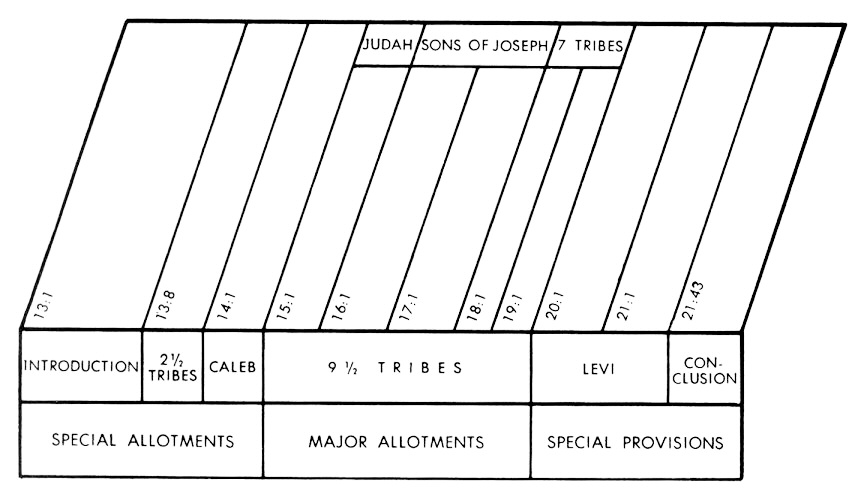
LAND ALLOTMENTS
(Joshua 13-21)
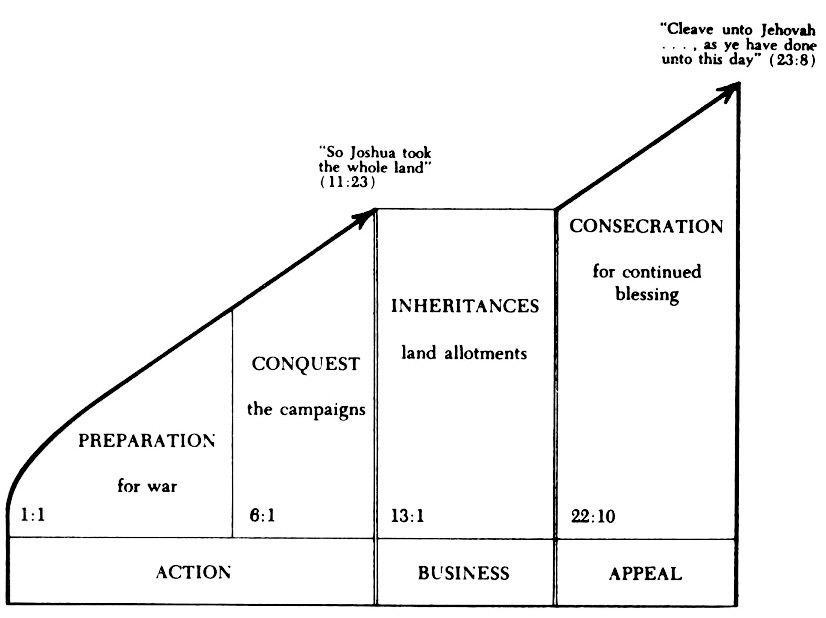
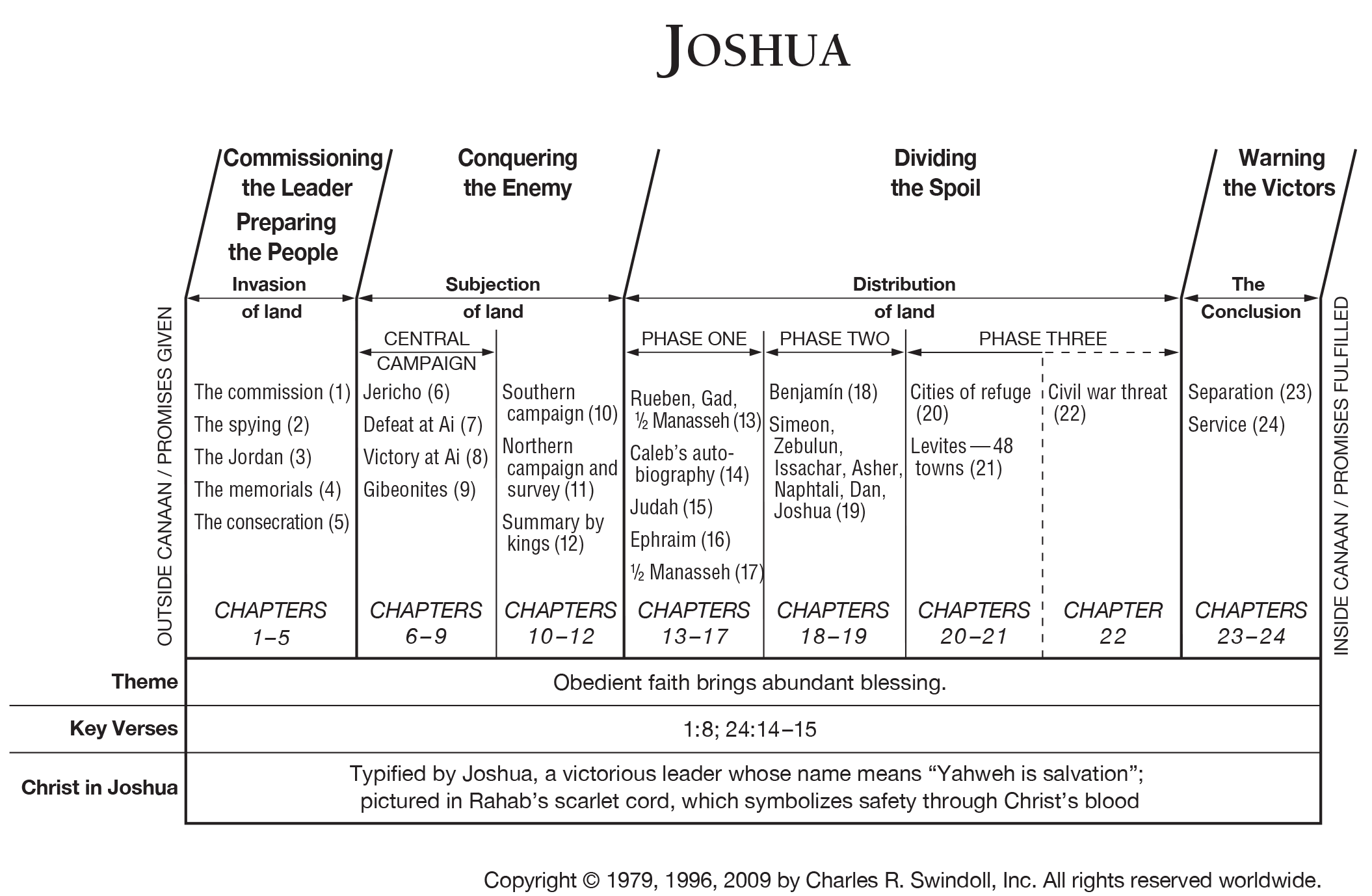
Click charts to enlarge Charts from Jensen's Survey of the NT - used by permission
|
JOSHUA |
|||
|
CONQUEST |
DIVISION |
CLOSE OF JOSHUA'S LIFE |
|
| ACTION | ALLOCATION | APPEAL | |
| Josh 1:1-5:15 | Josh 6:1-12:24 | Joshua 13:1-21:45 | Josh 22:1-24:33 |
|
WARLORDS IN |
LANDLORDS IN |
||
|
ENTERING |
CONQUERING |
DIVIDING |
|
|
SECURING THE |
SETTLING THE |
||
|
Preparation |
Conquest |
Possession |
Consecration |
| ca. 1 Month | ca 7 Years | ca. 18 Years | |
|
Key Verses:
|
|||
|
Christ in Joshua (see also notes below) - Christ is the believer's victorious leader, even as Joshua whose name means "Yahweh is salvation" was for Israel. Christ is also shown in Rahab's scarlet cord (click here), which pictures the believer's eternal safety from destruction through the blood of Christ |
|||
RELATED RESOURCES
- Joshua Commentaries
- Joshua Devotionals - from Back to the Bible
- Joshua Sermons by C H Spurgeon
- Joshua Sermons by Alexander Maclaren
Be strong and courageous. - Joshua 1:6
TODAY IN THE WORD
You don't have to read very far into Joshua before an obvious theme emerges. “Be strong and courageous” is repeated over and over, and that repetition indicates just how important it was for the new leader of Israel to possess and strongly portray those characteristics. C. S. Lewis gives us some insight as to why courage would be so vital to the man leading God's people when he writes, “Courage is not simply one of the virtues, but the form of every virtue at the testing point.”
More than anything else, God stressed strength and courage as the predominant character traits that would define Joshua's purpose, because without courage, Joshua's other virtues might have dissolved in the face of the many challenges he faced. God paired these character traits with a clear mission for Joshua.
In the opening verses of this book, God clearly communicated the task, characteristics, and guidelines He had in mind for Joshua. Verses 1-5 delineate precisely the boundaries of the land God would give Israel, and verse 6 makes it clear that Joshua's main task was to lead them to inherit that land.
And God would not leave Joshua in the dark as to how he would accomplish that task. After repeating the encouragement Joshua first received from Moses in Deuteronomy (31:23), God lays down the guidelines for success: meditate on the Law, obey it, and you'll succeed (v. 8).
The foundation for Joshua's strength and courage came in the truth communicated in verse 9. God was with Joshua, and we must not overlook that. Joshua's courage was not described as intrinsic in his makeup. God didn't say, “You are strong and courageous,” although Joshua had certainly shown those traits in the past. God directed him to be strong and encouraged because no matter what weakness Joshua had, no matter how many people he had to lead, and no matter how big and fearsome the enemy might be, the Lord was with Joshua, and that was all that mattered.
TODAY ALONG THE WAY - Israel easily could have crumbled in fear of the imposing enemy or turned away to foreign gods, but Joshua's strength and courage led Israel through a period of faith and obedience. In the unique situation where God has placed you, what character traits are most vital? Maybe you need to be compassionate and gracious or loving and generous. No matter what your personality, God can give you the character you need for the task He has given you. And He will be with you!
Joshua 1:1-7 Much Trouble
I will not leave you nor forsake you. —Joshua 1:5
A young boy named Riley started a fight with Avery on the school playground after a soccer match. The teacher broke it up, and both boys were sent to the principal’s office. Later, Avery said, “And of course, like always, we both got in trouble.” But he shared that he learned a lesson: “God is always with us, even if we get in as much trouble as this.”
The nation of Israel was in big trouble. Yet the Lord promised the nation’s new leader: “I will not leave you nor forsake you” (Josh. 1:5). Joshua was taking over leadership of the Israelites after Moses’ death, just before they were to enter the Promised Land. Trouble was on the horizon with numerous military campaigns against their enemies coming up (Josh 8:3; 9:1-2). Without God’s presence, they couldn’t begin to acquire the land.
Joshua had a strong faith in the Lord, as seen when he spied out the land of Canaan (Num. 14:6-9). But God graciously gave him the reminder as he took over the leadership role that he could be courageous because of His presence. He promises the same to His children today (Heb. 13:5-6).
It’s a comforting lesson for God’s children of all ages to know: The Lord is always with us. Even when we’re in “as much trouble as this.”
Dear Lord, we’re so thankful to be Your children,
and that You’ll never leave us.
Help us to hold on to that promise when
trouble seems to threaten on every side. Amen.
When troubles call on you, call on God.
Joshua 1:1-9 Recipe For Success
This Book of the Law shall not depart from your mouth, but you shall meditate in it day and night . . . . Then you will have good success. —Joshua 1:8
Wrinkled noses and puckered lips—sometimes this is my family’s reaction to my cooking, especially when I’m trying something new in the kitchen. Recently, I had a breakthrough with a unique version of macaroni and cheese. I jotted down the ingredients and tucked the recipe away for future reference. Without that set of instructions, I knew the next batch would be a flop.
Without God’s instructions, Joshua would have failed at leading the Israelites into the Promised Land. The first step was to “be strong and of good courage” (Josh. 1:6). Next, he was to continually meditate on the Book of the Law, and finally, he was to do everything it said. As long as Joshua followed the directions, God promised him “good success” (v.8).
God’s “recipe for success” can work for us too, but His idea of success has little to do with money, popularity, or even good health. In the original Hebrew, “then you will have good success” means “then you will act wisely.” Just as God called Joshua to walk in wisdom, He wants us to “walk circumspectly, not as fools but as wise” (Eph. 5:15).
As we take courage in the Lord, feast on His Word, and obey Him, we have a recipe for godly success that’s better than anything we could cook up on our own.
You will surely find at the journey’s end,
Whatever the world may afford,
That things fade away, and success is seen
In the life that has served the Lord. —Anon.
Obedience to God’s Word is the recipe for spiritual success.
Joshua 1:1-9 His Part - Our Part
"Arise, go over this Jordan...I will not leave you nor forsake you." - Joshua 1:2,5
Whenever the Lord assigns us a difficult task, He gives us what we need to carry it out. John Wesley
wrote,
"Among the many difficulties of our early ministry, my brother Charles often said, 'If the Lord would give me wings, I'd fly.' I used to answer, 'If God bids me fly, I will trust Him for wings.'"
Today's Scripture tells us that Joshua was thrust into a position of great responsibility. No doubt
the enormity of the challenge before him made him tremble with fear. How could he ever follow such a
great leader as Moses? In his own strength it would be impossible to lead the people into the Promised Land. But along with the marching orders, the Lord gave him an assuring promise: "I will not leave you nor forsake you" (Josh. 1:5). Then He said, "Have I not commanded you? Be strong and of good courage; do not be afraid, nor dismayed, for the Lord your God is with you wherever you go" (Josh 1:9). Such reassurances were the backing Joshua needed.
If God has given you some special work to do that frightens you, it's your responsibility to jump at it. It's up to the Lord to see you through. As you faithfully do your part, He will do His part. - R W De Haan
I'll go where You want me to go, dear Lord,
O'er mountain, or plain, or sea;
I'll say what You want me to say, dear Lord,
I'll be what You want me to be.- Brown
Where God guides, God provides!
Joshua 1:2 Look Both Ways
READ: Joshua 1:1-9
Moses My servant is dead. Now therefore, arise. —Joshua 1:2
During our church's annual New Year's Eve Communion service, we say this prayer together: "Father, we surrender this past year and give it up to You. We give You our failures, our regrets, and our disappointments, for we have no more use for them. Make us now a new people, forgetting what lies behind and pressing on toward that which lies ahead of us.
"We give You all our hopes and dreams for the future. Purify them by Your Spirit so that our wills shall truly reflect Your will for us.
"As we stand on the threshold of another year, encourage us by our successes of the past, challenge us by the power of Your Word, and guide us by the presence of Your Holy Spirit."
In every transition, it's good to look both ways. When Joshua assumed leadership of Israel, God told him to consider the past and the future: "Moses My servant is dead. Now therefore, arise, go over this Jordan, you and all this people, to the land which I am giving to them" (Joshua 1:2). Then He promised, "As I was with Moses, so I will be with you. . . . Do not be afraid, nor be dismayed, for the Lord your God is with you wherever you go" (Josh 1:5,9).
With confidence in God, we can look back and look ahead, then walk boldly into a new year.—David C. McCasland
Forgive us, Lord, for failures past,
Then help us start anew
With strength and courage to obey
And closely follow You. —Sper
The victories of the past give courage for the future.
Joshua 1:1-9 Mindless Prayer
As I was with Moses, so I will be with you. I will not leave you nor forsake you. —Joshua 1:5
Sometimes I am ashamed of my prayers. Too often I hear myself using familiar phrases that are more like mindless filler than thoughtful, intimate interaction. One phrase that annoys me, and that I think might offend God, is “Lord, be with me.” In Scripture, God has already promised not to leave me.
God made this promise to Joshua just before he led the Israelites into the Promised Land (Josh. 1:5). The author of Hebrews later claimed it for all believers: “I will never leave you nor forsake you” (Heb 13:5). In both cases, the context indicates that God’s presence has to do with giving us the power to carry out His will, not our own will, which is generally what I have in mind in my prayers.
Perhaps a better prayer would be something like this: “Lord, thank You for Your indwelling Spirit who is willing and able to direct me in the ways You want me to go. May I not take You where You don’t want to go. May I not enlist You to do my will, but humbly submit to doing Yours.”
When we are doing God’s will, He will be with us even without our asking. If we’re not doing His will, we need to ask for His forgiveness, change our course, and follow Him.
God Himself is with thee—
Thy Savior, Keeper, Friend;
And He will not forsake thee,
Nor leave thee to life’s end. —J. D. Smith
May our prayers not be mindless, but instead mindful of God’s will.
Joshua 1:9 Equipped for the Task
"Be strong and of good courage; for the Lord your God is with you wherever you go." Joshua 1:9
I was in England during World War II working as a surgical technician in an army hospital when I heard the shocking radio announcement: "Franklin Delano Roosevelt is dead!" I was saddened and troubled. Was Vice President Harry Truman qualified to be President?
I was relieved when I heard him say that he felt as if an enormous weight had fallen on his shoulders and that he desired people everywhere to pray for him. This reassured me that he humbly recognized his inadequacies and his need for God's help.
Few of us will ever be thrust into a position of leadership with duties of that magnitude, but most of us know the feeling of inadequacy in the face of great responsibility we are about to assume. It might be that of taking on a new job, getting a promotion at work, choosing a spouse, becoming a parent, or accepting a new ministry in Sunday school or church.
When we face a new challenge, we can take courage from the Lord's words to Joshua 1:9. We can accept our opportunity as from Him and believe that He will give us all we need to do it well. If we meditate on His Word, obey it, prayerfully rely on Him, and work diligently, He will do the rest. He will equip us for the task.—H. V. Lugt
The Lord will give you help and strength
For work He bids you do:
To serve Him from a heart of love
Is all He asks of you.
God's call to a task includes His strength to complete it.
Joshua 1:1-9 Trust The Compass
I will instruct you and teach you in the way you should go. —Psalm 32:8
An old sailor repeatedly got lost at sea, so his friends gave him a compass and urged him to use it. The next time he went out in his boat, he followed their advice and took the compass with him. But as usual he became hopelessly confused and was unable to find his way back. Finally he was rescued by his friends.
Disgusted and impatient with him, they asked, “Why didn’t you use that compass we gave you? You could have saved us a lot of trouble!”
The sailor responded, “I didn’t dare to! I wanted to go north, but as hard as I tried to make the needle aim in that direction, it just kept pointing southeast.” He was so certain he knew which way was north that he stubbornly tried to force his own personal conviction on his compass.
After the death of Moses, God spoke to Joshua just before he led Israel into the Promised Land. The Lord reminded Joshua of His law and told him, “Do not turn from it to the right hand or to the left, that you may prosper wherever you go” (Josh. 1:7).
Those who follow God’s instructions and warnings are spared the waste of foolish wandering and the heartache of shipwreck and ruin. We must ask God to point the way. Then let’s trust the compass of His Word.
All the way my Savior leads me—
What have I to ask beside?
Can I doubt His tender mercy,
Who through life has been my Guide? —Crosby
To know God's will, trust His Word.
Joshua 1:1-9 Inconvenient Or Important?
Go over this Jordan, you and all this people, to the land which I am giving to them. —Joshua 1:2
Modern society emphasizes efficiency and convenience but minimizes interaction among people. For example, a person using the phone may hear recorded messages: “For account information, press 1.” “At the tone, leave a message.” “For flight information, press 2.”
Although we may think life would be easier if we didn’t have to deal with troublesome, time-consuming relationships, God calls us to operate from a different perspective. As followers of Christ, we are to remain in the people business.
When Joshua succeeded Moses as the leader of Israel, God commanded him, “Arise, go over this Jordan, you and all this people, to the land which I am giving you” (Josh. 1:2). I might have questioned the Lord, “This group has a terrible track record. Wouldn’t it be easier to leave the complainers and second-guessers behind? Isn’t it my job to conquer the land?” But the Lord had said, “You and all this people.”
In God’s way of doing things, people are never a means to an end; they are the end. Inefficient and inconvenient? Frequently! Unimportant and unnecessary? Never!
Do we treat the people in our lives as inconveniences? Or as important individuals we need and love?
Important as your task may be,
That work you must fulfill;
Be sure you keep the human touch
If you would do God's will. —DJD
People are at the heart of God's heart.
Joshua 1:1-9 Leadership Lessons
Be an example to the believers in word, in conduct, in love, in spirit, in faith, in purity. —1 Timothy 4:12
You are a leader. Yes, you! You may not be the president or manager of an organization, but you will be called on to lead others.
Do you teach Sunday school? You’re a leader. Are you a parent? You’re a leader. Have a job? You’re a leader. Have friends? You’re a leader.
No matter who you are, others are looking at you and being influenced by your example. As you think about this awesome responsibility, what should you do? Someone has said that a good leader is one who “knows the way, goes the way, and shows the way.”
Joshua was like that. He knew the way because God had told him. He went that way by being obedient to the Lord, and he showed the way by providing servant-leadership.
Look specifically at what God told Joshua:
* Be strong and courageous (Joshua 1:6).
* Obey all of God’s laws for living (Joshua 1:7).
* Think often about what God has said (Joshua 1:8).
* Remember that God is with you (Joshua 1:9).
We need to keep these lessons of leadership in mind, because people are following our example. If we learn them well, we will know, go, and show the way that pleases God—and we will be good leaders.
Christians, remember you bear His dear name,
Your lives are for others to view;
Living examples—men praise you or blame
And measure the Savior by you. —Anon.
Leaders who serve will serve as good leaders.
Joshua 1:1-9 On Shoulders Of Giants
As I was with Moses, so I will be with you. —Joshua 1:5
Giants hold a special place in our lore—both historical and literary. From the real giant Goliath to the fictional giant of Jack and the Beanstalk fame, we are fascinated by these larger-than-life characters.
Sometimes we use the word giant to honor ordinary-size people who have done extraordinary things. One example is the 17th-century physicist Sir Isaac Newton. A committed Christian, he credited his success to other “giants” who had gone before. “If I have seen a little further,” he said, “it is by standing on the shoulders of giants.” Indeed, Newton became a giant on whose shoulders later scientists stood—even as they used his observations in the conquest of space flight.
When God commanded Joshua to lead the Israelites into the Promised Land, Joshua certainly had a giant’s shoulders to stand on. He had watched Moses’ leadership for 40 years, and now he would put what he had learned into action.
Joshua had another advantage—his walk with God sustained his life’s mission. Therefore, he had both Moses’ example and God’s promised presence as he led Israel.
Looking for help as you face the future? Look for a giant to follow. And never underestimate the importance of your walk with God.
There is a destiny that makes us brothers:
None goes his way alone;
All that we send into the lives of others
Comes back into our own. —Markham
A good example is someone who knows the way, goes the way, and shows the way.
Joshua 1:1-9 Anchors In The Storm
The Lord your God is with you wherever you go. —Joshua 1:9
When Matt and Jessica tried to navigate their sailboat into a Florida inlet during Hurricane Sandy, the craft ran aground. As the waves crashed around them, they quickly dropped anchor. It held the sailboat in place until they could be rescued. They said that if they had not put down the anchor, “We would have lost our boat for sure.” Without the anchor, the relentless waves would have smashed the vessel onto the shore.
We need anchors that hold us secure in our spiritual lives as well. When God called Joshua to lead His people after Moses’ death, He gave him anchors of promise he could rely on in troubled times. The Lord said to him, “I will be with you. I will not leave you nor forsake you. . . . The Lord your God is with you wherever you go” (Josh. 1:5,9). God also gave Joshua and His people the “Book of the Law” to study and observe (Josh. 1:7-8). That, and God’s presence, were anchors the Israelites could rely on as they faced many challenges.
When we’re in the middle of suffering or when doubts start threatening our faith, what are our anchors? We could start with Joshua 1:5. Although our faith may feel weak, if it’s anchored in God’s promises and presence, He will safely hold us.
We have an anchor that keeps the soul
Steadfast and sure while the billows roll,
Fastened to the Rock which cannot move,
Grounded firm and deep in the Savior’s love. —Owens
When we feel the stress of the storm we learn the strength of the anchor.
INSIGHT: In today’s reading, God encourages Joshua who has recently replaced his predecessor, Moses. God’s past faithfulness to Moses must have brought great comfort to Joshua: “As I was with Moses, so I will be with you” (Josh. 1:5). For us as well, God’s faithfulness in the past brings courage for the future.
Joshua 1:1-9 He’s Always On The Bridge
I will not leave you nor forsake you. —Joshua 1:5
My friend Ralph had the thrilling experience of going on a short cruise on the aircraft carrier USS Kennedy. He saw jet fighters take off, land, and demonstrate maneuvers. He was told that whenever the planes are taking off or landing—dangerous operations—the captain watches from the bridge. Even if the planes are flying continually, he stays on the bridge, cat-napping between runs if necessary. So each time a pilot takes off or lands on the deck, he knows that his captain is always on duty.
In today’s Scripture reading, when it was time for Joshua to take over as leader of Israel, he needed reassurance that God would be with him as He had been with Moses. The Israelites knew that Moses had divine direction during their wilderness journey because God led them by a pillar of fire and a cloud.
But what about Joshua? God promised him, “As I was with Moses, so I will be with you. I will not leave you nor forsake you” (Joshua 1:5). Joshua could lead Israel with the absolute confidence that God was always watching over him.
Wherever we are, whatever bold endeavor we are involved in, or whatever spiritual battle we may face, we have the confidence that God is with us. What’s more, He guides, protects, and leads us. He’s always on the bridge!
The Christian finds safety not in the absence of danger but in the presence of God.
Joshua 1:1-7 The Apprentice
As I was with Moses, so I will be with you. —Joshua 1:5
When some employers were asked what makes a good apprentice, they responded that they seek to hire “someone who wants to learn.”
In the Bible, a good example of an apprentice is Joshua. We remember Joshua for marching around the wall of Jericho. He also had some important responsibilities as a spy (Num. 13:16) and as a warrior (Ex. 17:10). But he was often in the shadow of someone else—Moses. For 40 years, Joshua served as Moses’ assistant, aide, and apprentice (Ex. 24:13).
God takes His own time to prepare us for service. Sometimes that period of waiting is as valuable as learning all the needed strategies and goals. Joshua observed Moses’ faith in God. He learned what it meant to be humble (Num. 12:3), how to take instruction (Ex. 17:10), and how to be a true servant of God (Josh. 1:1; 24:29). Even a display of Moses’ temper (Num. 20:7-12) was an opportunity to watch and learn. By spending time with Moses, Joshua learned things that couldn’t be learned from a book.
Joshua’s own time to lead was coming. And when it came, he was able to trust God’s promise to him: “As I was with Moses, so I will be with you. I will not leave you nor forsake you” (Josh. 1:5).
People who become great leaders
Sometimes need to learn
How to serve and follow others—
Then they’ll get their turn. —Sper
A person who is not willing to follow is not prepared to lead.
Joshua 1:6-11 The Challenge of Transition
Be strong and very courageous. —Joshua 1:7
After former professional athlete Chris Sanders suffered a career-ending injury, he told a group of military veterans that although he had never experienced combat, “I understand the pressures of transitions.”
Whether it’s the loss of a job, the loss of a marriage, a serious illness, or a financial setback, every major change brings challenges. The former athlete told the soldiers that the key to success when you are transitioning into a new way of living is to reach out and get help.
The book of Joshua is recommended reading whenever we find ourselves in transition. After 40 years of wandering and setbacks, God’s people were poised to enter the Promised Land. Moses, their great leader, had died, and Joshua, his assistant, was in charge.
God told Joshua to “be strong and very courageous, that you may observe to do according to all the law which Moses My servant commanded you; do not turn from it to the right hand or to the left, that you may prosper wherever you go” (Josh. 1:7). God’s words of direction were to be the bedrock of Joshua’s leadership in every situation.
The Lord’s charge and promise to Joshua apply to us as well: “Be strong and of good courage; do not be afraid, nor be dismayed, for the Lord your God is with you wherever you go” (Josh 1:9).
He is with us in every transition.
Father, I’m bringing You my trials and frustrations. You know each and every detail. Please comfort me as only You can, and provide exactly what I need for today. Help me give my unfulfilled expectations to You, trusting You’re working out a plan for me.
God remains faithful in every change.
INSIGHT: From personal observation, Joshua knew that the Canaanites lived in strongly fortified cities (Num. 13:28-29). But God’s command was accompanied with a promise of victory: “No man shall be able to stand before you all the days of your life; as I was with Moses, so I will be with you. I will not leave you nor forsake you” (Josh. 1:5).
Joshua 1:1-9 The Way To Success
This Book of the Law shall not depart from your mouth, but you shall meditate in it . . . . Then you will have good success. —Joshua 1:8
During the Chinese New Year it is customary for hongbaos (small red envelopes containing money) to be given away. When parents give hongbaos to their children, it is also to wish them prosperity and success. Knowing that this sincere wish is insufficient, however, they also remind their children to study hard. Chinese people generally believe that a good education is the key to one’s success in life.
In Joshua 1, God told Joshua that his ways could prosper as he assumed Moses’ leadership role. But he and the people needed to display courage in the face of stiff opposition as they entered the Promised Land (Joshua 1:6). God promised to give them success if they heeded His “Book of the Law” (Joshua 1:8).
Believers today also need to live according to God’s Word if we are to enjoy success in our spiritual walk. The Bible contains not only the do’s and don’ts for living but also records the life experiences of those who pleased or displeased God.
We, like Joshua, have God’s promise that He will be with us always (v.9; Matt. 28:20). That should give us strength to face the challenges and difficulties that inevitably arise as we seek to please Him.
Be strong! It matters not how deep entrenched the wrong,
How hard the battle goes, the day how long;
Faint not—fight on!
Tomorrow comes the song. —Babcock
When facing a crisis, trust God and move forward.
Joshua 1:1-9 A Fresh Start
Do not be afraid, nor be dismayed, for the Lord your God is with you wherever you go. —Joshua 1:9
They stand in the cold by the thousands in Times Square, New York City. What draws them to that place? There’s no sporting event or rock concert. There’s just a huge lighted ball that drops down a pole on top of a building. It takes only a few seconds, and it hardly seems worth fighting traffic and subway crunch to see—except that it happens on New Year’s Eve.
Why have we created a holiday over such a nonevent? Other holidays celebrate famous birthdays or historical milestones or something. New Year’s Eve just celebrates the passage of time. We make such a fuss because it signals the end of an old era and the beginning of a new one. The old year’s problems and struggles become a dim memory when we think of getting a fresh start.
It must have been something like that for the Israelites who stood with Joshua and looked at the new era ahead of them (Joshua 1:1-9). Behind them were 40 years of wandering in the desert. Ahead was a land of milk and honey. And best of all, they had God’s promise that He would be with them.
As we stand with our back to the past 12 months and our face toward the new year, we can have hope because we too can be sure of God’s help. That makes the prospect of a new year worth celebrating!
Though I know not what awaits me—
What the future has in store,
Yet I know that God is faithful,
For I've proved Him oft before. —Anon.
We can trust our all-knowing God for the unknown future.
Joshua 1:9 Amazing Guide
November 16, 2014
Not a word failed of any good thing which the Lord had spoken. —Joshua 21:45
When actors and actresses make a movie, it’s the director who sees the “big picture” and the overall direction. Actress Marion Cotillard admits she didn’t understand everything the director was doing in one of her recent films. She said, “I found it very interesting to allow myself to be lost, because I knew that I had this amazing guide. . . . You abandon yourself for a story and a director that will make it all work.”
I think Joshua could have said something similar about the director of his life. In today’s Scripture passage, the newly commissioned leader of Israel is standing at the threshold of the Promised Land. More than 2 million Israelites are looking to him to lead them. How would he do it? God didn’t give him a detailed script, but He gave him the assurance that He would go with him.
God said, “I will be with you. I will not leave you” (Josh. 1:5). He commanded Joshua to study and practice everything written in His Word (Josh 1:7-8), and He promised to be with Joshua wherever he went. Joshua responded with complete devotion and surrender to his amazing Guide, and “not a word failed of any good thing which the Lord had spoken” (Josh 21:45).
We too can abandon ourselves to our Director and rest in His faithfulness.
He leadeth me! O blessed thought!
O words with heavenly comfort fraught!
Whate’er I do, where’er I be,
Still ’tis God’s hand that leadeth me. —Gilmore
Faith never knows where it is being led; it knows and loves the One who is leading. —Oswald Chambers
INSIGHT: Moses dishonored God (Num. 20:1-13) and was not allowed to enter the Promised Land (Deut. 3:23-29). Yet God permitted him to see it from afar (Dt 34:1-4). Moses was succeeded by Joshua, a man who was “full of the spirit of wisdom” (Josh 1:9). In Joshua 1:1-9, God assured Joshua of His presence, power, providence, provision, and protection—just as God had assured Moses and been with him.
TODAY IN THE WORD
Are you one of those people who wants to know the ending of a book before you read it? Sometimes the assurance that the “good guys” will eventually prevail is comforting when the plot becomes too tense or suspenseful.
Yet knowing the outcome of the story doesn’t always keep one from feeling stressed! Although Joshua knew that God had promised the land to Israel as an inheritance (the outcome of this “book”), the Israelites still had to conquer its wicked inhabitants, who greatly outnumbered them. Clearly these odds weren’t lost on Joshua--three times (Josh. 1:6, 7, 9) the Lord commanded him to be courageous! In verse 9, the Lord went even further in His exhortation: “Do not be terrified.”
God’s command to Joshua settled Joshua’s emotions by establishing his mindset--the only way he could avoid terror was to focus on the Lord. Indeed God had promised: “No one will be able to stand up against you. . . . I will be with you; I will never leave you nor forsake you” (v. 5).
And that’s exactly what happened. When the people trusted the Lord, even the strong walls of Jericho’s toppled (Josh. 5:13–6:21). But when the people stopped trusting the Lord to give what He had already promised, there was disaster (Josh. 9). The land was a divine gift--and so was the conquest and possession of the land. Everything was from God.
TODAY ALONG THE WAY Even though God had promised Joshua victory, at some point Joshua still had to step into the battle.
TODAY IN THE WORD
Thomas and Tina Sjogren of New York City recently completed an incredible journey. In May 2002, they skied and swam their way without any outside help (such as sled dogs or food airdrops) to 90-1/4 N latitude–the North Pole. Earlier they had successfully reached the South Pole and climbed Mount Everest, sometimes called “the third pole.” Only three people before them had managed to go to all three poles, and Tina is the first woman ever to accomplish the feat.
An incredible journey, a seemingly impossible goal. These words also describe the Israelites at the end of the Exodus, as they stood poised to enter the Promised Land. The legendary Moses had died, and Joshua was trying to fill his big shoes as the head of a restless and wandering nation. He may have been tempted to fear or feel discouragement, despite his special anointing for the task at hand and the fact that he was “filled with the spirit of wisdom” (cf. Deut. 34:9).
In this difficult situation, God made Joshua several promises and gave him several commands. He renewed the promise of conquering and inheriting the land, and specifically promised him victory in battle. Most significantly, He guaranteed His constant presence: “I will never leave you nor forsake you . . . the Lord your God will be with you wherever you go” (vv. 5, 9). The Lord also told Joshua to be strong and courageous, and repeated this several times for emphasis. He reminded him to meditate on and obey carefully His Law. In summary, Joshua could meet the challenge if He trusted the person, presence, power, and Word of God.
TODAY ALONG THE WAY Today, we suggest that you do additional Bible study in order to dig deeper into the kind of faithful leadership Joshua exemplifies. What is genuine biblical leadership? What is “servant leadership”? What are the qualifications for leadership in the New Testament church, and why? What sort of leader is Christ? How can we follow in His footsteps? How does what you discover differ from the world’s viewpoint on these same questions, and why? How is God leading you to live out these principles?
TODAY IN THE WORD
Oswald Chambers wrote, 'The Christian life is gloriously difficult. But the difficulty of it does not make us faint and cave in; it rouses us to overcome. Do we so appreciate the marvelous salvation of Jesus Christ that we give our utmost for His highest? Thank God He does give us difficult things to do! His salvation is a glad thing, but it also tests us for all we are worth.'
What Chambers described in the spiritual realm is similar to what Joshua faced as he stepped up to fill the sandals of Moses. Israel's new commander had no less an assignment than leading the nation in the conquest of the promised land. This had never happened before, and no one really knew what to expect.
But it's clear from God's message to Joshua that this was no time for paralyzing fear. Bible teacher Donald K. Campbell points out that each of the three times God urged Joshua to be courageous, He gave Israel's leader a good reason for courage. Let's notice these, for our own encouragement today.
First, Joshua could be courageous because of God's promise (v. 6). God had sworn by His covenant promise to Abraham to give the land of Canaan to Israel, so Joshua had a solid reason to move forward with confidence.
Second, Joshua would find all the courage and strength he needed by obeying God's Word, our source for God's power (vv. 7-8). This was a strong command, as Dr. Campbell says, 'Greater strength of character would be required to obey God's Word faithfully and fully than to win military battles!'
The third reason for Joshua's courage was God's constant presence (v. 9). Knowing our eternal Lord is always with us certainly eases the task of keeping an eternal perspective.
Look at this list again, and you'll see that none of these blessings was limited to Joshua. We have God's promise, not of land on earth, but of an eternal home in heaven (Jn. 14:1-3). We also activate the transforming power of His Word by our obedience, and God has said He will never leave us (Heb. 13:5).
Put all of this together and there isn't much room left for paralyzing fears!
TODAY ALONG THE WAY Joshua 1:8 is another three-part outline for spiritual success. 1. God tells us to talk about His Word. We can do that as families and friends when we read the Word together and talk about what it means for our lives. 2. We also need to think about the Word. Meditation sounds a little suspicious to some Christians, but deliberately pondering the Scriptures in our minds is a great spiritual discipline. 3. Then we're ready to do the Word. Obedience is God's Word manifested in our lives.
F B Meyer
Our Daily Homily
Every place that the sole of your foot shall tread upon.
All the land was given, but every inch of it had to be claimed. Israel had to put her foot down upon the land, whether wilderness or Lebanon, plain or hill, and say, “This is mine by the gift of God.” And as the right was asserted, God made it good. The land had been covenanted to them through Abraham, but it awaited conquest and appropriation by the Israelites. No man was able to stand with them in the lot of their inheritance.
The settler who has purchased a plot of land in the Far West claims it to its furthest borders; and, if needs be, invokes the aid of the Government to make good his purchase. So with our possessions in Christ. All spiritual gifts are ours in the Risen Savior. From the wilderness of the earth even to the river that makes glad the city of God, and unto the glassy sea on which the sun never goes down, is our border. But we must put the foot of faith down and say, “All things are ours; we have been blessed with all spiritual blessings in the heavenlies in Christ. He hath given us all things that pertain to life and godliness.”
Let this be the beginning of a new life for thee. Reckon that thou art on the resurrection side of death. Do not look at temptation or difficulty, but claim by steadfast faith whatever God has taught thee to feel the need of. Dost thou ask how that strong courage may be thine? The answer is at hand. Meditate on the Word of God day and night, and depart not from it to the right or left. The strength of the inner life finds nourishment in the Word of God. Only in this way can we behold the broad expanse of territory that is ours by right, and obtain strength to go up and possess it.
Joshua 1:8-9; Psalm 119:89-104
TODAY IN THE WORD
Lord, you have promised to meet those who seek your face. Come now and reveal your presence to me as I make myself present to you. . . . Amen.–A Guide to Prayer for Ministers and Other Servants
Sometimes Christians feel uncomfortable with meditation, perhaps due to New Age forms of meditation. But meditation simply means to reflect deeply on something. The Bible is filled with exhortations to meditate on God’s Word and works, and the history of the church records numerous examples of men and women who heeded this call to contemplate God’s Word. There is much we can learn from this approach to prayer that includes sustained reflection on our Lord and His Word.
For one thing, meditation is not a mindless repetition of certain phrases, but an intense concentration on God and His ways. Scriptural exhortations to meditate are always directed toward God’s deeds, laws, or promises. For another thing, true meditation is not a flight from the world. Thomas Merton wrote, “Meditation has no point unless it is firmly rooted in life.”
TODAY ALONG THE WAY The psalmist exclaimed, “I meditate on [your law] all day long” (Ps. 119:97). Let’s consider several approaches to meditation. Sometime today if possible, set aside fifteen to twenty minutes for solitude and meditation. Choose a short section of Scripture, perhaps from today’s Psalm, and read it slowly several times. If distractions come up, ask the Lord for focus as you reread your chosen passage. As you silently dwell on the passage, ask the Lord to speak to you from this passage. Try to keep focused on His Word and His presence. At the end of your time of meditation, consider writing down things the Lord may have revealed to you.
Another way to meditate on Scripture is to use your imagination to consider the feelings and thoughts of people in the passage. For example, as you read today’s passage from Joshua, imagine how it would feel to face a formidable opponent following the death of an incredible leader like Moses. How might the Lord’s promises have particularly encouraged Joshua? Why was it important for Joshua to meditate on the Book of the Law? What did the promised land look like?
F B Meyer
Our Daily Walk
June 1
MARCHING ORDERS - "Have not I commanded Thee! Be strong and of a good courage: be not afraid, neither be thou dismayed: for the Lord thy God is with thee whithersoever thou goest."-- Joshua 1:9.
IT WAS a host of young men and women that stood on the verge of Jordan, waiting the signal to enter the Promised Land. God had said that He would give them every place upon which the sole of their foot should tread (Joshua 1:3). What an incentive this was for pressing on! Every time an Israelite put his foot forward on the territory of Canaan, he realized that piece of land would come into the possession of his people.
There is a counterpart of this in our own experience. We must learn to put down our foot upon the Promises of God's Word, and say: "These are mine by right, and shall be mine in actual enjoyment." In General Gordon's journal, he tells us that often before he reached some strange or hostile tribe, it seemed as though they had been given to his faith and subdued before he reached them. In combating your spiritual foes, dare to believe that God has given them into your hand, and go forward assured that not one of them shall stand before you. This is a blessed promise: "There shall not any man be able to stand before thee all the days of thy life: I will be with thee: I will not fail thee, nor forsake thee" (Joshua1:5). It does not Matter how fierce the tempter, how often you have failed, how inveterate the bad habits, if you will dare to believe that God is with you, not one of all the band of besetting sins shall be able to stand before you. God cannot fail, and will not forsake; be strong, and go forward!
The one thing that God asks of all of us is that we should obey up to the hilt.
Here are our marching orders, and we must keep them well before us:
(1) We must meditate upon the Scripture day and night; it must not depart from our heart or mouth.
(2) We must be strong even when obedience seems impossible, and when all influences are brought to bear to weaken our resolution, we must still dare to obey the voice of God. And as we advance we shall find that the dreaded forms of opposition are but shadows; when they are touched with the spear-point of faith, they will divide and we shall pursue our way.
PRAYER - Before we enter upon our work and warfare, wilt Thou graciously equip us with the armour of light, that we may be able to stand against the wiles of the devil. May we hear Thee saying: Fear not, I am with thee, I will help thee. AMEN.
TODAY IN THE WORD
Most people remember Amelia Earhart for her tragic disappearance, but the strength and resolve that powered her pioneering efforts in flight should not be ignored. Her words about courage fit well with today's reading: “Courage is the price that life exacts for granting peace.” Joshua needed to be courageous in order to usher Israel into peace and rest.
That peace and rest, though, would come after a time of battle. God told Abraham that all nations of the world would be blessed by Abraham's descendants (Gen. 22:18). We should keep that in mind when reading the book of Joshua. Israel's purpose was not some self-initiated world domination, it was the fulfillment of God's promise.
Joshua laid out God's plan to the leaders of Israel, and he clearly stated that it was God who would be giving the land to them (v. 11). And this military campaign was much bigger than a land war. This was one step of God's ultimate plan to bring His people to Himself. He was giving them rest (vv. 13, 15).
Hebrews paints the larger picture for us . . . and we're in it. Verse 8 points out that the rest Joshua leads Israel to find is incomplete. We have a rest to enter, as Israel did. And the issues are still faith and obedience. Like Joshua, we can be filled with strength and courage because we know that the Lord our God is with us, and we can approach His throne to receive grace and mercy when we need it (v. 16).
Just as God rested after the creation of the world, we await the time when all our striving and efforts, every last task, is completely finished. Between the lines of this passage lies an important truth for us: we aren't done working for God. There is much to be done before the Sabbath rest.
As we think about the purpose of Israel, we see how God reaches out to humanity. We'll read chapters that describe God's judgment against those who oppose Him, but the ultimate purpose of those battles was to bring God's people into the land of promise and bring blessings to every nation. Even through this, God has always been gracious and slow to anger, and His work in the book of Joshua is no exception.
TODAY ALONG THE WAY - What is your wilderness? Everyone has their personal source of frustration that tires us to the core of our very souls. Here's a great source of hope for you: God will give you rest. And we aren't helplessly waiting for it. Hebrews tells us that we can begin to enter that rest by drawing close to Jesus Christ, even now. And just as Israel wiped out the evil nations in the Promised Land, you can begin to rid your life of the evil that weighs you down. You can clear the way for entering the Lord's eternal rest.
Joshua 2:1-14 One Option We Don't Have
The Lord your God, He is God in heaven above and on earth beneath. —Joshua 2:11
James A. Meads Jr. began his sermon with this statement: “The reason you and I cannot ignore God can be stated in one word: Israel. No other nation has been known as a ‘chosen people.’ No other nation has as much to say about the love, the patience, and the anger of God. Through Israel, God has given the world an object lesson about His nature.”
Centuries ago, Jericho’s king might have said, “Israel is coming—so what!” But we read that when he and his people heard what God had done at the Red Sea, and that two Amorite kings had been destroyed, the hearts of the people “melted” (Joshua 2:10-11).
Jericho’s king had at least two options, however. He could flee for his life, or he could repent, believe in God, and plead for His mercy. That’s what Rahab did, and she and her family were spared (Josh 2:12-13). But the one option the king didn’t have was to ignore Israel, and therefore he couldn’t ignore God.
Many people seem to get along well without God. But just as the world today can’t ignore Israel, so also it can’t ignore Jesus Christ, who came from Israel. As the One who created the universe, He is God (Colossians 1:15-17). As the One who died on Calvary’s cross, He is the world’s Savior and Redeemer (Col 1:13-14). Trust Him to save you today.
We can't ignore God's only Son,
He is the Lord, the Holy One;
He is the source of life and grace,
The One who died and took our place. —Fitzhugh
Everyone must face God as Savior or as Judge.
Joshua 2:1-14 Unexpected Help
The woman took the two men and hid them. —Joshua 2:4
In 1803, Thomas Jefferson commissioned Lewis and Clark to lead an expedition across an unexplored America to the Pacific coast. The expedition was called “Corps of Discovery”—and it lived up to its name. It cataloged 300 new species, identified nearly 50 Indian tribes, and traversed terrain that had never been seen by Europeans.
They were joined along the way by a French fur trader and his wife Sacajawea. They soon found her to be invaluable as an interpreter and guide.
During the trip, Sacajawea was reunited with her family. Her older brother had become the tribe’s chief, and he helped them acquire horses and a map of the uncharted West. Without Sacajawea’s and her brother’s unexpected help, the expedition may not have succeeded.
The Bible tells of an expedition that also received unexpected help. The Israelites had sent spies into Jericho, a city in the land promised to them. Rahab agreed to ensure their escape in exchange for her family’s protection when Jericho fell. In this way the sovereign God of grace used her to prepare the way for a victory in Israel’s conquest and settlement of the Promised Land.
Are you in the middle of a challenge? Remember, God can provide help from unexpected sources.
When trials seem impossible
And we can’t face the day,
The Lord extends His helping hand
And makes for us a way. —Sper
When there seems to be no way, God can make a way.
Joshua 2:1-14 Three Tenses Of Trust
By faith the harlot Rahab did not perish with those who did not believe, when she had received the spies with peace. —Hebrews 11:31
Rahab had a remarkable faith. Although it seemed incredible that Joshua’s unequipped army would be able to break down or scale the walls of Jericho, she remembered what God had done for the Israelites in the past. So she put her trust in Israel’s God by protecting the spies, and by staking her future on the hope that God would do what seemed impossible. Her trust in God involved the past, the present, and the future.
I have ministered to suffering and dying believers who have handled their pain with serenity and who faced death with hope. Some may consider such people naive or gullible, but they do so because they don’t know the three tenses of trust.
Concerning the past, we know that God has proven His love and power, especially in giving His Son to die for our salvation (Rom. 5:8) and in bringing Him back to life (Rom. 1:4). In the present, He speaks to us through His Word (Heb. 1:1-4), hears our prayers (Mt. 7:7-11), and provides grace in our trials (2 Cor. 1:3-4). For the future, He promises that we will live with Him forever (1 Th. 4:17).
Remember, trust involves three tenses. Reflect on God’s faithfulness in the past and present. You’ll have good reason to trust Him for the future. What a wonderful God!
In the past the Lord has helped us,
Guiding, loving all the way;
Let us therefore trust His promise:
Grace sufficient for each day! —Anon.
Feeling tense about the future? Remember that God is always present.
Joshua 2:1-14 Storytime
The Lord your God, He is God in heaven above and on earth beneath. —Joshua 2:11
Did you ever wonder why Rahab, the prostitute who lived in the pagan city of Jericho, opened her home to the Israelite spies? And what gave her the courage to name the God of Israel as her own?
This unlikeliest of conversions was prompted by the stories she had heard about the reality and power of God. Though thoroughly steeped in paganism and immorality, her heart was drawn to God. As she told the spies, “We have heard how the Lord dried up the water of the Red Sea for you when you came out of Egypt, and what you did to the two kings of the Amorites” (Josh. 2:10).
Under normal circumstances, the highly fortified city of Jericho would have been virtually unconquerable. Yet it became vulnerable because of the compelling stories of God’s power. Long before God’s people arrived, the self-sufficient pride of this hostile culture dissolved in fear when faced with those who belonged to the God they had heard so much about (v.11). And within the walls, one pagan heart turned to receive the God of Israel and played a strategic role in Israel’s stunning victory.
Let’s boldly tell the stories of God’s greatness. You never know whose heart may be ready to respond!
Christ is coming, over the world victorious—
Power and glory unto the Lord belong:
Praise Him! Praise Him! Tell of His excellent greatness!
Praise Him! Praise Him! Ever in joyful song. —Crosby
Don’t be shy; tell the stories of God’s greatness.
Joshua 2:1-14 Ready To Believe
The Lord your God, He is God in heaven above and on earth beneath. —Joshua 2:11
The story of Rahab, a harlot in Jericho, is puzzling. She welcomed the spies from Israel, hid them on her roof, and helped them escape. Then her own life was spared and she was honored by becoming part of the family line of the Messiah (Mt. 1:5). Why did God choose her?
I found some insights about Rahab in a prayer letter from Mary Tapley, who works with Campus Crusade for Christ. Mary wrote, “She proved to be a woman that God had completely prepared to put her faith in Him. She was already convinced of His existence and knew of His character (Josh. 2:11). When the spies came to her house, she immediately allied herself with God.”
In her letter, Mary then told about witnessing to her new friend, Bliss. When she first talked with her about Jesus, Mary moved cautiously, not wanting to scare her away. But Bliss was ready, and before that initial conversation was over she asked Mary, “Will you teach me how to become a Christian?” In a few moments she was on her knees, asking Jesus to forgive her sins and become her Savior.
Rahab was ready, and Bliss was ready. Around you may be people who are ready to trust in Christ. Maybe all they need is a word from you!
Take control of my words today,
May they tell of Your great love;
And may the story of Your grace
Turn some heart to You above. —Sees
You can never speak to the wrong person about Christ.
TODAY IN THE WORD
General Douglas MacArthur was familiar with war, but he knew that the most intense battles were waged internally in the hearts of men. He said, “The world is in a constant conspiracy against the brave. It's the age-old struggle—the roar of the crowd on one side and the voice of your conscience on the other.”
We see that internal struggle today. We venture into a foreign stronghold and witness an indelible impression that God made on the enemy. Taken on its own, today's main verse looks like the proclamation of a prophet or from the Lord Himself. Put the quote into context, however, and we see that these words emerged from the unlikeliest of lips: a prostitute living in the corrupt city of Jericho in a land God's people were about to conquer.
In the book of Joshua, we get the sense that the outcome of the battle was already written on the hearts of the participants. The Israelites knew the Lord was with them, and they were confident of victory. But the enemy nations had also heard of the might of the Lord and His commitment to the Israelites, and they were overcome with fear (v. 11). The people of Canaan weren't without knowledge (v. 10). The identity of God wasn't unknown to them. They knew much of what the Israelites knew, they just reacted differently to the information. But Rahab serves as a great example that there was a viable option available to the people of Jericho: faith.
Rahab's story turns our perspective around. She turned against her own country in favor of protecting spies. She had the boldness to ask for mercy from God, and she was rewarded because of her faith—not for her deception, but for the kindness she showed to the spies (Heb. 11:31). A small detail in verse 15 makes Rahab's salvation from destruction all the more astounding. Her house was part of the city wall, and we know that those walls were to crumble. But to be spared, Rahab and her family had to stay in her house. God's deliverance of Rahab wasn't just merciful, it must have been miraculous! Rahab and her family were saved, and she actually married into the line of the Messiah (Matt. 1:5).
TODAY ALONG THE WAY - Word about God spread quickly in those days . . . before telephone, television, and the Internet. In our age of instant communication, is there any reason the whole world shouldn't know about Jesus Christ? The important thing isn't the media, it's the message. Rahab and the city of Jericho heard about the great things God had done. In the same way, the world should know the great things God has done in you. God's power cannot be marginalized. If you allow God to work in you, a watching world will notice.
TODAY IN THE WORD
Christian music artist, Wendy Talbot, has a beautiful song, “Lady of the Night,” in which the Lord declares to Rahab, “Rahab, rise, I know who you can be, and I will call you a lady of the light.” God saw who Rahab would become, not who she was before she heard Him.
Like Jethro, the news of the Lord's deeds in Egypt and the conquest of Canaan had reached Jericho. But unlike Jethro, Rahab and Jericho's residents were terrified. Yet like Jethro, Rahab came to acknowledge the Lord and seek His favor.
The spies were sent to find any weakness in the heavily fortified city of Jericho, even though God had already promised to give them the land. There's a bit of humor in this account, for while the spies are hiding at Rahab's, she is the one who declares the faithfulness and power of God! After their encounter with her, however, they gain confidence that the Lord is indeed delivering the land into their hand, despite their own apparent fears (see Josh. 1).
When we first read about the conquest, it doesn't seem like a blessing to the nations, especially the conquered ones. But we need to keep a few things in mind. First, these nations could have responded as Jethro and Rahab did, and indeed, there may have been other individuals who acknowledged the Lord God. Second, the wickedness of these nations was great and many refused to acknowledge God as the Creator. So, the conquest was intended to drive out evil from the land. We must also remember that the focus at this point in redemptive history is on establishing Israel as a great nation, from which the covenant promises could go forth.
As we look at Rahab, however, we see clear evidence of God's redemptive hand. Because of her faith, Rahab became incorporated into God's people. Later we find out that King David was a descendant of Rahab (Matt. 1:5-6). Eventually this line led to Jesus Christ! Moreover, in Hebrews 11:31 and James 2:25 Rahab is held up as an example of faith.
TODAY ALONG THE WAY - If we were writing the Bible, we probably wouldn't include a prostitute like Rahab! But thankfully the Lord's ways aren't our ways, because His ways are always about redemption, regardless of initial appearances. Rahab's story is encouraging at many levels. First, we see God's faithfulness to reveal Himself, even in ways that are difficult to explain. Rahab responded in faith to second-hand reports of what the Lord was doing. Second, we see that there is no one who cannot be reached and used by the Lord.
Joshua 2:1-24b; 6:22-25; Hebrews 11:31;
TODAY IN THE WORD
Which is harder for God to do, conquer a city with thick, thirty-foot-high walls, or conquer the heart of one person?
The answer, of course, is that neither is too hard for God. And in the ancient city of Jericho, He did both. Jericho stood in the Israelites’ path as they advanced into Canaan, and the people of Jericho were under God’s judgment for their gross immorality. He brought the walls down by His sovereign power without an arrow being fired.
But because God is also gracious, He opened the heart of a Jericho resident who seemed to be the least likely candidate for salvation. Rahab heard about the approaching Hebrews and their great God, who parted seas and flattened enemies on their behalf (Josh. 2:10). Like the rest of her neighbors, Rahab feared this God.
Hers was a different kind of fear. The rest of Jericho’s people simply hunkered down behind the city’s walls and locked gates and hoped the Hebrews wouldn’t come. They showed no inclination to repent of their sins and throw themselves on the mercy of the true God.
But Rahab’s fear turned into awe for the Lord, and she came to believe in the God of Israel (2:11). As a result, He credited her with faith. James 2:25 says Rahab’s faith was genuine because she acted on it by receiving and hiding the Israelite spies. In this way she was like Abraham, who believed God and proved it by leaving Ur, and later offering Isaac as a sacrifice (James 2:21-24).
Rahab’s faith was rewarded by the salvation of her entire family. She came to live in Israel, and even became part of Jesus’ lineage by marrying a man named Salmon and becoming the father of Boaz, David’s great-grandfather (Ruth 4:21; Matt. 1:5).
Because of her faith and God’s blessing on her, Rahab came to be highly regarded both by Jews and by Christians despite her former life as a prostitute. Some biblical scribes have tried to soften Rahab’s reputation by making her simply a hostess or an innkeeper.
But God’s grace doesn’t need any help. All of us are new creations in Christ (2 Cor. 5:17).
TODAY ALONG THE WAY
Rahab’s life illustrates this biblical principle: “Man looks at the outward appearance, but the Lord looks at the heart” (1 Sam. 16:7).
F B Meyer
Our Daily Homily
This line of scarlet thread.
It speaks of the precious blood of Christ. Scarlet is the color of Calvary. Twine it round the window through which thou lookest out on thy foes, and away to the river of death. Nothing can hurt the soul which has put the precious blood of Christ between it and condemnation or alarm. Let every outlook to the future be associated with a remembrance that his blood was shed for thee, and be thou thankful.
Rahab is the type of Gentile sinners who are permitted to share in the unsearchable riches of Christ, and to sit with Him in the heavenlies. That scarlet thread had been the means of salvation to the spies. By it they had been let down to the ground and saved from death. It must have been strong. So the blood of Christ avails, not only for us, but for all who shelter with us in the household of faith, and for others who find it the means of life as they receive it from our hands.
Let us see to it that, like Rahab, we gather father and mother, brethren and friends, to share with us the shelter and safeguard of the precious blood.
But, after all, it was not the cord that saved — that was only the emblem and type. Behind it on the one hand was God’s oath, spoken through the spies, and on the other was Rahab’s faith. The true safety of that house on the wall stood in the moral attitude of one woman in it. Rehab believed God who had dried up the water of the Red Sea, and who was God in heaven above and in earth beneath. This faith raised her afterwards from her life of shame to become the ancestress of Christ. Such wonders does the blood of Christ work in outcasts from the commonwealth of Israel, bringing them nigh.
TODAY IN THE WORD
Author Annie Dillard could have been speaking about the priests carrying the ark of the covenant in today's reading when she wrote, “You can't test courage cautiously.” Their courage was about to be tested in a task that required them to put their trust in God and the words He spoke through His servant Joshua. And they had yet to witness God's overt seal of approval placed on Joshua.
It's a lot easier to be a leader when the people you're leading trust you. Most leaders have to earn that trust over time, but God gave Joshua a sizeable jump start.
Joshua's faith preceded the miracle. Before God told him how they would cross the river, Joshua told the people to consecrate themselves. He knew God was about to do amazing things, and the people needed to cleanse themselves in preparation of God's presence.
It's important to note something about the people Joshua was leading. The oldest of them would have been about sixty years old. No one over the age of twenty at the time of Israel's rebellion was allowed to enter the Promised Land. They wandered in the wilderness for forty years until all of that generation had died. So most of the Israelites Joshua was now leading were not alive to see the parting of the Red Sea. Most of them didn't know any life other than the wandering wilderness. They had not witnessed first-hand some of God's miraculous provision. So God was about to give them a sign that would remove all doubt.
God told Joshua that He was about to exalt him, not so the Israelites would know of Joshua's greatness, but rather that they would know the Lord was with him. All the Israelites stood in formation over half a mile away from the ark of the covenant as the priests carried it to the overflowing Jordan river. They watched with their attention heightened by Joshua's announcement at the beginning of the chapter.
Before they could see the sign, however, the priests carrying the ark of the covenant still had to take that first step of faith. It wasn't until their feet touched the water that God held back the flow of the river.
TODAY ALONG THE WAY - When the Israelites reached the Jordan, it was at flood stage. Many times, when God asks us to take a step of faith, it's at the time when the potential for disaster seems the greatest. Is God asking you to take a step of faith? The God who stopped the flow of the Jordan is the same God you serve today. Sometimes He'll use you to show His glory. Other times, He'll just remind you of His presence. No matter the situation, He is faithful to help you fulfill the tasks He gives you to complete
Joshua 3:4 Our Daily Bread
"You have not passed this way before" (Joshua 3:4).
When I was a boy, the flame of adventure burned brightly in my soul, filling my life with anticipation. I loved to read stories about pioneers who ventured into the unknown, and I still remember these words of Rudyard Kipling:
"There is no sense in going further—it's the edge of civilization,
So they said, and I believed it—
Till a voice, as bad as conscience, rang interminable changes
On one everlasting whisper day and night repeated—
Something hidden. Go and find it.
Go and look behind the Ranges—
Something lost behind the Ranges.
Lost and waiting for you. Go!"
Although I still like to try new things, I have lost some of my adventurous spirit as I've grown older, and I find myself feeling a bit uneasy as I draw closer to retirement, old age, and death. It's natural, I believe, to feel a mixture of fear and anticipation as we face the unknown. But as I trust God and keep walking with Him, I find that fear diminishes and my longing for heaven grows stronger.
The Israelites undoubtedly felt both uneasiness and eagerness as they prepared to enter the Promised Land. Knowing this, Joshua told them to follow the ark, the symbol of God's presence. The people leading the column were to stay far enough behind the ark so that those in the rear could see it. By trusting God and obeying Him, their fear dissolved and their sense of anticipation grew stronger. And it still works that way today. —H. V. Lugt
Faith keeps the sails of life filled with the breath of heaven.
Joshua 3:1-13 Strange Territory
Our Daily Bread
"You have not passed this way before." - Joshua 3:4
When our son Stephen was eight, he was invited to stay overnight at a cousin's house. It was his first time away from home and it all sounded like an exciting adventure. But when we got ready to leave, he started getting that homesick feeling! With tears glistening in his eyes and his voice quavering, he cried, "Mommy, I don't feel so good. I'd better go home with you."
My wife responded, "It's up to you, but I know you'd have a good time."
"But Mommy," Stephen whimpered, "they said they were going to climb a big hill tomorrow, and I've never been there before."
We too can become fearful sometimes as we look ahead because we've "never been there before." But just as the Lord took care of Joshua and Israel (Josh. 3), He will take care of us.
Perhaps right now you are anxious about some new and untried pathway on which the Lord is leading you. Then listen to God's Word and take courage: "I will instruct you and teach you in the way you should go; I will guide you with My eye" (Ps. 32:8).
Place your hand by faith in your heavenly Father's hand, and let Him lead the way.-- R. W. De Haan
I have promised you My presence
With you everywhere you go;
I will never, never leave you
As you travel here below.- Rose
God does not ask us to go where He does not lead.
Joshua 3:9-17 Standing On The Edge
[The Israelites] set out . . . to cross over the Jordan, with the priests bearing the ark of the covenant before [them]. —Joshua 3:14
My little girl stood apprehensively at the pool’s edge. As a non-swimmer, she was just learning to become comfortable in the water. Her instructor waited in the pool with outstretched arms. As my daughter hesitated, I saw the questions in her eyes: Will you catch me? What will happen if my head goes under?
The Israelites may have wondered what would happen when they crossed the Jordan River. Could they trust God to make dry ground appear in the riverbed? Was God guiding their new leader, Joshua, as He had led Moses? Would God help His people defeat the threatening Canaanites who lived just across the river?
To learn the answers to these questions, the Israelites had to engage in a test of faith—they had to act. So they “set out from their camp to cross over the Jordan, with the priests bearing the ark of the covenant before [them]” (Joshua 3:14). Exercising their faith allowed them to see that God was with them. He was still directing Joshua, and He would help them settle in Canaan (Joshua 3:7,10,17).
If you are facing a test of faith, you too can move forward based on God’s character and His unfailing promises. Relying on Him will help you move from where you are to where He wants you to be.
Lord, we’re prone to quickly forget Your goodness
and care for us. May we trust You today and
into the new year—whatever uncertainties we
face. You are the God who can be trusted.
Fear fades when we trust our Father.
J R Miller
Morning Thoughts
Joshua 3.6 They took up the ark of the covenant, and went before the people.
The ark was the symbol of God’s own presence. God is always ready to lead us. To go without Him into life’s experiences, is to fail.
A little way back, when instructions were given for this crossing, Joshua said to the people, “You have not passed this way heretofore, and therefore you must keep in sight of the ark which will go before you.”
The same may be said of every day’s experiences. We have not passed this way heretofore. Although we have lived thousands of other days, each new day presents an unknown pathway to us, a way we have never gone over before. The only safe thing to do is always to keep the ark in sight, and to follow it.
One of the marks of the true Christian is that he follows Christ. Christ’s sheep know His voice and follow Him, and He goeth before them. Children should learn in their earlier years that Christ is their Leader, and that every morning they can put their hand in His for guidance for the day.
F B Meyer
Our Daily Homily
When the soles of the feet of the priests ... shall rest in the Jordan. (r.v.)
The floods of the Jordan were high: so may be the goods of trial and sorrow that sometimes overflow their banks; so the floods of conviction of sin; and so, to some at least, the waters of death. Possibly this overflowing is needed for the time of harvest; the width of golden grain in the Jordan valley was no doubt to a large extent dependent on the far-spreading of those waters. How the heart trembles, as we hear the gurgling and rushing of the floods. Hark, how they lift up their voice!
But when the priest’s foot touches them, they shrink away. Jesus has stepped down into these floods as our High Priest. In Gethsemane their overflowing tide washed around Him. At Calvary the water-spouts went over his head. In the grave He seemed momentarily to have succumbed. But since then they have been cut off. Through the ages He has stood, bearing the ark of propitiation, and arresting the tumultuous floods. “Thus far, and no further.”
Sinful soul, deeply convicted, “Look for the Priest,” on whose person the storm broke, and by whom it has been checked and stayed! Tried believer, be sure that the water-floods cannot pass Jesus, to reach or drown thee! His promise to thee is: “When thou passest through the waters, I will be with thee; and through the rivers, they shall not overflow thee: when thou walkest through the fire thou shalt not be burned; neither shall the flame kindle upon thee” (Isaiah 13:2). And when death approaches thee, O fearful and trembling one, thou wilt find Jesus standing between thee and its might, making a path by which thou shalt pass over dryshod.
TODAY IN THE WORD
The words of Robert Louis Stevenson apply to Joshua's leadership style: “Keep your fears to yourself, but share your courage with others.” Joshua made every effort not only to be courageous himself, but also to use object lessons to instill courage in his people and, as we read today, their descendants.
Joshua commanded the tribes of Israel to make a memorial so that future generations would know that God was with Israel. And that's the overriding purpose of Israel that we see repeated over and over: so that all people in the world would know about God. In the first half of this passage, the focus is on bearing witness to future generations (v. 7). And at the end of the chapter, the focus expands to show that the end result of the miraculous crossing of the Jordan is to deliver the message of the glory of God to all people (v. 24).
The comparison between crossing the Jordan and the earlier crossing of the Red Sea indicates a parallel between the two events. After the Red Sea, God had given Israel the opportunity to enter the land of promise, but they failed to take hold of it. After crossing the Jordan, the opportunity once again arose, and Joshua got it right this time. This miracle would give him no excuse for failure, because he was now exalted in the eyes of Israel, and he had their full respect (v. 14). He had a devoted army of Israelites, including 40,000 from the tribes whose land had already been acquired east of the Jordan, and we'll soon read that he had an even greater, more powerful force at his disposal, as long as he remained faithful to the purpose God gave him.
Again, it's important to keep these battles in context, so that we never view God in the Old Testament as simply angry as compared to the graciousness shown in the New Testament. Joshua is a story of God's faithfulness and steadfast grace even in judgment. God doesn't change like fashions or cultural ideology. Israel is an instrument of God's grace, and their upcoming military victories aren't cold displays of an uncaring god. This is God showing His holy, eternal love for the prize of His creation, humanity.
TODAY ALONG THE WAY - Will the generations that follow know how God has worked in your life? We often look at evangelism as a ministry across cultural or geographical distances, but today's passage shows the importance of faith transcending the generational gap as well. You don't have to build a monument to tell your story, but you should foster relationships with children in your church and family. Tell them your story of faith, so that they might know the power of God.
Joshua 4:1-6,20-24 Yesterday, Today, And Tomorrow
That all the peoples of the earth may know the hand of the Lord, that it is mighty. —Joshua 4:24
Recently I realized that all of the photos and mementos in my office represent the past. I considered removing them, but wondered if those reminders of people, places, and events might serve some purpose beyond nostalgia. To avoid being mired in the “yesterdays” of life, I needed to discover the value of those items for today and tomorrow.
When God’s people crossed the Jordan River into the Promised Land, He told their leader, Joshua, to choose 12 men, have each one take a stone from the middle of the river, and carry it to their campsite that night (Josh. 4:1-5). Joshua set up the stones as a memorial so that when future generations asked, “What do these stones mean to you?” they could tell them about God’s faithfulness in holding back the water while they crossed (Josh. 4:6-7).
As followers of Christ, it’s good for us to have tangible evidence of God’s help in the past. Those mementos remind us that His faithfulness continues today, and we can follow Him confidently into the future. Our “stones” may also help others know that God’s hand is mighty, as they encourage us to fear the Lord our God forever (Josh. 4:24).
The memories of what God has done for us can become building blocks for today and tomorrow.
Thinking It Over
How has God shown Himself to be faithful to
you and your family? What would help you to remember?
Is there someone you can talk to about it today?
Precious memories of yesterday can strengthen our faith today and tomorrow.
Joshua 4:1-24 The Stones
When your children ask . . . “What are these stones?” then you shall let [them] know, saying, “Israel crossed over this Jordan on dry land.” —Joshua 4:21-22
Not long ago, our friends had a gathering at their house and invited a group of people who were all music lovers. Kevin and Ilse, who are both gifted musicians, requested that each person or couple bring a rock for a fire pit that was often the site for their evening musical jams. But they didn’t want just plain ol’ rocks. They asked that each one be marked with a name or date or event that indicated how or when everyone had become friends.
God felt that the Israelites needed a reminder of an amazing event in their lives. Although the Jordan River had been at flood stage, the Israelites had been able to cross over on dry ground because God had stopped the water from flowing (Josh. 3:13-17). Something similar had happened years before in an escape from Egypt (see Ex. 14:21-31). On this occasion, however, God instructed His people to build a memorial of stones so that in the future when children would ask about the stones, parents could remind them of the mighty hand of God (Josh. 4:23-24).
As God continually cared for the Israelites, He continues to provide for us today. What “stones of remembrance” will you use to remind your children, grandchildren—and even yourself—of the evidence of God’s might?
God’s faithfulness we’ve known throughout the years,
His oneness with us in our joys and tears;
So many times the Lord has helped us through,
Has answered prayer and given strength anew. —F. Hess
Remembering God’s goodness is a good cure for doubt.
Joshua 4:1-9 Family Stories
These stones shall be for a memorial to the children of Israel forever. —Joshua 4:7
In her book The Shelter of Each Other, Mary Pipher gives advice on rebuilding troubled families. She explores how today’s children sometimes overuse TV and video games to the exclusion of informal instruction received from extended family.
She gives an example of a family reunion where the youngsters are given a video to watch in the back room so the adults can talk undisturbed. Dr. Pipher believes this diversion actually deprives kids. Children need to mix with the older generation so they can hear the stories of aunts, uncles, grandparents, and parents. This helps them learn from those who have gone before them.
The Old Testament places a high value on children being taught their spiritual heritage. After God parted the waters of the Jordan River, Joshua was instructed to take 12 stones from the river to create a memorial for future generations. “When your children ask . . . ‘What do these stones mean to you?’ then you shall answer them that the waters of the Jordan were cut off. . . . And these stones shall be for a memorial to the children of Israel forever” (Josh. 4:6-7).
We need spiritual interaction between generations. Remember, Bible stories are often family stories. And our children need them and us.
Godly forefathers make good teachers.
Joshua 4:1-18 Questions
Sanctify the Lord God in your hearts, and always be ready to give a defense to everyone who asks. —1 Peter 3:15
A young boy was in a church service with his grandfather. Full of curiosity, the boy kept asking, “What does that mean?” Grandpa quietly explained everything that was going on. When the minister began his sermon, he took off his watch and placed it on the podium. The boy whispered, “What does that mean”? Grandpa, who had heard many long sermons that sent the service into overtime, answered, “Not a thing, sonny. Not a thing.”
That’s a funny story, but there’s a serious side to it. The boy’s barrage of questions may have irritated some people, but the grandfather knew that children have an inquisitive nature that makes them open to spiritual truth.
According to today’s Bible reading, Joshua knew that too. He knew that children of future generations would ask about the pile of stones in the Jordan River. So he told parents to use the opportunity to tell how God had miraculously parted the waters of the Jordan (Josh. 4:6-7).
Since questions can open the door for us to witness about our faith, we should invite them from children or adults. If we are friendly, moral, kind, and peaceful under pressure, people will notice. And some will even ask how we can live this way. Then we will have the opportunity to share with them the life-changing message of the gospel.
Lord, help us live in such a way
That people ask and want to know
How they can have real joy and peace
While living in a world of woe. —Sper
God gave you a message to share—don't keep it to yourself!
Joshua 4:1-9 Stones Of Remembrance
March 12, 1999
Our Daily Bread
My old Bible isn't in one piece anymore. Its once gilt-edged pages are worn with the work of time and my fingers. Bible drills and youthful exuberance have given this tattered copy of the sacred Scriptures more character than any other book in my office.
Despite its condition, I can still read two poignant scribblings from my youth. One quote reads, "This Book will keep you from sin, or sin will keep you from this Book." The other, written when I was 18, says, "God's will is also my will. Whatever He says to do, that's what I'll do."
The Israelites of Joshua's day placed "stones of remembrance" by the Jordan River. They were to remind their children of the remarkable providence of God as He guided His chosen people into the land of promise.
Like those stones, the statements I penned in my Bible long ago keep calling me back to important truths. They recall my own journey from childhood to the present as God has directed me through His Word to know His will.
What reminders from the past protect your heart, guide your steps, and occupy your mind? Thank God today for the great truths of the Bible that keep calling you closer to Him. Consider them your stones of remembrance. —Dave Branon (Our Daily Bread, Copyright RBC Ministries, Grand Rapids, MI. Reprinted by permission. All rights reserved)
The Bible stands like a rock undaunted
'Mid the raging storms of time;
Its pages burn with the truth eternal,
And they glow with a light sublime. --Lillenas
© Renewal 1945 Hope Publishing Company
The Word of God is a map to help us chart our course through life.
F B Meyer
Our Daily Homily
Those twelve stones did Joshua set up in Gilgal. (r.v.)
Not content with pitching a cairn of stones on the river’s bank, Joshua, at God’s command, set up twelve stones in the midst of Jordan, in the place where the feet of the priests that bare the Ark of the Covenant stood. And often, as he came back to Gilgal, he must have gone out by himself to walk and muse beside the river, turning the outward and the inner gaze to the spot where beneath the flow of the current those stones lay hidden. They were a perpetual memorial of where the people had been, of the grace which had brought them forth, and of the position to which God had conducted them. Children in after days would gather round those mighty boulders and be instructed, and it is a great matter that the deliverances of God should be graven as with a pen of iron on the soft and yielding surface of the child’s heart; thus the coming generation shall revere and love the name of Jehovah.
The story of these stones is told again by the Apostle Paul in Ephesians 2. We were dead in trespasses and sins, and lay hopelessly in the grave, like stones in the heart of the river of death. But we were brought forth by God’s mighty hand and outstretched arm. We were raised up together with Christ. The resurrection of Jesus is the memorial stone of our position in the sight of God; from this we should never recede. How those old stones would have cried out, if Israel had gone back over the Jordan! And does not Christ’s empty grave protest against our living amid the pleasures and cares of the world from which He has gone, and going, has taken us also? This is not our rest; let us make good our standing in the risen Christ.
TODAY IN THE WORD
By now you've probably noticed a trend in this month's introductions. We're looking at quotes on courage from some historical figures to see how important those attributes are in a leader. Today's quote is one of two from the philosopher Plato, but Joshua put these words into action: “Courage is a kind of salvation.”
The first verse in chapter 5 illustrates the converse thought. The foreign kings lost all courage, and knew they were doomed. But for the Israelites, it was a time to recognize and commemorate the momentous truth that they were about to partake in.
The era of wandering in the wilderness had officially ended, and the Israelites faced a new situation. Those born during the wandering in the desert had not been circumcised, and when the circumcision of the people began and they saw all those who had yet to be set apart unto God in this way, they must have realized that they were leaving the ways of their disobedient fathers behind and entering a new age in the history of their nation. Joshua and Caleb would have appreciated the significance more than anyone alive, as they would have realized that all of their contemporaries were dead.
The lesson here is that disobedience has severe consequences. The Israelites alive at this time had yet to rebel against God in any serious fashion, which was definitely a good thing. But for a culture in which family was so cherished, the loss of an entire generation would not have gone unnoticed.
Israel commemorated Passover with the food of the land, and their days of eating manna were over (v. 11). This would have been no small thing in the minds and stomachs of the Israelites. After four decades of eating the “what is it?” the Israelites probably weren't sad to see that item removed from the menu. The fruit of the land must have tasted so much sweeter because of the monotony of the past they were leaving behind. God was about to provide for them in a much different and more satisfying way. Though He had provided for them in the barren land of the desert, now He would provide them with rich abundance.
TODAY ALONG THE WAY - The realization that their forefathers had missed out on blessing because of sin was particularly sobering for Israel. The consequences of rebellion and disobedience against God can be irreparable in some cases. So now would be a good time to take a personal inventory of your heart. Make today a point in your life when you leave any outstanding disobedience, grumbling attitudes, or unresolved conflict behind and move forward into obedience to God.
F B Meyer
Our Daily Homily
Behold, there stood a Man.
When Jericho, its fortifications looming dark through the night, must be assailed, then the Divine Man may be looked for. Only let circumcision do its keen work of separation, so that there be nothing of the flesh with its energy and pride to vaunt itself before God; then, as we stand face to face with some imminent peril, God will be revealed as our very present help. Not weeks before our need, not before the Jordan has been crossed in faith, not before circumcision has been performed; but when all God’s demands have been met, and tomorrow calls for action, then behold there will stand the Man Christ Jesus, not by Himself, but as Captain of the Lord’s host, awaiting with mighty legions on the wing for his least word.
It is sometimes thought that the Divine Warrior had come to supersede Joshua; this is not so. He was Prince of another host than Israel. His host was the celestial armies, which were going forth to war against Canaan. As long as Israel was true to God, these were its allies. Look up, Christian soul! Thou thinkest thyself alone; or countest sorrowfully thy poor array; but in very deed the Man of Calvary and of the throne is beside thee. All heaven owns his authority, and will supplement thine efforts. Be reverent, obedient, full of faith and prayer. Keep step with the goings forth of God. Thou shalt have light work to do. Before the impact of his might, thy Jericho shall fall. The battle is not to the strong, nor the race to the swift; but each to those who are living lives separate from the world, and dedicated to God. The vessels which are meet for the Master’s use are pure ones. Cleanness, rather than cleverness, is the prime condition of successful service.
TODAY IN THE WORD
Winston Churchill was one of the most quotable, outspoken leaders in history, which makes this quote even more profound, “Courage is what it takes to stand up and speak; courage is also what it takes to sit down and listen.” The courage to remain silent was probably not difficult for Joshua to muster when he realized to whom he was talking.
At first, when Joshua sees what he thinks is just a man with a sword, he shows no fear. He simply asks which side the man is on.
The reply from the commander of the army of the Lord is quite interesting, as we might have expected him to say “I am for Israel.” Instead he says, “neither,” which reinforces just how dependent the Israelites were on faithfulness. The armies of Israel don't have the unconditional allegiance of the army of the Lord—the slightest disobedience could put Israel out of favor with God, as we'll see later.
But let's not overlook this point that there actually is an army of the Lord. We can probably assume that it's an angelic army, but the important point is that Joshua was just one small part of God's plan. There are forces at God's disposal that we'll never fully know about—and that can be equally comforting and sobering, depending on how faithful we remain to Him.
Joshua was probably familiar with Moses' first encounter with holy ground at the burning bush. The significance of this moment was certainly not lost on him, and we shouldn't miss it either. To be on holy ground was a singular honor for Joshua, because it meant that he was in the presence of someone that made even the ground around him holy. This event singled Joshua out as the chosen leader of Israel, and it undoubtedly gave him confidence heading into the battle of Jericho.
Once again, take note that Joshua's courage didn't come from within himself. It came from the power of the Almighty and the assurance Joshua had that the Lord was with him. Before long we'll be reminded of just how fragile Joshua's courage really was.
TODAY ALONG THE WAY - Do you ever forget that God has an army? You might never be confronted by the commander with sword drawn, but it would be foolish to ignore the reality that God has legions of angels at His command. If you ever feel like the powers of darkness are more powerful than what you can withstand, remember that God has already won the battle, and He has enough servants at His disposal to protect you from any enemy. Faithful obedience should be our primary concern.
TODAY IN THE WORD
After demonstrating his brilliance as a military commander in the early years of the Civil War, Ulysses Grant was called back to Washington in March 1864 to be made a lieutenant general and put in command of all Union forces in the field. When Grant checked into his hotel in Washington, the clerk failed to recognize the general, who was rather shabbily dressed. The clerk was about to give his guest a back room on an upper floor of the hotel when someone saw Grant in the lobby and called out his name in greeting. The startled clerk quickly reassigned Grant to a better room.
Joshua did not immediately recognize the imposing ""commander"" who met him outside Jericho as Joshua planned his attack on that walled city. Most Bible teachers agree this was one of several appearances of Jesus Christ in the Old Testament.
Jesus appeared to Joshua as the ""LORD God Almighty,"" the Lord of hosts or armies. Even though this name of God does not appear in today's reading, the word ""army"" here is the same word translated ""Almighty"" in Psalm 89:8.
Not surprisingly, this name emphasizes God's might as the Leader of heaven's armies. The shepherd boy David came against the fearsome warrior-giant Goliath in the power of this name (1 Sam. 17:45). Dr. Tony Evans says of Jesus' appearance to Joshua, ""He did not come to take sides, but to take over.""
Joshua saw a drawn sword in the hand of this Commander. Clearly, Joshua and his forces were merely foot soldiers in this outfit. God was in command of His army. Joshua didn't know how the Israelites could conquer the impregnable city of Jericho. But with God at the head of Israel's army, that would be no problem. The Lord would defeat Jericho without an arrow being fired.
Joshua did the right thing when he realized who was speaking to him. He fell on his face in worship, and made himself available to God. The Lord Almighty deserves the same from us.
TODAY ALONG THE WAY - God Almighty has a countless army of angels at His disposal, ready to go to battle for Him at any time. God has called us to battle too, against ""the devil's schemes"" and ""the spiritual forces of evil in the heavenly realms"" (Eph. 6:11-12). We have all the power of heaven available to us in this spiritual warfare, but we have to be faithful in using the armor God has given us. This weekend would be a good time to review your spiritual armor (vv. 13-17) and make sure each piece is in place in your life.
Joshua 5:13–6:5 Facing The Impossible
See! I have given Jericho into your hand. —Joshua 6:2
In 2008, house values were tumbling in the United Kingdom. But 2 weeks after my husband and I put our home of 40 years on the market, a buyer offered us a good price and we agreed to a sale. Soon our builders started work on the house I had inherited, which would be our new home. But a few days before the sale of our old home was finalized, our buyer pulled out. We were devastated. Now we owned two properties—one whose value was tumbling rapidly, and the other a virtual ruin that we could neither sell nor move into. Until we found a new buyer, we had no money to pay the builder. It was an impossible situation.
When Joshua faced Jericho, a fortified city in lockdown, he may have felt as if he was facing an impossible situation (Josh. 5:13–6:27). But then a Man with a drawn sword appeared to him. Some theologians think the Man was Jesus Himself. Joshua anxiously asked if He would be backing the Israelites or their enemies in the forthcoming battle. “‘Neither one,’ he replied. ‘I am the commander of the Lord’s army’” (Josh 5:14NLT). Joshua bowed in worship before he took another step. He still didn’t know how Jericho would be delivered into his hand, but he listened to God and worshiped Him. Then he obeyed the Lord’s instructions and the impossible happened.
Dear Lord, often when I am faced with an impossible situation I choose worry rather than trust. Help me to trust You and to remember that nothing is too hard for You.
Nothing is impossible for the Lord.
Joshua 5:13–6:2 God’s Plans
What do you want your servant to do? Joshua 5:14
An army officer may have an overall plan, but before each battle he has to receive and give out new instructions. Joshua, a leader of the Israelites, had to learn this lesson. After God’s people spent 40 years in the wilderness, God chose Joshua to lead them into the land He had promised to them. The first stronghold they faced was the city of Jericho. Before the battle, Joshua saw the “commander of the Lord’s army” (probably the Lord Himself) standing opposite him with His sword drawn in His hand. Joshua fell on his face and worshiped. In other words, he recognized God’s greatness and his own smallness. Then he asked, “What message does my Lord have for his servant?” (Josh. 5:14). Joshua experienced victory at Jericho because he followed the Lord’s instructions. Recognizing God's greatness and our own smallness makes us more dependent on Him.
On another occasion, however, Joshua and his people “did not inquire of the Lord” (Josh 9:14). As a result, they were deceived into making a peace treaty with the people of Gibeon, enemies in the land of Canaan. This displeased the Lord (Josh 9:3-26).
We too are dependent on the Lord as we face life’s struggles. He longs for us to come near to Him today in humility. And He’ll be there again for us tomorrow.
In what area do you need God’s guidance today? Ask God to lead the way.
Spiritual victory comes to those who humble themselves and seek God’s will.
INSIGHT: Easton’s Bible Dictionary provides some insight into the life of Joshua. He was “the son of Nun, of the tribe of Ephraim, the successor of Moses as the leader of Israel. . . . He was born in Egypt, and was probably of the age of Caleb, with whom he is generally associated. He shared in all the events of the Exodus, and held the place of commander of the host of the Israelites at their great battle against the Amalekites in Rephidim. He became Moses' minister or servant, and accompanied him part of the way when he ascended Mount Sinai to receive the two tables. He was also one of the twelve who were sent on by Moses to explore the land of Canaan, and only he and Caleb gave an encouraging report.” Bill Crowder
Joshua 5:15 Worthy Of Worship
Read: Psalm 99 | Bible in a Year: Ezekiel 33-34; 1 Peter 5
Exalt the Lord our God, and worship at His footstool—He is holy. —Psalm 99:5
As Moses was tending his father-in-law’s sheep in the desert, his attention was drawn to a strange sight. A bush was burning without being consumed. When Moses turned to look more closely, God said to him, “Take your sandals off your feet, for the place where you stand is holy ground” (Exodus 3:5).
Joshua had a similar experience when he approached the captain of the host of the Lord. As Joshua drew nearer, he was given this command: “Take your sandal off your foot, for the place where you stand is holy” (Joshua 5:15).
The experiences of Moses and Joshua teach us that a holy God demands our reverence and respect. True, we are encouraged to “come boldly to the throne of grace” (Hebrews 4:16). We can enter the presence of God with confidence because Jesus has opened the way for us through His death on the cross. But never are we to approach God with disrespect. Never are we to profane His name.
Our heavenly Father is not “the man upstairs.” He is God, the One who is high and lifted up. And because of His majesty and holiness, we are to exalt and worship Him. As the one true God, He is worthy of our adoration. Let’s give Him our highest praise.
You alone are worthy, Lord,
To be worshiped and adored;
We to You our tribute bring
As our hearts rejoice and sing. —Hess
True worship acknowledges the true worthship of God.
TODAY IN THE WORD
In late May 1588, King Philip of Spain sent his “Invincible Armada” of 125 ships toward England. They were to ferry an army across the Channel to march on London.
When the Armada neared the coast, it was challenged by the English fleet, which harassed it until it anchored at Calais, France. When no army appeared, the English attacked with fire ships, sinking and scattering many of the enemy. Attempting to run home, more Spanish ships were destroyed by storms off the Scottish coast. The survivors returned home utterly demoralized.
The defeat of the Spanish Armada marked the rise of England to a new position as world leader. This famous victory opened a new chapter in Western history. Similarly, Joshua’s victory at Jericho opened a new chapter in the history of Israel.
After a generation of wandering in the wilderness, the people were poised to enter the Promised Land and conquer it, as God had promised. They had just finished a national circumcision to consecrate themselves. Now they faced the first target: the fortified city of Jericho.
Once again, God made Himself known, involving Himself personally in the flow of history. The “commander of the army of the Lord” was the Lord Himself, as we know from Joshua’s worshipful response and the instructions to remove his sandals (5:14-15). God met Joshua with a battle plan, which was actually a promise (6:2). This would not be a battle for human glory or material booty--God alone would win the victory for His people (Ps. 44:3). Everything in the city was to be devoted to the Lord.
Joshua responded with strong faith. No questions are recorded, only obedience. He organized the people to march, as God had ordered. The Ark went with them, symbolizing His presence (cf. Josh. 2:9-11). Joshua never doubted God, and gave instructions to ensure that when the city fell, the promise to Rahab would be kept.
TODAY ALONG THE WAY Now might be a good time to review our study so far. Look back through these first eleven days and any notes you’ve taken along the way. Are you keeping the thread of the story?
Joshua 6 Believing God
Our Daily Bread
By faith the walls of Jericho fell down.... Hebrews 11:30
In the story about Joshua and the city of Jericho, we have a most vivid illustration of faith. God commanded Joshua to gather all the men of war and have them march around Jericho once a day for six days. Then, on the seventh day, they were to compass the city seven times, after which the priests were to blow with the trumpets and all the people were to shout with a great shout. The Lord promised Joshua that if they did this, the walls of the city would fall down flat.
Have you ever tried to put yourself in Joshua's place, and imagine how you would have reacted to such a command? When the Lord gave him these instructions, do you suppose Joshua responded: "Lord, that's a reasonable thing to do. In fact, I'm rather ashamed of myself that I didn't devise such a brilliant plan in the first place. It really makes a lot of sense." Of course, he said nothing of the kind, simply because God's command was not a "reasonable" one to Joshua's mind. That is, he couldn't take out his "slide rule" and calculate scientifically that the predicted results would necessarily follow such actions. And yet, even though some would have ruled it an insane plan thus to attempt the conquest of Jericho, Joshua obeyed God anyway, simply because he had faith! Yes, he was willing to rely on the word of the Lord, despite the fact that it seemed contrary to his own understanding of things. That's what God expects of us today. He wants us to believe His Word — to accept the Bible record in its entirety — whether we can comprehend it or not. There is much in the Book we cannot explain: for example, the Trinity, the virgin birth, Christ's substitutionary death, His resurrection, and His coming again; yet we believe these things with all our heart just because God says so! Remember, without such faith it is impossible to please God (Heb. 11:6).
Joshua 6:1-5,20 The Bible Stands!
By faith the walls of Jericho fell down after they were encircled for seven days. —Hebrews 11:30
Unbelievers have long scoffed at the biblical story of the fall of the ancient city of Jericho. That’s why I was delighted to see this headline on the front page of the newspaper:
NEW STUDY BACKS BIBLICAL VERSION OF JERICHO’S DEMISE
The Associated Press article began, “The walls of Jericho did come tumbling down as recounted in the Bible, according to an archaeological study.” Archaeologist Bryant G. Wood of the University of Toronto said, “When we compare the archaeological evidence at Jericho with the biblical narrative describing the Israelite destruction of Jericho, we find remarkable agreement.” Wood noted that the Bible places the event after spring harvest and indicates that the Israelites burned the city—both facts confirmed by the archaeological remains. Once again, archaeology bears testimony to the truthfulness of Scripture.
Our belief in the authenticity of the Bible does not depend on scientific research but on its claim to be God’s Word. As 2 Timothy 3:16 tells us, “All Scripture is given by inspiration of God.” We can therefore have complete confidence in what it says.
It’s a fact—the walls of Jericho did indeed fall. The Bible stands!
To the wise, God's Word is sufficient.
TODAY IN THE WORD
Faith can be embarrassing--at least to the world’s eyes. From the safety of Jericho’s high walls, the city’s defenders must have ridiculed the Israelite priests and soldiers who walked around the fortress day after day doing nothing but blowing on trumpets. Maybe even some of the Israelites themselves secretly wondered what they were doing, and why.
But as unorthodox as it seemed, this was God’s plan to hand Jericho over to Israel, which meant finally entering the promised land after forty years of disobedience in the wilderness. Joshua was acting under direct orders from “the commander of the army of the Lord” (Josh. 5:14).
The chapter break between Joshua 5 and 6 is a little misleading, because the conversation begun in 5:13 continues into chapter 6, after a brief parenthetic note about the situation at Jericho (6:1). The complete lack of any military effort on behalf of the Israelites underscored the most important part of this story: Jericho was conquered “by faith” (Heb. 11:30).
This Commander who appeared to Joshua was the Lord Himself, most likely Jesus Christ in one of His appearances before the Incarnation. Joshua asked Him whose side He was on (5:13). But as someone has said, this Commander didn’t come to take sides. He came to take over. And His strategy was to take Jericho in a way that would leave no doubt whose victory it was. The people of Jericho were afraid of Israel (Josh. 2:9-11, see tomorrow’s study). So it must have been a relief to them when the dreaded Hebrews arrived and started holding “camp meetings” instead of attacking.
But the secret to Israel’s strength wasn’t in her people’s military might. It was the presence of the Lord in their midst that made the difference. That’s why it’s interesting to learn that the trumpets the priests blew were the trumpets blown during Israel’s feasts to announce the Lord’s presence. The Israelites would have known the trumpets’ significance.
TODAY ALONG THE WAY Joshua and the battle of Jericho may seem like a children’s Bible story, but there is a sober note of judgment to it. God commanded Jericho to be destroyed.
TODAY IN THE WORD
We heard from Plato earlier, and we'll revisit his thoughts on courage because he put them so succinctly. He wrote, “Courage is knowing what not to fear.” Joshua and Israel had a very simple choice. Either fear the fortified walls of Jericho or fear the Lord. On this occasion, it was no contest.
There are two lessons that Israel learned from the victory over Jericho. First, the Lord was clearly at work. The first phase of Israelite involvement consisted of marching, trumpet blowing, and shouting. That took care of the immense walls of Jericho. After the miraculous crossing of the Jordan and the appearance of the commander of the Lord's army, this was the third major reminder that the Lord was with them in battle.
The other lesson of Jericho is that God's victory is ultimate and decisive. The phrase used here is translated “devoted to God,” which sounds harmless enough. But in this case, devoting the city of Jericho to God meant destroying it by fire. Total destruction. No living thing, aside from Rahab and her family, was spared. And every last ounce of precious metal was to be reserved for the Lord's treasury. It would have been common for victorious soldiers to divide the plunder among themselves, but this was God's battle, and the reward was to be all His. No prisoners, no plunder, and no doubt that the victory was the Lord's.
We should also take notice of the fact that the Lord left almost no guesswork for Joshua. He really didn't demand a lot of creativity from Joshua, just faithful obedience. The Lord tells him exactly what to do in order to make the walls of Jericho crumble. This approach could have had one of two results. On one hand, Joshua could have given all the glory to God, realizing that the entire battle from beginning to end was in the hand of the Lord. In essence, he gained the courage not to fear the enemy. But another possibility existed: that the victory would seem easy, and Joshua and the people of Israel could take it for granted. He might have also foolishly ceased to fear God. We'll look at that in more detail in the days to come.
TODAY ALONG THE WAY - Today's reading may conflict with our modern sensibilities of grace and mercy, but it shows a reality about God. When He claims ownership of something, we shouldn't try to hold on to it for ourselves. Israel was God's nation, and He wouldn't share them with other gods. Similarly, we are His workmanship, created in Christ Jesus unto good works. We were bought with a price. Meditate today about the aspects of your life that you might be holding on to. Are you willing to devote them to God?
F B Meyer
Our Daily Homily
Every man straight before him.
God required of the Israelites only to wait, obey, and trust, whilst the Divine Captain led his celestial hosts to the assault, and achieved the victory. “And the Lord said unto Joshua, See, I have given into thine hand Jericho, and the king thereof, and the mighty men of valor. And ye shall compass the city, all ye men of war, and go round about the city once. Thus shalt thou do six days.” We must be sure that our way lies through and beyond Jericho, and that God has called us to take it. When that is ascertained, we may be perfectly certain that the frowning walls of difficulty, which rise between us and the further land of promise, will fall down flat.
There must be times of Waiting. Israel waited a whole week. We may have to wait still longer. Let patience have her perfect work. There is no such teacher as she is; her pupils become perfect and entire, wanting nothing.
There must be times of Obedience. The people could not understand the meaning of these repeated marchings around the walls. They were not, however, asked to understand, but simply to obey. First the priests and ark, then the warriors. We must subordinate our armed activities to the slow and reverent pace of faith, hope, and love.
There must be times of exultant Faith. There was no quaver or hesitation in that cry. The Word of God, as communicated by Joshua, hushed every doubt and misgiving. In confident assurance the people shouted, and according to their faith, so it was to them. “By faith the walls of Jericho fell down.” There are no walls of superstition and sin strong enough to resist Faith’s shout, when God say s that her shouting time is come.
TODAY IN THE WORD
Author Alice Gray, in her book More Stories for the Heart, recounts the following incident. A Native American was in downtown New York, walking along with his friend, a New Yorker. Suddenly, he said, “I hear a cricket.” “You’re crazy,” his friend replied. “No, I’m sure of it.” Eventually the man located the cricket, much to the amazement of his friend. But the Native American said, “My ears are no different from yours. It simply depends on what you are listening to. Here, let me show you.” He reached into his pocket and pulled out a handful of change–and dropped it on the concrete. Every head within a block turned. “You see what I mean?”
Choosing what, or whom, to listen to was painfully demonstrated to Joshua. Prior to the conquest, the Lord encouraged Joshua that He would be with him (Josh. 1:5). Joshua listened to the Lord and was victorious.
In today’s passage, Joshua listened to the voice of his spies. Just before this, we learn that Achan disobeyed the Lord by keeping banned loot for himself. The Lord had commanded that booty be utterly destroyed, probably because of its potential spiritual harm.
Immediately, Joshua and the elders tore their clothes and prostrated themselves as a sign of deep remorse. Then Joshua cried out to the Lord. Joshua was right to be concerned for the Lord’s name (v. 9), but the Lord confronted the real issue: unconfessed sin. Until the offense was dealt with, no victory was possible (v. 13). Disobedience among His people ultimately dishonored His holy name among the Canaanites more than their military defeat.
TODAY ALONG THE WAY - Although Joshua suffered personally from this military defeat (it must have reflected badly on him), the remarkable thing about his prayer is that his primary concern was not his own reputation but the Lord’s. That’s something to consider! We live in a time when it’s easy to focus only on what people think about us. But perhaps we need to consider how to reflect a similar concern for the Lord’s reputation in our own prayers. This is particularly true if sin has, in some way, brought dishonor to His name.
TODAY IN THE WORD
Mark Twain wrote in an era in American history when war was a realistic memory in most people's minds. So it was evident to him that the mettle required to fight was not the whole of what it meant to be courageous. As he wrote, “It is curious that physical courage should be so common in the world and moral courage so rare.” Such was the case with Israel in their next battle after Jericho, when their bravado got the best of them.
First of all, Achan took some of the treasure of Jericho that should have been devoted to God. Notice that this one transgression is extended to all of the Israelites in the language of verse 1, and the Lord's anger burned, not just against Achan, but against all of Israel. Perhaps that's why we don't read of any command coming from God regarding how Joshua should attack Ai. The plan seems to come from Joshua himself, and that's the second crucial mistake in today's passage.
There were only a few men at Ai (v. 3). The rules of natural logic would lead us to believe that even if the Lord wasn't with Israel, Ai wouldn't pose a problem. Unfortunately, it was natural logic that Joshua and his men used. They sent only 3,000 men to attack Ai, a foolish decision considering that Israel had depended on the supernatural for victory. The lessons of yesterday's reading apparently were lost on the Israelites, Joshua included. They somehow formed the opinion that the number of men in their army had some influence on their power to conquer the enemy. They were quite wrong. If God was not with Israel, they could not defeat anyone.
And after the defeat we see Joshua drastically divert from his assigned purpose. His reaction was neither strong nor courageous. Thirty-six Israelites died at the hands of Ai, but Joshua reacted as though all of Israel had been wiped off the face of the earth and that they should never have entered Canaan (v. 7).
Obviously, Joshua had lost his sense of purpose, and he says as much in verse 7. This cry of desperation bears a striking resemblance to the murmuring of the Israelites some forty years prior (Num. 14:3).
TODAY ALONG THE WAY - Joshua was one of the greatest leaders in the entire Bible, but he was still only a man. As we think about purpose, we need to know that God has not designed us to succeed on our own. The bulk of the Bible is spent proving the point that man can't do anything on his own. Joshua exhibits that point painfully but powerfully. Let's learn from his mistake and surrender our own exercises of frustration into God's almighty hands.
F B Meyer
Our Daily Walk
October 20
VICTORY OUT OF DEFEAT - "I will give her vineyards from thence, and the valley of Achor for a door of hope: and she shall sing there, as in the days of her youth."-- Hos2:15.
THE VALLEY of Achor is the emblem of defeat, failure, and the fainting heart. Down its long pass the terrified fugitives had fled, bearing to Joshua the story of defeat (Joshua 7). Is there a single life without its valley of Achor? Is there one of us who has not gone up against a foe, which in the distance appeared quite insignificant, but it has proved to be more than a match for all the resolutions with which we had braced ourselves to meet it. Can good come out of such evil, and sweetness from such bitter despair?
The tragic story told in Joshua 7 tells how that defeat wrought good. The disaster led to the searching out of the sin of Achan, and the cutting away of gangrene, which, otherwise, would have eaten out the heart of Israel. It led to humiliation, self-examination, prayer and faith, and finally to victory. May we not say as much of our defeats? Certainly, it would have been better had they not cast their shadow on our past; but they have not been without their lessons of priceless value. Each valley of Achor has had its door of Hope. Sin has reigned unto death, but the grace of God has reigned unto eternal life. Through our sins we have learned, as never before, to appreciate God's forgiveness; through our failures we have been taught our own weakness, and led to magnify the grace which is made perfect in weakness.
Out of such experiences comes the song--"She shall sing as in the days of her youth." You say that the spring and gladness of life are gone for ever. You insist that you must go mourning all your days, and that life will only bring added grief. But God says that you shall sing! Though the summer is gone, there will be a second--an Indian summer, even mellower than the first. God wants to give you a new revelation of His love, to draw you into His tenderest friendship and fellowship, to lift you into the life of victory and satisfaction. And when all these things come to pass, and they may begin to-day as you return to Him, you will find that He has put a new song into your mouth, even praise unto our God.
PRAYER- Heavenly Father, we thank Thee for opening doors of Hope in the valley of Achor, for giving us beauty for ashes, and the oil of joy for mourning. Put a new song into our mouths to-day, and let us taste afresh the glad sense of Thy pardoning love. AMEN.
Josh. 7:1-26 Space Junk
Read: 2 Samuel 12:1-13
Whatever a man sows, that he will also reap. —Galatians 6:7
Orbiting our planet at speeds more than 4.5 miles per second is a growing collection of space junk. Nuts, bolts, and other discarded debris from space flights are presenting a real hazard to future spacecraft. Their sheer speed makes the tiniest object strike with the impact of a bullet. During one of the shuttle missions, a speck of paint created a pit a quarter-inch wide in a window of the craft.
One study revealed that there are 110,000 objects larger than 1 centimeter in orbit. Their combined weight is 4 million pounds! To avoid a space junk disaster, the US Space Command monitors orbiting debris for NASA.
Sinful choices create their own kind of junk—unintended consequences. When Achan stole and hid forbidden booty, it cost him his life (Josh. 7:1-26). After King David committed adultery and murder, family discord followed (2 Sa 15–18).
Do you have any “junk” in your life? Sin’s consequences have a way of accumulating. When we confess our sins to God, He promises to forgive and cleanse us (1 John 1:9). For those we have hurt, we can seek ways of righting wrongs through restitution (Luke 19:1-8). The God of grace will give us wisdom in dealing with bad decisions from our past and help us to make good ones in the future.
What shame can overwhelm the soul
Because we’ve chosen paths of sin!
But if we humbly call on God,
He’ll grant anew His peace within. —D. De Haan
The law of sowing and reaping has never been repealed.
Joshua 7:1-13 What’s The Trouble?
Be sure your sin will find you out. —Numbers 32:23
There was something wrong with my lawn. I couldn’t see what the trouble was, but I knew something was causing damage.
After investigating, I discovered the problem: moles. Those voracious little bug-eaters were crawling around just under the surface of my previously well-groomed lawn looking for food and wreaking havoc on my grass.
The children of Israel also had a problem with a hidden cause (Josh 7:1-26). They were experiencing trouble, and they couldn’t figure out why. There was something hidden from their view that was causing serious damage.
The trouble became noticeable when Joshua sent 3,000 troops to attack Ai. Although that should have been a sufficient army to defeat Ai’s small force, the opposite happened. Ai routed the Israelites, killing 36 of them and chasing them back where they came from. Joshua had no idea why this trouble had come. Then God explained the hidden problem: One of his men, Achan, had violated a clear command and had stolen some “accursed things” from Jericho (Josh. 7:11). Only when that hidden sin was discovered and taken care of could Israel have victory.
Hidden sin does great damage. We need to bring it to the surface and deal with it—or face certain defeat.
Dear Lord, I don’t want anything in my life to
hinder my fellowship with You. You know what’s
in my heart. Reveal any areas of my life that are
not pleasing to You and forgive me. Amen.
Confession to God ensures forgiveness.
Joshua 7:1-13 A Winning Strategy
Israel has sinned, and they have also transgressed My covenant. —Joshua 7:11
During my days as a high school basketball coach, I made a huge mistake. I sent some of my players to scout an opponent. They returned with this report: We can take those guys easily. Overconfident, we lost to that team. Does that sound familiar? To me, it sounds like the situation at Ai when Joshua sent out his scouts, who misjudged their opponent’s strength.
But there was more to the defeat at Ai than bad scouting. Israel lost the battle and 36 soldiers for several reasons that I think we can learn from.
Shortly before the loss at Ai, Joshua led his army successfully against Jericho because he knew God’s plan of attack. But there is no mention of Joshua consulting God before Ai. Prior to the battle of Jericho, the men had consecrated themselves to God (Josh. 5:2-8). Before Ai—nothing is said about Joshua’s men preparing themselves spiritually. The reason the Bible gives for the Israelites’ loss is sin in the camp. Achan had stolen from the spoils of Jericho (Josh 7:1). They could not defeat Ai until the sin was confessed and the people had consecrated themselves (Josh 7:16-26). Then God gave them a plan for victory (Josh 8:1-7).
A winning strategy for our daily battles: confessing our sin and living in the power that God provides.
Dear Lord, before I go off into the battle today,
forgive me of my sin and lead me in the path You
want me to go. I want to serve You. Empower me
to live for You and Your will. Amen.
Purity in the heart produces power in the life.
Joshua 7:1-12 No Loose Laces
The children of Israel committed a trespass regarding the accursed things, for Achan . . . took of the accursed things. —Joshua 7:1
One person’s actions can affect an entire group. This truth became clear to journalist Sebastian Junger as he followed a platoon of soldiers. Junger watched a soldier accost another soldier whose bootlaces were trailing on the ground. He didn’t confront him out of concern for his fashion. He confronted him because his loose laces put the entire platoon at risk—he couldn’t be counted on not to trip and fall at a crucial moment. Junger realized that what happens to one happens to everyone.
Achan’s “bootlaces were loose,” and we learn from his story that sin is never private. After the great victory at Jericho, God gave Joshua specific instructions on how to deal with the city and its loot (Josh. 6:18). The people were to “abstain from the accursed things” and to put all the silver and gold “into the treasury of the Lord” (Josh. 6:18-19). But they disobeyed his command to them (Josh 7:1). The interesting thing is, not all of Israel sinned; only one person did—Achan. But because of his actions, everyone was affected and God was dishonored.
As followers of Jesus, we belong to one another and our individual actions can impact the entire body and God’s name. Let’s “tie up our laces” so that we may individually and together give God the honor He deserves.
Lord, we know our sin is never private, though we
may try to hide it. Help us to remember that we
belong to You and to one another and that what we do
individually grieves You and impacts fellow Christians.
Private sins will inevitably have public impact.
Joshua 7:1-6,19-26 Confession & Consequences
I said, "I will confess my transgressions to the Lord," and You forgave the iniquity of my sin. —Psalm 32:5
She brutally murdered two people in 1983, but in prison Karla Tucker confessed her sins to God and became a vibrant Christian. Many people hoped her transformation would persuade legal authorities to change her punishment to life imprisonment. But the courts rejected all appeals, and her execution was carried out in 1998.
I thought about Karla as I was reading the tragic story of Achan. I was impressed by his confession: “Indeed I have sinned against the Lord God of Israel, and this is what I have done” (Joshua 7:20). Those words make me think it possible that he, like King David many years later (Psalm 32:5), was forgiven by God. But Achan’s sin had caused the death of 36 Israelites (Joshua 7:5), and he had to pay the penalty for his actions.
Even after we have received God’s forgiveness, we may still have to face the consequences of our sin. If we have lied, mistreated someone, behaved irresponsibly, damaged someone’s property, or broken a law of the land, we still must do our best to make right any wrongs we have committed.
Yes, it’s wonderful to know we’re forgiven when we confess our sins to God. But that doesn’t mean we’re exempt from all of sin’s consequences. That’s why confessing sin is good, but saying no to sin is even better.
We love You, Lord, and want to do
What's pleasing in Your sight;
Help us to fear sin's consequence,
So we will do what's right. —Sper
Sin brings fear, but confession brings freedom.
Joshua 7:1,19-26 The Deadliest Disease
[Jesus] was wounded for our transgressions, . . . and by His stripes we are healed. —Isaiah 53:5
Severe Acute Respiratory Syndrome (SARS) was identified in 2003 in Vietnam. By the time it was brought under control, SARS had spread globally and killed nearly 800 people. One reason for the high mortality rate was that the virus was not recognized initially. But once recognized and understood, SARS was contained.
An even more dangerous disease is on the loose in our world—sin. It too is difficult to bring under control because many people do not recognize its deadliness. And many dispute the Bible’s diagnosis of sin.
In Joshua 7:1-26, we read the tragic story of Achan. We may recoil at the extreme way God dealt with him. Against God’s command, he had taken some of the spoils from Jericho and hid them in his tent (Joshua 7:21). He and his entire family paid with their lives (Joshua 7:25).
Thankfully, God does not deal with us in that way. If He did, none of us would remain alive. Yet we must never underestimate sin’s deadliness. It sent Christ to the cross for us.
Like SARS, the first step to deal with sin is to recognize it for what it is. Receive with gratitude the gift of eternal life. Then “put to death your members which are on the earth”—the selfish things that displease God (Col. 3:5). That’s the way to deal with our deadliest disease.
The Remedy for Sin
Have you received Christ’s gift of salvation? He died for your sins and rose from the dead. He offers forgiveness to all who believe in Him (Rom. 10:9).
Sin is a heart disease that can be cured only by the Great Physician.
Joshua 7:16-22 Here Comes The Boss!
If we confess our sins, He is faithful and just to forgive us our sins and to cleanse us from all unrighteousness. —1 John 1:9
A number of computer games come with a special feature called the “Boss Key.” If you’re playing a game when you’re supposed to be working, and someone (like the boss) walks into your office, you quickly strike the Boss Key. Your computer screen changes immediately, hiding what you’ve been doing.
Trying to hide from others when we’ve done something wrong comes naturally. We may feel guilty, but our desire to avoid admitting our responsibility is often stronger than our guilt.
Achan tried to hide his sin. He had stolen silver and gold and hidden it in his tent (Josh. 7:20-21). But when the Israelites were defeated in battle, the Lord told their leader Joshua that the loss was due to sin in the camp (Josh 7:11-12). The Lord identified Achan as the one who had sinned. And even though Achan confessed, he and his family were executed (Josh 7:25).
We may not understand why God dealt so harshly with Achan’s sin, but we do know He was instructing His people in His holiness and their need for obedience to His commands (Ex. 20:17).
If you’ve been disobedient, it’s time to come out of hiding. God is lovingly calling you and offering His cleansing, forgiveness, and restoration.
O Lord, help me to come to You
When I would rather hide my sin;
Give me the courage to confess
So I can be made clean within. —Sper
Confession is the key that opens the door to forgiveness.
F B Meyer
Our Daily Homily
The Lord said unto Joshua, Get thee up.
There was something very beautiful and impressive in that prostrate form. And as the awed people gathered around in silence to contemplate their leader thus prone upon his face, it must have greatly touched them.
There was cause for soul-anguish. Joshua had counted on unbroken victory through the might of his covenant-keeping God; but here it appeared, either that God had deserted his people, or that He could not cope with the gods on which the Canaanites depended. In either case, Israel was in awful peril; obviously she had not strength sufficient to cope with the seven nations of Canaan. If left to herself, she must inevitably be cut off. But even this prospect alarmed Joshua less than the discredit that would attach to the name of Jehovah.
There are hours in our life when we are called from the exercises of devotion, good and God-honoring though they may be, to deal with the sin of our people, or to cut out some source of failure and defeat. Our place then is no longer before the ark; but arraigning the people by their tribes, casting lots for the offender, or consigning the accursed thing to fire. Child of God, do not be content with weeping and praying before God; diligently ascertain and put away the accursed thing which has hidden his face from you. When defeat befalls you at the hands of Satan, you may always be sure that there is some flaw in your consecration. You have taken some of the devoted thing back from God. The course of the Christian warrior should be as the sun when he goeth forth in his strength, and in regular gradients drives his chariot from the eastern wane up the steep of heaven.
TODAY IN THE WORD
“If you lose hope, somehow you lose the vitality that keeps life moving, you lose that courage to be, that quality that helps you go on in spite of it all.” With that statement, Martin Luther King Jr. describes for us the problem with Joshua's response to the fall at Ai. He apparently lost hope—but God had called him to finish a task, and He didn't give up on him.
God's response to Joshua isn't the kind of passage that gets needlepointed and framed and hung on our walls, but it was exactly what Joshua needed to be told. Many times we need such a stern reprimand to break us out of a rut of whining and complaining. Notice especially God's rhetorical question to Joshua, “What are you doing down on your face?” Once again, God doesn't make Joshua guess at what He wants him to do. He spells out the plan, step by step, for how Joshua should deal with Israel's sin. Perhaps if Joshua had shown the foresight to meditate with God before going into battle with Ai, the loss could have been avoided.
The people of Israel again were called to consecrate themselves in preparation for God's presence among them. Only this time, it wasn't in preparation for an encouraging miracle. They instead awaited God's judgment of their sin, a frightening but necessary step for His people.
So in front of the whole nation, the tribe of Judah was isolated, then the clan of the Zerahites, the family of Zimri, and finally Achan. The process must have been humiliating for every person who had to step forward from the ranks. Especially Achan.
But then, Achan confessed. And at this point in the story, many of us would be tempted to say, “Okay, he confessed. It's all right—just never do it again.” But that wasn't how God wanted this sin treated. He had sacrificed thirty-six lives for a Babylonian robe, some silver, and even less gold. Achan and his family were punished most severely. All of his family and all of his possessions, even the stolen plunder, was gathered together, stoned, and burned. If Israel couldn't learn to obey God by witnessing His powerful works of grace, they would also witness His acts of judgment.
TODAY ALONG THE WAY - Notice that God attributes one man's sin to the entire nation. He says that Israel sinned, they violated the covenant, they stole, and they lied. Living as God's holy people isn't an “every man for himself” undertaking. The responsibility of obedience is shared among God's people. We should maintain close relationships with each other, encouraging the church body as a whole to abstain from sin and press on toward righteousness together.
TODAY IN THE WORD
The poet Maya Angelou penned the perfect words for Joshua in the wake of tragic defeat and judgment: “History, despite its wrenching pain, cannot be unlived, but if faced with courage, need not be lived again.”
It would have been easy for Joshua to be discouraged or afraid after the setback at Ai and the judgment of Achan, but God doesn't afford Joshua that opportunity. God directs him boldly to prepare for the next battle. Somewhat ironically, after Achan's strict punishment for his greedy disobedience, God permits Israel to keep the treasure and livestock of Ai. This act of grace punctuates the foolishness of Achan—and anyone who seeks to steal from God to serve their own desires. There's no need to grasp and claw at the possessions of this life; God will provide.
God also provided a plan. He gave Joshua the idea for an ambush, and unlike the previous attack, this plan was expertly executed and divinely supported. The ambush was not only a cunning tactic and sound protective measure against an attack from Bethel (v. 9) but also a stroke of calculated retribution for the false confidence of the Ai army.
The details can be confusing, as verse 3 seems to indicate a 30,000-man ambush while verse 12 puts the number at 5,000. Some believe these are two different ambush battalions, but other Hebrew scholars think the word thousand in verse 3 should actually be translated chief. In other words, Joshua may have put 30 commanders in charge of the ambush, leading a total of 5,000 men.
After drawing out the Ai forces, Joshua held out his javelin as a signal to begin the ambush attack. He continued to hold his javelin forward until the entire city had been destroyed. For Joshua, it was a symbol of obedience and courage, as he never relinquished his pose throughout the entire battle. If the Israelite army had wavered in their belief that God was with them, Joshua's example and the Lord's faithfulness removed all doubt.
TODAY ALONG THE WAY - In today’s passage, God reinforces the truth that He is the supreme leader of His people. Joshua is effective as a leader only because he obeys the Almighty. If you are a pastor, leader, parent, or employer—if you hold any kind of position of leadership or influence—remember this lesson. God has authority over all, and any success we enjoy is to God's glory. Give Him the proper praise both publicly and personally.
TODAY IN THE WORD
Aristotle has a thought that would have served Israel well during their more inconsistent days in the first few battles of the campaign west of the Jordan: “Moral excellence comes about as a result of habit. We become just by doing just acts, temperate by doing temperate acts, brave by doing brave acts.”
Two practices mark today's reading, and they give us a great lesson to follow up a mountaintop experience. First, Joshua led the Israelites in giving offerings. He did so according to the guidelines relayed from God by Moses (v. 31). The offerings showed proper admiration and praise for God, for it was His might, not theirs, that won the battle. It was an expression of worship from the people to God.
Joshua followed these offerings by relaying God's expression of truth to the Israelites. He read the complete Law to the entire population of Israel. For Israel to truly live out their identity as God's people, they had to remain well acquainted with His commands.
This wasn't a spontaneous exhibition by Joshua and the Israelites. It was a fulfillment of a command given by Moses in chapters 11, 27, and 28 of Deuteronomy. Using two mountains in the landscape of the Promised Land, the Israelites heard both the blessings promised to the obedient and the curses promised to the disobedient. So distinct are obedience and disobedience, the difference was like two mountains divided by a vast chasm.
Have you noticed how the object lessons that God taught Israel tended to be played out with grand gestures and meaningful symbolism? Joshua didn't just read the law. The reading was part of an involved display taking place across two mountains and involving all of the people of Israel. The lesson was memorable and significant because it engaged the participation and imagination of the entire nation and it employed the inspired, authoritative Word of God.
Joshua's commitment to relaying the Word of God to his people helped solidify Israel's obedience as they continued in the campaign to claim the land God had promised them. The challenge was remaining true to their purpose.
TODAY ALONG THE WAY - A deeper understanding of this passage requires doing a bit of extended reading. Set aside some time either today or tomorrow to read the chapters in Deuteronomy that explain in more detail the truth of today's passage. Read Deuteronomy chapters 11, 27, and 28 and meditate on the promises God gave to the Israelites. They give us a much more complete understanding of the history of Israel and the repercussions of their actions . . . and ours, as well.
F B Meyer
Our Daily Homily
We wrote a copy of the law of Moses.
If we view this act typically, it is very significant, These things happened to Israel as a type and foreshadowing of great spiritual realities. Canaan is an emblem of the heavenlies, that blessed condition of joy and peace and spiritual power which is ours is Jesus, and becomes ours to enjoy, when we receive the gift of the Holy Ghost. It might have been supposed that in the land of promise there would have been no need for the holy law of God, as given at Sinai, and repeated in Deuteronomy. But it was not so. So, even in the heavenlies, the law must be written again.
Jesus said, I came not to destroy, but to fulfill (see note Matthew 5:17). — Not to abrogate, or set aside, or supersede the holy law, but to re-enact it after a more spiritual sort, and to secure, not an outward, but an inward compliance with its precepts. Our Lord complied, not only with the moral, but with the ceremonial law; and his great aim and purpose was to honor and magnify it in the hearts of his people.
The Apostle Paul says that the ordinance of the law will be fulfilled by those who walk after the Spirit (see note Romans 8:4). — It is holy, just, and good; and they who are carnal and sold under sin cannot by their own resolutions and efforts comply with its demands; but when the soul is yielded to the Holy Spirit, He works in us the will and the power.
The Epistle to the Hebrews says that it will be written on our hearts (see note Hebrews 8:10). — This is the provision of the new covenant; God’s law written, not on atone, whence it might be obliterated; not on metal, whence it might be melted; not on the memory, whence it might fade: but on the tablets of the heart, where we shall love it.
TODAY IN THE WORD
Helen Keller overcame enormous obstacles. Her victories over blindness and deafness were monumental accomplishments, but her thoughts on courage focused on the smaller details. She wrote, “I long to accomplish a great and noble task, but it is my chief duty to accomplish humble tasks as though they were great and noble.” Joshua could have used that advice before the Gibeonites came to camp. He overlooked the simple yet crucial detail of taking the matter before the Lord.
This is another passage where our focus briefly leaves the Israelite camp and is placed instead on outsiders. News of the fall of Jericho and Ai traveled swiftly, and as today's verse reminds us, one choice available to those who heard of Israel's great God was to respond in faith. That turned out to be the road less traveled.
Most of the foreign kings (in what was most likely an unprecedented move) united to face this powerful foe. Instead of faith, they chose to fight the indestructible God. Not a wise choice, but a predictable one.
But the Gibeonites didn't have the courage to attempt a battle with Israel, so they decided to fool the mighty army. They went to great lengths to make it seem as though they crossed a great distance, and the obvious question is why would it matter whether they came from far away or right nearby? It appears that they knew some key elements of the Law as well as the Israelites did.
Deuteronomy 20 outlines the rules of warfare for the Israelites, and God provided for the possibility that faraway cities could peaceably become forced labor for Israel (Deut. 20:10-15). But Israel was commanded to destroy “anything that breathes” in the cities of Canaan, which would have included Gibeon.
Without inquiring of the Lord (v. 14), Joshua granted them a peace treaty. Through underhanded means, the Gibeonites secured their safety, along with a curse that would follow them all their days (v. 23).
TODAY ALONG THE WAY The agreement Israel made with the Gibeonites exposed Israel to a long-term relationship with people who had done deplorable acts for other gods—without any true repentance. Such deception from wolves in sheep's clothing still endangers us today. Examine every agreement you make in your professional life, your consumer choices, your personal relationships, and in your church. Bring every decision before the Lord, because He sees the lies that fool the human heart.
Joshua 9:1-16 Can I Trust You?
The Lord searches all hearts and understands all the intent of the thoughts. —1Chr 28:9
According to lie-detection experts, “Our natural tendency is to trust people.” However, not everyone is trustworthy all the time. Signs that someone may be lying include fidgeting, lack of eye contact, and noticeable pauses in speaking. Even with these clues, experts warn that it is still quite tough to tell deceivers from honest people.
Joshua needed to know if he could trust the Gibeonites. When they discovered that God wanted him to get rid of some neighboring nations (Josh. 9:24), they pretended to be from a faraway land. They arrived in worn-out tunics and patched sandals, claiming, “Our garments and our sandals have become old because of the very long journey” (Josh. 9:13). The Israelites were suspicious (Josh. 9:7), but they “did not ask counsel of the Lord” (Josh. 9:14); and Joshua unwisely made a peace treaty with the deceivers.
Many want to gain our trust: salespeople, financial advisors, or estranged family members. If we wonder: “Can I trust you?” we shouldn’t decide quickly, based only on what seems right to us. It’s better to seek counsel from God’s Word (Ps. 119:105), godly people (Pr. 11:14), and God Himself (James 1:5). Wisdom from above will help us decide who to trust.
Protect us from deceivers, Lord,
Who lie and plot to take
Advantage of us and confuse
Decisions we must make. —Sper
A desire for discernment is God’s call to prayer.
Joshua 9:1-16 Moldy Bread
They did not ask counsel of the Lord. So Joshua made peace with them. —Joshua 9:14-15
Joshua had just won two astounding victories, destroying both Jericho and Ai through the power of the Lord. The Gibeonites knew they would be next, so in fear they resorted to trickery to save their lives. They put on old clothes, took moldy bread with them, and made their way to the camp of Israel.
Joshua and the elders were completely taken in by the ruse. Without consulting the Lord, they entered into a covenant with the enemies of Israel whom God had told them to destroy.
I see several spiritual lessons in this account. If we put human reasoning before divine guidance, walking by sight rather than by faith, we are sure to err! We should dread the “moldy bread” of Satan’s deceptive strategies much more than the “lion’s roar” of his frontal attacks. Even though we have met the more obvious assaults of the enemy with victories like those of Jericho and Ai, overconfidence can lead us into a trap. If we are governed by the authority of the Word and put our total dependence in the power of the Spirit, we will not be easily caught in Satan’s web.
Remember to “put on the whole armor of God, that you may be able to stand against the wiles of the devil” (Eph. 6:11). And watch out for moldy bread!
Leave no unguarded place,
No weakness of the soul,
Take every virtue, every grace,
And fortify the whole. —Wesley
To avoid sin's tragedy learn Satan's strategy.
Joshua 9:18 God's People, God's Honor
I had concern for My holy name, which the house of Israel had profaned among the nations wherever they went. —Ezekiel 36:21
God’s reputation is either enhanced or maligned by the attitudes and actions of His people. Today’s Bible reading illustrates this truth.
During the reign of David, God punished Israel with a 3-year famine because David’s predecessor King Saul had attempted to exterminate the Gibeonites (2 Samuel 21:1). His action violated a solemn promise Joshua and the rulers of Israel had made with Gibeon in the name of “the Lord God of Israel” (Joshua 9:18). God’s honor was at stake.
When David asked the Gibeonites how he could make amends, they demanded that seven men from the descendants of Saul be handed over to them to be hanged. The Bible does not tell us that the Lord demanded this retribution, and the death of Saul’s sons and grandsons must have grieved God’s heart. Yet He allowed the executions to go forward so that the agreement His people had made in His name would be renewed. The Gibeonites therefore knew that God was a God of honor.
Just as Israel profaned God’s holy name by their wickedness (Ezekiel 36:22), so too we can dishonor God today by the way we live. Let’s pattern our lives after Jesus. Then we will bring honor to God’s name.
God's reputation is at stake
In all we say and do;
So let us pray for grace to live
A life that's good and true. —D. De Haan
We honor God our Father when we live like His Son.
F B Meyer
Our Daily Homily
They asked not counsel at the mouth at the Lord.
What an ominous sound there is in those words! They portend disaster — and it befell. Up to this moment the initiative had always been taken by the Lord. Now for the first time it is taken by Joshua and the people. It was a bad business! Certainly the Gibeonites did their work with guile, and were more than a match for the chosen race. Probably they would not have dared to attempt such a piece of imposition on men of their own sort; but the Israelites seemed a likely prey. They had so recently come into the land, that they might be supposed to be unfamiliar with the guile of Canaan. Yet how astute they fancied themselves!
So the children of God are imposed upon still! Women get married to unconverted husbands, supposing all the while that they are converted. Ministers of churches admit ravening wolves into their midst, deceived by the device of the sheepskin. Young converts get seduced from the simplicity and purity of the faith by lying spirits, that seem as lovely as God’s angels. This is due to their relying on their own judgment, and not asking counsel of God. We must try the spirits, whether they be of God, for many false spirits are gone out into the world.
Yet God held Israel to the covenant that their leaders had struck, and in after years their breach of this premise was awfully avenged (2 Samuel 21:1-2). When we have taken a false step we may be forgiven, but we shall be held to its results. O souls, be sure to call in the Priest, with the Urim and Thummim, that He may give you counsel. Seek the purged eye and the pure heart, to be able to see people and things as they really are.
Joshua 9:1-16 Moldy Bread
Our Daily Bread
Joshua had just won two astounding victories, destroying both Jericho and Ai through the power of the Lord. The Gibeonites knew they would be next, so in fear they resorted to trickery to save their lives. They put on old clothes, took moldy bread with them, and made their way to the camp of Israel.
Joshua and the elders were completely taken in by the ruse. Without consulting the Lord, they entered into a covenant with the enemies of Israel whom God had told them to destroy.
I see several spiritual lessons in this account. If we put human reasoning before divine guidance, walking by sight rather than by faith, we are sure to err! We should dread the "moldy bread" of Satan's deceptive strategies much more than the "lion's roar" of his frontal attacks. Even though we have met the more obvious assaults of the enemy with victories like those of Jericho and Ai, overconfidence can lead us into a trap. If we are governed by the authority of the Word and put our total dependence in the power of the Spirit, we will not be easily caught in Satan's web.
Remember to "put on the whole armor of God, that you may be able to stand against the wiles of the devil" (see note Ephesians 6:11). And watch out for moldy bread! —Henry G. Bosch (Our Daily Bread, Copyright RBC Ministries, Grand Rapids, MI. Reprinted by permission. All rights reserved)
Leave no unguarded place,
No weakness of the soul,
Take every virtue, every grace,
And fortify the whole. --Wesley
To avoid sin's tragedy learn Satan's strategy.
TODAY IN THE WORD
Eleanor Roosevelt has the answer partially correct when she says, “You gain strength, courage, and confidence by every experience in which you really stop to look fear in the face. You must do the thing which you think you cannot do.” Sometimes doing the impossible simply means asking God to do it for you. In today's reading, Joshua did just that.
Adoni-Zedek, the king of Jerusalem, was fighting directly against God and Joshua. He learned of Israel's treaty with the important city of Gibeon, and rather than attempting a similar treaty, he allied with other kings in attacking Gibeon.
Even though the treaty was in direct opposition to the commandment of the law, the oath had been sworn and Joshua was still obliged to uphold the treaty. And as Israel moved to defend Gibeon against the allied forces, the Lord assured Joshua that He would give Israel victory (v. 8). It was the beginning of, quite literally, a very long day.
Israel marched all night (about 25 miles uphill). They fought a victorious, one-sided battle in Gibeon and then chased the enemy for an equally lengthy and rugged distance beyond Gibeon. After all the miles they covered, they must have been grateful that God killed more of the enemy with His divinely aimed hailstones than the Israelites had to by the sword.
The battle was a drawn-out affair across a great distance and a considerable time, and it was Joshua's desire to see it end before the sun went down. Joshua did perhaps the most courageous thing of his life—he asked God to stop the sun, and God listened. It's not exactly clear for how long this event took place, whether it was for a standard period of daylight or an entire 24-hour stretch. But nonetheless, the extended day was an extraordinary event when God temporarily set aside His divinely orchestrated natural system at the request of a man. Some debate the details, but what can't be debated is that the Lord possesses the power to sustain or suspend every element of His creation—and He also possesses the loving care to listen to His children.
TODAY ALONG THE WAY Have you ever asked God to stop the sun? You can, because God has the power to do so. But before you make that seemingly impossible request of faith, examine your heart. Joshua didn't make a selfish request. He asked the Lord for help in fulfilling the specific task God had assigned to him. If you are seeking the Lord's will, and that seems to require stopping the sun or moving a mountain, ask Him boldly—and don't be surprised if and when God does it.
F B Meyer
Our Daily Homily
There was no day like that after it.
The sun seemed to stay its course in mid-heaven, and hasted not to go down; but there has been no day like that, and there will be none. You may bid the westering sun of another’s life stay its downward track toward the western sea, but in vain. It may be some revered minister, some sainted parent, some life dearer to you than your own; but it obeys not your bidding. Surely and inevitably the little daughter of Jairus fades like a flower plucked from its stalk; and Lazarus sinks into his death-sleep, despite the eager message of the sisters to the Life-giver.
So with the sun of your own life. Slowly and steadily it descends. Work while it is called today; for the night cometh, in which no man can work. Finish the work that your Father has given you to do; there is only just time enough for it to be done within the span of your days. Our one anxiety should be that nothing divert us from his path, or intercept the communication of his grace.
But there is one Sun that goes not down. “Thy sun shall no more go down, neither shall thy moon withdraw herself; for the Lord shall be to thee an everlasting light, and the days of thy mourning shall be ended.” Ah, precious Sun of Righteousness, when once Thou hast risen upon the soul, Thou shalt know no setting, ever higher and higher shalt Thou rise until the perfect day; no twilight or night can come where Thou art; no darkness draw its vail across the sky! Neither life nor death, nor principalities, nor powers, nor things present, nor things to come, shall be able to separate as from the love of God, which has broken upon our hearts, through the wall of cloud.
TODAY IN THE WORD
G. K. Chesterton wrote that “courage is almost a contradiction in terms. It means a strong desire to live taking the form of readiness to die.” He could have been describing Jesus Christ, except that His desire wasn't that He would live, but that we would live.
Today's passage gives us a heartbreaking glimpse into what Jesus took upon Himself so we could live eternally. He didn't just die; He took on a curse originally ordained for the most reviled people in the world.
According to the Law, anyone hanged on a tree was to be buried on the same day; so accursed was the corpse that if it remained beyond that day, the Promised Land would be defiled in God's eyes (Deut. 21:23). Just look at the contempt with which Joshua and his men treated these kings. The commanders put their feet on the kings' necks, and Joshua used this sign of authoritative domination to encourage his men (v. 25). The fate of these kings was the fate that awaited the enemies of the Lord.
Their five bodies were hung on five trees, taken down at sunset, and thrown into a cave sealed by large rocks. And then, in the book of John, we see our Savior receiving similar treatment. Jesus' body was hung on a tree. The Jews requested it to be taken down before the high Sabbath began (John 19:31). His body was buried in a tomb hewn out of rock, closed up by a large stone.
Earlier this month, we examined the parallel between Joshua and Jesus. But in today's reading, Jesus was not in the position of the conquering warrior—His was the role of the vanquished king. Joshua's victory was to lead Israel into the rest God promised. Christ took on the curse so that we could enjoy the Sabbath rest of God.
The key difference between the death of the evil kings and the King of Kings, though, can be found just after their burial. The large rocks sealing their grave, as it is written in verse 27 of the Joshua passage, “are there to this day.” In John 20:1, the stone sealing Christ's grave is already gone.
TODAY ALONG THE WAY Jesus took on the curse of sin, a curse intended for us. Sin made us the enemy of God, worthy of the same treatment Joshua gave to the evil kings. Good Friday is more than a week away, but our Lord's sacrifice is worth much more than a day of remembrance. Take the time between now and Easter Sunday to daily reflect on the love Christ showed for us. His was true courage, for He completed the most difficult task God ever commanded, through His faith in God's promise and power.
TODAY IN THE WORD
Robert Frost is best remembered for his poem “The Road Less Traveled,” and he pinpoints the thrust of Joshua's campaign in Chapter 11 with the words, “The best way out is always through.”
For Joshua, there was no avoiding the grim realities of war if he was to obey God. City after city, king after king, every living thing had to be destroyed. We don't get strategic details like the ones disclosed about the battles of Jericho and Ai, just a montage of utter domination of the armies inhabiting the land God promised to Israel. Israel plowed through the opposition, and it was all by God's command. That phrase, “the Lord commanded,” appears repeatedly throughout this passage, a reminder that God ruled this people, not Joshua or Moses.
Reliance on God was of ultimate importance, which is likely why God instructs Joshua to hamstring the horses and burn the chariots. Moses had prophetically commanded Israel that, once they pleaded for a human king in the Promised Land, the king must not multiply horses (Deut. 17:16). Horses and chariots were among the most powerful assets in battle, and Israel easily could have put their faith in the strength of a cavalry. By destroying the chariots and rendering the horses unfit for use in battle, Joshua depended on God for victory.
But the key verse in this passage, and perhaps the hardest to fathom, is verse 20. Phrases like “destroy them totally” and “exterminate them without mercy” aren't pleasant to read. But the hearts of these people were hardened—and they refused to repent or ask for peace. While some translations, including the NIV, read that God Himself hardened their hearts, He didn't do so against their wills. It would not have been a divine brainwashing, rather an employment of their naturally stubborn and evil inclinations against God, His character, and His people.
The result: the land had rest from war. As long as the wickedness of the Canaanites and their false gods survived, there would be no peace in the Promised Land. After Joshua's obedience, God's promise of peace had initially been fulfilled.
TODAY ALONG THE WAY - God and sin won't coexist. The prevalence of sin in Canaan resulted in ultimate destruction, so how can we be complacent about sin in our lives? It's easy to be so comforted by God's grace that we ignore the comfortable sin in ourselves and those around us. But when we allow sin to lay dormant in our hearts, we prevent ourselves from ever enjoying God's true peace. Ask the Lord to search out any sin today, and confess it to Him.
F B Meyer
Our Daily Homily
So Joshua took the whole land,… and Joshua gave it….
This is almost an exact parallel of the words addressed by Peter to the crowds on the day of Pentecost: “Having received of the Father the promise of the Holy Ghost, He hath shed forth this.” In his representative capacity, as the Head of his Church, and the Forerunner of the great host of the redeemed, it was necessary that Jesus should first receive from God the Father all that spiritual inheritance which He was to communicate to those who should afterwards believe in his name: and having received, He is prepared to give. “Ye shall receive power, when the Holy Ghost is come upon you.”
The whole land of spiritual blessing is now in the hand of Jesus. The prince of this world is cast out. The power of the Anakim is broken. The seven nations of Canaan and all the power of the enemy is under his feet. His are the rivers of the fulness of the Holy Ghost, and his the mountains of fellowship; his the slopes where the vines of Eshcol ripen and the corn of Canaan goldens; his the green pastures and the still waters of communion, as well as the rocky defile of death. Whatever, then, you desire, you must seek at his hand, in whom it is vested for thee, and me, and every believer: and He will give it.
The land had rest from war. Cease, then, from strife. You will not win by sore wrestling. The lame take the prey. Learn to take; let Him cause you to inherit; let Him give according to the division allotted you in the providence and determination of God. “It shall be given to those for whom it is prepared.” “They that receive the abundance of grace shall reign.”
TODAY IN THE WORD
Carl Sandburg once wrote, “Valor is a gift. Those having it never know for sure if they have it till the test comes. And those having it in one test never know for sure if they will have it when the next test comes.” We can forget, while reading about Joshua, that courage is not automatic. Joshua was only human, as robotic and fearless as he may have seemed while marching the army of Israel so systematically through the fearsome enemy ranks. Under natural circumstances, any human should have faltered more than Joshua did.
But the campaign against the people of Canaan was supernaturally driven. It began with Moses at the helm, east of the Jordan River, defeating two kings in battle. Two and a half tribes received their inheritance in that land. Then, after the crossing of the Jordan, Joshua led Israel on a dizzying tour of duty, defeating twenty-nine kings. Now, Joshua was faithful with what God asked him to do, but no man or army of men could have accomplished that feat in their own power. The victories described in chapter 12 can hardly be described as “military” achievements; they were miraculous.
Keep in mind, Moses wasn't a young man when he led the first leg of the battle. And at the outset of Chapter 13, the Lord tells Joshua that he, too, is getting on in years—and when God tells you you're old, there's no denying it. The Lord tells him of the additional lands yet to be conquered and promises that He will drive the people out from those cities as well.
Verse 7 identifies exactly the fact that makes this military conquest different than any other. Israel wasn't just taking the land, they were inheriting it. An inheritance cannot be taken by force. It is not a prize won or a salary earned. The land Joshua and Israel occupied was the result of a promise from God to Abraham, the father of the entire nation of Israel. His descendants inherited, not by force but by faith, a peaceful existence in perhaps the most desirable land on the face of the earth. God had set apart the land and prepared it for Israel. All Joshua had to do was help the nation claim it.
TODAY ALONG THE WAY - The battle for our spiritual inheritance has already been fought and won by Jesus Christ. The question we must ask ourselves is, have we claimed it? Have we “apportioned” the spoils of Christ's victory? We have eternal life, intimate communion with God, just waiting for us to enjoy. Whether it is fear of the enemies of life or desire for the false promises of the world, let's cast aside all obstacles today and through prayer, Bible study, and devotion to God, take hold of our inheritance
F B Meyer
Our Daily Homily
Moses, the servant at the Lord, gave it.
We must not press a type, or analogy, unduly, though we may employ it to illustrate a doctrine well established from other parts of Scripture. Such an illustration is here. It is remarkable that the two tribes and a half which Moses settled beyond the Jordan took little part in the national life, and were soon wiped out of their inheritance. They were apparently absorbed by the nations whom they were supposed to have superseded.
This was partly due to the devotion of the people to their material prosperity. In the words of Deborah, Reuben preferred to sit among the sheepfolds, to hear the piping of the flocks, rather than to take part in the emancipation of Canaan from Midian. But, looked at typically, may we not say that whatever Moses gives will ultimately evade our grasp and slip from our possession? Like the tables of stone, it will fall from our hand and be broken in pieces. and that you try to be or do in the power of your own resolution and energy will inevitably fail and deceive you. The land looks fair and the tenure seems good, but you will not be able to retain it.
The deepest blessings of the spiritual life cannot be won or held in the strength of our own purpose, even though it be a holy and earnest one. These things can be ours only in so far as we abide in Christ, in whom our inheritance is vested, and from whom we receive it as we need, by faith. We can hold nothing apart from abiding fellowship with Jesus. And this is our privilege. Let us lift our hearts to the blessed Spirit, asking that He would reveal to us that which eye hath not seen, nor ear heard, nor the heart of man conceived, but which God hath prepared for those that love Him.
F B Meyer
Our Daily Homily
There remaineth yet very much land to be possessed.
This is true in many directions:—
Of the Bible. — How many pages of our Bibles are unpossessed! We have not underlined any verses in them, or put any marks in the margin to indicate that God has spoken through them to our souls. They are as clean as when they came from the printers. It is well sometimes to consider this, and to resolve to master some unfamiliar portions of God’s Word, believing that no word of God is devoid of power. To many believers the Bible, which God intended for their possession, is yet an unexplored continent.
Of Doctrinal Truth. — Doctrine groups texts, and compares them. Doctrine is to isolated texts what natural laws are to particular facts. We should know the doctrines of the Bible. We should understand what is meant by Predestination; the unction of the Holy Ghost; and the Second Advent. How much unoccupied land there is here, which, if brought under cultivation, would yield grapes, and corn, and other produce for the refreshment and strength of the soul l
Of Spiritual Experience. — Talk with some deeply-taught saint, and you will see how little you have traversed of the good land beyond the Jordan, or know of its blessed extent. To know the length, and breadth, and depth, and height, of the love of Christ seems given to but few; but it need not be. There is no favoritism in the Kingdom which excludes some poor souls from the richer portions, and shuts them up to barrenness and a northern aspect. Rise, go through the land in the length and breadth of it; it is all yours; the gift of God in Jesus Christ; claim and possess it.
TODAY IN THE WORD
Ralph Waldo Emerson, the author and philosopher, has an interesting take on the motivation behind courage. He writes, “Courage charms us, because it indicates that a man loves an idea better than all things in the world, that he is thinking neither of his bed, nor his dinner, nor his money, but will venture all to put in action the invisible thought of his mind.” Joshua and Moses before him found their courage in a greater source than just an idea—it was God Himself. It certainly wasn't mere material gain they were after.
As we read through the description of the land Moses had allotted to the tribes of Reuben, Gad, and half of Manasseh, we're twice reminded of what Moses didn't assign. The Levites had yet to receive an inheritance of land. At first we see that as their inheritance, Levi was to receive the burnt offerings given by the other tribes to God (see Deut. 10:9; 18:1). This practice of offering for the sustenance of the priests reminded the Levites and the rest of Israel that God provided all they had.
But the material inheritance wasn't really the issue here; rather it's a symbol for a better, more important inheritance. Verse 33 states it differently, saying that the Lord Himself is the inheritance of Levi. It might seem like a small distinction, but think back over the battles of Joshua. How easily was the land obtained by Israel? If the land of promise and a peaceful existence were so easily gained, how quickly could it also be lost? Material inheritance is fleeting. The food the priests ate from burnt offerings only satisfied for a moment. But the Levites had an enduring, intimate connection to God that could not be invaded or stolen.
And isn't that Israel's greatest inheritance of all? The Promised Land was wonderful, and Israel enjoyed it. But they were only able to receive these parcels of land because God was with them. God's presence, the divine spiritual inheritance, rewarded them beyond any material gift. The relationship symbolized by the ark of the covenant was far superior to the real estate that came as a result. The Levites weren't missing out on an added bonus—knowing God is a reward in itself.
TODAY ALONG THE WAY -God has blessed all nations of the earth through the descendants of Abraham. He has given us the inheritance of eternal life. Not just living forever, but living with a superb quality of loving communion with God. We have faith in Christ, we're indwelled by the Holy Spirit, and we commune with the Father. With that immense stockpile of blessing, why do we still grasp for material pleasure? If your focus has shifted to stuff, turn your attention to the blessings of your inheritance in Christ.
Joshua 14:1-12 Older—And Wiser
Teach us to number our days, that we may gain a heart of wisdom. —Psalm 90:12
The younger members of the congregation wondered why Gaylord, who was 78, agreed to serve another 3-year term as elder. Some advised him to take it easy; he had already contributed more than his share of energy to the church.
Little did they know that the pastor and board members were delighted when Gaylord said yes. The church was facing some tough issues. When difficult decisions needed to be made, his wisdom and insight were invaluable. And few people knew that he diligently prayed every day on behalf of the people and ministries of the church.
Older saints are often wiser saints, and they can make an enormous contribution by picking a sphere of service that matches their energy and experience. In our Bible reading for today, 85-year-old Caleb (one of the spies who had been sent out by Moses into the Promised Land) showed remarkable faith and courage when he asked for the difficult-to-attack high ground as his inheritance (Joshua 14:12).
Sure, you may be getting older, but you’re experienced. And if you’ve been walking with Christ, you’re wiser. As you carefully and prayerfully choose your place of ministry, you can make a big difference in the spiritual and physical welfare of your congregation. —DCE
O Lord, I'll seek the wisdom of Your Word
And value it above the price of gold;
I'll store it in my mind and in my heart,
And draw upon its treasure when I'm old. —Hess
As God adds years to your life, ask Him to add life to your years.
Joshua 14:6-13 A 45-Year-Old Promise
The Lord has kept me alive, as He said, these forty-five years, ever since the Lord spoke this word to Moses. —Joshua 14:10
Nola Ochs, a student at Fort Hays State University in Kansas, took a break from her studies recently to celebrate her 95th birthday. She began attending college at Fort Hays in 1930 but didn’t graduate. When she realized she was only a few credits away from earning her degree, she returned to the university in 2006. Nola is not going to let her age prevent her from honoring a commitment over 76 years ago to finish her education.
In Joshua 14 we read that Caleb did not allow his advancing age to prevent him from believing that God would still honor His promise given 45 years earlier (Joshua 14:10-12). As one of the original scouts sent into the Promised Land, he saw large cities inhabited by powerful people of great stature (Num. 13:28-33).
But Caleb was faithful to God and believed He would help the Israelites conquer the land (Joshua 14:6-9). At 85 years of age, Caleb was still physically strong and his faith unwavering. He trusted that God would help him to conquer the land, even though it still had giants. So Joshua blessed Caleb with his portion of the land, fulfilling God’s 45-year-old promise.
Like Caleb, we must not allow age, our personal giants, or yet-unfulfilled promises to prevent us from believing that God still honors His word to us.
If God’s creation helps us see
What wonders He can do,
Then we can trust His promises,
For they are always true. —D. De Haan
Every promise of God comes with His personal guarantee.
Joshua 14:1-15; Numbers 13:1-6, 30
TODAY IN THE WORD
In a recent survey approximately 900 business managers were asked: ""Would you continue to work if you suddenly came into enough money to live comfortably for the rest of your life?"" Nearly 40 percent of the managers said they would quit. About 26 percent said they would stay in their present jobs. Interestingly, a similar survey in 1955 among business professionals found that only 14 percent said they would quit their jobs.
Given the chance, would the Israelite warrior Caleb have taken the easy road to retirement? Not a chance! Not when he was ready at age eighty-five to kick the Amalekites off the land God had promised to him forty-five years earlier (Nu 14:24). According to Joshua 14-15, he successfully did so. Talk about finishing well!
If Caleb were alive today, he might have his own workout show on cable TV--""Fitness After Eighty."" But we don't need to know Caleb's diet or exercise routine to learn the secret of his vigor. Caleb was a spiritual powerhouse, a man who followed the Lord with the fervor of a teenager.
Caleb first appears in the biblical narrative as one of the twelve Israelite spies Moses sent from Kadesh to check out the promised land. He and Joshua brought back a good report, saying the land was bountiful and ready for conquest by God's people.
But the other spies gave a different report; Joshua and Caleb were outvoted ten to two. So much for democracy! The faithless Israelites turned back at Kadesh and wandered in the wilderness for another forty years. But God did not turn His back on Caleb. That's because Caleb never turned his back on God.
Caleb and Joshua were the only two men of their generation to survive those years of wilderness wandering. When the conquest was nearly complete and the land of Canaan was ready to be divided among the Israelite tribes, Caleb approached Joshua to claim his inheritance.
TODAY ALONG THE WAY What earnest Christian wouldn't love to have the epitaph that he or she had followed the Lord wholeheartedly? God has not made the path of wholehearted discipleship a mystery. If we seek Him, we will find Him.
TODAY IN THE WORD
Billy Graham knows something more than the courage of battle or victory over oppression. His legacy is of moral courage, winning spiritual battles in an age of immorality. He said, “Courage is contagious. When a brave man takes a stand, the spines of others are often stiffened.”
Caleb had that kind of courage. It's hard not to smile when reading his words. He's 85 and still as strong as ever. Bring on the Anakites!
The conversation between Joshua and Caleb must have been a sight to behold. Joshua was probably about one hundred years old (24:29). No one else in the entire country would have been within twenty years of those two venerable leaders. And Caleb brings us back in time to when he and Joshua were the lone voices of courage among the spies. That courage hadn't dwindled in either of them, and it's so refreshing to hear confident words of faith from men who had walked with God for decades.
Notice that Caleb doesn't want his portion to be any of the lands conquered thus far. He specifically requests an inheritance in the land that is protected by fortified cities. He wasn't content just to have faith in God, he wanted to put his faith in action.
If you were to read past Joshua and into the first chapter of Judges, you'd see Caleb's story from chapter 15 repeated almost verbatim—Caleb delivered on his promise to drive the Anakites out from the land. But in the other battles recorded at the outset of Judges, Caleb is the only one mentioned who drove out the enemy from the land he inherited (Judg. 1:20). Every other tribe in that passage failed to rid the land of their opponents. An interesting note awaits us at the conclusion of chapter 14. The land changed names because Caleb drove out the descendants of the man for whom it was originally named.
Despite all the land Caleb received, a finer reward was the compliment he received in verse 14: “He followed the Lord, the God of Israel, wholeheartedly.” No inheritance can ever take the place of such a legacy.
TODAY ALONG THE WAY - Caleb's example is an inspirational reminder of purpose for believers of all ages. Retirement was definitely not in Caleb's vocabulary. That isn't to say that retiring from a vocation is unbiblical or undeserved. Rather, following God with courage and confidence is a lifelong pursuit. And for those far younger than Caleb was in today's reading, remember that the end goal of life is not to rest from all labor but to serve Him wholeheartedly for as long as we can.
TODAY IN THE WORD
Was Pete Sampras too old to win a major tennis tournament? Should he retire and leave the field to younger stars? Critics said he was finished. After two years and 33 tournaments without a title, it certainly looked that way . . . to everyone but Sampras. And he proved his point at the 2002 U.S. Open, beating rival Andre Agassi in four sets to win his fourteenth career Grand Slam championship, a record. Taking the tournament for the fifth time, he then became the oldest man to win in more than thirty years.
Of course, we’re talking about a man who was 31 years old at the time. If he can do it again at age 85, then he might qualify to be in Caleb’s league!
Caleb lived a life characterized by faith and wisdom. In the original spy mission, he brought a report according to his convictions, not according to the obstacles he saw. He trusted the promises of God, followed Him wholeheartedly, and was publicly commended for doing so (vv. 7–9).
He also showed faith through the difficult time of waiting–for 45 years!–before he finally crossed the Jordan River. It must have been quite depressing, waiting for an entire disobedient generation to die off. Surely he had plenty of chances to give up or lose focus, yet his faith remained strong. Wisely, he continued to trust in the Lord.
At age 85, standing at last on the edge of the Promised Land, Caleb showed faith in the future. He declared his readiness to go and fight. He praised God for keeping him strong. Anakites or no, he was eager to inherit the land God had promised (v. 12). He was given Hebron, in hill country about 25 miles south of Jerusalem. He later gave the city away to the Levites, demonstrating he was not preoccupied with the “spoils of war” (Josh. 21:11). That’s not what his life was about.
TODAY ALONG THE WAY Here’s an open question for you to reflect on today: Do you live with the wholehearted faith of Caleb? Do you both wait and act with perfect faith? “Wholehearted” means your entire heart is devoted to God–not even one tiny corner of it is given over to selfish pursuits or ambitions. You belong to the Lord, without reservation.
F B Meyer
Our Daily Homily
As my strength was then, even so is my strength now.
Men sometimes lose heart as they grow old. They say: My intellect will become impaired, my physical strength will abate, my power for service will wane. Yes: but if the outward man decays, the inward man shall be renewed day by day.
Those that wait on the Lord shall renew their strength: whether to war, to go out for service, or to come in for fellowship and rest. Be of good courage, and He shall strengthen thine heart. He shall satisfy thy mouth with good things, so that thy youth shall be renewed as the eagle’s. God’s angels are always young. The drain of the years is amply met by the inflow of his all-sufficient grace. There is no reason why we should decline in usefulness and fruit-bearing with the increase of years; but the reverse. The last sheaves that fall beneath thy sickle shall be the heaviest; and the width of thy swathe shall be greatest as the angel of death touches thee and bids thee home. The secret lies in wholly following the Lord.
But Caleb did not rely on his strength to win Hebron. Very modestly and humbly he said, “It may be that the Lord will be with me.” Not that he for a moment doubted it. Could it be for one moment supposed that the God whom he had wholly followed for eighty years would desert him in the supreme crisis of his life? But he put it thus in the sweet lowliness of his soul, because he counted not himself worthy. The strongest men are they who count that they are helpless as worms; and who put their weakness at the disposal of God’s might. To each of us comes the promise of God: “My grace is sufficient for thee; for my strength is made perfect in weakness.”
F B Meyer
Our Daily Homily
He gave her the upper springs, and the nether springs.
Caleb had conquered his giants, and so he was able to give his daughter an inheritance of land and springs of water. It was when Jesus had overcome the sharpness of death that He opened the Kingdom of Heaven to all believers; it was as He trampled under his victorious feet the principalities and powers of darkness that He gave to his Church the upper and the nether springs.
There are two departments in our life, which are closely related and yet one. We occupy the one in our contact with men and our work in the world; the other, in our holy moments of meditation and prayer. Christ’s sheep go out to their manifold activities, and come in to feed on the green pastures beside waters of rest. In each of these we stand in daily need of the springs that are fed from the River which proceeds from the Throne of God, and which is an emblem of the Holy Ghost.
On the Lord’s Day, in the House of God, or in private prayer, we climb the hills and stand on the margin of the upper springs that rise there; in the solemn hush we hear the murmur of their waters. On Monday we descend into the valley amid the clang of the battle and the cries of human need; but, thank God! plentiful springs are there also. Upper springs from the Mount of Transfiguration; nether springs for the Valley of Humiliation. Upper springs for the days of health and abounding activity; nether springs for days of depression, and pain, and death. Upper springs in praise, adoration, and rapture; nether springs for taking the yoke, bearing the burden, and drinking of his cup. Let us partake freely of the refreshing water which flows from the River of God.
TODAY IN THE WORD
Rosa Parks didn't set out to change a nation or start a revolution. When she courageously refused to move to the back of the bus fifty years ago, her reasoning was simple. As she put it, “All I was doing was trying to get home from work.” It was an eventful trip home that helped bring rest, not just to Rosa Parks, but to entire generations of Americans as well.
The trek home for the tribe of Judah was not without incident either, although today's reading simply describes the landscape to which they arrived. We have to peel back the layers of history in order to appreciate today's text more fully.
Among the tribes of Israel and the land that they inherited, Judah is especially significant, because it was out of this tribe that Israel would find her king. Interestingly enough, it was King David who would finally finish the job of claiming the land exclusively for Israel.
The tribe of Judah was not able to drive out the Jebusites from Jerusalem (Josh. 15:63). But this was to be the permanent home of the line of kings and the temple. Occupation by worshipers of other gods was unacceptable.
After David was anointed king in Hebron, the next action we see him take is the attack on the Jebusites in Jerusalem. After their perseverance through many years of Israel's residence in the land, the Jebusites seemed to have developed a rather arrogant attitude. Whatever courage they had was misplaced, however, for David won and claimed the fortress as his own.
For Israel, the courage to fully claim the land that God promised came a few generations later, but God didn't waver in His faithfulness. It's another example that Joshua's campaign is an example of God's grace and mercy. Even though Israel failed in completing some of the tasks God had commanded them, God remained true to His covenant with them.
Seeing David capture the palace and validate his reign on the throne of Israel foreshadows an even mightier King who would walk the streets of Jerusalem and emerge from the line of David, a Savior who could permanently wipe out sin from any fortress and any heart.
TODAY ALONG THE WAY - As David showed us, strength and courage are indispensable in battle—but they're also a necessity in the fight against sin. Don't believe the lie that you simply can't overcome sin in your life. The Lord is with us! Ask the Holy Spirit to help you drive out sinful attitudes and protect you from unrighteous behavior and reactions. Don't be discouraged and don't wait for the next generation to fight the battle for you. We have victory through Christ.
TODAY IN THE WORD
Before his days as President, Lyndon Johnson served in the House of Representatives, as a lieutenant in the Navy, in the Senate, and as the Vice President. He knew something about being a leader and the dangers of growing complacent. In an address to Congress after World War II he said, “I pray we are still a young and courageous nation, that we have not grown so old and so fat and so prosperous that all we can think about is to sit back with our arms around our money bags. If we choose to do that, I have no doubt that the smoldering fires will burst into flame and consume us—dollars and all.”
Joshua may have had similar concerns about the tribes of Ephraim and Manasseh (the two tribes of Joseph) when they complained of insufficient inheritance in today's reading. The first request posed to Joshua was perfectly legitimate. The daughters of Zelophehad were following up on a command the Lord had given to Moses when they originally petitioned him for their rightful inheritance (Num. 27).
Ephraim failed to drive out the Canaanites from their land (v. 10). Joshua was from the tribe of Ephraim (Num. 13:8). Their lapse in faithfulness was likely to be particularly disappointing for him. The same thing occurred with Manasseh; they were unable to dislodge the Canaanites. Although they lacked the courage to take on the iron chariots, they had the nerve to ask Joshua for a larger inheritance. When Joshua proposed another option, the combined tribes admitted that they lacked the strength to take hold of the land God was handing them (17:15).
But here is an example of Joshua's purposeful leadership in action. Although they probably deserved it, Joshua doesn't scold them for their disbelief. Instead, he boldly reassures them of their strength, commands them to take and clear the forest country for themselves, and encourages them that iron chariots will not be enough to prevent them from completing their task.
From Judges we learn that they weren't completely successful, but forcing the Canaanites into submission was an improvement on their initial inability to occupy the land at all (1:27-29).
TODAY ALONG THE WAY - Have you been asking God for something only to become frustrated when He doesn't seem to deliver? Take heart and learn from the tribes of the son of Joseph. First of all, don't lose your sense of gratitude for the abundance of grace God has given you. And secondly, make sure that you are being faithful to obey God. Faith is not a passive journey. God may answer your prayer through your own courageous obedience.
F B Meyer
Our Daily Homily
And the children of Joseph took their inheritance.
What a wonderful wealth of blessing these children of Joseph came into! There were the precious things of heaven, the dew, and the deep that couched beneath; the precious fruits of the sun and of the growth of the moons; the metals of the ancient mountains and the everlasting hills; the precious things of the earth, and the fulness thereof, and, above all, the good will of Him that dwelt in the bush (Deuteronomy 33:13–16). Surely they were blessed with all manner of blessings — more than they had asked or thought! The rich gifts of God’s grace! An inheritance which could not have been won by their prowess or arms, but was the free gift of God’s love — to be taken and enjoyed!
These things happened to them as types; the spiritual counterparts of all are ours in Christ. He is precious — nay, priceless: his promises are exceeding great and precious. The blood by which we were redeemed is precious, has meanings not yet explored; the very trial of our faith is precious as the gold taken from the everlasting hills. How much preciousness there is for us who believe! (1 Peter 2:7, r.v.). But we are poor, and wretched, and miserable, and blind, and naked, because we have not taken our inheritance.
We need to do more than ask for it. He that asketh should not rest satisfied till he receiveth. We must take by a faith which claims, appropriates, employs. Open your heart to the Lord Jesus Christ, that He may cause you to receive and enjoy all his precious gifts. In Christ all things are yours: go in and possess; take your inheritance; believe that you do receive; thank Him, and go on your way rejoicing.
F B Meyer
Our Daily Homily
The hill country shall be thine. (r.v.)
The hills were steep, irregular, covered with forest. “These shall be yours,” said Joshua to the children of Joseph; “you are a great people, and have great power; cut down the forest, terrace the slopes, turn their bare declivities into cornfields and vineyards; fill these vast untenanted spaces with life and song.”
There is always room higher up. — When the valleys are full of Canaanites, whose iron chariots withstand your progress, get up into the hills, occupy the upper spaces. If you can no longer work for God, pray for those who can. If you cannot move earth by your speech, you may move Heaven. If the development of life on the lower slopes is impossible, through limitations of service, the necessity of maintaining others, and such-like restrictions, let it break out towards the unseen, the eternal, the divine.
Faith can fell forests. — Even if the tribes had realized what treasures lay above them, they would hardly have dared to suppose it possible to rid the hills of their dense forest-growth. But as God indicated their task, He reminded them that they had power enough. The visions of things that seem impossible are presented to us, like these forest covered steeps; not to mock us, but to incite us to spiritual exploits which would be impossible unless God had stored within us the great strength of his own indwelling. Difficulty is sent to reveal to us what God can do in answer to the faith that prays and works, Are you straitened in the valleys? Get away to the hills, live there; get honey out of the rook, and wealth out of the terraced slopes now hidden by forest.
TODAY IN THE WORD
John F. Kennedy wrote, “The courage of life is often a less dramatic spectacle than the courage of a final moment; but it is no less a magnificent mixture of triumph and tragedy.” Today's passage is filled with courage that might go unnoticed. Casting lots and setting boundaries might seem like an uneventful chore, but each area was filled with towns and villages, and the land still had its share of less-than-friendly Canaanites.
Even after such a long period of wandering in the wilderness, the Israelites needed some encouragement from Joshua to go possess their inheritance (v. 3). If you haven't already done so, you'll probably want to consult a map of Israel at the time of the conquest of Canaan (you may have one at the back of your Bible). After the tribes of Gad, Reuben, Judah, Manasseh, and Ephraim had their allotments, the remaining tribes (with the exception of Levi) cast lots and laid their claim to what was still a sizeable portion of the land. Any additional fighting may not have been significant enough to record, but obediently stepping into the prime real estate of the Promised Land still required courageous faith.
We do learn of one specific battle involving the tribe of Dan, but if you compare Bible translations you'll notice some uncertainty about the details. While the NIV translates the first Hebrew phrase in Joshua 19:47 as “But the Danites had difficulty taking possession of their territory,” the NASB reads, “And the territory of the sons of Dan proceeded beyond them.” The former view indicates that some of the Danites were forced from their southern inheritance to live instead in the north. The latter paints a more positive picture of Dan as dislodging a troublesome faction above and beyond their assigned responsibility. This latter view seems more consistent; both versions indicate that Dan fought valiantly at least once. Many Bible scholars conclude that courage was the rule for Dan rather than the exception.
After a long, courageous bout with the enemy, Joshua received his well-deserved inheritance among his tribe. Finally, the assignment of the land God promised was finished.
TODAY ALONG THE WAY - You don't have to be in a dramatic climax of life in order to show courage. Following God through mundane stretches of time requires much spiritual fortitude. Sometimes we get complacent and need to hear words similar to Joshua's speech to the unsettled tribes. How long will you wait to take the inheritance God has given you? If you're enjoying still waters, today plunge into the depth of God's love through prayer and meditation on His Word.
F B Meyer
Our Daily Homily
Joshua charged them that went to describe the land.
In every age of the Church’s story, God has sent forth men to walk through and describe the land of our spiritual inheritance. They have become dissatisfied with the low attainments of their brethren, and with great desire have followed the Divine suggestions which pointed to a wider knowledge and enjoyment of the possibilities of Christian living. In the first ages, this was the work of men like Chrysostom and Augustine; in later ones, of the Reformers; in later ones still, of men whose names are still fresh in the memory of the Church.
But there is a sense in which all the experiences of life, all our walkings through the land of promise, all our discoveries of springs and valleys and far-stretching champaigns of territory, are not intended for ourselves alone, but for others. We are led by a certain path, that we may know how to direct a poor wanderer on his way. We are comforted, that we may be able to comfort those who are in any trouble. Our Father has blessed us with all spiritual blessings in Christ, that we may communicate those blessings to our fellows. We are shown the mysteries of the Kingdom of Heaven, that we may be able to unfold their joy and helpfulness to others. We are saved that we may become workers together with God.
The books which come to us from holy men who have traversed the land are of priceless value, like this Domesday book which Joshua prepared. But we who cannot write books should yet describe the land. “Come and hear, all ye that fear God; and I will declare what He hath done for my soul.” There is a Divine warrant for experience meetings of the right sort, where the form is subordinate to the fresh and living Spirit.
F B Meyer
Our Daily Homily
In the midst of them. (r.v.)
Since Joshua prefigures the Lord Jesus, we are fed to think of his inheritance in the midst of his brethren.
In the midst on the Cross. — “They crucified Him, and with Him two others, on either side one, and Jesus in the midst.” Forasmuch as we partook of flesh and blood, He shared the same; and since we were under the curse of a broken law, He also bowed beneath its weight, and was made a curse for us. He took the mid-current of pain; where the pressure was heaviest, there the Lamb of God bore the sin of the world. On Him God made to meet the iniquities of us all; alike of those who refuse, as did the one thief, and of those who accept, as did the other.
In the midst, in the gatherings of his People. — “Where two or three are gathered together in my name, there am I in the midst of them.” He is the center of unity. We come from different quarters with our peculiar prepossessions and preconceptions, with no special affinity to each other; but touching Him, we become one with all who touch Him also. See that, not the sermon, nor the supper, nor the form of worship, is the center of fellowship; but Christ always and in all. Then let Him be the center of thy home life and thy business life under all circumstances.
In the midst in Heaven. — “In the midst of the throne, and in the midst of the elders, a Lamb standing.” All the circles of the redeemed, of angels, and of all other beings, revolve around Jesus, as their common center. They thus become concentric. Jesus is the Heart of Heaven; the Sun of Paradise; the Essence of its bliss; the Center of its love; the innermost Soul of its life.
TODAY IN THE WORD
Through his character Sherlock Holmes, Sir Arthur Conan Doyle tells us that courage is more than brashly ignoring danger. He writes, “It is stupidity rather than courage to refuse to recognize danger when it is close upon you.” That bit of wisdom applies quite well to the crux of today's reading in a couple of different ways.
For the nation as a whole, it would have been foolish to deny the possibility of tragic deaths, either accidental or malicious, especially now that the people were spread out across a wide array of settlements. Without a plan to handle such a situation, the Promised Land could have closely resembled the chaos of the American Old West. God in His foresight provided Israel with a justice system that would apply to the whole land and could help see to it that patience and truth would prevail over irrational rage.
The quote also applies to the person who causes a death—it would be doubly foolish to think that no punishment would come as a result of costing a man his life. A man in that position no longer needs courage; he needs protection.
The passage in Numbers gives us a more detailed account of the philosophy of justice for murder, and it's much different than what we're used to today. When evaluating the incident, at least two witnesses needed to testify about the death (v. 30); in our society, one eyewitness can be evidence for conviction.
If the accused was convicted of murder, a relative of the victim was permitted to avenge the murder by taking the life of the guilty person (v. 19). Even if he was deemed innocent of malicious, intentional murder, causing a death was still a serious offense, and the offender couldn't leave the city of refuge until the death of the high priest without fearing for his life (vv. 26-28).
We may wonder at this, but God wanted to stress that all life is valuable, and there is punishment for murder and consequences even for accidents. Yet God still demonstrates His mercy by instituting protections in the legal system and by providing cities of refuge.
TODAY ALONG THE WAY - Hopefully the specifics of today's reading don't come into play in your life any time soon, but there's an important truth in the text that applies to all of us. God places tremendous value on human life. He would do anything to save a life, but He can't ignore justice to do it. Jesus died on the cross to save us, suffering the penalty that sin imposed on all mankind. We need to value human life in the same way; tell someone the good news today. Introduce them to the refuge of grace.
F B Meyer
Our Daily Homily
And for the stranger that sojourneth among them.
It is interesting to note this provision, made in the Land of Promise, for the passing over of sins which were not sins of presumption. In this verse there is that great word “Whosoever.” These cities of refuge were not for Hebrews only, but for whosoever had killed any person, without malice or forethought, but quite unintentionally, and had fled thither. Some poor Gentile might be sojourning among the chosen people, and suddenly find himself liable to the pursuit of the avenger of blood; but the gates of the refuge city were open to him, and the elders of the city were bound to give him a place that he might dwell among them (Joshua 20:4), not only safely, but in rest and peace.
Herein there was a foreshadowing of the days when God should open the door of faith unto the Gentiles. “For there is no distinction between Jew and Greek, since the same Lord is Lord of all, and is rich unto all them that call upon Him.”
There were two mysteries made known to the Apostle Paul: one be unfolds in the Epistle to the Ephesians, the other in the Epistle to the Colossians. First, he teaches us that the Gentiles may be fellow heirs and fellow-members of the body, and fellow-partakers of the promise of Christ through the Gospel. Next, he expatiates on the riches of the glory of this mystery, among the Gentiles, that the living Savior is prepared to dwell in their hearts also, as the Hope of Glory. It is a serious question, how far we are participating in our inheritance. The gates of the promises made to Abraham and his seed are open for us to enter in ‘and dwell there; but there is too much backwardness and hesitancy in us all. “Whosoever will, let him take.”
Joshua 21:1-42; Numbers 35:1-8
TODAY IN THE WORD
A proverb about courage attributed to Aesop reads, “It is easy to be brave from a safe distance.” The Levites were not afforded that luxury. One might think that the priests of Israel, the Levites, would have been set apart and isolated from the other tribes of Israel, but God didn't plan it that way. They weren't a safe distance away from the people they were supposed to lead spiritually, and as God's handpicked representatives, they were to be close to the Almighty as well.
Several times throughout Joshua we've been reminded that the Levites' inheritance was the Lord Himself; serving Him was their reward. But they still needed a place to live. God provided for them in a unique way, bringing provision from every other tribe in Israel. Consulting a map will show that the Levites were spread so evenly across the land that no one was very far from a city of priests.
This wasn't a last-minute decision. God commanded Moses that the land be shared with the priests in this way. The book of Numbers describes the parameters for the Levite cities, and they include generously sized pastures around each one. God didn't overlook His priests; He was determined to show His provision to them in a way that creatively taught the truth of God with unforgettable permanence and profound symbolism.
God's pattern for sustaining the priests had always been for the people to support them according to each one's possessions and income. The distribution of Levite cities was no different. God commanded the larger territories to yield more cities and the smaller to give up less. This fair and wise method provided ample space for the Levites and even distribution of priests throughout the land. It also rooted all of the tribes in the truth that the land was given to them by God and should be shared generously with His servants.
Six of the Levite cities also became the cities of refuge we read about yesterday. It's interesting to note that God chose priests to be a symbol of protection in times of trouble. “City of refuge” may sound like a military term, but it's men of faith, not weapon-bearing warriors, who provide asylum from vengeance.
TODAY ALONG THE WAY - As salt and light in the world, we can't be satisfied living a safe distance from the world. God has placed you in a position to be a spiritual leader to those around you. Stay close to Him through your personal time with God, and make the most of your place in the world so that the spiritually needy can come to you for help. The Lord will be with you; don't fear those who don't believe. God is greater than the world, and He can give you victory over your own flaws and fears.
TODAY IN THE WORD
A quote from one of the characters in Harper Lee's masterpiece novel, To Kill a Mockingbird, speaks to a different kind of courage: “It was times like these when I thought my father, who hated guns and had never been to any wars, was the bravest man who ever lived.” Joshua's courage led Israel through divinely victorious battles into the promise of God's peace from war; but the true test of Israel's courage wasn't in how they fought, but how they lived after the battle.
The last portion of Joshua 21 is an amazing statement, given all that Israel was up against. They were a people prone to disobedience. Physically, they were dwarfed by the Canaanites. But nothing stood in the way of God's promise to Israel during the reign of Joshua; neither physical enemies nor spiritual failures could prevent God from showing His love.
Think for a moment about how improbable it was for Israel to enter Canaan. Consider everything that happened in between God's covenant with Abraham and today's reading. Israel had started as a nation of one, and that one wasn't even born until after Abraham and Sarah were well beyond childbearing years. But that one became a multitude—through sacrifices and substitutions; stolen birthrights and switched brides; a coat of many colors and the plotting of many brothers; imprisonment and empowerment; captivity and deliverance; plagues and a Passover; grumbling and wandering; and finally, strength and courage—the nation of Israel had their land, and they had their rest.
Everything we've learned of Israel to this point in their history shows that they were a nation prone to wander, contentious and disobedient. There was nothing in their character as a people that set them apart as decidedly godly or sanctified—nothing, that is, except for a constant thread of faith. There was always someone in Israel who showed faith in God.
When we read that not one of the Lord's promises failed, we know who deserves the glory. God is faithful above anything Israel deserved. He held on to Israel by a lifeline of faith, and no matter what happened after Israel claimed their land, they had ample evidence that God reigns supreme.
TODAY ALONG THE WAY - Joshua and Israel had missteps of their own along the way, but God kept His promises to them. We can take heart in that invaluable lesson about God's longsuffering love. Don't get discouraged by your failures and your weaknesses—we all have them. Instead, take courage that God has given you faith and forgiveness. The Lord is mightier than the world around you and the sin inside you. Serve Him with confidence and praise Him today!
F B Meyer
Our Daily Homily
There failed not aught of any good thing which the Lord had spoken.
Such will be the summary of our lives, as we review them from the land of the sunset. We shall see plenty of our own failures, shortcomings, and sins, and sadly acknowledge them. We shall see that our unbelief and disobedience have deprived us of the enjoyment of much that God intended for us. We shall see that whatever was lacking was in no wise due to Him, but to ourselves. The land of our inheritance had been all given us in Jesus; but we suffered the lack of much, because of our failure to enter in.
There may be long delays in the fulfillment of promise. — But delays are not denials; and it is better to let the fruit ripen before you pluck it. Wait till God drops it into your hand; it will be ever so much sweeter.
There may be enemies and obstacles. — But they will give back, before the will of God, as the gates of night roll back before the touch of the dawn. Do not scheme, or fret, or be impatient; God is doing all to make thy life full of favour and blessing. Wait on Him, and keep his way; He will exalt thee to inherit the earth. Thou art as safe as if the gate of pearl were behind thee; thy joy cannot rust or be stolen; every wind is a south wind; every shore thy native land; every circumstance a rough packing-case containing the gifts of thy Fathers love.
There may be ignorance and weakness. — But God can dear with this also. Take to Him thine imperfect apprehension, thy faltering faith, He can make right what is wrong, and adjust thee to receive all He waits to give. Heaven will be full of wonder at the way in which God has kept his word, and done all that He had promised, and more.
Joshua 21:45 Amazing Guide
Not a word failed of any good thing which the Lord had spoken. —Joshua 21:45
When actors and actresses make a movie, it’s the director who sees the “big picture” and the overall direction. Actress Marion Cotillard admits she didn’t understand everything the director was doing in one of her recent films. She said, “I found it very interesting to allow myself to be lost, because I knew that I had this amazing guide. . . . You abandon yourself for a story and a director that will make it all work.”
I think Joshua could have said something similar about the director of his life. In today’s Scripture passage, the newly commissioned leader of Israel is standing at the threshold of the Promised Land. More than 2 million Israelites are looking to him to lead them. How would he do it? God didn’t give him a detailed script, but He gave him the assurance that He would go with him.
God said, “I will be with you. I will not leave you” (Josh. 1:5). He commanded Joshua to study and practice everything written in His Word (Josh 1:7-8), and He promised to be with Joshua wherever he went. Joshua responded with complete devotion and surrender to his amazing Guide, and “not a word failed of any good thing which the Lord had spoken” (Josh 21:45).
We too can abandon ourselves to our Director and rest in His faithfulness.
He leadeth me! O blessed thought!
O words with heavenly comfort fraught!
Whate’er I do, where’er I be,
Still ’tis God’s hand that leadeth me. —Gilmore
Faith never knows where it is being led; it knows and loves the One who is leading. —Oswald Chambers
INSIGHT: Moses dishonored God (Num. 20:1-13) and was not allowed to enter the Promised Land (Deut. 3:23-29). Yet God permitted him to see it from afar (Dt 34:1-4). Moses was succeeded by Joshua, a man who was “full of the spirit of wisdom” (Josh 1:9). In Joshua 1:1-9, God assured Joshua of His presence, power, providence, provision, and protection—just as God had assured Moses and been with him.
Joshua 22:5 Ignoring God
Love the LORD your God, . . . walk in all His ways, . . . keep His commandments. —Joshua 22:5
As a former high school teacher and occasional college instructor, I had this recurring thought: How terrible it would be to stand up in front of a classroom of students and have no one pay attention—to talk and have no one listen, to give instructions and have the students ignore them.
None of us enjoys being ignored. If we’re in a conversation with a friend, it hurts to have our words disregarded. If we’re in a store looking for help, it’s irritating to be ignored by the clerks. When we’re struggling with a problem, it’s painful when no one offers to help.
Imagine, then, how it must grieve God when we ignore Him. Think of how His heart of love must break when, despite the fact that He dwells within us through the Holy Spirit, we act as if He’s not there. Or consider how He must feel when His guidelines contained in the Book He gave us are ignored.
Let’s be careful not to ignore God. In ways large and small, let’s keep Him in our thoughts moment by moment. We do that by reading the inspired writings He has given us; by spending time in prayer and listening for His still, small voice; by thinking about His presence; by serving others in His name. May we be able to say with the psalmist, “My soul follows close behind You” (Ps 63:8).
We can’t ignore God’s only Son,
He is the Lord, the Holy One;
He is the source of life and grace,
The One who died and took our place. —Fitzhugh
He is a fool who ignores God.
Joshua 22:10-34 Beware Of Jumping To Conclusions
Do not hasten in your spirit to be angry, for anger rests in the bosom of fools. —Ecclesiastes 7:9
The e-mail contained nothing but Bible verses, and it came from someone I didn’t know very well at a time when there was disagreement among members of a church committee I was on. I assumed that the verses were aimed at me in an accusing way, and I was angry that someone who didn’t know all the issues involved would use Scripture to attack me.
Before I could retaliate, my husband, Jay, suggested I give her the benefit of the doubt instead of assuming the worst. “Perhaps there’s an innocent explanation,” he said. I couldn’t imagine what it would be, but I followed his advice and called. “Thank you so much for calling,” she said. “My computer has a virus and it spewed out e-mails using pieces of our Sunday school lesson to random people in my address book.” Gulp. I’m thankful that God used Jay to keep me from creating a problem where none existed.
By jumping to a conclusion that was logical but untrue, I came dangerously close to unnecessary conflict. The Israelites did the same thing. They were ready to go to war because they wrongly assumed that the altar built by their brothers was a sign of rebellion against God (Josh. 22:9-34). To avoid making wrong judgments, we must be careful to get the facts right.
When you’re forming your opinions,
Do it carefully—go slow;
Hasty judgments oft are followed
By regretting—that I know. —Anon.
To avoid an embarrassing fall, don’t jump to a wrong conclusion.
Joshua 22:10-16,21-29 Urge To Jump
If you hear someone . . . saying, “Corrupt men have gone out from among you and enticed the inhabitants,” . . . then you shall inquire, search out, and ask diligently. —Deut. 13:12-14
In April 2006, a stuntman tried to jump from the top of the Empire State Building. At the last minute, authorities restrained him and charged him with reckless endangerment. After a judge had looked carefully at all the facts, he dismissed the charges, noting that the accused had taken steps to ensure the safety of others. With a parachute strapped to his back, Jeb Corliss had safely made 3,000 previous jumps, including leaps from the 1,483-foot Petronas Towers in Kuala Lumpur and the Eiffel Tower.
As extreme as Corliss’ sport is, it is safer than the kind of leap that almost took place in Joshua 22. Israel had just engaged in a 7-year conquest of Canaan. Suddenly, an alarming rumor raised the possibility of civil war. Word spread that the families who settled east of the Jordan River had built an idolatrous altar (Josh 22:10).
A national catastrophe was averted that day, only because someone took time to investigate the facts and listen to both sides of the issue (vv.16-29). A terrible, costly misunderstanding was avoided. The wisdom of God was honored (v.31). Our loving Lord taught His people that the cost of listening is not nearly as great as the cost of jumping to wrong conclusions.
Lest judgment should be based on wrong conclusion,
Distinguish right from vain and carnal pleading;
The world is rife with error and confusion;
Rely alone on God the Spirit’s leading. —Mollon
Jumping to wrong conclusions is one of the greatest of all dangers.
Joshua 22:10-34 Flawed Impressions
It is a witness between us that the LORD is God. —Joshua 22:34
Jane Austen’s novel Pride and Prejudice is the story of an upper-middle-class Englishwoman named Lizzy Bennet who is pursued by Mr. Darcy, a brooding and complex man of great wealth. Lizzy’s first impression of Mr. Darcy was that he was arrogant, introverted, and self-serving. So when he declares his love for her, she rejects him. Later, when she learns of his many secret acts of kindness for others, Lizzy admits that she had been wrong about Mr. Darcy and agrees to marry him.
Joshua 22 records another instance of flawed first impressions. The tribes of Reuben, Gad, and Manasseh had built an altar near the Jordan. When the other tribes learned about this, they were enraged (Joshua 22:9-12) because God had commanded that He alone be worshiped and that sacrifices be performed only in the tabernacle (Ex. 20:3; Lev. 17:8-9). They saw the building of this altar as an act of apostasy. Fortunately, Phinehas the priest led a delegation to find out why they had built the altar (Josh. 22:13-33). They were told that it was a memorial of unity for all the tribes under the one God of Israel (Joshua 22:34).
Often our first impressions can be wrong. Open communication, however, can correct misunderstandings that are created by our own pride and prejudice.
Don’t judge too quickly what you see;
Treat lightly first impression;
Misunderstandings multiply
Without communication. —Sper
First impressions often lead to wrong conclusions.
TODAY IN THE WORD
Susan B. Anthony, a leader in the reforms that brought about a woman's right to vote, was not the most popular figure in her time. But her courage to face negative public opinion made her a hero in American history. She said, “Cautious, careful people always casting about to preserve their reputation and social standing, never can bring about a reform.”
Courage in the face of popular opposition was exhibited on both sides of the conflict between the tribes east and west of the Jordan. The tribes east of the Jordan feared that their decision to claim the pasturelands of Gilead would be interpreted as an intentional withdrawal from the rest of Israel. Although they proved their loyalty by arming themselves and joining in the conquering of Canaan, they wanted to provide a lasting reminder of their allegiance to Israel and their unity in the Lord. They wanted future generations to know that a natural boundary could not separate their supernatural connection, so they boldly built a very large replica of the altar that stood before the tabernacle.
The tribes west of the Jordan reacted with courage as well. They were prepared to go to battle to defend the honor of the Lord and prevent the punishment of God's wrath. It's remarkable that Israel had really seemed to learn from the lessons of the past. They knew that God would punish them for worshiping other gods (Num. 25:1-9) or for claiming ownership of what was rightfully God's (Josh. 7). In the past, Israel had been slow to take action against blatant rebellion against God, but in this case they reacted swiftly and collectively at the mere possibility of a sin among their people. Their courage should be applauded!
But they didn't just react in haste; they confronted the eastern tribes to allow them to explain their actions. Those tribes responded to the reaction with appropriate humility and grace. They explained that their altar was in no way intended to take the place of the true tabernacle altar or to be used to worship other gods. By their response it was obvious their hearts were in the right place.
TODAY ALONG THE WAY - It can be a very scary thing to confront sin, but ignoring it is even more terrifying. The Israelites had seen their brothers die because sin had gone unchecked. Although we're tempted to overlook sin, gossip about it, or even join in the sin, the appropriate approach is to confront it firmly, clearly, and lovingly. Even if it's a misunderstanding, as in today's reading, God is glorified when we risk being unpopular for the sake of righteousness.
F B Meyer
Our Daily Homily
A witness between us and you.
The two tribes and a half made the mistake which all Christendom has made since. They endeavored to erect an outward symbol of unity in this altar. They hoped that it would secure them from excision from the rest of Israel. They sought to make a unity, instead of accepting this as a fact, and endeavoring to manifest it by three pilgrimages a year to God’s altar at Shiloh.
Similarly, some Christians set up a church, a system, a creed, and mode of worship, and maintain that the Divine unity can only be realized in connection with one or other of these. You must be a votary at their altar of Ed, or you run the risk of their accusing you of the sin of schism. They substitute an outward for an inward unity, and a mechanical for a vital spiritual fellowship.
If we belong to Christ, we belong to one another. The Church, with all its members, is one vine, one body, one family; and therefore we have to manifest, rather than to make the unity, concerning which our Lord thought so much in his intercessory prayer. “That they all may be one; as Thou, Father, art in Me, and I in Thee, that they also may be One in us; that the world may believe that Thou hast sent Me.”
We are one in the thought of the Father, one in the redemption of the Son, one in the possession of the indwelling Holy Spirit. Let us be one in our relation to others, pitying, loving, aiding each other, forgiving and restoring, avoiding unkind comparisons and criticisms, remembering that the failure or success of one is that of all, and endeavoring to hasten the hour when the manifested oneness of the Church shall compel the world to believe that the Father sent the Son.
Joshua 23:1-13 To Chase Or Be Chased
One man of you shall chase a thousand, for the Lord your God is He who fights for you. —Joshua 23:10
I once saw a monarch butterfly turn the tables on a bird. The monarch actually chased the bird away! It was a strange sight, but understandable. This species has been protected by its Creator with a taste that makes birds sick. My guess is that it can courageously chase birds—while other kinds of butterflies are being chased.
The Lord has also equipped His children so we can be courageous in a hostile world. Although the foes we face may seem to be more powerful, we can resist them because of God’s special provision. This doesn’t mean He always protects His children from physical injury or even death. But when a child of God works together with God and does His will, he is unconquerable until his work on earth is done.
How do we find the protection that helps us “chase away” the enemy? By trusting and obeying God. Joshua told God’s people that if they would obey the Lord, no one could stand against them (Josh. 23:10). The same God who fought for them will also fight for us. He will strengthen us to meet any challenge when we are doing what He wants us to do in the way He wants us to do it (Phil. 4:13).
Yes, the Lord will give us courage as we draw strength from Him each day.
Though evil may surround us,
We need not fear defeat;
For when God fights the battle,
Our enemies retreat. —Sper
To trust is to triumph, for the battle is the Lord's.
Joshua 24:2,13-18 D-Day
Choose for yourselves this day whom you will serve . . . . But as for me and my house, we will serve the Lord. —Joshua 24:15
Recently I asked my older sister, Mary Ann, if she remembered when our family moved into the house where we lived for many years. She replied, “You were about 9 months old, and I remember that Mother and Daddy stayed up all night packing boxes and listening to the radio. It was June 6, 1944, and they were listening to live coverage of the Normandy Invasion.”
Today marks the 70th anniversary of what has become known as D-Day—a military term for the day on which a planned operation will begin. Over the years, D-Day has also come to mean a moment of decision or commitment in our personal lives.
At one point in ancient Israel, their leader Joshua, now an old man, challenged the people to another kind of D-Day. After years of struggle to possess their inheritance in the land God had promised them, Joshua urged them to faithfully serve the One who had been so faithful to them (Josh. 24). “Choose for yourselves this day whom you will serve,” he said. “But as for me and my house, we will serve the Lord” (Josh 24:15).
The day we decide to follow the Savior is the greatest turning point in our life. And each day after, we can joyfully renew our commitment to serve Him.
Lord, what a privilege it is to say “yes” to You each
day. Thank You for loving me and forgiving me.
Guide me in all my choices today and
help me to serve You faithfully.
Life’s biggest decision is what you do with Jesus.
INSIGHT: Joshua 22–24 records Joshua’s speech to the Israelites as they begin to occupy the Promised Land. Reminding them that the land was God’s gift to them (Josh 24:13), Joshua urged the people not to worship their ancestral gods from Mesopotamia or the gods of the Egyptians and the Canaanites, but instead to fear and serve the Lord in sincerity and in truth (Josh 24:14-15).
Joshua 24:2,8-14 We Have Fruit!
I gave you a land on which you did not toil and cities you did not build. Joshua 24:13
The young mother sighed as she scraped together lunch for her 3-year-old daughter. Spying the empty fruit basket on the table in their tiny kitchen, she sighed and said aloud, “If we just had a basket of fruit, I would feel rich!” Her little girl overheard her.
Weeks passed. God sustained the small family. Still, the struggling mom worried. Then one day her little girl bounded into the kitchen. “Look, Mommy, we’re rich!” she exclaimed, pointing at the full fruit basket on the table. Nothing had changed except that the family had purchased a bag of apples.
When Joshua, the leader of the Israelites, was about to die, he shared a message from the Lord that recounted all God had done for them. And he noted, “You lived in the wilderness for a long time” (Josh. 24:7). Then he said, “[God] gave you a land on which you did not toil and cities you did not build; and you live in them and eat from vineyards and olive groves that you did not plant” (Josh 24:13). Joshua set up a large stone to remind Israel of God’s provision (v. 26).
Like the Israelites, after a time of challenge and scarcity, that family now lives in a different place and enjoys fruit trees in a spacious yard, planted years earlier by a previous owner. If you visit them, you’ll find a bowl of fruit in their kitchen. It reminds them of God’s goodness and how a 3-year-old infused her family with faith, joy, and perspective.
Thank God for how He has provided in the past. Thank Him for what He will do. Ask Him what He wants you to do. Then trust Him.
Remembering God’s provision for yesterday gives hope and strength for today.
INSIGHT: In Genesis 15, God promised Abraham that He would give his descendants possession of a great stretch of land that was occupied by other people. Several hundred years later, under the leadership of Joshua, God fulfilled His promise, and the people of Israel took possession of the Promised Land. In today’s passage, Joshua reminds the Israelites that it was not by their own military might that they did this, but it was God who gave them the land. As a result of God’s provision (defeating the armies of the other people), Joshua reminded them to fear and serve the Lord. J.R. Hudberg
Joshua 24:1-25 Joshua's Challenge
Put away the foreign gods which are among you, and incline your heart to the Lord God. —Joshua 24:23
Call it the Showdown at Shechem. Joshua gathered the people of Israel at this town so he could give them the challenge of their lives.
Aware of their interest in the history of their forefathers, Joshua began with a dramatic recounting of things past. He told how God had spared them from Terah’s homeland to Jericho.
As Joshua talked, the people must have relived in their minds the exciting stories they had heard from their grandparents—the plagues in Egypt, the crossing of the Red Sea, and all the battles with surrounding enemies.
But more humbling than all those instances of God’s intervention must have been the reminder that despite God’s goodness, the people were still worshiping the false gods of their forefathers.
Joshua’s challenge to the Israelites was not about the past. It was about the future. He challenged them to worship only the one true God. Because “He is a jealous God” (Josh. 24:19), the Lord will not tolerate worship of any other.
We too have seen God work—both miraculously in giving us eternal life, and more routinely in His daily care. So in gratitude to the Lord, let’s cast aside our “false gods”—anything that competes with our devotion to Him—and incline our heart toward the only true God.
O Lord, help us to recognize
Your sole authority;
And may our worship of You be
A high priority. —Sper
Your heart cannot feel at home with a foreign god.
Joshua 24:15 A Loud Fizzle
"Choose for yourselves this day whom you will serve ... But as for me and my house, we will serve the Lord." Joshua 24:15
Abe Lincoln told the story of a blacksmith who heated a piece of iron in the forge, not knowing what he was going to make. At first he thought of shaping it into a horseshoe but changed his mind. After hammering on the iron for a while, he decided to try to make it into something else. By this time the metal was no longer malleable. Holding it up with his tongs and looking at it with disgust, the blacksmith tossed it into a vat of water. "Well," he shrugged, "at least I can make a fizzle out of it!"
Joshua would have seen an important lesson in that story. He knew that a meaningful life must have clear purpose. "Choose!" he urged his followers. If you're not going to live for God, then decide against Him. If you are going to live for God, then let your life reflect that decision. But whatever you do, decide! Joshua made it clear that he and his family had made their choice to serve the Lord (24:15).For him, life was not an amusement park but an arena where important decisions had to be made.
What about you? If you don't choose to trust Christ and serve Him, all you will have to show for the living of your days will be a loud fizzle.-- Haddon W. Robinson
Joyfully enlisting
By Thy grace divine,
We are on the Lord's side,
Savior, we are Thine.- Havergal
If you decide not to choose, you've already made the wrong choice.
Joshua 24:22-33 Still Climbing
"Let us run with endurance the race that is set before us." - Hebrews 12:1
Few experiences match the challenge and exhilaration of mountain climbing. Those who participate in this exercise of endurance and skill like to compare peaks and share experiences. When European climbers get together to swap stories, they often tell of passing a certain grave along the trail to one famous peak. On the inscription: HE DIED CLIMBING.
To me, mountain climbing is a picture of the life of faith. Throughout our lives we are to continue moving upward -- learning more about God, growing in our relationship with Christ, becoming stronger in our battle with temptation, pushing ahead in telling the lost about Christ.
The author of Hebrews put it this way: "Let us run with endurance." The words "with endurance" may be translated "with perseverance," or more commonly, "to the end."
Joshua was just such a man of God. His "climb" began in Egypt and ended in the Promised Land. He won great battles. We are told that "Israel served the Lord all the days of Joshua" (Josh. 24:31). At the close of his life, Joshua was still urging Israel to serve God faithfully (Josh 24:23).
Lord Jesus, help us to serve You faithfully. May we still be climbing to the very end. -- D C Egner
I want to scale the utmost height
And catch a glimpse of glory bright;
But still I'll pray till heaven I've found,
"Lord, lead me on to higher ground."-- Oatman
Faith grows stronger as we climb higher.
Joshua 24:14-28 Choose!
Choose for yourselves this day whom you will serve. —Joshua 24:15
All of us have times when we’d like to be completely free to do whatever we want. We long to break out of our restricting circumstances. But total freedom or complete independence is never an option for us. The Bible declares that we are servants by nature, even though we might not realize it.
I read about some slave-making ants of the Amazon that illustrate man’s predicament. Hundreds of these ants periodically swarm out of their nest to capture neighboring colonies of weaker ants. After destroying resisting defenders, they carry off cocoons containing the larvae of worker ants. When these “captured children” hatch, they assume that they are part of the family and launch into the tasks they were born to do. They never realize that they are forced-labor victims of the enemy.
Just as these little creatures are captives from the time of their birth, so we enter the world enslaved to sin and Satan. But there is a solution. By turning to Christ in faith, we are released from the condemnation of sin. Then by the Holy Spirit’s power we can begin serving the Lord.
We are all servants. Our decision, as Joshua pointed out, is not whether we will serve, but whom.
The freedom to choose is a gift from the Lord,
He wants you to serve Him of your own accord;
Right now He is calling for you to decide
To give Him your talents and serve by His side. —Hess
True freedom is found in submission to Christ.
Joshua 24:14-18 Choose Your God
Choose for yourselves this day whom you will serve . . . . But as for me and my house, we will serve the Lord. —Joshua 24:15
I recently saw a commercial for an online game based on Greek mythology. It spoke about armies, mythological gods, heroes, and quests. What got my attention was the description of how to get the game started. You go online to register, choose your god, then build your empire.
Wow! “Choose your god.” Those words, though presented casually in the ad, struck me as being characteristic of one of the most dangerous things about our world. In a game, it may be insignificant what “god” you choose; but in the real world that choice has eternal consequences.
To a generation of Israelites surrounded by the gods of their day, Joshua declared that they must choose their god—but it must not be done in a cavalier way. He set the example as he said, “Choose for yourselves this day whom you will serve, whether the gods which your fathers served that were on the other side of the River, or the gods of the Amorites, in whose land you dwell. But as for me and my house, we will serve the Lord” (Josh. 24:15).
Today, as in the days of Joshua, there are many options. But there is only one wise choice—the true God. Joshua made the right choice. “We will serve the Lord.”
The gods of this world are empty and vain,
They cannot give peace to one’s heart;
The living and true One deserves all our love—
From Him may we never depart. —D. DeHaan
Nothing can fill the emptiness in your heart except God.
Joshua 24:14-25 Choosing Our Leader
Choose for yourselves this day whom you will serve . . . . But as for me and my house, we will serve the Lord. —Joshua 24:15
Today, millions of people in the United States will cast their votes for a slate of political leaders, including President. After months of campaign speeches, television ads, and debates, each voter has the opportunity to say to one candidate, “I choose you.” Not everyone’s favorite will win, but every voter has a choice.
Unlike a political election in which the majority rules, each of us is given the opportunity to select our personal leader each day. In the spiritual election deep within our hearts, our choice will stand no matter what others may decide.
After many years in the Promised Land of Canaan, the aged Joshua called the people of Israel together and issued this challenge: “If it seems evil to you to serve the Lord, choose for yourselves this day whom you will serve, whether the gods which your fathers served that were on the other side of the River, or the gods of the Amorites, in whose land you dwell. But as for me and my house, we will serve the Lord” (Josh. 24:15). In a great collective response, the people said, “We will serve the Lord!” (Josh 24:21).
Everyone serves some kind of god. Whom will we choose to have rule in our hearts today?
Thy will I choose; I give to Thee
All of the life Thou gavest me;
Thy will I choose, no life I ask
Except to do Thy given task. —Anon.
Each day we choose the one we will follow in life.
Joshua 24:1-15 It’s Your Choice
Choose for yourselves this day whom you will serve. —Joshua 24:15
As Joshua was nearing the end of his life, he gathered the children of Israel together at Shechem. And there, from the lips of a man who was close to death, came an appeal that throughout the centuries has moved the hearts of many. Joshua said, “Choose for yourselves this day whom you will serve” (Joshua 24:15).
This challenge, viewed in the light of the New Testament, suggests three outstanding lessons regarding our salvation. First, we must make a choice between God and the devil. To refuse Christ leaves us automatically on the devil’s side. Jesus said, “He who is not with Me is against Me” (Matthew 12:30).
Second, this choice is a personal choice. Joshua said, “Choose for yourselves . . . whom you will serve.” Through faith in Jesus Christ, we can be born again and become a child of God. But we must do the believing ourselves.
Third, there is an urgency in this charge. “Choose for yourselves this day,” not next month, not a week from today, not tomorrow, but this day.
Have you made that all-important choice? Have you trusted the Lord Jesus Christ as your Savior? If not, do so right now! Remember, the choice is yours.
Now is the time to choose the Lord—tomorrow may be too late.
Joshua 24:15-24 The Definite Choice
We will serve the Lord! —Joshua 24:21
Coming from someone who used to value ancestral gods, my 90-year-old father’s statement near the end of his life was remarkable: “When I die,” he spoke laboriously, “nobody should do anything other than what the church will do. No soothsaying, no ancestral sacrifices, no rituals. As my life is in the hands of Jesus Christ, so shall my death be!”
My father chose the path of Christ in his old age when he invited Jesus into his life as Savior. His contemporaries mocked him: “An old man like you shouldn’t be going to church!” But my father’s choice to follow and worship the true God was definite, like the people Joshua addressed.
“Choose for yourselves this day whom you will serve,” Joshua challenged them. “But as for me and my house, we will serve theLord” (Josh 24:15). Their response was resolute—they chose to worship the Lord. Even after Joshua warned them to count the cost (Josh 24:19-20), they still resolved to follow the Lord, recalling His deliverance, provision, and protection (Josh 24:16-17,21).
Such a confident choice, however, calls for equally confident actions, as Joshua strongly reminded them: “Put away the foreign gods . . . and incline your heart to the Lord” (Josh 24:23). Have you made a choice to live for God?
Teach me all it means, Lord, to choose You. I want my words, actions, and attitudes to show the love for You that I have in my heart. You are worthy of far more than I could ever do.
A definite choice demands definite actions.
Joshua 24:15-24 One Small Choice
Choose for yourselves this day whom you will serve . . . . But as for me and my house, we will serve the Lord. —Joshua 24:15
As a boy, my father often played violin in the local symphony. This budding young talent continued improving into his high school years.
Then one day he decided to join his buddies in a harmless prank. As they raced through the school hallways and out the door, my dad hurried to follow them. The door slammed just as he reached it. His left hand smashed the glass of the door—severing the tendons to three fingers. All the doctors could do was tie the tendons in knots, rendering his fingers useless and taking the violin out of his life forever.
I wonder how Dad’s life might have been different had he not made that one small choice. “What-ifs” have dubious merit—we can always second-guess ourselves. But we cannot underestimate the impact of our choices. One choice can produce lifelong consequences, for good or bad.
Joshua’s counsel is a good place to start. “Choose for yourselves this day whom you will serve,” he told Israel. “But as for me and my house, we will serve the Lord” (Josh. 24:15).
Serving God will not always be the easy choice. But it is a choice that brings the kind of consequence we can live with.
I am resolved to follow the Savior,
Faithful and true each day;
Heed what He sayeth, do what He willeth—
He is the living way. —Hartsough
What you will be tomorrow depends on the choices you make today.
TODAY IN THE WORD
Theodore Roosevelt gave a famous speech: “It is not the critic who counts. . . . The credit belongs to the man who is actually in the arena, whose face is marred by dust and sweat and blood, who strives valiantly, who errs and comes short again and again, who knows the great enthusiasms, the great devotions, and spends himself in a worthy cause, who at best knows achievement and who at the worst, if he fails, at least fails while daring greatly so that his place shall never be with those cold and timid souls who know neither victory nor defeat.”
Joshua wasn't perfect, but he was faithful with the task God gave him. Yesterday's reading was a testament to the profound results of Joshua's leadership: his people had hearts inclined toward righteousness. Joshua trusted God in battle; no matter how many swords, spears, and chariots came his way, he held strong. It seems clear by their obedience that the nation of Israel noticed.
Joshua assembled the leaders of Israel for a farewell speech, and reminded them of the victories God has won for them. He assured them of the victories yet to come in completing the command to drive out the enemy. As God had done for him at the outset of the campaign, Joshua gave the leaders very clear instructions.
Be strong. Obey God. Don't serve or worship the gods of the people you conquered. And Joshua really seems to link the trait of courage with the battle of compromise, because he reminds them of their victories as a reason for staying true to God. And when Joshua says, “one of you routs a thousand,” he's not exaggerating (v. 10). The leaders of Israel have seen firsthand what the Lord can do for them.
But they've also seen what God can do against them, and Joshua reminds them of the consequences of unfaithfulness. You might feel a chill down your spine when you read verse 13, because it foreshadows the whips and thorns of Christ's suffering that came at the hands of a more powerful foreign nation. As strong a leader as Joshua was, he was not powerful enough to erase the devastating effects of sin.
TODAY ALONG THE WAY - Joshua's warning is a powerful reminder that the all-inclusive nature of our culture doesn't mesh well with God's plans. Today's false gospel of “whatever god you worship is okay,” has no place with the faith described in the Bible. At times you might be disappointed with the imperfect people who believe in the exclusive claims of God, but our faith is not in men. Our entire hope is placed in the only One who can bring us eternal life and victory over sin—Jesus Christ, Son of the one true God.
F B Meyer
Our Daily Homily
Take good heed unto yourselves, that ye love the Lord your God.
Love is the crown of human nature; its regal chaplet of flowers; the bond by which the sentient universe is made one; the trait in which we most nearly resemble God — for God is love. We may love God from four parts of our nature (Luke 10:27). From the heart, the seat of the emotions: from the soul, the seat of individuality or will; in the strength of our activities; and in the mind, the organ of thought and intelligence. Some natures are more prone to one, and others to another. Each is a gate into the metropolis of Love, or by which the love of God may enter us. And it is of small consequence which gate you use, so long as you use one, and in this way enter the city.
Many people are accustomed to impute love to the heart only, instead of associating it also with other departments of the inner life. Because you have no emotion of love, you therefore conclude that you do not love. But there may be the love of soul, wherein the will crowns Christ as King; or the love of the strength, wherein all the energy of life revolves around Jesus; or the love of the mind, in which all thought is brought into captivity to the obedience of Christ. Choose which you will.
But we must take heed to ourselves. The love of God will come naturally and easily in us as the fruit of the Spirit, unless we do anything to mar or hinder it. Love begets love; think then how much He loved you, when He gave Himself for you. Take heed to your speech, acts, intentions, volitions, affections; watch as well as pray; keep yourselves in the love of God; love one another and so abide in his love; and in you also the love of God will be perfected.
Joshua 24:15 Choose!
Our Daily Bread
All of us have times when we'd like to be completely free to do whatever we want. We long to break out of our restricting circumstances. But total freedom or complete independence is never an option for us. The Bible declares that we are servants by nature, even though we might not realize it.
I read about some slave-making ants of the Amazon that illustrate man's predicament. Hundreds of these ants periodically swarm out of their nest to capture neighboring colonies of weaker ants. After destroying resisting defenders, they carry off cocoons containing the larvae of worker ants. When these "captured children" hatch, they assume that they are part of the family and launch into the tasks they were born to do. They never realize that they are forced-labor victims of the enemy.
Just as these little creatures are captives from the time of their birth, so we enter the world enslaved to sin and Satan. But there is a solution. By turning to Christ in faith, we are released from the condemnation of sin. Then by the Holy Spirit's power we can begin serving the Lord.
We are all servants. Our decision, as Joshua pointed out, is not whether we will serve, but whom. —M. R. De Haan (Our Daily Bread, Copyright RBC Ministries, Grand Rapids, MI. Reprinted by permission. All rights reserved)
The freedom to choose is a gift from the Lord,
He wants you to serve Him of your own accord;
Right now He is calling for you to decide
To give Him your talents and serve by His side. —Hess
True freedom is found in submission to Christ.
TODAY IN THE WORD
General Douglas MacArthur paints an interesting portrait of a soldier: “The soldier, above all other men, is required to perform the highest act of religious teaching—sacrifice. In battle and in the face of danger and death he discloses those divine attributes, which his Maker gave when He created man in his own image. No physical courage and no brute instincts can take the place of the divine annunciation and spiritual uplift which will alone sustain him.”
Joshua was a teacher. He was particularly capable of demonstrating for Israel precisely how to follow God. Most of the time he taught by example, but today is more of a history lesson with a lecture provided from the Lord (v. 2). In it, we retrace the mobile journey of Israel from Abraham's original home in Ur, through a tour of Canaan, the journey into Egypt, the Exodus out of Egypt, the prolonged wandering in the desert, and the conquest of the Promised Land. Joshua also clearly states that at every step of the way, Israel was never alone. God was with them, clearing the way for them to complete their journey into a permanent home of blessing.
Verses 12 and 13 punctuate that point. It was not Israel themselves who defeated their enemies. What's more, they inherited more than just land; it was developed land at that (v. 13). Joshua makes a very subtle point here. The Promised Land was occupied by wicked people who worshiped false gods, but the one true God raised them into prominence to build cities for His people to enjoy. In a sense, the Canaanites had been Israel's forced labor before they ever set foot in the land.
In effect, Israel didn't have to expend their strength to take the land, nor did they have to toil and sweat to make the land livable. God, in His sovereign wisdom, provided Israel with the perfect inheritance, ready for them to enjoy. It remained to be seen how Israel would handle the privilege of having everything they could have hoped for. Tomorrow, our focus will shift to the future commitment of Israel. The lesson of today, though, is that God had dramatically and unmistakably lavished Israel with everything He promised, and much more than they deserved.
TODAY ALONG THE WAY - It's worthwhile to reflect on the history of our faith. It shows us God's divinely orchestrated plan to bring us into His family. Who is the person, or people, who helped lead you to know Christ? If you haven't already, try to learn how they came to faith. Trace back your spiritual lineage as far as you can go. You won't have to go far to be amazed at the intricate care the Lord took to include you in His plan of salvation.
TODAY IN THE WORD
Ralph Waldo Emerson wrote, “It is plain that there is no separate essence called courage, no cup or cell in the brain, no vessel in the heart containing drops or atoms that make or give this virtue; but it is the right or healthy state of every man, when he is free to do that which is constitutional to him to do.” Indeed, Israel's courage was rooted in their willingness to fulfill God's designed purpose: to serve Him.
Joshua emphasizes that purpose in no uncertain terms. It's really not that complicated. Ironically, this man whose driving purpose was to be strong and courageous begins his final charge to Israel by instructing them to fear. He said, “Now fear the Lord and serve him with all faithfulness. Throw away the gods your forefathers worshiped . . . and serve the Lord” (v. 14).
Joshua doesn't just command Israel to obey; he gives them a choice and makes evident his choice to serve the Lord. And the people respond with conviction that they, too, would serve the Lord, recounting His great works on their behalf. Joshua reminds them that obedience, while simple to understand, is not easy to execute. He warns the people of God's holy nature and Israel's spotty record. Still, Israel resolutely professed the commitment to serve the Lord.
So there at Shechem, Joshua made a covenant for Israel in the same city where Abraham first made an altar to God in Canaan (Gen. 12:6). For a more detailed picture of the covenant and the decrees and laws, you may want to devote some time to read chapters 19-24 in Exodus when Moses performed a similar act on Israel's behalf.
Joshua once again provides an object lesson to teach Israel and their descendants the importance of following God's law. The rock under the oak tree stood as a witness against Israel if they ever strayed from their allegiance to God. In fact, all the people of Israel were witnesses against themselves, having testified that they would serve the Lord and not be moved to worship other gods. History shows us, however, that Israel did not long show the stability and fortitude of the rock. But while Joshua was leading them, as we'll study tomorrow, their commitment to the Lord was firm.
TODAY ALONG THE WAY - You've probably noticed by now that a hallmark of Joshua's leadership was the frequent repetition of the law of God for all of Israel to hear. Israel's faithfulness under Joshua wasn't by chance. We can't expect to be faithful to God if we don't make His Word a fixture in our lives. Memorizing Scripture is a great way to give the Bible a permanent place in your heart. Why not start with Joshua 24:23?
Joshua 24:15; Proverbs 4:10-19
TODAY IN THE WORD
In “The Road Not Taken,” the poet Robert Frost ponders how his life might have been different had he made different choices. Frost concludes,
“Two roads diverged in a wood, and I,
I took the one less traveled by,
And that has made all the difference.”
This poem reminds us of an important truth: life is a journey and the path we take makes all the difference. Not all paths lead to the same place. As believers in Jesus Christ, we are ultimately on the path to eternal life. But during our lives in this world, we make choices that lead either to abundant life or to spiritual dryness. Proverbs is like a road map that shows us what these two paths look like.
Today’s passage develops this path metaphor. Yesterday we saw that those who sought wisdom found life–a promise echoed in verse 10. Here we see that the way of wisdom is a straight path (v. 11) because it leads to rightness or justice. Thus the way of wisdom allows one to walk unhindered by deception or fear of falling because of sin. Because wisdom leads to life, it’s to be guarded and applied (v. 13).
In addition to seeking wisdom, we must avoid evil. We shouldn’t put even our big toe on this path! This may seem overstated until we consider that initially evil rarely looks bad. In fact, most sins look adventurous and enticing . . . at first. But Proverbs shows us what the end of the road looks like. And here, the end of the evil path really doesn’t look that exciting. Here are people so consumed by greed, lust, revenge, or some other evil, that they can’t even sleep at night. Unless they harm someone, they aren’t content. We may call this thinking psychopathic today, but Proverbs shows that this is where the path of evil leads.
As if to drive this home, verses 18 and 19 compare the two paths. Using the familiar imagery of light and dark, the stark difference between the two paths couldn’t be more vividly drawn.
TODAY ALONG THE WAY We would like to emphasize an earlier point: as believers, our ultimate destination is eternal glory with Jesus. But between now and then, we make choices that either promote or hinder abundant life. So it’s worth considering which of these two paths you are on today. Are you asking the Lord to show you how to bless other people’s lives, or are you harboring grudges and vengeful thoughts? These are hard questions. But if you know you’re on the wrong path, it’s not too late to change direction and head down the path to life!
F B Meyer
Our Daily Homily
Ye cannot serve the Lord.
It seemed as though Joshua sought to damp down the enthusiasm of the people. They were all on fire to serve, but he repressed their ardor, crying, “Back, back! This is no place for you.” We are reminded of a precise analogy in the Gospels, where our Savior said to Peter and the rest, “Ye cannot follow Me now” (John 13:31–38). Why this Divine reluctance?
The answer is clear, when we consider the sequel in each case. In the one, we have only to turn a page in our Bibles, to come on all the disobedience, anarchy, and backsliding of the Book of Judges; in the other we see that Peter denied and the rest forsook Him. How obviously it was shown that there was a moral incompatibility between their self-confident assertions and the service of the Holy God. But this incompatibility was present to the Spirit’s discernment when these strong asseverations were made, first by the Israelites, and secondly by the Apostles.
So it becomes us to speak very reverently and leniently of our ability to obey. We are probably over-estimating our powers. Created might wanes and fails beneath the searching demands of the Holy One. Perpetual failure has weakened us; for when once a door has been broken through a wall, that spot is always ways weaker. A fallen ancestry has predisposed us to fail. To will is present with us, but how to perform that which is good we find not. No one can look thoughtfully into the workings of his own nature without realizing the terrible paralysis which has befallen it. We need then that God should counteract our fickleness by upholding us with his steadfast, or constant, Spirit (Psalm 51:10).
TODAY IN THE WORD
On the first day of the month, we looked at a quote from Andrew Jackson, and we'll revisit that thought today. He said, “One man with courage makes a majority.”
That sums up Joshua's life as a leader in Israel. Not many leaders in all of history could lay claim to what is said of Joshua in verse 31. His nation served the Lord until the day he died, and even after that throughout the lives of the other leaders who served under him.
Joshua died at the age of 110, and what an eventful 110-year period it was. When Joshua was born, Israel was under captivity in Egypt. When he died, they were enjoying the peace and riches of the Promised Land. He held the distinct honor of being buried in the same land as Joseph, of whom Joshua was a direct descendant. And the book of Joshua concludes with the burial of Eleazar, the High Priest. So in the land of the sons of Joseph were buried a general, a priest, and a forefather of the nation. We get the sense that an era of faithfulness is drawing to a close in Israel. The years that followed would be marked by a cycle of disobedience, judgment, and redemption, which makes Joshua's consistent leadership and Israel's faithfulness under him all the more remarkable.
Through a summary glance at Joshua's leadership, it doesn't seem difficult. God gave him clear directions, Joshua followed them, and Israel was greatly blessed. So why is Joshua's example such a rare item in the history of the world? Maybe because Joshua understood that he wasn't primarily a leader; he was a follower of the Lord. He let God call the shots. When Joshua acted without God's specific direction, he made mistakes. But when he did listen to God's commands, he followed them with unparalleled courage.
God commanded him to lead His people, which involved being strong, courageous, and obedient. Courage, strength, and submission don't often materialize in one man, but when they do, it makes for a powerful combination. Joshua did that. He lived up to the name Moses had given him: “The Lord brings salvation.”
TODAY ALONG THE WAY - If you're looking for that secret ingredient that made Joshua a great leader, don't look at Joshua. Look to God. His power, His Word, and His faithfulness are all available to you. Then you have to look at yourself. If making money, having fun, and being popular are among your top goals, you can never be the leader Joshua was. But if serving the Lord is your definition of success, God will give you the strength and courage to fulfill your purpose.