Judges 2:2
Judges 2:3
Judges 2:4
Judges 2:5
Judges 2:6
Judges 2:7
Judges 2:8
Judges 2:9
Judges 2:10
Judges 2:11
Judges 2:12
Judges 2:13
Judges 2:14
Judges 2:15
Judges 2:16
Judges 2:17
Judges 2:18
Judges 2:19
Judges 2:20
Judges 2:21
Judges 2:22
Judges 2:23
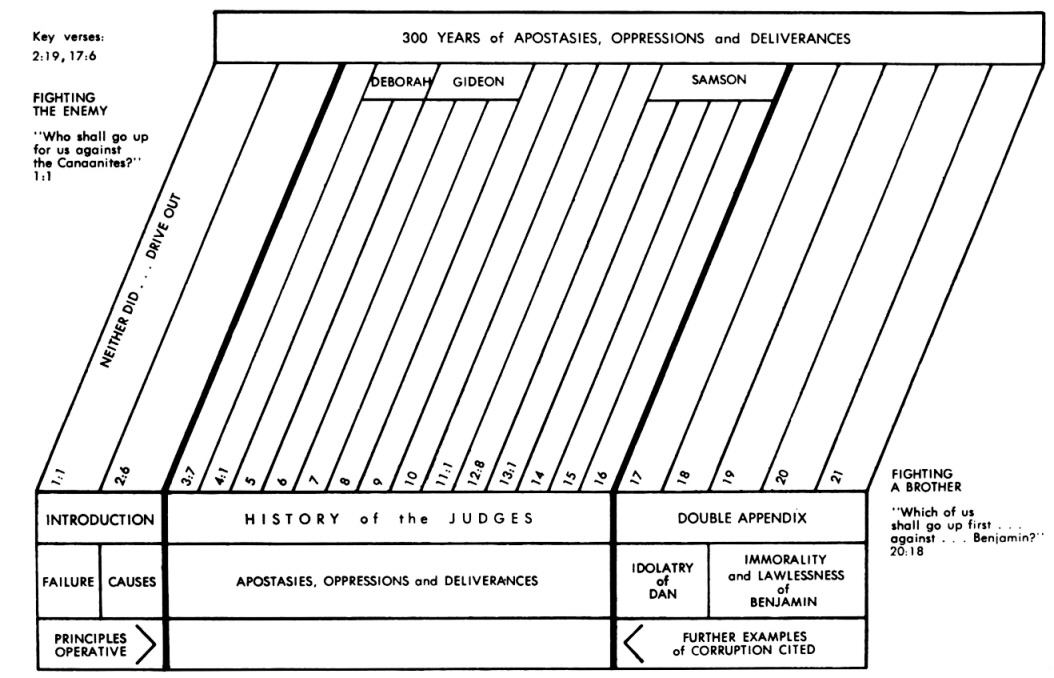
Chart from recommended resource Jensen's Survey of the OT - used by permission
Chart on Judges - Charles Swindoll
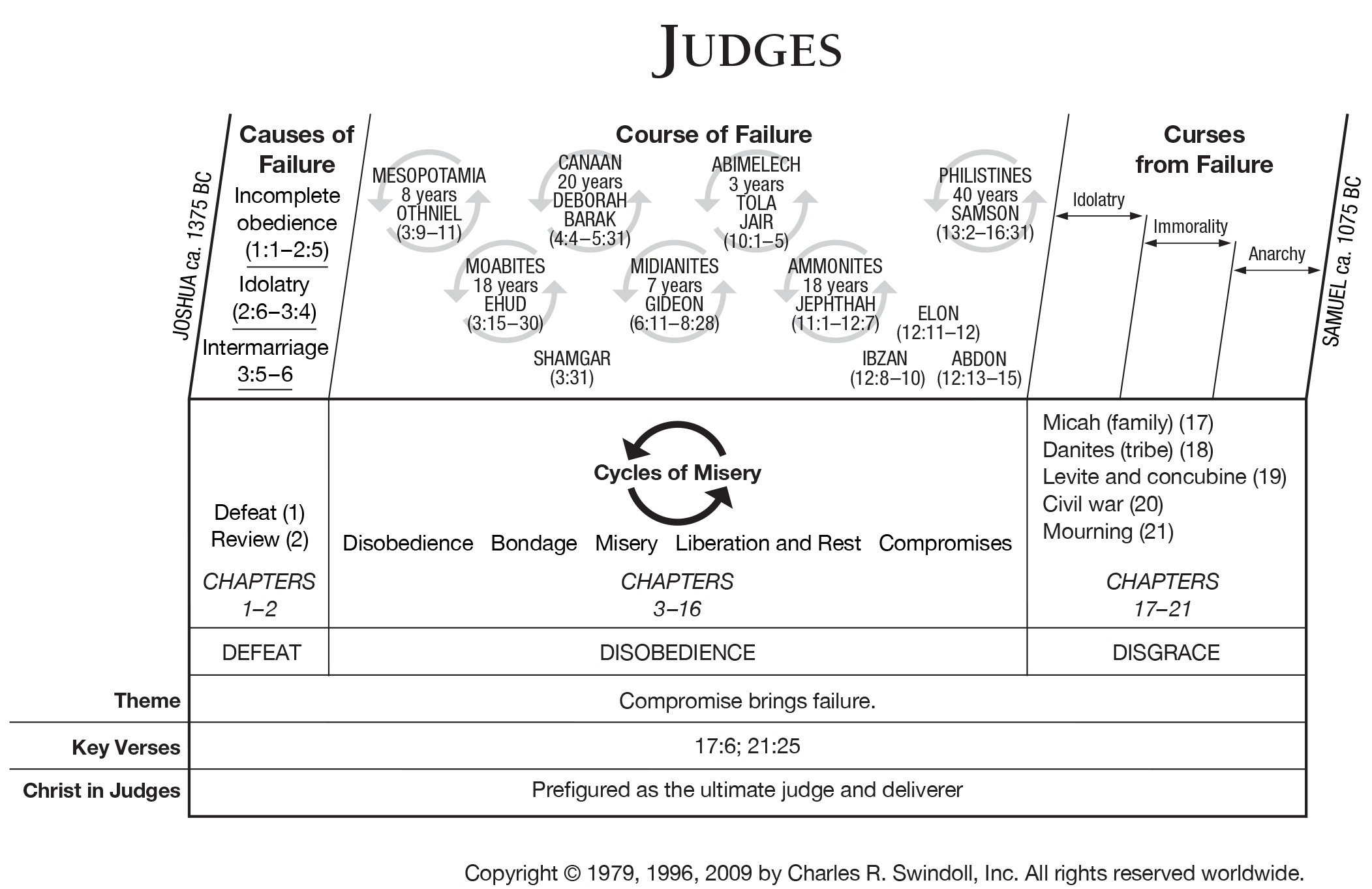
|
RECYCLING SIN |
|||||
| Jdg 1:1-3:6 | Jdg 3:7-16:31 | Jdg 17:1-21:25 | |||
| Introduction | History of the Judges | Appendix | |||
| Causes of the Cycles THE REASON |
Curse of the Cycles THE RECORD |
Conditions in the Cycles THE RESULTS |
|||
| Failure to Complete Conquest Jdg 1:1-36 God's Judgment for Failure Jdg 2:1-3:6 |
Curse of the Cycles |
Conditions in the Cycles |
|||
| Living with Canaanites |
War with the Canaanites |
Living Like the Canaanites |
|||
| Religious Laxity |
Political Uncertainty |
Moral Anarchy |
|||
| About 350 Years of Israel's History - Almost 25%! From Compromise to Confusion! |
|||||
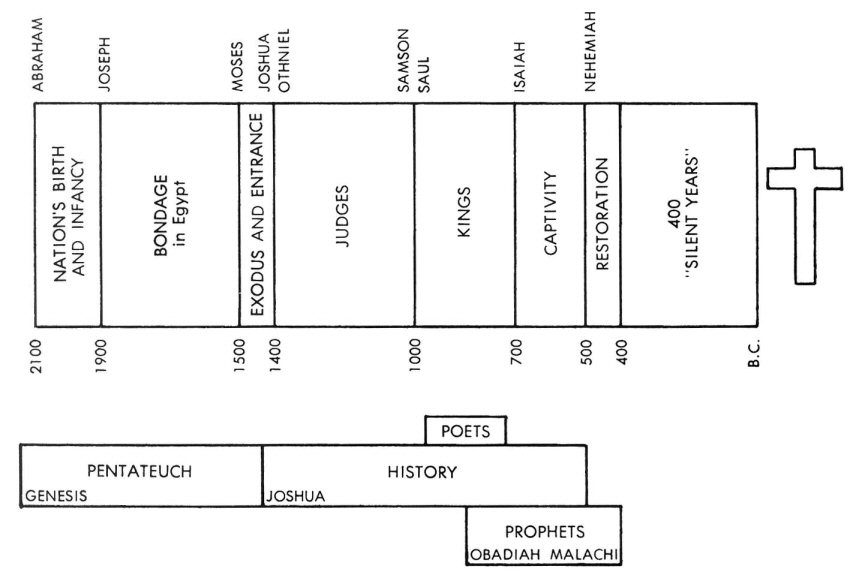
Another Timeline of Israel's History
Click to Enlarge
from Jensen's Survey of the OT
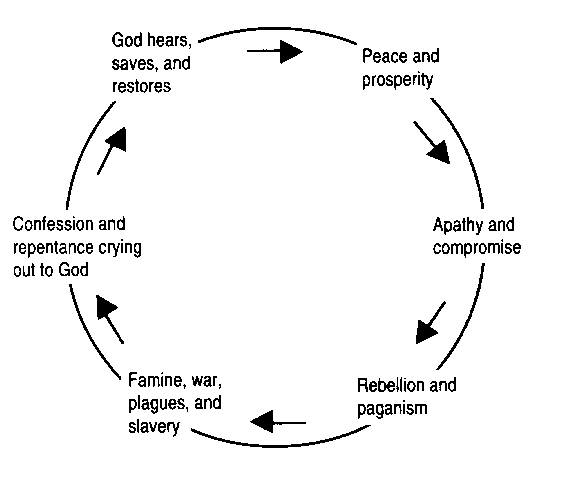
Click to Enlarge
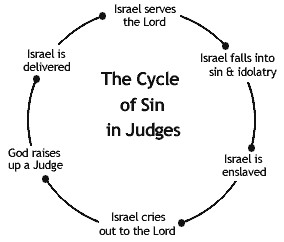
Other ways to describe Israel's cycle…
- Rest > Rebellion > Retribution > Repentance > Restoration
- Sin > Suffering/Servitude > Supplication > Salvation
- Apathy > Apostasy > Affliction > Answered Prayer
- Disobedience > Desperation > Deliverance
- Disobedience > Bondage >Misery > Liberation and Rest > Compromises
|
The Book of Judges |
|
| RUTH | JUDGES |
| Spiritual light |
Spiritual darkness |
| Purity | Immorality |
| Deciding for the One true God |
Pursuing Idols who are no gods |
| Devotion | Disloyalty |
| Love | Lust |
| Peace | War |
| Kindness | Cruelty |
| Obedience brings blessing |
Disobedience brings sorrow |
| Oasis of righteousness |
Desert of rebellion |
| Faithfulness of a Gentile alien |
Faithlessness of the "chosen people" |
FOLLOWING NOTES ARE COMPLETELY REVISED
SPRING, 2022
Judges 2:1 Now the Angel of the LORD came up from Gilgal to Bochim. And he said, "I brought you up out of Egypt and led you into the land which I have sworn to your fathers; and I said, 'I will never break My covenant with you,
- Now the Angel of the LORD, Jdg 6:12 Jdg 13:3 Ge 16:7-10,13 22:11,12 48:16 Ex 3:2-6 14:19 23:20 Ex 33:14 Jos 5:13,14 Isa 63:9 Ho 12:3-5 Zec 3:1,2 Mal 3:1 Ac 7:30-33
- came up from Gilgal to Bochim: Jdg 2:5
- I brought you up out of Egypt: Ex 3:7,8 Ex 14:14 20:2 De 4:34 Ps 78:51-53 105:36-38
- and led you into the land which I have sworn to your fathers: Ge 12:7 22:16,17 26:3,4 Jos 3:10 Ps 105:44,45
- I will never break My covenant with you: Ge 17:7,8 Lev 26:42 Nu 14:34 Ps 89:34 Jer 14:21 33:20,21 Zec 11:10
Related Passages:
Exodus 23:20+ “Behold, I am going to send an angel before you to guard you along the way and to bring you into the place which I have prepared.
Judges 6:12+ The angel of the LORD appeared to him and said to him, “The LORD is with you, O valiant warrior.”
Judges 13:3+ Then the angel of the LORD appeared to the woman and said to her, “Behold now, you are barren and have borne no children, but you shall conceive and give birth to a son.
Joshua 4:19-20+ Now the people came up from the Jordan on the tenth of the first month and camped at Gilgal on the eastern edge of Jericho. 20 Those twelve stones which they had taken from the Jordan, Joshua set up at Gilgal.
Joshua 5:9-10+ Then the LORD said to Joshua, “Today I have rolled away the reproach of Egypt from you.” So the name of that place is called Gilgal to this day. 10 While the sons of Israel camped at Gilgal they observed the Passover on the evening of the fourteenth day of the month on the desert plains of Jericho.
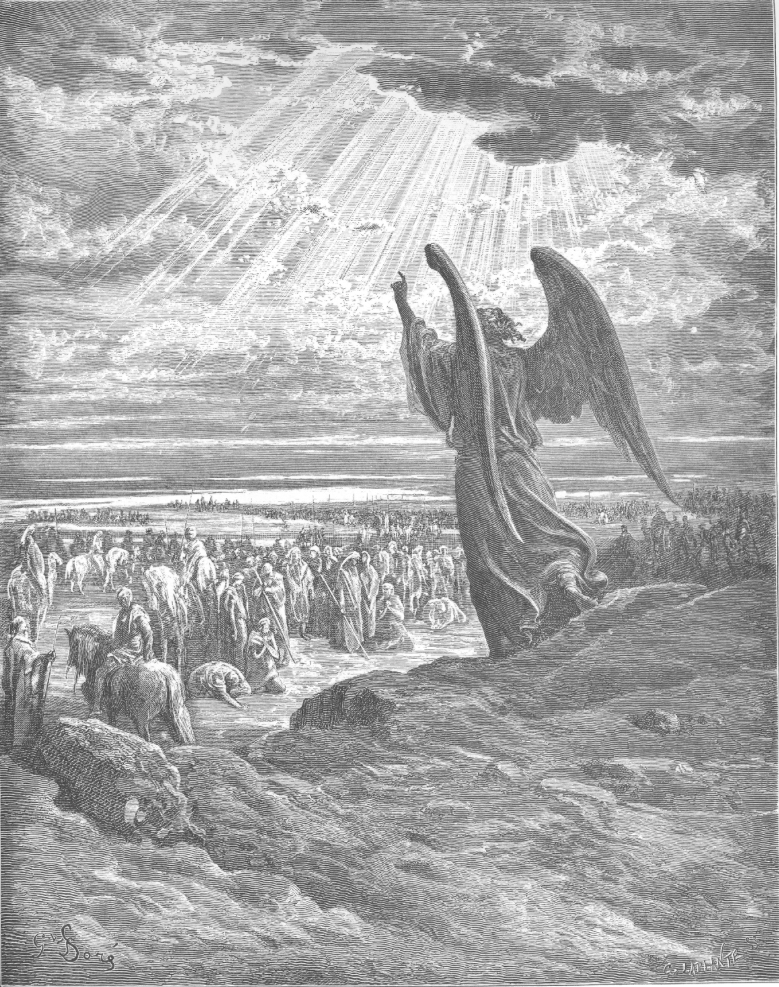
The Angel of the LORD
Gustave Dore
Dore is a great artist but not a great theologian! I seriously doubt if the pre-incarnate Christ appeared with wings!
Now: To when does this time refer? It's hard to discern with absolute certainty but it is probably referring to a time during the period of Judges and certainly a time when they had had ample opportunity to drive out their enemies but failed to do so. This event therefore could be the postscript to Jdg 1 and would be God's assessment to His people of how well they had followed His instructions and commands in Dt 7, 9, Jos 23,24 given before they came into the promised land.
Spurgeon - "if you turn aside from God’s words by a hair’s breadth you know not where it will end. The rail diverges but a little where the switches are turned, but before long the branch line is miles away from the main track. Backslide a little and you are on the way to utter apostasy. The mother of mischief is small as a midge’s egg: hatch it, and you shall see an evil bird larger than an ostrich. The least wrong has in it an all but infinity of evil. You cannot say to sin, “Hitherto shalt thou go, and no farther, and here shall thy proud waves be stayed.” Like the sea when the dyke is broken, it stretches forth its band to grasp all the surrounding country. The beginning of sin is hike the beginning of strife, and that is said to be as the letting out of water: no man knows what a flood may come when once the banks are burst. So Israel went aside farther and farther from God because they regarded not their way, and did not in all things obey the Lord."
Now the Angel of the LORD came up from Gilgal to Bochim -- HCSB has a pithy note stating that "Now after Israel's inadequate attempts to "go up" (in warfare) against the inhabitants of Canaan, the Angel of the Lord went up against them." Although not everyone agrees, I think the evidence is overwhelming that this "Angel of Jehovah" represents a "theophany" and specifically an appearance of God (Jesus) in visible and bodily form.
John MacArthur agrees writing that this is "One of 3 pre-incarnate theophanies by the Lord Jesus Christ in Judges (cf. Judges 6:11, 12, 13, 14, 15, 16, 17, 18; 13:3-23). This same Divine Messenger had earlier led Israel out of Egypt (cf. Ex. 14:19). (MacArthur Study Bible Nashville: Word)
F. Duane Lindsey agrees writing that "The Angel of the Lord was not merely “an angel”; He was a theophany—an appearance of the second Person of the Trinity in visible and bodily form before the Incarnation. (See Bible Knowledge Commentary)
THE Angel of the LORD - Jdg 5:23+, Jdg 6:11+, Jdg 13:3ff+ Ge 16:7-10,13; Ge 22:11,12; 48:16; Ex 3:2-6;Ex 14:19; Ex 23:20; Ex 33:14; Josh 5:13,14; Isa 63:9; Hos 12:3, 4, 5; Zech 3:1,2; Mal 3:1; Acts 7:30-33+)
Bochim was probably located between Bethel and Shiloh, some 20 mi from the Dead Sea. Gilgal was the first place Israel had camped after entering the Promised land and there they set up 12 memorial stones for there God rolled away their reproach and there they celebrated the Passover.
Gilgal was a place of OBEDIENCE and TRIUMPH but tragically Gilgal later became the scene of idolatrous worship (Hos 4:15; 9:15)! It is also apparently the site (or very close to it) where Joshua met the "captain of the LORD's host" (see above)
THOUGHT - I wonder what had happened to the 12 memorial stones (Jos 4:20-24+)? Have you set up "memorial stones" in your family? It's a good thing to do, but it's even better to remember the past glorious acts of God on our behalf!
Alexander Solzhenitsyn in an address for another reason made some comments that speak to the road forgetfulness (Jdg 3:7+) that leads from Gilgal to Bochim -"Over half a century ago while I was still a child, I recall hearing a number of older people offer the following explanation for the great disasters that had befallen Russia: 'Men have forgotten God; that's why all of this has happened.' Since then I have spent well-nigh 50 years working on the history of our revolution; in the process I have read hundreds of books, collected hundreds of personal testimonies, and have already contributed 8 volumes of my own toward the effort of clearing away the rubble left by that upheaval. But if I were asked today to formulate as concisely as possible the main cause of the ruinous revolution that swallowed up some 60 million of our people, I could not put it more accurately than to repeat: 'Men have forgotten God; that's why all this has happened.'"
And so too the forgetfulness of modern man continues to take him further and further from God and closer to the jaws of disaster and the pit of destruction. (Judges 3:7+).
H. L. Rossier has an interesting devotional note on Gilgal -
At the cross of Christ, in His death, the flesh was absolutely condemned and made an end of for the believer ... but continual returning to Gilgal was a necessity. There must be for the believer the constant realisation before God, what the cross of Christ teaches, that 'the flesh profiteth nothing'. True self-judgment must be maintained if we would know wherein lies the secret of spiritual power by which we mortify our members, which are upon the earth. We may learn this from the victories in the book of Joshua. The Israelites always returned to Gilgal, except in one case (Josh 7:2), where they were defeated" (Meditations on the Book of Judges).
Sadly, Gilgal appears only twice in the book of Judges (2:1 and 3:19) and therein is the reason for the spiritual weakness of those days. It held no position of importance or significance in the children of Israel's thinking
And he said: The "He" refers to the preincarnate preacher Jesus Christ. As Spurgeon said "it must have been grand hearing to hear an angel preach, and grander hearing still to hear the Angel of the Covenant (Isa 42:6, Isa 47:8, Isa 54:10, Isa 55:3, Isa 59:21, Isa 61:8) plead with the covenanted ones. Oh, what a sermon! What a sermon it must have been! Scarcely ever was such a preacher seen on earth. And yet that sermon did not do its much good as when the seafaring man, Peter, preached at Pentecost. The sermon at Bochim, if I were to sum up its results, ended in disappointment. Be not disappointed, servant of God, if sometimes you seem to fail. Do not say, “I will give it up.” Your bread has been cast upon the waters. Wait a while, for alter many days you may find it (Eccl 11:1). If Israel be not gathered, God will reward you for your toil. It is yours to labor; it is God’s to give the results; and he does not always grant pleasing results to us at once. He did not allot great triumphs to this Angel of the LORD, as we shall have to show you. It was a great congregation; it was a great preacher; and it was a great sermon, and yet there was not a great ingathering. Read the sermon through; and note that though it is a short one it is all the greater for its brevity. Sermons may grow little by being long, and a sermon may he great through being short, if it be big with thought as this angelic sermon was." (From sermon Bochim; Or, The Weepers)
I brought you up out of Egypt and led you into the land which I have sworn to your fathers: Jehovah - Jesus (see Jehovah = Jesus) is now speaking to Israel and reminding them of two aspects of His faithfulness - delivery from bondage and safe passage to the promised land. In Exodus He declared “I am the LORD your God, who brought you out of the land of Egypt, out of the house of slavery." (Ex 20:2+) How did He lead them? Moses records…
And the LORD was going before them in a pillar of cloud (Shekinah glory cloud) by day to lead them on the way, and in a pillar of fire by night to give them light, that they might travel by day and by night. He did not take away the pillar of cloud by day, nor the pillar of fire by night, from before the people. (Ex 13:21-22+)
But He led forth His own people like sheep and guided them in the wilderness like a flock (Ps 78:52)
C H Spurgeon- Brethren, this subject should most readily lead us to repentance,-that God should have dealt so well with us should make us grieve that we have behaved so ill to him. Do I address a backsliding child of God? I do not think that any exercise is more likely to benefit your heart than to remember what God did for you in years gone by. He took you up out of the horrible pit and out of the miry clay and set your feet upon a rock. He brought you out from the iron bondage of your despair and gave you liberty, he brake the yoke of sinful habits, and the chains of furious passions; and now are you wandering away from him? Are you making something else to be the god of your spirit? If so, be ashamed of your ingratitude, and let this first head of the angel’s discourse have power upon your mind. “You use no other friend so ill”; and yet you have not a friend who can be compared with your God. “I beseech you, brethren, by the mercies of God, that ye present your bodies a living sacrifice” unto your God, and sin no longer against him."
And I said, 'I will never break My covenant with you: After giving them two reminders of His faithfulness, He makes this promise. Yahweh is a covenant keeping God, an immutable truth for which we are all grateful! Notice he says
Gen 17:7 “I will establish My covenant between Me and you and your descendants after you throughout their generations for an everlasting covenant, to be God to you and to your descendants after you.
Gen 17:8 “I will give to you and to your descendants after you, the land of your sojournings, all the land of Canaan, for an everlasting possession; and I will be their God.”
Jer 33:20-21 “Thus says the LORD, ‘If you can break My covenant for the day and My covenant for the night, so that day and night will not be at their appointed time, then My covenant may also be broken with David My servant so that he will not have a son to reign on his throne, and with the Levitical priests, My ministers. (See study of New Covenant in the Old Testament )
Comment: Yes, Israel has been intractably disobedient, stubborn and rebellious for centuries and even in our present century where most of modern Israel is secular, with a smaller per cent of Orthodox but unsaved and with an even smaller percentage of born again Jews (A number that by all reports is definitely increasing in recent years - the year of this writing is 2014). But God is faithful even in Israel's (and our) unfaithfulness. He is faithful especially to His Word, specifically to His Word of Covenant, the covenant which He cut (made) with Abraham and then with Isaac and then with Jacob. The New Covenant is the extension of the Abrahamic Covenant (See Covenant: Abrahamic vs Old vs New). That is why when Jesus inaugurated the New Covenant, He choose to do so in a "Jewish context," as He celebrated the Passover Feast ("Last Supper")…
And in the same way He took the cup after they had eaten, saying, "This cup which is poured out for you is the new covenant in My blood. (Lk 22:20)
To wit (that is to say), Jehovah is not finished with the Nation of Israel as is commonly taught in many evangelical churches today. The Church has not replaced Israel! See What is replacement theology?. See also discussion of the "touchstone" passage Galatians 6:16 - Israel of God
Jehovah is the Covenant Keeping God! This is good for all of us to remember.
Psalm 89:34 My covenant I will not violate, nor will I alter the utterance of My lips.
Spurgeon comments (on Ps 89:34): My covenant will I not break. It is His own covenant. He devised it, drew up the draft of it, and voluntarily entered into it: he therefore thinks much of it. It is not a man's covenant, but the Lord claims it as His own. It is an evil thing among men for one to be a "covenant breaker", and such an opprobrious epithet shall never be applicable to the Most High.
Nor alter the thing that is gone out of my lips. Alterations and afterthoughts belong to short sighted beings who meet with unexpected events which operate upon them to change their minds, but the Lord who sees everything from the beginning has no such reason for shifting his ground. He is besides immutable in his nature and designs, and cannot change in heart, and therefore not in promise. A word once given is sacred; once let a promise pass our lips and honesty forbids that we should recall it, -- unless indeed the thing promised be impossible, or wicked, neither of which can happen with the promises of God. How consoling it is to see the Lord thus resolute. He, in the words before us, virtually reasserts his covenant and rehearses his engagements. This he does at such length, and with such reiteration, that it is evident he takes pleasure in that most ancient and solemn contract. If it were conceivable that he had repented of it, he would not be found dwelling upon it, and repeating it with renewed emphasis.
Jeremiah 33:20 "Thus says the LORD, 'If you can break My covenant for the day, and My covenant for the night, so that day and night will not be at their appointed time,
This is still true -- God has not broken His covenant promises to Israel and will fulfill them fully in the Messianic Age when He reigns on earth. (See notes on Millennium Pt 1 - Millennium Pt 2 - Millennium Pt 3)
C H Spurgeon -Then the angel passed on to mention the mercies guaranteed to them: “I said, I will never break my covenant with you.” Oh, that is a blessed theme. If indeed you are a believer in the Lord Jesus Christ, the Lord has pledged himself to make you perfect and to bring you home to himself with exceeding great joy. You shall not perish. Christ has said, “I give unto my sheep eternal life; and they shall never perish, neither shall any man pluck them out of my hand. My Father, which gave them me, is greater than all; and no man is able to pluck them out of my Father’s hand.” You see the two bands-one inside the other, and you inside the middle one, enclosed within the palm of omnipotent faithfulness. Jehovah says, “I have loved thee with an everlasting love.” He will never break his covenant with you. Will you wander away from him who passes by your iniquity, transgression, and sin, and does not let his anger smoke against you for ever-he to whom you are joined in an everlasting wedlock which shall never know a divorce? Oh, cruel heart! cruel heart! Canst thou offend against such love as this? Canst thou break with God when he declares that he will never break with you? The angel pleads this longsuffering, eternally-enduring love, and pleads it well. I know of no two greater arguments than mercy received and mercy promised. Let us not sin against these. May the Holy Spirit hold us fast with these cords of love.
THE TERRIBLE CONSEQUENCES OF PARTIAL OBEDIENCE,
OF SIN, OF EROSION OF SPIRITUALITY
Sin will take you further than you ever wanted to stray,
It'll keep you longer than you ever thought you'd stay,
And will cost you more than you ever dreamed that you would pay!
PARTIAL OBEDIENCE
TAKES US FROM
REJOICING TO WEEPING
Gilgal: they set up the altar after crossing the Jordan to commemorate the crossing. So that whenever the children of generations to come would see the altar, they would REMEMBER what God had done there. Jos 4:19, 5:1, 2 (circumcision), v10 (celebrated Passover), God appeared to Joshua at Gilgal Josh 5:13 (Joshua found out that God didn't come to take sides but to take over). In short, Gilgal was the place where the blessings were, where the victories were, where the people were surrendered to do what God had told them to do.
Bochim: means mourning or weeping. Do you see the picture of the cost that comes when you choose to begin to entertain sin in your life, becoming partially obedient (that subtle, nominal Christianity that's invaded America) and you move from the place of victory, the place of blessing to the place of mourning, to the place of weeping.
THOUGHT- Have you been at Gilgal in your life, only to move to Bochim and God had to come back to you again and bring you out of it? Perhaps you are in need of revival. The psalmist was writing "My soul cleaves to the dust; Revive me according to Your word." (Ps 119:25) If you need revival (most of us do at one time or another), Richard Owen Roberts has an interesting article of revival entitled Judges - Cycles of Revival. Life Action Ministries has some excellent materials you can download that will help you work through personal revival. And Ps 119:25 is a great prayer to pray frequently (integrate it with His Word).
- Proud People / Broken People - The first step toward a refreshed relationship with God is humility. Once we see our great spiritual need, for His intervention in our lives and for revival in our hearts, we can begin the journey of renewal. This worksheet helps readers uncover heart attitudes of pride that may be preventing them from experiencing revival.
- Freedom Through Forgiveness - We have been commanded to forgive earthly offenses in the same way that God has forgiven our heavenly offenses (Ephesians 4:32). And yet, how? Does one simply “forgive and forget?” What if the offender doesn’t deserve forgiveness? What if he never asks for it? How can we walk in the freedom Jesus died to provide while still held captive by bitterness and anger? This worksheet is a comprehensive walkthrough of biblical forgiveness principles, set forth in a way that, prayerfully, can lead believers to fully and finally forgive.
- Put Off / Put On, Repentance - Use this resource to ask God to show you whether your heart attitude toward Him is one of repentance from sin and from dead works of the flesh that cannot please God
- Clear Conscience - A clear conscience is the ability to say, “There is no one alive that I have ever wronged, offended, or hurt in any way that I have not gone back to and made it right with God and with them.”
- Sexual Purity, - Few areas in our Christian pilgrimage require more care and attention than the matter of our sexual lives. This exercise is intended to provide practical instruction on how to walk in sexual purity and victory. We suggest our readers set aside a concentrated period of time to process and internalize these application questions and their corresponding Scripture references.
- The Ministry of the Holy Spirit - This resource explores who the Holy Spirit is, what it means to be filled with the Holy Spirit and other questions you might have.
Related Resources:
- Covenant: As It Relates to Marriage
- Covenant: Why Study It?
- Covenant: Introduction
- Lesson 1 Covenant: Summary Table
- Lesson 2 Covenant: The Exchange of Robes
- Lesson 3 Covenant: The Exchange of Armor and Belts
- Lesson 4 Covenant: Solemn and Binding
- Lesson 5 Covenant: A Walk Into Death
- Lesson 6 Covenant: The Oneness of Covenant
- Covenant: Oneness Notes
- Lesson 7 Covenant: Withholding Nothing from God
- Lesson 8 Covenant: Abrahamic versus Mosaic
- Lesson 9 Covenant: New Covenant in the Old Testament
- Lesson 10 Covenant: Why the New is Better
- Lesson 11 Covenant: Abrahamic vs Old vs New
- Name change
- Covenant Meal
- Friend a covenant word (notes)
- Covenant memorial
- Phylacteries in OT
- Commingling of blood (notes)
- Common life of covenant
- Striking of hands
- Mephibosheth
- New Covenant in the Old Testament
George Bush - Notes, Critical and Practical on the Book of Judges (Judges 2)
1. An angel of the Lord. As the word ‘angel,’ in its primary import, is a term of office equivalent to messenger, the Jews for the most part are of the opinion that it here denotes a prophet sent by God as a messenger, and that messenger they suppose to have been Phinehas, the high-priest, who was commissioned on this occasion to deliver the ensuing solemn reproof to Israel. This is indeed possible, but the more probable opinion we take to be, that it was neither a human prophet nor a created angel, but the Son of God himself, he who is so frequently styled, in the Scriptures, the ‘Angel of the covenant.’ The evidence of this is found in what he immediately goes on to say of himself;—‘I made you to go up out of Egypt,’ &c. Who but Jehovah himself could or would adopt such language as this? It was not a creature that brought the Israelites out of Egypt; but Jehovah. It was not a creature that made a covenant with them; but Jehovah. It was not a creature to whom they were accountable for their disobedience, and whose displeasure they had so much reason to dread; but Jehovah. As to the circumstance of his being said to ‘come up’ from Gilgal, which is supposed to militate against this interpretation, it rather confirms it; for it was in Gilgal, near to Jericho, that this same divine person had appeared to Joshua as an armed warrior. That he was Jehovah cannot be doubted because he suffered Joshua to worship him, and even commanded him to put off his shoes from his feet, inasmuch as the ground on which he stood was, by reason of his presence, rendered holy. In his conversation with Joshua he had called himself the ‘Captain of the Lord’s host,’ and therefore there was a particular propriety in his appearing now to the people, to inquire, Why they had not carried his orders into effect? and to threaten them that he would fight for them no longer. Besides, at Gilgal the people bad renewed the ordinance of circumcision and the passover, in which they had consecrated themselves to God a fresh, and engaged to serve him as his redeemed people. In coming therefore as from Gilgal, the Angel upbraided them with their base ingratitude, reminded them of their solemn engagements, and humbled them the more for their violation of them.
To Bochim. Heb. ‘the weepers.’ Gr. κλαυθμωνες, bewailings; so called by anticipation from the weeping and lamentation, v. 8, that took place there. Where Bochim was situated we are not elsewhere informed, and the probability is, that the place was in reality no other than Shiloh, where the people were now assembled, v. 4, on one of their solemn festivals; for it appears, v. 5, that the sacrifices were offered on the occasion, and we know that, as a general rule, sacrifices were not offered except where the tabernacle and altar were fixed, and this, at the present time was at Shiloh. As to the time when the events recorded, v. 1–11, took place, it was doubtless subsequent to the death of Joshua, though the precise date of it cannot now be ascertained. If in Joshua’s time they had been guilty of the gross delinquency here laid to their charge, he would hardly have failed to reprove them for it, or have said, Josh. 23:8, that they had ‘cleaved unto the Lord their God unto that day.’ The reason for the mention of Joshua’s dismission of the people being inserted in this immediate connection, will be given in our remarks on v. 6.
I said, I will never break my covenant. Provided you are true and faithful to yours. The first breach of covenant shall never be laid to my charge.
Gary Phillips expresses the main point of this chapter - Although God is always faithful to his children, when we are faithless, he allows us to make our own choices, including choices that bring self-destructive pain upon us. Even so, he does not abandon us, but like the father of the prodigal son is always waiting to enfold us in repentance within his patient, loving arms. (Holman Old Testament Commentary)
James Smith - Handfuls of Purpose - “WHY HAVE YE DONE THIS?” Judges 2:1–5
“If Thou hadst not
Been stern to me,
But left me free,
I had forgot
Myself and Thee.”
—BEN JONSON.
The “angel of the Lord” may mean “the angel of His Presence,” that angelic form which makes the presence of the Lord a powerful reality. This the Holy Spirit now does. Wherever He is the presence of God is felt. The journey from Gilgal (rolling away) to Bochim (weepers) may in a moral sense be very short. If we do not walk in the light of His will the distance between our successes and failures will never be very great. We observe here—
I. A Work of Grace. This grace was manifested in—
1. A MERCIFUL COMPULSION. “I made you to go up out of Egypt” (v. 1). It is a blessed thing when salvation becomes a pressing necessity. Compelled to forsake our godless ways through the force of constraining grace. It was so with Saul while on the way to Damascus (Acts 9). The compulsion of Almighty love.
2. THE GIFT OF A RICH POSSESSION. “I brought you unto the land” (v. 1). This good land was the land of promise. To Israel it meant freedom, peace, plenty, progress, and power. Typical of the possessions the believer has in Christ Jesus.
3. AN UNFAILING ASSURANCE. “I will never break My covenant with you” (v, 1). The gifts and callings of God are without repentance. God Himself will not alter the thing that has gone out of His lips (Ps. 89:34). We may fail, yet He abideth faithful to His own promise. The bargain will never be broken on God’s side. He cannot deny Himself.
4. A NEEDFUL WARNING. “Ye shall make no league with the inhabitants; ye shall throw down their altars” (v. 2). The inhabitants of the land were bitterly opposed to the purposes of God, therefore the children of God must make no covenant with them. The servants of Christ must in no way identify themselves with that spirit that worketh in the children of disobedience. Their false gods must be thrown down, and the Lord alone exalted.
II. A Miserable Failure. “But ye have not obeyed My voice” (v. 2). The failure came in their case, as it often comes in ours, through unbelief. O fools and slow of heart, to believe all that He hath spoken! The voice of God is still in His Word, because His Word is the breathings of the Holy Ghost (2 Peter 1:21). The Scriptures are always living and active (see Heb. 4:12, R.V.). To turn away from His revealed will is to close our ears to the voice of God. Be not deceived, God knows when His voice is obeyed. He is personally interested in every individual child of His. How often have we complained of our failures? May not the cause be here: “Ye have not obeyed My voice?”
III. A Searching Question. “Why have ye done this?” The “angel of His presence” is jealous for the honour of God. What answer can a disobedient one give to this personal, pointed inquiry? An honest answer would be: “I feared man more than God, and was better pleased with my own thoughts and plans than with His.” Paul’s “Not I, but Christ,” has been changed into “Not Christ, but I.” Ye know that, apart from the presence and power of the Holy Ghost within you, ye cannot live or witness for God as ye ought; yet ye have gone leaning on your own strength and wisdom, and came away defeated. “Why have ye done this?” Ye know that to obey His voice is the secret of heart-restfulness, yet ye have not walked in this light. “Why have ye done this?”
IV. An Expressive Answer. They answered not by words, but by deeds. Acts speak louder than words—
1. THEY WEPT. “The people lifted up their voice and wept” (v. 4). The message from him who represented the presence of God had gone home to their hearts. “Why have ye done this?” smote them with the silence of self-condemnation that could only find expression in tears of repentance. It was a heart question that wrung out this heart-melting response. The crowing of a cock sent the same burning question into the heart of self-confident Peter, and with the very same result. “He went out and wept bitterly” (Matt. 26:75). “Godly sorrow worketh repentance to salvation not to be repented of” (2 Cor. 7:10).
2. THEY SACRIFICED. “And they sacrificed there unto the Lord” (v. 5). Sacrificing unto God is the only possible way of redeeming what we have lost by disobedience. The tears that are not followed with self-denying deeds are not very hot. “The sacrifices of God are a broken spirit” (Ps. 51:17). The broken spirit allows all that is in it to flow out for God. “I beseech you therefore by the mercies of God to present your bodies a living sacrifice, holy, acceptable to God, which is your reasonable service” (Rom. 12:1).
Judges 2:2 and as for you, you shall make no covenant with the inhabitants of this land; you shall tear down their altars.' But you have not obeyed Me; what is this you have done?
- and as for you, you shall make no covenant with the inhabitants of this land: Ex 23:32,33 34:12-16 Nu 33:52,53 De 7:2-4,16,25,26 12:2,3 De 20:16-18 2Co 6:14-17
- But you have not obeyed Me: Jdg 2:20 Ezra 9:1-3,10-13 Ps 78:55-58 106:34-40 Jer 7:23-28 2Th 1:8 1Pe 4:17
- what is this you have done: Ge 3:11,12 Ge 4:10 Ex 32:21 Jer 2:5,18, 31-33,36
Related Passages:
Exodus 23:32+; “You shall make no covenant with them or with their gods.
Exodus 34:12-16+ “Watch yourself that you make no covenant with the inhabitants of the land into which you are going, or it will become a snare in your midst. 13 “But rather, you are to tear down their altars and smash their sacred pillars and cut down their Asherim 14 –for you shall not worship any other god, for the LORD, whose name is Jealous, is a jealous God– 15 otherwise you might make a covenant with the inhabitants of the land and they would play the harlot with their gods and sacrifice to their gods, and someone might invite you to eat of his sacrifice, 16 and you might take some of his daughters for your sons, and his daughters might play the harlot with their gods and cause your sons also to play the harlot with their gods.
Numbers 33:51-53+ "Speak to the sons of Israel and say to them, 'When you cross over the Jordan into the land of Canaan, 52 then you shall drive out all the inhabitants of the land from before you, and destroy all their figured stones, and destroy all their molten images and demolish all their high places; 53 and you shall take possession of the land and live in it, for I have given the land to you to possess it.
Deuteronomy 7:2-4+ and when the LORD your God delivers them before you and you defeat them, then you shall utterly destroy them. You shall make no covenant with them and show no favor to them. 3 "Furthermore, you shall not intermarry with them; you shall not give your daughters to their sons, nor shall you take their daughters for your sons. 4 "For they will turn your sons away from following Me to serve other gods; then the anger of the LORD will be kindled against you, and He will quickly destroy you.
Deuteronomy 7:16+ “You shall consume all the peoples whom the LORD your God will deliver to you; your eye shall not pity them, nor shall you serve their gods, for that would be a snare to you.
Deuteronomy 7:25+ “The graven images of their gods you are to burn with fire; you shall not covet the silver or the gold that is on them, nor take it for yourselves, or you will be snared by it, for it is an abomination to the LORD your God.
Deuteronomy 7:26+ “You shall not bring an abomination into your house, and like it come under the ban; you shall utterly detest it and you shall utterly abhor it, for it is something banned.
Deuteronomy 12:2+ "You shall utterly destroy all the places where the nations whom you shall dispossess serve their gods, on the high mountains and on the hills and under every green tree. 3 "And you shall tear down their altars and smash their sacred pillars and burn their Asherim with fire, and you shall cut down the engraved images of their gods, and you shall obliterate their name from that place.
2 Corinthians 6:14-17+ Do not be bound together with unbelievers; for what partnership have righteousness and lawlessness, or what fellowship has light with darkness? 15 Or what harmony has Christ with Belial, or what has a believer in common with an unbeliever? 16 Or what agreement has the temple of God with idols? For we are the temple of the living God; just as God said, “I WILL DWELL IN THEM AND WALK AMONG THEM; AND I WILL BE THEIR GOD, AND THEY SHALL BE MY PEOPLE. 17 “Therefore, COME OUT FROM THEIR MIDST AND BE SEPARATE,” says the Lord. “AND DO NOT TOUCH WHAT IS UNCLEAN; And I will welcome you.
And as for you, you shall make (karath = cut) no covenant (beriyth) with the inhabitants of this land: (See notes Jdg 1:28, 1:30, 1:33, 1:35) (Dt 20:16-18) This was the first commandment Israel disobeyed. In this context cutting a covenant with the Canaanites would be tantamount to making a peace treaty, a treaty which would entail common worship and intermarriage. Not a "good thing" for God's holy people to do. The LXX version adds "neither shall you worship their gods… destroy their graven images." Don't cut covenant with the enemy (remember covenant speaks of oneness, of identity with the one you are in covenant with). If you do cut covenant it will become a snare in your midst (Ex 34:12). Even godly Joshua "blew it" on this one (Joshua 9:1-27+, which had consequences 2Sa 21:1 - see in depth discussion under topic [scroll down] Covenant Solemn & Binding)
Ray Stedman applies Israel's mistakes to believers today asking that as "We read this story, and we think, How foolish these Israelites were not to obey the commandment of God! But don’t we do exactly the same? Don’t we settle for less than complete victory over our sins and bad habits? Don’t we say, “Well, yes, I do have a problem with anger (or gossip, or swearing, or impure thoughts, or alcohol, or tobacco), but it’s just one little bad habit! I mean, we all need one small vice, don’t we?” No! God says that it is these little things that we accommodate ourselves to and compromise with that eventually defeat us and destroy us! We cannot afford to settle for anything less than complete victory. (Adventuring through the Bible)
You shall tear down their altars - This was the second commandment Israel disobeyed and later even to the point that they actually sacrificed their own sons and their daughters to the demons. This shows how far human depravity can degenerate when unchecked by God! And so the psalmist writes...
They did not destroy the peoples, as the LORD commanded them, 35 But they mingled with the nations, and learned their practices, 36 And served their idols, which became a snare (moqesh; Lxx = skandalon) to them. 37 They even sacrificed their sons and their daughters to the demons (Ps 106:34-37)
Matthew Henry - The miracles and mercies which settled them in Canaan made no more deep and durable impressions upon them than those that fetched them out of Egypt; for by that time they were well warm in Canaan, they corrupted themselves, and forsook God. Observe the steps of their apostasy. They spared the nations which God had doomed to destruction (Psalms 106:34). When they had got the good land God had promised them, they had no zeal against the wicked inhabitants, whom the Lord commanded them to extirpate, pretending pity; but so merciful is God, that no man needs to be in any case more compassionate than he. When they spared them, they promised themselves, that for all this, they would not join in any dangerous affinity with them; but the way of sin is down hill; omissions make way for commissions; when they neglect to destroy the heathen, the next news we hear is, they were mingled among the heathen, made leagues with them, and contracted an intimacy with them, so that they learned their works (Psalms 106:35). That which is rotten will sooner corrupt that which is sound, than be cured or made sound by it. When they mingled with them, and learned some of their works that seemed innocent diversions and entertainments, yet they thought they would never join with them in their worship; but by degrees they learned that too (Psalms 106:36). They served their idols in the same manner, and with the same rites that they served them; and they became a snare unto them, that sin drew on many more, and brought the judgments of God upon them, which they themselves could not but be sensible of, and yet knew not how to recover themselves. When they joined with them in some of their idolatrous services, which they thought had least harm in them, they little thought that ever they should be guilty of that barbarous and inhuman piece of idolatry, the sacrificing of their living children to their dead gods: but they came to that at last (Psalms 106:37, 38) in which Satan triumphed over his worshippers, and regaled himself in blood and slaughter. They sacrificed their sons and daughters, pieces of themselves to devils; and added murder, the most unnatural murder, to their idolatry; one cannot think of it without horror; they "shed innocent blood", the most innocent, for it was infant blood, nay, it was the "blood of their sons and their daughters." See the power of the spirit that works in the children of disobedience, and see his malice. The beginning of idolatry and superstition, like that of strife, is as the letting forth of water, and there is no villainy which they that venture upon it can be sure they shall stop short of, for God justly "gives them up to a reprobate mind" (Romans 1:28+).
Spurgeon comments on Psalm 106:34-37
They did not destroy the nations, concerning whom the LORD commanded them. They were commissioned to act as executioners upon races condemned for their unnatural crimes, and through sloth, cowardice, or Sinful complacency they sheathed the sword too soon, very much to their own danger and disquietude. It is a great evil with professors that they are not zealous for the total destruction of all sin within and without. We make alliances of peace where we ought to proclaim war to the knife; we plead our constitutional temperament, our previous habits, the necessity of our circumstances, or some other evil excuse as an apology for being content with a very partial sanctification, if indeed it be sanctification at all. We are slow also to rebuke sin in others, and are ready to spare respectable sins, which like Agag walk with mincing steps. The measure of our destruction of sin is not to be our inclination, or the habit of others, but the Lord's command. We have no warrant for dealing leniently with any sin, be it what it may.
Verse 35 But were mingled among the heathen, and learned their works. It was not the wilderness which caused Israel's sins; they were just as disobedient when settled in the land of promise. They found evil company, and delighted in it. Those whom they should have destroyed they made their friends. Having enough faults of their own, they were yet ready to go to school to the filthy Canaanites, and educate themselves still more in the arts of iniquity. It was certain that they could learn no good from men whom the Lord had condemned to utter destruction. Few would wish to go to the condemned cell for learning, yet Israel sat at the feet of accursed Canaan, and rose up proficient in every abomination. This, too, is a grievous but common error among professors: they court worldly company and copy worldly fashions, and yet it is their calling to bear witness against these things. None can tell what evil has come of the folly of worldly conformity
Verse 36 And they served their idols: which were a snare unto them. They were fascinated by the charms of idolatry, though it brings misery upon its votaries. A man cannot serve sin without being ensnared by it. It is like birdlime, and to touch it is to be taken by it. Samson laid his head in the Philistine woman's lap, but ere long he woke up shorn of his strength. Dalliance with sin is fatal to spiritual liberty.
Verse 37 Yea, they sacrificed their sons and their daughters unto devils. This was being snared indeed; they were spell bound by the cruel superstition, and were carried so far as even to become murderers of their own children, in honour of the most detestable deities, which were rather devils than gods. "And shed innocent blood." The poor little ones whom they put to death in sacrifice had not been partakers of their sin, and God looked with the utmost indignation upon the murder of the innocent. "Even the blood of their sons and of their daughters, whom they sacrificed unto the idols of Canaan." Who knows how far evil will go? It drove men to be unnatural as well as ungodly. Had they but thought for a moment, they must have seen that a deity who could be pleased with the blood of babes spilt by their own sires could not be a deity at all, but must be a demon, worthy to be detested and not adored.
How could they prefer such service to that of Jehovah? Did he tear their babes from their bosoms and smile at their death throes? Men will sooner wear the iron yoke of Satan than carry the pleasant burden of the Lord; does not this prove to a demonstration the deep depravity of their hearts? If man be not totally depraved, what worse would he do if he were? Does not this verse describe the neplus ultra of iniquity?
And the land was polluted with blood. The promised land, the holy land, which was the glory of all lands, for God was there, was defiled with the reeking gore of innocent babes, and by the blood red hands of their parents, who slew them in order to pay homage to devils. Alas! alas! What vexation was this to the spirit of the Lord.
Even in these warnings against compromise, we see a picture of God’s grace. Israel's willingness to carry out this command would show they are not merely hearers of the Word who delude themselves but that they were genuine, sincere, doers of the Word, who demonstrated their allegiance to God by their actions. Failure to do so would reveal an underlying lack of loyalty and eventually lead to assimilation to Canaanite religion and culture.
But - Another sad term of contrast!
You have not obeyed (shama) Me; what is this you have done: What happened to Israel? Simply put they did not obey God. Obeyed is shama which means hearing and heeding. What is this you have done? There must have been a long pause and no one seems to have answered. The Angel of the LORD was not looking for excuses but desired that they repent and return and do the deeds they did at first (cp Rev 2:5+).
Phillips - God's point highlighted the fact that sin is never a logical choice. The Canaanite altars represented gods that did not speak and did not feel. By contrast, God speaks (indeed, demands a response!), and God feels deeply, as his children saw. He is a jealous (passionate) God who is slow to anger, but when his wrath is kindled, he acts—or, in this case, withdraws his active protection. Over a millennium later, the very one who was grieved by sin was the one who would die for those sins (Isa. 53:6,11; 2 Cor. 5:21). (Holman Old Testament Commentary)
John Hunter "answers the question "What is this you have done?" - The awful truth of the reason why they had not driven out the inhabitants and destroyed their altars and their worship was simply this: they did not WANT to drive them out. They CHOSE to allow these people with their evil, lustful ways to remain. Something in God's people wanted what they saw in that world. Their fallen human nature responded to the wild degrading dances of the heathen worship. The prospect of involvement with male and female prostitutes made their blood tingle with excitement. That was a totally new way of life and all that was in them (Aka - their fallen flesh) cried out for this new culture. So it was that no one drove out anyone." So it was not really because they were afraid of iron chariots, etc… the truth is that they did not want to drive out the enemy because the lusts of their flesh and the lusts of their eyes were attracted to the world (1Jn 2:15+, 1Jn 2:16+, 1Jn 2:17+, Jas 4:4+) when they should have been attracted to Jehovah.
Imitating the enemy (Jdg 2:1-13) - Warren Wiersbe
This first section describes the danger. In this day of “pluralism,” when society contains people of opposing beliefs and lifestyles, it’s easy to get confused and start thinking that tolerance is the same as approval. It isn’t. In a democracy, the law gives people the freedom to worship as they please; and I must exercise patience and tolerance with those who believe and practice things that I feel God has condemned in His Word. The church today doesn’t wield the sword (Ro 13+) and therefore it has no authority to eliminate people who disagree with the Christian faith. But we do have the obligation before God to maintain a separate walk so we won’t become defiled by those who disagree with us (2Co 6:14-18+, 2Co 7:1+). We must seek by prayer, witness, and loving persuasion to win those to Christ who as yet haven’t trusted Him.
The Jews eventually became so accustomed to the sinful ways of their pagan neighbors that those ways didn’t seem sinful any more. The Jews then became interested in how their neighbors worshiped, until finally Israel started to live like their enemies and imitate their ways. For believers today, the first step away from the Lord is “friendship with the world” (Jas 4:4+), which then leads to our being spotted by the world (Jas 1:27+). The next step is to “love the world” (1Jn 2:15+) and gradually become “conformed to this world” (Ro 12:2+). This can lead to being “condemned with the world” (1Co 11:32), the kind of judgment that came to Lot (Ge 19), Samson (Jdg 16:1+), and Saul (1Sa 15, 31).
The disobedience (Jdg 2:1-5). In the OT the “angel of the Lord” is generally interpreted to be the Lord Himself, who occasionally came to earth (theophany) to deliver an important message. It was probably the Lord Jesus Christ, the second Person of the Godhead, in a temporary pre-incarnation appearance. (Ge 16:7) The fact that God Himself came to give the message shows how serious things had become in Israel.
The tabernacle was originally located at Gilgal (Jos 4:19,20), and it was there that the men of Israel were circumcised and “rolled away” the reproach of Egypt (Jos 5:2-9). It was also there that the Lord appeared to Joshua and assured him of victory as he began his campaign to conquer Canaan (Jos 5:13-15). To Joshua, the angel of the Lord brought a message of encouragement; but to the new generation described in the Book of Judges, He brought a message of punishment.
The Lord had kept His covenant with Israel; not one word of His promises had failed (Jos 23:5, 10, 15; 1Ki 8:56). He had asked them to keep their covenant with Him by obeying His law and destroying the Canaanite religious system—their altars, temples, and idols. (Ex 23:20-25, note the association between the angel of the Lord and the command to destroy the false religion; cp Ex 34:10-17 and Dt 7:1-11, 25, 26.) But Israel disobeyed the Lord and not only spared the Canaanites and their godless religious system but also began to follow the enemy’s lifestyle themselves.
In His covenant, God promised to bless Israel if the people obeyed Him and to discipline them if they disobeyed Him (Dt 27,28). God is always faithful to His Word, whether in blessing us or chastening us; for in both, He displays His integrity and His love (He 12:1f-note). God would prefer to bestow the positive blessings of life that bring us enjoyment, but He doesn’t hesitate to remove those blessings if our suffering will motivate us to return to Him in repentance.
By their disobedience, the nation of Israel made it clear that they wanted the Canaanites to remain in the land. God let them have their way (Ps 106:15), but He warned them of the tragic consequences. The nations in the land of Canaan would become thorns that would afflict Israel and traps that would ensnare them. Israel would look to the Canaanites for pleasures but would only experience pain; they would rejoice in their freedom only to see that freedom turn into their bondage.
No wonder the people wept when they heard the message! (Bochim = “weepers.”) However, their sorrow was because of the consequences of their sins and not because the wickedness of their sins had convicted them. It was a shallow and temporary sorrow that never led them to true repentance (2Co 7:8-11). (See The Bible Exposition Commentary)
George Bush - Notes, Critical and Practical on the Book of Judges (Judges 2)
Ye shall make no league, &c. The letter of this, passage is too plain to need remark, but the spirit of it in its application to the Christian Israel, merits our most serious regard. It teaches the danger of indecision and supineness in prosecuting our Christian warfare. The command to every follower of Christ is, to make no league with our spiritual enemies. Our corrupt affections and lusts are not to be spared. It is not sufficient to make them pay tribute; we must crucify and slay them; we must show them no mercy; our hatred of them must be irreconcileable and incessant.
Judges 2:3 "Therefore I also said, 'I will not drive them out before you; but they shall become as thorns in your sides, and their gods shall be a snare to you.'"
- Therefore I also said: Jdg 2:21 Nu 33:55 Jos 23:13
- their gods shall be a snare to you: Jdg 3:6 Ex 23:33 34:12 De 7:16 1Ki 11:1-7 Ps 106:36
Related Passages:
Judges 2:21+ I also will no longer drive out before them any of the nations which Joshua left when he died,
Exodus 34:12+ “Watch yourself that you make no covenant with the inhabitants of the land into which you are going, or it will become a snare in your midst.
Numbers 33:55+ ‘But if you do not drive out the inhabitants of the land from before you, then it shall come about that those whom you let remain of them will become as pricks in your eyes and as thorns in your sides, and they will trouble you in the land in which you live.
Deuteronomy 7:16+ “You shall consume all the peoples whom the LORD your God will deliver to you; your eye shall not pity them, nor shall you serve their gods, for that would be a snare to you.
Proverbs 22:5 Thorns and snares are in the way of the perverse; He who guards himself will be far from them.
Psalm 106:36 And served their idols, Which became a snare (moqesh; Lxx = skandalon) to them.
ISRAEL WOULD
PAY THE PIPER
To pay the piper is an idiom meaning to face, accept, or suffer repercussions for one's actions or words, especially those that would be expected to incur punishment.
Therefore (term of conclusion) marks the verdict specifying the CONSEQUENCES of their disobedience.
I also said, 'I will not drive them out (garas) before you -- Joshua had given this clear and horrible warning declaring "know with certainty that the LORD your God will not continue to drive these nations out from before you; but they shall be a snare and a trap (moqesh; Lxx = skandalon) to you, and a whip on your sides and thorns in your eyes, until you perish from off this good land which the LORD your God has given you. (Jos 23:13+)
Judgment in the OT and NT is similar--God will give you what you want (cf Ro 1:25-26+). So here is their punishment - "You will not drive them out,’’ says God, "and therefore I will not." In short, their sin was made their punishment. Those who indulge their lusts and corruptions, which they should mortify, forfeit the grace of God, and it is justly withdrawn from them. If we will not resist the devil, we cannot expect that God should tread him under our feet.
But they shall become [AS THORNS] in your sides, and their gods shall be a snare (moqesh; Lxx = skandalon) to you - A snare literally was a noose used for catching or entrapping animals using bait to catch the prey (cf Nu 25:1-3+ where Moabite women were the "bait" and Baal-peor the snare leading to death for 24,000 - Nu 25:9+). It follows that a snare metaphorically is something that allures one from his or her real purpose ("God's Will"), entraps and ultimately destroys the victim. Do not be deceived! Idols are seductive and ensnaring (and are very often associated with the seductive practice of immorality!)
Moses had given warning to the second generation who was to enter the Promised Land declaring
"They shall not live in your land, lest they make you sin against Me; for if you serve their gods, it will surely be a snare (moqesh; Lxx - proskomma) to you." (Ex 23:33+)
In 1 Kings 11 Solomon became ensnared by many foreign women…which led to abominable idolatry (note again immorality and idolatry are frequent "bedfellows.")
Now King Solomon loved many foreign women along with the daughter of Pharaoh: Moabite, Ammonite, Edomite, Sidonian, and Hittite women, 2 from the nations concerning which the LORD had said to the sons of Israel, "You shall not associate with them, neither shall they associate with you, for they will surely turn your heart away after their gods." (Aka IDOLATRY) Solomon held fast (dabaq - stick like glue!) to these in love. 3 And he had seven hundred wives, princesses, and three hundred concubines, and his wives turned his heart away. (Note: You can know the truth, even write the truth and yet not do the truth! Solomon wrote "Do not be wise in your own eyes. Fear the LORD and turn away [not same Hebrew verb] from evil." Pr 3:7) 4 For it came about when Solomon was old, his wives turned his heart away after other gods; and his heart (NOTE KEY WORD IS "HEART") was not wholly devoted to the LORD his God, as the heart of David his father had been. 5 For Solomon went after Ashtoreth the goddess of the Sidonians and after Milcom the detestable (Lxx = bdelugma = extremely abhorrent, from bdeo = stink!) idol of the Ammonites. 6 And Solomon did what was evil in the sight of the LORD, and did not follow the LORD fully, as David his father had done. 7 Then Solomon built a high place for Chemosh the detestable idol of Moab, on the mountain which is east of Jerusalem, and for Molech the detestable idol of the sons of Ammon. 8 Thus also he did for all his foreign wives, who burned incense and sacrificed to their gods. 9 Now the LORD was angry with Solomon because his heart was turned away from the LORD, the God of Israel, who had appeared to him twice,
Saul attempted to ruin David by giving him his daughter Michal in marriage so that she might become a snare (moqesh) to David (1Sa 18:21).
Gideon made an ephod out of the spoils from battle but sadly it became a snare (moqesh; Lxx = skandalon) not only to this great Biblical hero but his family, who began to actually worship the ephod (Judges 8:27+)!
THOUGHT- Dearly beloved son or daughter of God, is there a subtle (or overt) snare in your life, in your house, at your job, in your mind, etc? Beware for surely it will turn your heart away from being wholly devoted to your Lord! Cast it out today. Kill it (Ro 8:13+). Yes, it will hurt. It hurt Jesus to die on the Cross for us, and as we seek to follow Him and take up his Cross it is painful to put away that pet sin, that little sin from which we derive only passing pleasure (Heb 11:25+). Do not bury this "little sin" with the handle of the hatchet showing (cp Ro 13:14+). Do not conceal it (Pr 28:13+), but kill it! Do not procrastinate. Do not delay! The only reason it has not caused you to stumble yet is because of God's great mercy and longsuffering. May we all (yours truly included) take heed to Peter's exhortation to "be all the more diligent to make certain about His calling and choosing you; for as long as you practice these things, you will never stumble" (2Pe 1:10+)
God charged the people to utterly destroy (charam) the inhabitants of Canaan so that they would not be tempted to serve their gods and abandon Jehovah and replace Him with worship and service to false gods who are really no gods at all (see Dt 7:16, 25; Ex 23:32ff; but cf. Ps 106:34ff)
Snare (4170) moqesh from yaqosh) is a masculine noun meaning a snare, a trap, bait. The picture is of the lure or bait being placed in the hunter’s trap, which gives rise to moqesh referring to the snare itself. Traps were used to capture birds or beasts (Amos 3:5). As used in Judges 8:27 moqesh refers to a moral pitfall (Pr. 18:7; 20:25). Moqesh can be anything that lures one to ruin and disaster (Jdg. 2:3; Pr 29:6). The Septuagint translates moqesh in Jdg 8:27 (Jdg 2:3, 1 Sa 18:21, Ps 106:36) with the Greek word skandalon, which is literally, that part of a trap on which the bait was laid, when touched caused the trap to close on its prey and came to mean any entanglement of the foot. That's a picture of sin which looks alluring, but if touched, will surely captivate and capture its foolish prey.
Holman Bible Dictionary - Trap to catch birds and animals. There were basically two kinds of snares. One used rope or cord. Either the animal stepped in the trap and was snared by the feet, or the rope fell from above and caught the animal by the neck. The most common was a trap with a net. The animal would be attracted by the bait. When the baited trigger was released, the net covered the animal and captured it. Also the opening of a pit would be camouflaged with cover. The animal would fall into the pit and be captured. Figuratively, snares spoke of peril or death and the destruction of persons (Job 22:10 ; Psalm 18:5 ; compare 1 Samuel 28:9).
Moqesh - 27v - Exod. 10:7; Exod. 23:33; Exod. 34:12; Deut. 7:16; Jos. 23:13; Jdg. 2:3; Jdg. 8:27; 1 Sam. 18:21; 2 Sam. 22:6; Job 34:30; Job 40:24; Ps. 18:5; Ps. 64:5; Ps. 69:22; Ps. 106:36; Ps. 140:5; Ps. 141:9; Prov. 12:13; Prov. 13:14; Prov. 14:27; Prov. 18:7; Prov. 20:25; Prov. 22:25; Prov. 29:6; Prov. 29:25; Isa. 8:14; Amos 3:5
George Bush - Notes, Critical and Practical on the Book of Judges (Judges 2)
Wherefore I also said. I inwardly purposed and resolved. On this sense of the word ‘say,’ see on ch. 20:33. Or with several of the versions, it may be rendered in the present, ‘I say, I declare.’
Their gods shall be a snare unto you. Chald. ‘their abominations.’ They will prove an enticement to you, to entangle you in idolatry and so effect your ruin.
Judges 2:4 And it came about when the angel of the LORD spoke these words to all the sons of Israel, that the people lifted up their voices and wept.
- the people lifted up their voices and wept 1Sa 7:6 Ezr 10:1 Pr 17:10 Jer 31:9 Zec 12:10 Lu 6:21 7:38 2Co 7:10 Jas 4:9
WEEPING OF REMORSE
NOT REPENTANCE
And it came about when the angel of the LORD spoke these words to all the sons of Israel, that the people lifted up their voices and wept (Heb = bakah; Lxx = klaio = weeping, wailing, lamenting). The picture is of national expression of strong inner emotions, weeping, crying, shedding tears, even wailing and lamenting! This word places emphasis upon noise accompanying weeping (cf Mt 2.18). The preceding statement "they lifted their voice," refers to intense sorrow. The verbal combination "to lift up one's voice and weep," often refers elsewhere to sorrow associated with severe loss. It is used of sorrow over the death of a child or brother (Ge 21:16; 2Sa 13:36) or Esau's loss of a blessing (Ge 27:38).
In light of the context of Judges and subsequent events, these would appear to be tears of worldly sorrow not a godly sorrow which effects a true repentance (2Co 7:10-11+, Esau in Heb 12:17+). It is a sad note that the actual word repent or repentance does not appear in the book of Judges! However in Jdg 10:10-16+ the description of the response by the children of Israel certainly looks like repentance This is the only description that would qualify as true repentance in this entire book as best I can discern! We don't see any of the Judges call the people to repentance like Samuel did in 1Sa 7:3! These were almost surely tears of regret and remorse and the sacrifices may have been empty ritual (Jdg 2:5+). True repentance must go beyond tears of sorrow and achieve a 180 degree, about-face, a turning of one's entire life from sin to walk in a manner that is pleasing to the Lord. (Jdg 10:15-16+) They don't appear to have done as described in Joel 2:12-14+ ("Return to Me with all your heart, And with fasting, weeping and mourning; 13And rend your heart and not your garments.”")
Jameson, Fausset and Brown -The angel’s expostulation made a deep and painful impression. But the reformation was but temporary, and the gratifying promise of a revival which this scene of emotion held out, was, ere long, blasted by speedy and deeper relapses into the guilt of defection and idolatry.
Arthur Lewis - Although there may have been some who truly repented (cp Samson's godly parents in Judges 13, Boaz in book of Ruth), the fact is that the refrain repeats that as soon as the judge died the people lapsed quickly back into their evil in the face of the Lord. So that some of those who had cried out to the Lord went right back into sin, which is hardly indicative of genuine repentance.
Paul explains
For the sorrow that is according to the will of God produces a repentance without regret, leading to salvation; but the sorrow of the world produces death. (2Co 7:10+)
Wept (01058) bakah means to weep, bemoan, lament or wail, because of grief, pain, humiliation or even joy (Ge. 42:24; 43:30; Dt 21:13, Joel 1:5). Bakah can describe weeping as a response of contrition before the Lord (Dt. 1:45 - but see context as to why they were weeping and why it was too little, too late! = Dt 1:43-44; 2Ki 22:19 = King Josiah after discovery of Book of the Law in the House of God [2Ki 22:8] the reading of which caused Josiah to tear his clothes-2Ki 22:11). Weeping is often mentioned with fasting indicative of mourning (2Sa 12:21, 22 = David at loss of Bathsheba's child).
George Bush - Notes, Critical and Practical on the Book of Judges (Judges 2)
The people lifted up their voice and wept. For a time, at least, they were deeply affected with a sense of their transgressions. They lifted up their voice both in confession of sin and deprecation of punishment. And have we not equal occasion to weep, whether we consider our sin or our punishment? Is not the sparing of inveterate lusts as wicked as sparing the devoted Canaanites? Does it not betray an equal want of reverence for God, of love to his name, of zeal for his honor? Let us hear then the voice that proclaims our duty; ‘Be afflicted and mourn and weep, let your laughter be turned into mourning, and your joy into heaviness; humble yourselves under the mighty hand of God, and he shall lift you up.’ But while we imitate the humiliation of the Israelites on this occasion, let us be careful to bring forth fruits more meet for repentance than did they in their subsequent conduct. For though they now showed signs of deep abasement and sorrow of spirit, yet we do not find, from the ensuing history, that any general or permanent reformation took place; though they now relented, they soon relapsed, and involved themselves afresh and still more deeply in the guilt of defection and idolatry. ‘Many are melted under the word, that harden again before they are cast in a new mould.’ Henry.
Judges 2:5 So they named that place Bochim; and there they sacrificed to the LORD.
- Bochim: Weepers, Ge 35:8 Jos 7:26
- they sacrificed: Jdg 6:24 13:19 1Sa 7:9
Related Passages:
Isaiah 1:11 “What are your multiplied sacrifices to Me?” Says the LORD. “I have had enough of burnt offerings of rams And the fat of fed cattle; And I take no pleasure in the blood of bulls, lambs or goats.
1 Samuel 15:22 Samuel said, “Has the LORD as much delight in burnt offerings and sacrifices As in obeying the voice of the LORD? Behold, to obey is better than sacrifice, And to heed than the fat of rams.
Jeremiah 7:21-23 Thus says the LORD of hosts, the God of Israel, “Add your burnt offerings to your sacrifices and eat flesh. 22 “For I did not speak to your fathers, or command them in the day that I brought them out of the land of Egypt, concerning burnt offerings and sacrifices. 23 “But this is what I commanded them, saying, ‘Obey My voice, and I will be your God, and you will be My people; and you will walk in all the way which I command you, that it may be well with you.’
Hosea 6:6 For I delight in loyalty rather than sacrifice, And in the knowledge of God rather than burnt offerings.
Micah 6:6-8 With what shall I come to the LORD And bow myself before the God on high? Shall I come to Him with burnt offerings, With yearling calves? 7 Does the LORD take delight in thousands of rams, In ten thousand rivers of oil? Shall I present my firstborn for my rebellious acts, The fruit of my body for the sin of my soul? 8 He has told you, O man, what is good; And what does the LORD require of you But to do justice, to love kindness, And to walk humbly with your God?
SACRIFICE AND TEARS
AT BOCHIM (WEEPERS)
So they named that place Bochim - As is often the case in the OT, the name of a person or place conveys a meaning, in this case Bochim (derived from bakah = to weep, sob, cry, mourn) meaning literally "the weepers." After the Lord spelled out the consequences of partial obedience (disobedience) and compromise, the people begin to weep as they realize that they will have to live with their decision not to obey and drive them out. One of the most certain facts of spiritual experience is that the path of partial obedience leads to Bochim. There is no joy in halfhearted spiritual experience.
THOUGHT - Are you living at Bochim in your walk with the Lord, hearing Him say you have compromised My truth and so now you will have to live with the consequences? The most miserable people are professing believers who will not commit to the Lord Jesus. They do not have the best of both worlds but the worst (See notes on Jesus' clear teaching on "two masters" Mt 6:24+). If as Christians we try to walk the tightrope of compromise and partial obedience, we will not know spiritual victory and God's blessing. We will know the bitterness of defeat and frustration in our Christian lives. Do you know spiritual victory in your life? Do you know God's blessing in your life? If you don't then maybe you need to check out the pattern of obedience in your life. Remember: Half-hearted obedience (Aka disobedience) is the path of misery. One of the most certain facts of spiritual experience is that the path of partial obedience leads to Bochim. There is no joy in a half-hearted spiritual experience.
The old Puritans used to pray for ‘the gift of tears.’
If ever you cease to know the virtue of repentance, you are in darkness.
Examine yourself and see if you have forgotten how to be sorry.
-- Oswald Chambers
C H Spurgeon writes: "Had be let them alone, to be given up to their idols, their case would have been hopeless. For mercy’s sake they must be punished for their transgression; but this was a gracious punishment, that they might not lie and wallow in their transgression and become altogether like the swinish nations that surrounded them. God began to punish them by their own sin. He suffered the Canaanitish nations to grow strong, so that they grievously oppressed Israel. He put the Israelites under the yoke of those nations which they ought to have utterly destroyed. If they would not be conquerors they should be conquered. If they would not lead captivity captive they should be led captives themselves. The Lord laid his blows upon them thick and heavy. But, before he did this, he sent a messenger to rebuke them. It is ever the Lord’s way to have space for repentance ere he executes vengeance. The axes which were carried before the Roman magistrates by the lictors (ancient Roman officers who bore the fasces [fasces = a bundle of rods and among them an ax with projecting blade borne before ancient Roman magistrates as a badge of authority] as the insignia of their office and whose duties included accompanying the chief magistrates in public appearances) were bound up in bundles of rods. It is said that when a prisoner was before the magistrate the lictor began to untie the rods, and with these the culprit was beaten: meanwhile the judge looked in the prisoner’s face and heard his defense, and if he saw reason for averting the capital sentence, because of the repentance which the offender expressed, then he only smote him with the rod, but the axe remained unused. But if, when every rod was taken off, the culprit was still hardened, and the crime was a capital one and clearly proven, then the axe was used; and used all the more sternly because space had been given for penitence, and the rods had been used in vain. When the rod is despised the axe is ready. It is certainly so with God: He waiteth to be gracious, but when patience cannot hope for penitence then justice takes her turn, and her stroke is terrible. (ED COMMENT - Woe! We might all want to read this description over several times until we have a clear concept in our mind's eye of the disciplining rod of the Lord. God is surely not mocked beloved. We are called to be holy - separate from the venomous sinfulness of this present evil age!) (Sermon - Bochim; or, The Weepers)
And there they sacrificed to the LORD. The constant urging of the Scripture is that God’s people give their hearts and lives in deep contrition and brokenness of spirit before they observe feasts, fasts, sabbaths or sacrifices. Rote religion can never substitute for purity of heart (Pr 22:11, Mt 5:8+). It would have been more meaningful if it had said they broke down the altars, smashed the sacred pillars (Ex 23:24, 34:13, Dt 7:5), etc. thus bringing forth fruit in keeping with repentance (Mt 3:8). David a broken, repentant sinner understood what God desired writing "For You do not delight in sacrifice, otherwise I would give it; You are not pleased with burnt offering. The sacrifices of God are a broken spirit; A broken and a contrite heart, O God, You will not despise." (Ps 51:16-17+)
Ralph Davis addressing the question of "repentance" at Bochim writes that "Yahweh Himself addresses Israel, as the repeated “I” shows. Yahweh accuses Israel of breach of covenant (Judges 2:2b) and announces the discipline and judgment they would endure (Judges 2:3). They have now forfeited the promised help in Jdg 1:2, 4+. The primary peril, however, will be spiritual (Jdg 2:3). Note the response. There are tears all over the place. “The people lifted up their voice and wept” (Hebrew, bakah, Jdg 2:4b). The place was even named for their tears — Bochim (“Weepers,” Jdg 2:1, 5). And the tears led to sacrifice (Jdg 2:5b). So far so good. It is usually a good sign when God’s people can still weep, when we can be moved to tears. Would that it would happen more often! We are either too sophisticated, too refined, too hardhearted, or, what’s worse, all of these, to cry over our sins. Yet the text keeps us hanging. There is no neat closing, no answer to “What happened then?” So they wept and sacrificed. What did all that produce? The Angel of Yahweh’s sermon induces weeping, tears, and profound impressions. Does anything go beyond Israel’s tear ducts? Is anything more lasting than water produced here? While a pastor in Wales, Martyn Lloyd–Jones was accused of encouraging emotionalism. Lloyd–Jones’s retort was that “it is very easy to make a Welshman cry, but it needs an earthquake to make him change his mind!” Our response to Yahweh’s accusing word should be more than wet eyes. It is good to be moved to tears but better to be brought to repentance. God wants to produce “good grief” in us (cf. 2Co 7:8-11+). Yahweh’s demand via Joel keeps the perfect balance and needs no hermeneutical doctoring for the church: “Return to me with all your heart, with fasting and weeping and mourning, and tear open your heart, not your garments” (Joel 2:12-13+). (Such a Great Salvation)
George Bush - Notes, Critical and Practical on the Book of Judges (Judges 2)
They sacrificed there unto the Lord. They had recourse to the blood of sprinkling for the remission of their sin. Though their weeping was very general and very bitter, so much so as to give a name to the place, yet they did not hope to pacify their offended God with tears. They knew that an atonement was necessary, and they therefore sought him in his appointed way. Would that we might learn from them! Humiliation is necessary, but not sufficient. Tears, even if they were to flow in rivers, could never wash away sin. The blood of atonement is indispensable, without which there is no remission. Nor should the fact be lost sight of here, that the sin laid to the charge of Israel was not of commission, but of omission; not some flagrant enormity, but a lukewarmness and neglect of duty. Yet they saw their need of a sacrifice to atone for that. In like manner, though we should have no guilt imputed to us but that of omission and defect, yet must we apply to the blood of sprinkling, and seek for pardon through that one sacrifice offered for us upon the cross.
Israel wept but there was no genuine Repentance - For godly sorrow worketh repentance to salvation. 2 Cor. 7:10.
Conviction of sin is best portrayed in the words—
‘My sins, my sins, my Saviour.
How sad on Thee they fall.’
Conviction of sin is one of the rarest things that ever strikes a man. It is the threshold of an understanding of God. Jesus Christ said that when the Holy Spirit came He would convict of sin, and when the Holy Spirit rouses a man’s conscience and brings him into the presence of God, it is not his relationship with men that bothers him, but his relationship with God—“against Thee, Thee only, have I sinned, and done this evil in Thy sight.” Conviction of sin, the marvel of forgiveness, and holiness are so interwoven that it is only the forgiven man who is the holy man, he proves he is forgiven by being the opposite to what he was, by God’s grace. Repentance always brings a man to this point: ‘I have sinned.’ The surest sign that God is at work is when a man says that and means it. Anything less than this is remorse for having made blunders, the reflex action of disgust at himself. The entrance into the Kingdom is through the panging pains of repentance crashing into a man’s respectable goodness; then the Holy Ghost, Who produces these agonies, begins the formation of the Son of God in the life. The new life will manifest itself in conscious repentance and unconscious holiness, never the other way about. The bedrock of Christianity is repentance. Strictly speaking, a man cannot repent when he chooses; repentance is a gift of God. The old Puritans used to pray for ‘the gift of tears.’ If ever you cease to know the virtue of repentance, you are in darkness. Examine yourself and see if you have forgotten how to be sorry. (My Utmost for His Highest - Oswald Chambers)
In Baffled to Fight Better Chambers adds this note - The old Puritans used to pray for “the gift of tears.” A man has the power to harden himself against one of God’s greatest gifts. If in order to dissolve a piece of ice, you take a hammer and smash it up, you simply break it into so many pieces of ice; but put the ice out in the sunshine and it quickly disappears. That is just the difference between man’s handling of wrong and God’s. Man’s handling may cause it to crumble, but it is only so much crumbled-up wrong; when God handles it, it becomes repentance, and the man turns to God and his life becomes a sacrament of experimental repentance.
Robert Hawker - Poor Man's Evening Portion
And they called the name of that place Bochim.—Judges 2:5.
Surely it was enough to induce such an effect, when the preaching of an angel informed the people, that the Lord, for their sins, would not drive out their enemies before them. The place might well be called Bochim, and they themselves might bear the name Bochim, weepers. But, my soul, thou hast lately been to a place which is yet more calculated to make it memorable, by weeping, when thou didst attend Jesus at the ordinance of his supper. For there Jesus himself was, and is, the everlasting preacher, who showeth thee his hands, and his side, pierced and streaming with blood, for thy sins. Didst thou not hear him speak to thee himself, in his own words, “They shall look upon me whom they have pierced; and they shall mourn for him, as one mourneth for his only son; and shall be in bitterness for him, as one that is in bitterness for his first born?” (Zech. 12:10.) Didst thou not weep in beholding such a sight, in hearing such words, and in meditating on such things? Alas! Lord, my heart is harder than the adamant. But if the eye wept not, say, was not my heart broken? Did I not desire to feel, to mourn, and, with the prophet, to cry out: “Oh! that mine head were waters, and mine eyes a fountain of tears, that I might weep day and night,” in the recollection of my Redeemer’s sufferings, and my sins, the dreadful cause of them? Did Jesus die for me? Did the Son of God offer up his precious soul an offering for me? Was his body broken, and his blood shed for me? For me! a poor, wretched, polluted, hell-deserving sinner? Oh! for grace to make every place a Bochim in the recollection; and especially at the table of Jesus, may my soul always find these ordinance-seasons heart-melting seasons. Here would I frequently attend, to have my soul thoroughly awakened, and my stony heart made flesh. Here would I go, to gather a holy hatred to my sins, which brought Jesus to the cross. Here would I be found waiting, that when any new temptation may arise, I may cry out, with a vehement indignation, “How can I do this great wickedness, and sin against God?” How can I “crucify the Son of God afresh, and put him to an open shame?” Precious Lord Jesus! do thou help me to keep the eye of my soul steadfastly fixed on thee, and all the affections of my soul to be going out in desires after thee; to be “always bearing about in my body the dying of the Lord Jesus, that the life also of the Lord Jesus may be made manifest in my body!”
Judges 2:6 When Joshua had dismissed the people, the sons of Israel went each to his inheritance to possess the land.
- Joshua: Jos 22:6 Joshua 24:28-31
Related Passages:
Joshua 22:6 So Joshua blessed them and sent them away, and they went to their tents.
Joshua 24:28-31+ Then Joshua dismissed the people, each to his inheritance. 29 It came about after these things that Joshua the son of Nun, the servant of the LORD, died, being one hundred and ten years old. 30 And they buried him in the territory of his inheritance in Timnath-serah, which is in the hill country of Ephraim, on the north of Mount Gaash. 31 Israel served the LORD all the days of Joshua and all the days of the elders who survived Joshua, and had known all the deeds of the LORD which He had done for Israel.
Background - This next section Judges 2:6-9 fits best with the farewell address of Joshua in Joshua 24:28-31+ and some feel it summarizes the entire chapter of Joshua 24.
When Joshua had dismissed the people: These words appear to be a continuation of Joshua's last charge to Israel in Joshua 24 (see Jos 24:28+).
The sons of Israel went each to his inheritance to possess the land
This period that follows Joshua's death could be subtitled "Generation Degeneration"!
Gary Inrig sounds a note of warning about "good starts" (like the one Joshua had given to Israel in the promised land) in the example of the story of "Bonnie Prince Charlie" of Scotland…
In 1745, Charles Edward Stuart suddenly appeared at Glen-finnan in the Scottish Highlands. He was a tall, good-looking, young man and an exciting, dynamic leader. The heir of the Scottish kings and queens, Stuart had returned to Scotland to recapture the throne. George II, the British king, was an arrogant, cruel man, who spoke only German; and the Scots hated him. The Highlanders loved their Prince Charles and committed themselves to follow him and dethrone the foreigner.
At first they were successful in battle. But, suddenly, at the Battle of Culloden, their dreams came to an abrupt end. The Scots were crushed by the English army, and, although Charles escaped, his troops were slaughtered. The prince found his way to France to plan and dream about the day he would return to take his ancestral throne.
He never did. In fact, to meet Charles twenty years later was to confront a tragedy. He had become a hopeless alcoholic, his body and health broken. His life had become a record of disgrace and shame, a long trail of broken marriages, discarded mistresses, and public scandals. His former friends wanted nothing to do with him. The Scots may still sing about their "Bonnie Prince Charlie," but there was very little that was "bonnie" about Charles at the end of his life.
The life of Charles Stuart is the story of a great beginning followed by a tragic downward spiral into the slavery of sin. His life seemed to be one cycle of sin after another, taking him lower and lower and lower. Sin, unchecked in our lives, has a way of doing that to us. It is possible to begin brilliantly and end ignominiously. Some Christians are like the Russian satellite that went up on the back of a rocket, but came down like a rock and required a team of searchers in northern Canada to find the fragments. A good start does not assure a successful conclusion.(Hearts of Iron, Feet of Clay - archive.org allows you to borrow for an hour) (Bolding added)
Ralph Davis - Judges 2:6-3:6 functions as a sort of visitors’–center film for the Book of Judges. It provides the necessary preview for understanding what is happening in the rest of the book, particularly chapters 3-16. This section is a summary which interprets for the reader the significance of the judges’ stories. If you want to understand Judges you must stop here for perspective, to get a handle on what to look for in the upcoming stories and how to understand the various episodes you read. In particular, Jdg 2:6–3:6 will show you what God is doing in the period of the judges — and, for understanding the Bible, nothing could be more crucial than that. (Judges: Such a Great Salvation)
George Bush - Notes, Critical and Practical on the Book of Judges (Judges 2)
When Joshua had let the people go. This passage, Jdg 2:6–9, has already occurred in nearly the same words in Josh. 24:29–31+. It seems to be repeated here as a suitable preliminary to the ensuing account of their degeneracy and apostasy. The angel had foretold that the Canaanites and their idols would be a snare to Israel. The writer is now about to show that this prediction was actually fulfilled, and in order to that he turns back and takes a brief retrospect of some previous incidents in their history which, by contrast, would set the enormity of their transgressions in a still more striking point of view. This is according to the common usage of the sacred writers, who, in their narrations, go more by the relation of events to each other, than by their strict chronological order. After being so happily fixed in their several inheritances and having commenced their settlement in Canaan under such favorable auspices, it greatly aggravated their sin, that they should afterwards have fallen away from God, and so grievously disappointed the promise which their fair beginnings held out.
Judges 2:7 And the people served the LORD all the days of Joshua, and all the days of the elders who survived Joshua, who had seen all the great work of the LORD which He had done for Israel.
- And the people served the LORD all the days of Joshua: Jos 24:31 2Ki 12:2 2Ch 24:2,14-22 Php 2:12
- outlived (KJV): Heb. prolonged days after
And the people served the LORD all the days of Joshua - Serving the LORD protected the people from serving the idols because one cannot serve two masters (Mt 6:24+). In addition when the knowledge of God and His greatness is preserved in a community, especially by those who have personally experienced God's power, faith is nourished and obedience flourishes.
THOUGHT - If we as parents allow our children to grow up without knowledge of God, we serve not only their ignorance and unbelief, but also their destruction. It is the solemn duty of all parents to teach their children and those in their sphere of influence who might be "young" in the Lord, about God and His saving work so that the next generation will know and be saved. The most important school the child will ever attend is the home. The most important and influential theological teachers they will ever (potentially) have are Mom and Dad.
And all the days of the elders who survived Joshua
It is only when we obey God that we really begin to experience Him personally. We may all about Him but yet we fail to experience fellowship which comes from whole hearted surrender to His sweet will.
Moses in Ps 103:7 who knew God's "ways", whereas the children of Israel only knew His acts! there is a big difference. Spurgeon comments on this Psalm 103:7…
Psalm 103:7 He made known His ways to Moses, His acts to the sons of Israel.
He made known his ways unto Moses. Moses was made to see the manner in which the Lord deals with men; he saw this at each of the three periods of his life, in the court, in retirement, and at the head of the tribes of Israel. To him the Lord gave specially clear manifestations of his dispensations and modes of ruling among mankind, granting to him to see more of God than had before been seen by mortal man, while he cornmaned with him upon the mount.
His acts unto the children of Israel. They saw less than Moses, for they beheld the deeds of God without understanding his method therein, yet this was much, very much, and might have been more if they had not been so perverse; the stint was not in the revelation, but in the hardness of their hearts. It is a great act of sovereign grace and condescending love when the Lord reveals himself to any people, and they ought to appreciate the distinguished favour shown to them. We, as believers in Jesus, know the Lord's ways of covenant grace, and we have by experience been made to see his acts of mercy towards us; how heartily ought we to praise our divine teacher, the Holy Spirit, who has made these things known to us, for had it not been for him we should have continued in darkness unto this day, "Lord, how is it that thou wilt manifest thyself unto us and not unto the world?" Why hast thou made us "of the election who have obtained it" while the rest are blinded?
Observe how prominent is the personality of God in all this gracious teaching -- "He made known." He did not leave Moses to discover truth for himself, but became his instructor. What should we ever know if he did not make it known? God alone can reveal himself. If Moses needed the Lord to make him know, how much more do we who are so much inferior to the great law-giver?
Who had seen all the great work of the LORD which He had done for Israel: The Hebrew verb seen (raah - seeing and experiencing) in the Greek (LXX) is the verb ginosko which conveys the sense that this generation knew Yahweh by personal experience. They had seen His miracles. They had seen His power over stronger better equipped armies. And so we see that they learned when they crossed the Jordan, Joshua declaring...
"By this you shall know (yada = know by experiencing and can speak of intimacy; Lxx = ginosko - know by experience) that the living God is among you, and that He will assuredly dispossess from before you the Canaanite, the Hittite, the Hivite, the Perizzite, the Girgashite, the Amorite, and the Jebusite. Behold, the ark of the covenant of the Lord of all the earth is crossing over ahead of you into the Jordan. (Joshua 3:10-11+)
If you ask those who had walked across the Jordan River (which was at flood stage) on dry ground if they "knew" God and His great works what do you think they would say?
THOUGHT- Oh how we need to see the mighty deeds of God in our generation… but it all has to do with obedience… if the Joshua the leader had balked and not obediently led them across or if the people had balked and said we're not going across, then they would never have experienced God's miraculous power. Beloved, I ask to give serious attention to this question: Is your disobedience (or even so-called "partial obedience") keeping you from seeing His power in your life? Harness God's promises by immediate, unflinching obedience, stepping out in faith (not sight).
In Joshua 6 we see "the great work of the LORD" (Joshua 6:20+) as Jericho's walls (some say up to 18 feet thick) came falling down. Why did they see the power of God? Obedience brought Blessing, as it always does. Because Joshua and company obeyed the commands of God to march around the city, He did exactly what He said He would do.
George Bush - Notes, Critical and Practical on the Book of Judges (Judges 2)
All the days of the elders that outlived Joshua. Heb. ‘that prolonged their days after Joshua.’ As these elders might some of them have lived several years after Joshua’s decease, this term should be deducted from the whole period of Israel’s idolatries recorded in this book.
Judges 2:8 Then Joshua the son of Nun, the servant of the LORD, died at the age of one hundred and ten.
- Then Joshua the son of Nun: Jos 24:29,30
Then Joshua the son of Nun the servant of the LORD: LXX of Joshua = Iesous = ''Jesus" How would this fit with the key phrase in Judges ''No king in Israel" (Jdg 21:25+). Joshua death left a leadership vacuum and marked the beginning of the days when there was no king in Israel. Indeed, Joshua was in foreshadowing of Yeshua Who was to come as King of kings and Lord of lords! Joshua earned the title servant of the LORD for he faithfully and obediently carried out the Lord's will.
Gary Inrig comments that "This verse teaches an important lesson. One man, committed unreservedly to God and His Word, can make an enormous difference for good in the lives of God's people. One woman, living her life for Jesus Christ, can bring blessing to a whole group of people. If you will trust God and build your life on His Word, you can have a godly influence on your family, student group, or local church. That truth is written many times on the pages of Scripture." (Hearts of Iron, Feet of Clay - archive.org allows you to borrow for an hour) (Bolding added)
Died at the age of one hundred and ten-- The Greek Septuagint translates died with the verb teleutao which means to finish, to bring to a close, to come to an end or as we might say today "to bring down the curtain" on the "drama" of this great man's life and legacy. Teleutao is from teleo in turn from telos which means goal and makes one think of Joshua's death as attaining a "goal", the goal for which God had created him. How wonderful this would be for every believer to achieve the "goal" for which we were created (cf Eph 2:10+).Joshua had faithfully, obediently run the race with endurance (Heb 12:1+) and crossed God's "goal line". Surely he will hear "Well done, My good and faithful servant." (Mt 25:21) May his tribe increase! Amen.
Judges 2:9 And they buried him in the territory of his inheritance in Timnath-heres, in the hill country of Ephraim, north of Mount Gaash.
- And they buried him in the territory of his inheritance in Timnath-heres Jos 19:50 Josh 24:30, Timnath-serah
JOSHUA'S
BURIAL
And they buried him in the territory of his inheritance in Timnath-heres: This Hebrew word means “extra portion” "portion/image of the sun" and is synonymous with “Timnath-serah,” which means a double portion. The traditional site is at Tibneh, 17 mi NW of Jerusalem. Some scholars suggest that the consonants for Heres (hrs) were deliberately written backwards as Serah (srh) as a reminder of these pagan worship practices. Timnath Serah = Timnath Heres.
In the hill country of Ephraim, north of Mount Gaash - This was in the land given by God to the tribe of Ephraim.
George Bush - Notes, Critical and Practical on the Book of Judges (Judges 2)
Buried him—in Timnath-heres. This place is called, in Josh. 24:30, ‘Timnath-serah.’ By transposing the letters of the last word, it becomes, as here, ‘Heres,’ which signifies the sun, and it is not improbable, as the Jews imagine, that it was so called by reason of some memorial, connected with his sepulchre, of the sun’s miraculously standing still at his command.
Judges 2:10 And all that generation also were gathered to their fathers; and there arose another generation after them who did not know the LORD, nor yet the work which He had done for Israel.
- And all that generation also were gathered to their fathers. Ge 15:15 25:8,17 49:33 Nu 27:13 De 31:16 2Sa 7:12 Ac 13:36
- there arose another generation after them who did not know: Ex 5:2 1Sa 2:12 1Ch 28:9 Job 21:14 Ps 92:5,6 Isa 5:12 Jer 9:3 Jer 22:16 Jer 31:34 Ga 4:8-9 2Th 1:8 Titus 1:16
Psalm 71:16 I will come with the mighty deeds of the Lord GOD; I will make mention of Your righteousness, Yours alone.
Psalm 71:24 My tongue also will utter Your righteousness all day long; For they are ashamed, for they are humiliated who seek my hurt.
Psalm 92:5-6 How great are Your works, O LORD! Your thoughts are very deep. 6 A senseless man has no knowledge, Nor does a stupid man understand this:
Luke 1:51+ “He has done mighty deeds with His arm; He has scattered those who were proud in the thoughts of their heart.
Acts 2:11+ Cretans and Arabs–we hear them in our own tongues speaking of the mighty deeds of God.”
Isaiah 63:1+ Who is this who comes from Edom, With garments of glowing colors from Bozrah, This One who is majestic in His apparel, Marching in the greatness of His strength? “It is I who speak in righteousness, mighty to save.”
Jeremiah 9:3 “They bend their tongue like their bow; Lies and not truth prevail in the land; For they proceed from evil to evil, And they do not know Me,” declares the LORD.
Jeremiah 22:16 “He pled the cause of the afflicted and needy; Then it was well. Is not that what it means to know Me?” Declares the LORD.
Jeremiah 31:34+ “They will not teach again, each man his neighbor and each man his brother, saying, ‘Know the LORD,’ for they will all know Me, from the least of them to the greatest of them,” declares the LORD, “for I will forgive their iniquity, and their sin I will remember no more.”
Galatians 4:8-9+ However at that time, when you did not know God, you were slaves to those which by nature are no gods. 9 But now that you have come to know God, or rather to be known by God, how is it that you turn back again to the weak and worthless elemental things, to which you desire to be enslaved all over again?
2 Thessalonians 1:8+ dealing out retribution to those who do not know God and to those who do not obey the gospel of our Lord Jesus.
Titus 1:16+ They profess to know God, but by their deeds they deny Him, being detestable and disobedient and worthless for any good deed.
IGNORANCE
IS NOT BLISS
And all that generation also were gathered to their fathers - Referring to those who had responded to Joshua's last words in Joshua 24
If it is disagreeable in your sight to serve the LORD, choose for yourselves today whom you will serve: whether the gods which your fathers served which were beyond the River, or the gods of the Amorites in whose land you are living; but as for me and my house, we will serve the LORD.” 16 The people answered and said, “Far be it from us that we should forsake the LORD to serve other gods; 17 for the LORD our God is He who brought us and our fathers up out of the land of Egypt, from the house of bondage, and who did these great signs in our sight and preserved us through all the way in which we went and among all the peoples through whose midst we passed. 18 “The LORD drove out from before us all the peoples, even the Amorites who lived in the land. We also will serve the LORD, for He is our God.”
This godly, obedient generation (who vowed "Far be it from us that we should forsake the LORD to serve other gods") died. Joshua died in Judges 2:8. And now “that whole generation was gathered to their fathers”. This was the generation that had known victory, blessing, and seen the glory of the LORD. Now abruptly in the middle of the verse we meet the next generation.
There is another lesson for all of us (especially fathers) as we ponder the pervasive impact of Joshua's life on the people of Israel -
THOUGHT- One man, committed unreservedly to God and His Word, can make an enormous difference for good in the lives of God’s people! One woman, living her life for Jesus Christ, can bring blessing to a whole group of people (Read of Susanna Wesley's influence). If you will trust God and build your life on His Word, you can have a godly influence on your family, student group, or local church. That truth is written many times on the pages of Scripture. (Gary Inrig - Hearts of Iron, Feet of Clay - archive.org allows you to borrow for an hour) This begs the question "Will you be that man or that woman?"
Another generation after them (Joshua and elders) -- The word for another is 'aher - The adjective is used in both normal situations and in comments referring to Israel's worship of other gods. For example, after giving birth to Seth, Eve declared in Gen. 4:25 that God had appointed, or granted, another seed for her in place of Abel. In Ge 8:10, it says that Noah waited another 7 days before sending the dove out of the ark. Ge 8:12 relates that Noah again waited another 7 days before sending out the dove. Deuteronomy 24:2 talks about a divorced woman becoming the wife of another man. In 28:30, it says that one of the covenant curses involved Israelite males being pledged in marriage to women who would be subsequently raped by other men. In verse 32, it says that Israelite sons and daughters would be given to another people or nation (cf. Dt 29:28). In Deuteronomy 31:18, it says that the Lord would hide his face from his wicked people because they had turned to other gods. (Complete Biblical Library Hebrew-English Dictionary)
The Septuagint translates another with the Greek adjective heteros which means another, but of a different kind, a qualitatively different generation specifically in regard to their spiritual condition and heart attitude toward God.
THOUGHT - Without LEADERS the past history of God's acts and the future hope based on those acts can be easily forgotten. Lack of leadership and forgetting of history lead to self-centered life where wrong looks right… Black looks White… Upside down looks right sided up! (Jdg 21:25!) Within only one generation after entering Canaan, the Israelites began to practice blatant idolatry. The lesson is clear to all of us -- Even within one lifetime, idolatry is always only a heartbeat away. Each generation must learn and remember what God has done to show He is truly the only God. This means that the parents must teach their children would Who the Lord is and what His works are. If not they are at risk of forsaking God and pursuing ungodliness! Our Lord Jesus Christ gave us the best "preventative maintenance" (so to speak) for divine memory loss and the antidote for apathetic living when He gave his parting command to "Make disciples" (aorist imperative see our need to depend on the Holy Spirit to obey). Similarly in Paul's parting words to his young disciple Timothy "The things which you have heard from me in the presence of many witnesses, entrust these to faithful men who will be able to teach others also." (2Ti 2:2+).
Who did not know the LORD - Note it does not say they did not know about the LORD, for surely they had some knowledge of Him. The problem was they had no personal relationship with Him, like so many (I fear) in the church today who know about Him but have never been born again! Did not is a sad refrain in the book of Judges (and I fear too often in our lives [including mine!] as believers!
George Bush - Which knew not the Lord. Had no practical or experimental knowledge of him; no deep or lively impression of his goodness; no affectionate, grateful, or devout sense of the wondrous manifestations of his power in their behalf. See on Ex. 1:8.Notes, Critical and Practical on the Book of Judges (Judges 2)
| A SAD GROUP OF "DID NOTS" IN JUDGES |
|
Know (03045)(yada) has the nuance meaning to "experience in a personal way." The Hebrew is translated in the Septuagint with ginosko which means to know by experience. They had no personal experience with Jehovah!
THOUGHT- This third generation of Israel were like so many souls today who profess Christianity thinking that because they KNOW ABOUT Jesus, they have a sure "fire insurance policy," when the fact is they do not TRULY KNOW Him. And the tragic result is that their ignorance will not be bliss! They are among the "many" (Mt 7:22+) who will think they are "okay" with Jesus, but who will hear those horrible words "I never (absolute negation) knew (ginosko) you; DEPART (command in aorist imperative = Do it now! Do not delay!) FROM ME, YOU WHO PRACTICE (present tense = habit of your life) LAWLESSNESS." (Mt 7:23+)
Why didn't they know Him? One of the main reasons is because they did not obey Him. As alluded to above, they surely knew about Him but they had never experienced Him in a personal way. They had heard the great works but they did not know the Great God Who performed the great works! Their head knowledge never become heart knowledge. In a terse, terrible statement, they forgot God (Jdg 3:7+). We can see this basic principle of the relation between obeying God and knowing God in the words of Jesus in John 7:17 declaring “If anyone is willing to do His will (OBEDIENT), he will know (ginosko) of the teaching, whether it is of God or whether I speak from Myself."
The third generation had a natural tendency to accept the status quo and to lose the vision of the second generation. The second-generation experience became a secondhand experience for the third generation. Church history is filled with examples of forgetfulness and forsaking God, and, sadly has become the fate of so many churches over the ages, as is flagrantly manifest in many of the once staunchly Biblical mainline denominations like Methodists, Lutherans, Presbyterians (note - not all, but a large percentage!). In the church today when the parents' fervor for the Lord Jesus Christ becomes the children's formalism it begets the grandchildren's apathy.
PASS ON THE BATON - In Joshua 4:22+ Joshua instructs the people "you shall inform your children, saying, 'Israel crossed this Jordan on dry ground." So what happened to all the godly generation that was alive when Joshua died (Jdg 2:10,11)? Did they not tell their children about the great works of God that the children would learn to fear God forever (Joshua 4:24+)? Or did they tell them and the children were apathetic, hearing but not caring, with the result being that they did not know God or His works. Why might they have been apathetic toward the things of God? It could be that the pleasures of the Canaanite lifestyle were simply too seductive and they couldn't resist and were ensnared by the passing pleasures of the pagan's lust-filled licentious ways. And as Jesus said over 1000 yrs later, one cannot not serve 2 masters, for he will hold to one and despise the other, love one and hate the other (Mt 6:24+). And so when they chose pleasure over God, they served the idol of pleasure and they forgot their God and then forsook their God. And the downward cycle of the book of Judges began. This same declension can occur in any believer's life when they began to be attracted to the godless world's seductive pleasures (passing - Heb 11:25+), and soon the idol of the god of pleasure has usurped the place and power of the God of the universe! Why? Because of the "god of pleasure" doesn't place any restrictions on one's pursuit of pleasure. One becomes his or her own god and that is a deceptive and dangerous path to travel in this short (temporal) life, for the end will be destruction (unless Jesus rescues) in the next life and it will be eternal (cf eternal punishment)!
There is a striking parallel in Proverbs 29:18 which could be paraphrased...
Where there is no revelation of God's Word the people are undisciplined, out of control (cf Ex 32:25+) and run wild (sounds like Judges 17-21)! But fully satisfied (blessed, happy) regardless of the circumstances is the one who guards the treasure of God's precious word.
The importance of "passing the baton" is why Paul was so adamant that Timothy entrust what he had heard to trustworthy men who would then be able to teach others also (2Ti 2:2+). The Word centered, Spirit filled teacher is one of the vital links God uses to pass on the "standard of sound words" (2Ti 1:13+) to the next generation, a call which involves suffering and hardship (2Ti 1:8+, 2Ti 1:12+, 2Ti 1:16+)
Daniel Block assesses why there was failure to "pass the baton" - This text is a witness to the apparent failure of the community to keep alive its memory of Yahweh’s gracious saving acts. The priests had failed in their instructional duties (Lev 10:11); and the elaborate system of festivals, memorials, and other customs, designed to pass on the rich spiritual tradition (Deut 6:20) had either lapsed or been reduced to formality. If the Shemaʿ (Dt 6:4) was being recited at all, the following injunctions to the community (Dt 6:5–6) to instruct the children in the fundamentals of covenant faith were obviously regarded more in the breach than in the observance. When people lose sight of God’s grace, they lose sight of God and the sense of any obligation to him. All that follows in the book is a consequence of Israel’s loss of memory. (Judges, Ruth. Vol. 6: New American Commentary - archive.org allows you to borrow this book for an hour at no charge and renew. While you cannot copy and paste, this is still a useful resource.)
Gary Inrig sounds a warning call against "second generation" Christianity writing that "In 1963, John Gardner wrote a challenging little book, Self-Renewal. His words are addressed to motivate the renewal of societies and organizations, and he is not writing as a Christian. But he too is concerned with the second-generation syndrome, and his words deserve to be weighed carefully: The renewal of societies and organizations can go forward only if someone cares. Apathy and lowered motivation are the most widely noted characteristics of a civilization on the downward path. Apathetic men accomplish nothing. Men who believe in nothing change nothing for the better. They renew nothing and heal no one, least of all themselves. Anyone who understands our situation at all knows that we are in little danger of failing through lack of material strength. If we falter it will be a failure of heart and spirit.' That applies with even greater force to spiritual things. The challenge of the second generation is dynamic renewal and growth. The danger is apathy and spiritual rigor mortis. Which way are you going? Are you a spectator or a soldier? (Hearts of Iron, Feet of Clay - archive.org allows you to borrow this book for an hour at no charge and renew. While you cannot copy and paste, this is still a useful resource.)
Had the people remembered Joshua's “farewell speech” given to the leaders and the people of Israel (Jos 23:12-13+) and taken those speeches to heart, they would have known the Law of Moses; for in his final messages, Joshua emphasized the covenant God had made with Israel and the responsibility Israel had to keep it. When you forget the Word of God, you are in danger of forsaking the God of the Word, which explains why Israel turned to the vile, vicious, lascivious, licentious worship of Baal.
The majority of the Jews of this new generation were not true believers ("did not know the Lord" and as a result of their disobedience as described in Hebrews 3:18,19+ which emphasizes the relationship of true faith and obedience), and they did not turn to the God of the miraculous deliverance from Egypt under Moses and the victorious conquest of the Promised Land under Joshua. And yet God raised up men (and one woman Deborah), judges who genuinely knew the Lord.
THOUGHT- For believers today, the first step away from the Lord is taking your eyes off of Jesus (He 12:2+), failing to guard their heart (Pr 4:23+) and instead being seduced by the "passing pleasures of sin" [He 11:25+] which the world is "drowning" in. Sadly many are like Achan who looked at the spoil that was under the ban of God (Jos 7:21+), which led to coveting, then stealing, then concealing, and eventually loss of life!
Do not be deceived [led astray from truth by lusts of the flesh] beloved brethren (Jas 1:16+, Jas 1:14+, cf Gal 6:7-8+). If we do not flee idolatry of the world and youthful lusts (1Co 10:14+, 1Jn 5:21+, 2Ti 2:22+ ,1Ti 6:11+) we naturally (our old fallen flesh "nature") gravitate toward “friendship (affection) with the world” (Jas 4:4NKJV+), which then leads to our being spotted by the world (Jas 1:27+). Then we “love (agapao = sacrificially love) the world” (1Jn 2:15+) and progressively become more and more “conformed" to the corrupt mold of this world and is passing away, even its sensual, sick, seductive lusts (Ro 12:2+, 1Jn 2:17+). This can lead to being “condemned with the world” (1Co 11:32+), the kind of judgment that came to Lot (Ge 19:1-38), Samson (Jdg 16:1-31), and Saul (1Sa 31:3,4, 1Sa 15:35).
Nor yet the work which He had done for Israel - They did not even know of God's mighty deeds [see related passages]. Recall of God's mighty deeds should be a frequent practice, for as men see the Lord high and lifted up, and thus have a proper opinion of His holiness and majesty, then they are prepared to place themselves in proper perspective, bOWED down before His holiness, not to mention that it provides a great spiritual "antidote" for forgetfulness and forsaking God!
THOUGHT - O God, how we need men of the Book today, emboldened with Your Spirit O Lord, to speak forth about Your great and mighty deeds which You have done and will do again. Lord, let this tribe of godly, discerning men like those of the tribe of Issachar [1Chr 12:32] increase even in our day of apathy and anemic believism, while America rots away at her core. For Thy marvelous, mighty Name's sake Lord God. Amen.
Ps 111:2 Great are the works of the Lord; They are studied by all who delight in them.
Spurgeon's comment: The works of the LORD are great. In design, in size, in number, in excellence, all the works of the Lord are great. Even the little things of God are great. In some point of view or other each one of the productions of his power, or the deeds of his wisdom, will appear to be great to the wise in heart.
Sought out of all them that have pleasure therein. Those who love their Maker delight in his handiwork, they perceive that there is more in them than appears upon the surface, and therefore they bend their minds to study and understand them. The devout naturalist ransacks nature, the earnest student of history pries into hidden facts and dark stories, and the man of God digs into the mines of Scripture, and hoards up each grain of its golden truth. God's works are worthy of our researches, they yield us instruction and pleasure wonderfully blended, and they grow upon, appearing to be far greater, after investigation than before. Men's works are noble from a distance; God's works are great when sought out. Delitzsch reads the passage, "Worthy of being sought after in all their purposes," and this also is a grand truth, for the end and design which God hath in all that he makes or does is equally admirable with the work itself. The hidden wisdom of God is the most marvellous part of his works, and hence those who do not look below the surface miss the best part of what he would teach us. Because the works are great they cannot be seen all at once, but must be looked into with care, and this seeking out is of essential service to us by educating our faculties, and strengthening our spiritual eye gradually to bear the light of the divine glory. It is well for us that all things cannot be seen at a glance, for the search into their mysteries is as useful to us as the knowledge which we thereby attain. The history of the Lord's dealings with his people is especially a fit subject for the meditation of reverent minds who find therein a sweet solace, and a never failing source of delight.
Gary Inrig explains that there are 3 main reasons the second generation failed…
1. They were satisfied with the status quo.
After Joshua had led the people in some victorious assaults on the land of Canaan, God came to him and said, "Joshua, you are old and advanced in years, and very much of the land remains to be possessed." Then, through Joshua, God gave orders to each of the tribes to take their territory from the Canaanites. The first generation did conquer parts of Canaan, but they left pockets of the enemy untouched. Then the second generation came along. Their reaction was, "Why bother? We have all the land we need. Those Canaanites are not so bad. We can get along with them." God had given them a command to move out and take the land, but they refused to move out in faith. They were content and comfortable with the status quo.
There has never been a first generation, no matter how great it is, that conquered all the land, that has been all God wants it to be. But the great temptations are to believe that their experience is either the standard for our experiences or that their ideals are beyond our expectations, and we should settle for something less. That is wrong. God did not plan for the experiences of previous generations to be a diving board from which we go down, but to be a foundation on which we are to build. It is Satan's lie to make us believe that the status quo is all there is. His strategy allows us to say that it does not matter that the Canaanites have the valleys, as long as we have the high country… The first sign, then, of the second-generation syndrome is complacency about the status quo. Watch out for it! The second cause of the syndrome is equally dangerous, one God warned about years before it happened.
2. They took God's blessings for granted and did not acknowledge Him.
In Deuteronomy 6:10-12, God issued a warning to His people that still speaks to us, especially in the affluent West… The Lord God does not command us to give thanks because it makes Him feel good, but because it does us good. Praise, worship, thanksgiving, and acknowledgement of God's blessings are the greatest protections against the second-generation syndrome. The solution to the problem is not a joyless asceticism which turns its back on God's blessings. As Paul reminds us, "For everything created by God is good, and nothing is to be rejected, if it is received with gratitude" (1Ti 4:4). Our attitude toward our blessings and possessions is one of the most determinative factors in our spiritual health. To be ungrateful about grace is not only foolish, it is dangerous.
We need to recognize the subtlety of our sinful hearts. In our desperation, we call upon God to meet our needs, and, in His infinite grace, He does. Then, with a characteristic display of spiritual amnesia, we begin to take the credit for God's blessing. Israel looked at the land they possessed and said, "Look at what we did!" They became man-centered in their view of life, and, by their attitude of self-congratulation, they sowed the seeds of self-destruction. That is why the Word of God commands us to give thanks in everything. (1Th 5:18+). This is God's expressed will for every Christian. As believer-priests we are to "continually offer up a sacrifice of praise to God, that is, the fruit of lips that give thanks to His name" (He 13:15+). It is essential then, in our personal lives, in our families, and in our fellowship in the Body to cultivate and nourish a spirit of praise and thanksgiving. Apathy dies where praise flourishes.
3. They neglected God's Word.
The third cause of the second-generation syndrome is painfully obvious in Judges. It is astonishing to discover almost no reference to the study of Scripture in this book. What was so central in Joshua is peripheral in Judges. The people possessed Scripture but chose to ignore it. It is almost as if it were not written at all. Ritually, the people did many of the things the Law required, but their obedience was based on tradition, not on personal biblical conviction.
There is an enormous difference between a direct and an indirect relationship to Scripture. An issue comes up in conversation, and two people give exactly the same answer. But on the lips of one, the answer is hollow. He is peddling secondhand convictions, something he has heard from parents or preachers or friends. The other person says the same thing, but his answer rings with the authority of personal conviction. He has been in the Word himself, studied and prayed about the matter, and heard the Shepherd's voice. That Christian know the fresh dynamic experience of walking with Jesus Christ. Beware of secondhand convictions and secondhand experiences. Don't neglect the Word of God! ((Hearts of Iron, Feet of Clay - archive.org allows you to borrow this book for an hour at no charge and renew. While you cannot copy and paste, this is still a useful resource.)
Inrig leaves out the most critical failure (In my humble opinion) -
The first generation failed to pass the baton to the second generation!
(2Ti 2:2+)
Dale Ralph Davis on the attraction of Baal worship and while it is a bit "PG-13," from my reading of the Canaanite's "religion," what Davis says is spot on. The Canaanites gods were not like our God. Davis explains "Baal was the god of storm and fertility, and, for the Canaanites, of course, fertility was the name of the game—fertility of crops and livestock and family. Baal, nature god that he was, naturally had his female consort, Ashtoreth or Ashtart. In Canaanite theology (and agriculture) the fertility of the land depended upon the sexual relationship between Baal and his consort. The revival of nature was due to sexual intercourse between Baal and his partner. But the Canaanite faithful didn’t simply sit back and say, ‘Let Baal do it.’ There was no ‘let-go-and-let-Baal’ thinking among them. Instead their watchword was: Serve Baal with gladness, all ye glands. Hence the Canaanites practiced ‘sacred’ prostitution as a part of their worship. A Canaanite man, for instance, would go to a Baal shrine and have intercourse with one of the sacred prostitutes serving there. The man would fulfill Baal’s role and the woman Ashtart’s. The idea was that the copulating of the worshiper and of the holy whore would encourage the divine couple (Mr. and Mrs./Ms. Baal) to do their thing and thus the rain, grain, wine, and oil would flow again. Through sacred prostitution it was possible to assist, to encourage, and bring on the great orgasm of Baal in the sky; thus Baal would make ‘all things new.’ However, nothing would happen unless the fertility powers were properly worshiped. (Here, incidentally, is the great divide between paganism and biblical faith; in paganism the gods must be coerced rather than trusted; see Mt 6:7–8.) (ED: AND OF COURSE THIS COERCION IS ALL FICTIONAL). If we turn on our imagination lights we can readily understand how Israelites would be lured toward Baal worship by the Canaanites they had allowed to remain in the land. (ED: Note the command in 1Co 6:18+) One can almost hear a helpful Canaanite trying to talk a little religion—and "sense"—to his Israelite neighbor: ‘O yes, having Yahweh who brings you out of Egypt, who makes Pharaoh cry ‘Uncle,’ who divides the Jordan—all that is fine; and I’ve got nothing against this Yahweh, mind you; but here in Canaan it’s not always the big bang that matters but getting into the rhythms of nature, I mean trying to manage the day-to-day situation with crops and flocks and so forth. Naturally, I might be able to help you know some of our secrets. Maybe you and your son would like to come with me to the high place for our midweek service?’ (See Ps 106:34-40)
We should ask why Israel caved in to Canaanite faith and practice. Can we see any clues that may explain why Israel ‘forsook Yahweh’ (vv. 12, 13)? The reader should remember that I have called this section ‘the continuing emergency of our faith,’ for the conditions that fostered Israel’s faithlessness prove as lethal to God’s people in any age.
For one thing, the Israelites maintained no distinctive separation from the paganism surrounding them. Here we hark back to Jdg 1:27, 29, 30, 31, 32, 33 (see Ps 106:34–35). They did not drive out the Canaanites who remained after Joshua’s conquest. (See the discussion in the previous chapter.) In Israel’s case, God required the most radical separation—the peoples in Canaan must be eradicated, so polluted was their life and culture (Lev. 18; Deut. 9:4ff.). Israel did not do this and so lived with and chummied up to the Canaanites, to Israel’s destruction. Israel failed to properly combat a godless culture. God’s people in our day have no revealed mandate to swing the actual sword of God’s justice at contemporary pagans. But the principle remains—we must retain a distinct separation from our culture while mounting an active opposition to it, else we will blend with it. We are still called to this separation from and combat with our own godless culture. Time was when we used to smile a bit at the fundies who denounced television and the cinema (I mention these because they are very ‘Canaanite’ in their sexual preoccupation), but the more recent pornographic explosion has sobered us. Celluloid is a powerful cultural medium, fully as dangerous to the Christian mind for what it suggests as for what it preaches, as perilous in what it finds laughable as in what it seriously propounds. But that is simply one aspect of our secularised culture. The church needs not only saints who live godly lives but also saints who develop godly minds and thereby critique and expose the whole gamut of the godless culture in which we live, minds that can not only recognise false doctrine (whether it comes via advertising, education, or government pronouncements) but also unmask the assumptions behind Antichrist’s propaganda. Is this not our mandate? ‘Instead of being moulded to this world, have your mind renewed, and so be transformed in nature, able to make out what the will of God is, namely, what is good and acceptable to him and perfect’ (Rom. 12:2 Moffatt). One word more. If the church is going to do this we must cease thinking that God calls only missionaries and pastors. We must ask God to call believers to be artists, journalists, politicians, and historians. That is, if we are to produce an effective counterculture we must begin by holding that all of life belongs to Yahweh (Baal has no royal rights at all in any compartment of Yahweh’s universe). Our congregation has produced a brochure which we give to people we visit, part of which summarizes our beliefs. Among our essential convictions we include that ‘God rules over all of life: nothing is outside his dominion—whether business and politics, economics and education, science and sex, history and harvests, art and affliction, music and marriage. All of life is holy and must be submitted to his reign.’ That will not solve our cultural problem. But if we make any progress it must begin with that conviction. If we assume Baal has a corner on farming and sex, then we have already given the crown rights of Jesus to Antichrist.
Another cause of Israel’s apostasy was the lack of experiential religion in the succeeding generation. As Jdge 2:10 says: ‘All that generation was gathered to its fathers as well; then another generation arose after them who did not know Yahweh nor even the work he had done for Israel.’ When we contrast this description with that of the previous generation ‘who had seen all the great work of Yahweh’ (v. 7), we might surmise that the problem was ignorance, that the next generation did not know about Yahweh and his works. But that is surely incorrect (or incomplete). It was not that they did not know about Yahweh but that they did not know Yahweh. The ‘they did not know Yahweh’ of verse 10 is parallel to the same clause in 1 Samuel 2:12, where it describes the two raunchy sons of Eli, who were, unfortunately, priests at Yahweh’s sanctuary. And ‘they did not know Yahweh.’ That does not mean they did not know about Yahweh (obviously they did) or that they were ignorant of his mighty acts according to Israel’s creed (surely they were not). Rather it means that they ‘had no regard for’ (RSV) or that ‘they cared nothing for Yahweh’ (JB). So in Judges 2:10, this next generation ‘did not know Yahweh’ or his works, that is, they did not acknowledge Yahweh; Yahweh and his works didn’t matter to them, had no influence over them. That is a perennial peril. One generation can rejoice in a living faith, enjoy intimate communion with God, revel in the kingship of Jesus over daily life, even delight to teach their faith to those closest them; yet the next generation may come along and care nothing for all that. Not that they will formally repudiate everything. It’s just that they will know about the Lord rather than know the Lord. They may remain within the church in their cold, dead, formal way. But there is no fire in their ‘faith,’ no warmth in love, no joy from hope. What Paul calls ‘the surpassing worth of knowing Christ Jesus my Lord’ (Phil. 3:8 RSV) sounds utterly foreign to them. They cannot fathom it. Our children must not merely ape our faith—they need to be converted.10
Israel’s loss of historical memory also helps to explain her apostasy. It is a poignant report we read: ‘So they abandoned Yahweh, the God of their fathers, who brought them out of the land of Egypt, and they went after other gods …’ (Jdg 2:12). The very description unmasks Israel’s ingratitude. Yahweh is called the ‘God of their fathers.’ There is no reason to limit ‘their fathers’ to the exodus generation; the term may well be intended to include the patriarchs. All the pre-exodus stories (beginning with Gen. 12) highlight Yahweh’s faithful preservation of his fragile people (see Ps. 105:12–15). Otherwise there would have been no Israel. Moreover, Yahweh is the one ‘who brought them out of the land of Egypt.’ What but the death and resurrection of the Messiah could compare with that? That was Yahweh’s mighty act in behalf of a hopeless people. Israel abandoned this God! What gross ingratitude! Yet the writer does not make his point by hurling an exasperated prophetic invective at Israel but by simply describing in cold but accusing print the God they had forsaken.
The Bible is clear: amnesia produces apostasy. That is why Scripture is so frantic about the church not forgetting what Yahweh has done for us (see Deut. 4 and 6). So Jeremiah diagnosed faithless Israel:
They did not say, ‘Where is the LORD
who brought us up from the land of Egypt,
who led us in the wilderness,
in a land of deserts and pits,
in a land of drought and deep darkness,
in a land that none passes through,
where no man dwells? (Jer. 2:6RSV)
When we allow either his quiet keeping or his dramatic rescue to slip into oblivion we are on our way toward Baal. Nor is it merely some ancient Israelite problem. The apostle warns us of false teachers who will be ‘denying the Master who bought them’ (2 Peter 2:1RSV, italics added). Which is good reason for us to partake gratefully and frequently of the Lord’s Supper. Lest we forget. (Such A Great Salvation. Grand Rapids: 1990.)
Secondhand Faith
Another generation arose after them who did not know the Lord nor the work which He had done for Israel. —Judges 2:10
Today's Scripture: Judges 2:6-12
When I was growing up in Singapore, I remember that some of my school friends were kicked out of their homes by their non-Christian parents for daring to believe in Jesus Christ. They suffered for their beliefs and emerged with stronger convictions. By contrast, I was born and raised in a Christian family. Though I didn’t suffer persecution, I too had to make my convictions my own.
The Israelites who first entered the Promised Land with Joshua saw the mighty acts of God and believed (Judg. 2:7). But sadly, the very next generation “did not know the Lord nor the work which He had done for Israel” (v.10). So it was not long before they turned aside to worship other gods (v.12). They didn’t make their parents’ faith their own.
No generation can live off the faith of the previous generation. Every generation needs a firsthand faith. When faced with trouble of any kind, the faith that is not personalized is likely to drift and falter.
Those who are second, third, or even fourth generation Christians have a wonderful legacy, to be sure. However, there’s no secondhand faith! Find out what God says in His Word and personalize it so that yours is a fresh, firsthand faith (Josh. 1:8).By: C. P. Hia (Our Daily Bread, Copyright RBC Ministries, Grand Rapids, MI. — Reprinted by permission. All rights reserved)
O for a faith that will not shrink
Though pressed by many a foe,
That will not tremble on the brink
Of any earthly woe! |
—Bathurst
If your faith is not personalized, it’s not faith.
Judges 2:11 Then the sons of Israel did evil in the sight of the LORD, and served the Baals,
- Then the sons of Israel did evil: Jdg 4:1 6:1 13:1 Ge 13:13 38:7 2Ch 33:2,6 Ezr 8:12
- and served the Baals: {Baalim,} or lords, seems to have been the common appellation of the Syrian gods; whence we have Baal-peor, Baal-zebub, etc. Jdg 3:7 10:6,10 1Sa 7:4 1Ki 18:18 2Ch 28:2 33:3 Jer 2:23 9:14 Ho 2:13-17
Related Passages:
Proverbs 15:3 The eyes of the LORD are in every place, Watching the evil and the good.
THE EVIL PRACTICE
OF BAAL WORSHIP
Then - Then marks progression in the narrative. It is almost as if they were waiting for the last godly elder to die so they could pursue their evil path. There may have been some delay but clearly the inspired word implies it was not a lengthy period.
The sons of Israel did evil (an intentional evil which hurts those around) in the sight of the LORD - All evil is in God's sight! This alone should serve as a significant impediment to doing evil! They were not impeded by the fact that God's eyes could see the evil because "everyone did what was right in his own eyes." Hebrew word for evil is ra' (Lxx = poneros) which also describes the Tree of knowledge of good and evil! (Ge 3:5). The phrase did evil is common in Judges and also 24x in 1 & 2 Kings, increasing in frequency in 2nd Kings! It is as if the closer they got to judgment, the more evil they became. Just a thought to ponder. Note it is also interesting that this phrase "did evil" is not found in 1 & 2 Samuel. Could it be that the reason is that the leaders were godly men like Samuel and David? Note also that the evil began with Baalim (plural) but progressed to the point documented in Judges 10:6!
As noted above the Septuagint for evil is poneros which has several shades of meaning: (1) The effort: toilsome (a lot of sweat goes into evil conduct!), grievous and painful. (2) The intrinsic value of this evil: useless, worthless, of no good whatsoever. So you work hard all day… if you’re working at evil it’s worth nothing. (3). The effect: it always means that which is injurious and harmful to others. So when Judges 2:11 says the Israelites did evil the picture is that they worked hard at it, it was useless, worthless and of no good and it harmed everybody that was around them… it was an injurious lifestyle. What a picture… the result of them doing what was ‘’right in their own eyes’’ which in fact was evil!
Did evil in the sight of the LORD - sad key refrain in the book of Judges - Jdg 2:11, Jdg 3:12+, Jdg 4:1+ Jdg 6:1+, Jdg 10: 6+, Jdg 13:1+
Did evil - 41 - Jdg. 2:11; Jdg. 3:12; Jdg. 4:1; Jdg. 10:6; Jdg. 13:1; 1 Ki. 14:22; 1 Ki. 15:26; 1 Ki. 15:34; 1 Ki. 16:25; 1 Ki. 16:30; 1 Ki. 22:52; 2 Ki. 3:2; 2 Ki. 8:18; 2 Ki. 8:27; 2 Ki. 13:2; 2 Ki. 13:11; 2 Ki. 14:24; 2 Ki. 15:9; 2 Ki. 15:18; 2 Ki. 15:24; 2 Ki. 15:28; 2 Ki. 17:2; 2 Ki. 17:11; 2 Ki. 21:2; 2 Ki. 21:20; 2 Ki. 23:32; 2 Ki. 23:37; 2 Ki. 24:9; 2 Ki. 24:19; 2 Chr. 12:14; 2 Chr. 21:6; 2 Chr. 22:4; 2 Chr. 33:2; 2 Chr. 33:22; 2 Chr. 36:5; 2 Chr. 36:9; 2 Chr. 36:12; Neh. 9:28; Isa. 65:12; Isa. 66:4; Jer. 52:2
Five terms, simply but succinctly, capture the pattern of these verses. They also summarize the period of the judges because they describe the repeated cycle of 300-350 years. The terms are Sin, Servitude, Supplication, Salvation, Spiral downward. It is as if the children of Israel refused to acknowledge the truth that God was teaching them, and, because they would not learn from the past, they were forced to relive it.
Wayne Barber comments that "They adopted for themselves an Independent lifestyle. It is very important in our understanding of covenant to realize that you can’t live independently any longer." Example of Wayne’s marriage covenant with his wife… he better live like he is in covenant with his wife. He had better act like he is in covenant with his wife. Wayne’s wife is very quiet but she carries a big stick. He has no right whatsoever now to live independently of his covenant relationship… Wayne and his wife live dependent on one another. As you study covenant, you will see this principle that there is no such thing as an independent lifestyle. (Eve wanted to live independent of God and God called it SIN! Anytime we live independent of God the result is SIN.) The problem with Israel was that they did evil in the sight of God = they stepped out of line. This fits with the whole theme of the book of Judges: ‘’Everyone did what was right in his own eyes.’’ (LIVING INDEPENDENT OF GOD) The result of this action God called ‘’EVIL’’.
Remember that although we might say that their evil was, for example, lust, immorality, etc., EVIL is what God says is EVIL! There are many today who do not understand their relationship with God… they do not understand the covenant of grace (when we get to Hebrews 8:6 you will get excited… when you begin to understand that the NEW COVENANT is something totally different than the other covenants and you begin to realize the worthlessness of what we can do in the flesh and you begin to recognize the beauty and purity of what God can do in and through us you begin to see the significance of this NEW COVENANT relationship… there are many who do not truly understand what this entails with the result that they are still working in their own way in an attempt to somehow please God… they are not those who live and abide and walk in the Word… they’ve got religious works stacked ‘’bigger than Dallas’’ and God calls it EVIL! You may be the sweetest person in the room… why you would never commit adultery… you would never murder anyone… but in your heart there might be an Attitude that will not allow God to be God in your life and you are not willing to walk in ONENESS with Him. So whatever you call ‘’good’’ in your life, God calls it ‘’evil’’!
(From notes on Wayne Barber's Lectures on Covenant - Covenant Precept Upon Precept -- The best course you will ever take -- take it then teach it and yes, pastors [jettison pride, put on the clothing of humility - 1Pe 5:5+], take it and then preach it -- I can guarantee individuals will be saved, marriages will be saved [It saved mine! All glory to Jehovah, the Covenant keeping God - see Covenant: As It Relates to Marriage], and there may well be a Spirit energized spark of revival in your congregation from this powerful teaching.) (See also Covenant: Why Study It? See the "Related Resources" Index at took of the page - follows along with the Precept Course if you cannot take it -- at least go through the notes!)
And served the Baals (ba'al)(contrast Jdg 2:7) - This defines the "evil" which could be succinctly summarized as they practiced idolatry! Served (abad) is in the imperfect tense and in the Septuagint the verb latreuo (from latris = one hired or latron = reward, wages) is also in the imperfect tense which means they carried out this service to Baal over and over, again and again. The verb latreuo in the NT meant to render service to God (in Jdg 2:11 gods plural all with a little "g"!), to worship, to perform sacred services or to minister in a spirit of worship.
With the death of Joshua and the following generation, the last living link with Mount Sinai was gone, and the result was gross sin. The result is that were enslaved, (cf 2Pe 2:19+, Jn 8:34, Pr 5:22+) in bondage to the Baals (plural). The quickly jettisoned the idea of the Shema (Dt 6:4) for many gods, throwing themselves into idolatry, the sin of all sins. The greatest sin a human being can commit is not murder or rape or other despicable acts of atrocity. It is to turn one's back on the living God and serve man-made gods that are no gods! And so the Israelites sank to the level of the people they were commanded to destroy. What is not recorded here is the fact that Baals and Asthoreths were sex deities and their worship involved not only bowing down before stone idols but also engaging in obscene sexual practices (See "PG-13" discussion by Davis). In short Israel quickly sank into abominable idolatry and gross immorality. Mark it down as a principle that Idolatry is almost always associated with immorality!
The Hebrew word ba'al means to be master over another. Instead of allowing God to be their husband, His people followed "the Baals"
Jeremiah 2:23 "How can you say, 'I am not defiled, I have not gone after the Baals'? Look at your way in the valley! Know what you have done! You are a swift young camel entangling her ways"
The Canaanite religion was based on the idea that you worship your god by behaving as he does. The result was Baal worship which was perhaps the most degraded and degrading form of worship ever practiced on earth. The Canaanites engaged in temple prostitution, fertility rites, drunken sexual orgies of the most debased variety, idolatry, snake-worship, homosexuality, and even human sacrifice.
John Whitcomb and John Davis - The Canaanite cultic practices relating to the worship of Baal and Ashtoreth are well known to us through recent discoveries. Their system included animal sacrifices, in many cases using the same animals as Israel did in her sacrifices. Temple prostitution was a widespread practice and one that was thoroughly degrading. Moses was careful to warn against such a practice (Deut. 23:17). Fertility rites using libations of wine, oil, and so on, were common in attempting to assure fertility of the land. In some places human sacrifice was practiced. The more one studies the activities involved in the worship of Baal, the clearer it becomes as to why Jehovah demanded complete destruction of this religious system and its followers.(Israel From Conquest to Exile).
Baal worship was bad wherever it existed, but in Canaan it existed in its rawest form. Everything about it—its view of God, moral standards, ethics and values, rituals—stood in absolute and total contradiction to everything God had revealed about Himself to His people. However, the Israelites did the unthinkable. They did not stop speaking of Yahweh or forget Him entirely. Rather, they borrowed the rites, practices, and idols of Canaanite paganism and grafted them onto their existing worship, in a new syncretistic religion, forgetting that God said He was a Jealous God, and that He would not share His glory with another. They were tolerant of that which God commanded them to destroy. They accepted what God called them to hate, and they compromised when God called them to wholehearted obedience. And thus the period of the Judges was a seemingly endless cycle of rebellion, punishment, lament, new leadership, and deliverance. Repeatedly Israel suffered because they refused to commit themselves to God alone. They wanted to worship Him along with the gods of their neighbors. Often the evil God's people suffer comes because we want to be God's people with minimum commitment. But beloved, commitment has only one level--total devotion. Anything else is not commitment.
Frances Ridley Havergal well expresses the essence of commitment writing
Take my life, and let it be
Consecrated, Lord, to thee
THOUGHT- Do we sing this hymn and mean it? Notice it is clearly a cry to God. Do we really understand what we are asking Him to do? Or do we just mouth the words, because everyone else is singing out so lustily? Are we sincere or sincerely hypocritical? (Click to play the entire hymn and ponder the words of Francis Havergal… if you're not convicted, then you didn't read every stanza!)
George Sweeting writes that "God calls us to be 100 percent committed. His resources can make us willing to take a stand with our friends and neighbors against abortion. We can write our senators and oppose laws legalizing pornography and homosexuality. Ours need not be the day of the placid pulpit and the comfortable pew. Dante said, "The hottest place in hell is reserved for those who, in times of crisis, preserved their neutrality."
Lack of commitment and lack of devoted, dedicated leadership led to loss of sense of God's holiness and His great works. In their deceived, stuporous condition they were ensnared by the demon gods and intoxicated by the lusts of the flesh and eyes so they lost the proper reverential awe and fear of Jehovah and wantonly pursued their goals and desires all the more becoming enslaved. Sounds like America, at the turn of the 21st century!
Served (05647) abad means to work (to cultivate, till - Ge 2:5, 15 - Lxx = ergazomai before the fall! Ge 3:23 after the fall, Lxx = ergazomai), to serve (be enslaved or hold in bondage - Ex 6:6 - Lxx = katadouloo = make a slave; Lev 25:38, 39 Lxx = douleuo)(Ge 14:4, 15:13, 14 - Lxx = douleuo), worship. Labor (as when Israel was in Egyptian bondage - Ex 1:13,14 but same word abad translated worship after redemption Ex 3:12, 7:16, 8:1, 8:20, 9:1, et al where Lxx = latreuo).
Baal (01168) ba'al refers to the pagan god who was called by the name "Baal". Elijah contended with and exterminated the prophets of Baal (1 Ki 18:18, 19, 21, 22, 25, 26, 40). One of the more incredible mentions of Baal is Jehu's eradication of them from the northern kingdom (see 2 Ki 10:18-28). Before God would use Gideon to deliver His people from the Moabites, He first had him tear down his father's backyard altar to Baal (Jdg 6:25, 28, 30-31-note). As a result Gideon was named Jerrubball ("Let Baal contend against him" - Jdg 6:32-note). Under Gideon Israel was set free from Moabite oppression, but apparently they people were not set free from the "seed" of Baal worship in their hearts for "Then it came about, as soon as Gideon was dead, that the sons of Israel again played the harlot (SPIRITUAL ADULTERY!) with the Baals, and made Baal-berith their god" (Jdg 8:33-note)! Wow! Our hearts are more deceitful than all else and are desperately sick (Jer 17:9)! In 1 Sa 7:4 we see that "Israel removed the Baals and the Ashtaroth and served the LORD alone" but they must have backslide because we see their cry in 1 Sam 12:10! Beware of idols. Idols need to be radically uprooted lest they revive and return!
- Baal - page article in Dictionary of Deities and Demons in the Bible - note that on the following pages has all of the hyphenated names of Baal (Baal Toponyms, Baal-Berith, Baal-Gad, Baal-Hamon, Baal-Hazor, Baal-Hermon, Baal-Judah, Ball-meon, Baal of Peor, Baal-Perazim, Baal-Shalisha, Baal-Shamen, Baal-Tamar, Ball-Zaphon, Baal Zebub).
BAAL: (see dictionary articles) (KJV = Baalim = Hebrew ending "-im" = plural) Greek also = masculine plural. Like most of the world they rejected the "SHEMA" of [Dt 6:4] and became in effect "polytheists"! (cf Solomon in 1Ki 11:5, 7) When you depart from the One True God it's amazing & frightening how far you will go from Truth! (Cp 2Ti 4:3, 4+). “Baals” not only refers to images of Baal but also to various manifestations of the god (cf. 8:33; 9:4; Nu 25:3). The Canaanites were "addicted" (ensnared, enslaved) to Baal worship, which was conducted by priests in temples and outdoors, in fields and on hilltops called “high places.” Cult activities included animal sacrifice, ritualistic meals, and provocative dances. Near the altars the Canaanites placed symbols of fertility: the sacred pillar (massebah) and a wooden cult object (asherah). High places housed chambers where male prostitutes and harlots (qedeshim and qedeshot) practiced cult prostitution (cf. 1Ki 14:23; 2Ki 23:7). God had previously judged Israel for her association with Baal of Peor (Nu 22:41; 25:1-18; Dt 4:3, 4), but the fleshly hearts of the Israelites were attracted to the gaiety and provocative character of Baal worship.
Baal's "consort" was Ashtoreth (see notes) were figurines and various manifestations of Ashtoreth (or Asherah), the Canaanite goddess of fertility. Closely associated with the Babylonian Ishtar, goddess of sensual love, maternity, and fertility, she also became identified as the patroness of war as well as sex. Her worship was early entrenched at Sidon (cf. 1Ki 11:5, 33; 2Ki 23:13), where she was identified as Astarte (Greek for her name). During times of spiritual decline and apostasy, Israel continually forsook the Lord God and served Baal and Ashtoreth (Judges 3:7; 10:6-16; 1Sa 7:3-4; 12:10; 31:10; 1Ki 11:4-8; 2Ki 23:1-14).
Related Resources:
- Who was Baal? | GotQuestions.org
- What is an Asherah pole? | GotQuestions.org
- Why was the worship of Baal and Asherah a constant struggle for the Israelites? | GotQuestions.org
George Bush - Notes, Critical and Practical on the Book of Judges (Judges 2)
Served Baalim. This word, the plural of ‘Baal,’ signifies lords. Their false gods the Canaanites considered as supernatural rulers or governors, each having his peculiar district and office. But when they wished to express a particular ‘Baal,’ or lord, they usually added some distinctive epithet, as Baal-zephon, Baal-peor, Baal-zebub, &c. The pl. is here used to intimate that these imaginary deities were various, and that the worship of the Israelites, like that of the Canaanites, was not confined to any one of them. Lords many and gods many had dominion over them. From this verse onwards to the end of the chapter, the writer’s drift seems to be to give in brief terms a summary or compend of the whole book. It is a general and condensed statement of the leading features of the history of Israel, during the period of the Judges, which in the ensuing chapters is expanded into the various details of oppression and deliverance which are so briefly touched upon in these verses. This is according to the common usage of the sacred writers, and we have no doubt that the more minute is the reader’s inspection of the structure of the book, the more plausible will this view of the subject appear.
Before the Face of God - Syncretism and Pluralism
Then the Israelites did evil in the eyes of the LORD and served the Baals. [Judg. 2:11]
No one is conceived in the womb as a Christian. All of us start out with our old Adamic nature under the judgment of God. It is necessary for salvation that each person be born again at some point in life. Some people are born again by the action of the Holy Spirit so early in life that they cannot remember it—John the Baptist was born again before he exited the womb (Luke 1:41, 44). But whenever it happens, new birth must happen to each person individually. What this fact means for the history of a culture is that each generation must decide for itself to follow or to reject Christ.
The generation Moses raised up in the wilderness was faithful to God and they continued faithful all the days of Joshua. The next generation, however, chose not to follow in their parents’ footsteps but departed from the ways of the Lord. They committed the fundamental sin that underlies all other sins—idolatry.
Idolatry means treating as God something that is not. It means orienting your life around an ultimate concern that is not the true Maker of heaven and earth. Idolatry can take the visible form of bowing down to images made with hands. It also can take the invisible form of addiction to the things of this world, or of loyalty to a set of false ideological concepts.
The Israelites did not completely abandon outward worship of the Lord. Rather, they kept giving lip service to the central sanctuary while they paid homage to the baals and asherah poles in the groves and high places. This mixture of true religion with false is called syncretism. Syncretism is smorgasbord religion, combining a little of this with a little of that while calling itself orthodox.
Pluralism is modern syncretism. Pluralism rejects the idea that our culture should be based exclusively on fundamental Christian principles, while tolerating other religions. Pluralism is an ideology that says there is no such thing as absolute truth. Society becomes based upon the “plural”—the inclusion of all ideas and beliefs without any discrimination as to whether each is true or false. Pluralism denies monotheism, rejecting the claims of one true God. The greatest offense to our idolatrous society’s values has come to be any insistance that there is only one truth.
Tabletalk - THE BASIS OF ETHICS
JUDGES 2:11; 21:25 “In those days there was no king in Israel. Everyone did what was right in his own eyes” (21:25).
Moral relativism is the rule for most people today, which is clear whenever we hear it said, matter of factly, that “you cannot legislate morality.” Of course, any common-sense appeal this statement might have vanishes immediately when we realize that the sole purpose of law is to legislate morality. The only question is whose morality we are going to legislate. The most ironic thing of all about moral relativism is that moral relativists consider it to be an absolute truth, as seen in the objections that are raised each time someone tries to define ethics objectively. Yesterday, we were reminded that our culture believes in moral relativism. If, however, all people have the “right” to believe whatever they want, relativists cannot be consistent in their relativism and condemn those who adhere to universal, objective standards.
The book of Judges reveals that when society embraces a consistent ethic of relativism, it is in for disaster. We read in 2:11 how Israel practiced evil during the time the judges ruled Israel. Moral relativism led to this evil, for Judges 21:25 tells us everyone in Israel did what was right in his own eyes in that day. Refusing to obey God, Israel pursued autonomy with a vengeance, and each person became a law unto himself.
The author of Judges evaluated this autonomy as evil because he knew that the Lord determines ethics, not the individual. Biblically speaking, ethics are theonomic—determined by God’s law. This objective standard must bind the consciences of all people, for our Creator has put the basics of ethics on the consciences of everyone (Rom. 1:18–32). There is no excuse for immorality; as creatures, we owe the Creator our all, and we are rightly condemned for insolently refusing to bow to Him.
Though God has built the basic standards of right and wrong into creation itself, He has also provided Scripture as a fuller and sufficient revelation of His standards. These standards are based on the Lord’s own holy character and make up what the Reformed tradition has often called the moral law. This law is the “law of Christ” (Gal. 6:2), reflected in the Ten Commandments and the ethical teachings of the apostles.
Finally, describing Christian ethics as theonomic is not to endorse reconstructionist theonomy, which argues that the civil penalties of the Mosaic law are still in force. All we are doing is affirming the permanence of God’s ethical rules (1 Cor. 6:9–10). X
CORAM DEO Living before the face of God. The way in which the Mosaic law applies to believers today is a contentious matter, and there are many different opinions on the subject even within the Reformed tradition. All agree, however, that the coming of Christ did not suddenly make the Ten Commandments and the other ethical portions of the law of Moses invalid. Let us endeavor to know the moral law, that we might live in a way pleasing to our God.
We Have a King!
In those days Israel had no king; everyone did as they saw fit. Judges 21:25
Today's Scripture: Judges 2:11–23
After attacking my husband with hurtful words when a situation didn’t go my way, I snubbed the Holy Spirit’s authority as He reminded me of Bible verses that revealed my sinful attitudes. Was nursing my stubborn pride worth the collateral damage in my marriage or being disobedient to God? Absolutely not. But by the time I asked for forgiveness from the Lord and my spouse, I’d left a wake of wounds behind me—the result of ignoring wise counsel and living as if I didn’t have to answer to anyone but myself.
There was a time when the Israelites had a rebellious attitude. After the death of Moses, Joshua led the Israelites into the promised land. Under his leadership, the Israelites served the Lord (Judg. 2:7). But after Joshua and the generation that outlived him died, the Israelites forgot God and what He’d done (v. 10). They rejected godly leadership and embraced sin (vv. 11–15).
Things improved when the Lord raised up judges (vv. 16–18), who served like kings. But when each judge died, the Israelites returned to defying God. Living as if they didn’t have anyone to answer to but themselves, they suffered devastating consequences (vv. 19–22). But that doesn’t have to be our reality. We can submit to the sovereign authority of the eternal Ruler we were made to follow—Jesus—because He is our living Judge and King of Kings. By: Xochitl Dixon (Our Daily Bread, Copyright RBC Ministries, Grand Rapids, MI. — Reprinted by permission. All rights reserved)
Jesus, please help us remember You are our living King of Kings and Lord of Lords, almighty and worthy of our loving obedience and trust.
God gives us the power and the privilege to enjoy the rewards of doing things His way.
Free To Do What's Right
In those days there was no king in Israel; everyone did what was right in his own eyes. —Judges 17:6
Today's Scripture: Judges 2:11-23
What confusion! I had never seen anything like it. On the road from the Leonardo da Vinci Airport to downtown Rome was an intersection where cars had converged from every direction. Each driver was inching his way forward. Horns were blaring. Passions were flaring. No stoplights or traffic cops were there to bring order to this chaos of cars. But there was one positive note: No one was breaking the law—there was no law!
Back in the days before Israel had a king, a similar situation prevailed. Although they had God’s law, people ignored it and did what was right in their own eyes (Jud. 17:6). What a bitter price they paid for such freedom! The book of Judges tells of their disobedience, which resulted in oppression by pagan neighbors.
Still today, many people, and even some professing Christians, ignore God’s clear revelation of Himself in His Word. They think they are free to form their own ideas of what God is like and what He expects. Strongly influenced by a godless culture, they live at the center of their own little world and walk in their own ways. That creates moral and spiritual confusion.
We must take God’s Word seriously if we are to show our world that Christ gives us freedom to do what’s right. By: Dennis J. DeHaan (Our Daily Bread, Copyright RBC Ministries, Grand Rapids, MI. — Reprinted by permission. All rights reserved)
Christ came to give us liberty
By dying in our place;
Now with new freedom we are bound
To share His love and grace.
—DJD
Freedom doesn't give us the right to do what we please, but to do what pleases God.
Judges 2:12 and they forsook the LORD, the God of their fathers, who had brought them out of the land of Egypt, and followed other gods from among the gods of the peoples who were around them, and bowed themselves down to them; thus they provoked the LORD to anger.
- they forsook the LORD the God of their fathers: Dt 13:5 Dt 29:18,25 Dt 31:16,17 Dt 32:15 Dt 33:17
- followed other gods from among the gods of the peoples who were around them: Jdg 5:8 Dt 6:14-15
- bowed themselves down to them ; thus they provoked the LORD to anger: Ex 20:5 Dt 5:9
Related Passages:
Deuteronomy 29:25+ “Then men will say, ‘Because they forsook the covenant of the LORD, the God of their fathers, which He made with them when He brought them out of the land of Egypt.
Deuteronomy 31:16-17+ (THEIR FORSAKING PROPHESIED!) The LORD said to Moses, “Behold, you are about to lie down with your fathers; and this people will arise and play the harlot with the strange gods of the land (ISRAEL WIFE OF JEHOVAH), into the midst of which they are going, and will forsake Me and break My covenant (MOSAIC COVENANT) which I have made with them. 17 “Then My anger will be kindled against them in that day, and I will forsake them and hide My face from them, and they will be consumed, and many evils and troubles will come upon them; so that they will say in that day, ‘Is it not because our God is not among us that these evils have come upon us?’
Deuteronomy 32:15+ “But Jeshurun (Term of affection from the Hebrew verb yashar, "be upright" speaks of Israel "in an ideal situation, with its 'uprightness' due more to God's help than his own efforts") grew fat and kicked– You are grown fat, thick, and sleek– Then he forsook God who made him, And scorned the Rock of his salvation.
Deuteronomy 9:7+ “Remember, do not forget how you provoked the LORD your God to wrath in the wilderness; from the day that you left the land of Egypt until you arrived at this place, you have been rebellious against the LORD.
Deuteronomy 9:22+ “Again at Taberah and at Massah and at Kibroth-hattaavah you provoked the LORD to wrath.
1 Kings 15:30;and because of the sins of Jeroboam which he sinned, and which he made Israel sin, because of his provocation with which he provoked the LORD God of Israel to anger.
1 Kings 22:53 So he (Ahaziah the son of Ahab - 1Ki 22:51) served Baal and worshiped him and provoked the LORD God of Israel to anger, according to all that his father had done.
2 Chronicles 28:25 In every city of Judah he made high places to burn incense to other gods, and provoked the LORD, the God of his fathers, to anger.
FORSAKING THE TRUE GOD
TO FOLLOW FALSE GODS!
And they forsook ('azab) the LORD the God of their fathers, who had brought them out of the land of Egypt - The pronoun is painful - "they" not "he!" This was not one or two individual Israelites and not even just one or two tribes of the 12 tribes, but in fact was all Israel, all 12 tribes! This truth boggles our mind and especially since it does not say they had not heard about the deliverance of Israel from Egypt by a mighty hand of Yahweh. They simply forsook this truth which speaks of the intrinsic attitude of their heart! In the Septuagint the Hebrew verb ('azab) is translated with the verb egkataleipo which means to leave behind, desert, abandon. The idiom "to leave in a lurch" means to leave helpless. In this case it was not Yahweh Who was left "helpless," but ironically the very one's who left Yahweh were themselves left "helpless!" One other point of note about the verb egkataleipo is that it is the aorist tense which describes a completed past action and even worse is in the active voice which means they man a choice of their will, a volitional choice to disengage from Yahweh! Little wonder that their "national mantra" became "we now can do whatever is right in our own eyes!" (Jdg 21:25+) since they had no regard (no FEAR! cf Ro 3:18+) for the "eyes of the LORD (that) are in every place, watching the evil and the good." (Pr 15:3+)
A sense of finality of the verb forsook ('azab) is illustrated by its first and familiar use in Ge 2:24 where we read "a man shall leave ('azab) his father and his mother, and be joined to his wife; and they shall become one flesh." The irony is that now the Wife of Jehovah, Israel, does not cleave, but leave! In a word, they in effect committed apostasy, eschewing allegiance! God Who has everything and needs nothing sought and bought Israel (redeemed and "brought...out of...Egypt") who was nothing without Him and yet who now in utter deception and spiritual stupidity broke their covenant with Him and sought Him not instead seeking gods who are NOT!
THOUGHT - O God Who pursues us when we are so wicked as to spurn the precious infinite mysterious love of Calvary for that which perishes. Woe are we O God. Forgive us O God for we have run from Your favor, Your love, Your sweet tender mercies and constant bidding for us to 'Come'. Adulterers. Harlots, every one of us. Weep and mourn. Cleanse your hands you sinners. O God forgive us in "Christian" America. We have rejected You, the "Fountain of Living Waters". For Your Name's sake. Amen. [compare Daniel's prayer in Daniel 9:20]
Regarding the statement that Yahweh had "had brought them out of the land of Egypt" it seems clear that they were totally not totally ignorant of the Passover. We can know with certainty that they actually obeyed God's charge to keep the Passover, but we do know that it was the inaugural feast when the second generation entered the Promised Land (Joshua 5:10-11+). Had the third generation (the generation of the book of Judges) ever celebrated the Passover? We cannot say. But surely they had heard about one of the greatest events in Israel's history! And they also had the written record of Moses in the Pentateuch. The upshot is that they were absolutely without excuse. Their forsaking Yahweh was in the face of clear evidence that He was to be their God and they were to have no other gods! It was bold faced arrogant, flagrant, in Your Face (God), sin! Woe!
Gary Inrig asks "How could a people who had seen so much of the power of God drift so far from Him? It did not happen all at once. It never does.
1. They lost fellowship with God by incomplete obedience. When Israel did not drive out the people as God commanded, they were sowing the seeds of their own spiritual failure.
2. They did not consciously remind themselves of the grace of God. They forsook God, when they forgot all that He had done for them. That is the reason we have the Lord's Supper in the New Testament. "Keep on doing this in remembrance of Me," the Lord said; and every time we come to the Lord's table, we confront ourselves afresh with the great truths of what He has done for us.
3. They rejected the Word of God. Israel began to look at life the way the Canaanites did. Instead of being controlled by the truths of Scripture, they were controlled by the opinions and impulses of their sinful natures. (Hearts of Iron, Feet of Clay - archive.org allows you to borrow for an hour)
W A Criswell - And they forsook God (Jdg 2:12) and did evil in His sight (Jdg 2:11). I say that’s a sorry sentence, isn’t it? That’s a sorry come to pass. You feel penniless. You feel historically impoverished when you read it. A generation like that is the weight that time must carry. A generation like that is the burden of the ages. A generation like that lets history die. And they forgot and forsook the God of their fathers [Judges 2:12]. They forgot about Abraham. They forgot about Israel, Jacob. They forgot about Moses. They forgot about Joshua. And they forsook the Lord. It’s a sorry sentence, isn’t it? And it’s a sorry generation. No wonder they fell into apostasy, and into skepticism, and into unbelief, and into endemic powerlessness. For religion is historically conditioned and connected. It happens in a time, and in a place, and in a day, and in a year. It’s not something philosophical, or metaphysical, or peripheral, or intangible, but it is actual, and real, and it happens. And when we forget the past, we’re unfit for the present or the future. The real faith, the real religion of God binds us to the past in order that we may be ready for the future. And no generation of people can forget their past and be worthy of any kind of a future. And that is precisely and exactly what is happening today in America. We have a generation rising up who says, "That is old hat. This is the old establishment. Let’s blot it out." And they live as though time and life were just now. And they are forgetting our forefathers and the God of our people. Consequently, they have no other choice but to give themselves to sensuality, and promiscuity, and pleasure. It is a sorry generation, a cheap one, for no people who forget their past is worthy of any kind of a future. (Sermon)
Bush on forsook - a mere enlargement in its more minute particulars of the general fact stated in the preceding verse. Chald. ‘they forsook the worship of the Lord God,’ as they that forsake the worship of God, do in effect forsake God himself. (Notes)
The God of their fathers, who had brought them out of the land of Egypt - Yahweh brought them out (redemption by blood of the Passover lamb) and He now had brought them into the Promised Land. He had just said they "did not know the Lord" or "the work which He had done for Israel".
And followed other gods from - Followed is used metaphorically here which conveys the idea of allegiance and loyalty. The expression "walk after other gods" is prominent in Deuteronomy, where it is used of idolatry (Dt 8:19+, Dt 12:30+, Dt 13:2+, Dt 28:14+). Followed is the Hebrew verb halak which literally means to walk, depicting Israel as walking after vanity rather than the true and living God. The Septuagint translates halak with exago (same verb used in Acts 7:40+) which means to lead out from a place. It was as if they were led out of the safety of their Refuge and Shield, Jehovah, and exposed to the dangers and death found in the world that lies in the power of the evil one (1Jn 5:19+).
From among the gods of the peoples who were around them, and bowed themselves down (shachah) to them - False gods of Canaan were everywhere: El (strong, powerful) = supreme Canaanite deity, of uncontrolled lust, bloody tyrant in writings at Ras Shamra in N Syria. Baal (“lord, possessor”) = son & successor of El, “lord of heaven,” farm god of rain & storm. Baal cult at Phoenicia = animal sacrifices, ritual meals, licentious dances. There were Temple chambers for so-called "sacred" prostitution with both men and women (1Ki 14:23,24; 2Ki 23:7). Anath, sister-wife of Baal = Ashtoreth (Astarte), patroness of sex and war, called “virgin” and “holy” but actually a “sacred prostitute.”
Jdg 5:8+ “New gods were chosen; Then war was in the gates. Not a shield or a spear was seen Among forty thousand in Israel.
Jdg 8:33+ Then it came about, as soon as Gideon was dead, that the sons of Israel again played the harlot with the Baals, and made Baal-berith their god.
Jdg 10:6+ Then the sons of Israel again did evil in the sight of the LORD, served the Baals and the Ashtaroth, the gods of Aram, the gods of Sidon, the gods of Moab, the gods of the sons of Ammon, and the gods of the Philistines; thus they forsook the LORD and did not serve Him.
Thus they provoked the LORD to anger - This is a frightening statement. The omnipotent God became angry! Moses had given a clear and frightening warning to Israel regarding the consequences of idolatry declaring "You shall not follow other gods, any of the gods of the peoples who surround you, for the LORD your God in the midst of you is a jealous God; otherwise the anger of the LORD your God will be kindled against you, and He will wipe you off the face of the earth. (Dt 6:14-15+) Is the provocation of Yahweh any surprise? How long will God hold back His hand against any so-called "Christian" nation that leads the world in crimes, prostitution, drug abuse and world wide exportation of pornography?! Can you guess the name of that nation?
Forsook (left) (05800)('azab) means that they abandoned and neglected Jehovah. The verb basically means to depart from something -- to leave, to forsake (48x), to leave (26x; "left" 22x), to loose, to depart, to abandon. Things that can left behind or forsaken include persons (Ge 44:22; Nu 10:30; Ru 1:16; 2Ki4:30), people who should left behind (Ge 2:24); places (2Ki 8:6; Jer 18:14; 25:38) and objects (Ge 39:12,13; 50:8; Ex 9:21). Men can forsake God (apostatize) (Dt 28:20, 31:16, Jer 1:16), can abandon qualities of virtue (1Ki 12:8, 2Chr 10:8, 13), the way (of righteousness) (Pr 15:10), instruction/wisdom (Pr 4:2, 6), reproof (Pr 10:17 - "ignore" = forsake), kindness (lovingkindness, faithfulness) (Pr 3:3). God promises to not forsake His people (Ge 24:27, 28:15, Dt 31:6,7 contrast what God's people will do = Dt 31:16). In a use similar to Pr 28:13, we are instructed to "forsake wrath." (Ps 37:8) To abandon, reject, desert or leave a former association (1Ki 18:18). Abandoned, deserted or rejected, forsaken (Isa 6:12; 10:14; 17:2, 9; 54:6; 60:15; 62:4; Jer 4:29; Zep 2:4).
1828 Webster - Forsake = To quit or leave entirely; to desert; to abandon; to depart from. 2. To abandon; to renounce; to reject. 3. To leave; to withdraw from; to fail. In anger, the color forsakes the cheeks. In severe trials, let not fortitude forsake you. 4. In scripture, God forsakes his people, when he withdraws his aid, or the light of his countenance.
Azab - 6x in Judges and a key verb in Judges 2 which establishes the pattern for the entire book! - Jdg. 2:12, 13, 21; Jdg 10:6, 10, 13
Bow down (07812) shachah means to worship, prostrate oneself and was used to describe idol worship, such as the golden calf in the wilderness (Ex 32:8+, Ex 34:14+ and both in Lxx = proskuneo; contrast appropriate bowing down in Ex 33:10+, Ex 34:8+). In Jdg 2:12 bowed down is translated in the Septuagint (Lxx) with proskuneo, which is often translated worship and gives the picture of falling down before that which one worships, even literally prostrating one's self.
Shachah in Judges - Clearly a key verb in Judges 2, the chapter that presents the pathogenesis of the sins in the remainder of the book. Jdg. 2:12; Jdg. 2:17; Jdg. 2:19; Jdg. 7:15;
FAILURE - JUDGES RULE ISRAEL - C. T. Studd, the great missionary to China, India, and Africa, ended his life as a morphine addict. Despite all of his success, his last days were dark ones. His mission board dismissed him; he died a few weeks later.
Israel showed power and promise in escaping from Egypt. The people, however, unlike Studd, displayed their selfish addictions early. Trouble erupted only a few miles from Egypt. The faithless people, grumbling and carousing, played out a drama of disaster and death for forty years in the desert.
Joshua's leadership brought new hope to the nation when the people finally entered the Promised Land, but his successors, the judges, gave Israel a topsy-turvy season of success and failure.
Some judges ruled wisely and in peace, but others did not. And the people were mostly wicked during the whole period.
The failure of the judges led the people to demand an earthly king. Saul, David, and Solomon gave Israel some success, but many of the mad monarchs that followed wrote their stories of failure in blood.
For many, the last pretender to the throne was the greatest failure. He too wrote His story in blood—His own. But as King of kings, He turned failure into victory. (Our Daily Bread, Copyright RBC Ministries, Grand Rapids, MI. Reprinted by permission. All rights reserved)
Judges 2:13 So they forsook the LORD and served Baal and the Ashtaroth.
- served Baal and the Ashtaroth: Jdg 2:11 3:7 10:6 1Sa 31:10 1Ki 11:5,33 2Ki 23:13 Ps 106:36 1Co 8:5 10:20-22
FORSAKING TRUTH
FOR THE LIE
So - Translated and in most of the translations. Either "so" or "and" convey the sense that what is now described is intimately related to and a consequence of the description of Israel's heart in the preceding section.
They forsook (made a choice to abandon, to walk away from) the LORD (Hebrew = Husband --ba'al-- as in Isaiah 54:5): Forsook ('azab - see previous discussion) means abandoned, apostatized, departed from Jehovah even though He had given clear commands (Ex 20:3-5 cf Ro 1:25+, Jer 2:5) God made man as a spiritual creatures with a "spiritual vacuum" so to speak. If that "vacuum" is not filled with the true and living God, by default it will be filled by false gods and idols! And remember we become like that which we worship!
The children of Israel sought to be free by making themselves "god" and doing what was right in their own eyes. You can mark it down beloved - True Freedom is not the right to do as we please but the power to do as we should. Their attempts at "freedom" brought them even deeper into bondage! Isn't our response to God often like rebellious Israel? Let us repeat the axiom… lest we forget it…
SIN will take you further than you ever meant to STRAY,
Will keep you longer than you ever planned to STAY,
Will cost you more than you ever dreamed that you'd PAY!
And served Baal (ba'al in Jdg 2:11 it is in plural form Baalim) and the Ashtaroth ('ashtaroth/astarot) - Serve the true God or you will surely serve the false gods (Mt 6:24+)! Ashtoreth (Astarte), is the singular noun and and Ashtaroth is plural indicating many of these female gods. This is the name of the patroness of sex and war. "She" was called “virgin” and “holy” but was in truth nothing but a “sacred prostitute.” Figures of Ashtoreth (1Ki 11:5), the equivalent of the Phoenician goddess of fertility, Astarte (Dt 16:21), which were worshiped as idols during times of spiritual declension in Israel (Jdg 10:6+; 1Sa 7:3,4; 1Sa 12:10; 1Sa 31:10; 1Ki 11:5,33; 2Ki 23:13). The Hebrew form Ashtaroth (NIV, "Ashtoreths") is the plural of Ashtoreth. This name is a deliberate distortion of Astarte's name that vocalizes the last two syllables of the name to reflect the Hebrew word boset, "shame."
Modern readers often miss the import of Canaanite idolatry (see See "PG-13" discussion by Davis) and how it so closely parallels sexuality being practiced in the "civilized" world of the 21st century. The worship of a Canaanite god or goddess was no minor blemish in Israel's history. Besides having a devastating and debasing effect on the practitioner, the acts of worship included male and female cultic prostitutes in hetero- and homo-sexual liaisons which were fundamentally opposed to the worship of the living God, and were acts of treason against His Covenant.
Hindson and Kroll on Baal (KJV more accurate - Baalim) - The statement that they served Baalim (Jdg 2:11) indicates that they worshiped localized Baal deities, thus the plural form im is used. Baal was a fertility god. He was looked upon as the chief vegetation god of the Canaanites and was thought to bring productivity to crops, animals, and men. He was also associated with the occurrences of weather and was usually depicted in Canaanite carvings as holding a lightning bolt in his hand. Thus, he is also called the “god of fire,” indicating the significance of Elijah’s challenge to the prophets of Baal (1 Kgs 18). The Hebrew word ba˓al means “master,” or “lord.” When the Israelites settled in Canaan, they soon discovered the local Baal deities were looked upon as the individual lords of the land. Thus, by worshiping him they were forsaking the lordship of their God for the lordship of Baal! (KJV BIBLE COMMENTARY - JUDGES - free online)
R. K. Harrison, after describing the gross and savage worship system of the Canaanites, concludes: "its sordid and debased nature stand in marked contrast to the high ethical ideals of Israel. The absolute lack of moral character in the Canaanite deities made such corrupt practices as ritual prostitution, child sacrifice, and licentious worship the normal expression of religious devotion and fervor. In consequence there could be no compromise between the morality of the God of Israel and the debased sensuality of Canaanite religion"
George Bush - Notes, Critical and Practical on the Book of Judges (Judges 2)
Served Baal and Ashtaroth. Ashtaroth, like Baalim above, is of the plural number, and is probably here used as a general name for all the female deities of these nations, as Baal or Baalim is of the male. The sing. Ashtereth (Astarte) is the name of the Syrian Venus, who was worshipped with the most revolting and abominable rites. It is supposed that the moon was worshipped under this name, as was the sun under that of Baal.
Ashtaroth (06252)('ashtaroth/astarot) Ashtoreth or Astarte
- Canaanite goddess of sex & war vivid picture of paganism in its most corrupt manifestations
- Babylonian = Ishtar
- Greek = Aphrodite
- Phoenicians = Astarte
- Sumerians = Inana
- Roman = Venus
- Roman = Easter (fertility signs = rabbit and an egg!!!).
- Functioned with Baal as a fertility deity
- 'Sexual union' w Baal thought to bring annual renewal/fruitfulness
- Often depicted as a naked female figure (often multi-breasted)
- worship included bizzare sexual practices - sacred prostitution
- Ritual prostitution part of religious ceremonies since 3000BC
- Sexual rituals = futile attempts to prompt gods > earth fertile.
- Appears by name of Ishtar in Mesopotamian texts
- One of >70 deities worshiped by Canaanites.
Philistines gave homage by placing weapons of their defeated foe in the temple of the Ashtoreths. As the sword of Goliath was put in the house of the Lord behind the ephod (1Sa21:9), so the weapons of Saul were taken by the Philistines and put in the temple of the Ashtoreths. Military victory was attributed to the gods, since the belief was that military encounters were battles between the deities of rival nations.
Asherah = El’s wife, mother of gods
goddess of the sea (“Lady Asherah-of-the-Sea”).
1Ki15:13; 18:19; 2Ki 21:7; 23:4; 2Ch15:16
“wooden images” (Hebrew lit = “Asherahs”) associated w cult
Dt 16:21; Jdg 6:25, 26, 28, 30; 2Ki23:6
deliberate distortion of Canaanite “ashtart,” re-vocalized based on the Heb. word for “shame.”
goddess of love and fertility
esp worshiped at Tyre and Sidon.
Ashtoreth (Astarte), patroness of sex and war,
called “virgin” and “holy”
but was actually a “sacred prostitute.”
The plural Baals and Ashtoreths describe the many local shrines of Canaanite nature deities.
Baal, variously identified as
- son of El (chief of the Canaanite pantheon)
- son of Dagan (the Mesopotamian deity),
- particularly recognized as the god of thunder and rain whose task was to make the earth fertile annually.
Asherah appears in a drawing found in southern Israel. A picture shows bull representing God and cow representing Asherah w inscription “For Yahweh & His Asherah.” Tragically, these worshipers felt that God needed a wife just as El did!!!
NIDOTTE - עַשְׁתֹּרֶת (ʿaštōret), Astarte (NIV Ashtoreth/s, #6956; עַשְׁתָּרֹת, place-name, #6958). *עַשְׁתֶּרֶת (ʿašteret), offspring (function of Astarte, #6957). The vocalization of the name of the goddess in the MT may be that of (בֹּשֶׁת), shame. WestSem., עשׁתרת may be derived from עשׁר, be rich, with infixed /ת/ and metathesis. But it may be derived from East Sem. Ishtar with quadriliteral root.
ANE Astarte is not prominent in Ugar. myths, where she is inferior not only to Asherah but also to Baal’s “sister” Anat (found in place-names in OT). In the ritual texts and god lists she is more prominent, found, e.g., as “Hurrian Astarte” and “Astarte-name-of-Baal” ʿṯtrt. šm.bʿl KTU 1.16. 6: 56. But no personal names formed with hers have been discovered to date. There is also a god ʿṯtr (masc. form), son of Asherah and rival of Baal. Astarte was known in Egypt at least from the time of Amenophis II (fifteenth century) and was very prominent in Phoenicia and Carthage in the later first millennium, whence she became known to the Greeks, who identified her with Aphrodite. She was a goddess of sexuality, of fruitfulness, and a warrior goddess.
OT 1. As an (individual) foreign god (singular), Astarte is the/a city god of Sidon in particular. In the deut. condemnation of Solomon (1 Kgs 11:5, 33), Solomon is accused of following “Ashtoreh, the goddess of the Sidonians” (v. 5, along with Chemosh and Milcom). In 2 Kgs 23:13 he is accused of making high places for the three gods (in 1 Kgs 11:7 Astarte is [accidentally?] omitted). Only in 2 Kgs 23:13 is Astarte called the abomination (שִׁקֻּץ) of the Sidonians instead of the god; Chemosh and Molech/Milcom are also called abominations (1 Kgs 11:5, 7). This is a further example of the replacement of the word “god” for some term of abuse.
2. Astarte is also a general term for goddess. Prior to the time of the kings, the deut. history sees a recurring apostasy of the Israelites, when they abandon Yahweh and turn to “the Baals and the Ashtoreths” (Judg 10:6; 1 Sam 7:4; 12:10; cf. Judg 2:13). This phrase is equivalent to “other gods” or “foreign gods” (1 Sam 7:3), who within the deut. theology are seen as imports into the worship of the nation.
3. In Deut 7:13; 28:4, 18, 51 the connection with the goddess seems completely lost (as may also be the case with the Asherim/Asherah).
TWOT - עַשְׁתֹּרֶת (ʿaštōret) Ashtoreth, Ashtoroth (plural). This is the name of a Canaanite goddess of sex and war, a vivid representation of paganism in its most corrupt manifestations.
Derivatives
1718a עַשְׁתָּרוֹת (ʿaštārôt) I, flocks.
1718b עַשְׁתָּרוֹת (ʿaštārôt) II, Ashtaroth.
עַשְׁתָּרוֹת (ʿaštārôt) I. Flocks (ASV, RSV, NASB, “young”). The term occurs four times in Deut (7:13; 28:4, 18, 51) in the phrase, ʿaštĕrôt ṣōʾnekā, rendered “the flocks of thy sheep” (KJV), or’ “the young of thy/your flock” (ASV, RSV, NASB; “ewes” by KB, Holladay). Albright observes, “Since Astarte was best known as the patroness of sexual reproduction, this is a very natural development, quite acceptable in Israel, as the Israelites had little feeling for the religious connotations of the expression” (YGC, pp. 185–86).
עַשְׁתָּרוֹת (ʿaštārôt) (ED: NOTE 2 MEANINGS - A PLACE AND AN IDOL) II. Ashtaroth. (ASV, RSV similar.) A place name, perhaps associated with the worship of Astarte, some twenty miles east of the Sea of Galilee, Tell ’Ashtarah; mentioned in the Amarna texts and Assyrian inscriptions (see maps 21, 23, 24, etc., in The Macmillan Bible Atlas). Ashteroth [near] Karnaim was conquered by Chedorlaomer in the war of Gen 14. Ashtaroth in the time of Moses was the principal city of Og, king of Bashan (Deut 1:4; see Josh 9:10; 12:4; 13:12, 31; I Chr 6:71 [H 56]–gentilic).
The goddess Astarte, as she is known in Greek transliteration, figures prominently in the religious world of the ancient Near East as a mother-goddess associated with sexual reproduction as well as warfare. The Hebrew ʿaštōret is cognate to Akkadian išhtar and Ugaritic ʿttrt (there is also a masculine deity, ʾttr; cf. Moabite ʿštr [masc.], Phoenician ʿshtrt, Aramaic ʿtr, Old South Arabic ʿattar [masc.]). The Hebrew ʿaštārôt is the plural form. Albright and Pope suggest that the plural refers not to many such goddesses, but reflects “an increasing tendency to employ the plural of the name ”in the clear sense of totality of manifestations of a deity’ ” (Pope, p. 20, quoting Albright, p. 213). The BDB lexicon observes that the singular form ʿaštōret may be an artificial pronunciation to suggest the vowel pattern of the Hebrew bōšet “shame” (q.v.); the Akkadian, Ugaritic [normalized ʾattart], and Greek renderings show no vowel between the last two consonants. This singular Hebrew form is used three times in the book of Kings of a Sidonian goddess worshiped by Solomon (I Kgs 11:5, 33; II Kgs 23:13, called the šiqqûṣ “abominable idol,” of the Sidonians). Elsewhere in the OT the plural ʿaštārôt is found, usually associated with Baalim (the plural of Baal [q.v.], Jud 2:13; 10:6; I Sam 7:4; 12:10), and once with “strange gods” (I Sam 7:3). Saul’s armor was placed in a temple of Ashtaroth upon his death (I Sam 31:10).
Some scholars dissent, but it appears likely that the goddesses Ashera (q.v.) and Astarte are one and the same (e.g. Kapelrud, p. 62). In the Hebrew Bible, as in the Ugaritic texts, Astarte is used much less often than Ashera. Yet they are both associated with Baal (and in Ugaritic, with El). To complicate the picture of the Canaanite pantheon further, some scholars suggest that the goddess Anat (Ugaritic ʿnt, UT 19: no. 1889), the consort of El and the sisterspouse of Baal, is identified at times with Ashera and Astarte (e.g. Harrison, p. 167). Anat does not occur in the OT as the name of a goddess, but is the name of Shamgar’s father (Jud 3:31; 5:6; cf. Anathoth, a place name, Josh 21:18). The devotees of these goddesses glorified Astarte, Ashera, and Anat (or, as some suggest, one goddess under three designations) in terms of exaggerated sexual features (so the terra cotta figurines) coupled with vicious sadism (so the nauseating scenes in the Ugaritic epic literature).
Modern readers of the OT doubtless miss occasionally the import of Canaanite idolatry. The worship of a Canaanite god or goddess was no minor blemish in Israel’s history. Besides having a devastatingly debasing effect on the practitioner, the acts of worship, which included male and female cultic prostitutes in hetero- and homosexual liaisons, were fundamentally opposed to the worship of the living God, and were, in fact, acts of treason against his suzerainty. R. K. Harrison, after describing the gross and savage worship system of the Canaanites, concludes that “its sordid and debased nature stand in marked contrast to the high ethical ideals of Israel. The absolute lack of moral character in the Canaanite deities made such corrupt practices as ritual prostitution, child sacrifice, and licentious worship the normal expression of religious devotion and fervor. In consequence there could be no compromise between the morality of the God of Israel and the debased sensuality of Canaanite religion” (see Bibliography, p. 170).
Bibliography: Albright, William Foxwell, Yahweh and the Gods of Canaan: A Historical Analysis of Two Contrasting Faiths, Garden City, N.Y.: Doubleday, & Co., Inc., 1968. Cassuto, U., The Goddess Anath: Canaanite Epics of the Patriarchal Age, Tr. Israel Abrahams, Jerusalem: Magnes Press, 1971. Cross, Frank Moore, Jr., Canaanite Myth and Hebrew Epic: Essays in the History of the Religion of Israel, Harvard University, 1973. Harrison, R. K., Old Testament Times, Eerdmans, 1970. Kapelrud, Arvid S., The Ras Shamra Discoveries and the Old Testament, Oxford: Basil Blackwell, 1965. Pope, Marvin H., El in the Ugaritic Texts, Supplements to Vetus Testamentum, II, Leiden: Brill, 1955.
(ALLEN, Ronald B., Th.D., Professor of Old Testament Language and Exegesis, Western Conservative Baptist Seminary, Portland, Oregon)
Article from Dictionary of Deities and Demons - See also 6 page article on Asherah (on page 132/950 and in the actual book it is page 184 (See also The extensively revised second edition of Dictionary of Deities and Demons)
ASTARTE עשׁתרת
I. The divine name Astarte is found in the following forms: Ug ʿṯtrt (‘Athtart[u]’); Phoen ʿštrt (‘Ashtart’); Heb ʿAštōret (singular); ʿAštārôt (generally construed as plural); Eg variously ʿsṯrt, ʿsṯrṯ, isṯrt; Gk Astartē. It is the feminine form of the masculine ʿṯtr (‘Athtar’, ‘Ashtar’) and this in turn occurs, though as the name of a goddess, as Akkadian →Ishtar. The Akkadian Aš-tar-[tum?] is used of her (AGE 330). The etymology remains obscure. It is probably, in the masculine form, the name of the planet Venus, then extended to the feminine as well (cf. A. S. YAHUDA, JRAS 8 [1946] 174–178). It is unlikely that ROBERTSON SMITH’s suggestion (Religion of the Semites [Edinburgh 19273] 99 n. 2, esp. 310, 469–479), referring to Arabic ʿāṯūr, ‘irrigated land’, is of help; because it still leaves the t, which cannot be infixed, unexplained. Both god and goddess are probably, but not certainly, to be seen as the deified Venus (HEIMPEL 1982:13–14). This is indeed the case, since if the morning star is the male deity (cf. Isa 14:12), then the goddess would be the evening star: as she is in Greek tradition. (The two appearances of Venus are also probably to be seen as deified, cf. →Shahar and →Shalem.)
II. Ugarit. The goddess Ashtart is mentioned 46 times in the Ugaritic texts, but appears relatively rarely in the mythological texts. These appearances are as follows: in the Baal cycle (KTU 1.2 i 7–8) →Baal curses Yam (→Sea), inviting →Horon (cf. →Horus!) and ‘Ashtart-šm-Baal’ (see below) to smash his skull—Keret uses the same curse on his son Yaṣib in KTU 1.16 vi 54–57, showing it to be formulaic language. When Baal loses control in the divine council at the appearance of Yam’s ambassadors, →Anat and Ashtart restrain him forcibly (KTU 1.2 i 40). When Baal is about to kill Yam, Ashtart intervenes: either to taunt Baal(?), or more probably to urge him to deliver the coup de grâce (KTU 1.2 iv 28–30). In the Keret story, in addition to the curse noted above, Hurriya is compared in her beauty with Anat and Ashtart (KTU 1.14 iii 41–44 = vi:26–30). The fragmentary KTU 1.92 seems to have contained a myth concerning Ashtart (PRU 5, 3–5: §1; HERRMANN 1969:6–16). In KTU 1.100, a series of spells against snake-bites, she is paired with Anat (in the order Anat and Ashtart) in ll. 19–24, in addition to further mentions alone, twice as a toponym (cf. KTU 1.108.2). In the fragmentary KTU 1.107, another such text, Anat and Ashtart are invoked. The latter appears again as a toponym. In KTU 1.114 (the Marziḥu text), Ashtart and Anat (in that order) summon the dog-like Yarihu in order to throw him meat (ll. 9–11); and, when →El becomes drunk, Anat and Ashtart go off to find purgatives, returning as Ashtart and Anat (a chiastic arrangement, ll. 22–26).
The relation of Ashtart and Anat suggested by these occurrences is evidently close. It may represent an early stage in a process of syncretism of the two goddesses. It may be noted that their iconography is similar; because both appear armed and wearing the Egyptian Atef crown. This close relationship is also reflected in the Egyptian evidence. They are commonly understood to be consorts of Baal; but there is no direct evidence for this at Ugarit. The interpretation of various texts as describing sexual intercourse between Anat and Baal has recently been questioned (P. L. DAY, The Bible and the Politics of Exegesis [ed. D. Jobling; Cleveland 1991] 141–146, 329–333; id, JNES 51 [1992] 181–190), and no such relationship between Ashtart and Baal is mentioned. (The evidence cited could equally well be used to define her as Horon’s consort.) The nearest the tradition comes even to associating them is in the title ʿṯtrt šm bʿl. This has been interpreted in two ways: as ‘Ashtart-name-of-Baal’, sc. as the reputation, honour, or even ‘Shakti’ of Baal (e.g. GINSBERG, ANET 130a), or as ‘Ashtart-heavens-of-Baal’ (DUSSAUD 1947:220–221, who cites Astarte’s epithets Asteria, Astroarche, Astronoë and Ourania). The latter sense is to be preferred. This title also appears on Eshmunazar’s sarcophagus (below). In addition to various mentions in minor texts, Ashtart appears in the pantheon lists (KTU 1.47.25 = KTU 1.118.24) as the equivalent of Ishtar in RS 20. 24. 24.
Egypt. Astarte is mentioned a number of times in texts from Egypt. In one instance, her name is written ʿntrt. Even if this is simply a misspelling, as LECLANT (1960:6 n. 2) suggests, it is still ‘revealing’ (but cf. ANET 201a n. 16). In the Contendings of Horus and Seth (iii 4), →Seth is given Anat and Astarte, the daughters of →Re, as wives. This is a mythologisation of the importing of Semitic deities into Egypt under the Hyksos and later, and the New Kingdom fashion for the goddesses in particular. Seth and Baal were identified. But this does not justify retrojecting Egyptian mythological relationships into the Ugaritic context. Anat and Astarte are described in a New Kingdom text (Harris magical papyrus iii 5 in: PRITCHARD [1943:79]) as “the two great goddesses who were pregnant but did not bear”, on which basis ALBRIGHT (1956:75) concludes that they are “perennially fruitful without ever losing virginity”. He also asserts that “sex was their primary function”. Both assumptions are questionable, not to say mutually incompatible! As wives of Seth, who rapes rather than makes love to them, their fruitless conceptions are an extension of his symbolism as the god of disorder, rather than qualities of their own. In the fragmentary ‘Astarte papyrus’ (ANET 17–18; see HELCK 1983) the goddess is the daughter of →Ptah and is demanded by the →Sea in marriage. This myth may be related to a recension of the Ugaritic Baal myth: as well as to that of →Perseus and Andromeda. Astarte’s primary characteristic in Egypt is as a war-goddess. An inscription at Medinet Habu (ARE iii 62, 105), for instance, says of Rameses III that Mont and Seth are with him in every fray, and Anat and Astarte are his shield. She frequently appears in New Kingdom art armed, wearing the Atef crown and riding a horse (LECLANT 1960). A Ptolemaic text (ANET 250 n. 16) calls her “Astarte, Mistress of Horses, Lady of the Chariot”. The first part may echo KTU 1.86.6, which appears to link Ashtart (and Anat?) with a horse (PRU 5, 189 [§158], WYATT, UF 16 [1984] 333–335). In the now lost Winchester stela (EDWARDS, JNES 14 [1955] 49) the goddess appears on a lion (a trait normally associated with Ishtar) and was apparently identified with Qadeshet and Anat.
Phoenicia. Though she was undoubtedly an important deity in Phoenicia throughout the first millennium, there is surprisingly little direct written evidence. KAI lists only 11 Phoenician examples: ranging from Ur and Egypt to Malta and Carthage. The most important items are the following. The sarcophagus of Tabnit from Sidon dates from the sixth century BCE (KAI 13, ANET 662a). Since the king is also priest of Ashtart, we may suppose she was an important goddess in the city: if not its patroness. This is in interesting tension with Athirat’s apparently similar status in the Keret story (KTU 1.14 iv:34–36). The curse of the goddess is invoked against grave-robbers. The sarcophagus of his son Eshmunazar (KAI 14, ANET 662ab), from the beginning of the following century, states that his mother was priestess of Ashtart; and that the royal family sponsored (rebuilt?) a temple for Ashtart (in the form Ashtart-šm-Baal) in →Sidon, thus benefitting her cult in Byblos. A votive throne from south of Tyre, dating to the second century BCE (KAI 17), addresses the goddess as ‘my Great Lady’ (rbty); but perhaps without the old ideological overtones. The same expression is used of Ashtart and ‘Tanit of the Lebanon’ (this may denote a local feature at Carthage) on an inscribed slab, of uncertain date, from Carthage (KAI 81).
It will be apparent from the lack of biblical references to a living cult of Anat that the goddess must have undergone some transformation by about the beginning of the first millennium BCE. The constant juxtaposition of the goddesses in the Ugaritic and Egyptian records indicates what must have happened. They appear to have fused into the goddess →Atargatis; although we have just seen that Ashtart also retained her independence for centuries. The name Atargatis (Greek, Aramaic ʾtr̂tʾ) is generally agreed to be made up from the Aramaic development of Ashtart (ʿštrt) into Atar (ʾtrʾ note the weakening of the guttural) together with Anat (ʿnt) weakened by assimilation of the medial n into ʿt(t)ʾ. Some see Asherah assimilated to Anat (see ASTOUR, Hellenosemitica [19672] 206); but this is less likely. Occasional inscriptions to the goddess are found in Aramaic (KAI 239, 247, 248). Atargatis, in her form at Hierapolis in the second century CE, is the subject of Lucian’s work De Dea Syria. Lucian writes of Astarte of Sidon, §4, whom he identifies as the →Moon. He also claims that the local priesthood identified her with Europa. He identifies the goddess of Byblos (probably another local Astarte) with →Aphrodite. The common identiate in the Cypriot cult (§6), the Astarte of a temple on the Lebanon mountain (sc. at Afqa), he says was founded by Kinyras (sc. Kinnor) (§9). The goddess (Atargatis) of Hierapolis, founded by Deucalion or Semiramis, he identifies with →Hera or Derceto (§§12, 14). Given the character of Atargatis, it is perhaps significant that Anat is called both ‘mistress of dominion’ and ‘mistress of the high heavens’ (bʿlt drkt bʿlt šmm rmm: the Ugaritic equivalents of Derceto and Semiramis) among other titles in KTU 1.108.6–7. Much of Lucian’s information seems to be a loose mixture of Greek and Syrian traditions, but still has some genuine echoes from the past. Another important source reflecting a Graeco-Semitic rationalising of tradition is Eusebius’ Praep. Ev., which has Astarte as a daughter of Ouranos (→Heaven) and sister to Rhea and Dione: all three become wives of Kronos. Astarte has seven daughters by Kronos. The latter appears to be the equivalent of →El. A direct quotation from Philo Byblius states that “Astarte, the great goddess, and Zeus Demarous, and Adodos king of gods, reigned over the country (sc. Phoenicia) with the consent of Kronos. And Astarte set the head of a bull upon her own head as a mark of royalty, and in traveling round the world she found a →star fallen from the sky, which she took up and consecrated in the holy island Tyre. And the Phoenicians say that Astarte is Aphrodite.” (1.10:17–18, 21) The Greek goddess →Artemis may also preserve traits of Phoenician Ashtart (WEST, UF 23 [1991] 379–381).
III. The divine name Ashtart occurs nine times in MT, from which one should perhaps be subtracted (1 Sam 7:3) and to which a further instance should perhaps be added, i.e. Judg 3:7. This alteration, widely accepted, is based on the wording of Judg 2:13. It summarises the popular devotions of the pre-monarchical period as apostasy. This verse raises some interesting questions. MT reads labbaʿal wĕlāʿaštārôt, using the singular of baʿal, (supported by LXX) but, on most scholars’ assessment, the plural form for the goddess (supported by LXX!). Thus RSV, REB, read respectively ‘the Baals and the Ashtaroth’ and ‘the baalim and the ashtaroth’. Note, however, that bĕʿālîm does occur in the plural in 2:11. (Clearly there is some redundancy in vv 11–13.) RSV recognises the names, though plural. REB genericises them. JB, on the other hand reads ‘Baal and Astarte’. The ‘Baalim’ are often referred to in the plural (‘emphatic plural’: BDB 127) and are so construed by many commentators. The Ashtaroth are, thus, understood as a class of goddesses. Whether or not ʾăšērôt should be corrected at Judg 3:7, it is the same principle. But, given the phonology of the divine name, we should perhaps question the plural interpretation: even if it be allowed that it came to be understood in this way. The only vocalised forms of the name are, of course, the Hebrew and Greek. The other West Semitic forms are conventionally vocalised ‘Ashtart’ or ‘Athtart’; but it is quite possible that the original vocalisation was *ʿaṯtarāt(u), which, with the southern shift of ā to ô (as in Dāgān > Dāgôn) would become ʿaštārôt in Hebrew. Conversely, the expected singular—if the form found were the plural—would be *ʿaštārâ, with the final -at weakening to â. The toponyms mentioned below support this alternative explanation. Further, the three-vowel formation is supported by the other form occurring, viz. ʿaštōret. To argue that this formation is due to the adoption of the vowels of bōšet begs the question. There would have needed to be at least the vocal skeleton (that is, a word or in this case part of a word carrying two vowels) for the bōšet vowels to fit. The adoption of this vowel pattern (bōšet) is perhaps not in dispute, though the reason commonly given is arguably misconstrued. JASTROW’s suggestion (1894) makes better sense, in offering a closer parallel to the revocalising of the tetragrammaton to carry the vowels of ʾădōnay. It is suggested, therefore, that ‘Ashtaroth’ is in fact a singular form, though it might well come to be interpreted in the plural, as an indication of the scribal tradition’s view of the enormity of worshipping other deities, and thus representing all such cults as polytheistic. As for ‘Ashtoreth’ (ʿaštōret), this may well be explained as the singular carrying the vowels of bōšet; albeit on JASTROW’s understanding of the usage (1894). It is, however, possible that another explanation of this form is the assumption of an early form *ʿaštārit, in which case the conventional shift of ā-i to ō-ē (as in šāpiṭ > šōpēṭ) would occur. If this is so, we should look for dialectal variants of the name.
Jdg 10:6, 1 Sam 7:4 and 12:10 all refer to ‘the Baals and the Ashtaroth’. In the second instance, LXX has the curious reading tas Baalim kai ta alsē Astarōth, “and the (f.!) Baals and the (n. pl.!) groves-Ashtaroth”, an impossible combination of Ashtart and Asherah elements, while in the third, LXX reads tois Baalim kai tois alsesin. In 1 Sam 7:3 the allusion looks like a secondary addition at the end of the sentence (hāsîrû ʾet-ʾĕlōhê hannēkār mittôkĕkem wĕhāʿaštārôt). LXX, however, reads … kai ta alsē, thus presupposing hāʾăšērîm. In 1 Sam 31:10, the armour of Saul is hung on the walls of ‘the temple of Ashtart (ʿaštārôt)’ (LXX to Astarteion, // 1 Chr 10:10: bêt ʾĕlōhêhem). Commentators usually change the pointing to ʿaštōret (thus SMITH, The books of Samuel [ICC; Edinburgh 1899] 253) or regard the temple as dedicated to ‘the Ashtaroth’ (pl.: thus HERZBERG, I and II Samuel [London 1964] 233). On the basis of the argument that the form is singular, no change to MT is required.
The other three occurrences all point the name ʿaštōret and do not use the article. These passages overtly refer, however, not to an Israelite or Judahite goddess, but to ‘Ashtoreth, goddess (ʾĕlōhê!) of the Sidonians’ in 1 Kgs 11:5, 33 as importations by Solomon to please his wives; while in 2 Kgs 23:13, in the account of Josiah’s destruction of Ashtart’s shrine, she is referred to as šiqqūṣ, →‘abomination’. It is probably Ashtart who was denoted by the title →‘Queen of heaven’, referred to in cults of the end of the monarchy (Jer 7:18; 44:17–19, 25).
As well as serving as the divine name, the word appears in the expression ʿaštĕrōt ṣōʾn in Deut 7:13; 28:4, 18, 51. It means something like ‘lamb-bearing flocks’ or ‘ewes of the flock’. This appears to be an application of the name of the goddess as a term for the reproductive capacity of ewes.
It also appears in a toponym, which goes back to the pre-settlement era. It denotes a city named after the goddess. Gen 14:5 mentions Ashtaroth Qarnaim, which ASTOUR (ABD 1 [1992] 491; contrast DAY, ABD 1 [1992] 492) takes to be Ashtaroth near Qarnaim, and identifies with the Ashtaroth associated with →Og king of →Bashan (Josh 9:10). In Josh 21:27, this appears as bĕʿeštĕrâ, (LXX Bosoran = Bosra!) which should, however, be harmonised with ʿaštārôt (LXX Asērōth) in 1 Chr 6:56 (71). In Josh 12:4; 13:12, 31, this is linked with Edrei (the latter added to Josh 9:10 in LXX), and the two cities appear together as the seat of the chthonian god ‘Rapiu’ in KTU 1.108. 2–3 (most recently PARDEE, RSOu IV [Textes paramythologiques; Paris 1988] 81, 94–97). It is probably also the city Aštartu mentioned in the Amarna letters (EA 197:10, 256:21). This pronunciation and obvious sense (as the name of a singular goddess) may be taken to confirm the singular interpretation of the biblical toponym and divine name. It is supported by the reference to the Beth-Shean temple of the goddess in 1 Sam 31:10; 1 Chr 11:44 is the gentilic of the city.
The problem of pointing may be resolved thus: ‘Ashtaroth’ is the Hebrew and ‘Ashtoreth’ a Phoenician (Sidonian) form of the same name. The goddess is well-established as a war-goddess (by the Egyptian epigraphic and iconographic evidence, as well as the trophies offered at Beth Shean), while her ‘sexual’ role, conceived as primary by ALBRIGHT (1956), is scarcely hinted at by the evidence adduced. It appears, rather, to belong to a blanket judgment on Canaanite goddesses made by biblical scholars on the basis of meagre evidence such as Hosea’s sexual allusions. It is better explained as a metaphor for apostasy (cf. B. MARGALIT, VT 40 [1990] 278–284). The Hebrew singular form ʿaštārôt has subsequently been read as a plural and incorporated into the reference to bĕʿālîm wĕhāʿaštārôt. In doing so, it has simply become, like bĕʿālîm, a generic term. It is comparable to the Akkadian expression ilānu u ištarātu, ‘gods and goddesses’.
IV. Bibliography
W. F. ALBRIGHT, Archeology and the Religion of Israel (Baltimore 19564) 73–78; P. BORDREUIL, Ashtart de Mari et les dieux d’Ougarit, MARI 4 (1989) 545–547; D. J. A. CLINES, Mordecai, ABD 4 (1992) 902–904, esp. 902; A. COOPER, Divine names and epithets in the Ugaritic texts, RSP III §23, 403–406; J. DAY, Ashtoreth, ABD I (1992) 491–494; M. DELCOR, Le culte de la ‘Reine du Ciel’ selon Jer 7, 18; 44, 17–19, 25 et ses survivances, Von Kanaan bis Kerala (FS. Van der Ploeg, eds. W. L. Delsman et al., AOAT 211; Neukirchen-Vluyn 1982) 101–122; DELCOR, LIMC III.1 (1986) 1077–1085; R. DUSSAUD, Astarté, Pontos et Baal, CRAIBL (1947) 201–224; W. HELCK, Zur Herkunft der Erzählung des sog. “Astarte Papyrus”, Fontes atque Pontes. FS. H. Brunner (ed. M. Görg; Wiesbaden 1983) 215–223; W. HEMPEL, A Catalog of Near Eastern Venus Deities, SMS 4 (1982) 9–22; W. HERRMANN, Aštart, MIO 15 (1969) 6–52; F. O. HVIDBERG-HANSON, La déesse TNT (Copenhagen 1979) i 106–112, ii 147–155; HVIDBERG-HANSON, Uni-Ashtart and Tanit-Iuno Caelestis, Archaeology and Fertility Cult in the Ancient Mediterranean (ed. A. Bonanno; Valetta 1986) 170–195; M. JASTROW, The element bošet in Hebrew proper names, JBL 13 (1894) 19–30; *J. LECLANT, Astarté à cheval d’après les représentations égyptiennes, Syria 37 (1960) 1–67; R. dU MESNIL dU BUISSON, ʿAštart et ʿAštar à Ras-Shamra, JEOL 3 (1946) 406; C. A. MOORE, Esther, Book of, ABD 2 (1992) 633–643, esp. 633; S. M. OLYAN, Some Observations Concerning the Identity of the Queen of Heaven, UF 19 (1987) 161–174; M. H. POPE, ʿAṯtart, ʿAštart, Astarte, WbMyth I/1, 250–252; *J. B. PRITCHARD, Palestinian Figurines in Relation to Certain Goddesses Known through Literature (AOS 24; New Haven 1943) 65–76, 90–95; M. WEINFELD, The Worship of Molech and the Queen of Heaven and Its Background, UF 4 (1972) 133–154.
N. WYATT
QUESTION - Who was Asherah / Ashtoreth?
ANSWER - Asherah, or Ashtoreth, was the name of the chief female deity worshiped in ancient Syria, Phoenicia, and Canaan. The Phoenicians called her Astarte, the Assyrians worshiped her as Ishtar, and the Philistines had a temple of Asherah (1 Samuel 31:10). Because of Israel’s incomplete conquest of the land of Canaan, Asherah-worship survived and plagued Israel, starting as soon as Joshua was dead (Judges 2:13).
Asherah was represented by a limbless tree trunk planted in the ground. The trunk was usually carved into a symbolic representation of the goddess. Because of the association with carved trees, the places of Asherah worship were commonly called “groves,” and the Hebrew word “asherah” (plural, “asherim”) could refer either to the goddess or to a grove of trees. One of King Manasseh’s evil deeds was that he “took the carved Asherah pole he had made and put it in the temple” (2 Kings 21:7). Another translation of “carved Asherah pole” is “graven image of the grove” (KJV).
Considered the moon-goddess, Asherah was often presented as a consort of Baal, the sun-god (Judges 3:7, 6:28, 10:6; 1 Samuel 7:4, 12:10). Asherah was also worshiped as the goddess of love and war and was sometimes linked with Anath, another Canaanite goddess. Worship of Asherah was noted for its sensuality and involved ritual prostitution. The priests and priestesses of Asherah also practiced divination and fortune-telling.
The Lord God, through Moses, forbade the worship of Asherah. The Law specified that a grove of trees was not to be near the altar of the Lord (Deuteronomy 16:21). Despite God’s clear instructions, Asherah-worship was a perennial problem in Israel. As Solomon slipped into idolatry, one of the pagan deities he brought into the kingdom was Asherah, called “the goddess of the Sidonians” (1 Kings 11:5, 33). Later, Jezebel made Asherah-worship even more prevalent, with 400 prophets of Asherah on the royal payroll (1 Kings 18:19). At times, Israel experienced revival, and notable crusades against Asherah-worship were led by Gideon (Judges 6:25-30), King Asa (1 Kings 15:13), and King Josiah (2 Kings 23:1-7).GotQuestions.org
Judges 2:14 And the anger of the LORD burned against Israel, and He gave them into the hands of plunderers who plundered them; and He sold them into the hands of their enemies around them, so that they could no longer stand before their enemies.
- And the anger of the LORD burned against Israel: (literally "an it became hot the nose of Yahweh") - Jdg 3:7,8 10:7 Lev 26:28 Nu 32:14 De 28:20,58 Dt 29:19,20 Dt 31:17-18 2Ch 36:16 Ps 106:40-42
- and He gave them into the hands of plunderers: 2Ki 17:20 2Ch 15:5
- He sold them into the hands of their enemies around them: Jdg 3:8 4:2 Ps 44:12 Isa 50:1
- they could no longer stand before their enemies: Jdg 1:19,34 Lev 26:37 De 32:30 Jos 7:12,13 Ps 44:9,10 Jer 37:10
Related Passages:
Psalm 106:40-42 Therefore the anger (aph) of the LORD was kindled (charah) against His people And He abhorred His inheritance. 41 Then He gave them into the hand of the nations, And those who hated them ruled over them. 42 Their enemies also oppressed them, And they were subdued under their power.
2 Kings 17:20 The LORD rejected all the descendants of Israel (REFERRING TO NORTHERN KINGDOM TAKEN EVENTUALLY TO ASSYRIA) and afflicted them and gave them into the hand of plunderers, until He had cast them out of His sight.
Nehemiah 9:27 “Therefore You delivered them into the hand of their oppressors who oppressed them, But when they cried to You in the time of their distress, You heard from heaven, and according to Your great compassion You gave them deliverers who delivered them from the hand of their oppressors.
Deuteronomy 28:20+ “The LORD will send upon you curses, confusion, and rebuke, in all you undertake to do, until you are destroyed and until you perish quickly, on account of the evil of your deeds, because you have forsaken Me.
Deuteronomy 31:17-18+ “Then My anger (aph) will kindled (charah) against them in that day, and I will forsake them and hide My face from them, and they will be consumed, and many evils and troubles will come upon them; so that they will say in that day, ‘Is it not because our God is not among us that these evils have come upon us?’ 18 “But I will surely hide My face in that day because of all the evil which they will do, for they will turn to other gods.
2 Chronicles 36:16 but they (SOUTHERN TRIBES OF JUDAH AND BENJAMIN) continually mocked the messengers of God (TANTAMOUNT TO MOCKING GOD - Gal 6:7-8+), despised His words and scoffed at His prophets, until the wrath of the LORD arose against His people, until there was no remedy.
DIVINE
DISCIPLINE
In Jdg 2:12 Yahweh's anger is briefly mentioned ("they provoked the LORD to anger") but now in Jdg 2:14ff God's anger is described in detail.
And the anger (aph) of the LORD burned (kindled - charah) against Israel: God cannot be mocked. Israel would reap what they sowed (and we will also beloved!) God is angry and is beginning to fulfill the curses promised for disobedience in Deuteronomy 28-29+. And if you keep in mind that fact that Yahweh was the true "Husband" of Israel by virtue of the vows they declared in cutting the Mosaic Covenant (Ex 24:3,7+), it will help you understand why the LORD was angry when His "wife" began to play the harlot (zanah) with the Baals (recalling that the word Baal meant husband or master!)
Anger is the Hebrew word for "nose or nostril" and so this verse literally reads "His nose became hot" (glowed, was kindled, grew warm, burned). The KJV rendering as "the anger of the LORD was hot" is an expressive metaphor for His anger and an example of an anthropomorphism. This word charah differs from other Hebrew words for anger in that it emphasizes the "kindling" of anger, like the kindling of a fire, or the heat of the anger, once started. It is used of Potiphar's anger burning against Joseph when his servants falsely accused Joseph of sexual assault on Mrs. Potiphar in Gen 39:19. This picture also recalls to mind God giving Himself the Name "Jehovah Who is a jealous God (Ex 20:5, Ex 34:14).This Name for Jehovah, does not refer to the shallow, childish human emotion men and women exhibit, but emphasizes the principle that God will not tolerate a divided loyalty (Mt 6:24+). God's anger is not the petty anger of hurt feelings, but the holy anger of a righteous response to sin.
Block has an interesting comment that "According to the covenant (Leviticus 26; Deuteronomy 28), this abandonment of Yahweh not only absolves him of responsibility for them; it also renders them his enemy." (Judges, Ruth. Vol. 6: New American Commentary - archive.org allows you to borrow this book for an hour at no charge and renew. While you cannot copy and paste, this is still a useful resource.)
And He gave them into the hands of plunderers (shasah) who plundered them (NET = "robbers who plundered them.") - He gave...over (Lxx = paradidomi - used of Jesus given over to Pilate Mt 27:2) speaks of Jehovah's active, "personal" role in the punishment to Israel. Jehovah repeatedly gave Israel into the hands of their enemies. To be given into someone's hands was an idiomatic way of saying Israel was given over to the power of the enemy. We see an excellent illustration of plundering by the Midianites in Jdg 6:1-6. (See this repeated theme in Jdg 2:14+, Jdg 6:1+, Jdg 11:32+, Jdg 13:1+) We see this same idea of giving one over to the power of another in Ro 1:24+, Ro 1:26+, Ro 1:28+.
Moses had prophesied that "Jehovah will cause you to be defeated before your enemies; you shall go out one way against them, but you shall flee seven ways before them, and you shall be an example of terror to all the kingdoms of the earth. And your carcasses shall be food to all birds of the sky and to the beasts of the earth, and there shall be no one to frighten them away. (Dt 28:25-26+)
And He sold them into the hands of their enemies around them, so that they could no longer stand before their enemies: The Hebrew idiom sold into hands (lit., "sell into the hand of") pictures the Lord as the owner of His people who decides to sell them to another because of their unfaithfulness. See similar idea in Jdg 3:8+, Jdg 4:2+, Jdg 10:+7. Israel’s enemies eventually became their masters! That is the nature of sin. If we don't kill it, it will seek to kill us! Solomon records that "His own iniquities will capture the wicked, and he will be held with the cords of his sin." (Pr 5:22+)
Hindson and Kroll make an excellent point that "Because of the Israelites’ tendency to turn to Baal worship in times of peace, God kept the pressure on them by allowing invasions of their enemies so that they were greatly distressed. Since their worship of Yahweh was the unifying factor among the Israelite tribes, the apostasy into Baal worship also tended to decentralize the strength of the nation. Their neglect of the covenant which bound them to the Lord, and also bound them together, caused them to present a divided front to their enemy invaders." (KJV BIBLE COMMENTARY - JUDGES - free online)
Gary Inrig writes that "As Christians, we must not forget that God and evil cannot coexist. Because of the Lord Jesus, we know that God's anger blazed out at Calvary, and we will never come under His wrath. We have been saved from wrath through Christ. But it is impossible for us to live in sin and have fellowship with God (1 John 1:6). The disciplining hand of God will work in our lives if we choose sin in deliberate disobedience to Him (Heb 12:5-11). Sin that is not confessed to the Lord (1Jn 1:9) brings servitude and bondage in our lives. The joy fades (Ps 51:12) and the frustration builds. One of my favorite hymns is "Come, Thou Fount of Every Blessing (play it now)." It is a great hymn of praise to God, but there is a sad story related to it. Two strangers were riding in a coach—a miserable-looking man and a happy-faced woman, who was reading the hymn. She showed the hymn to her unknown companion and told him how much the words meant to her. The man looked at it and suddenly broke into tears. Sobbing, he said to her, "Madam, I am the poor, unhappy man who wrote that hymn many years ago, and I would give a thousand worlds, if I had them, to enjoy the feeling I had then." Robert Robinson had drifted out of fellowship with God, and he knew the awful bondage that sin brings. (Hearts of Iron, Feet of Clay - archive.org allows you to borrow for an hour)
Ray Stedman asks the question all believers need to consider "Have you ever had the Lord’s hand against you? Have you ever sensed that He was against you in everything you did? What you thought you were doing in dedication and sincerity was so opposite to what He had said that you discovered His hand was against you. This is what Israel discovered: Nothing seemed to work out right. They found themselves in bondage. One after another of the tribes around them was allowed to rule over them. These tribes came in and made slaves out of them, year after year after painful year. (Adventuring through the Bible)
Freedom of choice is one of the privileges God has given us, but He instructs us and urges us to use that freedom wisely. The laws of God are guideposts to lead us on the path of life, and He watches the decisions we make and the roads we take. (Pr 15:3). As long as we use our freedom wisely, we will mature in Christian character, and God can trust us with more freedom. But if we abuse our freedom and deliberately disobey His Word, our freedom will gradually become bondage, the kind of bondage that can’t easily be broken. Proverbs 5:22+ could have been used as an epitaph for Samson whom we encounter later in Judges 13-16. It is impossible to sin without potentially becoming bound. One of the deceitful things about sin is that it promises freedom but only brings slavery. (cp Jn 8:34, Ro 6:16+) The cords of sin get stronger the more we sin, yet sin deceives us into thinking we’re free and can quit sinning whenever we please. As the invisible chains of habit are forged, we discover to our horror that we don’t have the strength to break them. Millions of people in our world today are in one kind of bondage or another and are seeking for deliverance, but the only One who can set them free is Jesus Christ. (Jn 8:36).
Anger (nose, nostril, wrath) (0639) aph from anaph = to breathe hard, to be angry) is a masculine noun meaning nose, nostril, snout (pigs - Pr 11:22), face (2Sa 25:23) and anger. Both senses are found in Proverbs 30:22 - "For the churning of milk produces butter, and pressing the nose (aph) brings forth blood; so the churning of anger (aph) produces strife." In the first use God "breathed into (man's) nostrils the breath of life." (Ge 2:7) Aph sometimes refers to the entire e whole face (Ge 3:19), especially in the expression, to bow one’s face to the ground (Ge 19:1; 1Sa 24:8). To have length of nose is to be slow to wrath (Pr 14:29, 16:32). To have shortness of nose is to be quick tempered (Pr. 14:17; Jer. 15:14, 15). Aph is used in a phrase (goba aph) which means pride, arrogance, formally, high of nose, an improper haughtiness and self-confidence (Ps 10:4). Often speaks of divine anger or wrath (Ps 2:5, 2:12, 6:1, 30:5, 74:1, 77:9, 78:21) and thankfully is "Slow to anger." (Ps 103:8; 145:8, both Lxx = makrothumos = long-suffering)
The Lxx uses orge to translate aph in Judges 2:14.
Burned (02734) charah means to burn or be kindled with anger, and in the Hithpael, charah is used 4x (Ps 37:1, 7,8, Pr 24:19) always meaning "to worry" and describing the agitation, irritation or vexation resulting from active worry. Charah is used in reference to the anger of both man and God. The verb emphasizes the kindling and burning aspects of anger.
Plunderers (08154)(shasah) means to spoil or plunder of both land and objects usually that which belonged to Israel and usually allowed by God as divine judgment for sins against which they had been clearly warned but from which they refused to repent. It can also refer (as in this passage) to the people who do the plundering. It is notable that if the plunderers plundered more than God allowed, they too would be plundered!
Shasah - 10x - despoiled(1), pillage(1), plunder(1), plundered(3), plunderers(2), plundering(1), taken spoil(1). Jdg 2:14; Jdg. 2:16; 1Sa 14:48; 1Sa 23:1; 2Ki. 17:20; Ps. 44:10; Isa. 10:13; Isa. 42:22; Jer. 50:11; Hos. 13:15
Gilbrant - The Hebrew root shāsāh is located eleven times in the OT. Of these, all but two (Ps. 44:10; Isa. 10:13) are Qal participles. The verb is a by-form of shāsas (HED #8537), "to plunder."
Psalm 44:10 relates a setback for the people of God: "Our adversaries have plundered us" (v. 10, NIV). God had seemingly sold his people for little, gaining little (v. 12). An appeal for divine help was made (v. 26). Earlier, and with good reason, disobedient Israel had been given over to "plunderers" or "spoilers" (Jdg. 2:14). The people cried out to God Who sent judges to deliver them from the "hand of those that spoiled them" (v. 16).
Under Saul's leadership, the Amalekites were subdued, effectively ending their raiding forays that spoiled the people of Israel (1 Sam. 14:48). In a similar crisis, David defeated the Philistine army which was robbing the threshing floors (23:1). Isaiah reflected upon this same theme: "This is the portion of them who spoil us" (Isa. 17:14). The prophet may have had in mind the foiled attack on Jerusalem by the Assyrians under Sennacherib.
After Samaria fell, Judah stood alone. In the end, the Southern Kingdom would also be given into the "hand of the spoilers" (2 Ki. 17:20). Israel had prospered and pillaged her enemies without crediting God (Isa. 10:13). Consequently, the nation itself had been spoiled (42:22). An east wind would dry Ephraim's fruitfulness: "His storehouse will be plundered" (Hos. 13:15, NIV). Yet the "destroyer" Babylon would herself be brought to shame (Jer. 50:11). (Complete Biblical Library - Incredible Resource)
George Bush - Notes, Critical and Practical on the Book of Judges (Judges 2)
Into the hands of spoilers. Robbers, marauders, plundering parties of the Canaanites, who committed depredations upon their cattle, flocks, crops, &c. The word may also be understood in a still fuller sense as equivalent to oppressors, those who captured not their property only, but themselves, reducing them to servitude, or at least compelling them to pay tribute.
Sold them. To sell, is to alienate the possession of any thing for a valuable consideration. The term is used in the Scriptures, however, without the annexed idea of an equivalent. God is said to ‘sell’ his disobedient people, when he delivers them up into the hands of their enemies to be dealt with as they may see fit, when he puts them out of his own hand, as it were, withholds his protection, and has nothing more to do with them as the objects of his peculiar protection. It is a term, therefore, emphatically expressive of the divine displeasure, the most fearful judgment in its consequences that can befall a nation or an individual. Comp. Jdg 3:8, and Jdg 4:8; Deut. 32:30; Ps. 44:13; Is. 50:1.
Judges 2:15 Wherever they went, the hand of the LORD was against them for evil, as the LORD had spoken and as the LORD had sworn to them, so that they were severely distressed.
- the hand of the LORD was against them for evil: Jer 18:8 21:10 44:11,27 Mic 2:3
- as the LORD had spoken: Lev 26:15-46 De 4:25-28 28:15-68 Jos 23:15,16
- the LORD had sworn to them: De 32:40,41
- so that they were severely distressed: Jdg 10:9 1Sa 13:6 14:24 30:6 2Co 4:8
Related Passages:
Dt 7:10 (to repay) those who hate Him to their faces, to destroy them; He will not delay with him who hates Him, He will repay him to his face.
Joshua 23:15 "And it shall come about that just as all the good words which the LORD your God spoke to you have come upon you, so the LORD will bring upon you all the threats, until He has destroyed you from off this good land which the LORD your God has given you.
EVIL PAID
BACK
Wherever they went, the hand (power) of the LORD was against them for evil - Went is "went out" in KJV and the idea is accurately rendered by the ESV's "they marched out," which conveys the sense of Israel's going out to battle. Note that their adversary was God Himself! Have you ever had the Lord’s hand against you? Have you ever sensed that He was against you in everything you did? What you thought you were doing in dedication and sincerity was so opposite to what He had said that you discovered His hand was against you. This is what Israel discovered. Nothing seemed to work out right. They found themselves in bondage. One after another of the tribes around them was allowed to rule over them. These tribes came in and made slaves out of them, year after year after painful year.
The shocking reality for Israel was that their real enemy was God.
-- Daniel Block
As the LORD had spoken: For example in Leviticus Jehovah warned Israel "If you do not obey Me and do not carry out all these commandments, 15 if, instead, you reject My statutes, and if your soul abhors My ordinances so as not to carry out all My commandments, and so break My covenant, 16 I, in turn, will do this to you: I will appoint over you a sudden terror, consumption and fever that shall waste away the eyes and cause the soul to pine away; also, you shall sow your seed uselessly, for your enemies shall eat it up. 17 'And I will set My face against you so that you shall be struck down before your enemies; and those who hate you shall rule over you, and you shall flee when no one is pursuing you. (Lev 26:14-17+)
And as the LORD had sworn to them: God had promised (sworn) the consequences of disobedience. For example in Deuteronomy 32:40-41+ Yahweh declared "Indeed, I lift up My hand to heaven, And say, as I live forever, If I sharpen My flashing sword, And My hand takes hold on justice, I will render vengeance on My adversaries, And I will repay those who hate Me."
So that (Purpose clause) they were severely (Heb = abundance) distressed (tsarar; Lxx-ekthlibo - squeeze much) - God did not just send a minor pain! He had warned about this in the "Blessings and the Curses" declaring through Moses that "it shall come about, if you will not obey the LORD your God, to observe to do all His commandments and His statutes with which I charge you today, that all these curses shall come upon you and overtake you…53 "Then you shall eat the offspring of your own body, the flesh of your sons and of your daughters whom the LORD your God has given you, during the siege and the distress by which your enemy shall oppress you. (Deut 28:15, 53+)
Distressed (06887) tsarar means to be narrow, to be cramped, to be straitened, to be constricted, to hem or be hemmed in. Tsarar may refer to anything which is confining and in the context of Isa 8:16 it means to bind up, to tie or wrap up so as to safeguard from tampering (cf binding up in Pr 26:8, Ex 12:34, Joshua 9:4). This action refers most likely to the scribes binding the document into a sealed scroll for safekeeping. In Hos 13:12, tsarar figuratively depicts the record of Israel's sins being written down and permanently bound in a sealed scroll for safekeeping, thus assuring the that their sin would be retained. Figuratively tsarar means to oppress or harass and thus to be hostile or be an adversary or enemy, the best known use being Ps 23:5 "in the presence of my enemies (tsarar)." (Ex 23:22; Nu 10:9; 25:17-18 Esther 3:10; 8:1; 9:10, 24; Ps 6:7; 7:4, 6; 8:2; 10:5; 23:5; 31:11; 42:10; 69:19; 74:4, 23; 129:1-2; 143:12; Isa 11:13; Amos 5:12). Figuratively tsarar also means to feel hard pressed and thus to be distressed (13/36 uses), troubled, oppressed, cramped, anxious or worried. In contrast, that which is wide-open or broad gives a picture of freedom and/or deliverance.
God Fights Against Us - In Joel’s book of prophecy, God declared: “I am in the midst of Israel … My people shall never be put to shame” (Joel 2:27). But earlier in the chapter God promised to fight against His people. A plague of locusts would descend like a ravenous army on the nation (Joel 2:2, 3, 4, 5, 6, 7, 8, 9, 10, 11).
It’s hard to fathom that the Lord would fight against His chosen people. But Israel had given their affections to other gods.
In fact, God had fought against them before. “Wherever they went out, the hand of the Lord was against them for calamity” (Judges 2:15).
I have learned that if my own heart wanders away from God, I can count on Him to fight to bring me back. If I become proud and self-assured, if reading God’s Word and spending time in prayer seem like a waste of time, God will step in and deal with me.
God will fight against us for our good. He permits us to experience defeat so that we will listen to Him when He says, “Rend your heart, and not your garments; return to the Lord your God, for He is gracious and merciful, slow to anger, and of great kindness” (Joel 2:13).
Don’t wait for God to fight against you before you seek His face. Return to Him today. — Albert Lee (Our Daily Bread - God Fights Against Us)
Because our Father’s heart is grieved
Each time we go astray,
He lifts His chastening hand in love
To help us find His way. —D. De HaanGod’s hand of discipline is a hand of love.
George Bush - Notes, Critical and Practical on the Book of Judges (Judges 2)
Whithersoever they went out. Whatsoever they undertook. Heb. ‘in everything to which they went forth.’ Not only in their military expeditions against their enemies, but in whatever undertaking they engaged at home, they were still baffled and disappointed, and every thing went against them. The doing of any kind of business is frequently expressed in Hebrew by the phrase, ‘going out,’ or ‘coming in.’ Thus, Deut. 28:6, ‘Blessed shalt thou be when thou comest in, and blessed shalt thou be when thou goest out;’ i. e. in all thine undertakings and employments, in the whole course and current of thine affairs. Comp. Ps. 121:8.
As the Lord had said, &c. Particular reference is had to Lev. 26:15–17; Deut. 28:25; where these very judgments are expressly denounced against them in case they should thus apostatize.
Judges 2:16 Then the LORD raised up judges who delivered them from the hands of those who plundered them.
- A.M. 2591-2909, B.C. 1413-1095
- Then the LORD Jdg 3:9,10,15 4:5 6:14 1Sa 12:11 Ac 13:20
- raised up judges: The {shophetim} were not judges in the usual sense of the term; but were heads or chiefs of the Israelites, raised up on extraordinary occasions, who directed and ruled the nation with sovereign power, administered justice, made peace or war, and led the armies over whom they presided. Officers with the same power, and nearly the same name, were established in New Tyre, after the termination of the regal state; and the Carthaginian Suffetes, the Athenian Archons, and the Roman Dictators, appear to have been nearly the same.
- who delivered them from the hands, Ne 9:27 Ps 106:43-45
Related Passages:
Nehemiah 9:27 “Therefore You delivered them into the hand of their oppressors who oppressed them, But when they cried to You in the time of their distress, You heard from heaven, and according to Your great compassion You gave them deliverers who delivered them from the hand of their oppressors.
Psalm 106:43-45 Many times He would deliver them; They, however, were rebellious in their counsel, And so sank down in their iniquity. 44 Nevertheless He looked upon their distress When He heard their cry; 45 And He remembered His covenant (ABRAHAMIC COVENANT - GOD REMAINED FAITHFUL TO IT!) for their sake, And relented according to the greatness of His lovingkindness.
Judges 3:9; 10; 15+ (NOTE REPEATED EMPHASIS ON LORD'S PROVISION) When the sons of Israel cried to the LORD, the LORD raised up a deliverer (yasha') for the sons of Israel to deliver them, Othniel the son of Kenaz, Caleb’s younger brother. 10 The Spirit of the LORD came upon him, and he judged (shaphat) Israel. When he went out to war, the LORD gave Cushan-rishathaim king of Mesopotamia into his hand, so that he prevailed over Cushan-rishathaim....15 But when the sons of Israel cried to the LORD, the LORD raised up a deliverer for them, Ehud the son of Gera, the Benjamite, a left-handed man. And the sons of Israel sent tribute by him to Eglon the king of Moab.
Judges 6:14 The LORD looked at him and said, “Go in this your strength and deliver Israel from the hand of Midian. Have I not sent you?”
1 Samuel 12:11 “Then the LORD sent Jerubbaal and Bedan and Jephthah and Samuel, and delivered you from the hands of your enemies all around, so that you lived in security.
Acts 13:20 “After these things He gave them judges until Samuel the prophet.
YAHWEH RAISES UP
JUDGES TO SAE ISRAEL
Then the LORD raised up judges (shaphat) - When is "then?" Jdg 2:15 says when is when "the hand of the LORD was against them for evil." It is interesting that there is no record in Jdg 2:15 that they cried out. The first record of Israel crying out to Yahweh is in Jdg 3:9 (Also in Jdg 3:15 Jdg 4:3 Jdg 6:6 Jdg 6:7 Jdg 10:10 Jdg 10:12) In Jdg 10:14 Yahweh says sarcastically "Go and cry out to the gods which you have chosen; let them deliver you in the time of your distress.”
George Bush explains how God raised up judges which was "by the secret prompting and inspiration of His Spirit, working upon the hearts of particular individuals, in view of the sufferings and calamities of the people, and inciting them, like Moses in Egypt, to aim at effecting their deliverance. This inward impulse was usually, perhaps always, accompanied by an express call and command to undertake the work, and by some outward designation which testified to the people the divine election; such for the most part as the display of some signal act of heroism, the performance of some marvellous or miraculous exploit, as in the cases of Shamgar, Gideon, Samson, &c. On the import of the word ‘judges’ in this book, see Introduction. (Notes, Critical and Practical on the Book of Judges Judges 2)
John MacArthur emphasizes that "A judge or deliverer was distinct from a judge in the English world today. Such a leader guided military expeditions against foes as here and arbitrated judicial matters (cf. Judges 4:5). There was no succession or national rule. They were local deliverers, lifted up to leadership by God when the deplorable condition of Israel in the region around them prompted God to rescue the people. (See MacArthur Bible Commentary)
Judges (see Bible Dictionary) equates with "saviors" because the Hebrew word yasha' for "judge” = “save, rescue.” “Judge” applied to only 8/12 people we commonly call “judges,” but all of them functioned as counselors and deliverers. The 8 judges are Othniel (Jdg 3:9+), Tola (Jdg 10:1+), Jair (Jdg 10:3+), Jephthah (Jdg 11:1+), Ibzan (Jdg 12:8+), Elon (Jdg 12:11+), Abdon (Jdg 12:13+), Samson (Jdg 15:20+, Jdg 16:31-+).
Who delivered (yasha') them from the hands of those who plundered (shasah) them - God raised up the judges, and it was the LORD Who then empowered the judges to carry out deliverance from the hands of their enemies. In effect their true Deliverer was Yahweh! From the hands means from the power and authority of their adversaries, the word hand being a metaphor for power.
Arthur Cundall points out that in essence the actual “Judge” in Israel was the Lord Himself; for He only is called the shopet (Ge 18:25 = "the Judge of all the earth")! The individual judges were called by divine appointment and brought to prominence in the role of a deliverer through whom God administered His justice by empowerment with His Spirit (Jdg 3:10+). Perhaps later they settled as civil leaders as well, since the years of each one’s “judgeship” are recorded after the initial deliverance of the people from oppression. (Judges & Ruth: Tyndale Old Testament Commentary - archive.org allows you to borrow for an hour at no charge and renew. )
Judges (08199)(shaphat) is a verb that means to judge or govern. While it frequently translated judge, this is somewhat misleading as shaphat is not typical of the modern concept of judge (as in a court of law), but is much more inclusive -- to function as ruler or governor - individuals (Jdg. 16:31; 1 Sa 7:16), king (1 Ki. 3:9); even God Himself (Ps. 50:6; 75:7) because He is the source of authority and will eventually conduct all judgments (Ps. 96:13). In a judicial sense shaphat could refer to the arbitration of civil, domestic, and religious disputes (Dt. 25:1), fulfilled by the congregation (Nu 35:24), by individual judges (Ex 18:16; Dt. 1:16), by the king (1 Sa 8:5, 6, 20) or by God Himself (Ge 16:5; 1 Sa 24:12, 15).
The Septuagint (LXX) uses the Greek krites = Judges.
Swanson divides shaphat into 5 major groups -
1. (qal) judge, decide, i.e., adjudicate a matter between two parties in a court or a less formal setting, implying both the authority to punish and finality of the decision (Ex 18:16); (nif) be judged (Ps 9:19);
2. (qal) lead, govern, judge, i.e., act. as a leader or ruler over a people with a special focus on the authority to punish and fairness of the leader, as an extension of being a courtroom judge (1Ki 3:9);
3. (qal) give legal aid, defend a cause, vindicate, i.e., give legal arguments on behalf of the accused (Isa 1:17); (nif) litigate, argue a matter, be brought to trial (1Sa 12:7; Ps 37:33; 109:7; Pr 29:9; Isa 43:26; 59:4), note: NIV translates “confront with evidence”;
4. (nif) execute justice, i.e., obtain justice and rightness to one who has been wronged (2Ch 22:8; Isa 66:16; Jer 2:35; 25:31; Eze 17:20; 20:35, 36; 38:22; Joel 3:2);
5. (poel ptcp.) a judge, i.e., pertaining to one you plead before, who makes decisions, and executes judgment (Jdg 9:15) (Dictionary of Biblical Languages with Semantic Domains: Hebrew)
W E Vine on shaphat - In many contexts this root has a judicial sense. Shāpaṭ refers to the activity of a third party who sits over two parties at odds with one another. This third party hears their cases against one another and decides where the right is and what to do about it (he functions as both judge and jury). So Sarai said to Abram: "My wrong [outrage done me] be upon thee [in your lap]: I have given my maid into thy bosom; and when she saw that she had conceived, I was despised in her eyes: the Lord judge between me and thee" (Gen. 16:5, the first occurrence of the word). Sarai had given Hagar to Abram in her stead. This act was in keeping with ancient Nuzu law, which Abram apparently knew and followed. The legal rights to the child would be Sarai's. This would mean that Hagar "did all the work" and received none of the privileges. Consequently she made things miserable for Sarai. As the tribal and family head Abram's responsibility was to keep things in order. This he did not do. Thus Sarai declares that she is innocent of wrongdoing; she has done nothing to earn Hagar's mistreatment, and Abram is at fault in not getting the household in order. Her appeal is: since Abram has not done his duty (normally he would be the judge of tribal matters), "the Lord decide" between us, that is, in a judicial sense, as to who is in the right. Abram granted the legitimacy of her case and handed Hagar over to her to be brought into line (Gen. 16:6). Shāpaṭ also speaks of the accomplishing of a sentence. Both this concept and those of hearing the case and rendering a decision are seen in Gen. 18:25, where Abraham speaks of "the Judge [literally, "One who judges"] of all the earth." In 1 Sam. 3:13 the emphasis is solely on "delivering" the sentence: "For I have told him that I will judge his house for ever for the iniquity which he knoweth…."In some cases "judging" really means delivering from injustice or oppression. David says to Saul: "The Lord therefore be judge and judge between me and thee, and see, and plead my cause, and deliver me out of thine hand" (1 Sam. 24:15). This sense (in addition to the judicial sense), "to deliver," is to be understood when one speaks of the judges of Israel (Judg. 2:16): "Nevertheless the Lord raised up judges, which delivered them out of the hand of those that [plundered] them." Shāpaṭ can be used not only of an act of deliverance, but of a process whereby order and law are maintained within a group. This idea also is included in the concept of the judges of Israel: "And Deborah, a prophetess, the wife of Lapidoth, she judged Israel at that time" (Judg. 4:4). This activity was judicial and constituted a kind of ruling over Israel. Certainly ruling is in mind in Num. 25:5: "And Moses said unto the judges of Israel, 'Slay ye every one his men that were joined unto Baal-Peor'" (1 Sam. 8:1). The military deliverer was the head over a volunteer army summoned when danger threatened (militia). In the time of Samuel this procedure proved inadequate for Israel. They wanted a leader who would organize and lead a standing army. They asked Samuel, therefore, for a king such as the other nations had, one who was apt and trained in warfare, and whose successor (son) would be carefully trained, too. There would be more continuity in leadership as a result. Included in this idea of a king who would "judge" them like the other nations was the idea of a ruler; in order to sustain a permanent army and its training, the people had to be organized for taxation and conscription. This is what is in view in 1 Sam. 8:6-18 as Samuel explains. (Vine's Expository Dictionary of Old Testament and New Testament Words)
Gilbrant on shaphat - Of the approximately 200 times shāphat is used in the Hebrew Bible, all but about eighteen verses are in the Qal stem. Those eighteen are in the Niphal, which can be simply the passive of judging or can mean "to enter into a dispute" with someone (Prov. 29:9; Isa. 43:26). This probably would have been a public legal case in the ancient Israelite community, but in their culture not as formal as a modern law court. The closest to the modern court case and the more serious scene is presented in Jer. 25:31 and Ezek. 20:36 where the Lord brings his people to justice for their violations of the Covenant. Ultimately, He brings all nations to the valley of judgment to deal with their sins (Joel 3:2). The basic meaning of this verb in the Qal stem is "to make decisions" as a community leader, mainly in disputes between community members. Moses did this and followed his father-in-law's advice and appointed other leaders to deal with the lesser cases (Exo. 18:22). Such officials were to maintain justice in the land (Deut. 16:18). They were accountable to represent God in "righteous" (HED #6928; often shāphat is used with this word meaning "righteous") judgment (2 Chr. 19:6). God's wisdom enabled Solomon to do this (1 Ki. 3:28) and thus do mishpāt (from the root shāphat and often used with it) or justice, making good judgments or decisions. People would call on God to make a just decision between them (Judg. 11:27), especially between two groups or nations (Isa. 2:4). From the perspective of the one who considered himself innocent, this was a prayer for deliverance from an opponent and for vindication (1Sa 24:12, 15). David called on the Lord to declare him innocent (Ps. 26:1). People would also call for someone to get what they deserved, which meant judgment or punishment (Exo. 5:21; Ezek. 36:19). There was no separation of the judicial branch of government from the executive or legislative branch in the ancient Near East. Judging was a function of all kinds and levels of leadership, including the king. In fact, the verb summarizes the functions of the ruler or leader (Exo. 2:14; 1 Sam. 4:18; 2 Chr. 1:10). God rules the world or "judges" it (Pss. 9:8; 96:13). The participle is used of judges in general. These could be various rulers or leaders, but especially those elders or officials who decided cases between God's people. The Lord is called the "Judge of all the earth" by Abraham (Gen. 18:25). A special use is for the charismatic leaders who were raised up as judges. They usually led in battles to free Israel from nations who harassed them in the land given to them by God (Judg. 2:16, the "judges"). The finite verb "to judge" is also used in some contexts of the judges for carrying out their form of leadership, such as that of Samson (16:31). Beside the use referring to "the judges," other passages use the verb for "delivering from the power" of enemies (2 Sam. 18:19) and dealing with them (2 Chr. 20:12). In Isa. 51:5, God's judging of the nations is parallel to bringing them salvation. He vindicates the oppressed (Ps. 72:4) and defends the needy when He judges (Isa. 1:23). (Complete Biblical Library Hebrew-English Dictionary)
Shaphat - 200x in 182v - acting like a judge(1), already he is acting(1), argue our case(1), decide(1), defend(3), deliver(1), Dispense(1), enter into judgment(6), entered into judgment(1), entering into judgment(1), execute judgment(1), executing judgment(1), freed(2), handed down(1), has a controversy(1), Judge(5), judge(93), judged(22), judges(36), judges decide(1), judges governed(1), judges...judged(1), judging(5), plead(1), pleads(1), pronounce judgment(1), rule(2), rulers(1), rulers...ruled(1), vindicate(6). Gen. 16:5; Gen. 18:25; Gen. 19:9; Gen. 31:53; Exod. 2:14; Exod. 5:21; Exod. 18:13; Exod. 18:16; Exod. 18:22; Exod. 18:26; Lev. 19:15; Num. 25:5; Num. 35:24; Deut. 1:16; Deut. 16:18; Deut. 17:9; Deut. 17:12; Deut. 19:17; Deut. 19:18; Deut. 21:2; Deut. 25:1; Deut. 25:2; Jos. 8:33; Jos. 23:2; Jos. 24:1; Jdg. 2:16; Jdg. 2:17; Jdg. 2:18; Jdg. 2:19; Jdg. 3:10; Jdg. 4:4; Jdg. 10:2; Jdg. 10:3; Jdg. 11:27; Jdg. 12:7; Jdg. 12:8; Jdg. 12:9; Jdg. 12:11; Jdg. 12:13; Jdg. 12:14; Jdg. 15:20; Jdg. 16:31; Ruth 1:1; 1 Sam. 3:13; 1 Sam. 4:18; 1 Sam. 7:6; 1 Sam. 7:15; 1 Sam. 7:16; 1 Sam. 7:17; 1 Sam. 8:1; 1 Sam. 8:2; 1 Sam. 8:5; 1 Sam. 8:6; 1 Sam. 8:20; 1 Sam. 12:7; 1 Sam. 24:12; 1 Sam. 24:15; 2 Sam. 7:11; 2 Sam. 15:4; 2 Sam. 18:19; 2 Sam. 18:31; 1 Ki. 3:9; 1 Ki. 3:28; 1 Ki. 7:7; 1 Ki. 8:32; 2 Ki. 15:5; 2 Ki. 23:22; 1 Chr. 16:33; 1 Chr. 17:6; 1 Chr. 17:10; 1 Chr. 23:4; 1 Chr. 26:29; 2 Chr. 1:2; 2 Chr. 1:10; 2 Chr. 1:11; 2 Chr. 6:23; 2 Chr. 19:5; 2 Chr. 19:6; 2 Chr. 20:12; 2 Chr. 22:8; 2 Chr. 26:21; Ezr. 10:14; Job 9:15; Job 9:24; Job 12:17; Job 21:22; Job 22:13; Job 23:7; Ps. 2:10; Ps. 7:8; Ps. 7:11; Ps. 9:4; Ps. 9:8; Ps. 9:19; Ps. 10:18; Ps. 26:1; Ps. 35:24; Ps. 37:33; Ps. 43:1; Ps. 50:6; Ps. 51:4; Ps. 58:1; Ps. 58:11; Ps. 67:4; Ps. 72:4; Ps. 75:2; Ps. 75:7; Ps. 82:1; Ps. 82:2; Ps. 82:3; Ps. 82:8; Ps. 94:2; Ps. 96:13; Ps. 98:9; Ps. 109:7; Ps. 109:31; Ps. 141:6; Ps. 148:11; Prov. 8:16; Prov. 29:9; Prov. 29:14; Prov. 31:9; Eccl. 3:17; Isa. 1:17; Isa. 1:23; Isa. 1:26; Isa. 2:4; Isa. 3:2; Isa. 5:3; Isa. 11:3; Isa. 11:4; Isa. 16:5; Isa. 33:22; Isa. 40:23; Isa. 43:26; Isa. 51:5; Isa. 59:4; Isa. 66:16; Jer. 2:35; Jer. 5:28; Jer. 11:20; Jer. 25:31; Lam. 3:59; Ezek. 7:3; Ezek. 7:8; Ezek. 7:27; Ezek. 11:10; Ezek. 11:11; Ezek. 16:38; Ezek. 17:20; Ezek. 18:30; Ezek. 20:4; Ezek. 20:35; Ezek. 20:36; Ezek. 21:30; Ezek. 22:2; Ezek. 23:24; Ezek. 23:36; Ezek. 23:45; Ezek. 24:14; Ezek. 33:20; Ezek. 34:17; Ezek. 34:20; Ezek. 34:22; Ezek. 35:11; Ezek. 36:19; Ezek. 38:22; Ezek. 44:24; Dan. 9:12; Hos. 7:7; Hos. 13:10; Joel 3:2; Joel 3:12; Amos 2:3; Obad. 1:21; Mic. 3:11; Mic. 4:3; Mic. 5:1; Mic. 7:3; Zeph. 3:3; Zech. 7:9; Zech. 8:16
God established and strengthened the "deliverers". The noun shopet ("judges") appears only in Judges 2:16-19, where it is used six times of those God raised up to “rescue” or “save” Israel from her enemies.
The Hebrew word for “judge” is shopet, meaning “ruler,” rather than magistrate, and is the source of the noun mishpat, meaning “judgment” or “justice.” Its cognates are found in Akkadian, Phoenician, Aramaic, and even Punic (cf. A. Harris, A Grammar of the Phoenician Language, p. 153). The basic concept of the word has to do with a verdict given by a judge and is descriptive of every phase of the judge’s work. Therefore, the noun mishpat means the judgment given by the shopet and, thus, may indicate justice, ordinance, or codified law (torah) given by God Himself, since Yahweh is the God of mishpat (Gen 18:25). Real judgment and justice cannot be separated from Him who is the basis of all ethical righteousness (cf. N. Snaith, The Distinctive Ideas of the Old Testament, pp. 74–77). Thus, to the Hebrew mind God’s justice (mishpat) was not a mere idea, but an activated principle in time and history. It was manifested in real and observable events because the real God acted with vindicating righteousness upon His people. When Israel sought the Lord, He raised up “judges” to accomplish His act of deliverance for Israel. Thus, the English title “judge” may often be misleading since it conveys the idea of acting mainly in the legal realm of arbitrating disputes, whereas, the biblical judges were primarily “saviors” or “deliverers” from their enemies (cf. G. Vos, Biblical Theology, pp. 270–75).
Actually, the noun shopet is not used to describe the men themselves, though the verb “judged” is used of the action of Othniel (note Judges 3:10), Deborah (note Judges 4:4), Tola (note Judges 10:2), Jair (note Judges 10:3), Jephthah (note Judges 12:7), Ibzan (note Judges 12:8), Elon (note Judges 12:11), Abdon (note Judges 12:13), and Samson (note Judges 15:20). Their main duty was the act of “judging” by which they delivered Israel from oppression.
Delivered (saved, helped) (03467)(yasha' is translated by LXX with Greek verb "sozo which means to save NT rendering 149 times or saviour 15 times) means to save, to help, to deliver, to defend signifying primarily bringing to a place of safety or broad pasture as opposed to a narrow strait, symbolic of distress and danger - Deliverance from tribulation (Jdg. 10:13, 14); Deliverance from death (Ps. 22:21). Rescue from enemies (Dt. 28:31; Jdg. 6:14) Victory in war (1Sa 14:6). Shepherd's protection (Ezek. 34:22; cf. Jdg. 10:1); Avenging wrongs (1Sa 25:33); Aid in a time of need (2Ki. 6:26, 27; Ps. 12:1). Yasha describes the salvation that comes only from God (Isa. 33:22; Zeph. 3:17). First use in OT is of Moses who "helped" (yasha') Israel (Ex 2:17) but in truth the "LORD saved (yasha') Israel." (Ex 14:30). So judges would move the people from distress to safety which would equate with deliverance and liberation to those in bondage to evil masters.
Yasha' in Judges - A Key Word - Jdg. 2:16; Jdg. 2:18; Jdg. 3:9; Jdg. 3:15; Jdg. 3:31; Jdg. 6:14; Jdg. 6:15; Jdg. 6:31; Jdg. 6:36; Jdg. 6:37; Jdg. 7:2; Jdg. 7:7; Jdg. 8:22; Jdg. 10:1; Jdg. 10:12; Jdg. 10:13; Jdg. 10:14; Jdg. 12:2; Jdg. 12:3; Jdg. 13:5
Plundered (08154)(shasah) is a verb that means to spoil, to plunder of both land and objects (Jdg 2:14; 1Sa 14:48; Hos 13:15), especially plundering Israel which was divine judgment for their sins and failure to repent. God allowed any persons to be plunderers but if they overstepped their boundaries, they too would be plundered as the punishment for their sins. Psalm 44:10 relates a setback for the people of God: "Our adversaries have plundered us" (Ps 44:10NIV). God had seemingly sold his people for little, gaining little (v. 12). An appeal for divine help was made (Ps 44:26). Disobedient Israel had been given over to "plunderers" or "spoilers" (Jdg 2:14). The people cried out to God Who sent judges to deliver them from the "hand of those that spoiled them" (Jdg 2:16). Under Saul's leadership, the Amalekites were subdued, effectively ending their raiding forays that spoiled the people of Israel (1 Sam. 14:48). In a similar crisis, David defeated the Philistine army which was robbing the threshing floors (1Sa 23:1). Isaiah reflected upon this same theme: "This is the portion of them who spoil us" (Isa 17:14). The prophet may have had in mind the foiled attack on Jerusalem by the Assyrians under Sennacherib. After Samaria fell, Judah stood alone. In the end, the Southern Kingdom would also be given into the "hand of the spoilers" (2Ki 17:20). Israel had prospered and pillaged her enemies without crediting God (Isa 10:13). Consequently, the nation itself had been spoiled (Isa 42:22). An east wind would dry Ephraim's fruitfulness: "His storehouse will be plundered" (Hos 13:15NIV). Yet the "destroyer" Babylon would herself be brought to shame (Jer 50:11). (Adapted from (Complete Biblical Library)
Shasah - 10x - despoiled(1), pillage(1), plunder(1), plundered(3), plunderers(2), plundering(1), taken spoil(1).Jdg. 2:14; Jdg. 2:16; 1 Sa 14:48; 1 Sam. 23:1; 2 Ki. 17:20; Ps. 44:10; Isa. 10:13; Isa. 42:22; Jer. 50:11; Hos. 13:15
JUDGES 2:16 G Campbell Morgan "The Lord raised up judges". This brief sentence records the method of God during this period. It was a method made necessary by the repeated failure of the people. That should. be clearly understood. These men were not judges in our sense of the word. Neither were they appointed to rule in the normal way. The nation was a Theocracy, halting God as King. Its life was conditioned by His law, and His will was made known through His worship, and the teaching of the priests. The first sentences of the previous chapter reveal the nation inquiring of Jehovah on a matter of national importance. The answer was direct. It was sought and obtained by the use of Urim and Thummim by the priest (Ex 28.30). The people had no need of any other administrators in times of obedience. When through disobedience they passed into circumstances of difficulty and suffering, God raised up judges who became the instruments of Divine deliverance. The Hebrew word Shophetim is derived from a word meaning to put right, and so to rule, and this is exactly what these men did. In the earlier cases, when they had accomplished deliverance they retired again into private life. Gradually they came to retain office. Samuel judged Israel forty years. The need for them arose out of human failure: the provision was of Divine Grace. This principle runs through all the history of man. Man persistently fails, but God persistently overcomes man's failure in order to man's well-being. Priests, judges, kings, prophets, are all means by which God stoops to man's level in order to recover him. (Morgan, G. C. Life Applications from Every Chapter of the Bible)
Before the Face of God - The Forbearance of God
Then the LORD raised up judges, who saved them out of the hands of these raiders. [Judg. 2:16]
Each generation must affirm its faith in God anew; the nation of Israel, when confronted with the demands of living by faith, quickly cast off its devotion to the Lord. Shortly after Joshua and his generation died, the new generation drifted into syncretistic religion. The human heart is desperately wicked (Jer. 17:9) and runs swiftly into idolatry unless deliberately and self-consciously restrained. We see this phenomenon in the New Testament, as Paul wrote to the Galatians, “I am astonished that you are so quickly deserting the one who called you by the grace of Christ and are turning to a different gospel” (1:6).
God is faithful, even when his children try to cast him off. It was the grace of God that raised up raiders and foreign nations to plunder Israel in order to wake them up and drive them back to him. The principle God used was simple: “If you like the gods of the heathen, then you can live under the culture produced by those gods. You like the gods of Ammon? Well then, have fun living in the culture of Ammon.”
Of course, the cultures produced by these idols were cruel, and Israel suffered under their domination. Soon they cried out to the Lord and promised never to commit idolatry again.
The Lord was more than ready to hear their cry. When the Israelites broke their idols, God broke the yoke of the idol-culture that enslaved them. When they returned to him, he gave them gracious liberty under the fair and equitable rule of his holy law. God did this work of deliverance by raising up judges in Israel who would, with his help, summon the army and drive the invader out of the land.
Judges 3:1–4 provides another perspective regarding why God raised up these enemies. It was so that each generation should learn how to “make war.” The spiritual application is that we are to live in a state of perpetual war against sin and idolatry. We are to prosecute holy war against our own sin and in our communities against depravity and corruption. If we don’t prosecute holy war against our own sin, God will raise up external scourges, using them to teach us the difference between right and wrong and the importance of making war on evil.
One way or the other, God trains his host to war against sin.
Coram Deo - List besetting sins in your life, against which you need to make holy war. Now make a list of the most flagrant specimens of corruption in your community, against which your church needs to make a determined, prophetic stand. As you pray, consider how to fight on these two fronts of your holy war.
Our Daily Bread - Unlikely Heroes - The book of Judges is an account of God’s people descending into spiritual indifference and rebellion. After the death of Joshua and his peers, the next generation “forsook the Lord God of their fathers, … and they followed other gods from among the gods of the people who were all around them” (Jdg. 2:12).
This dismal record of wavering allegiance hardly seems the place to find spiritual heroes, yet four people from Judges—Gideon, Barak, Samson, and Jephthah (Jdg 4–16)—are named in the New Testament book of Hebrews (He 11:32). Along with Noah, Abraham, Moses, and other notables, they are commended for their faith.
Judges, however, presents these men as flawed people who nevertheless responded to God’s call during a time of spiritual darkness in their culture. The Bible honors them for their faith, not for their perfection. They were recipients of God’s grace as surely as we are.
In every generation, God raises up people who are true to Him and to His Word. The measure of their lives and of ours is not the absence of failure but the presence of God’s gracious forgiveness and the faith to obey His call. All of God’s champions are unlikely heroes. — David C. McCasland (Our Daily Bread - Unlikely Heroes)
Heaven’s heroes never carve their name
On marbled columns built for earthly fame;
They build instead a legacy that springs
Out of a life lived for the King of kings.
—Gustafson
Faith in Christ can make extraordinary heroes out of ordinary people.
Judges 2:17 And yet they did not listen to their judges, for they played the harlot after other gods and bowed themselves down to them. They turned aside quickly from the way in which their fathers had walked in obeying the commandments of the LORD; they did not do as their fathers.
- And yet they did not listen to their judges: 1Sa 8:5-8 12:12,17,19 2Ch 36:15,16 Ps 106:43
- for they played the harlot after other gods: Ex 34:15,16 Lev 17:7 Ps 73:27 Ps 106:39 Hos 2:2 Rev 17:1-5
- They turned aside quickly: Ex 32:8 De 9:12,16 Ga 1:6
- which their fathers had walked: Jdg 2:7 Jos 24:24,31
Related Passages:
Leviticus 17:7+ “They shall no longer sacrifice their sacrifices to the goat demons with which they play the harlot. This shall be a permanent statute to them throughout their generations.”’
Psalm 106:39 Thus they became unclean in their practices, And played the harlot (cf Israel Wife of Jehovah) in their deeds.
And yet - A sad term of contrast!
They did not (Lxx - ouk = absolutely did not) listen (shama; Lxx - epakouo - pay close attention with implication of being responsive) to their judges (shaphat) - This is the height of stubbornness and rebellion to not even listen to the one's who had saved them from their adversaries! Did not hearken. Did not listen with a view to obeying. We must have "ears" (willingly opened) to hear what the Spirit is saying. They heard the words but did not heed the warnings! (Been there! Done that!) This implies that the judges were giving instructions in godliness and righteous living and yet these "words of life" went in one ear and out the other so to speak as shown by Israel's rapid return to idolatry when the judge died.
For - Term of explanation. Explaining the evidence to support the statement that they did not listen.
They played the harlot (zanah) after other gods - The KJV is more vivid rendering it as they went "whoring after other gods." They pursued gods which were not gods! They prostituted themselves after vanity. Played the harlot (zanah; Lxx = ekporneuo - indulged in gross immorality) refers primarily to a sexual relationship outside of marriage and can thus encompass prostitution as well as adultery. In context the metaphor compares Israel to an unfaithful wife who has violated her marriage covenant and embraced other lovers (in this case the Canaanite gods/idols). Remember that one translation of "baal" is "husband" speaking to Israel Isaiah 54:5 records "your husband [baal] is your Maker, Whose name is the LORD of hosts" (See Jer 31:32+). Jehovah was Israel's Husband, helps one understand the choice of language that pictures Israel's apostasy as marital infidelity or as an unfaithful wife. See discussion of Israel The Wife of Jehovah.
George Bush on played the harlot - By the covenant entered into at mount Sinai, Ex. 19:6, the people of Israel were virtually married unto God, so that every instance of idolatry was a breach of that solemn compact. The worship of idols was accounted and spoken of as spiritual adultery, and from the nature of the rites accompanying these idolatrous practices, the term was often more than metaphorically proper. (Notes)
Constable - Each cycle of apostasy was worse than the former one. "The Israelites were stiff-necked in the wilderness, but they were even more obstinate in the Promised Land. A new environment, alas, did not mean a new attitude." (Wolf).
Israel had been warned (that's one of the great purposes of God's Word - Are you reading it daily, looking for those "divine stop signs" so to speak?)
“But rather, you are to tear down their altars and smash their sacred pillars and cut down their Asherim 14 –for you shall not worship any other god, for the LORD, whose name is Jealous, is a jealous (qin'ah) God–15 otherwise you might make a covenant (karath beriyth) with the inhabitants of the land and they would play the harlot (zanah; Lxx = ekporneuo - indulge in gross immorality) with their gods and sacrifice to their gods, and someone might invite you to eat of his sacrifice, 16 and you might take some of his daughters for your sons, and his daughters might play the harlot (zanah; Lxx = ekporneuo - indulge in gross immorality) with their gods and cause your sons also to play the harlot (zanah; Lxx = ekporneuo - indulge in gross immorality) with their gods (cf an example of this national travesty in Nu 25:1-11+). (Ex 34:13-16+)
And bowed (shachah) themselves down to them - This repeats the description of Judges 2:12+
They turned aside (sur) quickly from the way in which their fathers had walked In obeying the commandments of the LORD - Note the adverb quickly (maher) which is translated in the Septuagint with tacheos which means without delay, as soon as possible! Incredible! The way refers not to a perfect walk, but a walk that was in the direction of holiness, generally obeying God's commands. The same phrase used of golden calf episode, where Moses declares "And I saw that you had indeed sinned against the LORD your God. You had made for yourselves a molten calf; you had turned aside quickly from the way which the LORD had commanded you." (Dt 9:16+)
They did not do as their fathers - They did not obey as their fathers. How did their fathers do/obey? Joshua 24:24+ says first of all they agreed with Joshua's charge "The people said to Joshua, “We will serve the LORD our God and we will obey His voice.” Earlier in Judges we read "The people served the LORD all the days of Joshua, and all the days of the elders who survived Joshua, who had seen all the great work of the LORD which He had done for Israel." (Jdg 2:7+) And then we read that "Israel served the LORD (THIS IS THE BEST PREVENTATIVE AGAINST SERVING THE BAALS!) all the days of Joshua and all the days of the elders who survived Joshua, and had known all the deeds of the LORD which He had done for Israel." (Joshua 24:31+) In short, the people wasted their suffering. That is they did not learn the lessons God wanted them to learn and profit from His chastening.
Played the harlot (02181) zanah is a verb meaning to fornicate, to prostitute and refers to marital infidelity or unfaithfulness. It was word used elsewhere in the OT to describe prostitution (Lev 21:7, Pr 7:10). Many of the uses of zanah are figurative describing Israel 's (The Wife of Jehovah) commission of "spiritual prostitution" by having "intercourse" so to speak with other gods (cp 1Co 6:16). Indeed, idolatry is looked upon as prostitution (Isa 50:1, 2, 3; Isa 54:6, 7, 8; Jer 2:1, 2, 3; Jer 3:1ff; Hos 2:1ff; Jas 4:4+; Rev 2:4+). In addition zanah describes Israel’s improper relationships with other nations (Isa 23:17; Ezek 23:30; Nah 3:4). "The thought seems to be of having relations with these nations for the sake of political and monetary benefit, although in the case of Nineveh the added element of alluring, deceitful tactics leading on to oppressive dominance is implied." (TWOT) "A third figurative meaning is found in Isa 1:21, where the Israelites’ departure from God’s approved moral standards is called harlotry." (TWOT) In Exodus 34 God warns Israel using zanah as a metaphor describing Israel’s breach of the Lord’s covenant relationship ("make a covenant...play the harlot" in Ex 34:16+)
Bowed down (prostrated, worshipped) (07812) shachah means to bow down, to prostrate oneself, to crouch, to fall down, to humbly beseech, to do reverence, to worship. The idea is to assume a prostrate position as would in paying homage to royalty (Ge 43:28) or to God (Ge 24:26, Ps 95:6). In the first use in Genesis (which has most of the uses - 21v), when Abraham saw "three men (one of Whom was most likely the pre-incarnate Christ)… standing opposite him… he ran from the tent door to meet them and bowed (shachah) himself to the earth (Ge 18:2, cp Lot bowing to the two angels - Ge 19:1) It is used to describe Joseph's brother's sheaves which "bowed down to my sheaf.” (Ge 37:7) When God told Abraham to sacrifice his son, he told his men to remain for they would go to "worship and return to you." (Ge 22:5) Joshua bowed down to the "Captain of the host of the LORD," (Joshua 5:14) almost assuredly a preincarnate appearance of Messiah. In Josh 23:7, 16 Joshua warned Israel NOT to bow down to the idols of the land, but in Jdg 2:12, 17, 19 that is exactly what they did!
Ray Stedman sees some powerful lessons for believers in the book of Judges writing that…
The great lesson of Judges is that we must take God seriously, and we must take our enemy seriously. Jesus Christ has come to save us from our sins, not to help us to comfortably accommodate ourselves to them. He has come to drive those sins and habits out of us. If we do not take God seriously about these so-called little things, then step by step, gradually and imperceptibly, we will move away from God’s grace, and we will sink into moral and spiritual collapse.
Occasionally, we hear the story of an outstanding man or woman of God who suddenly, unexpectedly is found to be caught up in dishonest or immoral behavior. A scandal erupts, then widespread disillusionment. People shake their heads in bewilderment and ask, “How could this happen so suddenly? What caused this abrupt change in this person?” I’m convinced that in almost every case, there was nothing sudden about this behavior. Long before this seemingly sudden moral implosion took place, there was a long period of inner deterioration, gradual compromise, secret sins, little sins. They took their toll, day by day, until a major moral collapse became inevitable.
You may be asking yourself, “Is this happening to me? In some area of my life am I saying, ‘Lord, this really isn’t very important. Why bother me with this little matter? This isn’t very important, is it Lord?’ “ That is a dangerous attitude. If that is your attitude, you are exposing yourself to peril.
Listen to the message of Judges. Read the book carefully. Listen to God’s warning-yet-loving voice. If you read it closely, with an open heart, you will make the same discovery I did: The book of Judges is a mirror in which we are able to see ourselves and our condition more clearly. May God give us the courage and the wisdom to take the insights of Judges and apply them personally, so that the image we see in that mirror will look less like that of failed, deteriorating Israel and more like Jesus Christ. (Adventuring through the Bible)
Judges 2:18 And when the LORD raised up judges for them, the LORD was with the judge and delivered them from the hand of their enemies all the days of the judge; for the LORD was moved to pity by their groaning because of those who oppressed and afflicted them.
- And when the LORD raised up judges for them: Ex 3:12 Jos 1:5 Ac 18:9,10
- for the LORD was moved to pity (repented - KJV): Jdg 10:16 Ge 6:6 De 32:36 Ps 90:13 106:44,45 Jer 18:7-10 Ho 11:8 Jon 3:10
- groanings: Ex 2:24 2Ki 13:4,22,23 Ps 12:5
English translation of the Septuagint (LXX): And because the Lord raised them up judges, so the Lord was with the judge, and saved them out of the hand of their enemies all the days of the judge; for the Lord was moved at their groaning by reason of them that besieged them and afflicted them.
And when the LORD raised up judges for them, the LORD was with the judge and delivered them from the hand of their enemies all the days of the judge; for the LORD was moved to pity by their groaning: (Exodus 3:12; Joshua 1:5; Acts 18:9,10) (Jdg 10:16; Genesis 6:6; Deuteronomy 32:36; Psalms 90:13; 106:44,45; Jeremiah 18:7-10; Hosea 11:8; Jonah 3:10) (Exodus 2:24; 2Kings 13:4,22,23; Psalms 12:5)
Jehovah raised up Judges This verse teaches us 3 significant facts about the judges:
(1) God raised them up. They were not appointed by men or elected. Israel did not merit them. In fact other than their "groanings" there is no record of Israel specifically asking for a Judge/Savior! This is an example of mercy (not giving Israel what they deserved) and grace (giving them what they did not deserve) -- remember that whenever you study Israel and are tempted to point a finger of condemnation at them, there are four fingers pointing back at you. Flesh is always going to be flesh, and Israel is just a vivid picture of our fallen flesh!
(2) God was with the Judge (HIS HOLY SPIRIT) empowering them to carry out the task He gave them.
(3) God worked through the Judges who were the channels of His presence.
As long as the judge was alive, God brought freedom and victory to His people. One might say that during this period, Israel was essentially functioning as a theocracy for these leaders were directly raised up by God, empowered by God, and answerable to God, the King in Israel.
Groaning (naaqah) means to utter sounds of despair, especially as a result of oppression. A groan refers to a non-verbal guttural noise of great physical pain and suffering. It is not necessarily supplicating. And yet God still responded even to their groaning! This reminds us of Yahweh's response to Israel in bondage in Egypt...
"So God heard their groaning and God remembered His covenant with Abraham, Isaac, and Jacob." (Exodus 2:24+)
"And furthermore I have heard the groaning of the sons of Israel, because the Egyptians are holding them in bondage; and I have remembered My covenant. (Exodus 6:5+)
Jehovah is still the same God here in Judges (circa 1100BC) as He was in Egypt (circa 1400 bc) when Israel groaned under Egyptian slavery. Truly God's mercies never cease! (Lam 3:22-23) Hundreds of years do not cool the warmth of His compassions. Truths such as these should cause all of us to read the Old Testament with a sense of anticipation and excitement at what we will discover about our infinite God. God is not a man and so He does not break His covenants, and He does not desert His people. In fact, as the people experience their richly deserved judgment, we read He "was moved to pity by their groaning." What a beautiful picture of God's heart of compassion! In the midst of wrath, He remembers mercy.
His people sin against Him even as a faithless wife commits harlotry with strangers (cf Israel The Wife of Jehovah). They rebelled, rejected Him, and spurned the love He expressed like a husband to them. God could easily and justifiably declared "That's enough" and justice would had have no complaint. But as God saw Israel wallowing in their bondage to sin, His heart was moved with pity and love. Judges is full of the grace of God, the same grace and love which ultimately sent the Lord Jesus to the Cross. If God allowed men to be destroyed in their sin, the angels would keep on singing their eternal song: "Holy, holy, holy is the Lord of hosts." But God's love keeps reaching out, and would be fully consummated in the old rugged Cross of Calvary.
George Bush on was moved to pity (KJV - repented the Lord) - He altered the course of his providence, acted as if he repented. See on Ge 6:6, 7; Dt 32:36. (Notes)
Because of those who oppressed and afflicted them - Oppressed (lachats; Lxx - poliorkeo = hard pressed, enclosed) means to press, experience distress, crush, etc. There is no more graphic word picture of the meaning of this Hebrew verb than that of Balaam's donkey pressing up (lachats) against the wall and thereby pressing (lachats) Balaam's foot against the wall (Nu 22:25+).
F B Meyer Our Daily Homily - Jdg 2:18 "The Lord raised them up judges"
This was better than nothing. It was better to have even the fitful gleam of deliverance than to settle down under a monotony of servitude; but how much better it would have been if their national history had been a steady progression from one degree of prosperity to another, like the sun rising towards the perfect day! It was of God’s kindness and grace that the judges created these temporary respites; it was the fault of their own infidelity and sin that they were not always delivered.
This fitful life is too often the experience of the believer. We have our Gideons, and Baraks, and Samsons; times of revival, times of deep and blessed experience, followed by backsliding and relapse; times when the flood-tide of grace rises high in our soul, to be succeeded by the ebb, with long stretches of desert sand. Thank God for the judges; but be on the alert for the reign of the kings, for David and Solomon, Josiah and Hezekiah — for the reign of the King.
The days of the judges were those in which there was no king over Israel. The fitfulness of our experience is often attributable to our failure to recognize the kingship of Jesus. We worship other gods — the gods of the nations around; the idols of the market-place, the studio, the camp, and the bar. The aims and practices of the worldly and ungodly too much engross our thoughts, and sway our behavior. Alas for us! Is it strange that God leaves us to reap much bitterness, recalling us when He can, but longing to be able to do some permanent work of salvation and edification? Oh, let us gladly accord Him what is his right, to “sit and rule upon his throne.”
Some Assembly Required
Whenever the Lord raised up a judge for them, he was with the judge and saved them out of the hands of their enemies. Judges 2:18
Today's Scripture & Insight: Judges 2:7–19
Around our home, the words “some assembly required” have been the cause of great frustration (mine) and great humor (my family). When my wife and I first married, I attempted to make simple home repairs—with disastrous results. A repaired shower handle worked perfectly—if the plan was for the water to run between the walls. My fiascoes continued after we had children, when I assured my wife, Cheryl, I “don’t need instructions” to put these “simple” toys together. Wrong!
Gradually, I learned my lesson and began to pay strict attention to the instructions and things went together as they should. Unfortunately, the longer things went well, the more confident I became, and soon I was again ignoring instructions with predictably disastrous results.
The ancient Israelites struggled with a similar tendency: they would forget God, ignoring His instructions to avoid following after Baal and the other gods of the region (Judg. 2:12). This produced disastrous results, until God, in His mercy, raised up judges to rescue them and bring them back to Himself (v. 18).
God has reasons for all of the instructions He’s given us to keep our affections on Him. Only by a daily awareness of His loving presence can we resist the temptation to “construct” our lives our own way. What great gifts He has given us in His Word and His presence! By: Randy Kilgore (Our Daily Bread, Copyright RBC Ministries, Grand Rapids, MI. — Reprinted by permission. All rights reserved)
Lord, keep me close to You this day. Remind me of Your presence through Your Word and prayer and the leading of the Holy Spirit.
Our greatest privilege is to enjoy God’s presence.
Judges 2:19 But it came about when the judge died, that they would turn back and act more corruptly than their fathers, in following other gods to serve them and bow down to them; they did not abandon their practices or their stubborn ways.
- But it came about when the judge died: Jdg 2:7 3:11,12 4:1 8:33 Jos 24:31 2Ch 24:17,18
- act more corruptly than their fathers: Jer 16:12 Mt 23:32
- they did not abandon their practices or their stubborn ways. 1Sa 15:23 Ps 78:8 Jer 3:17 23:17
RAPID RETURN TO
EVIL PRACTICES OF IDOLATRY
But - Another sad/bad term of contrast.
It came about when the judge died, that they would turn back - There is an old saying "when the cat's away, the mice will play" and this idiom aptly describes the rapid reversion of Israel's behavior to idolatry and godlessness. So while Israel may have experienced some degree of "reformation" while the judge was alive, their hearts were not circumcised (see circumcision of the heart) and thus they did not manifest genuine repentance (clearly there were exceptions like Samson's parents, but a godly remnant was clearly in the minority during the days of the Judges).
(Jdg 2:7) (THIS VERSE PREVIEWS ISRAEL'S SUBSEQUENT RESPONSE TO DEATH OF A LEADER) The people served the LORD all the days of Joshua, and all the days of the elders who survived Joshua, who had seen all the great work of the LORD which He had done for Israel.
(Jdg 3:11) Then the land had rest forty years. And Othniel the son of Kenaz died. 12 Now the sons of Israel again did evil in the sight of the LORD. So the LORD strengthened Eglon the king of Moab against Israel, because they had done evil in the sight of the LORD.
(Jdg 4:1) Then the sons of Israel again did evil in the sight of the LORD, after Ehud died.
(Jdg 8:33) Then it came about, as soon as Gideon was dead, that the sons of Israel again played the harlot with the Baals, and made Baal-berith their god.
But - Always pause, ponder and query this strategic term of contrast. They reversed their direction, turning from good to evil.
Davis explains the problem that occurred when the judge died, noting that often we "discover the true nature of people by observing them when they are not bound by external constraints. Take a class full of second graders. Let the teacher leave the room and all Cain gets raised. They, like Israel, are showing their true nature. During a judge’s lifetime Israel tolerates an external righteousness. But let the judge die, let the “restraining one” be taken out of the way, and there is continual slopping back into idolatry. Even the kindness of God (Judges 2:16, 18) does not move the Israelites to faithfulness or repentance. They do not and apparently cannot keep themselves from the slavery of sin (Judges 2:19); they are held in sin’s grip; they have Baal in their blood. Sometimes we have difficulty understanding the slavery of sin (a key theme of Judges, by the way), understanding sin as power. There is a mystery about it… “When the judge died, they turned back and acted more corruptly than their fathers” (Judges 2:19). Why did they always do that? Why could they not break that pattern? It is mysterious; but Judges does teach us that that is the tragic tyranny of sin. Sin is not simply an action you do or fail to do, that you can choose to do or not to do. Sin is a power that holds you in its grip. That is precisely what the apostle meant when he averred that all — both Jew and Gentile, both religious man and pagan man — are “under sin” (Ro 3:9-note), by which he means “under the power of sin” (RSV). And until the church gets a proper view of sin, we will never see salvation as much more than a moving religious charade rather than as an act of holy, vicious violence by which Christ wrenches his people out of the clammy clutches of the prince of darkness (cf. 1Jn 3:8).(Judges: Such a Great Salvation - Focus on the Bible) (Bolding added)
Acted more corruptly (shachath) than their fathers, in following other gods to serve (abad) them and bow down (shachah) to them - Some 700 years later God has a similar description of Judah declaring "‘You too have done evil, even more than your forefathers; for behold, you are each one walking according to the stubbornness of his own evil heart, without listening to Me." (Jer 16:12) in Jeremiah 2:5 (GOD SAYS) "they went far from Me And walked after emptiness and became empty?" (NIV = They followed worthless idols and became worthless themselves.) Acted corruptly (shachath) in the Septuagint is the verb diaphtheiro (active voice = the choice of their will!) which literally speaks of something that is spoiled and figuratively of Israel becoming morally corrupt, depraved, ruined! This was the condition of their heart and the progressive declension was the rotten fruit of an impure heart - following idols, serving idols, bowing down (worshipping) idols. Other gods in the Lxx is heteros, signifying gods of a different kind (i.e., not gods at all!).
To serve (abad) is translated in the Lxx with the verb latreuo which means to carry out religious duties in a spirit of worship. Liddell-Scott adds that latreuo conveys the sense of to be bound or enslaved to, a good picture of what idols will do - they will "master" you (cf Mt 6:24+)! It follows that then you willingly bow down (shachah) or prostrate your self! The Septuagint (LXX) translates "bow down" with the picturesque verb proskuneo which conveys the basic sense to bow down and kiss someone's feet, garment hem, or the ground in front of him (picture God's people kissing the feet of gods which are no gods! - this is how far you can go when you abandon God!) and thus means to express in attitude or gesture one’s complete dependence on or submission to a high authority figure. It means to fall down and worship or to prostrate oneself before and reverence or welcome respectfully! This is what Israel was doing to the vile Canaanite idols which were associated with unspeakable depravity and wickedness. What a sad picture of God's Chosen people directly rebellion against God's explicit command "You shall have no other gods before Me. You shall not make for yourself an idol, or any likeness of what is in heaven above or on the earth beneath or in the water under the earth. You shall not worship them or serve them; for I, the LORD your God, am a jealous God, visiting the iniquity of the fathers on the children, on the third and the fourth generations of those who hate Me." (Ex 20:3-5+)
THOUGHT - NT believers can fall into idolatry. Notice how the last section of Colossians 3:5+ describes idolatry as greed (or covetousness)! Watch over your heart w all diligence (Pr 4:23+).
They did not abandon their practices or their stubborn (qasheh) ways: (1Sa 15:23; Ps 78:8; Jer 3:17; 23:17) - The psalmist has a similar description that they were "A stubborn and rebellious generation, A generation that did not prepare its heart And whose spirit was not faithful to God." (Ps 78:8) Stubborn (qasheh) means stiff-necked or obstinate and is translated in the Septuagint with skleros which literally means hard to the touch and figuratively describes the hearts of the rebellious Israelites as being unyielding in their attitude and behavior (stubborn). This reminds us of the words of Stephen's sermon to the hard hearted Jews who eventually stoned him to death - "You men who are stiff-necked (sklerotrachelos) and uncircumcised (aperitmetos) in heart (cf circumcision of heart) and ears are always resisting (present tense) the Holy Spirit; you are doing just as your fathers did (JUST LIKE IN THE BOOK OF JUDGES!)." (Acts 7:51+)
Judges 2:19 has an unusual use of the Hebrew verb (naphal) which means abandon, cease = NIV renders it "refused to give up". The LXX translates naphal with aporrhipto which gives us a vivid picture for this same verb is used in the NT in Acts 27:43 to describe those who "should jump overboard" from a ship that would soon be wrecked! (Interesting thought to ponder in context of idolatry!) In Jdg 2:19 the root problem seems to be that they never made a clean break (note Greek verb is in the active voice which calls for a decision of our will to carry out a certain action) with the false gods… they chose not to "jump overboard" from this "ship of idols" even though it was bound for certain destruction.
THOUGHT - What is the important lesson for believers today? These verses serve as a testimony and reminder that sin is always a serious matter to the children of God. If we do not deal decisively with sin in our lives, we will never experience the fullness of the Spirit and Christ's victory over sin. There must be no compromise and no peaceful coexistence with sin. If we try to go only part of the way in our commitment to the Lord Jesus, we will find ourselves bound up in a spiral that inexorably takes us downhill spiritually. The cycle of disobedience, discipline, despair, deliverance is seen today whenever God’s people turn away from His Word and go their own way. The spiritual theme at this point is obvious -- God gives the victory to all believers but only by faith and obedience do we enter fully into the victory He has made available. He is sovereign but He demands personal response and responsibility. The antidote to the Judges complex is the constant application of 1 John 1:9 to our lives. "If we confess our sins, He is faithful and righteous to forgive us our sins and to cleanse us from all unrighteousness." (1Jn 1:9+) That is God's provision for fellowship, and our opportunity for abundant, victorious living.
The pattern of Joshua-Judges serves as an excellent illustration of the conflicts of the Christian life. In Christ we have been guaranteed total victorious possession of “the land.” The inheritance of our salvation is assured, however, we must maintain our personal relationship to God by continually driving out our “enemies.” Therefore, separated and dedicated Christian living is necessary to maintain the victory which has been assured to us.
ILLUSTRATION - If you want to know just how up-to-date the Book of Judges is, listen to the words of the late General Douglas MacArthur: “In this day of gathering storms, as moral deterioration of political power spreads its growing infection, it is essential that every spiritual force be mobilized to defend and preserve the religious base upon which this nation is founded; for it has been that base which has been the motivating impulse to our moral and national growth. History fails to record a single precedent in which nations subject to moral decay have not passed into political and economic decline. There has been either a spiritual reawakening to overcome the moral lapse, or a progressive deterioration leading to ultimate national disaster.”
John Whitcomb and John Davis - The question that needs to be raised at this point is, “Why did Israel fall prey to this sensuous form of worship when she had such a lofty revelation of the true God and clear standards of moral conduct?” Several answers may be given to this question.
First, the gradual fragmentation of the tribes contributed to an abandonment of Shiloh as the only center of worship. As previously noted, the principal unifying factor in Israel was her religion and commitment to one place of worship. As the tribes moved into new territories, rather than defeating their enemy, they sought ways to establish peaceful coexistence with them. This was probably the case as tribes moved down into the valleys where Canaanite religious and cultural influence was the greatest.
Secondly, Baalism may have had a pragmatic appeal. The Israelites who attempted to farm in the hill country must have experienced some frustration and looked with envy on the beautiful crops of their Canaanite neighbors in the fertile valleys. The temptation to look to Baal to increase fertility was always there and many fell to it. In this connection notice the words of Jeremiah (44:17–19).
Thirdly, the sensuous appeal of temple prostitution would have allured some into Canaanite practices.
Finally, the quest for political compatibility led many to recognize the gods of Canaan through formal treaties. Intermarriage also led to formal recognition of the gods and gradual infiltration of pagan ideas into the community of Israel. Religious syncretism was slow, subtle, and disastrous. (Israel From Conquest to Exile).
Acted...corruptly (07843) shachath means to decay, to go to ruin, to corrupt, to destroy (Sodom and Gomorrah = Ge 13:10, Ge 18:28, 31-32), to lay waste (Egypt from swarms of flies -Ex 8:24). Shachath is used of Israelites who worshiped the golden calf (Ex 32:7; Dt 9:12; 32:5, Hos 9:9). God warned He would destroy Israel if they were turned away from following Him (Nu 32:15). Shachath describes Israel's behavior as more corrupt after a judge died (Jdg 2:19).
The first 3 uses of shachath are very instructive for they resulted in a worldwide flood, even as Israel's corruption would result in worldwide shame at her ignominious defeat by godless pagans "Now the earth was corrupt (Lxx = phtheiro = cause loss of soundness, ruin, destroy, kill. Corruption derives from "the lusts of deceit" Eph 4:22-note) in the sight of God (cp Pr 15:3), and the earth was filled with violence. 12 And God looked on the earth, and behold, it was corrupt (Lxx = kataphtheiro = "rotten"!) for all flesh had corrupted (Lxx = kataphtheiro) their way upon the earth. 13 Then God said to Noah, "The end of all flesh has come before Me; for the earth is filled with violence because of them; and behold, I am about to destroy them with the earth." (Ge 6:11-13)
Serve (enslave, worship) (05647) abad means to work (to cultivate, till - Ge 2:5, 15 - Lxx = ergazomai before the fall! Ge 3:23 after the fall, Lxx = ergazomai), to serve (be enslaved or hold in bondage - Ex 6:6 - Lxx = katadouloo = make a slave; Lev 25:38, 39 Lxx = douleuo)(Ge 14:4, 15:13, 14 - Lxx = douleuo), worship. Labor (as when Israel was in Egyptian bondage - Ex 1:13,14 but same word abad translated worship after redemption Ex 3:12, 7:16, 8:1, 8:20, 9:1, et al where Lxx = latreuo).
Stubborn (obstinate, stiff, stubborn) (07186)(qasheh) means hard, harsh, cruel, severe, strong, violent, fierce. This term's basic function is to describe something as hard. The root qāshî apparently arose from an agricultural milieu. It emphasizes, first, the subjective effect exerted by an overly heavy yoke, which is hard to bear, and secondarily, the rebellious resistance of oxen to the yoke. Thus we see hard labor (Ex 1:14, Ex 6:9, 1 Ki 12:4, 2 Chr 10:4, Isa 14:3), Joseph's hard words (Ge 42:7, 30), Nabal was harsh (1 Sa 25:3), Israel was often described as stubborn or obstinate (Ex 32:9, 33:3, 33:5, 34:9, Dt 9:6, 13, Dt 31:27, Jdg 2:19), obstinate (Is 48:4, Ezek 3:7), oppressed ("hard") in spirit (Hannah in 1 Sa 1:15), hard or difficult legal question (Ex. 18:26), severe battle (2 Sa 2:17), wind (Isa. 27:8), vision (Isa. 21:2); difficult times (Job 30:25), a relentless sword (Isa. 27:1) and fierce jealousy (Song 8:6).
George Bush - Notes, Critical and Practical on the Book of Judges (Judges 2)
They ceased not from their own doings. Heb. ‘they let nothing fall from their doings.’ They abated, they relaxed nothing of their evil practices.
Nor from their stubborn way. Heb. דרכם חקשח darkâm hakkâshâh, their hard way. Hard, as proceeding from a hard and perverse heart; hard, in the sense of being stubbornly persisted in; and hard or grievous in its consequences. It is the term applied to the obstinate and intractable conduct of Pharaoh.
Pencil Battle
They did not cease from their own doings nor from their stubborn way. —Judges 2:19
Today's Scripture: Judges 2:11-22
As I learned to write my letters, my first-grade teacher insisted that I hold my pencil in a specific way. As she watched me, I held it the way she wanted me to. But when she turned away, I obstinately reverted the pencil to the way I found more comfortable.
I thought I was the secret winner in that battle of the wills, and I still hold my pencil in my own peculiar way. Decades later, however, I realize that my wise teacher knew that my stubborn habit would grow into a bad writing practice that would result in my hand tiring more quickly.
Children rarely understand what is good for them. They operate almost entirely on what they want at the moment. Perhaps the “children of Israel” were aptly named as generation after generation stubbornly insisted on worshiping the gods of the nations around them rather than the one true God. Their actions greatly angered the Lord because He knew what was best, and He removed His blessing from them (Judg. 2:20-22).
Pastor Rick Warren says, “Obedience and stubbornness are two sides of the same coin. Obedience brings joy, but our stubbornness makes us miserable.”
If a rebellious spirit is keeping us from obeying God, it’s time for a change of heart. Return to the Lord; He is gracious and merciful. Cindy Hess Kasper (Our Daily Bread, Copyright RBC Ministries, Grand Rapids, MI. — Reprinted by permission. All rights reserved)
Heavenly Father, You are loving and gracious, and eager to forgive when we return to You. May we pursue you with our whole heart and not cling to our stubborn tendency to want things our way.
First we make our habits; then our habits make us.
Judges 2:20 So the anger of the LORD burned against Israel, and He said, "Because this nation has transgressed My covenant which I commanded their fathers, and has not listened to My voice,
- So the anger of the LORD burned against Israel: Jdg 2:14 3:8 10:7 Ex 32:10,11 De 32:22
- Because this nation has transgressed My covenant : Ex 24:3-8 De 29:10-13 Jos 23:16 24:21-25 Jer 31:32 Eze 20:37
Related Passages:
Deuteronomy 32:22 For a fire is kindled in My anger, And burns to the lowest part of Sheol, And consumes the earth with its yield, And sets on fire the foundations of the mountains.
Joshua 23:16 “When you transgress the covenant of the LORD your God, which He commanded you, and go and serve other gods and bow down to them, then the anger of the LORD will burn against you, and you will perish quickly from off the good land which He has given you.”
Deuteronomy 4:24-28 “For the LORD your God is a consuming fire, a jealous God. 25 “When you become the father of children and children’s children and have remained long in the land, and act corruptly, and make an idol in the form of anything, and do that which is evil in the sight of the LORD your God so as to provoke Him to anger, 26 I call heaven and earth to witness against you today, that you will surely perish quickly from the land where you are going over the Jordan to possess it. You shall not live long on it, but will be utterly destroyed. 27 “The LORD will scatter you among the peoples, and you will be left few in number among the nations where the LORD drives you. 28 “There you will serve gods, the work of man’s hands, wood and stone, which neither see nor hear nor eat nor smell.
Exodus 24:6-8 (MOSES INAUGURATES THE MOSAIC COVENANT) Moses took half of the blood and put it in basins, and the other half of the blood he sprinkled on the altar. 7 Then he took the book of the covenant and read it in the hearing of the people; and they said, “All that the LORD has spoken we will do, and we will be obedient!” (THEIR AFFIRMATION WAS LIKE SAYING "I DO" IN A MARRIAGE COVENANT!) 8 So Moses took the blood and sprinkled it on the people, and said, “Behold the blood of the covenant, which the LORD has made with you in accordance with all these words.”
ANGER FOR TRANSGRESSING
GOD'S COVENANT
So the anger of the LORD burned against Israel: Anger of Jehovah burned is literally "His nose became hot" (See Jdg 2:14 Comments) It is notable that it does not say against My people but against Israel which reflects His anger.
Jehovah's anger burned repeatedly in Judges…
(Jdg 2:14) The anger of the LORD burned against Israel, and He gave them into the hands of plunderers who plundered them; and He sold them into the hands of their enemies around them, so that they could no longer stand before their enemies.
(Jdg 3:8) Then the anger of the LORD was kindled against Israel, so that He sold them into the hands of Cushan-rishathaim king of Mesopotamia; and the sons of Israel served Cushan-rishathaim eight years.
(Jdg 10:7) The anger of the LORD burned against Israel, and He sold them into the hands of the Philistines and into the hands of the sons of Ammon.
He said, "Because this nation has transgressed My covenant which I commanded their fathers, and has not listened to My voice - Why did God punish Israel? Because is the term of explanation. They transgressed His covenant. It was like God had drawn a line in the sand and said "Do not pass this line" and yet they rebelliously walked over it. Not listened is not just not to hear audibly (sound waves), for in fact they did hear (they had the written words of Moses which God had given to him), but it went in one ear and out the other! They heard but did not heed, did not obey.
THOUGHT- Is there any lesson for us, especially when we have a besetting ("pet") sin that we refuse to give up or "kill" which God has enabled us to do by His Spirit (Ro 8:13+)?
John Whitcomb and John Davis have some practical observations - Someone once said, “If I could just see a miracle performed by God I know my faith would be established and never waver.” This sounds like a reasonable statement at first, but after careful examination, it will be seen to be faulty. If visible miracles were really the solution to weak faith, then Israel should have been an unshakable nation spiritually. No other people on the face of the earth have ever witnessed more miracles and yet they were led astray. Remember that during the days of Christ here on earth, men witnessed many miracles but they still refused to believe. We are reminded of the words of Hebrews 11:1, “Faith is the substance of things hoped for, the evidence of things not seen.…” A second lesson to be learned from these opening chapters is that spiritual and theological apostasy is a subtle process. Merely being in possession of a correct theology does not guarantee freedom from crisis. There must be a consistent application of divine truth in the life of the believer in order to be assured of a job well done and a battle well fought (2 Tim. 4:7). (Israel From Conquest to Exile).
George Bush - Notes, Critical and Practical on the Book of Judges (Judges 2)
And the anger of the Lord was kindled, &c. From this verse to the end of the chapter, the narrative is probably to be considered merely as a repetition in substance of what is affirmed by the Angel, Jdg 2:1–3. It is a more full and detailed statement of the reasons for the foregoing appearance of the divine messenger, threatening them with the judgments of heaven for their disobedience. Nothing is more common than such transpositions in the order of the inspired record. The effect is first mentioned, and the cause afterwards.
Judges 2:21 I also will no longer drive out before them any of the nations which Joshua left when he died,
- Jdg 2:3 3:3 Jos 23:13 Eze 20:24
Related Passages:
Judges 2:3+ “Therefore I also said, ‘I will not drive them out before you; but they will become as thorns in your sides and their gods will be a snare to you.’”
Joshua 23:13+ know with certainty that the LORD your God will not continue to drive these nations out from before you; but they will be a snare and a trap to you, and a whip on your sides and thorns in your eyes, until you perish from off this good land which the LORD your God has given you.
GOD'S WARNING OF
"POWER FAILURE"
I I also will no longer drive out before them any of the nations which Joshua left when he died Again Israel had been clearly warned by Joshua 23:13+ and it was not that long ago! How quickly fallen flesh forgets the truth! Little wonder Jesus advised daily intake of daily bread (Mt 4:4+, Lk 4:4+) God allowed the Canaanites to remain in the land (1) to punish Israel's apostasy (Judges 2:20), (2) to test Israel (Judges 2:22), (3) to teach Israel how to fight (Judges 3:2).
George Bush - Notes, Critical and Practical on the Book of Judges (Judges 2)
Will not henceforth drive out, &c. I will not while you continue in your stubborn way. The promises of God to expel the Canaanites were upon condition of their obedience.
Judges 2:22 in order to test Israel by them, whether they will keep the way of the LORD to walk in it as their fathers did, or not."
- in order to: Jdg 3:1-4
- to test Israel : Ge 22:1 De 8:2,16 13:3 2Ch 32:31 Job 23:10 Ps 66:10 Pr 17:3 Mal 3:2,3
Related Passage:
Proverbs 17:3 " The refining pot is for silver and the furnace for gold, but the LORD tests hearts."
Judges 3:1+ Now these are the nations which the LORD left, to test (nacah; Lxx = peirazo) Israel by them (that is, all who had not experienced any of the wars of Canaan; 2 only in order that (PURPOSE CLAUSE) the generations of the sons of Israel might be taught war, those who had not experienced it formerly). 3 These nations are: the five lords of the Philistines and all the Canaanites and the Sidonians and the Hivites who lived in Mount Lebanon, from Mount Baal-hermon as far as Lebo-hamath. 4 They were for testing (nacah; Lxx = peirazo) Israel, to find out if they would obey the commandments of the LORD, which He had commanded their fathers through Moses. 5 The sons of Israel lived among the Canaanites, the Hittites, the Amorites, the Perizzites, the Hivites, and the Jebusites; 6 and they took their daughters for themselves as wives, and gave their own daughters to their sons, and served their gods (IN OTHER WORDS THEY "FAILED THE TEST"). .
ENEMIES LEFT TO
TEST ISRAEL
In order to - This introduces a purpose clause.
Test (nacah) Israel by them, whether they will keep the way of the LORD to walk in it as their fathers did, or not - Test in the Septuagint is peirazo the same word used in Mt 4:1 of the devil tempting Jesus. Peirazo is a morally neutral word simply meaning to test but whether the testing is for a good (Heb 11:17) or evil (Mt 4:1) purpose depends on the intent of the one giving the test. In this passage clearly God is testing them for their good. When the scriptural context clearly indicates the testing is an enticement to evil, the word is most frequently translated by a form of the English tempt, which carries that negative connotation. Their fathers refers to those who lived in the days of Joshua, and also those who remained alive after his death.
Moses had warned Israel even before they entered the promised land that they would be tested (Do you believe you will be tested? Do you chaff at God's testing times? He has said we will be tested - notice God's testing always has a holy purpose - James 1:2-4+, 1Pe 1:6-7+).
"And you shall remember all the way which the LORD your God has led you in the wilderness these forty years, that He might humble you, testing you, (WHY? HE EXPLAINS...) to know what was in your heart (TO REVEAL TO ISRAEL HER TRUE CHARACTER), whether you would keep His commandments or not. "And He humbled you and let you be hungry, and fed you with manna which you did not know, nor did your fathers know, that He might make you understand that man does not live by bread alone, but man lives by everything that proceeds out of the mouth of the LORD. (Deut 8:2-3+)
In the wilderness He fed you manna which your fathers did not know, that He might humble you and that He might test you (WHY? HE EXPLAINS...), to do good for you in the end. (Deut 8:16+)
You shall not listen to the words of that prophet or that dreamer of dreams; for the LORD your God is testing you (WHY?) to find out if you love the LORD your God with all your heart and with all your soul. (Deut 13:3+)
Tested by them - Who is them? Clearly this is the pagan idol worshipping nations. As explained above, God's leaving the pagan nations (and the variegated temptations they brought with them) in the land was not to tempt the Israelites to sin, for as James explains "Let no one say when he is tempted, “I am being tempted by God”; for God cannot be tempted by evil, and He Himself does not tempt anyone. But each one is tempted when he is carried away and enticed by his own lust. Then when lust has conceived, it gives birth to sin; and when sin is accomplished, it brings forth death.." (James 1:13-15+). God's desire was to do them good, not bad. As Cundall says, sadly, for the most part, most of Israel "failed the test!"
Arthur Cundall on why God allowed the enemies to remain - To the modern reader it seems somewhat incongruous that God should leave the foreign elements within Israel’s borders as a punishment for apostasy, and to test the future faithfulness of the nation, when the very reason for the nation’s defection is attributed to the failure to drive out this alien population. There was no such difficulty to the Israelite historian, whose view of the Lord’s sovereignty ruled out all secondary causes, everything being directly attributable to His overruling will. In the changed situation caused by Israel’s disobedience this sovereignty was still manifested: the Canaanites were allowed to remain SO THAT the loyalty of the covenant-people might be adequately tested. It was a searching examination which the nation, in the main, failed to pass. (Judges & Ruth: Tyndale Old Testament Commentary - archive.org allows you to borrow for an hour at no charge)
THOUGHT - By whom or what is God testing you beloved? Our hearts are prone to wander, so we are always in need of testing and refining of our hearts. The tests will not cease until we see the King face to face in glory. Maranatha! What was the purpose of the testing? God allows or brings chastening and affliction (both forms of "testing") into each of our lives for our our spiritual good. What benefits do you see from the following "testings?"
Psalm 119:67 Before I was afflicted I went astray, But now I keep Your word.
Psalm 119:71 It is good for me that I was afflicted, That I may learn Thy statutes.
Proverbs 6:23 For the commandment is a lamp and the teaching is light; And reproofs for discipline are the way of life
Psalm 94:12 Blessed is the man whom You chasten, O LORD, And whom You teach out of Your law;
Hebrews 12:5-11+ and you have forgotten the exhortation which is addressed to you as sons, “MY SON, DO NOT REGARD LIGHTLY THE DISCIPLINE OF THE LORD, NOR FAINT WHEN YOU ARE REPROVED BY HIM; 6 FOR THOSE WHOM THE LORD LOVES HE DISCIPLINES, AND HE SCOURGES EVERY SON WHOM HE RECEIVES.” 7 It is for discipline that you endure; God deals with you as with sons; for what son is there whom his father does not discipline? 8 But if you are without discipline, of which all have become partakers, then you are illegitimate children and not sons. 9 Furthermore, we had earthly fathers to discipline us, and we respected them; shall we not much rather be subject to the Father of spirits, and live? 10 For they disciplined us for a short time as seemed best to them, but He disciplines us for our good, so that we may share His holiness. 11 All discipline for the moment seems not to be joyful, but sorrowful; yet to those who have been trained by it, afterwards it yields the peaceful fruit of righteousness.
Test (05254)(nacah/nasah; Lxx = peirazo) in most OT uses has idea of testing or proving quality of someone or something and doing so often through adversity or hardship. As the following context makes clear (note "to see," lit., "to know," in 3:4), the purpose of this divine test was to determine if Israel was truly loyal. An examination of parallel passages shows that such divine tests were designed to reveal otherwise hidden character qualities. Testing which shows what someone is really like generally involves difficulty or hardship.
Swanson sums up Nacah - 1. (piel) test, try, i.e., attempt to learn the true nature of something (1Ki 10:1); 2. (piel) attempt, try, i.e., exert oneself to do something (Dt 4:34); 3. (piel) test, try, i.e., cause or allow hardship or trouble in a circumstance, often with choices within the situation, implying a different outcome is possible (Jdg 2:22)
Baker - 5254. נָסָה nāsāh: A verb meaning to test, to try, to prove. Appearing nearly forty times in the Old Testament, this term often refers to God testing the faith and faithfulness of human beings, including Abraham (Gen. 22:1); the nation of Israel (Ex. 15:25; 16:4; 20:20; Deut. 8:2, 16; 13:3[4]; Judg. 2:22; 3:1, 4); Hezekiah (2 Chr. 32:31); David (Ps. 26:2). Although people were forbidden from putting God to the test, they often did so (Ex. 17:2, 7; Num. 14:22; Deut. 6:16; 33:8; Ps. 78:18, 41, 56; 95:9; 106:14; Isa. 7:12). Testing, however, does not always suggest tempting or enticing someone to sin, as when the Queen of Sheba tested Solomon’s wisdom (1 Kgs. 10:1; 2 Chr. 9:1); and Daniel’s physical appearance was tested after a ten-day vegetarian diet (Dan. 1:12, 14). Finally, this term can refer to the testing of equipment, such as swords or armor (1 Sam. 17:39). (Complete Word Study Dictionary- Old Testament)
Nacah - 34x in OT - See these use below. Translated in NAS = make a test(1), proved(1), put(1), put to the test(2), tempted(3), test(13), tested(9), testing(3), tried(1), try(1), venture(1), ventures(1).
Testing quality of someone or something through stress. Dt 6:16, 8:16, Ps 78:18 Lxx = ekpeirazo [1598]
KJV =“tempt” for “test” = confusing because "tempt" ~ “enticing to do wrong” yet God does not tempt man (Ja1:13), so rendering “TEMPT” became a problem.
In Ge 22:1 God was testing (REFINING) the character of Abraham & did the same with Hezekiah in 2Chr 32:31 because God wants us to walk more closely to His way (Ex 16:4; Dt 8:2; Jdg 2:22; Ps 26:12).
COMPARISON OF NACAH, TSARAPH, BACHAN = TEST
1). Nacah/nasah = an attempt to prove the existence of a particular quality in someone or something.
2). Tsaraph =“to refine,” usually indicating the purifying result of divine judgment.
3). Bachan focuses attention on an examination to prove the existence of some spiritual quality, such as integrity.
NOTE: Underlying each words is the conviction that even when a test involves difficulty or suffering, God intends His tests of our faith to bring us something good.
Attempt to do something. of attempting or venturing a word which might offend hearer Job 4:2; of venturing to touch one's foot to ground Dt 28:56; of trying to take a nation (Israel) fr another nation (Egypt) Dt 4:34
- of TESTING VARIOUS THINGS armor and WEAPONS 1Sa17:39
- PLEASURE Eccl 2:1; Eccl 7:23
Most uses of nacah deal with PERSON or NATION UNDERGOING TRIAL OR DIFFICULT TIME
Man is FORBIDDEN TO PUT GOD TO THE TEST Dt 6:16 but OT records that he did so. MASSAH ("TRIAL") = byword in this regard, often combined in a play on words with nasa, "to try" (Ex 17:2, 7; Dt 6:16; Dt 33:8; Ps 95:8, 9; cf. Dt 9:22). Those who put God to the proof in the wilderness would not see Canaan (Num 14:22-23). The hymns of Israel reflect this DEFIANT ATTITUDE (see Ps 78:18, 41, 56; Ps 106:14).
OF MAN PUTTING ANOTHER MAN TO THE TEST: Queen of Sheba TESTED SOLOMON with hard questions (1 Ki 10:1; 2Chr 9:1); chief of the eunuchs TESTED the appearance of DANIEL and his friends after they ate vegetables for ten days (Dan 1:12, 14); FALSE PROPHETS sometimes were the instrument for TESTING A MAN'S FAITH (Deut 13:3 [H 4]).
Often GOD IS RESPONSIBLE FOR TESTINGS AND TRIALS UPON MAN. God delivered Israel by sending "great trials" upon the Egyptians (Dt 7:19; Dt 29:3); but He later TESTED ISRAEL BY THE CANAANITE NATIONS (Jdg 2:22; Jdg 3:1, 4). GOD TESTED BOTH ABRAHAM (Gen 22:1) and HEZEKIAH (2Ch32:31). SUCH TESTING BY GOD, HOWEVER, WAS NOT WITHOUT INTENT. It was to REFINE THE CHARACTER of man that he might walk more closely in God's ways (Ex 16:4; Dt 8:2; Jdg 2:22; 2Ch32:31; Ps 26:1-3).
When a believer comes through a trial still trusting the Lord, he is assured that his faith is genuine (Ge 22:1-12; Job 1:20-22, 42:5,6 => Job's perseverance ultimately resulted in a clearer revelation of God and His awesome character.
Here are the 34 OT Uses of Nacah/nasah…
Ge 22:1 Now it came about after these things, that God tested (Lxx = peirazo) Abraham, and said to him, “Abraham!” And he said, “Here I am.”
(Heb 11:17-note) By faith Abraham, when he was tested, offered up Isaac, and he who had received the promises was offering up his only begotten son;
Ex 15:25 Then he cried out to the Lord, and the Lord showed him a tree; and he threw it into the waters, and the waters became sweet. There He made for them a statute and regulation, and there He tested (Lxx = peirazo) them.
Ex 16:4 Then the Lord said to Moses, “Behold, I will rain bread from heaven for you; and the people shall go out and gather a day’s portion every day, that I may test (Lxx = peirazo) them, whether or not they will walk in My instruction.
Ex 17:2 Therefore the people quarreled with Moses and said, “Give us water that we may drink.” And Moses said to them, “Why do you quarrel with me? Why do you test (Lxx = peirazo) the Lord?”
Ex 17:7 He named the place Massah and Meribah because of the quarrel of the sons of Israel, and because they tested (Lxx = peirazo) the Lord, saying, “Is the Lord among us, or not?”
Ex 20:20 Moses said to the people, “Do not be afraid; for God has come in order to test (Lxx = peirazo) you, and in order that the fear of Him may remain with you, so that you may not sin.”
Nu 14:22 “Surely all the men who have seen My glory and My signs which I performed in Egypt and in the wilderness, yet have put Me to the test (Lxx = peirazo) these ten times and have not listened to My voice,
Dt 4:34 “Or has a god tried (Lxx = peirazo) to go to take for himself a nation from within another nation by trials, by signs and wonders and by war and by a mighty hand and by an outstretched arm and by great terrors, as the Lord your God did for you in Egypt before your eyes?
Dt 6:16 You shall not put the Lord your God to the test, as you tested Him at Massah. (Both Lxx uses = ekpeirazo)
Dt 8:2 “You shall remember all the way which the Lord your God has led you in the wilderness these forty years, that He might humble you, testing (Lxx = ekpeirazo) you, to know what was in your heart, whether you would keep His commandments or not.
Dt 8:16, “In the wilderness He fed you manna which your fathers did not know, that He might humble you and that He might test (Lxx = ekperiazo) you, (Why did He test them?) to do good for you in the end. (cf Heb 12:5)
Dt 13:3 you shall not listen to the words of that prophet or that dreamer of dreams; for the Lord your God is testing (Lxx = peirazo) you to find out if you love the Lord your God with all your heart and with all your soul.
Dt 28:56 “The refined and delicate woman among you, who would not venture to set the sole of her foot (Literally = who hath not tried the sole of her foot ) on the ground for delicateness and refinement, shall be hostile toward the husband she cherishes and toward her son and daughter,
Dt 33:8 Of Levi he said, “Let Your Thummim and Your Urim belong to Your godly man, Whom You proved (Lxx = peirazo) at Massah, With whom You contended at the waters of Meribah;
Jdg 2:22 in order to test (Lxx = peirazo) Israel by them, whether they will keep the way of the Lord to walk in it as their fathers did, or not.”
Jdg 3:1 Now these are the nations which the LORD left, to test (Lxx = peirazo) Israel by them (that is, all who had not experienced any of the wars of Canaan;2 only in order that the generations of the sons of Israel might be taught war, those who had not experienced it formerly).3 These nations are: the five lords of the Philistines and all the Canaanites and the Sidonians and the Hivites who lived in Mount Lebanon, from Mount Baal-hermon as far as Lebo-hamath.4 And they were for testing (Lxx = peirazo) ISRAEL, to find out if they would obey the commandments of the LORD, which He had commanded their fathers through Moses.
Jdg 6:39 Then Gideon said to God, “Do not let Your anger burn against me that I may speak once more; please let me make a test (Lxx = peirazo) once more with the fleece, let it now be dry only on the fleece, and let there be dew on all the ground.”
1 Sa 17:39 David girded his sword over his armor and tried to walk, for he had not tested (Lxx = peirazo) them. So David said to Saul, “I cannot go with these, for I have not tested (Lxx = peirazo) them.” And David took them off.
1 Ki 10:1 Now when the queen of Sheba heard about the fame of Solomon concerning the name of the Lord, she came to test (Lxx = peirazo) him with difficult questions.
2 Ch 9:1 Now when the queen of Sheba heard of the fame of Solomon, she came to Jerusalem to test (Lxx = peirazo) Solomon with difficult questions. She had a very large retinue, with camels carrying spices and a large amount of gold and precious stones; and when she came to Solomon, she spoke with him about all that was on her heart.
2 Ch 32:31 (Read 2Chr 32:30 for context) (THE TEST =) A Even in the matter of the envoys of the rulers of Babylon, who sent to him to inquire of the wonder that had happened in the land, God left him alone only to test (Lxx = peirazo) him, that He might know all that was in his heart (Ed: Hezekiah showed the Babylonian envoys ALL of the treasuries! And Isaiah then prophesied that Judah would one day future be taken into captivity in Babylon. Hezekiah's son was evil Manasseh)..
Job 4:2 “If one ventures (tried) a word with you, will you become impatient? But who can refrain from speaking?
Ps 26:2 (Context Ps 26:1) Examine (bachan = to try like testing metals for their authenticity and purity. ) me, O Lord, and try (nasah/nacah; Lxx = peirazo) me; Test (Tsaraph = to refine; cast, goldsmith, melt, purge away, try. ) my mind and my heart. (All red verbs = commands).
Ps 78:18 And in their heart they put God to the test (ekperiazo) By asking food according to their desire.
Ps 78:41 Again and again they tempted (Lxx = peirazo) God, And pained the Holy One of Israel.
Ps 78:56 Yet they tempted (Lxx = peirazo) and rebelled against the Most High God And did not keep His testimonies,
Ps 95:9 “When your fathers tested (Lxx = peirazo) Me, They tried Me, though they had seen My work.
Ps 106:14 But craved intensely in the wilderness, And tempted (Lxx = peirazo) God in the desert.
Ec 2:1 I said to myself, “Come now, I will test (Lxx = peirazo) you with pleasure. So enjoy yourself.” And behold, it too was futility.
Ec 7:23 I tested (Lxx = peirazo) all this with wisdom, and I said, “I will be wise,” but it was far from me.
Isa 7:12 But Ahaz said, “I will not ask, nor will I test(Lxx = peirazo) the Lord!”
Da 1:12 "Please test (Lxx = peirazo) your servants for ten days, and let us be given some vegetables to eat and water to drink.'' 13 "Then let our appearance be observed in your presence, and the appearance of the youths who are eating the king's choice food; and deal with your servants according to what you see."14 So he listened to them in this matter and tested (Lxx = peirazo) them for ten days.
George Bush - Notes, Critical and Practical on the Book of Judges (Judges 2)
That through them I may prove Israel. Not for his own satisfaction, but that they themselves might be made better acquainted with the plague of their own hearts, and that the righteous judgments of God might thus approve themselves to the consciences of all who should either experience, or witness, or hear of them. The Most High often orders his providence on the principle of a father or master who distrusts the fidelity of his son or servant, and places them in such circumstances that they may, by their good or evil conduct, justify his suspicions, or give him proofs of their being groundless. It is implied, however, that these nations, in case the Israelites stood not the test, should be not only trials or ordeals to them, but also scourges and instruments of wrath.
As their fathers did keep it. That is, those who lived in the days of Joshua, and the elders who over-lived him.
Judges 2:23 So the LORD allowed those nations to remain, not driving them out quickly; and He did not give them into the hand of Joshua.
- Jdg 2:23
PURPOSE FOR
THE PAGANS
So (KJV = "therefore") - term of conclusion
The LORD allowed those nations to remain, not driving them out quickly; and He did not give them into the hand of Joshua - Joshua’s seven-year conquest is general in nature; much of the land remained to be possessed - "Now Joshua was old and advanced in years when the LORD said to him, "You are old and advanced in years, and very much of the land remains to be possessed." (Joshua 13:1+).
George Bush - Notes, Critical and Practical on the Book of Judges (Judges 2)
Therefore the Lord left, &c. Or, Heb. ‘suffered.’ It is not to be understood that there was any absolute necessity for this delay in expelling the Canaanites, but as God foresaw the remissness of his people in accomplishing this work, he saw fit in his providence to overrule it to a wise and useful result. In like manner he overrules the wickedness of all the wicked in the universe, and causes it to redound to the good of the whole and his own glory, in the view of all intelligent creatures.
WE admire the condescension of Jehovah towards his chosen people, in that he raised up prophets to instruct them, and not unfrequently sent angels also to minister unto them. But the person who is here called “an Angel of the Lord,” seems to have been no other than “the Angel of the Covenant,” the Lord himself. It is certain that Jehovah did sometimes assume the appearance of an angel; as when he visited Abraham, and informed him of the judgments that were about to be inflicted on Sodom and Gomorrha. And it is clear that the person spoken of in our text was no created angel; for if he had, how could he with any propriety use such language? It was not a creature that brought the Israelites out of Egypt; but Jehovah. It was not a creature that made a covenant with them; but Jehovah. It was not a creature to whom they were accountable for their disobedience, or whose threatened dereliction they had such reason to deplore, but Jehovah: and the circumstance of his being said to come up from Gilgal, which is supposed to militate against this interpretation, rather confirms it: for it was in Gilgal, near to Jericho, that this same divine person had appeared to Joshua, as an armed warrior. That he was Jehovah, cannot be doubted; because he suffered Joshua to worship him; and even commanded him to put off his shoe from his foot, because the very ground whereon he stood was, by reason of his presence, rendered holy. In his conversation with Joshua he had called himself “the Captain of the Lord’s host;” and therefore there was a particular propriety in his appearing now to the people, to inquire, “Why they had not carried his orders into effect? and to threaten that he would fight for them no longer. Besides, at Gilgal the people had revived the ordinance of circumcision, and had kept a Passover unto the Lord; in both which ordinances they had consecrated themselves to God afresh, and engaged to serve him, as his redeemed people. In coming therefore as from Gilgal, the Angel reminded them of their solemn engagements, and humbled them the more for their violation of them.
The particular address of the Lord to them, together with the effect it produced upon them, leads us to consider,
I. The danger of indecision—
The command which God had given to the Israelites was plain and express: they were “utterly to destroy the Canaanites, and to make no covenant with them:” (Dt 7:2) and on their performance of this condition was suspended the continuance of God’s interposition in their favour. But they were not careful to execute the divine command: and therefore God threatened, that the Canaanites, whom they had presumed to spare, should become a lasting source of pain to them; that they would gradually draw them into sin, and ultimately become instruments of inflicting on them the vengeance they had merited.
Such is the sin which God’s professing people still commit—
[The command to every one of us is to make no league with any one of our spiritual enemies; not with the world: on the contrary, we are to “overcome it;” to “come out from the people of it, and be separate;” to be “dead to” all its cares and pleasures, “being crucified to it, and esteeming it as crucified unto us:” we are “not to be of it, any more than Jesus Christ himself was of it.” With respect to the flesh also and our corrupt nature, no truce must be made with it, even for a moment: we must “mortify our members upon earth,” and “crucify the flesh with the affections and lusts:” we must not spare one evil desire, though it should be dear as “a right eye,” or useful as “a right hand;” we must “pluck it out with abhorrence, or cut it off, and cast it from us.” It is not sufficient to make them pay tribute: we must slay them; we must “shew them no mercy;” (Dt 7:2) our hatred of them must be irreconcilable and incessant.
But what is our state? Do we find in ourselves this zeal? Instead of proceeding to the utter extirpation of our spiritual enemies, are we not satisfied if they do not reign? Are we not contented to let them exist, provided they keep themselves concealed from public view? — — — What then is the declaration of God unto us? Does he not warn us, that the evils which we spare shall become “as thorns in our sides, and prove a snare unto our souls?” And do we not find that it is even so in our daily experience? Let the person who still associates with the men of this world, say, whether he does not find that they are a clog to him in his spiritual course? whether his endeavours to please them do not lead him sometimes into sinful compliances, and his fear of displeasing them do not keep him from testifying against their evil ways? Will any say that he has found it practicable for “light to have communion with darkness, or Christ with Belial;” or that the soul can flourish whilst it is engaged in such a foolish attempt as that of reconciling the services of God and Mammon? Let the person who is still too deeply immersed in the cares or pleasures of the world, say, whether he has not often been led to strain his conscience in order to prosecute his ends, and to adopt some practices which in his heart he disapproved? — — — Let the person who harbours some besetting sin, ask, whether it has not often risen up with a force that was almost irresistible, and nearly, if not altogether, involved him in some flagrant transgression? Let the person in whom pride, or lewdness, or covetousness, or passion is suffered to dwell, answer this question — — — He knows but little of his own heart, who does not know, that sin is a flame, which, if not extinguished, may speedily “set on fire his whole nature,” (Jas 3:6 with Dt. 32:2) and “burn to the lowest hell.” Lastly, Let the person who listens to the temptations of Satan, say, whether there be any way of making him flee, but by perpetual resistance? [Jas 4:7- note] — — —]
If such then be the danger of indecision, let us consider,
II. The duty of those who are convicted of it—
Two things were produced by the declarations of the Angel in the breasts of all the congregation of Israel; which also our own experience calls for; namely,
1. An humiliation of soul before God—
[The people “lifted up their voice and wept.” And who amongst us has not abundant reason to follow their example? Whether we consider our sin or our punishment, we have but too much reason to weep. Indecision is not so light a sin as some imagine: (Job 31:25, 28) it shews an insincerity of heart, which is most odious in itself, and most offensive to God. See in what a light the Israelites beheld it, when once a conviction of it was brought home to their minds! and is not the sparing of inveterate lusts as wicked as sparing the devoted Canaanites? Does it not betray an equal want of reverence for God, of love to his name, and of zeal for his honour? Behold then what is the duty of every one amongst us: “Be afflicted, and mourn, and weep; let your laughter be turned into mourning, and your joy into heaviness; humble yourselves under the mighty hand of God, and he shall lift you up.” (Jas 4:9-note, Jas 4:10-note) Nor does the threatened punishment afford us less occasion to weep: for a subjection to sin is the greatest evil that can befall us. If God should once say, “He is joined to idols; let him alone;” it would be a heavier judgment to us than immediate death and immediate damnation; because we should live only to “treasure up wrath against the day of wrath,” and should perish at last under an accumulated weight of misery to all eternity. O that the dread of such a punishment might humble us all in dust and ashes!]
2. An application to God through the medium of sacrifice—
[“They sacrificed there unto the Lord;” and had recourse to the blood of sprinkling for the remission of their sin. Though their weeping was very general, and very bitter, insomuch that the name of the place, which was Shiloh, was called Bochim, or Weepers, from that circumstance, yet did they not hope to pacify their offended God with tears: they knew that an atonement was necessary; and they sought him. therefore in his appointed way. O that we might learn from them! Humiliation is necessary; but it is not sufficient: tears, even if we could shed rivers of them, could never wash away sin: the blood of atonement is necessary; “without shedding of blood there is no remission.” We must apply to the Lord Jesus Christ, and “go to God through him.” We must acknowledge our obligation to his sacrifice for all the mercy and forbearance we have already experienced; and must look to it as the only means of our reconciliation with God: it is his blood, and “his blood alone, that can ever cleanse us from our sin” — — — And here I would particularly remind you that the sin laid to the charge of Israel, was not of commission, but of omission; not some flagrant enormity, but a lukewarmness and neglect of duty: yet did they see the need of a sacrifice to atone for that. In like manner, though we should have no guilt imputed to us but that of omission and defect, yet must we apply to the blood of sprinkling, and seek for pardon through that one Sacrifice which was once offered for us on the cross.]
Learn then from hence,
1. The value of a faithful monitor—
[We do not like faithful admonitions, even from those whose special duty it is to reprove sin. We are ready to account them harsh and severe. But what is the office which a friendly monitor performs? Is it not that which the Angel of the Covenant himself executed, yea, and came from heaven on purpose to perform? But it may be said, that we alarm men, and make them melancholy: true; we shew them their guilt and danger, and try to bring them to a state of humiliation on account of it, and to an affiance in the Lord Jesus Christ for the pardon of it. But is this an evil? If the whole congregation were affected precisely as the whole congregation of Israel were, every one weeping for his sins, and seeking the remission of them through the great Sacrifice, would it be a matter for regret? No: we would to God that this very place might this day deserve the name of Bochim; and that the remembrance of it might never be obliterated from your minds! Sure we are that the congregation of Israel felt themselves deeply indebted to Him who thus sought their welfare; and we have no doubt but that, however an ungodly world may hate our reproofs, there is not a contrite sinner in the universe who will not regard his monitor as a father, and “receive him as an Angel of God, even as Christ Jesus.” (Gal 4:14) They will not hesitate to thank him, who, by bringing them to weep here, has kept them from weeping and wailing and gnashing their teeth in hell for ever.]
2. The danger of forgetting the admonitions that have been given us—
During the days of Joshua and the elders that outlived Joshua, the Israelites maintained some measure of steadfastness in their duty to God: but afterwards they fearfully declined, and brought upon themselves the most afflictive judgments. The whole remainder of the chapter from whence our text is taken, elucidates this truth. The impressions which were now made upon them gradually wore away; and the people relapsed into their former state of supineness. Of the unreasonableness of their conduct they were fully convinced: for, when the Angel asked them, “Why have ye done this?” they could not offer one word in extenuation of their guilt: but when they ceased to listen to the voice of conscience, they proceeded from one wickedness to another, “till there was no remedy.” And how often is this seen amongst ourselves! Many are deeply affected on some particular occasion: they will weep, and pray, and think of the Saviour; but in process of time they lose all their good impressions, and “go back with the dog to his vomit, and the sow that was washed to the wallowing in the mire.” The Lord grant that it may not prove thus with us! May our “goodness not be as the dew, or as the morning cloud that passeth away;” but rather as the sun, which shines brighter and brighter unto the perfect day. (Horae Homileticae - Judges 2:1-5 The Danger of Indecision)
This was the first of many bitter remonstrances that were to come to Israel. "The messenger Jehovah" must be He of whom the prophet spoke (Mal. 3:1), the Word and Son of God.
Judges 2:1-3 There is a recital of the true cause of their failure. --It was due, not to any failure on God's part, but to a great failure on theirs. They had made a league with the people, and had not destroyed their idols. Was this guilty collusion due to any shame of their allegiance to an unseen God; or was it owing to their love of the sinful orgies which characterized the heathen festivities?
God's warning angels still come to men. Let us be on the outlook for them. But how bitter sometimes is their reproof? Have not we entered into covenant with forbidden things, avoiding His altar, and disobeying His voice. And this is the reason why we are hindered and injured by the thorn in our side and the snare for our foot (Judges 2:3). We, at least, may learn this solemn lesson, that the Church is no match for the world, so long as it is allied to the world; and that the way of separation is the only path of victory and safety.
Judges 2:6-9 The death of Joshua. -- The former part of this paragraph is identical with Joshua 24:29. There was a parenthesis of twenty years of rest, before the great warrior was summoned to his rest. During that time he exerted a great repressive influence, which waned when his sun set; and another generation arose.
Judges 2:10-15 The sins and sorrows of Israel -- What a marvellous relapse was here! How the heart of man abhors the spirituality and purity of God (Jer. 2:11-12). But those who turn from God lay themselves open to bitter sorrows. If your heart is not perfect with God, your best plans will be spoiled by spoilers, and you will be sold as a slave to the flesh.
In the light of Judges 2:14 and Judges 2:15 it cannot be too clearly or constantly repeated that failure in consecration and obedience always means defeat. When we follow other gods, and bow ourselves down to them, we can no longer stand against our enemies. Then the hand of the Lord is against us, and we become sore distressed. But even under such circumstances He does not forget His covenant. Though we believe not, He remaineth faithful, He cannot deny Himself. He therefore raises up judges, and saves us from the full measure of His wrath (Judges 2:18).
Judges 2:16-18 God's compassion. -- How touching is the account of God's pity (Judges 2:18). Even though we have brought grave sorrows on ourselves by sin, yet will God interpose to avert the full brunt of penalty. Though we believe Him not, He remaineth faithful. He cannot deny Himself. God can always find or make deliverers in the most degenerate age of the Church; so we find here that He raised up judges which delivered His people.
Judges 2:19-23 The madness of their apostasy. -- After a while God left the people to the results of their own choice, and, as they had permitted the Canaanites, they were allowed to suffer from them, and the discipline which refined them came through the results of the sin, from which they were to be set free. (F. B. Meyer. CHOICE NOTES ON JOSHUA THROUGH 2 KINGS)