Matthew 5:2
Matthew 5:3
Matthew 5:4
Matthew 5:5
Matthew 5:6
Matthew 5:7
Matthew 5:8
Matthew 5:9
Matthew 5:10
Matthew 5:11
Matthew 5:12
Matthew 5:13
Matthew 5:14
Matthew 5:15
Matthew 5:16
Matthew 5:17
Matthew 5:18
Matthew 5:19
Matthew 5:20
Matthew 5:21
Matthew 5:22
Matthew 5:23
Matthew 5:24
Matthew 5:25
Matthew 5:26
Matthew 5:27
Matthew 5:28
Matthew 5:29
Matthew 5:30
Matthew 5:31
Matthew 5:32
Matthew 5:33
Matthew 5:34
Matthew 5:35
Matthew 5:36
Matthew 5:37
Matthew 5:38
Matthew 5:39
Matthew 5:40
Matthew 5:41
Matthew 5:42
Matthew 5:43
Matthew 5:44
Matthew 5:45
Matthew 5:46
Matthew 5:47
Matthew 5:48
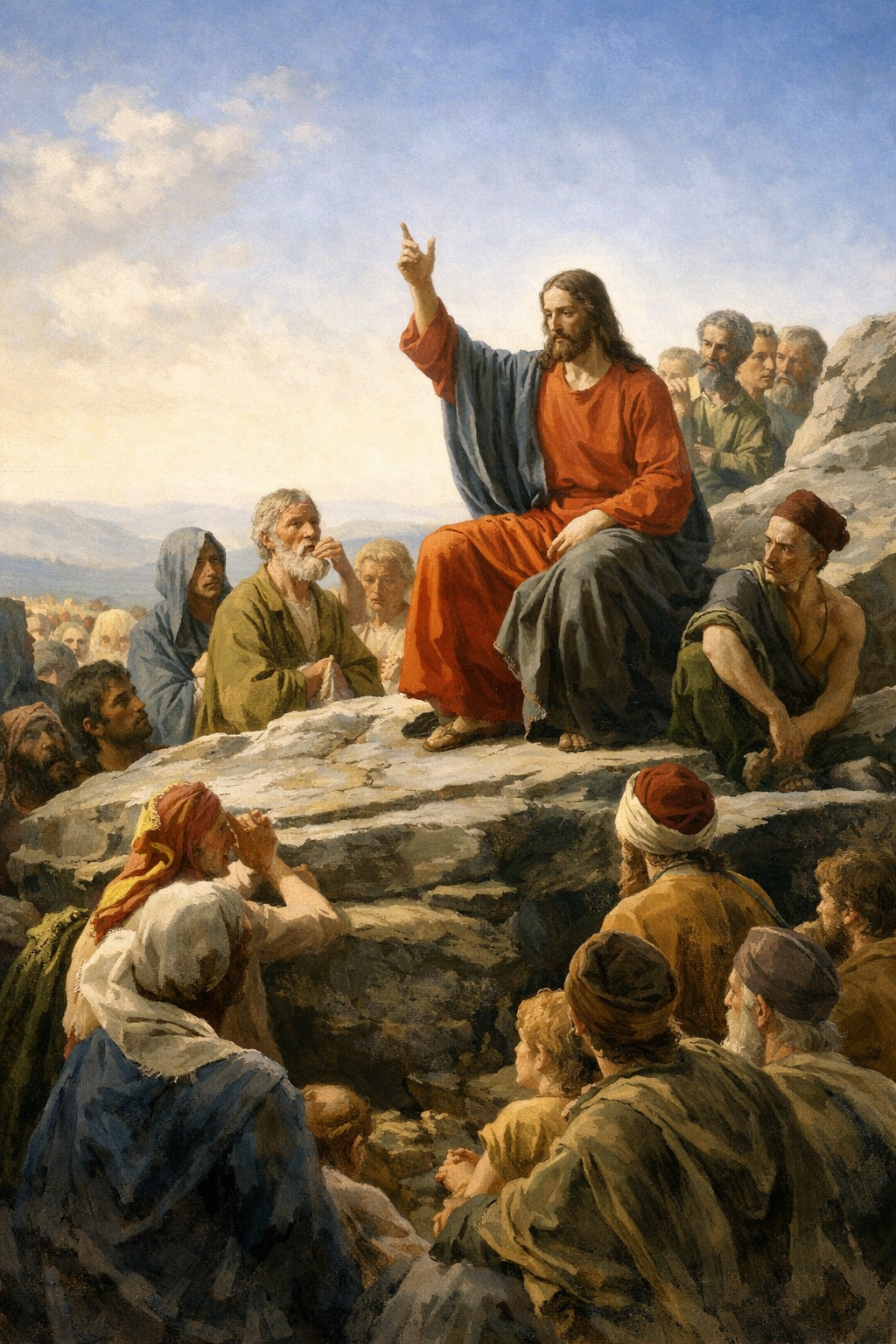
Sermon on the Mount
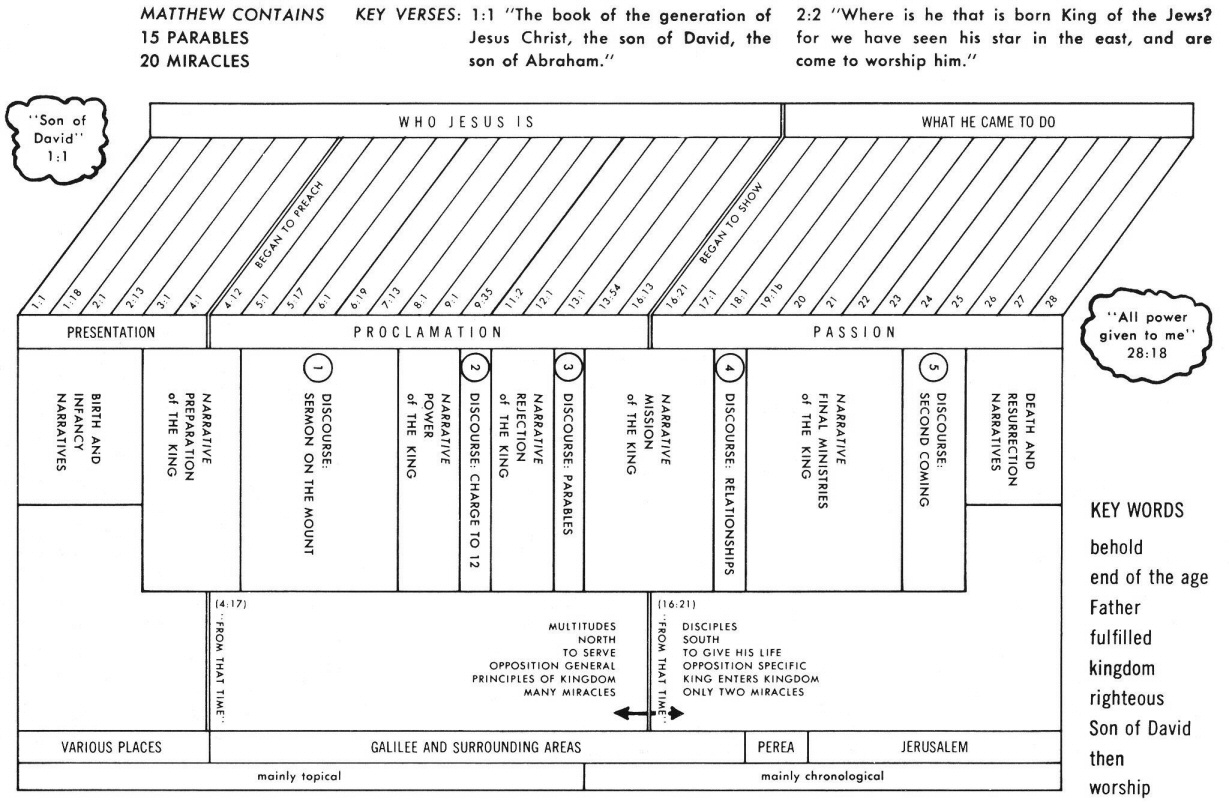
Click chart to enlarge
Charts from Jensen's Survey of the NT - used by permission
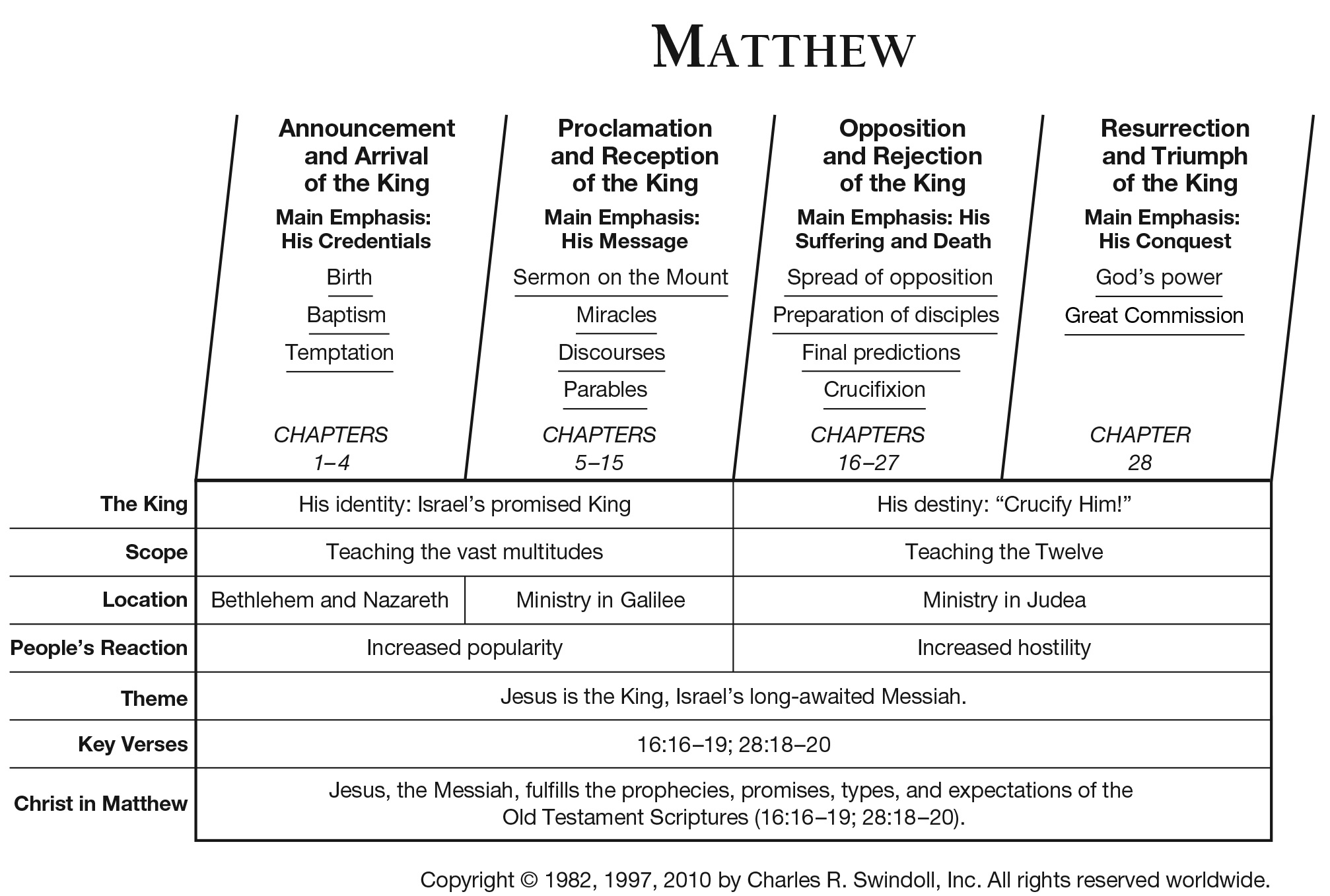
Another Chart from Charles Swindoll
THE LIFE OF JESUS AS COVERED
BY MATTHEW (shaded area)
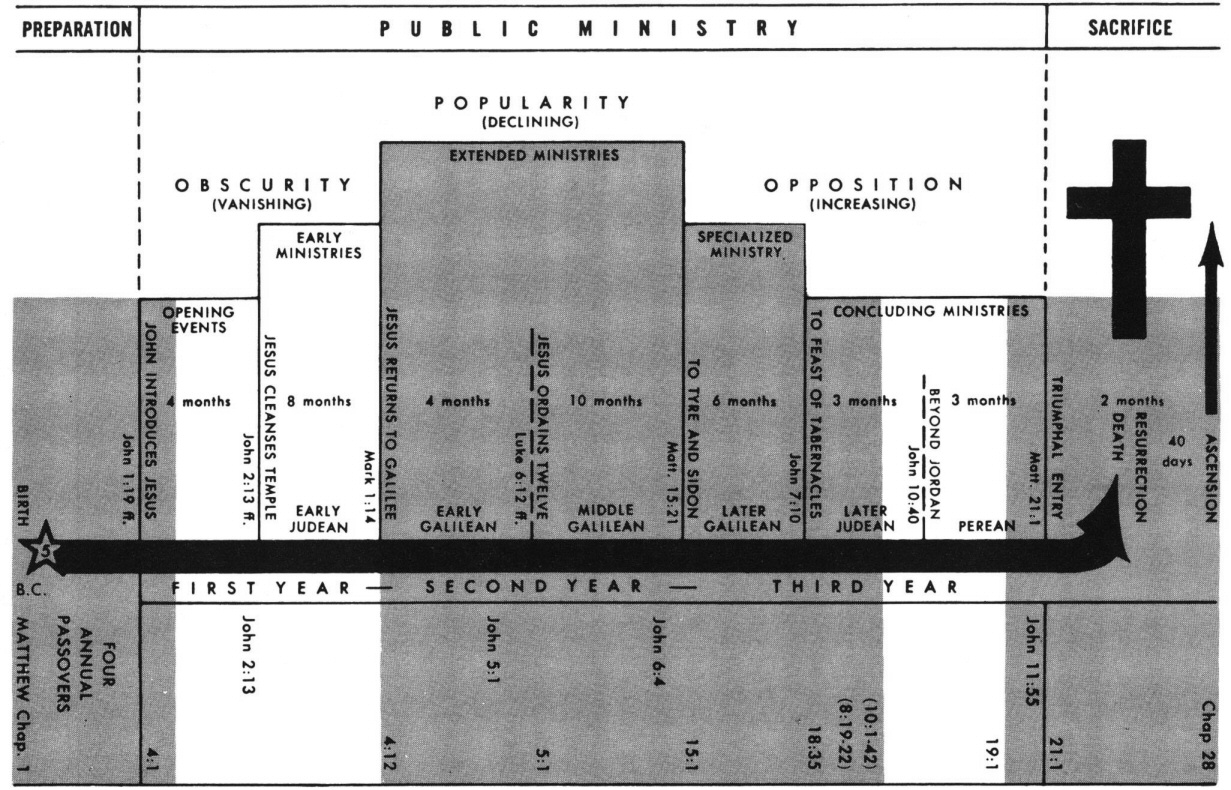
Click chart to enlarge
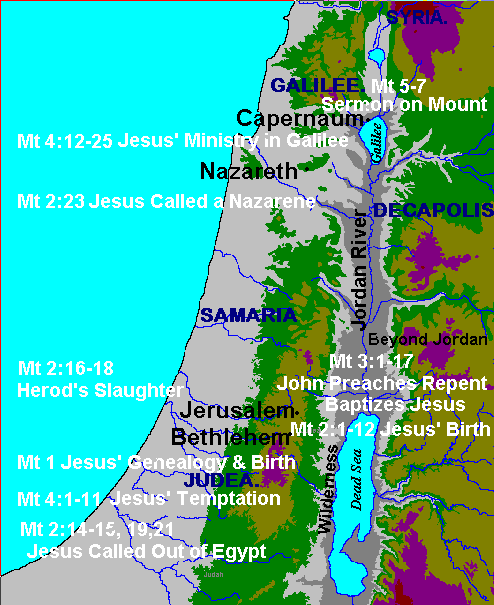
Jesus Birth and Early Years
Leading up to the Sermon on the Mount
Matthew 1-7

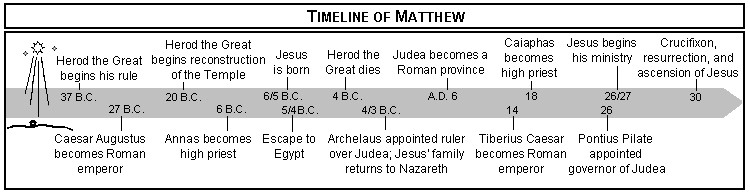
Source: Ryrie Study Bible
Matthew 5:1 When Jesus saw the crowds, He went up on the mountain; and after He sat down, His disciples came to Him (NASB: Lockman)
Greek: Idon (AAPMSN) de tous ochlous anebe (3SAAI) eis to horos; kai kathisantos (AAPMSG) autou proselthan (3PAAI) auto hoi mathetai autou
BGT ἰδὼν δὲ τοὺς ὄχλους ἀνέβη εἰς τὸ ὄρος, καὶ καθίσαντος αὐτοῦ προσῆλθαν αὐτῷ οἱ μαθηταὶ αὐτοῦ·
Amplified: Seeing the crowds, He went up on the mountain; and when He was seated, His disciples came to Him (Amplified Bible - Lockman)
KJV: And seeing the multitudes, he went up into a mountain: and when he was set, his disciples came unto him:
NKJ And seeing the multitudes, He went up on a mountain, and when He was seated His disciples came to Him.
NET When he saw the crowds, he went up the mountain. After he sat down his disciples came to him.
CSB When He saw the crowds, He went up on the mountain, and after He sat down, His disciples came to Him.
ESV Seeing the crowds, he went up on the mountain, and when he sat down, his disciples came to him.
NIV Now when he saw the crowds, he went up on a mountainside and sat down. His disciples came to him,
NLT: One day as the crowds were gathering, Jesus went up the mountainside with his disciples and sat down to teach them. (New Living Translation - Tyndale House)
Philips: - When Jesus saw the vast crowds he went up the hillside and after he had sat down his disciples came to him. (New Testament in Modern English)
Wuest: And having seen the multitudes, He went up into the mountain. And when He had seated Himself, His pupils came to Him.
Young's Literal: And having seen the multitudes, he went up to the mount, and he having sat down, his disciples came to him,
AND WHEN HE SAW THE CROWDS: Idon (AAPMSN) de tous ochlous:
- Mt 4:25; 13:2; Mark 4:1
Source: Ryrie Study Bible
When Jesus saw the crowds
Spurgeon introduces this section he titles "The King Promulgates the Laws of His Kingdom" with these words…
This is the natural order of royal action. The King is anointed, comes among the people to show His power, and afterwards acts as a Legislator, and sets forth His statutes.
And seeing the multitudes, He went up into a mountain: and when he was set, his disciples came unto him. For retirement, fresh air, and wide space, the King seeks the hill-side. It was suitable that such elevated ethics should be taught from a mountain. A natural hill suited His truthful teaching better than a pulpit of marble would have done. Those who desired to follow Him as disciples gathered closely about the seated Rabbi, Who occupied the throne of instruction in their midst; and then in outer circles "the multitudes "stood to listen. (The Gospel of the Kingdom: A Popular Exposition of the Gospel According to Matthew)
There are a variety of opinions as to what the Sermon on the Mount represents in terms of its theological thrust but the Plymouth Brethren writer William Kelly had one of the best assessments…
The sermon on the mount treats not of salvation, but of the character and conduct of those that belong to Christ—the true yet rejected king.
I think Kelly has correctly summarized Jesus' Sermon, because it is literally impossible for the natural man to fulfill His teachings, many of which are truly supernatural (e.g., "Be perfect as your heavenly Father is perfect!" Mt 5:48+ - TRY THAT ONE FOR 5 MINUTES RELYING SOLELY ON YOUR OWN NATURAL STRENGTH!). Only one who is born by (Jn 3:3-7+) and filled with His Spirit (Eph 5:18+) has the supernatural ability not just to hear Jesus' words regarding of the moral/ethical principles of His kingdom but to act upon those words (Mt 7:24+).
Multitudes (3793) (ochlos) means crowd, a mass of people, a large gathering of people or a throng and refers to generally to a multitude or a great number. By extension, ochlos can refer to "the common people” as distinct from leaders or elites (Mt 21:11). Thayer says it is sometimes used of the rabble or common people as opposed to the rulers or the upper class. It’s one of the most characteristic words of the Gospel narratives, painting the backdrop of Jesus’ public ministry among the masses. Examples - Matthew 4:25 — “Large crowds" Mk 2:4 "Being unable to get to Him because of the crowd" Acts 14:11 "When the crowds saw what Paul had done" The The crowd which was the fickle majority who could acclaim Jesus as Messiah one day (Matt 21:9) and cry “Crucify Him!” the next (Matt 27:20). In Rev 7:9 "a great multitude which no one could count" Jesus loved the ochlos—the ordinary, overlooked crowd. He taught, healed, and fed them (Mt 14:14; 15:32). The multitude was often needy, directionless, and easily swayed, yet Jesus “felt compassion for them, because they were distressed and downcast like sheep without a shepherd” (Mt 9:36). That compassion for the crowd mirrors His heart for the world today.
Spurgeon has an interesting comment on "the multitudes" writing that Jesus…
waited until the congregation around Him had reached its largest size, and was most impressed with His miracles, and then He took the tide at its flood, as every wise man should. The sight of a vast concourse of people ought always to move us to pity, for it represents a mass of ignorance, sorrow, sin, and necessity, far too great for us to estimate. The Savior looked upon the people with an omniscient eye, which saw all their sad condition; He saw the multitudes in an emphatic sense, and His soul was stirred within him at the sight. His was not the transient tear of Xerxes when he thought on the death of his armed myriads, but it was practical sympathy with the hosts of mankind. No one cared for them, they were like sheep without a shepherd, or like shocks of wheat ready to shake, out for want of harvest-men to gather them in (cf Mt 9:36-38). Jesus therefore hastened to the rescue. He notices, no doubt, with pleasure, the eagerness of the crowd to hear, and this drew him on to speak. A writer quoted in the “Catena, Aurea” has well said, “Every man in his own trade or profession rejoices when he sees an opportunity of exercising it; the carpenter, if he sees a goodly tree, desires to have it felled, that, he may, employ his skill on it; and even so the preacher, when he sees a great congregation, his heart rejoices, and he is glad of the occasion to teach.” If men become negligent, of hearing, and our audience dwindles down to a handful, it will be, a great distress to us if we have to remember that, when the many were anxious to hear, we were not diligent to preach to them. He who will not reap when the fields are white unto the harvest, will have only himself to blame if in other seasons he is unable to fill his arms with sheaves. Opportunities should be promptly used whenever the Lord puts them in our way. It is good fishing where there are plenty of fish, and when the birds flock around the fowler it is time for him to spread his nets. (Matthew 5.1-12 The Beatitudes)
They were ready for the sickle, if there were but hands to reap. The pitiful gaze of Christ saw in that weary crowd not only sheep needing a shepherd, but fields whitening to the harvest.
Here we find another example of not the best chapter break for "the multitudes" described here are referred to in the immediately preceding sentence as "great multitudes" (Mt 4:25+). There is no break with the description that begins most logically in Mt 4:23-25 and thus forms a prologue or introduction to Jesus' teaching.
The Sermon on the Mount reveals the true standard of righteousness which Christ requires of all who belong to Him (Matthew 5:1). The limitation of the Sermon on the Mount lies in the fact that our Lord reveals His standards for the Kingdom life, without the full revelation of the power by which this standard can be maintained. This fuller revelation would come later. It is similar to the John 7:37-39 passage, where Christ gives His promise of power and fruitfulness before the Holy Spirit has come, through Whom this power is given. The Sermon on the Mount is similar to a plumbline which shows the crookedness of a wall, but does not rebuild it.
D Martyn Lloyd-Jones introduces his monumental work noting…
There are certain general lessons, I suggest, to be drawn from the Beatitudes.
First, all Christians are to be like this. Read the Beatitudes, and there you have a description of what every Christian is meant to be. It is not merely the description of some exceptional Christians. Our Lord does not say here that He is going to paint a picture of what certain outstanding characters are going to be and can be in this world. It is His description of every single Christian… We are all meant to exemplify everything that is contained here in these Beatitudes. Therefore let us once and for ever get rid of that false notion. This is not merely a description of the Hudson Taylors or the George MacDonalds or the Whitefields or Wesleys of this world; it is a description of every Christian. We are all of us meant to conform to its pattern and to rise to its standard.
The second principle I would put in this form; all Christians are meant to manifest all of these characteristics. Not only are they meant for all Christians, but of necessity, therefore, all Christians are meant to manifest all of them. In other words it is not that some are to manifest one characteristic and others to manifest another. It is not right to say some are meant to be 'poor in spirit, and some are meant to 'mourn, and some are meant to be 'meek, and some are meant to be 'peacemakers, and so on. No; every Christian is meant to be all of them, and to manifest all of them, at the same time. Now I think it is true and right to say that in some Christians some will be more manifest than others; but that is not because it is meant to be so. It is just due to the imperfections that still remain in us. When Christians are finally perfect, they will all manifest all these characteristics fully; but here in this world, and in time, there is a variation to be seen. I am not justifying it; I am simply recognizing it… It is impossible truly to manifest one of these graces, and to conform to the blessing that is pronounced upon it, without at the same time inevitably showing the others also. The Beatitudes are a complete whole and you cannot divide them; so that, whereas one of them may be more manifest perhaps in one person than in another, all of them are there. The relative proportions may vary, but they are all present, and they are all meant to be present at the same time.
But the third is perhaps even more important. None of these descriptions refers to what we may call a natural tendency. Each one of them is wholly a disposition which is produced by grace alone and the operation of the Holy Spirit upon us. I cannot emphasize this too strongly. No man naturally conforms to the descriptions here given in the Beatitudes, and we must be very careful to draw a sharp distinction between the spiritual qualities that are here described and material ones which appear to be like them. Let me put it like this. There are some people who appear to be naturally `poor in spirit'; that is not what is described here by our Lord. There are people who appear to be naturally `meek'; when we deal with that statement I hope to be able to show you that the meekness which Christ talks about is not that which appears to be natural meekness in an ordinary unregenerate person. These are not natural qualities; nobody by birth and by nature is like this… There are some people who appear to be naturally `poor in spirit'; that is not what is described here by our Lord. There are people who appear to be naturally `meek'; when we deal with that statement I hope to be able to show you that the meekness which Christ talks about is not that which appears to be natural meekness in an ordinary unregenerate person. These are not natural qualities; nobody by birth and by nature is like this… The truth is that the Christian and the non-Christian belong to two entirely different realms. You will notice the first Beatitude and the last Beatitude promise the same reward, 'for theirs is the kingdom of heaven.' What does this mean? Our Lord starts and ends with it because it is His way of saying that the first thing you have to realize about yourself is that you belong to a different kingdom. You are not only different in essence; you are living in two absolutely different worlds. (SEE Studies in the Sermon on the Mount - Page 25) (Bolding added)
A T Robertson states regarding the Sermon on the Mount that "Jesus repeated His sayings many times as all great teachers and preachers do, but this sermon has unity, progress, and consummation. It does not contain all that Jesus taught by any means, but it stands out as the greatest single sermon of all time, in its penetration, pungency, and power. (Word Pictures in the New Testament)
Alexander Maclaren - The Beatitudes, as a whole, are a set of paradoxes to the ‘mind of the flesh.’ They were meant to tear away the foolish illusions of the multitude as to the nature of the kingdom; and they must have disgusted and turned back many would-be sharers in it. They are like a dash of cold water on the fiery, impure enthusiasms which were eager for a kingdom of gross delights and vulgar conquest. And, no doubt, Jesus intended them to act like Gideon’s test, and to sift out those whose appetite for carnal good was uppermost. But they were tests simply because they embodied everlasting truths as to the characters of His subjects. Our narrow space allows of only the most superficial treatment of these deep words. (entire sermon)
A. W. Tozer describes the beatitudes as the opposite of those attitudes that the world most values writing that "“A fairly accurate description of the human race might be furnished one unacquainted with it by taking the Beatitudes, turning them wrong side out, and saying, ‘Here is your human race.’ ”
Warren Wiersbe - The first sixteen verses of Matthew 5 describe the true Christian and deal with character. The rest of the Sermon on the Mount deals with conduct that grows out of character. Character always comes before conduct, because what we are determines what we do. In Matt. 5:1-16, Jesus shows us that true righteousness is inward, and in 5:17-48, He points out that sin is also inward. Thus, He exposed the false righteousness of the Pharisees, who taught that holiness consisted in religious actions, and that sin was what you did outwardly. How many people make these mistakes today! God looks upon the heart, for there is life’s destiny decided. There is definite progression in these verses. They show how the person begins with his or her own sense of sin and finally becomes a child of God and the results that then follow. Note that these verses deal with attitudes—what we think in our hearts, our outlook on life. “Beatitudes”—the attitudes that ought to be in our lives if we are true Christians. (BORROW Wiersbe's Expository Outlines on the New Testament page 26)
Dwight Pentecost - Many who had seen the miracles that the Lord Jesus performed were persuaded He was actually the King God had promised, who would institute a reign over the nation Israel. They pressed upon Him with one question uppermost, “Are we righteous enough to enter His Kingdom?” They knew well that the Old Testament demanded righteousness as the basis of acceptance with God; and they knew well the declaration of the psalmist that only those with clean hands and a pure heart could stand in the King’s presence. And they came to inquire of Him concerning the righteousness He required for entrance into His Kingdom. Our Lord shocked the multitude, who were devotees of the Pharisees and who zealously pursued Pharisaic righteousness, when He said, “Except your righteousness shall exceed the righteousness of the scribes and Pharisees, ye shall in no case enter into the kingdom of heaven” (5:20). If Pharisaic righteousness, which required a rigid observance of 365 prohibitions and 250 commandments, was not sufficient to bring men into Messiah’s Kingdom, what kind of righteousness was necessary? The Sermon on the Mount was our Lord’s exposition of the holiness of God, and the demands that a holy God made. It describes the kind of righteousness that God expects of those who have come to know Him by faith. In that well-known, well-loved, and oft-quoted—but little understood—part of the Sermon we call the Beatitudes, our Lord described the characteristics of a righteous man and laid the foundation of a happy life. He showed what will characterize one who has been made righteous by faith in God’s promise. He also gave us the basis upon which God’s blessing comes upon those who have received Him as a personal Saviour. We could well call the Beatitudes, “The Basis of a Happy Life.” (BORROW Pentecost, J. D. Design for living: Lessons in Holiness from the Sermon on the Mount PAGE 18)
Daniel Webster instructed that the following inscription be placed on his tomb "My heart has always assured and re-assured me, that the gospel of Jesus Christ must be a divine reality. The Sermon on the Mount cannot be a merely human production."
Dave Guzik gives an excellent introduction to the Sermon on the Mount...
1. The Sermon on the Mount (Matthew 5-7) has been long hailed as the sum of Jesus' - or anyone's - ethical teaching. In the Sermon on the Mount, Jesus tells us how to live.
a. It has been said if you took all the good advice for how to live ever uttered by any philosopher or psychiatrist or counselor, took out the foolishness and boiled it all down to the real essentials, you would be left with a poor imitation of this great message by Jesus.
2. The Sermon on the Mount is sometimes thought of as Jesus' "Declaration of the Kingdom."
a. The American Revolutionaries had their Declaration of Independence. Karl Marx had his Communist Manifesto. With this message, Jesus declares what His Kingdom is all about.
b. It presents a radically different agenda than what the nation of Israel expected from the Messiah. It does not present the political or material blessings of the Messiah's reign. Instead, it expresses the spiritual implications of Jesus' rule in our lives. This great message tells us how will we live when Jesus is our Lord.
3. The Sermon on the Mount does not deal with salvation as such, but it lays out for the disciple and the potential disciple how regarding Jesus as King translates into ethics and daily living.
a. It can't be proved, but in my opinion, the Sermon on the Mount was Jesus' "standard" sermon. It was the core of His itinerant message: a simple proclamation of how God expects us to live, contrasting with common Jewish misunderstandings of that life. It may be that when Jesus preached to a new audience, He often preached this sermon or used the themes from it.
b. It is clear that the Sermon on the Mount had a significant impact on the early church. The early Christians make constant reference to it and their lives display the glory of radical disciples.
4. (Mt 5:1-2) Introduction to the Sermon on the Mount.
And seeing the multitudes, He went up on a mountain, and when He was seated His disciples came to Him. Then He
and taught them, saying:
a. When He was seated: Jesus began teaching in the customary posture of a rabbi. In that day, the teacher sat while the listeners stood. His sitting signified that He was taking the position of authoritative instruction, as any recognized rabbi would when delivering formal teaching.
b. His disciples came to Him … He … taught them: Jesus primarily addressed His disciples. The Sermon on the Mount was directed to those who had already chosen to follow Him, though others were present and invited to listen. By the end of the sermon, the larger crowd had also heard His teaching and was amazed at His authority (Matthew 7:28).
The Beatitudes: the character of kingdom citizens.
The first portion of the Sermon on the Mount is known as the Beatitudes, which means "The Blessings" but can also be understood as giving the believer his "be - attitudes" - the attitudes he should "be."
a. In the Beatitudes, Jesus sets forth both the nature and the aspirations of citizens of His kingdom. They have and are learning these character traits.
b. All of these character traits are marks and goals of all Christians. It is not as if we can major in one to the exclusion of others, as is the case with spiritual gifts. There is no escape from our responsibility to covet every one of these spiritual attributes.
c. If you meet one who claims to be a Christian but displays and desires none of these traits, you may rightly wonder about their salvation, because they do not have the character of kingdom citizens. But if they claim to have mastered these attributes, you may question their honesty. (Matthew 5)
HE WENT UP ON THE MOUNTAIN: anebe (3SAAI) eis to horos:
- Mt 15:29; Mark 3:13,20; John 6:2,3
Related Passages:
Matthew 15:29 Departing from there, Jesus went along by the Sea of Galilee, and having gone up on the mountain, He was sitting there.
Mark 3:13 And He *went up on the mountain and *summoned those whom He Himself wanted, and they came to Him.
He went up on the mountain - Echoes Moses ascending Sinai to receive God’s law (Ex 19). Jesus, the greater Moses, now gives the law of the Kingdom. Jesus’ ascent was not for seclusion but elevation. He sought not distance from the crowd but a vantage point to teach them divine truth. He went up to bring heaven down. Throughout Scripture, ascending a mountain is a prelude to divine revelation (Ex 19:1-25; 1 Ki 18:42; Mt 17:1). The “mountain” is traditionally identified with the hills above Capernaum on the northwest shore of the Sea of Galilee.
Christ ascended the mount
to lift men’s hearts to heaven.
Went up (305) (anabaino from aná = up + baíno = to go, come) means to go up, climb, ascend from a lower to a higher place. This is the same verb used for: Jesus’ ascent to Jerusalem (Mt 20:17) His going up to pray (Mt 14:23) His going up for the Feast (Jn 7:8) His ascension to heaven (Jn 20:17; Acts 1:9) Thus, anabainō often signals a transition to a higher sphere — physical or spiritual.
He went up so that
His words might come down.
Some commentaries make what I think is an absurd suggestion that Jesus "went up" to avoid the crowds. Far more likely Jesus "went up" so that He might have a proper "podium" upon which to address the great multitudes and thus all could hear and see Him. It gave Jesus a natural amphitheater, where His voice would carry and all could see the Teacher as He sat. Jesus’ movement up the mountain was not withdrawal from the crowds but strategic elevation for teaching. Rabbis often taught from elevated places, both to be seen and heard more easily.
Spurgeon commenting on "the mountain" says…
Of course, this would be mainly because of the accommodation which the open hill-side would afford to the people, and the readiness with which, upon some jutting crag, the preacher might sit down, and be both heard and seen; but we believe the chosen place of meeting had also its instruction. Exalted doctrine might well be symbolised by an ascent to the mount; at any rate, let every minister feel that he should ascend in spirit when he is about to descant upon the lofty themes of the gospel. A doctrine which could not be hid, and which would produce a Church comparable to a city set on a hill, fitly began to be proclaimed from a conspicuous place. A crypt or cavern would have been out of all character for a message which is to be published upon the housetops, and preached to every creature under heaven.
Besides, mountains have always been associated with distinct eras in the history of the people of God; Mount Sinai is sacred to the law… Calvary was also in due time to be connected with redemption, and the Mount of Olives with the ascension of our risen Lord. It was meet, therefore, that the opening of the Redeemer’s ministry should he connected with a mount such as “the hill of the Beatitudes.”… Thank God, it was not a mount around which bounds had to be placed; it was not the mount which burned with fire, from which Israel retired in fear. It was, doubtless, a mount all carpeted with grass, and dainty with fair flowers, upon whose side the olive and fig flourished in abundance, save where the rocks pushed upward through the sod, and eagerly invited their Lord to honor them by making them his pulpit and throne.
May I not add that Jesus was in deep sympathy with nature, and therefore delighted in an audience chamber whose floor was grass, and whose roof was the blue sky? The open space was in keeping with his large heart, the breezes were akin to his free spirit, and the world around was full of symbols and parables, in accord with the truths he taught. Better than long-drawn aisle, or tier on tier of crowded gallery, was that grassed hill-side meeting-place. Would God we oftener heard sermons amid soul-inspiring scenery! Surely preacher and hearer would be equally benefited by the change, from the house made with hands to the God-made temple of nature. (Matthew 5.1-12 The Beatitudes)
AND AFTER HE SAT DOWN: kai kathisantos (AAPMSG) autou:
He sat down reflects the customary rabbinic posture for authoritative teaching. In Jewish tradition, a teacher sat and disciples stood (cf. Lk 4:20+).
Barclay on sat down… teach - Jesus began to teach when he had sat down. When a Jewish Rabbi was teaching officially he sat to teach. We still speak of a professor's chair; the Pope still speaks ex cathedra, from his seat. Often a Rabbi gave instruction when he was standing or strolling about; that his really official teaching was done when he had taken his seat. So, then, the very intimation that Jesus sat down to teach his disciples is the indication that this teaching is central and official. (William Barclay's Daily Study Bible - Matthew 5)
Sat down (2523) (kathizo from katá = down + hizo = sit) means to seat down, to tarry (not something most of us want to do), or to settle.
It is interesting to compare this (Mt 5:1) first use of kathizo with the last use of kathizo in Scripture as recorded by John in the Revelation…
And I saw thrones, and they sat upon them, and judgment was given to them. And I saw the souls of those who had been beheaded because of the testimony of Jesus and because of the word of God, and those who had not worshiped the beast or his image, and had not received the mark upon their forehead and upon their hand; and they came to life and reigned with Christ for a thousand years (The Millennium). (Revelation 20:4)
I agree with John MacArthur's assessment of who "they" are that "sat" on the thrones…"Tribulation believers, along with the redeemed from both the OT and NT eras, will reign with Christ (1Cor. 6:2; 2Tim. 2:12) during the 1,000 year kingdom." (BORROW MacArthur Study Bible PAGE 2020)
Sitting was the common mode of teaching among the Jews (Luke 5:3; John 8:2; Acts 13:14; 16:13)
Spurgeon has an interesting comment on "after He sat down" writing that…
The Preacher sat, and the people stood. We might make a helpful change if we were sometimes to adopt a similar plan now. I am afraid that ease of posture may contribute to the creation of slumber of heart in the hearers. There Christ sat, and “his disciples came unto him.” They formed the inner circle that was ever nearest to him, and to them he imparted his choicest secrets, but he also spoke to the multitude, and therefore it is said that “he opened his mouth,” as well he might when there were such great truths to proceed from it, and so vast a crowd to hear them
(Spurgeon adds in a sermon) We incline to the belief that, when he became a pleader with the sons of men, he stood with uplifted hands, eloquent from head to foot, entreating, beseeching, and exhorting, with every member of his body, as well as every faculty of his mind; but now that he was, as it were, a Judge awarding the blessings of the kingdom, or a King on his throne separating his true subjects from aliens and foreigners, he sat down. As an authoritative Teacher, he officially occupied the chair of doctrine, and spake ex cathedral, as men say, as a Solomon acting as the master of assemblies or a Daniel come to judgment. He sat as a refiner, and his word was as a fire. His posture is not accounted for by the fact that it was the Oriental custom for the teacher to sit and the pupil to stand, for our Lord was something more that a didactic teacher, he was a Preacher, a Prophet, a Pleader, and consequently he adopted other attitudes when fulfilling those offices, but on this occasion, he sat in his place as Rabbi of the Church, the authoritative Legislator of the kingdom of heaven, the Monarch in the midst of his people. Come hither, then, and listen to the King in Jeshurun, the Divine Lawgiver, delivering not the ten commands, but the seven, or, if you will, the nine Beatitudes of his blessed kingdom. (Matthew 5.1-12 The Beatitudes)
The Bible Knowledge Commentary writes that…Jesus instructed them in view of His announcement of the coming kingdom (Mt 4:17). Natural questions on the heart of every Jew would have been, “Am I eligible to enter Messiah’s kingdom? Am I righteous enough to qualify for entrance?” The only standard of righteousness the people knew was that laid down by the current religious leaders, the scribes and Pharisees. Would one who followed that standard be acceptable in Messiah’s kingdom? (cf Mt 5:20) Jesus’ sermon therefore must be understood in the context of His offer of the kingdom to Israel and the need for repentance to enter that kingdom. The sermon did not give a “Constitution” for the kingdom nor did it present the way of salvation. The sermon showed how a person who is in right relationship with God should conduct his life. While the passage must be understood in the light of the offer of the messianic kingdom, the sermon applies to Jesus’ followers today for it demonstrates the standard of righteousness God demands of His people…The qualities Jesus mentioned in this list, “the poor in spirit,” “those who mourn,” “the meek,” etc., obviously could not be products of Pharisaic righteousness. The Pharisees were concerned primarily with external qualities, but the qualities Jesus mentioned are internal. These come only when one is properly related to God through faith, when one places his complete trust in God. (SEE Bible Knowledge Commentary - Page 28)(Bolding added)
HIS DISCIPLES CAME TO HIM: autou proselthan (3PAAI) auto hoi mathetai autou:
- Mt 4:18, 19, 20, 21, 22; 10:2, 3, 4; Luke 6:13, 14, 15, 16
"WANNA BE'S"
WILL WALK AWAY
His disciples (mathetes) - The Sermon is primarily directed to disciples (learners), though the crowds overheard (Mt 7:28). At this time in His ministry, this designation "His disciples" probably includes individuals other than the 12 disciples, men and women who were following Him. This all changed when He gave His famous bread sermon and said His disciples must drink His blood, etc, teachings that many found too difficult to receive and accept. John writes
"“But there are some of you who do not believe.” For Jesus knew from the beginning who they were who did not believe, and who it was that would betray Him. 65 And He was saying, “For this reason I have said to you, that no one can come to Me unless it has been granted him from the Father.” 66 As a result of this many of His disciples withdrew and were not walking with Him anymore." (Jn 6:64-66+)
May the simple words of the hymnist Phillip Bliss be the continual cry of our heart and our soul and our mind, all for His glory. Amen…
At the feet of Jesus
Is the place for me,
There, a humble learner,
Would I choose to be.
—P. P. Bliss.
Disciples (3101) (mathetes from manthano = to learn which Vine says is "from a root math, indicating thought accompanied by endeavor". Gives us our English = "mathematics" - see matheteuo) describes a person who learns from another by instruction, whether formal or informal. Another sources says mathetes is from math- which speaks of "mental effort that thinks something through" and thus describes is a learner; a follower who learns the doctrines and the lifestyle of the one they follow. Discipleship includes the idea of one who intentionally learns by inquiry and observation (cf inductive Bible study) and thus mathetes is more than a mere pupil. A mathetes describes an adherent of a teacher. As discussed below mathetes itself has no spiritual connotation, and it is used of superficial followers of Jesus as well as of genuine believers. The Lord calls everyone to grow as a disciple (a learner of Christ; cf. also Mt 11:29,30+), one who lives in faith, who lives in and by His Word in the power of the Holy Spirit.
Note in the Great Commission that the implication is that the disciple is not just a hearer and a learner from another, but is a doer of what he learns for Mt 28:20+ says "teaching them to observe all that I commanded you; and lo, I am with you always, even to the end of the age.”
NIDNTT - (EXCERPT FROM 8 PAGE DISCUSSION OF MATHETES) - A man is called a mathētēs when he binds himself to someone else in order to acquire his practical and theoretical knowledge. He may be an apprentice in a trade, a student of medicine, or a member of a philosophical school. One can only be a mathētēs in the company of a didaskalos, a master or teacher, to whom the mathētēs since the days of the Sophists generally had to pay a fee. An obvious exception to this is when mathētēs refers to spiritual dependence on a thinker long since dead. Socrates never wanted to have any mathētēs and never regarded himself as a didaskalos… It is used to indicate total attachment to someone in discipleship (Ed: But see distinction below between a true disciple and a pseudo-disciple of Jesus). The secular Gk. usage of the word in the sense of apprentice, pupil or student is not found… Mathētēs in Jn. is often simply a term for “Christian” (Jn. 8:31+; Jn 13:35+; Jn 15:8+)… mathētēs has the general sense of “Christian”, one who believes in Jesus. (See online 8 page article on Mathetes in the New International Dictionary Of New Testament Theology, volume 1, page 490)
Ralph Earle - As followers of Jesus we are to be, first of all, learners. We are to learn from Him by listening to Him, learn the truth that will set us free (John 8:32+) and keep us from error. But we are also to learn from Him by looking at Him‑ learn how to live a life of beauty and blessing. (BORROW Word Meanings in the New Testament)
William Barclay writes that "All his life a Christian should be learning more and more about Jesus. The shut mind is the end of discipleship!" (Matthew 5 Commentary - Daily Study Bible - online)
Bill Mounce - Typically in the Jewish world, a disciple would voluntarily join a school or otherwise seek out a master rabbi; however, Jesus seeks out and chooses those whom he wants as his disciples (Mk 1:17; 2:14; Lk 5:1–11; cf. Mt 4:18–21). A dedicated disciple was generally expected someday to become a rabbi himself, yet Jesus teaches his disciples that he will always be their rabbi and they will have a lifetime of discipleship (Mt 23:8; cf. Mt 10:24–25, 37; Lk 14:26–27; Jn 11:16). Jesus’ disciples are bound to him and to God’s will (Mt 12:46–50; cf. Mk 3:31–45). They are called to a lifetime of work and service (Mt 16:15–19; Mk 1:17; Lk 5:10), (See Mounce's Complete Expository Dictionary of Old and New Testament words)
Charles Swindoll - A mathētēs is one who subjects himself or herself to a process of becoming familiarized with something by experiencing, learning, or receiving direction. This process usually implies the aid of another person, and as the term fully developed, it was inconceivable for one to be a learner without a guide or a master. The term is used to refer to the disciples of rabbis, and those of John the Baptizer, the Pharisees, and Moses (e.g., Mark 2:18; John 9:28). Although we often refer to the twelve apostles as the “twelve disciples,” it is important to recognize that this term often refers to all of Jesus’ followers (Luke 6:13, 17). (See Insights on Luke - Google Book)
TDNT - abridged online - mathetes is regularly used in Acts for a Christian as such… As regards the material aspect of the use of mathetes for Christians in Acts, the primary point to notice is that the relevant sections of Acts use it in the sense of those who have come to believe in Christ. In this respect the usage is analogous to that of John’s Gospel.
Robert Coleman - When it is all boiled down, those of us who seek to train men must be prepared to have them follow even as we follow Christ (1 Cor. 11:1+). (ED: SEE DISCUSSION OF Walking Like Jesus Walked!) We are the exhibit (Phil. 3:17+; 1 Th 2:7,8+, 2 Ti. 1:13+). They will do those things which they hear and see in us (Phil 4:9+). Given time, it is possible through this kind of leadership to impart our way of living to those who are constantly with us (See Robert Coleman's online work The Master Plan of Evangelism.) Related resource - BORROW The Master Plan of Evangelism by Robert E. Coleman (read some of the reviews!)
Related Resources:
- What is the difference between a disciple and apostle?
- What is Christian discipleship?
- Should a Christian be involved in mentoring? What does the Bible say about mentorship?
- American Tract Society Disciple
- Bridgeway Bible Dictionary Disciple
- Charles Buck Dictionary Disciple
- CARM Theological Dictionary Disciple
- Easton's Bible Dictionary Disciple
- Holman Bible Dictionary Disciples
- Hastings' Dictionary of the Bible Disciples
- Hastings' Dictionary of the NT Disciple Disciple (2)
- Smith Bible Dictionary Disciple
- Vines' Expository Dictionary Disciple
- Webster Dictionary Disciple Discipled Discipling
- Watson's Theological Dictionary Disciple
- 1911 Encyclopedia Britannica Disciple
- International Standard Bible Encyclopedia Disciple Seventy Disciples
- Kitto Biblical Cyclopedia Disciple
- McClintock and Strong's Bible Encyclopedia Disciple Seventy Disciples of Our Lord
QUESTION - What is the difference between a Christian and a disciple?
ANSWER - The terms disciple and Christian are related but not synonymous.
The Greek term for “disciple” in the New Testament is mathetes, which basically means “student” or “learner.” But a disciple is also a “follower,” someone who adheres completely to the teachings of another, making them his rule of life and conduct. The Pharisees prided themselves in being disciples of Moses (John 9:28). Jesus’ followers were called “disciples” long before they were ever called “Christians.” Their discipleship began with Jesus’ call and required them to exercise their will to follow Him (Matthew 9:9).
Jesus was quite explicit about the cost of following Him.
Discipleship requires a totally committed life: “Any of you who does not give up everything he has cannot be my disciple” (Luke 14:33).
Sacrifice is expected: “Jesus said to his disciples, ‘If anyone would come after me, he must deny himself and take up his cross and follow me’” (Matthew 16:24).
Not all of Jesus’ followers were able to make such a commitment. There were many who left Jesus after a while. “From this time many of his disciples turned back and no longer followed him” (John 6:66).
Jesus used the term disciple but never Christian. The first instance of the word Christian is found in the book of Acts: “The disciples were first called Christians in Antioch” (Acts 11:26). Most Bible scholars agree that it is unlikely that the believers themselves thought up the name “Christians.” The early church had other names for themselves, such as “disciples” (Acts 13:52; 20:1; 21:4) and “saints” (Romans 1:7; 1 Corinthians 16:1; Ephesians 1:1) and “brothers” (1 Corinthians 1:9; 1 Peter 3:8).
The name “Christian,” meaning “belonging to Christ,” appears to have been invented by those outside of the church. It was most likely meant as a derogatory term. Only two other times does the word appear in the New Testament (Acts 26:28; 1 Peter 4:16). The idea that the term Christian was originally a pejorative finds some support in 1 Peter 4:16: “However, if you suffer as a Christian, do not be ashamed, but praise God that you bear that name.”
Biblically speaking,
a Christian is a disciple of Christ.
Biblically speaking, a Christian is a disciple of Christ. A Christian is someone who has placed his faith in the Lord Jesus Christ (John 1:12). A Christian has been born again by the power of the Holy Spirit (John 3:3). A Christian “belongs to Christ” and is daily being transformed into the likeness of Christ (2 Corinthians 3:18).
A true Christian (and not one in name only)
will have to be a disciple of Christ as well.
A true Christian (and not one in name only) will have to be a disciple of Christ as well. That is, he has counted the cost and has totally committed his life to following Jesus. He accepts the call to sacrifice and follows wherever the Lord leads. The Christian disciple completely adheres to the teaching of Jesus, makes Christ his number-one priority, and lives accordingly. He is actively involved in making other Christian disciples (Matthew 28:19–20).
A true Christian disciple is a believer in Christ and possesses new life through the indwelling Holy Spirit. Because he loves Christ, a Christian will also be an obedient disciple (John 14:15). Paul describes the reality of being a Christian disciple: “I have been crucified with Christ and I no longer live, but Christ lives in me. The life I live in the body, I live by faith in the Son of God, who loved me and gave himself for me” (Galatians 2:20).
QUESTION - Why is making disciples important?
ANSWER - The making of disciples is our Lord’s means for answering the prayer, “Our Father in heaven, hallowed be Your name, Your kingdom come, Your will be done on earth as it is in heaven” (Matthew 6:9-10). In His infinite wisdom, Jesus chose to use dedicated followers, His disciples, to carry the message of salvation to all peoples of the world. He included this as a command in His last words before His ascension to heaven: “All authority in heaven and on earth has been given to Me. Therefore go and make disciples of all nations, baptizing them in the name of the Father and of the Son and of the Holy Spirit, and teaching them to obey everything I have commanded you. And surely I am with you always, to the very end of the age” (Matthew 28:18-20).
Making disciples is important because it is the Lord’s chosen method of spreading the Good News of salvation through Jesus Christ. During His public ministry, Jesus spent more than three years making disciples—teaching and training His chosen twelve. He gave them many convincing proofs that He was the Son of God, the promised Messiah; they believed on Him, though imperfectly. He spoke to the crowds, but often He drew the disciples aside privately to teach them the meaning of His parables and miracles. He sent them out on ministry assignments. He also taught them that soon He would be returning to His Father following His death and resurrection (Matthew 16:21; John 12:23-36, 14:2-4). Though they could not comprehend it, He made the disciples this astonishing promise: “I tell you the truth, anyone who has faith in Me will do what I have been doing. He will do even greater things than these, because I am going to the Father” (John 14:12). Jesus also promised to send His Spirit to be with them forever (John 14:16-17).
As promised, on the Day of Pentecost, the Holy Spirit came with power on the believers, who then were emboldened to speak the Good News to everyone. The remainder of the Book of Acts gives the exciting account of all that was accomplished through them. In one city the opposition said, “These who have turned the world upside down are come hither also” (Acts 17:6 KJV). Multitudes placed their faith in Jesus Christ, and they also became disciples. When strong persecution came from the false religious leaders, they dispersed to other areas and continued to obey Christ’s command. Churches were established throughout the Roman Empire, and eventually in other nations.
Later, because of disciples such as Martin Luther and others, Europe was opened to the Gospel of Jesus Christ through the Reformation. Eventually, Christians emigrated to the New World to make Christ known. Though the world still is not completely evangelized, the challenge is as viable now as ever before. The command of our Lord remains – “Go and make disciples, baptizing them, and teaching them to obey everything I have commanded you.” The characteristics of a disciple may be simply stated as
• one who is assured of his salvation (John 3:16) and is activated by the indwelling Holy Spirit (John 14:26-27);
• one who is growing in the grace and knowledge of our Lord and Savior (2 Peter 3:18); and
• one who shares Christ’s burden for the lost souls of men and women. Jesus said, “The harvest is plentiful but the workers are few. Ask the Lord of the harvest, therefore, to send out workers into His harvest field” (Matthew 9:37-38).
Tony Evans - The Greek philosopher Plato developed a system of thought that bears his name. Then he trained his young disciple Aristotle in this system of Platonic philosophy. Aristotle built on Plato’s teaching and developed his own system known as Aristotelian logic. Aristotle then established schools called academies to train more disciples. This Greek discipleship system was very effective, because even after Rome conquered Greece, the Romans could not eradicate Greek influence. So while Rome wielded military power, the Greeks wielded power over the culture because well-trained Greek disciples were functioning at every level of the society. These people lived under Roman rule, but their thinking was Greek. And in the end, what people think is a lot more important and powerful than what an external power can force them to do. This helps us understand why Jesus commissioned the church to make disciples. When it’s done right, the disciple becomes a follower for life because the real battle for souls is waged in the mind. A well-trained disciple can live in a foreign, hostile culture without succumbing to that culture because his mind is fixed on another world. (God's Glorious Church : The Mystery and Mission of the Body of Christ)
Bridgeway Bible Dictionary - During the lifetime of Jesus there were many who considered themselves his disciples. That is, they followed him and listened to his words, as pupils might listen to a teacher. Although these people may have thought Jesus to be the Messiah, many of them had a wrong understanding of the sort of person the Messiah would be. They expected him to be a political leader who would free the Jews from Roman domination and bring in the golden age (John 6:14-15; John 6:60-64). When they found that Jesus was not this kind of leader, they withdrew from him (John 6:66-68). Yet there were many, probably hundreds, who were true believers, true disciples (Luke 6:17; Luke 6:20). From these, Jesus chose twelve whom he appointed apostles (Luke 6:13; see APOSTLE). These twelve were Jesus' disciples in a special sense, and became known as the twelve disciples or simply the disciples (Matthew 16:13; Matthew 20:17; Matthew 24:3; Matthew 26:17). After the resurrection and ascension of Jesus, all the followers of Jesus became known as disciples (Acts 1:15; Acts 6:1; Acts 9:1), and later as Christians (Acts 11:26; 1 Peter 4:16; see CHRISTIAN). (Disciple)
Related resource:
In simple terms a disciple is a follower and so we often see Jesus say "Follow Me!" (Mt 4:19, 8:22, 9:9, 16:24, 19:21, Mk 1:17, 2:14, 8:34, 10:21 Lk 5:27, 9:23, 59, 18:22 Jn1:43, 10:27, 12:26, 13:36, 21:19, 22) And so in the Bible we see that John the Baptist (Mt 11:2; Mk 2:18; Lk 5:33; 7:18; Jn 3:25) had followers or disciples, as did the Pharisees (Mk 2:18, Mt 22:16 disciples of Pharisees were sent to test Jesus) and Moses (Jn 9:28). It follows that it becomes clear that not every use of disciple in the NT describes a genuine believer. On the other hand (although not a popular or common teaching in modern day evangelicalism) the NT makes it very clear that every genuine believer is a disciple of Jesus Christ.
In the ancient world a disciple would attach himself to another person in order to gain practical or theoretical knowledge by instruction or experience. It was a word used of apprentices learning a trade as well as students learning a teacher's philosophy. Discipleship was a popular concept among the Jews of Jesus' day. It was often the custom for the disciples to leave their natural home and move in with their teacher, who would provide their food and lodging. The disciple would become his servant and be completely under their teacher's authority. Their goal was to learn all that their teacher knew so that they might become like him in character and later be able to faithfully transmit his teachings to others.
Jesus, I my cross have taken,
All to leave and follow Thee;
Destitute, despised, forsaken,
Thou, from hence, my all shalt be:
I will follow Thee, my Saviour
Thou didst shed Thy blood for me,
And though all the world forsake Thee,
By Thy grace I’ll follow Thee.
-H. F. Lyte
Mathetes is from manthano which "carries the connotation of intentional learning by inquiry and observation." (MacArthur)
G Campbell Morgan in his helpful little book Discipleship writes that…
Disciples is the term consistently used in the four Gospels to mark the relationship existing between Christ and His followers (Ed: In fact "followers of Christ" is a synonym for disciples of Christ.). Jesus used it Himself in speaking of them, and they in speaking of each other. Neither did it pass out of use in the new days of Pentecostal power. It runs right through the Acts of the Apostles (Ed: Disciples is the most common term for the believers in Acts!). It is interesting also to remember that it was in this way that the angels thought and spoke of these men -- the use of the word (disciple) in the days of the Incarnation is linked to the use of the word in the apostolic age by the angelic message to the women, "Go, tell His Disciples and Peter" (Mark 16:7).
It is somewhat remarkable that the word is not to be found in the Epistles. This is to be accounted for by the fact that the Epistles were addressed to Christians in their corporate capacity as churches, and so spoke of them as members of such, and as the "saints" or separated ones of God. The term disciple marks an individual relationship (which is a state of being related by kindred, association by blood or marriage - believers are both His both by blood of the New Covenant and by virtue of being His Bride!), and though it has largely fallen out of use, it is of the utmost value still in marking that relationship existing between Christ and each individual soul, and suggesting our consequent position in all the varied circumstances of everyday living…
The word mathetes signifies a taught or trained one, and gives us the ideal of relationship. Jesus is the Teacher. He has all knowledge of the ultimate purposes of God for man, of the will of God concerning man, of the laws of God that mark for man the path of his progress and final crowning. Disciples are those who gather around this Teacher and are trained by Him. Seekers after truth, not merely in the abstract, but as a life force, come to Him and join the circle of those to whom He reveals these great secrets of all true life. Sitting at His feet, they learn from the unfolding of His lessons the will and ways of God for them; and obeying (Ed: Now enabled by His indwelling Spirit) each successive word, they realize within themselves, the renewing force and uplifting power thereof. The true and perpetual condition of discipleship, and its ultimate issue, were clearly declared by the Lord Himself to those Jews which believed on Him. "If ye abide in My word, then are ye truly My disciples ; and ye shall know the truth, and the truth shall make you free " (John 8:31+). (Discipleship - a worthy read)
FALSE VERSUS TRUE
DISCIPLES OF JESUS
As used in the NT, mathetes was not a guarantee that the person called a disciple was truly saved. There are two excellent examples of this caveat among those who ostensibly at first glance were classified as disciples of Jesus. The most obvious false disciple of Jesus was Judas Iscariot, a man who masqueraded for 3 years as a disciple or follower of Jesus but was never truly saved for he failed to remain with Jesus, John recording that "after receiving the morsel he went out immediately and it was night." (Jn 13:30)
John describes another, larger group of "disciples" in John 6 writing that…
Many therefore of His disciples, when they heard this (Ed: Jesus' teaching on salvation in Jn 6:51, 53-58) said, "This is a difficult (Greek = skleros = rough, stiff or figuratively something harsh, unpleasant or hard to accept) statement; who can listen to it?" (Ed: Not because it was incomprehensible but because it was unacceptable! It was dawning on these "pseudo-disciples" that following Jesus meant far more than just "hanging around" Him looking for miracles!)… 66 As a result of this many of His disciples withdrew, and were not walking with Him anymore. (Jn 6:60, 66+)
Comment: Those who were called His (Jesus') disciples in John 6:60 had simply attached themselves to Jesus, their attachment implying nothing about their sincerity or devotion (see their action in Jn 6:66!). As an aside, note the critical importance of the context in determining the actual meaning of a specific Greek word. Whenever you are performing Greek or Hebrew word studies, you must always examine the context lest you arrive at an incorrect interpretation of the meaning of the word in that specific passage.
And so we observe that in the preceding context Jesus had been teaching the crowds about genuine salvation using metaphors of bread, His blood and His body. While the interpretation of the exact meaning is somewhat difficult, what is not difficult is that many so-called "disciples" who heard Jesus rejected His teaching of salvation through His blood. They had apparently been attracted to Jesus the "miracle worker" and had the hope that He would deliver them from Roman rule (Jn 6:14-15). However, they were not sincerely devoted to Jesus. John 6:66 uses Greek language (eg, the word for "not" is the strongest negative and speaks of complete and permanent change) which makes it clear that their withdrawal was not temporary but as MacArthur says an "abandonment (that) was decisive and final (cf. 1Pe 2:6–8; 1Jn 2:19)." Or as the ESV Study Bible says "Their initial “faith” was not genuine." That's an interesting statement about "faith" because it implies that there is a type of "faith" that does not save a person, a mere intellectual belief is the idea (see study of Greek word for faith - pistis). In short these disciples in John 6:60 were not genuine believers or genuine disciples of Jesus. As F F Bruce succinctly stated (quoted by MacArthur)…
"What they wanted, He would not give;
what He offered, they would not receive!"
John MacArthur on the "disciples" who permanently withdrew from Jesus: Their reaction is typical of false disciples: as long as they perceived Jesus to be a source of healing, free food, and deliverance from enemy oppression, the self-serving disciples flocked to Him. But when He demanded that they acknowledge their spiritual bankruptcy, confess their sin, and commit themselves to Him as the only source of salvation, they became offended and left. Like countless other false disciples throughout the history of the church, they followed Jesus for what they thought they could get from Him. True disciples, on the other hand, come to Christ poor in spirit (Mt 5:3), mourning over their sin (Mt 5:4), and hungering and thirsting for the righteousness that only He can supply (Mt 5:6). Our Lord left nothing to doubt when He identified the elements of true discipleship (see Luke 9:23, 24, 25; cp Mt 10:34-39) (See John Commentary)
Vance Havner - Our Lord had no confidence in superficial disciples who did not count the cost. Crowds did not deceive Him. We measure a minister by the size of his crowd, but in the sixth chapter of John the Lord Jesus preached a crowd away! They could not bear His sermon on the bread of life and fell away until only the irreducible minimum of faithful disciples remained, and even they were puzzled. Again in Luke 14:25-33, another multitude followed Him, but He knew they did not mean business, so He turned upon them with that terrific challenge to forsake everything, and with the two illustrations of not counting the cost: the foolish builder, and the king going to war. Sifting church members through that sifter, one finds plenty of chaff today!
Vance Havner - Our Lord made discipleship hard and lost many prospective followers because he called them to a pilgrimage, not to a parade—to a fight, not to a frolic.
J C Ryle - As the soldier follows his general, as the servant follows his master, as the scholar follows his teacher, as the sheep follows its shepherd, just so ought the professing Christian to follow Christ.
If John 6:66 illustrates one aspect of false versus genuine discipleship (false disciples depart and no longer walk with Jesus), John 8:30-32 illustrates another aspect, defining the mark of genuine faith and the test of a true disciple. John records that…
As He spoke these things, many (He is speaking to a Jewish audience) came to believe in Him (Ed: If we stopped here, we would conclude that these Jews were not genuine believers in Jesus Christ. But Jesus knows the heart and does not desire for anyone to be deceived by a superficial faith that does not save). 31 Jesus therefore (Ed: Why "therefore"? Because He is assessing their "belief" - is it genuine saving faith or superficial spurious faith?) was saying to those Jews who had believed Him, "If ("If" introduces the Condition - 3rd class - of probability) you abide in My word, then (Now we see the promise) you are truly disciples of Mine 32 and you shall know the truth, and the truth shall make you free." (Jn 8:30-32)
Comment: In this passage notice that the Lord Jesus clearly associates belief with discipleship. The verb translated "abide" means to remain or stay (in a given place, state or relation) and introduces a conditional statement which can be paraphrased "If you continue… ". Abiding speaks of the general direction of one's life (not perfection because no one except Jesus abides perfectly). In other words Jesus is saying this is something that remains to be seen. He is saying in essence that if they are truly genuine believers (if they are truly "rooted" in Him so to speak), their "fruit" will demonstrate that they are "the real thing!"
What is the "fruit" in this passage? Abiding or remaining in His Word. Jesus is saying that if these "believers" remain or continue in His teaching, then (this is the fulfillment of the conditional sentence) it proves they are genuine disciples, genuine believers. The authentication of a genuine disciple of Jesus Christ is that they will not depart from the Word of God but instead continue in His Word. To continue to abide in His Word in turn means they keep on believing the Word, keep on following the Word and keep on ordering their life according to His Word. Does this sound like works based salvation? One might misread it that way. Jesus is not saying that they merit or gain their status as a genuine disciple by their self effort but that the general pattern of their life of abiding in His Word (including obeying His Word) is made possible because they are new creations (2Cor 5:17), with a new desire for holy things including especially His Holy Word (cf Php 2:13NLT+). In other words Jesus is saying that their endurance shows that they are genuine believers, "truly disciples" Jesus.
In summary, Jesus states that genuine disciples will in fact continue or remain in His Word, whereas false disciples ultimately will reject His word as happened in John 6:66 and later in this same encounter recorded in John 8:30-59. Their "rotten fruit" in Jn 8:37, 43, 47, 58 proves they had only a superficial and not a genuine, saving faith! Clearly these Jews who "believed" in Jesus were not true believers or true disciples because they did not continue in His Word. James would have said they needed to show him their faith by their works and their works were evil not good (See James 2:14-26+). These "believing" Jews in John 8:30 would be like those individuals Jesus warned about in Mt 7:21-23+.
Leon Morris - John is speaking of people who had made an outward profession, but a profession that did not go very deep. Jesus’ words, then, are meant to drive home to formal and casual adherents the meaning of true discipleship. If people in any sense believe in Jesus it is important that they come to see what real faith means… The key word here is “abide” (NIV paraphrases with “hold to my teaching”; the Greek means “abide in my word”). It is easy enough to be superficially attracted to Jesus, but the test is “abiding.” It is only those who continue who are genuine disciples. This section of discourse is addressed to those who believe, and yet do not believe. Clearly they were inclined to think that what Jesus said was true. But they were not prepared to yield Him the far-reaching allegiance that real trust in Him implies. (The Gospel According to John. The New International Commentary on the New Testament)
John MacArthur - Saving faith consists of three elements, commonly referred to by theologians with the Latin terms notitia, assensus, and fiducia. Notitia (knowledge) is the intellectual component of faith. It involves an understanding of the basic biblical facts regarding salvation. Assensus (assent) goes one step beyond notitia and confidently affirms those facts to be true. Fiducia (trust) acts on them by personally appropriating Jesus Christ as the only hope for salvation. (See John Commentary - Page 355)
John Piper (sermon) - What this phrase "truly my disciples" implies is that there are disciples who are not truly disciples. The word "truly" means "really"—"really my disciples." In other words, there are real and unreal disciples. There are authentic and inauthentic disciples. There is discipleship that is merely outward, and discipleship that goes down to the root. The world is not just divided into two groups: disciples of Jesus and non-disciples. It is divided into three groups: non-disciples, unreal disciples, and real disciples—people who make no pretense of following Jesus, people that say they follow him and have a surface connection with him, and people who truly follow him. Why did Jesus bring up this distinction? It's disturbing. It makes us squirm and ask ourselves the question which one we are. He brought it up because verse 30 says, "As he was saying these things, many believed in him." There had been a large response to what he was teaching. And whenever there is a large response to anything you may guess that some are being carried along by the crowd. If your friends are going, it's easy for you to go, even if you wouldn't go on your own. You are along for the ride. So Jesus doesn't assume that all this belief is real. What he does is give a test that we can use to see if we are real. And in giving us this test Jesus helps us be real. It is not just a test of reality. It is a pathway to reality.
What then is a true disciple? Or what does Jesus mean by saying in John 8:31+, "you are truly my disciples"? Let's be really clear here:
For Jesus "true disciple"
is the same as "true Christian"
or "true believer."
Jesus is not saying that "true disciple" is a second stage in the Christian life. First believer, and then later you attain the level of disciple. There have been ministries who talk that way.
First, you're an unbeliever, then you are a believer, then you grow into a disciple, and then you are a disciplemaker. That is not the way Jesus thought. And one piece of evidence for saying this is to notice the words he uses here in verse 31: "Jesus said to the Jews who had believed in him, 'If you abide in my word, you are truly my disciples." He did not say to these professing believers, "If you abide in my word, you will become truly my disciples." In other words, He did not teach that being a true disciple was a later stage after simple belief. No. He said, "If you abide in my word, you are truly my disciples." Now that you have believed, here is how you can know what you now are. You can know if your belief is real: You are now my true disciples if you go on abiding in My word. So there is no thought here about "true discipleship" being a second stage of Christian maturity.
True disciple means
true believer
or true Christian
or true follower.
It means, for example,
truly forgiven for your sins.
Look at Jn 8:24: "I told you that you would die in your sins, for unless you believe that I am He you will die in your sins." So he says, if you do believe in me, you won't die in your sins." (If You Abide In My Word, You Are Truly My Disciples)
C H Spurgeon - "Jews who believed Him”… reminds me of those of you who believe the Gospel and still remain worldly, impenitent, prayerless. You fear the Lord and serve other gods! You are not infidels in name, but you are atheists in life! To you there is urgent need that I speak. The Master turned round and spoke to those who were Believers and yet not Believers—holding with Jesus—and yet really opposed to Him. Oh, you that halt between two opinions, my Lord looks on you with a pitying hopefulness and He speaks especially to you at this time! May you have Divine Grace to hear and obey His Word!… He says, “if.” A great, “if,” hovered over them like a threatening cloud. Wisely does our Lord commence His word to them with, “if.” “If you continue in My Word, then are you My disciples, indeed.”
Continuance is the sure test
of the genuine Believer .
Our Lord does not say, “Go your way, you are not My disciples.” He, in effect, says, “I stand in doubt of you. The proof of your discipleship will be your persevering in your faith.” If we say that we believe in Jesus, we must prove it by abiding in believing and by still further believing! The Word of Jesus must be the object of our faith—into that Word we must enter—and in that Word we must continue. Beginning to believe is nothing unless we continue to believe! The Word of Jesus must be the object of our faith—into that Word we must enter—and in that Word we must continue. Beginning to believe is nothing unless we continue to believe!… Your home and refuge must be the Word of the Lord Jesus and in that refuge you must abide! Believe what Jesus says in His New Testament of Love. Whatever you find that He reveals by Himself or by His Apostles,
receive it without question!
Hold fast His Word
and let it hold you fast.
First, believe Him, believe Him to be true, believe Him to be sent of God for your salvation—and then put yourself into His hands. When you have committed yourself to Him, continue to do so. Do not run away from your faith because of ridicule. Mind that you so believe in Jesus as to practice what He commands—you cannot continue in His Word unless you learn to obey it.
The test of faith is obedience .
What He bids you, do it. Let your life be affected by the Truth He teaches. Let your whole mind, thought, desire, speech, bearing and conversation be colored and savored by your full faith in Jesus! Enter into His Word as a man into a stream and live there as a fish in the water! “Continue in My word.” Get into Christ’s Word as a sinking sailor would get into a lifeboat and, once there, keep inside the boat—do not throw yourself out into the stormy waves through despair—but continue in the place of hope. This is Christ’s gracious counsel to those in whom there seems to be some hopeful sign.
My Hearers, we never preach the saving power of temporary, unpractical, unsanctifying faith! If a man says, “I believe in Christ and, therefore, I shall be saved, his faith will have to be tested by his life. If, sometime after, he has no faith in Christ, that faith which he claimed to have is proven to be good for nothing! The faith of God’s elect is an abiding faith! It is precious faith and, like precious metal, it survives the fire! “Now abides faith, hope, charity, these three.” Thus true faith is classed among the abiding things—it is undying, unquenchable. If you truly believe in Jesus, it is for life! Saving faith is a life-long act. It is the relinquishment of all trust in self, once and for all, and the trusting in Jesus forever. He is and always shall be our only confidence. That is the faith which saves… next our Lord sets before these people inducements to continue in His Word… the first was certified discipleship—“Then are you My disciples, indeed.” That is to say, if they persevered in obeying His Word, they would be disciples, not in name only, but in truth. It is a small thing to be called Christians, but it is a great matter to truly be Christians. (Dear reader, if you are struggling with this vitally important passage, let me strongly encourage you to read John Piper's message [reference] and Spurgeon's sermon on John 8:30-32 Believing On Jesus, And Its Counterfeits)
Wayne Grudem - Jesus is here giving a warning that one evidence of genuine faith is continuing in His word, that is, continuing to believe what he says and living a life of obedience to his commands. (Ed comment: Note that continuing in His Word does not save a person but demonstrates that the individual is genuinely saved.)… Jesus is here giving a warning that one evidence of genuine faith is continuing in His word, that is, continuing to believe what he says and living a life of obedience to his commands. (Ed: Again "obedience" does not save but proves one is saved). Similarly, Jesus says, “He who endures to the end will be saved” (Matt. 10:22), as a means of warning people not to fall away in times of persecution (Ed: Genuine disciples are shown to be real because they do not fall away.). (Systematic Theology)
Zondervan Illustrated Bible Backgrounds Commentary - The measure of any disciple is whether or not one holds to the master’s teaching (cf. 2 John 9 - see below). The perfect follower of a Jewish rabbi was one who had “fully absorbed his master’s teaching” and “was drawing on it to spread it abroad”
Anyone who goes too far and does not abide in the teaching of Christ, does not have God; the one who abides in the teaching, he has both the Father and the Son.
Hendriksen - One abides in the word of Christ by making it the rule of one’s life. In other words, obedience is the same thing as abiding in the word. This makes one a true disciple of Jesus and leads to genuine knowledge of the truth (God’s special revelation which has its heart and center in the work of Christ).
J Oswald Sanders - What is the significance of “my word” in the passage? In a sense it is indistinguishable from Himself, for He is the living Word. The sense here, however, is that of the whole tenor and substance of His teaching. It stands for His message as a whole, not favorite passages or pet doctrines but the whole range of His teaching. (cp Lk 24:27) To continue in His Word (or “to hold to his teaching,” as the New International Version has it) was to make it their rule of life in daily practice. Our discipleship begins with the reception of the Word. Continuance in the Word is the evidence of reality. (Spiritual discipleship : Principles of Following Christ for Every Believer - borrow his book Real discipleship; a devotional exposition of the Sermon on the Mount)
J Vernon McGee - Faith alone saves, but the faith that saves is not alone. It will produce something. After a person believes on the Lord Jesus Christ, he will want to “continue in His Word.” The proof of faith is continuing with the Savior (Ed: From John 8:31+ continuing with the Savior means to continually "abide in My Word" and this is the "descriptive definition of a disciple. Are you a genuine disciple of Jesus?). As the pastor of a church, I learned to watch out for the person who is active in the church but is not interested in the study of the Word of God. Such a one is dangerous to a church.
Borchert - The believer who is committed to abide in Jesus and His word is in this Gospel to be designated as an authentic (alēthēs) disciple (cf. Jn 6:64–66; contrast Jn 5:38). (See John 1-11: An Exegetical and Theological Exposition)
It is notable that Luke uses mathetes repeatedly to describe believers in the book of Acts. In fact the most common term used for believers in Acts is mathetes or disciples, not believers or Christians. Those who teach that disciples of Jesus were a special class of believers and that not all believers are disciples need to explain the book of Acts (Acts 1:15KJV, Acts 6:1, 2, 7, 9:1, 10, 19, 25, 26, 38, 11:26, 29, 13:52, 14:20, 14:22, 28, 15:10, 16:1, 18:23, 27, 19:1, 9, 30, Acts 20:1 Acts 20:30 Acts 21:4 Acts 21:16.
And the word of God kept on spreading; and the number of the disciples continued to increase greatly in Jerusalem, and a great many of the priests were becoming obedient to the faith. (Acts 6:7)
Comment: Observe that the mark of a disciple according to this passage is one who is obedient to the faith. This is not saying their salvation was works based as if their obedience merited salvation. The phrase "obedient to the faith" simply means they were becoming believers. They accepted "the faith (see note on pistis)" (the Gospel). (cp similar description in Jn 3:36 where "believes in the Son" is paired with "obey the Son"). Note also that in this context the word "faith" is synonymous with the Gospel of Jesus Christ (compare Acts 13:8). Thus the term faith in this context "means the objective faith embodied in doctrinal teaching and not the subjective faith of the believer." (Kistemaker)
Luke in fact specifically labels the disciples as Christians…And when he had found him, he brought him to Antioch. And it came about that for an entire year they met with the church, and taught considerable numbers; and the disciples were first called Christians in Antioch. (Acts 11:26)
J Oswald Sanders writes although mathetes means a "learner"…Jesus infused into that simple word a wealth of profound meaning. As used by Him and by Paul, it means “a learner or pupil who accepts the teaching of Christ, not only in belief but also in lifestyle.” This involves acceptance of the views and practice of the Teacher. In other words, it means learning with the purpose to obey what is learned. It involves a deliberate choice, a definite denial, and a determined obedience. Today one may be regarded as a Christian even if there are few, if any, signs of progress in discipleship. It was not so in the early church. (Spiritual Discipleship: Principles of Following Christ for Every Believer)
A W Tozer…True discipleship is obeying Jesus Christ and learning of Him and following Him and doing what He tells you to do, keeping His commandments and carrying out His will. That kind of a person is a Christian—and no other kind is. (Faith Beyond Reason: With God Nothing is Impossible)
Mathetes - 261x in 245v in NAS - Matt 5:1; 8:21, 23; 9:10f, 14, 19, 37; 10:1, 24f, 42; 11:1f; 12:1f, 49; 13:10, 36; 14:12, 15, 19, 22, 26; 15:2, 12, 23, 32f, 36; 16:5, 13, 20f, 24; 17:6, 10, 13, 16, 19; 18:1; 19:10, 13, 23, 25; 20:17; 21:1, 6, 20; 22:16; 23:1; 24:1, 3; 26:1, 8, 17ff, 26, 35f, 40, 45, 56; 27:64; 28:7f, 13, 16; Mark 2:15f, 18, 23; 3:7, 9; 4:34; 5:31; 6:1, 29, 35, 41, 45; 7:2, 5, 17; 8:1, 4, 6, 10, 27, 33f; 9:14, 18, 28, 31; 10:10, 13, 23f, 46; 11:1, 14; 12:43; 13:1; 14:12ff, 16, 32; 16:7; Luke 5:30, 33; 6:1, 13, 17, 20, 40; 7:11, 18; 8:9, 22; 9:14, 16, 18, 40, 43, 54; 10:23; 11:1; 12:1, 22; 14:26f, 33; 16:1; 17:1, 22; 18:15; 19:29, 37, 39; 20:45; 22:11, 39, 45; John 1:35, 37; 2:2, 11f, 17, 22; 3:22, 25; 4:1f, 8, 27, 31, 33; 6:3, 8, 12, 16, 22, 24, 60f, 66; 7:3; 8:31; 9:2, 27f; 11:7f, 12, 54; 12:4, 16; 13:5, 22f, 35; 15:8; 16:17, 29; 18:1f, 15ff, 19, 25; 19:26f, 38; 20:2ff, 8, 10, 18ff, 25f, 30; 21:1f, 4, 7f, 12, 14, 20, 23f; Acts 6:1f, 7; 9:1, 10, 19, 25f, 38; 11:26, 29; 13:52; 14:20, 22, 28; 15:10; 16:1; 18:23, 27; 19:1, 9, 30; 20:1, 30; 21:4, 16.
Limitations of space preclude us from going through every NT use of mathetes but below are selective uses that help us understand the meaning of this great word.
A pupil (mathetes - the only place the NAS does not translate mathetes as disciple) is not above his teacher; but everyone, after he has been fully trained, will be like his teacher. (Luke 6:40)
Comment: Here Jesus gives His clear instruction on how we are to make disciples. A disciple is to learn from his teacher, so that when his training is complete, he will be like his master. Notice that likeness, not simply greater knowledge, is the goal of discipleship. Ultimately the likeness should be to Jesus, Who Himself is the goal God desires for all His children in training (Ro 8:29, cp 2Pe 3:18).
Illustration - Making Disciples, A Perishable Art -- After a distinguished performing career, virtuoso violinist Jascha Heifetz accepted an appointment as professor of music at UCLA. Asked what had prompted his change of career, Heifetz replied: “Violin playing is a perishable art. It must be passed on as a personal skill; otherwise it is lost.” We need to listen to this great musician. Living the Christian life is a highly personal experience. We can’t pull it off merely by watching skilled veterans “perform.” We need hands-on instruction.
This beginning of His signs Jesus did in Cana of Galilee, and manifested His glory, and His disciples believed in Him. (John 2:11)
Comment: Observe the two-fold purpose of Jesus' signs - (1) To make His glory apparent (revealing that He was truly God) and (2) To create belief in Himself. This is the first miraculous sign in John's Gospel and as stated in John 20:30, 31 His signs were intended to get persons to put their faith in Christ. These "disciples" had been following Jesus and learning from Him (following and learning being a good "working definition" of a disciple) but apparently up to this point they had not yet expressed or experienced "belief" in Him as the Messiah. John's Gospel is interesting in that it describes various levels of "belief" in Christ. The disciples trusted Jesus (Jn 2:11) but even they seem to have come to a deeper understanding in their faith after the resurrection (Jn 2:22-note). The crowds believed He had Messiah's powers, but they did not have faith which Jesus trusted and thus their belief was not a saving faith (Jn 2:23-25). () The Disciple Study Bible notes that "John warned against temporary faith resembling hero worship. He sought life-changing faith ready to feed Christ's sheep and share Christ's death." (For more discussion read subtopic entitled "A Disturbing Passage: Two Types of Faith"; see related discussion of Jn 8:30-31)
By this is My Father glorified, that you bear much fruit, and so prove to be My disciples. (Jn 15:8)
Comment: A fruitless disciple of Christ is a contradiction in terms. If there is no real fruit in our lives (eg Gal 5:22, Gal 5:23), we cannot claim to be disciples of Jesus for fruit-bearing demonstrates that we are one of His disciples (cp Mt. 7:20; Luke 6:43, 44). The purpose of our fruit bearing is to give a visible picture if you will which points clearly to the invisible God. As MacDonald puts it "People are forced to confess that He must be a great God when He can transform such wicked sinners into such godly saints." Note the progression in John 15 - no fruit (John 15:2), fruit, more fruit, much fruit (John 15:5, 8).
When he (Barnabas) had found him (Saul), he brought him to Antioch. And it came about that for an entire year they met with the church, and taught considerable numbers; and the disciples (mathetes) were first called Christians in Antioch. (Acts 11:26)
Comment: The most common designation for a genuine believer in the book of Acts was "disciple" (Acts 6:1, 2, 6:7, 9:1, 9:10, 19, 25, 26, 38, 11:26,
To the Jews in Jerusalem, the name "Christ" was a title, meaning "the anointed one," the Jewish Messiah. However, the Greek-speaking believers in Antioch were called "disciples" more often than believers and they soon became known as followers of Christ, or Christians, and this has been customary ever since.
By this all men will know that you are My disciples, if you have love (agape = unconditional, supernatural, Christ-like love) for one another. (Jn 13:35)
Comment: This is one of the great (if not the greatest) evidences of a true disciple of Jesus and also one of the greatest witnesses to the lost world. Given that this quality of love is supernatural, it follows that it can only be produced by a supernatural source or power and in fact is the fruit a disciple bears as they are filled with (~ "controlled by" like wine controls the one it fills! = Eph 5:18-note) and walk by the Spirit (Gal 5:16-note) (believing this truth, submitting to this truth, acting on this truth), for that is the way the Master Teacher walked, not in His own power (He "emptied" Himself - cp Phil 2:5, 6, 7-note= We are to "empty" ourselves of our self reliance,) but in the filling with, leading by and power (dunamis = inherent ability and in this context ability to accomplish a supernatural task) of the Holy Spirit. (see Luke 4:1, 2, 14). In Jn 8:31+ Jesus gives "abiding" as a requisite of a disciple and in 1John 2:6 we read that "the one who says he abides in Him ought Himself to walk in the same manner as He walked." (1Jn 2:6). How did Jesus walk (live, conduct His life, behave)? In submission to the Father and empowered by the Holy Spirit. We can do no less, if we expect to bear God glorifying, Christ exalting supernatural agape love which is the defining mark of Jesus' disciples. This begs the question dear follower of Christ, are you walking in your strength or are you learning to walk in the strength of the Spirit of Christ (Ro 8:9-note), Who indwells you continually, Who is Jesus' promised "Gift" to help us in our time of need (and we are always in need of His power to live a supernatural life)?
Leon Morris - Now we have the other truth that God is also glorified in the work of believers who abide in the Son. There is an air of completeness and of certainty about it. The disciples will surely glorify the Father by their continual fruit-bearing; since they cannot bear fruit of themselves (Jn 15:4) their fruitfulness is evidence of the Father at work in them and thus it glorifies him… It is not without its significance that the disciples are to be known by their love, the world by its hatred (Jn 15:17, 18).
In one of Jesus' hard sayings He called on all who would desire to follow after Him (this verse does not actually use the word "disciple" but the concept is clearly presented) to count the cost…
And He summoned the multitude with His disciples, and said to them, "If anyone wishes to come after Me, let him deny (aorist imperative) - say no or disown. Same verb used by Peter to "deny" of Christ three times!) himself, and take up (aorist imperative) his cross (Speaks of death), and follow (present imperative = make this your lifestyle) Me. For whoever wishes to save his life shall lose it; but whoever loses his life for My sake and the gospel's shall save it. For what does it profit a man to gain the whole world, and forfeit his soul? For what shall a man give in exchange for his soul? (Mark 8:34-37)
Comment - The phrase "come after Me" is clearly used in the sense of becoming a disciple of Jesus, following His instruction and entering into fellowship with Him. To deny self is a command to lose sight of one's self and one's own interests.
It costs to follow Jesus Christ,
but it costs more not to!
Dietrich Bonhoeffer - When Christ calls a man, He bids him come and die. It may be a death like that of the first disciples who had to leave home and work to follow Him, or it may be a death like Luther’s, who had to leave the monastery and go out into the world… Cheap grace is grace without discipleship, grace without the cross, grace without Jesus Christ, living and incarnate.
The Lord’s so called "Great Commission" was
Go therefore and make disciples (the only specific command in Jesus' commission)… teaching (didasko in the present tense = continually instructing) them to observe (tereo in the present tense = continually keeping Jesus' teaching in view with the nuance here of to keep, just as in Jn 14:15+ [where keep = tereo]) all that I have commanded you” (Mt 28:19-20+).
Comment: Jesus' "Magna Carta" command was to make learners by going, baptizing, teaching. As noted above, the Greek word mathetes ("disciple") is from the verb manthano ("to learn") emphasizing that the essence of a disciple is a pupil or learner. In Greek culture prior to Socrates, manthano described the process by which a person sought knowledge. A mathetes was one who attached himself to another to gain some practical or theoretical knowledge, whether by instruction or by experience. The word came to be used both of apprentices who were learning a trade and of adherents of various philosophical schools. After the time of Socrates, the word lost favor with the philosophers, who were not at all happy with its association with labor.
The concept of discipleship was popular in Jesus' day for most rabbis had disciples who studied with them in a well-defined and special relationship.
Illustration of the Modern Church's Abandonment of Jesus' Command to Make Disciples - In 1983 a fifty-year-old tradition was quietly dropped by the U.S. House of Representatives. The tradition involved the annual reading of George Washington’s farewell address on the occasion of his birthday. Democratic and Republican leaders decided it was useless to continue to read the lengthy address to a mostly empty chamber. “It’s too bad,” said GOP aide, “but it’s time for this to be consigned to the dustbin.” Stated “The Calgary Herald”: “In past years, it was almost holy writ that the address must be read. Through war and storm for half a century, a member of each chamber has been chosen to read the address.” Declared the newspaper heading, “Nobody listens to Washington’s farewell address.” We are afraid that something parallel to this is taking place in the Christian church. Fewer and fewer believers are listening to Christ’s farewell message. To His disciples Christ gave clear instructions - to go to all nations with the Gospel and there to make disciples.
That means that the mission of the church and the goal of evangelism is to make disciples. "Disciple" in the book of Acts (Acts 6:1-2, 7 11:26 14:20, 21-22 15:10) virtually always refers to a saved person.
Jesus warned all who thought of becoming disciples to count the cost carefully. (Lk 14:28-30+). The call to discipleship explicitly demands full commitment, with nothing knowingly or deliberately held back.
John Piper wrote that one of the most important teachings Jesus ever gave about becoming His disciple was in the following passage "Whoever does not carry his own cross and come after Me cannot be My disciple." (Lk 14:27+).
Comment: Bearing a cross does not mean primarily having hard times. It means going to Golgotha. It means dying with Christ—dying to the old attitudes of envy and strife and jealousy and anger and selfishness and pride; and turning to follow Jesus in newness of life. When we make disciples, we bid people to come and die to their old, destructive ways and to live for Jesus, Who loved them and gave Himself for them… When a person becomes a disciple of Jesus, he relates in a new way to the entire Godhead. The Father becomes our heavenly Father, the Son our Lord, the Spirit our indwelling enabler. (Ed comment: Clearly Dr Piper sees a believer and a disciple as synonymous terms).
The highly respected Bible expositor James Montgomery Boice (now with the Lord) writes "I once was asked to do a series of messages on Christian discipleship, and the first question I dealt with was this: "Is discipleship necessary?" I began by explaining the way the question needs to be interpreted. It should not mean, "Is discipleship necessary if we are to be obedient to Jesus?" That is obvious. Nor should it mean, "Is discipleship necessary in order to live a full and happy Christian life?" That should be obvious, too. What the question should mean (and the sense in which I treated it) is, "Is discipleship necessary for one to be a true Christian? Can you be a saved person without it?" The answer I gave, the answer that should be given by any true Bible expositor, is, "Yes, it is necessary! It is mandatory to follow after Christ to be a Christian."
Comment: Note Boice's use of the phrase "follow after" - at the church I now attend I have been struck with the fact that all of the pastoral staff routinely refer to believers as "Christ followers."
The salty expositor Vance Havner phrased it this way "Salvation is free. The gift of God is eternal life. It is not cheap for it cost God His Son and the Son His life, but it is free. However, when we become believers we become disciples and that will cost everything we have… our Lord was after disciples, not mere "joiners."
Although mathetes is not used in the NT after the book of Acts, clearly the concept of discipleship is taught. Here are some passages that illustrate the truth that believers are all called to be "learners"…
And the things which you have heard from me in the presence of many witnesses, these entrust to faithful men, who will be able to teach others also. (2Ti 2:2-note)
But you followed (accompanied him side by side, followed him closely, attended to his belief and behavior carefully) my teaching (notice the preeminent status given to sound doctrine), conduct (next - sound behavior that backs up what one says they believe!), purpose, faith, patience, love, perseverance, persecutions, and sufferings, such as happened to me at Antioch, at Iconium and at Lystra; what persecutions I endured, and out of them all the Lord delivered me! And indeed, all who desire to live godly in Christ Jesus (a great description of a disciple of Christ) will be persecuted (This is part of the disciple's "job description" we would rather not hear! Notice that it is a guaranteed promise from God!). (2Ti 3:10, 11-note, 2Ti 3:12-note)
Brethren, join in following my example, and observe those who walk according to the pattern you have in us. (Phil 3:17-note)
I exhort you therefore (term of conclusion = forces us to look back at the previous passages ~ a great aid to enable us to practice the powerful discipline of Biblical [not mystical] Meditation), be (present imperative = command calling for this to be our lifestyle, the habitual practice of our life, not just an occasional occurrence! How are you doing? Has discipleship become your lifestyle or are you an "episodic" [at irregular intervals] disciple?) imitators (mimetes = see comment below) of me. (1Cor 4:16)
Comment: Webster says that to imitate means to follow as a pattern, model, or example; to be or appear like. The 1828 Webster's (I highly recommend this edition as the definitions are very "bibliocentric") even says in the definition of imitate that "We should seek the best models to imitate, and in morals and piety, it is our duty to imitate the example of our Savior." One who mimes acts a part with mimic gesture and action usually without words. One application is that as disciples of Christ we should let our actions speak louder than our words! How are you doing?
Teachers based their whole educational procedure on imitation, as students imitated the behavior of teachers. Slowly the idea developed that people should imitate the gods, a concept Plato taught his disciples. The basic meaning of mimetes is seen in a mime. An English woman went to France to study under the famous mime artist, Marcel Marceau. All day he taught his students how to make the movements of mime, and each evening they went to see him perform. Their performances were marked indelibly by the style of the master. This is an excellent picture of a Christian who imitates the Lord by exposure to Him. As an African chief once said "A good example is the tallest kind of preaching." Jonathan Edwards was so concerned about the example which he set which others might imitate, that he framed the resolve to "never to do anything which I would be afraid to do if it were the last hour of my life."
You also became imitators of us and of the Lord, having received the word in much tribulation with the joy of the Holy Spirit, 7 so that you became an example to all the believers in Macedonia and in Achaia. 8 For the word of the Lord has sounded forth from you, not only in Macedonia and Achaia, but also in every place your faith toward God has gone forth, so that we have no need to say anything. (1Th 1:6, 7-note, 1Th 1:8-note)
Let no one look down on your youthfulness, but rather in speech, conduct, love, faith and purity, show yourself (present imperative - command to continually do this) an example of those who believe. (1Ti 4:12)
John MacArthur - The single greatest tool of leadership is the power of an exemplary life. The Puritan Thomas Brooks said, “Example is the most powerful rhetoric”
Remember (present imperative - command to keep remembering - what they were taught and how those who taught them lived out what they taught!) those who led you, who spoke the word of God to you; and considering the result of their conduct, imitate (present imperative - command to keep remembering) their faith (clearly not just what they believed but how their belief impacted their life). (Hebrews 13:7-note)
Make disciples (3100) matheteuo verb form of mathetes = disciple) means basically to become instructed in the ways or teachings of a specific teacher. Louw-Nida says the idea is "to be a follower or a disciple of someone, in the sense of adhering to the teachings or instructions of a leader and in promoting the cause of such a leader." Matheteuo is used in two senses (1) Intransitively, it means to be or to become a disciple, pupil or follower of another (Mt 27:57+) and thus to follow his precepts and instruction. "To be a disciple or follower of another’s doctrine." (Zodhiates) (2) Transitively, matheteuo means to make a disciple of someone, to make one a follower, to cause one to be a pupil, to teach or instruct them. BDAG = "to cause one to be a pupil." (Mt 28:19+, Acts 14:21+).
Spiros Zodhiates adds "Mathēteúō must be distinguished from the verb mathéō (n.f.) or manthano (3129) which simply mean to learn without any attachment to the teacher who teaches. Mathēteúō means not only to learn, but to become attached to one’s teacher and to become his follower in doctrine and conduct of life. It is really not sufficient to translate this verb as “learn” but as “making a disciple,” in the NT sense of mathētḗs." (BORROW The Complete Word Study Dictionary: New Testament)
A Chinese Proverb is very apropos regarding Jesus call to His disciples to go and make disciples - "Give a man a fish, and he eats for a day; teach him to fish, and he eats for the rest of his life."
New International Dictionary of New Testament Theology - This online resource has 14 pages on the TOPIC OF DISCIPLE. Here is a brief excerpt from this in depth discussion...
Disciple, Follow, Imitate, After - Men are dependent upon one another and their lives are shaped by each other in many ways. Sometimes it is through a casual relationship, an interested companion or hanger-on. But it may be the more lasting relationship of a pupil or disciple to his master or teacher. In the NT, the words connected with discipleship are applied chiefly to the followers of Jesus and describe the life of faith. akoloutheo (follow) denotes the action of a man answering the call of Jesus whose whole life is redirected in obedience. A mathetes (disciple) is one who has heard the call of Jesus and joins him. mimeomai (imitate) can be distinguished, in so far as it mainly emphasizes the nature of a particular kind of behaviour, modelled on someone else. The prep. opiso (after) is characteristic of the call to follow Jesus.
Here are the 4 NT uses
Matthew 13:52+ And Jesus said to them, "Therefore every scribe who has become a disciple of the kingdom of heaven is like a head of a household, who brings out of his treasure things new and old."
Matthew 27:57+ When it was evening, there came a rich man from Arimathea, named Joseph, who himself had also become a disciple of Jesus.
Matthew 28:19+ "Go therefore and make disciples (command) of all the nations, baptizing them in the name of the Father and the Son and the Holy Spirit,
Acts 14:21+ After they had preached the gospel to that city and had made many disciples, they returned to Lystra and to Iconium and to Antioch,
Comment - Note Luke does not say made many believers but disciples. In Acts believers were all disciples. Some have taught that to be a disciple is a "higher level" or "advanced stage" of a believer, but that is certainly not true in the book of Acts where the believers are known most often by the term disciples. I would submit that while are varying degrees of maturity, all believers today are also disciples.
Matthew 5:2 He opened His mouth and began to teach them, saying, (NASB: Lockman)
Greek: kai anoixas (AAPMSN) to stoma autou edidasken (AAImperfect) autous legon, (PAPMSN)
Amplified: Then He opened His mouth and taught them, saying: (Amplified Bible - Lockman)
KJV: And he opened his mouth, and taught them, saying,
NLT: This is what he taught them: (NLT - Tyndale House)
Philips: Then he began his teaching by saying to them, (Phillips: Touchstone)
Wuest: And having opened His mouth He went to teaching them, saying,
Young's Literal: and having opened his mouth, he was teaching them, saying: declaring who are blessed
HE OPENED HIS MOUTH: kai anoixas (AAPMSN) to stoma autou:
- Mt 13:35; Job 3:1; Ps 78:1-2; Pr 8:6; Pr 31:8,9; Lk 6:20-26; Acts 8:35; Acts 10:34; 18:14; Eph 6:19
He opened His mouth - Opened is anoigo, the same verb Matthew used to describe the wise men "opening their treasures." (Mt 2:11+) and later describing when the heavens were opened as Jesus' baptism (Mt 3:16+). The verb conveys the idea of unveiling or making accessible—here picturing Jesus opening His mouth to speak words of divine revelation, as heaven itself had once opened to reveal God’s pleasure in His Son.
The phrase “He opened His mouth” (anoigō to stoma autou) is a Hebrew idiom often used to introduce a solemn or weighty discourse (cf. Job 3:1; Daniel 10:16). It signals that what follows is not casual conversation but authoritative instruction—words meant to be heard, heeded, and treasured. Jesus, having seated Himself as the divine Rabbi, opens His mouth to unveil the principles of His kingdom. His teaching flows not from tradition or speculation but from divine revelation, as heaven’s wisdom speaks through human lips.
When Christ opened His mouth,
heaven broke its silence.
Barclay on opened His mouth - Matthew goes on to say that when he had opened his mouth, he taught them. This phrase He opened his mouth is not simply a decoratively roundabout way of saying He said. In Greek the phrase has a double significance. (a) In Greek it is used of a solemn, grave and dignified utterance. It is used, for instance, of the saying of an oracle. It is the natural preface for a most weighty saying. (b) It is used of a person's utterance when he is really opening his heart and fully pouring out his mind. It is used of intimate teaching with no barriers between. Again the very use of this phrase indicates that the material in the Sermon on the Mount is no chance piece of teaching. It is the grave and solemn utterance of the central things; it is the opening of Jesus' heart and mind to the men who were to be his right-hand men in his task. (William Barclay's Daily Study Bible - Matthew 5)
Wesley writes that "opening His mouth" is "a phrase which always denotes a set and solemn discourse" (see Mt 13:35; Job 3:1; Ps 78:1-2; Pr 8:6; Pr 31:8,9; Acts 8:35; Acts 10:34; 18:14; Eph 6:19)
Spurgeon writes that…
Even when his mouth was closed he was teaching by His life; yet He did not withhold the testimony of His lips. Earnest men, when they address their fellows, neither mumble, nor stumble, but speak distinctly, opening their mouths. When Jesus opens His mouth let us open our ears and hearts. (The Gospel of the Kingdom: A Popular Exposition of the Gospel According to Matthew)
Chrysostom says that He taught them even when He did not open His mouth; His very silence was instructive. But when He did open His mouth, what streams of wisdom flowed forth!
“How could he teach without opening his mouth? “to which the reply is that he very frequently taught, and taught much, without saying a word, since his whole life was teaching, and his miracles and deeds of love were the lessons of a master instructor. It is not superfluous to say that “He opened his mouth, and taught them,” for He had taught them often when His mouth was closed. Besides that, teachers are to be frequently met with who seldom open their mouths; they hiss the everlasting gospel through their teeth, or mumble it within their mouths, as if they had never been commanded to, “cry aloud, and spare not.” Jesus Christ spoke like a man in earnest; He enunciated clearly, and spake loudly. He lifted up His voice like a trumpet, and published salvation far and wide, like a man who had something to say which He desired His audience to hear and feel. Oh, that the very manner and voice of those who preach the gospel were such as to bespeak their zeal for God and their love for souls! So, should it be, but so it is not in all cases. When a man grows terribly in earnest while, speaking, his mouth appears to be enlarged in sympathy with his hearers: this characteristic has been observed in vehement political orators, and the messengers of God should blush if no such impeachment can be laid at their door.
“He opened his mouth, and taught them,” — have we not here a further hint that, as he had from the earliest days opened the mouths of his holy prophets, so now he opens his own mouth to inaugurate a yet fuller revelation? If Moses spake, who made Moses’ mouth? If David sang, who opened David’s lips that he might show forth the praises of God? Who opened the mouths of the prophets? Was it not the Lord by his Spirit? Is it not therefore well said that now he opened his own mouth, and spake directly as the incarnate God to the children of men? Now, by his own inherent power and inspiration, he began to speak, not through the mouth of Isaiah, or of Jeremiah, but by his own mouth. Now was a spring of wisdom to be unsealed from which all generations should drink rejoicingly; now would the most majestic and yet most simple of all discourses be heard by mankind. The opening of the fount which flowed from the desert rock was not one half so full of joy to men. Let our prayer be, “Lord, as thou hast opened thy mouth, do thou open our hearts;” for when the Redeemer’s mouth is open with blessings, and our hearts are open with desires, a glorious filling with all the fullness of God will be the result, and then also shall our mouths be opened to show forth our Redeemer’s praise. (Matthew 5.1-12 The Beatitudes)
Martyn Lloyd-Jones encourages believers to read and study the Sermon on the Mount writing that we should "not say it has nothing to do with us. Why, it has everything to do with us! If only all of us were living the Sermon on the Mount, men would know that there is dynamic in the Christian gospel; they would know that this is a live thing; they would not go looking for anything else. They would say, 'Here it is.' And if you read the history of the Church you will find it has always been when men and women have taken this Sermon seriously and faced themselves in the light of it, that true revival has come. And when the world sees the truly Christian man, it not only feels condemned, it is drawn, it is attracted. Then let us carefully study this Sermon that claims to show what we ought to be. Let us consider it that we may see what we can be. (Lloyd-Jones, D. M. Studies in the Sermon on the Mount)
Lloyd-Jones goes on to state that
it is important for us to take the Sermon as a whole before we come to the details, (because of) this constant danger of 'missing the wood because of the trees'. We are all of us ready to fix on certain particular statements, and to concentrate on them at the expense of others. The way to correct that tendency, I believe, is to realize that no part of this Sermon can be understood truly except in the light of the whole…
There is a kind of logical sequence in this Sermon. Not only that, there is certainly a spiritual order and sequence. Our Lord does not say these things accidentally; the whole thing is deliberate. Certain postulates are laid down, and on the basis of those, certain other things follow. Thus I never discuss any particular injunction of the Sermon with a person until I am perfectly happy and clear in my mind that that person is a Christian. It is wrong to ask anybody who is not first a Christian to try to live or practise the Sermon on the Mount…
.In Mt 5:3-10 you have the character of the Christian described in and of itself. That is, more or less, the Beatitudes which are a description of the character of the Christian in general. Then Mt 5:11-12, I would say, show us the character of the Christian as proved by the reaction of the world to him…
The whole of Matthew 6, I suggest, relates to the Christian as living his life in the presence of God, in active submission to Him, and in entire dependence upon Him… There, I say, is a description of the Christian as a man who knows he is always in the presence of God, so that what he is interested in is not the impression he makes on other men, but his relationship to God. Thus, when he prays, he is not interested in what other people are thinking, whether they are praising his prayers or criticizing them; he knows he is in the presence of the Father, and he is praying to God. (Ibid)
HE BEGAN TO TEACH THEM, SAYING: edidasken (AAImperfect) autous legon, (PAPMSN):
He began to teach is imperfect tense, portraying the action as ongoing or continuous. It pictures Jesus’ teaching as something that was in progress, unfolding gradually and repeatedly. Our Lord was always teaching; He lived as a teacher, and died as a teacher. His life was one long sermon.”
Began to teach (1321)(didasko from dáo= know or teach; English = didactic; see study of related noun didaskalia and the adjective didaktikos) means to provide instruction or information in a formal or informal setting. In the 97 NT uses of didasko the meaning is virtually always to teach or instruct, although the purpose and content of the teaching must be determined from the context.
John MacArthur writes that didasko "refers to the passing on of information-often, but not necessarily, in a formal setting. It focused on content, with the purpose of discovering the truth-contrary to the forums so popular among Greeks, where discussion and the bantering about of various ideas and opinions was the primary concern (see Acts 17:21). Synagogue teaching, as illustrated by that of Jesus, was basically expository. Scripture was read and explained section by section, often verse by verse. (MacArthur, J: Matthew 1-7 Chicago: Moody Press)
In another source MacArthur writes that didasko (and related words) - "In all the various forms, the root meaning carries with it the idea of systematic teaching or systematic training. It is the word that is used to refer to a choir director who trains a choir over a long period of rehearsals until they are able to perform. The gift of prophecy could be a one-time proclamation of Christ, but the gift of teaching is a systematic training problem to take a person from one point to another. What is the curriculum for the teacher? The Bible, the Word of God. The gift is to teach systematically the truth of God. It can be used with men—one on one, one on two, one on three, one on five thousand. It can be used with women—one on one, one on two, one on three, one on five thousand. It can be used by a lady in a little group of children. It can be used by a mother to a son. It can be used by a husband to his wife. It can be used in any conceivable way that the Spirit of God desires. It is the ability to pass on truth in a systematic progression so that someone receives it, implements it, and a change of behavior takes place. In fact, it is a gift that belongs to a lot more of us than we realize. (MacArthur, J. Spiritual Gifts. Chicago: Moody Press)
In Scripture to teach means to pass on the truth about the Word of God, the God of the Word and the faith of the saints, with the goal of influencing the understanding and stimulating obedience to the truth taught and resultant Spirit energized transformation and Christ-likeness. The essence of a disciple in fact is that he or she is a learner. The teacher teaches and the disciple hears and processes what is heard so that this truth affects his or her innermost being. Ultimately the purpose of didasko is to shape the will of the one taught.
The Sermon on the Mount reveals the true standard of righteousness which Christ requires of all who belong to Him (Matthew 5:1). The limitation of the Sermon on the Mount lies in the fact that our Lord reveals His standards for the Kingdom life, without the full revelation of the power by which this standard can be maintained. This fuller revelation would come later. It is similar to the John 7:37-39 passage, where Christ gives His promise of power and fruitfulness before the Holy Spirit has come, through Whom this power is given. The Sermon on the Mount is similar to a plumbline which shows the crookedness of a wall, but does not rebuild it.
Spurgeon warns "Do not fall into the mistake of supposing that the opening verses of the Sermon on the mount set forth how we are to be saved, or you may cause your soul to stumble. You will find the fullest light upon that matter in other parts of our Lord’s teaching, but here he discourses upon the question, “Who are the saved?” or, “What are the marks and evidences of a work of grace in the soul?” Who should know the saved so well as the Savior does? The shepherd best discerns his own sheep, and the Lord himself alone knoweth infallibly them that are his. We may regard the marks of the blessed ones here given as being the sure witness of truth, for they are given by him who cannot err, who cannot be deceived, and who, as their Redeemer, knows his own.
Lloyd-Jones lays down "a number of controlling principles which should govern the interpretation of this Sermon. What is of supreme importance is that we must always remember that the Sermon on the Mount is a description of character and not a code of ethics or of morals. It is not to be regarded as law — a kind of new 'Ten Commandments' or set of rules and regulations which are to be carried out by us — but rather as a description of what we Christians are meant to be, illustrated in certain particular respects. It is as if our Lord says, 'Because you are what you are, this is how you will face the law and how you will live it.'… If you find yourself arguing with the Sermon on the Mount at any point, it means either that there is something wrong with you or else that your interpretation of the Sermon is wrong… Again, if our interpretation makes any injunction appear to be ridiculous then we can be certain our interpretation is wrong. You see the argument; I have already mentioned it earlier in the illustration of the coat and the cloak. Such an interpretation, I repeat, must be wrong, for nothing that our Lord ever taught can be ridiculous. Finally, if you regard any particular injunction in this Sermon as impossible, once more your interpretation and understanding of it must be wrong… Here is the life to which we are called, and I maintain again that if only every Christian in the Church today were living the Sermon on the Mount, the great revival for which we are praying and longing would already have started. Amazing and astounding things would happen; the world would be shocked, and men and women would be drawn and attracted to our Lord and Saviour Jesus Christ. (Ibid)
Wil Pounds in his sermon "The Secrets of a Spiritually Prosperous Life" writes that
V. Raymond Edman in his excellent book, They Found the Secret (borrow), explored the lives of men and women who discovered the essentials of a growing mature intimate love relationship with their Savior. In the last chapter of his book he summarized the basics of the mature believer’s life of faith. As I studied the emphasis Jesus made in His teaching in the beatitudes in Matthew chapter five I realized a number of years ago that Jesus emphasized these same essentials that Edman discovered in the lives of great Christians. That really shouldn’t catch us by surprise. Christ is the author of God’s kind of life in the believer. It is the normal Christian life. (Pounds goes on to add that) Vance Havner once said,
“We are so subnormal that if we came up to normal, the world would think we were abnormal.” And so it does. In order to have God’s kind of life we must become acutely aware of our spiritual need. (Matthew 5:1-16 Secrets of Spiritually Prosperous Life)
Bob Deffinbaugh - I can remember in seminary, for example, hearing Dr. Charles Ryrie say, “If a businessman today practiced the Sermon on the Mount, he would go broke.” I thought to myself, “That’s exactly right.” And if a church today followed New Testament principles, there are many who would say you couldn’t exist; you couldn’t exist doing the things the New Testament says churches are to do. But that’s exactly what Christianity is about. It’s about God doing the impossible through those who obey Him, and mainly through His Spirit and His grace as He works in us. I am not very inclined to set aside pieces even of this passage and say, “This is the future.” In fact, you will notice that when Jesus talks about the kingdom of heaven, He talks both in future and present terms. Jesus is talking about the character of those who are in the kingdom of God, and He is talking about the character of those who are true believers in our Lord Jesus Christ. (Matthew 5:1-16 Fatal Failures of Religion: Secularism)
C H Spurgeon - Not only do the Beatitudes rise, one above another, but they spring out of each other, as if each one depended upon all that went before. Each growth, feeds a higher growth, and the seventh is the product of all the other six. The two blessings which we shall have first to consider have this relation. “Blessed are they that mourn” grows out of “Blessed are the poor in spirit.” Why do they mourn? They mourn because they are “poor in spirit.” “Blessed are the meek” is a benediction which no man reaches till he has felt his spiritual poverty, and mourned over it. “Blessed are the merciful” follows upon the blessing of the meek, because men do not acquire the forgiving, sympathetic, merciful spirit until they have been made meek by the experience of the first two benedictions. This same rising and outgrowth may be seen in the whole seven. The stones are laid one upon the other in fair colors, and polished after the similitude of a palace; they are the natural sequel and completion of each other… (Matthew 5.1-12 The Beatitudes)
F B Meyer on CHRIST'S TEACHING ABOUT BLESSEDNESS…
"Blessed is the man that walketh not in the counsel of the ungodly, nor standeth in the way of sinners, nor sitteth in the seat of the scornful: but his delight is in the law of the Lord."--Ps 1:1-2.
OUR LORD lived inside the City of Blessedness, and in Matthew 5:1-12 He reveals to all men the eight gates by which that City may be entered. For myself, I cannot go in by the Gate of Poverty of spirit, for I am not humble enough; nor by the Gate of the Mourners, for I am not grieved enough for my own sins or the sins of others; nor by the Gate of the Meek, for I often resent injury; nor by the Gates of Mercy, or Purity, or Peace. But I may claim to enter by the fourth Gate, for I Hunger and Thirst after Righteousness. And as I go in, I find myself inside the City, and in the company of all holy souls that have entered by the other gates. For in the Heavenly City, to enter by any gate is equivalent to having entered by all; and one grace which is inwrought by the Holy Spirit will ultimately lead on to all the rest.
What is Blessedness? According to our Lord's teaching, it is a condition or state of heart. Outward circumstances are not mentioned, unless it be reproach and persecution, as though they were matters of indifference. Blessedness is altogether independent of our outward lot, whether prosperous or perplexed, rich or poor. Blessedness begins and ends with a contented recognition of the Royalty of Christ's Kingdom; in the power of seeing the good in everything, and so inheriting the earth; in being satisfied, in obtaining mercy, in seeing God and being called His sons and daughters. Is it not worth while to strive to enter in at these wide-open doors? And if you can say that you really do yearn after better things, hungering and thirsting for more likeness to Christ, and more fitness for His Kingdom; if that desire really represents the purpose of your life, you may account yourself as being already admitted within the Gates of the Blessed Life.
We must not suppose that Our Lord allocated the award of Blessedness to the possessors of certain attributes with an arbitrary and royal prerogative. He simply declared what was true in the very nature of things. To be true, pure, merciful, and meek, is to have in your possession the seed-germs of the harvest of Blessedness. If you turn from this wonderful enumeration of Christian qualities to Galatians 5:22, you will find all of them set forth in the list of the fruit of the Spirit. May He work in us and through us a well-balanced and full-orbed Christian character.
PRAYER - Lord, take my lips, and speak through them; take my mind, and think through it; take my heart, and set it on fire. AMEN.
F B Meyer on OH, THE BLESSEDNESS! (Psa. 32:1; Matt. 5:1-12.)
THERE is a condition of soul which may be experienced and enjoyed by every child of our race, which the Master calls Blessedness. He uses the same words to describe it as is employed to set forth the Being of God and the Life of the Saints who have passed beyond the vail.
Blessed are ye (Matt. 5:11).
The glorious Gospel of the Blessed God ( 1 Tim. 1:1).
Blessed are the dead which die in the Lord (Rev. 14:13).
This condition of soul, however, need not be postponed until we too, in our turn, pass the Gate of the City, and find ourselves amid "the solemn troops and sweet societies" of eternity. It may be entered here and now. The fragrance of this garden steals through the crowded and noisy cities of our modem civilization like the morning air laden with the scent of new-mown grass. The gates of this city stand open, night and day, for lonely souls, in country and sequestered places, where the noise of our city life cannot reach, and at any moment they may tread its thronged streets, listen to its murmured speech, and join in its vast convocations, of which it is written: "Ye are come to Mount Sion, the City of the Living God, to myriads of angels, to the general assembly and church of the firstborn."
Blessedness does not depend on outward possessions, such as worldly goods, or lands, or high birth, or erudite culture. Indeed, there are words of Christ which suggest that they who stand possessed of these things will find it harder to enter that Paradise which has not yet faded from our world, and to pass through the gates of that city which are before our eyes, if only they were opened to discern them. When He repeated this Sermon of the Mountain-Heights and of the Dawn, to the multitudes that stood breathless beneath its spell, He said, "Woe unto you that are rich … Woe unto you that are full … Woe unto you, ye that laugh." He did not mean that such would be necessarily excluded, but that entrance into blessedness would be harder for them; as when, after dusk, a camel strives to get through the needle-eye-gate, placed in the city wall for belated pedestrians.
There is no soul of man so illiterate, so lonely, so poor in this world's goods, so beset with hereditary sins and demoniacal temptations, that may not at this moment step suddenly into this life of blessedness, begin to drink of the river which makes glad the city of God, the holy place of the tabernacles of the Most High. It is not necessary to ascend into Heaven to bring it down, or to descend into the Depth of the Abyss to bring it up; it has not to be wrestled or wept for; it is not to be obtained by the merit of holy deeds or as the guerdon of devoted service; it is not a reward which comes after long years in the council chamber or on the tented field. We have not to do, or feel, or suffer, but only to be; to cultivate certain dispositions; to possess a nature, here carefully defined, and instantly blessedness begins, an earthly light breaks on the soul, which is destined to increase into the full radiance of Heaven's high noon. "Come in, thou blessed of the Lord" (can you not hear the angel-voices?); "wherefore standest thou without?"
Our Master did not speak of this condition of soul by hearsay; for thirty years it had been His sweet and deep experience. During His life in Nazareth had not the Lamb of God lain in His Father's bosom? Had He not realized that He was wrapped around with the love which had been His before the worlds were made? Had He not been content to let the great ones of the world go on their way of pomp and pride, because He was assured of a deeper joy, a more perfect peace, a more satisfying happiness, than Caesar's smile or the Imperial purple could afford? The well of water was springing up in His own pure heart before He spoke of it to the woman at Sychar's well. He knew the Father, loved the Father, fulfilled His Father's behests, rested in the Father's will, was encompassed with the perpetual sense of the Father's presence, breathed the sunny air of the Father's love. During His earthly life, as He confessed Himself, the Son of Man was, therefore, already "in heaven" (John 3:13). He offers us what He was experiencing for Himself. "My peace I leave with you; My peace I give unto you." "These things have I spoken unto you, that My joy might remain in you." "That the love wherewith Thou lovest Me may be in them."
Not to the same degree, but after the same quality and kind, we may know in this life, amid difficult, tempestuous, and sorrowful experiences, what the Lord felt when He said: "He that sent Me is with Me; the Father hath not left Me alone, for I do always those things which please Him."
THE INGREDIENTS OF THIS EXPERIENCE
Are enumerated thus:
First, it is blessed to belong to that invisible Kingdom which is already in our world, including within its ever-expanding circle all gracious souls of every race and age, breathing the ozone of Heaven into the stale and exhausted atmosphere of the world; its King the Enthroned Lamb; its subjects, the childlike, the forgiving, the gentle, and the pure; its laws, love; its advances, soft, sweet, irresistible as the dawn; its duration, eternal. It is a blessed thing to know that one has the franchise and freedom of that kingdom, that one need never go out from its holy and strong embrace, and that men like John the Divine may greet us thus: "Your brother and partaker with you in the Kingdom, which is in Jesus" (Rev. 1:9, R.V.).
Second, it is blessed to be comforted with the comfort which only God can give. When the eyes are wet with tears that refuse to be staunched, to feel a hand soft and strong wiping them away, and to discover that it is the Hand.
OH, THE BLESSEDNESS
"That can ruffle an evening calm,
And hears Calvary's mark on its pierced palm."
When the face is buried deep amid the dried flowers and leaves of departed joys, to hear a whisper which thrills the sense, growing fuller and clearer, like a flute, and to detect in its syllables the assurances of the Comforter Himself; when the sepulchre seems to hold all that made life worth living, to become suddenly aware that there is a presence near at hand, and to find that the Gardener Himself is at hand to lift the drooping plant of life, unfurling its petals again to the light; to be strong in God's strength, comforted with the paracletism of the Paraclete, to drink of the brook by the way, here is blessedness which eye hath not seen, neither the ear of ordinary men heard, nor the unregenerate heart perceived. Even the bereaved and lonely heart, sitting amid the wreckage of all its joys and hopes, may be aware of this.
Third, it is blessed to inherit the earth. When that condition of soul is reached of which the Master is speaking,
"Heaven above is softer blue,
Earth around is sweeter green;
Something shines in every hue
Christless eyes have never seen."
There is a new rapture in common sights, a new meaning in common sounds; lilies are robed more sumptuously than Solomon; the winged and furred denizens of the woodlands become, as St. Francis found them, "little brothers and sisters." As Cowper said, such a man may be poor compared with those whose mansions glitter in his sight, but he calls the luxuriant prospect all his own. Every wind wafts him blessing; all things work together for his good. Whether Paul, or Apollos, or Cephas, or the world, or life, or death, or things present, or things to come, all things bring their tribute to the man who has learnt Christ's secret, which, like the fabled philosopher's stone, turns everything into gold. What inheriting the earth means is shown in the words of one of Christ's most proficient pupils, when he said: "I have learned in whatsoever state I am therewith to be content." You may own vast estates, and get nothing from them. You may have no rod or perch of land, and yet you may derive joy and delight from every scene, and extract nutriment from every incident. Newspapers, public events, journals, travels, pictures, architecture, literature, human life, all shall minister to your joy and perfecting.
Fourth, it is blessed to be filled. In this life, as well as in the next, it is possible to hunger no more, neither thirst any more. Not to hunger for the husks that the swine eat, because filled with the provisions of the Father's table! Not to thirst for the heated pools at which the children of the world seek to quench their thirst, because the well of water; that springs up to eternal life, is within! Not to clamour for the fleshpots of Egypt, because there is so plentiful a provision of manna. Oh, it is a blessed thing to be filled with the Spirit, to be full of joy and peace, to be fulfilled with God's grace and heavenly benediction, to be filled with the fruits of righteousness, to be filled with the knowledge of His will, to be filled unto the fulness of God. Tennyson says that the babble of the Wye among the hills lasts until the tidal wave fills up its channels to the brim; and the heart is restless till it is full, but when it has realized this blessed fulness, dipped deep into the fulness of God, and lifted out dripping with flashing drops, ah, then, evil has no lure to charm, the fear of man cannot intrude, the charms and blandishments of sense are neutralized. What more can the soul want than to be filled with Thee, O God, who didst make us for Thyself? Cannot a flower be satisfied which has a sun to shine on it, and a glacier-fed river to wash its roots?
Fifth, it is blessed to be the recipient of mercy. There is never a moment of our life in which we do not stand in need of mercy, both at the hands of our fellows, and, above all, from the hand of God. There is no saint in the heavenly Kingdom who does not, at some time or other, need to appropriate the petitions of the man after God's own heart, and say, "Have mercy on me, O God, according to Thy loving-kindness, according to the multitude of Thy tender mercies.''
We need mercy from little children, startled by our harsh tones; mercy from our servants and employees, hindered by our inconsistencies, our quick temper, and imperious tones; mercy from husband or wife, brother or sister, neighbour or friend, above all, mercy from the Most Merciful; and it is blessed to know that we have it in Heaven's own measure, full, pressed down, and running over. So far from it making us lax in permitting sin, it predisposes us to more mercy towards the failings of others, more mercilessness to ourselves.
Sixth, it is blessed to have the vision of God. Not to terrify, as when Moses hid his face, and Elijah went into the covert of the cave, and John fell at his feet as dead; but more after the fashion of Mr. Hewitson's experience, when he says: "Our Redeemer is no mere abstraction, no ideality that has its being only in our shifting thoughts, He is the most personal of all persons, the most living of all who live. He is 'the First and the Last, and the Living One.' He is so near us, as the Son of God, that we can feel His warm breath on our souls; and as the Son of Man He has a heart like these hearts of ours, a human heart, meek and lowly, tender, kind, and sympathizing. In the Word, the almost viva voce utterance of Himself, His arm of power is stretched forth beside you, that you may lean on it with all your weight; and in the Word, also, His love is revealed, that on the bosom of it you may lay your aching head, and forget your sorrow in the abundance of His consolation. To the Living One who died we must look that we may be weaned and won over to God, that we may be strengthened, spiritualized, and sanctified." Who would not desire a life like this, in which God should be the one dear Presence, the one familiar and ever-present object of thought, the Friend with whom an increasing dialogue is maintained. A young girl employed in a shop told me the other day that her consciousness of God and her converse with Him had now lasted for three years, and that difficult things had become easy, as though He arranged all and smoothed out the creases.
Seventh, it is blessed to be recognized as the son of God. Some are undoubtedly children of God, who are not like God. It would require a good deal of scrutiny to detect His image and superscription on their face, or the tones of His voice in their speech. The manners of the Heavenly Court are not evident in their demeanour; the courtesy and thoughtfulness that characterized the Son are not characteristic of their behaviour to the poor and timid, to little children and women. They too often break the bruised reed and quench the smoking flax; they strive and cry and cause their voices to be heard in the street; they do not bear, believe, hope, and endure all things, and elicit the love of men to Him whose name and nature they bear in every lineament. Be it ours to be imitators of God as dear children, to be harmless and blameless, the sons of God, without rebuke, to be thus is to be blessed.
Eighth, we come back to the Kingdom of Heaven. For blessedness is like a spiral staircase, we are always coming back to the same standpoint from a higher position on the circling round. When we begin to live for God we find ourselves in the Kingdom, and are ravished with the beauty of the dawn; but after years have been spent in doing His will and walking in His fellowship there is a new depth of loveliness and significance in its infinite and Divine contents.
O Christ, Thou King of Glory, uplift us above the common dusty road of mortal life, lift us into Thy life, above the heads of our enemies, above the weight of our flesh, above the glamour of the world, and make us most blessed for ever, and glad with joy in Thy presence! F. B. Meyer. The Directory of the Devout Life