Matthew 5:2
Matthew 5:3
Matthew 5:4
Matthew 5:5
Matthew 5:6
Matthew 5:7
Matthew 5:8
Matthew 5:9
Matthew 5:10
Matthew 5:11
Matthew 5:12
Matthew 5:13
Matthew 5:14
Matthew 5:15
Matthew 5:16
Matthew 5:17
Matthew 5:18
Matthew 5:19
Matthew 5:20
Matthew 5:21
Matthew 5:22
Matthew 5:23
Matthew 5:24
Matthew 5:25
Matthew 5:26
Matthew 5:27
Matthew 5:28
Matthew 5:29
Matthew 5:30
Matthew 5:31
Matthew 5:32
Matthew 5:33
Matthew 5:34
Matthew 5:35
Matthew 5:36
Matthew 5:37
Matthew 5:38
Matthew 5:39
Matthew 5:40
Matthew 5:41
Matthew 5:42
Matthew 5:43
Matthew 5:44
Matthew 5:45
Matthew 5:46
Matthew 5:47
Matthew 5:48
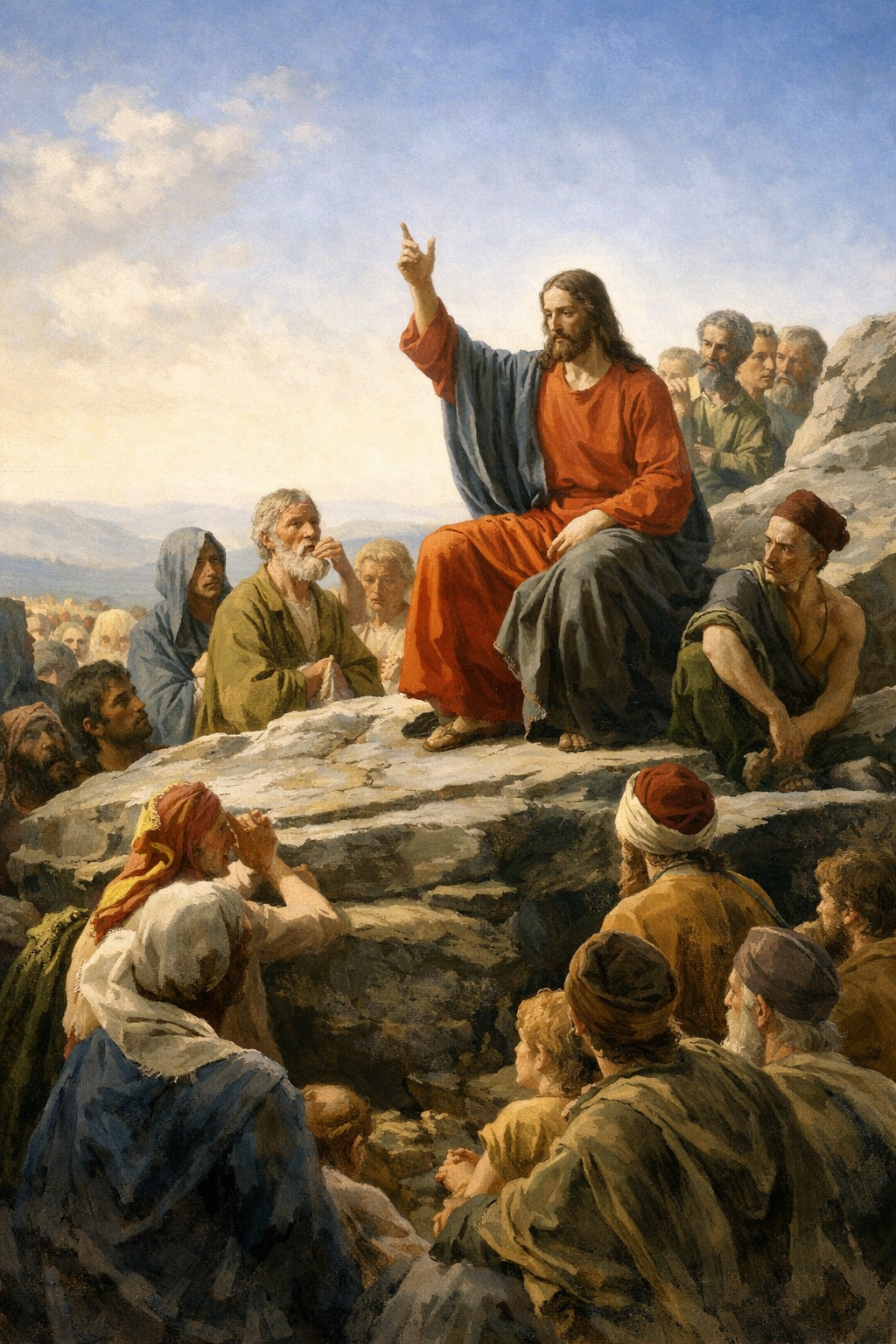
Sermon on the Mount
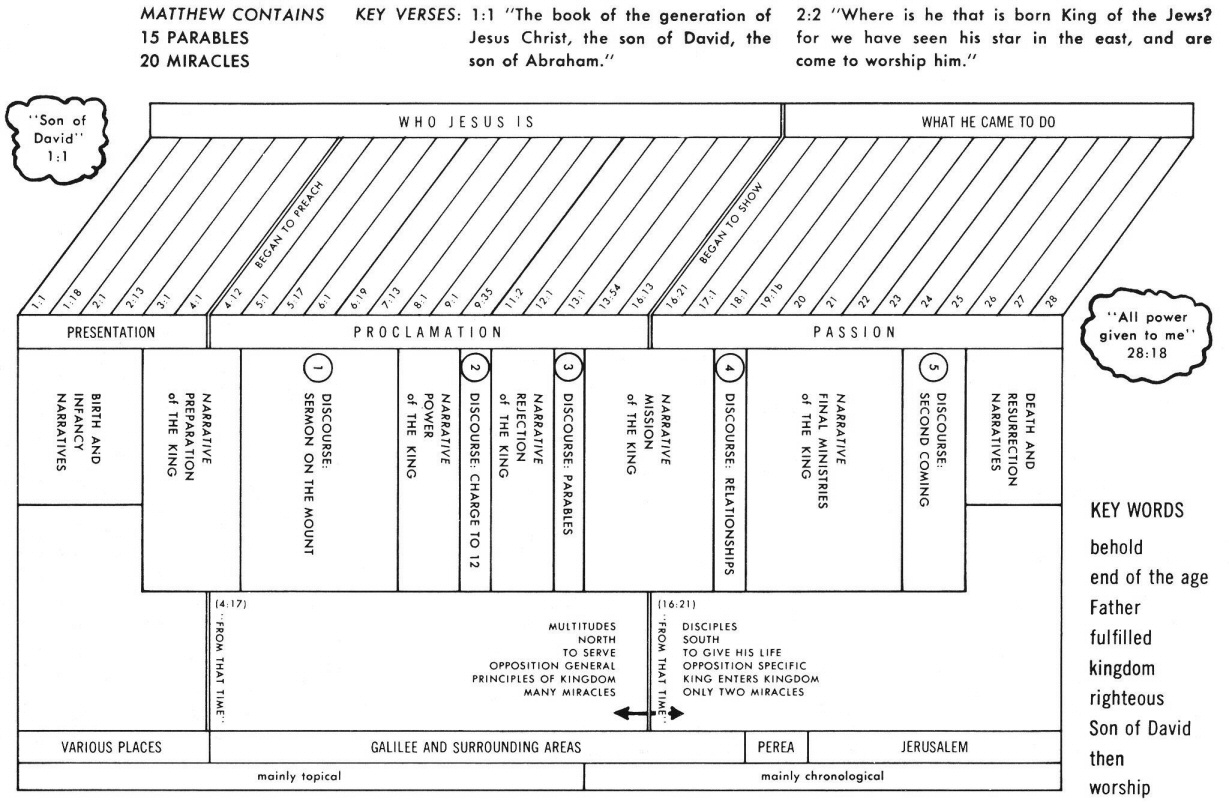
Click chart to enlarge
Charts from Jensen's Survey of the NT - used by permission
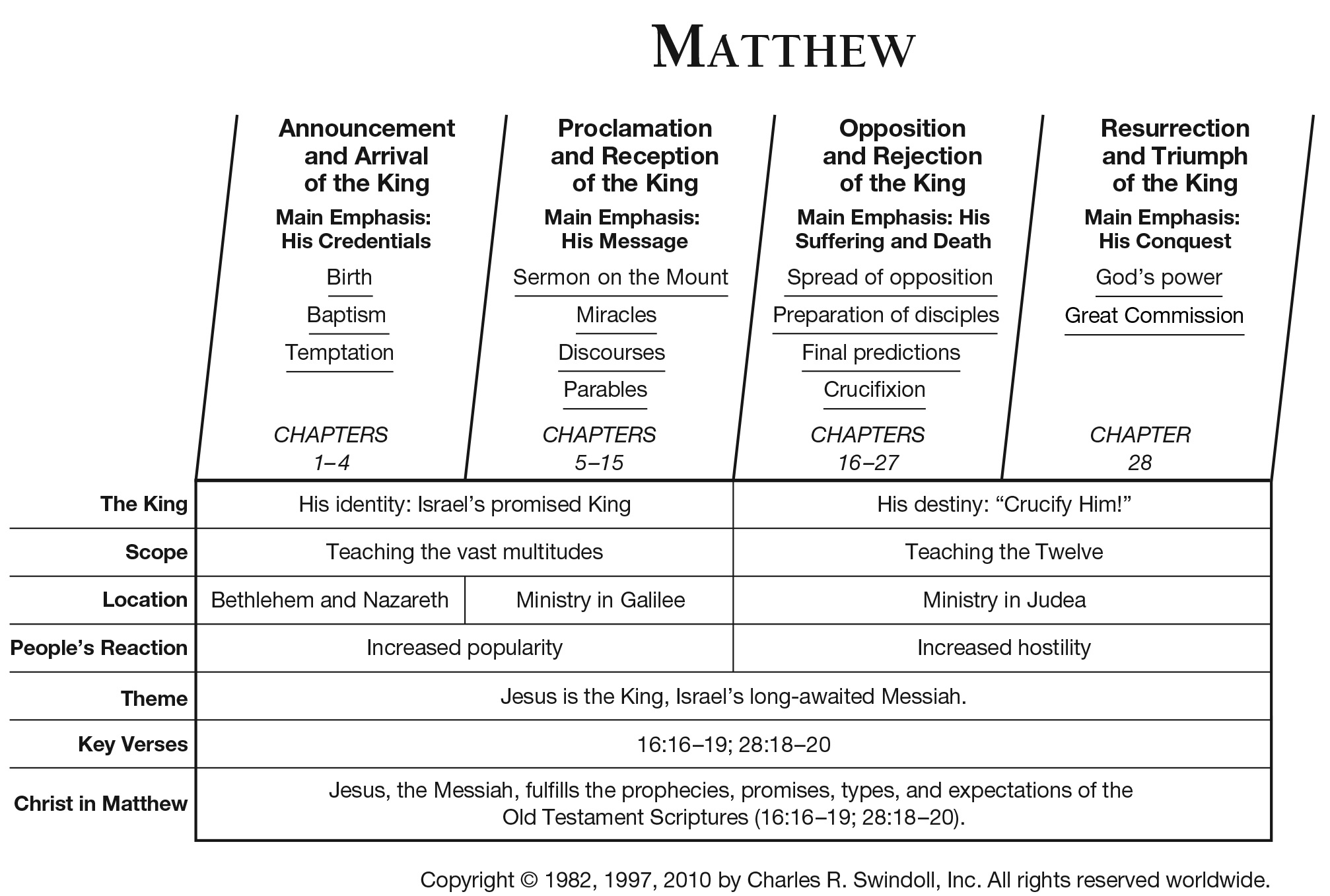
Another Chart from Charles Swindoll
THE LIFE OF JESUS AS COVERED
BY MATTHEW (shaded area)
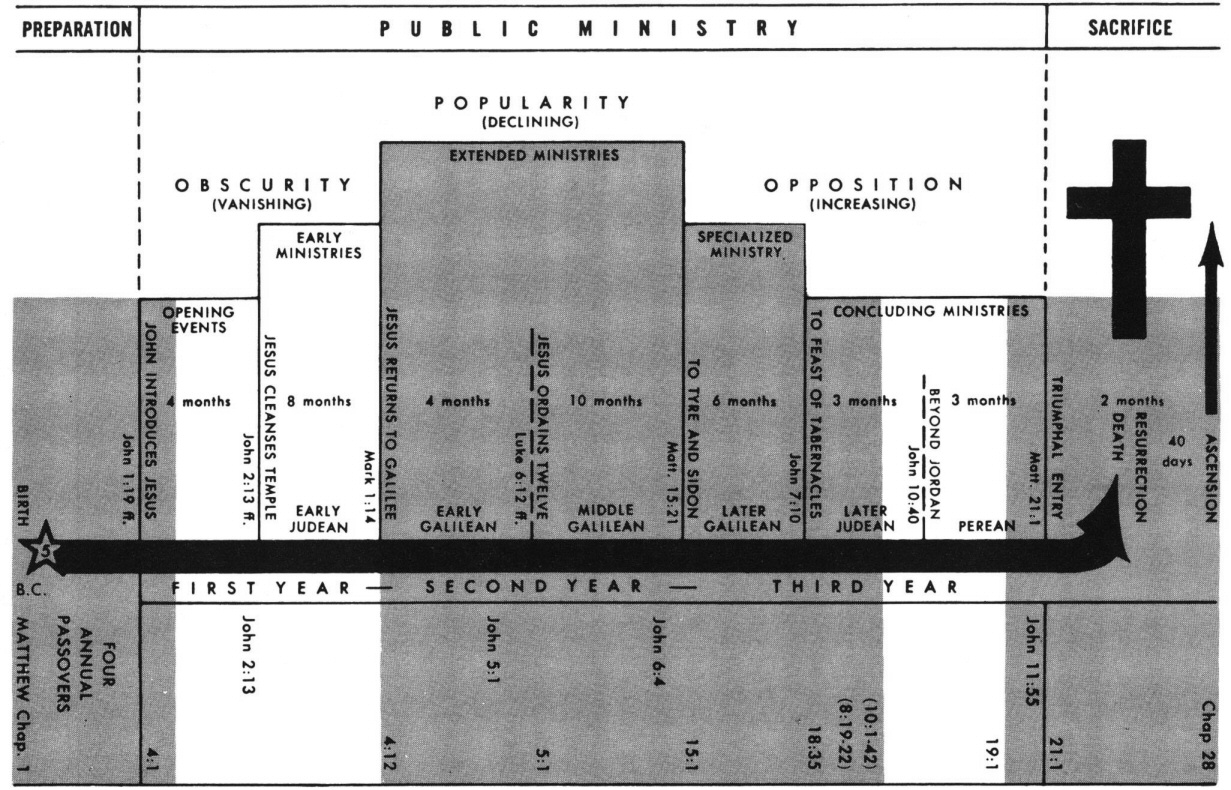
Click chart to enlarge
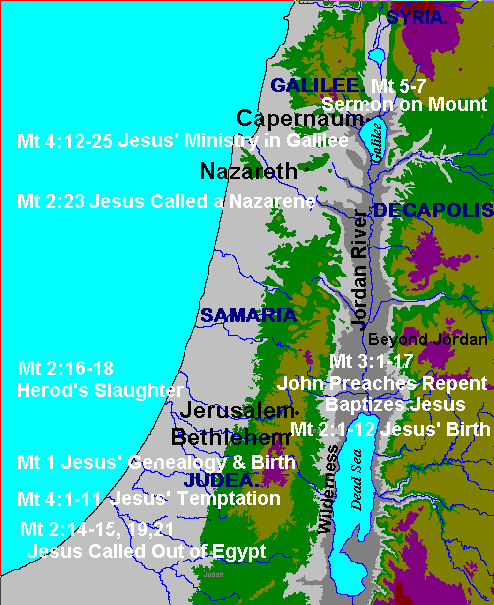
Jesus Birth and Early Years
Leading up to the Sermon on the Mount
Matthew 1-7
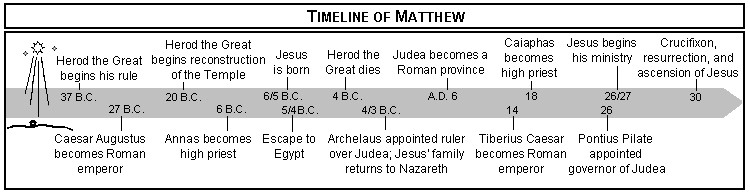
Source: Ryrie Study Bible
Matthew 5:17 "Do not think that I came to abolish the Law or the Prophets; I did not come to abolish but to fulfill. (NASB: Lockman)
Greek: Me nomisete (2PAAS) hoti elthon (AAI) katalusai (AAN) ton nomon e tous prophetas; ouk elthon (AAI) katalusai (AAN) alla plerosai. (AAN)
BGT Μὴ νομίσητε ὅτι ἦλθον καταλῦσαι τὸν νόμον ἢ τοὺς προφήτας· οὐκ ἦλθον καταλῦσαι ἀλλὰ πληρῶσαι.
Amplified: Do not think that I have come to do away with or undo the Law or the Prophets (entire Old Testament revelation); I have come not to do away with or undo but to complete and fulfill them. (Amplified Bible - Lockman)
My Amplified Paraphrase: Do not think that I came to abolish, invalidate, or dismantle the Law or the Prophets; I did not come to abolish them, but to fulfill them—to bring them to their intended meaning, to complete them, to perfectly embody and accomplish all that they foretold, required, and anticipated.
ASV Think not that I came to destroy the law or the prophets: I came not to destroy, but to fulfil.
CSB "Don't assume that I came to destroy the Law or the Prophets. I did not come to destroy but to fulfill.
ESV "Do not think that I have come to abolish the Law or the Prophets; I have not come to abolish them but to fulfill them.
GWN "Don't ever think that I came to set aside Moses' Teachings or the Prophets. I didn't come to set them aside but to make them come true.
KJV: Think not that I am come to destroy the law, or the prophets: I am not come to destroy, but to fulfill.
NLT: "Don't misunderstand why I have come. I did not come to abolish the law of Moses or the writings of the prophets. No, I came to fulfill them. (NLT - Tyndale House)
NLT (revised) "Don't misunderstand why I have come. I did not come to abolish the law of Moses or the writings of the prophets. No, I came to accomplish their purpose.
NET "Do not think that I have come to abolish the law or the prophets. I have not come to abolish these things but to fulfill them.
NIV "Do not think that I have come to abolish the Law or the Prophets; I have not come to abolish them but to fulfill them.
NKJ "Do not think that I came to destroy the Law or the Prophets. I did not come to destroy but to fulfill.
NRS "Do not think that I have come to abolish the law or the prophets; I have come not to abolish but to fulfill.
NAB "Do not think that I have come to abolish the law or the prophets. I have come not to abolish but to fulfill.
NJB 'Do not imagine that I have come to abolish the Law or the Prophets. I have come not to abolish but to complete them.
Philips: "You must not think I have come to abolish the Law or the Prophets; I have not come to abolish them but to complete them. (New Testament in Modern English)
Wuest: Do not begin to suppose that I came to destroy the law or the prophets. I did not come to destroy but to fulfill. (Wuest: Expanded Translation: Eerdmans)
Young's Literal: 'Do not suppose that I came to throw down the law or the prophets -- I did not come to throw down, but to fulfill;
DO NOT THINK THAT I CAME TO ABOLISH THE LAW OR THE PROPHETS; I DID NOT COME TO ABOLISH: Me nomisete (2PAAS) hoti elthon (AAI) katalusai (AAN) ton nomon e tous prophetas; ouk elthon (AAI) katalusai (AAN)
- Luke 16:17; John 8:5; Acts 6:13; 18:13; 21:28; Romans 3:31; Ro 10:4; Galatians 3:17, 18, 19, 20, 21, 22, 23, 24
- Romans 5 Resources - Multiple Sermons and Commentaries
- Matthew 5:17 Christ and the Law, Part 1 - John MacArthur
- Matthew 5:18 Christ and the Law, Part 2 - John MacArthur
AVOID AN ERRONEOUS
SUPPOSITION
Jesus did not come to abolish or do away with the Old Testament Law but to be the perfect, final fulfillment of every jot and tittle of the OT Law.
Do not think that I came to abolish the law or the prophets - The way this is phrased indicates that Jesus must have sensed that some of the audience thought he was advocating an overthrow of the Old Testament Law. On the other hand, considering the heavy burden that had been placed upon them by the Pharisees, they may have been hoping that Jesus would abolish the Law and the rigid requirements that the Pharisees had established in order for one to be righteous. In this context, the King gives His unforgettable disclaimer, which sets down for all time His relationship to the Law. It is interesting that Jesus had yet to mention the word "Law" in his discourse.
A B Bruce: These words betray a consciousness that there was that in His teaching and bearing which might create such an impression, and are a protest against taking a surface impression for the truth. (Matthew 5 Commentary)
Charles Simeon - To have just sentiments on religion is a matter of incalculable importance. Whilst we are mistaken respecting any fundamental truths, we not only lose the benefit and comfort of those truths, but are in danger of rejecting them when proposed to our consideration, and enlisting ourselves amongst the avowed enemies of the Gospel. The Jews were almost universally expecting a temporal Messiah. Hence, when our blessed Lord appeared in such mean circumstances, and inculcated doctrines so opposite to their carnal expectations, the people thought either that he was an impostor who deceived them, or that he was come to subvert and destroy all that had been delivered to them by their forefathers. Our blessed Lord anticipated and obviated their objections: “Think not,” says he, “that I am come to destroy the law and the prophets: I am not come to destroy, but to fulfil.” (Read the entire sermon - Matthew 5:17-18 The Law and the Prophets Confirmed by Christ)
Think (3543) (nomizo from nomos = law, custom) means to suppose, assume, regard or acknowledge as custom. It means to follow or practice what is customary, in this case a particular way of thinking.
In Mt 5:21-48 Jesus focuses attention on the Law and clearly shows that the external keeping of the Law is not enough. There has to be a corresponding internal or heart change (one OT term was circumcision of the heart, cp Dt 10:16, 30:6, Jer 4:4, Ro 2:29+). Some in His audience might feel as if He opposed to the Law, since His interpretation was not the same that they had heard from the Pharisees. And so for several reasons, Jesus explains He would not abolish but fulfill the Law.
Stephen was accused of speaking against the Law, Luke recording that
Then they (Jews from what was called the Synagogue of the Freedmen) secretly induced men to say, "We have heard him (Stephen) speak blasphemous words against Moses and against God (note word order suggest they were more concerned about offending Moses than God!)." And they stirred up the people, the elders and the scribes, and they came upon him and dragged him away, and brought him before the Council. And they put forward false witnesses who said, "This man incessantly speaks against this holy place, and the Law; for we have heard him say that this Nazarene, Jesus, will destroy this place and alter the customs which Moses handed down to us." (Acts 6:11-14+)
Paul was accused of opposing the Law…
But while Gallio was proconsul of Achaia, the Jews with one accord rose up against Paul and brought him before the judgment seat, saying, "This man persuades men to worship God contrary to the law." (Acts 18:12, 13+)
MacArthur has an interesting note writing that "The Jews in Corinth claimed that Paul’s teaching was external to Judaism, and therefore should be banned. Had Gallio ruled in the Jews’ favor, Christianity could have been outlawed throughout the Empire" The MacArthur Study Bible. Nashville: Word Pub)
And again Paul was falsely accused of opposing the Law…
And when the seven days were almost over, the Jews from Asia, upon seeing him (Paul) in the temple, began to stir up all the multitude and laid hands on him, crying out, "Men of Israel, come to our aid! This is the man who preaches to all men everywhere against our people, and the Law, and this place; and besides he has even brought Greeks into the temple and has defiled this holy place." (Acts 21:27-28+)
In Romans 3 Paul affirms Jesus' declaration asking…
Do we then nullify (make ineffective the power or force of) the Law through faith? May it never be! (Of course not!) On the contrary, we establish the Law. (NLT "In fact, only when we have faith do we truly fulfill the law") (Ro 3:31+)
In Romans 10 Paul explains the relationship of Christ to the Law writing that…
Christ is the end of the Law [… for the Law leads up to Him Who is the fulfillment of its types, and in Him the purpose which it was designed to accomplish is fulfilled. That is, the purpose of the Law is fulfilled in Him] as the means of righteousness (right relationship to God) for everyone who trusts in and adheres to and relies on Him. (Amplified Version) (Ro 10:4+)
Romans 8:3-4+ explains the Law was not meant to save men
For what the Law could not do, weak as it was through the flesh, God did: sending His own Son in the likeness of sinful flesh and as an offering for sin, He condemned sin in the flesh, 4so that the requirement of the Law might be fulfilled in us, who do not walk according to the flesh but according to the Spirit.
Abolish (2647) (kataluo from kata = down + luo = loose, untie; release, set free) means to set aside, to destroy, pull down, to break up, to loosen down (disintegrate), to demolish. The idea is to abrogate (to abolish by authoritative action) or set aside in the exercise of legislative authority. To the religious Jew even the thought of such a thing would be a profanity.
Kataluo - 17x in 16v - abolish(2), destroy(5), destroyed(1), find lodging(1), guest(1), overthrow(1), overthrown(1), tear down(1), torn down(4).Matt 5:17; 24:2; 26:61; 27:40; Mark 13:2; 14:58; 15:29; Luke 9:12; 19:7; 21:6; Acts 5:38f; 6:14; Rom 14:20; 2 Cor 5:1; Gal 2:18.
A B Bruce - A Greater than the OT, than Moses and the prophets, is here. But the Greater is full of reverence for the institutions and sacred books of His people. He is not come to disannul either the law or the prophets. (Matthew 5 Commentary)
The Law or the Prophets - Note that Law and prophets is connected by "or" not "and". The point is that Jesus is not signifying the entire Old Testament. (see all NT uses - click), but as distinct parts. Jesus indeed had come to fulfill both parts, the Law (He kept it perfectly and took it's penalty of death for breaking it) and the Prophets (He fulfilled all the Messianic prophecies), but since His great conflict with the Pharisees was over the Law, He focused His remarks on that aspect of the OT teaching.
Law (3551) (nomos, torah in Hebrew) is related etymologically to something parceled out, allotted, what one has in use and possession; hence, usage, custom). Generally, "the Law" refers to the Pentateuch, the first five books of the OT. More generally however, the law can mean a wide variety of things – a commandment, a principle, an instruction, etc. The meaning of the law, therefore, is best determined by examining its use in context.
Calvin wrote that did not abolish the Law but "He only restored it [the Law] to its integrity by maintaining and purifying it when obscured by the falsehood, and defiled by the leaven of the Pharisees.
Albert Barnes - Our Saviour was just entering on his work. It was important for him to state what he came to do. By his setting up to be a teacher in opposition to the Scribes and Pharisees, some might charge him with an intention to destroy their law, and abolish the customs of the nation. (Matthew 5)
Sinclair Ferguson makes an interesting observation that "By this point in His sermon, Jesus has made it very clear what belonging to the kingdom of God means. What he has said is startling enough. But in some ways, what he has not said is even more startling. He has said nothing about the law and the importance of keeping it. He has said nothing about the traditional interpretations of the law, and the importance of observing them. No statement has issued from his lips encouraging reverence for the scribes and the Pharisees. Did this mean that Jesus was overthrowing the law? He certainly was teaching that the way of salvation and entry into God's kingdom was not by merit gained through obedience to the law. Rather than feeling that they had achieved merit, Jesus' followers were poor in spirit, mourned for their sins, and received comfort and the kingdom of God. To the listening scribes and Pharisees, this must have sounded for all the world like the abolition of religion and of everything they stood for. So far, Jesus had said people could enter God's kingdom by God's grace; he had made not one single mention of the law!(Borrow Ferguson, Sinclair: Sermon on the Mount :Banner of Truth)
Prophets (4396) (prophetes from pró = before or forth + phemí = tell) means to speak forth or speak before (in time). In the NT uses, prophetes referred usually to a person in the OT who spoke under divine influence and inspiration thus foretelling future events or exhorting, reproving, and threatening of individuals or nations as the ambassador of God and the interpreter of His will to men. Hence the prophet spoke not his own thoughts but what he received from God, retaining, however, his own consciousness and self–possession.
Note that the Old Testament Law can be thought of in three divisions (although in fairness it needs to be stated that not all conservative evangelical commentaries agree with these subdivisions):
1) Moral Law - as in the 10 Commandments (only the keeping of the Sabbath is not commanded in the NT)
2) Ceremonial Law - as seen in the shadows and types in the Tabernacle, the Jewish sacrificial system, the Feast days
3) Civil Law - the judicial laws that governed the nation of Israel in the OT - e.g., the cities of refuge, stoning for certain offenses, etc
Related Resources:
- What is the difference between the ceremonial law, the moral law, and the judicial law in the Old Testament?
- What does it mean that Christians are not under the law?
- What did the Law mean when it referred to a lasting ordinance?
Jesus fulfilled all of these aspects of the Law. In the NT, only the moral law remains applicable to the believer. The ceremonial and civil law are not abolished but as Jesus stated "fulfilled" in Him. And yet many Christians remain confused and uncertain about significance of the Law even after sitting in church for years. They have no firm grasp of what role the Law plays in their lives today. So that will be the thrust of this lesson. (Click for more commentary on "Law and Believer")
Spurgeon - The life, work, and words of Christ are not an emendation of the Old Testament, or an abrogation of it. It stands fast and firm, fulfilled, carried to perfection, filled to the full in Christ.
In regard to the moral aspect of the Law, the Holman NT Commentary writes that…
Two pivotal passages (Jeremiah 31:31, 32, 33, 34; Ezekiel 36:26, 27) explain how, under the New Covenant, the same law (the very character of God) is not to be an external standard, but its values are to become an intrinsic part of newly recreated people. In a way, Jesus was teaching something that was not yet completely possible for people to follow. It is good to say, "People should move from external obedience to an obedience motivated by the law written upon the heart." But this is an impossibility until the heart is transformed and the very person of God himself, along with his righteous character as expressed in the law, comes to abide in one's heart. What Jesus taught would become a reality in the lives of God's people after his death sealed the new covenant and made possible the promised internal transformation. (See Holman New Testament Commentary - Matthew)
John Newton the converted slave trader wrote that "Ignorance of the nature and design of the law is at the bottom of most of our religious mistakes."
Is this statement by Newton all too true? How many Christians are still confused and uncertain about the law even after sitting in church all their life. They have no solid concept of what role the law plays in their lives today.
"For all the prophets and the Law prophesied until John (speaking of John the Baptist). (Mt 11:13+)
Not (3756) (ou) indicates Jesus' absolute denial ("absolutely no way") that He had come to do away with the Law and the Prophets (OT).
Spurgeon comments that…
Very great mistakes have been made about the law. Not long ago there were those about us who affirmed that the law is utterly abrogated and abolished, and they openly taught that believers were not bound to make the moral law the rule of their lives. What would have been sin in other men they counted to be no sin in themselves.
From such Antinomianism as that may God deliver us. We are not under the law as the method of salvation, but we delight to see the law in the hand of Christ, and desire to obey the Lord in all things.
Others have been met with who have taught that Jesus mitigated and softened down the law, and they have in effect said that the perfect law of God was too hard for imperfect beings, and therefore God has given us a milder and easier rule. These tread dangerously upon the verge of terrible error, although we believe that they are little aware of it. Alas, we have met with authors who have gone much further than this, and have railed at the law. Oh, the hard words that I have sometimes read against the holy law of God! How very unlike to those which the apostle used when he said, “The law is holy, and the commandment holy, and just, and good.” How different from the reverent spirit which made him say,- “I delight in the law of God after the inward man.” You know how David loved the law of God, and sang its praises all through the longest of the Psalms.
The heart of every real Christian is most reverent towards the law of the Lord. It is perfect, nay, it is perfection itself. We believe that we shall never have reached perfection till we are perfectly conformed to it. A sanctification which stops short of perfect conformity to the law cannot truthfully he called perfect sanctification, for every want of exact conformity to the perfect law is sin. May the Spirit of God help us while, in imitation of our Lord Jesus, we endeavor to magnify the law.
The Law Of God Must Be Perpetual. There is no abrogation of it, nor amendment of it. It is not to be toned down or adjusted to our fallen condition; but every one of the Lord’s righteous judgments abideth for ever.
I would urge three reasons which will establish this teaching.
In the first place our Lord Jesus declares that he did not come to abolish it. His words are most express: “Think not that I am come to destroy the law, or the prophets: I am not come to destroy, but to fulfill.” And Paul tells us with regard to the gospel, “Do we then make void the law through faith? God forbid: yea, we establish the law” (Ro 3:31+). The gospel is the means of the firm establishment and vindication of the law of God.
Jesus did not come to change the law, but he came to explain it, and that very fact shows that it remains, for there is no need to explain that which is abrogated. Upon one particular point in which there happened to be a little ceremonialism involved, namely, the keeping of the Sabbath, our Lord enlarged, and showed that the Jewish idea was not the true one. The Pharisees forbade even the doing of works of necessity and mercy, such as rubbing ears of corn to satisfy hunger, and healing the sick. Our Lord Jesus showed that it was not at all according to the mind of God to forbid these things. In straining over the letter, and carrying an outward observance to excess, they had missed the spirit of the Sabbath law, which suggested works of piety such as truly hallow the day. He showed that Sabbatic rest was not mere inaction, and he said, “My Father worketh hitherto, and I work.” He pointed to the priests who labored hard at offering sacrifices, and said of them, “the priests in the temple profane the Sabbath, and are blameless.” They were doing divine service, and were within the law. To meet the popular error he took care to do some of his grandest miracles upon the Sabbath-day; and though this excited great wrath against him, as though he were a law-breaker, yet he did it on purpose that they might see that the Sabbath was made for man and not man for the Sabbath, and that it is meant to be a day for doing that which honors God and blesses men. O that men knew how to keep the spiritual Sabbath by a easing from all servile work, and from all work done for self, The rest of faith is the true Sabbath, and the service of God is the most acceptable hallowing of the day. Oh that the day were wholly spent in serving God and doing good! The sum of our Lord’s teaching was that works of necessity, works of mercy, and works of piety are lawful on the Sabbath. He did explain the law in that point and in others, yet that explanation did not alter the command, but only removed the rust of tradition which had settled upon it. By thus explaining the law he confirmed it; he could not have meant to abolish it or he would not have needed to expound it.
In addition to explaining it the Master went further: he pointed out its spiritual character. This the Jews had not observed. They thought, for instance, that the command “Thou shalt not kill” simply forbade murder and manslaughter: but the Savior showed that anger without cause violates the law, and that hard words and cursing, and all other displays of’ enmity and malice, are forbidden by the commandment. They knew that they might not commit adultery, but it did not enter into their minds that a lascivious desire would be an offense against the precept till the Savior said, “He that looketh upon a woman to lust after her committeth adultery with her already in his heart.” He showed that the thought of evil is sin, that an unclean imagination pollutes the heart, that a wanton wish is guilt in the eyes of’ the Most High. Assuredly this was no abrogation of law: it was a wonderful exhibition of its far-reaching sovereignty and of its searching character. The Pharisees fancied that if they kept their hands, and their feet, and their tongues, all was done, but Jesus showed that thought, imagination, desire, memory, everything, must be brought into subjection to the will of God, or else the law was not fulfilled. What a searching and humbling doctrine is this! If the law of the Lord reaches to the inward parts who among us can by nature abide its judgment? Who can understand his errors? Cleanse thou me from secret faults. The ten commands are full of meaning-meaning which many seem to ignore. For instance, many a man will allow in and around his house inattention to the rules of health and sanitary precaution, but it does not occur to him that he is trampling on the command,- “Thou shalt not kill,” yet this rule forbids our doing anything which may cause injury to our neighbor’s health, and so deprive him of life. Many a deadly manufactured article, many an ill-ventilated shop, many a business with hours of excessive length, is a standing breach of this command. Shall I say less of drinks, which lead so speedily to disease and death, and crowd our cemeteries with untimely graves? So, too, in reference to another precept: some persons will repeat songs and stories which are suggestive of uncleanness,-I wish that this were not so common as it is. Do they not know that an unchaste word, a double meaning, a sly hint of lust all come under the command, “Thou shalt not commit adultery”? It is so according to the teaching of our Lord Jesus. Oh, talk not to me about our Lord’s having brought in a milder law because man could not keep the Decalogue, for he has done nothing of the kind. “His fan is in his hand, and he will thoroughly purge his floor.” “Who may abide the day of his coining? for he is like a refiner’s fire, and like fullers’ soap.” Let us not dare to dream that God had given us a perfect law which we poor creatures could not keep, and that therefore he has corrected his legislature, and sent his Son to put us under a relaxed discipline. Nothing of the sort. The Lord Jesus Christ has, on the contrary, shown how intimately the law surrounds and enters into our inward parts, so as to convict us of sin within even if we seem clear without. Ah me, this law is high; I cannot attain to it. It everywhere surrounds me; it tracks me to my bed and my board; it follows my steps and marks my ways wherever I may be. No moment does it cease to govern and demand obedience. O God, I am everywhere condemned, for everywhere thy law reveals to me my serious deviations from the way of righteousness and shows me how far short I come of thy glory. Have thou pity on thy servant, for I fly to the gospel which has done for me what the law could never do.
“To see the law by Christ fulfill’d,
And hear his pardoning voice,
Changes a slave into a child,
And duty into choice.”
Our Lord Jesus Christ, in addition to explaining the law and pointing out its spiritual character, also unveiled its living essence, for when one asked him “Which is the great commandment in the law?” he said, “Thou shalt love the Lord thy God with all thy heart, and with all thy soul, and with all thy mind. This is the first and great commandment. And the second is like unto it; Thou shalt love thy neighbor as thyself. On these two commandments hang all the law and the prophets.” In other words, he has told us, “All the law is fulfilled in this: thou shalt love.” There is the pith and marrow of it. Does any man say to me, “You see, then, instead of the ten commandments we have received the two commandments, and these are much easier.” I answer that this reading of the law is not in the least easier. Such a remark implies a want of thought and experience. Those two precepts comprehend the ten at their fullest extent, and cannot be regarded as the erasure of a jot or tittle of them. Whatever difficulties surround the ten commands are equally found in the two, which are their sum and substance. If you love God with all your heart you must keep the first table; and if you love your neighbor as yourself you must keep the second table. If any suppose that the law of love is an adaptation of the moral law to man’s fallen condition they greatly err. I can only say that the supposed adaptation is no more adapted to us than the original law. If there could be conceived to be any difference in difficulty it might be easier to keep the ten than the two; for if we go no deeper than tile letter, the two are the more exacting, since they deal with the heart, and soul, and mind. The ten commands mean all that the two express; but if we forget this, and only look at the wording of them, I say, it is harder for a man to love God with all his heart, with all his soul, with all his mind, and with all his strength, and his neighbor as himself than it would be merely to abstain from killing, stealing, and false witness. Christ has not, therefore, abrogated or at all moderated the law to meet our helplessness; he has left it in all its sublime perfection, as it always must be left, and he has pointed out how deep are its foundations, how elevated are its heights, how measureless are its length and breadth. Like the laws of the Medes and Persians, God’s commands cannot be altered; we are saved by another method.
To show that he never meant to abrogate the law, our Lord Jesus has embodied all its commands in his own life. In his own person there was a nature which was perfectly conformed to the law of God; and as was his nature such was his life. He could say, “Which of you convinceth me of sin?” and again “I have kept my Father’s commandments and abide in his love.” I may not say that he was scrupulously careful to keep the law: I will not put it so, for there was no tendency in him to do otherwise: he was so perfect and pure, so infinitely good, and so complete in his agreement and communion with the Father, that he in all things carried out the Father’s will. The Father said of him, “This is my beloved Son in whom I am well pleased; hear ye him.” Point out, if you possibly can, any way in which Christ has violated the law or left it unfulfilled. There was never an unclean thought or rebellious desire in his soul; he had nothing to regret or to retract: it could not be that he should err. He was thrice tempted in the wilderness, and the enemy had the impertinence even to suggest idolatry, but he instantly overthrew the adversary. The prince of this world came to him, but he found nothing in him.
“My dear Redeemer and my Lord,
I read my duty in thy Word;
But in thy life the law appears
Drawn out in living characters.”
Now, if that law had been too high and too hard, Christ would not have exhibited it in his life, but as our exemplar he would have set forth that milder form of law which it is supposed by some theologians he came to introduce. Inasmuch as our Leader and Exemplar has exhibited to us in his life a perfect obedience to the sacred commands in their undiminished grandeur, I gather that he means it to be the model of our conversation. Our Lord has not taken off a single point or pinnacle from that np-towering alp of perfection. He said at the first, “Lo, I come: in the volume of’ the book it is written of me, I delight to do thy will, O my God; yea, thy law is within my heart.” and well has he justified the writing of the volume of the book. “God sent forth his Son, made of a woman, made under the law”; and being for our sakes under the law he obeyed it to the full, so that now “Christ is the end of the law for righteousness to everyone that believeth.”
Once more, that the Master did not come to alter the law is clear, because after having embodied it in his life he willingly gave himself up to bear its penalty, though he had never broken it, bearing the penalty for us, even as it is written, “Christ hath redeemed us from the curse of the law, being made a curse for us.” “All we like sheep have gone astray, we have turned every one to his own way, and the Lord hath laid on him the iniquity of us all.” If the law had demanded more of us than it ought to have done, would the Lord Jesus have rendered to it the penalty which resulted from its too severe demands? I am sure he would not. But because the law asked only what it ought to ask- namely perfect obedience; and exacted of the transgressor only what it ought to exact, namely, death, as the penalty for sin,-death under divine wrath, therefore the Savior went to the tree, and there bore our sins and purged them once for all. He was crushed beneath the load of our guilt, and cried, “My soul is exceeding sorrowful, even unto death,” and at last when he had borne-
“All that incarnate God could bear,
With strength enough, but none to spare,”
he bowed his head and said, “It is finished.” Our Lord Jesus Christ gave a greater vindication to the law by dying, because it had been broken, than all the lost in hell can ever give by their miseries. for their suffering is never complete, their debt is never paid; but he has borne all that was due from his people, and the law is defrauded of nothing. By his death he has vindicated the honor of God’s moral government, and made it just for him to be merciful. When the lawgiver himself submits to the law, when the sovereign himself bears the extreme penalty of that law, then is the justice of God set upon such a glorious high throne that all admiring worlds must wonder at it. If therefore it is clearly proven that Jesus was obedient to the law, even to the extent of death, he certainly did not come to abolish or abrogate it; and if he did not remove it, who can do so? If he declares that he came to establish it, who shall overthrow it?
But, secondly, the law of God must be perpetual from its very nature, for does it not strike you the moment you think of it that right must always be right, truth must always be true, and purity must always be purity? Before the ten commandments were published at Sinai there was still that same law of right and wrong laid upon men by the necessity of their being God’s creatures. Right was always right before a single command had been committed to words. When Adam was in the garden it was always right that he should love his Maker, and it would always have been wrong that he should have been at cross-purposes with his God; and it does not matter what happens in this world, or what changes take place in the universe, it never can be right to lie, or to commit adultery, or murder, or theft, or to worship an idol God. I will not say that the principles of right and wrong are as absolutely self-existent as God, but I do say that I cannot grasp the idea of God himself as existing apart from his being always holy and always true; so that the very idea of right and wrong seems to me to be necessarily permanent, and cannot possibly be shifted. You cannot bring right down to a lower level; it must be where it always is: right is right eternally, and cannot be wrong. You cannot lift up wrong and make it somewhat right; it must be wrong while the world standeth. Heaven and earth may pass away, but not the smallest letter or accent of the moral law can possibly change. In spirit the law is eternal.
Suppose for a moment that it were possible to temper and tone down the law, wherein would it be? I confess I do not know and cannot imagine. If it be perfectly holy, how can it be altered except by being made imperfect. Would you wish for that? Could you worship the God of an imperfect law? Can it ever be true that God, by way of favoring us, has put us under an imperfect law? Would that be a blessing or a curse? It is said by some that man cannot keep a perfect law, and God does not demand that he should. Certain modern theologians have taught this, 1 hope, by inadvertence. Has God issued an imperfect law? It is the first imperfect thing I ever heard of his making. Does it come to this that, after all, the gospel is a proclamation that God is going to be satisfied with obedience to a mutilated law? God forbid. I say, better that we perish than that his perfect law perish. Terrible as it is, it lies at the foundation of the peace of the universe. and must be honored at all hazards. That gone, all goes. When the power of the Holy Ghost convinced me of sin I felt such a solemn awe of the law of God, that I remember well, when I lay crashed beneath it as a condemned sinner, I yet admired and glorified the law. I could not have wished that perfect law to be altered for me. Rather did I feel that, if my soul were sent to the lowest hell, yet God was to be extolled for his justice and his law held in honor for its perfectness. I would not have had it altered even to save my soul. Brethren, the law of the Lord must stand, for it is perfect, and therefore has in it no element of decay or change.
The law of God is no more than God might most righteously ask of us. If God were about to give us a more tolerant law, it would be an admission on his part that he asked too much at first. Can that be supposed? Was there, after all, some justification for the statement of the wicked and slothful servant when he said, “I feared thee, because thou art an austere man”? It cannot be. For God to alter his law would be an admission that he made a mistake at first, that he put poor imperfect man (we are often hearing that said) under too rigorous a regime, and therefore he is now prepared to abate his claims, and make them more reasonable. It has been said that man’s moral inability to keep the perfect law exempts him from the duty of doing so. This is very specious, but it is utterly false. Man’s inability is not of the kind which removes responsibility: it is moral, not physical. Never fall into the error that moral inability will be an excuse for sin. What, when a man becomes such a liar that he cannot speak the truth, is he thereby exempted from the duty of truthfulness? If your servant owes you a day’s labor, is he free from the duty because he has made himself so drunk that he cannot serve you? Is a man freed from a debt by the fact that he has squandered the money, and therefore cannot pay it? Is a lustful man free to indulge his passions because he cannot understand the beauty of chastity? This is dangerous doctrine. The law is a just one, and man is bound by it though his sin has rendered him incapable of doing so.
The law moreover demands no more than is good for us. There is not a single commandment of God’s law but what is meant to be a kind of danger signal such as we put up upon the ice when it is too thin to bear. Each commandment does as it were say to us, “Dangerous” It is never for a man’s good to do what God forbids him; it is never for man’s real and ultimate happiness to leave undone anything that God commands him. The wisest directions for spiritual health, and for the avoidance of evil, are those directions which are given us concerning right and wrong in the law of God. Therefore it is not possible that there should be any alteration thereof, for it would not be for our good.
I should like to say to any brother who thinks that God has put us under an altered rule: “Which particular part of the law is it that God has relaxed?” Which precept do you feel free to break? Are you delivered from the command which forbids stealing? My dear sir, you may be a capital theologian, but I should lock up my spoons when you call at my house. Is it the command about adultery which you think is removed? Then I could not recommend your being admitted into any decent society. Is the law as to killing softened down? Then I had rather have your room than your company. Which law is it that God has exempted you from? That law of worshipping him only? Do you propose to have another God? Do you intend to make graven images? The fact is that when we come to detail we cannot afford to lose a single link of this wonderful golden chain, which is perfect in every part as well as perfect as a whole. The law is absolutely complete, and you can neither add to it nor take from it. “For whosoever shall keep the whole law, and yet offend in one point, he is guilty of all. For he that said, Do not commit adultery, said also, Do not kill. Now if thou commit no adultery, yet if thou kill, thou art become a transgressor of the law.” If, then, no part of it can be taken down, it must stand, and stand for ever.
A third reason I will give why the law must be perpetual is that to suppose it altered is most dangerous. To take away from the law its perpetuity is first of all to take away from it its power to convince of sin. Is it so, that I, being an imperfect creature, am not expected to keep a perfect law? Then it follows that I do not sin when I break the law; and if all that is required of me is that I am to do according to the best of my knowledge and ability, then I have a very convenient rule indeed, and most men will take care to adjust it so as to give themselves as much latitude as possible. By removing the law you have done away with sin, for sin is the transgression of the law, and where there is no law there is no transgression. When you have done away with sin you may as well have done away with the Savior and with salvation, for they are by no means needful. When you have reduced sin to a minimum, what need is there of that great and glorious salvation which Jesus Christ has come to bring into the world? Brethren, we must have none of this: it is evidently a way of mischief.
By lowering the law you weaken its power in the hands of God as a convincer of sin. “By the law is the knowledge of sin.” It is the looking-glass which shows us our spots, and that is a most useful thing, though nothing but the gospel can wash them away.
“My hopes of heaven were firm and bright,
But since the precept came
With a convincing power and light, I find how vile I am.“My guilt appear’d but small before,
Till terribly I saw How perfect, holy, just, and pure,
Was thine eternal law.“Then felt my soul the heavy load,
My sins reviv’d again,
I had provok’d a dreadful God,
And all my hopes were slain.”
It is only a pure and perfect law that the Holy Spirit can use in order to show to us our depravity and sinfulness. Lower the law and you dim the light by which man perceives his guilt. This is a very serious loss to the sinner rather than a gain, for it lessens the likelihood of his conviction and conversion.
You have also taken away from the law its power to shut us up to the faith of Christ. What is the law of God for? For us to keep in order to be saved by it? Not at all. It is sent in order to show us that we cannot be saved by works, and to shut us up to be saved by grace; but if you make out that the law is altered so that a man can keep it, you have left him his old legal hope, and he is sure to cling to it. You need a perfect law that shuts man right up to hopelessness apart from Jesus, puts him into an iron cage and locks him up, and offers him no escape but by faith in Jesus; then he begins to cry, “Lord, save me by grace, for I perceive that I cannot be saved by my own works.” This is how Paul describes it to the Galatians: “The Scripture hath concluded all under sin, that the promise by faith of Jesus Christ might be given to them that believe. But before faith came, we were kept under the law, shut up unto the faith which should afterwards be revealed. Wherefore the law was our schoolmaster to bring us unto Christ, that we might be justified by faith.” I say you have deprived the gospel of its ablest auxiliary when you have set aside the law. You have taken away from it the schoolmaster that is to bring men to Christ. No, it must stand, and stand in all its terrors, to drive men away from self-righteousness and constrain them to fly to Christ. They will never accept grace till they tremble before a just and holy law; therefore the law serves a most necessary and blessed purpose, and it must not be removed from its place.
To alter the law is to leave us without any law at all. A sliding-scale of duty is an immoral invention, fatal to the principles of law. If each man is to be accepted because he does his best, we are all doing our best. Is there anybody that is not? If we take their words for it, all our fellow-men are doing as well as they can, considering their imperfect natures. Even the harlot in the streets has some righteousness,- she is not quite so far gone as others. Have you never heard of the bandit who committed many murders, but who felt that he had been doing his best because he never killed anybody on a Friday? Self-righteousness builds itself a nest even in the worst character. This is the man’s talk:- “Really, if you knew me, you would say, I have been a good fellow to do as well as I have. Consider what a poor, fallen creature I am; what strong passions were born in me; what temptations to vice beset me, and you will not blame me much. After all, I dare say God is as satisfied with me as with many who are a great deal better, because I had so few advantages.” Yes, you have shifted the standard, and every man will now do that which is right in his own eyes and claim to be doing his best. If you shift the standard pound weight or the bushel measure, you will certainly never get full weight or measurement again. There will be no standard to go by, and each man will do his best with his own pounds and bushels. If the standard be tampered with you have taken away the foundation upon which trade is conducted; and it is the same in soul matters,-abolish the best rule that ever can be, even God’s own law, and there is no rule left worthy of the name. What a fine opening this leaves for vain glory. No wonder that men talk of perfect sanctification if the law has been lowered. There is nothing at all remarkable in our getting up to the rule if it is conveniently lowered for us. I believe I shall be perfectly sanctified when I keep God’s law without omission or transgression, but not till then. If any man says that he is perfectly sanctified because he has come up to a modified law of his own, I am glad to know what he means, for I have no longer any discussion with him: I see nothing wonderful in his attainment. Sin is my want of conformity to the law of God, and until we are perfectly conformed to that law in all its spiritual length and breadth it is idle for us to talk about perfect sanctification: no man is perfectly clean till he accepts absolute purity as the standard by which he is to be judged. So long as there is in us any coming short of the perfect law we are not perfect. What a humbling truth this is! The law shall not pass away, but it must be fulfilled. This truth must be maintained, for if it goes, our tacklings are loose, we cannot well strengthen the mast; the ship goes all to pieces; she becomes a total wreck. The gospel itself would be destroyed could you destroy the law. To tamper with the law is to trifle with the gospel. “Till heaven and earth pass, one jot or one tittle shall in no wise pass from the law, till all be fulfilled.” (The Perpetuity of the Law)
BUT TO FULFILL: alla plerosai. (AAN)
- Mt 3:15; Ps 40:6, 7, 8; Isaiah 42:21; Romans 8:4; Galatians 4:4,5; Colossians 2:16,17; Hebrews 10:3-12
- Romans 5 Resources - Multiple Sermons and Commentaries
- Matthew 5:17 Christ and the Law, Part 1 - John MacArthur
- Matthew 5:18 Christ and the Law, Part 2 - John MacArthur
NOT ABOLITION
BUT FULFILLMENT
But to fulfill - Jesus came not as an Abrogator but as a Fulfiller of the Law. He fulfills the Law by realizing in theory and practice the ideal to which the OT Law and institutions all pointed. He was the Substance and very Form of which the Law was only a pale or weak shadow (Col 2:17+), Heb 10:1+).
Paul explains Jesus fulfilled the Law "so that the requirement of the Law might be fulfilled in us, who do not walk according to the flesh but according to the Spirit." (Romans 8:4+)
Fulfill (4137) (pleroo [word study] from pleres = full) be completely filled indicating a completed state. It means to fill out or to expand. Here pleroo means to make complete in every particular. To complete the design. To fill up what was predicted. To accomplish what was intended in the Old Testament.
Pleroo - 86x in 86v in the NAS -Matt 1:22; 2:15, 17, 23; 3:15; 4:14; 5:17; 8:17; 12:17; 13:35, 48; 21:4; 23:32; 26:54, 56; 27:9; Mark 1:15; 14:49; Luke 1:20; 2:40; 3:5; 4:21; 7:1; 9:31; 21:24; 22:16; 24:44; John 3:29; 7:8; 12:3, 38; 13:18; 15:11, 25; 16:6, 24; 17:12f; 18:9, 32; 19:24, 36; Acts 1:16; 2:2, 28; 3:18; 5:3, 28; 7:23, 30; 9:23; 12:25; 13:25, 27, 52; 14:26; 19:21; 24:27; Rom 1:29; 8:4; 13:8; 15:13f, 19; 2 Cor 7:4; 10:6; Gal 5:14; Eph 1:23; 3:19; 4:10; 5:18; Phil 1:11; 2:2; 4:18f; Col 1:9, 25; 2:10; 4:17; 2 Thess 1:11; 2 Tim 1:4; Jas 2:23; 1 John 1:4; 2 John 1:12; Rev 3:2; 6:11
J C Ryle wrote that…The Old Testament is the Gospel in the bud; the New Testament is the Gospel in full flavor. The Old Testament is the Gospel in the blade; the New Testament is the Gospel in full ear.
M De Haan wrote that "Jesus did not DESTROY the law, but He fulfilled it. When He arose, He proved that He had paid the death penalty of that Law. The Law has not failed—but man failed under the Law. The Law is still as perfect as ever, still as “just” as ever, and will condemn the sinner. The only hope lies in abandoning all hope of saving one’s self, and casting one’s self on the Grace of God, and God alone. We repeat, Jesus did not destroy the Law. It remains and ever will remain, the perfect demand of a righteous God for all who would save themselves. Since the sinner cannot keep it, the Law condemns him. But Christ fulfilled all its demands, and so while the Law is not dead, the believer is dead to the Law, and alive unto God. (Studies in Galatians)
John Phillips - "The Jews counted 613 separate edicts in the Mosaic law (What are the 613 commandments in the Old Testament Law?) and there never was a single moment when the Lord Jesus did not absolutely fulfill in every detail every commandment. As a baby and as a boy, as a teenager and in the prime of life, at home, at school, at work, at play, as a son and as a brother, as a neighbor and as a friend, as a village carpenter, as an itinerant preacher, in secret and in public, when surrounded by family and friends and when confronted by formidable foes—at all times, in all places, in all ways, He kept the law of God. He kept it in letter and in spirit. He kept the law in its injunctions and in its intentions. He kept it because it was His nature to keep it. He would never dream of not keeping it. It was His Father's will and Jesus always did those things that please the Father (see John 8:29). (Phillips, John: Exploring Matthew: An Expository Commentary)
Jesus was the "full flavor" and "full ear" to use Ryle's terms. As Mt 5:21-48 clearly shows Jesus intention was not to abolish but to explain fully the original intent of the Law, which the Jews had sadly managed to miss for some 14 centuries (the Old Covenant having been given to Israel at Mt Sinai about 1440BC). The religious leaders such as the Pharisees thought the Law was not sufficient and so added many oral traditions. (or tradition -- Mt 15:2, 3, 6; Mk 7:3, 5, 8, 9, 13; 1Co 11:2; Gal 1:14; Col 2:8; 2Th 2:15; 3:6) As an aside, although the majority of Israel failed attain God's perfect righteousness (i.e., most of Israel in the OT was not saved as we use the term today - cp Ro 2:27, 28, 29+), not all misunderstood and misused the Law, for God had always preserved a righteous remnant in every generation. And so here in the Sermon on the Mount, Jesus had no desire to annul any of the Law nor to add to it.
As David explained in Psalm 19:7 "the Law of the LORD is perfect" (Spurgeon's note) or complete in all its parts and in need of nothing to be added to make it more complete (cp Ro 7:12+). Jesus, the Word of God (John 1:1, 14), the very personification of the living and active word, came to clarify its true meaning, the meaning God had originally intended.
Spurgeon in his sermon The Perpetuity of the Law expounds 3 ways that Christ fulfilled the Law…
(1)
First, as I have already said, the law is fulfilled in the matchless sacrifice of Jesus Christ.
If a man has broken a law, what does the law do with him? It says,
“I must be honored. You have broken my command which was sanctioned by the penalty of death. Inasmuch as you did not honor me by obedience, but dishonored me by transgression, you must die.”
Our Lord Jesus Christ, who is the great covenant representative of his people, their second Adam, stood forward on the behalf of all who are in Him, and presented Himself as a victim to divine justice. Since His people were guilty of death, He, as their Covenant Head, came under death, in their place and stead. It was a glorious thing that such representative death was possible, and it was only so because of the original constitution of the race as springing from a common father, and placed under a single head. Inasmuch as our fall was by one Adam, it was possible for us to be raised by another Adam.
“As in Adam all died, even so in Christ shall all be made alive.” (1Cor 15:22)
It became possible for God, upon the principle of representation, to allow of substitution.
Our first fall was not by our personal fault, but through the failure of our representative; and now in comes our second and grander representative, the Son of God, and He sets us free, not by our honoring the law, but by His doing so. He came under the law by His birth, and being found as a man loaded with the guilt of all His people, He was visited with its penalty.
The law lifts its bloody axe, and it smites our glorious Head that we may go free. It is the Son of God that keeps the law by dying, the just for the unjust.
“The soul that sins, it shall die,”
There is death demanded, and in Christ death is presented. Life for life is rendered: an infinitely precious life instead of the poor lives of men. Jesus has died, and so the law has been fulfilled by the endurance of its penalty, and being fulfilled, its power to condemn and punish the believer has passed away.
(2)
Secondly, the law has been fulfilled again for us by Christ in His life.
I have already gone over this, but I want to establish you in it. Jesus Christ as our Head and Representative came into the world for the double purpose of bearing the penalty and at the same time keeping the law.
One of his main designs in coming to earth was “to bring in perfect righteousness.”
“As by the disobedience of one many were made sinners, so by the righteousness of one shall many be made righteous.” (see note Romans 5:19)
The law requires a perfect life, and he that believeth in Jesus Christ presents to the law a perfect life, which he has made his own by faith. It is not his own life, but Christ is made of God unto us righteousness, even to us who are one with him.
“Christ is the end of the law for righteousness to every one that believeth.” (see note Romans 10:4)
That which Jesus did is counted as though we did it, and because He was righteous God sees us in Him and counts us righteous upon the principle of substitution and representation.
Oh, how blessed it is to put on this robe and to wear it, and so to stand before the Most High in a better righteousness than ever His law demanded, for that demanded the perfect righteousness of a creature, but we put on the absolute righteousness of the Creator Himself:, and what can the law ask more? It is written,
“In His (Messiah's) days Judah shall be saved, and Israel shall dwell safely, and this is tile name wherewith he shall be called-The Lord our righteousness.” (Jer 23:6)
“The Lord is well pleased for his righteousness’ sake: He will magnify the law and make it honorable.” (Isaiah 42:21)
(3)
Ay, but that is not all. The law has to be fulfilled in us personally in a spiritual and gospel sense.
“Well,” say you, “but how can that be?”
I reply in the words of our apostle:
“What the law could not do, in that it was weak through the flesh,” Christ has done and is doing by the Holy Spirit, “that the righteousness of the law might be fulfilled in us who walk not after the flesh but after the Spirit.” (see notes Romans 8:3; 8:4)
Regeneration (discussion) is a work by which the law is fulfilled; for when a man is born again there is placed in him a new nature, which loves the law of God and is perfectly conformed thereto. The new nature which God implants in every believer at the time he is born again is incapable of sin: it cannot sin, for it is born of God. That new nature is the offspring of the eternal Father, and the Spirit of God dwells in it, and with it, and strengthens it. It is light, it is purity, it is according to the Scripture the
“living and incorruptible seed which liveth and abideth for ever.” (see note 1 Peter 1:23)
If incorruptible, it is sinless, for sin is corruption, and corrupts everything that it touches. The apostle Paul, when describing his inward conflicts, showed that he himself, his real and best self, did keep the law, for he says,
“So then with the mind I myself serve the law of God.” Ro 7:25 (note)
He consented to the law that it was good, which showed that he was on the side of the law, and though sin that dwelt in his members led him into transgression, yet his new nature did not allow it, but hated and loathed it, and cried out against it as one in bondage. The newborn soul delights in the law of the Lord, and there is within it a quenchless life which aspires after absolute perfection, and will never rest till it pays to God perfect obedience and comes to be like God himself.
This which is begun in regeneration is continued and grows till it ultimately arrives at absolute perfection. That will be seen in the world to come; and oh, what a fulfillment of the law will be there! The law will admit no man to heaven till he is perfectly conformed to it, but every believer shall be in that perfect condition. Our nature shall be refined from all its dross and be as pure gold. It will be our delight in heaven to be holy. There will be nothing about us then to kick against a single commandment. We shall there know in our own hearts the glory and excellency of’ the divine will, and our will shall run in the same channel. We shall not imagine that the precepts are rigorous; they will be our own will as truly as they are God’s will. Nothing which God has commanded, however much of self-denial it requires now, will require any self-denial from us then. Holiness will be our element, our delight. Our nature will be entirely conformed to the nature and mind of God as to holiness and goodness, and then the law will be fulfilled in us, and we shall stand before God, having washed our robes and made them white in the blood of the Lamb, and at the same time being ourselves without spot, or wrinkle, or any such thing. Then shall the law of the Lord have eternal honor from our immortal being. Oh. how we shall rejoice in it! We delight in it after the inward man now, but then we shall delight in it as to our risen bodies which shall be charmed to be instruments of righteousness unto God for ever and ever. No appetite of those risen bodies, no want and no necessity of them shall then lead the soul astray, but our whole body, soul, and spirit shall be perfectly conformed unto the Divine mind. Let us long and pant for this. We shall never attain it except by believing in Jesus. Perfect holiness will never be reached by the works of the law, for works cannot change the nature, but by faith in Jesus, and the blessed work of his Holy Spirit, we shall have it, and then I believe it will be among our songs of glory that heaven and earth pass away, but the word of God and the law of God shall stand fast for ever and ever. Hallelujah! Hallelujah! Amen. (For his full exposition read The Perpetuity of the Law)
How did Christ fulfill the Law and the Prophets? (1) Fulfilled all the OT prophecies concerning the Messiah, (2) kept the Law perfectly without one committing one sin (3) was the substance of the OT shadows in the ceremonial Law including the Tabernacle, the sacrificial system, the feasts, special days, etc.
(1)
Jesus perfectly fulfilled over 300
Old Testament Messianic Prophecies
Related Resources:
- Study on Messianic Prophecy
Matthew records for example that…
Now all this took place that what was spoken by the Lord through the prophet might be fulfilled, saying, "BEHOLD, THE VIRGIN SHALL BE WITH CHILD, AND SHALL BEAR A SON, AND THEY SHALL CALL HIS NAME IMMANUEL," which translated means, "GOD WITH US." (Matthew 1:22-23+)
And he arose and took the Child and His mother by night, and departed for Egypt; and was there until the death of Herod, that what was spoken by the Lord through the prophet might be fulfilled, saying, "OUT OF EGYPT DID I CALL MY SON." (Matthew 2:14-15+)
Then that which was spoken through Jeremiah the prophet was fulfilled, saying, "A VOICE WAS HEARD IN RAMAH, WEEPING AND GREAT MOURNING, RACHEL WEEPING FOR HER CHILDREN; AND SHE REFUSED TO BE COMFORTED, BECAUSE THEY WERE NO MORE." (Matthew 2:1-18+)
and came and resided in a city called Nazareth, that what was spoken through the prophets might be fulfilled, "He shall be called a Nazarene." (Matthew 2:23+)
This was to fulfill what was spoken through Isaiah the prophet, saying, "THE LAND OF ZEBULUN AND THE LAND OF NAPHTALI, BY THE WAY OF THE SEA, BEYOND THE JORDAN, GALILEE OF THE GENTILES— THE PEOPLE WHO WERE SITTING IN DARKNESS SAW A GREAT LIGHT, AND TO THOSE WHO WERE SITTING IN THE LAND AND SHADOW OF DEATH, UPON THEM A LIGHT DAWNED." (Matthew 4:14-16+)
Since the "Law or the Prophets" refers to the entire OT, in one sense, the entire OT had a prophetic function that was fulfilled in Christ.
Some of that function was clearly predictive prophecy (e.g. Micah 5:2 Jesus' birthplace, etc) Other parts of the OT are not as clearly predictive but can nevertheless be seen to have been fulfilled in the Messiah as for example in Matthew 2:15 recorded above. In that passage Matthew quotes from Hosea 11:1, but if one were reading that OT passage without knowledge of Matthew's quotation, it would be difficult to state that it was a clear prophecy of the Messiah.
Paul summarizes Jesus' fulfillment of all the promises of God including the Messianic prophecies writing…
For as many as may be the promises of God, in Him they are yes; wherefore also by Him is our Amen to the glory of God through us. (1Cor 1:20)
Sinclair Ferguson explains that…Jesus shows us what the promises of the Old Testament really meant. Until he came, God's people knew them and believed them, of course. But only when he fulfilled them were they able to say, 'Now I understand them.' Jesus says the same is true of God's law. That point is often overlooked. In Matthew 5:17 , Jesus is teaching that if we want to know what the law really means, we must look at Him and what He does with it because He fulfils, or `accomplishes,' the law (Mt 5:18). How? Jesus fulfils the law in his doctrine, or teaching. He brings out the real significance of God's commands. The Pharisees accused Jesus of 'abolishing' the law. But, in fact, they were the ones who were abolishing it. Their traditional interpretations of the law weakened its power to search the motives of men's hearts. It was only in the exposition of Jesus (in Matthew 5:21-48, for example) that the real power of God's law could be felt. Jesus did not weaken the law. On the contrary, He let it out of the cage in which the Pharisees had imprisoned it, allowing it to pounce on our secret thoughts and motives, and tear to pieces our bland assumption that we are able to keep it in our own strength. Jesus fulfils the law in His deeds and lifestyle. He shows the real meaning of the law. (Borrow Ferguson, Sinclair: Sermon on the Mount :Banner of Truth) (Bolding added)
(2)
Jesus fulfilled the OT
perfectly by keeping all the Law.
Isaiah records that…
His grave was assigned with wicked men, yet He was with a rich man in His death, because He had done no violence, nor was there any deceit in His mouth. (Isaiah 53:9+)
See below for Peter's quote of this verse from the Septuagint (LXX translation which reads "And I will give the wicked for his burial, and the rich for his death; for he practiced no iniquity, nor craft with his mouth."
Paul writes that God…
made Him who knew no sin to be sin on our behalf, that we might become the righteousness of God in Him. (2Cor 5:21+)
The writer of Hebrews concurs that…
it was fitting that we should have such a high priest, holy, innocent, undefiled, separated from sinners and exalted above the heavens who does not need daily, like those high priests, to offer up sacrifices, first for His own sins, and then for the sins of the people, because this He did once for all when He offered up Himself. (Hebrews 7:26-27+)
Peter writes that believers
have been called for this purpose, since Christ also suffered for you, leaving you an example for you to follow in His steps, WHO COMMITTED NO SIN, NOR WAS ANY DECEIT FOUND IN HIS MOUTH; and while being reviled, He did not revile in return; while suffering, He uttered no threats, but kept entrusting Himself to Him who judges righteously; and He Himself bore our sins in His body on the cross, that we might die to sin and live to righteousness; for by His wounds you were healed. For you were continually straying like sheep, but now you have returned to the Shepherd and Guardian of your souls. (see notes 1 Peter 2:21; 2:22; 2:23; 2:24; 2:25)
John adds…
And you know that He appeared in order to take away sins; and in Him there is no sin. (1 John 3:5+)
(3)
Jesus fulfilled
the OT ceremonial Law
His sacrificial death fulfilled the demands of the Law for perfect obedience (cf Heb 10:1-10). In so doing Jesus demonstrated the holiness of God's Law by bearing the penalty of breaking the Law. He took upon Himself the curse we deserved (Gal 3:13, cf 2Cor 5:21). When He cried out ""ELI, ELI, LAMA SABACHTHANI?" that is, "MY GOD, MY GOD, WHY HAST THOU FORSAKEN ME?" (Mt 27:46) in the darkness of that terrible day we see the depth of the penalty for the breaking God's Holy Law. But in so doing Jesus once and for all condemned Sin in the flesh so that the Holy requirement of the Law could now be fulfilled in us who walk according to the Holy Spirit (Ro 8:3, 4-see notes Ro 8:3; 8:4).
The ceremonial law embodied in the teaching on the Tabernacle (see the second column under "Old Covenant" for study of Shadows of Messiah in the Tabernacle ), the sacrificial system, the Jewish feasts in some way all were shadows (Co 2:17+, Heb 8:5, 9:9, 23, 10:1- see notes Hebrews 8:5, 9:9, 9:23, 10:1) which were fulfilled in the substance of Christ and His once for all sacrifice.
Jesus in fact is the consummation of the 3 major Biblical covenants as schematically depicted in the table below…
|
ABRAHAMIC COVENANT |
PROMISE of Jesus Christ |
|
OLD COVENANT |
PICTURE of Jesus Christ |
|
NEW COVENANT |
PERSON of Jesus Christ |
Paul speaks of this fulfillment in Romans recording that…
the law of the Spirit of life in Christ Jesus has set you free from the law of sin and of death. For what the Law could not do, weak as it was through the flesh, God did: sending His own Son in the likeness of sinful flesh and as an offering for sin, He condemned sin in the flesh, in order that the requirement of the Law might be fulfilled in us, who do not walk according to the flesh, but according to the Spirit. (Ro 8:2,3 , 4-notes Ro 8:2-3, 8:4)
Kent Hughes has novel explanation for what the OT sacrifices should have been for the Jews writing that…"In his experiments Ivan Pavlov would ring a bell whenever he fed his dogs. Eventually the dogs would salivate whenever they heard the bell. They knew the bell meant food for them. The sacrifices of the Old Testament prepared the people by instilling in them the conditioned reflex that sacrifice meant death. And the Old Testament sacrifices prepared them for the Lord Jesus' death when he came to die for our sins. Jesus fulfilled what the sacrificial system had pointed to. (See The Sermon on the Mount: The Message of the Kingdom)
Carl Henry writes that…"What He [Christ] criticizes is not the law itself but contemporary formulations of the law."
Although we have alluded to this earlier, you may still be asking "What about the ceremonial laws, such as the burnt offerings, the sacrifices, the dietary restrictions, keeping of feasts, new moon festivals and days"? Didn't Jesus abolish them? The answer of course is no. He did not abolish them but He was the ultimate fulfillment of them. For example in Colossians Paul explains..
Therefore let no one act as your judge in regard to food or drink or in respect to a festival or a new moon or a Sabbath day (the Sabbath was a sign pointing to our perfect rest in Christ Ex 31:13, 17+)-- things which are a mere shadow of what is to come; but the substance belongs to Christ. (Co 2:17+)
The Law of Moses is but a shadow pointing to Christ. The ceremonial aspects of the Law were abolished because their ultimate purpose was to foreshadow the once for all sacrifice that Christ Himself would make. The writer of Hebrews explains that…
the Law, since it has only a shadow of the good things to come and not the very form of things, can never by the same sacrifices year by year, which they offer continually, make perfect those who draw near. Otherwise, would they not have ceased to be offered, because the worshipers, having once been cleansed, would no longer have had consciousness of sins? But in those sacrifices there is a reminder of sins year by year. For it is impossible for the blood of bulls and goats to take away sins. (He 10:1, 2, 3, 4-see notes Hebrews 10:1; 10:2; 10:3; 10:4, read Hebrews 10:1-18 for a more complete description of the finished work of our Great High Priest, Jesus Christ).
Since Christ has made the perfect sacrifice for sin, once for all time, there is no further need for OT sacrifices and thus the ceremonial aspect of the Law is no longer binding.
Jesus for example was constantly accused of being a Sabbath breaker and therefore a lawbreaker, not a law keeper (or law fulfiller). It is interesting that even the Jewish rabbis realized how much they were adding to the straightforward teaching of the OT about the Sabbath. As one of them wrote
“The rules about the sabbath … are as mountains hanging by a hair, for Scripture is scanty and the rules many.”
Jesus did away with the need for the religious leader's "mountains" of legalistic detail by perfectly fulfilling every requirement and every detail. This truth however was not understood immediately and so even the early church only gradually came to see that Jesus had abolished the ritual teaching of the Old Testament on 'clean' and 'unclean' animals and food. (cf Acts 11:4-10+, Mk 7:19+, Ro 14:14+).
The Tyndale Bible Dictionary has an excellent summary of the meaning of the Sabbath to Christians today (and in the future) writing that…
Living on the other side of Jesus’ death and resurrection, Paul was quick to grasp the significance of both for Sabbath observance. He did not go so far as to ban all observance of the Jewish Sabbath. Indeed, he attended many Sabbath synagogue services himself in his evangelistic travels (see, e.g., Acts 13:14, 15, 16). Jewish Christians who insisted on keeping up their Sabbath practices were free to do so, provided they respected the opinions of those who differed (Ro 14:5, 6, 13). But any suggestion that observing the Jewish calendar was necessary for salvation must be resisted (Gal 4:8, 9, 10, 11). For Paul considered the Sabbath to be a shadow, while Christ Himself is the reality of that shadow (Col 2:17+).Finally, it is the writer of the Letter to the Hebrews who explains how the twin biblical “sabbath themes” of creation and redemption find their joint fulfillment in Christ. He did so by linking together the ideas of God’s rest after Creation and his redemptive act in bringing Israel to her “rest” in Canaan, and by showing how both relate to the present and future rest that Christians can and do enjoy in Jesus (Heb 4:1-11).God intends all his people to share His rest—that is, His promise (Hebrews 4:1). He showed this intention clearly when He brought Israel to the Promised Land, but that did not mark the complete fulfillment of His promise. The full, complete rest still waiting for the people of God is in heaven. Christ has already entered there. He is resting from His work, just as God did after the Creation. And because of His redeeming work, He invites all those who believe in Him to share that same “Sabbath Rest” now (He 4:9+, cf Matthew 11:28, 29, 30). (Elwell, W. A., & Comfort, P. W. Tyndale Bible Dictionary. Wheaton, Ill.: Tyndale House Publishers)
QUESTION: What does it mean that Jesus fulfilled the law, but did not abolish it? GOTQUESTIONS.ORG WATCH VIDEO
ANSWER: Jesus said, “Do not think that I have come to abolish the Law or the Prophets; I have not come to abolish them but to fulfill them. For truly I tell you, until heaven and earth disappear, not the smallest letter, not the least stroke of a pen, will by any means disappear from the Law until everything is accomplished” (Matthew 5:17–18). This important statement of our Lord gives us insight into His mission and the character of God’s Word.
Jesus’ declaration that He came to fulfill the Law and the Prophets, not to abolish them, obviously contains two statements in one. There is something Jesus did and something He did not do. At the same time, Jesus emphasized the eternal nature of the Word of God.
Jesus goes out of His way to promote the authority of the Law of God. He did not come to abolish the Law, regardless of what the Pharisees accused Him of. In fact, Jesus continues His statement with a commendation for those who teach the Law accurately and hold it in reverence: “Therefore anyone who sets aside one of the least of these commands and teaches others accordingly will be called least in the kingdom of heaven, but whoever practices and teaches these commands will be called great in the kingdom of heaven” (Matthew 5:19).
Note the qualities that Jesus attributes to the Word of God, referenced as “the Law and the Prophets”:
1) The Word is everlasting; it will outlast the natural world.
2) The Word was written with intent; it was meant to be fulfilled.
3) The Word possesses plenary authority; even the smallest letter of it is established.
4) The Word is faithful and trustworthy; “everything” it says will be accomplished.
No one hearing Jesus’ words in the Sermon on the Mount could doubt His commitment to the Scriptures.
Consider what Jesus did not do in His ministry. In Matthew 5:17, Jesus says that He did not come to abolish the Law and the Prophets. In other words, Jesus’ purpose was not to abrogate the Word, dissolve it, or render it invalid. The Prophets will be fulfilled; the Law will continue to accomplish the purpose for which it was given (see Isaiah 55:10–11).
Next, consider what Jesus did do. Jesus says that He came to fulfill the Law and the Prophets. In other words, Jesus’ purpose was to establish the Word, to embody it, and to fully accomplish all that was written. “Christ is the culmination of the law” (Romans 10:4). The predictions of the Prophets concerning the Messiah would be realized in Jesus; the holy standard of the Law would be perfectly upheld by Christ, the strict requirements personally obeyed, and the ceremonial observances finally and fully satisfied.
Jesus Christ fulfilled the Prophets in that, in His first coming alone, He fulfilled hundreds of prophecies concerning Himself (e.g., Matthew 1:22; 13:35; John 19:36; Luke 24:44). Jesus Christ fulfilled the Law in at least two ways: as a teacher and as a doer. He taught people to obey the Law (Matthew 22:35–40; Mark 1:44), and He obeyed the Law Himself (John 8:46; 1 Peter 2:22). In living a perfect life, Jesus fulfilled the moral laws; in His sacrificial death, Jesus fulfilled the ceremonial laws. Christ came not to destroy the old religious system but to build upon it; He came to finish the Old Covenant and establish the New.
Jesus came not to destroy the Law and the Prophets but to fulfill them. In fact, the ceremonies, sacrifices, and other elements of the Old Covenant were “only a shadow of the good things that are coming—not the realities themselves” (Hebrews 10:1). The tabernacle and temple were “holy places made with hands,” but they were never meant to be permanent; they were but “copies of the true things” (Hebrews 9:24, ESV). The Law had a built-in expiration date, being filled as it was with “external regulations applying until the time of the new order” (Hebrews 9:10).
In His fulfillment of the Law and Prophets, Jesus obtained our eternal salvation. No more were priests required to offer sacrifices and enter the holy place (Hebrews 10:8–14). Jesus has done that for us, once and for all. By grace through faith, we are made right with God: “He forgave us all our sins, having canceled the charge of our legal indebtedness, which stood against us and condemned us; he has taken it away, nailing it to the cross” (Colossians 2:14).
There are some who argue that, since Jesus did not “abolish” the Law, then the Law is still in effect—and still binding on New Testament Christians. But Paul is clear that the believer in Christ is no longer under the Law: “We were held in custody under the Law, locked up until faith should be revealed. So the Law became our guardian to lead us to Christ, that we might be justified by faith. Now that faith has come, we are no longer under a guardian” (Galatians 3:23–25, BSB). We are not under the Mosaic Law but under “the law of Christ” (see Galatians 6:2).
If the Law is still binding on us today, then it has not yet accomplished its purpose—it has not yet been fulfilled. If the Law, as a legal system, is still binding on us today, then Jesus was wrong in claiming to fulfill it and His sacrifice on the cross was insufficient to save. Thank God, Jesus fulfilled the whole Law and now grants us His righteousness as a free gift. “Know that a person is not justified by the works of the law, but by faith in Jesus Christ. So we, too, have put our faith in Christ Jesus that we may be justified by faith in Christ and not by the works of the law, because by the works of the law no one will be justified” (Galatians 2:16).
QUESTION: What is the Bible referring to when it mentions the law and the prophets? GOTQUESTIONS.ORG
ANSWER: The phrase the law and the prophets refers to the entire Hebrew Bible, what we call the Old Testament. Jesus spoke of “the law and the prophets” multiple times, such as when He listed the two greatest commandments (Matthew 22:40). In the Sermon on the Mount, Jesus pointed to His absolute perfection, saying, “Do not think that I have come to abolish the Law or the Prophets; I have not come to abolish them but to fulfill them” (Matthew 5:17).
On the Emmaus Road, Jesus taught two disciples “everything written about himself in the Scriptures, beginning with the Law of Moses and the Books of the Prophets” (Luke 24:27, CEV). Clearly, all Scripture, indicated by “the law and the prophets,” pointed to Jesus. The same passage also contains a three-fold division of the Old Testament: “the Law of Moses, the Prophets and the Psalms” (verse 44), but the two-fold division of “the law and the prophets” was also customary (Matthew 7:12; Acts 13:15; 24:14; Romans 3:21).
The books of the law, properly speaking, would comprise the Pentateuch: Genesis, Exodus, Leviticus, Numbers, and Deuteronomy. The prophets, in the two-fold division, would include the rest of the Old Testament. Although it may seem strange that poetic books such as Job or Proverbs would be included in the “prophets” category, it was common for the Jews to see any writer of Scripture as a prophet. Further, many of the psalms are clear messianic prophecies.
When Philip invited his friend Nathanael to meet Jesus, he referred to the whole of Hebrew Scripture in its two-fold division: “We have found the one Moses wrote about in the law, and the prophets also wrote about—Jesus of Nazareth” (John 1:45NET). Philip was right that all of Scripture has a common theme: the Messiah, the Son of God, who is Jesus.
- See also power of Law to stir up sin.
- Purpose of the Law - complete article
- See Commentary on the Ten Commandments - Exodus 20:1-17
1). Law reveals sin for what it is.
"Why the Law then? It was added because of transgressions, having been ordained through angels by the agency of a mediator, until the Seed (Christ) should come (Gal 3:19+).
Before you look in the mirror, you might have a vague sense that you’ve got dirt on your face. But when you look in the mirror and see it, you know that you’re dirty!
"Through the Law comes the knowledge of sin" (Ro 3:20+),
"What shall we say then? Is the Law sin? May it never be! On the contrary, I would not have come to know sin except through the Law; for I would not have known about coveting if the Law had not said, “YOU SHALL NOT COVET.” 8 But Sin, taking opportunity through the commandment, produced in me coveting of every kind; for apart from the Law Sin is dead. 9 I was once alive apart from the Law; but when the commandment came, Sin became alive and I died." (Ro 7:7-9+)
Though the law is not itself sinful ("the Law is holy, and the commandment is holy and righteous and good." Ro 7:12+), the Law does have the effect to arouse sin!
"For while we were in the flesh, the sinful passions, which were aroused by the Law, were at work in the members of our body to bear fruit for death." (Ro 7:5+)
PRINCIPLE - The law by itself arouses within us the desire to disobey. There is something about saying “Don’t” that makes us want to “Do.” There is something about saying “Do” that makes us want to “Not Do.” We all by nature instinctively rebel inwardly against rules and regulations. The sign says, “Wet Paint. Do not touch.” What do you do? You touch it.

Calvin - "As in a mirror we discover any stains upon our face, so in the Law...."
Matthew Henry - There is no way of coming to that knowledge of sin, which is necessary to repentance, and therefore to peace and pardon, but by trying our hearts and lives by the law.
Spurgeon - There could not have been a better law. Some talk about the law of God being too severe, too strict, too stringent, but it is not. If the design had been that men should live by the law, there could not have been a better law for that purpose; and hence it is proved that, by the principle of law nobody ever can be justified because, even with the best of laws, all men are sinful, and so need that justification which comes only by grace through faith.
Plumblines (plumb bobs) are not meant to straighten the building but to tell one how crooked it is and where change is needed. The Law was given as a plumbline to show us our need for a "divine reconstruction."
2). Law shuts up (shut in on all sides, describes fish caught in a net or trap which is a common way of fishing) all men under sin… (until they enter) "by faith (into) Christ Jesus"
"But the Scripture has shut up everyone under sin, so that the promise by faith in Jesus Christ might be given to those who believe."(Gal 3:22+)

Spurgeon - All of us, by nature are shut up like criminals in a prison that is so securely bolted and barred that there is no hope of escape for any who are immured within it. But why are all the doors shut and fastened? Why in order that Christ may come and open the one only eternal door of salvation: “that the promise by faith of Jesus Christ might be given to them that believes.”
3). Law keeps men in custody under the Law. Keep is a military term for soldier on guard. The Law keeps unbelievers under protective custody and they cannot escape.
"But before faith came, we were kept in custody under the law, being shut up to the faith which was later to be revealed." (Gal 3:23+) "until we could put our faith in the coming Savior" (NLT)

Spurgeon - Well do I remember when I was “shut up” in this fashion. I struggled and strove with might and main to get out, but I found no way of escape. I was “shut up” until faith came, and opened the door and brought me out into “the glorious liberty of the children of God.”
4). Law serves as a tutor ("guardian," "custodian," "disciplinarian.") to lead us to Christ. The "pedagogue" had the responsibility of taking a child to the schoolmaster in the morning and leaving him there) -
"Therefore the Law has become our tutor to lead us to Christ, so that we may be justified by faith." (Gal 3:24+) "until Christ came" (NLT)
Spurgeon - The pedagogue was a slave who led the children to school, and sometimes whipped them to school. That is what the law did with us; it took us under its management, and whipped us, and drove us to Christ.
God didn’t give His Law to save us. We are saved (delivered from God’s judgment) by His undeserved favor through faith in Christ and His death on our behalf (Eph. 2:8–9+). He paid the penalty that we deserved. When we trust in Christ, God puts our sin on Christ and imputes Christ’s righteousness to us. Only after putting your trust in Christ and receiving His indwelling Holy Spirit can you begin to obey His Law.
QUESTION: Do Christians have to obey the Old Testament law? GOTQUESTIONS.ORG WATCH VIDEO
ANSWER: The key to understanding the relationship between the Christian and the law is knowing that the Old Testament law was given to the ancient nation of Israel, not to Christians. The law was meant to govern God’s covenant people living in the Promised Land. Some of the laws were to teach the Israelites how to obey and please God (the Ten Commandments, for example). Some of the laws were to show the Israelites how to worship God and atone for sin (through the sacrificial system). Some of the laws were intended to make the Israelites distinct from other nations (e.g., the food and clothing rules). Some were civil laws that helped them organize their community and give right judgment in judicial matters. None of the Old Testament law is binding on Christians today. When Jesus died on the cross, He put an end to the Old Testament law (Romans 10:4; Galatians 3:23–25; Ephesians 2:15).
In place of the Old Testament law, Christians are under the law of Christ (Galatians 6:2). This law is expressed in John 13:34, where Jesus says, “A new commandment I give to you, that you love one another: just as I have loved you, you also are to love one another” (ESV). The law of Christ is not a set of legalistic rules but a principle of love that governs the life of a believer.
Now, this does not mean the Old Testament law is irrelevant or unprofitable. All of Scripture is useful and relevant for us (2 Timothy 3:16–17). The Old Testament law reveals much about God’s character and His ways, and it shows us how far we fall short of God’s standard. “God’s law was given so that all people could see how sinful they were” (Romans 5:20a, NLT). Many of the specific commands in the law fall into the categories of “loving God” and “loving your neighbor.” The principles of the law are certainly instructive, but keeping the specifics of the law has absolutely nothing to do with a believer’s justification (Romans 3:20; Galatians 2:16).
While we can learn from the Old Testament law,
to say that it applies to Christians today is incorrect.
While we can learn from the Old Testament law, to say that it applies to Christians today is incorrect. The Old Testament law is a unit (James 2:10). Either all of it applies, or none of it applies. If a person is obligated to keep the Sabbath as specified in the law, then he or she is also forbidden from eating catfish and wearing cotton-wool blends. “All who rely on the works of the law are under a curse, as it is written: ‘Cursed is everyone who does not continue to do everything written in the Book of the Law’” (Galatians 3:10). In contrast “those who rely on faith are blessed” (Galatians 3:9). If Christ fulfilled some of the law, such as the sacrificial system, He fulfilled all of it. “Christ is the end of the law for righteousness to everyone who believes” (Romans 10:4, ESV).
“This is love for God: to obey his commands. And his commands are not burdensome” (1 John 5:3). The Ten Commandments were essentially a summary of the entire Old Testament law. Nine of the Ten Commandments are clearly repeated in the New Testament as commands for believers (all except the command to observe the Sabbath, which is explicitly mentioned as not binding in Colossians 2:16–23). (SEE SABBATARIANISM) Obviously, if we are loving God, we will not be worshiping false gods or bowing down before idols. If we are loving our neighbors, we will not be murdering them, lying to them, committing adultery against them, or coveting what belongs to them (Galatians 5:13–26). One purpose of the Old Testament law was to convict people of their sin and point them to their need for a Savior (Romans 7:7–9; Galatians 3:24).
God never intended the Old Testament law to govern all people for all time (Jeremiah 31:31–37; Ezekiel 36:22–28; Hebrews 8:1—10:18). The law pointed to Christ (Galatians 3:23–25). Christ fulfilled the law and offers His righteousness to those who place their faith in Him. “Christ has truly set us free. Now make sure that you stay free, and don’t get tied up again in slavery to the law” (Galatians 5:1NLT).
QUESTION: What does it mean that Christians are not under the law? GOTQUESTIONS.ORG
ANSWER: An exposition of Romans 10:4, which says: "Christ is the end of the law so that there may be righteousness for everyone who believes," will help in understanding what it means that Christians are not under the law. The apostle Paul clarifies the effects of original sin in Romans 2:12, stating, "All who sin apart from the law will perish apart from the law, and all who sin under the law will be judged by the law." All men stand condemned before God, whether they are Jews or not, or to put it another way, whether they have the Law of God or not. Paul also states, "For all have sinned and fall short of the glory of God" (Romans 3:23).
If we are without Christ, we are justly condemned in God’s sight by the Law that was given to His servant Moses. However, we might argue that those who are not Jewish and therefore do not benefit from the knowledge of the Mosaic Law (including the moral and ceremonial laws), should not be condemned in the same way. This is dealt with by the Apostle in Romans 2:14-15, where he states that the Gentiles have the essence of God’s legal requirements already ingrained and so are just as much without excuse.
The Law is the issue that has to be dealt with in order to bring us into a right relationship with God. "Know that a man is not justified by observing the law, but by faith in Jesus Christ. So we, too, have put our faith in Christ Jesus that we may be justified by faith in Christ and not by observing the law, because by observing the law no one will be justified" (Galatians 2:16). This passage reveals that the Law cannot justify or make righteous any man in God’s sight, which is why God sent His Son to completely fulfill the requirements of the Law for all those who would ever believe in Him.
Christ Jesus redeemed us from the curse that has been brought through the law by becoming a curse for us (Galatians 3:13). He substituted Himself in our place and upon the cross took the punishment that is justly ours so that we are no longer under the curse of the Law. In doing so, He fulfilled and upheld the requirements of the Law. This does not mean that Christians are to be lawless, as some advocate today—a teaching called antinomianism. Rather, it means that we are free from the Mosaic Law and instead under the law of Christ, which is to love God with all of our being and to love our neighbors as we love ourselves.
Christ became the end of the Law by virtue of what He did on earth through His sinless life and His sacrifice on the cross. So, the Law no longer has any bearing over us because its demands have been fully met in the Lord Jesus Christ. Faith in Christ who satisfied the righteous demands of the Law restores us into a pleasing relationship with God and keeps us there. No longer under the penalty of the Law, we now live under the law of grace in the love of God.
Matthew 5:18 "For truly I say to you, until heaven and earth pass away, not the smallest letter or stroke shall pass from the Law until all is accomplished. (NASB: Lockman)
Greek: amen gar lego (PAI) humin eos an parelthee (3SAAS) o ouranos kai e ge, iota en e mia keraia ou me parelthe (3SAAS) apo tou nomou eos an panta genetai. (3SAAS)
Amplified: For truly I tell you, until the sky and earth pass away and perish, not one smallest letter nor one little hook [identifying certain Hebrew letters] will pass from the Law until all things [it foreshadows] are accomplished. (Amplified Bible - Lockman)
My Amplified Paraphrase: For truly I say to you, until heaven and earth pass away (way of saying never), not the smallest letter (iōta; Hebrew yod), nor the tiniest stroke of a letter (keraia - small horn-like projection that distinguishes similar Hebrew letters), shall by any means pass from the Law until all things are accomplished, fulfilled, and brought to completion.
KJV: For verily I say unto you, Till heaven and earth pass, one jot or one tittle shall in no wise pass from the law, till all be fulfilled.
NLT: I assure you, until heaven and earth disappear, even the smallest detail of God's law will remain until its purpose is achieved. (NLT - Tyndale House)
Philips: Indeed, I assure you that, while Heaven and earth last, the Law will not lose a single dot or comma until its purpose is complete. (New Testament in Modern English)
Wuest: For assuredly I am saying to you, until the heaven and the earth pass away, not one smallest letter nor smallest letter-marking shall pass away from the law until all comes to pass. . (Wuest: Expanded Translation: Eerdmans)
Young's Literal: for, verily I say to you, till that the heaven and the earth may pass away, one iota or one tittle may not pass away from the law, till that all may come to pass.
FOR TRULY I SAY TO YOU, UNTIL HEAVEN AND EARTH PASS AWAY, NOT THE SMALLEST LETTER OR STROKE SHALL PASS AWAY FROM THE LAW, UNTIL ALL IS ACCOMPLISHED.
- Truly - Mt 5:26; 6:2,16; 8:10; 10:15,23,42; 11:11; 13:17; 16:28; 17:20; 18:3,18; 19:23,28; 21:21,31; 23:36; 24:2,34,47; 25:12,40,45; 26:13,14; Mark 3:28; 6:11; 8:12; 9:1,41; 10:15,29; 11:23; 12:43; 13:30; 14:9; Mk 14:18,25,30; Luke 4:24; 11:51; 12:37; 13:35; 18:17,29; 21:32; 23:43; John 1:51; 3:3,5,11; 5:19,24,25; 6:26,32,47,53; 8:34,51,58; 10:1,7; John 12:24; 13:16,20,21,38; 14:12; 16:20,23; 21:18)
- Until - Mt 24:35; Ps 102:26; Isa 51:6; Luke 16:17; 21:33; Heb 1:11,12; 2 Pe 3:10-13; Rev 20:11
- Pass away - Ps 119:89,90,152; Isa 40:8; 1Pe 1:25
- Romans 5 Resources - Multiple Sermons and Commentaries
- Matthew 5:17 Christ and the Law, Part 1 - John MacArthur
- Matthew 5:18 Christ and the Law, Part 2 - John MacArthur
JESUS CONFIRMS
BIBLICAL INERRANCY
Expositor's Greek Testament - Jesus expresses here in the strongest manner His conviction that the whole OT is a Divine revelation, and that therefore every minute precept has religious significance which must be recognized in the ideal fulfillment… Christ though totally opposed to the spirit of the scribes, would not allow them to have a monopoly of zeal for the commandments great and small. (Matthew 5 Commentary)
Truly (281) (amen from aman = be firm, steady) was a term of strong, intense affirmation and means firm, trustworthy, surely. Amen acknowledges that which is valid and binding. The OT often used "Amen" at the end of a sentence to confirm the preceding words and invoke their fulfillment.
Only the Lord Jesus uses "Amen" at the beginning of a sentence and when He began by saying in essence "I tell you the truth" it was time to be quiet and listen for this is a weighty statement that you need to hear.. "Amen" thus guarantees the truth of His saying and affirms His authority. In the present context Jesus uses "Amen" to confirm the special importance of what He was about to say. Jesus was saying, “I say this to you absolutely, without qualification and with the fullest authority.”
Amen - 129x in 103v - Matt 5:18, 26; 6:2, 5, 16; 8:10; 10:15, 23, 42; 11:11; 13:17; 16:28; 17:20; 18:3, 13, 18f; 19:23, 28; 21:21, 31; 23:36; 24:2, 34, 47; 25:12, 40, 45; 26:13, 21, 34; Mark 3:28; 8:12; 9:1, 41; 10:15, 29; 11:23; 12:43; 13:30; 14:9, 18, 25, 30; 16:8; Luke 4:24; 12:37; 18:17, 29; 21:32; 23:43; John 1:51; 3:3, 5, 11; 5:19, 24f; 6:26, 32, 47, 53; 8:34, 51, 58; 10:1, 7; 12:24; 13:16, 20f, 38; 14:12; 16:20, 23; 21:18; Rom 1:25; 9:5; 11:36; 15:33; 16:27; 1 Cor 14:16; 2 Cor 1:20; Gal 1:5; 6:18; Eph 3:21; Phil 4:20; 1 Thess 3:13; 1 Tim 1:17; 6:16; 2 Tim 4:18; Heb 13:21; 1 Pet 4:11; 5:11; 2 Pet 3:18; Jude 1:25; Rev 1:6f; 3:14; 5:14; 7:12; 19:4; 22:20. The NAS renders amen as - Amen(31), truly(99).
Hughes makes an interesting observation…I think it is significant that these three sections of the sermon are increasingly personal. In the Beatitudes Christ speaks in the third person: "Blessed are the … " But in the final Beatitude and in the metaphors he switches to the second person: "Blessed are you … you are the salt … you are the light." Then in the applications that follow, he switches to the first person: "But I tell you… " No scribe or rabbi had ever spoken like this. They typically spoke in the second or third person. "Rabbi Abin said in the name of Rabbi Elai in Rabbi Jochanan's name … " Jesus' radical style of address concerning radical righteousness was, "I tell you." This was radically personal and authoritative. (See The Sermon on the Mount: The Message of the Kingdom)
Heaven (3772) (ouranos) in the physical sense is the over-arching, all-embracing heaven beneath which is the earth and all that is therein. It is in a spiritual sense, the abode of God.
Pass away (3928) (parerchomai from pará = near + érchomai = come) pass near and metaphorically means to pass away or perish.
In this context Jesus is referring to the end of the history of this present world. Peter wrote that…
the present heavens and earth by His word are being reserved for fire, kept for the day of judgment and destruction of ungodly men. (see note 2 Peter 2:7)
Jesus is saying that the Law and the Prophets, God's Word, would outlast the universe which as Peter teaches will one day cease to exist.
Not the smallest letter or stroke -
“Not an iota, not a comma” (Moffatt)
“not the smallest letter, not a particle” (Weymouth)
Not is a double negative (ou = absolute negation) plus (me = relative negation)
Christ did not require less than the Law but demanded all the Law required.
Spurgeon comments that "No cross of a “t” and no dot of an “I” shall be taken from God’s law. Its requirements will always be the same; immutably fixed, and never to be abated by so little as “one jot or one tittle.”
Letter (KJV = jot) (2503) (iota) is the ninth letter of the Greek alphabet and is used as an equivalent. Iota is the smallest letter of the Greek alphabet and is used to express smallness or the minutest part of something.
Here iota is used for the jot or yod (yodh) which is the tenth and smallest letter of the Hebrew alphabet and which looks like an apostrophe ('). There are approximately 66,420 yods in the Old Testament! Jesus believed in the literal inspiration of the Bible, even in what might seem small unimportant details. Nothing in Scripture, even the smallest stroke, is without significance. Not only the words, but even the letters are divinely inspired.
Vincent - Jot is for jod (or yod), the smallest letter in the Hebrew alphabet. Tittle is the little bend or point which serves to distinguish certain Hebrew letters of similar appearance. Jewish tradition mentions the letter jod as being irremovable; adding that, if all men in the world were gathered to abolish the least letter in the law, they would not succeed. The guilt of changing those little hooks which distinguish between certain Hebrew letters is declared to be so great that, if such a thing were done, the world would be destroyed. (Matthew 5 Greek Word Studies)
Stroke (KJV = tittle) (2762) (keraia from kéras = a horn) means something horn-like and is specifically the apex, point or extremity of a Hebrew letter, these small marks helping to distinguish one Hebrew letter from another.
Keraia was a small extension of a letter similar to a serif (any of the short lines stemming from and at an angle to the upper and lower ends of the strokes of a letter) in modern typefaces. The analogy is the small stroke at the bottom of an R which serves to distinguish it from a P. In the KJV keraia is translated "tittle". Not one of the innumerable little "serifs" will pass from the Law (which includes the Law and the Prophets) The Lord's point is that every letter of every word of the OT is vital and will be fulfilled. The Jewish teachers (rabbis) had emphasized the importance of retaining every slight stroke and the smallest letter in the written Law of Moses. Jesus made it clear that He completely concurred with the rabbis’ respect for the Law. Not even the smallest dot over an “i” would disappear until the Law was fulfilled.
A T Robertson writes that…
“Tittle” is from the Latin titulus which came to mean the stroke above an abbreviated word, then any small mark. It is not certain here whether kerea means a little horn, the mere point which distinguishes some Hebrew letters from others or the “hook” letter Vav. Sometimes yod] and vav were hardly distinguishable.
“In Vay. R. 19 the guilt of altering one of them is pronounced so great that if it were done the world would be destroyed” (McNeile).
There is one other use of keraia in Scripture…
Luke 16:17 "But it is easier for heaven and earth to pass away than for one stroke of a letter (keraia) of the Law to fail.
Smallest letter in KJV is "jot" which ISBE describes as follows…
Jot (Revised Version, later editions of the King James Version) is a corruption of iote (early editions of the King James Version, Geneva, Rheims, Bishops'--pronounced i-o'te), an English transliteration of iota, the 9th letter of the Greek alphabet (Matthew 5:18 parallel). "Iota," in turn, is the nearest Greek equivalent for the Hebrew yodh ("y"), the smallest letter of the Hebrew alphabet, in New Testament times being little larger than an English accent ('). The tittle ("stroke" in NAS) is the smallest part of a letter (not part of a y, however). Consequently, thinking of the law as written out, the sense of Matthew 5:17, is: "From this code, so written, not the smallest letter nor part of a letter--not an `i' nor the crossing of a `t'--shall be erased until all things come to pass." The reference is to the synagogue rolls, which were written in Hebrew, so that the passage has no bearing on the language used by Christ. (Orr, J, et al: The International Standard Bible Encyclopedia: 1915)
Stroke in the KJV is "tittle" which ISBE describes as follows "A small stroke or mark, specifically on a letter to denote accent, or as a diacritical mark; used only in Matthew 5:18 and Luke 16:17. In the first passage it is used in connection with iota, or jot, i.e. the very smallest thing, and in both it refers to the minutiae of the Law. It is well known that the scribes paid the greatest attention to such marks attached to the letters in the Hebrew Scriptures, the Massoretic Text of which abounds in them. (Orr, J, et al: The International Standard Bible Encyclopedia: 1915)
Related Resource:
Albert Barnes comments regarding a "stroke" (tittle) that "To change a small point of one letter, therefore, might vary the meaning of a word, and destroy the sense. Hence the Jews were exceedingly cautious in writing these letters, and considered the smallest change or omission a reason for destroying the whole manuscript when they were transcribing the Old Testament. The expression, "one jot or tittle," became proverbial, and means that the smallest part of the law should not be destroyed. (Matthew 5)
In short Jesus is teaching not only that all Scripture is inspired but that it is immutable. He is not just saying that the Old Testament "contains truth" (as some say) but that the Scripture "is truth" and it will not change. Jesus referred to the Old Testament some 64 times, and always as authoritative truth. In the course of defending His Messiahship and divinity before the unbelieving Jewish leaders in the Temple, He said that "the Scripture cannot be broken" (John 10:35) (See related study on the Authority of God's Word)
John MacArthur explains that "No other statement made by our Lord more clearly states His absolute contention that Scripture is verbally inerrant, totally without error in the original form in which God gave it. That is, Scripture is God’s own Word not only down to every single written word, but down to every letter and the smallest part of every letter. (MacArthur, J: Matthew 1-7 Macarthur New Testament Commentary Chicago: Moody Press)
Luke records a similar declaration by Jesus…
"But it is easier for heaven and earth to pass away than for one stroke (keraia) of a letter of the Law to fail. (to drop out of the Law)" (Luke 16:17)
It is also important to note that the NT the phrase "it is written" (60x in the NAS - Matt 4:4, 6f, 10; 11:10; 21:13; 26:24, 31; Mark 1:2; 7:6; 9:12f; 11:17; 14:21, 27; Luke 2:23; 3:4; 4:4, 8, 10; 7:27; 10:26; 19:46; 24:46; John 6:31, 45; 8:17; 12:14; Acts 1:20; 7:42; 13:33; 15:15; 23:5; Rom 1:17; 2:24; 3:4, 10; 4:17; 8:36; 9:13, 33; 10:15; 11:8, 26; 12:19; 14:11; 15:3, 9, 21; 1 Cor 1:19, 31; 2:9; 3:19; 9:9f; 10:7; 14:21; 15:45; 2 Cor 8:15; 9:9; Gal 3:10, 13; 4:22, 27; Heb 10:7; 1 Pet 1:16; 5:12; 1 John 2:21; Rev 1:3) some 60 times in the NAS - click) is virtually always in the Greek perfect tense which speaks of permanence. The idea is that "it was written at a specific time in the past and is written now and always will remain written."
Jesus equates His own words with the Scriptures and declares they are more enduring than the creation…
Heaven and earth will pass away, but My words shall not pass away (Mt 24:35, also in Lu 21:33)
Kent Hughes explains that
the radically righteous Christ saw the Old Testament Prophets and Law as God's perfect, enduring Word and, furthermore, saw his life as the fulfillment of the Law and the Prophets. We must see the profound continuity between Christ's righteousness and the righteousness called for by the Old Testament. The radical righteousness Christ lived and taught, including here in the Sermon on the Mount, is not out of line with the Old Testament. Christ's righteousness is radical not because it is new but because he lived it! The Old Testament is still tremendously important, even though we are under grace. The Law instructs us in the righteous demands of God. Through it we see how high his holiness and his standards are, and we see how far short we fall and thus desperately need God's grace. (See The Sermon on the Mount: The Message of the Kingdom)
Law (3551) (nomos, torah in Hebrew) is related etymologically to something parceled out, allotted, what one has in use and possession; hence, usage, custom). Generally, "the Law" refers to the Pentateuch, the first five books of the OT. More generally however, the law can mean a wide variety of things – a commandment, a principle, an instruction, etc. The meaning of the law, therefore, is best determined by examining its use in context.
Accomplished (1096) (ginomai) in this context conveys the meaning of becoming or taking place.
Arthur Pink comments that
"Everything in the Law must be fulfilled (accomplished): not only its prefigurations and prophecies, but its precepts and penalty: fulfilled, first, personally and vicariously, by and upon the Surety; fulfilled, second and evangelically, in and by His people; and fulfilled, third, in the doom of the wicked, who shall experience its awful curse forever and ever. Instead of Christ’s being opposed to the law of God, He came here to magnify it and render it honourable (Isaiah 42:21). And rather than His teachings being subversive thereof, they confirmed and enforced it” (Matthew 5:17-18: Christ and Law)
In Exodus 20+ (see Ex 20:1-2, 3-4, 5, 6, 7-9, 10, 11, 12, 13-16, 17, 18) we find the "Ten Commandments" which embody the essence of God's Law. For simplicity one can divide the OT Law into the following 3 categories (although in fairness it should be noted some commentators recognize only a moral and ceremonial division)…
(1) Moral, as for example the 10 commandments in Exodus 20 (all but the Sabbath are also commanded in the NT). We are called to love God with all of our heart, soul, mind, and strength, and our neighbor as ourselves.
(2) Ceremonial, which includes the Tabernacle, the sacrificial system, special days, weeks and feasts.
(3) Civil or judicial which dealt with laws specific to Israel such as the cities of refuge, stoning for certain offenses, etc.
The moral law is still in force for believers but as explained below is now written on our hearts and is to be obeyed in the power of the Spirit and under grace (not "under law").
The ceremonial law was fulfilled in Christ, Who was the substance of all the OT shadows (see Col 2:16, 17+, Heb 10:1+). As we see especially in the book of Hebrews, all of the types and shadows pointed to and are fulfilled in Christ. E.g., Jesus Lamb the Father provided for the sacrifice, so there is now no need for a better or fuller sacrifice for sin. In short, the ceremonial law vanishes with the coming of the One it was designed to foreshadow.
The civil law specific to Israel is no longer relevant to the NT believer. And yet so many NT believers today remain confused about their relationship to the OT Law and issue addressed in this "excursus".
Why did God speak to Israel from the mountain ( the "Ten Commandments") in Exodus 20:20?
And Moses said to the people, "Do not be afraid; for God has come in order to test you, and in order that the fear of Him may remain with you, so that you may not sin."
Clearly God gave the Law to His chosen people that they might not sin. For Israel, the fear of the Lord and the commands of the Lord truly were vital as a beginning to obedience (cp relationship of holy fear and obedience - Job 1:1, 28:28, Neh 5:5, Ps 34:11, 12, 13, 14+, Pr 8:13, 14:27, 18:6, Eccl 12:13, 14, Acts 5:11, 9:31, 2Co 7:1+, 1Pe 1:17+). Someone has suggested that we might visualize the Ten Commandments in terms of protection: protection of health in man’s relationship with God, and the protection of health in man’s relationship with other men. Notice that God clearly does not state that He gave the Law that they might be saved but in order to show Israel their sinfulness.
Commenting on Exodus 20:20 J Vernon McGee writes…
The Law presented a very high standard. The Law of the Lord is perfect. It demands perfection. If you are trying to be saved by keeping the Law, you will have to be perfect. If you are not perfect, you cannot be saved by the Law. I thank God that under grace He can take a poor sinner like me and save me. Grace reveals something of the goodness and wonder of our God. (McGee, J V: Thru the Bible Commentary: Nashville: Thomas Nelson)
How does David describe the Law?
The law of the LORD is perfect, restoring the soul; The testimony of the LORD is sure, making wise the simple. (Psalms 19:7+)
Thus the Law is without flaw and has perfect integrity, and is capable of restoring, reviving, converting and refreshing. The Law can result in the conversion of the sinner (see below) and can restore the saint when he wanders.
Paul writes explains the purpose and character of the Law…
What shall we say then? Is the Law sin? May it never be! On the contrary, I would not have come to know sin except through the Law; for I would not have known about coveting if the Law had not said, YOU SHALL NOT COVET (remember ALL CAPS in the NASB identifies a specific quotation from the OT, in this case from)… 12 So then, the Law is holy, and the commandment is holy and righteous and good. (Ro 7:7, 12+ )
Dwight Pentecost explains the "holiness" of the Law noting that…
All angelic creation beholds the holiness of God; but fallen, sinful men, because of their blindness and separation cannot behold the holiness of God without being consumed by it. God therefore revealed His holiness by reflecting it in a mirror. The Law was a mirror to reflect the holiness of God to men, but at the same time to protect them from being consumed by the brightness of God’s glory. Mankind could know that God is a holy God through the revelation in the Law. Sin is sin, not simply because it injures society, or an individual in society, or the one committing the sin. Sin is sin because it is unlike the holiness of God. (BORROW Design for living: Lessons in Holiness from the Sermon on the Mount PAGE 86)
Ray Stedman has a nice illustration of the power of the Law to awaken the sleeping giant called "The Sin" within every man writing…
I was in the Colorado Rockies this past week. A man met me to take me into the mountains for a conference. When I came out to the curb, he was waiting in his new, powerful, shiny Lincoln Continental. I got into the car and expected him to turn on the ignition. But to my amazement, he started driving without turning on the engine -- or at least that's how it seemed to me. I suddenly realized that the engine had been running all the time. It was so quiet that I hadn't heard it. As we moved up into the Rockies, the power of that engine became manifest. We traveled up the steep grades in those great mountains without difficulty because of the power released by the touch on the accelerator. Now, that is something like what Paul is describing here. Sin lies silent within us. We do not even know it is there. We think we have got hold of life in such a way that we can handle it without difficulty. We are self-confident because we have never really been exposed to the situation that puts pressure upon us -- we never have to make a decision against the pressure on the basis of the commandment of the Law "Thou shalt not… " But when that happens, we suddenly discover all kinds of desires are awakened within us. We find ourselves filled with attitudes that almost shock us -- unloving, bitter, resentful thoughts, murderous attitudes -- we would like to get hold of somebody and kill him, if we could. Lustful feelings that we never dreamed were there surface and we find that we would love to indulge in them if only we had the opportunity. We find ourselves awakened to these desires. As the great engine surges into life at the touch of the accelerator, so this powerful, idling beast within us called sin springs into life as the Law comes home to us. We discover something that we never knew was there before. (The Continuing Struggle)
Paul explains the purpose of the Law in Galatians 3:19-25+…
Why the Law then? It was added because of transgressions, having been ordained through angels by the agency of a mediator, until the seed should come to whom the promise had been made. Now a mediator is not for one party only; whereas God is only one. Is the Law then contrary to the promises of God? May it never be! For if a law had been given which was able to impart life, then righteousness would indeed have been based on law. But the Scripture has shut up all men under sin, that the promise by faith in Jesus Christ might be given to those who believe. But before faith came, we were kept in custody under the law, being shut up to the faith which was later to be revealed. Therefore the Law has become our tutor to lead us to Christ, that we may be justified by faith. But now that faith has come, we are no longer under a tutor.
In summary the purpose of the Law includes the following...
1). Law reveals sin for what it was… until the Seed (Christ) should come (Gal 3:19). "Through the Law comes the knowledge of sin" (Ro 3:17+, cp Ro 7:7, 8, 9+ - Though the law is not itself sinful [Ro 7:12+], it arouses sin in me.)
Matthew Henry - There is no way of coming to that knowledge of sin, which is necessary to repentance, and therefore to peace and pardon, but by trying our hearts and lives by the law.
2). Law shuts up (shut in on all sides, describes fish caught in a net) all men under sin… (until they enter) "by faith (into) Christ Jesus" (Gal 3:22)
3). Law keeps men in custody (military term for soldier on guard, the Law keeps unbelievers under protective custody - they cannot escape) under the Law (Gal 3:23) "until we could put our faith in the coming Savior" (NLT)
4). Law serves as a tutor (the "pedagogue" had the responsibility of taking a child to the schoolmaster in the morning and leaving him there) to lead us to Christ (Gal 3:24) "until Christ came" (NLT)
Related Resource: See summary of Purpose of the Law
Martin Luther explains how the law can drive one to the depths of despair so that all that they can do is cast themselves upon God's grace…
The Law must be laid upon those that are to be justified, that they may be shut up in the prison thereof, until the righteousness of faith comes - that, when they are cast down and humbled by the Law, they should fly to Christ. The Law humbles them, not to their destruction, but to their salvation. For God woundeth that He may heal again. He killeth that he may quicken again.
Earlier in Galatians Paul had explained the relationship of the Law and justification (being declared righteous) writing…
nevertheless knowing that a man is not justified by the works of the Law but through faith in Christ Jesus, even we have believed in Christ Jesus, that we may be justified by faith in Christ, and not by the works of the Law; since by the works of the Law shall no flesh be justified. (Galatians 2:16+)
Note the repetition of the phrase "works of the Law". Clearly the Law was never given to man that he might achieve justification before God by keeping the Law. James makes this impossibility clear recording that…
whoever keeps the whole law and yet stumbles in one point, he has become guilty of all. (James 2:10+)
And the penalty for stumbling, even if only on just one point of the Law, is stated by Paul who writes that…
as many as are of the works of the Law are under a curse; for it is written, "CURSED IS EVERYONE WHO DOES NOT ABIDE BY ALL THINGS WRITTEN IN THE BOOK OF THE LAW, TO PERFORM THEM." (Galatians 3:10+)
Paul went on to record the solution for the curse all men were under writing that…
Christ redeemed (paid the ransom price to set us free from the power of Sin and the debt we owed for our sins committed, past present and future) us from the curse of the Law, having become a curse for us-- for it is written, "CURSED IS EVERYONE WHO HANGS ON A TREE (quote from Deut 21:22-23+)" (Galatians 3:13+)
In Galatians 2:16+ Paul had explained that we are justified or declared righteous by faith in Christ Jesus and not by keeping the Law. The problem that existed at the time Jesus presented His Sermon on the Mount was that the religious leaders, especially the Pharisees had devised a legal system that consisted of manmade additions and perversions of God's original "holy and righteous and good" Law. The legal system of the Pharisees was designed to circumvent the requirements of the holiness of God and the demands of His Law as He intended it to be kept - from the heart and not based on external observances. And so the Pharisees had categorized the Old Covenant into 365 negative commandments and 248 positive commandments. They taught that if men kept all 613 laws, they would be righteous and thus acceptable in the sight of God.
So if no one could keep the Law and be made righteous, how would a sinner become righteous before a holy God? Paul alluded to this in Galatians 2:16, but further explained it in Romans 8 writing that…
what the Law could not do, weak as it was through the flesh (our fallen sin nature inherited from Adam), God did: sending His own Son in the likeness (this is a critical distinction - He was like us but He Himself never committed sin) of sinful flesh and as an offering for sin, He condemned (a past tense completed action - when Jesus hung on the Cross as the Offering for sin, God condemned Sin once and for all at that moment in time - at that moment God deposed Sin of its dominion or right to rule over those who would place their faith in Jesus) sin in the flesh, in order that the requirement of the Law might be fulfilled in us, who do not walk (habitually, as a lifestyle = present tense) according to the flesh, but according to the Spirit. (notes Romans 8:3, 8:4)
There it is - sinners "fulfill" the requirement of the Law by placing their faith in the One who fulfilled all "the Law and the Prophets" (Mt 5:17). Who are these people? Paul explains here in Ro 8:4+ that they are those who habitually conduct their lives according to the Holy Spirit and not those who walk continually according to the flesh. Obviously saved sinners still sin, but Paul's point is that this is not their lifestyle (cf Paul's explanation of why licentiousness can no longer be a genuine believer's lifestyle - Ro 6:1,2, 3, 4-see notes on Ro 6:1-3, 6:4)
The Pharisees should have been aware that God had prophesied about this glorious provision in the Old Testament. Their problem was the same as it is today in every unbeliever --.the heart of the problem is the problem with our heart as recorded by Jeremiah…
"The heart is more deceitful than all else and is desperately sick; who can understand it? (Jeremiah 17:9 cf Genesis 8:21 where Moses records that "the intent of man's heart is evil from his youth"!)
Jehovah through Jeremiah prophesied of the New Covenant declaring…
"Behold, days are coming," declares the LORD, "when I will make a new covenant with the house of Israel and with the house of Judah, not like the covenant (Old Covenant of Law) which I made with their fathers in the day I took them by the hand to bring them out of the land of Egypt, My covenant which they broke, although I was a husband to them," declares the LORD. But this is the covenant which I will make with the house of Israel after those days," declares the LORD, "I will put My law within them, and on their heart I will write it; and I will be their God, and they shall be My people. And they shall not teach again, each man his neighbor and each man his brother, saying, 'Know the LORD,' for they shall all know Me, from the least of them to the greatest of them," declares the LORD, "for I will forgive their iniquity, and their sin I will remember no more." (Jeremiah 31:31-34+) (See study of New Covenant in the OT)
In Ezekiel God explained the "heart transplant" further, declaring…
Moreover, I will give you a new heart and put a new spirit within you; and I will remove the heart of stone from your flesh and give you a heart of flesh. And I will put My Spirit within you and cause you to walk in My statutes (God's Part), and you will be careful to observe My ordinances (Man's Responsibility). (Ezekiel 36:26-27+)
Paul writes a perfect parallel to Ezekiel 36:27 in his letter to the Philippian saints…
So then, my beloved, just as you have always obeyed, not as in my presence only, but now much more in my absence, work out (command to make this your lifestyle = present imperative) your salvation with fear and trembling (Man's Responsibility); for (TERM OF EXPLANATION - EXPLAINS HOW IT IS POSSIBLE TO KEEP THE PRECEDING COMMAND - IT IS "IMPOSSIBLE" BUT IT IS "HIM"-POSSIBLE!) it is God who is at work (Greek = energeo ~ "energizing" continually = present tense) in you, both to will and to work (energeo present tense) for His good pleasure (God's Part). (Php 2:12+, Php 2:13NLT+)
In summary not only did God promise sinners who placed their faith in Christ a new heart but He also promised them His Spirit Who would ensure that the the saved sinner, now a saint, would be able to walk according to His statutes. His Spirit now indwells us and is not only our power to keep the Law but also our seal and pledge of future inheritance
Or do you not know that your body is a temple of the Holy Spirit Who is in you, Whom you have from God, and that you are not your own? For you have been bought with a price: therefore glorify God in your body. (1Cor 6:19+, 1Co 6:20+)
In Him, you also, after listening to the message of truth, the gospel of your salvation—having also believed, you were sealed (official mark of identification that placed on an important document usually made from hot wax and impressed with a signet ring which officially identified the document with and under the authority of the person to whom the signet belonged. God owns the signet which sealed believers!) in Him with the Holy Spirit of promise, who is given as a pledge (arrabon - "earnest" = a down-payment guaranteeing full payment ~ God's Spirit is the down-payment giving us a foretaste and guarantee of the coming glory of heaven. In Greek today this word is used for an engagement ring!) of our inheritance, with a view to the redemption of God's own possession, to the praise of His glory. (Ep 1:13, 14+)
Jesus inaugurated the New Covenant on the night He was betrayed…
And while they were eating (the Passover Meal which here becomes synonymous with the New Covenant meal), Jesus took some bread, and after a blessing, He broke it and gave it to the disciples, and said, "Take, eat; this is My body." And when He had taken a cup and given thanks, He gave it to them, saying, "Drink from it, all of you; for this is My blood of the covenant, which is poured out for many for forgiveness of sins." (Mt 26:26, 27, 28+)
And although the promise of a New Covenant was originally given to the Jews (cf Jeremiah 31:31), the covenant was extended to the Gentiles, who with the Jews were reconciled into one body (the church) through the Cross so that both Jews and Gentiles now have their access in one Spirit to the Father through the Great High Priest, Christ Jesus. (see Ep 2:11-22+, especially Eph 2:14, 15-see notes Ep 2:14; 15). Writing to the predominantly Gentile church in Corinth Paul instructed them
For I received from the Lord that which I also delivered to you, that the Lord Jesus in the night in which He was betrayed took bread; and when He had given thanks, He broke it, and said, "This is My body, which is for you; do this in remembrance of Me." In the same way He took the cup also, after supper, saying, "This cup is the new covenant in My blood; do this, as often as you drink it, in remembrance of Me." For as often as you eat this bread and drink the cup, you proclaim the Lord's death until He comes. (1Co 11:23, 24, 25, 26+)
Comment: The Lord's Supper pictures each partaker as if they were "preachers" exhorting themselves to look back on Christ's life, death, burial and resurrection, and to look forward to His second coming and to live in the light of the firm foundation and certain hope, respectively.
THE RELATIONSHIP OF
BELIEVERS TO THE LAW
Let's review. Where does this leave believers today in regard to the Law? Jesus fulfilled the Law and inaugurated the New Covenant in His blood. In this New Covenant, the Law has not been abolished for us as believers but is written on our hearts, through the ministry of the Holy Spirit -- "I will put My law within them, and on their heart I will write it" (Jer 31:33, cp 2Co 3:5,6). Now when we as believers walk by the Spirit and not under the Law (Ro 7:6+, Ro 8:4+, Gal 5:16, 17, 18, 25-notes on Ga 5:16, 17, 18, 25), we will fulfill the desire of the Spirit and not the desire of the flesh. Enabled by the indwelling Spirit and amazing grace (cp 1Co 15:10, 2Co 12:9+, 2Co 12:10+), we now can carry out what the Law requires (Jas 1:25), motivated by reverential fear (cp 2Co 7:1+, 1Pe 1:17+), love for our heavenly Father and a desire to be pleasing to Him, not out of legalism or a cringing fear of condemnation. God's Law is no longer an external rule that we find burdensome (cf Mt 23:4, 23; Gal 5:18+). Because God has given us a new heart committed to Him, we desire to please Him by obeying Him (2Cor 5:9). Whereas when we were still in Adam, before we were regenerated by grace through faith and placed into Christ, we struggled and fought against God's Holy Law, now we find that we have a heart to obey it and a desire to be holy as He is holy (1Pe 1:15, 16+, Php 2:12, 13-see notes Php 2:12; 13 where God even gives us the "want to", the desire to obey - note our part in those verses) and to be perfect as our heavenly Father is perfect (Mt 5:48+), having obtained in Christ a righteousness that surpasses that of the Scribes and Pharisees. No, beloved, our obedience is not yet perfect, but the general tenor of our life is ever Godward toward our true home in the Kingdom of Heaven, for our citizenship is in heaven, from which also we eagerly wait for a Savior, the Lord Jesus Christ Who will transform the body of our humble state into conformity with the body of His glory, by the exertion of the power that He has even to subject all things to Himself. (Php 2:12, 13-see notes Php 2:12; 13, cf Re 11:15+).
Although we have alluded to this above, let us ask again what was the problem of the Scribes and Pharisees? They knew that the Law was good and spiritual and sought to keep it. Their problem was the same problem that all men had -- their hearts were "uncircumcised" (spiritually speaking). Ro 2:29+ explains that a real Jew (one in the Kingdom of Heaven) is one who has experienced "circumcision… of the heart (the same thing Ezekiel called a "new heart" in Ezek 36:26), by the Spirit, not by the letter (Law)". The religious leaders of Jesus' day were futilely attempting to deal with their sinful hearts inherited from Adam (cf Ro 5:12+) by living according to the letter of the Law. They were blind to the prophet Ezekiel's teaching that promised them a new heart. As explained above, the Law could not change the Scribes and Pharisees on the inside where they needed change. The problem was their flesh which refused to cooperate with God's holy Law. What was the solution? They desperately needed to see the poverty of their flesh (Mt 5:3+) that they might enter into the Kingdom of Heaven.
Note that although keeping the law won't get one into heaven, those who are in the kingdom of heaven by grace are not free to live lawlessly. That is the fear of the legalist who says that if you take away the law as a means of earning merit, then there is no reason to keep it. They say believers will live as they please for the Law is no longer able to check their behavior (antinomian = against the law). Someone has composed a rhyme which echoes this fear…
Free from the law, O blessed condition!
I can sin as I please, And still have remission.
Clearly from Jesus' teaching in the Beatitudes this is NOT what He is saying. Christians are to be those not who live morally loose but who are continually poor in spirit depending on His Spirit, who mourn over their sins against a holy God, who continually hunger and thirst for righteousness and who are single mindedly living for God. Genuine citizens of the Kingdom of Heaven therefore can hardly be characterized as those who continue to live lawlessly or licentiously!
Paul anticipated a similar argument from the Romans and so rhetorically asked…
Do we then nullify the Law through faith? May it never be! On the contrary, we establish the Law. (NASB) (The first edition of the NLT is somewhat easier to understand "Well then, if we emphasize faith, does this mean that we can forget about the law? Of course not! In fact, only when we have faith do we truly fulfill the law.") (Ro 3:31+)
Sinclair Ferguson summarizes the relationship the Christian to the Law writing that…
It is a great mistake, then, to think that Jesus abolished the commandments and taught us that 'all we need is love.' For love means fulfilling the law (Ro 13:10+). In fact, in the New Testament it is John, the 'apostle of love,' who underlines the important place of the law for the believer. To show that love and law harmonise in the Christian life, he frequently echoes Jesus' words,
'If you love Me you will obey what I command' (Jn 14:15+) and, `If you obey My commands you will abide in My love' (Jo 15:10+). We know that we have come to know God if we obey His commands (1Jn 2:3+). Those who keep His commands live in Him, and He lives in them (John 15:4+). Love for God means keeping His commands (1Jn 5:3+).
In this respect, the Christian life is like one of the mighty steam engines of the railways of the past, the kind on which Casey Jones used to go 'a steamin' and a rollin'!' They needed fuel for the fire for power. But they also needed tracks, to direct their energy.
Love for Christ, in the power of the Spirit, is the energy of the Christian life. But that love needs tracks on which to run if it is ever to get to its intended destination. God's law provides us with those tracks.
That is why many places in the New Testament allude to the teaching of Exodus 20 (the giving of the Ten Commandments through Moses). These commandments are the sacred way in which we are to walk. Rather than restrict us, these tracks give us freedom to move in a Godward direction. (Borrow Ferguson, Sinclair: Sermon on the Mount :Banner of Truth) (Bolding added)
In Christ, God's love was expressed
and His law was satisfied.
Though freed from the law with its stern demands--
No longer ruled by its harsh commands--
I'm bound by Christ's love and am truly free
To live and to act responsibly. --DJD
SEE RELATED ARTICLE ON "THE PURPOSE OF THE LAW"
John MacArthur (in his highly recommended commentary on Matthew) gives an excellent summary of the believer's relationship to the Law…
There is indeed a paradox in regard to the law, and it is especially evident in Paul’s letters. On the one hand we are told of the law’s being fulfilled and done away with, and on the other that we are still obliged to obey it. Speaking of the Jews and Gentiles, Paul says that Christ “is our peace, who made both groups into one, and broke down the barrier of the dividing wall, by abolishing in His flesh the enmity, which is the Law of commandments contained in ordinances, that in Himself He might make the two into one new man, thus establishing peace” (Ep 2:14, 15-see notes Ep 2:14; 15.) When the church came into existence the “dividing wall” of civil, judicial law crumbled and disappeared. (Ed note: some examples of "civil law" - cities of refuge, Nu 35:6, restitution Nu 5:6, 7, Nu 35:15, etc)
In God’s eyes Israel was temporarily set aside as a nation at the Cross, when she crucified her King and rejected His kingdom. In the world’s eyes Israel ceased to exist as a nation in A.D. 70, when all of Jerusalem, including the Temple, was razed to the ground by the Romans under Titus. (Her restoration nationally is but a preparation for her restoration spiritually, as Romans 9-11 teaches)
The ceremonial law also came to an end. While Jesus was still hanging on the cross, “the veil of the temple was torn in two from top to bottom” (Mark 15:38). The Temple worship and the sacrifices were no longer valid, even symbolically. That part of the law was finished, accomplished, and done away with by Christ.
There is even a sense in which God’s moral law is no longer binding on believers. Paul speaks of our not being under law but under grace (Ro 6:14+). But just before that he had said, “do not let sin reign in your mortal body that you should obey its lusts” (Ro 6:12+), and immediately after verse 14 he says, “What then? Shall we sin because we are not under law but under grace? May it never be!” (Ro 6:15+). Those in Christ are no longer under the ultimate penalty of the law, but are far from free of its requirement of righteousness.
To the Romans Paul said, “For Christ is the end of the law for righteousness to everyone who believes” (Ro 10:4+), and to the Galatians he wrote, “But if you are led by the Spirit, you are not under the Law” (Gal 5:18+). But he had just made it clear that Christians are not in the least free from God’s moral standards. “For the flesh sets its desire against the Spirit, and the Spirit against the flesh; for these are in opposition to one another, so that you may not do the things that you please” (Gal 5:17+). The law that was once “our tutor to lead us to Christ” (Gal 3:24) now leads us as “sons of God through Christ Jesus” to be clothed with Christ (Gal 3:26, 27), and His clothing is the clothing of practical righteousness. If Christ’s own righteousness never diminished or disobeyed God’s moral law, how can His disciples be free to do so?
Paul harmonized the idea when he spoke of himself as being “without the law of God but under the law of Christ” (1Cor 9:21). In Christ we are anything but lawless. Christ’s law is totally different from the Jewish judicial and ceremonial law and different from the Old Testament moral law, with its penalties and curses for disobedience (Ed note: we are not to stone adulterers, disobedient children, etc). But it is not different in the slightest from the holy, righteous standards that the Old Testament law taught.
The Old Testament law is still a moral guide, as in revealing sin (Ro 7:7+). Even when it provokes sin (Ro 7:8+), it helps us see the wickedness of our own flesh and our helplessness apart from Christ. And even when we see the condemnation of the law (Ro 7:9, 10, 11-see notes Ro 7:9; 10 ; 11), it should remind us that our Savior took that condemnation upon Himself on the Cross (Ro 5:18+, Ro 8:1+; 1Pe 2:24+; etc). Whenever a Christian looks at God’s moral law with humility, meekness, and a sincere desire for righteousness, the law will invariably point him to Christ it was always intended to do. And for believers to live by it is for them to become like Christ. It could not possibly be otherwise, because it is God’s law, and it reflects God’s character. “So then,” Paul is careful to remind us, “the Law is holy, and the commandment is holy and righteous and good” (Ro 7:12+).
Paul concludes Romans 7 by thanking “God through Jesus Christ our Lord” that even though his flesh served “the law of sin,” his mind served “the law of God” (Ro 7:25+). The penalty of the law has been paid for us by Jesus Christ, but also in Him the righteousness of the law is “fulfilled in us, who do not walk according to the flesh, but according the Spirit” (Ro 8:4+; cf. Gal 5:13, 14, 15, 16, 17, 18, 19, 20, 21, 22, 23, 24+). (SEE Matthew 1-7 MacArthur New Testament Commentary - Page 272) (Notes, bolding and color added)
Excerpts from C H Spurgeon's Sermon "The Uses of the Law (see also commentary on Galatians 3:19+)
I. The first use of the law is to manifest to man his guilt. When God intends to save a man, the first thing he does with him is to send the law to him, to show him how guilty, how vile, how ruined he is, and in how dangerous a position…
II. Now, the second. The law serves to slay all hope of salvation of a reformed life. Most men when they discover themselves to be guilty, avow that they will reform. They say, "I have been guilty and have deserved God's wrath, but for the future I will seek to win a stock of merits which shall counterbalance all my old sins." In steps the law, puts its hand on the sinner's mouth, and says, "Stop, you cannot do that, it is impossible." I will show you how the law does this. It does it partly thus, by reminding the man that future obedience can be no atonement for past guilt…
III. And now, a step further. You that know the grace of God can follow me in this next step. The law is intended to show man the misery which will, fall upon him through his sin…
IV. And now, my dear friends, I am afraid of wearying you; therefore, let me briefly hint at one other thought. "Wherefore then serveth the law." It was sent into the world to shew the value of a Saviour.
Just as foils set off jewels, and as dark spots make bright tints more bright, so doth the law make Christ appear the fairer and more heavenly. I hear the law of God curse, but how harsh its voice. Jesus says, "come unto me;" oh, what music! all the more musical after the discord of the law. I see the law condemns; I behold Christ obeying it. Oh! how ponderous that price—when I know how weighty was the demand! I read the commandments, and I find them strict and awfully severe—oh! how holy must Christ have been to obey all these for me! Nothing makes me value my Savior more than seeing the law condemn me. When I know this law stands in my way, and like a flaming cherubim will not let me enter paradise, then I can tell how sweetly precious must Jesus Christ's righteousness be, which is a passport to heaven, and gives me grace to enter there.
V. And, lastly, "Wherefore serveth the law." It was sent into the world to keep Christian men from self-righteousness. Christian men—do they ever get self-righteous? Yes, that they do. The best Christian man in the world will find it hard work to keep himself from boasting, and from being self-righteous. John Knox on his death-bed was attacked with self-righteousness…