Matthew 5:2
Matthew 5:3
Matthew 5:4
Matthew 5:5
Matthew 5:6
Matthew 5:7
Matthew 5:8
Matthew 5:9
Matthew 5:10
Matthew 5:11
Matthew 5:12
Matthew 5:13
Matthew 5:14
Matthew 5:15
Matthew 5:16
Matthew 5:17
Matthew 5:18
Matthew 5:19
Matthew 5:20
Matthew 5:21
Matthew 5:22
Matthew 5:23
Matthew 5:24
Matthew 5:25
Matthew 5:26
Matthew 5:27
Matthew 5:28
Matthew 5:29
Matthew 5:30
Matthew 5:31
Matthew 5:32
Matthew 5:33
Matthew 5:34
Matthew 5:35
Matthew 5:36
Matthew 5:37
Matthew 5:38
Matthew 5:39
Matthew 5:40
Matthew 5:41
Matthew 5:42
Matthew 5:43
Matthew 5:44
Matthew 5:45
Matthew 5:46
Matthew 5:47
Matthew 5:48
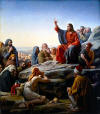
Sermon on the Mount

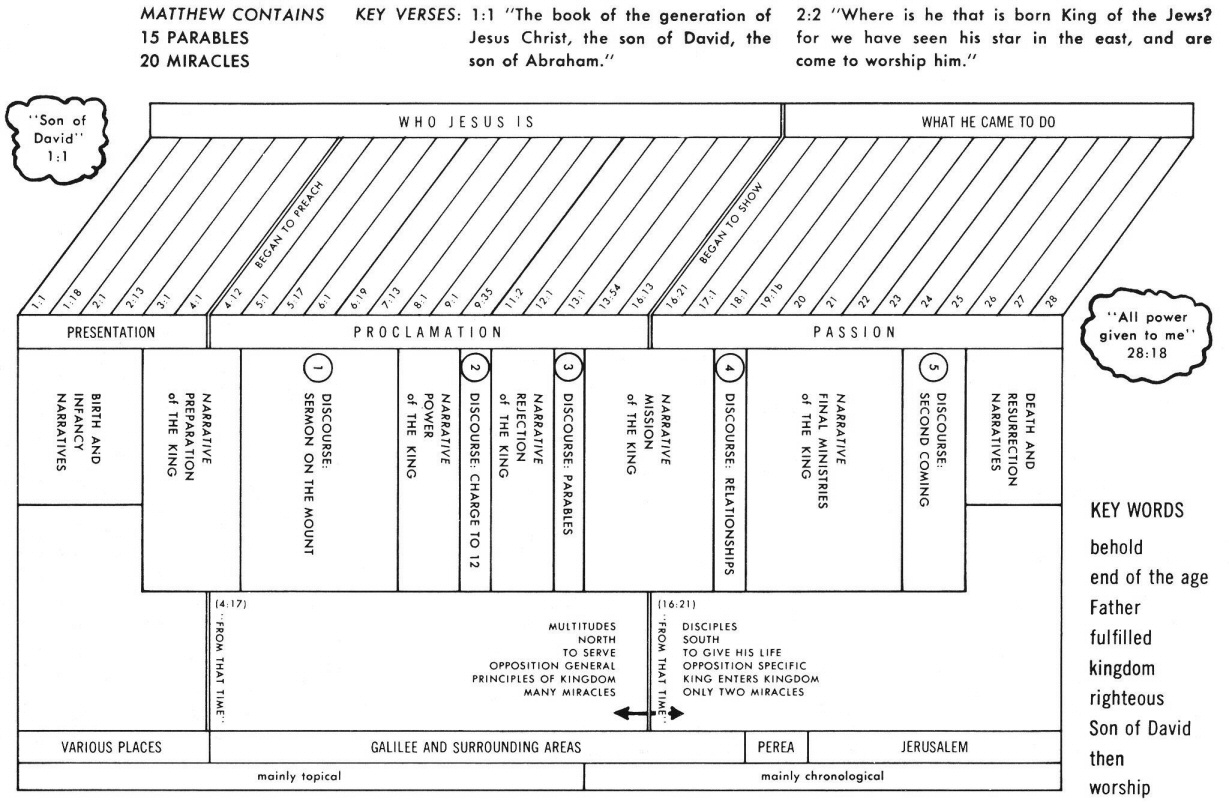
Click chart to enlarge
Charts from Jensen's Survey of the NT - used by permission
Another Chart from Charles Swindoll
THE LIFE OF JESUS AS COVERED
BY MATTHEW (shaded area)
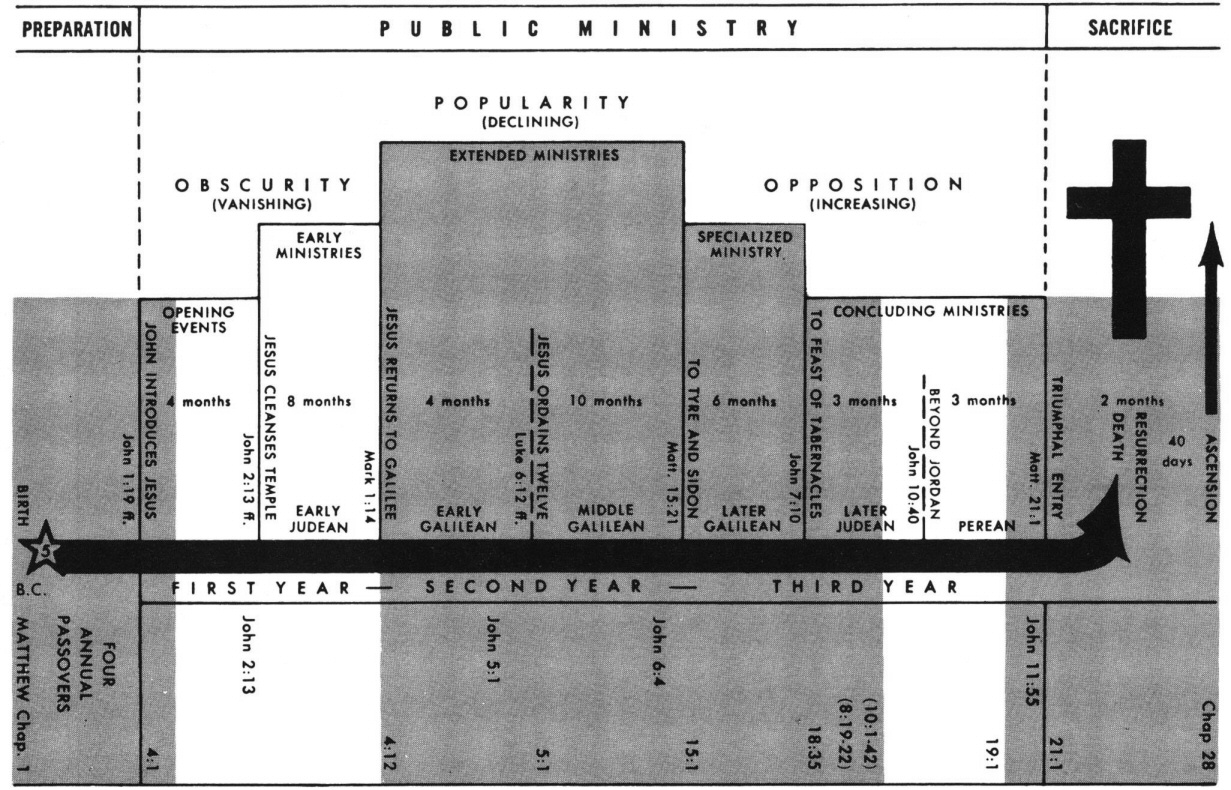
Click chart to enlarge
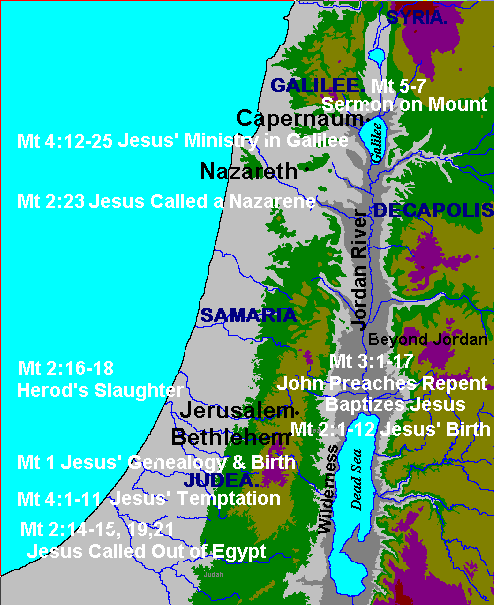
Jesus Birth and Early Years
Leading up to the Sermon on the Mount
Matthew 1-7

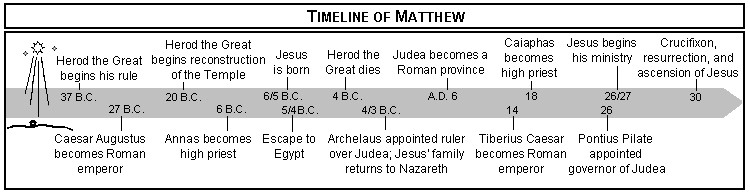
Source: Ryrie Study Bible
Matthew 5:8 Blessed are the pure in heart, for they shall see God. (NASB: Lockman)
Greek: makarioi oi katharoi te kardia, oti autoi ton theon opsontai. (3PFMI)
Amplified: Blessed (happy, enviably fortunate, and spiritually prosperous—possessing the happiness produced by the experience of God’s favor and especially conditioned by the revelation of His grace, regardless of their outward conditions) are the pure in heart, for they shall see God! (Amplified Bible - Lockman)
My Amplified Paraphrase - “Blessed—deeply favored, truly happy, spiritually fulfilled—are those whose hearts are clean, undivided, and free from hidden sin; whose inward life matches their outward profession; who desire God more than the world and refuse to harbor deceit, hypocrisy, or impurity. For such people, whose inner being has been purified by God’s grace and continually guarded by single-minded devotion, shall have the supreme privilege of beholding God—seeing Him with the eyes of faith now, enjoying intimate fellowship with Him in this life, and ultimately gazing upon His glorious presence forever in eternity.”
Barclay: O the bliss of the man whose motives are absolutely pure, for that man will some day be able to see God.
ICB: Those who are pure in their thinking are happy. They will be with God.
KJV: Blessed are the pure in heart: for they shall see God.
Philips: Happy are the utterly sincere, for they will see God! (New Testament in Modern English)
Wuest: Spiritually prosperous are those who are pure in the sphere of the heart, because they themselves shall see God. (Eerdmans)
Young's Literal: Happy the clean in heart--because they shall see God.
- Mt 23:25-28; 1Chr 29:17, 18, 19; Ps 15:2; 18:26; 24:4; 51:6,10; 73:1; Pr 22:11; Ezek 36:25, 26, 27; Acts 15:9; 2Co 7:1; Titus 1:15; Heb 9:14; 10:22; James 3:17; 4:8; 1Pe 1:22
BLESSED ARE THE
PURE IN HEART
As Jesus ascends the steps of this kingdom staircase, He now moves from outward actions to the very core of a person’s being—the heart. “Blessed are the pure in heart” reminds us that God is not impressed by external religion, polished behavior, or public performance. He is searching the inner life—the motives, desires, affections, and secret thoughts. In a world skilled at appearances and obsessed with image, Jesus declares that true blessedness belongs to those whose hearts have been cleansed by grace and made single in devotion to God. This beatitude confronts hypocrisy, exposes superficial religion, and invites us into the radiant promise that only the pure in heart will enjoy the deepest treasure of all: unhindered fellowship with God Himself.
Spurgeon - Christ was dealing with men’s spirits, with their inner and spiritual nature. He did this more or less in all the Beatitudes, and this one strikes the very center of the target as he says, not ‘Blessed are the pure in language, or the pure in action,’ much less ‘Blessed are the pure in ceremonies, or in raiment, or in food;’ but ‘Blessed are the pure in heart.
Charles Simeon - THERE is nothing in which mankind more generally imagine happiness to consist than in the uncontrolled indulgence of their passions. It is probable that among those who looked for the establishment of the Messiah’s kingdom, many pleased themselves with the idea, that his victories would open to them a way for multiplying captives to any extent, and consequently for the unlimited gratification of their corrupt appetites. To counteract such absurd notions, and to evince the spiritual nature of his kingdom, our blessed Lord declared, that happiness was to be found, not “in assimilating” ourselves to the brute creation, but in purity of heart and life: “Blessed are the pure in heart; for they shall see God.” (Matthew 5:8 Purity of Heart)
Do you remember the name, Yuri Gagarin… the year was 1961 and this Russian cosmonaut was the first human to travel into space. After circling the earth, he came back and declared that he looked outside his capsule and didn’t see God anywhere. To which Dr. W. A. Criswell replied, “Let him step out of his space suit for just one second and he’ll see God quick enough.”
Lloyd-Jones paraphrases this as "Blessed are those who are pure, not only on the surface but in the center of their being and at the source of every activity." (Lloyd-Jones, D. M. Studies in the Sermon on the Mount)
William Barclay picks up the thought of the Greek word for pure (see katharos below) - Blessed is the man whose motives are always entirely unmixed (cp 1Co 4:5), for that man shall see God. (Matthew 5 Commentary - Daily Study Bible online)
Isaac Watts has put this beatitude to hymn…
I Hunger and I Thirst
Blest are the pure, whose hearts are clean
From the defiling powers of sin;
With endless pleasure they shall see
A God of spotless purity.
Jesus' words in Matthew 5:8 answer the question "How does a man or woman cultivate 20/20 spiritual vision?"
Blessed (makarios) means spiritually prosperous, independent of one's circumstances because it is a state bestowed by God and not a feeling felt. Fortunate, approved of God, happy independent of happenings. The Amplified Bible has this expanded definition for "blessed"
happy, enviably fortunate, and spiritually prosperous—possessing the happiness produced by the experience of God’s favor and especially conditioned by the revelation of His grace, regardless of their outward conditions" (Amplified Bible - Lockman)
Pure (2513) (katharos) means literally physically clean or pure and has the idea of unsoiled (free from dirt), unalloyed, without blemish, spotless, free from impure admixture or free from adulteration.
Figuratively katharos was used in a ritual sense of food that was declared undefiled and thus acceptable (cf Ro 14:20+). In a moral or spiritual sense as used here by Jesus, katharos means to be free from corrupt desire or wrongdoing (sin and guilt) and thus pure or good in God's eyes (cf John 13:10 where Jesus was speaking figuratively, teaching that one who has been entirely cleansed, regenerated, possessing a new heart, born again, does not again need a radical renewal, but only needs to be cleansed from sins into which he falls each day, cf 1Jn 1:9). Katharos is to be free from admixture of what is false thus conveys the ideas of genuine, blameless or innocent.
Adrian Rogers notes that katharos "does not have to do so much with cleanliness, although that is inferred. It has to do more with unity or singleness of heart or mind. It literally means, blessed is that which is unmixed. For example, grain that would have chaff in it, would not be pure. Or metal that would have alloy in it would not be pure. Or milk that had been diluted would not be pure. Or an army that would have people who would defect, defectors in it, would not be pure. And so when he says, "Blessed are the pure in heart, what he is talking about is, Blessed are those who have integrity, that do not have divided hearts. That do not have double hearts. The word literally means singleness of heart." Listen to one of my favorite (very) old song by Craig Evans (
As used in Mt 5:8, katharos describes a heart which is pure in motive and which exhibits single mindedness, undivided devotion and spiritual integrity. The idea is "This one thing I do" (as Paul said in Php 3:13+). So although, "pure in heart" includes the ideas of moral purity or freedom from sensuality, that is not the primary idea in the word katharos. Pure (katharos) has to do with attitudes, integrity, and singleness of heart as opposed to duplicity and double mindedness (cf Jas 4:8+). Thus, one might paraphrase Jesus' words in this beatitude as…
I desire a heart that is unmixed in its devotion and motivation.
Pure Motives
from a
Pure Heart
Katharos gives us our English word catharsis which is used to describe a cleansing of one's mind or emotions.
The basic idea is that of integrity, singleness of heart,
as opposed to duplicity, a double heart, a divided heart.
Warren Wiersbe says katharos "has two basic meanings: “clean” and “unmixed....in this Beatitude (katharos) takes the second meaning, for being “pure in heart” involves being unmixed as well as being clean. Milk that is pure is not adulterated with water. Gold with the dross removed is pure gold. Wheat with the chaff removed is pure wheat. The basic idea is that of integrity, singleness of heart, as opposed to duplicity, a double heart, a divided heart. When God cleanses sinners and makes them His children, He does more than merely wash away sin. He puts within them a new heart that wants to focus wholly on God. “I will give them singleness of heart and action, so that they will always fear me for their own good and the good of their children after them” (Jeremiah 32:39) (Ed: See also the promise of the New Covenant in Ezekiel 36:26 ""Moreover, I will give you a new heart and put a new spirit within you; and I will remove the heart of stone from your flesh and give you a heart of flesh."). This is spiritual and moral integrity. It was this integrity that made David a successful king, and it was the lack of this integrity that corrupted and defeated Saul.
R Kent Hughes illustrates this idea of single mindedness writing that
Negatively, we can imagine this idea from everyday life if we reflect on those people who, having been introduced to us, keep talking and smiling, while at the same time looking behind and around us at other people and things. They really are not interested in us; they only see us as objects or a means to an end. In the God-man relationship such behavior is scandalous. Positively stated then, "pure" is represented by the words focus, absorption, concentration, sincerity, and singleness. "Blessed are the pure" is a searching statement, because focusing on God with a singleness of heart is one of the biggest challenges to twentieth-century Christians. Very few in this frenetic age are capable of the spiritual attention this Beatitude calls for (Ed: Not just "very few" but NONE of us! The only One Who is capable of enabling us to watch over our heart [Pr 4:23] is the Holy Spirit Who indwells us - thus we need to daily surrender to Him so that we are continually filled [controlled] so that in turn we can access His power to kill sin - cf Ro 8:13, Eph 5:18, Phil 2:13NLT). (See The Sermon on the Mount: The Message of the Kingdom)
MacArthur writes that katharos
was often used of metals that had been refined until all impurities were removed, leaving only the pure metal. In that sense, purity means unmixed, unalloyed, unadulterated. Applied to the heart, the idea is that of pure motive-of single-mindedness, undivided devotion, spiritual integrity, and true righteousness. Double-mindedness has always been one of the great plagues of the church. We want to serve the Lord and follow the world at the same time. But that, says Jesus, is impossible (cf Mt 6:24+, Jas 4:4+, Jas 4:8+)… Christians have the right heart motive concerning God. Even though we often fail to be single-minded, it is our deep desire to be so… Paul’s deepest spiritual desires were pure, although the sin dwelling in his flesh sometimes overrode those desires. Those who truly belong to God will be motivated to purity… The deepest desire of the redeemed is for holiness, even when sin halts the fulfillment of that desire… Purity of heart is more than sincerity. A motive can be sincere, yet lead to worthless and sinful things… Sincere devotees walk on nails to prove their spiritual power. Others crawl on their knees for hundreds of yards, bleeding and grimacing in pain, to show their devotion to a saint or a shrine. Yet their sincere devotion is sincerely wrong and is completely worthless before God. The scribes and Pharisees believed they could please God by such superficial practices as tithing “mint and dill and cummin”; but they “neglected the weightier provisions of the law: justice and mercy and faithfulness” (Mt 23:23). They were meticulously careful about what they did outwardly but paid no attention to what they were inwardly… Even genuinely good deeds that do not come from a genuinely good heart are of no spiritual value. Thomas Watson said, “Morality can drown a man as fast as vice,” and, “A vessel may sink with gold or with dung.” Though we may be extremely religious and constantly engaged in doing good things, we cannot please God unless our hearts are right with Him. (See 10 page discussion in Matthew Commentary - Page 204)
FIVE TYPES OF
PURITY
Dr MacArthur in his online sermon Happy are the Holy Matthew 5:8 outlines 5 types of purity...
Number one is what I call primitive purity. You say, “What is primitive purity?” That’s the kind of purity that exists only in God. It is as essential in God as light is to the sun, as wet is to water. It is His primitive purity.
Second, there is....created purity. It is the creation of a pure being before the fall. God created angels in purity, created man in purity, and then both fell. But it’s created purity. So you have primitive purity, that which is true only of God. You have created purity, that which He grants out of His own purity to a being He creates.
Third: ultimate purity. Ultimate purity is a category of glorification. In other words, ultimately, all the saints of God will be completely pure, right? Someday we’re going to have all of our sin washed away, we’re going to be cleansed, totally clean, we’re going to dwell with God in His eternal heaven forever, at that point, experiencing ultimate purity. 1 John 3:2 (+) tells us how it will be. “When He appears, we will be like Him, because we will see Him just as He is.”
Fourth is positional purity....Positional purity is the purity that we have been given right now by the imputation of the righteousness of Christ. When you believe in Jesus Christ, God imputes to you a positional kind of purity. In other words, your position in Christ grants to you purity. When God looks at John MacArthur, believe it or not, He says, “John MacArthur, right, absolutely pure in Christ. The righteousness of Christ has been applied to him because he believed in Jesus Christ.” Romans 3 tells us that the righteousness of Christ is imputed to us (cf Ro 3:24). Romans 5 tells us that we have been justified because of what Christ has done (Ro 5:1). Galatians 2:16 (+) tells us the same thing. 2 Corinthians 5:21 (+), the same thing. Ephesians 5 says that husbands are to love their wives as Christ loves the church and as He has cleansed the church and He washed the church. And in 2 Corinthians chapter 11, the apostle Paul that says that the church is like a chaste virgin. There is a positional purity.
Fifth...practical purity. Now, this is the hard part, folks. Only God knows primitive purity. Only God can bestow created purity. Someday God will give every saint ultimate purity. Right now every believer has positional purity. But boy, we have a lot of trouble with the practical kind don’t we? Trying to live out what we are in position. And that’s why the apostle Paul cries out in 2 Corinthians 7:1 (+), that tremendous statement to all believers, and we must hear it. Listen to what he says. “Dearly beloved, let us cleanse ourselves from all filthiness of the flesh and spirit, perfecting holiness and the fear of God.” He’s not talking about primitive, created, ultimate, or positional. That’s God’s business. What he’s crying for is a practical living purity. And at best, it’ll be gold mixed with some iron. At best, it’ll be a white cloak with some black thread. But God wants us to be as pure as we can be, practically, before Him.
Listen, people: It’s those people who are positionally pure in Jesus Christ who will see God, who will be in His kingdom. And those kinds of people will manifest it in a purity of life, in pure motives and in pure living. If that’s not true in your life, then you’re not a Christian, or you’re a Christian living in disobedience. We fail. Sure, we fail. But the Bible tells us how to deal with failure. We’re going to be tempted to be impure. We’re going to be tempted to have impure thoughts, say impure words, do impure things. We’re going to be tempted to have motives that aren’t right that’ll issue in words and deeds that aren’t right. But the Bible tells us how to deal with temptation. Read Ephesians 6, get your armor on. You say, “But what if I fail? What if I fail?” The Bible tells you how to deal with that. If we confess our sins, He’s faithful and still righteous to keep on cleansing us from all unrighteousness. Tells you how to deal with the temptation and the failure, and every time, you face it and you repent and you deal with it, and God cleanses it and you move on to a greater level of purity. (Happy are the Holy Matthew 5:8)
The TDNT (borrow) sums up the usages of katharos as pertaining to…
physical, religious, and moral cleanness or purity in such senses as clean, free from stains or shame, and free from adulteration… In Primitive Religion. Ideas of power are dominant in primitive thinking about cleanness. After coming into contact with power, e.g., in birth, sex, and death, cleansing is necessary to fit one for ordinary life… In Greek Religion. At its primitive stage Greek religion follows the customary pattern. At the historical stage, however, the gods are seen as friendly forces, though they must be approached with cultic purity… The Old Testament reflects the same general development. Uncleanness, which may be contracted in contact with birth or death (Lv 12:1ff; Nu 19:11), is a positive defiling force. So is anything linked to a foreign cult… Stress also falls, however, on the holiness of God, so that the concept of purity develops with special force. Purifications by washing, sacrifice, or transfer restore forfeited purity and open up access to God. (Kittel, G., Friedrich, G., & Bromiley, G. W. Theological Dictionary of the New Testament. Grand Rapids, Mich.: W. B. Eerdmans)
In classical Greek katharos described a river who course was "clear and open". In a moral or ethical sense the Greeks used katharos to describe one "clear from shame", "clear of guilt", of persons who purified after pollutions (even to the pagan Greeks touching a dead body cause one to be polluted). Katharos legally described one's state of being "clear of or from" a charge. Katharos was used to describe water which was "clear of admixture" and so "clear" or "pure". It was used to describe an individual's birth as "pure" or "genuine" and thus "citizens who were of pure blood". Herodotus used katharos to describe "the sound portion of the army", that is, that portion which was without blemish. The phrase "with clean hands" equated with "honestly".
Katharos is used far more frequent in the Septuagint (LXX) - 135 times! The first 8 uses describe "clean" animals (cf Ge 7:2, 3, 8, 8:20), "pure" gold (cf the components inside God's Tabernacle! Ex 25:11,17, 29, 31, 36, 38, 39)
In the LXX of Genesis 20:5 we find a very interesting use of katharos. Abimelech had not gone into Sarah (who Abraham had lied about as being his sister) and so when confronted by God in a dream declared…
Genesis 20:5: "Did he (Abraham) not himself say to me, 'She is my sister'? And she herself said, 'He is my brother.' In the integrity (LXX = katharos for the Hebrew = tom = completeness, the quality or state of being complete or undivided as in our English term integer. Study the 7 uses in Psalms and uses in Proverbs and see if they don't relate to "purity of heart" as in this beatitude) of my heart and the innocence of my hands I have done this." 6 Then God said to him in the dream, "Yes, I know that in the integrity (LXX = katharos) of your heart you have done this, and I also kept you from sinning against Me; therefore I did not let you touch her." (Genesis 20:5-6)
Here is another interesting use of katharos in the LXX translation of Leviticus 7:19 (cf Lev 10:10, 11:36-37, 47, in fact 33 total uses of katharos for tahowr - see below - in the book of Leviticus)
'Also the flesh that touches anything unclean shall not be eaten; it shall be burned with fire. As for other flesh, anyone who is clean (LXX = katharos for the Hebrew tahowr = describes pure, clean animals and also that which is unalloyed) may eat such flesh.
Comment: The Hebrew Tahowr or "Clean" most frequently described the purity maintained by avoiding contact with other human beings, abstaining from eating animals, and using things that were declared ceremonially clean. Conversely, cleansing results if ritual procedures symbolizing the removal of contamination are observed. This latter "science" the Pharisees had made into an "art" with their emphasis on the external at the expense of the internal! Mt 5:20 (note). The Pharisees liked the idea of “Blessed are the pure” as long as the statement stopped right there because they were the resident experts in outward purity. They had innumerable rules and regulations covering what you ate, what you wore, how far you could walk in the Sabbath, and so on. They scored an "A+" on being outwardly pure. But they flunked out on inward purity. To them this beatitude would be something like…
"Blessed are the outwardly clean, for they shall see God."
Jesus turned the tables on the Pharisees using their own vocabulary! To be pure in body is good. But to be pure in heart is best of all because it takes care of the external (in the right way). If you are pure in your heart, you will be pure everywhere. To be pure in heart then means to be pure from the inside out.
Look at Jesus' scathing pronouncement against the external purity without heart purity as practiced by the Pharisees in Mt 23:25-26, 27-28 declaring…
"Woe to you, scribes and Pharisees, hypocrites! For you clean (verb form katharizo) the outside of the cup and of the dish, but inside (their hearts were not pure) they are full of robbery and self-indulgence.
26 "You blind Pharisee, first clean (verb form katharizo) the inside (first believe what your prophets wrote about "inner cleansing" = Ezekiel 36:26, 27; 11:19, 20, 18:31, cf Deut 30:6, Jeremiah 31:34, 32:39, 40, Acts 15:9, 1Peter 1:22, 23),: of the cup and of the dish, so that the outside of it may become clean also.
27 "Woe to you, scribes and Pharisees, hypocrites! For you are like whitewashed tombs which on the outside appear beautiful, but inside they are full of dead men's bones and all uncleanness. (akathartos - derived from the negative of katharos)
28 "Even so you too outwardly appear righteous to men, but inwardly you are full of hypocrisy and lawlessness.
Two more uses of katharos in the LXX are instructive, both in psalms by David (cf Acts 13:22)…
Who may ascend into the hill of the LORD? And who may stand in His holy place? 4 He who has clean hands and a pure (LXX = katharos) heart, who has not lifted up his soul to falsehood, and has not sworn deceitfully. (Psalm 24:3-4) (See notes)
Create (command - David came "boldly" to the throne - the only way he could have done so is by knowing the One through Whom He had such bold access to the Father!) in me a clean (LXX = katharos for the Hebrew tahowr = describes pure, clean animals and also that which is unalloyed) heart, O God, And renew a steadfast spirit within me. (Psalm 51:10) (See notes)
Finally in Ezekiel God promised that one day in the future (to be completely fulfilled at the return of Messiah at the end of the Great Tribulation)
Then I will sprinkle clean (LXX = katharos) water on you, and you will be clean (LXX = verb from katharizo > English "cathartic"); I will cleanse (katharizo) you from all your filthiness and from all your idols. 26 "Moreover, I will give you a new heart and put a new spirit within you; and I will remove the heart of stone from your flesh and give you a heart of flesh. (Ezekiel 36:25-26)
Katharos is the source of the English word catharsis, meaning purifying or cleansing. It is akin to the Latin castus from which we derive the word pure.
As alluded to above, from a biblical standpoint the concept of cleansing was deeply rooted in both the Old Testament, especially the Torah (the first five books of Moses). Under the Levitical laws heavy emphasis was placed on ceremonial cleansing. This forbade contact with unclean animals, substances, persons, or places. By the time of Christ this preoccupation with ceremonial cleanness had largely displaced true worship in Spirit and truth. Thus in this beatitude Jesus focuses in on a clean heart, rather than on ceremonial cleanness.
Charles Hodge rightly observed that “Whenever true religion declines, the disposition to lay undo stress on external rites is stressed."
William Barclay explains that katharos but also had several meanings that help understand its use in this beatitude…
(i) Originally it simply meant clean, and could, for instance, be used of soiled clothes which have been washed clean.
(ii) It is regularly used for corn which has been winnowed or sifted and cleansed of all chaff.
In the same way it is used of an army which has been purged of all discontented, cowardly, unwilling and inefficient soldiers, and which is a force composed solely of first-class fighting men.
(iii) It very commonly appears in company with another Greek adjective—akēratos. Akēratos can be used of milk or wine which is unadulterated with water, or of metal which has in it no tinge of alloy.
So, then, the basic meaning of katharos is unmixed, unadulterated, unalloyed. That is why this beatitude is so demanding a beatitude. It could be translated: Blessed is the man whose motives are always entirely unmixed, for that man shall see God. So, then, a pure heart is a heart whose motives are absolutely pure and absolutely unmixed.
(Katharos) it is commonly used in housing contracts to describe a house that is left clean and in good condition. But its most suggestive use is that katharos is used of that ceremonial cleanness which entitles a man to approach his gods. Impurity, then, is that which makes a man unfit to come before God, the soiling of life with the things which separate us from him. (Matthew 5 Commentary - Daily Study Bible)
Ray Pritchard gives us an excellent practical definition of purity of heart explaining that
Pure gold is not clean gold but 100%. Pure bread is all bread and no leaven. Pure water means that all the harmful elements have been removed by filtration. Some of you will remember when Ivory Soap advertised itself as being “99 and 44/100ths percent pure.” But in truth, anything less than 100% is not really pure! In this context being “pure in heart” means to have no double allegiance. Later on in the Sermon on the Mount Jesus warned against serving God and mammon (Matthew 6:24). No one can serve two masters at the same time. You will always love one and hate the other. And James 1:6-8 teaches us that the double-minded man is unstable in all his ways.
To be pure in heart means that you are sincere, transparent and without guile. What you see is what you get. No fakery, no trickery, no hypocrisy. I still remember hearing one of my Greek professors in seminary speak about Dr. John Walvoord, who was then the president of Dallas Seminary. He said, “You never have to wonder what Dr. Walvoord really means or if he’s trying to send you a double message. He is man without guile.” That statement has stayed with me across all these years because he’s the only man I’ve ever heard described in those terms. That statement reminds me of something I heard many years ago. A counselor said that he often tells his counselees, “You’re only as sick as your secrets.” The more you have to hide, the sicker you are. And if you’ve got a lot of secrets, you’re really sick.
Is your life an open book? Or do you have things that you hide from your best friends and from your loved ones? Is there anyone in your life who knows the truth about who you really are? Blessed are the pure in heart, for they have nothing to hide. (Matthew 5:8 The Tragedy of Double Vision) (Bolding added)
We must remember that God is far more concerned with what we ARE than with what we DO for Him. If our character does not align with His holiness, then our activity—no matter how impressive—is essentially worthless. (cf. 1 Sam. 16:7+)
In his first letter to Timothy Paul wrote that (in contrast to the false teachers)…
the goal of our instruction is love from a pure heart and a good conscience and a sincere faith. (1Ti 1:5)
To have a pure heart fellowship and be accountable to those who have one… Paul says it this way (in his last written communication to Timothy)…
Now flee from youthful lusts, and pursue righteousness, faith, love and peace, with those who call on the Lord from a pure (katharos) heart. (2Ti 2:22+)
As yet we know Thee but in part;
But still we trust Thy Word,
That blessèd are the pure in heart,
For they shall see the Lord.O Savior, give us then Thy grace
To make us pure in heart,
That we may see Thee face to face
Hereafter, as Thou art.
---John M. Neale
John Blanchard writes "The Danish philosopher Soren Kierkegaard may have come as close as anyone to a precise definition of purity of heart with his famous aphorism that it means ‘to will one thing’. The pure in heart are the same on the inside as they are on the outside. As R V G Tasker puts it, they are ‘free from the tyranny of a divided self’. They may not be sinless, but they are sincere. They are the same in private as they are in public. Their religious activities are not a cover-up, hiding more than they reveal, as was the case with the Pharisees, of whom Jesus said, ‘These people honour me with their lips, but their hearts are far from me’ (Mark 7:6). When the pure-hearted man goes to church, his heart is there. He can truthfully say with the Psalmist, ‘I rejoiced with those who said to me, “Let us go to the house of the Lord” ’ (Psalm 122:1). When he prays, his heart is in it. He is among those who ‘call on the Lord out of a pure (katharos) heart’ (2 Timothy 2:22). His religion is not a lifeless performance but a living experience. He worships, prays, gives, serves and witnesses for Christ, and seeks to live in obedience to God’s Word, not because these things are expected of him, but because he has no wish to do otherwise. A friend of mine used to say that a hypocrite was someone who let his light so shine before men that nobody could tell what was going on behind. Not so the pure in heart. There is no hidden agenda, no moral, spiritual or religious sleight of hand. When Brian Johnston, the well-known British broadcaster, died in 1994, friends published a tribute called Summers will never be the same. In it, the blind American pianist George Shearing, a close friend for nearly 40 years, wrote, ‘To meet Brian Johnston was to know Brian Johnston.’ Author and songwriter Tim Rice added, ‘The man behind the microphone was the man himself … it is this aspect of Brian that first and foremost springs to mind.’ Cricket correspondent John Woodcock called him ‘quite without artifice’, and Andrew Johnston, the broadcaster’s second son, saw him as ‘one who had no hidden side’. According to fellow commentator Peter West, ‘He was always totally, irrepressibly and unrepentantly himself: what you saw or heard was exactly what you got.’ These tributes were not paid in a religious or spiritual context, and they need to be assessed with this in mind, but they surely prompt any Christian reading them to ask some probing questions: Is pleasing others sometimes more important to me than pleasing God? Is what I do consistent with what I really think? Do I sometimes put popularity before principle? Am I more concerned about making an impression than about doing what is right? What occupies my mind when I am alone, and have nobody to impress? Am I more concerned about my reputation than I am about my character? As John Calvin reminds us, ‘The Lord first of all wants sincerity in his service, simplicity of heart without guile and falsehood.’ Every Christian should continually pray with the Psalmist, ‘O Lord … give me an undivided heart’ (Psalm 86:11)." (The Beatitudes for Today)
David Guzik - Blessed are the pure in heart: In the ancient Greek, the phrase pure of heart has the idea of straightness, honesty, and clarity. There can be two ideas connected to this. One is of inner moral purity as opposed to the image of purity or ceremonial purity. The other idea is of a single, undivided heart—those who are utterly sincere and not divided in their devotion and commitment to God.
In his book Improving Your Serve (BORROW), Charles Swindoll tells of speaking at a singles retreat in a Rocky Mountain resort. He had purposely brought along a full-faced rubber mask that his children had given him as a funny present. One evening he wore it as he began to speak on authenticity. As expected, the crowd went wild with laughter. Each new sentence increased the effect. After removing the mask, he observed, "It's a funny thing, when we wear literal masks, nobody is fooled. But how easy it is to wear invisible ones and fake people out by the hundreds....Servants who are `pure in heart' have peeled off their masks. And God places special blessing on their lives." As David Egner adds "We all struggle with the problem of hypocrisy. But when our hearts are pure, we will have no reason to cover our faces."
Vance Havner - The pure in heart are those who follow holiness, without which no man shall see the Lord.
James Smith on pure in heart - His heart is right with God. Wholly yielded up to His holy will. Delighting in all that is pleasing to Him. Cleansed by the blood, and open to the light....The pure in heart shall see the face of God in His Son, in His Word, and in His Providence. (Handfuls of Purpose)
Heart (2588) (kardia) is used figuratively most often in Scripture and refers to the center of each persons thoughts (mind) and will (see note by MacArthur below). The heart usually is more general referring to the inner person, the center of life, the volitional center of our being. The heart is the seat and "master control center" of human life. It is the center of your personality, the “real you” who makes the decisions of life. Thus, to be pure in heart is to be pure in the center of your life.
Jeremiah reminds us that unfortunately it is the heart that is source of all our troubles for "The heart is more deceitful than all else And is desperately sick; Who can understand it?' (Jeremiah 17:9)
Jesus echoes Jeremiah's assessment of the heart reminding us that "out of the heart come evil thoughts, murders, adulteries, fornications, thefts, false witness, slanders. These are the things which defile the man" (Matthew 15:19,20)
Why is the state of one's heart so important? In the Old Testament here are just a few reasons…
But the LORD said to Samuel, "Do not look at his appearance or at the height of his stature, because I have rejected him; for God sees not as man sees, for man looks at the outward appearance, but the LORD looks at the heart." (1 Samuel 16:7) (cf Acts 13:22 "… 'I HAVE FOUND DAVID the son of Jesse, A MAN AFTER MY HEART, who will do all My will.' = single minded devotion and integrity just as Jesus calls for in this Sixth Beatitude) (Reputation is what others think about me. Character is what God knows is true of in my heart!)
"For the eyes of the LORD move to and fro throughout the earth that He may strongly support those whose heart is completely His… " (2Chronicles 16:9)
Watch over your heart with all diligence, for from it flow the springs of life. (Proverbs 4:23see note)
There is a certain "blessedness" inherent in the consciousness of a pure heart. (cf clean conscience - see suneidesis) A consciousness of a pure heart is a personal awareness of purity in our life. O the blessedness of those with a pure heart, the control center for all of your life.
Vine writes that kardia "came to denote man’s entire mental and moral activities, and to stand figuratively for the hidden springs of the personal life, and so here signifies the seat of thought and feeling.
MacArthur commenting on kardia writes that "While we often relate heart to the emotions (e.g., “He has a broken heart”), the Bible relates it primarily to the intellect (e.g., “Out of the heart come evil thoughts, murders, adulteries, fornications, thefts, false witness, slanders,” Matt 15:19). That’s why you must “watch over your heart with all diligence” (Proverbs 4:23see note). In a secondary way, however, heart relates to the will and emotions because they are influenced by the intellect. If you are committed to something, it will affect your will, which in turn will affect your emotions." (bORROW Drawing Near. Crossway Books)
MacArthur adds that "In most modern cultures, the heart is thought of as the seat of emotions and feelings. But most ancients—Hebrews, Greeks, and many others—considered the heart to be the center of knowledge, understanding, thinking, and wisdom. The New Testament also uses it in that way. The heart was considered to be the seat of the mind and will, and it could be taught what the brain could never know. Emotions and feelings were associated with the intestines, or bowels." (SEE Ephesians Commentary - Page 45) (Bolding added)
Max Lucado on PURE HEART - Clean the refinery, and the result will be a pure product. We usually reverse the order. We try to change the inside by altering the outside.
John Blanchard - What then does it mean to be ‘pure in heart’? Before giving some positive answers to the question, one important negative point needs to be made, namely that purity of heart does not mean perfection. If it did, not even the finest believer who has ever lived would have the remotest possibility of embracing the promise that the pure in heart ‘will see God’. Over the centuries, a number of ‘sinless perfection’ movements have taught that at conversion the sinful nature is eradicated and have claimed the possibility of perfect purity in this life, but the Bible gives no warrant for such teaching. All the Bible’s saints were sinners, and remained so when they were at their most saintly. The Bible asks, ‘Who can say, “I have kept my heart pure; I am clean and without sin”?’ (Proverbs 20:9)—and all of humanity must remain silent. John, who was given that remarkable vision of heaven, bluntly admits, ‘If we claim to be without sin, we deceive ourselves and the truth is not in us’ (1 John 1:8). Paul, who writes again and again about his joyful certainty of spending eternity in God’s presence, nevertheless confesses, ‘For what I do is not the good I want to do; no, the evil I do not want to do—this I keep on doing’ (Romans 7:19). He was not saying that he never stopped sinning but that, in spite of all the progress he had made, sin kept rearing its ugly head. There is nothing in the Bible—let alone in this Beatitude—which gives anyone the right to claim sinless perfection on this side of the grave. In fact, as A W Pink rightly says: ‘One of the most conclusive evidences that we do possess a pure heart is to be conscious of and burdened with the impurity which still indwells us.’ Conviction of sin and purity of heart are by no means incompatible. The gospel promises are not to those who think they are perfect, but to those who grieve over their imperfections, and long to be holy. With this negative principle in place, we can now turn to the issues involved in purity of heart. (The Beatitudes for Today)
How Great is Your Desire for a Pure Heart? - In the forests of Northern Europe lives the ermine, a small animal best known for his snow-white fur. Instinctively, he protects his glossy coat with great care lest it become soiled. Hunters often capitalize on this trait. Instead of setting a mechanical trap to catch the ermine, they find his home in a cleft of a rock or a hollow tree and daub the entrance and the interior with tar. Then their dogs start the chase, and the frightened ermine flees toward his home. But finding it covered with dirt, he spurns the place of safety. Rather than soil his white fur, he courageously faces the yelping dogs, who hold him at bay until the hunters capture him. To the ermine, purity is dearer than life! O God gives us hearts like these little creatures of Yours! Amen
HOLY AND HAPPY - A boy who had just listened to a long sermon walked out of church with a big frown on his face. His father had pulled his ear during the service to keep him from fidgeting. "What's the matter, Johnny?" asked one of the deacons. "You look so sad." The frustrated young fellow responded quickly, "I am. It's hard to be happy and holy at the same time." This boy was probably expressing the feelings of many young Christians, and perhaps many adults as well. They have the idea that if they are to be good, they can't possibly be happy. The nineteenth-century South African minister Andrew Murray corrected that misconception. He said, "Holiness is essential to true happiness; happiness is essential to true holiness. If you would have joy, the fullness of joy, an abiding joy which nothing can take away, be holy as God is holy. Holiness is blessedness. . . . If we would live lives of joy, assuring God and man and ourselves that our Lord is everything, is more than all to us, oh, let us be holy! . . . If you would be a holy Christian, you must be a happy Christian. Jesus was anointed by God with 'the oil of gladness,' that He might give us the 'oil of joy.' In all our efforts after holiness, the wheels will move heavily if there be not the oil of joy." The joy of Christ should ring through our souls in our most holy moments. We're on the road to spiritual maturity when we've learned that happiness and holiness are not enemies, but friends. —D.C. Egner - The holiest man is the happiest man.
Rejoice, ye pure in heart,
Rejoice, give thanks, and sing;
Your glorious banner wave on high,
The cross of Christ your King.
EDWARD H. PLUMPTRE (1821–1891)
Bill Bright - “Blessed are the pure in heart: for they shall see God.” MATTHEW 5:8, KJV
Jesus had a flashpoint against the hypocrisy of the Pharisees. They professed to be something they were not. Externally they did everything right, adhering meticulously to all the details of the law, yet He referred to them as being “whitewashed tombs” internally, and being “full of dead men’s bones.” Thus, obviously, the “pure in heart” did not apply to the Pharisees, according to His view of them.
In John 14:21, Jesus says, “The one who obeys Me is the one who loves Me and because he loves Me My Father will love him and I will too and I will reveal Myself to him.” That is another way of saying what He said in the verse in Matthew above. The pure in heart shall see God because He will reveal Himself to those who obey, and only the pure in heart obey.
If God seems impersonal to you, far off and unreachable, you may want to look into the mirror of your heart to see if anything there would grieve or quench the Spirit, short-circuiting His communication with you.
You may be sure of this promise of God: The pure in heart will experience the reality of His presence within.
If for some reason this is not your experience, God has made provision whereby you can have vital fellowship with Him. Breathe spiritually. Exhale by confessing your sins, and inhale by appropriating the fullness of God’s Spirit. Begin to delight yourself in the Lord and in His Word, asking God to give you a pure heart, and you may be assured that God will become a reality to you.
Billy Graham - Pure in Heart
“Blessed are the pure in heart, for they shall see God.” MATTHEW 5:8
Why does Jesus say we should be “pure in heart”? The reason is because our heart—our inner being—is the root of all our actions. From our hearts come our motives, our desires, our goals, our emotions. If our hearts aren’t right, our actions won’t be either. Jesus put it this way: “From within, out of the heart of men, proceed evil thoughts, adulteries, fornications, murders, thefts, covetousness, wickedness, deceit, lewdness, an evil eye, blasphemy, pride, foolishness” (Mark 7:21–22). But God wants to give us a pure heart—and He will. He does this first of all when we turn to Christ in repentance and faith, for “the blood of Jesus Christ His Son cleanses us from all sin” (1 John 1:7). But God also purifies our hearts day by day as we submit to the Holy Spirit and—with His help—flee from evil and seek what is good. “Blessed are the pure in heart.”
Thomas Watson - Meditation on heaven would make us strive after heart purity; because only the “pure in heart shall see God,” Matt. 5:8. It is only a clear eye that can look upon a bright transparent object.
Dennis Rainey - Blessed are the pure in heart, for they shall see God.MATTHEW 5:8 Moments With You: Daily Connections for Couples
When I was a boy, the thought of going to heaven sounded boring. As a young lad, I thought that there is so much more here that I wanted to experience. Places to go. Thrills to embrace. The thought of sitting around for all eternity strumming a harp didn’t appeal to me.
I had a very immature perspective of heaven back then. But in the last few years I’ve closed some of my letters and emails in a unique way:
God is good.
Life is a challenge.
Heaven looks better and better all of the time.
—Dennis
As I’ve read the Scriptures, I’ve realized that heaven looks much better than anything the world offers. I think life is one long process of God weaning us from this world and its pleasures and showing us that what we yearn for isn’t here.
Do you long for heaven? On those days when you desire heaven the most, is it because you’re exhausted, so you long for heaven’s rest? Is it because you’re drained by the burden of carrying life’s troubles and you long to be free? Is it because you’ve lost your sense of happiness and you long for a place of lasting peace and joy?
I don’t think it’s wrong to ache for a place of real sanctuary, a home in heaven where every tear will be wiped away, where “there will no longer be any mourning, or crying, or pain” (Revelation 21:4). But the true joy of heaven is not just pain relief. The true joy will be found in seeing our living Lord and Master, Jesus Christ, face to face. As Martyn Lloyd-Jones asked, “To stand in the very presence of God, to gaze and gaze on Thee … Is that heaven to us? Is that the thing we want above everything else?”
When you long for heaven, long for Him.
DISCUSS How deeply do you yearn for heaven? If not, what do you long for? What keeps it from being what you desire?
PRAY Pray that you will better see who Jesus is today and, in turn, set your affections “on things above,” not the world. (Moments with You)
Henry Blackaby asks "What does Jesus mean by “pure in heart”? It means having pure thoughts, pure motives, a pure will, and pure emotions. God requires purity at the very center of our being, in our heart....Several years ago, we had a family reunion in England. It was a wonderful time that provided incredible memories. While in London, we had the opportunity to tour Buckingham Palace. We saw the London Guard, beautiful tapestries, and other artwork and paintings from world-renowned artists. We walked in the hallways and stood in the rooms where history had been made. We were fascinated by the London Guard. Our tour guide told us that the highest military honor is to be assigned to guard Queen Elizabeth and Buckingham Palace. As we watched the changing of the Guard, we noticed that the guards marched, stood, and were dressed perfectly. The Queen has only the best of the best serving at her palace. What king or queen would have someone with filthy hands serving at his or her table? In our wildest imagination, we can’t picture a queen having someone dirty to serve her. It would be unacceptable. If a servant came to work unclean, he or she would be ineligible to attend to the queen’s personal needs. In the same way, Jesus—the King of kings—requires that those who serve Him have clean hands and pure hearts. Jesus said those who have pure hearts will see God; they will sit around His table and serve Him. They will hear what He says, know what is on His heart for the day, and see where He is working. Many times we want to see God’s activity and to be a part of His work in our world, but we don’t seem to see Him do much through our lives. We wonder where He is and why He hasn’t spoken to us or shown us His plans. If you have wondered the same thing, take a moment to consider your life. Are you ready for service? Are your hands clean from any stain of sin, and are the motives of your heart pure? Perhaps you need to pray as David did in Psalm 51: Create in me a clean heart, O God, and renew a steadfast spirit within me. Do not cast me away from Your presence, and do not take Your Holy Spirit from me. Restore to me the joy of Your salvation, and uphold me by Your generous Spirit. (BORROW Called and Accountable)
SINGLE HEART and PURE HEART
Two songs for your heart
Take a moment to listen to this song, one of my favorites from Craig Smith, entitled Single Heart...
He had only one aim
In placing us here
This is His domain
And His message is clear.
Single heart, Single mind.
My eyes forward all the time.
Single heart, purified.
Undivided, unified.
Single heart, Single mind.
May You find in us,
Solitary trust
May you find a single heart!
Here is another song Pure Heart -- take a moment to ponder your life in light the words sung by Craig Smith and make it your prayer to the Father today:
Over and over I hear it again
That the Father desires pure heart
Not to seek earthly treasure or the favor of man
But to be found with pureness of heart
Chorus
Pure heart is what the Father desires
Holy heart purified by God's holy fire
Broken heart, proven to be faithful and true
Fashion in me a heart that's thirsting for You
Search ever chamber, expose them to me
Create motives of honor and simplicity
May You find faithfulness, integrity
A heart which is worthy for Your eyes to see
Chorus
My only ambition is to stand before You
And find I was pleasing in Your sight
An obedient child of God, faithful and true
Found with pureness of heart
Chorus
FOR THEY SHALL SEE GOD: hoti autoi ton theon opsontai (3PFMI):
BLEST ARE THE PURE IN HEART
Blest are the pure in heart,
For they shall see our God;
The secret of the Lord is theirs;
Their soul is Christ’s abode.
The Lord, who left the heavens
Our life and peace to bring,
To dwell in lowliness with men
Their Pattern and their King.
Still to the lowly soul
He doth Himself impart;
And for His cradle and His throne
Chooseth the pure in heart.
Lord, we Thy presence seek;
May ours this blessing be;
Give us a pure and lowly heart,
A temple meet for Thee.
---John Keble
THE BLESSED PROMISE:
SEEING GOD
For - Always pause and ponder this instructive term of explanation.
As with the other beatitudes, In the Greek "they" is placed emphatically in the sentence signifying that it is "they and they alone" who will see God. It is only the pure in heart, who shall Him for He reserves intimate knowledge of and fellowship with Him for those who maintain this purity of heart. How this should motivate us.
John MacArthur describes the blessed promise -- "There’s one other question I can’t resist just mentioning. What is the promise attached to such purity? What happens if we’re pure? Ah, this is so great. The end of the verse, “They shall” – what? – “see God.” This is a future indicative in Greek. A future continuous tense. Let me read to you how it should go. “They shall be continually seeing God for themselves.” It’s middle voice reflexive. “They shall be continuously seeing God for themselves.” You know what happens when your heart is purified at salvation? You live in the presence of God. You don’t see God with a physical eye; you see Him with a spiritual eye. You comprehend Him. You realize that He’s there. You see Him. And like Moses, who cried “Lord, show me thy glory,” the one whose heart is purified by Jesus Christ sees again and again the glory of God. Hey, listen, did you know that to see God was the greatest thing that a person in the Old Testament could dream of? Moses said, “Show me thy glory.” (Ex 33:18) What a thought. Philip said that day to Jesus, “Show us the Father and that’s sufficient.” (John 14:8) And beloved, when you are purified in your heart by Jesus Christ, you will see God. He’ll be alive to you and you’ll go on seeing Him. And as you mature, and the more pure you become, the greater the beatific vision becomes." (Happy are the Holy - Matthew 5:8)
Spurgeon - It is a most blessed attainment to have such a longing for purity as to love everything that is chaste and holy, and to abhor everything that is questionable and unhallowed: There is a wonderful connection between hearts and eyes. A man who has the stains of filth on his soul cannot see God, but they who are purified in heart are purified in vision too: “they shall see God.”
Spurgeon tells this anecdotal story - One day, at an hotel dinner table, I was talking with a brother-minister about certain spiritual things when a gentleman, who sat opposite to us, and who had a serviette tucked under his chin, and a face that indicated his fondness for wine, made, this remark, ‘I have been in this world for sixty years, and I have never yet been conscious of anything spiritual.’ We did not say what we thought, but we thought it was very likely that what he said was perfectly true; and there are a great many more people in the world who might say the same as he did. But that, only proved that he was not conscious of anything spiritual; not that others were not conscious of it.
Spurgeon (Morning and Evening, Dec 13) - Sanctification, as it conforms us to our Lord, is another agate window. Only as we become heavenly can we comprehend heavenly things. The pure in heart see a pure God. Those who are like Jesus see him as he is. Because we are so little like him, the window is but agate; because we are somewhat like him, it is agate. We thank God for what we have, and long for more. When shall we see God and Jesus, and heaven and truth, face to face?
Guzik - They shall enjoy greater intimacy with God than they could have imagined. The polluting sins of covetousness, oppression, lust, and chosen deception have a definite blinding effect upon a person; and the one pure of heart is freer from these pollutions....Ultimately, this intimate relationship with God must become our greatest motivation for purity, greater than a fear of getting caught or a fear of consequences.
• The heart-pure person can see God in nature.
• The heart-pure person can see God in Scripture.
• The heart-pure person can see God in his church family.
And I would add one more to Guzik's list -- "the heart-pure person" can see God at work in his or her circumstances. In other words heart which is becoming purer and purer (as should happen as we mature in Christ) heart is better able to "see Him" (by faith) working in the providential circumstances He allows and/or brings to pass (cp Moses in Heb 11:27+)
Matthew Poole - For though no mortal eye can see and comprehend the essence of God, yet these men shall by an eye of faith see and enjoy God in this life, though in a glass more darkly, and in the life to come face to face.
See (3708) (optánomai from horao = to see) means to see with the eyes implying not just the mere act of physically seeing but also actual perception (act of coming to comprehend, grasp, attain awareness or understanding of) of what one sees.
This specific form (verb indicative future middle deponent 3rd person plural) is found in Matt 5:8; 24:30; 28:10; Mk 13:26; Luke 21:27; John 19:37; Acts 2:17; Ro 15:21; Rev 22:4
Optanomai is used 4 times in 1 Corinthians 15 to describe Jesus' post-resurrection appearances (green = optanomai).
5 and that He appeared to Cephas, then to the twelve.
6 After that He appeared to more than five hundred brethren at one time, most of whom remain until now, but some have fallen asleep;
7 then He appeared to James, then to all the apostles;
8 and last of all, as it were to one untimely born, He appeared to me also. (see notes 1Cor 15:5; 15:6; 15:7; 15:8)
Optanomai is used repeatedly to refer to Jesus' Second Coming as shown in the following verses:
"And then shall appear the sign of the Son of man in heaven: and then shall all the tribes of the earth mourn, and they shall see the Son of man coming in the clouds of heaven with power and great glory" (Mt 24:30)
"hereafter you shall see THE SON OF MAN SITTING AT THE RIGHT HAND OF POWER" (Mt 26:64)
"Christ… shall appear a second time" (He 9:28+)
"Beloved, now we are children of God, and it has not appeared as yet what we shall be. We know that, when He appears, we shall be like Him, because we shall see Him just as He is." (1John 3:2+ )
"BEHOLD, HE IS COMING WITH THE CLOUDS and every eye will see Him" (Re 1:7+)
Here in Mt 5:8 "see" is in future continuous tense. In other words:“They shall be continually seeing God for themselves.”
The future tense also convey the idea of certainty. The pure in heart "shall certainly, continually see God for themselves".
Purity of heart cleanses the eyes of the soul so that God is "visible" (cf John 14:21, He 11:27+)
Blest are the pure, whose hearts are clean,
Who never tread the ways of sin;
With endless pleasures they shall see
A God of spotless purity.
---Isaac Watts (Play)
Ray Pritchard writes that there is something in man that wants to see God and so Jesus' words…
touch a nerve deep in the human heart. Jesus here promises that which all men desire—to see God. The Bible tells us that God has put eternity in the heart of every man. Pascal speaks of the “God-shaped vacuum” inside the human heart. Augustine said that our hearts are restless until they find their rest in God. Seeing God is the goal of all religion, the end of all true science, the desire of every nation, and the aim of all philosophy.
(Pritchard goes on to qualify this "sight" noting that… ) "You only see what you are looking for. This principle explains so many things that happen to us. A few years ago someone on staff said they were going to walk down to Starbucks to get a cup of coffee. I looked at them and said, “Where is Starbucks?” I had no idea where it was even though it’s only located two blocks from here on Lake Street and I had passed it at least 100 times. But I don’t drink coffee so I have no need to go to Starbucks. Even though I had passed by the store many times, I never saw it. That explains why many of us never “see” God. We aren’t looking for him so we miss him. That, by the way, answers an interesting Bible question. If Jesus really was the Son of God, how could so many people have missed his true identity? The answer is, most people weren’t looking for the Son of God so they never saw him. He lived on this earth for 33 years but most people never knew it. In the spiritual realm, as in all of life, you only see what you are looking for. What We Are Determines What We See. Read Psalm 18:20, 21, 22, 23, 24, 25, 26 (+). What we are determines we see! The kind of people we are determines the kind of revelation we receive.
In this context, “seeing God” means to have a deep experience of God, to know him intimately and personally. All successful marriages discover this truth on a human level. The longer you live with another person, the more you get to know them as they really are. Transparency begets intimacy. In a good marriage, there is nothing hidden because there is nothing to hide… Let me summarize this beatitude in a two short statements: 1. In this life a pure heart means a deep walk with God. 2. In eternity a pure heart means a new experience of God. This is what Psalm 24 (+) means when it asks “Who may ascend the hill of the Lord? Who may stand in his holy place?” The answer is simple: “He who has clean hands and a pure heart.” He will receive a blessing from the Lord. He will be vindicated by God himself.
That leads me to one final passage that has always intrigued me. He 11:27 (note) says (speaking of Moses), “By faith he left Egypt, not fearing the king’s anger; he persevered because he saw him who is invisible.” What an amazing phrase! Moses saw “him who is invisible.” But according to 2Corinthians 3:11, 12, 13, 14, 15, 16, 17, 18 we have an even greater privilege than Moses had. When he saw God the glory eventually faded from his face, but in Christ the veil has been taken away and now in Christ we have seen God face to face and his glory has been revealed to us. More than that, by the Holy Spirit we are daily being transformed into his likeness with “ever-increasing glory.” As I scan this beatitude and think about what it really means, I want to take off my shoes. Surely we are standing on holy ground. . (Matthew 5:8 The Tragedy of Double Vision)
We can't physically see God now with our human physical eyes, and so it follows that in this beatitude, Jesus is speaking figuratively of spiritual vision (and in concert with the meaning of katharos discussed above He is specifically speaking of "20/20 Spiritual Vision"). The Scripture repeatedly states that no human has physically seen God the Father…
"But He (God to Moses) said, "You cannot see My face, for no man can see Me and live!" (Exodus 33:20) (Note: Even Moses who talked with God face to face in Nu 12:8 never God saw in His essence but only saw the “back side” of God. Seeing God’s essence is like looking directly into the sun. The light is too bright, it destroys your eyesight)
"Then the LORD spoke to you from the midst of the fire; you heard the sound of words, but you saw no form-- only a voice." (Deut 4:12)
"And the Father who sent Me, He has borne witness of Me. You have neither heard His voice at any time, nor seen His form." (John 5:37)
"Not that any man has seen the Father, except the One who is from God; He has seen the Father" (John 6:46)
"(God) who alone possesses immortality and dwells in unapproachable light; whom no man has seen or can see. To Him be honor and eternal dominion! Amen." (1Timothy 6:16)
No one has beheld God at any time; if we love one another, God abides in us, and His love is perfected in us. (1John 4:12)
The Scriptures however do state that seeing Jesus was tantamount to seeing the Father. For example…
"No man has seen God at any time; the only begotten God, who is in the bosom of the Father, He has explained (source of our word exegesis = explanation or critical interpretation of a text) Him. (John 1:18)
"Jesus said to him, "Have I been so long with you, and yet you have not come to know Me, Philip? He who has seen Me has seen the Father; how do you say, 'Show us the Father'?" (John 14:9)
"If I had not done among them the works which no one else did, they would not have sin; but now they have both seen and hated Me and My Father as well. (John 15:24)
"And He (Jesus) is the image of the invisible God, the first-born of all creation. (Col 1:15+)
"And He (Jesus) is the radiance of His (the Father's) glory and the exact representation of His (the Father's) nature, and upholds all things by the word of His power. (Heb 1:3+)
In addition there are numerous Old Testament appearances of God (theophanies) which when carefully observed leave little doubt that the One Who appeared was the Pre-incarnate Christ (Christophanies) in a form usually designated as the "Angel of the Lord". (click study). For example Jacob undoubtedly had a theophany of this type, for Moses records…
So Jacob named the place Peniel, for he said, "I have seen God face to face, yet my life has been preserved." (Genesis 32:30 )
In summary, the seeing that Jesus is referring to in this Beatitude is seeing with the eyes of the heart so to speak. Horao, the root verb of optánomai is used twice in Romans 1:20+ where Paul teaches that the creation (natural revelation) made God evident to man…
For since the creation of the world His invisible (aoratos from a = without + horao = see) attributes, His eternal power and divine nature, have been clearly seen, (kathorao from katá = an intensifying preposition + horáo = see) being understood through what has been made, so that they are without excuse. (Ro 1:20+)
And so in Romans 1:20 ("invisible" and "clearly seen") the root verb horao is used. In context "clearly seen" corresponds to "understood". In other words in the seeing of something God made (creation), there was an understanding of His invisible attributes, eternal power and divine nature. This is the way Jesus uses optanomai in the fifth beatitude. At least this is the meaning for those of us who are still on earth. But there is a greater seeing, the summum bonum (the greatest good), that Jesus includes in this beatitude and that is the seeing of Himself when He returns (in the Rapture or at the end of the Great Tribulation) or when we go home to Him at the end of our earthly life (2Cor 5:8). John writes…
Beloved, now we are children of God, and it has not appeared as yet what we shall be. We know that, when He appears, we shall be like Him, because we shall see (optanomai) Him just as He is. And everyone who has this hope fixed on Him purifies himself, just as He is pure (hagnos speaks of moral and spiritual purity). (1Jn 3:2-3+)
(Note how the certainty of the hope of seeing Jesus "tomorrow" should motivate us to live our life "today" so that when he appears we can have boldness and not shrink away from Him in shame at His coming. Beloved, mark it down - What or Who you are looking for, will determine what or who you live for) (See study on The Blessed Hope)
For now we see in a mirror dimly, but then face to face; now I know in part, but then I shall know fully just as I also have been fully known. (1Co 13:12+)
And there shall no longer be any curse; and the throne of God and of the Lamb shall be in it, and His bond-servants shall serve Him; and they shall see (horao) His face, and His name shall be on their foreheads. (Rev 22:3, 4+)
Job echoes a similar thought as does John in 1John 3:2 declaring…
"And as for me, I know that my Redeemer lives, and at the last He will take His stand on the earth. Even after my skin is destroyed, yet from my flesh I shall see God; Whom I myself shall behold, and Whom my eyes shall see and not another. My heart faints within me. (Job 19:26-27)
Spurgeon commenting on Job's affirmation writes…
"Mark the subject of Job’s devout anticipation—”I shall see God.” He does not say, “I shall see the saints”—though doubtless that will be untold felicity— but, “I shall see God.” It is not—”I shall see the pearly gates, I shall behold the walls of jasper, I shall gaze upon the crowns of gold,” but “I shall see God.” (Ed Note: Job says the same thing three times in different ways!) This is the sum and substance of heaven, this is the joyful hope of all believers")
Paul prays for the saints at Ephesus to have 20/20 spiritual vision…
I pray that the eyes of your heart (clarity of mind/understanding by which one is able to see all things intelligibly and clearly and proceed w/o mistake) may be enlightened, so that you may know what is the hope of His calling, what are the riches of the glory of His inheritance in the saints, and what is the surpassing greatness of His power toward us who believe. (Ep 1:18, 19-see notes Ep 1:18; 19)
It is not the stiff-necked rebellious heart who will see Jesus, but the pliable, pleasing, obedient heart as the King Himself declared in one of His incredible conditional promises…
"He who has My commandments and keeps them, he it is who loves Me; and he who loves Me shall be loved by My Father, and I will love him, and will disclose Myself to him." (John 14:21+)
Our Lord clearly promises the obedient saint, the one who is pure in heart - "I will make Myself manifestly apparent to that person." The Unseen and Risen Christ will be a real and spiritual Presence to the obedient and loving believer. Does this not make you hunger and thirst for righteousness, seeking to keep your heart pure?
Warren Wiersbe on cultivating a pure heart - You cannot read the Psalms without learning that David cultivated his heart, the inner person. “I will praise you, O Lord, with all my heart” (Psalm 9:1). “May the words of my mouth and the meditation of my heart be pleasing in your sight, O Lord, my Rock and my Redeemer” (Psalm 19:14). “Test me, O Lord, and try me; examine my heart and my mind” (Psalm 26:2). “My heart says of you, ‘Seek his face!’ Your face, Lord, I will seek” (Psalm 27:8). “My heart is stirred by a noble theme as I recite my verses for the king” (Psalm 45:1). (Did not Jesus say, “Out of the overflow of the heart the mouth speaks” [Matthew 12:34]?) Psalm 57 records David’s experiences in the cave when he was hiding from Saul, and twice he stated the desire of his heart: “Be exalted, O God, above the heavens; let your glory be over all the earth” (vv. 5, 11).
What was David’s secret? “My heart is steadfast, O God, my heart is steadfast; I will sing and make music” (Psalm 57:7). Saul’s heart was not steadfast; it was divided and unstable. “A double-minded man [is] unstable in all he does” (James 1:8). Saul set his heart on receiving honor before the people, and he lost both that and the honor that comes only from God. David set his heart on God and sought to honor Him, and God honored him in a singular way. When the Lord told David that He would build him a house and give him a throne forever (a promise that Messiah would come from David’s line), the king was overwhelmed. Like a child, David used his own name as he spoke to God: “What more can David say to you for honoring your servant? For you know your servant” (1 Chronicles 17:18). The highest joy of humanity comes from cultivating the deepest part of humanity, the heart. When the heart is pure, then the vision is clear, and a person will see God. (See Heirs of the King: Living the Beatitudes)
James Smith (Handfuls of Purpose) - Summary of Matthew 5:8
THE PURE IN HEART.
"Blessed are the pure in heart, for they shall see God" (Matt 5:8).
I. What is the Heart?
It embraces the will, the seat of the affections and desires. It is the Holy of Holies in man, the secret chamber of the Spirit.
II. What is Purity?
Purity implies the absence of everything that would pollute the waters or mar the harmony of our highest being Pure air, water, or gold means the non-presence of defiling or debasing elements.
III. What is Meant by a Pure Heart?
A heart brought back to its true and original condition, brought into perfect harmony with the will of God. The language of a pure heart is, "I delight to do Thy will, O God" (Ps. 40:8).
IV. How can the Heart be Made Pure? The heart, though deceitful above all things, and desperately wicked, can be made pure:
1. By faith in the atoning blood of Christ (Acts 15:9: Heb. 9:14).
2. By a continual abiding in the truth (John 17:17; Eph. 5:26).(Ed: And by continually confessing when we fall - 1 Jn 1:9)
V. What is the Blessing of a Pure Heart? "They shall see God." They see God—
1. In Christ Jesus.
2. In the Scriptures.
3. In providence.
4. In their own hearts.
They endure "as seeing Him who is invisible" (Heb. 11:27).
VI. How is it that only a Pure Heart can be so Blessed?
Because impurity blinds the eyes from seeing that which is pure and holy, just as jaundiced eyes discolour objects, or as earthly vapours conceal the heavens. "As a man thinketh in his heart so is he" (Prov. 23:7).
VII. Is my Heart Pure?
"Search me, O God"
"Search me, O God, and know my heart; Try me and know my anxious thoughts; 24And see if there be any hurtful way in me, And lead me in the everlasting way." (Ps. 139:23-24)
Tony Evans on PURE IN HEART - Organic food is becoming increasingly popular. No one wants to eat stuff that’s been sprayed with pesticides or pumped full of steroids and preservatives. Why? Because the extra stuff contaminates our bodies and makes us sick. When we eat food that man has messed with, we keep our bodies from functioning as God intended. The same principle applies to our hearts. When we feed our hearts whatever the world dishes out, we are at risk of spiritual disease. But when we focus our hearts on God’s Word and worship God with our thoughts and actions, He will keep our hearts pure and healthy. Only then will our hearts be capable of doing what they were meant to do—help us see God.
John Calvin wrote that “All knowledge of God is born of obedience.” -- As applied to Mt 5:8, the idea is that if we are diligent to obey God (as enabled by His Spirit), we will have the eyes of our heart opened (the Spirit illuminates) more and more to see God in our life whether it be in the glorious sunset, the glorious Word or the glory producing providential circumstances that impact our lives.
In his book Teach us to Number our Days Christian writer and former pastor David Roper adds this thought - "In this world we know and then we do. But God turns our theory of knowledge upside down. In His world we do and then we know. Every act of obedience quickens our sensitivity to God. It awakens our sense of His presence and deepens our capacity to comprehend the truth He has given us to know. Even the desire to obey opens our eyes to see more of God than we could otherwise see. “If anyone wills to do His will, he shall know concerning the doctrine, whether it is from God or whether I speak on My own authority,” Jesus said.(Jn 7:17) The corollary to this principle is that those who are unwilling to do God’s will have no knowledge of His ways. Blindness, error, and ignorance follow them throughout their lives. Ignorance and heresy, thus, are not a matter of the intellect, but of the heart. “They [the unbelieving] are darkened in their understanding and separated from the life of God because of the ignorance that is in them due to the hardening of their hearts.” (Eph 4:18) Bad behavior blinds men and women to the truth so that they “believe the lie.” (2 Th 2:11) They perish because they refuse to love the truth and so be saved. They are deluded because they have “delighted in wickedness.” (2 Th 2:12) Heresy, then, is not a matter of confusion, but of morality. Heretics, Paul notes, are not merely self-deceived; they are “depraved.” (2 Ti 3:8) C. S. Lewis states the principle this way: “What you see and what you hear depends a good deal on where you are standing. It also depends on what sort of person you are.” Put another way, it’s the pure in heart who see God.
Chris Tiegreen - A Culture of One Thing
God blesses those whose hearts are pure, for they will see God. Matthew 5:8
IN WORD
Our hearts aren’t completely pure. We know that. We’ve been told by a prophet that they are desperately wicked (Jeremiah 17:9), and though we’ve also been told by a prophet that we can have a new one (Ezekiel 36:26), we know some old things that still take place there. So when Jesus blesses the pure in heart, we aren’t very encouraged. We’re pretty sure we don’t qualify. We jump back to the first Beatitude and take comfort in our poverty of spirit. But for this Beatitude, we lose heart at the prospect of having a pure one.
The good news is that Jesus isn’t talking about spotlessness, at least not in practical terms. Perhaps He is referring to the cleansing that comes from His blood and the renewal that comes from His Spirit, but there’s even more to it than that. Having a pure heart means being singularly focused. The pure in heart are concerned with one thing: They are wholehearted in their desire for God. Their hearts are not distracted or filled with clutter. They are pure in their pursuit of Him and His Kingdom.
That’s encouraging. We can do that. It isn’t easy —we get distracted by lots of details in life —but we know what it’s like to be single-minded about something. A man in pursuit of his beloved, an athlete in pursuit of his prize, a researcher in pursuit of his great discovery —these are common human experiences. If that’s what it means to have a pure heart, we understand.
IN DEED
Some have called it a “magnificent obsession” or more biblically, a “pearl of great price,” or some other picture that captures the surpassing worth and beauty of the prize. Paul cast aside everything for it (Philippians 3:8), and we should too. That’s what Jesus urges His listeners to do. The pure in heart live in all-out pursuit of the things of the Kingdom, and of the King Himself. And they hang on to a promise: that their wholehearted devotion will result in the reward of seeing God.
PURE IN HEART “Blessed are the pure in heart, for they shall see God” (Matt. 5:8).✧✧✧
You have a part to play in becoming pure in heart. Purifying a heart is the gracious and miraculous work of the Holy Spirit, but there are some things we must do in response to His prompting.
First, we must admit we can’t purify our own hearts. Proverbs 20:9 says, “Who can say, ‘I have cleansed my heart, I am pure from my sin’?” The implied answer is, no one!
Next, we must put our faith in Jesus Christ, whose sacrifice on the cross is the basis for our cleansing. Acts 15:9 says that God cleanses hearts on the basis of faith. Of course, our faith must be placed in the right object. First John 1:7 says, “If we walk in the light as He Himself is in the light, we have fellowship with one another, and the blood of Jesus His Son cleanses us from all sin.”
Finally, we must study the Bible and pray. The psalmist said we keep our way pure by keeping it according to God’s Word, which we must treasure in our hearts (Ps 119:9, 11).
As we pray and submit to the Word, the Spirit purifies our lives.
That’s how you acquire and maintain a pure heart. As a result you “shall see God” (Matt. 5:8). That doesn’t mean you’ll see Him with physical eyes, but rather with spiritual ones. You’ll begin to live in His presence and will become increasingly aware of His working in your life. You’ll recognize His power and handiwork in the beauty and intricacy of creation (Ps. 19:1-2). You’ll discern His grace and purposes amid trials and will learn to praise Him in all things (1Th 5:18). You’ll sense His ministry through other Christians and will see His sovereignty in every event of your life. Life takes on a profound and eternal meaning as you share Christ with unbelievers and see Him transform lives.
There’s no greater joy than knowing you are pure before God and that your life is honoring to Him. May that joy be yours today, and may God use you in a powerful way for His glory! Ask the Lord for continued grace to live a pure life so others will see Christ in you. Read Isaiah 6:1–8. ✧ Describe Isaiah’s vision of God. ✧ How did Isaiah respond to God’s presence? (John MacArthur - Drawing Near)
Rejoice, ye pure in heart; rejoice, give thanks, and sing;
your festal banner wave on high, the cross of Christ your King.
Rejoice, rejoice, rejoice give thanks, and sing!
Selwyn Hughes (Every Day With Jesus) - Sixteen hundred years ago, St. Augustine expressed a sentiment in words which might well sum up the thoughts of many—thankfully, not all—in today's church: "Lord, make me pure ... but not just yet." Most of us would be willing to identify ourselves with the conditions laid down in the first five of our Lord's Beatitudes, but how do we feel about the condition of being pure in heart? Are we ready and willing to pray:
I want, dear Lord, a heart that's true and clean
A sunlit heart, with not a cloud between.
A heart like Thine, a heart divine.
A heart as white as snow.
On me, dear Lord, a heart like this bestow.
Pollution Problem
The pure in heart are blessed, for they will see God. (Matt. 5:8)
The Problem
In Romans 7:24, Paul exclaims, “What a wretched man I am! Who will rescue me from this dying body?” Can you relate to this? Our sin nature is ever present, constantly tempting us to do what we know we shouldn’t. If we are honest with ourselves—like Paul was in Romans 7—then we’ve got a real pollution problem. Instead of a pure heart, we have a tainted one.
Scripture shows us that sin hinders our ability to see God—to see where He’s leading us, what His plan is for us, what He wants to teach us, and how He’s answering our prayers (or why He’s not).
The Cleanup
If we want to see clearly how to live for God, we have to deal with our pollution problem. Here’s how:
Step 1. Stop polluting the heart with sin. Ask yourself, What kind of company do I keep? What kind of jokes do I laugh at? What kind of movies and entertainment do I watch? What websites do I visit?
Step 2. Ask for God’s help in dealing with the remnants of pollution already in your heart. Is there any resentment or unforgiveness you need to deal with? Is there something you need to confess or apologize for?
Step 3. Take a daily dose of grime prevention—spend time in God’s Word.
Bottom Line
Having a pure heart requires commitment and discipline that won’t always come easy. The good news is that God offers His help.
Dirty Windows Psalm 51:3–6 - Warren Wiersbe
SIN IS MUCH MORE THAN A WORD IN THE DICTIONARY. IT IS A POWERFUL evil that damages our lives and our world. David describes a guilty conscience: “For I acknowledge my transgressions, and my sin is always before me” (v. 3). Conscience is a marvelous gift from God, the window that lets in the light of His truth. If we sin against Him deliberately, that window becomes dirty, and not as much truth can filter through. Eventually, the window becomes so dirty that it no longer lets in the light. The Bible calls this a defiled, seared conscience.
David covered his sin for about a year. He refused to be broken. He refused to humble himself before God. And what was his life like? “He who covers his sins will not prosper” (Prov. 28:13). Did David prosper? No. Wherever he looked, he saw his sin.
Before he sinned, David saw God wherever he looked. His heart was pure. “Blessed are the pure in heart, for they shall see God” (Matt. 5:8). Your heart affects your eyes; what you love in your heart, your eyes will seek.
God wants truth in our inner being. “Behold, You desire truth in the inward parts, and in the hidden part You will make me to know wisdom” (v. 6). David confessed because he wanted to see God again—in nature, in His Word, and in the temple.
Do you keep a clean conscience? It is a part of your inner being that responds to God’s truth. When you sin, the window of your conscience becomes dirty and filters out truth. Avoid sin in your life and live with a clean conscience. Every day feed yourself truth from the Word of God. (Warren Wiersbe Psalm 51:3-6 Dirty Windows)
Spurgeon Morning and Evening - “I will make thy windows of agates.” —Isaiah 54:12
The church is most instructively symbolized by a building erected by heavenly power, and designed by divine skill. Such a spiritual house must not be dark, for the Israelites had light in their dwellings; there must therefore be windows to let the light in and to allow the inhabitants to gaze abroad. These windows are precious as agates: the ways in which the church beholds her Lord and heaven, and spiritual truth in general, are to be had in the highest esteem. Agates are not the most transparent of gems, they are but semi-pellucid at the best:
“Our knowledge of that life is small,
Our eye of faith is dim.”
Faith is one of these precious agate windows, but alas! it is often so misty and beclouded, that we see but darkly, and mistake much that we do see. Yet if we cannot gaze through windows of diamonds and know even as we are known, it is a glorious thing to behold the altogether lovely One, even though the glass be hazy as the agate.
Experience is another of these dim but precious windows, yielding to us a subdued religious light, in which we see the sufferings of the Man of Sorrows, through our own afflictions. Our weak eyes could not endure windows of transparent glass to let in the Master’s glory, but when they are dimmed with weeping, the beams of the Sun of Righteousness are tempered, and shine through the windows of agate with a soft radiance inexpressibly soothing to tempted souls.
Sanctification, as it conforms us to our Lord, is another agate window. Only as we become heavenly can we comprehend heavenly things. The pure in heart see a pure God. Those who are like Jesus see Him as He is. Because we are so little like Him, the window is but agate; because we are somewhat like Him, it is agate. We thank God for what we have, and long for more. When shall we see God and Jesus, and heaven and truth, face to face?
Lawrence Richards - The pure in heart tend to see things in a pure light. The pure see others as persons God loves—the impure see them as sex objects. The pure ascribe the best of intentions to others, and so are seldom hurt by remarks the impure see as slights or attacks. The pure rejoice over another’s success, the impure feel jealous.
The purity of your heart will shape the way you look at all things.
A heart purified by God protects from much hurt and harm.
Spurgeon - Morning and Evening -
“He that hath clean hands, and a pure heart; who hath not lifted up his soul unto vanity, nor sworn deceitfully.”
—Psalm 24:4
Outward practical holiness is a very precious mark of grace. It is to be feared that many professors have perverted the doctrine of justification by faith in such a way as to treat good works with contempt; if so, they will receive everlasting contempt at the last great day. If our hands are not clean, let us wash them in Jesus’ precious blood, and so let us lift up pure hands unto God. But “clean hands” will not suffice, unless they are connected with “a pure heart.” True religion is heart-work. We may wash the outside of the cup and the platter as long as we please, but if the inward parts be filthy, we are filthy altogether in the sight of God, for our hearts are more truly ourselves than our hands are; the very life of our being lies in the inner nature, and hence the imperative need of purity within.
The pure in heart shall see God, all others are but blind bats.
The man who is born for heaven “hath not lifted up his soul unto vanity.” All men have their joys, by which their souls are lifted up; the worldling lifts up his soul in carnal delights, which are mere empty vanities; but the saint loves more substantial things; like Jehoshaphat, he is lifted up in the ways of the Lord. He who is content with husks, will be reckoned with the swine. Does the world satisfy thee? Then thou hast thy reward and portion in this life; make much of it, for thou shalt know no other joy.
“Nor sworn deceitfully.” The saints are men of honour still. The Christian man’s word is his only oath; but that is as good as twenty oaths of other men. False speaking will shut any man out of heaven, for a liar shall not enter into God’s house, whatever may be his professions or doings. Reader, does the text before us condemn thee, or dost thou hope to ascend into the hill of the Lord?
Sin puts out our eyes.
When the heart is pure, the spiritual eye grows bright,
and the pure and holy Lord reveals Himself.
Billy Graham - THE POSSIBILITY OF PURITY
Blessed are the pure in heart: for they shall see God. MATTHEW 5:8
Pure hearts will be Christ-like. It is God’s desire that we be conformed to the image of His Son. If Christ lives within us, and our bodies become the abode of the Holy Spirit, is it any wonder that we should be like Him? And just what do we mean by “Christ-like”?
The Bible says, “Let this mind be in you, which was also in Christ Jesus” (Philippians 2:5). Jesus had a humble heart. If He abides in us, pride will never dominate our lives. Jesus had a loving heart. If He dwells within us, hatred and bitterness will never rule us. Jesus had a forgiving and understanding heart. If He lives within us, mercy will temper our relationships with our fellow men. Jesus had unselfish interests. But even more, Jesus’ one desire was to do His Father’s will. This is the essence of Christ-likeness—eager obedience to the Father’s will.
You say, “That’s a big order!” I admit that. It would be impossible if we had to measure up to Him in our own strength and with our own natural hearts.
Paul recognized that he could never attain this heart purity by his own striving. He said, “I can do all things through Christ which strengtheneth me” (Philippians 4:13).
Christ provided the possibility of purity by His death on the cross. The righteousness and the purity of God are imputed to men who confess their sins and receive Christ into their hearts.
The greatest happiness that comes to the pure heart is twofold: not only a proper relationship with others but a sublime relationship with God. “For they shall see God.” The gates of Eden swing open once more. God and man walk together once again.
Our Father and our God, I want to be obedient to Your will, but my pride and unforgiving spirit often keep me from it. Help me to give up hatred and bitterness in all their forms. Purify my heart, O Lord, and help me to be more like Christ, in whose name I pray. Amen. (Unto the Hills)
THE CHARACTER OF THE CALLED: PURE IN HEART
“Blessed are the pure in heart, for they shall see God.”—Matthew 5:8
Oh, to have clean hands and a pure heart! Our lives would have unhindered access to God; we would see God in every circumstance and everywhere we turn.
What does Jesus mean by “pure in heart”? It means having pure thoughts, pure motives, a pure will, and pure emotions. God requires purity at the very center of our being, in our heart. David said it this way in Psalm 24:
Who may ascend into the hill of the Lord? Or who may stand in His holy place? He who has clean hands and a pure heart, who has not lifted up his soul to an idol, nor sworn deceitfully. He shall receive blessing from the Lord, and righteousness from the God of his salvation.—Psalm 24:3–6
Several years ago, we had a family reunion in England. It was a wonderful time that provided incredible memories. While in London, we had the opportunity to tour Buckingham Palace. We saw the London Guard, beautiful tapestries, and other artwork and paintings from world-renowned artists. We walked in the hallways and stood in the rooms where history had been made. We were fascinated by the London Guard. Our tour guide told us that the highest military honor is to be assigned to guard Queen Elizabeth and Buckingham Palace. As we watched the changing of the Guard, we noticed that the guards marched, stood, and were dressed perfectly. The Queen has only the best of the best serving at her palace.
What king or queen would have someone with filthy hands serving at his or her table? In our wildest imagination, we can’t picture a queen having someone dirty to serve her. It would be unacceptable. If a servant came to work unclean, he or she would be ineligible to attend to the queen’s personal needs. In the same way, Jesus—the King of kings—requires that those who serve Him have clean hands and pure hearts.
Jesus said those who have pure hearts will see God; they will sit around His table and serve Him. They will hear what He says, know what is on His heart for the day, and see where He is working.
Many times we want to see God’s activity and to be a part of His work in our world, but we don’t seem to see Him do much through our lives. We wonder where He is and why He hasn’t spoken to us or shown us His plans. If you have wondered the same thing, take a moment to consider your life. Are you ready for service? Are your hands clean from any stain of sin, and are the motives of your heart pure? Perhaps you need to pray as David did in Psalm 51:
Create in me a clean heart, O God, and renew a steadfast spirit within me. Do not cast me away from Your presence, and do not take Your Holy Spirit from me. Restore to me the joy of Your salvation, and uphold me by Your generous Spirit.—Psalm 51:10–12
Father, I join David in praying:
“How can I know
all the sins lurking in my heart? Cleanse me from
these hidden faults. Keep your servant from deliberate
sins! Don’t let them control me. . . . May the words
of my mouth and the meditation of my heart be
pleasing to you, O Lord, my rock and my redeemer”
(Psalm 19:12–14 NLT).
In the name of Jesus, Amen.
As you strive to attain or maintain a pure heart, consider the following questions:
1. How well have you guarded your heart?
2. What are you allowing your eyes to see and your ears to hear?
3. Do you have a clean life?
4. What protective means have you put in place in your life to ensure that your heart and hands stay clean so that your service to the Lord is unhindered?
5. Those who have clean hands and pure hearts will see God. Are you seeing and experiencing God working in and through your life?
6. Are you sitting before the Lord, watching and listening carefully for your assignments each day?
7. What assignments has God given you this week? (Called and Accountable - Henry Blackaby)
Cleansed and Circumcised
Blessed are the pure in heart for they shall see God. (Matthew 5:8)
If your heart is pure, your perception of God will be clear, and your communication with Him will be good. The word pure means “without contamination.” That means old concepts have been abandoned, and self has been crucified. The difference between forgiveness and cleansing is similar to the difference between cutting off a weed at the ground or pulling it up by its roots. Forgiveness deals with the results of sin; cleansing deals with the cause of sin. Forgiveness comes by confession, cleansing comes by walking in the light. “If we walk in the light … the blood of Jesus Christ His Son cleanseth us [continually] from all sin” (1 John 1:7, author’s insertion). Do you keep asking God to forgive the same sins over and over again? That’s because you’ve never experienced cleansing. The cause has got to be dealt with!
Paul says our hearts must be circumcised. (See Romans 2:29.) This means cutting away everything that is of the flesh. It means removing the food if it hinders best. Some things may not be wrong in themselves, but if they take God’s time and God’s place, then they have got to go! God told His ancient people, “The Lord your God will circumcise your hearts … so that you may love Him with all your heart and with all your soul and live” (Deuteronomy 30:6, NIV).
CHILD OF GOD, DO YOU HAVE A HEARING EAR AND A PURE HEART? ASK HIM TO GIVE YOU BOTH TODAY! (Bob Gass - A Fresh Word for Today)
Bob Gass - Seeing God
Blessed are the pure in heart: for they shall see God. (Matthew 5:8)
What do you say when you worship? Jesus taught that a pure heart would “see God.” The problem is not God’s inability to be seen; it’s our inability to behold Him. To the blind all things are invisible. No wonder David cried out, “Create in me a pure heart” (Psalms 51:10). Our word “pure” is from the Greek word katharos, which means “to clean out,” much like a laxative. That may seem funny, but it’s true. Jesus is saying, “If you’ve heard too much and seen too much,” give your heart a laxative. Don’t carry around what God wants discarded. Get rid of “every weight and the sin which so easily ensnares us” (Hebrews 12:1). What God wants to show you is worth cleaning up to see!
Jesus said, “You are already clean because of the Word I have spoken to you” (John 15:3). The Word will cleanse you! It takes clarity to flow in divine authority. Only a pure heart can know what God is doing and see how He is moving.
Unidentified, unconfessed, unforgiven sin will block your spiritual arteries like cholesterol.
A heart that’s not pure will keep you seeking the wisdom of men rather than the ways of God. It will keep you needing prayer instead of offering prayer for others.
YOU NEED TO CLEAN OUT YOUR HEART SO THAT YOU CAN HEAR, WORSHIP, AND EXPERIENCE GOD IN A NEW DIMENSION. THAT’S HIS WORD TO YOU TODAY! (A Fresh Word for Today)
Oswald Chambers - Vision by personal purity
Blessed are the pure in heart; for they shall see God. Matthew 5:8.
Purity is not innocence, it is much more. Purity is the outcome of sustained spiritual sympathy with God. We have to grow in purity. The life with God may be right and the inner purity remain unsullied, and yet every now and again the bloom on the outside may be sullied. God does not shield us from this possibility, because in this way we realize the necessity of maintaining the vision by personal purity. If the spiritual bloom of our life with God is getting impaired in the tiniest degree, we must leave off everything and get it put right. Remember that vision depends on character—the pure in heart see God.
God makes us pure by His sovereign grace, but we have something to look after, this bodily life by which we come in contact with other people and with other points of view; it is these that are apt to sully. Not only must the inner sanctuary be kept right with God, but the outer courts as well are to be brought into perfect accord with the purity God gives us by His grace. The spiritual understanding is blurred immediately the outer court is sullied. If we are going to retain personal contact with the Lord Jesus Christ, it will mean there are some things we must scorn to do or to think, some legitimate things we must scorn to touch.
A practical way of keeping personal purity unsullied in relation to other people is to say to yourself—That man, that woman, perfect in Christ Jesus! That friend, that relative, perfect in Christ Jesus! (My Utmost for His Highest)
A Clear View - The Gran Telescopio Canarias, one of the world's most powerful telescopes, sits atop an extinct volcano on La Palma, Canary Islands. Inaugurated in July 2009 by King Carlos of Spain, it offers astronomers an unusually clear view of the heavens. Located at 7,870 feet, the telescope is above the cloud cover, where the prevailing winds are dry and turbulence-free. Here, near the equator, scientists can study all of the Northern Celestial Hemisphere and part of the Southern. Jesus chose a mountainside to teach His followers about the characteristics of a life yielded to God. There He taught them that attitude, not altitude, was the key to having a clear view of the Father. Tucked into the passage known as the Beatitudes, Jesus said: "Blessed are the pure in heart, for they shall see God" (Matthew 5:8). This is not just for the few who try to achieve it, but for all who will humbly receive it. To have a heart that is clean in God's eyes, we need to accept the Father's pardon through Christ His Son. "If we confess our sins, He is faithful and just to forgive us our sins and to cleanse [purify] us from all unrighteousness" (1 John 1:9). A mountaintop is a great place to see the stars, but to clearly see God
requires a change of heart.—Dave Macasland
Since by faith I have clear vision,
Your blest Word is rich and new;
Men with eyes by sin distorted
Cannot all its treasures view.
—Bosch
To get a clear view of God, focus on Jesus Christ.
SEEING GOD - Exodus 24:1-8 Seeing God By Herbert Vander Lugt - He who has seen Me has seen the Father. —John 14:9
Jesus said, “Blessed are the pure in heart, for they shall see God” (Matthew 5:8). Yet the apostle Paul spoke of God as One “whom no man has seen or can see” (1 Timothy 6:15-16). I have often thought about this seeming contradiction. How can we reconcile our Lord’s statement with the words of Paul? I believe we must first recognize that God in His essential being is pure Spirit (John 4:24), and therefore is invisibly present everywhere in His vast creation (Psalm 139:7-12). But we read in the Bible that on various occasions God appeared to people in a visible way (Genesis 18:1-3). He created a burning bush from which to challenge Moses (Exodus 3:2). And in today’s Scripture reading, the glory of His presence was revealed, and “there was under His feet as it were a paved work of sapphire stone” (Exodus 24:9-10). God can appear in any form He desires, even while He Himself remains invisibly present throughout the universe. One day in heaven the unseen, infinite God will graciously make Himself visible to us. But even then we’ll be unable to look upon His full glory. Instead, we will see Jesus and live in His light (Revelation 21:23). But seeing Him will be seeing God, for He is God. What a blessed prospect! —Herbert Vander Lugt
No mortal can see God and live,
His brilliance would destroy all sight,
But Jesus' glory we shall see
For He as God is truth and light.
—D. De Haan
To see God, look to Jesus.
Alexander Maclaren describes the blessedness that the seeing of God brings writing that…
There is nothing else that will ‘satisfy the eye with seeing.’ The vision of God, even in that incipient and imperfect form which is possible upon earth, is the one thing that will calm our distractions, that will supply our needs, that will lift our lives to a level of serene power and blessedness, unattainable by any other way. Such a sight will dim all the dazzling illusions of earth, as, when the sun leaps into the heavens, the stars hide their faces and faint into invisibility. It will make us lords of ourselves, masters of the world, kings over time and sense and the universe. Everything will be different when ‘earth is crammed with heaven, and every common bush afire with God.’ That is what is possible for a Christian holding fast by Jesus Christ, and in Him having communion with the Father and the Holy Spirit.
Brethren, I venture to say no word about the blessedness of that future. Heaven’s golden gates keep their secret well. Even the purest joys of earth, about which poets have sung for untold centuries, after all singing need to be tasted before they are conceived of; and all our imaginings about the blessedness yonder is but like what a chrysalis might dream in its tomb as to the life of the radiant winged creature which it would one day become. Let us be content to be ignorant, and believe with confidence that we shall find that the vision of God is the heaven of heavens.
We shall owe that eternal vision to the eternal Revealer; for, as I believe, Scripture teaches us that it is only in Him that the glorified saints see the Father, as it is only in Him that here on earth we have the vision of God. That sight is not, like the bodily sense to which it is compared, a far-off perception of an ungrasped brightness, but it is the actual possession of what we behold. We see God when we have God. When we have God we have enough.
But I dare not close without one other word. There is a vision of God possible to an impure heart, in which there is no blessedness. There comes a day in which ‘they shall call upon the rocks to fall and cover them from the face of Him that sits upon the throne.’ (Re 6:15, 16-see notes Rev 6:15; 16) The alternative is before each of us, dear friends-either ‘every eye shall see Him, and they also which pierced Him; and all kindreds of the earth shall wail because of Him’; (Re 1:7+) or, ‘I shall behold Thy face in righteousness. I shall be satisfied, when I awake, with Thy likeness.’ (Psalm 17:5 - Spurgeon notes) If we cry, ‘Create a clean heart in me, O God!’ (Psalm 51:10 - Spurgeon notes) He will answer, ‘I will give you a new heart, and take away the stony heart out of your flesh, and I will give you a heart of flesh, and I will pour clean water upon you, and ye shall be clean.’ (Ezekiel 36:25, 26) (Maclaren, A: The Sixth Beatitude)
HOW DOES PURITY RELATE TO
SPIRITUAL VISION?
Chambers writes that…
(Mt 5:8) Purity is not innocence, it is much more. Purity is the outcome of sustained spiritual sympathy with God. We have to grow in purity. The life with God may be right and the inner purity remain unsullied, and yet every now and again the bloom on the outside may be sullied. God does not shield us from this possibility, because in this way we realize the necessity of maintaining the vision by personal purity. If the spiritual bloom of our life with God is getting impaired in the tiniest degree, we must leave off everything and get it put right. Remember that vision depends on character - the pure in heart see God.
God makes us pure by His sovereign grace, but we have something to look after, this bodily life by which we come in contact with other people and with other points of view, it is these that are apt to sully. Not only must the inner sanctuary be kept right with God, but the outer courts as well are to be brought into perfect accord with the purity God gives us by His grace. The spiritual understanding is blurred immediately the outer court is sullied. If we are going to retain personal contact with the Lord Jesus Christ, it will mean there are some things we must scorn to do or to think, some legitimate things we must scorn to touch… (My Utmost for His Highest March 26)
(Rev 4:1) An elevated mood (Ed: Enhanced spiritual vision) can only come out of an elevated habit of personal character (Ed: purity). If in the externals of your life you live up to the highest you know, God will continually say - "Friend, go up higher." The golden rule in temptation is - Go higher. When you get higher up, you face other temptations and characteristics. Satan uses the strategy of elevation in temptation, and God does the same, but the effect is different. When the devil puts you into an elevated place, he makes you screw your idea of holiness beyond what flesh and blood could ever hear, it is a spiritual acrobatic performance, you are just poised and dare not move; but when God elevates you by His grace into the heavenly places, instead of finding a pinnacle to cling to, you find a great table-land where it is easy to move.
Compare this week in your spiritual history with the same week last year and see how God has called you up higher. We have all been brought to see from a higher standpoint. Never let God give you one point of truth which you do not instantly live up to. Always work it out, keep in the light of it.
Growth in grace (2Pe 3:18) is measured not by the fact that you have not gone back, but that you have an in sight into where you are spiritually; you have heard God say "Come up higher," not to you personally, but to the insight of your character.
"Shall I hide from Abraham that thing which I do?" (Ge 18:17) God has to hide from us what He does until by personal character (Ed: the growth of that character) we get to the place where He can reveal it. (My Utmost for His Highest March 27)
Here are several ways…
1) Natural Revelation - His Works
The heavens are telling of the glory of God; and their expanse is declaring the work of His hands. (Psalm 19:1 - see Spurgeon's note, cf see notes Romans 1:20)
2) Special Revelation - His Word
Open my eyes, that I may behold wonderful things from Thy law. (Psalm 119:18 - Spurgeon's note)
The unfolding of Thy words gives light; It gives understanding to the simple. (Psalm 119:130 - Spurgeon's note)
Then He opened their minds to understand the Scriptures (Mt 24:45)
And Jesus said, "For judgment I came into this world, that those who do not see may see; and that those who see may become blind." (John 9:39)
But their minds were hardened; for until this very day at the reading of the old covenant the same veil remains unlifted, because it is removed in Christ. But to this day whenever Moses is read, a veil lies over their heart; but whenever a man turns to the Lord, the veil is taken away. (2Cor 3:14-16)
For God, who said, "Light shall shine out of darkness," is the One who has shone in our hearts to give the light of the knowledge of the glory of God in the face of Christ. (2Cor 4:6)
I advise you to buy from Me gold refined by fire, that you may become rich, and white garments, that you may clothe yourself, and that the shame of your nakedness may not be revealed; and eye salve to anoint your eyes, that you may see. (see note Revelation 3:18)
3) Circumstances of life
Job's incredible affliction included an affirmation of trust in God and ended with him seeing God…
"But He knows the way I take; When He has tried me, I shall come forth as gold.
"My foot has held fast to His path; I have kept His way and not turned aside (Job 23:10-11+)
"I have heard of Thee by the hearing of the ear; But now my eye sees Thee (Job 42:5)
Comment: Some of us know all about the fiery furnace and if you are going through one as you read this note remember that God never sends fire to destroy His child but to purify him or her. As we learn to submit to God in our trials without murmuring or disputing (Php 2:14+), we begin to develop the purity of heart that produces the gold of a Christlike character.
Think of Fanny Crosby the great hymn writer who was blind from birth wrote…
"It seemed intended by the blessed providence of God that I should be blind all my life, and I thank him for the dispensation. If perfect earthly sight were offered me tomorrow I would not accept it. I might not have sung hymns to the praise of God if I had been distracted by the beautiful and interesting things about me."
She was surely a saint who was pure in heart and though blind the Spirit enabled her to see with the eyes of her heart the invisible God! How else could Fanny Crosby have written such an otherwise paradoxical stanza (watching...looking) in her famous hymn…
Blessed Assurance
Perfect submission, all is at rest
I in my Savior am happy and blest,
Watching and waiting, looking above,
Filled with His goodness, lost in His love
1) We Must Continually Recognize Our Poverty of Spirit (Mt 5:3+)
We must acknowledge and admit that we are unable to live even a single holy moment without complete dependence on the Lord’s guidance and power. Jesus' words in John ring true…
"I am the vine, you are the branches; he who abides in Me, and I in him, he bears much fruit; for apart from Me you can do nothing (Greek word here = "absolutely nothing"!)." (John 15:5, cf Ps 73:26 - See Spurgeon's note)
Cleansing begins with our recognizing the weakness to live God's call to a supernatural life in our strength. Paul's words make an excellent working pattern we should all seek to emulate. Possessing a "throne in the flesh" and in the face of entreaty times three, Paul comes to one of the great statements in the Bible…
And He has said to me, "My grace is sufficient for you, for power is perfected in weakness." Most gladly, therefore, I will rather boast about my weaknesses, that the power of Christ may dwell in me. Therefore I am well content with weaknesses, with insults, with distresses, with persecutions, with difficulties, for Christ's sake; for when I am weak, then I am strong. (2Corinthians 12:9-10+)
2) We Must Continually Eat and Drink (Mt 5:6 ) His Pure Word
But He answered and said, "It is written, 'MAN SHALL NOT LIVE ON BREAD ALONE, BUT ON EVERY WORD THAT PROCEEDS OUT OF THE MOUTH OF GOD.'" (Matthew 4:4, from Deut 8:3)
"You are already clean (katharos) because of the word (the cleansing agent is the Word, cf Eph 5:26+) which I have spoken to you."
Comment: Washing with the water will clean you but even water can’t make you clean until you get in the bathtub. In the same way the Word of God can purify your heart but you’ve got to daily wash yourself in the water of God's Word. Take a bath in the Bible every day, obey what the Spirit illuminates to your mind and you will soon have a pure heart.
How can a young man keep his way pure? By keeping it according to Thy word.
With all my heart I have sought Thee. Do not let me wander from Thy commandments.
Thy word I have treasured in my heart, that I may not sin against Thee. (Psalm 119:9-11- see Spurgeon's notes)
Let the word of Christ richly dwell (a command not a suggestion - God's Word is to be our daily, habitual intake! Are you "malnourished" dear reader?) within you, with all wisdom (ability to apply God's truth to every aspect of our life) teaching and admonishing one another with psalms and hymns and spiritual songs, singing with thankfulness in your hearts to God. (see + Colossians 3:16)
Comment: Did you open the Word today and ask the Lord to speak a word to you? Your quiet time is not an option, but is the barometer of your spiritual life. This is not the legalism of a practice but the loyalty to a Person, the Lord Jesus Christ. Did you pierce the heavens today to see the face of your Savior? Your heart must be dominated by the Word of God. As a man thinks in his heart, so is he. Your heart, the control center of your life, must be set apart to God or all that issues from it will not be holy unto the Lord.
3) We Must be Continually Be Activated by the Holy Spirit
And do not get drunk with wine, for that is dissipation, but (continually = present imperative) be filled with the Spirit, (Eph 5:18see notes)
Comment: This is not a promise to claim but a command to obey. If you are not being filled right now then there is sin in your life, there is something in the way. Yield your life to the person, power and presence of the Holy Spirit. How often we hear talk about a "higher" life but that pales in comparison to the "normal" Christian life, beloved!
Galatians 5:16+ But I say, walk by the Spirit, and you will not carry out the desire of the flesh. For the flesh sets its desire against the Spirit, and the Spirit against the flesh; for these are in opposition to one another, so that you may not do the things that you please.
Comment: God would not command us to walk by the Spirit unless He also enabled us to do so. God's commands always include His enablement. Understand that the POWER of the flesh for sin still remains, but it is now ALIEN to our new nature and therefore now we can say "YES" to God and usurp the power of the FLESH. The physical human body is not sinful but neutral. If the Holy Spirit controls our body, then we walk in the Spirit; but if the flesh (+) controls the body, then we walk in the lusts (desires - +) of the flesh. The Spirit and the flesh have different appetites, and this is what creates the conflict. Also NOTE what this text does NOT say… "walk by the Spirit and the flesh will not have desires." NOR does it say "Deny the desires of the flesh so that you may walk in the Spirit." Focus on Jesus (Col 3:1,2-see notes Col 3:1; 3:2, John 3:30+), not on the desires.
4) We Must Continually Seek to Keep Our Heart Clean
Paul writes based on the promises that God will be a father to us, and we shall be sons and daughters to Him… based on this incredible truth Paul concludes…
Therefore, having these promises (What? see 2Co 6:16, 17, 18!), beloved, let us cleanse ourselves from all defilement of flesh and spirit, perfecting holiness in the fear of God. (2Corinthians 7:1+)
John gives us the truth we must rely on as we walk to and fro through this fallen sin sick world, encouraging us that
if we walk in the light as He Himself is in the light, we have fellowship with one another, and the blood of Jesus His Son cleanses us from all sin. (1John 1:7+)
And when you do sin (we all will)… then quickly tell God what He already knows…
If we confess our sins, He is faithful and righteous to forgive us our sins and to cleanse us from all unrighteousness (note that this "all unrighteousness" includes those things you may not even have thought were sin or you forgot to confess - He said "all" unrighteousness so walk forth in peace). (1John 1:9+)
See related resources:
5) We Must Continually Maintain a Vigilance Motivated by Our Blessed Hope
Comment: Remember that "hope" in Scripture speaks of an absolute assurance that God will do good to us! Be motivated by the certainty that you will one day see your King face to face (see 1John 3:2-3 above). Paul echoes this sentiment writing to Titus (see notes Titus 2:11; 2:12; 2:13; 2:14) that…
the grace of God has appeared, bringing salvation to all men, instructing us to deny ungodliness and worldly desires and to live sensibly, righteously and godly in the present age, looking for the blessed hope and the appearing of the glory of our great God and Savior, Christ Jesus (if we are really looking for Him, we will have a strong desire to be living for Him now) Who gave Himself for us (our Substitute, Who died in our place - 1Pe 3:18 [note], Ro 5:6 [note]; Ro 5:8 [note]), that He might redeem (buy us with His blood out of enslavement to sin, 1Pe 1:18, 19-see notes 1Pe 1:18; 19) us from every lawless deed and purify for Himself a people for His own possession (KJV = "a peculiar people" = we are not our own 1Pe 2:9 [note], 1Cor 6:20, 1Cor 7:23, see Re 5:9+), zealous for good deeds (see discussion of see good deeds) (Ep 2:10+)
6) We Must Pray without Ceasing
Keep deception and lies far from me… " (Proverbs 30:8)
Create in me a clean heart, O God, and renew a steadfast spirit within me. Psalm 51:10 (See notes)
Although the psalmist (Psalm 86:11 - see Spurgeon's note) does not use the word katharos, the idea is the same in his prayer…
Teach me Thy way, O LORD; I will walk in Thy truth;
Unite my heart to fear Thy name.
(make my heart become one, give me an undivided heart, give me a heart focused on You Alone)
Comment: the psalmist prays for a single-mindedness, a single focus, a heart not focused with one "eye" on the world's delectables and the other on the heaven's divinity. (cf Mt 6:23-24)
Psalm 139:23-24 is another good prayer
Search me, O God, and know my heart; Try me and know my anxious thoughts;
And see if there be any hurtful way in me, And lead me in the everlasting way. (Psalm 139:23-24 - See Spurgeon's notes)
Comment: Search is a Hebrew word calling for God to penetrate and examine our hearts thoroughly and intimately.
Examine me, O LORD, and try me; Test my mind and my heart. (Psalm 26:2 - see Spurgeon's note)
Here is a hymn we would all be wise to take as our prayer…
PURER IN HEART, O GOD
Purer in heart, O God, help me to be;
May I devote my life wholly to Thee:
Watch Thou my wayward feet,
Guide me with counsel sweet;
Purer in heart, help me to be.Purer in heart, O God, help me to be;
Teach me to do Thy will most lovingly;
Be Thou my Friend and Guide,
Let me with Thee abide;
Purer in heart, help me to be.Purer in heart, O God, help me to be;
Until Thy holy face one day I see:
Keep me from secret sin,
Reign Thou my soul within;
Purer in heart, help me to be.
---Fannie Davison
In summary, citizens of the Kingdom of Heaven, must continually work out their salvation, striving to maintain purity of heart, with a sense of reverential awe and trembling, all the while knowing that ultimately it is God Who is at work in us giving us the desire to obey Him and the power to present to Him a single minded focus of heart that pleases Him (Php 2:12+), Php 2:13+)
See Discovery House booklet: Why Would Anyone Want To Be Holy? Discover what God expects from us
The promise of seeing God one day soon (in forever future) is beautifully expressed in the hymn…
Lord, Hear the Right
When I in righteousness at last
Thy glorious face shall see,
When all the weary night is past,
And I awake with Thee
To view the glories that abide,
Then, then I shall be satisfied.
Charles Simeon writes that…
I. The character here mentioned, is that which first claims our attention—
Purity of heart may be considered as opposed to hypocrisy: in that sense it denotes a freedom from base and selfish ends in the whole of our transactions, both with God and man. Strange as it may seem, the duties of religion itself may be performed from very unworthy motives. Pride, ostentation, self-righteousness, self-complacency, may lie at the foundation of those very services whereby we pretend to honour God; and may render them, not only worthless, but hateful in his sight. Our conduct also towards man may be very specious, and yet be full of dissimulation and craft. It is no uncommon thing, as all who are conversant with the world know, to see men, under the guise of friendship, aiming only at the advancement of their own interests. Such duplicity is hateful to a true Christian. He that is “an Israelite indeed, is without guile.” Purity of heart, in this sense, is beautifully exemplified in the Apostle Paul, whose ministrations had no other object than to advance the glory of God in the salvation of men. O that all of us possessed the same integrity; and could, like him, appeal both to God and man for the purity of our intentions, and the simplicity of our minds!
But purity may also be understood in opposition to uncleanness: and, if we suppose that our Lord designed to condemn the sensuality of those who expected the Messiah as a temporal Prince, we must of course annex that meaning to his words. Perhaps the more enlarged sense of the text, as comprehending both ideas, is the more just: but as the latter idea is of singular importance, we shall consider the character chiefly in reference to that.
We observe, then, that the person who is pure in heart,
1. Abstains from all acts of uncleanness— [Others may make light of fornication and adultery: but he knows them to be ruinous and damning sins: and he abstains from them, not merely from the fear of detection and disgrace, but from a dread of displeasing Almighty God, and of plunging his soul into everlasting misery. He is well convinced, that “the body was not for fornication, but for the Lord; and the Lord for the body.” (1Co 6:13) He considers “his body as a member of Christ himself:” and, if tempted to “take the members of Christ, and make them the members of an harlot,” he exclaims with horror, “God forbid!”1Co 6:15.]
2. Harbours no evil desires in his heart—Being of like passions with others, he cannot but feel as others on some occasions: but he has learned through grace to counteract the propensities of nature, and to “crucify the flesh with the affections and lusts.” (Gal 5:24) He knows that “fleshly lusts war against the soul;” (1Pe 2:11) and that, if not vigorously opposed in the first instance, they will soon gain the ascendant, and lead him captive. He sees how others are enslaved, “having eyes full of adultery, and that cannot cease from sin.” (2Pe 2:14) He has heard of that confession in the book of Proverbs, “I was almost in all evil in the midst of the congregation and the assembly:” (Pr 5:14) and he dreads lest he in like manner should become a prey to his evil passions. If evil thoughts or desires arise, he regards them as fire, which, if not extinguished speedily, will inflame and consume his soul. Hence he prays day and night, “Create in me a clean heart, O God, and renew a right spirit within me.” (Ps 51:10) He is not contented with being “like a whited sepulchre, beautiful without, but full of all uncleanness within:” he is as attentive to “the inside of the cup and platter,” as he is to its exterior appearance (Mt 23:25, 26, 27, 28).
3. Avoids the occasions of evil—Many who have a regard for their character, will yet make no scruple of reading books, or hearing songs, or attending scenes, which tend to vitiate the mind. They will even court occasions of evil, delighting in that company and conversation which they know by experience to produce bad impressions on their hearts.
Not so the person that is pure in heart: he stands at a distance from every polluting object (Ps 73:1): like Joseph, he flies from those who would corrupt him (Ge 39:9, 10): like Job, he “makes a covenant with his eyes,” and with his heart, that he will neither look, nor think, upon an object that will ensnare him (Job 31:1). He knows that “the very thought of foolishness is sin;” (Pr 24:9) and he is determined through grace, that “vain thoughts shall not lodge with him.” He hates them: he loathes himself for his propensity to indulge them; and he longs to be “holy as God himself is holy.” (1Pe 1:14, 15, 16)
II. The blessedness of those who have attained this character, is the next point to be considered:
1. They shall enjoy a sight of God in this world— [It is true, that “God dwelleth in the light which no man can approach unto,” and that, in strictness of speech, “no man hath seen him, or can see him.” But there were manifestations of him vouchsafed to his people of old, sometimes through the medium of the human or angelic form, and sometimes by a bright effulgence of his glory. There are also other manifestations which God still makes of himself to the souls of men (Jn 14:21, 22, 23); and which he will vouchsafe to the pure in heart. It must not, however, be expected that, in speaking of these things, we can bring them down to the apprehension of the ungodly: they have no eyes to see them, no ears to hear them, no understandings to understand them: and it is as vain to speak of these things to them, as it would be to speak of colours to the blind, or sounds to the deaf, or tastes to those who had no palate. Nevertheless we must affirm, on the authority of God himself, that “the pure in heart shall see God.” They shall see him in his ordinances, whilst others are altogether unconscious of his presence. They shall see him in their secret chamber, where he will draw nigh unto them, and “say, Here I am.” (Job 33:26. Is 58:9) They shall see him in all the works of creation, and in all the dispensations of his providence. They shall see him in every comfort and in every cross. His wisdom, his goodness, his love, his mercy, his faithfulness, are ever before their eyes. They have such views of him and his perfections as words cannot describe; and such fellowship with him as a carnal man has no idea of (1Jn 1:3). The impure may mourn, and even “howl upon their beds;” but the pure, like Moses of old, have near access to God, and see “him who is invisible;” (He 11:27) and by this sight are strengthened, supported, comforted, and sanctified.]
2. They shall behold the beatific vision in heaven—[Thither the unclean can never be admitted (Ep 5:5. He 12:14). As well might “light have communion with darkness, or Christ with Belial,” as they participate the blessedness of heaven. If it be asked, “Who shall ascend into the hill of the Lord, and stand in his holy place?” the answer is, “He that hath clean hands, and a pure heart.” (Ps. 24:4) To him a glorious inheritance is promised: for him a place in the heavenly mansions is prepared: a seat upon the very throne of God himself is reserved for him. There shall his organs of vision be strengthened to behold all the glory of the Godhead. At present he “sees God only as through a glass, darkly; but then will he behold him face to face. Now he knows God only in part; but then he will know him, even as he himself is known.” (1Co 13:12)
Address—
1. The gay (meaning "intoxicate") and dissipated—Perhaps you refrain from gross iniquity; and therefore “imagine yourselves pure, though you are not washed from your inward filthiness.” In this notion you are countenanced by the world at large: — — — but “let no man deceive you with vain words: for because of inward, as well as outward impurity, the wrath of God cometh upon all the children of disobedience.” (Ep 5:6. 2Pe 2:9, 10) “Your bodies are the temples of the Holy Ghost; and if any man defile the temple of God, him shall God destroy.” (1Co 3:16, 17) Nevertheless, if you deeply repent of your past sins, you shall be forgiven (Jas 4:8, 9); and if you believe in Christ, you shall be both sanctified and saved. (1Co 6:9, 10, 11)
2. The professors of religion—How many who have run well for a season have been hindered and turned aside through the prevalence of their own evil passions! We need not go back to David and Solomon: there is not a place where religion has made any progress, but affords some lamentable proof of the influence of unsubdued lusts. A religious person first conceives a thought; and that thought is suffered to dwell upon his mind. The mind inflamed, yields to the impulse of desire so far as to court familiarity with the alluring object: conscience reproves; but the deceitful heart suggests, that, as no positive act of sin is intended, no evil will arise. Corruption now begins to work more strongly; and every renewed familiarity with temptation increases its power over us; so that we scarcely know how to keep from the place or person whom we ought to shun. Conscience remonstrates, but in vain; till at last the devil takes us in his snare, and we bring disgrace on our holy profession, and cause the name of God to be blasphemed. This is the history of many a religious character. Would we avoid this melancholy end? let us avoid the means. Let us “keep our hearts with all diligence:” (Pr 4:23) let us live nigh to God, and beg of him to keep us. Let us beware how we “grieve his Spirit,” by tampering with sin, or parleying with temptation. Let us “walk in the Spirit; and then we shall not fulfil the lusts of the flesh.” Let us often ask ourselves, What we shall think of such things in a dying hour? Little dost thou think, whoever thou art that art yielding to the tempter, how thou art filling thy dying pillow with thorns; and wilt most probably bring on thyself a condemnation far heavier than that of Sodom and Gomorrah. O may God take you out of the horrible pit, out of the miry clay, and set your feet upon a rock, and establish your goings!” But concerning this evil we may say, as our Lord said concerning a deaf and dumb spirit whom his disciples could not cast out, “This kind goes not out but by prayer and fasting.”
3. The conscientious Christian— [Blessed art thou, who art enabled to maintain “a conscience void of offence towards God and man.” Thou art blessed, and shalt be blessed. If thou dost not see so much of God as thou wouldst, thou hast far different views of him from what they have who give way to sin. And the time is fast approaching, when thou shalt no more complain of darkness and distance from God, but shalt “behold his face in righteousness, and be satisfied with it.”
Yet even to thee must I say, Watch against the assaults of sin and Satan. It is not past experience that will keep thee: for Solomon fell “after God had appeared to him twice.” Nor is it high attainments that will preserve thee: for the man after God’s own heart became a monument of human frailty and depravity. Nor is even marriage itself sufficient to extinguish the unhallowed flame. You may have, if I may so say, whole flocks at your command, and yet it will not keep you from coveting your neighbour’s ewe-lamb. It is grace, and grace alone, that will enable you to hold on unto the end. In Christ you may trust with joyful confidence: “He is able to keep you from falling, and to present you faultless before the presence of his glory with exceeding joy.” Moreover, he has promised that “you shall have no temptation without a way to escape, that you may be able to bear it.” Apply this promise to your souls, and you shall be enabled to “cleanse yourselves from all filthiness, both of flesh and spirit, and to perfect holiness in the fear of God.” Depend not for one moment on yourselves, but “be strong in the grace that is in Christ:” and may the very God of Peace sanctify you wholly! and I pray God that your whole body, soul, and spirit, may be sanctified wholly unto the coming of our Lord Jesus Christ!] (Matthew 5:8 Purity of Heart)
In Faith's Checkbook C H Spurgeon has a devotional entitled "Purity of Heart and Life"…
Purity, even purity of heart, is the main thing to be aimed at. We need to be made clean within through the Spirit and the Word, and then we shall be clean without by consecration and obedience. There is a close connection between the affections and the understanding: if we love evil we cannot understand that which is good. If the heart is foul, the eye will be dim. How can those men see a holy God who love unholy things? What a privilege it is to see God here! A glimpse of Him is heaven below! In Christ Jesus the pure in heart behold the Father. We see Him, His truth, His love, His purpose, His sovereignty, His covenant character, yea, we see Himself in Christ. But this is only apprehended as sin is kept out of the heart. Only those who aim at godliness can cry, "Mine eyes are ever towards the LORD." The desire of Moses, "I beseech thee, show me thy glory," can only be fulfilled in us as we purify ourselves from all iniquity. We shall "see him as he is," and "every one that hath this hope in him purifieth himself." The enjoyment of present fellowship and the hope of the beatific vision are urgent motives for purity of heart and life. LORD, make us pure in heart that we may see Thee!
Our Daily Bread: A Daily Devotional writes about 20/20 spiritual vision and the ability to see God in the circumstances of life in a way we could never have done had He not enlightened the eyes of our heart…
Nineteen-year-old John McNeill was working in a railway office the day he received Christ as his Savior. Years later, this much-loved Scottish evangelist and pastor looked back on that life-changing day.
"It was like the lifting of a curtain for me," he said. "There was no great feeling; it was a case of seeing. I took a walk along the platform. I remember that morning saying to myself: 'Has the station been whitewashed?' The very dingy brick wall all covered with smoke and soot from the engines looked whiter. It was not the walls. It was my mind that was brightened as I took my first walk in the light of salvation."
McNeill's description beautifully illustrates one aspect of Jesus' words,
"Blessed are the pure in heart, for they shall see God" (Mt. 5:8).
When we experience God's forgiveness and cleansing, our eyes are opened to see Him in our circumstances in ways we never have before.
If your heart is clouded because you've resisted God, clear it by yielding to Him. With a heart purified by Christ, you will see Him everywhere around you today. --D C McCasland (Our Daily Bread, Copyright RBC Ministries, Grand Rapids, MI. Reprinted by permission. All rights reserved)
HOW TO SEE CLEARLY
Acknowledge your sin.
Turn away from your sin.
Ask Christ to forgive you.
Yield your life to Christ and look for Him in your daily circumstances.
A pure heart enables us to see God in everything. (See also related booklets The Way Back and David & Manasseh: Overcoming Failure)
Dear Kingdom Citizens…
Based on the truth in Matthew 5:8
Examine yourselves…
For as Sinclair Ferguson concludes…
Jesus' teaching provides us with a simple test of the strength of our Christian lives.
How clearly do we see God in all His glory?
Do we see Him as clearly as we used to?
Or has He become obscure and distant?
Have we maintained the sharpness of our vision of Him through whole-hearted commitment to Him?
Are we pure in heart?
(Ferguson, Sinclair: Sermon on the Mount :Banner of Truth) (Bolding added)
"Blessed are the pure in heart: for they shall see God."--Matt. 5:8.
OF all the eight beatitudes, none arrests us with a greater sense of sublimity and majesty than this; and none, in its possession, more absolutely distinguishes the religion of the Lord Jesus Christ. Like some inaccessible Alpine peak, covered with virgin snow, this conception of the pure heart towers up amid all the great words of this marvellous discourse.
To be pure in behavior and life was admitted by the Stoics to be the sign and token of true manhood; but to be pure in heart has been deemed an inaccessible and untenable position. Even if it were Christ's by the peculiar constitution of His nature, it cannot, so men argue, become the attribute of natures which were conceived in sin and shapen in iniquity, and are impressed with the evil impulses of generations of self-indulgence. To know sin only to abhor it, to keep so strong a hold on appetite that, like some spirited horse, it shall only fulfil its legitimate purpose, to be always blameless and harmless, to wear ever the white flower of a stainless life, to allow no lewd visitant to cross the threshold of the soul, to permit no foul picture to remain for a moment on the lens of the inner eye, to love all men and women with a pure and unselfish affection in which there is no taint or stain--this is an ideal which, if it flitted before the minds of men like a bright vision, was not attained until Jesus came with that omnific word, which said to the leper, " I will, be thou clean," and in that early miracle gave a sign of the characteristic of His life, in saving those who had been deeply dyed in the ditch of sensual indulgence, and making them bright jewels in His crown. Thus pure white paper is woven from rags, and diamonds manufactured out of charcoal.
PURITY OF HEART WILL ENSURE PURITY OF LIFE AND CONDUCT.
This connection has been too often overlooked, and the order forgotten. Many have insisted on the careful regimen of the body, frugal diet, vigorous exercise, cleanliness of person; and have reiterated the ancient maxims of the Stoical philosophy--Touch not, Taste not, Handle not, though discovering, as the apostle said, long ago, that these things have indeed a show of will-worship, and humility, and severity to the body, but are not of any value against the indulgence of the flesh.
No, the secret of purity lies deeper. Begin with the outward, and you may or may not affect the inward temper of the soul. Begin with the inward temper, and the effect on the outward will be immediate and transfiguring.
Purity of heart means the control of the imagination. Away from the realm of sense there lies a world of illusion, the atmosphere of which is brilliant but deadly, its scenery bewitching but corrupting, the inhabitants wicked spirits, some of whom are robed in exquisite costumes veiling their deformity, whilst others are at no pains to hide their loathsomeness. Thither imagination can at will transport us. Like a swift shallop it can convey us to those mystic shores; and disembarking we can take our part in unseemly revels, whilst our face is buried in our hands, in the attitude of prayer, or our outward presence is sharing in the amenities of the home-circle. But no heart can be kept pure, unless the fancy is kept sternly under control. It must not be permitted to bear us away into the world of unholy and sensuous dreams, or to introduce into the temple of the soul any picture which would taint or defile.
Purity of heart means the rigorous care of the affections. We must love. Not to love is to lose God and heaven out of life; not to love is to miss the inner secret of blessedness; not to love is to deny the exercise of our noblest powers. We wrong the nature with which God has endowed us when we refuse to love. But our affections resemble the tendrils of clinging plants, they reach out altogether in wrong directions, or too profusely in right ones. So our love strays to those to whom we ought not to give it, or overflows with undue extravagance to those who have a claim to something but not all. Nothing is more hurtful than a friendship which monopolizes all the thought and force of the lovers, to the exclusion of all others, and especially of God. We must love God in others, and them in God, only where His will permits, and to the extent which is compatible with His claims for the first place. Whenever you feel your heart giving out strongly to another, be very careful to consider whither the strong tide is bearing you, and stay whilst yet it is possible to resist its current.
The intention of the soul must be single.--To do God's will, whatever it costs; to follow in the line of His command, whatever it involves; to live within the limits He has laid down, whatever be the solicitation to outstep them. The eye must be single. The soul must resolve within itself that it will absolutely yield to God, though the surrender involve the loss of all beside. Impurity, when traced to its source, will often be found to arise from a lack of decision that God's way and will shall be paramount, and that nothing shall be permitted, even for a moment, to conflict with them.
The attitude of the will is also all-important.--This, after all, is the key to the position. The will is the custodian of the soul. Conscience pleads as the prophet and priest of God; the affection and emotions put in their passionate plea; memory recites the results of past experience; the imagination presents vivid portrayals of the consequences of certain acts; the judgment sits upon the bench, sums up and gives its decision; but, after all, it is for the will to act. We may almost say that it holds the destinies of life, at its belt swings the key with which it opens and none shuts, with which it shuts and none opens. The will is like the front wheel of the bicycle, which gives the direction to the movements of the machine; it resembles the steersman of the packet, standing weather-beaten behind the wheel; it is the prime minister of the inner court, its executive and marshal.
Oh, that thou and I, my reader, may choose purity above all, setting our will toward it with understanding tenacity, preferring it above our chief good, ever prepared to surrender everything if only this may be our lot, to count no sacrifice too great, no cliff too steep! Dost thou not think that God would meet us, and accomplish that on which our decisions were fixed? Could He lead us to such high resolves, only to disappoint and mock? Is not the conception of such a state a prophecy of what God is prepared to realize? Surely it is not in vain that His Spirit has indited the prayer, " Cleanse Thou the thoughts of our hearts by the inspiration of Thy Holy Spirit, that we may perfectly serve Thee, and worthily magnify Thy holy name."
THE LAW OF PURITY IS CLEARLY REVEALED.
It is the great gift of the gospel to teach men that Purity is possible--possible for those who have suffered most from the law of a depraved heredity, possible to those whose habits of evil living and thinking have been most debased, possible for those who have striven in vain to keep the marble palace of the inner life from being defiled by the tides of ink which sweep through the world. Let any one follow the Divine prescription, they will find the vision of the pure in heart is not a dream, but that the Lord Jesus is prepared to do for the inner life what He did for the leprous flesh. He can effect in our experience that temper of soul which knows evil only to abhor it, which is conscious of the presence of the tempter only to loathe his suggestion, which detects the hideous form beneath the dazzling garb of one who appears to be an angel of light. Remember the words of the apostle in which he reminded his converts that they had been delivered from the powers of darkness, and been translated into the kingdom of light and love, the kingdom of God's dear Son.
And what is the prime condition of this heart-purity? The answer comes back clear and sufficient from the lips of Peter, when speaking of God's work through him amongst the Gentiles. " God," says he, " which knoweth the heart, bear them witness, giving them the Holy Ghost, and He made no distinction between us and them, cleansing their hearts by faith."
And how does Faith cleanse the heart? There are many ways in which she performs her holy office.
She brings the soul to the Cross, and bids it behold the dying Saviour, and asks how, in view of such sorrow and anguish, borne to put away its sin, it can ever dare to open those wounds again, or add one stab of pain to that infinite agony.
She applies to the soul the precious blood of Christ that cleanseth from all sin, and there is nothing which so effectively produces inward purity as forgiveness based upon the sacrifice of the Redeemer. The ease with which the penitent and believing heart can claim forgiveness does not conduce to sin, but begets a holy fear which makes it increasingly abhorrent.
She has the marvellous power of handing over to Christ every suggestion of the Evil One. Whilst the fiery dart is flaming through the air, and before it reaches the soul, Faith catches it upon her shield. When the sooty hand is reached out to pluck her white flower, Faith suddenly interposes the protective covering of the purity of Christ. To hand over to Jesus every approaching temptation, each evil suggestion, all haunting fancies, when as yet they are in the air, and have not put their foot within the threshold of the soul, is the lesson which faith teaches.
But better than all, Faith appropriates the Purity of Christ. In the moment of temptation she lifts her thought and prayer to Him to claim that His purity should so fill the soul with its perfect heat and light, that there should be no room for impurity to lurk in any corner. Perhaps it would be better to say that Faith appropriates Christ as its purity, rather than the Purity of Christ. A person must always help us better than an attribute, and Christ Himself is made more to us than any single quality of His nature. The whole is greater than its part.
It has been discovered that there is no bacillus that can withstand sunlight, and certainly no impurity can remain in the heart which is perfectly filled with the presence of Christ, maintained there by the grace of the Holy Ghost. Darkness cannot coexist with light. Let the light in, and the darkness needs no other method of expurgation. It seems to me needless to stay to argue whether the root of sin is extracted or not; the one point is to let the refiner of silver pass our nature through the baptism of fire of which the Baptist spoke, when he foretold that the Lamb of God should baptize with the Holy Ghost, and with fire. When once the refining fire has passed through the heart, and is maintained within it, purity will be as natural as breathing to a man, as singing to a happy child.
THE GUERDON IS TRANSCENDENTLY ATTRACTIVE
"They shall see God."--To see the king's face was the object of ambition to loyal courtiers and subjects in the old days, when the Queen of Sheba congratulated the servants of Solomon on being able to stand always before him. And to Absalom it was the keenest sign of disgrace that he was not allowed to see the face of the king, his father.
This is the thought that probably underlies this beatitude. Only the pure in heart can stand in the inner circle, searched by those eyes that are too pure to look upon sin. Only garments which are unstained can pass muster in the throne-room of the Supreme. This truth was symbolized in the purity of ablution, ceremonial and dress, which prevailed in the ancient tabernacle; and it remains true forever that without holiness no man can see the Lord. If, then, you and I would dwell in the secret place of the Most High, and abide under the shadow of the Almighty; if we would dwell in the house of the Lord all the days of our life, we must be pure in heart.
The pure in heart see. They are seers. They get at truth first-hand. They see God in nature, beneath each flower, and tree, and waterfall; they see Him in every incident of providence; and circumstance does but reveal His plan and is as the slight gauze that conceals His movements; they see Him in human love, and tender voices, in the caress of the little child, and faithfulness of the true woman; they see Him in Scripture which burns like the bush of the desert because He is there; and their most cherished aspiration is to behold His face in righteousness, and to be satisfied when they awake with His likeness.
It is good to have the eye of the soul cleansed, that it may see what prophets and kings have been unable to discover by the exercise of the intellect. It is of this spiritual lens that the apostle speaks when he says, He that is spiritual discerneth all things, though he is himself discerned by no man. Even here and now we see God, but what will not be our rapture when this gross veil of flesh and infirmity is rent in twain from the top to the bottom, and we are permitted to stand before the throne, because the garments of the soul have been washed and made white in the blood of the Lamb!
In Thee was no sin, my Saviour; Thou wast the guileless, spotless Lamb of God; baptize me into the fire of Thy purity, and let me walk with Thee in pure unspotted robes. F. B. Meyer. Blessed Are Ye