Romans 5:2
Romans 5:3
Romans 5:4
Romans 5:5
Romans 5:6
Romans 5:7
Romans 5:8
Romans 5:9
Romans 5:10
Romans 5:11
Romans 5:12
Romans 5:13
Romans 5:14
Romans 5:15
Romans 5:16
Romans 5:17
Romans 5:18
Romans 5:19
Romans 5:20
Romans 5:21

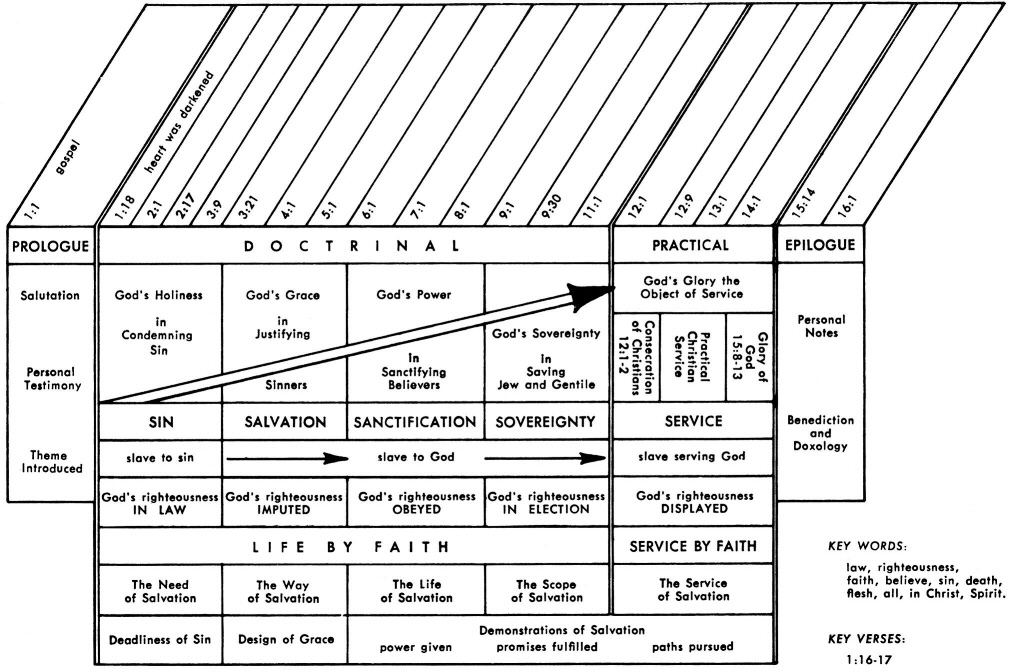
Click chart to enlarge
Chart from recommended resource Jensen's Survey of the NT - used by permission
Romans Overview Chart - Charles Swindoll
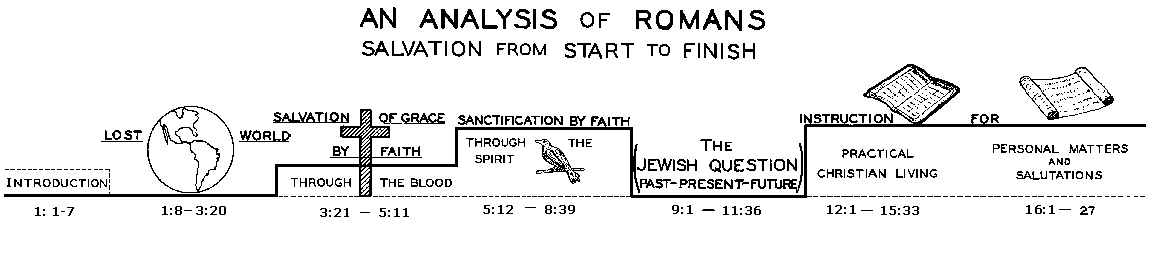
Source: Dr David Cooper
Click to Enlarge
R Ruin (Romans 1:17 – 3:20) – The utter sinfulness of humanity
O Offer (Romans 3:21-31) – God’s offer of justification by grace
M Model (Romans 4:1-25) – Abraham as a model for saving faith
A Access (Romans 5:1-11) – The benefits of justification
N New Adam (Romans 5:12-21) – We are children of two “Adams”
S Struggle w/ Sin (Romans 6-8) Struggle, sanctification, and victory
|
ROMANS ROAD |
||||
| Romans 1:18-3:20 | Romans 3:21-5:21 | Romans 6:1-8:39 | Romans 9:1-11:36 | Romans 12:1-16:27 |
| SIN | SALVATION | SANCTIFICATION | SOVEREIGNTY | SERVICE |
| NEED FOR SALVATION |
WAY OF SALVATION |
LIFE OF SALVATION |
SCOPE OF SALVATION |
SERVICE OF SALVATION |
| God's Holiness In Condemning Sin |
God's Grace In Justifying Sinners |
God's Power In Sanctifying Believers |
God's Sovereignty In Saving Jew and Gentile |
Gods Glory The Object of Service |
| Deadliness of Sin |
Design of Grace |
Demonstration of Salvation | ||
| Power Given | Promises Fulfilled | Paths Pursued | ||
| Righteousness Needed |
Righteousness Credited |
Righteousness Demonstrated |
Righteousness Restored to Israel |
Righteousness Applied |
| God's Righteousness IN LAW |
God's Righteousness IMPUTED |
God's Righteousness OBEYED |
God's Righteousness IN ELECTION |
God's Righteousness DISPLAYED |
| Slaves to Sin | Slaves to God | Slaves Serving God | ||
| Doctrine | Duty | |||
| Life by Faith | Service by Faith | |||
|
Modified from Irving L. Jensen's chart above |
||||
Romans 5:1 Therefore, having been justified by faith, we have peace with God through our Lord Jesus Christ, (NASB: Lockman)
Greek: Dikaiothentes (AAPMPN) oun ek pisteos eirenen echomen (1PPAI) pros ton theon dia tou kuriou hemon Iesou Christou
Amplified: THEREFORE, SINCE we are justified (acquitted, declared righteous, and given a right standing with God) through faith, let us [grasp the fact that we] have [the peace of reconciliation to hold and to enjoy] peace with God through our Lord Jesus Christ (the Messiah, the Anointed One). (Amplified Bible - Lockman)
Barclay: Since, then, we have been put into a right relationship with God in consequence of faith, let us enjoy peace with him through our Lord Jesus Christ. (Westminster Press)
KJV: Therefore being justified by faith, we have peace with God through our Lord Jesus Christ:
NLT: Therefore, since we have been made right in God's sight by faith, we have peace with God because of what Jesus Christ our Lord has done for us. (NLT - Tyndale House)
Phillips: Since then it is by faith that we are justified, let us grasp the fact that we have peace with God through our Lord Jesus Christ. (Phillips: Touchstone)
Wuest: Having therefore been justified by faith, peace we are having with God through our Lord Jesus Christ
Young's Literal: Having been declared righteous, then, by faith, we have peace toward God through our Lord Jesus Christ,
THEREFORE: Dikaiothentes (APPMPN) oun:
- Romans 5 Resources - Multiple Sermons and Commentaries
- Romans 5:1-2: The Blessings of Justification - Steven Cole
- Romans 5:1-2 Security of Salvation 1 - John MacArthur
- Romans 5:1-2 Links in the Chain of Security: Peace and Grace - John MacArthur
- Romans 5:2-4 Links in the Chain of Security: Hope - John MacArthur
Martin Luther wrote...
In the whole Bible there is hardly another chapter which can equal this triumphant text.
Therefore (3767) (oun) on the basis of the previous truths, Paul now introduces us to the practical benefits of salvation. Note the connection with the last word of Romans 4 - Justification (Ro 4:25). It is only because of Christ’s work of justification that peace and other blessings follow.
Paul reaches back to the (Ro 4:24, 25) contents of chapter four—therefore HAVING BEEN justified, not by works (Romans 4:1-8), not by ordinances (notes Ro 4:9; 10; 11; 12), not by obedience to the law (Romans 4:13-25), but by faith, we have peace. The first three never give peace to the soul. Only faith in Christ brings peace.
Paul's argument in the preceding section can be summarized as ....
The need for justification: All men are sinful and guilty before God (Romans 1-3)
The way of justification: by grace through faith based on the redemptive work of Christ on the Cross (Romans 3:24-28).
The illustration of justification: the example of Abraham (Romans 4).
|
Condemnation and Justification Contrasted |
||
| Condemnation | Justification | |
|
Source |
From one: first Adam |
From one: Second Adam |
|
Extent |
To all: the many |
To all (by faith): the many |
|
Cause |
Disobedience |
Obedience |
|
Force |
Law |
Grace |
|
Nature |
Judgment deserved |
Free gift undeserved |
|
Measure |
Abounded |
Abounds much more |
|
Result |
Sin & Death |
Righteousness & Life |
The New Unger’s Bible Handbook, Merrill F. Unger, Revised by Gary N. Larson, Moody Press, Chicago, 1984, p. 479
Paul is careful to emphasize that justification is an assured fact before going on to show what is involved in it. Paul has shown us that even Abraham had to be justified and that man is guilty before God and man cannot in any way justify himself. Beginning in Romans 5 Paul begins to show us "the other side" of what it means to be justified and expounds an incredible list of blessings and benefits that come spilling out of the cornucopia of justification.
As an aside, you may have heard someone speak of the need to receive "a second blessing" or "a second work of grace" referring to what they think is a post-salvation experience. It is not that believers lack a second blessing experience but that most of us fail to realize how blessed we already are in Christ. We fail to "claim" or lay hold of the spiritual riches that are ours. We fail to "possess our possessions". We who are children of the King need to stop living like "spiritual paupers".
Notice the Pauline pattern of presentation of the gospel - the sinner must see their need first (Romans 1-4) The unsaved must know why they even need to be saved!. Once they see their desperate need and receive Christ as Lord and Savior by grace through faith, then Paul explains the benefits accompanying salvation (Romans 5). How often the gospel is made as attractive as possible by showing the unsaved person all the wonderful benefits that will be his if he trusts Christ: "If you trust the Lord you will have peace with God!" The problem with this backwards approach is that the sinner does not come to understand why they need to have peace with God. The unsaved person must first be shown from the Scriptures that in his sinful condition he is an enemy of God, fighting against God in rebellion and that God’s wrath is being revealed from heaven against him. (Click here and scroll down to the enlightening discussion on presentation of the gospel)
IT'S GRADUATION TIME!
Ray Stedman writes: Romans 5 is a graduation exercise. It takes us from the elementary grades of Christian life into high school. Up to this point in the book of Romans, we have been dealing with BIRTH TRUTHS -- the elementary, introductory truths of the Christian faith. But at this point in the book we learn of the existence of GROWTH TRUTHS -- the way to maturity and power, and the way to be effective in Christian service. Now, wherever the Christian church is weak (and it is weak in many places), and wherever Christians are weak individually, it's because they have never graduated into the High School of the Holy Spirit -- they are still "babes in Christ" {1Cor 3:1}, no matter how long they have been Christians. Sometimes you can find "babes in Christ" who have been Christians 15, 20, or even 40 years, and it is because they have never come into this high school truth of the Holy Spirit: They keep learning over and over again the same old truths about salvation in Christ that are presented in these early chapters (wonderful as they are), and never go on -- never graduate. (Faith Faces Life)
W E Vine observes that
the fifth chapter shows what we have THROUGH CHRIST, while the sixth shows us what we are IN CHRIST. "THROUGH CHRIST" is the keynote of chapter five. This chapter unfolds the subjects of the effects of the death and resurrection of Christ, all being based on the doctrine of [Ro 3:21, 22, 23, 24, 25, 26 - see notes Ro 3:21; 22; 23; 24; 25; 26]. The opening sentence of the chapter is at once deduced from the closing statements of chapter four. The leading thought, "THROUGH our Lord Jesus Christ," is expressed at both the beginning and end of the first part of the chapter (Ro 5:1-11), and at the end of the second part (Ro 5:21). ( Collected writings of W. E. Vine. Nashville: Thomas Nelson )
Romans is a book of supernatural logic which is knitted together with a fine thread of “therefore's” (term of conclusion)...
- Therefore of giving over - Ro 1:24 ()
- Therefore of condemnation Ro 3:20 (note )
- Therefore of justification - Ro 5:1 (note)
- Therefore of no condemnation - Ro 8:1 (note)
- Therefore of dedication - Ro 12:1 (note).
For completeness note that the NAS version has 24 therefore's in Romans - Ro 1:24, 2:1, 2:21, 2:26, 4:22, 5:1, 5:12, 6:4, 6:12, 6:21, 7:4, 7:13, 8:1, 12:1, 13:2, 13:10, 13:12, 14:8, 14:13,14:16, 15:9, 15:17, 15:28, 16:19
In presenting his case, Paul has proved that the whole world is guilty before God, and that no one can be saved by their "religious" deeds, even including zealous attempts to obey God's Law. He has explained that God’s way of salvation has always been by grace, through faith (Eph 2:8; Eph 2:9), in Romans 4:1, 2, 3 ff, he used the beloved patriarch Abraham as his illustration that no one is saved by "good" works. If a reader of Romans were to stop reading at this point, he would (or at least should) clearly understand that he was in serious need of the gift of salvation from God. But there is much more the sinner needs to know about justification by faith. Can he be sure that it will last? How is it possible for God to save a sinner through the death of Christ on the Cross? Romans 5 is Paul’s explanation of the last two words in Ro 4:25 [note] our justification. He now explains two basic truth, first summarizing the blessings of justification (Ro 5:1-11), and the basis of justification (Ro 5:12-21). Our justification is not simply a guarantee of heaven, as thrilling as that is, but it is also the source of tremendous blessings in this present life. Paul's second purpose is to assure his readers that justification is a lasting thing. His Jewish readers in particular would ask "Can this spiritual experience last if it does not require obedience to the Law? What about the trials and sufferings of life? What about the coming judgment?"
HAVING BEEN JUSTIFIED BY FAITH: Dikaiothentes (APPMPN) oun ek pisteos:
- Ro 5:9,18; 1:17; 3:22,26, 27, 28,30; 4:5,24,25; 9:30; 10:10; Hab 2:4; Jn 3:16, 17, 18; 5:24; Acts 13:38,39; Gal 2:16; 3:11, 12, 13, 14,25; 5:4, 5, 6; Phil 3:9; Jas 2:23, 24, 25, 26
- Romans 5 Resources - Multiple Sermons and Commentaries
- Romans 5:1-2: The Blessings of Justification - Steven Cole
- Romans 5:1-2 Security of Salvation 1 - John MacArthur
- Romans 5:1-2 Links in the Chain of Security: Peace and Grace - John MacArthur
- Romans 5:2-4 Links in the Chain of Security: Hope - John MacArthur
A "FAIT ACCOMPLI!"
"PAST TENSE SALVATION"
JUSTIFICATION
Fait accompli is a French expression which means "an action which has already been done and which cannot be changed" (Cambridge Dictionary) Don't you love it! Our justification is "one and done" as some might say! It is a one time event in eternity that endures throughout eternity! Hallelujah, thank You Father, Son and Holy Spirit! Amen!
See Three Tenses of Salvation for more discussion of the concept of past tense salvation.
Having been justified (1344) (dikaioo from díkaios = just, righteous - the same root for words translated righteous, righteousness, justification, just, justifier) defines the act of declaring one not guilty. It means to pronounce and treat as righteous. It is not as some teach a "process".
The aorist tense identifies the justification as a one time event in the past when these believers were declared legally not guilty (Click for table on past, present and future salvation). Justification is not something that is going on now; it is something that happened and was completed the moment you were saved.
The passive voice indicates this declaration came from an outside Source, in this case God Himself. They were acquitted of the charges against them, the charges having been transferred (imputed, reckoned) to the account of their Sin Bearer, the sacrificial, substitutionary Lamb of God.
Dikaioo - 39x in the NT - Mt. 11:19; 12:37; Lk. 7:29, 35; 10:29; 16:15; 18:14; Acts 13:38, 39; Ro 2:13; 3:4, 20, 24, 26, 28, 30; 4:2, 5; 5:1, 9; 6:7; 8:30, 33; 1 Co. 4:4; 6:11; Gal. 2:16f; 3:8, 11, 24; 5:4; 1Ti 3:16; Titus 3:7; Jas. 2:21, 24, 25
Newell emphasizes how important a correct understanding of the verb tense is in this particular verse...
We must note at once that the Greek form of this verb "declared righteous, " or "justified, " is not the present participle, "being declared righteous, " but rather the aorist participle, "having been declared righteous, " or "justified." You say. What is the difference? The answer is, "being declared righteous" looks to a state you are in; "having been declared righteous" looks back to a fact that happened. "Being in a justified state" of course is incorrect, confusing, as it does, Justification and sanctification. "Whatsoever God doeth, it shall be forever." The moment you believed, God declared you righteous, never to change His mind: as David says, "Blessed is the man to whom the Lord will not reckon sin" (Ro 4:8). If therefore you are a believer, quote this verse properly, and say, "Having been declared righteous on the principle of faith I have"-these blessed fruits and results which are now to be recorded.
The Epistle takes on a new aspect in each chapter: in Chapter Three, Christ was set forth as a propitiation for our sins; in Chapter Four, Christ was raised for our justification; in Chapter Five, we have peace with God through Christ, a standing in grace, and the hope of the coming glory. (Romans 5)
Regarding dikaioo Wuest says that
"In simple, non-technical language it refers to the act of God removing the guilt and penalty of sin from a sinner who places his faith in the Lord Jesus as Saviour, and the bestowal of a positive righteousness, Jesus Christ, in Whom that believer stands a righteous person before God’s law for time and eternity, all this made possible by and based upon the satisfaction (hilasmos), propitiation) which Jesus Christ offered on the Cross as a complete payment of the penalty imposed by the law because of human infractions of that law, thus satisfying His justice, maintaining His government, and making possible the bestowal of mercy upon the basis of justice satisfied. This is a legal standing, and does not change nor affect the character of the person, which latter is changed by the work of the Holy Spirit in progressive sanctification Click here." (Wuest's Word Studies from the Greek New Testament)
After listing his "glorious" human accomplishments, Paul declared
more than that, I count all things to be loss in view of the surpassing value of knowing Christ Jesus my Lord, for whom I have suffered the loss of all things, and count them but rubbish in order that I may gain Christ, and may be found in Him, not having a righteousness of my own derived from the Law, but that (righteousness) which is through faith in Christ, the righteousness which comes from God on the basis of faith. (see notes Php 3:8; 9)
JUSTIFICATION = PAST TENSE
SANCTIFICATION = PRESENT TENSE
GLORIFICATION = FUTURE TENSE
Justification equates with what has been referred to as Past Tense Salvation which is intimately associated with the following stage known as Present tense salvation or sanctification, the consummation of which is our Future Tense Salvation or glorification. Click study of the Three Tenses of Salvation.
Justified by faith - This truth has permeated the previous chapters...
For in it (the Gospel) the righteousness of God is revealed from faith to faith; as it is written, "BUT THE RIGHTEOUS man SHALL LIVE BY FAITH." (Ro 1:17)
being justified as a gift by His grace through the redemption which is in Christ Jesus (Ro 3:24)
but for our sake also, to whom it will be reckoned, as those who believe in Him who raised Jesus our Lord from the dead, He who was delivered up because of our transgressions, and was raised because of our justification. (Ro 4:24, 25)
By faith - is literally out of (ek) faith, where the preposition ek signifies origin.
Faith (4102) (pistis [word study]) is synonymous with trust or belief and is the conviction of the truth of anything, but in Scripture usually speaks of belief respecting man's relationship to God and divine things, generally with the included idea of trust and holy fervor born of faith and joined with it. As faith relates to Christ it represents a strong and welcome conviction or belief that Jesus is the Messiah, through Whom we obtain eternal salvation and entrance into the Kingdom of Heaven. Stated another way, eternal salvation comes only through belief in Jesus Christ and no other way.
Haldane explains that "It is not by faith, abstractly considered, that we are justified, nor even by faith in everything that God reveals. It is by faith in the Lord Jesus Christ. Even this phrase itself, namely, faith in the Lord Jesus Christ, is still elliptical, and supposes the knowledge of what is to be believed with respect to Christ. It is not believing in His existence, but believing on Him as revealed in the Scriptures, in His person and work. In the same manner as we have the phrase, “justified by faith,” we have the phrase, justified by the blood of Christ. As, in the former case, faith implies its object, so, in the latter, it is implied that we are justified by faith in the blood of Christ. The blood of Christ justifies by being the object of belief and of trust. (An Exposition on the Epistle to the Romans)
True faith that saves one's soul includes at least three main elements (1) firm persuasion or firm conviction, (2) a surrender to that truth and (3) a conduct emanating from that surrender. In sum, faith shows itself genuine by a changed life. (Click here for W E Vine's similar definition of faith)
The highly respected theologian Louis Berkhof defines genuine faith in essentially the same way noting that it includes an intellectual element (notitia), which is "a positive recognition of the truth"; an emotional element (assensus), which includes "a deep conviction of the truth"; and a volitional element (fiducia), which involves "a personal trust in Christ as Savior and Lord, including a surrender … to Christ." (Louis Berkhof, Systematic Theology. Grand Rapids: Eerdmans, 1939)
Wayne Grudem defines faith that saves one's soul...
Saving faith is trust in Jesus Christ as a living person for forgiveness of sins and for eternal life with God. This definition emphasizes that saving faith is not just a belief in facts but personal trust in Jesus to save me... The definition emphasizes personal trust in Christ, not just belief in facts about Christ. Because saving faith in Scripture involves this personal trust, the word "trust" is a better word to use in contemporary culture than the word "faith" or "belief." The reason is that we can "believe" something to be true with no personal commitment or dependence involved in it. (Grudem, W. A. Systematic Theology: An Introduction to Biblical Doctrine Zondervan) (Bolding added)
When missionary John Paton was translating the Scripture for the South Sea islanders, he was unable to find a word in their vocabulary for the concept of believing, trusting, or having faith. He had no idea how he would convey that to them. One day while he was in his hut translating, a native came running up the stairs into Paton's study and flopped in a chair, exhausted. He said to Paton, It's so good to rest my whole weight in this chair.
John Paton had his word: Faith is resting your whole weight on God. That word went into the translation of their New Testament and helped bring that civilization of natives to Christ. Believing is putting your whole weight on God. If God said it, then it's true, and we're to believe it.
WE HAVE PEACE WITH GOD: eirenen echomen (1PPAI) pros ton theon:
- Ro 5:10; 1:7; 10:15; 14:17; 15:13,33; Job21:21; Ps 85:8, 9, 10; 122:6; Isa 27:5; 32:17; 54:13; 55:12; 57:19-21; Zech 6:13; Lk 2:14; 10:5,6; Lk 19:38,42; Jn 14:27; 16:33; Acts 10:36; 2Cor 5:18, 19, 20; Eph 2:14, 15, 16, 17; Col 1:20; 3:15; 1Thes 5:23; 2Th 3:16; Heb 13:20; Jas 2:23
- Romans 5 Resources - Multiple Sermons and Commentaries
- Romans 5:1-2: The Blessings of Justification - Steven Cole
- Romans 5:1-2 Security of Salvation 1 - John MacArthur
- Romans 5:1-2 Links in the Chain of Security: Peace and Grace - John MacArthur
- Romans 5:2-4 Links in the Chain of Security: Hope - John MacArthur
Have (echo) means to hold or to possess and in the present tense pictures this peace with God as a continual possession.
IT MUST BE SETTLED TONIGHT
by C B Kendall
play hymn
“It must be settled tonight,
Tomorrow may be too late”;
The angel of death may come,
And seal forever my fate.
It must be settled to-night,
I can no longer wait,
Peace with my God I now must have,
Tomorrow may be too late.
A burden weighs my soul
I can no longer bear;
Unless removed this night,
’Twill sink me into despair.
It must be settled to-night,
I can no longer wait,
Peace with my God I now must have,
Tomorrow may be too late.
I cannot rest till peace
Enfolds me from above,
Till my Redeemer speaks to me
Assurance of His love.
It must be settled to-night,
I can no longer wait,
Peace with my God I now must have,
Tomorrow may be too late.
Oh, now I know ’tis done!
My peace is made with God;
My pardon’s found in Jesus’ Name,
Thro’ faith in Jesus’ blood.
Oh, now I know ’tis done!
Sweet joy pervades my soul;
Peace with my God I now have found;
His blood hath made me whole.
Peace with God - Note that it is with (objective - the adjective), not of God (subjective). Peace with God speaks of the fact that we are no longer God's enemies but objects of His favor, an objective (in contrast to subjective) truth which is based on our position, something that is true forever because believers are now (positionally) in Christ, the Prince of peace (Isaiah 9:6). Peace with God expresses, as Friederich Philippi says, “not a state of mind, but a relationship to God.” To say it another way Peace with God is a fact not a feeling.
Isaiah phrases the relationship between righteousness and peace beautifully...
And the work of righteousness will be peace,
And the service of righteousness, quietness (Hebrew =- absence of war) and confidence forever. (Isaiah 32:17)
Haldane - "This peace, then, is through Jesus Christ and His righteousness, which brings this quietness and assurance. He is the King of righteousness and Prince of Peace." (An Exposition on the Epistle to the Romans)
Hodge writes that "As a result of this reconciliation, we have conscious (Ed: I might debate Hodge's use of conscious -- I am not always conscious of this great truth, but it is still true!) peace with God; that is, we no longer have either the constant censure of an unappeased conscience or the fear of divine anger. (Commentary on Romans)
Now change the preposition from with to of and the meaning changes significantly. The Peace of God is that (subjective) peace believers can experience moment by moment, as they walk in the light, their sins confessed and their consciences clear. The inward peace that follows is important, but is not the primary thought by Paul in this context. He wants us first to understand that our "war with God" is over! Christ won the victory on the Cross. We enter that victory by personal belief in His fully atoning, finished work on the Cross.
Peace with God - Ro 5:1 (note)
Peace of God - Php 4:7 (note)
Baird's poem differentiates between
Peace, Higher Peace and the Highest Peace:
Three Christian brothers met one day
To speak of things divine;
They had so much of Christ to say,
With joy their faces shine.
The first one said, `My brothers dear,
By virtue of Christ's blood,
My heart retains no guilty fear,
I now have "Peace with God".' (Ro 5:1)
The second brother answered bold,
`You lag on heaven's road;
I grasp the truth with higher hold,
I have the "peace of God".' (Php 4:7)
The third dear brother drew up tall;
He laughed and scarce could cease:
`My brothers dear, I beat you all—
I have the "God of Peace.” (1Th 5:23)
They all had peace, they all were right,
But peace in diverse measure;
The third had scaled the highest height
Of Heaven's exalted pleasure.
—T. Baird
Leon Morris writes that "The justified person is no longer tormented by questions of his relationship with God arising from the fact that he is a sinner. Sinner though he is, he is at peace with God because of what God has done for him. (The Epistle to the Romans. W. B. Eerdmans; Inter-Varsity Press)
Hodge - Conscience (word study) is only the reflection of (man's) countenance, the echo, often feeble and indistinct, often terribly clear and unmistakable, of his judgment. Therefore subjective peace always accompanies faith in the love of God, or assurance of our justification. So although the apostle’s primary idea is that God is at peace with us, it is nevertheless true that inner tranquility of mind is the fruit of justification by faith. (Commentary on Romans)
Wayne Barber explains the peace with God we now possess - That means that I have it today. I will have it tomorrow. I will have it the next day. I will always have it. Present tense means continuous duration of action. Indicative mood means that is a fact, take it to the bank. Active voice means the subject is acted upon or doing the acting. We have peace with God. I don’t know about you, but that completely blows my mind because there are a lot of people today who try to tell me I can lose my salvation. But the Word of God says when I put my faith into Jesus Christ, I eternally have peace with God. What does it mean to put my faith into Jesus Christ to get this peace with God? I have to realize my guilt before God. I have to realize I cannot do one single thing to justify myself. I have to realize what Christ came to do for me. Then when I put my faith into Him, when I surrender to Him, I have peace with God. (Romans 5:1-2 Detail of God's Good News)
Peace (1515) (eirene [word study) is derived from the verb eiro which means “to bind together that which has been separated.”) literally pictures the binding or joining together again of that which had been separated or divided and thus setting at one again, a meaning convey by the common expression of one “having it all together”. It follows that peace is the opposite of division or dissension. Peace as a state of concord and harmony is the opposite of war. Peace was used as a greeting or farewell corresponding to the Hebrew word shalom - "peace to you".
Eirene can convey the sense of an inner rest, well being and harmony. The ultimate peace is the state of reconciliation with God, effected by placing one's faith in the gospel. In eschatology, peace is prophesied to be an essential characteristic of the Messianic kingdom (Acts 10:36).
Peace is a condition of freedom from disturbance, whether outwardly, as of a nation from war or enemies or inwardly, as in the current context, within the soul. Peace implies health, well-being, and prosperity.
Related resources:
Harry Ironside summarizes the justified man or woman's peace...
Peace, as used in Romans 5:1, is not a state of mind or heart. It is a prevailing condition between two who were once alienated. Sin had disturbed the relations of Creator and creature. A breach had occured that man could not mend. But peace has been made by the blood of Christ's cross. There is no longer a barrier. Peace with God is now the abiding state into which every believer enters. The sin question is settled. (Romans)
Newell writes that...
Peace means that the war is done. Peace with God means that God has nothing against us. This involves:
1. That God has fully Judged sin, upon Christ, our Substitute.
2. That God was so wholly satisfied with Christ's sacrifice, that He will eternally remain so: never taking up the judgment of our sin again.
3. That God is therefore at rest about us forever, however poor our understanding of truth, however weak our walk. God is looking at the blood of Christ, and not at our sins. All claims against us were met when Christ made peace by the blood of His cross (Col 1:20). So we have peace with God...
If Thou hast my discharge procured,
And freely in my place endured
The whole of wrath Divine:
Payment God will not twice demand,
First at my bleeding Surety's hand,
And then again at mine!
Our peace with God is not as between two nations before at war, but as between a king and rebellious and guilty subjects. While our hearts are at last at rest, it is because God, against whom we sinned, has been fully satisfied at the cross. Peace with God through our Lord Jesus Christ does not mean peace trough what He is now doing, but through what He did do on the Cross. He made peace by the blood of His cross. All the majesty of God's holy and righteous throne was satisfied when Christ said, It is finished. (John 19:30) And, being now raised from the dead, He is our peace. (Ep 2:14) But it is His past work at Calvary, not His present work of intercession, that all is based upon; and that gives us a sense of the peace which He made through His blood.
This peace with (or towards) God must not be confused with the "peace of God" of Philippians 4:7 (note), which is a subjective state; whereas peace with God is an objective fact-outside of ourselves. Thousands strive for inward peace, never once resting where God is resting-in the finished work of Christ on Calvary.
The difference may be brought out by asking ourselves two questions: First. Have I peace with God? Yes; because Christ died for me. Second, Have I the peace of God in quietness from the anxieties and worries of life in my heart? We see at once that being at peace with God must depend on what was done for us by Christ on the cross. It is not a matter of experience, but of revelation. On the contrary, the peace of God "sets a garrison around our hearts and thoughts in Christ Jesus, " when we refuse to be anxious about circumstances, and "in everything (even the most 'trifling' affairs) by prayer and supplication with thanksgiving let our requests be made known unto God." (Php 4:7) Every 'believer is at peace with God, because of Christ's shed blood. Not every believer has this "peace of God" within Him; for not all have consented to judge anxious care and worry as unbelief in God's Fatherly kindness and care. (Newell, William: Romans Verse by Verse)
I hear the words of love,
I gaze upon the blood;
I see the mighty Sacrifice,
And I have peace with God.Tis everlasting peace,
Sure as Jehovah's name;
'Tis stable as His stedfast throne,
For evermore the same.
My love is oftimes low,
My joy still ebbs and flows;
But peace with Him remains the same,
No change Jehovah knows.
I change, He changes not,
God's Christ can never die;
His love, not mine, the resting-place,
His truth, not mine, the tie."
-Bonar
Guzik adds an important caveat writing that "the Bible doesn’t say we have peace with the devil, peace with the world, peace with the flesh (cp Ga 5:16, Ga 5:17), or peace with sin. Life is still a battle for the Christian (cp 1Ti 1:18, 6:12), but it is no longer a battle against God, it is fighting for Him. Some Christians are tempted to believe the battle against God was almost a better place to be, and that is a dangerous and damnable lie. (Romans 5)
Wayne Barber explains that eirene "comes from the root word (eiro) that means to join together. Have you ever tried to glue something to a surface that was dirty? Perhaps you want to apply a new top to a table. The first thing the instructions tell you to do is clean the surface you are going to glue something to, because if you have any debris, any irritant, of any kind on that surface, it will not adhere. They will not come together. They will not join together. Therefore, you have to make sure it is clean. You see, the word eirene means when two things come together and there is nothing in between that would stop the cohesion that is about to take place. Once they are glued together, they are one, never to be separated. "Do you mean to tell me that when I surrender, when I put my faith into Jesus Christ, I have a peace with God that is a ‘glued together’ peace and it will never come apart?" Yes! That is my relationship with Jesus Christ. It happens when I put my faith into Him. Peace with God. Two things glued together. This is why it is so important to understand that sin is the irritant. That sin has to be cleansed in order for the two to come back together. Peace is when there is no more war with God. There is no more conflict between the Father and me... I tell you, this is good news. When you realize that you have been separated from God because of Adam’s sin and that as a result you continue to sin to show you that you are a sinner, then you realize there is not one thing you can do; and you realize what God took the initiative to do even before the foundations of this world. He came to die for us so that irritant of sin could be dealt with and then man and God through Jesus could have peace once again. It is Jesus holding us together, not me and my obedience. He is the glue that causes us to come together, and we have peace forever with Him. When I have faith in Him, when I exercise my faith in Him, then He gives me peace with God, and He is the one who keeps that peace. (Romans 5:1-2 Detail of God's Good News)
Filled be our hearts with peace beyond comparing,
Peace in Thy world, joy to all heart’s despairing,
Firm is our trust in Thee for peace enduring,
Ever enduring.
Kenneth Wuest - Our Lord made peace through the blood of the Cross (Col 1:20) in the sense that through His sacrifice He binds together again those who by reason of their standing in the First Adam had been separated from God and who now through faith in Him are bound again to God in their new standing in the Last Adam (cf 1Cor 15:22). This is justification. We need peace because of the estrangement between God and man because of sin and so peace in this setting means harmony with God rather than a subjective state in the consciousness of man (Ed note: that is peace OF God not WITH God although clearly you must be at peace with God before you can experience the peace of God). The moment you put your faith in Christ, the war between you and God is permanently over. God has signed the peace treaty with the blood of his own Son (Ro 5:9) and He will never renege on his word (Col 2:14). Therefore, you never need worry again that God will reject you, or condemn you (Ro 8:1), or be hostile toward you (cp Col 1:21). How wonderful it is to know this! When you receive Christ (Mt 10:40, 18:5, Jn 1:12, 13, Col 2:6), you can sigh a huge sigh of relief and simply thank God that this is a settled issue. But this peace is more than merely the absence of enmity (Ep 2:15, 16). It is an invitation from God to come into his presence and enjoy relational closeness with Him (Ro 5:2;He 10:19, 20; 1Pe 3:18). Justification has a proper legal dimension, but its purpose is personal reconciliation (Ro 5:10, 11-notes). Yes, God is a holy Judge whose righteousness and justice must be satisfied (cp Ro 3:24, 25, 26). But he is also a loving Father who wants to have close personal fellowship with you." (Wuest, K. S. Wuest's Word Studies from the Greek New Testament: Studies in the Vocabulary of the Greek New Testament: Grand Rapids: Eerdmans)
ILLUSTRATION: Rest of a Soul - A woman lay dying. A minister sat beside her and tried to break the news as gently as he could. He said, "They think your time is short." "Yes," she said, "I know it." "Have you made your peace with God." "No," she replied, "I haven't made my peace with God." "Then you are not afraid to die?" "No." "Do you realize that in a few hours you must meet God?" "Yes." "And you have not made your peace with God?" "No, and I'm not going to." There was a strange light of perfect peace in the woman's eyes, and the minister realized that there was something back of it all. He said, "What do you mean?" She said, "Listen! I know I am dying, yet I have no fear of meeting God. I am resting in the peace which Jesus Christ made in his atoning death upon the cross, and I don't have to make my peace with God for I am resting in the peace which Jesus Christ has already made."—Evangelical Visitor.
As the needle of a compass trembles till it settles in the north point,
so the heart of man can find no rest (peace) but in Christ.
No God, no peace
Know God, know peace
Note this is not "peace FROM God" as in (Ro 1:7), nor "the peace OF God" as in (Php 4:7), but a new relation to God. When the Berlin Wall that isolated East and West Germany went down in the late 1980's hundreds of thousands of Germans crossed once impassable barriers to visit relatives in the West that they hadn’t seen for nearly 30 years. But even as the wall began to go down, there was no guarantee of peace. No guarantee that complete harmony between the deeply divided East and West will ever be restored.
Harry Ironside notes that...
The peace of God is a different matter, as in Php 4:6 [note]; Php 4:7 [note]. That is experiential. It is the abiding portion of all who learn to cast every care on Him who is the great burden-bearer. To see this distinction and to really grasp it in faith is of prime importance. Until the soul realizes that the peace made by the blood of His cross is eternal and undisturbed, even though one's experience may be very different owing to personal failure or lack of appropriating faith, there will be no certainty of one's ultimate salvation. But knowing this peace to be based, not on my frame or feelings, but on accomplished redemption, I have conscious access by faith into this grace wherein I stand. I stand in grace, not in my own merit. I was saved by grace. I go on in grace. I shall be glorified in grace. Salvation from first to last is altogether of God, and therefore altogether of grace.
Grace is the sweetest sound
That ever reached our ears:
When conscience charged and justice frowned,
'Twas grace removed our fears.Grace is a mine of wealth
Laid open to the poor,
Grace is the sov'reign spring of health,
'Tis life for evermore.Of grace then, let us sing,
A joyful wondrous theme;
Who grace has brought shall glory bring,
And we shall reign with Him.
Grace is the golden scepter held out by the King of glory to all who venture to approach in faith. (Romans)
Spurgeon commenting on peace writes that "the Christian life has its own peculiar joys. If you look through the chapter from which our text is taken, you will see that it begins with a joy: “Therefore, being justified by faith, we have peace with God.” That is a smoothly-flowing current, fathomless, and full of infinite sweetness. I do not know, if I had my choice of the state of heart in which I would wish to be between here and heaven, whether I would not prefer continual peace to any other condition of mind. (here Spurgeon shifts more to the peace of God than the peace with God) It is a blessed thing, sometimes, to soar aloft, as on the wings of eagles, and to seem to play with the young lightnings that are at home with the sun. It is a grand thing to live even here in the very presence of God, and feel that earth has grown into a little heaven; but I find that such an ecstatic state as that is frequently followed by deep depression. Elijah runs before Ahab’s chariot, but the next morning he runs away from a woman, and asks that he may die. Our great “ups” are not far off equally great “downs”; we climb the mountains, and then we slip down the cliffs; we descend into the Valley of Humiliation soon after we have been on the tops of the hills of communion. If one could always be just quiet and peaceful, it would be best. (Ro 5:11 Joy in God)
In context of Romans - the wrath of God is being continually revealed against ungodliness and that is certainly a cause of a lack of peace with God. But in Romans 5, for believers, the war is over. Hostilities and animosities have been vanquished by the Cross. Through the work of Christ all causes of enmity between our souls and God have been removed. We have been changed from foes to friends by the mighty Cross. Note this PEACE is an objective state and TRUE of ALL who are declared righteous. PEACE here is not just the absence of strife. It describes the situation where two things come together and there is nothing in between anymore to cause friction. (That is worth meditating on). There is no longer a barrier between the two parties! Webster helps us get a sense of what this PEACE with God means describing peace as freedom from disquieting or oppressive thoughts or emotions, harmony in personal relations (like it was in the garden of Eden before sin entered the world), a pact or agreement to end hostilities between those who have been at war or in a state of enmity (Ep 2:15, 17-see notes 2:15; 17), a state of tranquility or quiet, a state of security or order within a community provided for by law or custom.
CORAM DEO
BEFORE THE FACE
OF GOD
R C Sproul has a wonderful explanation regarding the meaning and practical application of Coram Deo
This phrase literally refers to something that takes place in the presence of, or before the face of, God. To live coram Deo is to live one’s entire life in the presence of God, under the authority of God, to the glory of God. To live in the presence of God is to understand that whatever we are doing and wherever we are doing it, we are acting under the gaze of God. God is omnipresent. There is no place so remote that we can escape His penetrating gaze. To be aware of the presence of God is also to be acutely aware of His sovereignty. The uniform experience of the saints is to recognize that if God is God, then He is indeed sovereign. When Saul was confronted by the refulgent glory of the risen Christ on the road to Damascus, his immediate question was, “Who is it, Lord?” He wasn’t sure who was speaking to him, but he knew that whomever it was, was certainly sovereign over him. Living under divine sovereignty involves more than a reluctant submission to sheer sovereignty that is motivated out of a fear of punishment. It involves recognizing that there is no higher goal than offering honor to God. Our lives are to be living sacrifices, oblations offered in a spirit of adoration and gratitude. To live all of life coram Deo is to live a life of integrity. It is a life of wholeness that finds its unity and coherency in the majesty of God. A fragmented life is a life of disintegration. It is marked by inconsistency, disharmony, confusion, conflict, contradiction, and chaos. The Christian who compartmentalizes his or her life into two sections of the religious and the nonreligious has failed to grasp the big idea. The big idea is that all of life is religious or none of life is religious. To divide life between the religious and the nonreligious is itself a sacrilege. This means that if a person fulfills his or her vocation as a steelmaker, attorney, or homemaker coram Deo, then that person is acting every bit as religiously as a soul-winning evangelist who fulfills his vocation. It means that David was as religious when he obeyed God’s call to be a shepherd as he was when he was anointed with the special grace of kingship. It means that Jesus was every bit as religious when He worked in His father’s carpenter shop as He was in the Garden of Gethsemane. Integrity is found where men and women live their lives in a pattern of consistency. It is a pattern that functions the same basic way in church and out of church. It is a life that is open before God. It is a life in which all that is done is done as to the Lord. It is a life lived by principle, not expediency; by humility before God, not defiance. It is a life lived under the tutelage of conscience that is held captive by the Word of God. Coram Deo … before the face of God. That’s the big idea. Next to this idea our other goals and ambitions become mere trifles. (What Does “Coram Deo” Mean?)
With is the Greek preposition "pros" which means toward and is a marker of closeness or being near and can mean “facing.” What an awesome picture this presents -- the justified sinner has peace facing a Holy God - no shame, no condemnation because he or she is safe in the "Ark" of Christ. Good news indeed! The glorious gospel. Paul writes that "by His doing you are in Christ Jesus, who became to us wisdom from God, and righteousness and sanctification, and redemption" (1Cor 1:30). God "made Him who knew no sin to be sin on our behalf, that we might become the righteousness of God in Him." (2Cor 5:21) The saved sinner can now stand in the presence of God, guiltless (cp Jude 1:24, 25), righteous in Christ's righteousness which God accepts.
Note how often the OT pictures God hiding His face (Click for some examples). Because of the death of His Beloved, the our God Who is a consuming fire" (He 12:28) no longer hides His face from justified sinners! Do we really comprehend the privilege and significance inherent in this profound privilege?
This new sense of God's presence should by our exceeding joy and great delight. We now have access to the Holy One, the Almighty, the Everlasting Living God. When we speak with Him, we can be assured that we have His ear (assuming we are not clinging to unconfessed sin, remembering that "If I regard wickedness in my heart, The Lord will not hear" Ps 66:18 - Spurgeon's note, cp Pr 28:13).
The sins that would entangle us
Must never be ignored;
For if we try to cover them
They'll pierce us like a sword.
We have the privilege of coming to Him at any time and any place because Christ has given us access to His Throne (Ro 5:2), having "entered as a forerunner for us, having become a high priest forever according to the order of Melchizedek." (He 6:20) The veil kept even the most pious, devout Jew out of the Holy of holies (exception = once for year - Day of Atonement) and a wall in the Temple grounds kept the Gentile from proximity to God (Ep 2:12, 13, 14, 15, 16-see notes 12; 13; 14; 15; 16). But now
brethren (believing Jews and Gentiles who are now one in Christ - cp Gal 3:28), we have confidence to enter the holy place by the blood of Jesus, by a new and living way which He inaugurated for us through the veil (Mt 27:51 the moment Jesus yielded up His spirit "the veil of the temple was torn in two from top to bottom..."), that is, His flesh, and since we have a great priest over the house of God, let us draw near with a sincere heart in full assurance of faith, having our hearts sprinkled clean from an evil conscience and our bodies washed with pure water. (He 10:19, 20, 21 - see notes 10:19; 20; 21).
The moment we believe in Jesus Christ all of these things are true for us. And they never become any more true -- a person who has been a Christian for 50 years is no more justified than the man who just this moment has committed his life to Jesus Christ. All Christians enjoy these blessings immediately, permanently, and continuously. The question of our going to hell has been forever settled, the certainty of heaven is forever established, and this is cause for rejoicing.
Middletown Bible - The hostility that once existed between me and God is now gone forever! The war is over! I’m at peace with my Creator and I have full acceptance with Him. My acceptance has nothing to do with who I am or what I have done. It has everything to do with Who Jesus Christ is and what He has done (Ep 1:6, 7-see notes 1:6; 7). God is well pleased with His beloved Son (Mt. 3:17) and God is well pleased with me because I am in His beloved Son (Ep 1:6--"accepted" means "highly favored"). Sadly, most believers to not take God at His Word when it comes to acceptance. When all is going well and God seems to be blessing, then they feel that He loves and accepts them. But when they are stumbling, and everything seems difficult and hard, then they feel He does not love and accept them. How can this be? There is nothing about us to commend us to God. Our acceptance is in Christ Jesus and not in ourselves. God has accepted us in His Son by grace alone, and upon this fact we must base our faith. (Romans 5)
Matthew Henry - There is more in this peace than barely a cessation of enmity, there is friendship and lovingkindness, for God is either the worst enemy or the best friend. Abraham, being justified by faith, was called the friend of God (James 2:23), which was his honour, but not his peculiar honour: Christ has called his disciples friends, [John 15:13, 14, 15].
Warren Wiersbe adds that...
Two verses from Isaiah make the matter clear: “There is no peace, for the wicked, saith the LORD” (Isa 48:22); “And the work of righteousness will be peace” (Isa 32:17). Condemnation means that God declares us sinners, which is a declaration of war. Justification means that God declares us righteous, which is a declaration of peace, made possible by Christ’s death on the cross for as the psalmist so poignantly phrased it “Lovingkindness and truth have met together; righteousness and peace have kissed each other.” (Ps 85:10) (Bible Exposition Commentary. 1989. Victor)
Johnny Miller writes, “When I was a teenager, I became fascinated, appalled, and grieved by the literature of the Holocaust … One scene that haunts me is a picture from Auschwitz. Above the entryway to the concentration camp were the words, Arbeit macht frei. The same thing stood above the camp at Dachau. It means, “work makes free”—work will liberate you and give you freedom. It was a lie—a false hope. The Nazis made the people believe hard work would equal liberation, but the promised “liberation” was horrifying suffering and even death. Arbeit macht frei. One reason that phrase haunts me is because it is the spiritual lie of this age. It is a satanic lie. It’s a religious lie. It is a false hope—an impossible dream for many people in the world. They believe their good works will be great enough to outweigh their bad works, allowing them to stand before God in eternity and say, “You owe me the right to enter into your heaven.” It is the hope of every false religion—arbeit macht frei.” (From Johnny V. Miller's sermon, "The Great Rescue," Preaching Today.com 4-14-07)
THROUGH OUR LORD JESUS CHRIST: dia tou kuriou hemon Iesou Christou:
- Ro 6:23; Jn 20:31; Eph 2:7
- Romans 5 Resources - Multiple Sermons and Commentaries
- Romans 5:1-2: The Blessings of Justification - Steven Cole
- Romans 5:1-2 Security of Salvation 1 - John MacArthur
- Romans 5:1-2 Links in the Chain of Security: Peace and Grace - John MacArthur
- Romans 5:2-4 Links in the Chain of Security: Hope - John MacArthur
CHRIST OUR ENTREE
The noun entree is from French (entrer = to enter) means "the right to join a group of people or enter a place" or "something that provides access." Here in Romans 5 Paul is saying Christ is the Someone Who provides access so that we can enter into the presence of God the Father without fear or trepidation that we will die.
Through (1223) (dia) indicates the channel or conduit through Whom the benefits of justification flow. (See study below most of which in some way speak of Christ the Mediator between God and man, Christ the channel of blessing and channel of access)
Christ is the Mediator between God and man (1Ti 2:5, He 8:6; He 9:15; He 12:24), and all God’s gifts are channeled through Him. Not a subjective, internal sense of calm and serenity, but an external, objective reality. God has declareda Himself to be at war with every human being because of man’s sinful rebellion against Him and His laws. But the first great result of justification is that the sinner’s war with God is ended forever. Scripture refers to the end of this conflict as a person’s being reconciled to God.
Consider the following simple study - observe and record the wonderful truths that accrue through Him - this would make an edifying, easy to prepare Sunday School lesson - then take some time to give thanks for these great truths by offering up a sacrifice of praise...through Him.
John 1:3 [NIV reads "through Him"], John 1:7, John 1:10,Jn 3:17, Jn 14:6, Acts 3:16, Acts 7:25, Acts 10:43, Acts 13:38-39, Romans 5:9 [note], Romans 8:37 [note], Ro 11:36 [note]; 1Cor 8:6, Ep 2:18 [note], Php 4:13 [note], Col 1:20 [note], Col 2:15 [note], Col 3:17 [note], He 7:25 [note], He 13:15 [note],1Pe 1:21 [note], 1John 4:9
Would you like more study on the wonderful topic of through Him? Click the NT uses of the parallel phrase through Jesus or see (John 1:17, Acts 10:36, Ro 1:8, Ro 5:1,2-note v1; v2 Ro 5:21, Ro 7:25, Ro 16:27, Gal 1:1, Ep 1:5, Php 1:11, Titus 3:6, He 13:21, 1Pe 2:5, 1Pe 4:11, Jude 1:25)
All things are from Him, through Him and to Him. To Him be the glory forever. Amen.
What is the balance between a believer's standing and their state?
We should also make a difference between POSITIONAL ACCEPTANCE and EXPERIENTIAL ACCEPTANCE (or the difference between STANDING and STATE). Positionally we are accepted in Christ and God is always well pleased with us because we have been placed in His beloved Son in whom He is well pleased (cp Matthew 3:17 with Eph 1:6 [note]). But in our actual state (as to our actual experience as we walk with the Lord in time) we may either be pleasing the Lord or not pleasing the Lord (2Ti 2:4; 1Th 4:1; Ga 1:10; 1John 3:22; Col 1:10; Col 3:20; Ro 12:2; Ep 5:10; 2Co 5:9; 1Co 7:32). The key verse is He 11:5 [note]; He 11:6 [note] which tells us that we please God BY FAITH. Compare also Ro 8:8 [note]; Ro 8:9 [note] which implies that we please God only as we are walking in the Spirit (cf. Gal 5:16). Though there are numerous verses (just cited) which speak of our experiential acceptance (the need to please God in our daily walk by faith and in the Spirit of God), we should never minimize the importance of positional acceptance. Many believers are crippled spiritually because they do not know and do not believe and do not reckon that IN CHRIST they are well-pleasing to the Father and completely acceptable to Him. The more we rest by faith in our positional acceptance the more we will be at liberty to please God in our daily walk! For more help on this subject see The Believer's Standing and State.)
GETTING READY FOR CHRISTMAS: It's coming -- a very confusing time of year for many people: Christmas. Although it's supposed to be a time of peace and joy, some consider it the most depressing. A counselor friend of mine mentioned that he sees more people during the Christmas holidays than at any other time.
Apparently, not everyone experiences the much-talked-about joy of the season. One's own bad feelings contrasted with other's good times can make life seem doubly depressing.
If that happens to you, if you're down when others are up, you'll find Paul's words in Romans 5 helpful. He said we have:
* Peace (Ro 5:1). Faith in Jesus brings the most important source of comfort: strong fellowship with God.
* Hope (Ro 5:2). Loss of hope is always a problem for those who are down. There can be no better hope than a future spent with God -- and that's the promise.
* Joy (Ro 5:3; Ro 5:4). The bad we endure is not purposeless. God's plan is being carried out, and our troubles will make us the kind of people God can use.
Even when things look bad, no one or no event can take away the promise of peace, hope, and joy. That can make any season a joyful one. J D Brannon (Our Daily Bread, Copyright RBC Ministries, Grand Rapids, MI. Reprinted by permission. All rights reserved)
The hope we have in Jesus Christ
Brings joy into our heart;
And when we know the love of God,
His peace He will impart.
--Sper
Joy and Peace: Lucky Lawrence thought he had it all. Like so many who seek fulfillment in fame, money, and success, he struggled to find real joy despite having all those things. His real name was Larry Wright, and he was the number one rock-and-roll radio personality in Phoenix in the 1960s. But his family life was a mess, and he was fast becoming an alcoholic.
As Mike Yorkey tells it in his book Touched By The Savior, the solution came to Lucky Lawrence when his wife Sue trusted Jesus as her Savior. Larry noticed the peace and joy in her life and the obvious change in her attitude toward him. Soon he too asked Jesus to forgive him and be his Savior.
Gone was the frustrating search for peace. In its place was the joy and peace of God. Larry and Sue have now served the Lord for more than 30 years.
In Romans we see the contrast between the two kinds of existence possible in this life. In Romans 1:18-32, we read about the sad, frightening life of those who refuse to live for God. It's a life full of trouble and turmoil. But in Romans 5:1-11, we see what happens when a person trusts Christ. "We have peace," it says. "We rejoice," we're told. And we have hope, love, and salvation. What a contrast!
Which of these two worlds are you living in? —J D Brannon (Our Daily Bread, Copyright RBC Ministries, Grand Rapids, MI. Reprinted by permission. All rights reserved)
How To Have Joy And Peace
Believe God and His Word (Romans 5:1; Romans 15:13 - note).
Live by the power of God's Spirit (Galatians 5:16, Gal 5:22-23).
With God's help, always do what is right (Romans 14:17 - note).
No God, no peace
Know God, know peace.
Real Peace: According to Robert McGee and Donald Sapaugh in their book "Search for Peace", a popular rock guitarist of the late 1960s led a promiscuous life, indulging in drugs and behaving outrageously on and off the stage. At the end of a concert in 1970, according to some reports, the musician smashed his guitar. The audience screamed and applauded, but suddenly the applause stopped. The guitarist had fallen on his knees and was staying in that position motionless. He broke the stillness by asking, "If you know real peace, I want to visit with you backstage." But nobody responded to his startling invitation. Several days later he died after an apparently accidental overdose of drugs. Peace, real peace, eluded him. Do you know real peace? Have you discovered that fame, money, and self-indulgence don't bring inner serenity? Prayerfully, then, you need to make another discovery. Only through a trustful commitment to Christ can you experience peace with God (Romans 5:1). Open your heart in faith to the Prince of Peace, inviting Him to come into your life and take control of it. Then, underneath all of life's agitation, you can know the peace of God--the very tranquility of heaven in the depths of your soul (Php 4:6; Php 4:7). --Vernon C Grounds (Our Daily Bread, Copyright RBC Ministries, Grand Rapids, MI. Reprinted by permission. All rights reserved)
Our heart is always seeking--
We long to know real peace;
But if we trust in Jesus,
Our restlessness will cease. --DJD
Peace floods the soul
when Christ rules the heart.
Romans 5:2 through Whom also we have obtained our introduction by faith into this grace in which we stand; and we exult in hope of the glory of God. (NASB: Lockman)
Greek: di' ou kai ten prosagogen eschekamen (1PRAI) [te pistei] eis ten charin tauten en e estekamen, (1PRAI) kai kauchometha (1PPMI) ep' elpidi tes doxes tou theou.
Amplified: Through Him also we have [our] access (entrance, introduction) by faith into this grace (state of God’s favor) in which we [firmly and safely] stand. And let us rejoice and exult in our hope of experiencing and enjoying the glory of God. (Amplified Bible - Lockman)
Barclay: Through him, by faith, we are in possession of an introduction to this grace in which we stand; and let us glory in the hope of the glory of God. (Westminster Press)
KJV: By whom also we have access by faith into this grace wherein we stand, and rejoice in hope of the glory of God.
NLT: Because of our faith, Christ has brought us into this place of highest privilege where we now stand, and we confidently and joyfully look (NLT - Tyndale House)
Phillips: Through him we have confidently entered into this new relationship of grace, and here we take our stand, in happy certainty of the glorious things he has for us in the future. (Phillips: Touchstone)
Wuest: through whom also our entree we have as a permanent possession into this unmerited favor in which we have been placed permanently, and rejoice upon the basis of hope of the glory of God.
Young's Literal: through whom also we have the access by the faith into this grace in which we have stood, and we boast on the hope of the glory of God.
THROUGH WHOM ALSO: di ou kai :
- Jn 10:7,9; 14:6; Acts 14:27; Eph 2:18; 3:12; Heb 10:19,20; 1Pet 3:18
- Romans 5 Resources - Multiple Sermons and Commentaries
- Romans 5:1-2: The Blessings of Justification - Steven Cole
- Romans 5:1-2 Security of Salvation 1 - John MacArthur
- Romans 5:1-2 Links in the Chain of Security: Peace and Grace - John MacArthur
- Romans 5:2-4 Links in the Chain of Security: Hope - John MacArthur
CHRIST THE DOOR INTO
TO THE THRONE ROOM
Note that by faith is in brackets in the Greek text and is not supported by the best Greek manuscripts, but of course is still the means of the access. Newell explains that...
It is not by an additional revelation, and acceptance thereof, that believers come into this standing in grace. It is a place of Divine favor given to every believer the moment he believes. In Ro 6:14 we are to be told that we are under grace, not law. It is a glorious discovery to find how fully God is for us, in Christ.
Through (1223) (dia) (see above study of through Him) means the modality by which something transpires. The benefits of justification come through Christ, our Mediator and Great High Priest. We enter in and draw near through Him, for He is the "Author of salvation" (He 2:!0). He is the Forerunner (He 6:20), having entered Himself through "the veil" (His Flesh) that we might now have a new and living way into the Holy of Holies, the very presence of God the Father! (He 10:19, 20, 21).
The emphasis in Romans 5 is on what has been done for the believer through Christ and his saving work (Ro 5:1, 2, 9, 10, 11, 17, 18, 21 - see notes 5:1; 5:2, 5:9, 10, 11, 17, 18, 19, 21), whereas in Romans 6 Paul deals with what has happened to the believer together with Christ (Ro 6:4, 5, Ro 6:6, Ro 5:8 ) and what he enjoys in Christ (Ro 6:11, Ro 6:23).
Harry Ironside distinguishes between state and standing writing that...
it is access and standing that are before us in Romans 5:2. Access (Ed: Primarily objective) is based on standing, not on state. The terms are to be carefully distinguished. In Philippians we read much about our state (Ed: Primarily subjective). Paul was greatly concerned about that. He never had a fear about the standing of the children of God. That is eternally settled.
Standing refers to the new place in which I am put by grace as justified before the throne of God and risen in Christ forever beyond the reach of judgment. State is condition of soul. It is experience. Standing never varies. State is fluctuating, and depends on the measure in which I walk with God. My standing is always perfect because it is measured by Christ's acceptance. I am accepted in Him. "As he is, so are we in this world" (1Jn 4:17). But my state will be good or bad as I walk in the Spirit or walk after the flesh (Ro 8:5)
My standing gives me title to enter consciously as a purged worshiper into the holiest and to boldly approach the throne of grace in prayer (Ed: He 4:16, He 10:19, 20). Of old God sternly said, "Worship ye afar off" (Ex 24:1). Access was not known under the legal covenant (Mosaic Law) God was hidden; the veil was not yet removed. Now all is different, and we are urged to "draw near with a true heart in full assurance of faith, having our hearts sprinkled from an evil conscience, and our bodies washed with pure water" (He 10:22). (Ed: see the Veil has been torn) (Bolding added) (Romans)
And now we draw near to the throne of grace,
For His blood and the Priest are there;
And we joyfully seek God's holy face
With our censer of praise and prayer.
The burning mount and the mystic veil
With our terrors and guilt are gone;
Our conscience has peace that can never fail,
'Tís the Lamb on high on the throne.
Ray Stedman gives this illustration of our entree' into the Throne Room of God - Remember Esther (Ed: Read Esther 4:11), that lovely Jewish maiden, a captive in the land of Persia? The king, seeking a bride, found her and made her his queen. After Esther ascended to the throne as queen, a plot was hatched against the Jews. The king, unwittingly, signed a decree that meant death for all Jews in the land of Persia. Esther's godly uncle, Mordecai, said it would be necessary for her to go to the king and tell him what he had unwittingly done. Esther knew that was a dangerous thing, because it was the law of the Medes and Persians that no one could come before the king without first being summoned by him. It meant death for anyone to dare come before the king in that manner. There were no exceptions -- even for a queen -- for this was the law of the Medes and the Persians and could not be changed. Unless the king extended his golden scepter to that person, he must die. Yet Esther knew that she had to dare to take her life in her hands and go before the king. The story tells us that she fasted for three days and three nights before she went. I am sure that was to prepare her heart and her courage. It doesn't say what else she did during that time, when she was getting ready to come before the king. With a wife, four daughters, and a mother-in-law in my home, I've observed women getting themselves ready for some years now. I'm sure that what Esther was doing was fixing her hair. It probably took three days and three nights to get ready! Then we are told that she dressed herself in robes of beauty and glory. When she was all ready, she stepped into the audience hall of the king, appearing all alone before him. The king was so smitten with her beauty that his heart went out to her. He stretched forth his scepter and accepted her. She had access to the king. Dressed in robes of beauty and glory that do not belong to us -- for they are the garments of Jesus -- we have access to the King, to receive from him all that we need to handle any threat that has come into our lives. We have continual acceptance before him. (Rejoicing in Hope)
Newell makes an important distinction - The word also ("through Whom also") sets this blessing forth as distinct from and additional to that of peace with God. Through Christ, in Whom they have believed, there has been given to the justified access into a wonderful standing in Divine favor. Being in Christ, they have extended to them the very favor in which Christ Himself stands.(!!!) (Romans Verse by Verse)
This is a blessing beyond peace with God for as Matthew Poole wrote...
One may be reconciled to his Prince, and yet not to be brought into his presence
WE HAVE OBTAINED OUR INTRODUCTION: eschekamen (1PRAI) ten prosagogen:
- Romans 5 Resources - Multiple Sermons and Commentaries
- Romans 5:1-2: The Blessings of Justification - Steven Cole
- Romans 5:1-2 Security of Salvation 1 - John MacArthur
- Romans 5:1-2 Links in the Chain of Security: Peace and Grace - John MacArthur
- Romans 5:2-4 Links in the Chain of Security: Hope - John MacArthur
We have obtained our introduction - I prefer the KJV rendering we have access.
Smart comments that "Access to this grace’ is access to God. Grace is not something apart from God, but is God giving Himself to us in His graciousness."
Adam Clarke adds that "this access to God, or introduction to the Divine presence, is to be considered a lasting privilege. We are not brought to God for the purpose of an interview (Ed: I love it!), but to remain with Him; to be His household; and by faith, to behold His face, and walk in the light of His countenance." (Incredible!)
Clarke's comment reminds me of the incredible words in John's first epistle commanding the saints:
See how great a love the Father has bestowed upon us, that we should be called children of God; and such we are. For this reason the world does not know us, because it did not know Him. (1 John 3:1)
Introduction (4318) (prosagoge from pros = toward + ago = bring, lead) literally means a bringing near, a leading or bringing into the presence of. The act of bringing to, a moving to. It means providing admission or access (freedom, permission and/or the ability to enter) with the associated thought that the one gaining access has freedom to enter by virtue of the assistance or favor of another. It includes the idea of the right to address someone, the one addressed being of higher status. It describes the approach to one we could never approach in our mortal unredeemed flesh. In the secular use a "status factor" is implied as in the statement "access to Cyrus for an audience".
In secular Greek prosagoge was used to describe an "access point for ships". Moulton and Milligan state that it was sometimes used of "a landing stage". It was used to describe ground that offered no access to enemy forces.
The only other uses of prosagoge are found in Ephesians...
for through Him we both have our access in one Spirit to the Father. (Eph 2:18 see notes)
in whom we have boldness and confident access through faith in Him. (Ephesians 3:12 [note])
From these NT uses notice that prosagoge always refers to the believer’s access to God through Jesus Christ. What was unthinkable to the OT Jew is now available to all who come.
From the 3 NT uses of prosagoge we observe that...
1. We have access into grace (see note Romans 5:2) God’s throne is the throne of grace (He 4:16).
2. We have access to the Father (Ep 2:18). Though He is sovereign, we can still approach Him as a child does a father (Luke 11:11, 12, 13, Ro 8:5).
3. We have access through Jesus Christ (1Timothy 2:5). The blood gives us boldness (He 10:19).
4. We have access by our faith (Ro 5:2 Ep 3:12). The essential ingredient is prayer (He 10:22).
Prosagoge was the word used for the right granted someone to enter into the King's presence. You couldn't just waltz into a king's presence. To do so would invite death. Prosagoge pictures provision of access into the presence of One Whom we would normally be restricted from approaching. In the Orient, one who came to see a king needed both access—the right to come and an introduction—the proper presentation. The story of Esther in the Old Testament contains a beautiful illustration of this idea. Esther desires to plead with King Ahasuerus for the safety of her Jewish countrymen. But she knows what can happen if she goes into his presence without an introduction (Esther 4:11). Esther risked her life by doing this, not knowing beforehand whether Ahasuerus would grant her an "introduction." Fortunately for her, he granted her grace.
Prosagoge pictures fellowship and communion eternally available to redeemed rebels! The French word for this is entree meaning freedom of entry or access. And that is exactly what our Lord Jesus provides for a believing sinner. He clothes him with Himself as his righteousness, cleanses him in His precious blood, and brings him into the full unmerited favor (grace) of God the Father. This is a believers entree. But for how long your ask? Aren't there rules we must keep or works we must do to guarantee this entree to God? See the next paragraph.
Have obtained, as alluded to above, is perfect tense, which means we have obtained this entree in the past (a past completed action) when we were justified by faith with the effect (access) continuing into the present. The perfect tense then speaks of the permanency of our access to God, independent of human merit. This is a humbling thought which should cause us to bow low in worship at "so great a salvation". We enjoy access into an indescribable position of favor with God. We are accepted in the Beloved. Therefore we are near and dear to God. The Father extends the golden scepter to us and welcomes us as sons, not strangers. We cry out Abba, Daddy. The question then is not do we believe that you deserve this -- we don't. But more simply the question is "Do we believe this truth about our relationship now with the Almighty?" We are not to try to deserve it or intellectualize it.
Wuest's translation picks up the sense conveyed by use of the perfect tense of the verb obtained...
Through Whom also our entree we have as a permanent possession into this unmerited favor in which we have been placed permanently, and rejoice upon the basis of hope of the glory of God.
Paul often prayed for the saints to appropriate (and know by experience) what they possessed in Christ. For example, after describing the greatness of the Ephesian saint's salvation, Paul prayed
that the God of our Lord Jesus Christ, the Father of glory, may give to you a spirit of wisdom and of revelation in the knowledge of Him. I pray that the eyes of your heart may be enlightened, so that you may know what is the hope of His calling, what are the riches of the glory of His inheritance in the saints, and what is the surpassing greatness of His power toward us who believe. (see notes Ephesians 1:17; 1:18; 1:19)
In a similar way he prayed for the saints at Colossae asking
"that you may be filled with the knowledge of His will in all spiritual wisdom and understanding, so that you may walk in a manner worthy of the Lord, to please Him in all respects, bearing fruit in every good work and increasing in the knowledge of God; strengthened with all power, according to His glorious might, for the attaining of all steadfastness and patience." (see note Colossians 1:9, 1:10, 1:11-12)
Prosagoge was also used as a nautical term to describe the approach of a ship to a haven or harbor where it could land. Thus the idea would be access into and rest in a haven or harbor. In the case of Romans 5:2, God’s grace is there pictured as a haven for the soul. Have obtained as discussed is perfect tense in Greek which in the nautical context would picture a permanent haven for our soul.
Think also of the OT Tabernacle and how "lay" Jews could never approach the Holy of Holies, the "throne of the King". Only the high priest had access and then only for a relatively briefly, once each year (the Day of Atonement). And then when Solomon and later Herod's Temple were built, the Jew was still kept from God’s presence by the veil in the temple. The Gentile was kept out by a wall in the temple with a warning on it that any Gentile who went beyond would be killed. When Jesus died, He tore the veil (Matthew 27:50, 51) and broke down the wall (Ep 2:14, 15-see notes 2:14; 15). In Christ, believing Jews and Gentiles have access to God (see the Veil has been torn) and they can draw on the inexhaustible riches of the grace of God. We stand “in grace” and not “under Law.” (Ro 6:14) Justification has to do with our standing (Click Ironside's note above); sanctification has to do with our state. The child of a king can enter his father’s presence no matter how the child looks. The word “access” here means “entrance to the king through the favor of another.”
John Calvin reminds us that...
Our reconciliation with God depends only on Christ; for He only is the beloved Son, and we are all by nature the children of wrath. But this favor is communicated to us by the Gospel; for the Gospel is the ministry of reconciliation, by the means of which we are in a manner brought into the Kingdom of God. Rightly then does Paul set before our eyes in Christ a sure pledge of God's favor, that he might more easily draw us away from every confidence in works. And as he teaches us by the word access (introduction) that salvation begins with Christ, he excludes those preparations by which foolish men imagine that they can anticipate God's mercy; as though he said, "Christ comes not to you, nor helps you, on account of your merits." (Romans 5)
BY FAITH INTO THIS GRACE IN WHICH WE STAND : te pistei eis ten charin tauten en e estekamen (1PRAI) :
- Ro 5:9,10; 8:1,30, 31, 32, 33, 34, 35, 36, 37, 38, 39; 14:4; Jn 5:24; 1Co 15:1; Ep 6:13; 1Pet 1:4
- Romans 5 Resources - Multiple Sermons and Commentaries
- Romans 5:1-2: The Blessings of Justification - Steven Cole
- Romans 5:1-2 Security of Salvation 1 - John MacArthur
- Romans 5:1-2 Links in the Chain of Security: Peace and Grace - John MacArthur
- Romans 5:2-4 Links in the Chain of Security: Hope - John MacArthur
STANDING FIRMLY AND FOREVER
PLANTED IN THE GRACE IN CHRIST JESUS
Grace is realized through Jesus (through the veil, His torn flesh, a new and living way, we have confidence to enter the Holy place - Heb 10:19, 20) And so Paul issues a command to his young disciple Timothy - "You therefore, my son, be strong (endunamoo in the present imperative = make this your daily practice, continually depending on being strengthened by the Spirit of Jesus, the Spirit of Grace - Heb 10:29b) in the grace that is in Christ Jesus. (2 Timothy 2:1)
Grace (5485) (charis) means God's undeserved favor given freely to us. One of the best acronyms I have heard on grace is God's Riches At Christ's Expense.
Grace however is not just unmerited favor but in other contexts refers to the transforming power of God or power to accomplish supernaturally what cannot be accomplished naturally. That is why Paul issued the command to Timothy to continually be strengthened. He (as are we) was continually in need of the transforming power inherent in the grace of God. To reiterate, the Grace that is in Christ Jesus and now provided by His Spirit Who indwells us, gives us the empowerment (dunamis the root word of endunamoo in 2Ti 2:1) we need in order to live the supernatural life in Christ. In the following verses Paul will show that divine grace enables the saints to (supernaturally) exult in tribulation (Ro 5:3), which is not a natural response otherwise! This in a nutshell is the secret of the so-called "victorious Christian life!" We can't successfully live it (in our strength). God never said we could. But we can successfully live it as we learn to continually rely on the grace God gives. The more we understand these deep truths, the more we come to understand what prompted Paul to such a glorious doxology in Romans 11:33-36! God by your Spirit open the eyes of our heart to really and practically understand these truths of the Spirit controlled life in Christ and for your glory. Amen
Matthew Henry - Those, and those only, that have access by faith into the grace of God now may hope for the glory of God hereafter. There is no good hope of glory but what is founded in grace; grace is glory begun, the earnest and assurance of glory.
Even though we are firmly and forever planted on the foundation of the grace of God in Christ Jesus, Peter issues a warning exhortation to the tried and tested saints at the end of his first epistle:
Through Silvanus, our faithful brother (for so I regard him), I have written to you briefly, exhorting and testifying that this is the true grace of God. Stand firm (aorist imperative = "Just do it!" is the idea) in it (in the true grace of God - implying some may have been propagating false teaching regarding grace)! (1 Peter 5:12)
At first Peter's command sounds somewhat unnecessary, since Paul is saying we are permanently standing in the grace of God (permanence is the sense conveyed by the use of the perfect tense). This seeming inconsistency is resolved as we recall that Paul is speaking of our position (permanently planted) but Peter is speaking more about our practice. It is one thing to know the Greek word charis and all the Scriptural uses of grace, but it is quite another for grace to "know us" so to speak. To say it another way, we will spend the rest of our time on earth working out our salvation (Php 2:12) in regard to daily learning to live (our practice) under grace and not slip back under law which is our "natural" human tendency. Writing to the Galatians who where standing in grace in regard to their position, Paul rebuked them for not living by grace (their practice was not matching their position) -
"This is the only thing I want to find out from you: did you receive the Spirit by the works of the Law, or by hearing with faith? (Rhetorical because of course the "correct answer" is by faith). Are you so foolish? Having begun by the Spirit (when we were born again, justified, regenerated by grace through faith, the Father and the Son sent the Spirit to live within us to enable the flow of grace in our daily lives), are you now being perfected by the flesh?" (Gal 3:2-3)
So while Paul says we are forever planted in grace in Christ (position), Peter is saying that we need to allow the Spirit to enable us to stand in that grace in our daily conduct (practice). Notice that Peter is like a commanding general who issues a command "Just Do It!" The idea in a military sense is to hold a watch post or to stand and hold a critcal position on a battlefield while under attack (Our inveterate, incorrigible, unrelenting enemies of course are the world, the flesh and the devil)! The intent of Peter's exhortation here is not unlike that of our Lord's command issued to the embattled church at Thyatira, whom He commanded, “hold fast (aorist imperative = "Just do it!") until I come” (Rev 2:25).
Beloved, in order to successfully stand against our strong foes, we need to continually be strengthened in (dunamis the root word of endunamoo in 2Ti 2:1 where grace in Christ Jesus is what provides power - here it is the Spirit of Jesus) our inner man by the Spirit (Eph 3:16), allowing our mind to (present tense = continually) be renewed by the truth of God's Word (Eph 4:23), and submitting without hesitation to the control (filling - Eph 5:18) of the Spirit of Christ who will "cause" (aka, "enable" or "empower") us to walk in God's statues (Ezekiel 36:27).
It is also important to emphasize that we cannot even obey God's commands (such as Peter's command to "Stand firm") by reliance on our natural strength. Instead, we need to continually reject our default tendency toward self-reliance (cp Gal 3:3) and instead learn to rely wholly on the Holy Spirit, the Spirit of grace (Heb 10:29b), Who is continually in us (1 Cor 3:16) AND is continually (present tense) "energizing" us, giving us both the desire and the power to walk in a manner pleasing to our Father. (Our part/responsibility = Php 2:12, God's Spirit's work of grace/His provision = Php 2:13NLT. We see this same spiritual dynamic in the OT promise of the New Covenant in Ezekiel 36:27 where first God "causes" and then "we are careful to observe" God's statutes). When we are walking by the Spirit (Gal 5:16), we are effectively "standing firm" on the grace on which we have been firmly planted, standing against our three mortal enemies. Lest you put yourself under a guilt trip, remember that what this Spirit enabled walk is one of "direction" (heavenward) and not "perfection!" In other words, this is not an "arrival" but a "process" (cp progressive sanctification or "present tense salvation - see Three Tenses of Salvation), and so in Peter's second epistle he prays for the saints that they would "grow (present imperative = make this your daily practice, continually depending on the supernatural power of the Spirit of Jesus, the Spirit of Grace - Heb 10:29b) in the grace (if we are to continually grow in grace, this clearly speaks of our practice which will be a lifelong process) and knowledge of our Lord and Savior Jesus Christ. To Him be the glory, both now and to the day of eternity. Amen" (2Pe 3:18) In other words Peter is charging us to continue to grow spiritually all the days of our life. That is what it means to stand firm in the grace in which we are standing firm!
Stand (2476) (histemi) in this context speaks of figuratively standing. Stand is in the perfect tense which indicates past completed action with a present and continuing result. Refers to the permanent, secure position believers enjoy in God’s grace in contrast to our former state of condemnation.
Paul is saying that not only has Christ brought us into this state of grace, but that there is nothing that can remove us from it for the perfect tense of stand says that we stand in the midst of God's grace permanently. In using this tense Paul is not saying that we are standing here now, and maybe later we will go stand somewhere else (i.e., not in grace, but in law or works for example). It means that we stand firm, that we are fixed on this spot in the way that a boat is securely moored to the dock. No storm of circumstances can move us from where we stand. The fact that we are tightly, permanently moored to the dock of God's grace provides (or should provide) us with a strong sense of security. Nothing can tear us away from God's grace. We cannot be severed from God's loving acceptance of us in Christ ("accepted in the beloved" Eph 1:6KJV). Even our sin cannot separate us from our position of standing firm in God's grace, for we are justified once and for all time.
Hodge writes that "The state, therefore, into which the believer is introduced by Christ is not a precarious one. He has not only firm ground to stand on, but divine strength to enable him to keep his foothold". (Commentary on Romans)
A W Pink - It is utterly and absolutely impossible that the sentence of the divine Judge should ever be revoked or reversed. Sooner shall the lightnings of omnipotence shiver the Rock of Ages than those sheltering in Him again be brought under condemnation (The Doctrines of Election and Justification)
BKC comments that...
Believers in Christ stand in the sphere of God’s grace (cf. “grace” in Ro 3:24 [note]) because Christ has brought them to this position. He is their means of access. (Walvoord, J. F., Zuck, R. B., et al: The Bible Knowledge Commentary. 1985. Victor)
The Gentiles stood in His revealed wrath and the Jews stood in the Law which condemned them but both Jew and Gentile upon belief in the sacrifice of the Lamb of God are transported from the kingdom of darkness into the glorious kingdom of God's beloved Son.
Robert Haldane said "And it is by Him (Jesus Christ) they enter into the state of grace, so by Him they stand in it, accepted before God; secured, according to His everlasting covenant, that they shall not be cast down (An Exposition on the Epistle to the Romans)
Wayne Barber has a practical thought on our present position of standing in grace noting that...
You may have peace with God and you are not recognizing the fact that you are standing in that grace because you are frustrating the grace of God which Paul said he did not do in Galatians 2:1KJV "I do not frustrate (Greek = atheteo = annul = making ineffective, inoperative or nonexistent) the grace of God." (KJV) You can frustrate "the grace of God". You can choose not to let God transform you. You can decide not to let God do what He wants to do in and through you.
William Newell has a "checklist" regarding our standing in grace which every believer would be wise to remind himself or herself of from time to time....
The Proper Attitude of Man under Grace
1. To believe, and to consent to be loved while unworthy, is the great secret.
2. To refuse to make "resolutions" and "vows"; for that is to trust in the flesh.
3. To expect to be blessed, though realizing more and more lack of worth.
4. To testify of God's goodness, at all times.
5. To be certain of God's future favor; yet to be ever more tender in conscience toward Him.
6. To rely on God's chastening hand as a mark of His kindness.
7. A man under grace, if like Paul, has no burdens regarding himself; but many about others.
Things Which Gracious Souls Discover
1. To "hope to be better" is to fail to see yourself in Christ only.
2. To be disappointed with yourself, is to have believed in yourself.
3. To be discouraged is unbelief, as to God's purpose and plan of blessing for you.
4. To be proud, is to be blind! For we have no standing before God, in ourselves.
5. The lack of Divine blessing, therefore, comes from unbelief, and not from failure of devotion.
6. Real devotion to God arises, not from man's will to show it; but from the discovery that blessing has been received from God while we were yet unworthy and undevoted.
7. To preach devotion first, and blessing second, is to reverse God's order, and preach law, not grace. The Law made man's blessing depend on devotion; Grace confers undeserved, unconditional blessing: our devotion may follow, but does not always do so, -in proper measure.
AND WE EXULT IN HOPE OF THE GLORY OF GOD: kai kauchometha (1PPMI) ep elpidi tes doxes tou theou :
- Ro 5:5; 8:24; 12:12; 15:13; Job 19:25-27; Ps 16:9, 10, 11; 17:15; Pr 14:32; 2Th 2:16; Heb 3:6; 6:18; 1Pet 1:3, 4, 5, 6, 7, 8, 9; 1Jn 3:1, 2, 3
- Ro 2:7; 3:23; 8:17,18; Ex 33:18, 19, 20; Ps 73:24; Mt 25:21; Jn 5:24; 2Cor 3:18; 4:17; Rev 3:21; 21:3,11,23; 22:4,5
- Romans 5 Resources - Multiple Sermons and Commentaries
- Romans 5:1-2: The Blessings of Justification - Steven Cole
- Romans 5:1-2 Security of Salvation 1 - John MacArthur
- Romans 5:1-2 Links in the Chain of Security: Peace and Grace - John MacArthur
- Romans 5:2-4 Links in the Chain of Security: Hope - John MacArthur
BOASTING IN HOPE:
OUR FUTURE GLORY!
Exult (2744) (kauchaomai [word study] akin to aucheo = boast + euchomai = to pray to God) means to boast over a privilege or possession. It means to rejoice and so to feel joy or great delight, combining ideas of jubilation and confidence into one word which we might describe as "joyful confidence". It expresses an unusually high degree of confidence in God and what He has done for as being exceptionally noteworthy. It also carries the thought of giving expression to what is felt and not simply the feeling. As used in the positive sense (as in the present passage) self-confidence is radically excluded and all self-boasting is abandoned. Faith implies the surrender of all self-glorying.
Note present tense the implies this should be every saved person's lifestyle! This exulting is an exulting in the confident expectation of the glory of God.
Hodge comments that kauchaomai "is one of Paul’s favorite terms. It means “to talk of one’s self,” “to praise one’s self,” “to boast”; then “to congratulate one’s self,” “to speak of ourselves as glorious or blessed”; and then “to felicitate ourselves in anything as a ground of our confidence and a source of honor and blessedness.” Men are commanded not “to glory” in themselves or in men or in the flesh, but in God alone. In this passage the word may be translated “to rejoice”: “we rejoice in hope.” But something more than mere joy is intended. It is a glorying, a self-felicitation and exultation, in view of the exaltation and blessedness which Christ has secured for us. (Commentary on Romans)
Hope (1680) (elpis [word study]) in Scripture is not the world's definition of "I hope so", with a few rare exceptions (e.g., Acts 27:20.) Hope is defined as a desire for some future good with the expectation of obtaining it. Hope is confident expectancy or the confident anticipation of that which we do not yet see. Hope is the looking forward to something with a reason for confidence respecting fulfillment. J B Phillips paraphrased the believer's hope as "happy certainty"!
Calvin - Paul’s meaning is that, although believers are now pilgrims on earth, yet by their confidence (fiducia... sua) they surmount the heavens, so that they cherish their future inheritance in their bosoms with tranquility.
My Hope is Built
My hope is built on nothing less
Than Jesus’ blood and righteousness.
I dare not trust the sweetest frame,
But wholly trust in Jesus’ Name.
On Christ the solid Rock I stand,
All other ground is sinking sand;
All other ground is sinking sand.
I love Paul's description of our present life and future hope in Colossians 3...
When Christ, Who is our life, is revealed, then you also will be revealed with Him in glory. (See note Colossians 3:4)
In the glory - The preposition is epi so it reads literally "upon, on", in other words, on the basis of.
Hodge explains that...
There is a joyful confidence expressed in these words, an assurance of ultimate salvation, which is the appropriate effect of justification. We are authorized and bound to feel sure that having been reconciled to God through Jesus Christ, we will certainly be saved. This confidence is the only fitting response to the merit of his sacrifice and the sincerity of God’s love. It is not founded on ourselves or on the preposterous idea that we deserve the favor of God or the equally preposterous idea that we have in ourselves strength to persevere in faith or obedience. Our confidence is solely on the merit of Christ and the free and infinite love of God.
Although this assurance is the legitimate result of reconciliation, and its absence is evidence of weakness, in this, as in other respects, the actual state of the believer generally falls far short of the ideal. He always lives below his privileges and goes limping and stumbling when he should rise up with the wings of the eagle. But it is important for him to know that assurance is not an unbecoming presumption, but a privilege and duty. (Commentary on Romans)
Newell comments "Alas, how few believers have the courage of faith! When some saint here or there does begin to believe the facts and walk in shouting liberty, we say (perhaps secretly), ‘He must be an especially holy, consecrated man.’ No, he is just a poor sinner like you, who is believing in the abundance of grace!” (Ibid)
Glory (especially every believer's glorification) is not a prospect that might happen, but one that is guaranteed to happen! And all God's people said "Amen!"
Glory (1391) (doxa) speaks of a manifestation of God's true nature, presence, or likeness. He is glorified when He is allowed to be seen as He really is. To be where God is will be glory. To be what God intended will be glory. To do what God purposed will be glory. In short Paul describes that glorious state which God Himself possesses, and into which He will admit the faithful. Hallelujah!
The glory of God is that marvelous salvation (present and future) which God has in store for those who place their trust in Him.
Cranfield explains that the glory of God...
is meant here (cf. Ro 3:23, Ro 8:17, 18, Ro 8:21, Ro 8:30, Ro 9:23) that illumination of man’s whole being by the radiance of the divine glory which is man’s true destiny but which was lost through sin, as it will be restored (not just as it was, but immeasurably enriched through God’s own personal participation in man’s humanity in Jesus Christ—cf. Ro 8:17 [note]), when man’s redemption is finally consummated at the parousia of Jesus Christ. (Cranfield, C. E. B Exegetical Commentary on the Epistle to the Romans. Vol 1: Ro 1-8.; Volume 2: Romans 9-16)
Vine writes that doxa is...
The glory of God, when referring especially to the glory which He possesses, is the outward and visible expression of His essential attributes and character. When used objectively, of that which He bestows, it refers to that state of blessedness by which the believer will enjoy hereafter the realization of these attributes. (Vine, W. Collected writings of W. E. Vine. Nashville: Thomas Nelson)
Morris has a nice summary of glory in this context writing that...
Left to ourselves we fall short of God’s glory (Ro 3:23), but the work of Christ has altered that. Christ prayed that his followers would see his glory (John 17:24), and the dying Stephen did see the glory (Acts 7:55). The glory is closely connected with Christ (cf. “Christ in you, the hope of glory”, Col 1:27). It is ongoing, for we are being transformed “from glory to glory” (2Cor. 3:18), but the consummation is yet to be revealed (Ro 8:18). (Morris, L. The Epistle to the Romans. W. B. Eerdmans; Inter-Varsity Press)
Calvin writes that...
The reason that the hope of a future life exists and dares to exult, is this, -- because we rest on God's favor as on a sure foundation: for Paul's meaning is, that though the faithful are now pilgrims on the earth, they yet by hope scale the heavens, so that they quietly enjoy in their own bosoms their future inheritance... The hope of the glory of God has shone upon us through the Gospel, which testifies that we shall be participators of the Divine nature; for when we shall see God face to face, we shall be like Him. (2 Peter 1:4; 1 John 3:2.) (Romans 5)
Spurgeon writes that Paul's phrase "We rejoice in hope of the glory of God".....
is no small joy, to be always looking for his coming in whose sovereignty we shall be made kings, and as the result of whose passion we shall be made priests, expecting to behold him here, and then looking for the revelation of the glory when we shall be “for ever with the Lord.” Oh, we have great joy whenever we think of heaven! Sit down, and turn over the passages of Scripture which relate to it. Think of the communion of saints that you shall enjoy there, and especially of the beatific vision of the face of him “whom having not seen, ye love; in whom, though now ye see him not, yet believing, ye rejoice with joy unspeakable and full of glory.” What must it be to be there? We cannot at present tell, but the apostle says, “We rejoice in hope of the glory of God;” and so we do. (Romans 5:11 Joy in God - Pdf)
In Romans 5:1-11 there are three "tenses" in which we can rejoice:
1) Past Rejoicing: “Peace with God” takes care of the past: He no longer holds our sins against us. (Ro 5:1)
2) Present Rejoicing: "we rejoice in tribulations" (Ro 5:3)
3) Future Rejoicing: “Hope of the glory of God” takes care of the future: one day we shall share in His glory! (Ro 5:2)
Rejoice and again I say rejoice for our reconciliation has been accomplished (past), God is now molding and shaping us through tribulations (present) and our glorification is yet to came (future).
IVP Background commentary has interesting thought:
"Hope of God’s glory” may imply the restoration of Adam’s “glory” (Ro 3:23); it probably alludes to the Old Testament prophecies that God would be glorified among his people (e.g., Isaiah 40:3; 60:19; 61:3; 62:2)."
In - This preposition is actually epi which means upon or on the basis of. In other words, the basis of our exultation is the sure hope set before us. We don't just "hope" we will see Him, but we know that one day we will see Him in all His glory. Biblical "hope" is the absolute certainty of future good. Until that glorious future day we live motivated by this sure, certain hope.
Believers in the NT are like the psalmist of the OT who wrote...
My soul faints with longing for your salvation, but I have put my hope in your word... (Ps 119:81)
You are my refuge and my shield; I have put my hope in your word. (Ps 119:114)
Spurgeon commenting on Ps 119:81 (note) wrote "But I hope in thy word. Therefore he felt that salvation would come, for God cannot break his promise, nor disappoint the hope which his own word has excited: yea, the fulfilment of his word is near at hand when our hope is firm and our desire fervent. Hope alone can keep the soul from fainting by using the smelling bottle of the promise. Yet hope does not quench desire for a speedy answer to prayer; it increases our importunity, for it both stimulates ardor and sustains the heart under delays. To faint for salvation, and to be kept from utterly failing by the hope of it, is the frequent experience of the Christian man. We are "faint yet pursuing" hope sustains when desire exhausts. While the grace of desire throws us down, the grace of hope lifts us up again.
Spurgeon commenting on Ps 119:114 (note) wrote "I hope in thy word. And well he (Ed note: Spurgeon feels that David is the author of Psalm 119) might, since he had tried and proved it: he looked for protection from all danger, and preservation from all temptation to Him who had hitherto been the Tower of his defence on former occasions. It is easy to exercise hope where we have experienced help. Sometimes when gloomy thoughts afflict us, the only thing we can do is to hope, and, happily, the word of God always sets before us objects of hope and reasons for hope, so that it becomes the very sphere and support of hope, and thus tiresome thoughts are overcome. Amid fret and worry a hope of heaven is an effectual quietus." Amen!
Those who hope for the glory of God hereafter can rejoice now.
Old Testament believers called God “the Hope of Israel” (Jer 14:8).
New Testament believers affirm Jesus Christ is our Hope (1Ti 1:1; Col 1:27, related topic The Blessed Hope).
In contrast Paul wrote that Gentiles have "no hope” (Ep 2:12) and if one dies without Christ, he will be hopeless forever.
William Newell writes that...
This is the future of the believer: to enter upon a glorified state, glorified together with Christ, as it is in Ro 8:17 ("and if children, heirs also, heirs of God and fellow heirs with Christ, if indeed we suffer with Him in order that we may also be glorified with Him."). It is not merely to behold God's glory, but to enter into it! (Romans 5)
"When Christ, who is our life, is revealed, then you also will be revealed with Him in glory" (Col 3:4).
"And the glory which Thou hast given Me I have given to them; that they may be one, just as We are one;" (John 17:22).
Life without Christ is a hopeless end. Life with Christ is an endless hope. No one is hopeless who hopes in God. Hope, like an anchor, is fixed on the unseen. Someone has noted,
The only thing we know about the future is that the providence of God will be up before dawn.
As we face what lies ahead, we can count on that. Hope in the God of all our tomorrows provides optimism for the future and gives strength for today. Even in the bleakest times, Christians have the brightest hope. Press on dear brother or sister, holding fast to the faithful word, looking up for the return of our "Blessed hope."
Related Resources:
- A Powerful Principle: Hope in God
- Blessed Hope Part 2
- God's Word of Hope
- Psalm 42:5 Commentary-Hope in God!
- Resources on the Blessed Hope
- Watching and Waiting
- What is the difference between faith and hope?
- What is the Christian's hope?
- What is hope theology / theology of hope?
- What does the Bible say about hope?
- What does it mean that faith, hope, and love remain (1 Corinthians 13:13)?
- What is the blessed hope?
- What does it mean that Christ in us is the hope of glory?
C H Spurgeon wrote...
If you are to have peace with God, there must be war with Satan.
---
I hear poor souls crying, "I do believe, but I do not enjoy peace." I think I can tell you how it is. You make a mistake as to what this peace is. You say, "I am so dreadfully tempted. Sometimes I am drawn this way and some-times the other, and the devil never lets me alone." Did you ever read in the Bible that you were to have peace with the devil? Look at the text: "Being justified by faith, we have peace with God. "
---
So, Lord, I also would take courage from the “hereafter.” I would forget the present tribulation in the future triumph. Help thou me by directing me into thy Father’s love and into thine own patience, so that when I am derided for thy name I may not be staggered, but think more and more of the hereafter, and, therefore, all the less of today. I shall be with thee soon and behold thy glory. Wherefore, I am not ashamed, but say in my inmost soul, “Nevertheless....hereafter.”
Feeling let down today? Try looking up
(See The Blessed Hope)
The glory of God" refers to the majesty and greatness of God's presence. Even in our most intimate moments with Him in this life, we experience only a bare glimpse of His infinite glory. Those who experience even God's reflected glory by coming into contact with one of his angels are completely undone. In the Revelation, John describes his encounter with the Glorious Risen Lord Jesus writing that...
"When I saw Him, I fell at His feet as a dead man. And He laid His right hand upon me, saying, "Do not be afraid; I am the first and the last, and the living One; and I was dead, and behold, I am alive forevermore, and I have the keys of death and of Hades." (Re 1:18, 19-see notes 1:18; 1:19)
But the day is coming (when Jesus returns) when we will experience the glory of God to the fullest measure possible. Scripture speaks of three different ways we will experience the glory of God:
We will see God in all His glory (Re 22:4, 5-see notes 22:4; 22:5).
We will be transformed to reflect His glory (Col 3:4).
We will live in a world filled with God's glory (Ro 8:21).
THE BASIS OF PEACE (F B Meyer. Our Daily Walk): THE BASIS of redemption and peace was laid on Calvary, when our Lord died for the sins of the world. In Leviticus 17:11, we learn that "the life, or soul, of the flesh is in the blood' (R.V. marg.); from which we infer that the forth-flowing of the blood of Christ was the forth-pouring of His soul as a sacrifice for sin.
It may be asked: Granted that the blood of Christ represents His soul which was poured out for sinful men, how did this marvellous act of self-sacrifice constitute a basis for peace? The full answer to that question is impossible in our present limited knowledge. It is one of the secret things which belong to the Lord our God, hidden from us now, to be revealed when we are full-grown.
But never suppose that the shedding of Christ's blood was necessary to make God love us, to appease His wrath or wring from His unwilling hand an edict of redemption. "God was in Christ reconciling the worm unto Himself.'" The Father does not love us because Jesus died, but He went to the Cross because of God's love for us who chose us to be joint-heirs with His Son.
But there is one condition to be fulfilled. The access into Peace is open only to those who believe. We are justified by faith; we have peace through believing. The Apostle says that "through our Lord Jesus Christ we have now received the Atonement" (Ro 5:11). The redemption is accomplished; we have but to receive it. The atonement of peace is made, it is only for us to take it. "For as sin hath reigned unto death, even so might grace reign through righteousness, unto eternal life, by Jesus Christ our Lord." As we receive eternal life, and the Holy Spirit with open and thankful hearts, relying on the Divine assurance by faith, we enter into the great inheritance of Peace, and the gifts of God in Grace and Nature become our own.
PRAYER: O Most Merciful Lord, Grant to me, above all things that can be desired, to rest in Thee, and in Thee to have my heart at peace. Thou art the true peace of the heart, Thou its only rest; out of Thee all things are hard and restless. In this very peace that is in Thee, the one Eternal God, I will sleep and rest. AMEN. (F B Meyer. Our Daily Walk)
AWAITING FUTURE GLORY: The glories that await the Christian defy our comprehension. What little we understand about them, however, fills us with anticipation. We look longingly to that day when we shall enjoy heaven in all its fullness.
In Dare to Believe, Dan Baumann told a story that illustrates the unique experience of knowing something is ours yet longing to enjoy it more fully. Every year at Christmastime, he would do a lot of snooping, trying to find the gift-wrapped presents and figure out what was in them. One year he discovered a package with his name on it that was easy to identify. His mother couldn't disguise the golf clubs inside. Baumann wrote: "When Mom wasn't around, I would go and feel the package, shake it, and pretend that I was on the golf course. The point is, I was already enjoying the pleasures of a future event; namely, the unveiling. It had my name on it. I knew what it was. But only Christmas would reveal it in its fullness."
That's the way it is for believers as we await what God has for us in heaven. Wrote Baumann, "We shall be glorified, but we are beginning to taste glorification now. . . . This quality of life begins the moment an individual places faith in Christ and thereby shares His life. We have eternal life—here and now—but it is only a foretaste of its fullness. God has whetted our appetites for the main course, which has to come later!"
Christians have good reason to rejoice in hope! —R W De Haan (Our Daily Bread, Copyright RBC Ministries, Grand Rapids, MI. Reprinted by permission. All rights reserved)
Future prospects bring present joys.