Philippians 1:2
Philippians 1:3
Philippians 1:4
Philippians 1:5
Philippians 1:6
Philippians 1:7
Philippians 1:8
Philippians 1:9
Philippians 1:10
Philippians 1:11
Philippians 1:12
Philippians 1:13
Philippians 1:14
Philippians 1:15
Philippians 1:16
Philippians 1:17
Philippians 1:18
Philippians 1:19
Philippians 1:20
Philippians 1:21
Philippians 1:22
Philippians 1:23
Philippians 1:24
Philippians 1:25
Philippians 1:26
Philippians 1:27
Philippians 1:28
Philippians 1:29
Philippians 1:30

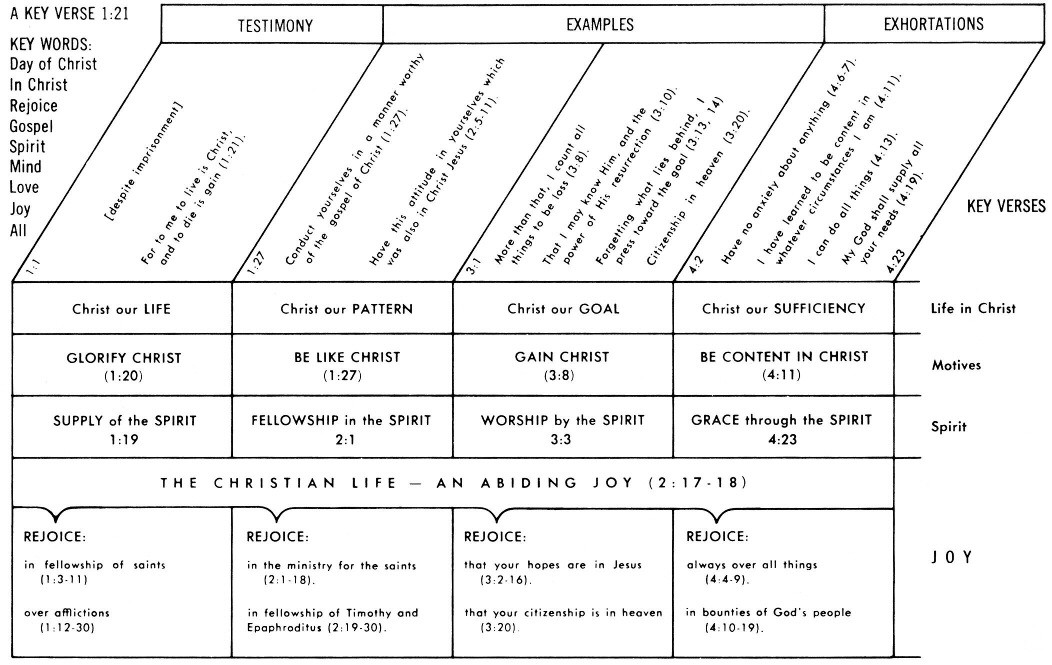
LIFE IN CHRIST
Click chart to enlarge
Charts from Jensen's Survey of the NT - used by permission
Philippians - Charles Swindoll = Chart on right side of page
| Account of Paul's Circumstances Php 1:1-30 |
Have the Mind of Christ Php 2:1-30 |
Have the Knowledge of Christ Php 3:1-21 |
Have |
| Partakers of Christ | People of Christ | Pursuit of Christ | Power of Christ |
| Suffering | Submission | Salvation | Sanctification |
| Experience | Examples | Exhortation | |

Philippi in the Time of Paul
The city plan above shows those features of the city of Philippi that archaeologists have so far identified as dating from the time of Paul. “Paul’s Prison” is not believed to be an authentic site, but was a cistern later associated with Christian worship. (ESV.org)
Philippians 1:15 Some, to be sure, are preaching Christ even from envy and strife, but some also from good will (NASB: Lockman)
Greek: Tines men kai dia phthonon kai erin, tines de kai di' eudokian ton Christon kerussousin (3PPAI)
Amplified: Some, it is true, [actually] preach Christ (the Messiah) [for no better reason than] out of envy and rivalry (party spirit), but others are doing so out of a loyal spirit and goodwill. (Amplified Bible - Lockman)
ESV Some indeed preach Christ from envy and rivalry, but others from good will.
KJV: Some indeed preach Christ even of envy and strife; and some also of good will:
NET Some, to be sure, are preaching Christ from envy and rivalry, but others from goodwill.
NLT: Some are preaching out of jealousy and rivalry. But others preach about Christ with pure motives.
NLT (Revised) It's true that some are preaching out of jealousy and rivalry. But others preach about Christ with pure motives.
CSB Some, to be sure, preach Christ out of envy and strife, but others out of good will.
NIV It is true that some preach Christ out of envy and rivalry, but others out of goodwill.
NJB It is true that some of them are preaching Christ out of malice and rivalry; but there are many as well whose intentions are good;
Wuest: In fact, certain ones even because of envy and rivalry, but also others because of good will are proclaiming Christ; (Eerdmans Publishing - used by permission)
Young's Literal: Certain, indeed, even through envy and contention, and certain also through good-will, do preach the Christ;
SOME TO BE SURE ARE PREACHING CHRIST EVEN FROM ENVY AND STRIFE: Tines men kai...ton Christon kerussousin (3PPAI) kai dia phthonon kai erin :
- Php 1:16;18 Acts 5:42; 8:5 8:35; 9:20; 10:36; 11:20; 1Co 1:23; 2Co 1:19; 4:5; 1Ti 3:16
- Php 2:3; Mt 23:5; Ro 16:17; 16:18; 1 Co 3:3; 3:4; 13:3; 2Co 12:20; Gal 2:4; Jas 4:5; 6
- Php 1:17; 1Pe 5:2, 3, 4
PREACHING CHRIST WITH
MIXED MOTIVES
The clear application from this text for all of us in ministry (and every saint is in ministry) is to check your motives. Why do you do what you do in ministry? Check them now for they will be checked later!
Therefore do not go on passing judgment before the time, but wait until the Lord comes who will both bring to light the things hidden in the darkness and disclose the motives of men’s hearts; and then each man’s praise will come to him from God. (1 Cor 4:5)
Stephen Olford - These were not heretics, like those in Corinth whom Paul severely denounced; nor were they Judaizers, like those of Galatia who preached another gospel. These were third-rate preachers who, out of sheer jealousy and enmity, took advantage of Paul’s imprisonment to draw attention to themselves. (Expository Preaching Outlines - Volume 2)
Ron Daniel summarizes Phil 1:15-18 - People were preaching the Gospel as a result of Paul's imprisonment. But those people fell into two different categories. The first group were sharing Christ with others out of good will and love. But the second group were doing it out of envy, strife, selfish ambition, and impure motives. These people were in it for what they could get: things like fame and notoriety, respect and honor, authority and control, money and favors. They envied Paul's popularity, the apostle's ministry. They wanted to prove that they were just as - or even more - effective a minister than he. The amazing thing to me is that Paul rejoiced at both situations. Why? Because although he knew that God would judge their motives, he knew that the Gospel was being proclaimed. I know people that have been saved through the ministries of men that were later exposed to be false. But their impurity and insincerity did not invalidate the true message of the gospel. It did not negate the conversion that many people experienced when they heard of the grace of God and believed it for salvation. That's because...Heb. 4:12 "the word of God is living and active and sharper than any two-edged sword, and piercing as far as the division of soul and spirit, of both joints and marrow, and able to judge the thoughts and intentions of the heart." The Word is alive, and when it is quoted, it accomplishes its work - to bring faith to the hearer. Rom. 10:17 So faith {comes} from hearing, and hearing by the word of Christ.There are evangelists who are dead or in jail from sin, those who have walked away from the faith, but when they preached Christ, people believed. There is at least one Christian comedian who was exposed as a fraud, but I know several who were saved because he preached the gospel. I have seen that ministry becoming contagious among the believers in this church as well. There has been such a neat work happening in so many people over the last year. Folks who were once shy and timid are stepping out and witnessing to their friends, their neighbors, their coworkers. Others are getting bold enough to invite unsaved people to church. And what is happening is that these people are getting saved. And that breeds the excitement to share with even more people. And just like what was happening in the early church, Acts 2:47 "the Lord was adding to their number day by day those who were being saved." (Sermon)
Some - This reflects back to Php 1:14--the brethren. "After telling the Philippians that one result of his imprisonment was to increase the number of gospel witnesses, he speaks of the two groups into which they were divided, and the different motives that impelled them to break their silence, which motives were governed by their different attitudes toward Paul."
To be sure - This phrase emphasizes that the detractors Paul is referring to did indeed preach the genuine gospel & were not heretics, Judaizers, Gnostics, idol worshipers, or devotees of Greek mythology.
Are preaching (proclaiming) (2784)(kerusso from kerux/keryx = a herald - one who acts as the medium of the authority of one who proclamation he makes; kerugma = the thing preached or the message) means to proclaim (publicly) or to herald or act as a public crier - the town official who would make a proclamation in a public gathering. Kerusso was used of the official whose duty it was to proclaim loudly and extensively the coming of an earthly king, even as our gospel is to clearly announce the coming of the King of kings and Lord of lords (Revelation 19:16-note)!
The Imperial Herald would enter a town in behalf of the Emperor, and make a public proclamation of the message which his Sovereign ordered him to give, doing so with such formality, gravity, and authority as to emphasize that the message must be heeded! (Think about this in regard to the Gospel of God instead of the decree of a man! cf 1Th 2:13-note). He gave the people exactly what the Emperor bade him give, nothing more, nothing less. He did not dare add to the message or take away from it. Should this not be the example and pattern every preacher and teacher of the holy gospel of God seeks and strives to emulate, yea, even doing so with fear and trembling! ("not as pleasing men but God, who examines our hearts" see 1Th 2:4-note)
Christ (5547) (Christos from chrio = to anoint, rub with oil, consecrate to an office) is the Anointed One, the Messiah, Christos being the Greek equivalent of the transliterated Hebrew word Messiah. S
They were preaching (present tense = continually) Christ (literally "the Christ" or "the Messiah") and not "another gospel" (Gal 1:8-note) or "another Jesus" (2Co 11:4)
In Acts we see the early church "kept right on teaching and preaching Jesus as (the) Christ" (the Messiah)." (Acts 5:42) Philip "went down to the city of Samaria and began proclaiming (the) Christ (the Messiah) to them" and to the Ethiopian eunuch "Philip opened his mouth, and beginning from this Scripture (Isa 53:7) he preached Jesus to him." (Acts 8:5, 35) Wasting no time after his Damascus Road encounter with the Resurrected Messiah, Paul "immediately...began to proclaim Jesus in the synagogues, saying, "He is the Son of God." (Acts 9:20) Paul continued to emphasize that "we preach Christ (Messiah) crucified, to Jews a stumbling block, and to Gentiles foolishness," and that they did "not preach (themselves) but Christ Jesus as Lord." (1Co 1:23; 2Co 4:5) (Click here for 15 references re "preaching Christ")
Who is my life "preaching"?
These detractors valued success, sadly not as a triumph over paganism, but as a triumph over Paul. It would make them feel good if they could make his sufferings in prison more acute by reason of jealousy which might arise in his heart. But their evil motives did not steal his joy, for as long as Jesus was being proclaimed as the Messiah, Paul was content. Once again we see a clue to the secret of Paul's joy (which the petty preachers sought to steal) and it was his steadfast focus on Christ and the Gospel. When your eyes are fixed vertically (on Christ), the things of the earth grow strangely dim in the light of His glory and grace!
Moule on "even from envy" - A mournful paradox, but abundantly verifiable. (Cambridge Bible for Schools and Colleges)
J Vernon McGee - When I first began to study the Bible, it was unbelievable to me that the preaching of the gospel of Christ could be done in envy and strife. But now that I've been in the ministry for a long time -- I was ordained in 1933 -- I know that one of the things that hurts the preaching of the gospel probably more than any other single thing is the envy and the strife. Paul will mention envy and strife several times in this epistle. There must have been quite a few who were preaching the gospel in that way, envious of the apostle Paul, jealous because they didn't have the results that Paul had.One of the solutions to this problem of envy is for every Christian to recognize that he has a gift. We do not all have the same gift. The body could not function if we did. The problem is that some men who have one gift are envious of a man who has a different gift. You will remember that Paul told the Corinthians that the gifts are to be exercised in love. Every gift is to be exercised in love. My friend, if you will exercise your gift in love, you will not envy someone else. "...Love envieth not; love vaunteth not itself, is not puffed up" (1Cor. 13:4). Envy says, "I don't think much of you," and pride says, "What do you think of me?" That is the difference between envy and pride, and the believer is warned against both of them. Paul put it very bluntly when he wrote, "For who maketh thee to differ from another? and what hast thou that thou didst not receive? now if thou didst receive it, why dost thou glory, as if thou hadst not received it?" (1Cor. 4:7). (Thru The Bible - Philippians 1 Commentary - Mp3's -Thru the Bible)
Envy (5355) (phthonos) describes pain felt and malignity conceived at the sight of excellence or happiness. It means not just wanting what another person has, but also resenting that person for having it. It is an attitude of ill-will that leads to division and strife and even murder. When we envy, we cannot bear to see the prosperity of others, because we ourselves feel continually wretched.
Phthonos - 9x in 9v - Matt 27:18; Mark 15:10; Rom 1:29; Gal 5:21; Phil 1:15; 1 Tim 6:4; Titus 3:3; Jas 4:5; 1 Pet 2:1.
The English word envy is interesting as it is derived from the Latin in = against and video = to look, “to look with ill-will,” etc., toward another, and obviously is an evil strongly condemned in both the Old Testament and the New Testament.
To envy is to feel a grudging discontent aroused by the possessions, achievements, or qualities of another along with the desire to have for oneself something possessed by another. To envy another is to show spiteful malice and resentment over another’s advantage. To envy is to possess a discontented feeling that arises in one's selfish heart in view of the superiority of another, and being nearly tantamount to the expression of jealousy. The one who envies possesses a malignant passion that sees in another qualities that it covets, and can even degenerate into hatred for their possessor. When we feel envy towards others our basic desire is to degrade them, not so much because we aspires after elevation as because we delight in obscuring those who are more deserving. It follows that envying while seemingly just an "innocent" sin is in fact one of the most odious and detestable of all vices.
Baker's Evangelical Dictionary on Envy -Sin of jealousy over the blessings and achievements of others, especially the spiritual enjoyment and advance of the kingdom of Christ freely and graciously bestowed upon the people of God. Old Testament examples of the sin of jealousy include the rivalry of Joseph's brothers over the favor that Joseph received at the hand of God (Genesis 37:12-36; Acts 7:9 ), and Saul's animosity toward David for his physical and spiritual prowess (1 Samuel 18 ). Envy inevitably leads to personal harm and debilitation, affecting one's physical, spiritual, and emotional well-being (Job 5:2; Proverbs 14:30 ). Unchecked, it gradually leads to a destructive and remorseful way of life (Proverbs 27:4 ), and ultimately, to estrangement from God (Romans 1:28-32 ). Envy manifests the insidiousness of sin and human depravity apart from the intervention of God's redeeming grace. As a sin of the flesh, envy characterizes the lives of the unregenerate. Envy is one of the traits of the Christian's former way of life (Romans 13:8-14; Titus 3:3 ). Those who practice envy and strife are barred from the kingdom of heaven (Galatians 5:19-26 ). Indeed, the unregenerate nature ever tends toward envy, manifesting the unbeliever's rejection of God, his truth, and his will for human conduct (James 3:14,16 ). (Envy - Baker's Evangelical Dictionary of Biblical Theology)
Jealousy and envy are close in meaning, but nevertheless are expressive of distinct attitudes, for jealousy makes us fear to lose what we possess, while envy creates sorrow that others have what we do not have. In other words, we are jealous of our own possessions, but we are envious of another man’s possessions. Jealousy fears to lose what it has, while envy is pained at seeing another have it!
Vine says that "envy differs from jealousy in that the former desires merely to deprive another of what he has, whereas the latter desires as well to have the same, or a similar, thing for itself." On this account envy is said to be “as the rottenness of the bones (Pr 14:30).
Thus Trench calls envy “the meaner sin” of the two.
Although Paul is characterizing those without Christ, believers are not immune to this sin which especially sad in the body of Christ, where the envying party is resentful of the spiritual accomplishments freely and graciously bestowed upon another brother or sister in Christ. Instead we should rejoice with them, but ultimately we can only do this when we are walking by the Spirit.
Spurgeon observes "How often, if one Christian brother does a little more than his fellow-workers, they begin to find fault with him; and if one is blessed with greater success than others are, how frequently that success is disparaged and spoken of slightingly! This spirit of envy is, more or less, in us all and though, perhaps we are not exhibiting it just now, it only needs a suitable opportunity for its display, and it would be manifested. No man here has any idea of how bad he really is. You do not know how good the grace of God can make you, nor how bad you are by nature, nor how bad you might become if that nature were left to itself.
Strife (2054) (eris) means contention, wrangling, quarrels. It refers to engagement in rivalry, especially with reference to positions taken in a matter, such a belief in the meaning of a genealogy! strife, a general term that carries the ideas of all kinds of self-centered rivalry and contentiousness about the truth. Strife is an expression of enmity with bitter sometimes violent conflict or dissension. It refers to persistent contention, bickering, petty disagreement, and enmity. It reflects a spirit of antagonistic competitiveness that fights to have its own way, regardless of cost to itself or of harm to others. It is produced by a deep desire to prevail over others, to gain the highest prestige, prominence, and recognition possible. Strife is characterized by self-indulgence and egoism. It has no place even for simple tolerance, much less for humility or love.
Barclay writes that strife (eris) "is the contention which is born of envy, ambition, the desire for prestige, and place and prominence. It comes from the heart in which there is jealousy. If a man is cleansed of jealousy, he has gone far to being cleansed of all that arouses contention and strife. It is God-given gift to be able to take as much pleasure in the successes of others as in one’s own...Eris is the spirit that is born of unbridled and unholy competition. It comes from the desire for place and power and prestige and the hatred of being surpassed. It is essentially the sin which places self in the foreground and is the entire negation of Christian love...(Eris) is a word of battles. It denotes rivalry and competition, discord about place and prestige. It is the characteristic of the man who has forgotten that only he who humbles himself can be exalted. (Daily Study Bible)
Eris is found 9 times in the (Ro 1:29 - note; Ro 13:13 - note; 1Cor 1:11; 3:3; 2Co 12:20; Gal 5:20; Php 1:15 - note; 1Ti 6:4; Titus 3:9) and not in the Septuagint (LXX).
Eris describes the discord, contention, rivalry, and/or conflict which resulted when Paul’s critics began discrediting him. Paul was simply following the example of his Master Jesus (1Pe 2:21) Who even Pilate "knew that because of envy ...had (been) handed ...over." (Mt 27:18) It is a sad that this kind of contention is rampant in the church today. Because people are jealous, they focus their whole lives on trying to discredit people who occupy places of blessing, such as evangelists, writers, pastors, teachers, and leaders of various ministries. Like Paul's detractors, they compete with others by using slander, accusation, and criticism--anything to tear another down.
Some preached Christ but had personal ambition whereas others had personal hostility toward Paul.
Paul had scolded the Corinthians for persistence in similar sins writing that
"for you are still fleshly. For since there is jealousy and strife (Gk = eris, wrangling, quarreling) among you, are you not fleshly, and are you not walking like mere men?" (1Cor 3:3)
Puritan Thomas Manton gives some good advice when you find yourself in a situation of being misrepresented like Paul was. He writes
"God is the most powerful asserter of our innocence. He has the hearts and tongues of men in His own hands, and can either prevent the slanderer from uttering reproach, or the hearer from the entertainment of the reproach. He that hath such power over the consciences of men can clear up our innocence; therefore it is best to deal with God about it; and prayer many times proves a better vindication than" to attempt to defend ourselves.
How did Paul handle the false accusations? (Php 1:18-note)
Bob Deffinbaugh has some interesting thoughts on envy and strife (rivalry) in the ministry - many Christians err in assuming that those who are in “full-time Christian ministry” cease to have fleshly desires and motivations. I believe that those to whom Paul referred were Christian leaders who were once threatened by Paul’s popularity and influence from a distance, but who are now intimidated by his presence. Many Christians seem to think that this is not possible. As one who has been involved in full-time Christian ministry for a number of years, I am here to tell you that Christians who are “in the ministry” are just as selfish, just as jealous, and just as manipulative as Christians who are not paid for their ministry. Indeed, some Christians in the ministry are more jealous and power hungry than some unbelievers I know.Over the years, I have watched young people in search of a “significant ministry.” Very often these folks look for employment in churches, in Christian educational institutions, and in parachurch ministries. And more often than I would wish to admit, these folks are badly disillusioned by their experience with such ministries. Until they saw it with their own eyes, they would never have believed that Christian leaders could be so jealous of others in ministry, so threatened by the success of others, and so manipulative and vindictive. Two nationally known speakers at a Bible conference may find it almost impossible to get along with each other, because of rivalry and competition. One speaker may lose his credibility, not because of his speaking, but because he can’t lose on the tennis courts or the golf course. Those of you who are in Christian ministry know that I am not exaggerating, and that what I am saying is true. Some of the most disillusioned people I know are those who were badly “burned” by Christian ministry, or by those in Christian ministry. Let me be painfully blunt by using a very specific illustration. In the recent past, it became known that Chuck Swindoll had consented to serve as the next president of Dallas Theological Seminary. It was obvious that in order to maintain his excellent radio ministry he would have to continue preaching on a regular basis. Finally, it was announced that Chuck Swindoll would plant a church in the Dallas area. (To his credit, I believe that he did everything possible to avoid sheep-stealing and doing damage to existing churches and their ministries. He chose to start a church as far removed as possible from existing Bible churches, and in a rapidly growing suburb as far to the north of Dallas as possible.) We would be nave to think that every pastor in the Dallas area responded like this: “Praise God! A wonderfully gifted preacher is coming to Dallas. What a blessing it will be to our city. How grateful to God I am that he is coming! I’m going to pray for Chuck, for his health, for physical strength, and for many new converts through his ministry.” I am sure that there are many noble-minded pastors in Dallas who responded this way, but I am just as convinced that a disturbing number did not. If one is jealous of or threatened by Chuck Swindoll’s success, it will almost never be couched in honest terms like this: “I’m jealous of Chuck Swindoll and his success, and I regret his decision to come to Dallas. Indeed, I’m going to do all I can to discredit him and his ministry.” Instead, it will be “pietized,” so that our jealous criticism is camouflaged as “concern for pure doctrine,” or “contending for the faith.” We will look for failures in his personal life, in his ministry, or in his methods. We will listen for rumors, and accept them as true. And when we hear of anything negative, we will be sure to let others know, “for their edification,” or as “a matter for prayer,” of course. I have to say that as I look back over my own ministry, I wonder how much of my criticism of other men and of other ministries was motivated (at least in part) by my own jealousy and ambition. I wonder how many church splits and how many doctrinal battles were really a matter of men’s egos, rather than of a love for the truth. It’s a sobering thought, but if we believe that the heart of man “is deceitful above all things and desperately wicked” (Jeremiah 17:9), it should not surprise us.....Surely some of those who had established themselves as leaders in the church at Rome were threatened by Paul’s announcement that he was planning on coming to Rome. If these men were those who first preached the gospel in Rome, and also the ones who founded the church in Rome, then they would have been tempted to feel that they “owned” this church. They would have been tempted to look on Paul as an intruder. They knew that when he came, many of the Roman saints would seek his counsel and would ask his opinion on matters of importance. These were some of the very ones who used to rely heavily on the advice and counsel of the church’s founding fathers. It would take great humility for them to welcome Paul and to be willing to step aside from their dominant role, at least for the time that Paul was in Rome. And now, to add insult to injury, Paul was a “jail bird.” .... He could not attend their church services nor fellowship with them in their homes. Can’t you see how those who were jealous of Paul and threatened by him could put a “spin” on Paul’s circumstances to make Paul look bad and to make themselves look good? “Well,” they might say with a pained expression, “I wanted to believe the best about Paul, but now that it has come out that he is a trouble-maker, I think it is probably best for the church here to keep its distance from him. We don’t want our testimony to be tainted by such a fellow.” (Paul's Perspective on Pain and Pettiness - Phil 1:12-18)
Charles Simeon (click to read biographical sketch of Simeon if you want to see an almost unbelievable example of standing firm in the face of fierce opposition) wrote,
"Let a pious minister arise in the Established Church (of England), and what labors (those filled with envy & strife will use) to draw away his people: preachings, prayer-meetings, societies, will all be formed for this very end & persons of popular talent will be brought from a distance to further the base design"
Alexander MacLaren speaks of tolerance of the message as long as it is the Gospel Message - It comes, then, to be a testing question for each of us, have we learned from Paul this lesson of tolerance, which is not the result of cold indifference, but the outcome of fiery enthusiasm and of a clear recognition of the one thing needful? Granted that there is preaching from unworthy motives and modes of work which offend our tastes and prejudices, and that there are types of evangelistic earnestness which have errors mixed up with them, are we inclined to say 'Nevertheless Christ is proclaimed, and therein I rejoice, Yea, and will rejoice'? Much chaff may be blended with the seeds sown; the chaff will lie inert and the seed will grow. Such tolerance is the very opposite of the carelessness which comes from languid indifference. The one does not mind what a man preaches because it has no belief in any of the things preached, and to it one thing is as good as another, and none are of any real consequence. The other proceeds from a passionate belief that the one thing which sinful men need to hear is the great message that Christ has lived and died for them, and therefore, it puts all else on one side and cares nothing for jangling notes that may come in, if only above them the music of His name sounds out clear and full. (Philippians 1:12-20 A Prisoner's Triumph)
BUT SOME ALSO FROM GOOD WILL: tines de kai di' eudokian:
but some are preaching him in good faith (Phillips)
but there are many as well whose intentions are good (NJB)
Good will (2107) (eudokía) refers to good pleasure, good intent, benevolence, a gracious purpose. This group was kindly disposed to Paul & was composed of Gentile converts, friends of Paul, who were encouraged to preach by the thought that it would give joy to the great apostle whose liberty was restricted. They were sympathetic towards Paul and grateful for his ministry. There are also people like that today--what a blessing, encouragement, and source of joy they are! If these "Barnabas" type folks are in your life then you should give praise and thanks to God for their lives.
Eudokia - 9x in 9v - desire(2), good pleasure(1), good will(1), kind intention(2), pleased(1), well-pleasing(2).
Matt 11:26; Luke 2:14; 10:21; Rom 10:1; Eph 1:5, 9; Phil 1:15; 2:13; 2 Thess 1:11.
As an aside note that in these Php 1:15-18 Paul is contrasting fleshly preaching versus Spirit filled preaching. Why do I say that? Because “envy and strife” are in the list of rotten fruit of the flesh in Gal 5:20-21 whereas “love” (Php 1:16) is the supernatural fruit of the Spirit in Gal 5:22. So if you are experiencing envy and strife, what’s the secret of eradicating that rotten fruit from your life and replacing it with love? Confess it as a sin and then yield to and “Walk by the Spirit and you will not gratify the (evil) desire of the flesh.” (Gal 5:16) Notice how envy and strife focus inward, on me, whereas love focuses outward, on others (cf Php 2:3-4).
Our Daily Bread: When the famous sculptor Michelangelo and the painter Raphael were creating works of art to beautify the Vatican, a bitter spirit of rivalry rose up between them. Whenever they met, they refused to speak to each other. Yet each was supposedly doing his work for the glory of God. Jealousy often parades behind the facade of religious zeal. Miriam and Aaron criticized their brother Moses for marrying an Ethiopian. But God's anger revealed that it was actually jealousy that prompted their criticism. Out of jealousy, Saul sought to kill David, whom God had chosen to succeed Saul as king. And when the apostle Paul was in prison, some people were so jealous of the way God was using him that they preached Christ in order to add to the apostle's distress.
We can overcome this harmful attitude, but first we must identify it. Jealousy believes that someone else is getting what we deserve—whether money, popularity, wisdom, skill, or spiritual maturity. Second, we must confess it. Call it what it is—sin. And third, we must give thanks. The moment we see someone enjoying any advantage, we must accept it with gratitude. We can keep jealousy in check by refusing to compare ourselves with others. As we learn to find our satisfaction in God, His grace enables us to rejoice with those who rejoice. When we do that, we have little room for envy. —D J De Haan (Our Daily Bread, Copyright RBC Ministries, Grand Rapids, MI. Reprinted by permission. All rights reserved)
When we turn green with jealousy,
We are ripe for trouble.
Philippians 1:16 the latter do it out of love, knowing that I am appointed for the defense of the gospel (NASB: Lockman)
Greek: oi men ex agapes, eidotes (RAPMPN) hoti eis apologian tou euaggeliou keimai, (1SPMI)
Amplified: The latter [proclaim Christ] out of love, because they recognize and know that I am [providentially] put here for the defense of the good news (the Gospel). (Amplified Bible - Lockman)
KJV: The one preach Christ of contention, not sincerely, supposing to add affliction to my bonds:
NLT: They preach because they love me, for they know the Lord brought me here to defend the Good News.
Phillips: These latter are preaching out of their love for me. For they know that God has set me here in prison to defend our right to preach the Gospel
Wuest: some indeed out of a spirit of love, knowing that I am appointed for the defense of the gospel; (Eerdmans Publishing - used by permission)
Young's Literal: the one, indeed, of rivalry the Christ do proclaim, not purely, supposing to add affliction to my bonds,
THE LATTER DO IT OUT OF LOVE KNOWING THAT I AM APPOINTED FOR THE DEFENSE OF THE GOSPEL: oi men ex agapes, eidotes (RAPMPN) hoti eis apologian tou euaggeliou keimai, (1SPMI):
- Php 1:7; Ro 1:13, 14, 15, 16, 17; 1Co 9:16 17; Gal 2:7;2:8 1Ti 2:7; 2Ti 1:11, 12; 4:6, 7; Lk 21:14; Acts 22:1; 26:1, 24; 2Ti 4:16
PAUL'S DIVINE APPOINTMENT
GOSPEL DEFENDER
Those who supported Paul did so "out of love". Those who preached Christ out of envy and strife certainly weren't characterized by love. An essential element of any effective ministry is love as Paul emphasized to the Corinthian church -
"If I speak with the tongues of men and of angels, but do not have love, I have become a noisy gong or a clanging cymbal. If I have the gift of prophecy, and know all mysteries and all knowledge; and if I have all faith, so as to remove mountains, but do not have love, I am nothing. And if I give all my possessions to feed the poor, and if I surrender my body to be burned, but do not have love, it profits me nothing." (1Cor 13:1-3)
Out of love (ex agapes) - The motivation of these saints was a supernatural, selfless, giving love (enabled by the Spirit) in direct contrast with the selfish motives of the petty, fleshly preachers. The former loved Paul, while the latter were envious and sought to cause Paul distress.
Love (26)(agape) is unconditional, sacrificial love and Biblically refers to a love that God is (1 Jn 4:8,16), that God shows (Jn 3:16, 1Jn 4:9) and that God enables in His children (see note on fruit of the Spirit - Gal 5:22-note). is the love of choice, the love of serving with humility, the highest kind of love, the noblest kind of devotion, the love of the will (intentional, a conscious choice) and not motivated by superficial appearance, emotional attraction, or sentimental relationship. Agape is not based on pleasant emotions or good feelings that might result from a physical attraction or a familial bond. Agape chooses as an act of self-sacrifice to serve the recipient. From all of the descriptions of agape love, it is clear that true agape love is a sure mark of salvation.
Agape is Love (Jn 3:16, 1Jn 4:9) that God enables in His children (see note on fruit of the Spirit - Gal 5:22-note).
Guy King - posted as a sentry, is the Moffatt Commentary's interpretation of "appointed."
A lesser man would have questioned God’s way’s. - But Paul saw his chains “Divinely Planned!”
Appointed (destined) (2749)(keimai) means literally to be in a recumbent position, to lie down, to be laid down. The root meaning refers to lying down or reclining and came to be used of an official appointment and sometimes of destiny. In the military keimai was used of a special assignment, such as guard duty or defense of a strategic position - the soldier was placed (set) on duty.
Keimai expresses the divine purpose of Paul's imprisonment. The sovereign God had brought this about, placing Paul on duty to defend the Gospel. In his last letter Paul gives all saints a similar charge to "suffer (command to suffer) hardship...as a good soldier of Christ Jesus" (2 Ti 2:3, 4-note).
Paul was in prison because he was destined to be there by God’s will, so as to be in a strategic position to proclaim the Gospel.
Wiersbe comments that keimai can also mean “to canvass for office, to get people to support you. Paul’s aim was to glorify Christ and get people to follow Him; his critics’ aim was to promote themselves and win a following of their own. Instead of asking, “Have you trusted Christ?” they asked, “Whose side are you on—ours or Paul’s?” Unfortunately, this kind of “religious politics” is still seen today. And the people who practice it need to realize that they are only hurting themselves."
Paul fully understood his "appointment" and that as a "good soldier of Christ Jesus" he was "under compulsion (compelled, a necessity having been laid upon him)," going on to explain that "woe is me if I do not preach the gospel for... I have a stewardship entrusted to me. (or as NLT paraphrases it - 'God has chosen me and given me this sacred trust, and I have no choice'." (1Co 9:16, 17)
Defense (627)(apologia from apo = from + logos = speech; English = apologetic) literally means, “to talk one’s self off from". Apologia was a technical word used in the Greek law courts and was used of an attorney who talked his client off from a charge preferred against him. In short it refers to a speech given in defense.
Apologia - Acts 22:1; 25:16; 1 Cor 9:3; 2 Cor 7:11; Phil 1:7, 16; 2 Tim 4:16; 1 Pet 3:15. NAS = defense(7), vindication(1).
Paul had used this same word earlier also referring to his defense of the Gospel...
For it is only right for me to feel this way about you all, because I have you in my heart, since both in my imprisonment and in the defense and confirmation of the gospel, you all are partakers of grace with me. (Phil 1:7)
Peter uses apologia in a similar sense as used here in Philippians 1:7, 16
but sanctify Christ as Lord in your hearts, always being ready to make a defense to everyone who asks you to give an account for the hope that is in you, yet with gentleness and reverence (1 Peter 3:15)
The English word apologetics describes the branch of theology devoted to the defense of the divine origin and authority of Christianity. Paul was a defender of the gospel and had been sovereignly, providentially placed by God in a strategic position to make his stand -- before the imperial government of the Roman Empire. How could he defend the gospel before the great and fearsome emperor of Rome? First, he had to understand that he was not defending himself but the gospel and secondly that he could not do it in his own strength.
As Jesus instructed His disciples
make up your minds not to prepare beforehand to defend yourselves for I will give you utterance and wisdom which none of your opponents will be able to resist or refute. (Lk 21:14, 15)
If God is for us, who is against us" for "in all these things we overwhelmingly conquer through Him who loved us. (Ro 8:31-note, Ro 8:37-note)
Philippians 1:17 (but) the former proclaim Christ out of selfish ambition rather than from pure motives, thinking to cause me distress in my imprisonment. (NASB: Lockman)
Greek: hoi de ex eritheias ton Christon kataggellousin, (3PPAI) ouch hagnos oiomenoi (PMPMPN) thlipsin egeirein (PAN) tois desmois mou.
Amplified: But the former preach Christ out of a party spirit, insincerely [out of no pure motive, but thinking to annoy me], supposing they are making my bondage more bitter and my chains more galling. (Amplified Bible - Lockman)
ASV: but the other proclaim Christ of faction, not sincerely, thinking to raise up affliction for me in my bonds. (This translation corresponds to the Greek text above)
KJV: But the other of love, knowing that I am set for the defence of the gospel.
NIV: The former preach Christ out of selfish ambition, not sincerely, supposing that they can stir up trouble for me while I am in chains.
NLT: Those others do not have pure motives as they preach about Christ. They preach with selfish ambition, not sincerely, intending to make my chains more painful to me. (NLT - Tyndale House)
Wuest: but others out of a partisan self-seeking spirit are announcing Christ, not with pure unmixed motives, but insincerely, thinking to make my chain gall me (Eerdmans Publishing - used by permission)
Young's Literal: and the other out of love, having known that for defence of the good news I am set: (This & the KJV translations are from the Greek Textus Receptus accounting for the differences)
THE FORMER PROCLAIM CHRIST OUT OF SELFISH AMBITION RATHER THAN FROM PURE MOTIVES: hoi de ex eritheias ton Christon kataggellousin, (3PPAI) ouch hagnos :
- 2 Co 2:17
"but the other proclaim Christ of faction, not sincerely" (ASV),
"But those are preaching Christ in a spirit of competition" (BBE)
"but those out of contention, announce the Christ, not purely" (Darby)
"There are others who are proclaiming Christ out of jealousy, not in sincerity" (NJB)
"the former proclaim Christ out of partisanship, not sincerely" (RSV),
"But others preach about Christ because they are selfish. Their reason for preaching is wrong." (ICB)
"The motive of the former is questionable - they preach in a partisan spirit" (Phillips)
The former - The petty, fleshy preachers.
Proclaim (2605) (kataggello) was used in secular Greek in honor of the emperors as the proclamation of imperial rule & meaning especially to announce or declare publicly, as in 1Co 11:26, where partaking of the Lord’s Supper is spoken of as a proclamation of His death until He comes again. Paul later wrote that the faith of the Roman saints was being openly & publicly declared (Ro 1:8 same verb kataggello cf uses in 1Co 2:1,1 Co 9:14, Col 1:28)
Christ (5547)(Christos from chrio = to rub or anoint, consecrate to an office) means one who has been anointed, symbolizing appointment to a task. The majority of the NT uses refer to Jesus (exceptions = "false Christs" - Mt 24:24, Mk 13:22).
Out of selfish ambition (ex eritheias) - Direct contrast with "out of love." (Php 1:16). Selfish versus selfless! Fleshly versus Spirit enabled!
Deffinbaugh - Redeemed men, even those who powerfully preach the gospel, are never completely free from fleshly and impure motivations. No one really wants to admit that when a classmate from seminary publishes a book that is widely acclaimed and becomes a best seller, he feels envious of his brother’s success. He should rejoice in his brother’s victory as his own, because both are members of Christ’s body, the church. But instead, there is—at least for a fraction of a moment—a jealous thought. (Paul's Perspective on Pain and Pettiness - Phil 1:12-18)
Selfish ambition (2052) (eritheia) originally meant to work for hire but came to be applied in a negative sense toward those who sought solely to benefit themselves--to advance themselves by acquiring wealth and prestige. It was often used of those who promote themselves in the course of running for government office. It was also used of the ruthlessly ambitious--those who sought to elevate themselves at all costs. Paul's imprisonment provided the perfect opportunity for such types to enhance their personal prestige and lessen his (or so they thought). Paul’s detractors used his incarceration as an opportunity to promote their own prestige possibly by accusing Paul of being so sinful the Lord had chastened or disciplined him by this imprisonment. In contrast to the love that characterized Paul's supporters, his detractors were motivated by selfish ambition--the most wicked of all motives. They were far removed from the principles of Php 2:3:
Do nothing from selfishness or empty conceit, but with humility of mind regard one another as more important than yourselves
The Philippians were not to behave like Paul's detractors in Rome. While the message of Paul's detractors was right, their motive was wrong. Selfishness comes in many forms. Peter warned against seeking after sordid gain (1Pe 5:2) and dominating others (1Pe 5:3). The apostle John spoke against seeking to be first (3Jn 1:9). Selfishness can show itself in any of those ways.
Rather than pure motives - "from mixed motives." What they said was doctrinally "pure" but the heart from which their message came was "impure" in regard to why they proclaimed Christ. Their motives were not free from admixture of evil.
Pure motives (53) (hagnos) means means freedom from defilements or impurities. So not with pure motives means their motives were mixed and impure, with duplicity. This group proclaimed Christ with but had underlying selfish motives. The preached with "dissimulation" which means they hid their motives under a false appearance. Do we ever do this among the brethren?
The clear application from this text for all of us in ministry (and every saint is in ministry) is to Check your motives. Here's a short "checklist" you might pray through:
- Why do you do what you do in ministry?
- Am I constantly comparing myself with others in ministry?
- Do I rejoice when my friends succeed or do I grow jealous and competitive?
- Do I resent it when others in ministry are praised?
- Does it disturb me when others are praised, promoted, and more recognized then I am?
- What is my response to those who try to tear me down in order to build themselves up?
Notice in that list, the questions deal with "will I respond enabled by a fleshly mindset" (Gal 5:19-20, especially "enmities, strife, jealousy, outbursts of anger, disputes, dissensions, factions") or "will I respond enabled by the Spirit" like Paul (Gal 5:22-23)? Paul shows us that the way to overcome your spirit of envy and rivalry and even desire to afflict another person in ministry is by practicing the "J.O.Y." (Jesus first...) RULE like Paul - He focused on Jesus, His Gospel and His glory. We need to practice the words of that great old Hymn - Turn your eyes upon Jesus, Look full in His wonderful face, And the things of earth will grow strangely dim, In the light of His glory and grace. Amen? Amen!
THINKING TO CAUSE ME DISTRESS IN MY IMPRISONMENT: hoiomenoi (PMPMPN) thlipsin egeirein (PAN) tois desmois mou:.
To make my chains gall me (Lightfoot)
supposing that they can stir up trouble for me while I am in chains. (NIV)
thinking to raise up affliction for me in my bonds (ASV)
but with the purpose of giving me pain in my prison (BBE)
supposing to arouse tribulation for my bonds (Darby)
meaning to add to the weight of my chains (NJB)
intending to make my chains more painful to me. (NLT)
hoping to make my chains even more galling than they would otherwise be (Phillips)
intending to increase my suffering in my imprisonment. (NRSV)
They want to make trouble for me in prison. (ICB)
thinking to make my chain gall me ( (Eerdmans Publishing - used by permission)
in order to stir up trouble for me while I'm in prison. (GWT)
supposing they are making my bondage more bitter and my chains more galling (Amp)
Thinking (Hoiomai) according to BDAG means "to consider something to be true but with a component of tentativeness." The present tense emphasizes that these pesky preachers were continually intending to make Paul's situation more distressing. The NLT paraphrase is vivid - "to make my chains more painful to me!"
Cause (1453)(egeiro) means to "raise up" and is a vivid metaphor of the detractors thinking they could "raise up affliction" with their desired goal being "to annoy the apostle by seeking to achieve success in gospel work in a spirit of rivalry against him, glorying in the fact that he was in chains." (Vine) Vincent says egeiro in this verse conveys the sense of "to waken or stir up affliction." He was under affliction in handcuffs and they sought in some way to make his "bonds press more heavily and gall him."
John MacArthur address how he is caused distress by others with impure motives declaring that the aspect of ministry that "most distresses (him) is being falsely accused by fellow preachers of the Gospel. For whatever reason, there are men who seem to desire to discredit the ministry of others. As a result they falsely accuse other ministers, not because those they attack are unbelievers, but simply to discredit them....The pain runs deep when preachers of the Gospel slander, malign, misrepresent, criticize, accuse, oppose, or belittle your ministry."
Steven Cole has a similar comment - I have found over the years that the most stinging criticism comes from fellow believers, not from the world. You expect the world to be hostile, but you also expect Christians to be on your side. Yet I have encountered the most hostility from those in the church, not from those outside. The Greek word translated “selfish ambition” was used of politicians building a personal following. Many in the church play politics to build a following. But it’s not the way of self-denial and living for Christ. (Sermon)
Distress (2347) (thlipsis) means tribulation (distress or suffering resulting from oppression or persecution), trouble, affliction and is derived from thlíbo which means to crush, press, compress, squeeze, which in turn is from thláo meaning to break. It is interesting to note the etymology of our English "tribulation" derives from the Latin tribulum which was the drag used in threshing grain, separating the wheat and the chaff. Is that not the eternal purpose of trials God allows in to our life? (Jas 1:2, 1:3, 1:4, 1:5) When Paul was "crushed" or "pressed", what came out of him was what continually filled him, the fruit of the Spirit of Christ, especially JOY in this letter! This begs the question "What comes out of me when I am squeezed out of my comfort zone?"
Thus we see the vivid picture of what Paul's detractors desired to do to him! And surely the malicious behavior of these envious detractors added to the physical chaffing of the shackles. Far from exalting Christ, protecting the church, evangelizing the lost, or defending the Word of God, their goal was to irritate Paul. Paul's words serve as a warning to us and we should not to be surprised by similar impious malicious behavior in the church today. If it happened to Paul, it will happen to all who "retain the standard of sound words" (2 Ti 1:13).
Many times the NT warns against envy, strife, selfish ambition, and impure motives (Php 2:3;1 Co 3:3 3:4; 13:3; 2Co 12:20; Gal 2:4; Jas 4:5 4:6) which are to be assiduously avoided now as much as they ought to have been then.
Tony Merida give us an excellent, practical summary of this section - The envious evangelists are filled with “envy and strife.” The empathetic evangelists preach out of “good will.” The former preach Christ out of “rivalry,” while the latter preach out of “love.” The envious evangelists look at Paul’s imprisonment as an occasion to tear him down, to stir up trouble, and to elevate their ministries over Paul’s. The empathetic evangelists care about Paul. They understand that Paul is in prison by God’s sovereign will and not as a result of any disobedience or unfaithfulness. They serve out of goodwill toward Paul. They seek to continue his mission. So we have two groups of ministers with different motives. These ministers with bad motives seem to be believers, and so we shouldn’t think that we can’t fall into these same sins ourselves. Let’s consider four applications for our ministries here. Beware of jealousy and envy in ministry. While every Christian will be tempted with these sins (Ro 1:29; Gal 5:20-21), they are particularly active in the passions of ministers. Be alert to the presence of such temptations. Ask yourself, Am I constantly comparing myself with others in ministry? Do I rejoice when my friends succeed, or do I grow jealous? Do I resent it when others are praised? Paul was uniquely gifted and used by God. Instead of rejoicing in Paul’s ministry, the envious evangelists resented him and couldn’t rejoice in the Savior’s work through him. Sadly, that sounds very familiar to our day. If Satan can’t corrupt your heart with a love of money or with sexual sin, he may try this tactic: envy and rivalry. Consider a story from the fourth century on the sin of envy. Some inexperienced demons were finding it difficult to afflict a godly hermit. They lured him with various temptations, but the man kept denying their allurements. The demons reported their problem to Satan. The evil one told them that they had been far too hard on the man. He suggested a more effective strategy: “Send him a message that his brother has just been made bishop of Antioch. Bring him good news.” The demons used the Devil’s scheme, reporting “the wonderful news” to the pious hermit. On hearing this message, the godly hermit fell into deep, wicked jealousy (Kent and Barbara Hughes, Liberating Ministry, 100).
Does it bother you when others are praised, promoted, and more recognized then you? What about if they try to tear you down in order to build themselves up? Despite the fact that wrongly motivated preachers were using Paul’s imprisonment as a means of tearing him down, Paul humbly said, “Christ is proclaimed. And in this I rejoice” (Php 1:18). The way you overcome your wicked jealousy is by caring more for Jesus’ glory than your own. Let the glory of Christ be your chief concern.
Beware of the temptation to promote yourself in ministry. Paul says that some were guilty of “rivalry” (Php 1:17) or “selfish ambition” (ESV, NASB). They wanted to be recognized and made much of by others. Serving Jesus out of rivalry is warped motivation. Yet, it’s sadly present today. Hanson notes, “Readers of Paul will observe that envy and rivalry are too often characteristics of preachers of Christ in our competitive churches” (Letter, 72). How sad it is to compete with others who are actually on the same team! How sad it is when we serve with selfish ambition while the heart of our message is about a Savior who emptied Himself for sinners. Avoid the sin of rivalry by caring for the glory of Jesus more than your own. Make it your ambition to make Christ known, not yourself (2 Cor 4:5).
Don’t be surprised if others envy you. While you will never be the mighty apostle Paul, the Lord may grant you unexpected influence. That influence would inevitably serve as an occasion for others to grow jealous of you. Because of their jealousy, they might do a number of things. They might criticize you unfairly. They might disassociate with you. They might speak against you. They might disrespect you. You may think this will never happen to you, but you should think again. What should you do then? You should follow Paul. He doesn’t try to defend himself. He doesn’t really get wrapped up in it all. He knows God will ultimately judge the hearts and ministries of people. So he simply stays focused on proclaiming Christ, and he puts the gospel first. You can’t control what others think of you; all you can do is finish your race with faithfulness.
Pray for God to give you the grace to minister out of love for Him and others. Paul recognizes that the message is more important than the motives, but he is clearly in favor of serving with good motives. Serve out of love and goodwill. The book of Philippians is filled with exhortations to loving, humble service that puts the needs of others ahead of our own. Why do you serve Jesus? Is it because you love Him and others? I don’t want to be an envious evangelist; I want to be a goodwill gospel proclaimer. This will happen as we care more about Jesus’ glory than our own, which Paul highlights in the next verse. (Christ-Centered Exposition – Exalting Jesus in Philippians)
Man's Purpose and God's Power.
In Psalm 75, breathing courage and confidence, which exalts the mighty Sovereign of all and magnifies His mighty power, the Psalmist tells us that the wrath of man shall be made to praise God. The wicked may plot against God, seeking to injure His servants and obstruct the progress of His truth, and within certain limits they may appear to succeed; but when they expect to reap the harvest of their evil machinations, they suddenly find themselves put to the worse, and God takes all that they had meant for the suppression of the Gospel, to promote its progress and triumph. There are few instances establishing this fact more striking than the story of the Apostle, for the misfortunes which befell his human life, and the difficulties over which he was compelled to make progress, were used by God to promote the highest interests of that very Gospel which was so dear to his heart, and for which he suffered so much.
St. Paul's yearning for Rome.
How eagerly he set his heart upon reaching Rome! In the Epistle to the Roman Christians, he tells them that he hopes presently that he may see Rome, not only that he may comfort them and be comforted by them, but because Rome was the metropolis of the world. From the golden mile-stone that stood in the Forum the mighty roads emanated to the far East and West. What Jerusalem was during the one week of the Passover, Rome was always. The statesmen who filled her Senate would be commissioned to all parts of the known world as consuls and praetors; the soldiers who gathered in her barracks might be despatched to the far Euphrates on the one hand, or the white cliffs of Britain on the other. To reach Rome seemed like standing in some telephonic centre, from which a whisper would reverberate to the ends of the world.
The Apostle Paul was a great strategist.
He knew the value of cities; they were the head of waters, into which if seed were dropped the current would carry it everywhere. Therefore, as he had spoken in Jerusalem, the heart of Palestine; at Antioch, the heart of Syria; at Ephesus, the heart of Asia Minor; and at Athens, the heart of Greece, he was desirous of preaching at Rome also, the heart of the empire of the world. No doubt he expected to get there as to other places, paying his own passage, going freely, and being welcomed by the little Churches of the saints, which were beginning to shed their light amid the surrounding gloom. But it was not thus that Paul accomplished his life-purpose. He came to Rome a prisoner, his passage paid as a convict by the Roman Government; and the hatred of his enemies was the breath of the Almighty that wafted him to his chosen destination.
Thus, constantly, God allows men to rage madly against His Gospel up to a certain point, which may cause annoyance, inconvenience, and pain, but there is always a "thus far and no further," and the Gospel proceeds upon the very lines which God from all eternity had determined.
This wonderful truth, which is capable of almost endless application, meets with three very remarkable illustrations in this paragraph.
Paul's Imprisonment in its Effect upon the Soldiers.
"My bonds became manifest in Christ throughout the whole praetorian guard, and to all the rest" (Phil. 1:13). It would be better translated--to the whole circle of the imperial lifeguards. We are all familiar with the fact that the Apostle was chained to a Roman soldier during the entire term of his two years' imprisonment, the soldier being changed every six hours. What an exquisite torture this must have been to a sensitive nature like his! Bad enough never to be alone, but still worse to have to spend the long hours always in company with a man chosen from the Roman guard.
In the Epistles of Ignatius, the good bishop of Antioch, who was entrusted to such guards to bring him from his see at Antioch to be thrown to the wild beasts, describes himself as fighting day and night with ten leopards, who, the more kindness was shown them, waxed worse and worse. Though we may well imagine that some of the soldiers chained to the Apostle may have been quiet and wistful men, eager to know the truth, yet, quite as likely, others would fill the room with ribald songs and jokes, and turn into blasphemous ridicule the words they heard the Apostle speak to those who came to visit him.
At times the hired room would be thronged with people, to whom the Apostle spoke words of life; and after they withdrew the sentry would sit beside him, filled with many questionings as to the meaning of the words which this strange prisoner spoke. At other times, when all had gone, and especially at night, when the moonlight shone on the distant slopes of Soracte, soldier and Apostle would be left to talk, and in those dark, lonely hours the Apostle would tell soldier after soldier the story of his own proud career in early life, of his opposition to Christ, and his ultimate conversion, and would make it clear that he was there as a prisoner, not for any crime, not because he had raised rebellion or revolt, but because he believed that He whom the Roman soldiers had crucified, under Pilate, was the Son of God and the Saviour of men. As these tidings spread, and the soldiers talked them over with one another, the whole guard would become influenced in sympathy with the meek and gentle Apostle, who always showed himself so kindly to the men as they shared, however involuntarily, his imprisonment.
The Witness of the Consistent Life.
How absolutely consistent the Apostle must have been! If there had been the least divergence, day or night, from the high standard which he upheld, his soldier-companion would have caught at it, and passed it on to others. The fact that so many became earnest Christians, and that the Word of Jesus was known far and wide throughout the praetorian guard, indicates how absolutely consistent the Apostle's life was. Do you not see how this applies to your own life? You may be bound to unsympathetic companions, as the Apostle to his soldier, as Ignatius to his ten leopards, or as Nicholas Ridley, afterwards Bishop and martyr, to the bigoted Roman Catholic Mayor of Oxford; but by your meek consistency and purity of life you may win these for God, and what might therefore have appeared an obstacle to your growth in grace, and to the progress of the Gospel, may turn out just the opposite. See to it that you so live and speak that it may be so.
The Imprisonment: its Effect upon the Brethren.
"Most of the brethren in the Lord, being confident through my bonds, are more abundantly bold to speak the word of God without fear" (Phil. 1:14). That is, courage was supplied them by the striking example of this noble man. Many who realised that, notwithstanding his chains and bonds, he was as enthusiastic in spreading the Gospel as he had been when his life was at his own disposal, and that, in spite of every difficulty and obstacle, he was still doing so much for the Gospel he loved, were rebuked for their lack of zeal and said: "If the Apostle is so strong and brave and energetic, when there is every reason for him to slacken and mitigate his energy, how much more reason there is for us, who have unrestrained liberty of action, to be unceasing in our endeavours for that Gospel for which he suffers."
The man who works for Christ when everything is against him stirs those up who have no such difficulties; just as he who makes confession for truth and righteousness, when there are many reasons for him to hush his voice, incites others to break forth in confession of Jesus Christ. They who dare to speak for God, even to death, are the means of stirring others to heroic defence of the Gospel. Think, for instance, of one of the greatest men that ever lived in England--a man whose name is almost forgotten now, but who is immortally associated with the cadence and splendid diction of the Bible--William Tyndale. It was his avowed purpose that every plough-boy in England should be able to know as much of the Bible as the priests. To accomplish this he appealed to the Bishop of London, but received no sympathy, and sorrowfully discovered that England could not hold the translator of the Bible. He was compelled to flee from England to Hamburg, from Hamburg to Cologne, from Cologne to Worms, and finally to Antwerp, where he was executed as a martyr; but not before he had put his imprimatur upon the magnificent English of the Bible, and had invested the Scriptures with priceless interest for the minds and hearts of those who had watched his noble life, his beneficent career, and his bloody death, so that out of his ashes there sprang a hundred, nay, a thousand men, to scatter the Bible for which he died.
A Call to You.
This may also be the case with you who are called to suffer for the Gospel. It may seem as if your voice were being hushed in blood and tears; but others are being made bold. Many a young man in that worldly society or godless counting-house is saying "If he dares to stand for God, I too will be a hero"; so that the very effect of your example is to stimulate weaker ones to become confessors and martyrs for Jesus Christ. Has not this been the result of the wholesale martyrdoms of Chinese missionaries and converts?
The Imprisonment: its Effect upon the Opponents of Evangelical Truth.
"Some indeed preach Christ even of envy and strife, and some also of goodwill." "What then? Only that in every way, whether in pretence or in truth, Christ is proclaimed; and therein I rejoice, yea, and will rejoice" (Phil. 1:1-18). There were two parties in Rome. The one loved Paul enthusiastically, and accepted his teaching; the other, though professedly Christian, held by the Temple, the Pharisees, and the old restrictions of Judaism. They avowed Christ, but often looked backward to the Old Covenant and tried to weave the two together. Paul's coming aroused these to more earnestness in promoting their own views of Christianity, but he said: "It does not matter, if Christ is preached; they do not love me, they do not come to me for help, they are doing all they can to make my life difficult; but nevertheless, if my Lord Jesus Christ is being preached, I am more than thankful." Perhaps that explains why God has permitted the various denominations to divide England between them. Perhaps it is better that it should be so, because one stirs up the other. It may be that the efforts of the Nonconformists stir to more activity the members of the Church of England, and vice versa. In any case the various doctrines of Christianity are more likely to be strongly enforced and maintained, when they underlie the very existence of a body of Christians, than if they were held in common by all.
All through the history of the world God has taken what seemed to be a hindrance and obstacle, and, if only His servants were patient and true to Him, has converted it into a pulpit from which they could better promulgate the truth. Remember how Nebuchadnezzar harried the Jews. It seemed as if the holy city was never again to wield an influence for good over the world; but the chosen people were scattered with their Scriptures throughout the world, and the world of God was magnified much more than it could have been by their concentration in their own city. The devil stirred up the Jews to murder Christ, but the grain of wheat which fell into the ground to die, no more abode alone, but has covered the world with the harvests of rich grain. The Emperors persecuted the early Church, but only drove the disciples everywhere preaching the Word. King Charles chased the Puritans out of England, but they landed on Plymouth Rock, and founded the great Christian commonwealth across the Atlantic. Out of the awful Civil War the conditions arose that made it possible for Abraham Lincoln to free the slave, and again the wrath of man turned out to further the Gospel of Jesus Christ.
"Careless seems the great Avenger,
History's pages but record
One death-grapple, in the darkness,
'Twixt old systems and the Word.
Truth for ever on the scaffold,
Wrong for ever on the throne;
Yet that scaffold sways the future,
And, behind the dim unknown,
Standeth God within the shadow,
Keeping watch upon His own."
So it May be with us. So it will be in our life. Let us begin to rejoice at difficulties, to rejoice when Satan rages. The power which is used against us, God will convert for our good; only let us always cherish the eager expectation and hope that Christ may be magnified in our body, whether by life or by death, whether by joy or by shame, whether by good fortune or by misfortune, whether by success or by failure. Christ, Christ, Christ, the Blessed Christ--not the Bible alone, not the creed alone, not doctrine alone, but Christ, Christ, Christ, always Christ manifested in our body, whether it be by life or by death.
Is Christ dear to you? Do you live for Him? Is the one passion and aim and purpose of your nature to glorify Him? Can you say: To me to live is Christ, and to die is gain? Oh, let us from today begin to live for this!
And if you are discouraged and disheartened, be of good cheer. When you are devoted to Christ, your very bonds will become electric chains through which the pulsation's of energy shall go to others, and your very troubles will be pulpits from which you shall preach the unsearchable riches of Christ.
Storms cannot shipwreck the Gospel; they waft it forward. Its foes contrive ingenious devices to obstruct it, but they awake to discover that all they had done to hinder is used to help. The lines of rail and the rolling stock which the enemy elaborated for incursions of hostile intent, are found to be simply invaluable to bear forward the precious message of the Gospel they would overthrow. It will be found, doubtless, at the end of all things, that the beneficent purposes of God have not been hindered one whit, but promoted and fostered, by all that has been done to frustrate them. This is the mystery of God's providence---that, so far from being set aside by evil, evil helps by furnishing the material on which the fire of the Gospel feeds, and flames to the furthest limits of God's universe. (F. B. Meyer. The Epistle to the Philippians)
Charles Simeon Philippians 1:17 Decision of Character Recommended