Philippians 1:2
Philippians 1:3
Philippians 1:4
Philippians 1:5
Philippians 1:6
Philippians 1:7
Philippians 1:8
Philippians 1:9
Philippians 1:10
Philippians 1:11
Philippians 1:12
Philippians 1:13
Philippians 1:14
Philippians 1:15
Philippians 1:16
Philippians 1:17
Philippians 1:18
Philippians 1:19
Philippians 1:20
Philippians 1:21
Philippians 1:22
Philippians 1:23
Philippians 1:24
Philippians 1:25
Philippians 1:26
Philippians 1:27
Philippians 1:28
Philippians 1:29
Philippians 1:30

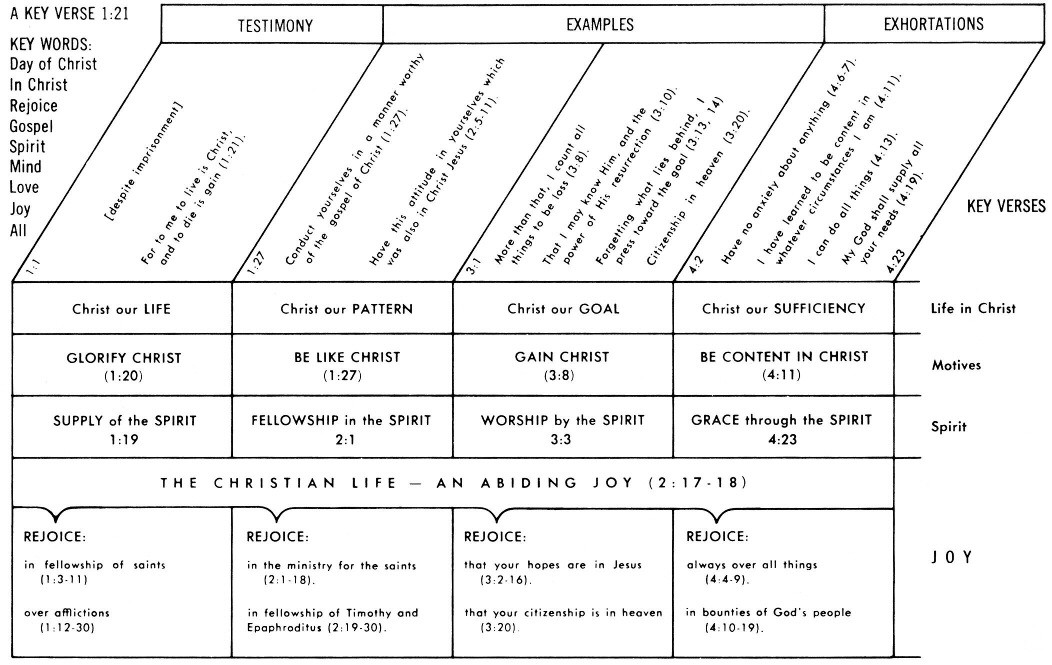
LIFE IN CHRIST
Click chart to enlarge
Charts from Jensen's Survey of the NT - used by permission
Philippians - Charles Swindoll = Chart on right side of page
| Account of Paul's Circumstances Php 1:1-30 |
Have the Mind of Christ Php 2:1-30 |
Have the Knowledge of Christ Php 3:1-21 |
Have |
| Partakers of Christ | People of Christ | Pursuit of Christ | Power of Christ |
| Suffering | Submission | Salvation | Sanctification |
| Experience | Examples | Exhortation | |
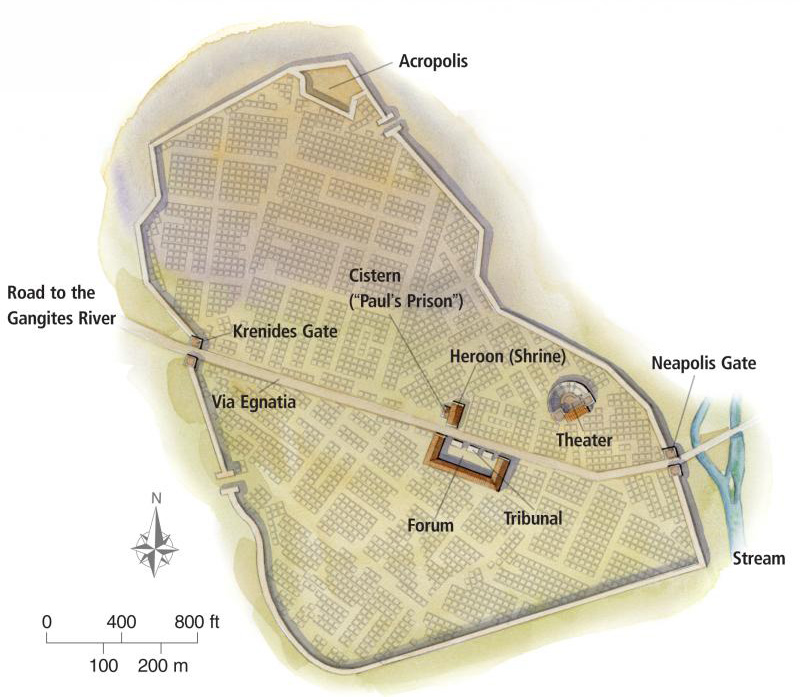
Philippi in the Time of Paul
The city plan above shows those features of the city of Philippi that archaeologists have so far identified as dating from the time of Paul. “Paul’s Prison” is not believed to be an authentic site, but was a cistern later associated with Christian worship. (ESV.org)
Philippians 1:2 Grace to you and peace from God our Father and the Lord Jesus Christ (NASB: Lockman)
Greek: charis humin kai eirene apo theou patros hemon kai kuriou Iesou Christou.
Amplified: Grace (favor and blessing) to you and [heart] peace from God our Father and the Lord Jesus Christ (the Messiah). (Amplified Bible - Lockman)
KJV: Grace be unto you, and peace, from God our Father, and from the Lord Jesus Christ.
NLT: May God our Father and the Lord Jesus Christ give you grace and peace. (NLT - Tyndale House)
Phillips: grace and peace from God our Father and Jesus Christ the Lord! (Phillips: Touchstone)
Wuest: (Sanctifying) grace be to you, and (heart) peace, from God our Father and from the Lord Jesus Christ. (Eerdmans Publishing - used by permission)
Young's Literal: Grace to you, and peace from God our Father, and the Lord Jesus Christ.
GRACE TO YOU: charis humin:
- Ro 1:7; 2Co 1:2; 1Pe 1:2
- Click for additional notes on Grace, Spurgeon on grace
- Philippians 1 Resources - Multiple Sermons and Commentaries
This salutation is undoubtedly a form of a blessing or prayer. Several of the modern paraphrases agree rendering it…
I pray that God our Father and the Lord Jesus Christ will be kind to you and will bless you with peace! (CEV)
May God our Father and the Lord Jesus Christ give you grace and peace. (TEV)
May grace and peace be granted to you from God our Father and the Lord Jesus Christ. (Weymouth)
May God our Father and the Lord Jesus Christ give you grace and peace. (NLT).
Notice that grace is like the "bookends" of this letter, Paul beginning and ending with a prayer for grace for his beloved saints at Philippi…
The grace of the Lord Jesus Christ be with your spirit. (Php 4:23-note)
In fact, with the exception of the epistle to Romans, every Pauline letter begins and ends with "grace", thus constantly emphasizing that the Christian life begins with grace, is lived by grace and ends with grace, not by reliance on self or works.
Grace to you and peace - This phrase is found 11x - Ro 1:7; 1 Co. 1:3; 2 Co. 1:2; Gal. 1:3; Eph. 1:2; Phil. 1:2; Col. 1:2; 1 Th 1:1; 2 Th 1:2; Philemon 1:3; Rev. 1:4.
Paul is opening with a prayer that the Lord's grace (His transforming, energizing enablement or power to live the supernatural, abundant life for His glory - see discussion of empowering aspect of grace at 2Ti 2:1+) be with all the the saints at Philippi. Is this not a prayer we should pray for all the saints in Christ Jesus? Have you ever prayed grace and peace for other believers?
Grace and peace, are always found in that order because grace is the foundation and peace is the result. No grace, no peace. Know grace, know peace!
C H Spurgeon well says that "Blessed men scatter blessings. When the benediction of God rests upon us, we pour out benedictions upon others. (The Second Coming)
Grace (5485) (charis) (click detailed study of grace) is the unmerited and "free favor and good-will of God, and all the blessed fruits and effects of it" (Matthew Henry). Grace is not license to do as we please (Jude 1:4), but power to do as we should. God’s grace insures that those who have been truly regenerated will persevere until the end of life. This entire work is called sanctification, a work of God “whereby we are renewed in the whole man and are enabled more and more to die daily unto sin and to live unto righteousness” as stated by the Westminster Shorter Catechism (Ro 12:2-note; Ep 4:23-note Col 3:10-note; 2Cor 4:16)
The grace of God not only makes us what we are, but then allows us to carry out fruitful labor (see 1Cor 15:10, cf the strengthening effect of grace in 2Ti 2:1).
Moule writes that grace in the salutations of many of the NT letters (Ro 1:7, 1Cor 1:3, 2Co 1:2, Gal 1:3, Ep 1:2, Col 1:2, 1Th 1:2, 2Th 1:2, 1Ti 1:2, 2Ti 1:2, Titus 1:4, Philemon 1:3, 1Pe 1:2, 2Pe 1:2, 2Jn 1:3) is supplemented…
by the remarkable addition "mercy" appears; in Jude, "mercy, peace, and love." In these salutations, "Grace" is all the free and loving favour of God in its spiritual efficacy. "Peace" is specially the complacency of reconciliation with which He regards His people, but so as to imply also its results in them ; repose, serenity of soul; spiritual happiness, in the largest sense. (The Epistle to the Ephesians)
Wuest on grace - In its use among the pagan Greeks referred to a favor done by one Greek to another out of the pure generosity of his heart, and with no hope of reward. When it is used in the New Testament, it refers to that favor which God did at Calvary when He stepped down from His judgment throne to take upon Himself the guilt and penalty of human sin. In the case of the Greek, the favor was done to a friend, never an enemy. In the case of God it was an enemy, the sinner, bitter in his hatred of God, for whom the favor was done. God has no strings tied to the salvation He procured for man at the Cross. Salvation is given the believing sinner out of the pure generosity of God’s heart. The Greek word referred to an action that was beyond the ordinary course of what might be expected, and was therefore commendable. What a description of that which took place at the Cross! The grace spoken of here is sanctifying grace [Ed note: In contrast to "saving grace", "sanctifying grace" is the Spirit of Christ indwelling me and enabling me to overcome sin. I cannot overcome it… it will overcome me if I try. All attempts to defeat the flesh in my own power will fail whether it be doing works or keeping rules or the Law. See Relationship of Justified, Sanctified, Glorified] that part of salvation given the saint in which God causes him to grow in Christ-likeness through the ministry of the Holy Spirit. (Wuest Word Studies - Eerdman Publishing Company Volume 1, Volume 2, Volume 3 - used by permission)
Guy King writes that…
Grace and peace - just the customary greeting: "grace", the Western (or Greek) "peace", the Eastern (or Hebrew) but when the HOLY SPIRIT led Paul to combine them here, we may be sure that He intended their use to be something so much more than formal and usual; both writer and readers would be led to see in them very deep and rich meaning.
Wilson Cash makes the interesting suggestion that "Paul combines both Jewish 'peace' and Gentile 'grace' in one salutation as a pledge of unity between East and West, between Jew and Gentile, in the one Saviour, who unites all in the one fellowship of His Body."
Dr. Hugh Michael, in the Moffatt Commentary, speaks of the enrichment of the commonplace by the new faith of CHRIST, which elevates a salutation into a benediction. How arrestingly that is seen in the transmutation of everything, however lowly, that He touched - a common Name, a despised City, a humble workshop, even a felon's Cross.
Dr. Johnson said of Oliver Goldsmith, "He touched nothing that he did not adorn: how infinitely truer of the Master. So here the common greeting is invested with uncommon beauty."
What are these things that the apostle desires for his friends, and which are no less desirable for ourselves?
(a) Grace - a quality which is, at once
(i) an Attitude, which He adopts towards us, as in Ep 2:8 (note);
(ii) an Activity, which He exerts for our help, as in 1Corinthians 15:10; and
(iii) an Accomplishment, which He works in, and out from, us, as in Acts 4:33.
Paul ardently, and prayerfully, desires for his converts everywhere - for he uses the words in all his church letters - that they may experience to the full this "grace", which the late Bishop Handley Moule describes as "love in action".
Then comes:
(b) Peace - the "God of all grace" is the "God of peace",1Pe 5:10 (note); Ro 15:33 (note); and it is only by, and after, His grace that we can enjoy His peace.
- Peace of heart - no condemnation before GOD
- Peace of conscience - no controversy with GOD
- Peace of mind - no anxiety about life
- Peace of action - no grit in the machinery
This gift is an immensely precious boon; and it may be the possession, should be the possession, of every believer. Paul will have some deep things to say about this later.
These two joys come, says our passage, "from God our Father, and from the Lord Jesus Christ" - the Father is the Source, from whom they come; the Saviour is the Medium, through whom they come. Not from the world arise such blessings, nor from our circumstances, however affluent and pleasant, nor from our own inner being, however much we strive, but only from Him, through Him, and "all the fulness of the Godhead … and ye are complete in Him" (See Col 2:9, 10-note) (King, Guy, Joy Way,1952 - online version) (Bolding added)
AND PEACE FROM GOD OUR FATHER AND THE LORD JESUS CHRIST: kai eirene apo theou patros hemon kai kuriou Iesou Christou:
- Philippians 1 Resources - Multiple Sermons and Commentaries
AMAZING GRACE
BEFORE PERFECT PEACE
From is the preposition apo (575) which governs both objects, God our Father and the Lord Jesus Christ, who together form one unit and are placed on a level of equality making this passage a definite affirmation of the deity of Jesus Christ.
We hear "God our Father" so often, we tend to miss the profound meaning and implications of this phrase. God is called our Father because we are His children by the new birth, John recording…
But as many as received Him, to them He gave the right to become children of God, even to those who believe in His name, who were born not of blood, nor of the will of the flesh, nor of the will of man, but of God. (John 1:12-13)
Father (3962) (pater) was not a term generally used for God in the Old Testament and so to be able to call God our Father as Paul does is a privilege believers need to meditate upon (see Primer on Biblical Meditation). We belong to His family and have all the rights of members of His divine family. In the Sermon on the Mount Jesus places special emphasis on the Fatherhood of God, addressing Jews who were not accustomed to addressing God in such familiar, intimate terms. Perhaps you have had a less than ideal earthly father and this experience makes it difficult for you to appreciate (and appropriate) the glorious truths inherent in the fact that the Almighty God Himself is now our Father. Study Jesus' description of the personal care and concern our Father manifests for each of His children (Mt 6:25,2 6- note, Mt 6:27, 28, 29-note, Mt 6:30, 31, 32-note, Mt 6:33, 34-note)
Lord (2962) (kurios from kúros = might, power in turn from kuróo = give authority) describes the One Who has absolute ownership and sovereign power and authority. In the New Testament, Jesus is referred to some ten times as Savior and some seven hundred times as Lord. When the two titles are mentioned together, Lord always precedes Savior. And even if, as some erroneously contend, Lord were simply a synonym for God, the very term God by definition includes the idea of sovereign authority and lordship. Kurios is used in more than 7000 verses in Old Testament Septuagint (LXX), usually translating the Name "Jehovah".
In one of the most beautiful passages in all of Scripture, Paul explains Christ's Lordship writing…
Therefore also God highly exalted Him, and bestowed on Him the name which is above every name, that at the name of Jesus EVERY KNEE SHOULD BOW, of those who are in heaven, and on earth, and under the earth, and that every tongue should confess that Jesus Christ is Lord, to the glory of God the Father. (see note Philippians 2:9-11)
Lord is a Name that calls every saint to reverently bow down to Jesus Christ. If Christ is our Lord, we are to live under Him, consciously and continually submitting our wills to him as His bondservants, always seeking first His Kingdom and His righteousness.
THOUGHT - According to this "definition" is He your Lord?
Lord is not merely a name that composes a title, but signifies a call to action so that every saint should willingly, reverently bow down to Jesus Christ. If Christ is our Lord, we are to live under Him, consciously, continually submitting our wills to him as His loyal, loving bondservants ("love slaves"), always seeking first His Kingdom and His righteousness (Mt 6:33-note). According to this practical working "definition" beloved we all need to ask ourselves "Is Jesus Christ my Lord?". "Do I arise each day, acknowledging this is the day the Lord hath made?" (Ps 118:24-note) "Do I surrender my will to His will as I begin each day?" (cp Ro 12:1-note, Ro 12:2-note) Beloved, don't misunderstand. None of us have "arrived" in this area of Jesus as Lord of our lives. And it is precisely for that reason that Peter commands us to continually "grow (present imperative) in the grace (unmerited favor, power to live the supernatural, abundant life in Christ) and knowledge (not just intellectual but transformational) of our Lord and Savior Jesus Christ. To Him be the glory, both now and to the day of eternity. Amen." (2Pe 3:18-note) So do not be discouraged. Don't "throw in the towel" as they say. Keep on keeping on, pressing (continually = present tense) "on toward the goal for the prize of the upward call of God in Christ Jesus." (Php 3:14-note)
Note also that there can be no grace and peace except from God our Father, the fountain and original of all blessings for
Every good thing bestowed and every perfect gift is from above, coming down from the Father of lights, with Whom there is no variation or shifting shadow. (Jas 1:17+)
As noted above, the Prince of Peace, the Lord Jesus Christ, is clearly identified by Paul with God the Father, leaving no doubt that he considers Jesus to be fully divine, which counters the argument of skeptics who say the Bible never says Jesus was God! In His special time with the disciples just prior to His crucifixion, Jesus declared…
Peace I leave with you; My peace I give to you; not as the world gives, do I give to you. Let not your heart be troubled, nor let it be fearful. (John 14:27)
These things I have spoken to you, that in Me (Ed: Think of the days of the flood, when the waters began to rise - those who had "peace" [Noah, et al] were safe in the Ark - Christ is the believer's "Ark" and in Him we are "safe" and have peace! And only in Him!) you may have peace. In the world you have tribulation, but take courage; I have overcome the world." (John 16:33)
Peace (1515) (eirene from verb eiro = to join) pictures the binding or joining together what is broken or divided and conveys the basic meaning to set at one again. Eirene is the root word for our English "serene" (serenity) which means clear and free of storms or unpleasant change, stresses an unclouded and lofty tranquility. Peace implies health, well-being, and prosperity. Christ Jesus through the blood of His Cross binds together that which was separated by human sin, the sinner who puts his faith in the Lord Jesus, and God. In secular Greek eirene referred to cessation or absence of war. In Adam all men before salvation "were enemies" (Ro 5:10-note, Ro 5:12-note), "alienated and hostile in mind, engaged in evil deeds" (Col 1:21-note) and so were ''at war'' with the Almighty'.
Saints now have "been justified by faith" and "have peace with God through our Lord Jesus Christ" (Ro 5:1+) because they have "been reconciled" (Ro 5:10+) The war between the believer and God is over, and the treaty was written not with pen and ink but with Cross and precious blood, where the Lamb of God paid the price in full (tetelestai in Jn 19:30+) so that believers now can be at rest in Christ (cf Heb 4:10+). Paul writes later in this letter that the "peace of God… shall guard your hearts and your minds in Christ Jesus" (Php 4:7+), referring to the peace that comes from being in unbroken communion or fellowship with God. The first peace is often referred to as peace with God (justification) and the later as the peace of God (fellowship, communion, daily walking with your Savior). Peace with God then is the harmony that exists between the Creator and His creatures who by grace through faith "receive the reconciliation" (Ro 5:11+).
The apostle’s desire is that those to whom he writes may live in the enjoyment of both grace and peace. Everything is from God, and because grace has been given from God, peace is possible.
The sum total of God's activity toward his human creatures is found in the word grace; God has given himself to His people bountifully and mercifully in Christ. Nothing is deserved, nothing can be achieved. The sum total of those benefits as they are experienced by the recipients of God's grace is peace, God's shalom, both now and in the ages to come. The peace flows out of the grace, and both together flow from God our Father and were made effective in human history through the Lord Jesus Christ.
Webster defines peace as a state of tranquility or quiet, freedom from disquieting or oppressive thoughts or emotions, harmony in personal relations, a pact or agreement to end hostilities between those who have been at war or in a state of enmity, state of repose in contrast with or following strife or turmoil.
Wuest adds that peace…in classical Greek means "to bind together," in the New Testament, "the operation of God’s grace in binding the believing sinner to God and His life again, this operation continued in bringing that believer in his experience more and more into harmony with God in his life and service," the latter being the particular phase to which Paul refers here.(Wuest Word Studies - Eerdman Publishing Company Volume 1, Volume 2, Volume 3 - used by permission)
Barclay writes that "in contemporary colloquial Greek this word eirene had two interesting usages. It was used of the serenity which a county enjoyed under the just and beneficent government of a good emperor; and it was used of the good order of a town or village. Villages had an official who was called the superintendent of the village’s eirene, the keeper of the public peace. Usually in the New Testament eirene stands for the Hebrew shalom and means not just freedom from trouble but everything that makes for a man’s highest good. It is interesting to note that Chara and Eirene both became very common Christian names in the Church. (Daily Study Bible)
John MacArthur adds that "If joy speaks of the exhilaration of heart that comes from being right with God, then peace refers to the tranquility of mind that comes from that saving relationship. The verb form (eiro) has to do with binding together and is reflected in the modern expression "having it all together." Everything is in place and as it ought to be. Like joy, peace has no relationship to circumstances. Christians know "that God causes all things to work together for good to those who love God, to those who are called according to His purpose" (Ro 8:28-note). Because God is in control (Sovereign) of all aspects of a believer’s life, how his circumstances may appear from a human perspective makes no ultimate difference. That is why Jesus could say without qualification to those who trust in Him, "Let (present imperative = Command with negative = Stop letting this happen!) not your heart be troubled" (John 14:1). There is absolutely no reason for a believer to be anxious or afraid. (MacArthur, J. Philippians. Chicago: Moody Press) (Bolding and notes in parentheses added)
ILLUSTRATION - Jim Walton was translating the NT for the Muinane people of La Sabana in the jungles of Colombia. But he was having trouble with the word peace. During this time, Fernando, the village chief, was promised a 20-minute plane ride to a location that would have taken him 3 days to travel by walking. The plane was delayed in arriving at La Sabana, so Fernando departed on foot. When the plane finally came, a runner took off to bring Fernando back. But by the time he had returned, the plane had left. Fernando was livid because of the mix-up. He went to Jim and launched into an angry tirade. Fortunately, Walton had taped the chief's diatribe. When he later translated it, he discovered that the chief kept repeating the phrase, I don't have one heart. Jim asked other villagers what having "one heart" meant, and he found that it was like saying, There is nothing between you and the other person. That, Walton realized, was just what he needed to translate the word peace. To have peace with God means that there is nothing--no sin, no guilt, no condemnation--that separates us. And that peace with God is possible only through Christ (Ro 5:1-note). Do you have "one heart" with God?