Philippians 1:2
Philippians 1:3
Philippians 1:4
Philippians 1:5
Philippians 1:6
Philippians 1:7
Philippians 1:8
Philippians 1:9
Philippians 1:10
Philippians 1:11
Philippians 1:12
Philippians 1:13
Philippians 1:14
Philippians 1:15
Philippians 1:16
Philippians 1:17
Philippians 1:18
Philippians 1:19
Philippians 1:20
Philippians 1:21
Philippians 1:22
Philippians 1:23
Philippians 1:24
Philippians 1:25
Philippians 1:26
Philippians 1:27
Philippians 1:28
Philippians 1:29
Philippians 1:30

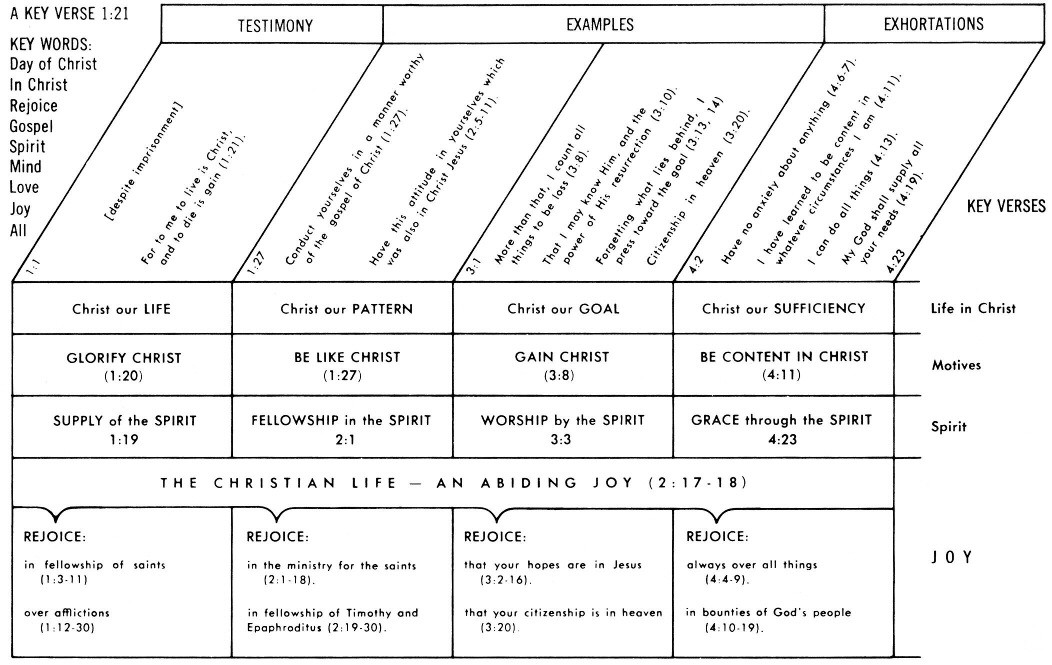
LIFE IN CHRIST
Click chart to enlarge
Charts from Jensen's Survey of the NT - used by permission
Philippians - Charles Swindoll = Chart on right side of page
| Account of Paul's Circumstances Php 1:1-30 |
Have the Mind of Christ Php 2:1-30 |
Have the Knowledge of Christ Php 3:1-21 |
Have |
| Partakers of Christ | People of Christ | Pursuit of Christ | Power of Christ |
| Suffering | Submission | Salvation | Sanctification |
| Experience | Examples | Exhortation | |
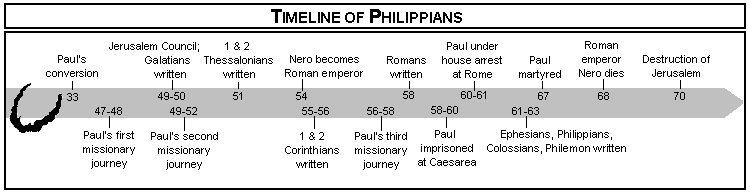
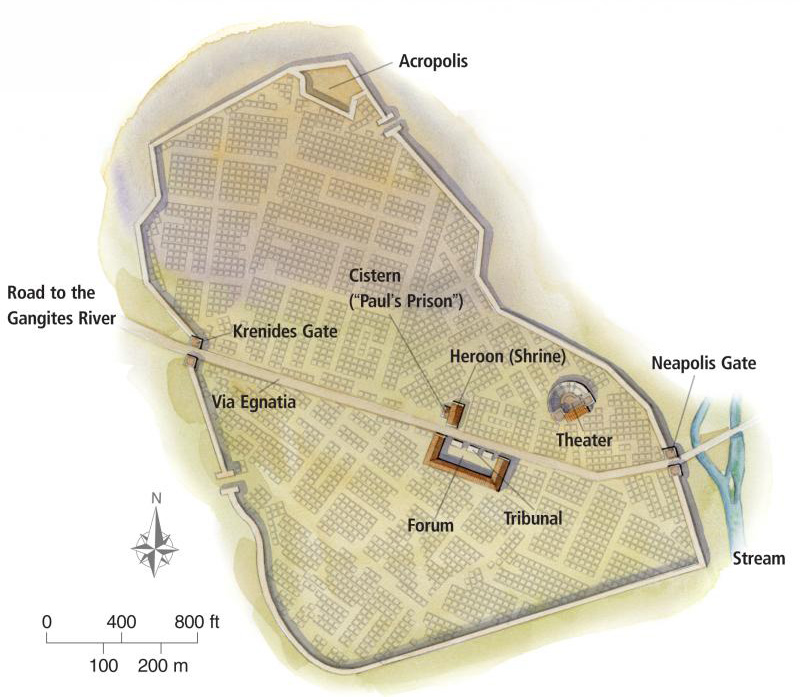
Philippi in the Time of Paul
The city plan above shows those features of the city of Philippi that archaeologists have so far identified as dating from the time of Paul. “Paul’s Prison” is not believed to be an authentic site, but was a cistern later associated with Christian worship. (ESV.org)
Philippians 1:22. But if I am to live (PAN) on in the flesh, this will mean fruitful labor for me; and I do not know which to choose (NASB: Lockman)
Greek: ei de to zen (PAN) en sarki, touto moi karpos ergou; kai ti hairesomai (1SFMI) ou gnorizo. (1SPAI)
Amplified: If, however, it is to be life in the flesh and I am to live on here, that means fruitful service for me; so I can say nothing as to my personal preference [I cannot choose], (Amplified Bible - Lockman)
NLT: Yet if I live, that means fruitful service for Christ. I really don't know which is better. (NLT - Tyndale House)
Wuest: But if for me [continued] life in this physical existence be my lot, this very thing [namely, continued life on earth] is that in which the fruit of my ministry will be involved and is the condition of that fruit being produced. Then what I shall prefer for myself I do not know. (Eerdmans Publishing - used by permission)
Young's Literal: And if to live in the flsh is to me a fruit of work, then what shall I choose? I know not;
But if I am to live on in the flesh: de to zen (PAN) en sarki:
- 2 Co 10:3; Gal 2:20; 1Pe 4:2
But - See discussion of importance of observing and querying terms of contrast. What is Paul contrasting?
Dwight Edwards - And so Paul expands upon the options of life or death. If he continues his sojourn on earth--"But if I live on in the flesh"--then he sees it as an opportunity to bear more fruit through ministry. Again we see Paul's strict singlemindedness (the mind of Christ)--he saw himself as an instrument for the unleashing of God's glory as long as time permitted (cf Acts 9:15). However, this unleashing would be a costly process--"fruit from my labor"--and the prospect of leaving the battlefront and going home was appealing indeed. So appealing, in fact, that he adds, "yet what I shall choose, I cannot tell (lit.--I do not know)."
Brian Bill - As Paul contemplates his future, he recognizes that if he continues to live, others will benefit: “this will mean fruitful labor.”
Flesh (sarx) here refers not to one’s fallen humanness (Ro 7:18, 7:5) but to physical life ("we walk in the flesh" - not the fallen flesh nature, but the physical body which is neutral - 2Cor 10:3-note; Gal 2:20-note; 1Pe 4:2-note). Paul is referring here to remaining in this world.
The following discussion is adapted from W E Vine's discussion of the various meaning of sarx in the New Testament. The specific meaning of any Greek word is always determined by the context and that principle is especially critical in correctly interpreting the meaning of sarx.
Flesh according to W E Vine "has a wider range of meaning in the NT than in the OT." The following summary of NT is based primarily on W E Vine's analysis but has additional notes obtained from a variety of sources too numerous to mention...
(a) The substance of the body. The material that covers the bones of a human or animal body. Whether of beasts or of men.
"All flesh is not the same flesh, but there is one [flesh] of men, and another flesh of beasts, and another flesh of birds, and another of fish." (1Co15:39) Paul speaks of the amazing variety of earthly bodies God has made. We need only look around us to see the virtually infinite assortment of created beings and things. The flesh of men is absolutely distinct from the flesh of beasts, the flesh of birds, and the flesh of fish. In short, all flesh is not of the same kind. In context Paul is saying that if God is able to make different kinds of bodies for men, animals, birds, and fish, why can He not make a different kind of body for us at the resurrection? He has arranged all things in nature in the differing degrees of glory and so has power to bring about the state of glory to be manifested in the resurrected bodies of believers. Note: Differences in degrees of glory in the believer's glorified bodies is not in view.
"I have been crucified with Christ; and it is no longer I who live, but Christ lives in me; and the life which I now live in the flesh (in this physical human body) I live by faith in the Son of God, Who loved me, and delivered Himself up for me." (Gal 2:20)
(b) “the human body,” 2 Cor. 10:3a; Gal. 2:20; Phil. 1:22; (c) by synecdoche, of “mankind,” in the totality of all that is essential to manhood, i.e., spirit, soul, and body, Matt. 24:22; John 1:13; Rom. 3:20; (d) by synecdoche, of “the holy humanity” of the Lord Jesus, in the totality of all that is essential to manhood, i.e., spirit, soul, and body John 1:14; 1 Tim. 3:16; 1 John 4:2; 2 John 7, in Heb. 5:7, “the days of His flesh,” i.e., His past life on earth in distinction from His present life in resurrection; (e) by synecdoche, for “the complete person,” John 6:51-57; 2 Cor. 7:5; Jas. 5:3; (f) “the weaker element in human nature,” Matt. 26:41; Rom. 6:19; 8:3a; (g) “the unregenerate state of men,” Rom. 7:5; 8:8, 9; (h) “the seat of sin in man” (but this is not the same thing as in the body), 2 Pet. 2:18; 1 John 2:16; (i) “the lower and temporary element in the Christian,” Gal. 3:3; 6:8, and in religious ordinances, Heb. 9:10 (j) “the natural attainments of men,” 1 Cor. 1:26; 2 Cor. 10:2, 3b; (k) “circumstances,” 1 Cor. 7:28; the externals of life, 2 Cor. 7:1; Eph. 6:5; Heb. 9:13; (1) by metonymy, “the outward and seeming,” as contrasted with the spirit, the inward and real, John 6:63; 2 Cor. 5:16; (m) “natural relationship, consanguine,” 1 Cor. 10:18; Gal. 4:23, or marital, Matt. 19:5.” Adapted and modified from Vine's Expository Dictionary
Metonymy: the substitution of a word referring to an attribute for the thing that is meant, as for example the use of the crown to refer to a monarch. This is a figure of speech in which an attribute of a thing or something closely related to it is substituted for the thing itself. Thus, “sweat” can mean “hard labor,” and “Capitol Hill” represents the U.S. Congress. Another example is "The White House denied the allegations,” which uses White House to mean the president or his staff."
Synecdoche: a figure of speech in which a part is substituted for a whole or a whole for a part, as in 50 head of cattle for 50 cows. It represents an indirect mode of expression, often used in rhetoric, whereby the whole is put for the part, or the part for the whole. Typical examples of this figure of speech occurring in the Bible are “for they have come under the shelter of my roof [my house]” (Ge19:18), and “How beautiful upon the mountains are the feet of him [the messenger] who brings good tidings” (Isa52:7). "The house was built by 40 hands" for "The house was built by 20 people." In this figure of speech a part is put for the whole (as fifty sail for fifty ships), the whole for a part (as society for high society), the species for the genus (as cutthroat for assassin), the genus for the species (as a creature for a man), or the name of the material for the thing made (as boards for stage) Synecdoche represents a more inclusive term is used for a less inclusive term, or vice versa, as in “Brazil lost the soccer game,” which means that a soccer team from Brazil lost the game. In the expression “all hands on deck,” “hands” stands for the whole person.
This will mean fruitful labor for me: touto moi karpos ergou:
- Ps 71:18; Is 38:18; 38:19
This - Remaining earthbound. Paul saw his purpose clearly -- to bear fruit for God's glory. We should do the same. It is so easy to get caught up in the world's attractions with the result that our truth purpose for being here becomes blurred.
John MacArthur explains that "Fruitful labor is the work of the Lord, which the Holy Spirit always blesses. When “the word of truth, the gospel” is faithfully proclaimed it will be “constantly bearing fruit and increasing” (Col. 1:5–6; cf. Phil. 1:15–18). Paul is not, of course, speaking of good works by which men vainly hope to redeem themselves. All human works are powerless to save and actually vitiate the gracious, redeeming work of Christ (Ro 3:20–22, 28; 4:1–5; Gal. 2:16–21; Eph. 2:7–9). He is rather speaking of the Spirit-empowered fruitful labor for which we are “created in Christ Jesus, [the] good works which God prepared beforehand so that we would walk in them” (Eph. 2:10). It is the fruit of “God who is at work in you, both to will and to work for His good pleasure” (Phil. 2:13). Spiritual fruit encompasses the Spirit-directed and Spirit-empowered motives and behavior built on the foundation of Jesus Christ (1 Cor. 3:11). It can be divided into several categories. Attitudinal fruit includes the “fruit of the Spirit” (Gal. 5:22–23); action fruit consists of righteous deeds (cf. Phil. 1:11); fruit also includes converts (cf. Rom. 1:13). (Philippians Commentary)
Fruitful (2590) (karpos) is used in its literal sense to refer to fruit, produce or offspring, which describes that which is produced by the inherent energy of a living organism. Karpos is what something naturally produces. Karpos refers to that which originates or comes from something producing an effect or result (benefit, advantage, profit, utility). Figuratively, karpos is used of the consequence of physical, mental, or spiritual action. In the NT the figurative (metaphorical) uses predominate and this is particularly true in the Gospels, where human actions and words are viewed as fruit growing out of a person's essential being or character.
Scripture describes 3 general kinds of spiritual fruit...
1) Spiritual attitude fruit - As described in Galatians 5:22-23. Every believer manifests all the aspects of this fruit to some degree, although often one or several traits will be predominant. This spiritual attitude fruit precedes spiritual action fruit described below. If the spiritual attitudes are present, the fruit of good deeds will invariably follow.
2) Spiritual action fruit - Col 1:10 (note) In Colossians Paul describes believers filled with or controlled by the knowledge of God's will in all spiritual wisdom and understanding and thereby walking worthy of the Lord, pleasing him and bearing fruit in every good work. Note that "spiritual action" fruit is preceded by the "spiritual attitude" fruit Paul describes in Galatians 5:22-23.
See other "spiritual action fruit" -
- Sanctification - Ro 6:22-note,
- Offering of money- Phil 4:16, 17-note;
- Offering of Praise - Heb 13:15-note (fruit of lips that give thanks to God)
3) New converts - 1Co 16:15 ; Ro 16:15 - note (where convert is literally "first fruit")
Larry Richards summarizes the Biblical concept of spiritual fruit writing that "Fruitfulness is a consistent concept in the OT and the NT. The fruit God seeks in human beings is expressed in righteous and loving acts that bring peace and harmony to the individual and to society. But that fruit is foreign to sinful human nature. Energized by sinful passions, fallen humanity acts in ways that harm and bring dissension. God's solution is found in a personal relationship with Jesus and in the supernatural working of God's Spirit within the believer. As we live in intimate, obedient relationship with Jesus, God's Spirit energizes us as we produce the peaceable fruit of a righteousness that can come only from the Lord. (Richards, L O: Expository Dictionary of Bible Words: Regency)
Spiritual fruit is a marker of spiritual life, a sure proof that one has experienced genuine conversion. A profession of faith in Christ cannot produce holy fruit. Only a genuine possession of the life of Christ can produce supernatural fruit. Let's look at a few texts that corroborate this basic and vitally important spiritual principle.
Warren Wiersbe wisely warns us that "It is possible for the old nature to counterfeit some of the fruit of the Spirit, but the flesh can never produce the fruit of the Spirit. One difference is this: when the Spirit produces fruit, God gets the glory and the Christian is not conscious of his spirituality; but when the flesh is at work, the person is inwardly proud of himself and is pleased when others compliment him. The work of the Spirit is to make us more like Christ for His glory, not for the praise of men. (Bible Exposition Commentary. 1989. Victor)
In Matthew 3:8 John the Baptist is addressing the "religious" professors, the Pharisees and Sadducees who were seeking "baptism". John in the context of discussing how to escape the "wrath to come" declared to these hypocritical religious leaders "Therefore bring forth (aorist imperative = command with a sense of urgency = do this now!) fruit in keeping with (or "worthy of" - see axios) repentance (see in depth study of metanoia)" John rebuked the religious "generation of vipers" calling for repentance and insisting that any inner change produce fruit (e.g., love, joy, peace, patience, etc) as evidence of the reality of that change. John demanded proof from these men of the new life before he administered baptism to them. The point is that spiritual fruit is not the change of heart itself, but the acts which result from a new spiritually circumcised heart (see notes on spiritual circumcision - Col 2:11-note). It was a bold deed for John thus to challenge as unworthy the very ones who posed as lights and leaders of the Jewish people.
Natural fruit needs to be cultivated and so does spiritual fruit! It needs to be watered and fed by the Word of good in the soil of a good heart (Lk 8:15) and in the invigorating, transforming atmosphere of the Holy Spirit. And so Paul is very practical explaining that "If we live by the Spirit let us also walk by the Spirit." (Galatians 5:25)
Labor - Don't miss what Paul just said. Not fruitful fun but fruitful labor. Laboring in spiritual fields is similar to laboring in the cotton fields in that it is not easy but is hard, even exhausting work. And yet when it is carried out in the power of the Spirit, it bears fruit that will endure for time and eternity (Jn 15:16). Epaphroditus almost died in the "work of Christ" (Php 2:30-note)
MacArthur - The apostle Paul considered that being alive in the physical world is synonymous with fruitful labor for Christ. His use of “labor” refers to his spiritual work for the Lord, which yields spiritual fruit. Spiritual fruit may be seen in people, deeds, and words—whatever is of eternal value (Ed: cp Heb 13:15-note) . That kind of fruit comes from good hard work, which is the natural activity of the godly on earth. (Truth for today : a daily touch of God’s grace)
Guzik - Paul was confident that God intended him to be fruitful. There was no doubt in Paul’s mind that this was God’s plan for him. If Paul lived, it would be a fruitful life. In sad contrast, many Christians have not yet come to the place where it is a certainty that they will bear fruit for the kingdom of God with their life.
Labor (2041)(ergon English ergometer) describes activity related to making or doing something (Mk 13:34; Eph. 4:12; 1 Ti 3:1; Lxx - Ge 2:2; 39:11; Ex. 35:2); of the work which Jesus was sent to fulfill on earth (tó érgon [John 17:4],.
And I do not know which to choose: kai ti hairesomai (1SFMI) ou gnorizo. (1SPAI):
- Ge 21:26; 39:8; Ex 32:1; Acts 3:17; Ro 11:2
PAUL'S DILEMMA - LIVE OR DIE
STAY OR GO?
I (do not) Know (1107)(gnorizo) means to cause information to be known, communicating things before unknown or reasserting things already known
MacArthur - Gnōrizō (know) is used twenty-seven times in the New Testament, over half of those times by Paul. It is used of revealing something that was previously unknown, whether by the Lord to men (as in Luke 2:15; John 15:15; Rom. 9:22–23) or by men to other men (as in Acts 7:13; 2 Cor. 8:1; Eph. 6:19, 21). Paul’s point seems to be that he had not yet decided which to choose because the Lord had not yet made it known to him which to choose. Because he was not sure of the Lord’s will in the matter, he was not sure of his own.
Choose (prefer) (138) (haireomai from haireo = to take a particular position for oneself) means to make a choice of one or more possible alternatives and so to choose, select or prefer. In the middle voice haireomai means to take for oneself (the pronoun "oneself" indicating the reflexive aspect of the middle voice) and so to choose, elect or prefer. It means to make a choice of one or more possible alternatives. Liddell Scott has this entry - "to choose, to take in preference, prefer one thing to another. "
Haireomai can mean to choose, for the purpose of showing special favor as in Thessalonians "But we should always give thanks to God for you, brethren beloved by the Lord, because God has chosen (haireo) you from the beginning for salvation through sanctification by the Spirit and faith in the truth. (2Th 2:13).
Haireo is the root word of the Greek word hairesis, which means "heresy" (an opinion, doctrine, or practice contrary to the truth or to generally accepted beliefs or standards) which can mean a false teaching or a division or group based upon different doctrinal opinions and/or loyalties and hence by implication in certain contexts an unjustified party or group.
Paul knew that the only reason to remain in this world was to bring souls to Christ and build up believers to do the same. Paul couldn't say what he would choose. He knew it was an issue that was in the Lord's hands and, given the choice, couldn't choose either heaven or earth for himself.
WHAT DOES PAUL MEAN
WHICH TO CHOOSE?
What did Paul mean that he did not "know which (life or death) to choose?" Here are a number of opinions...
Gordon Fee - Verse 22 is a clear follow-up to verse 21. Picking up on the first clause (to live is Christ), Paul assesses what its outcome will mean for him in the body (literally “flesh”), namely, fruitful labor. But rather than follow that up with a similar sentence (“if it means death”), he jumps ahead to reflect on what he might do if he in fact had a real choice in the matter. “I simply cannot say,” he says; indeed, I am torn between the two, since it means Christ in either case.
Wuest paraphrase " But if for me [continued] life in this physical existence be my lot, this very thing [namely, continued life on earth] is that in which the fruit of my ministry will be involved and is the condition of that fruit being produced. Then what I shall PREFER for myself I do not know.(Wuest Word Studies - Eerdman Publishing Company Volume 1, Volume 2, Volume 3 - used by permission)
NET Bible - Now if I am to go on living in the body, this will mean productive work for me, yet I don't know which I PREFER: (Comment: Greek "what I shall prefer." The Greek verb haireo could also mean "choose," but in this context such a translation is problematic for it suggests that Paul could perhaps choose suicide.)
Jamieson, Fausett, Brown - . WHAT I SHALL CHOOSE I know not (I cannot determine with myself, IF THE CHOICE WERE GIVEN TO ME, both alternatives being great goods alike).”
Adam Clarke - Yet what I shall choose I wot not - Had I the two conditions left to my own choice, whether to die now and go to glory, or whether to live longer in persecutions and affliction, (glorifying Christ by spreading the Gospel), I could not tell which to prefer.
Johann Bengel on "choose" - He supposes the condition, viz. if the power of choosing were given to him.
KJV Study Bible -- sees "choose" more with the nuance of "prefer" - Read the verse thus: “But should I continue living in the flesh, this will result in fruit [gain, profit] from my labor; yet which [of the two] I will prefer, I know not.”
Bible Knowledge Commentary (Lightner) - The apostle’s seeming frustration of mind is apparent in these verses. He knew if he could go on living there would certainly be fruit from his labor (v. 22). God would bless his work and continue to use him as He had in the past. Yet if Paul had a choice between going on living or dying for Christ, he was at a loss as to how to decide. He simply did not know which to choose. Of course the choice was really not up to him anyway.
Thomas Constable - The prospect of a few more years of life and service was not unattractive to the great apostle either. He saw living as an opportunity to continue serving the person of Christ and building up the body of Christ. He could continue to labor, and his work would produce fruit for eternity. Satanic opposition had always marked Paul’s labors, but he was willing to continue to face that. He was glad the choice of living or dying was not his to make since both options had positive features for him.1
John MacArthur - Paul’s point seems to be that he had not yet decided which to choose because the Lord had not yet made it known to him which to choose. Because he was not sure of the Lord’s will in the matter, he was not sure of his own.
Lutheran Study Bible - choose. Paul cannot choose, and the choice is not his to make. The Lord who made you and gives you life has numbered your days (Ps 139:16). He also prepares the good content of those days (Eph 2:10).
Matthew Poole - Yet what I shall choose I wot not; he seems, loving the Philippians as himself, to be at a loss what to determine, if God should permit him his choice, whether by laboring in his ministry for rite good of their souls he should bring more fruit to Christ, or by suffering, that which would arise from the blood of a martyr, who himself should receive a crown, 2Ti 4:8.
Andrews Study Bible - 1:22 what I shall choose. What should I pray for; see v. 25. Paul was released after about two years of house arrest in Rome. He was eventually martyred in Rome around A.D. 67.
John Wesley - And what I should choose I know not -That is, if it were left to my choice.
Philippians 1:23. But I am hard-pressed from both directions, having the desire to depart and be with Christ, for that is very much better (NASB: Lockman)
Greek: sunechomai (1SPPI) de ek ton duo, ten epithumian echon (PAPMSN) eis to analusai (AAN) kai sun Christo einai, (PAN) pollo [gar] mallon kreisson;
Amplified: But I am hard pressed between the two. My yearning desire is to depart (to be free of this world, to set forth) and be with Christ, for that is far, far better; (Amplified Bible - Lockman)
ESV: I am hard pressed between the two. My desire is to depart and be with Christ, for that is far better.
NET: I feel torn between the two, because I have a desire to depart and be with Christ, which is better by far,
NLT: I'm torn between two desires: Sometimes I want to live, and sometimes I long to go and be with Christ. That would be far better for me, (NLT - Tyndale House)
Wuest: Rather, I am being held motionless by an equal pull from the two (namely, life and death), so that I cannot incline either way, having the passionate desire towards striking my tent and being with Christ, which is by far better (Eerdmans Publishing - used by permission)
Lightfoot: I am hemmed in, as it were, a wall on this side and a wall on that. If I consulted my own longing, I should desire to dissolve this earthly tabernacle, and to go home to Christ; for this is very far better.
But I am hard-pressed from both directions: sunechomai (1SPPI) de ek ton duo:
- 2Sa 24:14; 1Th 2:1; 2:13 Lk 12:50; 2Co 6:12)
"I am hemmed in, as it were, a wall on this side and a wall on that" (Lightfoot)
PAUL IS HEMMED IN
ON BOTH SIDES!
But - See discussion of importance of observing and querying terms of contrast.
Hard pressed (4912) (sunecho/synecho from sun = with + echo = hold) literally means hold together and is a picturesque word which serves to heighten the magnitude of Paul's dilemma. Sunecho means to be hemmed in on both sides and was used of a traveler in a narrow passage or gorge, with a wall of rock on either side, hemmed in, unable to turn aside and able only to go straight on. The picture is that of a man pressed on both sides. The idea is not urging or driving, but shutting up to one line and purpose, as in a narrow, walled road.
Wuest - “I am hemmed in on both sides by the two,” or “I am held together by the two so that I cannot incline either way.” The definite article appears in the Greek text before “two,” the word “two” referring back to the life and death previously mentioned. There is an equal pressure being exerted from both sides, from the desire for continued life and from the desire for death. Paul was perplexed, held in, kept back from decision. There was a strong pressure bearing upon him from both sides, keeping him erect and motionless. (Wuest Word Studies - Eerdman Publishing Company Volume 1, Volume 2, Volume 3 - used by permission)
Marvin Vincent - The figure is that of one who is in a narrow road between two walls. I am held together, so that I cannot move to the one or the other side. The pressure comes from (eκ) both sides, from ‘the two’ considerations just mentioned, departing and abiding in the flesh. (Critical and exegetical commentary on the Epistles to the Philippians and to Philemon)
In sum hard pressed means Paul had to consider a difficult decision between two possibilities—that of going home to heaven or that of remaining on earth as an apostle of Christ Jesus. However as noted above in the discussion regarding Paul's choice, ultimately his life was in the hands of His Sovereign Lord.
I like the way John MacArthur explains hard pressed - Every Christian ought to feel the strain of desiring to be with Christ, yet also longing to build His church. If the Lord said to me, “You have five minutes to choose between being in heaven or on earth,” I would have a difficult time making that decision. And I would want to be sure I was choosing for the right reasons. I’d have to ask myself, can I glorify Christ more in heaven or on earth? Paul found it an impossible choice. Nevertheless, most people would choose to stay on earth. When asked why they would, most would give some selfish reason, such as, “We’re getting a new house,” or “I don’t want to leave my kids.” For Paul, nothing really mattered except glorifying Christ. When faced with the most basic of life’s issues—whether it would be better to live or die—his response was, “I would be thrilled to glorify Christ in heaven or on earth. Given the choice, I can’t choose.” Because glorifying Christ was Paul’s motivation, where he glorified Christ was not the issue. That ought to be true for you as well. (Truth for today : a daily touch of God’s grace)
From both - More literally "the two."
Moule on the two - The two alternatives just spoken of, life and death.—The imagery is of a man hemmed in right and left, so as to be stationary. Quite literally the words are, “I am confined from the two (sides)”; the position is one of dilemma, viewed from whichever side. Wonderful is the phenomenon of this dilemma, peculiar to the living Christian as such. “The Apostle asks which is most worth his while, to live or to die. The same question is often presented to ourselves, and perhaps our reply has been that of the Apostle. But may we not have made it with a far different purport?… Life and death have seemed to us like two evils, and we knew not which was the less. To the Apostle they seem like two immense blessings, and he knows not which is the better.” To the question, “Is life worth living?” this is the Christian answer. (Cambridge Bible Commentary)
Francis Patton (1843–1932) a former president of Princeton University observed that whereas the high watermark of the Old Testament was Psalm 23:4, that of the New Testament was Philippians 1:23. David was willing to go, but wanting to stay, but Paul was willing to stay, but wanting to go.
Hard-Pressed, Yet Longing
I’m hard-pressed here, from both sides torn,
A longing deep within me born.
To stay, to serve, to run the race,
Yet yearning for my Savior’s face.
This life, though filled with joy and strife,
Is but a fleeting, passing life.
The treasures here, they pale and fade,
Compared to what my Lord has made.
To depart, to leave, to be set free,
And dwell with Christ eternally.
Oh, what surpassing joy I’d find,
To leave this weary flesh behind.
But still, I pause, for love compels,
To stay and share the hope that dwells.
For others' gain, I bear the load,
And walk this narrow, rugged road.
Yet in my heart, the vision clear,
Of Christ my Lord, so ever near.
To be with Him—what could be greater?
A life fulfilled by my Creator.
So while I labor here below,
My heart is where I long to go.
To live is Christ, His will my tether,
To die is gain—for that is better.
Having the desire to depart: ten epithumian echon (PAPMSN) eis to analusai (AAN):
- Lk 2:29 Lk 2:30; Jn 13:1; 2Co 5:8; 2Ti 4:6
THE LUST OF A GODLY
MAN'S HEART
Having (echo) is in the present tense indicating this was Paul's continual mindset. He longed to see His Lord! This is a good mindset for a saint to cultivate.
Brian Bill - His dilemma is between delaying or departing, but his deepest desire is to“depart.” In our culture we use a lot of euphemisms for death. Here are a few: passed on, gone, passed away, no longer here.
The desire - The word Paul uses for "desire" (epithumias) is the same word for "lust." In fact, this is only one of the two times Paul uses this word in its noun form in a positive sense (1 Th 2:17 being the other). Thus we see one of the "lusts of a godly man's heart"--to be with Christ. In a very real sense Paul yearned for death in order that his union with Christ might be tasted and savored to the full. Is this the desire of our heart? It should be! It can be as we grow in grace and the knowledge of our Lord and Savior Jesus Christ. And as an aside, given our day of horrible internet trash and temptation for both men and women, Paul's mindset teaches us the valuable principle of the "expulsive power of a new affection." (from Thomas Chalmers' sermon by the same name). In short, lust to be with Christ effectively nullifies, neutralizes and makes ineffective the flesh's lust to be with something or someone else, whether vicariously or literally!
Other Christians through the ages have also felt this same strong stirring in their breasts. The great British evangelist George Whitefield said it this way...
"I go to my everlasting rest. My sun has risen, shone, and is setting--nay, it is about to rise and shine forever. I have not lived in vain. And though I could live to preach Christ 1,000 years, I die to be with him, which is far better."
The desire (1939) (epithumia) means passionate desire and most of the NT contexts are negative (and so it is often translated "lusts") but in this context clearly the "lust" is positive. There is an equal pressure being exerted from both sides, from the strong desire for continued life and from the strong desire for death and release into the presence of Christ. Paul was perplexed, held in, kept back from decision. There was an intense desire and strong pressure bearing upon him from both sides, keeping him erect and motionless.
Moule on having the desire - That is, the whole element of personal preference lies that way, not merely one desire among many.—We may paraphrase, “my longing being towards departure etc.” (Cambridge Bible Commentary)
The Puritan Thomas Watson wrote,
"Spiritual things satisfy; the more of heaven is in us, the less earth will content us.... Fly aloft in your affections (Col 3:1, Col 3:2, 1Pe 1:13), thirst after the graces and comforts of the Spirit; the eagle that flies above in the air, fears not the stinging of the serpent (cp Isa 40:31); the serpent creeps on his belly, and stings only such creatures as go upon the earth."
- APPLICATION: Consider what your heart and mind are set on. If you're set on the right things, you'll be content with the circumstances in which God has placed you.
Dwight Edwards - The Gk word depart means to unloose and was used of a ship being loosed from its moorings and allowed to sail back home. If God was finished unloading cargo through the apostle's life then Paul was keen to get back home. The reason is clearly given--" . . . and be with Christ, which is far better." This phrase should literally be translated, "much more better"; which intensifies the personal benefit he would experience. Indeed the joys and glories of heaven will thoroughly obliterate the heartaches and sorrows of earth in comparison. Ro. 8:17,18.
Ps 16:11 is apropos - "In Your presence is fullness of joy; at Your right hand are pleasures forevermore." Ps 16:11.
Adoniram Judson (missionary to Burma) said it well - "I am not tired of my work, neither am I tired of the world; yet when Christ calls me home, I shall go with the gladness of a boy bounding away from his school. Perhaps I feel something like the young bride when she contemplates resigning the pleasant associations of her childhood for a yet dearer home--though only a little like her, for there is no doubt resting on my future."
William Rutherford - Live in Christ, and you are in the suburbs of Heaven. There is but a thin wall between you and the land of praises. You are within one hour’s sailing of the shore of the new Canaan.
Brian Bill - The word “depart” is rich in meaning. It’s actually a sailing metaphor that means to pull up anchor. When the believer dies, he or she leaves this world and sets sail for the shores of heaven. It was also used for the taking down of a tent. As a tentmaker, Paul referred to the earthly body as a tent when he wrote in 2 Corinthians 5:1: “Now we know that if the earthly tent we live in is destroyed, we have a building from God, an eternal house in heaven, not built by human hands.” At death our tent is destroyed as we move on to a better place. Right before he is executed Paul used this same word in 2 Timothy 4:6: “…the time has come for my departure.” Notice that Paul desired to depart “and be with Christ.” This means that there is no such thing as “soul sleep” or a place of probation called purgatory. When a believer dies, he is ushered immediately into the presence of Christ. That’s what Jesus said to the thief on the cross in Luke 23:43: “I tell you the truth, today you will be with me in paradise.” 2 Corinthians 5:8 makes the same point: “We are confident, I say, and would prefer to be away from the body and at home with the Lord.”Paul concludes by saying to depart and be with Christ is “better by far.”This expresses the highest superlative Paul could think of and can be translated, “much more better” or “very far better” or even “better beyond all expression.” He is thinking here of the amazing “death benefits” for the believer. (ILLUSTRATION) That reminds me of a young business owner who was opening a new branch office, and a friend decided to send a floral arrangement for the grand opening. Due to a mix-up at the florist, the card that was attached said,“Rest in peace.” After complaining to the florist, the florist said, “Look at this way – somewhere a man was buried under a wreath today that said, “Good luck in your new location.” We really do go to a new location when we leave this one, don’t we? For the Christian, death is nothing more than a change of address.
Depart (360) (analuo) means transitively to loose or until and intransitively to depart or return. In Phil 1:23 analuo is used as a euphemism of "to die." In secular Greek analuo described the loosing of the anchor or mooring of a ship so it could depart port and set sail. Analuo was also used of striking one’s tent as one would do in the military when "breaking camp". The latter figure may have been the main idea Paul wanted to convey here since he was a tent maker by trade and spoke of the human body as a tent. Compare his description in Second Corinthians - " For we know that if the earthly tent which is our house is torn down, we have a building from God, a house not made with hands, eternal in the heavens." (2Cor 5:1-note)
Paul used the related (cognate) noun analusis in his last letter writing "For I am already being poured out as a drink offering, and the time of my departure (analusis) has come." (2Ti 4:6-note)
Guy King on What is it to die? Paul tells us it is "to depart" - a metaphorical word, suggestive of a nautical figure, a loosing of moorings preparatory to setting sail; or of a military figure, a striking of camp ready to start on the march. He would for himself so gladly do that straightaway. In 2 Timothy 4:6, when his earthly end really had come, he says, using the same word and metaphor, "the time of my departure is at hand". The storm-tossed mariner sailing away on the last ocean voyage, to the haven where he would be; the battle-scarred warrior marching away off the field of war, for his Sovereign's Review - that is the apostle's idea of death (Php 1:21b)
In the NT, analuo is used twice, first to return from wedding (Lk 12:36) and here in Philippians where Paul says that "setting sail" to a better and a more blessed world is very much better.
Luke 12:36 "And be like men who are waiting for their master when he returns from the wedding feast, so that they may immediately open the door to him when he comes and knocks. (Comment: Luke used analuo of men who should be prepared should their master “depart” from the marriage feast with the implication that he would then return.)
William Barclay on analuo - (i) It is the word for striking camp, loosening the tent ropes, pulling up the tent pins and moving on (read 2Cor 5:1-8-note). Death is a moving on. It is said that in the terrible days of the war, when the Royal Air Force stood between Britain and destruction and the lives of its pilots were being sacrificially spent, they never spoke of a pilot as having been killed but always as having been “posted to another station.” Each day is a day’s march nearer home, until in the end camp in this world is for ever struck and exchanged for permanent residence in the world of glory. (ii) It is the word for loosening the mooring ropes, pulling up the anchors and setting sail. Death is a setting sail, a departure on that voyage which leads to the everlasting haven and to God. (iii) It is the word for solving problems. Death brings life’s solutions. There is some place where all earth’s questions will be answered and where those who have waited will in the end understand. (Daily Study Bible)
Wiersbe adds that "depart" (analuo) had 2 additional secular usages that Paul may have had in mind: "departure was also a political term; it described the setting free of a prisoner. God’s people are in bondage because of the limitations of the body and the temptations of the flesh, but death will free them. Or they will be freed at the return of Christ (Ro 8:18-23) if that should come first. Finally, departure was a word used by the farmers; it meant “to unyoke the oxen.” Paul had taken Christ’s yoke, which is an easy yoke to bear (Mt 11:28-30), but how many burdens he carried in his ministry! (2Co 11:22-12:10.) To depart to be with Christ would mean laying aside the burdens, his earthly work completed. (Wiersbe, W. W. The Bible Exposition Commentary. Wheaton, Ill.: Victor Books)
Complete Biblical Library Greek-English Dictionary - The classical definition of analuo includes the senses of “to unloose” or “to set free.” It refers to the “unwinding” of a cocoon or to the melting of snow with the subsequent emergence of the ground. It can denote the “loosing” (and hence “departing”) of a boat from its moorings and the “unloosing” of a garment for such a wide variety of reasons as bearing a child or having sexual relations. Aristotle employed analuo in reference to “reducing” a syllogism by means of logic (Analytica Prioria)
Liddell-Scott - analuo = to unloose, undo, of Penelopé's web - “During the night she undid it” (Homer, “Odyssey,” ii., 105), Od. 2. to unloose, set free, release, II. to restore to a dead man the use of his eyes and voice, Pind. 2. to analyse, Arist. 3. to put an end to a thing, Xen.:-to abolish, cancel, Dem.:-Med. to cancel faults, Xen., Dem. III. intr. to loose a ship from its moorings, weigh anchor, depart, Polyb.:-metaph., of death, NT 2. to return, Ib.
The only other uses of analuo are in the Apocrypha - 1 Esd 3:3; Jdt 13:1; Tob 2:9; 2 Macc 8:25; 9:1; 12:7; 15:28; 3 Macc 2:24; 5:21, 40, 44; 7:13, 20; Wis 2:1; 5:12; 16:14; Sir 3:15. Moule - Analuo "does not occur in the LXX., but is not infrequent in the Apocrypha, and there usually means to go away, or, as another side of the same act, to return (cp. Tob 2:8; Jdt 13:1)."
Moule - Suicer (Thesaurus, under analuo), says that Melanchthon on his death-bed called the attention of his learned friend Camerarius to this word, dwelling with delight on the passage, correcting the “dissolution” of the Vulgate, and rendering rather, “to prepare for departure,” “to migrate,” or “to return home.”—Luther renders here abzuscheiden, “to depart.” (Cambridge Bible Commentary)
There is an interesting grave stone in a cemetery in Montgomery, Alabama:
Under the clover, and Under the trees,
Here lies the body of Jonathan Pease.
Pease ain’t here, only the pod,
Pease shelled out and went home to God.
Adam Clarke - It appears to be a metaphor taken from the commander of a vessel, in a foreign port, who feels a strong desire, to set sail, and get to his own country and family; but this desire is counterbalanced by a conviction that the general interests of the voyage may be best answered by his longer stay in the port where his vessel now rides; for he is not in dock, he is not aground, but rides at anchor in the port, and may any hour weigh and be gone.
Fear not that your life shall come to an end,
but rather that it shall never have a beginning.
You have to love Spurgeon's picturesque comment - "The sail is spread; the soul is launched upon the deep. How long will be its voyage? How many wearying winds must beat upon the sail ere it shall be reefed in the port of peace? How often shall that soul be tossed upon the waves before it comes to the sea that knows no storm. Oh tell it, tell it everywhere; yon ship that has just departed is already at its haven. It did but spread its sail and it was there." Hallelujah! Amen!
And be with Christ: kai sun Christo einai:
- Job 19:26;19:27 Ps 49:15; Lk 23:43; Jn 14:3; 17:24; Acts 7:59; 2Co 5:8 1Th 4:17; Rev 14:13
WE ARE IN CHRIST WILL ONE DAY
BE WITH CHRIST
Be (einai) is in the present tense = to continually be with Christ! Throughout eternity!
With is not the Greek word meta (primary meaning = mid, in midst, among, implying accompaniment but not union) but syn/sun (see word study) which speaks of an intimacy and union. We are in union with Christ now through the New Covenant, but we still live in mortal bodies and grapple with the fallen flesh, both of which diminish our full enjoyment of our union. Paul longed for the day when that union would be experienced to the fullest potential, and that should be every saint's great longing!
The destination for which Paul yearns to depart is into the presence of his Lord. Absent from the body, present with the Lord. No "long lines" or flight delays for this departure! Immediate transport into the presence of Jesus (cp 2Cor 5:8). There is no soul-sleep (see discussion). There is no intermediary period (no purgatory - see discussion) before entering eternity with Christ.
Moule on be with Christ - (This is) The other side of the fact of departure, and that which makes its blessedness....Christianity meets us where most of all we need its aid, and it meets us with the very aid we need. It does not tell us of the splendours of the invisible world; but it does far better when, in three words, it informs us that (analuo) to loosen from the shore of mortality is (sun Christo einai) to be with Christ.” It is divinely true that the Christian, here below, is “with Christ,” and Christ with him. But such is the developed manifestation of that Presence after death, and such its conditions, that it is there as if it had not been before.—Cp. Acts 7:59; words which St Paul had heard. (Cambridge Bible Commentary)
Guzik - Other men have also wanted to die. • Some men have wished to die, gripped by the gloom and darkness that leads to suicide. • Some have been so tired of this world and the cruelty of others that they thought death was better. • Some have wanted to die in the crisis of some kind of suffering. Paul’s desire to depart had nothing in common with these attitudes among men. Paul probably had many motivations to depart. • Going to heaven meant he would finally be done with sin and temptation. • Going to heaven meant that he would see those brothers and sisters who had gone to heaven before him. • Most of all, going to heaven meant being with Christ in a closer and better way than ever before.
"What does the Bible say about soul sleep?"
Answer: “Soul sleep” is a belief that after a person dies, his/her soul “sleeps” until the resurrection and final judgment. The concept of “soul sleep” is not biblical. When the Bible describes a person “sleeping” in relation to death (Luke 8:52; 1 Corinthians 15:6), it does not mean literal sleep. Sleeping is just a way to describe death because a dead body appears to be asleep....For believers, to be absent from the body is to be present with the Lord (2 Corinthians 5:6-8; Philippians 1:23). For unbelievers, death means everlasting punishment in hell (Luke 16:22-23). Until the final resurrection, though, there is a temporary heaven—paradise (Luke 23:43; 2 Corinthians 12:4) and a temporary hell—Hades (Revelation 1:18; 20:13-14). As can be clearly seen in Luke 16:19-31, neither in paradise nor in Hades are people sleeping. It could be said, though, that a person’s body is “sleeping” while his soul is in paradise or Hades. At the resurrection, this body is “awakened” and transformed into the everlasting body a person will possess for eternity, whether in heaven or hell. Those who were in paradise will be sent to the new heavens and new earth (Revelation 21:1). Those who were in Hades will be thrown into the lake of fire (Revelation 20:11-15). These are the final, eternal destinations of all people—based entirely on whether or not a person trusted in Jesus Christ for salvation. Present-day defenders of soul sleep include the Seventh Day Adventist church, Jehovah’s Witnesses, Christadelphians, and others. (From an excellent resource - Gotquestions.org).
See also - What does the Bible say about Purgatory?
For that is very much better: pollo [gar] mallon kreisson:
- Ps 16:10; 16:11, 17:15; 73:24, 73:25, 73:26; Rev 7:14, 7:15, 7:16, 7:17
WITH CHRIST
VERY MUCH BETTER
For (gar) is a strategic term of explanation, which begs the question "What is the writer explaining?" "For" (gar) is not present in all Greek texts but Vincent states "The best texts insert gar."
Ray Stedman - The Christian view of death is given in just four words in this passage: "with Christ, far better." That sums it up.
That - What is "that?" In context it is clearly absence from this temporal life and entrance into the eternal life with Christ.
Very much better (Literally = much more better) - This phrase is a double (Lightfoot says triple) strengthened comparative and as such expresses the highest superlative. More than "better" or "much better," to be with Christ so far surpasses anything in this life that it is "very much better." It's as though Paul could find no superlative adequate to express the comparison between being on earth and being with Christ in heaven and sharing complete, conscious, intimate, unhindered fellowship.
Vincent - Notice the heaping up of comparatives according to Paul’s habit. (Comp. Rom. 8:37; 2 Cor. 7:13, 4:17; Eph. 3:20.) (Ibid)
MacArthur - Very much better translates a double comparative in Greek, expressing the highest superlative. Therefore, as far as believers’ personal satisfaction and joy are concerned, going to heaven is obviously very much better than staying on earth.
Moule on very much better - a bold accumulation, to convey intense meaning. R.V., for it is very far better. Observe that it is thus “better” in comparison not with the shadows of this life, but with its most happy light. The man who views the prospect thus has just said that to him “to live is Christ.” Death is “gain” for him, therefore, not as mere escape or release, but as a glorious augmentation; it is “Christ” still, only very far more of Christ. (Cambridge Bible Commentary)
- Labor for Christ is sweet, but rest with Christ will be sweeter.
- Paul was ready to go but he was also willing to wait.
- Life has its attractions (most are passing), but death has its advantages (all are eternal).
Better (2909)(kreitton/kreisson) is a comparative of kratus (strong) and the comparative degree of agathos which means “good”. This reminds one of our English comparative "good, better, best." That which is of high status, is more prominent or higher in rank (Of a person -Heb 7:7; of things Heb 7:19). Kreitton relates to that which has "a relative advantage in value" (BDAG) (Heb 6:9).
Francis Patton (1843–1932) a former president of Princeton University, observed that whereas the high watermark of the Old Testament was Psalm 23:4, that of the New Testament was Philippians 1:23. David was willing to go, but wanting to stay, but Paul was willing to stay, but wanting to go.
The great English Evangelist preacher George Whitfield said “I am often weary in the work, but never weary of it.”
"O think to step on shore,
And that shore Heaven;
To take hold of a hand,
And that GOD'S hand!
To breathe a new air!
And find it celestial air!
To feel invigorated,
And to know it Immortality!
O think! to pass from the storm and the tempest,
To one unbroken calm;
To wake up,
And find it glory!"
Motyer summarizes this passage -
This is a very full and remarkable statement about the death of a Christian. He teaches us first about the nature of a Christian death: it is ‘to depart’. This may be a camping metaphor. Paul, the old ‘tent-maker’, resorts to the language of his trade. In this case, death for the Christian is the end of what was at best a transitory thing, a camp-life, in which he traveled without permanent resting-place. This is to be exchanged for the ‘house not made with hands, eternal in the heavens’. (2Cor 5:1-8) Camp-life is exchanged at death for home-life with Christ. But the other possibility is that this ‘departing’ is a ‘weighing of the anchor’, a ‘setting sail’. Bishop Moule speaks of ‘that delightful moment when the friendly flood heaves beneath the freed keel, and the prow is set straight and finally towards the shore of home, and the Pilot stands on board, at length “seen face to face.” And, lo, as He takes the helm, “immediately the ship is at the land whither they go” (John 6:21)’. When a Christian dies all the uncertainties and dangers lie behind: the uncertainties and dangers whether of camp-life or of temporary stay in a foreign port. All the certainties and safeties lie ahead in the presence of Christ.
And this, in the second place, is the blessedness of Christian death. The Christian goes to be with Christ. Scripture leaves so much about life after death undescribed, but on this central fact there is no hesitation: the Christian dead are ‘with Christ’. Paul takes the matter a stage further. He declares that death to the Christian is (literally) ‘by far the best’. Suppose we had been with Paul in Rome just then, and had seen him as he was, a man of immense vigor of mind and body, with gigantic gifts, a man irreplaceable in the church. How keenly we should have felt the loss were he to be executed! What an untimely death!—and all the other things we hear said when a notable Christian dies unexpectedly. But what is the reality for the person concerned, for Paul? He is not the loser; he is not ‘poor Paul’. For him it is better by far than anything else that could have happened or could be imagined. Indeed, even while the church mourned his loss, he would possess unimaginable riches. For him, as for us at our death too, it is far better. This is not, of course, to say that mourning is out of place for the Christian when loved ones go to be with the Lord. The fact that they are experiencing the supremely best lightens but does not take away the fact that our experience is of loss, loneliness, and great joys now irretrievably gone—however much we know that they will be transcended by the ‘joyful reunion in the heavenly places’. It is a very beautiful thing that in this same letter in which Paul sounds the note of confident expectation in the face of death he also expresses the desolation which bereavement brings: ‘sorrow upon sorrow’. And how true that is! In bereavement every tearful memory waits to be replaced by another, every sharp pang of loss is succeeded by a greater. Tears are proper for believers—indeed they should be all the more copious, for Christians are more sensitively aware of every emotion, whether of joy or sorrow, than those who have known nothing of the softening and enlivening grace of God. In this too we follow the example of him whose tears were not restrained at the graveside. (The Bible Speaks Today)
VERY MUCH BETTER - Solar eclipses are an amazing phenomenon. As the moon slides between the earth and the sun, the sun’s brilliance gradually fades. Its light grows dim, as if there’s a layer of dust on everything you see. The effect is most dramatic on a bright cloudless day. While the eclipse is in full force, it’s easy to forget that the sun is still there in all its force and glory. As amazing as a solar eclipse may be, more amazing is the fact that as followers of Jesus we often live with heaven eclipsed in our hearts. I don’t know what you think of when you think of heaven, but count on it, heaven is a glorious destination and, as Paul described, because of Christ’s presence there, it is far better than anything we could experience here (Philippians 1:23). But heaven’s glory and the excitement of getting there often fades in the light of our dim view of heaven and the lure of lesser stuff here on earth.
EYES TO THE SKY—Philippians 1:23
Joe Stowell writes - My friend Bud Wood is the founder and developer of what has become one of the finest homes in America for mentally challenged children and adults. Shepherds Home, located in Union Grove, Wisconsin, ministers to many who are afflicted with Down’s syndrome. The staff at Shepherds makes a concentrated effort to present the gospel to these children. As a result, many have come to believe in Christ as Savior and in a heaven that will be their home. Bud once told me that one of the major maintenance problems they have at Shepherds is dirty windows. I asked, “Why?”
“You can walk through our corridors any time of the day,” Bud explained, “and you see these precious children standing with their hands, noses, and faces pressed to the windows, looking up to see if Christ might not be coming back to take them home and make them whole.”
We should be asking ourselves, When was the last time we glanced toward the sky to see if this might not be that long-awaited moment when we finally see Him face-to-face? Perhaps our lack of longing for heaven says something about our lack of earthside fellowship with Him.
When Paul said being in heaven was “better by far,” he wasn’t talking about streets of gold. He said it in the context that heaven meant being with Christ. Heaven is the reward of a heart that has loved Jesus enough to long for Him. It was to shaken disciples, struggling with the prospect of losing the One they loved, that Jesus said, “Let not your heart be troubled. . . . I will come again, and receive you unto myself; that where I am, there ye may be also” (John 14:1, 3 KJV).
The joy of Eden for Adam and Eve was their unhindered fellowship with their Creator. It was their source of unlimited pleasure and fulfillment. Heaven is Eden restored. God looks forward to our arrival (Psalm 116:15). He died to guarantee it.
The question is, do we share the enthusiasm? He has a crown for those who “love his appearing” (2 Timothy 4:8 KJV).
Are there smudges on the windows of your heart?
FOR BETTER - For the believer, death means entering into the glorious presence of Christ. The 18th-century Bible commentator Matthew Henry expressed this confidence in words he hoped would be read after his death by anyone who might unduly mourn his passing. He wrote:
"Would you like to know where I am? I am at home in my Father's house, in the mansions prepared for me here. I am where I want to be—no longer on the stormy sea, but in God's safe, quiet harbor. My sowing time is done and I am reaping; my joy is as the joy of harvest. Would you like to know what I am doing? I see God, not as through a glass darkly, but face to face. I am engaged in the sweet enjoyment of my precious Redeemer. I am singing hallelujahs to Him who sits upon the throne, and I am constantly praising Him. Would you know what blessed company I keep? It is better than the best on earth. Here are the holy angels and the spirits of just men made perfect. I am with many of my old acquaintances with whom I worked and prayed, and who have come here before me. Lastly, would you know how long this will continue? It is a dawn that never fades! After millions and millions of ages, it will be as fresh as it is now. Therefore, weep not for me!"
Eager For Heaven - The street of the city was pure gold, like transparent glass. —Revelation 21:21
My neighbor Jasmine, age 9, was sitting on the front porch with me one summer evening. Out of the blue she started talking about her bad choices and how she needed God's forgiveness. We talked and prayed together and she asked Jesus to be her Savior.
Questions about heaven started pouring out of her: "Are the streets really gold? Will my mom be there? What if she isn't? Will I have a bed, or will I sleep on a cloud? What will I eat?" I assured her that heaven would be a perfect home, and that she would be with Jesus, who would give her everything she needed. She replied with excitement, "Well, then let's go right now!"
The apostle Paul had a heavenly perspective too (Philippians 1:23). His testimony was, "To me, to live is Christ, and to die is gain" (Php 1:21). He knew that this life was about knowing, trusting, and serving God. But he also knew that life in heaven would be "far better" because he would "be with Christ" (Php 1:23). He wanted to stay here so that he could minister to the Philippians and others, but he was ready to go to heaven at any time to see Jesus.
Jasmine is ready to go now. Are we as eager for heaven as she is? —Anne Cetas (Our Daily Bread, Copyright RBC Ministries, Grand Rapids, MI. Reprinted by permission. All rights reserved)
No matter what we learn of God
And of the fullness of His grace,
The picture will not be complete
Until we meet Him face-to-face. —Branon
Those who have their hearts fixed on heaven
will hold loosely the things of earth.
J Vernon McGee - The first time I had cancer surgery, a letter came from a lady that said, "I know that everybody is praying that you will get well, but I am praying that the Lord will take you home because to be with Christ is far better." I wrote back and said, "Would you mind letting the Lord decide about this? I want to stay." I want to stay a while longer to give out the Word of God. I've just now gotten to the best part of my ministry, and I don't want to leave it. I'm asking God to let me stay with it. I think that is a normal feeling for a child of God. It reminds me of a story of an incident that took place in my southland in a black church. The preacher asked one night, "How many of you want to go to heaven?" Everyone put up his hand except one little boy. The preacher asked him, "Don't you want to go to heaven?" He answered, "I sure do, but I thought you were getting up a load for tonight." We all want to go to heaven, but not right now! (Thru The Bible)
STAY OR GO? (Dave Brannon) - Falmouth, Kentucky, residents faced a nightmare of a decision in early 1997. The nearby Licking River was rising at the rate of a foot an hour, and local officials were urging people to evacuate. Most people left, but others, either fearing looters or downplaying the severity of the flood, refused to go.
We can understand why the people had such a tough time leaving. Each of us has possessions or places we want to protect and not let go of.
In Philippians 1, Paul spoke of being torn between two locations: “I am hard pressed between the two” (Phil 1:23). He longed to join his Savior in heaven, but he also knew that God had given him a purpose to fulfill on earth. He was torn between his desire to be with Christ and his calling to minister to people.
If you have placed your trust in Jesus Christ as your Savior and Lord, you can understand Paul’s dilemma. You look forward to being with Jesus, yet you realize God has a reason for you to stay on this troubled planet.
To stay or to go? The time for you to leave this world is God’s decision, so make the most of your life while you’re here. Give each day to Jesus Christ. Keep living for Him and rescuing others.
Heavenly-minded people
do the most earthly good.
Not what I wish to be, nor where I wish to go,
For who am I that I should choose my way?
The Lord shall choose for me, 'tis better far I know,
So let Him bid me go, or stay.
--Miles
Illustration of Php 1:23 in the Life of Adoniram Judson -The book "To the Golden Shore" tells the story of Adoniram Judson, one of the first American missionaries sent overseas (Courtney Anderson [Grand Rapids: Zondervan, 1956]). He was a brave ambassador of Jesus Christ who served his Lord in what was then known as Burma. After fourteen years of enduring wretched imprisonments and life-threatening diseases, all he had to show for his pains were the graves of his wife and all his children. He was all alone, yet was faithful to remain there. He wrote that if he had not felt certain that every trial was ordered by God's infinite love and mercy, he could not have survived his accumulated sufferings. Judson understood his trials were a part of the sovereign plan of God. Although he must have longed to be with Christ and enjoy the fellowship of his beloved family, he also longed to meet the needs of the pagan Burmese people. Therefore he prayed God would allow him to live until he had translated the entire Bible into Burmese and had presided over a native church of at least 100 Christians. Judson had the spirit of the apostle Paul, who longed to be with Christ but also desired to be useful to the church.
Click for more on the incredible sacrificial life of Adoniram Judson and be challenged by his life even as you are by Paul's words in Philippians.
John MacArthur adds this note on Judson - Adoniram Judson was the first overseas missionary sent out from America. In the early nineteenth century, he and his first wife went to India and, a short while later, to Burma, where he labored for nearly four decades. After fourteen years, he had a handful of converts and had managed to write a Burmese grammar. During that time he suffered a horrible imprisonment for a year and a half and lost his wife and children to disease. Like Paul, he longed to be with the Lord, but, also like the apostle, he considered his work for Christ to be infinitely more important than his personal longings. He therefore prayed that God would allow him to live long enough to translate the entire Bible into Burmese and to establish a church there of at least one hundred believers. The Lord granted that request and also allowed him to compile Burmese-English and English-Burmese dictionaries, which became invaluable to the Christian workers, both foreign and Burmese, who followed him. He wrote, “If I had not felt certain that every trial was ordered by infinite love and mercy, I could not have survived my accumulated sufferings.” (Ibid)
See also
- Adoniram Judson - "How Few There Are Who Die So Hard!" by John Piper
- Or even better listen to John Piper's address to the 2003 Bethlehem Conference for Pastors
New Estimate of Death
Christ has brought a new attitude toward death. He has invested it with a beauty, a peacefulness and a glory unknown before. This is what caused a Greek by the name of Aristeides to marvel, when trying to explain to one of his friends the reasons for the extraordinary success of Christianity. In a letter written about A.D. 125, he said: "If any righteous man among the Christians passes from this world, they rejoice and offer thanks to God, and they escort his body with songs and thanksgiving as if he were setting out from one place to another nearby." Those believers who are gone before are not lost, not separated from us permanently; they are only waiting in another place nearby for us to join them again.
A Lost Life
A young man was converted during an illness which proved fatal, though this was not apprehended when he seemed to give his heart to Christ. When his physician announced an unfavorable change in his condition, he expressed entire resignation, and requested his friends to sing a hymn expressive of that feeling. An hour or two after, in the silence of the room, he was heard to say, "Lost, lost, lost!" This surprised his mother, and caused the immediate inquiry, "My son, are our hopes feeble?" "No, mother; but, oh, my lost lifetime! I'm twenty-four; and, until a few weeks since, nothing has been done for Christ, and every thing for myself and my pleasures. My companions will think I've made a profession in view of death. Oh that I could live to meet this remark, and do something to show my sincerity, and to redeem my lost, lost, lost life!"
Dying at Home
Edith Schaeffer chose to have her husband brought home. She said, "I believe when my husband leaves his body, he will be with the Lord. I don't want him to leave me until he's with the Lord. Therefore, I am sure he would want to go to the house he asked me to buy and be there for the time he has left."
The doctors agreed with her and told her they wished more people would do things the same way. Francis Schaeffer was taken home, and Edith surrounded his bed with the things he loved, and had music playing in his room. She said, "One after another, we played his favorite records: Beethoven, Bach, Schubert, and Handel. Ten days later, on May 15, 1984, with the music of Handel's Messiah still in the air, Francis Schaeffer breathed his last breath."
An evangelist was speaking in a church one time and asked those who wanted to go to heaven to raise their hands. Everyone in the audience did so, except for one elderly man sitting near the front. The preacher pointed his finger at him and said, “Sir, do you mean to tell us that you don’t want to go to heaven?” The man replied, “Sure, I want to go, but the way you put the question, I figured you were getting up a busload for tonight.” Most everyone wants to go to heaven, they just don’t want to die in order to get there.
Woody Allen reportedly has said, “It’s not that I’m afraid to die, I just don’t want to be there when it happens.”
LONGING FOR HOME (Bill Crowder) - When our son Stephen was a youngster, he went away for a week at a Christian summer camp. Later that week, we got a letter from him that was addressed to “Mom and Dad Crowder” and simply said, “Please come and take me home today.” What his child’s mind couldn’t comprehend, of course, was that it would be days before we got his letter and more time before we could come for him. All his young heart knew was that he longed for home and for Mom and Dad—and that can be tough for a child.
Sometimes we can be like Stephen as we think about this world. It’s easy to think longingly about being with Jesus and begin to wish we could go to our “eternal home” (Eccl. 12:5) where we will “be with Christ” (Phil. 1:23). As God’s children (John 1:12), we know that this world will never truly be home to us. Like the apostle Paul, we especially feel that way when the struggles of life are hard. While in Rome awaiting trial, Paul wrote, “I am hard pressed between the two, having a desire to depart and be with Christ, which is far better” (Phil. 1:23). He loved serving Christ, but a part of him longed to be with the Savior.
It’s comforting to know that we can think ahead to being with Jesus—in a home that is far better.
To see His face, this is my goal;
The deepest longing of my soul;
Through storm and stress my path I’ll trace
Till, satisfied, I see His face!
—Chisholm
There is no place like home—
especially when home is heaven.
CHANGE OF ADDRESS (Dave Branon) - Every 26 years or so, we move to a different house.
Actually, Sue and I moved into our first home when our first child was a baby. We had no idea we would live there for 26 years. When we finally did change our residence, it was an emotional time. On the day we moved, after everything was out of the house, we did one final walk-through to relive the memories. The toughest moment came when we entered Melissa’s bedroom. We had said goodbye to her 2 years earlier after a car accident took her earthly life. Now we were bidding adieu to the sunflower-decorated room she loved so much.
As I think of that emotional time when we moved, I am reminded of what a great change of address Melissa enjoyed on the day she was ushered into God’s presence. Our move to a different house pales in comparison to the glories our daughter now enjoys in heaven. What a grand comfort to know that our departed loved ones who have trusted in Jesus are now living in God’s majestic kingdom! (2 Cor. 5:1).
Are you ready for that ultimate change of address? No matter where you live on this earth, make sure your final home will be heaven.
Someday my Redeemer shall call me to come
And leave all these earth-scenes below;
And take me to be with my loved ones at home—
I want to be ready to go!
—Huston
Our heavenly home is our real estate.
GETTING BETTER (Bill Crowder) - A popular song from the 1960s was titled “Getting Better.” In it, the singer considers his young life and happily declares that he sees things “getting better all the time.” It is a song of optimism but, unfortunately, without any real basis for that hope.
By contrast, the Bible warns us that we live in a world that in many ways is actually getting worse (2Ti 3:13). Daily we’re faced with increasing evidence to support that contention. So how do we respond to the realities of life in such a badly marred world? With empty optimism? With hopeless discouragement? The apostle Paul shows us how.
While imprisoned in Rome, Paul wrote to the church at Philippi to offer them genuine hope in a broken world. He encouraged his readers by telling them that though life in this world is often hard and painful, for the Christian things will get better. He wrote, “I am hard-pressed between the two, having a desire to depart and be with Christ, which is far better” (Phil. 1:23). It is a reminder to us that we can face the difficulties of living for Christ now because one day we will be with Him in an eternal home of splendor and fullness.
Life can be hard, but one day when we see Christ it will truly get better!
To see His face, this is my goal,
The deepest longing of my soul;
Through storm and stress my path I’ll trace
Till, satisfied, I see His face!
—Chisholm
To be with Jesus forever
is the sum of all happiness.
HARD TO IMAGINE (Joe Stowell) - Whenever my wife, Martie, and I get ready to go on vacation, we like to read about our destination, study the maps, and anticipate the joy of finally arriving at the place we’ve dreamed about for so long.
For those of us who know Jesus Christ, we have an incredible destination ahead of us—heaven. But I find it interesting that a lot of us don’t seem to be very excited about getting there. Why is that? Maybe it’s because we don’t understand heaven. We talk about streets of gold and gates of pearl, but what is it really like? What is there to look forward to?
I think the most profound description of heaven is found in Paul’s words to the Philippians. He said that to “depart and be with Christ” is “far better” (Phil. 1:23). It’s what I told my 8-year-old grandson when he asked what heaven is like. I started by asking him, “What is the most exciting thing in your life?” He told me about his computer game and other fun things he likes to do, and then I told him that heaven is far better. He thought for a minute, and then said, “Papa, that’s hard to imagine.”
What is it that you look forward to in life? What really excites you? Whatever it is, although it’s hard to imagine, heaven will be far better!
To be in His presence! A glorious thought
So awesome I cannot conceive;
I’ll bow down and worship the Lord on His throne
And add to the praise He’ll receive.
—Sper
The more you look forward to heaven,
the less you’ll desire on earth.
PULLED IN TWO DIRECTIONS - As Christians, we are pulled in two directions. We all want to go to heaven, but this life also holds great appeal. We are like the youngster in Sunday school who listened intently while the teacher told about the beauties of heaven. She concluded by saying, "Raise your hand if you want to go to heaven." Every hand shot up immediately--except one. "Why don't you want to go to heaven, Johnny?" "Well," he replied, "Mom just baked an apple pie for dinner."
Now, we don't need to feel guilty for having a strong desire to enjoy life. Marriage, a family, a fulfilling job, travel, recreation--these all have a legitimate appeal. But if the delights of our earthly home are so attractive that we lose sight of God's purpose for putting us here, something's wrong.
The apostle Paul had mixed feelings too. Although he believed he would be released from prison, he knew that he could possibly fall victim to Nero's sword. This created a conflict. He longed to be with Christ, for that would be "far better" (Phil. 1:23). He also wanted to live--not merely to enjoy life but because he was needed by his fellow believers (Php 1:24).
Paul was pulled in two directions, and in both cases it was for the highest reason. What about us? --D J De Haan (Ibid)
Tempt not my soul away--Jesus is mine;
Here would I ever stay--Jesus is mine.
Perishing things of clay, born but for one brief day,
Pass from my heart away--Jesus is mine.
-J. Bonar
To make the most of your time on earth,
always keep heaven in mind.
Philippians 1:24 yet to remain on in the flesh is more necessary for your sake (NASB: Lockman)
Greek: to de epimenein (PAN) [en] te sarki anagkaioteron di' humas
Amplified: But to remain in my body is more needful and essential for your sake. (Amplified Bible - Lockman)
NET: but it is more vital for your sake that I remain in the body.
NLT: but it is better for you that I live. (NLT - Tyndale House)
Wuest: but still to remain with my flesh is more needful for your sake. (Eerdmans Publishing - used by permission)
Young's Literal: and to remain in the flesh is more necessary on your account,
Yet to remain on in the flesh is more necessary for your sake: to de epimenein (PAN) [en] te sarki anagkaioteron di' humas:
- John 16:7; Acts 20:29-31
THE GREAT APOSTLE'S
GREAT UNSELFISHNESS
John MacArthur - Part of spiritual greatness is to know Christ intimately and to long to be with Him. But spiritual greatness also includes being totally committed to the advancement of the kingdom and serving Christ on earth. Every believer lives in such tension. (Ibid)
Dwight Edwards - Paul now explains why he should prolong his pilgrimage here on earth. God still has more cargo to unload to the Philippian believers through him. Paul is willing to temporarily forestall his desire (going home to be with Christ) in order to fulfill their need. In a very real sense the man of God is one caught between two worlds. He yearns for the eternal rest while thrust into the fierce conflict between good and evil. Heaven becomes a passion for us (as opposed to a mere desire) only when earth is stripped of her glamour and seen in proper perspective: a battlefield upon which the eternal souls of men are being fought over. It is those believers who are in the thick of the fray that. like Paul, long most intensely to return home.
Brian Bill - It’s only when we’re ready to die can we really live. Those who are most prepared to depart are most prepared to delay. When we die we leave behind all we have and take with us all that we are. When Lymann Abbot was 80 years old, he wrote this: “I enjoy my home, my friends, and my life. I shall be sorry to part with them. But I have always stood in the bow looking forward with eager anticipation. When the time comes from me to put out to sea, I think I shall be standing in the bow and looking forward with eager interest and glad hopefulness to the new world to which the unknown voyage will take me.” Paul was ready to set sail and yet was willing to wait: “But it is more necessary for you that I remain in the body.” By the way, if you’ve ever contemplated suicide and think it would just be better to die, remember this verse. It is necessary for you to stay to serve the Savior here and for the benefit of others. Your time of death is His call, not yours – or for that matter, anyone else’s. Death for the Christian is never pictured in Scripture as a way to get out of the worst of life. As someone has said, “It is an improvement on the best…To us, life and death often look like two evils of which we know not which is worse. To Paul, they look like two immense blessings, of which he knows not which is better.”
It’s only when we’re ready to die can we really live.
Those who are most prepared to depart are most prepared to delay.
When we die we leave behind all we have and take with us all that we are.
Dear believer you can mark this truth down - “A Christian is immortal until his work on earth is done.” Think about that for a moment. Death cannot touch us until God is through with us. Why? “For we are His workmanship (masterpiece), created in Christ Jesus for good works, which God prepared beforehand so that we would walk in them. (Eph 2:10) When we have walked in the good works He prepared for us from the foundation of the world, He will say “Son/daughter, it’s time to come. Well-done, My good and faithful servant.”
Brian Bill adds "By the way, if you’ve ever contemplated suicide and think it would just be better to die, remember this verse. It is necessary for you to stay to serve the Savior here and for the benefit of others. Your time of death is His call, not yours – or for that matter, anyone else’s. Death for the Christian is never pictured in Scripture as a way to get out of the worst of life. As someone has said, “It is an improvement on the best…To us, life and death often look like two evils of which we know not which is worse. To Paul, they look like two immense blessings, of which he knows not which is better.”
Steven Cole - To “live Christ” means to die to selfish desires in order to live to serve others for Jesus’ sake. Paul’s desire was to check out. He really wanted to depart and be with Christ. But, he also realized that the Philippians and others needed his ministry. So he was willing to deny his desires for the sake of serving others for Christ’s sake. Of course, the final decision as to whether Paul lived or died rested with the Lord. But Paul was willing to live on in fruitful service if that’s what the Lord wanted for him to do. Paul’s focus suggests two applications:
First, if you’re not denying self in order to serve Christ, you are not “living Christ”; you’re living for self.
Many people today have the notion that Christ is there to serve me, rather than that I am to serve Christ. They think the church is here to meet their needs, and if it doesn’t they drop out of church or try to find one that better meets their needs. We need to get back to the biblical truth, that we have been saved to serve Christ. If everyone who attends this church had this mind-set, we’d have a waiting list to teach Sunday School! What a radical thought!
Second, Christians should challenge the American notion of retirement.
The idea that when you finally reach a point where you don’t have to work, you’re free to live for self and pleasure is contrary to Scripture. Any time the Lord gives us we are to manage for Him, seeking first His kingdom and righteousness. As long as He gives us health and strength, we should ask, “How can I serve Him?” Being freed from a job should mean that you’re free to spend more time furthering the Lord’s work. Give your time to the church or to a mission. Consider going to a foreign country to help out in the cause of Christ. Charles Simeon, a British preacher of the past century, worked long and hard for Christ. Late in life he said, “I cannot but run with all my might, for I am close to the goal” (cited by H. C. G. Moule, Philippian Studies [CLC], p. 75).
Thus, to “live Christ” means to live in union with Him, so that He is my all in all; to exalt Him in all I do; and, to die to self so as to serve Him. (Philippians 1:19-26: What Are You Living For?)
Yet (de) - always pause to ponder terms of contrast. This one is relatively easy - to stay (alive) or to go (fall asleep in Jesus).
John Eadie - The apostle says, departure is better, stay more necessary; the one better for himself, and the other more necessary for the churches. (Philippians 1 Commentary)
We see this same self-less mindset of more necessary for your sake in his last words to the elders at Ephesus Paul declared
"But I do not consider my life of any account as dear to myself, in order that I may finish my course, and the ministry which I received from the Lord Jesus, to testify solemnly of the gospel of the grace of God." (Acts 20:24-note)
Paul modeled what he taught -
"Therefore, my beloved brethren, be (present imperative) steadfast, immovable, always abounding in the work of the Lord, knowing that your toil is not [in] vain in the Lord." (1Cor 15:58-note)
Jamieson - In order to be of service to you, I am willing to forego my entrance a little sooner into blessedness; heaven will not fail to be mine at last.
Remain (1961) (epimeno is a strengthened form of meno which means to abide, remain. From epi = upon + meno = abide) means literally to remain upon and so to stay at or with, to continue, to tarry still. The addition of the prefix preposition epi (upon) gives the force of adherence or persistence and hence a more protracted stay. Thus the idea of the phrase "to remain on in the flesh" is to hold on or cling to this life in the body. Personal desire gives way to spiritual need. Always with one eye toward heaven, Paul made the most of each day and so should all believers.
In the flesh (sarx) - Physical flesh (not the flesh, that "anti-God energy" still present in all believers). Paul is referring to remaining alive.
Vine explains - If personal advantage is the consideration it is much better to be with Christ, but if the consideration is that of obligation toward the saints in Philippi, then it is more needful to continue with them still serving the Lord.
Moule - Desire, and the sense of betterness, lie on the side of death; obligation, in view of the claims of others, lies on the side of life. (Philippians 1 Cambridge Bible for Schools and Colleges)
Matthew Henry - The apostle's difficulty was not between living in this world and living in heaven; between these two there is no comparison; but between serving Christ in this world and enjoying him in another. Not between two evil things, but between two good things; living to Christ and being with him. See the power of faith and of Divine grace; it can make us willing to die. In this world we are compassed with sin; but when with Christ, we shall escape sin and temptation, sorrow and death, for ever. But those who have most reason to desire to depart, should be willing to remain in the world as long as God has any work for them to do.
Kennedy - It is characteristic of the Apostle that the first thing which strikes him is the need of others. (Philippians 1 - The Expositor's Greek Testament)
John Trapp - No man is born, much less born again, for himself, but for the benefit of many.
Matthew Poole speaks to why it was necessary for Paul to remain - knowing the subtlety of false apostles, who would enter in as grievous wolves, Acts 20:29-note, it was necessary to strengthen them and other churches in the faith of Christ. (Philippians 1 Matthew Poole's Commentary)
More necessary for your sake - More necessary that he remains alive and thus is able to minister to the saints at Philippi.
Christ Centered Exposition applies this passage asking "Are you serving others (Php 1:24)? Paul says that it is “necessary” for the Philippians that he stay alive. Think about this. Is it necessary for you to stay at your church? If you left, would people really miss you? Please understand, Paul isn’t saying that the whole world will fall apart if he leaves, and the world wouldn’t fall apart if we left either. Jesus is Lord over His church, and we believe in the sovereignty of God. But I’m asking with the body in mind, which is often used regarding the church. If you take off my arm, I’m going to miss it! If you take my ear, I will miss it! Paul could say that the church needs him, and the church needs everyone in the body doing their part. The question is really, “Are you serving?” If you get a job transfer, would people in your group, your neighborhood, or your church say, “We really will miss you”? Sadly, some people give the church a bad name with their sin, and it would improve the church’s witness if they weren’t present anymore. Paul says, “I’m going to stay and serve. That’s why I’m living.” Can you say this? (Christ-Centered Exposition – Exalting Jesus in Philippians)
More necessary (316)(anagkaios from anagke = necessity, compulsion) describes that which compels or makes something needful or necessary (as meeting a need). That which is indispensable, pressing, what one cannot do without. In Acts 10:24 it describes those who are intimate (friends, relatives). Necessary, intimate, close. “Being necessary and indispensable to the occurrence of some event” (Louw-Nida)
Vine on anagkaios - “necessary,” is used, in a secondary sense, of persons connected by bonds of nature or friendship, with the meaning “intimate,” in Acts 10:24, “(his) near (friends)”; it is found in this sense in the papyri.
Necessary (Webster) - logically unavoidable; of an inevitable nature; absolutely needed; Indispensable; requisite; essential; that cannot be otherwise without preventing the purpose intended. Air is necessary to support animal life; food is necessary to nourish the body; holiness is a necessary qualification for happiness; health is necessary to the enjoyment of pleasure; subjection to law is necessary to the safety of persons and property.
Anagkaios - 8x in 8v - NAS Usage = close(1), more necessary(1), necessary(5), pressing(1). There are no uses in the Septuagint.
Acts 10:24 On the following day he entered Caesarea. Now Cornelius was waiting for them and had called together his relatives and close friends.
Acts 13:46 Paul and Barnabas spoke out boldly and said, "It was necessary that the word of God be spoken to you first; since you repudiate it and judge yourselves unworthy of eternal life, behold, we are turning to the Gentiles.
1 Corinthians 12:22 On the contrary, it is much truer that the members of the body which seem to be weaker are necessary;
Comment: Small things should not, therefore, be despised (Zech.4:10).
2 Corinthians 9:5 So I thought it necessary to urge the brethren that they would go on ahead to you and arrange beforehand your previously promised bountiful gift, so that the same would be ready as a bountiful gift and not affected by covetousness.
Philippians 1:24 yet to remain on in the flesh is more necessary for your sake.
Philippians 2:25 But I thought it necessary to send to you Epaphroditus, my brother and fellow worker and fellow soldier, who is also your messenger and minister to my need;
Titus 3:14 Our people must also learn to engage in good deeds to meet pressing needs, so that they will not be unfruitful.
Hebrews 8:3 For every high priest is appointed to offer both gifts and sacrifices; so it is necessary that this high priest also have something to offer.
Comment - For the OT priest the “necessity” (Greek anagkaios) was a matter of his duty, of the full performance of his office, but for Christ it was a divine necessity to open the way of access to God and provide forgiveness for the sins of men (D. Guthrie 171). (W S Outlaw)
Paul's willingness to remain on to aid his brethren is the mark of a spiritual man who manifests an unselfish great hearted spirit and yields his own comfort, needs and desires to meet the legitimate needs of others. Paul’s “heaven on earth” was helping others! So even while he sincerely longed to be with Christ, he eagerly yearned to remain and help these believers grow in Christ.