Philippians 1:2
Philippians 1:3
Philippians 1:4
Philippians 1:5
Philippians 1:6
Philippians 1:7
Philippians 1:8
Philippians 1:9
Philippians 1:10
Philippians 1:11
Philippians 1:12
Philippians 1:13
Philippians 1:14
Philippians 1:15
Philippians 1:16
Philippians 1:17
Philippians 1:18
Philippians 1:19
Philippians 1:20
Philippians 1:21
Philippians 1:22
Philippians 1:23
Philippians 1:24
Philippians 1:25
Philippians 1:26
Philippians 1:27
Philippians 1:28
Philippians 1:29
Philippians 1:30

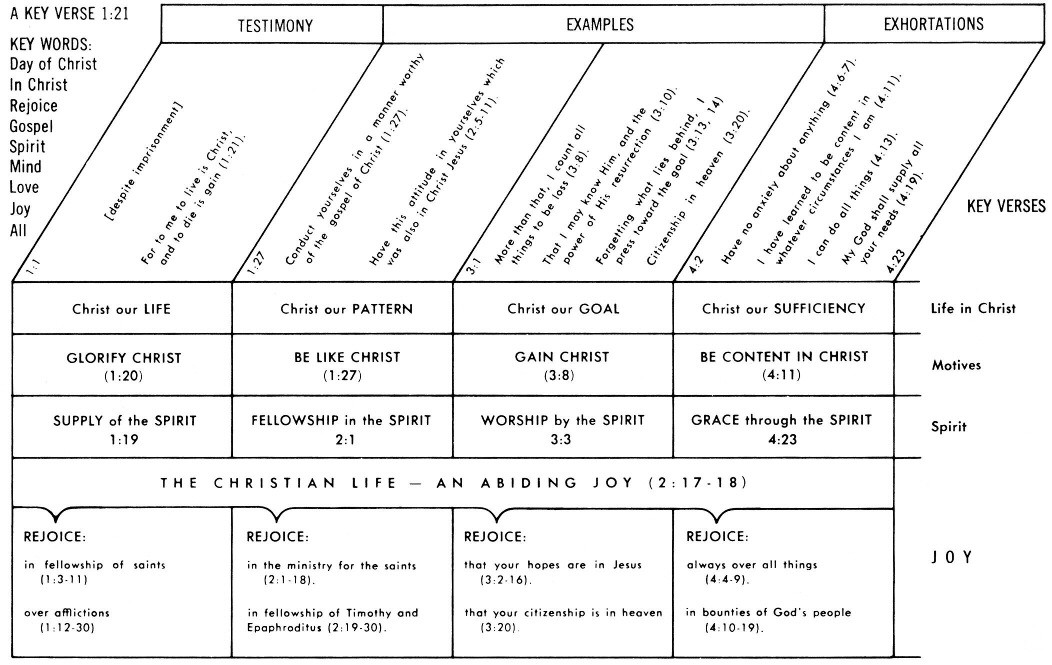
LIFE IN CHRIST
Click chart to enlarge
Charts from Jensen's Survey of the NT - used by permission
Philippians - Charles Swindoll = Chart on right side of page
| Account of Paul's Circumstances Php 1:1-30 |
Have the Mind of Christ Php 2:1-30 |
Have the Knowledge of Christ Php 3:1-21 |
Have |
| Partakers of Christ | People of Christ | Pursuit of Christ | Power of Christ |
| Suffering | Submission | Salvation | Sanctification |
| Experience | Examples | Exhortation | |
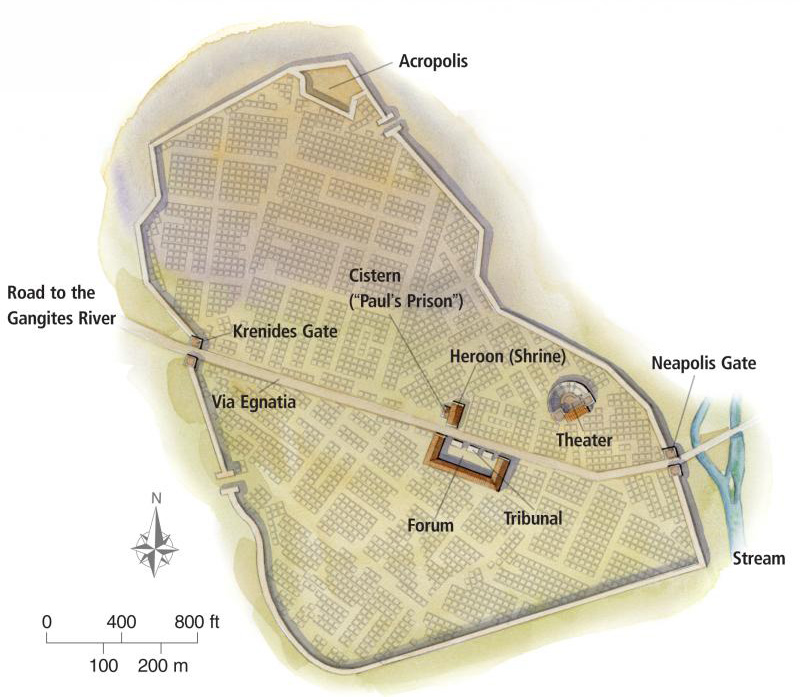
Philippi in the Time of Paul
The city plan above shows those features of the city of Philippi that archaeologists have so far identified as dating from the time of Paul. “Paul’s Prison” is not believed to be an authentic site, but was a cistern later associated with Christian worship. (ESV.org)
Philippians 1:3 I thank my God in all my remembrance of you (NASB: Lockman)
Greek: Eucharisto (1SPAI) to theo mou epi pase te mneia humon
KJV: I thank my God upon every remembrance of you,
NLT: Every time I think of you, I give thanks to my God. (NLT - Tyndale House)
Phillips: I thank God for you Christians at Philippi whenever I think of you. (Phillips: Touchstone)
Wuest: I am thanking my God constantly for my whole remembrance of you (Eerdmans Publishing - used by permission)
Young's Literal: I give thanks to my God upon all the remembrance of you,
I THANK MY GOD IN ALL MY REMEMBRANCE OF YOU: Eucharisto (1SPAI) to theo mou epi pase te mneia humon:
- Ro 1:8;1:9, 6:17; 1Co 1:4
- Eph 1:15,16; Col 1:3, 4 ; 1Th 1:2, 3, 3:9; 2Th 1:3; 2Ti 1:3; Philemon 1:4, 5
I thank my God for you every time I think of you (TEV)
Paraphrase - I continually thank my God every time I have a recollection of you in my mind.
TEN YEARS LATER
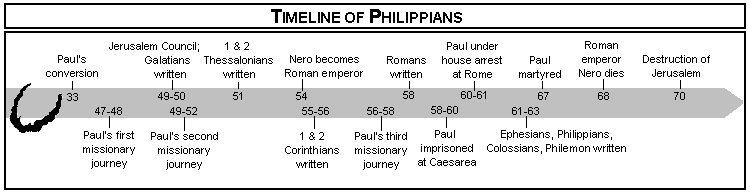
See the TIMELINE OF PHILIPPIANS above (from Ryrie Study Bible) - The church at Philippi was birthed by God's Spirit during Paul's Second Missionary Journey circa 49-52 AD and his letter to that church was written from a Roman prison about 61-63 AD, or roughly 10 years later. To help set this time contextually in your mind, try to think of someone you met 10 years ago (I am writing in April, 2017). Did you teach a Bible study or lead someone to Christ? Do you remember their name? To be honest I cannot remember what happened or who I met in 2007, but watch Paul's keen remembrance of the saints at Philippi in this short letter. Paul had invested his life in these souls and his fond remembrance of them never left his prayerful soul! Perhaps there is a lesson in this for all of us.
- Paul's 1st Missionary Journey (Acts 13:4-15:34)
- Paul's 2nd Missionary Journey synopsis (Acts 15:35-18:22)
- Paul's 3rd Missionary Journey (Acts 18:23)
Wiersbe - Paul uses three thoughts in 1:1-11 that describe true Christian fellowship:
- I have you in my mind (Phil 1:3-6),
- I have you in my heart (Phil 1:7-8),
- I have you in my prayers (Phil 1:9- 11).
I thank my God in all my remembrance of you - The best remembrance of our friends is to remember them at the throne of grace (Heb 4:16-note). Paul is our example to follow here (cf 1 Cor 11:1-note) because he clearly had a phenomenal prayer life. He has either a remarkable memory or an unusually long prayer list, because for ten years after his initial contact with the saints at Philippi he is able still to remember the Philippians by name, and he prays for them all repeatedly. (Phil 1:4 "always offering prayer...for you all")
Paul had a Spirit infused gratitude that stabilized him no matter what storm came (here imprisonment for the Gospel). How characteristic this attitude of thankfulness was in the life of Paul. It should mark every healthy, vigorous, Christian life. "Think and thank" must ever be our motto.
Prayers of joy filled giving of thanks are a hallmark of the opening sections of most of Paul’s letters (Ro 1:8; 1 Co 1:4; Col 1:3; 1 Th 1:2; 2 Th 1:3; 2 Ti 1:3; Phm 4).
Regarding my remembrance of you in the next verse Paul qualifies it with "you all." Paul thanks Gods for them "all," making no distinction whatever. Paul's interest in others is a true mark of the Christian life, countering our natural drift toward self-centered, and enabling us to rejoice in all tidings of the grace of God in other lives. All this is again clearly the mark of a man who is continually (not perfectly, but predominantly) filled with the Holy Spirit!
Vine on I thank my God - Paul associates Timothy with him in the salutation (Php 1:1), but in the body of the Epistle he uses the singular pronouns. Only in the Epistles to the Thessalonians is the use of the plural pronouns maintained throughout. To his fellow travelers in the storm-tossed ship he spoke of God as “the God whose I am, whom also I serve,” (Acts 27:23) an impressive declaration to heathen people. Here he is addressing converts, and he speaks of “my God,” not indeed in severance of himself from them, but as in gratitude to the One Who in blessing them had been gracious to him. (Collected Writings)
Lehman Strauss remarks that "The body of the letter is introduced at verse three, and it commences on a note of praise. My own heart is blessed, as I write, by the mere thought of this strange combination of persecution and praise. Paul the prisoner, in bonds for the defense and confirmation of the gospel, begins the body of his Epistle with rejoicing in his soul. Nowhere in the religious writings of the world, outside of the Bible, does one find evidence of inner peace and praise under such provocation. The reason is obvious. No religion outside of Christianity can produce a transformation of one's life equal to that of the Holy Spirit in regeneration. None but a child of God, in the will of God, can count it all joy when he comes by the varied trials of a troublesome life (James 1:2)… Approximately ten years had passed since that fellowship began, and "from the first day until now" it had continued. Now what was the secret of this continuing fellowship? Thanksgiving (vs. 3) and prayer (vs. 4). Not the one without the other, but both together. It is an indication of a Spirit-controlled heart when we praise and pray for the saints. This is exactly the way it should be. The dispensation of the Holy Spirit began with this continuing spirit in the lives of the new converts, for we read: "And they continued stedfastly in… fellowship… and in prayers" (Acts 2:42). (Devotional Studies in Philippians)
Matt Chandler notes that "Philippians is the only letter that we have in the Scriptures in which Paul is not trying to correct bad teaching or rebuke bad behavior. Instead, the letter highlights Paul’s personal affection for the Philippian church and his commendation of (and exhortation toward) their Christian maturity. We see in this little letter what it looks like to be a mature man or woman in Jesus Christ....Overall, the letter to the Philippians is colored with favor. It may be, then, that this letter is the best New Testament picture we have of what a maturing church looks like and what maturing people do. As a result, the letter to the Philippians overflows with Paul’s heart of affection for them. He considers the Philippians not just sheep in his care but friends in his heart, and in this book he wears his heart on his sleeve." (To Live is Christ, To Die is Gain)
I thank my God in all my remembrance of you - In Romans Paul amplifies this gratitude, explaining that it goes to the Father through His Son - "I thank my God through Jesus Christ for you all." Who is "you"? From Acts 16, we see the church at Philippi began with Lydia and her entire household (Acts 16:14,15-note), possibly a girl from whom a demon was immediately cast out by a word from Paul (Acts 16:16, 17,18-note), a Philippian jailer and his household (Acts 16:31, 32, 33, 34-note). Fond memories fueled his thanksgiving and joy. It is notable that Paul almost always thanked God for people, not things! This is a good pattern to practice, because things are temporal while people are eternal!
Wuest - The word “all” in the Greek text has the idea of “whole.” Paul thanks God because of his whole remembrance of the Philippians. There were no regrets in all of Paul’s relationships with them. ("I am thanking my God constantly for my whole remembrance of you, always in every prayer of mine making supplication for you all with joy.") (Wuest Word Studies - Eerdman Publishing Company Volume 1, Volume 2, Volume 3 - used by permission)
J Vernon McGee - Every time anybody would mention Philippi, Paul would just thank God for the believers there. That is something really quite wonderful.....If Paul hadn’t said anything else about his relationship to this church, this would have been enough to reveal how special it was. You can check the other epistles—he didn’t say this to the other churches, certainly not about the Galatians or the Corinthians. (Thru the Bible)
J Ligon Duncan on I thank my God in all my remembrance of you - In other words, Paul is saying that when he recalls the love of the Philippians, when he recalls the support of the Philippians, when he remembers the Philippians, it leads him to thanksgiving to God. Every time he thinks of them, he thanks God for them. The Apostle Paul had a special relationship with this congregation. He seems to be on the same wavelength with this congregation, and so his fellowship with them is especially sweet; and so when he thinks about them, when he thinks about the work of the gospel in them, when he thinks about their participation with him in the work of the gospel elsewhere, it leads him immediately to thanksgiving to God. For Paul, blessings received from God lead to thanksgiving to God. And I want to ask you a question. Is that the way it is for you? Do God’s blessings to you, especially gospel blessings, lead you immediately and instinctively to thanksgiving to God? Or are we a thankless people? The Apostle Paul is modeling for us an attitude of thanksgiving and an act of thanksgiving. Every blessing that comes to him he does not take for granted. He does not feel entitled to receive that blessing. He does not approach that blessing as if he deserved it and ‘Sure, the Lord did that for me. That's His job.’ No, for Paul those blessings overflow in thanksgiving, and I want to say to you, my friends, that that kind of thanksgiving needs to characterize our prayer and our life attitude. Is our practice in prayer to spend much time in thanksgiving? If it is not, let me ask you a question. What does that say about us? If our prayer is dominated by the rehearsal of needs and requests to God–as appropriate as it is to express our heartfelt needs and requests to God–if our prayer is dominated by the requests, and if thanksgiving is a small or non-existent portion of our prayers, what does that say about us? Well, it may say that we have not adequately spent time reflecting on the greatness of God's blessings to us, and thus we're not thankful for them; or, it may say — worse - that we are not thankful people, but that we are entitled people. (I Thank God for You - Philippians 1:3-5)
Ray Pritchard on praying FOR not AGAINST someone - Whenever you pray for someone, begin by thanking God for them. Thank God for the role they’ve played in your life, for all that they’ve done for you, for the good things they’ve done for others. Even if you’re having conflict with this person, thank God that he or she is giving you the opportunity to grow spiritually, learn forgiveness, be more patient, and on and on. If you try, you can find something to be thankful for in just about anyone.....Anyone can pray “against” another person. But only God can give you the grace to pray “for” them instead. When asked how he dealt with his many enemies, Abraham Lincoln replied, “If at all possible, I turn them into my friends.” That radical transformation is possible as we pray with thanksgiving for those who oppose us. George Buttrick once advised praying for your enemies this way, “Lord, bless this person whom I foolishly regard as an enemy. Keep him in thy favor. Banish my resentment.” (Joyful Living in a Grumpy World)
Spurgeon - All Paul’s memory of Philippi excited gratitude in his mind. He could not have said of the Galatians, “I thank my God upon every remembrance of you.” Oh, no! He said, “O foolish Galatians, who has bewitched you?” There were persons of whom he said, “I thank God that I baptized none of you.” He was pleased that believers should be baptized, but he was glad that he had not baptized certain persons who would have made capital out of it, and boasted that they were baptized by the hands of Paul. It was not so with the Philippians. Paul thought of them with devout gratitude to his God that there were such people, and that he had come into personal contact with them. He knew the ins and outs of them, and yet he could thank his God whenever he thought of them.
Eadie - There was no disturbing element, no sharp or sudden recollection, which suggested any other exercise than thanksgiving. His entrance to the city, the oratory by the river-side, Lydia's baptism, and the jailor's conversion - his entire connection with them filled his memory with delight. The incidents of his second visit are not recorded; but his whole association with the Philippian church prompted him to devout acknowledgment. He has changed at once in this verse to the first person, for, though Timothy's name occurs in the salutation, the epistle is in no sense a joint production.
Thank (2168) (eucharisteo from eú = well, good + charizomai [word study] = to grant, give) means to show oneself grateful, to be thankful or to give thanks. The present tense (continuous action = always thankful) is picked up in Wuest's rendering "I am thanking my God constantly".
How is this "quantity" of prayer even possible humanly speaking? IT IS NOT NATURALLY POSSIBLE! It is only possible for one who is filled with the Spirit and filled with the Word of God (Col 3:16-note; see Chart comparing Filled with the Spirit and the Word). In Eph 5:18-note Paul commands us to be continually filled with (controlled by) the Spirit and then he gives the effects -- singing as unto the Lord (Eph 5:19-note) and "giving thanks for all things in the name of our Lord Jesus Christ to God, even the Father" (Eph 5:20-note). Giving thanks is the same verb eucharisteo also in the present tense. One manifestation of a Spirit filled believer is the ability to continually give thanks in all things. It is not possible naturally to give thanks for all things but it is supernaturally possible to the man or woman continually filled with the Spirit. Will you fail? Sure. But we are speaking not of perfection, but of direction -- Heavenward or the alternative!
As noted above we see the same pattern in Colossians 3:16 -note where Paul commands the saints to "Let the word of Christ richly dwell (present imperative = as one's lifestyle, one's habitual practice) within you, with all wisdom teaching and admonishing one another with psalms and hymns and spiritual songs, singing with thankfulness in your hearts to God."
Would you call yourself a thankful person? Do you give thanks for others in your prayers? If not you can be thankful if you begin to yield to the Spirit and let the Word of Christ dwell at home in your heart. Being filled with (controlled by) the Spirit of God and filled with the Word of God are clearly related for it is difficult to be continually filled with the Spirit if you never read the Word.
Eucharisteo is a word that at its very core (eu = good + charis = grace) means to acknowledge how good grace is! As an aside while grace is commonly defined as God's unmerited favor that definition is not easily applied to our lives. A more pragmatic definition of grace is God's supernatural power and provision via His Holy Spirit Who exerts His influence upon souls turning them to Christ, keeping them in Christ, strengthening them in Christ and growing them in Christ-likeness. In other words, grace is God's supernatural power administered by His indwelling Spirit enabling and empowering believers (giving them not just the power but the desire) to live a supernatural life for the sake of Christ and the glory of the Father (Mt 5:16-note, see Php 2:13NLT-note).
John MacArthur notes that the Greek eucharisteo gives us our "English word “Eucharist,” a name often used of the Lord’s Supper, derives. In that ordinance believers give thanks to God in remembrance of Christ’s substitutionary sacrifice on the cross. In this instance Paul gives thanks for his spiritual brothers and sisters in Philippi who, over the years, had brought him such abundant blessing and joy." His thankfulness for the Philippians was to God, emphasizing both that the Lord is the ultimate source of all joy and that it was the Philippians’ relationship to Him through Christ that caused Paul to thank God.
Recall where Paul is as he writes these words of gratitude to God --- in prison (possibly a house arrest)! Not exactly the place conducive to cries of "Praise the Lord! Thank You Lord!" This begs an important question "How is this humanly possible?" Great question. The answer is that it is NOT HUMANLY possible, but it is SUPER HUMANLY possible. When we allow the Spirit to fill us and control us, He supernaturally can transform our prisons to praise services! Paul was clearly a man filled with the Spirit because this whole letter oozes with joy, one of the wonderful aspects of the fruit of the Spirit ("joy" = Gal 5:22-note, "in much tribulation with the joy of the Holy Spirit" =1 Th 1:6-note, cf Acts 13:52, Ro 14:17-note, Ro 15:13-note)
See similar expressions of Paul's thanksgiving for the saints in 1Th 1:2; Ro 1:9-10; Eph 1:16; Col. 1:3-4; 2Ti 1:3, Philemon 4.
MY GOD: DEEP INTIMACY
AND COMMUNION
My God - Other than the Lord Jesus when He was on the Cross, Paul is the only New character that speaks of God as "my God". He did not say "I thank God" but "I thank my God". God was his God, which speaks of his assurance and intimacy. God was not at a distance for Paul; He was close, He was his Father and his Friend. God was Paul's God by choice, by covenant and by confession. Can you join with Paul and say God is "my God?" Paul's phrase "my God" implies fellowship unbroken by unconfessed sin. Perhaps you shy away from saying "my God" because you don't "feel close" to Him because of unconfessed sin. Well, guess who moved? Not God, but you. Confession restores our fellowship and the joy of our salvation (Ps 51:12). This helps explain Paul's unbridled joy in Phil 1:4!
In Romans 2:16 Paul referred to the Gospel as "My Gospel" and here he refers to God as "My God." It was Martin Luther who said that Christianity is a religion of possessive pronouns. Anyone can say "Gospel" or "God," but only a Christian can say "My Gospel" and "My God!" Thank You Lord! In Paul's last known communication before he was martyred for the Gospel he wrote to Timothy
I also suffer these things, but I am not ashamed; for I know Whom (not just the doctrine but the Person!) I have believed and I am convinced that He is able to guard what I have entrusted to Him until that day. (2 Ti 1:12)
Comment: Paul could speak with such unbridled confidence because he knew God as "My God" and the Gospel as "My Gospel." What about you beloved? Can you say "My God" and "My Gospel"? Have you so possessed them that in fact they have possessed you? When they do your response to suffering and trials takes on an entirely new perspective as it did with Paul.
Greg Herrick notes that the phrase "my God" conveys "no indication here that Paul’s intends to say that his God is just one of many gods, i.e., my God as opposed to your God. What he is referring to is the close personal relationship he enjoys with the one God of the universe who has made himself known particularly in Christ Jesus the Lord." Herrick adds my God "reflects the deep intimacy he shared with the Lord and the expression itself may well come from the Psalter. When the psalmist cries out for God’s help against his enemies he petitions the Lord: “Arise O Lord, Deliver me, O my God…” (Ps 3:7) (Ed comment: IN FACT THE PHRASE "MY GOD" OCCURS 56X IN 54 VERSES IN THE PSALMS!) David cried out to God for help, entreating him saying, “Listen to my cry for help, my king and my God, for to you I pray.” And, when David was running from Saul he prayed to the Lord: “I love you, O Lord, my strength. The Lord is my rock, my fortress and my deliverer; my God is my rock in Whom I take refuge.” What incredible closeness to the Lord these passages speak of. Paul was undoubtedly drawn to these or similar texts as they ministered untold comfort during his difficult circumstances in prison." (Philippians 1:3-11 Thanksgiving and Prayer)
We see a similar sense of Paul's personal possession of God in Php 4:19 "my God will supply all your needs," Ro 1:8; 1Cor 1:4; 2Cor 12:21 Philemon 4. My God also , a truth shown. Would it be that all of God's children had such a continual consciousness that He is "my God" for this would surely be a deterrent our hearts which are prone to wander, prone to leave the God we love! Father grant us this as to be the desire of our heart. Amen
In Acts 27:23 we see a variation on "my God" which conveys the truth that Paul (us) is not his own but has been bought with a price! This truth is also a healthy deterrent to willful sin against our Father!
Herrick has some additional interesting observations - "There are several indicators in Philippians that reveal Paul’s close personal relationship with the Lord in spite of his trying circumstances. First, as a result of his intimacy with the Lord, Paul could eagerly expect and confidently hope, that in whatever circumstances he found himself, he would not be ashamed. He was confident that he would have sufficient courage so that Christ would always be exalted through him, whether in life or death (Php 1:20). This can only come as a result of spiritually abiding in Christ (John 15:7-8). Second, the apostle goes so far as to say that “for him to live is Christ and to die is gain” and that he would much rather “depart and be with Christ” (Php 1:21-23). Third, he rejoices in his ministry to the Philippians even though the cost to him was great and he was somewhat uncertain of the results (Php 2:16-18). Fourth, his sufferings have brought him to the place where he wants to know Christ more than anything else. He talks about knowing Christ in terms of knowing the power of his resurrection, the fellowship of sharing in Christ’s sufferings, being conformed to the likeness of his death, and rising from the dead (Php 3:10-11). There is much more in the letter that we could talk about as well. Paul was a man who knew his God; he referred to the Lord as my God. He understood the suffering and humiliation that Christ underwent for him (Php 2:6-11) and now it was his turn to follow his master’s example." (Philippians 1:3-11 Thanksgiving and Prayer)
Here are all 151 uses of the phrase "my God" in the NAS (It is not surprising that over 1/3 of the occurrences are in the Psalms - this would make a fruitful devotional study!) -
Ge 28:21; Ex 15:2; Nu 22:18; Dt 4:5; 18:16; 26:3, 14; Josh 9:23; 14:8-9; Ru 1:16 (= Affirmation of Ruth the Moabitess!); 2Sa 22:3, 7, 22, 30; 24:24; 1Kgs 3:7; 5:4f; 8:28; 17:20f; 1Chr 11:19; 17:25; 21:17; 22:7; 28:20; 29:2f, 17; 2Chr 2:4; 6:19, 40; 18:13; Ezra 7:28; 9:5-6; Neh 2:8, 12, 18; 5:19; 6:14; 7:5; 13:14, 22, 29, 31;
Psalm 3:7; Ps 5:2; 7:1, 3; 13:3; 18:2, 6, 21, 28-29; Ps 22:1-2, 10; Ps 25:2; 30:2, 12; 31:14; 35:23-24; Ps 38:15, 21; 40:5, 8, 17; 42:6, 11; 43:4-5; Ps 59:1, 10; 63:1; Ps 68:24; 69:3; 71:4, 12, 22; 83:13; 84:3, 10; Ps 86:2, 12; 89:26; 91:2; Ps 94:22; 102:24; 104:1, 33; Ps 109:26; 118:28; 119:115; Ps 140:6; 143:10; Ps 145:1; 146:2;
Pr 30:9; Isa 7:13; 25:1; 40:27; 44:17; 49:4-5; 57:21; 61:10; Jer 31:18; Da 4:8; 6:22; 9:4, 18-20; Hos 2:23; 8:2; 9:8, 17; Joel 1:13; Jonah 2:6; Mic 7:7; Hab 1:12; Zech 11:4; 13:9; 14:5;
Mt 27:46; Mk 15:34; Jn 20:17 (= all 3 uses uttered by Jesus are from the Cross! But see Revelation), Jn 20:28; Ro 1:8; 1Cor 1:4; 2Cor 12:21; Phil 1:3; 4:19; Philemon 1:4; Rev 3:2, 12
That Paul a persecutor of the church could now call God "My God" and a despised Moabitess named Ruth could call Naomi's God "My God" (Ru 1:16-note), is resounding testimony to the magnanimous, incomprehensible love, mercy and grace of the Father, Who through His Son's sacrifice choose to bring those who were once so far away to a place so near and dear to His heart, so near in fact that we might affectionately call Him "My God!" Indeed, as the writer of Hebrews says, ours is "so great a salvation!" Glory!
Related Resources:
Do you know what "DEUS MEUS ET OMNIA" means? Paul would surely have affirmed this Latin phrase which means "MY GOD, MY ALL" for in the NT Paul used the phrase “MY GOD” more than any other writer (only used by Jesus & Thomas). In Phil 1:3 Paul wrote "I thank MY GOD in all my remembrance of you." (It had been ~10 years since he last saw the saints at Philippi and yet he was still praying for them!) Paul's consciousness of his “PERSONAL POSSESSION” of God permeated and “perfumed” his prayers (cf. “My God” in Ro 1:8, 1Co 1:4, Philemon 4) and later allowed him to confidently declare “MY GOD shall supply all your needs according to His riches in glory in Christ Jesus.” (Php 4:19) Recall that Paul was in prison as he wrote Philippians and never felt forsaken and never wavered from the truth that God was HIS GOD, his intimate Comforter, the One with Whom he could confidently intercede on behalf of others. Oh, how we need to let the precious truth of the phrase “MY GOD” “marinate” and renew our minds day by day. In the OT we find this same great phrase “MY GOD” most often on the lips of the man after God’s own heart, David, who prayed prayers like “Save me, O MY GOD!” (Ps 3:7), Heed the sound of my cry for help, MY KING and MY GOD, for to Thee do I pray (Ps 5:2), O LORD MY GOD, in Thee I have taken refuge. Save me from all those who pursue me and deliver me (Ps 7:1), Consider and answer me, O LORD, MY GOD (Ps 13:3), In my distress I called upon the LORD and cried to MY GOD for help (Ps 18:6), O MY GOD, in Thee I trust, do not let me be ashamed (Ps 25:2), O Jehovah MY GOD, I cried to Thee for help and Thou didst heal me (RAPHA ~ Jehovah Rapha) (Ps 30:2), Do not forsake me, O LORD; O MY GOD, do not be far from me! (Ps 38:21), Since I am afflicted and needy, Let the Lord be mindful of me; Thou art MY HELP and MY DELIVERER. Do not delay, O MY GOD (Ps 40:17), Why are you in despair, O my soul? And why have you become disturbed within me? Hope in God, for I shall yet praise Him, The help of my countenance, and MY GOD (Ps 42:11), O MY GOD, set me securely on high away from those who rise up against me (Ps 59:1). "AMEN and AMEN" (Ps 41:13)
C H Spurgeon writes…
While the Atheist says, 'No God' and the heathen worship 'gods many,' the true believer says, 'O God, Thou art MY GOD.' He is so, by choice, by covenant and by confession. MY GOD is all good things in one. There is a boundless wealth in the expression MY GOD - it means, MY perpetual, unchanging, infinite, eternal good. He who can say truly MY GOD, may well add, 'my heaven, MY ALL" ( IN ALL).
FATHER You are OUR GOD and we are the people of Your pasture, the sheep of Your hand and we bow in humble adoration, wonder and awe at the greatness of Your grace, mercy and wisdom that would allow Your Son to cry from the Cross “MY GOD, MY GOD why have You forsaken Me?” so that we, Your children, might forever be able to cry out “MY GOD” fully assured that You will never desert us nor ever forsake us for the sake of Your Son, our Lord Jesus Christ. Amen (Ps 95:7, Mt 27:46, Heb 13:5).
May the cry of our heart be that of David's cry in Psalm 63
A Psalm of David, when he was in the wilderness of Judah. O God, You are my God; I shall seek You earnestly; My soul thirsts for You, my flesh yearns for You, In a dry and weary land where there is no water. (Ps 63:1)
Comment: David in a wilderness. Paul in a prison. And yet both find solace and comfort by laying hold of the preciousness of the phrase "MY GOD." Are you in a "wilderness" or a "prison" (spiritually speaking -- there are many "prisons" in this world that have no bars!)? If so, your mind can be renewed by pondering this simple but profound phrase "MY GOD!" asking His Spirit to drive this truth deep into your inner being, so that your soul is secure and stabilized regardless of how strong the winds might howl in the "wilderness" or the how loud the chains might clank in the "prison." Regardless, you can still sing "O God, You are my God!" (Take a moment and play Fernando Ortega's "O God You are My God." (Or Rich Mullins' - Step by Step)
Indeed, “MY GOD” is OUR ALL IN ALL even as in the beautiful words of the song below
Daniel Hill - Not only does the believer have a right to offer prayers to God because of Jesus Christ, but also he has a right to claim God as "MY GOD" because of Jesus Christ.
In all my remembrance - KJV says "upon" every remembrance and also leaves out the possessive pronoun "my" which is in the Greek text. Wuest explains that
The word “upon” does not mean “at.” That is, Paul does not mean here that he thanks God at every remembrance of the Philippians. It means “upon the basis of.” That is, the Philippians form the basis for Paul’s thanksgiving. The word “every” in the Greek text has the idea of “whole.” Paul thanks God because of his whole remembrance of the Philippians. There were no regrets in all of Paul’s relationships with them.(Wuest Word Studies - Eerdman Publishing Company Volume 1, Volume 2, Volume 3 - used by permission)
J R Miller's Devotional - September 21 - I thank my God upon every remembrance of you. - Philippians 1:3
It has been noted that the Philippian church never gave Paul any anxiety. Most of the churches founded by him lay heavily on his heart at some time or other. They had quarrels, and he had to be peacemaker. Or there were cases of wrong-doing, and he had to bear the burden. But the Philippian church was happy in itself. There were no wranglings, no dissensions (Ed: I would argue this point - see Phil 4:1-note). Paul got only joy and comfort from this church. Here he thanks God for it. It is a great thing to live so as to be a comfort to our friends, to those who love us and live for us. It is a great thing for a church to be a joy to a pastor, never to put thorns into his pillow. It is a great thing for children to be a comfort to their parents. A father was just saying that not one of his children - now all married and settled in life - has ever caused him an anxious day or a sleepless night. Why should we not set for ourselves the aim always to be a comfort to our friends?
GRATITUDE
FED BY MEMORY
Wiersbe on in all my remembrance - As he awaits his trial in Rome, Paul’s mind goes back to the believers in Philippi, and every recollection he has brings him joy. Read Acts 16; you may discover that some things happened to Paul at Philippi, the memory of which could produce sorrow. He was illegally arrested and beaten, was placed in the stocks, and was humiliated before the people. But even those memories brought joy to Paul, because it was through this suffering that the jailer found Christ! (Ro 8:28!)...It is worth asking, “Am I the kind of Christian who brings joy to my pastor’s mind when he thinks of me?”
Steven Cole - Our remembrance of other believers should not stop with warm feelings. Our remembrance should be turned God-ward, into heartfelt prayers for one another. I personally struggle with going over prayer lists, because I always think, “Lord, You can read my list. You know these needs.” It always seems kind of mechanical and meaningless to me. The lists can be helpful, to bring to mind people I otherwise would forget. But I find it easier to pray for people as God brings them to my mind during the day. Turn your remembrances into prayer. (Sermon)
Remembrance (3417) (mneia from the verb mnáomai = to recollect) describes a recalling to mind memory, recollection, remembrance. This is Paul’s stimulus for his continually giving thanks to God. He remembers their acceptance of the Gospel (read Acts 16:14ff of Lydia and Acts 16:23-40 for the miraculous deliverance of Philippian jailer), their consistent faith, their growth in grace, and their burden for lost souls.
How important it is for us to remember the good works in which God has allowed us to participate, as these memories serve to stoke an attitude of gratitude in our hearts, which otherwise tend too often to gravitate toward ungratefulness and even grumbling! (Speaking from personal experience!)
A review of Paul's uses of mneia (7x in NT - Ro 1:9; Eph 1:16; Php 1:3; 1Th 1:2; 3:6; 2Ti 1:3; Philemon 1:4) shows they are all in the context of prayer or praying specifically for someone, making mention of them in prayer.
What a wonderful picture of the relationship between Paul and the church at Philippi, for every time he thought of them, whatever the cause, he was (supernaturally) impelled to offer thanks and praise to God. Are there some dearly beloved saints in your life that generate such a chorus of thanksgiving from your lips? Paul frequently bore these saints in his thoughts -- even though they were out of sight and he was in a prison cell at a great distance from them, these saints were not out of his mind: To be such a selfless intercessor!
Matthew Henry - The best remembrance of our friends is to remember them at the throne of grace. Paul was much in prayer for his friends, for all his friends, for these particularly. It should seem, by this manner of expression, that he mentioned at the throne of grace the several churches he was interested in and concerned for particularly and by name. He had seasons of prayer for the church at Philippi. God gives us leave to be thus free with him, though, for our comfort, he knows whom we mean when we do not name them… Thanksgiving must have a part in every prayer; and whatsoever is the matter of our rejoicing ought to be the matter of our thanksgiving. What we have the comfort of, God must have the glory of. He thanked God, as well as made requests with joy. As holy joy is the heart and soul of thankful praise, so thankful praise is the lip and language of holy joy." And regarding "my God" adds that "we must eye God as our God… It encourages us in prayer, and enlarges the heart in praise, to see every mercy coming from the hand of God as our God."
Paul associates Timothy with him in the salutation, but here and in the body of the Epistle he uses the singular pronoun. Only in the Epistles to the Thessalonians is the use of the plural pronouns maintained throughout. Paul’s letters usually included such commendation except in his opening in Galatians, where Paul’s deep concern over the churches’ defection in Galatia from "the Gospel of the grace of God" (Acts20:24) is evident from his greeting, which lacks his customary commendations and courtesies, and is instead brief and impersonal, although even so he does open with the familiar "Grace to you and peace from God our Father, and the Lord Jesus Christ" (Gal 1:3)
Vincent - There is an intimacy in the expression "my God"—an expression found elsewhere in Ro 1:8 and Philemon 1:4. Paul recognized that the goodness of the Philippians was due to God’s work in them, and not to their natural graciousness. Phil 1:3, 4 seem to indicate a regular regimen of prayer on Paul’s part. We would say that the Philippians were on Paul’s "prayer list."
J Ligon Duncan's "outline" of Phil 1:3-5 - So we’re going to look at verses 3-5 today, and as we do so I’d like you to look for three things. As you look at verse 3, notice Paul’s thankful heart, because I think Paul’s thankful heart has something to teach us. Then as you look at verse 4, look at Paul’s joyful prayer, because again, Paul’s joyful prayer has something to teach us. And then as you look at verse 5, look for Paul’s gospel focus, because here he’s going to tell you what it is that he has in view especially that makes him so thankful and joyful when he thinks about the Philippians. So we’re going to look at Paul’s thankful heart in verse 3, his joyful prayer in verse 4, and his gospel focus in verse 5. (I Thank God for You - Philippians 1:3-5)
Brian Bill applies Php 1:3 - When you think of someone you know, give thanks to God for their uniqueness, for how grace and peace have impacted their lives, for how they are living out their purpose in a specific place and for how they are serving as saints. I see you rolling your eyes because this is hard to pray. Why is that? It’s because we’re so used to pointing out people’s problems and even celebrating their shortcomings. Instead, let’s follow Paul’s example by thanking God every time we remember a brother or sister in Christ.
John MacArthur applies Phil 1:3 - A thankful heart is essential for true spiritual service. If you are trying to serve the Lord without gratitude in your heart for what He’s done for you, then you are serving in the flesh with improper motives. One who is thankful realizes that God has a cause for everything that happens. One who serves externally, legalistically, or ritualistically will not find very many things to be thankful for in his life because he is not grateful for the things God has already done for him. Do you have a thankful heart? Are you overwhelmed with thanksgiving for what God has done? If you are, then you will be free from bitterness or resentment toward God or anyone else. There is so much to be thankful for. The devil often tempts us by saying, “You deserve better than that. You don’t have to be thankful.” But when he does, make sure you remember how much you have to be thankful for!
Henrietta Mears - Although in prison, Paul could pray for his friends. "I thank my God every time I remember you. In all my prayers for all of you, I always pray with joy" (Phil. 1:3-4). Paul lived to intercede for others. So should every true Sunday School teacher, Christian friend, father, mother, brother or sister remember others in their prayers without ceasing.
- Have you a prayer list?
- Do you talk with the Lord about your friends?
- Making requests with joy?
- Why can we rejoice in prayer?
- What is your answer?
A KEY TO JOY IN
THE CHRISTIAN LIFE
John MacArthur on the joy of recollection, my every remembrance - The very thought of the Philippians brought him jubilant memories. Paul Reese wrote, “His whole soul is a carillon, and the first bell to be struck is that of thanksgiving,” end quote. You see, Paul had this inventory of memories, and by virtue of the power of the Holy Spirit within him, he focused on the positive ones. He says, “I thank my God in all my remembrance of you.” Everything he could think about the Philippians gave him joy. They were a cause for gratitude. His heart was filled with joyous thanks to God for the sweet memories of these believers.....What blessed memories they were. Do you remember them? (MEMORY #1) He must have remembered that Sabbath day when he went to the riverside to find some Jewish women, because there was no synagogue there, not enough men to have one. And he met a few Jewish women who were there by the riverside near Philippi, worshiping the true God in the tradition of their forefathers, the Jews. And there the Lord opened the heart of a lady named Lydia, and she was saved and her entire household; the first converts in Europe. (Acts 16:14-15-note) That gracious woman was God’s gift to His Son, the beginning of evangelism in a new continent – a wonderful beginning, a sweet memory. She became a very dear saint of God in whose house the church met, a woman who showed her personal hospitality to Paul and Silas after their imprisonment (Acts 16:40-note). (MEMORY #2) And then there was the memory of that demon-possessed girl (Acts 16:16-18-note), whom Paul, by the power of the Spirit of God, cleansed of her demons – and perhaps was born again and too entered the church. We’ll find out in heaven. (MEMORY #3) And then there was the memory of jail, the sweet memory of being in stocks after your backs have been stripped and laid bare, and your flesh is nothing but pulp. And you’re in the darkness of an inner dungeon in the stocks, singing and praising God. And God brings in the darkness of the morning an earthquake, and breaks the jail open, and breaks the stocks, and all the chains are loosed. And out of it all the jailer is converted to Christ and his whole household, and they show their tender love to Paul and Silas by caring for their wounds (Acts 16:23-34-note). And there’s a baptismal service, and then they are released, and the church meets at Lydia’s house – sweet memories, sweet memories. (MEMORY #4) And then there’s the memory of those times when the Philippians sent money to him, money to help him. Those times when as part of the saints in Macedonia, mentioned in 2 Corinthians 8:1-5, they sent generously out of their deep poverty. They were a generous, loving people. They were gifts given from loving hearts, gifts that went beyond even Paul’s need. And he says to them in Philippians 4, “Look, I don’t need this much, but I’m so glad you gave it, because you gave it as a gift to the Lord. And it tells me where your heart is, and God will reward you and bless you. And my God shall supply all your need according to His riches in Christ Jesus.” (Read Php 4:11-19) (MEMORY #5) And then there was the latest gift, the gift from Epaphroditus, along with Epaphroditus (Php 2:25-note), to fill in the lovely memories of Philippian Christians. Though his present condition was difficult, though his present condition was painful physically, unjust legally, unexplained spiritually in one sense, his heart was unaffected; he was full of sweet memories.
May I suggest to you that that’s a key to joy in the Christian life? A real key – to be able to recall the goodness of people, to be able to recall the best in someone, to be able to look past some of the glitches in life and capture the sweet memories. The heart where the joy of the Holy Spirit dominates, like it did in Paul, is a heart that touches the sweet things of life, not the bitter things. It savors thoughts of others’ goodness and others’ kindness and others’ love and others’ compassion and others’ gentleness and others’ sacrifice and others’ care, and it forgets the rest. It really does. It forgets the rest.
I can easily discern, if given enough time, a heart where the Spirit of God is not in control, because there’s no joy. And the tendency is always to focus on everyone’s unkindness, ingratitude, faults, wounds that they’ve inflicted on us. It’s a dead giveaway. What isn’t right about everybody, what isn’t the way people want it to be.
Learn to walk in the Spirit (Gal 5:16,17-note), learn to yield to the Spirit (Eph 5:18-note), and the Spirit of God has a way of erasing the tape of negative things. I thank God for that. I thank God that I do not remember unkindnesses, for the most part. I ask the Spirit of God to erase those things, to produce in me a joy that focuses on joyful memories. That’s the work of the Spirit in the heart of the believer. Bitterness, unforgiveness, always remembering evil – that is the work of the flesh, holding grudges. As Thomas Hardy said, “Some people can find the manure pile in any meadow.” You want to live like that? You want to stomp around in that stuff all your life? Not me. Paul’s joy was expressed in pleasant memories. That is a basic element of joy. That’s the joy of recollection. (Elements of Joy, Part 1)
ILLUSTRATION/APPLICATION - In the seasons of our marriage, my wife and I have had some ragged times, when everything we said or did seemed to strike the other person the wrong way. Every casual remark felt like a deliberate attack. Once we’re into that rut, it’s difficult to get out. Telling the other person, “You ought to love me enough not to say hurtful things like that,” doesn’t help all that much. What did help, in one of our most recent conflicts, was Philippians 1:3-7, a paraphrase of which my wife read to me: “I thank my God in all my remembrance of you, always in every prayer of mine for you making my prayer with joy, grateful for your partnership in the gospel from the first day until now. It is right for me to feel this way about you, because I hold you in my heart. And I am confident that he who began a good work in you shall bring it to completion at the day of Jesus Christ.” “That,” she told me, “is who you are: someone who fills my heart with joy, someone for whom I am grateful to God, someone in whom Christ is doing a wonderful work.” She said that to express a change in her own attitude, not to preach me a sermon. And yet, in spite of my desire to get my own way in every dispute, I find myself arrested in mid-argument: if someone whose opinion I value this much says this is who I am, then maybe that really is who I am. And in spite of myself, I want to act like the person she describes, someone to be grateful for, someone who inspires joy, someone in whom Christ makes a difference. (James Ayers, First Presbyterian Church, Waltham, Massachusetts)
ILLUSTRATION FROM TONY EVAN'S INTRO - This book is gratefully dedicated to my good friend and colleague Ramesh Richard, whose spiritual life, theological astuteness, and personal camaraderie have done more for me than words can ever express. “I thank my God in all my remembrance of you.” (Philippians 1:3)
THE JOY OF RECOLLECTION “I thank my God in all my remembrance of you” (Phil. 1:3). (John MacArthur)
- A key to Christian joy is to recall the goodness of others.
Though Paul was under house arrest in Rome when he wrote to the Philippians, his mind wasn’t bound. Often he reflected on his experiences with the Philippian Christians. As he did so, his thoughts turned to prayers of praise and thanksgiving for all the Lord had done through them. I’m sure Paul remembered when he preached in Philippi and God opened Lydia’s heart to believe the gospel (Acts 16:13–14). Subsequently everyone in her household was saved (Acts 16:15). Surely her kindness and hospitality were bright spots in an otherwise stormy stay at Philippi. He must also have remembered the demon-possessed girl whom the Lord delivered from spiritual bondage (Acts 16:18), and the Philippian jailer who threw Paul and Silas into prison after they had been beaten severely (Acts 16:23–24). Perhaps the girl became part of the Philippian church—the text doesn’t say. We do know that the jailer and his whole household were saved, after which they showed kindness to Paul and Silas by tending to their wounds and feeding them (Acts 16:30–34). The many financial gifts the Philippians sent to Paul were also fond memories for him because they were given out of love and concern. That was true of their present gift as well, which was delivered by Epaphroditus and went far beyond Paul’s need (Phil. 4:18).
Paul’s gratitude illustrates that Christian joy is enhanced in your life by your ability to recall the goodness of others. A corollary is your ability to forgive shortcomings and unkindnesses. That goes against the grain of our “don’t get mad—get even” society, but is perfectly consistent with the compassion and forgiveness God has shown you. Therefore, be quick to forgive evil and slow to forget good. Suggestions for Prayer: Take time to reflect on some people who have shown kindness to you and encouraged you in your Christian walk. Thank God for them. If possible, call them or drop them a note of thanks. Assure them of your prayers, as Paul assured the Philippians. If you harbor ill will toward someone, resolve it quickly, and begin to uphold that person in prayer.
Philippians 1:4 always offering prayer with joy in my every prayer for you all, (NASB: Lockman)
Greek: pantote en pase deesei mou huper panton humon meta charan ten deesin poioumenos, (PMPMSN)
Amplified: In every prayer of mine I always make my entreaty and petition for you all with joy (delight). (Amplified Bible - Lockman)CSB always praying with joy for all of you in my every prayer,
ESV always in every prayer of mine for you all making my prayer with joy,
KJV: Always in every prayer of mine for you all making request with joy,
NET I always pray with joy in my every prayer for all of you
NIV: In all my prayers for all of you, I always pray with joy (NIV - IBS)
NLT: I always pray for you, and I make my requests with a heart full of joy (NLT - Tyndale House)
NLT (Revised) Whenever I pray, I make my requests for all of you with joy,
Phillips: My constant prayers for you are a real joy (Phillips: Touchstone)
Wuest: always in every prayer of mine making supplication for all of you with joy. (Eerdmans Publishing - used by permission)
Young's Literal: always, in every supplication of mine for you all, with joy making the supplication,
ALWAYS OFFERING PRAYER: pantote en pase deesei:
- Phil 1:9, 10, 11; Ro 1:9; Ep 1:14-23; 1 Th 1:2
- Torrey's related topics "Thanksgiving", Intercessory Prayer,
- Nave's related Topic "Intercession"
always, in every supplication of mine for you all, with joy making the supplication (YLT).
NOTE REPETITION OF ALL OR SOME VARIANT THEREOF: I thank my God in all (pas) my remembrance of you; always (pantote), in every (pas) supplication of mine, making my supplication for you all (pas) with joy.’ (Vincent on Phil 1:3-4) (All the words in bold are either pas or derivatives -- you might say Paul was "all or nothing!" All of the saints at Philippi, all the time, all requests, always with joy! Quite an all-inclusive prayer!)
UNCEASING INTERCESSORY
PRAYER
Always - "Not just sometimes." (McGee)
Intercessory prayer was a prominent feature in the life of the Apostle, and without ceasing (cf 1 Th 5:17-note) he prayed for the Christians of the various Churches. This "quantity" of prayer is not natural, but it is supernatural. Only a man or woman continually filled with (controlled by, enabled by, empowered by) the Holy Spirit can pray without ceasing! Are you continually in an attitude of prayer? In secular Greek the word for "without ceasing" (1 Th 5:17) was used to describe a hacking cough. We've all had a hacking cough that comes on us abruptly and is followed by a variable period of rest until we cough again. That's a picture of praying without ceasing. Paul was always in prayer for the saints at Philippi. Paul was a man continually filled with the Spirit, practicing what he preached in Ephesians 5:18-note, giving us an example to imitate (as he commanded in 1 Cor 11:1-note). Further proof that Paul was a "Spirit filled" man is seen in the fact that he also possessed supernatural joy (see below - cf Gal 5:22-note).
Always (3842) (pantote from pás = all and has the idea of “whole” + tóte = then) means at all times or on every occasion. Paul labors to show them that he never forgot them; that he always remembered them in his prayers.
W H Griffith-Thomas referring to Paul's unceasing prayer - As Godet truly says, "Paul thinks of those times of intimate intercourse which he has daily with his God in the exercise of his ministry; for it is at His feet, as it were, that he discharges this task." It has also been well remarked that Paul, while reaching multitudes by his preaching, certainly reached far more by his prayers, for "prayer moves the Arm that moves the world." (Ed: As an aside, you may have wondered what ministry to I have in the body of Christ? Beloved, all of us have the unfathomably valuable ministry of intercessory prayer! So may God's Spirit continually fill us enabling us to pray for others with ceasing, in Jesus' Name. Amen)
Wenham on the power of prayer - "Preaching is a rare gift—prayer is a rarer one. Preaching, like a sword, is a weapon to use at close quarters; those far off cannot be reached by it. Prayer, like a breechloader (firearm in which the weapon is loaded from the breech, i.e. the end opposite that which discharges the projectile), has longer range, and under some circumstances is even more effective" (Romans)
Pulpit Commentary - There is something significant in "the studied cumulation" of the "alls" (All and always = 4x in 2 verses = Phil 1:3, 4 - all, always, every, all) in the passage. It marks the overflowing heart. The apostle was much in prayer for his converts. He had a large heart, for he prayed for them all, Ministers should bear their people much upon their hearts in prayer to God. They should pray always for their people. The apostle prayed for his converts as often as he remembered them because "the anxiety of all the Churches" was upon him; because he had a deep affection for them; because they were exposed to great dangers at once from errorists and from persecutors.
John MacArthur - Another indispensable element of joy for believers is interceding before God on behalf of others. Those who are obedient to the Holy Spirit will delight in the privilege of intercessory prayer. Faithful and sincere intercession is much more than an obligation; it is a joy. Faithful intercessors are more preoccupied with the needs and welfare of others than their own and ask God to pour out His divine blessing on them. An infallible test of godly joy (ED: A SPIRIT ENABLED JOY) is the degree to which a believer prays more earnestly for the benefit and blessing of others than for his own.
Offering (making) (4160) (poieo) means to make and expresses action in this case continued. The present tense indicates this prayer for them was a habitual practice in his life and other indicator of a man who was supernaturally empowered by the Holy Spirit.
Paul Apple - The Natural Twin of Thanksgiving is Consistent Petition
Prayer (used twice in this verse)(1162) (deesis) generally refers to specific supplications always addressed to God, asked with urgency and arising from a presumed need. (cf. Luke 1:13; 5:33; Rom. 10:1; 2 Cor. 1:11; Heb. 5:7; James 5:16; 1 Peter 3:12). Deesis is from deomai which means to want, to lack, be in need of, and then to make known one's particular need which gave rise to the meaning to request, beseech and use distinctively in prayers of petition. Note the Greek word order ("with joy the prayer making") which gives emphasis to the phrase "with joy".
Vincent notes that deesis is "from deomai, to want, and hence distinctively of petitionary prayer. In classical Greek the word is not restricted to sacred uses, but is employed of requests preferred to men. Rev., more correctly, supplications."
Deesis was used by the angel who assured the godly father of John the Baptist, “Do not be afraid (stop fearing indicating he already was fearful), Zacharias (means "Jehovah remembers"), for your petition (deesis - specifically their need for God to open his wife's womb) has been heard, and your wife Elizabeth ("my God is an oath") will bear you a son, and you will give him the name John (“Jehovah has shown grace”)” (Luke 1:13-note).
Luke uses deesis again of the disciples of John the Baptist, who were said to “often fast and offer prayers (deesis)" (Luke 5:33-note).
Deesis was used by Paul of his “prayer for the salvation of his fellow Israelites "Brethren, my heart's (deepest, consuming) desire and my prayer prayer (deesis - conveys idea of pleading and entreaty, of persistent petition) to God for them is for their salvation." (Ro 10:1-note).
The KJV Bible Commentary has a pertinent reminder that "In a day when programs, publicity, and promotion characterize much of the Lord’s work, it should be emphasized that without prayer no lasting work will be accomplished for God." (KJV Bible Commentary: Nelson)
You all - This phrase permeates Phil 1:3-8 being found once in Phil 1:4, twice in Phil 1:7 and once in Phil 1:8. Paul spoke like someone from Texas! (Although we say "ya'll"). Clearly Paul wants to emphasize that he is addressing the ALL of the body of Christ at Philippi, not just a few favorites.
John MacArthur - The passions of a person's heart will come out in his prayers. If you examine what you pray for and find you are praying only for your needs, problems, questions, and struggles, that is an indication of where your heart is. If you pray infrequently, briefly, and in a shallow manner, you have a cold heart because prayer is not an inner desire. The call to the duty of prayer will not overcome a cold heart because prayer is an internal compulsion not fulfilled by conformity to an external standard. Lack of prayer doesn't mean that a person is merely disobedient; it indicates selfishness because of a cold heart."
Steven Cole - If you’re having trouble with another believer, even if it’s your mate or a family member, pray often for that person. It’s hard to stay angry at someone you’re praying for daily! James Boice states, “I think that ninety percent of all the divisions between true believers in this world would disappear entirely if Christians would learn to pray specifically and constantly for one another” (Sermon)
- Php 2:2; 3:18; 4:1; Lk 15:7;10; Col 2:5; 1 Th 2:19; 20 Phile 1:7; 2 Jn 1:4
FILLED WITH
JOYFUL PRAYER
With joy - Joy is a keynote of this letter. Bengel says: “The sum of the epistle is, ‘I rejoice, rejoice ye.’ ” Spurgeon says "Here we come to that sweet fruit of the Spirit which we call “Joy.”" One could subtitle this section "How to find joy in the midst of personal pain." Do you remember that old illustration of J.O.Y. we used to teach the children?
Jesus > Others > Yourself
We see this pattern in Paul's life - Phil 1:1-2 (Christ Jesus...Christ Jesus...the Lord Jesus Christ) and (Phil 1:3-4 (my remembrance of you...my every prayer for you all) Paul's Christocentric, outward focused mindset is surely part of the reason he was able to experience true joy in the face of adverse circumstances. Remember that joy is supernaturally given by the Spirit and is not dependent on what happens. In contrast, happiness depends on what "happens!"
And so we find that Paul in a Roman prison (or house arrest) was a man continually filled with the Spirit (cf Gal 5:22-note). Approximately 10 years earlier Paul had begun this "church plant" with a song from a prison cell! He had begun with joy (singing in prison in Philippi - Acts 16:25-note, note the first effect of someone filled with the Spirit = see Eph 5:19-note). Now 10 years have passed and we find Paul again in prison but continuing to experience (and express) his joy over the church at Philippians. In short this short letter is filled with joy from start to finish (Joy - 7 times, rejoice - 9 times, rejoice with - 2 times). Here he experienced joy in the privilege of praying for them, seeing what God had already done in them and among them, fully confident that He was not yet finished with them (Php 1:6-note).
Dwight Pentecost observes that "The word “joy” or “rejoice” or its counterpart occurs eighteen times in this epistle and is one of the major themes. Christ is referred to either by name or by personal pronoun some seventy times in this book. Paul’s joy is the joy of Christ. Christ is the source of the joy (Ed: The Spirit of Christ is the effecting Agent - Gal 5:22), and it is Christ’s joy into which Paul has entered even in the vicissitudes of life; it is Christ’s joy he wants them to know and to share as Christ becomes real in their lives. (Pentecost, J. D. The Joy of Living: A study of Philippians. Kregel Publications)
Albert Barnes - one of the highest joys which a minister of the gospel can have, is that furnished by the holy walk of the people to whom he has ministered...
I have no greater joy than this, to hear of my children walking in the truth. (3 John 1:4)
Jamieson, Fausset and Brown - "It marked his high opinion of them, that there was almost everything in them to give him joy, and almost nothing to give him pain." Paul is still joyful as a prisoner in Rome as he was initially in a prison in Philippi when "about midnight Paul and Silas were praying and singing hymns of praise to God, and the prisoners were listening to them" (Acts 16:25-note)
Let's summarize - Remember Paul's circumstances - he was is in prison as he penned the words "with joy!" Joy in prison? Yes, because Paul was filled with the Holy Spirit (cp Acts 9:17, compare Eph 5:18-note with Eph 5:20-note where gratitude is clearly a manifestation of one who is filled to the brim!) and thus he manifested supernatural joy independent of the circumstances, one component of the fruit of the Spirit (Gal 5:22-note)
J Vernon McGee on joy - Although the word joy appears nineteen times in this epistle, I have never felt that it should be called the “joy epistle.” If we are going to pick out the word that occurs more than any other word, we must take the name of Jesus Christ. His name appears over forty times in this epistle. He is the center of the epistle. He is the One who is the very source of joy. Therefore, the emphasis should be put upon Him rather than upon the joy. As we shall see, the philosophy of Christian living has to do with Him; the pattern has to do with Him. The price of Christian living has to do with Him, and the power has to do with Him. Actually, it is a personal relationship with Christ that brings joy to a believer’s life (ED: AND SPECIFICALLY THE SPIRIT OF CHRIST IN US). We try to produce joy in the church by external means. We have a program and tell folks, “Come and you will enjoy it.” We have a banquet—people enjoy a banquet—so we have joy, we say. Actually, joy does not depend upon outward circumstances. Real joy depends upon the inward condition of the individual. It depends on the proper attitude toward life. If you are complaining and whining about your lot in life, certainly you will not be experiencing joy. You may be able to go to a church banquet and have a little fun, but that will not be joy. When you and I get to the place where we find ourselves in the center of the will of God and know we are in His will regardless of our circumstances, then there will be joy in our lives....The time of prayer was not an ordeal for Paul. He didn’t say Oh, I’ve got to go through the ordeal of praying for those folk again! No. He said, “As I am here in jail, it is a lot of fun to pray for you Philippians; it brings joy to my heart.” (Thru the Bible)
John MacArthur joy in prayer - Now here’s an element of joy that you never want to miss: the delight of praying for others. When the Spirit of God is in control of a life, and you’re living in obedience to God’s Word and under the control of the Spirit, you will delight in praying for others. Paul says, “On my every occasion of praying for you I am filled with joy.” Now that’s tied to his recollection, that’s tied to the joy of his memories. And this is the joy of having the privilege to petition. The word here for prayer has to do with petition – deēsis, used two times in the verse – it’s the idea of asking God for something for someone else. And that is the expression of joy. Joy of the Holy Spirit tends not to be bound up with what I have, but in the privilege of praying that God would pour out His blessing on others. True joy is expressed in the fact that I can see God at work in someone else’s life, much more preoccupied with them than with me....And the evidence that it was a Spirit-produced joy is the fact that he was all wrapped up in the delight of praying for other people’s needs, when he himself had needs far greater than theirs, in some ways. Making requests to God for others is an element of joy. You can tell if you’re experiencing Holy Spirit joy. Do you find delight in interceding on someone’s behalf? When you pray, is it your joy to pray for the spiritual benefit, blessing, progress of someone else? Or are you forever and always praying only about yourself?...But with regard to the Philippians, his prayers were painless and filled with pleasure and delight. He loved them. They loved him. He was filled with joy over them. And that joy expressed itself in a delight to pray on their behalf. You see, love is concerned for others. Joy is found in that love being fulfilled in that others are having their needs met. Joy delights in petitioning God for someone else’s needs. It doesn’t concern itself with itself; even in the midst of pain, even in the midst of difficult circumstances, it joyfully asks for others to be blessed. It is concerned more about the pain of others than about itself....I guess I have to confess to you that I fear that there are very few Christians who know the true joy that the Holy Spirit gives to a fully obedient Christian. And it shows up in these two ways: their negative thoughts toward others, and the lack of concern, delight, and joy in praying for others....This is what the writer says: “Much of the nurse’s work was done with her hands. And she used her hand as, as it were, a scheme of prayer. Each of her fingers stood for someone. Her thumb was nearest to her, and it reminded her to pray for those who were nearest, and closest, and dearest to her. The second finger was used for pointing; those who teach us point to us with it when they would ask us a question. Therefore her second finger stood for all her teachers; she prayed for them. The third finger is the tallest, and it stood for the VIPs, the leaders in every sphere of life. The fourth finger is the weakest, as every pianist knows, and it stood for those who were weak, and in trouble, and in pain. And the little finger is the smallest, and the most unimportant, and to the nurse, it stood for herself.” That’s a lovely scheme of prayer. And there will always be a deep sense of joy in the heart of one who learns to pray by that little scheme, starting with others and ending up with the most insignificant of all, yourself. That’s the joy of intercession, the joy of petition. (Elements of Joy - Part 1)
Joy (5479) (chara) (and rejoice) is a feeling of great pleasure, of inner gladness, or of delight. Joy is an emotion evoked by a sense of well-being. It is a deep feeling of happiness and contentment. Joy in the NT is virtually always used to signify a feeling of "happiness" that is based on spiritual realities (independent of what "happens"). Joy is a depth of assurance and confidence that ignites a cheerful heart. It is a cheerful heart that leads to cheerful behavior. Joy is not necessarily an experience that comes from favorable circumstances, but is God’s gift from His Spirit to believers. Joy is a part of God’s very essence and as discussed below His Spirit manifests this supernatural joy in His children (Galatians 5:22-note, Acts 13:52, 1 Th 1:6-note).In sum, Joy is the deep-down sense of well-being that abides in the heart of the person who is filled with the Spirit and knows all is well between himself and the Lord. There is a chorus from an old spiritual song that is apropos…
Happiness happens
But joy abides
Chara - 59x in 57v in the NAS - NAS translates chara - greatly(1), joy(54), joyful(1), joyfully(1), joyously(1), rejoicing(1).
Mt 2:10; 13:20, 44; 25:21, 23; 28:8; Mark 4:16; Luke 1:14; 2:10; 8:13; 10:17; 15:7, 10; 24:41, 52; John 3:29 (2x); Jn 15:11 (2x); Jn 16:20, 21, 22, 24; 17:13; Acts 8:8; 12:14; 13:52; 15:3; Rom 14:17; 15:13, 32; 2Cor 1:24; 2:3; 7:4, 13; 8:2; Gal 5:22; Phil 1:4, 25; 2:2, 29; 4:1; Col 1:11; 1Th 1:6; 2:19f; 3:9; 2 Tim 1:4; Philemon 1:7; Heb 10:34; 12:2, 11; 13:17; Jas 1:2; 4:9; 1 Pet 1:8; 1 John 1:4; 2 John 1:12; 3 John 1:4
Joy is a condition, a state of the soul due to being right with God. Happiness is different from joy, it is dependent on happy circumstances! Joy is independent of these. . We may long for a change in our circumstances, and sometimes that’s what we get. But a changed life is our deepest need. Changed circumstances may make us happier, but a changed life will make us better, for it will make us like Christ. Happiness is affected by what one has! Joy by what one is. Happiness comes from experience of good, as distinct from evil! Joy from experience from God, apart from good or evil. Happiness comes through things outside, which stir feelings within! Joy leaps within, from God in the heart & soul. Happiness is like the changing surface of the ocean; Joy like the ocean bed, untouched by change of wind or atmosphere. When you are experiencing this joy…don’t forget to tell your face, Smile!
ILLUSTRATION - A conference at a certain church in Omaha. People were given helium-filled balloons and told to release them at some point in the service when they felt like expressing the joy in their hearts. This church wasn’t normally free to express themselves w/an “Hallelujah or a Praise the Lord.” All through the service balloons ascended, but when it was over 1/3 of the balloons were unreleased. Let your balloon go!
Note the association of chara and pleroo (joy and filled) - John 3:29, 15:11, 16:24, 17:13, Acts 13:52, Ro 15:13, 2Cor 7:4, Php 2:2, 2Ti 1:4, 1 John 1:4, 2 John 1:12. This repetitive association certainly suggests that God's desire for His children is fullness of joy!
Alfred Plummer (commenting on 1 Jn 1:4) writes that joy is "that serene happiness, which is the result of conscious union with God and good men, of conscious possession of eternal life…and which raises us above pain and sorrow and remorse."
Donald Campbell writes that chara describes "a deep and abiding inner rejoicing which was promised to those who abide in Christ (Jn 15:11). It does not depend on circumstances because it rests in God’s sovereign control of all things."
Martyn Lloyd-Jones wrote that when we give a definition for joy
we do not go to a dictionary; we go to the New Testament instead. This is something quite peculiar which cannot be explained; it is a quality which belongs to the Christian life in its essence, so that in our definition of joy we must be very careful that it conforms to what we see in our Lord. The world has never seen anyone who knew joy as our Lord knew it, and yet He was “a man of sorrows and acquainted with grief.” So our definition of joy must somehow correspond to that… Joy is something very deep and profound, something that affects the whole and entire personality. In other words it comes to this -
There is only one thing that can give true joy
and that is contemplation of the Lord Jesus Christ.
He satisfies my mind; He satisfies my emotions; He satisfies my every desire. He and His great salvation include the whole personality and nothing less, and in Him I am complete. Joy, in other words, is the response and the reaction of the soul to a knowledge of the Lord Jesus Christ. (Life in Christ Studies in 1 John by Martyn Lloyd-Jones)
How can we as believers "maximize our joy?
- Repentance brings joy (Lk 15:7, 10).
- The hope (absolute assurance) of future glory brings joy (1 Pe 4:13).
- The Lord's Word brings joy (John 15:11).
- Prayer brings joy (John 16:24).
- The presence and fellowship of believers brings joy (1 Jn 1:3-4).
- Converts bring joy (Lk 15:5; Php 4:1; 1 Th. 2:19-20)
- Hearing that those you have mentored are discipled are walking in the truth brings joy (3 Jn 4).
- Giving brings joy (2 Co 8:2; cp Heb 10:34).
- Fellowship with Father and Son brings joy - we need to "keep short accounts" by confessing our sins so that this fellowship is not adversely effected (1 Jn 1:3, 4, 1 Jn 1:9)
Secular dictionaries define joy as the emotion evoked by well-being, success, or good fortune or the emotion evoked by the prospect of possessing what one desires. The world's definition of joy is synonymous with the definition of happiness, for both of these "emotions" are dependent on what "happens".
Certainly there is a semblance of joy in human life, such as joy when one experiences a victory ("We will sing for joy over your victory, and in the name of our God we will set up our banners. May the LORD fulfill all your petitions." Psalm 20:5 Spurgeon's comment) or when one reaps a bountiful harvest (see Isaiah 9:3), but more often the Bible speaks of joy in a truly spiritual sense (as described above by Martyn Lloyd-Jones). For example, Nehemiah declared to the down in the mouth (not very filled with joy) Jews that "The joy of the Lord is your strength" (Neh 8:10). Similarly, David pleaded with God to “restore to me the joy of Thy salvation” (Psalm 51:12 Spurgeon's Comment). As an aside, it is not surprising that joy and rejoicing are found most frequently in the Psalms (about 80 references) and the Gospels (about 40 references).
Play (and believe the words of) the old song by Twila Paris…
THE JOY OF THE LORD
Brother and sisters
"Rejoice in the Lord and again I will say rejoice!"
(Php 4:4-note)
C. S. Lewis came a bit closer to the Biblical meaning of joy when he called it an “unsatisfied desire which is itself more desirable than any other satisfaction.” That statement is a bit obtuse (to me) but Lewis then went on to add that joy "must be sharply distinguished both from happiness and from pleasure". Ultimately Lewis experienced joy when he discovered that Jesus was the wellspring of all joy.
Spiritual Joy then is not only an emotion that comes from favorable circumstances but paradoxically (supernaturally) can occur when circumstances are most difficult as Jesus taught His disciples declaring…
Truly, truly, I say to you, that you will weep and lament, but the world will rejoice; you will be sorrowful, but your sorrow will be turned to joy. Whenever a woman is in travail she has sorrow, because her hour has come; but when she gives birth to the child, she remembers the anguish no more, for joy that a child has been born into the world. Therefore you too now have sorrow; but I will see you again, and your heart will rejoice, and no one takes your joy away from you. (John 16:20, 21, 22)
Believers of course have the Resident Source of joy within for as as Paul teaches
the fruit of the Spirit is love, joy, peace, patience, kindness, goodness, faithfulness (Galatians 5:22-note)
Compare other passages that associate the Holy Spirit with joy…
And the disciples were continually filled with joy and with the Holy Spirit. (Acts 13:52-note)
Comment: Clearly one of the effects of being filled with the Spirit (Eph 5:18-note) is joy, a supernatural joy He gives us as we surrender our will to His control.
(Paul to the Thessalonian believers who had just come to Christ out of pagan idolatry 1Th 1:9-note) You also became imitators of us and of the Lord, having received the word in much tribulation (thlipsis) with the joy of the Holy Spirit (1Th 1:6-note)
Comment: Observe the juxtaposition of "joy" and "tribulation" once again affirming that the believer's joy is supernaturally given by the indwelling Spirit of Christ and thus is independent of the circumstances! Are your circumstances dire? The Bible teaches you can still have the Joy of Jesus! Does this truth not help us understand Nehemiah's well known declaration to those grieving that independent of their grief, "the joy of Jehovah is your strength." (Neh 8:10) God given inner joy is like a shield that deflects disappointments, like a spring deep within our soul, able to quench our thirst regardless of how dire are our circumstances.
And in Acts we see a beautiful illustration of joy that abides, vividly contrasting with happiness that depends on what happens…
So they (Peter and the apostles who had been imprisoned and flogged - Acts 5:28, 29, 40) went on their way from the presence of the Council, rejoicing (chairo in the present tense = continually rejoicing) that they had been considered worthy to suffer shame for His name. And every day, in the temple and from house to house, they kept right on teaching and preaching Jesus as the Christ. (Acts 5:41, 42)
Comment: Note that the apostles' joy was independent of their uncomfortable, even painful circumstances but it was intimately linked with their proclamation of Jesus the Messiah (cf John's "these things we write so that our joy may be made complete"). Have you not had this supernatural joy in those times the Spirit has opened a door for you to proclaim Jesus to some lost soul? And doesn't this make sense… Jesus is the single most important Person in time and eternity and when we have the opportunity to share Him the joy we experience is simply unspeakable! May we pray for and be alert for more and more opportunities from God's Spirit to share His Son with those dead in their trespasses and sins and in desperate need for the Savior Jesus Christ. Amen.
The Christian life is to be a life of joy. It is founded on faith in Jesus, Whose life on earth began as "good news of great joy for all people" (Luke 2:10-note) and Whose last prayer was for His followers to have His joy made full in themselves (Jn 17:13). Joy from beginning to end and then without end. John describes our continual rejoicing in heaven in Revelation 19:7-note
“Let us rejoice ( chairo in present tense = continually!) and be glad (agalliao - "jump for joy"! in present tense) and give the glory to Him, for (term of explanation) the marriage of the Lamb has come and His bride has made herself ready.”
Dear believer (and especially if your "joy quotient" is a bit low) take a few moments to play and ponder the words of the great old spiritual song "Joy of My Desire."
Augustine - There is a joy which is not given to the ungodly, that of all those who love Thee for Thine own sake, whose joy Thou Thyself art; and this is the happy life, to rejoice in Thee, of Thee. This is it! And there is no other.
Emotional fluctuations cannot disturb this Source of joy. Note Paul’s statement of this confidence (Php 3:20-note).
In the epistle to the Philippians joy is like a golden thread Paul interweaves throughout this epistle...
- Joy - Php 1:4, 25, 2:2, 29, 4:1, Phil 2:17-note ("share my joy"sugchairo) Phil 2:18-note ("share your joy" sugchairo)
- Rejoice - Php 1:18 [2x], Php 2:17, 18, 29, 3:1, 4:4 [2x], Php 4:10
As Bengel says “The whole letter is ‘I rejoice,’ and ‘Rejoice!’”
The Christian life is to be a life of joy. It is founded on faith in Jesus, whose life on earth began as "good news of great joy for all people" (Luke 2:10). The theme of joy is underscored by the 59 uses of joy and the 74 uses of rejoice in the New Testament (as noted above most are in the Gospels) always to signify a feeling of happiness that is based on spiritual realities.
Joy is God’s gift to believers. Paul speaks of more than just a mood. This is a deep confidence that was rooted in God’s sovereign control of the universe, His on unchanging divine promises and eternal spiritual realities including the assurance of ultimate victory for those in Christ.
Joy is a part of God’s own nature and Spirit that He manifests in His children.
Joy is the inevitable overflow of receiving Jesus Christ as Savior and of the believer’s knowing His continuing presence and having a sense of well being experienced by one who knows all is well between himself and the Lord (1 Pe 1:8-note).
Biblical Joy not only does not come from favorable human circumstances but is sometimes greatest when those circumstances are the most painful and severe.
God’s joy is full, complete in every way. Nothing human or circumstantial can add to it or detract from it. But it is not fulfilled in a believer’s life except through reliance on the Spirit, being filled with and walking by the Spirit.
Although joy is a gift of God through His Spirit to those who belong to Christ, it is also commanded of them “Rejoice (present imperative) in the Lord always; again I will say, rejoice (present imperative)!” Paul commands (Php 4:4-note cf Php 3:1-note). Because joy comes as a gift from Him, the command obviously is not for believers to manufacture or try to imitate it but to delight in the blessing they already possess. The command is to gratefully accept and revel in this great blessing they already possess. Remember that this joy is not natural but supernatural. It follows that the only way to obey this present imperative command as one's lifestyle is by continually yielding to and relying upon the indwelling Spirit to enable this supernatural joy! As Paul says in Romans "the kingdom of God is not eating and drinking, but righteousness and peace and joy in the Holy Spirit." (Ro 14:17-note) Note again that it is the Spirit Who is the Source of joy (and righteousness and peace).
Warren Wiersbe defines joy as "that inward peace and sufficiency that is not affected by outward circumstances. (A case in point is Paul’s experience recorded in Phil. 4:10-20.) This "holy optimism" keeps him going in spite of difficulties."
Matthew Henry defines joy as "cheerfulness in conversation with our friends, or rather a constant delight in God. "
Donald Campbell former President of Dallas Theological Seminary says "Joy (chara) is a deep and abiding inner rejoicing which was promised to those who abide in Christ (Jn 15:11). It does not depend on circumstances because it rests in God’s sovereign control of all things (cf. Ro 8:28-note)"
William MacDonald - Joy is contentment and satisfaction with God and with His dealings. Christ displayed it in John 4:34
Adam Clarke defines joy as "The exultation that arises from a sense of God’s mercy communicated to the soul in the pardon of its iniquities, and the prospect of that eternal glory of which it has the foretaste in the pardon of sin."
Beet defines joy as "triumphant overflow of Christian gladness."
Barclay adds that "It is not the joy that comes from earthly things, still less from triumphing over someone else in competition. It is a joy whose foundation is God."
Joy is the byproduct of obedience. (Source Unknown) (Ed: Nothing can steal your joy quicker than unconfessed sin because this grieves [Eph 4:30-note] and quenches [1 Th 5:19-note] the Fountain-Head of all true joy, the Holy Spirit!)
Those that look to be happy must first look to be holy. (Richard Sibbes)
God is not otherwise to be enjoyed than as He is obeyed. (John Howe)
Haydn, the great musician, was once asked why his church music was so cheerful, and he replied: "When I think upon God, my heart is so full of joy that the notes dance and leap, as it were, from my pen, and since God has given me a cheerful heart it will be pardoned me that I serve Him with a cheerful spirit."
Men have pursued joy in every avenue imaginable. Some have successfully found it while others have not. Perhaps it would be easier to describe where joy cannot be found:
• Not in Unbelief — Voltaire was an infidel of the most pronounced type. He wrote: “I wish I had never been born… (and at his death cried out desperately) I am abandoned by God and man! I will give you half of what I am worth if you will give me six month's life. Then I shall go to hell; and you will go with me. O Christ! O Jesus Christ!”
• Not in Pleasure — Lord Byron lived a life of pleasure if anyone did. He wrote: “The worm, the canker, and grief are mine alone.”
• Not in Money — Jay Gould, the American millionaire, had plenty of that. When dying, he said: “I suppose I am the most miserable man on earth.”
• Not in Position and Fame — Lord Beaconsfield enjoyed more than his share of both. He wrote: “Youth is a mistake; manhood a struggle; old age a regret.”
• Not in Military Glory — Alexander the Great conquered the known world in his day. Having done so, he wept in his tent, before he said, “There are no more worlds to conquer.”
• Where then is real joy found? — the answer is simple, in Christ alone (Play and ponder this great spiritual son). (The Bible Friend, Turning Point, May, 1993)
As a third-century man was anticipating death, he penned these last words to a friend:
It’s a bad world, an incredibly bad world. But I have discovered in the midst of it a quiet and holy people who have learned a great secret. They have found a joy which is a thousand times better than any pleasure of our sinful life. They are despised and persecuted, but they care not. They are masters of their souls. They have overcome the world. These people are the Christians—and I am one of them.
The eternal effect of a Christian filled with the Joy of the Lord:
Many years ago when the great missionary Adoniram Judson was home on furlough, he passed through the city of Stonington, Connecticut. A young boy playing about the wharves at the time of Judson’s arrival was struck by the man’s appearance. Never before had he seen such a light on any human face. He ran up the street to a minister to ask if he knew who the stranger was. The minister hurried back with him, but became so absorbed in conversation with Judson that he forgot all about the impatient youngster standing near him. Many years afterward that boy—who could never get away from the influence of that wonderful face—became the famous preacher Henry Clay Trumbull (read Trumbell's own testimonty). In a book of memoirs he penned a chapter entitled: “What a Boy Saw in the Face of Adoniram Judson.” That lighted countenance had changed his life. Even as flowers thrive when they bend to the light, so shining, radiant faces come to those who constantly turn toward Christ! As an aside it is said that at the time of the Boxer Rebellion the Chinese Christians could not be disguised -- the light of their face betrayed them! O, to have such a Spirit anointed countenance! (cf Neh 8:9, 10)
It takes 72 muscles to frown—
Only 14 to smile!
ILLUSTRATION - John D Rockefeller was once asked what it would take to make him happy to which he retorted "One dollar more!" Benjamin Franklin (a deist and probably not a believer) was correct when he said "Money never made a man happy yet, nor will it...Instead of its filling a vacuum, it makes one. If it satisfies one want, it double and trebles that want another way!" O so true! A fascinating survey was published in which people of various income levels were asked how much more more they needed to be happy. Individuals making $20,000 through $30,000 would do it. People who made $45,000 thought the magic number was $60,000, while people at $100,000 were convinced that if only they made $200,000, they would finally be happy. In fact study after study has shown that the desire for material good, which has gone hand in hand with the rise of income in the West is actually a happiness suppressant! (from a secular book entitled "The Happiness Makeover")
IN MY EVERY PRAYER FOR YOU ALL: en pase deesei mou huper panton humon:
ALL INCLUSIVE
PRAYER
In my every remembrance of you - What is Paul saying? Simply stated every time the Spirit brought the Philippians to his mind, Paul gave thanks. What a great pattern to imitate!
Again the word for prayer is deesis (1162) (Click in depth study of deesis) referring to specific supplications or prayer for particular benefits, the verb supplicate suggesting an attitude and posture of humility.
Do I pray for all the saints or just a select few? All stand in the need of prayer. In every prayer, Paul made supplication for the Philippians with joy. Intercession is not a burden to be borne but an exercise of the soul to be performed with joy.
Vine comments of the occurrence of the word every (or all, Greek = pas) noting that "The recurrence of all in the epistle (see Phil 1, 7, 8, 25; 2:17, 26 and cp. Php 4:21) is a reminder to his readers that the apostle, like his Master, held them all in equal affection and esteem. He seeks thus tactfully to counteract the tendency to alienation of heart among them, a rumor of which seems to have reached him, and to which later he makes a direct reference (see Phil 2:1, 2, 3, 4; 4:2). The true pastor cares for the whole of the flock. (Collected writings of W. E. Vine)
Dwight Edwards - This verse gives us a look into Paul's tremendous heart for prayer.
(1) He prayed FREQUENTLY--"always (pantote) at all times." 1 Thess. 5:17; Eph. 6:18; Is. 62:6,7.
(2) He prayed SPECIFICALLY--"making request (deesin--the word for "a specific petition arising from a need," Rienecker) Eph. 6: 18,19.
(3) He prayed SELFLESSLY--"for you all" (lit.--"on behalf of all of you") I Tim. 2:1,2; Mt 6:9,10.
(4) He prayed JOYOUSLY--"with joy" Acts 16:25, Is. 56:7.
For Paul, prayer was the matrix of his ministry, the womb from which all spiritual ministry came forth.
Five-Finger Prayers (Read: James 5:13-18) Pray for one another. --James 5:16
Prayer is a conversation with God, not a formula. Yet sometimes we might need to use a "method" to freshen up our prayer time. We can pray the Psalms or other Scriptures (such as The Lord's Prayer), or use the ACTS method (Adoration, Confession, Thanksgiving, and Supplication). I recently came across this "Five-Finger Prayer" to use as a guide when praying for others:
* When you fold your hands, the thumb is nearest you. So begin by praying for those closest to you--your loved ones (Php 1:3, 4, 5).
* The index finger is the pointer. Pray for those who teach--Bible teachers and preachers, and those who teach children (1Th 5:25-note).
* The next finger is the tallest. It reminds you to pray for those in authority over you--national and local leaders, and your supervisor at work (1 Timothy 2:1-2).
* The fourth finger is usually the weakest. Pray for those who are in trouble or who are suffering (James 5:13, 14, 15, 16).
* Then comes your little finger. It reminds you of your smallness in relation to God's greatness. Ask Him to supply your needs (Php 4:6, 19-see notes Pip 4:6; 19).
Whatever method you use, just talk with your Father. He wants to hear what's on your heart. --Anne Cetas (Copyright RBC Ministries, Grand Rapids, MI. Reprinted by permission. All rights reserved)
Our prayers ascend to heaven's throne
Regardless of the form we use;
Our Father always hears His own
Regardless of the words we choose.
--D. De Haan
It's not the words we pray that matter,
it's the condition of our heart.
Here is another version of the Five Finger Prayer story from William Barclay - In Phil 1:4 there is the joy of Christian prayer, the joy of bringing those we love to the mercy seat of God. (cf Heb 4:16, 1 Jn 2:2) George Reindrop in his book No Common Task tells how a nurse once taught a man to pray and in doing so changed his whole life, until a dull, disgruntled and dispirited creature became a man of joy. Much of the nurse’s work was done with her hands, and she used her hands as a scheme of prayer. Each finger stood for someone. Her thumb was nearest to her, and it reminded her to pray for those who were closest to her. The second finger was used for pointing and it stood for all her teachers in school and in the hospital. The third finger was the tallest and it stood for the V.I.P.s, the leaders in every sphere of life. The fourth finger was the weakest, as every pianist knows, and it stood for those who were in trouble and in pain. The little finger was the smallest and the least important and to the nurse it stood for herself. (Philippians 1 Commentary)
Related Resources on Prayer:
- Guide to Praying for Missionaries
- Pithy Prayer Phrases
- Prayer - Greek Words for Prayer
- Prayer Devotionals and Illustrations
- Prayer Hymns and Poems
- Prayer Quotes
- Spurgeon's Gems on Prayer
Philippians 1:5 in view of your participation in the Gospel from the first day until now (NASB: Lockman)
Greek: epi te koinonia humon eis to euaggelion apo tes prots hemeras achri tou nun
Amplified: [I thank my God] for your fellowship (your sympathetic cooperation and contributions and partnership) in advancing the good news (the Gospel) from the first day [you heard it] until now. (Amplified Bible - Lockman)
KJV: For your fellowship in the Gospel from the first day until now;
NLT: because you have been my partners in spreading the Good News about Christ from the time you first heard it until now. (NLT - Tyndale House)
Phillips: My constant prayers for you are a real joy] for they bring back to my mind how we have worked together for the Gospel from the earliest days until now. (Phillips: Touchstone)
Wuest: I am thanking my God constantly for your joint-participation [with me] in the furtherance of the good news from the first day [when Lydia opened her home for the preaching of the Word] until this particular moment [as characterized by the gift which you have sent] (Eerdmans Publishing - used by permission)
Young's Literal: for your contribution to the good news from the first day till now,
IN VIEW OF YOUR PARTICIPATION IN THE GOSPEL: epi tei koinoniai humon eis to euaggelion:
- Php 1:7; 4:14; Acts 16:15; Ro 11:17; 12:13; 15:26; 1Co 1:9; 2Co 8:1; Eph 2:19, 20, 21, 22; 3:6; Col 1:21, 22, 23 ; Philemon 1:17; Heb 3:14; 2Pe 1:1; 1Jn 1:3, 7
Because of your help in giving the good news (BBE)
This is because you have taken part with me in spreading the good news (CEV)
because of the way in which you have helped me in the work of the Gospel (TEV)
for your cooperation in spreading the Good News (Weymouth)
JOINT-PARTNERSHIP IN
THE SPREAD OF THE GOSPEL
In view of is epi a preposition of motion and in this context functions as a term of explanation which explains the reason for Paul's prayer of thanksgiving with joy in Philippians 1:4. Why pray joyfully and thankfully? Because of the Philippian saint's koinonia, their "joint-participation in the common interest and activity” in the furtherance of the Gospel. How? By their prayers (cf "first gave themselves to themselves and to us" 2 Cor 8:5) and their financial support. "This joint-participation in the work of propagating the gospel had gone on from the first day when Lydia had opened her home to the preaching of the Word (Acts 16:15-note), until the moment when Paul was writing this letter." (Wuest Word Studies - Eerdman Publishing Company Volume 1, Volume 2, Volume 3 - used by permission)
NET Note - Several alternatives for translating vv. 3–5 are possible: (1) “I thank my God every time I remember you, yes, always in my every prayer for all of you. I pray with joy because of your participation …” (see NAB; also M. Silva, Philippians [BECNT], 43–44; G. D. Fee, Philippians [NICNT], 76–80); (2) “I thank my God because of your every remembrance of me. Always in my every prayer for all of you I pray with joy. [I am grateful] for your participation …” (see Moffatt; also P. T. O’Brien, Philippians [NIGTC], 58–61). Option (1) is quite similar to the translation above, but sees v. 4a as more or less parenthetical. Option (2) is significantly different in that Paul thanks God because the Philippians remember him rather than when he remembers them.
Your participation in the Gospel - Your fellowship in the Gospel. NLT paraphrases it "because you have been my partners in spreading the Good News about Christ." Some writers say this speaks primarily of their financial support for Paul, but there are at least four ways recorded in this letter which show their participation in the Gospel (cf Phil 1:7)...
- Giving - Php 4:14-16
- Praying - Php 1:19
- Suffering - Php 1:29, 30 (cf Paul's "invitation" to Timothy - 2 Ti 1:8)
- Witnessing - Php 4:2,3
The New Living Translation is a very good paraphrase and I think accurately conveys Paul's intent in verse 5...
for you have been my partners in spreading the Good News about Christ from the time you first heard it until now.
Ray Pritchard - The word ‘fellowship’ originally had commercial overtones. If two men bought a boat and started a fishing business, they were said to be in koinonia –a formal business partnership. They shared a common vision and invested together to make that vision become a reality. True Christian fellowship means sharing the same vision of getting the gospel to the world, and then investing personally to make it happen (Ed: And trusting the Holy Spirit's working - Php 2:1)…when Paul thanks God for the ‘fellowship’ of the Philippians, he is thanking God that from the very first day of their conversion, they rolled up their sleeves and got involved in the advance of the Gospel. True fellowship means putting the Gospel first as the controlling motive of your life and then doing whatever it takes to spread the life-changing message to the ends of the earth” (Joyful Living in a Grumpy World).
Dwight Edwards - The essential thing to see from this passage is Paul's perspective on laboring together for the same cause (i.e., the gospel). The Philippians were SENDERS, Paul and his companions were GOERS. One was the arrow, the other was the bow. Neither was more important than the other for they were INTERDEPENDENT. When William Carey went to India he told his friends, "I will go down but you must hold the rope." Who are we helping "hold the rope" for, through prayer and financial support? We can only do so much, but most of us could probably be holding more ropes than we are.
Spurgeon on participation in the Gospel - The apostle longed to spread the Gospel; so did they. He was earnest to carry it to the regions beyond; so were they. If he preached, they would be there to encourage him. If he held special meetings, they were ready to help. If money was required, every man was ready according to his means, without pressing. Each one felt as earnest about the work as did his minister. They were enthusiastic for the furtherance of the gospel. They were heartily with him where he most valued their sympathy.
Believers are joined together into one body in Christ Jesus, and it is the function of one part of the body to minister to another member of the body. If one member of the body does not minister to another member, it is to the detriment of both. Here Paul (even 10 years later) commends the saints at the local body in Philippi for ministering to and with him in the spread of the Gospel. (Have you been co-laboring with a missionary or Gospel ministry for 10 years?) Some of their "participation" was prayer for the apostle (Php 1:19) but they also gave funds out of their poverty. In the last chapter Paul commends them writing that…
you have done well to share (sugkoinoneo = share in company with, co-participate) with me in my affliction. And you yourselves also know, Philippians, that at the first preaching of the Gospel, after I departed from Macedonia, no church shared with me in the matter of giving and receiving but you alone; for even in Thessalonica you sent a gift more than once for my needs. Not that I seek the gift itself, but I seek for the profit which increases to your account. But I have received everything in full, and have an abundance; I am amply supplied, having received from Epaphroditus what you have sent, a fragrant aroma, an acceptable sacrifice, well-pleasing to God. (see notes Philippians 4:14-18)
Now, brethren, we wish to make known to you the grace of God which has been given in the churches of Macedonia (PHILIPPI WAS IN MACEDONIA - SEE MAP), 2 that in a great ordeal of affliction their abundance of joy and their deep poverty overflowed in the wealth of their liberality. (SURELY ONE OF THE MORE BEAUTIFUL DESCRIPTIONS OF SAINTS IN THE ENTIRE NEW TESTAMENT! THIS COULD ONLY BE SUPERNATURALLY PRODUCED BY THE INDWELLING HOLY SPIRIT IN THESE SAINTS - THEY WERE TRULY A "SPIRIT FILLED CHURCH" - SEE DESCRIPTION OF A SPIRIT FILLED CHURCH) 3 For I testify that according to their ability, and beyond their ability, they gave of their own accord, 4 begging us with much urging for the favor of participation (koinonia) in the support of the saints, 5 and this, not as we had expected, but they first gave themselves to the Lord (GOD DESIRES OUR HEART FAR MORE THAN OUR CHECKBOOK!) and to us by the will of God. (2 Corinthians 8:1-5)
Brian Bill - When Paul was with them, they partnered together physically. When Paul left, they partnered financially with him. According to Philippians 4:16, they gave to Paul“again and again” when he was in Thessalonica, which was the next town he visited after leaving Philippi. This church has always been a giving congregation....Through your giving, you are actually partnering with God in what He is doing. When you give to a missionary, as I hope you do, you are sharing in their service. When you support a summer worker, you become a partner with him or her.
Warren Wiersbe - One of the sources of Christian joy is this fellowship that believers have in Jesus Christ. Paul was in Rome, his friends were miles away in Philippi, but their spiritual fellowship was real and satisfying.
Guy King -IN verse 5 Paul uses the words "your fellowship", which give the keynote of this section; and, indeed, the thought is not far away all through the Epistle. Some of the commentators, in fact, consider that "fellowship" is the real theme of the Letter, and there is much to be said for that view. Here they are, then, the Philippian Christians and the Apostle, the good companions along the way. There are difficulties, of course, and there will be disappointments, perhaps, but judging from what he says, and from what they do, it is a very happy comradeship that they have - for them, at least, it is the Joy Way through life. Mark, please, that it is: A FELLOWSHIP BEGOTTEN IN LOVE - "Blest be the tie that binds our hearts in Christian love", sings John Fawcett; and that should ever be the golden thread uniting all believers. It was one of the characteristics of the early church which so profoundly impressed the pagan onlookers, "See how these Christians love one other". The very same words are sometimes used by the world concerning us Christians to-day - only now they are spoken ironically! (Joy Way - Philippians 1:3-8 The Good Companions)
They were thus fulfilling the "law of Christ" as Paul explained (commanded) in Galatians writing…
Bear (present imperative = command to do this continually, not naturally possible but only supernaturally possible as we are filled by and walk by God's Spirit!) one another's burdens, and thus fulfill the law of Christ. (Gal 6:2)
Participation (fellowship)(2842)(koinonia from koinos = that which is in common, belonging to several or of which several are partakers) describes the experience (in contrast to koinonia as an act) of having something in common and/or of sharing things in common with others. It describes a close association involving mutual interests and sharing or to have communion (Which Webster defines as "intimate fellowship") It denotes the active, joint participation, cooperation and/or sharing in a common interest or activity.
The idea of koinonia is frequently referred to as fellowship (the state of sharing mutual interests, experiences, activities, etc.; a relation in which parties hold something in common; see excellent article on Fellowship). Koinonia in this case a very special kind of sharing—entering into what John and the other apostles experienced with Christ. Believers have fellowship with the Triune God through His Son Christ Jesus and this also leads naturally (supernaturally) to fellowship with other believers.
In some NT contexts koinonia refers to a willing contribution or gift (Ro 15:26-note, 2Cor 8:4)
Tyndale Bible Dictionary succinctly defines fellowship as…
Communion with God, which results in common participation with other believers in the Spirit of God and God’s blessings. (Elwell, W. A., & Comfort, P. W. Tyndale Bible Dictionary)
Believers have fellowship vertically with the Triune God through His Son Christ Jesus and horizontally with other saints. The "vertical fellowship" precedes and makes possible the "horizontal fellowship' between believers.
Peter Toon notes that in secular Greek koinonia had several uses…
It was used of a business partnership, where two or more persons share the same business and are thus closely connected in work. Also it was used of marriage, of the shared life of two persons, a man and a woman, together. Further, it was sometimes used of a perceived relatedness to a god, such as Zeus. Finally, it was used to refer to the spirit of generous sharing in contrast to the spirit of selfish acquiring. (Baker's Evangelical Dictionary of Biblical Theology)
Webster says that share implies that one as the original holder grants to another the partial use, enjoyment, or possession of a thing though it may merely imply a mutual use or possession.
When one considers the secular Greek use of koinonia to describe the marriage bed, one begins to get a glimmer of the incredible privilege we as finite believers have to be in communion with the infinitely holy God (as John describes in 1Jn 1:3)!
Oh Lord, open our eyes to the breadth and length and height and depth of this incredible truth, that the unsearchable riches of the truth of our partaking of the life of the Almighty might motivate us to live holy lives for the glory of the Lamb in a world which has gone "AWOL" from God!
The Holman Treasury of Key Bible Words - The Father and Son have enjoyed communion with each other since before the creation of the world. When Jesus entered into time, His fellowship with the Father also entered into time. During the days of His ministry on earth, Jesus was introducing the Father to the disciples and initiating them into this fellowship. The unique fellowship between God and Jesus began in eternity, was manifested in time through the incarnation of Jesus, was introduced to the apostles, and then introduced to each and every believer through indwelling of the Holy Spirit (2Cor 13:14; Phil 2:1). (Carpenter, Eugene E.; Comfort, Philip W. - Holman Treasury of Key Bible Words: Broadman & Holman Publishers)
To reiterate, fellowship in Scripture does not refer to a social gatherings which is what many think of today as "fellowship." Koinonia is translated sharing in 1Cor 10:16 and as partnership in 2Cor 6:14 which helps us discern the basic meaning is that of a "joint participation in things held in common."
John Stott explains that the believer's fellowship is
that common participation in the grace of God, the salvation of Christ and the indwelling Holy Spirit which is the spiritual birthright of all Christian believers. It is their common possession of life -- one with God the Father, Son, and Holy Spirit, which makes them one.
Koinonia is used 17 times in the NT in the NASB. Study these uses (which are listed below) and make a list arriving at your own "definition" of koinonia - this would make a great lesson for a Bible study over several Sunday mornings)
Acts 2:42 And they were continually devoting themselves to the apostles' teaching and to fellowship, to the breaking of bread and to prayer.
Romans 15:26 (note) For Macedonia and Achaia have been pleased to make a contribution for the poor among the saints in Jerusalem.
1 Corinthians 1:9 God is faithful, through whom you were called into fellowship with His Son, Jesus Christ our Lord.
1 Corinthians 10:16 Is not the cup of blessing which we bless a sharing in the blood of Christ? Is not the bread which we break a sharing in the body of Christ?
2 Corinthians 6:14 Do not be bound together with unbelievers; for what partnership have righteousness and lawlessness, or what fellowship has light with darkness?
2 Corinthians 8:4 begging us with much entreaty for the favor of participation in the support of the saints,
2 Corinthians 9:13 Because of the proof given by this ministry they will glorify God for your obedience to your confession of the Gospel of Christ, and for the liberality of your contribution to them and to all,
2 Corinthians 13:14 The grace of the Lord Jesus Christ, and the love of God, and the fellowship of the Holy Spirit, be with you all.
Galatians 2:9 and recognizing the grace that had been given to me, James and Cephas and John, who were reputed to be pillars, gave to me and Barnabas the right hand of fellowship, that we might go to the Gentiles, and they to the circumcised.
Ephesians 3:9 (note) and to bring to light what is the administration (= oikonomia from Nestle-Aland used by the NASB - KJV has "fellowship" from the Textus Receptus) of the mystery which for ages has been hidden in God, who created all things;
Philippians 1:5 (note) in view of your participation in the Gospel from the first day until now.
Philippians 2:1 (note) If therefore there is any encouragement in Christ, if there is any consolation of love, if there is any fellowship of the Spirit, if any affection and compassion,
Philippians 3:10 (note) that I may know Him, and the power of His resurrection and the fellowship of His sufferings, being conformed to His death;
Philemon 1:6 and I pray that the fellowship of your faith may become effective through the knowledge of every good thing which is in you for Christ's sake.
Hebrews 13:16 (note) And do not neglect doing good and sharing; for with such sacrifices God is pleased.
1 John 1:3 (note) what we have seen and heard we proclaim to you also, that you also may have fellowship with us; and indeed our fellowship is with the Father, and with His Son Jesus Christ.
1 John 1:6 (note) If we say that we have fellowship with Him and yet walk in the darkness, we lie and do not practice the truth;
1 John 1:7 (note) but if we walk in the light as He Himself is in the light, we have fellowship with one another, and the blood of Jesus His Son cleanses us from all sin.
Koinonia is one of the great words of the Gospel and the highest expression of a personal relationship and sharing the things of Christ, for as Marvin Vincent writes "The true life in man, which comes through the acceptance of Jesus as the Son of God, consists in fellowship with God and with man." (Vincent, M. R. Word studies in the New Testament)
Pastor Adrian Rogers on fellowship - What is fellowship? Fellowship is not coffee and donuts. Fellowship is not as some people cutely say two people, two fellows in the same ship. What is fellowship? This is a very technical word, "that you may have fellowship with us." It is the Greek word koinonia. Now get that word in your heard and in your mind. That needs to be in your vocabulary. It is the Greek word koinonia and it means to hold things in common. That is, this Jesus, this established fact, because of this established fact that is established, there is a fellowship that is experienced that we can have fellowship one with another. It literally means to have something in common. Now notice who we have fellowship with. Notice he says in 1 John 1:3: "Our fellowship is with the Father and with his Son, Jesus Christ." Well, that brings up a real question. How, what do I have in common with the Father? Nothing, nothing. He's holy, I'm unholy; He is almighty, I am a worm. And, how can Adrian have fellowship with God? But yet the apostle John says, "Our fellowship is with the Father." I have nothing in common with the Father. Notice in 1 John 1:5, 6. "This then is the message which we have heard from him and declare unto you, that God is light and in him is no darkness at all. If we say that we have fellowship with him and walk in darkness we lie and do not the truth." We're in the dark, he's in the light. I mean there's a great chasm between us and almighty God, so how can I have fellowship with almighty God? Here's how. This God, who knows that there's a chasm between Adrian and himself and between you and himself, sent the Lord Jesus Christ to take something that is common between us, human flesh. Jesus becomes a man and now he never discards his deity, but now he takes humanity and now we begin to have likeness, we become together. He takes on the nature of man that I might take on the nature of God and he says in Second Peter 1:4, you're gonna love this, "We have now become partakers of the divine nature." Now, partakers of the divine nature, and the word partaker that is translated there, Peter translates it there, is exactly the same word that is translated fellowship over here in First John. Huh, we have the fellowship of the divine nature. You see, Jesus took humanity and, and therefore he became like I am that I might become like he is that we might have that he took the very nature of man that we might take the nature of God and so I have fellowship with God through the Lord Jesus Christ. I mean, a worm like I am can walk and talk and can fellowship with him and can sing, I come to the Garden alone, when the dew is still on the roses and the voice I hear, falling on my ear, the Son of God discloses, and he walks with me and he talks with me and he tells me I am his own. That's the fellowship, the koinonia that we have with him because of the incarnation and that's the reason old John is saying, Look, he's a man, he's a man, we saw him, we touched him, we hurt him. He took the nature of man that we might take the nature of God. And, and we have become partakers of the divine nature and then you see, look. Not only then do we have fellowship with God, but it follows as night follows day, that we must have fellowship with one another because when I am born of God and you are born of god, the same nature that's in Adrian is in you and the Jesus in me is gonna love the Jesus in you. We have the same nature, we're born from the same womb, from the womb of grace and that's so important. That's the reason why the Bible calls that in Philippians 1:5 the koinonia of the gospel or the fellowship of the gospel. That's the reason in Philippians 2 verse 1 it's called the koinonia or the fellowship of the spirit.
The fellowship with Christ and with all other believers means more than just enjoying each one another's company but includes a mutual sharing of all aspects of our live, a sharing which is permanent, because our shared eternal life is forever. Believers belong to each other in a mutual partnership, produced by their faith in Christ.
Not only does koinonia include our common fellowship in Christ (Gal 2:9) but also our sharing in the sufferings of Christ, Paul's desire being "that I may know Him, and the power of His resurrection and the fellowship of His sufferings, being conformed to His death in order that I may attain to the resurrection from the dead" (Php 3:10-note) a thought echoed by Peter who wrote
"to the degree that you share the sufferings of Christ, keep on rejoicing; so that also at the revelation of His glory, you may rejoice with exultation." (1Pe 4:13-note)
John emphasizes that fellowship with God exhibits and proves itself by fellowship with Christians for
"If we say that we have fellowship with Him and yet walk in the darkness, we lie and do not practice the truth but if we walk in the light as He Himself is in the light, we have fellowship with one another, and the blood of Jesus His Son cleanses us from all sin." (1 Jn 1:6, 7)
Men fall into two classes, those who are in fellowship with God, and therefore walk in light and love and those who are not in fellowship with God and therefore walk in darkness and hatred.
Koinonia sometimes refers to the act of fellowship -- e.g., giving a contribution or collection of money in behalf of poorer churches is an act of fellowship. (Ro 15:26, cf 2Cor 8:4, 2Cor 9:13). This spirit of sharing was immediately evident in the early church, as believers after Pentecost
“were continually devoting themselves to the apostles’ teaching and to fellowship (koinonia), to the breaking of bread and prayer… And all those who had believed were together, and had all things in common (koinós)” (Acts 2:42, 44).
In (1Co 10:16) koinonia is used in connection with Communion, an act of fellowship.
The writer of Hebrews tells us to act out our fellowship, exhorting believers to
"not neglect doing good and sharing (koinonia) for with such sacrifices God is pleased." (Heb 13:16)
Marvin Vincent writes that koinonia describes a "relation between individuals which involves a common interest and a mutual, active participation in that interest and in each other." (Vincent, M. R. Word studies in the New Testament)
Vincent goes on to write that koinonia parallels "the Latin communio, from communis, common. Hence, koinonia is sometimes rendered communion." Koinonia was also used in secular Greek as a commercial term for a joint-partnership in a business venture in which all parties actively participate to ensure the success of the business. Moulton and Milligan lists two instances of the use of koinonia in secular Greek writings (papyri) -- “belonging in common to, with whom I have no partnership.”
Wuest - "the word "fellowship" in the original means, "a joint-participation in a common interest and activity." This was the meaning of the word "fellowship" when the Authorized Version was made. The English word has largely lost its original meaning in religious circles, although it has retained it in academic phraseology. The word "fellowship" today usually means "companionship, intercourse between individuals." (Wuest Word Studies - Eerdman Publishing Company Volume 1, Volume 2, Volume 3 - used by permission)
Wuest goes on to add that koinonia was used in secular Greek "in a marriage contract where the husband and wife agree to a joint-participation in the necessaries of life. The key idea in the word is that of a partnership, a possessing things in common, a belonging in common to." (ibid)
The idea in koinonia is that of one person having a joint-participation with another in something possessed in common by both. A very touching use of the verbal form of this word was found in a fourth century inscription; a doctor of medicine had put up an inscription to his wife who had also studied medicine, and who had died. It read, “as with you alone I shared my life.” How beautiful it is when a sinner saved by grace comes to the sunset of life and can say to the Lord Jesus, “as with you alone I have shared by life.”
In the Christian community, koinonia expresses intimacy with Christ (1Co 1:9), the Father (1Jn 1:3), the Holy Spirit (2Co 13:14) and other believers (2Co 8:4, 1Jn 1:7). Koinonia was used for everything that believers could share -- Christ, the Word, prayer, the Lord’s Supper, and material gifts. Koinonia or fellowship is not just patting somebody on the back, but for a believer, koinonia is sharing the things of Christ.
Koinonia in Php 1:5 signifies joint participation and co-operation in the Gospel, not only in financial support (Php 4:14,1 5, 16-note) but also includes prayer support and an eager, wholehearted devotion to the spread of the good news (Acts 16:12-40) Koinonia in this verse does not refer to fellowship primarily with Paul or with each other, but fellowship in the furtherance of the Gospel by their living, loyalty, love, and liberality. The Philippians were fellow laborers or co-laborers with Paul to take the whole Word to the whole world. Immediately upon becoming Christians and continually thereafter, the Philippians had dedicated themselves to living and proclaiming the truth about Jesus Christ, and specifically to helping Paul in his ministry. (cf Lydia Acts 16:15).
Wuest - "This was the Philippians' joint-participation with Paul in a common interest and activity, that of preaching the Gospel. The preposition "in" is a preposition of motion. This common interest and activity was in the progress of the Gospel. The Philippians supported Paul with their prayers and finances while he went about his missionary labors. This is what he is thanking God for. And this is part of that "whole remembrance" of them for which he is grateful. This joint-participation in the work of propagating the Gospel had gone on from the first day when Lydia had opened her home to the preaching of the Word (Acts 16:15), until the moment when Paul was writing this letter."(Wuest Word Studies - Eerdman Publishing Company Volume 1, Volume 2, Volume 3 - used by permission)
John MacArthur - "Paul’s beautiful benediction in 2 Corinthians perhaps best summarizes the full depth and breadth of Christian koinonia: “The grace of the Lord Jesus Christ, and the love of God, and the fellowship [koinonia] of the Holy Spirit, be with you all” (2Cor 13:14). The justifying grace of the Son, the electing love of the Father, and the sanctifying fellowship of the Holy Spirit are inextricably coalesced in the partnership of the saints, a vast spiritual brotherhood that includes every person who has saving faith in Jesus Christ. Such fellowship was a great source of joy for Paul, as it is for all Christians who find strength, encouragement, support, comfort, and help through their fellowship with other believers." (MacArthur, J. Philippians. Chicago: Moody Press)
Kent Hughes - Human friendship is a wonderful thing, but fellowship goes beyond friendship. Fellowship occurs among friends committed to a common cause or goal and flourishes through their common pursuit of it.
J Vernon McGee adds this note on "fellowship" in Php 1:5, writing that "We do not want to pass over this word fellowship. This word is used widely in the church and outside the church. I don’t think that most people really know what the word means, and therefore they don’t use it properly. Years ago I was invited down to Huntington Beach about once a year to give a message at a Rotary Club luncheon. A Christian doctor was chairman of the program committee down there, and he would invite me to come at Christmas time or Easter time and give them the Gospel—both barrels, which is what I always tried to do. Over the speaker’s table they had a slogan: “Food, Fun, Fellowship.” Those three things belonged to the early church, and I didn’t feel that the Rotary Club should have bragged about having any one of the three. For food there would be embalmed chicken with peas as hard as bullets. For fun they had corny jokes. The fellowship consisted of patting someone on the back and saying, “Hello, Bill. How’s business?” Now that is not fellowship in the biblical sense of the word… Well, the Christian idea of fellowship is not much different. When you hear an announcement of a church banquet, it is almost certain that you will be urged to come for food and fellowship. What do they mean by fellowship? They mean meeting around the table and talking to each other about everything under the sun except the one thing that would give them true fellowship, the person of Christ… koinonia… means that which believers can share of the things of Christ. There are three elements that must enter into it: spiritual communication, sympathetic cooperation, and sweet communion. (1) Spiritual communication is sharing the things of Christ. This would be sharing the great truths concerning Christ. (2) Sympathetic cooperation means working together for Christ. That is why, when Paul used the word fellowship, he could be talking about Bible reading or Bible study together or prayer or celebrating the Lord’s Supper or taking up an offering. Paul called all of these koinonia—fellowship. The result would be (3) sweet communion. It makes us partners with Christ. This is true koinonia. Paul wrote that this church was having fellowship with him. He had communicated to them the Gospel. They had shared with Paul in a sympathetic cooperation. They had sent a gift to him and had ministered to his physical needs again and again. Then when they were together, they had sweet communion." McGee adds in a separate note "The only place you can have real Christian fellowship (koinonia) is around the Word of God. It is the Word of God which brings you to the person of Christ and enables you to see Him in all His glory. It is then that you will have fellowship and a good time with other believers. Our Lord is wonderful, my friend—it is terrible to pass Him by." (McGee, J V: Thru the Bible Commentary: Nashville: Thomas Nelson)
John MacArthur has a nice summary of koinonia based on the commentary by William Hendricksen (Hendriksen, W., & Kistemaker, S. J. Exposition of the Gospel According to Matthew Grand Rapids: Baker Book House)
MacArthur writes that Hendricksen has "an exceptional section on the fellowship of believers in his commentary on Philippians.
Hendriksen's analysis gives koinonia, the partnership of believers, a pithy and practical definition.
1. A fellowship of grace
It is a fellowship of grace--not a natural, platonic, or man-made partnership. The church is a divine fellowship effected by God in Christ through the Spirit by grace. Apart from the work of the triune God the fellowship of believers would be non-existent. It would be impossible to form on a human level because it transcends time and space, and will endure forever.
2. A fellowship of life
The partnership of believers is a fellowship of life. We all share the same common eternal life that was made ours in Christ. We are one with the Lord Jesus Christ, the Father, the Spirit, and with each other.
3. A fellowship of faith
Believers share a fellowship of faith. Just as the Father draws the sinner near to Christ (John 6:44), the sinner draws near to God in living faith. We participate in a fellowship of faith in that we have believed in the same God and agree with the same truths found in His Word.
4. A fellowship of prayer
Believers belong to a fellowship of prayer because we all come before God on each other's behalf.
5. A fellowship of praise, thanksgiving, and love
We participate in a fellowship of praise, thanksgiving, and love. It is natural for us to enshrine other Christians in our hearts and desire the best for them out of love.
6. A fellowship of service
Christians share a fellowship of service. We together shoulder the work of the ministry, and contribute to each other's needs.
7. A fellowship of evangelism
Christians share in spreading the Gospel through preaching, teaching, and witnessing.
8. A fellowship of separation
Our separation from the world and attachment to Christ marks our special fellowship with each other.
9. A fellowship of warfare
Ours is a fellowship of warfare and conflict. We wage spiritual war side by side against a common enemy.
A person filled with the joy of the Holy Spirit rejoices in Christian fellowship. In fact, there is nothing in the world as wonderful as Christian fellowship. Those in the church who spend their time looking for what isn't perfect demonstrate an absence of spiritual joy. They need to consider the partnership they have--the people who pray for them, enable them to serve Christ, care for them, meet their needs, work with their children and family, nurture them in spiritual truth, and who are available for them to minister to by the use of their own spiritual gifts. If a Christian can't rejoice in that, the problem is not on the outside--it's inside.
When Saul was made king, "the valiant men whose hearts God had touched went with him" (1 Sam. 10:26). When Nahash the Ammonite came to injure the people of Jabesh-gilead, the Holy Spirit came mightily on Saul. In response to Saul's strong message to join him in the fight, "the dread of the Lord fell on the people, and they came out as one man" (1 Sa 11:7).
The Philippians and Paul had that same unity of spirit. God had touched their hearts from the first day, and through the years they had become like one man in heart. (Bolding added. Source: John MacArthur: Elements of Joy -- Part 1)
In view of your participation in the Gospel from the first day until now - Gospel is used 9 times in Philippians. Phil 1:5, 7, 12, 16, 27 (twice); Phil 2:22; 4:3, 15. Note the concentration of Gospel in chapter 1.
Dwight Edwards - The gospel (evangelion--"good news, wonderful announcement," etc.) could refer either to the basic message necessary for regeneration (I Cor. 15:1-4) or to the entire body of Christian doctrine (Rom. 16:25). Probably it has reference to both here.
Gospel (2098) (euaggelion from eú = good + aggéllo = proclaim, tell) is literally good news or glad tidings. In the NT euaggelion is used only of God's message of salvation in three senses (1) act of proclamation (preaching the gospel) (1Cor 4:15), (2) the work of evangelization (spread of the gospel) (Phil 4:3), (3) the content of the message as an offer of salvation (good news) (Ro 1:16) (Adapted from Friberg - Analytical Lexicon).
BDAG (summarized) - (1) God’s good news to humans, good news as proclamation (2) details relating to the life and ministry of Jesus = good news of Jesus (Mk 1:1) (3) details relating to the life and ministry of Jesus = good news of Jesus (Mt 1:1)
In secular Greek it originally referred to a reward for good news and later became the good news itself. The word euaggelion was commonly used in the first century as our words "good news" today. The idea then and now is something like this - “Have you any good news (euaggelion) for me today?” This was a common question in the ancient world. In ancient secular Greek euaggelion described good news of any kind and prior to the writing of the New Testament, had no definite religious connotation in the ancient world until it was taken over by the "Cult of Caesar" which was the state religion and in which the emperor was worshipped as a god (see more discussion of this use below).
Our English word Gospel is from the Old English or Saxon word gōdspell (gōd = good + spell = message) which is literally "good tale, message". When I was a young man Godspell was actually the name of a popular musical play (See description). I wonder if they really understood the meaning of this word which is the very foundation stone of Christianity.
In modern secular use Gospel has an interesting meaning of something accepted as infallible truth or as a guiding principle (e.g., such and such is "the Gospel truth"). This is not a bad Biblical definition either!
The writers of the New Testament adapted the term as God's message of salvation for lost sinners. Euaggelion is found in several combination phrases, each describing the Gospel like a multifaceted jewel in various terms from a different viewpoint (from the NASB, 1977):
- the Gospel of the kingdom (Mt 4:23)
- the Gospel of Jesus Christ, the Son of God (Mk 1:1+) - it centers in Christ
- the Gospel of God (Mk 1:14+) - it originates with God and was not invented by man
- the Gospel of the kingdom of God (Lk 16:16+)
- the Gospel of the grace of God (Acts 20:24+),
- the Gospel of His Son (Ro 1:9+)
- the Gospel of Christ (Ro 15:19+)
- the Gospel of the glory of Christ (2Co 4:4+)
- the Gospel of your salvation (Ep 1:13+)
- the Gospel of peace (Ep 6:15+)
- the Gospel of our Lord Jesus (2Th 1:8)
- the glorious Gospel of the blessed God (1Ti 1:11)
- In Ro 16:25, 26+ Paul called it “my Gospel” indicating that the special emphasis he gave the Gospel in his ministry.
For a rewarding study, study the preceding references in context (or all the uses below) making notation of the truth you observe about the Gospel. If you would like a special blessing, take an afternoon to go through all 76 uses of euaggelion in context making a list of what you learn about the Gospel. The Spirit of God will enlighten your heart and encourage your spirit in a very special way… and you'll want to share the "good news" with someone because of your "discoveries"!
Wiersbe on the Gospel - The Gospel is called "the Gospel of God" (Mark 1:14) because it comes from God and brings us to God. It is "the Gospel of the kingdom" (Mark 4:23, Mt 9:35, Mt 24:14, Lk 16:16) because faith in the Saviour brings you into His kingdom. It is the "Gospel of Jesus Christ" (Mark 1:1) because He is the heart of it; without His life, death, and resurrection, there would be no Good News. Paul called it "the Gospel of the grace of God" (Acts 20:24) because there can be no salvation apart from grace (Eph. 2:8-9). There is only one Gospel (Gal. 1:1-9), and it centers in what Jesus Christ did for us on the cross (1 Cor. 15:1-11). (Wiersbe, W: Bible Exposition Commentary - New Testament)
William Barclay on the Gospel - It was preeminently good news that Jesus came to bring to men. If we follow the word euaggelion, good news, gospel through the New Testament we can see at least something of its content.
(a) It is good news of truth (Galatians 2:5; Colossians 1:5). Until Jesus came, men could only guess and grope after God. "O that I knew where I might find him," cried Job (Job 23:3). Marcus Aurelius said that the soul can see but dimly, and the word he uses is the Greek word for seeing things through water. But with the coming of Jesus men see clearly what God is like. No longer do they need to guess and grope; they know.
(b) It is good news of hope (Colossians 1:23). The ancient world was a pessimistic world. Seneca talked of "our helplessness in necessary things." In their struggle for goodness men were defeated. The coming of Jesus brings hope to the hopeless heart.
(c) It is good news of peace (Ephesians 6:15). The penalty of being a man is to have a split personality. In human nature the beast and the angel are strangely intermingled. It is told that once Schopenhauer, the gloomy philosopher, was found wandering. He was asked, "Who are you?" "I wish you could tell me," he answered. Robert Burns said of himself, "My life reminded me of a ruined temple. What strength, what proportion in some parts! What unsightly gaps, what prostrate ruins in others!" Man's trouble has always been that he is haunted both by sin and by goodness. The coming of Jesus unifies that disintegrated personality into one. He finds victory over his warring self by being conquered by Jesus Christ.
(d) It is good news of God's promise (Ephesians 3:6). It is true to say that men had always thought rather of a God of threats than a God of promises. All non-Christian religions think of a demanding God; only Christianity tells of a God who is more ready to give than we are to ask.
(e) It is good news of immortality (2 Timothy 1:10). To the pagan, life was the road to death; man was characteristically a dying man; but Jesus came with the good news that we are on the way to life rather than death.
(f) It is good news of salvation (Ephesians 1:13). That salvation is not merely a negative thing; it is also positive. It is not simply liberation from penalty and escape from past sin; it is the power to live life victoriously and to conquer sin. The message of Jesus is good news indeed. (Mark 1 - William Barclay's Daily Study Bible)
Euaggelion - 76 times in 73v - Translated in the NAS : good news(1), gospel(73), gospel's(2).
Matt 4:23; 9:35; 24:14; 26:13; Mark 1:1, 14f; 8:35; 10:29; 13:10; 14:9; 16:15; Acts 15:7; 20:24; Rom 1:1, 9, 16; 2:16; 10:16; 11:28; 15:16, 19; 16:25; 1 Cor 4:15; 9:12, 14, 18, 23; 15:1; 2 Cor 2:12; 4:3f; 8:18; 9:13; 10:14; 11:4, 7; Gal 1:6f, 11; 2:2, 5, 7, 14; Eph 1:13; 3:6; 6:15, 19; Phil 1:5, 7, 12, 16, 27; 2:22; 4:3, 15; Col 1:5, 23; 1 Thess 1:5; 2:2, 4, 8f; 3:2; 2 Thess 1:8; 2:14; 1 Tim 1:11; 2 Tim 1:8, 10; 2:8; Phlm 1:13; 1 Pet 4:17; Rev 14:6.
Matthew 4:23 Jesus was going throughout all Galilee, teaching in their synagogues and proclaiming the gospel of the kingdom, and healing every kind of disease and every kind of sickness among the people.
Matthew 9:35 Jesus was going through all the cities and villages, teaching in their synagogues and proclaiming the gospel of the kingdom, and healing every kind of disease and every kind of sickness.
Matthew 24:14 "This gospel of the kingdom shall be preached in the whole world as a testimony to all the nations, and then the end will come.
Matthew 26:13 "Truly I say to you, wherever this gospel is preached in the whole world, what this woman has done will also be spoken of in memory of her."
Mark 1:1 The beginning of the gospel of Jesus Christ, the Son of God.
14 Now after John had been taken into custody, Jesus came into Galilee, preaching the gospel of God,
15 and saying, "The time is fulfilled, and the kingdom of God is at hand; repent and believe in the gospel."
Mark 8:35 "For whoever wishes to save his life will lose it, but whoever loses his life for My sake and the gospel's will save it.
Mark 10:29 Jesus said, "Truly I say to you, there is no one who has left house or brothers or sisters or mother or father or children or farms, for My sake and for the gospel's sake,
Mark 13:10 "The gospel must first be preached to all the nations.
Mark 14:9 "Truly I say to you, wherever the gospel is preached in the whole world, what this woman has done will also be spoken of in memory of her."
Mark 16:15 And He said to them, "Go into all the world and preach the gospel to all creation.
Acts 15:7 After there had been much debate, Peter stood up and said to them, "Brethren, you know that in the early days God made a choice among you, that by my mouth the Gentiles would hear the word of the gospel and believe.
Acts 20:24 "But I do not consider my life of any account as dear to myself, so that I may finish my course and the ministry which I received from the Lord Jesus, to testify solemnly of the gospel of the grace of God.
Romans 1:1 Paul, a bond-servant of Christ Jesus, called as an apostle, set apart for the gospel of God,
9 For God, whom I serve in my spirit in the preaching of the gospel of His Son, is my witness as to how unceasingly I make mention of you,
16 For I am not ashamed of the gospel, for it is the power of God for salvation to everyone who believes, to the Jew first and also to the Greek.
Romans 2:16 on the day when, according to my gospel, God will judge the secrets of men through Christ Jesus.
Romans 10:16 However, they did not all heed the good news; for Isaiah says, "LORD, WHO HAS BELIEVED OUR REPORT?"
Romans 11:28 From the standpoint of the gospel they are enemies for your sake, but from the standpoint of God's choice they are beloved for the sake of the fathers;
Romans 15:16 to be a minister of Christ Jesus to the Gentiles, ministering as a priest the gospel of God, so that my offering of the Gentiles may become acceptable, sanctified by the Holy Spirit.
19 in the power of signs and wonders, in the power of the Spirit; so that from Jerusalem and round about as far as Illyricum I have fully preached the gospel of Christ.
Romans 16:25 Now to Him who is able to establish you according to my gospel and the preaching of Jesus Christ, according to the revelation of the mystery which has been kept secret for long ages past,
1 Corinthians 4:15 For if you were to have countless tutors in Christ, yet you would not have many fathers, for in Christ Jesus I became your father through the gospel.
1 Corinthians 9:12 If others share the right over you, do we not more? Nevertheless, we did not use this right, but we endure all things so that we will cause no hindrance to the gospel of Christ.
14 So also the Lord directed those who proclaim the gospel to get their living from the gospel.
18 What then is my reward? That, when I preach the gospel, I may offer the gospel without charge, so as not to make full use of my right in the gospel.
23 I do all things for the sake of the gospel, so that I may become a fellow partaker of it.
1 Corinthians 15:1 Now I make known to you, brethren, the gospel which I preached to you, which also you received, in which also you stand,
2 Corinthians 2:12 Now when I came to Troas for the gospel of Christ and when a door was opened for me in the Lord,
2 Corinthians 4:3 And even if our gospel is veiled, it is veiled to those who are perishing,
4 in whose case the god of this world has blinded the minds of the unbelieving so that they might not see the light of the gospel of the glory of Christ, who is the image of God.
2 Corinthians 8:18 We have sent along with him the brother whose fame in the things of the gospel has spread through all the churches;
2 Corinthians 9:13 Because of the proof given by this ministry, they will glorify God for your obedience to your confession of the gospel of Christ and for the liberality of your contribution to them and to all,
2 Corinthians 10:14 For we are not overextending ourselves, as if we did not reach to you, for we were the first to come even as far as you in the gospel of Christ;
2 Corinthians 11:4 For if one comes and preaches another Jesus whom we have not preached, or you receive a different spirit which you have not received, or a different gospel which you have not accepted, you bear this beautifully.
7 Or did I commit a sin in humbling myself so that you might be exalted, because I preached the gospel of God to you without charge?
Galatians 1:6 I am amazed that you are so quickly deserting Him who called you by the grace of Christ, for a different gospel;
7 which is really not another; only there are some who are disturbing you and want to distort the gospel of Christ.
11 For I would have you know, brethren, that the gospel which was preached by me is not according to man.
Galatians 2:2 It was because of a revelation that I went up; and I submitted to them the gospel which I preach among the Gentiles, but I did so in private to those who were of reputation, for fear that I might be running, or had run, in vain.
5 But we did not yield in subjection to them for even an hour, so that the truth of the gospel would remain with you.
7 But on the contrary, seeing that I had been entrusted with the gospel to the uncircumcised, just as Peter had been to the circumcised
14 But when I saw that they were not straightforward about the truth of the gospel, I said to Cephas in the presence of all, "If you, being a Jew, live like the Gentiles and not like the Jews, how is it that you compel the Gentiles to live like Jews?
Ephesians 1:13 In Him, you also, after listening to the message of truth, the gospel of your salvation-- having also believed, you were sealed in Him with the Holy Spirit of promise,
Ephesians 3:6 to be specific, that the Gentiles are fellow heirs and fellow members of the body, and fellow partakers of the promise in Christ Jesus through the gospel,
Ephesians 6:15 and having shod YOUR FEET WITH THE PREPARATION OF THE GOSPEL OF PEACE;
19 and pray on my behalf, that utterance may be given to me in the opening of my mouth, to make known with boldness the mystery of the gospel,
Philippians 1:5 in view of your participation in the gospel from the first day until now.
7 For it is only right for me to feel this way about you all, because I have you in my heart, since both in my imprisonment and in the defense and confirmation of the gospel, you all are partakers of grace with me.
12 Now I want you to know, brethren, that my circumstances have turned out for the greater progress of the gospel,
16 the latter do it out of love, knowing that I am appointed for the defense of the gospel;
27 Only conduct yourselves in a manner worthy of the gospel of Christ, so that whether I come and see you or remain absent, I will hear of you that you are standing firm in one spirit, with one mind striving together for the faith of the gospel;
Philippians 2:22 But you know of his proven worth, that he served with me in the furtherance of the gospel like a child serving his father.
Philippians 4:3 Indeed, true companion, I ask you also to help these women who have shared my struggle in the cause of the gospel, together with Clement also and the rest of my fellow workers, whose names are in the book of life.
15 You yourselves also know, Philippians, that at the first preaching of the gospel, after I left Macedonia, no church shared with me in the matter of giving and receiving but you alone;
Colossians 1:5 because of the hope laid up for you in heaven, of which you previously heard in the word of truth, the gospel
23 if indeed you continue in the faith firmly established and steadfast, and not moved away from the hope of the gospel that you have heard, which was proclaimed in all creation under heaven, and of which I, Paul, was made a minister.
1 Thessalonians 1:5 for our gospel did not come to you in word only, but also in power and in the Holy Spirit and with full conviction; just as you know what kind of men we proved to be among you for your sake.
1 Thessalonians 2:2 but after we had already suffered and been mistreated in Philippi, as you know, we had the boldness in our God to speak to you the gospel of God amid much opposition.
4 but just as we have been approved by God to be entrusted with the gospel, so we speak, not as pleasing men, but God who examines our hearts.
8 Having so fond an affection for you, we were well-pleased to impart to you not only the gospel of God but also our own lives, because you had become very dear to us.
9 For you recall, brethren, our labor and hardship, how working night and day so as not to be a burden to any of you, we proclaimed to you the gospel of God.
1 Thessalonians 3:2 and we sent Timothy, our brother and God's fellow worker in the gospel of Christ, to strengthen and encourage you as to your faith,
2 Thessalonians 1:8 dealing out retribution to those who do not know God and to those who do not obey the gospel of our Lord Jesus.
2 Thessalonians 2:14 It was for this He called you through our gospel, that you may gain the glory of our Lord Jesus Christ.
1 Timothy 1:11 according to the glorious gospel of the blessed God, with which I have been entrusted.
2 Timothy 1:8 Therefore do not be ashamed of the testimony of our Lord or of me His prisoner, but join with me in suffering for the gospel according to the power of God,
10 but now has been revealed by the appearing of our Savior Christ Jesus, who abolished death and brought life and immortality to light through the gospel,
2 Timothy 2:8 Remember Jesus Christ, risen from the dead, descendant of David, according to my gospel,
Philemon 1:13 whom I wished to keep with me, so that on your behalf he might minister to me in my imprisonment for the gospel;
1 Peter 4:17 For it is time for judgment to begin with the household of God; and if it begins with us first, what will be the outcome for those who do not obey the gospel of God?
Revelation 14:6 And I saw another angel flying in midheaven, having an eternal gospel to preach to those who live on the earth, and to every nation and tribe and tongue and people;
The only use of euaggelion in the Septuagint (LXX) is in Second Samuel…
when one told me, saying, 'Behold, Saul is dead,' and thought he was bringing good news (Lxx = euaggelion), I seized him and killed him in Ziklag, which was the reward I gave him for his news. (2 Samuel 4:10) (As an aside the verb form euaggelizo is found more often - here are the uses of the verb in the LXX - 1Sa 31:9; 2Sa 1:20; 4:10; 18:19f, 26, 31; 1Kings 1:42; 1Chr 10:9; Ps 40:9; 68:11; 96:2; Isa 40:9; 52:7; 60:6; 61:1; Jer 20:15; Joel 2:32; Nah 1:15)
A CONCISE DEFINITION OF
THE GOSPEL
1 Now I make known to you [since it seems to have escaped you], brethren, the Gospel which I preached to you, which also you received, in which also you stand, 2 by which also you are saved, if you hold fast the word which I preached to you, unless you believed in vain (does not teach that true believers are in danger of losing their salvation, but it is a warning against non–saving faith -- could be translated "unless your faith is worthless" -- holding fast was the result and evidence of genuine salvation). 3 For I delivered to you as of first importance what I also received, that Christ died for our sins according to the Scriptures, 4 and that He was buried, and that He was raised on the third day according to the Scriptures, 5 and that He appeared to Cephas, then to the twelve. (See notes 1Corinthians 15:1; 15:2; 15:3; 15:4; 15:5; 15:6 ; 15:7 ;15:8)
Euaggelion was commonly used in the Greco-Roman culture as "a technical term for "news of victory." The messenger appears, raises his right hand in greeting and calls out with a loud voice: "rejoice …we are victorious". By his appearance it is known already that he brings good news. His face shines, his spear is decked with laurel, his head is crowned, he swings a branch of palms, joy fills the city, euaggelia are offered, the temples are garlanded, an agon (race) is held, crowns are put on for the sacrifices and the one to whom the message is owed is honored with a wreath… [thus] euaggelion is closely linked with the thought of victory in battle. " (Theological Dictionary of the New Testament) This is a convicting definition - here a pagan messenger radiantly announces good news of an earthly victory. How much more radiant should we be who are the bearers of the great news of Christ's eternal triumph over sin, Satan, and death!
Euaggelion was used in secular Greek chiefly in connection with oracles (i.e. the promise of some future event) and in the imperial cult that euaggelion acquires a religious meaning. In the latter sphere news of the "divine" ruler’s birth, coming of age or enthronement and also his speeches, decrees and acts are glad tidings which bring long hoped-for fulfillment to the longings of the world for happiness and peace (albeit a counterfeit hope and peace). An instance of this is the decree of the Greeks of the province of Asia c. 9 B.C. marking the birthday of Augustus (23 September) the beginning of the civil year (this is worth reading as an example of thinking that has become darkened) --
“It is a day which we may justly count as equivalent to the beginning of everything—if not in itself and in its own nature, at any rate in the benefits it brings—inasmuch as it has restored the shape of everything that was failing and turning into misfortune, and has given a new look to the Universe at a time when it would gladly have welcomed destruction if Caesar had not been born to be the common blessing of all men… Whereas the Providence which has ordered the whole of our life, showing concern and zeal, has ordained the most perfect consummation for human life by giving to it Augustus, by filling him with virtue for doing the work of a benefactor among men, and by sending in him, as it were, a savior for us and those who come after us, to make war to cease, to create order everywhere… and whereas the birthday of the God [Augustus] was the beginning for the world of the glad tidings that have come to men through him… Paulus Fabius Maximus, the proconsul of the province … has devised a way of honoring Augustus hitherto unknown to the Greeks, which is, that the reckoning of time for the course of human life should begin with his birth” (compare our use of BC to AD because of the birth of Christ!) (E. Barker: From Alexander to Constantine: Passages and Documents Illustrating the History of Social and Political Ideas 336 B.C.-A.D. p337, 1956)
In contrast to the counterfeit Gospel, the human proclamation of the Gospel (euaggelion) does not merely herald a new era, but in fact actually brings it about because the euaggelion has within it the inherent power to germinate and generate salvation in those who hear it proclaimed. If this is true (and it is), then why are so many saints shy about speaking forth the good news of the greatest story ever told?!
The new testament evangelists appropriated euaggelion in reference to the good news of salvation by grace through faith in Jesus Christ. "Gospel" in fact was Paul’s favorite term for his message and occurs nine times in Philippians (more proportionately than in any other letter). In the NT in Paul’s letters the meaning of euaggelion narrows down to the specific sense of the "good news" that God has acted to save people from their sins and to reconcile them to Himself in or through Jesus Christ (cf Mt 1:21; 1Co 15:1, 2, 3; 2Co 5:19). For Paul, the Gospel is not merely good news in the sense of words spoken and heard, i.e. a good story, but is itself "the (inherent, dynamic) power of God for salvation to everyone who believes, to the Jew first and also to the Greek" (Ro 1:16, 17-note). The Gospel then possesses the inherent power to deliver (rescue and preserve) otherwise eternally lost sinners "from the domain (the power = right and the might) of darkness" and transfer them "to the kingdom of His beloved Son" (Col 1:11, 12, 13-note).
Paul reiterated the truth of the living, dynamic aspect of the Gospel in his epistle to the Colossians writing that because they were saved, the saints now had a
"hope laid up (reserved, laid away for preservation, waiting, in store) for (them) in heaven, of which (they) previously heard in the word of truth, the Gospel, which has come to you, just as in all the world also it (the Gospel) is constantly bearing fruit and increasing, even as it (Gospel) has been doing in you also since the day you heard of it (Gospel) and understood the grace of God in truth just as you learned it (Gospel) from Epaphras… " (Col 1:5, 6, 7-see note Col 1:5, 6-7)
The Gospel is not a stagnant system of ethics but is the Word of Truth which is living, moving, growing, bearing fruit and spreading.
The Gospel possesses a divine energy that causes it to spread like a mustard seed growing into a tree (Mt 13:31,32).
The Gospel produces fruit both in the internal transformation of individuals, and also in the external growth of the church. The living Gospel is the power that transforms lives. As it does so, the witness of those transformed lives produces fruit, including new converts. So as the Gospel produces fruit in individual lives, its influence spreads.
Finally, note that although the Gospel reaches its consummation in the NT with the truth of the birth, death, burial, resurrection and soon, sure return of Jesus Christ, the Gospel was also proclaimed in the Old Testament.
Paul teaches us that "the Scripture (in context the Old Testament), foreseeing that God would justify the Gentiles by faith, preached the Gospel beforehand to Abraham, saying, "ALL THE NATIONS SHALL BE BLESSED IN YOU." (Gal 3:8)
In other words, Old Testament saints were saved by faith in the Gospel, just as are NT saints. In fact even in the face of man's first sin, God promised the Gospel declaring to Satan "And I will put enmity between you and the woman, and between your seed and her seed. He shall bruise you (Satan) on the head, and you shall bruise him on the heel.” (Ge 3:15) The salvation we enjoy today was promised by the prophets, though they did not fully understand all that they were preaching and writing (1Pe 1:10, 11, 12-note).
William Tyndale, Christian martyr in the 1500's said ''Euaggelion (which we call Gospel) is a Greek word, and signifies good, merry, glad, and joyful tidings, that makes a mans heart glad, and makes him sing, dance, and leap for joy.''
A. B. Simpson is reported to have said that the Gospel "Tells rebellious men that God is reconciled, that justice is satisfied, that sin has been atoned for, that the judgment of the guilty may be revoked, the condemnation of the sinner canceled, the curse of the Law blotted out, the gates of hell closed, the portals of heaven opened wide, the power of sin subdued, the guilty conscience healed, the broken heart comforted, the sorrow and misery of the Fall undone. (10,000 Sermon Illustrations. Dallas: Biblical Studies Press)
Christ commands believers to share this Good News with the rest of the world. This Good News is Christ’s life-giving message to a dying world "Go into all the world and preach the Gospel to all creation." (Mk 16:15)
Spurgeon's Sermons on Gospel…
- 1 Timothy 1:15 The Glorious Gospel
- Proverbs 25:25 Good News
- Acts 13:49 Gospel Missions
- 1Corinthians 9:16 Preach the Gospel
- 1Thessalonians 1:5 Degrees of Power Attending the Gospel
- Philippians 1:27 The Gospel's Power in a Christian's Life
- 2 Corinthians 2:15-16 The Two Effects of the Gospel
- 2 Corinthians 5:20-21 The Heart Of The Gospel
- Lamentations 4:22 A Message From God For Thee
- Acts 20:21 Two Essential Things
- Proverbs 31:6-7 The Gospel Cordial
- Psalm 51:7 The Wordless Book
Related Resources on the Gospel:
- Gospel - Bridgeway Bible Dictionary
- Gospel - Baker's Evangelical Dictionary of Biblical Theology
- Gospel - Holman Bible Dictionary
- Gospel - Hastings' Dictionary of the Bible
- Gospel - Hastings' Dictionary of the New Testament
- Gospel (2) - Hastings' Dictionary of the New Testament
- Gospel - International Standard Bible Encyclopedia
- Gospel - Vine's Expository Dictionary of NT Words
- Gospel - Watson's Biblical & Theological Dictionary
- Gospel - Kitto's Popular Cyclopedia of Biblical Literature
- Gospel - Cyclopedia of Biblical, Theological and Ecclesiastical Literature
FROM THE FIRST DAY UNTIL NOW: apo tes prots hemeras achri tou nun:
from the first day you heard about it. (CEV)
from the time it first came to you even until now (Weymouth)
from the time you first heard it until now (NLT)
THE PHILIPPIAN SAINTS' ZEAL
DID NOT "COOL DOWN"
From the first day - What does Paul mean by this expression of time? He is referring back to the beginning of the church at Philippi, when Lydia and her household and the jailer and his household and possibly the demon possessed girl who was set free became believers in the Gospel of Jesus Christ.
Until now - Let me repeat the question - What does Paul mean by this expression of time? In context Paul is speaking of the Philippian saints' participation in the Gospel. The first day was 10 years earlier and they have continued to participate to the present (until now). Their fire continued to burn bright for the Gospel!
Spurgeon on from the first day - I think we could prophesy what converts will be from what they are at first. Some begin warmly and gradually cool down, but we seldom know them to develop much heat of zeal if they begin in lukewarmness. When we join a church, it is well that from the first day we inquire of the Lord, “What would you have me to do?” The kind of recruits that we desire in Christ’s army are those who are in fellowship with us for the furtherance of the gospel from the very first.
This begs the question we must each ask ourselves - am I participating in the Gospel now like I did when I was first born again? There is often a zeal and passion to share Christ when we first meet Him personally. Sadly, time and trouble tends to dampen His fire in our heart. The church at Ephesus once burned bright and participated prominently in promulgation of the Gospel, but their light dimmed over time, prompting Jesus to declare
‘I know your deeds and your toil and perseverance, and that you cannot tolerate evil men, and you put to the test those who call themselves apostles, and they are not, and you found them to be false; 3 and you have perseverance and have endured for My name’s sake, and have not grown weary. 4 ‘But I have this against you, that you have left your first love. 5 ‘Therefore remember from where you have fallen, and repent and do the deeds you did at first; or else I am coming to you and will remove your lampstand out of its place–unless you repent. (Rev 2:2-5-note)
Comment: Have you left your first love? Are you doing the deeds you did at first?
Spurgeon on until now - It was practical fellowship. Some of them preached, all of them prayed; some of them contributed money, and all gave love. Nobody shirked his work, which was not looked upon as a labor, but as a privilege. You will not wonder that Paul rejoiced, for it gives joy to every earnest man to see others earnest.
Matthew Henry regarding the phrase "From the first day until now" comments that "those who sincerely receive and embrace the Gospel have fellowship in it from the very first day: a new-born Christian, if he is true-born, is interested in all the promises and privileges of the Gospel from the first day of his becoming such… It is a great comfort to ministers when those who begin well hold on and persevere."
John MacArthur applies Philippians 1:3-5 - How’s your joy? How’s the joy in your heart today? You say, “Well, where do you begin?” I’ll tell you where you begin; it’s all produced by whom? The Holy Spirit. You begin with dealing with the sin in your life, confessing it to the Lord, yielding to the Spirit of God, and letting the Spirit produce joy. Let me tell you something. The fact that you were chosen by God to salvation before the foundation of the world, the fact that you have been given such glorious life in Christ, the fact that you have been placed in this church alongside these people, the fact that you have been given the privilege of intercessory prayer and access to God at any time, the fact that God has filled your life with so much blessedness, should cause you to be constantly filled with what? With joy. And if it isn’t there, don’t blame your circumstances, okay? Take the issue where the issue really belongs. It belongs inside. (Ibid)
PRAYER AND INTERCESSION
Philippians 1:3-4
F B Meyer
The Prayers of St. Paul. The Epistles of St. Paul are full of allusions to his prayers. We might almost call them his prayer-book. Let us verify that assertion by turning to the Epistles as they come on the pages of the Bible.
Ro. 1:9: "God is my witness, whom I serve in my spirit in the Gospel of His Son, how unceasingly I make mention of you, always in my prayers making request," etc.
1Cor. 1:4: "I thank my God always concerning you, for the grace of God which was given you in Christ."
Eph. 1:16: "I cease not to give thanks for you, making mention of you in my prayers."
Eph. 3:14: "For this cause I bow my knees unto the Father."
Col. 1:3: "We give thanks to God, the Father of our Lord Jesus Christ, praying always for you."
Col. 2:1: "I would have you know how greatly I strive for you, and for them at Laodicea, and for as many as have not seen my face in the flesh."
1Thess. 1:2: "We give thanks to God always for you all, making mention of you in our prayers."
2Thess. 1:11: "To which end we also pray always for you."
2Tim. 1:3: "I thank God,… how unceasing is my remembrance of thee."
Philemon 1:4: "I thank my God always, making mention of thee in my prayers."
These texts are sufficient to substantiate the assertion that the Epistles of St. Paul abound in allusions to his prayers on behalf of his converts; and just as our Lord Jesus Christ ever lives to intercede, so the true pastor, Sunday School teacher, or Christian friend, should day and night, without ceasing, remember the saved and unsaved of his charge in prayer.
Prayer: with Tears and with Joy. But there was a special liberty in the Apostle's prayer, for in Phil. 4:6 he says: "Always in every supplication of mine, making my supplication with joy." Those of us who know what it is to pray, are familiar with the alternations that come over the soul when it waits before God. There are some tracts and passages in our daily prayer-life which we tread with difficulty and tears. For those who seem so obdurate; for those who appear to have turned their backs determinedly upon God; for certain Churches that appear hopelessly desolate and barren, we plead with strong crying and tears. We tread these acres of our prayer-life, with weeping, sowing seed destined to bear an abundance of harvest fruit.
There are other parts of our daily prayer-life that are illumined with joy. When we come to pray for a beloved child, for some kindred spirit, for some blessed work of God which enjoys the perpetual dew of His favour, then it is easy to pray, and we make our supplication and request with joy. We know exactly what St. Paul meant, when he said that there was a liberty, a freedom, a gladness in prayer which suffused his heart as he prayed for the Philippians.
Our Private Prayers. Nothing would be better for most of us than a great revival in our habits of private prayer. We cannot do as Luther, who was accustomed to say, "I have so much work to do to-day that I cannot get through it with less than three hours of prayer"; or as Bishop Andrewes, who regularly set apart five hours each day for private devotion; or as Law, the author of the Serious Call, who was accustomed, as the clock rang out each third hour, to turn to prolonged prayer, allocating to each occasion some special subject. Our habits of life, and perhaps our methods of thought, forbid our adopting anything quite so absorbing and prolonged; but that we should pray more, that we should labour in prayer as Epaphras did, that we should cultivate the art of prayer, is clear.
Cultivate the Habit. Habits of prayer need careful cultivation. The instinct and impulse are with us by the grace of the Holy Spirit, but we need to cultivate the gracious inward movements until they become solidified into an unbending practice.
As far as possible, we should set apart one period in each day for prayer, and there can be no question that the morning hour is best. When the body is fresh from sleep, and before the rush of daily thought, care, and activity invades the mind, ere we hold intercourse with our nearest and dearest, then the bells ring for matins, and it is wise to heed their call.
Give Him thy first thoughts
So shalt thou keep
Him company all day
And in Him sleep.
Use an Oratory. It is good, also to have an oratory. There should be, as far as possible, one room and one spot in the room, or one garden path, or a walk over the moor or beside the sea, where our seasons of private devotion are spent, and our prayers are wont to be made. The posture is a secondary matter. Many a heaven-moving prayer has been uttered whilst the feet have been plodding along the road, or the hands plying their toils, or when weakness has chained the body to the couch. Whilst Paul was floating for a night and a day in the deep, his soul was as much wrapt in the spirit of prayer as when he was in a trance in the temple.
A rich man, visited by his pastor, was in sore distress because when praying during the night he had not removed his nightcap. His scruples were, however, allayed by the wise and skilful reply, "Some people pray, as Christians mostly do, with their shoes on and their heads uncovered; others, like the Jews and Mohammedans, pray with their heads covered and their shoes off. Now, I daresay, my friend, when you prayed, you had not your shoes on?" "No, sir, I hadn't," was the eager answer, and the troubled soul was comforted. But it would have been better far if it had never been troubled. It is of real service to have the fixed closet, and the habitual attitude there; but it is a great mistake to magnify any of these accidents and circumstances as though they were essential.
Seek a Spirit of Prayer. The main point for each of us is to have a spirit of prayer, so that the exercise be not irksome and tedious, but that the spirit may spring to it with delight. We must not, however, wait for the high tide to rise before we launch forth on the voyage. If there is not deep water, we must make what use we can of the shallows. If we cannot step off to the big ship, we must make for it in the little boat which draws only a foot or two of water. If the gale is not blowing to fill our flagging sails, we must make what use we can of the light breezes that dimple the calm and lethargic ocean. Good is it when the soul leaps towards the prayer-hour, as a child to mother, or wife to husband; but failing this eager desire, let us pray because we ought, and because the supreme Lover of Souls will be disappointed if we do not appear at the trysting-place to keep our appointment.
The ways by which the sluggish soul can be incited to pray are various, and hints may be jotted down here which will be useful.
When the hour for prayer arrives, allow time for staying on the threshold of the temple, to remember how great God is, how greatly He is to be praised, how great your needs are. Remember the distance between you and Him, and be sure that it is filled with love. Recall the promises that bid you to approach. Consider all the holy souls that have entered and are entering those same portals; and do not forget the many occasions in which the lowering skies have cleared, the dark clouds have parted, and weakness has become power during one brief spell of prayer.
A Still Greater Need. We specially need the aid of the Holy Spirit, who helps our infirmities in prayer. He kindled the spark of devotion at the first, and knows well how to fan it into a flame. It is good to confide in Him, to confess that you would but cannot pray, that your desires are languid and your love cool, that the lips which should be touched with fire are frost-bitten, that the wings which ought to have borne you to Heaven are clipped. He understands and loves to be appealed to, and will assuredly quicken the flagging soul until it shall mount up as on eagle wings, running without wearying, and walking without faintness. One look to the Spirit of Prayer will find Him in the heart. As our Teacher He begins to repeat the words of petition, which we lisp after Him. As our Comforter and Paraclete He stands beside us, showing us where to aim our petitions, and steadying our trembling hands. As the Spirit of Life, he makes us free from the law of sin and death.
Felt art Thou, and relieving tears
Fall, nourishing our young resolves;
Felt art Thou, and our icy fears
The sunny smile of love dissolves.
Helps to Prayer. It is advisable to use the Bible specially, and afterwards some spirit-stirring book, be it memoir or spiritual treatise, to stir up the black hot coals and compel them to break into a heaven-ascending flame. The story of George Muller, of James Gilmour, or of David Brainerd, the writings of Samuel Rutherford, Andrew Murray and Frances Ridley Havergal, the poetry of Horatius Bonar and John Keble, are of perennial use in this direction.
Sometimes it will be the confession of recent backsliding and inconsistency, which have drawn a veil over the face of Christ; sometimes the overflowing of thanksgiving, as you count over your blessings, one by one; sometimes the urgency of need to intercede for some beloved friend or friends; but always, if you look for it, you may discover some wave of blessed helpfulness, which, flowing up on the shore of your life, will, as it recedes, afford you an opportunity of passing out with it from the high and dry stones to the bosom of the heaving ocean.
A Condition of Successful Prayer. One condition of successful prayer must never be forgotten. We must believe that God is, and that He is the rewarder of them that diligently seek Him. The Father is the object of our prayer, through the mediation of our Lord Jesus, and by the aid of the Holy Spirit; but however we conceive of it, whether the Father, or the Son, or the Holy Spirit, is the prominent object before our thought, we must believe that there is an eye that witnesses our poor endeavours, an ear that listens, a mind that can be impressed and affected by our requests. But further, we need a living faith which reckons on the faithfulness of God, and believes that it has already received its petitions, when they are founded on specific promises and evidently prompted by the Holy Spirit. When we pray, it is not enough merely to speak a long list of requests into the ear of God, it becomes us to wait after each one, and to receive by an appropriating act of the soul. It is as though we saw God take from the shelves of His storehouse the boon on which we had set our heart, label it with our name, and put it aside until the precise moment arrived in which He could bestow it on us without hurt. But whether it is in our hands or not is of small matter, because "we know that we have the petitions that we desired of Him." Well may George Herbert sing:
"Oh, what an easy, quick access,
My blessed Lord, art Thou! how suddenly
May our requests Thine ear invade!
To show that state dislikes not easiness.
If I but lift mine eyes, my suit is made:
Thou canst no more not hear, than Thou canst die.
"Since then these three wait on Thy throne,
Ease, power, and love; I value prayer so,
That, were I to leave all but one,
Wealth, fame, endowments, virtues, all should go:
I and dear prayer would together dwell,
And quickly gain, for each inch lost, an ell."
(F. B. Meyer. The Epistle to the Philippians - A Devotional Commentary)