Philippians 1:2
Philippians 1:3
Philippians 1:4
Philippians 1:5
Philippians 1:6
Philippians 1:7
Philippians 1:8
Philippians 1:9
Philippians 1:10
Philippians 1:11
Philippians 1:12
Philippians 1:13
Philippians 1:14
Philippians 1:15
Philippians 1:16
Philippians 1:17
Philippians 1:18
Philippians 1:19
Philippians 1:20
Philippians 1:21
Philippians 1:22
Philippians 1:23
Philippians 1:24
Philippians 1:25
Philippians 1:26
Philippians 1:27
Philippians 1:28
Philippians 1:29
Philippians 1:30

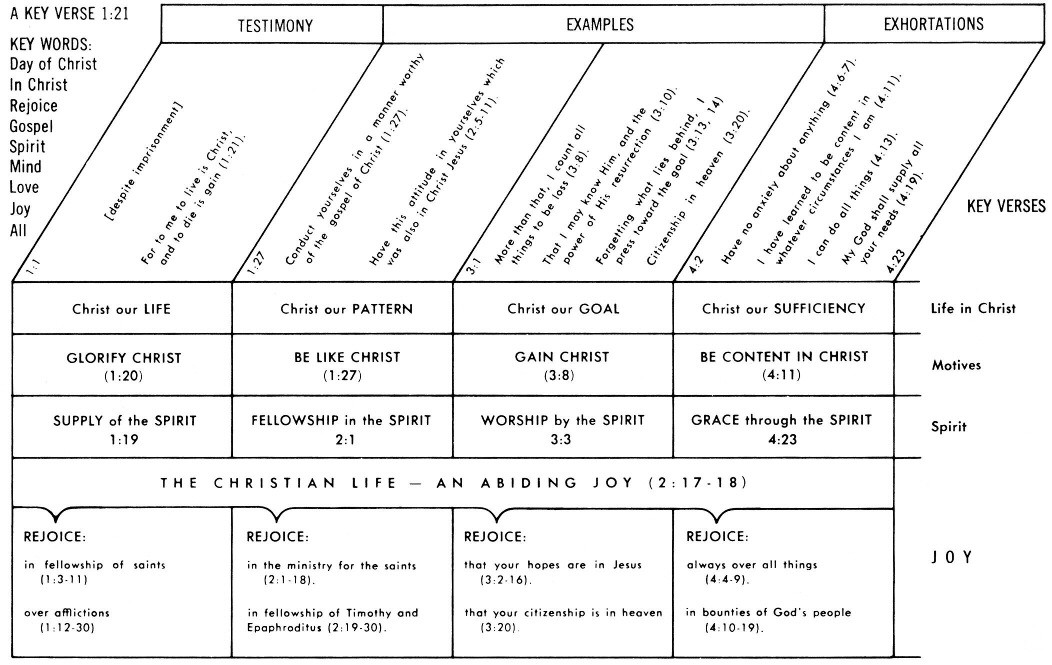
LIFE IN CHRIST
Click chart to enlarge
Charts from Jensen's Survey of the NT - used by permission
Philippians - Charles Swindoll = Chart on right side of page
| Account of Paul's Circumstances Php 1:1-30 |
Have the Mind of Christ Php 2:1-30 |
Have the Knowledge of Christ Php 3:1-21 |
Have |
| Partakers of Christ | People of Christ | Pursuit of Christ | Power of Christ |
| Suffering | Submission | Salvation | Sanctification |
| Experience | Examples | Exhortation | |
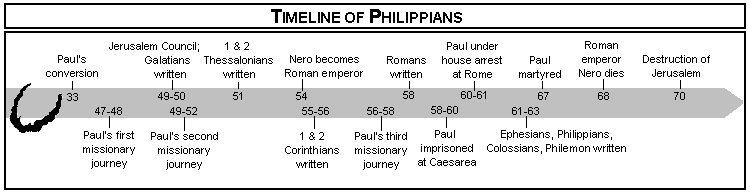

Philippi in the Time of Paul
The city plan above shows those features of the city of Philippi that archaeologists have so far identified as dating from the time of Paul. “Paul’s Prison” is not believed to be an authentic site, but was a cistern later associated with Christian worship. (ESV.org)
Philippians 1:9. And this I pray (1SPMI) that your love may abound (3SPAS) still more and more in real knowledge and all discernment (NASB: Lockman)
Greek: kai touto proseuchomai, (1SPMI) hina e agape humon eti mallon kai mallon perisseue (3SPAS) en epignosei kai pase aisthesei
Amplified: And this I pray: that your love may abound yet more and more and extend to its fullest development in knowledge and all keen insight [that your love may display itself in greater depth of acquaintance and more comprehensive discernment], (Amplified Bible - Lockman)
KJV: And this I pray, that your love may abound yet more and more in knowledge and in all judgment;
NLT: I pray that your love for each other will overflow more and more, and that you will keep on growing in your knowledge and understanding. (NLT - Tyndale House)
Phillips: My prayer for you is that you may have still more love - a love that is full of knowledge and wise insight. (Phillips: Touchstone)
Weymouth: And it is my prayer that your love may be more and more accompanied by clear knowledge and keen perception, for testing things that differ
Wuest: And this is the constant purport of my definite petitions, namely, that your love [divine and self-sacrificial in its nature as ministered to you by the Holy Spirit] yet more and more might overflow, but at the same time be kept within the guiding limitations of an accurate knowledge [of God’s word] gained by experience, and those [guiding limitations] of every kind of sensitive moral and ethical tact, (Eerdmans Publishing - used by permission)
Young's Literal: and this I pray, that your love yet more and more may abound in full knowledge, and all judgment,
AND THIS I PRAY: kai touto proseuchomai (1SPMI):
- Phil 1:4
- Philippians 1 Resources - Multiple Sermons and Commentaries
And - Alford (Comments) says this "refers back to the prayer in Php 1:4 'and this is the purport (design, intent, meaning) of my prayer.' At the same time this purport follows most naturally, after the expression of desire for them in the last verse." Bengel (Comments) writes that this refers to Php 1:3 where he begins to pray for them and that he now is explaining the substance of his prayer.
Joseph Beet - After mentioning for a moment in Php 1:4-note his petitions to God for his readers, Paul now adds to his thanks for the good work already begun in them and his hopes for its completion a definite prayer for its progress: and this I pray. The matter of this prayer, he describes as its purpose: he prays in order that their love... (Philippians 1:9-11 Commentary)
A W Pink laments on "How different are the prayers of Scripture from those which we are accustomed to hear in religious gatherings! Who ever heard this petition offered in public: "This I pray, that your love may abound yet more and more in knowledge and in all judgment"! How many would understand its purport if they should hear it? True spirituality, vital godliness, personal piety, has almost become an unknown quantity in Christendom today. How very different is this bold and comprehensive request "may abound yet more and more" from the halting and halfhearted "if it can please Thee to favor us with a sip" of those who seem utterly afraid to ask for anything worthy of such a God as ours! How little can such souls be acquainted with "the God of all grace." Seriously ponder the petitions of Paul and observe that he was not straitened, and therefore he asked for no half measures or scanty portions. Above all, realize that these prayers are recorded for our instruction, for our encouragement, for our emulation.
Pray (4336) (proseuchomai from prós = conveys sense of towards which adds the idea of consciousness on part of God’s presence and attention + euchomai = comprehensive term for invocation of deity, including the senses of "to vow" as well as "to ask, pray") (Click related noun proseuche) speaks of prayer directed consciously to God, with a definite aim. Proseuchomai carries with it a notion of worship which is not present in the word deomai (see related word deesis).
Proseuchomai is used of prayer to God in general and in classical Greek was the technical term for calling on a deity. The NT transforms the classical stiffness into the warmth of genuine conversation. Such entreaty in the NT is addressed to God or Jesus and typically is both personal and specific. The present tense of proseuchomai indicates this was a continuous activity with Paul and the middle voice means he not only initiated the action but participated in the results or effects thereof.
Proseuchomai is the verb that Jesus used when He instructed us why and how to pray in the Sermon on the Mount...
Matthew 5:44 (note) But I say to you, love your enemies, and pray (proseuchomai - present imperative = make this the habit of your life!) for those who persecute you (Comment: If we are honest, we will quickly acknowledge that for the natural man this injunction is impossible - our lips might mouth such a prayer but God would still see our hearts. In short, prayers such as these call for a supernatural enabling, initiated in a new heart that loves as God loves, even to the point of loving one's enemies.)
Matthew 6:5 (note) And when you pray (proseuchomai), you are not to be as the hypocrites; for they love to stand and pray (proseuchomai) in the synagogues and on the street corners, in order to be seen by men. Truly I say to you, they have their reward in full. 6:6 But you, when you pray (proseuchomai), go into your inner room, and when you have shut your door, pray (proseuchomai) to your Father who is in secret, and your Father who sees in secret will repay you. 6:7 And when you are praying (proseuchomai), do not use meaningless repetition, as the Gentiles do, for they suppose that they will be heard for their many words...6:9 Pray (proseuchomai - present imperative = make this the habit of your life!) , then, in this way: 'Our Father who art in heaven, Hallowed be Thy name.
Proseuchomai reflects the importance of a reverential attitude in our prayers more than the length of the prayers. This praying is not restricted to time or place for the believer ''is not in a right place if he cannot continue to pray there.''
Therefore, Paul's injunction means that one should be constantly conscious of his full dependence upon God. It is important in our "me centered" society to note that Paul didn't pray for physical needs, success, or "blessing" in general (e.g., "Lord bless the saints at Philippi") in this prayer or for that matter anywhere else in his epistles. His attitude of reverential prayer for the spiritual growth of the saints should motivate all saints to be imitators of Paul for all the saints in their sphere of influence. It's one thing to have someone in mind but quite another to have them in your prayers!
Dwight Pentecost has some interesting insights "People who spend time together in prayer find themselves bound by the closest of ties. When two labor together in prayer before God, all hypocrisy is stripped away, all sham and pretext about loving one another evaporates and people are compelled to be perfectly honest with each other before God. When in the first chapter of Philippians we read of the Apostle Paul’s prayer for these believers in Philippi, the heart of the apostle is exposed. In all honesty before God, because of his love for them, he prays for them. In Php 1:8-11 we see the genuineness and depth of Paul’s love for these to whom he ministered personally some ten years before. Paul has had only the briefest personal contact with these Philippians since he first met them on his second missionary journey. Yet his heart is still bound to them by inseparable ties. In this we see something of the pastor’s heart of Paul, for even a decade has not diminished or dimmed his love for them. Neither has the passage of time removed the sense of obligation that the apostle feels as a shepherd toward his sheep. His love does not depend on his presence with them. It is a tie that was established because he was their pastor and they were sheep of his pasture. (The Joy of Living- A Study of Philippians)
Berean Bible Church...
We don't find Paul praying on behalf of physical needs. I'm sure that there were believers at these churches with physical needs. He did pray for Epaphroditus who was sick. We'll see that in chapter two. Paul didn't pray for generic church success and blessing. He ties his prayers directly to their spiritual needs. That was his passion and burden.
What is the content of your prayer life? Are your prayers characterized by thanksgiving as were Paul's? Do you pray for the spiritual health of other believers? What is more important than a believer's spiritual health? A.W. Pink writes,
"How different are the prayers of Scripture from those which we are accustomed to hear in religious gatherings!"
Behind each of our requests is a desire! We often pray only for physical or material needs....why? We believe that health and material thing will bring us happiness. This is not true. Our happiness comes from our relationship with God. Paul gloried in his physical problems (2Cor 12:9-note, 2Co 12:10-note). Do you? Why did Paul glory in his physical problems? Was he some kind of sick sadomasochist? No!
He gloried in his problems
because
God was glorified in them.
So, Paul cut through the all the superficiality instead praying for their deeper need-- true spiritual growth, which will bring genuine blessing.
Prayer is our duty.
Prayerlessness is a declaration of self-sufficiency,
which is pride!
On the other hand,
prayer is a declaration of our dependency.
Does your prayer life declare that you are dependant upon God for everything? (How to Glorify God, Philippians 19-11)
THAT YOUR LOVE MAY ABOUND STILL MORE AND MORE: hina e agape humon perisseue (3SPAS) eti mallon kai mallon:
- Phil 3:15; 16 Job 17:9; Pr 4:18; Mt 13:31, 32, 33; 2Co 8:7; 1Th 3:12; 4:1;4:9,10 2Thes 1:3; Philemon 1:6; 1Pe 1:22
- Philippians 1 Resources - Multiple Sermons and Commentaries
A GREAT PRAYER TO
PRAY FOR OTHERS
That (2443) (hina) expresses purpose and should prompt a 5W/H question!
Joseph Beet - He prays in order that their love (may increase)... the principle which prompts us to do good to our fellows; as always when not further defined. So Ro 12:9-note; Ro 13:10-note; 1Co 13:4ff-note. It is the distinctive feature of the Christian character. By asking for its increase, Paul assumes its existence. And rightly so. For it is implied (Php 1:5) in fellowship, of which mutual love is always the animating principle. (Philippians 1:9-11 Commentary)
Love (26) (agape) is God's love, sacrificial, unconditional and manifests as a choice of one's will without expectation or condition of it being returned in kind.
A W Pink presents us an apt metaphor for agape type love "As you take from a fountain, still more comes. As a spring does not keep its water to itself, so love keeps nothing to itself, but it flows out for the use and benefit of others. Love is selfless: its very nature is to give, seeking to promote the glory of God and the good of men. As fountains have their rise in hills, so love is first in God’s heart in heaven. "We love him, because he first loved us" (1John 4:19).
Regarding agape Fee writes...
Following the lead of the Septuagint, his use of love first of all points to the character of God, and to God’s actions toward his people based on that character. God’s love is demonstrated especially in his forbearance and kindness (1Co 13:4), manifested ultimately in the death of Christ for his enemies (Ro 5:6, 7-note Ro 5:8-note). Thus the primary connotation of love is not “affection,” as in the preceding phrase about Christ (Php 1:8-note), but rather
a sober kind of love
that places high value on a person
and actively seeks that person’s benefit.
This is what Paul now prays will abound (= be present in an abundant way) yet more and more among the Philippian believers. The rest of the prayer, after all, emphasizes love not as affection but as behavior, behavior that is both pure (stemming from right motives) and blameless (lacking offense). (Philippians 1 Commentary)
Agape purposely seeks the welfare of the one loved and springs from intelligence and good will (Philadelphia type love springs from personal warmth and affection and God teaches it as shown in 1Th 4:9 -note). Agape does not have its origin in the desirability of the object of ones affection. A believer has this love (divine nature) within and it is manifest as fruit by the Holy Spirit as we obey truth. Agape is self-sacrificial love which seeks the loved one's highest good. Agape is an attribute of God, the love that He is and He gives as John explained...
And we have come to know and have believed the love which God has for us. God is love, and the one who abides in love abides in God, and God abides in him.1Jn 4:16)
It follows that if agape is supernatural love, it cannot be dispensed from the heart of a natural man (unbeliever), nor can it be shown even by believers unless they surrender to the Holy Spirit Who is the Source and Enabler of this divine. Paul explained to the believers at Rome that...
the love (agape) of God has been poured out within our hearts through the Holy Spirit Who was given to us. (Ro 5:5-note)
God models for us this sacrificial love in the famous verse that teaches that...
God so loved (verb - agapao) the world, that He gave His only begotten Son, that whoever believes in Him should not perish, but have eternal life (John 3:16)
As believers are surrender to God's Holy Spirit, and allow themselves to be controlled (filled with) the Spirit, He enables the yielded believer to bear fruit one aspect of that fruit being agape love as Paul explains writing that...
the fruit of the Spirit is love (agape), joy, peace, patience, kindness, goodness, faithfulness
Believers cannot bear this spiritual fruit unless they abide in the "Divine Gardener", Christ Jesus, Who explained...
I am the vine, you are the branches; he who abides in Me, and I in him, he bears much fruit; for apart from Me you can do nothing. (John 15:5)
Abiding in Him implies knowing what He instructed in His Word as to how we are to walk or conduct ourselves and obeying His instructions without hesitation and in total reliance on His transforming, empowering grace, which alone is sufficient for such a supernatural conduct.
When we walk by faith and obedience in Christ we will glorify His Father by bearing much fruit which proves we are His disciples (John 15:8).
Maclaren links this ever abounding love with an ever increasing desire (and delight) to obey non-burdensome (1Jn 5:3) God's laws (cp Jn 14:15, 21, 23, 15:10, 13)...
The Apostle takes it for granted here that if the Philippian Christians know what is right and what is wrong, they will immediately choose and do the right. Is he forgetting the great gulf between knowledge and practice? Not so, but Paul is strong in the belief that love needs only to know in order to do. The love which abounds more and more in knowledge and in all discernment will be the soul of obedience, and will delight in fulfilling the law which it has delighted in beholding. Other knowledge has no tendency to lead to practice, but this knowledge which is the fruit of love has for its fruit righteousness (right conduct before God and before men).
How do we know we are walking in the Spirit and abiding in the Vine Christ Jesus? Paul gives us a practical "check list" to assess whether we are exhibiting sacrificial, agape, love...
Love is patient, love is kind, and is not jealous; love does not brag and is not arrogant, does not act unbecomingly; it does not seek its own, is not provoked, does not take into account a wrong suffered, does not rejoice in unrighteousness, but rejoices with the truth, bears all things, believes all things, hopes all things, endures all things. (1Co 13:4-note, 1Co 13:5, 6-note, 1Co 13:7-note)
Comment: Note that these descriptions (patient, kind, etc) are not nouns but verbs, (action words) and all are in the present tense which calls for continual practice (i.e, love is continually patient), actions which from my 40+ years of marriage are naturally impossible but supernaturally Him-possible, Christ's Spirit enabling each of these aspects of love as we learn to lean hard on His adequacy and give up "trying" to do it in our own inadequacy! Like I like to tell the young men I disciple - "Quit trying! Start dying!" (cp Mk 8:34, Gal 2:20-note, et al)
Such supernatural love is like a rare, precious flower from heaven, planted in the soil of a believer’s heart
And so Paul prays that their agape love might increase. Love displays itself in knowledge and discernment. In proportion as it abounds it sharpens the moral perceptions for the discernment of what is best. Furthermore the divine love flowing through believers is regulated by an intimate understanding of God’s Word? It is not an uncontrolled emotion for real Biblical, Christ-like love is anchored in convictions based on the revealed truths of Scripture. Our love is to abound in “all discernment” which speaks of moral perception, insight, and the practical application of knowledge. A Spirit produced love which has been confined like a river within the limiting banks of a full experiential knowledge and a sensitive moral and ethical tact, is the thing that sharpens the moral and spiritual perceptions for the discernment of the finer qualities of Christian conduct. This will result in the saint being sincere and without offense until The Day they stand before their Lord, the Righteous Judge.
Abound (4052) (perisseuo from perissos = abundant, exceeding some number, measure, rank or need, over and above) means to cause to superabound, to be superfluous, to overflow, to be in affluence, to excel or to be in abundance with the implication of being considerably more than what would be expected.)
Perisseuo carries the idea of exceeding the requirements, of overflowing or overdoing. It means to exceed a fixed number of measure, to be left over and above a certain number or measure. It means to have or to be more than enough, to be extremely rich or abundant. To exceed or remain over (as used in loaves left over after feeding the 5000 [Mt 14:20]! When Jesus supplies there is more than enough so that some is even left over! How quick we are to forget this basic principle!) The idea is to overflow like a river out of its banks!
Abound is in the progressive present tense indicating Paul's desire and plea to God was that the saints continually overflowing love. A growing and maturing love is something that has to be worked at (and prayed for). Like the law of entropy, which describes how the physical universe is winding down, our ability to express divine love disintegrates unless we commit ourselves daily to the Spirit's power. We need continual strengthening and practice in showing love to others.
Perisseuo - 39x in 35v in the NAS - Matt 5:20; 13:12; 14:20; 15:37; 25:29; Mark 12:44; Luke 9:17; 12:15; 15:17; 21:4; John 6:12f; Acts 16:5; Rom 3:7; 5:15; 15:13; 1 Cor 8:8; 14:12; 15:58; 2 Cor 1:5; 3:9; 4:15; 8:2, 7; 9:8, 12; Eph 1:8; Phil 1:9, 26; 4:12, 18; Col 2:7; 1 Thess 3:12; 4:1, 10. NAS = abound(10), abounded(1), abounding(1), abundance(2), abundant(1), better(1), cause(1), cause*(1), excel(2), has an abundance(1), have an abundance(3), have more than enough(1), having abundance(1), increasing(1), lavished(1), left over(4), leftover(1), live in prosperity(1), make...abound(1), overflowed(1), overflowing(2), surpasses(1), surplus(2).
In his prayers for the saints Paul made frequent use of the verb abound (perisseúo).
In Ro 15:13 Paul prayed for the Roman saints
Now may the God of hope fill you with all joy and peace in believing, so that you will (continually) abound (present tense of perisseuo) in hope by the power of the Holy Spirit. (note)
In 1Thessalonians 3:12 Paul prayed for the Thessalonian saints that the
Lord cause (them) to increase and abound (perisseúo) in love for one another... (1Th 3:12-note) (Cp 1Th 4:1-note, 1Th 4:10-note which also use perisseuo to describe an excelling walk and love in believers - the theme of First Thessalonians in fact is "Excel Still More that You May Be Blameless At His Coming")
In 1Corinthians 15:58 (see note) he used abound to encourage the saints at Corinth
Therefore, my beloved brethren, be (present imperative) steadfast, immovable, always abounding (perisseuo) in the work of the Lord, knowing that your toil is not in vain in the Lord (note this last qualifying phrase "in the Lord", abiding in the Vine, filled with and yielded to His empowering Spirit).
And finally a verse the truth of which surely forms in part the basis for Paul's frequent use of the verb abound (2Corinthians 9:8)
God is able to make all grace abound (perisseuo) to you, so that always having all sufficiency in everything, you may have an abundance for every good deed
A common desire in Paul's prayers was that the believers ''super abound'': Here Paul prays that their love may keep on overflowing resulting in a perpetual "flood of love", and to do so "yet more and more" but always qualified by the limitations [like river banks keeping a river on course] "in real knowledge and all discernment".
More and more (3123) (mallon) coupled with the preceding verb "abound" paints the picture of the saint's love superabounding. This phrase also indicates their (and our) continual need for unremitting progress of growth in grace. But like a river in flood-time, rushing waters need to be brought within guiding limitations lest it work harm rather than bring blessing. So Paul prays that this love may overflow more and more, but that its outflow and application might be brought within the guiding limitations of knowledge and judgment as discussed below.
Joseph Beet
(More and more) further and further in the same direction. This is a courteous acknowledgment that his readers’ love is already rich in, and enriched by, knowledge. (Philippians 1:9-11 Commentary)
Dwight Pentecost notes that...
The apostle does not pray that they might love him. He does not pray that they might love one another. He does not even pray that they might love the Lord Jesus Christ more and more and that they might go deeper and deeper into the heart of God. He prays for an abounding love. In this he is not praying concerning the objects of their affection, he is praying concerning their character. To put it simply, “I am praying that you might be more loving, that more and more you might be characterized by love.” Paul recognizes the presence of love, and he is not praying that they might begin to love. He is praying that their love might be abounding. He is praying for a superabounding affection. (The Joy of Living- A Study of Philippians)
IN REAL KNOWLEDGE : en epignosei
- 1Cor 14:20; Eph 5:17; Col 1:9; 3:10; 2Pe 1:5, 6; 3:18
- Philippians 1 Resources - Multiple Sermons and Commentaries
In real knowledge and all discernment - These, not warm, fuzzy feelings, should form the ground of their love!
Joseph Beet - Knowledge: more fully scientific knowledge, an orderly and comprehensive acquaintance with something; as in Ro 1:28; 3:20; 10:2: a favourite word of Paul, especially in his later Epistles. Its frequency there is a mark of his mature thought, and perhaps of his deepening conviction of the need, in order to escape prevalent dangers, of a fuller knowledge of the Gospel. (Philippians 1:9-11 Commentary)
A W Pink comments on the need for love to be abounding in real knowledge - As the understanding needs to be enlightened and the conscience informed, so love requires instructing. Love is necessarily connected with knowledge for its inception, continuance, and development. A person must be known by us before we can love him. Christ must become a living reality before the heart is drawn out unto Him. There must be a personal and spiritual acquaintance with divine things before they can be delighted in. Where God is truly known, He is necessarily adored. And...if our love for Him is to increase, we must be more occupied and absorbed with His perfections. But love not only needs to be fed and nourished; it also needs to be taught, if it is to act intelligently. Spiritual love should not act by blind impulse, but be scripturally regulated. The Jews had "a zeal of God, but not according to knowledge" (Ro 10:2). They sincerely believed they were serving God when they excluded Christians from their synagogues, and later killed them because they supposed those Christians were heretics (Jn 16:2), yet they erred grievously, and their case has been recorded as a solemn warning for us....The world says that "love is blind", but the love of the Christian should be enlightened, well instructed, and directed in all its exercises, effects, and manifestations by the Scriptures. Unless love is regulated by an enlarged and exact knowledge of the Word, and by that good judgment which is the result of matured discernment and experience, it soon degenerates into fanaticism and unwise exertions. An affectionate regard for our brethren is to be far more than a mere sentiment, namely, "love in the truth" (2Jn 1:1), love informed and controlled by the truth....Only as love is regulated by light, and light is accompanied by and infused with love, are we well balanced.
Real knowledge (1922) (epignosis from epí - upon, gives the force of “fully” + ginosko = to know related to gnosis = knowledge) is full knowledge, indicating that it is a fuller, more complete form of the root word, gnósis.
Both epignosis and gnosis denote acquired or experimental knowledge but whereas gnosis may be true or false, epignosis is always true knowledge and is knowledge in the spiritual (in contrast to the secular) sphere. It usually conveys the thought of full knowledge or increasing knowledge.
For example, Paul writes
O Timothy, guard what has been entrusted to you, avoiding worldly and empty chatter and the opposing arguments of what is falsely called “knowledge” (gnosis) (1Ti 6:20)
The context makes clear that this knowledge is not speculative or theoretical nor only devotional, although this latter element is an essential factor in this epignosis.
Epígnosis is an intensely practical activity. It cannot be dissociated from the following exhortations to conducting themselves worthily of the Lord. These are the inevitable effects of an increase in the knowledge of God.
Epígnosis is knowledge based on personal involvement with the object of that knowledge (experiential)--not a mere intellectual understanding of the Truth.
Epignosis - 20x in 20v - Rom 1:28; 3:20; 10:2; Eph 1:17; 4:13; Phil 1:9; Col 1:9f; 2:2; 3:10; 1 Tim 2:4; 2 Tim 2:25; 3:7; Titus 1:1; Philemon 1:6; Heb 10:26; 2 Pet 1:2f, 8; 2:20. NAS = acknowledge*(1), knowledge(14), real knowledge(1), true knowledge(4).
True knowledge will hone our senses that we might accurately perceive what is true or what is worthless in any given matter. Far from being uncontrolled emotion, divine love is regulated by a knowledge of God's Word. Love controlled by God's Word is deep, anchored in convictions based on the truth. Vine adds that if the Philippian saint's "love were to increase, its outgoings were to be directed and controlled. Love is not impulsive, as though it were a mere emotion; love is intelligent, and therefore seeks that full and accurate knowledge which enables it to bestow itself worthily."
Kenneth Wuest - The full knowledge which these Philippians needed to gain by experience was a better understanding of God’s Word as translated into their experience, and a clearer vision of the Lord Jesus in all the beauty and fragrance of His Person. A Christian can have an “understanding” knowledge of the Word, that is, be able to explain its meaning to others, without having an experiential knowledge of the same. But when that Christian has put the Word of God into practice in his life, then he has what Paul is talking about here. This is the difference between a young convert and a matured believer. The former has not had time to live long enough to live out the Word in his life, the latter has. The former, if his life is wholly yielded, is a delight to look upon in his Christian life, as one would enjoy the vigor and sparkle of youth. The latter, in his mellowed, well-rounded, matured, and fully-developed Christian experience, his life full of tender reminiscences of his years of companionship with the Lord Jesus, has the fragrance of heavenly things about him. This was what the Philippian saints needed, but it would take time for this to be brought about. This mellowed Christian experience would constitute the limitations thrown around this overflowing love that would insure its proper application and wise outreach. (Wuest, K. S. Wuest's Word Studies from the Greek New Testament: Studies in the Vocabulary of the Greek New Testament: Grand Rapids: Eerdmans)
AND ALL DISCERNMENT : kai pase aisthese:
- ~ delicate spiritual perception
- Philippians 1 Resources - Multiple Sermons and Commentaries
All (pas) - means all without exception. Compare to Paul's commands to the Thessalonians to "examine (present imperative = continually do this = continually necessary!) everything (pas)" (1Th 5:21-note) and "abstain (present imperative = continually ) from every (pas) form of evil." (1Th 5:22-note)
Alexander Maclaren - ‘Discernment’ literally means ‘sense,’ and here, of course, when employed about spiritual and moral things it means the power of apprehending good and bad as such. It is, I suppose, substantially equivalent to conscience, the moral tact or touch of the soul by which, in a manner analogous to bodily sense, it ascertains the moral character of things. This growth of love in the power of spiritual and moral discernment is desired in order to its exercise in ‘proving things that differ.’ It is a process of discrimination and testing that is meant, which is, I think, fairly represented by the more modern expression which I have used—keenness of conscience. (Sermon)
Maclaren goes on to offer some wonderful insights on how increasing love is linked to increasing discernment writing that...
This keenness of conscience follows on the growth of love. Nothing makes a man more sensitive to evil than a hearty love to God (Ed: Take a few moments and peruse the comments on 2Corinthians 5:14-comments). Such a heart is keener to discern what is contrary to its love than any ethical maxims can make it. A man who lives in love will be delivered from the blinding influence of his own evil tastes, and a heart steadfast in love will not be swayed by lower temptations.
Communion with God will, from its very familiarity with Him, instinctively discern the evil of evil, as a man coming out of pure air is conscious of vitiated (spoiled, impaired quality of) atmosphere which those who constantly dwell in it do not perceive.
It used to be said that Venice glass would shiver into fragments if poison were poured into the cup. As evil spirits were supposed to be cast out by the presence of an innocent child or a pure virgin (an illustration not a Biblical truth), so the ugly shapes that sometimes tempt us by assuming fair disguises will be shown in their native hideousness when confronted with a heart filled with the love of God (Ed: And constrained, compelled and impelled by the love of Christ = 2Co 5:14-note).
Such keenness of judgment is capable of indefinite increase.
Our consciences should become more and more sensitive: we should always be advancing in our discovery of our own evils, and be more conscious of our sins, the fewer we have of them.
Twilight in a chamber may reveal some foul things, and the growing light will disclose more. ‘Secret faults’ will cease to be secret when our love abounds more and more in knowledge, and in all discernment. (Sermon)
Discernment (144) (aisthesis from aisthánomai = to apprehend by the senses, to perceive and in NT speaks primarily of spiritual perception; our English = aesthetic; the root verb is aio = to perceive) refers to the capacity to understand referring not so much to an intellectual acuteness but to a moral sensitiveness. It thus speaks of moral perception, insight, and the practical application of knowledge--the deep knowledge Paul had already mentioned. Aisthesis therefore is more of an immediate knowledge than that arrived at by reasoning. It describes the capacity to perceive clearly and hence to understand the real nature of something. It is the capacity to discern and therefore understand what is not readily comprehensible. It refers to a moral action of recognizing distinctions and making a decision about behavior.
It is interesting to note that the meaning of aisthesis is almost the opposite of the English word “aesthetic” which is derived from the Greek word. Aesthetic speaks of one who is appreciative of, responsive to, or zealous about the beautiful. It has largely to do with personal taste and preference. Paul calls believers to put aside personal tastes and preferences and to focus instead on achieving mature insight and understanding.
The English dictionary states that discernment is the power to see what is not evident to the average mind and stresses accuracy as in reading character or motives. The idea is to detect with the senses and in the present context speaks of a believer's "spiritual senses" being "fine tuned" (not judgmental but also not gullible - instead discriminating, able to see the difference between two or more things).
Love that abounds in all discernment is love that is controlled by theology, and theology must be applied to life with insight. It is used of those moral and spiritual concepts and actions which involve delicate and keen distinctions, those that require a deep and keen discernment to recognize. Not the ordinary, everyday, easily understood spiritual obligations, but the finer points of Christian conduct. It speaks of those things that are superior, vital, that surpass, that excel! Finally, it refers to the ability to make proper moral and spiritual decisions in the midst of a vast array of differing and difficult choices.
Berean Bible Church...
In 1Corinthians 13:2, we see that knowledge without love equals zero. In Philippians 1:9, we see that love without knowledge equals sentimentalism. As you learn the word and grow in the word it will effect your love.
First epignosis than aisthesis. People who don't know doctrine have no discernment. It has to do with practical application of that deep knowledge. So, your love is controlled by your theology, and your insight in the application of that theology.
Years ago a man came to our church looking for a place to stay. I told him that we supported the Union Mission and that I would be glad to take him down to the mission. He responded by telling me that he couldn't stay at the mission because he needed a private room. I told him that I would take him to the mission but that was the best I could do. He said to me, "I thought that Christians were supposed to love?" I said, "We are, but we're not supposed to be suckers." That is a paraphrase for discernment. This made him angry and he got violent. We ended up calling the police and he was taken to jail. We need to be discerning. Feeding and putting up a person who is too lazy to work does not help them. Do you know what God's cure for slothfulness is? Hunger! (How to Glorify God, Philippians 1:9-11)
John Eadie writes that aisthesis...
means power of perception. Physically, it denotes perception by the senses, especially that of touch; and in the plural, it signifies the organs of such perception—the senses themselves. The transition to a spiritual meaning such as that of apprehension is obvious. It might be rendered ethical tact, that faculty of moral discernment which is quick and unerring in its judgment, and by a peculiar insight arrives easily and surely at its conclusions.
Joseph Beet says the idea of aisthesis is...
Perception of qualities. Frequent in classical Greek for perception by the bodily senses. Paul desires for his readers a comprehensive acquaintance with things divine and a faculty of distinguishing right from wrong in the various details of life. The word all recalls the number and variety of these details. (Philippians 1:9-11 Commentary)
Marvin Vincent
Used of the senses, as Xenophon: “perception of things sweet or pungent”. Of hearing: “It is possible to go so far away as not to afford a hearing”. The senses are called aistheseis. Plato uses it of visions of the gods. Compare aisthētrion - senses, Heb. 5:14-note. Discernment selects, classifies, and applies what is furnished by knowledge.
MacArthur writes that aisthesis
refers to a high level of biblical, theological, moral, and spiritual perception. It also implies the right application of that knowledge. In other words, discernment is the understanding and appreciation of the real knowledge of God’s revelation that produces holy living. Unlike the way that worldly love is often characterized, biblical love is far from blind. On the contrary, it is wise and judicious. (MacArthur, J. Philippians. Chicago: Moody Press)
Barclay writes that
aisthesis is 'sensitive perception'. It is the quality of heart and mind which is sensitive to that which is wrong. It is the experience of life that the first time a man commits a wrong action he does so with a kind of shuddering reluctance; if he does it twice he does it more easily; if he goes on doing it he will end by doing it without thinking at all. His sensitiveness to sin is gone; his heart is hardened. It is indeed true that the most awful thing about sin is exactly its power to beget sin. (Barclay, W: The Daily Study Bible)
NIDNTT adds that...
Originally both aisthanomai and ginosko referred to experiencing an object through the senses. But whereas aisthesis and its cognates expressed physical apprehension through the senses apart from the intellectual act of interpretation, ginosko and its cognates included from the very first the idea of grasping and understanding the object perceived by the mind. Owing largely though not exclusively to the usage of the LXX, aisthanomai came to be confined to perception by the senses. (Brown, Colin, Editor. New International Dictionary of NT Theology. 1986. Zondervan)
Although aisthesis is used only here in the NT, there are 23 uses in the Septuagint (LXX) (Ex 28:3; Pr 1:4, 7, 22; 2:3, 10; 3:20; 5:2; 8:10; 10:14; 11:9; 12:1, 23; 14:6f, 18; 15:7, 14; 18:15; 19:25; 22:12; 23:12; 24:4). Note the predominance of uses in Proverbs. It is not surprising that Wisdom literature would have most of the Scriptural uses on discernment! For example, Solomon writes that the proverbs are written in part...
To give prudence to the naive, to the youth knowledge (LXX = aisthesis = discernment) and discretion (Proverbs 1:4)
"How long, O naive ones, will you love simplicity? And scoffers delight themselves in scoffing, and fools hate knowledge (LXX = aisthesis = discernment)? (Proverbs 1:22)
Aisthesis represents a moral action of recognizing distinctions and making a decision about behavior. Discernment selects, classifies, and applies what is furnished by knowledge. It means to have the capacity to perceive clearly. It describes the ability to understand the real nature of something and once discriminating to make the proper moral decision.
Hebrews has the sole NT use of the related word aistheterion refers to the organs or senses of perception...
solid food is for the mature, who because of practice have their senses (aistheterion) trained to discern good and evil. (Hebrews 5:14) (Comment: The mature believer in the spiritual realm has discernment about what is right and wrong, true and false, helpful and harmful, righteous and unrighteous).
Luke has the sole NT use of the root verb aisthanomai recording that
they (Jesus' disciples) did not understand this statement ("the Son of Man is going to be delivered into the hands of men"), and it was concealed from them so that they might not perceive (aisthanomai) it; and they were afraid to ask Him about this statement. (Luke 9:45)
John Eadie explains that
The apostle's desire was that the love of the Philippians might acquire a profounder knowledge, and not be tempted to misplace itself, and that it might attain a sharper and clearer discernment, and so be prevented from being squandered on unworthy subjects, or directed to courses of conduct which had the semblance but not the reality of Christian rectitude and utility. If love grew in mere capacity, and without the increase of these safeguards, it was in hazard of forming unworthy and profitless attachments. Passion, without such guides or feelers, is but blind predilection. “Fellowship for the Gospel” (Php 1:5KJV-note - koinonia in the Gospel) is still the thought in the apostle's mind, and that love which had led them to it, needed for its stability a deeper knowledge of the truths which characterized the gospel, and required for its development a clearer faculty of apprehending the character of the men best qualified, and the measures best adapted to its “defence and confirmation.” (Philippians 1 Commentary)
One of the sure marks of maturity is discerning love. This goal speaks of sensitive moral perception, and a quickness of ethical tact. How often we saints mean to be loving to others, and say the wrong words or do the wrong thing. We lack that delicate sensibility, that ability to express ourselves correctly, that gentle, wise, discriminating touch which would convey the love we have in our hearts to the lives of others. But this can be ours if we but live in close companionship with the One who always exhibited that sense of delicate tactfulness in His life. While it is true that we must approach the Word of God with an open mind, we also must recognize that God’s truth provides absolute boundaries for that openness.
Paul was praying that their self sacrificial love produced in yielded hearts by the Holy Spirit might overflow like a river in flood-time whose powerful waters needed to be brought within limits (cp "real knowledge and all discernment") lest it work harm rather than bring blessing.
R J Morgan writes that...
Paul prayed for this love to “abound”—not a one-time overflowing, but a continual activity (Ro 5:5-note). This is an others-centered love. It looks for needs in the lives of others and seeks to meet those needs with no thought of returned favors. This love is also characterized by knowledge and discernment. Many people today want to focus on love with no discernment. From their perspective, love means tolerance, accepting anyone and everything, like the song that says, “If loving you is wrong, I don’t want to be right.” But love must be based on truth" (Morgan, R. J. Nelson's Annual Preacher's Sourcebook: 2002. Nashville: Thomas Nelson Publishers)
G. K. Chesterton spoke to a believer's need love that is discerning when he wrote,
Merely having an open mind is nothing. The object of opening the mind, as of opening the mouth, is to shut it again on something solid.
><> ><> ><>
Harry A. Ironside - DISCERNING LOVE - Lack of discernment often accounts for the failure of those in the pew to realize the full import of unsound teaching from the pulpit.
A brilliant modernistic preacher, who had pleased his audience with flowery oratory and beautiful perorations, as he discoursed glibly of the importance of breadth of view and the danger of bigoted opinions, was bidding farewell to his congregation as he was about to leave them for a new parish. One of his young men approached him and said, "Pastor, I am sorry we are losing you. Before you came I was one who did not care for GOD, man, or the devil, but through your delightful sermons, I have learned to love them all!" This is mere sentimentality -- not discerning love
WANTED:
CHRISTIANS LIVING
"AMPLIUS" LIVES
AMPLIUS LIVES - It is said that one day Michelangelo entered his studio to examine the work of his students. As he came to the painting of one of his favorite pupils, he stood and looked at it for a long time. Then, to the utter surprise of the class, he suddenly took a brush and wrote one word across the canvas. That one word he splashed on the picture was amplius, meaning "larger." Michelangelo was not rejecting the work, for it exhibited great skill and was good as far as it went. But the small size of the canvas had made its design appear cramped. It needed to be expanded.
The Lord may have to write the word amplius across many of our lives. Our spiritual outlook becomes confined, and our vision of what God wants to do in and through us gets restricted by our small faith and limited spiritual growth (and limited spiritual vision). He wants to increase the dimensions of our spiritual lives (and the spiritual vision of our hearts), widen our outreach, and strengthen our witness.
OUR LIMITED VISION
needs
CONTINUAL RE-VISION!
A W Pink's exposition - The petition. "And this I pray, that your love may abound yet more and more in knowledge and in all judgment" or "sense."
Paul not only prayed for these saints, but he acquainted them with the particular things he requested for them, so that they might know what they should ask for and earnestly strive after. In like manner, his prayer is placed on permanent record in the Word that saints in all generations might be similarly instructed. If we would ascertain our special spiritual needs, if we would be better informed of the specific things we most need to ask for, then we should pay more than ordinary attention to these prayers of the apostle.
We should fix them in our minds, meditating frequently on them, begging God to open to us their spiritual meaning, and to effectually impress our hearts with the same. There is nothing provincial or evanescent about these prayers, for they are suited to and designed for Christians of all ages, places, and cases.
There is a wealth of heavenly treasure in them which no expositor can exhaust, and which the Holy Spirit will reveal to humble, earnest, seeking souls.
Those Philippian saints already loved God and His Christ, His cause, and His people, yet the apostle prayed that their love might "abound yet more and more"....The more we discern the grace of God at work in an individual Christian or church, the greater encouragement we have to make request that a still larger measure of it may be communicated to him or them.
LOVE...
BUBBLING UP
Goodwin pointed out that the Greek word here used for "abound" is a metaphor taken from the bubbling up and flowing of a spring of water, and showed the force and appropriateness of it. A spring flows naturally and spontaneously, and not by the mechanical efforts of men. Such is divine love in the soul: it operates freely and not by constraint, it works readily, and requires no urging from without. Where Christ is known to the soul, the heart cannot help being drawn out unto Him and delighting in Him.
"But as touching brotherly love ye need not that I write unto you: for ye yourselves are taught of God to love one another" (1Th 4:9).
No one can be made to love one another, but where there is love it will act freely and readily.
As you take from a fountain, still more comes. As a spring does not keep its water to itself, so love keeps nothing to itself, but it flows out for the use and benefit of others. Love is selfless: its very nature is to give, seeking to promote the glory of God and the good of men. As fountains have their rise in hills, so love is first in God’s heart in heaven. "We love him, because he first loved us" (1John 4:19).
To the phrase "that your love may yet abound," or spring up and flow forth, the apostle added "yet more and more." God can never have enough of our love, nor us of His grace. If we would receive an enlargement of love we must be more and more engaged with its Object.
REAL KNOWLEDGE
Love to Be Informed and Controlled by the Truth - It is painful to witness sincere and affectionate believers making mistakes and falling into wrong courses through lack of light, yet there are many such cases. A wrongly instructed and injudicious Christian causes trouble among his fellow Christians, and often increases the reproaches of the world. Paul here prayed for an intelligent affection in the saints, for a warm heartedness based upon and flowing from an enlarged perception of divine things, that they might have a clear apprehension of the just claims of God and of their brothers and sisters in Christ. The world says that love is blind, but the love of the Christian should be enlightened, well instructed, and directed in all its exercises, effects, and manifestations by the Scriptures. Unless love is regulated by an enlarged and exact knowledge of the Word, and by that good judgment which is the result of matured discernment and experience, it soon degenerates into fanaticism and unwise exertions. An affectionate regard for our brethren is to be far more than a mere sentiment, namely, "love in the truth" (2Jn 1:1), love informed and controlled by the truth.
Some Christians have a good understanding of the truth yet are considerably carnal in their walk (1Co 3:1, 2, 3). Others, though defective in knowledge and unsettled in the faith, are yet warmhearted, having much zeal toward God and His cause, and a considerable command over their passions. God’s people should labor for both. It was love and zeal for Christ which prompted the apostles to say, "Lord, wilt thou that we command fire to come down from heaven, and consume them, even as Elias [Elijah] did?" when they saw how their Master was slighted. Yet it was misdirected love and zeal, as His "Ye know not what manner of spirit ye are of" (Lk 9:54, 55) showed. Love must be instructed if it is to be placed on legitimate objects and restrained from non permissible ones, if it is to be rightly exercised on all occasions. And the needed instruction can be obtained only from God’s Word. Only as love is regulated by light, and light is accompanied by and infused with love, are we well balanced.
ALL JUDGMENT
(ALL DISCERNMENT)
"That your love may abound yet more and more in knowledge and in all judgment." Something more than bare knowledge, even though it is a knowledge of the Word, is needed if love is to be duly regulated and exercised. That something is here termed "judgment," or in the margin, "sense." (Ed: or "all discernment") That word occurs in the singular number nowhere else in the New Testament, and only once (Heb 5:14) in its plural form, where it is rendered "senses." In Young’s Analytical Concordance to the Bible it is defined as "perfection, sense, intelligence.’’
Not only do we need to be thoroughly familiar with the Scriptures. If we are to make proper use of such knowledge, then good judgment is required in the governing of our affections and the ordering of our affairs.
Our Love to Abound in Knowledge - Many are wise in the general principles and in the letter of the Word, but err grievously in the applying of those principles in detail. There is a vast variety of circumstances in our lives. These call for much prudence in dealing with them aright. If our hearts are to be properly governed and our ways suitably ordered, much instruction and considerable experience are required. Besides a knowledge of God’s will, the spirit of discretion is needed. There are times when all lawful things are not expedient, and wisdom is indispensable to determine when those times and where those places are, as well as by which persons they may be used or performed. Indiscretion and folly remain in the best of us. The chief work of our judgment is to perceive what is proper for the time, the place, the company where we are, that we may order our behavior aright (Ps. 50:23); that we may know how to conduct ourselves in all relations civil and sacred, in work or in recreation; that we may conduct ourselves wisely as husbands, fathers, wives, or children; as employers or employees. Love needs to be directed by good judgment in all its exercises and expressions. (Prayer for Discerning Love)
Philippians 1:10 so that you may approve (PAN) the things that are excellent (PAPNPA), in order to be (2PPAS) sincere and blameless until the day of Christ (NASB: Lockman)
Greek: eis to dokimazein (PAN) humas ta diapheronta, (PAPNPA) hina ete (2PPAS) eilikrineis kai aproskopoi eis hemeran Christou,
Amplified: So that you may surely learn to sense what is vital, and approve and prize what is excellent and of real value [recognizing the highest and the best, and distinguishing the moral differences], and that you may be untainted and pure and unerring and blameless [so that with hearts sincere and certain and unsullied, you may approach] the day of Christ [not stumbling nor causing others to stumble].
KJV: That ye may approve things that are excellent; that ye may be sincere and without offence till the day of Christ;
NLT: For I want you to understand what really matters, so that you may live pure and blameless lives until Christ returns. (NLT - Tyndale House)
Phillips: I want you to be able always to recognise the highest and the best, and to live sincere and blameless lives until the day of Jesus Christ. I want to see your lives full of true goodness, produced by the power that Jesus Christ gives you to the praise and glory of God. (Phillips: Touchstone)
Weymouth: so that you may be men of transparent character, and may be blameless, in preparation for the day of Christ,
Wuest: So that you may after testing, recognize the true value of the finer points of Christian conduct and thus sanction them, in order that you may be pure and not a stumbling block, keeping in view the day of Christ, (Eerdmans Publishing - used by permission)
Young's Literal: for your proving the things that differ, that ye may be pure and offenceless -- to a day of Christ,
SO THAT YOU MAY APPROVE : eis to dokimazein (PAN) humas:
- You - Isa 7:15; 16 Am 5:14; 15 Mic 3:2; Jn 3:20; Ro 2:18; 7:16, 22; 8:7; Ro 12:2, 9
- approve Job 12:11; 34:3; 2Co 11:13, 14, 15; Ep 5:10; 1Th 5:21; He 5:12, 5:13 14; 1Jn 4:1; Rev 2:2
- Philippians 1 Resources - Multiple Sermons and Commentaries
So that (eis) is a preposition of motion which literally means toward or into. When eis is used to describe a result, effect, consequence, it marks that which a person inclines toward or becomes (in this case a person with such a increasing knowledgeable and discerning love is becoming one who can continually test and approve things as genuine - see below). Whenever you see a "so that", pause and ponder "so what?" You may be surprised at how much greater insight the Spirit will give you when you prayerfully take time to interrogate terms of purpose or result with the 5W/H questions!
PRAYING FOR DISCERNMENT
PURSUING AFTER DISCERNMENT
While Paul is praying for discernment here in Php 1:9-10, in his letter to the Romans Paul commands the saints (and us) to be pursuing after discernment...
And do not be conformed (suschematizo in the present imperative + negative = stop living like this implying some were already making choices that were causing them to be conformed) to this world, but be transformed (metamorphoo in the present imperative = Make it the habit of your life to continually allow yourself to be changed outwardly [in other words continually seek to surrender your will to the Spirit's will] as a reflection from and truly representative of your inward character and nature. Paul is commanding us to continually be going/growing in that direction, [ever increasing degrees of Christ-likeness] and is not calling for perfection. How does this growth transpire?) by the renewing (anakainosis = cause your mind, now positionally the mind of Christ in all believers, to become experientially new. Paul is calling for a renovation which makes a saint different than he or she was before Christ came into their life.) of your mind, that you may prove (same verb used in Php 1:10 = dokimazo; the present tense = continuous action) what the will of God is, that which is good and acceptable and perfect. (Ro 12:2-note)
Comment: According to 2Corinthians 3:18-note for believers, the process of transformation (being "metamorphosed", so to speak, by the sanctifying work of the Spirit from a "spiritual caterpillar" to a "spiritual butterfly") is already underway in this life (we "are being transformed from glory to glory") as we behold God's Word (Are you daily in His Word of Truth that the persistent bombardment of your mind with the lies from the the world, the flesh and the devil, might be countered and "trumped" by the Truth of God? See Mt 4:4, 1Pe 2:2-note, Job 23:12-note). Romans 12:2 describes the ongoing process (present tense) by which we as believers are to daily be experiencing a change of character and conduct (Does your conduct match your character? Check your conduct for a good "barometer" of your character!) as a result of the renewal of our thinking. Wuest translates “change your outward expression to one that comes from within and is representative of your inner being, by the renewing of your mind." Dear brother and sister in Christ, we must daily encourage one another (Heb 3:13) to fight the good fight of faith (1Ti 6:12) for the glory and praise of our great and mighty God, and we must not allow ourselves to let our thinking and our conduct be patterned after the spirit of this present evil age! Remember that there is no "neutral gear" in the Christian life - you are either being conformed to this world today or being transformed into a greater degree of Christ-likeness. God will not force us but He will enable us and part of the "empowerment" is to pray prayers like Phil 1:9-11 for one another. I have just prayed that for all of you who are reading this note (reciprocation greatly appreciated!). May God be greatly glorified in and through the lives of His children who are growing in their ability to approve the things that are excellent. Amen.
Approve (1381) (dokimazo) was used in ancient times for the testing of gold to determine its purity, of testing money to be sure it wasn't counterfeit and for trying oxen to assess their usefulness for the task at hand (see Lk 14:19). The purpose of increasing in love, controlled by knowledge and discernment, is to be able to evaluate people and situations correctly.
Paul desires that the saints at Philippi might continually (note his use of present tense = continuous action) test things for the purpose of approving and ultimately practicing what is morally and ethically superior. He wants them to continually put things to the test in order to detect the good. And so he prays for them to have the ability to sift or test things and recognize its worth so that they might give it their stamp of approval.
Two good tests for us to follow as we exercise spiritual discernment: (1). Will it make others stumble? (2) Will I be ashamed if Jesus should return?
Dokimazo - 22x in 20v in NAS - Luke 12:56; 14:19; Rom 1:28; 2:18; 12:2; 14:22; 1 Cor 3:13; 11:28; 16:3; 2 Cor 8:8, 22; 13:5; Gal 6:4; Eph 5:10; Phil 1:10; 1 Thess 2:4; 5:21; 1 Tim 3:10; 1 Pet 1:7; 1 John 4:1. NAS = analyze(2), approve(3), approved(1), approves(1), examine(4), examines(1), prove(1), proving(1), see fit(1), test(2), tested(3), try(1), trying to learn(1).
A W Pink comments on approving the things that are excellent.
The Greek word here, rendered "approve" denotes that kind of trial to which metals are subjected when their nature and genuineness are being tested. Thus, when the apostle uses dokimazo in (1Pe 1:7), the picture is that of the goldsmith submitting the ore to a process of proof in his crucible. All is not gold that glistens! The uninstructed eye is not able to distinguish the genuine from the counterfeit: the metal must be properly examined and tested to ascertain beyond doubt whether it is precious or worthless...
The reader needs to realize that before he is capable of attesting the genuineness of his love, verifying the validity of his profession, or proving the worth or worthlessness of the preaching he hears or reads—whether that teaching relates to doctrine or practice—his love must be warm and enlightened by knowledge and directed by good judgment, otherwise he is likely to be deceived by what is erroneous.
But the Greek word for approve also signifies "an approving or judgment of what is good, a savoring, a relishing, closing with and cleaving to the goodness of it as good and best."
A love which is directed by an enlightened mind and a holy heart not only has the capacity to detect counterfeits but sweetly realizes the excellence of divine things and delights in them....
Where there is an increasing love which is directed by spiritual knowledge and holy sensibility, there is an enlarged capacity in the understanding to judge and discriminate: both to discern and detest what is injurious and to recognize and cherish what is beneficial. Or, to invert the order of thought: the apostle longed that these saints should "approve things that are excellent"—that they choose them, cleave to them, delight in them, and be regulated by them. But in order to do so, their love must both abound and be educated, so that they might have a true judgment and sense of the real worth of the different objects which competed for their hearts, and be suitably affected by the same. And that could only be obtained by trying these things. Love is not to be exercised indiscriminately. Objects must be esteemed only according to their nature and worth, and that worth is experimentally ascertained by an actual acquaintance with them. As the sweetness of honey is best known by the eating of it, so the preciousness of divine and spiritual things is realized in proportion as the soul is actually and actively engaged with them. (Prayer for Discerning Love)
THE THINGS THAT ARE EXCELLENT IN ORDER TO BE SINCERE : ta diapheronta (PAPNPA) hina ete (2PPAS) eilikrineis:
- Phil 1:16; Ge 20:5; Jos 24:14; Jn 1:47; Acts 24:16; 2Co 1:12; 2:17; 8:8; Eph 4:15; 5:27; 6:24; 1Th 3:13; 5:23
- Philippians 1 Resources - Multiple Sermons and Commentaries
The things - Always interrogate with 5W/H questions - e.g., What things? In this context, the answer is immediately apparent - those things that are excellent, of more value to one's spiritual life.
The things that are excellent - The things that differ.
As Beet says...
Only a divinely given comprehension of the great realities and discernment of moral details will enable us to distinguish the comparative excellence of various modes of action. And no gift is of greater practical worth.
Alexander Maclaren alludes to the believer's continual great need for learning to approve the things that are excellent...
We are surrounded by temptations to evil, and live in a world where maxims and principles not in accordance with the Gospel abound. Our own natures are but partially sanctified. The shows of things must be tested. Apparent good must be proved. The Christian life is not merely to unfold itself in peace and order, but through conflict. We are not merely to follow impulses, or to live as angels do, who are above sin, or as animals do who are beneath it. When false coins are being passed, it is folly to accept any without a test. All around us there is glamour, and so within us there is need for careful watchfulness and quick discrimination.
Berean Bible Church...
True love desires things that are excellent because true love is controlled by a deep knowledge of the word which enables the believer to be completely discerning and discriminating, and that leads him to a pursuit of things that are excellent...Paul is in effect saying, "My prayer for you is that you would have the capability to evaluate and determine the things that are excellent."
To be able to set proper values on things, it is not so much the ability to distinguish good from bad, but good from the best; to focus your time and energy on what really matters. It is the ability to prioritize; to test for the purpose of approval.
He wants them to approve things that are "excellent." This is the noun dia phero. It means things of greater value. A translation could be, "With the result that you may approve after testing the things of greater value."
It starts with epignosis -- full bible knowledge. If doctrine isn't first place in your life than Christ isn't first place in your life. You cannot divorce the Living Word from the written Word. Jesus Christ is the Living word. The Bible is the written word; it is the written word that reveals the Living word. It is the written word that causes us to grow spiritually that we might glorify the Living word, Jesus Christ.
The majority of believers don't test anything, they live by their moods and not by their minds. People don't want to think, but be amused. They don't know how to approve things that are excellent because they can't control their mind and they just react.
Too many people are like the pilot who said to the people, "I have good news and bad news. The bad news is that we have lost all instrumentation and don't know where we are. The good news is we have a tail wind and are making great time." That's how too many believers live, by mood and emotion.
The ability to distinguish is a mark of maturity. When a baby learns to speak, everything with four legs is a doggy.
In order to approve things that are excellent, there must be a standard with which we can harmonize our choice. That standard is not found in the varied philosophies of men but in the word of God. If we are going to prove what is excellent, it starts with the mind.
Look at your life are you approving and pursuing things that are excellent? Or is your life filled with trivia? Example-- mothers, to pursue things that are excellent, would be to pour your life into raising godly children. But too many mothers today have forsaken that calling to go after a career. We must learn to discriminate the higher spiritual blessings from the lower material blessings. You must be able to carefully examine the things of this life which compete for your allegiance, and then embrace and apply yourself to those that are excellent. (How to Glorify God, Philippians 1:9-11)
Excellent (1308) (diaphero from dia = separation, through + phéro = carry, bear) means literally to carry or take something through an area or structure (Mk 11:16, more figuratively of God's Word in Acts 13:49, Passive sense of a ship being driven about - Acts 27:27).
A T Robertson says that originally diaphero meant
“test the things that differ.” The verb was used for assaying metals. Either sense suits this context, but the first step is to distinguish between good and evil and that is not always easy in our complex civilization.
In the intransitive sense, diaphero means to differ, to be different. To differ in an advantageous way speaks of those things that are superior, to be worth more (in the present context Paul speaks of those things that are worth more from an eternal/spiritual perspective!)
BDAG summarized
1. to carry something through a place or structure, carry through
2. to cause to move from one locality to another, carry hither and yon (Pompey’s bier Ps Sol 2:27); drive or carry about, drift of a ship
3. to be unlike, differ, be different from someone or something in no respect, not at all
4. differ to one’s advantage fr. someone or something, be worth more than, be superior to
Friberg on diaphero - (1) transitively, as transporting something through an area carry through ( Mk 11.16); as telling a message throughout an area spread, tell everywhere (Acts 13.49); passive, of a ship in shifting winds be driven about, drift about ( Acts 27.27); (2) intransitively differ, be different (Gal 4.1); as differing advantageously be superior to, be worth more than (Mt 6.26); (3) absolutely ta. diafe,ronta the essential things, the things that matter or are of greater value (Ro 2.18); (4) impersonally - it matters, it makes a difference (Gal 2.6) (Analytical Lexicon)
Gilbrant - Diapherō occurs frequently in classical Greek and has a variety of meanings: “to differ” or “be different,” also “to carry over or across, to go through, to bear, endure, spread, separate,” etc. When the meaning is “to differ,” it may have both positive (“to excel or surpass”) and negative (“to quarrel”) connotations (Weiss, “diapherō,” Kittel, 9:62). In the Septuagint diapherō occurs 17 times as the translation of the Hebrew (or Aramaic) shᵉnāh. Noteworthy in the Septuagint are Proverbs 20:2 which depicts the rage of a king as not different from the roar of a lion, 1 Esdras 5:55 which speaks of cedar trees being brought or carried on floats to Joppa, and Wisdom of Solomon 18:10 which is commonly held to refer to enemies who are at variance with or who differ from the Israelites. Diapherō is found in the New Testament just 13 times. In three cases it means basically “to carry”: Mark 11:16 which refers to a man carrying a vessel or container, Acts 13:49 which speaks of the word of the Lord being carried or published through the whole area, and Acts 27:27 where Paul’s Rome-destined ship was carried or driven by the storm. In five instances (Matthew 6:26; 10:31; 12:12; Luke 12:7,24) it is used to compare the value of a human being with nature (birds, sheep, etc.). In each case it is claimed that the value of human life is much greater in God’s eyes, thus placing humanity in a special sphere of His love and care. In 1 Corinthians 15:41, while writing of the resurrected body which he contrasted with the natural body, Paul noted that one star is “different” from another. In Galatians 4:1 it is used to distinguish between a child and a slave. Romans 2:18 and Philippians 1:10 are quite similar with the participle of diapherō used as a noun to give the effect of approving those things which are different. In the case of Romans 2:18 the concern is for the Jew who makes decisions about life and conduct on the basis of the Law, while Philippians 1:10 speaks of the distinction pertaining to life and conduct which should characterize the Christian until the Day of Christ. In both cases there is implied a moral and ethical judgment and perspective which is able to deal with the good and bad of life. (Complete Biblical Library Greek-English Dictionary)
Diaphero applies to those moral and spiritual concepts and actions which involve delicate and keen distinctions and a deep and keen discernment to recognize the differences. These are not the ordinary, everyday, easily understood spiritual assessments, but speak of the finer points of Christian conduct. And thus the great need to pray this prayer for ourselves and our fellow believers!
Paul was not referring merely to the ability to distinguish between good and evil, white and black, so to speak. Most everyone is able to do that (but not always when the mind and heart and conscience is so tainted and distorted - see Isa 5:13, which leads to Isa 5:20, 21, cp Hos 4:6, 7, 8, Malachi 2:17). Paul was concerned about distinguishing between the better and the best -- a capability only a few believers seem to manifest. That kind of discernment enables a person to focus his or her time and energy on what really counts (Remember only the Word and Souls will endure forever!). This quality of spiritual discernment separates the simple from the profound, the weak from the powerful, and the common from the exceptional (all of these primarily referring to the spiritual aspect).
Wuest explains that The expression “the things that are more excellent” (the definite article is used in the Greek, pointing to particular things), comes from a word that means “to carry two ways,” thus “to carry different ways,” thus “to differ.” It refers here to those moral and spiritual concepts and actions which involve delicate and keen distinctions, those that require a deep and keen discernment to recognize. Not the ordinary, every-day, easily-understood spiritual obligations, but the finer points of Christian conduct are in the apostle’s mind. The Greek word is found in an early secular document in the sentence, “you are superior to Ptolemais in experience,” and in the phrase “most vital interests in the treasury.” It speaks of those things therefore that are superior, vital, that surpass, that excel. Thus, a Spirit-produced love in the heart and life of the saint, which has been confined like a river within the limiting banks of a full experiential knowledge and a sensitive moral and ethical tact, is the thing that sharpens the moral and spiritual perceptions for the discernment of the finer qualities of Christian conduct. This will result in the saint being sincere and without offence until the day of Christ, which latter expression refers to the Rapture of the Church. (Wuest Word Studies - Eerdman Publishing Company Volume 1, Volume 2, Volume 3 - used by permission)
Vincent - Unnecessary difficulty has been made in the explanation of this phrase. Love displays itself in knowledge and discernment. In proportion as it abounds it sharpens the moral perceptions for the discernment of what is best. The passage is on the line of 1Cor. 12:31, “Covet earnestly the best gifts,” and the “more excellent way” to attain these gifts is love (1Cor 13:1ff).
Thayer (abbreviated and altered)...
1. to bear or carry through any place: Mk. 11:16.
2. to carry different ways, i.e.
a. transitively to carry in different directions, to different places: thus persons are carried hither and thither in a ship, driven to and fro, to carry different ways = to toss or cast about = Acts 27:27; metaphorically to spread abroad: Acts 13:49
There is a secular Greek use - Carrying stones through a gate. Of time - to go through life, will pass his life
b. intransitive (like the Latin differo) to differ: to test, prove, the things that differ: i.e. to distinguish between good and evil, lawful and unlawful, Ro 2:18; Php 1:10,
In Romans 2:18 diaphero has the definite article in front of the verb in Greek - the sense is "the specific things that are of greater value" (essential)
Elsewhere, adopting a secondary sense of each verb in the above passages, translate to approve the things that excel; diaphero tinos = to differ from some one or some thing, i.e. to excel, surpass one: Mt. 6:26; 10:31; 12:12; Lk. 12:7, 24, 1Co 15:41 Gal. 4:1.
c. Impersonally = it makes a difference, it matters, is of importance: it matters nothing to me, Gal 2:6 (Thayer, J. H. A Greek-English Lexicon of the New Testament. 1889)
Diaphero - 13x in 13v = carry(1), differ(1), differs(1), driven about(1), essential(1), excellent(1), makes...difference(1), more valuable(3), spread(1), valuable(1), worth...more(1).
Mt 6:26-note; Mt 10:31; 12:12; Mark 11:16; Luke 12:7, 24; Acts 13:49; Acts 27:27 = "driven about"; Ro 2:18-note; 1Cor 15:41; Gal 2:6; 4:1; Php 1:10
Diaphero in non-apocryphal Septuagint (Lxx)- Esther 3:13; Pr 20:2; 27:14; Da 7:3, 23, 24, 28. In Apocrypha - 1Esd 5:53; 2Macc 3:4; 4:39; 15:13; 3Macc 6:26; Wis 18:2, 10; Pss Sol. 2:27; 16:3; Dat 7:3
This part of Paul's prayer is a prayer for the mind, just as the first part was a prayer for the heart. Very few people are able to pursue excellence because they don't use their minds. Instead they do whatever impulse, emotion, mood, or their environment suggests that they do. They don't think; they just react. They don't control themselves; their selves control them. They can't pursue what is excellent because they can't discern what is excellent. They are like a ball bouncing off every wall it hits in a new direction.
CHOOSING THE BEST
FROM THE GOOD
J R Miller - The man with the muck-rake (Ed: muck is dung in a moist state or a mass of dung and putrefied matter)
"Only one thing is needed.
Mary has chosen what is better."
Luke 10:42Paul prayed that his friends
"may be able to discern what is best."
Philippians 1:10.
We must be always making choices in this world. We cannot take up everything that lies in our path—and we ought to choose the best things. Even among 'right things' there is room for choice, for some right things are better than others.
There are many Christians, however, who do not habitually choose the best things—but second-rate things. They labor for the food that perishes (Jn 6:27)—when they might labor for the food that endures unto everlasting life.
Even in their prayers, they ask for temporal blessings,
when they might ask for spiritual treasures!
They are like "the man with the muck-rake", in Bunyan's 'Pilgrim's Progress'—who only looks 'down' and drags his rake among the weeds and worthless rubbish (Pilgrim's Progress Part Two, Section III - half way down the page)—while over his head are crowns which he might take into his hands! They are like Esau, who sold his valuable birthright, for some lentil stew. They toil for this world's vain things—when they might have been laying up treasures in heaven!
We only have one life to live—and we ought therefore to do the best we possibly can with it. We pass through this world only once—and we ought to gather up and take with us the things that will truly enrich us—things we can keep forever!
It is not worth our while, to toil and moil, and strive and struggle—to do things that will leave no lasting results when our life is done—while there are things we can do which have eternal significance!
"Set your hearts on things above, where Christ is seated at the right hand of God. Set your minds on things above, not on earthly things!" Col 3:1-note, Col 3:2-note
In another place J R Miller notes that...
There are things which are not worth while. If a man lives seventy years, and then leaves nothing good behind him, nothing which will stay in the world after he is gone, enriching it, beautifying it, sweetening its life—has it been really worth while for him to live? Or suppose that in his threescore and ten years a man lives to do evil, speaking words which become seeds of unholiness, scattering influences which cause blight, doing things which hurt other lives—who will say it has been worth while for him to live? He may have been a splendid success in a worldly way, amassing money, winning fame, getting honor, his later years a blaze of glory, his funeral one of magnificent pomp; yet has his life been worth while?
There are things which are worth while. A man spends his seventy years in humble Christian living. He fears God, and walks after God's commandments. He makes no marked success according to the world's standards. He is even spoken of by others with a sort of pity, as a man who never has been successful. Yet all the while he has lived honestly and faithfully in his place. While other men have been fighting for position, scrambling for honor, thinking only of advancing and pleasing SELF—he has been giving out his life in generous love, serving others, doing eternal good (cp Gal 6:7-note, Gal 6:8-note, Gal 6:9,10-note). He has not gotten on in the world, and his hands are empty at the last. But there is a success which is not measured by the standards of this vain world. There is an invisible sphere in which values are not rated by dollars and cents, but by their spiritual and eternal character. In that sphere, a cup of cold water given to a thirsty one in the name of Christ will count for more than the piling of a fortune for SELF (Mt 10:42). Hence it is that a man who has seemed unsuccessful, but nevertheless has been doing good all the while in Christ's name, living unselfishly, has really achieved a success which lifts his name to high honor.
Sometimes in the country, you will see an old water-wheel outside of a mill. The water fills its buckets, and all day long it turns round and round in the sunshine. It seems to be working in vain. You see nothing that it is doing by its constant motion. But its shaft runs through the wall; and within the mill it turns the stones which grind the wheat, and the bolts which prepare the flour for the bread that feeds hundreds; or runs the looms which weave the fabrics that keep many warm in winter. There are lives which with all their ceaseless toiling, seem to be accomplishing nothing; and yet they reach through the veil into the sphere of the unseen world, and there they make blessing and benefit which value is incalculable (cp Mt 6:21-note, 1Ti 4:7, 8-note). (From J R Miller's lengthy but thought provoking and recommended dissertation on Philippians 1:10 Things to Live For - Subtitles include - Things That Are Worthwhile, The Seriousness of Living, Wholesome or Unwholesome Living, The Duty of Being Strong, The Blessing of Simple Goodness, Living Up to Our Privileges, The Lesson of Service, The Grace of Thoughtfulness, The Seeds We Are Scattering, Knowledge and Love, Dangers of Discouragement, Talking About One's Self, Who Did You Fail?, Passing By on the Other Side, Over-Waiting for God, The Only Safe Committal, The Beatitude for Sorrow, Blessings of Bereavement, How They Stay With Us, The Hallowing of Our Burden, The Cost of Helpfulness, Loving And Hating One's Life, Taking God into Counsel, This Life and the After Life)
Comment: Too many Christians tragically are like the young man (true story from a San Francisco newspaper) who upon finding a $5 bill on the street resolved that from that day forward he would never lift his eyes while walking. The paper reported that over the years he accumulated, among other things, 29,516 buttons, 54,172 pins, 12 cents, a bent back, and a miserly disposition. But he also lost something—the glory of sunlight, the radiance of the stars, the smiles of friends, and the freshness of blue skies. How sad is it that far too many followers of Christ are just like that man. While they may not walk around staring at the sidewalk, they are so engrossed with the things of this life (even the "good things") that they give little attention to the things that are excellent, the "best things", those things which yield spiritual dividends today and throughout eternity! Perhaps they’ve gotten a taste of some fleeting (emphasize "fleeting") pleasure offered by the world and they purpose in their heart to zealously pursue that pleasure (And this does not necessarily refer to sinful pleasure, but especially "neutral" pleasures). Such a pursuit is a dangerous, for their perspective becomes distorted (as they substitute the temporal for the eternal), and they fail to bask in heaven’s sunlight (~Son-light). Taken up with the glittering baubles of this passing godless world, they become beaten down by the lusts (strong desires) created by the anti-god mindset of this fallen world and the result is that they become defeated, delinquent Christians. On the other hand, when God’s children, who even now (don't ask me to explain this mysterious truth!) are “seated with Christ in the heavenlies,” (Ep 2:6-note) give their affection and attention (Observe the order - first affection, then attention!) to a world that is passing away (1Jn 2:17-note), they gradually begin to lose their "upward look". Beloved, you can mark it down - our temporal affections give a definite clue to our eternal destiny! Do not be deceived! Buttons, pins, and pennies on earth, but no treasure laid up in heaven (Mt 6:21-note, cp Mt 6:24-note) makes for a very foolish (in a sense an "eternally foolish") exchange! Paul commanded us in view of the fact that we “have been raised up with Christ, keep seeking (present imperative = Command to make this your lifelong practice. Why do we need to make the upward look [not a glance but an intentional, lingering look!] our continual practice? Because the ever present urges of our fallen flesh coax us toward a "downward look" at the "temporary baubles" of this world!) the things above, where Christ is, seated at the right hand of God.” (Col. 3:1-note), the "things that are excellent." To live for the things of this world is to miss life’s (God's) best.
Let’s set our sights on the heights!
On the things that are excellent!
An educational study was done in which a group of people were presented a new concept. 50% percent of the people believed the new concept immediately without thinking and 30% didn't; 15% wanted to wait a little while before they made up their minds but didn't ask for any clarification or information. Only 5% analyzed all the details before coming to a conclusion. Apparently 5%t of the population thinks, 15% thinks they think, and 80% would rather die than think!
Someone has said that most of society is on a caboose looking backward: they see only what has already gone by. There's a story about a pilot who came on the loudspeaker during a flight and said,
I have some good news and bad news. The bad news is we've lost all our instrumentation and don't know where we are. The good news is we have a strong tail wind and are making great time.
This may seem funny but sadly it's a fairly accurate picture of how most people live. They have no directional instrumentation and a strong tail wind, so they fly through life with no idea of where they're going. The pursuit of excellence that Paul prays for is realized as we exercise our minds according to the Scriptural pattern laid out in the following Scriptures (among many others): (Ro 12:2-note, Php 4:8-note, Ep 5:9, 9, 10-note, Ep 5:15-note, 1Th 5:21-note)
Take a look at your life: is it filled with the pursuit of the abiding fruit of spiritual excellence or the lusts of the world which are passing away?
In order that (2443) (hina) should again cause you to pause and ponder interrogate this term of conclusion with a 5W/H question! In this context hina marks the purpose of approving the things that are excellent for it is only as the saint approves what is good (as God esteems "goodness") that he or she is able to order their steps in a manner worthy of the Lord. The idea is that believers love (Phil 1:9) so they can pursue excellence (Phil 1:10) , which would in turn produce integrity (sincere and blameless).
In essence Paul is praying that the Philippians ''pass the test", ready for the Judgment seat (see discussion of the bema) (2Co 5:10-note, Ro 14:10, 11, 12-note).
Tests are to be applied in order that the counterfeit and the false may be distinguished from the real and the true, and that when they are distinguished the former may be refused, the latter accepted and followed.
R J Morgan (Nelson's Annual Preacher's Sourcebook) writes that...
Paul understood the struggles we face in our choices. He wanted believers to evaluate the things of life correctly. Many things in life have no ultimate value, and the Bible reminds us that to find the real worth of things, we must weigh them in the light of eternity and approve the things that are excellent. There must be an ultimate standard to follow, one not to be found in the varied philosophies of mankind, but arrived at only through a knowledge of God’s Word (Heb 4:12-note). Genuine love, when making a decision, asks:
• Does the Bible speak against it? (Ps 119:9, 10, 11-note)
• Will it glorify God? (1Cor 10:31)
• Will it harm me physically or spiritually? (1Cor 6:12)
• Could it cause another to stumble? (Ro 14:21-note)
• Would I make that choice if Jesus were standing right here?
In order that (2443) (hina) is a term of conclusion or purpose clause which should prompt a 5W/H question such as "For what purpose?" Some of the questions/answers re easier than others but the value is that this discipline causes you to pause and ponder, in short to learn to meditate on the Scripture, a vanishing discipline in the modern evangelical church, but one that God promises to richly reward (cp Joshua 1:8-note, Ps 1:1-note, Ps 1:2-note, Ps 1:3-note)
"SUN TESTED" SAINTS:
WITHOUT HYPOCRISY
To be sincere - The verb eimi (to be) is in the present tense (ete) which calls for their character to continually be sincere, to continually be "like an open book waiting to be read." (Wuest Word Studies - Eerdman Publishing Company Volume 1, Volume 2, Volume 3 - used by permission)
Sincere (1506) (eilikrines from heíle = shining or splendor of the sun + kríno = judge, discern = but see possible alternative derivation below) literally means that which is "judged by sunlight' (compare the "Son's light", that day when all believers will ''appear before the bema of Christ'' to be judged - 2Co 5:10-note) As discussed more below, when something is tested by sunlight it is shown to genuine, pure, sincere, uncontaminated, unmixed by seductive influences of the world, the flesh, and the devil. Eilikrines describes that which is free from spot or blemish such a degree as to bear examination in full splendor of sun.
Alternatively, some say that eilikrines may be derived from eilein which means to whirl round and round as in a sieve and so to sift until every impurity is extracted. On that basis the Christian character is cleansed of all evil until it is altogether pure. The picture is like a winnowing process that removes chaff which leaves that which is unalloyed or unmixed, figuratively here referring to moral and ethical purity.
Eilikrines is rarely used in secular Greek but one use describes fire, the purest thing of all and another use describes a 'total' eclipse of the sun.
Moffatt translates eilikrines as "transparent" in Php 1:10 and as "pure" in the only other NT use in 2Peter 3:1.
Vine writes that eilikrines
expresses that moral quality by which all that is said and done is consistent with convictions. (Vine, W. Collected writings of W. E. Vine. Nashville: Thomas Nelson )
As noted the only other NT use of eilikrines is by Peter...
This is now, beloved, the second letter am writing to you in which am stirring up your sincere (eilikrines) mind by way of reminder (2Pe 3:1-note)
Comment: Barclay writes that "Plato uses this same phrase—eilikrines dianoia—in the sense of pure reason (dianoia = mind as the faculty of understanding), reason which is unaffected by the seductive influence of the senses. By using this phrase Peter appeals to his people as having minds uncontaminated by heresy. -Daily Study Bible)
In the OT, eilikrines is found only in the Greek translation of the apocryphal book The Wisdom of Solomon 7:25 where eilikrines describes Wisdom as a “pure influence” or as the Revised Version renders it “clear effluence.”
Paul's and Peter's point is that the sincere Christian is not afraid to ''stand in the light'' for they know that their character can stand any light in which it must stand. There is no hypocrisy about such a saint. His or her life is like an open book waiting to be read by the Author and Perfecter of our faith. What you see is what you get! Paul calls for genuineness, integrity, honesty; of transparent character; clear as crystal, so that the world will see Christ in our character and conduct (cp Mt 5:16-note, Php 2:15-note)
And remember that the "light" of the Word of God will expose our true character
for the word of God is living and active and sharper than any two-edged sword, and piercing as far as the division of soul and spirit, of both joints and marrow, and able to judge the thoughts and intentions of the heart. And there is no creature hidden from His sight, but all things are open and laid bare to the eyes of Him with Whom we have to do ("must give an account" = ESV) (Heb 4:12-note, Heb 4:13-note).
Eilikrineia is the related noun (1Co 5.8, 2Co 1.12, 2Co 2.17) and most versions translate it as 'sincerity'.
James Montgomery Boice has the following illustration in his commentary on Philippians...
The second prerequisite of a fruitful life is that the life must be pure or free of obstructions. The word Paul uses means “oven tested.” This does not mean that we must be perfect, for none of us is. But it does mean that our lives must be open before God and before others. There must be no hypocrisy. In ancient times the biggest industry in the world was the pottery industry. And pottery varied in quality just as cars, office supplies, or household goods vary today. The cheapest pottery was thick and solid and did not require much skill to make. It is found everywhere at archaeological sites. The finest pottery was thin. It had a clear color, and it brought a high price. Fine pottery was very fragile both before and after firing, and it would often crack in the oven. Cracked pottery should have been thrown away. But dishonest dealers were in the habit of filling in the cracks with a hard pearly wax that would blend in with the color of the pottery. This made the cracks practically undetectable in the shops, especially when painted or glazed; but the wax was immediately detectable when the pottery was held up to light, especially the sun (Ed note: cracks would show up as darker lines). It was said that the artificial element was detected by “sun-testing.” (Ed note: "sun-judged") Honest dealers marked their finer product by the caption sine cera—“without wax.”
Paul is saying that the flaws in the lives of believers must not be covered up with wax. Our lives are not perfect. In this life we will always have flaws, but we must not disguise them artificially. We must be sincere. God’s love will not flow through a Christian whose life is a sham. Hypocrisy will stop the flow. Fortunately, however, we may also say that God’s love will flow through an honest Christian, no matter how marred the vessel. Paul says, “We have this treasure in jars of clay to show that this all-surpassing power is from God and not from us” (2Cor 4:7-note). Moreover, we look forward to the day when what is begun on earth, with all its imperfections, will be made perfect in heaven. There we will be sterling examples of God’s fine workmanship. (Philippians An Expositional Commentary)
Webster's 1828 American Dictionary of the English Language (also cited in Collins English Dictionary) records that the English word sincere is "from Latin sincerus, which is said to be composed of sine, without, and cera, wax; as if applied originally to pure honey."
Indeed, God wants His people to have "sun-judged minds" (cp "Son judged!"), not those in which their "sin spots" have been covered over but which have been specifically confessed and fully forsaken.
John MacArthur adds that "Even as it was wise for customers in the ancient marketplaces to give all pieces of pottery the “sunlight test” by holding it up to the sun, our lives need to be tested for the "wax of hypocrisy". (The Power of Integrity Building a Life Without Compromise)
In the church are those who appear as "fine pottery" but are not. There are cracks of sin in their lives filled with the wax of religious ceremony and activity. When held up to the light of God’s Word, the presence or absence of sinful cracks will be apparent. That’s why it is so important for us to feed daily on Scripture (Ps 119:9, 10, 11-note) and to allow our lives to be shaped by its power (Heb 5:14-note).
As followers of Christ who desire to be honorable vessels used by Him (2Ti 2:20-note), we need to cleanse ourselves, so that we might indeed "be a vessel for honor, sanctified, useful to the Master, prepared for every good work." (2Ti 2:21-note)
Beloved "vessel" of the Lord, how would your life stand up to the "sun judged" ("Son judged") test?
Barclay adds several piercing questions regarding eilikrines...
The question that this word asks is, Could our inmost thoughts stand being brought out into the full light of day? Could our inmost motives stand being dragged out into the full glare of revealing light? To put the matter at its highest, could the inmost thoughts of our minds and motions of our heart stand the scrutiny of the light of God's eye? The Christian purity is a purity which is sifted until the last admixture of evil is gone, a purity which has nothing to conceal and whose inmost thoughts and desires will bear the full glare of the light of day. (Barclay, W: The Daily Study Bible Series. The Westminster Press)
Barnes comments on sincere...
The word properly means, that which is judged of in sun-shine (Heile krino); and then that which is clear and manifest. It is that over which there are no clouds; which is not doubtful and dark; which is pure and bright. The word sincere means literally without wax (sine cera); that is, honey which is pure and transparent. Applied to Christian character, it means that which is not deceitful, ambiguous, hypocritical; that which is not mingled with error, worldliness, and sin; that which does not proceed from selfish and interested motives, and where there is nothing disguised. There is no more desirable appellation that can be given to a man than to say that he is sincere—a sincere friend, benefactor, Christian; and there is nothing more lovely in the character of a Christian than sincerity. It implies,
(1.) that he is truly converted—that he has not assumed Christianity as a mask; (2.) that his motives axe disinterested and pure; (3.) that his conduct is free from double-dealing, trick, and cunning; (4.) that his words express the real sentiments of his heart; (5.) that he is true to his word, and faithful to his promises; and, (6.) that he is always what he professes to be. A sincere Christian would bear to have the light let in upon him always; to have the emotions of his heart seen; to be scanned everywhere, and at all times, by men, by angels, and by God.
SIN CERE
SCULPTURE
Sincerity - In the palmy days of Roman prosperity, when her merchants lived in their marble palaces on the banks of the Tiber, there was a sort of emulation in the grandeur and artistic adornment of their dwellings. Good sculptors were eagerly sought after and employed. But tricks were sometimes practised, then as now; thus, if the sculptor came upon a flaw in the marble, or chipped a piece out by accident, he had a carefully prepared wax, with which he filled in the chink, and so carefully fixed it as to be imperceptible. In process of time, however, heat or damp would affect the wax, and reveal its presence. The consequence was, that when new contracts were made for commissioned works of art, a clause was added to the effect that they were to be sine cera, or without cement. Hence we have a word picture of great significance. (J. Tesseyman.)
"Sincere and without offence" - Are words closely connected. "Sincere" seems to be an allusion to a practice common then and now. In the bazaars in the East goods are stored away in very obscure places, and persons go in to make their purchases, and purchase them in that dull light. Those who wish to know the matter thoroughly take the goods to the open space where the sunbeam plays, and then, under the full blaze of the light, if no flaw, and if no stain shall be revealed, the article is pronounced "sincere" in the sense of the text, and consequently without offence. He that walks in darkness knows not where he is going. He strikes against this, and he strikes against that, and he cannot understand it. He gets bewildered and ultimately overthrown. (J. Aldis.)
AND BLAMELESS : kai aproskopoi:
- Mt 16:23; 18:6, 7; 26:33; Ro 14:20, 21; 16:17; 1Co 8:13; 10:32; 2Co 6:3; Gal 5:11; 1Th 3:13
- Philippians 1 Resources - Multiple Sermons and Commentaries
SAINTS THAT ARE NOT
STUMBLING BLOCKS
Wuest - This saint is not a stumbling block to others.
Alexander Maclaren explains that blameless or one who ...
is without offence is so because the stones in the path have been cleared away by the power of discrimination, so that there is no stumbling. (Ed: For them or those who walk with them!)
Berean Bible Church notes that blameless relates to
relational integrity. Some people look good, but away from where they wear a mask, their flaws are glaring and they cause others to stumble. Does your life encourage others to godliness or does it cause them to stumble? In Mt18:6, 7 Jesus is saying, "You are better off dead than to cause another believer to sin." Think about that. Parents, do you cause your children to sin? The Bible says that the sins of the father are visited upon the children -- this is a reference to influence. (How to Glorify God)
Blameless (677) (aproskopos from a = not + proskopto = strike at, to trip, dash against as foot against a stone) literally means without offense, without stumbling, not stumbling or not tripping. Not causing others to stumble or fail. Not giving offense (thus inoffensive).
NIDNTT adds that aproskopos means "both giving no offense, unobjectionable, blameless, and taking no offense, unhurt."
Aproskopos describes "relational integrity" (See digression on Integrity an attribute that is rapidly vanishing in American society and even in Christianity!) meaning that Christians are to live lives of true integrity that do not cause others to stumble. It is blameless in the sense of not offending or not causing someone else to stumble. It describes one who does not lead others into sin. Such a one is inoffensive and clear (in their conscience).
Aproskopos - Only 3x in the NT - Acts 24:16; 1Cor 10:32; Phil 1:10. In Acts 24:16 aproskopos speaks of the apostle’s aim to have a conscience “void of offense toward God and men,” and in 1Corinthians 10:32, Paul exhorts the saints to “Give no offense either to Jews or to Greeks or to the church of God.”
Marvin Vincent
Aproskopos may be explained, not stumbling, or not causing others to stumble, as 1Cor. 10:32. Both senses may be included. If either is to be preferred it is the former, since the whole passage contemplates their inward state rather than their relations to men.
Thayer has the following entry for aproskopos...
1) actively, having nothing for one to strike against; not causing to stumble; a. properly: a smooth road, Sir. 35: (32) 21. b. metaphorically, not leading others into sin by one's mode of life: 1Co 10:32
2). passively, a. not striking against or stumbling; metaphorically, not led into sin; blameless: Phi 1:10'
b. without offence: not troubled and distressed by a consciousness of sin, Acts 24:16 (Not found in secular authors except Sextus Empiricus)
There are only two other NT uses of aproskopos...
(Paul declares) "In view of this (of his "having a hope in God... that there shall certainly be a resurrection of both the righteous and the wicked"), I also do my best to maintain always a blameless (aproskopos) conscience both before God and before men. (Ac 24:15) (Comment: Aproskopos is here applied to the conscience, as not stumbling over or impinging upon anything for which our heart condemns us)
(Paul commands the saints at Corinth to) Give (present imperative) no offense (aproskopos) either to Jews or to Greeks or to the church of God (1Co 10:32) (Comment: Paul is commanding them literally to "become offenseless". The idea is to continuously live in such a way so as not to cause moral or spiritual damage to anyone. Don't trip others up by being a stumbling block.)
Barclay - There are people who are themselves faultless, but who are so austere that they drive people away from Christianity. The Christian is himself pure, but his love and gentleness are such that he attracts others to the Christian way and never repels them from it. (Daily Study Bible)
Christians are to live lives of such integrity so that they do not cause others to sin. This kind of integrity requires a no-compromise attitude in accord with God's Word. We are to live deeply planted in the rich soil of biblical truth so that our roots tap deep into divine revelation and we flourish. That means many times you will find yourself standing against the world. (Ro 12:2, Jas 1:27, Jas 4:4, 1Jn 2:15)
The eighteenth-century reformer John Wesley was blessed with a godly mother. When he went away to school she reminded him that
"whatever weakens one's reason, impairs the tenderness of one's conscience, obscures one's sense of God or takes off the delight for spiritual things, whatever increases the authority of one's body over one's mind, that thing is sin"
UNTIL THE DAY OF CHRIST: eis hemeran Christou:
- 1Cor 1:8
- Philippians 1 Resources - Multiple Sermons and Commentaries
LOOKING TOWARD
THE MOST
IMPORTANT DAY
Until (eis) is a preposition marking motion (into, toward). In context, in a sense we are moving "toward" the glorious (for believers only!) day, the day of Christ. Note that until is an expression of time which indicates continuance of an action or condition up to a point in time (to the event mentioned or the time of that event, e.g., Ge 49:10 "until Shiloh comes" where Shiloh ~ the Messiah) and should always prompt you to pause and ponder with the 5W/H questions, questions like "When does until end?" (the day of Christ), "What condition is to continue until that ?" (in this case saints are to continue to be sincere, blameless, and fruitful) Are you ready? John exhorts believers to "be ready" at all times...
And now, little children, abide (present imperative = command to keep on keeping on! Note the active voice = abiding is a choice we must continually make) in Him (Abiding or remaining in Christ is the divine antidote for false belief and "false conduct" ~ unchristian behavior), so that when He appears (When the invisible One comes the visible One [cp Rev 1:7-note]! John uses the certainty of the Second Coming [cp Jn 14:3] to strengthen his appeal to his readers to continue to abide in Christ), we may have confidence (parrhesia = It is used of confidence to speak in God's presence in Job 27:10 And so it describes the confidence with which a saved sinner may enter into the royal throne room and speak with the King of kings without fear! Boundless mercy and amazing grace indeed!) and not shrink away from Him in shame at His coming (parousia - used for the visit of a ruler to some part of his dominion, which served as an occasion for celebrating and rejoicing). (1Jn 2:28)
Comment: Beloved, in that glorious day will you be able to sing with Charles Wesley...
Bold I approach the eternal throne,
And claim the crown through Christ my own
(Play And Can It Be that I Should Gain?)
Jamieson writes that the day of Christ refers to...
The Lord’s coming, designed by God in every age of the Church to be regarded as near, is to be the goal set before believers’ minds rather than their own death.
Maclaren exhorts all believers...
to keep before us the thought that in that coming day all our works will be made manifest, and that all of them should be done, so that when we have to give account of them we shall not be ashamed.
Berean Bible Church says that the day of Christ...
is referring to the second advent of Jesus Christ. Paul is telling the first century Philippians that THEY are to live sincere and without offense until Christ returns. Would he tell them this if Christ wasn't going to return in their life time? If Christ wasn't going to return for thousands of years, why would Paul say this to the Philippians? The day of Christ was an event that all of the first century saints expected in their life time (Ed: See study of imminent and of imminency). I believe that many of the Philippians lived to see the second advent in AD 70 with the destruction of the Jewish temple. (How to Glorify God)
Day of Christ - This time phrase (see expressions of time) alludes in part (see below) to the future day when believers will stand
before the judgment seat of Christ, so that each one may be recompensed for his deeds in the body, according to what he has done, whether good or bad. (2Co 5:10-note).
At that time...
each man's work will become evident; for the day will show it because it is to be revealed with fire, and the fire itself will test the quality of each man's work. If any man's work which he has built on it remains, he will receive a reward. If any man's work is burned up, he will suffer loss; but he himself will be saved, yet so as through fire. (1Cor 3:11, 12, 13, 14, 15) .
On the day when the Lord comes He will...
both bring to light the things hidden in the darkness and disclose the motives of men's hearts; and then each man's praise will come to him from God. (1Co 4:5).
Comment: Note that "each man" (each believer) will receive "praise...from God." So none will be left without some praise, even though much of their "work" during their life was burned up because it was not Spirit initiated and Spirit energized.
At that time we will be rewarded according to our deeds, so let us heed our Lord's loving reminder
Behold, I am coming quickly, and My reward is with Me, to render to every man according to what he has done (Rev 22:12-note) (See multiple Scriptures regarding the Reward of saints)
The sobering reality of the day of Christ should have a purifying effect on the life of every saint (Cp the motivating effect of our being made like Christ one day in the future = our future hope [absolute assurance!] = 1Jn 3:2-note, 1Jn 3:3-note) As an aside, given the motivating and purifying influence that a belief in the imminence of Christ's return can have on a believer's life, it is not surprising that roughly 1 in every 20 verses in the NT alludes either directly or indirectly to the Second Coming! Don't mock (turn your nose up to) this truth! (2Pe 3:3, 4-note)
The Day of Christ
Day (hemera) "has various meanings in Scripture in addition to that of the period of natural light. It frequently signifies a period of undefined length marked by certain characteristics. This is the significance in the present phrase. It denotes the period of the Parousia (coming) (Click "parousia" note) of Christ with His saints, a period with a beginning, a course and an issue (a final conclusion).
The word Parousia has no English equivalent; it needs transliterating: it combines the thought of the coming of a person to a place with that of his presence there subsequently till a certain event transpires.
The Parousia of Jesus Christ begins with the Rapture, when He comes for His saints, as mentioned in (1Th 4:16-note). (Ed note: for more discussion of His coming see The Comfort of His Coming) That is to be followed by the period of His presence with them when, having come to the air for them, and received them to Himself, He will take them to the place prepared for them, the Father’s “House,” (Jn 14:2), At the close of that period He will come with them in manifested glory for the overthrow of His foes and the establishment of His kingdom.
This Parousia is described in similar phrases - “the day of Christ” (Php 1:10, Php 2:16); “the day of the Lord Jesus” (1Co 5:5; 2Co 1:14); “the day of our Lord Jesus Christ,” (1Cor 1:8.) In (2Pe 1:19-note) it is called “the day.”
From these phrases, which all contain one or other or both of the titles Jesus and Christ, the phrase “the day of the Lord” is to be distinguished. In the Day of Jesus Christ the circumstances connected with “the Judgment Seat of Christ” will take place, as mentioned in (2Cor 5:10-note). (Adapted from W E Vine)
|
||||||||||||||||
Philippians 1:11 having been filled (RPPMPN) with the fruit of righteousness which comes through Jesus Christ, to the glory and praise of God. (NASB: Lockman)
Greek: pepleromenoi (RPPMPN) karpon dikaiosunes ton dia Iesou Christou eis doxan kai epainon theou
Amplified: May you abound in and be filled with the fruits of righteousness (of right standing with God and right doing) which come through Jesus Christ (the Anointed One), to the honor and praise of God [that His glory may be both manifested and recognized].
KJV: Being filled with the fruits of righteousness, which are by Jesus Christ, unto the glory and praise of God.
NLT: May you always be filled with the fruit of your salvation—those good things that are produced in your life by Jesus Christ—for this will bring much glory and praise to God. (NLT - Tyndale House)
Phillips: I want to see your lives full of true goodness, produced by the power that Jesus Christ gives you to the praise and glory of God. (Phillips: Touchstone)
Wuest: being filled full with the fruit of righteousness, which fruit is through Jesus Christ, resulting in glory and praise to God (Eerdmans Publishing - used by permission)
Young's Literal: being filled with the fruit of righteousness, that is through Jesus Christ, to the glory and praise of God.
HAVING BEEN FILLED WITH THE FRUIT OF RIGHTEOUSNESS : pepleromenoi (RPPMPN) karpon dikaiosunes:
- Phil 4:17; Ps 1:3; 92:12, 13, 14; Isa 5:2; Lk 13:6, 7, 8, 9; Jn 15:2, 8, 16; Ro 6:22KJV; 15:28; 2Co 9:10; Gal 5:22, 23; Eph 5:9; Col 1:6, 10; Heb 12:11; Jas 3:17 Jas 3:18
- Philippians 1 Resources - Multiple Sermons and Commentaries
RIGHTEOUSNESS
OUR POSITION & PRACTICE
Having been filled - Paul has just described the coming Day of Christ when all saints will see and stand before their Lord blameless. Fruit of righteousness probably describes our position (blameless) and/or our practice (fruit that brings glory to God).
Constable acknowledges the value of Paul's prayer as a model for the prayers of all saints "What an excellent prayer this is! In our day when we tend to voice prayer requests for physical needs primarily we need to follow Paul’s example of putting the spiritual needs of others high on our prayer lists. Christians still need God’s supernatural enablement to value highly the things of greatest importance as revealed in Scripture. Only then will we make choices that will prepare us to give a good account of ourselves at the judgment seat of Christ."
William MacDonald - filled with the fruit of righteousness, that is, with the fruits which righteousness produces, or with all the Christian virtues that make up a righteous life. The source of these virtues is Jesus Christ (Believer’s Bible Commentary)
KJV Bible Commentary comments on being filled - The word (Greek-pleroo) means to make full, cause to abound, filled to the full. This Greek perfect participle expresses the present results of a past action. They have been filled and are still filled. There is no room for anything else; there is no room for any other fruit. With the fruits of righteousness. Righteousness fruit. Which are by Jesus Christ. This fruit cannot be produced by human power but only by the Holy Spirit as the believer is in vital union with Christ (Jn 15:4–5). Unto the glory and praise of God. This is the spiritual purpose of all Christian endeavor.
Robert Lightner comment on being filled with the fruit of righteousness - A righteous stand before God, resulting from being clothed in Christ’s righteousness, ought to produce fruit for God. Such inner qualities, partially described in Galatians 5:22–23, will be evident to others. The fruit of the Spirit comes through Jesus Christ, for it is really His life lived out through believers. Such fruit magnifies God, not self. So a life that exhibits such traits is to the glory and praise of God. (Bible Knowledge Commentary)
Constable comments on being filled - This verse modifies the last half of Php 1:10. The only way we will be able to stand (Ed: "Blameless" cf Jude 1:24-note) before God sincere and blameless is if we allow the Holy Spirit to control us. If we do, He will fill our lives with the fruit that is the product of His righteousness (Gal. 5:22-note, Gal 5:23-note). This righteousness and its fruit come to us through Jesus Christ, not as a result of our own good deeds (Ed: And I would add our so-called "good deeds," deeds done in our strength are wood, hay and stumble at the Bema Seat!). Therefore all the glory and praise for our righteousness, our fruit, and hopefully our flawless and blameless condition at the judgment seat of Christ, goes to God. He is the ultimate source of it all (cf. Eph. 1:6-note, Eph 1:12-note, Eph 1:14-note).
David Garland on the the fruit of righteousness - The unstated agent in this case is God, who fills Christians with this fruit. The genitive “righteousness” may be rendered “fruit that is righteousness” (genitive of apposition), “righteous fruit” (attributive genitive), or “fruit that comes from or is produced by righteousness” (subjective genitive). “Fruit” is related to ethical behavior, and Silva, translates it “the fruit of right conduct.” Caird, asserts that the state of being declared right is a seed that produces a Christian harvest: “It is God’s free unearned gift through Jesus Christ, but it enables man to bear the harvest he ought and so to give God the glory and praise that are his due.” This theme reverberates throughout the letter, as Paul urges the Philippians to obey, to work out their salvation in fear and trembling, and to beware of the libertine lifestyle of the enemies of the cross. It always appears with the corollary that it is God who is working in them (Php 1:6, 2:13) and that the fruit of righteousness comes through Christ. Paul picks up this theme again in Php 3:9. (The Expositor's Bible Commentary)
J Vernon McGee - The “fruits of righteousness” are the fruits of the Holy Spirit.
Muller - The church, however, can only be pure and irreproachable, if it is filled, like a tree heavily laden, with the fruits of righteousness, if a holy life is revealed, a life that is right before God and adapted to His will, a life abounding in virtues and devoted to God. This subjective righteousness of life is, however, not the result of any human effort, but is only “through Jesus Christ,” who enables the believers to attain it as He works it in them. They who abide in Him (and He in them) bear much fruit (John 15:4, 5). (NICNT).
Gordon Fee explains that the perfect passive participle modifies “that you might be.” (Ed: In Php 1:10 = that you might be sincere and blameless...having been filled...) This is an excellent example of the nuance of the Greek perfect, which is not easily carried over into English. It reflects the present state of something that happened in the past; in this clause, which is from the perspective of the future day of Christ, the “past” is the present. (Paul's Letter to the Philippians)
Some like John MacArthur interpret Paul's the perfect tense in this context to picture the saint's standing at the Judgment Seat of Christ (2Co 5:10-note) and looking back over their life so to speak. Others disagree, for example Ralph Martin who writes "It is clear that this is part of his prayer for their present experience and influence, rather than a looking forward to their future state at the day of Christ, as Moule takes it."
At the Judgment Seat they are filled with spiritual fruit that has come through Jesus Christ. MacArthur says that "when believers stand before the Lord at the Judgment Seat, they already will have been filled with the fruit of righteousness. That refers to a divinely completed state, or condition, of righteousness that is based on the love, excellence, and integrity Paul has just explained." MacArthur does not limit the significance of our being filled with fruit of righteousness to the future, but applies it practically to the present, writing "It is God’s purpose to produce such good works in all believers because “we are His workmanship, created in Christ Jesus for good works, which God prepared beforehand so that we would walk in them” (Eph. 2:10)."
How do we walk in and practice the "good works" that are in us, prepared even before we were saved (Eph 2:10)? We can do so only as we jettison "self-reliance" and learn to daily surrender to (and be filled with) the Spirit, abiding in the Vine (Jn 15:5), trusting the Spirit to produce supernatural fruit in our lives which will one day be assessed for authenticity ("our" fruit or "His" fruit?) at the Judgment Seat of Christ (1Co 3:12-15). The perfect tense also speaks of permanence, which would suggest that the fruit that endures the Refiner's testing gaze (Rev 1:14-note), will endure throughout eternity. If that is indeed the case, it begs the question - What will your (my) "harvest" be beloved? Will we have a "bumper crop" (cp Lk 12:42-44, Lk 19:17-19, Da 12:3, Mt 24:45-47) or will we pass into eternity with relatively "empty fruit baskets" so to speak because the majority of our righteous deeds even after our new birth have been "our" deeds, not His deeds through us! May it be the ambition of our life to continually strive and fight and seek to be pleasing to Him (2Co 5:9-note)! Let us not miss this "once in a lifetime opportunity" to bear fruit that endures for eternity (Jn 15:16)!
The passive voice (subject receives the action - in this context the "divine passive") points out that believers do not fill themselves but are filled by an outside Source, in this case obviously God Himself.
Filled (4137) (pleroo from pleres = full) means to be be completely filled like a net filled with a catch of fish or cup filled to the brim.
Fruit of righteousness - The question arises as what Paul means by the phrase “the fruit of righteousness”. Melick notes - The construction (of fruit of righteousness) is actually capable of three possible translations of the genitive “righteousness”: fruit which is righteousness (appositional genitive); the fruit which righteousness produces (subjective genitive); the fruit which is righteous fruit (descriptive genitive). Regarding the definition of righteousness, there are two options: forensic (imputed righteousness) or ethical (moral conduct). Some interpret it to mean the fruit produced by their imputed righteousness. Most, however, understand the phrase to mean the result of righteous activity as Christians. It refers to an ethical righteousness. The Old Testament supports this conclusion (Hos 10:12), and it fits Paul’s attitude expressed in Philippians. (New American Commentary)
The writer to Hebrews teaches that God uses the rod of discipline to train us and to bring forth "the peaceful fruit of righteousness. (Heb 12:11-note)
Solomon teaches that "The fruit of the righteous is a tree of life and he who is wise wins souls. (Pr 11:30)
Alexander Maclaren explains that "The life which discerns keenly will bring forth the fruit which consists of righteousness, and that fruit is to fill the whole nature so that no part shall be without it."
Paul is not interested in ''churchianity'' but spiritual fruit produced by abiding in Christ (Jn 15:5). Apart from receiving the desire and the power from Jesus our Vine "we can do nothing". Paul reiterates this same idea with the following clause which says that fruit comes "through Jesus Christ." Too many Christians try to ''produce'' fruit in or through their own efforts and then ask God to bless those efforts instead of abiding in Him and allowing His life to bear fruit as we "grow in the grace and knowledge of our Lord and Savior Jesus Christ. To Him be the glory, both now and to the day of eternity." Amen. (2Pe 3:18-note)
GOD DESIRES A "BUMPER CROP"
OF RIGHTEOUSNESS IN OUR LIVES
Eadie sees the fruit as that "which springs from this righteousness (and) is to be possessed not sparingly, but richly ("filled"); and for such fulness does the apostle present his prayer. His pleading for them is, that their life might not be marked merely by the absence of insincerity and offence (Php 1:10), but that they might be adorned with all such Christian graces as result from the new nature—the deeds which characterize the “new man created in righteousness.” (Eph 4:24-note) And this was the last subject or purpose of the petition; for love increasing in knowledge and spiritual discernment, knowing what genuine obedience is, and what is but the semblance of it, appreciating the gospel and cherishing communion with those who oftentimes in suffering extend and uphold it, keeping the day of Christ in view and preparing for it— moves and enables the whole nature to “bring forth fruit unto holiness.” (Ro 6:22KJV-note) (Philippians 1:9-11 Commentary)
Warren Wiersbe explains it this way - Paul also prays that they might have mature Christian service. He wants them filled and fruitful (Phil. 1:11). He is not interested simply in “church activities,” but in the kind of spiritual fruit that is produced when we are in fellowship with Christ. “Abide in Me, and I in you. As the branch cannot bear fruit of itself, except it abide in the vine; no more can ye, except ye abide in Me” (John 15:4, cp Jn 15:5). Too many Christians try to “produce results” in their own efforts instead of abiding in Christ and allowing His life to produce the fruit.
H C G Moule - The phrase “fruit of righteousness” occurs in the LXX., Pr 11:30, 13:2; Amos 6:12; and in St James, 3:18. By analogy with such phrases as e.g. “fruit of the Spirit,” it means not “fruit which is righteousness,” but “fruit which springs from righteousness.”—“Righteousness” is properly a condition satisfactory to Divine law. Thus it often means the practical rectitude of the regenerate will; and so probably here. But often in St Paul we can trace an underlying reference to that great truth which he was specially commissioned to explain, the Divine way of Justification; the acceptance of the guilty, for Christ’s sake, as in Him satisfactory to the Law, broken by them, but kept and vindicated by Him. See further below, on 3:9. Such an inner reference may be present here; the “fruit” may be the fruit not merely of a rectified will, but of a person accepted in Christ. (Philippians 1 Commentary)
Fruit (2590) (karpos) is literally the fruit (as of trees, vines, etc) and then the "fruit" of ones loins, specifically his or her offspring. Most of the NT uses are figuratively describing an effect or a result = that which originates or comes from something. The context determines the exact nuance as can be discerned from noting the numerous ways karpos is translated in the NAS.
Karpos - 67x in 57v - NAS translates karpos = benefit, 2; crop, 5; crops, 2; descendants, 1; fruit, 43; fruitful, 1; fruits, 4; grain, 1; harvest, 1; proceeds, 1; produce, 4; profit, 1,
Matt 3:8, 10; 7:16ff; 12:33; 13:8, 26; 21:19, 34, 41, 43; Mark 4:7f, 29; 11:14; 12:2; Luke 1:42; 3:8f; 6:43f; 8:8; 12:17; 13:6f, 9; 20:10; John 4:36; 12:24; 15:2, 4f, 8, 16; Acts 2:30; Rom 1:13; 6:21f; 15:28; 1 Cor 9:7; Gal 5:22; Eph 5:9; Phil 1:11, 22; 4:17; 2 Tim 2:6; 4:13; Heb 12:11; 13:15; Jas 3:17f; 5:7, 18; Rev 22:2.
What fruit? See the Scripture references above for all the NT uses of karpos (fruit, benefit, crop, produce) to obtain a better understanding of the incredible privilege believers have to bear fruit that endures throughout eternity! Spiritual fruit in contrast to (self righteous) religious activity (cp Isa 64:6) result in the glory and praise of God. If we produce the fruit in our strength, our natural (fleshly) tendency is to boast. When the Spirit of Christ produces fruit in a surrendered saint, the saint can only bow down in awe, adoration and thankfulness that he or she was allowed to witness such a miracle and to experience God!
Remember, beloved that a fruit tree does not make a great deal of noise when it produces its crop. It merely allows the life within to work its way out in a natural way, and fruit is the natural result. Jesus gave us His "formula for fruitfulness" in John 15 declaring...
I am the vine, you are the branches; he who abides (present tense) in Me, and I in him, he bears (present tense) much fruit; for apart from Me you can do (absolutely) nothing. (Jn 15:5).
Comment: There can be absolutely no fruit of righteousness in anyone’s life apart from a continual dependence on the sufficiency of the indwelling Spirit of Christ.
Lehman Strauss - The Christian is appointed to bear the fruit of righteousness. Jesus said: "Ye have not chosen Me, but I have chosen you, and ordained you, that ye should go and bring forth fruit, and that your fruit should remain: that whatsoever ye shall ask of the Father in My Name, He may give it you" (John 15:16). The word "fruit" occurs eight times in this chapter, and it is associated closely with our relation to Christ and His expectation of us. The branches on a vine are intended to bear fruit....The glory of a vine is its fruit. How solemn a thought that the Lord is depending on us for a display of His glory! The fruit of righteousness is a godly life as seen in that ninefold cluster of the fruit of the Holy Spirit: "Love, joy, peace, longsuffering, gentleness, goodness, faith, meekness, temperance" [or self-control] (Galatians 5:22-23). (Philippians Commentary)
For a natural fruit tree to produce fruit, it needs (among other things) light. By analogy we who are called to be "fruit bearers", are charged by Paul to walk in the light so that we might bring forth the fruit of light which is righteousness...
for you were formerly darkness (Note: Not just "in" darkness, but the very essence of darkness! Wow!), but now you are light in the Lord; walk (present imperative = command to make this your general direction) as children of light (God is light and in Him there is absolutely no darkness and those who call themselves His children, demonstrate their family ties by walking as He would walk - not speaking of perfection but of the general direction of our life) for the fruit of the light consists in all goodness and righteousness and truth (Eph 5:8-note, Eph 5:9-note)
Thomas Watson...
DOCTRINE: Christians should above all things, endeavor after fruitfulness. The saints are called "trees of righteousness" in Isaiah 61:3. These rational trees must not only bring forth leaves—but fruit, "being filled with the fruits of righteousness." To further amplify this, there are two things to be inquired into:
QUESTION. How does a Christian bring forth fruit?
ANSWER. He brings forth fruit in the vine. By nature we are barren, and there is not one good blossom growing on us; but when by faith we are engrafted into Christ, then we grow and bear fruit. John 15:4: "Just as a branch is unable to produce fruit by itself unless it remains on the vine, so neither can you unless you remain in Me." Jesus Christ is that blessed Root which shoots up that sap of grace into His branches. The Pelagians tells us we have sufficiency of ourselves to bring forth good fruit; but how improper is this? Does not the root contribute to the branches? Is it not of Christ's precious fullness that we receive (John 1:16)? Therefore it is observable that Christ calls the spouse's grace His grace. Song of Solomon 5:1: "I have gathered My myrrh with My spice." Christ does not say, "your myrrh," but "My myrrh." If the saints bear any spiritual fruit, they are indebted to Christ for it; it is His myrrh. Hosea 14:8: "From Me is your fruit found." (Watson goes on to address "What kind of fruit?" and then has a lengthy section on Application of these truths to our life in his paper The Trees of Righteousness - Which is a Recommended Read)
WHICH COMES THROUGH JESUS CHRIST : ton dia Iesou Christou:
- Ps 92:14, 92:15; Isa 60:21; 61:3, 61:11 Mt 5:16; Jn 15:4, 15:5; 1Co 10:31; Eph 2:10; Col 1:6; 2Th 1:12; Heb 13:15, 13:16; 1Pet 2:5, 2:9, 2:12; 4:10, 4:11, 4:14
- Philippians 1 Resources - Multiple Sermons and Commentaries
John Eadie reminds us that spiritual fruit "is not self-produced, but is “by Jesus Christ,” in and through His gracious operations upon the heart by His Spirit. Righteousness is of His creation, and all the fruits of it are through Him, not by His doctrine or by faith in Him, but through Himself. (Philippians 1:9-11 Commentary)
Calvin - “We are wild and useless olive trees till we are grafted into Christ, who, by His living root, makes us fruit-bearing branches”
A J Gordon writes that "our relation to Christ determines also our Christian walk. This is obvious. A true Christian walk is a reproducing in our lives (Ed: by yielding to the power of the Spirit) the righteousness which is already ours in Christ. Compare Col 2:6 - we began by faith ["As you therefore have received Christ Jesus the Lord"] and must now continue to live the same way ["so walk in Him"]! (from Gordon's book In Christ)
Boice comments that the fruit of righteousness that comes through Jesus Christ "refers to what is seen externally. The fruit of righteousness is the fruit that righteousness produces. This is to be seen in the innumerable acts of kindness and service to which every believer in Jesus Christ is called."
Which come through Jesus Christ - The Greek literally reads "that through Jesus Christ". The Source and the "conduit" of these virtues is Jesus Christ, and their object is the glory and praise of God.
Through Jesus Christ (14x in the NAS) = Jn 1:17 Acts 10:36 Ro 1:8 Ro 5:21 Ro 7:25 Ro 16:27 Gal 1:1 Eph 1:5 Php 1:11 Titus 3:6 Heb 13:21 1Pe 2:5 1Pe 4:11 Jude 1:25.
Related resource - Study on the phrase through Him = through Christ
"FAUCETS" FOR
GOD'S GLORY
Lawrence of Arabia once brought a group of Bedouins to London and housed them in a beautiful hotel. The only kind of dwelling they had ever lived in was a tent in the desert. They quickly became fascinated with the faucets in the hotel. In the desert water was hard to come by, but in the hotel they merely had to turn a knob to get all the water they needed. When Lawrence helped them pack up to leave, he discovered they'd taken the faucets off all the sinks and put them in their bags. They believed that if they possessed the faucets they would also possess the water. Christians often forget that in the spiritual realm they are like faucets. Unless they are connected to the pipeline of spiritual water, they are just as useless as the faucets the Bedouins had in their bags. Spiritual fruit flows out of a Christian only when he or she is connected to the source of spiritual power..."which comes through Jesus Christ"
You are a "spiritual" faucet
and must remain connected to the Source
or you won't bring forth living water.
Electricity - There is an illustration of these relationships (in Php 1:9, 10, 11) in the area of electrical science. Anyone who has any acquaintance at all with electrical theory knows the basic formula: volts x amperes = watts. Voltage is a measurement of pressure. Amperage is a measurement of flow. And wattage is a measurement of power; it is the product of the pressure multiplied by the flow of electricity. Everything that Paul says can be expressed in this terminology. All good works depend on being filled with God's love, which is the pressure behind good works. Good works also depend on a channel where the amperage can be high. Our lives must not be filled with resistors (which impede the flow) or condensors (which store it up for private use). They must be open. The love of God times a life free of resistance equals good works. (Boice Expositional Commentary – Philippians)
TO THE GLORY AND PRAISE OF GOD : eis doxan kai epainon theou:
- Jn 15:8; Eph 1:12, 1:14
- Torrey's Topic "Glorifying God"
- Philippians 1 Resources - Multiple Sermons and Commentaries
OUR HIGHEST
PURPOSE:
TO BRING GOD
GLORY & PRAISE
The Westminster Catechism says that man's chief end is to glorify God. The Puritan author Thomas Watson rightly reminds us...
"That God in all things may be glorified." The glory of God is a silver thread which must run through all our actions. 1Co 10:31. "Whether therefore ye eat or drink, or whatsoever ye do, do all to the glory of God." Everything works to some end in things natural and artificial; now, man being a rational creature, must propose some end to himself, and that should be, that he may lift up God in the world. He had better lose his life than the end of his living (Mk 8:35).
The great truth asserted is that
the end of every man's living should be to glorify God.
Glorifying God has respect to all the persons in the Trinity; it respects God the Father Who gave us life; God the Son, Who lost His life for us; and God the Holy Ghost, Who produces a new life in us; we must bring glory to the whole Trinity.
When we speak of God's glory, the question will be moved, What are to understand by God's glory? Answer. There is a twofold glory:
1. The glory that God has in himself, his intrinsic glory. Glory is essential to the Godhead, as light is to the sun: He is called the "God of glory." Acts 7:2. Glory is the sparkling of the Deity; it is so co-natural to the Godhead, that God cannot be God without it. The creature's honour is not essential to his being. A king is a man without his regal ornaments, when his crown and royal robes are taken away; but God's glory is such an essential part of His being, that He cannot be God without it. God's very life lies in His glory. This glory can receive no addition, because it is infinite; it is that which God is most tender of, and which He will not part with. Isa 48:11, "My glory I will not give to another." God will give temporal blessings to His children, such as wisdom, riches, honour; He will give them spiritual blessings, He will give them grace, He will give them His love, He will give them heaven; but His essential glory He will not give to another. King Pharaoh parted with a ring off his finger to Joseph, and a gold chain, but he would not part with his throne. Ge 41:40. "Only in the throne will I be greater than thou." So God will do much for His people; He will give them the inheritance; He will put some of Christ's glory, as Mediator upon them; but His essential glory He will not part with; "in the throne He will be greater."
2. The glory which is ascribed to God, or which His creatures labour to bring to Him. 1Chr 16:29, "Give unto the Lord the glory due unto His name." And, 1Co 6:20, "Glorify God in your body."
The glory we give God is nothing else
but our lifting up His name in the world,
and magnifying Him in the eyes of others.
Php 1:20, "Christ shall be magnified in my body."
What is it to glorify God? Answer. Glorifying God consists in four things: 1. Appreciation, 2. Adoration, 3. Affection, 4. Subjection. This is the yearly rent we pay to the crown of heaven. (You might take a moment to read Watson's detailed amplification of each of these four points = Man's Chief End is to Glorify God = Highly Recommended Reading)
To the glory and praise of God - This phrase parallels the words of our Lord Jesus
by this is My Father glorified (doxazo - see discussion of glorifying God) that you bear much fruit and so prove to be (Literally it reads "ye shall become") My disciples. (Jn 15:8)
Comment: Notice the corollary principle - Fruit bearing is one of the marks or "badges" of a genuine disciple. This begs the question dear reader -- Are you bearing much fruit?
Genuine spiritual fruit brings glory and praise to God the Father. And so Paul sets down the Christian aim which is to live in such a way that the glory and praise are given to God and not to us. Christian fruit is not meant to bring adulation to us but is meant to generate glory and praise to God.
John Eadie says us that...
The being filled with such fruits of righteousness—fruits grown only through Christ, redounds (results in, contributes) to the glory and praise of God—the ultimate end of all His works. Glory is the manifestation of His nature and character, and praise is that grateful homage which salutes it on the part of His people. Eph 1:6; Php 2:11. (Philippians 1:9-11 Commentary)
See Related Resources -
Paul repeatedly emphasized the principle that although he was called to work, it was God Who alone was to receive the glory writing...
But by the grace of God I am what I am, and His grace toward me did not prove vain; but I labored even more than all of them (Note: Man does have a responsibility in bearing fruit), yet not I, but the grace of God with me (Ultimately it is God's transforming power which enables supernatural fruit, so that in the final analysis as discussed below, He alone can receive the glory and praise). (1Co 15:10-note)
As Homer Kent explains...
Transformed lives are the demonstration that God works in believers. Paul desires that when his readers stand before Christ, their lives will have been filled with the right kind of fruit. He is not talking about mere human uprightness measured by outward conformity to law (Php 3:9-note). He is rather speaking of the spiritual fruit that comes from Jesus Christ, produced in them by the Holy Spirit sent by Christ (Gal 5:22-note). Consequently, all the glory and praise belongs not to believers but to God, for He has redeemed them by the work of His Son and has implanted within them His Spirit to produce the fruit of righteousness. The thought is similar to that in Eph 1:6-note, Ep 1:12-note, Ep 1:14-note, where Paul says that the entire plan of redemption should result in praise of God’s glory. (Expositor's Bible Commentary)
And so we see that highest purpose of Paul’s prayer was that God's nature and character would be manifestly magnified for all to see. As the fruit in us comes forth supernaturally, believers and non-believers alike are able to see through this supernatural effect, the handiwork of the Supernatural One, the only One worthy of our praise.
Jesus commanded his hearers in the Sermon on the Mount to...
Let your light shine (aorist imperative = Command calling for immediate response. Do this now. Do it effectively!) before men in such a way that they may see your good works, and glorify (doxazo = in simple terms this verb means to give a proper opinion of) your Father Who is in heaven" (Mt 5:16-note)
Comment: Observe that "your light" is practically demonstrated by "your good deeds". Note also that "in such a way" which means that the "good deeds" are to be performed so that God gets the "credit" not us. When that transpires, others (lost and saved) will see visible evidence of the "supernatural" ("your good works") which in turn give clear testimony to the existence of God the Father. Maclaren puts it beautifully writing that "The highest glory of God comes from the gradual increase in redeemed men’s likeness to Him. They are ‘the secretaries of His praise'...."
OAKS OF RIGHTEOUSNESS
PLANTED TO GLORIFY GOD
Isaiah describes the believing Jewish remnant (all of whom are made righteous by faith) in the end times, which is a beautiful picture applicable to all of God's children of all ages...
(Context: Isa 61:1, 2 = Messiah is speaking) To grant those who mourn in Zion, Giving them a garland instead of ashes, the oil of gladness instead of mourning, the mantle of praise instead of a spirit of fainting. So they will be called oaks (cp Ps 1:3-note) of righteousness (See related passage = Isa 60:21, Isa 1:27. Isa 61:3 is the divinely enabled antithesis to their rebellious, idolatrous state in Isa 1:29, 30, 31-note resulting from their efforts to "glorify" themselves!), the planting of the LORD , that He may be glorified (God is responsible for their spiritual planting and it is only right and proper that He receives the glory for His supernatural work of making an unrighteous people righteous in Christ!) (Isaiah 61:3)
John Oswalt comments: Here is another of the great paradoxes of this book and of the Bible: try to make ourselves mighty, and we burn ourselves up (Isa 1:31); admit ourselves helpless and doomed, and God gives us his beauty (Isa 61:3)! We are made to be mirrors (cp Eph 2:10, Mt 5:16); when His beauty is reflected in us, we become beautiful.
The final result of growing in love and of living a wise and pure life that overflows with righteousness is that God will be honored and pleased. All the glory and praise belongs not to believers but to God, for he has redeemed them by the work of his Son and has implanted within them his Spirit to produce the fruit of righteousness.
In Christian Leaders of the Eighteenth Century, J. C. Ryle describes the ministries of great British Christian leaders--George Whitefield, John Wesley, and others observing that...
"they taught constantly the inseparable connection between true faith and personal holiness. They never allowed for a moment that any church membership or religious profession was the proof of a man being a true Christian if he lived an ungodly life. A true Christian, they maintained, must always be known by his fruits; and those fruits must be plainly manifest and unmistakable in all relations of life. 'No fruits, no grace,' was the unvarying tenor of their preaching"
In our own time many have come to view spiritual fruit to be an optional characteristic in the Christian life--not a natural product of salvation. Paul said,
"my brethren, you also were made to die to the Law through the body of Christ, so that you might be joined to another, to Him who was raised from the dead, in order that we might bear fruit for God." (Ro 7:4-note) .
Are you living a holy life that produces fruit "to the glory and praise of God"?
WHAT a blessed friendship is that of which the natural language is prayer! We have many ways, thank God, of showing our love and of helping one another, but the best way is by praying for one another. All that is selfish and low is purged out of our hearts in the act, suspicions and doubts fade away when we pray for those whom we love. Many an alienation would have melted like morning mists if it had been prayed about, added tenderness and delicacy come to our friendships so like the bloom on ripening grapes.
We may test our loves by this simple criterion—
Can we pray about them?
If not, should we have them?
Are they blessings to us or to others?
This prayer, like all those in Paul’s epistles, is wonderfully full. His deep affection for, and joy in, the Philippian church breathes in every word of it. Even his jealous watchfulness saw nothing in them to desire but progress in what they possessed. Such a desire is the highest that love can frame.
We can wish nothing better for one another
than growth in the love of God.
Paul’s estimate of the highest good of those who were dearest to him was that they should be more and more completely filled with the love of God and with its fruits of holiness and purity, and what was his supreme desire for the Philippians is the highest purpose of the Gospel for us all, and should be the aim of our effort and longing, dominating all others as some sovereign mountain peak towers above the valleys. Looking then at this prayer as containing an outline of true progress in the Christian life, we may note:
I. The Growth In Keenness Of Conscience Founded On Growth In Love.
Paul does not merely desire that their love may abound, but that it may become more and more ‘rich in knowledge and all discernment.’ The former is perhaps accurate knowledge, and the latter the application of it. ‘Discernment’ literally means ‘sense,’ and here, of course, when employed about spiritual and moral things it means the power of apprehending good and bad as such. It is, I suppose, substantially equivalent to conscience, the moral tact or touch of the soul by which, in a manner analogous to bodily sense, it ascertains the moral character of things. This growth of love in the power of spiritual and moral discernment is desired in order to its exercise in ‘proving things that differ.’ It is a process of discrimination and testing that is meant, which is, I think, fairly represented by the more modern expression which I have used—keenness of conscience.
I need spend little time in remarking on the absolute need of such a process of discrimination. We are surrounded by temptations to evil, and live in a world where maxims and principles not in accordance with the Gospel abound. Our own natures are but partially sanctified. The shows of things must be tested. Apparent good must be proved. The Christian life is not merely to unfold itself in peace and order, but through conflict. We are not merely to follow impulses, or to live as angels do, who are above sin, or as animals do who are beneath it. When false coins are being passed, it is folly to accept any without a test. All around us there is glamour, and so within us there is need for careful watchfulness and quick discrimination.
This keenness of conscience follows on the growth of love. Nothing makes a man more sensitive to evil than a hearty love to God. Such a heart is keener to discern what is contrary to its love than any ethical maxims can make it. A man who lives in love will be delivered from the blinding influence of his own evil tastes, and a heart steadfast in love will not be swayed by lower temptations. Communion with God will, from its very familiarity with Him, instinctively discern the evil of evil, as a man coming out of pure air is conscious of vitiated atmosphere which those who dwell in it do not perceive. It used to be said that Venice glass would shiver into fragments if poison were poured into the cup. As evil spirits were supposed to be cast out by the presence of an innocent child or a pure virgin, so the ugly shapes that sometimes tempt us by assuming fair disguises will be shown in their native hideousness when confronted with a heart filled with the love of God.
Such keenness of judgment is capable of indefinite increase. Our consciences should become more and more sensitive: we should always be advancing in our discovery of our own evils, and be more conscious of our sins, the fewer we have of them. Twilight in a chamber may reveal some foul things, and the growing light will disclose more. ‘Secret faults’ will cease to be secret when our love abounds more and more in knowledge, and in all discernment.
II. The Purity And Completeness Of Character Flowing From This Keenness Of Conscience.
The Apostle desires that the knowledge which he asks for his Philippian friends may pass over into character, and he describes the sort of men which he desires them to be in two clauses, ‘sincere and void of offence’ being the one, ‘filled with the fruits of righteousness’ being the other. The former is perhaps predominantly negative, the latter positive. That which is sincere is so because when held up to the light it shows no flaws, and that which is without offence is so because the stones in the path have been cleared away by the power of discrimination, so that there is no stumbling. The life which discerns keenly will bring forth the fruit which consists of righteousness, and that fruit is to fill the whole nature so that no part shall be without it.
Nothing lower than this is the lofty standard towards which each Christian life is to aim, and to which it can indefinitely approximate. It is not enough to aim at the negative virtue of sincerity so that the most searching scrutiny of the web of our lives shall detect no flaws in the weaving, and no threads dropped or broken. There must also be the actual presence of positive righteousness filling life in all its parts. That lofty standard is pressed upon us by a solemn motive, ‘unto the day of Christ.’ We are ever to keep before us the thought that in that coming day all our works will be made manifest, and that all of them should be done, so that when we have to give account of them we shall not be ashamed.
The Apostle takes it for granted here that if the Philippian Christians know what is right and what is wrong, they will immediately choose and do the right. Is he forgetting the great gulf between knowledge and practice? Not so, but he is strong in the faith that love needs only to know in order to do.
The love which abounds more and more in knowledge and in all discernment will be the soul of obedience, and will delight in fulfilling the law which it has delighted in beholding.
Other knowledge has no tendency to lead to practice, but this knowledge which is the fruit of love has for its fruit righteousness.
III. The Great Name In Which This Completeness Is Secured.
The Apostle’s prayer dwells not only on the way by which a Christian life may increase itself, but in its close reaches the yet deeper thought that all that growth comes ‘through Jesus Christ.’
He is the Giver of it all, so that we are not so much called to a painful toil as to a glad reception.
Our love fills us with the fruit of righteousness, because it takes all these from His hands. It is from His gift that conscience derives its sensitiveness. It is by His inspiration that conscience becomes strong enough to determine action, and that even our dull hearts are quickened into a glow of desiring to have in our lives, the law of the spirit of life, that was in Christ Jesus (Ro 8:2-note), and to make our own all that we see in Him of ‘things that are lovely and of good report.’ (Php 4:8-note)
The prayer closes with a reference to the highest end of all our perfecting—the glory and praise of God; the former referring rather to the transcendent majesty of God in itself, and the latter to the exaltation of it by men.
The highest glory of God comes from the gradual increase in redeemed men’s likeness to Him.
They are ‘the secretaries of His praise,’ and some portion of that great honour and responsibility lies on each of us.
If all Christian men were what they all might be and should be, swift and sure in their condemnation of evil and loyal fidelity to conscience, and if their lives were richly hung with ripened clusters of the fruit of righteousness, the glory of God would be more resplendent in the world, and new tongues would break into praise of Him who had made men so like Himself.