Philippians 2:2
Philippians 2:3
Philippians 2:4
Philippians 2:5
Philippians 2:6
Philippians 2:7
Philippians 2:8
Philippians 2:9
Philippians 2:10
Philippians 2:11
Philippians 2:12
Philippians 2:13
Philippians 2:14
Philippians 2:15
Philippians 2:16
Philippians 2:17
Philippians 2:18
Philippians 2:19
Philippians 2:20
Philippians 2:21
Philippians 2:22
Philippians 2:23
Philippians 2:24
Philippians 2:25
Philippians 2:26
Philippians 2:27
Philippians 2:28
Philippians 2:29
Philippians 2:30

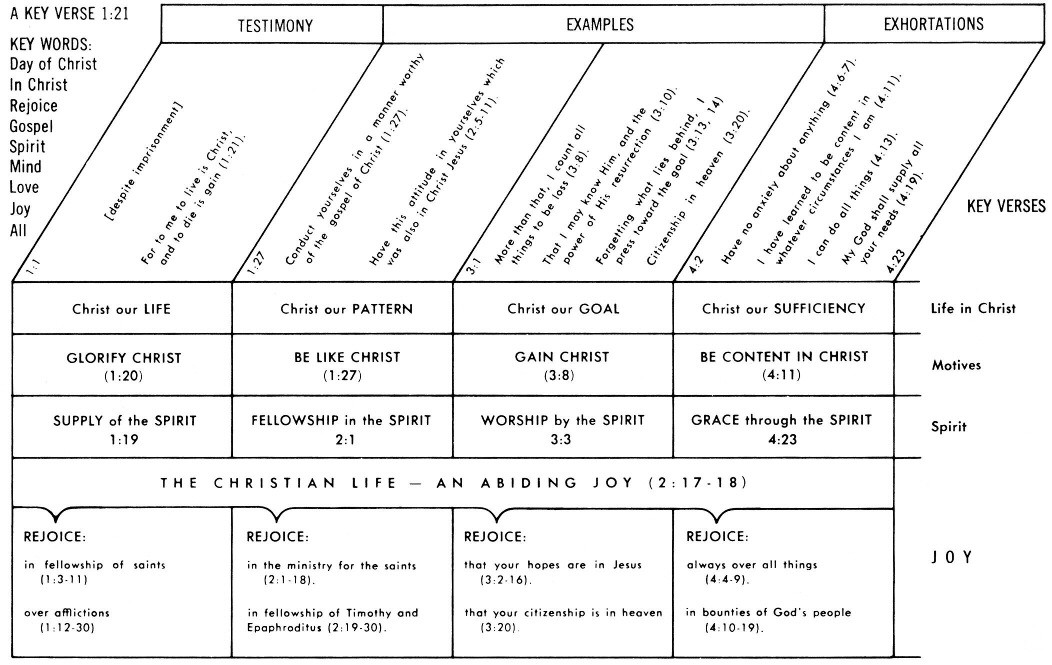
LIFE IN CHRIST
Click chart to enlarge
Charts from Jensen's Survey of the NT - used by permission
Philippians - Charles Swindoll = Chart on right side of page
| Account of Paul's Circumstances Php 1:1-30 |
Have the Mind of Christ Php 2:1-30 |
Have the Knowledge of Christ Php 3:1-21 |
Have |
| Partakers of Christ | People of Christ | Pursuit of Christ | Power of Christ |
| Suffering | Submission | Salvation | Sanctification |
| Experience | Examples | Exhortation | |
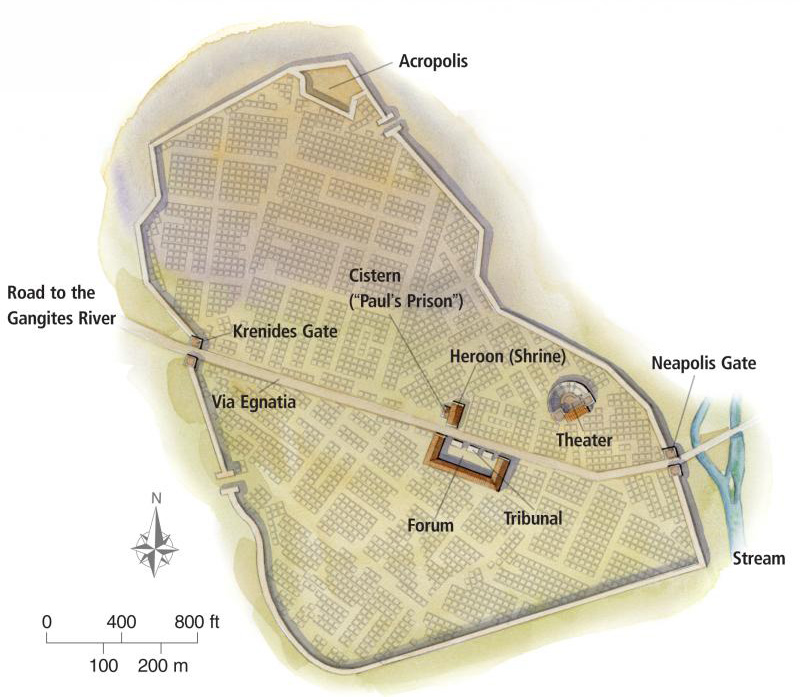
Philippi in the Time of Paul
The city plan above shows those features of the city of Philippi that archaeologists have so far identified as dating from the time of Paul. “Paul’s Prison” is not believed to be an authentic site, but was a cistern later associated with Christian worship. (ESV.org)
Philippians 2:12 So then, my beloved, just as you have always obeyed not as in my presence only, but now much more in my absence, work out your salvation with fear and trembling (NASB: Lockman)
Greek: hoste agapetoi mou, kathos pantote hupekousate, (2PAAI) me os en te parousia| mou monon alla nun pollo mallon en te apousia mou, meta phobou kai tromou ten heauton soterian katergazesthe; (2PPMM)
Amplified: Therefore, my dear ones, as you have always obeyed [my suggestions], so now, not only [with the enthusiasm you would show] in my presence but much more because I am absent, work out (cultivate, carry out to the goal, and fully complete) your own salvation with reverence and awe and trembling (self-distrust, with serious caution, tenderness of conscience, watchfulness against temptation, timidly shrinking from whatever might offend God and discredit the name of Christ). (Amplified Bible - Lockman)
Barclay: So then, my beloved, just as at all times you obeyed not only as in my presence, but much more, as things now are, in my absence, carry to its perfect conclusion the work of your own salvation with fear and trembling; for it is God, who, that he may carry out his own good pleasure, brings to effect in you both the initial willing and the effective action. (Westminster Press)
New Jerusalem Bible: So, my dear friends, you have always been obedient; your obedience must not be limited to times when I am present. Now that I am absent it must be more in evidence, so work out your salvation in fear and trembling.
NLT: Dearest friends, you were always so careful to follow my instructions when I was with you. And now that I am away you must be even more careful to put into action God’s saving work in your lives, obeying God with deep reverence and fear. (NLT - Tyndale House)
Phillips: So then, my dearest friends, as you have always followed my advice - and that not only when I was present to give it - so now that I am far away be keener than ever to work out the salvation that God has given you with a proper sense of awe and responsibility. (Phillips: Touchstone)
Wuest: Wherefore, my beloved ones, as you always obeyed, not as in my presence only, but now much more in my absence, carry to its ultimate conclusion [likeness to the Lord Jesus] your own salvation with a wholesome, serious caution and trembling (Eerdmans Publishing)
SO THEN MY BELOVED JUST AS YOU HAVE ALWAYS OBEYED NOT IN MY PRESENCE ONLY BUT NOW MUCH MORE IN MY ABSENCE: hoste agapetoi mou kathos pantote hupkousate (2PAAI) mê hôs en têi parousiâi monon alla nun pollo mallon en te apousia mou:
- Phil 4:1; 1Cor 4:14; 1Pet 2:11
- obeyed Php 1:5, Php 1:27, Php 1:29
FROM
THEOLOGICAL CONTEMPLATION
TO PRACTICAL IMPLICATION
Having dealt with the voluntary humiliation of our Lord Jesus Christ, Paul went on to apply this truth in a practical way in the remainder of this chapter.
The respected expositor J Ligon Duncan makes a strong statement with which I heartily concur that Php 2:12,13 "is one of the most important passages in all of the Bible about sanctification." (See his sermon on Philippians 2:12-13 Live Life in Light of the Exaltation of Christ)
D A Carson on Php 2:12-13 - Verses 12 and 13 are extraordinarily important!
Henry Alford - After this glorious example (of Christ's obedience to His Father in Php 3:5-11) he exhorts them to earnestness after Christian perfection (not an attainment but a goal at which we should aim) (Philippians 2:13 Commentary - The NT for English Readers)
Hansen rightly says that "True worship of Christ inspires our work; singing the praise of Christ motivates us to build the community in Christ. (Pillar New Testament Commentary The Letter to the Philippians).
In Philippians 2:12-13 Paul presents two opposite and yet completely harmonious sides of the Christian life, the first emphasizing man's responsibility based on the truths just presented and the second emphasizing God's sovereign enablement which allows man to fulfill his solemn responsibility. Although God's part follows in Philippians 2:13, clearly man's part in Philippians 2:12 would be impossible without God's empowerment!
Martyn Lloyd Jones explains the so then (therefore) - We also saw that the Apostle's object in writing the words was not to give a disquisition on theology, but rather to make a practical appeal. Yet, as is his custom, he cannot make a practical appeal without putting it in terms of doctrine. That is where the New Testament way of life differs from a merely ethical system. Any appeal to the world to live a Christian life before it has become Christian, is, as we have seen, a negation of Christian teaching. We have here a perfect illustration of the Apostle's method. But it is true also of all the New Testament writers; it is the characteristic way of making an appeal for conduct and Christian behaviour. We are not put under a law but an appeal is made to us. There is a great law of life in the New Testament, but it is what the New Testament calls 'the perfect law of liberty' (James 1:25). This does not mean that the Christian is living a lawless life, but that he has a higher kind of liberty. The New Testament always lays down its doctrine first, and then, having done so, says, 'If you believe that, cannot you see that this is inevitable?' It is an appeal to equity, to fair play. It does not confront us with a way of life, and say, 'Go and live it.' It first of all tells us of certain things that have been done for us, and then says, 'Now then ...'As you make the transition from doctrine to practice in the epistles, there is always a 'wherefore' or a 'therefore', and I am at pains to point out that the essential approach is to be found in such a connecting word. Without that, there is no appeal, but because of that, there is a very definite appeal to reason and to commonsense. (Philippians 2:12-13 Working Out Our Own Salvation)
Gene Getz on Php 2:12-18 - Paul then became more specific and practical about their relationships with non-Christians. If you read verses 12-18 casually, it may appear that Paul was continuing to talk about relationships within the body—as he was earlier in verses 2-4. But when you read more carefully, it becomes clear that in the verses before us he was speaking of the Philippian Christians' relationships to the world—their Christian witness. Note the following comparisons, especially the different words Paul used and the different environment he had in mind - Relationships Within the Body (Philippians 2:2-4) versus Relationships With the World (Philippians 2:12-16a)....First, they were to work out their salvation—pinpointing human responsibility. Second, they were to realize that God was at work within them—emphasizing their divine resources. Both are vitally important to our Christian witness. Paul exhorted them to "live out" ("work out") their Christianity in such a way that those who did not know Christ would either be attracted to their lives and to the truth that had made them what they were—or they would at least know that Christ had revealed Himself as the Savior for lost humanity and wants to live in the hearts and lives of those who respond to Him in faith. This is undoubtedly what Paul had in mind when he stated earlier in this letter, "This is a sign to them that they will be destroyed, but that you will be saved" (Phil. 1:28). The important point is that man is responsible to share Christ with non-Christians. What is inside must come outside. Christian witness, however, is not purely a human affair— man's ingenious effort in communication. It has a divine dimension. More important than human effort is the marvelous truth that God lives in us and desires to work through us. Thus, after exhorting the Philippians to work out their salvation, Paul wrote, "It is God who works in you to will and do what pleases him." Therefore we see a divine balance that permeates Scripture—man's human responsibility blended with God's divine resources. Here Paul was talking about keeping this balance in Christian witness. But how important to keep these two dimensions in balance no matter what our responsibilities, circumstances, and goals! (The Measure of a Christian: Studies in Philippians)
So then (5620) (hoste) is used to draw a conclusion from a preceding statement, introducing "an inferential lesson (1Co 3:21, 4:5, 10:12; 1Th 4:18, etc.)" (Eadie). In short, so then is a term of conclusion which should always prompt you to pause to ponder "What, when, why, who, where, how" type questions which usually will force you to examine the previous context.
So then - refers to the previous passage (Php 2:1–11) Paul's exhortation and Christ's example. What he has just said should serve as a strong motivation to obey the following exhortation.
In the present case Paul especially draws our attention back to Philippians 2:5, 6, 7, Php 2:8 the Lord's example of humility, submission and obedience (self-lessness, service and sacrifice) to give us a pattern to follow. He also gives the example of Christ's exaltation to encourage us that one day we will be exalted (1 Pe 5:6). Paul had just described Christ's obedience to the will of His Father. Based on Christ's example of selfless obedience and even their past obedience when Paul was present with them, they were to allow these truths to motivate them to be diligent to obey Paul's command to "work out their salvation" (under grace not law) even though Paul was not present.
D A Carson on so then (therefore) - In other words, Paul is now drawing logical connections from the hymn of praise he has just offered up to Christ. There are at least two logical links in the connections he draws. First, every knee shall bow (Phil 2:10): therefore we do well to live in the light of the fact that we shall all bow before Christ on the last day and give an account to Him. Second and more importantly, Christ Jesus, after terrible suffering, was finally vindicated. So shall we be. He obeyed and endured to the end and was finally vindicated. “Therefore . . . continue to work out your salvation with fear and trembling . . .” (Phil 2:12).
J Ligon Duncan on so then (therefore in some translations) - "So here we see — and it’s not surprising, is it, because he’s just shown you Jesus’ obedience — and then he’s said therefore, and then he says to you what? “Continue to obey.” So he is calling believers to obey. There is no idea in the Apostle Paul’s teaching that obedience is not an essential part of the Christian life. There are many, many well-meaning Christians who don’t believe – or who actively teach – that obedience is not a part of the Christian life. And the Apostle Paul is telling us here, ‘No, no, no! Obedience is vital to the Christian life, so continue to obey." (Philippians 2:12-13 Live Life in Light of the Exaltation of Christ)
Johann Bengel adds that "When Christ is proposed to us as an Example (as in the preceding context), the inference (of "so then") is, that we should uphold ("work out") the salvation He has procured for us." (Philippians 2:12 Commentary - Critical English Testament)
Lightfoot captures the spirit of the apostle's thought of so then paraphrasing it "As you have the Example of Christ's humiliation (Ed: And I would add "His obedience") to guide you and His exaltation to encourage you, so continue.
Marvin Vincent on so then - The point of connection through hoste with the preceding passage is hupekoos (obedient) in Php 2:8. As Christ obtained exaltation and heavenly glory through perfect obedience to God, therefore do you, with like subjection to Him (Ed: And with continual yielding to and dependence on the supernatural enabling power of the Holy Spirit of Christ Who indwells all believers!), carry out your own salvation. The spirit of obedience is to be shown in their godly fear, in the avoidance of murmuring and skeptical criticism (Php 2:14), and in their holy lives and their bold proclamation of the gospel in the midst of ungodly men (Php 2:15). For a similar use of hoste, comp. Php 4:1 ; Ro 7:12 ; 1Co 14:39, 15:58. (A Critical and Exegetical Commentary on the Epistle to the Philippians)
Wuest writes that the so then (wherefore) "goes back to Php 1:27 where Paul’s presence and absence are referred to as in this verse. In Php 1:27 we have Paul’s exhortation to the Philippian saints to conduct themselves as citizens of heaven should. Then the apostle singles out one of the obligations of a citizen of heaven, that of living in harmony and unity with his fellow-saints. In Php 2:1-4, he gives four reasons which in themselves are enablements, why they should live in unity together, and further develops the theme of Christian unity....Now, in Php 2:12, 13, the apostle exhorts these saints to make the humility and self-abnegation (self surrender, self denial, self renunciation) exhibited by the Lord Jesus, a fact in their own lives. (Philippians Commentary - Verse by Verse)
Here is a summary of some of the previous statements that call for the saints at Philippi to work out their salvation...
- Conduct (present imperative = continually) yourselves in a manner worthy of the (a supernatural conduct which is in keeping with the supernatural power of the ) gospel of Christ (Php 1:27)
- Make my joy complete (aorist imperative = Don't delay. Do this now and do it effectively) by being of the same mind (Php 2:2)
- (Literally) Nothing from selfishness (Php 2:3a) ("Do" added)
- Let each of you regard (present tense = continually) one another as more important than himself (Php 2:3b)
- Do not merely look out for (present tense = continually) your own personal interests. (Php 2:4)
- Have this attitude (present imperative = continually) in yourselves which was also in Christ Jesus. (Php 2:5)
Christ has set the example (compare Jn 13:15 with Php 2:3, 4) for us to work out, to walk in His steps (1Pe 2:21) and show love for Him (Jn 14:15). Shall we hesitate to follow? I pray not and may we learn to trust in the enabling power of His Spirit. The essence of what Paul is saying is that in view of the fact that Christ exhibited a servant's heart (Mk 10:45, Mt 20:28, Jn 13:4, 5) and an obedient, selfless spirit, so should we.
As John Eadie says "Will it not endear itself to your imitation as you look upon it (Christ's example of perfect obedience)." (The Epistle to the Philippians)
Martyn Lloyd Jones emphasizes this close tie between the previous Christological doctrine (belief) and the believer's earnest duty (behavior) asking "is there anything that so thoroughly tests our whole profession of the Christian faith as our reaction to it when it calls upon us to live a certain kind of life? (Ed: For example think of Grumbling) I put it like that for this good reason: do we not all know something in our experience about this unnatural and artificial dichotomy? We may like to hear the gospel with its grand good news and all that it has to offer, but we do not always feel quite so pleased when it goes on to call us to live in a particular way. There are people who say, 'But it is so narrow.' When it outlines a 'straight and narrow way', they say, 'Narrowness again!' Because of the 'wherefore', because of this indissoluble connection between doctrine and practice, because, too, of this inevitable logical sequence from doctrine to behaviour, our attitude towards the appeal tells us a great deal about our ultimate attitude to the doctrine. The New Testament says that these things are really inevitable, they are linked together, so if I object to doing them, it surely implies that there is at any rate something wrong with my view of the doctrine. There is, then, no better test of my whole position, than my reaction when I am confronted with this amazing call of the New Testament to deny myself and take up the cross and follow Christ, to mortify my 'flesh', 'the deeds of the body', and 'my members which are upon the earth' and all those other New Testament ways of putting it. (Philippians 2:12-13 Working Out Our Own Salvation)
MacArthur adds the important note that...
One of the greatest realities of the Incarnation was the fact that what Jesus did He did in the Spirit’s power (Lk 4:1, 14, 18; 5:17; Ac 10:38; cf Mt 12:18, 28, 29, 30, 31, 32). The essence of living the Christian life is being obedient like Him: “The one who says he abides in [Christ] ought himself to walk in the same manner as He walked” (1Jn 2:6). (MacArthur, J. Philippians. Chicago: Moody Press)
Comment: MacArthur gives us an important reminder when we consider "imitating" Christ's example in our life. Even as He Himself conducted His earthly life in full surrender and dependence on the Holy Spirit, so too must we as believers learn to daily, moment by moment yield to the the control of the Spirit, a process which we must carry out the remainder of our time on earth. In other words, there is no saint, no matter how sanctified, how Christ-like or how godly, who will ever achieve a level of spiritual growth in which they can say that they have "arrived." Lifelong humble dependence on the blessed Holy Spirit is to be our continual state and praise God that the Spirit is His continual provision! We all experience some periods when we are walking wonderfully in step with the Spirit, but we also experience days of disappointing defeat and failure to trust and obey. But don't let the "cloudy days" discourage you. Confess and turn from your sins and lean hard on His everlasting arms. As William Cowper wrote...
Judge not the Lord by feeble sense
But trust Him for His grace;
Behind a frowning providence
He hides a smiling face.
Alford comments on the phrase "just as" - As is by no means superfluous, but gives the sense not as if (it were a matter to be done) in my presence only, but now (as things are at present) much more (with more earnestness) in my absence (because spiritual help from me is withdrawn from you), carry out (bring to an accomplishment) your own (emphasis on your own, perhaps as directing attention to the example of Christ which has preceded -- as He obeyed and won His exaltation, so do you obey and carry our your own salvation) salvation (which is begun with justification by faith, but must be carried out, brought to an issue, by sanctification of the Spirit -- a life of holy obedience and advance to Christian perfection (Ed: Not sinlessness). (The New Testament for English Readers)
Beloved (27) (agapetos from agapao = to love and agape = love) refers to the saints at Philippi who Paul loved dearly with an agape quality of love which is that unconditional, sacrificial love which flows from the throne of grace, is part of the very essence of God and which is produced in the yielded saint's heart by the Holy Spirit. This is a quality of love which calls for one to sacrifice of self for the sake of the recipient of that love. Paul in using this word agapetos is indicating to the Philippians that he has a heavenly, divine love for them, even commending them for their past obedience. His soul is bound up in these precious saints, who were the among the first Gentile converts in Europe (read about the Macedonian Vision, God opening Lydia's heart and the converted jailer at Philippi beginning in Acts 16:9, 10, 11, 12, 13, 14, 15)
Agapetos - 61x in 60v in NAS -
Mt 3:17; 12:18; 17:5; Mk 1:11; 9:7; 12:6; Lk 3:22; 20:13; Acts 15:25; Rom 1:7; 11:28; 12:19; 16:5, 8f, 12; 1 Cor 4:14, 17; 10:14; 15:58; 2 Cor 7:1; 12:19; Eph 5:1; 6:21; Php 2:12; 4:1; Col 1:7; 4:7, 9, 14; 1Th 2:8; 1Ti 6:2; 2Ti 1:2; Philemon 1:1, 16; Heb 6:9; Jas 1:16, 19; 2:5; 1Pet 2:11; 4:12; 2 Pet 1:17; 3:1, 8, 14f, 17; 1Jn 2:7; 3:2, 21; 4:1, 7, 11; 3Jn 1:1f, 5, 11; Jude 1:3, 17, 20
Beloved conveys a tenderness and affection which lend force to the injunctions which follow while providing a clear word of comfort and encouragement. This tender, affectionate greeting would serve to temper any note of harshness in his exhortation/ Paul uses beloved twice in Phil 4:1 writing...
Therefore, my beloved brethren whom I long to see, my joy and crown, so stand firm in the Lord, my beloved. (Php 4:1).
While this verse is actually Paul's first use of beloved in Philippians it does recall his earlier declaration of love for them...
God is my witness, how I long for you all with the affection of Christ Jesus. (Php 1:8)
Hansen explains that "Christ’s obedience established the ultimate moral standard of obedience for followers of Christ. (Ed: And remember that He accomplished this not in dependence on His divinity but in dependence on His flesh which in turn continually depended on the Spirit's empowerment) Paul does not set up this standard in an accusing way but in an affirming way. He embraces his readers by calling them my dear friends, literally, “my beloved.” This strong expression of love for his friends continues the theme of friendship in this letter." (Pillar New Testament Commentary The Letter to the Philippians).
How different the tone is here from books like Galatians, where Paul is dealing with the danger of legalism and works (Gal 2:4, 5:1, 2).
Just as you have always obeyed - The idea is "Recall the times when you were filled with the Spirit and walked in obedience, disciplining yourselves for godliness, etc." And so first Paul encourages then with a reminder of their past conduct...they had obeyed. He uses this encouragement to gently prod them onward to a lifestyle of further obedience. Memory is a good thing when it remembers good behavior!
Past commendation is used by Paul to motivate present and future conduct. How different from his question to the saints in Galatia...
You were running well; who hindered you from obeying the truth? (Gal 5:7)
You = The command is to the entire church at Philippi (and all believers) since the word you is plural.
David Guzik is "spot on" commenting that "We should not miss the connection between the obedience Jesus showed (Php 2:8) and the obedience Paul expects of the Philippians (Php 2:12)." (Philippians 2 Commentary)
Obeyed (5219) (hupakouo from hupó = agency or means, under + akoúo = physical hearing, gives us English word "acoustics") literally means to "hear under" and has the basic meaning of listening to or of placing oneself under what is heard and therefore submitting and obeying what is heard. Hupakouo implies the idea of voluntary submission.
Another meaning of hupakouo in Acts 12:13 presents an informative picture, Luke recording...
And when he knocked at the door of the gate, a servant-girl named Rhoda came to answer (hupakouo - of a doorkeeper who hearkens or answers a knock and opens the door). (Acts 12:13)
Hupakouo - 21 times in the NT - Mt. 8:27; Mk 1:27; 4:41; Lk 8:25; 17:6; Acts 6:7; Acts 12:13 ; Ro 6:12 (believers no longer have to obey the strong desires of the old fallen sin nature! Don't say you can't stop that sin believer. Be honest and say "I won't"! You have a power outside of and inside of you - the Spirit, the transforming grace of God - which enables supernatural victory over sin ~ progressive sanctification.), Ro 6:16, Ro 6:17 (notice where obedience comes from - not the head, but the heart - in the New Covenant God gives us a new heart [Ezek 36:26, 27, 11:19, 20, Ro 2:28, 29, Ga 6:15, 2Co 5:17, Je 31:31, 32, 33, 34, 32:39, 40] that now has a desire to obey Him - no, not perfectly but as the general rule and direction of one's new life in Christ); Ro 10:16 (Don't miss what Paul is explaining - only belief saves, but genuine belief obeys. If someone says they believe and continually disobey and have no evidence of a changed life and new power over sin, they could be deceived - Let us all apply the test given in Paul's solemn admonition 2Co 13:5); Ep 6:1, Ep 6:5; Php 2:12; Col 3:20, Col 3:22; 2Th 1:8 (Context 2Th 1:7 - Who will be punished? Note how this truth parallels Ro 10:16. Do not be deceived!); 2Th 3:14; He 5:9 (What is the associated with eternal salvation? How important is this point in modern day evangelicalism where there are those who claim salvation but have no demonstrable change in their lifestyle?); He 11:8 (Again with what is obedience connected by the writer? See Ro 1:5 for discussion of the phrase "obedience of faith"); 1Pe 3:6
Acts 6:7 And the word of God kept on spreading; and the number of the disciples continued to increase greatly in Jerusalem, and a great many of the priests were becoming obedient to the faith (the faith here refer not to the act of believing but to the substance of what is believed, and in that sense is synonymous with the gospel - see the faith).
Hupakouo - 52 uses in the non-apocryphal Septuagint (LXX)-
Ge 16:2; 22:18; 26:5; 27:13; 39:10; 41:40; Lev. 26:14, 18, 21, 27; Deut. 17:12; 20:12; 21:18, 20; 26:14, 17; 30:2; Jdg. 2:17; 1 Sam. 30:24; 2 Sam. 22:42; Est. 3:4; Job 5:1; 9:3, 14, 16; 13:22; 14:15; 19:16; 38:34; Ps. 18:44; Prov. 1:24; 2:2; 8:1; 15:23; 17:4; 22:21; 28:17; 29:12, 19; Cant. 3:1; 5:6; Isa. 11:14; 29:24; 50:2; 65:12; 66:4; Jer. 3:13, 25; 13:10; 16:12; Dan. 3:12; 7:27
The word "answer" is our word hupakouo and in context meant to hear and to answer as a result of hearing. In secular Greek hupakouo was used of the doorkeeper whose duty is was to listen for the signals of those who wish to enter and to admit them if they are entitled to do so. Is the word of God "knocking" on the door of your mind and heart in any area of your life? Are you "opening the door" and letting the truth in? Are you responding to the truth you've let in or have you sequestered it in a back room of your heart so it won't disturb you?
Hupakouo conveys the idea of subordinating one’s self to the person or thing heard and hence “to obey”. Paul had used the adjective form hupekoos (5255) in Philippians 2:8 (see note) describing Jesus Who "humbled Himself by becoming obedient (hupekoos) to the point of death, even death on a cross". Christ is their example of perfect obedience and the Philippian saints have a good record of obedience in his presence. They had "hearkened" or given respectful attention to and surrendered to the truth of God's word as shown by their subsequent behavior. Little wonder that Paul as the "spiritual father" of these "beloved" saints had such affection for them for as John writes
I have no greater joy than this, to hear of my children walking in (in the sphere of or the "atmosphere" of, breathing in) the truth (the Word of God = Jn 17:17)" (1 Jn 3:4)
Paul stresses not how much the saints at Philippi knew but how well they obeyed. He knew that when God measures the character of a man or woman, He puts the tape not around their head to see how much they know but around their heart to see how well they obey! Your conduct does matter! So Paul appeals to the example of Christ's perfect obedience and their past obedience to continue to exhibit consistent obedience. Paul knows that ongoing obedience is essential to sanctification, which cannot occur without it. Are you a hearer of the word on Sunday and a "forgetter" on Monday? Are you growing in Christ-likeness (sanctification) or are you just growing older (and more hardened) because you hear but don't obey? Beloved brethren, "do not be deceived , God is not mocked, for whatever a man sows, this he will also reap." (Gal 6:7, Gal 6:8)
Click for a discussion of the phrase "obedience of faith" which emphasizes the important relationship between belief and obedience.
Henrietta Mears - Paul is practical as well as profound. He never leaves us in the clouds. He never separates knowledge from action. Christianity is both creed and life. A creed without the right conduct amounts to little. After Paul has scaled the heights in Christ’s (Ed: emptying and) exaltation, he does not plan to leave us there. “Wherefore, my beloved … work out your own salvation with fear and trembling” (Philippians 2:12). “Work out” means “live out”—not working for salvation, but showing the works of salvation. God has a plan for each of our lives as He had for Jesus. We must live out that plan. It is an entirely personal matter. No one can do it for somebody else. God plants in our hearts salvation in Christ—great, divine, wonderful and to be lived out. Happy (ED: BLESSED) is the person who finds God’s plan for life and actively participates in it. (ED: AMEN!) Christian experience is not something that is going on around you, but in you. “Christ liveth in me” (Galatians 2:20)! (What the Bible is All About)
Pulpit Commentary note asks "What should be the result of Christ’s example? I. Obedience. 1. Christ became obedient even unto death. The Philippians have hitherto been obedient; they were obedient when the apostle called them to faith and repentance; let them be obedient now. 2. That obedience is due to God who seeth the heart. We must not depend too much on human teachers, whether present or absent; we must look to the unseen Saviour who is ever present, and work out, each one for himself, our own salvation. (The pulpit commentary)
Hansen makes the point that...
Obedience is defined not in legal terms but in relational terms as knowing Christ, being like him, and serving him....When the path of obedience to Christ becomes steep and dangerous, pleasure seekers look for an easier way. Religious tourists hunting for sensational entertainment, instantaneous enlightenment, and emotional excitement will jump on the newest rides and take quick shortcuts, but they will not be found with pilgrims on the long, hard road following in the footsteps of Christ, who was obedient to death—even death on a cross. Paul’s call to unflagging, Christ-like obedience will not be popular in a world that so highly values going fast and having fun and so quickly rejects enduring pain and submitting to authority. But the essential characteristic of the wise who build their community on Christ is their consistent obedience to Him. (Pillar New Testament Commentary The Letter to the Philippians).
Dwight Edwards makes a point that should convict every pastor or teacher of the Word...
The measure of our effectiveness in ministry is greatly determined by how people live in our absence. We have accomplished nothing if our disciples only live for God when we're around and then go back to disobedience or complacency when we leave. They must learn to feel responsible to God, not to us. (Philippians)
Bruce Goettsche - Integrity in the faith is something that is revealed in the hidden times more than in the public times. Bill Hybels had a great title for one of his books, "Who You are When No One is Looking". It is the reminder that who we are when no one is looking is who we really are. We can all maintain a certain image when we are in church. But the real test of faith is when we are outside of the church. The goal of the Christian is to live consistently. Will Rogers perhaps summed it up well, "Live in such a way that you would not be ashamed to sell your parrot to the town gossip." (Sermon on Philippians 2:12-13)
John Eadie comments that Paul's "absence did not make the obligation (to obey) less imperative, but it demanded more earnestness and vigilance from them in the discharge of the duty. His voice and person were a guide and stimulant, his addresses and conversations reproved their languor, and excited them to assiduous labour, so that His presence among them wrought like a charm. And now that he was not with them, and they were left to themselves, they were so much the more to double their diligence, and work out salvation." (The Epistle to the Philippians - online - scholarly but excellent)
Vine adds that "Their fulfillment of his exhortation ("work out your salvation") was not to be dependent on his being with them. On the contrary, there was a stronger reason for their carrying it out when he was absent, as they would realize the more their dependence on Christ. The power of faith that depends upon the power of the unseen but personally present Christ is sufficient for the accomplishment of His will. (Collected writings of W. E. Vine. Nashville: Thomas Nelson )
It is interesting to see association of obedience linked as in the present verse with "fear and trembling" in Paul's letter to the Corinthians where he wrote that the affection of Titus...
abounds all the more toward you, as he remembers the obedience of you all, how you received him with fear and trembling. (2Co 7:15)
Now much more in my absence - This reminds one of Paul's instruction to slaves in Eph 6:6 not to obey "by way of eyeservice (in the context of Php 2:13, not only when Paul is present), as men-pleasers, but as slaves of Christ, doing the will of God from the heart (in the present passage obeying the command to work out their salvation)".
ESV Study Bible - They cannot be content with past glories but need to demonstrate their faith day by day as they nurture their relationship with God.
Pulpit Commentary - They were to make their future, as they had made their past. They were not to make their obedience to the gospel dependent on his presence with them. An obedience as in his presence would have meant negligence in his absence. Nay, they were to make his absence a stimulus to greater exertion. When they had not his help they were to feel the greater need of rousing themselves to action. (Ed: A a greater need on God their ultimate source of spiritual energizing.)
Paul Apple writes that "the degree of obedience of the child is not determined by what the child does when the parent is present, but by what he does when the parent is absent. (Paul Apple - Philippians)
John MacArthur comments that Paul's "point is that there is never a time when a true believer is not responsible to obey the Lord. Believers must never be primarily dependent on their pastor, teacher, Christian fellowship, or anyone else for their spiritual strength and growth. Their supreme example is the Lord Jesus Christ, and their true power comes from the Holy Spirit. Believers, gratefully, are never without Christ’s example and never without the Spirit’s power." (MacArthur, J. Philippians. Chicago: Moody Press)
Beet adds that "the absence of the teacher’s help (Paul) making their own care more needful. (Joseph A Beet - Philippians 2:12 Commentary)
Dwight Pentecost comments that the example of Christ in the previous verse should be sufficient motivation for them to obey explaining that "In Paul's mind, if his presence would put pressure upon them, the example of the loving suffering of the Lord Jesus Christ ought to put even greater pressure on them. It was Paul's greatest desire to please a person. That was the motive in his personal life, and it was not necessary for that Person to be present.
Harry A. Ironside has an interesting introductory note on this next section applying the truth more to the entire body of believers rather than to individual believers writing that...
Philippians 2:12 has often perplexed those who thought they saw clearly from Scripture the simplicity of salvation by grace, apart from works. Here, in seeming contrast to that doctrine, the apostle told the saints to work out their own salvation with fear and trembling, as though there were a possibility that salvation might be forfeited because of failure to work it out properly. Notice first, however, that the apostle did not speak of working for salvation. He spoke of working it out, which is very different. I am reminded of a little girl who listened to a legalistic sermon preached on this text. The minister insisted that no one could be saved by grace alone; each person must work out his own salvation. At the close of the service she innocently asked, "Mother, how can you work it out if you haven't got it in?"
If salvation of the individual were being contemplated here, it might be enough of an explanation to say, "It is your own; therefore manifest it—work it out."
But more than individual salvation is being contemplated. Taken in context, verse 12 refers to assembly salvation. That is, Paul was giving direction to an assembly of Christians. They were exposed to difficulties from without and from within; they were passing through a world totally opposed to the testimony committed to them. Paul was showing them how to continue in fellowship together in spite of the fact that each individual had within him a corrupt nature that could surface—to the detriment of the whole church—if given the opportunity.
We have already noticed that there was some difficulty in the Philippian assembly between two sisters of prominence, Euodias and Syntyche. This disagreement could easily cause distressing quarrels and even division if not judged in the presence of the Lord. Similar misunderstandings could arise from time to time and would need to be carefully watched for. When the apostle himself was with the Philippians, they could refer all such matters to him and he would, so to speak, work out their salvation from these perplexities. He would advise and guide as needed. But at the time he was writing to them, he was far away. He was a prisoner for the gospel's sake and could not personally give the help he wanted to provide. Since he was absent, he directed them as obedient children to work out their own salvation in godly fear and with exercise of soul, so that they would not depart from the right path or stray out of the will of God.
How beneficial Paul's words have been for generations of Christians! Sooner or later, all assemblies of saints on earth will probably have internal differences, and the advice or command the apostle gave to the Philippians will apply in all such cases. It is God's way that churches should be put right from within, by self-judgment in His presence and submission to His Word. (H. A. Ironside. Philippian Commentary)
WORK OUT YOUR (OWN) SALVATION: ten heauton soterian katergazesthe (2PPMM):
- See Torrey's excellent topic Salvation
- Phil 3:13, Php 3:14; Pr 10:16; 13:4; Mt 11:12,29; Lk 13:23,24; Jn 6:27, 28, 29; Ro 2:7; 1Co 9:24, 25, 26, 27; 15:58; Gal 6:7, 8, 9; 1Th 1:3; Heb 4:11; He 6:10, He 6:11; He 12:1; 2Pe 1:5, 6, 7, 8, 9, 10; 2Pe 3:18)(Php 2:19; Ro 13:11, Ro 13:12, Ro 13:13 Ro 13:14; 1Co 9:20, 21, 22, 23; 2Ti 2:10
THE KEY TO PROGRESSIVE SANCTIFICATION:
A LIFE CHANGING PASSAGE
Jonathan Edwards by most measures the greatest theologian in American history attests to the importance of a proper understanding of Philippians 2:12-13 writing that
"From St. Paul a sentence hit me when I was about twenty-two that has shaped my theology ever since, "Work out your salvation with fear and trembling for it is God who works in you to will and to do his good pleasure" (Bolding added)
D A Carson - It is vitally important to grasp the connection between God’s sovereignty and our responsibility in Phil 2:12 and Phil 2:13. The text does not say, “Work to acquire your salvation, for God has done his bit and now it is all up to you.” Nor does it say, “You may already have your salvation, but now perseverance in it depends entirely on you.” Still less does it say, “Let go and let God. Just relax. The Spirit will carry you.” Rather, Paul tells us to work out our salvation with fear and trembling, precisely because God is working in us both to will and to act according to his good purpose (Phil 2:12–13). Nor is God working merely to strengthen us in our willing and acting. Paul’s language is stronger than that. God Himself is working in us both to will and to act: he works in us at the level of our wills and at the level of our doing. But far from this being a disincentive to press on, Paul insists that this is an incentive. Assured as we are that God works in this way in His people, we should be all the more strongly resolved to will and to act in ways that please our Master. (Basics for Believers: An Exposition of Philippians) (Ed Note: It is very surprising that Carson makes no mention at all regarding the role of the Holy Spirit in his exposition of this passage!)
W A Criswell emphasizes that Philippians 2:12-13 "must be read together for a proper understanding. “Work out your own salvation” means to “work out,” not “work for.” A “works salvation” is not being taught. The idea is to progress to the finish or completion in spiritual growth and maturity. This process is what the Bible calls “sanctification.” It should be noted that Phil 2:12 makes it clear we are to be active, not passive, in this process. However, though we are active, we are not alone. Phil 2:13 reminds us again that the entire salvation process is the work of a sovereign God and the result of His grace (Ed: Ministered by the indwelling Holy Spirit).. (Criswell, W A. Believer's Study Bible: New King James Version. 1991. Thomas Nelson)
Php 2:12: The Christian's workout
Php 2:13: The Lord's work-in
Spurgeon on work out - I have frequently heard these words addressed to an indiscriminate audience, and it has always struck me that they have thereby been twisted from their right meaning. These words, as they stand in the New Testament, contain no exhortation to all men, but are directed to the people of God. They are not intended as an exhortation to the unconverted. They are, as we find them in the epistle, beyond all question addressed to those who are already saved through a living faith in the Lord Jesus Christ. No proof can be needed of this assertion, for the whole epistle is directed to the saints. It begins, “To all the saints in Christ Jesus who are in Philippi, together with the overseers and deacons” (Phil 1:1). The verse before us contains within itself conclusive evidence that Paul was not speaking to unbelievers, for he calls the persons addressed “my dear friends,” and he says of them, “As you have always obeyed, not as in my presence only but now much more in my absence,” he was therefore writing to persons who had been obedient to the gospel. All true obedience springs from saving faith, and he was therefore addressing those who, through faith in Christ, had been rendered obedient to the gospel commands..... I have heard it said that the good sculptor, whenever he sees a suitable block of marble, firmly believes that there is a statue concealed within it. His business is but to take away the superfluous material, and so unveil the “thing of beauty” which shall be “a joy forever.” Believer, you are that block of marble; you have been quarried by divine grace, and set apart for the Master’s service, but we cannot see the image of Christ in you yet as we could wish. True, there are some traces of it, some dim outlines of what is to be; it is for you, with the chisel and the mallet, with constant endeavor and holy dependence upon God, to work out that image of Christ in yourself, till you shall be discovered to be by all men like unto your Lord and Master. God has sketched the image of his Son in you; in the as-yet-but-slightly-carved marble He has fairly outlined it, and you have but to go on chipping away these sins, infirmities, and corruptions, till the fair likeness of the incarnate God shall be seen by all.
John Eadie - The compound verb katergazomai expresses the idea of carrying out, or making perfect...The verb describes not the spirit in which the work is done, but the aim and issue—“carry through” (Ibid)
Joseph Beet writes that katergazomai "denotes effective effort, and implies that deliverance day by day is a result of persistent work: cp. Ep 6:13. While using all means to strengthen our spiritual life (Ed: Word, prayer, dependence on the Spirit's enablement), we are bringing about our present and final deliverance. So sailors have often toiled to save their ship from the rocks and themselves from a watery grave. (Joseph A Beet - Philippians 2:12 Commentary)
Thomas Watson - Life is a day for labor. The day is the time for working, Psalm 104:23. The sun rises and man goes forth to his work. Death is a sleeping time for the body. Life is a working time. A Christian has no time to lie fallow. Philippians 2:12, "Work out your salvation with fear and trembling." John 9:4, "Work while it is day." Still there is some work to do—either some sin to mortify or some grace to exercise. (Until My Change Comes)
Jerry Bridges emphasizes that "Our responsibility regarding our wills is to guard our minds and emotions, being aware of what influences our minds and stimulates our desires. As we do our part, we will see the Spirit of God do His part in making us more holy. (The Pursuit of Holiness)
David Legge - There was little girl once listening to a preacher who was preaching on this text, and saying it's not by grace, it's not by faith - you need grace and you need faith to help you along the way, but you've got to meet God half-way. He was really saying that it's not by grace alone that we are saved - and the little girl tugged the arm of her mother, and said: 'Mother, how can you work it out if it hasn't got in?'. How can you work it out if you haven't got it in? Do you see the difference here? It has to be in before you can work it out. This is the primary difference between Christianity, Bible believing Christianity, and the religions of this world - because religion is an attempt to work in, rather than let God work something in, you're trying to work the thing in.
Chris Vogel - Augustine said, "God gives us commands we cannot perform, that we may know what we ought to request from Him." A consciousness of our powerlessness must break us of self assurance and force us to look to Him Who has all power....This puts the brakes on self-congratulatory, self-improvement rhetoric. No more can we say with personal determination that we will do anything, but this forces us to constantly acknowledge that we must change, and that God (His Spirit indwelling us) is the One making us change. Change is certainly hard activity, necessary activity, but never a self-reliant activity. God wants us to be neither activists nor apathetic. To grow in the likeness of Christ, there must be a blend of rest and activity, not alternating from one to the other, but a blend in which, at one and the same moment, the Christian is both resting confidently in God’s grace and actively pursuing obedience. We must be confident that God will work in us when and where we see areas which call for obedience. It is not “I must control my tongue!” nor “The Lord must control my tongue.” Rather control comes in knowing what God desires, confessing our weakness and consistently asking God for grace that you would obey....we then lack the power to make real change. Either we cannot bring ourselves to choose what we know to be right, or else, having chosen it, we fail to do it. Sin has corrupted both the power to choose and the power to accomplish. God supplies not only the will we need to change, but the power to respond. In order to rip every last shred of self-pride from us, God reminds us of the necessity to change and then tells us the only way we will ever change is by God’s work of grace. God is working from above and within to make you both to will and to do. When we grasp this, obedience ceases being rules that regulate conduct and become another opportunity for God to mold us to be like Christ. Freedom to live as God commands comes as God empowers. (ILLUSTRATION) - Have you ever watched a two year old trying to push a grocery cart, his hands barely reaching the bar, his vision blocked by the wire mesh and the accumulation of boxes and bags? As the cart weaves in and out of the aisles it is obvious to you how that cart moves. But what is obvious to you may not be known by the small operator. While he is proud of his efforts in controlling the cart, Dad stands behind. There Dad stands, with hands resting on the bar, guiding every move. When it comes to change in your life, you know what God demands; you know what is necessary. You must change. New Year's resolutions will come and go. But real change must occur. For real change to occur you must yield to God’s Law, confess, repent from sin and as you look in faith to Christ, as you consider and seek to conform your life to God’s revealed will, change will happen. The funny thing is it looks like it's us doing it! You do the work for the Lord - the speaking, the music, the serving, the encouraging, the leading and it sure looks like it's you who's living your Christian life ... saying "no" to temptation, loving people, but then, it looked to that little boy like he was pushing that cart too! But, it was really his father. The same with you and me.(Sermon)
OUR RESPONSIBILITY - Phil 2:12
GOD'S SOVEREIGN ENABLEMENT - Phil 2:13
Work out (2716) (katergazomai from katá = intensifies meaning of verb + ergazomai = labor, work or engage in an activity involving considerable expenditure of effort) means to work out fully and thoroughly, to accomplish or achieve an end (implying thoroughness), to finish or carry something to its conclusion. To work so as to bring something to fulfillment or successful completion and implies doing something with thoroughness. It means to do that from which something results. This verb always means to complete the effort and the work begun.
Working out their salvation is the way to keep obeying as they had been obeying.
As discussed below work out is in the present imperative which is a reminder that we can't even obey this without the Spirit's enabling power! This truth should help keep us humble! As Rod Mattoon says " The life of the Christian is not a series of up's and down's, but in's and out's. God (God's Spirit continually) works in us and we work out what He has done within us." In short, we are commanded to work out what He works in!
Katergazomai was used by secular Roman writers (Strabo - 60BC) to describe the working of a silver mine with the goal of extracting all of the precious ore. By analogy, we are commanded to "mine out" of our lives all the richness of salvation God has so graciously deposited in us. By sustained Spirit enabled effort and diligence we are to work out and perfect in daily conduct the precious "ore" God has placed within us when He blessed us with "every spiritual blessing in the heavenly places" in Christ (Eph 1:3) and "granted us everything necessary for life and godliness through a true knowledge of" Jesus our Lord. (2Peter 1:3)
Brian Harbour - The Roman historian Strabo, who lived in the first century before Christ and wrote in Greek, gave an account of the once famous silver mines of Spain. He referred to the "working out of the mines" and used the exact word [katergazomai] that Paul used in our text. What did Strabo mean when he told his contemporaries to "work out the mines?" Strabo meant that they were to operate the mines in such a way that they could get the utmost value out of them. They already had the mines in their possession. Now they were to derive the full benefit from them. When we become Christians, God plants tremendous potential in our lives, like a mine, and He wants us to realize that potential to its fullest. Working out the full benefit of our salvation is a task to which we must be committed all our lives.
Katergazomai was also used to describe working in a field with the reaping of a big harvest! I love that picture -- Lord, let each of us "reap a bountiful harvest" in the glorious Gospel field known as sanctification! Amen
Oliver Cromwell, the English leader of the past, wrote in the front of his Bible, this motto: "He who ceases to be better, ceases to be good."
Finally, katergazomai was used to describe one working on a math problem and deriving the correct answer. So applied to Paul's command the idea is to "work out” as one does when referring to the working out of a problem in mathematics, carrying it to its ultimate goal or conclusion.
Wil Pounds renders Phil 2:12 as "Work out what God has worked in when you were born again. Bring the whole purpose of your salvation to completion. Don’t stop short of seeing the fulfillment of your very existence."
Paul uses the present imperative which is a command calling for the readers to make it their lifelong work to obey this command, bring their salvation to the goal (the goal of Christ likeness, "conformed to the image of His Son" Ro 8:29, cf Col 1:28 "every man complete in Christ."). Thus this is not an optional exercise. In addition note Paul's use of the middle voice, pictures the subject as the one who initiates the action and then participates in the results/effects of that action. The point is that believers have a responsibility to put forth real effort in their Christian lives and it is not just "let go and let God." (aka "quietism" the opposite extreme being "pietism" - click for more discussion of these two extremes - Dr. John MacArthur) I rather prefer to say we are to "Let God and let's go!" Paul is commanding a continuous, sustained effort in this verse (balanced by a description of the continual, sufficient provision of divine desire and power in Php 2:13). Thus the clause could be rendered more fully as "You yourself keep on bringing your salvation fully to its intended goal."
The point is do not go half-way in your salvation. Do not take bits and pieces when there is a whole parcel of glorious Gospel land to be claimed by faith (obedience). Trust and obey there's no other way to be blessed in Jesus, then to trust and obey! God has given us new life in Christ, but His desire is for us to experience this life abundantly in His Son (Jn 10:10). He desires that we possess our possessions so to speak (cf Eph 1:3). Even as Joshua (and Israel) had been given the land of Canaan, they were still commanded to exert effort to possess their possessions. And so we read that God instructed them "Every place on which the sole of your foot treads (NOTE: They were to "tread" - Man's Responsibility), I have given it to you (God's Provision/Promise), just as I spoke to Moses." (Joshua 1:3) We must not be satisfied with just a little when we can have an abundance! Go on, keeping growing until your salvation is completed (2Pe 3:18), confident that He Who began that good work will complete it in the day of Christ Jesus (Php 1:6)
Notice that this verse implies that the believer has both freedom and responsibility. The responsibility of man in this verse as noted is balanced by the divine sovereignty in the next verse (Phil 2:13). Stated another way we are 100% responsible and 100% dependent (on the Spirit's enabling power - Phil 2:13).
Paul says believers are to continually be perfecting Christ likeness, that glorious supernatural life which commenced at our new birth. Dearly beloved, is this your ongoing experience - increasing Christ likeness? (You can use Gal 5:19-21 versus Gal 5:22-23 as a "checklist" to see if the former sins are are decreasing and the latter fruit is increasing. Don't place yourself under guilt or the law -- sanctification is about direction not perfection. But if you are not going in the "right direction," it begs the question of "Why not?" Beloved, we will have no excuse at the Judgment Seat of Christ (2Co 5:10), "seeing that His divine power has granted to us everything pertaining to life and godliness, through the true knowledge of Him who called us by His own glory and excellence." (2Pe 1:3) Note that the "provision" is not nebulous or out of our reach but is rooted in true knowledge which in turn implies that you must daily be in the Word of Truth (cp Jn 17:17), not so much that you might know, but that you would grow! How's your time in the Word? While reading through the Bible in a year is great, it is far better to daily "ingest" a small portion of "filet mignon" (Mt 4:4, Job 23:12) and "chew" it well (See Meditation) so that you might "digest" it fully and it might be "assimilated" completely into your innermost being, resulting in real, tangible growth in Christ likeness, as you live out that truth in Spirit energized obedience (cp 1Pe 2:2, Micah 6:8, Jn 7:17, Ep 4:15, Col 1:10, 2Th 1:3, Ps 92:12).
The power that compels us
comes from the Spirit who indwells us.
Handley Moule places the command to work out our salvation in proper perspective writing that "We have still in our ears the celestial music, infinitely sweet and full, of the great paragraph of the incarnation, the journey of our Lord of love from glory to glory by the way of the awful cross...the immediate sequel is—that we are to be holy. We are to act in the light and wonder of so vast an act of love, in the wealth and resource of ‘so great salvation.’ We are to set spiritually to work."
As C H Spurgeon wisely advised "Hurried reading is of little benefit. To sit down awhile and meditate is very profitable (cf Mary in Lk 10:39, 42)."
Martyn Lloyd Jones writes that working out what God has worked in "is the practical exhortation of the New Testament Gospel to us today. I must now perfect (Ed: bring to final form so as to leave nothing wanting = speaks of our continual direction toward this goal) this thing which has been given to me. The seed has been planted; I have been given it in embryo. My business is to allow and to encourage this gift to grow and develop, until it comes to its final perfection and full maturity. I have got the gift: I need not be worried lest God is not present and not with me. God is working in me and I must develop it all I can. (Philippians 2:12-13 Working Out Our Own Salvation)
The KJV Bible Commentary notes that "Our salvation is worked in by the Holy Spirit in answer to faith in God’s promises and it is worked out by the Holy Spirit by our obedience to God’s precepts. It is always a matter of trust and obey...No one can live the Christian life until he has Christ. It is not a matter of the imitation of Christ but the manifestation of Christ, the Holy Spirit reproducing the life of Christ in and through the believer (cf 2Cor 3:18). (Dobson, E G, Charles Feinberg, E Hindson, Woodrow Kroll, H L. Wilmington: KJV Bible Commentary: Nelson)
William Barclay says that katergazomai "always has the idea of bringing to completion. It is as if Paul says: “Don’t stop halfway; go on until the work of salvation is fully wrought out in you.” No Christian should be satisfied with anything less than the total benefits of the gospel." And so he translates this as "carry to its perfect conclusion". (Philippians 2 Commentary)
TDNT writes that katergazomai is. "found from the time of Sophocles, means a. “to bear down to the ground,” “to overcome,” maintaining the older local sense of kata; b. “to work at,” “make.” Refined by constant use, it gradually takes on the sense of the simple, so that the verb signifies working at, and finally accomplishing a task." (Kittel, G., Friedrich, G., & Bromiley, G. W. Theological Dictionary of the New Testament)
Katergazomai describes not the spirit in which the work is done, but the aim and issue—"carry through" and so it represents the full and final bringing of an enterprise to a successful conclusion.
Paul's point is that by working out our salvation, believers bring the whole purpose of salvation to completion. In a sense then we are to daily "mine out" of our lives all the richness of the great a salvation which God has so graciously "deposited" within each believer.
Remember that in chapter 1 (Php 1:11) Paul said believers had been "filled with the fruit of righteousness" (perfect tense which describes a completed, permanent state) and here using katergazomai Paul is saying "work the field" and bear the fruit of righteousness in your daily Christian walk.
D R Jenkins offers an analogy to help explain how God works in (Php 2:13) and we work out "How does God work? (1) In the tree by air, light, heat, rain, and dew, and the tree works out in wood, leaves, and fragrant blossoms. (2) In man by means of His truth, Spirit, and grace, and we work them out in love, joy, etc. (Galatians 5:22, 23)." (Biblical Illustrator - online)
J C Ryle reminds us "If there is anything which a man ought to do thoroughly, authentically, truly, honestly, and with all of his heart, it is the business of his soul. If there is any work which he ought never to slight, and do in a careless fashion, it is the great work of "working out his own salvation" (Philippians 2:12). Believer in Christ, remember this! Whatever you do in religion, do it well. Be authentic. Be thorough. Be honest. Be true." (Authentic Religion)
A W Pink - As Matthew Henry (1662-1714) pointed out, "Many are more inquisitive respecting who shall be saved, and who not—than respecting what they shall do to be saved." "Work out your own salvation with fear and trembling" (Philippians 2:12) is a word which many need to attend unto. (Ed: Pink is not saying we work for our salvation as we could earn it but we do carry out the daily business of working out our growth in Christ likeness.) (Curiosity Rebuked)
Chris Vogel - When it comes to change there are often two extremes into which Christians fall: Quietism and Pietism. Quietism teaches that the believer is passive and is characterized by the saying, "let go and let God." The mysticism and subjectivism of quietism was originally popular among the Quakers and then became part of the Perfectionist movement. They believed you could come to a post-conversion crisis experience in which you momentarily became so totally surrendered that you never sinned again — what some call sinless perfection. So it was thought that sanctification, growth in holiness, does not involve any effort on our part, except surrender. Effort, it was thought, was a hindrance to the process of sanctification, so self must get out of the way. Such phrases are used as die to self, crucify self, put self on the altar. Pietism on the other hand teaches that it is a diligent effort toward personal piety. You are active, aggressive and working in all your power to live the sanctified life. Pietism has its roots in 18th century Germany as a reaction to the lifeless and detached theology of the Church at that time. So there was a strong emphasis on Bible study, holy living, practical Christianity, spiritual exercise and self-discipline. They took the opposite view of the Quietist. They said that if there was a belief that did not lead to works, it was not a worthwhile belief. If passivity was the hallmark of Quietism, activity was key to Pietism. The problem arises that when you believe that all your spiritual progress is based upon your ability to dedicate yourself, discipline yourself, and move yourself in the right direction, then you're going to experience two things:
When you succeed, you'll be proud! "Look what I have accomplished, I am righteous!" When you fail, you'll have despair. If you are the only resource, where do you go when you fail? If you fail and you have no place to turn, the chances are you're going to give up. Both sides are problematic. When you read verse 12, it looks like Paul is a Pietist. When you read verse 13, it looks like he's a Quietist. These verses must be taken together, not separately. How does change come about in our life, God or us? God commands us to change and God causes us to change. (Sermon)
Thomas Watson writes that "Happiness is not attainable, but in the use of means. Now, the use of means implies practice. Salvation must not only be sought out by knowledge, but wrought out by practice, "work out your own salvation with fear and trembling." Philippians 2:12. There can be no crown without running, no recompense without diligence." (The Good Practitioner)
William Dyer notes why it is so important to work out our salvation "Until you attain to firm salvation--you will never be free from great temptation."
C H Spurgeon rightly notes that...
What is to be worked out must first be worked in. An unconverted man can work nothing out, for there is nothing in. You have faith; work it out then; act like a believer; trust God in daily life. Be you Christlike, inasmuch as the Spirit of Christ dwells in you.
Salvation is to be worked out. Holiness is salvation. We are not to work out our salvation from the guilt of sin; Christ has done that, but from the power of sin. God has in effect worked that in; He has broken the yoke of sin; it lives and struggles, but it is dethroned, and our life is to keep it down. A man may be saved from the guilt of sin, and yet not saved from the power of pride or bad temper. Your salvation is not complete till you are saved from these. You must fight them till you conquer.
The model to be worked to. Every artist requires some idea in his mind to which he is to work. The apostle’s model is exhibited in the context. (1) Unanimity (Php 2:2); (2) humiliation (Php 2:3); (3) mutual love; (4) in a word, the mind of Christ (Php 2:5).
J R Miller writes that...
People sometimes think that salvation imparts . . . godly virtues, fine qualities of Christian character, lovely traits of disposition, and elements of spiritual beauty—without any cost or effort to the believer himself!
Christ's followers are transformed—old things pass away, and all things become new. Those who believe in Him—are fashioned into His image. But these blessings do not come easily. The heavenly graces are not put into our life—as one might hang up lovely pictures on the walls to adorn a home! They must be wrought into our life in a sense, by our own hands. We must work out our own salvation, although it is God who works in us, both to will and to work.
For example, patience is not put into anyone's life—as one brings in a piece of new furniture. You cannot merely receive patience as a gift from God. Patience is a lesson to be learned—through long and watchful self-discipline. Christ is the teacher—but you are the student, and it is the student who must learn the lesson! Not even Christ will learn it for you—to spare you the effort. Nor can it be made an easy lesson for you. It costs to grow patient, and you must pay the price yourself!
The same is true of all the elements of a godly and worthy character.
We are always at school
in this world.
God is teaching us the things we need to learn. The lessons are not easy—sometimes they are very hard! But the hardest lessons are the best—for they bring out in us the finest qualities, if only we learn them well.
Those, therefore, who find themselves in what may seem adverse conditions, compelled to face hardship, endure opposition, and pass through struggle—should quietly accept the responsibility; and, trusting in Christ for guidance and strength, go firmly and courageously forward, conscious that they have now an opportunity to grow strong, and develop in themselves the qualities of worthy and noble character!
C H Spurgeon - Man’s work an evidence of his salvation: — William Wickham being appointed by King Edward to build a stately church, wrote in the windows, “This work made William Wickham.” When charged by the king for assuming the honour of that work to himself as the author, whereas he was only the overseer, he answered that he meant not that he made the work, but that the work made him, having before been very poor, and then in great credit. Lord, when we read in thy Word that we must work out our own salvation, thy meaning is not that our salvation should be the effect of our work, but our work the evidence of our salvation. (Biblical Illustrator)
If depraved men go to such great lengths to work out their indecent acts (same Gk verb translated "committing" in Ro 1:27), how much more should we who are children (Jn 1:12, Ro 8:14) of the Most High God burn in our desire to be pleasing unto Him and by the enabling grace He supplies and the empowering of His Spirit, work out our salvation...day by day...decision by decision!
Note that this verse is not teaching that an unsaved person can do good works to earn salvation. Why not? For one thing, those he addressed were already saved and secondly because the Bible is clear in its teaching that God “saved us, not on the basis of deeds which we have done in righteousness, but according to His mercy by the washing of regeneration and renewing by the Holy Spirit, Whom He poured out upon us richly through Jesus Christ our Savior,” (see note Titus 3:5).
THE GOAL:
CHRIST-LIKENESS
As James Hastings phrases it "We are not to work for life, but, as it were, from life, as being those who already have it and who are resolved, by Divine grace, to experience all that life implies....we in the sphere of Christ Jesus, in Whom potentially we have all things, (are) to work Christ out with fear and trembling into the actual being, thought and character of our souls.
Below are the 22 Uses of Katergazomai. The NAS translates katergazomai as: accomplished, 1; brings about, 2; carried, 1; committed, 1; committing, 1; does, 1; doing, 4; done, 1; effecting, 1; performed, 1; prepared, 1; produced, 2; produces, 2; producing, 2; work, 1.
Romans 1:27 and in the same way also the men abandoned the natural function of the woman and burned in their desire toward one another, men with men committing indecent acts and receiving in their own persons the due penalty of their error.
Romans 2:9 There will be tribulation and distress for every soul of man who does evil, of the Jew first and also of the Greek,
Romans 4:15 for the Law brings about wrath, but where there is no law, neither is there violation.
Romans 5:3 And not only this, but we also exult in our tribulations, knowing that tribulation brings about perseverance;
Romans 7:8 But sin, taking opportunity through the commandment, produced in me coveting of every kind; for apart from the Law sin is dead.
Romans 7:13 Therefore did that which is good become a cause of death for me? May it never be! Rather it was sin, in order that it might be shown to be sin by effecting my death through that which is good, that through the commandment sin might become utterly sinful.
Romans 7:15 For that which I am doing, I do not understand; for I am not practicing what I would like to do, but I am doing the very thing I hate.
Romans 7:17 So now, no longer am I the one doing it, but sin which indwells me.
Romans 7:18 For I know that nothing good dwells in me, that is, in my flesh; for the wishing is present in me, but the doing of the good is not.
Romans 7:20 But if I am doing the very thing I do not wish, I am no longer the one doing it, but sin which dwells in me.
Romans 15:18 For I will not presume to speak of anything except what Christ has accomplished through me, resulting in the obedience of the Gentiles by word and deed,
1Corinthians 5:3 For I, on my part, though absent in body but present in spirit, have already judged him who has so committed this, as though I were present.
2Corinthians 4:17 For momentary, light affliction is producing for us an eternal weight of glory far beyond all comparison,
2Corinthians 5:5 Now He who prepared us for this very purpose is God, who gave to us the Spirit as a pledge.
2Corinthians 7:10 For the sorrow that is according to the will of God produces a repentance without regret, leading to salvation; but the sorrow of the world produces death.
2Corinthians 7:11 For behold what earnestness this very thing, this godly sorrow, has produced in you: what vindication of yourselves, what indignation, what fear, what longing, what zeal, what avenging of wrong! In everything you demonstrated yourselves to be innocent in the matter.
2Corinthians 9:11 you will be enriched in everything for all liberality, which through us is producing thanksgiving to God.
2Corinthians 12:12 The signs of a true apostle were performed among you with all perseverance, by signs and wonders and miracles.
Ephesians 6:13 Therefore, take up the full armor of God, that you may be able to resist in the evil day, and having done everything, to stand firm.
Philippians 2:12 So then, my beloved, just as you have always obeyed, not as in my presence only, but now much more in my absence, work out your salvation with fear and trembling;
James 1:3 knowing that the testing of your faith produces endurance.
1Peter 4:3 For the time already past is sufficient for you to have carried out the desire of the Gentiles, having pursued a course of sensuality, lusts, drunkenness, carousals, drinking parties and abominable idolatries.
Muller wrote that "The believer must finish, must carry to conclusion, must apply to its fullest consequences what is already given by God in principle...He must work out what God in His grace has worked in."
Wiersbe - As you yield to the Lord, He works in and you work out; in this way, you fulfill His plan for your life (Eph. 2:10). God cannot shine through you until He works in you, so let Him have His way. You are a light in a dark world, a runner holding forth the living Word to a dead world (Php 2:14-15). (Wiersbe, W. W. With the Word : The Chapter-by-Chapter Bible Handbook Nashville: Thomas Nelson)
James Boice reminds us Paul is not teaching “self-help” salvation (sanctification). This verse teaches "because you are already saved, because God has already entered your life in the person of the Holy Spirit, because you, therefore, have His power at work within you—because of these things you are now to strive to express this salvation in your conduct.....“The verse does not say, ‘work for your salvation’ or ‘work toward your salvation’ or ‘work at your salvation.’ It says ‘work out your salvation.’ And no one can work out his salvation out unless God has already worked it in.
Here is another illustration to help understand what Paul is calling believers to carry out ---
When a musician has a fine composition placed before her, that music is not the musician's masterpiece; it is the composer's gift to the musician. But it then becomes the task of the musician to work it out, to give it sound and expression and beauty as she applies his skills to the composition. When she does, the composition reaches its completed purpose and thrills the hearts of her listeners. (Charles R. Swindoll, Laugh Again, p97)
BELIEVERS HAVE SIGNED A
DECLARATION OF DEPENDENCE!
A H Strong - Our first and most important religious act is the signing of a declaration of dependence. We need to recognize our relation to God, to see that He is the source of all good, and that without Him we can do nothing. But we are not to be mystics, folding our hands and leaving everything to God. He has made us reasoning and voluntary beings, and when He works in us, He only puts us in more complete possession of our powers of intellect and will. Our declaration of dependence needs to be followed by a declaration of independence. We must see to it that we become co-workers with God and not mere puppets moved by the Divine fingers. The true Christian is more of a man than he ever was before, and while God works in him, he is also to work out his own salvation. (Philippians 2:12-13 Work Out Your Own Salvation - in depth!)
J Cameron Lees - A little seed, says a German fable, began suddenly to give signs of life, and it shot up through the hard crust of the earth, and it spread forth its roots, rejoicing in the pleasant sunshine, crying aloud in its joy, “Am I not a tree?” But a voice came floating by which said, “The wind shall rock thee, and great storms tear thy very roots, and the winter’s frost shall bite thee, and many winters and summers pass over thee as the years roll along, ere thou canst call thyself a tree.” It is a fable not without application. It is not enough that we feel called to a higher and a better life, and that we perhaps suddenly burst the bonds that hold us to the past, and rejoice in the inherent and everlasting love of God. There must be patient growth and development of character—working out our own salvation. (Philippians 2:12-13 Work Out Your Own Salvation - in depth!)
Let no man think that sudden in a minute
All is accomplished and the work is done;—
Though with thine earliest dawn thou shouldst begin it
Scarce were it ended in thy setting sun.Oh the regret, the struggle and the failing!
Oh the days desolate and useless years!
Vows in the night, so fierce and unavailing!
Stings of my shame and passion of my tears!
--F. W. H. Myers
Dwight Pentecost explains that working out "has in it the idea to “translate.” Translate what you know into action. This is not working to attain something. Rather, because you have attained the riches of God in Christ, you are to let those riches work themselves out in your life. The life that pleases God is the life through which the salvation of God works itself out. It is a life that conforms to the salvation God gave us, and the salvation God gave us depended on the humiliation of Christ. The life that honors God is a life that is patterned after the humiliation of Christ, that seeks not its own good but the good of others....There is a great disparity between our knowledge and our practice. Most people do not face a problem of knowledge for they have been taught the Word of God. The problem is translating what is known into daily conduct. While we might score high on what we know, we may not score very high on how we translate what we know into action. Work out the salvation that God has given you in a life that is in perfect harmony with that salvation. (Pentecost, J. D. The Joy of Living: A study of Philippians. Kregel Publications) (Bolding added)
F. B. Meyer once said "I used to think that God’s gifts were on shelves one above the other, and that the taller we grew in Christian character the more easily we could reach them. I now find that God’s gifts are on shelves one beneath the other and that it is not a question of growing taller but of stooping lower."
Spurgeon - Does God work in you? Have you a work of the Holy Spirit in your soul? If so, you are saved. (Your Own Salvation)
J Lyth writes on the paradox of working out our salvation "Demands effort" but "It is not of works" and "Yet it must be worked out." What a divine paradox! It is mysterious - Not depending on self-effort but depending on Spirit energization!
Spurgeon on your own salvation -
In a certain sense, the salvation of every person who believes in Christ is complete, and complete without any working out on his part, seeing that “it is finished,” and we are complete in Jesus. Observe that there are two parts of our salvation, the one complete, the other as yet incomplete, though guaranteed to be brought to perfection. The first part of our salvation consists of a work for us; the second, of a work in us. The work for us is perfect—none can add thereunto. Jesus Christ our Lord has offered a complete atonement for all the offenses of His people. He took His people into union with Himself, and by that union they became entitled to all the merit of His righteousness; they became partakers of His everlasting life, and inheritors of His glory. Saints are therefore saved completely so far as substitutionary work is concerned. Such was the meaning of those majestic death-words of our Lord, “It is finished.” He had finished transgression, made an end of sin, and brought in everlasting righteousness, and thus perfected forever those who are set apart. Now with the work of Christ we cannot intermeddle; we are never told to work that out, but to receive it by faith. The blessing comes “to the one who does not work, but who believes in the one who justifies the ungodly” (Rom 4:5). Justification is not at all by human effort, but by the free gift of God.
The second part of salvation consists of a work in us—this is the operation of God the Holy Ghost. As many as were redeemed by the blood of Jesus, are also in due time renewed in the spirit of their minds. The Holy Ghost in regeneration descends into a man, and creates in him a new nature. He does not destroy the old; that remains still to be battled with, and to be overcome. God has broken the yoke of sin in our hearts. It lives, and struggles, and contends, but it is dethroned, and our life is to be the continual overthrow and dethronement of sin in our members.
Though the nature which the Spirit implants is perfect in its kind and in its degree, yet it is not perfect in its development. It is a seed which needs to work itself out into a tree; it is an infant which requires to grow into the stature of a perfect man. The new nature has in it all the elements of entire perfection, but it needs to be expanded, brought out, to use the words of the text, wrought out with fear and trembling. God having first worked it in, it becomes the business of the Christian life to work out the secret inner principle till it permeates the entire system, till it overcomes the old nature, till it, in fact, utterly destroys inbred corruption and reigns supreme in the man’s every part, as it shall do when the Lord takes us to dwell with Himself forever. Understand then, it is not at all to the mediatorial work of Christ, it is not at all with regard to the pardon of our sins or the justification of our persons that Paul speaks, but only with regard to our inner spiritual life.
Your (own) (1438) (ten heautoun) is a reflexive pronoun which means not to work out someone else's salvation but your own. It is placed first in the clause to emphasis the importance of each one taking personal responsibility. Growth in holiness is not something someone else can do for us. Each Christian should make it their own business to work out their own salvation. If we do not do it, it will not be done. But as Php 2:13NLT explains we can only do it successfully as God gives us the desire and power. Mystery of mysteries for on one hand Jesus declared "apart from Me you can do nothing" (Jn 15:5), but Paul balances Jesus' words with the truth that we "can do (Our part) all things through Christ Who strengthens (God's part)" us (Php 4:13)
James Hastings notes that "Salvation must be personal for the all-important reason that sin is personal."
Spurgeon - Your own salvation. Charity must begin at home. You ought to spread the truth, but you must first understand it. Ploughing another man’s field, don’t neglect your own; indicating to another the mote in his eye, do not permit a beam to blind your own.
Deffinbaugh has a good word on the mystery of man's responsibility to work out his salvation and God's provision to enable him to work it out writing “All too often Christians try to distinguish between ‘our work’ and ‘God’s work,’ as though they can be neatly isolated and compartmentalized. In my opinion, this is like trying to distinguish between our Lord’s humanity and His deity. Since the incarnation, He is the God-man, and I don’t think we do well to try to distinguish between our Lord’s deity and His humanity.” (“Fleshing Out Your Faith” Phil 2:12–18).
Johann Bengel commenting on your own writes "In this respect, indeed, let each look to his own affairs; comp. Php 2:4. He says, your own: because I cannot be with you, be on that account more careful of yourselves."
In his introduction to his sermon entitled "Your Own Salvation" Spurgeon says "I ask you all, as reasonable men who would not injure or neglect yourselves, to lend me your most serious attention. Chase away the swarming vanities which buzz around you, and let each man think for himself upon his "own salvation." O may the Spirit of God set each one of you apart in a mental solitude, and constrain you each one, singly, to face the truth concerning his own state! Each man apart, each woman apart; the father apart, and the child apart: may you now come before the Lord in solemn thought, and may nothing occupy your attention but this: your own salvation.
Kenneth Wuest writes in regard to "your own salvation" that...
When Paul was with them, his teaching instructed them, his example inspired them, his encouragement urged them on in their growth in grace. Now in his absence they were thrown upon their own initiative. They must learn to paddle their own canoe. Thus Paul sets before them their human responsibility in their growth in grace, for sanctification is in the apostle’s mind. They have their justification. Their glorification will be theirs in eternity (Ed note: see Three Tenses of Salvation). Their growth in Christ-likeness is the salvation concerning which Paul is speaking. Thus, the saints are exhorted to carry their growth in grace to its ultimate goal, Christ-likeness. 1Jn 3:2 speaks of the saint’s future conformation to the image of Christ, and (1Jn 3:3) says, “And every man that hath this hope set on him purifies himself even as he is pure."
The salvation spoken of in verse twelve is defined for us in verse thirteen, namely, the definite act of willing to do God’s good pleasure and the doing of it. That is the saint’s responsibility from the human standpoint. But the saint is not left without resources with which to do both, for God the Holy Spirit indwelling him produces in him both the willingness and the power to do His will. The saint avails himself of both of these by fulfilling the requirements laid down by our Lord in Jn 7:37, 38 , namely, a THIRST or desire for the fullness of the Spirit, and a TRUST in the Lord Jesus for that fullness.
The literal translation is as follows: “Wherefore, my beloved, as ye have always obeyed, not as in my presence only, but now much more in my absence, carry to its ultimate goal your own salvation with fear and trembling, for God is the One who is constantly supplying you the impulse, giving you both the power to resolve and the strength to perform his good pleasure.” In verse twelve we have human responsibility, and in verse thirteen, divine enablement. (Philippians Commentary - Verse by Verse) (bolding and capitalization added)
Salvation (soteria from sozo = save) describes the rescue or deliverance from danger, destruction and peril. For believers we have been delivered from slavery to sin and from the penalty (eternal death ~ separation from God) of sin. The ideas inherent in soteria include rescue, healing, wholeness, restoration, preservation and protection.
Salvation in this verse does not refer to the beginning of our salvation experience, the moment in the past in which we were justified (declared righteous) by grace through faith. Justification refers to a one time event and is often referred to as past tense salvation (See discussion of the Three Tenses of Salvation - I have been saved, I am being saved daily, I will be saved one glorious day in the future). In the present context Paul is referring to present tense salvation (we are "being saved" - eg, 1Cor 1:18) or progressive sanctification, which is the process God begins the day we are justified (See Puritan writer Thomas Watson on "Sanctification").
Soteria - 45x in NT -
Lk. 1:69, 71, 77; 19:9; Jn 4:22; Ac 4:12; 7:25; 13:26, 47; 16:17; 27:34; Ro 1:16; 10:1, 10; 11:11; 13:11; 2 Co 1:6; 6:2; 7:10; Ep 1:13; Php 1:19, 28; 2:12; 1Th 5:8,9; 2 Th 2:13; 2 Ti 2:10; 3:15; He 1:14; 2:3, 10; 5:9; 6:9; 9:28; 11:7; 1Pe 1:5, 9, 10; 2:2; 2 Pe 3:15; Jude 1:3; Re 7:10; 12:10; 19:1
It is interesting to note that salvation (soteria) is used with a different meaning in in the first chapter where Paul writes that...
I know that this shall turn out for my deliverance (soteria) through your prayers and the provision of the Spirit of Jesus Christ (Php 1:19)
Comment: In this passage soteria refers to deliverance from prison which could have been accomplished either by release or by death, in either way resulting in freedom.
In sum, the meaning of salvation as determined by context (which is always vital when one is doing word studies, lest one arrive at the wrong "definition" for that specific verse) is not salvation of the soul (justification) but deliverance from the snares of the world, the flesh, and the devil which would hinder the believer from doing the will of God. Present tense salvation or sanctification is a life long event in which grow in Christ-likeness as we are delivered from evil.
The last words of the Buddha, as he was dying, are said to be...
And now, O priests, I take my leave of you; all the constituents of being are transitory; work out your salvation with diligence.
As John Noss, the noted religion scholar explains,
Like Mahavira (founder of Jainism), the Buddha showed each disciple how to rely for salvation upon himself, on his own powers, focused upon redemption by spiritual self-discipline. Here was the strictest sort of humanism in religion.
Unfortunately for Buddha, his way of salvation missed the truth that it is God at work in us to will and work for His good pleasure. Buddha had it half right but salvation is not a game of horseshoes. And so Buddha was eternally wrong.
In summary, does this sound like the Christian life is going to be real work? Without a doubt! As Kistemaker says the Christian life is one of "continuous, sustained, strenuous effort" (New Testament Commentary: Baker Book House)
At times you will walk through a valley that casts a "shadow of death", but as the next verse teaches, you will never walk through it alone. Is the strenuous effort to work out our salvation worth the reward? Without a doubt! For one day we will each cross the "finish line" into glory where at least one reward will be to hear "Well done, my good and faithful servant." So beloved, make every effort to work out your salvation one day at a time... one decision at a time... one choice at a time... and do it all for the glory of the Lord.
Paul conveys a similar idea to Timothy warning him to...
have nothing to do with worldly fables fit only for old women. On the other hand, discipline yourself for the purpose of godliness for bodily discipline is only of little profit, but godliness is profitable for all things, since it holds promise for the present life and also for the life to come. (1Timothy 4:7,8)
John Walvoord - These verses have been subject to considerable misunderstanding in that the emphasis seems to be upon self-effort. What does it mean to work out one’s own salvation? Some have attempted to support the idea that when God saves a soul it is then up to the individual to possess and achieve the ultimate goals of salvation in Christ. They view Christianity as a step-ladder which reaches from earth to heaven which it is our duty to climb. A careful examination of this passage, however, will not justify this immature conclusion. (Ed: Notice the "key" that unlocks the accurate interpretation is found in the little word "for" which begins Php 2:13 - this is one of the great examples of how important it is to learn to identify and ponder this strategic term of explanation).
First of all, the salvation which is in view in this passage is not salvation from the guilt of sin. This is accomplished once and for all when a sinner receives Jesus Christ by faith as the One who bore his sins in His own body on the cross. In this sense, salvation is accomplished once and for all. Many times in Scripture, however, salvation is presented as a process which is not completed until the redeemed saint stands perfect in glory (Ed: See study of Three Tenses of Salvation). The salvation that is in view in this passage, therefore, is deliverance from the power of sin, and the experience and manifestation of the new life in Christ. Like all other forms of salvation, it is a work of God but involving to a larger degree the element of individual experience and participation. It is therefore described as a human work in the expression: “Work out your own salvation with fear and trembling.” What does this mean? As many have pointed out, it is not possible to work out something which is not already possessed. In other words, having received Christ as our Savior and having become a child of God, one has received many things which relate to his salvation which are true of every Christian, such as the indwelling presence of the Holy Spirit, eternal life, and the new possibility of serving God acceptably. The exhortation is to the point that this manifestation of salvation (Ed: progressive sanctification, growth in Christ-likeness) in life is one of the supreme goals of Christian experience, the details and realization of which is of such importance that one should approach the task with fear (cf 1 Pe 1:17, 2 Cor 7:1) and trembling. The exhortation to accomplish this is couched in most loving terms by the apostle. He reminds the the Philippians of their past experience of always obeying, a yieldedness to God that was manifested not only when he was there but also in his absence. Now without his presence in their midst they were to give themselves all the more to a diligent working out of their salvation. In a word, it is an exhortation to realize the whole program of God in sanctification, testimony, and growth in grace.
Having thus alerted them to the necessity of serious effort, he assures them, however, that salvation fundamentally is a work of God for, in, and through man, not a work of man for God. It is God’s work in us. It is something that God does for us. Whatever effort we may expend, our salvation is nevertheless the working out of God’s plan in our life and experience. Accordingly, in verse thirteen he assures them: “For it is God which worketh in you both to will and to do of his good pleasure.” Though the Scriptures recognize the validity of human choice, it is no contradiction of the principle of human responsibility that God works especially in His children inclining their wills to do the will of God and providing spiritual enablement that they may accomplish His good pleasure. Even the present experience of salvation depends upon divine provision. The present tense of the word worketh is most significant. It is God who keeps on working, not content with initiating the believer’s salvation, but continuing the work of salvation until the process is complete in glory.
With the great principles of experience of salvation set forth in verses twelve and thirteen, a series of particular exhortations follow. Though at first glance they may not seem to be sweeping in their character, a closer study will reveal that the apostle has set forth in these three verses the great essentials of the believer’s testimony in the world. In verse fourteen he categorically commands them: “Do all things without murmurings and disputings.” There are few exhortations in Scripture that are more incisive or demanding than this simple command. It demands of the Christian that he avoid complaining, not only in some things but in all things. The very common failing of the saints of God of murmuring, as illustrated in the life of Israel in the wilderness, is regarded as a very serious failure in the eyes of God. Their complaint about lack of water and lack of food, though very human, nevertheless brought sweeping divine judgment upon them. Their murmuring, though understandable, reflected an attitude of insubordination and lack of faith in their relationship to their God. (At the Name of Jesus Every Knee Should Bow)
Skip Heitzig - ILLUSTRATION OF WORKING OUT OUR SALVATION
I really like his illustration in this excerpt from his sermon on Phil 2:12-13 "How to Have a Great Workout". First his outline - "Get a Good Trainer: "Therefore my beloved", Pump Some Iron: "Work out", Follow a Personal Plan: "Work out your own salvation", Don't Flex in the Mirror: "With fear and trembling", Use Power Supplements: "For it is God who works in you". Here is his illustration - You can't work something out from you that God hasn't first worked in you. So this idea of work out what God has worked in is a very important relationship. You might put it this way. Work hard and obey and serve God, because He is energizing your work. Apply your energy, and God will energize your energy. God will work for your work. That's the idea. In fact, the word "work"-- it says, "God works"-- it's the word energon. The Greek word energon, we get our word energy from energon. God energizes you. He'll energize your work. It's His divine energy at work in us, so they work together. This might help. It helped me understand it. I was late for a flight. So here's the deal. I was flying on an airplane, going to Phoenix, catching a connecting flight. My plane-- I think it was out of here or I was coming back. I forget which-- was late. It was late taking off and it was late landing in Phoenix. So I'm wondering, I'm not going to make my connecting flight. I'm just going to have to wait for another one. And what made it worse is when the plane landed, it landed in the terminal at Phoenix way over here on this terminal. And the plane, my connecting flight was on the complete exact opposite farthest away terminal out of the same airport. And I go, there's just no way. But in Phoenix, if you've been there, you know they have these cool moving walkways. They are like flat escalators. And so you can just sort of walk like this, and you will zoom past people walking on the regular part. So I get on this walkway, and I start running. Excuse me. Excuse me. Excuse me, because I want to catch this flight. So that little gizmo, that walkway, helped me run faster and longer than I could ever do it on my own strength. The combination of my running and the walkway moving propelled me. That's this thought. Work out your own salvation because God is working in you. I was working, but I was really cooperating with a greater power that enabled me to reach my goal. Now, these supplements that I'm talking about, this spiritual power, God's power, it begins in the will, and then it ends in the action. But it always affects our will first. Please notice how he puts it. "It is God who works in you, both to will and to do for His good pleasure." You know what that means? It means God will give you the desire to do His will.
ILLUSTRATION OF WORKING OUT WHAT IS WORKED IN BY THE SPIRIT - There are some Christians whose lives are like a parked (or stalled) car—if God wants them to move down the road of life, He will have to push them Himself. Others live the Christian life by keeping their car washed and polished—looking good on the outside—but they fail to give proper attention to the engine that supplies the power. Still others live the Christian life by holding the steering wheel and patiently waiting for instructions on where and when to go. Their car has been gassed up by the presence of the Holy Spirit (Php 2:13) Who freely gives His power and counsel for the journey ahead: a lifetime of adventure in the Spirit! Are you like that parked car? Are you stalled on the highway to holiness? Are you waiting for a push (a "Let go and let God" mindset)? Even worse, are you trying to push your car down the road of life in your own natural energy? Or is your life one that looks good on the outside but lacks the Spirit's power on the inside? Your most successful life journey will be to begin to sit prayerfully in the presence of His Word and to daily learn to use His Spirit's energizing supernatural power and counsel to work out your salvation. The only thing the Lord will not provide is the decision to sit behind the wheel, turn on the ignition and drive. This is a choice of the will that each one of us must make, but God even gives us that desire. But we still have the choice to act on His desire or to act on our won desire. The choice is yours.
David Legge - ILLUSTRATION AND COMMENT - Well, how is your workout going, Christian? How are you working out what God has implanted in you? Let me tell you a very interesting story: one of the most remarkable characters in the United States history was a man called George Washington Carver. He was born a slave, and on one occasion he was traded as a little boy for a horse. Let me read an account: 'Years ago before the slaves were free, a little six month-old negro boy was stolen with other slaves from his owner. Moses Carver, who lived near Diamond Grave, Missouri, became a professor eventually in Tuskagee University. He held degrees of Bachelor and Master of the Royal Society for the Encouragement of Arts, Manufacture and Commerce of Great Britain. He was also a musician, he once toured the mid-West US as a concert pianist. He was a painter, he had exhibited at the world's greatest fairs - but the most surprising thing about him was his ability to make things out of nothing'. Wait until you hear this! 'He was able to paint out of clay, he could make marble out of wood shavings, starch, paste, vinegar, ink, shoe blackening; caramels out of sweet potatoes' - could you do this? 'He made butter, oil, cheese, dye, face powder, breakfast food, printers ink, pickles, instant coffee, axle grease, and 276 other things out of peanuts'. In spite of his background Professor Carver said, listen to this: 'When you do common things in an incommon way, you will command the attention of the world'.
That's what Paul is saying, when your life has changed so that you work out your salvation in such a way that the world stands back and sees you doing everyday, mundane, ordinary things, but with the glory and humility of Christ, they will take note. Professor Carver was recognised and registered as a genius, a real genius, but he didn't profess to be a genius. In fact he attributed all his success to God, this is what he said: 'Whatever I did I was doing it because God had already placed the possibility of it in my nature. I'm only doing what God told me to do'. He's doing, literally, in the physical realm what Paul is exhorting these Christians in Philippi to do in the spiritual realm - to dig deep, and to dig out what God has put in there! To work it out, and you know that right across this world there are vast resources of natural wealth and minerals that lie within the earth, and they are being taken out day by day, and at a rate of billions of pounds and dollars per year - but there's no miner can work under the earth for gold or diamonds or copper, which has not already been put down under there by the Creator of the universe! He can only work out what God has put in!
The ancient scholar Strabo, who lived in 64-62BC, was a Roman who wrote in the Greek language. In one of his accounts of the famous silver mine in Spain he refers to this phrase 'working out', the same phrase as Paul uses. What Strabo was describing were the Romans exhausting totally the value of those mines of everything valuable that was in them. That's the sense of this word. I tell you believer: God has put within your spirit, His Spirit, a power that is greater than all the hydrogen bombs that this world could imagine. Paul's question is: are you working it out? The Greek word is 'katergazomai' - it's a working with diligent labor, the sense is 'fully developed maturity'. It's saying don't stop half-way, don't be content with partial salvation, follow your salvation to its ultimate conclusion. It's the math student working out a problem until he gets the answer -- he stays at it until he gets it! (Sermon)
WITH FEAR AND TREMBLING: meta phobou kai tromou:
- Ezra 10:3; Ps 2:11; Ps 119:120; Isa 66:2,5; Acts 9:6; 16:29; 1Co 2:3; 2Co 7:15; Eph 6:5; Heb 4:1; He 12:28,29
- Phobos and Tromos often occur together in LXX -- e.g., Ge 9:2; Ex 15:16; Is 19:16
The Union of
a Right Fear
with a Right Walk
Why "fear and trembling"? What is the immediate context? Paul had just declared that one day in the future "at the name of Jesus EVERY KNEE SHOULD BOW, of those who are in heaven, and on earth, and under the earth, and that every tongue should confess that Jesus Christ is Lord, to the glory of God the Father." (See note Philippians 2:10-11)
Observe also that in the Greek fear and trembling precede the verb work out which signifies that Paul was emphasizing the attitude with which they were to fulfill the command. Mattoon says "The idea behind this phrase is a passion to please the Lord. It involves humility and vigilance."
Spurgeon comments on why a believer should fear
With fear to offend so good a God of which we read, Blessed is the man who fears always. (cp Ps 25:12, Ps 112:1, Ps 115:13, Ps 128:1, 4, Ps 147:11, Pr 13:13, Pr 14:2, Pr 28:14, Ec 7:18)
Spurgeon on Ps 128:1: The fear of God is the corner stone of all blessedness. We must reverence the ever blessed God before we can be blessed ourselves. Some think that this life is an evil, an infliction, a thing upon which rests a curse; but it is not so; the God fearing man has a present blessing resting upon him. It is not true that it would be to him "something better not to be." He is happy (blessed) now, for he is the child of the happy (blessed) God, the ever living Jehovah; and he is even here a joint heir with Jesus Christ, whose heritage is not misery, but joy. This is true of every one of the God fearing, of all conditions, in all ages: each one and every one is blessed. Their blessedness may not always be seen by carnal reason, but it is always a fact, for God himself declares that it is so; and we know that those whom He blesses are blessed indeed. Let us cultivate that holy filial fear of Jehovah which is the essence of all true religion; --
the fear of reverence,
of dread to offend,
of anxiety to please,
and of entire submission and obedience.
This fear of the Lord is the fit fountain of holy living: we look in vain for holiness apart from it: none but those who fear the Lord will ever walk in his ways.
N. M'Michael on Ps 128:1:The fear of the Lord is the internal principle; but unless there be a corresponding expression in the outward life, what reason is there to suppose that it has any existence at all? Observe also, that there is no walking in the ways of the Lord, until his fear be established in the heart. There can be no genuine morality apart from the fear of God. How can a man obey God while his affections are alienated from him?
Fear and trembling - The first words in the Greek sentence are phobos and tromos (fear and trembling) signify this attitude is being emphasized. It's as if Paul is saying first have a proper heart and mind attitude and then carry out the the action of working out your salvation thoroughly and to completion. How we think about God will always influence how we act before Him.
Chris Vogel - How often do we hear of the need to “fear God”? Christian culture today portrays a God who is too much our friend to ever give us reason to tremble - but that is to our own detriment. When we see the darkness of our own heart, the weakness of our own resolve, the power of temptation to sin, we should be filled with dread at offending God. There should be a fear, not of what He might do to us, but of the hurt we might do to Him. (Sermon)
With fear and trembling: with anxious care as in a matter serious and difficult: a Pauline phrase; see 1 Co 2:3; 2 Co 7:15; Eph 6:5. It suggests the real peril to which Christians are exposed, and especially the great peril of selfishness. (Joseph A Beet - Philippians 2:12 Commentary)
While believers have been delivered from fear of the wrath of God (1 Jn 4:18), we have not been delivered from the discipline of God. Thus sin in a believer can still bring discipline from God because of the sinful conduct, and in this sense the believer still fears (or should fear) God (cp similar fear in 1Pe 1:17).
Fear and trembling describe the anxiety of one who distrusts his ability completely to meet all requirements, but religiously does his utmost to fulfill his duty. Both fear and trembling are proper reactions to the awareness of one’s own spiritual weakness and the power of temptation. Together these words speak of a healthy fear of offending or displeasing our Father and a proper anxiety to do what is right in His eyes. It is certainly not a fear of eternal doom but a reverential awe that motivates a person to righteousness, living life "Coram Deo", before the face of God, fully aware that He is cognizant of not only our outward actions but even our inward motives (cp 2 Chr 16:9).
FEAR IN WORKING OUT SALVATION...
DISTRUST OF SELF
DISCARDING OF CARNAL CONFIDENCE!
James Hastings notes that...
This fear does not mean mistrust or doubt, which would keep the mind in a continual apprehension of falling short of salvation, but a distrust of ourselves from a consciousness of our own weakness, and of the obstacles in the way, which produces an anxious solicitude to use all the means necessary to salvation.
And trembling here denotes self-abasement in the Divine presence, a holy reverence of God, originating in the conviction of our absolute dependence upon Him for that grace which works out salvation.
The one is a warning against carnal confidence, which, if indulged, would lead to the disuse of the means of salvation; and the other an admonition against vain presumption, which would lead to dependence upon self-Endeavour for salvation. What is here recommended is assurance without spiritual security, and labour without spiritual pride; and this meets the case both of those who undervalue and of those who overvalue human agency in the work of salvation.
John Walvoord cautions that "No foes of spiritual life are more obvious than self-complacency and pride. Spiritual growth comes when we realize our need for it. No doubt the small problems that existed in the Philippian church were fostered by spiritual pride and self-congratulation. The remedy was to recognize their need and the great danger of falling short of full realization of spiritual power and victory. Fear and trembling are proper reactions as we realize our own weakness and inadequacy. The remedy is to realize the divine sufficiency of God’s power. (Walvoord, J. F. Philippians: Triumph in Christ. Chicago, IL: Moody Press)
John MacArthur explains that
This kind of fear is fear of sinning, distrust of one’s own strength in the face of temptation, horror at the thought of dishonoring God. It is a sense of foreboding that comes with understanding "the deceitfulness of sin" (see Heb 3:13) (See Related Discussion: The Deceitfulness of Sin) and the unreliability of one’s own heart (see Jer 17:9). It is terror at the thought of a moral breakdown; a loathing of the disqualification such sin might cause and the kind of circumspection Paul enjoined when he reminded the early church of the failures of the Israelites (see 1Cor 10:6, 11). It is a moral revulsion at anything that would grieve or cause affront to a thrice-holy God. Isaiah 66:2 speaks of righteous fear: “To this one I will look, To him who is humble and contrite of spirit, and who trembles at My word.”
Isaiah 66:5 says, “Hear the word of the Lord, you who tremble at His word.”
When the Lord speaks in this context of a trembler at His Word, He is, in effect, using that expression as a title for the true believer. Every believer should live in such awe of God’s majesty and holiness that he shuns sin lest it grieve his Lord, violate his testimony to an unbelieving world, or negate his usefulness for ministry in the body of Christ and bring divine chastening. Working out our salvation is not easy. It takes hard, consistent effort and discipline. It involves a lifelong pursuit of holiness that requires following the example of Christ, understanding the love of God, cultivating obedience to the Word of God, appropriating your spiritual resources, and appreciating the serious consequences of sin. Paul said it called for beating our bodies into submission (1Co 9:27) and cleansing ourselves from all filthiness of the flesh, perfecting holiness in the fear of God (2Co 7:1). A high calling like that will mean all will fail at times. But a healthy fear of God will restrain such failure, because it motivates us to pursue godliness above all else. (MacArthur, J., F., Jr. Our Sufficiency in Christ Crossway. 1998)
KJV Bible Commentary has a practical discussion of fear in this passage - This is not slavish fear, but wholesome, serious caution. It is the constant apprehension of the deceitfulness of the heart (Jer 17:9), taking heed lest we fall (1 Cor 10:12); or stop short of the final goal (2 Pet 1:1–10, 11). It is that desirable distrust of our own self-sufficiency and the consciousness that all depends on the grace of God. It is not fear of being lost, but fear of the failure of not walking in lowliness of mind, in true humility, and in unfailing obedience (cf Php 2:8). It is fear of all that would rob us of our spiritual vitality and spiritual victory and of shrinking from all carelessness in matters of faith and life.
Spurgeon on fear - The fear of the text is that which makes a fear to offend so good a God—a hallowed, childlike fear, of which we read, “Blessed is the man that fears always.” A reverential awe of the Most High, a pious dread of offending—this is the fear that is to be cultivated by us. It is not the fear that is the enemy of full assurance, but it is the fear that is opposed to carnal security or recklessness.
Fear (5401) (phobos grom the verb phébomai = to flee from or to be startled) refers first to flight, to alarm, to fright or to terror (of the shaking type) (cf. Mt 14:26; Lk 21:26; 1Co 2:3). This type of fear is connected with fear of the unknown, fear of the future, and fear of authorities. It speaks of the terror which seizes one when danger appears.
On the other hand phobos in some contexts refers to reverence, respect and honor, describing the attitude we should have toward a holy God (cf. Acts 2:43; 9:31; 2Co 5:11; 7:1). In some uses phobos includes the idea of astonishment and/or amazement (eg, Mt 28:8; Mk 4:41; Lk 1:65; 5:26; 7:16).
A third meaning of phobos pictures due respect for people and their position. Paul urged the Roman saints in regard to government authorities to...
Render to all what is due them: tax to whom tax is due; custom to whom custom; fear to whom fear; honor to whom honor. (Ro 13:7)
A Biblical fear of God includes elements of (1) awe of His greatness and glory and elements of (2) dread of the results of violating His holy nature causing Him displeasure and incurring His hand of discipline (He 12:6, He 12:11). The OT points out that those who fear God show their awareness of Who He is by their moral choices (obedience - cp 1Sa 15:22, 23) as well as by their worship. In short reverential fear marked the Old Testament believer. Israel was commanded to reverence Jehovah. Moses was instructed to take off his sandals, when he was in the presence of God on Mount Horeb (Ex 3:5). The fear of the Lord is the beginning of wisdom (and thus it is a good thing to fear God!) (Ps 111:10).
Fear of God - 10 occurrences of this phrase in ESV - Ge 20:11; 2Sa 23:3; 2Chr 20:29; 26:5; Ne 5:15; Job 4:6; 15:4; Ps 36:1; Ro 3:18; 2Co 7:1.
If you are like many saints in the modern evangelical church, the chances are good that you have little understanding of the true meaning of Biblical fear. If that is you dear saint, let me encourage you to take a few hours and listen to the excellent five part Mp3 series by Jerry Bridges on the "Fear of God" . I can assure you that you will be amply rewarded for God Himself says the fear of the Lord is the beginning of knowledge (Pr 1:7) and wisdom (Pr 9:10, Job 28:28, Ps 110:10) or wise living (cp Ec 12:13, 14) in an increasingly unwise living world!
Jerry Bridges writes...
The late professor John Murray said, “The fear of God is the soul of godliness.” Yet the fear of God is a concept that seems old-fashioned and antiquated to many modern-day Christians. There was a time when an earnest believer might have been known as a “God-fearing man.” Today we would probably be embarrassed by such language. Some seem to think the fear of God is strictly an Old Testament concept that passed away with the revelation of God’s love in Christ. After all, doesn’t perfect love drive out fear, as John declares in 1John 4:18? Although it is true that the concept of the fear of God is treated more extensively in the Old Testament, it would be a mistake to assume that it is not important in the New Testament. One of the blessings of the new covenant is the implanting in believers’ hearts of the fear of the Lord. In Jeremiah 32:40 God said, “I will make an everlasting covenant with them: I will never stop doing good to them, and I will inspire them to fear me, so that they will never turn away from me.”
“Nothing could be more significant,” observed John Murray, “than that the fear of the Lord should be coupled with the comfort of the Holy Spirit as the characteristics of the New Testament church: ‘So the church … walking in the fear of the Lord and in the comfort of the Holy Spirit was multiplied’ (Acts 9:31).” Paul and Peter both use the fear of the Lord as a motive to holy and righteous living. The example of the Lord Jesus Himself, of whom Isaiah said, “and he will delight in the fear of the Lord” (Isa 11:3), should put the question beyond all doubt. If Jesus in His humanity delighted in the fear of God, surely we need to give serious thought to cultivating this attitude in our lives. (The Practice of Godliness)
In sum, phobos includes both a negative emotion and a positive attitude. Christians are not to fear people or persecution or even Satan. They are, however, to show proper fear or reverence toward God and respect to other people.
Phobos - 47x NAS - NAS = cause of fear, 1; fear, 37; fearful, 1; fears, 1; intimidation, 1; respect, 1; respectful, 1; reverence, 1; sense of awe, 1.
Mt 14:26; 28:4, 8; Mk 4:41; Lk 1:12, 65; 2:9; 5:26; 7:16; 8:37; 21:26; Jn 7:13; 19:38; 20:19; Ac 2:43; 5:5, 11; 9:31; 19:17; Ro 3:18; 8:15; 13:3, 7; 1Co 2:3; 2Co 5:11; 7:1, 5, 11, 15; Ep 5:21; 6:5; Php 2:12; 1Ti 5:20; He 2:15; 1Pe 1:17; 2:18; 3:2, 14, 16; 1Jn 4:18; Jude 1:23; Re 11:11; 18:10, 15.
In classical Greek phobos meant panic or flight ('Panic-stricken flight' = Homer) It conveyed the idea of running away, of fleeing panic-stricken from battle. (2) More generally phobos means fear in the widest sense means 'awe' or 'reverence' for some exalted ruler and especially for some divinity or some god. It is the feeling which a man experiences in the presence of someone who is infinitely his superior.
In the Gospels phobos is used of the reaction when the disciples saw Jesus walking on the water (Mt 14.26), when they saw Him stilled the storm (Mk 4.41), of the people after the healing of the paralyzed man (Lk 5.26), after the raising of the widow's son at Nain (Lk 7.16), after the healing of the Gadarene demoniac (Lk 8.37), of the feeling of Zacharias when he saw the angel of the Lord beside the altar (Lk 1.12), of the spectators when Zacharias recovered his speech (Lk 1.65), of the shepherds when they heard the song of the angels (Lk 2.9), of the guards at the tomb when the angel rolled the stone away (Mt 28.4), of the women as they went home after seeing the empty tomb (Mt 28.8) and of the feelings of men in the midst of the devastating events of the last days (Lk 21.26), of multitudes of Jews not speaking openly of Jesus because of fear of the Jews (Jewish authorities) (= fear of man) (Jn 7:13), of Joseph of Arimathea a secret disciple of Jesus because of fear of the Jews (Jewish authorities) (Jn 19:38), of the disciples hiding after Jesus' resurrection because of the fear of the Jews (Jewish authorities) (Jn 20:19)
In Acts Luke records that...
everyone kept feeling a sense of awe (phobos); and many wonders and signs were taking place through the apostles. (Comment: Phobos here refers to fear or holy terror related to the sense of divine presence, to the attitude of reverence. Phobos is this sense describes the feeling produced when one realizes God is at hand.) (Acts 2:43)
So the church throughout all Judea and Galilee and Samaria enjoyed peace, being built up; and, going on in the fear of the Lord and in the comfort of the Holy Spirit, it continued to increase. (Acts 9:31)
Elsewhere in Acts Luke uses phobos to describe the reaction to the deaths of Ananias and Sapphira (Acts 5:5, 11) and the reaction of the citizens of Ephesus to the attack on some Jewish exorcists by a demon possessed man. (Acts 19:17)
In Second Corinthians Paul writes...
Therefore (in view of the truth that every believer must stand before the judgment seat of Christ and have their whole life exposed and evaluated - this very thought excites a "holy" fear in Paul) knowing the fear of the Lord, we persuade men, but we are made manifest to God; and I hope that we are made manifest also in your consciences. (2Cor 5:11) (Comment: the "fear" about which Paul speaks could also be the awesomeness of God's judgment for unbelievers, but whether believers or unbelievers, the message is the same. The "fear of the Lord" is one of the strongest motivations for disciples to become involved in evangelism.)
Therefore (based on the holiness of God, His call to be separate and His promise to dwell in our midst), having these promises, beloved, let us cleanse ourselves from all defilement of flesh and spirit, perfecting holiness in the fear of God. (2Cor 7:1) (Comment: The truth of this passage is similar to that here in Phil 2:12, both calling the saint to pursue sanctification.)
Paul exhorts believers and specifically those filled with the Spirit (see Eph 5:18) to ...
be subject to one another in the fear of Christ. (Eph 5:21)
Comment: Mutual submission based upon shared reverence for Christ as Lord is one evidence of the Spirit-filled life (Ep 5:18). Conversely a husband and wife who are not controlled by the Spirit will have difficult reverencing the Lord and submitting to one another.
Peter exhorts slaves
Slaves (believing slaves), be obedient to those who are your masters according to the flesh, with fear (phobos) and trembling (tromos), in the sincerity of your heart, as to Christ. (Eph 6:5, cf similar use of phobos 1Pe 2:18)
Peter shows that a proper fear of God is a strong motivator for godly conduct, especially when coupled with a realization that our time on earth is short...
If you address as Father the One who impartially judges according to each man's work, conduct (aorist imperative = Do this now! Do it effectively! It is urgent! Note: Only way to do this is by learning to rely on the Spirit's power!) yourselves in fear during the time of your (short - cf Jas 4:14) stay upon earth" (1Pe 1:17)
The NET Bible translation note comments that...
The translation awe and reverence was chosen to portray the attitude the believer should have toward God as they consider their behavior in light of God working through Jesus Christ (Phil 2:6, 7, Php 2:8, 9, Php 2:10, 11) and in the believer’s life (Phil 2:13) to accomplish their salvation. (NETBible Philippians 2:12) (Bolding added)
A T Robertson comments on fear and trembling...
“A nervous and trembling anxiety to do right” (Lightfoot). Paul has no sympathy with a cold and dead orthodoxy or formalism that knows nothing of struggle and growth. He exhorts as if he were an Arminian in addressing men. He prays as if he were a Calvinist in addressing God and feels no inconsistency in the two attitudes. Paul makes no attempt to reconcile divine sovereignty and human free agency, but boldly proclaims both. (Word Pictures in the New Testament - Verse 12)
William Barclay notes that "this is not the fear and trembling of the slave cringing before his master; nor fear and trembling at the prospect of punishment. It comes from two things. It comes, first, from a sense of our own creatureliness and our own powerlessness to deal with life triumphantly. That is to say, it is not the fear and trembling which drives us to hide from God, but rather the fear and trembling which drives us to seek God, in the certainty that without His help we cannot effectively face life. It comes, second, from a horror of grieving God. When we really love a person, we are not afraid of what he may do to us; we are afraid of what we may do to him. (Philippians 2 Commentary)
Rod Mattoon explains why we need to continually have an attitude of fear and trembling as we work out our salvation - We have 3 untiring adversaries and they are focused on trying to make us sin - "1.The Weakness of the flesh. 2. The Ways of this world. 3. The Wiles of the Devil. We need to fear the flesh since it is weak. The world criticizes our failures and Satan desires that we yield to temptation (Ed: And accuses us when we fall!)."
Fear of God therefore is a healthy attitude as we on one side have an awe of God's greatness and glory and on the other side have a deep and reverential sense of accountability to God or Christ and also a dread of the results of violating His holy nature. Such fear involves self-distrust, a sensitive conscience, and being on guard against temptation. Believers should have a serious dread of sin and yearning for what is right before God. Aware of their weakness and the power of temptation, they should fear falling into sin and thereby grieving the Lord. This solemn, reverential fear springs from deep adoration and love. It acknowledges that every sin is an offense against holy God and produces a sincere desire not to offend and grieve Him, but to obey, honor, please, and glorify Him in all things.
Quoting Ps 36:1 Paul summed up rebellious mankind's attitude toward God's revelation of His holy character as
THERE IS NO FEAR OF GOD BEFORE THEIR EYES (Ro 3:18)
Spurgeon (commenting on the original passage in Ps 36:1): His daring and wanton sin; his breaking the bounds of law and justice. Saith within my heart, that there is no fear of God before his eyes.
Men's sins have a voice to godly ears.
They are the outer index of an inner evil.
It is clear that men who dare to sin constantly and presumptuously cannot respect the great Judge of all. Despite the professions of unrighteous men, when we see their unhallowed actions our heart is driven to the conclusion that they have no religion whatever.
Unholiness is clear evidence of ungodliness.
Wickedness is the fruit of an atheistic root.
This may be made clear to the candid head by cogent reasoning, but it is clear already and intuitively to the pious heart. If God be everywhere, and I fear Him, how can I dare to break His laws in His very presence? He must be a desperate traitor who will rebel in the monarch's own halls. Whatever theoretical opinions bad men may avow, they can only be classed with atheists, since they are such practically. Those eyes which have no fear of God before them now, shall have the terrors of hell before them forever. (Psalm 36:1 - Treasury of David)
Unfortunately believers are not immune to a gradual drift away from reverential fear of the Lord. There seems to be a trend in modern day evangelicalism (as manifest in many of the choruses and even the new Bible translations) away from a sense of God's holiness, a trend I personally believe derives in part from a general lack of familiarity with the character of God as taught especially in the Old Testament. For example, have you heard any sermon series recently on Leviticus which emphasizes the holiness of God and those who are to be His holy ambassadors? In short, there is a definite drift from a proper fear of God. In one of my classes, a saint who is quite knowledgeable in the Scriptures ask why were we studying the "fear of God" because it was an Old Testament concept not found in the New Testament since we are under grace? Yes we are under grace (but so were the Old Testament saints, eg Noah found grace with God, see Genesis 6:8) and clearly Philippians 2:12 teaches us about the importance of the fear of the Lord.
A. Raleigh - Salvation to be worked out with fear and trembling: — The face of the helmsman in coming down the rapids of the St. Lawrence in the great vessel is a sight to see. He takes in, as it were, all the conditions of the case, in one inevitable glance — the bank; the bend; the shallowing or deepening bed; the amount of way on the vessel; the hurry of the waters; the calm spread of the deep river lying like a peaceful haven yonder in the distance! There he stands — fearful, yet firm — distrustful, yet confident — until the danger is past. With a similar feeling — not slavishly afraid — but intent, earnest, bending all the powers in concentrated effort towards the ultimate object — so “work out your salvation.” (Philippians 2 - Biblical Illustrator)
Vincent has an excellent note reminding us that phobos, fear, is “Not slavish terror, but wholesome, serious caution. This fear is self-distrust; it is tenderness of conscience; it is vigilance against temptation; it is the fear which inspiration opposes to high-mindedness in the admonition, ‘be not high-minded but fear.’ It is taking heed lest we fall; it is a constant apprehension of the deceitfulness of the heart, and of the insidiousness and power of inward corruption. It is the caution and circumspection which timidly shrinks from whatever would offend and dishonor God and the Saviour” And these the child of God will feel and exercise the more he rises above the enfeebling, disheartening, distressing influence of the fear which hath torment. Well might Solomon say of such fear -How blessed is the man who fears always, but he who hardens his heart will fall into calamity. (Proverbs 28:14).
In summary, "fear" is the attitude with which Christians are to pursue sanctification.
As much as fear of people and events is to be disdained, so reverential fear of God is to be cultivated C. Neil Strait writing of this reverential fear "Not all fears are bad. Many of them are wholesome, indeed, very necessary for life. The fear of God, the fear of fire, the fear of electricity, are lifesaving fears that, if heeded, bring a new knowledge to life."
Puritan John Flavel said that "By the fear of the Lord men depart from evil; but by the fear of man they run themselves into evil."
Puritan William Gurnall wrote that God is the Conqueror of all fear explaining that "Our help is in the name of the Lord, but our fears are in the name of man."
F. B. Meyer wrote that "God incarnate is the end of fear, and the heart that realizes that He is in the midst, that takes heed to the assurance of His loving presence, will be quiet in the midst of alarm."
ILLUSTRATION: Many people have faced frightening experiences, and sometimes nations have passed through times of terror. One such nightmare of human history was the frequent bombing of London and other English cities by Germany during World War H. Many Christians testified that those nighttime attacks were times of great peace because the Lord was with them. In this same vein, during WWII in the midst of frightening nighttime air raids one London church posted the following sign "If your knees knock, kneel on them."
Spurgeon on fear and trembling - With fear to offend so good a God of which we read, Blessed is the man who fears always (Pr 28:14). With trembling. Before the Lord we do not tremble with fright, but with holy awe, lest we should sin and grieve the Spirit (Eph 4:30). (Working Out What is Worked In)
Fear and trembling are proper reactions when we consider our own spiritual weakness and the power of our fallen flesh to tempt us (James 1:14). The Amplified Bible "amplifies" the meaning of fear and trembling with a very vivid description "self-distrust, with serious caution, tenderness of conscience, watchfulness against temptation, timidly shrinking from whatever might offend God and discredit the name of Christ."
I particularly like the idea of "self-distrust" because my flesh is so crafty and subtle that it can make me think I am in good spiritual condition which is clearly a form of pride which comes before my fall! (Pr 16:18) I think we might all benefit from the prayer by King Asa (before he became prideful - 2 Chr 16:7-14) - "Then (see context = 2 Chr 14:9-10) Asa called to the LORD his God, and said, "LORD, there is no one besides Thee to help in the battle between the powerful and those who have no strength (That's US beloved when we try to win the battles with the world, the flesh and the devil in our own strength!). So help (Hebrew = 'azar) us, O LORD our God, for we trust in Thee, and in Thy name have come against this multitude. O LORD, Thou art our God; let not man prevail against Thee." (2 Chr 14:11) We need continually to confess our lack of strength and our tendency of self-reliance. Notice that while God provides the power, they still had the responsibility ("have come against this multitude"). I love how Alexander Maclaren put it "Profound self-distrust is wisdom" which of course sounds like foolishness to the world, but it is in weakness that we are made strong even as the saints of faith in Hebrews 11:34 (cp 2 Cor 12:9).
The godless world scoffs at the premise that self-distrust could have any meritorious effect, crying out that a lack of confidence in oneself is to be avoided at all costs. The world says be confident, be bold. "Just do it" like the commercial says! While this attitude may have some merit in the material world, it has no merit in the spiritual world and is of no value in our day by day walk of sanctification. Confidence in the Lord, yes, but not confidence in my flesh. In fact, distrust of my flesh! There is a huge difference.
Maclaren goes on to add that "The consciousness of weakness may unnerve a man; and that is why people in the world are always patting each other on the back and saying ‘Be of good cheer, and rely upon yourself.’ But the self-distrust that turns to God becomes the parent of a far more reliable self-reliance than that which trusts to men. My consciousness of need is my opening the door for God to come in. Just as you always find the lakes in the hollows, so you will always find the grace of God coming into men’s hearts to strengthen them and make them victorious, when there has been the preparation of the lowered estimate of one’s self. Hollow out your heart by self-distrust, and God will fill it with the flashing waters of His strength bestowed. The more I feel myself weak, the more I am meant not to fold my hands and say, ‘I never can do that thing; it is of no use my trying to attempt it, I may as well give it up’; but to say, ‘Lord there is none beside Thee that can set the balance right between the mighty and him that hath no strength.’ ‘Help me, O Lord my God!’ Just as those little hermit-crabs that you see upon the seashore, with soft bodies unprotected, make for the first empty shell they can find, and house in that and make it their fortress, our exposed natures, our unarmored characters, our sense of weakness, ought to drive us to Him (Ed: Continually!). As the unarmed population of a land invaded by the enemy pack their goods and hurry to the nearest fortified place, so when I say to myself I have no strength, let me say, ‘Thou art my Rock, my Strength, my Fortress, and my Deliverer. My God, in whom I trust, my Buckler, and the Horn of my Salvation, and my high Tower.’ Now, there is one more word about this matter, and that is, the way by which we summon God into the field. Asa prays, ‘Help us, O Lord our God! for we rest on Thee’; and the word that he employs for ‘rest’ is not a very frequent one. It carries with it a very striking picture. Let me illustrate it by a reference to another case where it is employed. It is used in that tragical story of the death of Saul, when the man that saw the last of him came to David and drew in a sentence the pathetic picture of the wearied, wounded, broken-hearted, discrowned, desperate monarch, leaning on his spear. You can understand how hard he leaned, with what a grip he held it, and how heavily his whole languid, powerless weight pressed upon it. And that is the word that is used here. ‘We lean on Thee’ as the wounded Saul leaned upon his spear. Is that a picture of your faith, my friend? Do you lean upon God like that, laying your hand upon Him till every vein on your hand stands out with the force and tension of the grasp? Or do you lean lightly, as a man that does not feel much the need of a support? Lean hard if you wish God to come quickly. ‘We rest on Thee; help us, O Lord!’ (Read Maclaren's Exposition of Asa's Prayer in 2Chronicles 14:11)
The last line in a Puritan prayer in the VALLEY OF VISION reads "Let me live a life of self-distrust, dependence on Thyself, mortification, crucifixion, prayer." That's the prayer of a mature saint! It is a good pattern to emulate!
Spurgeon well said "Beware of no man more than of yourself: we carry our worst enemies within us! Distrust yourself, dear friend, for you accurately gauge your own judgment when you do that. The well-instructed believer is very much afraid of himself; he dares not go into temptation, for he feels that a man who carries a bomb-shell within him ought to mind that he keeps away from sparks, and that he who has a powder-magazine in his heart ought not to play with fire. When I hear my Master say, “One of you shall betray me,” I may have a shrewd suspicion that he refers to Judas, but it will be wiser for me to say, “Lord, is it I?” rather than to ask, “Lord, is it Judas?”
In Isa 66:2 Jehovah says that trembling is a good attitude for saints to possess - “For My hand made all these things, Thus all these things came into being,” declares the LORD. “But to this one I will look, To him who is humble and contrite of spirit, and who trembles at My word.
A W Tozer on self-distrust - It is important that we understand how dangerous it is to trust our good habits and virtues. Only God can bring us to the point of understanding that our strength is indeed our weakness. Anything that we rely on or trust can be our undoing. We do not realize how weak we are until the Holy Spirit begins exposing these things to us.
James Smith includes self-distrust among several which reflect the blessed state of those who are "poor in spirit." (Mt 5:3, cf Php 3:3)
F B Meyer - The resolutions of the evening are not strong enough to carry us victoriously through the morning conflict. We must learn to watch and pray, to lie low in humility and self-distrust, and to be strong in the grace which awaits all tempted ones in God.
Richard Watson on with fear and trembling. - Beware of the treachery of the heart. The number who have fallen; the immense stake at issue; the frown of God.
G Campbell Morgan commenting on Pr 25:9 - There is no safer condition of soul, than that self-distrust, that knowledge of ignorance, which drives us persistently to seek for the wisdom which cometh from above.
Alexander Maclaren - If we keep ourselves in Christ's love, we may blend self-distrust and absolute security, and we shall have the security only if we cherish the distrust.
Alexander Maclaren commenting on miracle of loaves and fishes - Preparation of the disciples for this work. Looking at their own resources, they felt utterly inadequate to the work. Humility and self-distrust are necessary if God is to work with and in us. He works with bruised reeds, and out of them makes polished shafts, pillars in His house. In His hands our feeble resources are enough.
Alexander Maclaren commenting on Luke 22:61 - Be sure, dear friend, that the same long-suffering, patient love is looking down upon each of us, and that if we will, like Peter, let the look melt us into penitent self-distrust and heart-sorrow for our clinging sins, then Jesus will do for us as He did for that penitent denier on the Resurrection morning. He will take us away by ourselves and speak healing words of forgiveness and reconciliation so that we, like him, will dare in spite of our faithlessness to fall at His feet and say, "Lord, You know all things; You know that I, earlier faithless and treacherous, love You; and all the more because You have forgiven the denial and restored the denier."
Alexander Maclaren - Love, which destroys fear, heightens reverence, and deepens self-distrust....Love destroys fear, and perfects self-distrust. (Sermon on 1John 4:18)
James Owen - There is abundant reason for caution, self-distrust, modesty, and humility, since so many have fallen, so many Peters denied their Lord, so many Demases forsaken Him. “Be not high minded, but fear.”
The old Scottish preacher Wardlaw says "This fear (in Php 2:12) is self-distrust; it is tenderness of conscience; it is vigilance against temptation; it is the fear which inspiration opposes to high-mindedness in the admonition 'be not high-minded but fear.' It is taking heed lest we fall (1Cor 10:12); it is a constant apprehension of the deceitfulness of the heart (Jer 17:9), and of the insidiousness and power of inward corruption [in the unsanctified]. It is the caution and circumspection which timidly shrinks from whatever would offend and dishonor God and the Savior (Ps 19:13)."
G Campbell Morgan noted the paradox that God's "grace keeps the soul in the dust of self-distrust; but lifts it to the height of confidence and loyalty."
Arthur Ritchie wrote "The secret of perfect trust is perfect self-distrust. And there is nothing which helps more to a realization of one’s unworthiness than the contemplation of the just judgment of God as He reveals it in Holy Writ."
Lilley writes "To walk in humility, self-distrust, and holy fear is wisdom."
Herbert Lockyer commenting on the apostle Peter wrote "Under divine training Peter came to learn that the secret of victorious strength in service for Christ is self-distrust, "When I am weak, then am I strong." Through his pride, through his overweening self-confidence, Peter fell, but there is one verse in his first epistle, addressed especially to those who are self-reliant, "Be sober, be vigilant; because your adversary the devil, as a roaring lion, walketh about, seeking whom he may devour." From Jesus, Peter learned the lesson of self-abnegation (denial). The Master died to self before He died for sin. "Reviled, he reviled not again." This was the example which Peter the braggart came to follow (1Peter 2:21-24). Along a hard road he came to experience that "God resisteth the proud, and giveth grace to the humble" (1Pet. 5:5)."
C. B. Brigstocke writes that "Self-confidence is the mark of the natural man. Self-distrust is the mark of the genuine disciple of Christ."
Joseph Parker says "We are safe in Humility, we are secured by self-distrust; for then we cry mightily with the tenderness of prayer, "Hold thou me up and I shall be safe!"
Joseph Parker also prayed "Teach us our ignorance. May we begin at the point of self-distrust, and gradually move onward by the guidance of the Holy Ghost to perfect faith in the Son of God. We would live the faith-life: we would live, and move, and have our being in the Spirit."
J J Goadby - The spirit in which this great work (of working out our salvation) is to be pursued. - "What will come of any work we undertake largely depends on the “spirit” in which we undertake it. We may enter upon it half-heartedly, or as something merely secondary. But our salvation is to be the principal thing to us; and working it out is to be thorough. Wise cautiousness. “Fear and trembling.” This is not nervous dread, nor timorous quaking, but a keen and ceaseless outlook considering foes and temptations; a self-distrust that sharpens vigilance; a recognition of danger and preparedness to meet it.
A Word of Caution - Self-distrust becomes perilous sentimentality in some forms of sectarian religious life. It is exaggeration of sentiment to assume that, in the matter of redemption, or in the ordering of the godly life, God must do everything and man can do nothing. So long as self-distrust holds itself ready to respond to what comes of its reliance on God, it is healthy. When self-distrust is fostered by introspection, by examination of variable feelings, or by attempting to match feeling with impossible human standards, it is unhealthy, and utterly weakening to the moral fibre. Self-distrust that makes a man miserable and idle is, by its influence, stamped as bad. Self-distrust that inspires trust, self-distrust that persists in keeping on doing active duty, is healthy and good, honouring to God, and every way hopeful for man. (Pulpit Commentary)
Gotquestions on fear and trembling - This text is often misused to instill fear into people, warning them that it means that they can lose salvation. What does it mean to work out our salvation with fear and trembling? Paul can hardly be encouraging believers to live in a continuous condition of nervousness and anxiety. That would contradict his many other exhortations to peace of mind, courage, and confidence in the God who authors our salvation. (What does it mean to work out salvation with fear and trembling Philippians 2:12)
Trembling (5156) (tromos from trémo = tremble, gives us our English word "tremor") quaking with fear or quivering often with the implication of fear and/or consternation (Mk 16:8). Tremor in the present context expresses profound reverence and respect (1Co 2:3, 2Co 7:15).
Paul's use of tromos in his description of slaves closely approximates the sense of the use here in Php 2:12 - "Slaves, be obedient to those who are your masters according to the flesh, with fear and trembling, in the sincerity of your heart, as to Christ." (Eph 6:5)
The English dictionary defines trembling as an involuntary shaking, quivering, or shivering as with fear, cold or weakness.
Tromos - 5x in 5v in NAS -Mk 16:8; 1Co 2:3; 2Co 7:15; Ep 6:5; Php 2:12. Always translated as "trembling".
Tromos - 20x in non-apocryphal Septuagint (LXX) -Ge 9:2; Ex 15:15f; Deut 2:25; 11:25; Job 4:14; 38:34; Ps 2:11; 48:6; 55:5; Isa 19:16; 33:14; 54:14; 64:1, 3; Jer 15:8; 49:24; Da 4:1, 19; Hab 3:16. Is is most often translated by the English words (in NAS) terror or dread.
Tromos and phobos are also found in the Septuagint (LXX) translation of Psalm 2 which calls for us to "Worship (LXX translates it with douleuo = serve, Hebrew is more literally "serve") Jehovah with reverence (phobos), and rejoice with trembling (tromos). (Psalm 2:11)
The Lord seeks such an attitude from those who would worship Him in spirit and in truth, the psalmist writing "Worship the LORD with reverence (phobos) and rejoice with trembling (tromos). (Psalm 2:11)
Henry Alford comments on fear and trembling means "lest you should fail of its accomplishment at the last. The Expression indicates a state of anxiety and self-distrust. And the stress of the exhortation is on these words -- considering the immense sacrifice which Christ made for you, and the lofty eminence to which God hath now raised Him, be ye more than ever earnest that you miss not your own share in such salvation. The thought before the Apostle's mind is much the same as that in Heb 2:3. (The NT for English Readers - Online).
Paul Apple - Our Attitude must be that of a Humble Servant -- striving to please his master "with fear and trembling" possibly an idiomatic expression of the times 1Co 2:3; 2Co 7:15; Ep 6:5 cf. hostess wanting to make sure everything is just right for a distinguished guest opposite of being high-minded and proud and arrogant and self-confident (Paul Apple - Philippians)
Rainy on fear and trembling - He uses it where he would express a state of mind in which willing reverence is joined with a certain sensitive anxiety to escape dangerous mistakes and to perform duty well. (Warning and Shining)
F F Bruce writes that "fear and trembling" refers to "an attitude of due reverence and awe in the presence of God, a sensitivity to His will, an awareness of responsibility in view of the account to be rendered before the tribunal of Christ (Ed: The bema seat of Christ).
Alexander Maclaren comments on fear and trembling - You may say, “Perfect love casts out fear.” (1Jn 4:18) So it does: the fear that hath torment. But there is another fear and trembling which is but another shape of confidence and calm hope. Scripture does tell us that the believing man’s salvation is certain since he believes. And your faith can be worth nothing unless it have trembling distrust of your own power, which is the companion of all thankful and faithful reception of God’s mercy. Let, then, all fear and trembling be yours as a man; let all confidence and calm trust be yours as a child of God. Turn your confidence and your fears alike into prayer.
John Piper writes that "If you know God—really know God—for Who He is in the greatness of His holiness and justice and wrath and grace, you will tremble in His presence. And this is not something you will grow out of. In fact, the immature must grow into it. (The Present Effects of Trembling at the Wrath of God) (Bolding added)
The very thought of one of the most monumental events in time and eternity should cause every individual, saved and unsaved, to carefully weigh their every thought, word and deed, and chose the way of obedience and sanctification for none of know when that day will come like a thief. And so with utmost resolve and dependence on God (verse 13), we should daily seek to as
"little children (to) abide (present imperative) in Him, so that when He appears, we may have confidence and not shrink away from Him in shame at His coming" ( 1John 2:28) and "everyone who has this hope" (of His appearing and being like Him) "purifies ("decontaminates", frees from all that defiles heart and mind = present tense) himself, just as He is pure (without moral defect or blemish)." (1Jn 3:2, 1Jn 3:3-note)
Eadie comments that fear and trembling "describes that state of mind which ought ever to characterize believers—distrust of themselves—earnest solicitude in every duty—humble reliance on divine aid, with the abiding consciousness that after all they do come far short of meeting obligation...“Work out with fear and trembling, for God it is that worketh in you. Engage in the duty, for God prompts and enables you; engage in it with fear and trembling—emotions which the nature of the work and such a consciousness of the Divine presence and co-operation ought always to produce.” If the impulse sprang from themselves, and drew around it the ability to obey, there might be “strife and vainglory;” but surely if the motive and the strength came alike from God, then only in reliance on Him, and with special humility and self-subduing timidity, could they proceed, in reference to their own salvation, or in offering one another spiritual service." (Philippians 2 Commentary)
Martin Lloyd-Jones writes that "fear and trembling" are manifest by "a holy vigilance and circumspection. It means that as I work out my salvation, I should realize the tremendous seriousness of what I am doing." (The Life of Joy and Peace, Lloyd-Jones p. 178)....He does not mean that we must do it in fear of losing our salvation. You will find that in the New Testament these words never carry that implication. When Paul wrote to the Corinthians 'I was with you ... in fear, and in much trembling' (1Cor 2:3), he did not mean that he was afraid that he would lose his soul. Neither is it a kind of craven fear, one of self torment. It means humility and a holy reverence, or, if you like, a holy vigilance and circumspection. It means that as I work out my salvation, I should realize the tremendous seriousness of what I am doing. (Working Out Our Own Salvation)
A W Pink - It is "with fear and trembling" (Philippians 2:12) that God bids us to work out our own salvation. While we are left here below, we are in the Adversary's territory, for "the whole world lies in wickedness" (1Jn 5:19). Moreover, sin indwells us, and our corruptions are ever seeking to dominate us. God has faithfully warned us in His Word against our perils, and it is the part of wisdom to lay those warnings to heart. Only the presumptuous fool will disregard them, only the silly trifler will raise quibbles and make objections against them. If God has issued cautions, it is because we stand in real need of such. (Brethren Beware!)
Dwight Pentecost explains that the idea behind fear and trembling "is of a passion to please. We might render the phrase this way: You work out your own salvation with a deep passion and trembling desire to do the right." (Pentecost, J. D. The Joy of Living: A study of Philippians. Kregel Publications)
As alluded to above, Phil 2:12, 13 must not be taken out of context which is critical for accurate Interpretation. "Work out" does not mean "work for" one's salvation as most of the cults teach. Paul is not teaching "works salvation". The idea as discussed more fully in the next section is to progress to the finish or completion in spiritual growth and maturity. Peter would phrase it a bit differently but gives essentially the same exhortation writing "applying all diligence, in your faith supply moral excellence..." (2Pe 1:5, 6, 7, 2Pe 1:8, 9, 2Pe 1:10, 11), concluding his epistle with the exhortation (command) to "grow (continually) in the grace and knowledge of our Lord and Savior Jesus Christ" (2Pe 3:18) This process is called "sanctification." Verse 12 makes it clear we are to be active, not passive, in this process. But praise God although we are active, we are not alone for the next verse reminds us again that the entire salvation process is a work of grace by our sovereign God. "For it is God Who is at work in you" is the firm and ultimate foundation for our past, present and future salvation. Our salvation is "by grace...through faith; and that not of yourselves, it is the gift of God not as a result of works" (Eph 2:8, Ep 2:9). Works can no more retain salvation for us than they can achieve it in the first place, but works are the visible evidence of salvation and so we will do good works (see discussion Good Deeds) if we are truly saved "For we are His workmanship, created in Christ Jesus for good works, which God prepared beforehand, that we should walk in them." (Eph 2:10-note).
The next verse assures us that God is now working in us, through His indwelling Holy Spirit, to enable us to do these good works. This is good news.
John MacArthur explains that "there are two equal and opposite errors into which Christians may fall concerning the doctrine of sanctification. On the one hand, quietists stress God’s role in sanctification, to the virtual exclusion of any human effort. Pietists, in contrast, emphasize self-effort at the expense of reliance on God’s power. In Philippians 2:12, 13, the apostle Paul avoids both of those unbiblical extremes, and presents the true balanced view of sanctification. (MacArthur, J. Philippians. Chicago: Moody Press)
Here is an OT example of the Biblical principle of working out when God works in...
Now the LORD spoke to Moses, saying, 2 “See, I have called by name Bezalel, the son of Uri, the son of Hur, of the tribe of Judah. 3 “I have filled him with the Spirit of God in wisdom, in understanding, in knowledge, and in all kinds of craftsmanship, 4 to make artistic designs for work in gold, in silver, and in bronze, 5 and in the cutting of stones for settings, and in the carving of wood, that he may work in all kinds of craftsmanship. 6 “And behold, I Myself have appointed with him Oholiab, the son of Ahisamach, of the tribe of Dan; and in the hearts of all who are skillful I have put skill, that they may make (work out what God had worked in them!) all that I have commanded you: 7 the tent of meeting, and the ark of testimony, and the mercy seat upon it, and all the furniture of the tent, 8 the table also and its utensils, and the pure gold lampstand with all its utensils, and the altar of incense, 9 the altar of burnt offering also with all its utensils, and the laver and its stand, 10 the woven garments as well, and the holy garments for Aaron the priest, and the garments of his sons, with which to carry on their priesthood; 11 the anointing oil also, and the fragrant incense for the holy place, they are to make them according to all that I have commanded you.”
Martyn Lloyd Jones in his pithy, pragmatic style explain how salvation is to be worked out writing that...
Well, first of all I must submit myself entirely to God. The Apostle puts it here in terms of the amazing account that he gives us of the earthly life of our Lord in Phil 2:5-11 (note). Now that, says Paul, is the very thing that God is demanding of you. He wants you to manifest that same obedience which was to be seen in our Lord and Saviour Jesus Christ an utter and absolute submission to the will of God. Though he came as a man, our Lord went even further, even to the death of the cross. Whatever God asked Him to do, He did it; and that is the first part of the working out of our own salvation. It is to see that in view of this amazing gift that God has given us, He has the right to demand of us this utter submission of our wills. Before I begin to do anything, I must say to myself, 'In view of what God has done for me, in this world I must desire to please him in all things. I must make my will, His. My one concern must be to live to His honour and His glory.' I do not think that that needs any proof. If I believe that God has done this astounding thing for me, is it not inevitable?
Clearly the next step is that I must avoid everything that is opposed to God, what the New Testament calls 'the world': 'Love not the world, neither the things that are in the world' (1John 2:15). The New Testament tells us that man cannot love God and the world at the same time. It puts this to our common sense and reason. It is perfectly evident that the outlook of life and organization in this world is opposed to God. We have only to read our newspapers. The world is godless, ready to make fun of God and religion. It is not interested in God; it panders to the flesh, and ridicules everything that is connected with God. But the New Testament says that working out my salvation means avoidance of everything that is opposed to God.
There is no limit to that. I must in no way be concerned with those things, or be interested in them, or allow them to appeal to me or to attract me. I must avoid everything that is opposed to my own best interests. If I believe that this world is a very dangerous place to me, that temptation and sin are all round and about me, and that the whole world is doing its utmost to drag me down, if I see that it leads me to hell and destruction, but that God has delivered me from it, am I not being contradictory if I go on doing worldly things and enjoy doing them? It is an appeal to commonsense. It is surely ridiculous to say, 'I want to go to God and I thank God I have been delivered', and yet to work in the opposite direction. 'Work out your own salvation'; perfect it. God has delivered you by this amazing act of self sacrifice; you have been given a new start and nature, salvation is set before you. Turn your back upon the other once and for ever. If we really believe that, there is no need to argue; it is inevitable.
We can summarise it like this. The best way is to consult the textbook on this subject. Here it is perfectly clear: the more I read the Bible and see the picture of the Christian man, the more I understand the nature of sin and life in this world, and what God has done for me in Christ, then the more I shall desire the things of God and hate the other. So I suggest that the best practical step is to read God's word, and to be thoroughly soaked in it. There is a very simple, practical test that one can apply at this point. I wonder what the result would be if we all kept a chart for one week and put down on paper the amount of time which we spent in reading God's word and things which help us to understand it, and the time we spent reading newspapers and novels or watching films? Now I am just asking the question. We say we believe in salvation. We believe God has given us this gift, so then, I ask, what are the relative amounts of time that we give to these things? Working out our own salvation means that we do everything we can to feed this life, to stimulate it, to enable it to extend and develop and grow.
And the other thing, clearly, is prayer: prayer for an increasing knowledge of God, for a greater measure of the Holy Spirit and for a greater understanding of this word; prayer for guidance, for leading and for understanding. If I believe in God and that he has done this for me, why do I spend so little time with Him? Why do I not long for Him more and more? That is how we work it out and I must follow and obey every prompting and leading that I am conscious of in this direction. The fathers used to regard the Christian life as a whole time occupation. They used to spend their time with it and, I feel, it is one of the greatest condemnations of us today that we are guilty of not working out this amazing salvation that God has given to us.
But, then, what is the manner in which we do this? The Apostle says that we are to do it 'with fear and trembling'. Here again we must define our terms. He does not mean that we must do it in fear of losing our salvation. You will find that in the New Testament these words never carry that implication. When Paul wrote to the Corinthians 'I was with you ... in fear, and in much trembling' (1 Cor 2:3), he did not mean that he was afraid that he would lose his soul. Neither is it a kind of craven fear, one of self torment. It means humility and a holy reverence, or, if you like, a holy vigilance and circumspection. It means that as I work out my salvation, I should realise the tremendous seriousness of what I am doing.
I wonder whether this is not the thing which needs to be emphasised most at the present time, not least in the ranks of evangelical people? I wonder why it is that the whole idea of the godly man has somehow or other got lost amongst us? Why is it that Christian people are not described as 'God fearing' people? Why is it that there is such a difference between us and the Christian of a hundred or two hundred years ago, or the Puritan of the seventeenth century? They were truly Christian. 'Methodist', too, was a kind of nickname given to people because of their methodical life. I wonder why it is that somehow or other we have lost this particular sense of the Christian life? I have no doubt but that the explanation is that it is an overreaction on our part from the pure legalism that was so common at the turn of the century when many people had lost the true spirit of the New Testament. They imposed a certain kind of life upon themselves and upon their children; they laid down rules and regulations; and people then reacted and said, 'That is pure legalism, not Christianity.' But now we are so much like everybody else because we have forgotten this about 'fear and trembling', vigilance and circumspection. Sometimes I am afraid we have been so anxious not to give the impression that to be Christian means being miserable, that we have imagined that we must be smiling and laughing all the time and we have believed in this so called 'muscular' Christianity.
Now I suggest that that is somewhat of a denial of what is taught here. The Christian must of necessity be a serious and sober man. 'With fear and trembling' means a holy reverence and awe of God. I must realize that the God with whom I am concerned is 'the Father of lights, with whom is no variableness, neither shadow of turning' (Jas 1:17), that 'God is light, and in him is no darkness at all' (1John 1:5). If he is in the light, I must walk in the light (1John 1:7). Also, I should have a fear of the world in the sense that I realize that the world is opposed to me, that it is there to drag me down and away from God. I should have a healthy respect for it.
I should also fear myself. A man who knows his own heart is a man who cannot be light and carefree and flippant. He knows that in his flesh there 'dwelleth no good thing' (Ro 7:18). The Christian is one who works out his own salvation with fear and trembling; fear lest he should fail or falter, lest he should not discern the subtlety of the world, the power of sin and his own weakness, and the holiness of God. So he walks with gravity lest he should be unworthy of this great salvation.
So, then, we have seen what it means to work out our own salvation, and how we are to do it, and now, lastly, why should we do it?
First of all, as we saw earlier, we should do this because it is exactly and precisely what our Lord and Saviour Jesus Christ did. He submitted himself to God; he said, 'For I came down from heaven, not to do mine own will, but the will of him that sent me' (John 6:38). Is there anything higher for us than to imitate and emulate his example?
The second reason is because of what He has done for us; we believe that Christ shed His blood and allowed His body to be broken that we might be delivered. As Paul wrote to Titus,
'Who gave Himself for us, that He might redeem us from all iniquity, and purify unto Himself a peculiar [a special] people, zealous of good works' (see note Titus 2:14)
It was the reason why he came and went to the death of the cross. It was in order that we might do this.
Then I must work out my own salvation because of his honour and his glory. The world judges Him by His people. In that sense His glory and His honour are in my hands. I am dishonouring Christ if I fail.
Another reason is that there are others who are watching me. Even the world itself is doing so, and I must so live that I attract them to Christ, warning them of their sinful and terrible condition and trying my utmost to bring them to know him.
And then there is another, powerful reason: if I really believe that I am going to heaven, that I am a citizen of the kingdom of God and that when I come to die I enter this amazing inheritance, then,
'Every man that hath this hope in him purifieth himself, even as he is pure' (1 John 3:3).
God is absolutely pure and perfect, and if I say I am going on to him, have I then a moment to waste? I must prepare myself, there is not a second to lose.
And, lastly, I must work out my salvation with fear and trembling, for this good reason: the New Testament teaches me that if I fail to do so myself, then I must not be surprised if God begins to do certain things to me. Do you remember the teaching of Hebrews 12:6?
'Whom the Lord loveth he chasteneth, and scourgeth every son whom he receiveth.' (cp He 12:5)
It is put still more strikingly in 1 Corinthians 11, where Paul says that there were many in the church at Corinth who were sick, and there were even some, he said, who were dead, and he tells us that the reason for that was that they had not examined themselves before partaking of the Lord's Supper, and were partaking unworthily. Such a man, Paul said,
'eateth and drinketh damnation to himself, not discerning the Lord's body' (1Co 11:29).
The doctrine of the New Testament can be put into this form: if God has called you and given you his salvation, he destines you for salvation and he is going to perfect you. His method is to put promptings within us. He energizes our mind and whole outlook, but if we fail to practise these things, then God, in His very love to us, is going to chasten us a sickness, an illness, a disappointment, a loss, a sorrow. These are ways which God uses because of our failure and our recalcitrance.
'It is a fearful thing to fall into the hands of the living God' (Heb 10:31).
The love of God is as great as that. The Christian man who is not doing his utmost to live the Christian life is a fool, and he must not be surprised if certain things begin to happen to him. If you are a child of God, He is going to bring about your perfection and if you do not do it yourself to please Him in this way, then, I say, you may well find that God will do it to you in one of these other ways. That is a very wonderful thing. I am not saying that every Christian who suffers is being chastised, but I do say that God does do that, and if we fail to respond to His appeal, then we must not be surprised if we experience His chastening.
Therefore, my beloved, 'work out your own salvation with fear and trembling. For it is God which worketh in you both to will and to do of his good pleasure.' (Philippians 2:12-13 Working Out Our Own Salvation)
Jerry Bridges in his excellent book The Bookends of the Christian Life (Read reviews; See also Tim Challies recommendation) emphasizes the believer's need for dependence on the Holy Spirit to "work out" our salvation. He explains that this is NOT a "Let go, let God" approach (as frequently falsely taught in Keswick theology) but is in fact what he refers to as a "Synergistic Approach." The word synergy is from 2 Greek words "syn-" with (and speaks of an intimate association) and erg- which conveys the root meaning of "work" so taken together the idea of synergy is to work together (closely) with. Here is Bridges explanation of this important truth...
THE SPIRIT’S SYNERGISTIC WORK
At this point we need to understand in greater depth how the Holy Spirit works in the believer’s life. The Bible teaches that the Spirit applies his power to our lives in two different ways. The first we call his synergistic work, which refers to occasions that combine our effort with his enabling power. But this isn’t a pure synergism, as if we and the Spirit each contributed equal power to the task. Rather, we work as he enables us to work, so we use the expression qualified synergism.
We’re 100 percent dependent on his power in order to participate in the work, as the psalmist illustrated:
“Unless the Lord builds the house, those who build it labor in vain.
Unless the Lord watches over the city, the watchman stays awake in vain” (Psalm 127:1).
Two activities are mentioned: building a house and watching over a city. The Lord’s involvement isn’t one of helping but of building the house and watching over the city. At the same time, the builder builds and the watchman watches. The verse’s message is that the Lord doesn’t merely help the builder and the watchman; he’s totally involved with them in this qualified synergism. He supplies all the enabling power, and they do all the tangible work.
There are many such examples in the New Testament. We’re to “put to death the deeds of the body” —the sin that remains in us—yet we do so “by the Spirit” (Romans 8:13).
We’re to use the spiritual gifts we’ve received to serve God and other people, yet we do so “by the strength that God supplies” (1 Peter 4:10–11).
Perhaps we see this qualified synergism most clearly in Philippians 2:12–13:
“Work out your own salvation with fear and trembling, for it is God who works in you, both to will and to work for his good pleasure.”
In this sentence, Paul refers to work three times. We are to work—to apply ourselves with utmost seriousness and vigilance. But we’re to do so with the recognition that God provides us with both the motivation (the will) and the power (the work) to obey.
Toward the end of this letter, after describing how he’d learned to be content in any and every circumstance, Paul summed up the concept of qualified synergism with a sweeping, dramatic statement:
“I can do all things through Him Who strengthens me” (Philippians 4:11–13).
We’re fully and wholeheartedly engaged in the work as the Spirit’s enabling power works in us.
THE SPIRIT’S MONERGISTIC WORK
The second way the Spirit applies his power to our lives is his monergistic work, in which he works alone in us and for us but completely independent from us. The monergistic work of the Holy Spirit begins when he gives us new life by causing us to be born again (John 3:5–6; Titus 3:5–6). This is a mysterious process, one we cannot understand or control:
“The wind blows where it wishes, and you hear its sound, but you do not know where it comes from or where it goes. So it is with everyone who is born of the Spirit” (John 3:8).
Through the new birth, the Spirit gives us the gifts of repentance and faith (Acts 11:18; Ephesians 2:8). He inclines our hearts to obey God: “I will put my Spirit within you, and cause you to walk in my statutes and be careful to obey my rules” (Ezekiel 36:27). Prior to the Spirit indwelling us, our hearts were bent only toward sin; we couldn’t please God no matter what we did or didn’t do (Romans 3:10–12; 8:7–8). The supernatural work of the Holy Spirit alone creates this new desire in us; it happens apart from any willpower or decision-making processes of our own.
The Spirit also gives us a unique type of assurance of our salvation. Paul wrote, “The Spirit himself bears witness with our spirit that we are children of God” (Romans 8:16). How the Holy Spirit interacts with our spirit to bear witness that we’re God’s children is a mystery we cannot comprehend, but we experience its reality applied to us quite independently from any effort on our part to feel like a child of God.
The sixteenth-century Heidelberg Catechism, which unfortunately is little known among believers today, provides a framework for understanding the monergistic work of the Spirit. It’s structured around three words: guilt, grace, and gratitude. These words refer to our guilt, God’s grace, and our response of gratitude. We saw this threefold sequence earlier as we looked at the experiences of the sinful woman, the prophet Isaiah, and the apostle Paul. But how do we come to recognize our guilt and to understand and believe the gospel so as to experience God’s grace? It’s by the monergistic work of the Spirit (John 16:8; 2 Corinthians 4:4, 6). Thus, our resulting heartfelt gratitude to God for his grace is also vitally connected with the monergistic work of the Holy Spirit.
Jesus often referred to the Spirit of God as our “Helper” (parakletos)(John 14:16, 26; 15:26; 16:7) (ED: SEE FOLLOWING NOTE ON "HELP"). This word may also be translated Encourager, Advocate, Intercessor, Counselor, or Comforter. John Owen often called him “the Spirit of consolation.” Consolation is a vital, monergistic ministry of the Holy Spirit, yet we seldom recognize it. As we engage in spiritual warfare with the world, the devil, and our own flesh, we often experience discouragement because of our sin or difficult circumstances. At times like these, the Spirit may surprise us with his encouragement. Both of us have experienced this. It usually comes when we’re keenly aware of how undeserving we are of such a reenergizing blessing.
FROM ANOTHER NOTE DISTINGUISHING OUR HELP VERSUS ENABLEMENT - We must be enabled, not merely helped. What’s the difference? The word help implies we have some ability but not enough; we need someone else to supplement our partially adequate ability. By contrast, enablement implies that we have no ability whatsoever. We’re entirely powerless. We can do nothing. But when by faith we renounce self-sufficiency and embrace reliance on the power of the Holy Spirit, we receive divine empowerment, enablement, and strength for personal transformation and ministry. (ED: EVEN THE ENGLISH DEFINITION EMPHASIZES THIS IMPORTANT DISTINCTION - HELP = a person who contributes to the fulfillment of a need or furtherance of an effort or purpose." DO YOU SEE THE DIFFERENCE?)
Sometimes we’re conscious of the monergistic work of the Holy Spirit and sometimes not. Either way, we can be confident that throughout our lives he’s always at work to accomplish God’s purpose both monergistically and synergistically.
THE SEAMLESS APPLICATION
OF MONERGISM AND SYNERGISM
We must understand both ways the power of the Holy Spirit is applied to our lives so we can discern how to contribute effort, even though it is likely we won’t fully know which one the Spirit is applying at any given time. The writer of Hebrews provides helpful insight:
Now may the God of peace . . . equip you with everything good that you may do his will, working in us that which is pleasing in his sight, through Jesus Christ, to whom be glory forever and ever. Amen. (Hebrews 13:20–21)
The two prayer requests here seem redundant at first, but upon closer inspection, we see that they aren’t. The first is that God will equip us with everything good we need to do his will. This is his synergistic work. Do we need understanding of God’s will? He’ll supply it. Do we need the power to perform it? He’ll provide it. Do we need providential circumstances, materials, people, or other resources? He equips us. But the writer’s second request is that God will work in us whatever is pleasing in his sight. This is his monergistic work. He performs it without our effort, and sometimes in spite of our effort.
Most of us are aware of spiritual needs in our lives. We prioritize areas of sin we need to put off and aspects of the Spirit’s fruit we need to put on. We pray and ask God to enable us by his Spirit to change in those areas. That’s our spiritual growth agenda. It’s good to have such an agenda, and God is pleased to honor our requests and to enable us to change over time. But meanwhile the Holy Spirit has his own agenda, which works in conjunction with the agenda he has placed within our hearts.
So while the Holy Spirit is working in us synergistically to enable us to accomplish our growth agenda, he’s at the same time working monergistically to change us according to his agenda. As we contemplate this, we can only bow in wonder and adoration at his sovereignty, grace, and power: his sovereignty that he does his work in us, his grace that he condescends to do so, and his power that he is both now and eternally uncontainable. We say with the psalmist, “Bless the Lord, O my soul, and all that is within me, bless his holy name!” (Psalm 103:1).
We hope you would now agree we’re just as dependent on the second bookend as on the first. All our books—our spiritual and temporal activities—must be supported by both the righteousness of Christ and the power of the Holy Spirit, or they’ll fall off the shelf of our Christian life.
There are three important similarities between these two bookends. Both are infinitely solid and weighty because they’re provided by God Almighty. Both require faith, which includes a renunciation of our own resources and a reliance, or dependence, on God’s. And both are blood-bought, life-changing fountains of grace—blessings beyond measure, such that he gets all the glory.
There are also important differences. The first bookend represents his work for us and outside of us. It’s totally finished and complete. We can never become more righteous or less righteous in our standing before God once we’re clothed with the perfect, completed righteousness of Christ. The second bookend represents his work not only for us but in us. This work, whether monergistic or synergistic, is always a process. It will never be finished and complete in this life.
There is another difference, one that is often misunderstood in ways that can have dire consequences. It involves our response to the bookends, the answers to questions such as, “What do I do? What’s my responsibility? What part do I play?” Our response to the first bookend is always passive; our part is simply to receive it. The same is true with the monergistic work of the Holy Spirit in the second bookend. But the synergistic work of the Holy Spirit in the second bookend requires an active response from us; there is something we are responsible to do. It is vital we understand this distinction and how it works. So we devote the entire next chapter to explaining it. (The Bookends of the Christian Life - Get this book! Read this book! I have read it probably 5-10 times and not just because I am that forgetful but because it's truths are so foundational and need to be remembered and put into practice. It is thoroughly Biblical!)
Oswald Chambers - Work out what God works in - Your will agrees with God, but in your flesh there is a disposition which renders you powerless to do what you know you ought to do. When the Lord is presented to the conscience, the first thing conscience does is to rouse the will, and the will always agrees with God. You say—‘But I do not know whether my will is in agreement with God.’ Look to Jesus and you will find that your will and your conscience are in agreement with Him every time. The thing in you which makes you say ‘I shan’t’ is something less profound than your will; it is perversity, or obstinacy, and they are never in agreement with God. The profound thing in man is his will, not sin. Will is the essential element in God’s creation of man: sin is a perverse disposition which entered into man. In a regenerated man the source of will is almighty, “For it is God which worketh in you both to will and to do of His good pleasure.” You have to work out with concentration and care what God works in; not work your own salvation, but work it out, while you base resolutely in unshaken faith on the complete and perfect Redemption of the Lord. As you do this, you do not bring an opposed will to God’s will, God’s will is your will, and your natural choices are along the line of God’s will, and the life is as natural as breathing. God is the source of your will, therefore you are able to work out His will. Obstinacy is an unintelligent ‘wadge’ that refuses to be enlightened; the only thing is for it to be blown up with dynamite, and the dynamite is obedience to the Holy Spirit. Do I believe that Almighty God is the Source of my will? God not only expects me to do His will, but He is in me to do it. (Chambers, Oswald: My Utmost For His Highest - Barbour Publishing)
Warren Wiersbe - A SPIRITUAL "WORKOUT" Work out your salvation" does not suggest "Work for your own salvation." To begin with, Paul is writing to people who are already "saints" (1:1), which means they have trusted Christ and have been set apart for Him. The verb work out carries the meaning of "work to full completion," such as working out a problem in mathematics. In Paul's day it was also used for "working a mine," that is, getting out of the mine all the valuable ore possible; or "working a field" so as to get the greatest harvest possible. The purpose God wants us to achieve is Christlikeness, "to be conformed to the likeness of his Son" (Rom. 8:29). There are problems in life, but God will help us to "work them out." Our lives have tremendous potential, like a mine or a field, and He wants to help us fulfill that potential. The phrase "work out your own salvation" probably has reference particularly to the special problems in the church at Philippi, but the statement also applies to the individual Christian. We are not to be "cheap imitations" of other people, especially "great Christians." We are to follow only what we see of Christ in their lives!
Applying God's Truth:
1. On a scale of 1 (least) to 10 (most), how hard would you say you try to "work out your own salvation"?
2. Does your relationship with God still involve a degree of "fear and trembling," or have you begun to take some of your spiritual privileges for granted? Explain.
3. List some ways that God has worked in your life during the past few months, and thank Him for each one.
(Pause for Power)
Display According to Circumstances by John Ker = "... work out your own salvation with fear and trembling" (Phil. 2:12). - The Pharisees were rebuked for making their religion public. Daniel would have sinned had he made his private. So different is duty when religion is popular or unpopular. Sometimes a man has no religion if he does not show it; sometimes very little if he obtrudes it. One thing we must always show the fruits in the life.
There are things in religion not for common talk, which a delicate mind will no more thrust in than it will its heart's deepest affections. David says, "Come near all ye that fear God: I will tell what He hath done for my soul." Those that "fear God" are invited, and they must "come near."
Our Saviour was thirty years in the world before He said much in it, as far as we know. Then He spoke "as one having authority." He bade some of the healed speak, others to be silent, as suited character and circumstance. He kept silence on occasions--when the Syro-Phoenician woman cried after Him, when His accusers testified against Him. There are many seasons for silence as well as for speech.
Warren Wiersbe - Therefore, my beloved, as you have always obeyed, not as in my presence only, but now much more in my absence, work out your own salvation with fear and trembling; for it is God who works in you both to will and to do for His good pleasure. PHILIPPIANS 2:12–13
These words were written to a local congregation to encourage the people to follow the calling God had given each of them as individuals and all of them as a church. While every local church must worship the Lord, witness to the lost, focus on prayer and the Word of God (Acts 6:4), and serve the community in God’s name, it must also engage in whatever unique ministries God appoints. In my own years of itinerant ministry, I have visited hundreds of churches in different parts of the world, and I have seen how God has burdened and equipped congregations, families, and individuals for different kinds of ministries that have glorified his name. The verb “work out” simply means “bring to success,” as in the working out of a mathematical problem. The Holy Spirit is infinitely original and has called and gifted people for various ministries, and each church must make room for these ventures of faith. If an individual or a group of members is gripped by a vision for a certain ministry, the church must pray about it and see how the Lord is leading.
Paul’s admonition not only challenges congregations, but it calls for cooperation between God and his people. The Lord “works in” and we “work out.” God “worked in” the hearts and minds of Bazalel and Aholiab, and they “worked out” and built the tabernacle and its furnishings (Ex 31:1–11). God “worked in” James Hudson Taylor and he “worked out” the ministry of China Inland Mission. The Lord has deigned to humble himself and use human agents to accomplish his divine purposes. We as individuals must so yield to the Lord that he will be able to move our hearts, teach our minds, and control our wills, so that all of our skills are available for his service. Serving the Lord is a gracious privilege and a great responsibility, which is why Paul tells us to serve with fear and trembling. Yes, there is joy in serving Jesus, but this joy must be balanced with a godly fear that motivates us to please him. “Serve the LORD with fear, and rejoice with trembling” (Ps. 2:11). It is very destructive when somebody with an inflated ego tries to begin a ministry without the Lord’s guidance and help.
We have looked at the congregation being sensitive to God’s leading, and at the importance of cooperation between believers and the Lord. Now we must look at commendation, praising the Lord and giving him all the glory. I have seen well-meaning but misguided believers start works on their own, only to see these so-called ministries crumble and vanish. If God gives birth to a new work and we obey his will, that work will prosper, but if, like Peter and his friends, we go fishing without God’s guidance, we will catch nothing until we invite him to take over (John 21:1–14). If God’s work is done in God’s way for God’s glory, he will one day reward his faithful servants at the judgment seat of Christ (Rom. 14:10; 2 Cor. 5:10).
The first word in our text is “therefore,” referring to the previous passage (Phil. 2:1–11), the humiliation and exaltation of Jesus Christ. Because he is declared Lord, we must make him Lord of our lives today. (New Testament Words for Today)
Hidden Work by Elisabeth Elliot - Phil 2:12-14 - Few of us accomplish without delay or interruption what we set out to accomplish. Plans are made, and they fail. We dream dreams, and they are not fulfilled. Even what seem to be soberly realistic schedules are interrupted by unforeseen demands. Often we are tempted to quit our efforts altogether, to take a careless attitude, or to give in to helplessness, despair, and frustration.
When the apostle Paul's itinerant ministry was brought to a standstill by his imprisonment in Rome, he had plenty of human reasons for giving up. He wrote to the Christians at Philippi, who themselves were suffering persecution, reminding them of the humble obedience of Christ. "You too, my friends, must be obedient, as always.... You must work out your own salvation in fear and trembling; for it is God who works in you, inspiring both the will and the deed, for his own chosen purpose. Do all you have to do without complaint or wrangling" (Phil 2:12-14 NEB).
Imprisonments, persecutions, late planes, an attack of the flu, an uninvited guest, or an unpleasant confrontation--never mind. Be obedient as always! Such a simple directive. So hard to carry out--unless we also remember that we are not by any means alone in our effort. God also is at work in us, always accomplishing what we could not accomplish if left to ourselves: his own chosen purpose.
Theodore Epp - Balanced and Blessed
Every Christian needs to work out his salvation with a tender conscience and a watchfulness against temptations, trials or testings, shrinking from whatever might offend God or discredit His name.
Each of us needs to seriously consider whether or not there is something in our lives that is discrediting the name and Person of Christ. When we realize what He has done for us, we ought to tremble as we stand in the presence of a holy, righteous, almighty God.
Not only do we stand in His presence now, but we will also stand in His presence when we give account at the Judgment Seat of Christ.
When others view our lives today, what do they see? What do they talk about? We should be constantly apprehensive of the deceitfulness of the flesh.
Jeremiah 17:9,10 says
The heart is more deceitful than all else and is desperately sick; who can understand it? I, the LORD, search the heart, I test the mind, even to give to each man according to his ways, according to the results of his deeds
We need to develop a watchfulness in regard to the power in our corruption.
In all of this a perfect balance is kept--God gives the divine enablement; we provide the human responsibility. We are not to be totally passive, for after God works in us, we are to work it out through our lives.
"And herein do I exercise myself, to have always a conscience void of offence toward God, and toward men" (Acts 24:16). (Back to the Bible)
Becoming Whole - When a friend fell off her bike and suffered a severe brain injury, doctors weren’t sure she would survive. For several days she remained suspended between life and death.
The first good news came when she opened her eyes. Then she responded to simple voice commands. But with every small improvement, anxiety remained. How far would she progress?
After one difficult day of therapy, her husband was discouraged. But the very next morning he shared these welcome words: “Sandy’s back!” Physically, emotionally, psychologically, and mentally, Sandy was becoming the “self” who we knew and loved.
Sandy’s fall reminds me of what theologians refer to as “the fall” of mankind (Gen. 3). And her struggle to recover parallels our struggle to overcome the brokenness of sin (Ro. 7:18). If only her body healed, recovery would be incomplete. The same would be true if her brain worked but her body didn’t. Wholeness means that all parts work together for one purpose.
God is the one healing Sandy, but she has to work hard in therapy to improve. The same is true of us spiritually. After God saves us through Christ, we must “work out” our salvation (Phil 2:12)—not to earn it but to bring our thoughts and actions into agreement with His purpose.— by Julie Ackerman Link
More like the Master I would ever be,
More of His meekness, more humility;
More zeal to labor, more courage to be true,
More consecration for work He bids me do.
—GabrielTo become whole,
keep yielding to the Holy Spirit.
J C Philpot...
None but God's people under the teachings of the Spirit know what it is to "work out their own salvation." And all who work out their own salvation will work it out "with fear and trembling." For when a man is taught by God to know what he is; when he feels what a deceitful heart he carries in his bosom; when the various snares, temptations, and corruptions by which he is daily encompassed are opened up to him; when he knows and feels what a ruined wretch he is in self, then he begins to fear and tremble lest he should be damned at the last. He cannot go recklessly and carelessly on without "making straight paths for his feet," without "examining himself whether he be in the faith."
And whenever a man's dreadfully deceitful heart is opened up to him; whenever the hollowness of an empty profession is unmasked; whenever he feels how strait is the path, how narrow the way, and how few there are that find it; whenever he is brought to see how easily a man is deceived, and how certainly he must be deceived unless God teaches him in a special manner--whenever a man is brought to this point, to see what a rare thing, what a sacred thing, and what a spiritual thing religion is, that God himself is the author and finisher of it in the conscience, and that a man has no more religion than God is pleased to give him, and cannot work a single grain of it into his own soul; when he stands on this solemn ground, and begins to work out that which God works in, it will always be "with fear and trembling;" with some "fear" lest he be deceived, until God assures him by his own blessed lips that he is not deluded; and "with trembling," as knowing that he stands in the immediate presence of God, and under his heart-searching eye. (June 1 Devotional)
A Long Obedience - Work out your own salvation with fear and trembling. —Every January, health club memberships dramatically increase and exercise rooms become crowded with what some people call "the New Year's resolution crowd." Fitness regulars know that by March many of the newcomers will be gone. "They don't see results as quickly as they think they will," says one club director. "People don't realize it takes a lot of work and perseverance to get in shape."
It's a phenomenon we experience in the spiritual realm as well. Author Eugene Peterson notes that in a culture that loves speed and efficiency, "it is not difficult . . . to get a person interested in the message of the gospel; it is terrifically difficult to sustain the interest." To follow Christ faithfully, Peterson says, requires "a long obedience in the same direction."
Paul urged the Philippians to adopt the same mindset as Christ, whose obedience to the Father was wholehearted and complete (Phil 2:8). He encouraged them to keep on obeying the Lord and to "work out [their] own salvation with fear and trembling" (Phil 2:12).
As new believers, we may have good intentions when we take our first steps of faith. Then, as we grow in Christ, God's power enables us to keep walking joyfully with Him along the long road of obedience. —David C. McCasland (Our Daily Bread, Copyright RBC Ministries, Grand Rapids, MI. Reprinted by permission. All rights reserved)
The Lord God is faithful, and always will be,
He'll never give up on you or on me;
So let us continue to serve Him each day,
Faithful to follow His will and His way.
—Fitzhugh
Faith in Christ is not just a single step
but a life of walking with Him.
If there be anything excellent, it is salvation; if there be anything necessary, it is working out salvation; if there be any tool to work with, it is holy fear. "Work out your salvation with fear." The words are a grave and serious exhortation, needful, not only for those Christians who lived in the apostle's time, but may fitly be calculated for the meridian of this age wherein we live...The proposition is this: It should be a Christian's great work to be working out his salvation. The great God has put us into the world as into a vineyard, and here is the work He has set us about, the working out of salvation. There is a parallel Scripture to this: "Give diligence to make your calling and election sure" (2Pe 1:10). When estate, friends, life cannot be made sure, let this be made sure: The original Greek signifies to study, or beat the brains about a thing. These words in the text, "work out," imply two things. First, a shaking off spiritual sloth. Sloth is a pillow on which many have slept the sleep of death. Secondly, it implies a uniting and rallying together all the powers of our souls that we may attend the business of salvation.
I proceed now to the reasons enforcing this holy sweat and industry about salvation, and they are three. We must work out our salvation because of-
1. The difficulty of this work.
2. The rareness of it.
3. The possibility of it.
1. The difficulty of this work.
It is a work that may make us labor to the going down of the sun of our life (Da. 6:14) Now this difficulty about the work of salvation will appear four manner of ways.
First, from the nature of the work. The heart is to be changed. The heart is the very nursery of sin. It is the magazine where all the weapons of unrighteousness lie. It is a lesser hell. The heart is full of antipathy against God; it is angry with converting grace. Now that the bias of the heart should be changed, what a work is this! How should we beg of Christ, that He who turned the water into wine would turn the water, or rather poison of nature, into the wine of grace?
The heart will be ready to deceive us in this work of salvation, and make us take a show of grace for grace. Many think they repent when it is not the offence, but the penalty which troubles them; not the treason, but the bloody axe. They think they repent when they shed a few tears; but though this ice begins to melt a little, it freezes again; they go on still in sin. Many weep for their unkind dealings with God, as Saul did for his unkindness to David. "He said to David, You are more righteous than I; for you have rewarded me good, whereas I have rewarded you evil" (1Sa 24:17). "And Saul lifted up his voice and wept" (1Sa 24:16). But for all this he follows David again, and pursues after him (1Sa 26). Secondly, men can lift up their voices and weep for sin, yet follow their sins again. Thirdly, others forsake sin, but still they retain the love of it in their hearts. Like the snake that casts off its skin, but keeps the sting, there is as much difference between false and true tears as between salt water and spring water. That which makes salvation-work hard, is, that it is a slippery work. "Look to yourselves, that we lose not those things which we have wrought" (2Jn 8). This work falls down almost as fast as we build. An ordinary builder, when he has been at work, finds his work the next morning just as he left it; but it is not so with us. When we have been working out salvation by prayer, fasting, meditation, and leave this work a while, we shall not find our work as we left it; a great deal of our work is fallen down again. We had need be often called upon to "Strengthen the things which remain, that are ready to die" (Rev 3:2). No sooner is a Christian taken off from the fire of the sanctuary, but he is ready to cool and freeze again in security. He is like a watch, when he has been wound up towards heaven, he does quickly unwind to earth and sin again. When the gold has been purified in the furnace, it remains pure; but it is not so with the heart. Let it be heated in an ordinance, let it be purged in the furnace of affliction, it does not remain pure, but quickly gathers soil and corruption. We are seldom long in a good frame. All this shows how difficult the work of salvation is, we must not only work, but set a watch too.
Question. But why has God made the way to heaven so hard? Why must there be this working?
Answer. To make us set a high estimate upon heavenly things. If salvation were easily come by, we should not have valued it to its worth. If diamonds were ordinary, they would be slighted; but because they are hard to come by, they are in great esteem.
2. The rareness of this work
The second reason we must put forth so much holy sweat and industry about salvation is because of the rareness of this work. But few shall be saved; therefore we had need work the harder that we may be in the number of these few. The way to hell is a broad way; the highway of it is paved with riches and pleasure; it has a golden highway; therefore there are daily so many travelers in it. But the way to heaven lies outside of the road; it is an unbeaten path, and few can find it. Those who advocate universal grace say that Christ died intentionally for all; but then why are not all saved? Can Christ be frustrated of His intention? Some are so gross to aver that all shall actually be saved; but has not our Lord Christ told us, "Strait is the gate, and narrow is the way, which leads unto life, and few there be that find it" (Matt. 7:14)? How all can go in at this gate, and yet but few find it, seems to me a contradiction.
3. The possibility of this work
The third reason why we should put forth so much vigor about the work of salvation is because of the possibility of the work. Impossibility kills all endeavor. Who will take pains for that which he thinks there is no hope of ever obtaining? But "there is hope in Israel concerning this." Salvation is a thing feasible; it may be had. Oh Christians, though the gate of paradise be strait, yet the gate is open! It is shut against the devils, but it is yet open to you. Who would not crowd hard to get in? It is but paring off your sins; it is but unloading some of your thick clay; it is but assuaging the swelling humour of your pride, and you may get in at the strait gate. This possibility, no probability, of salvation may put life into your endeavor. If there be corn to be had, why should you sit starving in your sins any longer?
II. THE OBJECT
And so I proceed to the use of exhortation, to persuade you all in the affections of Christ to set about this great work, "the working out your salvation." Beloved, here is a plot for heaven, and I would have you all in this plot; rally together all the powers of your souls; give neither God nor yourselves rest until you have "made your election sure." Christians, fall to work; do it early, earnestly, incessantly. Pursue salvation as in a holy chase; other things are but matters of convenience; salvation is a matter of necessity. You must either do the work that Christians are doing, or you must do the work that devils are doing. Oh, you that never yet took one stitch in this work of salvation, begin now. Religion is a good trade if it be well-followed. Be assured there is no salvation without working. But here I must lay down a caution to prevent mistakes.
Though we shall not be saved without working, yet not for our working. We do not work out salvation by way of merit. Bellarmine says, "We merit heaven out of worthiness." No, though we are saved in the use of means, yet by grace too (Eph. 2:5). There must be ploughing and sowing the ground, but yet no crop can be expected without the influence of the sun; so there must be working, but no crop of salvation can be hoped for without the sunshine of free grace: "It is your Father's good pleasure to give you the Kingdom" (Luke 12:32). Give? Why, might some say, we have wrought hard for it? Ay, but heaven is a donation; though you work for it, yet it is the good pleasure of God to bestow it. Still look up to Christ's merit; it is not your sweat, but His blood that saves. That your working cannot merit salvation is clear, "It is God that works in you to will and to do" (ver. 13). It is not your working, but God's co-working. For as the scrivener guides the child's hand, or he cannot write; so the Spirit of God must afford His auxiliary concurrence, or our work stands still. How then can any man merit by working, when it is God that helps him to work?
I shall now, having laid down this caution, resume the exhortation, and persuade you to the working out salvation. But I must first remove two objections which lie in the way.
Objection 1. You bid us work out salvation, but we have no power to work.
Answer. It is true, we have not power; I deny that we have the liberty to work. Man before conversion is purely passive; therefore the Scripture calls it a heart of stone (Ezek. 36:26). A man by nature can no more prepare himself to his own converting than the stone can prepare itself to its own softening. But yet when God begins to draw, we may follow. Those dry bones in Ezekiel could not of themselves live, but when breath came into them, then "they lived, and stood up upon their feet" (Ezek. 37: 10).
Question. But suppose God has not dropped in a principle of grace? Suppose He has not caused breath to enter?
Answer. Yet use the means. Though you cannot work spiritually, yet work physically; do what you are able, and that for two reasons. 1. Because a man by neglecting the means, does destroy himself. It is like a man by not going to the physician, may be said to be the cause of his own death. 2. God is not wanting to us when we do what we are able. Urge the promise, "Seek and you shall find" (Matt. 7:7). Put this bond in suit by prayer; you say you have no power, but have you not a promise? Act so far as you can. Though I dare not say as the Arminian, when we do exert and put forth nature, God is bound to give grace; yet this I say, God is not wanting to those who seek his grace. No, I will say more, He denies His grace to none but those who willfully refuse it (John 5:40).
Objection 2. The second objection is this; But to what purpose should I work? There is a decree past; if God has decreed I shall be saved, I shall be saved.
Answer. God decrees salvation in a way of working (2Th 2:13). Origen, in his book against Celsus, observes a subtle argument of some who disputed about Fate and Destiny. One gave counsel to his sick friend not to send for the physician, because, says he, it is appointed by destiny whether you shall recover or not. If it be your destiny to recover, then you need not the physician; if it is not be your destiny, then the physician will do you no good. The like fallacy does the devil use to men; he bids them not work; if God has decreed they shall be saved, they shall be saved, and there is no need of working; if He has not decreed their salvation, then their working will do them no good; this is an argument fetched out of the devil's topics. But we say, God decrees the end in the use of means. God did decree that Israel should enter into Canaan, but first they must fight with the sons of Anak. God decreed that Hezekiah should recover from his sickness, but let him lay a fig to the boil (Isa. 38:21). We do not argue thus in other things. A man does not say, "If God has decreed I shall have a crop this year, I shall have a crop; what need I plough, or sow, or fertilize the land?" No, he will use the means, and expect a crop. Though "the blessing of the Lord, it makes rich" (Prov. 10:22), yet it is as true, "the hand of the diligent makes rich" (Prov. 10:4). God's decreeing is carried on by our working.
And thus having removed these objections, let me now persuade you to set about this blessed work, the working out your salvation; and that my words may the better prevail, I shall propound several arguments by way of motive to excite you to this work.
Argument 1. The first argument or motive to working, is taken from the preciousness of the soul; well may we take pains that we may secure this from danger. The soul is a divine spark kindled by the breath of God. It does out-balance the world (Matt. 16:26). If the world be the book of God, as Origen calls it, the soul is the image of God. Plato calls the soul a glass of the Trinity. It is a bright mirror in which some refracted beams of God's wisdom and holiness do shine forth; the soul is a blossom of eternity. God has made the soul capable of communion with Himself. It would bankrupt the world to give half the price of a soul. How highly did Christ value the soul when He sold Himself to buy it? Oh then, what pity is it that this excellent soul (this soul for which God called a council in heaven when he made it) should miscarry and be undone to all eternity? Who would not rather work night and day than lose such a soul? The jewel is invaluable, the loss irreparable.
Argument 2. Holy activity and industry does ennoble a Christian. The more excellent any thing is, the more active. The sun is a glorious creature, it never stands still, but is going it's circuit round the world. Fire is the purest element, and the most active; it is ever sparkling and flaming. The angels are the most noble creatures and the most nimble; therefore they are represented by the cherubim, with their wings displayed. God Himself is (as the school men speak) a most pure act: Homer says of Agamemnon, that he did sometimes resemble Jupiter in feature, Pallas in wisdom, Mars in valor; by holy activity we resemble God who is a most pure act. The phoenix flies with a coronet on its head; the industrious Christian needs not a coronet; his sweat ennobles him; his labor is his ensign of honor. Solomon tells us that "drowsiness shall clothe a man with rags" (Prov. 23:21). Infamy is one of the rags that hang upon him; God hates a dull temper. We read in the law, that the donkey, being a dumb creature, must not be offered up in sacrifice. Spiritual activity is a badge of honor.
Argument 3. Working out salvation is that which will make death and heaven sweet to us. It will sweeten death. He that has been hard at work all day, how quietly does he sleep at night? You who have been working out salvation all your lives, how comfortably may you lay down your head at night in the grave, upon a pillow of dust, in hopes of a glorious resurrection? This will be a deathbed cordial. It will sweeten heaven. The more pains we have taken for heaven, the sweeter will it be when we come there. It is delightful for a man to look over his work and see the fruit appear. When he has been planting trees in his orchard, or setting flowers, it is pleasant to behold and review his labors. Thus in heaven, when we shall see the fruit of our labors, "the end of your faith, even the salvation" (1 Pet. 1:9), this will make heaven the sweeter. The more pains we have taken for heaven, the more welcome it will be; the more sweat, the more sweet. When a man has been sinning, the pleasure is gone, and the sting remains; but when he has been repenting, the labor is gone, and the joy remains.
Argument 4. Yet you have time to work. This text and sermon would be out of season to preach to the damned in hell. If I should bid them work, it is too late; their time is past. It is night with the devils; it is yet day with you. Work while it is day (John 9:4). If you lose your day, you lose your souls. This is the season for your souls. Now God commands, now the Spirit breathes, now ministers beseech, and as so many bells of Aaron, would chime in your souls to Christ. Oh, improve your season! This is your seed-time, now sow the seeds of faith and repentance. If when you have seasons, you lack hearts, the time may come when you have hearts and you shall lack seasons. Take time while you may; the mariner hoists up his sails while the wind blows. Never had a people a fairer gale for heaven than you of this city, and will you not set forward in your voyage? What riding is there to the term: I warrant you the lawyer will not lose his term. Oh my brethren, now is the term-time for your souls, now plead with God for mercy, or at least get Christ to plead for you.
Think seriously of these things. [Reasons to think seriously of these things]
First, our life does unravel apace. Gregory compares our life to the mariner in a ship going full sail; we are every day sailing apace to eternity.
Secondly, the seasons of grace though they are precious, are not permanent. Abused mercies will like Noah's dove, take their wings and fly from us. England's golden hour will soon run out; gospel blessings are very sweet, but very swift. "Now they are hid from your eyes" (Luke 19:42). We know not how soon the golden candlestick may be removed.
Thirdly, there is a time when the Spirit has done striving. There are certain spring tides of the Spirit, and these being neglected, possibly we may never see another tide come in. When conscience has done speaking, usually the Spirit has done striving.
Fourthly, the loss of gospel opportunities will be the hell of hell. When a sinner shall at the last day think with himself, oh, what might I have been! I might have been as rich as the angels, as rich as heaven could make me! I had a season to work in, but I lost it. This, this will be as a vulture gnawing upon him; this will enhance and accent his misery. And let this persuade you speedily to work out your salvation.
Fifthly, you may do this work and not hinder your other work; working out salvation and working in a calling are not inconsistent. And this I insert to prevent an objection. Some may say, but if I work so hard for heaven, I shall have no time for my trade. No, surely, the wise God would never make any of His commands to interfere; as He would have you "seek you first the kingdom" (Matt. 6:33), so he would have you provide for your family (1 Tim. 5: 8); you may drive two trades together. I do not like those who make the church exclude the shop, who swallow up all their time in hearing, but neglect their work at home (2 Thes. 3:11). They are like the lilies of the field which toil not, neither do they spin. God never sealed a warrant to idleness. He both commands and commends diligence in a calling, which may the rather encourage us to look after salvation, because this work will not take us off our other work. A man may with Caleb, follow God fully, (Num. 14:24) and yet with David be "following the sheep great with young" (Ps. 78:71). Piety and industry may dwell together.
Sixthly, the inexcusableness of those who neglect working out their salvation. Methinks I hear God expostulating the case with men at the last day, after this manner, "Why did you not work? I gave you time to work, I gave you light to work by, I gave you My gospel, My ministers. I bestowed talents upon you to trade; I set the recompense of reward before you. Why did you not work out your salvation?" Either it must be sloth or stubbornness. Was their any work you did of greater concern? You could work in brick, but not in gold. What can you say for yourselves why the sentence should not pass? Oh, how will the sinner be left speechless at such a time, and how will this cut him to the heart to think with himself he neglected salvation, and could give no reason for it?
Seventhly, the inexpressible misery of such as do not work out salvation. Those who sleep in spring, shall beg in harvest. After death, when they look to receive a full crop of glory, they will be put to beg, as Dives, for one drop of water. Vagrant people who will not work are sent to the house of correction. Such as will not work out salvation, let them know, hell is God's house of correction that they must be sent to.
Eighthly, if all this does not prevail, consider, what it is we are working for. None will take pains for a trifle; we are working for a crown, for a throne, for a paradise, and all this is comprised in that one word, "salvation." Here is a whet-stone to industry. All men desire salvation. It is the crown of our hopes; we should not think any labor too much for this. What pains will men take for earthly crowns and scepters! And suppose all the kingdoms of the world were more illustrious than they are - their foundations of gold, their walls of pearl, their windows of sapphire - what were all this to that kingdom we are laboring for? We may as well span the firmament as set forth this in all its splendor and magnificence. Salvation is a beautiful thing, it is as far above our thoughts as it is beyond our deserts. Oh, how should this add wings to our endeavors! The merchant will run through the intemperate zones of heat and cold for a little prize. The soldier, for a rich booty, will endure the bullet and sword, he will gladly undergo a bloody spring for a golden harvest. Oh then, how much more should we spend our holy sweat for this blessed prize of salvation!
III. THE MANNER
And so, having laid down some arguments by way of motive, to persuade to this work, I shall now propound some means by way of direction to help us in this work; and here I shall show you what are those things to be removed which will hinder our working, and what are those things to be prosecuted which will further it.
1. We must remove those things which will hinder our working out salvation. There are six obstacles in the way to salvation which must be removed.
(i) First, the entanglements of the world. While the foot is in a snare, a man cannot run. The world is a snare; while our feet are in it, we cannot run the race set before us (Heb. 12: 1). If a man were to climb up a steep rock, and had weights tied to his legs, they would hinder his ascent; too many golden weights will hinder us from climbing up this steep rock that leads to salvation. While the mill of a trade is going, it makes such a noise that we can hardly hear the minister "lifting up his voice like a trumpet." The world chokes our zeal and appetite after heavenly things; the earth puts out the fire; the music of the world charms us asleep, and then we cannot work. In mines of gold there are killing damps. Oh, how many souls have been destroyed with a damp arising from the earth!
(ii) The second bar in the way to salvation is sadness and uncheerfulness: when a man's heart is sad, he is unfit to go about his work; he is like an untuned instrument. Under fears and discouragements we act but faintly in religion. David labors to chide himself out of this spiritual melancholy, "why are you cast down o my soul?" (Ps. 42:5). Cheerfulness quickens; the Lacedemonians used music in their battles to excite their spirits and make them fight more valiantly. Cheerfulness is like music to the soul, it excites to duty, it oils the wheels of the affections. Cheerfulness makes service come off with delight, and we are never carried so swift in religion as upon the wings of delight. Melancholy takes off our chariot wheels, and then we drive on heavily.
(iii) The third bar in the way to salvation is spiritual sloth. This is a great impediment to our working. It was said of Israel, "they despised the pleasant land" (Ps- 106:24); what should be the reason? Canaan was a paradise of delight, a type of heaven; but they thought it would cost them a great deal of trouble and hazard in the getting, and they would rather go without it; they despised the pleasant land. Are there not millions among us who had rather go sleeping to hell, than sweating to heaven? I have read of certain Spaniards who live near where there is great store of fish, yet are so lazy that they will not be at the pains to catch them, but buy of their neighbors. Such a sinful stupidity and sloth is upon the most, that though Christ be near them, though salvation is offered in the gospel, yet they will not work out salvation. "Slothfulness casts into a deep sleep" (Prov. 19:15). Adam lost his rib when he was asleep; many a man loses his soul in this deep sleep.
(iv) The fourth bar in the way to salvation is an opinion of the easiness of salvation; God is merciful, and the worst come to the worst, it is but repent.
God is merciful, it is true, but withal He is just; He must not wrong His justice by showing mercy; therefore observe that clause in the proclamation, He "will by no means clear the guilty" (Ex. 34:7). If a king did proclaim that only those should be pardoned who came in and submitted to his scepter; could any, still persisting in rebellion, claim the benefit of that pardon? Oh sinner, would you have mercy, and will not disband the weapon of unrighteousness?
It is but repent. But repent? It is such a mark that we cannot hit unless God direct our arrow. Tell me, Oh sinner, is it easy for a dead man to live and walk? You are spiritually dead, and wrapped up in your winding sheet (Eph. 2:2). Is regeneration easy? Are there no pangs in the new birth? Is self-denial easy; do you know what religion must cost, and what it may cost? It must cost you the parting with your lusts, it may cost you the parting with your life; take heed of this obstruction. Salvation is not accomplished lightly; thousands have gone to hell upon this mistake. The broad spectacles of presumption have made the strait gate seem wider than it is.
(v) The fifth bar in the way to salvation is carnal friends. It is dangerous listening to their voice. The serpent did speak in Eve. Job's wife would have caged him off from serving God, "Do you still retain your integrity?" (Job 2:9) What, still pray and weep? Here the devil did hand over a temptation to Job by his wife. Carnal friends will be calling us off from our work. What needs all this ado? Less pains will serve. We read that some of Christ's kindred, when they saw Christ so earnest in preaching, would try to stop Him: His friends "went to lay hold on Him" (Mark 3:2 1). Our friends and kindred would sometimes stand in our way to heaven, and judging our zeal madness, would lay hold of us and hinder us from working out our salvation. Such friends Spira met with; for advising with them whether he should revoke his former opinions concerning Luther's doctrine, or persist in them to death, they wished him to recant, and so openly abjuring his former faith, he became like a living man in hell.
(vi) The sixth bar in the way to salvation is evil company. They will take us off our work. The sweet waters lose their freshness when they run into the salt; Christians lose their freshness and savouriness among the wicked; Christ's doves will be sullied by lying among these pots. Sinful company is like the water in a smith's forge which quenches the iron be it ever so hot; such cool good affections. The wicked have the plague of the heart (1 Kings 8:38), and their breath is infectious. They will discourage us from working out our salvation; just as he who is a suitor to a woman; and is very earnest in his suit, there comes one and tells him he knows something about the woman of ill report, some impediment; the man hearing this, is presently taken off, and the suit ceases. So it is with many a man who begins to be a suitor to religion. Sincerely he would have the match made up, and he grows very hot and violent in the suit, and begins to work out his salvation, but then there come some of his confederates, and they tell him they know something about religion that is of ill report. "This sect is everywhere spoken against." There must be so much strictness and mortification that he must never look to see good days anymore; hereupon he is discouraged, and so the match is broken off. Take heed of such people; they are devils covered with flesh; they are, as one says, like Herod, who would have killed Christ as soon as He was born. Thus, when Christ is, as it were, beginning to be formed in the heart, they would in a spiritual sense kill Him.
And thus I have shown you the bars that lie in the way to salvation, which are to be removed.
2. I proceed now in the second place to lay down some helps conducive to salvation.
(i) The first is in the text, fear and trembling. This is not a fear of doubting, but a fear of diligence. This fear is requisite in the working out of salvation. Let us fear lest we come short (Heb. 4:1). Fear is a remedy against presumption. Hope is like the cork to the net, it keeps the soul from sinking in despair; and fear is like the lead to the net, it keeps the soul from floating in presumption. Fear is that flaming sword that turns every way to keep sin from entering. Fear quickens; it is an antidote against sloth. "Noah being moved with fear, prepared an ark" (Heb. 11:8). The traveler, lest night should overtake him before he gets to his journey's end, spurs on the faster. Fear causes circumspection; he that walks in fear treads warily. Fear is a preservative against apostasy, "I will put My fear in their hearts, that they shall not depart from Me" (Jer. 32:40). The fear of falling keeps us from falling. Fear is the badge and livery of a Christian. The saints of old were men fearing God (Mal. 3:16). It is reported of holy Anselm, that he spent most of his thoughts about the day of judgment. "Happy is the man that fears always" (Prov. 28:14). Fear is a Christian's garrison, the way to be secure is always to fear. This is one of the best tools for a Christian to work with.
(ii) Secondly, another great help in working out salvation is love. Love makes the work proceed with delight; seven years labor seemed nothing to Jacob because of the love that he did bear to Rachel. Love facilitates everything. It is like wings to the bird, like wheels to the chariot, like sails to the ship; it carries the soul on swiftly and cheerfully in duty. Love is never weary. It is an excellent saying of Gregory, "Let but a man get the love of the world into his heart, and he will quickly be rich." So do but get the love of religion into your heart, and you will quickly be rich in grace. Love is a vigorous, active grace. It despises dangers; it tramples upon difficulties; like a mighty torrent it carries all before it. This is the grace which "takes heaven by violence." Get but your hearts well heated with this grace, and you will be fitted for this work.
(iii) A third thing conducive to salvation is work in the strength of Christ. "I can do all things through Christ which strengthens me" (Phil. 4:13). Never go to work alone. Samson's strength lay in his hair. And a Christian's strength lies in Christ. When you are to do any duty, to resist any temptation, to subdue any lust, set upon it in the strength of Christ; some go out against sin in the strength of resolutions and vows, and they are soon foiled. Do as Samson; he first cried to heaven for help and then having taken hold of the pillars, he pulled down the house upon the lords of the Philistines. When we engage Christ in the work, and so take hold upon the pillar of an ordinance, we then bring down the house upon the head of our lusts.
(iv) Fourthly, work humbly, be humble, do not think to merit by your working. Satan would either keep us from working, or else he would make us proud of our working. God must pardon our works before He crowns them. If we could pray as angels, shed rivers of tears, build churches, erect hospitals, and should have a conceit that we merited by this, it would be as a dead fly in the box of perfume; it would stain and eclipse the glory of the work. Our duties, like good wine, savor of a bad cask. They are but glittering sins. Let not pride poison our holy things; when we have been working for heaven, we should say as good Nehemiah, "Remember me, O my God, concerning also, and spare me according to the greatness of Your mercy" (Neh. 13:22).
(v) Fifthly, work upon your knees; be much in prayer. Beg the Spirit of God to help you in the work; make that prayer, "Awake O north wind; and come, you south; blow upon my garden" (Song 4:16). We have need that this Spirit blow upon us, there being so many contrary winds blowing against us, and considering how soon holy affections are apt to wither. The garden has not more need of wind to make its fruit flow out, than we of the Spirit to make our graces flourish. Philip joined himself to the Eunuch's chariot (Acts 8:29). God's Spirit must join itself to our chariot; as the mariner has his hand to the helm, so he has his eye to the star. While we are working, we must look up to the Spirit. What is our preparation without the Spirit's operation? What is all our rowing without a gale from heaven? "The Spirit lifted me up" (Ezek. 3:14). God's Spirit must both infuse grace and excite it. We read of a "wheel in the middle of a wheel" (Ezek. 1: 16). The Spirit of God is that inner wheel that must move the wheel of our endeavors. To conclude all, pray to God to bless you in your work. "The race is not to the swift, nor the battle to the strong" (Eccl. 9: 11), nothing prospers without a blessing; and what way to obtain it but by prayer? It is a saying of one of the ancients, The saints carry the keys of heaven at their girdle. Prayer beats the weapon out of the enemy's hand, and gets the blessing out of God's hand.
(vi) Lastly, work in hope; the apostle says, "he that plows should plow in hope" (1 Cor. 9:10). Hope is the soul's anchor (Heb. 6:19). Cast this anchor upon the promise and you shall never sink. Nothing more hinders us in our working than unbelief. Surely, says a Christian, I may toil all day for salvation and catch nothing. What is there "no balm in Gilead?" Is there no mercy seat? Oh, sprinkle faith in every duty! Look up to free grace; fix your eye upon the blood of Christ. Would you be saved? To your working join believing (The One Thing Necessary - sermon on Php 2:12)
I. Getting through the pearly gates. (Unbiblical idea, but good for jokes)
A man comes to the gates of heaven and is met by St. Peter. "What do I have to do to get in?" Peter says, "It takes a thousand spiritual points to get into heaven. What have you done?" The man begins to recite his accomplishments: "I went to church every Sunday, attended every prayer meeting and fellowship dinner, read my Bible each morning and shared the gospel with everyone I met. What is more, I tithed ten percent of all I made, sang in the choir, cooked Thanksgiving turkeys for the Senior Citizen's dinner and EVEN HELPED WITH THE JUNIOR HIGH BAPTIST YOUTH..." For two hours he went on reciting an awesome list of all he had done for God. Peter looked at with love and said, "That's very impressive! It will add up to one spiritual point." The guy was flabbergasted! "You mean to tell me that everything I've done, the sweat I've poured, money I've given and time I've spent is only worth a SINGLE POINT?? "I've got one point and it takes ONE THOUSAND to get into heaven? LORD, HAVE MERCY!!" Peter replied, "Oh, that will be worth the other 999. You can come on in."
A. Works approach.
1) Christianity (Catholicism and Orthodox).
a) Other religions (Buddhism and walking on knees).
2) Positive.
a) We feel we accomplish something. 1> Easy to grasp - Ten Commandments, go to church. 2> They usually don't set a [high] standard.
b) Change seems real, not fake. 1> Appeals to our ego and national character - pull self up by bootstrap.
3) Negative.
a) Heresy known of "activism."
b) We end up trusting in ourselves.
c) We don't need God (at least, he won't help us).
B. Grace approach.
1) Salvation is God's doing.
a) Beginning to end.
b) No boasting.
2) Positive.
a) All on same level before God.
b) God looks good, because he does it all.
3) Negative. -
ILLUSTRATION - Observations by a Chinese pastor: One of the main problems of the church in China is not enough leaders with adequate knowledge of the Bible. Take Deacon Yin's grandson. He's a young man, maybe 35, and destined to replace him. You know what he's saying over and over again in his sermons? He says that grace is everything. It is grace that saves and sustains us. And nothing else matters. Faith is totally divorced from conduct. Christ on the cross overshadows us and everything we do. Our thoughts and actions don't matter. Man does not exist. God sees only Jesus Christ, not us. And we should rejoice, because human beings are filthy, rotten to the core. This is the message. I can understand the experience behind it. But it is neither biblical nor edifying. What effect will this have on a young mind? I tremble when I think of it. #4309
a) Heresy of Quietism. 1> God is totally responsible for our spiritual progress, or lack thereof. 2> Motto is, "Let go and let God." 3> No struggle is necessary, no resistance to temptation required.
b) We end up becoming puppets.
4) How to sort out the puzzle.
a) Paul gives deep insight in this passage.
b) When explained, most Christians say it makes sense. 1> (Salvation must be understood dynamically.) 2> (On-going aspect emphasized here.) c) A mystery, but sensible.
II. God's part in changing me.
A. God works in us.
1) Individual approach.
a) Be you, not Billy Graham.
2) Work = energize.
a) God is the power for change in your life.
B. Both to will and to act.
1) Gives us desire.
a) Even our faith is a gift from him. Eph 2:8-10
b) The on-going aspect of salvation also depends on God.
2) Gives us ability to act on desires.
a) Will power. 1> God does not demand of us what we cannot do.
b) It is not always enough to "will" something, for good intentions are not always carried out.
C. According to his good purpose. Phil 2:13
1) Good purpose = good pleasure.
2) God wants love, and love must be a choice.
III. My part in changing me.
A. Obedience cannot be separated from faith.
1) They did obey, and need to continue in it.
a) Not just when apostle (or mom) is looking over your shoulder. Phil 2:12
2) God created us to be responsible beings.
a) Bible never reduces us to puppets.
b) "Whosoever will..."
3) We must choose to reject sin, and receive Jesus.
a) Prove repentance by our deeds. Acts 26:20
B. We work OUT salvation.
1) Something we already possess, not working for it.
a) Contrasted with God's working "in".
b) Philippians are already doing it, must "continue."
c) Work out the implications of salvation. 1> Physical workouts are not for a new body, but to develop the body you already have. 2> Work out = bring to completion. Don't stop halfway.
IV. Three areas to start working on.
A. Devotion to God.
1) Spend time with God. (Prayer, Bible)
2) Challenge God.
a) Explore questions.
b) Think through some deeper issues in life. (Job)
3) Honor him before others.
B. Relationships with people.
1) Do any of them not honor God?
2) A need for reconciliation, extra love...
C. Attitudes inside yourself.
1) You can choose what you think about.
2) You can choose to depend on God moment by moment.
3) You can choose your response to circumstances.
ILLUSTRATION: Victor Frankl, the famous psychologist, was imprisoned in a concentration camp in World War II. He said one day they had stripped him naked, taken his clothes, shoes, family, his wedding ring. He said they had taken away everything physically that they could. But standing there in front of the Nazi soldiers he realized there was one thing that could never be taken from him. That was his choice to respond to the circumstances he experienced in life. This is ultimate freedom. You cannot choose what is going to happen to you next week, next month, next year. You don't have that choice. But you can choose how you're going to respond, how you're going to react... --Whether it's going to make you or break you, whether you're going to be bitter or better, whether it's going to be a stepping stone to maturity or a stumbling block to failure. What really matters in life the most is not what happens to you. What happens IN you is what matters most. That is a choice. We've all seen people put in the same bad circumstances. One will come out a winner and the other will come out a whiner.
V. It's no joke.
A. Don't be afraid of God.
1) Take it seriously, it's life or death.
2) Christian joy is the experience of every believer who is living in line with God's will.
a) But holy fear of God that trembles at the thought of sin is also the attitude of the careful Christian. (James 4:8-10)
B. Power to change comes from God's power and our choices.
1) Don't belittle God's power to make dramatic change.
2) Don't belittle your ability to choose.
a) We do this to get ourselves off hook.
C. What do you need to change?
1) What can you do about it?
2) Have a plan of attack.
Salvation is hard work - don't let anyone try to tell you otherwise. You can toil away in your garden and you can put in a double-shift at your factory but the task that requires more sweat than any of them is salvation.
In our passage today Paul is dealing with salvation and he says we have to work it out, shine it out and hold it out. First let's look at Phil 2:12:
"Work out your own salvation with fear and trembling."
This statement has caused a lot of confusion because people disagree over just what Paul is talking about. It boils down to this question: How are people saved? Is salvation a reward for all the good works we do or is it really a free gift from God? Most people seem to think salvation is a reward for our good deeds. Often they'll mention following the Ten Commandments and going to church. Those who believe salvation is a reward usually don't set a standard. They don't pin it down so that seven good deeds get you in heaven but only six send you to hell. This view is attractive because it appeals to our ego. Americans like to pull ourselves up by our own bootstraps and earn our own way. "Work out your own salvation" seems to support this view.
The other view of salvation is more humbling. It insists that people do not deserve salvation because of their sinfulness. The only way to receive salvation is as a free gift from God. Since Jesus died on the cross for our sins, God saves those who accept Christ as their Savior. This is the clear teaching of the Bible but "work out your own salvation" seems to contradict it. The apparent contradiction disappears when we look at the context of the passage. Phil 2:12 may say: "Work out your own salvation..." but verse 13 adds, "...For it is God who works in you."
If God is working in a person, then salvation has already taken place, at least as far as the initial experience is concerned. Therefore, verse 12 is not talking about initial salvation, the moment when our sins are forgiven and we are reconciled back with God. Instead, it's talking about our on-going experience of salvation, what the Bible calls "sanctification." In other words, if you have accepted God's free gift of salvation, you'd better be obedient to God and work out what he has started in your life. The Greek word for "work out" always has the idea of bringing something to completion. Paul is saying, "Don't stop halfway. Keep at it until God's work of salvation is finished in you."
It's interesting how this passage deals with both our part and God's part in salvation. Once you are a Christian it becomes a cooperative effort. God's part comes first. As Phil 2:13 says, "It is God who works in you both to will and to do of his good pleasure."
When we first feel the desire to be saved God is the one who caused this. The Bible teaches that God reaches out to us before we ever really think about him. The on-going aspect of salvation also depends on God - he works in us to do, or accomplish, his good pleasure in our lives. Without God's help there can be no progress in becoming a better Christian. He has to work in our lives from beginning to end.
But, there is also a human side to salvation. I want to be careful not to minimize this. Some Christians stress God's work so much there's nothing left for us to do. We become puppets that God manipulates as he wants. This isn't the biblical view at all. God created us as responsible beings. We can make choices. When God offers us the gift of salvation we must choose to accept it. When we are confronted by sin in our lives we must choose to reject it. That is why this passage is so important for Christians. If you're not a Christian the emphasis on "work" may lead you into the false doctrine of salvation by works. But if you are a Christian it's aimed right at you.
Living out your salvation is hard work and too many Christians are trying to get by on welfare. We want all the benefits without any of the effort. Part of the problem is that we put all the emphasis on the "decision" for Christ. Everything is made to boil down to the one moment you first accept Christ. In some churches every sermon and every Sunday School lesson are made to focus on it and nothing else is mentioned.
Paul didn't see it this way. For him the decision of faith must go hand in hand with obedience. In Phil 2:12 he says: "...as you have always obeyed, work out your own salvation."
Churches are filled with disobedient Christians who smugly trust in their eternal security. We should be glad we're saved but we should also try to make it more evident in our lives. The goal is found in Phil 2:15: "That ye may be blameless and harmless, the sons of God, without rebuke in the midst of a wicked and perverse nation, among whom you shine as lights in the world."
Blameless is the first word used. This kind of blamelessness means that we should deal with the things in our lives that stick out like sore thumbs. Paul focuses on grumblers and argumentative people in Phil 2:14. There is no way that a professional grumbler can shine. The grumbling and arguing have to go if the shining is to start.
Our world needs people who shine. Paul says we live in a nation (literally it should read-a generation) that is twisted and warped. However, the darker things are, the less difficult it is to shine. I had an experience on Friday that fit right in with this thought. I was downtown in Coshocton getting license plates for the van when I ran into a problem: it wouldn't start. Fortunately, there was a Sohio gas station a short walk away, so I asked for some assistance. They sent a young mechanic over and he ended up working on the distributor. He was a good mechanic but I could tell from some of the expressions he used that he wasn't exactly "sanctified." When he found out I was a preacher he told me about a friend of his. He said this guy was once the biggest drug dealer in the county. He could supply you with anything you wanted if you had the cash. But one night while he lay drunk in bed the drug dealer realized he was throwing his life away. He immediately stopped dealing in drugs in gave his life to Christ. More than this, he went to a Bible College and will soon be a preacher in Kentucky.
After telling me all this the young mechanic said, "It's hard to believe people can change like that. I guess it's what they call being re-born." The drug dealer had been part of the darker side of society and by changing directions he stood out like a light. His non-Christian friends could see the difference.
We have to work out our salvation. We have to shine it out and we also have to hold it out. Paul says we must "hold forth the word of life." The word of life is the good news about Jesus and how he can change lives. To hold it forth means we have to evangelize. Everyone believes in witnessing but few people actually do it. Evangelism is more than knocking on doors or passing out tracts at airports. On the simplest level it involves sharing with your friends how important Jesus Christ is to you.
The apostle Paul certainly thought his relationship to Christ was important. In Phil 2:17 he describes his life as an offering. Literally this was a drink offering which was poured on the altar before the sacrifice was made. So Paul is saying his life is being poured out for God's service. Is yours?