Philippians 2:2
Philippians 2:3
Philippians 2:4
Philippians 2:5
Philippians 2:6
Philippians 2:7
Philippians 2:8
Philippians 2:9
Philippians 2:10
Philippians 2:11
Philippians 2:12
Philippians 2:13
Philippians 2:14
Philippians 2:15
Philippians 2:16
Philippians 2:17
Philippians 2:18
Philippians 2:19
Philippians 2:20
Philippians 2:21
Philippians 2:22
Philippians 2:23
Philippians 2:24
Philippians 2:25
Philippians 2:26
Philippians 2:27
Philippians 2:28
Philippians 2:29
Philippians 2:30

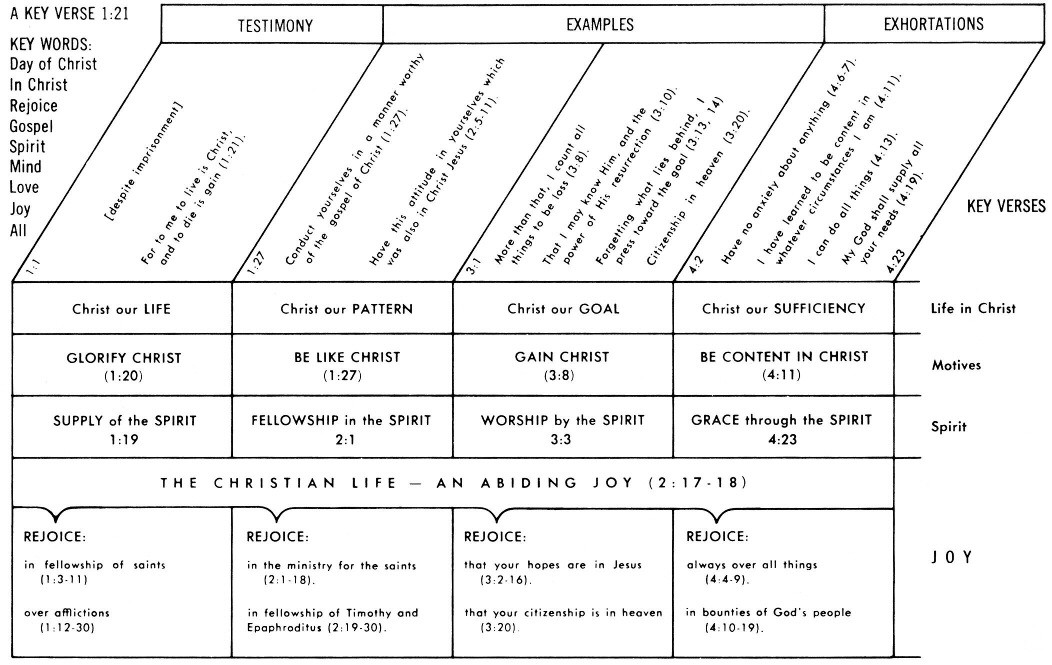
LIFE IN CHRIST
Click chart to enlarge
Charts from Jensen's Survey of the NT - used by permission
Philippians - Charles Swindoll = Chart on right side of page
| Account of Paul's Circumstances Php 1:1-30 |
Have the Mind of Christ Php 2:1-30 |
Have the Knowledge of Christ Php 3:1-21 |
Have |
| Partakers of Christ | People of Christ | Pursuit of Christ | Power of Christ |
| Suffering | Submission | Salvation | Sanctification |
| Experience | Examples | Exhortation | |
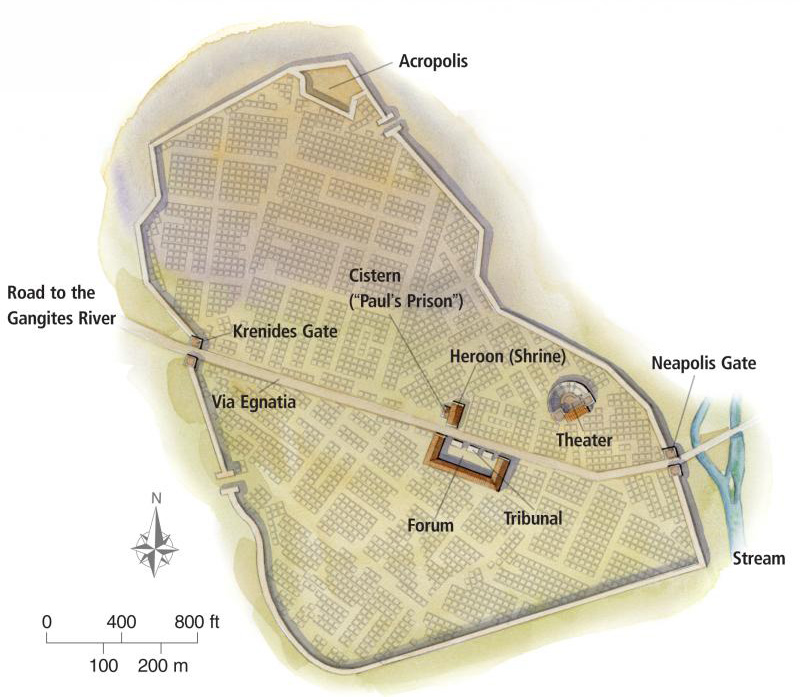
Philippi in the Time of Paul
The city plan above shows those features of the city of Philippi that archaeologists have so far identified as dating from the time of Paul. “Paul’s Prison” is not believed to be an authentic site, but was a cistern later associated with Christian worship. (ESV.org)
Philippians 2:13 for it is God who is at work in you, both to will and to work for His good pleasure (NASB: Lockman)
Greek: theos gar estin (3SPAI) o energon (PAPMSN) en humin kai to thelein (PAN) kai to energein (PAN) huper tes eudokias
Amplified: [Not in your own strength] for it is God Who is all the while effectually at work in you [energizing and creating in you the power and desire], both to will and to work for His good pleasure and satisfaction and delight. (Amplified Bible - Lockman)
Barclay: for it is God, who, that he may carry out his own good pleasure, brings to effect in you both the initial willing and the effective action. (Westminster Press)
Net: for the one bringing forth in you both the desire and the effort—for the sake of his good pleasure—is God. (NET Bible)
NLT For God is working in you, giving you the DESIRE and the POWER to do what pleases Him.
Phillips: For it is God who is at work within you, giving you the will and the power to achieve his purpose. (Phillips: Touchstone)
Wuest: for God is the One who is constantly putting forth His energy in you, both in the form of your being desirous of and of your doing His good pleasure. (Eerdmans Publishing)
Weymouth: For it is God Himself whose power creates within you the desire to do His gracious will and also brings about the accomplishment of the desire.
Young's Literal: for God it is who is working in you both to will and to work for His good pleasure.
FOR IT IS GOD WHO IS AT WORK IN YOU: theos gar estin (3SPAI) o energon (PAPMSN) en humin:
- Jer 31:33; 32:38; Jn 3:27; Acts 11:21; ; Heb 13:21; Jas 1:16, 17, 18
THE CAUSE OF THE EFFECT IS GOD:
The power that compels us comes from the Spirit Who indwells us.
Paul now explains the "cause" of the "effect" in Php 2:12. Stated another way, he explains the inworking of the Spirit, so that we might be enabled to obey the present imperative command to make this our lifestyle, our habitual practice to work out our salvation or to "work out what the Spirit works in!"
Notice we see this same spiritual dynamic in the prayer in Hebrews 13:20-21 (which makes it a great prayer to pray for yourself and for all for whom you intercede!)...
Now the God of peace, who brought up from the dead the great Shepherd of the sheep through the blood of the eternal covenant, even Jesus our Lord, 21 equip you in every good thing (cp Php 2:13 - the Spirit supernaturally equips us) to do His will (cp Php 2:13- the equipped saint supernaturally works out his or her salvation relying on the Spirit's power), working in us (present tense = Again emphasizing the continual energizing effect of the Holy Spirit in every believer - the question is this...are you keeping yourself "plugged in" to the energy Source, not grieving or quenching Him?) that which is pleasing in His sight, through (the Mediator) Jesus Christ, to Whom be the glory forever and ever. Amen.
J Ligon Duncan remarks that Philippians 2:12-13 is "one of the most important passages in all of the Bible about how we grow in grace, how we become more like Jesus Christ."
For (gar) - Notice the little preposition "for" (there are several thousand "for's" in Scripture!) and in this passage it is a term of explanation. This should always stimulate us to pause and ask what is the Spirit seeking to explain? (In fact, stop reading right now and observe the passage and see if you can determine what Paul is explaining.) You should practice this simple but very rewarding discipline every time you encounter a term of explanation. I guarantee it will rejuvenate your "Read Through the Bible in a Year" program! You might even get a small journal and begin to keep notes on what the Spirit illuminates and how this truth can be applied to your daily life. As you practice interrogating the text (the "for's") with the 5W/H questions such as "What the for there for?", what you are beginning to learn how to do is to read the Bible inductively and also how to meditate (see also Primer on Biblical Meditation) on the Scripture, a vanishing discipline in our fast paced world, but one which God gives you His sure promise of untold blessing (cp the promises to richly reward - see Ps 1:1, Ps 1:2, Ps 1:3, Joshua 1:8), cp Ps 4:4, 19:14, 27:4, 49:4, 63:6, Ps 77:6, 77:12, Ps 104:34, Ps 119:15, 119:23, 119:27, Ps 119:48, 119:78, Ps 119:97, 119:99, Ps 119:148, 143:5, Ps 145:5 - From these passages which "organ" of our being is most often involved/engaged in meditation? What are the subjects or focus of meditation?). Reading the Bible without meditating on it is like eating without chewing. We must read…
Read Scripture every day
And meditate on what God said
To fight temptation from the world
And live a life that's Spirit led.
--Sper
For (1063) (gar) in Phil 2:13 explains how it is possible for us as believers to obey the command to continually work out our salvation. Our initial salvation (justification) was a supernatural work of God. Why would we think that the supernatural work of daily sanctification is anything less than His ongoing work in us! This verse explains God's role (God's sovereignty) in the believer's sanctification process, whereas the preceding verse explains our role (man's responsibility). It should be clear that without God "working in" the believer who is "working out" his or her own salvation, genuine sanctification would be impossible.
What Paul is doing in this section is to explain to the saints at Philippi how they can "conduct (themselves) in a manner worthy of the gospel of Christ." (Phil 1:27)
Eadie - The for (gar) indicates the connection, not by assigning a reason in the strict sense of the term, but by introducing an explanatory statement:— Engage in this duty; the inducement and the ability to engage in it are inducement and ability alike from God… The position of Theos (God) shows the emphasis placed upon it by the apostle. God it is Who works in you—alluding to the inner operation of Divine grace—for en humin is not among you. There is special force in the form estin ho energon.
It is God - Note that God (theos) is placed first in the Greek to emphasize His vital role in this process. It is God alone. He is all we need. Our tendency is to think we can do it but by placing Theos or God in such an emphatic position, Paul wants us to be mindful that we cannot carry out this supernatural work of living a "Christ-ian" life without with Divine Assistance. We can live a religious life but it is like taking "Christ" out of the word "Christian"! Oh, how we need to keep this in mind as we seek to carry out the many commands in the NT, commands like mortify immorality, etc (Col 3:5). Men, just try to do that in your own strength! Need I say more? Thank You Father that Your commandments always include Your enablement!
John Calvin on it is God - This is the true artillery for destroying all haughtiness; this is the sword for killing all pride, when we hear that we are utterly nothing and can do nothing except through the grace of God alone.
Johann Bengel commenting on for it is God - And God alone. He is present with you, although I am absent. Nothing is lacking for you; do not be lacking yourselves. Comp. 2Pe 1:3. You can do nothing of yourselves; avoid careless security. Some relying too much on their exalted condition, think that they may hold the grace of God as the Israelites held the food sent down from heaven (Nu 11:8) and consequently, that it is their privilege either to resist it or admit it anew. (Philippians 2:12 Commentary - Critical English Testament)
Gordon Fee commenting on Php 2:13 notes that…
The "what" (Ed: See discussion of importance of asking the 5W/H'S) is loaded with theology. God empowers both our "doing" (energeo, the verb just used to describe God's "working") and the "willing" that lies behind the doing. Christian ethics has nothing to do with rules that regulate conduct. Rather, it begins with a mind that is transformed by the Spirit, so as not to be conformed to this age but to the character of God, knowing God's will, what is good and pleasing and perfect to him (Ro 12:1-2). We are not those who have been begrudgingly caught by God, so that we obey basically out of fear and trembling over what might happen if we were to do otherwise.
Rather, being Christ's means to be converted in the true sense of that word, to have our lives invaded by God's Holy Spirit, Who creates in us a new desire toward God that prompts godly behavior in the first place. (Philippians 2 Commentary - Application and Final Appeal)
… Thus with Php 2:13 Paul puts the imperative into theological perspective. What follows is to be understood as flowing directly out of this word; what pleases God in this instance, of course, is that the Philippians cease the in-fighting that is currently going on among some of them. Specific Application--Harmony for the World's and Paul's Sake (2:14-16) In moving from the general appeal to its specific application, Paul has clearly "quit preachin' and gone to meddlin'." Complaining and arguing are the sins that breed disunity and thus blur the effect of the gospel in Philippi. They are to do everything without indulging these attitudes, which reflect "selfish ambition" and "vain conceit" rather than the humility that puts the concerns of others ahead of one's own (Php 2:3).
J Ligon Duncan explains that "When we talk about justification, we’re talking about God accepting us. When we’re talking about sanctification, we’re talking about God changing us. In this passage, Paul is not talking about how we’re accepted with God (cp Eph 1:6KJV). He’s telling us how we’re changed by God. In our acceptance, we contribute absolutely nothing. Not even our faith is a reason why God accepts us. Our faith is the way we receive His free acceptance, but in our change it’s a little bit different, isn’t it? Yes, God is at work in us by His grace to change us; but, in a way very different from our being accepted by God, we also work towards change in us, cooperating with what God the Holy Spirit is doing in us. And that’s very different from our acceptance." (Fighting for Joy, Growing in Humility, Knowing Christ and the Peace that Passes Understanding- A Study of Philippians (29)- Sanctification 101 and Missions!)
Henry Alford writes that Paul gives the saints
encouragement to fulfill the last exhortation—for you are not left to yourselves, but have the almighty Spirit dwelling in you to aid you. This working must not be explained away with Pelagius, into "a mere persuasion and encouraging by promises:" it is an efficacious working which is here spoken of -- God not only brings about the will, but creates the will (Hallelujah! Thank You Lord!) —we owe both the will to do good, and the power, to His indwelling Spirit.
In you - not among you, but in you, as in 1Co 12:6, and 2Co 4:12; Eph. 2:2; Col. 1:29.
For the sake of His good pleasure - i.e. in order to carry out that good counsel of His will which He hath purposed towards you (Philippians 2:13 Commentary - The NT for English Readers)
NOT LET GO, LET GOD
BUT TAKE HOLD WITH GOD!
Wuest comments that in Phil 2:12 "we have human responsibility, in Phil 2:13, divine enablement, a perfect balance which must be kept if the Christian life is to be lived at its best. It is not a “let go and let God” affair. It is a “take hold with God” business. It is a mutual co-operation with the Holy Spirit in an interest and an activity in the things of God. The saint must not merely rest in the Holy Spirit for victory over sin and the production of a holy life. He must in addition to this dependence upon the Spirit, say a positive NO to sin and exert himself to the doing of the right (cp the teaching, child rearing role of the "grace of God" in Titus 2:12). Here we have that incomprehensible and mysterious interaction between the free will of man and the sovereign grace of God. (Philippians Commentary - Verse by Verse) (Bolding added)
Adrian Rogers says the best definition of grace that he has ever heard is that God's grace is "both the desire and the ability to do the will of God." It is striking that almost the same words occur here in Php 2:13NLT "For (term of explanation - explains how it is possible to Work out our salvation - Php 2:12) God is working in you, giving you the DESIRE and the POWER to do what pleases Him." When you have a godly desire, that desire is from God, because no good thing can come out of our old vile heart! And only God the Spirit in us can give the supernatural power necessary to accomplish that godly desire! So we could paraphrase Php 2:13, in simple words, by saying that God's Spirit is continually giving us the grace (desire and power) to do what pleases Him! This practical definition of grace ought to free many of us who are "trying to clean ourselves up!" It can't be done! We need His grace to give us the desire to "clean up" and the power to "clean up!" Are you resisting His grace? You can either receive it or resist it! The first way leaves us filled, while the second way leaves us empty, dry, and spiritually barren. O beloved, tell God you desperately need and want Him to pour out His grace on the situation you find yourself entwined. Do you have a root of bitterness? Then confess it (even that act is a reflection of His grace) and cry out for His grace to give you the desire and the ability to eradicate that deadly root and its caustic fruit. And keep crying out until He removes the root, for it is in His will that no child of His should ever have a root of bitterness! And when He removes it, celebrate with a praise and worship service!
The popular phrase "Let go and let God," is not Biblical because it is imbalanced and if adhered to literally releases us as believers from our responsibility to live this Christian life. So more accurately we could say "Let God and let's go!"
Our responsibility is our response to God's ability
Gordon Fee emphasizes that "This does not mean that God is "doing it for them," but that God supplies the working power. Happily for us, God is on the side of his people."
J I Packer in his discussion of the problems with Keswick Theology -
As an account of the Christian’s relationship to God the Holy Spirit, Keswick teaching fails yet a third time. A strong quietist element went into its making, and quietism prescribes passivity (Note: The main source of quietist influence seems to have been Madame Guyon, whose biography...was popular reading in holiness-oriented circles in the second half of the nineteenth century. Bishop H. C. G. Moule, probably Keswick’s best theologian, described the believer’s part in the life of holiness as “a blessed and wakeful Quietism”...). Quietism, we saw, holds that all initiatives on our part, of any sort, are the energy of the flesh; that God will move us, if at all, by inner promptings and constraints that are recognizably not thoughts and impulses of our own; and that we should always be seeking the annihilation of our selfhood so that divine life may flow freely through our physical frames. We have already seen how the idea of inner passivity was worked into the Keswick formula for holy action. How far members of this school of thought have gone in teaching the annihilation of selfhood and what tangles they have got into over the question whether, when I go passive, I am switching God on (“using” him) or he is switching me on, are fascinating inquiries that we cannot pursue here; nor is this the place to dwell on the incoherent Arminianism that is involved in the notion of “using” the Holy Spirit in and by your passivity, as you “use” the car that you drive or the washing machine that you program and start. What must be said now is that by biblical standards this passivity frame of reference is altogether wrong, for the Holy Spirit’s ordinary way of working in us is through the working of our own minds and wills. He moves us to act by causing us to see reasons for moving ourselves to act. Thus our conscious, rational selfhood, so far from being annihilated, is strengthened, and in reverent, resolute obedience we work out our salvation, knowing that God is at work in us to make us “… both … will and … work for his good pleasure” (Phil. 2:13). This is holiness, and in the process of perfecting it there is, properly speaking, no passivity at all. (Keeping in Step with the Spirit)
Sam Storms commenting on a parallel passage in Colossians 1:29 (where we clearly see Paul's part and God's provision) has this to say...
(Someone may ask Paul) If God's power is so great and so effective and so readily available, why do you feel it necessary to exert yourself so passionately and no doubt painfully? Why toil? Why struggle? Shouldn't you just 'let go and let God'?"
Absolutely not! The presence of God's power does not preclude Paul's personal struggle or energetic striving or laboring. Rather, it makes it possible. God's power is not designed to eliminate our responsibility to work hard but to enable us to fulfill it. Paul is able to work hard because God is working hard. The latter doesn't destroy or undermine the former.
I can't repeat this often enough: the operation of divine energy does not eliminate the physical and emotional exhaustion that Paul feels (ED: AND BY ANALOGY DOES NOT ELIMINATE OUR NEED TO WORK OUT OUR SALVATION IN Php 2:12). God's working in and through us is not the sort that enables us to put our efforts on cruise control.
What we see here in Colossians 1:29, with reference to ministry in particular, is similar to what Paul wrote in Philippians 2:12-13, with reference to the Christian life in general – "Therefore, my beloved, as you have always obeyed, so now, not only as in my presence but much more in my absence, work out your own salvation with fear and trembling, for it is God who works in you, both to will and to work for his good pleasure."
Virtually every theological and ethical problem can be traced either to an elevation of divine power in a way that minimizes human toil, or the exaltation of human effort in a way that marginalizes the sovereignty of God. But Paul will have neither. He toils because of God's power. And divine power is released in and through human struggling to enable us to accomplish in our labor what we otherwise never would.
Again, God's sovereignty doesn't undermine human activity but inspires it! Any attempt to justify sloth or irresponsibility by appealing to divine power will meet with a harsh biblical denunciation. (His Divine Power)
D A Carson -
We are called not only to early steps of faith and obedience but to an entire life of working out our salvation. Php 2:12–18. Note how these verses begin. “Therefore, my brothers …” In other words, Paul is now drawing logical connections from the hymn he has just offered up to Christ. There are two points in this logic. First, he says in verse 10, “Every knee shall bow.” Therefore, since every knee shall bow, we do well to live in the light of this ultimate judgment. Every knee shall bow and give an account. But also, Christ Jesus, after terrible suffering, was finally vindicated, and we’ll be vindicated too. He was vindicated. “Therefore … continue to work out your salvation with fear and trembling,” and you too will be vindicated on the last day. Verses 12 and 13 are extraordinarily important. The text does not say, “Work to acquire your salvation, for God has done his bit and now it all depends on you.” It doesn’t say that. Nor does it say, “let go and let God. God does it all, just sit back and relax and He’ll sort of carry you.” What it does say is, “Work out your salvation precisely because it is God working in you both to will and to do of his good pleasure.” God is at work in you, even at the level of your will; God is at work in you, even at the level of your actions. This becomes not disincentive but incentive. Line up with it. Work at it. Work, work, work. Your very working demonstrates that it is God working in you, both to will and to do of his good pleasure. Now what does this mean in practical points? Well, he tells us very clearly (ED: KEEP READING IN CONTEXT - Php 2:14-15!). (Bold added)
CEV paraphrases it "God is working in you to make you willing and able to obey him."
God calls us to holiness, and then empowers us to pursue holiness, and we obediently and in faith pursue holiness (cf Heb 12:14).
As James Hastings puts it…
This virtually is what St. Paul says here: Work out your own salvation, for now the great impossibility has become possible; God is working in you; this is no hopeless task to which I am calling you, no fruitless beating of the air, no idle effort of the leopard to change his spots or the Ethiopian to wash himself white. The Lord is working in you, and He is mighty to save. Whatever impulse you feel, whatever goodwill to this work, look upon it as a token of His presence and of His readiness to help you in it; that is God working in you both to will it and to do it, for He has no feeling but one of goodwill to you.
It is notable that the teaching that they are enabled to obey by God’s power is virtually unparalleled in pre-Christian literature except for Old Testament teachings on the Holy Spirit.
Paul places God (2316) (theos) first in the Greek sentence, which emphasizes the critical role God plays in our ability to work out our own salvation. God gives us both the desire and the energy. It is only through the Spirit, and by reliance on his power, that servants of Christ can faithfully work out their salvation. God's Holy Spirit, the Spirit of Christ lives in each believer and He gives us the desire and the divine (supernatural) energy to
"not walk according to the flesh, but according to the Spirit"… and enables us "by the Spirit...(to put) to death the deeds of the body." In short we are to be continually "led by the Spirit" of the Living God Who is continually at work in us and Who Alone "is able to keep (us) from stumbling, and to make (us) stand in the presence of His glory blameless with great joy" (Ro 8:4-note, Ro 8:13-note, Ga 5:18 Jude 1:24)
John Kitto commenting on Php 2:13
The certainty that all our strength is from above, and the determination actively to employ that strength, must go together; neither will effect anything without the other; but the two combined will, by the blessing of God, finally beat down Satan under our feet. (Daily Bible Illustrations 3:240 in his notes on 1Sa 17 - Saul was right when he told David "You are not able to go against this Philistine to fight with him" 1Sa 17:33! David's reply gives us the OT equivalent of Php 2:13 = "Jehovah… delivered me from the paw of the lion and from the paw of the bear. He will deliver me from the hand of this Philistine." 1Sa 17:37. Man's way = 1Sa 17:38-39! God's way = 1Sa 17:45, 46. See especially 1Sa 17:47! This Old Testament truth is the essence of the truth in Php 2:13!)
In the Old Testament we see God at work in Judah…
The hand of God was also on Judah to give them one heart to do what the king and the princes commanded by the word of the LORD. (2Chr 30:12)
Isaiah records during the Millennium that the Jews (all of whom will be redeemed at that time) will acknowledge…
LORD, you will grant us peace, for all we have accomplished is really from you. (Isa 26:12, NLT)
F F Bruce writes that…
When the Spirit takes the initiative in imparting to believers the desire and the power to do the will of God, then that desire and power becomes theirs by His gift, and they do His will ‘from your heart’ (See note Ephesians 6:6)
As the apostle Peter declared…
His divine power has granted (perfect tense = speaks of the permanence of this grant) to us everything pertaining to life and godliness, through the true knowledge of Him who called us by His own glory and excellence. (2Pe 1:3, 4)
SUPERNATURAL WORK
REQUIRES
SUPERNATURAL ENERGY
Walter Smith says "That God must needs work in us is, of course, taken for granted; but we are encouraged by the assurance that that is exactly what He is already doing."
Work (1754) (energeo from energes = active, operative, at work in turn from en = in + érgon = work) refers to active, efficient, effectual fervent work. God supernaturally energizes us as His children to obey and serve Him. Is this not amazing grace! His power enables our progressive sanctification as His Spirit takes us from glory to glory (2Co 3:18).
Paul describes God's effective energetic supernatural power in believers, alluding to the operation of the Holy Spirit and the transforming power of grace. The present tense indicates God (Which member of the Trinity is at the forefront of this supernatural supply? Who is the "COO," the Chief Operating Office? See 1 Co 3:16, Ro 8:9, Ro 8:13, etc) is continually at work powerfully, energizing believers, enabling us to work out our salvation. Don't be discouraged beloved, and certainly don't give up in your fight against that besetting sin (Heb 12:1), for Paul is saying our Great and Mighty God is Himself always at work in us for our good (cp Ro 8:29) and for His glory. It is for that reason that sanctification will continue throughout the believer’s life for "He who began a good work in you will perfect it until the day of Christ Jesus." (Php 1:6). Those whom God justifies by grace through faith, He just as surely sanctifies (also by grace through faith). (cp Ro 8:30, 1 Cor 6:9-11) One is reminded of Paul's rhetorical question to the readers of the letter to the Galatians...
Are you so foolish? Having begun by the Spirit, are you now being perfected by the flesh? (Gal 3:2).
Note that this truth abolishes (or should do so) all personal pride in our daily growth in grace and godliness. Any progress we make in supernatural sanctification is the result of divine desire and power worked into our being and fittingly it is God Who gets the glory for our sanctification.
James Hastings - Two powers are at work, and the error lies in separating them. The two parts of the text, if taken separately, may lead to error. “Work.” “God works.” The truth lies in the synthesis of the two: Work, for God works… The great religions of the East, Hinduism and Buddhism, lay all the stress upon the human will. The key-note of those systems is, “Work out your own salvation.”
J Lyth sums up God's work…
God works: —
I. SECRETLY — “in you.”
II. MEDIATELY — by His Word.
III. MIGHTILY — by His Spirit.
IV. GRACIOUSLY — Of His good pleasure.
V. EFFECTUALLY — to will and to do. (Biblical Illustrator)
T. H. Leary…
Salvation worked in and out: — A clock presents a beautiful emblem of Christianity. When in good order it is always going, and one wheel propels another and even so must true Christianity be in continual exercise, and every act of godliness make way for the next. As a clock, however, needs to be constantly inspected, and frequently set and cleaned, so God, in His faithfulness and long suffering, has continual work to do, amending, purifying, and regulating our Christianity. (Biblical Illustrator)
James Owen - Just as the same electricity that flashes like an avenging sword from the cloud, and that lightens from one side of heaven to the other, also trembles in the dew drop, and flies along the wire, carrying news from one continent to another: so the Divine Power that binds all holy beings in chains of loyalty and love to the throne of the eternal, and that breaks the bond of our captivity, and raises us to a state of spiritual enlargement and fellowship, also enables us to discharge the smallest duties and the common daily responsibilities of the Christian life. “Christ is all, and in all,” in every duty, in every service. (Biblical Illustrator)
H. W. Beecher - When a seed is planted in good soil it is given over to the sun; and when the sun undertakes to care for a plant it always keeps its eye on the blossom and the fruit which it is to unfold. It is not enough that it develops stem, branches, and flowers. The tendency of the sun is to bring everything up to its ultimate consummation. So the tendency of the Divine Spirit is to draw men up steadily through the whole range of their faculties till they blossom. (Biblical Illustrator)
Spurgeon - The assistance of Divine grace is not given to put aside our own efforts, but to assist them. Observe what God works in us: He works in us to will—the desire after holiness, the resolution to put down sin, the pang of grief because we have sinned, the stern resolve that we will not fall into that sin again. All, all is of God, and He who gave the desire will surely fulfill it. He that gave you the will does not leave you there; He works in you the power to do. The power to achieve the victory, the power to smite down the loftiest plume of pride shall come from Him. God is equal to all emergencies, therefore fear not. Though your inner life shall be subject to ten thousand dangers, He will give you power to do the right, the just, the lovely, and the true, for He works gloriously in you.
Spurgeon on Destroying Sin Is Like Taking the Land of Canaan - You are this day, Christian, like the seed of Israel in Canaan. You have not to escape from Egypt; you are already free. With a high hand and with an outstretched arm God has set you free from the Pharaoh of your sin; you have already passed through the wilderness of your convictions. The fiery serpents and howling wilderness are all over now. You have crossed the river; you are a saved man. Jesus the Joshua is in command; He reigns and rules in your spirit. You have not to fight your way towards the land—you are in it—for we that have believed do enter into rest. But what have you now to do? Why, you have to extend the kingdom within yourself by routing one nation of sins after another. You have, in the power of the Spirit, to hang up your corruptions before the light of the sun—to destroy them utterly. Do not let one escape, for Canaan will never be a place of rest to you till you have driven away the Canaanites, and shall live in the land without association with sin. This is the matter then to which you are earnestly invited to attend. May the Holy Spirit grant you grace never to forget it so long as you live.
As Walvoord notes "It is not the idea of work—that unless you work God cannot help you—but rather, work with the realization that you work not alone, that you have an infinite power within you, that actually God is working out His will for you and motivating you both to will or desire it and also to accomplish His good pleasure. (Walvoord, J. F. Philippians: Triumph in Christ. Chicago, IL: Moody Press)
If you are discouraged by failures, the truth that God is continually at work in you and clearly has not given up on you should encourage you to forget what lies behind (Php 3:13) and press on (Php 3:14) in His power knowing that it is always too soon to quit!
Paul did not underestimate the importance of faithful obedience, but he knew that underlying all our obedience and acceptable service was the energizing power and will of God, Who Alone then will receive the glory. It is as if believers who are working out their salvation are God's "trophies" before the lost, watching world! Beloved, is your "trophy" shining forth or do you need to "dust" it off by practicing the principles of Philippians 2:12-13?
Paul emphasized this same principle of God's inner working and thus our dependence on God's power writing to the Corinthians…
Not that we are adequate in ourselves to consider anything as coming from ourselves, but our adequacy is from God, who also made us adequate as servants of a new covenant, not of the letter, but of the Spirit; for the letter kills, but the Spirit gives life. (2Corinthians 3:5, 6)
After declaring that his great desire and purpose was to present all men complete in Christ (Col 1:28), he went on to explain how he carried out this task writing that it was…
for this purpose also I labor (kopiao to the point of exhaustion in the present tense = continually laboring), striving (agonizomai intensely struggling like an athlete in the present tense = continually striving) (Paul's responsibility) according to His power (God's provision), which mightily (dunamis) works (energeo in the present tense = continually energizes) within me . (Col 1:29) (Paul was passionate to see men formed complete in Christ and we should be no less zealous.)
In his letter to the Ephesians Paul emphasized that the carrying out of his responsibility was made possible by God's empowerment…
(Paul reminded them that he) was made a minister, according to the gift of God's grace which was given to me according to the working (energeia in this context = supernatural energy) of His power (dunamis). (Ep 3:7)
Now to Him Who is able (dunamai in the present tense = continually has the inherent ability - see omnipotence) to do exceeding abundantly beyond all that we ask or think, according to the power (dunamis - Inherent power residing in a thing by virtue of its nature - obviously God's supernatural power) that works (energeo in the present tense = continually energizes) within us, to Him be the glory in the church and in Christ Jesus to all generations forever and ever. Amen” (Ep 3:20, 21).
Paul's point is that God energizes His children to obey and serve Him! His energy enables our ongoing, daily supernatural process of sanctification. In fact, believers can do nothing holy or righteous in their own power or resources and this even includes "church work" (especially if that work is done in our own natural [rather than supernatural] power and for our "recognition"!) (cp Jesus' warning that "apart from Me you can do nothing." John 15:5)
GOD IS THE ENERGY
AND
THE ENERGIZER!
ILLUSTRATION OF WORKING OUT - William Hendriksen explains the working out process with several analogies writing that
"The toaster cannot produce toast unless it is “connected,” so that its nichrome wire is heated by the electricity from the electric power house. The electric iron is useless unless the plug of the iron has been pushed into the wall outlet. There will be no light in the room at night unless electricity flows through the tungsten wire within the light-bulb, each end of this wire being in contact with wires coming from the source of electric energy. The garden-rose cannot gladden human hearts with its beauty and fragrance unless it derives its strength from the sun. Best of all, “As the branch cannot bear fruit of itself unless it abides in the vine, so neither can you unless you abide in me” (John 15:4).So here also.
Only then can and do the Philippians work out their own salvation when they remain in living contact with their God… By means of his Spirit working in the hearts of his people (Php 1:19), applying to these hearts the means of grace and all the experiences of life, God is the great and constant, the effective Worker, the Energizer, operating in the lives of the Philippians, bringing about in them both to will (DESIRE) and to work (POWER). Note: not only to work but even to will, that is, to resolve and desire! (AMAZING GRACE INDEED!) (Hendriksen, W., & Kistemaker, S. J. Vol. 5: New Testament commentary : Exposition of Philippians. Page 122. Grand Rapids: Baker Book House)
ILLUSTRATION - (MOST OF US CAN IDENTIFY WITH THIS PICTURE AND IT WOULD LEAVE EVERYONE WITH A CLEAR PICTURE OF WHAT GOD IS DOING AS WE ARE WORKING OUT OUR SALVATION NOT GRUMBLING, ETC)
Have you ever watched a two year old trying to push a grocery cart, his hands barely reaching the bar, his vision blocked by the wire mesh and the accumulation of boxes and bags? As the cart weaves in and out of the aisles it is obvious to you how that cart moves. But what is obvious to you may not be known by the small operator. While he is proud of his efforts in controlling the cart, Dad stands behind. There Dad stands, with hands resting on the bar, guiding every move. When it comes to change in your life, you know what God demands; you know what is necessary. You must change. New Year's resolutions will come and go. But real change must occur. For real change to occur you must yield to God’s Law, confess, repent from sin and as you look in faith to Christ and His indwelling Spirit, as you consider and seek to conform your life to God’s revealed will, change will happen. The funny thing is it looks like it's us doing it! You do the work for the Lord - the non-grumbling speaking, the music, the serving, the encouraging, the leading and it sure looks like it's you who's living your Christian life. It looks like you are one saying "NO" to temptation, loving people, forgiving others, but then, it looked to that little boy like he was pushing that cart too! But, it was really his father. The same with you and me. Beloved, now go forth this week and work out what God's Spirit has worked in and experience a new freedom and joy in your daily walk in Christ.
In John’s Gospel, Jesus says that “He is the vine, we are the branches." The grapes look like they're coming from the branch, right? Wrong! They're coming through the branch, from the vine. If you don't believe it, cut off the branch and see how many grapes it produces! Now, it's like that for us in our life in Jesus Christ. Anything you've become, anything you've done, all those spiritual victories that you've been a part of, they may look like something you did but it wasn't really you doing something for God; it was God doing something through you. Jesus put it bluntly in His vine story. He just said, "Without Me you can do nothing." (John 15:5) Nothing that matters, nothing that lasts, nothing that's life-changing. You see, you can dare to change because it's God’s power, His adequacy doing it anyway! "It is God who works," the verse says. A little boy was able to move what he could never move because of his father's strength. You can move things for the Lord that are way beyond you because of your Heavenly Father's strength. So keep pushing the cart, keep walking, but remember that your cart will stay on course and move a heavy load because of the powerful hands above you.
William Barrick - The Saint’s Role. Silva identifies the basic issue involving agency in sanctification as a matter of the human role in sanctification. What role can people 31 play? Obviously, they cannot sanctify themselves. Without the Holy Spirit and the Scriptures, no one can be holy. Roman Catholicism stresses the cleansing power of baptism and good works. Meanwhile, advocates of the Victorious Life Movement focus on the believer’s passivity in sanctification. Philippians 2:12-13, while stating 32 that God does work in the believer, also indicates that God empowers the believer to work at the task of manifesting inward godliness or holiness outwardly. In fact, an imperative governs the entire statement: katergazesthe, “work out” (v. 12). The force of this verb appears in Rom 4:15 where Paul explains how the Mosaic Law produces (works out) wrath. In Rom 7:8 the apostle uses the same verb to express how sin works itself out in covetousness. In verses 17 and 20 indwelling sin works out its effects in the apostle’s life. Again in Rom 15:18 the indwelling Christ accomplishes the proclamation of the Gospel to the Gentiles through the apostle Paul. 33
Silva admits that Sanctification requires discipline, concentration, and effort, as is clear by the many exhortations of Scripture, especially those where the Christian life is described with such figures as running and fighting (1 Cor 9:24-27; Eph 6:10-17). On the other hand, men must always resist the temptation to assume that they in effect sanctify themselves, that spiritual power comes from within them and that they may therefore rely on their own strength. This is a difficult tension, though no more puzzling than the paradox of prayer (“Why pray when God, who knows our needs and who is all-wise and sovereign, will always do what is best anyway?”). Yet perhaps the real “secret” of holiness consists precisely in learning to keep that balance: relying thoroughly on God as the true agent in sanctification while faithfully discharging one’s personal responsibility.....
Substantiating Synergism in Sanctification Three agents work together (i.e., synergize) to sanctify the believer: the Spirit, the Scriptures, and the saint. The saint cannot attain sanctification without the Spirit and the Scriptures. Those two agents are primary in the process of making the believer more and more holy(SANCTIFICATION: THE WORK OF THE HOLY SPIRIT AND SCRIPTURE - excellent 13 page discussion)
AN INCOMPARABLE
INCOMPREHENSIBLE
PARADOX
A paradox is a statement that contradicts itself or an argument that produces an inconsistency, typically within logic or common sense. God works. We work. It is not one or the other but both together. He works in and we work out what He works in. Note that this is not let go and let God, which is an aberrational teaching that was propagated by the Keswick movement that began in England in the late 1800's.
The incomprehensible "paradox" of man's responsibility (Php 2:12) and God's sovereignty (Php 2:13) described by Paul in this section is also found in several other NT passages (note brown corresponds to man's part and purple corresponds to God's part (Note -- the colors are an attempt to highlight the juxtaposition of man's role and God's provision)...
But by the grace of God I am what I am, and His grace toward me did not prove vain; but I labored even more than all of them, yet not I, but the grace of God with me. (1 Co 15:10)
And for this purpose (to present every man complete in Christ - Col 1:28) also I labor (kopiao), striving (agonizomai) according to His power, which mightily works within me. (Col 1:29)
I have been crucified with Christ; and it is no longer I who live, but Christ lives in me; and the life which I now live in the flesh I live by faith in the Son of God, who loved me, and delivered Himself up for me. (Gal 2:20)
If (since as is the case) we live by the Spirit (i.e., are indwelt by His life), let us also walk by the Spirit. (Ga 5:25)
We see a similar paradoxical statement in Hebrews…
(Heb 13:20 = Praying that God might) equip you in every good thing to do His will, working in us that which is pleasing in His sight, through Jesus Christ, to Whom be the glory forever and ever. Amen. (Heb 13:21)
And it should come as no surprise that we see this same dynamic at play in the Old Testament. See if you can see it in this Psalm
Unless the LORD builds the house, They labor in vain who build it; Unless the LORD guards the city, The watchman keeps awake in vain. (Ps 127:1)
Comment: Did you see the same dynamic - our part, God's provision? Notice "LORD builds" is God's provision and "They labor in vain who build it" is man's responsibility. Note the same synergistic relation in guarding.
John MacArthur emphasizes that "That divine-human synergy working in and through believers has always existed and is exemplified in the Old Testament. When Pharaoh’s army threatened the people of Israel, Moses was so confident in the Lord that he cried out, “Do not fear! Stand by and see the salvation of the Lord which He will accomplish for you today; for the Egyptians whom you have seen today, you will never see them again forever. The Lord will fight for you while you keep silent” (Ex 14:13, 14). But the Israelites also had a part to play: “The Lord said to Moses, ‘Why are you crying out to Me? Tell the sons of Israel to go forward. As for you, lift up your staff and stretch out your hand over the sea and divide it, and the sons of Israel shall go through the midst of the sea on dry land’ ” (Ex 14:15,16). It was not the Lord’s will that His people merely keep silent and be passive but that they participate actively in accomplishing His purpose. His purpose for them was to be accomplished through them. (MacArthur, J. Philippians. Chicago: Moody Press)
See Jerry Bridges discussion of working out our salvation in synergy with the Spirit.
Alexander Maclaren -
These two streams of truth are like the rain-shower that falls upon the water-shed of a country. The one half flows down the one side of the everlasting hills, and the other down the other. Falling into rivers that water different continents, they at length find the sea, separated by the distance of half the globe. But the sea into which they fall is one, in every creek and channel. And so, the truth into which these two apparent opposites converge, is “the depth of the wisdom and the knowledge of God,” whose ways are past finding out—the Author of all goodness, who, if we have any holy thought, has given it us; if we have any true desire, has implanted it; has given us the strength to do the right and to live in His fear; and who yet, doing all the willing and the doing, says to us, “Because I do everything, therefore let not thy will be paralyzed, or thy hand palsied; but because I do everything, therefore will thou according to My will, and do thou according to My commandments!”
Marvin Vincent adds that "It is God's good pleasure which they are to fulfill, as did their great example, Jesus Christ (Ed: Mt 3:17, compare Jn 4:34, 17:4); and it is God Who, to that end, is energizing their will and their working. (See 2Co 5:18.) This is a serious task, to be performed in no self-reliant spirit, but with reverent caution and dependence on God… in you as 1 Co 12:6; 2 Co 4:12 ; Ep 2:2; Col 1:29. Not ' among you.' (A Critical and Exegetical Commentary on the Epistle to the Philippians)
H. Lefroy Yorke - This is the profound teaching in St. Augustine’s doctrine of grace, which he pressed so strongly as to seem at times almost to destroy the reality of free will. Man could not seek God unless God already possessed him. He possesses us that we may desire to possess Him. Strictly speaking, there is no such thing as mere natural goodness. Whether it is recognized or not, all earnest thought and effort is God working in us.
James Hastings - When we co-operate with God the antagonism vanishes. God and man are so near together, so belong to one another, that not a man by himself, but a man and God, is the true unit of being and power. The human will in such sympathetic submission to the Divine will that the Divine will may flow into it and fill it, and yet never destroy its individuality; my thoughts filled with the thought of One who, I know, is different from me while He is unspeakably close to me;—are not these the consciousnesses of which all souls that have been truly religious have been aware?
G. Matheson offers an interesting albeit a bit mystical explanation of the human and divine synergism depicted in Php 2:12-13 - There are two parts in every great work—a working in and a working out. The working in is always the Divine part. It is very easy to work out an idea when once you have got it; but the mystery is the getting of it. What is the mystery of the beehive? It is not the making of the hive; it is the conceiving of it. If you can tell me how the idea was worked in, I will tell you how the plan was worked out. The thing which wakes my wonder is the instinct—the process within the bee; I call it God’s work. So it is with my soul. I, too, am helping to build a hive—a great home of humanity, named the Kingdom of God (Ed: More correctly I am "building" Christ-likeness). I know not how it is done; I know not even what part of the building I am aiding to construct; I only know that an impulse of life moves me. That impulse is God working within me (Ed: The Spirit of Christ Ro 8:9, cp Jn 6:63). Whither it (He) tends I cannot see. The making of the hive eludes me. I am traveling through the night—carrying I know not what, to places I know not where. Only, the impulse (Ed: Of the Holy Spirit) says “go,” and I do go; I work out what God works in. I cannot fathom His designs; He has inspired me to the work by designs less than His own.
O power to do! O baffled will!
O prayer and action! ye are one.
-J G Whittier
J H Jowett explains it this way - Rose leaves, placed within a vase, can influence the atmosphere of a room, creating an odor which is pleasing to the sense. Can the spirit of man, placed within its vase of clay, create a moral atmosphere which it will be healthful or injurious for others to breathe? Your mind has immediately given an affirmative answer. We cannot be in the presence of any man of great and holy force of character and not perceive his influence. How often one has heard a weaker man speak of a stronger man, and say, “As long as he is with me, I feel I can do everything I ought to do!” If you examine the expression you will find that it is a popular proof of the truth I am now enforcing, that one strong, dominant spirit can pervade a weaker one, and give to the weaker one a sense of confident and conquering might. Now, let us lift up the argument to its highest application. If human spirit can work upon human spirit, and reinforce it by the impartation of its own strength, is it inconceivable that the great Creative Spirit can work upon created spirit, and impart to it its own unspeakable strength? Do you detect anything in the assumption which is belittling or degrading to an august conception of God? The raindrop, hanging at the tip of a rose-leaf, depends by the same power as the largest star. And I am fain to believe, and rejoice in believing, that the ineffable spiritual energy which is implied in what we call the holiness of God, and which empowers seraph and archangel with endurance to bear the “burning bliss” of the Eternal Presence, will also communicate itself to the weakest among the sons of men, and so hold him in his appointed place as to make it impossible for him ever to be moved.
Power belongeth unto God
John Berridge
Ps. 62.11; Phil. 2.131 How sinners vaunt of power
A ruined soul to save,
And count the fulsome store
Of worth they seem to have,
And by such visionary props
Build up and bolster sandy hopes!2 But God must work the will,
And power to run the race;
And both through mercy still,
A work of freest grace;
His own good pleasure, not our worth,
Brings all the will and power forth.3 Disciples who are taught
Their helplessness to feel,
Have no presumptuous thought,
But work with care and skill;
Work with the means, and for this end,
That God the will and power may send.4 [They feel a daily need
Of Jesus’ gracious store,
And on his bounty feed,
And yet are always poor;
No manna can they make or keep;
The Lord finds pasture for his sheep.]5 Renew, O Lord, my strength
And vigour every day,
Or I shall tire at length,
And faint upon the way;
No stock will keep upon my ground;
My all is in thy storehouse found.
Who is John Berridge writer of the previous hymn? See Spurgeon's note on Berridge. The 18th century evangelical preacher John Berridge (1716-1793) (If you've never heard of him, you must take a moment and be convicted and challenged by C H Spurgeon's assessment of Berridge) was called in by the Anglican bishop and reproved for preaching at all hours of the day and on every day of the week.
“My lord,” he replied, “I preach only at two times.”
The bishop pressed him, “And which are they, Mr. Berridge?”
He quickly responded, “In season and out of season, my lord”
See also: Short bio on John Berridge by J C Philpot ; Excerpts from a third short biography on John Berridge - And one of my favorite songs by Berridge - Jesus Cast A Look On Me by John Berridge Demo Mp3 by Michael Perryman Jones
BOTH TO WILL AND TO WORK: kai to thelein (PAN) kai to energein (PAN):
- 1Ki 8:58; 1Chr 29:14, 15, 16, 17, 18; Ezra 1:1,5; 7:27; Neh 2:4; Ps 110:3; 119:36; Ps 141:4; Pr 21:1; Jn 6:45,65; Ep 2:4,5; 2Th 2:13,14; Titus 3:4,5; 1Pet 1:3
THE SPIRIT PROVIDES US WITH
THE DESIRE AND THE POWER
NLT For God is working in you, giving you the desire and the power to do what pleases Him.
Hansen - Contemporary Christians speak of a purpose-driven church and a purpose-driven life; Paul speaks here of a God-driven purpose. Even our purpose, our willing and desiring to live and work for God, comes from God. God is the great originator of human willing as well as human working… God’s indicative—God works—makes it possible to fulfill the imperative given to us—work! Without God’s prior work directing and empowering our work, all our work is meaningless and in vain. All human effort is in vain unless it is energized by God. “Unless the Lord builds the house, the builders labor in vain” (Ps 127:1) (Pillar New Testament Commentary The Letter to the Philippians).
Marvin Vincent - God so works upon the moral nature that it not only intellectually and theoretically approves what is good (Ro 7:14-23), but appropriates God's will as its own. The willing wrought by God unfolds into all the positive and determinate movements of the human will to carry God's will into effect. (A Critical and Exegetical Commentary on the Epistle to the Philippians)
Thomas Boston - The will is cured of its utter inability to will what is good. While the opening of the prison to those who are bound, is proclaimed in the Gospel, the Spirit of God comes and opens the prison door, goes to the prisoner, and, by the power of his grace, makes his chains fall off; breaks the bonds of iniquity, with which he was held in sin, so as he could neither will nor do anything truly good; and brings him forth into a large place, "working in him both to will and to do of his good pleasure," Phil. 2:13. Then it is that the soul, that was fixed to the earth, can move heavenward; the withered hand is restored, and can be stretched out. (Human Nature in its Fourfold State)
J C Philpot. - Sadly would we miss the mark, grievously would we mistake the way, should we lay on the creature a hair's breadth of will or power. "Without me you can do nothing," finds a responsive echo in every believing heart. And yet he does work in his people both to will and to do of his good pleasure; and, by the gentle constraints of his love, enables them not to live to themselves but to him who died for them and rose again, (Phil. 2:13; 2Cor 5:14, 15.)
Thomas Constable notes that Php 2:13 "is one of the most comforting in the New Testament. Sometimes we want to do right but seem to lack the energy or ability. This verse assures us that God will help us. At other times we cannot even seem to want to do right. Here we learn that God can also provide the desire to do His will when we do not have it. If we find that we do not want to do right, we can ask God to work in us to create a desire to do His will. This verse gives us confidence that God desires both to motivate and to enable us. (Philippians Expository Notes)
In Ezekiel Jehovah, the Lord (Adonai [study]) God (Ezek 36:23) gives us the OT parallel of this great truth in Philippians in His promise of a New Covenant…
Moreover, I will give you (speaking directly to Israel, but applicable to all believers) a new (Lxx = kainos [word study] = a qualitatively brand new kind, one that has never existed - in short this is not a "renovated" but a "regenerated") heart and put a new (Lxx = kainos) spirit within you; and I will remove the heart of stone from your flesh and give you a heart of flesh. And I will put My Spirit within you and cause you to walk in My statutes (GOD'S PROVISION - OT parallel of Php 2:13), and you will be careful to observe My ordinances (OUR RESPONSIBILITY - OT parallel of Php 2:12). (Ezekiel 36:26, 27)
Comment: Although the term "New Covenant" is not used, comparison with Jer 31:31 (Lxx = kainos) indicates that this passage clearly refers to the New Covenant. This promise of the New Covenant was inaugurated by our Lord at the "Last Supper", the Passover meal in which He presented Himself as the Passover Lamb (1 Co 5:7, Jn 1:29) declaring "This cup which is poured out for you is the new covenant in My blood. (Lk 22:20). The covenant was "cut" (and consummated) by our Lord, the Lamb of God, when He yielded His life as a sacrifice on the Cross. See New Covenant in the Old Testament.
Earlier in Ezekiel's prophecy God had promised "And I will give them one heart, and put a new (Lxx = kainos) spirit within them. And I will take the heart of stone out of their flesh and give them a heart of flesh." (Ezekiel 11:19)
In Ezekiel 18 God again alludes to the New Covenant...
Cast away (Heb = imperative = a command; Lxx = aporripto = throw away, cast down) from you all your transgressions which you have committed and make yourselves a new (Lxx = kainos) heart and a new (Lxx = kainos) spirit! For why will you die, O house of Israel? (Ezekiel 18:31)
Comment: Don't misunderstand the command to make… a new spirit as if by our unrighteous deeds we could ever hope to achieve the perfect righteousness God's holiness and law demand! No, what God is calling for is a personal choice to enter into the New Covenant by grace through faith and receive a new heart and spirit (Ezek 36:26, 27) in Christ Jesus the Covenant Messenger (Mal 3:1). See related resource: Excursus on Circumcision Of the Heart
John MacArthur commenting on Ezekiel 18:31 writes that "The key to life eternal and triumph over death is conversion (article by Darrell Bock). This involves repentance from sin (Ezek 18:30, 31a) and receiving the new heart which God gives with a new spirit, wrought by the Holy Spirit (Ezek 36:24-27; Jer 31:34; Jn 3:5-8)."
God produces the desire to live godly and provides the effective energy to accomplish this supernatural objective in the life of every believer. So what is your excuse?
As Wiersbe rightly remarks…
Too many Christians obey God only because of pressure on the outside, and not power on the inside.
Comment: Little wonder that they fail and fall and experience frustration. Natural power cannot accomplish what only supernatural power can accomplish!
As an aside are you wrestling with what is the Will of God for you life? You might consider the RBC booklet How Can I Know What God Wants Me To Do?
In Philippians 2:12,13, Paul has in view both human choice (responsibility) and God’s sovereignty (provision/power). When Spurgeon was asked to “reconcile” the two, he replied, "How do I reconcile friends?".
Will (2309) (thelo cp related word thelema) means to determine and refers to one's desire and implies volition and purpose. Thelo refers to thoughtful, purposeful choice, not to mere whim or emotional desire.
In ancient secular Greek thelo was used by Homer to speak of readiness, inclination, and desire. When one was ready for an event, or inclined to undertake a course of action, thelo was used. In the writings of Plato the word came to speak of intention or desire.
A genuine desire to do God’s will, as well as the power to obey it, originates with Him.
Thelo is in the present tense indicating God is continually at work on our will so to speak.
And so we learn that God’s work in us includes the transformation of our will, as well as our work. But clearly His work is not a passive transaction, in light of the exhortation in the preceding verse to work out our own salvation.
Kenneth Wuest summarizes the sense of the verb thelo in Php 2:13 commenting that
"It is this desire to do the good pleasure of God that is produced by divine energy in the heart of the saint as he definitely subjects himself to the Holy Spirit’s ministry."
It is God the Holy Spirit who energizes the saint,
making him not only willing,
but actively desirous of doing God’s sweet will.
But He does not merely leave the saint with the desire to do His will. He provides the necessary power to do it. This we have in the words “to do.” The Greek construction implies habit, the habitual doing of God’s will. (Philippians Commentary - Verse by Verse)
Jerry Bridges underscores why this action of God (to exert effect on our will to cause us to seek that which is holy rather than profane) is so crucial to a walk of holiness, explaining that it is…
the will that ultimately makes each individual choice of whether we will sin or obey. It is the will that chooses to yield to temptation or to say no. Our wills, then, ultimately determine our moral destiny, whether we will be holy or unholy in our character and conduct. This being true, it is critically important that we understand how our wills function—what causes them to turn in one direction or the other, why they make the choices they do. Above all else, we must learn how to bring our wills into submission and obedience to the will of God on a practical, daily, hour-by-hour basis… the mind, the emotions, the conscience, and the will… were all corrupted through man’s fall in the Garden of Eden. Our reason (or understanding) was darkened (Ep 4:18), our desires were entangled (Ep 2:3), and our wills perverted (Jn 5:40). With new birth our reason is again enlightened, our affections and desires redirected, and our wills subdued. But though this is true, it is not true all at once. In actual experience it is a growing process. We are told to renew our minds (Ro 12:2), to set our affections on things above (Col 3:1), and to submit our wills to God (Jas 4:7)…
While the will is the ultimate determiner of all choices, it is influenced in its choices by the strongest forces brought to bear upon it. These compelling forces come from a variety of sources. It may be the subtle suggestions of Satan and his world system (Ep 2:2) or the evil enticements of our own sinful nature (Jas 1:14). It may be the urgent voice of conscience, the earnest reasoning of a loving friend, or the quiet prompting of the Holy Spirit. But from whatever source these compelling forces come, they reach our wills through either our reason or our emotions. Solomon said, “Watch over your heart with all diligence, for from it flow the springs of life” (Pr 4:23). If we diligently guard our minds and emotions, we will see the Holy Spirit working in us to conform our wills to His own (Php 2:12, 13)…
The Bible speaks to us primarily through our reason, and this is why it is so vitally important for our minds to be constantly brought under its influence. There is absolutely no shortcut to holiness that bypasses or gives little priority to a consistent intake of the Bible… It is obvious from even a casual reading of Pr 2:1-12 that the protective influence of the Word of God comes as a result of diligent, prayerful, and purposeful intake of Scripture. To guard our minds, we must give priority to the Bible in our lives—not just for the spiritual information it gives but also for the daily application of it in our workaday lives…
God most often appeals to our wills through our reason, sin and Satan usually appeal to us through our desires. It is true Satan will attack our reason to confuse and cloud the issues, but that is only to enable him to conquer us through our desires. This is the strategy he employed with Eve (Ge 3:1, 2, 3, 4, 5, 6). He attacked her reason by questioning God’s integrity, but his primary temptation was to her desire. We read that Eve saw that the tree was good for food, it was a delight to the eyes, and desirable for making one wise (Genesis 3:6)… we are to set our desires on spiritual things and delight ourselves in the law and will of God (Ed: cp 2Ti 2:22, Col 3:1, Col 3:2, Ps 1:2)…
Normally our reason, wills, and emotions should work in that order, but since we so often reverse the order, giving attention to our desires, we must work at directing those desires toward God’s will… Our responsibility regarding our wills is to guard our minds and emotions, being aware of what influences our minds and stimulates our desires. As we do our part, we will see the Spirit of God do His part in making us more holy. (From chapter 13 of The Pursuit of Holiness = This small book is highly recommended - Do not speed read but "chew" slowly, digest fully & prayerfully read every Scripture referenced. Consider using the The Pursuit of Holiness Study [based on Jerry Bridges' classic book] and/or studying with your accountability partner or group.)
First
VOLITION (WILL)
Then
ACTION (WORK)
Eadie - first and naturally volition, and then action (Ro 7:18) The double kai is emphatic (kai to thelein kai to energein) The apostle uses energein (energeo) both of cause and effect—energon… energein— whereas the verb denoting the ultimate form of action was katergazesthe (katergazomai). The difference is very apparent. The latter term, the one employed by the apostle in the exhortation of Php 2:12, represents the full and final bringing of an enterprise to a successful issue; whereas energein describes action rather in reference to vital power or ability, than form or result. The will and the work are alike from God, or from the operation of His grace and Spirit; not the work without the will—an effect without its cause; not the will without the work—an idle and effortless volition. (The Epistle to the Philippians - online excellent) )
Believers choose to behave a certain way but only because the Holy Spirit is at work causing us to want to do God’s will. God arouses, stirs, and energizes the heart of the believer to do God's will. This is a wonderful truth. All believers experience movements and stirrings within their heart toward God. These stirrings are from His Spirit. God is working within —energizing —giving both the will and power to do what pleases Him. Amazing grace! Our part is to lay hold of these stirrings and not to let them pass by unheeded. We are to grab hold of them and do exactly what the stirrings are arousing and energizing us to do. Then we are truly working out our salvation. Praise God He does not leave us to our own futile efforts.
J Ligon Duncan - many Christians, well-meaning Christians, draw this deduction: ‘Since God is at work in me, working to change me, I don't need to do anything.’ And again, that is not the deduction that the Apostle Paul draws, and nowhere in the New Testament do you find that equation. In fact, it's the opposite: ‘Since God is working in me, I work with hope. Since God is at work in me, it's not that I don't need to work; it's that I work with hope.’ (Fighting for Joy, Growing in Humility, Knowing Christ and the Peace that Passes Understanding- A Study of Philippians- Sanctification 101 and Missions!)
John MacArthur has an interesting comment on this passage writing that…
God uses two means to move believers’ wills.
First is what might be called holy discontent, the humble recognition that one’s life always falls short of God’s standard of holiness…
The second means God uses to move believers’ wills is holy aspiration, the positive side of holy discontent. After He instills a genuine hatred of sin, He cultivates a genuine desire for righteousness. After He makes believers discontent with what they are, He gives them the aspiration to greater holiness. Above all, it is the desire to be like Christ, “to become conformed to the image of [God’s] Son” (Ro 8:29)…
Holy resolve leads to holy living. A godly will produces godly work. (Read the full message on "God At Work in You" Part 3)
And to work - The power that works in us and "energizes" our new supernatural life, is the power of the Holy Spirit of God (cp John 14:16, 17, 26; Acts 1:8; 1Cor. 6:19, 20). We do well to remember that the same Holy Spirit Who empowered Christ when He was ministering on earth is to empower us as well. Luke describes the Holy Spirit's empowering role in Jesus' life and ministry…
And Jesus, full of the Holy Spirit, returned from the Jordan and was led about by the Spirit in the wilderness (Luke 4:1)
And Jesus returned to Galilee in the power (dunamis) of the Spirit; and news about Him spread through all the surrounding district. 15 And He began teaching (What was His source of "power" with which to teach?) in their synagogues and was praised by all. (Luke 4:14-15)
You know of Jesus of Nazareth, how God anointed Him with the Holy Spirit and with power (dunamis), and how He went about doing good, and healing all who were oppressed by the devil; for God was with Him. (Acts 10:38)
Jesus promised the same Spirit and power to His disciples and the Spirit is still every believer's source of power…
(Jesus said) you shall receive power (dunamis) when the Holy Spirit has come upon you; and you shall be My witnesses both in Jerusalem, and in all Judea and Samaria, and even to the remotest part of the earth." (Acts 1:8)
Thomas Watson…
The form of the first covenant in innocence was by WORKS. "Do this and live." (Lev 18:5) Working was the ground and condition of man's justification. Gal 3:12, "How different from this way of faith is the way of law, which says—If you wish to find life by obeying the law, you must obey all of its commands." Not but that working is required in the covenant of grace, for we are bid to work out our salvation, and be rich in good works. But works in the covenant of grace are not required under the same notion, as in the first covenant with Adam. Works are not required for the justification of our persons—but as an attestation of our love to God;
not as the cause of our salvation—
but as an evidence of our adoption.
Works are required in the covenant of grace, not so much in our own strength as in the strength of Christ. "It is God who works in you." Phil 2:13. As the teacher guides the child's hand, and helps him to form his letters, so that it is not so much the child's writing as the master's. Just so, our obedience is not so much our working as the Spirit's co-working. (Body of Divinity)
Pray for the Spirit of God. We cannot do it in our strength. The Spirit must work in us both to will and to do. Phil 2:13. When the loadstone draws—the iron moves. Just so, when God's Spirit draws—we run in the way of his commandments. (The Ten Commandments)
A W Pink - This point is of supreme importance for those who desire their steps to be truly ordered of the Lord. We cannot discern His best for us while the heart has its own preference. Thus it is imperative to ask God to empty our hearts of all personal preferences, to remove any secret, set desire of our own. But often it is not easy to take this attitude before God, the more so if we are not in the habit of seeking grace to mortify the flesh. By nature each of us wants his own way, and chafes against every curb placed upon us. Just as a photographic plate must be blank if it is to receive a picture upon it, so our hearts must be free from personal bias if God is to work in us "both to will and to do of his good pleasure" (Phil. 2:13). (The Attributes of God)
John Angell James - God's working is not mentioned as a reason why we should not work ourselves—but as an inducement to engage us in an earnest and diligent cooperation with him. The meaning is, God exerts a certain influence upon our minds to produce a certain effect on us—that effect is, "to will," that is to "choose" to be holy; "to do," that is to perform holy actions. This effect in us is the end and purpose of his influence upon us. It is not God who wills and acts for us—but we who will and act ourselves, under his influence. The mode of this divine influence we cannot explain. It is not a physical force, such as is exerted on passive unintelligent matter; nor is it the mere moral force of persuasion, such as one man exerts upon another by mere argument and entreaty; but it is an influence of a peculiar kind, and peculiar to this subject, the operation of the Divine Spirit upon the human mind, causing it to understand and yield to the power of truth as set forth in the Gospel, and addressed to man's intellect. (Christian Progress)
Work (1754) (energeo from energes = active, operative, at work in turn from en = in + érgon = work) refers to active, efficient, effectual fervent work. It refers to being energized and active in a particular endeavor.
God energizes His children to obey and serve Him; His power enables their sanctification. Energeo in the NT virtually always describes supernatural activity, principally God's energizing activity and this verse is no exception.
Energeo describes active, efficient, effective working. Paul is saying that God exerts effective, energetic power in believers which enables them to obey. The activity put forth in an individual energizes him to the doing certain things intended by God Who is doing the energizing.
The present tense indicates that God's grace and Spirit continually work effectually and productively, providing the necessary power for supernatural living.
Paul linked this divine internal working or energizing in believers with the living and abiding Word of God writing to the saints at Thessalonica "And for this reason we also constantly thank God that when you received from us the word of God's message, you accepted it not as the word of men, but for what it really is, the word of God, which also performs (energeo = effective, operative and productive, continually [present tense] producing an effect in the lives of those who receive it) its work in you who believe. (1Th 2:13)
The prayer of the writer of Hebrews echoes a similar dependence on God's power to carry out what He calls us to do, the writer asking that God "equip you in every good thing to do His will, working (present tense = continually) in us that which is pleasing (euarestos = well pleasing, acceptable, speaks of God's attitude toward man) in His sight, through Jesus Christ, to whom be the glory forever and ever. Amen. (He 13:21)
A T Robertson - Both the willing and the working (the energizing). God does it all, then (ED: Yes, but that does not release us from personal responsibility!). Yes, but he puts us to work also and our part is essential, as he has shown in verse 12, though secondary to that of God.
D A Carson - God's continuous, gracious, sovereign work in our lives becomes for us an incentive to press on with fear and trembling.
William Barclay commenting on the meaning of energeo notes that "There are two significant things about (energeo); it is always used of the action of God, and it is always used of effective action. God’s action cannot be frustrated, nor can it remain half-finished; it must be fully effective." (Barclay, W: The Daily Study Bible Series, Rev. ed. Philadelphia: The Westminster Press)
A BALANCED VIEW
Warren Wiersbe explains this balance writing that Paul "is setting before us the divine pattern for the submissive mind and the divine power to accomplish what God has commanded. “It is God Who works in you” (Phil 2:13). It is not by imitation, but by incarnation—“Christ lives in me” (ED: VIA HIS SPIRIT!) (Gal 2:20). The Christian life is not a series of ups and downs. It is rather a process of “ins and outs.” God works in, and we work out. We cultivate the submissive mind by responding to the divine provisions God makes available to us. (Bible Exposition Commentary. 1989. Victor)
Pulpit Commentary - The grace of God is alleged as a motive for earnest Christian work. The doctrines of grace and free-will are not contradictory: they may seem so to our limited understanding: but in truth they complete and supplement one another. Paul does not attempt to solve the problem in theory; he bids us solve it in the life of faith (comp. 1Cor. 9:24, “So run that ye may obtain;” and Ro. 9:16. (The pulpit commentary)
Greg Herrick reminds believers of the need to "keep our balance" in our Christian walk:
We cannot say, “It all depends on me. This makes Christianity just a list of do’s and don’ts.” This negates verse 13. Yet, on the other hand, we cannot sit around waiting for God to do something, all the while disobeying the explicit teaching of Scripture. This is to deny the imperative in verse 12. The informed Christian who knows the Lord through his word, and in prayer, will say with the apostle Paul:
by the grace of God I am what I am, and His grace toward me did not prove vain; but I labored even more than all of them, yet not I, but the grace of God with me. (1Corinthians 15:10 - note that the same grace that saved [justified] Paul continued to effect his ongoing sanctification! May we too walk by a similar faith, not by our sight [or our feelings])
Jeremy Taylor - God has given to man but a short time on earth, yet upon this time does all eternity depend.
Henry Drummond writes that
"One of the futile methods of sanctifying ourselves is trying; effort--struggle--agonizing. I suppose you have all tried that, and I appeal to your own life when I ask if it has not failed.
(ILLUSTRATION) Crossing the Atlantic, the Etruria, in which I was sailing, suddenly stopped in mid-ocean--something had broken down. There were a thousand people on board that ship. Do you think we could have made it go if we had all gathered together and pushed against the sides or against the masts? When a man hopes to sanctify himself by trying, he is like a man trying to make the boat go that carries him by pushing it--he is like a man drowning in the water and trying to save himself by pulling the hair of his own head. It is impossible.
Christ held up the mode of sanctification almost to ridicule when He said: "Which of you by taking thought can add a cubit to his stature?" Put down that method forever as futile. Another man says: "That is not my way. I have given up that. Trying has its place, but that is not where it comes in. My method is to concentrate on some single sin, and to work away upon that until I have got rid of it." Now, in the first place, life is too short for that process to succeed. Their name is legion. In the second place, that leaves the rest of the nature for a long time untouched. In the third place, it does not touch the seed or root of the disease. If you dam up a stream at one place, it will simply overflow higher up. And for a fourth reason: Religion does not consist in negatives--in stopping this sin and stopping that sin (ED: IN FACT WE CALL THAT BRAND OF "RELIGION" LEGALISM!). (The Perfected Life)
John Piper reconciles Philippians 2:12,13 this way -
God's sovereignty in sanctification does not remove our obligation. It enables it…God's sovereign work in us is our only hope that we will press on to maturity. (from Let Us Press on to Maturity) God’s working and willing in us does not make our working pointless; it makes it possible. (from Assessing Ourselves ) We obey and we work. It is our act and our choice. But beneath our doing and our willing is God giving the willing and giving the doing. "For it is God who is at work in you, both to will and to work for his good pleasure." It is really our work and really His gift. It is really our willing and really His gift. (from Let Us Press On To Maturity Hebrews 6:1-3)
Lehman Strauss -
We work and God works. It is a mutual effort toward the common goal of glorifying God in our lives. Here is a blending and interacting of God’s sovereign grace and power and man’s free will. God works in us but we dare not be passive. We work, too, and our work and the exercise of our wills are never at greater liberty than when thus engaged in doing ‘His good pleasure.’ The Holy Spirit abides in the believer, and he is never more pleased than when we are working out that which He has worked in… But remember, while God has assumed the responsibility for the inworking, we are responsible for the outworking” (Studies in Philippians, p. 123). (Bolding added)
As C H Spurgeon put it "We must work out our own salvation with fear and trembling, but not till He (THE SPIRIT) has worked in us can we work it out."
Oswald Chambers writes that
"God alters our disposition, but he does not make our character. When God alters my disposition, the first thing the new disposition will do is to stir up my brain to think along God’s line. As I begin to think, begin to work out what God has worked in, it will become character. Character is consolidated thought. God makes me pure in heart; I must make myself pure in conduct.
C S Lewis commented that "Scripture just sails over the problem [of the whole puzzle about grace and free will]. “Work out your own salvation in fear and trembling” – pure Pelagianism. But why? “For it is God who worketh in you” – pure Augustinianism (he argued that without grace there could be no salvation). It is presumably only our presuppositions that make this appear nonsensical."
Chuck Swindoll in his exposition of Philippians (Laugh Again) writes that
"Christ says in effect, “You want to live My life? Here is My power.” Lo and behold, He strengthens us within. “You want to please My heavenly Father? Here’s My enablement.” And He enables us by His Spirit… You see, Christ not only lived an exemplary life, He also makes it possible for us to do the same. He gives us His pattern to follow without, while at the same time providing the needed power within… Because we have His example to follow and His power to pull it off, you and I no longer have to fake it or hurry it or strive for it. Once He gets control of our minds, the right attitudes bring about the right actions (Laugh Again, p. 96 ).
James Hastings…
By God working in us “to will and to do,” we are to understand that He makes us willing, and gives us power, who were formerly unwilling and unable, to surrender ourselves to the work of our own salvation. Nor is there involved in this any violation of the true liberty of the human will. The will is incapable of coercion. There can be no forcing of volition.
The very freest act of the human soul
is that by which it gives itself under God’s grace to Himself.
When God works in the soul “to will” there is no violence done to the rational nature. On the contrary, there is the fullest unison with the freedom and responsibility of the moral being. And so is it also when God works in us “to do.” Our doing is not compulsory action. It is not a course of conduct to which we are forcibly driven, but one to which we are freely drawn.
We are not like slaves,
compelled by the lash to do what we have a repugnance to do.
We are like freemen, influenced by grace
to do what we have the inclination and resolve to do.
Thus the carrying out of our salvation is willing action. But the will and the action, though by us as agents, are not from us in their motive cause. The will is wrought in us by God, and the action is wrought by us, as the instruments of the in-working agency of God (Ed: Who indwells us in the form of the Holy Sprit).
J C Philpot - When God has worked in a man "to will," and not only worked in him "to will," but also worked in him "to do;" when he has made him willing to flee from the wrath to come; willing to be saved by the atoning blood and justifying righteousness of Jesus; willing to be saved by sovereign grace as a sinner undone without hope, and glad to be saved in whatever way God is pleased to save him; willing to pass through the fire, to undergo affliction, and to walk in the strait and narrow path; willing to take up the cross and follow Jesus; willing to bear all the troubles which may come upon him, and all the slanders which may be heaped upon his name; when God has made him willing to be nothing, and to have nothing but as God makes him the one, and gives him the other--and besides working in him "to will," has worked in him "to do," worked in him faith to believe, hope whereby he anchors in the finished work of Christ, and love whereby he cleaves to him with purpose of heart; when all this has been "with fear and trembling," not rushing heedlessly on in daring presumption, not buoyed up by the good opinion of others, not taking up his religion from ministers and books; but by a real genuine work of the Holy Spirit in the conscience; when he has thus worked out with fear and trembling what God has worked in, he has got at salvation; at salvation from wrath to come, from the power of sin, from an empty profession; at salvation from the flesh, from the delusions of Satan, from the blindness and ignorance of his own heart; he has got at a salvation which is God's salvation, because God has worked in him to will and to do of his good pleasure. (June 15 Devotional)
Ray Pritchard - One final observation. God’s intends to give us all that we need in every situation so that we can do his will. He will “enable us” by his Spirit so that we will both desire his will and then we will do it. I find this thought very encouraging. Often we look at what we lack and conclude that our problems are greater than our potential. But those constraints (of time or energy or money or people or material resources) are given to us by God. Again and again he puts us in positions where we are unable to do anything without his help. Then he helps us! What God demands, he supplies. This truth comes to the heart of the gospel itself. When God demands full payment for sin, he supplies his Son whose death fully pays the debt we owe. But that truth doesn’t apply only to our past experience of forgiveness. It describes how God deals with his children day by day. What we need, he supplies. He gives us the inner strength to do his will, and then he makes a way so that we can do it. Yes, we must do our part, but we could never do our part unless God did his part first. And “his part” involves giving us both the desire and whatever else we need to fulfill his purpose for us. Let us then set forth every day, with all the energy we have, to do God’s will, knowing that we already have whatever we need to do his will that day. And if we need anything else along the way, he will give it to us.
ILLUSTRATION OF GOD'S POWER WORKING WITHIN US - Years ago, workmen were building a bridge across a portion of the New York harbor. While seeking a base for one of the supporting towers, they hit a submerged barge full of stone that had sunk deeply into the mud at the bottom of the bay. Divers attached chains to the flatboat, but no crane was powerful enough to lift it. At last a special engineer was called to solve the problem. He ordered two barges brought to the spot. Cables were fastened to them and tightly secured to the sunken boat when the waters were at low tide (Ed: Think of the spiritual counterpart - Humility - God is opposed to the proud but gives grace to the humble, the person "at low tide"). As the water rose higher and higher, it began to move the two barges on the surface. The submerged barge shook and then responded, breaking free of the mud on the harbor floor. It had been released by the power of the Atlantic Ocean! So too, lives mired in the power of some murky sin can be raised out of their plight by the Holy Spirit's heavenward "lift" described in Php 2:13 ("desire and power").
C H Spurgeon emphasizes God's provision and our responsibility in a message on Colossians 1:29 entitled Work in Us and Work by Us
Colossians 1:29 Whereunto I also labor, striving according to his working, which works in me mightily.
The work of Christ in us and for us does not exempt us from work. Nor does the Holy Spirit's operation supersede human effort, but rather excites it. This truth is illustrated in —
I. THE BELIEVER'S SALVATION. If any man be saved, the work within is entirely wrought by the Holy Ghost, but that does not exempt from, but necessitates, energetic labour. To enforce this we remark —
1. That the Christian life is always described as a thing of energy: as a journey, a race, a boxing match.
2. That there is no illustration in Scripture which allows the supposition that heaven is won by sloth. That is everywhere condemned.
3. That it is natural it should be so. When the Holy Spirit comes the sinner sees his danger, and exclaims, "What must I do to be saved?" He sees the excellence of salvation, and is desirous of finding the pearl of great price at all costs. Having found Christ, the believer is moved at once to glorify Him with all his powers.
4. That it is most certain that all saving acts must be performed by the man himself. Faith is the gift of God, but the Holy Ghost never believed for anybody. Repentance is His work, but the sinner must repent. He helps our infirmities in prayer, but we have to pray.
5. That if He were not made active, but one simply called upon, there is a reduction of manhood to materialism. There is no moral good or evil to me in a work which is not my own. In the Square of St. Mark, at Venice, at certain hours the bell of the clock is struck by two bronze figures as large as life, wielding hammers. Now, nobody ever thought of presenting thanks to those bronze men for the diligence with which they have struck the hours; of course, they cannot help it, they are wrought upon by machinery, and they strike the hours from necessity. Some years ago a stranger was upon the top of the tower, and incautiously went too near one of these bronze men; his time was come to strike the hour; he knocked the stranger from the battlement of the tower and killed him; nobody said the bronze man ought to be hanged; nobody ever laid it to his charge at all. There was no moral good or moral evil, because there was no will in the concern. It was not a moral act, because no mind and heart gave consent to it. Am I to believe that grace reduces men to this?
6. I warn any who imagine a man is a merely passive being in salvation against putting their theory into practice.
II. THE MINISTRY OF THE SAINTS IN THE CONVERSION OF OTHERS.
The Holy Spirit alone can convert a soul, but wherever He works, as a general rule, it is in connection with the earnest efforts of Christian men.This is clear —
1. From the example of the text. Paul certifies that the salvation of souls is the sole work of Christ, but he declares that He laboured "agonizing." Labouring means —
(1) Abundant work. No man can be said to labour who only does half a day's work; and a soul labourer will not make his work a by-play, but put in long hours, and be ever at it.
(2) Hard work. He is no labourer who takes a spade to play with it as a little child upon the sand.
(3) Personal work. No man is a labourer who works through his servants; and the power of the Church lies in the personal influence of her members.
(4) All this must have combined with it inward soul conflict. If your heart never breaks for another, you will never be the means of breaking his heart.
2. This is plain from the work itself.
(1) Souls are not converted, as a rule, without previous prayer. So we must be stirred up to prayer, and the petitions God hears are not those of people half asleep.
(2) Souls are saved instrumentally through teaching, but not cold, dead teaching. Some warn souls in such a careless tone as to create unbelief.
(3) Teaching is not all; we must use earnest, persevering persuasion.
3. Earnest zeal is a natural result of the Spirit's working on the soul.
(1) He sanctifies in each the natural instinct which leads them to wish others to be like themselves. Having experienced salvation, we desire others to have the same happiness.
(2) He bestirs in us the impulse of gratitude to Christ, and so consecration to Him.
(3) He sanctifies the desire for the prosperity of the community to which we belong, and so we ardently labour for the success of the Church.
4. The whole history of the Church confirms what has been stated, our Lord's ministry, Pentecost, and , Luther, etc.
Read full sermon Work in Us and Work By Us - Colossians 1:29
See related sermon - Working Out What is Worked In - Php 2:12-13
F B Meyer writes…
He works in us to will. That is, He does not treat us like a machine. He deals with us as moral agents who can say yes and no. He is not going to compel us to be saints, He is not going to force us to be holy. If thou wilt, He much more wills, and thou dost will because He willed before. The will of God wants to take thee up into itself, as the wind that breathes over a city waits to catch up the smoke from a thousand chimney-pots, and waft it on its bosom through the heavens.
You may always know when God is willing within you--
First, by a holy discontent with yourself. You are dissatisfied with all that you have ever done, and been.
Secondly, you aspire; you see above you the snow-capped peaks, and your heart longs to climb and to stand there.
Thirdly, these are followed by the appreciation of the possibility of your being blameless and harmless and without rebuke. If a man refuses to believe that he can be a saint, he never will become one. If a man says, I cannot hope to be more than conqueror, God Himself cannot save him. When the Spirit of God is within you, there rises up a consciousness that you have the capacity for the highest possible attainments, because you were made and redeemed in the image of God, and because the germ of the Christ-nature has been sown in your spirit. Two men go through a picture-gallery. Each sees the same masterpiece. One says, I cannot imagine how that can be done. The other man says, I also am a painter. That second man is capable of producing a picture which also shall outlive. You must believe that you can be a saint, even you. You must dare to believe it, because the Christ-germ is sown in your character, and because God is working in you to will and to do.
Fourthly, the determination, I will. There should be a moment in the history of us all when each shall say--Cost what it may, I will not yield again; I will arise to be what God wants to make me; I will yield myself to Him; I will reckon myself to be dead indeed unto sin, and alive unto God through Jesus Christ; I will yield myself to the power that worketh in me. Discontent, aspiration, appreciation of the possibilities of saintliness, and resolve.
The will of God is working in you to-day. Cannot you take those four steps? Are you going back to live the old self-indulgent life? If so, these words will be a curse to you, for nothing injures the soul so much as to know the truth and yet fall back into the ditch. (Devotional Commentary on Philippians)
William Cowper's hymn…
Evangelical Obedience.
Ro 7.9; Php 2.13
1 No strength of nature can suffice
To serve the Lord aright;
And what she has she misapplies,
For want of clearer light.2 How long beneath the law I lay,
In bondage and distress!
I toiled the precept to obey,
But toiled without success.3 [Then to abstain from outward sin
Was more than I could do;
Now, if I feel its power within,
I feel I hate it too.]4 [Then, all my servile works were done
A righteousness to raise;
Now, freely chosen in the Son,
I freely choose his ways.]5 What shall I do, was then the word,
That I may worthier grow?
What shall I render to the Lord?
Is my inquiry now.6 To see the law by Christ fulfilled,
And hear his pardoning voice,
Changes a slave into a child,
And duty into choice.
FOR HIS GOOD PLEASURE: huper tes eudokias:
- Lk 12:32; Ro 9:11, Ro 9:16; Eph 1:5, Ep 1:9, Ep 1:11; Ep 2:8; 2Th 1:11; 2Ti 1:9
OUR ULTIMATE GOAL
TO BE PLEASING TO OUR FATHER
The NIV is slightly different rendering Philippians 2:13…
for it is God who works in you to will and to act according to his good purpose.
The New Living paraphrase renders it…
For God is working in you, giving you the desire to obey him and the power to do what pleases him.
Spurgeon on His good pleasure - It gives God pleasure to see you holy; it is His delight to see you self-denying. If you conquer yourself it will give Him pleasure.
Clarke - Every good is freely given of God; no man deserves any thing from Him; and as it pleases Him, so He deals out to men those measures of mental and corporeal energy which He sees to be necessary; giving to some more, to others less, but to all what is sufficient for their salvation.
Barnes - Here eudokia means that which would be agreeable to him; and the idea is, that he exerts such an influence as to lead men to will and to do that which is in accordance with his will.
Boice has some interesting thoughts on this passage writing…
I wonder if you have ever noticed that the well-known verses of Ephesians 2:8, 9, 10 speak twice of our works, the things that we do. One kind of work is condemned because it comes out of ourselves and is contaminated by sin. The other kind of work is encouraged because it comes from God as he works within the Christian. The verses say,
"For it is by grace you have been saved, through faith—and this not from yourselves, it is the gift of God—not by works [that is, of human working], so that no one can boast. For we are God's workmanship, created in Christ Jesus to do good works [that is, the result of God's working], which God prepared in advance for us to do."
These verses are really Paul's own commentary upon Philippians 2:12, 13, for they tell us that although God can never be satisfied with any good that comes out of human beings, he is satisfied and pleased with the good that is done by Christians through the power of Jesus Christ within them. Through that power the tyranny of sin is broken, the possibility of choosing for God is restored, and a new life of communion with God and holiness is set before the Christian. (Boice Expositional Commentary)
James Hastings asks "What is this “good pleasure” of God towards man? Not that man should exist as a being endowed with reason, conscience, affection, and will, in merely elementary form, still less in the depraved and corrupted forms with which we are only too familiar. It is that human beings, endowed from the beginning with the germs of Power Divine, human beings now existing as weak, wayward, sinning, shame-stained children, should, through the manifold discipline of life, be educated, built up into all the power, wisdom, and moral beauty of a perfect manhood; that through sore trial, and deep suffering, and awful sacrifice, every heavenly faculty should be daily led forth into larger force and nobler firmness, every taint of moral weakness and impurity be gradually purged away, every virtue, every grace of the Christian character be quickened and ripened into fullest beauty in every human soul; that all the sons of men should become truly, fully, sons of God—each carrying on in his varied activity the very work of God, the Author of all life and beauty and joy; and each, in all his richly endowed humanity, standing forth before all worlds the image and the glory of the Eternal."
Spurgeon - It gives God pleasure to see you holy; it is His delight to see you self-denying. If you conquer yourself it will give Him pleasure.
Good pleasure (2107) (eudokía from eu = well, well off + dokeo = to seem, to think, to have an opinion) means good will or pleasure. Eudokia speak of that which pleases.
Eudokia - 10 times in the NT (see below) - Mt. 11:26; Lk 2:14; 10:21; Ro 10:1; Eph 1:5 (purpose = kind intention) Ep 1:9; Php 1:15; Php 2:13; 2Th 1:11
Please note, eudokia (in my opinion) is one of those Greek words which is somewhat difficult to define in concrete, easily apprehended terms, so keep this caveat in mind as you read the various definitions of eudokia. Part of the difficulty in defining eudokia arises from the fact that it has no classic Greek uses, appearing for the first time in Septuagint.
In Ro 10:1 eudokia describes a feeling of strong emotion in favor of and thus a desire or wish and includes the idea that a desire is usually directed toward something that causes satisfaction or favor. Thayer offers for this instance of its use, “desire, for delight in any absent thing easily begets a longing for it.”
In Php 1:15 eudokia speaks of men and describes having a good intent or goodwill (contrasting with envy and strife). Most of the other NT uses of eudokia (including here in Philippians 2:13) are used of God. Eudokia expresses not merely a benevolent attitude but an active pleasure, and, when used of something not yet realized, indicates a fervent desire.
God's motive behind His work in our lives is because it gives Him pleasure!
MacArthur writes that "eudokia in Philippians 2:13 speaks of satisfaction or good pleasure. God works in us to cause us to do what satisfies and pleases Him. Such is the goal of the sanctification process. Working out our salvation with fear and trembling pleases Him. Believers are very dear to God; so when we obey His will, He is pleased. Isn’t that the essence of a relationship? We want to please the ones we love. God wants our best because that’s what pleases Him most—and He is worthy of even more—so we should give Him our best as a demonstration of our love. Think of it! We can bring pleasure to the One who does everything for us. (MacArthur, J., F., Jr. Our Sufficiency in Christ Crossway. page 208. 1998)
Note that eudokia is variously translated (see full verses below) in the NASB as desire(2), good pleasure(1), good will(1), kind intention(2), pleased(1),well-pleasing(2).
Vine writes that eudokia "implies a gracious purpose, a good object being in view, with the idea of a resolve, showing the willingness with which the resolve is made. It is often translated “good pleasure,” e.g., Eph 1:5, Ep 1:9; Php 2:13; in Phil. 1:15, “good will”; in Rom. 10:1, “desire,” (marg., “good pleasure”); in 2Th 1:11, rv, “desire,” kjv and rv, marg., “good pleasure.” It is used of God in Matt. 11:26 (“well pleasing,” rv, for kjv, “seemed good”); Luke 2:14, rv, “men in whom He is well pleased,” lit., “men of good pleasure” (the construction is objective); 10:21; Eph. 1:5, 9; Phil. 2:13. See pleasure, seem, will.
TDNT has this note on Paul's uses of eudokia "In the NT there are only two references to human will. In Ro 10:1 the will of the heart becomes petition to God. In Phil. 1:15 the idea is that of good will, directed toward Paul but by implication toward his mission as well. The other references in Paul are all to God’s good pleasure or counsel. It is just possible that good human resolve is at issue in 2Th. 1:11, but this is unlikely. In Ep 1:5, 9, 11, where thélēma, próthesis, and boule accompany eudokía, the term brings out the element of free good pleasure in the divine counsel. (Kittel, G., Friedrich, G., & Bromiley, G. W. Theological Dictionary of the New Testament. Eerdmans)
NIDNTT - The verb eudokeo is a colloquial term from Hellenistic times (attested from the 3rd cent. B.C.). It is thought to be derived from the hypothetical eudokos, formed from eu, good, and dechomai, to accept (Ed: Note that this is different then the derivation noted above.). In classic Greek it means to be well pleased or content, to consent, approve; in the passive, to be favoured, i.e. prosper; to find favour with. From the verb the LXX has also formed the noun eudokia, whereas classic Gk. uses the noun eudokesis, satisfaction, approval, consent. The goal of the Epicurean philosophy of life is the eudokoumene zoe, the life with which one is content (Philodemus Philosophus, De Morte 30, 42; cf. G. Schrenk, TDNT II 740). (Brown, Colin, Editor. New International Dictionary of NT Theology. 1986. Zondervan)
The noun eudokia occurs 10 times in the non-apocryphal Septuagint - LXX) (1Chr. 16:10; Ps. 5:12; 19:14; 51:18; 69:13; 89:17; 106:4; 141:5; 145:16; Song 6:4). Here is a representative use…
Psalm 19:14 Let the words of my mouth and the meditation of my heart Be acceptable (Hebrew = ratson = pleasure, delight favor, acceptance; LXX = eudokia) in Thy sight, O LORD, my rock and my Redeemer.
Here are the 9 NT uses of eudokia…
Matthew 11:26 "Yes, Father, for thus it was well-pleasing (good pleasure) in Thy sight.
Luke 2:14 "Glory to God in the highest, and on earth peace among men with whom He is pleased (good pleasure)."
Luke 10:21 At that very time He rejoiced greatly in the Holy Spirit, and said, "I praise Thee, O Father, Lord of heaven and earth, that Thou didst hide these things from the wise and intelligent and didst reveal them to babes. Yes, Father, for thus it was well-pleasing in Thy sight.
Romans 10:1 (note) Brethren, my heart's desire and my prayer to God for them is for their salvation.
Ephesians 1:5 (note) He predestined us to adoption as sons through Jesus Christ to Himself, according to the kind intention (good will, delight, satisfaction, purpose, counsel) of His will,
Comment: Paul teaches that predestination is God's absolute act of free love grounded totally in Himself - here according to the kind intention or good pleasure of His will).
Ephesians 1:9 (note) He made known to us the mystery of His will, according to His kind intention which He purposed in Him
Comment: Wuest writes that "God’s good pleasure, therefore, is not an arbitrary whim of a sovereign, but represents that which in the wisdom and love of God would contribute most to the well-being and blessing of the saints. The word means “will, choice, delight, pleasure, satisfaction.” In the case of God, all these are dictated by what is good or well. Thus, the delight, pleasure, and satisfaction which God has in blessing the saints is found in the fact that what He does for them is dictated by what is good for them. This good pleasure is that “which He hath purposed in Himself.")(Word Studies - Eerdman Publishing Company Volume 1, Volume 2, Volume 3)
Philippians 1:15 (note) Some, to be sure, are preaching Christ even from envy and strife, but some also from good will;
Philippians 2:13 (note) for it is God who is at work in you, both to will and to work for His good pleasure.
2 Thessalonians 1:11 To this end also we pray for you always that our God may count you worthy of your calling, and fulfill every desire (purpose, choice) for goodness and the work of faith with power
God’s good pleasure Is not an arbitrary whim of a sovereign, but represents that which in the wisdom and love of God would contribute most to the well-being and blessing of the saints. The ultimate goal or purpose of our lives is "His good pleasure". Our lives are to be lived for God's greater glory and not for our own selfish desires. Are we left to carry out this daunting task alone? Is it our task to grit our teeth and to "grin and bear it" (whatever "it" is in our lives)? Paul is teaching us "Absolutely not!" He is however not saying just "Let go and let God." That is part of the "equation" but Paul presents a balanced picture: God is at work in us! He gives us strength and empowers our diligence. As He pours His power into us, we are to do our part choosing to do the things that bring Him pleasure. His pleasure not ours. His will not ours. His glory not ours. Those are the things that make life truly meaningful.
Chuck Swindoll observes
"As He pours His power into us, we do the things that bring Him pleasure. Take special note that His pleasures (not ours), His will (not ours), His glory (not ours) are what make life meaningful.” (Ibid)
Wil Pounds adds that in this verse we find…
The ultimate goal or purpose of our lives is stated… “His good pleasure.” How foolishly we pursue the idea that our lives, even as Christians, are to seek after and fulfill our selfish desires and ambitions. We are now His possession and the goal of our lives is to bring honor and glory to Him.
God Is At Work
We always crave change in a new year. This is why on January 1 we start diets, exercise programs, and new hobbies. Of course, a month later we’re usually back to our old bad habits. Maybe that’s because we crave too big a change and do not have enough power and will to make the changes.
I wonder how many Jesus-followers have made commitments to change and grow spiritually but are experiencing frustration because they don’t have the will and power to carry out those steps.
Paul addresses this issue in his letter to the Philippians. As he encouraged them to work out their salvation with fear and trembling (Php 2:12), Paul said they would not be on their own. God Himself would energize them to grow and carry out His tasks. The first area affected would be their desires. God was at work in them, giving them the desire to change and grow. He was also working to give them the power to make the actual changes (Php 2:13).
God has not left us alone in our struggles to attain spiritual growth. He helps us want to obey Him, and then He gives us the power to do what He wants. Ask Him to help you want to do His will.— by Marvin Williams
Every day more like my Savior,
Every day my will resign,
Until at last Christ reigns supremely
In this grateful heart of mine.
—Brandt
The power that compels us
comes from the Spirit who indwells us.
How To Fail Successfully - Inventor Charles Kettering has suggested that we must learn to fail intelligently. He said, “Once you’ve failed, analyze the problem and find out why, because each failure is one more step leading up to the cathedral of success. The only time you don’t want to fail is the last time you try.”
Kettering gave these suggestions for turning failure into success: (1) Honestly face defeat; never fake success. (2) Exploit the failure; don’t waste it. Learn all you can from it. (3) Never use failure as an excuse for not trying again.
Kettering’s practical wisdom holds a deeper meaning for the Christian. The Holy Spirit is constantly working in us to accomplish “His good pleasure” (Php 2:13), so we know that failure is never final. We can’t reclaim lost time. And we can’t always make things right, although we should try. Some consequences of our sins can never be reversed. But we can make a new start, because Jesus died to pay the penalty for all our sins and is our “Advocate with the Father” (1Jn 2:1).
Knowing how to benefit from failure is the key to continued growth in grace. According to 1Jn 1:9, we need to confess our sins—it’s the first step in turning our failure into success.— by Dennis J. De Haan
Onward and upward your course plan today,
Seeking new heights as you walk Jesus' way;
Heed not past failures, but strive for the prize,
Aiming for goals fit for His holy eyes. —Brandt
Failure is never final
for those who begin again with God.
Dennis De Haan writes that
"When we experience God's love through faith in Jesus Christ, something wonderful is born within us--a desire to love and please God for all He has done for us. This desire may grow faint at times, especially when other passions clamor for fulfillment. But the Lord is always working in us "both to will and to do for His good pleasure" (Phil. 2:13). When we realize that He always desires our good, we will want to live for His glory.
What is your greatest desire?
The world displays and tempts us with
All kinds of sinful pleasure;
But if we long to please the Lord,
We'll have life's greatest treasure. --SperYou can do what you want when you want to please God.
The trap we fall into is trying to "clean ourselves up" so that we appear more holy to people. We stop going to R-Rated movies, stop cursing, etc and think that because we have abandoned a few behaviors we are "better". The Christian life however is no longer a matter of stopping some things and starting some others. Our ability to sin or not is the result of the Holy Spirit in us leading us to be like Christ (cf Ro 8:13). The progressive process of "separation" from the world (sanctification) takes place as we "cooperate" with the Spirit (under control of or filled with the Spirit… like a "drunk" man… what fills him controls him.) We too like Paul have to continually, daily die to the flesh (death to self), saying "yes" to Jesus and "no" the flesh (not in the reverse order!) so that Christ can live His life through us. It is not us living "like Jesus" trying to do for Him but Christ living His life through us… this is the key to the Christ Life. We can't but He can. Christ in me enables me to do what He has commanded me to do (Ezek 36:27 He 13:21).
ILLUSTRATION: Warren Wiersbe tells of a frustrated Sunday school teacher whose class wasn't growing as it should. She wore herself out working harder and harder, yet nothing changed. Finally, after recognizing that her ministry was self-motivated and self-activated, things began to change. "I've learned to draw constantly on the Lord's power," she said, "and things are different!" This woman still works hard as a teacher, but no longer self-sufficiently. Instead, she's learned to work out, moment by moment, what God works in. Have you?
We must come to the end of ourselves, realizing we cannot live the life Christ lived unless He lives it through us, (Gal 2:20) in His power. Remember as Ro 7:18 -- our flesh is "no good" and temptations of the flesh are subtle (cf "deceitful lusts" Ep 4:22). To be sure, believers "released from the Law, having died to that by which we were bound, so that we serve in newness of the Spirit and not in oldness of the letter" (Ro 7:6, cp Ro 6:14) but if we begin to try to establish little personal "laws" to "make us spiritual" or "keep us spiritual" we will arouse (Ro 7:5) the old flesh nature (crucified to be sure but still dormant within us). Don't get discouraged. This is a lifelong battle (Ga 5:16, 17, 18 -see notes Ga 5:16; 17; 18) but we have fled for refuge (He 6:18) to a sure and steadfast hope (absolute assurance of future good - Ultimately hope is personified in Christ, 1Ti 1:1) and can therefore be certain that He will complete in us the good work He began (Php 1:6, 1Th 5:24). Enter His rest (He 4:11, He 4:1). Rely on His Spirit and keep working out your salvation with fear and trembling. He Who is coming is coming quickly.
ILLUSTRATION - An illustration of working out our salvation and God working in us: Ignace Jan Paderewski, the famous Polish composer-pianist, was once scheduled to perform at a great American concert hall for a high-society extravaganza. In the audience was a mother with her fidgety nine-year-old son. Weary of waiting, the boy slipped away from her side, strangely drawn to the Steinway on the stage. Without much notice from the audience, he sat down at the stool and began playing “chopsticks.” The roar of the crowd turned to shouts as hundreds yelled, “Get that boy away from there!” When Paderewski heard the uproar backstage, he grabbed his coat and rushed over behind the boy. Reaching around him from behind, the master began to improvise a countermelody to “Chopsticks.” As the two of them played together, Paderewski kept whispering in the boy’s ear, “Keep going. Don’t quit, son, don’t stop, don’t stop.” (Today in the Word) We are that little boy playing "chopsticks" and God the Holy Spirit is the Master Pianist playing in us so to speak!
ILLUSTRATION - Harry Ironside illustrates the point of God taking the "want to" out of our new heart writing that
"It is the grace of God working in the soul that makes the believer delight in holiness, in righteousness, in obedience to the will of God, for real joy is found in the service of the Lord Jesus Christ. I remember a man who lived a life of gross sin. After his conversion, one of his old friends said to him, “Bill, I pity you—a man that has been such a high-flier as you. And now you have settled down; you go to church, or stay at home and read the Bible and pray; you never have good times any more.” “But, Bob,” said the man, “you don’t understand. I get drunk every time I want to. I go to the theater every time I want to. I go to the dance when I want to. I play cards and gamble whenever I want to.” “I say, Bill,” said his friend, “I didn’t understand it that way. I thought you had to give up these things to be a Christian.” “No, Bob,” said Bill, “the Lord took the ‘want to’ out when He saved my soul, and he made me a new creature in Christ Jesus.” When we are born of God we receive a new life and that life has its own new nature, a nature that hates sin and impurity and delights in holiness and goodness."
Ironside summarizes "working out our salvation" as “simply submitting to the truth of God after we have been saved, in order that we may glorify Him, whether as individuals or assemblies of saints in the place of testimony.”
As John wrote
"No one who is born of God (continually - present tense) practices sin, because His seed abides in him; and he cannot (habitually - present tense) sin, because he is born of God." (1Jn 3:9)
Commenting on Philippians 2:12-13 John Piper exhorts believers to…
Go hard after Christ, because Christ is at work in you! "Strive for … the holiness without which no one will see the Lord" (He 12:14), for the Lord is working in you what is pleasing in his sight (He 13:21). The reason the Bible can make our salvation depend on our pursuit of holiness without turning us into self-reliant legalists who have no assurance is that it makes our pursuit of holiness depend on the sovereign work of God in our lives. Work out your salvation because God is at work in you. Your work is his work for his glory when done in dependence on his power. The most fundamental reason why you must go hard after Christ is that Christ is in you, moving you to go hard after him. (from Going Hard After the Holy God)
In another sermon John Piper reasons that…
Since God has given power for godliness, strive to become godly! This is the heart of New Testament ethics. We labor for virtue because God has already labored for us and is at work in us. Don't ever reverse the order, lest you believe another gospel (which is no gospel). Never say, "I will work out my salvation in order that God might work in me." But say with the apostle Paul, "I work out my salvation for it is God who works in me to will and to do of his good pleasure" (Phil 2:13). Never say, "I press on to make it my own in order that Christ might make me his own." But say with Paul, "I press on to make it my own because Christ Jesus has made me his own" (Php 3:12). There is a world of difference in a marriage where the husband doubts the love of his wife and labors to earn it, and a marriage where the husband rests in the certainty of his wife's love and takes pains joyfully not to live unworthily of it… God is for us with divine power. Of that we may be sure. Now, in the confidence of that power, take pains not to live unworthily of his love. (from Confirm Your Election)
In another sermon John Piper exhorts believers…
Beloved, work out your own salvation with fear and trembling (get out of the chair, the house is on fire!) because (not "in spite of" but "because") God is at work in you both to will and to work for His good pleasure. It is a great incentive, not discouragement, that all our effort to do what is right is the work of almighty God within us. At least for myself I am greatly encouraged when the going gets rough that any effort I make to do right is a sign of God's grace at work in me. (from Let Us Walk By the Spirit)
In explaining "working out" John Piper instructs us to be mindful that yes…
we really do work, but all our working is the fruit of enabling grace. Paul explains this in Philippians 2:12,13… We work, but when we have worked by faith in God's enabling future grace (rather than for the merit of the law), we turn around and say about our work, "My work was God's work in me, willing and "doing his good pleasure." (from Sustained By All His Grace)
In his discussion on "step #4 ACT with humble confidence in God's help" on prayer John Piper writes…
This might seem so obvious that it wouldn't need mentioning. But it does because there are some who say that since Christ is supposed to live his life through you ("I am crucified with Christ. It is no longer I but Christ who lives in me.") you should not do anything—that is, simply wait until you are, as it were, carried along by another will. Well this is simply not what the Bible teaches. The Spirit of God does not cancel out our will. The work of God does not cancel out our work. The Spirit transforms our will. And God works in us so that we can work. So Philippians 2:12,13 says, "Work out your own salvation with fear and trembling, for God is at work in you both to will and to work for his good pleasure." When you have admitted to God that you can do nothing without him, and prayed for his help and trusted his promise, then go ahead, ACT! And in that act Christ will be trusted, you will be helped, others will be served and God will get glory. (from Practical Help for Praying for Help)
F B Meyer wrote that…
it is not enough for God to stir men, they must obey. It appears that only a comparatively small number of captive Jews obeyed the Divine stirring and came out of Babylon with the chief of the fathers. The call resounds for volunteers, but only a few respond; the inspiration breathes over us, but only some are susceptible to it. God works to will and to do, but only certain of the children of men work out what He works in. Whenever there is a Divine stirring abroad, let us rise up and go.( Our Daily Homily Vol. 2, Page 168)
May F B Meyer's prayer also be our prayer beloved:
O God work in me,
not only to will
but to do of Thy good pleasure;
and may I work out in daily life
what Thou dost work in. AMEN.
(Our Daily Walk, February 17)
Work out what God works in - Your will agrees with God, but in your flesh there is a disposition which renders you powerless to do what you know you ought to do. When the Lord is presented to the conscience, the first thing conscience does is to rouse the will, and the will always agrees with God. You say—‘But I do not know whether my will is in agreement with God.’ Look to Jesus and you will find that your will and your conscience are in agreement with Him every time. The thing in you which makes you say ‘I shan’t’ is something less profound than your will; it is perversity, or obstinacy, and they are never in agreement with God. The profound thing in man is his will, not sin. Will is the essential element in God’s creation of man: sin is a perverse disposition which entered into man. In a regenerated man the source of will is almighty, “For it is God which worketh in you both to will and to do of His good pleasure.” You have to work out with concentration and care what God works in; not work your own salvation, but work it out, while you base resolutely in unshaken faith on the complete and perfect Redemption of the Lord. As you do this, you do not bring an opposed will to God’s will, God’s will is your will, and your natural choices are along the line of God’s will, and the life is as natural as breathing. God is the source of your will, therefore you are able to work out His will. Obstinacy is an unintelligent ‘wadge’ that refuses to be enlightened; the only thing is for it to be blown up with dynamite, and the dynamite is obedience to the Holy Spirit.
Do I believe that Almighty God is the source of my will? God not only expects me to do His will, but He is in me to do it. (Chambers, Oswald: My Utmost For His Highest - Barbour Publishing)
Hidden Work by Elisabeth Elliot - Phil 2:12-14 - Few of us accomplish without delay or interruption what we set out to accomplish. Plans are made, and they fail. We dream dreams, and they are not fulfilled. Even what seem to be soberly realistic schedules are interrupted by unforeseen demands. Often we are tempted to quit our efforts altogether, to take a careless attitude, or to give in to helplessness, despair, and frustration.
When the apostle Paul's itinerant ministry was brought to a standstill by his imprisonment in Rome, he had plenty of human reasons for giving up. He wrote to the Christians at Philippi, who themselves were suffering persecution, reminding them of the humble obedience of Christ. "You too, my friends, must be obedient, as always… You must work out your own salvation in fear and trembling; for it is God who works in you, inspiring both the will and the deed, for his own chosen purpose. Do all you have to do without complaint or wrangling" (Phil 2:12-14 NEB).
Imprisonments, persecutions, late planes, an attack of the flu, an uninvited guest, or an unpleasant confrontation--never mind. Be obedient as always! Such a simple directive. So hard to carry out--unless we also remember that we are not by any means alone in our effort. God also is at work in us, always accomplishing what we could not accomplish if left to ourselves: his own chosen purpose.
Self-Made Man by J. Stuart Holden - "For it is God which worketh in you both to will and to do of his good pleasure" (Phil. 2:13). - For, in the truest sense of that frequently misused term, every Christian believer is a self-made man. That description is, I know, usually applied to a man who has made a fortune and has in many cases been so busy over the making of it that he has never thought of making himself. He has made money but has all the time been letting his money make him or rather unmake him. Most often when so applied it points to an example which is a terrible warning. But in an entirely different sense from its common misuse in this connection the Christian believer is a self-made man. He chooses his Model because he is aware that his Model has first chosen him. And he humbly, resolutely and prayerfully determines the degree of fidelity with which he pursues its living lineaments. His soul is continually in his hand. Which is not to say that he is always thinking of his soul. That would be quite as injurious, and quite as complete a denial of his Christian faith, as always to be thinking of his body. No! His hand has to work at the tasks it finds to do, tasks that often seem to have no relation whatever to his spiritual aims and hopes, tasks that in themselves may be altogether uncongenial and yield not the slightest satisfaction beyond their economic value--or rather recompense, tasks that promise nothing beyond the inexorable necessity of their own endless repetition. For such are many of the tasks of modern industry. Yet all the time, while engaged upon them, the Christian man is actually fashioning himself. From this supreme task, in which all others are embraced, which is in point of fact carried out through them, he has no discharge.
Futile Attempts by Henry Drummond - "For it is God which worketh in you both to will and to do of his good pleasure" (Phil. 2:13). - One of the futile methods of sanctifying ourselves is trying; effort--struggle--agonizing. I suppose you have all tried that, and I appeal to your own life when I ask if it has not failed. Crossing the Atlantic, the Etruria, in which I was sailing, suddenly stopped in mid-ocean--something had broken down. There were a thousand people on board that ship. Do you think we could have made it go if we had all gathered together and pushed against the sides or against the masts? When a man hopes to sanctify himself by trying, he is like a man trying to make the boat go that carries him by pushing it--he is like a man drowning in the water and trying to save himself by pulling the hair of his own head. It is impossible. Christ held up the mode of sanctification almost to ridicule when He said: "Which of you by taking thought can add a cubit to his stature?" Put down that method forever as futile.
Another man says: "That is not my way. I have given up that. Trying has its place, but that is not where it comes in. My method is to concentrate on some single sin, and to work away upon that until I have got rid of it." Now, in the first place, life is too short for that process to succeed. Their name is legion. In the second place, that leaves the rest of the nature for a long time untouched. In the third place, it does not touch the seed or root of the disease. If you dam up a stream at one place, it will simply overflow higher up. And for a fourth reason: Religion does not consist in negatives--in stopping this sin and stopping that sin.
Spiritual Reupholstering - Put on the new man which was created according to God. —Ephesians 4:24 - When we moved into our home 5 years ago, we discovered that the former owner had left us six dining room chairs. They were covered with fabric of beautiful African art—tasteful zebra stripes. We appreciated the unexpected gifts and used them frequently when entertaining guests.
When we recently moved again, those chairs needed a makeover to match our new decor. So I called an upholsterer and asked, "Shouldn't we just put the new material over the existing fabric?" He responded, "No, you'll ruin the shape of the chair if you just put new material over the old."
The work of God in our lives is similar. He's not interested in merely changing our spiritual appearance. Instead, He intends to replace our character with what is called "the new man," made in the image of Christ (Ep 4:24). The flesh has a tendency to perform religious activity, but this is not the work of the Holy Spirit. He will completely transform us on the inside.
But the process is a partnership (Philippians 2:12,13). As we daily lay aside our old behaviors and replace them with godly ones, the God of grace works in us through the power of the Holy Spirit.
God wants to reupholster us. —Dennis Fisher (Our Daily Bread, Copyright RBC Ministries, Grand Rapids, MI. Reprinted by permission. All rights reserved)
Dear Lord, You've given new life to me—
A great and full salvation;
And may the life that others see
Display the transformation. —Hess
When you receive Christ, God's work in you has just begun.
How To Fail Successfully - If anyone sins, we have an Advocate with the Father, Jesus Christ the righteous. —1 John 2:1
Inventor Charles Kettering has suggested that we must learn to fail intelligently. He said, "Once you've failed, analyze the problem and find out why, because each failure is one more step leading up to the cathedral of success. The only time you don't want to fail is the last time you try."
Kettering gave these suggestions for turning failure into success: (1) Honestly face defeat; never fake success. (2) Exploit the failure; don't waste it. Learn all you can from it. (3) Never use failure as an excuse for not trying again.
Kettering's practical wisdom holds a deeper meaning for the Christian. The Holy Spirit is constantly working in us to accomplish "His good pleasure" (Philippians 2:13), so we know that failure is never final. We can't reclaim lost time. And we can't always make things right, although we should try. Some consequences of our sins can never be reversed. But we can make a new start, because Jesus died to pay the penalty for all our sins and is our "Advocate with the Father" (1John 2:1).
Knowing how to benefit from failure is the key to continued growth in grace. According to 1 John 1:9, we need to confess our sins—it's the first step in turning our failure into success. —Dennis J. De Haan (Our Daily Bread, Copyright RBC Ministries, Grand Rapids, MI. Reprinted by permission. All rights reserved)
Onward and upward your course plan today,
Seeking new heights as you walk Jesus' way;
Heed not past failures, but strive for the prize,
Aiming for goals fit for His holy eyes. —Brandt
Failure is never final for those who begin again with God.
As Hitler was mounting his attack against England during World War II, Winston Churchill was asked to speak to a group of discouraged Londoners. He uttered this encouragement:
"Never give in. Never give in. Never, never, never, never--in nothing, great or small, large or petty--never give in, except to convictions of honor and good sense. Never yield to force. Never yield to the apparently overwhelming might of the enemy!" (Ref)
There will be times when you'll be discouraged in your Christian walk, but you must never, never, never give up. If nothing else, your struggle against sin will cause you to turn to God again and again and cling to Him in your desperation.
What's required is dogged endurance, keeping at the task of obedience through the ebbs and flows, ups and downs, victories and losses in life. It is trying again, while knowing that God is working in you to accomplish His purposes (Php 1:6; Php 2:13). It is persistently pursuing God's will for your life till you stand before Him and your work is done. —D. H. Roper (Our Daily Bread, Copyright RBC Ministries, Grand Rapids, MI. Reprinted by permission. All rights reserved)
Perseverance can tip the scales from failure to success.
The great inventor Charles Kettering suggests that we learn to fail intelligently. He said, "Once you've failed, analyze the problem and find out why, because each failure is one more step leading up to the cathedral of success. The only time you don't want to fail is the last time you try." Here are three suggestions for turning failure into success:
(1) Honestly face defeat; never fake success.
(2) Exploit the failure; don't waste it. Learn all you can from it; every bitter experience can teach you something.
(3) Never use failure as an excuse for not trying again. We may not be able to reclaim the loss, undo the damage, or reverse the consequences, but we can make a new start.God does not shield us from the consequences of our actions just because we are His children. But for us, failure is never final because the Holy Spirit is constantly working in us to accomplish His purposes. He may let us fail, but He urges us to view defeat as a steppingstone to maturity. God is working for our good in every situation, and we must act on that good in order to grow.
Knowing how to benefit from failure is the key to success—especially when we trust God to work in us, both to will and to do His good pleasure. —D. J. De Haan. (Our Daily Bread, Copyright RBC Ministries, Grand Rapids, MI. Reprinted by permission. All rights reserved)
Success is failure turned inside out.
Energy Crisis (READ: Philippians 2:12-18 )- Each day as your body performs its round of duties, it's not functioning without resources. The fact is, your body is working out what your well-supplied digestive system is working in. It's a physical law, a cooperation between supply and demand that is fundamental to healthy living.
In his letter to the Philippians, Paul described a spiritual law that is similar. As we faithfully "work out" our salvation, demonstrating the reality of our faith through acts and attitudes of obedience to God's Word, we can't do it in our own energy. We must rely on God, "who works in [us] both to will and to do for His good pleasure" (2:13).
Warren Wiersbe tells of a frustrated Sunday school teacher whose class wasn't growing as it should. She wore herself out working harder and harder, yet nothing changed. Finally, after recognizing that her ministry was self-motivated and self-activated, things began to change. "I've learned to draw constantly on the Lord's power," she said, "and things are different!"
This woman still works hard as a teacher, but no longer self-sufficiently. Instead, she's learned to work out, moment by moment, what God works in. Have you? — Joanie Yoder (Our Daily Bread, Copyright RBC Ministries, Grand Rapids, MI. Reprinted by permission. All rights reserved)
Start where you are in serving the Lord,
Claim His sure promise and trust in His Word;
God simply asks you to do what you can,
He'll use your efforts to further His plan. --Anon.
You can trust God to do what you cannot do.
Your Greatest Desire - (READ: Philippians 2:12-16) The slogan "If it feels good, do it" is pure hedonism —the philosophy that pleasure is the chief good of man. Although pleasure in itself is not wrong, it can lead to moral and spiritual ruin if it is not controlled by God's Spirit.
Take the natural longing for physical, emotional, and spiritual intimacy. We all desire and need it. But if closeness is lacking in one's marriage, for example, the desire to seek it with someone else can lead to much pain and suffering. It's natural to seek pleasure and avoid pain, so it's easy to believe that if something feels right it can't be wrong. But feelings are never a reliable guide to morality.
Because all of us are sinful human beings, we need one all-encompassing good desire that is stronger than any others. When we experience God's love through faith in Jesus Christ, something wonderful is born within us —a desire to love and please God for all He has done for us. This desire may grow faint at times, especially when other passions clamor for fulfillment. But the Lord is always working in us "both to will and to do for His good pleasure" (Phil. 2:13). When we realize that He always desires our good, we will want to live for His glory.
What is your greatest desire? — Dennis J. De Haan (Our Daily Bread, Copyright RBC Ministries, Grand Rapids, MI. Reprinted by permission. All rights reserved)
The world displays and tempts us with
All kinds of sinful pleasure;
But if we long to please the Lord,
We'll have life's greatest treasure. —Sper
You can do what you want when you want to please God.
This text stands between two remarkable injunctions, the first personal, "Work out your own salvation with fear and trembling"; the second relative--"Do all things without murmurings and disputings; that ye may be blameless and harmless, children of God without rebuke."
A Personal Injunction.
The personal injunction--"Work out your own salvation." There is a sense in which we are saved from guilt and the wrath of God directly we come to the Cross; but there is a sense also in which our salvation from the power of sin will not be complete until we stand before God in perfect beauty, and in that sense we have to work it out. God gives us salvation in the germ, but the growth of the tree of our life has to elaborate this primal thought. And we are to do it with "fear and trembling," because so much is involved for ourselves and for others, for evermore, if the work is left incomplete. This is the great aim to which all other aims must be subservient--the accomplishment of our soul's salvation, God and we working together. As the husbandman and God work together for the harvest, and as the miner and God work together for the provision of coal in our homes and factories, so we are to work together with God for the full accomplishment of His purpose and our blessedness, in the ultimate salvation of our souls from every evil ingredient. This is a very deep, searching, and important work. Are you engaged in it?
A Relative Injunction.
The relative injunction--your attitude to others. "That ye may be harmless," i.e. that your life shall not injure another; blameless, i.e. that no one should have any proper blame to attach to you; without rebuke, i.e. in the sight of God. And this, not in heaven, but in the midst of "a crooked and perverse generation.'' A traveller in Japan was surprised to find a country given up to arctic winter, in which, nevertheless, there is the abundant tropical growth of oranges and bamboos. He was surprised, whilst the winds were sweeping across the snowy, icy plains of Japan, to find all these tropical plants, which he could only account for by the fact that the country had been volcanic, and that the hidden fire still burnt under the soil, so that, whilst winter reigns in the climate, summer reigns in the heart of the earth, and therefore the tropical plants are able to thrive. And we, in the midst of a very frigid, arctic world, a rebellious generation, are called to live the tropical life of eternity, to be blameless, harmless, and without rebuke. A man may say to himself, It is impossible for me to realise those two injunctions; but our text lies between them and says, Do not despair, do not abandon hope of being harmless, blameless, and without rebuke, for God will assume the responsibility of making you obedient to His own ideal--"It is God which worketh in you both to will and to work, for His good pleasure." Work out what He works in.
Six Dominant Notes.
Now this sublime text strikes six dominant notes:
God's Personality--"it is God";
God's Immanence--"in you";
God's Energy--"worketh in you";
God's Morality--He works in you "to will";
God's Efficiency--He works in you "to work";
God's ultimate Satisfaction--"for His own good pleasure."
GOD'S PERSONALITY.
(1) God's Personality. --"It is God that " Take away it, and transpose the other words--God is. Or if you like to strike out the word is, you leave the one great word God. And God is the answer to every question of the mind, to every trembling perturbation of the heart, to every weakness of appetite, and to every strong hurricane of temptation. The soul, the lonely individual soul, not knowing whence it has come, knowing almost as little whither it goes, confronting the question of weakness and sin and death and eternity, and the deep, deep problem of moral evil, can only answer every complaint by the one all-sufficient, all comprehending monosyllable God. This is our one sheet-anchor--God made us, God knew our constitution, God knew our environment, God knew our temptation, the temptations that would assail us, and yet God redeemed us to Himself, and made us His own by the blood of Christ. Now, if He be a Being of perfect benevolence, He cannot have done so much without assuming to Himself the responsibility of realizing the object of the tears, longings, and prayers, which He has put by His own hand within our nature; and, therefore, we must throw back on Him the responsibility (we doing our part), of making us blameless, harmless, and unrebukable before Him.
GOD'S IMMANENCE.
(2) God's Immanence.--Distinguish between justification and sanctification. In justification, which is an instantaneous act upon the part of God, as soon as the soul of man trusts Christ, God imputes to man the righteousness of Jesus Christ, so that he stands before God, in Christ, accepted and beloved. But if that were all it would resemble those curious Eastern processions where they marshal all the beggars of the market-place, and fling over their shoulders white or purple dresses embroidered with gold, so that the procession is composed of a number of the raggedest, dirtiest, laziest men in the kingdom, who look for an hour respectable. And if justification were all, God would simply throw white robes upon us. But our hearts would fester; and, therefore, having justified us by an instantaneous act of His grace, He undertakes our sanctification by His immanence (from the Latin words in and neneo to remain).
Deeper than the body, deeper than the soul with intellect, imagination, and volition, lies the spirit, and into the spirit of man the Spirit of God comes, bringing the germ of the nature of the risen Christ, so that the Holy Spirit reproduces it within us. This is the immanence of God; and this is the distinctive peculiarity of our holy religion--that God can be in us, not robbing us of individuality, but side by side with it, clothing Himself with it, so that just as He was in Isaiah, but Isaiah greatly differs from Jeremiah, just as He was in John, but John was an altogether different man from Peter, so God enters the human spirit, and, without robbing us of our power of volition, individuality, or personality, He waits within, longing to burst through every restraint, and to reveal Himself through us in all the beauty and glory of His nature. Hide yourself, and let God work through you His own perfect ideal.
GOD'S ENERGY
(3) God's Energy.--He works. He is not an absentee in creation; He is not an absentee in providence; He is not an absentee in the spirit of man; but He works so unobtrusively that we do not always realise the mighty forces which are at work within us. Froude and Carlyle, in Carlyle's house, had a conversation one day about God's work, and Froude said that God's work in history was like His work in nature, modest, quiet, and unobtrusive. Carlyle replied sadly and solemnly--for it was a day of one of his darker moods--"Ah, but, Froude, God seems to do so little!"--as though he expected that God would resemble a world-conqueror, whose personality is always attracting attention.
If you had been present during creation, as Milton puts it, you might only have heard flute-like music. You would not have heard the voice that said, Light be! or that bade the waters give place. You would not have seen the mighty hands moulding the earth. All would have been done by natural processes, so simply, so ordinarily, you would hardly have recognised the greatness of the Creator.
And so in our heart. O son of man, thou hast not realised it, that all through these years the infinite God has been imprisoned in thy spirit; and thy tears, thy sighs, thy regrets, thy yearnings, the rejuvenation of thy conscience, which thou hast so often affronted and injured, prove that the Holy, mighty, and loving God is within thy spirit, fretting against the evil as John Howard fretted against the evils of the lazaretto and the prison, longing to make thy heart pure and sweet, if only thou wilt yield to Him.
THE DIVINE MORALITY.
(4) The Divine Morality.--He works in us to will. That is, He does not treat us like a machine. He deals with us as moral agents who can say yes and no. He is not going to compel us to be saints, He is not going to force us to be holy. If thou wilt, He much more wills, and thou dost will because He willed before. The will of God wants to take thee up into itself, as the wind that breathes over a city waits to catch up the smoke from a thousand chimney-pots, and waft it on its bosom through the heavens.
You may always know when God is willing within you--first, by a holy discontent with yourself. You are dissatisfied with all that you have ever done, and been. Secondly, you aspire; you see above you the snow-capped peaks, and your heart longs to climb and to stand there. Thirdly, these are followed by the appreciation of the possibility of your being blameless and harmless and without rebuke. If a man refuses to believe that he can be a saint, he never will become one. If a man says, I cannot hope to be more than conqueror, God Himself cannot save him. When the Spirit of God is within you, there rises up a consciousness that you have the capacity for the highest possible attainments, because you were made and redeemed in the image of God, and because the germ of the Christ-nature has been sown in your spirit. Two men go through a picture-gallery. Each sees the same masterpiece. One says, I cannot imagine how that can be done. The other man says, I also am a painter. That second man is capable of producing a picture which also shall outlive. You must believe that you can be a saint, even you. You must dare to believe it, because the Christ-germ is sown in your character, and because God is working in you to will and to do. Fourthly, the determination, I will. There should be a moment in the history of us all when each shall say--Cost what it may, I will not yield again; I will arise to be what God wants to make me; I will yield myself to Him; I will reckon myself to be dead indeed unto sin, and alive unto God through Jesus Christ; I will yield myself to the power that worketh in me. Discontent, aspiration, appreciation of the possibilities of saintliness, and resolve.
The will of God is working in you to-day. Cannot you take those four steps? Are you going back to live the old self-indulgent life? If so, these words will be a curse to you, for nothing injures the soul so much as to know the truth and yet fall back into the ditch.
HE WORKS TO WORK.
(5) God's Work for Work.--Does God allow babes to want milk, and then, in the eternal ordering of things, not provide milk? Does not the longing of the little child argue that somewhere, presumably in the mother's breast, there is the supply? Do the swallows begin to gather around the eaves of our houses, longing for a sunny clime, and is there no such realm of sunshine to be reached over land and sea? Do the young lions in the winter roar for food, that God does not furnish? Do you think that God is going to give us this discontent with ourselves, this yearning after Himself, and is going to mock us? That would be the work of a devil. If you hold that God is good and loving and holy, your very aspirations are a proof that He who works in you to will, is prepared to work in you to do. But, till now, we have done so much by our own resolutions, that we have shut His doing out. If only we would relinquish our efforts after sanctification, as once we relinquished those after justification, and if we said to Him: "Great God, work out Thine own ideal in my poor weak nature," He would will and He would work. God's morality and God's efficiency are co-equal.
GOD'S SATISFACTION.
(6) God's Satisfaction.--"For His good pleasure." When He made the world, He said it was very good; then sin came, and selfishness; and the dull dark ages passed, till Jesus came, who opened His nature to the Father, though He were the Son of God. The mystery of the Incarnation lies in this: our Lord gave up the exercise of His inherent deity as the Son of God, and became dependent on the Father, and the Father wrought perfectly through the yielded nature of the Son. Oh, ponder this! The Father wrought perfectly in the yielded nature of Jesus, and the result was summed up in the cry, "This is my beloved Son, in whom I am well pleased." In some such manner it is possible to walk worthy of God unto all pleasing. It is possible to have this testimony, even in our mortal life, that we have pleased God. At the end of every day, as we lie down to sleep--we may hear the whisper of God's voice saying, "Dear child, I am pleased with you." But you can only have it by allowing Him in silence, in solitude, in obedience, to work in you, to will and to do of His own good pleasure.
An Appeal to You. Will you begin now? He may be working in you to confess to that fellow-Christian that you were unkind in your speech or act. Work it out. He may be working in you to give up that line of business about which you have been doubtful lately. Give it up. He may be working in you to be sweeter in your home, and gentler in your speech. Begin. He may be working in you to alter your relations with some with whom you have dealings that are not as they should be. Alter them. This very day let God begin to speak, and work and will; and then work out what He works in. God will not work apart from you, but He wants to work through you. Let Him. Yield to Him, and let this be the day when you shall begin to live in the power of the mighty Indwelling One. (F. B. Meyer. The Epistle to the Philippians)
"It is God which worketh in you." Philippians 2:13
In order to apply the merits of the Saviour's work on the cross, the Spirit takes up His abode in the believer. This, then, may be termed the domain of the Spirit-"in you," that is, in the Christian.
Where Is God?
The taunting oppressors prodded the psalmist daily with the question, "Where is thy God?" (Ps 42:10). At a later date, eastern scientists journeyed westward with the inquiry, "Where is he?" (Mt 2:2). In answer to the former question, David said: "The Lord is in his holy temple, the Lord's throne is in heaven" (Ps 11:4). For the latter, the Angel of the Lord furnished this information: "They shall call his name Emmanuel, which being interpreted is, God with us" (Mt 1:23). If, in our day, it be asked where God is, a Christian may unhesitatingly reply, "God is in me." This is where He is, and this is where He works.
"For it is God Who works in you
both to will and to work
to His good pleasure."
(Php 2:13)
This important statement will yield much light if we will but subject it to four simple questions.
(1) Who works?
(2) Where?
(3) How?
(4) Why?
The Revealing Identification - Who works?
"It is God Who works." Nothing is clearer in Scripture than the fact that God is the Operator in spiritual accomplishments.
Unless the LORD builds the house, They labor in vain who build it;
Unless the LORD guards the city, The watchman keeps awake in vain. (Ps 127:1).
The Lord made an inspection of men's work and reported, "Their webs shall not become garments" (Isa 59:6).
Man builds dynasties which disintegrate, civilizations which crumble, principalities which perish.
Man's wisdom weakens his judgment; his ingenuity inflates his ego; his inventions threaten his ruin.
Men are more imaginative, but less manageable; more cultured, but more corrupt.
"Woe to the rebellious children, saith the Lord, that take counsel, but not of me" (Isa 30:1).
God with His wisdom and power must work to insure success and permanence in any enterprise.
As the "goings forth" of the Saviour have been from everlasting (Mic 5:2), even so have been the activities of the Spirit.
He was prominent in the creation of the world: "The spirit of God moved upon the face of the waters" (Gen 1:2).
He was the promoting force in the construction of Solomon's great house of worship: "The pattern … he had by the Spirit" (1Ch 28:12KJV).
He is the power in producing the temple of God which is made of living stones: "In whom ye also are being built together for an habitation of God through the Spirit" (Eph 2:22).
It is He who works in the believer.
The Realm of Operation - Where does God work?
"It is God which worketh in you." Of course, this is God the Holy Spirit. He is in the believer, and this is where He works. Since out of the heart, out of the innermost being, are the issues of life (Pr 4:23), this is the logical province for His operation.
He originates, motivates and consummates.
When we substitute will power for His working, we automatically place ourselves at a disadvantage. Failure becomes inevitable. "It is not in man that walketh to direct his steps" (Jer 10:23). What an abundance of testimony can be adduced to bolster this fact! A man like Napoleon could defeat great armies, but could not control his own wicked cravings which eventually wrought his downfall.
The Holy Spirit, who indwells the believer must be allowed to perform His work. Then the fruit of the Spirit will be evident. "love, joy, peace, patience, kindness, goodness, faithfulness, gentleness, self-control" (Gal 5:22-23) will abound. He may find it necessary at times to do some pruning (disciplining), but this is ever "for our profit, that we might be partakers of his holiness" (Heb 12:10). This yields "the peaceable fruit of righteousness" (Heb 12:11).
The Procedure of the Spirit - How does God work?
"To will and to work." It is at once apparent that the Holy Spirit originates the desire as well as operates in the realization of it. He deals with our attitudes as well as with our actions. These infinitives, "to will" and "to work," are the Siamese twins of spiritual success.
"To will." No one will do God's will who does not desire God's way. "If any man will do his will," Jesus revealed, "he shall know of the doctrine" (John 7:17). Desire leads to knowledge, and knowledge leads to activity. Lack of fruitful activity is attributable then to lack of desire. It is unmistakably clear that, if unhindered, the Holy Spirit will create the desire which is the hunger and thirst for righteousness. He will give one the desire to forgive, to pray, to study, to witness, to love.
"To do." We must face the fact, if ever so reluctantly, that the work of the church lags. We must agree that the Holy Spirit wants to accomplish more than is being realized. It must also be emphasized that the Spirit of God never lacks purpose or power. The fault lies squarely and undeniably with the unyieldedness of those whom He indwells.
As long as we initiate programs in the energy of the flesh, just that long we will remain unproductive.
"It is the Spirit who gives life; the flesh profits nothing; the words that I have spoken to you are spirit and are life." (John 6:63).
Why do we not understand that the Spirit of God works to give a holy desire to our hearts and a wholesome task to our hands?
The Purpose of Divine Operation - Why does God work within us?
"To do of his good pleasure." But what is His good pleasure?
Our selfish hearts dictate and demand self-satisfaction so much that we may grievously overlook the pleasure of God.
We read that it pleased God to bruise His Son (Isa 53:10). This was to give us life.
In the same verse we read: "The pleasure of the Lord shall prosper in his hand." This is to give us life more abundant.
Further: "Fear not, little flock; for it is your Father's good pleasure to give you the kingdom" (Lk 12:32). This is to give life with a glorious prospect.
The above, though but a brief allusion to an infinite provision, has to do with God's pleasure in giving to us.
There is another side-His pleasure in receiving from us.
He desires our love: "Thou shalt love the Lord thy God" (Lk 10:27).
He desires our devotion: "Set your affection on things above" (Col 3:2).
He wants our obedience: "Be ye therefore followers of God, as dear children" (Eph 5:1).
This whole practical matter is summarized in His own revelation in Jer 9:24 :
"But let him who boasts boast of this, that he understands and knows Me,
that I am the LORD who exercises lovingkindness, justice, and righteousness on earth;
for I delight in these things,” declares the LORD."
If the Holy Spirit were allowed to perform His work in us, we would put off the old man with all his deeds; we would put on the new man; we would draw near to God and God would draw near to us (James 4:8). The atmosphere would change; the church would flourish; the Devil would be put to flight. Heaven would come down our souls to greet and glory would crown the Mercy Seat.
"It is God [the Holy Spirit] which worketh in you." (The Holy Spirit at work- S. Franklin Logsdon)
Therefore, my beloved, as you have always obeyed, not as in my presence only, but now much more in my absence, work out your own salvation with fear and trembling; for it is God who works in you both to will and to do for His good pleasure (Philippians 2:12-13).
Abraham Maslow, who is considered one of the founders of humanistic psychology, developed many theories about human personality and behavior. One of his insights had to do with the role that purpose plays in human longevity. He found that both the quality and quantity of life are affected by a person’s sense of purpose. If, for example, at mid-life, a person feels a strong sense of mission and purpose, he or she will on average live longer than those who don’t have such a sense of purpose.
Viktor Frankl reached a similar conclusion. He was the famous psychologist who survived the terrors on a Nazi death camp, and afterward he wrote a profound book called Man’s Search for Meaning. Among his conclusions is that the inmates in the death camps who had a sense of purpose and meaning in life handled stress better and were far more likely to survive than those who didn’t.
The great Christian writer, A. W. Tozer, devotes a chapter to this subject in his book Whatever Happened to Worship. The chapter is entitled “Born to Worship God,” and it’s so good I almost decided to read his chapter to you today instead of preaching. In this chapter, he told a story. He said that he was waiting one day on a bench in front of City Hall when a stranger approached him. The man looked at him and smiled, but he seemed a little bewildered. Tozer said, “Do we know each other?” The man replied, “No, I don’t think so. I think I am in some kind of a jam.”
He went on: “Something has happened to me. I think I tripped and fell somewhere in the city and bumped my head. I cannot remember anything for sure. When I woke up I had been robbed. My wallet and all of my cards and papers were gone. I have no identification—and I do not know who I am.”
Tozer was just about to take the man to the police station when another man nearby let out a sudden shout and rushed over to the man and called him by name. “Where have you been and what have you been doing?”
The lost man looked at him strangely and said, “Do we know each other?”
“What? You don’t know me? We came to Toronto together three days ago. Don’t you know that we are members of the Philharmonic and that you are first violinist? We have filled our engagement without you and we have been searching everywhere for you!”
“Ah,” said the man, “so that’s who I am and that is why I am here!”
Tozer went on to say that the poor man in the story is emblematic of the human race. Many years ago, our forefather Adam had a fall and received a terrible bump. And ever since then, men and women on this planet have been walking around in a fog, not knowing who they are and why they are here. That’s why there is so much confusion in life, so much despair, so many addictions, so much entertainment, amusement, and diversions. But to be healthy and whole in life, we must have a clear sense of who we are and why we are here.
According to Rick Warren, we have five purposes, and today we’re going to look at the first and foremost purpose for which we are made: To bring pleasure to God—to worship Him.
The Westminster Catechism begins with the question: “What is the chief and highest end of man?” And the answer is: “Man's chief and highest end is to glorify God, and fully to enjoy him forever.”
John Calvin wrote a catechism in 1537 and the first article said: “We are all created for this end, that we should know the majesty of our Creator and that, having known him, we should hold him above all things in esteem and honor him with all fear, love, and reverence.”
The Apostle Paul put it this way in Philippians 2: Therefore, my beloved, as you have always obeyed, not as in my presence only, but now much more in my absence, work out your own salvation with fear and trembling; for it is God who works in you both to will and to do for His good pleasure (Philippians 2:12-13).
In other words, God wants to work in you and me, giving us the desire to bring Him pleasure and the ability to bring Him pleasure. He works in us both to will and to do His good pleasure. There is a sense in which worship can be defined as doing that which brings God pleasure. We are made to will and to do His good pleasure. How do we do that? Well, there are many ways, but I want to mention four of them this morning.
Experience His Pardon
First, to bring God pleasure we must experience His pardon. We must receive His forgiveness. Suppose that my wife and I wanted to adopt a youngster who had been abandoned by his mother. Suppose we had visited with him, we had fallen in love with him, and our hearts had gone out to him. Suppose we were ready to open our home to him. Suppose we fixed up the spare bedroom, processed through all the paperwork, and suppose we were prepared to love him just as much or more than we could love our own flesh-and-blood children. This would be a child whom we could please and who, in turn, could bring us great pleasure. But what if, at the last moment, the young man turned on us and said, “I don’t want to bring you pleasure. I want to break your heart. I don’t want your love or your home or your bedroom. You can keep your adoption papers. I’d rather live on the streets and in the gutter than to be adopted by you.” Well, we would be hurt and heartbroken. If, on the other hand, he received our invitation and came into our home and hearts, he would become a source of great pleasure.
I want to show you something in the first chapter of Ephesians: Blessed be the God and Father of our Lord Jesus Christ, who has blessed us with every spiritual blessing in the heavenly places in Christ, just as He chose us in Him before the foundation of the world, that we should be holy and without blame before Him in love, having predestined us to adoption as sons by Jesus Christ to Himself, according to the good pleasure of His will…. (Eph 1:3-5)
God wants to adopt us, as it were, into His family according to the good pleasure of His will!
And down in Eph 1:7-8: In Him we have redemption through His blood, the forgiveness of sins, according to the riches of His grace which He made to abound toward us in all wisdom and prudence, having made known to us the mystery of His will, according to His good pleasure….
See those two phrases? We are orphaned by sin, but God wants to adopt us as His children. He wants to bring us into His family. He wants to do it according to the good pleasure of His will… according to His good pleasure. It breaks the heart of God when we reject His offer of adoption and forgiveness and grace. But it brings Him great pleasure when we receive it and enter the joys of His home. He saves us according to His good pleasure.
Jesus said: “Fear not, little flock, for it is the Father’s good pleasure to give you the Kingdom.”
Sing His Praises
It also brings pleasure to God when, as His adopted children, we sing His praises. Let’s go to Psalm 149. The writer here says:
Praise the Lord!
Sing to the Lord a new song, and His praise in the assembly of the saints.
Let Israel rejoice in their Maker; let the children of Zion be joyful in their King.
Let them praise His name with dance; let them sing praises to Him with the timbrel and harp.
For the Lord takes pleasure in His people; He will beautify the humble with salvation.
Let the saints be joyful in glory; Let them sing aloud on their beds.
Let the high praises of God be in their mouth, and a two-edged sword in their hand,
to execute vengeance on the nations, and punishments on the peoples;
to bind their kings with chains, and their nobles with fetters of iron;
to execute on them the written judgment—this honor have all His saints.
Praise the Lord!
Do you see that phrase? The Lord takes pleasure in His people; He gains great pleasure when we sing and praise Him in the great assemblies of worship.
The Psalmist tells us to sing to the Lord a new song. What does that mean? The Bible tells us on nine different occasions to sing to the Lord a new song. That phrase occurs six times in the Psalms, once in Isaiah, and two times in the book of Revelation.
It seems to me there are two ways to sing to the Lord a new song. One is to keep writing and singing new music. I get a lot of letters and e-mails because of my book Then Sings My Soul, and the other day a man wrote to thank me for writing the stories of the great old hymns. He said, “I just can’t stand all this new music with the drums and everything. I just want to sing the old songs.” I wrote back to him and told him that I love the old hymns, too, but that he should think about this. If there ever comes a generation of believers that doesn’t write its own music to the Lord, Christianity is dead. Every generation of Christians—if their faith is living—expresses their faith with original songs that flow from their hearts. We need to sing the old songs, but we also need to sing the new ones. Sing a new song to the Lord.
I think it also means that every time we sing to the Lord, our song should be fresh and new and real. We should never just repeat words out of routine, but every song should be special. Years ago my friend Vernon Whaley was scheduled to sing a solo here. I think it was on a Sunday night. He began the solo, but about a verse into the song he stopped. “I want to start this song again,” he said. “I realize I was just singing through the words without thinking about them, and I don’t want to do that. I want to sing from my mind and heart, not just with my voice.”
When we sing like that, every song is new. It’s fresh every time; and it can make a powerful statement. I received a wonderful letter last week from a woman in Minnesota who wrote something that delighted me. She said, “My mother tells me that when she was nursing me, she sang all the way through the Lutheran hymnal, start to finish.” Not surprisingly, the woman went on to describe how the great hymns and songs of the church have been a strength and comfort to her through the years, from her childhood. I think God is delighted with that. He takes pleasure in his people.
The Psalmist says: Sing to the Lord a new song, and His praise in the assembly of the saints. Let Israel rejoice in their Maker; let the children of Zion be joyful in their King. Let them praise His name with dance; let them sing praises to Him with the timbrel and harp. For the Lord takes pleasure in His people; He will beautify the humble with salvation.
Obey His Precepts
Third, we worship God and bring Him pleasure when we obey His precepts. I’d like to show you something that King David said in 1 Chronicles 29. He was an old man when he rose for the last time and, with aged voice, gave his last public speech. It was on the occasion of the great freewill offering given by the people of Israel for the building of the First Temple. David said: “O Lord our God, all this abundance that we have prepared to build You a house for Your holy name is from Your hand, and is all Your own. I know also, my God, that You test the heart and have pleasure in uprightness.”
God has pleasure in uprightness. In other words, when you’re tempted to sin, but by His grace you resist—that brings Him pleasure. When you have the opportunity of doing something in obedience to Him and you do it, that brings Him pleasure. That’s an act of worship.
Psalm 5:4 says: “You are not a god who takes pleasure in wickedness.” But Psalm 147:11 says: “The Lord takes pleasure in those who fear Him, in those who hope in His mercy.”
Hebrews 10 says that the Lord takes no pleasure in sacrifices and burnt offerings, but in those who come to do His will.
Practice His Presence
Finally, the Lord takes pleasure when we practice His presence. Zephaniah 3:17 says: The Lord your God in your midst, the Mighty One, will save; He will rejoice over you with gladness. He will quiet you with His love. He will rejoice over you with singing.
God is delighted when we practice His presence and walk with Him in daily fellowship. Too often we build a wall between the secular and the sacred. We talk about our secular lives and about our religious lives. When we work at the gym or mow the lawn or go to work, that’s secular. When we come to church, that’s sacred. But in God’s sight, there is no such wall. As Christians, we constantly live in His presence, and we’re always on holy ground. Everything we do is sacred. Everything we do is an act of worship. Everything we do should be designed for His glory.
This is what “Brother Lawrence” discovered. His real name was Nicholas Herman (pronounced är-män'), and he was born in Lorraine, France, in 1605. Little is known of his early life, but he was converted at age 18 and he went to work as a footman for a local official in the treasury. Years passed, and at age fifty Nicholas joined a Carmelite monastery in Paris where he was dubbed Brother Lawrence and assigned to the kitchen, a task that struck him as insulting and humbling. For the next several years, he went about his chores, miserable but dutifully, until gradually recognizing his unhealthy attitude.
He then began reminding himself frequently that God's presence continually hovered about him, and his disposition changed. Even the most menial tasks, Lawrence realized, if undertaken for God's glory, are holy; and wherever the Christian stands--even in a hot, thankless kitchen--is holy ground, for the Lord is there, too. Many more years passed, and Brother Lawrence's countenance and demeanor gradually changed until others began asking him a reason for his radiance. He was sought out and his advice valued.
Here’s what Brother Lawrence said: “The time of business does not with me differ from the time of prayer, and in the noise and clatter of my kitchen, while several persons are at the same time calling for different things, I possess God in as great tranquility as if I were upon my knees at the blessed sacrament.”
In other words, every moment of the day and every duty of our lives are holy and sacred when we’re living for the Lord and practicing His presence.
It reminds me of a lady I know who has a plaque over her kitchen sink that says, “Divine Service Conducted Here Three Times a Day.”
Colossians 3:23 says: And whatever you do, do it heartily, as to the Lord and not to men. Rick Warren points out that when we really understand that verse, it will revolutionize our lives. It says: and whatever you do….
In other words, if you want to worship the Lord more you don’t have to enter a monastery like Brother Lawrence. It isn’t just a matter of having your quiet times and coming to church, though those are important things to do. There really is only one thing we have to do. We must change who we are working for. Too many of us are working for someone else or we’re working for ourselves, but Colossians 3:23 says: And whatever you do, do it heartily, as to the Lord and not to men. In other words, in this life it isn’t what you do that matters, but who you do it for. It doesn’t matter if you are a butcher, a baker, or a candlestick maker. You might be a factory worker, a school teacher, or an executive. Whatever you do, do it for the Lord. We must say, “God, I’m going to teach these children for you. God, I’m going to file these papers for you. God, I’m going to drive this truck for you. God, I’m going to post these accounts for you.”
Romans 12:2 says in the Message: Take your everyday, ordinary life—your sleeping, your eating, your going to work, your walking-around life—and place it before God as an offering.
Isn’t that wonderful? Tomorrow you can go back to that same old job that you’ve had for ten years, but you’ll have a different boss. You’ll have a different perspective. You’ll be working for the Lord and not for men. And all of life becomes a doxology. All of life is an act of worship. All of life is a means of bringing pleasure to God.
That’s our first great purpose in life. Jesus said, “The greatest commandment is the love the Lord your God with all your heart, all your soul, all your mind, and all your strength.”
Are you doing what you were made to do? We worship God by bringing Him pleasure, and we bring Him pleasure by…
• Experiencing His pardon
• Singing His praises
• Obeying His precepts, and
• Practicing His presence.
So work out your salvation with fear and trembling, for it is God who works within us, both to will and to do His good pleasure.