Philippians 2:2
Philippians 2:3
Philippians 2:4
Philippians 2:5
Philippians 2:6
Philippians 2:7
Philippians 2:8
Philippians 2:9
Philippians 2:10
Philippians 2:11
Philippians 2:12
Philippians 2:13
Philippians 2:14
Philippians 2:15
Philippians 2:16
Philippians 2:17
Philippians 2:18
Philippians 2:19
Philippians 2:20
Philippians 2:21
Philippians 2:22
Philippians 2:23
Philippians 2:24
Philippians 2:25
Philippians 2:26
Philippians 2:27
Philippians 2:28
Philippians 2:29
Philippians 2:30

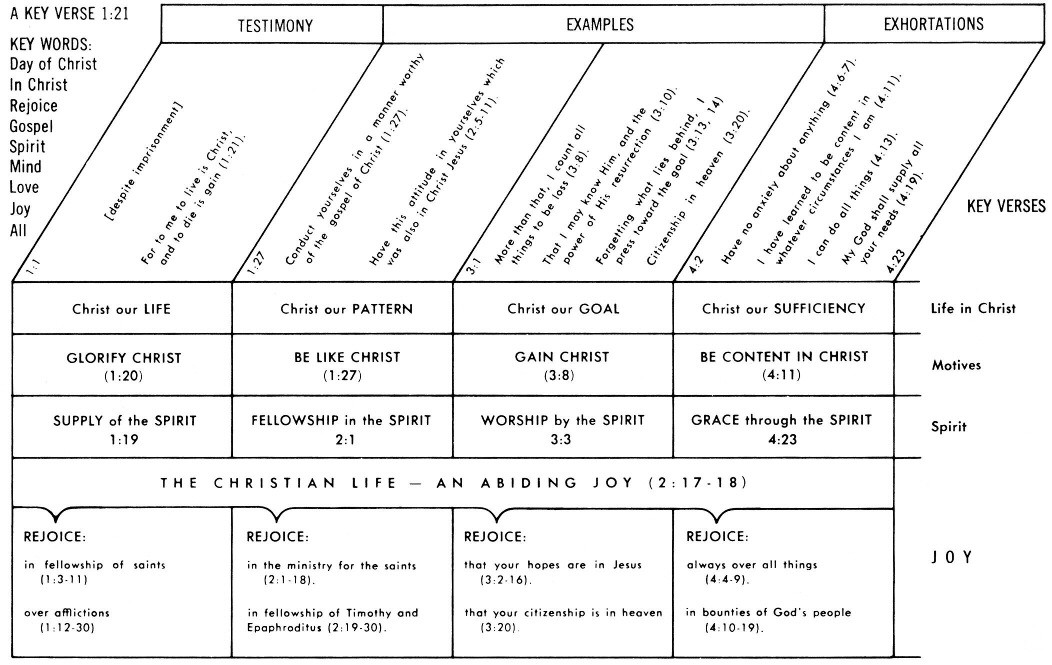
LIFE IN CHRIST
Click chart to enlarge
Charts from Jensen's Survey of the NT - used by permission
Philippians - Charles Swindoll = Chart on right side of page
| Account of Paul's Circumstances Php 1:1-30 |
Have the Mind of Christ Php 2:1-30 |
Have the Knowledge of Christ Php 3:1-21 |
Have |
| Partakers of Christ | People of Christ | Pursuit of Christ | Power of Christ |
| Suffering | Submission | Salvation | Sanctification |
| Experience | Examples | Exhortation | |
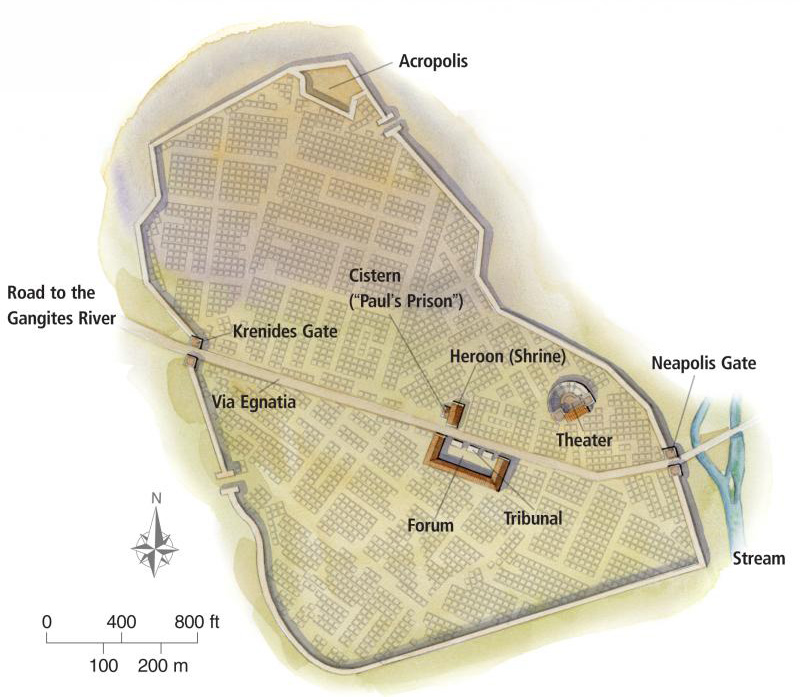
Philippi in the Time of Paul
The city plan above shows those features of the city of Philippi that archaeologists have so far identified as dating from the time of Paul. “Paul’s Prison” is not believed to be an authentic site, but was a cistern later associated with Christian worship. (ESV.org)
Philippians 2:17 But evenif I am being poured out (1SPPI) as a drink offering upon the sacrifice and service of your faith, I rejoice (1SPAI) and share my joy (1SPAI) with you all (NASB: Lockman)
Greek: alla ei kai spendomai (1SPPI) epi te thusia kai leitourgia tes pisteos humon chairo (1SPAI) kai sugchairo (1SPAI) pasin humin
Amplified: Even if [my lifeblood] must be poured out as a libation on the sacrificial offering of your faith [to God], still I am glad [to do it] and congratulate you all on [your share in] it. (Amplified Bible - Lockman)
KJV: Yea, and if I be offered upon the sacrifice and service of your faith, I joy, and rejoice with you all.
NLT: But even if my life is to be poured out like a drink offering to complete the sacrifice of your faithful service (that is, if I am to die for you), I will rejoice, and I want to share my joy with all of you. (NLT - Tyndale House)
Phillips: Yes, and if is should happen that my life-blood is, so to speak, poured out upon the sacrifice and offering which your faith means to God, then I can still be very happy, and I can share my happiness with you all.
Wuest: if also I am being poured out as a libation upon the sacrifice and priestly service of your faith, I rejoice and continue to rejoice with you all. (Eerdmans Publishing)
Young's Literal: but if also I am poured forth upon the sacrifice and service of your faith, I rejoice and joy with you all,
But even if I am being poured out as a drink offering upon the sacrifice and service of your faith: alla ei kai spendomai (1SPPI ) epi te thusia kai leitourgia tes pisteos humon:
- Phil 2:30; 1:20; Acts 20:24; 21:13; 2Co 12:15; 1Thes 2:8; 2Ti 4:6; 1John 3:16
- Php 4:18; Ro 12:1; 15:16; Heb 13:15,16; 1Pet 2:5)
But (alla) is a strong term of contrast.
Spurgeon on poured out - If he might be poured forth as a drink offering on their behalf, or offered up as a whole burnt offering in the service of the Savior, he would be glad. He could not bear to have lived in vain, but to spend his life for the glory of his Lord would be ever a joy to him.
Poured out as a drink offering (4689) (spendo) means to pour out an offering as an act of worship or ritual observance or as a libation. Paul is alluding to his possible martyrdom (which by tradition did become a reality).
The picture of poured out is from OT sacrificial system. As commanded in the book of Numbers, the people of Israel, as well as Gentiles who lived among them, were first to give a burnt offering of one of the prescribed animals, then a grain offering, and finally a drink offering (Nu 15:1-10). Pouring out as a drink offering refers to the topping off of an ancient animal sacrifice. The offerers poured wine either in front of or on top of the burning animal and the wine would be vaporized. That steam symbolized the rising of the offering to the deity for whom the sacrifice was made (cf. Ex 29:38, 39, 40, 41; 2Ki 16:13 ;Jer 7:18 ; Ho 9:4).
In OT sacrificial system this was the final offering that followed burnt and grain offerings prescribed for the people of Israel (Nu 15:1-16).
In Paul's last letter ever recorded, 2Timothy, the apostle pictured his coming death as his final offering to God in a life that had already been full of sacrifices to Him writing that...
I am already being poured out as a drink offering, and the time of my departure has come. (2Ti 4:6-note)
Just as he had offered himself to the Lord as “a living and holy sacrifice, acceptable to God” (see Ro 12:1-note) while he was alive, he now offered himself to the Lord in his death. He was
ministering as a priest the gospel of God, that [his] offering of the Gentiles might become acceptable, sanctified by the Holy Spirit (Ro 15:16-note).
Wuest adds that "The words “offered up” (Php 2:17KJV) are the translation of a Greek word used in the pagan Greek religions, of the drink-offering poured out upon the sacrifice itself, the latter being the major part of the offering to the gods, and the former, the minor part. Paul uses this drink-offering or libation to speak of the violent death he will some day die as a martyr. It will be his blood poured out. Indeed, during his second Roman imprisonment, knowing that he would shortly be sent to the executioner’s block for decapitation, he writes to Timothy, using the same word, “For I am now ready to be offered,” or as one could translate, “For my life’s blood is already being poured out” (2Ti 4:6-note). He uses the main sacrifice as an illustration of the Philippian saint’s Christian life and service. The Greek word for “sacrifice” used (Philippians Commentary - Verse by Verse)
Sacrifice (2378) (thusia from thúo = to sacrifice) is used metaphorically in the NT referring as here to one's service but also to obedience and praise.
Thusia was used for both pagan animal sacrifices and in the Septuagint, (some of the uses of thusia =
Ge 4:3, 5; 31:54; 46:1; Ex 10:25; 12:27; 18:12; 24:5; 29:34, 41f; 30:9; 32:6; Lev 1:9, 13, 17; 2:1, 2, 3, 4, 5, 6, 7, 8, 9, 10, 11, 13, 14, 15; 3:1, 3, 6, 9; 4:10, 26, 31, 35; 5:13; 6:14, 15, 20, 21, 23; 7:9-17, 15, 16, 17, 20, 21, 29, 32, 34, 37; 9:4, 17, 18; 10:12, 14; 14:10, 20f, 31; 17:5, 7f; 19:5; 21:6, 21; 22:21, 29; 23:13, 16, 18f, 37; 26:31)
Thusia - 28x in 28v -
Mt 9:13; 12:7; Mark 12:33; Luke 2:24; 13:1; Acts 7:41, 42; Ro 12:1; 1 Cor 10:18; Eph 5:2; Phil 2:17; 4:18; Heb 5:1; 7:27; 8:3; 9:9, 23, 26; 10:1, 5, 8, 11f, 26; 11:4; 13:15, 16; 1 Pet 2:5.
Service (3009) (leitourgia) (see word study of verb Leitourgeo) was used for used of the religious service of the Old Testament priests the religious service of the Old Testament priests.
Leitourgia - See the Septuagint, where leitourgia used in Ex 38:21; Nu 4:24, 27f, 33; 7:5, 7f; 8:22, 25; 16:9; 18:4, 6f, 21, 23, 31; 2Sam 19:18; 1 Chr 6:32, 48; 9:13, 19, 28; 23:24, 26, 28; 24:3, 19; 26:30; 28:13, 20f; 2 Chr 8:14; 31:2, 4, 16; 35:10, 15f; Ezra 7:19; Ezek 29:20
Williams - The apostle compares the self-sacrifice and energy of the Philippians with his own, magnifying theirs and minimizing his. They were both laying down their lives for the sake of the gospel, but their action he regards as the great sacrifice, and his as only the drink offering poured out upon it. Under this beauteous figure of speech, he speaks of his possible approaching death as a martyr. (George Williams, The Student’s Commentary on the Holy Scriptures, p. 931)
Wuest - What humility for the great apostle to rejoice at the fact that some day he would be the lesser part of the sacrifice poured out upon the major part, the Philippian’s Christian testimony and service to God. (Philippians Commentary - Verse by Verse)
Leitourgia - 6x in 6v - Luke 1:23; 2 Cor 9:12; Phil 2:17, 30; Heb 8:6; 9:21. NAS = ministry(2), priestly service(1), service(3).
The writer of Hebrews gives us a proper perspective on service...
Through Him (Christ, our Great High Priest) then, let us continually offer up a sacrifice of praise to God, that is, the fruit of lips that give thanks to His name. And do not neglect doing good and sharing, for with such sacrifices God is pleased. (He 13:15, 16-note)
William Plummer - The Scriptures do commend a very high degree of love to men. They say that "perhaps for a good man some would even dare to die." Ro 5:8-note. This is evidently spoken not in censure, but in praise of the self-sacrificing man. John is yet more explicit, and says that in certain cases "we ought to lay down our lives for the brethren." 1John 3:16. Paul furnishes us with an example of what John here teaches when he says to the Philippians, "If I be offered upon the sacrifice and service of your faith, I rejoice with you all." Phil 2:17. Now Paul did not love others more than the law requires; yet he was willing to suffer martyrdom, if thereby he could be most useful to his fellow-men. Surely this is loving our neighbor as ourselves. The thing is therefore not impracticable. Greater love than this is not required. (Vital Godliness)
Warren Wiersbe - Sacrifice and service are the twin children of humility. It is important to note that this sacrifice and service must often go unnoticed and unrewarded. “They have their reward!” If we blow a trumpet every time we help somebody, we will only nourish our pride and starve our humility. A cup of cold water for Jesus’ sake is all that He asks. Do not look for big opportunities “worthy” of your abilities. Those will come in due time. The great saints of the Bible started as servants, not rulers, and they were faithful over a few things before God made them kings. Moses tended sheep; Joseph was a steward; David was a shepherd; Jesus was a carpenter. Live with the eye of God upon you and forget the praise of others. Serve faithfully in the hidden place, and in due time God will lift you up. Every opportunity for service is an opportunity to exercise sovereignty in Christ. We reign in life by living to serve, to the glory of God. (Heirs of the King).
John Walvoord - The second chapter of Philippians falls naturally into four divisions. The chapter opens with four verses devoted to the exhortation to unity and humility. The second division deals with the humiliation and exaltation of Christ as the supreme illustration of the mind of Christ which should be in the believer. The exposition of what the mind of Christ is as manifested in working out one’s own salvation is contained in the third section, verses twelve to sixteen. In the concluding section, beginning with verse seventeen, a threefold illustration of the mind of Christ is offered in the life and witness of the Apostle Paul (Php 2:17-18), in Timothy (Php 2:19-24), and in Epaphroditus (Php 2:25-30). The mind of Christ as presented in this chapter therefore is not an unattainable ideal, but that which has been realized in large measure by those who have committed themselves completely to the will and service of the Lord.
The first illustration is that of Paul himself in which he speaks of his rejoicing in whatever measure God has used him to be of help to the Philippian church. He writes: “Yea, and if I be offered upon the sacrifice and service of your faith, I joy, and rejoice with you all. For the same cause also do ye joy, and rejoice with me.” Paul is here contemplating the possibility that his service for the Lord may result in his martyrdom. He therefore contemplates what would be his reaction if he, like a drink offering, were poured out. The word offered is literally “to be poured out,” a figure of speech which might refer to his own blood shed in martyrdom, but perhaps more generally to be understood as the offering or pouring out of his life. Whether as a sacrifice or in priestly service, Paul would rejoice in the sacrifice and service of God up to the time of his writing in which he and the Philippian church had joined. Like Paul, the church at Philippi rejoiced in its sacrifices for it was to the glory of God and in it Christ was magnified. In some real measure Paul approximated the mind of Christ in being like Christ, willing to suffer and die in achieving the will of God. (At the Name of Jesus)
John MacArthur - American society is breeding a generation of Christians who primarily want to be successful. Seldom do they have a humble attitude of service. They are unwilling to make sacrifices for the cause of Christ because they have been taught, whether verbally or not, that Christians should be rich, famous, successful, and popular. Such an orientation toward personal success rather than humble service is the opposite of what glorifies God. Living for the glory of God means knowing you are expendable and being ready to die, if necessary, to accomplish God’s ends. Such a humble attitude glorifies God. To grow spiritually, we must lose ourselves in the lordship of Christ at the moment of salvation and allow Him to dominate our lives from then on. In doing so, we must seek only His glory—not our own comfort and success. We will not grow when we choose our own way or serve God with the wrong motive. (Truth for Today)
John MacArthur - JOY AND GODLINESS “I rejoice and share my joy with you all” (Phil. 2:17).
True joy is directly related to godly living.
Philippians is often called the epistle of joy, and rightly so because the believer’s joy is its major theme. Paul loved the Philippian Christians, and they loved him. When they learned that he had been imprisoned for preaching the gospel, they were deeply concerned.
Paul wrote to alleviate their fears and to encourage their joy. Of his own circumstances he said, “Even if I am being poured out as a drink offering upon the sacrifice and service of your faith, I rejoice and share my joy with you all. And you too, I urge you, rejoice in the same way and share your joy with me” (Phil. 2:17–18).
Often a Jewish animal sacrifice was accompanied by a libation or drink offering (see, e.g., Num. 15:1–10). The animal was the greater sacrifice, the libation the lesser. Drawing from that picture, Paul placed greater significance on the faith and spiritual well-being of his readers than on his own life. To suffer for Christ’s sake brought him joy, and he wanted the Philippians to understand that perspective and to rejoice with him.
He also wanted them to understand that joy doesn’t operate in a vacuum. It’s directly related to godly living. Christ is its source, obedience its sustenance. We see this in David’s cry of repentance: “Restore to me the joy of Thy salvation” (Ps. 51:12). Paul knew the joy of the Lord because he trusted Christ and obeyed His will.
The scarcity of joy and godliness in the world today makes it imperative that Christians manifest those characteristics. As we do, others will see our good works and will glorify our Father in heaven (Matt. 5:16). (Drawing Near)
Oswald Chambers - Are you ready to be offered?
Yea, and if I be offered upon the sacrifice and service of your faith, I joy and rejoice with you all. Phil. 2:17.
Are you willing to be offered for the work of the faithful—to pour out your life blood as a libation on the sacrifice of the faith of others? Or do you say—‘I am not going to be offered up just yet, I do not want God to choose my work. I want to choose the scenery of my own sacrifice; I want to have the right kind of people watching me and saying, “Well done.” ’
It is one thing to go on the lonely way with dignified heroism, but quite another thing if the line mapped out for you by God means being a door-mat under other people’s feet. Suppose God wants to teach you to say, “I know how to be abased”—are you ready to be offered up like that? Are you ready to be not so much as a drop in a bucket—to be so hopelessly insignificant that you are never thought of again in connection with the life you served? Are you willing to spend and be spent; not seeking to be ministered unto, but to minister? Some saints cannot do menial work and remain saints because it is beneath their dignity. (My Utmost for His Highest)
I rejoice and share my joy with you all: chairo (1SPAI) kai sugchairo (1SPAI) pasin humin:
- 2 Co 7:4; Col 1:24; 1 Th 3:7, 8, 9)
Paul would gladly be poured out in martyrdom on the sacrifice and service of their faith. If this should be his lot, he would rejoice that it should be so.
Rejoice (5463) (chairo) means to be be cheerful and to enjoy a state of happiness and well-being. The present tense indicates this was Paul's continual attitude and action. How? Only a man continually filled with the Spirit (Eph 5:18-note) can bear the fruit of joy continually! How does your garden grow?
Share joy (4796) (sugchairo from sun = together, speaks of an intimate union + chairo = rejoice) means to rejoice together and thus to share in another’s joy.
David Black...
To animate us to the exercise of pure and unselfish zeal, let us recall to our minds the example of the best and holiest men who have lived in past ages.
"All seek their own interests, not those of Jesus Christ." And too much cause has there been for the same complaint in every period of the church. But, blessed be God, there have been and still are many noble examples of the contrary spirit. The Lord has not lacked faithful witnesses to his truth, from the earliest ages of the world through all succeeding generations to the present times. But in none was this blessed temper ever more conspicuous, than in Paul himself, the apostle whose words we are now considering. How ardent and unselfish was the zeal of this great apostle, for the honor of his Master! From the time that his Lord met him on his way to Damascus, to the close of his life, a period of more than thirty years, his whole soul was engaged in devising and carrying into execution schemes for the advancement of the Redeemer's kingdom. Sometimes the apostle met with ungrateful returns from those whose best interests he labored to promote; but even ingratitude itself could not damp the generous ardor of his love. Speaking to the Corinthians, he says, "I will most gladly spend and be spent for you. If I love you more, am I to be loved less?" (2Cor 12:15)
In the prosecution of this arduous work, the apostle was sometimes exposed to incredible dangers and hardships. But none of these things moved him, neither did he count his life dear to himself, that he might finish his course with joy. Yes, says he (Phil. 2:17), and if I am offered upon the sacrifice and service of your faith, I joy and rejoice with you all. (The Duty of Seeking the Things Which Are Jesus Christ)
Philippians 2:18 You too, I urge you, rejoice in the same way and share your joy (2PPAM) with me. (NASB: Lockman)
Greek: to de auto kai humeis chairete (2PPAM ) kai sugchairete ( 2PPAM) moi.
Amplified: And you also in like manner be glad and congratulate me on [my share in] it. (Amplified Bible - Lockman)
KJV: For the same cause also do ye joy, and rejoice with me.
NLT: And you should be happy about this and rejoice with me. (NLT - Tyndale House)
Phillips: I should like to feel that you could be glad about this too, and could share with me the happiness I speak of. (Phillips: Touchstone)
Wuest: But as for you, you even be rejoicing in the same thing and continue to rejoice with me. (Eerdmans Publishing)
Young's Literal: because of this do ye also rejoice and joy with me.
You too I urge you rejoice in the same way: to de auto kai humeis chairete (2PPAM):
- Php 3:1; 4:4; Ep 3:13; Jas 1:2, 3, 4
I urge - Not in the Greek but added for clarity.
In the same way (KJV "for the same reason") - The Philippians should be glad and rejoice with Paul and so he commands them to do so. They should not look on his possible martyrdom as a tragedy but congratulate him on such a glorious departure.
Both verbs (rejoice and share joy) are present imperative commanding this to be their lifestyle.
John Phillips - Paul had a stake in the Philippians and they had a stake in him. They were supporting him, helping to supply his financial needs, and ministering to him in prison. They were to rejoice in him just as he rejoiced in them.
By way of application to our daily Christian life which is to be a joy filled testimony (See Ps 16:11-note, Jn 15:11,16:24, 17:13, 2Ti 1:4-note, cp 1Pe 1:8-note, 1Jn 1:4, 2Jn 1:12) to a deeply despairing (no hope) world, simply try to do this in your own strength, your natural energy! You might succeed for a moment or two but for this to be one's lifestyle requires continual dependence upon a supernatural Source, and calls for the believer to continually submit to the control of the Holy Spirit (cp Eph 5:18-note, Gal 5:22-note)
Rejoice (5463) (chairo) means to be be cheerful and to enjoy a state of happiness and well-being.
and share your joy with me: kai sugchairete (2PPAM) moi :
Share...joy (4796)(sugchairo from sún = together + chairo= rejoice) means to rejoice together and thus to share in another’s joy. What a great thing to share!
Spurgeon on share your joy - To live and to die for Jesus Christ, with the blessing of the Father resting upon us, is a matter for us to joy in unitedly and continually. God help us so to do!
MacArthur - Because Paul and the Philippians had sacrificed and served together, they were able to rejoice together. Using the same word (sunchairō) that he had just used of himself, he now admonishes them, You too, I urge you, rejoice in the same way and share your joy with me.
A T Robertson - Joy is mutual when the service is mutual. Young missionaries offer their lives as a challenge to other Christians to match their money with their blood.
John Phillips sums up chapter 2:1-18 - We see the relevance of Paul's pointing to Christ as the supreme example of triumph in sacrifice. What Paul was getting at is clear. In effect he was saying to the Philippians: "Your petty squabbles will soon tear the heart out of your testimony. There needs to be a transformation in your conduct, in your character, and in your concepts. You need a whole new view of the Christian life. You need to keep Calvary in mind. You need to think about Jesus, who is the living secret of holiness. Think about the path He pursued from Heaven's heights, to the cross of shame, and back to the throne of power at God's right hand. Think of His inestimable offering on the altar of sacrifice and service. Think of the libation of His blood. Think about Him 'who for the joy that was set before him endured the cross, despising the shame' (Hebrews 12:2). Look at your lives in the light of His cross. You too should be burning up for God. I myself am likely to be martyred-in any case I am a living martyr, dying daily (1 Corinthians 15:31). When we live in the light of Calvary, how can there be any room for murmurings and disputings?"
PHILIPPIANS 2:19 ENCOURAGERS
Read: Acts 27:21-36
I long to see you . . . that I may be encouraged together with you. . --Romans 1:11-12
Discouragement is a problem for many Christians. While they may not be distressed about health, family, or work, they're discouraged about their spiritual service. They compare themselves to others who are gifted with musical talents or the ability to teach the Bible. They see people who are able to give generously and pray with evident effectiveness, but they think they can't do these things. As a result, they feel they are useless to God. They need to realize, however, that every Christian is qualified to carry on at least one helpful ministry--the ministry of encouragement.
Renowned preacher Robert Dale was walking one day in Birmingham, England, where he was pastoring the great Carr's Lane Church. He was under a dark cloud of gloom when a woman came up to him and exclaimed, "God bless you, Dr. Dale. If you could only know how you have made me feel hundreds of times!" Then off she hurried. Dale later testified, "The mist broke, the sunlight came, and I breathed the free air of the mountains of God."
The apostle Paul knew how important it was not only to be encouraged by others (Phil. 2:19) but to be an encourager (Acts 20:2; 27:35-36). That's a ministry all of us can be involved in. --V C Grounds
It may seem insignificant
To say a word or two,
But when it is encouragement,
What wonders it can do! --K. De Haan
Even if you have nothing else to give, you can always give encouragement.
AGAIN the Apostle refers to the "day of Christ." He was constantly anticipating the coming of the Lord. His early Epistles specially abound in references to that event which would bring to light the hidden things of darkness, and make manifest the counsels of all hearts, so that each man should have his praise from God. He spoke of his being alive and remaining unto the coming of the Saviour, and as anticipating that his mortality would be swallowed up of life. Often, amid his imprisonment, he must have listened for the sounding of the trumpet of God, and the songs which accompanied his returning Lord. Invariably he so lived and laboured, that whenever that day came, whether to close his earthly life or afterwards he might receive the reward, which would be to him what the crown of amaranth was to the successful competitor in the games.
Paul's Great Fear. Paul's incessant fear was that he might run or labour in vain. There are many expressions of it. In one place he expresses the fear lest all the work which he had built upon the foundation, which God had previously laid, should be burned up, and he should suffer loss; in another he gives utterance to the dread lest he should be a castaway (or rejected) as one who had no right to the prize; here, he uses the words "in vain" as though some mistake on his part should obliterate all the results of the work, which he had laboriously sought to achieve for his Lord.
How is it with us? A very solemn inquiry is suggested to us all. Are we running in vain? Are we labouring in vain? Life is full of running to and fro, and incessant labour, but we may gravely ask whether at the end there will be aught to show commensurate with the energy we have expended. So many days are lived in vain! So many books are written in vain! So many sermons preached in vain! So many philanthropic activities expended in vain!
A Condition of Success. It is, however, certain that before any service that we do for God or man is likely to be of lasting and permanent benefit, it must be saturated with our heart's blood. That which costs us nothing will not benefit others. If there is no expenditure of tears and prayer, if that love, of which the Apostle speaks in another place, which costs, is wanting, we may speak with the tongues of men and of angels, may know all mysteries and all knowledge, may bestow all our goods to feed the poor, but it will profit nothing. Let us rather seek to be poured forth as a libation than to do much without feeling the least travail of soul. As the fertility of Egypt in any year is in direct proportion to the height that the waters of the Nile measure on the Nilometer, so the amount of our real fruitfulness in the world is gauged by the expenditure of our spiritual force.
It was because Moses was prepared to be blotted from the Book of God for his people that he carried them for forty years through the desert, and deposited them on the very borders of the Promised Land. It was because Jesus wept over Jerusalem that He was able to send a Pentecost on the guilty city. It was because Paul was prepared to be accursed for his brethren according to the flesh, that he was able to turn so many from darkness to light, and from the power of Satan unto God. It is when Zion travails that she brings forth her children. No heart pangs, no spiritual seed.
The Call for Sacrifice. The Christian life should be a sacrifice. Where faith in Christ is a reality, it will lead not simply to a life service, which becomes a liturgy, but also to sacrifice. "I beseech you, therefore, brethren, by the mercies of God to present your bodies a living sacrifice, holy, well-pleasing to God, which is your reasonable service."
There is only one sacrifice which can take away sin, and which was offered once for all. "When He had offered one sacrifice for sins, forever He sat down on the right hand of God": "By one offering He hath perfected forever them that are sanctified." But the whole Church of God is called to follow the Master's steps in the sacrifice of her life for men. She must fill up that which is behind of the sufferings of Christ; she must be prepared to suffer with Him; she must surrender the joy that is set before her of ease, and luxury, and earthly power, in order that she may go out to her Lord without the camp, bearing His reproach. He is the Lamb of God which taketh away the sin of the world, and by His one sufficient sacrifice has opened the way into peace, but there is a sacrifice of what the world deems choicest and best in order that the highest interest of men should be better served, which is the peculiar prerogative, not only of the Church of Christ collectively, but of each individual soul.
Have we our Sacrifice? Is there sacrifice in your life and mine? I knew, for instance, of the case of a young girl, who promised her mother upon her dying bed, that she would not accept an offer of marriage until she had seen the younger children well started in life, and had performed the last offices for her father. I do not here comment upon the unwisdom of a mother exacting such a pledge from her child, but only cite the fact. As a result, when, three years after her mother's death, Love looked into the window of that girl's soul, and one who was altogether suitable for her asked her to be his wife, she felt bound to refuse, and nobly stood by her charge until the whole family passed out of her care into homes of their own. It was a supreme relinquishment of all that a woman holds dearest, but how noble it was!
Is not sacrifice of this sort constantly being demanded of us, have we not all to turn from the doors that stand wide open on our mountains of transfiguration, in order to descend into the valley, where the cross of self-denial stands with wide-open arms, awaiting us? Whenever such is the case, our faith is working out in sacrifice, our obedience to the will of God is enabling us to surrender all things, that we may more efficiently do the high work of Jesus for others. We may well doubt whether we are true followers of the Crucified, or have entered into any true experience of His religion, unless there is the trace of the Cross somewhere, whether known to men, or known only to Christ.
When a deluded man set himself up as the Christ of to-day, the indignant crowd that gathered around the doors of his church demanded that he should show them his hands, meaning that if he were the Christ, the marks of the nails would certainly be apparent. It was a just request. People know well enough that Christ stands for sacrifice, and that His followers can expect no better treatment than He experienced. And again we may put the question to ourselves: Does our faith cost us anything, and is our service to man and God often sealed by blood?
Paul Ready to be Offered. The Apostle was willing to yield his life's blood as a libation. Moses said, "He that offereth his oblation must offer wine for the drink offering, the fourth part of an hin shall he prepare with the burnt offering or for the sacrifice, for each lamb" (Nu. 15:5). This was doubtless in the Apostle's mind when he spoke of being poured out as a drink offering upon the sacrifice and service of their faith.
What unity there was between his sufferings in Rome and theirs in Philippi! It seemed to him as though they had reached a common altar, and were engaged in one common act of devotion. Not only did their faith lead them to considerable sacrifice in order to supply his needs, but it was likely to extort a still greater surrender, even of life itself in the defence of the truth; but in that same cause it was not improbable that sooner or later he would have to shed his blood. There was indeed an if in the case. "If I am offered," etc., but whilst Nero was on the throne, and the hatred of the Jews so virulent, there was little hope that he would escape.
The prospect, however, did not fill him with dread. On the contrary, he anticipated it as though it were a marriage. The thought that he was consummating the faith and service of the Philippians, who had first learnt to love God through his ministry, was a cause of infinite delight.
The Joy of Sacrifice. It was thus that the martyrs pressed to the scaffold and stake, rejoicing that they were counted worthy to suffer for Christ's name. So great was the enthusiasm in the early days, that the Church authorities had to publish edicts, prohibiting the Christians of their time from hazarding their lives, or throwing them needlessly away. When once the soul has caught sight of the true significance of life, and has learnt the privilege which is within its reach, of identifying itself with the Son of God in His great act of Redemption, a similar glow of joy begins to cast its radiance over passages of life that hitherto had been dark and forbidding. The joy of the Lord becomes a source of altogether new strength. Partnership with Jesus in the redemption of the world, opens the door to partnership in those fountains of blessedness that rise within His soul, and to which He referred, when He said, "Your heart shall rejoice, and your joy no one taketh from you"; "These things have I said unto you that My joy might remain in you, and that your joy might be full." (F. B. Meyer. The Epistle to the Philippians)