Philippians 2:2
Philippians 2:3
Philippians 2:4
Philippians 2:5
Philippians 2:6
Philippians 2:7
Philippians 2:8
Philippians 2:9
Philippians 2:10
Philippians 2:11
Philippians 2:12
Philippians 2:13
Philippians 2:14
Philippians 2:15
Philippians 2:16
Philippians 2:17
Philippians 2:18
Philippians 2:19
Philippians 2:20
Philippians 2:21
Philippians 2:22
Philippians 2:23
Philippians 2:24
Philippians 2:25
Philippians 2:26
Philippians 2:27
Philippians 2:28
Philippians 2:29
Philippians 2:30


LIFE IN CHRIST
Click chart to enlarge
Charts from Jensen's Survey of the NT - used by permission
Philippians - Charles Swindoll = Chart on right side of page
| Account of Paul's Circumstances Php 1:1-30 |
Have the Mind of Christ Php 2:1-30 |
Have the Knowledge of Christ Php 3:1-21 |
Have |
| Partakers of Christ | People of Christ | Pursuit of Christ | Power of Christ |
| Suffering | Submission | Salvation | Sanctification |
| Experience | Examples | Exhortation | |
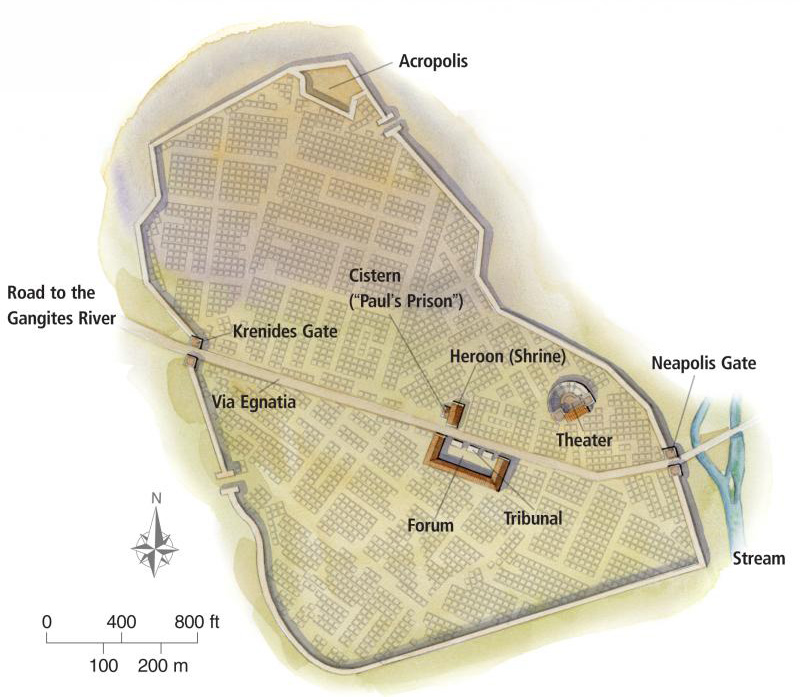
Philippi in the Time of Paul
The city plan above shows those features of the city of Philippi that archaeologists have so far identified as dating from the time of Paul. “Paul’s Prison” is not believed to be an authentic site, but was a cistern later associated with Christian worship. (ESV.org)
Philippians 2:19 But I hope in the Lord Jesus to send Timothy to you shortly, so that I also may be encouraged (lit = have good soul) when I learn of your condition. (NASB: Lockman)
Greek: Elpizo (1SPAI) de en kurio Iesou Timotheon tacheos pempsai (AAN) humin hina kago eupsucho (1SPAS) gnous (AAPMSN) ta peri humo
Amplified: But I hope and trust in the Lord Jesus soon to send Timothy to you, so that I may also be encouraged and cheered by learning news of you. (Amplified Bible - Lockman)
Barclay: I hope in the Lord Jesus soon to send Timothy to you, that I may find out how things are going with you and take heart. (Westminster Press)
KJV: But I trust in the Lord Jesus to send Timotheus shortly unto you, that I also may be of good comfort, when I know your state.
Lightfoot: But though absent myself, I hope in the Lord to send Timotheus shortly to you. This I purpose not for your sakes only but for my own also; that hearing how you fare, I may take heart.
NLT: If the Lord Jesus is willing, I hope to send Timothy to you soon. Then when he comes back, he can cheer me up by telling me how you are getting along. (NLT - Tyndale House)
Phillips: But I hope in Jesus Christ that it will not be long before I can send Timothy to you, and then I shall be cheered by a first-hand account of you and your doings. (Phillips: Touchstone)
Wuest: But I am hoping in the Lord Jesus quickly to send Timothy to you, in order that I also may be of good cheer, having come to know of your circumstances. (Eerdmans Publishing)
Young's Literal: And I hope, in the Lord Jesus, Timotheus to send quickly to you, that I also may be of good spirit, having known the things concerning you,
But I hope in the Lord Jesus to send Timothy to you shortly: Elpizo ( 1SPAI ) de en kurio Iesou Timotheon tacheos pempsai (AAN) humin
- Php 2:24 Jer 17:5 Mt 12:21 Ro 15:12 Eph 1:13 2Ti 1:12 Jas 4:15 1Pe 1:21
- Phil 2:23;25, 1:1; Ro 16:21; 1Co 4:17; Ep 6:21, 6:22; Col 4:8, 4:9; 1Th 3:2, 3:6
- Philippians 2 Resources - Multiple Sermons and Commentaries
- Philippians 2:19-30 Worth Imitating - Steven Cole
- Philippians 2:19-24 Model Spiritual Servants: Timothy - John MacArthur
- Philippians 2:19-24 Anti-Model of Leadership - John MacArthur
EXAMPLES OF
FAITHFUL FRIENDS
Ryrie's Outline of Philippians 2
The Pattern of the Christian Life: The Humility of Christ, Php 2:1-30
A. The Exhortation to Humility, Php 2:1-4
B. The Epitome of Humility, Php 2:5-11
C. The Exercise of Humility, Php 2:12-18
D. The Examples of Timothy and Epaphroditus, Php 2:19-30
Guy King titles Php 2:19-30 A Couple of Fine Specimens - WE have just been thinking about lights, and here now we have two magnificent examples. Two Christian men utterly consistent, good, through and through. It used to be said that the difference between linoleum and cork-linoleum was that in the one the pattern was on top and eventually wore off, but in the other the pattern went right through. This was the style of these two men - Christian all through, inward and outward.The late beloved Taylor Smith used to say, "It isn't the label on the bottle, but what's inside". With Epaphroditus and Timothy the two coincided - Christian in name, Christian in nature....Suppose GOD planned to send you to some dark pagan corner of the globe to be His light to benighted, groping, heathen souls, would you go? Said Henry Martin, on the eve of his departure for the dark mission-field, "I go to burn out for GOD." Would you be prepared for that, if it proved to be GOD'S will for you? Here before us are two men ready, any moment, to go anywhere on Paul's errands in the service of the Master. (Joy Way)
Brian Bill in his sermon on Php 2:19-30 entitled "Finding Faithful Friends" writes "It has been said that an individual is fortunate if they have five good friends in their life time. George Barna, in his book, “What Americans Believe,” wrote, “Americans are among the loneliest people on earth.” Maybe it is because of our fast-paced society or it is due to our rugged American individualism but many of us struggle to find friends. We saw this phenomena clearly in the 1990s when the two most popular television shows were both about groups of friends trying to find their way together – “Seinfeld” and “Friends.” Friendships can be based on a common goal like catching bad guys [Scooby Do and Shaggy], or trying new careers [Paris and Nicole], or trying to win an election [Napoleon Dynamite and Pedro]. A friend can encourage, affirm, and even rebuke. You can trust a friend with your secrets and with your valuables. A person may have many acquaintances and several casual connections, but good friends are hard to find. We were created for community and function more fully when flanked by faithful friends." The Apostle Paul did not need lettering on the back of jackets or name tags. He knew people’s names and people knew him. Paul was a pal to many. In the sixteenth chapter of Romans, he lists thirty-five friends by name. In fact, in many his letters he mentions by name individuals that he has built relationships with through ministry. He highlights two of his friends in Phil 2:19-30. If you read the passage for this week ahead of time, you may have been a little confused. Chapter two begins with the beautiful “Christ Hymn” then moves on to encourage us to “shine like stars.” Paul then starts going into his travel plans. Why would he do that? In chapter one and two of Philippians Paul is making a point. Paul encourages the Christians at the church in Philippi to “…conduct yourselves in a manner worthy of the Gospel of Christ.” (Philippians 1:27) In chapter two, Paul gives four extreme examples of Christian conduct – Jesus Christ (Php 2:5-11), Paul himself (Php 2:17-18), Timothy (Php 2:19-24), and Epaphroditus (2:25-30). His “travel plans” include these two friends.
Kent Hughes sets the context for why he would give us two "character studies" in Php 2:19-30: Paul’s thought goes like this: In Php 1:27–30 he instructs the Philippians on how to live lives worthy of the gospel in relation to the surrounding pagan world—namely, by “standing firm in one spirit, with one mind striving side by side for the faith of the gospel” (Php 1:27). In doing this Paul tells them not to be “frightened in anything” (Php 1:28) and that it has been granted them to “not only believe in him but also suffer for his sake” (Php 1:29). This is the face and disposition with which the Philippians are to live in this world. Next, in Php 2:1–4, Paul tells the Philippians how to live lives worthy of the gospel within the fellowship of the church. Very specifically, they were to treat each other with selfless humility: “Do nothing from rivalry or conceit, but in humility count others more significant than yourselves. Let each of you look not only to his own interests, but also to the interests of others” (Php 2:3, 4). Paul viewed all of this as so vital that in Php 2:5–11 he reached for the ultimate example of Christ, saying “Have this mind among yourselves, which is yours in Christ Jesus,” and used the most exalted language to describe Christ’s astonishing self-humiliation and super-exaltation (Php 2:6–11). Then, in Php 2:12–18, on the basis of Christ’s example Paul again refocused his call for the church to walk worthy of the gospel of Christ: “work out your own salvation with fear and trembling, for it is God who works in you, both to will and to work for his good pleasure” (Php 2:12, 13). If the church does this, its people will shine as lights amidst a crooked and twisted generation as they hold fast to the gospel. This will be cause for multiple and mutual rejoicings! Now in Php 2:19–30 Paul gives flesh-and-blood examples of the selfless conduct to which he is calling the Philippian church. Here are men who live lives “worthy of the gospel of Christ.” (Preaching the Word: Philippians)
Alan Carr also emphasizes Paul's friendships writing - As one reads the epistles of Paul the Apostle , it is easy to see that he crossed paths with many different individuals. Some of these individuals, it would seem, were a great hindrance to his work for the Lord, 2 Tim. 2:14; Phil. 1:16; 1 Tim. 1:19-20. However, most of the people Paul met were a great blessing to his life and ministry. Paul closes nearly everyone of his letters with a personal note to some of these very special people. In the last chapter of the book of Romans, Paul mentions at least 35 people by name! Contrary to the trend in our modern society, Paul was a man who made friends as he traveled through life. Too many in our day want to isolate and insulate themselves from others. (An Anatomy of a Lovely Christian)
Lehman Strauss - We are about to be introduced to two worthy men of God, fine examples of all that Paul has been teaching us in this second chapter. We have just been learning about "lowliness" (Php 2:3KJV) and about "lights" (Php 2:15); and now we have in two of Paul's partners magnificent examples of both. Timothy and Epaphroditus are here set before us as witnesses to the possibility of self-renounced and sacrificial living.
Vincent writes that "but" (see term of contrast) offsets the possibility at which he has hinted in (poured out as a sacrifice), and which he knows is disturbing the minds of his faithful friends at Philippi.
MacDonald - Up to this point, Paul has cited two examples of self-sacrificing love—the Lord Jesus and himself. Both were willing to pour out their lives to death. Two more examples of selflessness remain—Timothy and Epaphroditus. (Believer's Bible Commentary)
Ryrie - The letter now returns to personal matters. Paul was going to send Timothy later and Epaphroditus right away; he wanted them to be accepted as his representative with his authority. No one else with him then, except Timothy, had the interest of Christ at heart (Php 2:21). Epaphroditus was a leader in the Philippian church who brought the financial gift to Paul and whom Paul sent home with this letter (Php 2:25). (The Ryrie Study Bible)
Hendriksen - Paul, the joyful servant of Jesus Christ, the optimistic prisoner, the humble cross-bearer, is also the thoughtful administrator. Even from his prison in Rome he manages in a masterly fashion the spiritual terrain entrusted to his care, so that we marvel at his practical wisdom, gracious consideration of the needs and feelings of others, and delightful unselfishness. Are the Philippians anxious to receive a report about the verdict that is about to be pronounced regarding Paul? As soon as this decision is known, a messenger will be rushed to Philippi with the news. See Php 1:23. However, the apostle wants the Philippians to know that he is as concerned about them as they are about him. In fact, it is of importance to note that the first reason which he mentions for dispatching someone to Philippi is that he, Paul, may be brought up to date in his information concerning them... Although in this letter Paul never entirely dismisses from his mind the possibility of an unfavorable verdict (Php 1:20, 21, 22, 23; 2:17, 18, 23), yet his expectation of an imminent acquittal and release predominates (Php 1:25, 26; 2:19; 2:24; cf. Philemon 1"22). He is full of hope. This hope is, of course, “in the Lord Jesus” (Php 1:8, 14; 2:24; 3:1). It is cherished in complete and humble subjection to him who alone is Lord, sovereign Ruler of all, the One with whom the apostle is living in intimate fellowship. (New Testament Commentary: Baker Book House)
Remember that the major emphasis of this chapter is "others", specifically becoming a servant and the major exhortation is to have the same attitude in ourselves that was in Christ Jesus. If Christ is my life in Chapter 1 then Christ can be my attitude in Chapter 2.
I hope in the Lord Jesus to send Timothy to you shortly: Notice that in Pp 2:19-30 Paul is clearly focused on communication and his method is to send special messengers - see send (Timothy in Php 2:19), send (Timothy in Php 2:23), send (Epaphroditus in Php 2:23), sent (Epaphroditus in Php 2:28). Timothy had accompanied Paul on his first trip to Philippi (see Acts 16:1-3, 12; 17:15; 18:5; cp. Acts 19:22).
Hope (1679) (elpizo related to noun elpis) means to look forward with confidence to that which is good and beneficial. As much as Paul valued Timothy, his hope was not in Timothy but in the Lord. The present tense indicates that this is Paul's continual desire.
Elpizo - 31x in 31v -
Matt 12:21; Luke 6:34; 23:8; 24:21; John 5:45; Acts 24:26; 26:7; Rom 8:24f; 15:12, 24; 1 Cor 13:7; 15:19; 16:7; 2 Cor 1:10, 13; 5:11; 8:5; 13:6; Phil 2:19, 23; 1 Tim 3:14; 4:10; 5:5; 6:17; Philemon 1:22; Heb 11:1; 1 Pet 1:13; 3:5; 2 John 1:12; 3 John 1:14
In the Lord Jesus - This phrase emphasizes that the believer hopes, loves, boasts, labors, etc., in the Lord. In context, the idea of the preposition "in" signifies "The sphere or element in which his hope moves. (cf. Php 1:8, 14, 3:1; Ro 9:1, 14:14; 1Co 1:31, 7:39, etc.)" (Vincent)
Hughes adds this note on in the Lord Jesus - This is not a glib cliché. This is the way Paul lived, as other outtakes from his letters make clear: “if the Lord wills” (1 Corinthians 4:19) and “if the Lord permits” (16:7)—Deo volenti. (Ibid)
Paul says in effect, “My hope is not an idle one, but one that is founded on faith in the Lord.” This phrase emphasizes that Paul’s every thought, word, and deed proceeded from the Lord as the center of his volition. Could the same be said about me?
Matthew wrote regarding Jesus that "IN HIS NAME THE GENTILES WILL HOPE." (Mt 12:21)
In his first epistle to Timothy we read about the ultimate source of hope "Paul, an apostle of Christ Jesus according to the commandment of God our Savior, and of Christ Jesus, who is our hope (1Ti 1:1)
In Romans Paul emphasizes the association of hope and Jesus writing 'And again Isaiah says, "THERE SHALL COME THE ROOT OF JESSE, AND HE WHO ARISES TO RULE OVER THE GENTILES, IN HIM SHALL THE GENTILES HOPE." (Ro 15:12-note)
Peter also associates hope and God writing "For He was foreknown before the foundation of the world, but has appeared in these last times for the sake of you who through Him are believers in God, who raised Him from the dead and gave Him glory, so that your faith and hope are in God. (see notes 1 Peter 2:20; 21)
Wuest adds that "The phrase “in the Lord” tells us that Paul’s every thought, word, and deed proceeded from the Lord as the center of his volition. Paul says in effect, “My hope is not an idle one, but one that is founded on faith in the Lord.” (Philippians Commentary - Verse by Verse)
Since all believers are in Christ (see related topics - in Christ and in Christ Jesus), this vital union should influence every thought and activity.
Dwight Edwards writes that "Though Paul couldn't be there himself, he felt responsible for their spiritual welfare. So, first he writes them this letter. Now, he tells of his expectation to send Timothy to them. "Hope" is more than a wishful hope--it is "confident expectation." Note where Paul's expectation was grounded. Not in Timothy but the Lord Jesus. The same Lord who commissioned Paul would also send Paul's son in the faith. Note the sense of urgency Paul is feeling towards these believers. He didn't just leave their spiritual maturity up to God, he felt keenly responsible also." (Sermon)
Wayne Detzler - In the second chapter of Philippians Paul spotlights communication. His method is ‘sending’ special messengers with significant messages. Our focus falls on the simple word ‘to send’, or pempo as it is in Greek. So common is this term that it turns up seventy-nine times in the New Testament, and four of those references are in Philippians chapter 2. First of all, Paul proposes to propel Timothy. ‘I hope in the Lord Jesus to send Timothy to you soon’, writes Paul, ‘that I also may be cheered when I receive news about you’ (Phil. 2:19). Just below this first reference, the apostle adds, ‘I hope, therefore, to send him as soon as I see how things go with me’ (Phil. 2:23). Obviously this tells us something about Paul’s concern, but it conveys even more about Timothy. He is a ready messenger. Although communication was slower by personal emissary, it was no less satisfying than modern media. In fact, Paul here commends Timothy as an able ambassador. He is ready to go anywhere, to help anyone and to pay any price. (ILLUSTRATION OF A "SENT ONE") Missionary history abounds with Timothy’s spiritual soul brothers and sisters. One recent example must be C. T. Studd (1862–1931). The England cricketer sailed for China in 1885, only to be invalided home in 1894. Undaunted he served in India 1900–1906, before retiring through illness. This was only the prelude to his main work in Africa 1912–31. Like Timothy, Studd was God’s messenger boy. (Living Words in Philippians)
F. B. Meyer said, ‘I have only one ambition: to be God’s errand boy.’
Lord, send me,
Oh, send me forth, I pray!
The need is great.
Thy call I will obey.
Thy love compels me,
I must go.
I’m longing, ready,
Willing to go.
C. T. Studd bore much fruit for the Saviour while in Africa as he endured weakness and sickness; loosing most of his teeth and suffering several heart attacks; but he endured hardness as a good soldier of the Lord Jesus Christ!
In a letter home, C. T. gave a last backward look at the outstanding events of his life:
"As I believe I am now nearing my departure from this world, I have but a few things to rejoice in; they are these:
1. That God called me to China and I went in spite of utmost opposition from all my loved ones.
2. That I joyfully acted as Christ told that rich young man to act.
3. That I deliberately at the call of God, when alone on the Bibby liner in 1910, gave up my life for this work, which was to be henceforth not for the Sudan only, but for the whole unevangelized World.
My only joys therefore are that when God has given me a work to do, I have not refused it."
Shortly after 10:30 p.m. on a July day in 1931, C. T. Studd went home to be with His Lord whom he had loved so dearly and served so faithfully! The last word he spoke was "Hallelujah"!
Timothy (Greek Timotheus) (Holman Dictionary Article) (and later Epaphroditus) are now cited as two more examples of self-sacrificing love (the previous examples being the Lord Jesus and Paul himself) and all were willing to pour out their lives to death for the sake of others. Where are the men of like minded selflessness, passion and conviction in the church in America today?
Timothy -
- Kindred spirit
- Concern for others
- Proven
Brian Bill gives a brief background on Timothy - Timothy was originally from Lystra in modern-day Turkey. He grew up in a multicultural house with a Greek father and a Jewish-Christian mother and grandmother. His heritage belies some confusion. His name means “one who honors God” but he was not circumcised as was the Jewish custom. This exposure to Greek and Jewish traditions served him well as he helped Paul spread the Gospel to Gentiles. Paul had led Timothy to the Lord at a young age and Timothy was instrumental in Paul’s ministry very early on. Timothy was with Paul in Corinth (Acts 18:5), was sent into Macedonia (Acts 19:22), was with Paul on the return trip from Jerusalem (Acts 20:4), and assisted Paul in the writing of Romans (Romans 16:21), 2 Corinthians (2 Cor 1:1), Philippians (Phil 1:1), Colossians (Col 1:1), 1 and 2 Thessalonians, and Philemon. It has been said that Timothy was Paul’s “sole authorized representative” of the Gospel. For years Paul had relied on Timothy. Paul was under house arrest in Rome and he is not quite ready to send him to Philippi.
so that I also may be encouraged when I learn of your condition: hina kag o eupsucho (1SPAS) gnous (AAPMSN) ta peri humo:
- Phil 2:28; 1Th 3:6, 7, 8; 2Th 1:3; Philemon 1:5, 6, 7; 3Jn 1:3 1:4)
that I also may be cheered when I receive news about you (NIV)
This I purpose not for your sakes only but for my own also; that hearing how you fare, I may take heart (Lightfoot)
in order that I also may be of good cheer, having come to know of your circumstances (Wuest - Eerdmans Publishing)
So that (hina) - see value of observing and interrogating terms of purpose or result.
John Walvoord explains how this mention of Timothy fits with the overall context - The second chapter of Philippians falls naturally into four divisions. The chapter opens with four verses devoted to the exhortation to unity and humility. The second division deals with the humiliation and exaltation of Christ as the supreme illustration of the mind of Christ which should be in the believer. The exposition of what the mind of Christ is as manifested in working out one’s own salvation is contained in the third section, verses twelve to sixteen. In the concluding section, beginning with verse seventeen, a threefold illustration of the mind of Christ is offered in the life and witness of the Apostle Paul (Php 2:17-18), in Timothy (Php 2:19-24), and in Epaphroditus (Php 2:25-30). The mind of Christ as presented in this chapter therefore is not an unattainable ideal, but that which has been realized in large measure by those who have committed themselves completely to the will and service of the Lord. (At the Name of Jesus)
Also (2532) indicates that, while the saints at Philippi will be comforted by Timothy’s presence, Paul anticipates comfort for himself by the message Timothy will bring concerning them when he returns to Paul.
May be encouraged (that it will cheer me up)(2174) (eupsucheo from eú = well + psuche = soul, mind) is literally “well-souled" and speaks of the well-being of one’s soul, and to be animated or in good spirits. It means to be glad, have courage, be cheered up, be encouraged, be heartened. Eupsucheo is found commonly on sepulchral inscriptions meaning "be of good cheer" which of course would only be true for those who fell asleep in Christ! Present tense describes a continual attitude. This is the only NT use of this verb.
Learn (1097) (ginosko) means to learn by experience (by hearing the report from Timothy when he returns).
Dwight Edwards writes that "So that would appear to be introducing a purpose clause (See terms of purpose or result). Timothy would report to him the things concerning those believers. And Paul was so keenly interested in them that his soul would be encouraged and refreshed by what he heard. Apparently he expected to hear favorable things! We see Paul's selflessness in where his soul derives joy--from the things concerning others." (Sermon)
Encouraging People: Encouraging others is a vital ministry. But Paul's letter to the Philippians illustrates that it can also be costly.
Even though he was sitting in prison and benefiting from Timothy's fellowship, Paul planned to send him to minister to the Philippians and learn how they were doing. He chose Timothy because all others focused on themselves rather than on Christ (Philippians 2:21-note). A good report from him would encourage Paul (Phil 2:19-note). Epaphroditus was also a man who practiced selfless encouragement. He was a representative from the Philippian church. While visiting and helping Paul he had become sick and nearly died. His greatest concern was not over his own critical illness, but that his home church had heard about it and he didn't want them to be unduly distressed (Phil 2:26-note). We see in Paul, Timothy, and Epaphroditus the secret of true encouragement--self-giving without self-pity. It is clearly self-forgetfulness.
Do you want to be an encouraging Christian? Remember, the ultimate source of encouragement is not people but God. Go to Him for fresh encouragement--then go out and encourage others. --J E Yoder (Our Daily Bread, Copyright RBC Ministries, Grand Rapids, MI. Reprinted by permission. All rights reserved)
It may seem insignificant
To say a word or two,
But when it is encouragement,
What wonders it can do!
--K. De Haan
Even if you have nothing else to give,
you can give encouragement.
Philippians 2:20 For I have (1SPAI) no one else of kindred spirit who will genuinely be concerned (3SFAI) for your welfare. (NASB: Lockman)
Greek: oudena gar echo (1SPAI) isopsuchon hostis gnesios ta peri humon merimnesei, (3SFAI)
Amplified: For I have no one like him [no one of so kindred a spirit] who will be so genuinely interested in your welfare and devoted to your interests. (Amplified Bible - Lockman)
Barclay: I have no one with a mind equal to his, for he is the kind of man who will genuinely care for your affairs (Westminster Press)
KJV: For I have no man likeminded, who will naturally care for your state.
Lightfoot: I have chosen him, for I have no other messenger at hand who can compare with him, none other who will show the same lively and instinctive interest in your welfare.
NLT: I have no one else like Timothy, who genuinely cares about your welfare. (NLT - Tyndale House)
Phillips: I have nobody else with a genuine interest in your well-being. (Phillips: Touchstone)
Wuest: For not even one do I have who is like-souled, one of such a character who would genuinely and with no secondary regard for himself be concerned about your circumstances. (Eerdmans Publishing)
Young's Literal: for I have no one like-minded, who sincerely for the things concerning you will care,
For I have no one else of kindred spirit: oudena gar e cho (1SPAI) isopsuchon
- Phil 2:2, 22; Ps 55:13; Pr 31:29; Jn 10:13; 12:6; 1Cor 1:10,11; Col 4:11; 1Ti 1:2; 2Ti 1:5
- Philippians 2 Resources - Multiple Sermons and Commentaries
- Philippians 2:19-30 Worth Imitating - Steven Cole
- Philippians 2:19-24 Model Spiritual Servants: Timothy - John MacArthur
- Philippians 2:19-24 Anti-Model of Leadership - John MacArthur
SPIRITUAL
SOUL MATES
Do you have someone of the same gender who you would call your spiritual soul mate? If not you are missing God's important spiritual dynamic of iron sharpening iron (Pr 27:17), among other things!
For (gar) - always pause to ponder this term of explanation.
Have (2192) (echo) means to have or hold and so to possess. Paul possessed no one else like Timothy.
No one else (3762) (oudeis from ou = absolutely not + dé = but + heis = one) is literally "but absolutely not one" or not even one. This is a strong statement regarding Paul's sense of total agreement with Timothy, presumably more than anyone else. Now in one sense this seems to be more of a general statement because Paul immediately goes on to describe the charming character of Epaphroditus. In any even, if only a general statement, it is still is a very sad commentary. It reminds one of Paul's statements to Timothy shortly before he died...
You are aware of the fact that all who are in Asia turned away from me, among whom are Phygelus and Hermogenes. (see note 2Timothy 1:15)
Demas, having loved this present world, has deserted me and gone to Thessalonica; Crescens has gone to Galatia, Titus to Dalmatia. (2Ti 4:10-note)
At my first defense no one supported me, but all deserted me; may it not be counted against them. (2Ti 4:16-note)
Spurgeon - Paul himself had this natural care, but he could not just then put his hand upon another of like mind to himself, except Timothy. The man of God, who feels the force of holy fatherhood, would do anything and everything, possible and impossible, for the sake of his spiritual children; he gladly spends and is spent for them. Though the more he loves the less he may be loved, yet by the force of inward prompting he is impelled to self-denying labor.
Swindoll on kindred spirit (isopsuchos) - We might say Paul and Timothy possessed an “equal spirit,” or that they were “like-minded.” Mathematically speaking, their triangles were congruent. They thought alike. Their perspectives were in line with each other. Timothy would interpret situations much like Paul, had the latter been there. In today’s slang, they hit it off. When the older sent the younger on a fact-finding mission, he could rely on the report as being similar to one he himself would have brought back. Being of kindred spirit in no way suggests they had the same temperament or even that they always agreed. What it does mean, however, is that being alongside each other, neither had to work hard at the relationship; things flowed smoothly between them. Coming across a person with a kindred spirit is a rare find. We may have numerous casual acquaintances and several good friends in life, but finding someone who is like-souled is a most unusual (and delightful) discovery. And when it happens, both parties sense it. Neither has to convince the other that there is a oneness of spirit. It is like being with someone who lives in your own head—and vice versa—someone who reads your motives and understands your needs without either having to be stated. No need for explanations, excuses, or defenses. Paul enjoyed all these relational delights with Timothy, along with a spiritual dimension as well.
Kindred spirit (2473) (isopsuchos from ísos = equal + psuche = soul, mind, life, breath of life) (cp isotimos) is literally one of equal soul, thus like–minded or of like character and activated by the same motives. It was used in secular Greek to convey the idea of having much in common with another. "Sharing the same feelings" (UBS). Latin Vulgate = "unanimus". Paul is saying in essence only Timothy could be trusted by Paul to demonstrate the level of care that he would have given had he been able to go to Philippi.
Paul used a similar word in Php 2:2, sumpsuchos, which means literally with the same soul, thus of one soul or one mind, united in spirit, in total agreement in attitude, in full agreement, harmonious.
Spurgeon - Paul himself had this natural care, but he could not just then put his hand upon another of like mind to himself, except Timothy. The man of God, who feels the force of holy fatherhood, would do anything and everything, possible and impossible, for the sake of his spiritual children; he gladly spends and is spent for them. Though the more he loves the less he may be loved, yet by the force of inward prompting he is impelled to self-denying labor.
Timothy was then a man after Paul's own heart, one in thought, feeling, and spirit with Paul in love for the church. Mathematically speaking their "triangles were congruent." The idea is that Timothy thought like Paul and had a similar perspective so that he would likely interpret situation much like Paul would if he had been present. Paul could rely on any report from Timothy as being similar to one he himself would have brought back.
Paul's description of Timothy reminds one of the close friendship between David and Saul's son Jonathan...
1 Samuel 18:1; 3 Now it came about when he had finished speaking to Saul, that the soul of Jonathan was knit to the soul of David, and Jonathan loved him as himself....3 Then Jonathan made a covenant (cut a covenant - speaks of oneness, communion) with David because he loved him as himself.
This is the only NT use of isopsuchos and there is only one in the Septuagint in Psalm 55...
Psalm 55:13-note But it is you, a man my equal (a man like me; Lxx = isopsuchos), my companion and my familiar friend
Vine notes that isopsuchos "is used in the Septuagint (LXX) of Ps 55:13, “thou, O man likeminded.” A similar phrase is found in Deut 13:6, “a friend equal to thy soul.” (Ed: In Dt 13:6 the Greek is not actually "isopsuchos" but "isos tes psuches", literally "as thine own soul") (Collected Writings of W. E. Vine)
Marvin Vincent. on isopsuchos - Only here in N.T. (See LXX, Ps. 55:13) Supply moi, not Timotheo. Timothy was to be sent to minister to them in Paul’s stead. Moreover, the quality of Timothy’s care for them is just that which marks Paul’s care—gnesios, ‘naturally,’ ‘by birth-relation,’ and therefore ‘truly’ or ‘genuinely’; with such a care as springs from a natural, parental relation. In other words, there is no one who will care for them in a fatherly way as Paul does. (See 1Co 4:15; 1Th 2:11; Philemon 1:10; 1Ti 1:2; Titus 1:4.) Timothy would have such a feeling for the Philippian Christians, since he was associated with Paul in founding their church. For gnesios, see Php 4:3; 2Co 8:8; 1Ti 1:2; Titus 1:4) (Philippians 2 Commentary)
Note that being "like-souled" does not mean Paul and Timothy always agreed but it does mean that being alongside each other was easy so that neither had to work hard at the relationship and things flowed smoothly between them.
Paul now gives one of the most important characteristics of being "kindred spirits" -- a genuine concern for the welfare of others. What Paul had been calling for in Php 2:3, 4, 5 (see note Philippians 2:3-4; 2:5), both he and Timothy were carrying out in everyday life. They were not just putting on a show of affection for these believers, they were sincerely concerned about their estate. It is a sign of spiritual maturity to not merely have much knowledge but to care much, to live out that knowledge.
ILLUSTRATION - Spurgeon - Along the coast, in certain places, there are no harbors. But in other spots, there are bays into which vessels run at once in the time of storm. Some men present an open natural harborage for people in distress. You love them instinctively, and trust them unreservedly. They, on their part, welcome your confidence, and lay themselves out for your benefit. They were fashioned by nature with warm human sympathies, and these have been sanctified by grace, so that it is their vocation to instruct, to comfort, to succor, and in all ways to help spirits of a feebler order. These are the kingly men who become nursing fathers of the church. Or whoever heard of a nurse more fit for her work than Florence Nightingale? She seems as if she could do nothing else, and as if God had sent her into the world on purpose, not only that she might be a nurse herself, but that she might also teach others to nurse. Well, it is just the same in spiritual things.
We all have numerous acquaintances and a few close friends in our life, but finding a "like-souled" one is a most unusual and delightful discovery. When it happens, both parties sense the kindred bond and neither has to convince the other that they have a oneness of spirit. Such was Paul's great joy and delight in his protégée Timothy who stood out as a rare gem in a world of self-seekers.
Is there a person or people in your life you
are influencing to multiply your ministry?
That is the way the gospel spreads.
Encouraging People - A political leader, summing up the brokenness of our time, talked about a "Humpty-Dumpty world." The intriguing phrase takes us back to a childhood nursery rhyme:
Humpty Dumpty sat on a wall;
Humpty Dumpty had a great fall.
All the king's horses and all the king's men
couldn't put Humpty Dumpty together again.
The message of that old rhyme is true to life. Man is broken and needs to be put together again. The Creator of the universe cares about our situation and has taken steps to restore us to wholeness. He came into the world in the person of Jesus Christ, and He fashioned the church as His body so that the members should "care for one another" (1Corinthians 12:25). Timothy demonstrated that kind of care for Paul, and for other believers (Philippians 2:18-22).
Caring is as basic as giving money to help destitute Christians or looking after aged parents; as simple as being patient and kind or visiting widows and orphans in distress; as obvious as paying a just wage to employees; or as unspectacular as giving a cup of cool water to someone who thirsts. That's how our Savior would have us care for broken people in our Humpty-Dumpty world. Are we letting Jesus care through us? —H W Robinson (Our Daily Bread, Copyright RBC Ministries, Grand Rapids, MI. Reprinted by permission. All rights reserved)
A gentle word, a kindly deed
To help the ones who have a need,
A smile that Christ's great love imparts—
Such caring stands to win their hearts. —Brandt
If you really care, you'll want to share.
See also (What Is Real Love - God's definition of love from 1 Corinthians 13)
Encouragers Needed (Please Apply) - Discouragement is a problem for many Christians. While they may not be distressed about health, family, or work, they're discouraged about their spiritual service. They compare themselves to others who are gifted with musical talents or the ability to teach the Bible. They see people who are able to give generously and pray with evident effectiveness, but they think they can't do these things. As a result, they feel they are useless to God. They need to realize, however, that every Christian is qualified to carry on at least one helpful ministry--the ministry of encouragement.
Renowned preacher Robert Dale was walking one day in Birmingham, England, where he was pastoring the great Carr's Lane Church. He was under a dark cloud of gloom when a woman came up to him and exclaimed,
"God bless you, Dr. Dale. If you could only know how you have made me feel hundreds of times!"
Then off she hurried. Dale later testified,
"The mist broke, the sunlight came, and I breathed the free air of the mountains of God."
The apostle Paul knew how important it was not only to be encouraged by others (Phil. 2:19) but to be an encourager (Acts 20:2; 27:35-36). That's a ministry all of us can be involved in. --V C Grounds (Our Daily Bread, Copyright RBC Ministries, Grand Rapids, MI. Reprinted by permission. All rights reserved)
It may seem insignificant
To say a word or two,
But when it is encouragement,
What wonders it can do!
--K. De HaanEven if you have nothing else to give,
you can always give encouragement.
Who will genuinely be concerned for your welfare: hostis gnesios ta peri humon merimnesei, (3SFAI )
- 1 Sa 18:1,3
TIMOTHY:
THE REAL DEAL!
Who will genuinely be concerned for your welfare - This is the antithesis of Php 2:21 where "they all seek after their own interests, not those of Christ Jesus." Timothy modeled Php 2:3-4
Do nothing from selfishness or empty conceit, but with humility of mind regard one another as more important than yourselves; 4do not merely look out for your own personal interests, but also for the interests of others.
Genuinely (1104) (gnesios is an adverb derived from génos = born) ((gnesios, literally is born in wedlock; thus, “like a brother”) when referring to children meant those of born in wedlock and so legitimately or lawfully born. The related noun form gnesios is used figuratively in the NT to describe one who is genuine, true and not degenerate. Gnesios described the relation of a disciple to his teacher. For example in the introduction of Titus Paul writes "to Titus, my true child in a common faith" (see note Titus 1:4). The word "true" is the noun form, gnesios, and describes Titus as one who is a legitimate, truly born again believer. So Timothy was like a real, born son naturally cares for his father’s interests and not in pretence only. Timothy had a genuine sense of responsibility. He was a straight shooter. He was a person you could count upon to get at the truth of the matter. In the present context the emphasis is upon the sincere concern Timothy had for the Philippian saints which explains his selection as emissary from Paul. Timothy was the "genuine article" or the "real deal" as we might say today.
Be concerned for your welfare (3309) (merimnao from mérimna = anxious care in turn from merizo = to divide or draw different directions - which is exactly what anxiety does to most of us!) (Click in depth word study) means to have an anxious concern, give one’s thought to a matter, and expresses a strong feeling for something or someone, often to the point of being burdened.
Here merimnao is used in a positive sense. Timothy could be depended upon to have a very real and appropriate "anxious concern" about the welfare of the Philippians. Paul uses this same verb later in a "negative" sense telling his beloved saints to "be anxious (merimnao) for nothing" (Phil 4:6-note) the contrasting meanings of the same verb illustrating the importance of context in accurate interpretation. In the present verse being anxious (caring, concerned) is a good thing. Similarly, using the related noun form (merimna) Paul described "the daily pressure upon me of concern for all the churches." (2 Cor 11:28)
When Timothy was with others, his heart was sincerely touched by their needs. Read the next verse to help understand something of Timothy's concern -- he did not seek after his own interests but those of Christ Jesus. Timothy was unique in his selfless (cf see note Philippians 2:3-4) unselfish care for the spiritual condition of the Philippians. There was no one else whom Paul could send to them with the same confidence. Timothy was truly a man who was more "other-centered" rather than "self-centered." He was not "me first" but "me third." Remember the formula for joy is Jesus Others Yourself which spells "J.O.Y.!
ILLUSTRATION: Such godly transparent interest in the welfare of others is a thing of beauty. It is said that when Henrietta Mears, one of the most effective American Christians of the twentieth century, would walk into a room, each person often had the feeling that she was saying to him or her, “Where have you been? I’ve been looking all over for you.” Miss Mears’s genuine concern for others marked and elevated a whole generation of remarkable leaders. (Kent Hughes)
ILLUSTRATION: Timothy had learned the art of putting others before himself. In a bygone day when a prominent soldier was returning from foreign duty, a newly hired driver was sent to the station to pick him up. When he asked how he would recognize the soldier, the soldier’s aged mother said, “Look for somebody helping someone else.” And sure enough, when the train pulled in, the driver saw a man assisting an old woman, and it was the soldier! So it was with Timothy. (Kent Hughes)
ILLUSTRATION OF GENUINELY CONCERNED - Many years ago Dwight Morrow told a group of friends that he felt Calvin Coolidge had a real chance of becoming President of the USA. To a man they disagreed saying that Mr Coolidge was boringly quiet, lacking color and charisma. One member of the caucus reckoned people just ‘would not like him.’ At that point in the proceedings, Dwight Morrow’s daughter Ann spoke up: ‘Well, you may not like him, but I do!’ Then the six-year-old girl held up a bandaged finger and said: ‘He was the only one who asked me about my sore finger!’ Her father nodded, and said: ‘Gentlemen, there is your answer.’
Chuck Swindoll on Timothy's genuine concern for the saints at Philippi - That was Timothy. No wonder Paul felt so close to him. Friends like that remind us of the importance of helping others without saying a word. One man writes with understanding: (ILLUSTRATION) A few years ago I stood on the banks of a river in South America and watched a young man in western clothes climb out of a primitive canoe. The veteran missionary with whom I was traveling beamed at the young man and whispered to me, “The first time I saw him he was a naked Indian kid standing right on this bank, and he pulled in my canoe for me. God gave me a real concern for him, and eventually he came to Christ, committed himself to the Lord’s work and is just returning home after graduating from seminary in Costa Rica.” I could understand the beam on the missionary’s face, and I think Paul beamed when he talked of his men. And he had good cause to be thrilled with them." (Laugh Again)
APPLICATION: It is not what is on the label; it is what is inside that counts. We can lead in name only by our title or we can lead by character and responsibility.
Josiah Holland wrote
GOD, GIVE US MEN!
A time like this demands
Strong minds, great hearts, true faith and ready hands;
Men whom the lust of office does not kill;
Men whom the spoils of office cannot buy;
Men who possess opinions and a will;
Men who have honor; men who will not lie;
Men who can stand before a demagogue
And damn his treacherous flatteries without winking!
Tall men, sun-crowned, who live above the fog
In public duty and in private thinking;
For while the rabble, with their thumb-worn creeds,
Their large professions and their little deeds,
Mingle in selfish strife, lo! Freedom weeps,
Wrong rules the land and waiting Justice sleeps.
-- Josiah Gilbert Holland, "God, Give Us Men!" quoted in The Best Loved Poems of the American People, selected by Hazel Felleman (Garden City: Garden City Books, 1936), p. 132.
Brian Bill characterizes Timothy's attributes as described in this section by Paul...he is saying in essence that when "you get Timothy, you get me!"
- The Real Deal
- Single-Minded
- Fire-Tested
- Sonny Boy
- Servant
The Real Deal. Remember, “is it live or is it Memorex?” There was no shadow of doubt with Timothy. Paul says Timothy is the “real deal.” The word “genuinue” means natural or legitimate. Timothy’s interest in the Philippian church’s welfare was a sign of his inner character of compassion. Timothy was a true shepherd. The Greek word “interest” is a strong word that shows Timothy was “concerned to the point of being burdened.” In 2 Corinthians 11:28we learn that Paul had “true concern for all the churches.”Timothy had the same concern but had a special place in his heart for Philippi. He had seen the church begin and had a vested interested in their welfare.
Single-Minded. Paul goes on to say that Timothy cared so deeply that other individual’s concern paled in comparison. Look at Php 2:21: “For everyone looks out for his own interests, not those of Jesus Christ.” His life was Jesus, others, and himself (Ed: cf J.O.Y. = Jesus Others Yourself) . Remember Paul is giving us examples of how to conduct ourselves in a manner worthy of the Gospel and he makes it clear that one of the marks of a growing Christian is the ability to say “Me-Third.”
Fire-Tested. Let’s continue on in Php 2:22. Paul states that the church at Philippi knows that Timothy has “proved himself.” This term means “proof after testing.” Timothy was a seasoned veteran and had survived and thrived through hardship. He was Paul’s “trouble shooter” in Corinth (I Cor 4:17), Thessalonica (I Thes 3:2), Ephesus (I Tim 1:3-4), and Philippi.
Sonny Boy. Paul then likens his relationship with Timothy to that of a son and a father. Listen to what Paul calls him in other letters: “my true child in the faith” (1 Timothy 1:2), “my beloved son” (2 Timothy 1:2), and “my beloved faithful child in the Lord” (1 Cor 9:17). In that culture, sons learned their trade and their faith from their fathers. Paul cared deeply for Timothy and was his spiritual mentor and father-figure
EDITORIAL COMMENT: Closely related to "Sonny Boy" is the fact that Timothy was also Paul's disciple as well as being a disciple of Jesus - Look at 2 Ti 3:10-11-note = "Now you followed (parakoloutheo - literally = followed closely, cf use in 1 Ti 4:6) my teaching (WHAT I SAY), conduct (HOW I BEHAVE), purpose (WHY I DO IT), faith, patience, love, perseverance, 11 persecutions, and sufferings, such as happened to me at Antioch, at Iconium and at Lystra; what persecutions I endured, and out of them all the Lord rescued me!)
Servant. Noticed that Paul did not say that Timothy “served me in the work of the Gospel.” Paul inserted a very important word – with. Timothy and Paul were a team of servants. They both had servant’s hearts and they gave themselves away in the caring for the needs of others. Timothy had surrendered his own personal plans to serve with Paul. He was not interested in being a superstar, just a servant. He wanted to be faithful, not famous.
The Bible is so Divine because it is so human. This chapter began with the sorrows of the Son of God; it ends with the sorrow of His Apostle; and the Holy Spirit does not deem it incongruous to deal first with the wonderful condescension of our blessed Master from the supernal Throne to the Cross of shame, and then to turn back to what was transacting in a human breast, of hope and fear, of sorrow and joy, on the banks of the muddy Tiber. So, beloved, however great God is, and however vast the range and circumference of His interests, there is not one tear that you shed, one sorrow that you feel, that is not of exceeding importance and care to Him.
The Great God, who, in the Person of His Son, stooped from the Throne to the Cross, and is now exalted above all conception, yet thinks of His prisoner in the hired house at Rome, and sees to it that the pressure of sorrow shall not be too great for the delicate machinery of his frail heart to sustain.
The facts as here stated. The Philippian Church; the Apostle Paul; Timothy; Epaphroditus; God.
THE CHURCH AT PHILIPPI
(1) The Church at Philippi (Phil. 2:25, 26, 27, 28, 29, 30). For ten years the Christians there had not assisted the Apostle; not that they had forgotten him, but because they had had no opportunity. He was in circumstances where they could not reach him. It might have been supposed that they had forgotten, but such love as theirs never forgets. It may not be able to furnish assistance, but it still burns on the altar of the heart.
Be loyal to your love; whatever else you forget in the world, never forget the claims of friendship. Let love be cherished above all other treasures. Trust each other's love, and when there is no sign or token, still believe that your friend is loyal, and only awaiting the moment when his help may reveal an undying, unaltering affection. The Philippians were only waiting until the time came, the time when they could help best. Give a man bread when he is hungry, drink when he is thirsty, and clothes when he is naked; watch your moment. Ah, if we would but watch the timely moment, when some spirit is failing, when hope threatens to expire, when heart and soul faint, and would strike it then, how many desperate deeds we should arrest, and how many heart-broken ones we should encourage to face with fresh hope the difficulty and responsibility of life! Be true to your friends; trust your friends; redeem the opportunity.
THE IMPRISONED APOSTLE.
(2) The Apostle Paul. He could preach, but he was a handcuffed prisoner; and in that dreary apartment, from which he looked out wearily upon liberty, he was often lonely. He had sent everybody away whom he could trust, except Timothy and Epaphroditus. But he was extremely anxious about the welfare of his Philippian friends; and he knew that they were equally anxious about him; he gave up, therefore, the one man of all others who was dear to him--Timothy--and sent him to bring word about their state, and that they might be comforted in knowing about his. Because the Philippians were so true in their love to him, he counted no sacrifice too great to show his love to them. The man who lives nearest God is always nearest his fellows, and he who is most sensitive towards God is most sensitive towards man, and will rather go without his dearest and nearest, to show how much he is prepared to do to sympathise with and help others. Be always willing to sacrifice your Timothy's if you may give a ray of comfort to the distant friends at Philippi.
THE HELPER, TIMOTHY.
(3) Timothy. Timothy loved Paul as a child his father (Phil. 2:22, R.V.). He had been delicately reared; his constitution was weak, so much so that the Apostle even advised him to take a little wine for his often infirmities; and perhaps he was too sensitive to stand against strong opposition and dislike. But, with all this, he was a man of rare sweetness of disposition and grace of character. He had great faith in the Lord Jesus, and was staunch and loyal to his friend. Probably his love to Paul strengthened his character, and the demand that Paul made on him brought out his noblest and best, so that young Timothy grew to be a hero under the touch of love. What a wonderful power love is--the right kind of love! There is a selfish, hurtful, harmful love that enervates and injures its objects; there is another, an unselfish love, that draws out the best and noblest, making the timid strong and brave, and eliciting the hero that had lain buried in the soul. Timothy would therefore be sent to Philippi, as soon as the Apostle knew how his trial would turn out; and probably the Apostle would closely follow him (Phil. 2:23-24).
"MY BROTHER"
(4) Epaphroditus. The Apostle speaks of Epaphroditus, who was to carry this Epistle, as the minister and apostle from Philippi, because he had brought the gifts of Philippi over sea and land. He describes him also, with exquisite delicacy, as My brother. There is no kinship so close as that brotherhood into which a common love to God brings two men. "My brother, my fellow-worker, my fellow-soldier" (Phil. 2:25, R.V.). Epaphroditus was a man of much less gift than Paul, yet Paul seemed to forget the disparity and speaks of him as his equal--my fellow-worker and fellow-soldier, because to work for Christ, and to fight side by side in the ranks of Christ's Gospel, must bring soul close to soul.
Epaphroditus, the Suppliant. Epaphroditus is probably referred to as Epaphras in Col. 4:12, and there we learn that he laboured fervently in prayer, that the distant Churches might be perfect in all the will of God. The word used of this good man's prayer, is agonise; he agonised as a gladiator in an amphitheatre, or an athlete in an arena. He was so intense in his intercession for his brethren in the faith, that it seemed as though his very veins stood out as whipcord, and his whole soul was knit into an agony. This simple man prayed so earnestly that Paul said he was like a gladiator wrestling in the amphitheatre. He had fallen sick; perhaps he had taken Roman-fever when diving down into some of the worst parts of Rome to look after lost men, who, like Onesimus, had gone astray, and in one of these terrible dens of infamy, where the air was heavy with disease and impurity, this good man Epaphroditus was taken ill (Phil. 2:30). When tidings came to the Apostle, they nearly broke his heart, because he feared that his friend would die, and he be unable to visit him or to help.
Epaphroditus was, however, spared, but in his convalescence was sore troubled, because, somehow, the Philippians had come to hear of his sickness, and would naturally be filled with profound anxiety about it. So delicate is life in its sensitiveness. It is a difficult question to decide how much love ought to tell the loved one. You might have supposed Epaphroditus ought to tell, and would be glad to tell, his Philippian friends. But he thought otherwise. He felt that they had trouble and responsibility and anguish enough, and he did not want to add one additional burden to those who were already weighted to the ground.
Reticence and Frankness. Perhaps it is wise, when we are so far away from those we love that they cannot possibly help us, to keep back something of the pain and sorrow through which we are going; but with those whom we are meeting day by day we should not be reticent, for reticence is often the death-blow of love. The only thing about which we do well to be reticent to our intimate friends is when we have been slighted or injured. Under such circumstances it is good not to speak, because, maybe, we shall magnify the slight into an actual wrong, whilst if we do not speak about it we shall forget it.
In other things it is well to be frank. Confidence is the native air of love. Those words of Lord Bacon's, in his inimitable essay upon Friendship, are perfectly true. "We know," he says, "that diseases of stoppings and suffocations are most dangerous to the body; and it is not much otherwise in the mind. You may take sarza to open the liver, steel to open the spleen, flower of sulphur for the lungs, castoreum for the brain; but no receipt openeth the heart but a true friend, to whom you may impart griefs, joys, fears, hopes, suspicions, counsels, and whatever lieth upon the heart to oppress it, in a kind of civil shrift or confession."
We must admire Epaphroditus, whose love was so sensitive that he said: "They cannot help me; if they were near enough to nurse me I would tell them, but they are too far away." But when he knew that tidings of his illness but not of his convalescence had reached them, the news almost caused a relapse.
GOD'S CARE
(5) God. St. Paul lived in a very atmosphere of love. Think of it. All around, the world lay in hate, malice, and envy; but in that hired room in Rome there was the intense focus-point of love. In the midst of winter all around, there was summer in that hired house. In the midst of the dark night of heathenism there was the one beautiful spot of heavenly life.
The Philippian gifts were all about the place, showing they had not forgotten him. So far from forgetting them, the Apostle was thinking of sending Timothy, though it seemed like tearing a part of himself away. Timothy was, also, as intent on serving him as a child a father, and daring to share his bonds and shame. In addition, there was Epaphroditus anxious because the Philippians were anxious, and distressed beyond measure because he added to their grief. There was a perfect hothouse of love--palms, fruits, and flowers in a tropical atmosphere amid the wintry climate. And out of all that there came this blessed faith in God that He would not add sorrow to sorrow. Paul said to himself: "I am quite sure God is just like man, only better. I am quite sure that God is as thoughtful and sensitive as we are about one another. I would not let Epaphroditus die, unless there were some urgent reason to the contrary; if I could spare a servant of mine sorrow I would." He argued from the love of which he was personally conscious to the love above him, and said: "God is like a father, mother, brother, sister, friend, all in one. The most tender, gentle, sensitive being in the whole universe is God, and He will not add sorrow to sorrow. There must be sorrow, that I may learn to sympathise with sorrow, that my heart may be open towards all who suffer; but there will be no needless adding of sorrow to sorrow." What a noble conception is presented to us here of how human love lifts man to understand the Divine love! We argue from the human to the Divine: "How much more shall your heavenly Father give good things to them that ask Him." He will not overdrive His flock; nor give us more than we can bear; nor add one drop of needless grief to our heart's burden.
WE MAY DRAW THREE CONCLUSIONS
Christ and Human Friendship.
(First), Christ and Human Friendship. That Christ recognises human friendships. Love is the one thing that makes life worth living. One has said: "I would rather be condemned to be led out and hung, if I knew one human soul would love me for a week beforehand and honour me afterwards, than live half a century to be nothing to any living creature." That life is richest which has most true friends; that life is most worth living which is surrounded by the truest and tenderest hearts. But do we prize human love enough? Do we requite it as we should? Are we not too careless of these pearls of spiritual wealth? Do we not break the necklace and loose the pearls too recklessly? Are there not people in our own home-circle who, if they were to die this week, would haunt our memory with infinite regret? "George," she said, "I was a foolish girl, but I always loved you." But the kisses that poured from the husband's lips were too late to arrest the death, and undo the lovelessness of his treatment of the one whom he promised to love with all his heart; and he must suffer always afterwards the gnawing of a constant sorrow.
How eminently careful we ought to be to be loyal to love; to be sensitive not needlessly to hurt, and never to fall beneath the high standard put by Jesus Christ in his loyalty to Mary, Martha, and Lazarus, and the rest. Jesus Christ recognises human love. Lacordaire, the great French preacher, said, "Above all things, be kind. Kindness is the one thing in which we most resemble God and help men. Kindness in mutual relations is the principal charm of life." It would, perhaps, be better to use the word love instead of kindness; for kindness is often mere philanthropy, whereas love is of God. Christ honours friendship.
God as our Friend
(Secondly) God as our Friend. We may dare to impute to God the feelings that we impute to our dearest friend. "That I might not have sorrow upon sorrow." Some people are always asking the question, Do you love God? It is far better to dwell on the assurance that God loves you. It is a far more important thing to reckon that God loves you, than for you to try to love God. It is no wonder that people abstain from our places of worship, and go away into sin and worldliness, because the Church has insisted so constantly that they must love God, and they cannot; whereas if the Church would tell people that God loves them, and that they may absolutely reckon on His love, there would be an attraction in the message which would draw them to the Saviour. In God's love they may always dare to impute the very delicacy and tenderness which Paul felt towards Philippi, or Epaphroditus towards his fellow-Christians.
"And so beside the silent sea
I wait the muffled oar:
No harm from Him can come to me
On ocean or on shore.
"I know not where His islands lift
Their fronded palms in air;
I only know I cannot drift
Beyond His love and care."
Always know and believe in the love of God. God is Love; and he that dwelleth in love dwelleth in God, and God in him.
Influence of the Love of God.
(Thirdly), Influence of the Love of God. The love of God, when it is believed in, makes us very sensitive to other people. We have our blessed human friendships. From these we rise to conceive of God, and from God we come back to love all men. As with waterfalls, the water dropping from a great height scatters a spray, which makes the stones and boulders array themselves in verdure; so the love of God, falling upon our hearts, will make us very tender towards our fellow-Christians and all men. We must love the suffering and the lost, the loveless and implacable, with something of the love that fills the heart of God, and which never fails. From individuals we rise to God, from God we return to individuals, and from individuals we go forth to the great world.
Love is the only clue to the mysteries of life. As one grows older and knows more, one is more absolutely appalled at the mysteries of sin, and pain, and evil, and there is no clue but to believe that God loves, and that in our turn we must love. St. John says: "Herein is love made perfect that we may have boldness in the Day of Judgment.'' When the worlds crash to ruin, when the universe is in the throes of dissolution, and the eternal certainties are revealed, the only thing which will make the soul strong and unmoved will be the sense that the eternal God has loved it in Christ, and that it has sought to live a life of tender holy love, which it will continue to live for evermore.
If you do not love God, or are not conscious that God loves you, what have you to make you bold in the Day of Judgment? But here stands the Christ Who loves you, Who in love came to die for you, Who by the Spirit is knocking at the door of your heart, Who is pouring out to you a very torrent of love. Have you been disloyal to it? Have you tried its patience to the uttermost? Have you repaid it as Othello did the loving devotion of Desdemona? All, will not your hell be your remorse, that you thus refused the love of God in Christ? God help you. Believe that God loves you in Christ, and go forth to live a life of perfect love, not causing sorrow upon sorrow, either to Him who loves you so unutterably, or to any other living soul. (F. B. Meyer. The Epistle to the Philippians - A Devotional Commentary)