
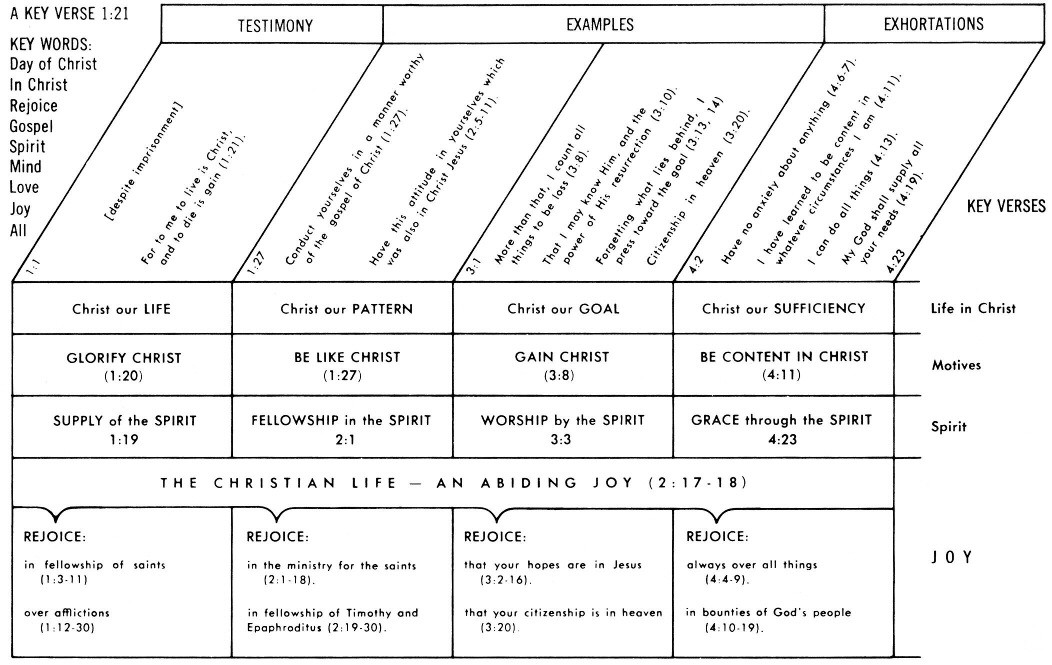
LIFE IN CHRIST
Click chart to enlarge
Charts from Jensen's Survey of the NT - used by permission
Philippians - Charles Swindoll = Chart on right side of page
| Account of Paul's Circumstances Php 1:1-30 |
Have the Mind of Christ Php 2:1-30 |
Have the Knowledge of Christ Php 3:1-21 |
Have |
| Partakers of Christ | People of Christ | Pursuit of Christ | Power of Christ |
| Suffering | Submission | Salvation | Sanctification |
| Experience | Examples | Exhortation | |
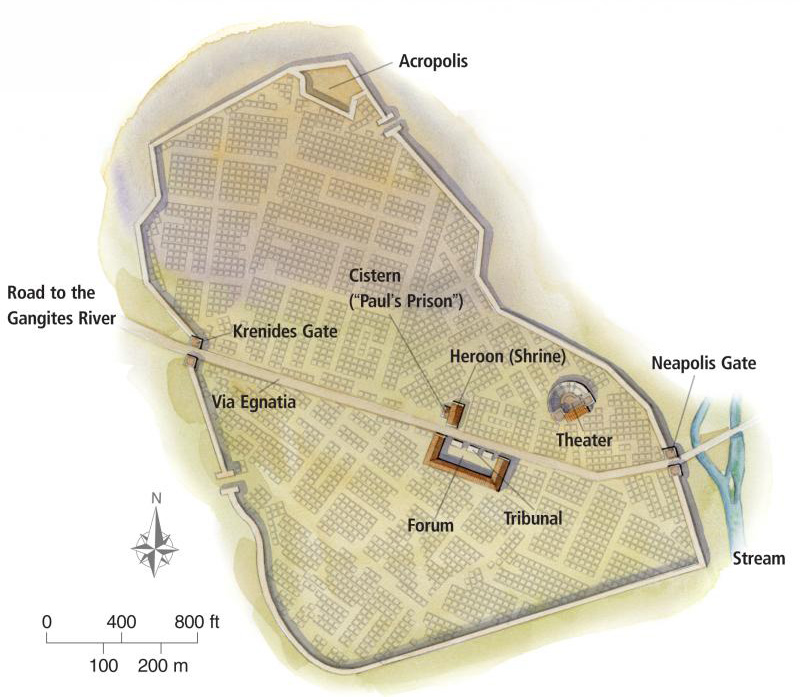
Philippi in the Time of Paul
The city plan above shows those features of the city of Philippi that archaeologists have so far identified as dating from the time of Paul. “Paul’s Prison” is not believed to be an authentic site, but was a cistern later associated with Christian worship. (ESV.org)
Philippians 2:8 Being found in appearance as a man, He humbled (3SAAI) Himself by becoming (AMPMSN) obedient to the point of death, even death on a cross. (NASB: Lockman)
Greek: tkai schemati heuretheis (AAPMSN) os anthropos etapeinosen (3SAAI) heauton genomenos (AMPMSN) hupekoos mechri thanatou, thanatou de staurou
Amplified: And after He had appeared in human form, He abased and humbled Himself [still further] and carried His obedience to the extreme of death, even the death of the cross! (Amplified Bible - Lockman)
Barclay: And when he came in appearance as a man for all to recognise, he became obedient even to the extent of accepting death, even the death of a cross. (Westminster Press)
KJV: And being found in fashion as a man, he humbled himself, and became obedient unto death, even the death of the cross.
Lightfoot: Nor was this all. Having thus appeared among men in the fashion of a man, he humbled himself yet more, and carried out his obedience even to dying. Nor did he die by a common death: he was crucified, as the lowest malefactor is crucified
Phillips: And, having become man, he humbled himself by living a life of utter obedience, even to the extent of dying, and the death he died was the death of a common criminal. (Phillips: Touchstone)
Wuest: And being found to be in outward guise as man, He stooped very low, having become obedient to the extent of death, even such a death as that upon a cross. (Eerdmans)
Young's Literal: and in fashion having been found as a man, he humbled himself, having become obedient unto death -- death even of a cross,
AND BEING FOUND IN APPEARANCE AS A MAN: kai schemati heuretheis (AAPMSN) os anthropos:
- Mt 17:2; Mk 9:2,3; Lk 9:29
Being found (2147) (heurisko, gives us English word eureka which is from the exclamation attributed to Archimedes on discovering a method for determining the purity of gold) means learn location of something, either by intentional searching or by unexpected discovery.
Appearance (4976) (schema gives us English "scheme") refers purely outward and appeals to the senses.
The contrast here is between what He was in Himself, God, and what He appeared in the eyes of man. "Likeness" states the fact of His real resemblance to men in mode of existence. (Derivative words of schema = metaschematizo, suschematizo)
Schema "always refers to what may be known from without." (Schneider, TDNT 1:954)
Schema in this verse signifies what Jesus was in the eyes of men. Schema describes the entire, outward, perceptible mode and shape of Christ's existence as a man.
Thayer says schema is…the habitus, as comprising everything in a person which strikes the senses, the figure, bearing, discourse, actions, manner of life, etc.
Schema should be distinguished from the Greek word morphe which signifies "form" in Phil 2:7. Vine (quoting from Gifford's work "The Incarnation") says that
morphe is therefore properly the nature or essence, not in the abstract, but as actually subsisting in the individual, and retained as long as the individual itself exists…Thus in the passage before us morphe Theou is the Divine nature actually and inseparably subsisting in the Person of Christ… For the interprehtion of ‘the form of God’ it is sufficient to say that (1) it includes the whole nature and essence of Deity, and is inseparable from them, since they could have no actual existence without it; and (2) that it does not include in itself anything ‘accidental’ or separable, such as particular modes of manifestation, or conditions of glory and majesty, which may at one time be attached to the ‘form,’ at another separated from it… “The true meaning of morphe in the expression ‘form of God’ is confirmed by its recurrence in the corresponding phrase, ‘form of a servant.’ It is universally admitted that the two phrases are directly antithetical, and that ‘form’ must therefore have the same sense in both.”
Expositor's adds that morphe “always signifies a form which truly and fully expresses the being which underlies it… the words mean ‘the being on an equality with God.’”
KJV Bible Commentary - The word form (Greek morphē) differs from fashion (Greek schēma) as that which is intrinsic from that which is outward. The contrast is between what He is in Himself (God) and what He appears to be in the eyes of men (man). Christ had all the qualities which Adam had before he sinned, but not the sinful nature which came through Adam’s fall. (Dobson, E G, Charles Feinberg, E Hindson, Woodrow Kroll, H L. Wilmington: KJV Bible Commentary: Nelson)
Radmacher explains that schema "is the third word Paul uses to show the Philippians that Jesus Christ who is fully God from all eternity is also fully man. In the previous verses, Paul describes Jesus as possessing the nature of God and taking on the nature (morphe) of a servant. Jesus came to the earth with the identity of a man (homoíoma = likeness). Here the word appearance points to the external characteristics of Jesus: He had the bearing, actions, and manners of a man. (Radmacher, E. D., Allen, R. B., & House, H. W. The Nelson Study Bible: NKJV. Nashville: Thomas Nelson)
Barclay writes that "There are two Greek words for form, morphē and schēma. They must both be translated form, because there is no other English equivalent, but they do not mean the same thing. Morphē is the essential form which never alters; schēma is the outward form which changes from time to time and from circumstance to circumstance. For instance, the morphē of any human being is humanity and this never changes; but his schēma is continually changing. A baby, a child, a boy, a youth, a man of middle age, an old man always have the morphē of humanity, but the outward schēma changes all the time. Roses, daffodils, tulips, chrysanthemums, primroses, dahlias, lupins all have the one morphē of flowers; but their schēma is different. Aspirin, penicillin, cascara, magnesia all have the one morphē of drugs; but their schēma is different. The morphē never alters; the schēma continually does. The word Paul uses for Jesus being in the form of God is morphē; that is to say, his unchangeable being is divine. However his outward schēma might alter, he remained in essence divine. (Philippians 2 Commentary)
NIDNTT has this note on the classic use of schema - (1) form, shape, figure; (2) appearance, as opposed to reality; (3) bearing, air, mien; (4) fashion, manner; (5) character. Greek thought did not sharply distinguish between the external and the internal. Schēma denotes the form that is seen. It could thus denote the role played by an actor which includes its essential character (Plato, Leg., 11, 918e). But the outward form can also be deceptive, and appearance become a sham. Schēma can thus mean mere appearance as opposed to reality. It can also mean a dancing figure (Plato, Ion, 536c), bodily attitude or bearing (Eur., Medea, 1039), clothing (Xen., Cyr., 5, 1, 5), and occasionally semblance (Theophrastus, Historia Plantarum, 3, 12, 7). In studying the Greek word, one has to beware of the modern outlook which would relate schēma merely to external things, implying that the essential character was something different. To the Greek mind, the observer saw not only the outer shell but the whole form with it. (Brown, Colin, Editor. New International Dictionary of NT Theology. 1986. Zondervan)
The only other NT use of schema is
1 Corinthians 7:31 and those who use the world, as though they did not make full use of it; for the form (schema) of this world is passing away (cp similar statement in 1Jn 2:17).
Comment: In the context of 1Cor 7:31, schema signifies that which comprises the manner of life, actions, etc., of humanity in general. There is one use of schema in the Lxx in Isaiah 3:17 where it refers to the "proud bearing of women." (Schneider, TDNT).
Appearance in summary defines the outward mode and expression. While on earth, Jesus did not give expression to the glory of His deity except on the Mount of Transfiguration. He appeared as the Man Christ Jesus to the world around Him. He was in His humiliation. And of course in contrast to the occasional nuance of schema meaning deception, Jesus' schema never for an instance presented even a suggestion of deception. He was fully Man, just as other men saw Him. Indeed John records Jesus' schema as interpreted by Nathanael…
Jesus saw Nathanael coming to Him, and said of him, "Behold, an Israelite indeed, in whom is no (not "me" but "ouk" = absolute negation) guile (dolos)!" (Jn 1:47)
Spurgeon's Exposition…
He had not descended low enough yet, though he had come down all the way from the Godhead to our manhood: “he humbled himself.”
What a cruel and ignominious death for the Son of God to suffer! Did he lose anything by all this wondrous condescension? Will you lose anything by any dishonor that may come upon you for Christ’s sake, for the truth’s sake? No; listen to what followed our Savior’s humiliation:—
He humbled himself, so be you not unwilling to humble yourself. Lower than the cross Christ could not go, his death was one of such extreme ignominy that he could not have been more disgraced and degraded. Be you willing to take the lowest place in the Church of God, and to render the humblest service, count it an honor to be allowed to wash the saints feet. Be humble in mind; nothing is lost by cherishing this spirit, for see how Jesus Christ was honored in the end.
D A Carson explains this section noting that Jesus Christ…
“made himself nothing, taking the very nature of a servant [literally, slave] … ” (Phil 2:7). But Paul does not tell us that Christ exchanged one form for another; he is not saying that Jesus was God, gave that up, and became a slave instead. Rather, without ever abandoning who he was originally, he adopted the mode of existence of a slave. To do this, he (literally) became “in human likeness (morphe)” (Phil 2:7). The idea is not that he merely became like a human being, a reasonable facsimile but not truly human. Rather, it means that he became a being fashioned in this way: a human being. He was always God; He now becomes something He was not, a human being. “And being found in appearance as a man, he humbled himself and became obedient to death—even death on a cross!” (Phil 2:8). (Basics for Believers : an Exposition of Philippians)
Bob Utley - In Greek philosophy morphē meant “the inner form of something that truly reflected its inner essence,” while “ schēma ” meant “the outer changing form of something that did not fully represent its inner essence” (cf. 1Cor. 7:31). Jesus is like us in all ways except fallen mankind’s sin nature. (Philippians 2 Commentary)
Marvin Vincent says that when we consider morphe "We must here dismiss from our minds the idea of shape. The word is used in its philosophic sense, to denote that expression of being which carries in itself the distinctive nature and character of the being to whom it pertains, and is thus permanently identified with that nature and character. Thus it is distinguished from schema = fashion, comprising that which appeals to the senses and which is changeable. Morphe or form is identified with the essence of a person or thing… As applied here to God, the word is intended to describe that mode in which the essential being of God expresses itself."
Alexander Maclaren - Equally emphatic in another direction is Paul’s next expression, ‘In the form of God,’ for ‘form’ means much more than ‘shape.’ I would point out the careful selection in this passage of three words to express three ideas which are often by hasty thought regarded as identical, We read of ‘the form of God’ (Phil. 2:6),’ the likeness of men’ (Phil. 2:7), and’ in fashion as a man.’ Careful investigation of these two words ‘form’ and’ fashion’ has established a broad distinction between them, the former being more fixed, the latter referring to that which is accidental and outward, which may be fleeting and unsubstantial. The possession of the form involves participation in the essence also. Here it implies no corporeal idea as if God had a material form, but it implies also much more than a mere apparent resemblance. He who is in the form of God possesses the essential divine attributes. Only God can be ‘in the form of God’: man is made in the likeness of God, but man is not ‘in the form of God.’ Light is thrown on this lofty phrase by its antithesis with the succeeding expression in the next verse, ‘the form of a servant,’ and as that is immediately explained to refer to Christ’s assumption of human nature, there is no room for candid doubt that ‘being originally in the form of God’ is a deliberately asserted claim of the divinity of Christ in His pre-existent state. (The Descent of the Word)
Lightfoot in his commentary on Philippians has a lengthy discussion of schema as it differs from morphe…
The word schema corresponds exactly in derivation, though but partially in meaning, to the old English ‘haviour.’ In its first sense it denotes the figure, shape, fashion, of a thing. Thence it gathers several derived meanings. It gets to signify, like the corresponding Latin ‘habitus,’ sometimes the dress or costume… , sometimes the attitude or demeanor… Schema is used also for a ‘figure of speech,’ as the dress in which the sense clothes itself or the posture which the language assumes. It signifies moreover pomp, display, outward circumstance… Morphe, like schema, originally refers to the organs of sense. If schema may be rendered by ‘figure,’ ‘fashion,’ morphe corresponds to ‘form.’ Morphe comprises all those sensible qualities, which striking the eye lead to the conviction that we see such and such a thing… the great and entire change of the inner life, otherwise described as being born again, being created anew, is spoken of as a conversion of morphe always, of schema never. Thus ‘He fore-ordained them conformable (summorphous) to the image of His Son’ (Ro 8:29); ‘Being made conformable (summorphizomenos) to His death’ (Phil. 3:10); ‘We are transformed (metamorphoumetha) into the same image’ (2Cor. 3:18); ‘To be transformed by the renewal of the mind’ (Ro 12:2); ‘Until Christ be formed (morphothe) in you’ (Gal. 4:19). In these passages again, if any one doubts whether morphe has any special force, let him substitute schema and try the effect. In some cases indeed, where the organs of sense are concerned and where the appeal lies to popular usage, either word might be used. Yet I think it will be felt at once that in the account of the transfiguration metaschematizesthai would have been out of place and that metamorposthai alone is adequate to express the completeness and significance of the change (Mt 17:2, Mark 9:2). Even in the later addition to Mark’s Gospel here our Lord is described as appearing to the two disciples en hetera morphe, though morphe here has no peculiar force, yet schema would perhaps be avoided instinctively, as it might imply an illusion or an imposture. It will be observed also that in two passages where Paul speaks of an appearance which is superficial and unreal, though not using schema, he still avoids morphe as inappropriate and adopts morphosis (Ed: "the state of being formally structured, embodiment, formulation, form… In 2Ti 3:5 the idea of mere outward form is derived from the context" BADG) instead (Ro 2:20, 2Ti 3:5). Here the termination denotes the aiming after or affecting the morphe.
And the distinction, which has thus appeared from the review of each word separately, will be seen still more clearly from those passages where they occur together. In Ro 12:2 (suschematizo… metamorphoo) the form of the sentence calls attention to the contrast, and the appropriateness of each word in its own connection is obvious: ‘Not to follow the fleeting fashion of this world, but to undergo a complete change, assume a new form, in the renewal of the mind.’…
Thus in the passage under consideration the morphe is contrasted with the schema, as that which is intrinsic and essential with that which is accidental and outward. And the three clauses imply respectively the true divine nature of our Lord (μορφὴ Θεοῦ), the true human nature (μορφὴ δούλου), and the externals of the human nature (σχήματι ὡς ἄνθρωπος). (Saint Paul's Epistle to the Philippians}, (St. Paul's Epistle to the Philippians - page 125-131)
Joseph Beet - Fashion (in NT only 1Co 7:31) differs from form as any occasional appearance or visible clothing differs from an expression which corresponds to actual inner reality. The form of God is the appropriate self-manifestation of the Son’s essence, of His equality with God. The fashion as a man was the outward guise of humanity, a visible clothing bearing only a distant relation to the actual nature of the Son. It is practically the same as in the likeness of men, except perhaps that it recalls more conspicuously the outward aspect of Christ as an individual man. In this outward guise, by those who sought Him, the Incarnate Son was found. This last word keeps before us, as does the conspicuous repetition of the word form, the self-presentation of the Son both as God and as Man. (Philippians 2 Commentary)
James E Rosscup writes that Jesus "did not rid Himself of the essence in which He was God, or relinquish the attributes of God. He always remained God but also became man. He was fully God and fully man, in one Person. He did not exchange the “form” of God (let it go), but always had this, and simply added or took the form also of a man in being fully humanity. What He emptied Himself of was the exercise, use, or expression of the prerogatives of being God. As a servant, He showed perfect submission to the Father to do His will as the God-man. This is as other humans also can obey whatever is God’s will for them, as in many things it varies for each person. Christ worked miracles only as these served the Father in His will and timing, and many times bypassed showing the power He could have asserted, never making His own way easier. He lived as a true human, experiencing thirst, hunger, and weariness in His treks instead of moving from one place to another in an instant. (An Exposition on Prayer in the Bible: Igniting the Fuel to Flame Our Communication with God)
HE HUMBLED HIMSELF: etapeinosen (3SAAI) heauton:
- Acts 8:33; Heb 5:5, 6, 7; 12:2
In Proverbs we read that…
The fear (reverential awe) of the LORD (Jehovah) is the instruction for wisdom, and before honor comes humility (Compare - the Cross, before the Crown!). (Pr 15:33)
"STOOPING
LOWER"
Jesus put aside all personal rights and interests in order to insure the welfare of others. In so doing He gave us His perfect example to follow in His steps (1Pe 2:21-note, 1Jn 2:6). F B Meyer spoke of applying Jesus' pattern of living as a Man to our life as men and women who are now in Him (and enabled by His indwelling Spirit, the Spirit of Christ)…
I used to think that God’s gifts were on shelves one above the other, and that the taller we grew in Christian character the more easily we could reach them. I now find that God’s gifts are on shelves one beneath the other and that it is not a question of growing taller but of stooping lower.
Humbled (5013) (tapeinoo [word study]) from tapeinos = low, not high, figuratively of one's attitude/social position) literally means to level, to cause something to be lower or to make low (eg, to level off a mountain in Lk 3:5 from the Septuagint (Lxx) of Isa 40:4). Tapeinoo means to bow down, to make low, to humble. Most NT uses of tapeinoo are figurative and include the following meanings: To cause someone to lose prestige, to reduce to a meaner condition or lower rank, to abase. To be ranked below others.
Tapeinoo - 14x in 11v - Mt 18:4; 23:12; Luke 3:5; 14:11; 18:14; 2 Cor 11:7; 12:21; Phil 2:8; 4:12; Jas 4:10; 1 Pet 5:6. NAS = brought low(1), get along(1), humble(2), humble means(1), humbled(4), humbles(4),humbling(1)
Humble in English is derived from Latin "humilis" meaning low and this word is in turn from "humus" meaning earth! Greeks saw humility as shameful but the NT sees humility as condition bringing man to right relation to God! The fundamental difference between the Greek and the biblical use of these words is that in the Greek world, with its anthropocentric view of man, lowliness is looked on as shameful, to be avoided and overcome by act and thought. In the NT, with its theocentric view of man, the words are used to describe those events that bring a man into a right relationship with God and his fellow-man.
This was a "voluntary humiliation on the part of Christ and for this reason Paul is pressing the example of "Christ upon the Philippians, this supreme example of renunciation." (A T Robertson - Word Pictures) In this lowly estate He humbled Himself. The Greek word translated "humbled" is used in an early document, of the Nile River at its low stage, in the sentence, "It runs low," a good description of the humility of our Lord, who said of Himself, "I am meek and lowly of heart." (Mt 11:28KJV) He became obedient, not to death, but obedient to the Father up to the point of death, even the death of a cross. In so doing our Lord gave us the perfect example of the self-emptied life, an example and challenge to all those who would seek to follow in His steps (1Pe 2:21-note, 1Jn 2:6), seeking to be servants of the One Who came not to be ministered unto but to minister, and to give His life a ransom for many (Mk 10:45)
J Vernon McGee on Christ humbling Himself - You and I have been humbled by someone doing or saying something which has been humiliating to us. But notice that Christ “humbled himself.” This is a most difficult thing to do.
One of the finest things I ever heard about John Wesley was concerning an incident when he was about to cross a brook over which was a very narrow bridge, just wide enough for one person. As he was starting over, he met a liberal preacher of that day. This preacher swelled up and said, “I never give way to a fool.” John Wesley looked at him for a moment, smiled, and began to back off, saying, “I always do.” My friend, it is difficult to take that humble place, but it has made me think a great deal more of John Wesley. We find it difficult to humble ourselves, but our Lord humbled Himself.
The great Puritan divine Thomas Watson commenting on "God made Him who had no sin—to be sin for us!" (2Corinthians 5:21-note) wrote that
This was the lowest degree of Christ's humiliation. That Christ, who would not endure sin in the angels, should endure to have sin imputed to Himself—is the most amazing humility that ever was!
Christian! Learn to be humble!
Do you see Christ humbling Himself—and are you proud? It is the humble saint, who is Christ's picture! Christians, do not be proud of your fine feathers! Have you an estate? Do not be proud. The earth you tread on, is richer than you! It has mines of gold and silver in its depths. Have you beauty? Do not be proud. It is but water mingled with dirt! Have you skill and abilities? Be humble. Lucifer has more knowledge than you! Have you grace? Be humble. It is not of your own making—it was given to you by God. You have more sin than grace; more spots than beauty. Oh look on Christ—this rare pattern of humility—and be humbled! It is a sad sight, to see God humbling Himself—and man exalting himself; to see a humble Savior—and a proud sinner! God hates the very semblance of pride! "I hate pride and arrogance!" Proverbs 8:13…
Be like Christ in grace and HUMILITY. He was like us in having our flesh, let us be like him in having his grace. We should labor to be like Christ, in humility. "He humbled himself." He left the bright robes of his glory—to be clothed with the rags of our humanity—a wonder of humility! Let us be like Christ in this grace. "Humility," says Bernard, "is a despising of self-excellence," a kind of a self-annihilation. This is the glory of a Christian. We are never so lovely in God's eyes—as when we are black in our own eyes. In this let us be like Christ. True true religion is to imitate Christ. And indeed, what cause have we to be humble—if we look within us, about us, below us, and above us!
If we look within us—here we see our sins represented to us in the looking-glass of conscience; lust, envy, passion. Our sins are like vermin crawling in our souls. "How many are my iniquities!" Job 13:23. Our sins are as the sands of the sea for number; as the rocks of the sea for weight! Augustine cries out, "My heart, which is God's temple—is polluted with sin!"
If we look about us—there is that which may humble us. We may see other Christians outshining us in gifts and graces, as the sun outshines the lesser planets. Others are laden with fruit—and perhaps we have but here and there an olive-berry growing, to show that we are of the right kind. Isa 17:6.
If we look below us—there is that may humble us. We may see the mother earth, out of which we came. The earth is the most ignoble element: "They were viler than the earth." Job 30:8. (From Thomas Watson's superb work entitled Body of Divinity - scroll down to point 6 "Christ's Humiliation in His Incarnation" and then "Use One: Of Instruction")
><>><>><>
Spurgeon's Devotional - Jesus is the great teacher of lowliness of heart. We need daily to learn of him. See the Master taking a towel and washing his disciples' feet! Follower of Christ, wilt thou not humble thyself? See him as the Servant of servants, and surely thou canst not be proud! Is not this sentence the compendium of his biography, "He humbled himself"? Was he not on earth always stripping off first one robe of honour and then another, till, naked, he was fastened to the cross, and there did he not empty out his inmost self, pouring out his life-blood, giving up for all of us, till they laid him penniless in a borrowed grave? How low was our dear Redeemer brought! How then can we be proud? Stand at the foot of the cross, and count the purple drops by which you have been cleansed; see the thorn-crown; mark his scourged shoulders, still gushing with encrimsoned rills; see hands and feet given up to the rough iron, and his whole self to mockery and scorn; see the bitterness, and the pangs, and the throes of inward grief, showing themselves in his outward frame; hear the thrilling shriek, "My God, my God, why hast thou forsaken me?" And if you do not lie prostrate on the ground before that cross, you have never seen it: if you are not humbled in the presence of Jesus, you do not know him. You were so lost that nothing could save you but the sacrifice of God's only begotten. Think of that, and as Jesus stooped for you, bow yourself in lowliness at his feet. A sense of Christ's amazing love to us has a greater tendency to humble us than even a consciousness of our own guilt. May the Lord bring us in contemplation to Calvary, then our position will no longer be that of the pompous man of pride, but we shall take the humble place of one who loves much because much has been forgiven him. Pride cannot live beneath the cross. Let us sit there and learn our lesson, and then rise and carry it into practice.
BY BECOMING OBEDIENT: genomenos (AMPMSN) hupekoos:
-
Jn 4:34; 15:10; Heb 10:7, 8, 9
Remember that Paul is telling the Philippians that if they think they cannot humble themselves to the will of one another, they need to ponder the obedience of the Lord of glory who was willing to give up His rights as their example of perfect selflessness. This is the attitude the saints at Philippi were to manifest. It is the attitude every believer is to manifest to assure unity in the body of Christ.
Becoming (1096) (ginomai) means to cause to be ("gen"-erate) and in this context means that it came to be that Jesus experienced obedience to the will of His Father.
Obedient (5255) (hupekoos/hypekoos is from hupo = under, frequently meant not simply to be beneath but to be totally under the power, authority, control of something or someone + akouo = hear and apprehend with the mind, gives us our English word "acoustic") is an adjective which means giving ear to, hearkening, attentively listening and thus describes one who is obedient.
Obedient describes a person who obeys based on the fact that they have paid attention to what was commanded or instructed. In other words, what they heard did not just (as the saying goes) "go in one ear and out the other!" We have all seen the child who, when they are being instructed by their parents, responds by putting their hands over their ears so as to not hear their parent's words! That is a picture of not "giving ear to" (i.e., they are disobedient - I'm sure this doesn't describe your child dear reader!).
Hupekoos also conveys the sense of subject or submissive to (another).
J I Packer in the New Bible Dictionary writes that…
The idea of obedience which this vocabulary suggests is of a hearing that takes place under the authority or influence of the speaker, and that leads into compliance with his requests. For obedience to be due to a person, he must: (a) have a right to command, and (b) be able to make known his requirements. Man’s duty to obey his Maker thus presupposes: (a) God’s Lordship, and (b) His revelation. The OT habitually describes obedience to God as obeying (hearing) either His voice (accentuating [b]) or His commandments (assuming [b] and accentuating [a]). Disobedience it describes as not hearing God’s voice when He speaks (Ps. 81:11; Je 7:24,25,26-27,28)…
The disobedience of Adam, the first representative man, and the perfect obedience of the second, Jesus Christ, are decisive factors in the destiny of everyone. Adam’s lapse from obedience plunged mankind into guilt, condemnation and death (Ro 5:19; 1Cor 15:22). Christ’s unfailing obedience ‘unto death’ (Phil. 2:8; cf. Heb. 10:5-10) won righteousness (acceptance with God) and life (fellowship with God) for all who believe on him (Ro 5:15-19). (New Bible Dictionary I. Howard Marshall, A.R. Millard, J.I. Packer, D.J. Wiseman) (Bolding added)
Webster says "obedient" describes the attitude of being submissive to the restraint or command of authority; i.e., willing to obey. The obedient individual is submissive to the will, guidance or control of another, implying compliance with the commands or instructions of the one who is in authority, performing what is required, or abstaining from what is forbidden. Words related to obedient = acquiescent, compliant, sheeplike, submissive, yielding; duteous, dutiful, loyal; law-abiding; obeisant, subservient. Words contrasted with obedient = insubordinate, rebellious; contrary, froward, perverse, wayward, willful; headstrong, intractable, recalcitrant, refractory, uncontrollable, ungovernable, unruly. Which group of synonyms best describes your Christian walk? Beloved, as Christ followers we are called to "follow in His steps" (1Peter 2:21-note), "to walk in the same manner as He walked." (1Jn 2:6), and it follows that obedience to the guiding and leading of the Holy Spirit (Ezek 36:27, Ro 8:14-note, Gal 5:16-note, Gal 5:18-note, Gal 5:25-note) should be our continual desire and practice (You might consider praying Ps 25:4,5, 143:10). This study of hupekoos begs the question - Are you being obedient to the will of your Father, surrendering your will to His Spirit's leading and enabling power? This is the "Jesus way", the way to "walk in a manner worthy of the God who calls you into His own kingdom and glory." (1Thes 2:12-note)
J C Ryle exhorts us to make Jesus' example our chief standard of holy living…
If we would look rightly to Jesus—we must look daily at His example, as our chief standard of holy living. We must all feel, I suspect, and often feel—how hard it is to live a Christian life, by mere rules and regulations. Scores of circumstances will continually cross our path, in which we find it difficult to see the line of duty, and we become perplexed. Prayer for the guidance of the Holy Spirit, and attention to the practical part of the Epistles, are, undoubtedly, primary resources. But surely it would cut many a knot, and solve many a problem—if we would cultivate the habit of studying the daily behavior of our Lord Jesus, as recorded in the four Gospels, and strive to shape our own behavior by His pattern!
This must have been what our Lord meant when He said, "I have given you an example—that you should do as I have done to you." (John 13:15). And this is what Peter meant, when he wrote, "Leaving you an example, so that you should follow in His steps." (1Peter 2:21). And this is what John meant when he said, "The one who says he abides in Him, should walk just as He walked." (1John 2:6).
Our "look" to Jesus is very imperfect—if we do not look at His example, and strive to follow it. Let us cultivate the daily habit of "looking to Christ as our pattern," as well as our salvation. We can never look too steadily at Christ's death and intercession. But we may easily look too little at the blessed steps of His most holy life. Let all men see that we love to follow Him whom we profess to love. "How would my Master have behaved in my position?" should be our constant concern. (From Looking Unto Jesus!) (See also Anne Ortlund's Fix Your Eyes On Jesus - 44 excellent meditations)
As A W Tozer said…
The secret of successful Christians has been that they had a sweet madness for Jesus about them.
See study of other words in this "family"…
Verb hupakouo - of believers in Acts 6:7, Ro 6:12-note, Ro 6:17-note, Php 2:12-note.
Noun hupakoe - of Jesus in Heb 5:8-note and believers in 1Pe 1:14-note, 1Pe 1:22-note
The other two uses of hupekoos in the NT…
Acts 7:39 "Our fathers were unwilling to be obedient to him, but repudiated him and in their hearts turned back to Egypt
Comment: The Israelites under Moses refused to listen to and submit to the will of God given through His servant Moses. In this passage notice that to not be obedient is an issue of one's heart (their hearts turned back), which is why God is always working in our lives to cause us to love Him with our whole heart (cp Mk 12:30:, 2Chr 16:9)
2Corinthians 2:9 For to this end also I wrote, so that I might put you to the test, whether you are obedient in all things.
MacDonald explains this passage: In writing the First Epistle to the Corinthians, Paul had put the saints to the test. Here was an opportunity for them to show whether they were obedient to the word of the Lord, as ministered to them by the Apostle Paul. He had suggested at that time that they should put the man out of the fellowship of the church. That is exactly what they did, thus proving themselves to be truly obedient. Now Paul would have them go one step further, that is, to receive the man back. (MacDonald, W & Farstad, A. Believer's Bible Commentary: Thomas Nelson)
Hupekoos is found 5 times in the Septuagint - Deut 20:11; Josh 17:13; Pr 4:3; 13:1; 21:28
Proverbs 13:1 (Brenton's English translation of the Septuagint) A wise son is obedient (hupekoos) to his father: but a disobedient (anekoos = not hearing and thus disobedience) son will be destroyed.
Proverbs 21:28 A false witness will perish, But the man who listens (hupekoos) to the truth will speak forever.
As discussed obedient describes an attitude and willingness to be submissive to the will of another and to comply with the demands or requests of the one in authority (contrast Acts 7:39). And here again we see the perfect example of Jesus who declared…
I always do the things that are pleasing to Him (God the Father) (John 8:29)
David foretold of Jesus' obedience to His Father when he wrote…
Sacrifice and meal offering Thou hast not desired. My ears Thou hast opened. Burnt offering and sin offering Thou hast not required. Then I said, "Behold, I come; In the scroll of the book it is written of me; I delight to do Thy will, O my God; Thy Law is within my heart." (Psalm 40:6, 7, 8-note)
Isaiah records the prophetic words of Jesus…
The Lord GOD has opened My ear; and I was not disobedient, Nor did I turn back. I gave My back to those who strike Me, and My cheeks to those who pluck out the beard; I did not cover My face from humiliation and spitting. (Isa 50:5,6)
We see His obedience in the Garden of Gethsemane as the sinless Son anticipated the cup of suffering in which He took upon Himself all the sins of mankind including the humanly unfathomable mystery of His temporary separation from His Father (Mt 27:45, 46). Jesus naturally shrank from this separation, but was obedient and willingly submitted, Matthew recording…
And He went a little beyond them, and fell on His face and prayed, saying, "My Father, if it is possible, let this cup pass from Me; yet not as I will, but as Thou wilt."… He went away again a second time and prayed, saying, "My Father, if this cannot pass away unless I drink it, Thy will be done." (Mt 26:39,42)
In fact Jesus entire life purpose was to live in humble submission to the Father's will, John recording Jesus' words to His disciples that…
My food is to do the will of Him who sent Me, and to accomplish His work. (John 4:34, compare Jesus' statement in Jn 17:4)
Paul speaks of Jesus' perfect obedience, an obedience which took H im to the "nth" degree, to death itself…
For as through the one man’s disobedience (Adam) the many were made sinners (cp Ro 5:12), even so through the obedience (hupakoe) of the One (Jesus) the many will be made righteous. (Ro 5:19-note)
The writer of Hebrews explains that…
Although He was a Son, He learned obedience from the things which He suffered (What Jesus knew by omniscience, He "learned" by experience - true obedience can only be tested if it involved suffering). And having been made perfect (not as God (for as God He was eternally perfect, by definition), but as man), He became to all those who obey Him the source of eternal salvation (Hebrews 5:8-note, He 5:9-note)
(Later the writer of Hebrews records another affirmation of Christ's obedience to His Father) Then He said, “BEHOLD, I HAVE COME TO DO THY WILL.” He takes away the first (covenant) in order to establish the second (covenant = New Covenant). (Heb 10:9-note)
Expositor's Greek Testament…
As obedient, He gave Himself wholly up to His Father’s will. And the course of following that will led as far as death itself, no ordinary death… , but a death of shame and suffering.
Muller writes that…
Obedience unto God and surrender and submission to the will of God was maintained by Him unto the end, and the profoundest degree of humiliation was reached in that His death was not to be a natural or an honourable one, but was the painful and accursed death of the cross (cf. Deut. 21:23; Gal. 3:13). (The Epistles of Paul to the Philippians and to Philemon)
TO THE POINT OF DEATH EVEN DEATH ON A CROSS: mechri thanatou thanatou de staurou:
- Dt 21:23; Ps 22:16; Jn 10:18; 12:28, 29, 30, 32, 32; 14:31; Gal 3:13; Titus 2:14; Heb 12:2; 1Pet 2:24; 3:18
As we read these words, it is good for us to remember that Jesus was perfectly obedient to the point of death in our place, as our substitute.
Jerry Bridges writes that…The obedient death of Christ is the very apex of the righteousness of Christ. Let’s not miss the implications of this. At the Cross, Jesus paid the penalty we should have paid, by enduring the wrath of God we should have endured. And this required Him to do something unprecedented. It required Him to provide the ultimate level of obedience—one that we’ll never be asked to emulate. It required Him to give up his relationship with the Father so that we could have one instead. The very thought of being torn away from the Father caused Him to sweat great drops of blood (Luke 22:44). And at the crescendo of His obedience, He screamed, “My God, My God, why have You forsaken Me?” (Mark 15:34). The physical pain He endured was nothing compared to the agony of being separated from the Father. In all of history, Jesus is the only Human Being Who was truly righteous…Just as God charged our sin to Christ, so he credits the perfect obedience of Jesus to all who trust in him. In what is often called the Great Exchange, God exchanges our sin for Christ’s righteousness. As a result, all who have trusted in Christ as Savior stand before God not with a clean-but-empty ledger, but one filled with the very righteousness of Christ! (The Bookends of the Christian Life- Jerry Bridges, Bob Bevington - I highly recommend this book)
Death (2288) (thanatos from thnesko = to die) refers physically to the separation of soul from the body (physical) death and was a legal technical term for capital punishment. In the NT thanatos is treated as a destroying power related to sin and its consequences.
The act of voluntary humiliation did not stop with the Incarnation but continued to the ignominious depths of death by crucifixion.
Kenneth Wuest clarifies - He became obedient unto death. But this does not mean that He became obedient to death. He was always the Master of death. He died as no other individual ever died or ever will die. He died of His own volition. He dismissed His human spirit. The word “unto” is the translation of a Greek word which means “up to the point of.” Our Lord was obedient to the Father up to the point of dying. He said, “Lo, I come to do thy will, O God” (Heb. 10:9). (Philippians Commentary - Verse by Verse Comments Online)
Albert Barnes - He obeyed even when obedience terminated in death. The point of this expression is this: One may readily and cheerfully obey another where there is no particular peril. But the case is different where obedience is attended with danger. The child shows a spirit of true obedience when he yields to the commands of a father, though it should expose him to hazard; the servant who obeys his master, when obedience is attended with risk of life; the soldier, when he is morally certain that to obey will be followed by death. Thus many a company or platoon has been ordered into the “deadly breach,” or directed to storm a redoubt, or to scale a wall, or to face a cannon, when it was morally certain that death would be the consequence. No profounder spirit of obedience can be evinced than this. It should be said, however, that the obedience of the soldier is in many cases scarcely voluntary, since, if he did not obey, death would be the penalty. But in the case of the Redeemer, it was wholly voluntary. He placed himself in the condition of a servant to do the will of God, and then never shrank from what that condition involved.
Cross (4716) (stauros from histemi = to stand) was an an upright stake, especially a pointed one. Thayer adds the stauros was a well-known instrument of most cruel and ignominious punishment, borrowed by the Greeks and Romans from the Phoenicians; to it were affixed among the Romans, down to the time of Constantine the Great, the guiltiest criminals, particularly the basest slaves, robbers, the authors and abetters of insurrections, and occasionally in the provinces, at the arbitrary pleasure of the governors, upright and peaceable men also, and even Roman citizens themselves. Stauros is used somewhat in with a figurative (but still very real) supernatural significance as the source of the the doctrine concerning the saving power of the death on the cross endured by Christ (1Co 1:18 = where "being saved" = present tense).
Vine on stauros - Noun Masculine — denotes, primarily, "an upright pale or stake." On such malefactors were nailed for execution. Both the noun and the verb stauroo, "to fasten to a stake or pale," are originally to be distinguished from the ecclesiastical form of a two beamed "cross." The shape of the latter had its origin in ancient Chaldea, and was used as the symbol of the god Tammuz (being in the shape of the mystic Tau, the initial of his name) in that country and in adjacent lands, including Egypt. By the middle of the 3rd cent. A.D. the churches had either departed from, or had travestied, certain doctrines of the Christian faith. In order to increase the prestige of the apostate ecclesiastical system pagans were received into the churches apart from regeneration by faith, and were permitted largely to retain their pagan signs and symbols. Hence the Tau or T, in its most frequent form, with the cross-piece lowered, was adopted to stand for the "cross" of Christ. As for the Chi, or X, which Constantine declared he had seen in a vision leading him to champion the Christian faith, that letter was the initial of the word "Christ" and had nothing to do with "the Cross" (for xulon, "a timber beam, a tree," as used for the stauros, see under TREE). The method of execution was borrowed by the Greeks and Romans from the Phoenicians. The stauros denotes (a) "the cross, or stake itself," e.g., Matthew 27:32; (b) "the crucifixion suffered," e.g., 1 Corinthians 1:17,18 , where "the word of the cross," RV, stands for the Gospel; Galatians 5:11 , where crucifixion is metaphorically used of the renunciation of the world, that characterizes the true Christian life; Galatians 6:12,14; Ephesians 2:16; Philippians 3:18. The judicial custom by which the condemned person carried his stake to the place of execution, was applied by the Lord to those sufferings by which His faithful followers were to express their fellowship with Him, e.g., Matthew 10:38 . (Cross, Crucify - Vine's Expository Dictionary of NT Words)
Note another Greek word xulon is also translated "cross".
The cross as used figuratively to describes that which was to be borne by those who, on behalf of God's cause, do not hesitate cheerfully to bear persecutions, troubles, distresses thus recalling and identifying with the rejection and fate of Christ while on earth. (Mt 10:38, 16:24, Mk 8:34, 10:21, Lk 9:23, 14:27, literally of Simon of Cyrene in Mk 15:21)
Stauros - 27x in 27v -Mt 10:38; 16:24; 27:32, 40, 42; Mark 8:34; 15:21, 30, 32; Luke 9:23; 14:27; 23:26; John 19:17, 19, 25, 31; 1Cor 1:17f; Gal 5:11; 6:12, 14; Eph 2:16; Phil 2:8; 3:18; Col 1:20; 2:14; Heb 12:2. All uses are rendered "cross".
- Cross - American Tract Society Bible Dictionary
- Cross - Kitto's Popular Cyclopedia of Biblial Literature
- Cross - International Standard Bible Encyclopedia
- Cross - Nave's Topical Bible
- Cross - Bridgeway Bible Dictionary
- Cross - Charles Buck Theological Dictionary
- Cross - Fausset's Bible Dictionary
- Cross - Watson's Biblical & Theological Dictionary
- Cross - 1911 Encyclopedia Britannica
- Cross - The 1901 Jewish Encyclopedia
- Cross - Hastings' Dictionary of the Bible - Nice Discussion of Spiritual Meaning
Crucifixion on a Cross was the most despised death of all and was reserved for condemned criminals. The cross was an instrument of most dreadful and agonizing torture. This mode of punishment was known to the Persians (Ezra 6:11; Esther 7:10); and the Carthaginians. However, it was most common among the Romans for slaves and criminals, and was introduced among the Jews by the Romans. It was not abolished until the time of Constantine who did so out of regard for Christianity. Persons sentenced to be crucified were first scourged and then made to bear their own cross to the place of execution. A label or title was usually placed on the chest of or over the criminal. Crucifixion was at once an execution, a pillory, and an instrument of torture. When we read of the antagonism to the cross of Christ, we must understand it as antagonism to a redemption which was accomplished by the deepest humiliation, not by the display of power and glory
Dwight Pentecost explains that the Cross was not a natural death but in fact…
It was so unnatural a form of death that the Old Testament law forbade it and placed a curse on anyone who should die by this means. It was such an unnatural and abhorrent death that the Romans outlawed it for all but the grossest of criminals. This means of execution was forbidden any Roman citizen; it was reserved for those the Romans called “barbarians,” that is, non-Romans. The singular thing is that because Paul was a Roman citizen, he was protected from the kind of death that the Lord Jesus endured for sinners. But what Roman law protected Paul from, the Lord Jesus Christ could not and did not escape. For He came as a creature subject to the Creator. He came as a servant subject to a Master. He submitted Himself in obedience to the will of His Master in death, a death by crucifixion, in order to provide salvation for sinful men. (Pentecost, J. D. The Joy of Living: A study of Philippians. Kregel Publications)
COUNTING THE COST
OF A CHRIST FOLLOWER
Warren Wiersbe -Dr. J. H. Jowett has said, “Ministry that costs nothing accomplishes nothing.” If there is to be any blessing, there must be some “bleeding.” At a religious festival in Brazil, a missionary was going from booth to booth, examining the wares. He saw a sign above one booth: “Cheap Crosses.” He thought to himself, “That’s what many Christians are looking for these days—cheap crosses. My Lord’s cross was not cheap. Why should mine be?” (Wiersbe, W: Bible Exposition Commentary - New Testament. 1989. Victor)
Beloved, is it costing you anything
to be a Christ Follower?
If we are to have this attitude (Phil 2:5) what does it mean to us today? We too must be willing (humility) to die to our old man's selfish interests. Positionally this has occurred on the Cross, so that when He died, we died (Ro 6:3-note, Ro 6:4-note), but if we are truly His disciples (Mk 8:34), He calls us to experience death to self daily as a "normal" part of our life (Mk 8:34ff, 1Cor 15:31). How is this even possible? In Philippians 2:13 Paul explains that…
for it is God Who is at work (energeo in the present tense = continually) in you, both to will (present tense = continually willing us) and to work (energeo in the present tense = continually) for His good pleasure. (See more detailed discussion)
Every Christ follower has the indwelling Spirit of Christ (Ro 8:9, 1Cor 3:16, 1Cor 6:19), and He is our sole Source of inner motivation, continually giving us the "want to" so that we might even be willing to consider dying daily to self. But notice not only does the Spirit give us the supernatural desire but also the supernatural power, for He continually is working in us, "energizing" us and doing so in a way that brings glory, honor and pleasure to our Father Who art in heaven.
Jesus repeatedly called for death to self in the lives of those who would see to follow after Him (Christ followers is another name for "disciples" - see Greek word study = mathetes) - Mt 16:25; Mk 8:35; Lk 9:24;17:33; Jn 12:24,25). The same truth is also stressed by Paul (Ro 12:1-note, Ro 12:2-note; 2Co 5:14,15; 6:9,10; Gal 2:20-note; Phil 2:5-11; 2Ti 2:11, 12-note). Dying to self and living unto God is the very essence of a truly happy (blessed) and fulfilling life in this world and the one to come (cp the promise in 1Ti 4:7, 8-note).
In his book "The Epistle to the Philippians" F B Meyer summarizes Philippians 2:5-8 as…
Majesty and Humility Combined. In the whole range of Scripture this paragraph stands in almost unapproachable and unexampled majesty. There is no passage where the extremes of our Saviour's majesty and humility are brought into such abrupt connection. Guided by the Spirit of God, the Apostle opens the golden compasses of his imagination and faith, and places the one point upon the supernal Throne of the eternal God, and the other upon the Cross of shame where Jesus died, and he shows us the great steps by which Jesus approached always nearer and nearer to human sin and need; that, having embraced us in our low estate, He might carry us back with Himself to the very bosom of God, and that by identifying Himself with our sin and sorrow He might ultimately identify us with the glory which He had with the Father before the world was. And this wonderful description of His descent to our shame and sorrow is here cited by the Apostle, that it might be a living impulse and inspiration to ourselves, not to look upon our own things, not to hold them with a tight grasp, but to be willing to stoop for others to shame, sorrow, and spitting; fulfilling God's purpose of mercy to the world, even as Jesus Christ, who became the instrument and organ through which God's redemptive purpose wrought. "Let this mind be in you." Think these thoughts. Never look exclusively upon your own interests, never count anything of your own worthy to stand in the way, but always be prepared to the last point to deny yourself, that the redemptive purpose of God may flow through the channel of your life to those that sorely need His blessed help. It is a wonderful thing that, day by day, in our poor measure, we may repeat the purpose and the work of Jesus Christ our Emmanuel. No rhetoric or metaphor of ours can add to the splendour of these words, but in the simplest possible way we will stand on these seven successive slabs of chrysolite.
Philippians 2:9 For this reason also, God highly exalted (3SAAI) Him, and bestowed (3SAMI) on Him the name which is above every name, (NASB: Lockman)
Greek: dio kai o theos auton huperupsosen (3SAAI) kai echarisato (3SAMI) auto to onoma to huper pan onoma
Amplified: Therefore [because He stooped so low] God has highly exalted Him and has freely bestowed on Him the name that is above every name, (Amplified Bible - Lockman)
Barclay: And for that reason God exalted him, and granted to him the name which is above every name (Westminster Press)
KJV: Wherefore God also hath highly exalted him, and given him a name which is above every name:
Lightfoot: But as was his humility, so also was his exaltation. God raised him to a preeminent height, and gave him a title and a dignity far above all dignities and titles else.
Phillips: That is why God has now lifted him so high, and has given him the name beyond all names, (Phillips: Touchstone)
Wuest: Because of which voluntary act of supreme self-renunciation, God also super-eminently exalted Him to the highest rank and power, and graciously bestowed upon Him THE NAME, the one which is above every name, (Eerdmans)
Young's Literal: wherefore, also, God did highly exalt him, and gave to him a name that is above every name,
THEREFORE ALSO GOD HIGHLY EXALTED HIM: dio kai o Theos auton huperupsosen (3SAAI):
- Ge 3:15; Ps 2:6, 7, 8, 9, 10, 11, 12; 8:5, 6, 7, 8; 91:14; 110:1,5; Isa 9:7; 49:6, 7, 8; 52:13; 53:12; Da 2:44,45; 7:14; Mt 11:27; 28:18; Lk 10:22; Jn 3:35,36; 5:22, 23, 24, 25, 26, 27; 13:3; 17:1, 2, 3,5; Acts 2:32, 33, 34, 35, 36; 5:31; Ro 14:9, 10, 11; 1Co 15:24, 25, 26, 27; Heb 2:9; 12:2; 2Pet 1:17; Rev 1:5; 3:21; 5:12; Rev 11:15; 19:16)
The psalmist foretells of Messiah's exaltation writing…
Thy throne, O God, is forever and ever. A scepter of uprightness is the scepter of Thy kingdom. Thou hast loved righteousness, and hated wickedness. Therefore God, Thy God, has anointed Thee With the oil of joy above Thy fellows. (Ps 45:6,7-note)
In another psalm we see a prayer that speaks of His exalted Name…
May His Name endure forever. May His Name increase as long as the sun shines. And let men bless themselves by Him; Let all nations call Him blessed. Blessed be the LORD God, the God of Israel, Who alone works wonders. and blessed be His glorious Name forever; and may the whole earth be filled with His glory. Amen, and Amen. (Ps 72:17, 18, 19-note)
Spurgeon comments: It is, and ever will be, the acme of our desires, and the climax of our prayers, to behold Jesus exalted King of kings and Lord of lords. He has done great wonders such as none else can match, leaving all others so far behind that He remains the sole Wonder-Worker; but equal marvels yet remain, for which we look with joyful expectation.
The Messianic Psalm 110 pictures Jesus exaltation to King of kings…
(A Psalm of David.) The LORD (God the Father) says to my (David's) Lord (Messiah): "Sit at My right hand, until I make Thine enemies a footstool for Thy feet." (Ps 110:1-note)
Isaiah records a prophecy of Jesus' exaltation…
Behold, My servant will prosper, He will be high and lifted up, and greatly exalted. (Isaiah 52:13)
Daniel records one of the most glorious descriptions of Messiah's exaltation…
"And to Him was given dominion, Glory and a kingdom, That all the peoples, nations, and men of every language Might serve Him. His dominion is an everlasting dominion Which will not pass away; And His kingdom is one Which will not be destroyed. (Daniel 7:14)
Therefore (1352) (dio) begins this section explaining that because of this voluntary act of humility (Phil 2:6-8), God also highly exalted Him, giving Him not only an exalted position, but also an exalted name.
The contrasts with the previous section are striking…
Jesus humbled Himself.
God exalted Him.
Jesus sought not a Name for himself.
God gave Him the Name above all others.
Jesus bent His knee to serve others.
God decrees every knee shall bow to Him.
This section although steeped in profound theology remains eminently practical for the saints at Philippi and for believers of all ages. Paul is presenting the divine paradox, foolish to the natural man, that the way up is down. That a cross precedes a crown. That the road of exaltation by the Father is paved by humble service to others for the Father's glory.
James put it this way…
Humble yourselves in the presence of the Lord, and He will exalt you. (James 4:10)
Peter concurs writing…
Humble yourselves, therefore, under the mighty hand of God, that He may exalt you at the proper time (1Pe 5:6-note)
Spurgeon
He stooped, who can tell how low? He was raised, who shall tell how high? “Wherefore God also hath highly exalted him.”
He threw away his name; he emptied himself of his reputation. How high is his reputation now! How glorious is the name that God hath given him as the reward of his redemptive work!
Highly exalted (5251) (huperupsoo from huper = above or high + hupsoo = to elevate) means to exalt to the highest rank and power, to raise to supreme majesty and refers to a super-eminent exaltation. The idea is to regard a person as being exceptionally honored in view of high status—‘to give exceptional honor.
Vine explains that the verb exalted…
is in the aorist (or point) tense and refers to the definite act in the past in His resurrection followed by His ascension, viewed as one great historical event. (Vine, W. Collected writings of W. E. Vine. Nashville: Thomas Nelson )
A T Robertson discussing the phrase "God highly exalted Him" writes that…
Because of Christ’s voluntary humiliation God lifted Him above or beyond (huper) the state of glory which He enjoyed before the Incarnation. What glory did Christ have after the Ascension that He did not have before in heaven? What did He take back to heaven that He did not bring? Clearly His humanity. He returned to heaven the Son of Man as well as the Son of God. (Greek Word Studies)
Kennedy laments that the term Lord has become one of the most lifeless in the Christian vocabulary, whereas it really declares the true character and dignity of Jesus Christ and “is the basis and the object of worship.”
Why is Robertson's observation so significant? It means that Jesus Christ still bears the scars of His crucifixion in His hands, side and feet, scars which will eternally testify to the New Covenant which He cut with all those who have placed their faith in Him. His covenant scars bear evidence that once genuinely saved, always saved, for once a sinner has entered covenant with Jesus, He will never break that covenant. This picture of the exalted God-Man retaining the scars of Calvary should comfort all believers regarding the absolute eternal security of their salvation.
The psalmist prophesied of Jesus' exaltation writing…
"I (God the Father) also shall make Him (Messiah) My first-born, the highest of the kings of the earth. (Psalm 89:27)
AND BESTOWED ON HIM THE NAME WHICH IS ABOVE EVERY NAME:kai echarisato auto (3SAMI) to onoma to huper pan onoma:
- Ps 89:27; Eph 1:20, 21, 22, 23; Col 1:18; Heb 1:4; 1Pet 3:22)
In Colossians Paul wrote of Jesus that…
is also head of the body, the church; and He is the beginning, the first-born from the dead ( the first one to rise from the dead with a resurrection body); so that He Himself might come to have first place (to be above all else) in everything. (Col 1:18- note)
The writer of Hebrews explains that after Jesus
had made purification of sins , He sat down at the right hand of the Majesty on high (Christ seated indicates the finished character of His once-for-all sacrifice for sin); 4 having become as much better than the angels, as He has inherited a more excellent name than they. (see notes Hebrews 1:3; 1:4)
Bestowed (5483) (charizomai [word study] is from charis = grace, unmerited favor) has the basic meaning of to give, and to do so freely and generously. To grant as a favor. To give gratuitously, generously, graciously and in kindness. It means to bestow as a gift of grace or out of grace, and to do so willingly and not under coercion. To give help to those who don't deserve it. To show grace by providing undeserved help to someone unworthy (see Eph 4:32) Vine adds charizomai means "to bestow a favor unconditionally… then to remit a debt, and hence to forgive… Charizomai primarily denotes to show a favor (charis)… In each case the idea of a free, unconditioned act is involved, and in all save one or two cases this is the dominant thought, cp. Acts 27:24; Philemon 1:22." (Vine, W. Collected writings of W. E. Vine. Nashville: Thomas Nelson)
Charizomai - 23x in 19v - Luke 7:21, 42, 43; Acts 3:14; 25:11, 16; 27:24; Ro 8:32; 1Cor 2:12; 2Cor 2:7, 10; 12:13; Gal 3:18; Eph 4:32; Phil 1:29; 2:9; Col 2:13; 3:13; Philemon 1:22. NAS = bestowed(1), forgave(2), forgive(3), forgiven(4), forgiving(2), freely give(1), given(1),graciously forgave(1), granted(5), hand(2), things freely given(1).
Paul used this same verb charizomai earlier to explain to the Philippians that…
to you it has been granted (charizomai = a gift of grace!!!) for Christ's sake, not only to believe in Him, but also to suffer (Do you accept suffering as a "gift" beloved? We can only accept it in this way when we understand that it has a holy even eternal purpose in the hand of our sovereign God [E.g. conformation to the image of God's Son Who suffered more than any of us will ever suffer - Ro 8:29-note] and is not simply a random event) for His sake (Php 1:29-note)
Wuest - "The word given is the translation of the Greek word used when God in grace freely gives salvation to the believing sinner. It is so used in Ro 8:32 ("He who did not spare His own Son, but delivered Him up for us all, how will He not also with Him freely give [charizomai] us all things?" see note Ro 8:32). It was an act of grace on the part of God the Father toward the incarnate Son who had voluntarily assumed a subordinate position so as to function as the Sin-bearer on the Cross." (Philippians Commentary - Verse by Verse Comments Online)
Name (3686) (onoma) is that by which one is known. For more insight into the Hebrew meaning of the Names of God see study Name of the LORD is a Strong Tower.
Paul is not referring here to the physical name as we think of it today but is using "name" as it was used in Scripture to represent the total person. In this sense, the Bible uses one's "name" to speak of the total person, as well as of the office, the rank, and the dignity attached to the person because of his position. Today we use a name as little more than a distinguishing mark or label to differentiate one person from other people. But in the world of the NT the name concisely sums up all that a person is. One's whole character was somehow implied in the name. In this passage "name" speaks not only of the total Person of Christ but also speaks to His title which supersedes forever every title every given to anyone.
In short, the Name of the Lord is what He is, it is Himself.
How this truth about "the Name" of Jesus contrasts with the many "names" by which He was ridiculed and mocked during the days of His flesh (and is still mocked by the unbelieving world), names like "a friend of sinners", "blasphemer", One Who has "lost His senses", etc. Jesus did not live to make His name great in this world, and yet God made His Name the one that is supremely exalted forever in the world to come.
Am I living to make a name for myself on this earth or to lead others to the Name above all names?
Pentecost - An exalted name indicates that one is worthy of adoration and praise. In the Old Testament, men praised and blessed and feared the name of God because the name represented the whole person of the God who had revealed Himself to them. Now God has elevated Jesus Christ to a position of authority over the earth and over heaven and over the expanse of the universe and has attached to Him all dignity and honor and glory and dominion and majesty so that men must bow before Him. (Pentecost, J. D. The Joy of Living: A study of Philippians. Kregel Publications)
Wuest - "That which was graciously bestowed was not “a name,” but “the Name.” The definite article ("to" = the) appears in the Greek text and refers to a particular name. The title, The Name, is a very common Hebrew title, denoting office, rank, dignity. The expression, “The Name of God” in the Old Testament, denotes the divine Presence, the divine Majesty, especially as the object of adoration and praise. The context here dwells upon the honor and worship bestowed on Him upon whom this name was conferred. The conferring of this title “The Name,” was upon the Lord Jesus as the Son of Man. A Man, the Man Christ Jesus, who as Very God had voluntarily laid aside His expression of the glory of Deity during His incarnation, now has placed upon His shoulders all the majesty, dignity, and glory of Deity itself. It is the God-Man Who stooped to the depths of humiliation, Who is raised, not as God now, although He was all that, but as Man, to the infinite height of exaltation possessed only by Deity. It is the answer of our Lord’s prayer “And now, O Father, glorify thou me with thine own self with the glory which I had with thee before the world was” (John 17:5). It is the glory of Deity, not now seen shining in infinite splendor as in His pre-incarnate state, but that glory shining in perfect contrast to and with His glorified humanity raised now to a place of equal dignity with Deity. It is the ideal and beautiful combination of the exaltation of Deity and the humility of Deity seen in incarnate Deity." (Philippians Commentary - Verse by Verse Comments Online)
WHAT'S IN A NAME? - What's in a name? Plenty, according to Justin Kaplan and Anne Bernays, authors of the book The Language of Names. "Names penetrate the core of our being."
In the section of their book where they discuss literary names, Kaplan and Bernays point out that English novelist Charles Dickens was a great master at naming his characters. Seth Pecksniff, Wilkins Micawber, Tiny Tim, Sir Mulberry Hawk, and Thomas Gradgrind are just a few examples of characters whose names reflect who they are.
For Christians, the name above all other names is Jesus. The angelic messenger announced, "You shall call His name Jesus, for He will save His people from their sins" (Mt. 1:21). Jesus' name has become the most exalted and meaningful name on earth and in heaven.
What's in that name? All the grace of God, all the wonder of redemption, all that we believe, and all that we are hoping for. We say it, we sing it, and adoration fills our souls. We anticipate the indescribable glory of that day when every knee will bow and every tongue, by glad choice or by divine constraint, will praise that highest and holiest of all names--Jesus! — Vernon C. Grounds (Our Daily Bread, Copyright RBC Ministries, Grand Rapids, MI. Reprinted by permission. All rights reserved)
The name of Jesus is so sweet,
I love its music to repeat,
It makes my joy full and complete,
The precious name of Jesus. --MartinThe name of Jesus is profanity to the sinner
but heaven's password to the saint.
THE NAME - Jesus! No other name draws people together so closely, while at the same time evoking hatred in others.
In 1999, a political candidate answered a question about who had the greatest effect on his life by saying, "Jesus Christ. He changed my heart." This person's honest answer was met with disdain from people who detest the name of Jesus.
On the other hand, people all over the world who love Christ meet every week to honor and praise Jesus' name. To them, His name means love, joy, peace, hope, and forgiveness.
What is it about this name that divides people so clearly? Why do some treat the name of Jesus with contempt while others hold it in highest esteem? I think the reason some people can't stand Jesus' name is that they don't want to be reminded of their sins. Jesus is "the way, the truth, and the life" (John 14:6), the One who saves us from our sins (Matthew 1:21). People who refuse to ask for forgiveness from sin cannot love the name of Jesus. Yet His name "is above every name," and one day "every tongue [will] confess that Jesus Christ is Lord" (Philippians 2:9,11).
Jesus! Do you love that name? Praise God for that holy name—and tell others what Jesus has done for you. — Dave Branon (Our Daily Bread, Copyright RBC Ministries, Grand Rapids, MI. Reprinted by permission. All rights reserved)
Jesus—O how sweet the name,
Jesus—every day the same;
Jesus—let all saints proclaim
Its worthy praise forever. —Martin
We honor God's name when we call Him our Father
and live like His Son.
Above (5228) (huper) conveys the basic meaning of "over" meaning a degree which is beyond that of a compared scale of extent. Huper is a marker of status which is superior to another status.
The Psalmist foretold of this exaltation writing…
"But as for Me, I have installed My King Upon Zion, My holy mountain."
7 "I will surely tell of the decree of the LORD: He said to Me, 'Thou art My Son, Today I have begotten Thee.
8 'Ask of Me, and I will surely give the nations as Thine inheritance, And the very ends of the earth as Thy possession.
9 'Thou shalt break them with a rod of iron, Thou shalt shatter them like earthenware.'" (Psalm 2:6-9)
Jesus exaltation after His resurrection was the basis for His declaration to His disciples that…
"All authority has been given to Me in heaven and on earth. Go therefore and make disciples of all the nations, baptizing them in the name of the Father and the Son and the Holy Spirit, teaching them to observe all that I commanded you; and lo, I am with you always, even to the end of the age." (Mt 28:18-20)
Door Of Humility -- Over the centuries, the entrance to Bethlehem's Church of the Nativity has twice been made smaller. The purpose in the last case was to keep marauders from entering the basilica on horseback. It's now referred to as the "Door of Humility," because visitors must bend down to enter.
As we age, bending our knees becomes more and more difficult and painful. In the physical realm, some people courageously undergo knee replacement surgery. To avoid years of increasingly painful joint damage, they endure several weeks of agony.
Like physical knees, spiritual knees can grow stiff over time. Years of stubborn pride and selfishness make us inflexible, and it becomes increasingly difficult and painful for us to humble ourselves. Seduced by false feelings of importance when others submit to us, we never learn that true importance comes from submitting ourselves to God and to others (Ephesians 5:21; 1Peter 5:5).
As we celebrate Jesus' birth, it's good to remember the Door of Humility, for it reminds us that we all need new knees-knees that will bend. Humbly is the only way to enter the presence of God.
What better way to honor the One who bent so low to be with us. —Julie Ackerman Link (Our Daily Bread, Copyright RBC Ministries, Grand Rapids, MI. Reprinted by permission. All rights reserved)
Christ's humble birth should help us see
What life in Him can bring;
It's not acclaim that we should seek
But service for our King. -BranonThe road to victory is paved with humble submission to God
Philippians 2:10 so that at the name of Jesus EVERY KNEE WILL BOW (3SAAS) of those who are in heaven and on earth and under the earth (NASB: Lockman)
Greek: hina en to onomati Iesou pan gonu kampse (3SAAS) epouranion kai epigeion kai katachthonion
Amplified: That in (at) the name of Jesus every knee hould (must) bow, in heaven and on earth and under the earth (Amplified Bible - Lockman)
Barclay: in order that at the name of Jesus every knee should bow, of things in heaven, and things upon the earth, and things below the earth
KJV: That at the name of Jesus every knee should bow, of things in heaven, and things in earth, and things under the earth;
Lightfoot: For to the name and majesty of Jesus all created things in heaven and earth and hell shall pay homage on bended knee;
Phillips: so that at the name of Jesus "every knee shall bow", whether in Heaven or earth or under the earth. (Phillips: Touchstone)
Wuest: in order that in recognition of THE NAME belonging to Jesus, every knee should bow, of things in heaven, of things on earth, and of things under the earth, (Eerdmans)
Young's Literal: that in the name of Jesus every knee may bow -- of heavenlies, and earthlies, and what are under the earth--
SO THAT AT THE NAME OF JESUS EVERY KNEE SHOULD BOW: hina en to onomati Iesou pan gonu kampsei (3SAAS):
- Ge 41:43; Isa 45:23-25; Mt 27:29; 28:18; Ro 11:4; 14:10,11; Eph 3:14; Heb 1:6; Rev 4:10; 5:13,14)
Literally the Greek reads not "at the Name" but "in the Name of Jesus"
In a manner of speaking the tongue confesses that to which the knee bows.
So that (2443) (hina) expresses purpose, specifically the purpose of His having been given the exalted Name "Lord". For that reason (for that purpose) "every knee will bow". Ultimately, whether by choice or by force, every creature, human and angelic, will submit to Jesus Christ as the divine and exalted Lord.
As MacDonald phrases it "Those who will not be reconciled in the day of His grace will be subjugated in the day of His judgment. (MacDonald, W., & Farstad, A. Believer's Bible Commentary: Thomas Nelson)
Jesus Himself foretold of this event some 700 years prior in the book of Isaiah (from which Paul quotes in part) declaring "I have sworn by Myself, the word has gone forth from My mouth in righteousness and will not turn back, that to Me every knee will bow, every tongue will swear allegiance. They will say of Me, 'Only in the LORD are righteousness and strength.' Men will come to Him, and all who were angry at Him shall be put to shame. In the LORD all the offspring of Israel will be justified, and will glory." (Isaiah 45:23, 24, 25)
Paul alludes to this event in Romans writing…
But you, why do you judge your brother? Or you again, why do you regard your brother with contempt? For we shall all stand before the judgment seat of God. For it is written, "AS I LIVE, SAYS THE LORD, EVERY KNEE SHALL BOW TO ME, AND EVERY TONGUE SHALL GIVE PRAISE TO GOD." (Ro 14:10, 11-note)
Every (3956) (pas) means all without exception.
Even those who mockingly bowed on earth will be forced to bow their knees. Matthew describes those who mocked him writing…
And after weaving a crown of thorns, they put it on His head, and a reed in His right hand; and they kneeled down before Him and mocked Him, saying, "Hail, King of the Jews!" (Mt 27:29)
The writer of Hebrews records…
And when He again brings the first-born into the world (referring to His Second Coming), He says, "AND LET ALL THE ANGELS OF GOD WORSHIP HIM." (He 1:6-note)
Comment: the authority of the person of Jesus Christ extends to the limits of heaven and earth and under the earth so that all of the angelic hosts will bow to acknowledge the superiority and sovereignty and authority of His name
John wrote that in heaven…
the twenty-four elders will fall down before Him (Jesus) Who sits on the throne, and will worship Him who lives forever and ever, and will cast their crowns before the throne, saying, "Worthy art Thou, our Lord and our God, to receive glory and honor and power; for Thou didst create all things, and because of Thy will they existed, and were created." (Rev 4:10-note, Rev 4:11-note)
And every created thing which is in heaven and on the earth and under the earth and on the sea, and all things in them, I heard saying, " To Him who sits on the throne, and to the Lamb, be blessing and honor and glory and dominion forever and ever. And the four living creatures kept saying, "Amen." And the elders fell down and worshiped. (Rev 5:13-note, Rev 5:14-note)
All creation will render such homage, whether animate or inanimate, whether in heaven, on earth, or under the earth. Those who do not willingly bow the knee to Him now will one day be compelled to do so. Those who will not be reconciled in the day of His grace will be subjugated in the day of His judgment.
Bow (2578) (kampto) means to bend, such as the knees, to which it is applied in the New Testament. Bowing the knee is an act of reverence, respect, and submission to the person in whose presence we drop to our knees.
As Edwards note "Again we see the vindication of servanthood. Christ was willing to make others more important than Himself and now God has made Christ eternally more important than anyone else."
It is interesting to note that when a ruling dignitary approaches his subjects, they all rise in respect. One day as a British king entered a room and everyone stood, he said,
“Please take your seats, gentlemen. I’m not the Lord, you know.”
“No, Your Highness,” replied one of the group. “If you were, we would have dropped to our knees.”
Paul is not referring to a perfunctory genuflection whenever the Name of Jesus is mentioned, but a universal acknowledgment of the majesty and power of Jesus who carried His human name and nature to heaven.
John upon seeing the resurrected, glorified Christ wrote…
And when I saw Him, I fell at His feet as a dead man. And He laid His right hand upon me, saying, "Do not be afraid; I am the first and the last and the living One; and I was dead, and behold, I am alive forevermore, and I have the keys of death and of Hades. (Rev 1:17-18).
Those to whom the resurrected, glorified Christ appeared fell on their faces, not because Scripture commanded them to, not because they were told that was what they ought to do, but because that was the natural response to such a revelation of the majesty and glory that belong to the Son of God.
Pentecost applies this truth to all believers asking…
As Jesus Christ is lifted up and His glory is displayed, why do you sit? Why aren’t you on your knees to give honor, glory, dominion, and majesty to the One whom God has chosen to exalt as heir to a position, and to clothe with the glory and majesty of His person, the One before whom every knee must bow and every tongue confess that He is Lord to the glory of the Father? “Whosoever shall exalt himself shall be abased; and he that shall humble himself shall be exalted” (Matt. 23:12). (Ibid)
This universal homage to Jesus is described by Paul in Ephesians where he explains the power available to believers today is the same power…
which He brought about in Christ, when He raised Him from the dead, and seated Him at His right hand in the heavenly places, far above all rule and authority and power and dominion, and every name that is named, not only in this age, but also in the one to come. And He put all things in subjection under His feet, and gave Him as head over all things to the church (Eph 1:20, 21-note,Ep 1:22-note)
As someone has well said…
The name of "Jesus" is profanity to the sinner but heaven's password to the saint.
Spurgeon's Exposition
Now is he higher than the highest. Now every one must confess his divinity. With shame and terror, his adversaries shall bow before him; with delight and humble adoration, his friends shall own him Lord of all: “that every tongue should confess that Jesus Christ is Lord, to the glory of God the Father.” See how the greatest glory of Christ is the glory of the Father. He never desired any other glory but that. The highest honor you can ever have, O child of God, is to bring honor to your Father who is in heaven. Do you not think so? I know you do.
Some foolish and superstitious persons make this passage a pretext for bowing their heads at the name of Jesus whenever it is mentioned. Nothing can be more senseless, because the passage means no such thing.
What we are taught here is the great truth that Jesus Christ, though once he stooped to the lowest shame, is now exalted to the very highest glory, and even the devils in hell are compelled to own the might of his power. We are also to learn from this passage that the way to ascend is to descend. He who would be chief must be willing to be the servant of all. The King of kings was the Servant of servants; and if you would be crowned with honor by-and-by, you must be willing to be despised and rejected of men now. The Lord give us this gracious humbleness of mind, for Jesus Christ’s sake! Amen.
OF THOSE WHO ARE IN HEAVEN AND ON EARTH AND UNDER THE EARTH: epouranion kai epigeion kai katachthonion:
- Mt 12:40; Jn 5:28,29; Eph 4:9; Rev 20:13
There are three groups described:
(1) In heaven (2032) (epouranios from epí = upon, in + ouranos = heaven) = all the good angels and redeemed believers of all ages.
(2) On earth (1919) (epígeios from epí = upon + ge = earth) = would include both unredeemed and redeemed, the latter group described by Paul who wrote…
when He comes to be glorified in His saints on that day, and to be marveled at among all who have believed-- for our testimony to you was believed. (2Th 1:10)
(3) Under the earth = the fallen angels and unredeemed dead who are awaiting final judgment and eternal punishment.
Under the earth" (2709) (katachthonios from kata = down + chthon = ground from a root word signifying that which is deep) describes the subterranean place for departed souls. It was a common in secular Greek describing the underworld where divine beings were thought to be localized.
Wuest adds that "All creation will render such homage, whether animate or inanimate, whether in heaven, on earth, or under the earth. (Philippians Commentary - Verse by Verse Comments Online)
Indeed First Chronicles records this amazing truth…
Let the sea roar, and all it contains. Let the field exult, and all that is in it. Then the trees of the forest will sing for joy before the LORD for He is coming to judge the earth. (1Chronicles 16:32, 33)
Comment: See also Psalm 148:3-10 where creation is personified as presenting homage to the Messiah.
Pentecost writes that…
Here is an amazing revelation that, because of the exaltation of Jesus Christ, even the fallen, unredeemed angels, and unredeemed, sinful men, who are under eternal condemnation, will have to bow before the display of the majesty of the Son of God and acknowledge that the One they despised and rejected is in truth the exalted Son of God. While in their state of separation and condemnation they cannot believe to the salvation of their souls, throughout the unending ages of eternity, even hell itself will confess that Jesus Christ is Lord and acknowledge that the despised and rejected One whom they delighted to put to the cross was in truth the absolute Sovereign of the universe. And God will not leave one single created intelligent being who does not admit to the superior worth of Jesus Christ. Things in heaven, things in earth, and things under the earth will bow the knee in reverence and respect and awe at the majesty of the exalted person of Jesus Christ. (Ibid)
TURNING THE TABLES - GOD has a way of turning the tables on evil. The French philosopher Voltaire predicted that Christianity would be swept from existence within one hundred years. Yet just fifty years after he died in 1779, the German Bible Society had occupied Voltaire's house and was using his printing press to produce stacks of Bibles.
During World War II, Adolf Hitler erected a massive stone structure in Monte Carlo. It was to be a radio station from which to broadcast Nazi propaganda into North Africa. Today, from that very building, Trans World Radio beams the Gospel of Christ's redeeming love all across Europe and into Russia and Africa.
Could these ironies of history be just a hint of the last word Christ will have at the end of this age? The apostle Paul wrote of a day when every knee shall bow and every tongue confess that "Jesus Christ is Lord, to the glory of God the Father" (Philippians 2:11).
When evil prospers and falsehood seems to triumph over truth, we need not be discouraged. When we are treated unjustly, we need not despair. The ironies of history and Paul's words in Philippians 2:1-11 assure us that the God we serve will have the final word. The righteous will one day be vindicated.—D J De Haan (Our Daily Bread, Copyright RBC Ministries, Grand Rapids, MI. Reprinted by permission. All rights reserved)
It's All For Him - All things were created through Him and for Him. —Colossians 1:16 (note) It's a little phrase of just two words at the end of Colossians 1:16—"for Him." Yet that little phrase gives God's own interpretation of history. In those two words He affirms that Jesus is the final and complete explanation of everything.
All that has happened and ever will happen is moving through time toward that climactic hour when every tongue will confess the lordship of Jesus Christ. Every knee, whether in grateful adoration or under compulsion, will then bow to Him (Philippians 2:10, 11).
British historian H.A.L. Fisher apparently did not share that view. He sadly confessed, "Men wiser and more learned than I have discovered in history a plot, a rhythm, a predetermined pattern. These harmonies are concealed from me. I can see only one emergency following upon another as wave follows upon wave … nothing but the play of the contingent and the unforeseeable."
What about you? Are you overwhelmed by what seems to be the aimless sequence of events? If so, look once more at Jesus—His life, death, resurrection, and promised return. Your troubled heart will be filled with hope and confidence as you realize that there's meaning and purpose for everything in the world—when you live "for Him." —Vernon C Grounds (Our Daily Bread, Copyright RBC Ministries, Grand Rapids, MI. Reprinted by permission. All rights reserved)
One life to live for Christ my Lord,
One life to do my part,
One life in which to give my all
With fervency of heart. —BrandtChrist showed His love by dying for us;
we show our love by living for Him.
Philippians 2:11 and that every tongue will confess that Jesus Christ is Lord, to the glory of God the Father. (NASB: Lockman)
Greek: tkai pasa glossa exomologesetai (3SAMS) hoti kurios Iesous Christos eis doxan theou patros
Amplified: And every tongue [frankly and openly] confess and acknowledge that Jesus Christ is Lord, to the glory of God the Father (Amplified Bible - Lockman)
Barclay: and that every tongue should confess that Jesus Christ is Lord to the glory of God the Father. (Westminster Press)
KJV: And that every tongue should confess that Jesus Christ is Lord, to the glory of God the Father.
Lightfoot: and every tongue with praise and thanksgiving shall declare that Jesus Christ is Lord, and in and for him shall glorify God the Father
Phillips: And that is why, in the end, "every tongue shall confess" that Jesus Christ" is the Lord, to the glory of God the Father (Phillips: Touchstone)
Wuest: and in order that every tongue should plainly and openly declare that Jesus Christ is LORD, resulting in the glory of God the Father (Eerdmans)
Young's Literal: and every tongue may confess that Jesus Christ is Lord, to the glory of God the Father.
AND THAT EVERY TONGUE SHOULD CONFESS: kai pasa glossa exomologesetai (3SAMS):
- Ps 18:49; Mt 10:32; Jn 9:22; 12:42; Ro 10:9; 15:9; 1John 4:2,15; 2John 1:7; Rev 3:5)
Paul presents the second phase of Jesus' dominion over all creation. Not only will all men realize Christ's Lordship but they also will vocalize it. Even the tongues which have vilified and blasphemed the wonderful Name of Jesus will one day bless Him, by faith or force and this will result in further glory unto God the Father. Amen.
Every (3956) (pas) means all without exception!
Tongue (1100) (glossa) is literally the tongue but as used in this context represents a spoken language. Paul's point is clear. No matter what language a person speaks now, every language will declare Jesus’ lordship.
Confess (1843) (exomologeo is from ek = out, out from + homologeo in turn derived from lego “to speak” + homos “the same” and so literally meaning to speak same thing that another speaks” or to agree with someone else) means to acknowledge, admit openly, agree fully, recognize or to express agreement with. Exomologeo means also to publicly declare. The sense here is that of frank, open confession.
Some day, the entire universe (including Satan) will publicly declare and openly acknowledge Jesus as Lord, agreeing with God the Father regarding the testimony which He has given concerning His Son.
It is important to note that this passage does not teach that ultimately all the lost will be saved, as taught by many cults. There is no passage in Scripture that teaches future reconciliation for the lost.
Although the entire creation will one day confess Jesus as "Lord", only those who do so during their life will be saved by that confession, Paul writing that…
that if you confess with your mouth Jesus as Lord, and believe in your heart that God raised Him from the dead, you shall be saved; for with the heart man believes, resulting in righteousness, and with the mouth he confesses, resulting in salvation. (Romans 10:9-10)
The writer of Hebrews explains that when Christ returns the Second time it will not be for salvation writing that…
Christ also, having been offered once to bear the sins of many (His First Coming), shall appear a second time for salvation without reference to sin, to those who eagerly await Him (Hebrews 9:28) (Comment: when Christ returns as "King of kings and Lord of lords" as John describes in Rev 19:16, it is not to take away sins but to rule and reign with those who confessed Him as Lord during their life and are longing expectantly to see Him).
THAT JESUS CHRIST IS LORD TO THE GLORY OF GOD THE FATHER: hoti kurio Iesous Christos eis doxan Theou patros:
- Ps 110:1; Jer 23:6; Lk 2:11; Jn 13:13; 20:28; Acts 2:36; 10:36; Ro 10:9, 10, 11, 12; 14:9,11; 1Co 8:6; 12:3; 15:47) (Jn 5:23; 13:31,32; 14:13,23; 16:14,15; 17:1; 1Pet 1:21
The Lordship of Christ is the core of Christianity and the ultimate purpose of all creation acknowledging Jesus Christ as Lord is that God the Father might be glorified.
Jesus (2424)(Iesous) is transliteration of the Greek Iesous, which in turn is the transliteration of the Hebrew name Jehoshua (Yehoshua) or Jeshua (Yeshua) which mean Jehovah is help or Jehovah is salvation. Stated another way the Greek Iesous corresponds to the OT Jehoshua (Yehoshua) which is contracted as Jeshua (Yeshua).
NET Note on Jesus - The Greek form of the name Iēsous, which was translated into Latin as Jesus, is the same as the Hebrew Yeshua (Joshua), which means “Yahweh saves” (Yahweh is typically rendered as “LORD” in the OT).
One of my favorite (older) choruses is Jesus, Name Above All Names - YouTube
Jesus, Name above all names,
Beautiful Savior, glorious Lord.
Emanuel, God is with us,
Blessed Redeemer, Living Word.
Christ (5547)(Christos from chrio = to rub or anoint, consecrate to an office) means one who has been anointed, symbolizing appointment to a task. The majority of the NT uses refer to Jesus (exceptions = "false Christs" - Mt 24:24, Mk 13:22).
Christos is translated in the NAS 1995 edition as Christ (516x), Christ's (11x) and Messiah (4x - Mt 1:1, 16, 17,2:4). The NIV and ESV never translate Christos as Messiah, but always as Christ. The Holman Christian Standard Bible has an interesting approach and translates Christos as Messiah many times depending on the context (see explanatory note) The NLT paraphrase translates Christos as Messiah over 80 times. The NET translates Christos as Messiah in Jn 4:29, Acts 3:20, Eph 2:12.
Many interpreters over the ages have commented on a possible wordplay between the Greek words for good (chrestos) and Christ (Christos), which as you note differ by only a single Greek letter. Whether a wordplay is intended or not, every believer can personally attest to the truth that Christos is chrestos!
See also discussion of related word Messiah = messias
Lord (2962) (kurios) describes one who has absolute ownership and uncontrolled power and is the translation of a word found in the Greek translation of the Old Testament to translate Jehovah. Lord is the title of majesty, authority, honor, and sovereignty. At His Second Coming Jesus Christ will manifest sovereign authority over all creation.
Wiersbe ties this profound doctrinal teaching in Philippians 2:9-11 with the idea that Paul is trying to teach the saints at Philippi about the futility of disunity and discord writing…
The kind of rivalry that pits Christian against Christian and ministry against ministry is not spiritual, nor is it satisfying. It is vain, empty. Jesus humbled Himself for others, and God highly exalted Him; and the result of this exaltation is glory to God. (Wiersbe, W: Bible Exposition Commentary. 1989. Victor)
A T Robertson discussing the name "Lord" writes that…
Kennedy laments that the term Lord has become one of the most lifeless in the Christian vocabulary, whereas it really declares the true character and dignity of Jesus Christ and “is the basis and the object of worship.” (Greek Word Studies)
If you adore Christ as your Savior, you won't ignore Him as your Lord. (Our Savior And King) In his sermon on Pentecost Peter declared…
"Therefore let all the house of Israel know for certain that God has made Him both Lord and Christ-- this Jesus whom you crucified." (Acts 2:36)
Thomas who at first doubted Jesus' resurrection, was compelled to confess Him as Lord when presented with the clear proof of His deity…
The other disciples therefore were saying to him, "We have seen the Lord!" But he said to them, "Unless I shall see in His hands the imprint of the nails, and put my finger into the place of the nails, and put my hand into His side, I will not believe." And after eight days again His disciples were inside, and Thomas with them. Jesus came, the doors having been shut, and stood in their midst, and said, "Peace be with you."
Then He said to Thomas, "Reach here your finger, and see My hands; and reach here your hand, and put it into My side; and be not unbelieving, but believing."
Thomas answered and said to Him, "My Lord and my God!"
Jesus said to him, "Because you have seen Me, have you believed? Blessed are they who did not see, and yet believed."
Many other signs therefore Jesus also performed in the presence of the disciples, which are not written in this book; but these have been written that you may believe that Jesus is the Christ, the Son of God; and that believing you may have life in His name. (John 20:24-31)
Thomas Constable writes that…
The exaltation of Jesus Christ is as much a motivation for the Christian to live a life of submissive humility as is His incarnation. God will reward a life of self-denial now in the future. That is the obvious implication of Paul’s illustration. Is it not selfish to serve the Lord for a reward? Was it selfish for Jesus to endure what He did because He knew He would receive a reward? Motivation is the key. If we submit to God and to one another for the glory of God rather than for selfish glory, as Jesus did, our motivation is correct. (Tom Constable's Expository Notes on the Bible)
William MacDonald puts this section into the context of the letter noting that…
Before leaving this magnificent passage on the Person and work of the Lord Jesus, we should repeat that it was introduced in connection with a minor problem in the church at Philippi. Paul did not set out to write a treatise on the Lord. Rather, he was merely seeking to correct selfishness and party spirit in the saints. The cure of their condition is the mind of Christ. (Ibid)
A Name Above Every Name. This is the other side of the subject we last considered. Then, we contemplated the descent; now, the ascent: the one, His humiliation; the other, the glory to which God hath exalted Him. We ought to put this passage alongside of Eph. 1:15-23, where the Apostle asserts that God displayed in the person of Jesus His mightiest power, when He raised Him from the dead, and set Him at His own right hand, far above all principality and power, might, and dominion, and every name that is named, not only in this world, but in that which is to come. Indeed all through the New Testament the Father's agency in the exaltation of His Son is distinctly accentuated; and we are constantly reminded of the contrast between the action of men, who with wicked hands crucified and slew Him, and the action of God, who raised Him from the dead.
There are two interpretations, which are suggested by the Authorised and Revised Versions. We are told in the R.V. that God highly exalted Him, and gave Him the name which is above every name--the emphasis on the definite the; and if we should accept this rendering, it would convey the meaning that the infinite God gave to Jesus, His perfected Servant, His own incommunicable name of Jehovah. The name which is above every name is manifestly the name of Jehovah, which the Jews held to be so sacred that they never mentioned it, never even wrote it. It is important for us to realise that in Jesus Christ there blend at this moment the perfected beauty of the Man and the excelling glory of Jehovah--the glory which He had with the Father before the world was made. That is so deep and blessed a truth that we may be quite prepared to admit it is included in the meaning here, for our Saviour is God.
But after looking carefully into the matter from every point of view, it seems better to come back to the conclusion suggested by the Authorised Version--that the name of Jesus, which was given to Him in His birth, has been recognised as the highest type of being in the whole universe, and that this name, or more especially the nature for which the name stands, is the loftiest and supreme type of character, which is highly exalted above all other characters and types of being.
The Name of Jesus. His is the conquering name; the name which shall become victorious; the name which is destined to supremacy--the name of Jesus. It was given to Him first by the angel Gabriel, when in his annunciation to the mother he said, "Thou shalt conceive and bring forth a son, and shalt call his name Jesus." And when Joseph was considering whether or not he should put away Mary, then espoused to him but not yet married, the angel of God, in a dream, told him to take to himself Mary his wife, because she would bear a son, to whom they must give the name Jesus. This name of Jesus was borne by our Lord throughout His earthly life, and often used by His apostles after His ascension, as the spell and talisman of victory, when they wrought miracles in His name. It is repeatedly referred to in the Epistles, and especially in that to the Hebrews, and evidently stands for the highest type of being. In the whole realm of existence this is the name which is above every name, that at the name of Jesus, the Saviour, every knee should bow in heaven, in earth, and in Hades.
HERE IS INSTRUCTION
(1) We obtain instruction. We are familiar with the phrase, "Survival of the fittest"; by which we understand that amid the shocks and collisions of creation certain types of creature-like, stronger than others, broad-shouldered and powerful, have pushed their way to the front, and have crushed out the weaker.
Amid the strife chronicled by history, certain races of mankind inevitably go down, whilst others forge their way to the front and hold positions of supremacy. Similarly, in the life of the world around us, where everything is being searched and tested to the uttermost by the ordeal of time, probation, and trial, certain types of character are constantly being thrust downward, or hurled against the wall in the impetuous rush, whilst others come easily to the front. Thus, perpetually, different types of ideal and character are acknowledged as supreme.
As we look around us, in the great arena of life, we are often disposed to imagine that the type of character represented by power, by the giant's grip, by sinew and muscle, is the supreme and victorious one. At other times we are disposed to think that the type of the scientist and philosopher, the man of wise thought and penetrating investigation, is the elect, the ideal type. Again we are disposed to think that the man of wealth, who by his ingenuity has succeeded in accumulating a fortune or in building up a great business, exhibits the ideal type. Thus amid the cross-lights of this world we are greatly perplexed; for when we turn to the life of Jesus Christ, the sweet, gentle, serf-denying, and forgiving life, which appeared to be unable to hold its own against the antagonism and malice of men, we are apt to conclude that that type at least is too tender, too gentle, too retiring and unobtrusive to become the dominant type. Yes, we exclaim, the race is to the strong, the sceptre for the wise, the throne for the man of wealth; but the cross is for the character that lives to love and forgive and save. It is good, therefore, to come into the sanctuary of God, to leave behind us our newspapers and novels, the standards of the marketplace and the forum, and to submit our minds beneath the influence of this word which lets in eternity upon time, which allows the light that plays around the throne of God to strike in upon us; and, as we see things for one brief hour, not from the standpoint of our fellows, but of the angels--not judging by the standards of this world, but by those of the other world into which we so soon shall come---we shall find that the dominant type of character which is to endure, to last supreme when all other types of character, which men have worshipped and idolised, have passed away as the mists of winter before the summer, is the name and nature of Jesus Christ, the Saviour and Redeemer of men.
This is what God hath chosen. Here is the survival of the fittest. Here is the supreme conception of character. This, this is what eternity enthrones. This is what dominates angels and demons. The nature that stoops, loves, forgives, saves; this is the ideal type. God hath given Him a name above every name--Jesus, Saviour.
HERE IS ENCOURAGEMENT.
(2) We get great encouragement. It is of infinite importance to know what God loves best. We are destined to live with Him for ever, to see Him face to face, and be for ever in His presence. It is of the highest importance, therefore, to us, to know what is His chosen ideal, that we may begin to shape ourselves by it, that we may emulate it, that we may ourselves seek to be endued by it, so that hereafter we may be taken to the bosom' of God as His chosen friends and children. If we desire to know a man we must converse with him, enter his study, handle and look at his books, and gaze round the walls at the pictures he has chosen to adorn them.
If we know a man's ideal, we know him. If we can only get God's ideal, we may know Him. Where can we find it? In creation? ---No, not His deepest. In proverb and prophecy?--No, not His deepest. In angels excelling in strength?--No, not His deepest. In the perfection of moral character? That is nearer, but it is not His deepest. The name that is dearest to God is Jesus; and the character which is dearest to God is that which bears, forgives, and loves even to death, that it may save. That which God sets His heart upon for evermore is redemptive love, which He glorifies, raising it to the highest place that heaven affords.
"Ah, we will not fear Thee more, our God! We have stood under the thunder-peal hurtling through the air, and trembled; we have beheld the lightning-flash revealing our sin and making us cry for shelter; we have watched Thy march through history, and there have been traces of blood and tears behind on Thy track; and as we look out into the eternal future our hearts stand still. We are but leaves in the great forest of existence; bursting bubbles upon the mighty ocean of being; but when we come to see that Thine ideal is in the Divine Man who died for us, we fear Thee no more, but approach with the confidence of a little child; for if Thou dost love the Man Christ Jesus, and we love Him too, we can meet Thee in the Cross with its dying agony." It is a great encouragement to know that God's ideal is the Man who died.
Our God seems sometimes to come near us and say: "There is never a soul that stoops, stripping itself that it may wash the feet of another; there is never a soul that sheds tears over the ruin of those it loves, as Jesus did on the Mount of Olives over Jerusalem; there is never a soul that pours out its life-blood even unto death; there is never a soul that denies itself to the uttermost, that is not dear to Me. I notice it, though the great world passes by unwitting and careless; I bend over those who tread in the earthly pathway trodden by My Son, My well beloved; and though the midnight darkness may gather over the head, extorting the cry, "My God, my God, why hast Thou forsaken?" I do not forget, I cannot forsake; and presently, when the earth has passed away like the shadow of the cloud upon the hills, I will gather such, and bear them upward, taking them to My bosom, and enthroning them right and left of My Son. He that drinks the cup which Jesus drank of, and is baptised with the baptism with which he was baptised, though forgotten, ignored, crushed and trampled underfoot by men, shall sit beside the Son of Man in His kingdom."
Oh, let us take heart, as we think of God's ideal; let us be encouraged, for now we know what God is, and that ultimately He will vindicate our work of faith, and labour of love, and patience of hope.
HERE IS EXHORTATION.
(3) We get exhortation. The name of Jesus is, then, dear to God. What then? Let it be your plea, for it is said that whosoever believeth in that Name shall receive remission of sins. Convicted sinner, longing to have a clue to the maze, go at this moment into the presence of the great God and plead the name of Jesus. Let your one cry be founded upon what He was, and is; and just so soon as you utter that name, in the spirit of the name, God accepts, forgives, and saves.
Follow Christ. Live in that name, in the temper and character of Jesus, day by day; let His Gospel imbue and colour your character; let the imitation of the Life of Jesus be the one object of your ambition. There is no other clue to life amid the misery and sorrow of the world. Sometimes it seems hard to remember that children laugh, that the sun shines yet, that the crocuses and snowdrops are preparing to break through the clods of winter. We live oppressed beneath the infinite anguish and agony of the world; it is so dark, so terrible with its sin and sorrow, with its overcrowding and drink and passion; and there is one's own broken life, and all the mystery and perplexity of God's dealings. We can find no clue to it except to follow the ideal of Christ, living to save; every day by patient and tender forbearance making someone happier; lifting the burden from some shoulder, sending a rift of light into some darkened heart. There is no other clue for the difficulty and perplexity of life.
Speak of Christ. Sunday School teacher, never let the lesson pass without allowing the Name of Jesus Christ to mingle with your words, like the breath of flowers in the summer air. Preacher, see to it that that Name rings through your utterances, your first word and your last. It is the only spell and talisman of victory; it is the one name that will overcome the power of the devil in temptation, and before which the evil spirits that beset us in our hours of weakness and depression give back. It is the watchword for those who approach the portals of eternity; the talisman of victory in the hour of death.
As soon as you utter the name of Jesus, you arrest the Divine ear. Therefore in every prayer, before you break out into adoration, praise, confession, or entreaty, speak in the ear of God that name. Remember that Jesus said: Whatsoever ye ask the Father in My Name, in My Nature, according to the ideal of My Life, He will give you. Let the name of Jesus winnow out of your prayers everything proud, selfish, and vindictive; let them be poured like liquid and gleaming metal into that precious mould.
Reverence His Name. Reverence that name. "In the name of Jesus every knee shall bow." Let us never utter it without the prefix Lord. Let Him be always the Lord Jesus. If God speaks His name with marked emphasis, we must treat it with devout reverence. I greatly shrink from too great familiarity with the precious name of our Lord. A man has to be very near the Great Brother who can call him familiarly by His name.
Confess Him. "And every tongue confess." Let us confess that He is Lord. God the Father has made Him His ideal type; make Him your ideal type. God has just put the sceptre into His hand, do you put the sceptre into His hand also. God has enthroned Him, do you enthrone Him too, and to-day look up and say: "Henceforth, Blessed Jesus, Thou shalt be Lord and King; Lord of my life, King of my mind and heart; my Lord and my God."
And remember that that is the one hope of the future. That name of Jesus, whispered first by Gabriel to Mary and to Joseph, spread through a comparatively small circle of His immediate followers, but at Pentecost the Holy Ghost caught it up, and spoke it in thunder; and ever since it has been spreading through the world and through the universe, and we are yet to see the time when the loftiest angels shall bow beneath it, when all men shall own it, and the very demons acknowledge it. "Jesus I know, and Paul I know," was the sad confession of a fallen spirit centuries ago.
This name of our Lord--the last name spoken on earth, the first name uttered in heaven--the name that comprehends grace, the name that spells glory, for He has gone to prepare a place for us. We have passed the shortest day; yonder is the spring and summer of the morning land, and we anticipate the time when we shall sit with Him; bearing that name with Him; and perhaps going forth to all parts of the universe to tell of it, to kindle hearts and lives with it, to unfold, as only redeemed men can, the full meaning and significance of the name Jesus. (F. B. Meyer. The Epistle to the Philippians)