Philippians 4:2
Philippians 4:3
Philippians 4:4
Philippians 4:5
Philippians 4:6
Philippians 4:7
Philippians 4:8
Philippians 4:9
Philippians 4:10
Philippians 4:11
Philippians 4:12
Philippians 4:13
Philippians 4:14
Philippians 4:15
Philippians 4:16
Philippians 4:17
Philippians 4:18
Philippians 4:19
Philippians 4:20
Philippians 4:21
Philippians 4:22
Philippians 4:23

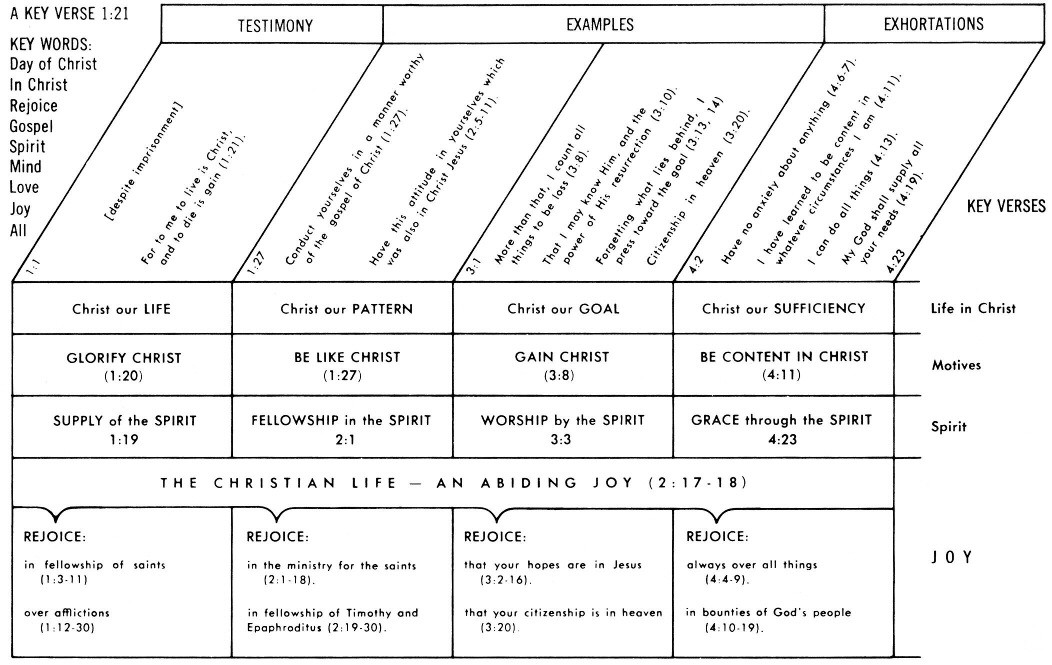
LIFE IN CHRIST
Click chart to enlarge
Charts from Jensen's Survey of the NT - used by permission
Philippians - Charles Swindoll = Chart on right side of page
| Account of Paul's Circumstances Php 1:1-30 |
Have the Mind of Christ Php 2:1-30 |
Have the Knowledge of Christ Php 3:1-21 |
Have |
| Partakers of Christ | People of Christ | Pursuit of Christ | Power of Christ |
| Suffering | Submission | Salvation | Sanctification |
| Experience | Examples | Exhortation | |
Philippians 4:11 Not that I speak (1SPAI) from want, for I have learned (1SAAI) to be content in whatever circumstances I am (PAN) (NASB: Lockman)
Greek: ouch hoti kath' husteresin lego, (1SPAI) ego gar emathon (1SAAI) en ois eimi (1SPAI) autarkes einai. (PAN)
Amplified: Not that I am implying that I was in any personal want, for I have learned how to be content (satisfied to the point where I am not disturbed or disquieted) in whatever state I am. (Amplified Bible - Lockman)
KJV: Not that I speak in respect of want: for I have learned, in whatsoever state I am, therewith to be content.
Lightfoot: Do not suppose, that in saying this I am complaining of want; for I have learnt to be content with my lot, whatever it may be.
NLT: Not that I was ever in need, for I have learned how to get along happily whether I have much or little. (NLT - Tyndale House)
Phillips: Nor do I mean that I have been in actual need, for I have learned to be content, whatever the circumstances may be. (Phillips: Touchstone)
Wuest: It is not that I speak as regards a need, for, so far as I am concerned, I have come to learn, in the circumstances in which I am placed, to be independent of these and self-sufficient.
Young's Literal: not that in respect of want I say it, for I did learn in the things in which I am -- to be content;
NOT THAT I SPEAK FROM WANT: ouch hoti kath husteresin lego (1SPAI) :
I am not saying this because I am in need (NET)
I do not say this because I have lacked anything (NJB)
Not that I am implying that I was in any personal want (Amp)
- Philippians 4 Resources - Multiple sermons and commentaries
- Philippians 4:10-12 Secret of Contentment 1 - John MacArthur
- Philippians 4:13 Secret of Contentment - 2 - John MacArthur
Not that I speak from want - What Paul is doing in this introductory phrase is reminding the Philippians that his thankfulness for their' giving was not because he was needy (though he was needy), but because it was good for them to be givers. He wants them to know he was not depending on their gift to meet his needs. Paul shows the right balance - we ought to appreciate and rejoice over other's gifts to us; but we shouldn't rely upon them as the basis for meeting our needs.
Want (5304) (husteresis from the verb hustereo = hustereo, fall short, be deficient, be destitute) is a noun which means being in need, being deficient, suffering need or being in poverty. Hustereo describes the condition of lacking that which is essential.
Even though Paul was in by the world's standards "in need" (he was in prison as he wrote this letter), he was content where he was, for he was free in Christ!
The only other NT use of husteresis…
Mark 12:44 for they all put in out of their surplus, but she, out of her poverty, put in all she owned, all she had to live on."
Spurgeon comments that it…
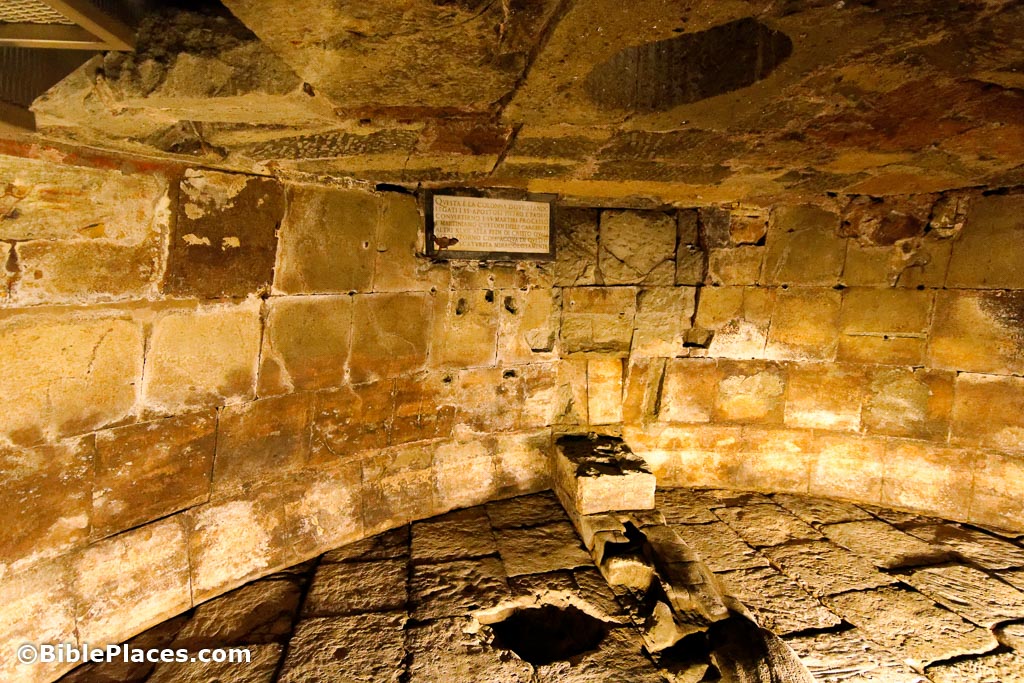
was not an easy lesson to learn, especially when one of those states meant being in prison at Rome. If he was ever in the Mamertine Prison (picture of one of the dungeons - talk about claustrophobia!), those of us who have been in that dungeon would confess that it would take a deal of grace to make us content to be there; and if he was shut up in the prison of the Palatine hill, in the barracks near the morass, it was, to say the least, not a desirable place to be in. A soldier chained to your hand day and night, however good a fellow he may be, does not always make the most delightful company for you, nor you for him; and it takes some time to learn to be content with such a companion; but, says Paul, “I have learned, in whatsoever state I am, therewith to be content.”
Some one hundred years ago it was determined that the average American had about 70 wants, things he desired to have. A similar survey was taken of his grandson and he had nearly 500 wants on his list and today, I’m sure that number is even higher. Why? Because people are not content in what they have! (Joe Guglielmo - Philippians 4:11-20 The Content Life)
Coming downstairs one morning, Lord Congelton heard the cook exclaim, “Oh, if I only had five pounds, wouldn’t I be content!” Thinking the matter over, and anxious to see the woman satisfied, he shortly after handed her a five-pound note, then worth about twenty-five dollars. She thanked him profusely. He paused outside the door to hear if she would express her satisfaction and thank God. As soon as his shadow was invisible, she cried out, “Why didn’t I say ten?”- Prairie Overcomer
Thomas Watson has the following introduction from his highly recommended (especially if you are virtually immobilized by anxiety) book on one verse, Philippians 4:11…
These words are brought in by way of prolepsis (a figure in rhetoric by which objections are anticipated or prevented) to anticipate and prevent an objection. The apostle had, in the former verse, laid down many grave and heavenly exhortations: among the rest, “to be careful for nothing.” Not to exclude, 1. A prudential care; for, he that provides not for his own house, “has denied the faith, and is worse than an infidel.” (1Ti 5.8) Nor, 2. a religious care; for we must give all “diligence to make our calling and election sure.” (2Pe. 1.10-note) But, 3. to exclude all anxious care about the issues and events of things; “take no thought for your life, what you shall eat.” (Mt. 6.25-note) And in this sense it should be a Christian’s care not to be careful (Ed: Owen uses "careful", the archaic English word for anxious). The word careful in the Greek comes from the primitive, that signifies “to cut the heart in pieces,” a soul-dividing care; take heed of this. We are bid to “commit our way unto the Lord;” (Ps 37.5-note) the Hebrew word is, “roll thy way upon the Lord.” It is our work to cast away care; (1Pe 5.7-note) and it is God’s work to take care.
By our immoderacy (lack of moderation implies a lack of desirable or necessary restraint, excessiveness) we take His work out of His hand.
Care, when it is eccentric, either distrustful or distracting, is very dishonorable to God; it takes away His providence, as if He sat in heaven and minded not what became of things here below; like a man that makes a clock, and then leaves it to go for itself (Ed: This is what Deism believes).
Immoderate care takes the heart off from better things; and usually while we are thinking how we shall live, we forget how to die.
Care is a spiritual canker (an erosive or spreading sore) that wastes and dispirits (deprives of morale or enthusiasm); we sooner by our care (anxiety) add a furlong to our grief than a cubit to our comfort. God threatens it as a curse, “they shall eat their bread with carefulness (anxiety).” (Ezek12.19) Better fast than eat of that bread.
“Be careful for nothing.”
Now, lest any one should say, yea, Paul you preach that to us which you have scarcely learned it yourself; Have you learned not to be careful (anxious)? the apostle seemed tacitly to answer that, in the words of the text; “I have learned, in whatsoever state I am, therewith to be content:” a speech worthy to be engraven upon our hearts, and to be written in letters of gold upon the crowns and diadems of princes.
The text doth branch itself into these two general parts. I. The scholar, Paul; “I have learned.” II. The lesson; “in every state to be content.” (Read his entire book - Art of Divine Contentment An Exposition of Philippians 4:11)
FOR I HAVE LEARNED HOW TO BE CONTENT IN WHATEVER CIRCUMSTANCES I AM: ego gar emathon (1SAAI) en ois eimi (1SPAI) autarkes einai (PAN):
I have learnt to be content with my lot, whatever it may be (Lightfoot)
I have learned how to be content (satisfied to the point where I am not disturbed or disquieted) in whatever state I am (Amp)
for I have learnt to be satisfied with what I have (GNB)
for (for my part) I have learned, whatever be my outward experiences, to be content (Weymouth)
so far as I am concerned, I have come to learn, in the circumstances in which I am placed, to be independent of these and self-sufficient (Wuest)
- Php 3:8; Ge 28:20; Ex 2:21; Mt 6:31, 32, 33, 34; Lk 3:14; 1Ti 6:6, 7, 8-note, 1Ti 6:9-note; He 10:34; He 13:5,6
- Philippians 4 Resources - Multiple sermons and commentaries
- Philippians 4:10-12 Secret of Contentment 1 - John MacArthur
- Philippians 4:13 Secret of Contentment - 2 - John MacArthur
TRUE CONTENTMENT IS
A LEARNING PROCESS
For I have learned how to be content in whatever circumstances I am - We are all in "circumstances" of one type or another in our Christian walk. The question is do we have a teachable spirit to truly learn from the Holy Spirit in those circumstances? I have to be honest -- when the heat is on as it has been in 2022 for about 6 of the most testing, horrible time of my 36 years as a disciple of Jesus, it is had not been easy and I have had periods of feeling like I was caught in quicksand, but the Lord has finally lifted me out (I had asked many brethren to pray for the adverse circumstances!).
THOUGHT - Only genuine believers can be truly, fully content, for in the final analysis, contentment is not a natural attainment but a supernatural gift from our heavenly Father to His children! To say it another way, a believer's degree of contentment in this world is a reflection of their degree of contentment regarding the world to come! The more the invisible, eternal things above grip our heart, the less will be the power of the visible, temporal things of the world to cause us discontent.
For (1063) (gar) is "a marker of cause or reason between events, though in some context this association may be remote or tenuous" (Louw-Nida). Stated another way "for" is a term of explanation which always provides an opportunity to pause and ponder the passage. You will be amazed how much truth a humble, prayerful, Spirit dependent attitude will allow to discern as you simply observe the text! In the present context, for explains the reason for Paul not being dependent upon their gift. It is not because he needs external circumstances to be more favorable, but that he has learned to be content from another Source. Paul does not need gifts to rejoice. The believer's joy and contentment is not dependent upon outward circumstances, but upon the indwelling Christ. Paul’s joy comes from within, not from without.
Matthew Henry says that "We have here an account of Paul's learning, not that which he got at the feet of Gamaliel, but that which he got at the feet of Christ."
Have learned (3129) (manthano [word study]) means to learn by experience, to discover and so to genuinely understand and accept a teaching as true and to apply it in one’s life. Manthano indicates that one directs his mind to something which produces an external effect. In the present context the idea would be that Paul learned through his experiences and came to know and experience the contentment he describes. His spiritual contentment was not something he had immediately after he was saved. He had to go through many experiences, easy and difficult, in order to learn who was the Source of true contentment.
Manthano - 25x in the NT - Matt. 9:13; 11:29; 24:32; Mk. 13:28; Jn. 6:45; 7:15; Acts 23:27; Rom. 16:17; 1 Co. 4:6; 14:31, 35; Gal. 3:2; Eph. 4:20; Phil. 4:9, 11; Col. 1:7; 1 Tim. 2:11; 5:4, 13; 2Ti 3:7, 14; Titus 3:14; Heb. 5:8; Rev. 14:3. The NAS renders manthano as educated(1), find out(1), learn(12), learned(9), learning(1), receive instruction(1).
And so we see that this satisfaction apart from external conditions is something Paul learned. It may have taken some time, but Paul's training has been consummated and he is no longer dependent upon worldly things for satisfaction. All believers can expect to go through the same training process for as "citizens of heaven", God wants to wean us from dependence upon the decaying delicacies of earth.
Thomas Watson remarks that…
1. The apostle doth not say, I have heard, that in every estate I should be content: but, I have learned. Whence our first doctrine, that it is not enough for Christians to hear their duty, but they must learn their duty. It is one thing to hear and another thing to learn; as it is one thing to eat and another thing to concoct (to prepare by combining raw materials). Paul was a practitioner. Christians hear much, but it is to be feared, learn little. (! cp Jas 1:22-note) There were four sorts of grounds in the parable, (Lk 8.5) and but one good ground: an emblem (an object symbolizing and suggesting another object or an idea) of this truth, many hearers, but few learners.
There are two things which keep us from learning.
1. Slighting what we hear.
Christ is the pearl of price; when we disesteem this pearl, we shall never learn either its value, or its virtue. The gospel is a rare mystery; in one place, (Acts 20.24) it is called “the gospel of grace;” in another, (1Co 4.4) “the gospel of glory;” because in it, as in a transparent glass, the glory of God is resplendent. But he who has learned to contemn (scorn) this mystery, will hardly ever learn to obey it; he who looks upon the things of heaven as things by and bye, and perhaps the carrying on of a trade, or carrying on some politic design as of greater importance, this man is on the high road to damnation, and will hardly ever learn the things of His peace. Who will learn that which he thinks is scarce worth learning?
2. Forgetting what we hear.
If a scholar has his rules laid before him, and he forgets them as fast as he reads them, he will never learn. (Jas 1.25-note) Aristotle calls the memory the scribe of the soul; and Bernard calls it the stomach of the soul, because it hath a retentive faculty, and turns heavenly food into blood and spirits; we have great memories in other things, we remember that which is vain. Cyrus could remember the name of every soldier in his huge army. We remember injuries: this is to fill a precious cabinet with dung; but as Hierom said, how soon do we forget the sacred truths of God?
We are apt to forget three things: our faults, our friends, our instructions.
Many Christians are like sieves; put a sieve into the water, and it is full; but take it forth of the water, and all runs out: so, while they are hearing a sermon, they remember something: but like the sieve out of the water, as soon as they leave the church, all is forgotten. “Let these sayings, (says Christ) sink down into your ears;” (Lk 9.44) in the original it is, “put (or place) these sayings into your ears,” as a man who would hide a jewel from being stolen, locks it up safe in his chest. Let them sink: the word must not fall only as dew that wets the leaf, but as rain which soaks to the root of the tree, and makes it fructify (fruitful). O, how often does Satan, that fowl of the air, pick up the good seed that is sown (Mt 13:19, Mk 4:15, Lk 8:12)! (Read his entire book - Art of Divine Contentment An Exposition of Philippians 4:11) (Read Reviews to motivate you to read his book)
Contentment does not come naturally (even to Christians) but only supernaturally as one learns that this life is no longer me living but Christ living in and through me.
Wuest comments that the
words have learned are in a construction in the Greek which speaks of entrance into a new condition. It is, “I have come to learn.” Paul had not always known that. He had been reared in the lap of luxury, and had never known want as a young man. The “I” is emphatic. It is, “I, for my part, whatever others may feel.” -- I leave it to others if they will, to be discontented. I, for my part, have learned, by the teaching of the Holy Spirit, and the dealings of Providence to be content.
Paul had learned and accepted the teaching that Christ was His sufficiency and had applied it practically to his life experiences.
How did Paul learn? Surely in God's classroom, the curriculum offering such classes as "Discipline (Child Training) 101", "Tribulaton102", etc, classes in which Paul had ample experience, recording for example
I have been on frequent journeys, in dangers from rivers, dangers from robbers, dangers from my countrymen, dangers from the Gentiles, dangers in the city, dangers in the wilderness, dangers on the sea, dangers among false brethren… (2Cor 11:26)
The writer of Hebrew extols the virtues of our heavenly Father's method of teaching His children through "child training" writing that
He disciplines us for our good, that we may share His holiness. All discipline for the moment seems not to be joyful, but sorrowful; yet to those who have been trained (Greek = gumnazo - pictures discipline as God's gymnasium) by it, afterwards it yields the peaceful fruit of righteousness. [a harvest of fruit which consists in righteousness--in conformity to God's will in purpose, thought, and action, resulting in right living and right standing with God] (He 12:10-note; He 12:11-note)
Be (eimi) means to exist and in the present context describes Paul's existing in a state of contentment. The verb is in the present tense which speaks of his experience as a continuous one and the indicative mood signifies that this was a real event, not a figment of his imagination. Contentment is not a hypothetical postulate available to just a few but is the practical potential available to every person in Christ. Paul was totally independent of man because he was totally dependent upon Christ. He knew that the chief end of man is not to have his needs met, but to glorify God and enjoy Him forever and because of that, he was satisfied with whatever God graciously granted him.
If you are like me and have not yet "mastered" the art of contentment, Paul explains that contentment is something that must be learned. As Thomas Watson puts it "it is not enough for Christians to hear their duty, but they must learn their duty. It is one thing to hear and another thing to learn; as it is one thing to eat and another thing to digest. St Paul was a practitioner. Christians hear much, but it is to be feared, learn little. There were four sorts of grounds in the parable, (Lk 8:5) and but one good ground: an emblem of this truth, many hearers, but few learners." (From The Art of Divine Contentment - highly recommended reading) In fact, I would posit that while will be learning the secret of contentment for the rest of our lives, as we grow in the grace and knowledge of our Lord Jesus Christ, we should be able to say more and more confidently that indeed we "can do all things through Him Who (continually) strengthens" us. Note that "strengthen" is the Greek verb endunamoo in the present tense which in this context signifies that Jesus (the Spirit of Christ, Ro 8:9-note), continually gives us dunamis, the inherent power to accomplish a task, in this case to be content and to do so in dependence on His strength which continually enables us to do what we could never accomplish in our fleshly strength! As an aside, I fear many saints quote Phil 4:13 out of context and completely miss Paul's intended meaning! The reason Paul could make such a wonderful statement on His sufficiency in Christ was based on the secret he had learned in Phil 4:11,12! This is just another example of learning to read the text in context, one of the critical components of inductive Bible study.
Content (842) (autarkes from autos = reflexive pronoun = self + arkeo = be sufficient, suffice) means literally "sufficient to self" (self-sufficient and competent) and so to be independent of external circumstances and independent of all people. One secular writer used autarkes in reference to a country that supplied itself and had no need of imports. True contentment comes only from our Lord, and enables believers to be satisfied and at ease in the midst of any problem. Autarkes therefore describes the man who needs nothing externally to be satisfied in life for all he needs is within. the believer who has Christ dwelling within.
See Related Resource: Multiple Quotes and Illustrations Related to Contentment
Wiersbe adds that…
The word “content” actually means “contained.” It is a description of the man whose resources are within him (Ed:What are those resources? = the Spirit of Christ and the Word of Christ) so that he does not have to depend on substitutes without. (Wiersbe, W: Bible Exposition Commentary. 1989. Victor)
Asaph expresses a similar thought asking…
Whom have I in heaven but Thee? And besides Thee, I desire nothing on earth. My flesh and my heart may fail, But God is the strength of my heart and my portion forever. (Ps 73:25-26)
Dwight Pentecost wisely explains that…
Air and water are two entirely different elements or spheres, and it is impossible to have a vessel filled with air and water at the same time. One that is filled with air must have the air displaced in order to be filled with water. Similarly, if a man’s life is given over to the pursuit of material things, that life cannot then be filled with Jesus Christ. Until that love for material things is displaced, that life cannot and will not be filled with Jesus Christ. When a man gives himself to the pursuit of all that is involved in this world and makes its position and its material things his goal and his standard and the center of his life, he will not find the satisfaction that comes from making Jesus Christ the center of his life. To be content is the opposite of to be covetous, to be greedy, to be worldly, to be materialistic… The reason material things can never make a man content is that a man is never able to get enough of them to satisfy him… Someone once asked John D. Rockefeller how much money is enough. He thought a moment and said, “Just a little more than one has.” The world’s wealthiest man has yet to say, “I have enough to be satisfied.” (Pentecost, J. D. The Joy of Living: A Study of Philippians. Kregel Publications)
Jesus warned
Beware, and be on your guard against every form of greed; for not even when one has an abundance does his life consist of his possessions. (Luke 12:15)
We can never accumulate enough "things" if "things" are what we crave. Jesus implies one can easily fall into this deceptive trap. So "Beware"! Material things give no lasting satisfaction. It is only in what Jesus provides that can we can find genuine satisfaction and contentment.
Barclay adds that
in order to achieve content, the Stoics abolished all desires and eliminated all emotions. Love was rooted out of life and caring was forbidden. As T. R. Glover said, “The Stoics made of the heart a desert, and called it a peace.” We see at once the difference between the Stoics and Paul. The Stoic said, “I will learn to be content by a deliberate act of my own will.” Paul said, “I can do all things through Christ Who infuses His strength into me.” For the Stoic, contentment was a human achievement; for Paul it was a divine gift. The Stoic was self-sufficient; but Paul was God-sufficient. Stoicism failed because it was inhuman; Christianity succeeded because it was rooted in the divine. Paul could face anything, because in every situation he had Christ. The man who walks with Christ can cope with anything. (Barclay, W: The Daily Study Bible Series, Rev. ed. Philadelphia: The Westminster Press)
Autarkes is found only here in the NT but was a secular word used by the Stoic philosophers to describe one of their favorite doctrines that a man by exerting the power of his own will (mind power or what today we might say "grit your teeth and bear it") should be sufficient to himself for all things and should be enabled thereby to resist the shock of whatever circumstances or conditions he might experience. It expressed the Stoic concept of the wise man as being sufficient in himself, wanting nothing and possessing everything.
Paul adapts this well known pagan word and gives it a Christocentric meaning explaining that he is "self-sufficient" but is not a result of the power exerted by his old self (his flesh) but through the power of the new self indwelt by the Spirit of Christ, His source of strength. Succinctly stated Paul is self-sufficient because he is Spirit dependent and Savior-supplied. Are you trying to live the "Christian" life in your power? Take Christ out of "Christian" and the word that's left ("ian") doesn't even make sense. Have you like Paul learned to be content in Christ? Please don't become disappointed if you have not achieved the level of maturity Paul expresses. Remember that even the great apostle had to learn this wonderful truth. So don't expect it to come either naturally or instantaneously. Use the circumstances God allows to learn this truth.
Paul’s independence was not Stoic independence, but dependence upon Christ. He found his sufficiency in Christ. He was independent of circumstances because he was dependent upon Christ. One of the secrets of contentment is to have a mind satisfied with whatever Providence allots. A prayer you may have heard in church is "Lord, give us minds always contented with our present condition.” Have you ever prayed like that before?
Eadie adds that
The contentment which the apostle universally and uniformly possessed, sprang not from indifference, apathy, or desperation. It was not sullen submission to his fate, not the death of hope within him. He felt what want was, and keenly felt it, and therefore he gladly accepted of relief, and rejoiced in all such manifestations of Christian sympathy. Nor was he self-sufficient in the ordinary or the common sense of the term. It was no egotistic delusion that upheld him, nor did he ever invoke the storm to show that he could brave it. But his mind calmly bowed to the will of God in every condition in which he was placed. For that wondrous equanimity and cheerfulness which far excelled the stolid and stubborn endurance ascribed to heathen stoicism, gave him the mastery over circumstances. He felt the evil, but surmounted it—a purer triumph than with a petrified heart to be unconscious of it. (The Epistle to the Philippians)
Although autarkes is found only here in the NT, there are several instructive uses of related words. For example in the midst of a "thorny" trial (see 2Cor 12:7, 8 for context), Paul is prays for relief and here is Jesus' reply…
My grace is sufficient (arkeo) (Christ's infinite grace always suffices. The Amplified says " [sufficient against any danger and enables you to bear the trouble manfully]) for you, for (see term of explanation) power ( = inherent power to accomplish a task, power from the Spirit of Christ as we humbly yield - see James 4:) is perfected in weakness." Most gladly, therefore, I will rather boast about my weaknesses, that the power of Christ may dwell in me. (2Cor 12:9-note)
Surely this thorny trial was a lesson in the Christ's class of "Contentment 101".
Writing in the context of "cheerful giving" Paul reminds the Corinthians that
God is able to make all grace abound to you, so that always having all sufficiency (autarkeia used in classical Greek in a philosophical sense for "a perfect condition of life, in which no aid or support is needed". Amplified adds "possessing enough to require no aid or support and furnished in abundance for every good work and charitable donation") in everything, you may have an abundance for every good deed (2Co 9:8)
Paul reminded Timothy of what was really valuable in life writing that
godliness actually is a means of great gain (a source of immense profit) , when accompanied by contentment (autarkeia). (1Ti 6:6-note)
The writer of Hebrews exhorts the saints of all ages to
Let your character (conduct, manner of life, behavior) be free from the love of money (Amplified adds [including greed, avarice, lust, and craving for earthly possessions]) , being content (arkeo) with what you have, for (explains now how the former attitude is possible) He Himself has said, "I WILL NEVER DESERT YOU, NOR WILL I EVER FORSAKE YOU (there are 5 negatives in the Greek underlining the absolute impossibility of this ever happening) (see note Hebrews 13:5)
This verse once again emphasizes the close relationship of a Christian's contentment with intimacy with Christ and his confidence in Christ's sufficiency.
A T Robertson adds that
Paul is contented with his lot and he learned that lesson long ago.
Paul is teaching here that he had learned how to be independent of external circumstances. He had come to the point of realizing JESUS was ALL he had and that JESUS was ALL he NEEDED!
In whatever circumstances I am - C H Spurgeon makes the point that the little word whatever (herewith in his version) is very important explaining that the idea is that…
There is nothing in hunger, or thirst, or nakedness, or peril, to invite our contentment. If we are content under such circumstances, it must be from higher motives than our condition itself affords. Hunger is a sharp thorn when in the hands of stern necessity. But hunger may be voluntarily endured for many an hour when conscience makes a man willing to fast. Reproach may have a bitter fang, but it can be bravely endured, when I am animated by a sense of the justice of my cause. Now Paul counted that all the ills which befell him were just incident to the service of his Lord. So for the love he bear to the name of Jesus, the hardships of servitude or self-mortification sat lightly on his shoulders, and were brooked cheerily by his heart.
There is yet a third reason why Paul was content, I will illustrate it. Many an old veteran takes great pleasure in recounting the dangers and sufferings of his past life. He looks back with more than contentment, oftentimes with self-gratulation, upon the terrible dangers and distresses of his heroic career. Yet the smile that lights his eye, and the pride that sits on his lofty wrinkled brow as he recounts his stories, were not there when he was in he midst of the scenes he is now describing. It is only since the dangers are past, the fears have subsided, and the issue is complete, that his enthusiasm has been kindled to a flame. But Paul stood on vantage ground here. "In all these things," said he, "we are more than conquerors." Witness his voyage toward Rome. When the ship in which he sailed was caught and driven before a tempestuous wind; when darkness veiled the skies; when neither sun nor stars in many days appeared; when hope failed every heart;—he alone bore up with manly courage. And why? The angel of God stood by him, and said, Fear not. His faith was predestined, and as such, he had as much peaceful contentment in his breast while the tribulation lasted as when it had closed. (Contentment)
Theodore Epp makes a good point that writing…
Nowhere does the Bible suggest that we should be content with unsatisfactory conditions. But because of our personal relationship with Christ we can be content in them. As different situations arise and we learn our lessons one after another, we will also find it possible to be content in every situation.
Contentment is one of those concepts that is easier to define than to experience. This is probably because the tendency is to seek contentment in possessions rather than in a person.
We assume that contentment comes from having things, but it is possible to have deep contentment without things.
So often we think contentment would be ours if we were promoted to the next higher position or if we were able to buy that object we think we need so much or if we could be accepted in a certain circle of friends.
But as we advance in these areas, we discover that contentment is elusive because we are seeking it in the wrong places and in the wrong way.
Contentment does not depend on what we have; it depends on who we are. It is a spiritual attainment, not something that results from purchasing power. As someone has said, "Contentment is a state of heart rather than a statement of account."
Godliness with contentment is great gain (1 Ti 6:6-note). (Devotional)
Clarke adds that what Paul is saying is that
"I am so satisfied with the wise providence and goodness of God, that I know whatever He determines is the best; and therefore I am perfectly contented that He should govern the world in that way which seems best to His godly wisdom. How true is the proverb, A contented mind is a continual feast! What do we get by murmuring and complaining?"
Calvin comments
"Whatever my condition may be, I am satisfied with it. "Why? because saints know that they thus please God. Hence they do not measure sufficiency by abundance, but by the will of God, which they judge of by what takes place, for they are persuaded that their affairs are regulated by his providence and good pleasure."
Spurgeon gives us an excellent metaphor to help understand Paul's teaching --
"These words show us that contentment is not a natural propensity of man. “Ill weeds grow apace.” Covetousness, discontent, and murmuring are as natural to man as thorns are to the soil. We need not sow thistles and brambles; they come up naturally enough, because they are indigenous to earth: and so, we need not teach men to complain; they complain fast enough without any education. But the precious things of the earth must be cultivated. If we would have wheat, we must plough and sow; if we want flowers, there must be the garden, and all the gardener’s care. Now, contentment is one of the flowers of heaven, and if we would have it, it must be cultivated; it will not grow in us by nature; it is the new nature alone that can produce it, and even then we must be specially careful and watchful that we maintain and cultivate the grace which God has sown in us. Paul says, “I have learned … to be content;” as much as to say, he did not know how at one time. It cost him some pains to attain to the mystery of that great truth. No doubt he sometimes thought he had learned, and then broke down. And when at last he had attained unto it, and could say, “I have learned in whatsoever state I am, therewith to be content,” he was an old, grey-headed man, upon the borders of the grave—a poor prisoner shut up in Nero’s dungeon at Rome. We might well be willing to endure Paul’s infirmities, and share the cold dungeon with him, if we too might by any means attain unto his good degree.
Do not indulge the notion that you can be contented with learning , or learn without discipline. It is not a power that may be exercised naturally, but a science to be acquired gradually. We know this from experience. Brother, hush that murmur, natural though it be, and continue a diligent pupil in the College of Content." (Morning and evening: Feb 16 AM).
Contentment from Easton's Bible Dictionary
A state of mind in which one's desires are confined to his lot whatever it may be (1 Timothy 6:6-note; 2Cor9:8). It is opposed to envy (James 3:16), avarice (Hebrews 13:5), ambition (Proverbs 13:10), anxiety (Matthew 6:25 6:34), and repining (1 Corinthians 10:10). It arises from the inward disposition, and is the offspring of humility, and of an intelligent consideration of the rectitude and benignity of divine providence (Psalms 96:1,2; 145), the greatness of the divine promises (2 Peter 1:4), and our own unworthiness (Genesis 32:10); as well as from the view the gospel opens up to us of rest and peace hereafter (Romans 5:2).
Spurgeon in Morning and Evening writes the following devotional related to Philippians 4:11…
These words show us that contentment is not a natural propensity of man. “Ill weeds grow apace.” Covetousness, discontent, and murmuring are as natural to man as thorns are to the soil. We need not sow thistles and brambles; they come up naturally enough, because they are indigenous to earth: and so, we need not teach men to complain; they complain fast enough without any education. But the precious things of the earth must be cultivated. If we would have wheat, we must plough and sow; if we want flowers, there must be the garden, and all the gardener’s care. Now, contentment is one of the flowers of heaven, and if we would have it, it must be cultivated; it will not grow in us by nature; it is the new nature alone that can produce it, and even then we must be specially careful and watchful that we maintain and cultivate the grace which God has sown in us. Paul says, “I have learned … to be content;” as much as to say, he did not know how at one time. It cost him some pains to attain to the mystery of that great truth. No doubt he sometimes thought he had learned, and then broke down. And when at last he had attained unto it, and could say, “I have learned in whatsoever state I am, therewith to be content,” he was an old, grey-headed man, upon the borders of the grave—a poor prisoner shut up in Nero’s dungeon at Rome. We might well be willing to endure Paul’s infirmities, and share the cold dungeon with him, if we too might by any means attain unto his good degree. Do not indulge the notion that you can be contented with learning, or learn without discipline. It is not a power that may be exercised naturally, but a science to be acquired gradually. We know this from experience. Brother, hush that murmur, natural though it be, and continue a diligent pupil in the College of Content.
Dwight Pentecost poignantly applies the teaching in this passage writing…
Child of God, if there is a restlessness in your heart, if you long for that rest, satisfaction, and contentment which Paul testifies he has found, on the authority of Scripture I can say that is to be found only in Jesus Christ. Jesus Christ must be the center of life. Jesus Christ must be the goal of life. Jesus Christ must be the fullness of life. He must be all in all. Socrates, the great Greek philosopher, was asked on one occasion, “Who is the wealthiest man?” He replied, “He that is content with least, for contentment is natures’ well.” “To live is Christ,” and “I am content.” (Ibid)
A friend in Pennsylvania wrote, "One of my father's old cows gives good milk, but she sure can be dumb! She has a whole field in which to feed, yet no grass seems quite as tasty as those patches outside her own pasture. I often see her stretching her head through the fence, while right behind her is everything she needs—excellent grazing land, beautiful shade trees, a cool, refreshing stream of water, and even a big chunk of salt. What more could she want?"
Many people are like that old cow. They think the "grass is always greener on the other side of the fence." They are constantly grasping, coveting, and seeking to obtain what doesn't belong to them.
If you are a Christian, the greatest blessings in life are already yours. Heaven is your home, and God is your Father. He has promised never to leave you (Heb. 13:5), and He will supply your every need (Phil. 4:19). How green the grass is on your side of the fence! —R. W. De Haan (Our Daily Bread, Copyright RBC Ministries, Grand Rapids, MI. Reprinted by permission. All rights reserved)
Most people aren't content with their lot --
even when they get a lot.
GODLY CONTENTMENT - Contentment is never the result of multiplying riches, increasing pleasures, or gaining fame. All these only incite discontent, for when one obtains them, he finds he still is not satisfied. Contentment does not depend upon things on the outside, but results from conditions on the inside! Paul had suffered more for the sake of Christ than probably anyone else (2 Cor. 11:23-28); yet this is the man who says, "I am content." The apostle was able to interpret all the experiences of life in terms of God's will for his eternal good (Rom. 8:28). Paul did not come to this happy philosophy of life in a moment. He says, "I have learned … to be content." Aspiring to be what we are not, or grasping after riches which elude us, is not the way to happiness. We must rather do our very best with God's help to accomplish our life's task with the talents and opportunities He presents.
In his famous lecture on "Clocks and Watches," Dr. Joseph Parker related the following story: A little watch, delicately strung, was dissatisfied with its restricted sphere of influence in a lady's pocket. It envied the position of Big Ben, the great tower clock. One day as it passed with her ladyship over London's Westminster Bridge, the tiny watch exclaimed, "I wish I could go up there! I could then serve multitudes, instead of just one individual." "You shall have your opportunity, small watch," she said. The lecturer then dramatically described how the pocket timepiece was drawn up the side of the mammoth tower by a slender thread. When it reached the top, it was completely lost to view. In his dramatic way, Dr. Parker concluded his lecture by exclaiming, "Its elevation had become its annihilation!"
Pray that you too may not lose the small influence you now have for Christ by coveting something larger for which you are not equipped, and which God constantly refuses you in His love. (Our Daily Bread, Copyright RBC Ministries, Grand Rapids, MI. Reprinted by permission. All rights reserved)
O for the peace of perfect trust
My loving God in Thee;
Unwavering faith that never doubts
Thou choosest best for me. —Anon.
Discontent makes rich men poor,
While contentment makes poor men rich
BAD AND GOOD OF POVERTY - The young man I visited in jail had been arrested for armed robbery. He was bitter as he spoke of the inner-city school from which he had dropped out because he felt unsafe. He asked, "Why couldn't I have gone to a better school? Why didn't someone help me to learn a trade?" He said he committed the robbery because he was sick and tired of having so little while others had so much.
I felt sorry for him. Poverty has a down side. It can place people in a position where they are tempted to commit crimes.
Like the writer of Proverbs 30, I would never ask God to send me poverty. Yet Jesus said, "Blessed are you poor" (Luke 6:20).
I grew up in the 1930s during the Great Depression. My family seldom ate meat, and we wore second hand clothing. Yet we were happy. We were supremely thankful for small favors. We enjoyed simple pleasures. We appreciated one another. We valued our spiritual riches.
I'm not saying that we should desire poverty, but we can be hankful for it. We can learn lessons through it that we could earn in no other way. Let's be like the apostle Paul who said that he had learned to be content, no matter what his situation (Phil. 4:11). -- Herbert Vander Lugt (Our Daily Bread, Copyright RBC Ministries, Grand Rapids, MI. Reprinted by permission. All rights reserved)
Lord, help me not to set my heart
On things that pass away;
Make me content with what I have
And help me stay that way.
--Sper
Those who are content are never poor;
those who are discontent are never rich
Contentment
by William Cowper
Fierce passions discompose the mind,
As tempests vex the sea;
But calm content and peace we find,
When, Lord, we turn to Thee.
In vain by reason and by rule
We try to bend the will;
For none but in the Saviour's school
Can learn the heavenly skill.
Since at His feet my soul has sate,
His gracious words to hear,
Contented with my present state,
I cast on Him my care.
"Art thou a sinner, soul?" He said,
"Then how canst thou complain!
How light thy troubles here, if weigh'd
With everlasting pain!
"If thou of murmuring wouldst be cured,
Compare thy griefs with mine;
Think what my love for thee endured,
And thou wilt not repine.
"'Tis I appoint thy daily lot,
And I do all things well;
Thou soon shalt leave this wretched spot,
And rise with me to dwell.
"In life my grace shall strength supply,
Proportion'd to thy day;
At death thou [still] shalt find me nigh,
To wipe thy tears away."
Thus I, who once my wretched days
In vain repinings spent,
Taught in my Saviour's school of grace,
Have learnt to be content.
A NEW PERSPECTIVE - A Jewish man in Hungary went to his rabbi and complained, “Life is unbearable. There are nine of us living in one room. What can I do?” The rabbi answered, “Take your goat into the room with you.” The man was incredulous, but the rabbi insisted, “Do as I say and come back in a week.”
A week later the man returned looking more distraught than before. “We can’t stand it,” he told the rabbi. “The goat is filthy.” The rabbi said, “Go home and let the goat out, and come back in a week.” A week later the man returned, radiant, exclaiming, “Life is beautiful. We enjoy every minute of it now that there’s no goat- only the nine of us.” (Reader's Digest [12/81].) Contentment is more a matter of our perspective than of our circumstances, isn’t it!
ILLUSTRATIONS OF BIBLE TRUTH by Harry A. Ironside - SATISFACTION IN CHRIST - I have learned in whatsoever state I am, therewith to be content (Phil. 4:11) CHRIST is enough to satisfy the hearts of all who confide in Him and who leave everything in His hands. Such need never be cast down by seeming misfortunes.
A Christian asked another how he was getting along. Dolefully his friend replied, "Oh, fairly well, under the circumstances."
"I am sorry," exclaimed the other, "that you are under the circumstances. The LORD would have us living above all circumstances, where He Himself can satisfy our hearts and meet our every need for time and eternity."
Philippians 4:12 I know (1SRAI) how to get along with humble means (PPN) , and I also know (1SRAI) how to live in prosperity (PAN) in any and every circumstance I have learned the secret (1SRPI) of being filled (PPN) and going hungry (PAN) both of having abundance (PAN) and suffering need (PPN) (NASB: Lockman)
Greek: oida (1SRAI) kai tapeinousthai, (PPN) oida (1SRAI) kai perisseuein; (PAN) en panti kai en pasin memuemai (1SRPI) kai chortazesthai (PPN) kai peinan, (PAN) kai perisseuein (PAN) kai hustereisthai. (PPN)
Amplified: I know how to be abased and live humbly in straitened circumstances, and I know also how to enjoy plenty and live in abundance. I have learned in any and all circumstances the secret of facing every situation, whether well-fed or going hungry, having a sufficiency and enough to spare or going without and being in want. (Amplified Bible - Lockman)
Barclay: I know both how to live in the humblest circumstances, and how to have far more than enough. In everything and in all things I have learned the secret of being well fed and of being hungry, of having more than enough and of having less than enough.
KJV: I know both how to be abased, and I know how to abound: every where and in all things I am instructed both to be full and to be hungry, both to abound and to suffer need.
Lightfoot: I know how to bear humiliation, and I know also how to bear abundance. Under all circumstances and in every case, in plenty and in hunger, in abundance and in want, I have been initiated in the never-failing mystery, I possess the true secret of life.
NLT: I know how to live on almost nothing or with everything. I have learned the secret of living in every situation, whether it is with a full stomach or empty, with plenty or little. (NLT - Tyndale House)
Phillips: I know now how to live when things are difficult and I know how to live when things are prosperous. In general and in particular I have learned the secret of facing either poverty or plenty. (Phillips: Touchstone)
Weymouth: I know both how to live in humble circumstances and how to live amid abundance. I am fully initiated into all the mysteries both of fulness and of hunger, of abundance and of want.
Wuest: I know in fact how to discipline myself in lowly circumstances. I know in fact how to conduct myself when I have more than enough. In everything and in all things I have learned the secret, both to be satiated and to be hungry, and to have more than enough and to lack.
Young's Literal: I have known both to be abased, and I have known to abound; in everything and in all things I have been initiated, both to be full and to be hungry, both to abound and to be in want.
I KNOW HOW TO GET ALONG WITH HUMBLE MEANS AND I ALSO KNOW HOW TO LIVE IN PROSPERITY: oida (1SRAI) kai tapeinousthai (PPN) oida (1SRAI) kai perisseuein (PAN):
- 1Cor 4:9, 10, 11, 12, 13; 2 Co 6:4, 5, 6, 7, 8, 9, 10; 10:1,10; 11:7,27; 12:7, 8, 9, 10
- Philippians 4 Resources - Multiple sermons and commentaries
- Philippians 4:10-12 Secret of Contentment 1 - John MacArthur
- Philippians 4:13 Secret of Contentment - 2 - John MacArthur
"I have experienced times of need and times of abundance" (NET)
"I know how to live on almost nothing or with everything" (TLB)
"I know how to live modestly, and I know how to live luxuriously too" (NJB)
"I know how to be abased and live humbly in straitened circumstances, and I know also how to enjoy plenty and live in abundance" (AMP)
I know how to be abased (KJV) - Spurgeon writes…
Notice first, that the apostle said he knew how to be abased. A wonderful knowledge this. When all men honour us, then we may very well be content; but when the finger of scorn is pointed, at us, when our character is held in ill repute, and men hiss us by the wayside, it requires much gospel knowledge to be able to endure that with patience and with cheerfulness. When we are increasing, and growing in rank, and honour, and human esteem, it is easy work to be contented; but when we have to say with John the Baptist, "I must decrease," or when we see some other servant advanced to our place, and another man bearing the palm we all had longed to hold, it is not easy to sit still, and without an envious feeling cry with Moses, "Would to God that all the Lord's servants were prophets." To hear another man praised at your own expense, to find your own virtues made as a foil to set forth the superior excellence of some new rival—this, I say, is beyond human nature, to be able to bear it with joy and thankfulness, and to bless God. There must be something noble in the heart of the man who is able to lay all his honours down as willingly as he took them up, when he can as cheerfully submit himself to Christ to humble him, as to lift him up and seat him upon a throne. And yet, my brethren, we have not any one of us learned what the apostle knew, if we are not as ready to glorify Christ by shame, by ignominy and by reproach, as by honour and by esteem among men. We must be ready to give up everything for him. We must be willing to go downwards, in order that Christ's name may ascend upwards, and be the better known and glorified among men. "I know how to be abased," says the apostle…
… I have to counsel the POOR. "I have learned," says the apostle, "in whatever state I am, therewith to be content."
A very large number of my present congregation belong to those who labour hard, and who, perhaps, without any unkindly reflection, may be put down in this catalogue of the poor. They have enough—barely enough, and sometimes they are even reduced to straitness. Now remember, my dear friends, you who are poor, there are two sorts of poor people in the world. There are the Lord's poor, and there are the devil's poor. As for the devil's poor: they become pauperized by their own idleness, their own vice, their own extravagance. I have nothing to say to them to-night. There is another class, the Lord's poor. They are poor through trying providences, poor, but industrious,—labouring to find all things honest in the sight of all men, but yet they still continue through an inscrutable providence to be numbered with the poor and needy. You will excuse me, brothers and sisters, in exhorting you to be contented; and yet why should I ask excuse, since it is but a part of my office to stir you up to everything that is pure and lovely, and of good report? I beseech you, in your humble sphere, cultivate contentment. Be not idle. Seek, if you can, by superior skill, steady perseverance, and temperate thriftiness, to raise your position. Be not so extravagant as to live entirely without care or carefulness; for he that provideth not for his own household with careful fore-thought, is worse than a heathen man and a publican; but at the same time, be contented; and where God has placed you, strive to adorn that position, be thankful to him, and bless his name. And shall I give you some reasons for so doing?
Remember, that if you are poor in this world so was your Lord. A Christian is a believer who hath fellowship with Christ; but a poor Christian hath in his poverty a special vein of fellowship with Christ opened up to him. Your Master wore a peasant's garb, and spoke a peasant's brogue. His companions were the toiling fishermen. He was not one who was clothed in purple and fine linen, and fared sumptuously every day. He knew what it was to be hungry and thirsty, nay, he was poorer than you, for he had not where to lay his head. Let this console you. Why should a disciple be above his Master, or a servant above his Lord? In your poverty, moreover, you are capable of communion with Christ. You can say, "Was Christ poor? Now can I sympathize with him in his poverty. Was he weary, and did he sit thus on the well? I am weary too, and I can have fellowship with Christ in that sweat which he wiped from his brow." Some of you brethren cannot go the length you can; it were wrong of them to attempt to do it, for voluntary poverty is voluntary wickedness. But inasmuch as God hath made you poor, you have a facility for walking with Christ, where others cannot. You can go with him through all the depths of care and woe, and follow him almost into the wilderness of temptation, when you are in your straits and difficulties for lack of bread. Let this always cheer and comfort you, and make you happy in your poverty, because your Lord and Master is able to sympathize as well as to succour.
Permit me to remind you again, that you should be contented, because otherwise you will belie your own prayers. You kneel down in the morning, and you say, "Thy will be done!" Suppose you get up and want your own will, and rebel against the dispensation of your heavenly Father, have you not made yourself out to be a hypocrite? The language of your prayer is at variance with the feeling of your heart. Let it always be sufficient for you to think that you are where God put you. Have you not heard the story of the heroic boy on board the burning ship? When his father told him to stand in a certain part of the vessel, he would not move till his father bade him, but stood still when the ship was on fire. Though warned of his danger he held his ground. Until his father told him to move, there would he stay. The ship was blown up, and he perished in his fidelity. And shall a child be more faithful to an earthly parent than we are to our Father, who is in heaven? He has ordered everything for our good, and can he be forgetful of us? Let us believe that whatever he appoints is best; let us choose rather his will than our own. If there were two places, one a place of poverty, and another a place of riches and honour, if I could have my choice, it should be my privilege to say, "Nevertheless, not as I will, but as thou wilt."
Another reflection suggests itself. If you are poor you should be well content with your position, because, depend upon it, it is the fittest for you. Unerring wisdom cast your lot. If you were rich, you would not have so much grace as you have now. Perhaps God knew, that did he not make you poor, he would never get you to heaven at all; and so he has kept you where you are, that he may conduct you thither. Suppose there is a ship of large tonnage to be brought up a river, and in one part of the river there is a shallow, should some one ask, "Why does the captain steer his vessel through the deep part of the channel?" His answer would be, "Because I should not get it into harbour at all if I did not take it by this course." So, it may be, you would remain aground and suffer shipwreck, if your Divine Captain did not always make you trace the deepest part of the water, and make you go where the current ran with the greatest speed. Some plants die if they are too much exposed; it may be that you are planted in some sheltered part of the garden where you do not get so much sun as you would like, but you are put there as a plant of his own righteous planting, that you may bring forth fruit unto perfection. Remember this, had any other condition been better for you than the one in which you are, God would have put you there. You are put by him in the most suitable place, and if you had had the picking of your lot half-an-hour afterwards, you would have come back and said, "Lord, choose for me, for I have not chosen the best after all." You have heard, perhaps, the old fable in Aesop, of the men that complained to Jupiter, of their burdens, and the god in anger bade them every one get rid of his burden, and take the one he would like best. They all came and proposed to do so. There was a man who had a lame leg, and he thought he could do better if he had a blind eye; the man who had a blind eye thought he could do better if he had to bear poverty and not blindness, while the man who was poor thought poverty the worst of ills; he would not mind taking the sickness of the rich man if he could but have his riches. So they all made a change. But the fable saith that within an hour they were all back again, asking that they might have their own burdens, they found the original burdens so much lighter than the one that was taken by their own selection. So would you find it. Then be content; you cannot better your lot. Take up your cross; you could not have a better trial than you have got; it is the best for you; it sifts you the most; it will do you the most good, and prove the most effective means of making you perfect in every good word and work to the glory of God.
And surely, my dear brethren, if I need to add another argument why you should be content, it were this: whatever your trouble, it is not for long; you may have no estate on earth, but you have a large one in heaven, and perhaps that estate in heaven will be all the larger by reason of the poverty you have had to endure here below. You may have scarcely a house to cover your head, but you have a mansion in heaven,—a house not made with hands. Your head may often lie without a pillow, but it shall one day wear a crown. Your hands may be blistered with toil, but they shall sweep the strings of golden harps. You may have to go home often to dinner of herbs, but there you shall eat bread in the kingdom of God, and sit down at the marriage supper of the Lamb.
The way may be rough, but it cannot be long,
So we'll smooth it with hope and cheer it with song
Yet a little while, the painful conflict will be over. Courage, comrades, courage,—glittering robes for conquerors. Courage, my brother, courage, thou mayest sooner become rich than thou dreamest of; perhaps there is e'en now, but a step between thee and thine inheritance. Thou mayest go home, peradventure, shivering in the cold March wind; but ere morning dawneth thou mayest be in thy Master's bosom. Bear up with thy lot then, bear up with it. Let not the child of a king, who has an estate beyond the stars, murmur as others. You are not so poor after all, as they are who have no hope; though you may seem poor, you are rich. Do not let your poor neighbours see you disconsolate, but let them see in you that holy calmness, that sweet resignation, that gracious submission, which makes the poor man more glorious than he that wears a coronet, and lifts the son of the soil up from his rustic habitation, and sets him among the princes of the blood-royal of heaven. Be happy, brethren, be satisfied and content. God will have you to learn, in whatever state you may be, therewith to be content. (Contentment)
I know (1492) (eido, oida - eido is used only in the perfect tense = oida) literally means perception by sight (perceive, see) as in Mt 2:2 where the wise men "saw His star". The meaning of eido is somewhat difficult to convey but in general this type of "knowing" is distinguished from ginosko (and epiginosko, epignosis), the other major NT word for knowing, because ginosko refers to knowledge obtained by experience or "experiential knowledge" whereas eido often refers to more intuitive knowledge, although the distinction is not always crystal clear.
Eido (oida) then is not so much by experience as an intuitive insight that is "drilled into your heart". In spiritual terms, eido is that perception, that being aware of, that understanding, that intuitive knowledge that only the Holy Spirit of God can give. It is an absolute knowledge, a knowledge that is without a doubt. Oida describes absolute, positive, beyond a peradventure of a doubt, knowledge.
Oida suggests fullness of knowledge, rather than progress in knowledge, which is expressed by ginosko, a distinction illustrated in John 8:55, (Jesus said "you have not come to know {ginosko} Him, but I know {oida} Him). Here Jesus says in essence "I know God perfectly (oida)". In John 13:7 Jesus addresses Peter (Jesus answered and said to him, "What I do you do not realize {oida} now, but you shall understand {ginosko} hereafter.")
Know (oida) then carries the idea of having the "know how" , the knowledge or skill necessary to accomplish a desired goal. Every Christian needs to know himself or herself well, so as to understand their weaknesses and evil propensities and, thereby, know how to possess or “gain mastery over” their own vessel.
Ro 6:19 I am speaking in human terms because of the weakness of your flesh. For just as you presented your members as slaves to impurity and to lawlessness, resulting in further lawlessness, so now present your members as slaves to righteousness, resulting in sanctification.
How to get along with humble means (5013) (tapeinoo - see also study of related word tapeinos = humble) which literally means “to lower,” as one would lower the level of water behind a dam, or the height of a mountain or hill (Luke 3:5 records "every mountain and hill shall be brought low" = tapeinoo).
Tapeinoo figuratively means to be brought low or to be abased - a going down into deprivation. The English word "humble" is derived from the Latin "humilis" which in turn is derived from "humus" meaning "earth"! The Greeks saw humility as shameful, whereas the NT sees humility as condition bringing man to right relation to God!
Tapeinoo - 14x in NT - Matt. 18:4; 23:12; Lk. 3:5; 14:11; 18:14; 2 Co. 11:7; 12:21; Phil. 2:8; 4:12; Jas. 4:10; 1 Pet. 5:6. The NAS renders tapeinoo as brought low(1), get along(1), humble(2), humble means(1), humbled(4), humbles(4),humbling(1), humiliate(1).
Note Paul's repetition of the verb know (eido, oida) which Eadie comments reflects
the earnest fulness of his heart; and the rhetoric is even a proof of his uniform satisfaction and complacency, for he writes as equably of the one condition as of the other. He does not curse his poverty, nor sting with satirical epithets… (The Epistle to the Philippians)
To live in prosperity (how to abound) (4052) (perisseuo from perissos = abundant, exceeding some number, measure, rank or need, over and above) means to cause to superabound, to be superfluous, to overflow, to be in affluence, to excel or to be in abundance with the implication of being considerably more than what would be expected.
Perisseuo - 39x in NT -
Matt. 5:20; 13:12; 14:20; 15:37; 25:29; Mk. 12:44; Lk. 9:17; 12:15; 15:17; 21:4; Jn. 6:12f; Acts 16:5; Rom. 3:7; 5:15; 15:13; 1 Co. 8:8; 14:12; 15:58; 2 Co. 1:5; 3:9; 4:15; 8:2, 7; 9:8, 12; Eph. 1:8; Phil. 1:9, 26; 4:12, 18; Col. 2:7; 1 Thess. 3:12; 4:1, 10.
The NAS renders perisseuo as abound(8), abounded(1), abounding(1), abundance(3), abundant(1), better(1), cause to abound(1), cause to abound*(1), excel(2), have an abundance(3), have more than enough(1), having abundance(1), increasing(1),lavished(m)(1), left over(4), leftover(1), live in prosperity(1), make abound(1), overflowed(1), overflowing(2),surpasses(1), surplus(2).
Perisseuo carries the idea of exceeding the requirements, of overflowing or overdoing. It means to exceed a fixed number of measure, to be left over and above a certain number or measure. It means to have or to be more than enough, to be extremely rich or abundant. To exceed or remain over (as used in loaves left over after feeding the 5000 [Mt 14:20]! When Jesus supplies there is more than enough so that some is even left over! How quick we are to forget this basic principle!) The idea is to overflow like a river out of its banks!
In short, perisseuo means to exceed a fixed number or measure, to exist in superfluity and so to superabound. Paul knew that grace was needed to handle prosperity properly as well as penury. But there is no indication that he favored one state over the other. The idea is to have enough and some to spare in order to meet the needs of daily life. This phrase may be rendered as “to have more than I need” or “to have more than what is necessary for me.”
Spurgeon comments…
These are both hard lessons to learn; I do not know which is the more difficult of the two. Probably it is easier to know how to go down than to know how to go up. How many Christians have I seen grandly glorifying God in sickness and poverty when they have come down in the world; and ah! how often have I seen other Christians dishonoring God when they have grown rich, or when they have risen to a position of influence among their fellow-men! These two lessons grace alone can fully teach us.
Someone has well said "If you can't be happy with what you already have, why should God trust you with anything else?"
Good question. Far too many people go through life chronically unhappy with their circumstances. Yet in every situation those who are in Christ have whatever they need to be content (contentment is independent of what happens, while happiness is dependent upon what happens). When we focus on material things, we will often feel frustrated, but when we focus on the Lord, we can rejoice that what we have can never be taken from us.
Spurgeon in his sermon on Contentment writes that Paul's…
second piece of knowledge is equally valuable, I know how to abound. There are a great many men that know a little how to be abased, that do not know at all how to abound. When they are put down in the pit with Joseph, they look up and see the starry promise, and the hope for an escape. But when they are put on the top of a pinnacle, their heads grow dizzy, and they are ready to fall. When they were poor they used to battle it, as one of our great national poets has said—
"Yet many things, impossible to thought,
Have been by Need to full perfection brought.
The daring of the soul proceeds from thence,
Sharpness of Wit, and active Diligence;
Prudence at once and Fortitude it gives;
And, if in patience taken, mends our lives."
But mark the same men after success has crowned their struggles. Their troubles are over; they are rich and increased with goods. And have you not often seen a man who has sprung up from nothing to wealth, how purse-proud he becomes, how vain, how intolerant? Nobody would have thought that man ever kept a shop; you would not believe that man at any time ever used to sell a pound of candles, would you? He is so great in his own eyes, that one would have thought the blood of all the Caesars must flow in his veins. He does not know his old acquaintances. The familiar friend of other days he now passes by with scarce a nod of recognition. The man does not know how to abound; he has grown proud; he is exalted above measure. There have been men who have been lifted up for a season to popularity in the Church. They have preached successfully, and done some mighty work. For this the people have honoured them, and rightly so. But then they have become tyrants; they have lusted after authority; they have looked down contemptuously upon everybody else, as if other men were small pigmies, and they were huge giants. Their conduct has been intolerable, and they have soon been cast down from their high places, because they did not know how to abound. There was once a square piece of paper put up into George Whitfield's pulpit, by way of a notice, to this effect:—"A young man who has lately inherited a large fortune, requests the prayers of the congregation." Right well was the prayer asked, for when we go up the hill we need prayer that we may be kept steady. Going down the hill of fortune there is not half the fear of stumbling. The Christian far oftener disgraces his profession in prosperity than when he is being abased. There is another danger—the danger of growing worldly. When a man finds that his wealth increases, it is wonderful how gold will stick to the fingers. The man who had just enough, thought if he had more than he required he would be exceedingly liberal. With a shilling purse he had a guinea heart, but now with a guinea purse he has a shilling heart. He finds that the money adheres, and he cannot get it off. You have heard of the spider that is called a "money spinner," I do not know why it is called so, except that it is one of the sort of spiders you cannot get off your fingers; it gets on one hand, then on the other hand, then on your sleeve; it is here and there; you cannot get rid of it unless you crush it outright: so it is with many who abound. Gold is a good thing when put to use—the strength, the sinews of commerce and of charity—but it is a bad thing in the heart, and begets "foul-cankering rust." Gold is a good thing to stand on, but a bad thing to have about one's loins, or over one's head. It matters not, though it be precious earth with which a man is buried alive. Oh, how many Christians have there been who seemed as if they were destroyed by their wealth! What leanness of soul and neglect of spiritual things have been brought on through the very mercies and bounties of God! Yet this is not a matter of necessity, for the apostle Paul tells us that he knew how to abound. When he had much, he knew how to use it. He had asked of God that he might be kept humble—that when he had a full sail he might have plenty of ballast—that when his cup ran over he might not let it run to waste—that in his time of plenty he might be ready to give to those that needed—and that as a faithful steward he might hold all he had at the disposal of his Lord. This is divine learning. "I know both how to be abased, and I know how to abound." The apostle goes on to say, "everywhere and in all things I am instructed both to be full and to be hungry." It is a divine lesson, let me say, to know how to be full; for the Israelites were full once, and while the flesh was yet in heir mouth the wrath of God came upon them. And there have been many that have asked for mercies, that they might satisfy their own heart's lust; as it is written, "the people sat down to eat and drink, and rose up to play." Fulness of bread has often made fulness of blood, and that has brought on wantonness of spirit. When men have too much of God's mercies—strange that we should have to say this, and yet it is a great fact—when men have much of God's providential mercies, it often happens that they have but little of God's grace, and little gratitude for the bounties they have received. They are full, and they forget God; satisfied with earth, they are content to do without heaven. Rest assured, my dear hearers, it is harder to know how to be full than it is to know how to be hungry. To know how to be hungry is a sharp lesson, but to know how to be full is the harder lesson after all. So desperate is the tendency of human nature to pride and forgetfulness of God! As soon as ever we have a double stock of manna, and begin to hoard it, it breeds worms and becomes a stench in the nostrils of God. Take care that you ask in your prayers that God would teach you how to be full…
… to the RICH. The apostle Paul says, "I have learned, in whatsoever state I am, therewith to be content." Now some of you have, as far as your circumstances are concerned, all that the heart can wish. God has placed you in such a position that you have not to toil with your hands, and in the sweat of your face gain a livelihood. You will perhaps think that any exhortation to you to be contented is needless. Alas! my brethren, a man may be very discontented though he be very rich. It is quite as possible for discontent to sit on the throne, as it is to sit on a chair—a poor broken-backed chair in a hovel. Remember that a man's contentment is in his mind, not in the extent of his possessions. Alexander, with all the world at his feet, cries for another world to conquer. He is sorry because there are not other countries into which he may carry his victorious arms, and wade up to his loins in the blood of his fellow man, to slake the thirst of his insatiable ambition. To you who are rich, it is necessary that we give the same exhortation as to the poor: "learn to be content." Many a rich man who has an estate is not satisfied, because there is a little corner-piece of ground that belongs to his neighbour, like Naboth's vineyard that the king of Israel needed that he might make a garden of herbs hard by his palace. "What matters it," says he, "though I have all these acres, unless I can have Naboth's vineyard?" Surely a king should have been ashamed to crave that paltry half-acre of a poor man's patrimony. But yet so it is; men with vast estates, which they are scarcely able to ride over, may have that old horse-leech in their hearts, which always cries, "Give, give! More, more!" They thought when they had but little, that if they had ten thousand pounds it would be enough. They have it: they want twenty thousand pounds. When they have that, they still want more. Yes, and if you had it, it would be "A trifle more!" So would it continually be. As your possessions increased, so would the lust of acquiring property increase. We must, then, press upon the rich this exhortation: "Learn in your state, therewith to be content."
Besides, there is another danger that frequently awaits the rich man. When he has enough wealth and property, he has not always enough honour. If the queen would but make him a justice of the peace for the country, how glorious would my lord become! That done, he will never be satisfied till he is a knight; and if he were a knight, he would never be content until he became a baron; and my lord would never be satisfied till he was an earl; nor would he even then be quite content unless he could be a duke; nor would he be quite satisfied I trow then, unless there were a kingdom for him somewhere. Men are not easily satisfied with honour. The world may bow down at a man's feet; then he will ask he world to get up and bow again, and so keep on bowing for ever, for the lust of honour is insatiate. Man must be honoured, and though king Ahasuerus make Haman the first man in the empire, yet all this availeth nothing, so long as Mordecai in the gate doth not bow down to my lord Haman. Oh! Learn, brethren, in whatever state you are, therewith to be content.
And here let me speak to the elders and deacons of this church. Brethren, learn to be content with the office you hold, not envious of any superior honour to exalt yourselves. I turn to myself, I turn to the ministry, I turn to all of us in our ranks and degrees in Christ's Church; we must be content with the honour, but to content to give it all up, knowing that it is but a puff of breath after all. Let us be willing to be the servants of the Church, and to serve them for nought, if need be even without the reward of their thanks, may we but receive at last the right good sentence from the lips of the Lord Jesus Christ. We must learn, in whatever state we are, therewith to be content. (Contentment)
IN ANY AND EVERY CIRCUMSTANCE I HAVE LEARNED THE SECRET: en panti kai en pasin memuemai (1SRPI):
- Dt 32:10; Neh 9:20; Isa 8:11; Jer 31:19; Mt 11:29; 13:52; Ep 4:20,21
- Philippians 4 Resources - Multiple sermons and commentaries
- Philippians 4:10-12 Secret of Contentment 1 - John MacArthur
- Philippians 4:13 Secret of Contentment - 2 - John MacArthur
I have been very thoroughly initiated into the human lot with all of its ups and downs (NEB)
I have learned in any and all circumstances the secret of facing every situation (Amp)
I am fully initiated into all the mysteries" (Weymouth)
"I have learned the secret of living in every situation (NLT)
THE SECRET OF
CONTENTMENT
In any and every circumstance (literally "in everything and in all things I have been initiated") is a sweeping assertion that shows the universality of his "initiation". Phillips paraphrases it as "In general and in particular". There were no exceptions.
Learned the secret (one word in Greek) (3453) (mueo = root word for mustes meaning "one initiated" which in turn is the source of "mystery" or musterion) means to be initiated. It was used by the pagan religions with reference to their “inner secrets.” Paul is saying in essence “I have been initiated, I possess the secret”.
Mueo was the common term used to describe the initiation rites required of anyone seeking to enter into the secrets of the ancient mystery religions. Mueo means to learn the secret of something through personal experience or as the result of initiation. In those mysteries, it was only the “initiated” who were made acquainted with the lessons that were taught there. Paul’s initiation was not a secret affair for he learned from the hard experiences in life.
Eadie adds that mueo
is borrowed from the nomenclature of the Grecian mysteries, and signifies the learning of something with preparatory toil and discipline… There is no idea of secret training. (The Epistle to the Philippians)
Paul says that he had been initiated into the lessons taught by trials and by prosperity. The secret and important lessons which these schools of adversity are most suited to teach, Paul had had ample opportunity to learn from and he had faithfully embraced the doctrines he had been taught. Are trials your teachers or your tormentors? Let us not miss the opportunities God provides us to grow in grace and in understanding of the sweet "secret of contentment".
Once again Paul borrows from the vocabulary of his pagan environment just the right word that would be readily understood by his readers and which expresses accurately the idea he wished to impart. Paul is not saying that he automatically or instantaneously entered into the secret of a contented life, but that he came to know this secret through a process that would be analogous to the rites of an initiation. Paul was saying that he had been "initiated" through disciplining circumstances into the "mystery" of Christ in Him the hope of Glory. When he was born again he was possessed all of Jesus he would ever possess but it was through the variegated trials and circumstances of his subsequent life that the Spirit taught him that Christ was his very life and his continual source of power and contentment.
Spurgeon commenting on how Paul learned the secret says…
You may now ask by what course of study did he acquire this peaceful frame of mind? And of one thing we may be quite certain, it was by no stoic process of self-government, but simply and exclusively by faith in the Son of God.
You may easily imagine a nobleman whose home is the abode of luxury, traveling through foreign parts for purposes of scientific discovery, or going forth to command some military expedition in the service of his country. In either case he may be well content with his fare, and feel that there is nothing to repine at. And why? Because he had no right to expect anything better; not because it bore any comparison with his rank, his fortune, or his social position at home. So our apostle. He had said "Our conversation or citizenship is in heaven." (see note Philippians 3:20) Traveling through earth as a pilgrim and stranger he was content to take travellers fare. Or entering the battle field, he had no ground of complaint that perils and distresses should sometimes encircle his path, while at other times a truce gave him some peaceful and pleasing intervals (Contentment)
Vine adds that learned the secret is
in the passive voice, (which speaks of action exerted on one from without or from an outside force, in this case of course the Spirit of God taking Paul from glory to glory) “I have been initiated,” and the perfect tense (past completed action with present ongoing result or effect) conveys the thought of the abiding effects of the initiation. Paul’s use of this word indicates that this constant and complete contentment, whilst possible to all believers, involves many and varied testings, costing self-denial, demanding fervent prayer and abstention from many a thing which might be considered not only legitimate but consistent with improved circumstances. Such contentment brings present peace and future reward." The effort called for to learn the secret reminds one of Paul's instruction to Timothy to "have nothing to do with worldly fables fit only for old women. On the other hand, discipline (gymnazo -command to make this a habit of your life, literally to train in the gym stripped of all clothes which would encumber one's training!) yourself for the purpose of godliness (train yourself, keeping yourself spiritually fit) for bodily discipline is only of little profit, but godliness (spiritual training) is profitable for all things (in everything and in every way), since it holds promise for the present life (life that now is, literally "the now life") and also for the life to come ("of the coming future life"). (see notes 1Timothy 4:7; 1Timothy 4:8) (Vine, W. Collected writings of W. E. Vine. Nashville: Thomas Nelson )
Clarke notes that Paul is saying
I have passed through all these states; I know how to conduct myself in each, and how to extract good from all. And he had passed through these things, especially the hardships, so that he had learned the lesson perfectly, as the word memuemai (initiate) implies; he was thoroughly instructed; fully initiated into all the mysteries of poverty and want, and of the supporting hand of God in the whole. See here the state to which God permitted his chief apostle to be reduced! And see how powerfully the grace of Christ supported him under the whole! How few of those who are called Christian ministers or Christian men have learned this important lesson! When want or affliction comes, their complaints are loud and frequent; and they are soon at the end of their patience.
OF BEING FILLED AND GOING HUNGRY: kai chortazesthai (PPN ) kai peinan (PAN):
- Philippians 4 Resources - Multiple sermons and commentaries
- Philippians 4:10-12 Secret of Contentment 1 - John MacArthur
- Philippians 4:13 Secret of Contentment - 2 - John MacArthur
Filled (5526) (chortazo [word study] from chortos =grass, hay) was used of force-feeding animals for the purpose of fattening them, of birds gorging themselves on their prey (Rev 19:21), of satisfying the needs of a hungry crowd (Mt 14:20) Paul's point here is that he had times in which he had plenty of food.
Chortazo - 16x in the NT - The NAS translates chortazo as fed(1), filled(4), satisfied(8), satisfy(2).
Matt. 5:6; 14:20; 15:33, 37; Mk. 6:42; 7:27; 8:4, 8; Lk. 6:21; 9:17; 15:16; 16:21; Jn. 6:26; Phil. 4:12; Jas. 2:16; Rev. 19:21.
Eadie adds that
The apostle's experience had led him to touch both extremes. It was not uniform penury under which he was content. The scene was checkered—shadow and sunshine—no unmanly depression in the one, no undue elation in the other. Equable, contented, patient, and hopeful was he in every condition. (The Epistle to the Philippians)
Going hungry (3983) (peinao from peina =hunger which is related to penes the poor man who has to work for his living) means famished, starved. Paul is saying he at times was continually in circumstances of want without murmuring or complaining. Instead he learned to bear all this without discontent, which is no easy lesson to learn.
Peinao - 23x in the NT - The NAS translates peinao as going hungry(1), hunger(4), hungry(18).
Matt. 4:2; 5:6; 12:1, 3; 21:18; 25:35, 37, 42, 44; Mk. 2:25; 11:12; Lk. 1:53; 4:2; 6:3, 21, 25; Jn. 6:35; Rom. 12:20; 1 Co. 4:11; 11:21, 34; Phil. 4:12; Rev. 7:16.
Barnes comments that when one goes suddenly from one state to another, from high to low or filled to empty, that
"it is in these sudden reverses that grace is most needed, and in these rapid changes of life that it is most difficult to learn the lessons of calm contentment. People get accustomed to an even tenor of life, no matter what it is, and learn to shape their temper and their calculations according to it. But these lessons of philosophy vanish when they pass suddenly from one extreme to another, and find their condition in life suddenly changed. The garment that was adapted to weather of an uniform temperature, whether of heat or cold, fails to be suited to our needs when these transitions rapidly succeed each other. Such changes are constantly occurring in life. God tries his people, not by a steady course of prosperity, or by long-continued and uniform adversity, but by transition from the one to the other; and it often happens that the grace which would have been sufficient for either continued prosperity or adversity, would fail in the transition from the one to the other. Hence, new grace is imparted for this new form of trial, and new traits of Christian character are developed in these rapid transitions in life, as some of the most beautiful exhibitions of the laws of matter are brought out in the transitions produced in chemistry. The rapid changes from heat to cold, or from a solid to a gaseous state, develop properties before unknown, and acquaint us much more intimately with the wonderful works of God. The gold or the diamond, unsubjected to the action of intense heat, and to the changes produced by the powerful agents brought to bear on them, might have continued to shine with steady beauty and brilliancy; but we should never have witnessed the special beauty and brilliancy which may be produced in rapid chemical changes. And so there is many a beautiful trait of character which would never have been known by either continued prosperity or adversity. There might have been always a beautiful exhibition of virtue and piety, but not tidal special manifestation which is produced in the transitions from the one to the other. (Notes)
Spurgeon in his sermon on Contentment writes that…
The apostle knew still further how to experience the two extremes of fulness and hunger. What a trial that is! To have one day a path strewn with mercies, and the next day to find the soil beneath you barren of ever comfort. I can readily imagine the poor man being contented in his poverty, for he has been inured to it. He is like a bird that has been born in a cage, and does not know what liberty means. But for a man who has had much of this world's goods, and thus has been full, to be brought to absolute penury, he is like the bird that once soared on highest wing but is now encaged. Those poor larks you sometimes see in the shops, always seem as if they would be looking up, and they are constantly pecking at the wires, fluttering their wings, and wanting to fly away. So will it be with you unless grace prevent it. If you have been rich and are brought down to be poor, you will find it hard to know "how to be hungry." Indeed, my brethren, it must be a sharp lesson. We complain sometimes of the poor, that they murmur. Ah! We should murmur a great deal more than they do, if their lot fell to us. To sit down at the table, where there is nothing to eat, and five or six little children crying for bread, were enough to break the father's heart. Or for the mother, when her husband has been carried to the tomb, to gaze round on the gloom-stricken home, press her new-born infant to her bosom, and look upon the others, with widowed heart remembering that they are without a father to seek their livelihood. Oh! It must need much grace to know how to be hungry. And for the man who has lost a situation, and has been walking all over London—perhaps a thousand miles—to get a place, and he cannot get one, to come home, and know that when he faces his wife, her first question will be "Have you brought home any bread?" "Have you found anything to do?" and to have to tell her "No; there have been no doors open to me." It is hard to prove hunger, and bear it patiently. I have had to admire, and look with a sort of reverence on some of the members of this Church, when I have happened to hear afterwards of their privations. They would not tell anyone, and they would not come to me; but they endured their pangs in secret, struggled heroically through all their difficulties and dangers, and came out more than conquerors. Ah! Brothers and sisters, it looks an easy lesson when you come to see it in a book, but it is not quite so easy when you come to put it in practice. It is hard to know how to be full, but it is a sharp thing to know how to be hungry. Our apostle had learned both—both how to abound, and to suffer need." (Contentment)
BOTH OF HAVING ABUNDANCE AND SUFFERING NEED: kai perisseuein (PAN) kai hustereisthai (PPN):
- Philippians 4 Resources - Multiple sermons and commentaries
- Philippians 4:10-12 Secret of Contentment 1 - John MacArthur
- Philippians 4:13 Secret of Contentment - 2 - John MacArthur
Having abundance (4052) (perisseuo from perissos = abundant, exceeding some number, measure, rank or need, over and above) means to superabound (quantitatively or qualitatively) and so to be in excess.
Suffering need (5302) (hustereo from hústeros = last, latter, terminal, hindmost) has the basic meaning of come to late (in time) or to come after (in terms of space) and thus it means to fail in something, come short of, miss, not to reach. Hustereo has the basic meaning of being last or inferior. It means to be left behind in the race and so fail to reach the goal, to fall short of the end, to lack. It means to come late or too tardily. Figuratively as used in this verse hustereo means to lack or be in need of. This word pictures someone in a company marching together with others who march faster than he can. He cannot keep up, so he falls behind.
Hustereo - 16x in the NT - Matt. 19:20; Mk. 10:21; Lk. 15:14; 22:35; Jn. 2:3; Rom. 3:23; 1 Co. 1:7; 8:8; 12:24; 2 Co. 11:5, 9; 12:11; Phil. 4:12; Heb. 4:1; 11:37; 12:15.
The NAS translates hustereo as am lacking(1), come short(1), comes short(1), destitute(1), fall short(1), gave out(1),inferior(2), lack(2), lacked(1), lacking(1), need(3), suffering(1), worse(1).
Paul is saying
whether I have too many things or I do not have enough to fill my need, that makes no difference
What a great secret this is to learn! And this should be the goal of every believer, seeking first His kingdom and His righteousness so that we come to the place where we experientially are allowing Christ to satisfy us independently of circumstances. It is true what Paul said
godliness with contentment is great gain! (1Ti 6:6-note)
Discontentment is a manifestation of unbelief.
Thomas Fuller wrote
Contentment consists not in adding more fuel, but in taking away some fire; not in multiplying wealth, but in subtracting men’s desires.
Puritan Thomas Watson said
Discontent keeps a man from enjoying what he doth possess. A drop or two of vinegar will sour a whole glass of wine.
C H Spurgeon on the other hand said
A little sprig of the herb called content put into the poorest soup will make it taste as rich as the Lord Mayor’s turtle.
It isn’t what we have, but what we enjoy that makes for a rich life, and the wise person understands that contentment is not having everything we want, but enjoying everything we have.
As John Calvin notes
Prosperity is wont to puff up the mind beyond measure, and adversity, on the other hand, to depress. From both faults he declares himself to be free… If a man knows to make use of present abundance in a sober and temperate manner, with thanksgiving, prepared to part with everything whenever it may be the good pleasure of the Lord, giving also a share to his brother, according to the measure of his ability, and is also not puffed up, that man has learned to excel, and to abound. This is a peculiarly excellent and rare virtue, and much superior to the endurance of poverty. Let all who wish to be Christ's disciples exercise themselves in acquiring this knowledge which was possessed by Paul, but in the mean time let them accustom themselves to the endurance of poverty in such a manner that it will not be grievous and burdensome to them when they come to be deprived of their riches. (Philippians 4)
J Vernon McGee tells a story illustrating on living with abundance:
It was the custom of Dr. Harry Ironside to go every year to Grand Rapids for a Bible conference at Mel Trotter’s mission. Mel Trotter had been an alcoholic, and after he had come to Christ, he opened a mission to reach other men who were in his former condition. The owner of a hotel which had just been built in Grand Rapids had been an alcoholic and had been led to Christ by Mel Trotter. He told Mel, “When you have a speaker or visitor come to your mission, you send him over to the hotel. We will keep him here free of charge.” When Dr. Ironside arrived at that hotel, the man ushered him up to the presidential suite. He had the best apartment in the hotel. Dr. Ironside had never been in a place like that before. He called Mel on the phone and said, “Listen, Mel, you don’t have to put me up like this. I don’t need all this luxury. All I want is a room with a comfortable bed, and a desk and a lamp where I can study.” Mel assured him that the room was not costing him or the mission anything; it was being provided free of charge. He said, “Harry, Paul said he knew how to abound and he knew how to be abased. Now you learn to abound this week, will you? (McGee, J V: Thru the Bible Commentary: Nashville: Thomas Nelson)
Spurgeon draws one more practical application this section of Philippians 4 declaring…
Before I dismiss you there is this one other sentence. You that love not Christ, recollect that you are the most miserable people in the world. Though you may think yourselves happy, there is no one of us that would change places with the best of you. When we are very sick, very poor, and on the borders of the grave, if you were to step in and say to us "Come, I will change places with you; you shall have my gold, and my silver, my riches, and my health," and the like, there is not one living Christian that would change places with you. We would not stop to deliberate, we would give you at once our answer—"No, go your way, and delight in what you have; but all your treasures are transient, they will soon pass away. We will keep our sufferings, and you shall keep your gaudy toys." Saints have no hell but what they suffer here on earth; sinners will have no heaven but what they have here in his poor troublesome world. We have our sufferings here and our glory afterwards; you may have your glory here, but you will have your sufferings for ever and ever. God grant you new hearts, and right spirits, a living faith in a living Jesus, and then I would say to you as I have said to the rest—man, in whatsoever state you are, be content. Amen. (Contentment)
Spurgeon in Morning and Evening writes the following devotional related to Philippians 4:12
There are many who know “how to be abased” who have not learned “how to abound.” When they are set upon the top of a pinnacle their heads grow dizzy, and they are ready to fall. The Christian far oftener disgraces his profession in prosperity than in adversity. It is a dangerous thing to be prosperous. The crucible of adversity is a less severe trial to the Christian than the refining pot of prosperity. Oh, what leanness of soul and neglect of spiritual things have been brought on through the very mercies and bounties of God! Yet this is not a matter of necessity, for the apostle tells us that he knew how to abound. When he had much he knew how to use it. Abundant grace enabled him to bear abundant prosperity. When he had a full sail he was loaded with much ballast, and so floated safely. It needs more than human skill to carry the brimming cup of mortal joy with a steady hand, yet Paul had learned that skill, for he declares, “In all things I am instructed both to be full and to be hungry.” It is a divine lesson to know how to be full, for the Israelites were full once, but while the flesh was yet in their mouth, the wrath of God came upon them. Many have asked for mercies that they might satisfy their own hearts’ lust. Fulness of bread has often made fulness of blood, and that has brought on wantonness of spirit. When we have much of God’s providential mercies, it often happens that we have but little of God’s grace, and little gratitude for the bounties we have received. We are full and we forget God: satisfied with earth, we are content to do without heaven. Rest assured it is harder to know how to be full than it is to know how to be hungry—so desperate is the tendency of human nature to pride and forgetfulness of God. Take care that you ask in your prayers that God would teach you “how to be full.”
Let not the gifts thy love bestows
Estrange our hearts from thee.
A GOOD SURRENDER - Surrender is not a very popular word. We use it in reference to the humiliation that accompanies defeat. When a nation loses a war, it may be forced to surrender unconditionally, and has no say in the terms of defeat.
Yet there is a type of surrender that is dignified and appropriate. Paul understood it in two aspects. First, it means surrendering our desires and will to the heavenly Father. Jesus is our example, for He did the Father's will in everything (Jn. 6:38).
The second aspect is our acceptance of God's supreme sovereignty. This is marked by our realization that things do not always go our way as God works out His will on earth. Our business goes through good times and bad. Our health may suffer. Loved ones will hurt us, or leave us, or even die. Our fondest dreams may never be realized.
In the spiritual sense, to surrender means that we trust God to do what is best. It is, as Paul said, choosing to be content "in whatever state I am" (Phil. 4:11-12), and knowing by faith that God will take care of our needs (v.19). That kind of faith isn't easy. But it's the only way to overcome dissatisfaction and anger about uncontrollable circumstances.
Perhaps it's time to say "I surrender" to the Lord and to His perfect will and plan. --D C Egner (Copyright RBC Ministries, Grand Rapids, MI. Reprinted by permission. All rights reserved)
Take my love--my God, I pour
At Thy feet its treasure store;
Take myself--and I will be
Ever, only, all for Thee.
--Havergal
Surrender is victory when we yield to God.
Pastor Steven Cole in his sermon "The Secret of Contentment" introduces his message with the question…
WHAT IS
CONTENTMENT?
The word content (Php 4:11) comes from a Greek word that means self-sufficient or independent. The Stoics elevated this word, the ability to be free from all want or needs, as the chief of all virtues. But the Stoic philosophy was marked by detachment from one’s emotions and indifference to the vicissitudes of life. This clearly is not the sense in which Paul meant the word, since in Php 4:10-note he shows that he rejoiced in the Lord greatly when he received the gift, not because of the money, but because it showed the Philippians’ heartfelt love and concern for him. Paul was not detached from people nor from his feelings. He loved people dearly and was not afraid to show it. And, Php 4:13-note clearly shows that Paul did not mean the word in the pagan sense of self-sufficiency, since he affirms that his sufficiency is in Christ. Neither does contentment mean complacency. As Christians we can work to better our circumstances as we have opportunity.
The Bible extols hard work and the rewards that come from it, as long as we are free from greed. Paul tells slaves not to give undue concern to gaining their freedom, but if they are able to do so, they should (1Co 7:21). If you’re single and feel lonely, there is nothing wrong with seeking a godly mate, as long as you’re not so consumed with the quest that you lack the sound judgment that comes from waiting patiently on the Lord. If you’re in an unpleasant job, there is nothing wrong with going back to school to train for a better job or from making a change to another job, as long as you do so in submission to the will of God.
So what does contentment mean? It is an inner sense of rest or peace that comes from being right with God and knowing that He is in control of all that happens to us. It means having our focus on the kingdom of God and serving Him, not on the love of money and things. If God grants us material comforts, we can thankfully enjoy them, knowing that it all comes from His loving hand. But, also, we seek to use it for His purpose by being generous. If He takes our riches, our joy remains steady, because we are fixed on Him (see 1Ti 6:6, 7, 8-note, 1Ti 6:9-note, 1Ti 6:10-note, 1Ti 6:7, 18, 19). Contentment also means not being battered around by difficult circumstances or people, and not being wrongly seduced by prosperity, because our life is centered on a living relationship with the Lord Jesus Christ. So no matter what happens to us or what others do to us, we have the steady assurance that the Lord is for us and He will not forsake us.
HOW DO WE ACQUIRE CONTENTMENT?
The world goes about the quest for contentment in all the wrong ways, so we must studiously avoid its ways. Paul’s words show …
The secret for contentment in every situation is to focus on the Lord--as Sovereign, as Savior, and as the Sufficient One. He is the Sovereign One to whom I must submit; He is the Savior whom I must serve; He is the Sufficient One whom I must trust. If I know Him in these ways as Paul did, I will know contentment.
1. Contentment comes from focusing on the Lord as the Sovereign One to whom I must submit.
Paul mentions that the Philippians had revived their concern for him. The word was used of flowers blossoming again or of trees leafing out in the springtime. He is quick to add that they always had been concerned, but they lacked opportunity. We do not know what had prohibited their sending a gift sooner, whether it was a lack of funds, not having a reliable messenger to take the gift, not knowing about Paul’s circumstances, or some other reason. But whatever the reason, Paul knew that God was in control, God knew his need, and God would supply or not supply as He saw fit. Paul was subject to the Sovereign God in this most practical area of his financial support.
I will develop this more next week, but I believe that Paul had a policy of not making his financial needs known to anyone except the Lord. Here he was in prison, unable to pursue his tent-making trade, and he was in a tight spot (“affliction” in Php 4:14-note literally means “pressure”). He wrote a number of letters during this time to various churches and individuals (Ephesians, Philippians, Colossians, Philemon), and he asks for prayer in those letters. But never once does he mention his financial needs. Rather, he asks for prayer for boldness and faithfulness in his witness. He trusted in and submitted to the sovereignty of God to provide for his needs.
Sometimes God supplied abundantly, and so Paul had learned how to live in prosperity. Most of us would like to learn that lesson! But sometimes God withheld support, and so Paul had to learn to get along with humble means. At those times, he did not grumble or panic, but submitted to the sovereign hand of God, trusting that God knew what was best for him and that He always cared for His children (1Pe 5:6, 7-note).
But notice, Paul learned to be content in all conditions. It didn’t come naturally to him, and it wasn’t an instantaneous transformation. It is a process, something that we learn from walking with God each day. Key to this process is understanding that everything, major and minor, is under God’s sovereignty. He uses all our circumstances to train us in godliness if we submit to Him and trust Him. Our attitude in trials and our deliberate submission to His sovereignty in the trial is crucial. George Muller proved the sovereign faithfulness of God in the matter of finances. He lived in 19th century Bristol, England, where he founded an orphanage. He and his wife had taken literally Jesus’ command to give away all their possessions (Luke 14:33), so they had no personal resources. Also, he was firmly committed to the principle of not making his financial needs known to anyone, except to God in prayer. He was extremely careful not even to give hints about his own needs or the needs of the orphanage. The children never knew about any financial difficulties, nor did they ever lack good food, clothes, or warmth.
But there were times when Muller’s faith was tried, when the Lord took them down to the wire before supplying the need. On February 8, 1842, they had enough food in all the orphan houses for that day’s meals, but no money to buy the usual stock of bread or milk for the following morning, and two houses needed coal. Muller noted in his journal that if God did not send help before nine the next morning, His name would be dishonored. The next morning Muller walked to the orphanage early to see how God would meet their need, only to discover that the need had already been met. A Christian businessman had walked about a half mile past the orphanages toward his place of work when the thought occurred to him that Muller’s children might be in need. He decided not to retrace his steps then, but to drop off something that evening. But he couldn’t go any further and felt constrained to go back. He gave a gift that met their need for the next two days (George Muller: Delighted in God! by Roger Steer [Harold Shaw Publishers], pp. 115-116).
Muller knew many instances like that where God tried his faith. If you are walking with God and you find yourself in a desperate situation, you can know that you are not there by chance. The sovereign God has put you there for your training in faith, that you might share His holiness. It may be a small crisis or a major, life-threatening crisis. Submit to and trust the Sovereign God and you will know the contentment that comes from Him.
2. Contentment comes from focusing on the Lord as the Savior whom I must serve.
The reason Paul knew that God would meet his basic needs was that Jesus had promised, “Seek first His kingdom and His righteousness; and all these things shall be added unto you” (Mt 6:33-note). All these things refers to what you shall eat, what you shall drink, what you shall wear (Mt 6:25-note). Jesus was teaching that if we will put our focus on serving Him and growing in righteousness, God will take care of our basic material needs. In the context He is talking about how to be free from anxiety, or how to be content in our soul. Paul taught the same thing (see 1Ti 6:6, 7, 8-note, 1Ti 6:9-note, 1Ti 6:10-note, 1Ti 6:11-note). If our focus is on our Savior and on doing what He has called us to do for His kingdom, which includes growing in personal holiness, then we can be content with what He provides.
Please take note that He promises to supply our needs, not our greed. Most of us living in America have far, far more than our needs. We live in relative luxury, even if we live in a house that is too small or only have one car. Sometimes we need to remember that people in other countries squeeze ten family members into a one-room, dirt-floored shanty.
I read a story about a Jewish man in Hungary who went to his rabbi and complained, “Life is unbearable. There are nine of us living in one room. What can I do?” The rabbi answered, “Take your goat into the room with you.” The man was incredulous, but the rabbi insisted, “Do as I say and come back in a week.” A week later the man returned looking more distraught than before. “We can’t stand it,” he told the rabbi. “The goat is filthy.” The rabbi said, “Go home and let the goat out, and come back in a week.” A week later the man returned, radiant, exclaiming, “Life is beautiful. We enjoy every minute of it now that there’s no goat-- only the nine of us.” (Reader’s Digest [12/81].) Perspective helps, doesn’t it!
But the point is, if you live for yourself and your own pleasure, you will not know God’s contentment. But if you follow Paul in living to serve the Savior, you will be content, whether you have little or much. Part of seeking first God’s kingdom means serving Him with your money and possessions, which are not really yours, but His, entrusted to you as manager. We mistakenly think that we will be content when we accumulate enough money in the bank and enough possessions to make us secure. The truth is, you will know contentment when you give generously to the Lord’s work, whether to world missions, to the local church, or to meeting the needs of the poor through Christian ministries. “Where your treasure is, your heart will be” (Matt. 6:21-note).
If your treasure is in this world,
your heart will be in this world,
which isn’t the most secure environment!
If your treasure is in the kingdom of God,
your heart will be there,
and it is a secure, certain realm.
3. Contentment comes from focusing on the Lord as the Sufficient One whom I must trust.
Paul says that he had “learned the secret of being filled and going hungry, both of having abundance and suffering need” (Php 4:12). That secret is stated in Php 4:13-note, “I can do all things in Him who continually infuses me with strength” (literal rendering).
The all-sufficient, indwelling Christ was Paul’s source of strength and contentment. Since Christ cannot be taken from the believer, we can lean on Him in every situation, no matter how trying. Notice that there is a need to learn not only how to get along in times of need, but also how to live with abundance. In times of need, we’re tempted to get our eyes off the Lord and grow worried. That’s when we need a trusting heart. In times of abundance we’re
tempted to forget our need for the Lord and trust in our supplies rather than in Him. That’s when we need a thankful heart that daily acknowledges gratitude for His provision. Thanking God for our daily bread, even when we’ve got enough in the bank for many days’ bread, keeps us humbly trusting in Him in times of abundance. By “all things,” Paul means that he can do everything that God has called him to do in his service for His kingdom. He can obey God, he can live in holiness in thought, word, and deed. He can ask for the provisions needed to carry out the work and expect God to answer. If God has called you to get up in public and speak, He will give you the power to do it. If He has called you to serve behind the scenes, He will equip you with the endurance you need (1Pe 4:11-note). If He has called you to give large amounts to further His work, He will provide you with those funds. As Paul says (2Co 9:8), “God is able to make all grace abound to you, that always having all sufficiency in everything, you may have an abundance for every good deed.”
Notice the balance between
God’s part and our part.
Some Christians put too much emphasis on “I can do all things,” on the human responsibility. You end up burning out, because I cannot do all things in my own strength.
Others put too much emphasis on “through Him who strengthens me.” These folks sit around passively not doing anything, because they don’t want to be accused of acting in the flesh.
The correct biblical balance is that I do it, but I do it by constant dependence on the power of Christ who indwells me. (Ed: See more discussion of my part, God's part in "Sacred Synergism")
As Paul expressed it (1Co 15:10), “But by the grace of God I am what I am, and His grace toward me did not prove vain; but I labored even more than all of them, yet not I, but the grace of God with me.”
In Philippians 4:13-note, the verb is present tense, meaning, God’s continual, day-by-day infusing me with strength as I serve Him. The Greek preposition is “in,” not “through.” It points to that vital, personal union with Christ that we have seen repeatedly throughout Philippians. Paul is saying that because of his living relationship of union with the living, all-sufficient Christ, he can do whatever the Lord calls him to do for His kingdom.
This verse is one of many which affirm the sufficiency of Christ for the believer’s every need. But this doctrine is under attack by the “Christian” psychology movement, which claims that Christ is sufficient for your “spiritual” needs (whatever that means!), but not for your emotional needs. But look at the list of the fruit of the Spirit (Ga 5:22-note, Ga 5:23-note), look at the qualities of the godly person as described throughout the New Testament, and you’ll find an emotionally stable person. You are not equipped for every good deed (2Ti 3:16,17-note) if you’re an emotional wreck. The living Christ and His Word are powerful to strengthen you to serve Him, which includes emotional well-being. But the church today is selling out the joy of trusting in the all-sufficient Christ for a mess of worldly pottage that does not satisfy.
Whatever your needs, learn to trust daily in the sufficient Savior and you will know His contentment in your soul.
Conclusion
Legend has it that a wealthy merchant during Paul’s day had heard about the apostle and had become so fascinated that he determined to visit him. So when passing through Rome, he got in touch with Timothy and arranged an interview with Paul the prisoner. Stepping inside his cell, the merchant was surprised to find the apostle looking rather old and physically frail, but he felt at once the strength, the serenity, and the magnetism of this man who relied on Christ as his all in all. They talked for some time, and finally the merchant left. Outside the cell, he asked Timothy, “What’s the secret of this man’s power? I’ve never seen anything like it before.” “Did you not guess?” replied Timothy. “Paul is in love.” The merchant looked puzzled. “In love?” he asked. “Yes,” said Timothy, “Paul is in love with Jesus Christ.” The merchant looked even more bewildered. “Is that all?” he asked. Timothy smiled and replied, “That is everything.” (Adapted from Leonard Griffith, This is Living [Abingdon], p. 149.)
That’s the secret of contentment--to be captivated by Christ--as the Sovereign to whom I submit; as the Savior whom I serve; as the Sufficient One whom I trust in every situation. (Read His full message on The Secret of Contentment)
Phil 4:10-13
FOR ten years the Philippian Church had been unable to send material aid to its beloved founder. It was not because his love for them, or theirs to him had cooled, but they had lacked opportunity. Previously, his friends had contributed, even beyond their power, to aid him in relieving the need of their poorer brethren in Judea. In addition to this, they had sent, "once and again," to relieve his personal wants. Then for some time their help had ceased; but just recently, in his sore destitution during his Roman imprisonment, their love for him had flamed out in generous bounty, and they had sent by Epaphroditus, substantial proof that their care for him had flourished again.
Bound: Received with Joy. This was a matter of great satisfaction to the much-tried Apostle. It touched his generous nature; it was an evidence that the love he so greatly prized was as fresh and strong as ever. It seemed to him that the Master Himself was gratified with the sacrifices they had made; but he hastened to add that they must not for a moment suppose that he was dependent upon outward gifts for contentment and peace. His secret of happiness was not in circumstances, but in his peace of heart; he would not admit that his joy was lessened when his circumstances were more straitened, and enhanced when they brimmed with comfort. His serenity lay beyond the range of storms, in Christ. The secret of the Lord was with him, the high mountains of God's protection defended from ruffling alarm the lake of the inner life, he possessed the white stone, with the name written on it. He wanted them to understand that he did not for a moment reflect on their long silence, or speak in respect of want, for he had "learned in whatsoever state he was, therewith to be content."
Contentment Desirable in this World of Fluctuation. It has been said that contentment produces in some measure all the effects which the alchemist usually ascribes to the philosopher's stone; and if it does not bring riches, it achieves the same object by banishing the desire for them. How true this is. We become rich either by possessing the abundance of this world, or by losing our desire for it, by abounding in everything, or by being content to have nothing; and surely of the two conditions, in such a changeful world as this, the latter is both safer and happier.
The world is constantly compared to the sea, with its fluctuation of tide, its alternation of storm and calm. We are reminded by Isaiah of "the troubled sea which cannot rest," and unhappy are they whose all is embarked upon this troublous scene, having no fixity of tenure, no stability of possession, but driven by the wild winds of change, and often of panic. To have little and to be content with it, is better far than to have great riches invested in the Stock Exchange, where a man may be a millionaire to-day and a pauper to-morrow. Well may the Apostle, in another and later Epistle, speak of "uncertain riches," and urge the disciples not to trust in them, but in the Living God "who gives richly all things to enjoy." Often, in human experience, the mountains are carried into the heart of the seas, the waters roar and are troubled, and the rocks are shaken by the swelling waters; but how good it is at such times to frequent the banks of the river, whose streams make glad the city of God, and whose placid upper waters reflect the jasper of God's throne! To be independent of circumstances, to set them at defiance, to be as happy when hungry as when filled, to be at rest when suffering need as when abounding, to resemble the compass which is so swung as to be unaffected by the motion of the ship, to have the jewel of a Divine peace which the thieving hands of anxiety and care cannot touch, surely only thus can we discover the gleam of a life which is no longer at the mercy of the elements, but resembles the shaft of light which penetrates the murky cloud, and strikes through the storm itself, but is too ethereal to be disturbed by the rush of wind or the dash of the foaming breaker.
Such Contentment is Oftenest Found where Least Expected. Where shall we find it? Where barns are full of grain, and the sheds of cattle? Where mansions overlook miles of parkland and landscape? Where the feet sink ankle-deep in the rich piles of the carpets, and upholsterers have done their utmost to furnish the rooms with dazzling elegance; where the murmur of the outer world hardly enters, and where distracting care has no twig on which to perch? Not there. When human life is surrounded by every circumstance of comfort and luxury, it is very often fullest of ennui, complaining and discontent!
The causes for it may be ignoble and superficial--that some other beauty outshines, that some other house is more splendidly furnished, that some other life attracts more notoriety, that there is a touch of frost in the air to-day, or a degree or two more of heat.
If we would find content, let us go to homes where women are crippled with rheumatism, or dying of cancer, where comforts are few, where long hours of loneliness are not broken by the intrusion of friendly faces, where the pittance of public charity hardly suffices for necessary need, to say nothing of comfort, it is there that contentment reveals itself like a shy flower. How often in the homes of the wealthy one has missed it, to find it in the homes of the poor! How often it is wanting where health is buoyant, to be discovered where disease is wearing out the strength! So it was with the Apostle, who was in the saddest part of his career. Bound to the Roman soldier, enclosed in some narrow apartment, in touch with only a few friends who made an effort to discover him, away from the happy scenes of earlier years, and anticipating Nero's bar, he breaks out into these glorious expressions of equanimity. He had learned how to be abased in the valley of shadow, he wore the flower heartsease in his buttonhole.
Contentment Pre-eminently a Christian Grace. The idea of it has been always present to the minds of men, but the power by which the ideal could be realised has been lacking. For instance, Cicero who wrote volumes of incitement to courage and manly virtue, when he was driven into exile, though it was by no means onerous, wearied his friends with puerile and unmanly murmurings. It was the same with Seneca, whose books are full of stoic endurance and superiority to suffering, but as soon as he was exiled from Rome, he filled the air with abject complaints, and was not ashamed to fall at the feet of a worthless freedman to induce him to procure a revocation of his exile and permission to return from Sardinia to the metropolis.
How different was the great Apostle! Though deprived of every comfort, and east as a lonely man on the shores of the great strange metropolis, with every movement of his hand clanking a fetter, and nothing before him but the lion's mouth or the sword, he speaks serenely of contentment.
Paul's Contentment was not Complacency with Himself. In the previous chapter, he tells us that he had not attained, but was following after. He refused to be content with what he had already accomplished for himself or others, his whole soul was on fire to apprehend more absolutely that for which Christ had apprehended him, but whilst he could not be content with the spiritual attainment or service, he was absolutely content with the circumstances of his lot. Looking up into the face of Jesus, he confessed his discontent; looking around at the prison, the gaoler, and the future, since these were all contained in the will of God for him, he was absolutely satisfied, because infinite love had permitted them.
He longed that men might be turned from darkness to light, and from the power of Satan to God. He could never be content until his Master was the enthroned King of the world; and strove with unabating determination, according to the working of the mighty Spirit of God, "to present every man perfect in Christ Jesus." His eager spirit participated in the very travail of Christ for His body's sake, the Church. He was willing to be accursed for his brethren, the unbelieving Jews. But amid all this, he was content with the poor raft on which he was navigating the stormy seas. It was enough for him that God had willed his circumstances, and that Christ was his partner and friend. His was the spirit of the Psalmist, when he said, "Whom have I in heaven but Thee, and there is none on earth beside Thee? My heart and flesh faileth, but God is the strength of my heart, and my portion for ever."
Paul had Learned the Art. Just as our Lord "learned obedience by the things that He suffered," so the Apostle acquired the habit of contentment by practising it. He had schooled himself, by constantly applying the Cross of Jesus to his ambitions, his murmurings, his tendency to complain. He had accustomed himself to dwell upon the bright side of things, to lay more stress upon what he had than upon what he lacked. It was the habit of his life to take his lot from God, to look upon it as illumined by perfect wisdom and perfect love. He refused to listen to the dark and sinister suggestions flung into his soul by the tempter. Yes, we can do a great deal to elaborate the faculty of contentment; the germ of it is in our hearts by the grace of God, but the flower and fruit demand our constant heed. (From F. B. Meyer. The Epistle to the Philippians)
THREE CONDITIONS FOR THE GRACE OF CONTENTMENT
(1) We Must Live in the Will of God.
All is of God and God is good. Every wind blows from the quarter of His love, every storm wafts us nearer the harbour, every cup, though presented by the hand of Judas, is mixed by the Father of our spirits. It is not possible for a man to be thrust by his brethren in the pit, unless God permit it, and therefore we may say with Joseph, "It was not you that sent me hither, but God." Habituate yourself, oh Christian soul, to believe that not only what God appoints but what He permits, is in the sphere of His will! It is His will for you to be full to-day or to be empty to-morrow; to abound to-day or to be abased to-morrow; He has a reason, though He may not tell it, and because you know that the reason satisfies Him, you may be content.
(2) We must turn to Christ.
The Complement of Our Need. Jesus Christ is sufficient. The greater our lack, the larger our supply. "To them that have no might He increases strength." To the ignorant He is wisdom, to the unholy sanctification, to the enslaved redemption. His miracles manifested the supply of His royal nature to the need around Him; His purity cleansed the polluted flesh of the leper; His life poured into the arteries of death; His strength made good the helplessness of the paralysed. Receive from Christ "grace upon grace", and look upon the emptiness and need of your spirit as the greater reason why you should claim all from Him.
(3) We must Do all Things in Christ's Strength.
The prophet Isaiah says, that "they that wait upon the Lord change their strength" (Isa. 40:31, A.V. margin). They begin life with the strength of young manhood, which boasts that it is well able to realise its dreams with its natural vigour, but as life goes on they tire and faint, the youths faint and are weary, the young men utterly fall. Then it is that they learn to avail themselves of the strength of the Everlasting God, the Creator of the ends of the earth, "Who faints not, neither is weary." Moses no longer trusts in the blow of his mailed fists, but by faith feeds his soul from the fountains of omnipotence; Peter no longer vaunts his ability to follow Christ even to death, but receives the power and anointing of the Holy Ghost, and becomes bold as a lion; Paul no longer speaks of his Pharisaic ancestry, and all the qualities which he had counted so much gain, but is content to be weak with Christ, that with Christ he may receive and depend upon the power of God. This change must come to us all. Whatever our need, we must turn for its supply to the fulness of God in Christ. As we keep open the avenue of our soul to our Lord, He will pour His strength into our nerveless and helpless nature. Nay, He will not merely give us His strength, but will be in us the power of God unto salvation. We need not simply the strength of Christ, but Christ who gives strength, that we may be able to say with the Apostle, "I can do all things"--whether it is to live or die, whether it is to be abased or abound, whether it is to be full or empty--"through Christ that strengthens me."
Practice these three conditions, and you will learn, perhaps in dark hours of trial, and on the hard benches of the school of affliction, the art of contentment which shall enrich your life more than if the mines of Ophir were unlocked for your wealth. (F. B. Meyer. The Epistle to the Philippians - A Devotional Commentary)