Philippians 4:2
Philippians 4:3
Philippians 4:4
Philippians 4:5
Philippians 4:6
Philippians 4:7
Philippians 4:8
Philippians 4:9
Philippians 4:10
Philippians 4:11
Philippians 4:12
Philippians 4:13
Philippians 4:14
Philippians 4:15
Philippians 4:16
Philippians 4:17
Philippians 4:18
Philippians 4:19
Philippians 4:20
Philippians 4:21
Philippians 4:22
Philippians 4:23

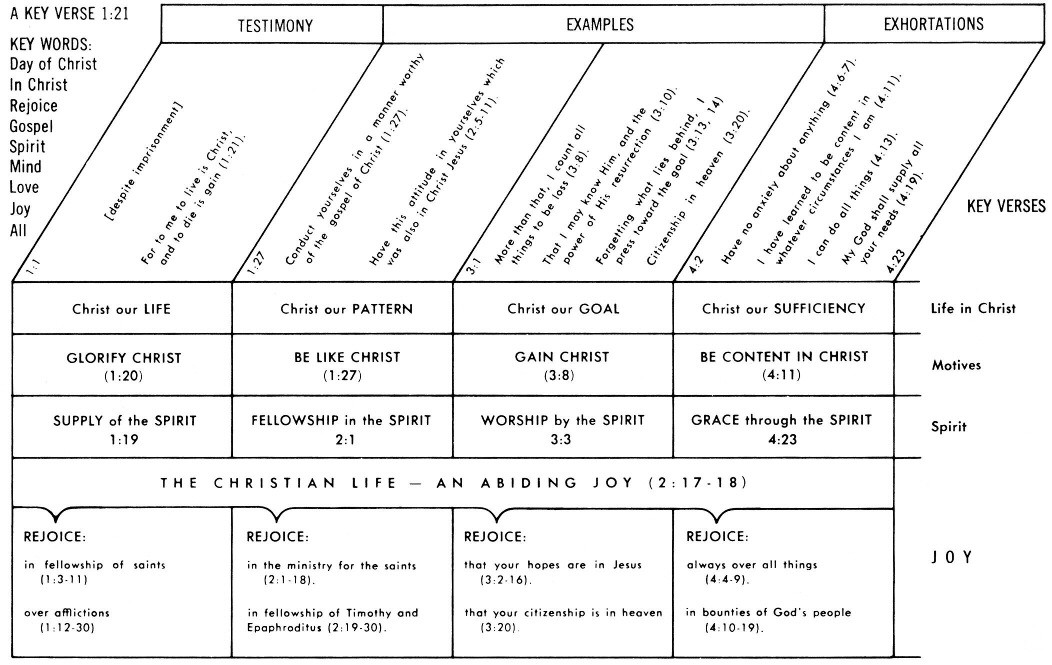
LIFE IN CHRIST
Click chart to enlarge
Charts from Jensen's Survey of the NT - used by permission
Philippians - Charles Swindoll = Chart on right side of page
| Account of Paul's Circumstances Php 1:1-30 |
Have the Mind of Christ Php 2:1-30 |
Have the Knowledge of Christ Php 3:1-21 |
Have |
| Partakers of Christ | People of Christ | Pursuit of Christ | Power of Christ |
| Suffering | Submission | Salvation | Sanctification |
| Experience | Examples | Exhortation | |
Philippians 4:13 I can do (1SPAI) all things through Him who strengthens (PAPMSD) me. (NASB: Lockman)
Greek: panta ischuo (1SPAI) en to endunamounti (PAPMSD) me.
Amplified: I have strength for all things in Christ Who empowers me [I am ready for anything and equal to anything through Him Who infuses inner strength into me; I am self-sufficient in Christ’s sufficiency]. (Amplified Bible - Lockman)
Barclay: I can do all things through him who infuses strength into me.
KJV: I can do all things through Christ which strengtheneth me.
Lightfoot: I can do and bear all things in Christ who inspires me with strength.
NLT: For I can do everything with the help of Christ who gives me the strength I need. (NLT - Tyndale House)
Phillips: I am ready for anything through the strength of the one who lives within me. (Phillips: Touchstone)
Wuest: I am strong for all things in the One who constantly infuses strength in me.
Young's Literal: For all things I have strength, in Christ's strengthening me;.
I CAN DO ALL THINGS: panta ischuo (1SPAI):
- Jn 15:4,5, 6,7; 2Co 3:4,5, 6
- Philippians 4 Resources - Multiple sermons and commentaries
- Philippians 4:10-12 Secret of Contentment 1 - John MacArthur
- Philippians 4:13 Secret of Contentment - 2 - John MacArthur
Context - Remembering that context (the text before and after a passage) is critical for the most accurate, robust interpretation, keep in mind that this famous verse is closely "hinged" with the preceding two verses (Php 4:11, 12) in which Paul explains how he is able to come to the point that he can make the glorious, profound declaration in this passage. Paul knew that God was able to change his circumstances, but that He was much more interested in changing Paul and this is still His desire for His children. In short, he had learned the "secret", he had counted the cost and paid the "cost", and in the crucible of testing wrought by both good times and bad times, he had come to the point of realization that his sufficiency was solely in his Savior. This principle is echoed in his second letter to the church at Corinth, where Paul writes…
Not that we are adequate in ourselves to consider (logizomai - word study) anything as coming from ourselves, but our adequacy (Greek = hikanotes = sufficiency, competency, ability, capacity, fitness = state of being qualified for something) is from God, 6 who also made us adequate as servants of a new covenant, not of the letter, but of the Spirit; for the letter kills, but the Spirit gives life.
Listen and watch Steven Curtis Chapman's "His Strength is Perfect"… I can do all things…Play His strength is perfect
Literally this verse reads…
“I have strength for all things in Him Who strengthens me.”
I can do all things in Him strengthening me. (Eadie)
The idea is…
In all things I continue to be strong by the One Who infuses the power into me.
The Living Bible expands the text this way
I can do everything God asks me to with the help of Christ who gives me strength and power.
The Twentieth Century New Testament
Nothing is beyond my power in the strength of him who makes me strong!
Phillips has a nice paraphrase
I am ready for anything through the strength of the one who lives within me. (Phillips)
Jesus taught the same principle when He instructed His disciples to…
Abide (aorist imperative = a command calling for urgent, effective action!) in Me, and I in you. As the branch cannot bear fruit of itself, unless it abides (present tense) in the vine, so neither can you, unless you abide (present tense = as a lifestyle) in Me. I am the vine, you are the branches; he who abides (present tense = as a lifestyle) in Me, and I in him, he bears (present tense) much fruit; for apart from Me you can do nothing (oudeis = denying absolutely and objectively, not one thing!… of eternal value). (John 15:4, 5)
Spurgeon writes…
What a gracious attainment! There is no boasting in this declaration; Paul only spoke what was literally the truth.
J Vernon McGee recommends some caution when interpreting and applying this verse writing
When Paul says all things, does he literally mean all things? Does it mean you can go outside and jump over your house? Of course not. Paul says, “I can do all things in Christ”—that is, in the context of the will of Christ for your life. Whatever Christ has for you to do, He will supply the power. Whatever gift He gives you, He will give the power to exercise that gift. A gift is a manifestation of the Spirit of God in the life of the believer. As long as you function in Christ, you will have power… Now Paul is not saying that we can do all things. I can’t jump like a grasshopper can jump. When I was in school I was the high jumper, but I can’t jump anymore. You see, I can’t do all things, but I can do all things which God has for me to do from the time He saved me to the time He will take me out of this world." (McGee, J V: Thru the Bible Commentary: Nashville: Thomas Nelson)
Dwight Pentecost sums up this verse writing that…
We are commanded to live victoriously over sin. We have no ability of ourselves to fulfill this command. But we can live victoriously, because we can do all things through Christ. We are enjoined to defeat Satan in our warfare with the evil one. We can do all things through Christ, for He is the victor. We are commanded to be lights to the world, to be witnesses for Jesus Christ. We can do all things through Christ, because He is the light. We are commanded to love the brethren. We can do all things through Christ, because He is love. All that Jesus Christ is today in glory can be manifested through us, because it is God who works in us both to will and to do of His good pleasure. There was no limit as to what Jesus Christ could do when He was here on this earth. On the authority of the Word of God, we say there is nothing that Jesus Christ cannot do from glory through us. “I can do all things through Christ which strengthens me. (Pentecost, J. D. The Joy of Living: A Study of Philippians. Kregel Publications)
All things - Is this to be taken literally? Is Paul advocating a veritable "holy omnipotence?" The qualifying phrase is all things that are in God's will. The point is that Paul had come to learn the secret that God would never require him to accomplish or carry out some task without also supplying the grace needed to bring the task to completion and/or fruition.
Ray Pritchard adds that…
This is the principle of Divine Direction. It's crucial for you to understand this second answer because it is clearly stated in the text. "I can do all things through Christ." This verse is not a blank check. It's not as if Paul is saying, "I can do anything I can dream up." No. If you read the context, he is speaking about the varying and sometimes difficult circumstances of life. Verse 11—"I have learned to be content whatever the circumstances." Php 4:12—"Sometimes I find myself with plenty of food and sometimes I have nothing to eat. Sometimes I have a roof over my head and sometimes I don't." "I know what it is to have money in the bank and I know what it is to be flat broke. And I've learned to be content no matter what my situation might be." (That's the Pritchard Loose Paraphrase.) Then Php 4:13—"I have learned through the power of Jesus Christ that I can face whatever comes my way." If it's good, I can enjoy it. If it's not so good, I can deal with it. Why? Because I have access to the everlasting strength of Jesus Christ.
Let me put this teaching in one sentence: Through Jesus Christ you can do everything God wants you to do this year. You can face everything he wants you to face, you can fight every battle he wants you to fight, you can obey every command, you can endure every trial, and you can overcome every temptation through Jesus Christ. (Philippians 4:13: One Word You Shouldn't Say In 1993)
Jamieson writes that…
After special instances he declares his universal power—how triumphantly, yet how humbly! [Meyer].
Spurgeon wrote…
We know not how much capacity for usefulness there may be in us. That donkey’s jawbone lying on the earth, what can it do? Nobody knows. It gets into Samson’s hands. No one knows what it cannot do now that a Samson wields it. And you have often thought yourself to be as contemptible as that bone. You have said, “What can I do?” But when Christ by his Spirit grips you, what can you not do? Truly you may adopt Paul’s language and say, “I can do all things through Christ Who strengthens me.”
Can do - I have strength (for), where Paul passes from the physical meaning ischuo to the metaphorical, spiritual meaning.
ESV Study Bible adds the caveat…
This does not mean God will bless whatever a person does; it must be read within the context of the letter, with its emphasis on obedience to God and service to God and others.
Can do (2480) (ischuo from ischus = might) means to be strong in body or in resources. Ischuo can speak of physical power (Mk 2:17, 5:4, 9:12). It can speak of having the required personal resources to accomplish some objective as here in Php 4:13 or conversely with the negative speaks of that which is good for nothing (Mt 5:13). Ischuo is the equivalent of to have efficacy, to avail or to have force.
When Paul said that he could do all things, he meant all things which were God’s will for him to do. He had learned that the Lord’s commands are always the Lord’s enablements. Where the finger of God points, the hand of God provides the way.
Ischuo can mean to be valid or be in force as a covenant (He 9:17).
Ischuo - 28x in the NT -
Mt 5:13; Mt 8:28; 9:12; 26:40; Mk 2:17; 5:4; 9:18 = (here ischuo refers to power as evidenced by extraordinary deeds); Mk 14:37; Lk 6:48; 8:43; 13:24; 14:6, 29, 30; 16:3; 20:26; Jn. 21:6; Acts 6:10; 15:10; 19:16, 20; 25:7; 27:16; Gal. 5:6; Php 4:13; Heb 9:17; Jas 5:16; Rev 12:8.
Matthew 5:13 (note) You are the salt of the earth; but if the salt has become tasteless, how will it be made salty again? It is good for nothing anymore, except to be thrown out and trampled under foot by men.
Matthew 8:28 And when He had come to the other side into the country of the Gadarenes, two men who were demon-possessed met Him as they were coming out of the tombs; they were so exceedingly violent that no one could pass by that road.
Matthew 9:12 But when He heard this, He said, "It is not those who are healthy (be strong in body, be robust, be in sound health) who need a physician, but those who are sick.
Matthew 26:40 And He came to the disciples and found them sleeping, and said to Peter, "So, you men could not keep watch with Me for one hour?
Mark 2:17 And hearing this, Jesus said to them, "it is not those who are healthy who need a physician, but those who are sick; I did not come to call the righteous, but sinners."
Mark 5:4 because he had often been bound with shackles and chains, and the chains had been torn apart by him, and the shackles broken in pieces, and no one was strong enough to subdue him.
Mark 9:18 and whenever it seizes him, it dashes him to the ground and he foams at the mouth, and grinds his teeth, and stiffens out. And I told Your disciples to cast it out, and they could not do it."
Mark 14:37 And He came and found them sleeping, and said to Peter, "Simon, are you asleep? Could you not keep watch for one hour?
Luke 6:48 he is like a man building a house, who dug deep and laid a foundation upon the rock; and when a flood rose, the torrent burst against that house and could not shake it, because it had been well built.
Luke 8:43 And a woman who had a hemorrhage for twelve years, and could not be healed by anyone,
Luke 13:24 "Strive to enter by the narrow door; for many, I tell you, will seek to enter and will not be able.
Luke 14:6 And they could make no reply to this.
Luke 14:29 "Otherwise, when he has laid a foundation, and is not able to finish, all who observe it begin to ridicule him, 30 saying, 'This man began to build and was not able to finish.'
Luke 16:3 "And the steward said to himself, 'What shall I do, since my master is taking the stewardship away from me? I am not strong enough to dig; I am ashamed to beg.
Luke 20:26 And they were unable to catch Him in a saying in the presence of the people; and marveling at His answer, they became silent.
John 21:6 And He said to them, "Cast the net on the right-hand side of the boat, and you will find a catch." They cast therefore, and then they were not able to haul it in because of the great number of fish.
Acts 6:10 And yet they were unable to cope with the wisdom and the Spirit with which he was speaking.
Acts 15:10 "Now therefore why do you put God to the test by placing upon the neck of the disciples a yoke which neither our fathers nor we have been able to bear?
Acts 19:16 And the man, in whom was the evil spirit, leaped on them and subdued all of them and overpowered (to use one's strength against one, to treat him with violence) them, so that they fled out of that house naked and wounded.
Acts 19:20 So the word of the Lord was growing mightily and prevailing (to have strength to overcome).
Acts 25:7 And after he had arrived, the Jews who had come down from Jerusalem stood around him, bringing many and serious charges against him which they could not prove;
Acts 27:16 And running under the shelter of a small island called Clauda, we were scarcely able to get the ship's boat under control.
Galatians 5:6 For in Christ Jesus neither circumcision nor uncircumcision means anything (is of any power in), but faith working through love.
Ischuo can mean “to be effective” or “to be capable of producing results” in Gal 5:6 states that the physical act of circumcision is not effective or is not capable of producing results.
Wuest comments Paul's use of ischuo in Galatians noting that it
means “to have power, to exert or wield power.” Thus, in the case of the one who is joined to Christ Jesus in that life-giving union which was effected through the act of the Holy Spirit baptizing the believing sinner into the Lord Jesus (Ro 6:3, 4), the fact that he is circumcised or is not circumcised, has no power for anything in his life. The thing that is of power to effect a transformation in the life is faith, the faith of the justified person which issues in love in his life, a love produced by the Holy Spirit.
Philippians 4:13 - I can do all things through Him who strengthens me.
Hebrews 9:17 (note) For a covenant is valid only when men are dead, for it is never in force while the one who made it lives.
James 5:16 Therefore, confess your sins to one another, and pray for one another, so that you may be healed. The effective prayer of a righteous man can accomplish much. (Young's Literal reads "very strong is a working supplication of a righteous man")
Revelation 12:8 (note) and they were not strong enough, and there was no longer a place found for them in heaven.
The NAS renders ischuo as able(5), am strong enough(1), been able(1), can(1), can do(1), could(8), good(1),healthy(2), in force(1), means(1), overpowered(1), prevailing(1), strong enough(2), unable (2).
Ischuo is used 71x in the Septuagint (Lxx) -
Ge 31:29; Ex 1:9, 12, 20; Lv 5:7; 27:8; Nu 22:6; Dt. 2:10; 16:10; 28:32; 31:6, 7, 23; Jos. 1:6, 7, 9, 14, 18; 10:25; 14:11; Jdg. 6:2; 7:11; 1 Ki. 2:2; 1 Chr. 16:11; 22:13; 28:7, 10, 20; 29:14; 2 Chr. 2:6; 15:7; 17:13; 19:11; 25:8; 32:7; Esther 4:17; Job 36:9, 31; Ps. 13:4; Pr 7:1; 18:19; Isa. 1:24; 3:1, 2, 25; 5:22; 8:9; 10:21; 22:3; 23:8, 11; 25:8; 28:22; 35:3, 4; 41:7; 46:2; 49:25; 50:2; 59:1; Jer 5:6; 20:11; 48:14; Da 1:4; 4:11, 20, 22; 7:21; 8:8; 10:19; Joel 3:10
Ischuo (and ischus) are somewhat similar to other Greek words (kratos, energeia) but are distinct. Ralph Earle summarizes these differences noting that…
Eadie distinguishes the meaning thus: Ischus … is—power in possession, ability or latent power, strength which one has, but which he may or may not put forth… Kratos … is that power excited into action—might. Energeia, as its composition implies, is power in actual operation. Ischus, to take a familiar illustration, is the power lodged in the arm, kratos is that arm stretched out or up-lifted with conscious aim, while energeia is the same arm at actual work, accomplishing the designed result.
Salmond supports these distinctions. He writes: "Kratos is power as force, mastery, power as shown in action: ischus is power as inherent, power as possessed, but passive. (Earle, R. Word Meanings in the New Testament).
Vincent explains the root word ischus exhibits the idea …
of indwelling strength, especially as embodied: might which inheres in physical powers organized and working under individual direction, as an army: which appears in the resistance of physical organisms, as the earth, against which one dashes himself in vain: which dwells in persons or things, and gives them influence or value: which resides in laws or punishments to make them irresistible. This sense comes out clearly in the New Testament in the use of the word and of its cognates. Thus, “Love the Lord thy God with all thy strength” (Mark 12:30): “according to the working of his mighty power” (Eph 1:19). So the kindred adjective ischuros. “A strong man” (Mt 12:29): a mighty famine (Luke 15:14): his letters are powerful (2 Cor. 10:10): a strong consolation (He 6:18): a mighty angel (Re 18:21). Also the verb ischuo. “It is good for nothing” (Mt 5:13): “shall not be able” (Luke 13:24): “I can do all things” (Philippians 4:13): “availeth much” (Jas 5:16)… (In sum ischus is) indwelling power put forth or embodied, either aggressively or as an obstacle to resistance: physical power organized or working under individual direction. An army and a fortress are both ischuros. The power inhering in the magistrate, which is put forth in laws or judicial decisions, is ischus, and makes the edicts ischura valid and hard to resist."
THROUGH (in) HIM ("in Christ") WHO (continually) STRENGTHENS ME: en toi endunamounti (PAPMSD) me:
- Take a moment to ponder the following Scriptures to amplify the meaning of this great principle = 2Co 12:9,10; Ep 3:16; 6:10; Col 1:11; Isa 40:29, 30, 31; 41:10; 45:24
- Philippians 4 Resources - Multiple sermons and commentaries
- Philippians 4:10-12 Secret of Contentment 1 - John MacArthur
- Philippians 4:13 Secret of Contentment - 2 - John MacArthur
Thou, O Christ, art all I want;
More than all in Thee I find.
Through Christ, Who is strengthening me, and does continually strengthen me; it is by His constant and renewed strength I am enabled to act in every thing; I wholly depend upon Him for all my spiritual power (Matthew Henry's paraphrase)
For I can do everything with the help of Christ who gives me the strength I need (NLT)
Warren Wiersbe explains that…
All of nature depends on hidden resources (cp "in Whom" = Christ in Col 2:3). The great trees send their roots down into the earth to draw up water and minerals (cp Col 2:7). Rivers have their sources in the snow-capped mountains. The most important part of a tree is the part you cannot see, the root system, and the most important part of the Christian’s life is the part that only God sees. Unless we draw on the deep resources of God by faith (2Co 5:7, cp Ro 10:17), we fail against the pressures of life. Paul depended on the power of Christ at work in his life (Php 1:6, 21, 2:12, 13, 3:10 - see notes Php 1:6, 21; 2:12; 13; 3:10). “I can—through Christ!” was Paul’s motto, and it can be our motto too. (Wiersbe, W: Bible Exposition Commentary. 1989. Victor)
Through Him is literally in Him, a key phrase here and in all of Paul's epistles for it speaks of the believer's vital union and identification with Christ, so that even as a branch apart from a vine can bear no fruit, even so a believer apart from abiding in the "Vine" can do nothing of lasting import (Jn 15:5, 8, 16). It is all from Him, through Him and to Him be the glory. Amen. Because Paul had learned the secret (Php 4:11, 12) of continually abiding in Christ, Paul justifiably felt that it was impossible for life to confront him with anything that he and the Lord could not handle, no matter how severe or how favorable! (See related studies on In Christ and in Christ Jesus)
Kent Hughes writes that…
Christ was in him (Paul), and he was in Christ. For Paul, being aware of Christ’s presence was as natural as breathing (Ed: cp "abiding" in Him). The wondrous reality was that the Lord was at Paul’s side as he stood before imperial Rome at his first hearing (2Ti 4:17) and that, in Paul’s words, he “gave me strength”—or as A. T. Robertson renders it, “poured power into me” (cf. Philippians 4:13). It was as if a pair of jumper cables were attached to Christ and then to Paul, so that Jesus’ voltage poured into Paul (cp Col 1:29, Gal 2:20). (Hughes, R. K., & Chapell, B. 1 & 2 Timothy and Titus : To Guard the Deposit. Preaching the Word)
The Puritan Thomas Watson wrote…
Deny self-confidence (cp Mk 8:34, 35, 36, 37, 38, Lk 9:23). It is just with God, that he who trusts himself (cp Pr 3:5, 6, Ps 37:3, 5)—should be left to himself! (cp Jas 4:6) The vine being weak—twists around the oak to support it (Jn 15:5). A godly man (cp 1Ti 4:7, 8, 9, 10), being conscious of his own imbecility—twists by faith around Christ. Sampson's strength lay in his hair. Ours lies in our Head, Christ (Ep 4:15, 16, Ep 5:23, Col 1:18, Col 2:10, Col 2:19). "I can do all things through Christ's strengthening me."
A Christian's strength lies in Christ, "I can do everything through Him who gives me strength." Philippians 4:13. How is a Christian able to do duty, to resist temptation—but through Christ's strengthening? How is it that a spark of grace lives in a sea of corruption, the storms of persecution blowing—but that Christ holds this spark in the hollow of His hand? How is it that the roaring lion of hell has not devoured the saints? Because the Lion of the tribe of Judah has defended them! Christ not only gives us our crown—but our shield. He not only gives us our garland when we overcome—but our strength whereby we overcome. Revelation 12:11, "They overcame him—that is, the accuser of the brethren—by the blood of the Lamb." Christ keeps the royal fort of grace—so that it is not blown up. Peter's shield was bruised—but Christ ensured that it was not broken. "I have prayed for you—that your faith fail not," Luke 22:32, that it be not a total falling away. The crown of all the saints' victories must he set upon the head of Christ!
QUESTION. How may we fight the good fight so as to overcome?
ANSWER. Let us fight in the strength of Christ. Philippians 4:13: "I can do all things through Christ who strengthens me." Grace itself, if it is not strengthen by Christ, will be beaten out of the field. Some fight against sin in the strength of their vows and resolutions—and so are foiled. We must go out against our spiritual antagonists in the strength of Christ—like David went out against Goliath in the name of the Lord (1Samuel 17:45). "The saints overcame the accuser of the brethren—by the blood of the Lamb" Revelation 12:11.
We must fight on our knees by prayer. Prayer whips the devil. The arrow of prayer, put into the bow of the promise and shot with the hand of faith, pierces the old serpent. Prayer brings God over to our side, and then we are on the strongest side. Let us pray that God will enable us to overcome all our ghostly enemies. While Joshua was fighting, Moses was praying on the mount (Exodus 17:11). So while we are fighting, let us be praying (Ephesians 6:1318). The way to overcome is upon our knees. (The Fight of Faith Crowned)
The Christian's strength (Thomas Watson, "The One Thing Necessary")
"I can do all things through Christ who strengthens me." Philippians 4:13
Always labor in the strength of Christ. Never go to work alone. Samson's strength lay in his hair. The Christian's strength lies in Christ.
When you are …
to do any duty,
to resist any temptation,
to subdue any lust,
set upon it in the strength of Christ!
Some go out against sin, in the strength of their resolutions and vows—and they are soon foiled. Do as Samson did—he first cried to God for help and then having taken hold of the pillars, he pulled down the house upon the Philistines! Likewise, only when we engage Christ in the work, can we bring down the house upon the head of our lusts!
Prayer beats the weapon out of the devil's hand—and gets the blessing out of God's hand!
J C Ryle (Holiness) writes…
Would you be holy? Would you become a new creature? Then you must begin with Christ. You will do just nothing at all and make no progress until you feel your sin and weakness and flee to Him. He is the root and beginning of all holiness, and the way to be holy is to come to Him by faith and be joined to Him. Christ is not wisdom and righteousness only to His people, but sanctification also. Men sometimes try to make themselves holy first of all, and sad work they make of it. They toil and labor and turn over many new leaves and make many changes; and yet, like the woman with the issue of blood, before she came to Christ, they feel "nothing bettered, but rather worse" (Mark 5:26). They run in vain and labor in vain, and little wonder; for they are beginning at the wrong end. They are building up a wall of sand; their work runs down as fast as they throw it up. They are baling water out of a leaky vessel; the leak gains on them, not they on the leak. Other foundation of holiness can no man lay than that which Paul laid, even Christ Jesus. Without Christ we can do nothing (John 15:5). It is a strong but true saying of Traill’s: "Wisdom out of Christ is damning folly; righteousness out of Christ is guilt and condemnation; sanctification out of Christ is filth and sin; redemption out of Christ is bondage and slavery."
Do you want to attain holiness? Do you feel this day a real hearty desire to be holy? Would you be a partaker of the divine nature? Then go to Christ. Wait for nothing. Wait for nobody. Linger not. Do not think to make yourself ready. Go and say to Him, in the words of that beautiful hymn,
"Nothing in my hand I bring,
Simply to Your cross I cling;
Naked, flee to You for dress;
Helpless, look to You for grace."
There is not a brick nor a stone laid in the work of our sanctification until we go to Christ. Holiness is His special gift to His believing people. Holiness is the work He carries on in their hearts by the Spirit whom He puts within them. He is appointed a "Prince and a Savior … to give repentance" as well as remission of sins. To as many as receive Him, He gives power to become sons of God (Acts 5:31; John 9:12, 13). Holiness comes not of blood: parents cannot give it to their children; nor yet of the will of the flesh: man cannot produce it in himself; nor yet of the will of man: ministers cannot give it to you by baptism. Holiness comes from Christ. It is the result of vital union with Him. It is the fruit of being a living branch of the true Vine. Go then to Christ and say, "Lord, not only save me from the guilt of sin, but send the Spirit, whom You did promise, and save me from its power. Make me holy. Teach me to do Your will."
Would you continue holy? Then abide in Christ. (John 15:4, 5). It pleased the Father that in Him should all fullness dwell, a full supply for all a believer’s wants. He is the Physician to whom you must daily go if you would keep well. He is the Manna which you must daily eat and the Rock of which you must daily drink. His arm is the arm on which you must daily lean as you come up out of the wilderness of this world. You must not only be rooted, you must also be built up in Him. Paul was a man of God indeed, a holy man, a growing thriving Christian, and what was the secret of it all? He was one to whom Christ was all in all. He was ever looking unto Jesus. "I can do all things," he says, "through Christ which strengthens me." "I live; yet not I, but Christ lives in me: and the life which I now live, I live by the faith of the Son of God." Let us go and do likewise (Heb. 12:2; Phil. 4:13; Gal. 2:20).
May all who read these pages know these things by experience and not by hearsay only! May we all feel the importance of holiness far more than we have ever done yet! May our years be holy years with our souls, and then they will be happy ones! Whether we live, may we live unto the Lord; or whether we die, may we die unto the Lord; or, if He comes for us, may we be found in peace, without spot, and blameless! (J. C. Ryle. Holiness)
Jerry Bridges in his modern day classic "The Practice of Godliness" notes that
The second principle of godly character is, The power or enablement for a godly life comes from the risen Christ. Paul said in relation to his ministry, “our competence comes from God” (2Corinthians 3:5), and “I labor, struggling with all his energy, which so powerfully works in me” (Colossians 1:29).
He said of his ability to be content in any situation,
“I can do everything through him who gives me strength” (Philippians 4:13).
It is very likely that God, in His sovereign calling and preparation of Paul for his tremendous task, had endowed him with more noble qualities and strength of character than any person since; yet Paul consistently attributes his spiritual strength and accomplishments to the Lord’s power. I once heard someone say, “When I do something wrong, I have to take the blame, but when I do something right, God gets the credit.” This person was complaining, but he was exactly correct. Certainly God cannot be blamed for our sins, but only He can provide the spiritual power to enable us to live godly lives.
As the source of power for godliness is Christ, so the means of experiencing that power is through our relationship with Him. This truth is Jesus’ essential teaching in His illustration in John 15 of the vine and the branches. It is only by abiding in Him that we can bring forth the fruit of godly character. The most helpful explanation I have found of what it means to abide in Christ comes from the nineteenth century Swiss theologian Frederic Louis Godet:
To abide in me’ expresses the continual act by which the Christian sets aside everything which he might derive from his own wisdom, strength, merit, to draw all from Christ.
Paul expresses this relationship as “living in Christ.” He says in Colossians 2:6–7, “So then, just as you received Christ Jesus as Lord, continue to live in him, rooted and built up in him, strengthened in the faith.” The context of this statement is that all the wisdom and power for living the Christian life are to be found in Christ rather than in manmade philosophies and moralisms (Col 2:2, 3, 4 and Col 2:8, 9, 10). This is what Godet is saying. We have to set aside any dependence upon our own wisdom and strength of character and draw all that we need from Christ through faith in Him. This faith, of course, is expressed concretely by prayer to Him. Psalm 119:33, 34, 35, 36, 37 is a good example of such a prayer of dependence.
This relationship is also maintained by beholding the glory of Christ in His word. In 2Corinthians 3:18 Paul tells us that as we behold the Lord’s glory, we are transformed more and more into His image. Beholding the Lord’s glory in His word is more than observing His humanity in the gospels. It is observing His character, His attributes, and His will in every page of Scripture. And as we observe Him, as we maintain this relationship with Him through His word, we are transformed more and more into His likeness; we are enabled by the Holy Spirit to progressively manifest the graces of godly character.
So it is this relationship with Christ, expressed by beholding Him in His word and depending upon Him in prayer, that enables us to draw from Him the power essential for a godly life. The Christian is not like an automobile with a self-contained power source; rather, he is like an electric motor that must be constantly connected to an outside current for its power. Our source of power is in the risen Christ, and we stay connected to Him by beholding Him in His word and depending on Him in prayer. (Bridges, J.. The Practice of Godliness)
F B Meyer wrote…
Apart from Him we can do nothing. Whilst we are abiding in Him nothing is impossible. The one purpose of our life should therefore be to remain in living and intense union with Christ, guarding against everything that would break it, employing every means of cementing and enlarging it. And just in proportion as we do so, we shall find His strength flowing into us for every possible emergency (Php 4:13). We may not feel its presence; but we shall find it present whenever we begin to draw on it. There is no temptation which we cannot master; no privation which we cannot patiently bear; no difficulty with which we cannot cope; no work which we cannot perform; no confession or testimony which we cannot make, if only our souls are living in healthy union with Jesus Christ; for as our day or hour, so shall our strength be.
John MacDuff …
He will not impose upon you one needless burden. He will not exact more than He knows your strength will bear. He will ask no Peter to come to Him on the water, unless He impart at the same time strength and support on the unstable waves. He will not ask you to draw water if the well is too deep, or to withdraw the stone if too heavy. But neither at the same time will He admit as an impossibility that which, as a free and responsible agent, it is in your power to avert. He will not regard as your misfortune what is your crime.
Source Unknown…
For me to live is …
For me to live is _______________ ($, pleasure, popularity, power.) If you substitute any word for Christ, then you must change the second phrase to: “To die is loss.”
Christ in me, my life.
Php 1:21, 22
Christ behind me, my example.
Phil. 2:5, 6, 7, 8 - Obedient - Eph. 2:10 - Whenever I say, “Not your will, but mine be done” I forfeit contentment and step out of God’s will.
Christ my goal, before me.
Phil. 3:20, 21
Christ my all-sufficient Provider, above me
In the mental realm Phil. 4:5–7
In the physical realm Phil. 4:13
In the financial realm Phil. 4:19 - Needs, not Greeds
From Cups of Light…
How Far Can You Jump?
A minister in Iowa was preaching on the text, “I can do all things in him who strengthens me” (Philippians 4:13). What, he wondered, could he say or do in the children’s sermon to help the boys and girls understand the meaning of that verse?
Finally, he got an idea. He lined the children up in front of one of the front pews and told them to jump across the aisle so they would be in front of the pew on the other side of the aisle. Of course, none of them could jump that far. They could jump one foot, two feet, even three feet, but not all the way across the aisle.
When he came to the last little girl, he told her to count to three and jump. Then he put his hands under her armpits, and as she jumped, he lifted her and carried her across the aisle. “See,” he said, “she did it… … No,” said the children, “you helped her. You carried her.”
Then he explained: “That’s the way it is with us. We can’t jump out of our sins but Jesus can lift us out of our sins. We can’t jump into the presence of God, but Jesus can lift us into the presence of God. We can’t jump into heaven, but, when the time comes, Jesus can lift us into heaven. We can’t jump out of our selfishness and fears, but, if we let him, Jesus can lift us out of our selfishness and fears.”
Before he wrote the words of the text, Paul told us, “Whatever is true … honorable … just … pure … lovely … gracious … think about these things” (Philippians 4:8). He knew the power of “positive thinking.” But he did not go on to say, “I can do all things through my thoughts which strengthen me.” He knew, and so do we, that often our thoughts are not as true, honorable, just, pure, lovely, and gracious, as we know they ought to be. We need help, and Jesus can give us that help.
Let’s show the world how far we can jump—when we let Jesus lift us. (Cranford, C. W. Cups of Light : And other illustrations. Willow Grove, Pa)
P G Ryken writes…
Contentment means wanting what God wants for us rather than what we want for us. The secret to enjoying this kind of contentment is to be so satisfied with God that we are able to accept whatever he has or has not provided. To put this another way, coveting is a theological issue: Ultimately, it concerns our relationship with God. Therefore, the way to get rid of any covetous desire is to be completely satisfied with God and what he provides. In a wonderful book called The Rare Jewel of Christian Contentment, the Puritan Jeremiah Burroughs explained what we ought to say to ourselves whenever we are tempted to be discontent: “I find a sufficiency of satisfaction in my own heart, through the grace of Christ that is in me. Though I have not outward comforts and worldly conveniences to supply my necessities, yet I have a sufficient portion between Christ and my soul abundantly to satisfy me in every condition.”
Godly people have always known this secret. Asaph knew it. True, there was a time in his life when Asaph was disappointed with God. He saw wicked men prosper, while he himself had nothing to show for his godliness. It made him angry with God and bitter about what life didn’t seem to offer. But then Asaph learned the secret of being content, and he was able to say to the Lord, “Whom have I in heaven but you? And earth has nothing I desire besides you” (Ps. 73:25).
The Apostle Paul knew the secret, too. He said, “I have learned to be content whatever the circumstances. I know what it is to be in need, and I know what it is to have plenty. I have learned the secret of being content in any and every situation, whether well fed or hungry, whether living in plenty or in want” (Phil. 4:11b, 12). In other words, Paul had learned that contentment is not circumstantial; it does not depend on our situation in life. So what’s the secret?
Paul said, “I can do everything through him who gives me strength” (Phil. 4:13).
God is all we need, and therefore all we ought to desire. To be even more specific, all we need is Jesus. God does not offer us his Son as a better way of getting what we want. No; God gives us Jesus and says, “Even if you don’t realize it, he is all you really need.” When we come to Jesus, we receive the forgiveness of our sins through his death and resurrection. We receive the promise of eternal life with God. We receive the promise that he will never leave us or forsake us, that he will help us through all the trials of life. What else do we need? (Ryken, P. G., Hughes, R. K. Exodus: Saved for God's glory. Wheaton, Ill.: Crossway Books)
Our thinking: It’s impossible
God’s promise: All things are possible (Luke 18:27)
“I’m too tired”
I will give you rest (Matthew 11:28, 29, 30)
“Nobody really loves me”
I love you (Jn 3:16; 13:34)
“I can’t go on”
My grace is sufficient (2Co 12:9; Ps 91:15)
“I can’t figure things out”
I will direct your steps (Pr 3:5,6)
“I can’t do it”
You can do all things (Php 4:13)
“I’m not able”
I am able (2Corinthians 9:8)
“It’s not worth it”
It will be worth it (Ro 8:28)
“I can’t forgive myself”
I forgive you (1Jn 1:9; Ro 8:1)
“I can’t manage”
I will supply all your needs (Php 4:19)
“I’m afraid”
I have not given you a spirit of fear (2Ti 1:7)
“I’m always worried and frustrated”
Cast all your cares on Me (1Pe 5:7)
“I don’t have enough faith”
I’ve given everyone a measure of faith (Ro 12:3)
“I’m not smart enough”
I give you wisdom (1Co 1:30)
“I feel all alone”
I will never leave you or forsake you (He13:5)
Author unknown
William Mason (1773) had the following thoughts some of which relate directly and some indirectly to Philippians 4:13…
Where Christ is most precious—there sin is exceedingly sinful; and self is humbled and loathed!
But—do we not grow stronger in ourselves, and find more help and power from ourselves—to withstand our enemies, to fight our good fight, to run our race, and to perfect holiness?
No! If we think so—it is plain that we are not growing up into Christ—but growing down into self! If the Lord has given me to know anything of this matter, after being upwards of twenty years in precious Christ, I sincerely declare, thatI find myself to be just that weak, helpless sinner I was when I first came to Jesus with, "Lord help me! Lord save me—or I perish!" Yes, I find myself more helpless now—than I thought myself then. I see more constant need to put on Christ, and to say, "truly in the Lord (not in myself) I have strength!"
I never more firmly believed than now, this truth of my Lord, "Without Me, you can do nothing." John 15:5. Never, never did I see less cause to trust in my own strength!
"Hold me up—and I shall be safe!" Psalm 119:117
How is all this to be done?
Before the believer arrives to the full enjoyment of Christ in eternal glory, he has … many enemies to encounter; many trials and troubles to conflict with; a body of sin and death to be delivered from; many lusts to be mortified; many corruptions to be subdued; a legion of sins to strive against; graces to be exercised; duties to be performed; in one word—he has to glorify Christ in the world, by his life and walk.
How is all this to be done?
Only by Christ strengthening him. Therefore he is constantly to put on Christ—to attain a greater knowledge of Christ—more rich and sweet experience of His grace and love—to be more strongly rooted in His love. He must have his heart, his hopes, his affections more with Christ, and his soul more swallowed up in the ocean of God's everlasting love in Christ—that he may be more conformed to Christ's image; and that thus, as a good soldier of Christ, he may manfully fight under His banner against the world, the flesh, and the devil, unto his life's end.
"I can do all things through Christ, who strengthens me." Philippians 4:13
A continual supply of grace, comfort, and strength
"I live by faith in the Son of God, who loved me and gave Himself for me!" Galatians 2:20
That the believer may live cheerfully and comfortably, he is exhorted to the free and constant use of Christ.
O consider—Christ is given to us—to be enjoyed by us!
He is the bread of life. We are to feed upon Him daily.
He is the water of life, which our souls are to drink of constantly.
He is our righteousness. We are to put Him on continually.
So then, we not only have a precious Christ—but we are also to use Him—and enjoy His preciousness! He is not only a well of salvation—but we must draw water out of it with joy—and drink of it to the refreshing of our souls!
Deeply consider, that without this inward enjoyment of Christ—you cannot be … happy in your soul, comfortable in your walk, nor holy in your life.
We must live by faith upon Christ—so as to derive a continual supply of grace, comfort, and strength from Him! "I live by faith in the Son of God, who loved me and gave Himself for me!" Galatians 2:20
Spurgeon (All-Sufficiency Magnified) wrote…
There is no corruption, no evil propensity, no temptation to sin, which the Christian cannot overcome. "I can do all things through Christ who strengthens me." Philippians 4:13.
A W Pink instructs that if we would walk worthy of the calling to which we have been called, we would…
seek grace to appropriate Philippians 4:13, and turn it into earnest prayer: "I can do all things through Christ who strengthens me." Unbelief says, I cannot; previous failures say, I cannot; past experience says, I cannot; the example of fellow-Christians says, I cannot; Satan tells me, I cannot. But faith says, I "can do all things through Christ who strengthens me": turn that statement into believing, fervent, persistent prayer. Count upon God making it good.
Eadie writes that the preposition
in (en) marks the union through which the moral energy is enjoyed - "in Him strengthening me," that is, in His strength communicated to me. Acts 9:22, Eph 6:10, 1Ti 1:12, 2Ti 4:17, Heb 11:34. We have the simple form of the verb in Col 1:11. Had we retained the term "enforce" with the same meaning as its common compound "re-enforce", we should have had a good and equivalent translation of the participle. Richardson gives an instance from old English -- "clasping their les together, they enforce themselves with strength."… Where unassisted humanity should sink and be vanquished, he should prove His wondrous superiority. Privation, suffering, and martyrdom could not subdue him and what might seem impracticable should be surmounted by Him in His borrowed might. He could attempt all which duty required, and he could succeed in all; for to him the epithet impossible, in an ethical aspect, had no existence… It is also to be borne in mind that this ability came not from his commission as an apostle but from his faith as a saint. The endowment was not of miracle, but of grace. (The Epistle to the Philippians )
Nothing between my soul and my Savior,
Naught of this world’s delusive dream;
I have renounced all sinful pleasure;
Jesus is mine, there’s nothing between.
-Charles A. Tindley (Play Hymn)
Consider the following simple study - observe and record the wonderful truths that accrue through Him - this would make an edifying, easy to prepare Sunday School lesson - then take some time to give thanks for these great truths by offering up a sacrifice of praise… through Him.
Jn 1:3 [NIV reads "through Him"], Jn 1:7, John 1:10, Jn 3:17, Jn 14:6, Acts 2:22, 3:16, Acts 7:25, Acts 10:43, Acts 13:38, 39, Ro 5:9 [note], Ro 8:37 [note], Ro 11:36 [note]; 1Co 8:6, Ep 2:18 [note], Php 4:13 [note], Col 1:20 [note], Col 2:15 [note], Col 3:17 [note], Heb 7:25 [note], Heb 13:15 [note], 1Pe 1:21[note], 1John 4:9
Would you like more study on the wonderful topic of through Him? Study also the NT uses of the parallel phrase through Jesus (or similar phrases - "through Whom", "through our Lord", etc) - John 1:17, Acts 10:36, Ro 1:4, 5; Ro 1:8, Ro 2:16, Ro 5:1; Ro 5:2 Ro 5:11, Ro 5:21, Ro 7:25, Ro 16:27, 1Cor 15:57, 2Cor 1:5, 3:4, 5:18, Gal 1:1, Eph 1:5, Php 1:11, 1Th 5:9; Titus 3:6, He 1:2; He 2:10, Heb 13:21, 1Pe 2:5, 1Pe 4:11, Jude 1:25)
All things are from Him, through Him and to Him. To Him be the glory forever. Amen.
Strengthens (1743) (endunamoo from en = in + dunamóo = from dúnamis which means to be able or to have power Click for in depth word study of dunamis) means to enable one to do or experience something. Endunamoo in simple terms means "to put power in" (like a car needs gas for power) and so to make strong, vigorous, to strengthen, or to be strengthened, enabled or empowered inwardly. This word is found only in biblical and ecclesiastical Greek. The idea is to cause one to be able to function or do something. It can refer to physical strengthening as in (He 11:34) but more often endunamoo refers to spiritual or moral strengthening as in the case of Abraham who "with respect to the (humanly speaking impossible) promise of God (of the birth of Isaac in his old age by Sarah), he did not waver (was not divided, did not vacillate between two opinions - belief and unbelief - implies mental struggle) in unbelief, but grew strong (endunamoo - was endued with strength or empowered) in faith (Godly faith is not full understanding but full trust), giving glory to God (Ro 4:20) Isaac was the result of a biological miracle performed by God in answer to Abraham’s faith. Godly faith glorifies God; the One Who gives faith receives all the credit.
Endunamoo - 7x in the NT - Acts 9:22; Ro 4:20; Ep 6:10; Phil. 4:13; 1Ti 1:12; 2Ti 2:1; 4:17
Robertson say endunamoo means "to pour power into one" and reasons rightly that
Paul had strength so long as Jesus kept putting His power into him.
Eadie says that
It is to spiritual might that the verb refers, and that might has no limitations.
Vincent adds strengthens me can be translated
more literally, infuses strength into me, as the old verb enforce.
This "infusion of strength" is based upon the believer's living union and identification with Christ, our Life. Galatians 2:20 (see note) brings out the vital nature of this union for Paul declares
"I have been crucified with Christ; and it is no longer I who live, but Christ lives in me; and the life which I now live in the flesh I live by faith in the Son of God, who loved me and gave Himself up for me."
Endunamoo is in the present tense indicating that Christ is continually able to infuse or pour in the power we need for the need of the moment. The moment we lose our sense of need of Him to enable us to live a supernatural life, is the moment we are vulnerable to the old flesh "taking over" in one form or another! Do not be deceived! Instead continually "be desperate" for Him and your need to continually abide in Him. If we experience a "power outage" or "power failure", it is not because of a failure in the Source but a failure in us to depend on the Source (cp His steadfast promise in He 13:5, 6).
As Eadie notes
Knowledge is power; and the apostle rises from knowledge to power—tells what he knows, and then what he can achieve. It was no idle boast, for he refers at once to the source of this all-daring energy… Where unassisted humanity should sink and be vanquished, he should prove his wondrous superiority. Privation, suffering, and martyrdom could not subdue him, and what might seem impracticable should be surmounted by him in his borrowed might. He could attempt all which duty required, and he could succeed in all; for to him the epithet "impossible", in an ethical aspect, had no existence… It is also to be borne in mind that this ability came not from his commission as an apostle, but from his faith as a saint. The endowment was not of miracle, but of grace." (The Epistle to the Philippians )
Both Kenneth Wuest and William Barclay often translate the verb endunamoo with the English word "infuse", which gives us a great word picture of the Greek verb endunamoo. For example, Webster (Ed: remember to look up Biblical words in an English dictionary - you will many times discover a wonderful illumination/amplification of the passage you are studying) says that to infuse something is to to cause it to be permeated with something else (Ed: in context this would be Christ), the infusion resulting in an alteration which is usually for the better -- this is a good picture of what happens to the believer who submits/yields/surrenders so that he or she is constantly "infused" with Jesus! Ponder another definition of infuse as to introduce one thing into another so as to affect it throughout, with the implication that there is a pouring in of something that gives new life or significance! Let your life be infused with Jesus!
Paul uses endunamoo commanding the Ephesian saints to
be strong (endunamoo = present imperative = command to continually be empowered via union with Christ) in the Lord and in the strength of His might." (Ep 6;10)
Paul used this word repeatedly in his epistles to Timothy, initially writing
I thank Christ Jesus our Lord, Who has strengthened me, because He considered me faithful, putting me into service" (1Ti 1:12).
Knowing the trials that Timothy would experience, Paul exhorted him
You therefore, my son, be strong (present tense = be continually empowered) in the grace (God's enabling power) that is in Christ Jesus." (2Ti 2:1)
In the last recorded chapter knowing that his death is imminent, Paul affirms the trustworthiness of the Lord's empowerment, writing to Timothy that
the Lord stood with me, and strengthened me, in order that through me the proclamation might be fully accomplished, and that all the Gentiles might hear; and I was delivered out of the lion's mouth." (2Ti 4:7)
From these uses of endunamoo note how from from beginning to end Paul expresses his need of and dependence on the empowerment of His Lord.
Wiersbe adds that…
Every Christian ought to read Hudson Taylor’s (biography or another short bio) Spiritual Secret, by Dr. and Mrs. Howard Taylor, because it illustrates this principle of inner power in the life of a great missionary to China. For many years, Hudson Taylor worked hard and felt that he was trusting Christ to meet his needs, but somehow he had no joy or liberty in his ministry. Then a letter from a friend opened his eyes to the adequacy of Christ.
“It is not by trusting my own faithfulness, but by looking away to the Faithful One!” he said.
This was a turning point in his life. Moment by moment, he drew on the power of Christ for every responsibility of the day, and Christ’s power carried him through. (Wiersbe, W: Bible Exposition Commentary. 1989. Victor)
I also highly recommend reading Hudson Taylor's Spiritual Secret which can be downloaded free at CCEL.
- Was Hudson Taylor’s Spiritual Secret the Same as Paul’s? - John Piper
- Download a Word document of Hudson Taylor's Spiritual Secret
Spurgeon wrote that…
We know not how much capacity for usefulness there may be in us. That ass's jawbone lying on the earth, what can it do? Nobody knows. It gets into Samson's hands. No one knows what it cannot do now that a Samson wields it. And you have often thought yourself to be as contemptible as that bone. You have said, "What can I do?" But when Christ by His Spirit grips you, what can you not do? Truly you may adopt Paul's language and say, "I can do all things through Christ Who strengthens me."
Warren Wiersbe writes that…
The Bible affirms our need to rely on God, for whom nothing is impossible (Luke 1:37): “Is anything too hard for the Lord?” (Ge 18:14). “There is nothing too hard for You” (Jer. 32:17); God is “able to do exceedingly abundantly above all that we ask or think” (Eph. 3:20). So, we may say, “I can do all things through Christ who strengthens me” (Php 4:13). Lay hold of God’s power! (Wiersbe, W: With the Word: Chapter-by-Chapter Bible Handbook. Nelson)
In his book "The Present Tenses of the Blessed Life" F B Meyer has the following notes on Php 4:13…
IT WAS a marvellous statement for a man to make: "I can do all things." At first sight we suppose the speaker had either had but very little experience of the world with its varying conditions; or that he was some favoured child of fortune, who had never known want, because possessing an abundant supply of wealth and power.
But closer consideration removes each supposition; and we find ourselves face to face with a prisoner bound to a Roman soldier, who had run through the whole scale of human experience, now touching its abundant fulness, and anon descending to its most abject want; one who said himself: "I know how to be abased, and I know also how to abound; in everything and in all things have I learned the secret both to be filled and to be hungry, both to abound and to be in want." It was, therefore, after a very profound experience of the extremes of human life, and of all the variations between, that the Apostle made that confident assertion: "I can do all things."
It is a temper of mind which we might well covet. To be superior to every need; to bear prosperity without pride, and adversity without a murmur; to feel that there is no earthly circumstance that can disturb the soul from its equilibrium in God; to be able to yoke the most untameable difficulties to the car of spiritual progress; to have such a sense of power as to laugh at impossibility and to sing in adversity; to help the weak, even though we might seem to need every scrap of power for ourselves; to feel amid the changing conditions of life as a strong swimmer does in the midst of the ocean waves, which he beats back in the proud consciousness of power--all this, and much more, is involved in the expression, "I can do all things."
And when we ask for the talisman, which has given a frail man this marvellous power, it is given in the words: "in Him that strengthens Me." The Old Version gave "through Christ;" the New alters it to "in Him." And at once we see the connection with all that line of inner teaching, of which, to the careful student, the Bible is so full. Those words are the keynote of Blessedness, first struck by our Lord, and repeated with unwearying persistence by His immediate followers, to whom they were the secret of an overcoming life. The one main thought of them is this--that the strength which we covet is not given to us in a lump, for us to draw upon as we choose, like electricity stored in boxes for use; it is a life, and it is only to be obtained so long as we are in living union with its source. Apart from Him we can do nothing. Whilst we are abiding in Him, nothing is impossible. The one purpose of our life should therefore be to remain in living and intense union with Christ, guarding against everything that would break it, employing every means of cementing and enlarging it. And just in proportion as we do so, we shall find His strength flowing into us for every possible emergency. We may not always feel its presence; but we shall find it present whenever we begin to draw on it. Or if ever we are more than usually sensible of our weakness, one moment of upward looking will be sufficient to bring it in a tidal wave of fulness into our hearts.
There is no temptation which we cannot master; no privation which we cannot patiently bear; no difficulty with which we cannot cope; no work which we cannot perform; no confession or testimony which we cannot make--if only our souls are living in healthy union with Jesus Christ, for as our day, or hour, is, so shall our strength be: so much so, that we shall be perfectly surprised at ourselves, as we look back on what we have accomplished.
Dwell on that present tense, strengthens. Hour by hour, as the tides of golden sun-heat are quietly absorbed by flowers and giant trees--so will the strength of the living Saviour pass into our receptive natures. He will stand by us; He will dwell in us; He will live through us--strengthening us with strength in our souls.
The dying patriarch told how his favourite child would be made strong, by the mighty God of Jacob putting His Almighty hands over his trembling fingers; as an archer might lay his brawny skilled hands on the delicate grasp of his child, teaching him how to point the arrow, and enabling him to pull back the bow string. Oh what beauty there is in the comparison! Who would not wish to be such a favoured one, feeling ever the gentle touch of the hands of God, empowering us, and working with us! Yet that portion may be thine, dear reader, and mine. To the prayer first offered by Nehemiah, "O God, strengthen my hand," God answers Himself: "I will strengthen thee." "Wait on the Lord, and He shall strengthen thine heart." "They that wait upon the Lord shall change their strength," i.e. they shall exchange one degree of strength for another, in an ever ascending scale.
The strength of Christ is never found in the heart that boasts its own strength. The two can no more co-exist, than light and darkness can co-exist in the same space. And therefore the Apostle used to glory in anything that reminded him of his utter helplessness and weakness. This thought made him even acquiesce willingly to the thorn in his flesh. It was at first his repeated prayer that it might be removed; but when the Lord explained that His strength could only be perfected in weakness, and that the presence of the thorn was a perpetual indication and reminder of the weakness of his flesh, driving him to the Strong for strength, and making him a fit subject for the conspicuous manifestation of God's might at its full then he protested that he would most gladly glory in his weakness, that the strength of Christ might rest upon him; for when he was weak, in his own deep consciousness, then he was strong in the strength of the strong Son of God (2Co 12:9).
It would be a great help to us all if we could look at difficulties and trials in this way. Considering that they have been sent, not to grieve or annoy us, but to make us despair of ourselves, and to force us to make use of that divine storehouse of power, which is so close to us, but of which we make so little use. Difficulties are God's way of leading us to rely on His almighty sufficiency. They are none of them insurmountable; they are the triumphs of His art; they are meant to reveal to us resources of which, had it not been for their compulsion, we might have lived in perpetual ignorance--just as hunger has led to many of the most wonderful inventions.
What glorious lives might be the lot of the readers of these lines, if only they would abjure their own strength be it wisdom, wealth, station, or any other source of creature aid; and if they would learn that the true strength is to sit still at the source of all might and grace, receiving out of His fulness, and mingling the song of the psalm, with the glad affirmation of the Apostle: "I will love Thee, O Lord, my strength;" "I can do all things through Christ that strengthens me!"
An airline pilot was flying over the Tennessee mountains and pointed out a lake to his copilot. “See that little lake?” he said. “When I was a kid I used to sit in a rowboat down there, fishing. Every time a plane would fly overhead, I’d look up and wish I was flying it. Now I look down and wish I was in a rowboat, fishing.”
Contentment can be an elusive pursuit. We go after what we think will make us happy only to find that it didn’t work; in fact, we were happier before we started the quest. It’s like the story of two teardrops floating down the river of life. One teardrop said to the other, “Who are you?” “I’m a teardrop from a girl who loved a man and lost him. Who are you?” “I’m a teardrop from the girl who got him.”
The lack of contentment that marks our nation is reflected in many ways. We see it in our high rate of consumer debt. We aren’t content to live within our means, so we go into debt to live just a bit better than we can afford, but then we suffer anxiety from the pressure of paying all our bills. Of course, the advertising industry tries to convince us that we can’t possibly be happy unless we have their product, and we often take the bait, only to find that we own one more thing to break down or one more time consuming piece of equipment to add more pressure to an already overloaded schedule.
Our discontent is reflected in our high rate of mobility. People rarely stay at the same address for more than five years. We’re always on the move, looking for a better house, a better job, a better place to live and raise a family, a better place to retire. Some of the moves are demanded by the need for decent jobs. But some of it is fueled by a gnawing discontent that we think will be satisfied when we find the right living situation. But we never quite get there.
Our discontent rears its head in our high divorce rate. We can’t find happiness in our marriages, so we trade our mates in for a different model, only to find that the same problems reoccur.
Our lack of contentment is seen in our clamoring for our rights, all the while claiming that we have been victimized. If we can just get fair treatment, we think we’ll be happy. We are suing one another at an astonishing rate, trying to get more money so we can have more things so that life will be more comfortable. We spend money that we can’t afford on the lottery, hoping to win a big jackpot that will give us what we want in life. But even those who win large settlements in a lawsuit or a lottery jackpot are not much happier in the long run.
In Philippians 4:10, 11, 12, 13, a man who sits in prison because of corrupt officials awaiting possible execution over false charges tells us how to find contentment. The answer lies buried in the midst of a thank-you note. The Philippian church had sent a financial gift to Paul the prisoner. He wants to express his heartfelt thanks, but at the same time he doesn’t want to give the impression that the Lord was not sufficient for his every need. Even though he had been in a very difficult situation (Php 4:14, “affliction”), he doesn’t want his donors to think that he had been discontented before the gift arrived; but he does want them to know that their generosity was truly appreciated. So he combines his thanks with this valuable lesson on the secret for contentment. We’ll look first at what contentment is as Paul describes it; and then at how we acquire it.
WHAT IS CONTENTMENT?
The word content (Php 4:11) comes from a Greek word that means self-sufficient or independent. The Stoics elevated this word, the ability to be free from all want or needs, as the chief of all virtues. But the Stoic philosophy was marked by detachment from one’s emotions and indifference to the vicissitudes of life. This clearly is not the sense in which Paul meant the word, since in Php 4:10 he shows that he rejoiced in the Lord greatly when he received the gift, not because of the money, but because it showed the Philippians’ heartfelt love and concern for him. Paul was not detached from people nor from his feelings. He loved people dearly and was not afraid to show it. And, Philippians 4:13 clearly shows that Paul did not mean the word in the pagan sense of self-sufficiency, since he affirms that his sufficiency is in Christ.
Neither does contentment mean complacency. As Christians we can work to better our circumstances as we have opportunity
The Bible extols hard work and the rewards that come from it, as long as we are free from greed. Paul tells slaves not to give undue concern to gaining their freedom, but if they are able to do so, they should (1Co 7:21). If you’re single and feel lonely, there is nothing wrong with seeking a godly mate, as long as you’re not so consumed with the quest that you lack the sound judgment that comes from waiting patiently on the Lord. If you’re in an unpleasant job, there is nothing wrong with going back to school to train for a better job or from making a change to another job, as long as you do so in submission to the will of God.
So what does contentment mean? It is an inner sense of rest or peace that comes from being right with God and knowing that He is in control of al that happens to us. It means having our focus on the kingdom of God and serving Him, not on the love of money and things. If God grants us material comforts, we can thankfully enjoy them, knowing that it all comes from His loving hand. But, also, we seek to use it for His purpose by being generous. If He takes our riches, our joy remains steady, because we are fixed on Him (see 1Ti 6:6, 7, 8, 9, 10, 17, 18, 19). Contentment also means not being battered around by difficult circumstances or people, and not being wrongly seduced by prosperity, because our life is centered on a living relationship with the Lord Jesus Christ. So no matter what happens to us or what others do to us, we have the steady assurance that the Lord is for us and He will not forsake us.
HOW DO WE ACQUIRE CONTENTMENT?
The world goes about the quest for contentment in all the wrong ways, so we must studiously avoid its ways. Paul’s words show …
The secret for contentment in every situation is to focus on the Lord--as Sovereign, as Savior, and as the Sufficient One.
He is the Sovereign One to whom I must submit; He is the Savior whom I must serve; He is the Sufficient One whom I must trust. If I know Him in these ways as Paul did, I will know contentment.
1. Contentment comes from focusing on the Lord as the Sovereign One to whom I must submit.
Paul mentions that the Philippians had revived their concern for him. The word was used of flowers blossoming again or of trees leafing out in the springtime. He is quick to add that they always had been concerned, but they lacked opportunity. We do not know what had prohibited their sending a gift sooner, whether it was a lack of funds, not having a reliable messenger to take the gift, not knowing about Paul’s circumstances, or some other reason. But whatever the reason, Paul knew that God was in control, God knew his need, and God would supply or not supply as He saw fit. Paul was subject to the Sovereign God in this most practical area of his financial support.
I will develop this more next week, but I believe that Paul had a policy of not making his financial needs known to anyone except the Lord. Here he was in prison, unable to pursue his tent-making trade, and he was in a tight spot (“affliction” in Php 4:14 literally means “pressure”). He wrote a number of letters during this time to various churches and individuals (Ephesians, Philippians, Colossians, Philemon), and he asks for prayer in those letters. But never once does he mention his financial needs. Rather, he asks for prayer for boldness and faithfulness in his witness. He trusted in and submitted to the sovereignty of God to provide for his needs.
Sometimes God supplied abundantly, and so Paul had learned how to live in prosperity. Most of us would like to learn that lesson! But sometimes God withheld support, and so Paul had to learn to get along with humble means. At those times, he did not grumble or panic, but submitted to the sovereign hand of God, trusting that God knew what was best for him and that He always cared for His children (1Pe 5:6, 7-notes).
But notice, Paul learned to be content in all conditions. It didn’t come naturally to him, and it wasn’t an instantaneous transformation. It is a process, something that we learn from walking with God each day. Key to this process is understanding that everything, major and minor, is under God’s sovereignty. He uses all our circumstances to train us in godliness if we submit to Him and trust Him. Our attitude in trials and our deliberate submission to His sovereignty in the trial is crucial.
George Muller proved the sovereign faithfulness of God in the matter of finances. He lived in 19th century Bristol, England where he founded an orphanage. He and his wife had taken literally Jesus’ command to give away all their possessions (Luke 14:33), so they had no personal resources. Also, he was firmly committed to the principle of not making his financial needs known to anyone, except to God in prayer. He was extremely careful not even to give hints about his own needs or the needs of the orphanage. The children never knew about any financial difficulties, nor did they ever lack good food, clothes, or warmth.
But there were times when Muller’s faith was tried, when the Lord took them down to the wire before supplying the need. On February 8, 1842, they had enough food in all the orphan houses for that day’s meals, but no money to buy the usual stock of bread or milk for the following morning, and two houses needed coal. Muller noted in his journal that if God did not send help before nine the next morning, His name would be dishonored.
The next morning Muller walked to the orphanage early to see how God would meet their need, only to discover that the need had already been met. A Christian businessman had walked about a half mile past the orphanages toward his place of work when the thought occurred to him that Muller’s children might be in need. He decided not to retrace his steps then, but to drop off something that evening. But he couldn’t go any further and felt constrained to go back. He gave a gift that met their need for the next two days (George Muller: Delighted in God! by Roger Steer [Harold Shaw Publishers], pp. 115-116). Muller knew many instances like that where God tried his faith.
If you are walking with God and you find yourself in a desperate situation, you can know that you are not there by chance. The sovereign God has put you there for your training in faith, that you might share His holiness. It may be a small crisis or a major, life-threatening crisis. Submit to and trust the Sovereign God and you will know the contentment that comes from Him.
2. Contentment comes from focusing on the Lord as the Savior whom I must serve.
The reason Paul knew that God would meet his basic needs was that Jesus had promised, “Seek first His kingdom and His righteousness; and all these things shall be added unto you” (Mt 6:33). All these things refers to what you shall eat, what you shall drink, what you shall wear (Mt 6:25). Jesus was teaching that if we will put our focus on serving Him and growing in righteousness, God will take care of our basic material needs. In the context He is talking about how to be free from anxiety, or how to be content in our soul. Paul taught the same thing (see 1Ti. 6:6, 7, 8, 9, 10, 11). If our focus is on our Savior and on doing what He has called us to do for His kingdom, which includes growing in personal holiness, then we can be content with what He provides.
Please take note that He promises to supply our needs, not our greed. Most of us living in America have far, far more than our needs. We live in relative luxury, even if we live in a house that is too small or only have one car. Sometimes we need to remember that people in other countries squeeze ten family members into a one-room, dirt-floored shanty.
I read a story about a Jewish man in Hungary who went to his rabbi and complained, “Life is unbearable. There are nine of us living in one room. What can I do?” The rabbi answered, “Take your goat into the room with you.” The man was incredulous, but the rabbi insisted, “Do as I say and come back in a week.”
A week later the man returned looking more distraught than before. “We can’t stand it,” he told the rabbi. “The goat is filthy.” The rabbi said, “Go home and let the goat out, and come back in a week.” A week later the man returned, radiant, exclaiming, “Life is beautiful. We enjoy every minute of it now that there’s no goat--only the nine of us.” (Reader’s Digest [12/81].) Perspective helps, doesn’t it!
But the point is, if you live for yourself and your own pleasure, you will not know God’s contentment. But if you follow Paul in living to serve the Savior, you will be content, whether you have little or much. Part of seeking first God’s kingdom means serving Him with your money and possessions, which are not really yours, but His, entrusted to you as manager. We mistakenly think that we will be content when we accumulate enough money in the bank and enough possessions to make us secure. The truth is, you will know contentment when you give generously to the Lord’s work, whether to world missions, to the local church, or to meeting the needs of the poor through Christian ministries.
“Where your treasure is, your heart will be” (Mt 6:21).
If your treasure is in this world, your heart will be in this world, which isn’t the most secure environment! If your treasure is in the kingdom of God, your heart will be there, and it is a secure, certain realm.
3. Contentment comes from focusing on the Lord as the Sufficient One Whom I must trust.
Paul says that he had “learned the secret of being filled and going hungry, both of having abundance and suffering need” (Php 4:12). That secret is stated in verse 13,
“I can do all things in Him who continually infuses me with strength” (literal rendering).
The all-sufficient, indwelling Christ was Paul’s source of strength and contentment. Since Christ cannot be taken from the believer, we can lean on Him in every situation, no matter how trying.
Notice that there is a need to learn not only how to get along in times of need, but also how to live with abundance. In times of need, we’re tempted to get our eyes off the Lord and grow worried. That’s when we need a trusting heart. In times of abundance we’re tempted to forget our need for the Lord and trust in our supplies rather than in Him. That’s when we need a thankful heart that daily acknowledges gratitude for His provision. Thanking God for our daily bread, even when we’ve got enough in the bank for many days’ bread, keeps us humbly trusting in Him in times of abundance.
By “all things,” Paul means that he can do everything that God has called him to do in his service for His kingdom. He can obey God, he can live in holiness in thought, word, and deed. He can ask for the provisions needed to carry out the work and expect God to answer. If God has called you to get up in public and speak, He will give you the power to do it. If He has called you to serve behind the scenes, He will equip you with the endurance you need (1Pe. 4:11). If He has called you to give large amounts to further His work, He will provide you with those funds. As Paul says (2Cor. 9:8), “God is able to make all grace abound to you, that always having all sufficiency in everything, you may have an abundance for every good deed.”
Notice the balance between God’s part and our part. Some Christians put too much emphasis on “I can do all things,” on the human responsibility. You end up burning out, because I cannot do all things in my own strength. Others put too much emphasis on “through Him who strengthens me.” These folks sit around passively not doing anything, because they don’t want to be accused of acting in the flesh. The correct biblical balance is that I do it, but I do it by constant dependence on the power of Christ who indwells me. As Paul expressed it (1Co 15:10),
“But by the grace of God I am what I am, and His grace toward me did not prove vain; but I labored even more than all of them, yet not I, but the grace of God with me.”
In Philippians 4:13, the verb is present tense, meaning, God’s continual, day-by-day infusing me with strength as I serve Him.
The Greek preposition is “in,” not “through.” It points to that vital, personal union with Christ that we have seen repeatedly throughout Philippians. Paul is saying that because of his living relationship of union with the living, all-sufficient Christ, he can do whatever the Lord calls him to do for His kingdom.
This verse is one of many which affirm the sufficiency of Christ for the believer’s every need. But this doctrine is under attack by the “Christian” psychology movement, which claims that Christ is sufficient for your “spiritual” needs (whatever that means!), but not for your emotional needs. But look at the list of the fruit of the Spirit (Gal 5:22, 23-see notes Gal 5:22; 23), look at the qualities of the godly person as described throughout the New Testament, and you’ll find an emotionally stable person. You are not equipped for every good deed (2Ti 3:16, 17-notes) if you’re an emotional wreck. The living Christ and His Word are powerful to strengthen you to serve Him, which includes emotional well-being. But the church today is selling out the joy of trusting in the all-sufficient Christ for a mess of worldly pottage that does not satisfy. Whatever your needs, learn to trust daily in the sufficient Savior and you will know His contentment in your soul.
Conclusion
Legend has it that a wealthy merchant during Paul’s day had heard about the apostle and had become so fascinated that he determined to visit him. So when passing through Rome, he got in touch with Timothy and arranged an interview with Paul the prisoner. Stepping inside his cell, the merchant was surprised to find the apostle looking rather old and physically frail, but he felt at once the strength, the serenity, and the magnetism of this man who relied on Christ as his all in all. They talked for some time, and finally the merchant left. Outside the cell, he asked Timothy, “What’s the secret of this man’s power? I’ve never seen anything like it before.” “Did you not guess?” replied Timothy. “Paul is in love.” The merchant looked puzzled. “In love?” he asked. “Yes,” said Timothy, “Paul is in love with Jesus Christ.” The merchant looked even more bewildered. “Is that all?” he asked. Timothy smiled and replied, “That is everything.” (Adapted from Leonard Griffith, This is Living [Abingdon], p. 149.)
That’s the secret of contentment--to be captivated by Christ--as the Sovereign to whom I submit; as the Savior whom I serve; as the Sufficient One whom I trust in every situation.
Discussion Questions
Where’s the balance between being content and yet trying to better your situation or solve certain problems?
Someone says, “If God is sovereign over the tragedy that happened to me, then He is not good.” What would you reply?
What does it mean practically to seek first God’s kingdom and righteousness? Must we all become full-time missionaries?
Someone says, “We trust God and yet use modern medicine; why can’t we trust God and use modern psychology?” Your answer? (Copyright 1995, Steven J. Cole, All Rights Reserved. Philippians 4:10-13 The Secret for Contentment) (Steven Cole's sermons by Scripture - Highly Recommended - They read essentially like a verse by verse commentary!)
Missionary Dan Crawford had a difficult task—following in the steps of David Livingstone, the missionary who gave his life in ministering the Word of God in Africa. Crawford didn’t have the imposing personality of his famous predecessor, so at first he had trouble winning the loyalty of the tribal people. Even the people in his church back home weren’t sure he could carry on the work. With God’s help, however, he did a magnificent job. When he died, a well-worn copy of the New Testament was found in his pocket. A poem, evidently his own, handwritten on the inside cover, revealed the secret of his success:
I cannot do it alone!
The waves dash fast and high;
The fog comes chilling around,
And the light goes out in the sky.
But I know that we two shall win in the end—
Jesus and I.
Coward and wayward and weak,
I change with the changing sky,
Today so strong and brave,
Tomorrow too weak to fly.
But He never gives up,
So we two shall win in the end:
Jesus and I.
(Note: Some have attributed this poem to Corrie Ten Boom)
LIGHTEN THE LOAD - I once read about a distraught Christian woman who was extremely upset because her children had become unruly. She telephoned her husband at work one day and tearfully described the visit of a friend who had pinned this verse above the kitchen sink: "I can do all things through Christ who strengthens me" (Philippians 4:13). The friend had meant well. She was trying to be helpful, but her action just made the mom feel even more like a failure.
Sometimes it's not helpful merely to quote a Scripture verse to someone. Philippians 4:13 was Paul's personal testimony that he had learned to be content in all situations, in plenty and in want (Php 4:11, 12). His secret of contentment was that he could "do all things through Christ" who strengthened him (Php 4:13).
We too can live by Paul's secret. We can be victorious through Christ's strength, but we shouldn't force this truth on people who are feeling overwhelmed. Paul also wrote that we should care for one another and share in one another's distress (Galatians 6:2; Php 2:4 [note]; Php 4:14 [note]).
We need each other, for we all have burdens to bear. Let's use the strength Christ gives us to minister to the needs of others and find ways to lighten their loads. —Joanie Yoder (Our Daily Bread, Copyright RBC Ministries, Grand Rapids, MI. Reprinted by permission. All rights reserved)
PUTTING IT INTO PRACTICE
Who needs your encouragement today?
What are some practical ways you can help?
Write a note? Make a meal? Baby sit? Just listen?
To ease another's burden, help to carry it.
CHOOSE YOUR COLOR - A college student decided one summer that he would earn money for his tuition by selling Bibles door-to-door. He began at the home of the school president. The president's wife came to the door and explained politely that her family didn't need any more books. As the student walked away, she saw him limping. "Oh, I'm sorry," she exclaimed. "I didn't know you were disabled."
When the student turned around, she realized she had offended him. So she quickly added, "I didn't mean anything except admiration. But doesn't your disability color your life?" To which the student responded, "Yes, it does. But thank God, I can choose the color."
When Paul and Silas were imprisoned at Philippi and their backs were raw from beatings, they sang hymns (Acts 16:23, 24, 25). They chose the bright color of praise instead of the dark colors of depression,
bitterness, and despair.
No matter what affliction or crisis we may face, we too can decide how we will respond. With the enablement of the Holy Spirit, we can refuse to paint our lives in the dull gray of grumbling and complaining. Instead, our chosen color can be the azure blue of contentment because God's help is always available. -- Vernon C. Grounds (Our Daily Bread, Copyright RBC Ministries, Grand Rapids, MI. Reprinted by permission. All rights reserved)
He gives me joy in place of sorrow;
He gives me love that casts out fear;
He gives me sunshine for my shadow,
And "beauty for ashes" here.-- Crabbe
God chooses what we go through; we choose how we go through it.
You Can Do It! - A young boy was at the barbershop for a haircut. The room was filled with cigar smoke. The lad pinched his nose and exclaimed, "Who's been smoking in here!" The barber sheepishly confessed, "I have." The boy responded, "Don't you know it's not good for you?" "I know," the barber replied. "I've tried to quit a thousand times but I just can't." The boy commented, "I understand. I've tried to stop sucking my thumb, but I can't quit either!"
Those two remind me of the way believers sometimes feel about their struggle with sins of the flesh. Paul summed it up well by crying out, "O wretched man that I am! Who will deliver me from this body of death?" (Ro 7:24). His spiritual battle might have left him in despair if he had not found the solution. Following his agonizing question, he declared with triumph, "I thank God- through Jesus Christ our Lord!" (Ro 7:25).
Are you struggling to break some stubborn habit? Like Paul, you can be an overcomer. If you know the Lord Jesus as your Savior, victory is possible through the power of the indwelling Holy Spirit. Confidently affirm with Paul, "I can do all things through Christ who strengthens me" (Philippians 4:13). You can do it! —Richard De Haan (Our Daily Bread, Copyright RBC Ministries, Grand Rapids, MI. Reprinted by permission. All rights reserved)
I have tried and I have struggled
From my sin to be set free;
Not by trying but through trusting,
Jesus gives the victory. -Complin
Think less of the power of things over you and more of the power of Christ in you.
PHILIPPIANS 4:13 - Jerry Bridges defines contentment as believing that God is good to me right now (The Practice of Godliness). After I spoke on this topic at a church, I heard these comments:
"It's hard for me to be content right now because I am married to an unsaved man. I keep thinking that I can't be content as long as he's not a believer. But I see that God is calling for me to be content right now."
Another woman rose and said,
"I'm a single mother rearing two boys by myself. I see how much they need a father, and it makes me unhappy with God. Pray that I will do better at accepting this as God's will for me right now."
Then a man stood to say,
"I want a promotion at work and our family needs the extra money. I have to admit I've really been complaining about it. I need prayer to accept this as God's goodness for me."
One very strong temptation is to make people around us miserable because we don't think God's goodness for us is good enough. Whenever we give in to this temptation, we can repent by practicing the godliness of contentment. To do this we can begin passing on to others the goodness God has given us rather than burdening them with complaints about what He hasn't given us.—D C Egner (Our Daily Bread, Copyright RBC Ministries, Grand Rapids, MI. Reprinted by permission. All rights reserved)
Strength For Today - Most people own a calendar or an appointment book in which they record details of future commitments. A Christian friend of mine uses one in the opposite way. He doesn't record key activities until after they've taken place.
Here's his approach: Each morning he prays, "Lord, I go forth in Your strength alone. Please use me as You wish." Then, whenever he accomplishes something unusual or difficult, he records it in his diary in the evening.
For example, he may write, "Today I was enabled to share my testimony with a friend." "Today God enabled me to overcome my fear through faith." "Today I was enabled to help and encourage a troubled person."
My friend uses the word enabled because he knows he couldn't do these things without God's help. By recording each "enabling," he is giving God all the glory. Relying constantly on God's strength, he can testify with the apostle Paul, "I can do all things through Christ who strengthens me" (Philippians 4:13).
As you enter each new day, ask God to strengthen and use you. You can be sure that as you look back on your day, you'll praise and glorify the Lord as you realize what He has enabled you to do.—Joanie Yoder (Our Daily Bread, Copyright RBC Ministries, Grand Rapids, MI. Reprinted by permission. All rights reserved)
Lord, give me strength for this day's task,
Not for tomorrow would I ask;
At twilight hour, oh, may I say,
"The Lord has been my guide today." —Nillingham
God always gives enough strength for the next step.
Phil. 4:13. I can do all things through Christ which strengtheneth me.
THERE are in the sacred writings many various, and apparently opposite, representations of the Christian’s state: he is mournful, yet happy; sinful, yet holy; weak, yet possessed of a derived omnipotence. These paradoxes are incomprehensible to the world at large: but the solution of them is easy to those who know what man is by nature, and what he is by grace, and what are the effects which flow from the contrary and contending principles of flesh and spirit. Nothing can be more incredible, at first sight, than the assertion in the former part of our text: but, when qualified and explained by the latter part, it is both credible and certain: yea, it presents to our minds a most encouraging and consoling truth.
In elucidating this passage, we shall shew,
I. The extent of a Christian’s power—
Using only such a latitude of expression as is common in the Holy Scriptures, we may say concerning every true Christian, that he can,
1. Endure all trials—
In following his Divine Master, he may be called to suffer reproaches, privations, torments, and death itself. But “none of these can move him.” When his heart is right with God, he can “rejoice that he is counted worthy to suffer shame for his Redeemer’s sake:” he can “suffer the loss of all things, and yet count them but dung;” under extreme torture, he can refuse to accept deliverance, in the prospect of “a better resurrection:” he can say, “I am ready to die for the Lord’s sake;” and when presented at the stake as a sacrifice to be slain, he can look upon his sufferings as a matter of self-congratulation and exceeding joy.
2. Mortify all lusts—
Great are his inward corruptions; and many are the temptations to call them forth: but he is enabled to mortify and subdue them. “The lust of the flesh, the lust of the eye, and the pride of life,” are very fascinating: but “the grace of God, which has brought salvation to his soul, has taught him to deny them all, and to live righteously, soberly, and godly in this present world.” “By the great and precious promises of the Gospel, he is made a partaker of the Divine nature,” and is stirred up to “cleanse himself from all filthiness, both of flesh and spirit, and to perfect holiness in the fear of God.”
3. Fulfil all duties—
Every different situation brings with it some correspondent duties: prosperity demands humility and vigilance; adversity calls for patience and contentment. Now the Christian is “like a tree that is planted by the rivers of water, and bringeth forth its fruits in its season.” It is to this change of circumstances that the Apostle more immediately refers in the text: “I have learned,” says he, “in whatsoever state I am, therewith to be content. I know both how to be abased, and I know how to abound: everywhere, and in all things, I am instructed, both to be full, and to be hungry; both to abound, and to suffer need. I can do all things.” The Christian knows that all his duties are summed up in love to God, and love to man: he is assured, that no changes in his condition can for one moment relax his obligation to approve himself to God in the execution of these duties: and he endeavours to avail himself of every wind that blows, to get forward in his Christian course.
But in reference to all the foregoing points, we must acknowledge, that all Christians are not equally advanced; nor does any Christian so walk as not to shew, at some time or other, that “he has not yet attained, nor is altogether perfect.” We must be understood therefore as having declared, rather what the Christian “can do,” than what he actually does in all instances. “In many things he still offends;” but he aspires after the full attainment of this proper character: in the performance of his duties, he aims at universality in the matter, uniformity in the manner, and perfection in the measure of them.
The Christian’s power being so extraordinary, we may well inquire after,
II. The source from whence he derives it—
The Christian in himself is altogether destitute of strength—
If we consult the Scripture representations of him, we find that he is “without strength,” and even “dead in trespasses and sins.” Nor, after he is regenerate, has he any more power that he can call his own; for “in him, that is, in his flesh, dwelleth no good thing.”
If our Lord’s assertion may be credited, “without him we can do nothing;” we are like branches severed from the vine.
If the experience of the most eminent Apostle will serve as a criterion, he confessed, that he “had not of himself a sufficiency even to think a good thought; his sufficiency was entirely of God.”
His power even to do the smallest good is derived from Christ—
“It has pleased the Father, that in Christ should all fulness dwell,” and that “out of his fulness all his people should receive.” It is he who “strengthens us with all might by his Spirit in the inner man:” it is he who “gives us both to will and to do.” If we are “strong in any degree, it is in the Lord, and in the power of his might.” Whatever we do, we must give him the glory of it, saying, “I live; yet not I, but Christ liveth in me:” “I have laboured; yet not I, but the grace of God which was with me:” “by the grace of God I am what I am.”
Nor is it by strength once communicated, that we are strong; but from continual communications of grace from the same overflowing fountain. It is not through Christ who hath strengthened, but who doth strengthen us, that we can do all things. We need fresh life from him, in order to the production of good fruit; exactly as we need fresh light from the sun, in order to a prosecution of the common offices of life. One moment’s intermission of either, would instantly produce a suspension of all effective industry.
From that source he receives all that he can stand in need of—
Christ is not so prodigal of his favours, as to confer them in needless profusion: he rather apportions our strength to the occasions that arise to call it forth. He bids us to renew our applications to him; and, in answer to them, imparts “grace sufficient for us.” There are no limits to his communications: however “wide we open our mouth, he will fill it.” He is “able to make all grace abound towards us, that we, having always all-sufficiency in all things, may abound unto every good work:” he is ready to “do for us exceeding abundantly above all that we can ask or think.” “If only we believe, all things shall be possible unto us:” we shall be “able to quench all the fiery darts of the devil,” and “be more than conquerors over all the enemies of our souls.”
The uses to which we may apply this subject, are,
1. The conviction of the ignorant—
Many, when urged to devote themselves to God, reply, that we require more of them than they can do; and that it is impossible for them to live according to the Scriptures. But what ground can there be for such an objection? Is not Christ ever ready to assist us? Is not Omnipotence pledged for our support? Away with your excuses then, which have their foundation in ignorance, and their strength in sloth. Call upon your Saviour; and he will enable you to “stretch forth your withered hand:” at his command, the dead shall arise out of their graves; and the bond-slaves of sin and Satan shall be “brought into the liberty of the children of God.”
2. The encouragement of the weak—
A life of godliness cannot be maintained without constant watchfulness and strenuous exertion. And there are times when “even the youths faint and are weary, and the young men utterly fall,” But “if we wait upon our God we shall certainly renew our strength, and mount up with wings as eagles.” If we look “to Him on whom our help is laid,” the experience of David shall be ours: “In the day when I cried, thou answeredst me, and strengthenedst me with strength in my soul.” Let not any difficulties then discourage us. “Let the weak say, I am strong;” and the stripling go forth with confidence against Goliath. Let us “be strong in the grace that is in Christ Jesus,” and “his strength shall assuredly be perfected in our weakness.”
“I can do all things through Christ which strengtheneth me.” — Philippians 4:13.
The former part of the sentence would be a piece of impudent daring without the latter part to interpret it. There have been some men who, puffed up with vanity, have in their hearts said, “I can do all things.” Their destruction has been sure, and near at hand. Nebuchadnezzar walks through the midst of the great city; he sees its stupendous tower threading the clouds; he marks the majestic and colossal size of every erection, and he says in his heart, “Behold this great Babylon which I have builded. ’I can do all things.’” A few hours and he can do nothing except that in which the beast excels him; he eats grass like the oxen, until his hair has grown like eagles’ feathers, and his nails like birds’ claws. See, too, the Persian potentate; he leads a million of men against Grecia, he wields a power which he believes to be omnipotent, he lashes the sea, casts chains upon the wave, and bids it be his slave. Ah, foolish pantomime. — “I can do all things!” His hosts melt away, the bravery of Grecia is too much for him; he returns to his country in dishonor. Or, if you will take a modern instance of a man who was born to rule and govern, and found his way upwards from the lowest ranks to the highest point of empire, call to mind Napoleon. He stands like a rock in the midst of angry billows; the nations dash against him and break themselves; he himself puts out the sun of Austria, and bids the star of Prussia set; he dares to proclaim war against all the nations of the earth, and believes that he himself shall be a very Briarius with a hundred hands attacking at once a hundred antagonists. “I can do all things,” he might have written upon his banners. It was the very note which his eagles screamed amid the battle. He marches to Russia, he defies the elements; he marches across the snow and sees the palace of an ancient monarchy in flames. No doubt as he looks at the blazing Kremlin, he thinks, “I can do all things.” But thou shalt come back to thy country alone, thou shalt strew the frozen plains with men; thou shalt be utterly wasted and destroyed. Inasmuch as thou hast said, “I propose and dispose too,” let Jehovah disposes of thee, and puts thee from thy seat, seeing thou hast arrogated to thyself omnipotence among men. And what shall we say to our apostle, little in stature, stammering in speech, his personal presence weak, and his speech contemptible, when he comes forward and boasts, “I can do all things?” O impudent presumption! What canst thou do, Paul? The leader of a hated sect, all of them doomed by an imperial edict to death! Thou, thou, who darest to teach the absurd dogma that a crucified man is able to save souls, that he is actually king in heaven and virtually king in earth! Thou sayest, “I can do all things.” What I has Gamaliel taught thee such an art of eloquence, that thou canst baffle all that oppose thee! What I have thy sufferings given thee so stern a courage that thou art not to be turned away from the opinions which thou hast so tenaciously held? Is it in thyself thou reliest? No, “I can do all things,” saith he, “through Christ which strengtheneth me.” Looking boldly around him he turns the eye of his faith humbly towards his God and Savior, Jesus Christ, and dares to say, not impiously, nor arrogantly, yet with devout reverence and dauntless courage, “I can do all things through Christ which strengtheneth me.”
My brethren, when Paul said these words, he meant them. Indeed, he had to a great measure already proved the strength, of which he now asserts the promise. Have you never thought how varied were the trials, and how innumerable the achievements of the apostle Paul? Called by grace in a sudden and miraculous manner, immediately — not consulting with flesh and blood — he essays to preach the gospel he has newly received. Anon, he retires a little while, that he may more fully understand the Word of God; when from the desert of Arabia, where he has girded his loins and strengthened himself by meditation and personal mortification, he comes out, not taking counsel with the Apostles, nor asking their guidance or their approbation, but at once, with singular courage, proclaiming the name of Jesus, and protesting that he himself also is an apostle of Christ. You will remember that after this, he undertook many difficult things; he withstood Peter to the face — no easy task with a man so bold and so excellent as Peter was, but Peter might be a time-server: Paul never. Paul rebukes Peter even to the face. And then mark his own achievements, as he describes them himself, “In labors more abundant, in stripes above measure;” “in prisons more frequent, in deaths oft. Of the Jews five times received I forty stripes save one. Thrice was I beaten with rods, once was I stoned, thrice I suffered shipwreck, a night and a day I have been in the deep; in journeyings often, in perils of waters, in perils of robbers, in perils by mine own countrymen, in perils by the heathen, in perils in the city, in perils in the wilderness, in perils in the sea, in perils among false brethren; In weariness and painfulness, in matchings often, in hunger and thirst, in fastings, in cold and nakedness. Beside those things that are without, that which cometh upon me daily, the care of all the churches.” Ah! bravely spoken, beloved Paul. Thine was no empty boast. Thou hast indeed, in thy life, preached a sermon upon the text, “I can do all things through Christ which strengtheneth me.”
And now, my dear friends, looking up to Christ which strengtheneth me, I shall endeavor to speak of my text under three heads. First, the measure of it; secondly, the manner of it; and thirdly, the message of it.
—————
I. As for The Measure Of It. It is exceeding broad for it says, “I can do all things.” We cannot, of course, mention “all things,” this morning; for the subject is illimitable in its extent. “I can do all things through Christ which strengtheneth me.”
But let me notice that Paul here meant that he could endure all trials. It matters not what suffering his persecutors might put upon him, he felt that he was quite able through divine grace to bear it, and no doubt though Paul had seen the inside of almost every Roman prison, yet he had never been known to quake in any one of them; though he understood well the devices which Nero had invented to put torment upon Christians; though he had heard doubtless in his cell of those who were smeared with pitch and set on fire in Nero’s gardens to light his festivities, though he had heard of Nero’s racks and chains and hot pincers, yet he felt persuaded that rack and pincers, and boiling pitch, would not be strong enough to break his faith. “I can endure all things,” he says “for Christ’s sake.” He daily expected that he might be led out to die, and the daily expectation of death is more bitter than death itself, for what is death? It is but a pang, and it is over. But the daily expectation of it is fearful. If a man fears death he feels a thousand deaths in fearing one. But Paul could say, “I die daily,” and yet he was still stedfast and immovable in the hourly expectation of a painful departure. He was ready to be offered up, and made a sacrifice for his Master’s cause. Every child of God by faith may say, “I can suffer all things.” What though to-day we be afraid of a little pain? Though perhaps the slightest shooting pang alarms us, yet I do not doubt, if days of martyrdom should return, the martyr-spirit would return with martyrs’ trials; and if once more Smithfield’s fires needed victims, there would be victims found innumerable — holocausts of martyrs would be offered up before the shrine of truth. Let us be of good courage under any temptation or suffering we may be called to bear for Christ’s rake, for we can suffer it all through Christ who strengtheneth us.
Then Paul meant also that he could perform all duties. Was he called to preach? He was sufficient for it, through the strength of Christ; was he called to rule and govern in the churches — to be, as it were, a travelling over-looker and bishop of the flock? He felt that he was well qualified for any duty which might be laid upon him, because of the strength which Christ would surely give. And you, too, my dear brother, if you are called this day to some duty which is new to you, be not behind the apostle, but say, “I can do all things through Christ which strengtheneth me.” I have seen the good man disappointed in his best hopes, because he hath not won the battle in the first charge, laying down his arms and saying, “I feel that I can do no good in this world, I have tried, but defeat awaits me; perhaps it were better that I should be still and do no more.” I have seen the same man too for a while lie down and faint, because, said he, “I have sown much, but I have reaped little; I have strewed the seed by handfuls, but I have gathered only here and there an ear of precious grain.” O be not a craven: play the man. Christ puts his hand upon thy loins to day, and he saith, “Up and be doing;” and do thou reply, “Yea, Lord, I will be doing, for I can do all things through Christ which strengtheneth me.” I am persuaded there is no work to which a Christian can be called for which he will not be found well qualified. If his master should appoint him to a throne, he would rule well, or should he bid him play the menial part he would make the best of servants: in all places and in all duties the Christian is always strong enough, if the Lord his God be with him. Without Christ he can do nothing, but with Christ he can do all things.
This is also true of the Christian’s inward struggles with his corruptions. Paul I know once said, “O wretched man that I am, who shall deliver me from the body of this death.” But Paul did not stay there; his music was not all in a minor key; right quickly he mounts the higher chords, and sings, “But thanks be to God who giveth us the victory through our Lord Jesus Christ.” I may be addressing some Christians who have naturally a very violent temper, and you say you cannot curb it. “You can do all things through Christ which strengtheneth us.” I may be speaking to another who has felt a peculiar weakness of disposition, a proneness to be timid, and yielding. My brother, you shall not disown your Lord, for through Christ that strengtheneth thee, the dove can play the eagle, and thou who art timid as a lamb can be mighty and courageous as a lion. There is no weakness or evil propensity which the Christian cannot overcome. Do not come to me end say, “I have striven to overcome my natural slothfulness, but I have not been able to do it.” I do avow, brother, that if Christ hath strengthened you, you can do it. I don’t believe there exists anywhere under heaven a more lazy man than myself naturally; I would scarce stir if I had my will, but if there be a man under heaven who works more than I do, I wish him well through his labors. I have to struggle with my sloth, but through Christ who strengtheneth me, I overcome it. Do not say thou hast a physical incapacity for strong effort; my brother, thou hast not; thou canst do all things through Christ who strengtheneth thee. A brave heart can master even a sluggish liver. Often do I find brethren who say, “I hope I am not too timid or too rash in my temper, or that I am not idle, but I find myself inconstant, I cannot persevere in anything.” My dear brother, thou canst. You can do all things through Christ who strengtheneth you. Do not sit down and excuse yourself by saying, “Another man can do this, but I cannot; the fact is, I was made with this fault, it was in the mould originally, and it cannot be got rid of, I must make the best I can of it “ You can get rid of it, brother, there is not a Hittite or a Jebusite in all Canaan that you cannot drive out. You can do nothing of yourself, but Christ being with you, you can make their high walls fall flat even as the walls of Jericho. You can go upon the tottering walls and slay the sons of Anak, and although they be strong men, who like the giants had six toes on each foot and six fingers on each hand you shall be more than a match for them all. There is no corruption, no evil propensity, no failing that you cannot overcome, through Christ which strengtheneth you. And there is no temptation to sin from without which you cannot also overcome through Christ which strengtheneth you. Sitting one day this week with a poor aged woman who was sick, she remarked that oftentimes she was tempted by Satan; and sometimes she said, “I am a little afraid, but I do not let other people know, lest they should think that Christ’s disciples are not a match for Satan. Why, sir,” said she, “he is a chained enemy, is he not? He cannot come one link nearer to me than Christ lets him; or when he roars never so loudly I am not afraid with any great fear of him, for I know it is only roaring — he cannot devour the people of God.” Now, whenever Satan comes to you with a temptation, or when your companions, or your business, or your circumstances suggest a sin you are not timidly to say, “I must yield to this; I am not strong enough to stand against this temptation.” You are not in yourself, understand that; I do not deny your own personal weakness; but through Christ, that strengtheneth you, you are strong enough for all the temptations that may possibly come upon you. You may play the Joseph against lust; you need not play the David; you may stand steadfast against sin — you need not to be overtaken like Noah — -you need not be thrown down to your shame, like Lot. You may be kept by God, and you shall be. Only lay hold on that Divine strength, and if the world, the flesh, and the devil, should beleaguer and besiege you day after day, you shall stand not only a siege as long as the siege of old Troy, but seventy years of siege shall you be able to stand, and at last to drive your enemies away in confusion, and make yourselves rich upon their spoils. “I can do all things through Christ.
Though I despair of explaining the measure of my text, so as to classify even the tenth part of all let me make one further attempt. I have no doubt the apostle specially meant that he found himself able to serve God in every state. “I know how to be abased, and I know how to abound: everywhere and in all things I am instructed to be full and to be hungry, both to abound and to suffer need.” Some Christians are called to sudden changes, and I have marked many of them who have been ruined by their changes. I have seen the poor man exceedingly spiritual-minded; I have seen him full of faith with regard to Divine Providence, and living a happy life upon the bounty of his God, though he had but little. I have seen that man acquire wealth, and I have marked that he was more penurious; that he was, in fact, more straitened than he was before; he had less trust in God, less liberality of soul. While he was a poor man he was a prince in a peasant’s garb; when he became rich, he was poor in a bad sense — mean in heart with means in hand. But this need not be. Christ strengthening him, a Christian is ready for all places. If my Master were to call me this day from addressing this assembly to sweep a street-crossing, I know not that I should feel very contented with my lot for awhile; but I do not doubt that I could do it through Christ that strengtheneth me. And you, who may have to follow some very humble occupation, you have had grace enough to follow it, and to be happy in it, and to honor Christ in it. I tell you, if you were called to be a king, you might seek the strength of Christ, and say in this position too, “I can do all things through Christ which strengtheneth me.” You ought to have no choice as to what you shall be. The day when you gave yourself up to Christ, you gave yourself up wholly to him! to be his soldier, and soldiers must not be choosers; if they are called to lie in the trenches, if they are bidden to advance under a galling fire, they must do it. And so must you, feeling that whether he bid you do one thing or another in all states and in all circles, you can do what God will have you do, for through him you can do all things.
To conclude upon this point, let me remind you that you can, do all things with respect to all worlds. You are here in this world, and can do all things in respect to this world. You can enlighten it; you can play the Jonah in the midst of this modern Nineveh; your own single voice may be the means of creating a spiritual revival. You can do all things for your fellow-men. You may be the means of uplifting the most degraded to the highest point of spiritual life; you can doubtless, by resisting temptation, by casting down high looks, by defying wrath, by enduring sufferings; you can walk through this world as a greater than Alexander, looking upon it all as being yours, for your Lord is the monarch of it. “You can do all things.” Then may you look beyond this world into the world of spirits. You may see the dark gate of death; you may behold that iron gate, and hear it creaking on its awful hinges; but you may say, “I can pass through that; Jesus can meet me; he can strengthen me, and my soul shall stretch her wings in haste, fly fearless through death’s iron gate, nor fear the terror as she passes through. I can go into the world of spirits, Christ being with me, and never fear. And then look beneath you. There is hell, with all its demons, your sworn enemy. They have leagued and banded together for your destruction. Walk through their ranks, and as they bite their iron bonds in agony and despair; say to them as you look in their face, “I can do all things;” and if loosed for a moment Diabolus should meet you in the field, and Apollyon should stride across the way, and say, “I swear by my infernal den that thou shalt come no further, here will I spill your soul,” — up at him! Strike him right and left, with this for thy battle-cry, “I can do all things,” and in a little while he will spread his dragon wings and fly away. Then mount up to heaven. From the lowest deeps of hell ascend to heaven; bow your knee before the eternal throne; you have a message; you have desires to express and wants to be fulfilled, and as you bend your knee, say, “O God, in prayer I can prevail with thee; let me wonder to tell it, I can overcome heaven itself by humble, faithful prayer.” So you see in all worlds — this world of flesh and blood, and the world of spirits, in heaven and earth and hell — everywhere the believer can say, “I can do all things through Christ which strengtheneth me.”
—————
II. Thus have I discussed the first part of our subject — the measure; I shall now talk for awhile upon The Manner.
How is it that Christ doth strengthen his people? None of us can explain the mysterious operations of the Holy Spirit; we can only explain one effect by another. I do not pretend to be able to show how Christ communicates strength to his people by the mysterious inflowings of the Spirit’s energy; let me rather show what the Spirit does, and how these acts of the Spirit which he works for Christ tend to strengthen the soul for “all things.”
There is no doubt whatever that Jesus Christ makes his people strong by strengthening their faith. It is remarkable that very many poor timid and doubting Christians during the time of Mary’s persecution were afraid when they were arrested that they should never bear the fire, but a singular circumstance is, that these generally behaved the most bravely, and played the man in the midst of the fire with the most notable constancy. It seems that God gives faith equal to the emergency, and weak faith can suddenly sprout, and swell, and grow, till it comes to be great faith under the pressure of a great trial Oh! there is nothing that braces a man’s nerves like the cold winter’s blast; and so, doubtless, the very effect of persecution through the agency of the Spirit going with it, is to make the feeble strong.
Together with this faith it often happens that the Holy Spirit also gives a singular firmness of mind — I might almost call it a celestial obstinacy of spirit. Let me remind you of some of the sayings of the martyrs, which I have jotted down in my readings. When John Ardley was brought before Bishop Bonner, Bonner taunted him, saying, “You will not be able to bear the fire; that will convert you; the faggots will be sharp preachers to you.” Said Ardley, “I am not afraid to try it, and I tell thee, Bishop, if I had as many lives as I have hairs on my head, I would give them all up sooner than I would give up Christ.” That same wicked wretch held the hand of poor John Tomkins over a candle, finger by finger, saying to him, “I’ll give thee a taste of the fire before thou shalt come there,” and as the finger cracked and spurted forth, Tomkins smiled, and even laughed in his tormentor’s face, being ready to suffer as much in every member as his fingers then endured. Jerome tells the story of a poor Christian woman, who being on the rack, cried out to her tormentors as they straitened the rack and pulled her bones asunder, “Do your worst; for I would sooner die than lie.” It was bravely said. Short, pithy words; but what a glorious utterance! what a comment! what a thrilling argument to prove our text! Verily, Christians can do all things through Christ who strengtheneth them.
And not only does he thus give a sort of sacred tenacity and obstinacy of spirit combined with faith, but often Christians anticipate the joys of heaven, just when their pangs are greatest. Look at old Ignatius. He is brought into the Roman circus, and after facing the taunts of the emperor and the jeers of the multitude, the lions are let loose upon him, and he thrusts his arm into a lion’s mouth, poor aged man as he is, and when the bones were cracking, he said, Now I begin to be a Christian.” Begin to be a Christian: as if he had never come near to his Master till the time when he came to die. And there was Gordus, a, martyr of Christ, who said when they were putting him to death, “I pray you do not spare any torments, for it will be a loss to me hereafter if you do, therefore inflict as many as you can.” What but the singular joy of God poured down from heaven — what but some singular vials of intense bliss could have made these men almost sport with their anguish? It was remarked by early Christians in England, that when persecution broke out in Luther’s days, John and Henry, two Augustine monks, — the first who were put to death for Christ in Germany — died singing. And Mr. Rogers, the first put to death in England for Christ, died singing too — as if the noble army of martyrs marched to battle with music in advance. Why who would charge in battle with groans and cries? Do not they always sound the clarion as they rush to battle, “Sound the trumpet, and heat the drums, now the conquering hero comes,” indeed — comes face to face with death, face to face with pain, and surely they who lead the van in the midst of such heroes should sing as they come to the fires. When good John Bradford, our London martyr, was told by his keeper, that he was to be burned on the morrow, he took off his cap and said, “I heartily thank my God;” and when John Noyes, another martyr, was just about to be burned, he took up a faggot, and kissed it, and said, “Blessed be God that he has thought me worthy of such high honor as this;” and it is said of Rowland Taylor, that when he came to the fire he actually, as I think Fox says in his Monument, “fetched a frisk,” by which he means, he began to dance when he came to the flames, at the prospect of the high honor of suffering for Christ.
But in order to enable his people to do all things, Christ also quickens the mental faculties. It is astonishing what power the Holy Spirit can bestow upon the mind of men. You will have remarked, I do not doubt, in the controversies which the ancient confessors of the faith have had with heretics and persecuting kings and bishops, the singular way in which poor illiterate persons have been able to refute their opponents. Jane Bouchier, our glorious Baptist martyr, the maid of Kent, when she was brought before Cranmer and Ridley, was able to non plus them entirely; of coarse we believe part of her power law in the goodness of the subject, for if there be a possibility of proving infant baptism by any text in the Bible, I am sure I am not aware of the existence of it; Popish tradition might confirm the innovation, but the Bible knows no more of it than the baptism of bells and the consecration of horses. But, however, she answered them all with a singular power — far beyond what could have been expected of a countrywoman. It was a singular instance of God’s providential judgment that Cranmer and Ridley, two bishops of the church who condemned this Baptist to die, said when they signed the death-warrant, that burning was an easy death, and they had themselves to try it in after days, and that maid told them so. She said, “I am as true a servant of Christ as any of you, and if you put your poor sister to death, take care lest God should let loose the wolf of Rome on you, and you have to suffer for God too.” How the faculties were quickened, to make each confessor seize every opportunity to avail himself of every mistake of his opponent, and lay hold of texts of Scripture, which were as swords to cut in pieces those who dared to oppose them, is really a matter for admiration.
Added to this, no doubt, also, much of the power to do all things lies in the fact that the Spirit of God enables the Christian to overcome himself. He can lose all things, because he is already prepared to do it; he can suffer all things, because he does not value his body as the worldling does; he can be brave for Christ, because he has learned to fear God, and therefore has no reason to fear man. A healthy body can endure much more fatigue and can work much more powerfully than a sick body. Now, Christ puts the man into a healthy state, and he is prepared for long injuries, for hard duties, and for stern privations. Put a certain number of men in a shipwreck; the weak and feeble shall die, those who are strong and healthy, who have not by voluptuousness become delicate, shall brave the cold and rigours of the elements, and shall live. So with the quickened yet feeble professor; he shall soon give way under trial; but the mature Christian, the strong temperate man, can endure fatigues, can perform wonders, can achieve prodigies, because his body is well disciplined, and he has not permitted its humours to overcome the powers of the soul.
But observe that our text does not say, “I can do all things through Christ, which has strengthened me;” it is not past, but present strength that we want. Some think that because they were converted fifty years ago they can do without daily supplies of grace. Now the manna that was eaten by the Israelites when they came out of Egypt must be renewed every day, or else they must starve. So it is not your old experiences, but your daily experiences, not your old drinkings at the well of life, but your daily refreshings from the presence of God that can make you strong to do all things.
—————
III. But I come now to the third part of my discourse, which is The Message Of The Text. “I can do all things through Christ which strengtheneth me.”
Three distinct forms of the message: first, a message of encouragement to those of you who are doing something for Christ, but who begin to feel painfully your own inability. Cease not from God’s work, because you are unable to perform it of yourself. Let it teach you to cease from yourself, but not from your work. “Cease ye from man whose breath is in his nostrils,” but cease not to serve your God; but the rather in Christ’s strength do it with greater vigor than before. Remember Zerubbabel. A difficulty is in his path, like a great mountain, but he cries, “Who art thou, great mountain? Before Zerubbabel thou shalt become a plain.” If we did but believe ourselves great things, we should do great things. Our age is the age of littlenesses, because there is always a clamor to put down any gigantic idea. Every one praises the man who has taken up the idea and carried it out successfully; but at the first he has none to stand by him. All the achievements in the world, both political and religious, at any time, have been begun by men who thought themselves called to perform them, and believed it possible that they should be accomplished. A parliament of wiseacres would sit upon any new idea — sit upon it indeed — yes, until they had destroyed it utterly. They would sit as a coroner’s inquest, and if it were not dead they would at least put it to death while they were deliberating thereon. The man who shall ever do anything is the man who says, “This is a right thing; I am called to do it; I will do it. Now, then, stand up all of you — my friends or my foes, whichever you will; it is all the same, I have God to help me, and it must and shall be done.” Such are the men that write their records in the annals of posterity; such the men justly called great, and they are only great because they believed they could be great — believed that the exploits could be done. Applying this to spiritual things, only believe, young man, that God can make something of you, be resolved that you will do something somehow for Christ, and you will do it. But do not go drivelling through this world, saying, “I was born little;” of course you were, but were you meant to be little, and with the little feebleness of a child all your days do little or nothing? Think so, and you will be little as long as you live, and you will die little, and never achieve anything great. Just send up a thought of aspiration, oh thou of little faith. Think of your dignity in Christ — not of the dignity of your manhood, but the dignity of your regenerated manhood, and say, “Can I do all things, and yet am I to shrink first at this, then at that end then at the other?” Be as David, who, when Saul said, “Thou art not able to fight with this Goliath,” replied, “Thy servant slew both the lion and the bear, and this uncircumcised Philistine shall be as one of them,” and he put his stone into the sling and ran cheerfully and joyously, so Goliath fell; and he returned with the bloody dripping head. You know his brothers said at first, “Because of thy pride and the naughtiness of thy heart, to see the battle art thou come.” All our elder brethren say that to us if we begin anything. They always say it is the naughtiness of our heart and our pride. Well, we don’t answer them; we bring them Goliath’s head, and request them to say whether that is the effect of our pride and the naughtiness of our heart. We wish to know whether it would not be a blessed naughtiness that should have slain this naughty Philistine. So do you my dear brothers and sisters. If you are called to any work, go straight at it, wilting this upon your escutcheon. “I can do all things through Christ which strengtheneth me; and I will do what God has called me to do, whether I am blessed or whether I am left alone.”
A second lesson is this — Take heed, however, that you get Christ’s strength. You can do nothing without that. Spiritually in the things of Christ you are not able to accomplish even the meanest thing without him. Go not forth to thy work therefore till thou hast first prayed. That effort which is begun without prayer will end without praise. That battle which commences without holy reliance upon God, shall certainly end in a terrible rout. Many men might be Christian victors, if they had known how to use the all prevailing weapon of prayer; but forgetting this they have gone to the fight and they have been worsted right easily. O be sure Christian that you get Christ’s strength. Vain is eloquence, vain are gifts of genius, vain is ability, vain are wisdom and learning, all these things may be serviceable when consecrated by the power of God, but apart from the strength of Christ they shall all fail you. If you lean upon them they shall all deceive you. You shall be weak and contemptible, however rich or however great you may be in these things, if you lack the all-sufficient strength.
Finally, the last message that I have is this: Paul says, in the name of all Christians “I can do all things through Christ which strengtheneth me.” I say, not in Paul’s name only, but in the name of my Lord and Master Jesus Christ, How is it that some of you are doing nothing? If you could do nothing you might be excused for not attempting it, but if you put in the slightest pretense to my text you must allow my right to put this question to you. You say, “I can do all things,” in the name of reason I ask why are you doing nothing? Look what multitudes of Christians there are in the world; do you believe if they were all what they profess to be, and all to work for Christ, there would long be the degrading poverty, the ignorance, the heathenism, which is to be found in this city? What cannot one individual accomplish? What could be done therefore by the tens of thousands of our churches? Ah professors! you will have much to answer for with regard to the souls of your fellow men. You are sent by God’s providence to be as lights in this world; but you are rather dark lanterns than lights. How often are you in company, and you never avail yourself of an opportunity of saying a word for Christ? How many times are you thrown in such a position that you have an excellent opportunity for rebuking sin, or for teaching holiness, and how seldom do you accomplish it? An old author named Stuckley, writing upon this subject, said, “There were some professed Christians who were not so good as Baalam’s ass; for Baalam’s ass once rebuked the mad prophet for his sin; but there were some Christians who never rebuked any one all their lives long. They let sin go on under their very eyes, and yet they did not point to it; they saw sinners dropping into hell, and they stretched not out their hands to pluck them as brands from the burning; they walked in the midst of the blind, but they would not lead them; they stood in the midst of the deaf, but they would not hear for them; they were where misery was rife, but their mercy would not work upon the misery; they were sent to be saviours of men, but by their negligence they became men’s destroyers. “Am I my brother’s keeper?” was the language of Cain. Cain hath many children even at this day. Ye are your brother’s keeper. If you have grace in your heart, you are called to do good to others. Take care lest your garments be stained and sprinkled with the blood of your fellow men. Mind, Christians, mind, lest that village in which you have found a quiet retreat from the cares of business, should rise up in judgment against you, to condemn you, because, having means and opportunity, you use the village for rest, but never seek to do any good in it. Take care, masters and mistresses, lest your servant’s souls be required of you at the last great day. “I worked for my master, he paid me my wages, but he had no respect to his greater Master, and never spoke to me, though he heard me swear, and saw me going on in my sins.” Mind, I speak, sirs, to some of you. I would I could thrust a thorn into the seat where you are now sitting, and make you spring for a moment to the dignity of a thought of your responsibilities. Why, sirs, what has God made you for? What has he sent you here for? Did he make stars that should not shine, and suns that should give no light, and moons that should not cheer the darkness? Hath he made rivers that shall not be filled with water, and mountains that shall not stay the clouds? Hath he made even the forests which shall not give a habitation to the birds; or hath he made the prairie which shall not feed the wild flocks? And hath he made thee for nothing? Why, man, the nettle in the corner of the churchyard hath its uses, and the spider on the wall serves her Maker; and thou, a man in the image of God, a blood-bought man a man who is in the path and track to heaven, a man regenerated, twice created, — art thou made for nothing at all but to buy and to sell, to eat and to drink, to wake and to sleep, to laugh and to weep, to live to thyself? Small is that man who holds himself within his ribs; little is that man’s soul who lives within himself; ay, so little that he shall never be fit to be a compeer with the angels, and never fit to stand before Jehovah’s throne.
I am glad to see so large a proportion of men here. As I always have a very great preponderance of men — therefore, I suppose I am warranted in appealing to you, — are there not here those who might be speakers for God, who might be useful in his service? The Missionary Societies need you, young men. Will you deny yourselves for Christ? The ministry needs you — young men who have talents and ability. Christ needs you to preach his Word. Will you not give yourselves to him? Tradesmen! Merchants! Christ needs you, to alter the strain of business and reverse the maxims of the present lay — to cast a healthier tone into our commerce. Will you hold yourselves back? The Sabbath-school needs you, a thousand agencies require you. Oh! if there is a man here to-day that is going home to his house, and when he gets there will say this afternoon — “Thank God I have nothing to do;” and if to-morrow when you come home from your business, you say, “Thank God I have no connection with any church; I have nothing to do with the religious world, I leave that to other people; I never trouble myself about that,” — you need not trouble yourself about going to heaven; you need not trouble yourself about being where Christ is, at least until you can learn that more devoted lesson. “The love of Christ constraineth me; I must do something for him; Lord, show me what thou wouldst have me to do, and I will begin this very day, for I feel that through thee, Christ strengthening me, I can do all things.”
God grant the sinner power to believe on Christ — power to be repent — power to be caved; for Christ strengthening him, even the poor lost sinner, “can do all things,” — things impossible to fallen nature can he do, by the enabling of the Spirit and the power of Christ resting on him.