Philippians 4:2
Philippians 4:3
Philippians 4:4
Philippians 4:5
Philippians 4:6
Philippians 4:7
Philippians 4:8
Philippians 4:9
Philippians 4:10
Philippians 4:11
Philippians 4:12
Philippians 4:13
Philippians 4:14
Philippians 4:15
Philippians 4:16
Philippians 4:17
Philippians 4:18
Philippians 4:19
Philippians 4:20
Philippians 4:21
Philippians 4:22
Philippians 4:23

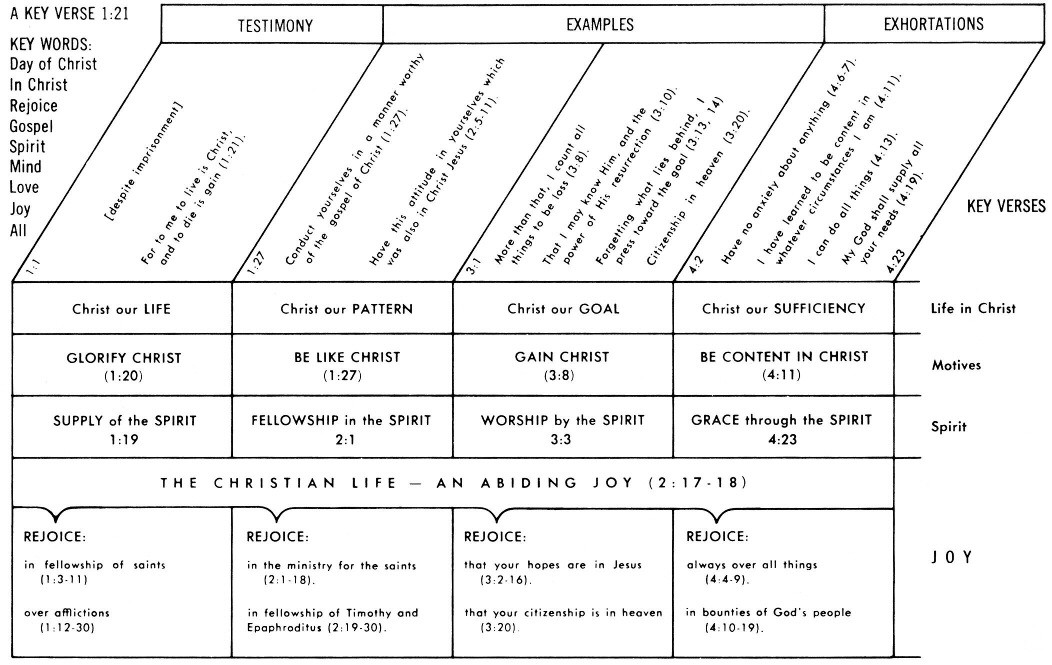
LIFE IN CHRIST
Click chart to enlarge
Charts from Jensen's Survey of the NT - used by permission
Philippians - Charles Swindoll = Chart on right side of page
| Account of Paul's Circumstances Php 1:1-30 |
Have the Mind of Christ Php 2:1-30 |
Have the Knowledge of Christ Php 3:1-21 |
Have |
| Partakers of Christ | People of Christ | Pursuit of Christ | Power of Christ |
| Suffering | Submission | Salvation | Sanctification |
| Experience | Examples | Exhortation | |
Philippians 4:19 And my God will supply all your needs according to His riches in glory in Christ Jesus(NASB: Lockman)
Greek: o de theos mou plerosei (3SFAO) pasan chreian humon kata to ploutos autou en doxe en Christo Iesou
Amplified: And my God will liberally supply (fill to the full) your every need according to His riches in glory in Christ Jesus. (Amplified Bible - Lockman)
Lightfoot: And I am confident that God on my behalf will recompense you and supply all your wants with the wealth which he only can command, in the kingdom of his glory, in Christ Jesus.
NLT: And this same God who takes care of me will supply all your needs from his glorious riches, which have been given to us in Christ Jesus. (NLT - Tyndale House)
Phillips: My God will supply all that you need from his glorious resources in Christ Jesus. Phillips: Touchstone)
Wuest: But my God shall satisfy to the full your every need in accordance with His wealth in glory in Christ Jesus.
Young's Literal: and my God shall supply all your need, according to His riches in glory in Christ Jesus;
AND MY GOD SHALL SUPPLY ALL YOUR NEEDS: o de theos mou plerosei (3SFAO) pasan chreian humon:
- my God 2Sa 22:7; 2Chr 18:13; Neh 5:19; Da 6:22; Mic 7:7; Jn 20:17,27; Ro 1:8; 2 Co 12:21; Philemon 1:4
- will supply all your needs Ge 48:15; Dt 8:3,4; Neh 9:15; Ps 23:1, 2, 3, 4, 5; 41:1, 2, 3; 84:11; 112:5, 6, 7, 8, 9; Pr 3:9,10; 11:24,25; Mal 3:10; Lk 12:30, 31, 32, 33; 2Co 9:8, 9, 10, 11
- Philippians 4 Resources - Multiple Sermons and Commentaries
"And my God shall fulfill all your necessities" (Geneva)
"My God will richly fill your every need" (GWT)
"But my God shall satisfy to the full your every need" (Wuest)
"And this same God who takes care of me will supply all your needs" (NLT)
The KJV Commentary writes…
The Philippians had met Paul’s need out of their poverty by Epaphroditus; God will meet their need out of His riches by Christ Jesus. (Dobson, E G, Charles Feinberg, E Hindson, Woodrow Kroll, H L. Wilmington: KJV Bible Commentary: Nelson)
DThis verse is often yanked out of context as a blank check from God and is emblazoned on everything from T-Shirts to coffee mugs. However verse 19 is not a blank check. It is not a promise of prosperity. Here is what many people miss when they take Php 4:19 out of the context of generous, even sacrificial giving by the Philippian church. Yes, it is a trustworthy promise from God, BUT taken in context, it is a conditional promise. In effect, God says "If you honor me with your finances (like the church at Philippi had done), then I will meet all of your needs."
We see this same principle in Proverbs 3:9-10 where Solomon writes
Honor the LORD from your wealth, and from the first of all your produce (THE CONDITION); so your barns will be filled with plenty, and your vats will overflow with new wine (THE PROMISE).
Such amazing generosity does not allow for foolish and frivolous spending on our part while at the same time we consider God is responsible for necessities! Rather, because the Philippians had been so generous in their Christian giving, God would meet their needs as well. (see Jesus' promise of the Father's intimate care of His children's needs in the notes on the Sermon on the Mount - Mt 6:25, 26, 27, 28, 29, 30, 31, 32, 33, 34- see notes Mt 6:25-26, 6:27-29, 6:30-32, 6:33-34)
My God - write in the margin of your Bible - “My Banker”!
Commenting on the phrase "my God" Eadie writes that
my God, so honoured and so pleased with your gift to me, will supply all your need. I who receive your contribution can only thank you, but my God Who accepts the sacrifice will nobly reward you. You have supplied one element of my need, but my God will supply every need of yours… The apostle uses the simple future (tense), as if he pledged himself for God; for he felt most assured, that God as his God would act as he promised in His name.
Vine writes that "the possessive pronoun (my) here suggests that while he could not do all that he would like to do for these, who had ministered on his behalf, his God would see to it."
The value of a promise depends entirely upon the one making the promise. "My God" is faithful to His promise and will never let you down. Paul could not repay the Philippians, but God could and would.
J M Boice asks the important application question: “Is He your God? If He is not your God, if you have never come to Him through faith in the Lord Jesus Christ, the promises of God’s care in the Bible are not for you. On the other hand, if you do believe in Him and wish to obey Him, you will find Him strong in your need. You will find Him entirely and consistently faithful” (Philippians, p. 258).
Paul is saying “You met my need, and God is going to meet your need. You met one need that I have, but my God will meet all of your needs. You gave out of your poverty, but God will supply your needs out of His riches in glory!”
Paul is reminding "his benefactors that "his" God ("my God") will do what he himself is in no position to do namely, reimburse his benefactors. This assurance of the divine supply of the Philippians' needs implies that they had given so liberally that they actually left themselves in some real "need." (Expositor's)
Shall supply (4137) (liberally supply) (pleroo [word study]) means to be filled (passive voice = saints acted on by outside force) to the brim (a net, Mt 13:48, a building, Jn 12:3, Acts 2:2, a city, Acts 5:28, needs Phil 4:19), to make complete in every particular, to cause to abound, to furnish or supply liberally, to flood, to diffuse throughout, to pervade, to take possession of and so to ultimately to control.
This word means to “fill to the brim, to furnish or supply generously.” It is the picture of filling a glass to overflowing. That’s how our God gives to His children.
Note that some translations suggest this verse is a prayer (eg, the Contemporary English Version has "I pray that God will take care of all your needs… ") but most versions do not hold to that view.
Barnes paraphrases this verse as "You have shown your regard for me as a friend of God, by sending to me in my distress, and I have confidence that, in return for all this, God will supply all your needs, when you are in circumstances of necessity." (Barnes)
Krell - If you are a faithful giver, you can expect God to meet your financial needs (ALL). If you’re not a faithful giver, you shouldn’t expect God to meet your financial needs, because you’re not obeying His Scriptures.
All (3956) (pas) without exception or “every” need is a comprehensive description covering all kinds of need. Paul emphasized the all inclusiveness in the Corinthian letter writing that
"God is able to make all grace abound to you, that always having all sufficiency in everything, you may have an abundance for every good deed as it is written, "HE SCATTERED ABROAD, HE GAVE TO THE POOR, HIS RIGHTEOUSNESS ABIDES FOREVER." Now He who supplies seed to the sower and bread for food, will supply and multiply your seed for sowing and increase the harvest of your righteousness, you will be enriched in everything for all liberality, which through us is producing thanksgiving to God." (2Cor 9:8-11)
Needs (5532) (chreia from chréos = debt) necessities or that that which should happen or be supplied because it is needed. Note that Paul says the promise is to meet needs not their "greeds" and all of their wishes, wants, or whims. Men have physical needs, mental needs, social needs, economic needs. These needs are temporal, but spiritual and eternal because all men need perpetual pardon, perpetual peace, and perpetual power. All would be supplied to the saints at Philippi!
Chreia - 49x in the NT -
Matt. 3:14; 6:8; 9:12; 14:16; 21:3; 26:65; Mk. 2:17, 25; 11:3; 14:63; Lk. 5:31; 9:11; 10:42; 15:7; 19:31, 34; 22:71; Jn. 2:25; 13:10, 29; 16:30; Acts 2:45; 4:35; 6:3; 20:34; 28:10; Rom. 12:13; 1 Co. 12:21, 24; Eph. 4:28, 29; Phil. 2:25; 4:16, 19; 1 Thess. 1:8; 4:9, 12; 5:1; Tit. 3:14; Heb. 5:12; 7:11; 10:36; 1 Jn. 2:27; 3:17; Rev. 3:17; 21:23; 22:5.
The NAS renders chreia as necessary(1), need(40), needed(1), needs(6), task(1).
Jesus reminds busy Martha (and all of us) that
only a few things are necessary (chreia), really only one, for Mary has chosen the good part, which shall not be taken away from her. (Lk 10:42-note)
Paul says that practical sanctification shows itself in
contributing to the needs (chreia) of the saints, practicing hospitality. (see note Romans 12:13)
hose who freely give (like the Philippians) will also receive--not their wants, but all they need for their service for Christ. The world's richest person was Jesus, Who had no place to sleep (Mt 8:20). He shared the Heavenly Father's unlimited resources. We can, too, if we dedicate all we have to Him.
Dwight Pentecost offers an important caveat writing that "The promise that, “My God shall supply all your need.” presupposes obedience. To claim the fulfillment of the promise without giving obedience to God is presumptuous. It shows a lack of faith… The Philippians were obedient. They were obedient to the Gospel, they were obedient to the demands of love for the apostle, and they were obedient in their obligation to God’s servant. Because of their obedience the apostle can say categorically to them, “I realize that in your poverty you gave and that you are reduced to dire want, but my God shall supply your needs because they arose out of obedience.” It is foolish to think you can squander what God has given you on yourself and then expect Him to step in and meet your need. (The Joy of Living: A Study of Philippians)
Solomon exhorts us to
"Honor the LORD from your wealth, and from the first of all your produce, so your barns will be filled with plenty, and your vats will overflow with new wine." (Pr 3:9,10)
And again he says
"There is one who scatters, yet increases all the more, and there is one who withholds what is justly due, but it results only in want. The generous man will be prosperous, and he who waters will himself be watered." (Pr 11:24,25)
Although in context God was speaking to Israel in the following verse, the principle applies that God's people have the responsibility to support the work of God, rather than to heap luxuries on themselves. Thus God tells Israel to
"Bring the whole tithe into the storehouse, so that there may be food in My house, and test Me now in this," says the LORD of hosts, "if I will not open for you the windows of heaven, and pour out for you a blessing until it overflows." (Mal 3:10)
Jack Arnold - This is a great promise. It involves the reciprocity of sufficiency. These Philippians had undoubtedly given from their meager resources. They were not wealthy people. Paul is saying to them, “My God will reimburse you. He will supply all your needs. Since you supplied my needs, God will supply yours. NOTE. This verse makes it clear that God will supply the Christian’s needs. He doesn’t promise to meet our wants but our needs – food, clothing, housing and other things which are absolutely necessary for living. He does not say a Christian may not go through some hard times and have to skip a meal now and then. Needs and wants can often get all scrambled up in the Christian’s mind, especially in our materialistic society. Wants and needs deal with motivations. “People are funny; they spend money they don’t have, to buy things they don’t need, to impress folks they don’t like.” NOTE. Also it should be noted that while God always meets our needs, He often goes beyond those needs to lavishly meet our wants because He is a faithful, loving, concerned God (Prov. 3:9-10: Honor the LORD with your wealth, with the first-fruits of all your crops; then your barns will be filled to overflowing, and your vats will brim over with new wine. Prov. 11:24-25: One man gives freely, yet gains even more; another withholds unduly, but comes to poverty. A generous man will prosper; he who refreshes others will himself be refreshed. 2 Cor. 9:10-11: Now he who supplies seed to the sower and bread for food will also supply and increase your store of seed and will enlarge the harvest of your righteousness. You will be made rich in every way so that you can be generous on every occasion, and through us your generosity will result in thanksgiving to God.). These verses do not guarantee God will make every Christian, who gives liberally, rich, but they do indicate blessing for the faithful giver to the Lord. So, if you want, give! Why? Because you can’t out give God! NOTE. The promise God will meet every need must be put into the context of Philippians 4:14-19. God does not meet the needs of every Christian indiscriminately but every Christian who is faithfully giving to God’s work. Because the Philippians had been generous, had given liberally and even sacrificed greatly, Paul assured them God would meet every financial need they had. The promise to meet all needs is conditioned on obedience to faithful giving (2 Cor. 9:6: Remember this: Whoever sows sparingly will also reap sparingly, and whoever sows generously will also reap generously.). Sometimes the best illustrations are those we have experienced ourselves. I have now been a Christian over 35 years and have seen God meet my needs or the needs of my family in hundreds of ways. I would like to pick out several cases for which I have no human explanation except God meets needs supernaturally. The first case is when I went to seminary. I was a new Christian. My parents had rejected my Christianity and were antagonistic to me. My father said he would support me if I went and received a doctorate in Physical Education but if I went to seminary he would not give me a dime. He is a man true to his word. I trusted God to meet my needs and went to seminary by faith. Three months before I went to seminary, a very wealthy woman in Texas called me over to her home and said, “God has laid it upon my heart to start supporting men who feel the call to the ministry while they are going to seminary. God has indicated to me that you are one of these young men.” She supplied monies for me to go to seminary and help me support my family for seven years while I received my education. God supplies needs. The second case is when I was in seminary. Carol and I had two children and one week we ran completely out of money. We needed milk for the babies and gas to go to a church where I was teaching Sunday school. I went to my mailbox at the seminary just after it closed on Saturday sure God would supply my needs but there was no money. Sunday morning I got up and asked God to get me to this church for I knew we had no gas. I made it to the church which was about ten miles away on fumes. For some reason, I was about a half an hour early and this church was about two blocks from the seminary. I decided to walk and pray and God seemed to impress me that I was to go to my mailbox at seminary. I argued with God because I had been there just after the mailroom closed on Saturday and there was nothing in it. I went to my mailbox and in it were two one dollar bills. I took one dollar and bought gas to get home and took the other dollar and bought milk for the kids. What a fantastic need God met and such wonderful timing. I’m still convinced that God put that money in the mailbox because there is no human explanation as to how it got there. To me this event is just as significant as having my way paid thought seminary. God supplies needs! (Joy in Giving)
Barnes has a practical comment noting God supplying all their needs "does not mean that the Philippians would now be justified in becoming lazy. "God's word does not advocate fanaticism, nor does it say that one should throw his pocketbook into the nearest river and then announce that he is going to live by faith" (Tenney). To be sure, God was taking care of Paul, but one of the ways in which he was doing so was exemplified by the gift from Philippi.
Calvin writes that the saints at Philippi "had… been truly sowing in the Lord's field, from which a sure and abundant harvest might be expected. Nor does he promise them merely a reward in the future life, but even in respect of the necessities of the present life: "Do not think that you have impoverished yourselves; God, whom I serve, will abundantly furnish you with everything necessary for you.
F B Meyer cautions that "we must distinguish between our needs and our desires. It is possible to want a good many things which we do not need. We often want things which it would injure us greatly to have. Paul wanted to be delivered from his thorn, but his real need was for more grace. We want a great many things which it is not possible for our Heavenly Father to give us, except to the great detriment of our best life. There is no promise that God shall supply all our desires or wishes, there is a certainty that He will fulfill all our need. Some may read these words whose needs are clamant (crying, beseeching), the need for guidance, for help against temptation, for the quickening of languishing devotional life, the need for daily bread or employment. Let all such take this to their heart for their comfort that God will supply all their need. (Commentary on Philippians)
KJV Commentary has an excellent summation of this section writing "We see first of all in this verse a great need. God promises to meet all of their need, not all of their wishes, wants, or whims. Men have physical needs, mental needs, social needs, economic needs. Men have not only temporal needs, but spiritual and eternal needs. Men need perpetual pardon, perpetual peace, and perpetual power. Secondly, we see in this verse a great helper. Paul says But my God. Paul could not repay the Philippians, but God could and would. Paul does not say my God can supply all your needs, but my God shall supply all your needs. This was Paul’s personal testimony and confession of faith. We see next a great Supplier. There is a total supply for a total need. God’s supply is infinite, abundant, inexhaustible, limitless, boundless. God many times uses the agencies of men to meet our needs. Next we see great resources. God’s riches in glory. Paul says according to his riches, not out of His riches, not off the top. God’s supply is not according to our deserts, but according to His mercy; not out of debt, but out of grace; not according to our emptiness, but according to His fullness; not according to our poverty, but according to His wealth. God has great riches. Lastly, look at the great and glorious channel by Christ Jesus. “For there is one God, and one mediator between God and men, the man Christ Jesus; Who gave himself a ransom for all, to be testified in due time” (1Ti 2:5–6). There is no other Mediator; there is no other channel. With such precious truth before us there can only be concurrence with the past, contentment with the present, and confidence for the future. " (Dobson, E G, Charles Feinberg, E Hindson, Woodrow Kroll, H L. Wilmington: KJV Bible Commentary)
C. H. Spurgeon once said, “God is satisfied with Himself, and sufficient to His own happiness. Therefore, surely, there is enough in Him to fill the creature. That which fills an ocean will fill a bucket; that which will fill a gallon will fill a pint; those revenues which will defray an emperor’s expenses are enough for a beggar or poor man.” Didn’t Paul say, “My God shall supply all your need according to his riches in glory by Christ Jesus” (Phil. 4:19)? And He sees fit to bestow these riches on us as an inherent gift. Thus all believers possess Christ, but not every one has all His gifts, for He gives them as it pleases Him. His pleasure is according to His knowledge.
ILLUSTRATION - Two friends were walking near Times Square in Manhattan. It was during the noon lunch hour and the streets were filled with people. Cars were honking their horns, taxis were squealing around corners, sirens were wailing and the sounds of the city were almost deafening. Suddenly, one of them said, “What an interesting place to hear a cricket.” His friend said, “You must be crazy. You couldn’t possibly hear a cricket in all of this noise!” “No, I’m sure of it,” his friend said, “I hear a cricket.” That’s crazy,” said his friend. The man, who had heard the cricket, listened carefully for a moment and then walked across the street to a big, cement planter where some shrubs were growing. He looked into the bushes, beneath the branches, and sure enough, he located a small cricket. His friend was utterly amazed. “That’s incredible,” said his friend. “You must have superhuman ears!” “No,” said the man who heard the cricket. “My ears are no different from yours. It all depends on what you’re listening for.” “But that can’t be!” said the friend. “I could never hear a cricket in this noise.” “Yes, it’s true,” came the reply. “It depends on what is really important to you. Here, let me show you.” He reached into his pocket, pulled out a few coins, and discreetly dropped them on the sidewalk. And then, with the noise of the crowded street still blaring in their ears, they noticed every head within twenty feet turn and look to see if the money that tinkled on the pavement was theirs. “See what I mean?” asked the man who had heard the cricket. “It all depends on what’s important to you.” What is important to you? (Keenan Kelsey, Making Choices, via eSermons.com newsletter)
ACCORDING TO HIS RICHES IN GLORY IN CHRIST JESUS: kata to ploutos autou en doxe en Christo Iesou:
- according to His riches in glory Ps 36:8; 104:24; 130:7; Ro 9:23; 11:33; Ep 1:7,18; 2:7; 3:8,16; Col 1:27; 3:16; 1Ti 6:17
- glory Ro 8:18; 2Co 4:17; 1Th 2:12; 1Pe 5:1,10
- Philippians 4 Resources - Multiple Sermons and Commentaries
According to (2596) (kata) reveals the extent to which God would supply the Philippians’ needs.
Jack Arnold on according to His riches in glory in Christ Jesus - God meets the needs of Christians “according to” not “out of” His riches. God meets needs proportionately to His own riches which are infinite. The source of God’s bank account is His own riches in glory. The God who owns the gold in every mine and the cattle on a thousand hills can meet the needs of all His children who dare to be faithful givers. We have no guarantee God will meet our needs if we are not giving to Him faithfully (although He may). But we do have the guarantee He will meet the needs of all who are faithfully giving to the Lord’s work. (Joy in Giving)
According to (kata) which is not the same as "out of" His riches. If I am a billionaire and I give you ten dollars, I have given you out of my riches; but if I give you a million dollars, I have given to you according to my riches. The first is a portion; the second is a proportion. The first would take it out of His riches, & would be like Mr. Rockefeller who used to give his caddy a dime. God gives in proportion to His infinite and inexhaustible riches!
If Bill Gates walked into your house this afternoon and said, “I think I want to give you some money” what would be your reaction? Would you get a wheelbarrow and shout “Show me the Money!”? What if he pulled out his wallet and handed you a one dollar bill. That would be “OUT OF his riches” and cheap! But what if he said “All I have is yours.” That would get your heart pumping, wouldn’t it? That’s exactly what God promises - to meet all our needs ACCORDING TO His infinite resources in Christ.
Spurgeon - “You have supplied my need out of your poverty; my God shall supply all your need out of his riches. Your greatest need shall not exceed the liberality of his supplies.”
Spurgeon - Will you allow me to make a break here for one instant? I read you just now the story of the prophet’s widow whose children were about to be taken for a debt, and how the oil was multiplied in the vessels which she borrowed, until there was enough to discharge the debt, and sufficient surplus for herself and children to live upon. Now, kindly take that picture, and join it on to this, and we have here, first, the empty vessels. Set them out in a row, “all your need.” Secondly, who will fill them up?—“My God shall fill up all your need.” Thirdly, after what fashion will he do it?—“According to his riches in glory.” Fourthly, by what means will he do it?—“By Christ Jesus.” Keep the widow and the vessels before you, and let us see the miracle worked over again on a grand scale in our own houses and hearts. May the Holy Spirit make the sight refreshing to our faith. (Philippians 4:19 Filling the Empty Vessels)
In his sermon on Philippians 4:19 entitled A New Year's Wish Spurgeon adds that…
His riches in glory”… means not only the riches of what He has done, but the riches of what He could do; for if He has made hosts of worlds, He could make as many myriads more, and then have but begun. The possibilities of God omnipotent, who shall reckon? But the Lord shall supply all your need according to such glorious possibilities. When a great king gives according to his, riches, then he does not measure out stinted alms to beggars, but he gives like a king, as we say; and if it be some grand festival day, and the king is in his state array, his largesse is on a noble scale. Now, when God is in His glory, bethink you, if you can, what must be the largesse that He distributes,-what the treasures that He brings forth for His own beloved! Now, “according to His riches in glory,” He will supply all your needs. After that, dare you despond? O soul, what insanity is unbelief? What flagrant blasphemy is doubt of the love of God! He must bless us; and, blessed by Him, we must be blest indeed. If He is to supply our needs “according to His riches in glory,” they will be supplied to the full. (Amen!)
Riches (4149) (ploutos) properly denotes abundance, plentitude, and literally is used to refer to material wealth or prosperity (abundance of earthly, temporal goods) which is the meaning in the parable of the seed and the soils (Mt 13:22, Mk 4:19, Lk 8:14 = Material riches are deceitful and choke out reception of the Word of God. Be careful all you wealthy readers! Contrast spiritual riches - Ep 3:8) Indeed, think of the people who know whose whole lives glow with the glory of God for they are rich in spiritual possessions, albeit often poor in material possessions!
Ploutos - 22x in NT -
Matt. 13:22; Mk. 4:19; Lk. 8:14; Rom. 2:4; 9:23; 11:12, 33; 2 Co. 8:2; Eph. 1:7, 18; 2:7; 3:8, 16; Phil. 4:19; Col. 1:27; 2:2; 1 Tim. 6:17; Heb. 11:26; Jas. 5:2; Rev. 5:12; 18:17
The NAS renders ploutos as riches(19), wealth(3).
Figuratively ploutos refers to spiritual abundance or prosperity. Ploutos refers to a high point on any scale with the implication of value as well as abundance. God's storehouse will never go bankrupt for He who own everything and has abundant fullness has an inexhaustible ability to supply their needs.
Francis Havergal alluded to true riches in these lines…
Take my silver and my gold,
Not a mite would I withhold;
Take my intellect, and use
Every power as Thou shalt choose.
Play Hymn - Take My Life and Let it Be
(Another Version by Chris Tomlin)
In Greek Plutus was the god of riches. Liddell-Scott records secular uses of ploutos as referring to treasures of gold, silver, the "riches" of the earth. Our English word plutocrat means one who rules because of his wealth. In Greek the word is connected to pleroma, the word for "fullness" so that a rich person is one who is "full of money or property."
Detzler writes that…
In early Greek literature, the fullness of material things was contrasted with the fullness of spiritual things. It was regarded as crude to be wealthy in terms of possessions but poor in terms of immaterial things. (Sadly, many people still make this foolish exchange. They surrender spiritual wealth for financial fatness.) Along the lines of this spiritual wealth one reads of Zeus, who was a pagan god rich in peace. But Homer spoke of wealth which made it possible for one to live without working. Socrates said that the rich were regarded as being socially sought after. (Wayne A Detzler. New Testament Words in Today's Language)
The KJV Commentary draws our focus to His…
great resources. God’s riches in glory. Paul says according to His riches, not out of His riches, not off the top. God’s supply is not according to our deserts, but according to His mercy; not out of debt, but out of grace; not according to our emptiness, but according to His fullness; not according to our poverty, but according to His wealth. God has great riches. (Dobson, E G, Charles Feinberg, E Hindson, Woodrow Kroll, H L. Wilmington: KJV Bible Commentary: Nelson) (Bolding added)
Vine writes regarding "according to His riches in glory"…
that is, in accordance with His infinite and exhaustless fullness. This fullness is in the heavenly sphere, where His attributes and power are in unceasing manifestation, as emanating from His own person. This glory shines into the hearts and lives of His people, expressing to and in them all that centers in Himself. (Vine, W. Collected writings of W. E. Vine. Nashville: Thomas Nelson)
A T Robertson adds that
"God has an abundant treasure in glory and will repay the Philippians for what they have done for Paul. The spiritual reward is what spurs men into the ministry and holds them to it."
In Christ Jesus - (See related studies on In Christ and in Christ Jesus) This phrase emphasizes the Source and Channel of all riches.
Writing to Timothy Paul declared that…
there is one God, and one mediator also between God and men, the man Christ Jesus, who gave Himself as a ransom for all, the testimony borne at the proper time. (1Timothy 2:5-6)
In Christ Jesus, God gives enough grace to meet whatever we face. Our needs can never exhaust His supply for Paul explains in Colossians that in Christ "are hidden all the treasures of wisdom and knowledge." (see note Colossians 2:3)
Williams (in Student's Commentary) calls Philippians 4:19 a note drawn upon the bank of faith:
My God—the name of the Banker.
Shall supply—the promise to pay.
All your need—the value of the note.
According to His riches—the capital of the bank.
In glory—the address of the bank.
By Christ Jesus—the signature at the foot, without which the note is worthless
Have you ever heard the false statement "God helps those who help themselves." The real truth is brought out in this verse:
"God helps those who cannot help themselves!"
How easy it is to take this verse out of context and use it as a soft pillow for Christians who are squandering their money on themselves with seldom a thought for the work of God!
“That’s all right. God will supply all your need.”
While it is true in a general sense that God does supply the needs of His people, this is a specific promise that those who are faithful and devoted in their giving to Christ will never suffer lack.
The famous missionary to China, Hudson Taylor, wrote
"It matters little to my servant whether I send him to buy a few cash worth of things, or the most expensive articles. In either case he looks to me for the money and brings me his purchases. So, if God should place me in serious perplexity, must He not give me much guidance; in positions of great difficulty, much grace; in circumstances of great pressure and trial, much strength? No fear that His resources will prove unequal to the emergency! And His resources are mine, for He is mine, and is with me and dwells in me."
When God leads He provides. Hudson Taylor observed,
God’s work, done in God’s way, will receive God’s supply
Our God hasn’t changed. When the child of God is in the will of God, serving for the glory of God, then he will have every need met.
As Paul closes this letter, he again affirms the centrality of Christ Jesus as the Source of every spiritual blessing and benefit from God. The preposition in emphasizes the essential nature of the believer's personal union with God through Christ and that it is via this dynamic union that God will supply every need.
So wonderful is the truth of v19 that Paul cannot refrain from breaking forth with a doxology of praise in the next verse. All saints should continually show a similar response to the incalculable riches bestowed upon us in Christ Jesus.
Think back over the past few days. Has the Lord taken care of some minor needs in your life? Has He solved some nagging problem? Thank Him! As today unfolds, remember that He provides the little things too.
"If you can't be happy with what you already have, why should God trust you with anything else?" Good question. Far too many people go through life chronically unhappy with their circumstances. Yet in every situation we have whatever we need to be content (if not happy). When we focus on material things, we will often feel frustrated, but when we focus on the Lord, we can rejoice that what we have can never be taken from us.
A classic illustration of the truth of this Scripture comes from the life of George Muller (Online biography). (Watch this excellent one hour video on Muller's life story - I promise you will be both encouraged and challenged!)
Things looked bleak for the children of George Muller’s orphanage at Ashley Downs in England. It was time for breakfast, and there was no food. A small girl whose father was a close friend of Muller was visiting in the home. Muller took her hand and said,
“Come and see what our Father will do.”
In the dining room, long tables were set with empty plates and empty mugs. Not only was there no food in the kitchen, but there was no money in the home’s account. Muller prayed, “Dear Father, we thank Thee for what Thou art going to give us to eat.”
Immediately, they heard a knock at the door. When they opened it, there stood the local baker. “Mr. Muller,” he said, “I couldn’t sleep last night. Somehow I felt you had no bread for breakfast, so I got up at 2 o’clock and baked fresh bread. Here it is.”
Muller thanked him and gave praise to God. Soon, a second knock was heard. It was the milkman. His cart had broken down in front of the orphanage. He said he would like to give the children the milk so he could empty the cart and repair it. (This story is actually recorded in the video account of his life).
Eadie comments that in Christ Jesus…
designates the sphere of God's action. In Christ Jesus will He supply their wants, or from the fulness in Him, His merit and mediation being the ground of it. What a glorious promise for the apostle to make on God's behalf to them!—a perfect supply for every want of body or soul, for time or eternity, for earth or heaven. If man is but a mass of wants, wants for this world and wants for the world to come, and if God alone can supply them, what confidence should not such a pledge produce? Is it physical fare?—He heareth “the young ravens” when they cry. Is it the forgiveness of sin? —He “delighteth in mercy.” Is it purification of soul?— His Spirit produces His own image. Is it courage?—He is “Jehovah-Nissi.” Is it enlightenment?—His words are, “I will instruct thee.” Is it the hope of glory?—Then it is, “Christ in you.” Is it preparation for heaven?—He makes “us meet to be partakers of the inheritance of the saints in light.” Is it contentment in any circumstance?—All things may be done in the strength of Christ. Nor was it rash in Paul to make such a promise, nor did he exceed his commission. He did not speak without a warrant. He knew the character of his God, and did not take his name in vain, for his varied and prolonged experience had fully informed him, and he was assured that the state of heart in the Philippian church must attract towards it the blessing. Would God resile (withdraw) from His servant's pledge, or act as if in thus vouching for Him he had taken too much upon him?"
F B Meyer comments that
Christ is God's Answer to Our Need. "
In Him are all the treasures of wisdom and knowledge hidden.
It pleased the Father that in Him should all the fulness dwell.
In Him dwelleth all the fulness of the Godhead bodily.
The Divine-Human nature of Christ is replete with every possible supply for His people.
He filleth all in all.
Those that trust Him can say, as the Apostle did of the Philippian gifts, "I have all things and abound; I am filled, hating received from Christ the things that came from God, and which were treasured in Him for my enrichment and thanksgiving." The teaching of the Apostle is full of this thought, as when he says, "I thank my God always concerning you, for the grace of God which was given you in Christ Jesus; that in everything ye were enriched in Him" (1Co 1:4-5), and again, "Blessed be the God and Father of our Lord Jesus Christ who hath blessed us with every spiritual blessing in the heavenly places in Christ" (see note Ephesians 1:3). Peter also affirms the same thought.
Grace to you, and peace be multiplied in the knowledge of God, and of Jesus our Lord; seeing that His Divine power hath granted unto us all things that pertain unto life and godliness" (see notes 2 Peter 1:2; 1:3).
Christ is the complement i.e. the complement of every soul. Just as the dark face of the moon taken with her first crescent of light makes a complete circle, so the unseen Redeemer together with our infinite need makes a complete man after God's stature. The greater our deficiency the larger His supply.
The Prime Necessity. The prime necessity, however, is that we should reckon it is so, and avail ourselves of all the treasures that are prepared for our use in our Risen Lord. Too often we act as if we had to meet the demands of life from our own limited exchequer, instead of believing that we have been taken into partnership with the Son of God, and can at any moment draw upon His all-sufficiency. What would you think if a clerk, who was sent to a distant land to open a branch of some great business firm, were to seek to meet the expenses out of his own limited salary, when the head of the firm had told him to draw upon his credit to any extent which he deemed necessary? But we make the same mistake when we meet the calls of life apart from the boundless wealth which is placed to our credit in Jesus.
A story is told by Dr. Richard Newton of an old and poverty-stricken Indian, who many years ago made his way into a Western settlement in search of food to keep him from starving. A bright-coloured ribbon was seen around his neck, from which there hung a small, dirty pouch. On being asked what it was, he said it was a charm given him in his younger days. He opened it, and took out a worn and Crumpled paper, which he handed to the person making the inspection. It proved, on examination, to be a regular discharge from the federal army, signed by George Washington himself, and entitling him to a pension for life. Here was a man with a promise duly signed, which if presented in the right place would have secured him ample provision, yet he was wandering about hungry, helpless, and forlorn, and begging bread to keep him from starving.
What a picture of many Christians who are in need of everything when they might be rich and full! Perhaps their own life had not been generous, certainly their faith has never put in its claim to God's great bank of promise. (Commentary on Philippians)
A Bigger Shovel by Joe Stowell - It’s interesting to me that Jesus taught more about money than any other subject. He consistently talked about the importance of generosity and the deadly danger of greed. To the man who asked Jesus to tell his brother to divide the inheritance with him, Jesus responded by warning, “Watch out! Be on your guard against all kinds of greed; a man’s life does not consist in the abundance of his possessions” (Luke 12:15). And in Luke 6:38Jesus taught, “Give, and it will be given to you . . . pressed down, shaken together and running over.” To disciples distracted by financial needs, Jesus assured them that the Father knows they need such things as food and clothes: “But seek his kingdom, and these things will be given to you as well” (Luke 12:22-31).
God’s plan is simple—give to gain. In other words, give to the kingdom and God will take care of your needs.
The great British preacher Charles H. Spurgeon once learned about this kind of trust while trying to raise money for poor children in London. He went to Bristol hoping to collect £300 (which in those days was a huge amount of money) for London’s homeless children. At the end of the week of meetings, many lives had been changed and his financial goal had been reached. That night, as he bowed in prayer, Spurgeon was clearly prompted to give the money to a co-laborer of Christ named George Mueller.
“Oh no, Lord,” answered Spurgeon, “I need it for my own dear orphans.” Yet Spurgeon couldn’t shake the idea that God wanted him to part with it. Only when he said, “Yes, Lord, I will,” could he find rest.
With great peace, he made his way the next morning to Mueller’s orphanage and found the great man of prayer on his knees. The famous minister placed his hand on Mueller’s shoulder and said, “George, God has told me to give you the £300 I’ve collected.”
“Oh, my dear brother,” exclaimed Mueller,” I’ve just been asking him for exactly that amount!” The two servants of the Lord wept and rejoiced together.
When Spurgeon returned to London, he found an envelope on his desk containing more than £300. The Lord had returned the £300 he had obediently given to Mueller, with 300 shillings of interest!
Spurgeon learned what another generous believer once said: “I shovel out, and God shovels in, and he has a bigger shovel than I do.” And while the return may or may not be monetary, you can be sure that your heart will overflow with the joy of giving generously and seeing His kingdom prosper.
And you don’t have to look back a hundred plus years to discover stories about the overflowing generosity of God to people who cheerfully give their money to the needs of others and God’s work. Just ask those who have discovered the joy of giving. They’ve got plenty of stories to prove the point. Let me invite you to get a few stories of your own!
YOUR JOURNEY…
- When was the last time God prompted you to give something? How did you respond? If He hasn’t prompted you to give to others, ask Him to give you an opportunity. You can be sure that He will!
- Do you give generously and sacrificially to the kingdom? Examining your heart to find out why or why not will be an important exercise. What holds you back? Greed? Fear? Disinterest?
- Read 2 Corinthians 9:6-15. Why is it sometimes hard to be a “cheerful giver”?
- To help you give more cheerfully in the future, be sure to consider the outcome—your gift “is not only supplying the needs of God’s people but is also overflowing in many expressions of thanks to God” (2 Corinthians 9:12).
- What assurance do you find in the promise of Philippians 4:19? Don’t miss the fact that the promise was made to the Philippians who had just given themselves sacrificially into poverty for the work of Christ through Paul.
Spurgeon has the following devotional entitled Limitless Riches…
PAUL’S God is our God, and He will supply all our need. Paul felt sure of this in reference to the Philippians, and we feel sure of it as to ourselves. God will do it, for it is like Him: He loves us, He delights to bless us, and it will glorify Him to do so. His pity, His power, His love, His faithfulness, all work together that we be not famished. What a measure doth the Lord go by: “According to his riches in glory by Christ Jesus.” The riches of His grace are large, but what shall we say of the riches of His glory? His “riches of glory by Christ Jesus,” who shall form an estimate of this? According to this immeasurable measure will God fill up the immense abyss of our necessities. He makes the Lord Jesus the receptacle and the channel of His fullness, and then He imparts to us His wealth of love in its highest form. Hallelujah! The writer knows what it is to be tried in the work of the Lord. Fidelity has been recompensed with anger, and liberal givers have stopped their subscriptions. But he whom they sought to oppress has not been one penny the poorer; nay, rather he has been the richer, for this promise has been true, “My God shall supply all our need.” God’s supplies are surer than any bank. (Faith's Checkbook)
John Butler - FIRST—THE SOVEREIGN IN THE PROMISE
“My God” This was a Divine promise, it was not just a human promise.
• The authority of the promise. “God.” Being a Divine promise it had the authority of God behind the promise. This meant the promise was a much stronger promise than if man had made it. God does not recant on his promises
• The association in the promise. “My.” This “My” is a result of Paul’s relationship with Christ, it is not the fact that God is the Father of everyone through Creation but this “My” is a result of the salvation of the soul. not the creation of the body.
SECOND—THE SURENESS OF THE PROMISE
“Shall.” This promise carries the sureness, the certainty of God Himself. When God promises, God fulfills. God has never broken and will never break a promise. Men break promises all the time. Divorce courts are where many marriage promises are broken and the breaking is confirmed by law. Wars are a result of nations breaking their promises. Treaties are promises between nations which are often worth less than the paper upon which they are written
THIRD—THE SOCIETY FOR THE PROMISE
“Your.” This text does no apply to everyone. It applies only to those who have been faithful in support of God’s work. The church at Philippi supplied Paul’s with help again and again, this resulted in their being blessed with this promise. You can never out give God. You may think that giving to God has been a mistake, but time will vindicate you actions.
FOURTH—THE SPECIFICS OF THE PROMISE
“Supply your need according to his riches in glory by Christ Jesus.” Paul spells out in detail how and why this promise will be fulfilled by God.
• The source in the specifics. “Riches in glory.” This need will be supplied from he best bank ever. It is not from your local bank which may fail, or the government but the bank of heaven (“riches in glory”). That bank, the richest bank of all, has never failed, and has unlimited resources. It is from this bank that God will provide.
• The supply in the specifics. “Need.” This is not wants. Nor is it even luxuries. The promise is limited to needs. God in wisdom gives us what we need not what we may want.
• The Savior in the specifics. “By Christ Jesus.” Jesus Christ is involved. It is through Him God meets our needs. Therefore do not reject Christ but receive Him.
The following devotionals are from Our Daily Bread (Copyright RBC Ministries, Grand Rapids, MI. Reprinted by permission. All rights reserved)
The saying "You can never out give God" may be doubted by overanxious or tightfisted people. But Paul's letter to the Philippian believers fully supports this saying. Having just received their generous gifts to meet his needs in prison, he assured them that because of their generosity God wouldn't allow them to suffer undue need. He told them, "My God shall supply all your need according to His riches in glory by Christ Jesus" (Phil. 4:19). God's people have relied on the truth of those words ever since.
To help us place our trust more confidently in this promise of God, someone has put Philippians 4:19 in terms we can all understand:
"My God [the bank] shall supply [the check] all your need [the amount] according to His riches in glory [the capital] by Christ Jesus [the signature]."
As with any valid check that we have received, we need only endorse God's check through our "signature of faith" and it will be paid in full. As long as we're willing to be content with much or little, as Paul was (v.12), we can dare to be generous people. Only then will we discover for ourselves that we can never out give our rich and generous God. (Our Daily Bread)
God's riches fill up our supply,
Whatever we may need,
So we can then be generous
And not controlled by greed. --Sper
God gives freely to us so that we can give freely to others.
Winds Of Love - A farmer had a weather vane on his barn, on which was written "God is love." When friends asked why, the farmer said, "This is to remind me that no matter which way the wind blows, God is love."
When the warm "south wind" with its soothing and balmy breezes brings showers of blessing, God is love.
"Every good gift and every perfect gift is from above" (James 1:17)
When the cold "north wind" of trial and testing sweeps down upon you, God is love.
"All things work together for good to those who love God" (Romans 8:28)
When the "west wind" blows hard upon you with its punishing intent, God is love.
"Whom the Lord loves He chastens" (Hebrews 12:6)
When the "east wind" threatens to sweep away all that you have, God is love.
"God shall supply all your need according to His riches in glory" (Philippians 4:19)
Perhaps you are discouraged and downhearted. If so, remember, God still cares for you. What you are experiencing has either been sent or it has been allowed by Him for your good.
Yes, no matter which way the wind is blowing, God is love. —Richard De Haan (Our Daily Bread, Copyright RBC Ministries, Grand Rapids, MI. Reprinted by permission. All rights reserved)
God is love: His mercy brightens
All the path in which we rove;
Bliss He wakes and woe He lightens—
God is wisdom, God is love. —Bowring
No affliction would trouble us if we knew God’s reason for permitting it.
Faith & Riches - Do you want to be rich? Do you think your faith will bring you riches? What kind of riches are you looking for?
There's good news and bad news if wealth is what you want. The good news is that God's Word does promise riches to the believer. The "bad" news is that it doesn't have anything to do with money.
Here are some examples of the riches that can be ours as believers in Jesus Christ:
- An understanding of God the Father and the Son, "in whom are hidden all the treasures of wisdom and knowledge" (Col 2:2, 3-see notes Col 2:2; 2:3).
- Christ, "the hope of glory," living in us (Col 1:27-see note Col 1:27).
- Mighty strength in our inner being, "through His Spirit" (Eph 3:16-see note Ep 3:16).
- Having all our needs met by God (Php 4:19-see note Php 4:19).
- The "wisdom and knowledge of God" (Ro 11:33-see note Ro 11:33).
- "Redemption through His blood, the forgiveness of sins," which comes from God's grace (Eph 1:7-see note Ep 1:7).
Yes, God's Word promises us great riches—treasures that we cannot even attempt to purchase with any amount of money. It is these riches that we must seek, enjoy, and use to glorify their source—our heavenly Father.—Dave Branon (Our Daily Bread, Copyright RBC Ministries, Grand Rapids, MI. Reprinted by permission. All rights reserved)
The treasures of earth are not mine,
I hold not its silver and gold;
But a treasure far greater is mine;
I have riches of value untold. —Hartzler
God's Word promises riches that money cannot buy.
WHEN THIS GETS ALL - We had thoroughly enjoyed the meeting in Altoona, Pennsylvania, and the privilege of greeting many friends of the Radio Bible Class who attended the service that evening. Some dear friends invited us to their home after the meeting for a lunch; but when we got there, it was more like a full-course dinner, and what a feast we had! As we were eating, one of the hostesses came into the living room to see if we had enough. Upon leaving, she turned around and said, "There's more in the kitchen when this gets all!" Since I come from the Midwest, this Pennsylvania Dutch expression really tickled me. "There's more in the kitchen when this gets all!" It was just another way of saying, "When what you have is all gone, there's more where that came from!" That was good to know, but how much more wonderful this is in the spiritual realm. How comforting the assurance that no matter how great our need, no matter how heavily we might have already drawn upon Heaven's resources, there's more "when this gets all!"
God's love has no measure; God's grace has no limit; and God's power is supreme. His wisdom is unbounded; and, praise His name, His provisions are never exhausted! No wonder the Apostle Paul wrote to the church at Ephesus expressing his desire that they might "know the love of Christ which passeth knowledge" and be conscious of the fact that He "is able to do exceeding abundantly above all that we ask or think, according to the power that worketh in us."
Oh, that we might learn to walk in this confidence each day, and never worry about tomorrow! Thanking God for His present provision, we should go forward a step at a time knowing that "there's more when this gets all!" (Our Daily Bread, Copyright RBC Ministries, Grand Rapids, MI. Reprinted by permission. All rights reserved)
"There's more, there's more, when this gets all";
Assurance blest: He hears our call,
Though sad our way — filled with regret —
Through His supply we'll conquer yet! —H. G. Bosch
Our prayer and God's supply are like two buckets in a well; while one ascends, the other descends!
The Ultimate Giver - If we put our trust for our well-being in a person, any person, we are putting it in the wrong place. Ultimately, our faith must be in God. To transfer that trust to a spouse or pastor or child is to put it where we will be disappointed.
In his book The Business of Heaven, C. S. Lewis wrote,
At first it is natural for a baby to take its mother's milk without knowing its mother. It is equally natural for us to see the man who helps us without seeing Christ behind him. But we must not remain babies. We must go on to recognize the real Giver. It is madness not to. Because, if we do not, we shall be relying on human beings. And that is going to let us down. The best of them will make mistakes; all of them will die. We must be thankful to all the people who helped us. We must honor and love them. But never, never pin your whole faith on any human being.
The author of Psalm 146 (notes) said not to trust in mortal men--even princes (Ps 146:3-note). Instead, he wrote, "Happy is he who has the God of Jacob for his help, whose hope is in the Lord his God" (Ps 146:5-note).
God can be trusted because He always provides what He promises. He is the ultimate Giver. --D C Egner (Our Daily Bread, Copyright RBC Ministries, Grand Rapids, MI. Reprinted by permission. All rights reserved)
I belong to the King, and He loves me, I know,
For His mercy and kindness, so free,
Are unceasingly mine wheresoever I go,
And my refuge unfailing is He. --Smith
My God shall supply all your need. --Philippians 4:19
PHILIPPIANS 4:19 - Pastor Harold Springstead was driving along, on his way to preach at a little country church, when he felt a sudden vibration. A tire had gone flat. As the 78-year-old pastor maneuvered his car to a stop, a trucker pulled up behind him. A young man jumped out, assessed the situation, and cheerfully changed the tire. Pastor Springstead got to the service in plenty of time, and it was not until later that he realized his car didn't even have a jack!
It was a minor problem. He was a retired faithful servant of God. It was a tiny congregation. We might think God would be too busy with larger and more important needs than to be concerned about a flat tire. But His promise to provide for the needs of His people covers little things as well as big ones.
The same God who helped Elisha retrieve the borrowed ax head (2Ki 6:5, 6, 7), who supplied food for a faithful widow (1Ki 17:8, 9, 10, 11, 12, 13, 14, 15, 16), and who provided wine at a small-town wedding (Jn 2:1, 2, 3, 4, 5, 6, 7, 8, 9,10) meets our needs as well.
Think back over the past few days. Has the Lord taken care of some minor needs in your life? Has He solved some nagging problem? Thank Him! As today unfolds, remember that He provides the little things too. --D C Egner (Our Daily Bread, Copyright RBC Ministries, Grand Rapids, MI. Reprinted by permission. All rights reserved)
If God sees the sparrow's fall,
Paints the lilies, short and tall,
Gives the skies their azure hue,
Will He not then care for you? --Anon.
Nothing is too great for God to accomplish, nothing to small for His attention.
An Answer For Everything - Dad, can I have 10 dollars?" "Dad, can you help me with my math?" "Dad, what's the capital of Maine?" "Dad, why can't we get another car?" "Dad, I didn't make the team."
The questions and requests and needs of my children seem endless. Whether they are in junior high, in high school, in college, or married, they never stop needing help.
Often I can provide the help they need, but sometimes I am unable to come up with the answer or the solution. As much as I would like to, I don't have an answer or the resources for everything. But I know who does. I know that God supplies all of our needs (Phil 4:19). And He knows when our requests are genuine needs, or when He must redirect our thinking instead.
Consider this: When we think we are too tired to go on, Jesus says, "I will give you rest" (Mt 11:28). When we think no one cares, Jesus says He loves us (Jn 15:12, 13). When we can't figure things out, God says He will guide us (Ps 48:14-note). When we need forgiveness, God says He will forgive us if we confess our sins (1Jn. 1:9).
God is our heavenly Father, who wants us to come to Him with our requests. He wants us to listen to Him speak through His Word. He has an answer for everything. –J D Branon (Our Daily Bread, Copyright RBC Ministries, Grand Rapids, MI. Reprinted by permission. All rights reserved)
For answered prayer we thank You, Lord,
We know You're always there
To hear us when we call on You;
We're grateful for Your care. –JDB
God never tires of our asking
Sermons from older expositors on Philippians 4:19
Philippians 4:20 Now to our God and Father be the glory forever and ever. Amen (NASB: Lockman)
Greek: to de theo kai patri hemon e doxa eis tous aionas ton aionon; amen
Amplified: To our God and Father be glory forever and ever (through the endless eternities of the eternities). Amen (so be it). (Amplified Bible - Lockman)
Phillips: And may glory be to our God and our Father for ever and ever, amen! (Phillips: Touchstone)
Wuest: Now to God, even our Father, be the glory forever and ever. Amen.
Young's Literal: and to God, even our Father, is the glory -- to the ages of the ages. Amen.
NOW TO OUR GOD AND FATHER BE THE GLORY FOREVER AND EVER AMEN: to de theo kai patri hemon e doxa eis tous aionas ton aionon amen:
- Php 1:11; Ps 72:19; 115:1; Mt 6:9,13; Ro 11:36; 16:27; Gal 1:5; Ep 3:21; 1Ti 1:17; Jude 1:25; Rev 1:6; 4:9, 10, 11; 5:12; 7:12; 11:13; 14:7
- amen Php 4:23; Mt 6:12; 28:20)
- Philippians 4 Resources - Multiple Sermons and Commentaries
through the endless eternities of the eternities (Amp)
Paul's doxology flows out of his abundant joy in this epistle and it should also be our continuous response to the ever-present, inexhaustible riches bestowed upon us by our Father in and through Christ Jesus our Lord!
Regarding the phrase "Our God" Lightfoot notes that…
it is no longer “my,” for the reference is not now to himself as distinguished from the Philippians, but as united with them.
Henry - It is a great condescension and favour in God to own the relation of Father to sinners, and allow us to say to him, Our Father; and it is a title peculiar to the gospel dispensation. It is also a great privilege and encouragement to us to consider him as our Father, as one so nearly related and who bears so tender an affection towards us. We should look upon God, under all our weaknesses and fears, not as a tyrant or an enemy, but as a Father, who is disposed to pity us and help us.
Bengel - The doxology flows out of the joy of the whole epistle
James Boice - God’s glory is the outward expression of what God is internally
God gets all the glory. He will not share His glory with another.
Expositor's - Small wonder that Paul closes this beautiful passage with a doxology. The glory of God's providential care must always be recognized by his children. Even the eternal ages yet to come will not be sufficient to exhaust the praises that belong to Him. (Gaebelein, F, Editor: Expositor's Bible Commentary 6-Volume New Testament. Zondervan Publishing)
Eadie - To God, even our Father, the kind and liberal supplier of every want to every child, be eternal glory ascribed. The ascription of praise is the language of spiritual instinct, which cannot be repressed. Let the child realize its relation to the Father who feeds it, clothes it, and keeps it in life, who enlightens and guides it, pardons and purifies it, strengthens and upholds it, and all this in Christ Jesus, and it cannot but in its glowing consciousness cry out—“Now to God and our Father be the glory for ever.” The Amen is a fitting conclusion. As the lips shut themselves, the heart surveys again the facts and the grounds of praise, and adds—So be it.
The psalmist rightly declares…
And blessed be His glorious Name forever; and may the whole earth be filled with His glory. Amen, and Amen (Ps 72:19) (Spurgeon's note)
Philippians 4:21 Greet (2SAMM) every saint in Christ Jesus. The brethren who are with me greet (3PPMI) you (NASB: Lockman)
Greek: Aspasasthe (2SAMM) panta hagion en Christo Iesou. aspazontai (3PPMI) humas oi sun emoi adelphoi
Amplified: Remember me to every saint (every born-again believer) in Christ Jesus. The brethren (my jassociates) who are with me greet you. (Amplified Bible - Lockman)
Phillips: Greetings to every true Christian, from me and all the brothers here with me. (Phillips: Touchstone)
Wuest: Greet every saint in Christ Jesus. The brethren with me send greeting to you.
Young's Literal: Salute ye every saint in Christ Jesus; there salute you the brethren with me;
GREET EVERY SAINT IN CHRIST JESUS: Aspasasthe (2SAMM) panta hagion en Christo Iesou:
- Philippians 4 Resources - Multiple Sermons and Commentaries
Greet (782) (aspazomai) means to enfold in one's arms and so to welcome and embrace another. Give each other a "holy hug" is the idea! Paul commands it using the aorist imperative meaning "Just do it"!
Spurgeon comments that…
The religion of Christ is full of courtesy, and it is full of generous thoughtfulness. I do not think that he can be a Christian who has no knowledge nor care about his fellow church-members.
Every (3956) (pas) means all without exception. Paul was concerned for every saint in Christ Jesus, not just his close personal friends. Little wonder that God used him so mightily.
Saint (hagios) (Click word study of hagios) is in the singular which conveys Paul's interest to each believer individually, and is an expression of personal affection. None is to be treated differently from any other. In a church troubled by disunity the apostle does not single out any one individual and does not "take sides".
The familiar Pauline phrase in Christ Jesus emphasizes the believer's union with Christ. The Philippians were holy (saints), not through any merit of their own, but because they were in Christ Jesus.
In Christ Jesus also emphasizes the important truth that every saint is in vital union with Christ. (See related resources in Christ and in Christ Jesus)
THE BRETHREN WHO ARE WITH ME GREET YOU: aspazontai (3PPMI) humas oi sun emoi adelphoi:
- Ro 6:21,22; Gal 1:2; 2:3; Col 4:10, 11, 12, 13, 14; Philemon 1:23,24
- Philippians 4 Resources - Multiple Sermons and Commentaries
The body of Christ is essential. Even the great apostle Paul was not a "Lone Ranger" doing his own thing.
Eadie adds that
Of course the brethren are saints, but all the saints are not brethren in the very same sense. The apostle refers to two circles of Christians about him; those bound by some nearer and more special tie to him, and named “brethren;” and those beyond them having no such familiar relationship with him, “the saints.” Who composed this inner circle we know not.
Philippians 4:22 All the saints greet (3PPMI) you, especially those of Caesar's household (NASB: Lockman)
Greek: aspazontai (3PPMI) humas pantes oi hagioi, malista de oi ek tes Kaisaros oikias
Amplified: All the saints (God’s consecrated ones here) wish to be remembered to you, especially those of Caesar’s household. (Amplified Bible - Lockman)
Phillips: All the Christians here would like to send their best wishes, particularly those who belong to the emperor's household (Phillips: Touchstone)
Wuest: All the saints send greeting to you, especially those of Caesar’s household.
Young's Literal: there salute you all the saints, and specially those of Caesar's house
ALL THE SAINTS GREET YOU: aspazontai (3PPMI) humas pantes oi hagioi:
- Ro 16:16; 2Co 13:13; Heb 13:24; 1Pe 5:13; 3Jn 1:14
- Philippians 4 Resources - Multiple Sermons and Commentaries
Saints (hagios) refers to members of the Body of Christ, the church at Rome, not to an elite group of men or women who have been granted sainthood by other men. God grants sainthood to EVERY ONE of His children, to all who by grace through faith believe in the Gospel of Jesus Christ. The moment we belief we are set apart from this godless world unto God Himself, Who now owns us as His own possession. Are you a saint or an ain't? This is a serious question the answer to which has eternal consequences!
ESPECIALLY THOSE OF CAESAR'S HOUSEHOLD: malista de oi ek tes Kaisaros oikias:
Of Caesar's household is an expression used in ancient Greco-Roman literature to refer both to the highest officials in the Roman government and to the lowest servants in the emperor’s employ.
Vine comments that "the gospel was making progress and accomplishing spiritual victories in the retinue of the worst of the Caesars. Grace changes the lives of those who, humanly speaking, are impossibilities. (Vine, W. Collected writings of W. E. Vine. Nashville: Thomas Nelson)
Philippians 4:23 The grace of the Lord Jesus Christ be with your spirit. (NASB: Lockman)
Greek: e charis tou kuriou Iesou Christou meta tou pneumatos humon
Amplified: The grace (spiritual favor and blessing) of the Lord Jesus Christ (the Anointed One) be with your spirit. Amen (so be it) (Amplified Bible - Lockman)
Phillips: The grace of the Lord Jesus Christ be with your spirit. (Phillips: Touchstone)
Wuest: The grace of the Lord Jesus Christ be with your spirit, with all of you in this respect individually
Young's Literal: the grace of our Lord Jesus Christ is with you all. Amen.
THE GRACE OF THE LORD JESUS CHRIST BE WITH YOUR SPIRIT: e charis tou kuriou Iesou Christou meta tou pneumatos humon:
- Ro 16:20,24; 2 Cor 13:14
- Philippians 4 Resources - Multiple Sermons and Commentaries
Paul begins his letter with grace (Click for in depth word study of charis) and fittingly concludes it with this same rich word.
Note that this passage is in its essence a prayer. Paul is praying that the Lord's grace (His transforming, energizing enablement or power to live the supernatural, abundant life for His glory - see discussion of empowering aspect of grace - 2Ti 2:1-note) be with them all. Is this not a prayer we should pray for all the saints in Christ Jesus?
Henry paraphrases it
the free favor and good will of Christ be your portion and happiness
He desires that they experience the daily unmerited help from the Lord Jesus.
Eadie adds that
In parting from his readers, he wishes them to possess the grace of the Lord Jesus; that grace which blesses and cheers, which strengthens and consoles, and at last ripens into glory
The concluding benediction is exactly the same as Philemon 1:25 and similar to Gal 6:18 and invokes on the Philippian church the continuing grace of Christ to be with their spirits.
The KJV adds Amen. It is true. So be it. It is an expression of confident and joyful affirmation.
PROBABLE, at this point, the Apostle took in hand the style with which his amanuensis had been rapidly penning his glowing thoughts, that in the clumsy letters, to which he refers in the Epistle of Galatians (Galatians 6:11), probably due to his defective eyesight, he might append his autograph.
"Salute every saint in Christ Jesus." There were many distinctions between the disciples in that distant city. Some who professed a lofty spirituality, but lacked the spirit of loving concord; some who were tinctured with the pharisaic disputations of his own earlier days; and some who were able to appreciate the deepest teachings of the nature of Christ which human words can unfold. It was enough, however, that they were in Christ Jesus, that He had accepted them, and that already they were separated from the corruption that is in the world through lust, and were set apart for the glorious purpose of the Son of God, and therefore their faithful friend was able to include them all in his tender salutation.
How good it is when Christian love enables us to rise above sectarian strife, and the misunderstandings which are generated by the differences of our temperament and education, so that we are able to view each other as common members of the Body, and contiguous branches of the Vine, praying for each other, and prepared to communicate grace by word and act. Let us salute every saint, whether belonging to our own Church or to some other. It is enough to know that they with us are partakers of Paul's Humility. There is no trace of the priest in these simple words. Having sent his own personal greetings, he hastens to class with himself his colleagues, as Timothy and Mark, or his travelling companions, as Luke and Silas, or prominent believers who dwelt in Rome, and had the right of entrance into his hired room. They were brethren more or less unknown, but the Apostle recognised that they had as much right to salute the saints in Philippi as he had, and he hastened to strengthen his own message by the inclusion of their good-will.
It is interesting to notice how fond the Apostle was of having others with him in his Christian work. Their fellowship gave him strength and comfort. Probably, he entered into the Spirit of the Master, who sent His disciples out two and two. Sometimes, he allied himself with Barnabas, at other times with Silas, at other times with Mark. The opening words of this Epistle show how closely he was associated with Timothy, "his own son in the faith." Two are better than one. It is a matter of great encouragement and strength when some kindred soul is united with us in any service.
The Gathering Wealth of Christian Love. "All the saints salute you." The Apostle first salutes for himself; then he associates the brethren that were with him; and now his voice seems to have stirred a large circle of consenting hearts, and from them all a torrent of tender affection sets in towards the Philippian Church. There is every probability that the saints who here send greeting are those who themselves had been greeted and mentioned by name in Romans 16. Bishop Lightfoot, in an essay on this passage which is full of interest, has pointed out that many of the names mentioned by Paul in the last chapter of his letter to the Romans are identical with the names deciphered in sepulchral inscriptions, and known to have had a place in the Imperial household. Of these he specifies Ampliatus, Appeles, Stachys, Rufus and Hermes, and the two women, Tryphaena and Tryphosa. These were almost certainly included in "all the saints."
Thus this Epistle, so full of love, seems like a shuttle to have shot between these far-removed centres of Christian life, uniting each to the other. Epaphroditus had brought a sweet savour of Philippi unto Rome, now this letter carries the fragrance of Roman Christianity to Philippi. It is thus that the Churches in all ages have exchanged words and actions of Christian courtesy.
The Saints that are Specially Distinguished. "Especially them that are of Caesar's household." The great commentator already referred to has shown that the household of Caesar was a term embracing a vast number of persons, not only in Rome, but in the provinces, all of whom were either actual or former slaves of the Emperor, and filled every possible description of office. There is every reason to believe that this term included household slaves who were in immediate attendance upon the Emperor; soldiers who through being attached to the prisoner had been constrained to hear the story of salvation, and yielded to the claims of Jesus: and perhaps beyond, there was a still wider circle of senators and knights, men of intellectual power and large wealth, who composed the Imperial retinue and court. The household of Caesar was constituted by a vast concourse, many of whom were the agents of murders, bitter cruelties, and licentious intrigues, but large numbers of whom were men of upright character, who found it possible, amid such surroundings as those of Nero's palace, to be simple followers of Jesus. It is as possible to be a Christian in a royal court as in a slum, in a fashionable circle as amongst peasants and labourers, amongst rulers as amongst the poor and destitute. Character may be independent of circumstances. Joseph may pursue his life of purity amid the corruption of Egypt, and Daniel his life of prayer amid the idolatry of Babylon.
Circumstances may differ; in some cases they are more, whilst in others they are less favourable to the growth of Christian character, but Christianity is indigenous to all climates, and will flourish on any soil. It is like the corn plant which grows alike upon the alluvial soil of the Nile Delta, and the broad expanse of Western prairies.
It speaks much for the earnestness of individual workers in those early days, when there were no great conventions, nor many eloquent and commanding preachers, that such vast multitudes of believers were being gathered in every part of the known world through the individual effort of those who, like the first apostles, could say, "Come and see."
The Final Benediction. "The grace of the Lord Jesus Christ be with your spirit." The Epistle begins with grace (Phil. 1:2) and with grace it ends. It is impossible to define all that is meant by this comprehensive prayer. Illumination for the soul, love for the heart, strength for the mind, purity for the character, help in every time of need, direction in all perplexity and difficulty--all these are included in the word grace. It was impossible for the Apostle to know in detail all that his friends might be passing through amid the temptations and perils of Philippi, but he wished that always and everywhere they might be conscious that the grace of the Lord Jesus beset them behind and before, encompassed their going out and coming in, enwrapped them in their lying down and rising up, canopied them with skies opening Godward, and was their shield and their exceeding great reward. (F. B. Meyer. The Epistle to the Philippians - A Devotional Commentary)