Philippians 4:2
Philippians 4:3
Philippians 4:4
Philippians 4:5
Philippians 4:6
Philippians 4:7
Philippians 4:8
Philippians 4:9
Philippians 4:10
Philippians 4:11
Philippians 4:12
Philippians 4:13
Philippians 4:14
Philippians 4:15
Philippians 4:16
Philippians 4:17
Philippians 4:18
Philippians 4:19
Philippians 4:20
Philippians 4:21
Philippians 4:22
Philippians 4:23

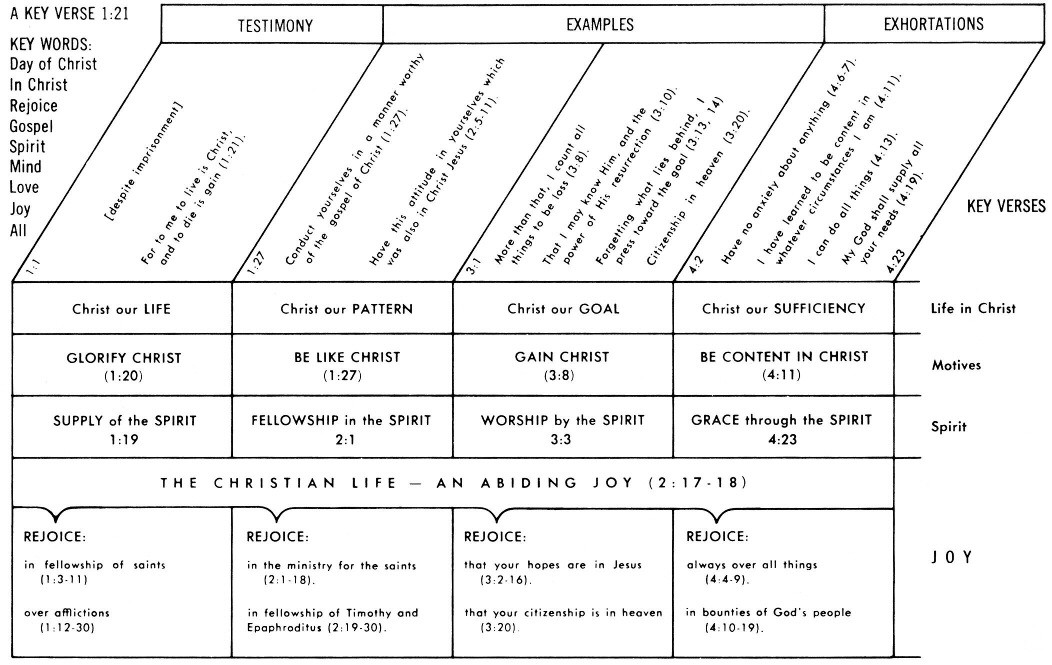
LIFE IN CHRIST
Click chart to enlarge
Charts from Jensen's Survey of the NT - used by permission
Philippians - Charles Swindoll = Chart on right side of page
| Account of Paul's Circumstances Php 1:1-30 |
Have the Mind of Christ Php 2:1-30 |
Have the Knowledge of Christ Php 3:1-21 |
Have |
| Partakers of Christ | People of Christ | Pursuit of Christ | Power of Christ |
| Suffering | Submission | Salvation | Sanctification |
| Experience | Examples | Exhortation | |
Philippians 4:7 And the peace of God, which surpasses (PAPFSN) all comprehension, will guard (3SFAI) your hearts and your minds in Christ Jesus (NASB: Lockman)
Greek: kai e eirene tou theou e huperechousa (PAPFSN) panta noun phrouresei (3SFAI) tas kardias humon kai ta noemata humon en Christo Iesou
Amplified: And God’s peace [shall be yours, that tranquil state of a soul assured of its salvation through Christ, and so fearing nothing from God and being content with its earthly lot of whatever sort that is, that peace] which transcends all understanding shall garrison and mount guard over your hearts and minds in Christ Jesus. (Amplified Bible - Lockman)
Barclay: And the peace of God, which surpasses all human thought, will stand sentinel over your hearts and minds in Christ Jesus. (Westminster Press)
GWT: Then God's peace, which goes beyond anything we can imagine, will guard your thoughts and emotions through Christ Jesus. (GWT)
HNV (Hebrew Names Version): And the shalom of God, which surpasses all understanding, will guard your hearts and your thoughts in Messiah Yeshua.
Lightfoot: If you do this, then the peace of God, far more effective than any forethought or contrivance of man, will keep watch over your hearts and your thoughts in Christ Jesus.
NLT: If you do this, you will experience God's peace, which is far more wonderful than the human mind can understand. His peace will guard your hearts and minds as you live in Christ Jesus. (NLT - Tyndale House)
Phillips: and the peace of God which transcends human understanding, will keep constant guard over your hearts and minds as they rest in Christ Jesus. (Phillips: Touchstone)
Weymouth: And then the peace of God, which transcends all our powers of thought, will be a garrison to guard your hearts and minds in union with Christ Jesus.
Wuest: and the peace of God which surpasses all power of comprehension shall mount guard over your hearts and minds in Christ Jesus. (Eerdmans)
Young's Literal: and the peace of God, that is surpassing all understanding, shall guard your hearts and your thoughts in Christ Jesus.
AND THE PEACE OF GOD WHICH SURPASSES ALL COMPREHENSION: kai e eirene tou theou e huperechousa (PAPFSN) panta noun:
- Php 1:2; Nu 6:26; Job 22:21; 34:29; Ps 29:11; 85:8; Isa 26:3,12; 45:7; Isa 48:18; 48:22; 55:11,12; 57:19, 20, 21; Jer 33:6; Lk 1:79; 2:14; Jn 14:27; 16:33; Ro 1:7; 5:1; 8:6; 14:17; 15:13; 2Cor 13:11; Gal 5:22; Col 3:15; 2Thes 3:16; Heb 13:20; Rev 1:4
- Eph 3:19; Rev 2:17
- Click for discussion of LORD our PEACE, Jehovah Shalom,
- Click for more on peace
- Resources on Philippians - Multiple commentaries and sermons
And God’s peace [shall be yours, that tranquil state of a soul assured of its salvation through Christ, and so fearing nothing from God and being content with its earthly lot of whatever sort that is, that peace] (Amp),
If you do this, you will experience God's peace, which is far more wonderful than the human mind can understand (NLT)
And then the peace of God, which transcends all our powers of thought (Weymouth)
THE PEACE OF GOD
FROM THE GOD OF PEACE
And (kai) connects the previous truth with the present result. It might be paraphrased “and then,” or “and so”, which connects following promise with the preceding precepts on prayer. And so we see that by the practice of the precepts one is enabled to obtain the promise. Have you experienced this promise?
Dwight Edwards - Here we have the result of fulfilling verse 6. Instead of having our hearts and minds captured by worry, they will be captives of God's peace.
Peace (1515) (eirene from eiro = to joining or binding or joining together what is broken or divided) means to set at one again, a meaning convey by the common expression of one “having it all together”.
Eirene - 86v in NT -
Matt. 10:13, 34; Mk. 5:34; Lk. 1:79; 2:14, 29; 7:50; 8:48; 10:5f; 11:21; 12:51; 14:32; 19:38, 42; 24:36; Jn. 14:27; 16:33; 20:19, 21, 26; Acts 7:26; 9:31; 10:36; 12:20; 15:33; 16:36; 24:2; Rom. 1:7; 2:10; 3:17; 5:1; 8:6; 10:15; 14:17, 19; 15:13, 33; 16:20; 1 Co. 1:3; 7:15; 14:33; 16:11; 2 Co. 1:2; 13:11; Gal. 1:3; 5:22; 6:16; Eph. 1:2; 2:14f, 17; 4:3; 6:15, 23; Phil. 1:2; 4:7, 9; Col. 1:2; 3:15; 1 Thess. 1:1; 5:3, 23; 2 Thess. 1:2; 3:16; 1 Tim. 1:2; 2 Tim. 1:2; 2:22; Titus 1:4; Philemon 1:3; Heb. 7:2; 11:31; 12:14; 13:20; Jas. 2:16; 3:18; 1 Pet. 1:2; 3:11; 5:14; 2 Pet. 1:2; 3:14; 2 Jn. 1:3; 3 Jn. 1:14; Jude 1:2; Rev. 1:4; 6:4
Peace is a condition of freedom from disturbance, whether outwardly, as of a nation from war or enemies or inwardly, as in the current context, within the soul.
The peace of God which replaces anxiety in the life of the prayerful believer is impossible to experience unless one already is at peace with God through faith in Christ. The peace of God is the ANTIDOTE for ANXIETY.
The peace of God - This is not the absence of problems but a reflection of the presence of divine sufficiency in the midst of problems (Isa 26:4; Php 4:13-note, Php 4:19-note).
George Morrison said "Peace is the possession of adequate resources” and those resources come from the Lord when you yield heart and mind to Him.
Every believer has come into an eternal peace with God for Paul writes that
having been justified by faith, we have peace with God through our Lord Jesus Christ.
Comment: See notes on Romans 5:1 for more discussion of the distinction between the peace of God and peace with God
However, not every believer necessarily experiences the peace of God which Paul describes in this passage. This peace is a promise which is the result of the practice of thankful prayer to God. As Vincent puts it "Peace (of God) is the fruit of believing prayer." Stated another way, one may have peace with God without having the peace of God. Peace with God is dependent upon faith, and peace of God is dependent upon faithful prayer. Peace with God describes the state between God and the Christian, and the peace of God describes the condition within the Christian.
Barnhouse comments that the truth of Romans 5:1 means for believers that…
Peace with God was already theirs, as it is already the portion of all who are placed in Christ. But the peace of God comes afterwards to those who are willing to accept the paradox of unconditional surrender. How many unsaved people there are today who are in misery because they will not accept the peace ("peace with God") that God made at the cross when He declared that the war was over and that sin was dealt with. And how many Christians are going to Heaven miserably because they are not willing to accept the riches of His grace and the wonders of His peace that He is so willing to give if we will only acknowledge Him as our Lord as well as our Saviour… Day by day, we are the objects of that love and grace, and, when we are surrendered to it, we shall be at peace.
Calvin writes that
It is on good ground that he calls it the peace of God, inasmuch as it does not depend on the present aspect of things, and does not bend itself to the various shiftings of the world, but is founded on the firm and immutable word of God.
Peace of God (God's peace, the dispeller of anxiety and worry) is the peace which God alone possesses (He is often referred to as the "God of peace") and which He gives to His children.
Peace in the present context is a state without anxiety and worry about how and when our needs (physical or emotional) will be supplied. This peace is the result of going to Him and confidently committing everything into His trustworthy hands.
Although the context is different, the principle in Isaiah is applicable that
"The steadfast of mind (the mind that has confidence in God shall not be agitated by the trials to which it shall be subject; by persecution, poverty, sickness, want, or bereavement) Thou will keep (guard, preserve) in perfect peace (Hebrew literally is ‘Peace, peace;’ repetition denoting emphasis = inward peace, outward peace, peace with God, peace of conscience, peace at all times, under all events), because he trusts in Thee." (Isa 26:3)
Henry describes the peace of God as
the comfortable sense of our reconciliation to God and interest in his favour, and the hope of the heavenly blessedness, and enjoyment of God hereafter.
Before God saves us, we are ''at war'' with the Almighty and our peace with Him is ''disturbed''. When we are justified by faith and reconciled to our Creator by the blood of Christ, we are made positionally at peace with God (see exposition of "peace with God" in Ro 5:1-note) and are "set at one again" so to speak like Adam and Eve were in Eden before sin entered the world. Paul in this section is describing the "peace of God" which can be a believer's experience (experiential peace) as he or she surrenders their will to His will, submits to His authority and walks in Spirit empowered obedience to His good and acceptable and perfect will. Specifically in the present context this peace is the Spirit borne fruit of thankful prayer. It's logical isn't it? If we can truly thank Him for every circumstance, good or bad, the result is His peace, the peace He gives.
Dwight Edwards on the peace of God - "Of God" is probably a genitive of source. Thus God is the source of this peace, not the conditions around us. This peace is beyond our comprehension, for we cannot fully understand it; yet it is not beyond our experience, for we can fully experience it in the present. "Will guard" is graphic, denoting a garrison, or one standing sentry. The peace of God will watch over and warn us against any intruders. If the peace of God is not ruling or standing sentry over our inward man, then an unwanted intruder has already entered. Here we see a distinction between "heart" and "mind." It would seem that they are referring to our emotional and intellectual facilities. Not only are we to be characterized by joy, we also are to be under the control of God's supernatural peace.
Barnes on the peace of God - The peace which God gives. The peace here particularly referred to is that which is felt when we have no anxious care about the supply of our needs, and when we go confidently and commit everything into the hands of God. “Thou wilt keep him in perfect peace whose mind is stayed on thee;” Isa 26:3; see the notes at Joh 14:27.
Wiersbe - "The peace of God" is one test of whether or not we are in the will of God. "Let the peace that Christ can give keep on acting as umpire in your hearts" (Col 3:15-note, wms). If we are walking with the Lord (Ed: yielding to the Spirit), then the peace of God and the God of peace exercise their influence over our hearts. Whenever we disobey, we lose that peace and we know we have done something wrong. God's peace is the "umpire" that calls us "out"! - Bible Exposition Commentary (BE Series)
The peace of God - That harmonizing of all passions and appetites which is produced by the Holy Spirit, and arises from a sense of pardon and the favor of God. (Adam Clarke)
Fierce passions discompose the mind,
As tempests vex the sea;
But calm content and peace we find,
When, Lord, we turn to Thee.
- William Cowper
Eadie eloquently explains the experiential "peace of God" writing that…
The Greek Fathers, followed by Erasmus, Estius, Crocius, and Matthies, understand the phrase of reconciliation:— “Peace,” said Chrysostom, “that is, the reconciliation, the love of God”. No doubt this peace is the result of reconciliation or peace before God . But this peace flowing from pardon and acceptance was already possessed by them—they had been reconciled; and what the apostle refers to is a state of mind which has this reconciliation for its basis. The former peace has a special relation to God (Ed note: "peace with God"), the controversy between Him and the soul being terminated—the latter (Ed note: "peace of God") is more personal and absolute. This peace is but another name for happiness, for it is beyond the reach of disturbance. Come what will, it cannot injure—come when it likes, it is welcome—and come as it may, it is blessing in disguise (Ed note: equates with supernatural "fruit" borne by the indwelling Spirit). It (Ed note: "It" refers to whatever circumstance or person might disturb one's peace) can neither dissolve union to Christ, nor cloud the sense of God's forgiving love, nor exclude the prospect of heavenly glory. It is not indigenous: it is the “peace of God.” Man may train himself to apathy, or nerve himself into hardihood—the one an effort to sink below nature, and the other to rise above it. But this divine gift ("fruit")—the image of God's own tranquility—is produced by close relationship to Himself, is the realization of that legacy which the Elder Brother (Jesus) has bequeathed.
Peace I leave with you; My peace I give to you; not as the world gives, do I give to you. Let not your heart be troubled, nor let it be fearful. John 14:27
To know that it is well with me now, and that it shall be so forever—to feel that God is my Guide and Protector, while His Son pleads for me and His Spirit dwells within me as His shrine—to feel that I am moving onward along a path divinely prescribed and guarded, to join the eternal banquet in the company of all I love and all I live for—the emotion produced by such strong conviction is peace, ay, the “peace of God.”
The secret of peace - He who climbs above the cares of the world and turns his face to his God, has found the sunny side of life. The world’s side of the hill is chill and freezing to a spiritual mind, but the Lord’s presence gives a warmth of joy which turns winter into summer. (C. H. Spurgeon.)
John Philips - What can disturb God's peace? Could some happening in a remote part of the galaxy disturb His peace? Of course not. He is omnipresent, always on the spot. Nothing can take place behind His back. He is right there, no matter where, all the time. Could some diabolical thought of Satan disturb God's peace? Could some mystery, some obscure idea, some crafty twist of error, or some plot hatched in the demented soul of Lucifer to thwart God's beneficent purposes and bring new forms of suffering into the universe disturb God's peace? Of course not. God is omniscient. He knows all the wiles of the evil one and in His infallible wisdom has anticipated and annulled every one of them. Satan's deep counsels are just so much gibberish to God, however clever and sophisticated they may seem to us. Can all the might of the gates of Hell (Matthew 16:18) disturb God's peace? Of course not. He is omnipotent. He can command galaxies and create atoms. He can toss stars into space and hold satellites whirling at inconceivable velocities on their orbits. There is no physical, moral, or spiritual power that He does not rule with consummate skill and tireless ease—not in Heaven or earth or Hell, not now or ever. Nothing can ruffle the peace of God. It is a calm beyond all storms, a rest beyond all strife, a haven beyond all tempestuous seas. The peace of God is majestic and sublime. Did Soviet atheism and militarism disturb God's peace? Was He intimidated by the size of the Russian army, by the success of Soviet propaganda, or by the worldwide presence of the KGB? Of course not. Long ago He wrote Russia's doom into His Book. In Paul's day, was God upset by Nero? When that evil man burned Rome, blamed the Christians, and began a persecution rarely surpassed in history, did he take God by surprise? Did God hastily cut short the day of grace and summon Michael to usher in Armageddon then and there? No. His peace was undisturbed. All was foreknown. We do not know why God held back His hand then or why He holds it back now, but "we'll understand it better by and by." The unfathomable peace of the God who controls the universe and pursues a faultless purpose, is the peace that Paul commended to his Philippian friends. Their arguing should vanish in the infinite calm of God's peace. (Exploring Philippians: An Expository Commentary)
Rod Mattoon - Peace possessed by one who has health, wealth, friends, and loved ones is understandable, but the peace of God in the midst of trials and tribulation is different. The peace of God that passeth understanding is peace so precious, that man's mind, with his skill and knowledge, can never produce it. It can never be of man's contriving. It is only of God's giving. This world demands a price for peace but it cannot deliver the goods after the price has been paid. The price for the peace of God has been paid for us, for the Lord Jesus Christ made peace through the blood of His cross (Colossians 1:20). (Mattoon's Treasures – Treasures from Philippians)
Pulpit Commentary - God's Peace
I. What it is. God’s own peace; that which he himself possesses. It is the peace which our Lord had and which he promised to his disciples: “My peace I give unto you.” It is, therefore, no mere superficial freedom from external troubles, but a deep-seated harmony with God the Source of all peace. Thus it transcends human understanding and human expression.
II. What prevents our possessing it? Over-anxiety and worry. These are a kind of practical atheism, since they prevent us from leaving all things to Him Who is supreme over all circumstances.
III. How to obtain it. By prayer, which rests upon Him for all things; by supplication, which brings our own special causes for anxiety into His presence; by thanksgiving, which recognizes that His will must be full of blessing. By thus turning our cares into prayers we throw them upon him who gives us in return His peace.
IV. What it does for us. It keeps our hearts and minds, preserving them from undue anxiety, and making them realize the strength of the peace which Christ bestows. How do these words come home with sublime force at the end of our Communion Service! Having received him who is our Peace (Eph 2:14), we have entered into and taken possession of the peace of God which passeth all understanding.—V. W. H.
The peace of God is a sense of holy repose and complacency which floods the soul of the believer when he is leaning hard upon God. Frances Ridley Havergal conveyed this truth beautifully in the words of the hymn Like a River Glorious…
Like a River Glorious
Stayed upon Jehovah,
Hearts are fully blessed;
Finding, as He promised,
Perfect peace and rest.
Surpasses (5242) (huperecho from hupér = above, over + écho = have) means literally to hold above and in context means to transcend the reach of man's ability to comprehend. This word speaks of that which is superior to or of surpassing and exceptional value.
Huperecho - 5v in NT - Rom. 13:1; Phil. 2:3; 3:8; 4:7; 1 Pet. 2:13. NAS renders - governing(1), in authority(1), more important(1), surpasses(1), surpassing value(1).
Huperecho is in the present tense which signifies that this peace is continually a peace that baffles men's futile attempts to explain it or rationalize it. Why? Because it is supernatural peace. God's peace continually stands out and is superior and more excelling than the world's peace or any so called peace we might be able to well up because of ''positive thinking'' etc. It is beyond our ability to produce it by our own intellect.
Comprehension (3563) (nous) describes the God given faculty of perceiving and understanding and is the channel through which truth reaches the heart.
In the present context nous speaks of the mind in its power of grasp spiritual truth as in Luke 24:45, where it is said that Jesus “opened their minds to understand the Scriptures.” The spiritual truth Paul describes cannot be grasped. This peace doesn't just surpass the understanding of the worldly man but surpasses all understanding. Even the godly man can't comprehend this peace. Paul is promising something that is not humanly explicable -- that a man surrounded by care and anxiety and harassment and concern can still live with the tranquility of God in his soul! Who can understand this great promise!
Nous - 22v in NT - NAS renders - composure (1), comprehension(1), mind(20), minds(1), understanding(1).
Lk. 24:45; Rom. 1:28; 7:23, 25; 11:34; 12:2; 14:5; 1 Co. 1:10; 2:16; 14:14f, 19; Eph. 4:17, 23; Phil. 4:7; Col. 2:18; 2 Thess. 2:2; 1 Tim. 6:5; 2 Tim. 3:8; Titus 1:15; Rev. 13:18; 17:9.
Eadie notes that the
mind cannot rightly estimate this peace or rise to an adequate comprehension of it. It is so rich, so pure, so noble, so fraught with bliss, that you cannot imagine its magnitude.
Paul is not saying that this is a senseless peace but that it is beyond our ability to understand and explain and therefore by implication it must be experienced.
Calvin illustrates "incomprehensible peace" writing that
nothing is more foreign to the human mind, than in the depth of despair to exercise, nevertheless, a feeling of hope, in the depth of poverty to see opulence, and in the depth of weakness to keep from giving way.
Ray Stedman…
That is the result of prayer, as Paul tells us in Philippians. The peace of God is a peace no one can understand or explain, a peace that comes to us despite our circumstances, and which does not arise out of emotions or events. It is " supernatural in origin and nature. Can there be anything more relevant to the trouble and anxiety of this world than the peace of God?
Lehman Strauss…
Now a peace possessed by one who has health, wealth, friends, and loved ones, is quite understandable, but the peace of God in the midst of trial and tribulation is something far different.
Barnes comments on this "incomprehensible peace" that
Those who see it manifested in the lives of Christians cannot understand such peace exhibited despite the slings and arrows of outrageous fortune encountered by them; even those who possess it cannot fully understand it; but those who have experienced it would not exchange it for anything that the world has to offer.
MacDonald comments that
People of the world cannot understand it at all, and even Christians possessing it find a wonderful element of mystery about it. They are surprised at their own lack of anxiety in the face of tragedy or adverse circumstances.
A person whose cancer has been arrested may say, “I am so thankful to God.” That is praise. But a person who is dying of cancer and in pain may calmly say, “Everything is all right. The Lord doesn’t make mistakes. I have peace in my heart.” That is “the peace that passes all understanding.”
Dwight Pentecost adds a practical note…
You look at a cow in a pasture, and no matter what… is breaking loose around the pasture, that cow is completely unperturbed. She keeps on biting off grass and chewing her cud as though there were no cause for worry in the world. You see, that cow is not sensitive to what is going on. But the peace of God is not a cow-like placidity in which we build up shields around ourselves by ignoring everything that ought to cause us to worry. That is not the promise of this verse. In the midst of things which could break a person’s mind, we can experience the peace of God. Why? Because we can cast everything that would cause us concern into the hands of a God to whom it is no concern at all. We know that no matter what experience comes, we can pass it on to God; it doesn’t have to stay in our hands at all. We simply transfer it to the shoulder of One who welcomes the opportunity to bear His children’s burdens (Pentecost, J. D. The Joy of Living: A study of Philippians. Kregel Publications)
William Barclay says surpasses all human comprehension "means that the peace of God is so precious that the human mind, with all its skill and all its knowledge, can never produce it. It can never be of our contriving; it is only of God's giving. The way to peace is in prayer to entrust ourselves and all whom we hold dear to the loving hands of God."
Spurgeon notes that
The understanding of mere carnal man can never comprehend this peace. He who tries with a philosophic look to discover the secret of the Christian's peace, finds himself in a maze. "I know not how it is, nor why it is," saith he; "I see these men hunted through the earth; I turn the pages of history, and I find them hunted to their graves. They wandered about in sheepskins and goat skins, destitute, afflicted, and tormented; yet, I also see upon the Christian's brow a calm serenity. I can not understand this; I do not know what it is. I know that I myself, even in my merriest moments, am disturbed; that when my enjoyments run the highest, still there are waves of doubt and fear across my mind. Then why is this? How is it that the Christian can attain a rest so calm, so peaceful, and so quiet?" Understanding can never get to that peace which the Christian hath attained. The philosopher may teach us much; he can never give us rules whereby to reach the peace that Christians have in their conscience. Diogenes may tell us to do without everything, and may live in his tub, and then think … that he enjoys peace; but we look upon the poor creature after all, and though we may be astonished at his courage, yet we are obliged to despise his folly. We do not believe that even when he had dispensed with everything, he possessed a quiet of mind, a total and entire peace, such as the true believer can enjoy. We find the greatest philosophers of old laying down maxims for life, which they thought would certainly promote happiness. We find that they were not always able to practise them themselves, and many of their disciples, when they labored hard to put them in execution, found themselves encumbered with impossible rules to accomplish impossible objects. But the Christian man does with faith what a man can never do himself. While the poor understanding is climbing up the craigs, faith stands on the summit; while the poor understanding is getting into a calm atmosphere, faith flies aloft and mounts higher than the storm, and then looks down on the valley, and smiles while the tempest blows beneath its feet. Faith goes further than understanding, and the peace which the Christian enjoys is one which the worldling can not comprehend and cannot himself attain.
Spurgeon goes on to say that
I cannot show you what that peace is, if you have never felt it; but yet I think I could tell you where to look for it, for I have sometimes seen it. I have seen the Christian man in the depths of poverty, when he lived from hand to mouth, and scarcely knew where he should find the next meal, still with his mind unruffled, calm, and quiet. If he had been as rich as an Indian prince, yet could he not have had less care… Picture… Martin Luther standing up in the midst of the Diet of Worms; there are the kings and the princes, and there are the bloodhounds of Rome with their tongues thirsting for his blood — there is Martin rising in the morning as comfortable as possible, and he goes to the Diet, and delivers himself of the truth, solemnly declares that the things which he has spoken are the things which he believes, and God helping him, he will stand by them till the last. There is his life in his hands; they have him entirely in their power. The smell of John Huss’s corpse has not yet passed away, and he recollects that princes, before this, have violated their words; but there he stands, calm and quiet; he fears no man, for he has nought to fear; “the peace of God which passeth all understanding, keeps his heart and mind through Jesus Christ.
John Trapp…
Prayer hath virtutem pacativam. "Acquaint thyself with God and be at peace," Job 22:21. Pray, "that your joy may be full," John 16:24. David prays down his distempers, Psalm 6:1-10 Psalm 116:1-19, and then cries out, "Return to thy rest, O my soul;" he rocks himself asleep in this sort; and sets all to rights often times, even then when his heart was more out of tune than his harp. Would you then have that peace of God, that most precious jewel that ever the heart of man was acquainted with? do as you are here advised: 1. Pray for what you want, and give thanks for that you have: (a sacrifice of praise is called a "pay offering," or a "peace offering," because peace ensues upon it.) 2. Be always doing something that is good, as Philippians 4:8-9, for as every flower hath its sweetness, so every good union hath its comfort. This is so true, that very heathens (upon the discharge of a good conscience) have found comfort and peace answerably. How boldly did Abimelech bear himself upon his integrity; and what a blessed composedness had holy Noah, who was righteous in his generation, and therefore sat mediis tranquillus in undis.
Maclaren on the peace of God…
What is it? What are its elements? Whence does it come? It is of God, as being its Source, or Origin, or Author, or Giver, but it belongs to Him in a yet deeper sense, for He Himself is Peace. And in some humble but yet real fashion our restless and anxious hearts may partake in the divine tranquility, and with a calm repose, kindred with that rest from which it is derived, may enter into His rest.
If that be too high a flight, at all events the peace that may be ours was Christ’s, in the perfect and unbroken tranquility of His perfect Manhood. What, then, are its elements? The peace of God must, first of all, be peace with God. Conscious friendship with Him is indispensable to all true tranquility. Where that is absent there may be the ignoring of the disturbed relationship; but there will be no peace of heart. The indispensable requisite is ‘a conscience like a sea at rest.’ Unless we have made sure work of our relationship with God, and know that He and we are friends, there is no real repose possible for us. In the whirl of excitement we may forget, and for a time turn away from, the realities of our relation to Him, and so get such gladness as is possible to a life not rooted in conscious friendship with Him. But such lives will be like some of those sunny islands in the Eastern Pacific, extinct volcanoes, where nature smiles and all things are prodigal and life is easy and luxuriant; but some day the clouds gather, and the earth shakes, and fire pours forth, and the sea boils, and every living thing dies, and darkness and desolation come. You are living, brother, upon a volcano’s side, unless the roots of your being are fixed in a God who is your friend.
Again, the peace of God is peace within ourselves. The unrest of human life comes largely from our being torn asunder by contending impulses. Conscience pulls this way, passion that. Desire says, ‘Do this’; reason, judgment, prudence say, ‘It is at your peril if you do!’ One desire fights against another, and so the man is rent asunder. There must be the harmonizing of all the Being if there is to be real rest of spirit. No longer must it be like the chaos ere the creative word was spoken, where, in gloom, contending elements strove.
Again, men have not peace, because in most of them everything is topmost that ought to be undermost, and everything undermost that ought to be uppermost. ‘Beggars are on horseback’ {and we know where they ride}, ‘and princes walking.’ The more regal part of the man’s nature is suppressed, and trodden under foot; and the servile parts, which ought to be under firm restraint, and guided by a wise hand, are too often supreme, and wild work comes of that. When you put the captain and the officers, and everybody on board that knows anything about navigation, into irons, and fasten down the hatches on them, and let the crew and the cabin boys take the helm and direct the ship, it is not likely that the voyage will end anywhere but on the rocks. Multitudes are living lives of unrestfulness, simply because they have set the lowest parts of their nature upon the throne, and subordinated the highest to these.
Our unrest comes from yet another source. We have not peace, because we have not found and grasped the true objects for any of our faculties. God is the only possession that brings quiet. The heart hungers until it feeds upon Him. The mind is satisfied with no truth until behind truth it finds a Person who is true. The will is enslaved and wretched until in God it recognises legitimate and absolute authority, which it is blessing to obey. Love puts out its yearnings, like the filaments that gossamer spiders send out into the air, seeking in vain for something to fasten upon, until it touches God, and clings there. There is no rest for a man until he rests in God. The reason why this world is so full of excitement is because it is so empty of peace, and the reason why it is so empty of peace is because it is so void of God. The peace of God brings peace with Him, and peace within. It unites our hearts to fear His name, and draws all the else turbulent and confusedly flowing impulses of the great deep of the spirit after itself, in a tidal wave, as the moon draws the waters of the gathered ocean. The peace of God is peace with Him, and peace within.
I need not, I suppose, do more than say one word about that descriptive clause in my text, It ‘passeth understanding.’ The understanding is not the faculty by which men lay hold of the peace of God any more than you can see a picture with your ears or hear music with your eyes. To everything its own organ; you cannot weigh truth in a tradesman’s scales or measure thought with a yard-stick. Love is not the instrument for apprehending Euclid, nor the brain the instrument for grasping these divine and spiritual gifts. The peace of God transcends the understanding, as well as belongs to another order of things than that about which the understanding is concerned. You must experience it to know it; you must have it in order that you may feel its sweetness. It eludes the grasp of the wisest, though it yields itself to the patient and loving heart.
SHALL GUARD YOUR HEARTS AND MINDS IN CHRIST JESUS: phrouresei (3SFAI) tas kardias humon kai ta noemata humon en Christo Iesou:
- Neh 8:10; Pr 2:11; 4:6; 6:22
- Spurgeon on How to Guard the Heart
- 1Pet 1:4,5; Jude 1:1
will be a garrison to guard your hearts and minds in union with Christ Jesus (Weymouth)
will stand sentinel over your hearts and minds in Christ Jesus (Barclay)
will guard your thoughts and emotions through Christ Jesus (GWT)
His peace will guard your hearts and minds as you live in Christ Jesus (NLT)
will keep watch over your hearts and your thoughts in Christ Jesus (Lightfoot)
will keep constant guard over your hearts and minds as they rest in Christ Jesus (Phillips)
Shall guard (5432) (phroureo from phrouros = sentinel) means to pay attention to something, this definition giving us a clear picture of the action involved in guarding or protecting. The root word phrouros (sentinel) is derived from pro = before, toward + horao = behold, take special notice of, stare at more.
Phroureo - 4v in NT - 2 Co. 11:32; Gal. 3:23; Phil. 4:7; 1 Pet. 1:5. NAS renders - guard(1), guarding(1), kept in custody(1), protected(1).
Phroureo has three primary nuances:
(1) to maintain a watch, guard (like guarding the city gates from within as a control on all who went out),
(2) to hold in custody, detain, confine as in Galatians where Paul explained that…
"before faith came, we were kept in custody (phroureo) under the law, being shut up to the faith which was later to be revealed."
This meaning in fact was The terminology is consistent w. the Roman use of prisons principally for holding of prisoners until disposition of their cases, just as the Law did until we could place our faith in Christ.
(3) to provide security, guard, protect, keep, this being the primary meaning in the present context.
Phroureo means to be a watcher in advance, to mount guard as a sentinel (post spies at gates) and figuratively to hem in and to protect.
Phroureo is in the future tense which makes this verb a declaration of what will result when the preceding precepts (Php 4:6) are put into practice.
The picture of phroureo is to protect by a a Roman guard or soldier holding his weapon on guard duty, either to prevent hostile invasion or to keep the inhabitants of a besieged city from flight (ponder this last aspect in the context of the effect that "anxiety" often has on one's psyche - don't you sometimes feel like you just want to take flight or run away?) The armed guard is walking back and forth in front of an open gate so that no one can enter. This picture would have been familiar to the Philippians, since the Romans stationed troops in the Roman colony of Philippi to protect their interests. Just as the Roman soldiers watched over the city, so God’s peace will actively guard and protect those saints who confidently trust in Him and show their trust by obeying the exhortations in the preceding verse. God's peace mounts guard at the door of one’s heart and mind to prevent anxiety from entering. He will not allow any menacing worry to enter.
Rod Mattoon - This would have been a familiar picture to the Philippians which was a Roman colony protected by Roman troops stationed in that town. The peace of God acts a military guard or sentinel at the door of our hearts and minds. God's peace guards against worry, fear, fretting, frustration, doubt, division and unbelief. ILLUSTRATION - In 1555, Nicholas Ridley was burned at the stake because of his witness for Christ. On the night before Ridley's execution, his brother offered to remain with him in the prison chamber to be of assistance and comfort. Nicholas declined the offer and replied that he meant to go to bed and sleep as quietly as ever he did in his life. Because he knew the peace of God, he could rest in the strength of the everlasting arms of his Lord to meet his need. So can we!
Phroureo was used in Galatians to describe one purpose of the Law, Paul explaining that…
before faith came, we were kept in custody (phroureo) under the law, being shut up to the faith which was later to be revealed. (Galatians 3:23)
John MacArthur adds that the saints in Philippi
"knew what a sentry was, what a guard was, what a garrison was… a protector. And what Paul says… if you know your God and you know your God is near and you confidently trust your God in the midst of any trial, knowing that it is effecting His purpose, and then being thankful in the midst of that for the purpose of God even in the difficulty, you are granted the peace of God, that peace will guard you and protect you from anxiety, difficulty, distress, dissatisfaction, discontent, doubt."
MacArthur goes on to illustrate this principle writing that
"Bunyan had a beautiful picture of this. You remember in Holy War (click to read this classic) he has the picture of the city called Mansoul and it's representative of the soul of man. And he has the Prince Emanuel who, of course, is Christ, and then he has this special character called Mr. God's Peace. And Mr. God's Peace is in the town of Mansoul, he's on patrol and his job is to guard the town. Bunyan writes, "Nothing was to be found but harmony, happiness, joy, and health so long as Mr. God's Peace maintained his office." And Bunyan talks about how the town Mansoul grieved Prince Emanuel. Prince Emanuel left and Mr. God's Peace laid down his commission and chaos resulted. That's what happens in the Christian life. When Christ is out of our thoughts, when we no longer see things in the light of how He views them, when we no longer are under, as it were, the confidence in His sovereignty, then all of a sudden Mr. God's Peace doesn't function anymore and we're left with troubled minds and troubled hearts. But where we have that confident trust in the Lord, so much so that we can thank Him in the midst of our petitions, then we have Mr. God's Peace on duty and he is the protector of the peace of our souls. That couldn't be a clearer perspective for all of us to understand."
Matthew Henry writes that God's peace guards us because it
"will keep us from sinning under our troubles, and from sinking under them; keep us calm and sedate, without discomposure of passion, and with inward satisfaction.
Lehman Strauss - The peace of God acts as a guard, or sentinel, at the door of the heart and mind. Paul said that it "shall keep [or garrison] your hearts and minds through Christ Jesus." When we dwell upon our problems and perplexities, our hearts and minds become seriously affected, so much so that we go all to pieces. This is Satan's strong point of attack and I fear he has succeeded in making neurotics of great numbers of professing Christians. But God's peace does sentinel duty over our hearts and minds to prevent any successful attack on the part of the enemy. God's peace is a priceless commodity that this old world cannot purchase with money, nor can it be had through the efforts of modern psychiatry. "Careful for nothing… prayerful for everything… thankful for anything"—this is the secret! When everything is placed trustingly into the hands of our Heavenly Father in prayer, petition, and praise, we know that He will keep watch over our hearts and minds so that nothing can upset us mentally or emotionally. (Philippians Commentary)
In Christ Jesus (Need encouragement? Click and make a list of what you learn from the 73 uses of "in Christ") signifies that He is the One Who secures and insures our peace and it is through our union with Him. Being in Christ is necessary to experience the peace of God. (See discussion of related topics In Christ and in Christ Jesus)
Barnes commenting on in Christ Jesus that for us "To understand all that is meant by these words is to grasp in its fullness the whole theology of the apostle Paul… One may only be amazed that so many commentators pay no attention at all to these most important words."
Shortly before He was crucified, Jesus told His disciples
Peace I leave with you; My peace I give to you; not as the world gives do I give to you. Do not let your heart be troubled, nor let it be fearful (Stop allowing yourselves to be agitated and disturbed; and do not permit yourselves to be fearful and intimidated and cowardly and unsettled)" (Jn 14:27).
Wiersbe comments: The world bases its peace on its resources, while God's peace depends on relationships. To be right with God means to enjoy the peace of God. The world depends on personal ability, but the Christian depends on spiritual adequacy in Christ. In the world, peace is something you hope for or work for; but to the Christian, peace is God's wonderful gift, received by faith. Unsaved people enjoy peace when there is an absence of trouble; Christians enjoy peace in spite of trials because of the presence of power, the Holy Spirit. People in the world walk by sight and depend on the externals, but Christians walk by faith and depend on the eternals.”
Barclay comments: The peace which the world offers us is the peace of escape, the peace which comes from the avoidance of trouble and from refusing to face things. The peace which Jesus offers us is the peace of conquest. No experience of life can ever take it from us and no sorrow, no danger, no suffering can ever make it less. It is independent of outward circumstances.
Jesus added that
These things I have spoken to you, so that in Me you may have peace. In the world you have tribulation (and trials and distress and frustration), but take courage (be of good cheer, be confident and courageous in face of danger); I have overcome the world. (I have deprived it of power to harm you and have conquered it for you)" (Jn16:33)
Spurgeon adds that "Without Christ Jesus this peace would not exist; without Christ Jesus this peace, even where it has existed, cannot be maintained. Daily visits from the Savior, continual lookings by the eye of faith to Him that bled upon the cross, continual drawings from His ever-flowing fountain, make this peace broad, and long, and enduring. But take Christ Jesus, the channel of our peace away, and it fades and dies, and droops, and comes to nought. A Christian hath no peace with God except through the atonement of his Lord Jesus Christ."
The result of believing prayer is that the peace of God will stand like a sentinel on guard upon our hearts. The way to peace is in prayer to entrust ourselves and all whom we hold dear to the loving hands of God.
The Puritan William Gurnall wrote that “The peace of God is said to garrison the believer’s heart and mind. He is surrounded with such blessed privileges that he is as safe as one in an impregnable castle” (from his work "A Christian in Complete Armor").
G Campbell Morgan - There are three great phrases in which peace and God are brought together. They are "Peace from God," "Peace with God," and "Peace of God." They are all the result of a truth enshrined in another, "the God of peace." The first, Paul constantly employed in the introduction to his letters. It reminds us that our peace comes to us a gift from God The second describes the relationship into which we are brought with God, through Christ Jesus. The third refers to the peace which is the experience of God Himself, because of what He is in Himself, the God of peace. At once it admits us to a realm which this particular passage indicates. The peace of God is beyond "all mind"; that is, beyond our power of thinking. That means two things: first, that the peace of God is so wonderful that we are not able fully to apprehend it; but second, it means that the peace of God, being the result of the wisdom and might of God, is far more wonderful than any cleverness of our own. That is the main value of the whole declaration of which this phrase is a part. It is that peace which will guard, as with a garrison of defence, our hearts and thoughts in Christ Jesus. If we by our own cleverness attempt to guard our hearts and thoughts, we shall fail. The forces opposed are too strong for us. They will break through upon us, They can never do so, as we are guarded in "the peace of God." (Life Applications from Every Chapter of the Bible)
Hearts (2588) (kardia) (Click for in depth word study) describes the center of each person from which thoughts and affections flow.
Kardia - 152v in NT - NAS renders - heart(102), heart's(1), hearts(50), mind(2), minds(1), quick(1), spirit(1).
Matt. 5:8, 28; 6:21; 9:4; 11:29; 12:34f, 40; 13:15, 19; 15:8, 18f; 18:35; 22:37; 24:48; Mk. 2:6, 8; 3:5; 4:15; 6:52; 7:6, 19, 21; 8:17; 11:23; 12:30, 33; Lk. 1:17, 51, 66; 2:19, 35, 51; 3:15; 4:18; 5:22; 6:45; 8:12, 15; 9:47; 10:27; 12:34, 45; 16:15; 21:14, 34; 24:25, 32, 38; Jn. 12:40; 13:2; 14:1, 27; 16:6, 22; Acts 2:26, 37, 46; 4:32; 5:3f; 7:23, 39, 51, 54; 8:21f, 37; 11:23; 13:22; 14:17; 15:9; 16:14; 21:13; 28:27; Rom. 1:21, 24; 2:5, 15, 29; 5:5; 6:17; 8:27; 9:2; 10:1, 6, 8ff; 16:18; 1 Co. 2:9; 4:5; 7:37; 14:25; 2 Co. 1:22; 2:4; 3:2f, 15; 4:6; 5:12; 6:11; 7:3; 8:16; 9:7; Gal. 4:6; Eph. 3:17; 4:18; 5:19; 6:5, 22; Phil. 1:7; 4:7; Col. 2:2; 3:15f, 22; 4:8; 1 Thess. 2:4, 17; 3:13; 2 Thess. 2:17; 3:5; 1 Tim. 1:5; 2 Tim. 2:22; Heb. 3:8, 10, 12, 15; 4:7, 12; 8:10; 10:16, 22; 13:9; Jas. 1:26; 3:14; 4:8; 5:5, 8; 1 Pet. 1:22; 3:4, 15; 2 Pet. 1:19; 2:14; 1 Jn. 3:19ff; Rev. 2:23; 17:17; 18:7.
John MacArthur explains that "Paul’s use of the phrase "hearts and minds" was not intended to imply a distinction between the two; he was merely making a comprehensive reference to the believer’s inner person. Once again, Paul reminds his readers that true peace is not available through any human source, but only in Christ Jesus." (MacArthur, J. Philippians. Page 284. Chicago: Moody Press)
Minds (3540) (noema from noéo = perceive in turn from noús = mind) is literally the result of the activity of the "nous" or mind, that part of man which thinks. Noema means that which is thought (a thought), perceived with the mind (a mental perception), understood, pondered, or considered.
Noema - 6 uses in NT - 2Co. 2:11; 3:14; 4:4; 10:5; 11:3; Phil. 4:7. NAS renders - minds(4), schemes(1), thought(1).
BDAG divides noema into two main categories…
1. That which one has in mind as product of intellectual process = thought, design, purpose, intention.
2. The faculty of processing thought = the mind or the understanding
Paul uses noema with a negative connotation in his description of our Adversary writing that…
"in order that no advantage be taken of us by Satan; for we are not ignorant of his schemes (his devices or designs = noema)." (2 Corinthians 2:11)
The basic meaning then is what results from directing one’s mind (nous) to a subject, in the present context case in directing our mind to prayer with thanksgiving. The focus of our mind changes from the problem to the "Problem" solver, from a self centered focus to a "Godward", Christ centered focus and the result is a "guarded, garrisoned" mind! This is supernatural "mind over matter!"
Vine says noema is "that which is thought out."
Noema refers to the content of thinking and reasoning, to what is thought, conceived or perceived. Stated another way noema is the psychological faculty of understanding, reasoning, thinking, and deciding. It can also conveys the negative idea (all NT uses except here in Php 4:7 are in a bad sense) of plot, method or scheme and is so used in describing Satan, Paul writing "in order that no advantage be taken of us by Satan; for we are not ignorant of his schemes (wiles, evil plans, purposes, intentions, enterprises, devices, designs, sly ways or cunning, the great number of stratagems which he is constantly using to injure us and to destroy the souls of people) (noema)." (2Cor 2:11) In this same letter Paul explains that although we walk in the flesh, we do not war according to the flesh but instead, with the aid of divinely powerful "weapons… are destroying speculations and every lofty thing raised up against the knowledge of God, and we are taking every thought (noema) captive to the obedience of Christ" (2Cor 10:3, 4, 5-note)
Vincent comments that "The guardianship is over the source and the issues of thought and will. “Your hearts and their fruits” (Alford)."
W H G Thomas spoke about the meaning of the peace of God in our hearts first asking "What does the peace of Christ do (Col 3:15-note)? Primarily it gives assurance of acceptance with God (cf. Ro. 5:1-note), and the protection of God (cf. Php 4:7-note, Gr., "shall garrison," a paradoxical use of a warlike term). But here (Col 3:15-note) Christ's peace is to be received into the heart as the arbiter deciding the course and ruling the life (Gr., "umpire"). A similar idea and practically the same Greek word is found in Col 2:18-note… where the apostle is warning his readers not to let anyone judicially deprive them of their reward as though they were unworthy. This word, translated here "rule," suggests that which settles differences, especially where there is any conflict of thoughts and feelings. Under such circumstances "the peace of Christ" is to decide; and if it be asked how peace is able to do this perhaps the explanation is that just as peace with God is the result of our acceptance of Christ as Savior (Ro 5:1-note), so the experience of peace in the soul, in union with Christ and through the presence of the Holy Spirit, will at once settle every difficulty, resolve every conflict, and show us what is the will of God. In this case there is a special reason for such divine peace--the essential unity of the body of Christ, the Church, and to this peace, we are told, every believer has been called. When we are one with Christ, in whom God "called us with an holy calling" (2Ti 1:9-note), and also one with Christians, "called in one body," as Paul says here, there is no question as to the great power of divine peace in our lives. We read of "government and peace" (Isa. 9:7), of "righteousness and peace" (Ps 85:10-note; cf. Isa. 32:17), and of "grace… and peace" (Titus 1:4-note). Until these prevail universally, however, "the God of peace himself" (1Th 5:23-note) will be with us, keeping us meanwhile "in perfect peace" (Isa 26:3).
Adam Clarke - Shall keep your hearts - Shall keep them as in a strong place or castle. Your hearts - the seat of all your affections and passions, and minds - your understanding, judgment, and conscience through Christ Jesus; by whom ye were brought into this state of favor, through whom ye are preserved in it, and in whom ye possess it; for Christ keeps that heart in peace in which he dwells and rules. This peace passeth all understanding; it is of a very different nature from all that can arise from human occurrences; it is a peace which Christ has purchased, and which God dispenses; it is felt by all the truly godly, but can be explained by none; it is communion with the Father, and his Son Jesus Christ, by the power and influence of the Holy Ghost. You may be experiencing little or big trouble this very moment. Most of us have this experience every day. The question is
Where do you choose (you do have a choice, you know!) to focus your thoughts
when the problems and their entangling thoughts assail you?
Do you run into the strong tower of the Name of the Lord , calling on Him, thanking Him for His sovereignty, His faithfulness, His promises, etc? (See Name of the LORD is a Strong Tower- Summary and The Attributes of God) This action does not come naturally but takes continual sober mindedness and steady practice. Next time trouble knocks, let thankful praying and God centered thinking (cf Php 4:8-note) answer the door. In time, as this becomes the habit of your life, you will begin to progressively experience God's peace in a way that is difficult to fully understand and difficult to explain to someone else.
MacArthur is probably correct in his comment that "Paul’s use of the phrase hearts and minds was not intended to imply a distinction between the two; he was merely making a comprehensive reference to the believer’s inner person.
John Trapp - Shall keep your hearts] φρουρησει, keep as with a guard, or as in a garrison. Solomon’s bed was not so well guarded with his threescore valiant men, all holding swords, Song of Solomon 3:7-8, as each good Christian is by the power of God without him and the peace of God within him. This peace, like David’s harp, drives away the evil spirit of cares and fears; it soon husheth all. God can soon raise up in his an army of powerful thoughts and meditations, so as their very inward tranquillity arising from the testimony of a good conscience (called here, their minds), and the sweet sabbath of spirit, the composedness of their affections (called here, their hearts), can make and keep them secure and sound, yea, bring aid when they are close besieged by sin and Satan.
Dwight Pentecost sums up this section noting that "Many of us worry because of our pride. We think we ought to be big enough to handle any situation that comes, and we are too proud to ask God’s help. We think we ought to be able to accept and bear everything by ourselves. That is not what the Word of God demands. The Word of God asks us to recognize our inability and to transfer any burdens to One who is able. The Apostle Peter in 1 Peter 5:7 gave the command, “Casting all your care upon him.” Why is that sufficient? “For he careth for you.” Whatever would cause us anxiety we should cast on Him, because He exercises a providential care over us. We can live without worry, and without fear, and without anxiety, and without nervous exhaustion, and without frustration — but not without God’s help. We must let our worries roll off on God, and He will deliver us from worry. (Pentecost, J. D. The Joy of Living: A study of Philippians. Kregel Publications)
J Vernon McGee draws an interesting conclusion from this section writing "There are those who say that prayer changes things. I can’t argue with that; prayer does change things. But that is not the primary purpose of prayer. Notice that we entered this passage in anxiety, with worry, and we came out of the passage with peace. Between the two was prayer. Have things changed? Not really. The storm may still be raging, the waves still rolling high, the thunder still resounding. Although the storm has not abated, something has happened in the individual. Something has happened to the human soul and the human mind. In our anxiety we want God to change everything around us. “Give us this.” “Don’t let this happen.” “Open up this door.” We should be praying, “Oh, God, change me .” Prayer is the secret of power. We enter with worry, we can come out in peace. Joy is the source of power; prayer is the secret of power. (McGee, J V: Thru the Bible Commentary: Thomas Nelson)
Spurgeon wrote the following devotional entitled "Prayer, Thanksgiving, Praise" - No care, but all prayer. No anxiety, but much joyful communion with God. Carry your desires to the Lord of your life, the guardian of your soul. Go to Him with two portions of prayer and one of fragrant praise. Do not pray doubtfully, but thankfully. Consider that you have your petitions, and therefore thank God for His grace. He is giving you grace; give Him thanks. Hide nothing. Allow no want to lie rankling in your bosom; “make known your requests.” Run not to man. Go only to your God, the Father of Jesus, who loves you in Him. This shall bring you God’s own peace. You shall not be able to understand the peace which you shall enjoy. It will enfold you in its infinite embrace. Heart and mind through Christ Jesus shall be steeped in a sea of rest. Come life or death, poverty, pain, slander, you shall dwell in Jesus above every ruffling wind or darkening cloud. Will you not obey this dear command? Yes, Lord, I do believe thee; but, I beseech thee help mine unbelief. (from Faith's Checkbook)
In Christ Jesus - The blessed means--“Through (in) Christ Jesus.” Christ is the medium through which the possibility of peace came at first. Christ is the channel through which it flows at present. He is the propitiation for sins; therefore He brings peace to the conscience. He is the power of God; therefore He brings peace to those who are weak and in fear. He is the path to heaven; therefore He brings confidence to these who are pilgrims. He is the Prince of Peace; therefore He is the delight of all His subjects. (J. J. S. Bird, M. A. Biblical Illustrator-Philippians)
Peace and then Higher Peace and then the Highest Peace:
Three Christian brothers met one day
To speak of things divine;
They had so much of Christ to say,
With joy their faces shine.
The first one said, `My brothers dear,
By virtue of Christ's blood,
My heart retains no guilty fear,
I now have "Peace with God".' (Ro 5:1-note)
The second brother answered bold,
`You lag on heaven's road;
I grasp the truth with higher hold,
I have the "peace of God".' (Php 4:7-note)
The third dear brother drew up tall;
He laughed and scarce could cease:
`My brothers dear, I beat you all—
I have the "God of Peace.” (1Th 5:23-note)
They all had peace, they all were right,
But peace in diverse measure;
The third had scaled the highest height
Of Heaven's exalted pleasure.
—T. Baird
The Cushion of Peace by John MacArthur - "Blessed are the peacemakers, for they shall be called sons of God" (Matt. 5:9). God’s peace cushions the soul during difficult times. I remember reading about what is called "the cushion of the sea." The ocean surface is often greatly agitated, but as you descend, the water becomes increasingly calm. At its greatest depths the ocean is virtually still. Oceanographers dredging ocean bottoms have found animal and plant remains that appear to have been undisturbed for hundreds of years. Similarly, Christians can experience a cushion of peace in their souls regardless of their troubled surroundings. That's because they belong to God, who is the source of peace; serve Christ, who is the Prince of Peace; and are indwelt by the Holy Spirit, who is the agent of peace. Galatians 5:22 says, "The fruit of the Spirit is love, joy, [and] peace." When you become a Christian, God grants you the gift of peace. God is not only the source of perfect peace, but also its purest example. Everything He does is marked by peace. First Corinthians 14:33 says He is not a God of confusion but of peace. In Judges 6:24 He is called Jehovah-shalom, which means, "the Lord is peace." The Trinity is characterized by a total absence of conflict: perfect oneness, perfect righteousness, and absolute harmony. It is impossible for God to be at odds with Himself! God wants everyone to know that kind of peace. He created the world with peace and sent His Son to offer peace. Someday Christ will return to establish His kingdom and reign in peace for eternity. In the meantime turmoil exists for all who don't know Christ. They have no cushion for their souls. You, however, have peace with God through the death of Christ Jesus, and as you obey Him, His peace will continually reign in your heart. Don't ever let sin rob you of that blessed cushion. Only as you experience peace within yourself can you share it with others. Suggestions for Prayer - Thank God for the cushion of peace He has provided amid difficult circumstances.Ask God to use you as an instrument of His peace today. For Further Study - Read Isaiah 57:15-21, noting how God encourages the repentant and warns the wicked in relation to peace. (Grace to You)
Comment: There is a story about a submarine that was being tested and as part of its test, it had to remain submerged beneath the surface for a long time. While the submarine was submerged, a powerful storm passed through the area, causing a great deal of damage. When the submarine returned to the harbor, the head of the team that was evaluating the submarine asked the captain, “How did that terrible storm affect you?” The captain looked at the man in surprise and exclaimed, “Storm? We didn’t even know there was one!” The reason for the captain’s surprise was that his submarine had been so far beneath the ocean’s surface that it reached this area known to sailors as “the cushion of the sea.” Although a storm’s high winds may whip the surface into huge waves, the waters in the “cushion” are not even stirred. So while vessels up above were being subjected to turmoil and damage, the submarine down below was not affected. It remained "at peace" so to speak safely set on the “cushion.” This illustration pictures the supernatural peace of God which guards the believer's heart, in response to thankful prayer (Php 4:6)
F B Meyer in Our Daily Walk has a devotional entitled "The Fortress of the Heart"…
In most of the old castles there is an inner keep, which is protected, not only by mighty walls and bastions, but by the portcullis at the gate, and sentries at every approach, who challenged every one that passed in and out. So the heart is continually approached by good and evil, by the frivolities and vanities of the world and the insidious suggestions of the flesh. It is like an inn or hostelry, with constant arrivals and departures. Passengers throng in and out, some of them with evil intent, hoping to find conspirators, or to light fires that will spread until the whole being is swept with passion, consuming in an hour the fabric of years to ashes.
We need, therefore, to be constantly on the watch; we must keep our heart above all else that we guard, for out of it are the issues of life (R.V. marg.). Our Lord says that "out of the heart of man come forth evil thoughts, murders, adulteries, thefts," etc. The devil and the world without would be less to be feared, if there were not such strong tendencies to evil within--many of them inherited from long lines of ancestors, who, alas! pass down to us the worst features of their characters equally with the best.
Keep it Clean. Just as the eye of the body is perpetually washed with tear-water, so let us ask that the precious blood of Christ may cleanse away any speck of impurity. Remember how delicate a thing the heart is, and how susceptible to the dust of an evil thought, which would instantly prevent it becoming the organ of spiritual vision. Sursum Corda! Lift up your hearts! We lift them up unto the Lord!
The Sentinel of Peace. Then the Peace of God will become the warden or sentry of the heart, and it passeth understanding! We can understand the apparent peace of some men. They have made money, and their gold-bags are piled around them as a fortress; they have rich and influential friends, within whose protection they imagine they will be sheltered and defended; they enjoy good health, and are held in high esteem. We can understand such peace, though it often proves ephemeral! But there is a peace that passeth understanding! It is to this that our Lord refers when He says, "My Peace I give unto you; not as the world giveth." "Let not your heart be troubled, neither let it be afraid."
PRAYER- Keep me, Heavenly Father, as the apple of Thine eye; defend me by Thine Almighty power; hide me from this strife of tongues and the fiery darts of the wicked one. May my heart be as the palace which the Stronger than the strong man keeps in perfect peace. AMEN.
The following devotionals are from Our Daily Bread (Copyright RBC Ministries, Grand Rapids, MI. Reprinted by permission. All rights reserved)
PHILIPPIANS 4:6-7 - The Promise Of Peace - At Christmas-time we love to hear the angelic message of peace on earth. But the message that’s repeated in songs and sermons needs to be heard and heeded every day of the year. We continually hear reports of tragedies around the globe. And we may be troubled by personal problems and crises. We long for and pray for peace.
The Bible provides an answer to that plea for peace. To start with, the apostle Paul assured us in Romans 5:1-note that it is possible to have peace with God. Yes, we disobedient and sinful creatures can enter into a state of reconciliation with God through faith in His Son Jesus (Ro 5:11-note).
We can enjoy emotional peace as we cast our cares on the Savior (Philippians 4:6, 7; 1Peter 5:7-note). There is also the possibility of interpersonal peace. In Romans 12:18-note, Paul urged believers, “As much as depends on you, live peaceably with all men.” Peace with others can become a reality. Best of all, we can anticipate global peace when our Savior, the Prince of Peace, returns.
By our prayers and by our example, let us be peacemakers who help to fulfill the angelic message: “Glory to God in the highest, and on earth peace, goodwill toward men!” (Luke 2:14). —Vernon C Grounds
Peace, perfect peace, in this dark world of sin?
The blood of Jesus whispers peace within;
Peace, perfect peace, our future all unknown?
Jesus, we know, and He is on the throne.
—Bickersteth
Only the Prince of Peace can bring lasting peace
PHILIPPIANS 4:6-7 - "Peace I leave with you, My peace I give to you; not as the world gives do I give to you" (John 14:27). A dear friend of many years, Ethel La Botz, sent me a letter in which she wrote: "As I was reading your devotional in Our Daily Bread called `The Peace Corps,' I was reminded of what a missionary in Brazil told me when we were there. Reared in a godless home, she was unhappy and dissatisfied with life. Then one day she noticed an advertisement for the Peace Corps. The thought came to her, that's what's missing in my life—peace. So she joined and was sent to Irian Jaya, but she soon realized she couldn't find what she was lacking. Through her work, however, she came in contact with an old Indian. He was different from anyone she had ever met. She inquired as to what caused his peace, joy, and contentment, and he told her that Jesus was in his heart. So she started reading the Bible. Through the Word and the witness of the Indian friend, she found the peace that only Christ can give."
That same peace is available to all who by faith receive the Lord Jesus Christ as their Savior. "Therefore, having been justified by faith, we have peace with God through our Lord Jesus Christ," said Paul in Romans 5:1-note. Those who have peace with God can also experience the peace of God. This is what John 14 is all about. The Bible says, "Let your requests be made known to God; and the peace of God, which surpasses all understanding, will guard your hearts and minds through Christ Jesus" (Phil. 4:6, 7). Yes, in this troubled world we can find peace—the wonderful, satisfying peace of God! —R. W. De Haan
No God, no peace.
Know God, know peace.
PHILIPPIANS 4:6-7 - Source Of Hope - Through the Lord's mercies we are not consumed. —Lamentations 3:22
What good is faith when all seems lost? I've asked that penetrating question in my life, and not long ago I received a letter from a mom who has asked it as well. She told me that she and her husband set out in their marriage to seek God's will for their lives and entrust their future to Him. Then their second son was born with Down syndrome. Their initial response was "grief, shock, and disbelief." Yet the same day he was born, God used Philippians 4:6, 7 to put peace in their hearts and give them an undying love for their precious son. It says: "Let your requests be made known to God; and the peace of God, which surpasses all understanding, will guard your hearts." But their days in the desert were not over. Nine years later, their fourth son was diagnosed with cancer. Before he reached his third birthday, he was gone. Shock, pain, and sadness again broke into their world. And again, they found help from God and His Word. "When the grief overwhelms us," says this mom, "we turn to God's Word and His gift of eternal life through Jesus Christ."
When life's troubles hit us like a tidal wave, we can remember that God's compassions never fail (Lamentations 3:22, cp Lam 3:20, 21, 23, 24). He can give us the hope we need. —Dave Brannon
My sheep I know, they are My own,
I leave them not in trials alone;
I will be with them to the end—
Their hope, their joy, their dearest Friend. —Anon.
Feeling hopeless reminds us that we are helpless without God.
PHILIPPIANS 4:6-7 - Jesus' Very Own Peace - On the eve of the execution of Christian martyr Nicholas Ridley (1500-1555), his brother offered to stay with him in the prison to be of comfort. Ridley declined, saying that he planned to sleep as soundly as usual. Because he knew the peace of Jesus, he could rest in his Lord.
The next morning, Ridley told a fellow Christian who was also being executed, "Be of good heart, brother, for God will either assuage the fury of the flame, or else strengthen us to abide it." Then they knelt and prayed by the stake and, after a brief conversation, were burned to death for their faith.
Jesus had given Nicholas Ridley His peace (John 14:27). But what kind of peace did Jesus have? In Matthew 16:21, 22, 23, we see His peace in His determination to go to Jerusalem even though He knew He would suffer and die (see Luke 9:51). Peter rebuked Him, but Jesus trusted His Father and went to the cross. His purpose for living was to die.
Amy Carmichael said, "The peace of Jesus stood every sort of test, every strain, and it never broke. It is this, His very own peace, which He says 'I give.'"
No matter how big or small our trials may be, we can trust Jesus to give us His very own peace in the midst of them. —Anne Cetas
For Further Thought
How can we be at peace with God? (Romans 5:1, 2).
How do we find peace in our trials? (Philippians 4:6, 7).
Have you experienced Jesus' peace?
When Jesus rules the heart, peace reigns.
PHILIPPIANS 4:6-7 - And let the peace of God rule in your hearts … Colossians 3:15
The story is told about a wounded soldier who was being taken to a hospital tent by some of his comrades. After they had carried him but a short distance, he urged them to put him down and go back to rescue someone else. As he was mortally wounded, he knew there was no hope for him anyway. Granting his request, they left him and returned to the combat area. In a few minutes, however, an officer stopped to ask him whether he could assist him in any way. The wounded soldier weakly replied,
"No, thank you, sir. There's nothing at all you can do."
"But can't I at least get some water to quench your thirst?" the officer inquired. The dying man again shook his head saying,
"No, thank you, sir. There is one thing, however, you could do for me. In my knapsack you will find a New Testament. Please open it to John 14. Near the end of the chapter you will find a text beginning with the word `Peace.' I would appreciate it if you would read just that one verse to me."
The officer found the passage and read these words,
"Peace I leave with you, my peace I give unto you; not as the world giveth, give I unto you. Let not your heart be troubled, neither let it be afraid" (John 14:27).
"Thank you, sir," said the dying soldier. "I have that peace and I am going to the Savior who made that promise. God is with me, I want no more."
Shortly after that, the wounded man entered into the presence of his Lord. Because he had Christ, he had peace with God, and since he had learned to commit everything to His care, he also had the peace of God. How important for all of us to remember that the Bible admonishes,
"Be anxious for nothing, but in everything by prayer and supplication with thanksgiving, let your requests be made known unto God. And the peace on God . shall keep your hearts and minds through Christ Jesus!" (Phil. 4:6, 7).
Yes, in our joys and in our sorrows, in life's sunshine, or in the "valley of the shadow," we who are at peace with God can also know the peace of God which passeth all understanding.
Peace, perfect peace, in this dark world of sin?
The blood of Jesus whispers peace within.
Peace, perfect peace, with sorrows surging 'round?
On Jesus' bosom naught but calm is found.—E. H. Bickersteth
Peace rules the day when Christ rules the heart!
The peace of God, which passeth all understanding, shall guard your hearts and your thoughts in Christ Jesus. It is only in the presence of Christ that this peace becomes Ours.
Worded and anxious with the fluctuation of stock and share markets, his employees and subordinates trying him; the master unreasonable; affairs in a tangle; a man comes home from his day's work feeling thoroughly out of heart. His wife meets him at the door, her face calm and restful; there is a sense of peace and serenity, like the scent of flowers, in the room where she had been awaiting him. She knows that the frost has gathered about him, as the frost gathered on the Majestic one winter day when it came into New York harbour, after battling with the Atlantic. She ministers to his needs, and presently elicits, without seeming to do it, the story of the day. Without realising the change which is transpiring, he pours his confidence into her ear, and as he does so, the thaw sets in, his heart softens, and by and by it seems as though the white-robed Angel of Peace passes from her heart to his to keep its affections and thoughts. We all know something like that; and that is the idea of the Apostle, to live in the presence of Jesus, and to turn to Him from every anxiety and worry, so as to allow His presence to saturate and soothe the soul.
The Lord is at hand. Say it when you need to be stable. Say it when Euodia has quarrelled with Syntyche. Say it when your joy threatens to fail. Say it when you are irritated and think there is no reason you should yield so persistently to another. Say it when you are worded and anxious. Until you come into that presence many things will seem impossible, which beneath the light of those deep tender eyes will become easy as newly mown lawns to tired feet.
Are you one to whom the presence of Jesus is dreadful? Then Heaven can be no place for you, where He is Lord. Bring your strong will to Him; ask Him to break or bend it; give yourself to Him, and ask the Holy Spirit that from this moment, in temptation, in sin, when torn with conviction, when smarting with pain, in perplexity, in death, and in judgment, the one thought of your life may be that the Lord is at hand. (F. B. Meyer. The Epistle to the Philippians - A Devotional Commentary)
Phil 4:7
And the peace of God, which passeth all understanding, shall keep your hearts and minds through Christ Jesus.
The Apostle's Campaign. In the course of our Lord's instructions to His Apostles, in which He appointed their route, and gave them their commission, He did not hesitate to tell them of the unfriendly reception with which the world would receive their ministry. They would be as sheep amid wolves; would be delivered up to councils, and scourged in synagogues; would be brought before governors and kings; would be hated of all men for His name's sake; would be driven from city to city; would be called upon to lay down their lives, very rough and unfriendly would be the response of men to the ministry that meant only good.
Conditions of Warfare. He did not hesitate also to strip them of all needless encumbrance. They were to carry no purse and no money; they were not to provide a scrip in which to place the victuals that kindly hands might offer them; they were to be content with one coat, not even reserving a second against wear and tear or inclement weather; they were to refuse the heavy boots shod with metal which the Roman soldiers had introduced into the country, and to be content with simple sandals; they were to be satisfied with the pilgrim's staff, if they happened to possess it--otherwise they were not to endeavour to procure one; they were to start out in fellowship with God, whose workmen they were, sure that He would at least supply them with food. Like the soldiers of whom the Apostle speaks, they were not to encumber themselves with baggage. Their movements were to be unimpeded, their hearts free from all anxious thought and care, their faith in perpetual exercise in Him who had called them to work in His great harvest field.
Welcome or unwelcome. On arriving at any new town or village, the Gospel messengers were to ask of the first group they met the names and residences of any who were known throughout the place as generous and well-disposed; to such they were to make application for hospitality during their brief sojourn in the place. On reaching the threshold of the house, they were to utter, with something more than a formal greeting, the Eastern benediction, "Peace be to this house." They were then to wait, carefully noting the result.
It might be that no "son of peace" would be found within the doors; no calm, quiet face would welcome them with a smile; no heart at leisure from itself would be able to answer them back with words of peace; but instead, there would be the scowl, the cold and formal manner, the evident antipathy.
Welcomed Where "A Son of Peace" Was. On the other hand, the "son of peace" might be discovered within that household the householder himself, or his wife, or little child, or someone more obscure amongst the servants. There would be an instant welcome from that soul, which was in living affinity with the greeting of peace; and this would at once indicate that such a house was the predestined home in which the heralds of the Gospel of Peace should stay, eating and drinking such things as were set before them, until they departed to fulfil their commission elsewhere. How simple, primitive, and beautiful the whole arrangement was, and how Oriental!
The meeting between the Apostles, commissioned to bear with them the peace of Christ, and the "son of peace," fulfilling in some Hebrew home an obscure life, on whom the benediction of a larger peace than he had ever known would henceforth rest, suggests that there are two kinds of peace in the world, that of Christ and that of man, that which comes from above and that which is elaborated through the process of human thought and prudence, the one that passes understanding and the other that is within the limits of understanding. It may be, that from this moment, the peace that passeth understanding shall come in to abide in hearts which up till now have been content with something less than God's best. It may be that some will understand, as never before, what Jesus meant when He said: "My peace I give unto you; not as the world giveth, give I unto you. Let not your heart be troubled." Who is there that does not long for His peace? Who does not desire to have something better than the peace with which the world contents itself?.
The Peace that can be Understood. In many a Jewish home this type of character could be found;--men who owned their vineyard, or gathered the berries of their olives, enjoyed the comfort of their modest patrimony, were happily married, and rejoiced in the filial affection of their children. They supported the local synagogue, stood well with their neighbours and friends, gave generously to the poor, and did not fail to attend the great annual feasts at Jerusalem. Their life flowed through the years easily and pleasantly, like a river gliding between its banks in the verdant plains--such men might be called "sons of peace." Their houses would be open to the entertainment of strangers; their manner would be suave and pleasant; there would be no grudging on their table, no stinting of their gifts; they would have no foes, but would bask in the sunshine of universal favour. Like Job, such men would look forward to dying in their nest, to passing from the town or village where they had spent their happy days to rest in Abraham's bosom. Surely, however, the peace of such characters is not of the highest type. The comfort and prosperity of their lives are largely dependent on the substantial buildings and ample provision which they have made for themselves.
Modern Parallels. Are there not many men of to-day like these? They are comfortably provided for, have a balance at their bankers', are possessed of good health and good spirits, are happily wedded, the parents of noble children, and surrounded by everything that can promote the well-being and prosperity of life; and surely the conditions and foundations of such peace are well within the limits of anyone's understanding. They look round their lives to see any possible source of trouble or annoyance that may be menacing them, and, having discovered it, they do their best to provide against it. They go round the house of their life to see how far it is secure against tempests and flood, and wherever they discover a weak spot they use their best endeavour to strengthen it, and, having done all, they retire to the interior and rest in peace, in fancied security against whatever storm may arise.
Some Grounds of Peace. The peace of one man arises from the fact that he has managed to secure a competence, or to accumulate a little balance in the bank; his peace of mind, as he looks forward upon old age, is due to the fact that there is something to secure him against want. Another accounts himself safe because he is allied with rich friends, or enjoys good health, or is held in high social esteem, and he comforts himself in view of any contingency by saying: "My friends will help me through; the momentum of my life will carry me over these rapids; I have done so much for others, surely they will stand by me when my evil day arrives." Yet another finds his peace in some system of thought which he has elaborated, and in virtue of which he holds himself ready to answer any puzzling question that may be addressed to him. Whatever controversy may be hurtling through the world, he feels it cannot come near him, so carefully has he wrought out his system as a wall of defence.
But Uncertain Grounds. All these men are "sons of peace." They have peace which can be easily understood. They are not in trouble as other men, not plagued as other men; from year to year the stream of their life flows evenly forward. They have homes, incomes, abounding vigour, high spirits, happy family relations, and perhaps some faith in God as their Father and Redeemer; but it is easy to see the foundations upon which the superstructure of their peace rests. It is very pleasant and innocent, but there is always a serious liability of its being disturbed. As someone suggests, it reminds one of Robinson Crusoe when he first landed upon his island. He built his hut, reared his stockade, planted his cornfield, penned in his goats, primed his gun, but he knew nothing of the land that lay beyond the thin fringe of trees which skirted the shore, and at any moment, from the unknown territory beyond, a horde of cannibals, or herds of wild beasts, might sweep down upon the spot which he had selected for his home. His peace was limited, and was always liable to be suddenly broken. It is not enough for us to have the peace which arises from earthly conditions and the possession of good things. There is a deeper, sweeter peace, which the Apostle describes as passing all understanding; and our Lord refers to it when He says: "My peace I give, not as the world giveth."
The Peace which Passes Understanding. This was the peace of Christ and His Apostles. There was nothing to account for it. Not theirs the settled home; not theirs the wife and child; not theirs the provision against the future; not theirs a universal love and welcome; not theirs the prospect of a serene old age, surrounded by troops of friends. It seemed as though they were sent forth as men doomed to death, and made a spectacle to the world, and to angels, and to men. But notwithstanding all, there was a peace which was absolutely independent of external conditions, whether of joy or sorrow. Is it not evident that the quality of their peace was infinitely higher than that which we have discussed? It had heights and depths, breadths and lengths, that passed the understanding of ordinary men.
Imagine an apostle coming to such a home as we have described--coming out of the storm of some terrible persecution, coming as a fugitive from a distant city, coming as Paul came to Athens from Beroea, and yet with the peace of God upon the face, the light of heaven shining in the eye, betraying the restful and calm demeanour of the tranquil soul. Would not the "son of peace" who had carefully hedged himself around with every earthly barrier against discomfort and tribulation realise that there was a Divine quality in the peace which kept the heart and mind of his visitor?
To return to the illustration already employed. Such peace may be well compared to the coming of ambassadors from the interior of the country on which the poor shipwrecked mariner has landed, to tell him that beyond the line of trees that guard the coast there is a friendly Emperor, that the country is Christian, that the people are hospitable, that there is awaiting him the goodwill of those with whom his lot would henceforth be cast. These Apostles of Christ, who breathed His peace, did not fear the unknown, since it was well known to Him; did not fear the future, for it was present to Him; were not startled at the change in circumstances, since their peace did not depend upon external things, but upon Him who is First and Last, and who guaranteed the supply of all need.
This Peace is Based upon the Work of Christ. "Christ is our Peace." "He has made peace by the Blood of His Cross." He has come to us with the tidings that God is reconciled, and desires that we should be reconciled with Him; He breaks down our stubborn rebellion, and brings us into harmony with the Father's will; changes the heart of stone into the heart of flesh; teaches us that our salvation does not depend on what we are to feel, but on the over-abounding love of God; convinces us that He who has done so much for our salvation will not forget the body, with all its varied need, and opens up to us the heart of the Father, so true and tender, so set upon our help, that within its limits all fulness dwells, pledged to our supply.
It is the Peace that Dwelt in the Heart of Jesus. All through the agitating scenes of our Lord's arrest and death, He bore Himself as one in whose heart the peace of God reigned in unbroken calm. He said: "These things have I spoken unto you, that in Me ye may have peace. In the world ye shall have tribulation, but be of good cheer,! have overcome the world." Spat upon, mocked, scourged, crucified. He never for a single moment lost His kingliness of mien. In the midst of the excitement in the garden, when being led forth as a felon, He was able to work a miracle on the ear of Malchus; and when standing before Pilate, the royalty of His manhood was so apparent, that the governor was convinced that He had done nothing amiss, and became His advocate. My peace He said, and says. The peace that filled His heart is His gift to all that are united with Him by a living faith.
This Peace is Intended to Keep our Hearts and Thoughts. The word keep is the term for sentry duty. It is as though the peace of God, like some sentinel angel, went to and fro before the portal of our inner life, keeping back all intruders who would break in upon the purity of our affections, or the integrity of our thoughts. How often we have been flurried and agitated! How suddenly things have broken in upon us which have rocked the waters of the inner lake to storm! How frequently the fever of the world has entered, for want of a disinfecting barrier, to raise the pulses of our souls to fever heat! But all this may be prevented when the peace that passeth understanding keeps us.
Conditions of Reception. The conditions of receiving this peace are threefold. Be anxious for nothing. "Anxiety" comes from the same root as anger, and refers to the physical act of choking. Worry chokes the life of faith; it does not help us to meet our difficulties; so far from this it unfits us, for our mind is too flurried to think clearly and carefully, our hand trembles too much to perform the delicate operation. Therefore, the perpetual injunction of the New Testament to the children of God, is, as Jesus puts it, "Take no anxious thought." We must watch against it as against any other temptation; we must resist the first intimation of the overshadowing blight of care; we must turn from to-morrow's threatened difficulty to the face of God who is "the same yesterday, to-day, and forever." He will be there, and He will be for judgment when we have to sit in judgment and give our decisions as certainly as He will be for strength when we have to turn the battle from the gate.
We are to be anxious about nothing, however great or trivial. The storm that threatens to engulf the house of our life, and the gnawing of the tiny mouse in the cellar; the bankruptcy which may sweep away the accumulation of years, and the few coins that we may have mislaid! Nothing in the whole range of our life should give us anxiety because there is nothing which is not within the circumference of God's care, nothing which gives us annoyance is too small for the notice of our Heavenly Father, who has a cure for every ailment, a foil for every weapon of the adversary.
Be Prayerful about Everything. In everything by prayer and supplication let your requests be made known unto God. Prayer is more general, supplication more specific. Whenever the least shadow of care threatens our life we should go at once to our knees, and in the silence of private prayer hand over the burden and responsibility to our Infinite and All-wise Father. We have to make our requests known. Not that He will always give us what we ask, but will read into our prayers the meaning that we would put in them, were we as well informed as He is of what is best. There need not be undue urgency or excitement, or the play of profound emotion; in quietness and confidence will be our strength, the least whisper will enter into the depths of God's nature, the tiniest tremor of our heart will be noticed, the least as well as the greatest of our demands will be met.
Be Thankful for Anything. Go over the mercies of the past. Count your blessings; remember all the way which the Lord your God has led you; see how His loving-kindness has been encompassing your path and your lying down, your going out to service and your coming in to rest through long years. Has there not been a plan in your life? Are you not conscious of a Divine purpose? Do you not realise that the hand of the Potter has been moulding you into a vessel for His use? Is not the sweet reasonableness of many mysteries that once puzzled you beginning to reveal itself?. Have you not a clue to the maze? As you stand on the eminence of the years, can you not see that the path by which you have come through the valley is the directest and safest? How much we have to be thankful for, how often we have been stayed on the very brink of ruin, how marvellously we have been withdrawn from the doing or saying that which would have shattered our usefulness I Oh my heart, take the harp from the willows, and commence where thou wilt to praise thy God; and as the song of praise begins to steal up in faltering notes at first, but with ever more certainty and thankfulness, the clouds will break, the chink of blue sky will widen until the whole vault of heaven is clear, and the peace of God like a pure, strong, beautiful angel will descend to act as sentry to the heart and mind,--to the heart, keeping out unholy affection, and to the mind, checking the entrance of rebellious, restless, and distracting thoughts.
The Benediction of Peace. Those that have this peace can unlock its stores for others. It is as though, like Rebekah of old, they draw from deep wells, and are able to wet the lips of thirsty travellers from the overflowing of their buckets. Their presence calms, soothes, and quiets the restless and perturbed spirit. No such nurses for the sick room, no such confidants in hours of anxiety, no such strong and wise advisers in perplexity! The hand of the priest or minister can be stretched out to invoke upon the congregation the peace of God, but the people may go away uncomforted; whilst one quiet heart, which has drunk deep into the peace of Christ, radiates it forth with the velocity and virtue of the newly discovered metal radium.
Of course, such peace needs a quiet and sympathetic heart, able to appreciate and respond. As in wireless telegraphy, the instrument at the receiving must be in perfect harmony with that at the transmitting station; so there must be some knowledge of peace, some yearning desire for it, some reciprocity, if the Divine peace is to find entrance. The "son of peace" receives the higher, purer quality which the apostle of peace brings. God ever says to these souls, "Ye shall see greater things than these." If He has given the nether, He will add the upper springs also.
But there are cases in which this reciprocity is withheld. "Your peace shall return to you again." The salutation to peace excites the frown, the refusal, the chilling reply--what then! Is it lost? Nay, verily, it comes back to the heart from which it originated. The peace comes back to roost, as the dove to Noah's ark when the patriarch put forth his hand and took her in to himself; or as the waves dashing against the sea wall, and unable to effect an entrance through its stony barrier, return their unspent force to the heart of mother-ocean from which they sprang. Thus does the peace which we would communicate to others, but they will not receive, come back to our own hearts. Nothing is lost in this world which is done for God, and no word spoken for Him can be in vain. With infinite care He causes us to be enriched by the beneficence we intend for others, but which they will not receive. (F. B. Meyer. The Epistle to the Philippians - A Devotional Commentary)
John Phillips - The Secret of a Guarded Thought Life (Php 4:7)
"The peace of God, which passeth all understanding, shall keep your hearts and minds through Christ Jesus."
What can disturb God's peace? Could some happening in a remote part of the galaxy disturb His peace? Of course not. He is omnipresent, always on the spot. Nothing can take place behind His back. He is right there, no matter where, all the time.
Could some diabolical thought of Satan disturb God's peace? Could some mystery, some obscure idea, some crafty twist of error, or some plot hatched in the demented soul of Lucifer to thwart God's beneficent purposes and bring new forms of suffering into the universe disturb God's peace? Of course not. God is omniscient. He knows all the wiles of the evil one and in His infallible wisdom has anticipated and annulled every one of them. Satan's deep counsels are just so much gibberish to God, however clever and sophisticated they may seem to us.
Can all the might of the gates of Hell (Matthew 16:18) disturb God's peace? Of course not. He is omnipotent. He can command galaxies and create atoms. He can toss stars into space and hold satellites whirling at inconceivable velocities on their orbits. There is no physical, moral, or spiritual power that He does not rule with consummate skill and tireless ease-not in Heaven or earth or Hell, not now or ever.
Nothing can ruffle the peace of God. It is a calm beyond all storms, a rest beyond all strife, a haven beyond all tempestuous seas. The peace of God is majestic and sublime.
Did Soviet atheism and militarism disturb God's peace? Was He intimidated by the size of the Russian army, by the success of Soviet propaganda, or by the worldwide presence of the KGB? Of course not. Long ago He wrote Russia's doom into His Book.
In Paul's day, was God upset by Nero? When that evil man burned Rome, blamed the Christians, and began a persecution rarely surpassed in history, did he take God by surprise? Did God hastily cut short the day of grace and summon Michael to usher in Armageddon then and there? No. His peace was undisturbed. All was foreknown. We do not know why God held back His hand then or why He holds it back now, but "we'll understand it better by and by."
The unfathomable peace of the God who controls the universe and pursues a faultless purpose, is the peace that Paul commended to his Philippian friends. Their arguing should vanish in the infinite calm of God's peace.
This divine peace kept Paul's mind and heart. The word translated "keep" in Philippians 4:7 is phroureō, which is translated "kept with a garrison" in 2 Corinthians 11:32. Phroureō means "to keep in custody." Between Paul and threatening circumstances stood a garrison. God's peace had him in custody. A great river of peace was thrown like a moat around the citadel of his soul.
God's peace was the antidote Paul offered for disturbing thoughts and emotions. The apostle was not writing about a mere theory or a theological proposition removed from daily reality, but an operating principle of dynamic Christian life. Paul was a living testimony that the principle worked. It was the secret of his calmness of soul in both the Philippian jail and the Caesar's cell.
How does the principle work? How can we hope to be garrisoned by God's peace? Philippians 4:7 provides the answer: "Through Christ Jesus." We are kept not through our strength of will, not through our sublimation of thought, not through our resolution of heart, but "through Christ Jesus." Years before, Paul had sent this glorious formula for living the Christian life to the believers in Rome (Romans 5:1; 6:23; 7:25) and now he was putting the principle into practice as a prisoner in their midst.
It was Christ Jesus who brought the peace of God down to earth. Heralding His birth across the Judean hills, the heavenly host said, "Glory to God in the highest, and on earth peace, good will toward men" (Luke 2:14). That imperturbable peace hushed the storm-tossed sea of Galilee and gave rest to the tormented soul of the Gadarene demoniac. That peace remained unshaken by conflict, criticism, crisis, and cross. At all times, in all places, under all circumstances, Christ reposed in His Father's good and acceptable and perfect will (Romans 12:2). And when Jesus appeared in the upper room on resurrection evening, His greeting to the disciples was "Peace" (John 20:19).
"Through Christ Jesus" was the secret of Paul's own peace of soul. God's peace was established in him by the indwelling Christ. Paul experienced the peace of God because Christ lived His life in Paul. Christ would live His life in the Philippians too if they would let Him, and He is willing to live His life in us as well. Satan would like to take our minds and hearts by storm, but God offers His peace as a garrison to stand guard against all attacks. (Exploring Ephesisans and Philippians)
‘The peace of God, which passeth all understanding, shall keep your hearts and minds through Christ Jesus.’ — Philippians 4:7.
The great Mosque of Constantinople was once a Christian church, dedicated to the Holy Wisdom. Over its western portal may still be read, graven on a brazen plate, the words, ‘Come unto Me, all ye that labor and are heavy-laden, and I will give you rest.’ For four hundred years noisy crowds have fought, and sorrowed, and fretted, beneath the dim inscription in an unknown tongue; and no eye has looked at it, nor any heart responded. It is but too sad a symbol of the reception which Christ’s offers meet amongst men, and — blessed be His name! — its prominence there, though unread and unbelieved, is a symbol of the patient forbearance with which rejected blessings are once and again pressed upon us, and He stretches out His hand though no man regards, and calls though none do hear. My text is Christ’s offer of peace. The world offers excitement,
Christ promises repose.
I. Mark, then, first, this peace of God.
What is it? What are its elements? Whence does it come? It is of God, as being its Source, or Origin, or Author, or Giver, but it belongs to Him in a yet deeper sense, for Himself is Peace. And in some humble but yet real fashion our restless and anxious hearts may partake in the divine tranquillity, and with a calm repose, kindred with that rest from which it is derived, may enter into His rest.
If that be too high a flight, at all events the peace that may be ours was Christ’s, in the perfect and unbroken tranquillity of His perfect Manhood. What, then, are its elements? The peace of God must, first of all, be peace with God. Conscious friendship with Him is indispensable to all true tranquillity. Where that is absent there may be the ignoring of the disturbed relationship; but there will be no peace of heart. The indispensable requisite is ‘a conscience like a sea at rest.’ Unless we have made sure work of our relationship with God, and know that He and we are friends, there is no real repose possible for us. In the whirl of excitement we may forget, and for a time turn away from, the realities of our relation to Him, and so get such gladness as is possible to a life not rooted in conscious friendship with Him- But such lives will be like some of those sunny islands in the Eastern Pacific, extinct volcanoes, where nature smiles and all things are prodigal and life is easy and luxuriant but some day the clouds gather, and the earth shakes, and fire pours forth, and the sea boils, and every living thing dies, and darkness and desolation come. You are living, brother, upon a volcanos side, unless the roots of your being are fixed in a God who is your friend.
Again, the peace of God is peace within ourselves. The unrest of human life comes largely from our being torn asunder by contending impulses. Conscience pulls this way, passion that. Desire says, ‘Do this’; reason, judgment, prudence say, ‘It is at your peril if you do!’ One desire fights against another, and so the man is rent asunder. There must be the harmonizing of all the Being if there is to be real rest of spirit. No longer must it be like the chaos ere the creative word was spoken, where, in gloom, contending elements strove.
Again, men have not peace, because in most of them everything is topmost that ought to be undermost, and everything undermost that ought to be uppermost. ‘Beggars are on horseback’ (and we know where they ride),
‘and princes walking.’ The more regal part of the man’s nature is suppressed, and trodden under foot; and the servile parts, which ought to be under firm restraint, and guided by a wise hand, are too often supreme, and wild work comes of that. When you put the captain and the officers, and everybody on board that knows anything about navigation, into irons, and fasten down the hatches on them, and let the crew and the cabin boys take the helm and direct the ship, it is not likely that the voyage will end anywhere but on the rocks, Multitudes are living lives of unrestfulness, simply because they have set the lowest parts of their nature upon the throne, and subordinated the highest to these.
Our unrest comes from yet another sources. We have not peace, because we have not found and grasped the true objects for any of our faculties, God is the only possession that brings quiet. The heart hungers until it feeds upon Him. The mind is satisfied with no truth until behind truth it finds a Person who is true. The will is enslaved and wretched until in God it recognizes legitimate and absolute authority, which it is blessing to obey. Love puts out its yearnings, like the filaments .that gossamer spiders send out the air, seeking in vain for something to fasten upon, until, it touches God, and clings there. There is no rest for a man until he, rests in God. The reason why this world is so full of excitement is because it is so empty of peace, and the reason why it is so empty of peace is because it is so void of God. The peace of God brings peace with Him, and peace within. It unites our hearts to fear His name, and draws all the else turbulent and confusedly flowing impulses of the great deep of the spirit after itself, in a tidal wave, as the moon draws the waters of the gathered ocean. The peace of God is peace with Him, and peace within.
I need not, I suppose, do more than say one word about that descriptive clause in my text, It ‘passeth understanding.’ The understanding is not the faculty by which men lay hold of the peace of God any more than you can see a picture with your ears or hear music with your eyes. To everything its own organ; you cannot weigh truth in a tradesman’s scales or measure thought with a yard-stick. Love is not the instrument for apprehending Euclid, nor the brain the instrument for grasping these divine and spiritual gifts.
The peace of God transcends the understanding, as well as belongs to another order Of things than that about which the understanding is concerned. You must experience it to know it; you must have it in order that you may feel its sweetness. It eludes the grasp of the wisest, though it yields itself to She patient and loving heart.
II. So notice, in the next place, what the peace of God does.
It ‘shall keep your hearts and minds.’ The Apostle here blends together, in a very remarkable manner, the conceptions of peace and of war, for he employs a purely military word to express the office of this Divine peace. That word, ‘shall keep,’ the same as is translated in another of his letters kept with a garrison — and, though, perhaps, it might be going too far to insist that the military idea is prominent in his mind, it will certainly not be unsafe to recognise its presence.
So, then, this Divine peace takes upon itself warlike functions, and garrisons the heart and mind. What does he mean by ‘the heart and mind’? Not, as the English reader might suppose, two different faculties, the emotional and the intellectual — which is what we usually roughly mean by our distinction between heart and mind — but, as is always the case in the Bible, the ‘heart’ means the whole inner man, whether considered as thinking, willing, purposing, or doing any other inward act; and the word rendered ‘mind’ does not mean another part of human nature, but the ‘whole products of the operations of the heart. The Revised Version renders it by ‘thoughts;’ and that is correct if it be given a wide enough application, so as to include emotions, affections, purposes, as well as
‘thoughts’ in the narrower sense. The whole inner man, in all the extent of its manifold operations, that indwelling peace of God will garrison and guard.
So note, however profound and real that Divine peace is, it is to be enjoyed in the midst of warfare. Quiet is not quiescence. God’s peace is not torpor. The man that has it has still to wage continual conflict, and day by day to brace himself anew for the fight. The highest energy of action is the result of the deepest calm of heart; just as the motion of this solid, and, as we feel it to be, immovable world, is far more rapid through the abysses of space, and on its own axis, than any of the motions of the things on its surface. So the quiet heart,’ which moveth altogether if it move at all,’ rests whilst it moves, and moves the more swiftly because of its unbroken repose. That peace of God, which is peace militant, is unbroken amidst all conflicts. The wise old Greeks chose for the protectress of Athens the goddess of Wisdom, and whilst they consecrated to her the olive branch, which is the symbol of peace, they set her image on the Parthenon, helmed and spear- bearing, to defend the peace, which she brought to earth. So this heavenly Virgin, whom the Apostle personifies here, is the ‘winged sentry, all skilful in the wars,’ who enters into our hearts and fights for us to keep us in unbroken peace.
It is possible day by day to go out to toll and ears and anxiety and change and suffering and conflict, and yet to bear within our hearts the unalterable rest of God. Deep in the bosom of the ocean, beneath the region where winds howl and billows break, there is calm, but the calm is not stagnation. Each drop from these fathomless abysses may be raised to the surface by the power of the sunbeams, expanded there by their heat, and sent on some beneficent message across the world. So, deep in our hearts, beneath the storm, beneath the raving winds and the curling waves, there may be a central repose, as unlike stagnation as it is unlike tumult; and the peace of God may, as a warrior, keep our hearts and minds in Christ Jesus.
What is the plain English of that metaphor? Just this, that a man who has that peace as his conscious possession is lifted above the temptations that otherwise would drag him away. The full cup, filled with precious wine, has no room in it for the poison that otherwise might be poured in. As Jesus Christ has taught us, there is such a thing as cleansing a heart in some measure, and yet because it is ‘empty,’ though it is ‘swept and garnished,’ the demons come back again. the best way to be made strong to resist temptation, is be lifted above feeling it to be a temptation, by reason of the sweetness of the peace possessed. Oh! if our hearts were filled, as they might be filled, with that divine repose, do you think that the vulgar, coarse-tasting baits which make our mouths water now would have any power over us? Will a man who bears in his hands jewels of priceless value, and knows them to be such, find much temptation when some imitation stone, made of coloured glass and a tinfoil hacking, is presented to him? Will the world draw us away if we are rooted and grounded in the peace of God? Geologists tell us that, climates are changed and creatures are killed by the slow variation of level in the earth. If you and I can only heave our lives up high enough, the foul things that live down below will find the air too pure and keen for them, and will die and disappear; and all the vermin that stung and nestled down in the flats will begone when we get up to the heights. The peace of God will keep our hearts and thoughts.
III. Now, lastly, notice how we get the peace of God.
My text is an exuberant promise, but it is knit on to something before, by that ‘and’ at the beginning of the verse. It is a promise, as all God’s promises are, on conditions. And here are the conditions. ‘Be careful for nothing; but in everything by prayer and supplication, with thanksgiving, let your requests be made known unto God.’ That defines the conditions in part; and the last words of the text itself complete the definition. ‘In Christ Jesus’ describes, not so much where we are to ,be kept, as a condition under ,which we shall be kept. How, then, can I get this peace into my turbulent, changeful life?
I answer, first, trust is peace. It is always so; even when it is misplaced we are at rest The condition of repose for the human heart is that we shall be ‘in Christ,’ who has said, ‘In the world ye shall have tribulation, but in Me ye shall have peace.’ And how may I be ‘in Him’? Simply by trusting myself to Him-That brings peace with God.
The sinless Son of God has died on the Cross, A sacrifice for the sins of the whole world, for yours and for mine. Let us trust to that, and we shall have peace with God, through our Lord Jesus Christ, And ‘in Him’ we have, by trust, inward peace, for He, through our faith consols our whole natures, and Faith leads the lion in a silken leash, like Spenser’s Una. Trust in. Christ brings peace amid outward sorrows and conflicts. When the pilot comes on board the captain does not leave the bridge, but stands by the pilot’s side. His responsibility is past, but his duties are not over. And when Christ comes into my heart, my effort, my judgment, are not made unnecessary, or put on one side. Let Him take the command, and stand beside Him, and carry out His orders; and you will find rest to your souls. Again, submission is peace. What makes our troubles is not outward circumstances, howsoever afflictive they may be, but the resistanes of our spirits to the circumstances. And where a man’s will bends and says, ‘Not mine but Thine be done,’ there is calm. Submission is like the lotion that is applied to mosquito bites — it takes away the irritation, though the puncture be left. Submission is peace, both as resignation and as obedience. Communion is peace. You will get no quiet until you live with God. Until He is at your side you will always be moved.
So, dear friend, fix this in your minds: a life without Christ is a life without peace. Without Him you may have excitement, pleasure, gratified passions, success, accomplished hopes, but peace never! You never have had it, have you? If you live without Him, you may forget that you have not Him, and you can plunge into the world, and so lose the consciousness of the aching void, but it is there all the same. You never will have peace until you go to Him. There is only one way to get it. The Christless heart is like the troubled sea that cannot rest. There is no peace for it. But in Him you can get it for the asking. ‘The chastisement of our peace was laid upon Him.’ For our sakes He died on the Cross, so making peace. Trust Him as your only hope, Saviour and friend, and the God of peace will ‘ fill you with all joy .and peace in believing.’ Then bow your wills to Him in acceptance of His providence, and in obedience to His commands, and so, ‘your peace shall be as a river, and your righteousness as the waves of the sea.’ Then keep your hearts in union and communion with Him, and so His presence will keep you in perfect peace whilst conflicts last, and, with Him at your side, you will pass through the valley of the shadow of death undisturbed, and come to the true Salem, the city of peace, where they beat their swords into ploughshares, and learn and fear war no more.